Posted in DOCTORS of the Church, SAINT of the DAY

Saints – 27 February

St Abundius of Rome
St Alexander of Rome
St Alnoth
St Anne Line
St Antigonus of Rome
St Baldomerus of Saint Just
St Basilios of Constantinople
St Comgan
St Emmanuel of Cremona
St Fortunatus of Rome
St Gabriel of Our Lady of Sorrows/Gabriel Possenti
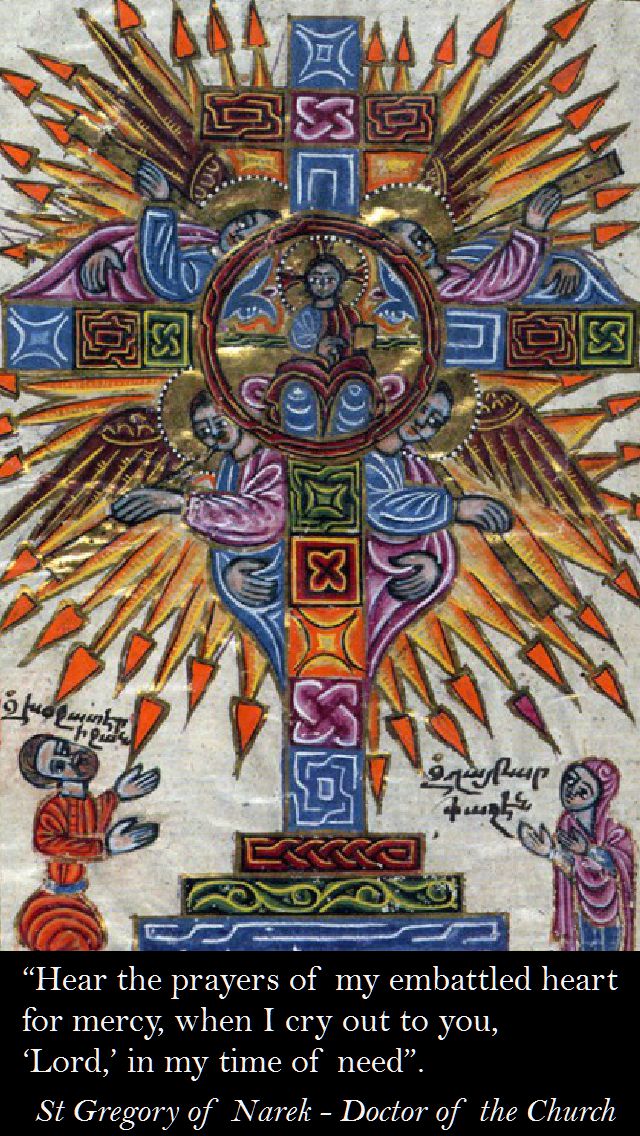
St Gregory of Narek – Doctor of the Church, Poet, Philosopher and Theologian
St Herefrith of Lindsey
St Honorina
St John of Gorze
Bl Josep Tous Soler
St Luke of Messina
Bl Maria Caridad Brader
Bl Mark Barkworth
St Procopius of Decapolis
Bl Roger Filcock
St Thalilaeus
Bl William Richardson

Martyrs of Alexandria: –
Besas of Alexandria
Cronion Eunus
Julian of Alexandria

Posted in DOCTORS of the Church, MORNING Prayers, QUOTES of the SAINTS, The WORD

One Minute Reflection – 22 February

One Minute Reflection – 22 February

“On this rock I will build my Church’,,,,,,,,,,Matthew 16:18

REFLECTION – “How blessed is the Church of Rome, on which the Apostles poured forth all their doctrine along with their blood!” (De Praescriptione Hereticorum, 36)…….Tertullian
“I decided to consult the Chair of Peter,
where that faith is found exalted by
the lips of an Apostle;
I now come to ask for nourishment for my soul there,
where once I received the garment of Christ.
I follow no leader save Christ,
so I enter into communion with Your beatitude,
that is, with the Chair of Peter,
for this I know is the rock upon which the Church is built”
(cf. Le lettere I, 15, 1-2)…………..St Jerome

PRAYER – Holy Father, send Your Divine Enlightener into the hearts of all Your faithful, filling us with the strength to fulfil our mission as the followers of the Chair of St Peter. And most of all, we pray Lord Holy God to inspire and light the way of our Holy Father, Francis. Sustain and guide him, keep him in health and strength, to lead Your people by the Light of the Way and the Truth. Holy Father, have mercy on us, Holy Spirit guide and lead us, Lord Jesus Christ be our intercessor and teacher, amen.

on-this-rock-matthew-16-18on-this-rock-i-willbuild-my-church-matthew-16-18how-blessed-is-the-church-of-rome-tertulliani-decided-to-consult-the-chair-of-peter-st-jerome


Posted in DOCTORS of the Church, MORNING Prayers, SAINT of the DAY

Thought for the Day – 21 February

Thought for the Day – 21 February

St Peter Damian was a reformer but he reformed his own life before he tried to reform others.   Example is still the most powerful influence in changing others and preaching is useless if it is not joined to a holy life.   Before we can change others, we have to change ourselves.   Lent is nearly here – a great place to work on our progress or to begin all over again.

St Peter Damian, pray for us!

st-peter-damian-pray-for-us-2st-peter-damian-21-feb

Posted in DOCTORS of the Church, MORNING Prayers, QUOTES of the SAINTS, SAINT of the DAY

Quote/s of the Day

Quote/s of the Day

“He pours light into our minds, arouses our desire and gives us strength…
As the soul is the life of the body, so the Holy Spirit is the life of our souls.”

“The best penance is to have patience with the sorrows God permits.
A very good penance is to dedicate oneself to fulfill the duties of everyday
with exactitude and to study and work with all our strength.”

“Through a woman [Eve] a curse fell upon the earth;
through a woman [Mary] as well there returned
to the earth, a blessing.”

St Peter Damian

he-pours-light-into-our-minds-st-peter-damian84791e84504fcc717afbaafbf2d0eb9ethrough-a-woman-st-peter-damian

Posted in DOCTORS of the Church, MORNING Prayers, QUOTES of the SAINTS, SAINT of the DAY, The WORD

One Minute Reflection – 21 February

One Minute Reflection – 21 February

For whom the Lord loves he reproves,
he chastises the one he favours………….Proverbs 3:12

REFLECTION – “When you are scorned by others and lashed by God, do not despair.
God lashes us in this life to shield us from the eternal lash in the next.”………..St Peter Damian

PRAYER – Infinitely just God, help me to accept Your corrections and turn them to my benefit. Let me never despair about my weaknesses but entrust myself to Your goodness and mercy. Help me Lord! St Peter Damian, pray for us, amen.

proverbs-3-12when-you-are-scorned-by-others-st-peter-damianst-peter-damian-pray-for-us

Posted in DOCTORS of the Church, SAINT of the DAY

Saint of the Day – 21 February – St Peter Damian (c 1007-1072)

Saint of the Day – 21 February – St Peter Damian (c 1007-1072) Bishop, Confessor, Benedictine Monk, Cardinal, Theologian, Reformer, Writer, Teacher, Preacher, Poet and Doctor of the Church.   Also known as – Petrus Damianus; Italian: Pietro or Pier Damiani was a reforming Benedictine Monk and Cardinal in the circle of Pope Leo IX.    Dante placed him in one of the highest circles of Paradiso as a great predecessor of Saint Francis of Assisi. He was declared a Doctor of the Church in 1828 by Patronages – Spiritual warfare, Church Reformers and of Faenza, Italy.

Peter was born in Ravenna, Italy, around 1007, the youngest of a large noble but poor family.    Orphaned early, he was at first adopted by an elder brother, who ill-treated and underfed him while employing him as a swineherd.    After some years, another brother, Damianus, who was Archpriest at Ravenna, had pity on him and took him away to be educated.    Adding his brother’s name to his own, Peter made such rapid progress in his studies of Theology and Canon Law, first at Ravenna, then at Faenza and finally at the University of Parma, that when about twenty-five years old he was already a famous teacher at Parma and Ravenna.   As well as a good grounding in the field of law, he acquired a refined expertise in the art of writing the ars scribendi and, thanks to his knowledge of the great Latin classics, became “one of the most accomplished Latinists of his time, one of the greatest writers of medieval Latin” (J. Leclercq, Pierre Damien, ermite et homme d’Église, Rome, 1960, p. 172).

About 1035, however, he gave up his secular calling and, avoiding the compromised luxury of Cluniac Monasteries, entered the isolated hermitage of Fonte Avellana, near Gubbio. Both as a Novice and as a Monk, his fervour was remarkable but led him to such extremes of self-mortification in penance that his health was affected and he developed severe insomnia.    On his recovery, he was appointed to lecture to his fellow Monks.    Then, at the request of St Guy of Pomposa (Guido d’Arezzo) and other heads of neighbouring Monasteries, for two or three years he lectured to their brethren too and (about 1042) wrote the Vita of St. Romuald for the monks of Pietrapertosa.    Soon after his return to Fonte Avellan, he was appointed Economus (manager or administrator) of the house by the Prior, who designated him as his successor.    In 1043 he became Prior of Fonte Avellana and remained so until his death in February 1072.

Subject-hermitages were founded at San Severino, Gamogna, Acerreta, Murciana, San Salvatore, Sitria and Ocri. A zealot for monastic and clerical reform, he introduced a more-severe discipline, including the practice of flagellation (“the disciplina”), into the house, which, under his rule, quickly attained celebrity and became a model for other foundations, even the great abbey of Monte Cassino.    There was much opposition outside his own circle to such extreme forms of penitence, but Peter’s persistent advocacy ensured its acceptance, to such an extent that he was obliged later to moderate the imprudent zeal of some of his own hermits.   Another innovation was that of the daily siesta, to make up for the fatigue of the night office.    During his tenure of the priorate a cloister was built, silver chalices and a silver processional cross were purchased, and many books were added to the library.

Reformer
Although living in the seclusion of the cloister, Peter Damian closely watched the fortunes of the Church and like his friend Hildebrand, the future Pope Gregory VII, he strove for reforms in a deplorable time.    When Benedict IX resigned the pontificate into the hands of the archpriest John Gratian (Gregory VI) in 1045, Peter hailed the change with joy and wrote to the new pope, urging him to deal with the scandals of the church in Italy, singling out the wicked bishops of Pesaro, of Città di Castello and of Fano.    Extending the area of his activities, he entered into communication with the Emperor Henry III.    He was present in Rome when Clement II crowned Henry III and his consort Agnes and he also attended a synod held at the Lateran in the first days of 1047, in which decrees were passed against simony.    After this he returned to his hermitage.

Pope Benedict XVI described him as “one of the most significant figures of the 11th century … a lover of solitude and at the same time a fearless man of the Church, committed personally to the task of reform.”

Philosophy
Peter often condemned philosophy.    He claimed that the first grammarian was the Devil, who taught Adam to decline deus in the plural.    He argued that monks should not have to study philosophy, because Jesus did not choose philosophers as disciples and so philosophy is not necessary for salvation.    But the idea (later attributed to Thomas Aquinas) that philosophy should serve theology as a servant serves her mistress originated with him.

Papal envoy and Cardinal
During his illness the pope died, and Frédéric, abbot of Monte Cassino, was elected pope as Stephen IX.    In the autumn of 1057, Stephen IX determined to make Damian a cardinal. For a long time Damian resisted the offer, for he was more at ease as an itinerant hermit-preacher than a reformer from within the Curia but was finally forced to accept and was consecrated Cardinal Bishop of Ostia on 30 November 1057.    In addition he was appointed administrator of the Diocese of Gubbio.    The new cardinal was impressed with the great responsibilities of his office and wrote a stirring letter to his brother-cardinals, exhorting them to shine by their example before all.    Four months later Pope Stephen died at Florence and the Church was once more distracted by schism.    Peter was vigorous in his opposition to the antipope Benedict X but force was on the side of the intruder and Damian retired temporarily to Fonte Avallana.

Milan
About the end of the year 1059 Peter was sent as legate to Milan by Pope Nicholas II.   So bad was the state of things at Milan, that benefices (a reward received in exchange for services rendered and as a retainer for future services) were openly bought and sold and the clergy publicly married the women with whom they lived.    The resistance of the clergy of Milan to the reform of Ariald the Deacon and Anselm, Bishop of Lucca rendered a contest so bitter that an appeal was made to the Holy See.   Nicholas II sent Damian and the Bishop of Lucca as his legates.    The party of the irregular clerics took alarm and raised the cry that Rome had no authority over Milan.    Peter boldly confronted the rioters in the cathedral, he proved to them the authority of the Holy See with such effect that all parties submitted to his decision.   He exacted first a solemn oath from the archbishop and all his clergy that for the future no preferment should be paid for; then, imposing a penance on all who had been guilty, he reinstated in their benefices all who undertook to live in celibacy.    This prudent decision was attacked by some of the rigorists at Rome but was not reversed.   Meanwhile, Peter was pleading in vain to be released from the cares of his office. Neither Nicholas II nor Hildebrand would consent to spare him.

Later career
He rendered valuable assistance to Pope Alexander II in his struggle with the antipope, Honorius II.    In July 1061 the pope died and once more a schism ensued.    Peter Damian used all his powers to persuade the antipope Cadalous to withdraw but to no purpose. Finally Anno II, Archbishop of Cologne and acting regent in Germany, summoned a council at Augsburg at which a long argument by Peter Damian was read and greatly contributed to the decision in favour of Alexander II.

In 1063 the pope held a synod at Rome, at which Peter Damian was appointed legate to settle the dispute between the Abbey of Cluny and the Bishop of Mâcon.   He proceeded to France, summoned a council at Chalon-sur-Saône, proved the justice of the contentions of Cluny, settled other questions at issue in the Church of France and returned in the autumn to Fonte Avellana.    Having served the papacy as legate to France and to Florence, he was allowed to resign his bishopric in 1067.    Early in 1072 or 1073 he was sent to Ravenna to reconcile its inhabitants to the Holy See, they having been excommunicated for supporting their archbishop in his adhesion to the schism of Cadalous.    On his return thence he was seized with fever near Faenza.    He lay ill for a week at the monastery of Santa Maria degl’Angeli, now Santa Maria Vecchia.    On the night preceding the feast of the Chair of St. Peter at Antioch, he ordered the office of the feast to be recited and at the end of the Lauds he died.    He was at once buried in the monastery church, lest others should claim his relics.

Posted in DOCTORS of the Church, MORNING Prayers, QUOTES of the SAINTS, SAINT of the DAY, The WORD

One Minute Reflection – 13 February

One Minute Reflection – 13 February

Find your delight in the LORD
who will give you your heart’s desire………….Psalm 37:4

REFLECTION – “Happiness is secured through virtue;
it is a good attained by man’s own will.” ,,,,,,,,,,,,,,,,, St Thomas Aquinas

PRAYER – All-provident Lord, my God, You are my Father and in You is all my hope and trust.   Teach me to live according to Your precepts, knowing that through them I will attain virtue and thus be filled with true joy.   Blessed Jordan of Saxony, you were filled with love for your fellowman and through your virtue you assisted many to achieve holiness and happiness.  Pray for us that we may too be filled with virtue, love and the true happiness of God which is joy, amen.

psalm-37-4happiness-is-secured-through-virtue-stthomasaquinasblessed-jordan-of-saxony-pray-for-us

Posted in DOCTORS of the Church, MORNING Prayers, PRAYERS of the SAINTS

Our Morning Offering – 13 February

Our Morning Offering – 13 February

Father, keep us from vain strife of words.
Grant to us constant profession of the Truth!
Preserve us in a true and undefiled faith
so that we may hold fast to that
which we professed when we were baptised
in the Name of the Father, Son and Holy Spirit,
that we may have Thee for our Father,
that we may abide in Thy Son
and in the fellowship of the Holy Spirit.
Through Jesus Christ, Our Lord, amen.

By St Hilary of Poitiers

prayer-st-hilary-of-poitiers-fatherkeepusfromvainstrifeofwords


Posted in DOCTORS of the Church, MORNING Prayers, The WORD

One Minute Reflection – 2 February

One Minute Reflection – 2 February

Although he was a Son, he learned obedience through what he suffered;………..Heb 5: 7-9

REFLECTION – “On this Feast of the Presentation of the Lord, the Church is celebrating the Day of Consecrated Life.   This is an appropriate occasion to praise the Lord and thank him for the precious gift represented by the consecrated life in its different forms; at the same time it is an incentive to encourage in all the People of God, knowledge and esteem for those who are totally consecrated to God.   Indeed, just as Jesus’ life in his obedience and dedication to the Father is a living parable of the “God-with-us”, so the concrete dedication of consecrated persons to God and to their brethren becomes an eloquent sign for today’s world of the presence of God’s Kingdom.”……..Pope Benedict XVI 2 February 2006

PRAYER – May the Lord renew in you and in all consecrated people each day the joyful response to His freely given and faithful love.   Dear brothers and sisters, like lighted candles, always and everywhere shine with the love of Christ, Light of the world.   May Mary Most Holy, the consecrated Woman, help you to live to the full, your special vocation and mission in the Church for the world’s salvation.   And may we all follow our Lord in obedience. Amen!

hebrews-5-7

consecratedlife_400

Posted in DOCTORS of the Church, MORNING Prayers, SAINT of the DAY

Thought for the Day – 28 January

Thought for the Day – 28 January

For St Thomas, the goodness of God can be seen in everything and the whole of creation is a mighty love song of God.   He learned more at the foot of the Crucifix and before the Blessed Sacrament, he said, than in all his readings and writings.   We can look to Thomas Aquinas as a towering example of Catholicism in the sense of broadness, universality and inclusiveness.   We should be determined anew to exercise the divine gift of reason in us, our power to know, learn and understand.   At the same time we should thank God for the gift of His revelation, the incarnation of His Son, Jesus Christ who is here with us always in the Holy Sacrament.

St Thomas Aquinas Pray for us!

st-thomas-aquinas-jan-28

st-thomas-pray-for-us


Posted in DOCTORS of the Church, SAINT of the DAY

Saint of the Day – 28 January – St Thomas Aquinas

Saint of the Day – 28 January – St Thomas Aquinas O.P. (1225-1274 aged 49) THE ANGELIC DOCTOR – DOCTOR of the CHURCH/Priest, Religious, Theologian, Philosopher, Write, Teacher, Jurist.   Also known as: Angelic Doctor/Doctor Angelicus/Doctor Communis/Great Synthesizer/The Dumb Ox/The Universal Teacher.    Patron of Academics, Theologians, against storms; against lightning; apologists; book sellers; Catholic academies, Catholic Schools – (proclaimed on 4 August 1880 by Pope Leo XIII), Catholic universities, Catholic Colleges, chastity, learning; pencil makers, philosophers; publishers; scholars; students; University of Vigo and of St. Tomas;, Batangas; theologians, Aquino, Italy; Belcastro, Italy, Diocese of Aquino,  Falena, Italy.

St Thomas Aquinas was an Italian Dominican friar, Catholic priest and Doctor of the Church.   He was an immensely influential philosopher, theologian and jurist in the tradition of scholasticism, within which he is also known as the Doctor Angelicus and the Doctor Communis.   The name Aquinas identifies his ancestral origins in the county of Aquino in present-day Lazio.

He was the foremost classical proponent of natural theology and the father of Thomism. His influence on Western thought is considerable, and much of modern philosophy developed or opposed his ideas, particularly in the areas of ethics, natural law, metaphysics and political theory.   Unlike many currents in the Church of the time, Thomas embraced several ideas put forward by Aristotle—whom he called “the Philosopher”—and attempted to synthesize Aristotelian philosophy with the principles of Christianity.   The works for which he is best known are the Summa Theologiae and the Summa contra Gentiles.   His commentaries on Scripture and on Aristotle form an important part of his body of work. Furthermore, Thomas is distinguished for his eucharistic hymns, which form a part of the Church’s liturgy.

The Catholic Church honours Thomas Aquinas as a saint and regards him as the model teacher for those studying for the priesthood, and indeed the highest expression of both natural reason and speculative theology. In modern times, under papal directives, the study of his works was long used as a core of the required program of study for those seeking ordination as priests or deacons, as well as for those in religious formation and for other students of the sacred disciplines (philosophy, Catholic theology, church history, liturgy, and canon law).

Thomas Aquinas is considered one of the Catholic Church’s greatest theologians and philosophers. Pope Benedict XV declared: “This (Dominican) Order … acquired new luster when the Church declared the teaching of Thomas to be her own and that Doctor, honoured with the special praises of the Pontiffs, the master and patron of Catholic schools.”

crash-course-aquinasf828980ca600e4f0814c9e37e235a62b

By universal consent, Thomas Aquinas is the preeminent spokesman of the Catholic tradition of reason and of divine revelation.   He is one of the great teachers of the medieval Catholic Church, honoured with the titles Doctor of the Church and Angelic Doctor. (Image below – Benozzo Gozzoli – Triumph of St Thomas Aquinas)

264px-Benozzo_Gozzoli_-_Triumph_of_St_Thomas_Aquinas_-_WGA10334.jpg

At five he was given to the Benedictine monastery at Monte Cassino in his parents’ hopes that he would choose that way of life and eventually became abbot.   In 1239, he was sent to Naples to complete his studies.   It was here that he was first attracted to Aristotle’s philosophy.   By 1243, Thomas abandoned his family’s plans for him and joined the Dominicans, much to his mother’s dismay.   On her order, Thomas was captured by his brother and kept at home for over a year.   Once free, he went to Paris and then to Cologne, where he finished his studies with Albert the Great.   In class, his silence during discussions and his large size earned him the nickname “the dumb ox.”  He held two professorships at Paris, lived at the court of Pope Urban IV, directed the Dominican schools at Rome and Viterbo, combated adversaries of the mendicants, as well as the Averroists and argued with some Franciscans about Aristotelianism.

04031f9dfa182cc79fba3383cc3074af
Jean Fouquet

His greatest contribution to the Catholic Church are his writings.   The unity, harmony and continuity of faith and reason, of revealed and natural human knowledge, pervades his writings.   One might expect Thomas, as a man of the gospel, to be an ardent defender of revealed truth.   But he was broad enough, deep enough, to see the whole natural order as coming from God the Creator, and to see reason as a divine gift to be highly cherished.

thomas-acquinas

The Summa Theologiae, his last and, unfortunately, uncompleted work, deals with the whole of Catholic theology.   But this brilliant man was very humble.   He knew that all his gifts came from God.   While celebrating Mass on December 6, 1273, he received a revelation from God.  After that, he stopped writing.   He said  “I cannot go on…. All that I have written seems to me like so much straw compared to what I have seen and what has been revealed to me.”  Thomas died at age 49 on his way to the Council of Lyons, France. Pope Gregory X had asked him to come. When asked why he stopped writing, he replied,   He died March 7, 1274.


Posted in DOCTORS of the Church, MORNING Prayers, QUOTES of the SAINTS, SAINT of the DAY

Quote/s of the Day – 28 January

Quote/s of the Day – 28 January

“Faith has to do with things that are not seen
and hope with things that are not at hand.”

“The celebration of Holy Mass is as valuable
as the death of Jesus on the cross.”

“To love is to will the good of the other.”

“If you can live amid injustice without anger,
you are immoral as well as unjust.”

“In the life of the body a man is sometimes sick
and unless he takes medicine, he will die.
Even so in the spiritual life a man is sick
on account of sin.
For that reason he needs medicine
so that he may be restored to health –
and this grace is bestowed in the Sacrament of Penance.”

“To pretend angels do not exist
because they are invisible is to believe
we never sleep because we don’t see
ourselves sleeping.”

“To bear with patience wrongs done to oneself
is a mark of perfection but to bear with patience
wrongs done to someone else is a mark of imperfection
and even of actual sin.”

“All the efforts of the human mind
cannot exhaust the essence of a single fly.”

~~~ ST THOMAS AQUINAS (Saint of the Day)

holy-mass-st-thomas-aquinaswisdom-of-st-thomas-aquinas

if-a-man-is-sick-st-aquinas

Posted in CATHOLIC Quotes, DOCTORS of the Church, MORNING Prayers, The WORD

One Minute Reflection – 26 January

One Minute Reflection – 26 January

So do not be ashamed of your testimony to our Lord,
nor of me, a prisoner for his sake;
but bear your share of hardship for the Gospel
with the strength that comes from God………..2 Tm 1:1-8
…….to Titus, my true child in our common faith:
grace and peace from God the Father and Christ Jesus our saviour.
For this reason I left you in Crete
so that you might set right what remains to be done…………Ti 1:1-5

REFLECTION – …. we consider together the two figures of Timothy and Titus, we are aware of certain very significant facts………. it clearly appears that (Paul) he did not do everything on his own but relied on trustworthy people who shared in his endeavours and responsibilities.   The sources concerning Timothy and Titus highlight their readiness to take on various offices that also often consisted in representing Paul in circumstances far from easy.   In a word, they teach us to serve the Gospel with generosity realizing that this also entails a service to the Church herself..”………………Pope Benedict XVI

PRAYER – Father of light, let my life be illumined by the light of Christ and enable me to radiate the Gospel to others.  Teach me, like Sts Timothy and Titus to give my all to the service of the Bride of Christ, His Mystical Body, the Church.   Sts Timothy and Titus, pray for us. amen.

one-minute-reflectionmemorial-sts-tim-and-titus

Posted in DOCTORS of the Church, SAINT of the DAY

Saint of the Day – 24 January – St Francis de Sales – Doctor of the Church

Saint of the Day – 24 January – St Francis de Sales CO, OM, OFM (Cap)- Doctor of the Church / “The Gentleman Saint” (1567-1622 aged 55) Bishop of Geneva – Patron of  against deafness, authors, writers (proclaimed on 26 April 1923 by Pope Pius XI), Catholic press, confessors, deaf people, journalists (proclaimed on 26 April 1923 by Pope Pius XI), teachers, educators, Champdepraz, Aosta, Italy, 8 dioceses – Also known as “The Gentle Christ of Geneva”, Francis of Sales, Franz von Sales – His motto ‘Non-excidet’ – (no failure)

coa_francis_de_sales-svg

He became noted for his deep faith and his gentle approach to the religious divisions in his land resulting from the Protestant Reformation.   He is known also for his writings on the topic of spiritual direction and spiritual formation, particularly the Introduction to the Devout Life  and the Treatise on the Love of God.

Francis de Sales was born on 21 August 1567 in the Château de Sales into the noble Sales family of the Duchy of Savoy, in what is today Thorens-Glières, Haute-Savoie, France., the eldest of 13 children.    His father was François de Sales, Lord of Boisy, Sales and Novel.   His mother was Françoise de Sionnaz, the only child of prominent magistrate, Melchior de Sionnaz and a noblewoman.   He was baptised Francis Bonaventura, after two great Franciscan saints. His father wanted him, the first of his six sons, to attend the best schools in preparation for a career as a magistrate.   He therefore enjoyed a privileged education in the nearby town of La Roche-sur-Foron and at the age of eight, at the Capuchin college in Annecy.

From early youth, Saint Francis de Sales had a great desire to devote himself entirely to the service of God, although his father had other plans for him.   With the pious Abbe Deage as his tutor, Francis was a student at the University of Paris from his fourteenth to his twentieth year;  and after studying jurisprudence at the University of Padua for four more years, he was awarded the degree of Doctor of Law.   Francis was also a skilled swordsman who enjoyed fencing, an expert horseman and a superb dancer.   Then Francis studied at the University of Padua and received a doctorate in civil and canon law.  His father wanted him to marry but Francis desired to be a priest.   In 1593 he finally obtained the consent of his father to enter the sacred ministry;  and since he had devoted much time to the study of theology during his student years, he was ordained a priest six months later.

2393e6f68ade4f8c005377003af45539

Not long afterwards Saint Francis de Sales volunteered for the difficult and dangerous task of leading the people of the province of Chablais back to the fold of the Church, after the protestant reformation.   Several times he miraculously escaped death at the hands of assassins.   But he persevered in his heroic and patient efforts and after four years succeeded in converting a large number of Calvinists.  It was here that Francis began to write and distribute a weekly essay, explaining some doctrines of faith.  For two years, he and his friends had these essays printed.   Francis preached with power and charm in simple, clear language.   His gentleness and love drew many hearts to God.   The majority of the Chablais inhabitants accepted the Catholic faith.

In 1599 he was appointed coadjutor to his bishop and in 1602 he became bishop of Geneva, a position which he filled in an exemplary manner for twenty years.  When Francis was appointed bishop of Geneva, he not only wrote for and encouraged priests, but he also took an interest in the candidates for priesthood. Francis even conducted the examinations to see if the candidates were fit for this vocation. He also trained laypeople to teach catechism. Francis often gave spiritual guidance to people.

At Dijon, in 1604, Saint Francis de Sales became acquainted with St Jane de Chantal, for whom and through whom he founded the nursing and teaching order known as Visitation Nuns. He died at Lyons on December 28, 1622.

800px-francois_de_sales_et_jeanne_de_chantal

Francis de Sales and Jane Frances de Chantal, medal 1867

458213b8d73c11f8bea48d33fe482929

4 T

The body of the holy bishop was exhumed ten years after his death and was found perfectly preserved. When the body was once again exhumed at a later date, only bones and dust remained.

St Frances de Sales was beatified in 1661, and canonized in 1665. He was declared a doctor of the Church in 1877


Posted in DOCTORS of the Church, JESUIT SJ, MORNING Prayers, SAINT of the DAY, The BLESSED VIRGIN MARY, The WORD

One Minute Reflection – 21 December

One Minute Reflection – 21 December

God who is mighty, has done great things for me, holy is his name…….Lk 1:49

REFLECTION – “While remaining the Mother of our Judge, Mary is a mother to us, full of mercy.
She constitutes our protection. She keeps us close to Christ and she faithfully takes the matter of our salvation into her charge.”……………….St Peter Canisius (Saint of the Day)

PRAYER – Heavenly Father, You have filled Mary with grace and made her a Co-Redeemer with Christ Your Son. Grant that I may have constant recourse to her and attain the salvation she helped win for the world. St Peter Canisius Pray for us! Amen

df8e86b9b533cd6b84c2ddf71997be35100239st-p-canisius


Posted in DOCTORS of the Church, SAINT of the DAY

Saints for 21 December

St Peter Canisius (Optional Memorial)/Hammer of Protestantism/ Second Apostle of Germany

Bl Adrian of Dalmatia
St Anastasius II of Antioch
St Anrê Tran An Dung
Bl Anton Durcovici
St Baudacarius of Bobbio
St Beornwald of Bampton
Bl Bezela of Göda
Bl Daniel of the Annunciation
St Dioscorus
St Festus of Tuscany
St Glycerius of Nicomedia
St James of Valencia
St John of Tuscany
St John Vincent
St Micah the Prophet
St Phêrô Truong Van Thi
St Severinus of Trèves
Bl Sibrand of Marigård
St Themistocles of Lycia

Posted in DOCTORS of the Church, MORNING Prayers, QUOTES of the SAINTS

Quote of the Day – 17 December

Quote of the Day – 17 December

“For not eating and drinking makes friendship: such friendship even robbers have and murderers. But if we are friends, if we truly care for one another, let us in these respects help one another. This leads us to a profitable friendship: let us hinder those things which lead away to hell.”

~~~ Saint John Chrysostom

100239