Quote/s of the Day – 10 January – “Month of the Most Holy Name of Jesus”
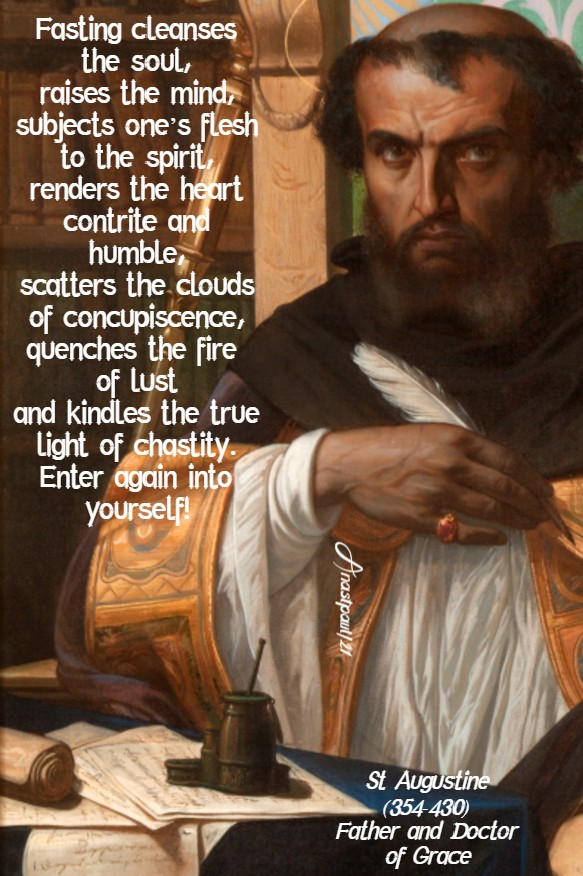
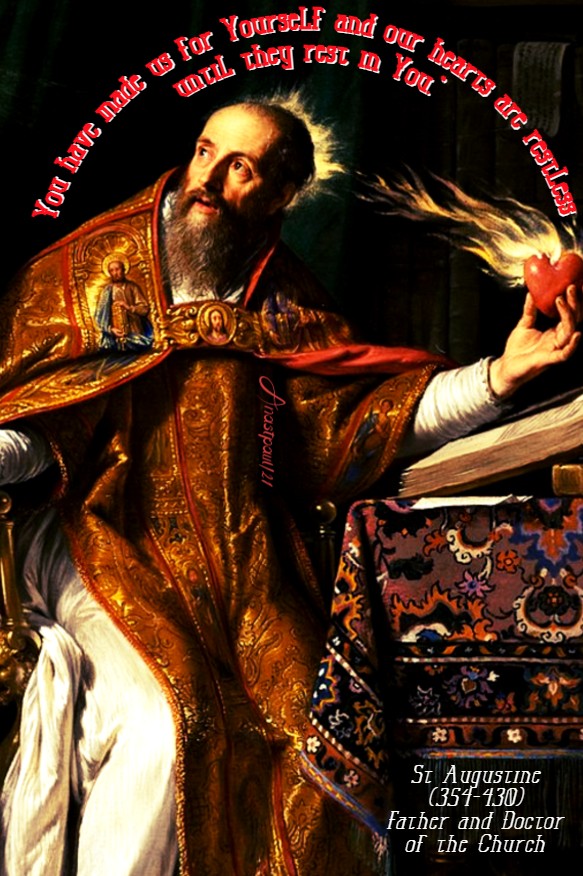
“People who associate the name of Christian with a dishonest life, injure Christ… If God’s Name, is blasphemed by bad Christians, it is praised and honoured, on the other hand, by the good: “For in every place, we are the aroma of Christ” (2 Cor,14-15). And it is said in the Song of Songs: “Your name is oil poured out” (1,3).”
St Augustine (354-430) Father and Doctor of Grace
“The Name of Jesus is the purest and holiest, the noblest and most indulgent of names, the Name of all blessings and of all virtues, it is the Name of the God-Man, of sanctity itself.”
St Bernard of Clairvaux (1090-1153) Mellifluous Doctor of the Church
“Sacrilegious tongues blaspheme the God who preserves their existence! … you should be damned forever and, instead of thanking Him for His goodness, you, at the very time that He bestows His favours upon you, YOU blaspheme His Holy Name!”
St Alphonsus Maria de Liguori (1696-1787) Most Zealous Doctor
Our Morning Offering – 10 January – The Fifth Day within the Octave of Epiphany
O Child, So Worthy of Our Love, I Offer Thee My Heart (O Grant Me that Gold, Incense and Myrrh Which I Lack) By St Alphonsus Liguori (1696-1787) Most Zealous Doctor
O Child so worthy of our love, I see You lying on the straw in this cave, so poor and despised. Yet faith teaches me, that You are my God come down from heaven for my salvation. I acknowledge You as my Sovereign Lord and Saviour, as such I proclaim You, yet, I have nothing at all to offer You. I am without Love’s Gold, since I have given my love to the things of this world – I have only loved my own whim, rather than loving You, so infinitely worthy of love. I am without Prayer’s Incense, since I have lived wretchedly without thinking of You. I have no Myrrh of Mortification since, so as not to forsake some paltry pleasures, I have so often saddened Your infinite goodness. So what am I to offer You? O my Jesus, I offer You my heart, soiled and naked as it is. Take it and change it, for You have come down to us to wash our guilty hearts with Your Blood and so transform us from sinners into saints. O grant me that Gold, Incense and Myrrh which I lack. Grant me the Gold of Your Holy Love; grant me the Incense which is the spirit of prayer; grant me Myrrh, the willingness and strength to deny myself in all that displeases You… O holy Virgin, you welcomed those devout Magi Kings with keen affection and satisfied them. Deign to welcome and comfort me also, I, who come, following their example, to visit and offer myself to your Son Amen.
One Minute Reflection – 9 January – Sunday withi the Octave of Epiphany and the Feast of the Holy Family of Jesus, Mary and Joseph, Readings: Colossians 3:12-17, Luke 2:42-52
“He went down with them and came to Nazareth and was obedient to them” – Luke 2:51
REFLECTION – “In saying to Joseph – “Do not be afraid to take Mary as your wife” (Mt 1:20), the Angel was not mistaken. … The address as “wife” was neither empty nor false, for this Virgin was the happiness of her husband, in a way, that was all the more perfect and admirable, in that she became a mother without the participation of that husband, fecund, without him but faithful to him. It was because of that genuine marriage, that they both merited to be called “the parents of Christ” – not only she as “His Mother” but also he, as “his father,” insofar as he was husband of Christ’s Mother, father and husband spiritually, not according to the flesh. Both of them – he only by the spirit, she even in the flesh – are parents of His Humility, not of His Nobility, parents of His Weakness, not of his Divinity. Look in the Gospel, which cannot lie – His Mother said to Him: “Son, why have you done this to us? See how your father and I, have been searching for you anxiously.”
As for Him, wanting to show that He also had a Father, besides them, who had conceived Him without a mother, answered them: “Why were you looking for me? Did you not know that I had to be in my Father’s house?” And so, that no-one should think that in speaking thus, He was denying His parents, the Evangelist added: “He went down with them to Nazareth and was subject to them.” … Now why did He subject Himself to those who were so inferior to His Divine Nature? Because, “humbling himself, he took on the nature of a slave” (Phil 2:7), according to which, they were His parents. If they had not been united by a true marriage, even without carnal intercourse, they could not both have been the parents of that nature of a servant.
So, taking Christ’s genealogy from Joseph – a husband in chastity, he was father in the same way. … Are you saying that he did not conceive Jesus through the operation of nature? Well then, what the Holy Spirit operated, He did for them both. For Joseph was “a just man,” Matthew tells us (1:19). Both husband and wife were just. The Holy Spirit dwelt within their mutual justice and gave each of them, a Son!” – St Augustine (354-430) Father and Doctor of Grace (Marriage and concupiscence 1,11; Sermon 51)
PRAYER – God, our Father, in the Holy Family of Nazareth, You have given us the true model of a Christian home. Grant, that by following Jesus, Mary and Joseph in their love for each other and in the example of their family life, we may come to Your home of peace and joy. We make our prayer through our Lord Jesus Christ, Your Son Who lives and reigns with You and the Holy Spirit, God, now and forever, amen.
Our Morning Offering – 8 January – Octave of Epiphany and Mary’s Day
Mother of Salvation, Blessed Lady By Anselm (1033-1109) Magnificent Doctor Marian Doctor
Mother of Salvation, Blessed Lady, you are the Mother of Justification and those who are justified; the Mother of Reconciliation and those who are reconciled; the Mother of Salvation and those who are saved. What a blessed trust and what a secure refuge! The Mother of God is our Mother. The Mother of the One in Whom alone, we hope and Whom alone, we fear, is our Mother! … The One Who partook of our nature and by restoring us to life, made us children of His Mother, invites us by this grace, to proclaim that we are His brothers and sisters. Therefore, our Judge, is also our Brother. The Saviour of the world, is our Brother. Our God has become – through Mary – our Brother! Anen
One Minute Reflection – 7 January – The Second Day within the Octave of Epiphany, Readings:1 John 5: 5-13; Psalm 147: 12-15, 19-20; Gospel: Luke 5: 12-16
“Jesus stretched out his hand and touched him” … Luke 5:13
REFLECTION – “Christ said when He came into the world: ‘Sacrifice and offering you did not desire but a body you prepared for me … Then I said: Behold I come to do your will’ ” (Heb 10:5.7; Ps 40:7-9 LXX). Can it be true that God wanted to become man to save us from our wretchedness … and conquer our love? Yes, it is so true that it is an article of faith: “Who for us and for our salvation came down from heaven… and was made man” (Creed) … Yes, this is what God has done, so to be loved by us! … This is how He wanted to make known the immensity of His love for us: “the grace of God our saviour has appeared to all” (Ti 2:11). It is, as though, our Lord said: “Man does not love Me because he cannot see Me, I am going to make Myself visible and talk to him, in that way I shall surely make Myself loved”: “He has appeared on earth and spoken with us” (cf. Bar 3:38).
God’s love for humankind is vast, vast from all eternity: “with age-old love I have loved you; so in mercy I have drawn you to myself” (cf. Jer 31:3). But we have not yet seen how great and incomprehensible He is. When the Son of God was seen in the form of a child, lying on the straw in a stable, then He was made known indeed: “the kindness and generous love of God our saviour appeared” (Ti 3:4). As Saint Bernard observed: “The creation of the world made God’s power shine out, the ordering of the world, His wisdom but the Incarnation of the Word, caused His mercy to break forth in the sight of all.” …
“By showing disdain towards God,” Saint Fulgentius said, “man was separated from Him forever and, since man could no longer return to God, God deigned to come to find him on earth.” And as Saint Augustine had already said: “We were unable to go to the Doctor, therefore, the Doctor had the graciousness, to come to us.” … St Alphonsus Maria de Liguori (1696-1787) – Bishop and Doctor of the Church – 1st address for the Octave of Christmas.
PRAYER – Almighty God and Father, by the guidance of a star, You revealed the Birth of the Saviour of the world. Open our minds and hearts to that revelation and may it bear fruit in our lives. May Your nearness, be understood in our hearts and minds, ‘may the Lord Jesus touch our eyes, as He did those of the blind and may the prayers of His Blessed Mother Mary and ours, grant us strength on our journey. We make our prayer, through Christ, our Lord in the unity of the Holy Spirit, God forever and ever, amen.
Quote/s of the Day – 6 January – The Solemnity of the Epiphany of the Lord
“All elements in nature testified that their Creator had come. Let me indicate them in our everyday fashion. The heavens knew that He was God, for they sent a star to herald Him. The sea knew Him, for it bore up His feet upon it. The earth knew Him and trembled when He died. The sun knew Him and hid its light. The stones and walls knew Him and were rent at His death. Hell knew Him and gave up its dead. All the insensible elements of nature knew Him but even up to this minute, the hearts of the unbelieving Jews will not recognise Him as God and–more hard than rock– will not be rent in penitence.”
St Pope Gregory the Great (540-604) Father and Doctor of the Church
“But, lo! on entering into the little shed these holy pilgrims feel a joy which they had never felt before; they feel their hearts chained to the dear little Infant Whom they behold. The straw, the poverty, the cries of their little Saviour– Oh, what darts of love! Oh, what blessed flames are they to their enlightened hearts! The Infant looks upon them with a joyful countenance and this is the mark of affection, with which He accepts them amongst the first-fruits of His Redemption!”
St Alphonsus Maria de Liguori (1696-1787) Most Zealous Doctor of the Church
Chalk the Door – Epiphany House Blessing 20 C+M+B 22 “Christus mansionem benedicat” The equation is written to be the first two digits of the year, followed by the initials C, M, and B, followed by the last two digits of the year. Each portion is split by plus signs (being the Sign of the Cross). For this year, the equation would be written as “20 + C + M + B + 22”
The chalking holds two meanings. The C, M and B, refer to the traditional names of the Magi: Caspar, Melchior and Balthasar. The letters also stand for the Latin phrase “Christus mansionem benedicat” which means “May Christ bless this house.” The plus signs represents the Cross and the 20 and 22 simply refer to the year.
One Minute Reflection – 6 January – The Solemnity of the Epiphany of the Lord, Readings: Isaiah 60:1-6, Psalms 72:1-2, 7-8,10-11, 12-13, Ephesians 3:2-3, 5-6, Matthew 2:1-12
“They fell down and worshipped him. Then, opening their treasures, they offered him gifts of gold, frankincense and myrrh.” – Matthew 2:11
REFLECTION – “Guided by the Star, the wise men from the East, having arrived in Bethlehem, entered the house in which the Blessed Virgin Mother was staying with her Child. They opened their treasures and offered the Lord three gifts – Gold, Frankincense, and Myrrh – thereby acknowledging Him as Lord, true Man,and true King.
Holy Church also offers these same gifts to her Saviour everyday without ceasing. She offers Him Frankincense by acknowledging and believing in Him, the true Lord and Creator of all. She offers Him Myrrh, when she affirms, that He assumed the substance of our flesh, in which He willed to suffer and die for our salvation. And she offers Him, Gold by believing, without a doubt, that He reigns eternally with the Father and the Holy Ghost. …
Alternatively, the offering of these gifts may be taken in a mystical sense. Heavenly wisdom is symboliSed by Gold, according to the verse of Solomon, which says: “A priceless treasure lies in the mouth of the sage” (cf. Prv 21:20). … By Frankincense, pure prayer is to be understood, as the psalmist says: “Let my prayer rise like incense in your sight, O Lord” (Ps 141[140]:2). For when our prayer is pure, it yields a purer fragrance to the Lord than the smoke of burning incense and just as such smoke rises upward, so does our prayer ascend to the Lord. Myrrh can be taken as the mortification of our flesh. Thus we offer the Lord, Gold when we shine in His Sight with the light of heavenly wisdom …. We offer Him Frankincense when we send up pure prayer before Him and Myrrh, when, “mortifying our flesh with its vices and passions” (Gal 5:24) by self-control, we carry the cross behind Jesus.” – St Bruno of Segni O.Cart. (c 1030 -1101) Bishop (1st Sermon on the Epiphany ; PL 165, 863).
PRAYER – “Give me, therefore, I pray Thee, this Gold, this Incense and this Myrrh. Give me the Gold of Thy holy Love, give me the spirit of holy prayer, give me the desire and strength to mortify myself in everything that displeases Thee. I am resolved to obey Thee and to love Thee but Thou knowest my weakness, oh, give me the grace to be faithful to Thee!- St Alphonsus Liguori (1696-1787) Doctor of the Church.
Quote/s of the Day – 5 January – “Month of the Most Holy Name of Jesus” – Christmas Weekday, Readings: 1 John 4:7-10, Psalms 72:1-2, 3-4,7-8, Mark 6:34-44
“Beloved, since God loved us so much, we also ought to love one another.”
1 John 4:11
“So if I, your Lord and Teacher, have washed your feet, you also ought to wash one another’s feet.”
John 13:14
“It is by the path of love, which is charity, that God draws near to man and man to God. But where charity is not found, God cannot dwell. If, then, we possess charity, we posses God, for ‘God is Charity’ (1 John 4:8).”
St Albert the Great OP (1200-1280) Doctor of the Church
“At the end of your life, you will be judged by your love.”
St John of the Cross (1542-1591) Doctor of the Church
“The Gospel showed me that the first commandment is to love God with all one’s heart and that, we should enfold everything in love; everyone knows, that the first effect of love is imitation.”
Bl Charles of Jesus de Foucauld (1858-1916)
“Before the cave at Bethelehm then, we should learn two great lessons. We should learn to love Jesus intensely, as our highest and only good and we should learn to love, in an effective and practical way, those who are poverty-stricken or suffering, in whom we should be able to see Jesus Christ Himself.”
One Minute Reflection – 5 January – “Month of the Most Holy Name of Jesus” – Christmas Weekday, Readings: 1 John 4:7-10, Psalms 72:1-2, 3-4,7-8, Mark 6:34-44
“But he answered them, “You give them something to eat .. ” – Mark 6:37
REFLECTION – “Let us take note of the disciples’ trusting abandonment to God’s providence in life’s greatest necessities and their disdain for a life of luxury – there were twelve of them and they only had five loaves and two fish. They were not bothered by bodily things but dedicated all their zeal to the things of the soul. Moreover, they did not keep these provisions for themselves, they handed them over to the Saviour at once, when He asked them for them. Let us learn from this example, to share what we have, with those in need, even if we only have a little. When Jesus asks them to bring the five loaves, they don’t say: “What will there be for us later on? Where will we find what is necessary for our own needs?” They obey promptly … Taking the loaves, then, the Lord broke them and entrusted the honour of distributing them to the disciples. He did not just want to honour them by this holy service but desired them to take part in the miracle, so as to be wholly convinced witnesses to it and, not forget what had taken place under their own eyes …. It is through them, that He made the people sit down and, that He distributed the bread, so that each one of them, might bear witness to the miracle accomplished at their hands … Everything in this event – the desert place, the bare ground, the small supply of bread and fish, the distribution of these same things to everyone without distinction, each one of them having the same as their neighbour – all this teaches us humility, frugality and fraternal charity. To love one another equally, to place everything in common amongst those who are serving the same God – this is what our Saviour is teaching us here.” – St John Chrysostom (345-407) Bishop of Constantinople, Father and Doctor of the Church
PRAYER – All-powerful, eternal God, splendour of true light and never-ending day, let our striving for Your kingdom not fall short through selfishness or fear, may the universe be alive with the Spirit and our homes be the pledge of the world redeemed. May our eyes see and our hearts have compassion, to all those who need us. May the intercession of our Holy Mother and all the saints, be a strength and a comfort. Through Jesus, our compassionate and loving Redeemer, with the Holy Spirit, one God with You forever, amen.
Quote/s of the Day – 4 January – “Month of the Most Holy Name of Jesus” – Christmas Weekday, Readings: 1 John 3:7-10, Psalm 98:1, 7-9, John 1:35-42
“Jesus turned and saw them following him and said to them, “What are you looking for?”
John 1:38
“… There is one Road and one only, well secured against all possibility of going astray and, this Road is provided by One Who is Himself both God and man. As God, He is the Goal, as man, He is the Way.”
St Augustine (354-430) Bishop of Hippo Father and Doctor of Grace
May I Love You More Dearly St Richard of Chichester (1197-1253)
Thanks be to You, my Lord Jesus Christ For all the benefits You have given me, For all the pains and insults You have borne for me. O most merciful Redeemer, Friend and Brother, May I know You more clearly, Love You more dearly, Follow You more nearly. Amen
“Those who risk all for God, will find. that they have both lost all and gained all.”
St Teresa of Jesus of Ávila (1515-1582) Doctor of Prayer of the Church
“Teach Us Good Lord” By St Ignatius Loyola (1491-1556)
Teach us, good Lord, to serve You as You deserve; to give and not to count the cost, to fight and not to heed the wounds, to toil and not to seek for rest, to labour and not to ask for reward, except that of knowing that we are doing Your will. Amen
“All a person’s holiness, perfection and profit lies in doing God’s will perfectly…. Happy are we, if we succeed in pouring out our heart into God’s, in uniting our desires and our will to His, to the point, that one heart and one will are formed, wanting, what God wants, wanting, in the way, in the time and in the circumstances, what He desires and willing it all, for no other reason, than that God wills it.”
St Joseph Cafasso (1811-1860)
“You cannot be half a saint. You must be a whole saint or no saint at all.”
St Thérèse of the Child Jesus and the Holy Face of Lisieux (1873-1897) Doctor of the Church
One Minute Reflection – 4 January – “Month of the Most Holy Name of Jesus” – Christmas Weekday, Readings: 1 John 3:7-10, Psalm 98:1, 7-9, John 1:35-42
He said to them, “Come and see.” They came and saw where he was staying and they stayed with him that day … John 1:39
REFLECTION – “John was there and two of his disciples with him.” John was such “a friend of the Bridegroom” that he did not seek his own glory, he simply bore witness to the truth (Jn 3:29.26). Did he dream of keeping back his disciples and preventing them from following the Lord? Not in the least. He, himself showed them, the one they were to follow … He declared: “Why cling to me? I am not the Lamb of God. Behold the Lamb of God …… Behold him who takes away the sins of the world.”
At these words the two disciples who were with John, followed Jesus. “Jesus turned and saw that they were following him and said to them: ‘What are you looking for?’ They said to him: ‘Rabbi, where are you staying?” As yet they were not following Him definitively, as we know, they joined themselves to Him, when He called them to leave their boat …, when He said to them: “Come after me and I will make you fishers of men” (Mt 4:19). That was the moment they joined Him definitively, no longer to leave Him. But for now they wanted to see where Jesus was living and put into practice the words of Scripture: “If you see an intelligent man, seek him out at daybreak; let your feet wear away his doorstep! Learn from him the precepts of the Lord” (cf. Sir 6:36f.). So Jesus showed them where He was living, they went and stayed with Him. What a happy day they spent! What a blessed night! Who can say what it was they heard from the Lord’s mouth? Let us, too, build a dwelling in our hearts, construct a house where Christ can come to teach and converse with us.” … St Augustine (354-430) Bishop of Hippo, Father & Doctor of the Church (Sermons on Saint John’s Gospel, no 7).
PRAYER – Heavenly Father, thank You for making me a child of eternity. Help me to live each day in such a way that I may deserve to be a child of Yours forever. Grant that by the prayers of the Blessed Virgin Mary, all Your Angels and Martyrs and Saints, we may strive always to keep our eyes fixed on Your Son, our entry to You, our Shepherd and our Saviour, Who will lead us to You in our eternal home. May we never waiver from Your commandments. Amen.
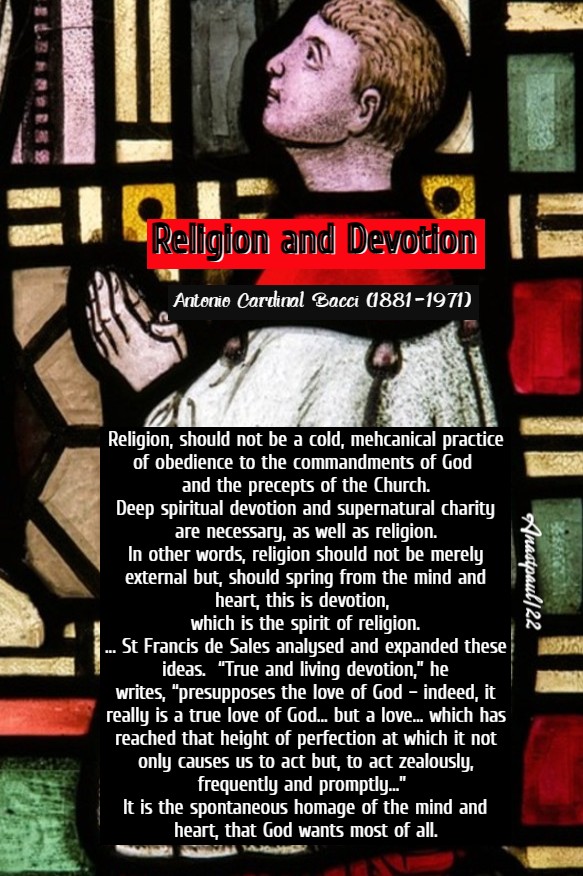
Thought for the Day – 3 January – Meditations with Antonio Cardinal Bacci (1881-1971)
Making a Good Meditation
“Some people claim, that they cannot concentrate for any great length of time on meditation. In their case, it is very helpful to combine mental and vocal prayer. Short aspirations and expressions of love for God and of an ardent desire for holiness, can restore the atmosphere of recollection, making the intellect more attentive, the heart more fervent and the entire spiritual exercise, more profitable.
When our minds wander or grow drowsy, we must pull ourselves together by placing ourselves once more in God’s presence and beginning to converse with Him, in a humble and loving fashion. We must remember how much we need Him and how anxious He is to inspire and help us. We are so poor and weak – He is infinitely powerful and strong. We are lost in darkness – He is the Light which illumines every man who is travelling through this world.
St Therese of the Child Jesus always held, that anybody who was careful to spend at least ten minutes, everyday, in devout meditation, was certain of salvation!”
Quote/s of the Day – 3 January – “Month and Feast of the Most Holy Name of Jesus” – Readings: John 3: 22 – 4: 6; Psalm 2: 7bc-8, 10-11; Matthew 4: 12-17, 23-25
“The people who sat in darkness, have seen a great light“
Matthew 4:16
“Our Lord Jesus Christ Has appeared to us from the bosom of the Father. He has come and drawn us out of the shadows And enlightened us with His joyful Light.
Day has dawned for humankind, Cast out the power of darkness. For us, a Light from His Light has arisen That has enlightened our darkened eyes.
Over the world He has made his glory arise And has lit up the deepest depths. Death is no more, darkness has ended, The gates of hell are shattered.
He has illumined every creature, All the shades from times long past. He has brought about salvation and given us life; Next He will come in glory.
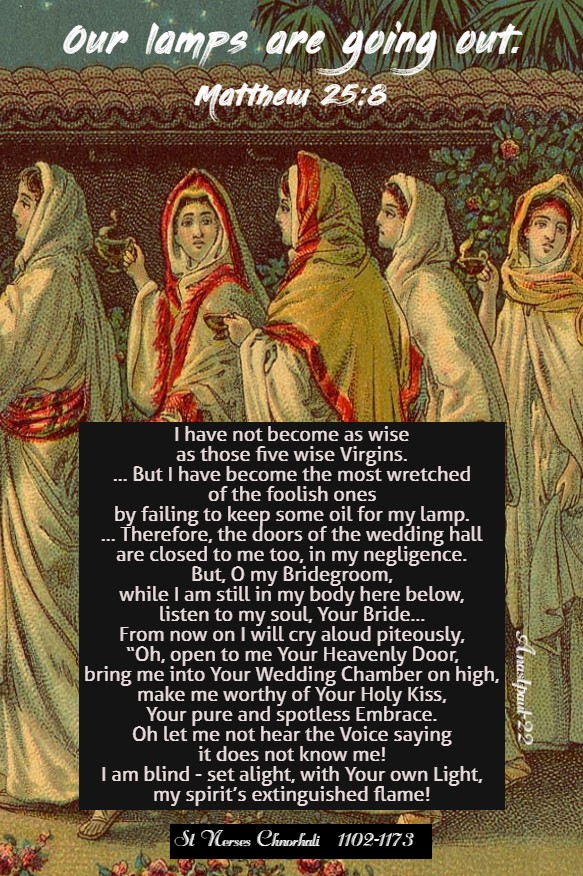
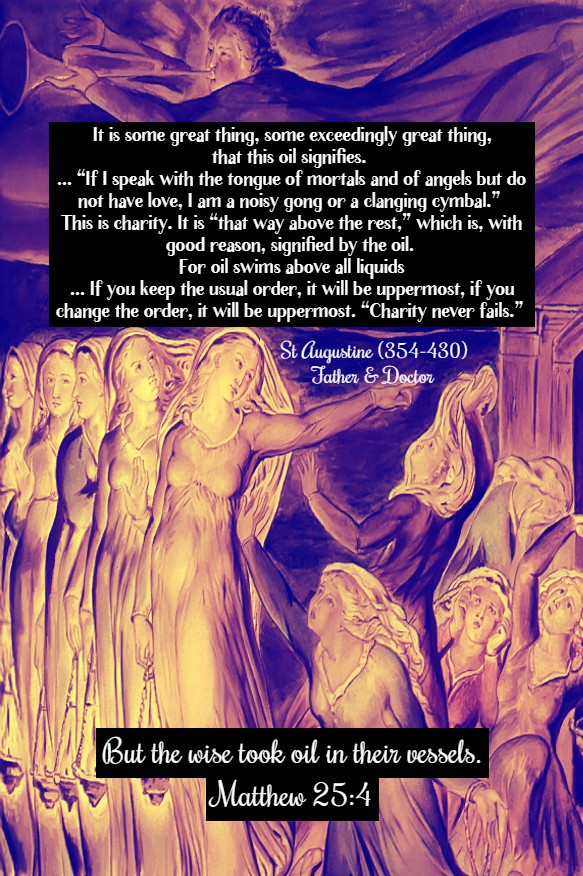
Our King is coming in His great glory: Let us light our lamps and go out to meet him (Mt 25,6); Let us be glad in Him as He has been glad in us And gives us gladness with His glorious Light.
My friends, arise! make yourselves ready To give thanks to our Saviour King, Who will come in His glory and make us joyful With His joyous Light in the Kingdom.
St Ephrem (306-373) Father and Doctor of the Church
Our Morning Offering – 2 January – “Month of the Most Holy Name of Jesus” and the Feast of the Holy Name celebrated today (Feast 3 January)
Jesu, Dulcis Memoria Prayer, Poem, Hymn By St Bernard of Clairvaux (1090-1153) Doctor Mellifluous Trans. Fr Edward Caswell C.Orat. (1814-1878)
Jesus, the very thought of Thee With sweetness fills the breast! Yet sweeter far Thy face to see And in Thy presence rest. No voice can sing, no heart can frame, Nor can the memory find, A sweeter sound than Jesus’ Name, The Saviour of mankind. O hope of every contrite heart! 0 joy of all the meek! To those who fall, how kind Thou art! How good to those who seek! But what to those who find? Ah! this Nor tongue nor pen can show The love of Jesus, what it is, None but His loved ones know. Jesus! our only hope be Thou, As Thou our prize shall be; In Thee be all our glory now, And through eternity. Amen
Jesu, Dulcis Memoria is a celebrated 12th century prayer/hymn by St Bernard of Clairvaux (1090-1153), Doctor Mellifluous. The entire hymn has some 42 to 53 stanzas depending upon the translation. Parts of this hymn are used for the Feast of the Holy Name of Jesus on 3 January.
Nuestra Señora del Pilar / Our Lady of the Pillar (Zaragoza, Spain) (40) – 2 January, 12 October (originally 4 October), 15 August – (This Apparition it is considered the first Marian Apparition, and is unique because it happened while Mary was still living on Earth):
According to ancient Spanish history, on 2 January in the year 40, in the early days of Christianity, James the Greater, one of the original Twelve Apostles of Jesus Christ, was preaching the Gospel in what was then the pagan land of Caesaraugusta (now Zaragoza), in the Roman Province of Hispania.
St James was disheartened with his mission, having made only a few converts. While he was praying by the banks of the Ebro River with some of his disciples, the Blessed Virgin Mary miraculously appeared before him atop a pillar accompanied by Angels. Mary assured James that the people would eventually be converted, becoming a stronghold of the Faith due to his efforts and their faith would be as strong as the pillar she was standing on. She gave him the pillar as a symbol and a wooden image of herself. James was also instructed to build a Chapel on the spot where she left the pillar which he did, making it the first Church in Spain.
Apparition of the Virgin of the Pillar to Saint James and his Saragossan disciples by Francisco Goya, c 1769.
It is generally believed, that Mary appeared to James through bilocation, as she was still living, either in Ephesus or Jerusalem, at the time of this event, as she is believed to have died three to fifteen years after Jesus ascended into Heaven. After establishing the church, James returned to Jerusalem with some of his disciples where he became a Martyr, beheaded in 44 under Herod Agrippa. His disciples returned his body to Spain. The pillar left by the Virgin Mary is presently enshrined in the same but larger Basilica of Our Lady of the Pillar. It is believed to be the same pillar given and promised by Mary, in spite of numerous disasters that beset the Church. A fire in 1434 razed the Church that preceded the present Basilica Cathedral, see below.
The image of the Blessed Virgin Mary may or may not be the original. Some reports state that the original wooden image was destroyed when the Church burned down in 1434, contradicting other reports, that it is still the original Statue. The Statue of the Blessed Virgin Mary is made of wood and stands 39 centimetres tall while the 1.8 m pillar is made of jasper.quartz. The Statue depicts Mother Mary with the Child Jesus on her left arm, Who has a dove sitting on His left palm. Since the 16th century, the pillar is usually draped in a skirt-like cover called manto (in English: mantle). As a whole, it is protected by a bronze case and then another case of silver. The image was canonically crowned in 1905 during the reign of Pope Pius X. The crown was designed by the Marquis of Griñi, valued at 450,000 pesetas (£18,750, in1910). During the three Marian festivities of today, 15 August and 12 October, the faithful adorn the base of the Pillar and Statue with flowers – see below (both our Blessed Mother and St James would be thrilled by this display of such immense faith and piety!)
The apparition of Our Lady of the Pillar is a widely accepted sacred tradition. Popes from earliest times issued Papal Bulls attesting to the authenticity of the Shrine and the appearance of the Virgin Mary. Pope Calixtus III issued a Bull in 1456 encouraging pilgrimage to the Lady of the Pillar. It acknowledged the miracle of its foundation and the miracles that had taken place at the Spanish Shrine. It was also through this Bull that the name “Our Lady of the Pillar” was confirmed. So many contradictions had arisen concerning the miraculous origin of the Church that during the reign of Pope Innocent XIII , the Bishops of Spain appealed to the Holy See to settle the controversy. After careful investigation, the twelve Cardinals, in whose hands the affair rested, adopted the following account, which was approved by the Sacred Congregation of Rites on 2 August 1723 and has since been inserted in the lessons of the Office of the Feast of Our Lady of the Pillar, celebrated on 12 October.
“Of all the places that Spain offers for the veneration of the devout, the most illustrious is doubtless the Sanctuary consecrated to God under the invocation of the Blessed Virgin, under the title of Our Lady of the Pillar, at Saragossa. According to ancient and pious tradition, St James the Greater, led by Providence into Spain, spent some time at Saragossa. He there received a signal favour from the Blessed Virgin. As he was praying with his disciples one night, upon the banks of the Ebro, as the same tradition informs us, the Mother of God, who still lived, appeared to him and commanded him to erect an oratory in that place. The Apostle delayed not to obey this injunction,and with the assistance of his disciples, soon constructed a small Chapel. In the course of time, a larger Church was built and dedicated, which, with the dedication of Saint Saviour’s, is kept as a festival in the City and Diocese of Saragossa on the 4th of October.“
Holy Chapel of the Pillar of Zaragoza. Altar with the Arrival of the Virgin by ‘José Ramírez de Arellano.
In 1730, Pope Clement XII allowed the celebration of the Feast of Our Lady of the Pillar all over the Spanish Empire. As the date coincides with the discovery of the Americas, the Lady was later named as Patroness of the Hispanic World although her Patronages include all of the following: Zaragoza, Spain, Melo, Uruguay, Buenos Aires, Argentina, Diocese of Imus, Cavite, Zamboanga City, Santa Cruz, Manila, Alaminos, Laguna, San Simon, Pampanga, Libmanan, Camarines Sur, Pilar and Morong in Bataan, Mamburao, Occidental Mindoro, Sibonga, Cebu, Baleno, Masbate, Cauayan, Isabela.
Prayer: Hail, Mary, Our Lady of the Pillar, conceived without sin, I come to venerate and honour you. above all the Angels and Saints in Heaven, as my Queen, my Lady and my dearest Mother. I firmly resolve to serve you always and to do whatever I am able, that all may render faithful service to you. Most Holy Mary, through your kind intercession and by your own merits, obtain for me from your Divine Son Jesus, our Lord and Saviour, all the graces I need for the eternal salvation of my soul. Therefore, most devoted Mother of mothers, through the Precious Blood which your Son shed for us, I humbly beseech thee to receive me among your devotees and to accept me as your servant forever. Help me in my every thought, action word and deed, never to be displeasing in your sight and in the sight of your Son, our Lord and Redeemer. Think of me always, my dear Lady of the Pillar and do not forsake me in the hour of my death. Amen.
Bl Airaldus of Maurienne St Asclepius of Limoges St Aspasius of Auch St Blidulf of Bobbio Bl Guillaume Répin St Hortulana of Assisi St Isidore of Antioch St Isidore of Nitria St Laurent Bâtard
Saint Macarius the Younger of Alexandria (Died c 401) Priest, Monk, Desert Hermit.
St Maximus of Vienne Bl Odino of Rot St Paracodius of Vienne St Seiriol Blessed Sylvester of Troina St Telesphorus, Pope St Theodota St Theopistus St Vincentian of Tulle
Many Martyrs Who Suffered in Rome: There were many Martyrs who suffered in the persecutions of Diocletian for refusing to surrender the holy books. Though we know these atrocities occurred, we do not know the names of the Saints and we honour them as a group. c 303 in Rome, Italy.
Martyrs of Antioch – 5 saints: A group of Christian soldiers Martyred together for their faith. We know the names of five – Albanus, Macarius, Possessor, Starus and Stratonicus. They were born in Greece and were Martyred in Antioch (modern Antakya, Turkey).
Many Martyrs of Britain: The Christians of Britain appear to have escaped unharmed in the earlier persecutions which afflicted the Church but the cruel edicts of Diocletian were enforced in every corner of the Roman Empire and the faithful inhabitants of this land, whether native Britons or Roman colonists, were called upon to furnish their full number of holy Martyrs and Confessors. The names of few are on record but the British historian, Saint Gildas, after relating the Martyrdom of Saint Alban, tells us, that many others were seized, some put to the most unheard-of tortures and others immediately executed, while not a few hid themselves in forests and the caves of the earth, where they endured a prolonged death until God called them to their reward. The same writer attributes it to the subsequent invasion of the English, then a pagan people, that the recollection of the places, sanctified by these Martyrdoms, has been lost and so little honour paid to their memory. It may be added, that, according to one tradition, a thousand of these Christians were overtaken in their flight near Lichfield and cruelly massacred and that the name of Lichfield, or Field of the Dead, is derived from them.
Martyrs of Ethiopia – 3 saints: A group of Christians Martyred together for their faith. We know the names of three – Auriga, Claudia and Rutile.
Martyrs of Jerusalem – 2 saints: A group of Christians Martyred together for their faith. We know the names of two – Stephen and Vitalis.
Martyrs of Lichfield: Many Christians suffered at Lichfield (aka Lyke-field, meaning field of dead bodies), England in the persecutions of Diocletian. Though we know these atrocities occurred, we do not know the names of theSsaints and we honour them as a group. Their Martyrdom occurred in 304 at Lichfield, England.
Martyrs of Piacenza: A group of Christians who died together for their faith in the persecutions of Diocletian. No details about them have survived. They were Martyred on the site of Church of Madonna di Campagna, Piacenza, Italy.
Martyrs of Puy – 4 saints: Missionaries, sent by Saint Fronto of Périgueux to the area of Puy, France. Tortured and Martyred by local pagans. We know the names – Frontasius, Severinus, Severian and Silanus. They were beheaded in Puy (modern Puy-en-Velay), France and buried together in the Church of Notre Dame, Puy-en-Velay by Saint Fronto, their bodies laid out to form a cross.
Martyrs of Syrmium – 7 saints: Group of Christians Martyred together, date unknown. We know the names of seven – Acutus, Artaxus, Eugenda, Maximianus, Timothy, Tobias and Vitus – but very little else. This occurred in the 3rd or 4th century at Syrmium, Pannonia (modern Sremska Mitrovica, Serbia).
Martyrs of Tomi – 3 saints: Three brothers, all Christian soldiers, in the Imperial Roman army and all three Martyred in the persecutions of Emperor Licinius Licinianus. We know their names – Argeus, Marcellinus and Narcissus – but little else. They were Martyred in 320 at Tomi, Exinius Pontus, Moesia (modern Constanta, Romania).
Quote/s of the Day – 1 January – “Month of the Most Holy Name of Jesus” – The Octave Day of the Nativity of Jesus and the Feast of the Circumcision of the Lord,
May We Confess Your Name to the End By St Cyprian of Carthage (200-258) Bishop and Martyr Father of the Church
Good God, may we confess Your Name to the end. May we emerge unmarked and glorious from the traps and darkness of this world. As You have bound us together by charity and peace and as together we have persevered under persecution, so may we also rejoice together in Your heavenly kingdom. Amen
“Sacrilegious tongues blaspheme the God who preserves their existence! … you should be damned forever and, instead of thanking Him for His goodness, you, at the very time that He bestows His favours upon you, YOU blaspheme His Holy Name!”
St Alphonsus Maria de Liguori (1696-1787) Most Zealous Doctor
Quote/s of the Day – 30 December – The Sixth Day in the Christmas Octave, Readings: 1 John 2:12-17, Psalm 96:7-10, Luke 2:36-40
“She [Anna] spoke about the child to all who were awaiting the redemption of Jerusalem…”
Luke 2:38
“He has come down to earth to take you to heaven, He became mortal that you might become God and put on your original beauty.”
St Romanos Melodios (c 490-c 556) Monk, Composer of Hymns, Poet
“The Angel said to the shepherds, “This is a sign for you” (Lk 2: 12), you who are humble, you who are obedient, you who are not haughty (Rom 12: 16), you who are keeping vigil and meditating on God’s law, day and night (Ps 1:2). “This is a sign for you,” he said. What is this sign? The sign the Angels promised, the sign the people asked for, the sign the prophets foretold, the Lord Jesus has now made and He shows it to you. …”
St Bernard (1091-1153) Mellifluous Doctor of the Church
“Listen! the reason He is called Saviour is because, for all those to whom He is united, He gains salvation. Now salvation means, to be delivered from all ills and, at the same time, to find all blessings forever – Life instead of death, Light in place of darkness and, instead of the slavery of the passions and unworthy deeds, the complete freedom granted to all those, who are united to Christ, Saviour of all beings. Thus they will possess, without being able to lose it, all joy, all happiness, all blessedness (…) that that none can ever know, or conceive, or see, if not sincerely and ardently attached to Christ.”
St Symeon the New Theologian (c 949-1022)
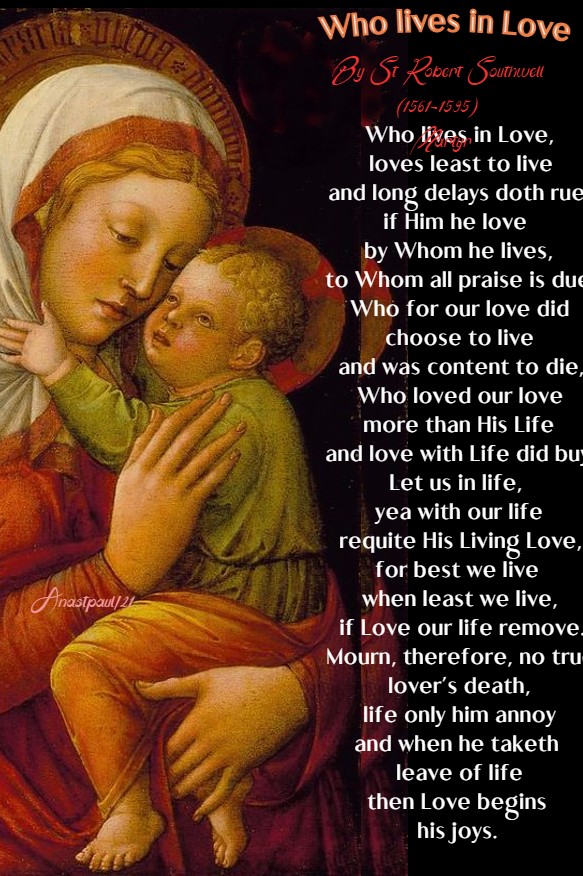
Who lives in Love By St Robert Southwell SJ (1561-1595) Martyr
Who lives in Love, loves least to live and long delays doth rue, if Him he love by Whom he lives, to Whom all praise is due, Who for our love did choose to live and was content to die, Who loved our love more than His life and love with Life did buy. Let us in life, yea with our life requite His Living Love, for best we live when least we live, if Love our life remove. Mourn, therefore, no true lover’s death, life only him annoy and when he taketh leave of life then Love begins his joys.
Our Morning Offering – 29 December – The Fifth Day of the Christmas Octave
O Dearest Infant By St Alphonsus Liguori (1696-1787) Most Zealous Doctor
O dearest Infant, tell me what You came on earth to do. Tell me whom You are seeking. Ah, yes, I now understand… You have come to die for me, a lost sheep, in order that I may no more hide from You but love You. O Jesus, my treasure, my life, my love, my all, if I do not love You, then whom shall I love? Where can I find a mother or father, a friend, or a spouse more loving than You? And who has ever loved me more than You have? I am sorry that I have lived so many years in this world and yet still love You so little, even having offended You and sometimes forgotten You. Amen
Unsere Liebe Frau vom Speyer / Our Lady of Speyer, Germany Featuring the Salve Regina and St Bernard (1146) – 29 December:
The Abbot Orsini wrote: “Our Lady of Spire (Speyer), in Germany. Saint Bernard, entering this Church on the 29th of December, 1146, was honourably received there by the Canons, who conducted him to the choir, singing the Salve Regina. The antiphon being finished, Saint Bernard saluted the image of the Blessed Virgin in these terms: “O clems, O pia, O dulcis Virgo Maria!” and she answered: “Salve Bernarde!” The words of this Saint to the image are seen engraved in a circle on the pavement of the Church, on the same spot where he pronounced them and they have since been added to the Salve Regina, which was composed in the year 1040, by Herman, surnamed Contractus, a Benedictine monk.” [He is Blessed Herman of Reichenau (often known as Blessed Herman the Cripple OSB (1013–1054) – his Biography here: https://anastpaul.com/2019/09/25/saint-of-the-day-blessed-herman-of-reichenau-the-cripple-osb-1013-1054-the-wonder-of-his-age/ ]
This date on the Marian calendar, Our Lady of Speyer, actually refers to the Cathedral of Speyer, dedicated to the Blessed Virgin Mary and known as Kaiserdom zu Speyer in Germany. Construction began on the Romanesque style Cathedral in the year 1030 and was completed in 1106. It is 134 metres long and 43 metres wide, which made it one of the largest buildings constructed at that time and is now thought to be, the largest surviving Romanesque building in the world.
During the Nine Years’ War the entire Town of Speyer was burned to the ground and the heat from the inferno caused part of the nave to collapse. In 1792 the Town was occupied by the French revolutionary troops and the Church pillaged. It was in that century that the ruins of the Chapel of Saint Bernard were removed. The Cathedral was subsequently used as a warehouse and hospital. In 1957 the Cathedral was restored and, although much of the plaster and 19th century paintings were removed, the scenes of the life of the Blessed Virgin were left undisturbed. n 1981 the Cathedral was added to the World Heritage List of UNESCO.
St Aileran of Clonard St Albert of Gambron St Aproniano de Felipe González St David the King St Ebrulf of Ouche (c 626-c 706) Abbot, Hermit St Enrique Juan Requena St Florent of Bourges Bl Francis Ruiz St Girald of Fontenelle St Jacinto Gutiérrez Terciado Bl José Aparicio Sanz Bl José Perpiñá Nácher St Juan Bautista Ferreres Boluda St Libosus of Vaga St Marcellus the Righteous St Martinian of Milan Bl Paul Mary Bl Peter the Venerable St Quartillosa of Carthage St Thaddeus of Scythia St Trophimus of Arles St Trophimus of Ephesus
Martyrs of North Africa – (8 saints): A group of Christians executed together for their faith. The only details to survive are eight names – Crescentius, Dominic, Honoratus, Lybosus, Primian, Saturninus, Secundus and Victor.
Martyrs of Rome – (3 saints): A group of Christians executed together for their faith. The only details to survive are three names – Boniface, Callistus and Felix.
Martyrs of Seoul – (7 saints): Additional Memorial – 20 September as part of the Martyrs of Korea. A group of seven lay woman in the apostolic vicariate of Korea who were martyred together. • Barbara Cho Chung-I • Barbara Ko Sun-I • Benedicta Hyong Kyong-Nyon • Elisabeth Chong Chong-Hye • Magdalena Han Yong-I • Magdalena Yi Yong-Dok • Petrus Ch’oe Ch’ang-Hub They were born in South Korea and were martyred by beheading on 29 December 1839 at the Small West Gate, Seoul, South Korea. They were Canonised on 6 May 1984 by St Pope John Paul II.
Martyred in the Spanish Civil War: Thousands of people were murdered in the anti-Catholic persecutions of the Spanish Civil War from 1934 to 1939. • Blessed Aproniano de Felipe González • Blessed Enrique Juan Requena • Blessed Jacinto Gutiérrez Terciado • Blessed Juan Bautista Ferreres Boluda
Quote/s of the Day – 28 December – The Feast of the Holy Innocents – The Fourth Day of the Christmas Octave, Readings: 1 John 1:5-2:2, Psalm 124:2-5, 7-8, Matthew 2:13-18
“Whoever says he abides in Christ, ought to walk, even as Christ walked…”
1 John 2:6
“How grave is the case of a Christian, if he, a servant, is unwilling to suffer when his Master first suffered! … The Son of God suffered, that He might make us sons of God and the son of man will not suffer, that he may continue to be a son of God!?”
St Cyprian of Carthage (c 200-258) Martyr, Father of the Church
Letter 55
“Our pilgrimage on earth cannot be exempt from trial. We progress by means of trial. No-one knows himself except through trial, or receives a crown, except after victory, or strives, except against an enemy or temptations.”
St Augustine (354-430) Father and Doctor of Grace
“He gives according to the love He bears us …, according to the courage He sees in each and the love each has for His Majesty. He will see, that whoever loves Him much, will be able to suffer much for Him; whoever loves Him little, will be capable of little. I myself hold, that the measure for being able to bear, a large or small cross, is love …”
St Teresa of Avila (1515-1582) Doctor of Prayer of the Church
Our Morning Offering – 28 December – The Feast of the Holy Innocents and the Fourth |Day of the Octave of Christmas
O Jesus, Dear Holy Child By St Thérèse of the Child Jesus (1873 – 1897) Doctor of the Church
O Jesus, dear Holy Child, my only treasure, I abandon myself to Thy every whim. I seek no other joy than that of calling forth Thy sweet Smile. Vouchsafe to me, the graces and the virtues of Thy Holy Childhood, so that, on the day of my birth into Heaven, the Angels and Saints may recognise in Thy Spouse, Thérèse of the Child Jesus. Amen
Quote/s of the Day – 26 December – The Second Day in the Christmas Octave
Christ, the Child
“Oh great God! Oh perfect Child! The Son is in the Father and the Father is in the Son. How could the teaching this Child gives, not be irreproachable? It includes us all to guide us all, His children. He has stretched out His hands to us and we have placed in them all our faith. To this little Child, John the Baptist himself also gave testimony – “Behold,” he said, “the Lamb of God,” (Jn 1:29). Since Scripture has called children ‘lambs,’ it has called “Lamb of God” the Word of God Who became man for us and Who wanted to become like us in all things, the Son of God Himself, the child of the Father.”
St Clement of Alexandria (150-215) Theologian, Father
“Maker of the sun, He is made under the sun.
In the Father He remains, From His mother He goes forth.
Creator of heaven and earth, He was born under heaven.
Unspeakably wise, He is wisely speechless.
Filling the world, He lies in a manger.
Ruler of the stars, He nurses at His mother’s bosom.
He is both great in the nature of God and small in the form of a servant.”
“He became small because you were small – understand how great He is and you will become great along with Him. This is how houses are built, how the solid walls of a building are raised. The stones brought to construct the building increase, you, too, increase, understanding how great Christ is and how He who appeared to be small is great, very great indeed…”
St Augustine (354-430) Father & Doctor of the Church
“He is an infant, He does not speak, He only cries but these cries are cries of love which invite us to love Him, cries that demand our hearts.”
St Alphonsus Maria de Liguori (1696-1787) Most Zealous Doctor
A Christmas Carol By G K Chesterton (1874-1936) English Catholic Convert, Writer, Poet.
The Christ-child lay on Mary’s lap, His hair was like a light. (O weary, weary were the world, But here is all aright.)
The Christ-child lay on Mary’s breast His hair was like a star. (O stern and cunning are the kings But here the true hearts are.)
The Christ-child lay on Mary’s heart, His hair was like a fire. (O weary, weary is the world But here the world’s desire.) The Christ-child stood on Mary’s knee, His hair was like a crown, And all the flowers looked up at Him, And all the stars looked down.
One Minute Reflection – 26 December – Feast of St Stephen the ProtoMartyr and The Second Day in the Christmas Octave, Readings: Acts 6:8-10; 7:54-59, Psalm31:3-4, 6, 8, 16-17, Matthew 10:17-22
“Lord, do not hold this sin against them” – Acts 7:60
REFLECTION – “Let us imitate our Lord and pray for our enemies … He was Crucified yet, at the same time, prayed to His Father for the sake of those who were crucifying Him. But how could I possibly imitate our Lord, one might ask? If you want to, you can. If you were not able to do it, how could He have said: “Learn from me for I am meek and humble of heart”? (Mt 11:29) …
If you have difficulty in imitating our Lord, at least imitate him who is also His servant, His Deacon – I would speak of Stephen. Just as Christ, in the midst of those crucifying Him, without considering the cross, without considering His own predicament, pleaded with the Father on behalf of His tormentors (Lk 23:34), so His servant, surrounded by those who were stoning him, attacked by all, crushed beneath a hail of stones and, without taking any account of the suffering they were causing him, said: “Lord, do not hold this sin against them” (Acts 7:60). Do you see how the Son spoke and how His servant prayed? The former said: “Father, forgive them for they know not what they do,” and the latter said: “Lord, do not hold this sin against them.” Moreover, to make us realise better the fervour with which he was praying, he did not just pray, as he stood beneath the blows of the stones but, he spoke on his knees with sincerity and compassion …
Christ said: “Father, forgive them for they know not what they do.” Stephen cried out: “Lord, do not hold this sin against them.” Paul, in his turn, said: “I offer up this sacrifice for my brethren, my kin according to race” (cf Rm 9:3). Moses said: “If you would only forgive their sin! And if you will not, then strike me out of the book that you have written!” (Ex 32:32). David said: “May your hand fall on me and my kindred,” (2 Sam 24:17). … What kind of forgiveness do we think we shall receive if we ourselves do the opposite of what is asked of us and pray against our enemies, when the Lord Himself and His servants of both Old and New Testaments, direct us to pray on their behalf?” – St John Chrysostom (345-407) Father and Doctor of the Church – Sermon for Good Friday “The Cross and the bandit”
PRAYER – Grant us Your Grace, Lord God Almighty, to practise what we worship. Teach us to love our enemies and to pray for those who persecute us. As we keep the feast of Saint Stephen, may we learn from him, who learned from You and prayed, even for the men who stoned him to death. Through Christ our Lord, with the Holy Spirit, God now and forever, amen.
Quote/s of the Day – 25 December – The Solemnity of the Nativity of Our Lord, Jesus Christ
“In the beginning was the Word and the Word was with God and the Word was God.”
John 1:1
“And the Word became flesh and made his dwelling among us and we saw his glory, the glory as of the Father’s only Son, full of grace and truth.”
John 1:14
“On this day, on which the Lord of all came among servants, let the lords also bow down, to their servants lovingly.
On this day, when the rich One was made poor for our sake, let the rich man also make the poor man, a sharer at his table.
On this day, a gift came out to us without our asking for it, let us then give alms to those, who cry out and beg from us.
This Lord of natures, today was transformed, contrary to his nature; it is not too difficult for us also to overthrow our evil will.
Bound is the body by its nature, for it cannot grow larger or smaller but powerful is the will, for it may grow to all sizes.
Today the Deity imprinted itself on humanity, so that humanity might also be cut into the seal of Deity.”
St Ephrem (306-373) Father and Doctor
(Homily on Our Lord, 21)
“… Let us keep the Feast, not after the manner of a heathen festival but after a godly sort; not after the way of the world but in a fashion above the world; not as our own but as belonging to Him who is ours, or rather as our Master’s; not as of weakness but as of healing; not as of creation but of re-creation.”
St Gregory of Nazianzen (330-390) Father and Doctor of the Church
“Awake, mankind! For your sake God has become man. Awake, you who sleep, rise up from the dead and Christ will enlighten you. I tell you again, for your sake, God became man.”
St Augustine 354-430) Great Latin Father and Doctor of the Church
Quote of the Day – 22 December – Wednesday of the Fourth Week of Advent, O Rex Gentium/O King of all Nations,
“If you want, the Virgin will come walking down the road pregnant with the Holy and say: “I need shelter for the night. Please take me inside your heart. My time is so close.” Then, under the roof of your soul, you will witness the sublime intimacy, the Divine, the Christ, taking birth forever. As she grasps your hand for help, for each of us is the midwife of God, each of us. Yes, there, under the dome of your being, does creation come into existence eternally– through your womb, dear pilgrim–the sacred womb of your soul! As God grasps our arms for help; for each of us is His beloved servant never far. If you want, the Virgin will come, walking down the street, pregnant with Light and sing!”
St John of the Cross (1542-1591) Mystical Doctor of the Church
One Minute Reflection – 22 December – “Month of the Immaculate Conception” – Wednesday of the Fourth Week of Advent, O Rex Gentium/O King of all Nations, Readings: Samuel 1:24-28; First Samuel 2: 1, 4-8; Luke 1:46-56
The Lord is at hand, come let us adore Him.
O KING OF ALL NATIONS and keystone of the Church come and save man, whom You formed from the dust!
“My spirit rejoices in God my saviour” – Luke 1:47
REFLECTION – “My soul magnifies the Lord, my spirit rejoices in God my Saviour.”. The first interpretation of these words is undoubtedly to acknowledge the gifts granted to her, to Mary in particular, by God. But then she recalls the universal blessing with which God never ceases to surround the human race.
The soul glorifies the Lord, when it consecrates all its inner powers on praising and serving God and when, by its submission to the divine commands, it proves that it never loses sight of His power and majesty. The spirit rejoices in God, its Saviour, when it places all its joy in the remembrance of its Creator, from Whom it hopes for eternal salvation. Without doubt, these words exactly express the thought of all the Saints but it was most especially fitting they should be spoken by the blessed Mother of God, who, filled with a special privilege, burned with a wholly spiritual love for the One she had the joy of conceiving in her flesh. More than any other Saint she had good reason to rejoice in Jesus – that is to say, in her Saviour – because He Whom she acknowledged to be the Eternal Author of our salvation, would in time, as she knew, be born in His own flesh and with such authenticity, that in one and the same Person her Son and her God, would be truly present…
Hence it is a praiseworthy and salutary custom, whose fragrance perfumes Holy Church, when everyday at Vespers, we sing the Canticle of the Virgin. We may well expect from this, that the souls of the faithful, by so often calling to mind the Lord’s Incarnation, will be enflamed with even greater fervour and that, such a frequent reminder of His Holy Mother’s example, will strengthen them in virtue. And Vespers is the best time to come back to this song, since our souls, tired by the day and drawn this way and that by the day’s thoughts, need to come back together again, when the hour of rest draws near, so that they may find, once more, their singleness of focus.” – St Bede the Venerable (673-735) Monk, Father and Doctor of the Church (Homilies on the Gospel, I, 4 ; CCL 122, 25f)
PRAYER –The Magnificat The Canticle of Mary Luke 1:46-55
My soul glorifies the Lord, my spirit rejoices in God, my Saviour He looks on His servant in her lowliness Henceforth, all ages will call me blessed: The Almighty works marvels for me, holy is His Name! His mercy is from age to age, on those who fear Him. He puts forth His arm in strength and scatters the proud-hearted. He casts the mighty from their thrones and raises the lowly. He fills the starving with good things, sends the rich away empty. He protects Israel, His servant, remembering His mercy, the mercy promised to our fathers, to Abraham and his sons forever. Amen.
Quote/s of the Day – 21 December – O Oriens/O Radiant Dawn – “Month of the Immaculate Conception” – Tuesday of the Fourth Week of Advent, Readings: Songs 2: 8-14 or Zephaniah 3: 14-18a; Psalm 33: 2-3, 11-12, 20-21; Luke 1: 39-45
“Having confidence in you, O Mother of God, I shall be saved. Being under you protection, I shall fear nothing. With your help, I shall give battle to my enemies and put them to flight, for devotion to you, is an arm of Salvation.”
St John Damascene (676-749) Father and Doctor of the Church
“O Mary, you give assistance to everyone endeavouring to rise to God!”
St Bridget of Sweden (c 1303 – 1373)
“At the mention of this name [the Blessed Virgin Mary], the Angels rejoice and the devils tremble. Through this invocation, sinners obtain grace and pardon.”
St Peter Canisius SJ (1521-1397) Doctor of the Church
“Wherefore, in the same holy bosom of His most chaste Mother, Christ took to Himself flesh and united to Himself, the spiritual Body formed by those who were to believe in Him. Hence Mary, carrying the Saviour within her, may be said, to have also carried, all those. whose life was contained in the life of the Saviour. Therefore, all we, who are united to Christ and, as the Apostle says, are members of His body, of His flesh and of His bones (Eph 5:30), have issued from the womb of Mary, like a body united to it’s Head.”
St Pius X (1835-1914) Pope from 1903 to 1914 Encyclical “Ad diem illum laetissimum” #10-11
Quote/s of the Day – 20 December – Monday of the Fourth Week of Advent, Readings: Isaiah 7: 10-14; Psalm 24: 1-6; Luke 1: 26-38
“And Mary said, ‘Behold, I am the handmaid of the Lord. May it be to me according to your word.’”
Luke 1:38
“The price of our salvation is offered to you. We shall be set free at once, if you consent. In the eternal Word of God, we all came to be and behold, we die. In your brief response, we are to be remade. in order to be recalled to life.
… Answer quickly, O Virgin. Reply in haste to the Angel, or rather, through the Angel to the Lord. Answer with a word, receive the Word of God. Speak your own word, conceive the Divine Word. Breathe a passing word, embrace the Eternal Word!”
St Bernard of Clairvaux (1090-1153) The Last Father and the Mellifluous Doctor of the Church
The Annunciation By Fr Thomas Merton (1915-1968)
Ashes of paper, ashes of a world Wandering, when fire is done: We argue with the drops of rain!
Until one comes Who walks unseen Even in elements we have destroyed. Deeper than any nerve He enters flesh and bone. Planting His truth, He puts our substance on. Air, earth and rain Rework the frame that fire has ruined. What was dead is waiting for His Flame. Sparks of His Spirit spend their seeds, and hide To grow like irises, born before summertime. These blue thinas bud in Israel.
The girl prays by the bare wall Between the lamp and the chair. (Framed with an angel in our galleries She has a richer painted room, sometimes a crown. Yet seven pillars of obscurity Build her to Wisdom’s house, and Ark and Tower. She is the Secret of another Testament She owns their manna in her jar.)
Fifteen years old – The flowers printed on her dress Cease moving in the middle of her prayer When God, Who sends the messenger, Meets His messenger in her Heart. Her answer, between breath and breath, Wrings from her innocence our Sacrament! In her white body God becomes our Bread.
It is her tenderness Heats the dead world like David on his bed. Times that were too soon criminal And never wanted to be normal Evade the beast that has pursued You, me and Adam out of Eden’s wood. Suddenly we find ourselves assembled Cured and recollected under several green trees.
Her prudence wrestled with the Dove To hide us in His cloud of steel and silver: These are the mysteries of her Son. And here my heart, a purchased outlaw, Prays in her possession Until her Jesus, makes my heart Smile like a flower in her blameless hand.
Fr Thomas Merton (1915-1968), Trappist Monk and Priest. Thomas Merton expressed his vision in his poetry, novels, essays, devotionals and autobiographical writings.
One Minute Reflection – 20 December – Monday of the Fourth Week of Advent O Clavis David/O Key of David – Readings: Isaiah 7: 10-14; Psalm 24: 1-6; Luke 1: 26-38
The Lord is at hand, come let us adore Him.
O KEY OF DAVID, and Sceptre of the House of Israel, who opens and no-one shuts, who shuts and no-one opens. Come and bring forth the captive from his prison, he who sits in darkness and in the shadow of death.
“Hail, full of grace!” – Luke 1:28
REFLECTION – “This woman will be the Mother of God, the door to Light, source of Life; she will reduce to oblivion the judgement that weighed on Eve. “The rich among the people seek the face” of this woman, “the kings of the nations shall pay her homage”, they shall “offer gifts”…, yet the glory of the Mother of God is an interior glory: the fruit of her womb.
O woman, so worthy of love, thrice happy, “blessed are you among women and blessed is the fruit of your womb.” Daughter of David the king and Mother of God, King of the universe, masterpiece in whom the Creator rejoices…: you are to be nature’s full achievement. For you, life is not yours; you were not born for yourself alone but your life is to be God’s. You came into the world for Him, you will serve for the salvation of all people, fulfilling God’s design established from the beginning: the Incarnation of the Word and our own divinisation. Your whole desire is to feed on the words of God, to be strengthened by their sap, like “a green olive tree in the house of God,” “like a tree planted by running water,” you are the “tree of life” who “yielded its fruit in due season”…
He Who is Infinite, Limitless, came to dwell in your womb; God, the Child Jesus, was nourished by your milk. You are the ever virginal Doorway of God; your hands hold your God; your lap is a throne raised up above the Cherubim… You are the wedding chamber of the Spirit, the “city of the living God, gladdened by the runlets of the stream”, that is to say, the waves of the Spirit’s gifts. You are “all fair, the Beloved” of God.” – St John Damascene (675-749) Monk, Theologian, Father and Doctor of the Church (Homily on the Nativity of the Virgin, # 9 ; SC 80) [( Biblical references : Ps 44[45],13; 71[72],11.10; Mt 2,11; Lk 1,42; Is 62,5; Ps 51[52],10; 1,3; cf Gn 2,9, Rv 22,2; cf Ez 44,2; Ps 79[80],2; cf Sg 1,4; Ps 45[46],5; Sg 4,7].
PRAYER – Lord, at the Angel’s message, Mary, the Immaculate Virgin, became the temple of God and was filled with the light of the Holy Spirit, when she received Your divine Word. Grant that, after her example, we may humbly and steadfastly follow Your will. Through Christ the Incarnate Word, our Lord and Saviour, with the Holy Spirit, one God for all ages, amen.
Quote/s of the Day – 18 December – O Adonai … O Lord – Saturday of the Third Week of Advent, Readings: Jeremiah 23:5-8, Psalm 72:1-2, 12-13, 18-19, Matthew 1:18-25
“She will bear a son and you are to name him Jesus because he will save his people from their sins.”
Matthew 1:21
“Faith in Jesus and in the power of His Holy Name is the greatest spiritual force in the world today. It is a source of joy and inspiration in our youth; of strength in our manhood, when only His Holy Name and His grace, can enable us to overcome temptation; of hope, consolation and confidence at the hour of our death, when more than ever before, we realise, that the meaning of Jesus is ‘Lord, the Saviour.’ We should bow in reverence to His Name and submission to His Holy Will.”
Bl Henry Suso (1290-1365)
“The Holy Name of Jesus is, first of all, an all-powerful prayer. Our Lord, Himself, solemnly promises, that whatever we ask the Father in His Name, we shall receive. God never fails to keep His Word. Each time we say “Jesus,” it is an act of perfect love, for, we offer to God, the infinite love of Jesus.”
St Alphonsus Liguori (1696-1787) Doctor of the Church
Jesus, Name Full of Glory By St Bernardine of Siena (1380-1444)
Jesus, Name full of glory, grace, love and strength! You are the refuge of those who repent, our banner of warfare in this life, the medicine of souls, the comfort of those who morn, the delight of those who believe, the light of those who preach the true faith, the wages of those who toil, the healing of the sick. To You our devotion aspires, by You our prayers are received; we delight in contemplating You. O Name of Jesus, You are the glory of all the saints for eternity. Amen
You must be logged in to post a comment.