Posted in DOMINICAN OP, MORNING Prayers, NOVENAS

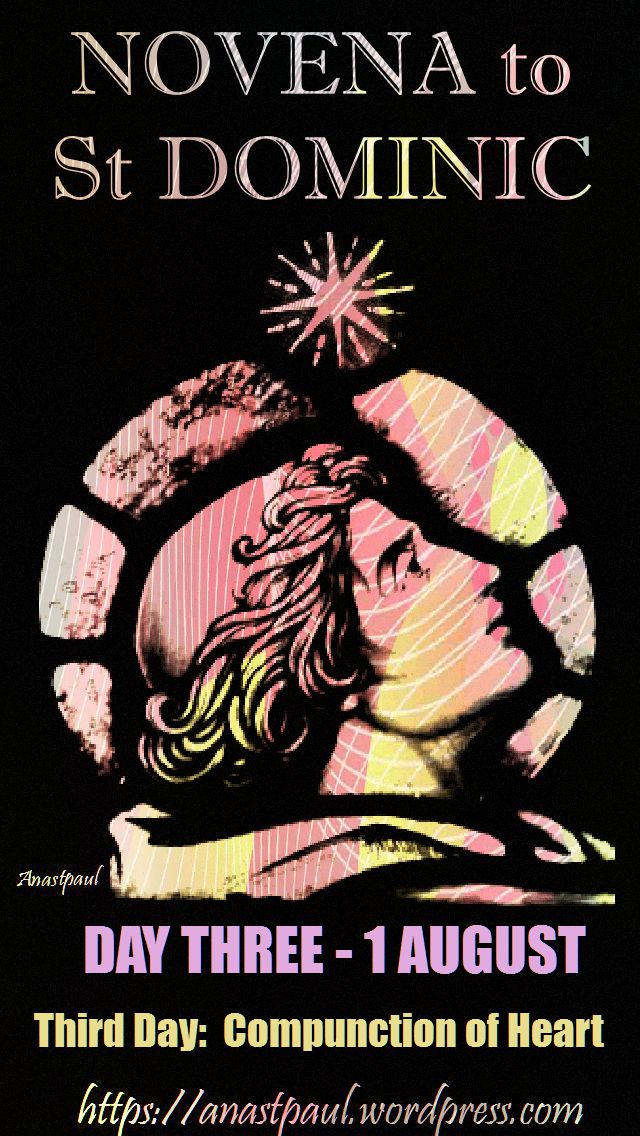
Novena to St Dominic – DAY THREE – 1 August

Novena to St Dominic

Third Day:  Compunction of Heart
Those who fear the Lord seek to please him, those who love him are filled with his law. Those who fear the Lord prepare their hearts and humble themselves before him. Let us fall into the hands of the Lord and not into the hands of men, for equal to his majesty is the mercy that he shows. (Sirach 2: 16-18)

ROSA PATIENTIAE               ROSE OF PATIENCE

Though so pure that Holy Church calls him “Ivory of Chastity” and Christian art puts a lily into his hands, Dominic was always weeping over sin.   His soul being full of contrition, acts of sorrow were constantly upon his lips.   On seeing towns or villages, he used to weep over the sins committed there against God.   But this sorrow was not merely hidden in the soul;  it bore fruit in works of penance.   Three times every night he scourged himself:  once for his own sins, once for those of others and once for the suffering souls.   He was a rule of abstinence, even on journeys never eating meat or food cooked with meat.   His fasts were strict and continual; even when traveling over Europe on foot, he fasted from September until Easter, though preaching daily.   He never had a room of his own but slept anywhere: on the ground, a bench, or the altar step.   Being a zealous lover of the rule, he punished faults but with such fatherly love that penance was accepted and even desired from his hands.

“If you have no sins of your own to weep for,” St. Dominic would say, “still weep, after the example of our Lord Jesus Christ and grieve for the sinners of the world that they may repent.”

Anyone who does not take up his cross and follow me cannot be my disciple. (Luke 14:27)

Pray for us, blessed father, St. Dominic, That we may be made worthy of the prom­ises of Christ.

Let us pray:

O zealous preacher of penance,
Holy Father St. Dominic,
whose ardent desire for the salvation of souls,
made you ever ready to endure the greatest labours and fatigues
and even to give your life in order to win them to God,
pray for us, that treading in the steps of Jesus Crucified,
the Redeemer and Physician of souls,
we may disregard all suffering
and generously sacrifice ourselves
for the needs of others.
Grant us we pray, true contrition and
sadness for our sins and for those of all the world.
Teach us how to do penance for all the pain we cause
our Lord and Saviour.
Pray too Holy St Dominic,
that our penance may draw back those
who have lapsed from the one, true faith
and for this our special intention …
(make your request)
Through the same Christ our Lord. Amen
DAY THREE - NOVENA TO ST DOMINIC

Posted in DOMINICAN OP, SAINT of the DAY

Saint of the Day – 18 July – St Bruno of Segni (1049-1123)

Saint of the Day – 18 July – St Bruno of Segni OSB (1049-1123) – Benedictine Bishop, Confessor, Missionary, Papal Advisor, Theologian, (1049 at Solero, Piedmont, Italy – 1123 of natural causes).   He was Canonised on 5 September 1183 by Pope Lucius III.  Patron of Segni, Italy.

San_Bruno

St Bruno was of the illustrious family of the lords of Asti in Piemont and born near that city.   From his cradle he considered that man’s happiness is only to be found in loving God:  and to please Him in all his actions was his only and his most ardent desire.    He made his studies in the monastery of St Perpetuus, in the diocess of Asti.

In the Roman council in 1079, he defended the doctrine of the Catholic Church concerning the blessed eucharist against Berengarius;   and Pope Gregory VII nominated him bishop of Segni in the ecclesiastical state in 1081.   Bruno, who had been compelled to submit to the appointment, after a long and strenuous resistance, served his flock and on many important occasions the universal church with unwearied zeal.   Gregory VII who died in 1085, Victor III formerly abbot of mount Cassino, who died in 1087 and Urban II who had been scholar to St. Bruno (afterwards institutor of the Carthusians) at Rheims, then a monk at Cluni and afterwards bishop of Ostia, had the greatest esteem for our saint.

He attended Urban II into France in 1095 and assisted at the council of Tours in 1096. After his return into Italy he continued to labour for the sanctification of his soul and that of his flock, till not being able any longer to resist his inclination for solitude and retirement, he withdrew to mount Cassino and put on the monastic habit.   The people of Segni demanded him back;  but Oderisus, abbot of mount Cassino and several cardinals, whose mediation the saint employed, prevailed upon the pope to allow his retreat.   The abbot Oderisus was succeeded by Otho in 1105 and this latter dying in 1107, the monks chose bishop Bruno abbot.   He was often employed by the pope in important commissions and by his writings laboured to support ecclesiastical discipline and to extirpate simony.   This vice he looked upon as the source of all the disorders which excited the tears of all zealous pastors in the church, by filling the sanctuary with hirelings, whose worldly spirit raises an insuperable opposition to that of the gospel.

Paschal II formerly a monk of Cluni, succeeded Urban II in the pontificate in 1099.   By his order St. Bruno having been abbot of mount Cassino about four years, returned to his bishopric and left his abbatial crozier on the altar.  He continued faithfully to discharge the episcopal functions to his death, which happened at Segni on the 31st of August in 1125.   He was canonized by Lucius III in 1183.

The works of St. Bruno of Segni, or of Asti, with a preliminary dissertation of Dom Maur Marchesi, were printed at Venice in 1651, in two vols. folio and in the Bibl. Patr. at Lyons in 1677, t. 20.   They consist of comments on several parts of scripture, one hundred and forty-five sermons, several dogmatical treatises and letters; and a life of St Leo IX and another of St Peter, bishop of Anagnia, whom Paschal II canonised.  Most importantly Bruno’s theologial work on the Holy Eucharist set the standard for centuries and he is considered one of the greatest biblical commentators of his era.

Fr Alban Butler (1711–73). Volume VII: The Lives of the Saints. 1866

Posted in DOMINICAN OP, PATRONAGE - LOST KEYS/LOST ARTICLES, SAINT of the DAY

Saint of the Day – 9 April – Blessed Antony of Pavoni OP (1326-1374) Priest Martyr

Saint of the Day – 9 April – Blessed Antony of Pavon OP (1326-1374) Priest and Marty, Friar of the Order of Preachers, Inquisitor-General in Lombardy, Prior.  Patronage – of lost articles.  Beatified on 4 December 1856 by Pope Pius IX.

BLESSED ANTONY was born about the year 1326 of the noble Piedmontese family of the Pavoni. His father was at the head of a school of music;   he also held some important municipal offices in the town of Savigliano.    After a childhood of great promise, Antony, at the age of fifteen, received the Dominican habit.    His extraordinary learning, his eloquence, his practical talents for government and, most of all, the sanctity of his life, caused him to be raised to important offices;   and, after the martyrdom of Blessed Peter Ruffia, he was appointed his successor as Inquisitor-General in Piedmont, Upper Lombardy and the Genoese territory, then much infected by the Waldensian heresy.    Being made Prior of Savigliano in the year 1368, he undertook the rebuilding of his Convent on so noble a scale that Provincial Chapters,and even a General Chapter, were subsequently held there.Blessed-Antony-of-Pavoni-1.jpg

The indefatigable labours of Blessed Antony for the conversion of the heretics rendered him an object of hatred in their eyes, and they determined to rid themselves of so formidable an enemy. The holy man had long prayed that the grace of martyrdom might be vouchsafed to him, and God revealed to him the day and hour of his death. Transported with joy, he thenceforth had continually on his lips the words of the Psalmist, “I have rejoiced at the things that are said unto me; we will go into the house of the Lord.”   Regardless of the threats of the heretics, he persevered with renewed zeal in his apostolic labours, patiently awaiting the accomplishment of the Divine will.

On the eve of his death, he went, radiant with joy, to a barber of Bricherasio, in which town he was then preaching and bade him shave him well, “for,” said he, “I am invited to a wedding.”    “That cannot be,” replied the man; “all the news of the town comes to my shop and if a wedding had been in preparation, I should certainly have heard of it.” “Believe me,” answered Blessed Antony, “I am telling you the truth.”

The following day, being Low Sunday, April 9, A.D. 1374, after a night spent in prayer, the holy man for the last time offered the Holy Sacrifice and preached in refutation of the Waldensian errors.   On leaving the church after his thanksgiving, he was attacked by seven armed men, who inflicted many wounds on him and finally hacked his body to pieces, in presence of the weeping multitude, who had not the courage to stop the brutal deed.   The sacred remains were brought to the Convent at Savigliano and many miracles were worked at the Martyr’s tomb.

Like his namesake, the glorious Saint Anthony of Padua, Blessed Antony of Pavoni, as the Lessons of his Office in the Dominican Breviary testify, is invoked by the faithful specially for the recovery of things lost.   A gentleman of the name of Brian Taparelli, having mislaid a legal document, for lack of which he was exposed to the danger of imprisonment and almost total ruin, made a vow to the holy Martyr, promising to offer a candle of fifty pounds’ weight at his tomb if he recovered the deed.    The following night, Blessed Antony appeared to him in his sleep and told him where he would find the missing document.

In the year 1468, Blessed Aimo Taparelli, a kinsman of the gentleman just mentioned, having a great devotion to Blessed Antony, caused his holy relics to be solemnly translated to a more worthy resting-place.
Pius IX. raised both these holy men to the altars of the Church.

Prayer

O God, who, to promote the unity of the faith, didst endow Blessed Antony, Thy Martyr, with invincible fortitude of soul, grant, we beseech Thee, that we may so follow in his footsteps as to attain the end of our faith, even the salvation of our souls.    Through Christ our Lord. Amen.