Posted in DOMINICAN OP, SAINT of the DAY

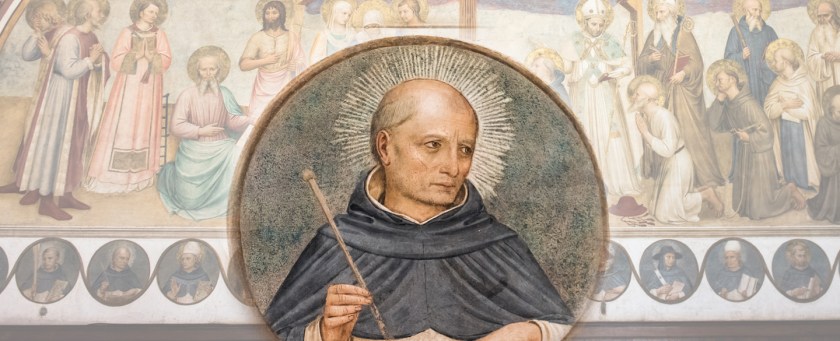
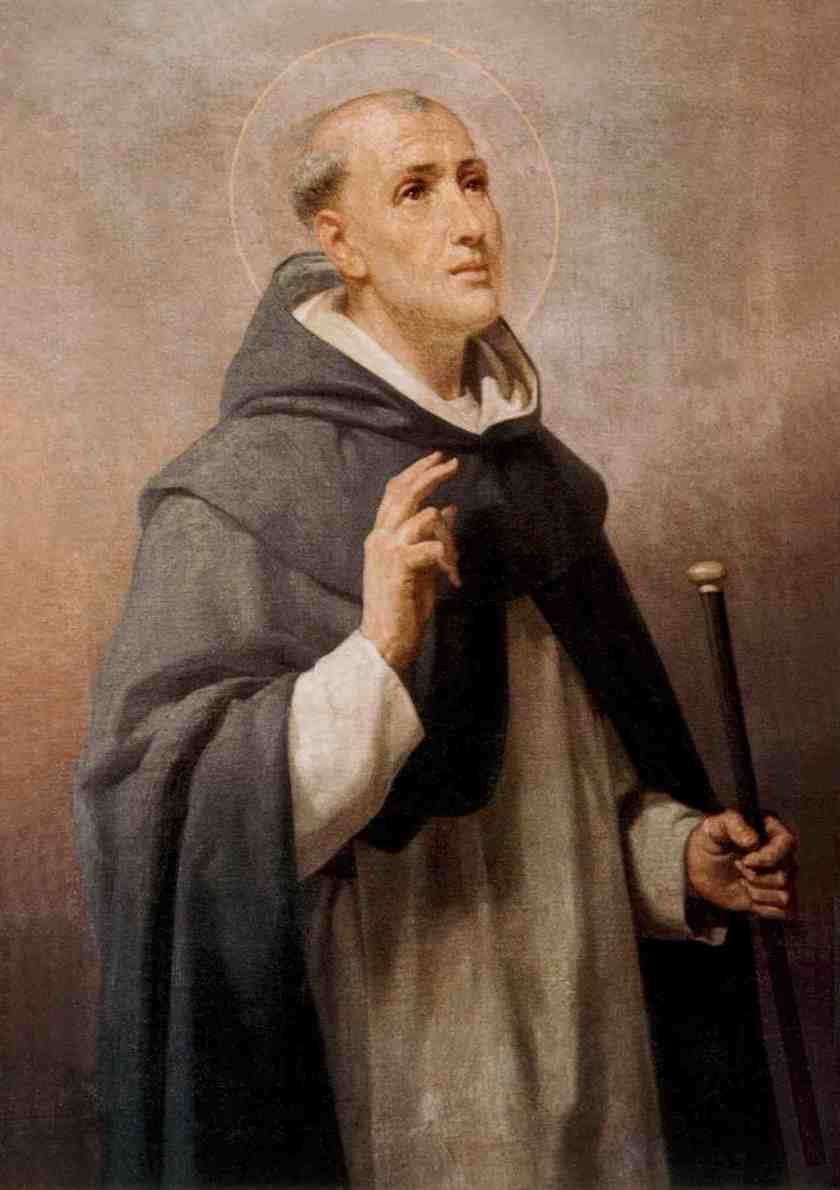
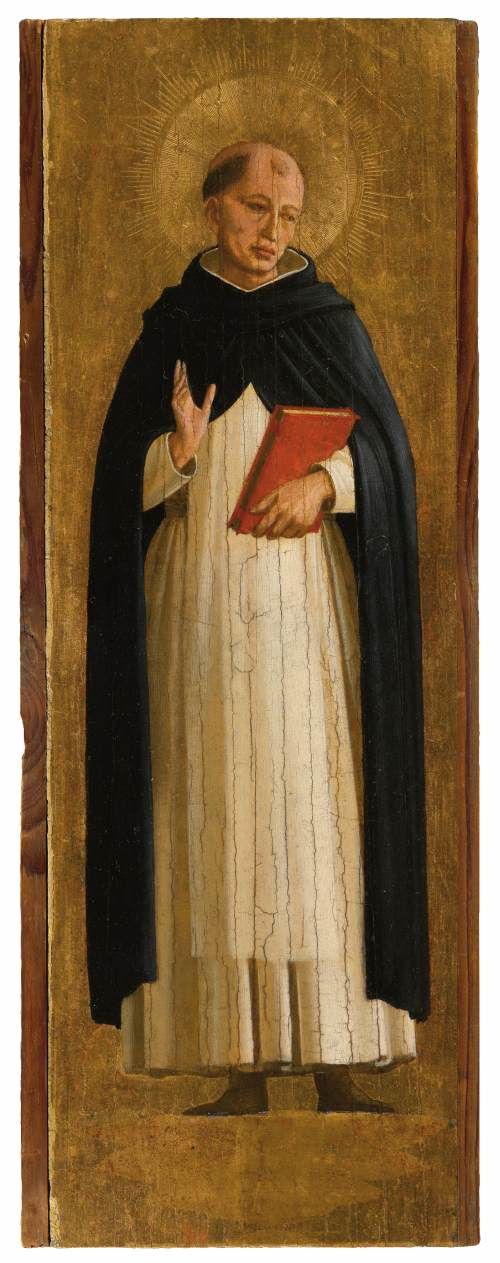
Saint of the Day – 10 April – Blessed Antony Neyrot O.P. (1425-1460) Martyr

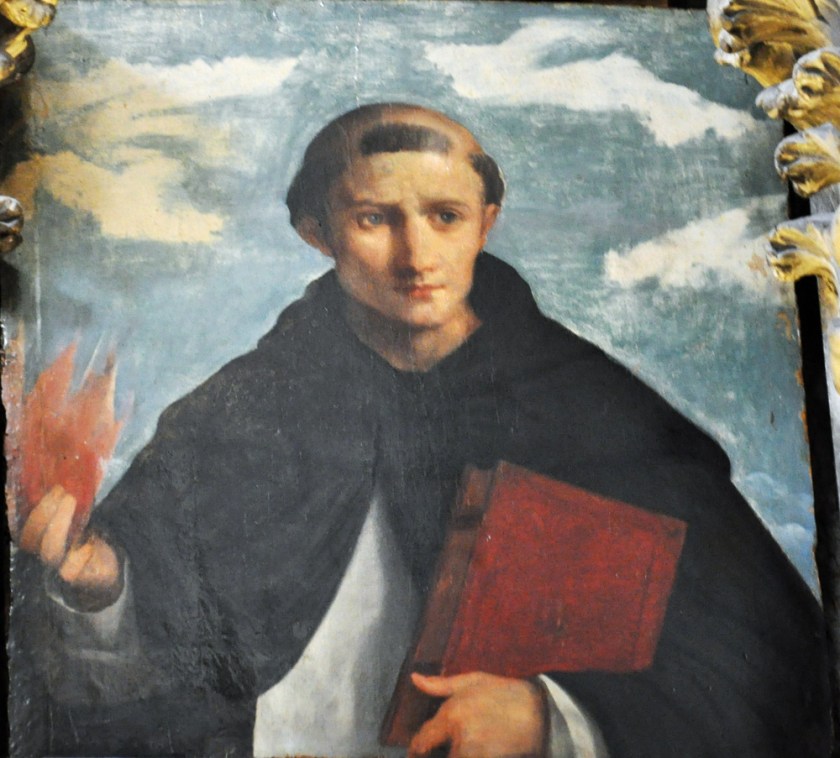
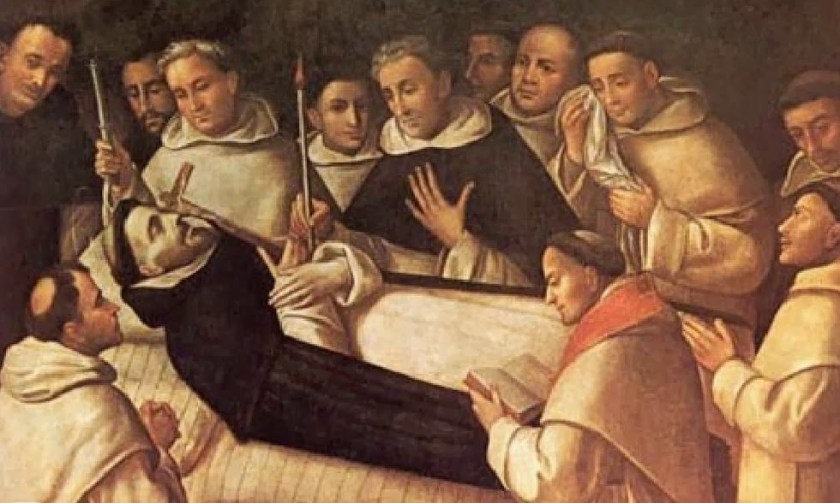
Saint of the Day – 10 April – Blessed Antony Neyrot O.P. (1425-1460) Martyr, Dominican Priest, an Apostate who reconverted, Penitent.   Bl Anthony was born c 1425 at Rivoli, Diocese of Turin, Italy and died by being stoned to death on 10 April 1460 in Tunis, Tunisia.   His body was returned to Rivoli, Italy by merchants travelling through the region.  He was Beatified on 22 February 1767 by Pope Clement XIII (cultus confirmation).
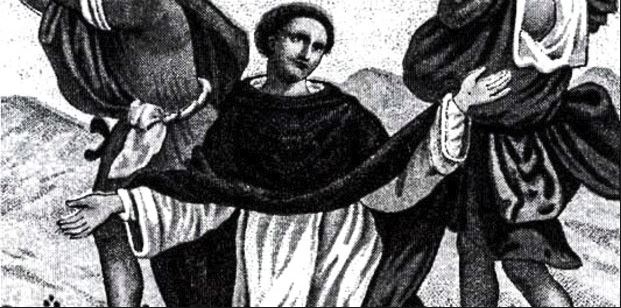
header - bl anthony neyrot

Anthony was the only Dominican blessed ever to renounce his faith and yet in the end return to the faith and die a Martyr’s death.   Bl Anthony is a reminder to us that nothing is lost which cannot be found again and no-one can stray so far that the Good Shepherd cannot bring him or her home.

Not much is known about the youth of Bl Anthony, only that he was from Rivoli in Italy. He was received into the Order by the great Dominican, Saint Antoninus.   After his studies and ordination, Anthony was assigned to the convent of San Marco in Florence. Being somewhat wayward and impatient, Anthony quickly grew tired of this and asked for a change of scenery.   He was sent first to Sicily, about which he was not thrilled and then to Naples.   While sailing to Naples, Anthony’s ship was captured by pirates and he and the other passengers were taken to the city of Tunis in North Africa.

At first, Anthony was well-liked by the emir in Tunis and was allowed a measure of freedom.   His continuing arrogance, though, quickly brought the wrath of his captors and Anthony was put in prison and given only bread and water.   Anthony eventually gave in, denying his faith in order to obtain his freedom.   Anthony quickly embraced his new faith, even going so far as to attempt a translation of the Qur’an.   Soon, he was adopted by the emir and married a high-born Turkish lady.

Anthony’s newfound complacency, though, was quickly shattered.   Into his life came the news that his beloved teacher and mentor, Saint Antoninus, had died.   Love for his old master stirred in Anthony’s heart a desire for the Truth which he had abandoned.   He had a dream in which Antoninus appeared to him;   the conversation that transpired caused Anthony to resolve to readopt the faith which he had left behind, although such an action would result in his certain death.

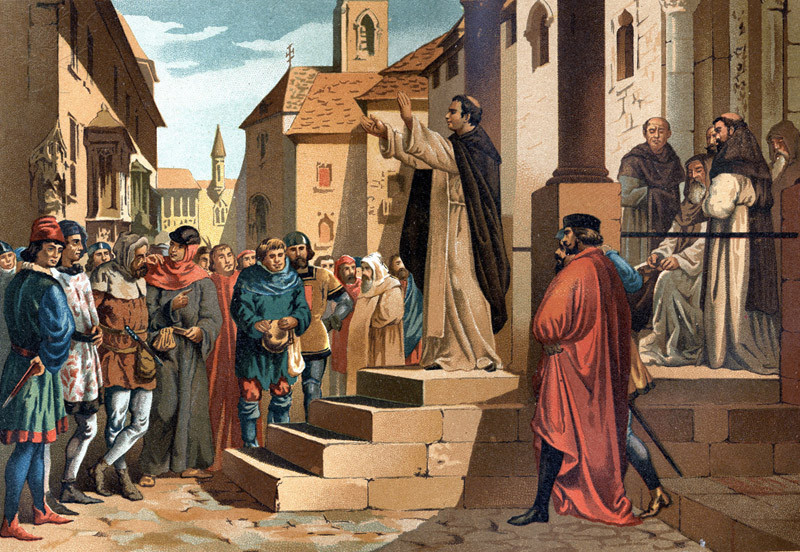
Finding a Dominican priest, Anthony confessed his sins, and on Palm Sunday of 1460, he publicly asked forgiveness from his fellow Catholics and was thereafter readmitted to his order.    Wanting his re-conversion to be as public as his denial had been, Anthony waited until the king held a public procession then, Anthony appeared on the palace steps wearing again his Dominican habit and proclaiming his faith in a loud voice and his sorrow at ever having abandoned it.   Failing to change Anthony’s mind, the emir ordered his death.   Anthony died under a shower of stones, proclaiming his faith and his sorrow on Holy Thursday, 1460.   His body was eventually returned to Rivoli,  where it soon became a site of pilgrimage and many miracles were attributed to it and an annual procession was held at his shrine.
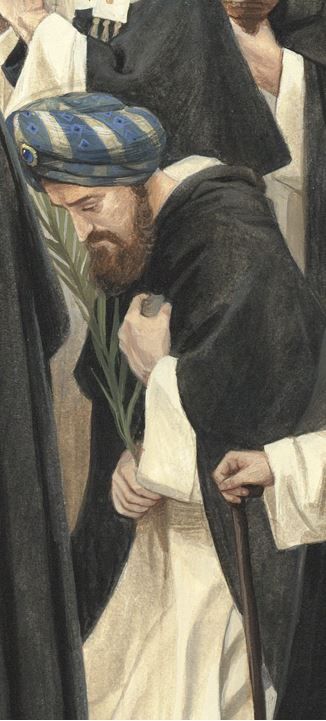
bl anthony neyrot

Holy Mary, Searcher for the Lost, pray for us.

 Blessed Anthony Neyrot, pray for us.

Posted in DOMINICAN OP, SAINT of the DAY

Memorials of the Saints – 10 April

Bl Antony Neyrot O.P. (1425-1460) Martyr
Bl Antonio Vallesio
St Apollonius of Alexandria
Bl Archangelus Piacentini
St Bademus
St Bede the Younger
St Beocca of Chertsey
Bl Boniface Zukowski
Bl Eberwin of Helfenstein
St Ethor of Chertsey
St Ezekiel the Prophet
St Fulbert of Chartres
St Gajan
St Hedda of Peterborough
St Macarius of Antioch
St Maddalena of Canossa
St Malchus of Waterford
Bl Marco Mattia
Bl Mark Fantucci
St Michael de Sanctis
St Palladius of Auxerre
St Paternus the Scot

Martyrs of Carthage – 50 saints: A group of 50 Christians who were imprisoned in a pen of snakes and scorpions, and then martyred, all during the persecutions of Decius. Only six of their names have come down to us – Africanus, Alessandro, Massimo, Pompeius, Terence and Teodoro. Beheaded in 250 at Carthage.

Martyrs of Georgia: Approximately 6,000 Christian monks and lay people martyred in Georgia in 1616 for their faith by a Muslim army led by Shah Abbas I of Persia.

Martyrs of Ostia: A group of criminals who were brought to the faith by Pope Saint Alexander I while he was in prison with them. Drowned by being taken off shore from Ostia, Italy, in a boat which was then scuttled, c 115.

Posted in DOMINICAN OP, EASTER, MORNING Prayers, QUOTES of the SAINTS, QUOTES on CHARITY, QUOTES on HUMILITY, SAINT of the DAY, The WORD

One Minute Reflection – 5 April – Easter Thursday and the Memorial of St Vincent Ferrer (1350-1419)

One Minute Reflection – 5 April – Easter Thursday and the Memorial of St Vincent Ferrer (1350-1419)

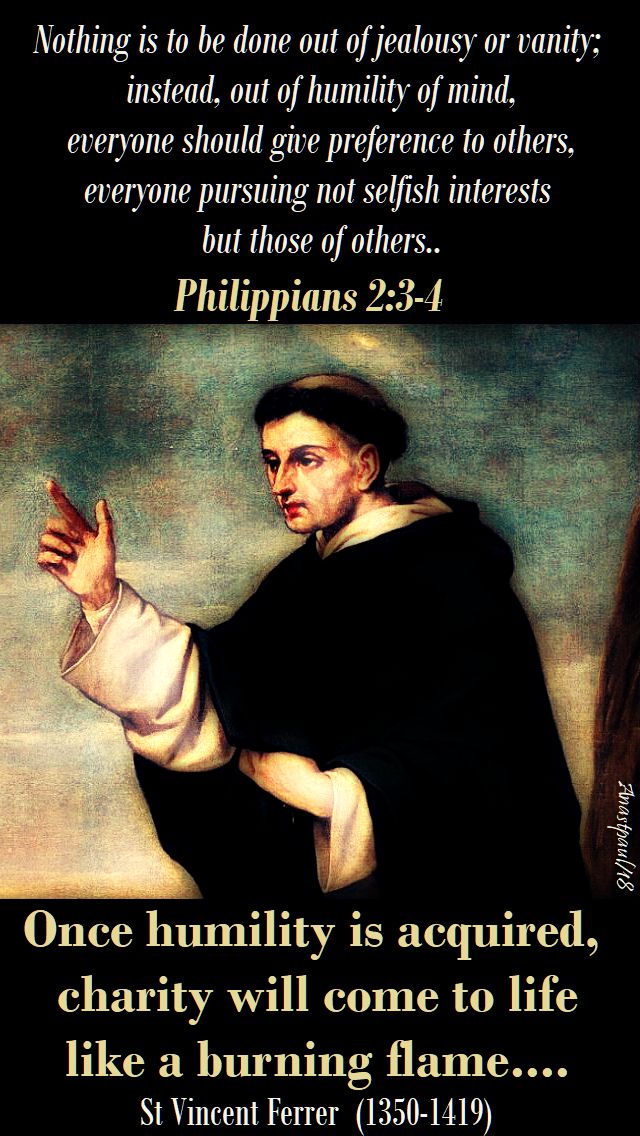
Nothing is to be done out of jealousy or vanity; instead, out of humility of mind everyone should give preference to others, everyone pursuing not selfish interests but those of others...Philippians 2:3-4

REFLECTION – “Once humility is acquired, charity will come to life like a burning flame devouring the corruption of vice and filling the heart so full, that there is no place for vanity.”…once humility is acquired - st vincent ferrer - 5 april 2018

PRAYER – Lord God, who sent St Vincent Ferrer to preach the Gospel of Christ, grant that we may see the Son of Man reigning in heaven, whom he proclaimed as Judge of Mankind. Grant that by the prayers of St Vincent, we may attain true humility and charity to all we meet. We make our prayer through our Lord, Jesus in unity with the Holy Spirit, one God, forever amen.st vincent ferrer - pray for us - 5 APRIL 2018

Posted in DOMINICAN OP, EASTER, MORNING Prayers, PRAYERS of the SAINTS, SAINT of the DAY

Our Morning Offering – 5 April – Easter Thursday and the Memorial of St Vincent Ferrer (1350-1419)

Our Morning Offering – 5 April – Easter Thursday and the Memorial of St Vincent Ferrer (1350-1419)

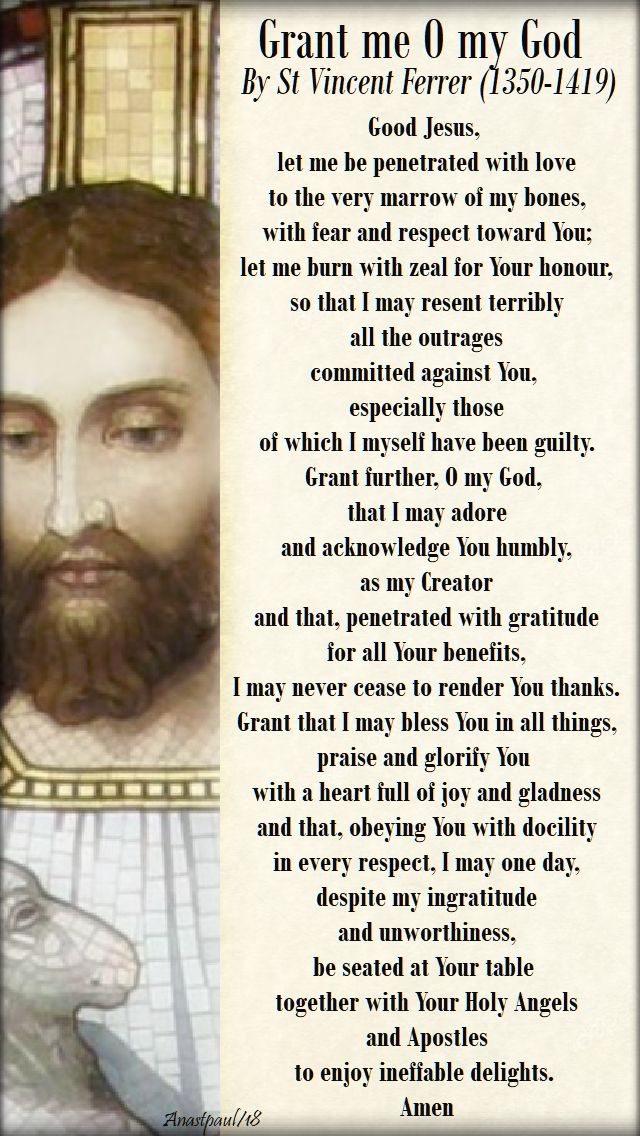
Grant me O my God
By St Vincent Ferrer

Good Jesus,
let me be penetrated with love
to the very marrow of my bones,
with fear and respect toward You;
let me burn with zeal for Your honour,
so that I may resent terribly all the outrages
committed against You, especially those
of which I myself have been guilty.
Grant further, O my God,
that I may adore
and acknowledge You humbly, as my Creator
and that, penetrated with gratitude
for all Your benefits,
I may never cease to render You thanks.
Grant that I may bless You in all things,
praise and glorify You
with a heart full of joy and gladness
and that, obeying You with docility
in every respect, I may one day,
despite my ingratitude and unworthiness,
be seated at Your table
together with Your Holy Angels and Apostles
to enjoy ineffable delights.
Amengood jesus let me be penetrated with love - st vincent ferrer - 5 april 2018

Posted in DOMINICAN OP, Of BUILDERS, CONSTRUCTION WORKERS, Of FISHERMEN, FISHMONGERS, PATRONAGE - PRISONERS, SAINT of the DAY

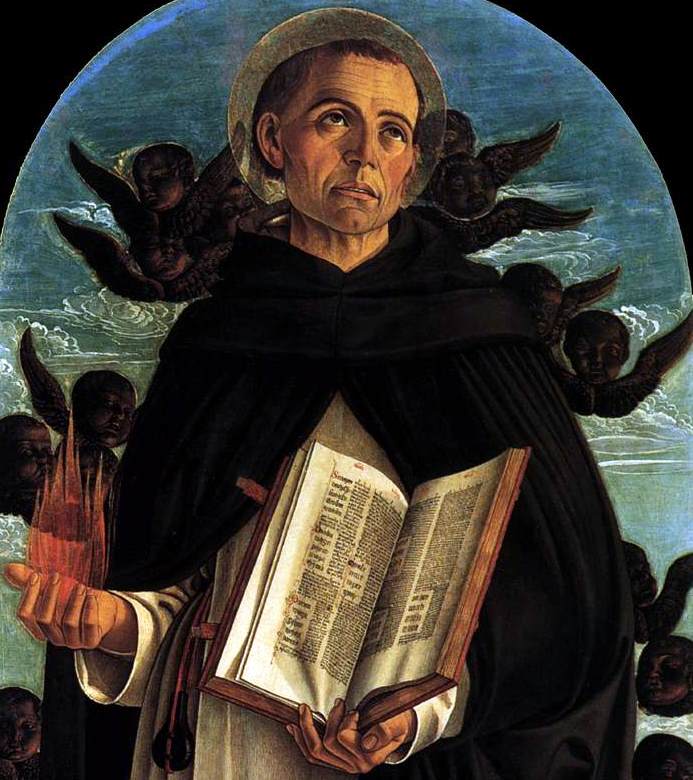
Saint of the Day – 5 April – St Vincent Ferrer O.P. (1350-1419)

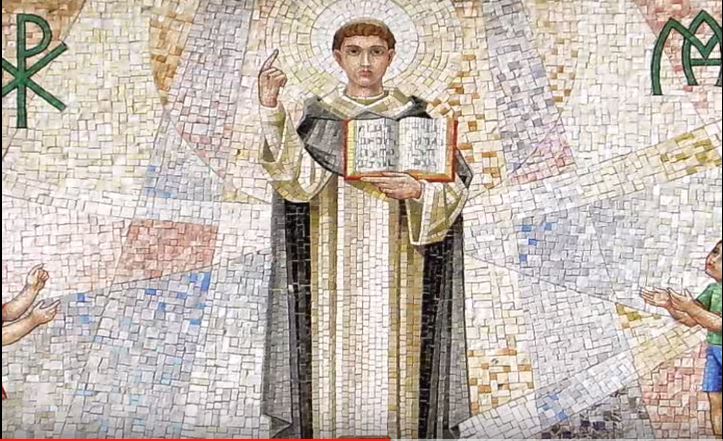
Saint of the Day – 5 April – St Vincent Ferrer O.P. (1350-1419), called the “Angel of the Apocalypse/The Last Judgement” and the “The Mouthpiece of God.”- Dominican Priest, Missionary, Master of Sacred Theology, Philosopher, Teacher, Preacher, Logician, Apostle of Charity – born on 23 January 1350 in Valencia (part of modern Spain) and died on 5 April 1419 at Vannes, Brittany, France of natural causes.   His remains are interred in the Cathedral of Vannes.   Patronages – Archdiocese of Valencia, Builders, Prisoners, Construction workers, Plumbers, Fishermen, Spanish orphanages, Calamonaci, Italy, Casteltermini, Agrigento, Italy, Leganes, Philippines, Orihuela-Alicante, Spain, diocese of.   st vincent ferrer - header

St Vincent was born in Valencia, Spain.   However, even in utero he was performing miracles.   His mother visited a blind woman she often helped.   The lady placed her head on the mother’s womb to hear the baby’s heart beat and was instantly healed of her blindness.   The entire city was quite animated at his birth and their town square argument over his name had to be settled by the local bishop who recommended he share the name of the city’s patron saint (St Vincent of Zaragosa, a third century martyr, died 304).   Before St Vincent was three months old, Valencia was struck by a terrible famine.   The infant spoke in a perfectly intelligible manner to his mother, informing her that all the townspeople needed to carry a venerated statue in procession about the city to end the famine.   No sooner had the procession begun than rain began to fall and the famine was broken.

From his tenderest years, it was clear that God was calling St Vincent to serve Him at His Altar.   The boy was gifted with great intelligence and even more profound piety.   When Vincent joined the Dominicans, he zealously practiced penance, study and prayer.   He was a teacher of philosophy and a naturally gifted preacher called the “Mouthpiece of God.”   His saintly life was what made his preaching so effective.   Vincent’s subjects were judgement, heaven, hell and the need for repentance.  Soon he was teaching and preaching all over Spain.

But at this time, three men claimed to be pope in the 1300s and 1400s.   Kings, princes, priests and laypeople fought one another to support the different claimants for the Chair of Peter.   This chaos led to the Western Schism and then God raised up Vincent Ferrer.saint-vincent-ferrer-large

Even the holiest people can be misled.   Pope Urban VI was the real pope and lived in Rome but Vincent and many others thought that Clement VII and his successor Benedict XIII, who lived in Avignon, France, were the true popes.   Vincent convinced kings, princes, clergy and almost all of Spain to give loyalty to them.   After Clement VII died, Vincent tried to get both Benedict and the pope in Rome to abdicate so that a new election could be held.  Vincent returned to Benedict in Avignon and asked him to resign.   Benedict refused.

Vincent came to see the error in Benedict’s claim to the papacy.   Discouraged and ill, Vincent begged Christ to show him the truth.   In a vision, he saw Jesus with Saint Dominic and Saint Francis, commanding him to “go through the world preaching Christ.” For the next twenty years he travelled to England, Scotland, Ireland, Aragon, Castile, France, Switzerland and Italy, preaching the Gospel and converting many.   Many biographers believe that he could speak only Valencian but was endowed with the gift of tongues.   St Vincent also had great success in preaching to the Moors and Jews.   Countless converts came into the Church and on one single day he converted more than five thousand Jews.   His spiritual success was even more fruitful among Catholics. Hatreds, envies, wars and other divisions were all brought to an abrupt end under his guidance.   Once he raised a woman from the dead so that she could testify to all present that he was indeed the Angel of the Apocalypse (cf. Apco 14:6), sent by God to call a world seeped in sin to repentance.  He preached to St Colette of Corbie and to her nuns and it was she who told him that he would die in France.   Too ill to return home to Spain, he did, indeed, die in Brittany in 1419, at the age of sixty-nine.   Breton fishermen still invoke his aid in storms.   Vincent spread the Good News throughout Europe.   He fasted, preached, worked miracles and drew many people to become faithful Christians.

One day while Benedict was presiding over an enormous assembly, Vincent, though close to death, mounted the pulpit and denounced him as the false pope.   He encouraged everyone to be faithful to the one, true Catholic Church in Rome.   Benedict fled, knowing his supporters had deserted him.    The Great Western Schism was finally ended in 1417 when all the world universally acknowledged Martin V as rightful pope.

St Vincent was canonised by Pope Calixtus III on 3 June 1455.Palma il Vecchio, St. Vincent Ferrer, ca. 1523

Posted in DOMINICAN OP, SAINT of the DAY

Memorials of the Saints – 5 April

St Vincent Ferrer O.P. (1350-1419) (Optional Memorial)

St Albert of Montecorvino
Bl Antonius Fuster
St Becan
Bl Blasius of Auvergne
St Claudius of Mesopotamia
St Derferl Gadarn
St Gerald of Sauve-Majeure
St Irene of Thessalonica
St Maria Crescentia Hoss
St Mariano de la Mata Aparicio
St Pausilippus
Bl Peter Cerdan
St Theodore the Martyr
St Zeno the Martyr

Martyrs of Lesbos: 5 saints – Five young Christian women martyred together for their faith. We don’t even know their names. island of Lesbos, Greece.

Martyrs of North-West Africa: Large group of Christians murdered while celebrating Easter Mass during the persecutions of Genseric, the Arian king of the Vandals. They were martyred in 459 at Arbal (in modern Algeria).

Martyrs of Seleucia: 120 saints – One-hundred and eleven (111) men and nine (9) women who, because they were Christians, were dragged to Seleucia and martyred for refusing to worship the sun or fire or other pagan idols during the persecutions of King Shapur II. They were burned alive in 344 in Seleucia, Persia.

Posted in DOMINICAN OP, MORNING Prayers, ON the SAINTS, QUOTES of the SAINTS, SAINT of the DAY

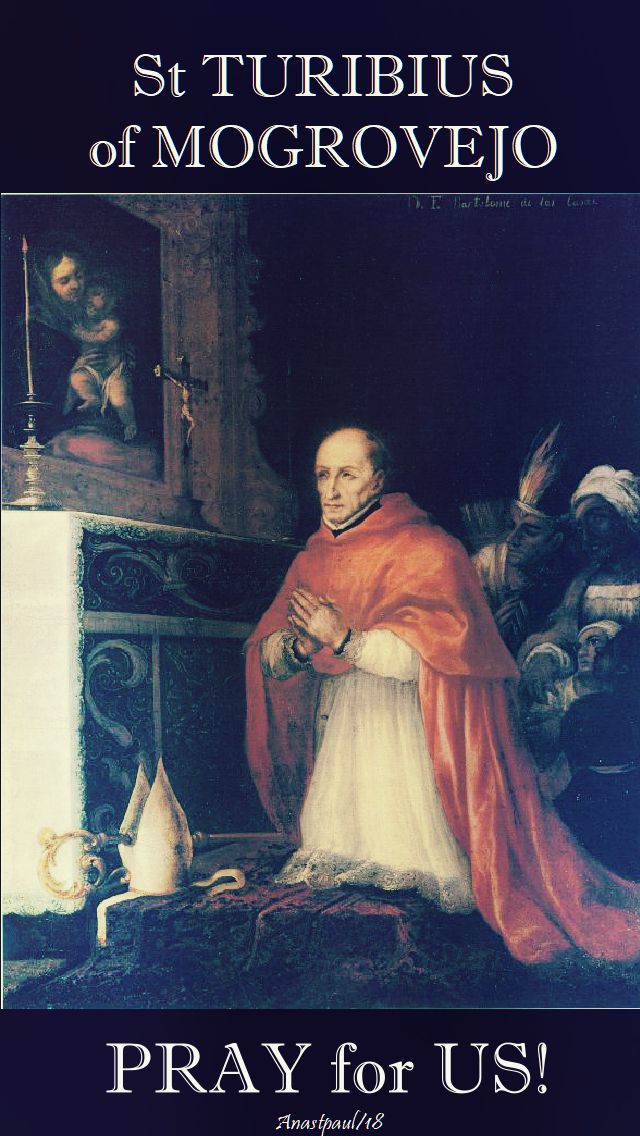
Thought for the Day – 23 March – The Memorial of St Turibius of Mogrovejo (1538-1606)

Thought for the Day – 23 March – The Memorial of St Turibius of Mogrovejo (1538-1606)

Nothing gave our saint so much pleasure as the greatest labours and dangers, to procure the least spiritual advantage to one soul.   Burning with the most vehement desire of laying down his life for his flock and of suffering all things for Him who died for us, he feared no dangers.   When he heard that poor Indians wandered in the mountains and deserts, he sought them out;  and to comfort, instruct, or gain one of them he often suffered incredible fatigues and dangers in the wildernesses and boldly travelled through the haunts of wild animals.
The ardour of his faith, his hope, his love of his Creator and Redeemer, his resignation and perfect sacrifice of himself, gathered strength in the fervent exercises and aspirations which he repeated almost without ceasing in his illness.   By his last will he ordered what he had about him to be distributed among his servants and whatever else he otherwise possessed to be given to the poor.
His body when translated the year after his death to Lima, was found incorrupt, the joints flexible, and the skin soft.
The Lord indeed writes straight with crooked lines.   Against his will and from the unlikely springboard of an Inquisition tribunal, this man became the Christlike shepherd of a poor and oppressed people.   God gave him the gift of loving others as they needed it. St Turibius, pray for us!st turibius pray for us - 23 march 2018-no 2

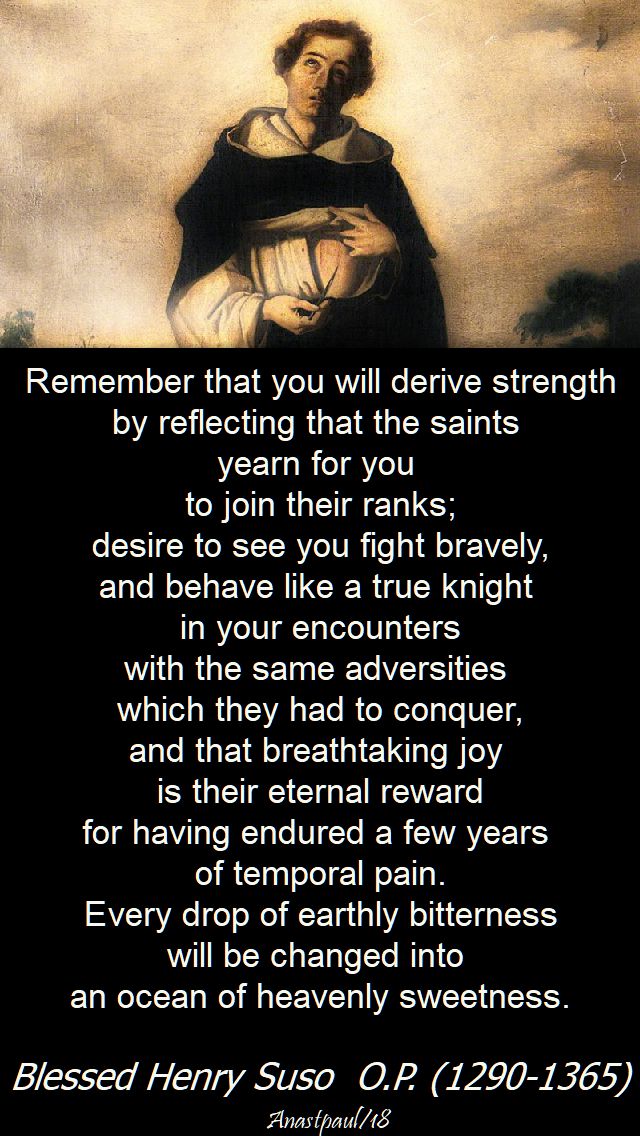
“Remember that you will derive strength
by reflecting that the saints
yearn for you
to join their ranks;
desire to see you fight bravely,
and behave like a true knight
in your encounters
with the same adversities
which they had to conquer,
and that breathtaking joy
is their eternal reward
for having endured a few years
of temporal pain.
Every drop of earthly bitterness
will be changed into
an ocean of heavenly sweetness.”

Blessed Henry Suso O.P. (1290-1365)remember that you will - bl henry suso - 23 march 2018

Posted in DOMINICAN OP, SAINT of the DAY

Memorials of the Saints – 17 March

St Patrick (c 386-461) (Optional Memorial)

St Agricola of Châlon-sur-Saône
St Alexander
St Ambrose of Alexandria
Bl Conrad of Bavaria
St Diemut of Saint Gall
St Gabriel Lalemant
St Gertrude of Nivelles (626-659)
Bl Gertrude of Trzebnica
St Jan Sarkander
Bl Josep Mestre Escoda
St Joseph of Arimathea
Bl Juan Nepomuceno Zegrí y Moreno
St Llinio of Llandinam
Bl Maria Bárbara Maix
St Paul of Cyprus
St Stephen of Palestrina
St Theodore of Rome
St Thomasello
St Withburga of Dereham

Martyrs of Alexandria – Also known as Martyrs of Serapis: An unknown number of Christians who were martyred together by a mob of worshippers of the Graeco-Egyptian sun god Serapis. They were Martyred in c 392 in Alexandria, Egypt.

Posted in DOCTORS of the Church, DOMINICAN OP, LENT, MORNING Prayers, QUOTES of the SAINTS, QUOTES on CONVERSION, QUOTES on REPENTANCE, SAINT of the DAY

One Minute Reflection – – 14 March 2018 – Wednesday of the 4th Week of Lent and the Memorial of St Matilda

One Minute Reflection – – 14 March 2018 – Wednesday of the 4th Week of Lent and the Memorial of St Matilda

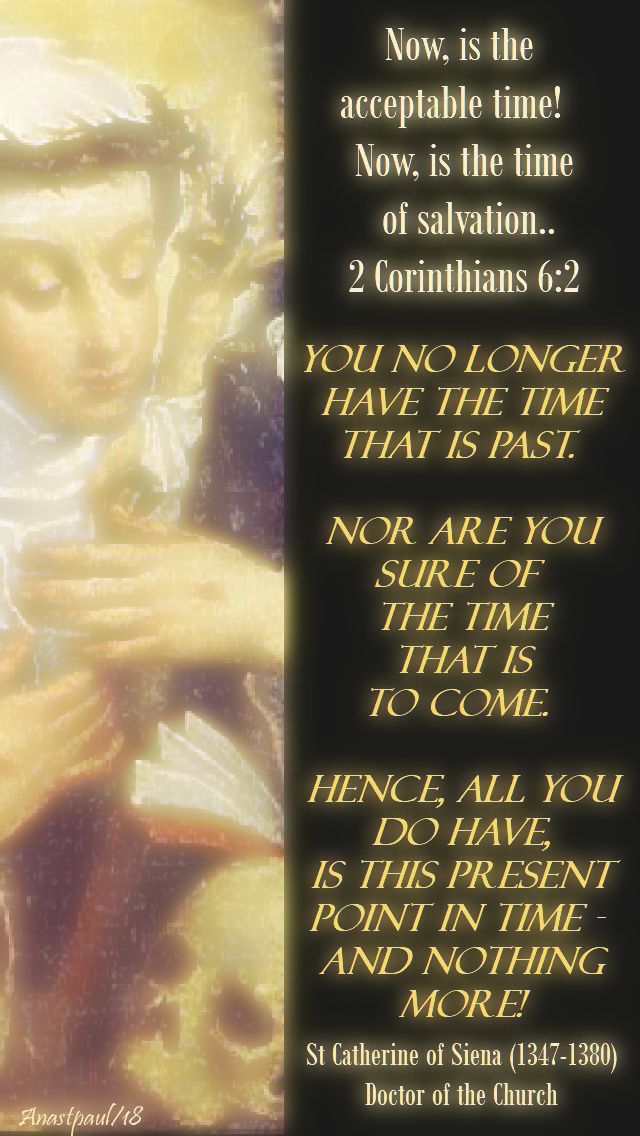
Now is the acceptable time!   Now is the time of salvation….2 Corinthians 6:2

REFLECTION – “You no longer have the time that is past.   Nor are you sure of the time that is to come.   Hence, all you do have, is this present point in time – and nothing more!”… St Catherine of Siena (1347-1380) Doctor of the Churchyou no longer have the time - st catherine of siena - 14 march 2018

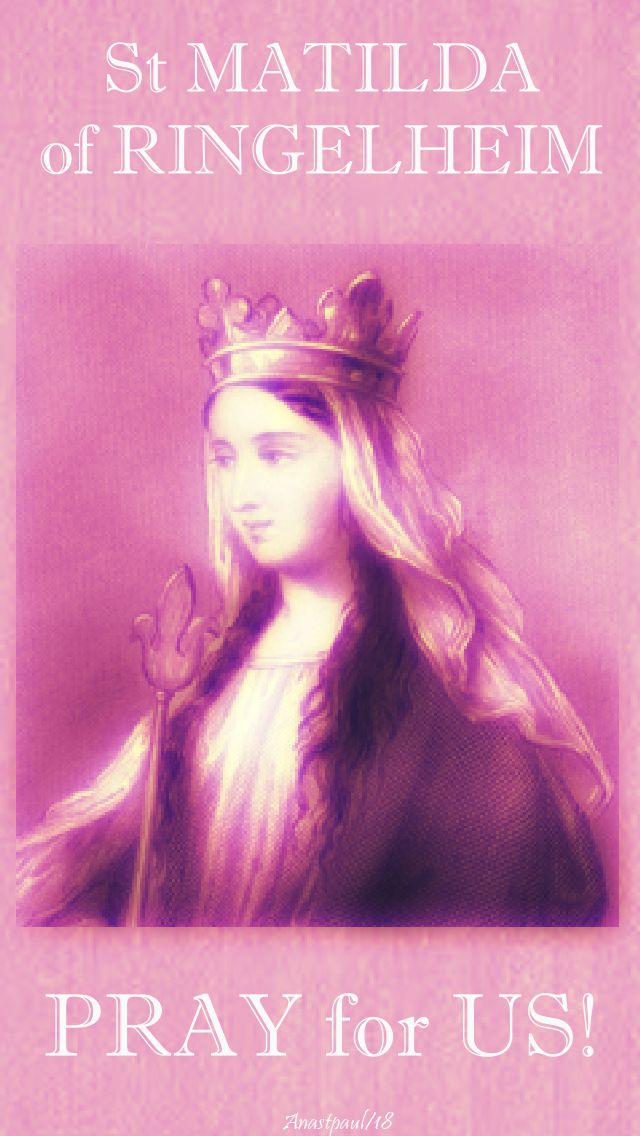
PRAYER – Timeless loving Lord, teach me to be grateful for every moment that You allot to me.   Grant that I may always understand this ‘blink of an eye’ and live each moment only for You, in You and with You.   Difficult as your times were St Matilda, you maintained your eyes on the Lord alone, pray for us all, that we too may follow your example. Amenst matilda pray for us - 14 march 2018

Posted in DOMINICAN OP, SAINT of the DAY

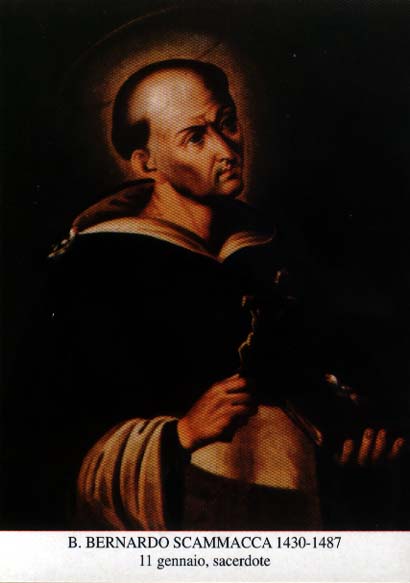
Saint of the Day – 16 February – Blessed Bernard Scammacca O.P. (1430-1487)

Saint of the Day – 16 February – Blessed Bernard Scammacca O.P. (1430-1487) – Religious Priest, Preacher, apostle of charity, mystic, with a gift of prophecy and a great devotion to the Passion of Christ.   Born Bernardo in 1430 in Catania, Sicily and he died on 11 January 1487 of natural causes.   Fifteen years after his death he appeared in a vision to the prior in Catania and asked that his remains be moved to the house’s rosary chapel, during this relocation, a man was cured of paralysis by touching the relics.   He was Beatified in 1825 by Pope Leo XII (cultus confirmed).   His body is incorrupt.

bl bernard scammacca

Blessed Bernard Scammacca was born in 1430 in Catania to upper-class and pious parents.

Scammacca was well-educated in his childhood.   Despite his education he spent his adolescence as a wild and dissolute man and during one such revel he received a leg wound in a duel with a man with whom he had quarrelled.   His subsequent convalescence provided him with adequate time to reflect on what had happened as well as the course his life had taken.   This made him realise that he was heading in the wrong direction and needed urgent changes.   His healing over time renewed his links to his faith;  he approached the Order of Preachers in 1452 in Catania and begged to be admitted into their ranks.

Bl Bernard became known for his range of charitable works and for his life of repentance for the life he had led, as well as for his strict adherence to the rule of St Dominic.   He fostered a particular devotion to the Passion of Christ, which sometimes led him into ecstasies.   He founded a hospital for the poor, which still exists.   He also liked to spend time in the confessional and worked as a spiritual director.  He had the gift of being a prophet and used that gift to warn others to change their lives.   He also prophesied the date of his own death.

Scammacca was named the prior of the convent of St Dominic in Catania and later named as the prior of the convent in Palermo.   He was also made the vicar general of the reformed Sicilian convents.

It was often said that when he walked in his convent’s garden the birds would come and sing to him but would stop at once when he stopped to reflect.   On one occasion a porter was sent to his room to fetch him and the man saw a bright light under a door.   He peeked in to see a child shining with light holding a book that Scammacca was reading from.

Bl Bernard died in 1487 in Catania.   In 1502 it was said that he appeared in a vision to the prior of his convent and asked that his incorrupt remains be relocated the house’s chapel.   During the translation a man was cured of his paralysis after he touched Scammacca’s relics.

Posted in DOMINICAN OP, MORNING Prayers, QUOTES of the SAINTS, SAINT of the DAY

Thought for the Day – 13 February – The Memorial of Blessed Jordan of Saxony O.P. (1190-1237)

Thought for the Day – 13 February – The Memorial of Blessed Jordan of Saxony O.P. (1190-1237

“You have no doubt heard that our kind Father, Master Jordan, his two companions and ninety-nine other persons have been taken from this wicked world by shipwreck in a violent storm.   However, dear brothers, do not let your hearts be saddened by this awful calamity;  for God, in His mercy, has already greatly consoled us, who have become orphans through the untimely death of a good Father.   After the storm, the bodies of our three confrères were washed ashore and bright lights in the form of crosses shone over them every night until they were found and buried where they lay by those who escaped from the disaster.   These, together with many others, have borne testimony to the miracle.   Moreover, the inhabitants of the neighbourhood, drawn to the place of the catastrophe by reports of so marvellous an occurrence, testify that they experienced a sweet fragrance all round;   while those who touched the bodies declare that this fragrance did not leave their hands for more than ten days.   Indeed, this same sweet odour pervaded the locality until the fathers at Ptolomais came in a boat and took up the bodies for burial in the conventual church of that city.   There now repose the remains of our late beloved Master General;  and many wonders have in this short time been attributed to his intercession.   Blessed be God in all His works. Amen”

All through his religious life the second head of the Order had been regarded as a very saintly man.   A number of prodigies were said to have been wrought by him.   Others came after his death;  while several very holy persons declared that, in visions, they saw his soul ascend into heaven.   All this, together with the facts recorded in the letter just quoted, occasioned a devotion to the man of God which continued through the course of centuries and caused him to be given the title of Blessed Jordan of Saxony.   After a thorough study of this immemorial veneration by the Sacred Congregation of Rites, Leo XII, who reigned from 1823 to 1829, allowed the Friars Preacher the world over to say mass and recite the divine office in his honour.   Throughout his Order he is held in an esteem second only to that which is accorded to Saint Dominic.

It is not commonly known or understood the highly efficacious intercession available to us all and thus we pray, Blessed Jordan of Saxony, Pray for us!bl-jordanofsaxony-prayforus-- 13 feb 2017 . 2

Posted in DOMINICAN OP, MORNING Prayers, QUOTES of the SAINTS, SAINT of the DAY, The WORD

Quote of the Day – 13 February – The Memorial of Blessed Jordan of Saxony O.P. (1190-1237)

Quote of the Day – 13 February – The Memorial of Blessed Jordan of Saxony O.P. (1190-1237)

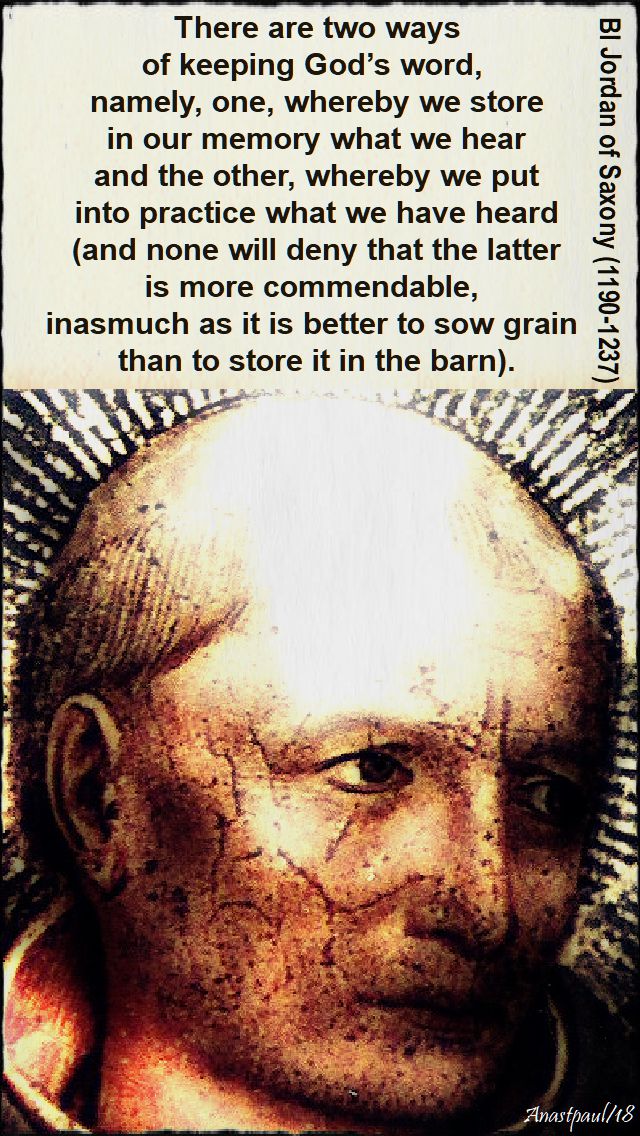
“There are two ways of keeping God’s word, namely, one, whereby we store in our memory what we hear and the other, whereby we put into practice, what we have heard (and none will deny that the latter is more commendable, inasmuch, as it is better to sow grain, than to store it in the barn).”

Blessed Jordan of Saxony (1190-1237)there are two ways - bl jordan of saxony - 13 feb 2018

Posted in DOCTORS of the Church, DOMINICAN OP, MORNING Prayers, PRAYERS of the SAINTS, SAINT of the DAY

Our Morning Offering – 13 February – The Memorial of Blessed Jordan of Saxony O.P.

Our Morning Offering – 13 February – The Memorial of Blessed Jordan of Saxony O.P.

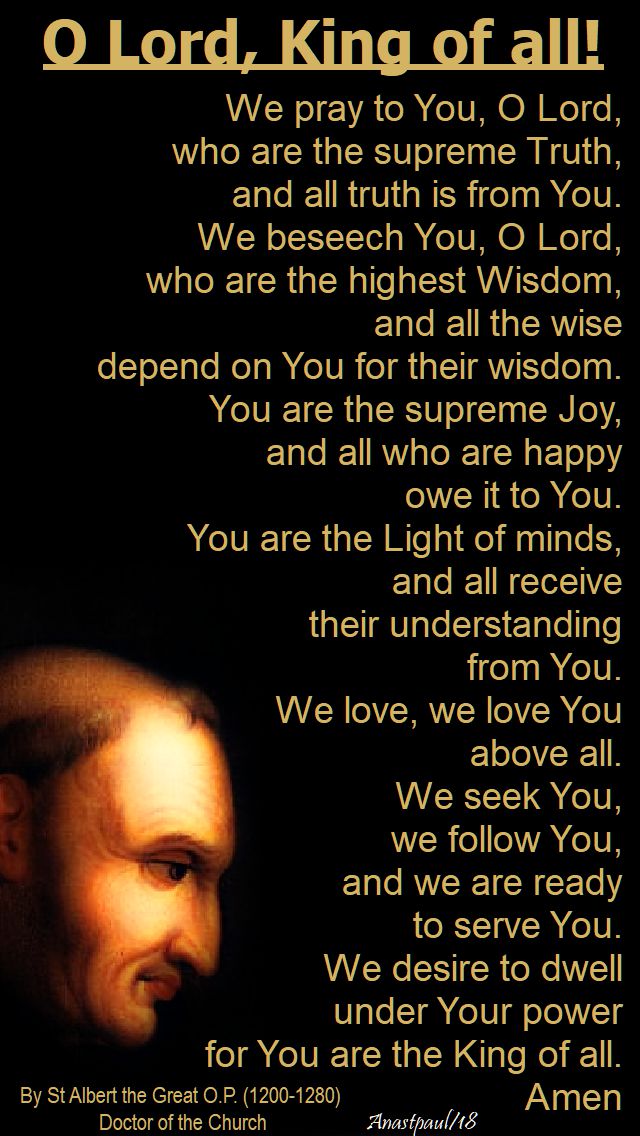
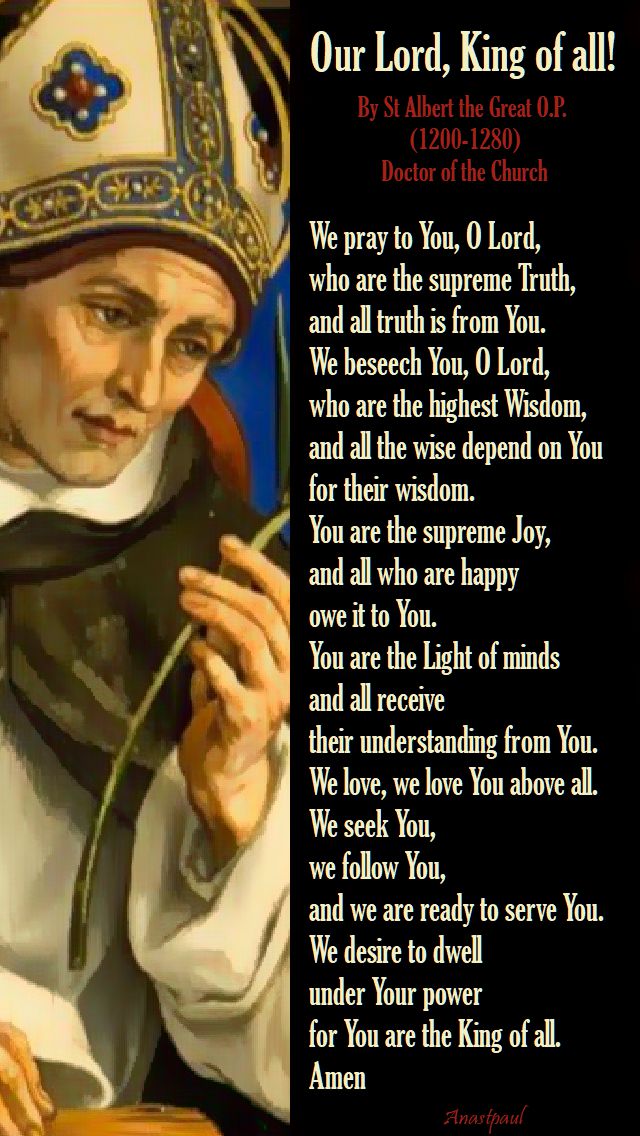
O Lord, King of all!
By St Albert the Great O.P. (1200-1280) Doctor of the Church

We pray to You, O Lord,
who are the supreme Truth,
and all truth is from You.
We beseech You, O Lord,
who are the highest Wisdom,
and all the wise depend on You for their wisdom.
You are the supreme Joy,
and all who are happy owe it to You.
You are the Light of minds,
and all receive their understanding from You.
We love, we love You above all.
We seek You, we follow You,
and we are ready to serve You.
We desire to dwell under Your power
for You are the King of all.
Amen.o lord,king of all by st albert the great - 13 feb 2018 - we pray to you o lord

Posted in DOMINICAN OP, QUOTES of the SAINTS, SAINT of the DAY

Saint of the Day – 13 February – Blessed Jordan of Saxony O.P. (1190-1237)

Saint of the Day – 13 February – Blessed Jordan of Saxony O.P. (1190-1237) Religious Priest, Preacher, the Second Master-General of the Domican Order, after St Dominic himself.   He was born in 1190 at Padberg Castle, diocese of Paderborn, Westphalia, old Saxony (in modern Germany), though it is rumoured to have been born in Palestine while his parents were on a pilgrimage, and named after the River Jordan but this is apparently aprochryphal.   He died by drowning in 1237 in a shipwreck off the coast of Syria while on a pilgrimage to the Holy Land.  He is buried in Acre.   Patronages – against drowning, of the Dominican Order, Vocations to the Dominicans.   Attributes – Dominican writing, a pen, a lily.

Header BLESSED-JORDAN

Mothers hid their sons when Master Jordan came to town…

These ten short words sum up in a humorous kind of way, the outstanding legacy of the successor of St Dominic.   It not only gives the impression that this new group of mendicant preachers had a clearly defined and essential role to play, challenging the infectious heresies so prevalent at the time (as was confirmed by Pope Honorius III in 1216 when he formally recognised the Order) but also that people were powerless to resist when confronted with it.   Of Blessed Jordan we are told that that during his tenure as Master General, between 1222 and 1237, over 1000 novices joined the Dominicans, new convents were established and new provinces formed.   Under his rule the Order continued to win many of the best men available, particularly in the Universities where many a Professor was seduced.   With such a charming figure sweeping through the neighbourhood is it any wonder that mothers tried to keep their sons out of reach?

A German of noble descent born in 1190, he had been in the Order a mere two years before his election as Master General in 1222.   By today’s standards, his rapid accession may appear hasty, a point he himself was quick to highlight when he became the first Provincial of Lombardy in 1221.   In the Libellus he writes:

‘In 1221, at the General Chapter in Bologna, they saw fit to make me the first Provincial of Lombardy, although I had only been in the Order one year and had not struck root as deeply as I ought to have done.   I was to be placed over others as their superior, before I had learned to govern my own imperfection.   I was not present at this Chapter myself.’bl jordan of saxony

Despite his anxiety, he must have made quite an impression on his brothers during his short tenure in the Order.   We are told about the type of person he was by those who knew.   It is obvious that he possessed all those qualities the ideal leader should have. Inspired by his brother and friend St Dominic, he was abounding in faith, kind and compassionate, humble, authoritative and yet at the same time understanding.   He had the ability to attract people by his sincerity.   His style of life complemented his style of words;  something that was evidently lacking at the time among the Clergy and Religious. This was vital at a time when ‘reform’ was the buzzword of the day.bl jordan - add

His great love for the poor was well known. There is a story said of him that:

‘Meeting a vagabond upon the road who feigned sickness and poverty, he gave him one of his tunics, which the fellow at once carried straight to a tavern for drink.   The brethren, seeing this done, taunted him with his simplicity:  ‘There now, Master, see how wisely you have bestowed your tunic.’  ‘I did so,’ said he, ‘because I believed him to be in want through sickness and poverty and it seemed at the moment to be a charity to help him;  still, I reckon it better to have parted with my tunic than with charity.’

Our Blessed Jordan may well be still speaking to us today!   Not all those people who present themselves as being needy these days may be genuine.   However, when we stop caring, we stop striving to be like Jesus.   Let us never restrain God’s work in our hearts but allow ourselves to be moved by compassion  . Perhaps it was this genuineness that caused Mothers in the district to be wary of his arrival.


Jordan died in a shipwreck on his return from Palestine, where he had visited the local convents of the Order;  the shipwreck occurred off the coast of Syria in 1237.   It is perhaps fitting that this great servant of the Order of Preachers, who was kept at arm’s length by the Mothers who feared his magnetic appeal on their sons, should nestle snuggly within the loving embrace of the Mother of God as famously depicted in that famous vision of St Dominic.death of blessed jordanmary and the dominican saints

Posted in DOMINICAN OP, MORNING Prayers, SAINT of the DAY

Thought for the Day – 25 January – The Memorial of Blessed Henry Suso O.P. (1290-1365)

Thought for the Day – 25 January – The Memorial of Blessed Henry Suso O.P. (1290-1365)

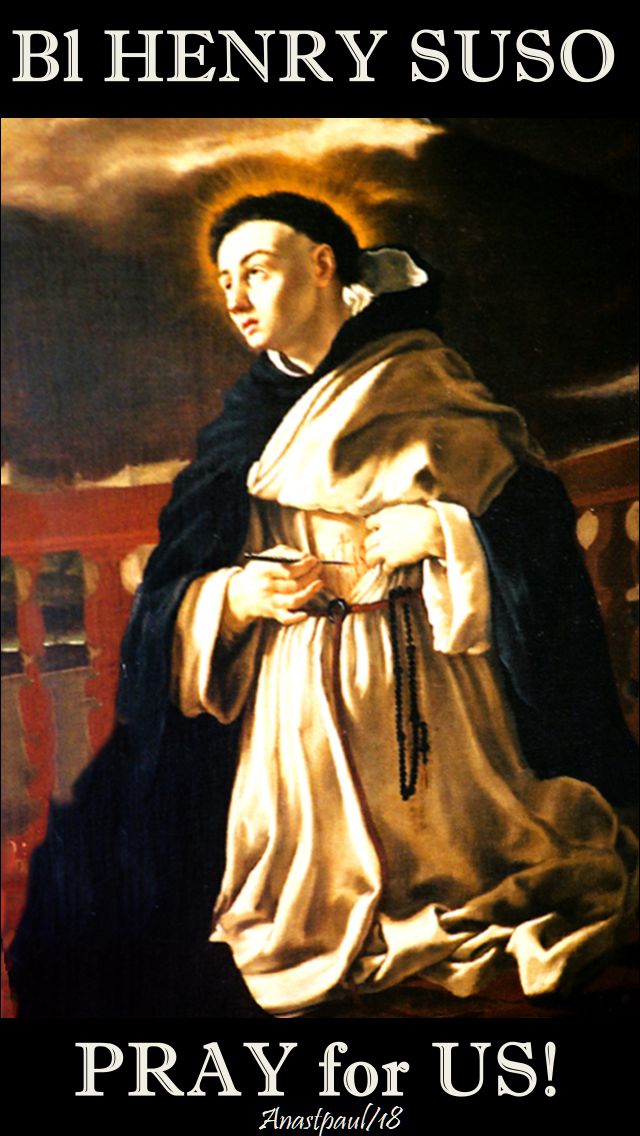
Henry Suso is a bundle of contradictions and a person, moreover, who has gathered legends about him like a snowball rolling downhill.   He was a poet, which is not always a key to happiness in this world; a mystic of the highest order;  a hard working Dominican;  and a man with a positive genius for getting into embarrassing situations. He has suffered at the hands of chroniclers who dislike his followers, or his tactics, or his poetry;  he is all but canonised by those who see in him the Dominican mystic.   It will require many years of exhaustive research to sort out the diverse elements in his personality, if, indeed, it can ever be accomplished.   Poets are not easy to analyse, and Henry, before all else, was a poet and a mystic.

Anyone who endures dryness at prayer or feels abandoned by God will find instruction, and perhaps some relief, in the experience of Henry Suso.   A mystic who called himself the “servant of Eternal Wisdom,” he endured long stretches of spiritual darkness interrupted only by occasional bursts of brightness.   Henry’s life says to us that in apparent barrenness the soul draws closest to God.   And we see him only by learning to look deep within.

Henry Suso was born at Constance, Switzerland and became a Dominican there at 13. Five years later an extraordinary divine encounter launched him on his lifelong mystical pursuit of God.   For the next decade, however, Suso suffered severe depression and doubt.   Finally, counsel with Meister Eckhart, the patriarch of 14th-century German mysticism, delivered him from the worst of it.

Like many other mystics, at midlife Henry threw himself into active Christian work.   For nearly two decades he travelled throughout the Rhineland preaching, teaching and giving spiritual direction.   He also wrote extensively about the inner life.   His work on prayer, The Little Book of Eternal Wisdom, became the most popular Christian book in Europe before The Imitation of Christ appeared.   In this excerpt he asks God, the Eternal Wisdom, why he seems to forsake those he loves:

Eternal Wisdom: When I hide myself, only then do you become aware of who I am or who you are. I am eternal Good, and so when I pour myself forth so lovingly, everything I enter becomes good. One can thus detect my presence as one detects the sun by its brightness since one cannot see its essence.

Servant: Lord, I find within myself a great unevenness. When I feel forsaken, my soul is like a sick person to whom everything is repugnant. But when the bright morning star bursts forth in my soul, all gloom disappears. Quickly, however, it is all snatched away and I am again forsaken. But then after intense sadness it returns. What is going on?

Eternal Wisdom: I am causing it, and it is the game of love. As long as love is together with love, love does not know how dear love is. But when love departs from love, then truly love feels how dear love was.

Servant: Dear Lord, teach me how to conduct myself in this game.

Eternal Wisdom: On good days you should consider the bad days, and on the bad days consider the good days. Then neither exuberance at my presence nor despondency can harm you. To find joy on earth, it is not enough that you give me a certain period of the day. You must constantly remain within yourself if you want to find God, hear his familiar words and be sensitive to his secret thoughts.

Suso’s individualistic piety and his association with Meister Eckhart, who was suspected of heresy, won him many enemies.   He was accused of theft, sacrilege, fathering a child, poisoning and heresy, he suffered greatly but he was completely cleared of all charges. Toward the end of his life he served as the prior of the Dominican house at Ulm in central Germany. Henry Suso died there in 1366.

Henry died in 1365, in Ulm and was buried there in the convent of St Paul.   However, in spite of the fact that his body was found intact and giving forth a sweet odour two hundred and fifty years later, the beatification was delayed until 1831.   The relics, meantime, had disappeared entirely and have never been recovered.

Blessed Henry Suso, pray for us!bl henry suso - pray for us - 25 jan 2018

Posted in DOMINICAN OP, EUCHARISTIC Adoration, MORNING Prayers, QUOTES of the SAINTS, QUOTES on LOVE, QUOTES on SANCTITY, QUOTES on SILENCE, QUOTES on SUFFERING, SAINT of the DAY, The HOLY EUCHARIST / The HOLY MASS

Quote/s of the Day – 25 January – The Memorial of Blessed Henry Suso O.P. (1290-1365)

Quote/s of the Day – 25 January – The Memorial of Blessed Henry Suso O.P. (1290-1365)

“Suffering is the ancient law of love;
there is no quest without pain;
there is no lover
who is not also a martyr.”

“Suffering is
a short pain
and a long joy.”

“After big storms
there follow
bright days.”suffering is the ancient law of love - bl henry suso - 25 jan 2018

“I have often repented of having spoken.
I have never repented of silence.”i have often repented - bl henry suso - 25 jan 2018

“The eternal God asks a favour of His bride:
“Hold me close to your heart,
close as locket or bracelet fits.”
No matter whether we walk
or stand still, eat or drink,
we should at all times
wear the golden locket
“Jesus” upon our heart.”the eternal god asks a favour - bl henry suso - 25 jan 2018

“Nowhere does Jesus
hear our prayers
more readily than
in the Blessed Sacrament.”

Blessed Henry Suso O.P. (1290-1365)nowhere does jesus hear our prayers - bl henry suso - 25 jan 2018

Posted in DOMINICAN OP, SAINT of the DAY

Saint of the Day – 18 January – St Margaret of Hungary OP (1242-1270)

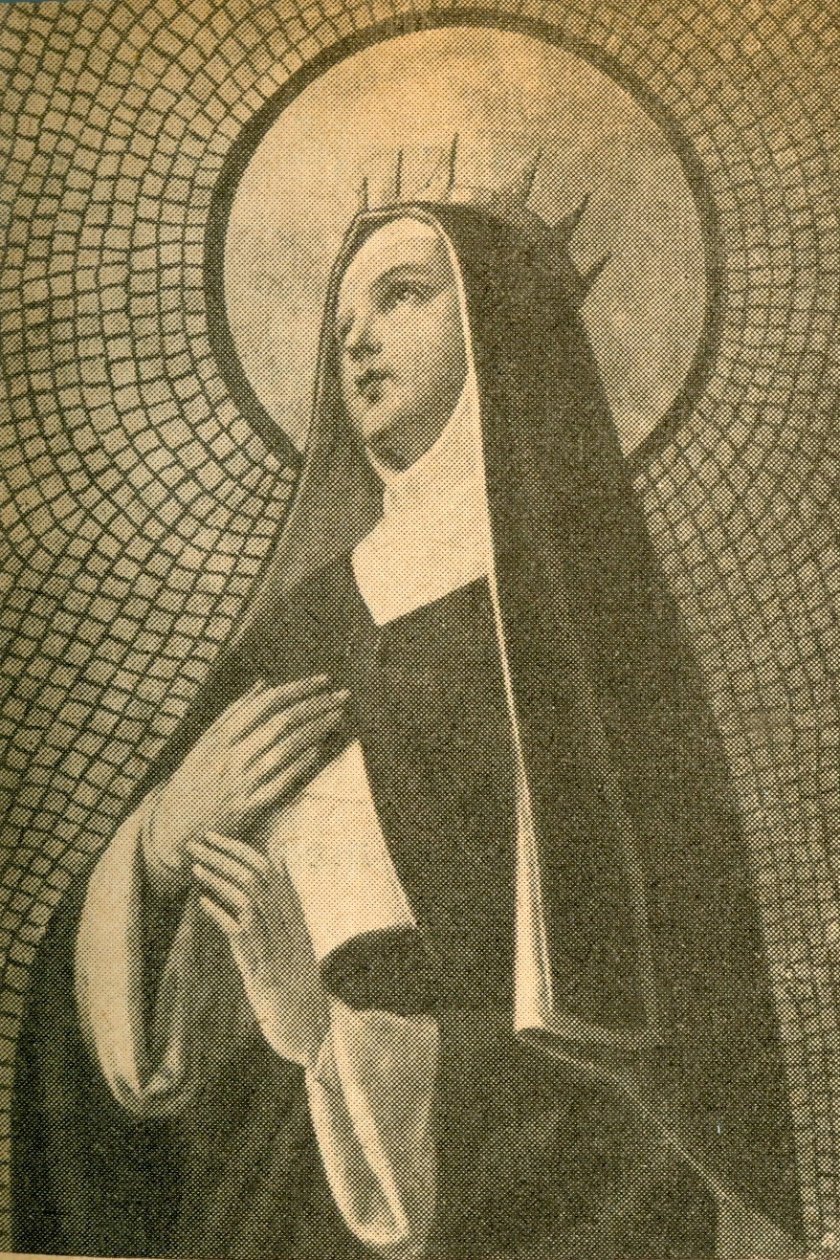
Saint of the Day – 18 January – St Margaret of Hungary OP (1242-1270) – Nun and Virgin – born in 1242 and died on 18 January 1271 at Budapest, Hungary.   Her relics were given to the Poor Clares at Pozsony (modern Bratislava, Slovak Republic) when the Dominican Order in the area was dissolved, however, most of her relics were destroyed in 1789 though what remains are still preserved at Gran, Gyor, Pannonhalma, Hungary.   Patronage – against flood.   Attributes – Dominican holding a lily and a book, a princess with a lily,  Dominican in prayer with a globe of fire over her head.    Princess Margaret was a Dominican nun and the daughter of King Béla IV of Hungary and Maria Laskarina.   header - Margaret of Hungary

Margaret, the daughter of King Bela IV, champion of Christendom and Queen Mary Lascaris of Hungary, was offered to God before her birth, in petition that the country would be delivered from the terrible scourge of the Tartars.   The prayer having been answered, the king and queen made good their promise by placing the rich and beautiful three-year-old in the Dominican convent at Vesprim.   Here, in company with other children of nobility, she was trained in the arts thought fitting for royalty.

Margaret was not content with simply living in the house of God, she demanded the religious habit–and received it–at the age of four.   Furthermore, she took upon herself the austerities practised by the other sisters–fasting, hairshirts, the discipline (scourge), and night vigils.   She soon learned the Divine Office by heart and chanted it happily to herself as she went about her play.   She chose the least attractive duties of the nuns for herself.   She would starve herself to keep her spirit humble.   No one but Margaret seemed to take seriously the idea that she would one day make profession and remain as a sister, for it would be of great advantage to her father if she were to make a wise marriage.

This question arose seriously when Margaret was 12.   She responded in surprise.   She said that she had been dedicated to God, even before her birth and that she intended to remain faithful to that promise.   Some years later her father built for her a convent on the island in the Danube between Buda and Pest.   To settle the matter of her vocation, here she pronounced her vows to the master general of the order, Blessed Humbert of the Romans, in 1255 and took the veil in 1261.

Again, when Margaret was 18, her father made an attempt to sway her from her purpose, because King Ottokar of Bohemia, hearing of her beauty, had come seeking her hand.   He even obtained a dispensation from the pope and approached Margaret with the permission.   Margaret replied as she had previously, “I esteem infinitely more the King of Heaven and the inconceivable happiness of possessing Jesus Christ than the crown offered me by the King of Bohemia.”   Having established that she was not interested in any throne but a heavenly one, she proceeded with great joy to live an even more fervent religious life than she had before.

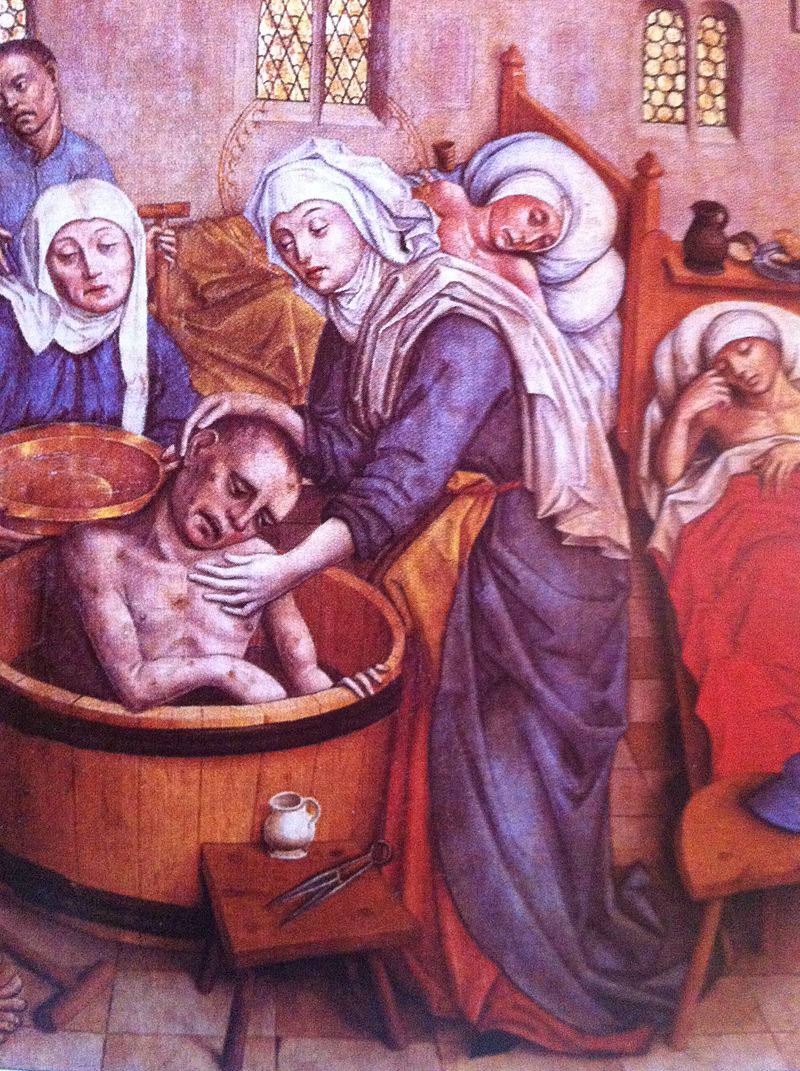
Margaret’s royal parentage was, of course, a matter of discussion in the convent.   But the princess managed to turn such conversation away from herself to the holy lives of the saints who were related to her by blood–King Saint Stephen, Saint Hedwig, Saint Elizabeth of Hungary and several others.   She did not glory in her wealth or parentage, but strove to imitate the saints in their holiness.   She took her turn in the kitchen and laundry, seeking by choice much heavy work that her rank might have excused her from doing.   She was especially welcome in the infirmary, which proves that she was not a sad-faced saint and she made it her special duty to care for those who were too disagreeable for anyone else to tend.

SAINT ELIZABETH OF HUNGARY - WASHING A POOR SICK MAN

Margaret’s austerities seem excessive to us of a weaker age.   The mysteries of the Passion were very real to her and gave reason for her long fasts, severe scourgings and other mortifications detailed in the depositions of witnesses taken seven years after her death (of which records are still in existence).   Throughout Lent she scarcely ate or slept. She not only imitated the poverty-stricken in their manual labour and hunger but also in their lack of cleanliness–a form of penance at that time.

She had a tender devotion to Our Lady and on the eve of her feasts, Margaret said a thousand Hail Mary’s.   Unable to make the long pilgrimage to the Holy Land, to Rome, or to any of the other famous shrines of Christendom, the saint developed a plan by which she could go in spirit:  she counted up the miles that lay between herself and the desired shrine and then said an Ave Maria for every mile there and back.   On Good Friday she was so overcome at the thoughts of Our Lord’s Passion that she wept all day.   She was frequently in ecstasy and very embarrassed if anyone found her so and remarked on her holiness.

A number of miracles were performed during Margaret’s lifetime and many more after her death because Margaret had an implicit faith in the power and efficacy of prayer. The princess nun was only 28 when she died.   Most of the particulars of her life are recorded in existing depositions of witnesses taken in 1277.   Her friends and acquaintances petitioned for her to be acclaimed a saint almost immediately after her death.   Among them was her own servant, Agnes, who rightly observed that this daughter of a monarch showed far more humility than any of the monastery’s maids. Although their testimony expressed Margaret’s overpowering desire to allow nothing to stand between her and God, the process of canonisation was not complete until 1943, when she was canonised on 19 November by Venerable Pope Pius XII.

Posted in DOCTORS of the Church, DOMINICAN OP, MORNING Prayers, QUOTES of the SAINTS, SAINT of the DAY

Thought for the Day – 15 November – The Memorial of St Albert the Great (1200-1280) Doctor of the Church: Pope Benedict XVI on St Albert, Faith and Science

Thought for the Day – 15 November – The Memorial of St Albert the Great (1200-1280) Doctor of the Church Pope Benedict XVI on St Albert, Faith and Science (Excerpt)

One of the great masters of medieval theology is St Albert the Great.   The title “Great”, (Magnus), with which he has passed into history indicates the vastness and depth of his teaching, which he combined with holiness of life.   However, his contemporaries did not hesitate to attribute to him titles of excellence even then.   One of his disciples, Ulric of Strasbourg, called him the “wonder and miracle of our epoch”.

He still has a lot to teach us.   Above all, St Albert shows that there is no opposition between faith and science, despite certain episodes of misunderstanding that have been recorded in history.   A man of faith and prayer, as was St Albert the Great, can serenely foster the study of the natural sciences and progress in knowledge of the micro- and macrocosm, discovering the laws proper to the subject, since all this contributes to fostering thirst for and love of God.   The Bible speaks to us of creation as of the first language through which God who is supreme intelligence, who is the Logos reveals to us something of himself.   The Book of Wisdom, for example, says that the phenomena of nature, endowed with greatness and beauty, is like the works of an artist through which, by analogy, we may know the Author of creation (cf. Wis 13: 5).   With a classical similitude in the Middle Ages and in the Renaissance one can compare the natural world to a book written by God that we read according to the different approaches of the sciences (cf. Address to the participants in the Plenary Meeting of the Pontifical Academy of Sciences, 31 October 2008; L’Osservatore Romano English edition, 5 November 2008, p. 6).   How many scientists, in fact, in the wake of St Albert the Great, have carried on their research inspired by wonder at and gratitude for a world which, to their eyes as scholars and believers, appeared and appears as the good work of a wise and loving Creator! Scientific study is then transformed into a hymn of praise.   Enrico Medi, a great astrophysicist of our time, whose cause of beatification has been introduced, wrote:  “O you mysterious galaxies… I see you, I calculate you, I understand you, I study you and I discover you, I penetrate you and I gather you.   From you I take light and make it knowledge, I take movement and make it wisdom, I take sparkling colours and make them poetry;  I take you stars in my hands and, trembling in the oneness of my being, I raise you above yourselves and offer you in prayer to the Creator, that through me alone you stars can worship” (Le Opere. Inno alla creazione).

St Albert the Great reminds us that there is friendship between science and faith and that through their vocation to the study of nature, scientists can take an authentic and fascinating path of holiness.

His extraordinary openmindedness is also revealed in a cultural feat which he carried out successfully, that is, the acceptance and appreciation of Aristotle’s thought.   In St Albert’s time, in fact, knowledge was spreading of numerous works by this great Greek philosopher, who lived a quarter of a century before Christ, especially in the sphere of ethics and metaphysics.   They showed the power of reason, explained lucidly and clearly the meaning and structure of reality, its intelligibility and the value and purpose of human actions.   St Albert the Great opened the door to the complete acceptance in medieval philosophy and theology of Aristotle’s philosophy, which was subsequently given a definitive form by St Thomas.   This reception of a pagan pre-Christian philosophy, let us say, was an authentic cultural revolution in that epoch.   Yet many Christian thinkers feared Aristotle’s philosophy, a non-Christian philosophy, especially because, presented by his Arab commentators, it had been interpreted in such a way, at least in certain points, as to appear completely irreconcilable with the Christian faith. Hence a dilemma arose: are faith and reason in conflict with each other or not?

This is one of the great merits of St Albert:  with scientific rigour he studied Aristotle’s works, convinced that all that is truly rational is compatible with the faith revealed in the Sacred Scriptures.   In other words, St Albert the Great thus contributed to the formation of an autonomous philosophy, distinct from theology and united with it only by the unity of the truth.   So it was that in the 13th century a clear distinction came into being between these two branches of knowledge, philosophy and theology, which, in conversing with each other, cooperate harmoniously in the discovery of the authentic vocation of man, thirsting for truth and happiness:  and it is above all theology, that St Albert defined as “emotional knowledge”, which points out to human beings their vocation to eternal joy, a joy that flows from full adherence to the truth.

St Albert the Great was capable of communicating these concepts in a simple and understandable way.   An authentic son of St Dominic, he willingly preached to the People of God, who were won over by his words and by the example of his life.

Dear brothers and sisters, let us pray the Lord that learned theologians will never be lacking in holy Church, wise and devout like St Albert the Great and that he may help each one of us to make our own the “formula of holiness” that he followed in his life:  “to desire all that I desire for the glory of God, as God desires for His glory all that He desires”, in other words always to be conformed to God’s will, in order to desire and to do everything only and always for His glory.

Pope Benedict XVI – Saint Peter’s Square, Wednesday, 24 March 2010

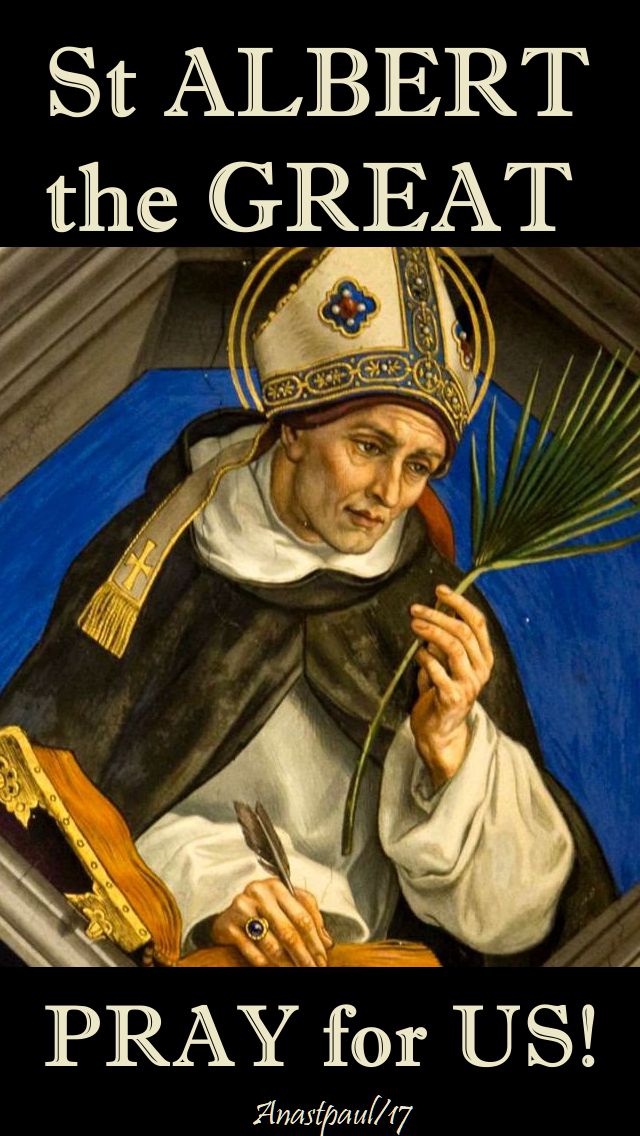
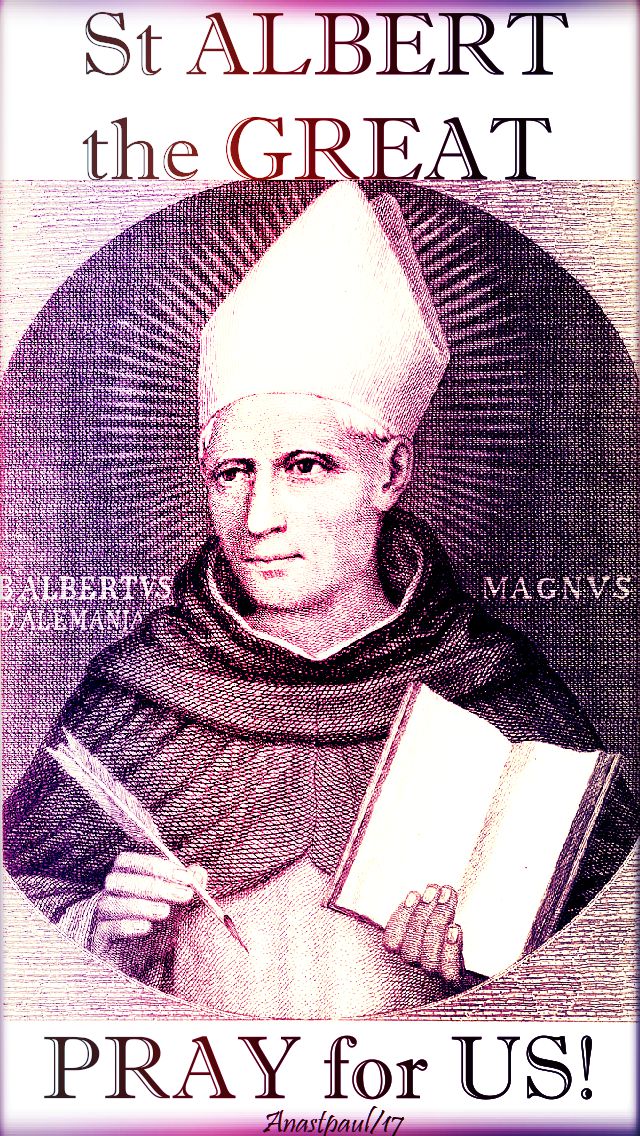
St Albert the Great, Pray for us!st albert the great - pray for us

Posted in CARMELITES, DOCTORS of the Church, DOMINICAN OP, EUCHARISTIC Adoration, MORNING Prayers, QUOTES of the SAINTS, SAINT of the DAY, The HOLY EUCHARIST / The HOLY MASS

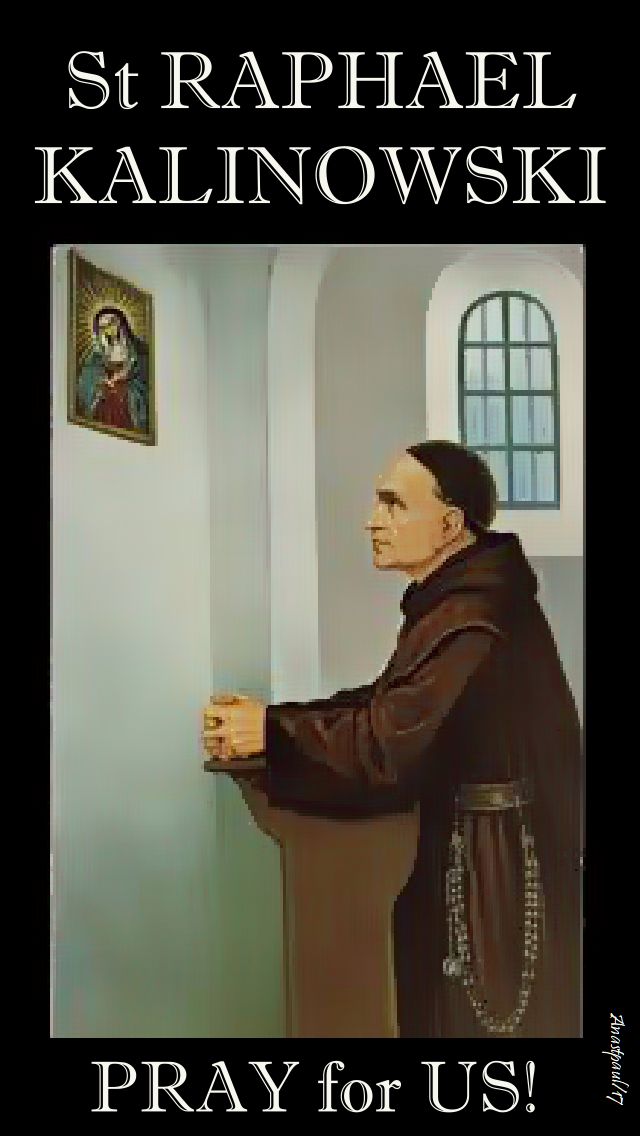
Quote/s of the Day – 15 November – The Memorials of St Albert the Great (1200-1280) Doctor of the Church and St Raphael Kalinowski (1835-1907)

Quote/s of the Day – 15 November – The Memorials of St Albert the Great (1200-1280) Doctor of the Church and St Raphael Kalinowski (1835-1907)

“Nor could He have commanded anything more lovable,
for this sacrament produces love and union.
It is characteristic of the greatest love to give itself as food.
“Had not the men of my text exclaimed:
‘ Who will feed us with his flesh to satisfy our hunger?’
as if to say: ‘I have loved them and they have loved me
so much that I desire to be within them
and they wish to receive me so that the,
may become my members.’
There is no more intimate or more natural means
for them to be united to me and I to them.
Nor could He have commanded anything
which is more like eternal life.
Eternal life flows from this sacrament
because God with all sweetness
pours Himself out upon the blessed.”

St Albert the Great (1200-1280) Doctor of the Church

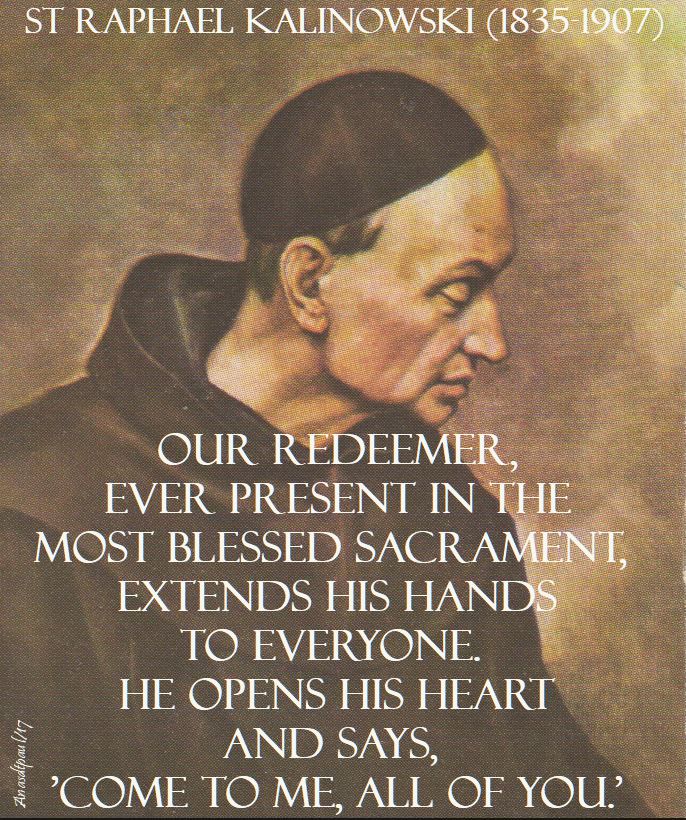
“Our Redeemer ever present in the most Blessed Sacrament,
extends His hands to everyone.
He opens His heart and says, ‘Come to Me, all of you.'”

St Raphael Kalinowski (1835-1907)our redeemer ever present - st raphael kalinowski - 15 nov 2017

Posted in DOCTORS of the Church, DOMINICAN OP, MORNING Prayers, QUOTES of the SAINTS, SAINT of the DAY, The WORD

One Minute Reflection – 15 November – – The Memorial of St Albert the Great (1200-1280) Doctor of the Church

One Minute Reflection – 15 November – – The Memorials of St Albert the Great (1200-1280) Doctor of the Church and St Raphael Kalinowski (1835-1907)

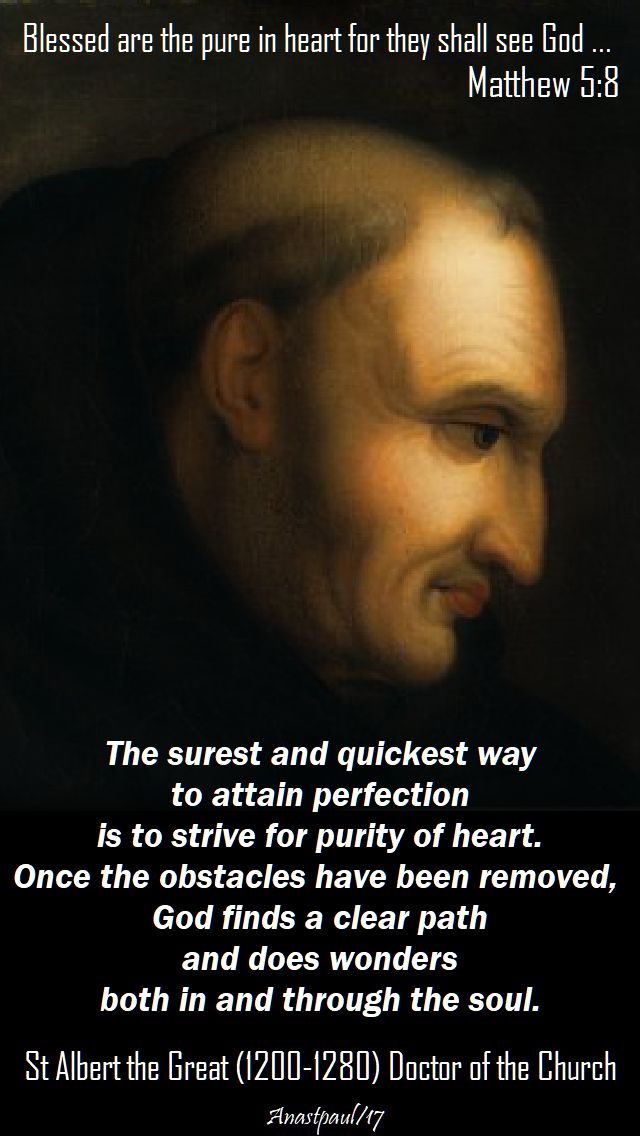
Blessed are the pure in heart for they shall see God ….Matthew 5:8

REFLECTION – “The surest and quickest way to attain perfection is to strive for purity of heart.   Once the obstacles have been removed, God finds a clear path and does wonders both in and through the soul.”…St Albert the Great (1200-1280) Doctor of the Church

“God refuses only the person who does not admit his own weakness; He sends away only the unhappy proud person. You must “hold him” well and strongly, with a poor spirit, with a poor heart, with a life entirely poor…”St Raphael Kalinowski (1835-1907)

the surest and quickest way - st albert the great - 15 nov 2017god refuses - st raphael kalinowski - 15 nov 2017PRAYER – Lord God, You made St Albert great by his gift for reconciling human wisdom with divine faith. Help us so to follow his teaching that every advance in science may lead us to a deeper knowledge and love of You. May his prayers on our behalf be a succour to us all.   We ask too for the intercession of the blessed Father St Raphael that his zeal and perseverance may be the driving force of our lives.   Through our Lord Jesus Christ with the Holy Spirit, one God for all eternity, amen.st albert the great - pray for us - 14 nov 2017st raphaelk kalinowski - pray for us - 15 nov 2017

Posted in DOCTORS of the Church, DOMINICAN OP, MORNING Prayers, PRAYERS of the SAINTS, SAINT of the DAY

Our Morning Offering – 15 November – The Memorial of St Albert the Great (1200-1280) Doctor of the Church

Our Morning Offering – 15 November – The Memorial of St Albert the Great (1200-1280) Doctor of the Church

Prayer “O Lord, King of all!”
St Albert the Great (1200-1280)

We pray to You, O Lord,
who are the supreme Truth,
and all truth is from You.
We beseech You, O Lord,
who are the highest Wisdom,
and all the wise depend on You for their wisdom.
You are the supreme Joy,
and all who are happy owe it to You.
You are the Light of minds,
and all receive their understanding from You.
We love, we love You above all.
We seek You, we follow You,
and we are ready to serve You.
We desire to dwell under Your power
for You are the King of all. Amenour lord, king of all - st albert the geat op

Posted in DOCTORS of the Church, DOMINICAN OP, Of Catholic Education, Students, Schools, Colleges etc, Of SCIENTISTS, SAINT of the DAY

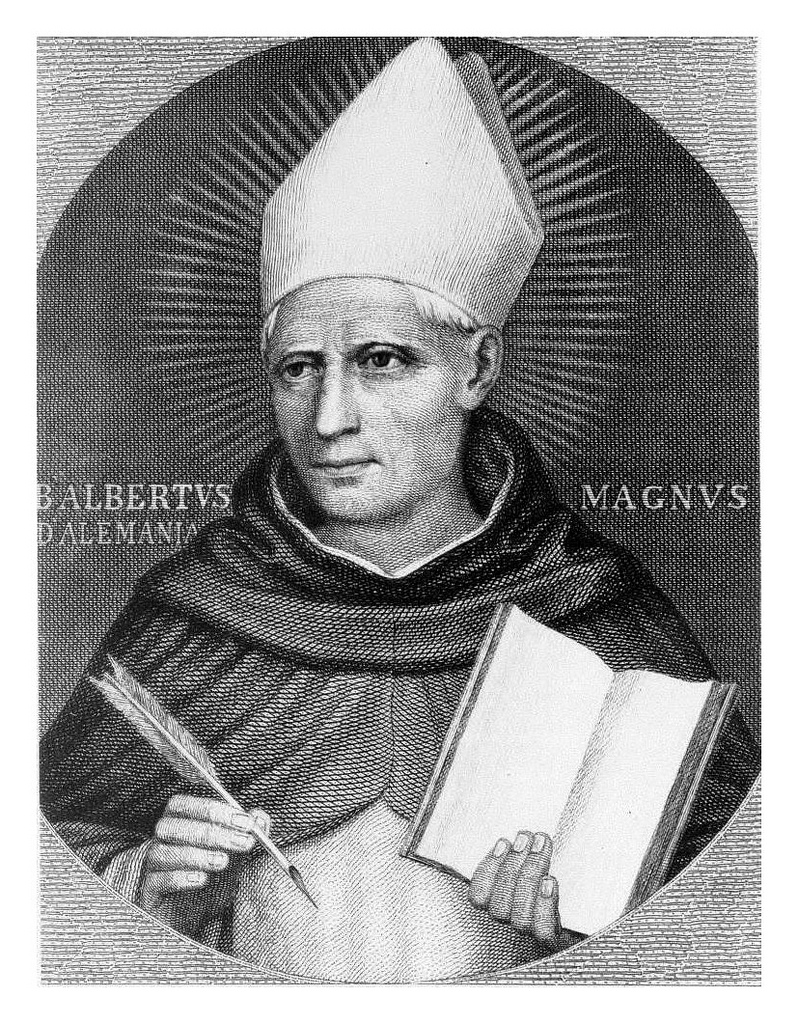
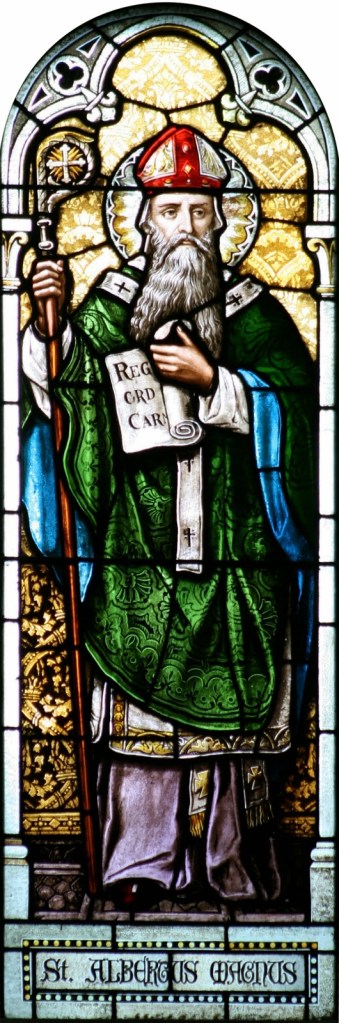
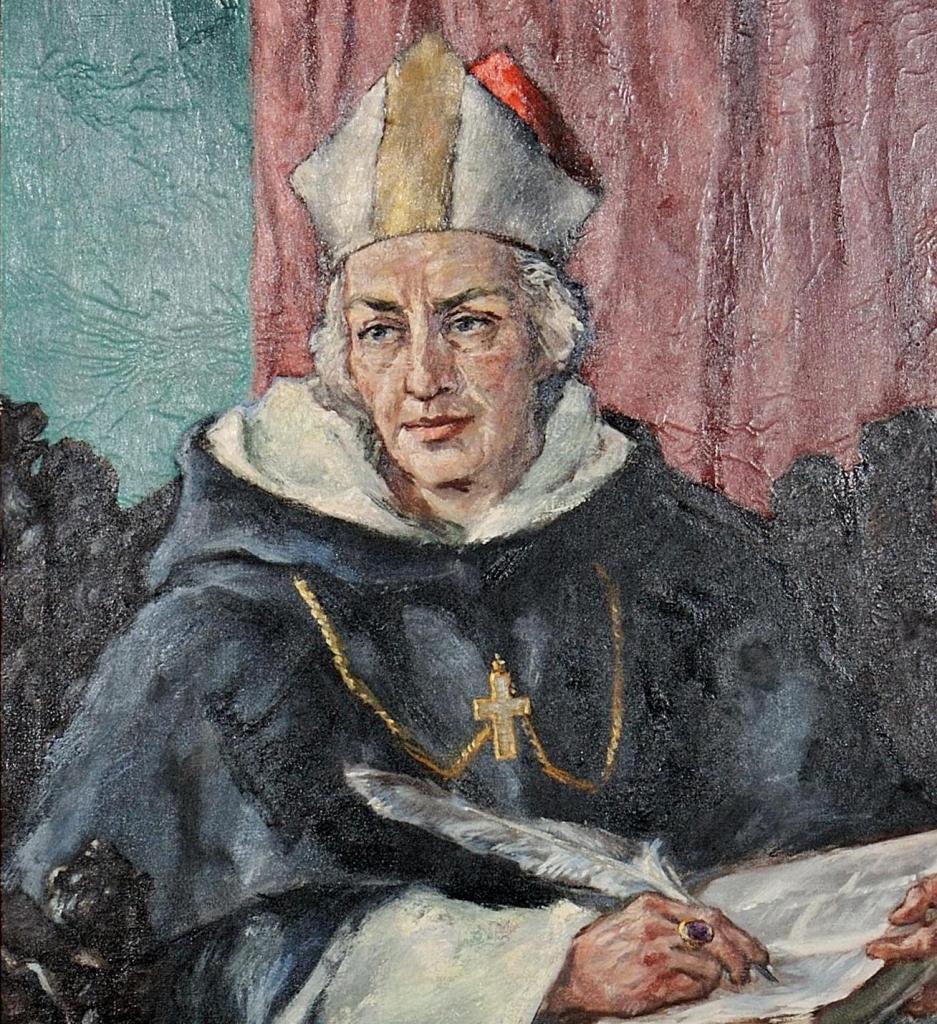
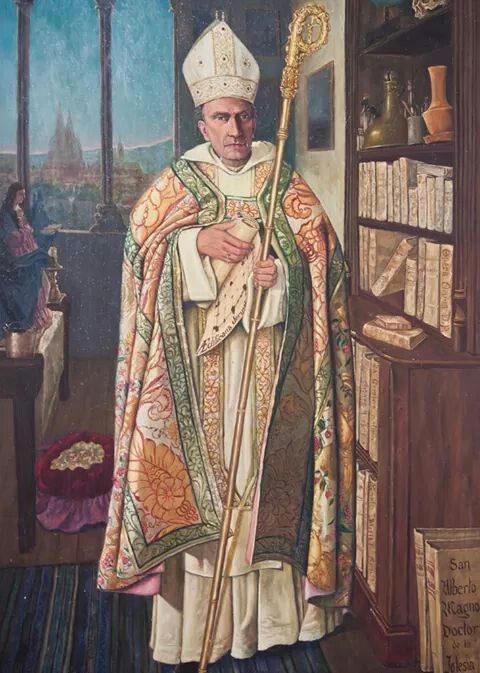
Saint of the Day – 15 November – St Albert the Great OP (1200-1280) Bishop, Confessor, Doctor of the Church

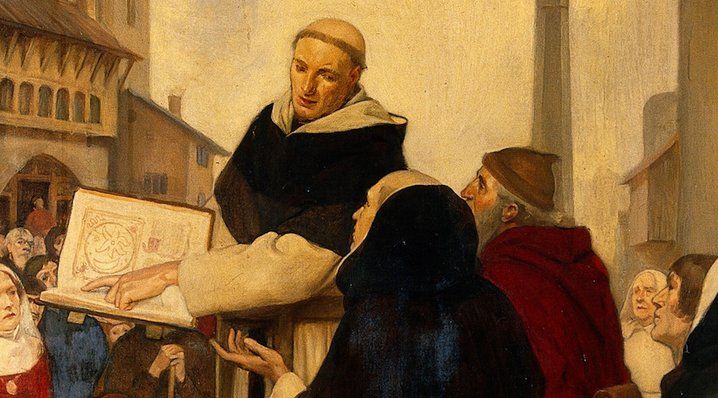
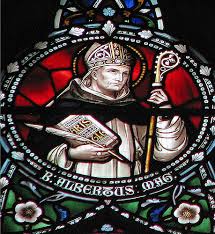
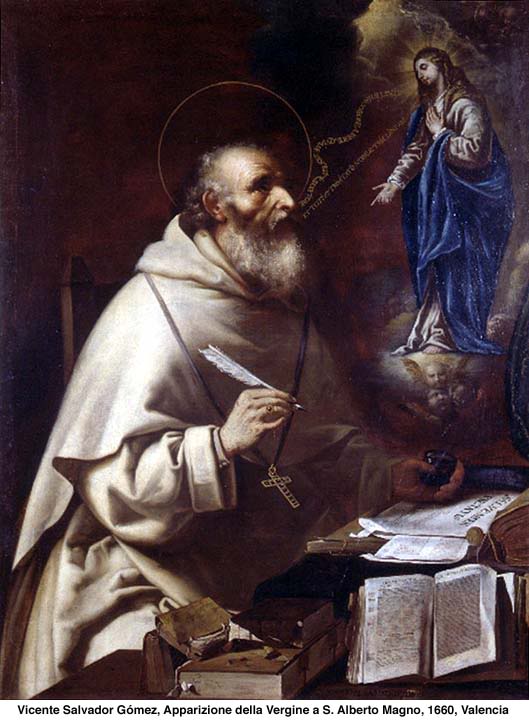
Saint of the Day – 15 November – St ALBERTUS MAGNUS/Albert the Great OP (1200-1280) Bishop, Confessor, Doctor of the Church – Doctor universalis (Universal Doctor) – Priest and Friar of the Order of Preachers,Theologian, Scientist, Philosopher, Teacher, Writer.   Born in c 1200 at Lauingen an der Donau, Swabia (part of modern Germany) – 15 November 1280 at Cologne, Prussia (part of modern Germany) of natural causes.   Patronages – • Medical Technicians• Natural Sciences• Philosophers• schoolchildren• Scientists (proclaimed on 13 August 1948 by Pope Pius XII) Theology students.   Scholars have referred to him as the greatest German philosopher and theologian of the Middle Ages.H_LITANY-OF-ALBERT-THE-GREATSaint-Albert-the-Great - HEADERSOC0080

Born around 1206 in Launingen, Germany, Albert was educated as a young man at the University of Padua, and joined the Dominican Order in 1223.   He spent the following years engaged in various studies and teaching assignments in several German cities, most prominently Cologne.   He left Cologne for the University of Paris in 1245.

It was there that one of his students, a brilliant if quiet and heavy-set young man was so impressed by him that he later accompanied him back to Cologne and later became his most famous pupil!   Albert said of his student, St Thomas Aquinas, after St. Thomas’ remarkable explanation of a difficult treatise, “We call this young man a dumb ox but one day his bellowing in his teaching will be heard throughout the world.”

ST ALBERT AND ST THOMAS. getty - my snipSt-Albert-and-St-Thomas-Aquinas (1)

Not that St Albert wasn’t an intellectual heavyweight in his own right.   He was known as Albertus Magnus (Albert the Great).   St Albert can truly be called a Renaissance man, a century before the Renaissance actually began!   This Dominican friar and bishop was also known for his scholarly contributions to the sciences and philosophy as well as theology.   The publication of his complete writings in Paris in 1899 came to 38 volumes and covered his extensive knowledge of such diverse subjects as theology, botany, astronomy, mineralogy, alchemy (the forerunner of chemistry), justice and law among others!   He was the first to comment on virtually all of the writings of Aristotle, thus making them accessible to wider academic debate.   The study of Aristotle brought him to study and comment on the teachings of Muslim academics, notably Avicenna and Averroes and this would bring him into the heart of academic debate.

In 1254 Albert was made provincial of the Dominican Order and fulfilled the duties of the office with great care and efficiency.   During his tenure he publicly defended the Dominicans against attacks by the secular and regular faculty of the University of Paris, commented on John the Evangelist and answered what he perceived as errors of the Islamic philosopher Averroes.

In 1259 he took part in the General Chapter of the Dominicans at Valenciennes together with Thomas Aquinas, masters Bonushomo Britto, Florentius, and Peter (later Pope Innocent V) establishing a ratio studiorum or program of studies for the Dominicans that featured the study of philosophy as an innovation for those not sufficiently trained to study theology.   This innovation initiated the tradition of Dominican scholastic philosophy put into practice, for example, in 1265 at the Order’s studium provinciale at the convent of Santa Sabina in Rome, out of which would develop the Pontifical University of Saint Thomas Aquinas, the “Angelicum”

In 1260 Pope Alexander IV made him bishop of Regensburg, an office from which he resigned after three years.   During the exercise of his duties he enhanced his reputation for humility by refusing to ride a horse, in accord with the dictates of the Order, instead traversing his huge diocese on foot.   This earned him the affectionate sobriquet “boots the Bishop” from his parishioners.   In 1263 Pope Urban IV relieved him of the duties of bishop and asked him to preach the eighth Crusade in German-speaking countries.  After this, he was especially known for acting as a mediator between conflicting parties.   In Cologne he is not only known for being the founder of Germany’s oldest university there but also for “the big verdict” (der Große Schied) of 1258, which brought an end to the conflict between the citizens of Cologne and the archbishop.   Among the last of his labours was the defense of the orthodoxy of his former pupil, Thomas Aquinas, whose death in 1274 grieved Albert (the story that he travelled to Paris in person to defend the teachings of Aquinas can not be confirmed).

After suffering a collapse of health in 1278, he died on 15 November 1280, in the Dominican convent in Cologne, Germany.   Since then 15 November 1954, his relics are in a Roman sarcophagus in the crypt of the Dominican St Andreas Church in Cologne. Although his body was discovered to be incorrupt at the first exhumation three years after his death, at the exhumation in 1483 only a skeleton remained.

Pope Pius XI, when he canonised him in 1931, said he had “that rare and divine gift, scientific instinct, in the highest degree.”   Like St Thomas, he was very much influenced by Aristotle in seeing the compatibility of natural sciences and philosophy with theology. Also like his star pupil, he rightly saw God’s hand behind all creation!

Posted in DOMINICAN OP, MORNING Prayers, QUOTES of the SAINTS, The WORD

One Minute Reflection – 14 November

One Minute Reflection – 14 November

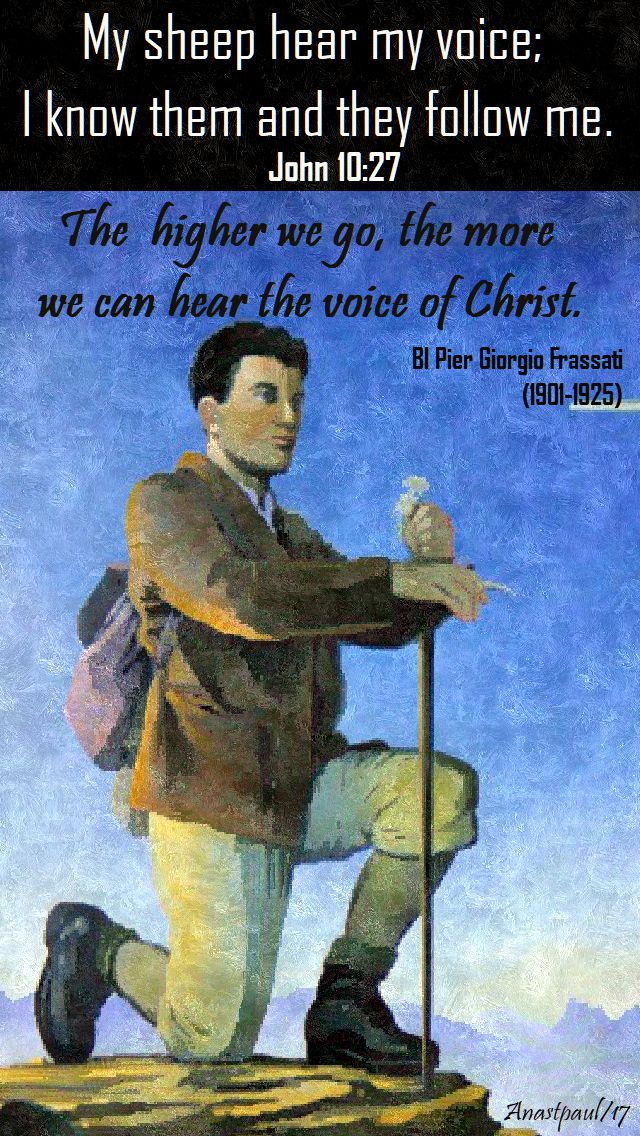
My sheep hear my voice; I know them and they follow me…..John 10:27

REFLECTION – “The higher we go, the more we can hear the voice of Christ.”…Bl Pier Giorgio Frassatithe higher we go - bl pier - 14 nov 2017

PRAYER – Jesus my Lord and God, help me to climb high enough to hear Your voice.   Help me to strive daily to attain knowledge of You with a heart that longs for and loves you.   For it is Your voice and Your embrace I reach for. Amen

Posted in DOCTORS of the Church, DOMINICAN OP, MORNING Prayers, PRAYERS of the SAINTS

Our Morning Offering – 14 November

Our Morning Offering – 14 November

Grant me, O Lord my God
St Thomas Aquinas (1225-1274) Doctor of the Church

Grant me, O Lord my God,
a mind to know You,
a heart to seek You,
wisdom to find You,
conduct pleasing to You,
faithful perseverance in waiting for You,
and a hope of finally embracing You.
Amen.grant me o lord my god - st thomas aquinas - 14 nov 2017

Posted in DOMINICAN OP, SAINT of the DAY

Saint of the Day – 14 November – Blessed John Licci O.P. (1400-1511)

Saint of the Day – 14 November – Blessed John Licci O.P. (1400-1511) Bl John was born in 1400 at Caccamo, diocese of Palermo, Sicily, Italy and he died on 14 November 1511 of natural causes.   Religious Priest of the Dominican Order, Preacher, Miracle-Worker.  Patronages – • against head injuries• Caccamo, Italy.   He was Beatified on 25 April 1753 by Pope Benedict XIV (cultus confirmed).

John Licci is one of the longest living holy men of the Church.  His 111 years on this earth in a small town near Palermo, Sicily, were filled with many miracles.  Born to a poor farmer, John’s mother died in childbirth.   His life from then on, all 111 years, was a tale of miracles.

John’s father, who fed the baby on crushed pomegranates, had to work the fields and was forced to leave the infant alone.   The baby began crying and a neighbour woman took him to her home to feed him.   She laid the infant on the bed next to her paralysed husband – and the man was instantly cured.   The woman told John’s father of the miracle but he was more concerned that she was meddling and had taken his son without his permission.   He took the child home to feed him more pomegranate pulp.   As soon as the child was removed from the house, the neighbour’s paralysis returned; when John was brought back in, the man was healed.  Even John’s father took this as a sign and allowed the neighbours to care for John.

A precocious and emotional child, John began reciting the Daily Offices before age 10. While on a trip to Palermo, Italy at age 15, John went to Confession in the church of Saint Zita of Lucca where his confession was heard by Blessed Peter Geremia who suggested John consider a religious life.   John considered himself unworthy but Peter pressed the matter, John joined the Dominicans in 1415 and wore the habit for 96 years, the longest period known for anyone.

He founded the convent of Saint Zita in Caccamo, Italy.   Lacking money for the construction, John prayed for guidance.   During his prayer he had a vision of an angel who told him to “build on the foundations that were already built.”   The next day in the nearby woods he found the foundation for a church called Saint Mary of the Angels, a church that had been started many years before but had never been finished.   John assumed this was the place indicated and took over the site.

During the construction, workmen ran out of materials;  the next day at dawn a large ox-drawn wagon arrived at the site.   The driver unloaded a large quantity of stone, lime and sand – then promptly disappeared, leaving the oxen and wagon behind for the use of the convent.   At another point a well got in the way of construction – John blessed it and it immediately dried up.  When construction was finished, he blessed it again and the water began to flow.   When roof beams were cut too short, John would pray over them, and they would stretch.   There were days when John had to miraculously multiply bread and wine to feed the workers.   Once a young boy came to the construction site to watch his uncle set stones;  the boy fell from a wall, and was killed;  John prayed over him and restored him to life and health.

John and two brother Dominicans who were working on the convent were on the road near Caccamo when they were set upon by bandits.   One of the thieves tried to stab John with a dagger, the man’s hand withered and became paralysed.   The gang let the brothers go, then decided to ask for their forgiveness.   John made the Sign of the Cross at them and the thief‘s hand was made whole.

One Christmas a nearby farmer offered to pasture the oxen that had come with the disappearing wagon-driver.   John declined, saying the oxen had come far to be there and there they should stay.   Thinking he was doing good, the layman took them anyway. When he put them in the field with his own oxen, they promptly disappeared, he later found them at the construction site, contentedly munching dry grass near Father John.

While he did plenty of preaching in his 90+ years in the habit, usually on Christ’s Passion, John was not known as a great homilist.   He was known, however, for his miracles and good works.   His blessing caused the breadbox of a nearby widow to stay miraculously full, feeding her and her six children.   His blessing prevented disease from coming to the cattle of his parishioners.   Noted healer, curing at least three people whose heads had been crushed in accidents.   He became the Dominican Provincial of Sicily.

Bl John Licci died peacefully in his hometown on 14 November 1511.


Posted in DOCTORS of the Church, DOMINICAN OP, MORNING Prayers, SAINT of the DAY

Thought for the Day – – 10 November – The Memorial of St Pope Leo the Great (c400-461) Doctor of the Church

Thought for the Day – – 10 November – The Memorial of St Pope Leo the Great (c400-461) Doctor of the Church

Leo is called Great in large part because he saved the city of Rome on two separate occasions.   But far more noteworthy is his work safeguarding the Roman and apostolic faith from the confusion of so many different figures.   Since Christ as perfect Man reveals man to himself (concerning which Vatican II reminds us in Gaudium et Spes §22), understanding Christ’s dignity is essential for recognising our own as restored and elevated in the grace He has won for us.

Preserving and transmitting this teaching does not usually oblige us to face the barbarians at the gates.   In the face of those who would obscure the truth, our call—Pope Leo’s call—is to put on what St Paul calls “the mind of Christ.”   Embracing what we ourselves have received, we can be tailored to His understanding of us, rather than our conjectures about Him.   There are only two choices: we can either remember Him Whose members we are in the Body of Christ, or slide into the grave danger highlighted by John Courtney Murray, SJ:

“Self-understanding is the necessary condition of a sense of self-identity and self-confidence, whether in the case of an individual or in the case of a people… Otherwise the peril is great. The complete loss of one’s identity is, with all propriety of theological definition, hell.   In diminished forms it is insanity.”

As to insanity, some would say riding out to meet a barbarian without an army fits the bill.   But knowing himself and the One who called him, Pope Leo could ride out to Attila, confident that the Hun’s efforts would amount to an empire built on sand, a mass of broken lives and a brief (but memorable) footnote in the textbooks….(Br Leo Camurati OP)

St Pope Leo the Great Pray for us, that we may build our houses upon the Rock of Christ and His Church!st pope leo THE GREAT - pray for us

Posted in DOMINICAN OP, Of Catholic Education, Students, Schools, Colleges etc, PATRONAGE - RACE RELATIONS etc, PATRONAGE - TELEVISION, SAINT of the DAY

Saint of the Day – 3 November – St Martin de Porres O.P. “Saint of the Broom”

Saint of the Day – 3 November – St Martin de Porres O.P. “Saint of the Broom” Dominican lay Brother, Miracle Worker, Apostle of Charity, Mystic – Also known as:• Martín de Porres Velázquez, • Martin of Charity, • Martin the Charitable, • Saint of the Broom (for his devotion to his work, no matter how menial).   (9 December 1579 at Lima, Peru – 3 November 1639 in Lima, Peru of fever).   Beatified in 1837 by Pope Gregory XVI and Canonised on 6 May 1962, by Pope John XXIII.   Patronages – • African-Americans, • against rats, • barbers, • mixed-race people, • black people, • for inter-racial justice, • for social justice, • hair stylists, hairdressers, • hotel-keepers, innkeepers, • paupers, poor people, • public education, public schools, state schools, • public health, • race relations, racial harmony, • television, • Peru, • Archdiocese of Accra, Ghana, • Diocese of Biloxi, Mississippi.   Attributes:  a dog, a cat, a bird and a mouse eating together from a same dish; broom, crucifix, rosary, a heart.   St Martin was noted for work on behalf of the poor, establishing an orphanage and a children’s hospital.   He maintained an austere lifestyle, which included fasting and abstaining from meat.   Among the many miracles attributed to him were those of levitation, bilocation, miraculous knowledge, instantaneous cures and an ability to communicate with animals.

“Father unknown” is the cold legal phrase sometimes used on baptismal records.   “Half-breed” or “war souvenir” is the cruel name inflicted by those of “pure” blood.   Like many others, Martin might have grown to be a bitter man but he did not.   It was said that even as a child he gave his heart and his goods to the poor and despised.

He was the son of a freed woman of Panama, probably black but also possibly of indigenous stock and a Spanish grandee of Lima, Peru.   His parents never married each other.   Martin inherited the features and dark complexion of his mother.   That irked his father, who finally acknowledged his son after eight years.   After the birth of a sister, the father abandoned the family.   Martin was reared in poverty, locked into a low level of Lima’s society.

When he was 12, his mother apprenticed him to a barber-surgeon.   Martin learned how to cut hair and also how to draw blood–a standard medical treatment then–care for wounds and prepare and administer medicines.

After a few years in this medical apostolate, Martin applied to the Dominicans to be a “lay helper,” not feeling himself worthy to be a religious brother.  After nine years, the example of his prayer and penance, charity and humility, led the community to request him to make full religious profession.   Many of his nights were spent in prayer and penitential practices;   his days were filled with nursing the sick and caring for the poor. It was particularly impressive that he treated all people regardless of their colour, race, or status.   He was instrumental in founding an orphanage, took care of slaves brought from Africa and managed the daily alms of the priory with practicality, as well as generosity.   He became the procurator for both priory and city, whether it was a matter of “blankets, shirts, candles, candy, miracles or prayers!”   When his priory was in debt, he said, “I am only a poor mulatto.   Sell me.   I am the property of the order. Sell me.”
Side by side with his daily work in the kitchen, laundry, and infirmary, Martin’s life reflected God’s extraordinary gifts:   ecstasies that lifted him into the air, light filling the room where he prayed, bi-location, miraculous knowledge, instantaneous cures and a remarkable rapport with animals.   His charity extended to beasts of the field and even to the vermin of the kitchen.   He would excuse the raids of mice and rats on the grounds that they were underfed;   he kept stray cats and dogs at his sister’s house.
Martin became a formidable fundraiser, obtaining thousands of dollars for dowries for poor girls so that they could marry or enter a convent.

Many of his fellow religious took Martin as their spiritual director, but he continued to call himself a “poor slave.”   He was a good friend of another Dominican saint of Peru, Rose of Lima.

Saint Martin experienced the exclusion, derision and discrimination of racism.   Instead of growing bitter, he used his experience to reach out and comfort others.   Martin’s unwavering love of God and devotion to the Passion sustained him in his charitable works that often went unacknowledged.

“Compassion, my dear Brother, is preferable to cleanliness.   Reflect that with a little soap I can easily clean my bed covers but even with a torrent of tears I would never wash from my soul the stain that my harshness toward the unfortunate would create.”

Posted in DOMINICAN OP, MORNING Prayers, PRAYERS of the SAINTS

Our Morning Offering – 24 October

Our Morning Offering – 24 October

Our Lord, King of all!
St ALBERT the GREAT O.P.

We pray to You, O Lord,
who are the surpeme Truth,
and all truth is from You.
We beseech You, O Lord,
who are the highest Wisdom,
and all the wise
depend on You for their wisdom.
You are the supreme Joy,
and all who are happy owe it to You.
You are the Light of minds,
and all receive
their understanding from You.
We love, we love You above all.
We seek You, we follow You,
and we are ready to serve You.
We desire to dwell under Your power
for You are the King of all. Amenour lord, king of all - st albert the geat op


Posted in ArchAngels and Angels, DOMINICAN OP, SAINT of the DAY

Our Morning Offering – 2 October – The Memorial of the Holy Guardian Angels

Our Morning Offering – 2 October – The Memorial of the Holy Guardian Angels

Prayer to my Good Guardian Angel
By Fr Peter J Cameron O.P.

My good Guardian Angel;
you have been appointed by God
to be my protector and shepherd,
leading me to life and peace.
Thank you for your guardianship.
Without the benefit of your angelic care,
I would be left to the custody
of my own feeble resources.
You delight in dispensing God’s graces
to aid me in my salvation.
Help me to regulate my life and
move me to the good.
Instruct me that I may live by the
enlightenment of heaven.
Assist me in my prayer.
Ward off demons that would threaten me
and remove the sadness and affliction
brought on by the enemy.
When weighed down by my emotions
and things of the flesh,
lift me up and let me share your joy.
Protect me from all spiritual and bodily harm.
Please forgive my neglect of you.
With trust in your angelic protection,
I offer you my love and gratitude. Amenprayer to my good guardian angel - by for peter j cameron (my novenas book) 2 oct 2017


Posted in DOMINICAN OP, MARIAN PRAYERS, MARIAN TITLES, MORNING Prayers, PRAYERS of the SAINTS, The BLESSED VIRGIN MARY

Our Morning Offering – 12 September – Feast of the Most Holy Name of Mary

Our Morning Offering – 12 September – Feast of the Most Holy Name of Mary

(Hail Mary, the Angelic Salutation)

Whenever I say Hail Mary
By Bl Alan de la Roche (1428-1475)

Whenever I say Hail Mary
The court of heaven rejoices
And the earth is lost in wonderment
And I despise the world
And my heart is brim full
Of the love of God.
When I say Hail Mary;
All my fears wilt and die
And my passions are quelled.
If I say Hail Mary;
Devotion grows within me
And sorrow for sin awakens.
When I say Hail Mary
Hope is made strong
In my breast
And the dew of consolation
Falls on my soul
More and more
Because I say Hail Mary.
And my spirit rejoices
And sorrow fades away
When I say
Hail Mary.


whenever i say hail mary - blessed alan de la roche