Posted in DOMINICAN OP, QUOTES of the SAINTS, QUOTES on LOVE, QUOTES on MERCY, QUOTES on PRAYER, SAINT of the DAY

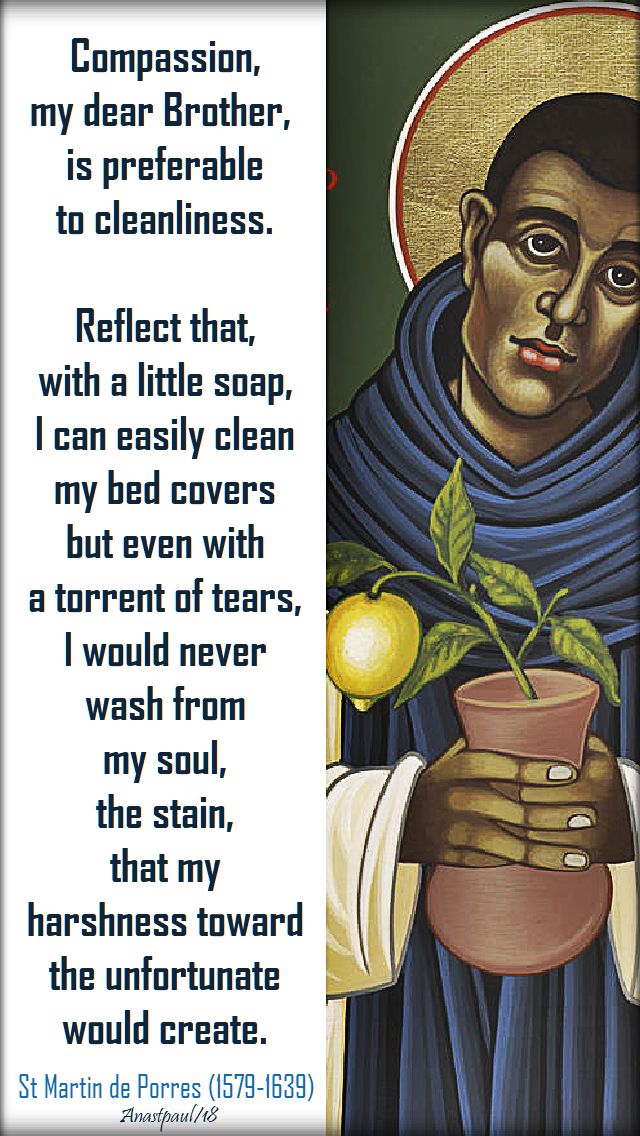
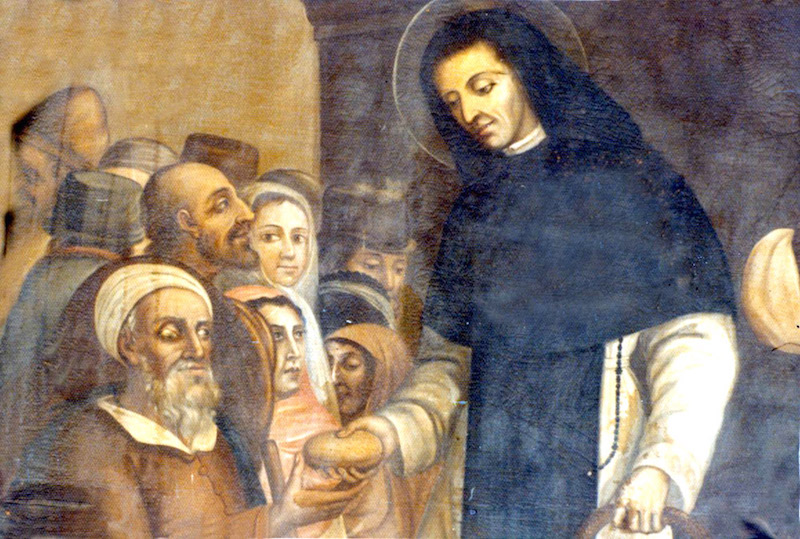
Quote/s of the Day – 3 November – The Memorial of St Martin de Porres (1579-1639)

Quote/s of the Day – 3 November – The Memorial of St Martin de Porres (1579-1639)

“Compassion, my dear Brother,
is preferable to cleanliness.
Reflect that with a little soap,
I can easily clean my bed covers
but even with a torrent of tears,
I would never wash from my soul,
the stain, that my harshness toward
the unfortunate would create.”compassion my dear brother - st martin de porres - 3 nov 2018

“Everything,
even sweeping,
scraping vegetables,
weeding a garden
and waiting on the sick,
could be a prayer,
if it were offered to God.”

St Martin de Porres (1579-1639)everything - st martin de porres - 3 nov 2018

Posted in DOMINICAN OP, SAINT of the DAY

Saint of the Day – 9 October – St Louis Bertrand O.P. (1526-1581) “Apostle of South America”

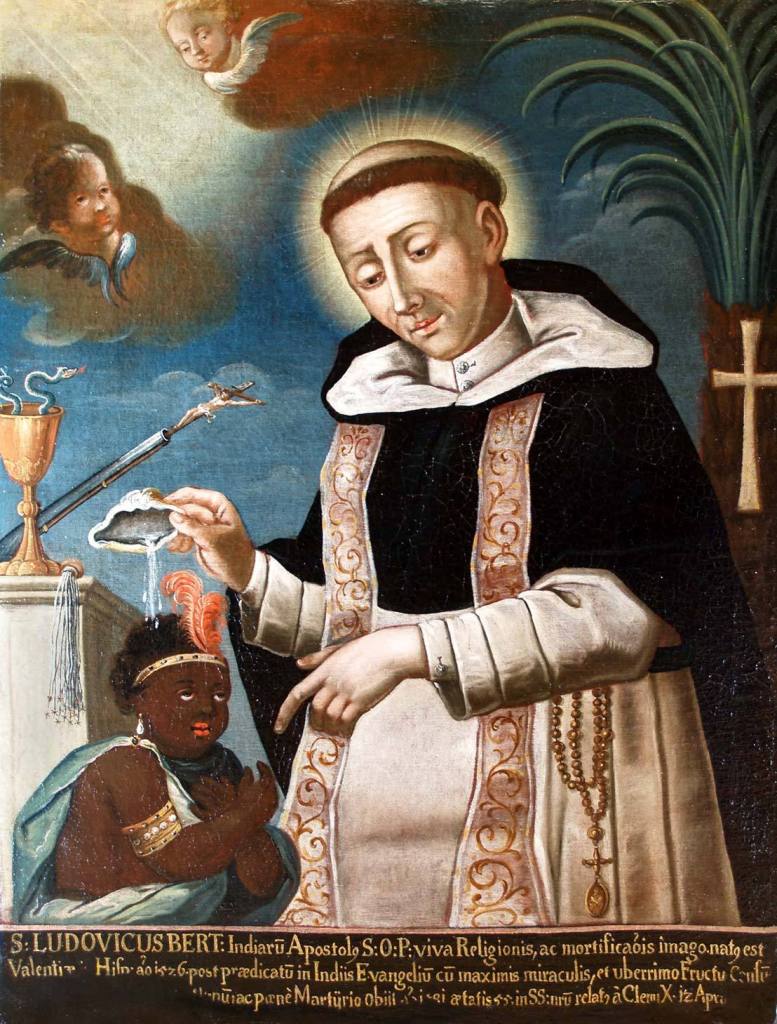
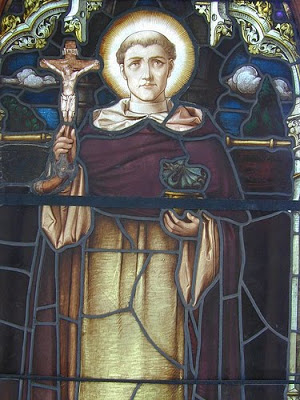
Saint of the Day – 9 October – St Louis Bertrand O.P. (1526-1581) “Apostle of South America” – Dominican Priest, Missionary, Preacher, Confessor, Teacher, Spiritual Director, Miracle-Worker – born as Luis Beltrán on 1 January 1526 at Valencia, Spain and died on 9 October 1581 of natural causes at Valencia, Spain.   Patronages – Buñol; New Granada; Colombia.header - san-luis-beltran-email

Saint Louis Bertrand was born in the year 1526, the oldest of the eight children of his good Christian parents, at Valencia in Spain.   He was in every way a model of modesty and obedience and it was foreseen that God had some particular role for him.   He devoted himself to the sick in the hospitals.   He desired to enter the Order of Saint Dominic but for some time could not obtain his parents’ permission.   Finally, in 1545, he became professed in the Dominican Order, then was ordained a priest in 1547 when he was only 21 years old, according to the desire of his Superiors.   In 1551, at the age of twenty-five, he was made master of novices and in this post he formed many great servants of God.   In demeanour he was grave and apparently without any sense of humour, yet withal possessed of a gentle and sweet disposition that greatly endeared him to those with whom he came in contact.   It is said that despite his strictness, he was so gentle that his chastisements were more agreeable to his novices than the favours of their best friends.10_9_St Louis Bertrand

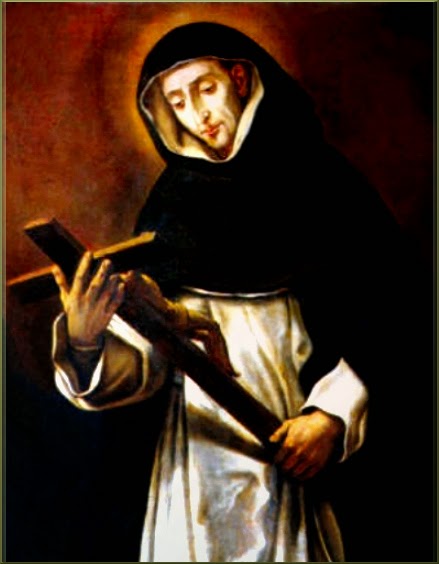
In 1560, when the plague broke out in Valencia, his Superiors, not wanting to lose him, sent him elsewhere for a time, he preached with great success and was endowed with the spirit of prophecy.   He continued his preaching when recalled to Valencia.   In 1562 he obtained leave to embark for Carthagena in the American mission and there converted vast multitudes to the Faith.   He hoped to obtain the grace of martyrdom there, but God conserved his life.   He was favoured with the gift of miracles and, after praying for the gift to be understood without an interpreter, since one of those had disappointed him seriously, he preached in his mother tongue, Spanish but was understood by all the natives of various tribes.st louis teaching the cross

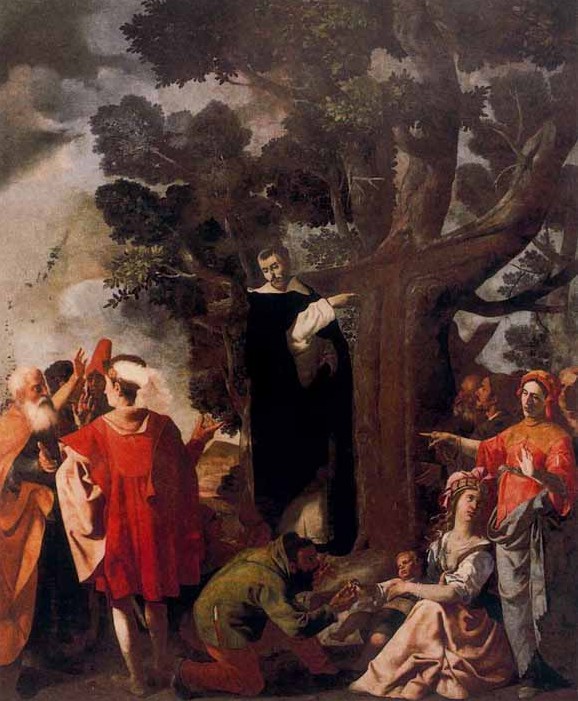
In his mission at Tubera he himself baptised 10,500 Indians, without counting those his companions baptised, and obliged them to burn their idols and the sites of their sacrifices.   Often his gentleness charmed his worst enemies.  He preached also at Capicoa and Paluato, having established missions there  . He refused all remuneration -he brought down rain after a drought.   He was poisoned by some pagans who had suffered a reproach but the poison did not harm him and the nativeswere converted by the miracle.   He went to many other places, preaching and healing the sick – again he was poisoned without effect.   There was no one who did not consider him a Saint, sent for the benefit of the new continent.LG ST LOUIS BERTRAND

After seven years he returned to Spain to plead the cause of the Indians, oppressed and given bad example by his own countrymen.   He used his own growing reputation for sanctity, as well as family and other contacts, to lobby on behalf of the native peoples he had encountered, as well as serving in his native diocese of Valencia.   There he also became a spiritual counsellor to many, including St Teresa of Ávila.  He was not permitted, however, to return and labour among his beloved peoples.   He spent his remaining days preaching, labouring for the conversion of different cities and again forming the novices of the Order at Valencia.   He was elected Prior of that convent and never had a more charitable or more zealous Superior been seen there.louis bertrand

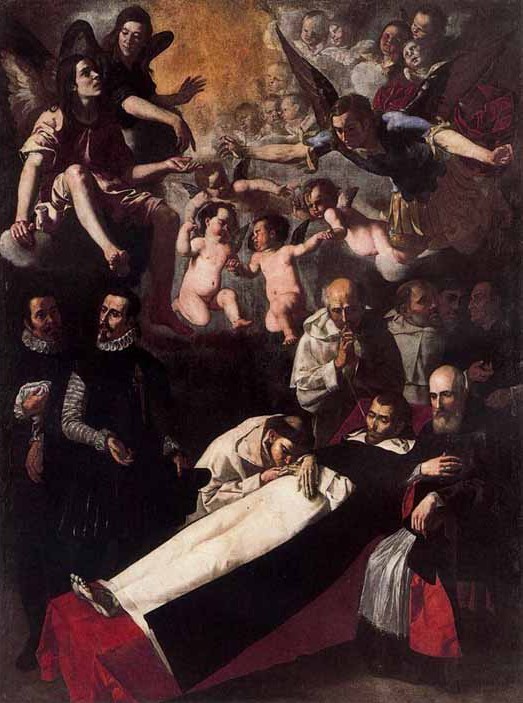
At length, after suffering from a long and painful illness, he was carried from the pulpit in the Cathedral at Valencia to the bed from which he never rose.   He died on the day he had foretold, 9 October 1581, at the age of 55 years.st louis bertrand deathbed

He was Canonised by Pope Clement X in 1671.

There is a statue of Louis Bertrand on the north colonnade of St Peter’s Basilica in Rome.
The festival known as La Tomatina is held in Buñol, Valencia, in honour of the town’s patron saints, Louis Bertrand and the Mare de Déu dels Desemparats – Mother of God of the Defenceless, a title of the Blessed Virgin Mary.

ST LOUIS BERTRAND

Posted in DOMINICAN OP, MORNING Prayers, SAINT of the DAY, The WORD

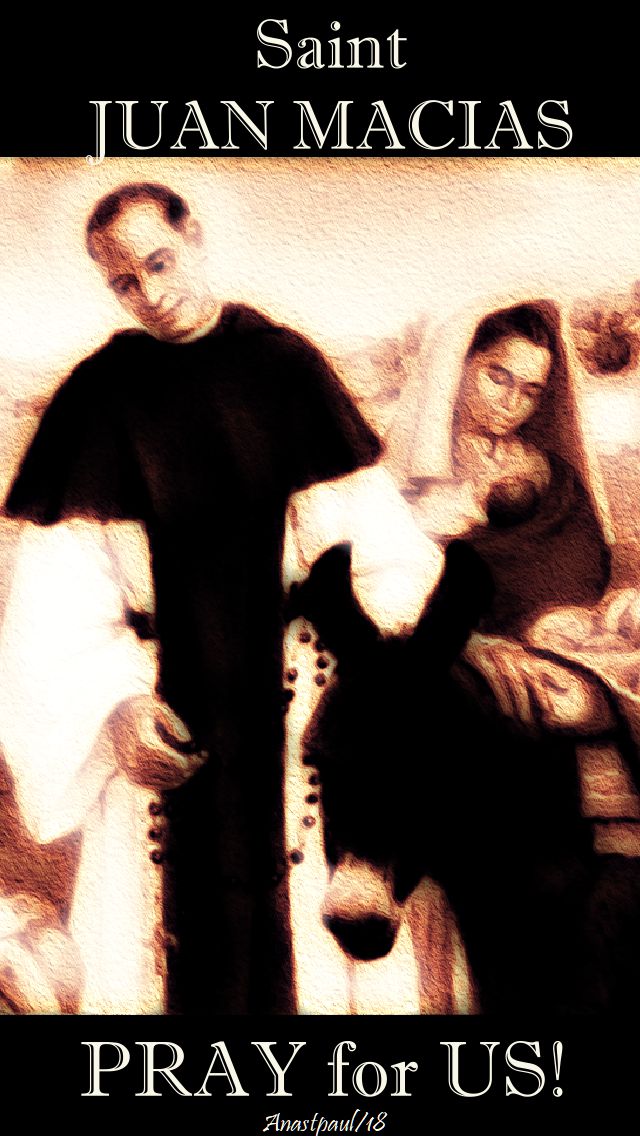
Thought for the Day – 18 September – The Memorial of St Juan Macias O.P. (1585-1645)

Thought for the Day – 18 September – The Memorial of St Juan Macias O.P. (1585-1645)

St Juan Macias reflects the life of the many immigrants who come seeking better living conditions.   His life helps us to realise that as immigrants, we have a greater mission – to share the richness of our faith with other people in simple ways.   According to his biographers, St Juan Macias constantly meditated on the verse from the Book of Revelation:  “I saw a new heaven and a new earth” (Rev 21:1).

Faith is a journey on this earth in which all of us are immigrants who seek the new heaven and the new earth.   The life of St Juan Macias teaches us to walk this journey of faith in simple ways – being generous at all times, especially with the poor, the sick and the elderly;  being humble, embracing the reality that we are on this earth only for a while and doing the works of charity, the surest way to salvation.

The life of St Juan Macias teaches, that immigrants go to new worlds to find a better life through giving themselves for the greater mission of sharing the Gospel.   Indeed, this is a very effective way in which our life conditions will really become better, by sharing the Gospel, the Word of God, the life and death of our Saviour, Jesus Christ, in whatever way we can, where we find ourselves!

St Juan Macias, pray for us!st juan macias pray for us - no 2 - 18 sept 2018

Posted in DOCTORS of the Church, DOMINICAN OP, FATHERS of the Church, franciscan OFM, MORNING Prayers, PAPAL SERMONS, QUOTES of the SAINTS, QUOTES on CONVERSION, SAINT of the DAY, The WORD

One Minute Reflection – 18 September – Today’s Gospel: Luke 7:11–17

One Minute Reflection – 18 September – Today’s Gospel: Luke 7:11–17, Tuesday of the Twenty-fourth week in Ordinary Time and the Memorial of St Juan Macias O.P. (1585-1645) and St Joseph of Cupertino O.F.M. Conv. (1603-1663)

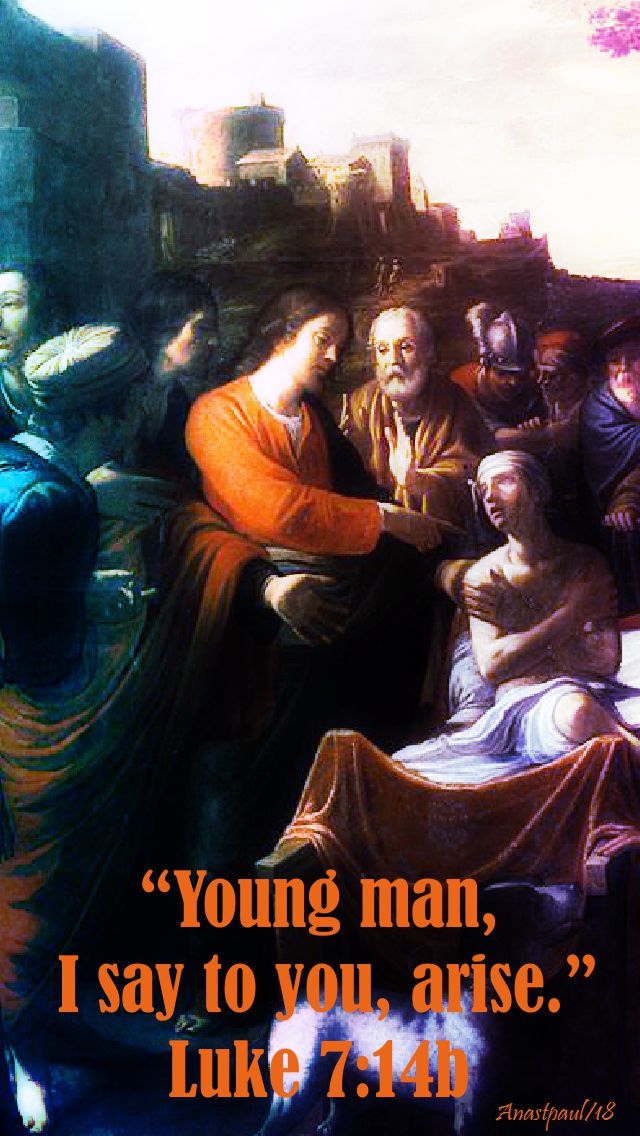
And he said, “Young man, I say to you, arise.”...Luke 7:14byoung man i say to arise - luke 7 14b - 18 sept 2018

REFLECTION – “Even if the signs of death have removed all hope of life, even if the bodies of the dead lie beside the tomb, yet, at the voice of God, the corpses of those ready to decompose will rise and recover speech.   The son is restored to his mother, he is called back from the tomb, snatched out of it.   And what is this tomb?   Your own.   Your bad habits, your lack of faith.  This is the tomb from which Christ delivers you, this is the tomb from which you will return to life if you listen to the Word of God.  Even if your sin is so grave that you are unable to wash it clean for yourself with your tears of repentance, the Church, your mother, she who intercedes for each one of her children like a widowed mother for her only son, will weep for you.   For she feels for it with a kind of spiritual suffering natural to her when she sees her offspring dragged down to death by lamentable vices…
Let her weep, then, this pious mother; let the crowd accompany her – and not just a crowd but a large crowd – and may it show compassion towards this tender mother. Then you will come to life again in your tomb and will be delivered, the bearers will stop and you will start to speak the words of the living; everyone will be astonished.   The example of one will correct the many and they will praise God for having granted such remedies to us for escaping death.”…St Ambrose (c 340-397) Father & Doctor (A treatise on the Gospel of Saint Luke)young man i say to you arise luke 7 14b - the son is restored to his mother - st ambrose 18 sept 2018

God wants us to stand upright.   He created us to be on our fee,: for this reason, Jesus’ compassion leads to that gesture of healing, to heal us, of which the key phrase is:  “Arise! Stand up, as God created you!”.   Standing up.   “But Father, we fall so often” — “Onward, arise!”.   This is Jesus’ word, always.   His word revives us, gives us hope, refreshes weary hearts, opens us to a vision of the world and of life which transcends suffering and death…Pope Francis – General audience, 10 August 2016young man i say to arise - luke 7 14b - pope francis - god wants us to stand upright - 18 sept 2018

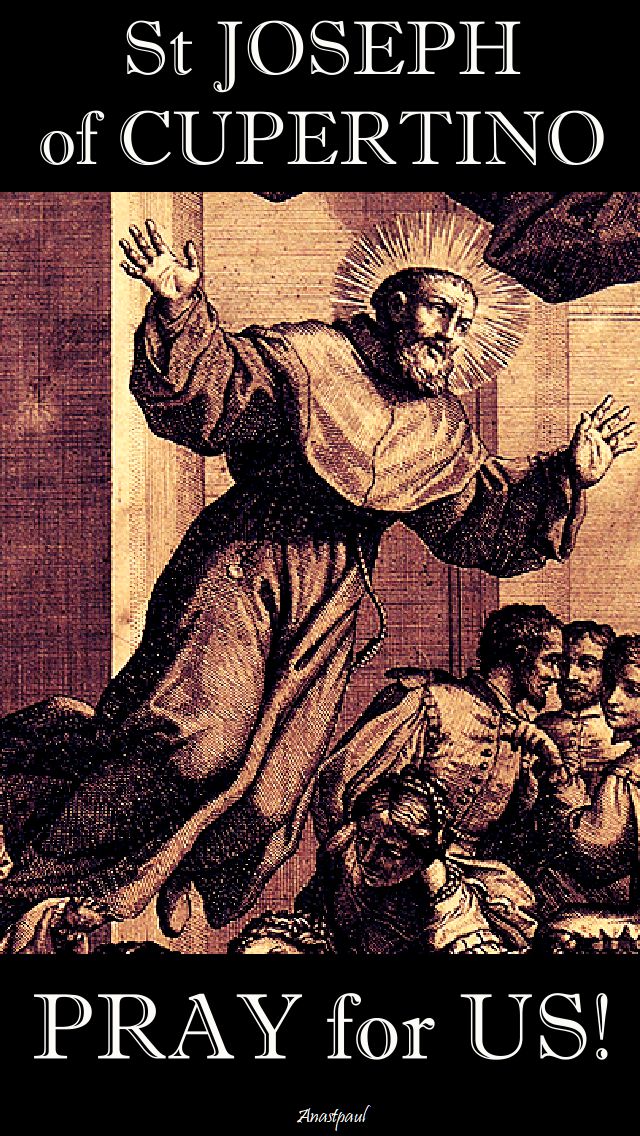
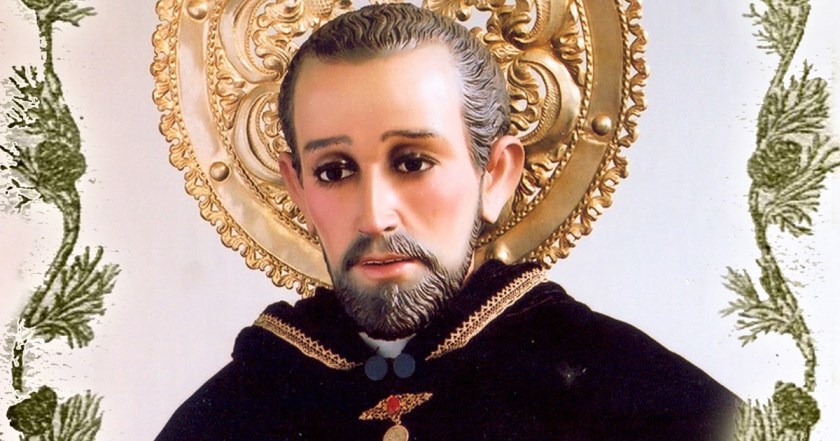
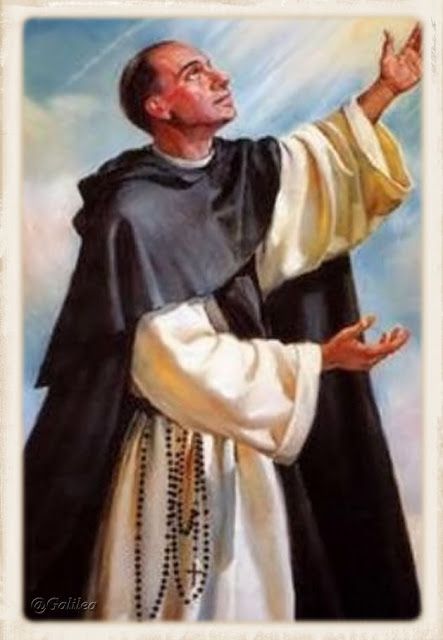
PRAYER – Heavenly Father, help me to be holy in the way that You have laid out for me. Let me stand upright and carry out my duties of my state of life to the full.   Only in You may I attain holiness, learning to give myself, my will, my heart and my to You.   St Joseph of Cupertino, you who were so disadvantaged, achieved by the grace of God, sanctity in this life and now behold His Face through all eternity.   St Juan, in your lowly work, you stood in the Light of Christ, allowing the lowly and rich, to see Him who saved us.   We ask You Holy Father, that You grant, by the intercession pf St Joseph and Juan, that we may reach our heavenly home.   We make our prayer through Christ our Lord, with the Holy Spirit, one God forever, amen.st-joseph-of-cupertino-pray-for-us-18 sept 2017

st juan macias pray for us 18 sept 2018

Posted in DOMINICAN OP, Our MORNING Offering, SAINT of the DAY

Our Morning Offering – 18 September – The Memorial of St Juan Macias O.P. (1585-1645)

Our Morning Offering – 18 September – The Memorial of St Juan Macias O.P. (1585-1645)

Note:  I am a Lay Dominican so I should be signing Anastpaul O.P. 

Breaking (down) The Habit

For the past 800 years, Dominican Friars (and Sisters, of course) have donned the white habit, the familiar robes, the brand unique of the Order of Preachers.   Each day whilst dressing, they quietly recite prayers as they do so.   This is a glimpse into a rarely seen Dominican ritual.

First is the tunic, a long white cotton/wool robe worn over any set of plain clothes.

Clothe me, O Lord, with the garments of salvation.   By Your grace may I keep them pure and spotless, so that clothed in white, I may be worthy to walk with You in the Kingdom of God. Amen.

The cincture is a belt, generally black leather, simple.

Gird me, O Lord, with the cincture of justice and the cord of purity that I may unite the affections of my heart in the love of You alone. Amen.

Over the belt, a 10-15 decade rosary, in adoration for Mary Magdalene.   Worn on the left hip because that was wear soldiers wore their weapons in 1216 when St Dominic founded the Order of Preachers, saying, “Arm yourself with prayer rather than a sword;  wear humility rather than fine clothes”.

O God, whose only-begotten Son, by His life, death and resurrection, has purchased for us the rewards of eternal life, grant we beseech Thee, that meditating upon the mysteries of the Most Holy Rosary of the Blessed Virgin Mary, we may imitate what they contain and obtain what they promise, through the same Christ our Lord, Amen.

The scapular is akin to a large white poncho, a long vest without sleeves.

Show yourself a mother, He will hear your pleading whom your womb has sheltered and whose hand brings healing.

A white capuce looks like the original hoody but only comes down past the shoulders to a point between the arm pit and the elbow.

Lord, You have set your sign upon my head that I should admit no lover but you. Amen.

The sixth layer is a black cappa, a cape of sorts.

We fly to your patronage, O Holy Mother of God, do not despise our prayers in our necessity, but free us from all peril, O Blessed Virgin. Amen.

The black capuce is the seventh and final layer.   It is generally only worn for formal occasions.

Heavenly Father, Who were with Your great servants Moses and Joshua and used them to bring Your children out of bondage, fill us with that same grace that we may preach Your word boldly and with authority for the deliverance of those under the bondages of sin.   We ask this through Christ our Lord, Amen.

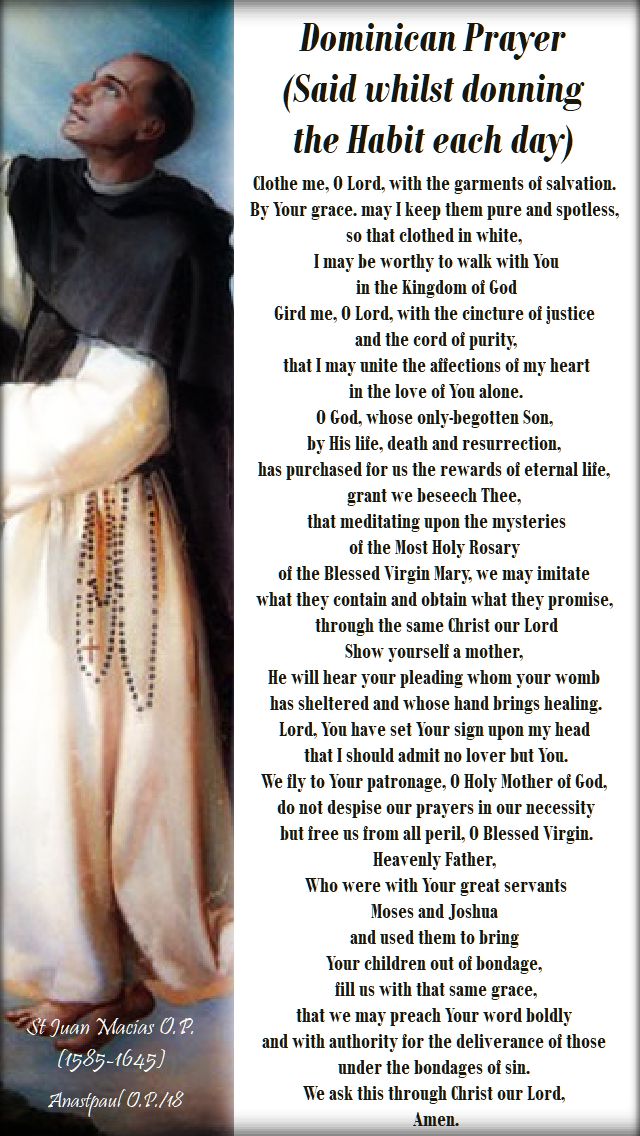
Dominican Prayer whilst donning the Habit

Clothe me, O Lord, with the garments of salvation.
By Your grace. may I keep them pure and spotless,
so that clothed in white,
I may be worthy to walk with You in the Kingdom of God
Gird me, O Lord, with the cincture of justice
and the cord of purity,
that I may unite the affections of my heart
in the love of You alone.
O God, whose only-begotten Son,
by His life, death and resurrection,
has purchased for us the rewards of eternal life,
grant we beseech Thee,
that meditating upon the mysteries of the Most Holy Rosary
of the Blessed Virgin Mary, we may imitate
what they contain and obtain what they promise,
through the same Christ our Lord
Show yourself a mother,
He will hear your pleading whom your womb
has sheltered and whose hand brings healing.
Lord, You have set Your sign upon my head
that I should admit no lover but You.
We fly to Your patronage, O Holy Mother of God,
do not despise our prayers in our necessity
but free us from all peril, O Blessed Virgin.
Heavenly Father,
Who were with Your great servants Moses and Joshua
and used them to bring Your children out of bondage,
fill us with that same grace,
that we may preach Your word boldly
and with authority for the deliverance of those
under the bondages of sin.
We ask this through Christ our Lord,
Amen.dominican prayer - clothing prayer no 2 with St Juan macias- 18 sept 2018
Posted in DOMINICAN OP, SAINT of the DAY

Saint of the Day – 18 September – St Juan Macias O.P. (1585-1645)

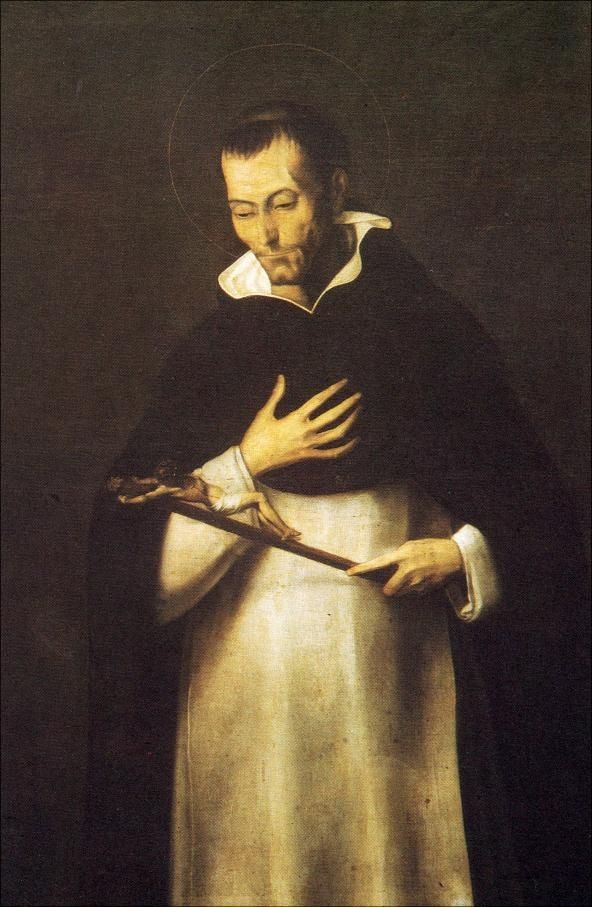
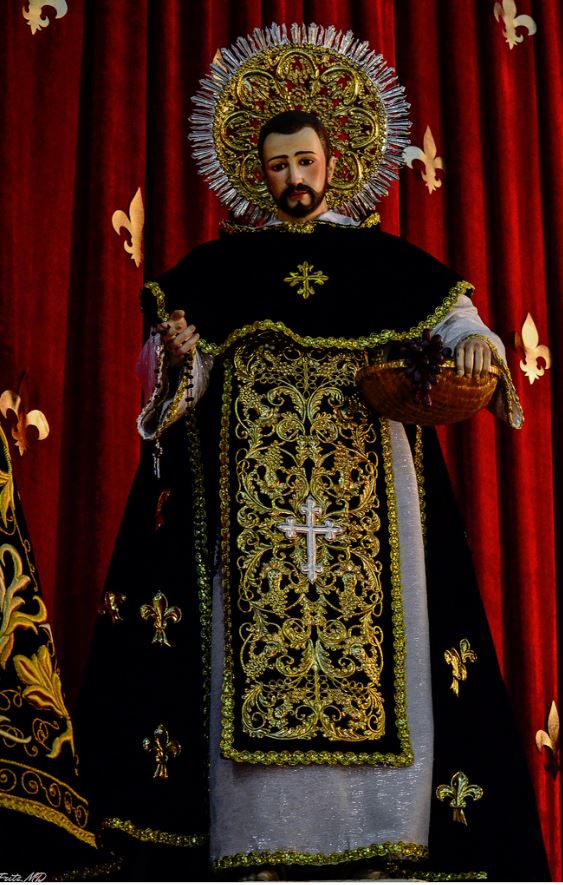
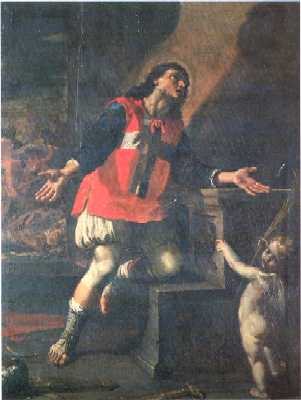
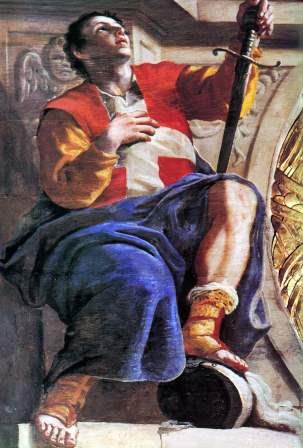
Saint of the Day – 18 September – St Juan Macias O.P. (1585-1645) – vowed Dominican Lay Friar, Mystic, Apostle of Charity and Prayer, MiracleWorker – St Juan was born on 2 March 1585 Ribera del Fresno in Extremadura, Spain and died on 16 September 1645 in Lima, Peru.   He was Beatified in 1837 together with his close friend, St Martin de Porres, by Pope Gregory XVI and Canonised in 1975 by Pope Paul VI.   His main image is located at the main altar of the Basilica of Our Lady of the Rosary of Lima and is venerated by the local laity in Peru.   A church was built in his honour in 1970 in San Luis, Lima, Peru.header - st juan macias

St Juan Macias is a saint dear to the heart of Dominicans.   To the chorus of Dominican saints, this humble lay brother adds his characteristic notes of contemplation and spiritual friendship, a living example of the Dominican motto, “to contemplate and to give to others the fruits of our contemplation.”

Juan Macias was born on 2 March 1585 in a small village in southwestern Spain.   His parents were poor farmers – both died when Juan and his sister Agnes were young.   The two children were raised by their uncle whose last name, “Macias,” they took as their own.

st juan macias

When he was sixteen, Juan met a Dominican priest while attending Mass in a neighbouring village.   Like most young people, Juan was full of wonder about what his future would hold.   This experience made a new impression on Juan and opened his heart to the possibility of a Dominican vocation.   Unlike most young people, Juan received another special grace – it is said that as he began to seek God’s will for his life, he was frequently visited by the Blessed Virgin Mary and by his patron, St John the Evangelist.

At the age of 35, Juan still felt drawn to the Dominican Order.   St John told him that it was not to be in Spain that he would become a Dominican, but in Lima, Peru.   In 1622, Juan Macias entered the Dominican convent of St Mary Magdalene in Lima, Peru. H  e entered as a lay brother, a non-ordained friar who, instead of preaching, would do the manual labour necessary in the monastery.   Juan was the assistant Porter (doorkeeper) until his death in 1646.   Although he was uneducated, Juan Macias exemplified the Dominican charism.   Like St Dominic, he learned the most sublime theology by studying the “book of charity,” the Cross.    Juan Macias’ entire life preached the Word of God to those he met.st juan macias beautiful statue

One of Juan Macias’ chief duties was to meet the poor who came to the convent seeking material or spiritual assistance, often over two hundred people every day.   Besides his cheerful disposition and encouraging manner, Juan Macias became known for the sometimes miraculous nature of his service to the poor.   Everyone knew that Juan worked extremely hard to collect alms for distribution.   Still, he would often return empty handed.   Yet, somehow Juan never turned anyone away.   From what he had been able to collect, he would have enough to feed all who came to him for help.St.-Juan-Macias

Juan Macias knew that he must help meet the physical needs of those who came to him, but he also knew that their spiritual hunger was much greater.   Juan was an instrument of conversion for many.

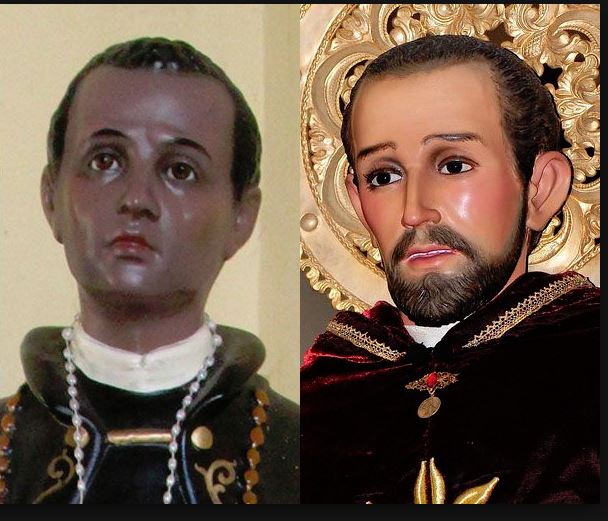
Juan Macias is well known for his close friendship with another Dominican saint, Martin de Porres  (1579–1639).   The two saints often met on their daily rounds of the city and became close spiritual friends as well.   They were a constant source of encouragement and ideas for one another.   The two were beatified together in a single ceremony by Pope Gregory XVI in 1837.st martin de porres and st juan macias

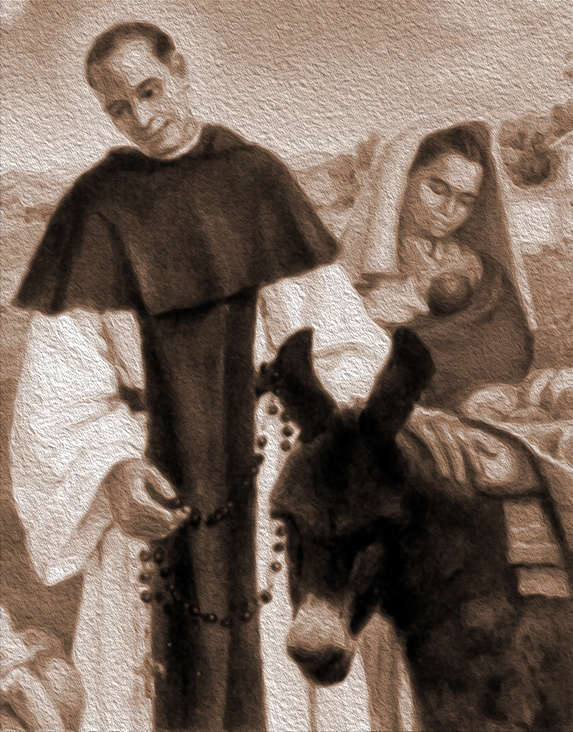
John Macias was well known mainly for two things during his life.   First, he was known to love the rosary, which he began to pray as a child in Spain while he shepherded his uncle’s flock of sheep.   Secondly, he was known for his generosity to the poor, 200 of whom he fed every day.   He was greatly aided in this by a little donkey that he sent through Lima.   He had a small sign put on it asking for donations for the poor.   The donkey, knowing his route perfectly, would travel through the streets and come back with benefactions for the city’s poor.   Often the donkey would stop at certain locations and make loud noises so that the people inside would come out to make their donations.ST-JUAN-MACIAS

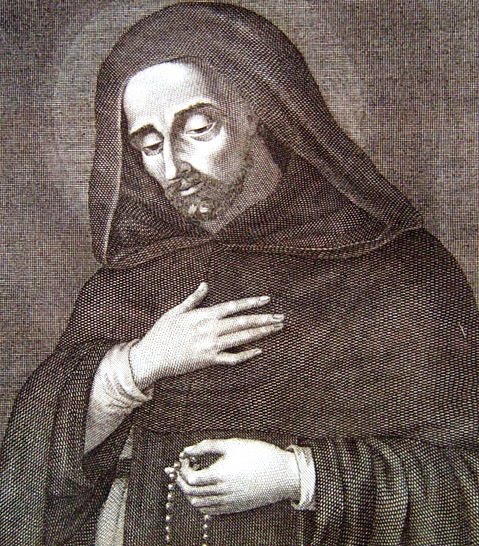
At the priory, Macías’s life was filled with fervent prayer, frequent penance and charity. As a result of his austerity, he quickly fell ill and had to have a risky surgery. Nevertheless, he continued to care for other sick and needy as they waited at the friary gates.   Beggars, disabled people and other disadvantaged people were commonplace throughout Lima where they flocked to him at the monastery gates for counsel and comfort.   The poor came for food and the rich for advice.st juan macias engraving

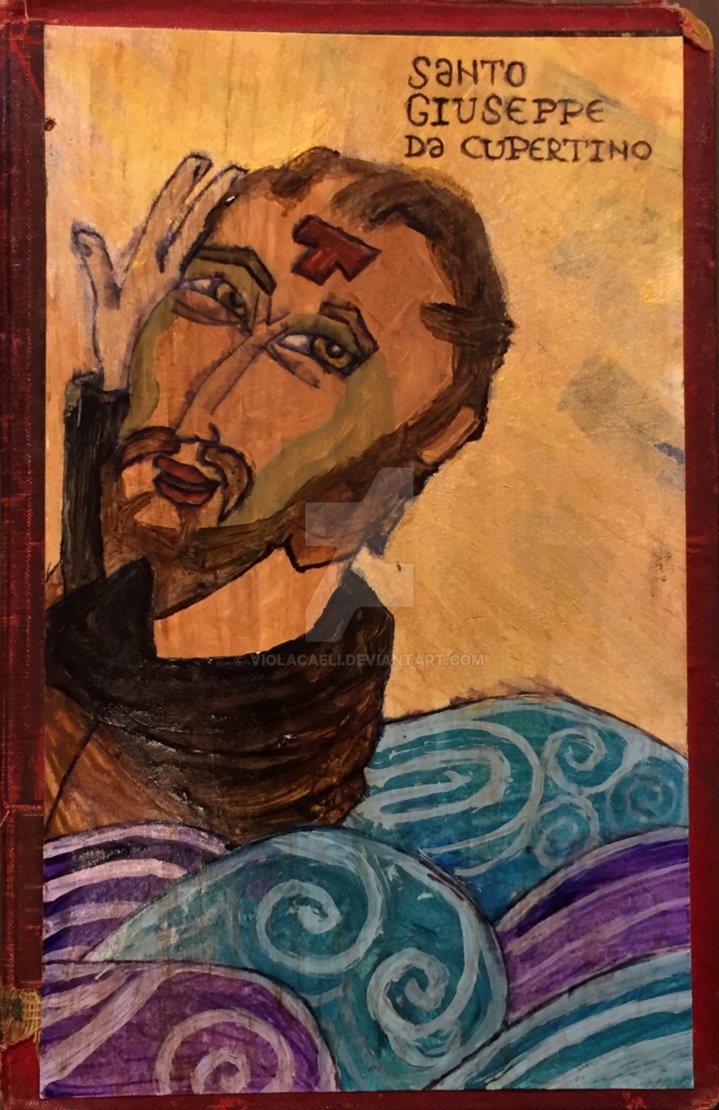
Macias, however, expressed a greater desire to spend more time in contemplative solitude rather than engage in conversational activities with others.   He confessed this to Father Abbot Ramírez who said, “If he were to never follow his vow of obedience, nobody would have ever seen his face.”   But his official position as the priory’s porter, which he held for over 20 years and went against his natural inclinations of solitude, served to continue disciplining his vow of obedience.   This filled him with a joyful sense of fulfillment.   He died of natural causes in 1645.San_Juan_Macias_official_sidest__joseph_of_cupertino___icon_by_violacaeli-d99myw4

Posted in DOMINICAN OP, SAINT of the DAY

Saint of the Day – 2 September – St Ingrid of Sweden O.P. (Died 1292)

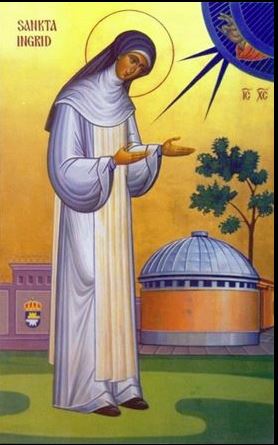
Saint of the Day – 2 September – St Ingrid of Sweden O.P. (Died 1292) – also known as St Ingrid of Skänninge – Dominican Religious and Mystic.9_2_St_Ingrid_of_Sweden best

Ingrid Elovsdotter was born in Skänninge, Sweden, in the 13th century.   Following the death of her husband, she resolved to consecrate the rest of her life to God.   She placed herself under the spiritual direction of Peter of Dacia, a Dominican priest.   In one of his letters, Petrus de Dacia has left a description of the ascetic life style and mystic revelations of one of his “spiritual daughters” in this circle of women, which likely refers to Ingrid.

She was the first Dominican nun in Sweden and in 1281 after making a pilgrimage to Rome she founded the first Dominican cloister, called St Martin’s in Skänning, which was formally recognised in 1281, 1 year prior to her death.   Ingrid made pilgrimages to Santiago de Compostela, Jerusalem and Rome.

She died in 1282 surrounded by an aura of sanctity.   After her death in 1282, Ingrid became object of veneration and pilgrimages to her convent.   She was, however, not formally recognised by the Pope as such.   When her relative, Bridget of Sweden, was formally recognised by the Pope in 1391, it caused a need to have Ingrid to be granted a similar status as well.   At the Council of Costance, an application was made for her canonisation.   In 1499, Pope Alexander VI agreed to a Translation (relic), which took place in her convent in 1507.

The remains of Ingrid was removed to the Vadstena Abbey after the Swedish Reformation.   In 1645, the skull was stolen from the Vadstena church by Antoine de Beaulieu, who believed it to be the skull of Bridget of Sweden.   Antoine de Beaulieu gave the skull to the French ambassador Gaspard Coignet de la Thullerie, who in turn placed it in the church of Courson-les-Carrières in France.   In 1959, it was given to the Brigitinesse abbey of Mary’s Refuge in Uden in the Netherlands, where it is exhibited as the skull of Bridget of Sweden.

st ingrid of sweden


Posted in DOCTORS of the Church, DOMINICAN OP, Our MORNING Offering, SAINT of the DAY

Our Morning Offering– 23 August – The Memorial of St Rose of Lima (1586-1617)

Our Morning Offering– 23 August – The Memorial of St Rose of Lima T.O.S.D. (1586-1617)

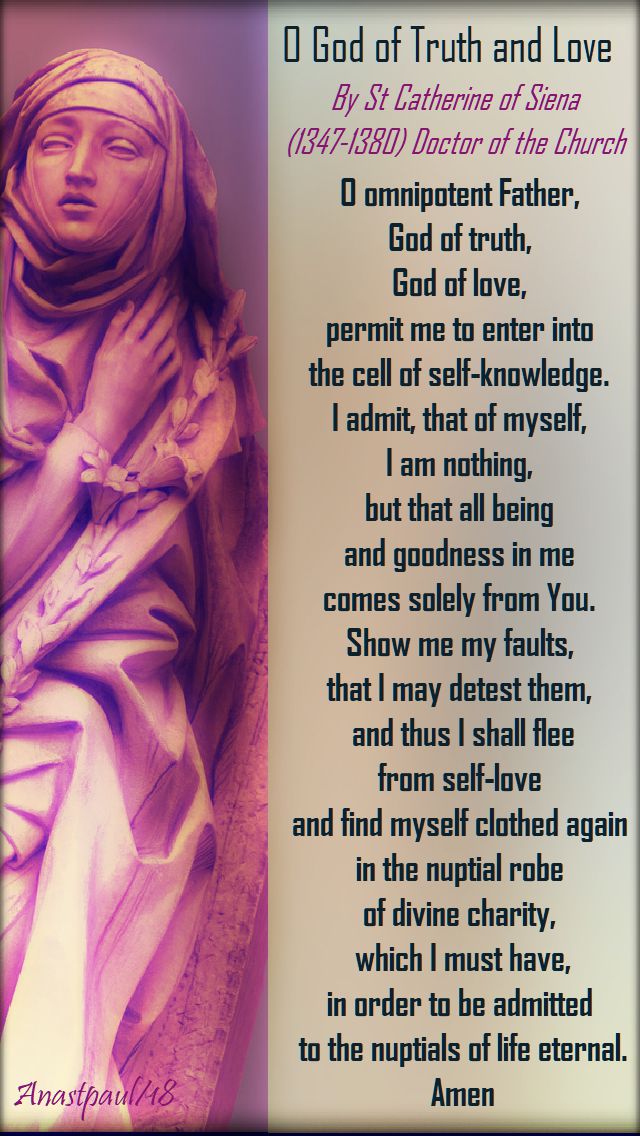
O God of Truth and Love

A Prayer of Penitence
By St Catherine of Siena (1347-1380) Doctor of the Church

O omnipotent Father,
God of truth,
God of love,
permit me to enter into
the cell of self-knowledge.
I admit, that of myself, I am nothing,
but that all being
and goodness in me
comes solely from You.
Show me my faults,
that I may detest them,
and thus I shall flee from self-love
and find myself clothed again
in the nuptial robe of divine charity,
which I must have,
in order to be admitted
to the nuptials of life eternal.
Amen

St Catherine was St Rose’s model and both were, of course, Dominican Tertiaries.o god of truth and love, o omnipotent Father - st catherine of siena - 23 aug 2018 mem of st rose of lima (dominican tertiaries)

Posted in DOMINICAN OP, SAINT of the DAY

Saint of the Day – 23 August – St Rose of Lima (1586-1617)

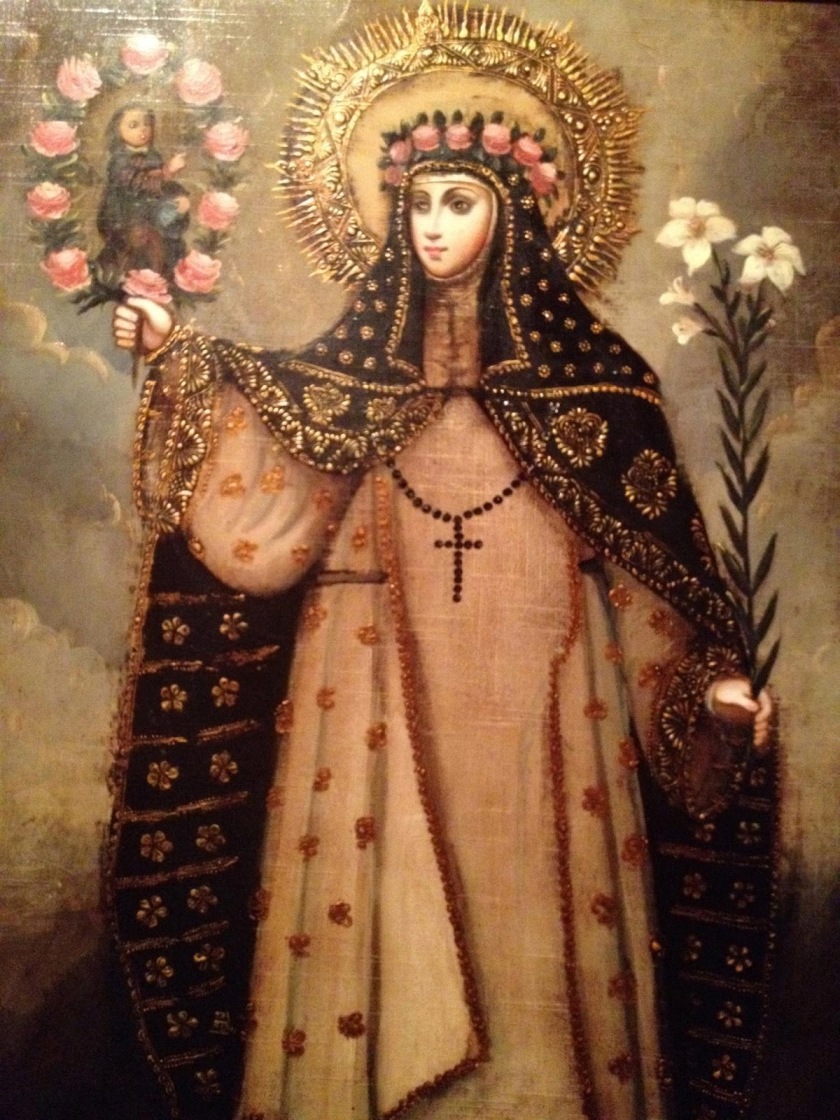
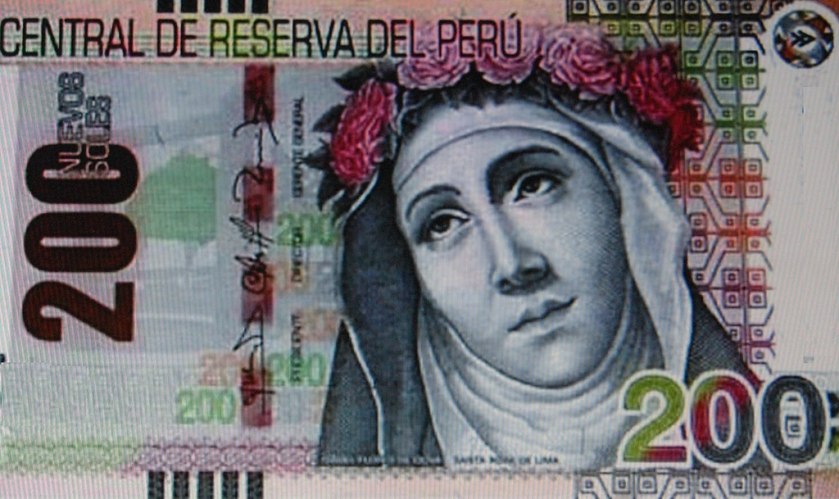
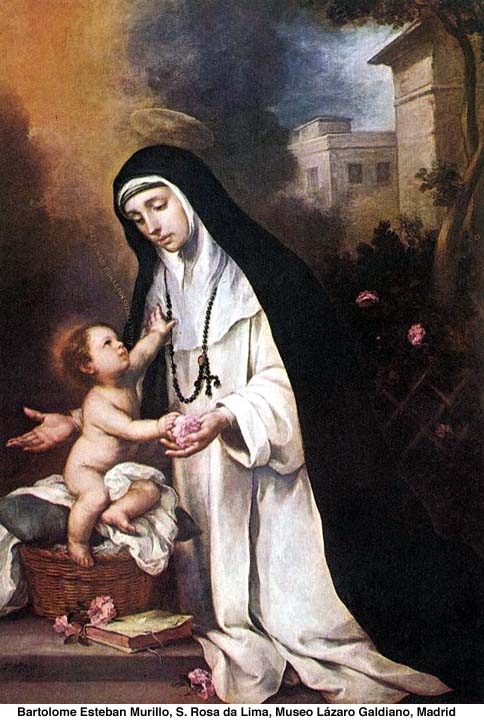
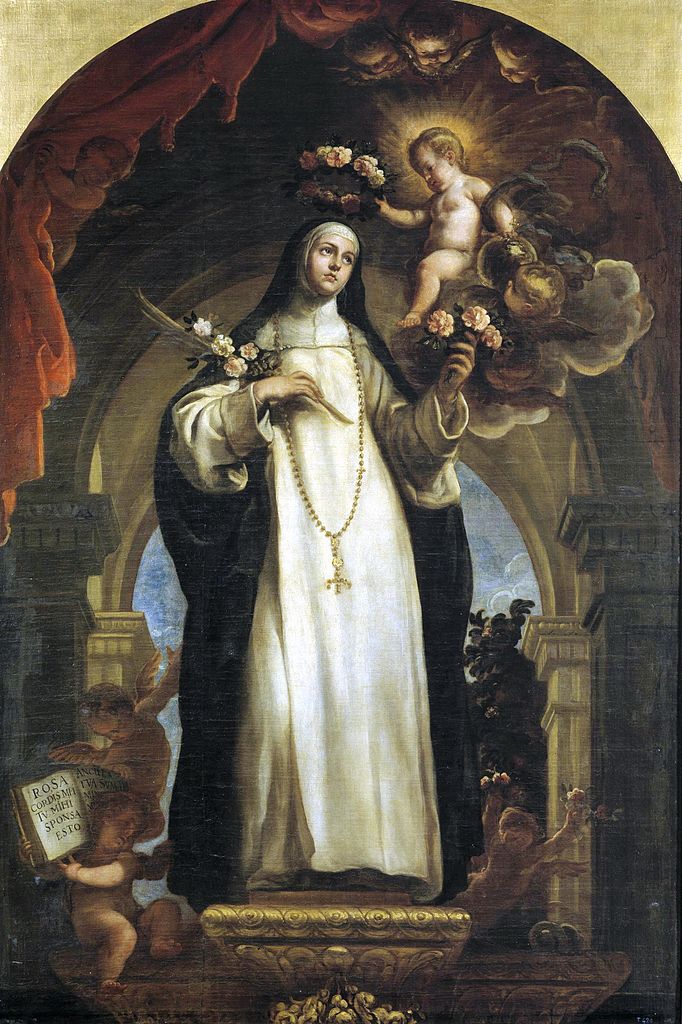
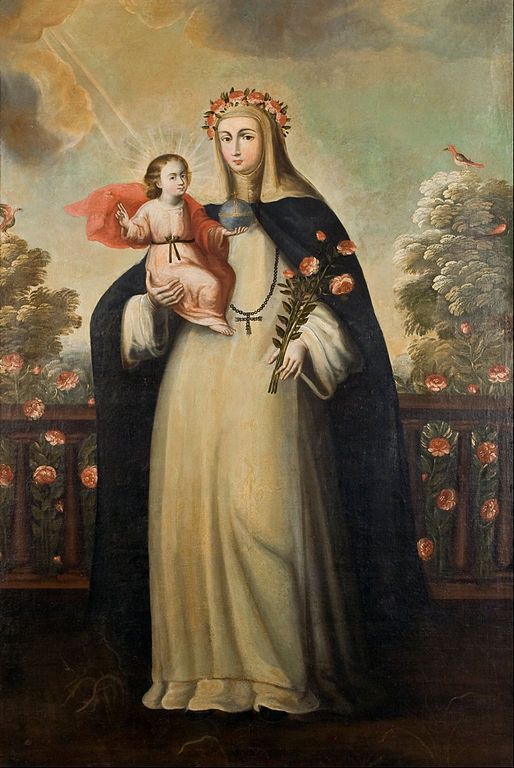
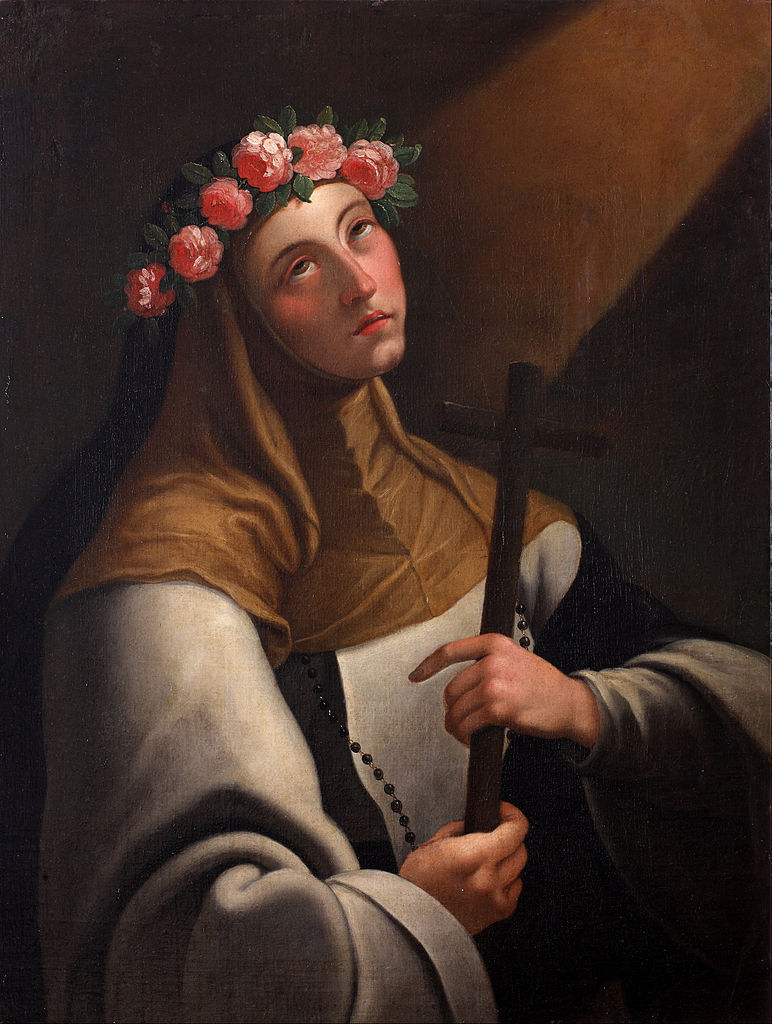
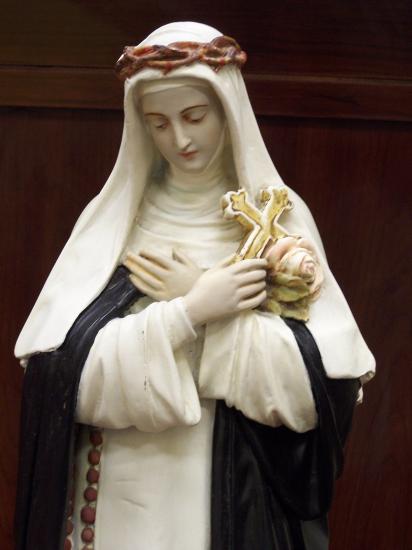
Saint of the Day – 23 August – St Rose of Lima T.O.S.D. (1586-1617) Virgin and Penitent, Mystic, Visionary, Stigmatist (invisible), Apostle of the Poor – born on 20 April 1586 at Lima, Peru as Isabel Flores de Oliva and died on 24 August 1617 at Lima, Peru of natural causes.   Patronages – against vanity, embroiderers, florists, gardeners, needle workers, people ridiculed for their piety, Peru, Lima, Peru, Americas, Central America, Latin America, New World, South America, India, Philippines, West Indies, diocese of Santa Rosa, California, Villareal Samar, Philippines, World Youth Day 2011.   St Rose was a member of the Third Order of Saint Dominic in Lima, Peru, who became known for both her life of severe asceticism and her care of the needy of the city through her own private efforts.  She was the first person born in the Americas to be canonised as a saint.   She is the primary patroness of Peru and of the indigenous natives of Latin America.   Her image is featured on the highest denomination banknote of Peru.St. Rose of LimaSt Rose of Lima - 1024px-Biljete200soles

This lovely flower of sanctity, was born at Lima in 1586.   She was christened Isabel but the beauty of her infant face earned for her the title of Rose, which she ever after bore.

As a child, while still in the cradle, her silence under a painful surgical operation proved the thirst for suffering already consuming her heart.   At an early age she took service to support her impoverished parents and worked for them day and night.   In spite of hardships and austerities her beauty ripened with increasing age and she was much and openly admired.   From fear of vanity she cut off her hair, blistered her face with pepper and her hands with lime.

For further security she enrolled herself in the Third Order of St Dominic, took St Catherine of Siena as her model and redoubled her penance.   Her cell was a garden hut, her couch a box of broken tiles.   Under her habit Rose wore a hair-shirt studded with iron nails, while, concealed by her veil, a silver crown armed with ninety points encircled her head.   More than once, when she shuddered at the prospect of a night of torture, a voice said, “My cross was yet more painful.”Santa_Rosa_da_Lima_DSta_Rosa_de_Lima_por_Claudio_Coello514px-Anonymous_Cusco_School_-_Saint_Rose_of_Lima_with_Child_Jesus_-_Google_Art_Project

The Blessed Sacrament seemed almost her only food.   Her love for it was intense.   When the Dutch fleet prepared to attack the town, Rose took her place before the tabernacle, and wept that she was not worthy to die in its defence.   All her sufferings were offered for the conversion of sinners and the thought of the multitudes in hell was ever before her soul.

She died in 1617, at the age of thirty-one on the date she had predicted.saint-rose-lima-original-oil-painting_1_e306317917c3f8cbdfe682319a440417

Rose was beatified by Pope Clement IX on 10 May 1667 and Canonised on 12 April 1671, by Pope Clement X, the first in the Americas to be declared a saint.   Her shrine, alongside those of her friends St Martin de Porres (1585-1645) and St John Macias (also 1585-1645)), is located inside the convent of St Dominic in Lima.   Many miracles followed her death:  there were stories that she had cured a leper and that, at the time of her death, the city of Lima smelled like roses, roses also started falling from the sky.   Many places in the New World are named Santa Rosa after her.

772px-José_del_Pozo_(atribuido)_-_Saint_Rose_of_Lima_-_Google_Art_Projectst rose of lima statue

Posted in DOMINICAN OP, MORNING Prayers, SAINT of the DAY

Thought for the Day – 8 August – The Memorial of St Dominic (1170-1221)

Thought for the Day – 8 August – The Memorial of St Dominic (1170-1221)

St Dominic possessed such great integrity and was so strongly motivated by divine love, that without a doubt he proved to be a bearer of honour and grace.   And since a joyful heart animates the face, he displayed the peaceful composure of a spiritual man in the kindness he manifested outwardly and by the cheerfulness of his countenance. Wherever he went he showed himself in word and deed to be a man of the Gospel.

During the day no one was more community-minded or pleasant toward his brothers and associates.   During the night hours no one was more persistent in every kind of vigil and supplication.   He seldom spoke unless it was with God, that is, in prayer, or about God and in this matter, he instructed his brothers.   Frequently he made a special personal petition that God would deign to grant him genuine charity in caring for and obtaining the salvation of men.   For he believed that only then would he be truly a member of Christ, when he had given himself totally for the salvation of men, just as the Lord Jesus, the Saviour of all, had offered Himself completely for our salvation.   So, for this work, after a lengthy period of careful and provident planning, he founded the Orders of Friars Preachers.

In his conversations and letters he often urged the brothers of the Order to study constantly the Old and New Testaments.   He always carried with him the gospel according to Matthew and the epistles of Paul and so well did he study them that he almost knew them from memory.

Two or three times he was chosen bishop but he always refused, preferring to live with his brothers in poverty.

Of him Pope Gregory IX declared: “I knew him as a steadfast follower of the apostolic way of life.   There is no doubt that he is in heaven, sharing in the glory of the apostles themselves.”
– from various writings on the history of the Order of Preachers

St Dominic, Pray for us!st-dominic-pray-for-us-2.-8 aug 2017

Posted in DOMINICAN OP, MORNING Prayers, QUOTES of the SAINTS, QUOTES on CHARITY, QUOTES on DIVINE PROVIDENCE, QUOTES on EVANGELISATION, QUOTES on FAITH, QUOTES on HUMILITY, QUOTES on LOVE, QUOTES on MERCY, QUOTES on PERSEVERANCE, QUOTES on SUFFERING, QUOTES on TRUST and complete CONFIDENCE in GOD, SAINT of the DAY

Quote/s of the Day – 8 August – The Memorials of St Dominic (1170-1221) and St Mary of the Cross MacKillop (1842-1909)

Quote/s of the Day – 8 August – The Memorials of St Dominic (1170-1221)

and St Mary of the Cross MacKillop (1842-1909)

“We must sow
the seed,
not hoard it.”we must sow the seed not hoard it - st dominic - 8 aug 2018.jpg

“Heretics are to be converted by an example of humility
and other virtues far more readily, than by any external
display or verbal battles.
So let us arm ourselves with
devout prayers and set off showing signs of genuine humility
and go barefooted to combat Goliath.”heretics-st-dominic-8 aug 2017

“A man who governs his passions is master of his world.
We must either command them or be enslaved by them.
It is better to be a hammer than an anvil.”

St Dominic (1170-1221)a-man-who-governs-his-passions-st-dominic-8 aug 2017

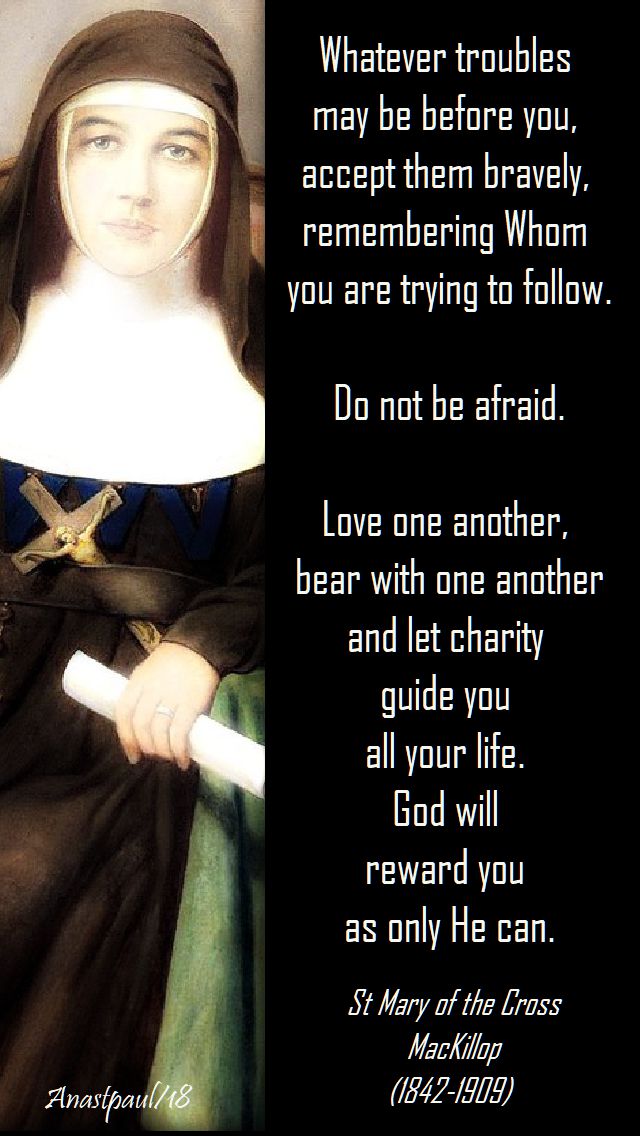
“Whatever troubles may be before you,
accept them bravely,
remembering Whom you are trying to follow.
Do not be afraid.
Love one another, bear with one another
and let charity guide you all your life.
God will reward you as only He can.”

St Mary of the Cross MacKillop (1842-1909)whatever troubles may be - st mary of the cross - 8 aug 2018

Posted in DOMINICAN OP, MORNING Prayers, PAPAL SERMONS, QUOTES on FAITH, SAINT of the DAY, The WORD

One Minute Reflection – 8 August – Today’s Gospel: Matthew 15:21–28

One Minute Reflection – 8 August – Wednesday of the Eighteenth week in Ordinary Time, Year B – Today’s Gospel: Matthew 15:21–28 and The Memorials of St Dominic (1170-1221) and St Mary of the Cross MacKillop (1842-1909)

Then Jesus answered her, “O woman, great is your faith!   Be it done for you as you desire.” And her daughter was healed instantly...Matthew 15:28

REFLECTION – “Jesus points to this humble woman as a model of unwavering faith.   Her persistence in beseeching Christ’s intervention is incentive for us not to become discouraged, not to despair when we are burdened by life’s difficult trials.   The Lord does not turn away in the face of our needs and, if at times, He seems insensitive to our requests for help, it is in order to put to the test and to strengthen, our faith.   We must continue to cry out like this woman:  “Lord, help me! Lord, help me!”.  In this way, with perseverance and courage.   This is the courage needed in prayer.   He can help us to find our way, when we have lost the compass of our journey; when the road no longer seems flat but rough and arduous; when it is hard to be faithful to our commitments.

It is important to nourish our faith every day, by carefully listening to the Word of God, with the celebration of the Sacraments, with personal prayer as a “cry” to Him — “Lord, help me!” — and with concrete acts of charity toward our neighbour.”…Pope Francis – Angelus, 20 August 2017matthew 15 38 - o woman great is your faith - the lord does not turn away - pope francis - 8 aug 2018

PRAYER – Lord God, You gave St Dominic and St Mary of the Cross Mackillop, to the Church in their days, as lessons in total love, charity and zeal.   We pray that they may help us in our times, by their merits, their inspiration, their words and their prayers. Through Jesus Christ our Lord, in the unity of the Holy Spirit, one God forever, amen.st-dominic-pray-for-us.8 aug 2017.pgst mary of the cross mackillop pray for us 8 aug 2018

Posted in DOMINICAN OP, MORNING Prayers, PRAYERS of the SAINTS, SAINT of the DAY

Our Morning Offering – 8 August – The Memorial of St Dominic (1170-1221)

Our Morning Offering – 8 August – The Memorial of St Dominic (1170-1221)

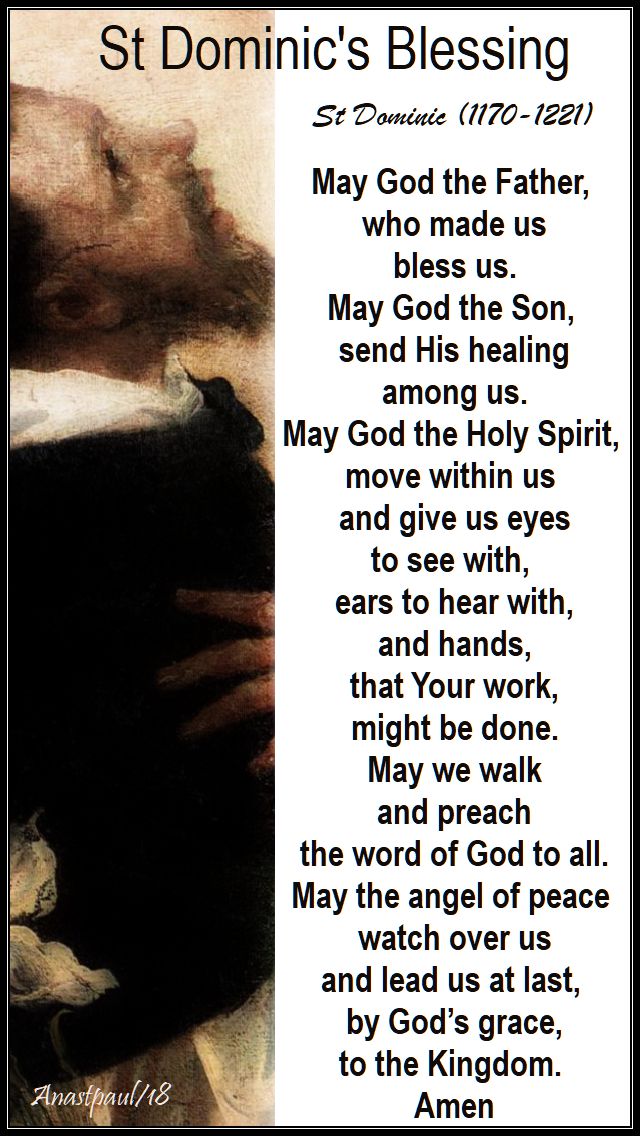
St Dominic’s Blessing

May God the Father,
who made us, bless us.
May God the Son,
send His healing among us.
May God the Holy Spirit,
move within us
and give us eyes to see with,
ears to hear with,
and hands, that Your work,
might be done.
May we walk and preach
the word of God to all.
May the angel of peace
watch over us
and lead us at last,
by God’s grace,
to the Kingdom.
Amenmay god the father - st dominic's blessing - 8 aug 2018

Posted in DOMINICAN OP, SAINT of the DAY

Saints of the Day – 8 August

St Dominic de Guzman O.P. (1170-1221) (Memorial) – All about him here: https://anastpaul.wordpress.com/2017/08/08/saint-of-the-day-8-august-st-dominic-de-guzman-founder-of-the-dominican-order-of-preachers/

St Aemilian of Cyzicus
St Altman of Passau
St Cyriacus the Martyr
St Eleutherius of Constantinople
St Ellidius
St Famianus of Compostela
St Gedeon of Besancon
St Hormisdas of Persia
Bl John Felton
Bl John Fingley
St Largus
St Leobald of Fleury
St Leonidas of Constantinople
St Marinus of Anzarba
St Mary of the Cross/ Mary MacKillop (1842-1909) – the first Australian born Saint

St Mummolus of Fleury
St Myron the Wonder Worker
St Paulus Ge Tingzhu
St Rathard of Diessen
St Severus of Vienne
St Sigrada
St Smaragdus
St Ternatius of Besançon
St Ultan of Crayke
Bl William of Castellammare di Stabia
Bl Wlodzimierz Laskowski

Martyrs of Albano – 4 saints: Four Christians who were martyred together, and about we today know little more than their names – Carpóforo, Secondo, Severiano and Vittorino. They were martyred in Albano, Italy – their remains are interred in the San Senator cemetery, on the Appian Way, 15 miles from Rome, Italy.

Martyrs of Rome – 5 saints: Five Christians martyred together; we know nothing else about them but the names – Ciriaco, Crescenziano, Giuliana, Memmia and Smaragdus. They were martyred at the 7 mile marker, on the Via Ostia, Rome, Italy.

Martyred in the Spanish Civil War – Martyrs of El Saler – 5 beati: Five nuns, all members of the Sisters of the Pious Schools, all teachers, and all martyred together in the Spanish Civil War.
• Antonia Riba Mestres
• Maria Baldillou Bullit
• María Luisa Girón Romera
• Nazaria Gómez Lezaun
• Pascuala Gallén Martí
They were martyred on 8 August 1936 in El Saler, Valencia, Spain and Beatified on 11 March 2001 by Pope John Paul II.

Martyred in the Spanish Civil War:
Bl Antero Mateo Garcia
Bl Antonio Silvestre Moya
Bl Cruz Laplana Laguna
Bl Fernando Español Berdie
Bl Leoncio López Ramos
Bl Manuel Aranda Espejo
Bl Mariano Pina Turón
Bl Pedro Álvarez Pérez

Posted in DOMINICAN OP, SAINT of the DAY

Saint of the Day – 3 August – Blessed Augustine Gazotich O.P. (1262-1323)

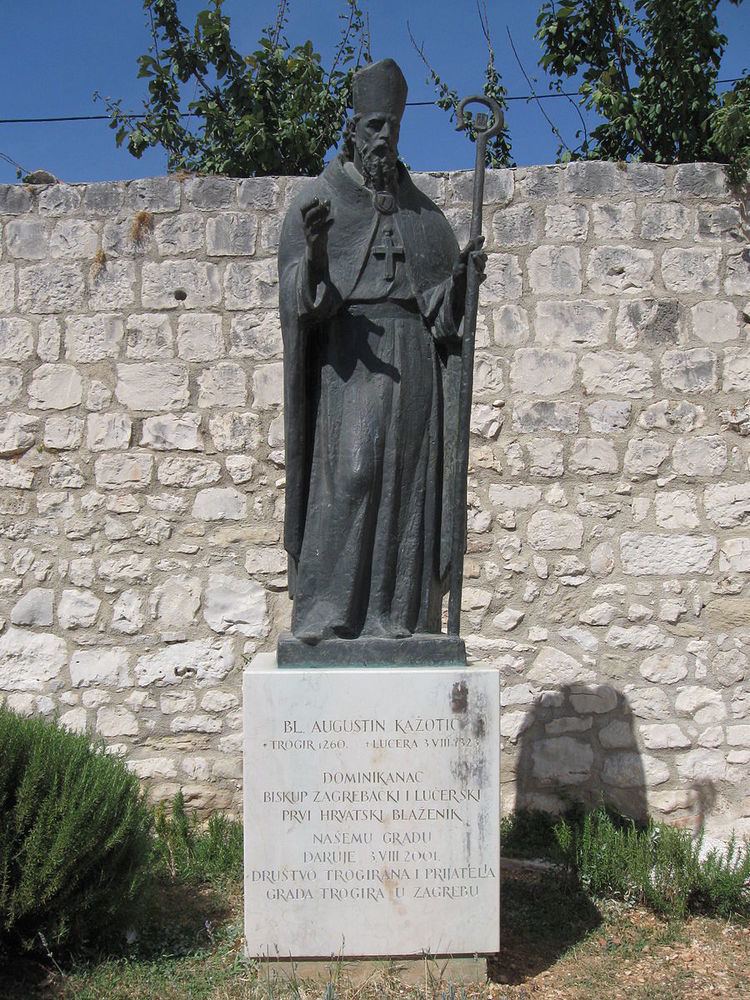
Saint of the Day – 3 August – Blessed Augustine Gazotich O.P. (1262-1323) born in 1262 at Trau, Dalmatia and died on 3 August 1323 at Lucera, Foggia, Italy of natural causes.  Also known as Augustin Kazotic.   Blessed Augustine was a Dalmatian-Croatian Prelate and professed member from the Order of Preachers who served as the Bishop of Lucera from 1322 until his death.   Gazotich was a humanist and orator who had served first as the Bishop of Zagreb from 1303 until 1322.   He studied in Paris before returning to his homeland where he began working in the missions and preaching in modern Bosnia.  He was one of the first humanist figures to appear in southern Croatia, a great Apostle of Charity.   He was also noted for being the guide for Dante Aligheri as the poet travelled through Croatia.   His reputation for personal holiness remained noted long after his death; this resulted in Pope Innocent XII confirming the late bishop’s beatification in 1700.bl augustin gazotich-my enlg 2

Born to a wealthy family at Trau, Dalmatia, about 1262, Augustine joined the Dominican Order at eighteen and was sent to Hungary.   There his fine spiritual qualities brought him to the attention of the legate Cardinal Niccolo Boccasino, a fellow Dominican.   Upon the latter’s elevation to the Papacy as Benedict XI in 1303, Augustine was made Bishop of Zagreb.augustin-kaoti-b3710491-1f1d-40d7-a635-723897a2b11-resize-750
The new Bishop reformed the clergy, completed building the cathedral and diligently brought about the spiritual renewal of the diocese and its people–while fending off the attacks of the hostile King of Dalmatia.   He was particularly attentive to the needs of the poor and needy peoples, donating most of his own income to them.

In time, Augustine was transferred to the See of Lucera in Sicily, where he continued his work of spiritual renewal, aided by his gift of healing.   The Bishop also defended his flock from attacks against the Faith.   He cared for the poor and needy and fostered devotion to Sts Dominic, Thomas Aquinas, and Peter Martyr.   He died in 1323 in the odour of sa  nctity. In 1702, Pope Clement XI confirmed his cultus.   The cause for his canonisation was re-launched in 2013 in Lucera.   The current Postulator for this cause – since the cause still proceeds – is the Dominican priest Gianni Festa.augustin-kaoti-21c3e900-88eb-45f3-b6c2-93f2a7c0487-resize-750

Posted in DOMINICAN OP, SAINT of the DAY

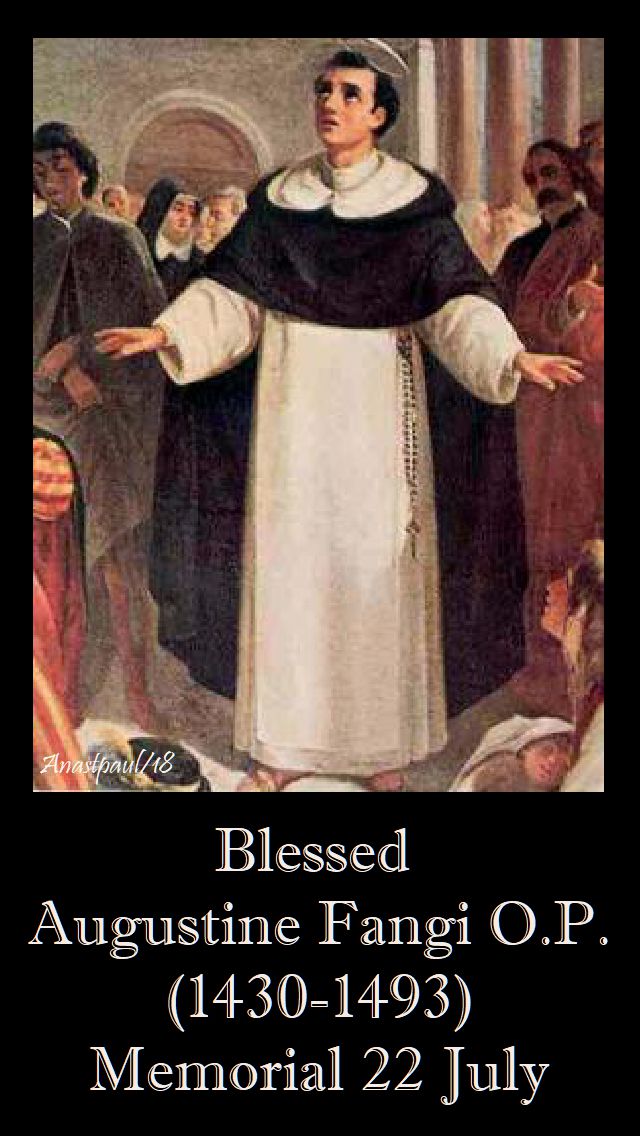
Saint of the Day – 22 July – Blessed Augustine Fangi O.P. (1430-1493)

Saint of the Day – 22 July – Blessed Augustine Fangi OP (1430-1493) – Dominican Friar and Priest, Confessor, Mystic, known as “The Miracle Worker,” Augustine of Biella.   He was commonly regarded, even in his time, as a miracle worker and, in serving as the Prior of several of his Order’s monasteries, was concerned with restoring and maintaining a faithful observance of the Rule of Saint Dominic.   He was born in 1430 at Biella, Piedmont, Italy and died on 22 July 1493 at Venice, Italy of natural causes.   In the 1530s, workmen found his coffin floating in the water that had seeped into the burial chamber – when opened, Augustine’s body and clothing were found to be Incorrupt and remains so.

bl augustine fangi - my pic - 22 july 2018

Blessed Augustine’s father was a member of the Fangi family, who were wealthy and noble and, because of this, he had planned a secular career for his son.   But when the Dominicans came to Biella, his plans were changed, for Augustine was completely charmed by their way of life and begged to be admitted.   He entered, while quite young, the new convent that the Dominicans had built at Biella.

Augustine had a reputation for penance, even at a time when people were not as squeamish as they are today.   Not only did he inflict harsh penances upon himself, he also bore with patience whatever pain and annoyance life granted him gratuitously.

One remarkable characteristic noted of Augustine, was his equanimity and ability to concentrate intensely on spiritual matters.   One incident recorded, involves a surgical procedure, which he was required to undergo without anesthetic, as such an aid was not available in the fifteenth century.   He did so without crying out at all.   Afterwards, he simply stated that his mind was so intensely focused on something else that he hardly noticed what was being done.  In prayer he was often seen levitating in ecstasy.

In 1464, Augustine was made Prior at Soncino.   Several of his best known miracles were performed there.   At one time, a deformed child, who had died without baptism, was restored to life, by Augustine’s prayer, long enough to be baptised.   At another time, when he was passing down the street, he met a little boy who was crying bitterly, because he had broken a jug of wine.   Augustine gathered up the shards and put them back together again.   Then, with a prayer, he refilled the jug and handed it back to the startled child.   Still another time, through his intercession, a woman was delivered from possession of five devils.

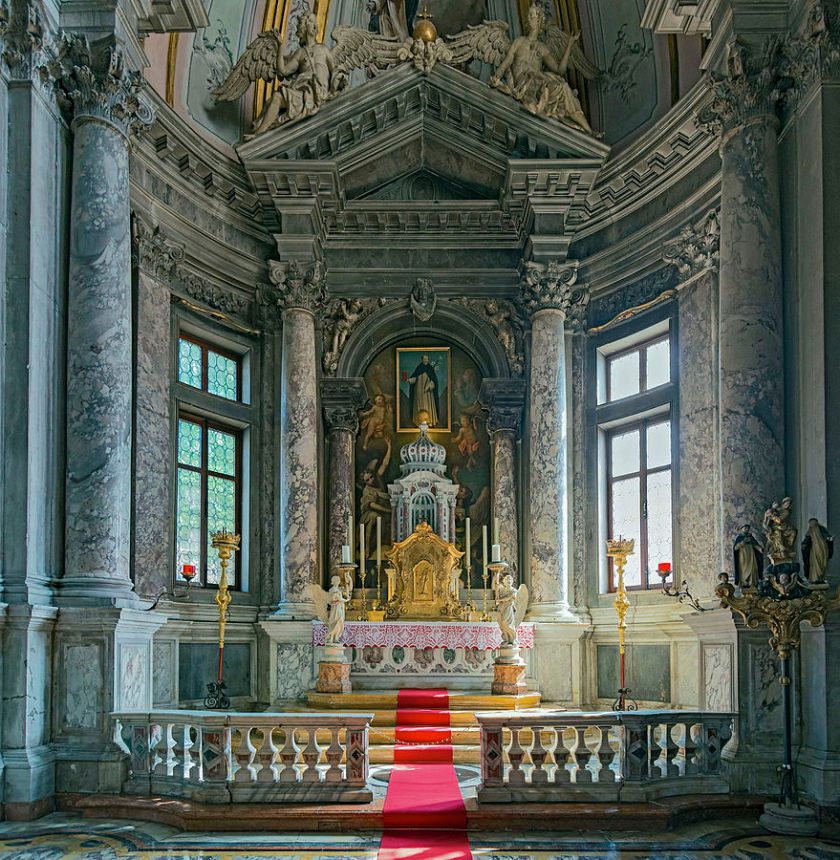
When his coffin, was opened in the 1530s and his body was found to be Incorrupt, interest was again revived in Blessed Augustine.   Nevertheless, it was more than three centuries before his cultus was confirmed in 1872 by Pope Pius IX he was finally beatified in 1878 by Pope Leo XIII.   His Shrine is at the Chapel of St Dominic in Venice (below).879px-Interior_of_Santi_Giovanni_e_Paolo_Venice_-_Chapel_of_St._Dominic_by_Andrea_Tirali

Posted in DOMINICAN OP, SAINT of the DAY

Saint of the Day – 16 July – Blessed Bartholomew of the Martyrs (1514-1590)

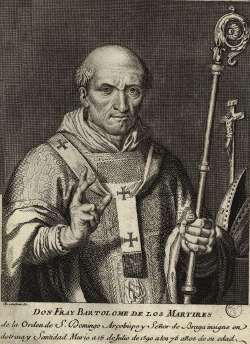
Saint of the Day – 16 July – Blessed Bartholomew of the Martyrs or St Bartholomew of Braga O.P. ArchBishop of Braga (1514-1590) – Portuguese Dominican Friar and Priest, Writer, Theologian, Advisor, Teacher and Catechetical writer, Apostle of Charity founding a series of hospitals and hospices in Braga and surrounds – born as Bartolomeu Fernandes on 3 May 1514 in Lisbon, Portugal and died on 16 July 1590 in the monastery of Viana do Castelo, Minho, Portugal of natural causes.   Patronage – Archdiocese of Braga.

bartolomeu_dos_martires_21907495c_base

Blessed Bartholomew was born near Lisbon on 3 May 1514 to Domingos Fernandes and Maria Correia.  He was baptised mere hours after, in the local parish church of Nossa Senhora dos Mártires.

He entered the Order of Preachers on 11 November 1527 and later made his solemn profession into the order on 20 November 1529.   On the completion of his own studies in 1538 he taught philosophical studies in the Convent of the Order at Lisbon and then for about two decades taught theological studies in the various houses of the Dominicans.   In 1551 he received his Master’s degree at the provincial chapter of Salamanca in Spain. He also served as the prior of the Benfica Convent from 1557 to 1558 and was in Évora as a teacher from 1538 until 1557.header - bl bartholomew of braga

During the course of teaching theological studies at the Batalha Convent, he was summoned to Évora at the request of Luis of Portugal, Duke of Beja to undertake the religious education of his son who was entering the ecclesiastical life himself.   He dedicated a great deal of his time to this task.

In 1558 – against his own desires – and out of obedience to his provincial superior (the Venerable Louis of Granada (1505-1588) he accepted the appointment to the Archepiscopal see of Braga for which Queen Catherine had chosen him and in 1559 received his episcopal consecration at the Convent of Saint Dominic on 3 September 1559 from the Bishop of Coimbra João Soares.    In actual fact it was Luis of Grenada who was initially nominated to become the Archbishop though Luis urged the queen to select Fernandes instead.   Pope Paul IV confirmed this appointment in the papal bull “Gratiae divinae praemium” on 27 January 1559.   He devoted himself to the duties of his new office with his installation in his Archdiocese on 4 October 1559.bl bartholomew of braga

On the resumption of the Council of Trent in 1561, the Archbishop repaired to the Council and took part in the last sessions.    He made a total of 268 suggestions at the council and collaborated with Saint Charles Borromeo.    There was also one instance in which he pushed for the defense of a certain topic and opposed view of the Archbishop of Toledo Bartolomé Carranza.   He was esteemed and held in high regard among the Council Fathers both on the account of his theological learning and the holiness of his life.   Bartholomew exercised great influence in the discussions and more so with regard to the decrees on the reform of ecclesiastical life and development.   The conclusion of that council saw him return to Braga in February 1564 and in 1566 he held an important provincial gathering of the diocese, in which decrees were passed for the restoration of ecclesiastical discipline and the elevation of the moral life of priests and people (“Concilium provinciale Bracarense quartum” in 1567).   As Archbishop, Bartholomew now devoted himself to the task of enacting the reforms of the Council of Trent in addition to the decrees of his own provincial synod.

A great famine and a visitation of the plague, revealed the depths of his charitable and merciful nature, in addition to his willingness to aid his flock in their time of need;  he also constructed a series of hospitals and hospices.

He made repeated requests to resign from his episcopal see and received papal permission from Pope Gregory XIII on 20 February 1582 to resign and withdraw to the Dominican Convent at Viana do Castelo where he lived in solitude for the remainder of his life but also serving as a teacher for some time.

Blessed Bartholomew died at Viana do Castelo on 16 July 1590.

The sainthood process commenced under Pope Benedict XIV on 11 September 1754 and he was titled as a Servant of God while Pope Gregory XVI later named him as Venerable on 23 May 1845.   St Pope John Paul II Beatified Bartholomew in Saint Peter’s Square on 4 November 2001.   Pope Francis – on 20 January 2016 – authorised the C.C.S. to work towards the Equipollent Canonization of the late archbishop and authorised that the second miracle required for his Canonization be waived as a result.   It is probable that Blessed Bartholomew will be Canonised soon.

Blessed Bartholomew’s writings have been republished on numerous occasions and have also been translated into several languages.   A collective edition is: “Opera omnia cura et studio Malachiae d’Inguinbert, archiepisc. Theodos.” (1 vol. Fol. In 2 parts, Rome, 1734–35).bl bartholomew of braga statue

Posted in DOMINICAN OP, MORNING Prayers, QUOTES of the SAINTS, QUOTES on CHARITY, QUOTES on FAITH, QUOTES on HUMILITY, QUOTES on LOVE, QUOTES on MERCY, QUOTES on PATIENCE, QUOTES on PRAYER, QUOTES on SILENCE, QUOTES on TEMPTATION, QUOTES on TRUST and complete CONFIDENCE in GOD, SAINT of the DAY, The HOLY GHOST

Quote/s of the Day – 9 July – The Memorial of Blessed Adrian Fortescue T.O.S.D. (1476-1539) Martyr

Quote/s of the Day – 9 July – The Memorial of Blessed Adrian Fortescue T.O.S.D. (1476-1539) Martyr

“In Husbands Bosworth Hall, the residence of Miss Fortescue-Turville, the last direct descendant of the blessed martyr, was found some years ago a very precious relic, being nothing less than the Book of Hours which he habitually used.
The manuscript has suffered a good deal from time and careless handling but on the outer leaf can still be read another series of maxims, a kind of rule of life written and signed by the martyr’s own hand.   It will be seen how, while yet in the days of his prosperity, this truly Christian knight was preparing all unconsciously for the martyr’s crown and palm.
The Book of Hours is now reverently preserved as a relic in the beautiful little Catholic church adjoining the old hall of Husbands Bosworth :”

Quotations (slightly updated – from his famous Book of Hours)

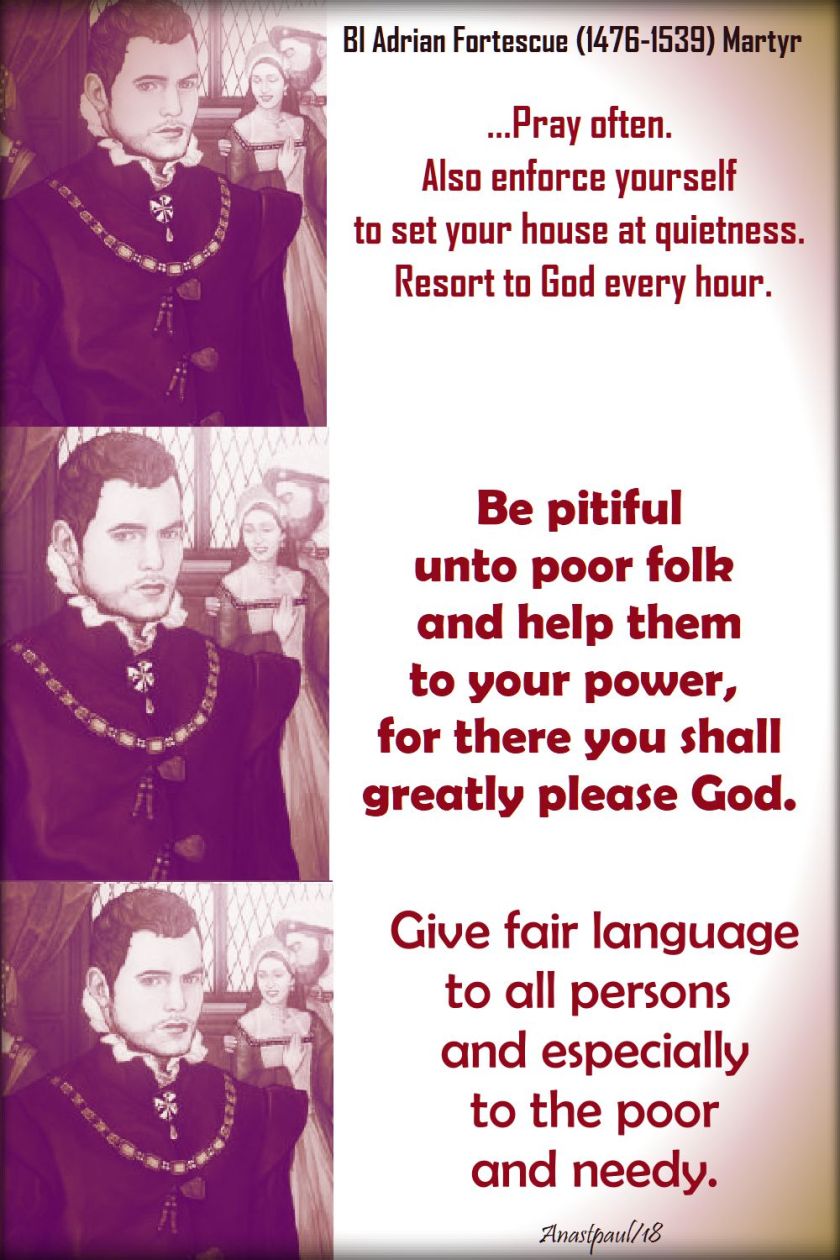
…”Pray often.
Also enforce yourself
to set your house at quietness.
Resort to God every hour.”

“Be pitiful unto poor folk and help them to your power,
for there you shall greatly please God.”

“Give fair language to all persons
and especially to the poor and needy.”pray often - be pitiful unto poor folk - give fair language - bl adrian fortescue - 9 july 2018

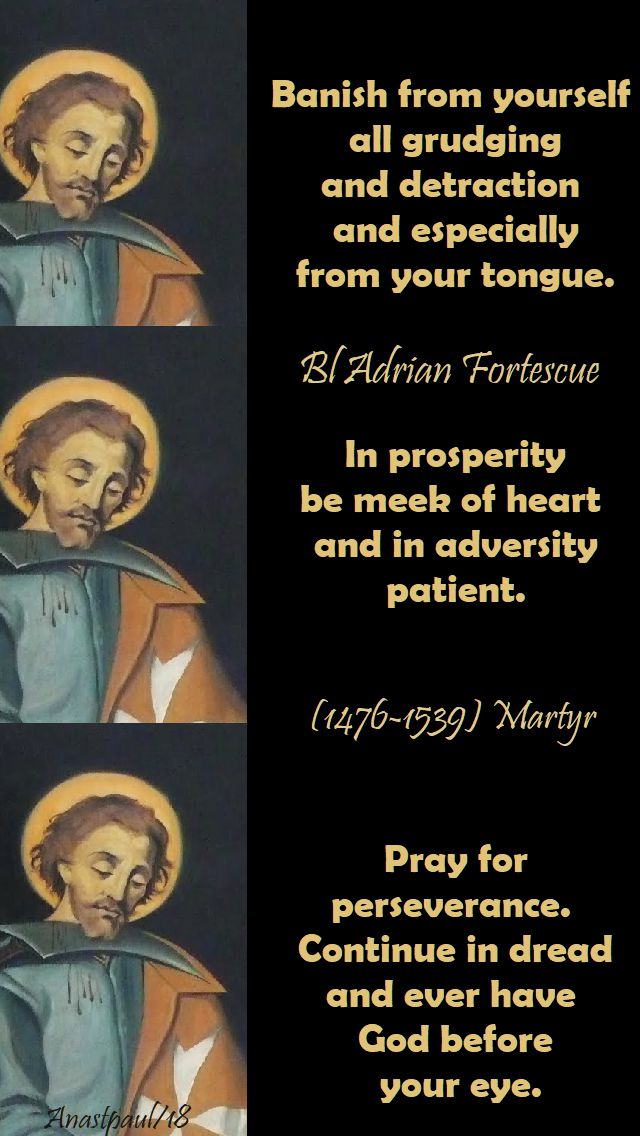
“Banish from yourself all grudging and detraction
and especially from your tongue.”

“In prosperity be meek of heart
and in adversity patient.”

“Pray for perseverance.
Continue in dread
and ever have
God before your eye.”banish from yourself - in prosperity - pray for perseverance - bl adrian fortescue - 9 july 2018

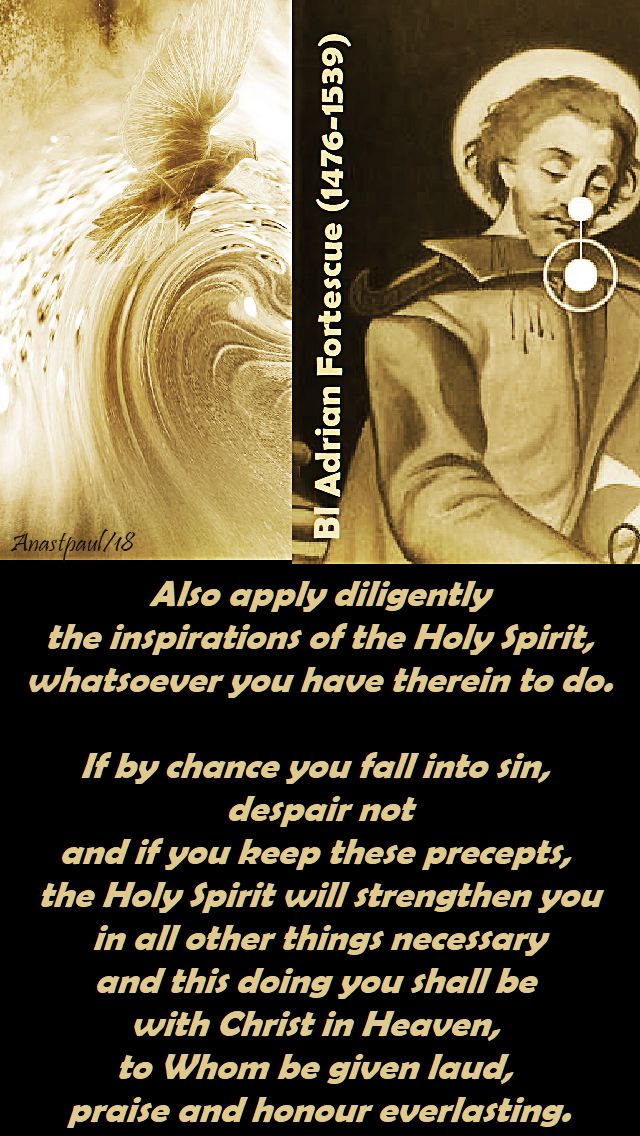
“Also apply diligently
the inspirations of the Holy Spirit,
whatsoever you have therein to do.”

“If by chance you fall into sin,
despair not
and if you keep these precepts,
the Holy Spirit will strengthen you
in all other things necessary
and this doing you shall be
with Christ in Heaven,
to Whom be given laud,
praise and honour everlasting.”

Blessed Adrian Fortescue (1476-1539)also apply diligently - if by chance - bl adrian fortescue - 9 july 2018.jpg

Posted in DOCTORS of the Church, DOMINICAN OP, MORNING Prayers, QUOTES of the SAINTS, QUOTES on SANCTITY, QUOTES on SUFFERING, QUOTES on the CROSS of CHRIST, The HOLY CROSS, The WORD

One Minute Reflection – 9 July – The Memorial of Blessed Adrian Fortescue T.O.S.D. (1476-1539) Martyr

One Minute Reflection – 9 July – The Memorial of Blessed Adrian Fortescue T.O.S.D. (1476-1539) Martyr

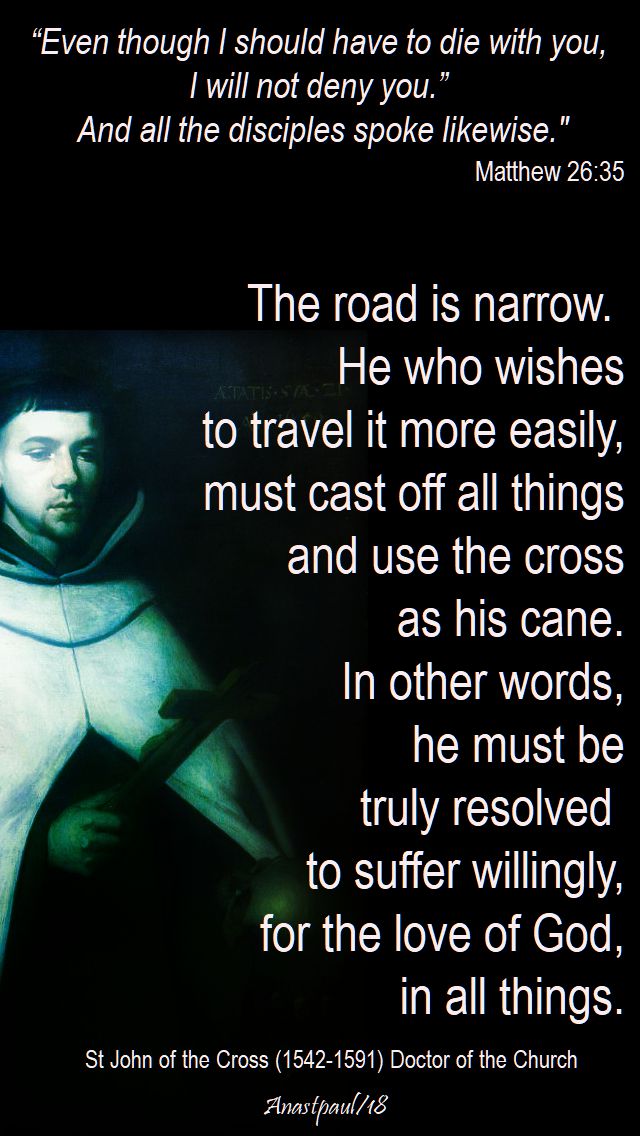
“Even though I should have to die with you, I will not deny you.” And all the disciples spoke likewise”…Matthew 26:35.

REFLECTION – “The road is narrow.   He who wishes to travel it more easily must cast off all things and use the cross as his cane.   In other words, he must be truly resolved to suffer willingly for the love of God in all things.”…St John of the Cross (1542-1591) Doctor of the Churcheven though i should die - matthew 26-35 and the road is narrow - st john of the cross - 9 july 2018

PRAYER – O God, You specially strengthened Blessed Adrian Fortescue with a wonderful spirit of holiness and courage.   Hear the prayers of Your people and from his renowned example, may we learn to be obedient to You rather than to human authority.   We ask this through our Lord Jesus Christ, Your Son, who lives and reigns with you and the Holy Spirit, one God forever and ever. Amenbl adrian fortescue - 9 july 2018 - pray for us

Posted in DOMINICAN OP, MORNING Prayers, PRAYERS for VARIOUS NEEDS, SAINT of the DAY

Our Morning Offering – 9 July – The Memorial of Blessed Adrian Fortescue T.O.S.D. (1476-1539) Martyr

Our Morning Offering – 9 July – The Memorial of Blessed Adrian Fortescue T.O.S.D. (1476-1539) Martyr

A Dominican Offering

May God the Father bless us.
May God the Son heal us.
May God the Holy Spirit enlighten us,
and give us
eyes to see with,
ears to hear with,
hands to do the work of God with,
feet to walk with,
a mouth to preach
the word of salvation with,
and the angel of peace
to watch over us and lead us at last,
by our Lord’s gift, to the Kingdom.
Amen

a dominican offering - may god the father bless us - 8 july 2018

Posted in DOMINICAN OP, SAINT of the DAY

Saint of the Day – Blessed Adrian Fortescue (1476-1539) Martyr

Saint of the Day – Blessed Adrian Fortescue (1476-1539) Martyr

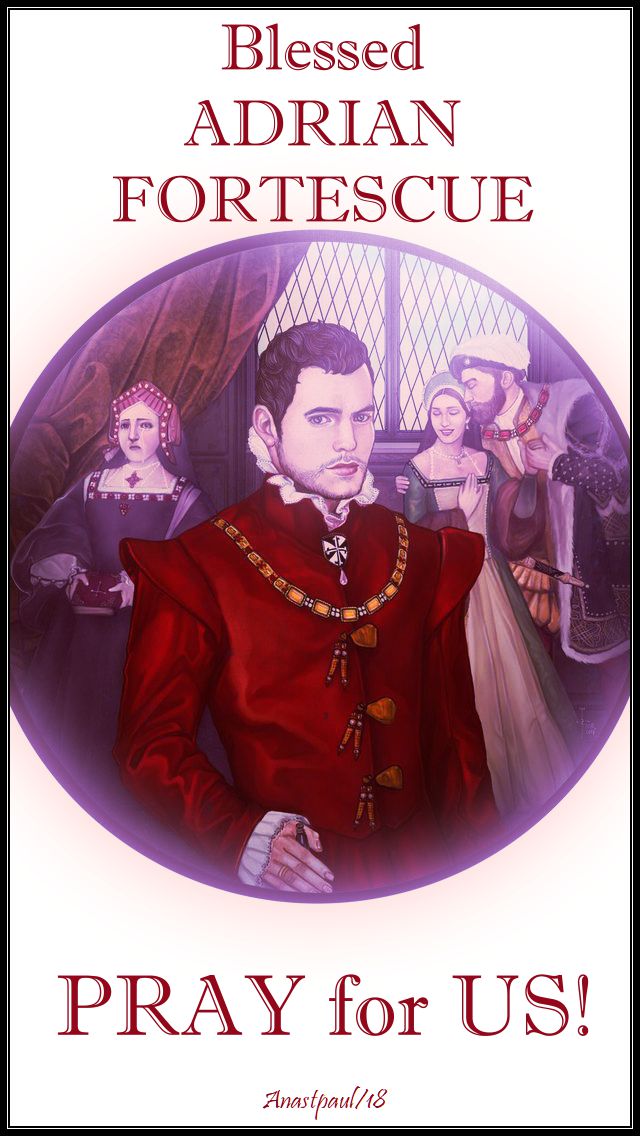
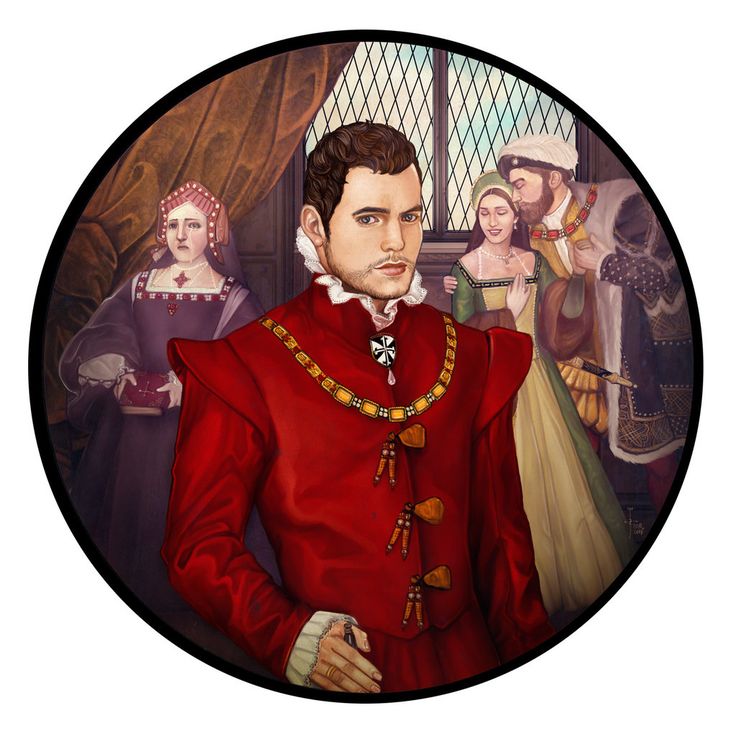
After a remarkable life, Bl. Adrian Fortescue died a martyr at the strike of an executioner’s blade at Tower Hill in 1539.   A husband and father, a Justice of the Peace, a Knight of the Realm, a Knight of Malta and a Dominican Tertiary (Lay Dominican),he was at once a loyal servant of the Crown so far as he could be but still more, he was a man of unshakeable faith.Bl Adrian Fortescue. large

The House of Fortescue into which Adrian was born is said to date from the Battle of Hastings where Richard le Fort saved William the Conqueror’s Life by the shelter of his “strong shield” and, thereafter, was called “Fort – Escu”.   His family had a history of service to the Crown although this was later complicated by the dynastic battles of The Wars of the Roses.   Vicissitudes notwithstanding, his great uncle, Sir John Fortescue (d.1479) became Chief Justice of the King’s Bench (1442-61).   Sir John’s writings on the law and politics of England were arguably the most significant contribution of the fifteenth century and are still studied by lawyers and political theorists today.   Adrian’s father, also named Sir John, fought for the victorious Lancastrians at the Battle of Bosworth in 1485 when Adrian was but a young boy.   And later in his life, Adrian’s first cousin, Anne Boleyn, became King Henry VIII’s second wife (before her eventual beheading in 1536).   We can say with some justification then that the Fortescues occupied a privileged position at the Rroyal court.

The first mention of Adrian Fortescue is in 1499, by which time, aged about 23, he was already married to Anne Stonor.   He lived at his wife’s family seat at Stonor Park in Oxfordshire.   This estate would later become the subject of an acrimonious legal dispute between him and his relative.   In 1503, on Prince Henry becoming Prince of Wales (after Prince Arthur’s death) Adrian was made a Knight of the Order of Bath.   Sir Adrian took the motto Loyalle Pensée;  his loyalty was indeed to be tested.

Like his forebears, Adrian served King Henry VIII in his ambitious military campaigns. He helped to rout the French the Battle of Spurs in 1513, and fought again in 1523.   King Henry rewarded his support and in 1520 invited him to the splendorous Field of the Cloth of Gold where Henry famously wrestled with the King of France.   Closer to home, Sir Adrian was made a Justice of the Peace of the county of Oxfordshire.   In this period of history, royal favour could also take more peculiar forms.   Sir Adrian had the dubious honour of being made a Gentleman of the King’s Privy Chamber, forerunner to the august body now known as the Privy Council.AdrianF

In addition to being an assiduous servant of the Crown, Sir Adrian was evidently also a man of strong religious conviction and charity.   His accounts reveal a number of benefactions to clergy and religious foundations.   In 1532, he became a Knight of Devotion in the Order of Malta.   The following year in July of 1533, he was admitted as a Dominican Tertiary at Blackfriars, Oxford, which he would visit from Stonor.   But he also had a strong association with the Dominican Priory in London.   His lodgings in the capital were in the precincts of the Blackfriars, close to the present eponymous tube station.

Not long after becoming a Lay Dominican, began what Adrian called his “trobilles”.   At the start of Summer 1533, he assisted in the Coronation of his cousin, Anne Boleyn – then six months pregnant – as Queen of England.   He must have realised that the marriage was not valid but perhaps thought, at that stage at least, that in the words of Sir Thomas More, it was not his business “to murmur at it or dispute upon it”.   This narrow compromise was to prove short-lived.

The King’s infidelity and presumption were rebuked when the Pope refused to grant an annulment declaring Henry’s marriage to Catherine as valid on 23rd March 1534.   The following month on 13th April, Bishop Fisher and Sir Thomas More refused to take the Oath of Succession.   Sir Adrian was similarly arrested that same year but he was released without explanation, probably in the Spring of 1535.   Fisher and More were afforded no such clemency and the two Saints were executed in Summer 1535.

The Act of Supremacy was also passed in 1535, making Henry supreme Head of the Church “immediately under God”.   As a matter of law, Henry expressly denied the Pope’s authority.   A writ affirming this and dated the following year can be found in Sir Adrian’s extant Missal.   Tellingly, perhaps, it has with a line struck through it:  apparent evidence of his disapproval.   The die, it seems, was cast.

In February 1539, Sir Adrian was again arrested and imprisoned in the Tower of London. In the sitting of Parliament that Spring, a number of laws were passed in what has been described as the most servile Parliamentary session in history.   Among the draconian laws enacted was a novel provision whereby a sentence of death might be passed without any trial of the accused.   Under this procedure, no evidence was needed, neither could a defence be heard.   Ironically, the architect of the law, Thomas Cromwell (then Lord Chancellor) was himself condemned by the same measure a year later leading to his own execution.   This device was put to use on 11th May 1535 when a Bill of Attainder was passed condemning fifty people of High Treason who opposed Henry’s ecclesiastical policies.   The names included Sir Adrian, Reginald Cardinal Pole, and the Countess of Salisbury.

adrian fortescue - martyr

Sir Adrian’s Book of Hours contains a Rule of Life written in his own hand and giving an insight into the interior life of a man who exemplified holiness and virtue in his conduct. He led a life of asceticism and honour, trying to follow God’s will in all things and daily seeking the guidance of the Holy Spirit.   His pursuit of God’s truth brought him to a martyr’s death on 8th July 1539 (but possibly 9th or 10th) when he was beheaded at Tower Hill.   His servants were also killed for treason on the same day but were hanged, drawn and quartered at Tyburn.   As one later account neatly puts it, “Sir Adrian Fortescue died for his faith in Him whose acts Parliament was not competent to repeal”.

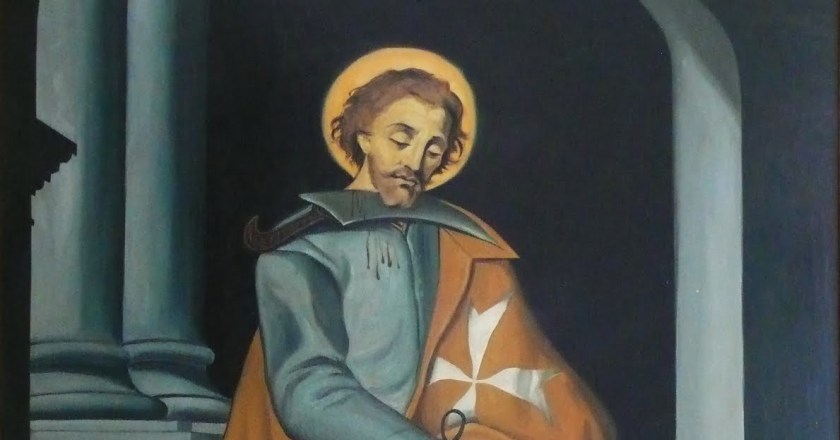
 Blessed Adrian, painting by Mattia Preti at St. John's Co-Cathedral, Valletta, Malta

Pope Leo XII declared Adrian Fortescue blessed on 13th May 1895 and as a layman, he ranks among the great Dominicans as an outstanding example to all Christians. … By Br Samuel Burke O.P.

Br Samuel Burke O.P. Br Samuel Burke is a deacon based in Rome where he is completing his studies at the Angelicum

Posted in DOMINICAN OP, MORNING Prayers, QUOTES of the SAINTS, QUOTES on CHARITY, QUOTES on LOVE, QUOTES on MERCY, SAINT of the DAY, The WORD

One Minute Reflection – 4 July – The Memorial of Blessed Pier Giorgio Frassati T.O.S.D. (1901-1925) “Man of the Eight Beatitudes”

One Minute Reflection – 4 July – The Memorial of Blessed Pier Giorgio Frassati T.O.S.D. (1901-1925) “Man of the Eight Beatitudes”

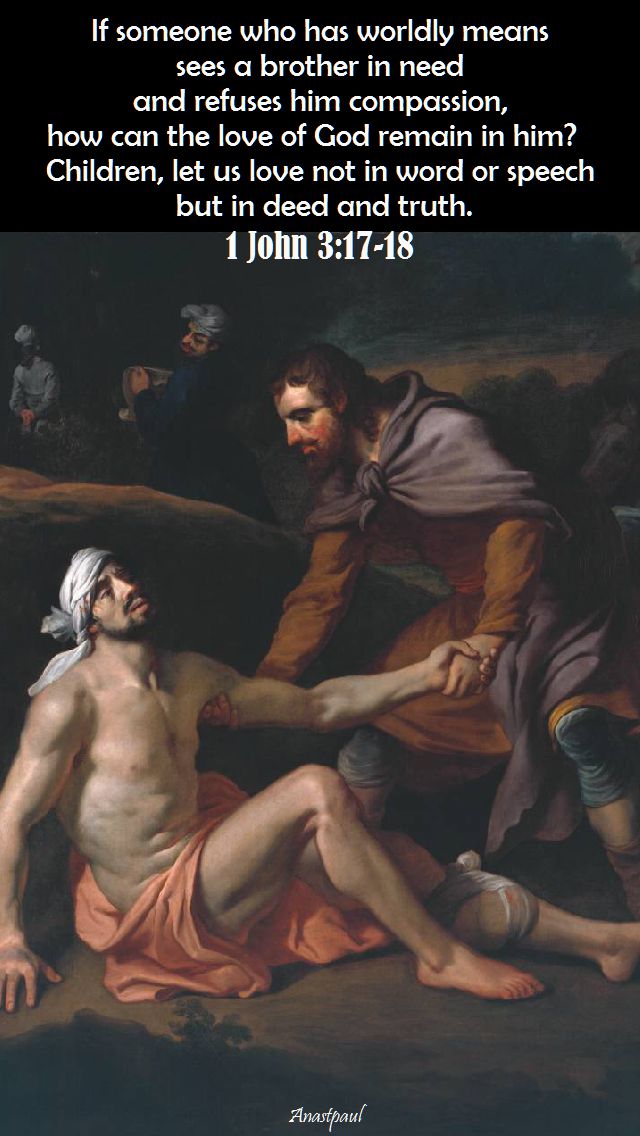
If someone who has worldly means sees a brother in need and refuses him compassion, how can the love of God remain in him? Children, let us love not in word or speech but in deed and truth…..1 John 3:17-181-john-3-17-and-18-if someone who has wordly means - 4 july 2017

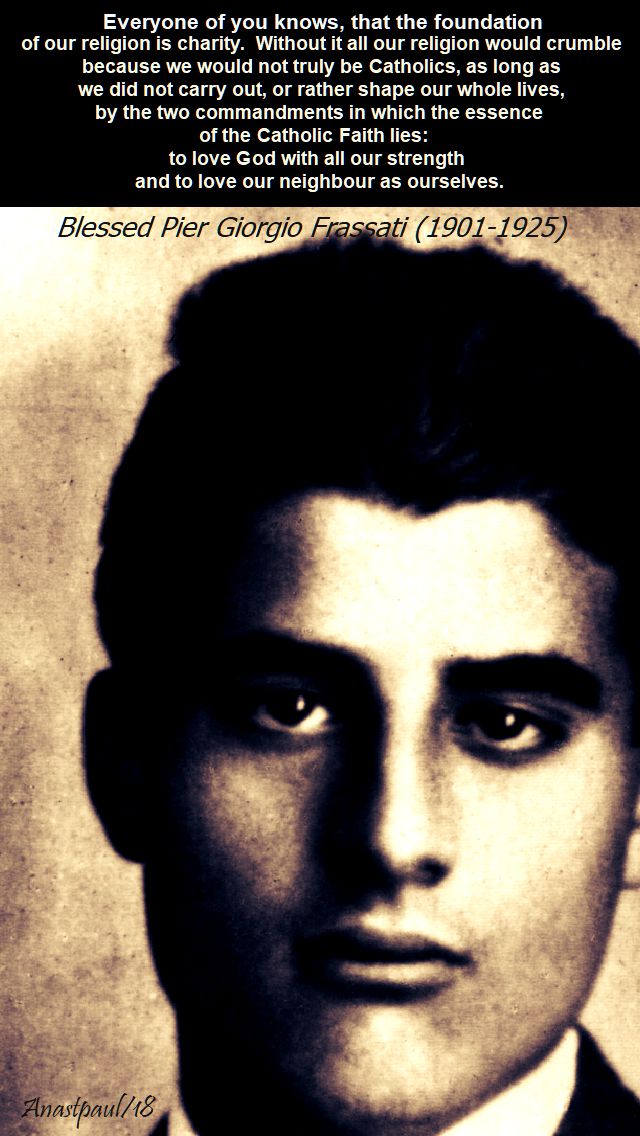
REFLECTION – “Everyone of you knows, that the foundation of our religion is charity. Without it all our religion would crumble because we would not truly be Catholics, as long as we did not carry out, or rather shape our whole lives, by the two commandments in which the essence of the Catholic Faith lies:  to love God with all our strength and to love our neighbour as ourselves.”…….Bl Pier Giorgio Frassatieveryone knows - bl pier giorgio - 4 july 2018

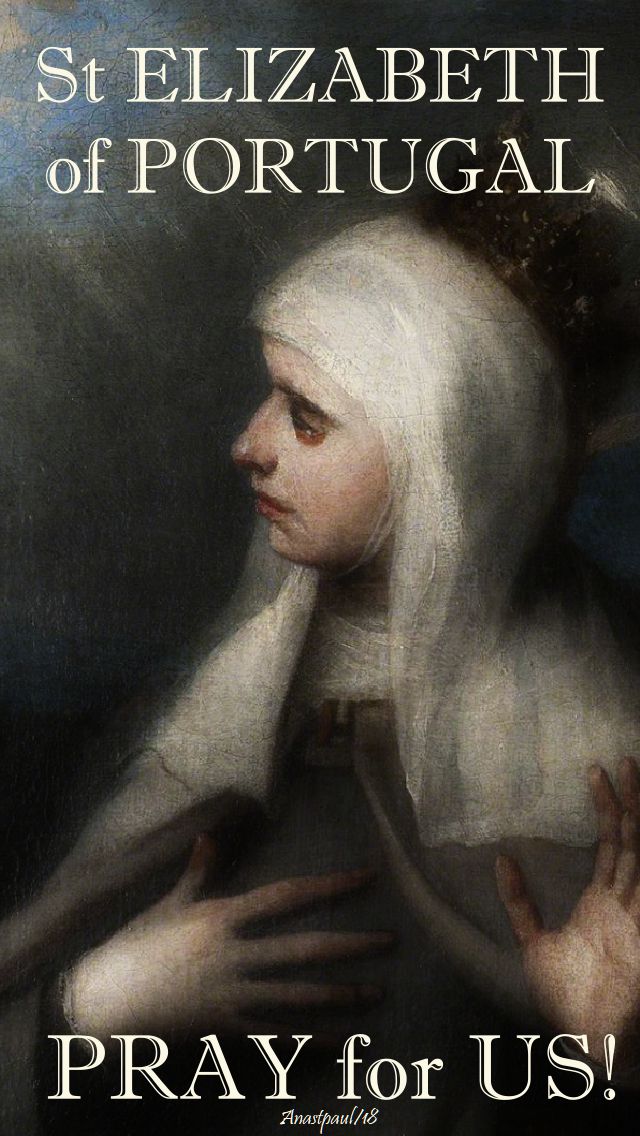
PRAYER – Loving Father, teach me to see the face of Your Divine Son in all those I meet especially those in need.   Help me to realise that love is the most powerful force in the world.   Saint Elizabeth of Portugal and Blessed Pier Georgio are an inspiration to us all, teaching us by their actions, that it is only in living love in charity that we can be true Catholics.   Saint Elizabeth of Portugal and Blessed Pier Georgio pray for us, amen.st elizabeth of portugal - pray for us - 4 july 2018bl-pier-pray-for-us-4 july 2018

Posted in CATHOLIC DEVOTIONS of the Month, DOCTORS of the Church, DOMINICAN OP, MORNING Prayers, PRAYERS of the SAINTS, SAINT of the DAY, The MOST PRECIOUS BLOOD

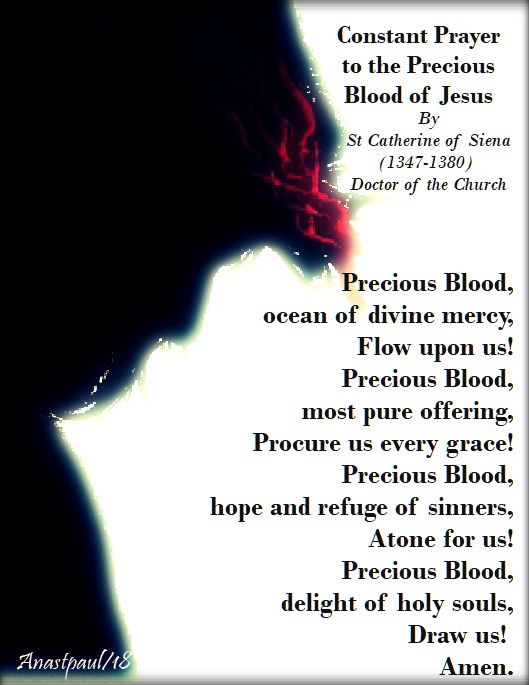
Our Morning Offering – 1 July – Month of the Most Precious Blood

Our Morning Offering – 1 July – Month of the Most Precious Blood

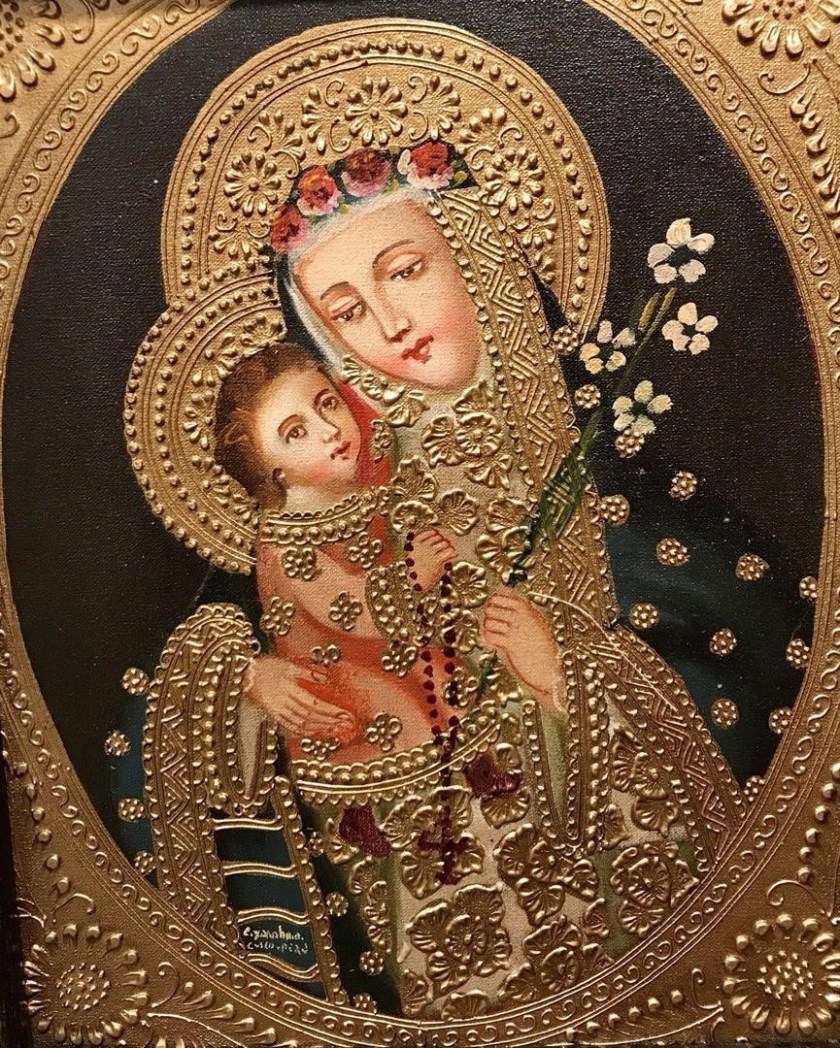
Constant Prayer
to the Precious Blood of Jesus
By St Catherine of Siena (1347-1380) Doctor of the Church

Precious Blood,
ocean of divine mercy,
Flow upon us!
Precious Blood,
most pure offering,
Procure us every grace!
Precious Blood,
hope and refuge of sinners,
Atone for us!
Precious Blood,
delight of holy souls,
Draw us!
Amen.
constant prayer to the precious blood - st catherine of siena - 1 july 2018

Posted in DOMINICAN OP, SAINT of the DAY, Uncategorized

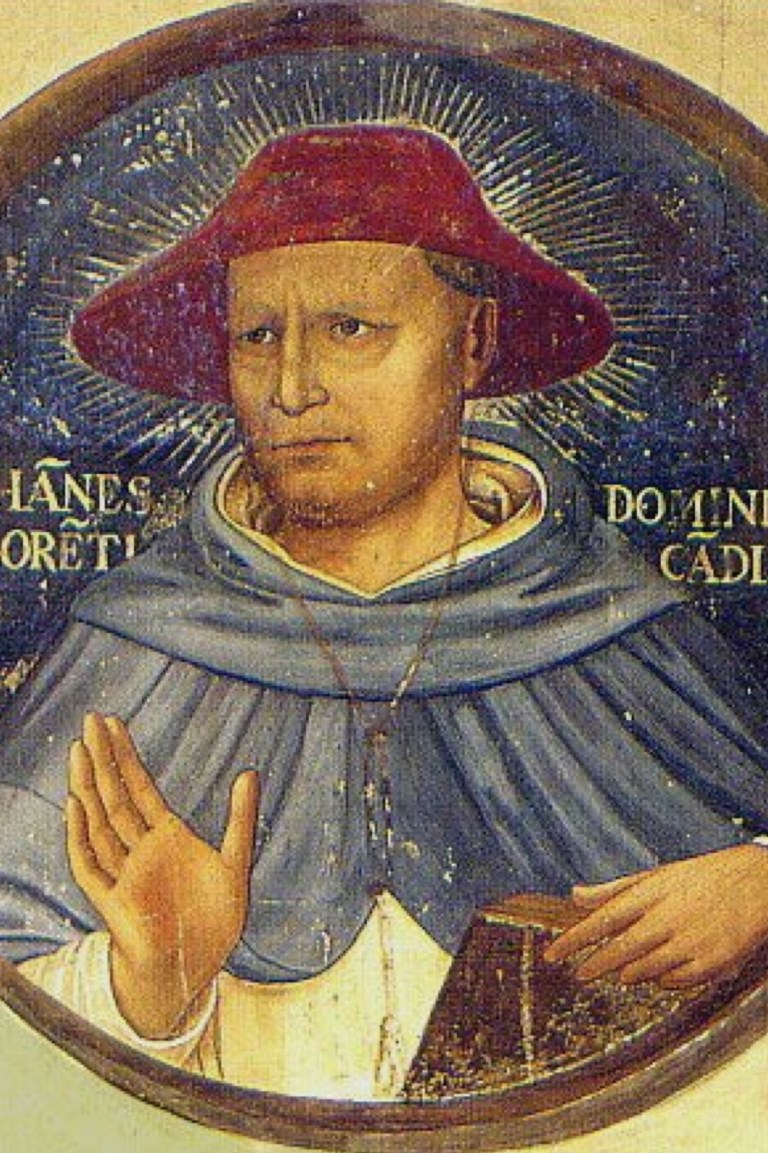
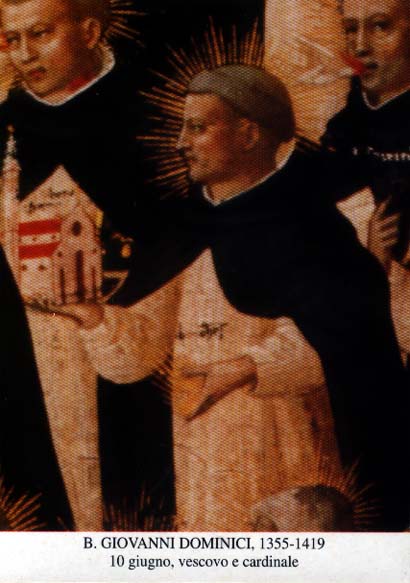
Saint of the Day – 10 June – Blessed John Dominici O.P. (c 1355-1419)

Saint of the Day – 10 June – Blessed John Dominici O.P. (c 1355-1419) ArchBishop, Cardinal, Religious Friar, Theologian, Preacher, Confessor, Reformer, Papal Legate, Papal Counsellor and Confessor, Writer, Evangeliser – born on 1356 at Florence, Italy and died on 10 June 1419 of a fever at Buda, Hungary.  Bl-JohnDominic

Although John had little education and suffered from a speech impediment that caused him to stammer and stutter, he possessed a tremendous drive to improve himself, overcome his obstacles and serve our Lord.   He also had a great memory and later in life became a great theologian and preacher.   John Dominic met St Catherine of Siena when he was young, entered the Order of Preachers and was an integral part of a major reform movement.   This reform helped to revitalise the Order after its decimation by the plague and general laxity of observance.   Not only was he a major force in the Dominican Order but he became a cardinal in the Church and an official legate for the Pope.   Most importantly, he worked to resolve the Great Western Schism.   He also brought Fra Angelico, the world famous painter and St Antoninus, a brilliant theologian and reformer, into the Order.

Born in c 1355 at Florence, Italy, John spent a great deal of his youth in or around the Dominican church of Santa Maria Novella.   He joined the Order at the age of 17, despite his lack of education and his speech impediment, even while the Dominicans are scholars and preachers.   After entering the Order, Blessed John studied in Pisa and Florence and received a degree from the University of Paris.   As a priest, Blessed John once believed that his speech impediment would threaten his vocation but it was cured through the intervention of Saint Catherine of Siena.   Blessed John spent 12 years in Venice as a preacher.

In 1392, Blessed John found himself to be the Vicar provincial serving in Rome.   At the time, Blessed Raymond of Capua was the Master General of the Order and he helped rebuild the Order after the ravages of the Plague and helped return regular discipline to the Order’s members.

Blessed John founded Dominican convents in Venice, Fiesole, Chioggia, Citta de Castello, Cortona, Lucca and Fabriano and was a correspondent of Blessed Clara Gambacorta, advising her of how to restore discipline to Dominican nuns of the day.   For a time, he lost papal support because of support for the Dominican White Penitents in Venice but was later welcomed back and resumed his work in the Order.

Most importantly, Blessed John worked to provide a Christian education to young people. He opposed pagan ideas that were taking hold in the humanism of his day and was a confessor and adviser to Pope Gregory XII.   He was made Cardinal of San Sisto in 1407 and Archbishop of Ragusa in 1408.   In these roles, he helped to heal the Western Schism and convinced Pope Gregory XII to call the Council of Constance and to abdicate the papacy causing the anti-popes to also drop their claims to the papal throne.Blessed John Dominic

He was appointed the Papal legate to Milan, Genoa, Hungary and Bohemia for Pope Martin V and, in that role,  worked to settle the disputes caused by the death of Jon Hus and to heal the Hussite Schism.   However, while Blessed John was able to convert some, he was unable to resolve the Hussite Schism.

John is widely known for his scripture commentaries and hymns.   His portrait was painted by Fra Angelico and a his memoir was written by St Antonius of Florence, who joined the Order after hearing Blessed John preach.

Blessed John died on 10 June 1419 at Buda, Hungary, from a fever and he was buried in the Saint Paul the Hermit church there.   His tomb became a site of miracles and his remains were venerated and miracles reported, until the destruction of the church during a Turkish invasion.   His cultus was confirmed in 1832 and he was beatified by Pope Gregory XVI in 1837.

Posted in CATHOLIC-PRAYERS OF THE CHURCH, DOCTORS of the Church, DOMINICAN OP, FEASTS and SOLEMNITIES, franciscan OFM, MORNING Prayers, ON the SAINTS, PRAYERS of the CHURCH, QUOTES of the SAINTS, SAINT of the DAY, The HOLY EUCHARIST / The HOLY MASS

Sunday Reflection – 3 June 2018 – The Solemnity of Corpus Christi

Sunday Reflection – 3 June 2018 – The Solemnity of Corpus Christi

There is a claim that the Adoro Te Devote, our morning offering today, was the prayer that St Thomas Aquinas addressed to Christ as he was dying.   The claim remains doubtful, (in the sense that it is a highly intricate prayer and it would be difficult to write whilst very ill) but the account that his biographer, William of Tocco, gives of the holy Doctor’s last moments of life is, in itself, an extraordinary testimony of Eucharistic devotion and reveals the source of the doctrine that, directly or indirectly, inspired the most beautiful Eucharistic texts of the Latin Church, including the Adoro Te Devote.

“Feeling his strength failing and sensing the nearness of his departure from this world, the holy Doctor, with great devotion, requested the viaticum of the Christian pilgrimage, the Most Holy Body and Blood of Christ.
After the abbot and the monks had brought the Eucharist to him, he prostrated himself on the ground, weak in body but strong in spirit and went, with tears, to meet his Lord.
Then, in the presence of the Sacrament of the Body of Christ, as is the custom with every Christian at the moment of death, he was asked if he believed that in that consecrated host was the true Son of God, born of the womb of the Virgin, suspended from the scaffold of the Cross, who died and rose for us on the third day. With a free voice and great devotion, mingled with tears, he replied:
“I truly believe and hold as certain that He is true God and true man, Son of God and of the Virgin Mother and I believe with my heart and profess with my lips, that which the priest has asked me of this most Holy Sacrament.”
And after some words of devotion (at this point it is believed St Thomas quoted the Adoro), receiving the Sacrament, he exclaimed:
“I receive You, price of the Redemption of my soul, for love of which I have studied, watched and worked, I have preached and taught You, I have said nothing against You nor am I obstinate in my opinion, if in some part I have spoken poorly of this Sacrament, I submit all to the correction of the Holy Roman Church, in who obedience, I pass from this life.”

May we also, at the end of life, be able to say the same as St Thomas Aquinas!

Let us be transported to the same climate of expectation and joyful hope as we feel in the Adoro Te Devote with these last words of the Lauda Sion, the Eucharistic hymn/sequence also written by St Thomas Aquinas. (Fr Raneiro Cantalamessa O.F.M. “This is My Body”)

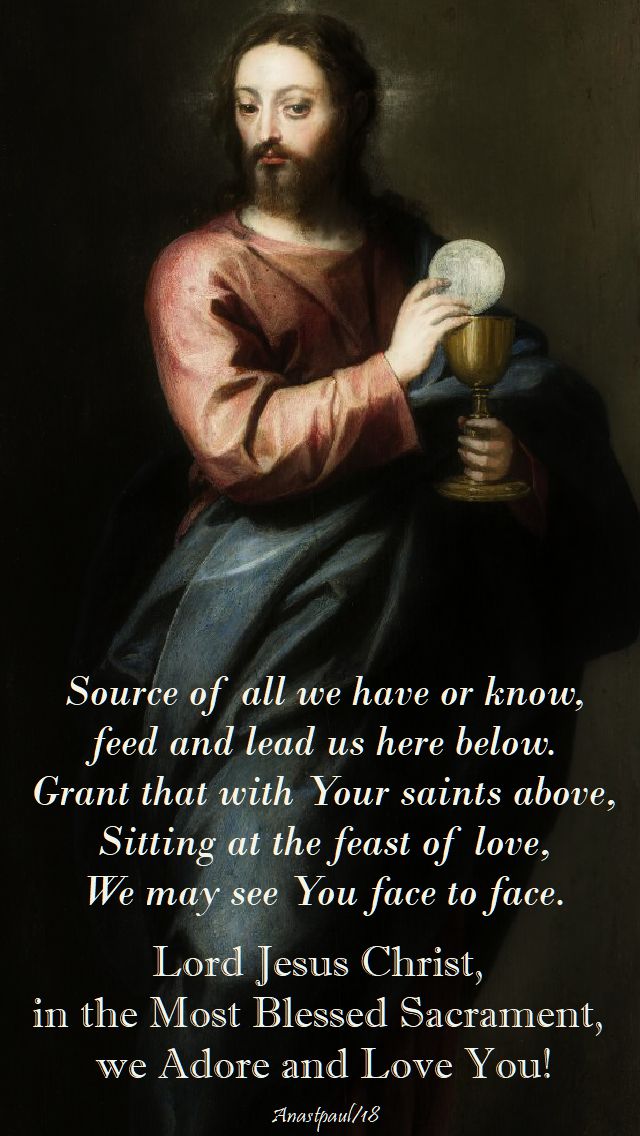
Source of all we have or know,
feed and lead us here below.
Grant that with Your saints above,
Sitting at the feast of love,
We may see You face to face.

Amen Alleluia!

Lord Jesus Christ, in the Most Blessed Sacrament, we Adore and Love You!lauda sion - lord jesus christ in the most blessed sacrament - corpus christi - 3 june 2018 - sunday reflection

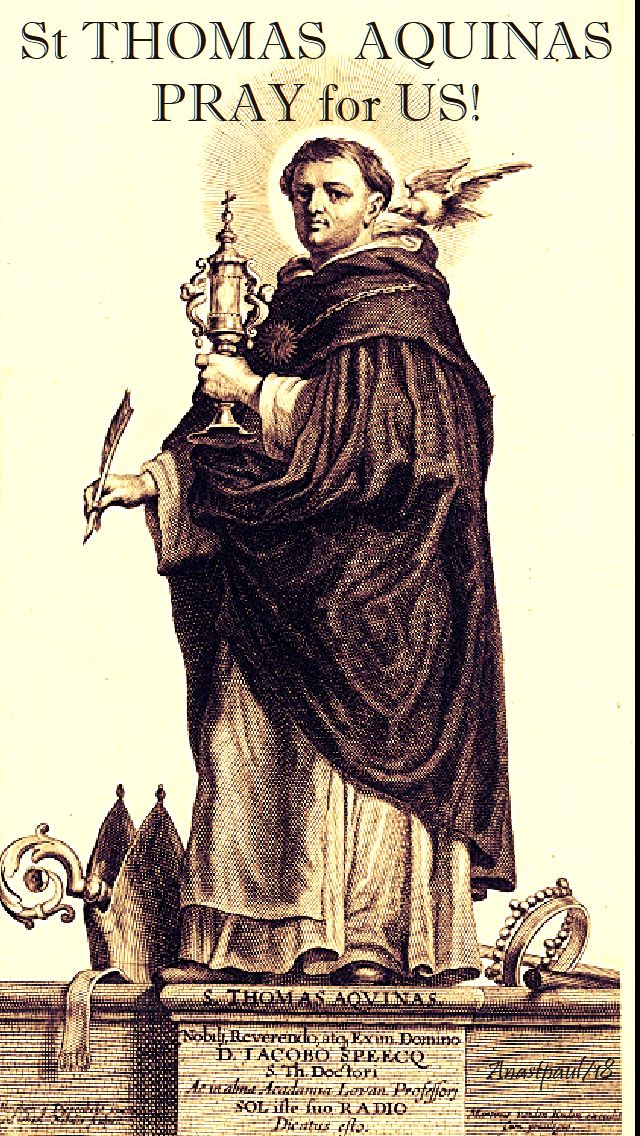
St Thomas Aquinas, Pray for us!st thomas aquinas pray for us - corpus christi - 3 june 2018

Posted in DOMINICAN OP, MORNING Prayers, QUOTES - J R R Tolkien and MORE, QUOTES on CONVERSION, QUOTES on DIVINE PROVIDENCE, QUOTES on FAITH, QUOTES on LOVE, QUOTES on PRAYER, QUOTES on SANCTITY

Quote/s of the Day – 19 May – Saturday of the Seventh Week of Eastertide

Quote/s of the Day – 19 May – Saturday of the Seventh Week of Eastertide

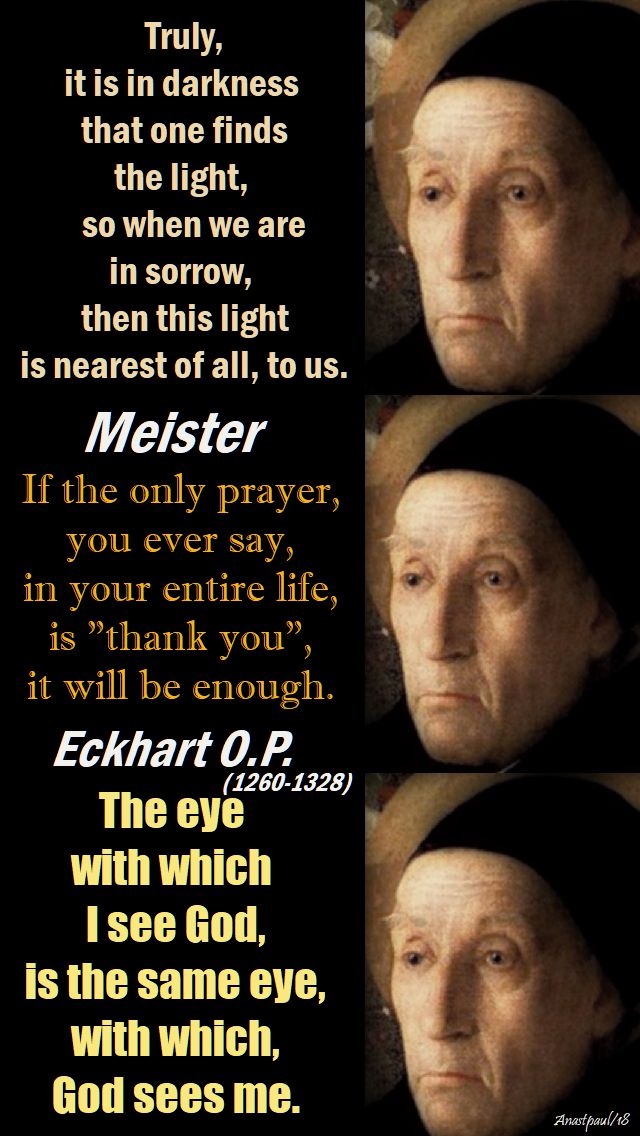
“Truly, it is in darkness
that one finds the light,
so when we are in sorrow,
then this light is nearest of all to us.”

“If the only prayer,
you ever say,
in your entire life,
is “thank you”,
it will be enough.

“The eye
with which
I see God,
is the same eye,
with which,
God sees me.”

Meister Eckhart O.P. (1260-1328)truly it is in darkness - the eye with which i see god - if you only say one prayer - meister eckhart -19 may 2018

Posted in DOMINICAN OP, SAINT of the DAY

Saint of the Day – 15 May – Blessed Andrew Abellon O.P. (1375-1450)

Saint of the Day – 15 May – Blessed Andrew Abellon O.P. (1375-1450) Dominican Priest, Confessor, Preacher, Apostle of the Sick, noted Artist in his day, he was especially known for his manuscript illuminations.  Blessed Andrew was born in 1375 at Saint Maximin, Provence, France and he died on 15 May 1450 at Aix-en-Provence, France of natural causes.   Patronages – of Artists and against fevers.

Blessed+Andrew+Abellon

Blessed Andrew was born near the world-famous shrine of Mary Magdalen.   His entire life was centred around the shrine and it is greatly due to his efforts that devotion to the great penitential has become so well established.

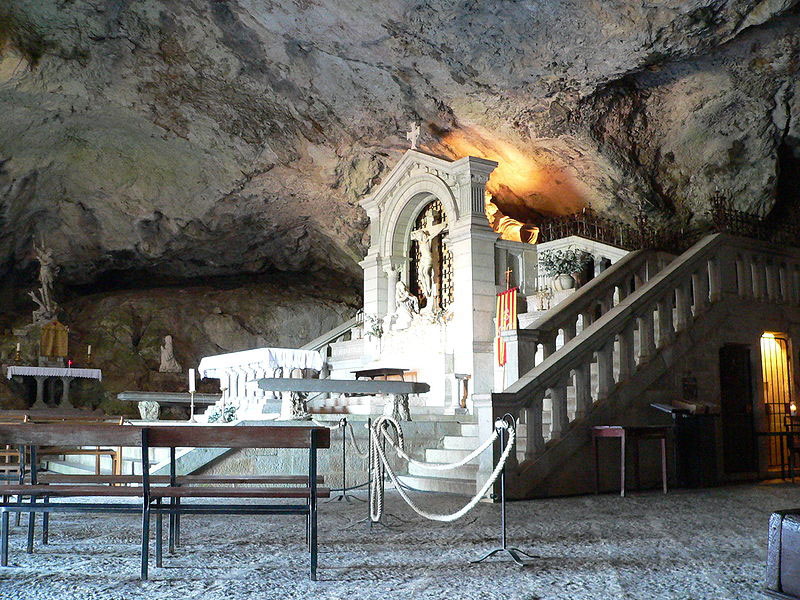
SHRINE OF ST MARY MAGDALENE IN FRANCE
Shrine of St Mary Magdalene

As a young man, Andrew may have heard the stirring sermons of Saint Vincent Ferrer, who was at that time preaching in France.   Perhaps the purity and penitential zeal for which this great preacher was renowned gave the young Andrew the pattern for his own life.   He soon demonstrated his choice of purity and penance by joining the Dominicans in his home town.   After a happy and holy novitiate, he made his profession and was ordained.   In a few years, a preacher and a guide for souls, he turned his attention to the neglected shrine of Saint Mary Magdalen.

This rugged and penitential region of France had been honored from the time of the Apostles as the chosen retreat for Mary Magdalen, who did penance there for the sins of her youth.   From earliest days, it had been a place of pilgrimage but had no definite arrangements for the care of pilgrims, nor any way of supplying their spiritual needs.   In Blessed Andrew’s time, Dominican fathers from Saint-Maximin had taken over the spiritual care of the pilgrims as a mission work but without financial help and in the face of great trials.

Seeing the need of a permanent foundation at the shrine, Andrew set about creating one. He interested the queen in his project and obtained enough money from her to build a monastery, which was a gem of architecture as well as a source of spiritual power. Andrew had studied art before his entry into the order and he used his talents in building, beautifully and permanently, whatever he was called upon to do.

bl Andrew Abellon - St Martha and the Dragon circa 1430
Blessed Benedict’s Painting of St Martha and the Dragon

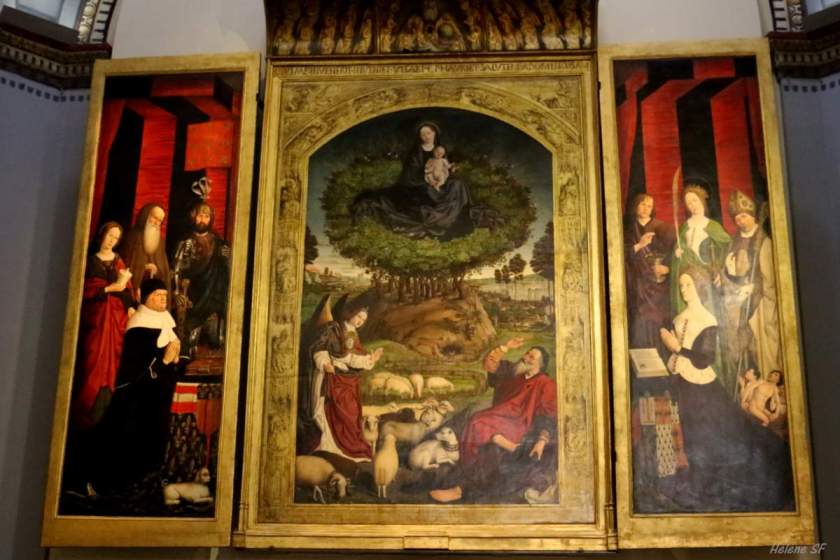
A lover of great beauty in the physical order, Andrew was the same in the spiritual.   He was famous as a confessor and his wise government as prior, gave help to the spiritual growth of the new convent.   A practical man as well as deeply spiritual, Andrew established two mills near the shrine that would provide the people with a means of earning a living while remaining there.   Quite naturally, a priest who interested himself in the welfare of the people to this extent could hope for great influence with them and this he had, both at Saint Maximin and at Aix, where an altarpiece he painted may still be seen.bl andrew altarpiece

After his death, Blessed Andrew was buried in the Church of the Magdalene.   His tomb soon became a place of pilgrimage,his help especially was sought in the cure of fevers and many miracles were reported.   His beatification was approved on 19 August 1902 after Pope Leo XIII signed a decree, that recognised the late priest’s longstanding and popular “cultus” – or veneration – which acted as a prerequisite for beatification for older causes of sainthood.

Posted in DOMINICAN OP, SAINT of the DAY

Memorials of the Saints – 15 May

St Isidore the Farmer (c 1070-1619) (Optional Memorial)

St Achilles of Larissa
St Adiutor of Campania
St Alvardo
Bl Andrew Abellon O.P. (1375-1450)
Bercthun of Beverley
Bertha of Bingen
St Caecilius of Granada
St Caesarea of Otranto
St Cassius of Clermont
Bl Clemente of Bressanone
St Colman Mc O’Laoighse
St Ctesiphon of Verga
Bl Diego of Valdieri
St Dymphna
St Euphrasius of Andujar
St Gerebernus
St Hallvard of Oslo
St Hesychius of Gibraltar
St Hilary of Galeata
St Indaletius of Urci
St Isaias
St Isidore of Chios
Bl Joan Montpeó Masip
St Maximus of Clermont
St Nicholas the Mystic
St Rupert of Bingen
St Secundus of Avila
St Simplicius of Sardinia
St Sophia of Rome
St Victorinus of Clermont
St Waldalenus of Beze

Martyrs of Maleville: 50 Mercedarian friars murdered for their faith by Huguenots. 1563 in the Mercedarian convent of Maleville in Rodez, France.

Martyrs of Persia: Three Christians who were tortured, mutilated, imprisoned, starved and finally executed together for refusing to worship the sun and fire during the persecutions of Shapur II. We know nothing else about them but their names: Bohtiso, Isaac and Simeon. They were beheaded or burned at the stake (records vary) in the late 3rd century somewhere in Persia

Martyrs of Lampsacus:
Andrew of Troas
Denysa of Troas
Paul of Troas
Peter of Lampsacus

Posted in DOCTORS of the Church, DOMINICAN OP, MYSTICS, QUOTES of the SAINTS, QUOTES on DIVINE PROVIDENCE, QUOTES on FAITH, QUOTES on LOVE, QUOTES on SANCTITY, QUOTES on SUFFERING, QUOTES on the CROSS of CHRIST, QUOTES on TRUTH, SAINT of the DAY

Quote/s of the Day – 29 April – Fifth Sunday of Eastertide and the Memorial of St Catherine of Siena (1347-1380) Doctor of the Church

Quote/s of the Day – 29 April – Fifth Sunday of Eastertide and the Memorial of St Catherine of Siena (1347-1380) Doctor of the Church

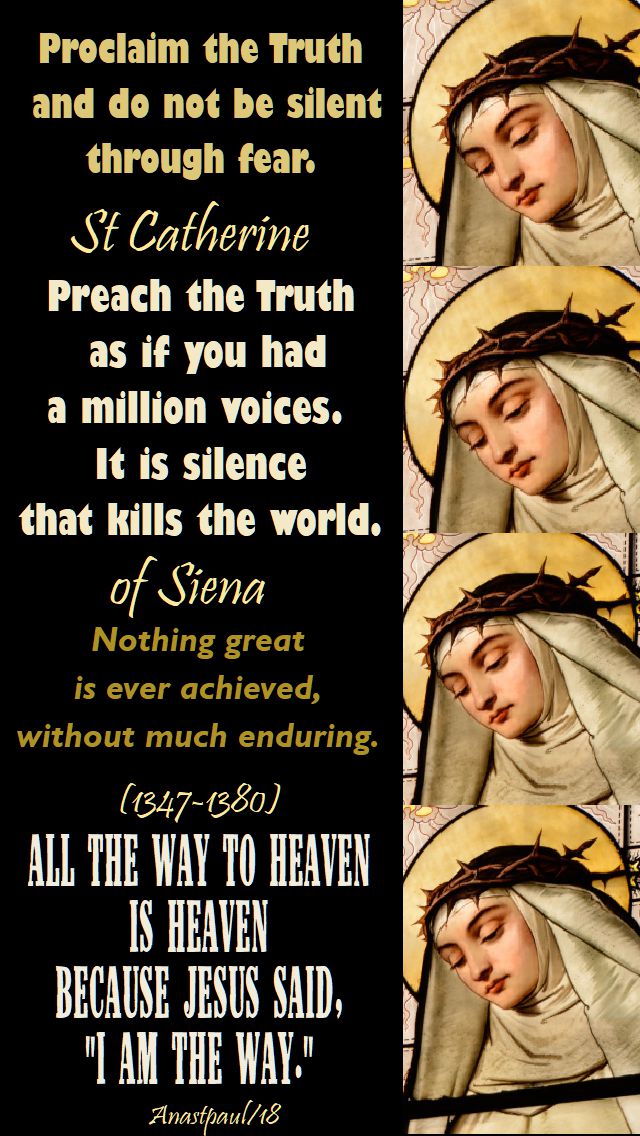
“Proclaim the Truth
and do not be silent
through fear.”

“Preach the Truth
as if you had a million voices.
It is silence that kills the world.”

“Nothing great is ever achieved,
without much enduring.”

“All the way to heaven is heaven
because Jesus said, “I am the way.”proclaim the truth -nothing great - all the way to heaven - preach the truth - st catherine of siena - 29 april 2018

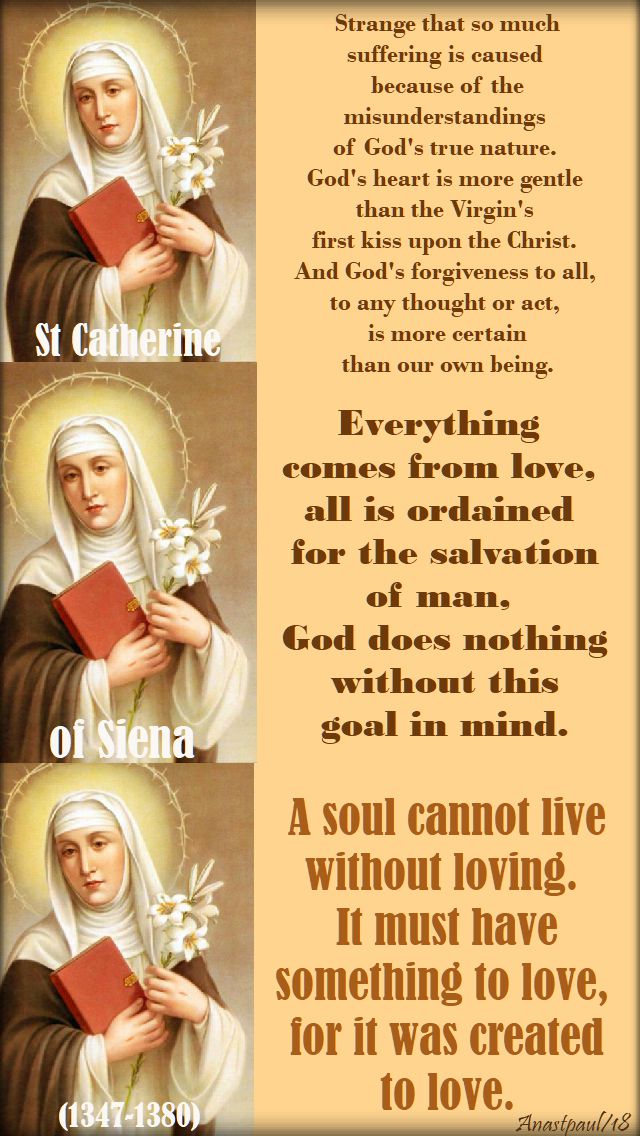
“Strange that so much suffering is caused
because of the misunderstandings
of God’s true nature.
God’s heart is more gentle
than the Virgin’s first kiss upon the Christ.
And God’s forgiveness to all, to any thought or act,
is more certain than our own being.”

“Everything comes from love,
all is ordained for the salvation of man,
God does nothing without this goal in mind.”

“A soul cannot live without loving.
It must have something to love,
for it was created to love.”strange that so much - everything comes from love - a soul cannot live - st catherine of siena - 29 april 2018

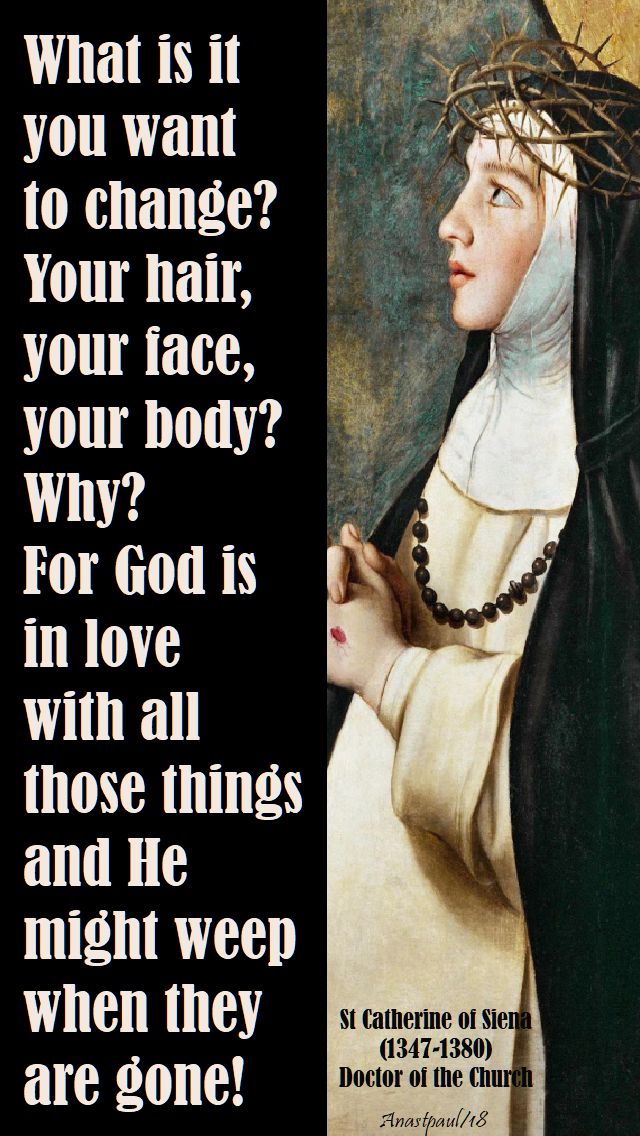
“What is it you want to change?
Your hair, your face, your body?
Why? For God is in love with all those things
and He might weep when they are gone!”

St Catherine of Siena (1347-1380) Doctor of the Churchwhat is it you want to change - st catherine of siena - 29 april 2018

Posted in DOMINICAN OP, INCORRUPTIBLES, Of BEGGARS, the POOR, against POVERTY, PATRONAGE - PARALYSED, PHYSICALLY DISABLED, CRIPPLED PEOPLE, SAINT of the DAY

Saint of the Day – 13 April – Blessed Margaret of Castello O.P. (1287-1320)

Saint of the Day – 13 April – Blessed Margaret of Castello O.P. (1287-1320) was an Italian professed member from the Third Order of the Order of Preachers of St Dominic. Margaret was disabled and became known for her deep faith and holiness.   Patronages – against poverty, disabled people, handicapped people, people rejected by religious orders,Pro-Right Groups.   Her body is incorrupt.

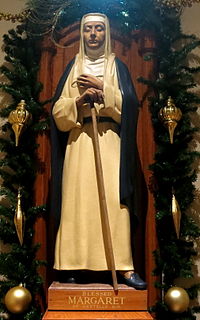
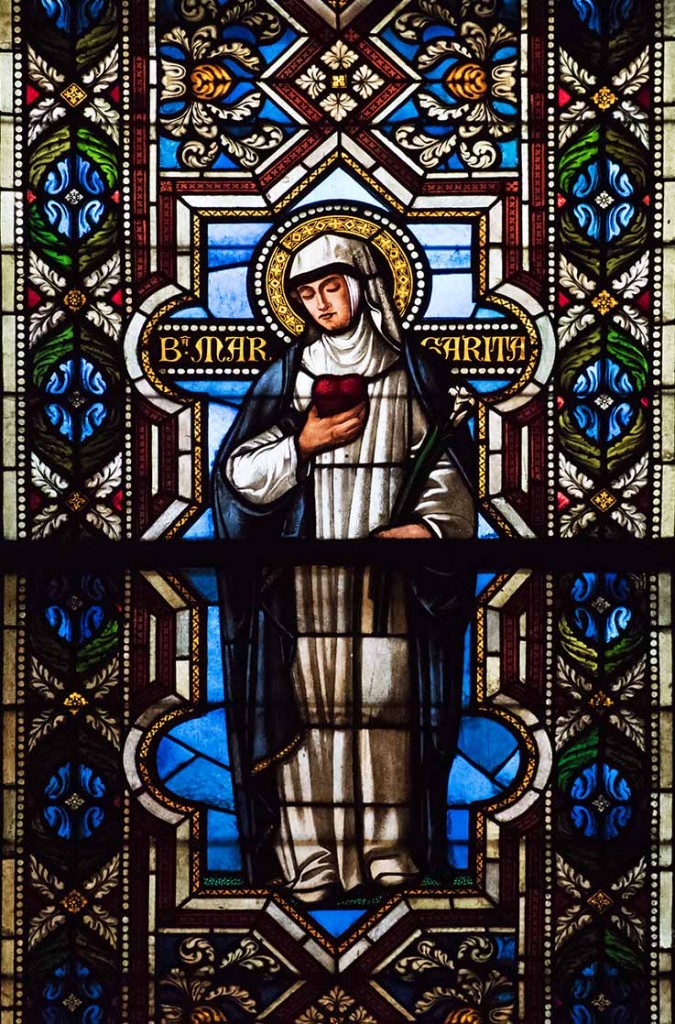
Blessed_Margaret_of_Castello

Bl Margaret of Castello was born in the fourteenth century in Metola, Italy to noble parents who wanted a son.   When the news was brought to the new mother that her newborn daughter was a blind, hunchbacked dwarf, both parents were horrified.   Little Margaret was kept in a secluded section of the family castle in the hopes that her existence would be kept secret.   However, when she was about six years old, she accidentally made her presence known to a guest.   Determined to keep her out of the public eye, her father had a room without a door built onto the side of the parish church and walled Margaret inside this room.   Here she lived until she was sixteen, never being allowed to come out.   Her food and other necessities were passed in to her through a window.   Another window into the church allowed her to hear Mass and receive Holy Communion.   The parish priest became a good friend and took upon himself the duty to educate her.   He was amazed at her docility and the depth of her spiritual wisdom.

When Margaret was sixteen years old, her parents heard of a shrine in Citta di Castello, Italy, where many sick people were cured.   They made a pilgrimage to the shrine so that she could pray for healing.   However, Margaret, open to the will of God, was not healed that day, or the next, so her parents callously abandoned her in the streets of the town and left for home, never to see her again.   At the mercy of the passersby, Margaret had to beg her food and eventually sought shelter with some Dominican nuns.

W. R. Bonniwell writes, “Her cheerfulness, based on her trust in God’s love and goodness, was extraordinary.   She became a Dominican tertiary and devoted herself to tending the sick and the dying” as well as prisoners in the city jail.

Saint_Patrick_Catholic_Church_(Columbus,_Ohio)_-_Blessed_Margaret_of_Castello_statue

Deprived of all human companionship, Margaret learned to embrace her Lord in solitude.   Instead of becoming bitter, she forgave her parents for their ill treatment of her and treated others as well as she could.   Her cheerfulness stemmed from her conviction that God loves each person infinitely, for He has made each person in His own image and likeness.   This same cheerfulness won the hearts of the poor of Castello and they took her into their homes for as long as their purses could afford.   She passed from house to house in this way, “a homeless beggar being practically adopted by the poor of a city” (Bonniwell, 1955).

Bl Margaret died on 13 April 1320 at the age of 33.   More than 200 miracles have been credited to her intercession since her death.   She was beatified on 19 October 1609 by Pope Paul V (concession of indult for Mass and Office).   Thus, the daughter that nobody wanted is now one of the glories of the Church.

IN-TEXT_BLESSEED-MARGARET-OF-CASTELLO-675x1024