St Alphaeus St Anderea Kaggwa Blessed Andrea Franchi OP (1335-1401) Bishop St Becan of Cork Bl Berengar of Saint-Papoul St Damian the Missionary St Desiderius of Vienne St Eleuterus Pope and Martyr St Felicissimus of Todi
St Odulvald of Melrose St Paulinus of Todi St Peter Sanz St Ponsiano Ngondwe St Priscus of Auxerre and Companions St Quadratus of Africa St Quadratus the Apologist St Regintrudis of Nonnberg St Simitrius of Rome and Companions St Zachary of Vienne
St Peter Canisius SJ (1521-1597) – The Known as “The Hammer of Protestantism,” “Second Apostle of Germany” – Confessor, Doctor of the Church, Dutch Priest of the Society of Jesus, Reformer, Teacher, Writer, Apostle of Charity. Patronages – Catholic Press, Germany, Catechists. The restoration of the Catholic Church in Germany after the Protestant Reformation is largely attributed to the work there of the Society of Jesus, which he led. “Peter Canisius was the first publisher, the first author, the first editor of the Society of Jesus. By now, Jesuits have followed in his footsteps to the tune of having published in 400 years, thousands of books. From the time of Canisius, and his name is first in the bibliography of Jesuit writers, from Peter Canisius to the end of the l9th century, that is to 1900, there are about twenty volumes of bibliography, each volume about two inches thick, stands about eighteen inches high, filled just with authors and titles, thousands and thousands and thousands, no other religious institute in the Church publishes as much as members of the Society. It was all started by Peter Canisius.” (Ven Servan of God Fr John A Hardon SJ) His Feast day is 27 April (General Roman Calendar, 1926–1969. Biography: https://anastpaul.com/2017/12/21/saint-of-the-day-21-december-st-peter-canisius-s-j-1521-1397-doctor-of-the-church/ AND: https://anastpaul.com/2018/12/21/saint-of-the-day-21-december-st-peter-canisius-s-j-1521-1397-the-second-apostle-of-germany-doctor-of-the-church/
St Adelelmus of Le Mans St Asicus of Elphin St Castor of Tarsus St Enoder St Floribert of Liege
Blessed Jakov Varingez OFM (c 1400–1496) Croatian professed religious of the Order of Friars Minor, Apostle of charity, Mystic with a great devotion to the Cross of Christ, Marian devotee, he was noted as a miracle worker and levitated. He was Beatified on 29 December 1700 by Pope Clement XIH.His body is incorrupt. His Life: https://anastpaul.com/2019/04/27/saint-of-the-day-27-april-blessed-jakov-varingez-ofm-c-1400-1496/
St Peter Armengol OdeM (c 1238-1304) “The Martyr who Wasn’t,” “The Unconquerable Martyr of Jesus Christ,” “The Gangster Saint,”Spanish Priest of the Mercedarian Friars, Penitent, Mystic. Beatified on 28 March 1686, by Pope Innocent XI and Canonised on 8 April 1687, by the same Pope. His body was incorrupt until it was destroyed during the horrors of the Spanish Civil War. A Miraculous Life: https://anastpaul.com/2022/04/27/saint-of-the-day-27-april-saint-peter-armengol-odem-c-1238-1304-the-martyr-who-wasnt/
St Pollio of Cybalae St Simeon of Jerusalem St Stephen of Tarsus St Tertullian of Bologna St Theophilus of Brescia St Winewald of Beverley
St Zita of Lucca (1212-1272) Virgin, Laywoman, Apostle of the Poor. – Her reputation was such that Dante in the Inferno referred to the City of Luccam, her birthplace and home, as “Santa Zita.” Patronages – housewives, butlers, housemaid, domestic servants (proclaimed by Pope Pius XII), housemaid, eys, manservants, people ridiculed for their piety, rape victims, servers, single laywomen, waiters, Lucca, Italy. Her body is incorrupt. Biography:. https://anastpaul.wordpress.com/2017/04/27/saint-of-the-day-27-april-st-zita-of-lucca/
Martyrs of Nicomedia: A group of Christians murdered together for their faith. In most cases all we have are their names – Dioscurus, Evanthia, Felicia, Felix, Germana, Germelina, Johannes, Julius, Laetissima, Nikeforus, Papias, Serapion and Victorinus. They died at Nicomedia, Bithynia, Asia Minor (modern Izmit, Turkey).
Quote/s of the Day – 16 April – “The Month of the Resurrection and the Blessed Sacrament” – – Ferial Day – 1 Peter 2:21-25; John 10:11-16 – Scripture search here: https://www.drbo.org/
“My sheep hear My Voice; I know them and they follow Me.”
John 10:27
“I am like the sick sheep which strays from the rest of the flock. Unless the Good Shepherd takes me on His shoulders and carries me back to His fold, my steps will falter and, in the very effort of rising, my feet will give way!”
St Jerome (343-420) Father and Doctor of the Church
“Christ said that the shepherd enters through the gate and that He is Himself the Gate, as well as the Shepherd. Then, it is necessary, that He enter through Himself. By so doing, He reveals Himself and through Himself, He knows the Father. But we enter through Him because through Him. we find happiness.”
St Thomas Aquinas (1225-1274) Doctor Angelicus Doctor Communis
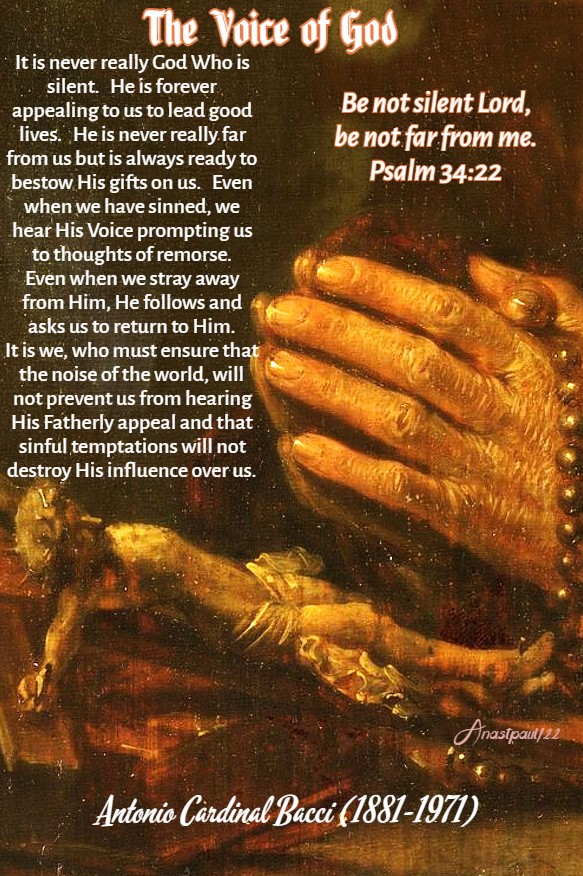
“It is never really God Who is silent. He is forever appealing to us to lead good lives. He is never really far from us but is always ready to bestow His gifts on us. Even when we have sinned, we hear His Voice prompting us to thoughts of remorse. Even when we stray away from Him, He follows and asks us to return to Him. It is we, who must ensure that the noise of the world, will not prevent us from hearing His Fatherly appeal and that sinful temptations will not destroy His influence over us.”
St Miguel de Sanctis O.SS.T (1591-1625) Priest of the Order of the Most Holy Trinity and of the Captives also known as the Trinitarian Order or the Trinitarians, Mystic, Penitent, Ecstatic, Apostle of prayer, mortification, of the poor and the sick, he had a special devotion to the Blessed Sacrament and would fall into ecstatic prayer during the Consecration at Holy Mass, so much so, that he became known as “El Extático”, “The Ecstatic.” Pope Pius IX Canonised Miguel on 8 June 1862. About St Miguel: https://anastpaul.com/2020/04/10/saint-of-the-day-10-april-st-miguel-de-sanctis-o-ss-t-1591-1625/
St Palladius of Auxerre (Died c659) Bishop St Paternus the Scot
Martyrs of Carthage – 50 Saints: A group of 50 Christians who were imprisoned in a pen of snakes and scorpions and then Martyred, all during the persecutions of Decius. Only six of their names have come down to us – Africanus, Alessandro, Massimo, Pompeius, Terence and Teodoro. Beheaded in 250 at Carthage.
Martyrs of Georgia: Approximately 6,000 Christian Monks and lay people Martyred in Georgia in 1616 for their faith by a Muslim army led by Shah Abbas I of Persia.
Martyrs of Ostia: A group ofcriminals who were brought to the faith by Pope Saint Alexander I while he was in prison with them. Drowned by being taken off shore from Ostia, Italy, in a boat which was then scuttled, c 115.
Quote/s of the Day – 9 April – “The Month of the Resurrection and the Blessed Sacrament” – Tuesday in the Second Week of Easter – 1 John 5:4-10, John 20. 19-31 – Scripture search here: https://www.drbo.org/
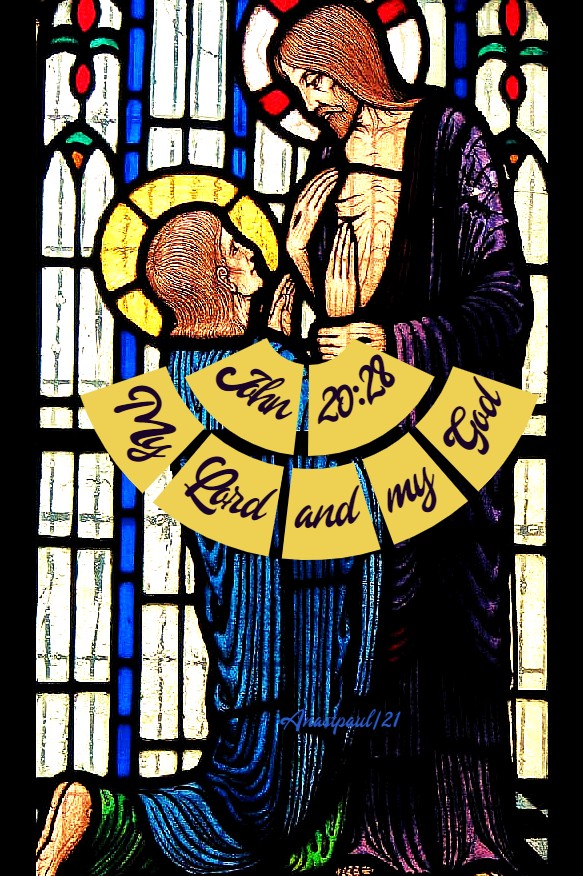
“My Lord and my God.”
John 20:28
“To one who has faith, no explanation is necessary. To one without faith, no explanations is possible.”
“If then, you are looking for the way by which you should go, take Christ, for He, Himself, is the Way.”
Grant Me Grace, O Merciful God Prayer of St Thomas Aquinas (1225-1274) Doctor Angelicus & Doctor Communis which he was accustomed to recite everyday before the image of Christ.
Grant me grace, O merciful God, to desire ardently all that is pleasing to Thee, to examine it prudently, to acknowledge it truthfully and to accomplish it perfectly, for the praise and glory of Thy Name. Amen
St Thomas Aquinas (1225-1274) Doctor Angelicus / Doctor Communis
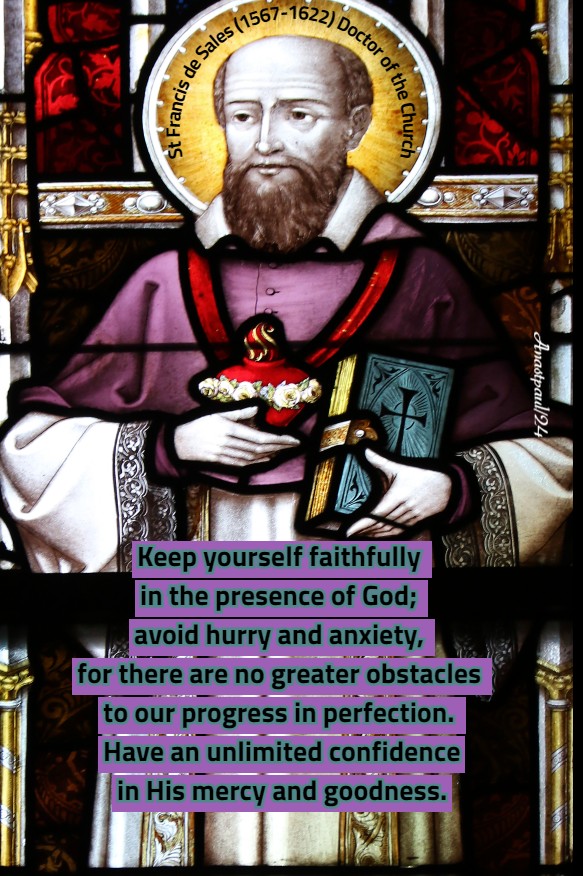
“Keep yourself faithfully in the presence of God; avoid hurry and anxiety, for there are no greater obstacles to our progress in perfection. Have an unlimited confidence in His mercy and goodness.”
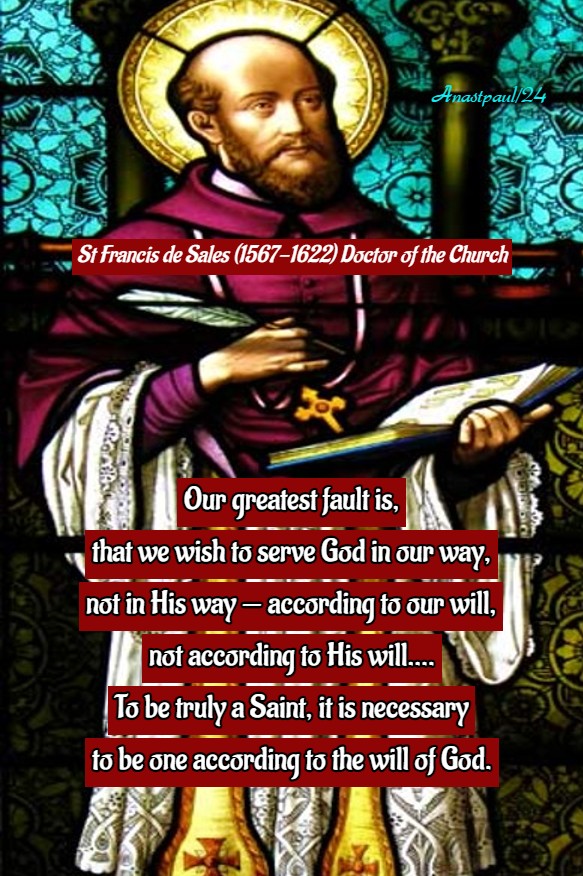
“Our greatest fault is, that we wish to serve God in our way, not in His way — according to our will, not according to His will…. To be truly a Saint, it is necessary to be one according to the will of God.”
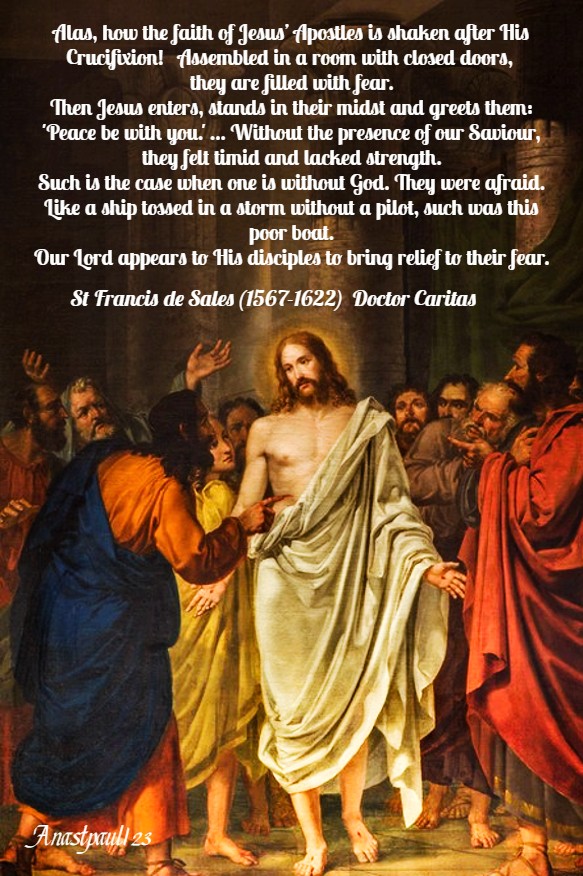
“Alas, how the faith of Jesus’ Apostles is shaken after His Crucifixion! Assembled in a room with closed doors, they are filled with fear. Then Jesus enters, stands in their midst and greets them: ‘Peace be with you.’ … Without the presence of our Saviour, they felt timid and lacked strength. Such is the case when one is without God. They were afraid. Like a ship tossed in a storm without a pilot, such was this poor boat. Our Lord appears to His disciples to bring relief to their fear.”
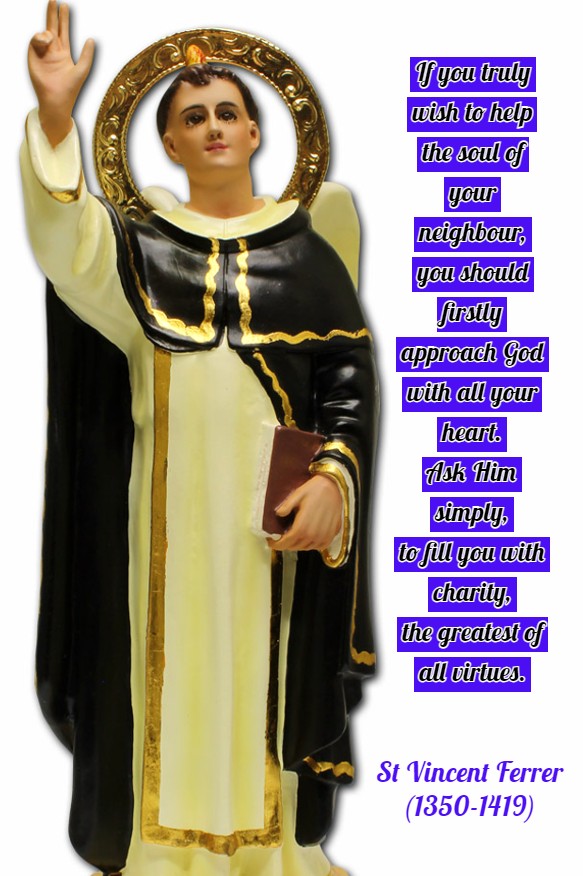
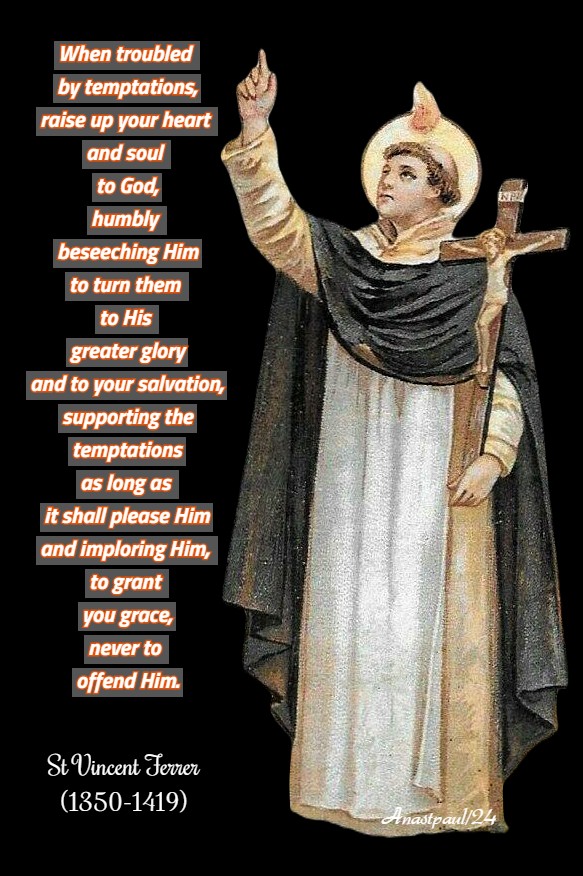
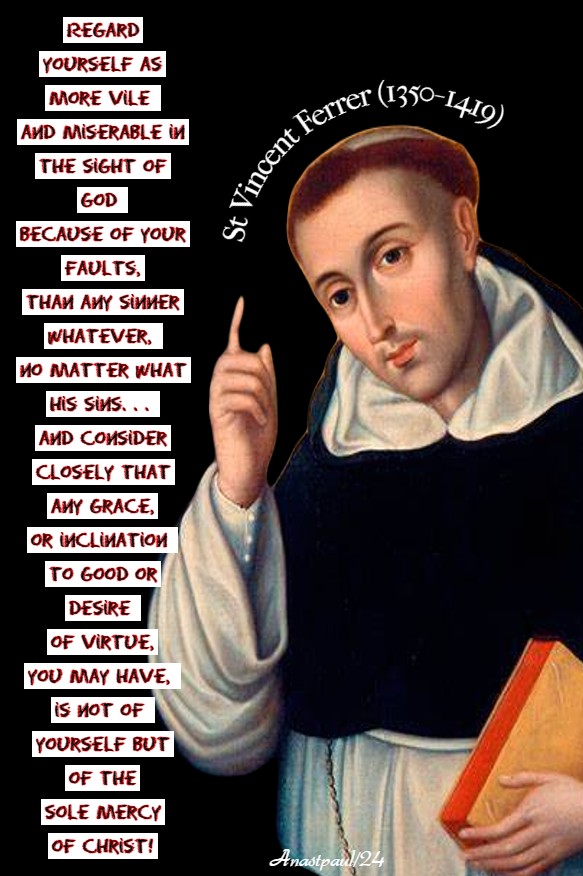
Quote/s of the Day – 5 April – St Vincent Ferrer OP (1350-1419) Confessor, called “The Angel of the Apocalypse” and of “The Last Judgement” and the “Mouthpiece of God.”
“If you truly wish to help the soul of your neighbour, you should firstly approach God with all your heart. Ask Him simply, to fill you with charity, the greatest of all virtues.”
“When troubled by temptations, raise up your heart and soul to God, humbly beseeching Him to turn them to His greater glory and to your salvation, supporting the temptations as long as it shall please Him and imploring Him, to grant you grace, never to offend Him.”
“Regard yourself as more vile and miserable in the sight of God because of your faults, than any sinner whatever, no matter what his sins. . . and consider closely that any grace, or inclination to good or desire of virtue, you may have, is not of yourself but of the sole mercy of Christ.”
St Photina & Companions / Martyrs of Rome – 9+ Saints: A group of Christians Martyred together in the persecutions of Nero. We know nothing else about them but the names Photina, Sebastian and Victor, Anatolius, Cyriaca, Joseph, Parasceve, Photis.
Blessed Ambrose Sansedoni of Siena OP (1220-1287) Priest and Friar of the Order of Preachers, Preachers, Confessor, Mystic, a powerful and convincing Preacher employed by various Popes as a Diplomatic Peacemaker and that which seems opposed, as a Preacher of the Crusades, Peacemaker. A fellow student with St Thomas Aquinas under St Albert Magnus. His Life: https://anastpaul.com/2023/03/20/saint-of-the-day-19march-blessed-ambrose-sansedoni-of-siena-op-1220-1287-priest/
Anastasius XVI Archippus of Colossi St Benignus of Flay St Cathcan of Rath-derthaighe St Clement of Ireland
St Guillermo de Peñacorada (Died c1042) Abbot St Herbert of Derwenwater Bl Hippolytus Galantini Bl Jeanne Veron Bl John Baptist Spagnuolo St John Nepomucene St John Sergius
Martyrs of Amisus – 8 Saints: A group of Christian women Martyred together in the persecutions of Diocletian. The only details we have are eight of their names – Alexandra, Caldia, Derphuta, Euphemia, Euphrasia, Juliana, Matrona and Theodosia. They were burned to death c 300 in Amisus, Paphlagonia (modern Samsun, Turkey).
Martyrs of San Saba – 20 Saints: Twenty monks who were Martyred together in their monastery by invading Saracens. They were Martyred in 797 when they were burned inside the San Sabas monastery in Palestine.
Martyrs of Syria – 3+ Saints: A group of Christians who were Martyred together in Syria. We know nothing else about them but the names Cyril, Eugene and Paul.
Quote/s of the Day – 16 March –Saturday of the Fourth Week in Lent – Ferial Day – Isaias 49:8-15; John 8:12-20 – Scripture search here: https://www.drbo.org/
“I Am the Light of the world. He who follows Me does not walk in the darkness but will have the Light of Life. ”
John 8:12
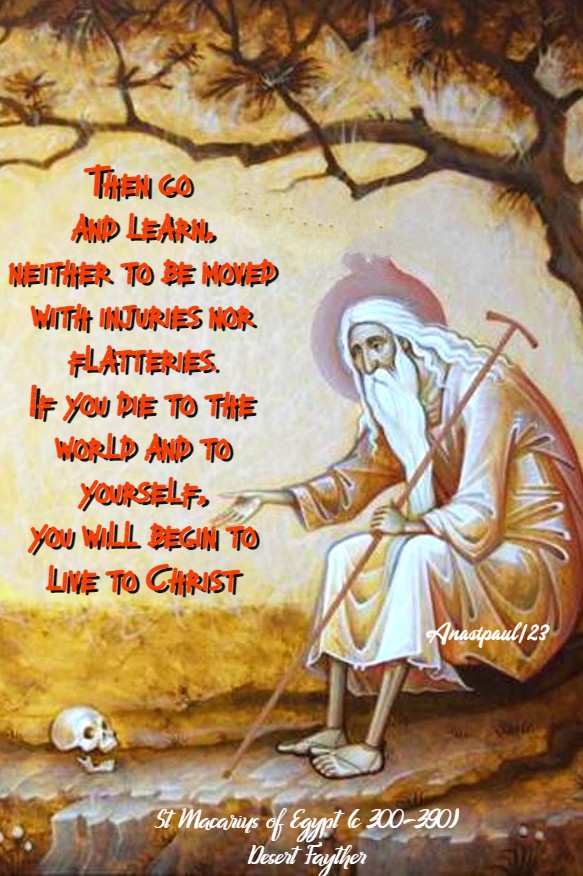
“Then go and learn, neither to be moved with injuries nor flatteries. If you die to the world and to yourself, you will begin to live to Christ.”
St Macarius of Egypt (c300-390)
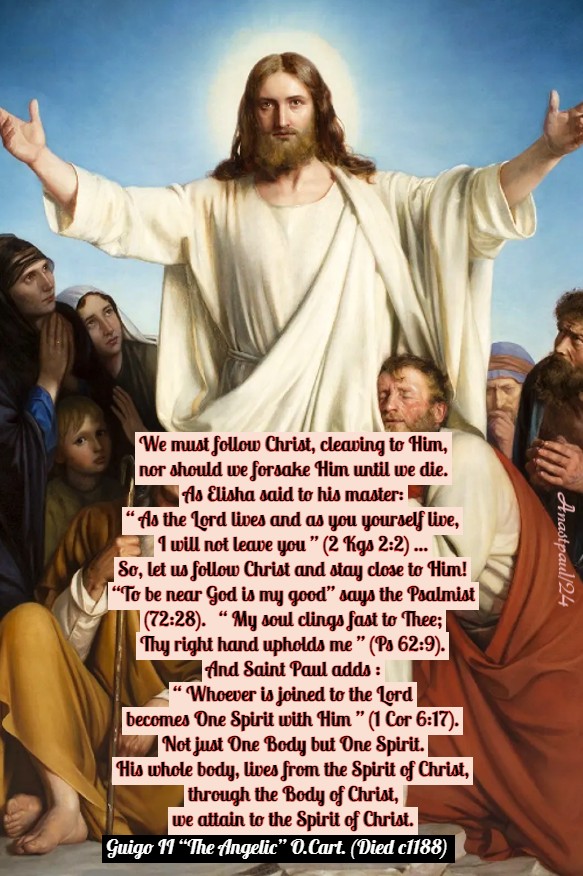
“We must follow Christ, cleaving to Him, nor should we forsake Him until we die. As Elisha said to his master: “ As the Lord lives and as you yourself live, I will not leave you ” (2 Kgs 2:2) … So, let us follow Christ and stay close to Him! “To be near God is my good” says the Psalmist (72:28). “ My soul clings fast to Thee; Thy right hand upholds me ” (Ps 62:9). And Saint Paul adds : “ Whoever is joined to the Lord becomes One Spirit with Him ” (1 Cor 6:17). Not just One Body but One Spirit. His whole body, lives from the Spirit of Christ, through the Body of Christ, we attain to the Spirit of Christ.”
Guigo II “The Angelic” O.Cart. (Died c1188) The 9th Prior of Grande Chartreuse, from 1174 to 1180 (Meditation 10).
“The one who walks in the love of God seeks neither gain nor reward but seeks only, with the will, to lose self and all things, for God and this loss, the lover judges to be a gain! ”
St John of the Cross (1542-1591) Doctor of the Church
“Let us not strive for the rewards of Heaven, valuable though they may be but live, so as to please the God of Heaven. If God were not in Heaven, all its beauty, riches and sweetness, would be dull rather than delightful. By faith, we know, God already dwells within us. But in Heaven, we will see God face-to-face. May we so live that one day, we will be in Heaven praising and praying eternally, before our Lord and Saviour!”
Quote/s of the Day – 7 March – St Thomas Aquinas OP (1225-1274) Confessor, Doctor
“We are like children, who stand in need of masters, to enlighten us and direct us and God has provided for this, by appointing His Angels, to be our teachers and guides.”
“To one who has faith, no explanation is necessary. To one without faith, no explanations is possible.”
“Love takes up, where knowledge leaves off.”
“If the highest aim of a Captain were to preserve his ship, he would keep it in Port, forever!”
“If then, you are looking for the way by which you should go, take Christ, for He, Himself, is the Way.”
“Happiness is secured through virtue; it is a good attained by man’s own will.”
Grant Me Grace, O Merciful God Prayer of St Thomas Aquinas (1225-1274) Doctor Angelicus & Doctor Communis which he was accustomed to recite everyday before the image of Christ.
Grant me grace, O merciful God, to desire ardently all that is pleasing to Thee, to examine it prudently, to acknowledge it truthfully and to accomplish it perfectly, for the praise and glory of Thy Name. Amen
Our Morning Offering – 7 March – Thursday of the Third Week in Lent – St Thomas Aquinas OP (1225-1274) Confessor, Doctor
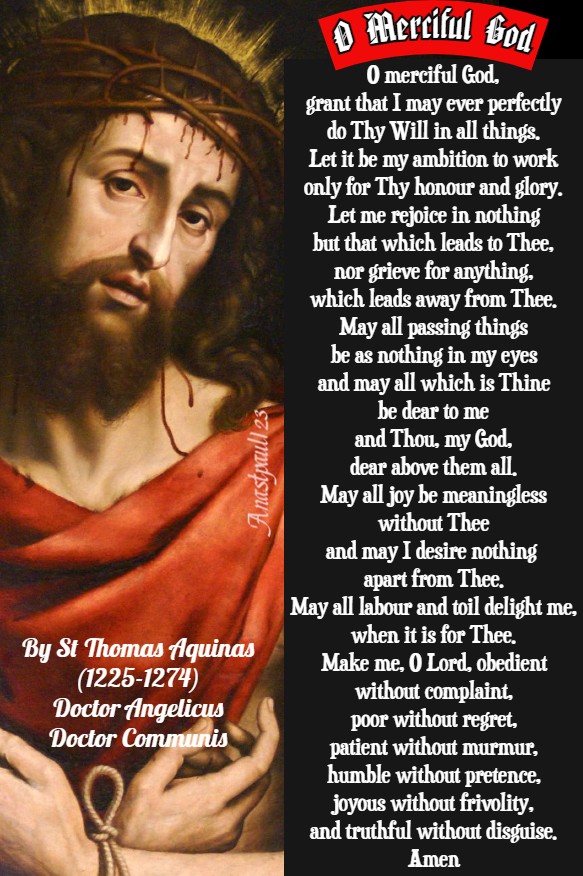
O Merciful God By St Thomas Aquinas (1225-1274) Doctor Angelicus Doctor Communis
O merciful God, grant that I may ever perfectly do Thy Will in all things. Let it be my ambition to work only for Thy honour and glory. Let me rejoice in nothing but that which leads to Thee, nor grieve for anything, which leads away from Thee. May all passing things be as nothing in my eyes and may all which is Thine be dear to me and Thou, my God, dear above them all. May all joy be meaningless without Thee and may I desire nothing apart from Thee. May all labour and toil delight me, when it is for Thee. Make me, O Lord, obedient without complaint, poor without regret, patient without murmur, humble without pretence, joyous without frivolity, and truthful without disguise. Amen
St Ardo of Aniane Bl Daniel of Wichterich St Deifer of Bodfari St Drausinus of Soissons Bishop St Enodoch St Esterwine of Wearmouth Abbot St Eubulus of Caesarea Bl German Gardiner Bl Henry of Austria Bl Jermyn Gardiner Bl John Ireland BlessedJohn Larke (Died 1544) Priest Martyr. He was a notable personal friend of St Thomas More (1478-1535) , Martyr the Lord High Chancellor of England. St Paul of Prusa
Bl Volker of Segeberg OSA (Died c1135) Priest Martyr Bl William of Assisi
Martyrs of Carthage – 4 Saints: A catechist and three students Martyred together for teaching and learning the faith. We know little more than their names – Revocatus, Saturninus, Saturus and Secundulus. Mauled by wild beasts and beheaded 7 March 203 at Carthage, North Africa
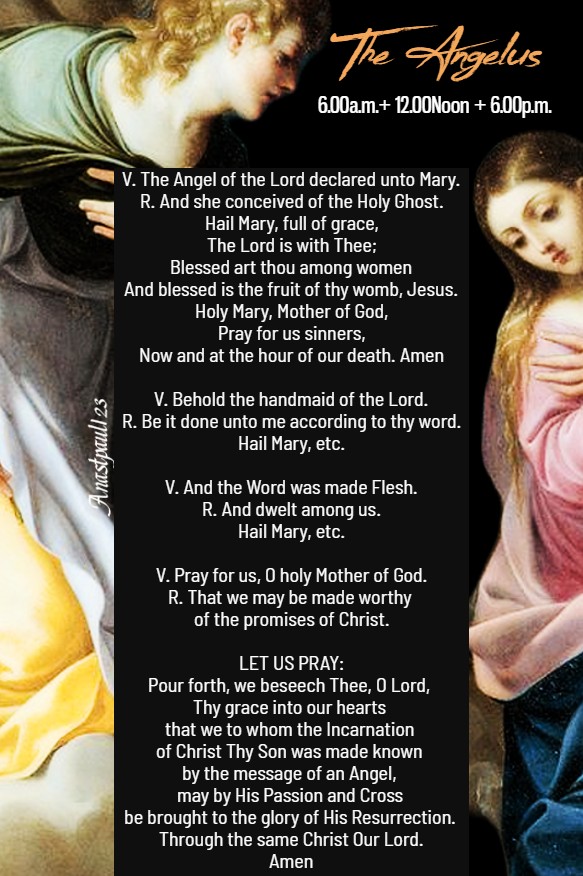
Blessed Benedetto Sinigardi da Arezzo OFM (1190-1282) Friar of the Order of Friars Minor, who received the Habit directly from St Francis of Assisi. Although rarely mentioned, Blessed Benedetto is the Author of the Angelus! Furthermore, the beautiful custom of reciting the Marian Antiphon “The Angelus Domini” is attributed to Blessed Benedetto, meditating on the saving Mystery of the Incarnation of the Son of God in Mary’s virginal womb. The Angelus Domini became a pious practice firstly to the entire Franciscan Order, then to the whole Church, as it still is today. Biography: https://anastpaul.com/2023/03/03/saint-of-the-day-3-march-blessed-benedetto-sinigardi-da-arezzo-ofm-c1190-1282-the-author-of-the-angelus/
St Anselm of Nonantola St Arthelais of Benevento St Calupan St Camilla St Cele-Christ
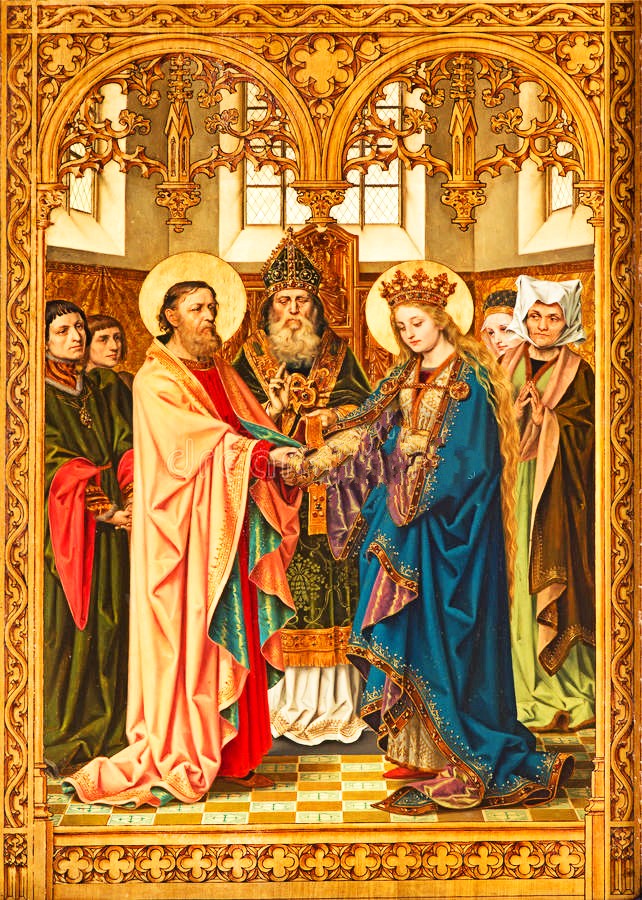
St Cunegundes (c975-1040) Empress of the Holy Roman Empire, Nun, she took a vow of Virginity before her marriage, which, after a miracle was upheld by her husband, the King (also a Saint). Founder of Monasteries and Churches, Nun in one of her Convents, Apostle of Charity. Born in c 975 and died in 1040 of natural causes. Biography: https://anastpaul.com/2022/03/03/saint-of-the-day-3-march-st-cunegundes-c-975-1040/
St Foila Bl Frederick of Hallum St Gervinus Blessed Innocento of Berzo OFM Cap. (1844-1890) Priest Bl Jacobinus de’ Canepaci St Lamalisse St Non
Bl Pierre-René Rogue St Sacer St Teresa Eustochio Verzeri St Titian of Brescia Bishop and Confessor St Winwallus of Landévennec
40 Martyrs in North Africa – A group of Christians Martyred together in North Africa, date unknown. No details have survived, but we know these names – Antonius, Artilaus, Asclipius, Astexius, Basil, Bosimus, Carissimus, Castus, Celedonius, Claudianus, Cyricus, Donata, Emeritus, Emeterius, Euticus, Felix, Fortunatus, Frunumius, Gajola, Georgius, Gorgonius, Hemeterus, Isicus, Janula, Julius, Luciola, Luciolus, Marcia, Marinus, Meterus, Nicephorus, Papias, Photius, Risinnius, Sabianus, Savinianus and Solus
Martyrs of Pontus – 3+ Saints – A large group of Christians Martyred together in the persecutions of Emperor Maximian Galerius and governor Ascleopiodato. We have some details on three of them – Basiliscus, Cleonicus and Eutropius. 308 in Pontus (in modern Turkey) Martyrs of Caesarea; Asterius Marinus
Martyrs of Calahorra: Cheledonius Emeterius
Martyrs of Gondar, Ethiopia: Bl Antonio Francesco Marzorati Bl Johannes Laurentius Weiss Bl Michele Pío Fasol
Quote/s of the Day – 1 March – Friday of the Second Week in Lent and the Feast of the Holy Shroud – – Genesis 37:6-22; Matthew 21:33-46.– Scripture search here: https://www.drbo.org/
“He will bring those evil men to an evil end”
Matthew 21:41
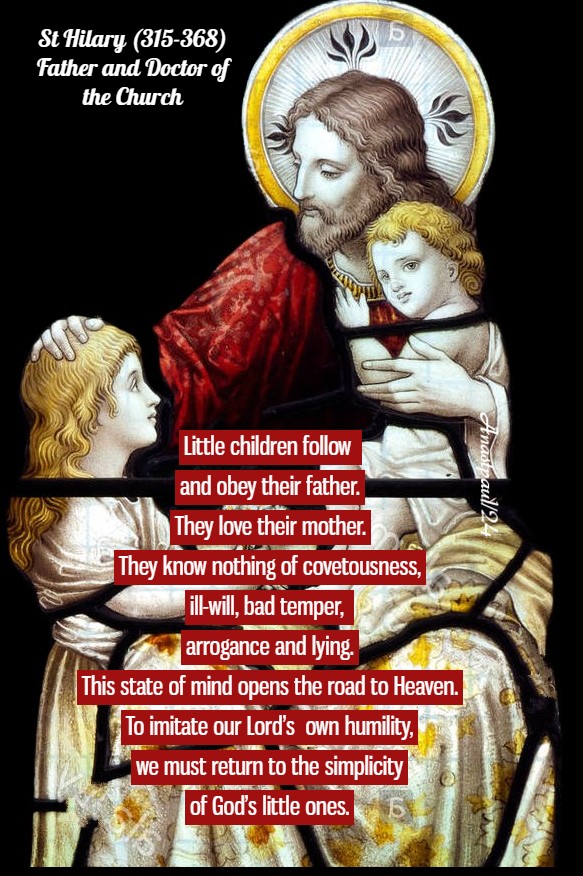
“Little children follow and obey their father. They love their mother. They know nothing of covetousness, ill-will, bad temper, arrogance and lying. This state of mind opens the road to Heaven. To imitate our Lord’s own humility, we must return to the simplicity of God’s little ones.”
St Hilary (315-368) Father and Doctor of the Church
“I see clearly with the interior eye, that the sweet God loves, with a pure love, the creature that He has created and has a HATRED for nothing but SIN, which is more opposed to Him, than can be thought or imagined.”
St Catherine of Genoa (1447-1510)
“Let us then depart, let us depart from Egypt, let us approach Our Lord, let us make provision of good works; let the feet of our affections be bare, let us clothe ourselves with innocence, let us not be satisfied with crying for mercy, let us go forth from Egypt, let us delay no longer. The hour is come to arise from sleep, since we know that He receives sinners; the Angels await our repentance, the Saints pray for it!”
St Francis de Sales 91567-1622) Doctor of the Church
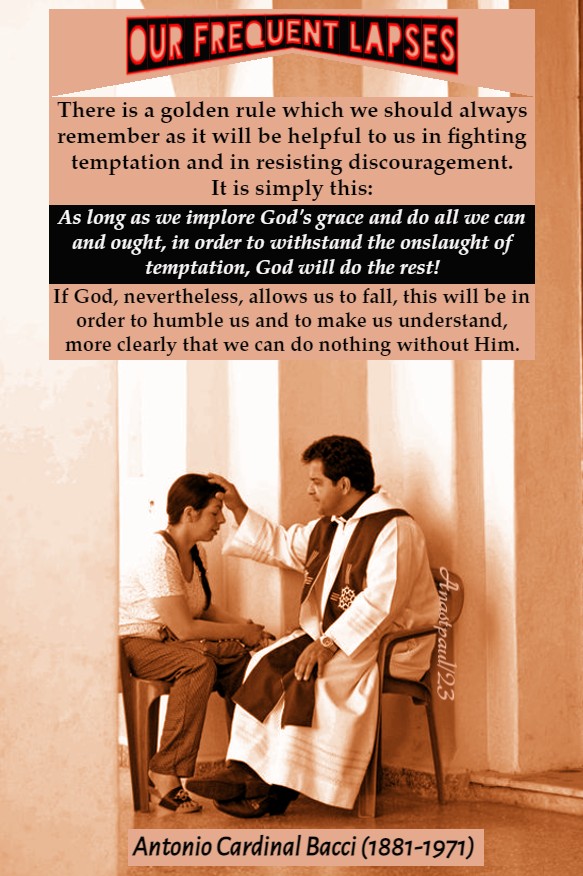
“There is a golden rule which we should always remember as it will be helpful to us in fighting temptation and in resisting discouragement. It is simply this: As long as we implore God’s grace and do all we can and ought, in order to withstand the onslaught of temptation, God will do the rest! If God, nevertheless, allows us to fall, this will be in order to humble us and to make us understand, more clearly that we can do nothing without Him.”
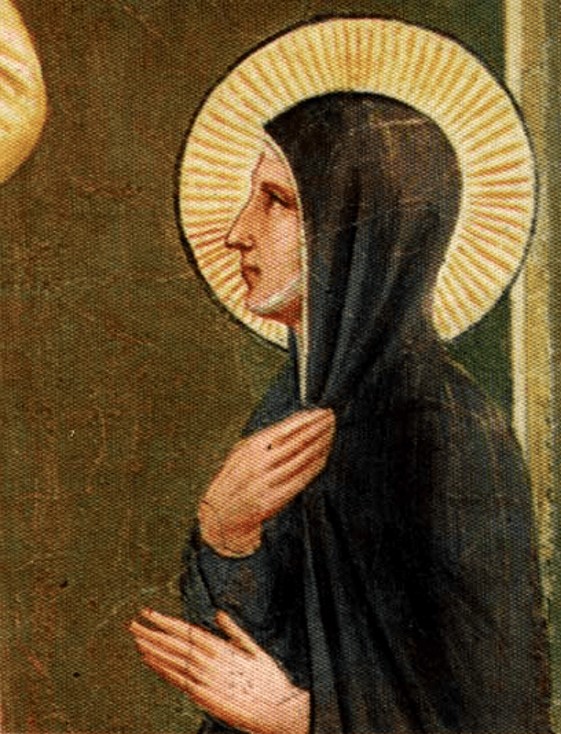
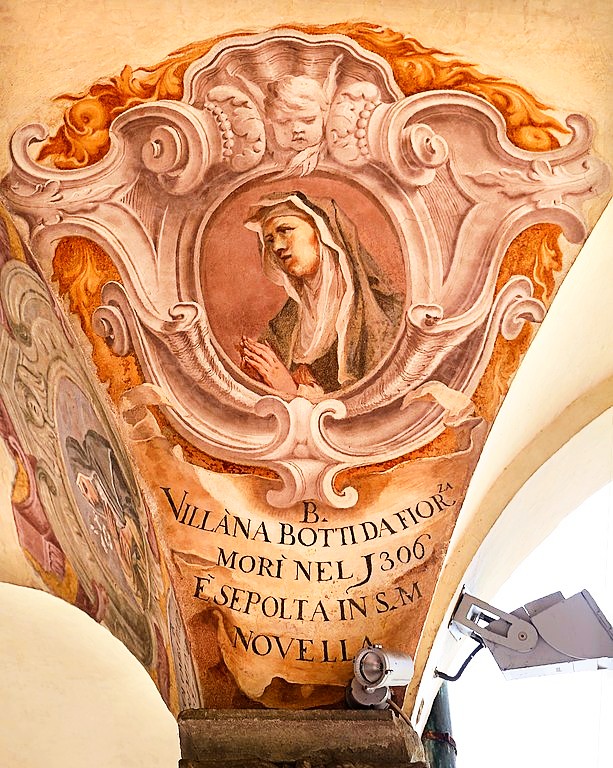
Saint of the Day – 28 February – Blessed Villana de’Botti OP (1332-1361) Widow, Mother, Penitent, Mystic, Lay Religious of the Order of Preachers. She was gifted with visions of Our Lady and of the Saints and was granted the gift of prophecy. Born in 1332 in Florence, Italy and died on 29 January 1361 of natural causes. Patronage – of Florence.
Villana de’Botti was born in 1332 in Florence in the Tuscany region of central Italy. She was the daughter of the rich Florentine merchant Andrea di Lapo de’Botti. As a child she was exceptionally pious and, at the age of thirteen, she ran away from home to enter a Convent. But her father objected to this and had her brought back. Not long after, in July 1351 he had her married to Rosso di Piero Benintendi.
After she married, she seemed completely transformed. She indulged herself completely in worldliness and vanity and even debauchery. But it is said that one day she was going out dressed in a beautiful dress adorned with pearls and precious stones. She looked in the mirror, but instead of her own reflection, she saw a demon (another version says she saw her stained soul). The same image appeared in a second and a third mirror. Immediately Villana repented of her sins, her vices and evil habits. She tore off her dress and put on the simplest outfit she could find. She then went to the Dominican Church of Santa Maria Novella and made a general Confession. Not long after, she joined the Dominican Tertiaries.
Her conversion was complete but she remained faithful to her marital duties. However, she spent all her free time in prayer and reading spiritual literature, studying — especially the biographies of Saints and St Paul ‘s letters and, she made great progress in the spiritual life. She tried to beg for the poor in the streets but was prevented from doing so by her horrified family. She appears to have had visions and ecstasies, and despite opposition in certain camps, she was locally venerated as a saint even before she died. After she became a widow, she had to endure slander from some of her companions.
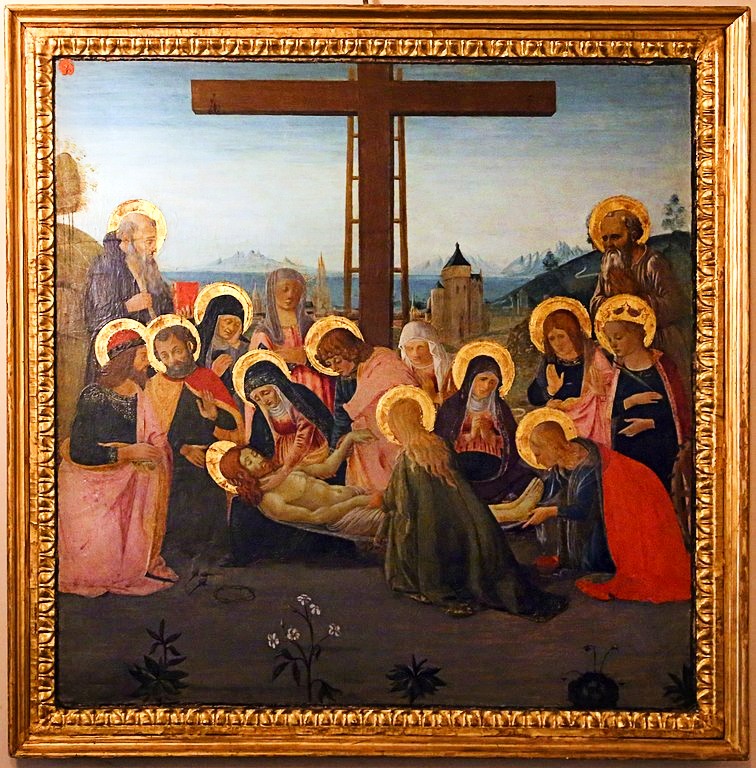
She died on 29 January 1361 in Florence while the words from the Passion of Christ: “He bowed his head and gave up His spirit” were read to her at her request. (The painting below depicts Bl Villana and companions mourning the Death of our Saviour). Her body was carried to the Church of Santa Maria Novella, where it was besieged for a month by large crowds who fought to get hold of pieces of her clothing and made it impossible for any burial to take place.
Mastro dell’Annunciazione di Fiesole, compianto della Beata Villana
She is buried there in a marble tomb made by Bernardo Rossellino. She was Beatified on 27 March 1824 when her cult was confirmed by Pope Leo XII (1823-1829). Her Feast Day is 28 February.
St Justus the Potter St Llibio St Macarius the Potter St Maidoc St Marana of Beroea
St Oswald of Worcester (Died 992) Monk, Archbishop of York from 972-992, as well as simultaneously being the Bishop of Worcester and a leading figure in the reform of the Anglo-Saxon Church which took place in the second half of the tenth Century. He died on 29 February in 992 of natural causes, a leap year, therefore, his Feast is celebrated on the 28th. (Feast Day 29 February in a Leap Year) St Oswald’s Life: https://anastpaul.com/2023/02/28/saint-of-the-day-28-february-saint-oswald-of-worcester-c912-992-bishop/
St Proterius of Alexandria St Pupulus of Alexandria
St Ruellinus of Treguier St Rufinus the Potter St Serapion of Alexandria St Sillan of Bangor St Theophilus the Potter Blessed Villana de’Botti OP (1332-1361) Widow, Mother, Penitent, Mystic.
Martyrs of Alexandria – A number of clerics and layman who died as Martyrs of charity for ministering to the sick during a plague that ravaged Alexandria, Egypt in 261.
Martyrs of Antwerp – 14 Christians who were Martyred together. We know nothing about them but the names Alexander, Anicetus, Cyriacus, Eulalia, Faustus, Genesius, Hirena, Macarius, Mauritius, Modestus, Placidus, Rochus, Symforian and Victorinus. Died in Rome, Italy, date unknown. Their Relics were transferred and enshrined in Antwerp, Belgium.
Martyrs of Corinth – A group of Christians Martyred together in Corinth, Greece. The only information we have about them are the names Basilia, Betha, Caius, Claudius, Diodorus, Donatus, Enuclus, Felix, Hermes, Januaria, Januarius, Maccaris, Maninlia, Mansuetus, Nicophorus, Papias, Quinquianus, Rufunia, Serapion, Servilia, Silvana, Stercola, Tella, Veneria, Victor and Victorinus.
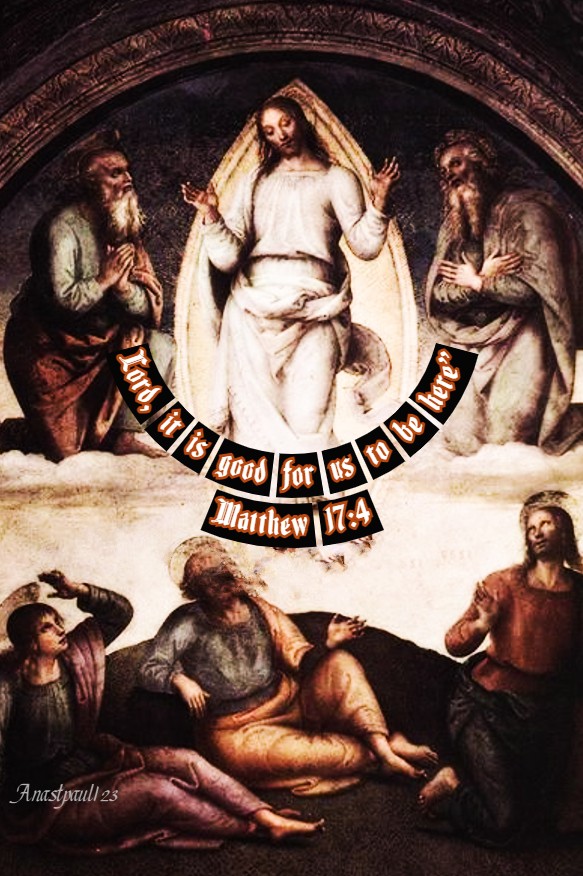
Quote/s of the Day – 25 February – The Second Sunday in Lent – Thessalonians 4:1-7; Matthew 17:1-9 – Scripture search here: https://www.drbo.org/
“Lord, it is good for us to be here …”
Matthew 17:4
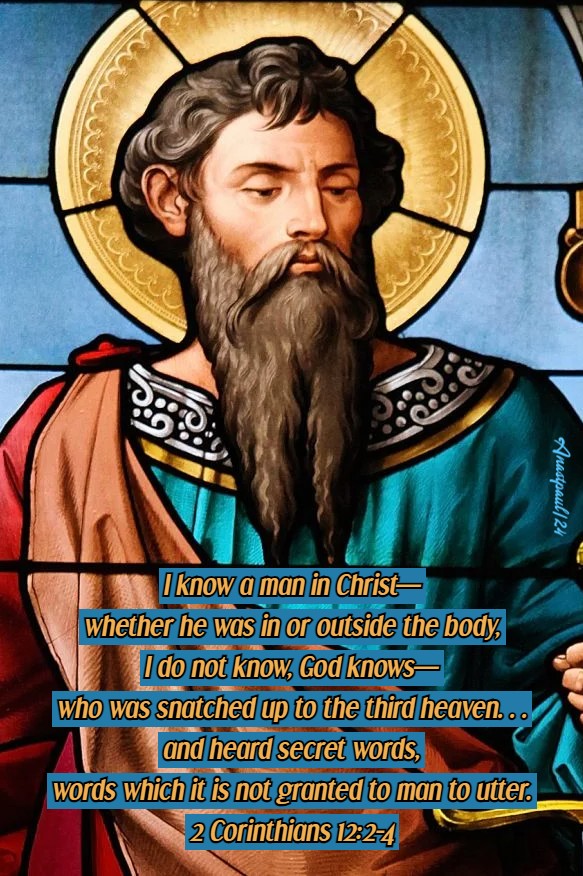
“I know a man in Christ— whether he was in or outside the body, I do not know, God knows— who was snatched up to the third heaven. . . and heard secret words, words which it is not granted to man to utter.”
2 Corinthians 12:2-4
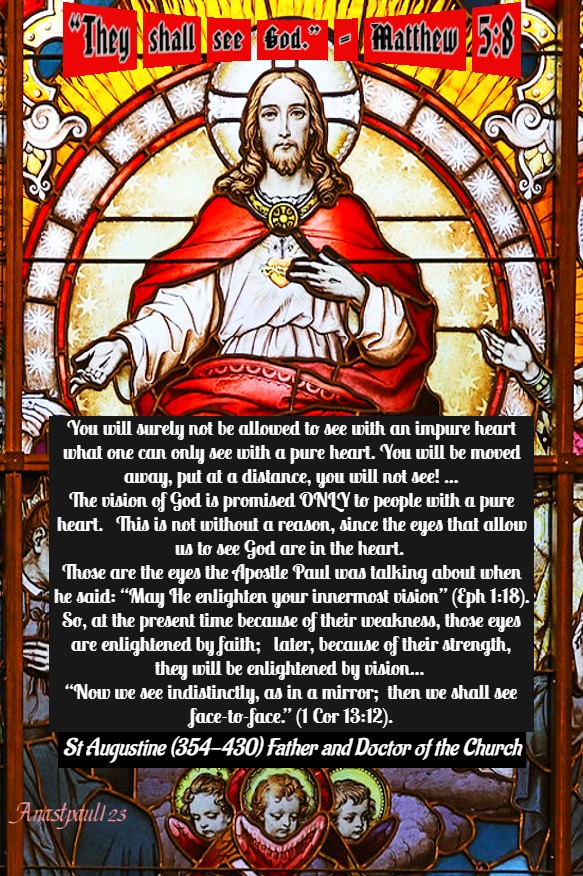
“They shall see God.” Matthew 5:8
“You will surely not be allowed to see with an impure heart what one can only see with a pure heart. You will be moved away, put at a distance, you will not see! The vision of God is promised ONLY to people with a pure heart. This is not without a reason, since the eyes which allow us to see God are in the heart. Those are the eyes the Apostle Paul was talking about when he said: “May He enlighten your innermost vision” (Eph 1:18). So, at the present time because of their weakness, those eyes are enlightened by faith; later, because of their strength, they will be enlightened by vision… “Now we see indistinctly, as in a mirror; then we shall see face-to-face.”
St Augustine (354-430) Father and Doctor of the Church
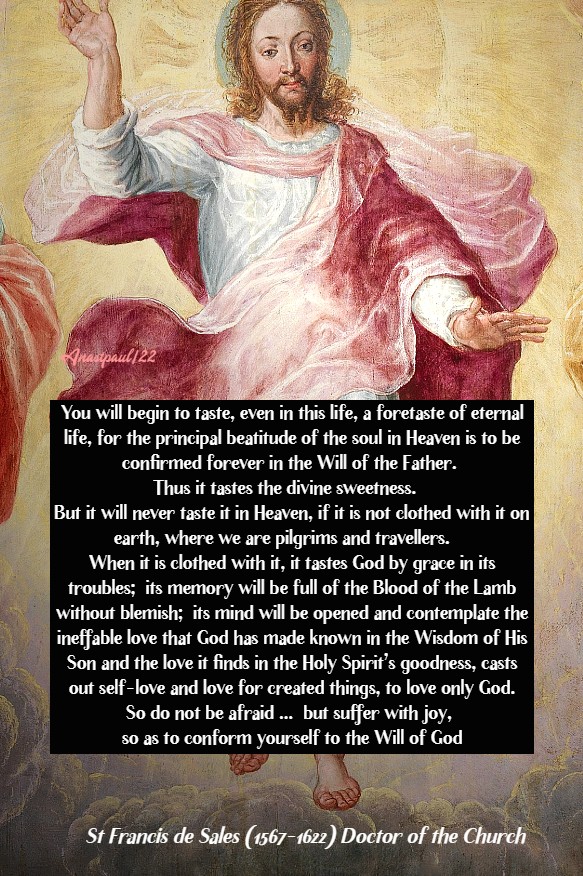
“You will begin to taste, even in this life, a foretaste of eternal life, for the principal beatitude of the soul in Heaven, is to be confirmed forever in the Will of the Father. Thus, it tastes the divine sweetness. But it will never taste it in Heaven, if it is not clothed with it on earth, where we are pilgrims and travellers. When it is clothed with it, it tastes God by grace in its troubles; its memory will be full of the Blood of the Lamb without blemish; its mind will be opened and contemplate the ineffable love that God has made known in the Wisdom of His Son and the love it finds, in the Holy Spirit’s goodness, casts out self-love and love for created things, to love only God. So do not be afraid … but suffer with joy, so as to conform yourself to the Will of God.””
St Francis de Sales (1567-1622) Doctor Caritatis
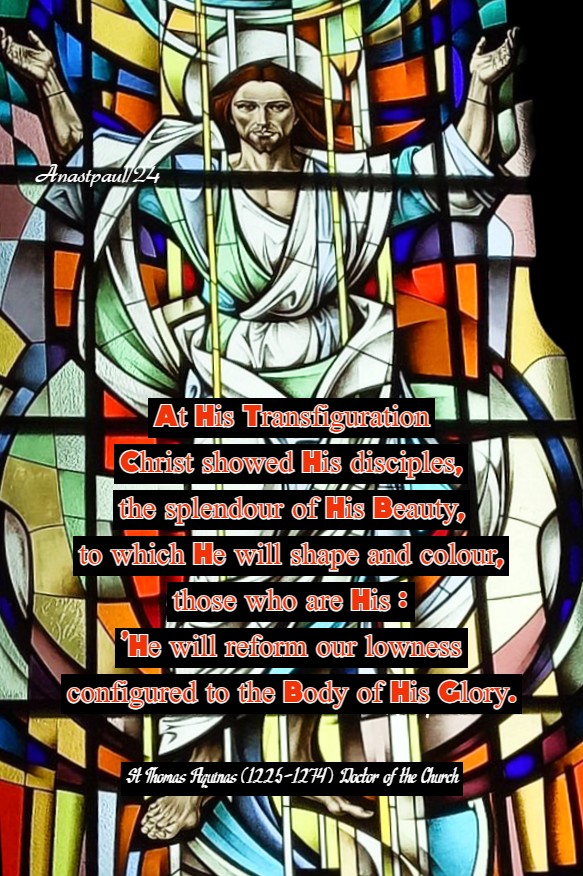
“At His Transfiguration Christ showed His disciples, the splendour of His Beauty, to which He will shape and colour, those who are His : ‘He will reform our lowness configured to the Body of His Glory.”
St Thomas Aquinas (1225-1274) Doctor of the Church
Martyrs of Cilicia – 12 Saints: A group of Christians who ministered to other Christians who were condemned to work the mines of Cilicia in the persecutions of Maximus. They were arrested, tortured and martryed by order of the governor Firmilian. They were Daniel, Elias, Isaias, Jeremy, Samuel. The group also includes the three known have been sentenced to the mines – Pamphilus, Paul of Jamnia, Valens of Jerusalem and those who were exposed as Christians as a result of these murders – Julian of Cappadocia, Porphyrius of Caesarea, Seleucius of Caesarea, Theodule the Servant. They were Martyred in 309 in Cilicia, Asia Minor (in modern Turkey).
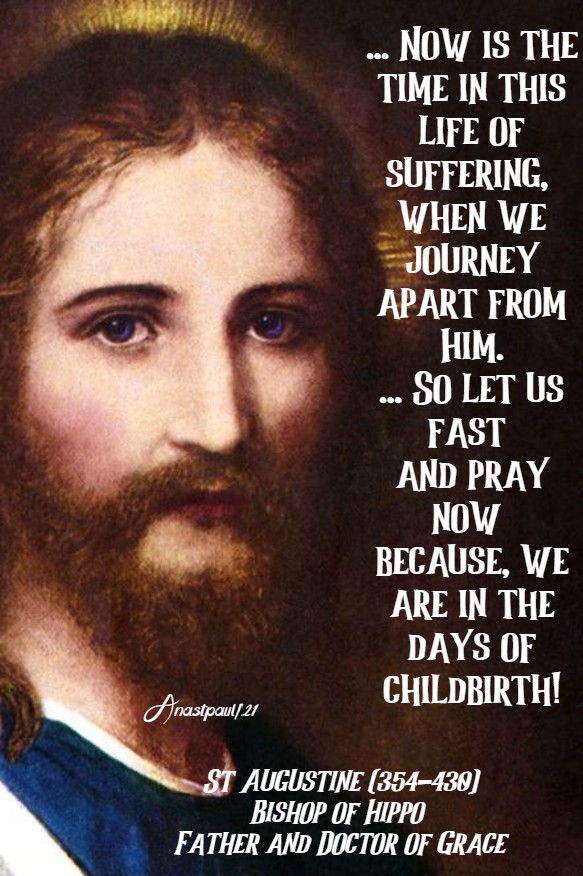
“… Now is the time in this life of suffering, when we journey apart from Him. … So let us fast and pray now because, we are in the days of childbirth!”
“Fasting cleanses the soul, raises the mind, subjects one’s flesh to the spirit, renders the heart contrite and humble, scatters the clouds of concupiscence, quenches the fire of lust and kindles the true light of chastity. Enter again into yourself!”
St Augustine (354-430) Father and Doctor of Grace
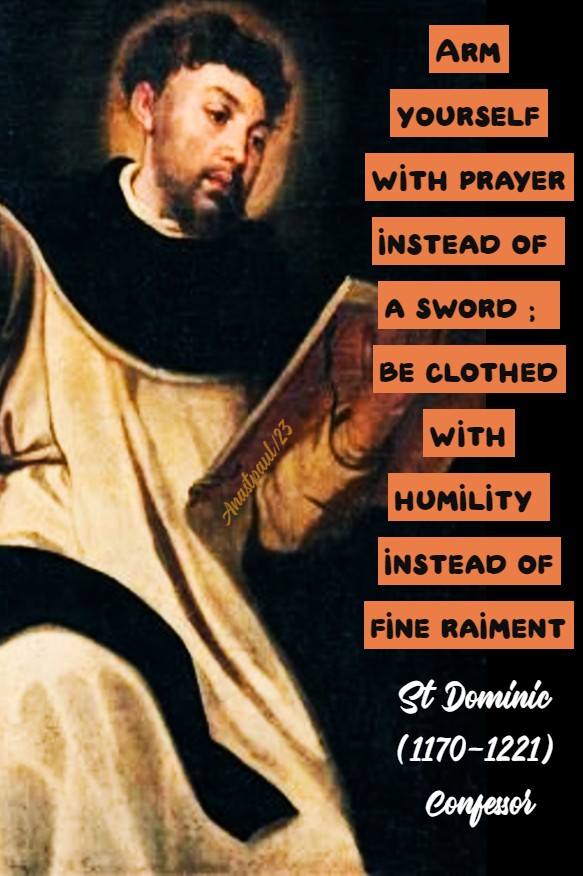
“Arm yourself with prayer instead of a sword; be clothed with humility instead of fine raiment.”
St Dominic OP (1170-1221)
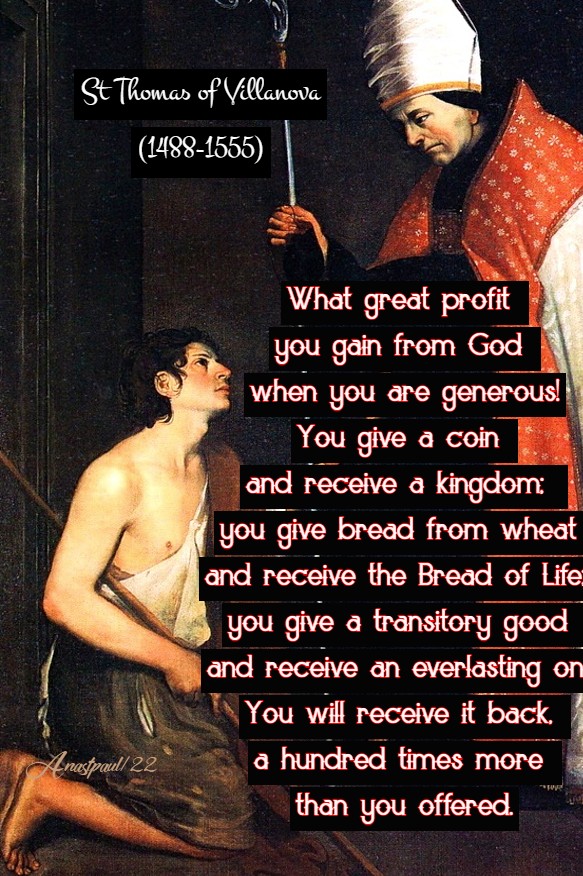
“What great profit you gain from God when you are generous! You give a coin and receive a Kingdom; you give bread from wheat and receive the Bread of Life; you give a transitory good and receive an everlasting one. You will receive it back, a hundred times more than you offered.”
St Thomas of Villanova (1488-1555)
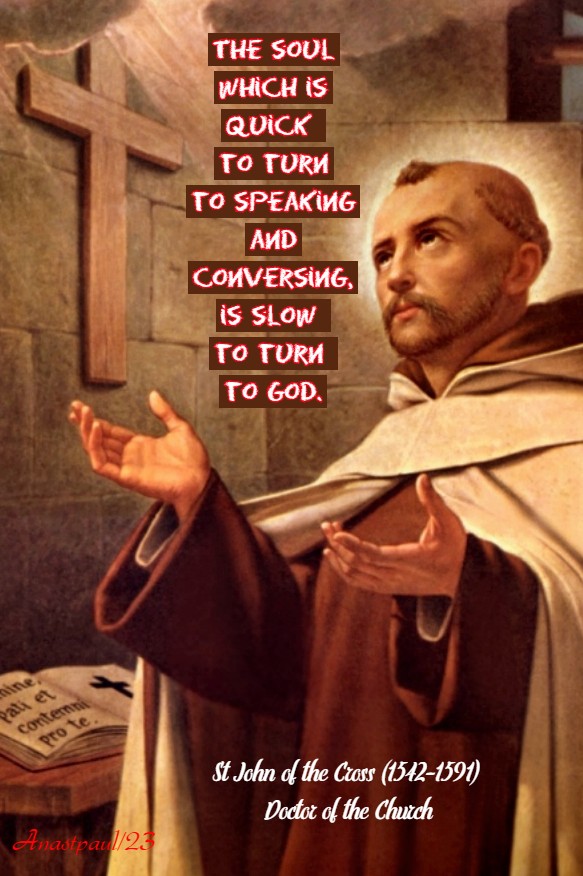
“The soul which is quick to turn to speaking and conversing, is slow to turn to God.”
St John of the Cross (1542-1591) Doctor of the Church
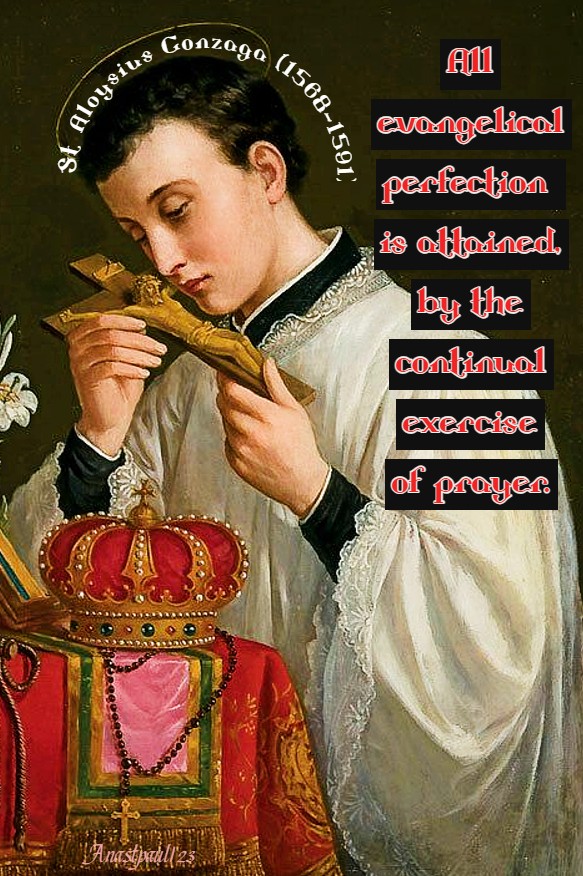
“All evangelical perfection is attained, by the continual exercise of prayer.”
St Aloysius Gonzaga SJ (1568-1591)
“As well as the corporal works, there are the spiritual works of mercy. Everyone is not obliged to undertake the former, that would be impossible, for instance, for the desitute, the sick, the aged. But, everyone is OBLIGED to undertake the latter. Sometimes a kind word is more valuable than money!” … Remember, however, that the practice of the spiritual works of mercy, does not excuse us from the exercise of material works of charity, wherever that is possible for us (Cf Js 2:16).
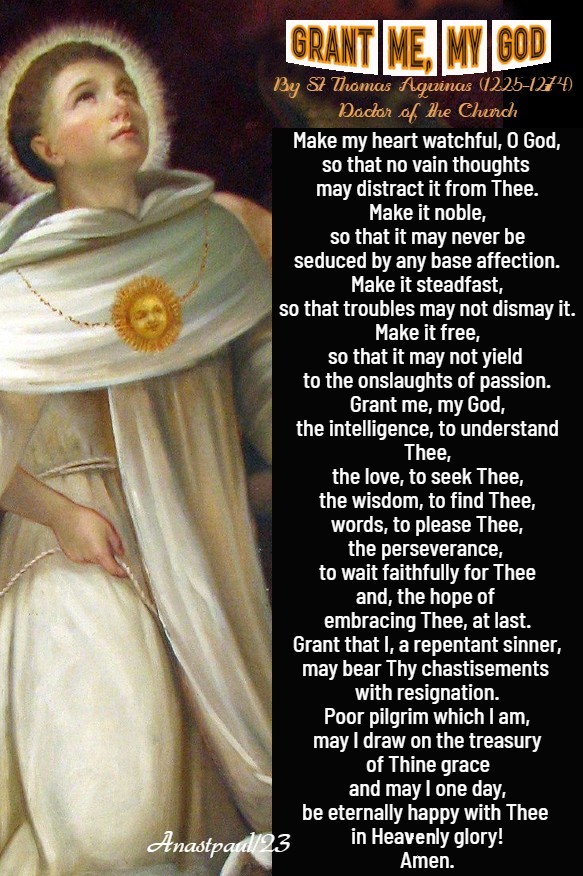
Grant Me, My God By St Thomas Aquinas (1225-1274) Angelic Doctor, Common Doctor
Make my heart watchful, O God, so that no vain thoughts may distract it from Thee. Make it noble, so that it may never be seduced by any base affection. Make it steadfast, so that troubles may not dismay it. Make it free, so that it may not yield to the onslaughts of passion. Grant me, my God, the intelligence, to understand Thee, the love, to seek Thee, the wisdom, to find Thee, words, to please Thee, the perseverance, to wait faithfully for Thee and, the hope of embracing Thee, at last. Grant that I, a repentant sinner, may bear Thy chastisements with resignation. Poor pilgrim which I am, may I draw on the treasury of Thine grace and may I one day, be eternally happy with Thee in Heavenly glory! Amen.
The Feast of the Holy Face of Jesus: In the 19th Century Jesus expressed His wishes to Sister Mary of St Peter (1816-1848), a Carmelite Nun in Tours, France, that there be an actual Devotion to his Holy Face. Our Lord wanted this in reparation for blasphemies against Him and His Holy Name as well, as for the profanation of Sunday (when people engage unnecessarily in commerce and other such labours and chores on Sunday, a day meant for rest and reflection on God). In August of 1843 He dictated to her the well-known Golden Arrow Prayer. He also gave her Promises for those who would honour His Holy Face. The first Holy Medal of the Holy Face was given to Ven Pope Pius XII, who approved the Devotion and the Medal. In 1958 he formally declared the Feast of the Holy Face of Jesus as Shrove Tuesday for all Catholics. https://anastpaul.com/2022/03/01/feast-of-the-holy-face/
Shrove Tuesday: Shrove is the past tense of the word Shrive, which means “to hear a confession, assign penance and absolve from sin.” In the Middle Ages, especially in Northern Europe and England, it became the custom to confess one’s sins on the day before Lent began in order to enter the penitential season in a repentant spirit.
St Catherine de Ricci OP (1522-1590) Virgin, Tertiary of the Order of Preachers, Mystic, Stigmatist, Ecstatic, Counsellor to many in both secular and spiritual matters, a highly admired Administrator and Advisor,blessed with many mystical charism including visions of Christ, both as a Baby and Adult, bilocation and miracles. Her body is incorrupt. A Mighty Handmaid: https://anastpaul.com/2022/02/13/saint-of-the-day-13-february-saint-catherine-de-ricci-op-1522-1590/
St Fusca of Ravenna St Gilbert of Meaux St Gosbert of Osnabruck St Guimérra of Carcassone St Huno
St Julian of Lyon St Lucinus of Angers St Marice St Martinian the Hermit St Maura of Ravenna St Modomnoc St Peter I of Vercelli St Stephen of Lyons St Stephen of Rieti (Died c590) Abbot
Our Lady of the Candles – Nuestra Señora de la Purificación y la Candelaria, is a Marian title and image venerated by Filipino Catholics. The image, which is enshrined on the balcony of Jaro Cathedral, is known as the Patroness of Jaro District of Iloilo City and the whole of the Western Visayas. The Feast Day of Our Lady of the Candles is on Candlemas (2 February) and is celebrated in Iloilo City with a Solemn Pontifical Mass presided by the Archbishop of Jaro.
St Adalbald of Ostrevant St Adeloga of Kitzingen St Agathodoros of Tyana St Apronian the Executioner Bl Bernard of Corbara St Bruno of Ebsdorf St Candidus the Martyr St Columbanus of Ghent St Cornelius the Centurion St Felician the Martyr St Feock St Firmus of Rome St Flosculus of Orléans St Fortunatus the Martyr St Hilarus the Martyr St Jeanne de Lestonnac (1556-1640) Widow, Mother, Founder
St Lawrence of Canterbury (Died 2 February 619) The Second Archbishop of Canterbury, the successor of St Augustine of Canterbury from 604 until his death in 619, but he was Consecrated as Archbishop by his predecessor, St Augustine, during Augustine’s lifetime, to ensure continuity in the office, Benedictine Monk, Missionary. He was a member of the Gregorian mission sent from Italy to England to Christianise the Anglo-Saxons. About St Lawrence: https://anastpaul.com/2022/02/02/saint-of-the-day-2-february-saint-lawrence-of-canterbury-died-619/
Quote/s of the Day – 23 January – St Raymond of Peñafort OP (1175-1275) Confessor, “Father of Canon Law”
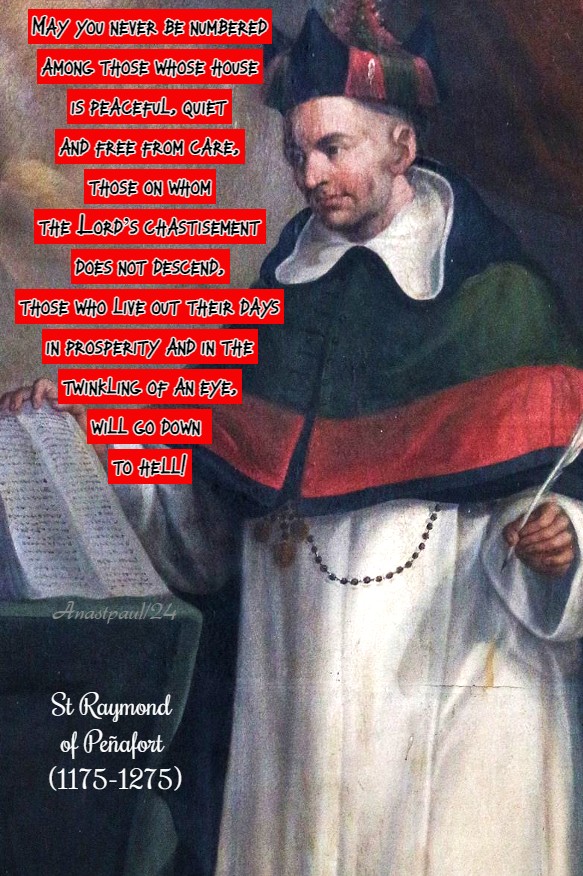
“May you never be numbered among those whose house is peaceful, quiet and free from care, those on whom the Lord’s chastisement does not descend, those who live out their days in prosperity and in the twinkling of an eye, will go down to hell!”
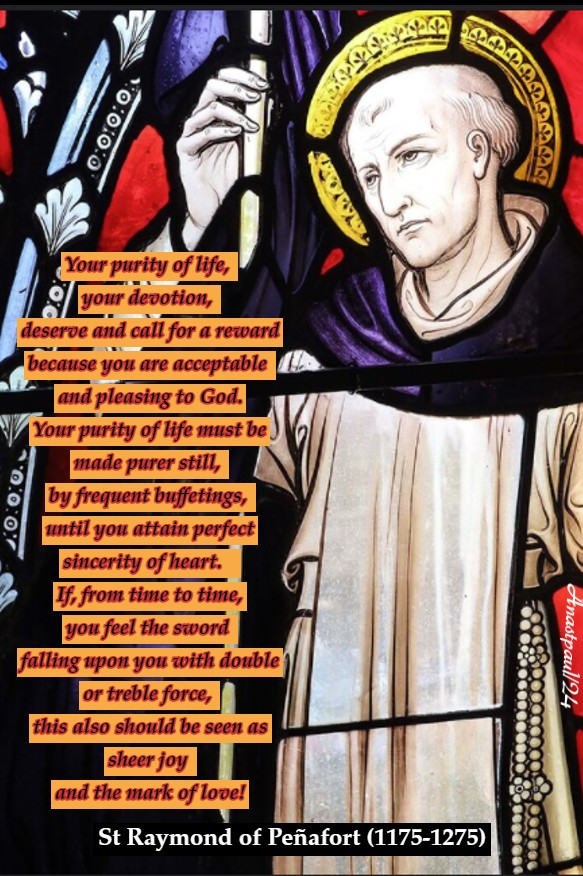
“Your purity of life, your devotion, deserve and call for a reward because you are acceptable and pleasing to God. Your purity of life must be made purer still, by frequent buffetings, until you attain perfect sincerity of heart. If, from time to time, you feel the sword falling upon you with double or treble force, this also should be seen as sheer joy and the mark of love!”
“Look then on Jesus, the Author and Preserver of faith — in complete sinlessness, He suffered and, at the hands of those who were His own and was numbered among the wicked. As you drink the cup of the Lord Jesus (how glorious it is!), give thanks to the Lord, the Giver of all blessings. May the God of love and peace set your hearts at rest and speed you on your journey; may He meanwhile, shelter you from disturbance by others in the hidden recesses of His Love, until He brings you, at last, into that place of complete plenitude, where you will repose forever in the vision of peace, in the security of trust and in the restful enjoyment of His riches. ”
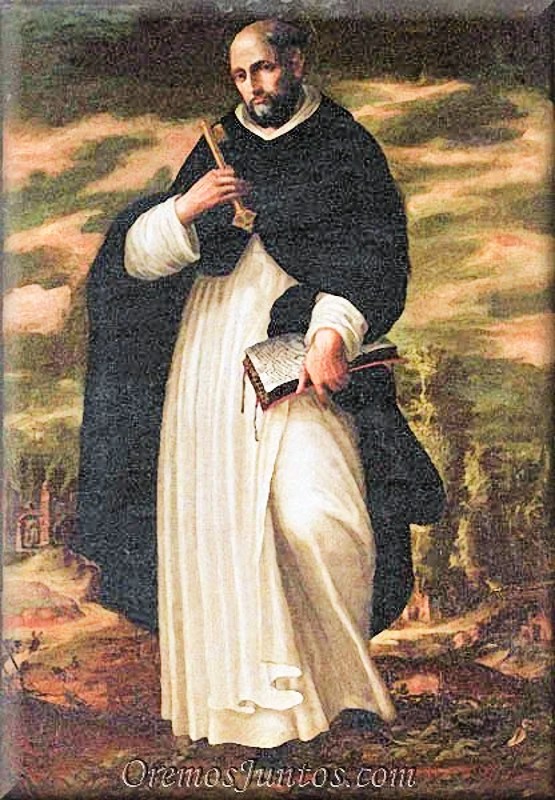
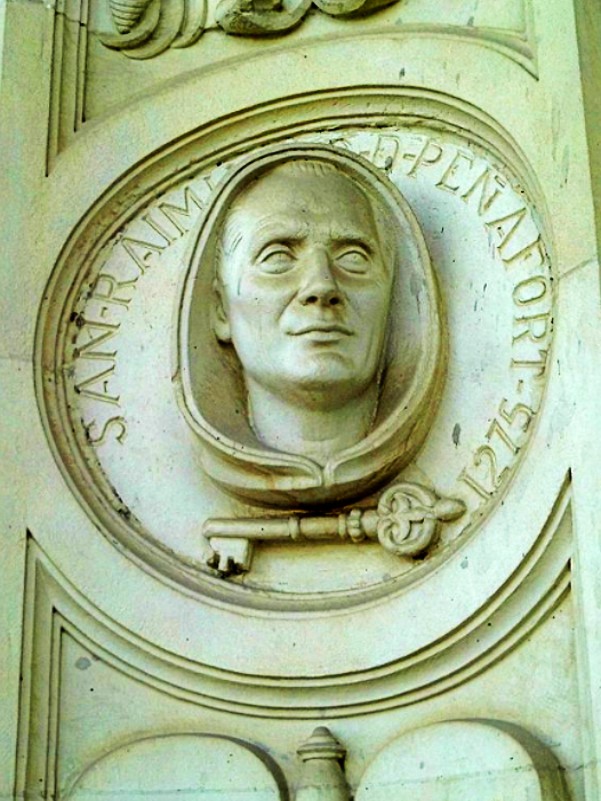
Saint of the Day – 23 January – St Raymond of Peñafort OP (1175-1275) Confessor, “Father of Canon Law” Dominican Priest, Co-Founder of the Mercedarian Friars with St Peter Nolasco, Miracle-Worker – born on 1175 at Peñafort, Catalonia, Spain and died on 6 January 1275 at Barcelona, Spain of natural causes. Raymond compiled the Decretals of St Gregory IX (Reign 1227-1241), a collection of Canonical Laws which remained a major part of Church Law until the 1917 Code of Canon Law abrogated it. Patronages – Lawyers, Canon Lawyers, Medical Record Librarians, Barcelona, Spain, Navarre, Spain. Also known as – Ramon de Penyafort, Raymond of Rochefort. … of Penyafort, Raymund. https://anastpaul.com/2019/01/07/saint-of-the-day-st-raymond-of-penafort-op-1175-1275-father-of-canon-law/
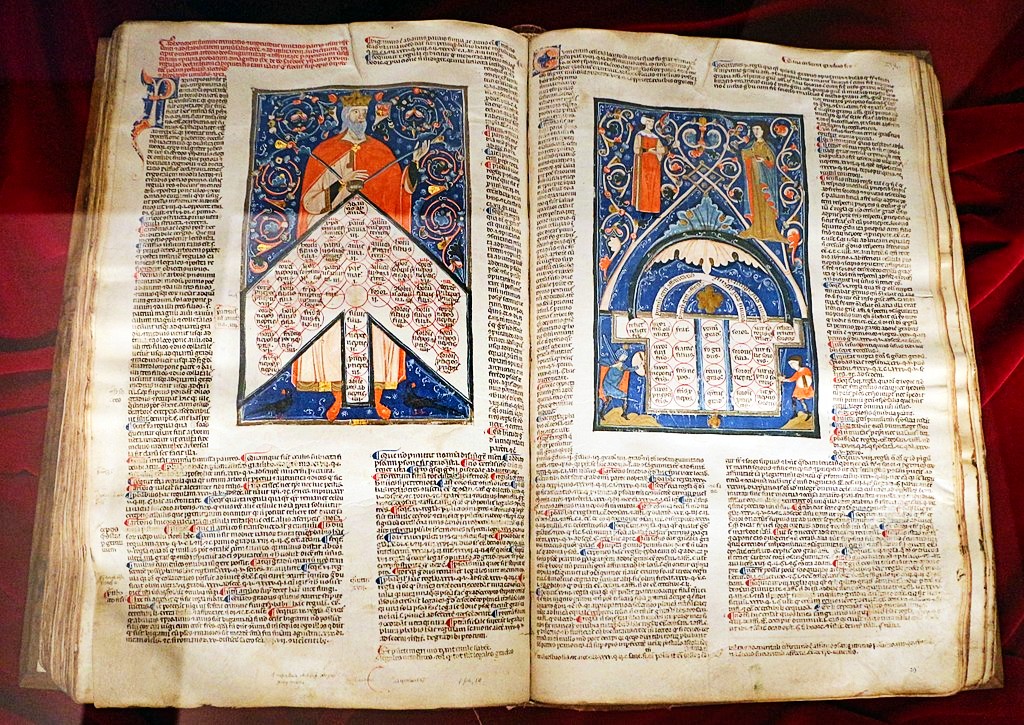
Decretals of St Gregory IX
St Raymond of Peñafort OP (1175-1275) By Fr Francis Xavier Weninger SJ (1805-1888)
“Raymond, sprung from the noble race of Peñafort, was born at Barcelona, in Catalonia, Spain, in the year 1175. Even in early childhood. his only delight was in prayer and study and, when but a mere youth, he was so advanced in learning, as to be deservedly appointed to instruct others. Subsequently, he devoted himself to Canon and Civil Law and soon excelled amongst the most celebrated Jurists of his time.
At Bologna he lectured publicly and gratuitously. At this time, Berengarius, Bishop of Barcelona, happening to pass through Bologna and hearing of Raymond’s wide-spread fame, persuaded him to return to his native land, where he first installed him as Canon, subsequently, however, as Provost. Nor did the Bishop hesitate to consult him in his most important affairs.
At the age of forty-four Raymond entered the Order of St Dominic, in which he soon acquired a great reputation for learning and piety. Pope Gregory IX, called him to Rome and chose him for his Spiritual Guide and Confessor, of which duties he acquitted himself with remarkable modesty and frankness. Observing that many poor people visited the Papal Palace, in whose fate no-one seemed to interest themself, Raymond imposed upon the Pope, as a penance, the duty of better providing for Christ’s poor. The Pope, who tells this anecdote himself, loved Raymond the more and valued him the more highly on this account, carefully regulating his manner of life, according to the instructions of the Saint.
As some reward for his many services, the Holy Father wished to appoint him to the Bishopric of Taragona but Raymond, steadfastly refused the proffered dignity, only begging to be dismissed from the Papal Court. In fact, his physicians had already decided that, if he wished to recover from a malady with which he was afflicted, he must seek his native air. Once more restored to his old home, he resumed his primitive fervour, in which he ever persevered. He wrote various instructions for the use of his neighbour, to whose eternal salvation he entirely devoted himself.
In the foundation of the Order for the Redemption of Captives, he took no little part; for he too, like St. Peter Nolasco, was admonished, in an apparition of Our Lady, to interest himself in its cause. He compiled Rules for those who wished to enter the Order, received St Peter as its first member, afterwards appointing him, with permission of the Holy See, its first General. In 1238, Raymond himself was elected the 3rd General but hastened, after three years, to resign, preferring the quiet of the cloister, devoted to prayer, the writing of edifying books and other such holy and useful occupations. He was looked upon by all, as a model of Christian perfection,but he excelled especially in a wonderful humility, an obliging condescension to the poor and a most childlike devotion to the Virgin Mother.
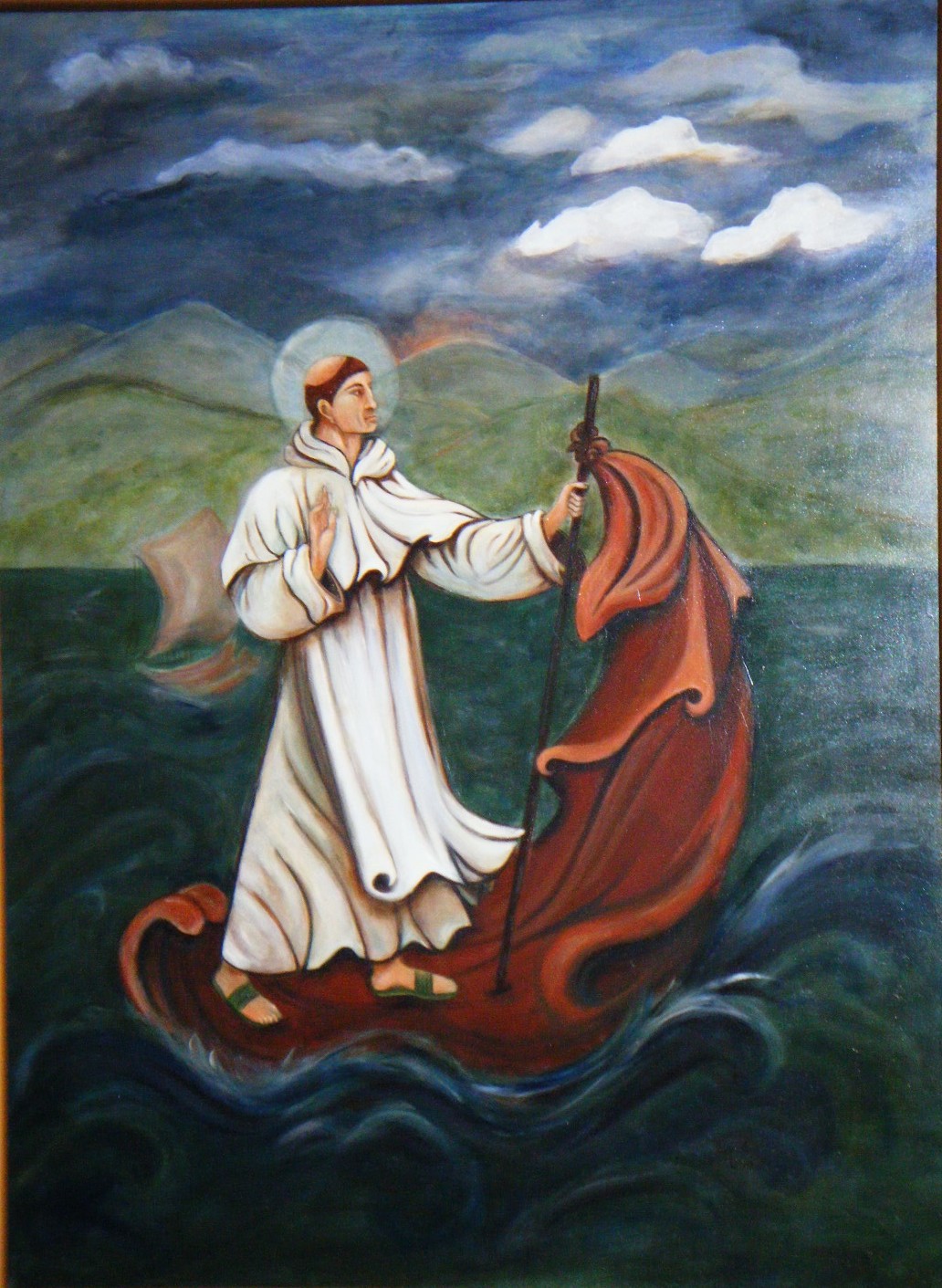
Many and remarkable are the miracles recorded of him but the following, which is the most known, may suffice here. James the First, King of Arragon, had chosen Raymond for his Confessor and desired him to favour him with his company on a journey to the Island of Majorca. But the King, incited by an unholy love for a certain woman, clandestinely conveyed her with him. Raymond had repeatedly and with holy zeal conjured the King to dismiss her and James had even promised to comply with the holy man’s request but upon their arrival at Majorca the Saint, soon perceiving that the King had broken his promise, went up to him and thus addressed him: “Your Majesty must either dismiss this person, or I shall be obliged to set sail for Barcelona to return to my cloister.” The King, growing angry at this reproof, gave strict orders that no-one should give passage to Raymond, should he wish to return to Spain. The holy man, unconscious of the intrigues of the King, hastened to the sea-coast, where a vessel lay ready to sail. He sought for admission in vain, the Officers showed him the Royal Mandate in Raymond’s regard.
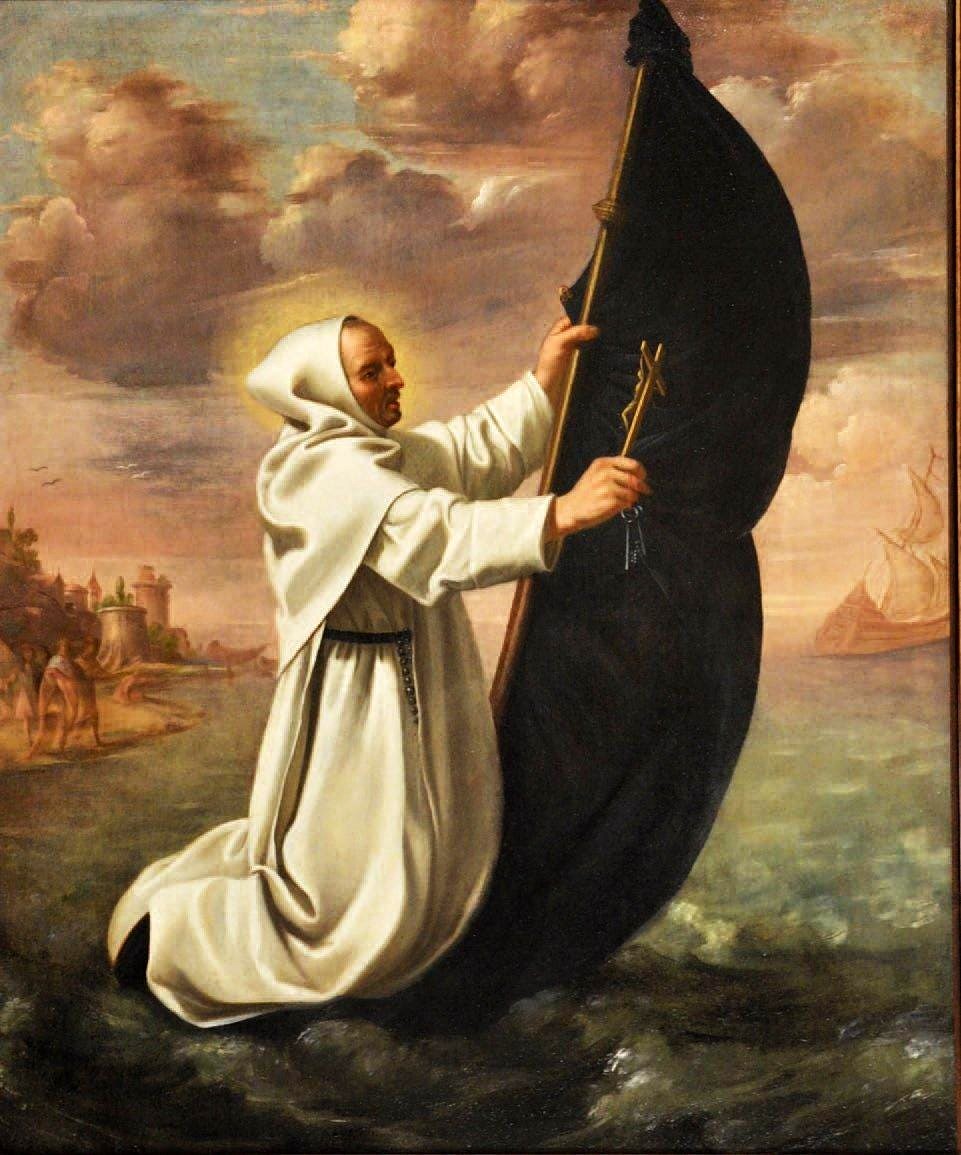
Full of confidence in God, the Saint stepped upon a huge rock which stretched far into the sea. After making the Sign of the Cross, he spread his cloak upon the water and mounted the same, as if it were a seaworthy vessel. In vain did he press a fellow-Religious to join him, who had followed him to the coast but who now stood stupefied at this manner of sailing. Raymond did not allow himself to be shaken in his purpose by the fright of his companion but, placing his staff upright on his cloak and gathering up the folds in front in the manner of a sail, he glided off, to the most profound astonishment of all present! He arrived safely in Barcelona within six hours after his departure, the distance being 160 miles. In the presence of a large concourse of people, he stepped ashore, and, throwing his perfectly dry cloak over his shoulders, he hurried to his Monastery.
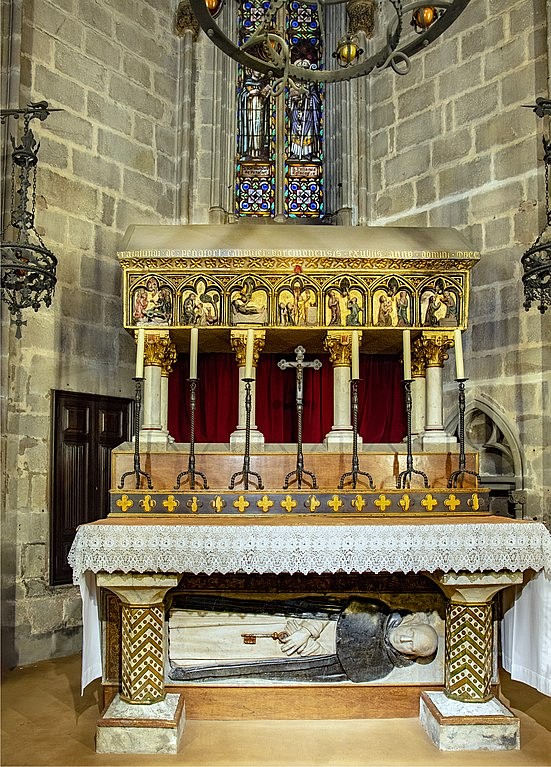
There, he lived for some time in great sanctity and, when he had almost reached his hundreth year, he slept quietly in the Lord, full of virtues and merits.” Below is St Raymon’d Tomb and Shrine in Barcelona Cathedral.
St Raymond of Peñafort OP (1175-1275) “Father of Canon Law” Dominican Priest, Doctor of Canon Law, the Third Master of the Order of Preachers, Founder of the Mercedarian friars, Writer, Teacher, Miracle-Worker. St Raymond of Peñafort’s Feast day was inserted in the General Roman Calendar in 1671 for celebration on 23 January. In 1969 it was moved to 7 January, the day after that of his death. He is the Patron Saint of canon lawyers, specifically and lawyers, in general. Biography: https://anastpaul.com/2019/01/07/saint-of-the-day-st-raymond-of-penafort-op-1175-1275-father-of-canon-law/
St Abel the Patriarch St Agathangelus St Amasius of Teano St Aquila the Martyr St Asclas of Antinoe St Clement of Ancyra St Colman of Lismore St Dositheus of Gaza
St Ildephonsus (506-667) Archbishop of Toledo. Theologian, Scholar, Marian devotee, Writer, Evangeliser. Abbot Dom Guéranger calls him the Doctor of the Virginity of Mary. Saint Ildephonsus established the Feast of the Expectation of the Blessed Virgin Mary, which is still kept in some places on 18 December. Biography: https://anastpaul.wordpress.com/2018/01/23/saint-of-the-day-23-january-st-ildephonsus-607-667/
Quote/s of the Day – 22 January – “The Month of the Most Holy Name of Jesus and of the Holy Family” – St Vincent of Saragossa (Died 304) Protomartyr of Spain and St Anastasius the Persian (Died 628) Martyr – Wisdom 3:1-8; Luke 21:9-19 – Scripture search here: https://www.drbo.org/
“And you shall be hated by all men, for My Name’s sake.”
Luke 21:17
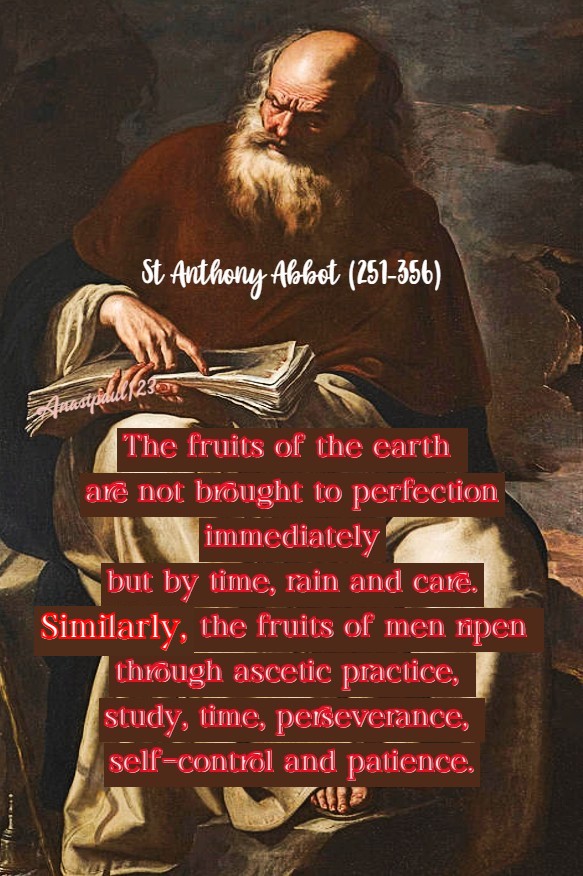
“The fruits of the earth are not brought to perfection immediately but by time, rain and care. Similarly, the fruits of men ripen through ascetic practice, study, time, perseverance, self-control and patience.”
St Anthony Abbot (251-356)
“Rejoice and be happy! Persevere to the end and prefer to die rather than abandon the post, to which God has called you!”
St Catherine of Siena (1347-1380) Doctor of the Church
“Love consists, not in feeling great things but, in having great detachment and in suffering for the Beloved.”
St John of the Cross (1542-1591) Doctor Mysticus
“Now, you must always persevere in firmly placing all your trust in our Lord, in the troublesome business you have in hand. It will give you a fine opportunity of laying a good foundation of submission to God’s will and peace of soul.”
St Francis de Sales (1567-1622) Doctor Caritatis
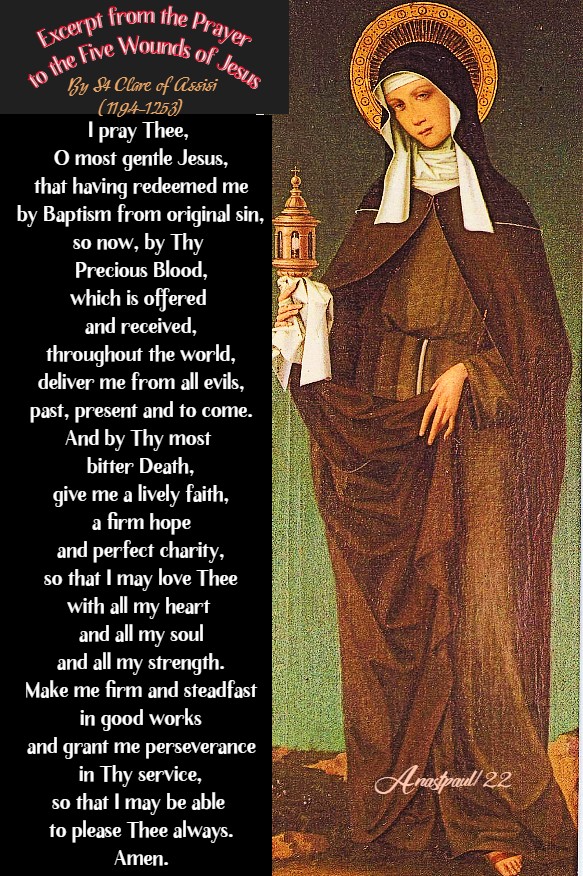
Excerpt from the Prayer to the Five Wounds of Jesus By St Clare of Assisi (1194-1253)
I pray Thee, O most gentle Jesus, that having redeemed me by Baptism from original sin, so now, by Thy Precious Blood, which is offered and received, throughout the world, deliver me from all evils, past, present and to come. And by Thy most bitter Death, give me a lively faith, a firm hope and perfect charity, so that I may love Thee with all my heart and all my soul and all my strength. Make me firm and steadfast in good works and grant me perseverance in Thy service, so that I may be able to please Thee always. Amen.
Saint of the Day – 22 January – Blessed Antonio della Chiesa OP (1394-1459) Priest and Friar of the Order of Preachers, the Dominican Order (Ordo Fratrum Praedicatorum – OP), Prior, Reformer. Antonio was a known Miracle worker and was able to read the consciences of all which gifts made him a sought-after Spiritual Counsellor. Antonio was a Mystic and had a special devotion to the Blessed Virgin Mary and he was known to have conversed with her several times, in ecstasy. Born in 1394 in San Germano Vercellese, in the region of Piedmont in northern Italy and died on 22 January 1459 in the Dominican Convent in Como, Lombardy, of natural causes, Also known as – Anthony of San Germano. Beatified on 15 May 1819 by Pope Pius VII. Additional Memorial – 28 July in his Hometown of San Germano Vercellese, the date his Relics were translated to the Parish Church there.
Antonio belonged to the noble and illustrious Piedmontese family of the Marquis della Chiesa and, via a connexted line, he was an ancestor of Pope Benedict XV (Reign 1914-1922) (Giacomo Giovanni della Chiesa).
He received a good education and early in life he showed pious traits. He grew up hoping to become a Monk but his father, who was a man of some importance, opposed this. In 1417, as a twenty-year-old, he nevertheless, joined the Dominican Order in Vercelli, despite his family’s protests.
He became known as a popular and effective Preacher, particularly against usurious interest. He also became a sought-after Confessor. He accompanied Saint Bernardine of Siena on a range of missions and served in various capacities in the Dominican Monasteries. Among those positions was that of the Prior and he served at the Friaries of Como and Florence, as well as in Savona and Bologna.
In Como, he reformed the life and morals of the entire Town and following this success Antonio was sent to govern other Convents. It was at these Convents that he insisted on a rigorous observance to their Rule of Life according to Saint Dominic. He is remembered as a kind Prior who had mercy on sinners and, at the same time, was firm with them that they may amend their ways.
Antonius was also one of the leaders in opposition to the last antipope, Felix V, who troubled the Church from 1440 until 1449. Felix V had a large support network stemming from Switzerland and Antonio vigourously opposed his work. He succeeded in winning over a large number of the antipope’s adherents to the lawful power of the recognised Pontiff, Pope Eugene IV and later Pope Nicholas V.
While on a trip from Savona to Genoa, he was captured by pirates but he was released unharmed. He had been apprehended with a fellow Friar and the pirates released the pair, after being so impressed with their gentle and kind demeanour.
Antoniuo, worn out by activity and penance, he died at the age of 65 having poredicted the date of his death, on 22 January 1459 in Como while he was Prior there. He was buried in the Dominican Church in the City and many miracles happened at his grave. On 28 July 1810 his Relics were translater to the Parish Church of San Germano Vercellese, his birth Town. He was Beatified on 15 May 1819 when his cult was confirmed by Pope Pius VII (1800-1823).
St Anastasius the Persian (Died 628) Martyr, Monk. The Roman Martyrology reads: “At Rome, at Aquiae, Salviae, St Anastasius, a Persian Monk, who, after suffering much at Caesarea in Palestine, from imprisonment, stripes and fetters, had to bear many afflictions from Chosroes, King of Persia, who caused him to be beheaded. He had sent before him, to Martyrdom, seventy of his companions, who were precipitated into rivers. His head was brought to Rome, together with his venerable likeness, by the sight of which, the demons are expelled and diseases cured, as is attested by the Acts of the Second Council of Nicacea.” His Life and Death: https://anastpaul.com/2023/01/22/saint-of-the-day-21-january-st-anastasius-the-persian-died-628-martyr-monk/
Blessed Antonio della Chiesa OP (1394-1459) Priest and Friar of the Order of Preachers St Blaesilla of Rome St Brithwald of Ramsbury St Caterina Volpicelli St Dominic of Sora St Guadentius of Novara
Blessed Maria Mancini of Pisa OP (1356-1431) Widow, Second Order Sister of the Order of Preachers, spiritual disciple of St Catherine of Siena, Prioress, Mystic, Reformer, Apostle of the poor and the sick. The Roman Martyrology states: “In Pisa, Blessed Maria Mancini, who, twice widowed and all her children lost, under the exhortation of St Catherine of Siena, began community life in the Monastery of St Domenic, which she led for ten years.” Her Life: https://anastpaul.com/2022/01/22/saint-of-the-day-22-january-blessed-maria-mancini-of-pisa-op-1356-1431/
Bl Walter of Himmerode Bl William Patenson
Martyrs of Puigcerda: St Orontius St Victor St Vincent
Quote/s of the Day – 19 January – “The Month of the Most Holy Name of Jesus and of the Holy Family” – St Marius and Family of Persia, (Died c 270) Martyrs – Hebrews 10:32-38, Matthew 24:3-13 – Scripture search here: https://www.drbo.org/
“Tell us when shall these things be? and what shall be the sign of Thy Coming and of the consummation of the world? ”
Matthew 24:3
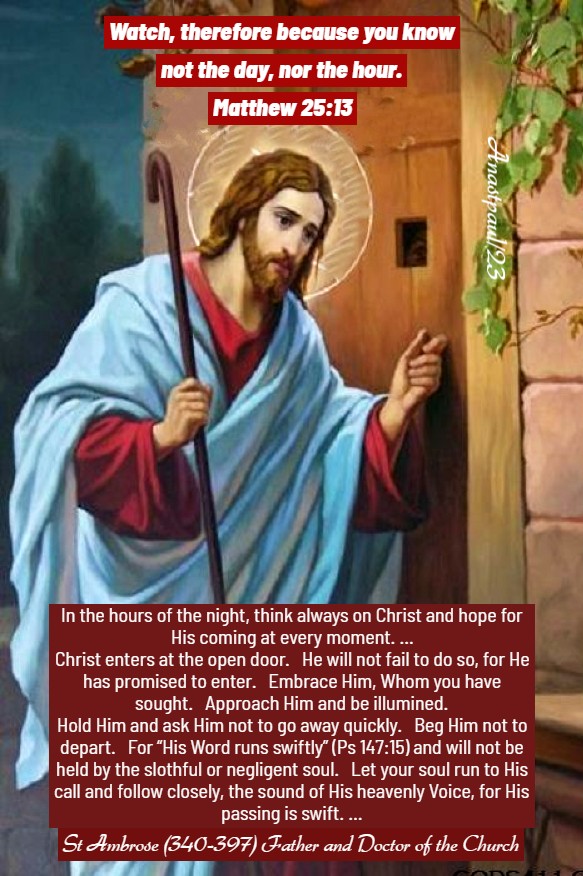
“Watch, therefore because you know not the day, nor the hour.” Matthew 25:13
“ In the hours of the night, think always on Christ and hope for His coming at every moment. … Christ enters at the open door. He will not fail to do so, for He has promised to enter. Embrace Him, Whom you have sought. Approach Him and be illumined. Hold Him and ask Him not to go away quickly. Beg Him not to depart. For “His Word runs swiftly” (Ps 147:15) and will not be held by the slothful or negligent soul. Let your soul run to His call and follow closely, the sound of His heavenly Voice, for His passing is swift. …”
St Ambrose (340-397) Father and Doctor of the Church
“… In fact, according to the merit and fervour of each one, there is a frequent and familiar advent of the Lord that, in this intermediary period, between His First and Last Coming, models us on one and prepares us to the other. The Lord comes to us now, so that His First Coming to us, may not be in vain and that the Last One, may not be that of wrath. Through His Present Coming, in fact, He works at reforming our pride, in the image of the humility of His first advent, to then remodel our humble body, in the image of the glorified body He will show us, when He will return. This is why we should desire and fervently ask this personal coming – which gives us the grace of this first advent and promises us the glory of the last. …”
Bl Guerric of Igny (c1080-1157) Cistercian Abbot
(2nd sermon for Advent, 2-4)
Grant Me, My God By St Thomas Aquinas (1225-1274) Angelic Doctor, Common Doctor
Make my heart watchful, O God, so that no vain thoughts may distract it from Thee. Make it noble, so that it may never be seduced by any base affection. Make it steadfast, so that troubles may not dismay it. Make it free, so that it may not yield to the onslaughts of passion. Grant me, my God, the intelligence, to understand Thee, the love, to seek Thee, the wisdom, to find Thee, words, to please Thee, the perseverance, to wait faithfully for Thee and, the hope of embracing Thee, at last. Grant that I, a repentant sinner, may bear Thy chastisements with resignation. Poor pilgrim which I am, may I draw on the treasury of Thine grace and may I one day, be eternally happy with Thee in Heavnely glory! Amen.
Feast of the Chair of the Apostle, St Peter at Rome: This Feast was instituted to commemorate the establishment of the Holy See at Rome. In 1960, Pope John XXIII removed from the General Roman Calendar, the 18 January Feast of the Chair of Peter at Rome. Two Liturgical Feasts were celebrated in Rome, in Honour of Chairs of Saint Peter, one of which was kept in the Baptismal Chapel of St Peter’s Basilica, the other at the Catacomb of Priscilla. The dates of these celebrations are 18 January and 22 February. The two Feasts were included in the Tridentine Calendar with the rank of Double which, in 1604, Pope Clement VIII raised to the rank of Greater Double. Those traditional Catholics. who do not accept the changes made by Pope John XXIII, continue to celebrate both Feast days: “Saint Peter’s Chair at Rome” on 18 January and the “Chair of Saint Peter at Antioch” on 22 February. https://anastpaul.com/2017/02/22/feast-of-the-chair-of-st-peter-22-february/
Blessed Beatrix d’Este the Younger (c 1230-1262) French Benedictine Nun, Founded a Convent. Beatified in 1774 by Pope Clement XIV. Her memorial date was decreed by Pope Pius VI for today. The Roman Martyrology states: “In Ferrara, Blessed Beatrice d’Este, Nun, who, on the death of her future husband, having renounced the kingdom of this world, consecrated herself to God in a Monastery founded by herself under the rule of Saint Benedict.” Her Life: https://anastpaul.com/2023/01/18/saint-of-the-day-18-january-blessed-beatrix-deste-the-younger-c-1230-1262/
St Catus
Blessed Cristina Ciccarelli OSA (1481–1543) Religious of the Order of Saint Augustine, Mystic, Stigmatist, Apostle of the poor, Reformer, she had a had a particular devotion to the Eucharist and to the Passion and Death of Christ, she was granted the gift of Prophecy, visions and levitation. Beatified in 1841 by Pope Gregory XVI . About Bl Cristina: https://anastpaul.com/2020/01/18/saint-of-the-day-18-january-blessed-cristina-ciccarelli-osa-1481-1543/
St Day/Dye St Deicola of Lure Bl Fazzio of Verona St Leobardus of Tours St Moseus of Astas St Ulfrid of Sverige St Volusian of Tours (Died 496) Bishop





































 AnaStpaul
You must be logged in to post a comment.