St Acepsimas St Acheric of Vosges Bl Alphais of Cudot Bl Berardo dei Marsi Bl Berchtold of Engelberg St Caesarius St Cecilio Manrique Arnáiz St Clydog St Cristiolus St Domnus of Vienne St Elerius St Englatius St Florus of Lodeve St Francisco Colom González St Gaudiosus of Tarazona St Germanus St Guenhael St Hermengaudius of Urgell St Hilary of Viterbo
St Papulus St Pirmin St Quartus St Rumwold of Buckingham Blessed Simon Ballachi OP (c 1210-1319) Lay Brother of the Order of Preachers, Mystic. St Sylvia of Rome St Theophilus St Valentine of Viterbo St Valentinian St Vitalis St William of Vosges St Winifred of Wales St Wulganus
Innumerable Martyrs of Saragossa: A large group of Christians martyred in Zaragoza, Spain by Dacian during the persecutions of Diocletian. Dacian ordered all Christians of the city into exile under pain of death; when they were assembled to leave, Dacian ordered imperial soldiers to massacre the lot of them. They were Martyred in 304.
Quote/s of the Day – 31 October – “The Month of the Most Holy Rosary and of the Angels” – Goodbye October
“Mary, thou art the vessel and tabernacle containing all Mysteries. Thou knows that, which the Patriarchs, never knew, thou hast experienced that, which was never revealed to the Angels, thou has heard that, which the Prophets never heard. In a word, all that was hidden from preceding generations, was made known to thee, even more, most of these wonders, depended on thee!”
St Gregory theWonderworker (c 213–270)
The Fifteen Promises is a tradition held by the Order of Preachers, that the Blessed Virgin Mary made Fifteen specific Promises through Saint Dominic (1170-1221)and Blessed Alain de la Roche (1428-1475), to those who faithfully pray the Rosary.
The 15 Promises of The Most Holy Rosary Given by The Blessed Virgin Mary
Those who faithfully serve me, by the recitation of the Rosary shall receive signal graces.
I promise my special protection and the greatest graces, to all those who shall recite the Rosary.
The Rosary shall be a powerful armour against hell. It will destroy vice, decrease sin and defeat heresies.
It will cause virtue and good works to flourish. It will obtain for souls the abundant mercy of God. It will withdraw the hearts of men from the love of the world and its vanities and will lift them to the desire of eternal things. Oh, that souls would sanctify themselves by this means.
The soul which recommends itself to me by the recitation of the Rosary, shall not perish.
Whoever shall recite my Rosary devoutly, applying himself to the consideration of its Sacred Mysteries, shall never be conquered and never overwhelmed by misfortune. God shall not chastise him in His justice, he shall not perish by an unprovided death Sinners shall convert. The just shall grow in grace and become worthy of eternal life.
Whoever shall have a true devotion to the Holy Rosary, shall not die without the Sacraments of the Church.
Those who are faithful, in reciting the Rosary, shall have, during their life and at their death, the Light of God and the plenitude of His graces. At the moment of death, they shall participate in the merits of the Saints in paradise.
I shall deliver from Purgatory, those who have been devoted to the Rosary.
The faithful children of the Rosary, shall merit a high degree of glory in Heaven.
You shall obtain all you ask of me, by the recitation of the Rosary.
All those who propagate the Holy Rosary, shall be aided by me, in their necessities.
I have obtained from my Divine Son, that all the advocates of the Rosary, shall have for intercessors, the entire Celestial Court during their life and at the hour of death.
All who recite the Rosary are my sons and brothers of my only Son, Jesus Christ.
Devotion to my Rosary is a great sign of predestination.
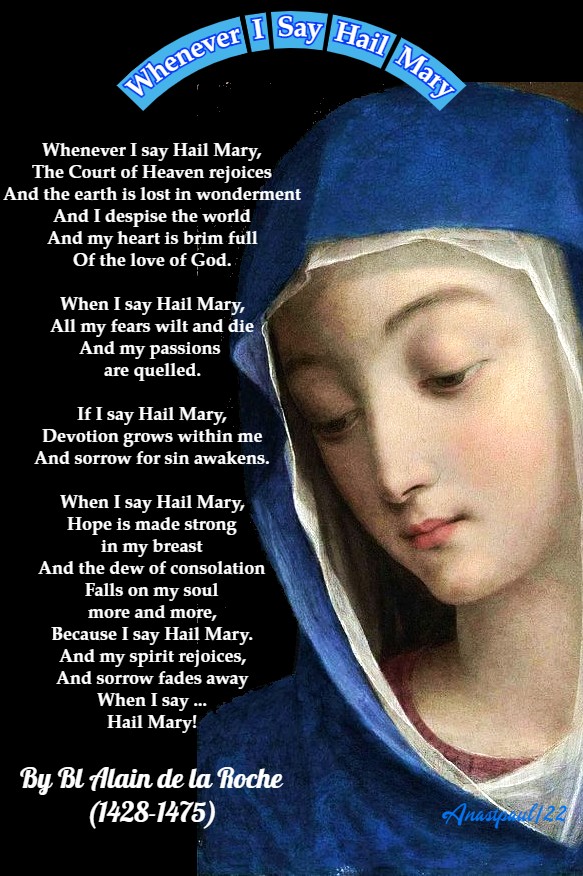
Whenever I Say Hail Mary Blessed Alain de la Roche (1428-1475)
Whenever I say Hail Mary, The Court of Heaven rejoices And the earth is lost in wonderment And I despise the world And my heart is brim full Of the love of God.
When I say Hail Mary, All my fears wilt and die And my passions are quelled.
If I say Hail Mary, Devotion grows within me And sorrow for sin awakens.
When I say Hail Mary, Hope is made strong in my breast And the dew of consolation Falls on my soul more and more, Because I say Hail Mary. And my spirit rejoices, And sorrow fades away When I say … Hail Mary!
Quote/s of the Day – 25 October – Saints Chrysanthus and Daria Died c 282) Martyrs, Married Couple
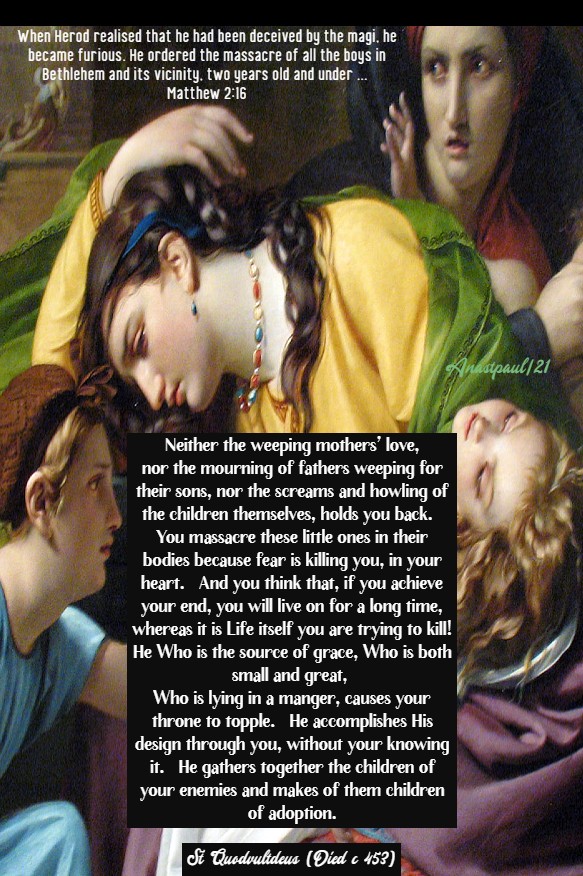
“Neither the weeping mothers’ love, nor the mourning of fathers weeping for their sons, nor the screams and howling of the children themselves, holds you back. You massacre these little ones in their bodies because fear is killing you, in your heart. And you think that, if you achieve your end, you will live on for a long time, whereas, it is Life itself, you are trying to kill! He Who is the source of grace, Who is both small and great, Who is lying in a manger, causes your throne to topple. He accomplishes His design through you, without your knowing it. He gathers together the children of your enemies and makes of them, children of adoption.”
St Quodvultdeus (Died c 453) Father of the Church, Bishop of Carthage
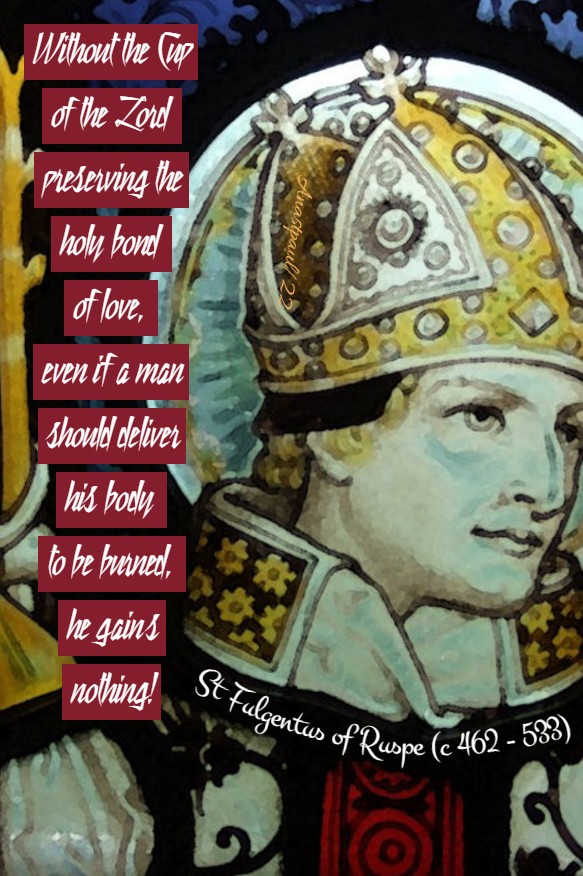
“Without the Cup of the Lord preserving the holy bond of love, even if a man should deliver his body to be burned, he gains nothing!”
St Fulgentus of Ruspe (c 462 – 533)
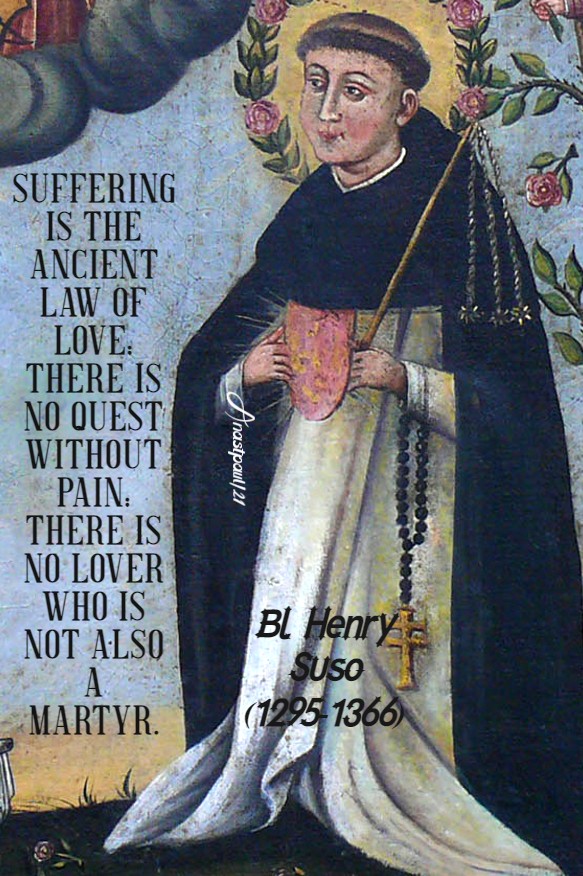
“Suffering is the ancient law of love; there is no quest without pain; there is no lover who is not also a Martyr.”
Bl Henry Suso (1295-1366)
“We should not forget, that the devil has his martyrs and that he infuses into them a false constancy. It is not the punishment but the cause, that makes the Martyr; that is – the confession of the True Faith.”
Quote/s of the Day – 22 October – Mary’s Day – Luke 11:27-28
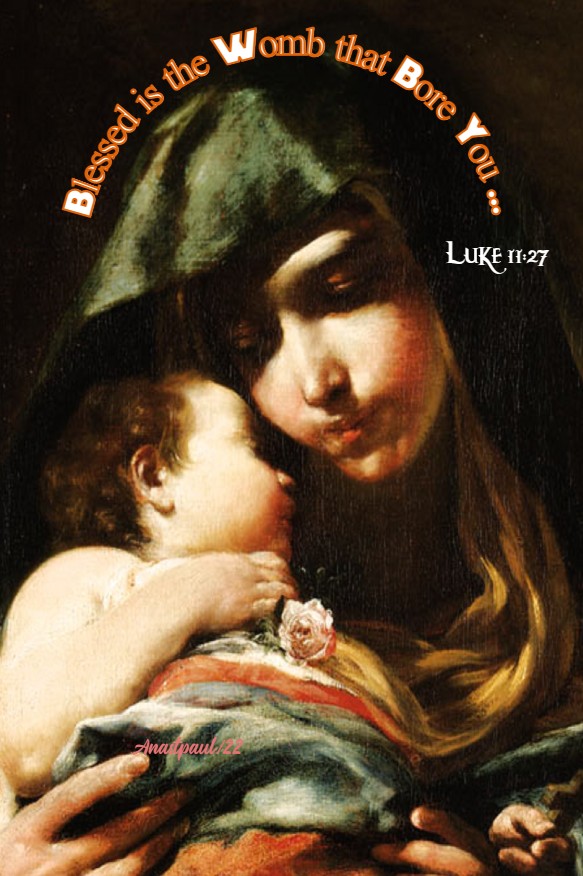
“Blessed is the womb that bore You …”
Luke 11:27
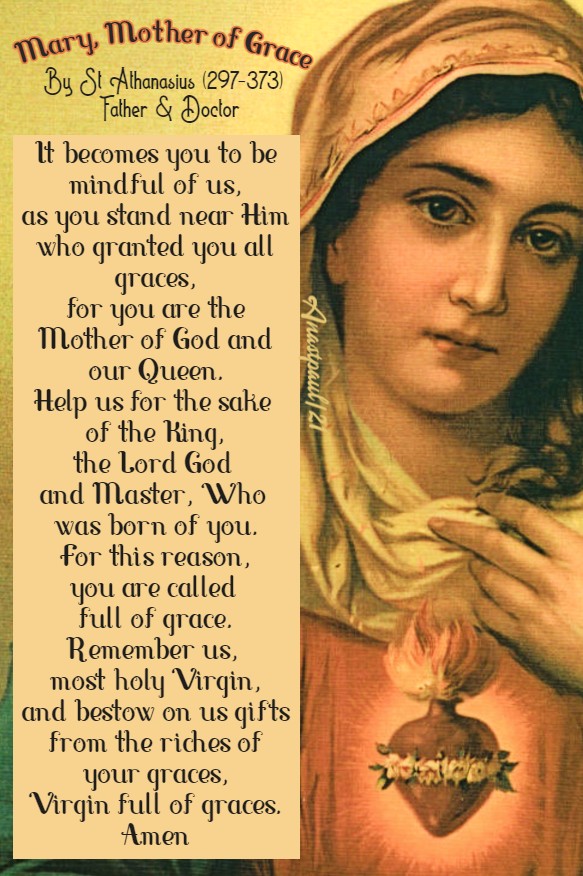
Mary, Mother of Grace St Athanasius (297-373) Father & Doctor of the Church
It becomes you to be mindful of us, as you stand near Him who granted you all graces, for you are the Mother of God and our Queen. Help us for the sake of the King, the Lord God and Master, Who was born of you. For this reason, you are called full of grace. Remember us, most holy Virgin, and bestow on us gifts from the riches of your graces, Virgin full of graces. Amen
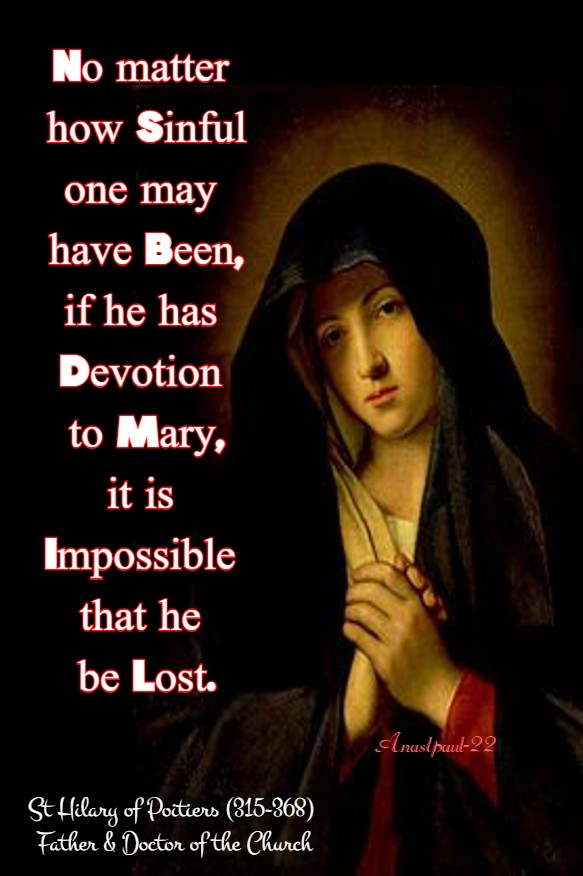
“No matter how sinful one may have been, if he has devotion to Mary, it is impossible that he be lost.”
St Hilary of Poitiers (315-368) Father & Doctor of the Church
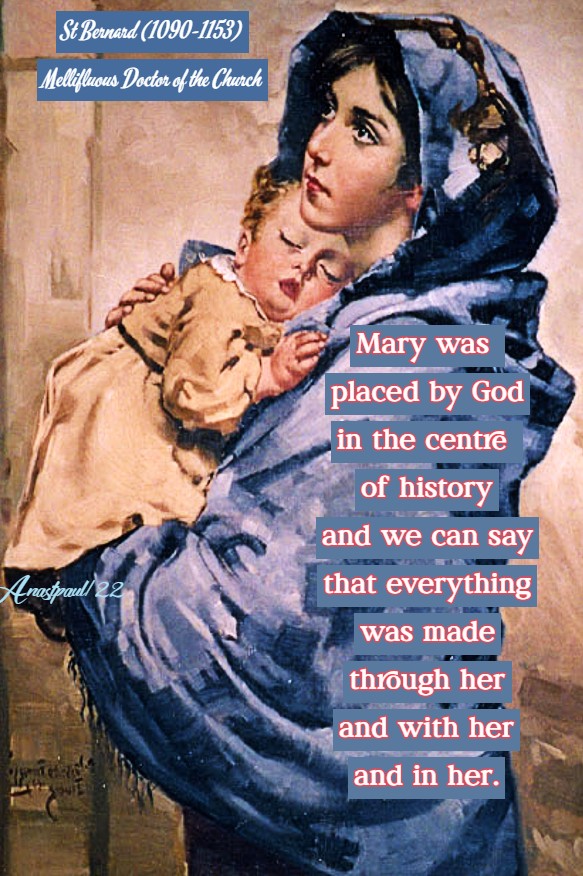
“Mary was placed by God in the centre of history and we can say that everything was made through her and with her and in her.”
“O great, O gentle, O most lovable Mary, thy Holy Name cannot be spoken without inflaming the heart. To those who love thee, it is unspeakable consolation and joy even to think of thee; thou art a sweet memory to those who honour thee.”
St Bernard (1090-1153) Mellifluous Doctor of the Church
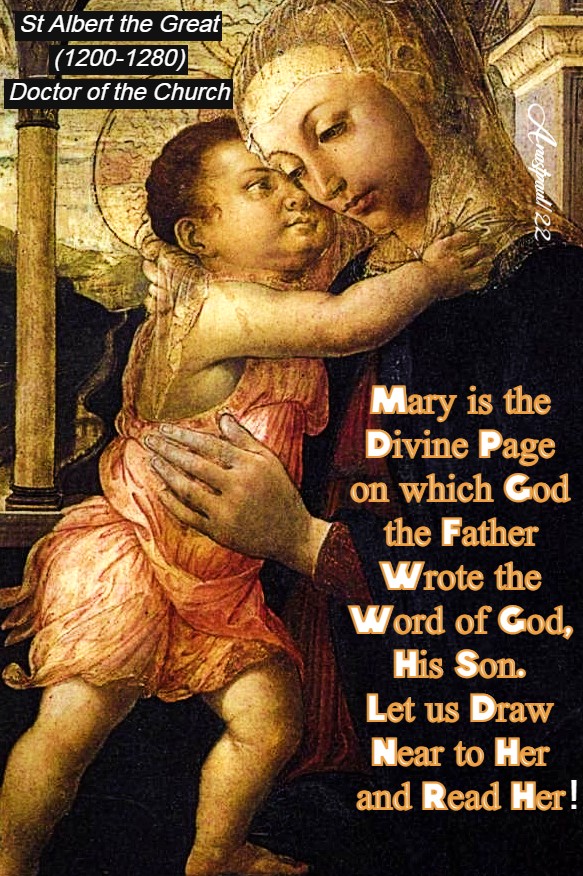
“Mary is the divine Page on which God the Father wrote the Word of God, His Son. Let us draw near to her and read her!”
St Albert the Great (1200-1280) Doctor of the Church
“No-one who shall invoke this Mother of Grace, with devotion and perseverance, can possibly perish forever.”
St John Eudes (1601-1680) “The Apostle of Two Hearts”
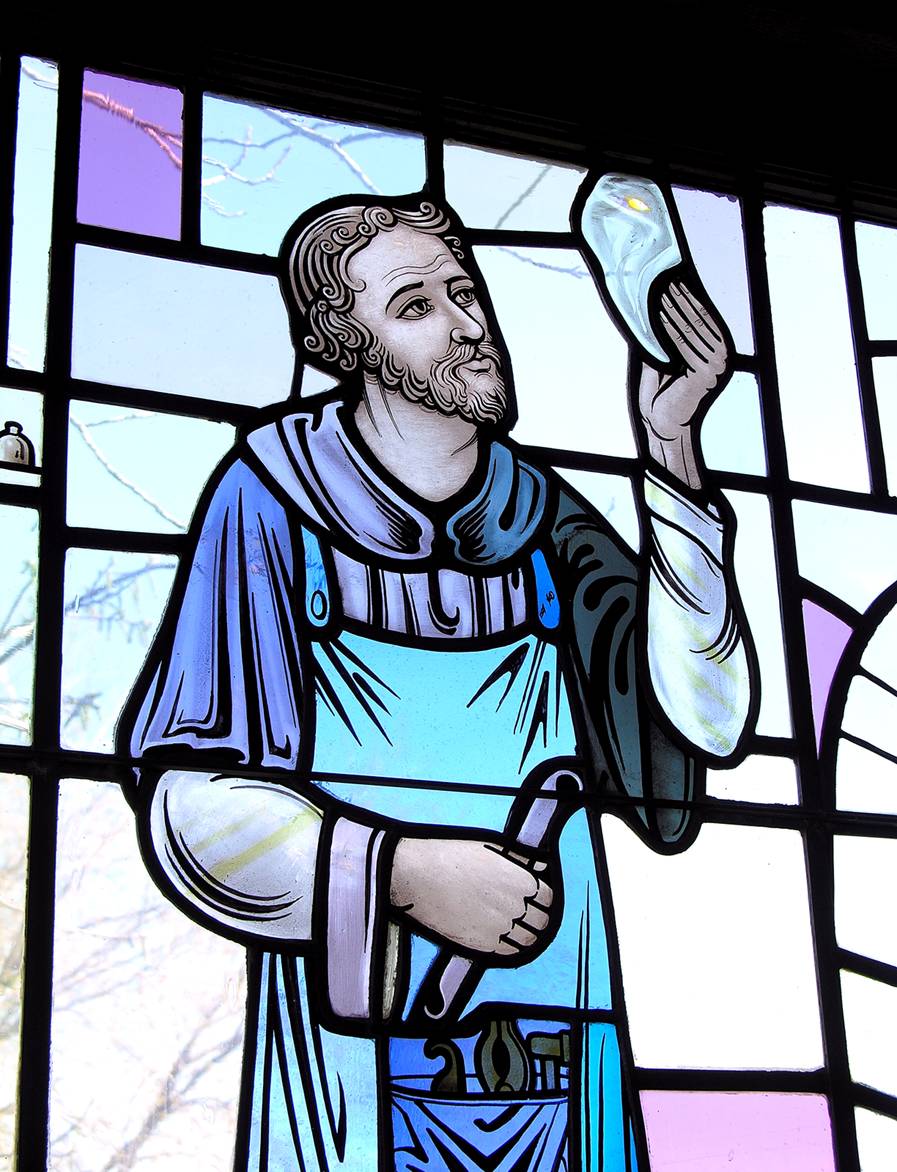
Saint of the Day – 11 October – Blessed James Grissinger OP (c 1407-1491) “The Innocent,” Lay Brother of the Order of Preachers, Artist of Religous imagery, especially stained glass, former Soldier. Born in 1407 at Ulm, Swabia (modern Germany) and died on 11 October 1491, aged 84, in Bologna, Italy of natural causes. Also known as – James Griesinger, James of Ulm.
The Roman Martyrology reads: “In Bologna, blessed Giacomo da Ulm Grissinger, a religious of the Order of Preachers, who, although unlearned, he was a skilled decorator of stained glass windows and for fifty years, offered everyone an example of dedication to work and prayer.”
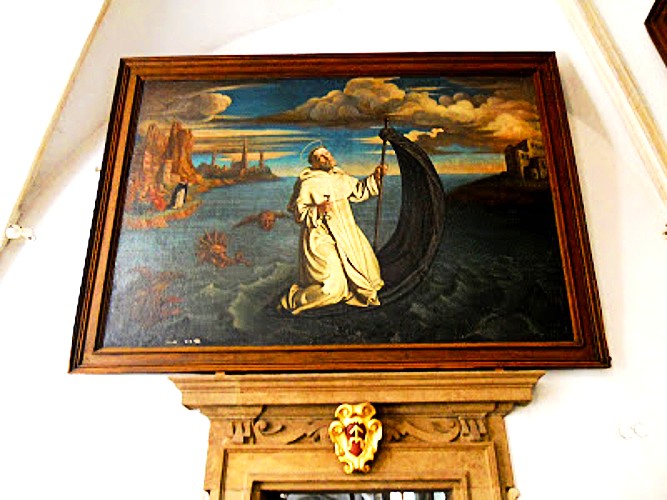
James, born in Ulm in 1407, had since childhood in his family, the Grissingers, the most precious examples of Christian piety. After a period as a Soldier, being unhappy in that life, at 25 years of age, with the blessing of his parents, from the banks of the Danube, he set out as a pilgrim to Rome to venerate the tombs of the Holy Apostles.
After various wanderings, he passed through Bologna, where he stopped for some time. His favourite destination was the tomb of St Domenic and here, during his devoted visits, he felt a strong inspiration to embrace the Order.
Although he was not completely uneducated, he asked and obtained, in 1441, to be admitted among the lay brothers. Candid and sensitive soul, he understood and knew how to fully implement his holy vocation.
His prayer touched ecstasy and he was often seen surrounded by light But although his heart was foreign to the earth, his hands were always ready to work and to render any humble service with that amiable smile that opens hearts. He was skilled in the art of painting glass, so much so that excellent works remain in remembrance of him. for the benefit of souls.
It is said that one day, while he supervised the firing of some painted glass, the Prior commanded him to go in search of alms. The Blessed one, without opening his mouth, went to fulfill the task in holy obedience. On his return, instead of finding the glass incinerated, as was to be expected, he found them cooked to the right point, by the Divine intercession at which he marvelled in thanksgiving.
He always kept his Baptismal innocence and, having expired his blessed soul, on 11 October 1491, his candour seemed to be communicated also to his body, which shone with celestial light.
On 3 August 1825, Pope Leo XII confirmed his cult. His relics, are preserved in St Domeni’s Basilica in Bologna,
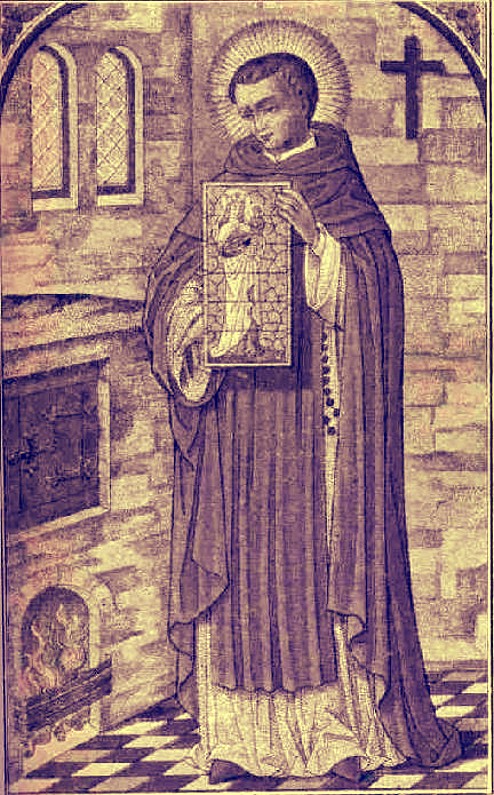
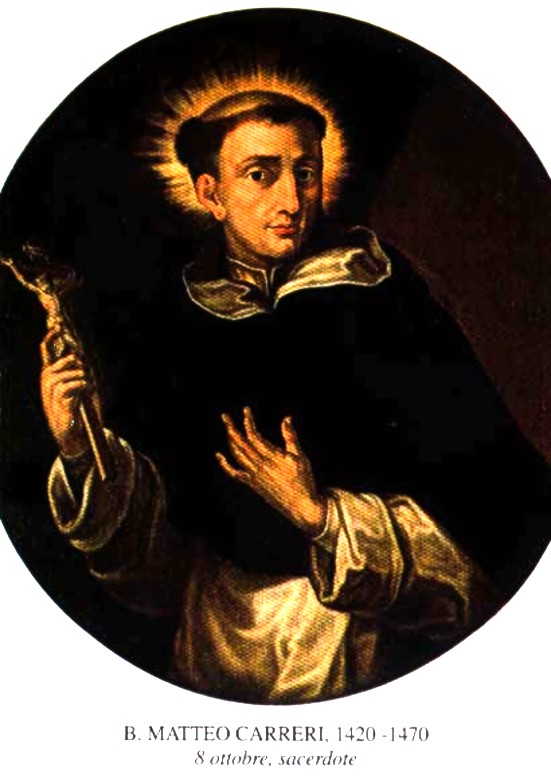
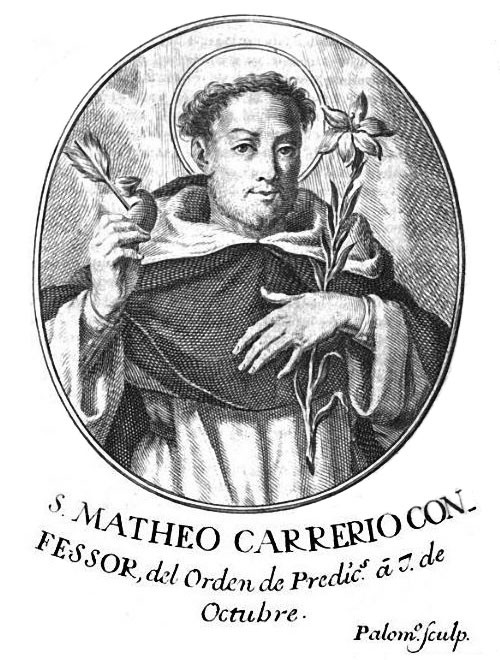
Saint of the Day – 5 October – Blessed Matthew Carreri OP (c 1420-1470) Priest and Friar of the Order of Preachers, Stigmatic, Mystic, Reformer, renowned Preacher. Born Giovanni Francesco Carrieri in the City of Mantua, Italy some time around 1420 and died on 5 October 1470 at Vigevano, Province of Pavia, Italy of natural causes. Patronage – Vigevano, Italy. Also known as – Matthew of Mantua, Matteo Carreri. Additional Memorial – 7 October on some calendars.
Giovanni Francesco grew up a silent and prayerful child, a good student and a great reader. These qualities seemed to recommend him to the Preaching Friars and at an early age, he presented himself at the Convent in his home City and received the Habit. He took the name Matthew when he entered the Dominican Order. His later success as a preacher was inarguably, attributable, to the significant time he spent in spiritual exercises and meditation
Matthews’s career as a preacher began soon after his Ordination, when he was sent to Lombardy to preach against the heretics. He succeeded admirably in his preaching and converted many to a spiritual way of life. Travelling from Convent to Convent, he preached a revival of fervour and a deeper understanding of the spirit of St Dominic, and many of the religious of Lombardy-both Dominicans and members of other Orders,were led by him to renew their devotion and fervour..
At on time, when he was preaching in Vigevano, a troupe of jugglers came into Town and set up their act. They were a particularly scandalous set of people, poking ridicule at the religious and the pope. Matthew sent them word to move on, which they ignored. So he went after them with his walking-stick and this proved more effective. They scattered and ran but soon came back, fortified with the presence of the Duke of Milan, who scolded Matthew for being so narrow-minded and humourless. Matthew patiently pointed out to him, the unhealthy and evil areas in their humour and, in spite of the Duke’s natural aversion to Friars, convinced him that he should keep the jugglers out of Town.
At Lucina, there was a lady of noble birth and great talents, who was wasting her time in frivolities. Never one to avoid an issue, Matthew aimed a powerful sermon in her direction and she came to him afterwards ,in a torrent of tears and begged him to help her. He gave her the Habit of the Third Order and outlined a stiff rule of life, which she afterwards faithfully followed.
He also met and directed Blessed Stephanie Quinzan who proved to be an apt pupil.
Matthew was given the task of reforming the Convents of the Dominican Friars in Soncino and in nearby Towns and he worked for many years in Milan. Going up and down the Peninsula, he varied his approach but never his message – penance and love of God. So many were the conversions effected that a whole group of additional Preachers had to be appointed, to continue to carry on Matthew’s powerful methods and message, as he moved rapidly from place to place. Preaching his way, he went through Tuscany, and took ship at Genoa.
The ship was soon captured by a Turkish corsair. The Mohammed Captain called on the three Dominicans for an explanation of why they were there. Matthew spoke up so fearlessly and eloquently that the Captain released all three of them. Just as they were being hustled off to a rescue boat, the wail of one of the woman passengers stopped them. The lady and her young daughter were resisting the journey and were afraid to be taken to Algiers,and Matthew began pleading for them. The Captain told him he had better let the affair alone and be satisfied that he had saved his own skin. Matthew thereupon, volunteered to go to Algiers, in chains, if the Captain would release the two women. Amazed at his courage, as well as at his defence of those in danger, the Captain released all of them and told them to get off of his ship quickly, before he changed his mind.
Many miracles are credited to Matthew Carreri. One day, a young father who came to hear Matthew preach, had left his little son at home with the nurse. The baby fell into the fire and was badly burned. The distraught father brought the little one to Matthew, who cured him. The baby was well in a few days and grew up to be a Franciscan Friar. Matthew cured another man of hemorrhage and worked many cures on the sick and possessed.
One day, , while meditating on the Passion, Matthew asked our Lord tp allow him to partake of His sufferings. He received the stigmata, in the form of an arrow which pierced his heart. For the remainder of his life, he suffered great pain from his wound.
Matthew Carreri died, in 1470, in a house composed entirely of religious whom he had rescued from a life a laxity. His cult was confirmed twelve years after his death, testifying to the great reputation for sanctity he enjoyed among the people of northern Italy.
Pope Sixtus VI confirmed his cultus in 1483 and he was formally Beatified by Pope Urban VIII on 2 December 1625.
Our Morning Offering – 27 August – “The Month of the Immaculate Heart of Mary” and Feast of Our Lady Health of the Sick and Mary’s Day
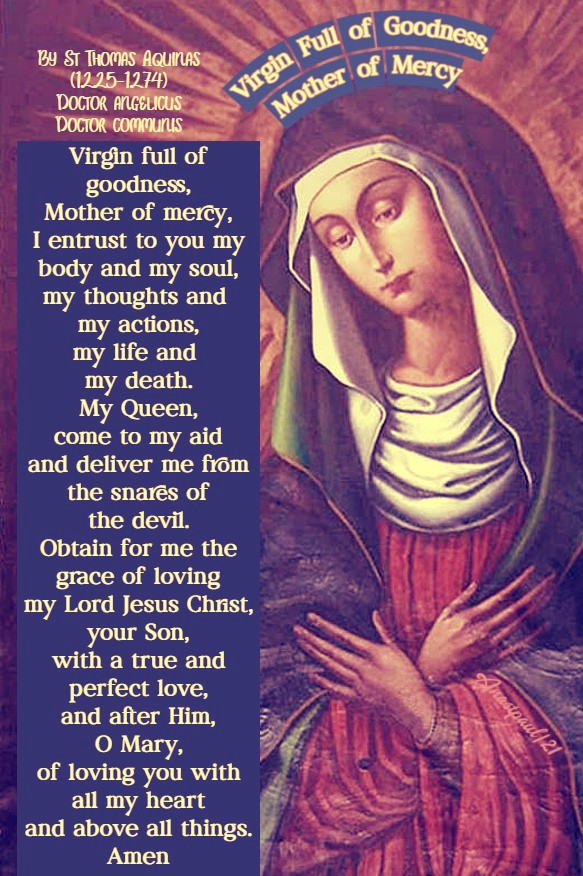
Virgin Full of Goodness, Mother of Mercy By St Thomas Aquinas (1225-1274) Doctor angelicus Doctor communis
Virgin full of goodness, Mother of mercy, I entrust to you my body and my soul, my thoughts and my actions, my life and my death. My Queen, come to my aid and deliver me from the snares of the devil. Obtain for me the grace of loving my Lord Jesus Christ, your Son, with a true and perfect love, and after Him, O Mary, of loving you with all my heart and above all things. Amen.
Quote/s of the Day – 23 August – St Philip Benizi OSM (1233-1285) Confessor
Doing great things for God, like St Philip Benezi
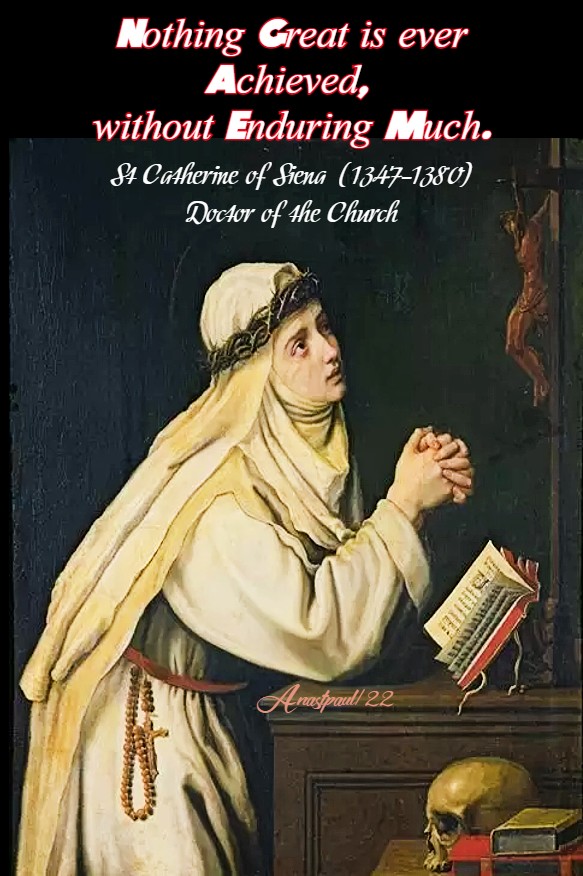
“Nothing great is ever achieved, without enduring much.”
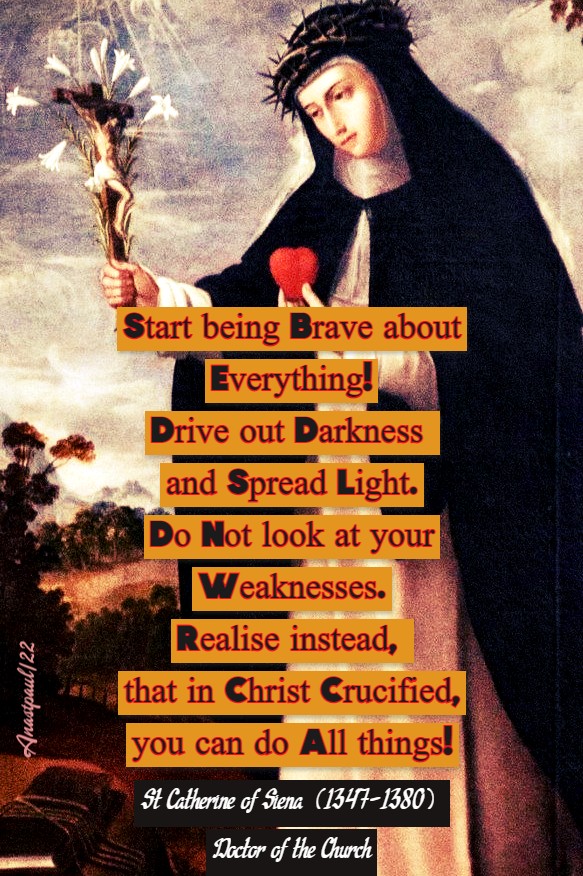
St Catherine of Siena (1347-1380) Doctor of the Church
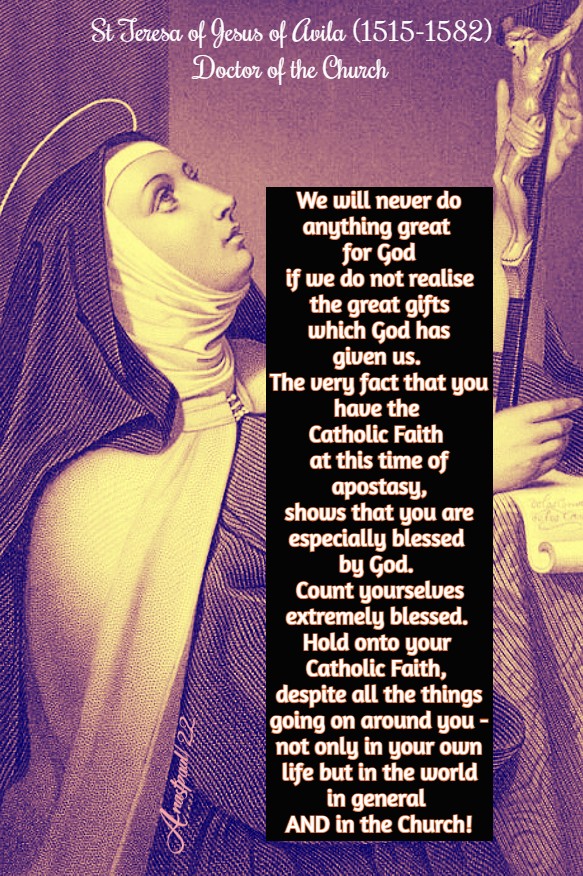
“We will never do anything great for God if we do not realise the great gifts which God has given us. The very fact that you have the Catholic Faith at this time of apostasy, shows that you are especially blessed by God. Count yourselves extremely blessed. Hold onto your Catholic Faith, despite all the things going on around you ,- not only in your own life but in the world in general AND in the Church!”
St Teresa of Jesus of Avila (1515-1582) Doctor of the Church
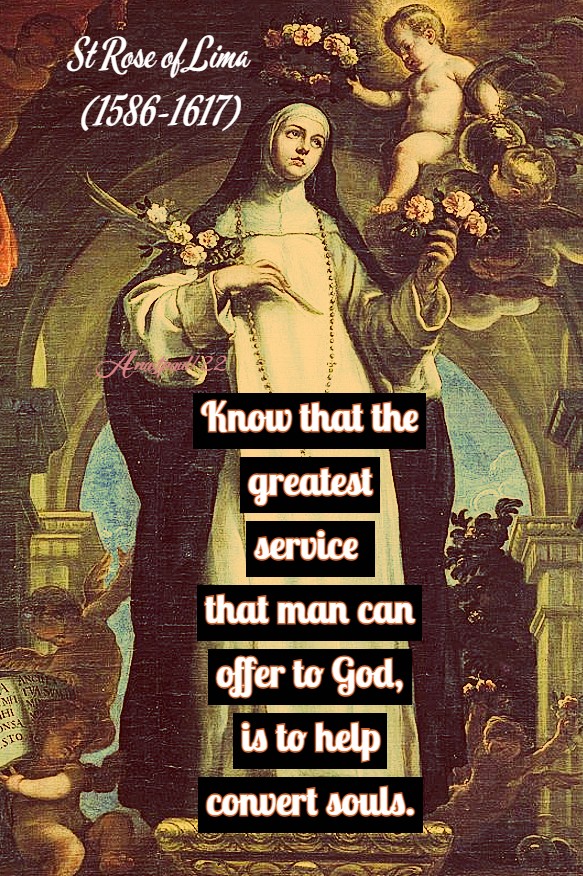
“Know that the greatest service that man can offer to God, is to help convert souls.”
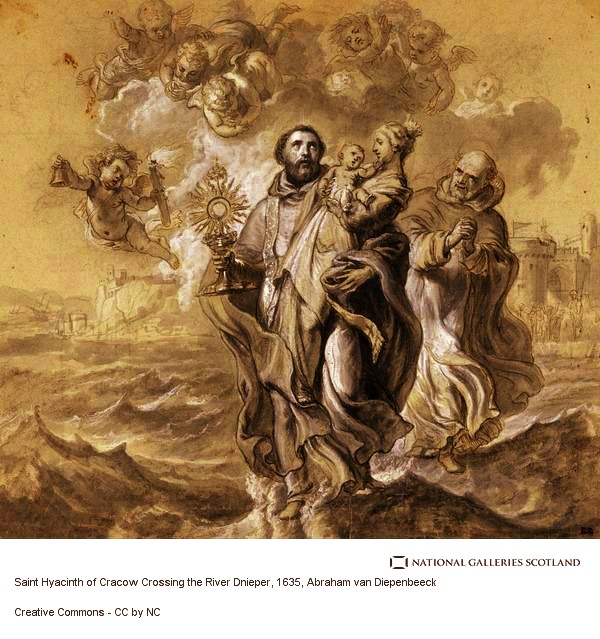
Saint of the Day – 17 August – St Hyacinth OP (1185-1257) ) Confessor, Priest. “Apostle of Poland” and “Apostle of the North” also known as “the Polish St Dominic.
Saint Hyacinth, Confessor By Fr Francis Xavier Weninger SJ (1805-1888)
St Hyacinth, a great ornament of the celebrated Order of Preachers, was born in Poland. He was the son of illustrious parents, who educated him according to the dictates of Christianity. During the years devoted to his studies, he was an example of innocence, piety and industry. His uncle, the Bishop of Cracow, appointed him Canon in his Cathedral, so that he might employ him in the administration of his See. When he left for Rome, on account of troubles at home, he took Hyacinth with him. St Dominic, so celebrated for his apostolic zeal and for the miracles he wrought, was also in Rome at the time. Hyacinth, observing the wonderful zeal and piety of this holy man and of his companions, felt a growing desire to join them. He and three of his fellow-travellers, who had the same inclination, went to St Dominic and begged him to receive them into his newly founded Order. The Saint received them willingly and instructed them how to lead a religious life, to preach in a Christian spirit and to labour successfully for the spiritual welfare of men. After a few months, the holy founder had so thoroughly imbued them with his spirit that he did not hesitate, after they had taken their vows, to send them into their native country, to preach the word of God and promote the salvation of souls.
At Cracow, where Hyacinth had formerly preached, by his edifying life, he now began to preach with words and God gave them such power that he reformed the most hardened sinners, induced others to become more zealous in the service of the Almighty and animated all, to be more solicitous for the salvation of their souls. That all this might have a more solid foundation, he gathered a number of spiritual co-operators about himself and, having instructed them, according to the maxims of St Dominic, he established a Dominican Monastery at Cracow. Hyacinth, who had been chosen Superior by the new members, was an example to all. Besides the prescribed fast-days of his Order, he fasted all Fridays and vigils, on bread and water. The greater part of the night he passed in fervent prayer, before the Blessed Sacrament. He allowed himself only a very short rest on the bare floor and scourged himself severely every night. The whole day was occupied with hearing confessions, preaching, visiting the sick and similar pious exercises.
He had particular devotion to the Blessed Sacrament and to the Blessed Virgin and never undertook anything before offering his work to God and begging the assistance of His Blessed Mother. She appeared to him once, on the eve of the Feast of her Assumption, saying to him: “Be assured, my son, that thou shalt receive everything thou askest from my Son.” The comfort these words afforded the holy man, may be easily imagined. He, however, asked only for what was necessary for the salvation of souls. His own and his companion’s pious labours were all directed to the same end.
When he thought that he had firmly established religious principles and practices among the inhabitants of Cracow and the whole Diocese, he sent his preachers to different places to labour in the same manner. He himself, also left Cracow and it is astonishing, how many Countries he journeyed through, how many Convents he established everywhere for apostolic labourers, how many souls he converted to the true faith or to a more virtuous life. To aid his pious endeavours, God gave him power to work miracles and so great was their number, that he might well be called the Thaumaturgus, or wonder-worker of his age.
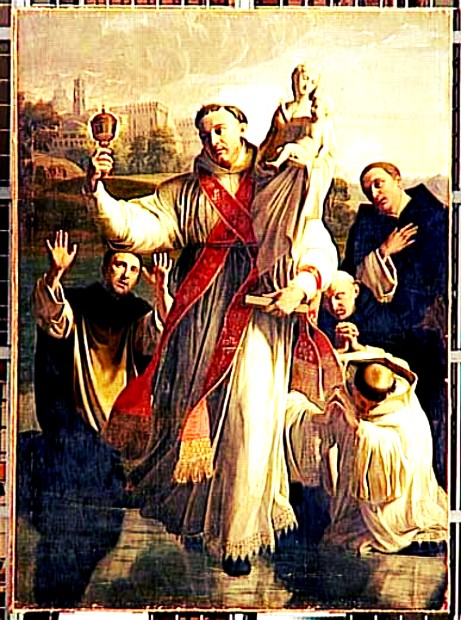
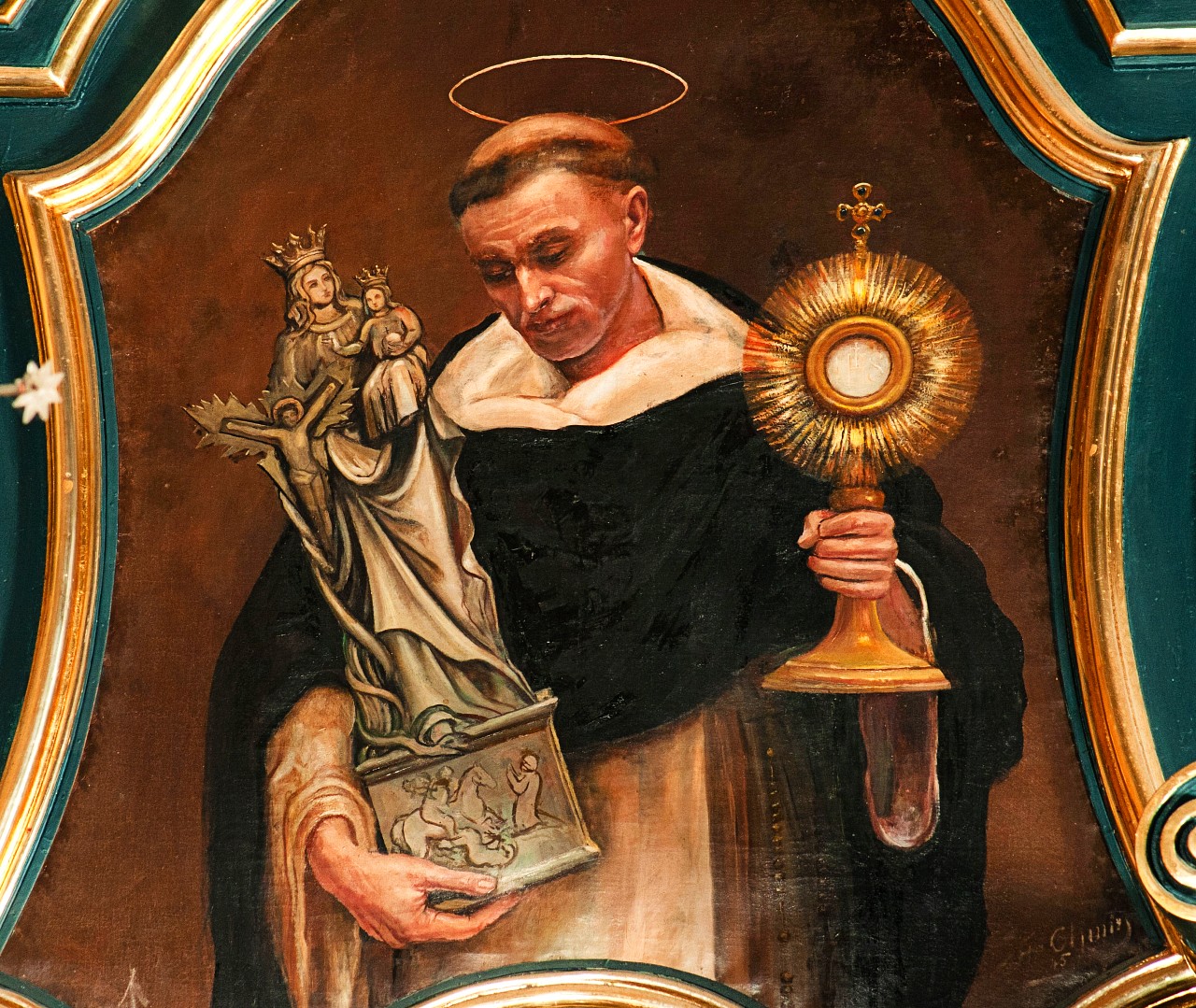
A miraculous event occurred in Russia, when the Tartars stormed Kiow, where the Saint had founded a Church and Convent. He was standing at the Altar when they entered the City, spreading destruction and desolation around them. After finishing the Holy Sacrifice, the Saint, still in his Priestly robes, took the Ciborium containing the Blessed Sacrament and telling his Priests to follow him without fear, he went towards the Church door. When passing a large alabaster statue of the Blessed Virgin, before which he had often said his prayers, he distinctly heard a voice saying: “My son Hyacinth, wilt thou leave me here to be at the mercy of my enemies?” The Saint’s eyes filled with tears. “How can I carry thee? ” said he; “the burden is too heavy.” “Only try,” was the response; “my Son will assist thee to carry me without difficulty.” The holy man with streaming eyes, took the statue and found it so light that he could carry it with one hand. Thus, carrying the Ciborium in one hand and the statue in the other, he and his companions passed through the enemy unassailed, to the gates of the City. Not finding any soldiers there, they passed on and reached Cracow in safety.
Whether Almighty God made His servants invisible to the Tartars on this occasion, or in some other manner prevented them from harming them, is not known but, it is a fact that they left the City unmolested. When they reached the river, over which there was no bridge, nor a boat to convey them across, the Saint, trusting in the power of Him Whom he carried in his right hand and, in the intercession of her whom he held in his left, fearlessly stepped upon the water and crossed it with dry feet.
A similar and perhaps, still greater miracle occurred at another time. He was going to Vicegrad to preach but, on reaching the river, found no vessel which he could use to reach the opposite bank. Spreading his cloak on the water, he sat upon it and was floated safely across and brought his companions over in the same manner. By this and many other miracles, God glorified His servant even on earth.
For forty years this holy man had laboured for the salvation of souls, when, in 1257, it was revealed to him that he should assist, in Heaven, at the triumph of the Blessed Virgin, on the Feast of her glorious Assumption. On the Feast of St Mary ad Nives, he was taken ill. On the eve of the Assumption, he gave his last instruction to the Priests of his Order, after which, he prepared for the festival and,, having recited the Office of the day, he fixed his eyes on Heaven and said the psalm, “In thee, O Lord, have I hoped,” to the words, “Into thy hands I commend my spirit,” when he calmly expired, at the age of 74. The innocence and chastity which he possessed at the time of his Baptism, remained unspotted until the end.
After his death, the miracles which the Almighty continued to work through this Saint, were the means of proclaiming to all the world, the sanctity and merits of His blessed servant.
St Amor of Amorbach St Anastasius of Terni St Benedicta of Lorraine St Carloman St Cecilia of Lorraine
St Clare of the Cross of Montefalco (c 1269-1308) Augustinian Nun and Abbess, before becoming a nun, St Clare was a member of the Third Order of St Francis (Secular), Mystic, Penitent, Spiritual adviser. Beatified by Pope Clement XII. On 8 December 1881, the Feast of the Immaculate Conception, Pope Leo XIII Canonised Clare. Her Life: https://anastpaul.com/2019/08/17/saint-of-the-day-17-august-saint-clare-of-the-cross-of-montefalco-c-1269-1308/
St Donatus of Ripacandida St Drithelm St Elias the Younger St Eusebius of Sicily St James the Deacon St Jeroen of Noordwijk St Juliana of Ptolemais St Mamas St Myron of Cyzicus
St Nicolò Politi (1117-1167) Basilian Monk and Hermit. He was known for his miracles even during his childhood and was Venerated as a saint even before his death. St Nicolò was Canonised on 7SJune 1507, at Saint Peter’s Basilica, Rome, by Pope Julius II. About St Nicolò: https://anastpaul.com/2020/08/17/saint-of-the-day-17-august-st-nicolo-politi-1117-1167/
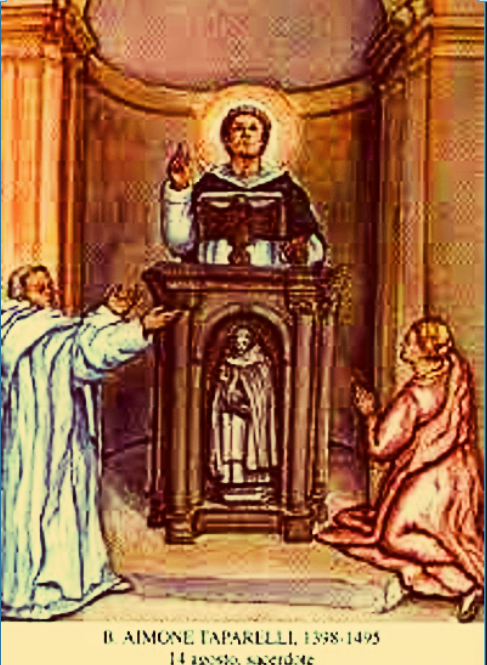
Saint of the Day – 15 August – Blessed Aimo Taparelli OP (c 1395-1495) Priest and Friar of the Order of Preachers, widower and father, Reformer., spiritual writer. He served as an Inquisitor-General for his order in the Lombard and Liguria regions of Italy and became a travelling preacher in northern Italian Cities. Born in c 1395 at Savigliano, Piedmont, Italy and died on 15 August 1495 (aged 100 years) at Savigliano, Piedmont of natural causes. Also known as – Aimone Taparelli, Haymo Taparelli, Elmo. Additional Memorial – 17 August, in Savigliano of which Town Aimo is the Patron. His name means “defends the house with the sword.” Aimo was Beatified on 29 May 1856 by Pope Pius IX.
The Roman Martyrology reads today: “In Savigliano in Piedmont, Blessed Aimone Taparelli, Priest of the Order of Preachers, tireless defender of the truth.”
Aimo was born around 1395 in Savigliano to nobles who were the Counts of Lagnasco. The Tapparelli, one of the oldest families of Savigliano, boasted illustrious Ecclesiastics over the centuries.
Aimo first pursued a career in law and was married and a father. But soon became a widower, mourning both the death of his wife and his children. Aimo felt the call to the religious life instead.
He felt the call to the religious life and to this end he studied at Turin, graduating in Theology and Sacred Scripture. Embracing complete self-denial, he entered the Order of Preachers at Savigliano in 1441 at the San Domenico Convent.
From his earliest years, he engaged in an intense apostolate. He was a worthy son of St Dominic, for the effectiveness of his sermons and for the austerity of his life. When the clear fame of his virtues reached the Savoy Court, Duke Amedeo IX wanted him to be his Chaplain and Confessor. He was then appointed Professor at the University of Turin (lecturer in Theology).
He returned to Savigliano and was appointed as the Inquisitor-General for his Order in the Lombard and Ligurian regions. He was appointed as such to replace the murdered Fr Bartolomeo Cerveri. He carried out this delicate task with care and tireless preservation of the Catholic faith, strengthened by the example of his previous confreres in this role, who had suffered martyrdom in carrying out this mission. In the case of Blessed Antonio Pavoni (1325-1374), he personally organised his honourable burial .
In 1468 he became Superior of his Convent and then Prior of it in 1483. He was confirmed twice as the Inquisitor-General in 1483 and in 1489 and finally, Aimo was appointed as the Provincial Vicar. As he defended the values of Catholicism, his zeal in restoring and confirming discipline within the Order was equal, so much so that he is remembered among the most ardent reformers of the fifteenth century.
However, he also loved solitude and when he could, he retired to a small hermitage in Verzuolo, where there was a Chapel dedicated to St Cristina, 5 kilometers from his Convent.
Aimo composed various religious writings and promoted the cult of the Mother of God, towards whom,he always nourished deep devotion.
In 1495 at almost 100 years old, Aimo predicted his death. A pious legend tells that the Angels warned him that it would take place on the Feast of the glorious Assumption of the Virgin. In bed, reciting the Office, he pressed the Crucifix to his heart and, having received the Sacraments, he expired saying “To serve God is to reign.”
The Friars in choir, read the introit of the solemn Mass. With difficulty they removed the Crucifix from his hands while a crowd had already gathered at the Convent.
Aimo was buried in the choir, in a new tomb, where the faithful, who soon wanted his relics, could go to pray. Some brought wax tablets as ex-votos. Two extraordinary miracles are well remembered – the healing of a woman’s mother from cancer and the conception of a child, in old age, of a couple believed to be sterile. They were from the Genola family and the newborn, who was given the name Aimo, would become an illustrious scholar.
At the beginning of the 19th century his remains were brought to St Domenic Church in Turin. Pope Pius IX, on 29 May 1856, approved the cult, setting its memorial of the Blessed Aimo for 17 August, which date is still honoured in Savigliano.
Quote/s of the Day – 14 August – The 10th Sunday after Pentecost – 1 Cor.inthians 12:2-11, Luke 18:9-14
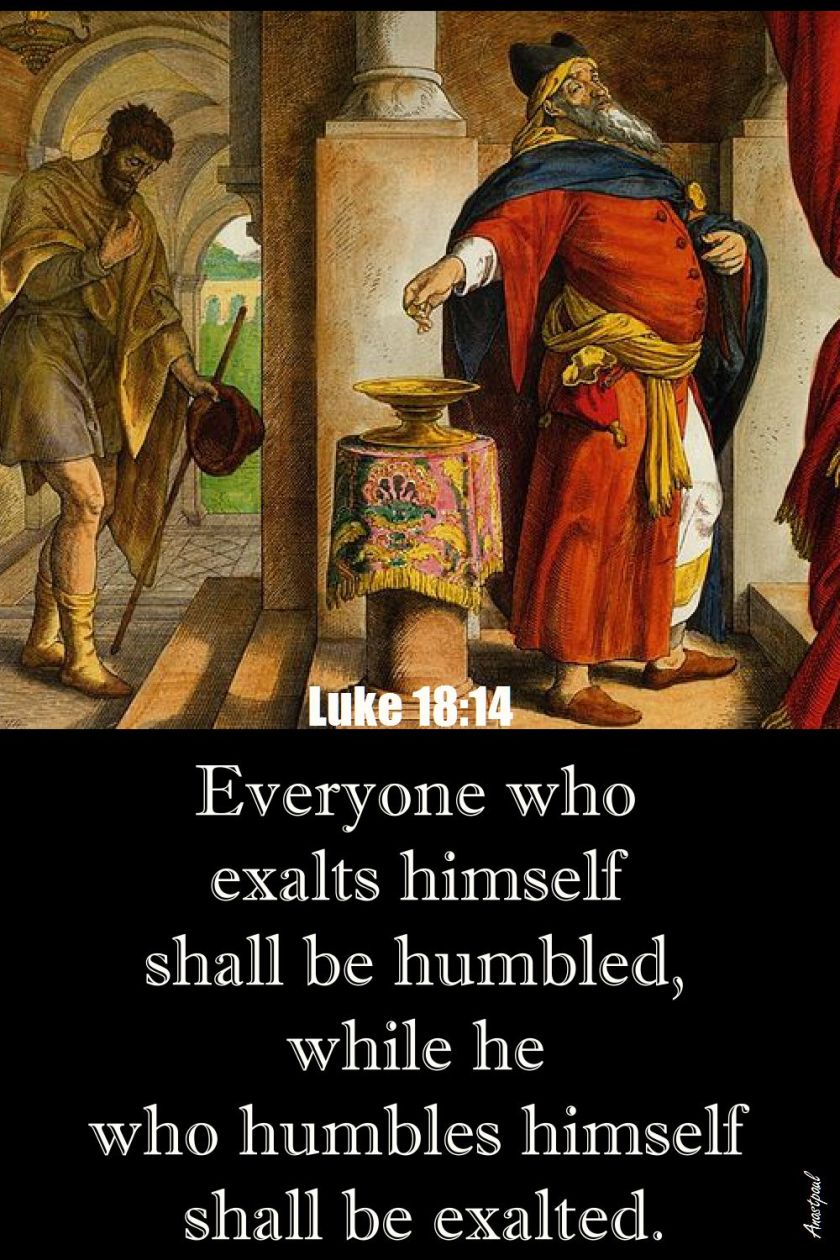
“… For everyone who exalts himself shall be humbled and he who humbles himself shall be exalted.”
Luke 18:14
“Let him who is greatest among you, become as the youngest and he who is the leader, as the servant.”
Luke 22:25
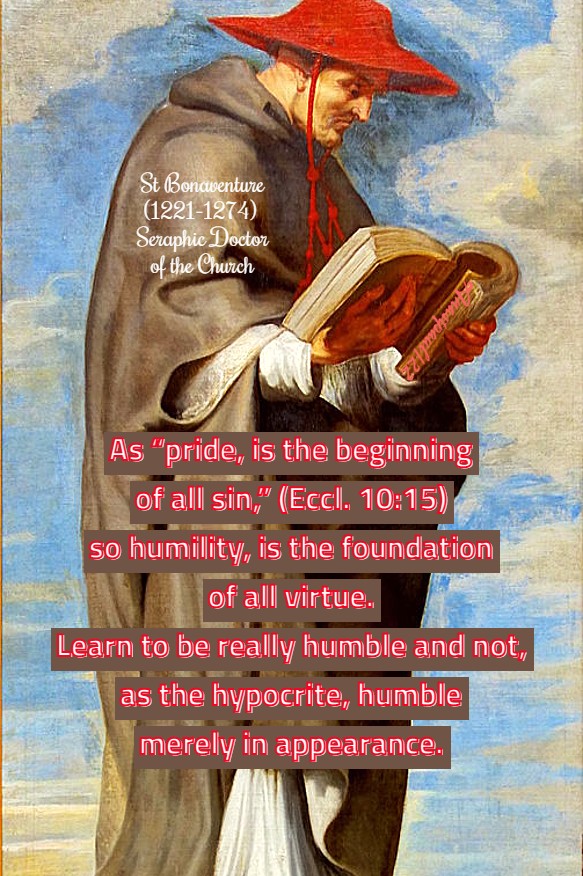
“As “pride, is the beginning of all sin,” (Eccl. 10:15) so humility, is the foundation of all virtue. Learn to be really humble and not, as the hypocrite, humble merely in appearance.”
St Bonaventure (1221-1274) Seraphic Doctor of the Church
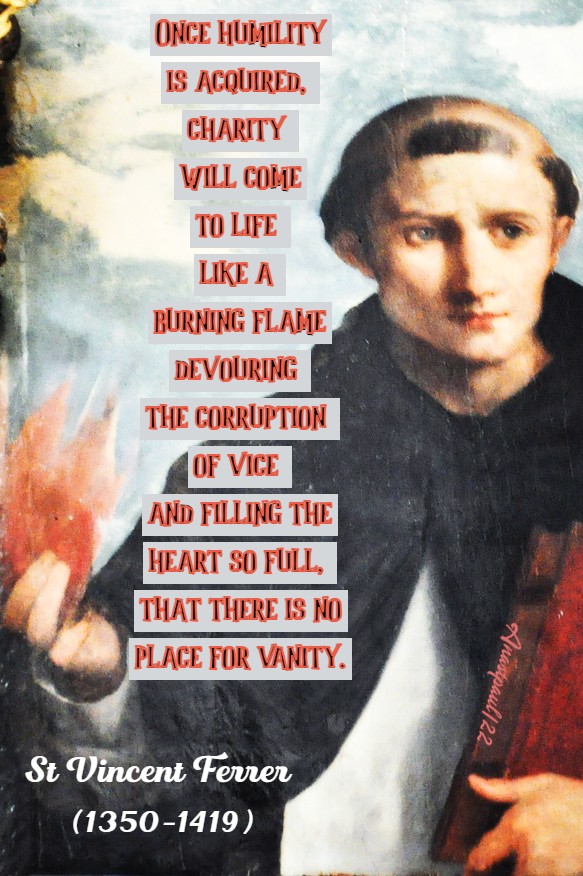
“Once humility is acquired, charity will come to life like a burning flame devouring the corruption of vice and filling the heart so full, that there is no place for vanity.”
St Vincent Ferrer (1350-1419)
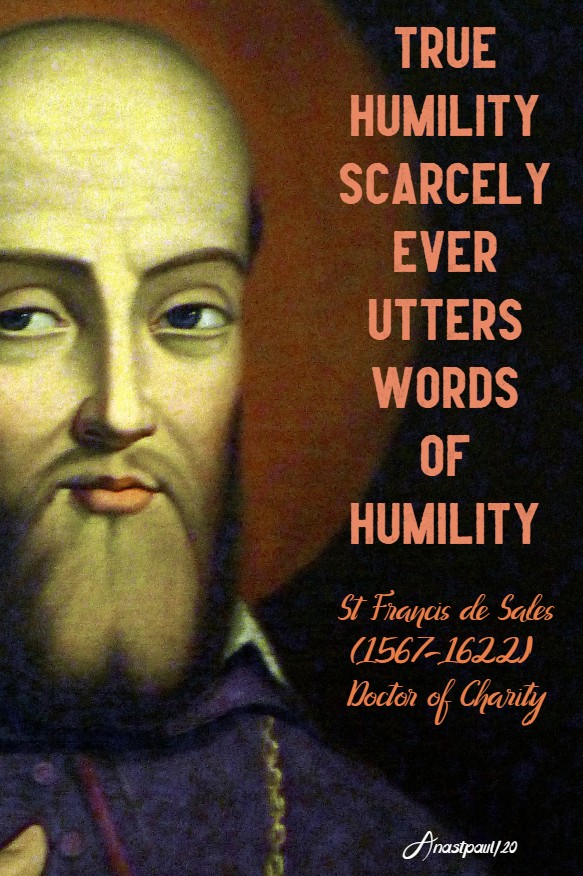
“True humility scarcely ever utters words of humility.”
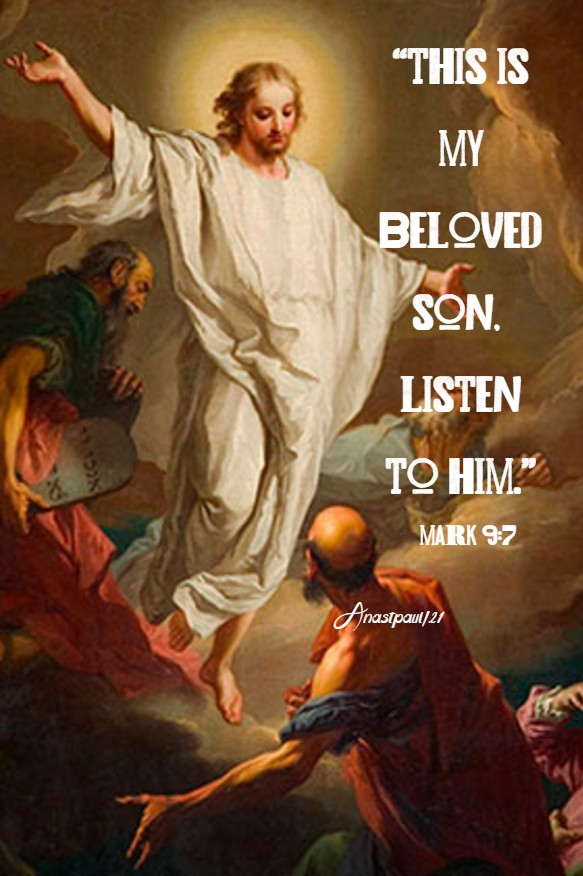
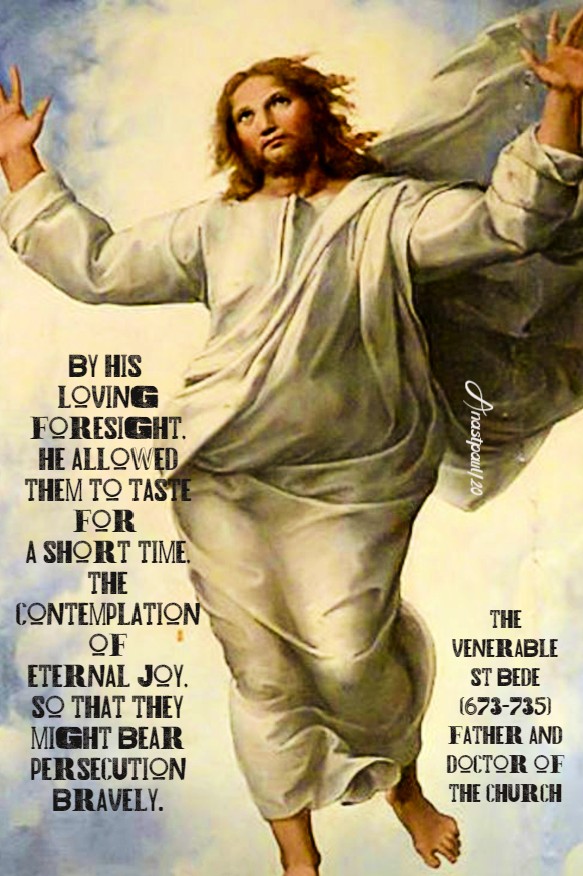
Quote/s of the Day – 6 August – The Transfiguration of Our Lord
“And a cloud overshadowed them and a voice came out of the cloud, “This is my beloved Son; listen to him.”
Mark 9:7
“By His loving foresight, He allowed them to taste for a short time, the contemplation of eternal joy, so that they might bear persecution bravely.”
The Venerable St Bede (673-735) Father and Doctor of the Church
“At His Transfiguration Christ showed His disciples, the splendour of His Beauty, to which He will shape and colour, those who are His : ‘He will reform our lowness configured to the Body of His Glory.’”
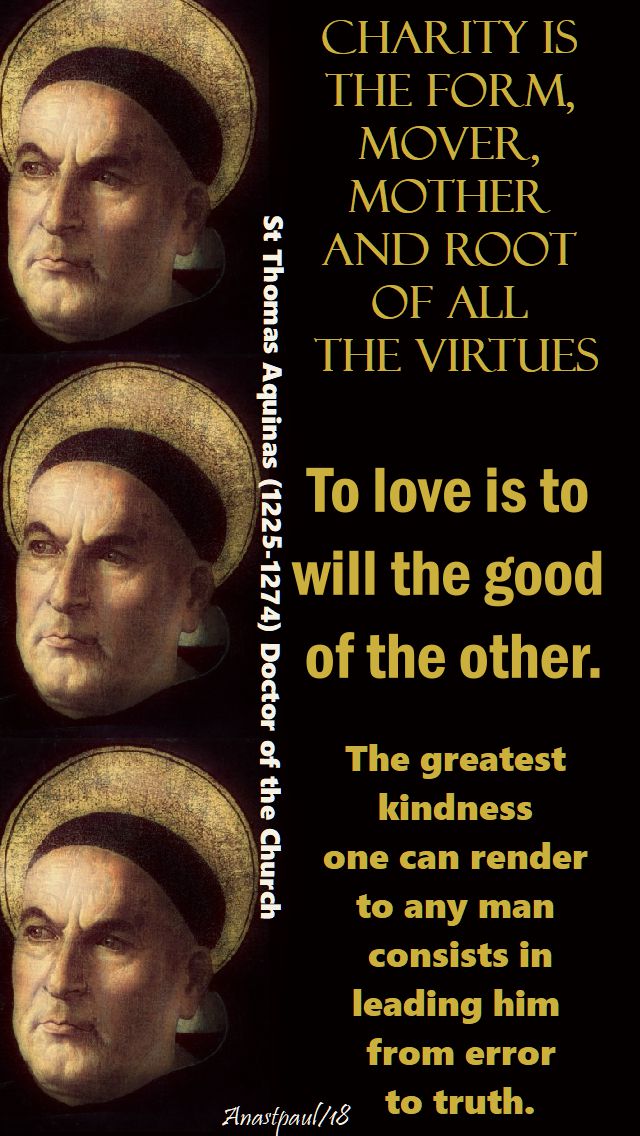
St Thomas Aquinas (1225 – 1274) Angelic Doctor of the Church
Quote/s of the Day – 5 August – “The Month of the Immaculate Heart of Mary” – Santa Mariæ ad Nives, Dedication of the Basilica of Our Lady of the Snows
“Mary, Mother of Grace, it becomes you to be mindful of us, as you stand near Him who granted you all graces, for you are the Mother of God and our Queen. Help us for the sake of the King, the Lord God and Master, Who was born of you.”
St Athanasius (297-373) Father & Doctor of the Church
“Mary was placed by God in the centre of history and we can say that everything was made through her and with her and in her.”
St Bernard (1090-1153) Mellifluous Doctor of the Church
“Mary is the divine Page on which God the Father wrote the Word of God, His Son. Let us draw near to her and read her!”
St Albert the Great (1200-1280) Doctor of the Church
“Mary seeks for those who approach her devoutly and with reverence, for such she loves, nourishes, and adopts as her children. ”
St Bonaventure (1221-1274) Seraphic Doctor of the Church
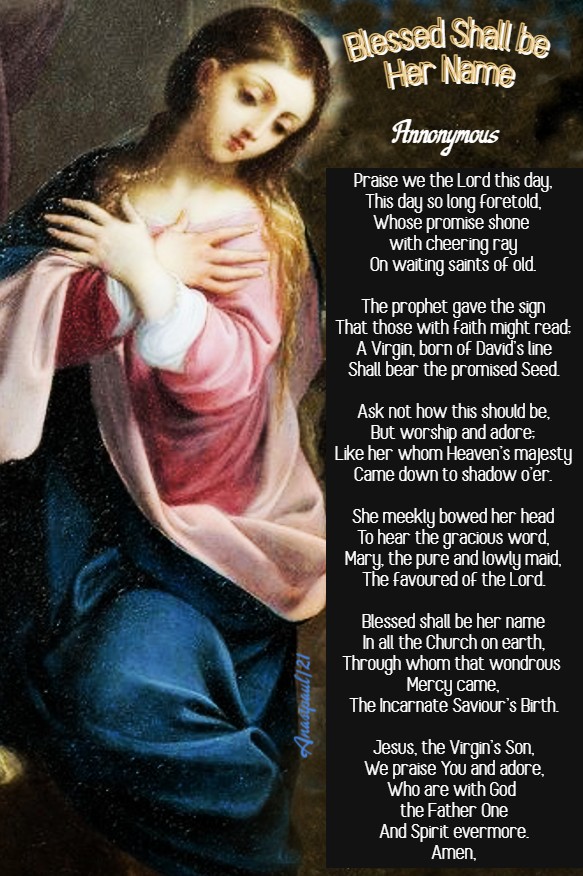
Blessed Shall be Her Name Anonymous Author
Praise we the Lord this day, This day so long foretold, Whose promise shone with cheering ray On waiting saints of old.
The prophet gave the sign That those with faith might read; A Virgin, born of David’s line Shall bear the promised Seed.
Ask not how this should be, But worship and adore; Like her whom Heaven’s majesty Came down to shadow o’er.
She meekly bowed her head To hear the gracious word, Mary, the pure and lowly maid, The favoured of the Lord.
Blessed shall be her name In all the Church on earth, Through whom that wondrous Mercy came, The Incarnate Saviour’s Birth.
Jesus, the Virgin’s Son, We praise You and adore, Who are with God the Father One And Spirit evermore. Amen
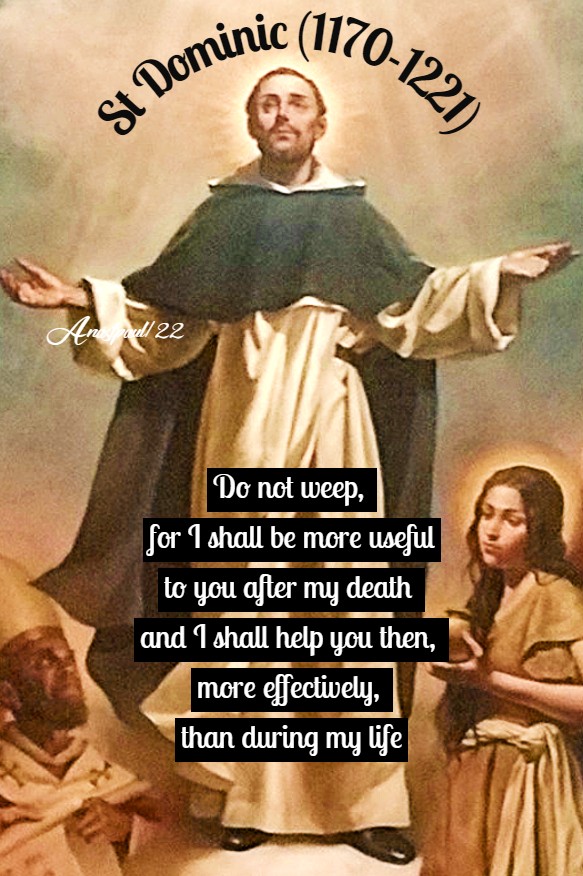
Quote/s of the Day – 4 August – The Memorial of St Dominic (1170-1221) Confessor
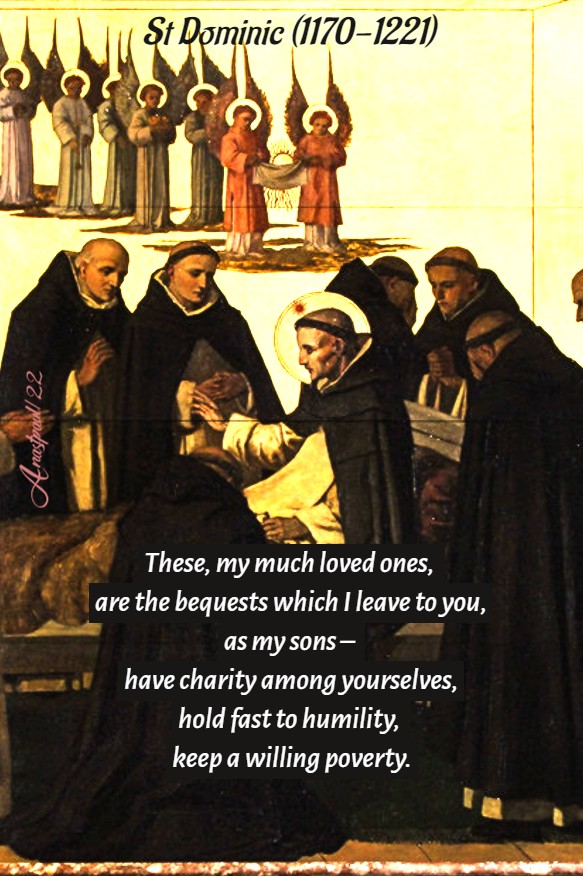
“These, my much loved ones, are the bequests which I leave to you, as my sons – have charity among yourselves, hold fast to humility, keep a willing poverty.”
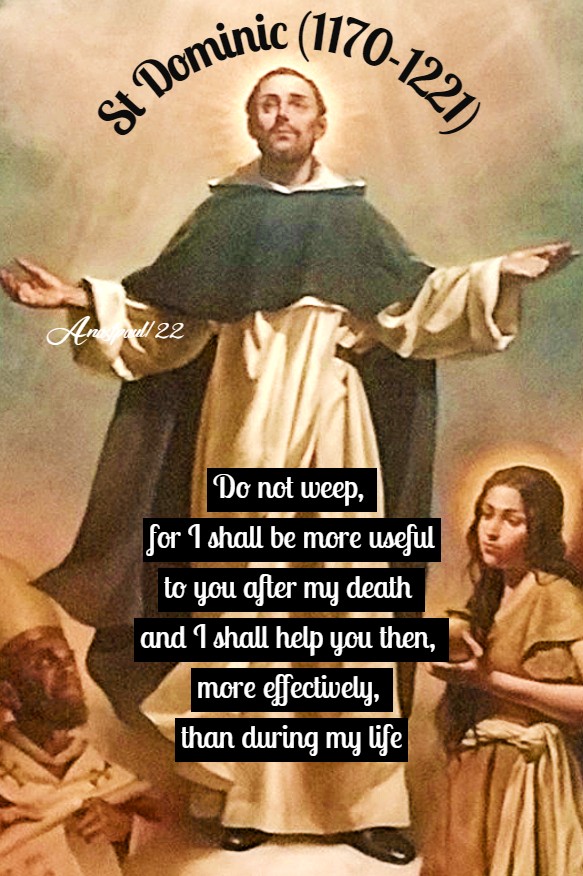
“Do not weep, for I shall be more useful to you after my death and I shall help you then, more effectively, than during my life.”
Our Morning Offering – 4 August – The Memorial of St Dominic de Guzman OP (1170-1221)
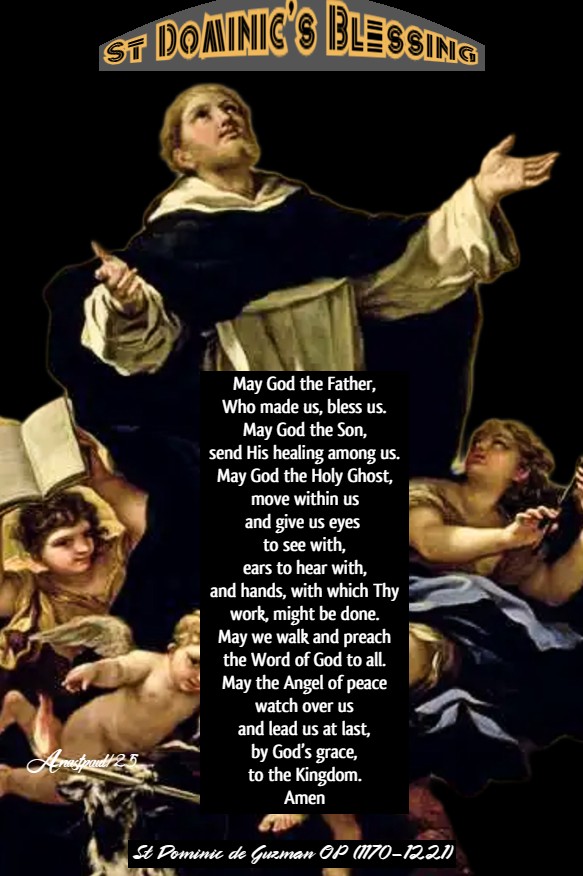
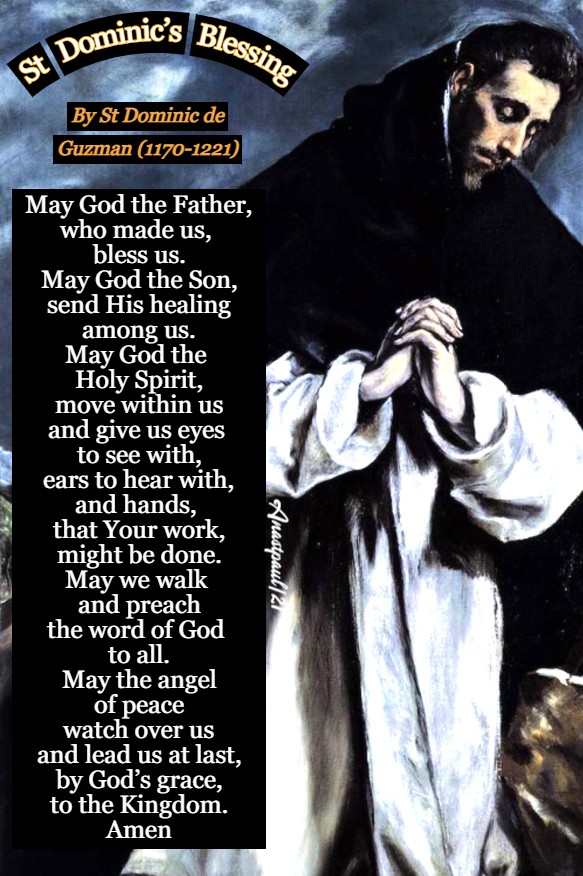
St Dominic’s Blessing By St Dominic de Guzman (1170-1221)
May God the Father, who made us, bless us. May God the Son, send His healing among us. May God the Holy Spirit, move within us and give us eyes to see with, ears to hear with, and hands, that Your work, might be done. May we walk and preach the word of God to all. May the angel of peace watch over us and lead us at last, by God’s grace, to the Kingdom. Amen
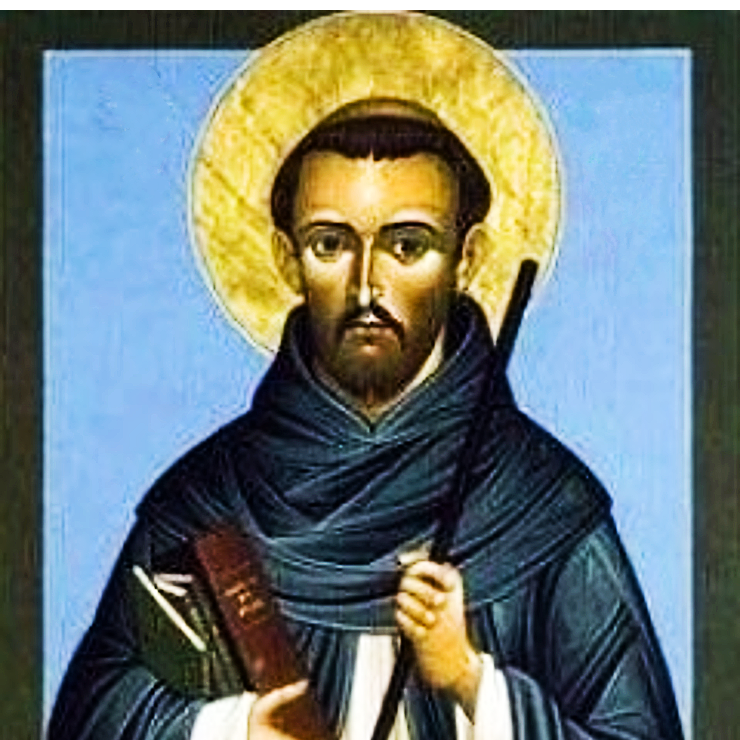
Saint of the Day – 4 August – St Dominic de Guzman OP (1170-1221) Confessor, Founder of the Dominican Order of Preachers – Priest, Founder, Teacher, Preacher, Mystic, Miracle-Worker, Apostle of the Holy Rosary
The Roman Martyrology states today: “At Bologna, St Dominic, Confessor, Founder of the Order of Friars Preachers, most renowned for sanctity and learning. He preserved his chastity unsullied to the end of his life and by his great merits, raised three persons from the dead. After having repressed heresies by his preaching and instructed many in the religious and Godly life, he rested in peace on the 6th of this month. His Feast, however, is celebrated on this day by decree of Pope Paul IV.”
The Virtues and Gifts of Saint Dominic (By the Order of Preachers, England and Wales)
Dominic was of middling height and slender build. His face was ruddy and his hair and beard had a reddish colour. His eyes were striking and he was said to have a beautiful face and one, which seemed to radiate a certain light. He was intelligent but sensitive, usually cheerful except when moved, as quite often occurred, to tears, by people’s suffering. He was known as a man of humility and purity, of prayer and penance and of deep compassionate love.
Dominic was very disciplined with himself but merciful with others. He was noted for his peace and joy. He had great patience and courage. He made good friendships with both men and women and was a good companion, enjoying others and being enjoyed by them.
He was generous, putting God and others before his own needs and wants. He loved Jesus and the Gospel, always carrying some of the Sacred Scriptures (Matthew’s Gospel and Paul’s letters, in particular) with him. He had a great passion for helping people know and love Jesus and so ‘save their soul.s’ He had great energy and commitment to the works of Jesus, his Master and His God.
When Dominic preached, His passion was so patent that, he often moved people to tears for their errors and sins. He explained the Truth of Jesus Christ so well that his listeners were eager to confess and repent.
Dominic’s life and conversation were so Godly, so full of the Lord and heavenly thoughts, that it was said that he only ever spoke to God or about God – yet, he seems to have done this in ways which were warm, appealing, human and attractive to all who heard him.
He was a good leader and a good organiser and good at making sensible laws to organise communities. He trusted others and gave them freedom and opportunities and encouragement to develop and use their gifts. In these ways, he showed himself a true spiritual father. He was also wise and diplomatic. He saw clearly the needs of people in his time and what the Church needed to do and set about bringing this about, in other words, our Saint Dominic was a true Shepherd – never absent, never belittling the problems the faithful faced in their daily lives but assisting them, in many ways, to devoutly submit to the Will of God and learn the great gift of suffering in silence. In all this, Dominic placed himself in the hands of the Holy Ghost
St Francesc Mercader Rendé St Hyacinth of Rome St Ia of Persia St Isidore of Besançon St Lua of Limerick St Onofrio of Panaia St Perpetua of Rome St Protasius of Cologne St Rainerio of Split St Sithney (Died c 529) St Tertullinus of Rome Bl William Horne
Bl Richard Featherstone St Rufinus of Assisi St Senen St Tatwine of Canterbury St Terenzio of Imola Bl Thomas Abel St Ursus of Auxerre
Martyrs of Tebourba – 3 Saints: Three girls Martyred together in the persecutions of Diocletian. We know little else about them but the names – Donatilla, Maxima and Secunda. 304 at Tebourba in North Africa.
Saint/s of the Day – 29 July – Blessed Luis Bertran OP (1594-1627) and Companions Martyrs. Luis was a Spanish Priest and Missionary of the Order of Preachers. Born in 1596 in Barcelona, Spain and died by being burned to death on 29 July 1627 at Omura, Nagasaki, Japan. Also known as – Luis Exarch. Additional Memorial – 10 September as one of the 205 Martyrs of Japan. Beatified on 7 May 1867 by Pope Pius IX.
The Dominican Missionary Priest, Luis Bertran, from Barcelona, Spain, was a relative of aother revered Dominican Missionary Priest with the same name, Saint Louis Bertrand (1526-1581), who had served in Latin America..
The younger Father Bertran joined the Dominicans at the Convent of Santa Catalina in Barcelona, Spain in 1611. He was sent as a Missionary firstly to the Philippines in 1618 and then to Japan in 1623 where the Catholics were in great need under the dire persecutions of the regime then in control.
Luis ministered for 4 years in secret, to the Catholics of the Omura region in Japan. Luis brought many pagans to the Faith, especially working with Dominican Tertiaries. During a period of veracious persecution, he hid from the authorities in a leper colony but was found, imprisoned and executed by being burned to death, together with Blessed Mancio de la Cruz, Blessed Pedro de Santa Maria and three of the patients who had given them shelter. Pedro was a native of Japan and Mancio, an elderly man, were both Catechists. Pedro and Mancio were formally admitted to the Dominican Order shortly before their execution.
Quote/s of the Day – 28 July – Wisdom 10:17-20, Luke 21:9-19
“And you shall be hated by all men,
for My Name’s sake …”
Luke 21:17
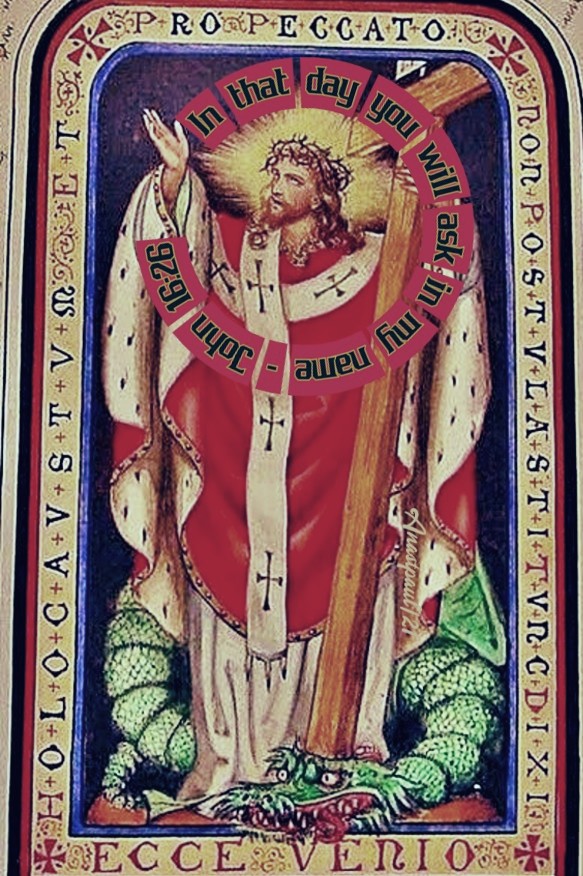
“In that day, you will ask in My Name”
John 16:26
“Wake up then, believer and note what is stated here: “In my Name.” That [Name] is Christ Jesus. Christ signifies King, Jesus signifies Saviour. Therefore, whatever we ask for that would hinder our salvation, we do not ask in our Saviour’s Name and yet, He is our Saviour, not only when He does what we ask but also, when He does not. When He sees us ask anything to the disadvantage of our salvation, He shows Himself our Saviour by not doing it. The physician knows whether what the sick person asks for, is to the advantage or disadvantage of his health. And [the physician] does not allow what would be harmful to him, although the sick person himself, desires it. But the physician looks to his final cure.”
St Augustine (354-430) Father and Doctor of Grace of the Church
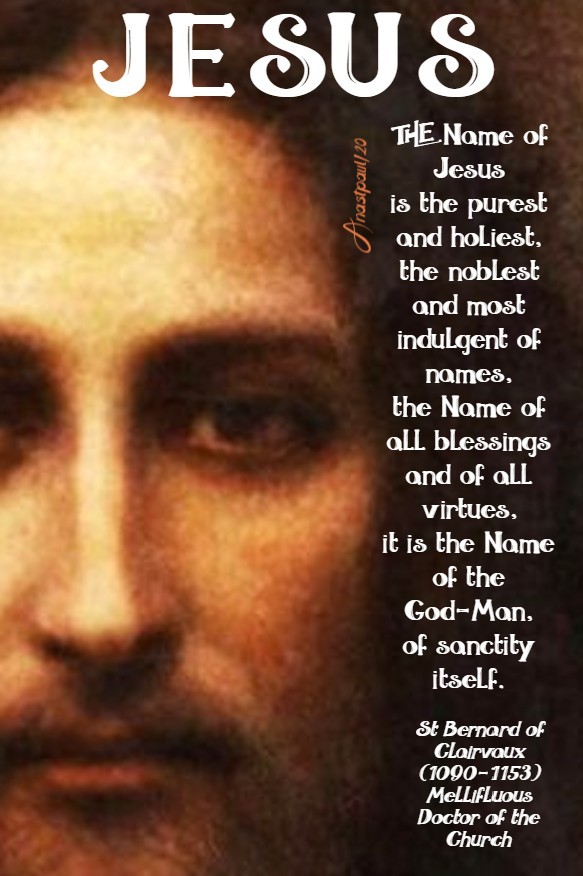
“The Name of Jesus is the purest and holiest, the noblest and most indulgent of names, the Name of all blessings and of all virtues, it is the Name of the God-Man, of sanctity itself.”
St Bernard of Clairvaux (1090-1153) Father and Mellifluous Doctor of the Church
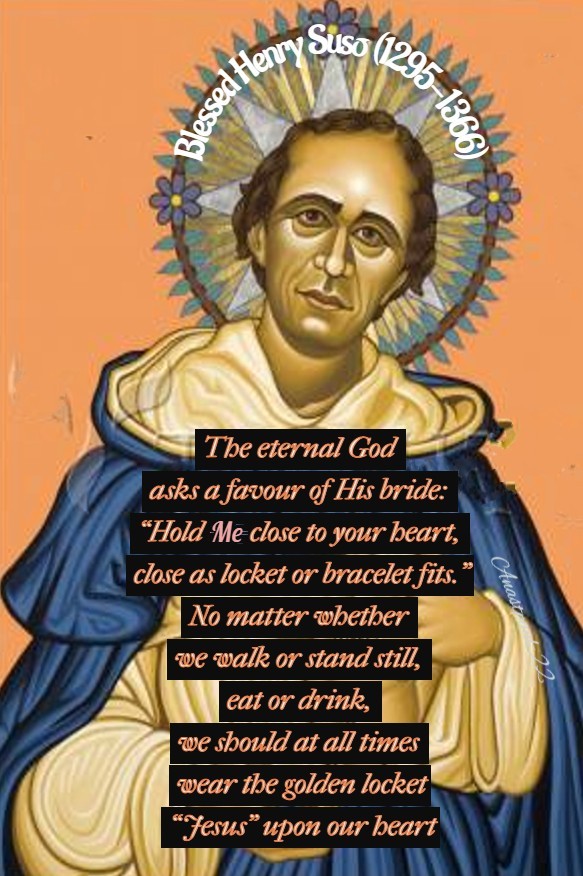
“The eternal God asks a favour of His bride: “Hold Me close to your heart, close as locket or bracelet fits.” No matter whether we walk or stand still, eat or drink, we should at all times wear the golden locket “Jesus” upon our heart.”
Our Morning Offering – 24 July – “Month of the Most Precious Blood”
Virgin Full of Goodness, Mother of Mercy By St Thomas Aquinas (1225-1274) Doctor angelicus Doctor communis
Virgin full of goodness, Mother of mercy, I entrust to you my body and my soul, my thoughts and my actions, my life and my death. My Queen, come to my aid and deliver me from the snares of the devil. Obtain for me the grace of loving my Lord Jesus Christ, your Son, with a true and perfect love, and after Him, O Mary, of loving you with all my heart and above all things. Amen.
Bl Anne-Andrée Minutte St Arno of Würzburg Bl Berthold of Scheide St Dogfan Bl Élisabeth Verchière St Esdras the Prophet St Eugene of Carthage St Giustina of Arzano
St Henry (972-1024) Holy Roman Emperor ,Henry was well known for his Missionary spirit and for his protection of the Pope in times of trouble. Henry ruled with a spirit of great humility and always sought to give the glory to God. He used his position to promote the work of the Church and the peace and happiness of the people. Biography: https://anastpaul.wordpress.com/2017/07/13/saint-of-the-day-13-july-st-henry-ii-holy-roman-emperor/
St Iosephus Wang Kuiju
Blessed James of Voragine OP (c 1226 – 3 or 16 July 1298) Italian Archbishop of Genoa, Author of the ‘Golden Legend’ (a collection of lives of Saints and treatises on Christian festivals, one of the most popular religious works of the Middle Ages and is still published and referred to today – completed 1265), Priest and Friar of the Order of Preachers of St Dominic, Writer, Scholar of great genius, Prior and Provincial General of the Order. Blessed James was Beatified on 11 May 1816 by Pope Pius VII. Biography: https://anastpaul.com/2021/07/13/saint-of-the-day-13-july-blessed-james-of-voragine-op-c-1226-1298-author-of-the-golden-legend/
Bl Jean of France St Joel the Prophet Bl Marie-Anastasie de Roquard Bl Marie-Anne Depeyre Bl Marie-Anne Lambert St Mildred of Thanet OSB (Died c 700) English Benedictine Nun and Abbess.
St Muritta of Carthage St Myrope St Salutaris of Carthage St Sarra of Egypt St Serapion of Alexandria Serapion of Macedonia Bl Thérèse-Henriette Faurie Bl Thomas Tunstal St Turian
Martyrs of Cyprus – 300 Saints: 300 Christians who retired to Cyprus to live as cave Hermits, devoting themselves to prayer and an ascetic life devoted to God. Tortured and Martyred for their faith and their bodies thrown into the various caves in which they had lived. We know the names of five of them but no other details even about them – Ammon, Choulélaios, Epaphroditus, Eusthénios and Héliophotos. They were beheaded in the 12th century on Cyprus and their bodies dumped in the cave where they had lived and only rediscovered long afterwards.
Martyrs of Philomelio – 31 Saints: 31 soldiers Martyred for their faith in the persecutions of prefect Magno, date unknown. The only name that has come down to us is Alexander. In Philomelio, Phrygia (in modern Turkey).
Saint Cyril (827-869) Saint Methodius (826-885) “Apostles to the Slavs,” Sibling Brother Bishops, Confessors, Theologians, Missionaries, Writers, Preachers, Patrons of Europe. Creators of the Glagolitic alphabet, the first alphabet used to transcribe Old Church Slavonic and Cyrillac Alphabet, which was developed from it. Their Feast Day is 7 July (moved in 1969). The great Saints Cyril & Methodius: https://anastpaul.wordpress.com/2018/02/14/saints-of-the-day-14-february-sts-cyril-827-869-methodius-826-885/
St Lawrence of Brindisi OFM Cap (1559-1619) Confessor, The “Franciscan Renaissance Man,” Priest and Friar of the Friars Minor Capuchin, Theologian, Vicar General of the Franciscans, Language scholar, Humanist, Philosopher, Biblicist, Preacher, Missionary, Professor, International Administrator, Confidant of Popes, Emperors, Kings and Princes, Diplomatic envoy, Army Chaplain, Military Strategist and Morale builder, Polemicist, Prolific writer. He was Beatified on 1 June 1783 by Pope Pius VI and Canonised on 8 December 1881 by Pope Leo XIII. His Zealous Life: https://anastpaul.com/2017/07/21/saint-of-the-day-21-july-st-lawrence-of-brindisi-o-f-m-cap-doctor-of-the-church/
St Alexander St Angelelmus of Auxerre St Apollonius of Brescia
Blessed Pope Benedict XI OP (1240-1303) Cardinal-Priest of St Sabina, Bishop of Ostia then of Rome, Dominican Friar, Prior Provincial of Lombardy prior to becoming the Master of the Order in 1296, Apostolic Papal Legate to Hungary and France, Teacher, Preacher, Writer and renowned Scholar with special emphasis on Biblical commentary. His Papacy began on 22 Ocober 1303 and ended at his death on 7 July 1304. His Life: https://anastpaul.com/2020/07/07/saint-of-the-day-7-july-blessed-pope-benedict-xi-1240-1303/
Bl Bodard of Poitiers St Bonitus of Monte Cassino St Carissima of Rauzeille St Eoaldus of Vienne St Ethelburga of Faremoutier St Hedda of Wessex St Maelruan Bl Marie-Gabrielle-Françoise-Suzanne de Gaillard de Lavaldène St Medran St Merryn Bl Oddino Barrotti St Odo of Urgell St Odran St Palladius of Ireland St Pantaenus of Alexandria
St Pantænus (Died c 216) Father of the Church, Theologian, Philosopher, Teacher, Confessor and Defender of the Faith, Writer and interpreter of the Bible, the Trinity and Christology, |Missionary. Convert ofthe disciples of the Apostles. Head of the Alexandrian School of Learning – a famous pupil was St Clement of Alexandria. Biography: https://anastpaul.com/2019/07/07/saint-of-the-day-7-july-st-pantaenus-father-of-the-church-died-c-216/
St Prosper of Aquitaine (c 390-c 436) Theologian, Married Layman, Writer, disciple abd friend of St Augustine. St Syrus of Genoa St They
Martyrs of Durres – 7 Saints: Also known as – Martyrs of Dyrrachium/Martyrs of Durazzo. A group of seven Italian Christians who fled Italy to escape the persecutions of Emperor Hadrian. Arrived in Dyrrachium, Macedonia to find Saint Astius tied to a cross, covered in honey, laid in the sun and left to be tortured by biting and stinging insects. When they expressed sympathy for Astius, they were accused of being Christians, arrested, chained, weighted down, taken off shore and drowned. We know little more about each of them than their names – Germaus, Hesychius, Lucian, Papius, Peregrinus, Pompeius and Saturninus. They were born in Italy and were martyred at sea c117 off the coast of Dyrrachium (Durazzo), Macedonia (modern Durres, Albania).
Our Morning Offering – 6 July – “The Month of the Most Precious Blood”
Your Blood, The Fire of Love! By St Catherine of Siena (1347-1380) Doctor of the Church
O sweet Jesus, my Love, to strengthen my soul and to rescue it from the weakness into which it has fallen, You have built a wall around it and have mixed the mortar with Your Blood, confirming my soul and uniting it to the sweet will and charity of God! Just as lime mixed with water is placed between stones to cement them together, so You, O God, have placed between Your creature and Yourself, the Blood of Your only-begotten Son, cemented with the divine lime of the fire of ardent charity, in such a way that there is no Blood without fire, nor fire without Blood. Your Blood was shed, O Christ, by the fire of love! Amen.
St Paulinus of Nola (c 354-431) Bishop, Confessor, Poet, Writer, Apostle of Charity, Preacher, Orator, Senator and Governor. St Paulinus was an inspiration to many—including six great Saints of the Church, who referenced him in letters of encouragement to others: St Augustine, St Jerome, Melania, St Martin of Tours, St Gregory and St Ambrose. St Augustine wrote, “Go to Campania– there study Paulinus, that choice servant of God. With what generosity, with what still greater humility, he has flung from himself the burden of this world’s grandeurs to take on him the yoke of Christ and in His service how serene and unobtrusive his life!” About St Paulinus: https://anastpaul.com/2018/06/22/saint-of-the-day-22-june-st-paulinus-of-nola-c-354-431/
St Aaron of Brettany St Aaron of Pais-de-Laon St Alban of Britain Bl Altrude of Rome St Consortia St Cronan of Ferns St Eberhard of Salzburg St Eusebius of Samosata St Exuperantius of Como St Flavius Clemens St Gregory of Agrigento St Heraclius the Soldier St Hespérius of Metz
Blessed Pope Innocent V OP (c 1225-1275) Papal Ascesion 21 January 1276 unril 22 June 1276 (the date of his death. Friar of the Order of Preachers, Theologian, renowned Preacher, Scholar, Writer,, Dominican Office bearer, disciple of St Albert the Great and collaborator and friend of St Thomas Aquinas.and St Bonaventure. His Life: https://anastpaul.com/2021/06/22/saint-of-the-day-22-june-blessed-pope-innocent-v-op-c-1225-1275/
St John IV of Naples St Julius of Pais-de-Laon Bl Kristina Hamm Bl Marie Lhuilier St Nicetas of Remesiana St Precia of Epinal St Rotrudis of Saint-Omer St Rufinus of Alexandria
Martyrs of Samaria – 1480 Saints: 1480 Christians massacred in and near Samaria during the war between the Greek Emperor Heraclius and the pagan Chosroas of Persia. c 614 in the vicinity of Samaria, Palestine.
Our Morning Offering – 16 June – Corpus Christ, The Most Holy Body and Blood of our Lord Jesus Christ
Lauda Sion Salvatorem Sion, Lift Up thy Voice and Sing (Excerpt) By St Thomas Aquinas (1225-1274) Doctor Angelicus / Doctor Communis
Sion, lift thy voice and sing, Praise thy Saviour and thy King, Praise with hymns thy Shepherd true, Dare thy most to praise Him well, For He doth all praise excel, None can ever reach His due.
Special theme of praise is Thine, That true living Bread divine, That life-giving flesh adored, Which the brethren twelve received, As most faithfully believed, At the Supper of the Lord.
Let the chant be loud and high, Sweet and tranquil be the joy Felt to-day in every breast; On this festival divine Which recounts the origin Of the glorious Eucharist.
St Thomas Aquinas wrote the Liturgy for Corpus Christi when Pope Urban IV added the Solemnity to the universal Church’s Liturgical calendar in 1264. He provided a great sequence, one of the great poems chanted or recited before the proclamation of the Gospel. Lauda Sion is one of only four medieval sequences which were preserved in the Roman Missal published in 1570 following the Council of Trent (1545–1563)—the others being Victimae Paschali Laudes (Easter), Veni Sancte Spiritus (Pentecost) and Dies irae (requiem masses). (A fifth, Stabat Mater, would later be added in 1727.) Before Trent, many feasts had their own sequences. The existing versions were unified in the Roman Missal promulgated in 1570. The Lauda Sion is still sung today as solemn Eucharistic hymn, though its use is optional in the post-Vatican II Ordinary form. As with St Thomas’s other three Eucharistic Hymns, the last few stanzas of the Lauda Sion are often used alone, in this case, to form the “Ecce Panis Angelorum”.
Our Morning Offering – 11 June – “The Month of the Sacred Heart”
O Jesus, Mary’s Son! By St Thomas Aquinas (1225-1274) Doctor Angelicus, Doctor communis
Hail to Thee! True body sprung From the Virgin Mary’s womb! The same that on the cross was hung And bore for man the bitter doom. Thou Whose side was pierced and flowed Both with water and with blood. Suffer us to taste of Thee In our life’s last agony. O kind, O loving One! O Jesus, Mary’s Son! Amen
Quote’s of the Day – 8 June – Ember Wednesday within the Octave of Pentecost – Acts 2:14-21, John 6:44-52.
“I Am the Living Bread Who came down from Heaven. If any man eat of this Bread, he shall live forever and the Bread that I will give, is My Flesh, for the Life of the world.”
John 6:51-52
“I Am the Bread of Life”
John 6:35
“For His Body, has been given to you under the appearance of bread and His Blood, under the appearance of wine, so that, when you have partaken of the Body and Blood of Christ, you might be One Body and One Blood with Him. So shall we become Christ-bearers [“Christophers”]. His Body and Blood are diffused through all our members – see, then, how we become participants in the Divine Nature!”
St Cyril of Jerusalem (c 313-386) Father and Doctor of theChurch
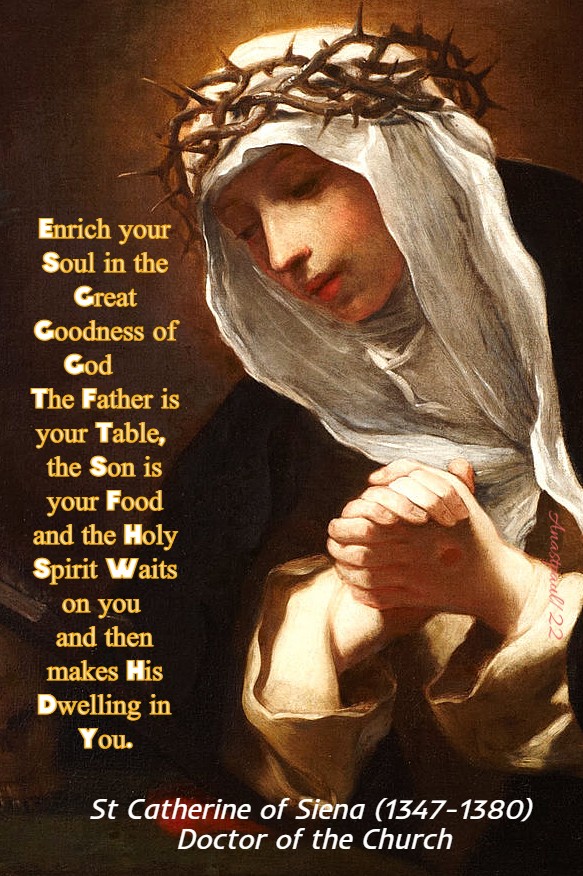
“Enrich your soul in the great goodness of God – The Father is your Table, the Son is your Food and the Holy Spirit waits on you and then makes His Dwelling in you.”
St Catherine of Siena (1347-1380) Doctor of the Church
“What graces, gifts and virtues the Holy Mass calls down!”
St Leonard of Port Maurice (1676-1751)
O Lord, My God, I Am Not Worthy Prayer Before Holy Communion By St John Chrysostom (347-407) Father and Doctor of the Church
O Lord, my God, I am not worthy that You should come into my soul but I rejoice that You have come to me because, in Your loving kindness You desire to dwell in me. You ask me to open the door of my soul, which You alone have created, so that You may enter into it with Your loving kindness and dispel the darkness of my mind. I believe that You will do this, for You did not turn away Mary Magdalene when she approached You in tears. Neither did You withhold forgiveness from the tax collector who repented of his sins or from the good thief who asked to be received into Your kingdom. Indeed, You numbered as Your friends, all who came to You with repentant hearts. O God, You alone are blessed always, now and forever. Amen
St Photinus of Lyons St Rogate Bl Sadoc of Sandomierz St Stephen of Sweden
Martyrs of Lyons and Vienne: A group of 48 Christians from the areas of Vienne and Lyon, France, who were attacked by a pagan mob, arrested and tried for their faith, and murdered in the persecutions of Marcus Aurelius. A letter describing their fate, possibly written by Saint Irenaeus of Lyons, was sent to the churches in the Middle East. Only a few names and details of their lives have survived; some of them have separate entries on this date – • Alexander of Vienne • Attalus of Pergamos • Biblis of Lyons • Blandina the Slave • Cominus of Lugdunum • Epagathus of Lugdunum • Maturus the Novice • Photinus of Lyons • Ponticus of Lugdunum • Sanctius of Vienne • Vettius of Lugdunum They were martyred in assorted ways on on various during 177.
Martyrs of Sandomierz: A group of 49 Dominicans, some of whom received the habit from Saint Dominic de Guzman himself. They worked separately and together to bring the faith and establish the Dominican Order in Poland, basing their operations in and around Sandomierz. In 1260 they were all Martyred by the Tartars as they were singing the Salve Regina at Compline; the custom of singing the Salve Regina at the deathbed of Dominicans, stems from this incident. We know a few details about a few of the martyrs, but most survive only as names – • Zadok• Andrea, chaplain• James, novice master• Malachi, convent preacher • Paul, vicar• Peter, guardian of the garden• Simone, penitentiaryfriars • Abel, Barnabas, Bartholomew, Clemente, Elia, John, Luke, Matthew, Philip deacons• Giuseppe, Joachim, Stefanosub-deacons• Abraham, Basil, Moses, Taddeoclerics• Aaron, Benedict, David, Dominico, Mattia, Mauro, Michele, Onofrio, Timothyprofessed students• Christopher, Donato, Feliciano, Gervasio, Gordian, John, Mark, Medardo, Valentinonovices• Daniele, Isaiah, Macario, Raffaele, Tobialay brothers• Cyril, tailor• Jeremiah, shoemaker • Thomas, organist They were martyred in 1260 at Sandomierz, Poland and Beatified on 18 October 1807 by Pope Pius VII (cultus confirmation).
You must be logged in to post a comment.