One Minute Reflection – 1 March – Monday of the Second week of Lent, Readings: Daniel 9:4-10, Psalms 79:8, 9, 11 and 13, Luke 6:36-38 and the Memorial of Saint Albinus of Angers (469-549) Bishop
“For the measure you give, will be the measure you get back.”… Luke 6:38
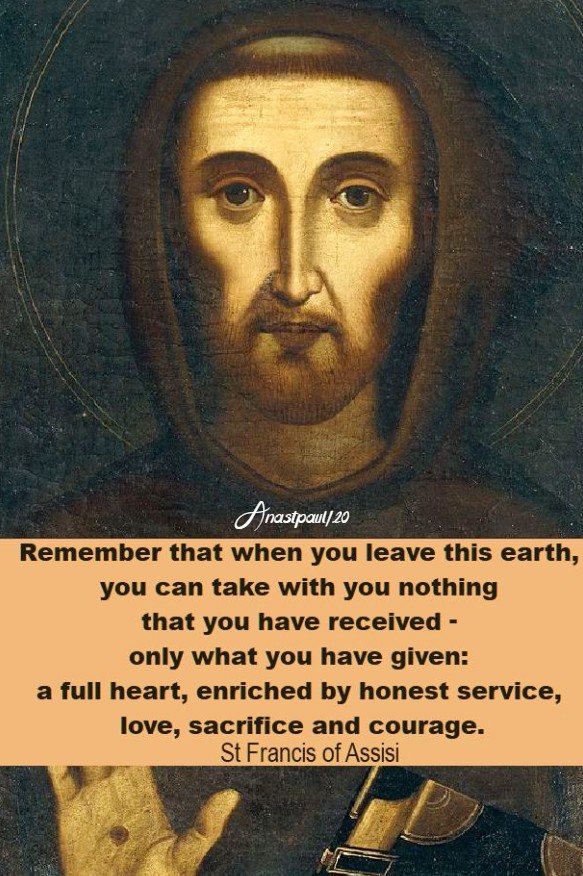
REFLECTION – “Let us give alms because these cleanse our souls from the stains of sin. Men lose all the material things – they leave behind them in this world but they carry with them the reward of their charity and the alms they give. For these they will receive from the Lord the reward and recompense they deserve.” – St Francis of Assisi (c 1181–1226)
PRAYER – We beseech Your mercy Lord, let Your Spirit come upon us in power and fill us with His gifts, to render our minds and hearts pleasing to You and make us docile and merciful as Your Son has taught us. May our Lord Jesus, Your Son, guide us and may the prayers of St Albinus of Angers assist us to engrave Your precepts in our hearts and actions. Through Jesus Christ with the Holy Spirit, God now and forever, amen.
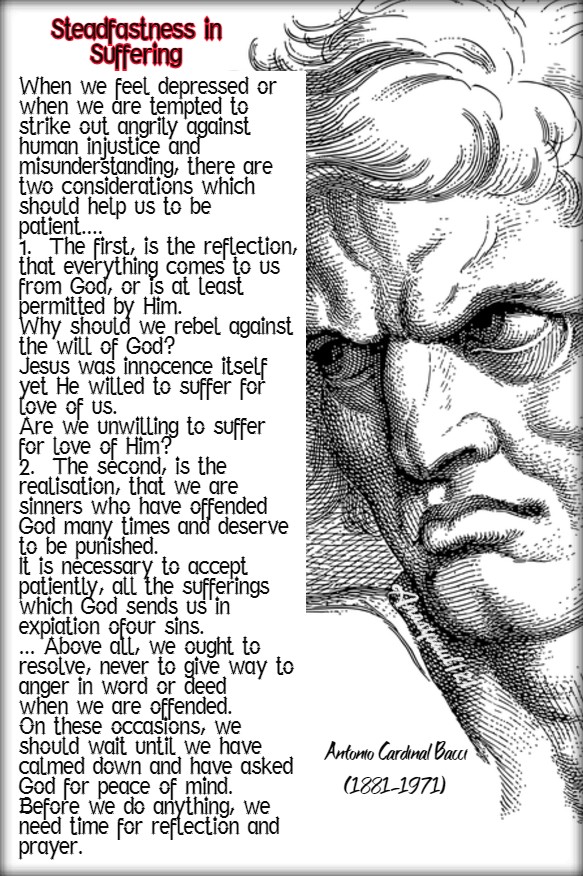
Thought for the Day – 28 February – Meditations with Antonio Cardinal Bacci (1881-1971)
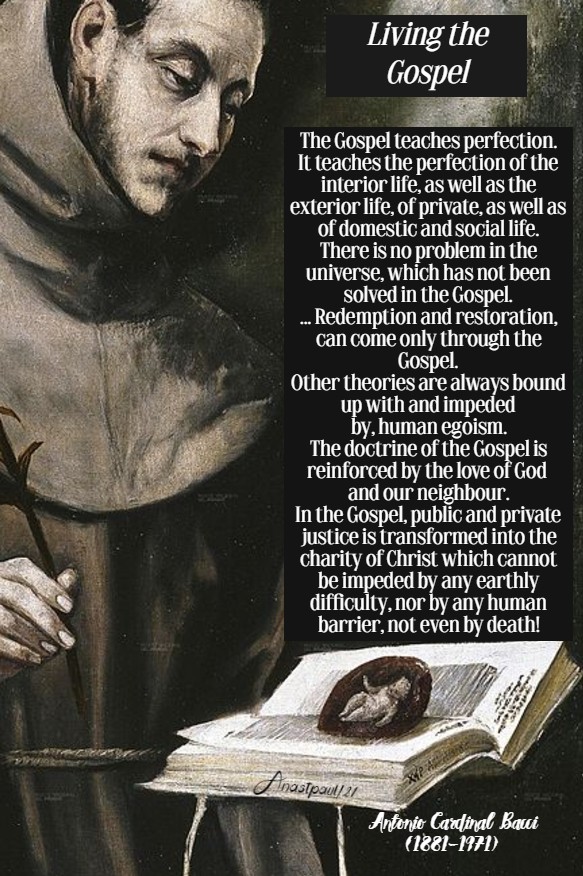
Living the Gospel
“The Gospel teaches perfection. It teaches the perfection of the interior life, as well as the exterior life, of private, as well as of domestic and social life. There is no problem in the universe, which has not been solved in the Gospel. In regard to the spiritual life, its command is clear. “You are to be perfect, even as your heavenly Father is perfect” (Mt 5:48). “Thou shalt love the Lord thy God with thy whole heart and with thy whole soul and with they whole mind … Thou shalt love thy neighbour as thyself” (Mt 22:37, Mk 12:30, Lk 10:27). “This is my commandment, that you love one another, as I have loved you” (Jn 15:12). “If anyone wishes to come after me, let him deny himself and take up his cross daily and follow me” (Lk 9:23). “Blessed are the poor in spirit … the clean of heart … the peacemakers …” (Mt 5:3-10). “If thou wilt be perfect, go, sell what thou hast and give to the poor and thou shall have treasure in heaven” (Mt 19:21). “Our Father who art in heaven … thy will be done on earth as it is in heaven” (Mt 6:10). “Father … not my will but thine be done” (Lk 22:42). Anyone who identifies himself with these maxims, rises above the level of a man, to that of an angel. His interior life soars to such a peak, that he seems to be leading a heavenly, rather than an earthly existence. If he is living the Gospel, moreover, his external behaviour will be a faithful mirror of his interior life, for it is not enough to say “Lord, Lord” but a man must also do the will of the Father (Cf Mt 7:21). A man’s domestic and social life, will follow the pattern of his private life.
When he has reached the summit of perfection, an invisible force will emanate from him, the force of good example. This force will transform everything, within him and around him. Like Mary and the Saints, he will become the loyal and powerful co-worker of Christ in the redemption of the human race and in the Christian transformation of society. Redemption and restoration, can come only through the Gospel. Other theories are always bound up with and impeded by, human egoism. The doctrine of the Gospel is reinforced by the love of God and our neighbour. In the Gospel, public and private justice is transformed into the charity of Christ which cannot be impeded by any earthly difficulty, nor by any human barrier, not even by death. “Who shall separate us from the charity of Christ?” (Rom 8:35) asks St Paul. Let us meditate on this.”
Thought for the Day – 27 February– Meditations with Antonio Cardinal Bacci (1881-1971)
The Death of our Saviour – Pray for your Enemies!
“In the midst of His sufferings, Jesus forgets Himself and pray for His executioners. “Father,” He pleaded, “forgive them, for they do not know what they are doing” (Lk 23:34). Who were these people who crucified Him? We know well that they were not only the Jews but all of us. The prophet Isaiah, had foretold this. “He was wounded for our iniquities, he was bruised for our sins … He was offered because it was his own will…” (Is 53:5-7). We are all the crucifiers of Jesus. Therefore, He willed to suffer and to die for all of us and when He was hanging on the Cross, He begged for forgiveness for us all. This should incite us to trust in God and to do repentance for our sins. We should be sorry for our sins because, they were the real cause of the voluntary death of Jesus. We should have confidence in Him, because, He prayed for us and forgave us when He was dying on the Cross and is ready to pardon us again, as long as we are sincerely repentant.
Let us consider how Jesus, even though He was derided and nailed to the Cross, prayed for and forgave His executioners. How do we normally behave? Perhaps we fly into anger at the first word of offence or act of misunderstanding, or perhaps we nourish secret feelings of hatred in our hearts for our brothers in Jesus Christ? Let us kneel before the Cross and tell Our Lord, that we wish to be meek and humble of heart, like Him. We wish to be quick to forgive and to live in peace and, even, if it is necessary, to do good to those who offend us, or at any rate, to pray fervently for them.”
Day Eleven of our Lenten Journey – 27 February – Saturday of the First week of Lent, Readings: Deuteronomy 26:16-19, Psalms 119:1-2, 4-5,7-8, Matthew 5:43-48
Imitating Christ with Thomas à Kempis (1380-1471)
In You is the source of life and in Your Light Lord, we see light Psalm 35(36)
“But I say to you, love your enemies” – Matthew 5:44
BE NOT troubled about those who are with you or against you but take care, that God be with you in everything you do. Keep your conscience clear and God will protect you, for the malice of man cannot harm one whom God wishes to help. If you know how to suffer in silence, you will undoubtedly experience God’s help. He knows when and how to deliver you, therefore, place yourself in His hands, for it is a divine prerogative to help men and free them from all distress.
It is often good for us to have others know our faults and rebuke them, for it gives us greater humility. When a man humbles himself because of his faults, he easily placates those about him and readily appeases those who are angry with him.
It is the humble man whom God protects and liberates; it is the humble whom He loves and consoles. To the humble, He turns and upon them bestows great grace, that after their humiliation, He may raise them up to glory. He reveals His secrets to the humble and with kind invitation, bids them come to Him. Thus, the humble man enjoys peace in the midst of many vexations because his trust is in God, not in the world. Hence, you must not think that you have made any progress until you look upon yourself as inferior to all others. (Book 2 Ch 2)
Thought for the Day – 26 February – Meditations with Antonio Cardinal Bacci (1881-1971)
“As We Also Forgive Our Debtors”
“If thou art offering thy gift at the altar,” Jesus tells us “and thou remember that thy brother has anything against thee, leave thy gift before the altar and go first to be reconciled to thy borhter and then come and offer thy gift” (Mt 5:23-24). Prayer is futile, therefore, unless we have first forgiven our enemies!
“Learn from me,” Jesus said when He proposed Himself as a model to be imitated, “for I am meek and humble of heart.” Then He added, “you will find rest for your souls” (Cf Mt 11:29). The foundation of our hatred, anger and resentment, is always our wounded pride. We need Christlike gentleness and humility, if we are to forgive sincerely and generously. Only when we have this gentleness and humility, moreover, shall we find joy in forgiving and only then, shall we have peace. As long as there is room in our hearts for pride and hatred, we can never enjoy peace of soul!”
Day Ten of our Lenten Journey – 26 February – – Friday of the First week of Lent, Readings: Ezekiel 18:21-28, Psalms 130:1-2, 3-4, 5-7, 7-8, Matthew 5:20-26
Imitating Christ with Thomas à Kempis (1380-1471)
In You is the source of life and in Your Light Lord, we see light Psalm 35(36)
“Go first and be reconciled with your brother” – Matthew 5:24
First keep peace with yourself, then you will be able to bring peace to others. A peaceful man does more good than a learned man. Whereas a passionate man turns even good to evil and is quick to believe evil, the peaceful man, being good himself, turns all things to good. The man who is at perfect ease is never suspicious but the disturbed and discontented spirit, is upset by many a suspicion. He neither rests himself nor permits others to do so. He often says what ought not to be said and leaves undone what ought to be done. He is concerned with the duties of others but neglects his own.
Direct your zeal, therefore, first upon yourself; then you may with justice exercise it upon those about you.
You are well versed in colouring your own actions with excuses which you will not accept from others, though it would be more just to accuse yourself and excuse your brother.
If you wish men to bear with you, you must bear with them. Behold, how far you are from true charity and humility which does not know how to be angry with anyone, or to be indignant save only against self! It is no great thing to associate with the good and gentle, for such association is naturally pleasing. Everyone enjoys a peaceful life and prefers persons of congenial habits.
But to be able to live at peace with harsh and perverse men, or with the undisciplined and those who irritate us, is a great grace, a praiseworthy and manly thing. Some people live at peace with themselves and with their fellow men but others are never at peace with themselves nor do they bring it to anyone else. These latter are a burden to everyone, but they are more of a burden to themselves. A few, finally, live at peace with themselves and try to restore it to others.
Now, all our peace in this miserable life is found in humbly enduring suffering rather than in being free from it. He who knows best how to suffer will enjoy the greater peace because he is the conqueror of himself, the master of the world, a friend of Christ and an heir of heaven. (Book 2 Ch 3)
Thought for the Day – 25 February – Meditations with Antonio Cardinal Bacci (1881-1971)
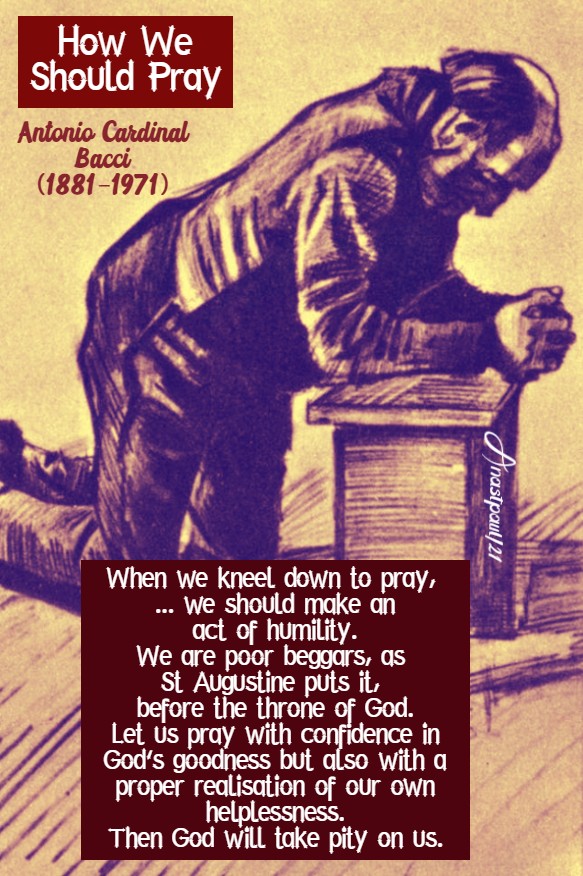
How We Should Pray
“We must pray with deep humility. Once again we find, that the Man-God Jesus, has given us an example. In Gethsemane He fell prostate on the ground and begged that, if it were possible, the bitter chalice might be taken away from Him. Immediately he added. with full submission to the will of His Heavenly Father – “Yet, not my will but thine be done” (Lk 22:42). Let us remember, moreover, the parable of the Pharisee and the publican. The former appeared to be full of virtue but he was proud and was rejected. The latter, recognised in all humility, that he was a poor sinner and he was exalted. “Everyone who exalts himself shall be humbled and he who humbles himself shall be exalted” (Lk 14:11). “God resists the proud but gives grace to the humble” (Js 4:6). “The prayer of the lowly pierces the clouds; it does not rest, until t reaches its goal” (Ecclus 35:17).
When we kneel down to pray, therefore, we should make an act of humility. We are poor beggars, as St Augustine puts it, before the throne of God. Let us pray with confidence in God’s goodness but also with a proper realisation of our own helplessness. Then God will take pity on us.
One Minute Reflection – 25 February – Thursday of the First week of Lent, Readings: Esther C:12, 14-16, 23-25, Psalms 138:1-2,2-3, 7-8, Matthew 7:7-12 and the Memorial of Blessed Sebastian of Aparicio OFM (1502-1600) “The Angel of Mexico”
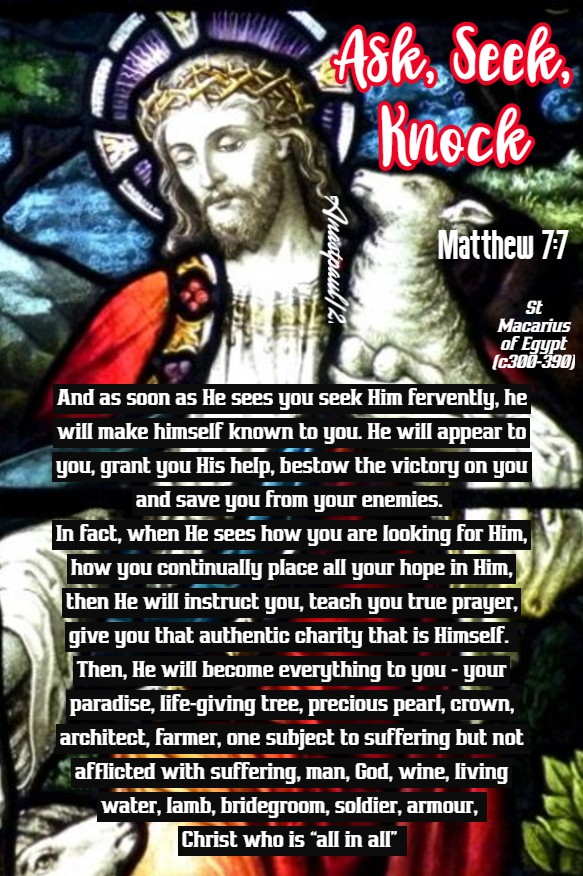
“Ask and it will be given you, seek and you will find, knock and it will be opened to you.” – Matthew 7:7
REFLECTION – “Try hard to please the Lord, pay Him unwearying attention within yourself, seek for Him with the aid of your thoughts, keep a check on your will and its decisions, control them so they are constantly directed towards Him. Then you will see how He draws near you and makes His dwelling within you… He stands there, taking note of your reasoning, thoughts, reflexions, examining how you are seeking Him, whether it is with all your soul or whether sluggishly and carelessly. And as soon as He sees you seek Him fervently, he will make himself known to you. He will appear to you, grant you His help, bestow the victory on you and save you from your enemies. In fact, when He sees how you are looking for Him, how you continually place all your hope in Him, then He will instruct you, teach you true prayer, give you that authentic charity that is Himself. Then, He will become everything to you: your paradise, life-giving tree, precious pearl, crown, architect, farmer, one subject to suffering but not afflicted with suffering, man, God, wine, living water, lamb, bridegroom, soldier, armour, Christ who is “all in all” (1Cor 15,28).
Just as a child cannot feed or take care of itself but can only look at its mother and cry until she takes pity and gives it her attention, so believing soul,s always hope in Christ and attribute to Him, all righteousness. As the shoot withers if it is separated from the vine (Jn 15,6) so does someone who wants to become faultless apart from Christ. Just as “someone is a thief and robber who does not enter the sheepfold through the gate but climbs over elsewhere” (Jn 10,1), so it is with someone, who wants to become just, without Him who justifies.” – St Macarius of Egypt (c 300-390) Monk – Spiritual Homilies no 30, 3-4
PRAYER –May We Love Only YouBy St Columban (543-615) Loving Saviour, be pleased to show Yourself to us who knock, so that in knowing You, we may love only You, love You alone, desire You alone, contemplate only You, day and night and always think of You. Inspire in us the depth of love that is fitting for You to receive as God. So may Your love pervade our whole being, possess us completely and fill all our senses, that we may know no other love but love for You, Who are everlasting. May our love be so great, that the many waters of sky, land and sea cannot extinguish it in us – many waters could not extinguish love. May this saying be fulfilled in us also, at least in part, by Your gift, Jesus Christ, our Lord, to whom be glory forever and ever. Amen
Day Eight of our Lenten Journey – 24 February – – Wednesday of the First week of Lent, Readings: Jonah 3:1-10,Psalms 51:3-4, 12-13, 18-19, Luke 11:29-32
Imitating Christ with Thomas à Kempis (1380-1471)
In You is the source of life and in Your Light Lord, we see light Psalm 35(36)
“This generation is an evil generation. It seeks for a sign but no sign will be given to it, except the sign of Jonah.” – Luke 11:29
IN ALL things consider the e,d; how you shall stand before the strict Judge from Whom nothing is hidden and Who will pronounce judgement in all justice, accepting neither bribes nor excuses. And you, miserable and wretched sinner, who fear even the countenance of an angry man, what answer will you make to the God Who knows all your sins? Why do you not provide for yourself against the day of judgement when no man can be excused or defended by another because each, will have enough to do, to answer for himself? In this life your work is profitable, your tears acceptable, your sighs audible, your sorrow satisfying and purifying.
The patient man goes through a great and salutary purgatory when he grieves more over the malice of one who harms him than for his own injury; when he prays readily for his enemies and forgives offenses from his heart; when he does not hesitate to ask pardon of others; when he is more easily moved to pity than to anger; when he does frequent violence to himself and tries to bring the body into complete subjection to the spirit.
It is better to atone for sin now and to cut away vices than to keep them for purgation in the hereafter. In truth, we deceive ourselves by our ill-advised love of the flesh. What will that fire feed upon but our sins? The more we spare ourselves now and the more we satisfy the flesh, the harder will the reckoning be and the more we keep for the burning.
For a man will be more grievously punished in the things in which he has sinned. There the lazy will be driven with burning prongs and gluttons tormented with unspeakable hunger and thirst; the wanton and lust-loving will be bathed in burning pitch and foul brimstone; the envious will howl in their grief like mad dogs.
Every vice will have its own proper punishment. The proud will be faced with every confusion and the avaricious pinched with the most abject want. One hour of suffering there, will be more bitter, than a hundred years of the most severe penance here. In this life men sometimes rest from work and enjoy the comfort of friends, but the damned have no rest or consolation.
You must, therefore, take care and repent of your sins now so that on the day of judgement you may rest secure with the blessed. For on that day, the just will stand firm against those who tortured and oppressed them and he, who now submits humbly to the judgement of men, will arise to pass judgement upon them. The poor and humble will have great confidence, while the proud will be struck with fear. He who learned to be a fool in this world and to be scorned for Christ, will then appear to have been wise. (Book 1 Ch 24:1-4)
Quote/s of the Day – 24 February – Wednesday of the First week of Lent, Readings: Jonah 3:1-10,Psalms 51:3-4, 12-13, 18-19, Luke 11:29-32
“The sign of Jonah”
Luke 11:29
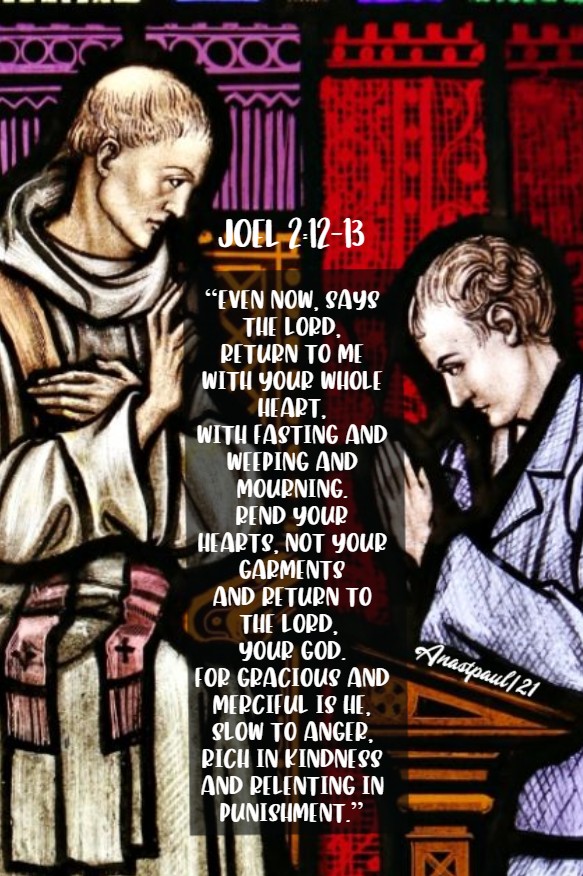
“Even now, says the LORD, return to me with your whole heart, with fasting and weeping and mourning. Rend your hearts, not your garments and return to the LORD, your God. For gracious and merciful is he, slow to anger, rich in kindness and relenting in punishment.”
Joel 2:12-13
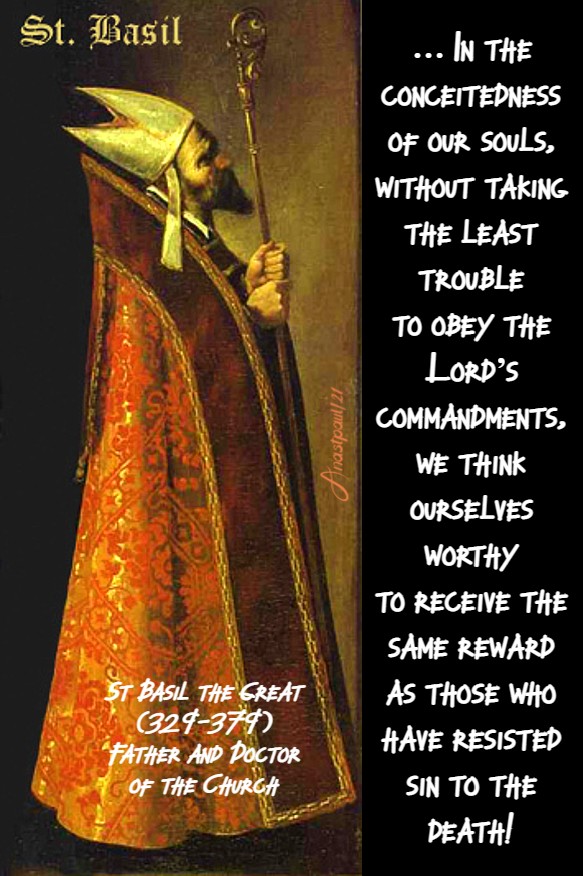
“… In the conceitedness of our souls, without taking the least trouble to obey the Lord’s commandments, we think ourselves worthy to receive the same reward as those who have resisted sin to the death!”
St Basil the Great (329-379) Father and Doctor of the Church
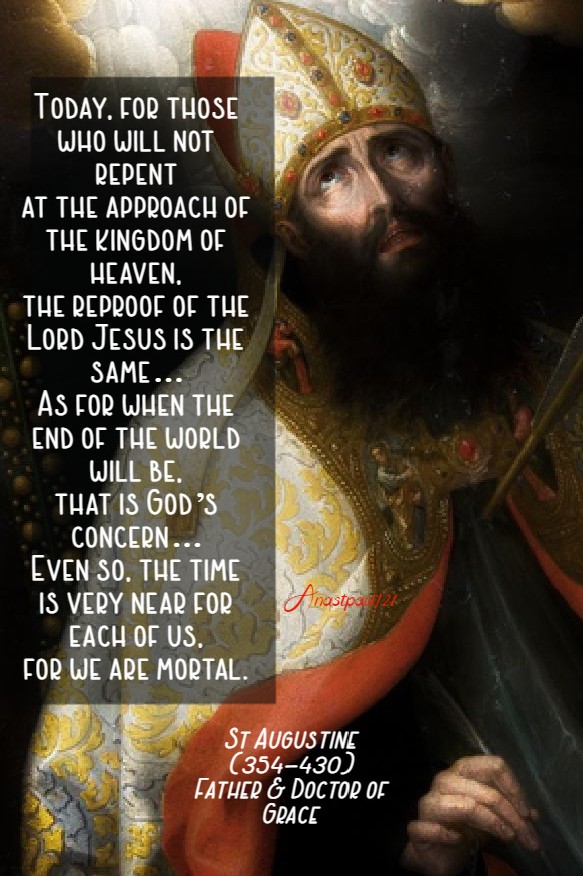
“Today, for those who will not repent at the approach of the kingdom of heaven, the reproof of the Lord Jesus is the same… As for when the end of the world will be, that is God’s concern… Even so, the time is very near for each of us, for we are mortal.”
St Augustine (354-430) Father & Doctor of Grace
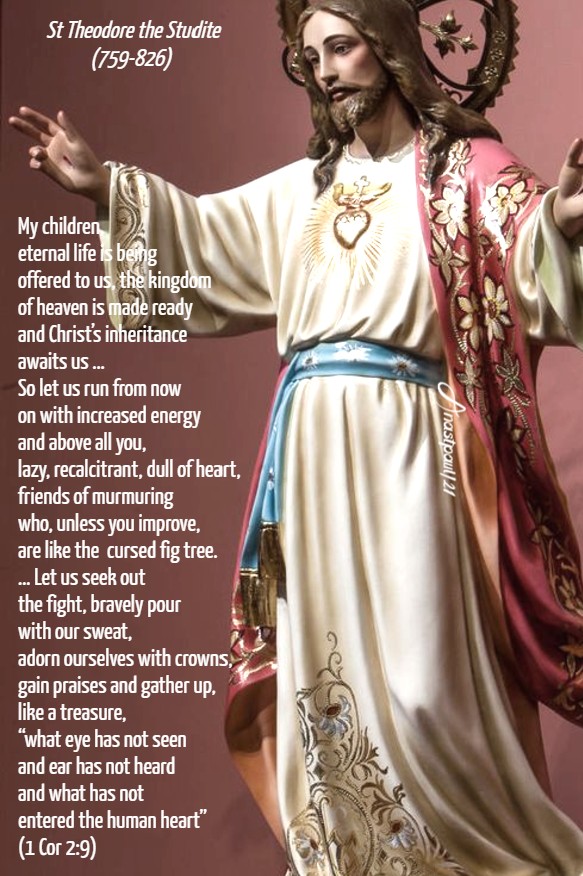
“My children, eternal life is being offered to us, the kingdom of heaven is made ready and Christ’s inheritance awaits us … So let us run from now on with increased energy and above all you, lazy, recalcitrant, dull of heart, friends of murmuring who, unless you improve, are like the cursed fig tree. … Let us seek out the fight, bravely pour with our sweat, adorn ourselves with crowns, gain praises and gather up, like a treasure, “what eye has not seen and ear has not heard and what has not entered the human heart” (1 Cor 2:9).
St Theodore the Studite (759-826)
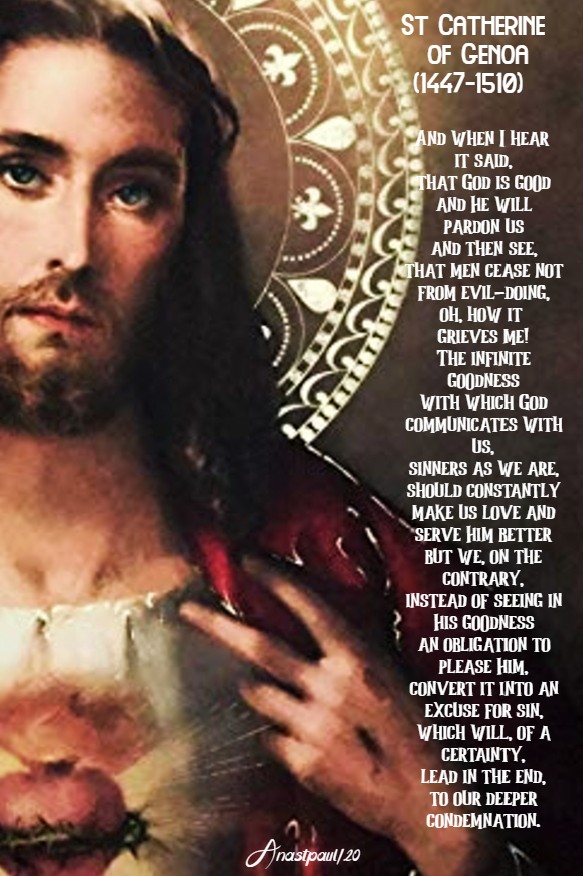
“And when I hear it said, that God is good and He will pardon us and then see, that men cease not from evil-doing, oh, how it grieves me! The infinite goodness with which God communicates with us, sinners as we are, should constantly make us love and serve Him better but we, on the contrary, instead of seeing in His goodness an obligation to please Him, convert it into an excuse for sin, which will, of a certainty, lead in the end, to our deeper condemnation.”
Day Seven of our Lenten Journey – 23 February – Tuesday of the First week of Lent, Readings: Isaiah 55:10-11, Psalms 34:4-5, 6-7,16-17, 18-19, Matthew 6:7-15
Imitating Christ with Thomas à Kempis (1380-1471)
In Your Light Lord, we see light
“Thy will be done, on earth, as it is in heaven.” – Matthew 6:10
WHATEVER I can desire or imagine for my own comfort, I look for not here but hereafter. For if I alone should have all the world’s comforts and could enjoy all its delights, it is certain, that they could not long endure. Therefore, my soul, you cannot enjoy full consolation or perfect delight except in God, the Consoler of the poor and the Helper of the humble. Wait a little, my soul, wait for the divine promise and you will have an abundance of all good things in heaven. If you desire these present things too much, you will lose those which are everlasting and heavenly. Use temporal things but desire eternal things. You cannot be satisfied with any temporal goods because you were not created to enjoy them.
Even if you possessed all created things, you could not be happy and blessed; for in God, Who created all these things, your whole blessedness and happiness consists — not indeed such happiness as is seen and praised by lovers of the world but such, as that for which the good and faithful servants of Christ wait and of which the spiritual and pure of heart, whose conversation is in heaven, sometime have a foretaste.
Vain and brief is all human consolation. But that which is received inwardly from the Truth is blessed and true. The devout man carries his Consoler, Jesus, everywhere with him and he says to Him: “Be with me, Lord Jesus, in every place and at all times. Let this be my consolation, to be willing to forego all human comforts. And if Your consolation be wanting to me, let Your will and just trial of me, be my greatest comfort. For You will not always be angry, nor will You threaten forever.” (Book 3 Ch 16:1-2)
Quote/s of the Day – 23 February – Tuesday of the First week of Lent, Readings: Isaiah 55:10-11, Psalms 34:4-5, 6-7,16-17, 18-19, Matthew 6:7-15
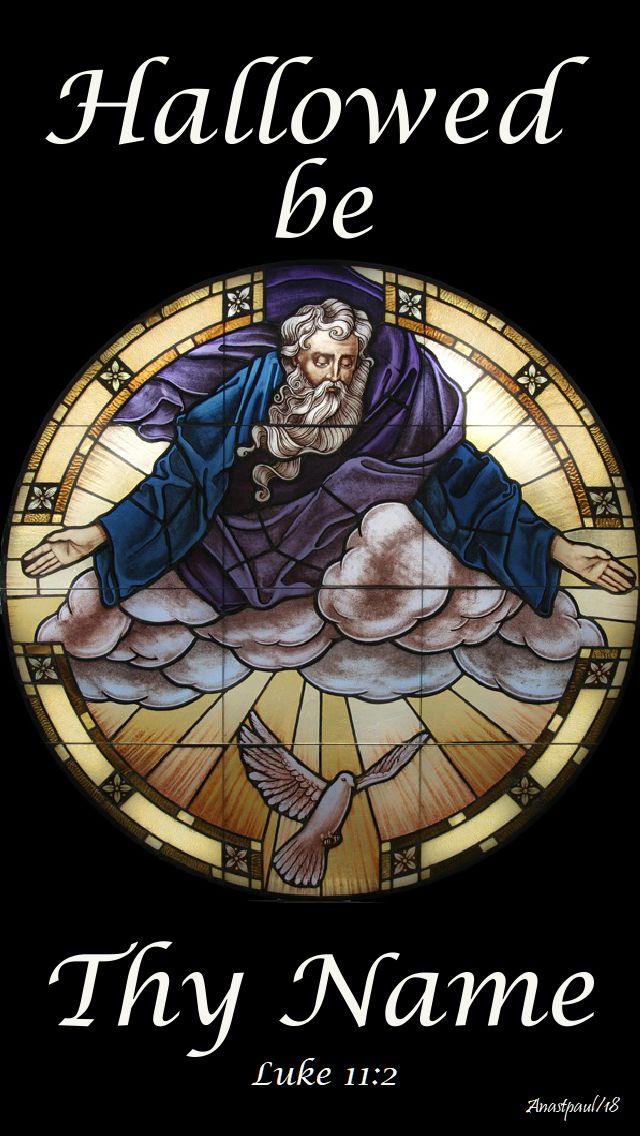
“Father, hallowed be thy name.”
Luke 11:2
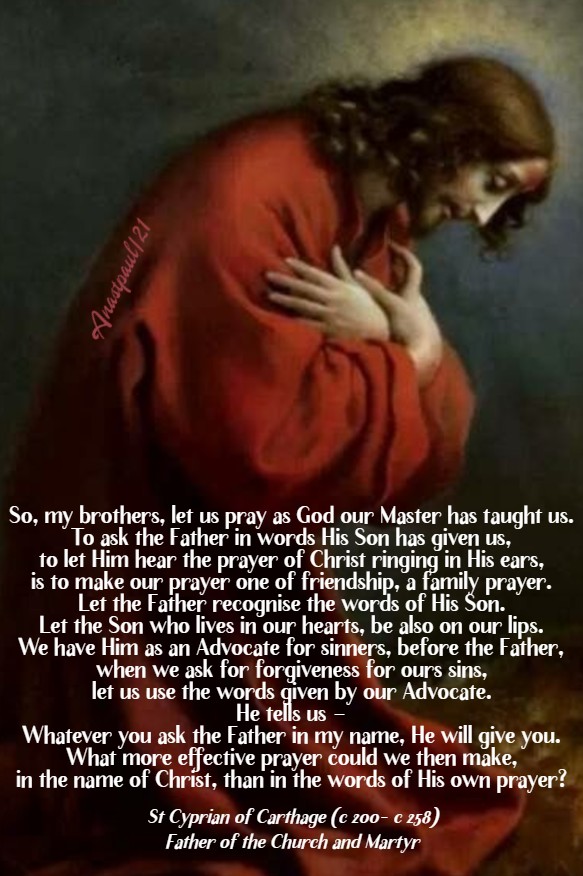
“So, my brothers, let us pray as God our master has taught us. To ask the Father in words His Son has given us, to let Him hear the prayer of Christ ringing in His ears, is to make our prayer one of friendship, a family prayer. Let the Father recognise the words of His Son. Let the Son who lives in our hearts, be also on our lips. We have Him as an Advocate for sinners, before the Father, when we ask for forgiveness for ours sins, let us use the words given by our Advocate. He tells us – Whatever you ask the Father in my name, He will give you. What more effective prayer could we then make, in the name of Christ, than in the words of His own prayer?”
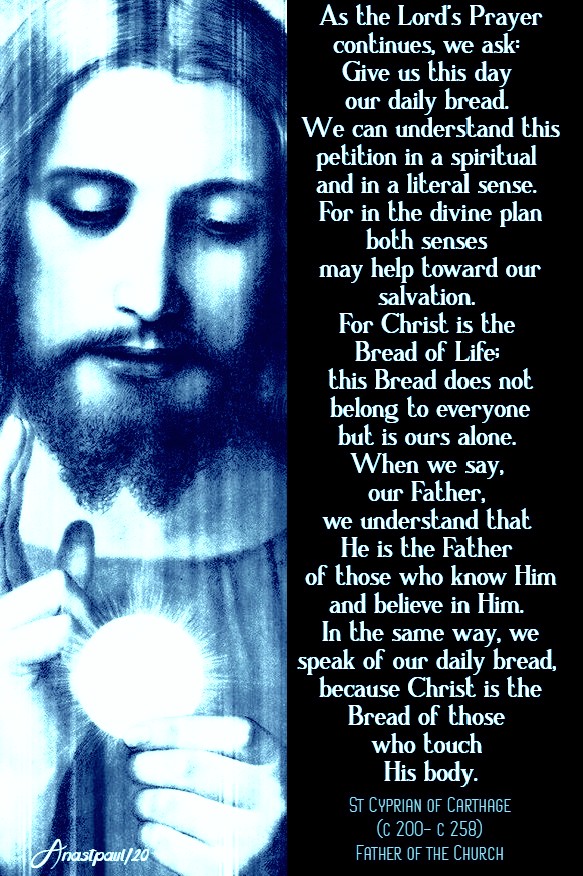
“As the Lord’s Prayer continues, we ask: Give us this day our daily bread. We can understand this petition in a spiritual and in a literal sense. For in the divine plan both senses may help toward our salvation. For Christ is the Bread of Life; this Bread does not belong to everyone but is ours alone. When we say, our Father, we understand that he is the Father of those who know Him and believe in Him. In the same way, we speak of our daily bread, because Christ is the Bread of those who touch His body.”
St Cyprian of Carthage (c 200- c 258) Bishop, Father of the Church and Martyr An excerpt from his “On the Lord’s Prayer”
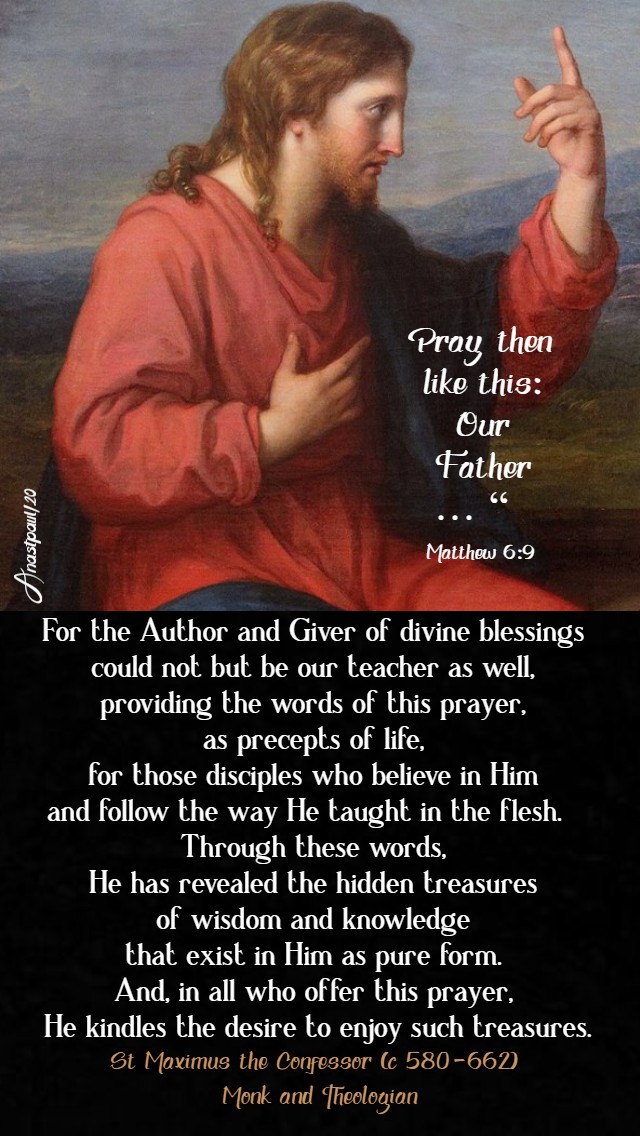
“For the author and giver of divine blessings could not but be our teacher as well, providing the words of this prayer, as precepts of life, for those disciples who believe in Him and follow the way He taught in the flesh. Through these words, He has revealed the hidden treasures of wisdom and knowledge (Col 2:3) that exist in Him as pure form. And, in all who offer this prayer, He kindles the desire to enjoy such treasures.”
St Maximus the Confessor (c 580-662) Monk and Theologian Interpretation of the Lord’s Prayer
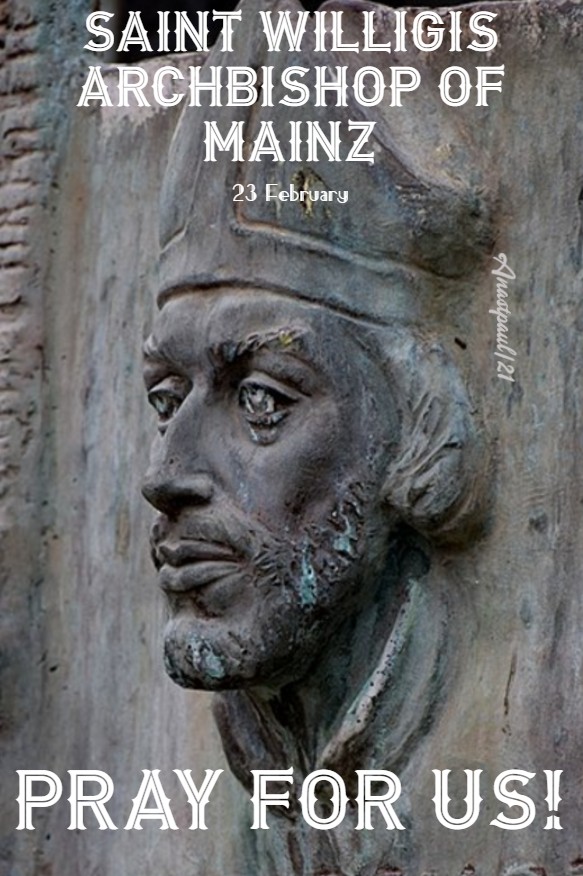
One Minute Reflection – 23 February – Tuesday of the First week of Lent, Readings: Isaiah 55:10-11, Psalms 34:4-5, 6-7,16-17, 18-19, Matthew 6:7-15 and the Memorial of St Polycarp Apostolic Father, Bishop and Martyr (c 69 – c 155)and St Willigis of Mainz (940-1011)
“This is how you are to pray.” – Matthew 6:9
REFLECTION– “Regarding other ceremonies in vocal prayers and other devotions, one should not become attached to any ceremonies or modes of prayer, other than those Christ taught us. When His disciples asked Him to teach them to pray [Lk 11:1], Christ obviously, as one Who knew so well His Father’s will, would have told them, all that was necessary, in order to obtain an answer from the Eternal Father and, in fact, He only taught them those seven petitions of the Our Father, which include all our spiritual and temporal necessities and He did not teach numerous other kinds of prayers and ceremonies. At another time, rather, He told them, that in praying, they should not desire much speaking because our heavenly Father clearly knows our needs.
He only charged us with great insistence to persevere in prayer – that is, in the Our Father – teaching, in another place, that one should pray and never cease. [Lk.18:1] He did not teach us a quantity of petitions but that these seven be repeated often and with fervour and care. For in these, as I say, are embodied everything that is God’s will and all that is fitting for us. Accordingly, when His Majesty had recourse three times to the Eternal Father, all three times He prayed with the same petition of the Our Father, as the evangelists recount: “Father, if it cannot be but that I drink this chalice, may your will be done.” [Mt. 26:42]
And He taught us only two ceremonies for use in our prayers. Our prayer should be made either in the concealment of our secret chamber [Mt 6:6] where without noise and without telling anyone we can pray with a more perfect and pure heart … Or, if not in one’s chamber, in the solitary wilderness and at the best and most quiet time of night, as He did..” [Lk. 6:12] – St John of the Cross (1542-1591) – Carmelite, Doctor of the Church – The Ascent of Mount Carmel Bk.III, ch.44
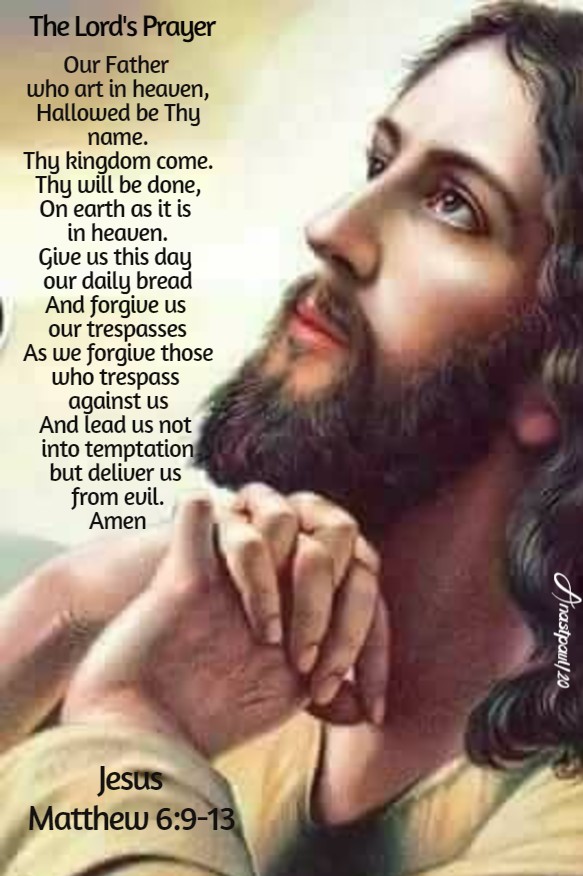
PRAYER – Our Father Who art in heaven, Hallowed be Thy name. Thy kingdom come. Thy will be done, On earth as it is in heaven. Give us this day our daily bread And forgive us our trespasses As we forgive those who trespass against us And lead us not into temptation but deliver us from evil. Amen
Day Six of our Lenten Journey – 22 February – The Feast of the Chair of Saint Peter, Readings: 1 Peter 5:1-4, Psalm 23:1-3,4-5, Matthew 16:13-19
Imitating Christ with Thomas à Kempis (1380-1471)
In Your Light Lord, we see light
“He said to them, “But who do you say that I am?” Simon Peter said in reply, “You are the Messiah, the Son of the living God.” – Matthew 16:15-16
CHRIST: MY CHILD, walk before Me in truth and seek Me always in the simplicity of your heart. He who walks before Me in truth shall be defended from the attacks of evil and the truth shall free him from seducers and from the slanders of wicked men. For if the truth has made you free, then you shall be free indeed and you shall not care for the vain words of men.
DISCIPLE: O Lord, it is true. I ask that it be with me as You say. Let Your truth teach me. Let it guard me and keep me safe to the end. Let it free me from all evil affection and badly ordered love and I shall walk with You in great freedom of heart.
CHRIST: I shall teach you those things which are right and pleasing to Me. Consider your sins with great displeasure and sorrow and never think yourself to be virtuous because of your good works. You are truly a sinner. You are subject to many passions and entangled in them. Of yourself you always tend to nothing. You fall quickly, are quickly overcome, quickly troubled and quickly undone. You have nothing in which you can glory but you have many things for which you should think yourself vile, for you are much weaker than you can comprehend. Hence, let none of the things you do seem great to you. Let nothing seem important or precious or desirable except that which is everlasting. Let the eternal truth please you above all things and let your extreme unworthiness always displease you. Fear nothing so much, blame and abhor nothing so much as your own vices and sins; these should be more unpleasant for you than any worldly losses.
Some men walk before Me without sincerity. Led on by a certain curiosity and arrogance, they wish to know My secrets and to understand the high things of God, to the neglect of themselves and their own salvation. Through their own pride and curiosity and because I am against them, such men often fall into great temptations and sins. I leave them to their own devices without My help and counsel!
Fear the judgements of God! Dread the wrath of the Almighty! Do not discuss the works of the Most High but examine your sins — in what serious things you have offended and how many good things you have neglected.
Some carry their devotion only in books, some in pictures, some in outward signs and figures. Some have Me on their lips when there is little of Me in their hearts. Others, indeed, with enlightened understanding and purified affections, constantly long for everlasting things, they are unwilling to hear of earthly affairs and only with reluctance do they serve the necessities of nature. These sense what the Spirit of truth speaks within them, for He teaches them to despise earthly things and to love those of heaven, to neglect the world and each day and night, to desire heaven. (Book 3 Ch 4:1-4)
Thought for the Day – 20 February – Meditations with Antonio Cardinal Bacci (1881-1971)
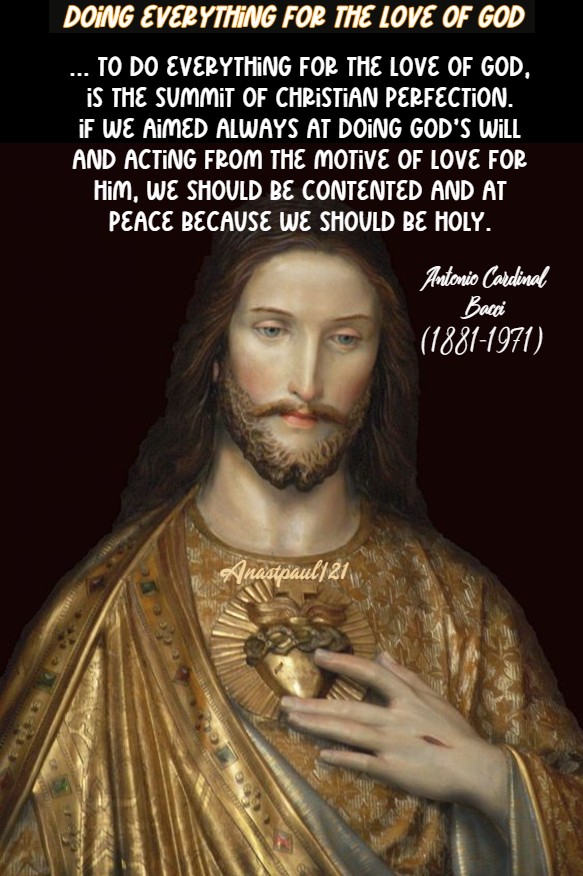
Doing Everything for the Love of God
“The beginning of perfection consists in doing the will of God, even in our smallest actions. But, to do everything for the love of God, is the summit of Christian perfection. If we aimed always at doing God’s will and acting from the motive of love for Him, we should be contented and at peace, because we should be holy. The saints are the only people who remain calm and undisturbed in the midst of worldly adversity. They are always content, because they live in God. Their lives are in full conformity with His Will, guided by His Love and dedicated to His Service. As a result, they live in a kind of spiritual stratosphere far above the storms of this world. There they are above the clouds of pride, ambition, avarice and all the other major vices. There they see and contemplate everything in the Light of God. Let us become saints. Then we shall have solved all the problems of life!.” Amen
Day Four of our Lenten Journey – 20 February – Saturday after Ash Wednesday, Readings: Isaiah 58: 9-14, Psalms 86:1-2, 3-4, 5-6, Luke 5:27-32
Imitating Christ with Thomas à Kempis CRSA (1380-1471)
In Your Light Lord, we see light
“Those who are well, have no need of a physician but those who are sick. I have not come to call the righteous but sinners to repentance.” – Luke 5:31-32
The holy Martyr, Lawrence, with his priest, conquered the world because he despised everything in it that seemed pleasing to him and for love of Christ patiently suffered the great high priest of God, Sixtus, whom he loved dearly, to be taken from him. Thus, by his love for the Creator, he overcame the love of man and chose instead of human consolation the good pleasure of God. So you, too, must learn to part with an intimate and much-needed friend for the love of God. Do not take it to heart when you are deserted by a friend, knowing that in the end we must all be parted from one another.
A man must fight long and bravely against himself before he learns to master himself fully and to direct all his affections toward God. When he trusts in himself, he easily takes to human consolation. The true lover of Christ, however, who sincerely pursues virtue, does not fall back upon consolations nor seek such pleasures of sense but prefers severe trials and hard labours for the sake of Christ. …
In what can I hope, then, or in Whom ought I trust, save only in the great mercy of God and the hope of heavenly grace? For though I have with me good men, devout brethren, faithful friends, holy books, beautiful treatises, sweet songs and hymns, all these help and please but little when I am abandoned by grace and left to my poverty. At such times there is no better remedy than patience and resignation of self to the will of God.
The devil does not sleep, nor is the flesh yet dead, therefore, you must never cease your preparation for battle, because on the right and on the left are enemies who never rest. (Book 2, Ch9, 2-3,6,8)
Quote/s of the Day – 20 February – Saturday after Ash Wednesday, Readings: Isaiah 58: 9-14, Psalms 86:1-2, 3-4, 5-6, Luke 5:27-32
“Follow me.”
Luke 5:27
“This is the glory of man – to persevere and remain in the service of God. For this reason, the Lord told His disciples: ‘You did not choose Me but I chose you.’ He meant that His disciples did not glorify Him by following Him but, in following the Son of God, they were glorified by Him. As He said: ‘I wish that where I am they also may be, that they may see My glory.’”
St Irenaeus (130-202) Father of the Church and Martyr
From his Against Heresies (Book 4)
“Christ is the artist, tenderly wiping away all the grime of sin that disfigures the human face and restoring God’s image to its full beauty.”
St Gregory of Nyssa (c 335–C 395) Father of the Church
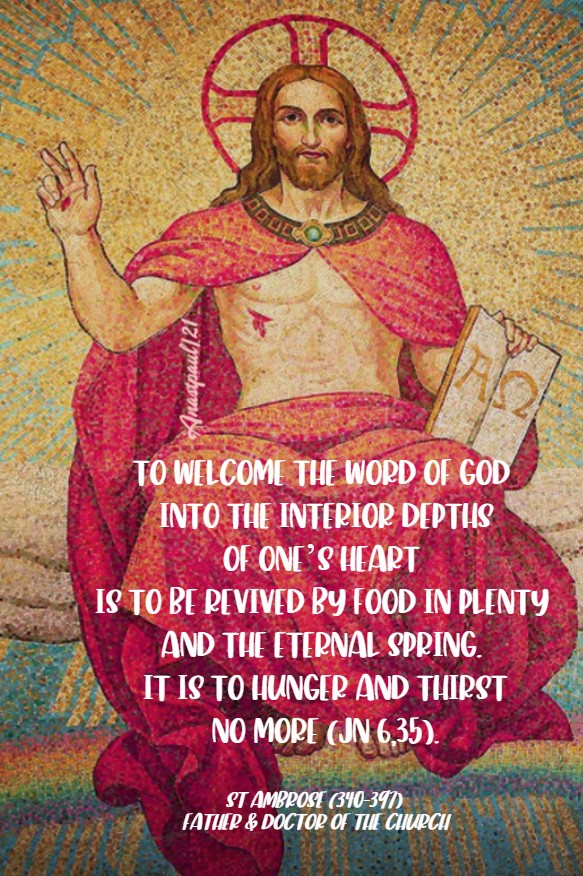
“To welcome the Word of God into the interior depths of one’s heart is to be revived by food in plenty and the eternal spring. It is to hunger and thirst no more (Jn 6,35).”
St Ambrose (340-397) Bishop of Milan Father & Doctor of the Church
Commentary on Saint Luke’s gospel, 5, 16 ; SC 45
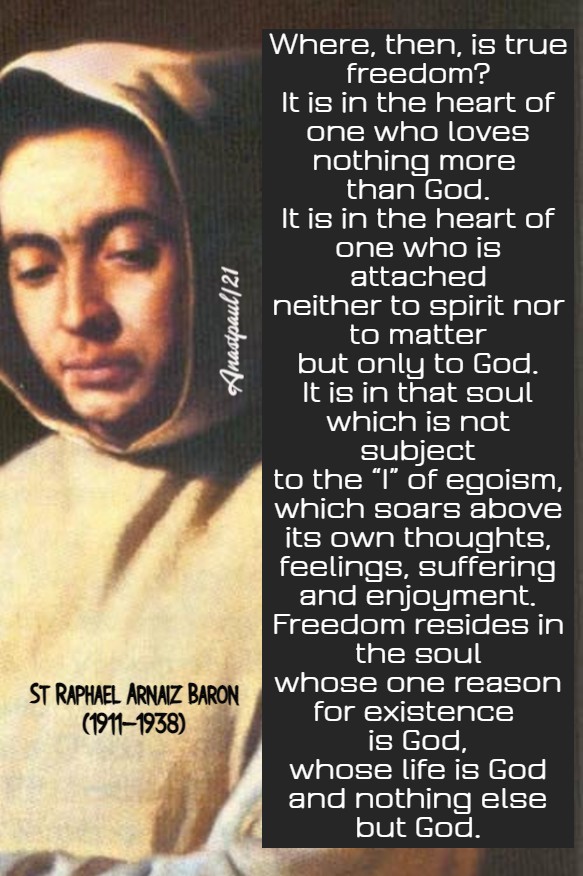
“Where, then, is true freedom? It is in the heart of one who loves nothing more than God. It is in the heart of one who is attached neither to spirit nor to matter but only to God. It is in that soul which is not subject to the “I” of egoism, which soars above its own thoughts, feelings, suffering and enjoyment. Freedom resides in the soul whose one reason for existence is God, whose life is God and nothing else but God.”
Saint Raphael Arnaiz Baron (1911-1938) Spanish Trappist Monk
One Minute Reflection – 20 February – Saturday after Ash Wednesday, Readings Isaiah 58: 9-14, Psalms 86:1-2, 3-4, 5-6, Luke 5:27-32 and the Memorial of St Elutherius of Tournai (c 456-532) Bishop and Martyr and Saints Francisco (1908-1919) and Jacinta (1910-1920)
“Those who are well, have no need of a physician but those who are sick. I have not come to call the righteous but sinners to repentance.” – Luke 5:31-32
REFLECTION – “The Apostle Paul said: “Take off the old self with its practices and put on the new self” (Col 3,9-10)… This was the work Christ accomplished when He called Levi; He refashioned him into a new man. Similarly, it is as a new person, that the former publican prepares a banquet for Christ since Christ takes pleasure in him and he himself, merits to have a share in happiness with Christ… He followed him now, happy, light-hearted and overflowing with joy.
“I have the aspect of a publican no more,” he said, “I don’t carry around the old Levi any longer; I put off Levi when I put on Christ. I flee from my earlier life; my Lord Jesus, you alone, who heal my wounds, I desire to follow. Who shall separate me from the love of God … ? tribulation? anguish? hunger? (Cf Rom 8,35). I am bound to You by faith as by nails, I am held fast by the worthy bonds of love. All Your commandments will be like a cautery that I will apply firmly to my wound; the remedy stings but it takes away the ulcerous infection. Lord Jesus, with Your powerful sword, cut away the corruption of my sins: come quickly, lance my hidden and varied passions. Purge away all infection in the new bath.
“Listen to me, you people who are fixed to the earth, you whose thoughts are intoxicated by your sins. I, Levi, was also wounded by similar passions. But I found a doctor who dwells in heaven and pours out His remedies on earth. He alone can cure my wounds since He Himself has none. He alone can remove the heart’s pain and the soul’s lethargy, for He knows everything that lies hidden.” – St Ambrose (340-397) Bishop of Milan and Doctor of the Church – Commentary on Saint Luke’s Gospel, 5, 23.27
PRAYER – Come my all-powerful, ever-living God, look with compassion on our frailty and for our protection, stretch out to us Your strong right hand. Grant that by the prayers of Mary, our Mother and all your angels and saints we may change our ways, leave everything behind, proclaim the glory of Your kingdom and come safely home to You. St Eleutherius and Sts Jacinta and Francisco, pray for us. Through our Lord Jesus Christ, in the unity of the Holy Spirit, God forever, amen.
Day Three of our Lenten Journey – 18 February – Friday after Ash Wednesday, Readings: Isaiah 58:1-9, Psalms 51:3-4, 5-6, 18-19, Matthew 9:14-15
Imitating Christ with Thomas à Kempis CRSA (1380-1471)
In Your Light Lord, we see light
“Then they will fast” – Matthew 9:15
Consider the glowing examples of the holy Fathers, in whom shone true religion and perfection; compared with them, we do little or nothing. Alas, how can our life be compared with theirs! The Saints and friends of Christ served Our Lord in hunger and thirst, in cold and nakedness, in toil and weariness: in watching and fasting, in prayer and meditation, in persecutions and insults without number (Heb.9:38, 1 Cor.4:11).
How countless and constant were the trials endured by the Apostles, Martyrs, Confessors, Virgins and all those others, who strove to follow in the footsteps of Christ. These all hated their lives in this world, that they might keep them to life eternal (Jn 12:35). How strict and self-denying was the life of the holy Fathers in the desert! How long and grievous the temptations they endured! How often they were assaulted by the Devil! How frequent and fervent their prayers to God! How strict their fasts! How great their zeal and ardour for spiritual progress! How valiant the battles they fought to overcome their vices! How pure and upright their intention towards God!
All day long they laboured and the night they gave to continuous prayer; even as they worked, they never ceased from mental prayer. They spent all their time with profit, every hour seeming short in the service of God. They often forgot even their bodily needs in the great sweetness of contemplation. They renounced all riches, dignities, honours, friends and kindred; they desired to possess nothing in this world. Scarcely would they take the necessities of life and only with reluctance would they provide for the needs of the body. Thus, though destitute of earthly goods, they were abundantly rich in grace and all virtues. Outwardly they were poor but inwardly they were refreshed with grace and heavenly consolation. They were strangers to the world but to God, they were dear and familiar friends (Ex 33:11). To themselves they were nothing but in the eyes of God, they were precious and beloved. Grounded in true humility, they lived in simple obedience, they walked in charity and patience; (Eph 5:2) and thus daily increased in the Spirit, and received great grace from God.
… Oh, the carelessness and coldness of this present time! Sloth and lukewarmness makes life wearisome for us and we soon lose our early fervour! May the longing to grow in grace not remain dormant in you … (Book 1, Ch 18:1-4a,6)
Quote/s of the Day – 18 February – Friday after Ash Wednesday, Readings: Isaiah 58:1-9, Psalms 51:3-4, 5-6, 18-19, Matthew 9:14-15
“Then they will fast”
Matthew 9:15
“The days will come, when the bridegroom is taken away from them and then they will fast in that day.”
Mark 2:20
“Fasting cleanses the soul, raises the mind, subjects one’s flesh to the spirit, renders the heart contrite and humble, scatters the clouds of concupiscence, quenches the fire of lust and kindles the true light of chastity. Enter again into yourself!”
St Augustine (354-430) Bishop of Hippo Father and Doctor of Grace
“Prayer, mercy and fasting: These three are one and they give life to each other. Fasting is the soul of prayer; mercy is the lifeblood of fasting. Let no-one try to separate them; they cannot be separated. If you have only one of them, or not all together, you have nothing.”
“So if you pray, fast; if you fast, show mercy; if you want your petition to be heared, hear the petition of others. When you fast, see the fasting of others. If you hope for mercy, show mercy. If you look for kindness, show kindness. If you want to receive, give.”
St Peter Chrysologus (400-450) Bishop of Ravenna Father and Doctor of Homilies
“Let my fasting be based on temperance, my soul in a state of grace, my intention solely to please God, then my efforts will ring true, fit to enlarge my store of charity.”
St Francis de Sales (1567-1622) Bishop of Geneva OFM, Cap. Doctor Caritatis
Thought for the Day – 18 February – A Meditations with Antonio Cardinal Bacci (1881-1971)
The Hour of Trial
“Everybody, even a Saint, has his hour of trial. God wants it this way. so that if we are victorious with the help of His grace, we can receive our reward. “One who enters a contest is not crowned unless he has competed according to the rules” (Cf 2 Tim 2:5). Even the Angels were put on trial and those haughty spirits who rebelled against God, were damned forever.
Our first parents were placed on trial and because they disobeyed God’s command, were deprived of their supernatural gifts and exiled from their earthly paradise. Even Jesus willed to endure His hour of trial in the Garden of Gethsemane, before the Sanhedrin, before the judgement seat of Pilate and on Mount Calvary. He desired to be tried in this way, in order to teach us how to be victorious.
Our trials are of various kinds, some of which recur frequently during our lives. They may be physical, such as suffering, disease, disgrace or poverty. They may be moral trials, which affect mainly the heart – the neglect of those whom we love, calumny, misunderstanding, or malice. There are also spiritual trials, such as discouraging lapses into sin, or aridity of soul when it seems that the Heavenly Father has abandoned us as He abandoned Jesus in His last agony on the Cross.
How should we behave when we are tried? Jesus showed us the way, when He took upon Himself, the sins of all mankind and His passion began in the Garden of Gethsemane. Even before He ascended Mount Calvary and was nailed to the Cross, He experienced here all the agony and terror of His redemptive mission. Prostrate with suffering, He prayed three times: “Father, if it is possible, let this cup pass away from me; yet not as I will but as thou willest” (Cf Mt 26:39-42). When we are tried, we should fervently repeat this prayer of complete resignation to the will of God.”
Day Two of our Lenten Journey – 18 February – Thursday after Ash Wednesday, Readings: Deuteronomy 30:15-20, Psalms 1:1-2, 3, 4 and 6, Luke 9:22-25
Imitating Christ with Thomas à Kempis CRSA (1380-1471)
In Your Light Lord, we see light
“Whoever wishes to come after me must deny himself, take up his cross and follow me” – Luke 9:23
To many the word seems harsh; “Deny yourself, take up your cross and follow Jesus”… (Mt 16:24) Why do you fear then to take up the cross, the way that leads to the kingdom? In the cross you are saved, revived, protected. In the cross you are showered with sweetness from on high, your mind is strengthened, your spirit rejoiced. In the cross is virtue’s sum and perfect holiness. In the cross alone, is the hope of life eternal, the soul’s salvation. So take up your cross and follow Jesus and you will enter eternal life… For if you die with Him, you shall also likewise live with Him. If you are His companion in punishment, so shall you be in glory.
Everything is founded on the cross… There is no other way to life, nor to true inner peace… Walk where you will, seek what you will, you will find neither a loftier way above, nor a safer way below but only the way of the Holy Cross.
Plan as you will, arrange as you see fit; all you will ever find is suffering, you cannot help but bear and so you will always find the cross. You will either have bodily pain or mental and spiritual affliction. Now God will leave you, again your fellow will provoke you and what is more, you will often weigh heavy on yourself. There is neither remedy to free you, nor comfort to ease you… For God will have you learn to endure affliction with total submission to Himself and become more humble… You must endure with patience everywhere, if you would be at peace within and earn the lasting crown. (Book II, Ch 12:1,2,3-4)
Quote/s of the Day – 18 February – Thursday after Ash Wednesday, Readings: Deuteronomy 30:15-20, Psalms 1:1-2, 3, 4 and 6, Luke 9:22-25
“The servant is not greater than his Master”
John 13:16
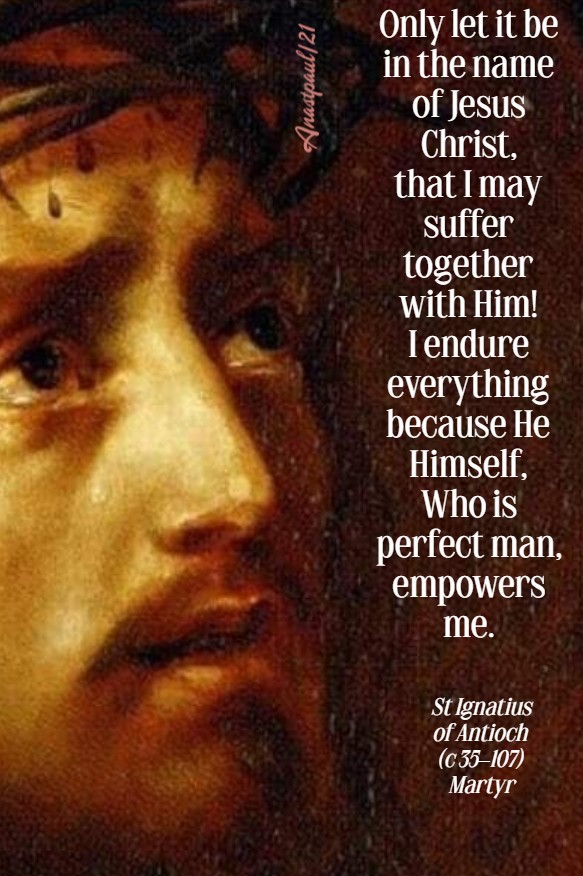
“Only let it be in the name of Jesus Christ, that I may suffer together with Him! I endure everything because He Himself, Who is perfect man, empowers me.”
St Ignatius of Antioch (c 35 – 107)
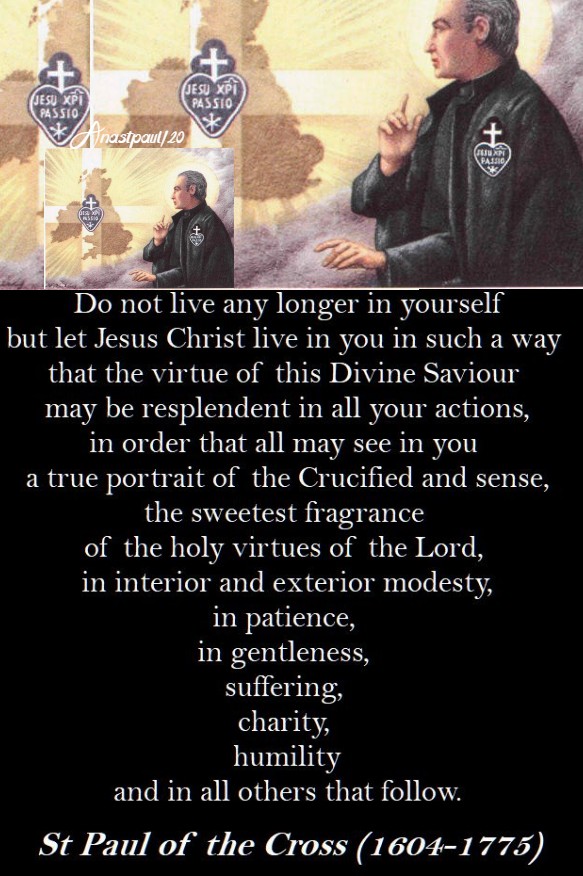
“Oh cherished cross! Through thee my most bitter trials are replete with graces!”
St Paul of the Cross (1604-1775)
“Humility, obedience, meekness and love are the virtues that shine through the Cross and the Blessed Sacrament of the Altar. O my Jesus, help me imitate you!”
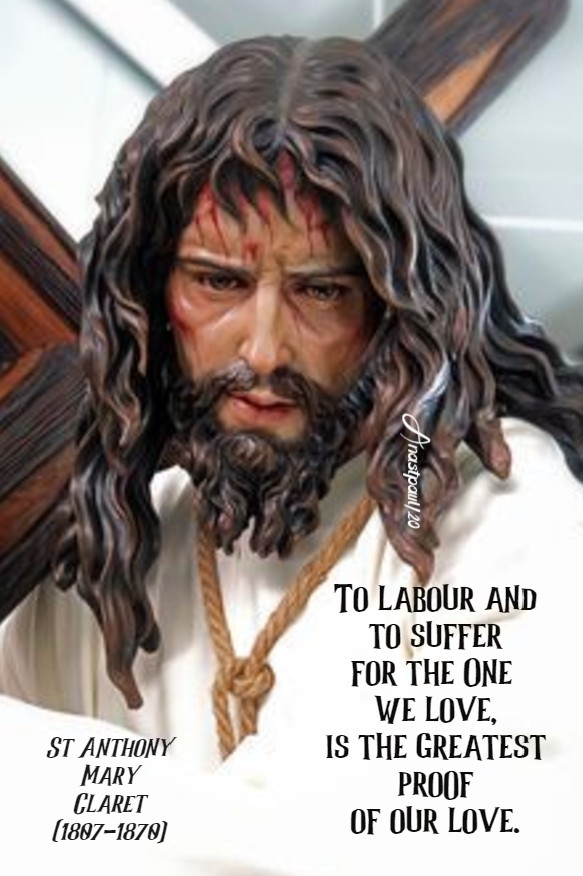
“To labour and to suffer for the One we love, is the greatest proof of our love.”
St Anthony Mary Claret (1807-1870)
“It is only through suffering that we become holy. And to become holy is our only purpose in life, our only preparation for heaven.”
One Minute Reflection – 18 February – Thursday after Ash Wednesday, Readings Deuteronomy 30:15-20, Psalms 1:1-2, 3, 4, and 6, Luke 9:22-25 and the Memorial of St Theotinius (1082-1162) The First Saint of Portugal
“Whoever wishes to come after me must deny himself, take up his cross and follow me” – Luke 9:23
REFLECTION – “What joy to live in the Cross of Christ! Who could complain of suffering? Only the insensate man who does not adore the Passion of Christ, the Cross of Christ, the Heart of Christ, can in his own griefs, give way to despair… How good it is to live united with the Cross of Christ. Christ Jesus… teach me that truth, which consists in rejoicing in scorn, injury, degradation; teach me to suffer with that humble, silent joy of the saints; teach me to be gentle towards those who don’t love me or who despise me; teach me that truth, which from the mound of Calvary You reveal to the whole world. But I know: a very gentle voice within me explains it all; I feel something in me which comes from You and which I don’t know how to put into words; so much mystery is revealed that man cannot apprehend it. I, Lord, in my way, do understand it. It is love. In that is everything. I know it, Lord, nothing more is needed, nothing more, it is love! Who shall describe the love of Christ? Let men, creatures and all things, keep silent, so that we may hear in the stillness, the whisperings of love, meek, patient, immense, infinite, which from the Cross, Jesus offers us with His arms open. The world, mad, doesn’t listen.” – St Raphael Arnaiz Baron (1911-1938) a Spanish Trappist Monk – Spiritual writings 07/04/1938
PRAYER – God of mercy, teach us to live as You have ordained. Help us to follow Your commandments with courage and steadfast devotion. Let our Saviour be our Master, help us to learn from Him, the ways of prayer in silence, the ways of love. Fill us with the fire of the Holy Spirit, that we may learn. Grant blessed Trinity, that by the prayers of St Theotonius, we may grow in holiness. Through Jesus our Lord, in unity with the Holy Spirit, one God forever. Amen
Our Morning Offering – 18 February – Thursday after Ash Wednesday
Jesus, Pierce My Soul with Your Love By St Bonaventure OFM (1221-1274) The Seraphic Doctor
Jesus, pierce my soul with Your love so that I may always long for You alone, the fulfilment of the soul’s deepest desires. May my heart always hunger and feed on You, my soul thirst for You, the source of life, wisdom, knowledge, light and all the riches of God. May I always seek and find You, think about You, speak about You and do everything for Your honour and glory. Be always my hope, my peace, my refuge and my help, in whom my heart is rooted, so that I may never be separated from You. Amen
Ash Wednesday – 17 February- Day One of our Lenten Journey
Imitating Christ with Thomas à Kempis CRSA (1380-1471)
In Your Light Lord, we see light
“HE WHO follows Me, walks not in darkness,” (John 8:12) says the Lord. By these words of Christ, we are advised to imitate His life and habits, if we wish to be truly enlightened and free from all blindness of heart. Let our chief effort, therefore, be to study the life of Jesus Christ. (Book 1, Ch 1:1)
DISCIPLE: IT IS the mark of a perfect man, Lord, never to let his mind relax in attention to heavenly things and to pass through many cares as though he had none; not as an indolent man does but, having by the certain prerogative of a free mind, no disorderly affection for any created being.
Keep me, I beg You, most merciful God, from the cares of this life, lest I be too much entangled in them. Keep me from many necessities of the body, lest I be ensnared by pleasure. Keep me from all darkness of mind, lest I be broken by troubles and overcome. I do not ask deliverance from those things, which worldly vanity desires so eagerly but, from those miseries which, by the common curse of humankind, oppress the soul of Your servant, in punishment and keep him from entering into the liberty of spirit as often as he would.
My God, Sweetness beyond words, make bitter all the carnal comfort that draws me from love of the eternal and lures me to its evil self, by the sight of some delightful good in the present. Let it not overcome me, my God. Let not flesh and blood conquer me. Let not the world and its brief glory deceive me, nor the devil trip me by his craftiness. Give me courage to resist, patience to endure and constancy to persevere. Give me the soothing unction of Your spirit, rather than all the consolations of the world and in place of carnal love, infuse into me the love of Your Name.
Behold, eating, drinking, clothing and other necessities that sustain the body are burdensome to the fervent soul. Grant me the grace to use such comforts temperately and not to become entangled in too great a desire for them. It is not lawful to cast them aside completely, for nature must be sustained but Your holy law forbids us to demand superfluous things and things that are simply for pleasure, else the flesh would rebel against the spirit. In these matters, I beg, let Your hand guide and direct me, so that I may not overstep the law in any way. (Book 3 Ch 26:1-4)
And he said,“What comes out of a man is what defiles a man. For from within, out of the heart of man, come evil thoughts, fornication, theft, murder, adultery, coveting, wickedness, deceit, licentiousness, envy, slander, pride, foolishness. All these evil things come from within and they defile a man.” – Mark 7:20-23
REFLECTION – “It is a terrible misfortune, when there is not to be found, one really interior soul among all those at the head of important Catholic projects. Then, it seems, as though the supernatural had undergone an eclipse and the power of God, were in chains! And the saints teach us that, when this happens, a whole nation may fall into a decline and Providence will seem to have given evil men a free hand, to do all the harm they desire! Make no mistake, there is a sort of instinct by which souls, without clearly defining what it is they sense, are aware of this radiation of the supernatural. What else would bring the sinner, of his own accord, to cast himself at the feet of the Priest and ask pardon, recognising God Himself in His representative? … “John, indeed, did no sign.” (Jn 10:41) Without working a single miracle, St John the Baptist attracted great crowds. St John Vianney, had a voice so weak, that it could not reach most of those in the crowd that surged around him. But, if people could hardly hear him, they saw him; they saw a living monstrance of God and the mere sight of him overwhelmed those who were there and, converted them!” – Dom Jean-Baptiste Chautard OCSO (1858-1935) – The Soul of the Apostolate, Part 4, C
PRAYER – God our Saviour, through the grace of Baptism, You made us children of light. Hear our prayer, that we may always walk in that light and work for truth, as Your witnesses before men. May our hearts be purified by You grace and may our hands and lips speak with sincere words of love. May the prayers of St Scholastica and St Benedict, help us in this, our exile. We make our prayer, through Christ our Lord with the Holy Spirit, God forever, amen.
Quote/s of the Day – 8 February – The Memorial of St Jerome Emiliani (1486–1537)
“For God, … does not work in those who refuse to place all their confidence and hope in Him alone. But He does impart the fullness of His love upon those who possess a deep faith and hope; for them He does great things.”
“With your patience you will save your soul.”
(Letter 3 #1)
“Therefore, having done what you could, the Lord will be satisfied with you because for Him, who is the most benign, goodwill compensates for the lack of success.”
(Letter 5 #4)
“…If I do not speak the truth, I become a slave of the father of lies and become a member of this father of lies.”
Thought for the Day – 5 February – Meditations with Antonio Cardinal Bacci (1881-1971)
Doing Everything for the Love of God
“As St John says, God is love; he who dwells in love dwells in God and God dwells in him (1 Jn 4:16). Since He is love, God longs to be loved by us. Our actions should come from and, be accompanied by, our love for Him. “Love, therefore, is the fulfilment of the law,” writes St Paul (Rom 13:10). We must perform all our actions, therefore for the love of God. The alchemists of old, made a great many experiments in the hope of being able to transform base metals into gold. What was impossible in the physical order, however, is quite possible in the moral and spiritual order. We can transform all our actions into pure gold, by means of the love of God.
There is a story told about a sculptor who was chiselling out a small statue which was to be placed on the highest pinnacle of the temple. He was striving after perfection in the tiniest details, as if it would be possible for the statue to be inspected at close quarters. Somebody asked him why he was so particular and careful in his work and he replied: “I am not working for those who are looking up from below but, for Him, Who is looking down from above. I am working for God alone!”
Quote/s of the Day – 4 February – Thursday of the Fourth Week of Ordinary Time, Readings: Hebrews 12:18-19, 21-24, Psalms 48:2-3,3-4, 9, 10-11, Mark 6:7-13
And he called the twelve and began to send them out, two by two …
Mark 6:7
“Go into all the world and proclaim the gospel to vthe whole creation.”
Mark 16:15
“Lord, if Your people still have need of my services, I will not avoid the toil. Your will be done. I have fought the good fight long enough. Yet, if You bid me to continue to hold the battle line, in defence of Your camp, I will never beg to be excused from failing strength. I will do the work You entrust to me. While You command, I will fight beneath Your banner. Amen”
St Martin de Tours (c 316-397)
“Pray as though everything depended on God. Work as though everything depended on you.”
St Augustine (354-430) Father & Doctor of the Church
“What a tragedy, how many souls are being shut out of heaven and falling into hell, thanks to you!”
St Francis Xavier (1506-1552)
“We ought to instruct with meekness those whom heresy has made bitter and suspicious and has estranged from orthodox Catholics, … Thus, by whole-hearted charity and goodwill, we may win them over to us in the Lord.”
St Peter Canisius (1521-1397) Doctor of the Church
“Let us go in simplicity, where merciful Providence leads us, content to see the stone on which we should step, without wanting to discover, all at once and completely, the windings of the road.”
Blessed Frédéric Ozanam (1813–1853) “Servant to the Poor”
You must be logged in to post a comment.