Our Morning Offering – 6 September – Friday of the Twenty-second week in Ordinary Time, Year C
Holy Spirit, Fire of Love By St Anthony of Padua (1195-1231) Doctor of the Church
Holy Spirit,
fire of love,
come rest over each of us,
make our tongue ready
to confess our sins,
that in revealing everything
and concealing nothing,
we may attain heavenly life
to sing eternal praise
with the angels.
With your help,
You who live
and reign through all ages.
Amen
Quote of the Day – 1 September – Twenty-second Sunday in Ordinary Time, Year C and The 5th World Day of Prayer for the Care of Creation
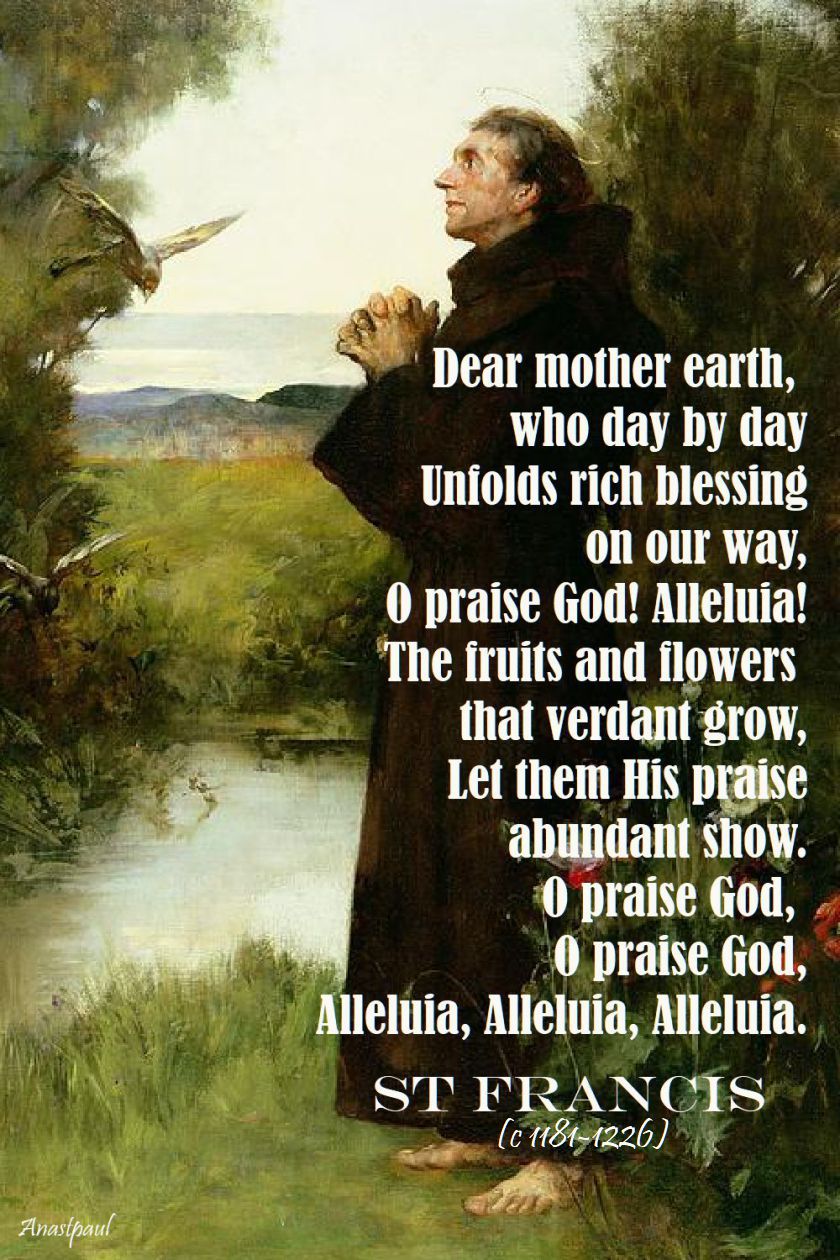
Dear mother earth, who day by day Unfolds rich blessing on our way, O praise God! Alleluia! The fruits and flowers that verdant grow, Let them His praise abundant show. O praise God, O praise God, Alleluia, Alleluia, Alleluia.
St Francis of Assisi (c 1181-1226)
(Translated by William H Draper) (Image by St Francis by Albert Chevallier Tayler)
Our Morning Offering – 30 August – Friday of the Twenty-first week in Ordinary Time, Year C
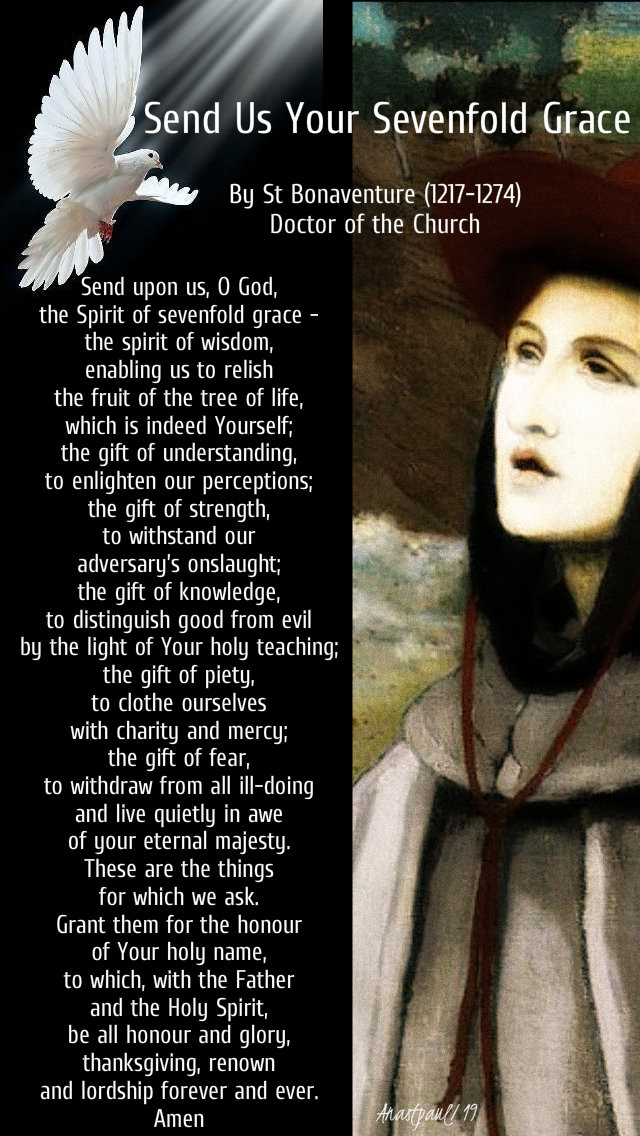
Send Us Your Sevenfold Grace By St Bonaventure (1217-1274) Doctor of the Church
Send upon us, O God,
the Spirit of sevenfold grace –
the spirit of wisdom,
enabling us to relish the fruit of the tree of life,
which is indeed Yourself;
the gift of understanding,
to enlighten our perceptions;
the gift of strength,
to withstand our adversary’s onslaught;
the gift of knowledge,
to distinguish good from evil
by the light of Your holy teaching;
the gift of piety,
to clothe ourselves with charity and mercy;
the gift of fear,
to withdraw from all ill-doing
and live quietly in awe of your eternal majesty.
These are the things for which we ask.
Grant them for the honour of Your Holy Name,
to which, with the Father and the Holy Spirit,
be all honour and glory,
thanksgiving, renown
and lordship forever and ever.
Amen
Our Morning Offering – 17 August – Saturday of the Nineteenth week in Ordinary Time, Year C and a Marian Saturday
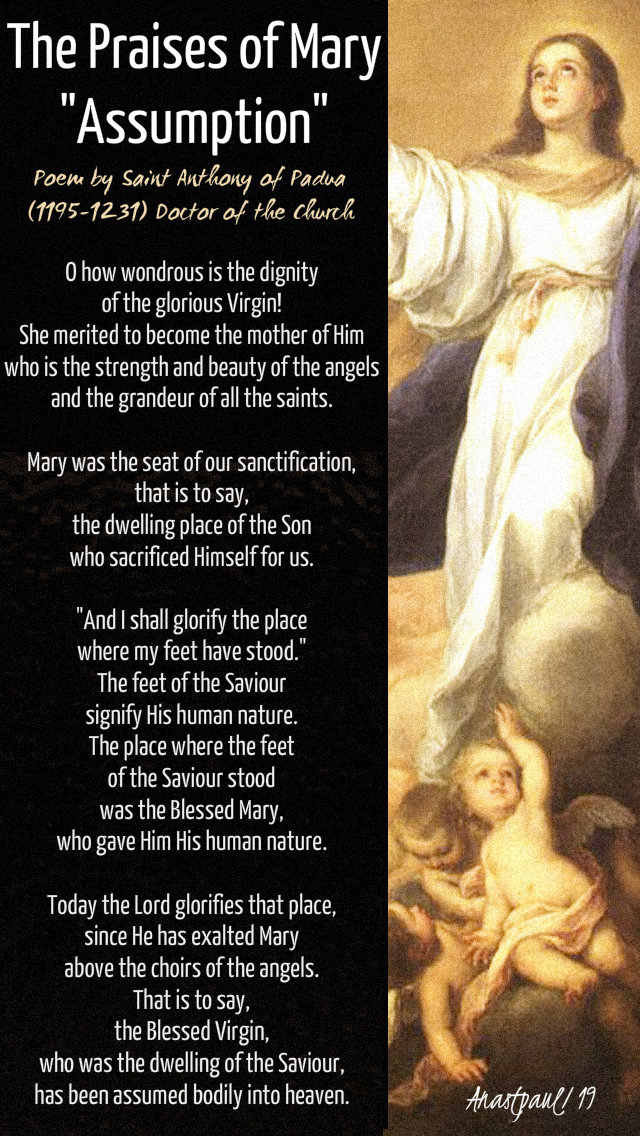
The Praises of Mary “Assumption” Poem by Saint Anthony of Padua (1195-1231) Doctor of the Church
O how wondrous is the dignity of the glorious Virgin!
She merited to become the mother of Him
who is the strength and beauty of the angels
and the grandeur of all the saints.
Mary was the seat of our sanctification,
that is to say,
the dwelling place of the Son
who sacrificed Himself for us.
“And I shall glorify the place where my feet have stood.”
The feet of the Saviour signify His human nature.
The place where the feet of the Saviour stood
was the Blessed Mary,
who gave Him His human nature.
Today the Lord glorifies that place,
since He has exalted Mary
above the choirs of the angels.
That is to say,
the Blessed Virgin,
who was the dwelling of the Saviour,
has been assumed bodily into heaven.
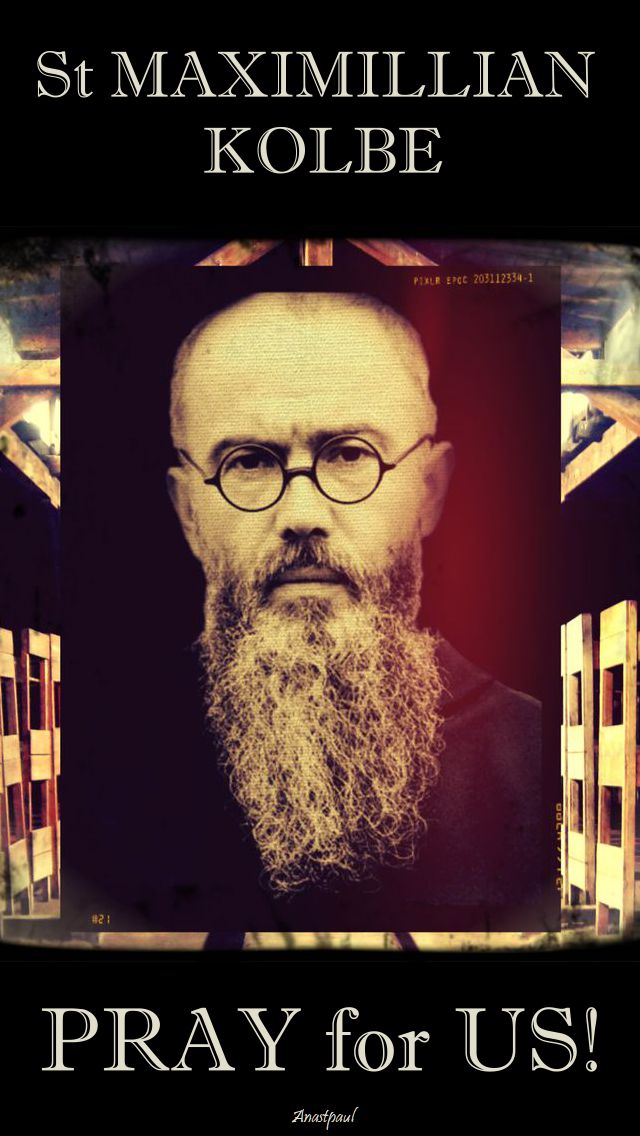
Thought for the Day – 14 August – Memorial of Saint Maximilian Mary Kolbe OFM Conv (1894 -1941) “Martyr of Charity”
Apostolic Zeal for the Salvation and Sanctification of Souls
An excerpt from the Letters of Saint Maximilian Kolbe
“The burning zeal for God’s glory that motivates you fills my heart with joy. It is sad for us to see in our own time that indifferentism in its many forms is spreading like an epidemic not only among the laity but also among religious. But God is worthy of glory beyond measure and, therefore, it is of absolute and supreme importance, to seek that glory with all the power of our feeble resources. Since we are mere creatures we can never return to Him all that is His due.
The most resplendent manifestation of God’s glory is the salvation of souls, whom Christ redeemed by shedding His blood. To work for the salvation and sanctification of as many souls as possible, therefore, is the preeminent purpose of the apostolic life. Let me, then, say a few words that may show the way toward achieving God’s glory and the sanctification of many souls.
God, who is all-knowing and all-wise, knows best what we should do to increase His glory. Through hHs representatives on earth, He continually reveals His will to us, thus it is obedience and obedience alone, that is the sure sign to us of the divine will. A superior may, it is true, make a mistake but it is impossible for us to be mistaken in obeying a superior’s command. The only exception to this rule is the case of a superior commanding something, that in even the slightest way, would contravene God’s law. Such a superior would not be conveying God’s will.
God alone is infinitely wise, holy, merciful, our Lord, Creator and Father; He is beginning and end, wisdom and power and love, He is all. Everything other than God, has value to the degree, that it is referred to Him, the maker of all and our own redeemer, the final end of all things. It is He who, declaring His adorable will to us through His representatives on earth, draws us to Himself and whose plan is, to draw others to Himself through us and to join us all to Himself in an ever-deepening love.
Look, then, at the high dignity that by God’s mercy belongs to our state in life. Obedience raises us beyond the limits of our littleness and puts us in harmony with God’s will. In boundless wisdom and care, His will guides us to act rightly. Holding fast to that will, which no creature can thwart, we are filled with unsurpassable strength.
Obedience is the one and the only way of wisdom and prudence, for us to offer glory to God . If there were another, Christ would certainly have shown it to us by word and example. Scripture, however, summed up His entire life at Nazareth in the words: He was subject to them, Scripture set obedience as the theme of the rest of His life, repeatedly declaring that He came into the world, to do His Father’s will.
Let us love our loving Father with all our hearts. Let our obedience increase that love, above all, when it requires us to surrender our own will. Jesus Christ crucified is our sublime guide toward growth in God’s love.
We will learn this lesson more quickly through the Immaculate Virgin, whom God has made the dispenser of His mercy. It is beyond all doubt, that Mary’s will represents to us, the will of God Himself. By dedicating ourselves to her, we become in her hands, instruments of God’s mercy even as she was such an instrument in God’s hands. We should let ourselves be guided and led by Mary and rest quiet and secure in her hands. She will watch out for us, provide for us, answer our needs of body and spirit, she will dissolve all our difficulties and worries.”
Quote/s of the Day – 14 August – The Memorial of St Maximillian Kolbe OFM Conv (1894 -1941) “Martyr of Charity”
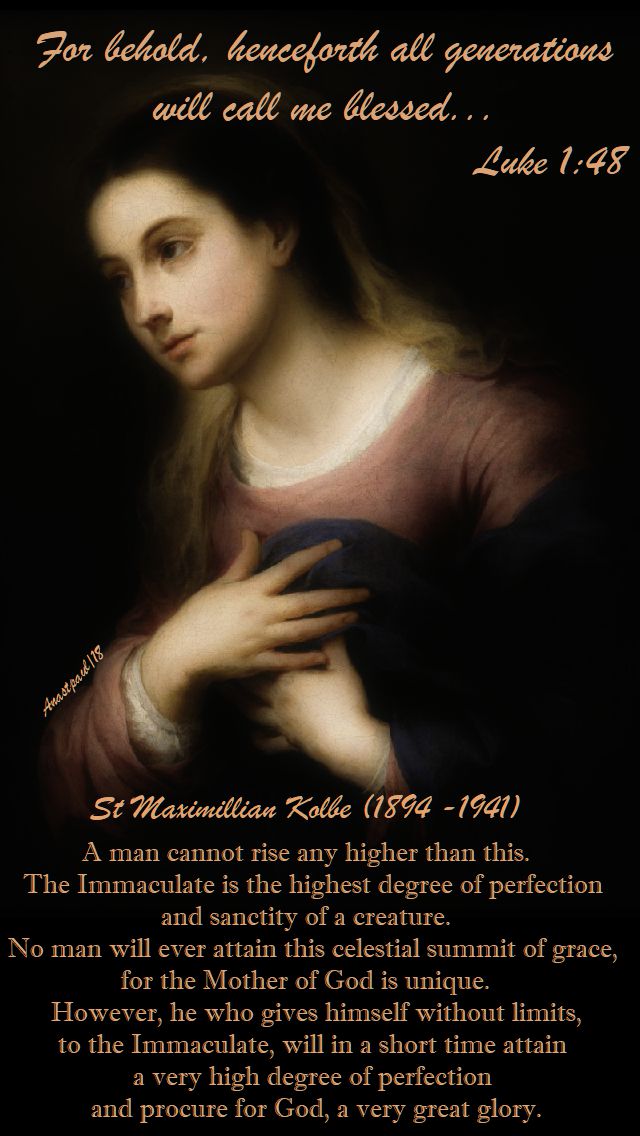
“A man cannot rise any higher than this. The Immaculate is the highest degree of perfection and sanctity of a creature. No man will ever attain this celestial summit of grace, for the Mother of God is unique. However, he who gives himself without limits, to the Immaculate, will in a short time, attain a very high degree of perfection and procure for God, a very great glory.”
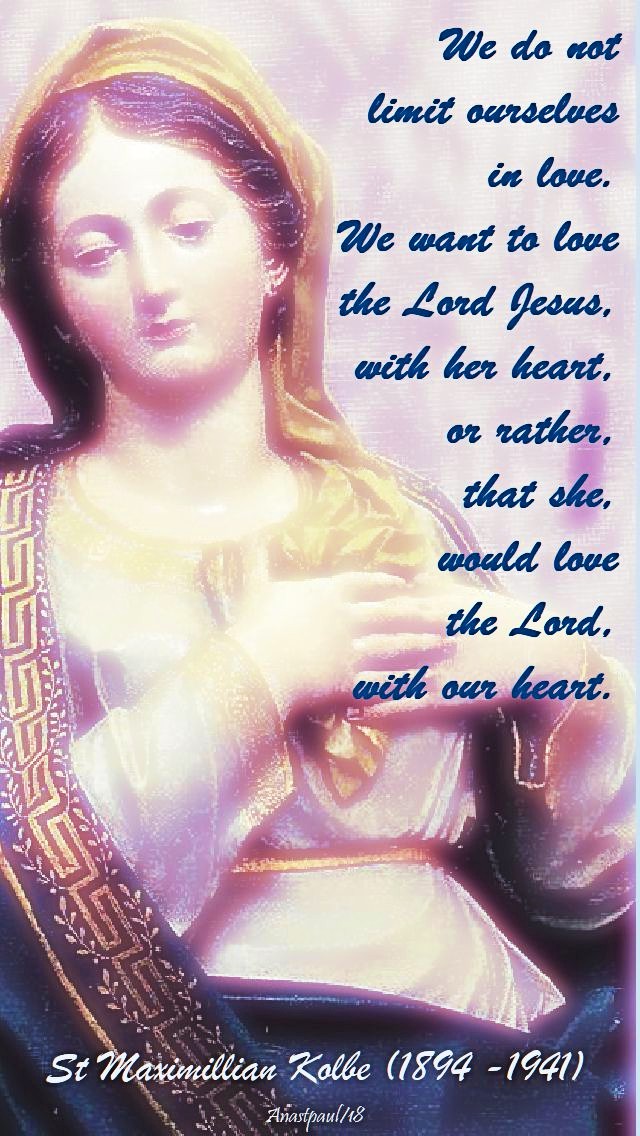
“We do not limit ourselves in love. We want to love the Lord Jesus, with her heart, or rather, that she would love the Lord, with our heart.”
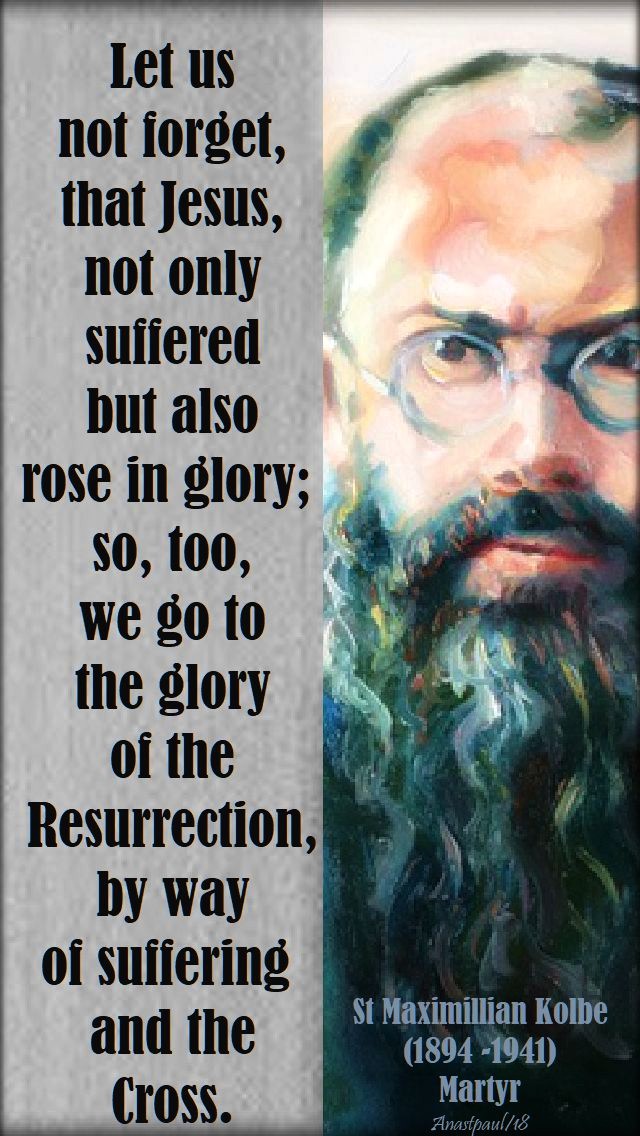
“Let us not forget, that Jesus not only suffered but also rose in glory; so, too, we go to the glory of the Resurrection, by way of suffering and the Cross.”
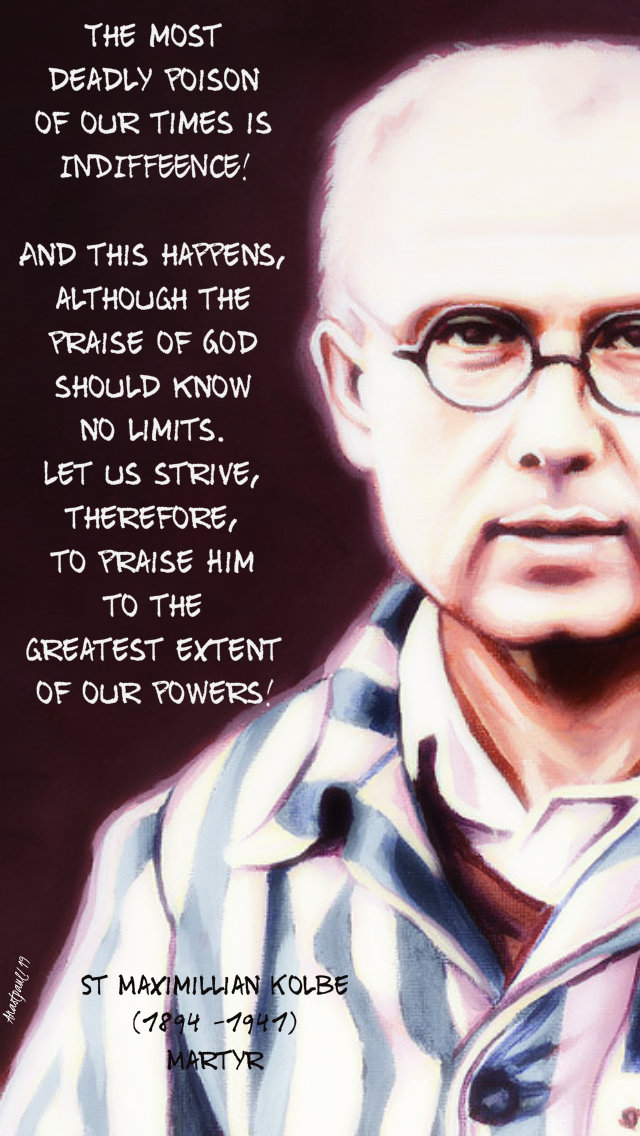
“The most deadly poison of our times is indifference. And this happens, although the praise of God should know no limits. Let us strive, therefore, to praise Him to the greatest extent of our powers!”
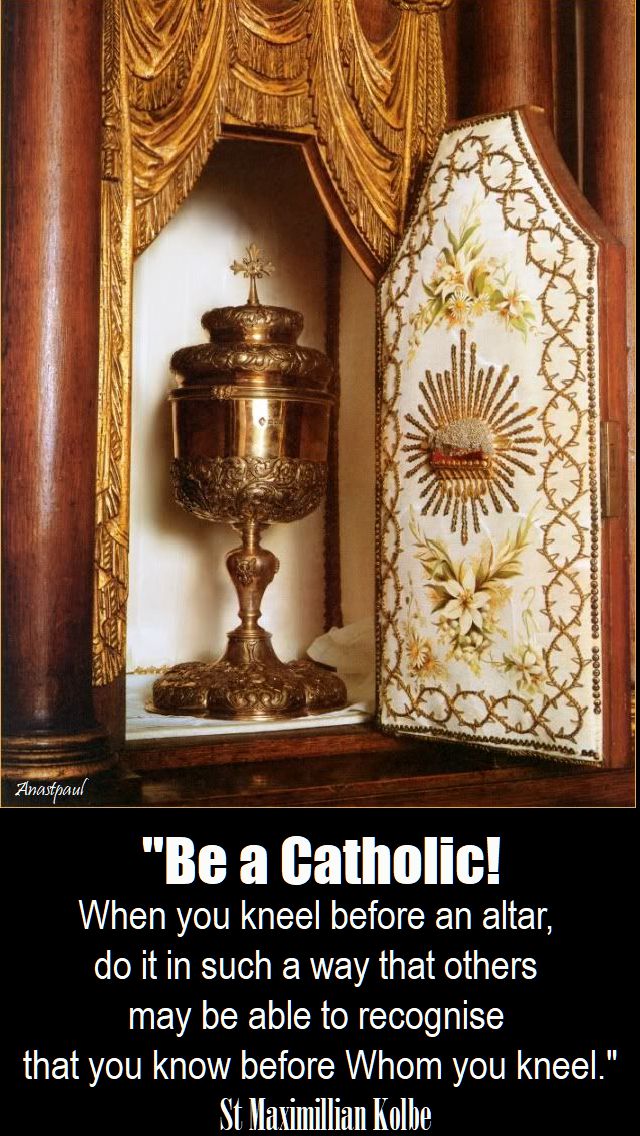
“Be a Catholic! When you kneel before an altar, do it in such a way that others may be able to recognise that you know before Whom you kneel.”
One Minute Reflection – 14 August – Wednesday of the Nineteenth week in Ordinary Time Year C, Gospel: Matthew 18:15–20 and the Memorial of St Maximillian Kolbe OFM Conv (1894 -1941) “Martyr of Charity”
“For where two or three are gathered in my name, there am I in the midst of them.” … Matthew 18:20
REFLECTION – “The Lord said: “If two of you agree on earth about anything for which they are to pray, it shall be granted to them by my heavenly Father. For where two or three are gathered together in my name, there am I in the midst of them.”
These words prove that much is given not to the mere number but to the unanimity of those who pray. “If two of you agree on earth,” He says, putting unanimity and peaceful concord first, teaching us to agree firmly and loyally. But how can one man agree with another when he disagrees with the body of the Church itself, with the whole brotherhood?… The Lord’s words were spoken about His own Church and addressed to members of the Church. If they are agreed, if, as He commanded but two or three are gathered together and pray with one mind, then, although they are but two or three, they can obtain from the divine majesty what they ask.
“Where two or three are gathered, I (he said) am with them.” That means, of course, with the single-hearted and peaceable, with those who fear God and keep His command-ments. With these, though but two or three, He declared His presence, as He was present also with the Three Children in the fiery furnace and, because they continued single-hearted and of one mind, refreshed them with the breath of dew as the flames surrounded them (Dn 3,50); or as He was present with the two apostles in prison, because they were single-hearted and of one mind and Himself opened the prison gates (Acts 25,25)… So when Christ lays down with authority: “Where two or three are gathered, I am with them,” He is not separating men from the Church which He founded and created. But He rebukes the faithless for their discord and with His own voice commends peace to the faithful.” … Saint Cyprian of Carthage, (c 200- c 258) Bishop and Martyr, Father of the Church – On the Unity of the Church
PRAYER – My Lord and my God, You who are the fruit of Mary’s blessed womb and the most Divine Son of our Father, grant that we may always have recourse to You, through her who bore You and through Your Holy Church. Grant that she may help and comfort us me and lead us to You. Mary, Holy and loving Mother of God, pray for us all. Grant O Lord, that through the intercession of St Maximillian, we may entrust ourselves to You through Your and our blessed Mother, amen.
Bl Aimo Taparelli
St Antony Primaldo St Arnold/Arnulf of Soissons (1040-1087)
St Athanasia of Timia
St Callistus of Todi
St Demetrius of Africa
St Domingo Ibáñez de Erquicia
St Eberhard of Einsiedeln
St Eusebius of Palestine
St Eusebius of Rome
St Fachanan of Ross
St Francisco Shoyemon
Bl Juliana Puricelli
St Marcellus of Apamea
Bl Sanctes Brancasino
St Ursicius of Nicomedia
St Werenfridus
__
Martyred in the Spanish Civil War: 11 Beati
• Blessed Ángel de la Red Pérez
• Blessed Antonio María Martín Povea
• Blessed Basilio González Herrero
• Blessed Ezequiél Prieto Otero
• Blessed Joaquín Frade Eiras
• Blessed Jocund Bonet Mercadé
• Blessed José García Librán
• Blessed Ricardo Atanes Castro
• Blessed Segundo Pérez Arias
• Blessed Vicente Rubiols Castelló
Our Lady, Refuge of Sinners/Refugium Peccatorum: St John Damascene calls Mary a city of refuge to all who flee to Her.
Blessed Antonio Baldinucci SJ (1665-1717) had a particular devotion to the Refugium Peccatorum image of Virgin Mary in the Church of the Gesu (Frascati) in Italy and commissioned a copy which he considered miraculous and carried it with him in his travels. The Jesuits spread copies of the image of the Madonna of Refuge in Mexico by the 19th century and it began to be depicted in missions there, often with clouds surrounding the lower portion of the image of the Virgin Mary holding the Child Jesus.
The term “Refugium peccatorum” is also used other works of Roman Catholic Marian art. For instance, there is a marble statue representing the Virgin Mary, on the grand staircase of the old municipal palace in Venice, Italy. The name came from the fact that the convicts were allowed to stop in front of the Virgin Mary’s statue to pray for their soul on the way to the scaffold.
The traditional feast day of Our Lady, Refuge of Sinners is today, 13 August.
St Anastasius the Monk
St Anastasius the Priest
St Benildus
St Cassian of Imola
St Cassian of Todi
St Concordia
St Conn O’Rourke
Bl Gertrude of Altenberg
St Helen of Burgos
St Herulph of Langres
Bl Jakob Gapp
Bl John of Alvernia St John Berchmans SJ (1599-1621)
St Junian of Mairé
St Ludolph Bl Marco d’Aviano/Mark of Aviano OFM Cap (1631-1699) Biography: https://anastpaul.com/2018/08/13/saint-of-the-day-13-august-blessed-mark-of-aviano-ofm-cap-1631-1699/
St Maximus the Confessor
St Nerses Glaietsi
St Patrick O’Healy
Bl Pierre Gabilhaud
St Radegund
St Radegunde
St Wigbert of Fritzlar
Bl William Freeman
—
Martyred in the Spanish Civil War:
• Blessed Francesc Castells Areny
• Blessed Inocencio García Díez
• Blessed José Bonet Nadal
• Blessed José Boher y Foix
• Blessed José Juan Perot y Juanmarti
• Blessed Jose Tàpies y Sirvant
• Blessed Josep Alsina Casas
• Blessed Luciano Hernández Ramírez
• Blessed Maria de Puiggraciós Badia Flaquer
• Blessed Mateo Despóns Tena
• Blessed Modesto García Martí
• Blessed Pascual Araguàs y Guàrdia
• Blessed Pedro Martret y Molet
• Blessed Silvestre Arnau y Pascuet
Martyred Claretians of Barbastro – 51 beati:
• Blessed Agustín Viela Ezcurdia
• Blessed Alfons Miquel Garriga
• Blessed Alfons Sorribes Teixidó
• Blessed Antolín Calvo y Calvo
• Blessed Antoni Dalmau Rosich
• Blessed Atanasio Vidaurreta Labra
• Blessed Eduardo Ripoll Diego
• Blessed Esteve Casadevall Puig
• Blessed Eusebi Maria Codina Millà
• Blessed Felipe de Jesús Munárriz Azcona
• Blessed Francesc Roura Farró
• Blessed Francisco Castán Meseguer
• Blessed Gregorio Chirivas Lacamba
• Blessed Hilario Llorente Martín
• Blessed Jaume Falgarona Vilanova
• Blessed Joan Baixeras Berenguer
• Blessed Joan Codinachs Tuneu
• Blessed José Amorós Hernández
• Blessed José Blasco Juan
• Blessed José Figuero Beltrán
• Blessed José Pavón Bueno
• Blessed Josep Maria Badía Mateu
• Blessed Josep Ormo Seró
• Blessed Josep Ros Florensa
• Blessed Juan Díaz Nosti
• Blessed Juan Echarri Vique
• Blessed Juan Sánchez Munárriz
• Blessed Leoncio Pérez Ramos
• Blessed Lluís Escalé Binefa
• Blessed Lluís Lladó Teixidor
• Blessed Lluís Masferrer Vila
• Blessed Manuel Buil Lalueza
• Blessed Manuel Martínez Jarauta
• Blessed Manuel Torras Sais
• Blessed Miquel Masip González
• Blessed Nicasio Sierra Ucar
• Blessed Pedro García Bernal
• Blessed Pere Cunill Padrós
• Blessed Rafael Briega Morales
• Blessed Ramon Illa Salvia
• Blessed Ramon Novich Rabionet
• Blessed Salvador Pigem Serra
• Blessed Sebastià Riera Coromina
• Blessed Sebastián Calvo Martínez
• Blessed Secundino Ortega García
• Blessed Teodoro Ruiz de Larrinaga García
• Blessed Tomàs Capdevila Miró
• Blessed Wenceslau Clarís Vilaregut
They were martyred on 2 August through 18 August 1936 in Barbastro, Huesca, Spain and Beatified on 25 October 1992 by Pope John Paul II.
Thought for the Day – 11 August – Nineteenth Sunday in Ordinary Time, Year C, Gospel: Luke 12:32–48 and the Memorial of St Clare of Assisi (1194-1253)
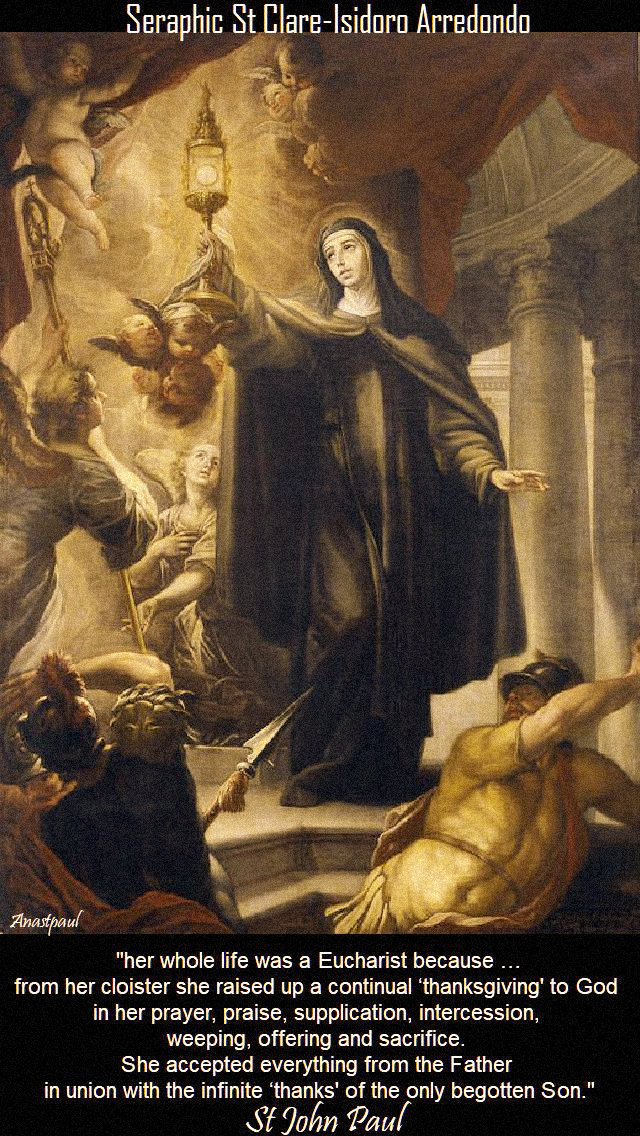
St Pope John Paul II said of Saint Clare – “her whole life was a Eucharist because … from her cloister she raised up a continual ‘thanksgiving’ to God in her prayer, praise, supplication, intercession, weeping, offering and sacrifice.
She accepted everything from the Father in union with the infinite ‘thanks’ of the only begotten Son.”
St Pope John Paul II (1920-2005)
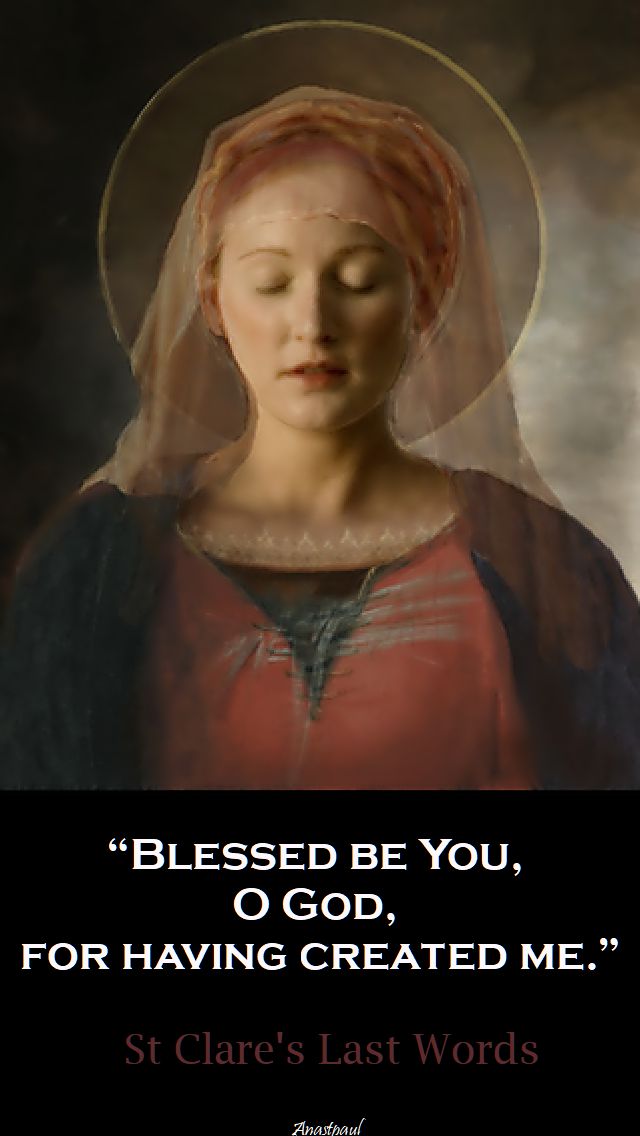
“ Blessed be You, O God, for having created me. ”
St Clare’s Last Words
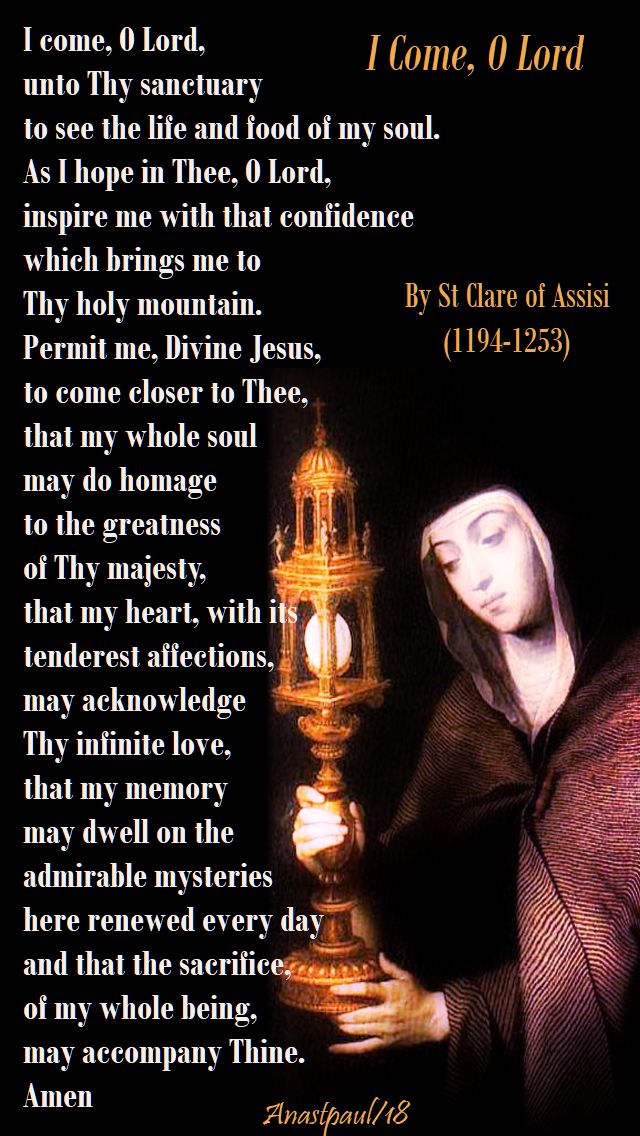
I Come, O Lord By St Clare of Assisi (1194-1253)
I come, O Lord,
unto Thy sanctuary
to see the life and food of my soul.
As I hope in Thee, O Lord,
inspire me with that confidence
which brings me to Thy holy mountain.
Permit me, Divine Jesus,
to come closer to Thee,
that my whole soul may do homage
to the greatness of Thy majesty,
that my heart,
with its tenderest affections,
may acknowledge Thy infinite love,
that my memory may dwell
on the admirable mysteries
here renewed every day
and that the sacrifice,
of my whole being,
may accompany Thine.
Amen
St Rusicola of Arles
St Rufinus of Marsi
St Susanna of Rome
St Taurinus of Evreux
Bl Theobald of England and Companion
St Tiburtius of Rome
Bl William Lampley
—
Martyred in the Spanish Civil War
Bl Armando Óscar Valdés
Bl Benjamín Fernández de Legaria Goñi
Bl Carlos Díaz Gandía
Bl Rafael Alonso Gutiérrez
Bl Ramon Rosell Laboria
St Agathonica of Carthage
St Agilberta of Jouarre Bl Amadeus of Portugal O.F.M. (1420–1482) Biography: https://anastpaul.com/2018/08/10/saint-of-the-day-blessed-amadeus-of-portugal-o-f-m-1420-1482/
St Aredius of Lyon
St Asteria of Bergamo
Bl Augustine Ota
St Bassa of Carthage
St Bessus
St Bettelin St Blane (Died 590)
Bl Claude-Joseph Jouffret de Bonnefont
St Deusdedit the Cobbler
Bl Edward Grzymala
Bl Franciszek Drzewiecki
Bl Francois François
St Gerontius
Bl Hugh of Montaigu
Bl Lazare Tiersot
St Paula of Carthage
St Thiento of Wessobrunn
—
Martyrs of Alexandria – 260+ saints: A large number of Christians who died in Alexandria, Egypt between 260 and 267 in the persecutions of Decius and Valerian, whose names have not come down to us and who are commemorated together.
Martyrs of Rome – 165 saints: Group of 165 Christians martyred in the persecutions of Aurelian. 274 in Rome, Italy.
Martyred in the Spanish Civil War:
• Blessed Antonio González Penín
• Blessed José Toledo Pellicer
• Blessed José Xavier Gorosterratzu Jaunarena
• Blessed Juan Martorell Soria
• Blessed Pedro Mesonero Rodríguez
• Blessed Victoriano Calvo Lozano
Thought for the Day – 8 August – The Memorial of Ven Antonio Margil of Jesus OFM (1657-1726) “The Flying Father”
A quarter century before St Junípero Serra began his California adventure, there was an extraordinary Franciscan carrying out a great work of evangelisation across Central America, Mexico and finally, Texas. In his zeal to spread the Catholic faith, he faced inclement weather, hostile animals, forest insects and reptiles, lack of food and water and cruel treatment from hostile Indian tribes.
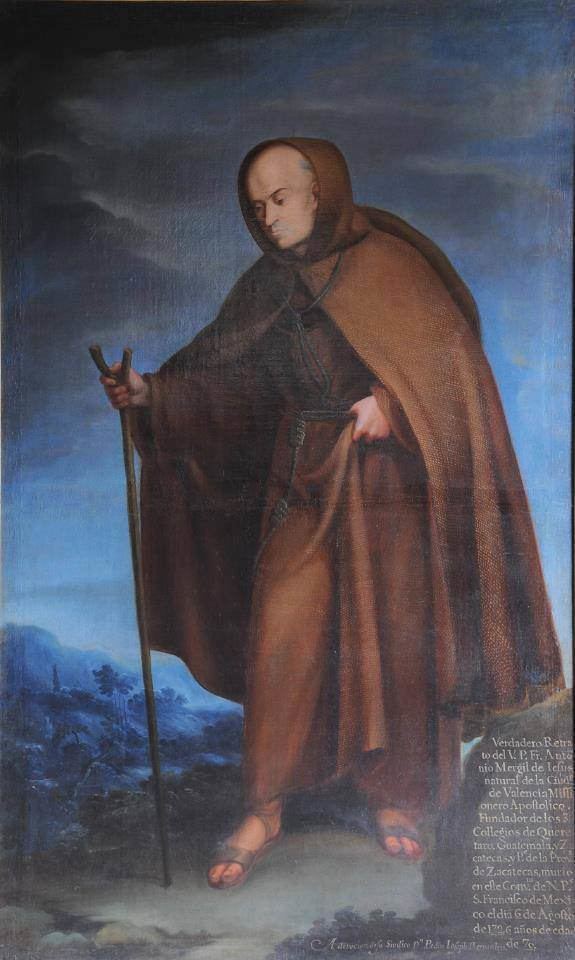
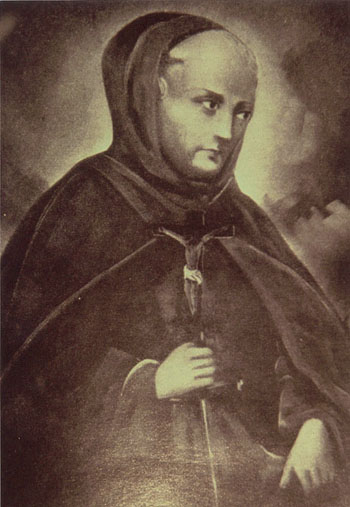
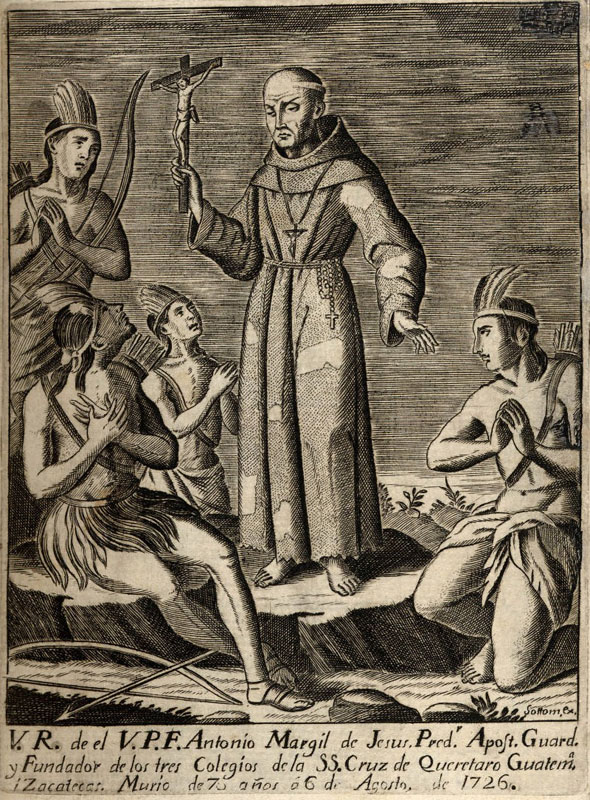
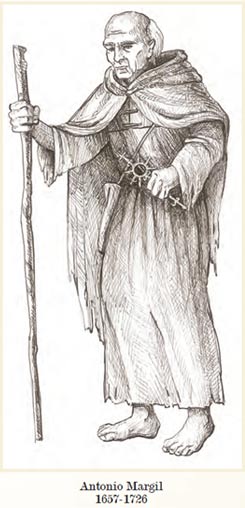
The life of Fr Antonio Margil of Jesus is an epic story of a man who seems larger than life. Barefoot, carrying only a staff, breviary and the materials he needed to say Mass, he established hundreds of missions in a territory extending from the jungles of Costa Rica to east Texas and the borders of Louisiana. Countless Indians of Costa Rica, Nicaragua, Guatemala, Mexico and Texas received the divine gift of faith from him and revered him a saint. For this, he is called the Apostle of New Spain and Texas.
In 1697, Fr Margil was recalled to Querétaro as superior, or presidente, of the Franciscan College of the Holy Cross, and a new phase of his life began as an administrator. When he reached the College, Fr Margil took off the ragged habit he had worn and mended for 14 years, patching it at times with bark from a certain tree called the mastastes and exchanged it for a new one, thus avoiding the least shadow of singularity.
As superior, he never dispensed himself from any public act or expected anything but what he himself practised. To maintain accuracy and the decorum of ritual, he imposed upon his religious the obligation of holding a conference once a week on the ceremonies of the Holy Sacrifice of the Mass. The friar who loved “Lady Poverty” exhorted his brethren and the faithful to ornament the altars and churches as much as they could, so they might be worthy of the divine majesty of God.
For Our Lord, there was nothing too rich or decorous. For himself, it was a different story. With the exception of Sunday, he fasted every day, taking a few herbs, a piece of bread and some water or watered down chocolate once a day. He permitted himself sleep only from 8 to 11 every evening. He was wakened then by the brother porter and together they read a chapter from The Mystical City of God by María de Agreda. After praying the Divine Office at midnight, he made the Stations and would remain in prayer until the hour of Prime, absorbed in God.
The barefoot friar who walked on water in his extraordinary missionary work was a man of deep humility. More than once he was tortured, beaten, or left for dead. His name, which deserves to be known and his fame spread is Venerable Antonio Margil of Jesus, who titled himself and signed his letters as El Nada Mismo – Nothingness Itself.
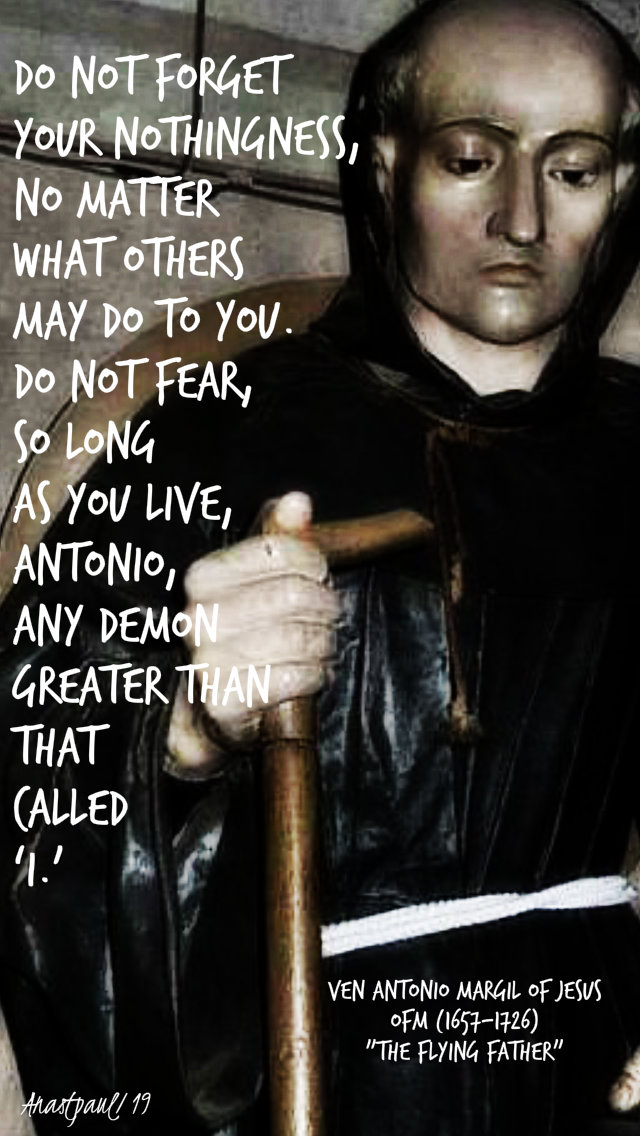
“Do not forget your nothingness, no matter what others may do to you. Do not fear, so long as you live, Antonio, any demon greater than that called ‘I.’”
Let us Pray that Venerable Antonio that he may soon be raised to the altars of the most high!
Prayer for the Intercession of Venerable Antonio
O Lord Jesus Christ,
Your apostle Antonio Margil of Jesus,
left his homeland to bring
the Gospel of Salvation to the people
of Mexico and the United States.
He endured every hardship
and pain for love of You.
May You graciously deign
to reward Your servant Antonio
by hastening the day
when he will be raised
to the honour of Blessed and Saint.
We ask that Venerable Antonio Margil
intercede for us before God
by answering this request.
………………………………. (make your request)
Through Christ Our Lord,
Amen
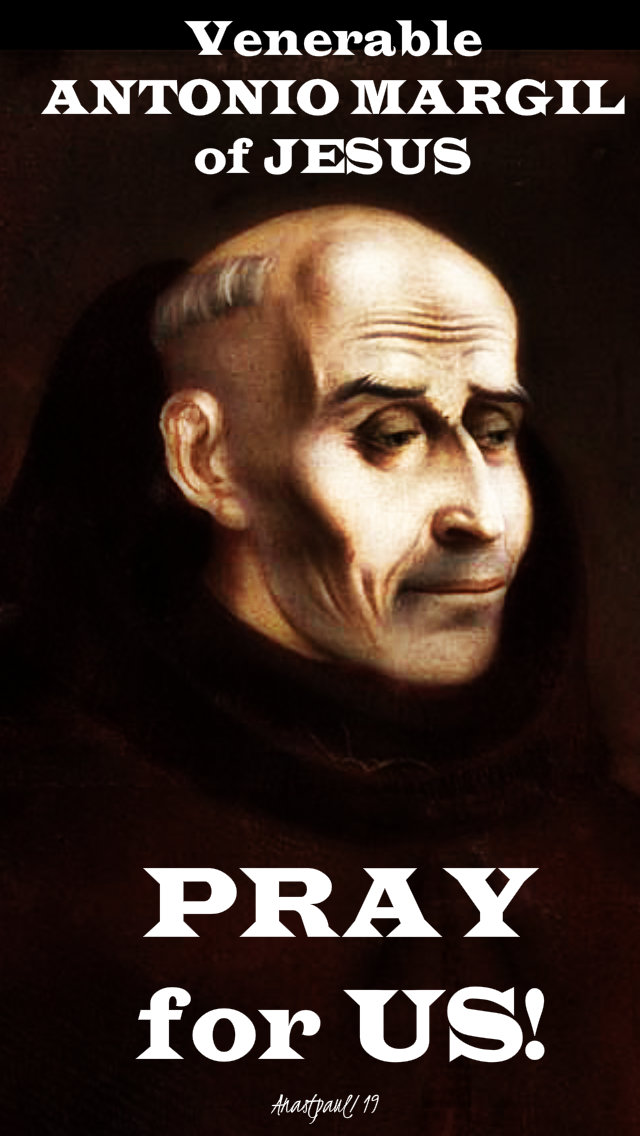
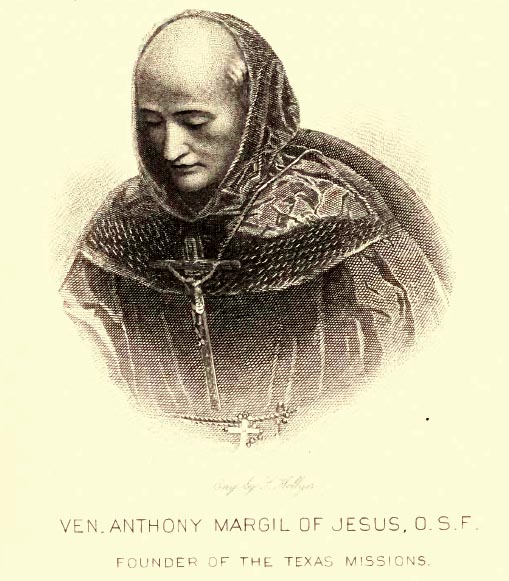
Saint of the Day – 8 August – Venerable Antonio Margil of Jesus OFM (1657-1726) Franciscan Priest and Friar, Missionary, ascetic, mystic, miracle-worker, apostle of prayer and penance, administrator, known as the “Apostle of New Spain and Texas” and the “Flying Father” – born Antonio Margil on 18 August 1657 in Valencia, Spain and died on 6 August 1726 in Mexico City, Mexico aged 68, of natural causes.
Venerable Antonio laboured tirelessly as missionary, miracle-worker, servant of the Lord throughout the Americas. While others gave him such laudable nicknames, ever humble Antonio referred to himself as “La Misma Nada,” translated as “Nothingness Itself.” At his eulogy, it was said of him: “All America was the witness and the scene of his virtues and miracles . To trace his journeys among the pagans, turn your eyes to east and west, to north and south and you will find him in all these places, leading a very austere life, crossing mountains, combating the evil spirits until he had triumphantly planted his foundations. The widely scattered provinces of Nicaragua and Costa Rica, of Honduras and Chol and Panama, of Coahuila and Tejas – all of them heard his apostolic voice.”
Antonio was born in Valencia, Spain and at the young age of 15 joined the Franciscan Order at La Corona de Cristo. Ordained at 25, he was assigned to “New Spain” and made the voyage to Mexico where he was initially stationed at the newly established Mission college of Queretaro. Like other new world missionaries (for example, Junipero Serra in California, twenty-five years later), Antonio encountered difficult living and harsh conditions. Never one to complain, he embraced his challenges as mortifications, offering his sufferings to the Lord for the sake of those he preached to.
Over the course of his life, Antonio would travel throughout Mexico and Central America. His first two missions were to Guatemala and Nicaragua, where he founded colleges. He became known for his fierce preaching, life of penance and prayers, miracle-working and ability to read souls. He survived multiple attacks, including being burned in a pile of flaming wood by the Talamanca Indians. Rather than be injured, he walked unharmed from the pyre as the flames died. Similarly, reports were told of Anthony walking across swollen streams or rivers without getting wet and multiplied small quantities of food so that entire villages could eat for months on end.
While on his mission, Antonio received notice that he had been elected Father Guardian (Superior) of the Holy Cross Monastery in Queretero. Requested to return, he left immediately, covering the 700 mile distance barefoot (without a mule) in only 14 days. Once at the monastery, Father Antonio governed fairly and through his own example of exact observance of the Rule of the Order, penance, mortification, fasting and prayer. His favourite devotion was to that of the Stations of the Cross, which he prayed through the streets each Friday, barefoot, carrying a large cross, with a rope around his neck and a crown of thorns atop his head. In Guatemala alone, he established more than 2,500 Ways of the Cross to encourage this devotion.
Similarly, in a miraculous occurrence, a tree sprouted and grew in the courtyard garden of the monastery where Anthony stuck his walking stick into the ground one afternoon. After a few days, it became clear that the walking stick had sprouted and began growing into a tree. The miraculous tree produces a series of small thorns, each it the form of a cross along its trunk and branches. Each cross, in turn, presents three smaller thorns recognising the spikes of the crucifixion. The tree, which is unlike any other in the world, continues to grow in the monastery courtyard today.
At approximately the age of 60, Antonio was appointed vice-commissary of Missions of New Spain and was granted the right to establish missions wherever he thought the most work for the Lord could be accomplished. Having heard of the Indians of Texas, who lived in horrible conditions, he became intent on journeying to Texas to establish missions on their behalf. The journey was difficult due to weather, hostile animals and Indian tribes, insects, reptiles, hunger and lack of water. He was repeatedly captured and tortured, beaten and left for dead but never gave up. Walking barefoot through the harsh terrain, he established multiple missions throughout the region. Bringing nothing with him, he relied each day on the provisions of the Lord, which were never withheld from him.
Throughout his journeys, Antonio worked further miracles, kept peace between natives and settlers and founded multiple missions—some of which needed to be abandoned during the war between France and Spain in 1719. One of his most famous miracles occurred during a journey from Nacogdoches when his band of travellers found themselves without water and with no hope of finding any. Faint with thirst, Antoniosaid: “Fear not, do not be dismayed. Trust in God, for in a short time you shall have water.” Then striking a rock in the dry creek bed twice with his staff, fresh and clear water gushed forth and continues to flow to this day. The area is named in his honour.
Given Antonio’s great success at missionary work and the unmatched peace-keeping and influence, he had on all he encountered, he was sent on various missions in his elder years including travel to Zacatecas, Guadalajar, and other towns. These rigorous trips took their toll on his declining health and it soon became clear that he would not live much longer. When the people noted this, they began to surround him, cutting pieces from his travel cloak as holy relics. He was sent to Mexico City for medical attention and upon arrival declared to his superior: “Reverend Father Superior, the donkey has come here to deposit its burden.”
Antonio insisted on making a last confession, which due to the nature of his life, was quite short (given that he had few faults to confess). His confessor, having difficulty finding sufficient sin to absolve him of, paused with a look of wonder and confusion. Seeing this, Antonio said, “If Your Reverence should see a ball of gold suspended by a hair, though gold is very heavy, would you think that it was supported by itself? Now, I have been a poor creature, liable to fall at any moment and if God had not kept His omnipotent hand over me, I do not know what I might have done.”
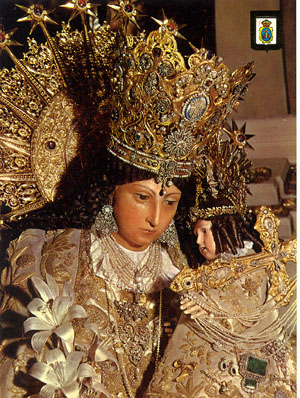
His illness lasted five days, but he never complained of sufferings or asked the least relief, although he suffered greatly. He was heard preaching, singing hymns, invoking the holy names of Jesus and Mary, reprimanding sinners with kindness and charity and reciting the Rosary. On 5 August, a picture of Our Lady of Remedies, the Patroness of Valencia, his hometown in Spain,was brought to him and he greeted her lovingly saying, “Until tomorrow, my dearly beloved Lady.” The following day, on the feast of the Transfiguration, he died peacefully. Just short of his 69th birthday, Antonio had served the Lord with profound humility for nearly 53 years, 43 of which as a missionary in North and Central America.
When notice of his death was given, all the bells of the Mexico City began to ring announcing it. Citizens of all ages and conditions lined up to see the mortal remains of the Servant of God, exposed for three days in the Franciscan church and surrounded by guards to protect it from the multitudes. His face, pallid in life, had now assumed a rosy hue, his limbs remained flexible, his flesh warm. His feet, worn to leather and covered with rough calluses from the thousands of miles he had trod, became soft and supple like those of a child.
Shortly after his death the process for beatification was begun. But because of grave political situation in Europe, the process was interrupted and only in 1836 was he declared Venerable by Pope Gregory XVI.
Why he is not a saint yet? In 1992 the archivist of the Vatican Congregation for Causes of Saints and the Franciscan promoter of the cause, stated as soon as there is an approved miracle attributed to the intercession of Fr Margil, he will be beatified and then after a second miracle, he will be Canonised. Miracles can be reported to The Margil House of Studies, in Houston, Tx.
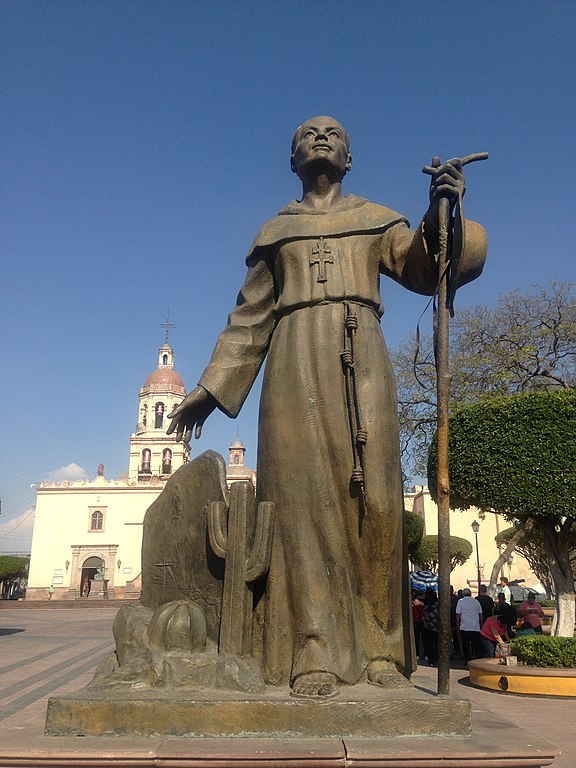
Venerable Antonio Margil of Jesus’s statue in Queretaro, Mexico.
St Aemilian of Cyzicus
St Altman of Passau Ven Antonio/Margil of Jesus OFM (1657-1726)
St Cyriacus the Martyr
St Eleutherius of Constantinople
St Ellidius
St Famianus of Compostela
St Gedeon of Besancon
St Hormisdas of Persia
Bl John Felton
Bl John Fingley
St Largus
St Leobald of Fleury
St Leonidas of Constantinople
St Marinus of Anzarba St Mary of the Cross/ Mary MacKillop (1842-1909) – the first Australian born Saint Biography: https://anastpaul.com/2018/08/08/saint-of-the-day-st-mary-of-the-cross-1842-1909/
St Mummolus of Fleury
St Myron the Wonder Worker
St Paulus Ge Tingzhu
St Rathard of Diessen
St Severus of Vienne
St Sigrada
St Smaragdus
St Ternatius of Besançon
St Ultan of Crayke
Bl William of Castellammare di Stabia
Bl Wlodzimierz Laskowski
—
Martyrs of Albano – 4 saints: Four Christians who were martyred together, and about we today know little more than their names – Carpóforo, Secondo, Severiano and Vittorino. They were martyred in Albano, Italy – their remains are interred in the San Senator cemetery, on the Appian Way, 15 miles from Rome, Italy.
Martyrs of Rome – 5 saints: Five Christians martyred together; we know nothing else about them but the names – Ciriaco, Crescenziano, Giuliana, Memmia and Smaragdus. They were martyred at the 7 mile marker, on the Via Ostia, Rome, Italy.
Martyred in the Spanish Civil War – Martyrs of El Saler – 5 beati: Five nuns, all members of the Sisters of the Pious Schools, all teachers, and all martyred together in the Spanish Civil War.
• Antonia Riba Mestres
• Maria Baldillou Bullit
• María Luisa Girón Romera
• Nazaria Gómez Lezaun
• Pascuala Gallén Martí
They were martyred on 8 August 1936 in El Saler, Valencia, Spain and Beatified on 11 March 2001 by Pope John Paul II.
Martyred in the Spanish Civil War:
Bl Cruz Laplana Laguna
Bl Fernando Español Berdie
Bl Leoncio López Ramos
Bl Manuel Aranda Espejo
Bl Mariano Pina Turón
Bl Pedro Álvarez Pérez
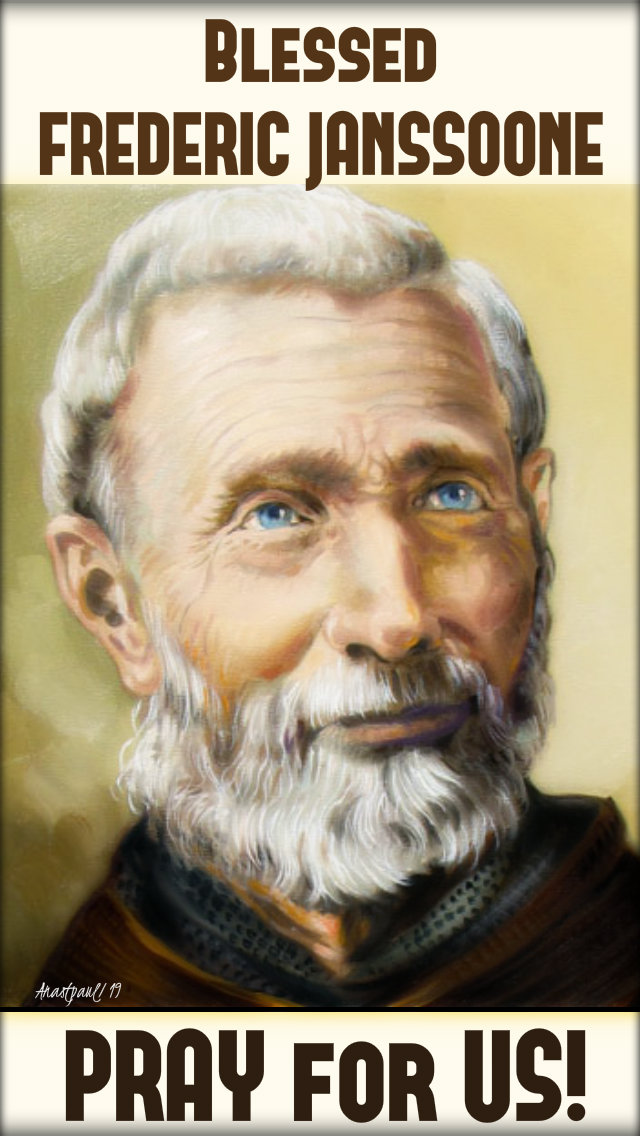
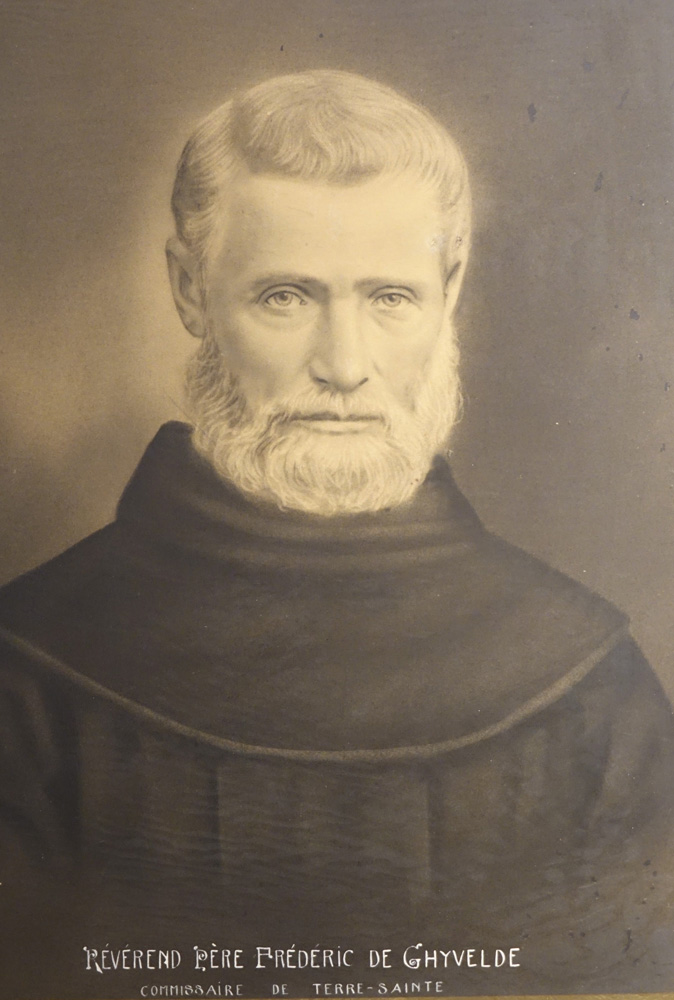
Thought for the Day – 4 August – Eighteenth Sunday in Ordinary Time, Year and The Memorial of Blessed Frédéric Janssoone OFM (1838-1916) – “God’s Pedlar”, “Good Fr Frederic”
His Great Passion, Jesus of Nazareth
One of the very first things to extract from the life of Father Frederic, is his passion for Jesus of Nazareth.
His early education pointed him toward the Gospels. His formation with the Franciscans, his plans to become a missionary in the Holy Land, his writings and books all his preaching on Jesus the son of man and son of God, everything reveals to us that the Blessed Frederic is the missionary to the Holy Land par excellence. His work orients us to know Jesus in the mysteries of His humanity, His birth, His public life, His passion and Resurrection.
It is he who walked about the country of Jesus in every sense during the 14 years that he lived in the Holy Land. The Stations of the Cross which had been banned since 1621, he negotiated with the Muslim Arabs the right to preach the Stations of the Cross along the Via Dolorosa and in the arched souks of Jerusalem. He directed the construction work of the church of Saint Catherine next to the Basilica of the Nativity in Bethlehem. For this construction, he then went to beg in France and in Canada, hence his first journey in 1881.
He is a pioneer in the dispersion of the gospels in Canada. From 1893 to 1907, his Life of Our Lord Jesus Christ, a text in harmony with the Gospels, enjoyed eight printings, which represent a total of 42,000 copies “It was without a doubt the greatest publishing success in Canada” (Legare – Baillargeon, Good Father Frederic, Montreal, Pauline Ed. 1988, p. 277).
Blessed Frederic could be the patron of the seekers of meaning and truth who study the Gospels and especially the life of Jesus of Nazareth, thus the man Jesus.
Prayer for the Canonisation of Blessed Frederic Janssoone
Almighty and eternal God,
You granted to Blessed Frederic Janssoone,
son of France,
to follow the footsteps of Your Son Jesus
in the Holy Land,
and to work there for peace.
Then You led him to Canada,
to invite that nation
to be generous toward the Holy Land,
to found the Sanctuary of the Cap-de-la-Madeleine,
and to better make known
the life of Jesus of Nazareth
and His most holy Mother.
Grant us to become in turn,
true pilgrims,
and veritable missionaries of Your Church.
That we also may be equally
solid pillars of the faith in our Christian communities.
Grant us, through his intercession,
the favour that we ask…
……………………………………..
(Silent pause)
Grant this son of Saint Francis of Assisi,
to be canonised soon,
and to draw us all toward Your Son
Jesus, Our Lord.
Amen.
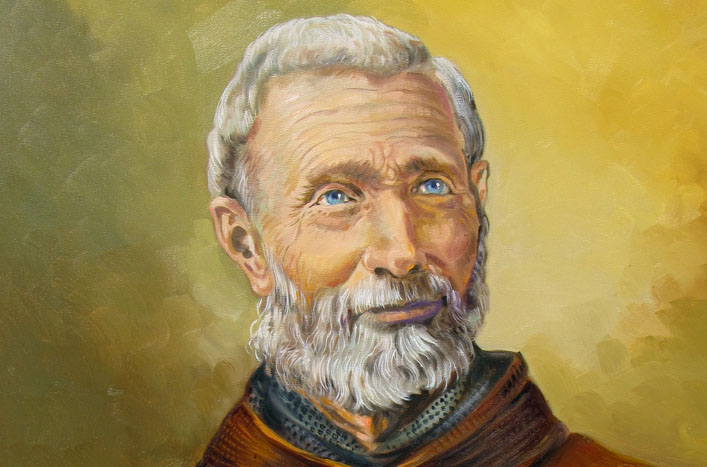
Saint of the Day – 4 August – Blessed Frédéric Janssoone OFM (1838-1916) – Franciscan Priest, prolific and passionate preacher, Evangeliser “God’s Pedlar”, “Good Fr Frederic”, apostle of the Passion, of the poor, of charity of Marian devotions – born on 19 November 1838, Ghyvelde, France — 4 August 1916, Montreal, Canada. Patronage – the Secular Franciscan Regional Fraternity of Eastern Canada.
The son of a prosperous and devout farming family, Frederic Janssoone was born on 19 November 1838, in Ghyveldge, in the North of France. His father died when Frederic was only nine. He attended secondary school in Hazebrouck and then Dunkirk but in 1856, he had to leave school to support his mother. He found work as an errand boy and eventually had great success as a travelling salesman. After his mother died, in 1861, he was able to complete his studies. In 1864, he entered the novitiate of the Franciscan Order of Friars Minor in Amiens. He was Ordained a priest in 1870 and was a military chaplain during the Franco-Prussian War. Afterwards, he became assistant novice director and librarian. He then became superior of the community in Bordeaux.
In 1876, he travelled to the Custody of the Holy Land. He became chaplain for the Brothers of the Christian Schools in Cairo and gave preached retreats there and in Alexandria. Between 1878 and 1888, he was assistant to the head guard of the Sacred Sites in Palestine. He helped with administration, promoted a renewal of the custom of Holy Land pilgrimages, re-established the ritual of the Way of the Cross in the streets of Jerusalem and directed construction of the Church of the Nativity in Bethlehem. He revised the set of customary regulations that had developed through the centuries between the Latins, the Greeks and the Armenians for the use and maintenance of the shrines of Bethlehem and the Holy Sepulchre.
In 1881, Father Frederic made his first trip to Canada to establish an annual collection for the Holy Places and to submit to the Bishops a plan for the Commissariat for the Holy Land in Canada. He gave preached retreats throughout Quebec – in Quebec City, Portneuf, TroisRivières, Bécancour and Cap-de-la-Madeleine. He settled in Canada for good in 1888. He lived in Trois-Rivières, where he became closely involved with the organisation and development of the pilgrimage of Our Lady of the Rosary that had been started up by Father Luc Désilets at nearby Cap-de-la-Madeleine. He promoted the
Franciscan Third Order in Quebec and New England. He created three outdoor Ways of the Cross, organised conferences and pilgrimages and gave many preached retreats. He also wrote magazine and newspaper articles, booklets, works on the Holy Land, lives of Jesus, Mary, Saint Anne, Saint Joseph, Saint Francis of Assisi, Saint Anthony of Padua and the first Franciscan born in Canada, the Venerable Brother Didace Pelletier.
Father Frederic paved the way for the re-establishment in Canada of the Order of Friars Minor, which had ceased to exist with the death of the last Recollet in 1812 Father Frederic, the former travelling salesman, had become a pedlar for God. He travelled from one parish to another in several Quebec dioceses and went door-to-door selling his works. The profit from his sales went toward the establishment of several communities of consecrated life – the Franciscan Missionaries of Mary, the Poor Clares, the Franciscans of Trois-Rivières and the Sister Adorers of the Precious Blood of Joliette.
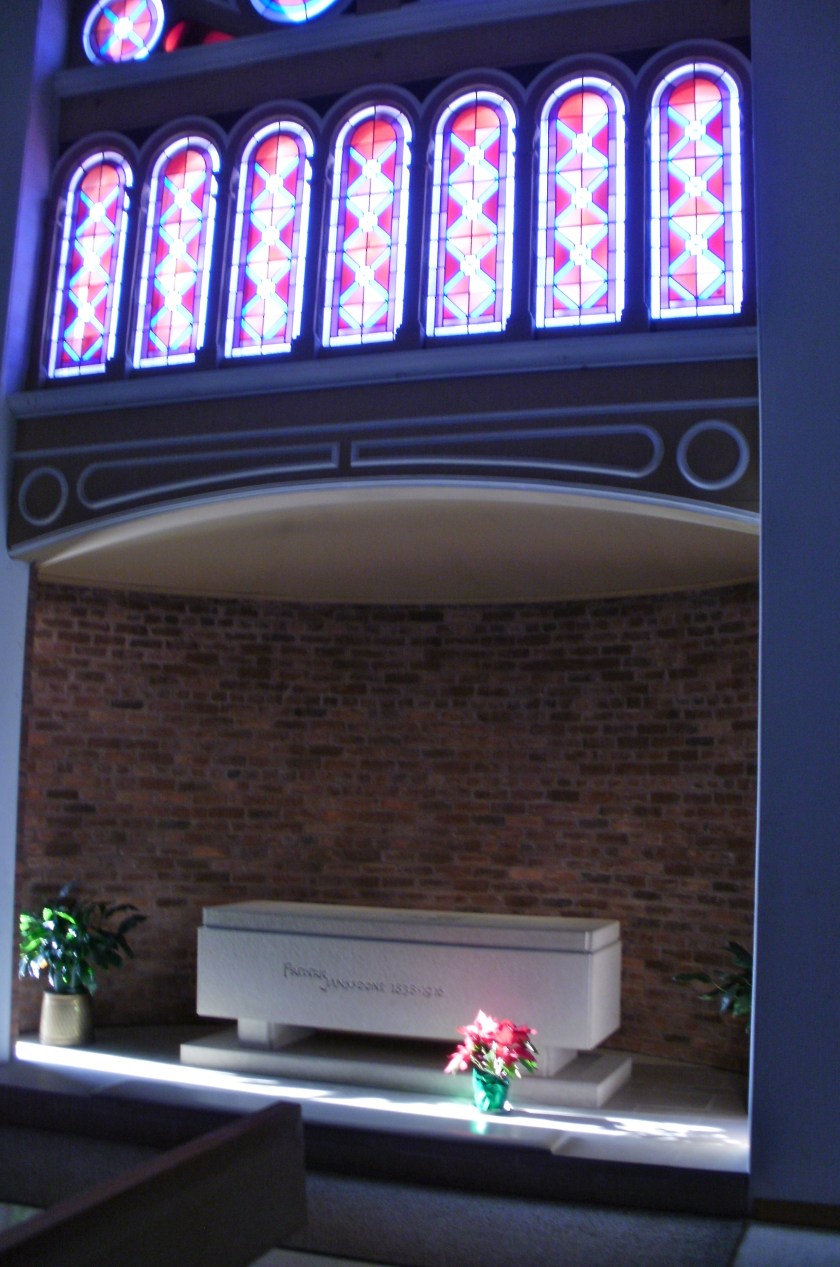
Bl Frederic took to his bed in June 1916 physically worn out by his many exertions in his ministries and in great pain. He was admitted to the Franciscan Infirmary in Montreal, where he was diagnosed as suffering from stomach cancer. After almost two months of intense pain, he died there on the following 4 August. His body was returned to Trois-Rivières, where he was buried in the small chapel he had built attached to the friary. Next door is now a Museum dedicated to him. He was Beatified by St Pope John Paul II on 25 September 1988.
His Spirituality
As a young man, Frederic Janssoone received the rigorous humanist college education typical of his era. He developed skill in business before turning to priestly life. His upbringing left him with a sensitive conscience but he had unusual gifts for pastoral work.
He was always curious and in Paris he researched the early Franciscan mission to Canada. He was a natural pedagogue and could touch hearts and minds when he preached. He was comfortable presiding at liturgical celebrations and believed in making them resplendent as this would draw the minds of participants to God. He was among those who promoted a religious awakening in France following the Franco-Prussian War.
In Palestine, he demonstrated considerable diplomacy and skill in building churches. His devotion to the passion of Christ inspired him to re-establish the practice of praying the Way of the Cross in the streets of Jerusalem. His sincere and upright character as well as his spirit of justice and conciliation permitted him to develop the set of regulations that decreased the tensions between the Greeks, Armenians, and Latins regarding the shrines of the Holy Sepulchre and Bethlehem.
His preaching was leavened by his close observation of life and it was delivered with energy. He was never afraid to be dramatic if it could touch the hearts of his listeners. He took advantage of his first-hand knowledge of the land where Jesus and Mary had lived to illustrate his sermons. His apostolic spirit characterised his promotion of the devotion of the Way of the Cross, pilgrimages and the Franciscan Third Order. He played an important role as the initiator of a spiritual renewal based on meditation on the suffering and passion of Christ.
Father Frederic had an innate sense of publicity and used his facility for writing to add lustre to the projects that he poured himself into. As soon as he began visiting Quebec, he published newspaper articles on the Holy Land to publicise his mission. The Canadians liked his style of preaching. The Journal des Trois-Rivières wrote that he was “one of the best preachers that one could encounter.”
He was humble and objective and he expressed his apostolic ambition with the prayer, “Let me bring to you, whoever comes to me.” After he created the pilgrimage site at Our Lady of the Cape Shrine, he suggested to the Bishop that he entrust its management to the Oblates of Mary Immaculate, “because they are very humble and have simplicity ways.” His devotion to Mary was expressed in the promotion of prayer to Our Lady of the Rosary, which is at the heart of the pilgrimage to Cap-de-la-Madeleine. He founded the Annales, known today under the title NotreDame-du-Cap. His goodness and his reputation as a moving preacher earned him the nicknames “Holy Father” and “Good Father Frederic”.
It was said of Fr Frederic “the man is joyful and full of humour.” He had numerous areas of interest, going from theology to the pastoral, by way of history, geography, astronomy, botany, painting, architecture and archaeology. Tireless apostle, his love of people and preaching, his goodness, austerity, his extreme poverty, his patience and his serenity during adversity, made others compare him to St Francis of Assisi.
St Agabius of Verona
St Aristarchus of Thessalonica
St Crescentio of Rome
St Eleutherius of Bithynia
St Epiphanes of Besançon
St Euphronius of Tours
St Francesc Mercader Rendé Bl Frédéric Janssoone OFM (1838-1916) “God’s Pedlar” “Good Father Frédéric”
St Hyacinth of Rome
St Ia of Persia
St Isidore of Besançon
St Lua of Limerick
St Onofrio of Panaia
St Perpetua of Rome
St Protasius of Cologne
St Rainerio of Split
St Sithney
St Tertullinus of Rome
Bl William Horne
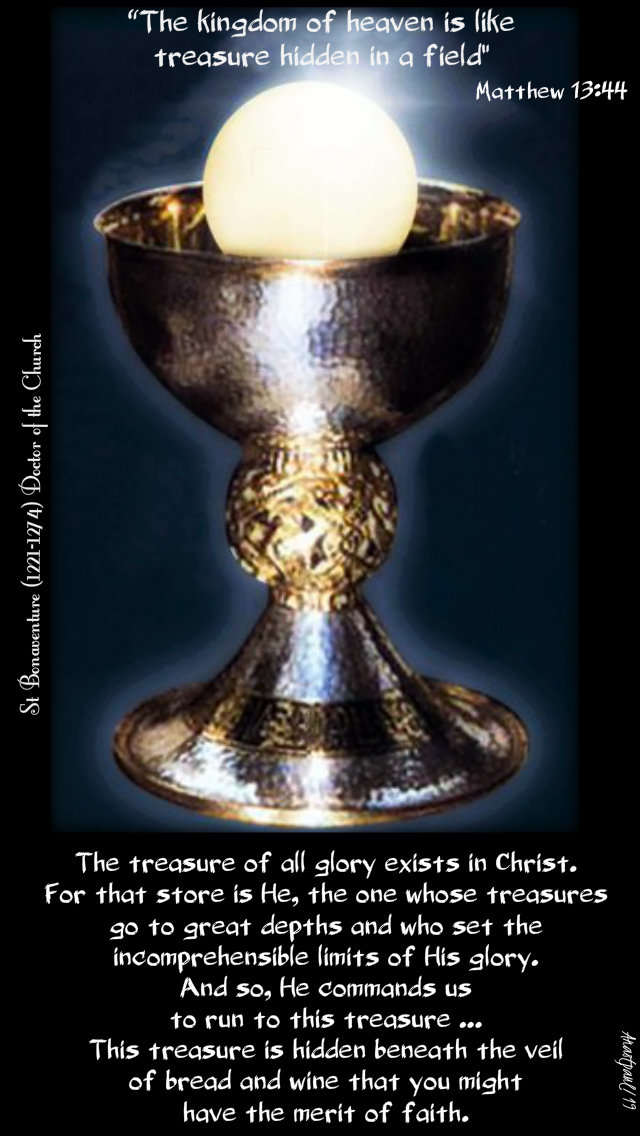
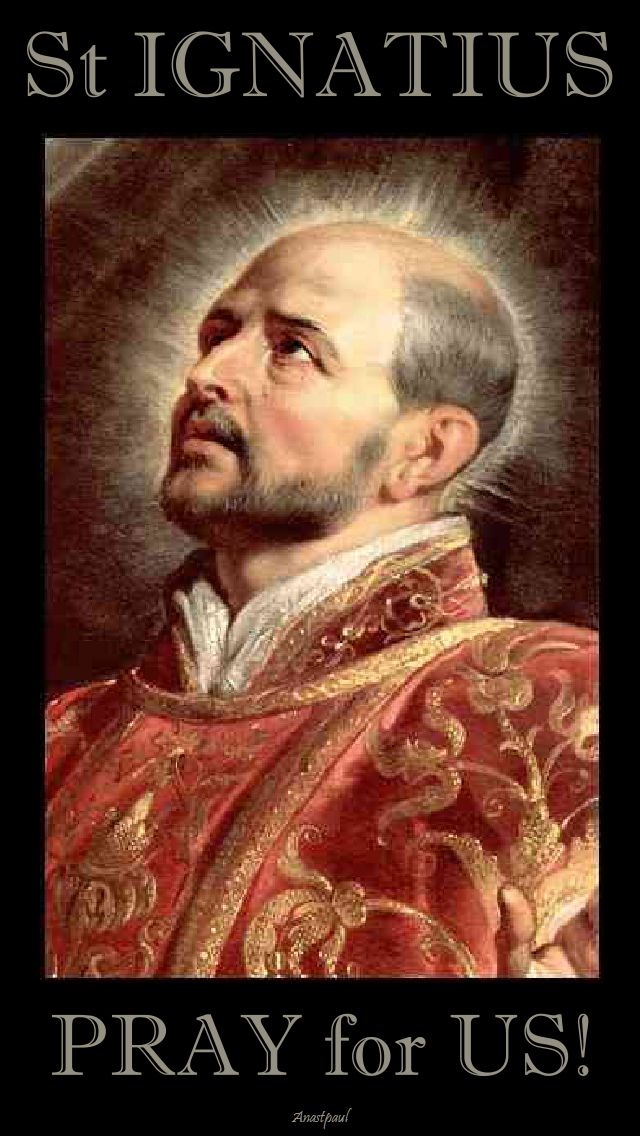
One Minute Reflection – 31 July – Wednesday of the Seventeenth week in Ordinary Time, Year C, Gospel: Matthew 13:44-46 and The Memorial of St Ignatius Loyola (1491-1556)
“The kingdom of heaven is like treasure hidden in a field” … Matthew 13:44
REFLECTION – “Christ is the treasure store of all grace for He is “filled with grace and truth” (Jn 1:14) and angels and humans receive from His fullness. He possesses the very source of fullness and, when He opens His hand, He fills all rational creatures with blessings. But this treasure store of graces, is concealed beneath the veil of the sacrament of the altar. Is it not true that “the Kingdom of heaven is like a treasure hidden in a field”? (Mt 13:44). And is not the field, in this case, the sacrament of the body of Christ, gathered in the fields? In this field we possess a hidden treasure because all kinds of graces are hidden there. “The man who discovered it went away in his joy, sold all he possessed and bought it” (Mt 13:44). Someone who knows the wealth of this sacrament willingly renounces all other activity, to freely give himself to participation and devotion towards this sacrament. He knows he will gain possession of eternal life according to the words of the Lord: “He who eats my flesh and drinks my blood has eternal life” (Jn 6:55).
The treasure of all glory exists in Christ. All the glory, possessed by both angels and men, who are to be saved until the day of judgement, whether it be glory of body or glory of soul, is drawn from that store of treasure. For that store is He, the one whose treasures go to great depths and who set the incomprehensible limits of His glory. And so, He commands us to run to this treasure when He says: “Gather up treasure for yourselves in heaven” (Mt 6:20). This treasure is hidden beneath the veil of bread and wine that you might have the merit of faith.
So may the Lord be praised for His mercies since He represented His Body to us beforehand under the image of heavenly treasure!” … St Bonaventure (1221-1274) Doctor of the Church
PRAYER – Almighty God, grant that the example of Your saints may spur us on to perfection, so that we, who are celebrating the feast of St Ignatius, may follow him step-by-step in his way of life to reach You in heaven. Grant us the grace, by his intercession, to find our treasure in Your divine Son, through Christ our Lord, with the Holy Spirit, God for always and forever, amen.
Thought for the Day – 25 July – Memorial of St Christopher (died C 251) Martyr
There is a beloved saint whose image can be found inside of cars, on the walls of churches and around the necks of safety-seeking travellers. His most prevalent image is that of a tall, formidable man who wades across an unruly river. Wooden staff firmly in hand, his face is often strained, looking upward to the sweet-faced child resting on his oversized shoulders.
He is referenced in literature: “A Cristofre on his breast of silver shene…,” Chaucer wrote in The Canterbury Tales and in film, such as 2005’s Crash in which a habitual car thief uses his trusty Saint Christopher medal as a good-luck charm.
Saint Christopher—patron of travellers, protector against toothaches, hailstorms and sudden death—is one of the most endearing for Catholics. His life and story, bordering somewhere between legend and legitimacy, is a complex, faith-affirming exercise in service, grace and love.
A picture of Saint Christopher was found in a monastery on Mount Sinai dating from the time of Justinian (527-565). His image was cast on coins in Württemberg and Bohemia and his statues could be found on bridges, imparting safety to their many travellers.
Christopher’s woodcarvings and paintings were hung on the walls of many European churches, often accompanied by the inscription, “Whoever shall behold the image of Saint Christopher shall not faint or fall on that day.”
Further proof of his early popularity, Saint Christopher was included as someone invoked against an assortment of hardships. He was also chosen as the patron of Baden, Brunswick and Mecklenburg and is one of the efficacious saints, The Fourteen Holy Helpers.
And that popularity never wavered. Even somewhat recently, organisations such as “The Christophers,” founded by Father John Keller, M.M. in 1945, are named after him. The Christophers’ purpose is to encourage all individuals to celebrate “their abilities and use them to raise the standards in all phases of human endeavour.” It’s a fitting principle.
Despite Saint Christopher’s long-lasting influence, aspects of his life are shrouded in myth and in legend. But his popularity, regardless of overwhelming uncertainty, is unmistakable. We love him and trust in his intercession!
Christopher has proven his resilience, growing in popularity over the centuries and withstanding suspicious historians who have questioned his validity.
For many, Saint Christopher reminds us that, in our own way, we carry Christ on our shoulders and in our hearts, across mighty rivers.
These mighty rivers of our lives!
St Christopher, Pray for us!
Partially Excerpted – Christopher Heffron, St Anthony Messenger
St James the Greater (Feast) – Son of Zebedee and Salome, brother of Saint John the Apostle. He is called “the Greater” simply because he became an Apostle before Saint James the Lesser.
St Cugat del Valles
Bl Darío Acosta Zurita
St Ebrulfus
St Euphrasia
St Fagildo of Santiago
St Felix of Furcona
St Florentius of Furcona
St Glodesind of Metz
St Magnericus of Trier
Bl Michel-Louis Brulard
Bl Mieczyslawa Kowalska
St Mordeyren
St Nissen of Wexford
St Olympiad of Constantinople
St Paul of Palestine
Bl Pietro Corradini of Mogliano
St Theodemir of Cordoba
—
Martyrs of Caesarea – 3 saints: Three Christians martyred together in the pesecutions of emperor Maximilian and governor Firmilian – Paul, Tea and Valentina. 309 in Caesarea, Palestine.
Martyrs of Cuncolim – 20 saints: On 15 July 1583 the group met at the church of Orlim, and hiked to Cuncolim to erect a cross and choose land for a new church. Local anti-Christian pagans, seeing the unarmed Christians, gathered their weapons and marched on them. One of the parishioners, a Portuguese emigre named Gonçalo Rodrigues, carried a firearm, but Father Alphonsus Pacheco stopped him from using it. The pagans then fell upon them, and killed them all without mercy. They were –
• Alphonsus Pacheco
• Alphonsus the altar boy
• Anthony Francis
• Dominic of Cuncolim
• Francis Aranha
• Francis Rodrigues
• Gonçalo Rodrigues
• Paul da Costa
• Peter Berno
• Rudolph Acquaviva
• ten other native Christian converts whose names have not come down to us
They were martyred on Monday 25 July 1583 at the village of Cuncolim, district of Salcete, territory of Goa, India. Beatified on 30 April 1893 by Pope Leo XIII.
Martyrs of Motril – 5 beati: Four priests and a brother, all members of the Augustinian Recollects, who were martyred together in the Spanish Civil War:
• Deogracias Palacios del Río
• José Rada Royo
• José Ricardo Díez Rodríguez
• Julián Benigno Moreno y Moreno
• León Inchausti Minteguía
They were shot on 25 July 1936 in Motril, Granada, Spain and Beatified on 7 March 1999 by Pope John Paul II.
Martyrs of Toledo – 4 beati: Four brothers and a priest, all members of the Hospitallers of Saint John of God, and all martyred together in the Spanish Civil War.
• Carlos Rubio álvarez
• Eloy Francisco Felipe Delgado Pastor
• Jerónimo Ochoa Urdangarín
• Primo Martínez De San Vicente Castillo
25 July 1936 in Talavera de la Reina, Toledo, Spain. They were Beatified on 25 October 1992 by Pope John Paul II.
Martyrs of Urda – 3 beati: Three members of the Passionists who were martyred together in the Spanish Civil War.
• Benito Solana Ruiz
• Felix Ugalde Irurzun
• Pedro Largo Redondo
They were shot on 25 July 1936 in Urdá, Toledo, Spain and Beatified on 1 October 1989 by Pope John Paul II.
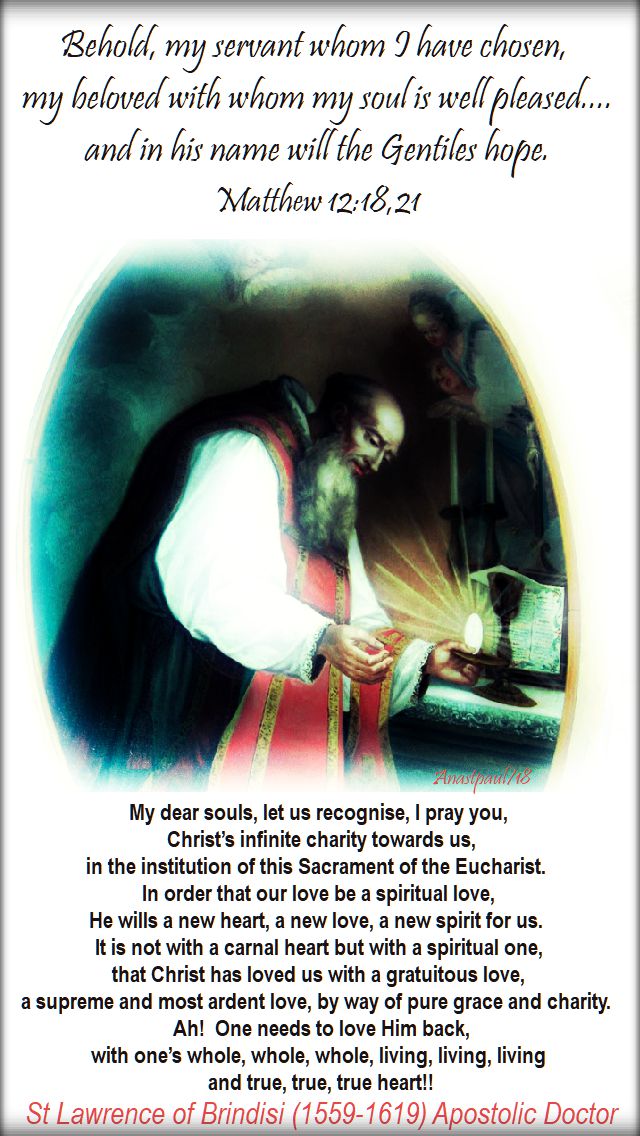
One Minute Reflection – 20 July – Saturday of the Fifteenth week in Ordinary Time, Year C, Gospel: Matthew 12:14–21
“Behold, my servant whom I have chosen, my beloved with whom my soul is well pleased…. and in his name will the Gentiles hope.”…Matthew 12:18,21
REFLECTION – “My dear souls, let us recognise, I pray you, Christ’s infinite charity towards us, in the institution of this Sacrament of the Eucharist. In order that our love be a spiritual love, He wills a new heart, a new love, a new spirit for us. It is not with a carnal heart but with a spiritual one, that Christ has loved us with a gratuitous love, a supreme and most ardent love, by way of pure grace and charity. Ah! One needs to love Him back with one’s whole, whole, whole, living, living, living and true, true, true heart!!” …… St Lawrence of Brindisi (1559-1619) Apostolic Doctor
PRAYER – Lord God, You bestowed on us all the ways of grace in Your Son, so that Your name might be glorified and souls be saved. At the intercession of His Mother, whom He so lovingly gave us, grant that we may see what we have to do and, in Your mercy give us the strength to do it and the courage, love and charity to persevere. Grant above all, that by her prayers we may love You above all and with all we are. Mary, holy Mother of God, pray for us, through your Son Jesus Christ, with the Holy Spirit, one God forever, amen.
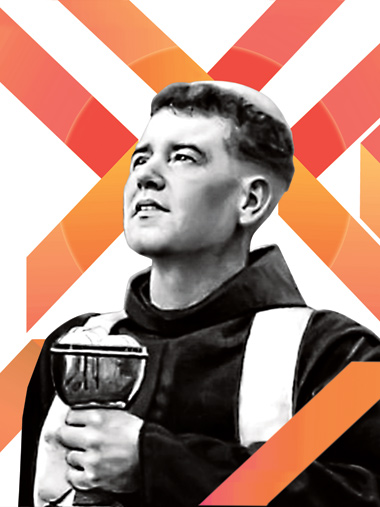
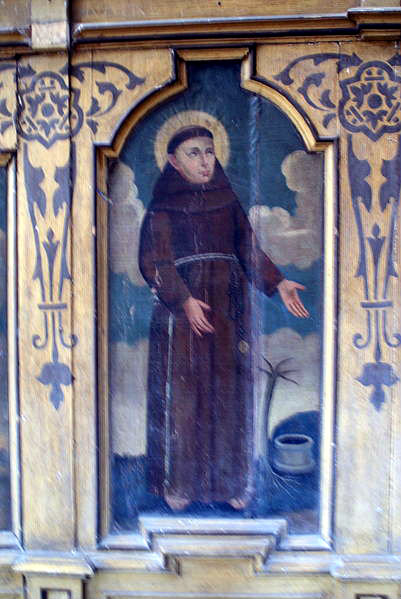
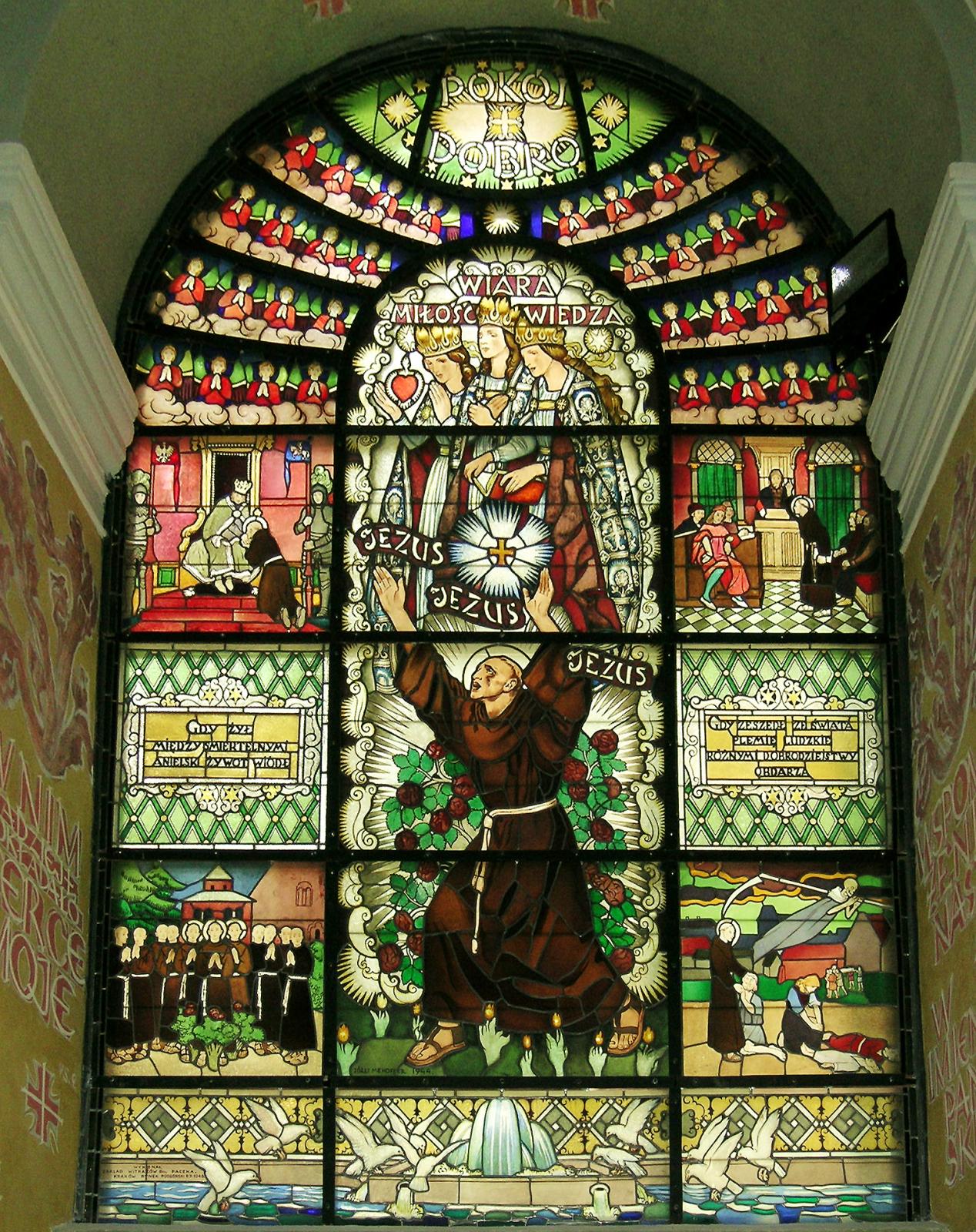
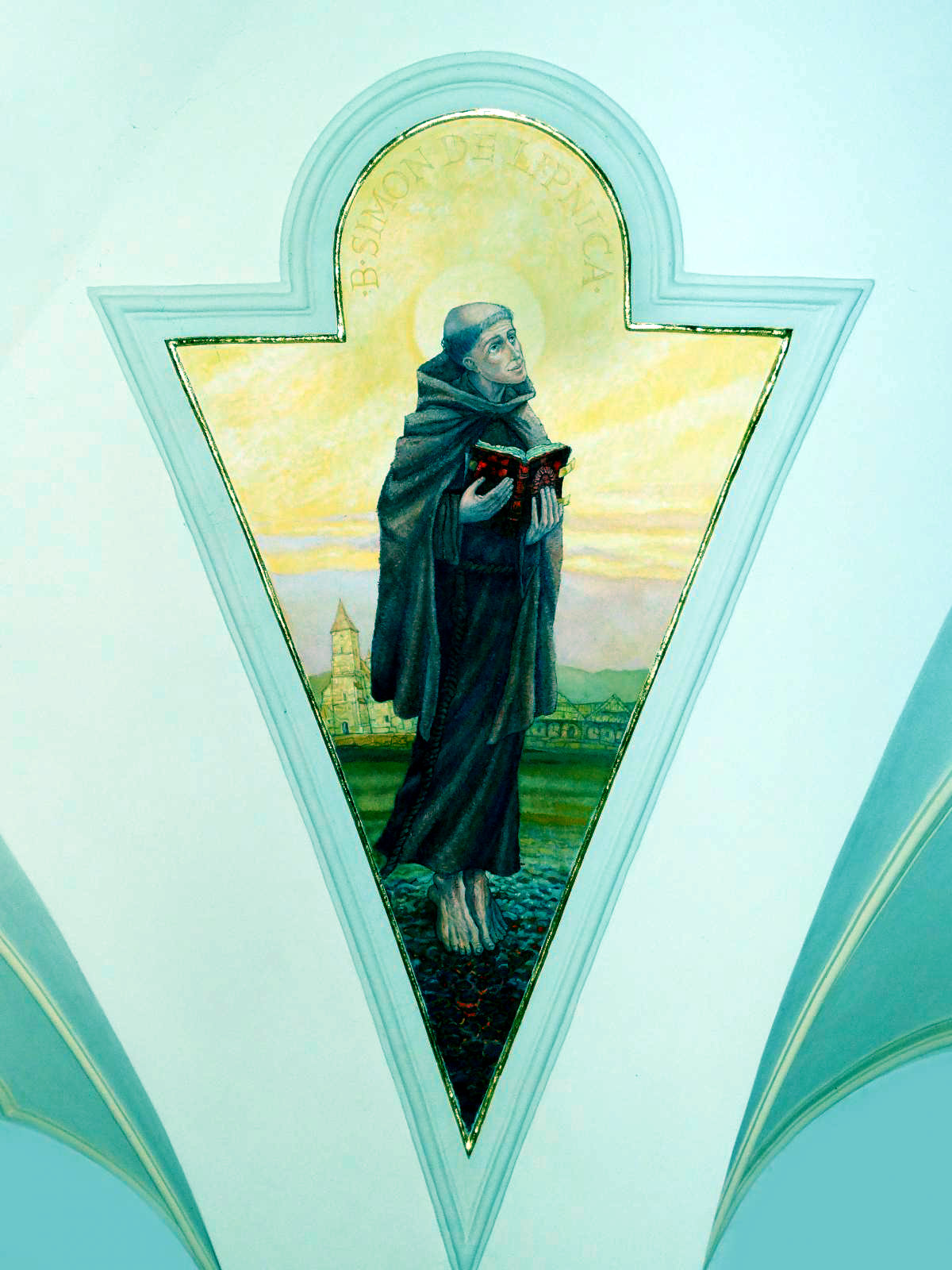
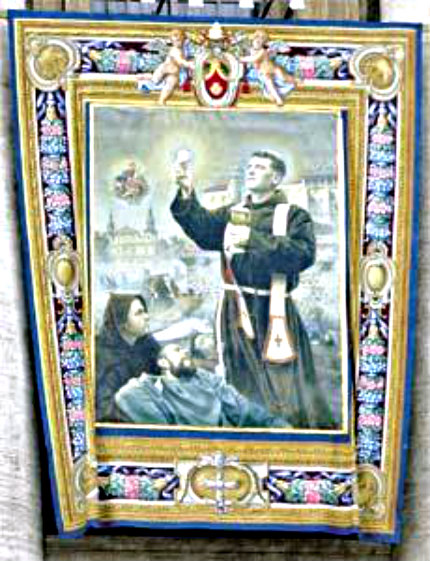
Saint of the Day – 18 July – Saint Simon of Lipnica (1435/1440-c 1482) OFM Cap Priest of the Franciscan Order of Friars Minor (OFM), renowned Preacher, apostle of charity – also known as Szymon of Lipnicza – born in 1435/1440 in Lipnica Murowana, Malopolskie, Poland and died on 18 July 1482 in Kraków, Malopolskie, Poland during a plague epidemic. Patronages – Krakow, Students.
Simon was born in Lipnica Murowana, in the south of Poland, between the years 1435-1440. His parents, Gregory and Anne, knew how to give him a good education, inspired by the values of the Christian faith and, despite their modest conditions, they took care to secure him an adequate cultural formation. Simon grew up with a pious and responsible nature, rich in a natural predisposition towards prayer and a tender love for the Mother of God.
He moved to Krakow, to attend the famous Jagiellonian Academy, in 1454. It was precisely in those years that St John of Capestrano OFM (1386-1456) enthused the city through the sanctity of his life and the fervour of his preaching, attracting a dense crowd of young, generous men to the Franciscan vocation. On the 8th September 1453, the Italian saint founded the first convent of the Observance, with the name of the recently Canonised St Bernardine of Siena (1380-1444), in Krakow. It was for that reason that the Friars Minor of the convent were called the “Berdardini” by the people.
In 1457, the young Simon, fascinated by the Franciscan ideal, also chose to acquire the pearl of great price mentioned in the Gospel and left aside a possible successful and rich future. He asked to be received, with another ten fellow students, into the convent of Stradom.
Under the wise guidance of the Novice Master, Br Christopher of Varese, a religious renown for his teaching and sanctity of life, Simon generously embraced the humble and poor life of the Friars Minor and received the priesthood about the year 1460. He exercised his first ministry in the convent of Tarnów, where he was the Guardian of the fraternity.
He later established himself in Stradom (Krakow), dedicating himself untiringly to preaching with a clear word, full of ardour, faith and wisdom, which permitted a glimpse of his profound union with God and of his prolonged study of Sacred Scripture.
Like St Bernardine of Siena and St. John of Capestrano, Br Simon spread devotion to the Name of Jesus, obtaining the conversion of innumerable sinners. He, the first of the Friars Minor, took up the duty of preacher in the Cathedral of Wawel in 1463. Because of his dedication to preaching the Gospel, the ancient sources conferred the title of “predicator ferventissimus” “Zealous Preacher”, on him.
In his desire to give homage to St Bernardine of Siena, the inspirer of his preaching, he, with some Polish confreres, went to Aquila to participate in the solemn transfer of the body of the saint, on the 17th May 1472, to the new Church erected in his honour. He was again in Italy in 1478, on the occasion of the General Chapter of Pavia. He had a way, then, to be able to satisfy his deepest desire to visit the tombs of the Apostles in Rome and to extend his pilgrimage to the Holy Land later. He lived this experience in a spirit of penance, truly loving the passion of Christ, with the hidden aspiration of spilling his own blood for the salvation of souls, if it would please God. He emulated St Francis in his love for the Holy Places. In view of the possibility of being captured by the non-believers, he wished to learn the Rule of the Order by heart before undertaking the journey in order “to have it always before the eyes of his mind”.
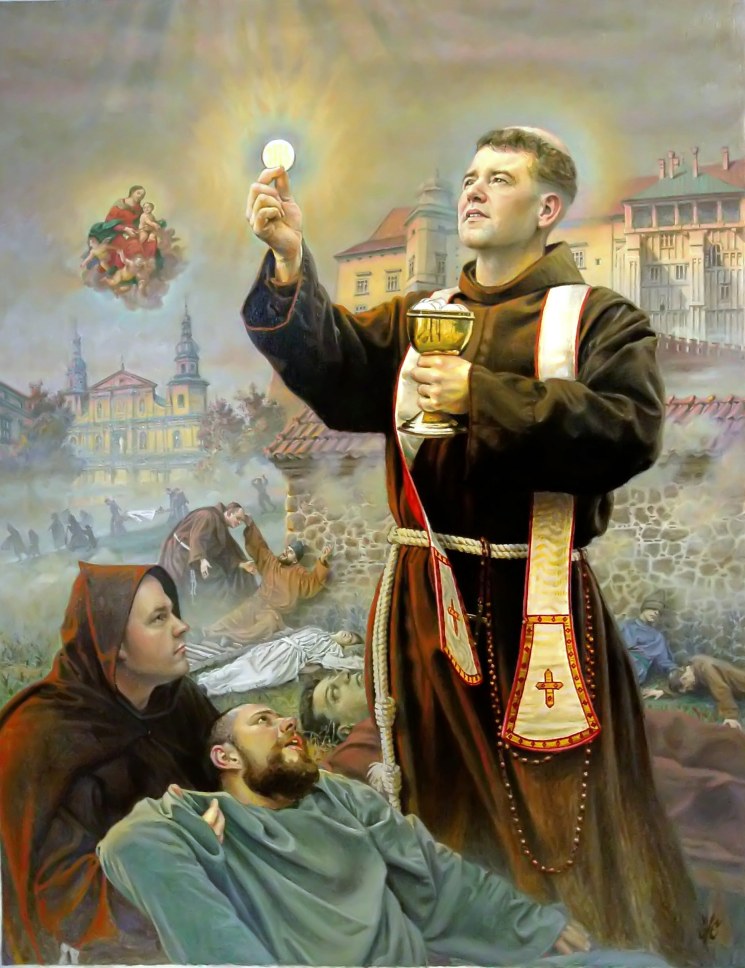
The love of Simon for his brothers and sisters was manifested in an extraordinary way during the last year of his life, when an epidemic of plague broke out in Krakow. The city was under the scourge of the disease from July 1482 to the 6th January 1483. The Franciscans of the convent of St Bernardine tirelessly did all they could to care for the sick as true consoling angels.
Br Simone, held it to be a “propitious time” to exercise charity and to fulfil the offering of his own life. He went everywhere comforting, giving succour, administering the sacraments and announcing the consoling Word of God to the dying. He was soon infected. He suffered the pain of the disease with extraordinary patience and, near the end, expressed his desire to be buried under the threshold of the church so that all could trample on him. On the sixth day of the disease, the 18th July 1482, without fear of death and with his eyes fixed on the Crucifix, he gave his soul back to God.
The “ab immemorabili” cult rendered to Blessed Simon, which passed into the history of seraphic sanctity under the title of “Salutis omnium sitibundus”, was confirmed by Blessed Innocent XI on the 24th February 1685.
The cause of his Canonisation, taken up by the Holy Father Pius XII on the 25th June 1948, today reaches its happy ending, following the recognition of his heroic virtues and of the miraculous cure which occurred in Krakow in 1943 and attributed to the intercession of the Blessed. The respective Decrees were promulgated by the Holy Father Benedict XVI on the 19th of December 2005 and the 16th December 2006.
This slideshow requires JavaScript.
Simon of Lipnica knew how to combine admirably his commitment to evangelisation and to giving witness to charity, which flowed from his great love for the Word of God and for the poor and suffering. The Order of Friars Minor, on the vigil of the celebration of the VIII Centenary of its Foundation (1209-2009), salutes him as an authentic witness to poverty, humility and simplicity, as well as to the joy of belonging fully to the Lord and to being a gift to the life of the Friars.
He was Canonised by Holy Father Pope Benedict XVI mere months after the decrees approved by him in 2006, on 3 June 2007 in Saint Peter’s Square upon the confirmation of a 1943 miracle attributed to his intercession….Vatican.va
Thought for the Day – 15 July – Monday of the Fifteenth week in Ordinary Time, Year C, Gospel: Matthew 10:34-11,1 and The Memorial of St Bonaventure OFM (1221-1274) Seraphic Doctor of the Church
Saint Bonaventure saw the spires of the great cathedrals reaching up to heaven as a reflection of the human soul’s reaching up to God in his The Soul’s Journey into God. Likewise, the streams of light coming into the church through the stained-glass windows, reflect God expressing Himself, in the wide variety of creatures upon whom He showers His gifts of grace.
And the images go on and on as the saint reaches into human experience of creation and cultural artifacts and finds vestigium (the footprints) of God since everything in creation, reflects in some way, the grandeur of God. Human beings, of course, are the actual image of God.
It was this ability to take the spirituality of Saint Francis—as reflected in Saint Francis’ Canticle of the Sun, for instance—and place it at the heart of his writings, keeping the simplicity of the Franciscan insights and creating a sublime theology, that truly deserves the name “Seraphic.”
When Bonaventure was declared a Doctor of the Universal Church in 1588 by Pope Sixtus V, he was given the title “Seraphic Doctor.” Merriam-Webster defines a seraph as one of the highest-ranking angels as well as “one of the six-winged angels standing in the presence of God.” It was as a seraph that Christ appeared to Saint Francis when he received the stigmata on Mount La Verna. Therefore, it is fitting to use the term to describe the soaring mysticism of Saint Bonaventure.
In his General Audience on 3 March 2010, Pope Benedict XVI spoke about the life of St Bonaventure. He called to mind the great works of literature, art, philosophy and theology that were inspired by the Christian faith during the time period in which the saint lived.
“Among the great Christian figures who contributed to the composition of this harmony between faith and culture, Bonaventure stands out, a man of action and contemplation, of profound piety and prudent government,” Pope Benedict said.
The Pope called on the faithful to take note of “the central role that Christ always played in Bonaventure’s life and teaching,” and to imitate the way in which “the whole of his thinking was profoundly Christocentric.”
“Meditation on Christ in His humanity is corporeal in deed, in fact but spiritual in mind. . . . By adopting this habit, you will steady your mind, be trained to virtues and receive strength of soul….Let meditation of Christ’s life be your one and only aim, your rest, your food, your desire, your study.” – St Bonaventure
Quote/s of the Day – 15 July – Monday of the Fifteenth week in Ordinary Time, Year C, Gospel: Matthew 10:34-11,1 and The Memorial of St Bonaventure (1221-1274) Doctor of the Church
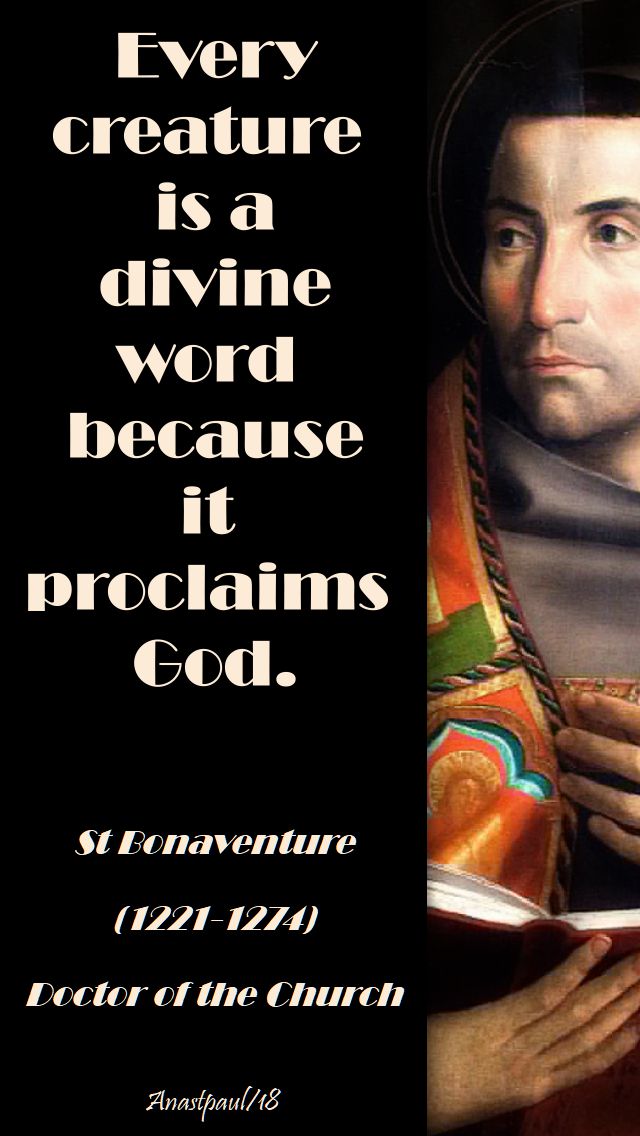
“Every creature is a divine word because it proclaims God.”
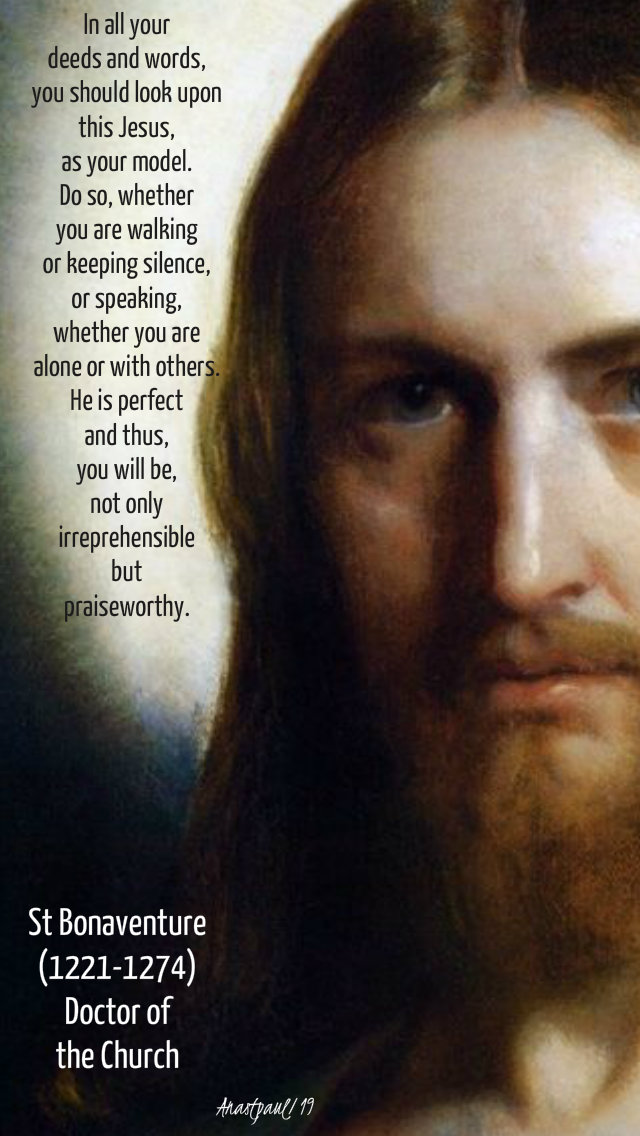
“In all your deeds and words, you should look upon this Jesus, as your model. Do so, whether you are walking or keeping silence, or speaking, whether you are alone or with others. He is perfect and thus, you will be, not only irreprehensible but praiseworthy.”
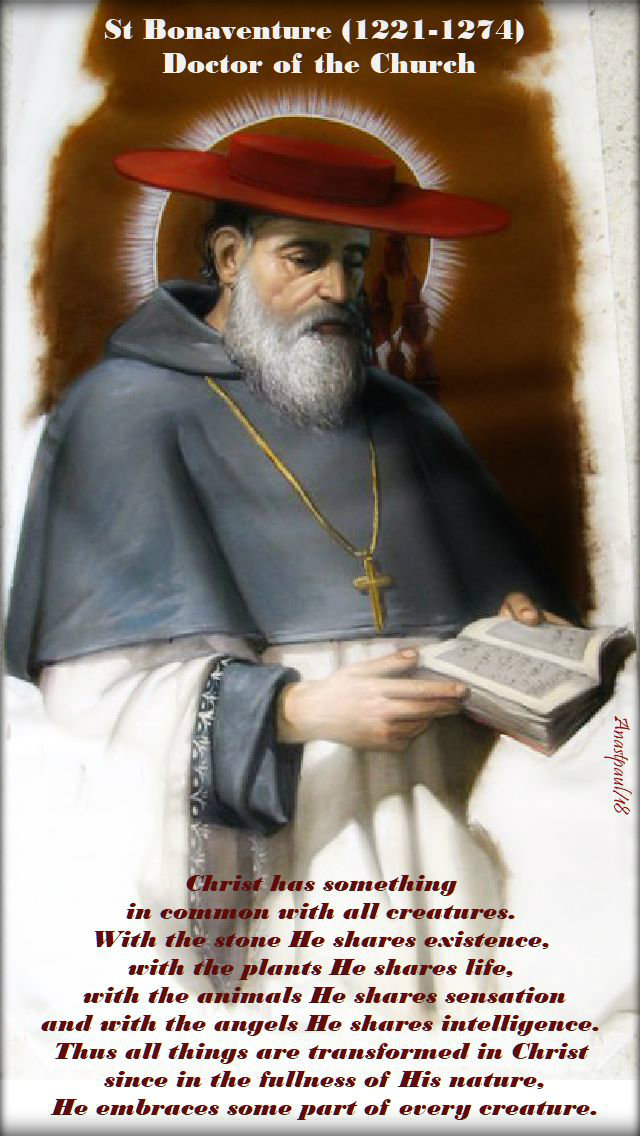
“Christ has something in common with all creatures. With the stone He shares existence, with the plants He shares life, with the animals He shares sensation and with the angels He shares intelligence. Thus all things are transformed in Christ since in the fullness of His nature, He embraces some part of every creature.”
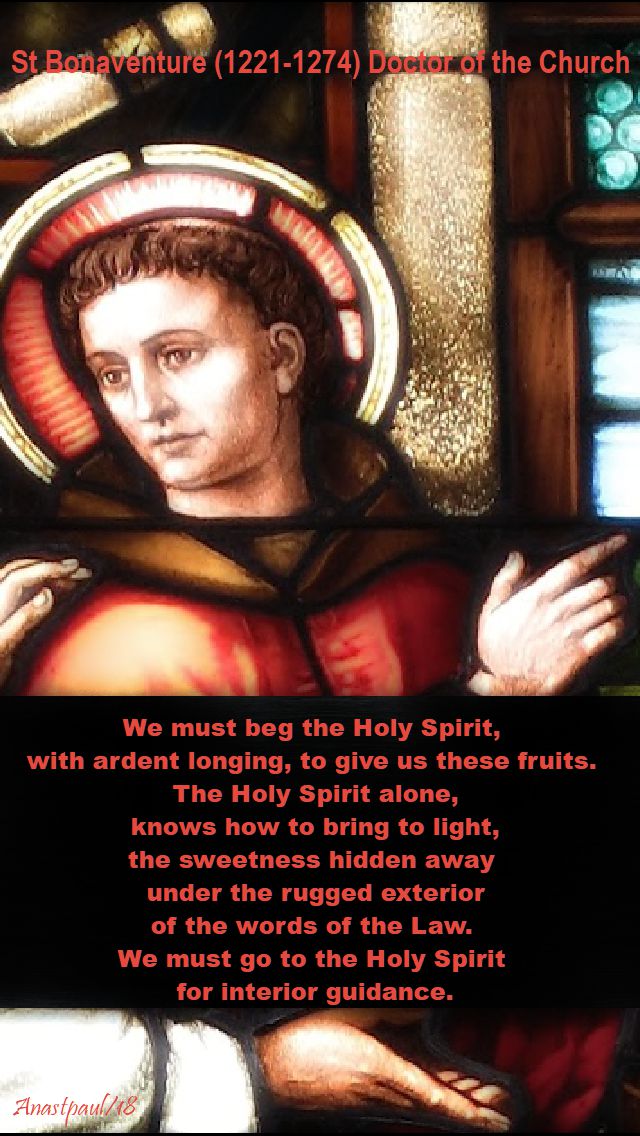
“We must beg the Holy Spirit, with ardent longing, to give us these fruits. The Holy Spirit alone, knows how to bring to light, the sweetness hidden away under the rugged exterior of the words of the Law. We must go to the Holy Spirit for interior guidance.”
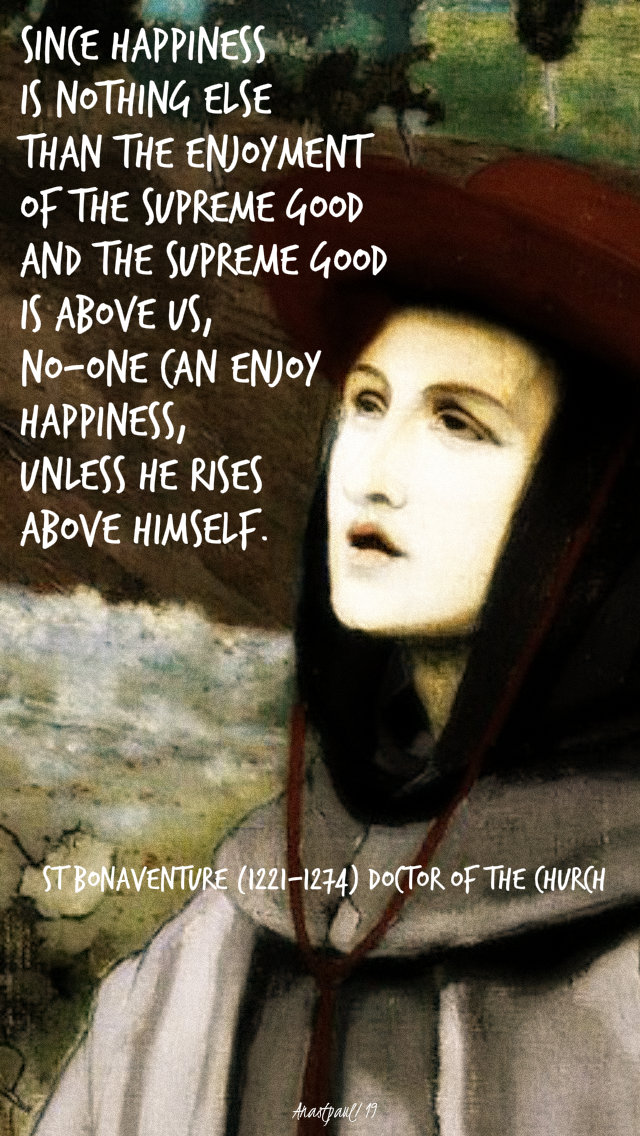
“Since happiness is nothing else than the enjoyment of the Supreme Good and the Supreme Good is above us, no-one can enjoy happiness, unless he rises above himself.”
“God might have created a more beautiful world, He might have made heaven more glorious but it was impossible for Him, to exalt a creature, higher than Mary, in making her His Mother.”
St Adolphus of Osnabrück
St Alpinian of Limoges
St Alrick the Hermit
Bl Ambrose de Feis
Bl Anthony de Tremoulières
Bl Arnulf of Villers
St Austriclinian of Limoges
St Basilides of Alexandria
St Bertrand of Le Mans
St Clotsindis of Marchiennes
Bl Elisabeth Heimburg
St Emiliana of Rome
St Erentrude
St Eurgain
St Gaius Bl Gennaro Maria Sarnelli C.Ss.R. (1702–1743)
Bl Jacob Clou
St Leo the Deacon
St Lucina of Rome
St Lucina of the Callistus Catacombs
St Marcian of Pampeluna
St Martial of Limoges
St Ostianus
St Otto of Bamberg
St Peter of Asti
St Petrus Li Quanhui
Bl Philip Powel
St Raimundus Li Quanzhen Bl Raymond Lull TOSF (c 1232 – c1315) Biography:
St Theobald of Provins
Bl Vasyl Vsevolod Velychkovskyi
St Vihn Son Ðo Yen
Bl Zenon Kovalyk
—
Martyrs of Africa – 7 saints: Seven Christians martyred together. No detail about them have surived but the names – Cursicus, Gelatus, Italica, Leo, Timotheus, Zoilus, and Zoticus. Date and precise location in Africa unknown.
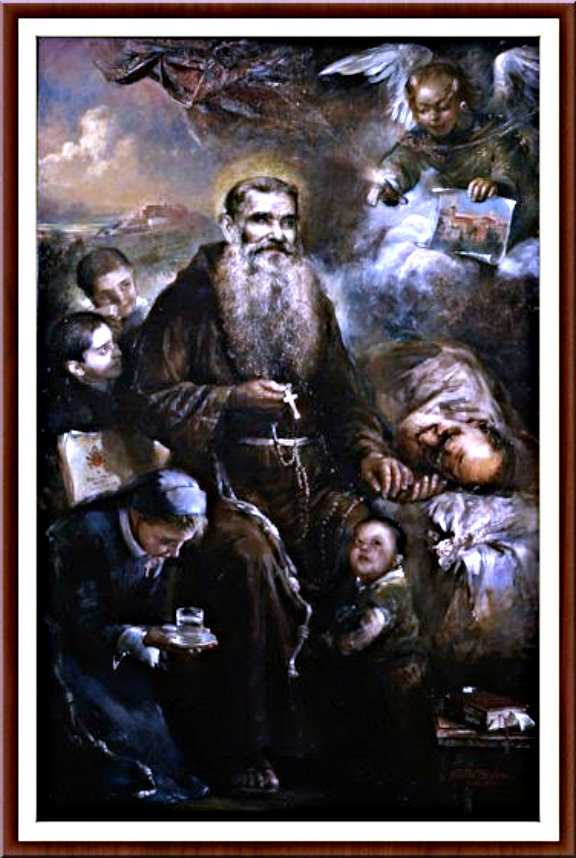
Thought for the Day – 26 June – Wednesday of the Twelfth week in Ordinary Time and the Memorial of Blessed Jacques Ghazir Haddad OFM Cap (1875-1954) “The Apostle of Lebanon” “The Apostle of the Cross”
Lebanon’s Apostle of the Cross
Brother Jacque’s long-cherished dream of erecting a large Cross in Lebanon was a concrete expression of his commitment to his Christian faith and to his native country. He wanted to make it not only a meeting place for Franciscan Tertiaries but above all, a place of prayer for all those fallen in war and for the Lebanese who had emigrated in search of work. With the help of collected money he completed this project which also included a church dedicated to Our Lady of the Sea and, later, hospital, orphanage and rest home for retired priests in 1923.
Brother James’s love for the Cross of Christ was so legendary that people christened him ‘the Apostle of the Cross’. He himself prayed the Stations of the Cross everyday and he encouraged others to frequently pray this prayer. Among his publications is a booklet of mediations for the Way of the Cross and the congregation of Tertiary Sisters he founded to run his corporal works of mercy projects is called the ‘Congregation of Franciscan Sisters of the Cross of Lebanon’. Among his frequently quoted maxims are the following: “I myself have the Cross as a destiny”.,“One ounce of a Cross is much better than a ton of books of prayer.”, and “O Cross of the Lord, so dear to the heart”.And as he left this world he held his well-worn Crucifix in his hands.
Besides his love of the Cross, Brother James also had a deep devotion to the Eucharist and to Our Blessed Lady. He prayed the fifteen decades of the rosary every day. He viewed our Lady as the perfect guide who leads people to Christ. “Honouring Mary, no matter how sacred, is only the door leading to Jesus. Mary is the means, Jesus is the end. Mary is the road, Jesus is the destination”. It was in adoration before the Blessed Sacrament that Brother James reached this destination while here on earth. Sometimes, as he adored the the Lord in the tabernacle, he would pray, “How I would prefer to take you in procession throughout the streets rather than closing up on you in the tabernacle”.
Apostle of Lebanon
But inevitable old-age and illness impacted this energetic Capuchin Brother’s own strength of also. He was already known throughout Lebanon as Abouna Yaaqoub(أبونا يعقوب) meaning Father Jacques, Father James or Abba Jacob.
At dawn on Saturday 26 June 1954 he said, “Today is my last day!” and he died at 3 o’ clock in the afternoon . The radio, the press, his friends and church bells in the villages announced his death. Thousands flocked to the Friary of the Cross to weep, pray and receive a final blessing. His body was laid to rest in a tomb of the new Calvary Chapel. This chapel soon became a site that is visited by an ever-growing throngs of pilgrims. Tens of thousands of Lebanese turned out to celebrate his beatification in Beirut’s Martyrs Square. That bloodstained square which witnessed so many tragedies of wartorn Lebanon’s recent history resound with cheers of joy as the painting of the Brother Jacques of Ghazir was unveiled above it after the Pope’s representative, Cardinal Martens, proclaimed the faithful son of Lebanon, Khalil Haddad, the Capuchin Order’s ‘Abuna Yaaqub’ a Blessed. His beatification a moment of hope for unity in a country ripped apart by factional warfare and international conflict.
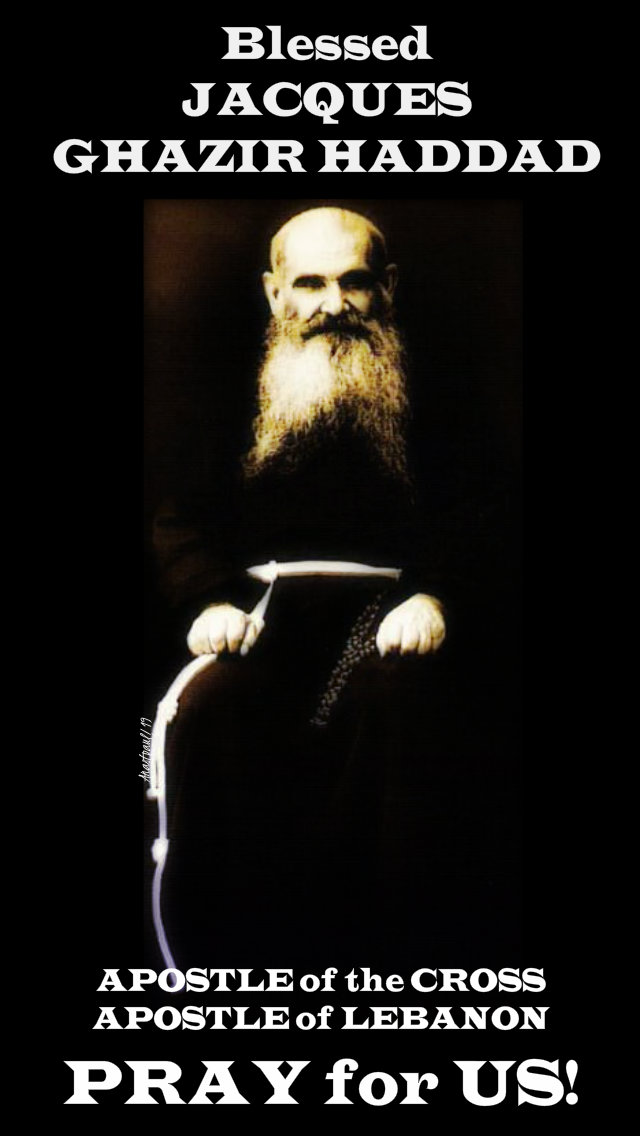
Blessed Jacques Ghazir Haddad (1875-1954)
“The Apostle of Lebanon”
“The Apostle of the Cross”
Pray for Us!
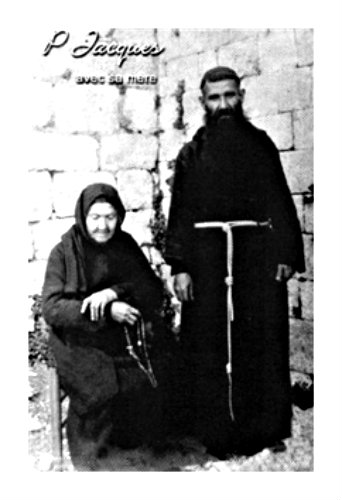
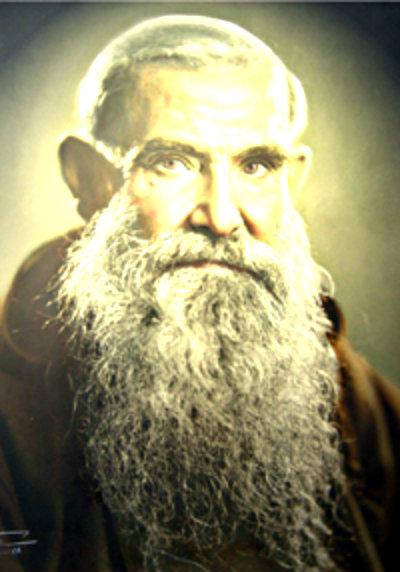
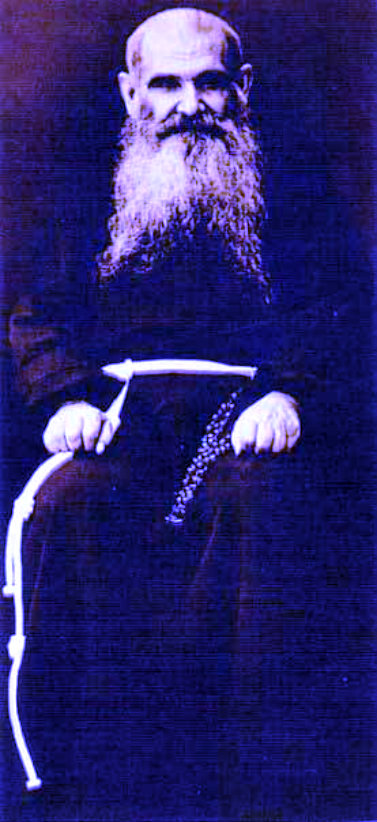
Saint of the Day – 26 June – Blessed Jacques Ghazir Haddad OFM Cap (1875-1954) aged 79 – Priest, Religious of the Order of Friars Minor as a Capuchin Friar, Founder of the Franciscan Sisters of the Holy Cross of which he is the Patron, noted Preacher and founder of many orphanages and schools across Lebanon, Apostle of Charity. Called the “St Vincent de Paul of Lebanon,” “the Apostle of the Cross” and “the Apostle of Lebanon.”
Fr Jacques Ghazir Haddad was born on 1 February 1875, in Ghazir, Lebanon, the third of five children. He attended school in Ghazir and then the College de la Sageese in Beirut, where he studied Arabic, French and Syriac.
In 1892 he went to Alexandria, Egypt, to teach Arabic at the Christian Brothers’ College, and there he felt the call to the priesthood. He entered the Capuchin Convent in Khashbau the next year. He was ordained a priest on 1 November 1901 in Beirut, Lebanon.
As an itinerant preacher from 1903 to 1914 he walked all over Lebanon proclaiming the Word of God and was given the name “the Apostle of Lebanon”. He was also seen preaching in Syria, Palestine, Iraq and Turkey.
In 1919 he bought a piece of land on the hill of Jall-Eddib, north of Beirut, where he built a chapel dedicated to Our Lady of the Sea. Nearby he erected a great Cross.
Fr Jacques was tireless, he would help anyone in need following in the footsteps of St Francis of Assisi. In 1920, to assist him in this mission to help the sick and the poor, he founded the Franciscan Sisters of the Holy Cross of Lebanon. Sister Marie Zougheib was his first collaborator and aided him in setting up his new congregation. He set out in the rule of his order with the insistence, above all else, that the works of mercy never be neglected in the pursuit of the order’s work. He had been titled as the “Vincent de Paul of Lebanon”.
The modest work of Fr Jacques aroused the people’s admiration, many poor and sick people began to go to the “Cross” and Fr Jacques would welcome them all. In 1950 the “Cross” became exclusively a psychiatric hospital, one of the most modern in the Near East. The movement of charity began to spread throughout Lebanon and Fr Jacques and his Sisters multiplied their works of social assistance.
In 1933 he opened the House of the Sacred Heart in Deir el-Kamar, a girls’ orphanage, which later became an asylum for the chronically ill. In 1948 he opened the Hospital of Our Lady for the aged, the chronically ill and the paralysed. In 1949 St Joseph’s Hospital became one of the most important medical centres of the capital. It was followed in 1950 by St Anthony’s House in Beirut for beggars and vagabonds whom the police found on the streets and Providence House for homeless girls.
Even though Fr Jacques was very busy with the hospital mission, he and his Sisters carried on the important work of education and opened several schools as well as an orphanage for 200 girls.
Fr Jacques was worn out by vigils, fatigue and travel. Although he suffered from numerous illnesses, became almost completely blind and was stricken with leukemia, he did not stop blessing God and working. He was lucid to the end, at dawn on the day of his death, he said “Today is my last day!” His last hours were an uninterrupted series of prayers invoking the Cross and the Virgin Mary until he died on 26 June 1954 in Lebanon.
His cause for Beatification was introduced in February 1979, on 24 February 1979, His Holiness St Pope John Paul II signed the Decree of Introduction of the Cause for Beatification. On Sunday, 22 June 2008, he was Beatified during a special Mass in Beirut by Cardinal José Saraiva Martins, C.M.F., Prefect of Congregation for the Causes of Saints.
Since Blessed Haddad’s death, additional hospitals have opened to assist those injured during the war and to assist the Kabr-Chemoun region where medical services were scarce…Vatican.va
Father al-Haddād received from President Émile Eddé the Palm Medal of Lebanese Merit on 5 January 1938 while President Bechara El Khoury awarded him the Golden Medal of Lebanese Merit on 2 June 1949 and then the Officer Degree of the Lebanese Cedars Medal on 26 November 1951.
Blessed Virgin of Potente del Trompone:
Visionary: Domenica di Miglianotto on 26 June 1562
Title: Blessed Virgin of Potente del Trompone
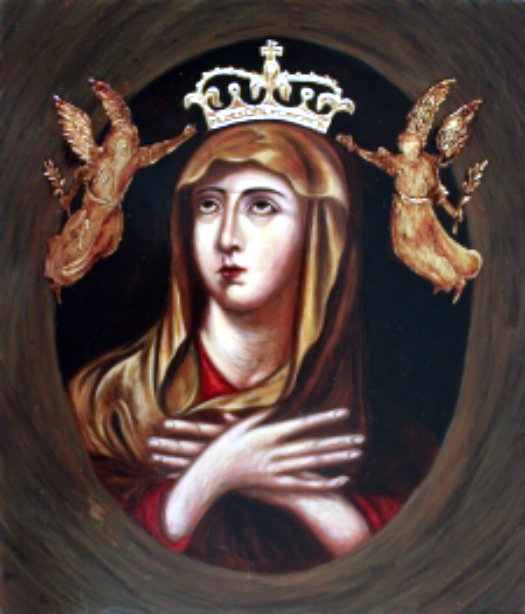
2nd Visionary: Visionary: St Peter of Alcantara (1499-1562) – seen below: Our Lady of Longing:Matka Boża Tęskniąca / Longing Mother of God, Warsaw, Poland – One of the oldest churches in the Archdiocese of Warsaw is St Elizabeth Powsin Located on the main altar is a painting of Our Lady of Longing – artist unknown – from the first half of the seventeenth century. At either side, the image is surrounded by statues of Saints Adalbert and Stanislaus – Polish bishops and martyrs . The testimony of miracles and graces relating to the Our Lady of Longing icon have been collected at least since the mid-seventeenth century. On 28 June 1998, the image became the fourth image of Mary in the Archdiocese of Warsaw to be canonically crowned.
St Acteie of Rome
St Albinus of Rome
Bl Andrea Giacinto Longhin
Bl Andrii Ischak
St Anthelm of Belley
St Babolenus of Stavelot-Malmédy
St Barbolenus of Fossés
Bl Bartholomew of Vir
St Corbican
St David of Thessalonica
St Deodatus of Nola
St Dionysius of Bulgaria
St Edburga of Gloucester
St Hermogius of Tuy
St Iosephus Ma Taishun
St John of Rome
St John of the Goths
St José Maria Robles Hurtado St Josemaria Escriva (1902-1975) Biography: https://anastpaul.com/2018/06/26/saint-of-the-day-26-june-st-josemaria-escriva-de-balaguer-y-albas-1902-1975-the-saint-of-ordinary-life/
Bl Jacques Ghazir Haddad OFM Cap (1875-1954)
St Maxentius of Poitou
St Medico of Otricoli
Bl Mykola Konrad
St Paul of Rome
St Pelagius of Oviedo
St Perseveranda of Poitiers
Bl Raymond Petiniaud de Jourgnac
St Salvius
Bl Sebastian de Burgherre
St Soadbair
St Superius
St Terence of Rome
St Vigilius of Trent
Bl Volodymyr Ivanovych Pryima
—
Martyrs of Africa – 4 saints: Four Christians who were martyred together – Agapitus, Emerita, Felix and Gaudentius at an unknown location in Africa, date unknown.
Martyrs of Alexandria – 3 saints: Three Christians who were martyred together, but we really know little more that the names – Agatho, Diogenes and Luceja. They were martyred in Alexandria, Egypt, date unknown.
Martyrs of Cambrai – 4 beati: Four Daughters of Charity of Saint Vincent de Paul nuns at Arras, France. Imprisoned together in 1792 and executed together two years later in the anti-Catholic excesses of the French Revolution. They were:
• Jeanne Gerard
• Marie-Françoise Lanel
• Marie-Madeleine Fontaine
• Thérèse-Madeleine Fantou
They were guillotined on 26 June 1794 at Cambrai, Nord, France and Beatified in June 1920 by Pope Benedict XV.




 The following day, on the feast of the Transfiguration, he died peacefully. Just short of his 69th birthday, Antonio had served the Lord with profound humility for nearly 53 years, 43 of which as a missionary in North and Central America.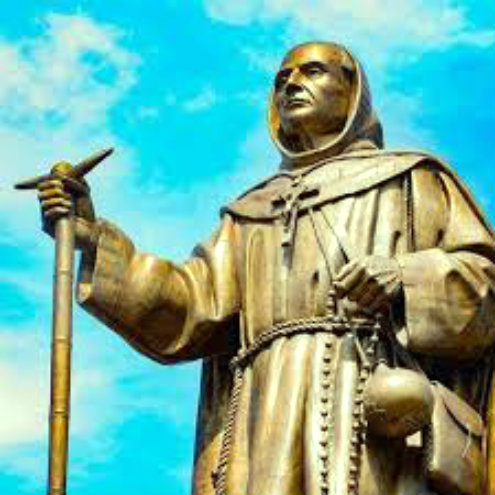
 He helped with administration, promoted a renewal of the custom of Holy Land pilgrimages, re-established the ritual of the Way of the Cross in the streets of Jerusalem and directed construction of the Church of the Nativity in Bethlehem. He revised the set of customary regulations that had developed through the centuries between the Latins, the Greeks and the Armenians for the use and maintenance of the shrines of Bethlehem and the Holy Sepulchre.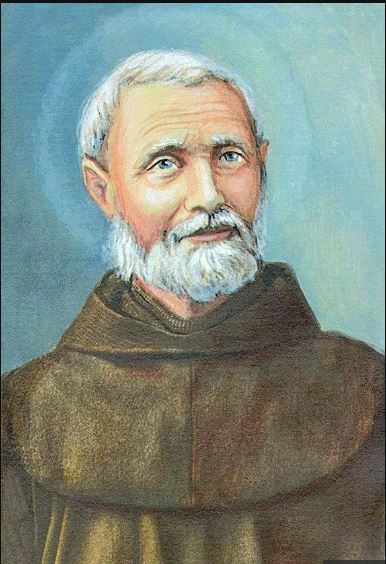







 AnaStpaul
You must be logged in to post a comment.