Our Morning Offering – 7 October – Twenty Seventh Sunday in Ordinary Time, Year B
Your Sacred Table A Prayer Before Holy Communion By St Francis de Sales (1567-1622) Doctor of the Church
Divine Saviour,
we come to Your sacred table
to nourish ourselves,
not with bread but with Yourself,
true Bread of eternal life.
Help us daily to make a good
and perfect meal
of this divine food.
Let us be continually refreshed
by the perfume of Your kindness and goodness.
May the Holy Spirit fill us with His Love.
Meanwhile, let us prepare a place
for this holy food by emptying our hearts.
Amen
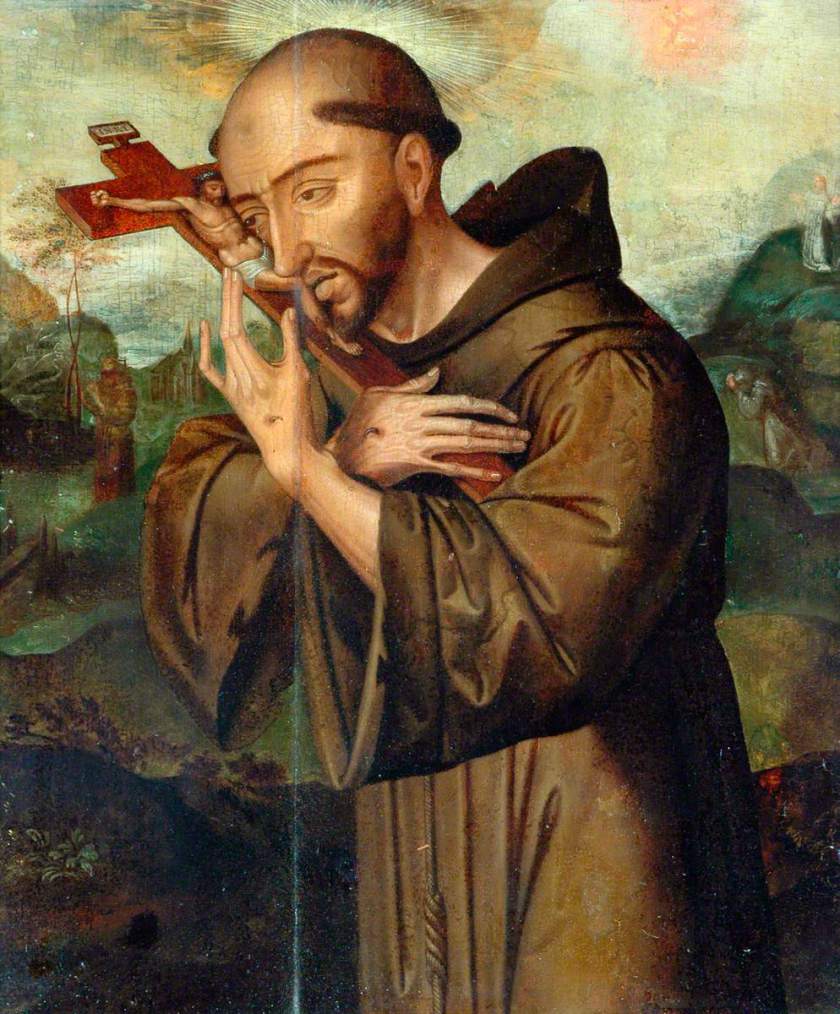
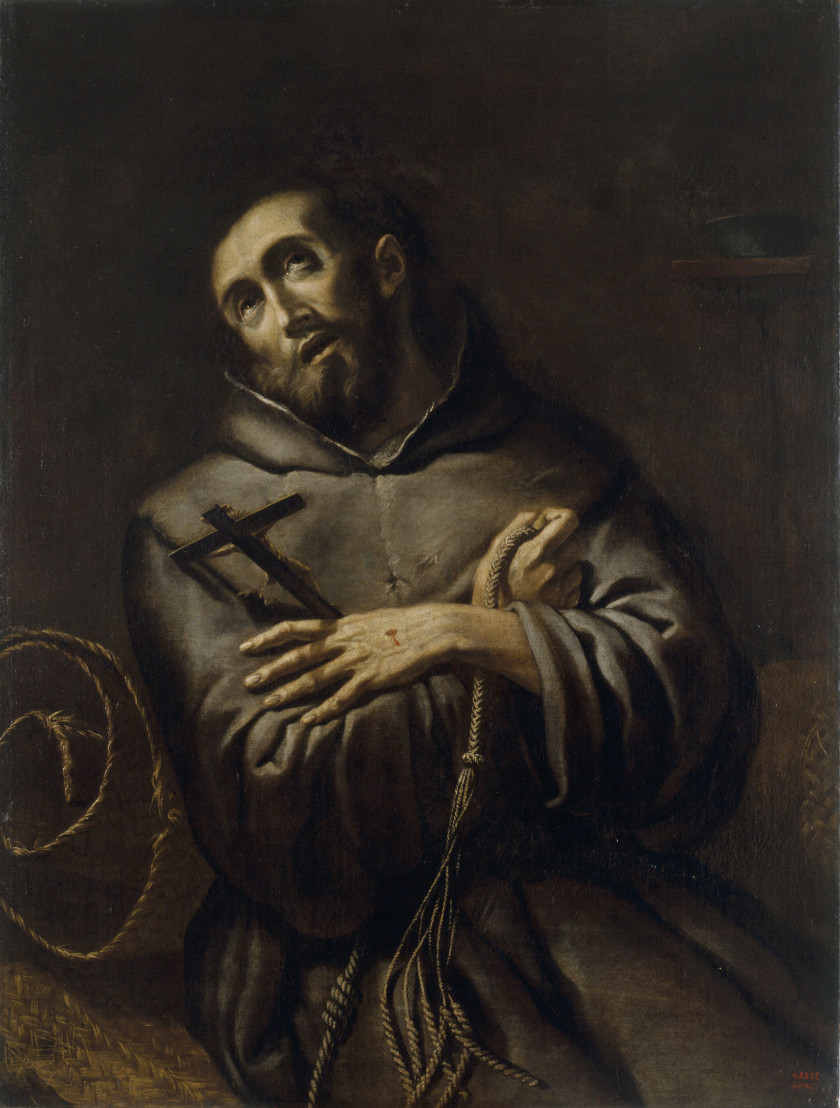
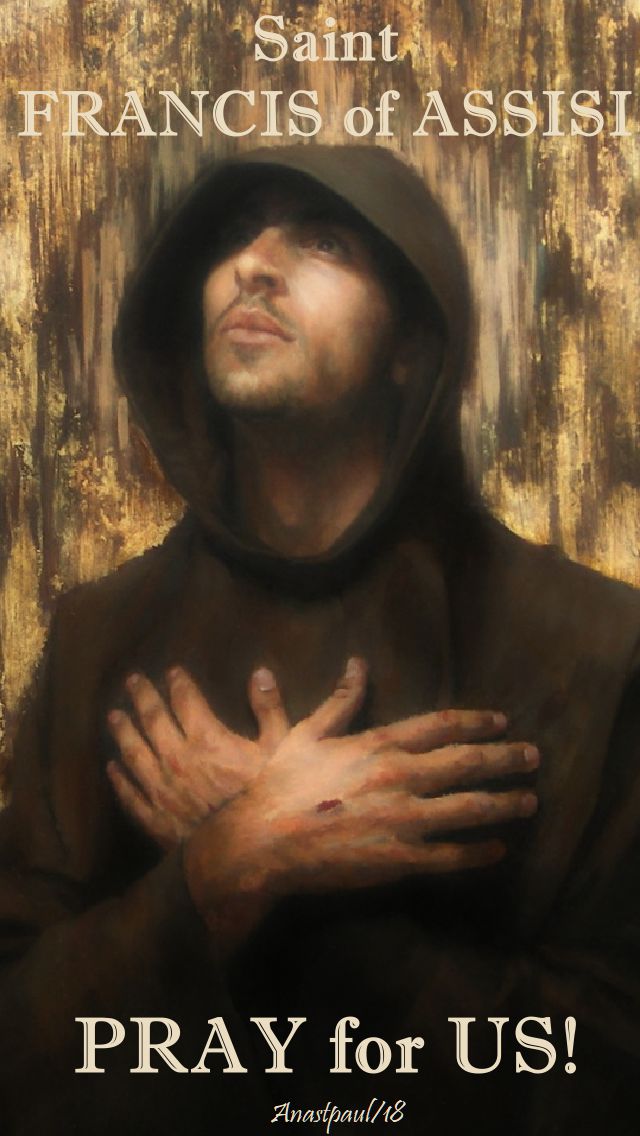
Second Thoughts for the Day – 4 October – Celebrating St Francis of Assisi OFM (1181/2–1226)
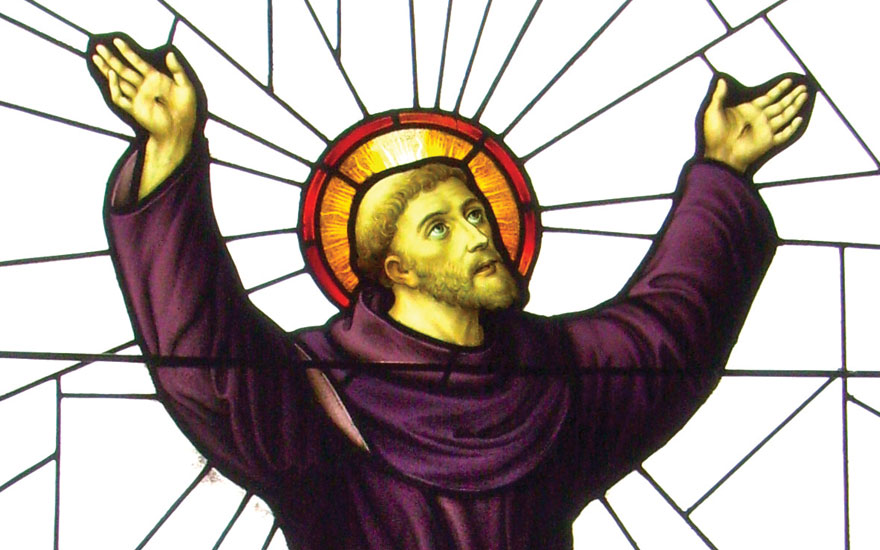
His name was Francis…
He used to praise God the Artist in every one of God’s works. Whatever joy he found in things made he referred to their maker. He rejoiced in all the works of God’s hands. Everything cried out to him, “He who made us is infinitely good!’
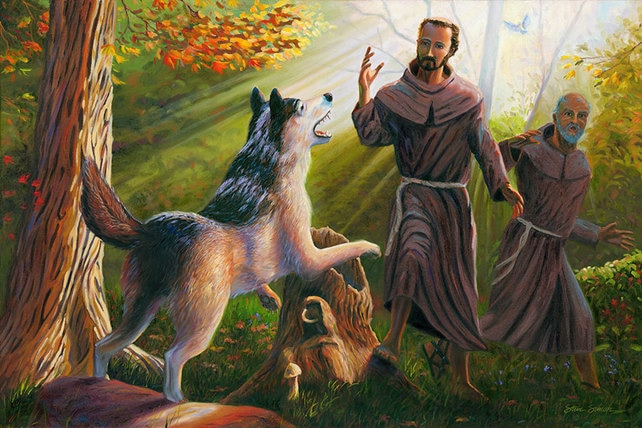
He called animals “brother” or “sister” and he exhorted them to praise God. He would go through the streets, inviting everyone to sing with hi m. And one time when he came upon an almond tree, he said, ‘Brother Almond, speak to me of God.” And the almond tree blossomed.
That is what Saint Francis of Assisi did and that is what he does for us once we are caught up in his life and teachings. He makes us blossom, wherever and whoever we are. We blossom because we see in Francis what could happen to us if we were to embrace the overflowing goodness of God revealed in everything that exists and let that embrace change us.…Murray Bodo, OFM
Thought for the Day – 4 October – The Memorial of St Francis of Assisi OFM (1181/2–1226)
Dear friends, Francis was a great Saint and a joyful man. His simplicity, his humility, his faith, his love for Christ, his goodness towards every man and every woman, brought him gladness in every circumstance. Indeed, there subsists an intimate and indissoluble relationship between holiness and joy. A French writer once wrote that there is only one sorrow in the world – not to be saints, that is, not to be near to God. Looking at the testimony of St Francis, we understand that this is the secret of true happiness: -to become saints, close to God!
May the Virgin, so tenderly loved by Francis, obtain this gift for us. Let us entrust ourselves to her with the words of the Poverello of Assisi himself:
“Blessed Virgin Mary, no one like you among women has ever been born in the world, daughter and handmaid of the Most High King and heavenly Father, Mother of our Most Blessed Lord Jesus Christ, spouse of the Holy Spirit.
Pray for us… to your most blessed and beloved Son, Lord and Master”
(Francesco di Assisi, Scritti, 163)….Excerpt from Pope Benedict XV’s Catechesis on St Francis – General Audience, 27 January 2010
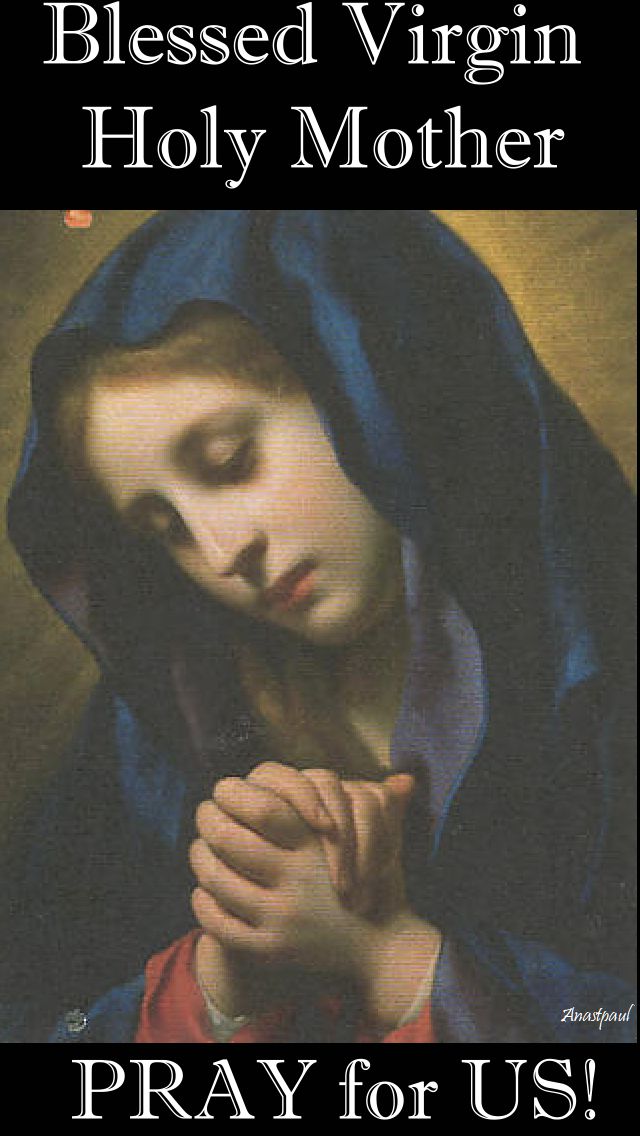
Blessed Virgin, Holy Mother, Pray for us!
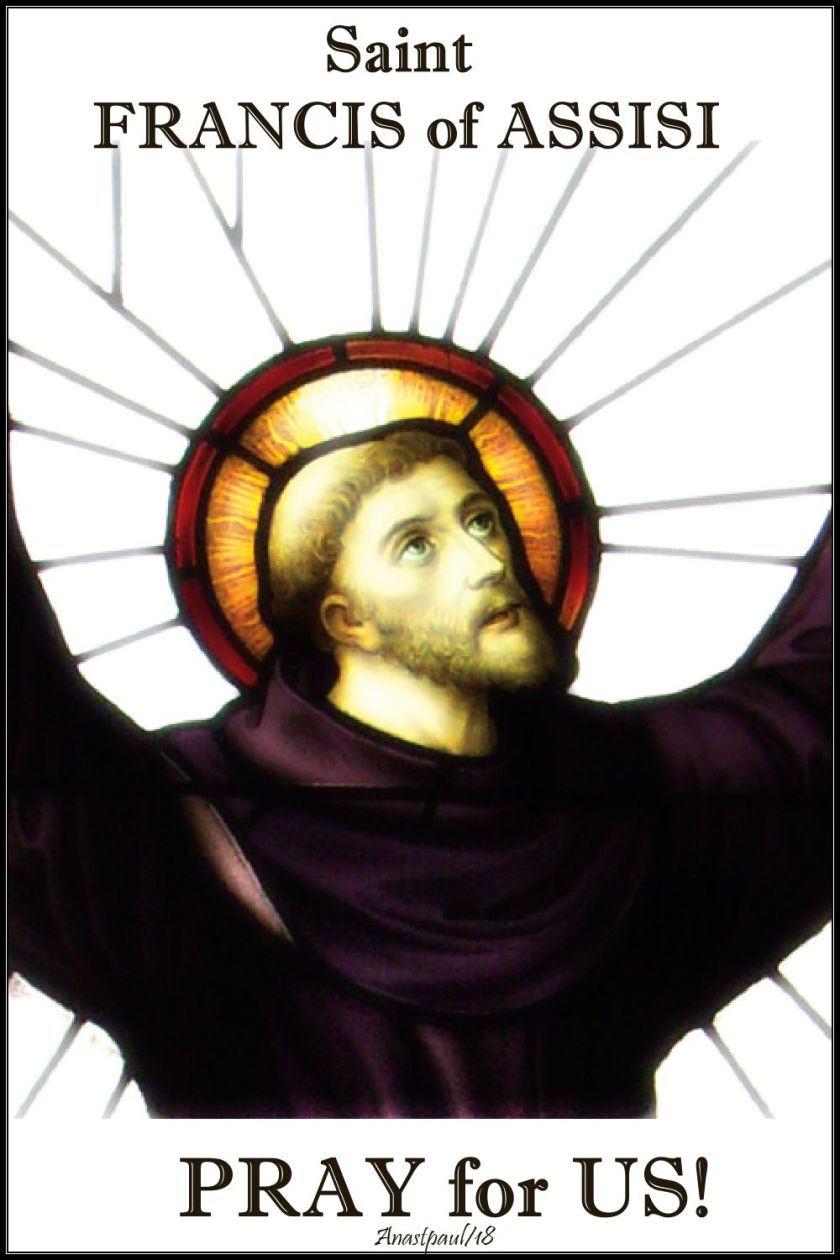
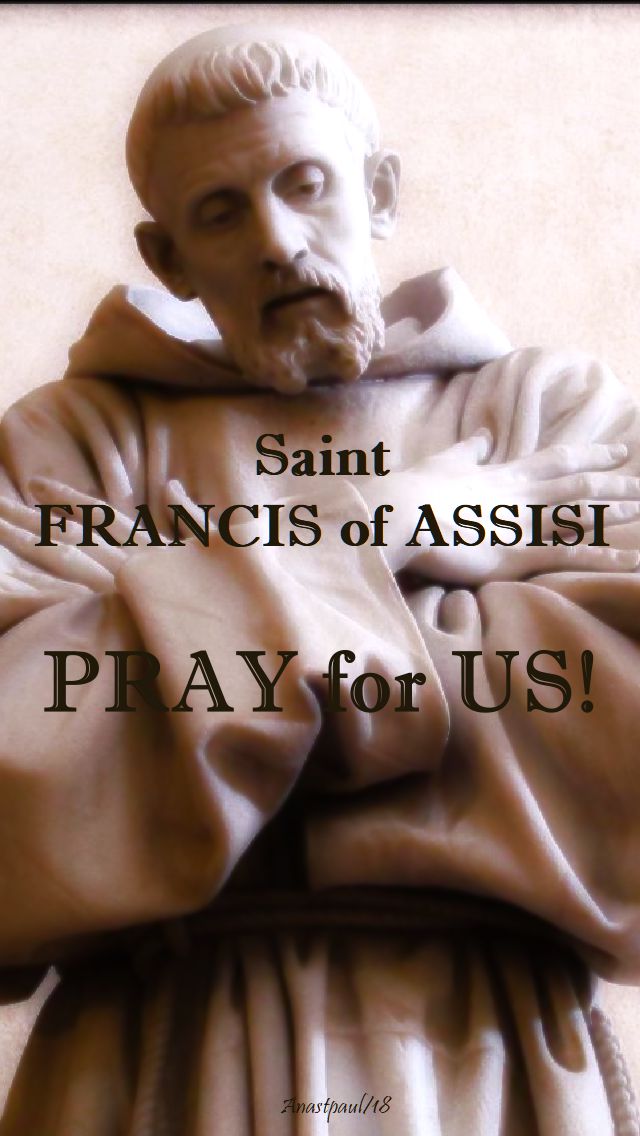
St Francis of Assisi, Pray for us!
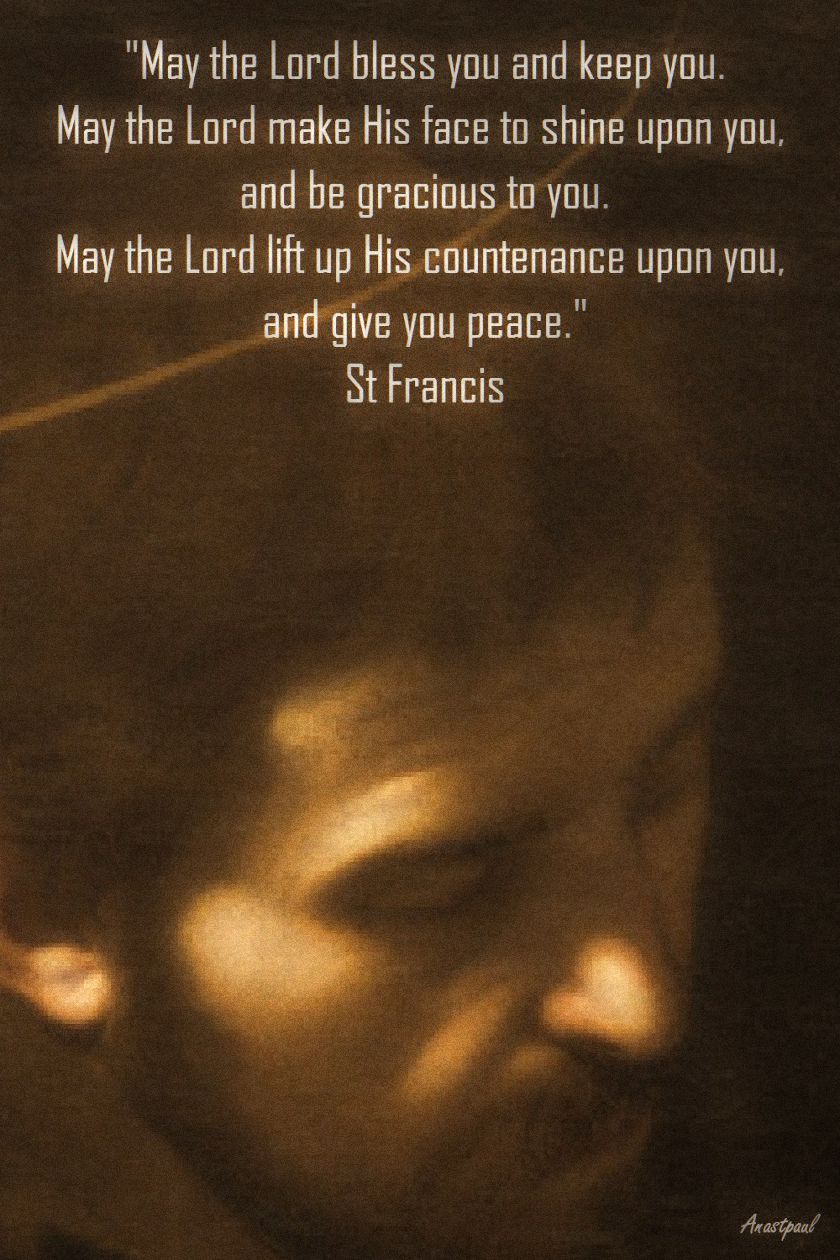
St Francis leaves us with his blessing:
May the Lord bless you and keep you. May the Lord make His face to shine upon you and be gracious to you. May the Lord lift up His countenance upon you and give you peace.
Quote/s of the Day – 4 October – The Memorial of St Francis of Assisi (1181/2–1226)
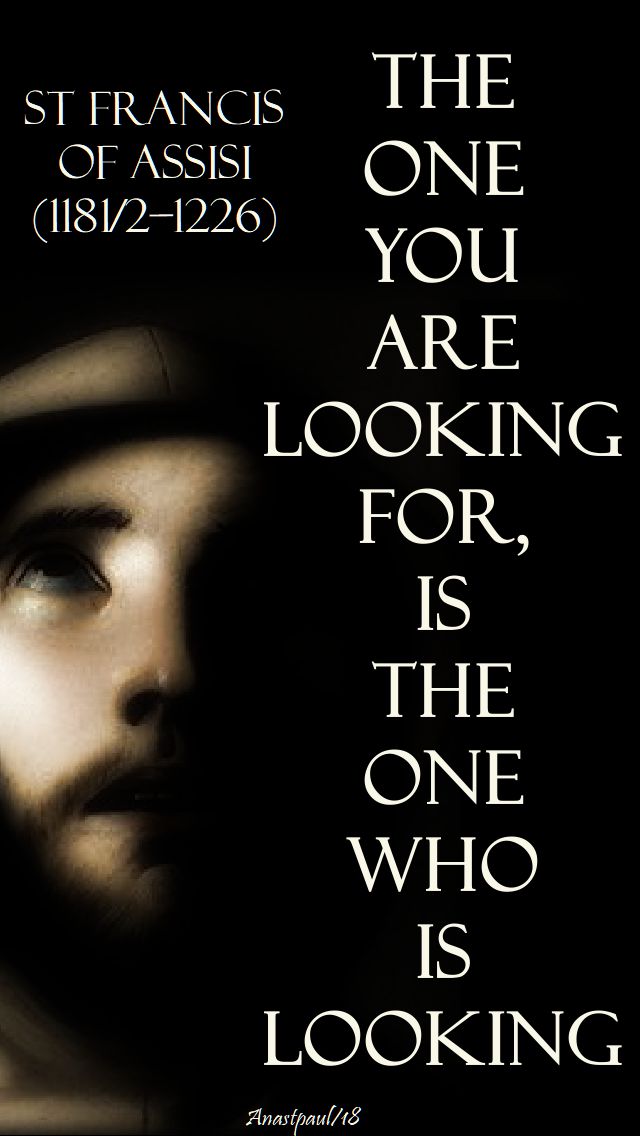
“The one you are looking for, is the One who is looking.”
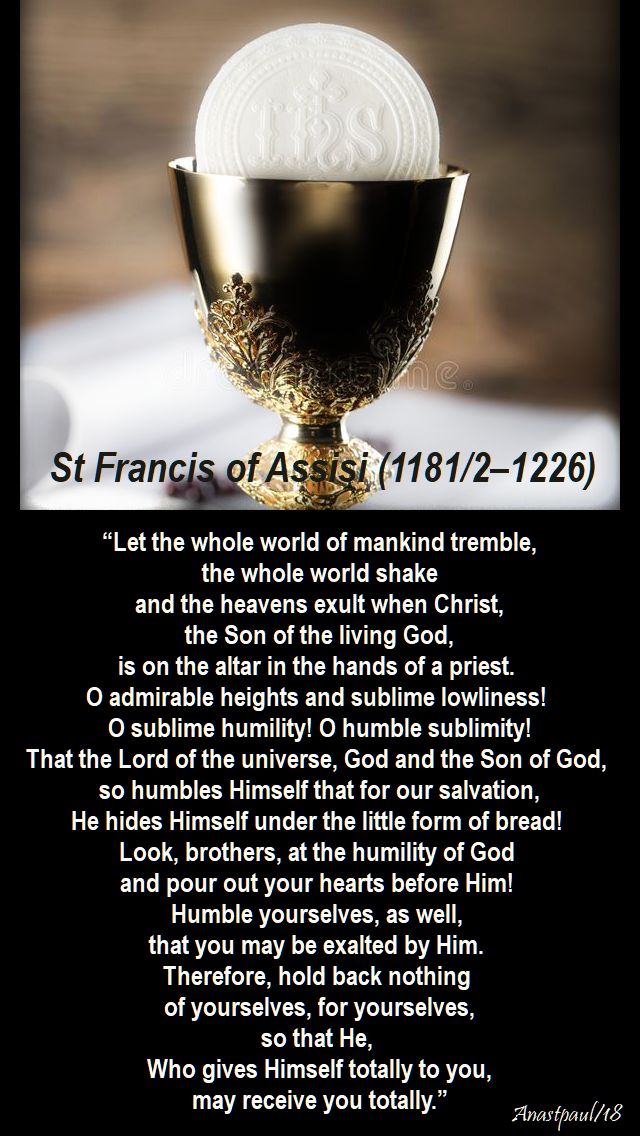
“Let the whole world of mankind tremble, the whole world shake and the heavens exult when Christ, the Son of the living God, is on the altar in the hands of a priest. O admirable heights and sublime lowliness! O sublime humility! O humble sublimity! That the Lord of the universe, God and the Son of God, so humbles Himself that for our salvation, He hides Himself under the little form of bread! Look, brothers, at the humility of God and pour out your hearts before Him! Humble yourselves, as well, that you may be exalted by Him. Therefore, hold back nothing of yourselves, for yourselves, so that He, Who gives Himself totally to you, may receive you totally.”
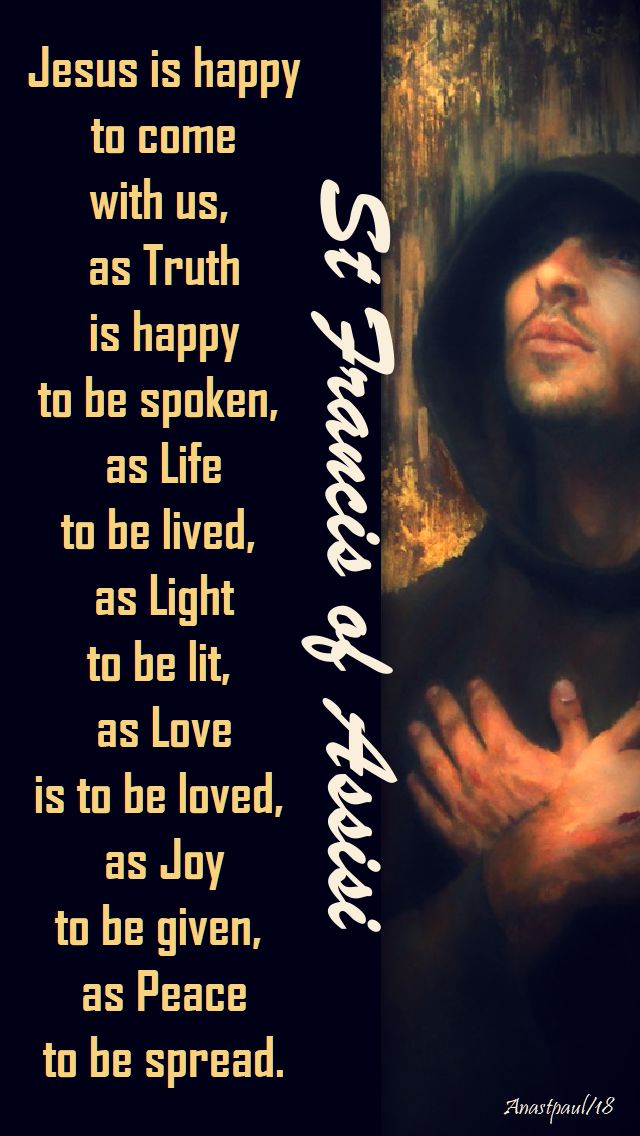
“Jesus is happy to come with us, as Truth is happy to be spoken, as Life to be lived, as Light to be lit, as Love is to be loved, as Joy to be given, as Peace to be spread.”
“The deeds you do may be the only sermon some persons will hear today.”
One Minute Reflection – 4 October – Today’s Gospel: Luke 10:1-12 – Thursday of the Twenty-sixth week in Ordinary Time – The Memorial of St Francis of Assisi OFM (1181/2–1226)
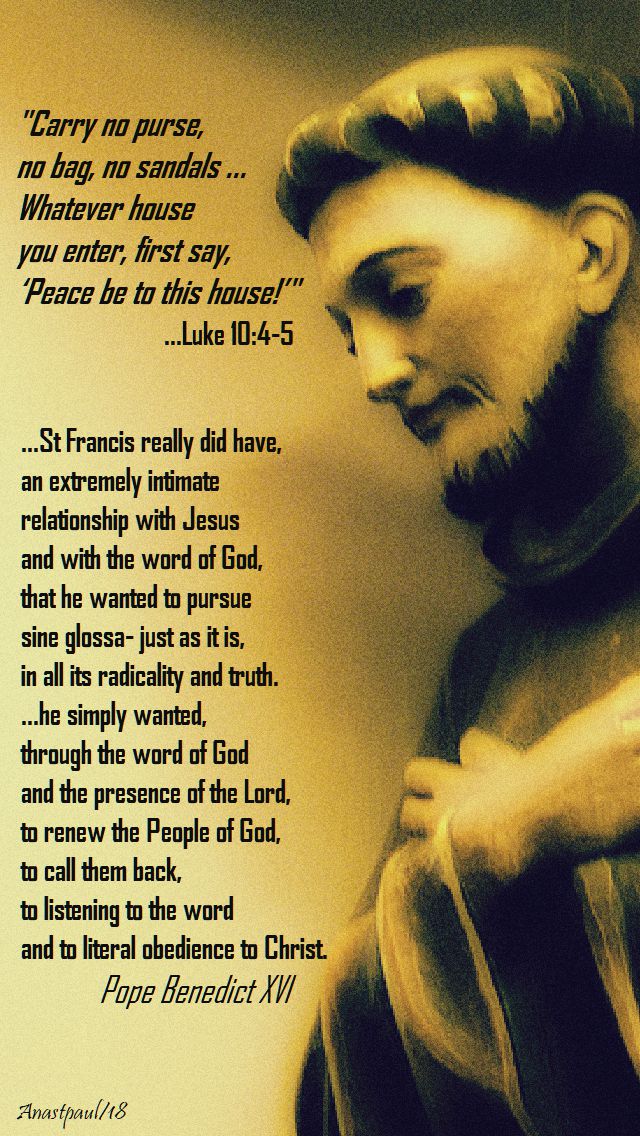
“Carry no purse, no bag, no sandals and salute no one on the road. Whatever house you enter, first say, ‘Peace be to this house!’”...Luke 10:4-5
REFLECTION – “Three times Christ on the Cross came to life and told him: “Go, Francis, and repair my Church in ruins”. This simple occurrence of the word of God heard in the Church of St Damian, contains a profound symbolism. At that moment, St Francis was called to repair the small church but the ruinous state of the building, was a symbol of the dramatic and disquieting situation of the Church herself…. it is important to note that St Francis does not renew the Church without, or in opposition, to the Pope but only in communion with him. Authentic renewal grew from these together….
Francis, standing before the Bishop of Assisi, in a symbolic gesture, stripped off his clothes, thus showing he renounced his paternal inheritance. Just as at the moment of creation, Francis had nothing, only the life that God gave him, into whose hands he delivered himself….
The truth is that St Francis really did have an extremely intimate relationship with Jesus and with the word of God, that he wanted to pursue sine glossa – just as it is, in all its radicality and truth. It is also true, that initially he did not intend to create an Order with the necessary canonical forms. Rather he simply wanted, through the word of God and the presence of the Lord, to renew the People of God, to call them back to listening to the word and to literal obedience to Christ.”…Pope Benedict XVI – Catechesis on St Francis – General Audience, 27 January 2010
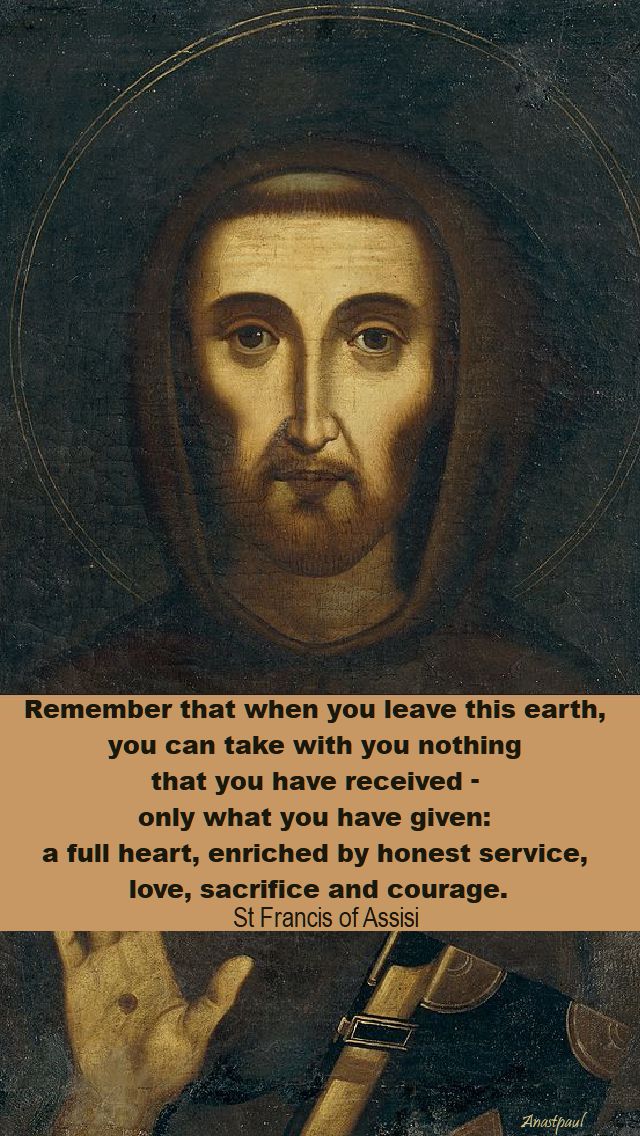
“Remember that when you leave this earth, you can take with you nothing that you have received—only what you have given: a full heart, enriched by honest service, love, sacrifice and courage.”….St Francis of Assisi
PRAYER – Lord God, You made St Francis of Assisi, Christ-like in his poverty and humility, his gentleness and charity, his love and courage. Help us to walk in his ways that, with joy and love, we may follow Christ Your Son and be united with You. May the intercession of St Francis, be an assistance on our journey. Through Christ our Lord, with the Holy Spirit, one God forever, amen.
Our Morning Offering – 4 October – The Memorial of St Francis of Assisi OFM (c1181–1226)
I Beg Thee, Lord By St Francis of Assisi (c1181–1226)
I beg Thee, Lord, let the fiery, gentle power of Thy love take possession of my soul and snatch it away, from everything under Heaven, that I may die, for love of Thy love, as Thou saw fit, to die for love of mine! Amen
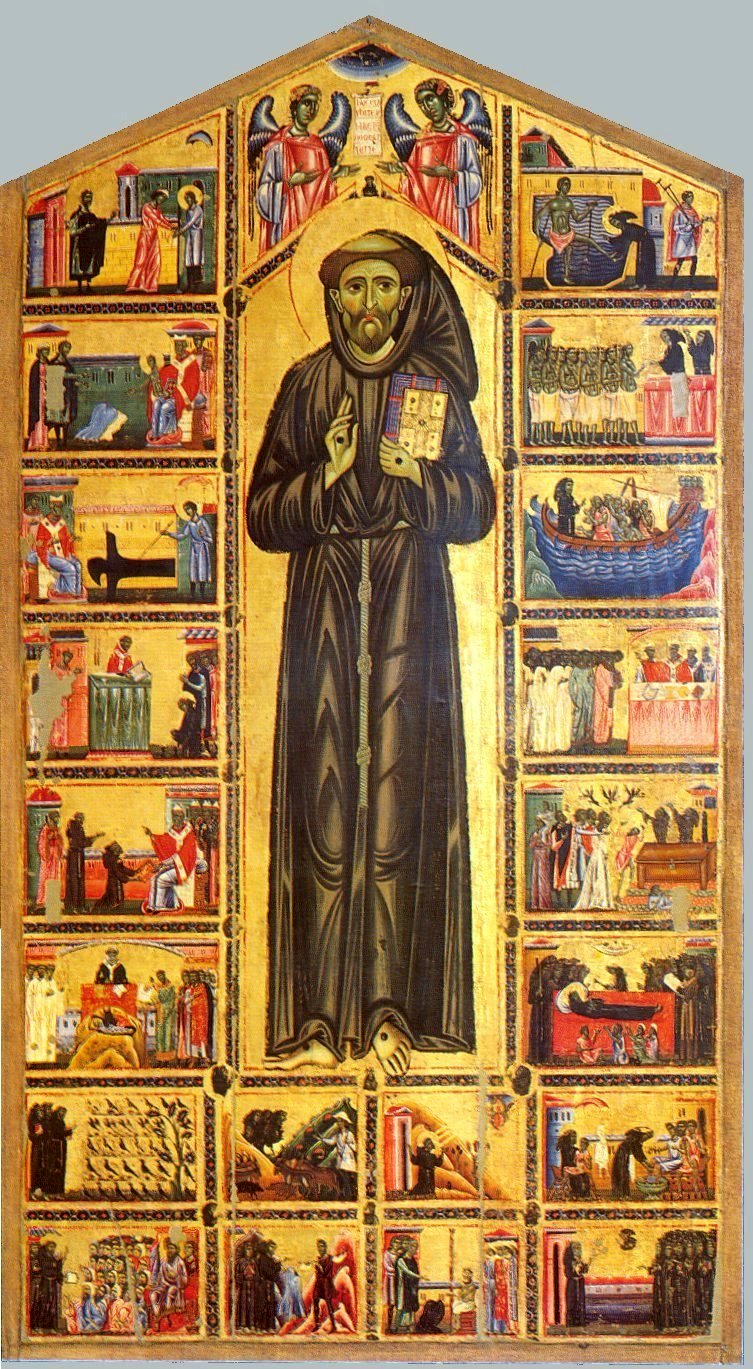
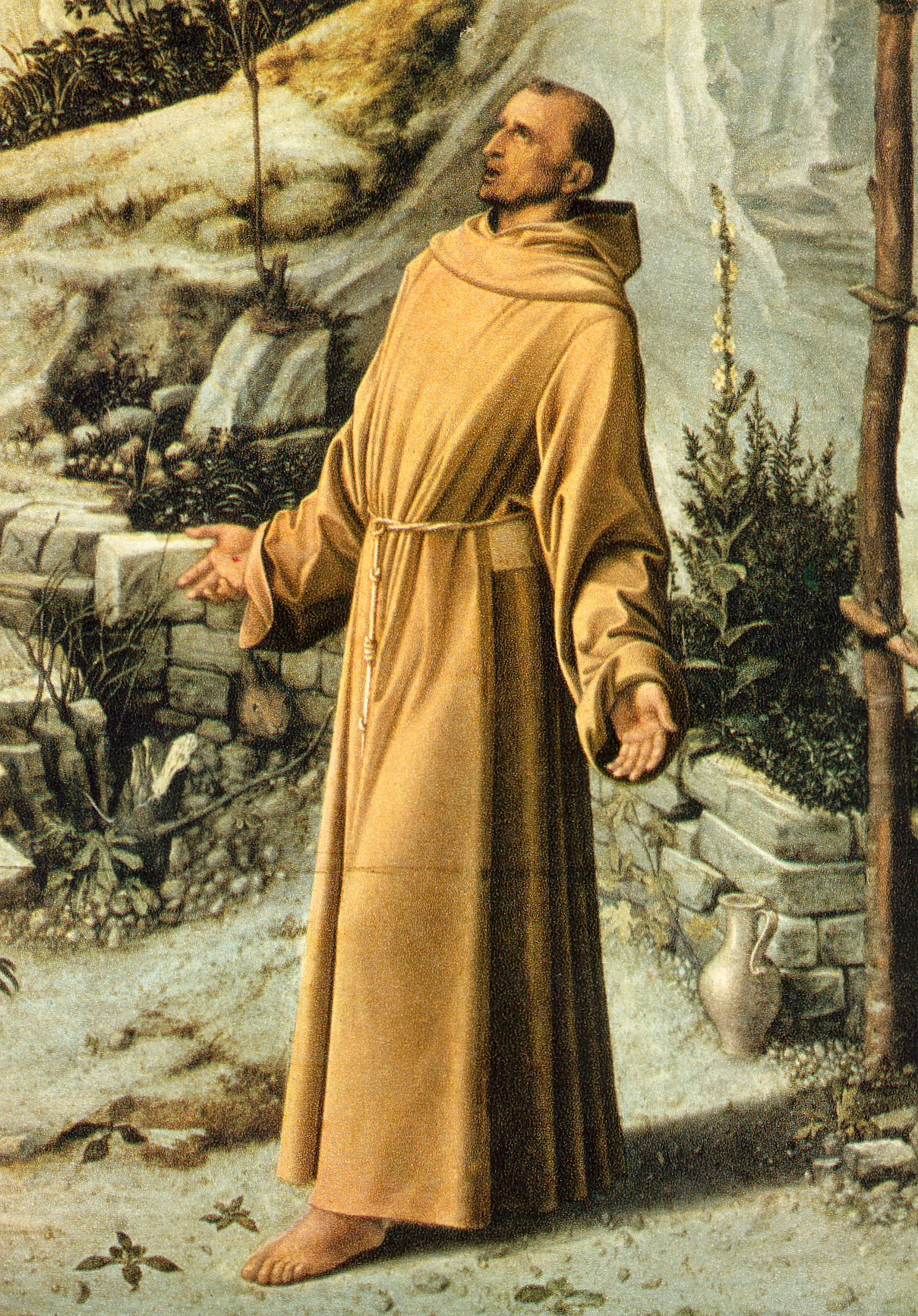
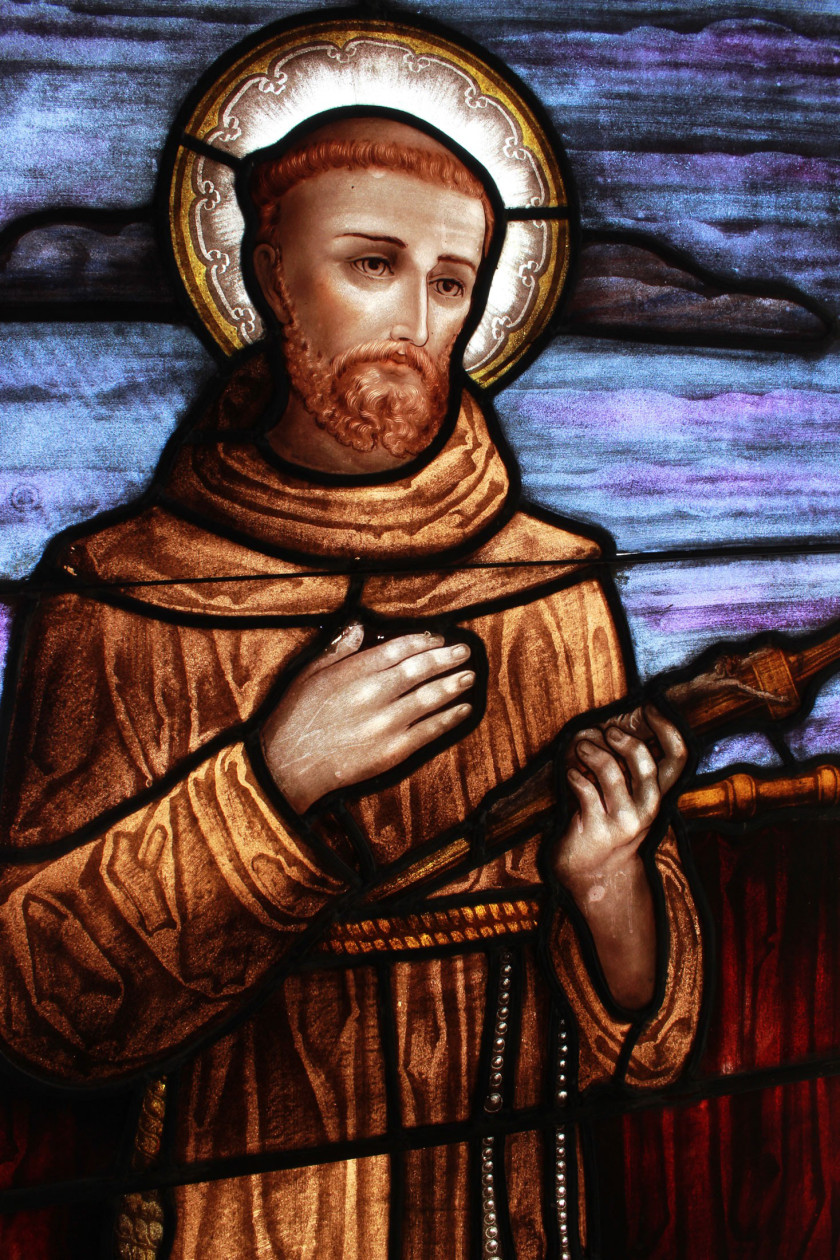
Saint of the Day – 4 October – St Francis of Assisi OFM (1181/2–1226) – born Giovanni di Pietro di Bernardone, informally named as Francesco (1181/1182 – 3 October 1226), was an Italian Friar, Deacon, the First known Stigmatist, Founder, Mystic, Apostle of the Holy Eucharist, of the Blessed Virgin, of Charity, Confessor, Missionary, Writer, Poet, Miracle-Worker, Preacher. He founded the men’s Order of Friars Minor, the women’s Order of Saint Clare, the Third Order of Saint Francis and the Custody of the Holy Land. Francis is one of the most venerated religious figures in history.
Francis of Assisi was a poor little man who astounded and inspired the Church by taking the gospel literally—not in a narrow fundamentalist sense but by actually following all that Jesus said and did, joyfully, without limit and without a sense of self-importance.
Serious illness brought the young Francis to see the emptiness of his frolicking life as leader of Assisi’s youth. Prayer—lengthy and difficult—led him to a self-emptying like that of Christ, climaxed by embracing a leper he met on the road. It symbolised his complete obedience to what he had heard in prayer: “Francis! Everything you have loved and desired in the flesh it is your duty to despise and hate, if you wish to know my will. And when you have begun this, all that now seems sweet and lovely to you will become intolerable and bitter but all that you used to avoid will turn itself to great sweetness and exceeding joy.”
From the cross in the neglected field-chapel of San Damiano, Christ told him, “Francis, go out and build up my house, for it is nearly falling down.” Francis became the totally poor and humble workman.
He must have suspected a deeper meaning to “build up my house.” But he would have been content to be for the rest of his life the poor “nothing” man actually putting brick on brick in abandoned chapels. He gave up all his possessions, piling even his clothes before his earthly father—who was demanding restitution for Francis’ “gifts” to the poor—so that he would be totally free to say, “Our Father in heaven.” He was, for a time, considered to be a religious fanatic, begging from door to door when he could not get money for his work, evoking sadness or disgust to the hearts of his former friends, ridicule from the unthinking.
But genuineness will tell. A few people began to realise that this man was actually trying to be Christian. He really believed what Jesus said : “Announce the kingdom! Possess no gold or silver or copper in your purses, no travelling bag, no sandals, no staff” (Luke 9:1-3).
Francis’ first rule for his followers was a collection of texts from the Gospels. He had no intention of founding an order but once it began he protected it and accepted all the legal structures needed to support it. His devotion and loyalty to the Church were absolute and highly exemplary at a time when various movements of reform tended to break the Church’s unity.
Francis was torn between a life devoted entirely to prayer and a life of active preaching of the Good News. He decided in favour of the latter but always returned to solitude when he could. He wanted to be a missionary in Syria or in Africa but was prevented by shipwreck and illness in both cases. He did try to convert the sultan of Egypt during the Fifth Crusade.
During the last years of his relatively short life, he died at 44, Francis was half blind and seriously ill. Two years before his death he received the stigmata, the real and painful wounds of Christ in his hands, feet and side.
On his deathbed, Francis said over and over again the last addition to his Canticle of the Sun, “Be praised, O Lord, for our Sister Death.” He sang Psalm 141, and at the end asked his superior’s permission to have his clothes removed when the last hour came in order that he could expire lying naked on the earth, in imitation of his Lord. (via Franciscan media)
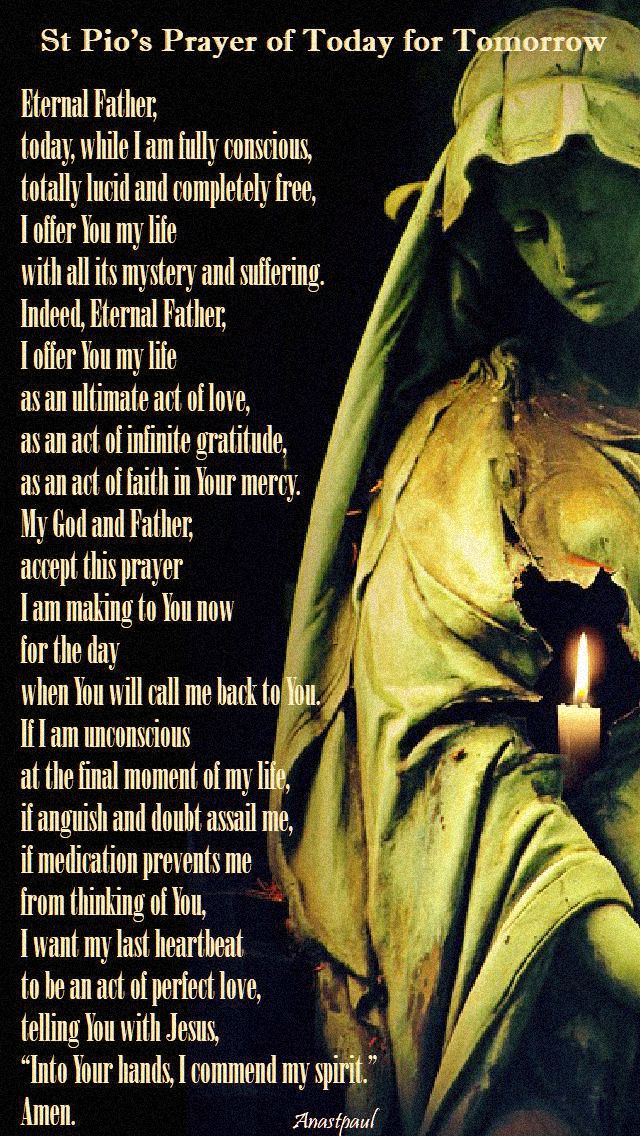
Eternal Father,
today, while I am fully conscious,
totally lucid and completely free,
I offer You my life with all its mystery and suffering.
Indeed, Eternal Father,
I offer You my life as an ultimate act of love,
as an act of infinite gratitude,
as an act of faith in Your mercy.
My God and Father,
accept this prayer I am making to You now
for the day when You will call me back to You.
If I am unconscious at the final moment of my life,
if anguish and doubt assail me,
if medication prevents me from thinking of You,
I want my last heartbeat to be an act of perfect love,
telling You with Jesus,
“Into Your hands, I commend my spirit.”
Amen.
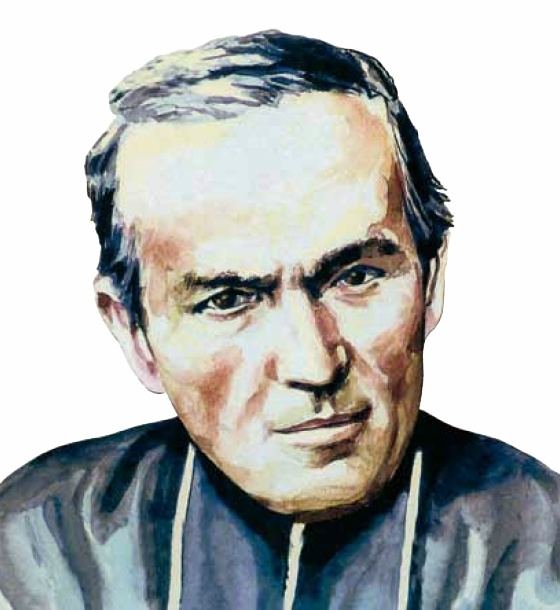
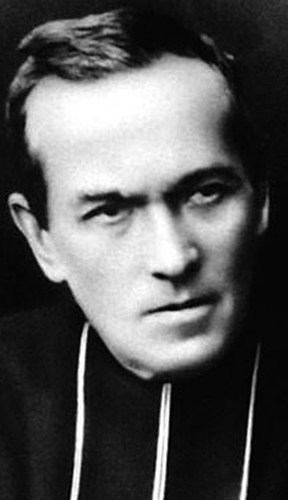
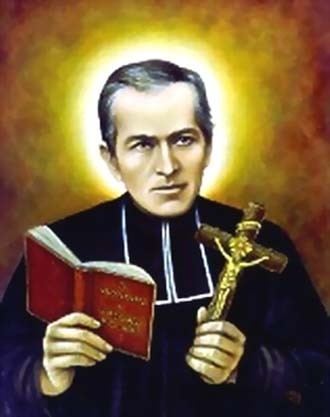
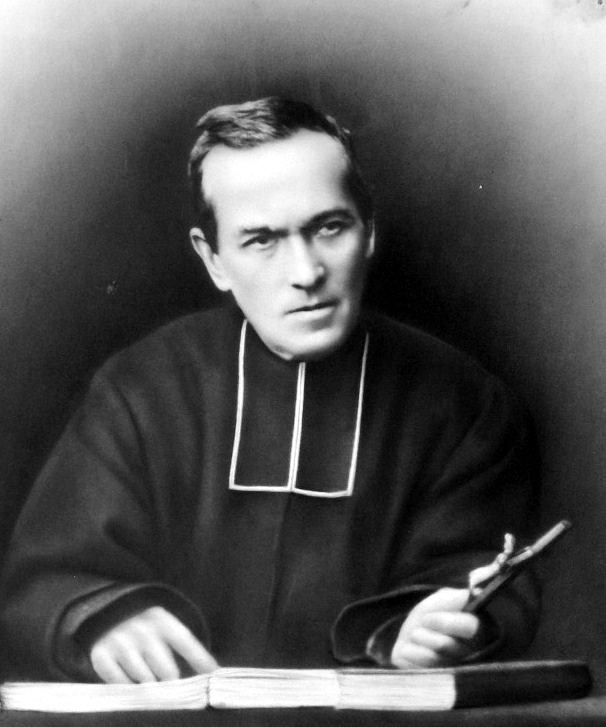
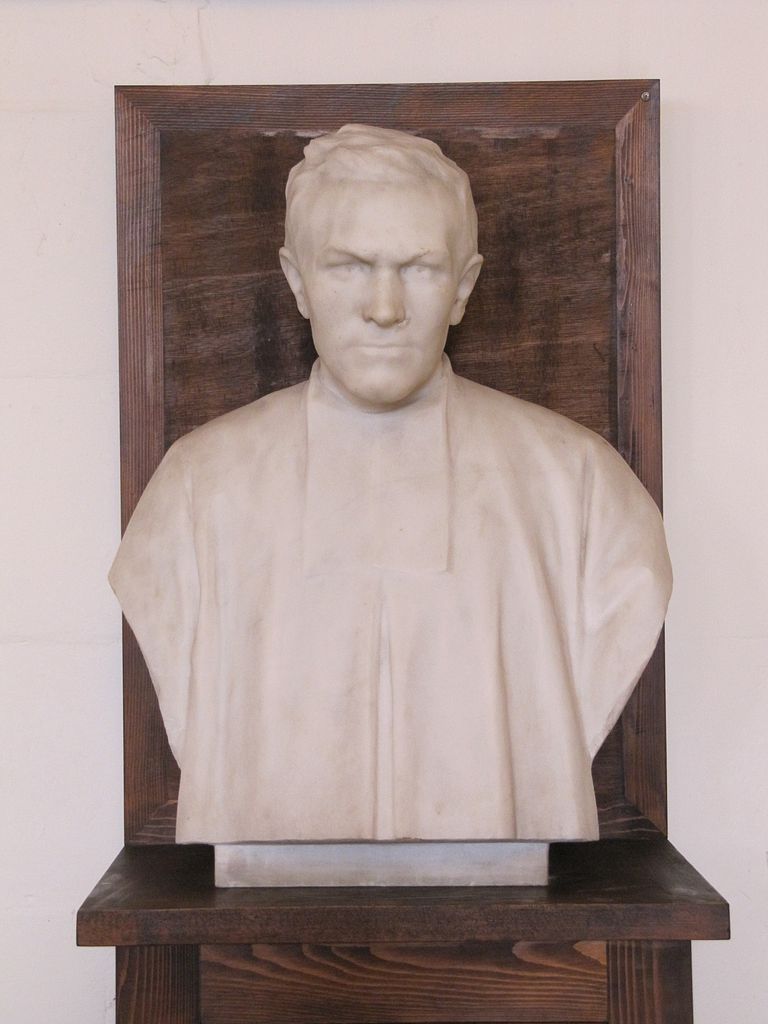
Saint of the Day – 2 October – Blessed Antoine Chevrier T.O.S.F. (1825-1879) – Priest, Founder of the Sisters of Prado and the Institute of the Priests of Prado, professed member of the Franciscan Third Order, Apostle of Charity, Writer – born on Easter Sunday, 16 April 1825 in Lyon, Rhône, France and died on 2 October 1879 in Lyon, Rhône, France of natural causes. Patronage – the Sisters of Prado and the Institute of the Priests of Prado. His entire life and pastoral mission was devoted to the service of the poor and the education of poor children and those on the peripheries.
Antoine Chevrier was born on Easter on 16 April 1825. He was the sole child born to his parents and received baptism on the following 18 April. From his father he inherited a humble spirit and gentleness while he received from his mother a passionate and energetic disposition. He had his First Communion in 1837. In 1840 – at the age of fourteen – a parish priest asked him if he wanted to become a priest himself. Chevrier never thought about it but said he would like to. He felt immediate happiness in this realisation and decided to become a priest. Chevrier commenced his studies for the priesthood at the age of seventeen in 1842. He received the cassock in October 1846 and received the tonsure in 1847.
Prior to being ordained he wanted to join the foreign missions but his mother opposed and said to him: “You are an ingrate, mister, a bad son. Do you think I raised you for you to be eaten by savages? Savages you can fin in Lyon! If you go in spite of me, I will disown you as my child”. He was ordained to the priesthood on 25 May 1850 by Cardinal Louis Jacques Maurice de Bonald and was sent to Saint-André de la Guillotière as an assistant priest where he became greatly saddened with the miserable conditions of the poor that he encountered.
In the middle of the night on 31 May 1856 a great storm caused flooding. He rescued several victims despite the danger to his own life. On Christmas Eve in 1856 he meditated before the crib and it was there and then that he realised his true mission as a priest was to evangelise to the poor but also to tend to the poor on the streets while forming a religious congregation for all those who were poor. This experience was almost like a sudden “conversion”. In Ars-sur-Formans – in January 1857 – he consulted with Saint John-Baptiste-Marie Vianney (1786-1859) on his mission and who encouraged his work. He asked to leave his parish to pursue this aim and a meeting with layman Camille Rambaud in June 1857 hastened this. Sometimes parents sent him their delinquent children and others asked him to get their children out of prison and take them to live with him for a better life. In 1859 he became a professed member of the Third Order of Saint Francis.
On 10 December 1860 he purchased a disused ballroom in order to establish a chapel and a shelter for poor children and those on the peripheries in order to provide them with a Christian education. In his lifetime he received around 2400 male adolescents . In 1866 he opened a clerical school – that grew into his male institute – for clerical aspirants. The first lot were ordained in Rome in 1876. The female branch of his order – the Sisters of Prado – opened not long after his first was established.
Social unrest threatened Lyon and Paris in 1871 but the conflict in Lyon stalled as Chevrier celebrated the Feast of Corpus Christi and paraded the Eucharist through the streets – the quarrellers dared not interrupt the celebration.
Chevrier was also a writer and he wrote both the “Disciple of Jesus Christ” and “God sends Revolutions”. The latter was a critique of priests who pursued greed and their excessive attachment to material goods.
He fell ill in the spring of 1874 which began his long period of illness until his death. He recovered and made a four-month visit to Rome to be with his future priests.
He knew his death was approaching in September 1879 due to his ailment. Chevrier died on 2 October 1879 after suffering a long illness. Around 10 000 people attended his funeral many of them the people the Work of Prado had helped. He was buried in the chapel he had built and the street in front of it is now named for him. His order was approved of diocesan right in 1924 and was aggregated to the Conventual Franciscans in 1930. The order received the papal decree of praise of Pope John XXIII on 28 October 1959.
Blessed Antoine was Beatified on 4 October 1986 by St Pope John Paul II.
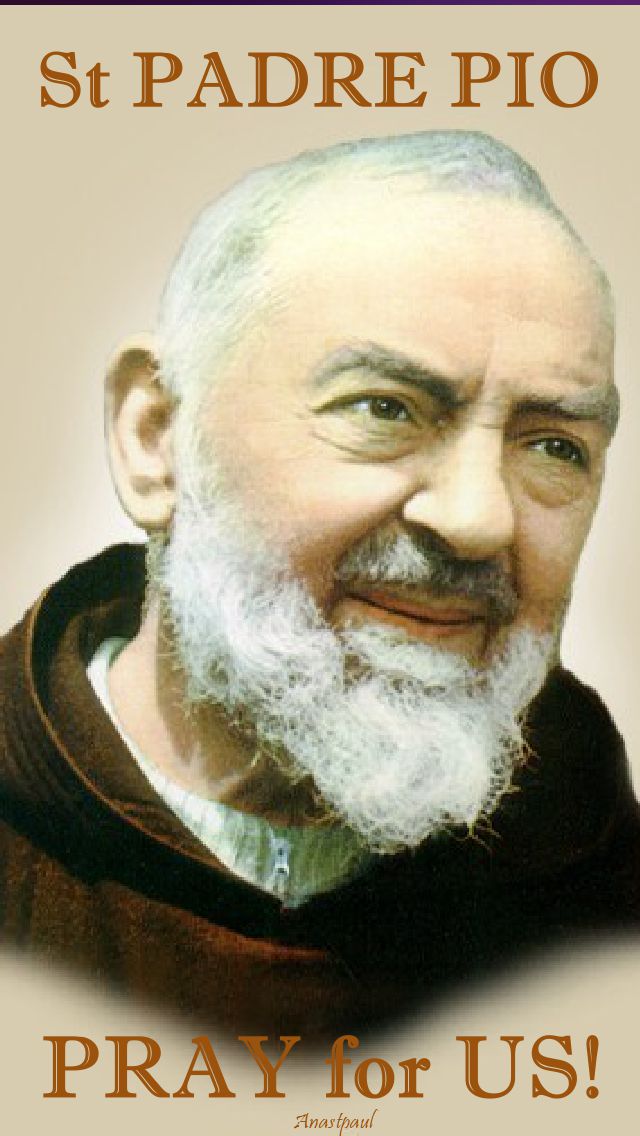
Thought for the Day – 23 September – Twenty-fifth Sunday in Ordinary Time, Year B and The Memorial of St Padre Pio (1887-1968)
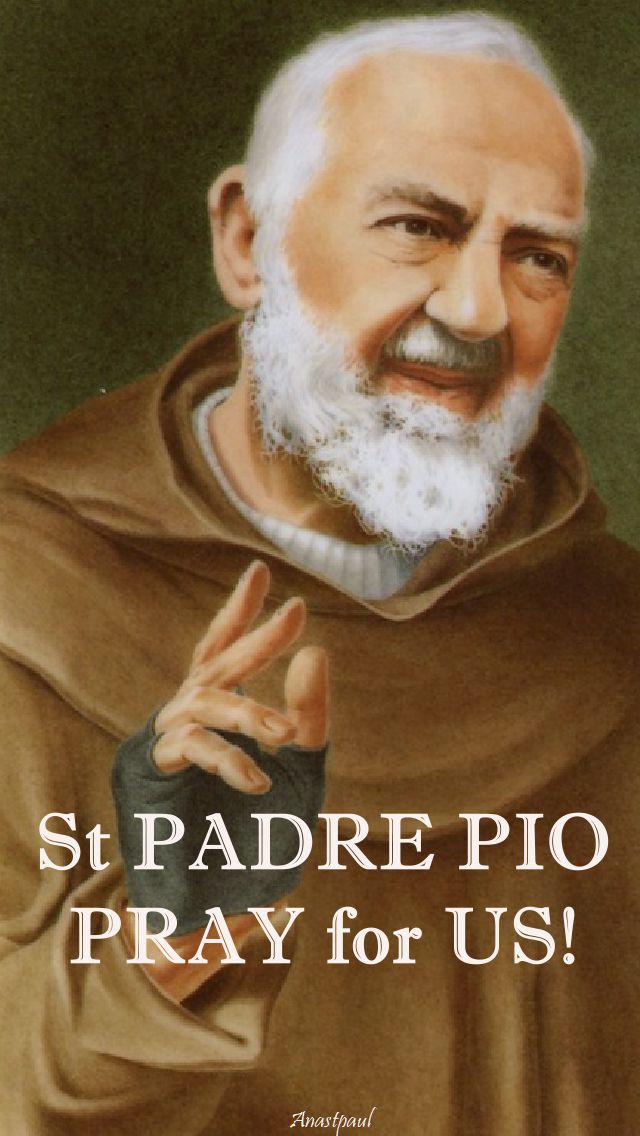
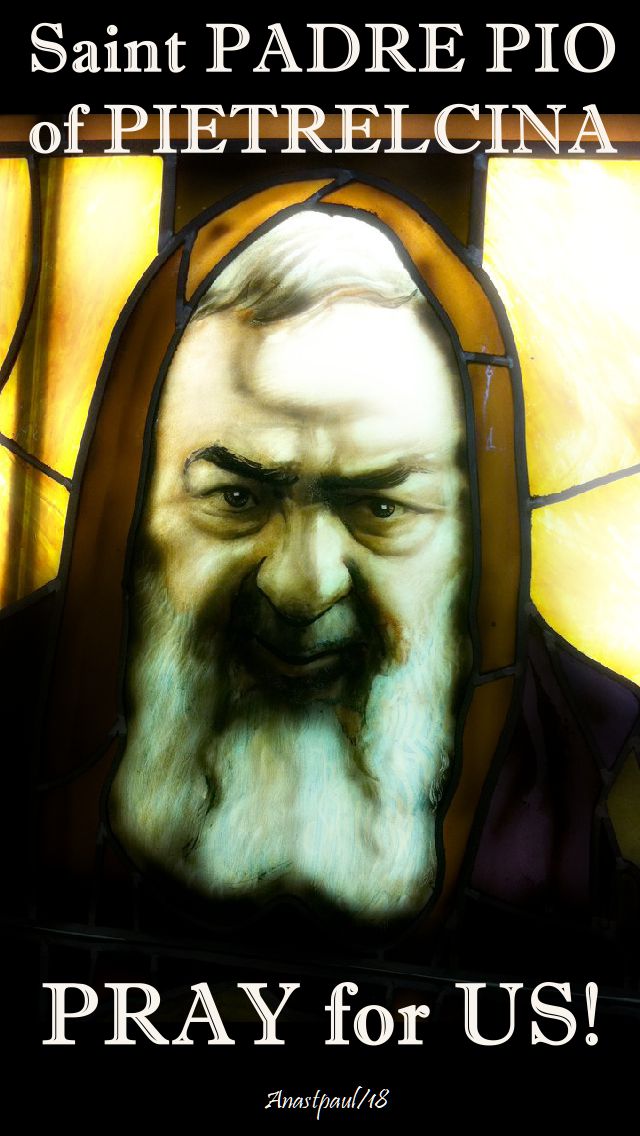
Miracles happened every day of Padre Pio’s life. Like other wonder-workers such as Francis of Paola (1416-1507), Pio freely contradicted inviolable laws of nature. He appeared in two places at the same time to help people in trouble. He summoned friends by mental telepathy or by causing them to smell the scent of violets, which was associated with his presence. He read people’s thoughts and used that special knowledge to tease them . He dumbfounded people in the confessional by describing all their sins in detail. He accurately predicted future events, including his own death. He healed people of deafness, blindness and incurable diseases. And for fifty years he bore Christ’s wounds on his body and suffered enormously because of them.
How do we understand the appearance of such a “medieval” figure in our contemporary world? Perhaps we should not be surprised that God acts dramatically to get our attention when we lose sight of spiritual realities. God sent Padre Pio to us as a light to challenge the darkness of the mid-twentieth century and to offer hope to a world racked by depression and war.
Quote/s of the Day – 23 September – Twenty-fifth Sunday in Ordinary Time, Year B and The Memorial of St Padre Pio (1887-1968)
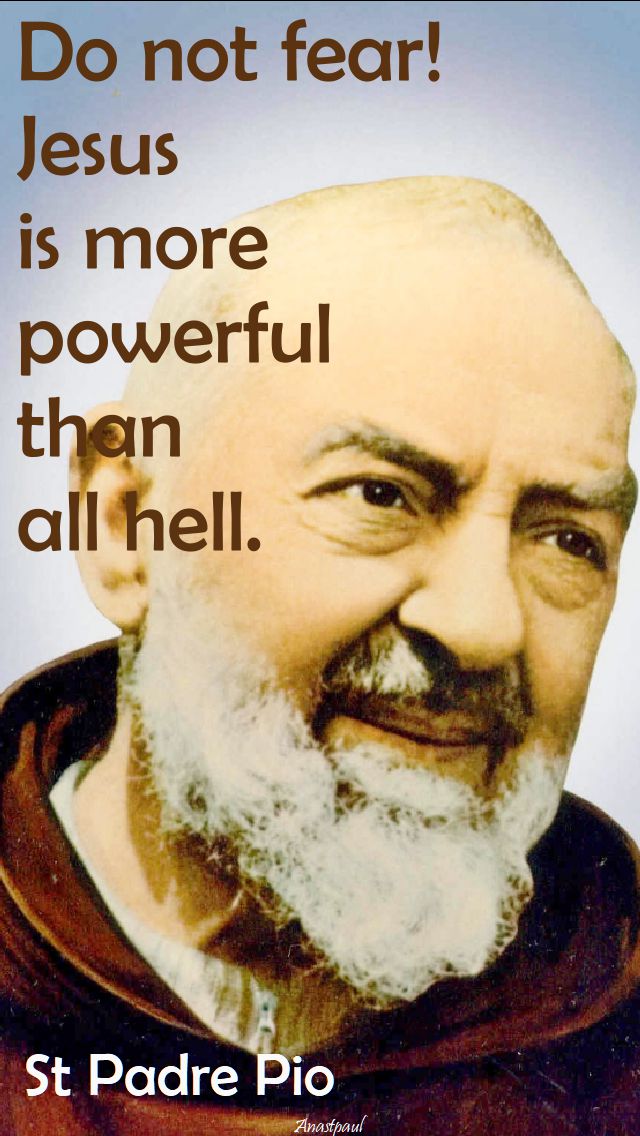
“Do not fear! Jesus is more powerful than all hell.”
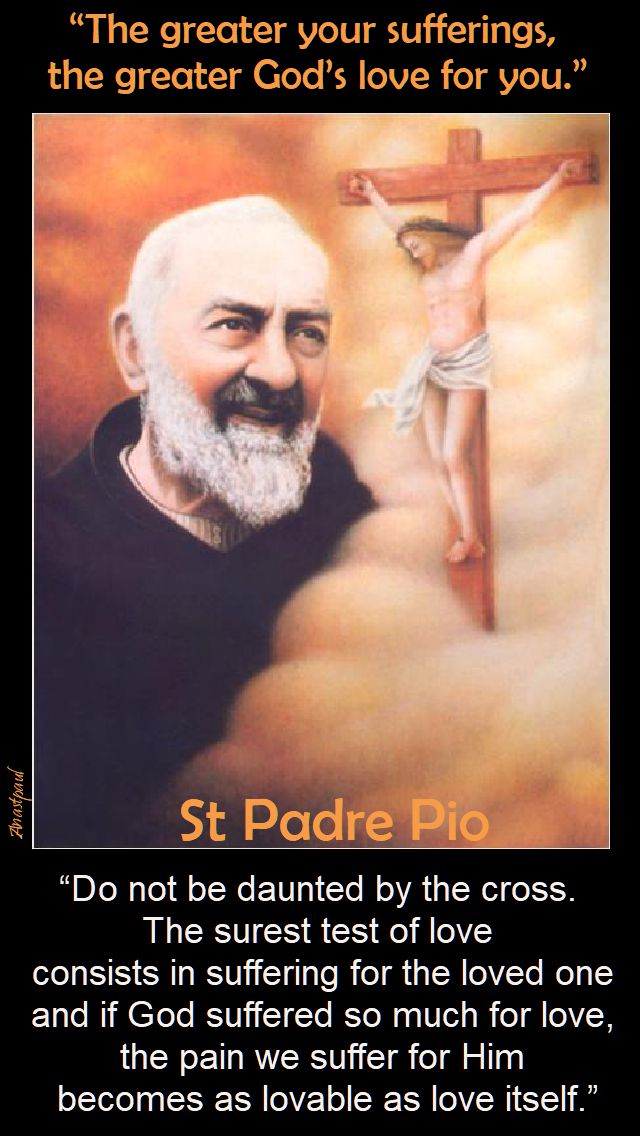
“Do not be daunted by the cross. The surest test of love consists in suffering for the loved one and if God suffered so much for love, the pain we suffer for Him becomes as lovable as love itself.”
“The greater your sufferings, the greater God’s love for you.”
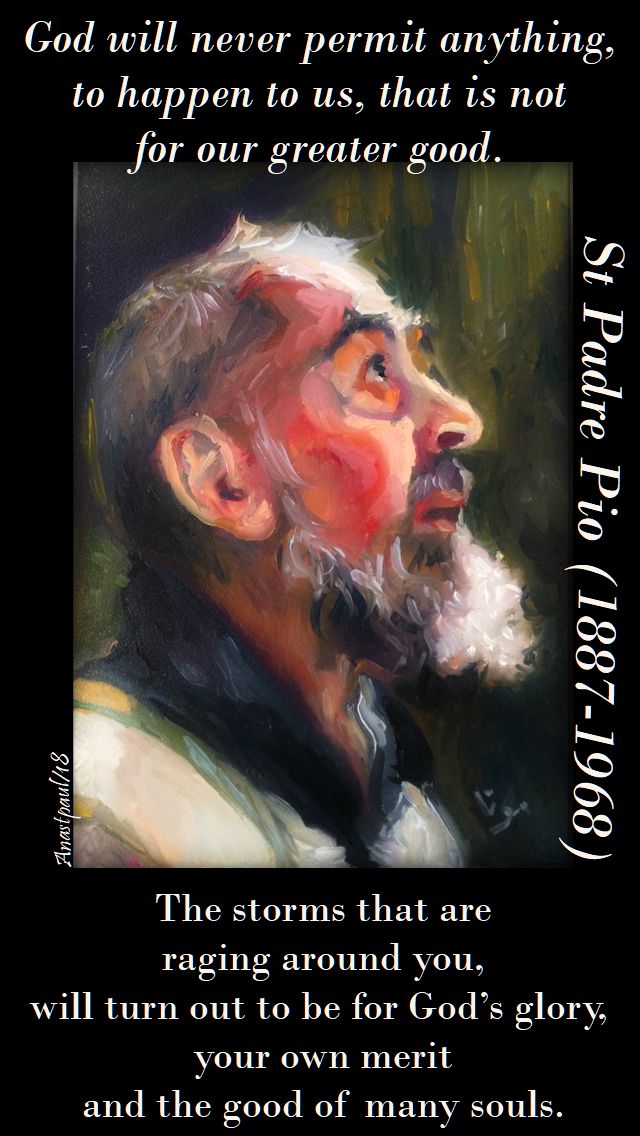
“God will never permit anything, to happen to us, that is not for our greater good.”
“The storms that are raging around you, will turn out to be for God’s glory, your own merit and the good of many souls.”
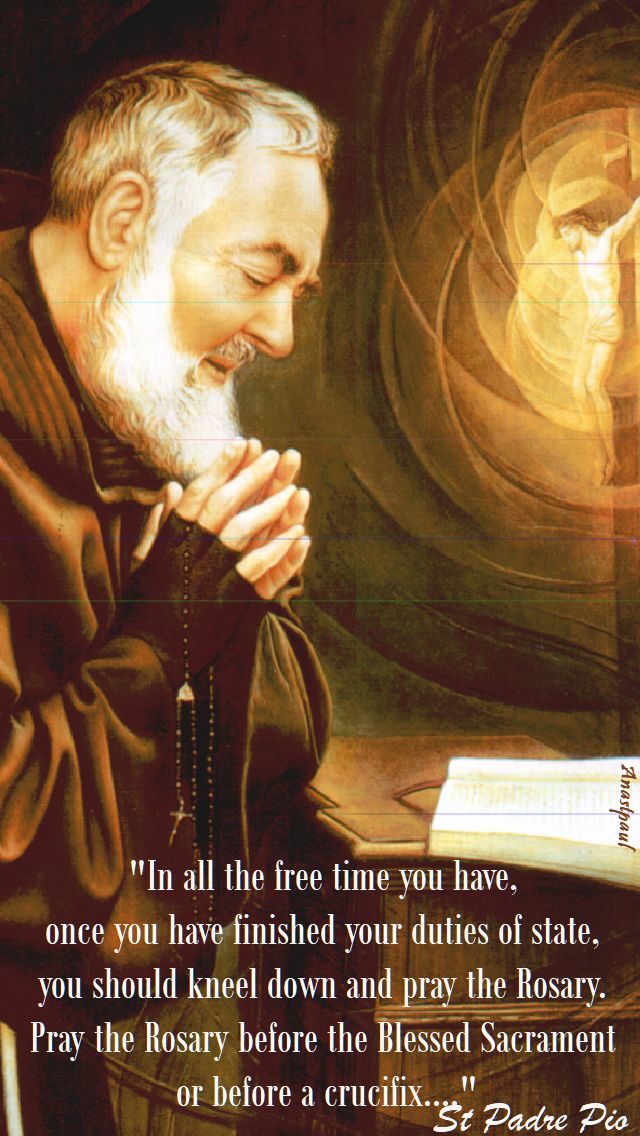
“In all the free time you have, once you have finished your duties of state, you should kneel down and pray the Rosary. Pray the Rosary before the Blessed Sacrament or before a crucifix.”
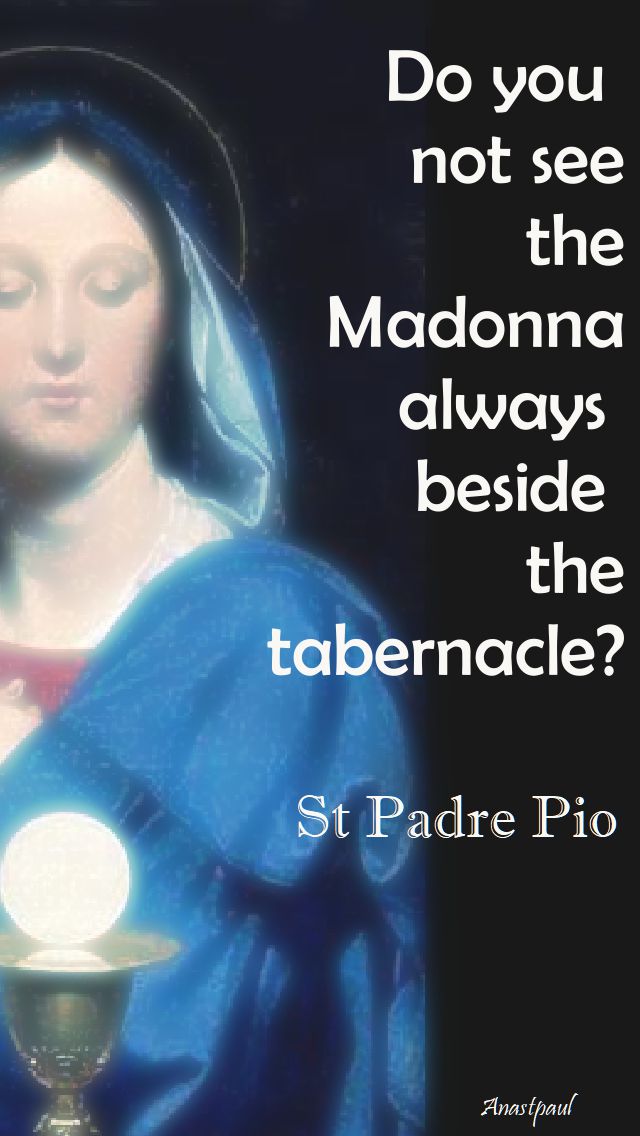
“Do you not see the Madonna always beside the Tabernacle?”
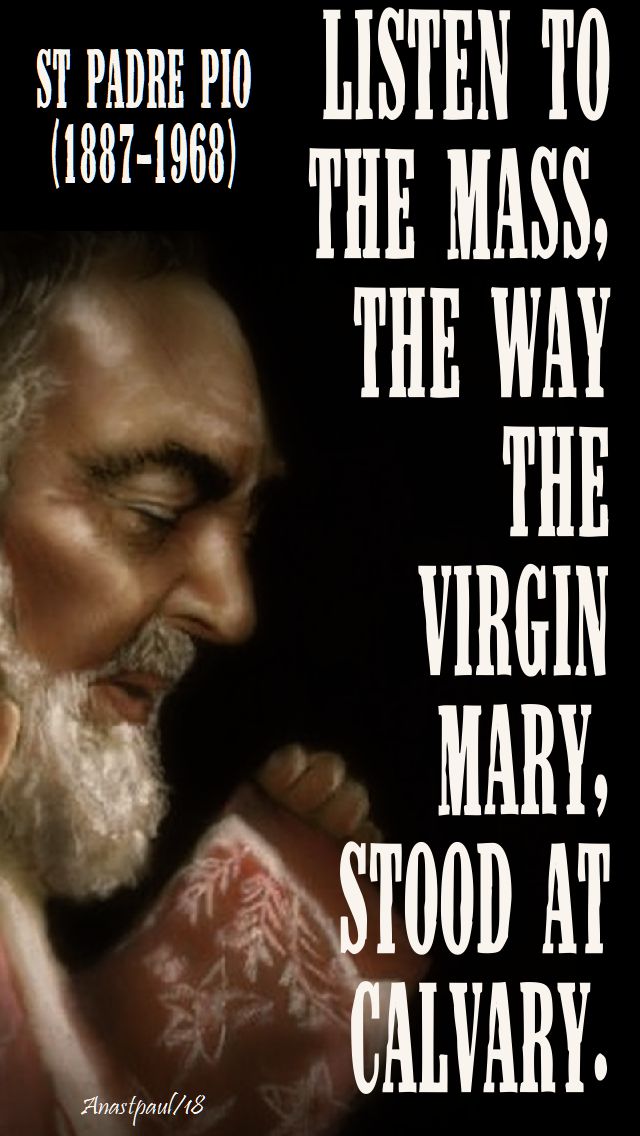
“Listen to the Mass, the way the Virgin Mary, stood at .. Calvary..”
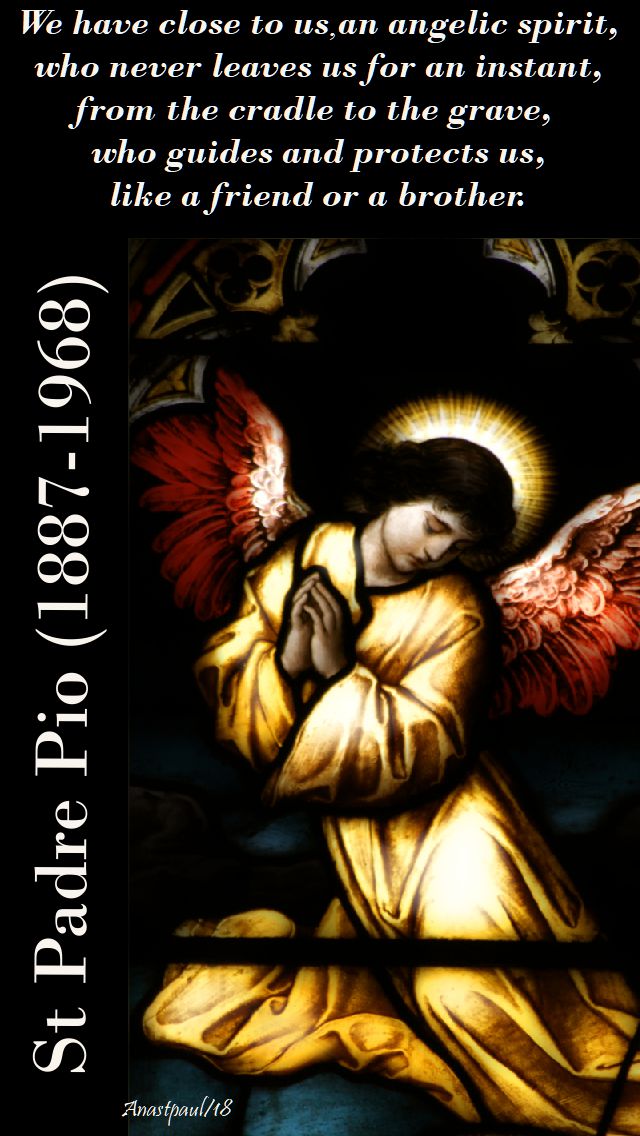
“We have close to us, an angelic spirit, who never leaves us for an instant, from the cradle to the grave, who guides and protects us, like a friend or a brother.”
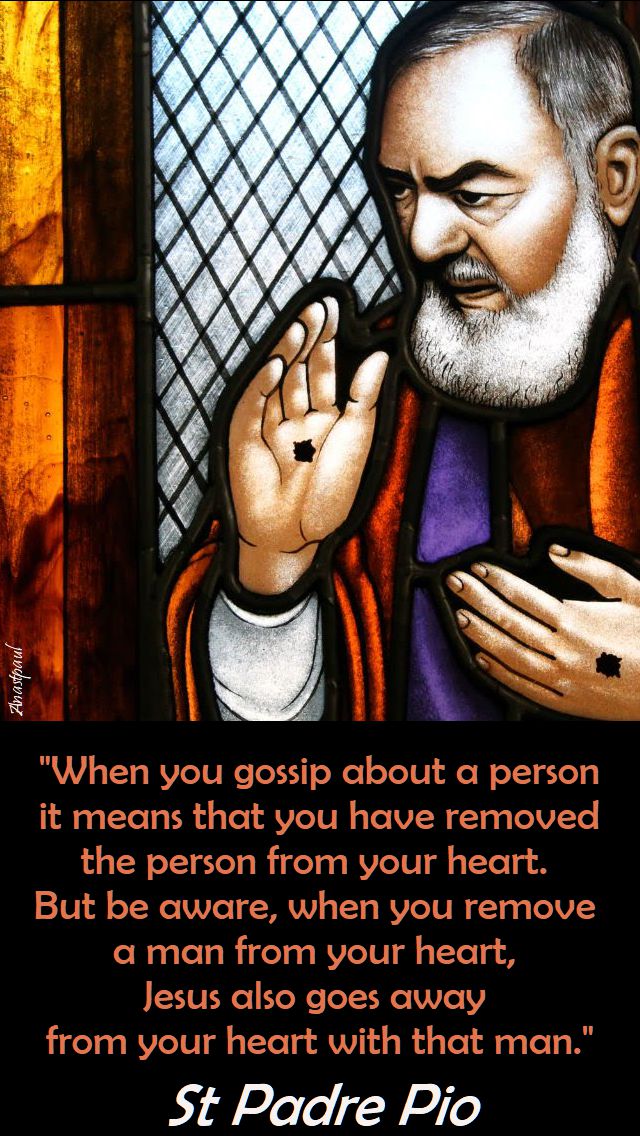
“When you gossip about a person it means that you have removed the person from your heart. But be aware, when you remove a man from your heart, Jesus also goes away from your heart with that man.”
One Minute Reflection – 23 September – Today’s Gospel: Mark 9:30–37
– Twenty-fifth Sunday in Ordinary Time, Year B and the Memorial of St Padre Pio (1887-1968)
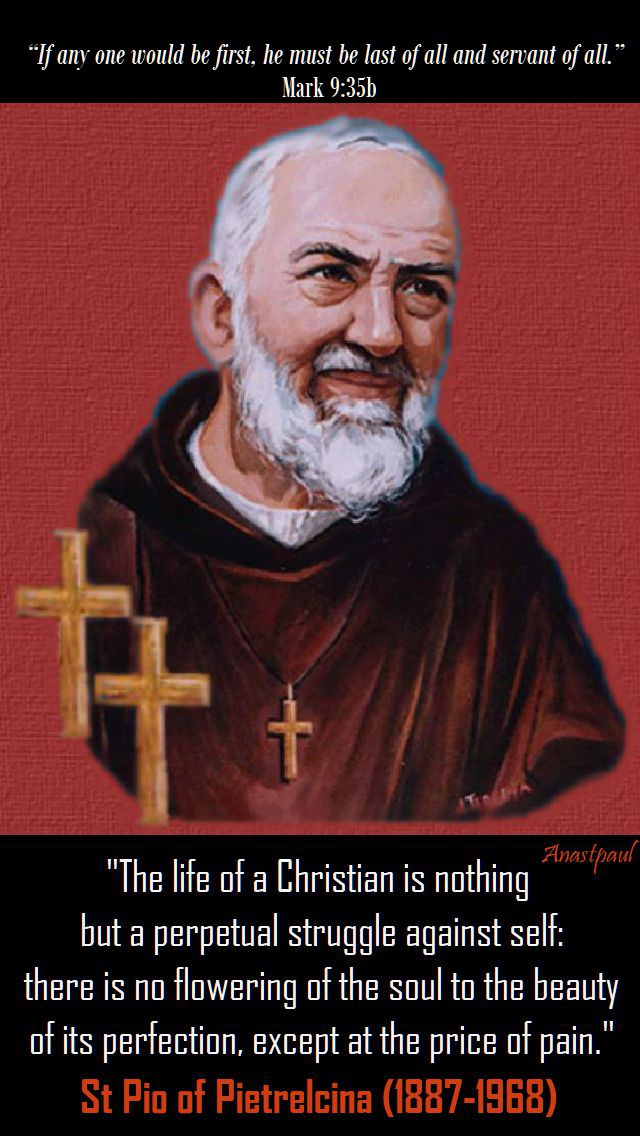
“If any one would be first, he must be last of all and servant of all.”…Mark 9:35b
REFLECTION – “The life of a Christian is nothing but a perpetual struggle against self:
there is no flowering of the soul to the beauty of its perfection, except at the price of pain.”………St Pio of Pietrelcina (1887-1968)
PRAYER – “And you, Blessed Padre Pio, look down from heaven upon us assembled …today. Intercede for all those who, in every part of the world, are spiritually united … and raise their prayers to you. Come to the help of everyone; give peace and consolation to every heart. Amen!” – from the homily of St Pope John Paul II at the Beatification of Padre Pio
One Minute Reflection – 18 September – Today’s Gospel: Luke 7:11–17, Tuesday of the Twenty-fourth week in Ordinary Time and the Memorial of St Juan Macias O.P. (1585-1645) and St Joseph of Cupertino O.F.M. Conv. (1603-1663)
And he said, “Young man, I say to you, arise.”...Luke 7:14b
REFLECTION – “Even if the signs of death have removed all hope of life, even if the bodies of the dead lie beside the tomb, yet, at the voice of God, the corpses of those ready to decompose will rise and recover speech. The son is restored to his mother, he is called back from the tomb, snatched out of it. And what is this tomb? Your own. Your bad habits, your lack of faith. This is the tomb from which Christ delivers you, this is the tomb from which you will return to life if you listen to the Word of God. Even if your sin is so grave that you are unable to wash it clean for yourself with your tears of repentance, the Church, your mother, she who intercedes for each one of her children like a widowed mother for her only son, will weep for you. For she feels for it with a kind of spiritual suffering natural to her when she sees her offspring dragged down to death by lamentable vices…
Let her weep, then, this pious mother; let the crowd accompany her – and not just a crowd but a large crowd – and may it show compassion towards this tender mother. Then you will come to life again in your tomb and will be delivered, the bearers will stop and you will start to speak the words of the living; everyone will be astonished. The example of one will correct the many and they will praise God for having granted such remedies to us for escaping death.”…St Ambrose (c 340-397) Father & Doctor (A treatise on the Gospel of Saint Luke)
God wants us to stand upright. He created us to be on our fee,: for this reason, Jesus’ compassion leads to that gesture of healing, to heal us, of which the key phrase is: “Arise! Stand up, as God created you!”. Standing up. “But Father, we fall so often” — “Onward, arise!”. This is Jesus’ word, always. His word revives us, gives us hope, refreshes weary hearts, opens us to a vision of the world and of life which transcends suffering and death…Pope Francis – General audience, 10 August 2016
PRAYER – Heavenly Father, help me to be holy in the way that You have laid out for me. Let me stand upright and carry out my duties of my state of life to the full. Only in You may I attain holiness, learning to give myself, my will, my heart and my to You. St Joseph of Cupertino, you who were so disadvantaged, achieved by the grace of God, sanctity in this life and now behold His Face through all eternity. St Juan, in your lowly work, you stood in the Light of Christ, allowing the lowly and rich, to see Him who saved us. We ask You Holy Father, that You grant, by the intercession pf St Joseph and Juan, that we may reach our heavenly home. We make our prayer through Christ our Lord, with the Holy Spirit, one God forever, amen.
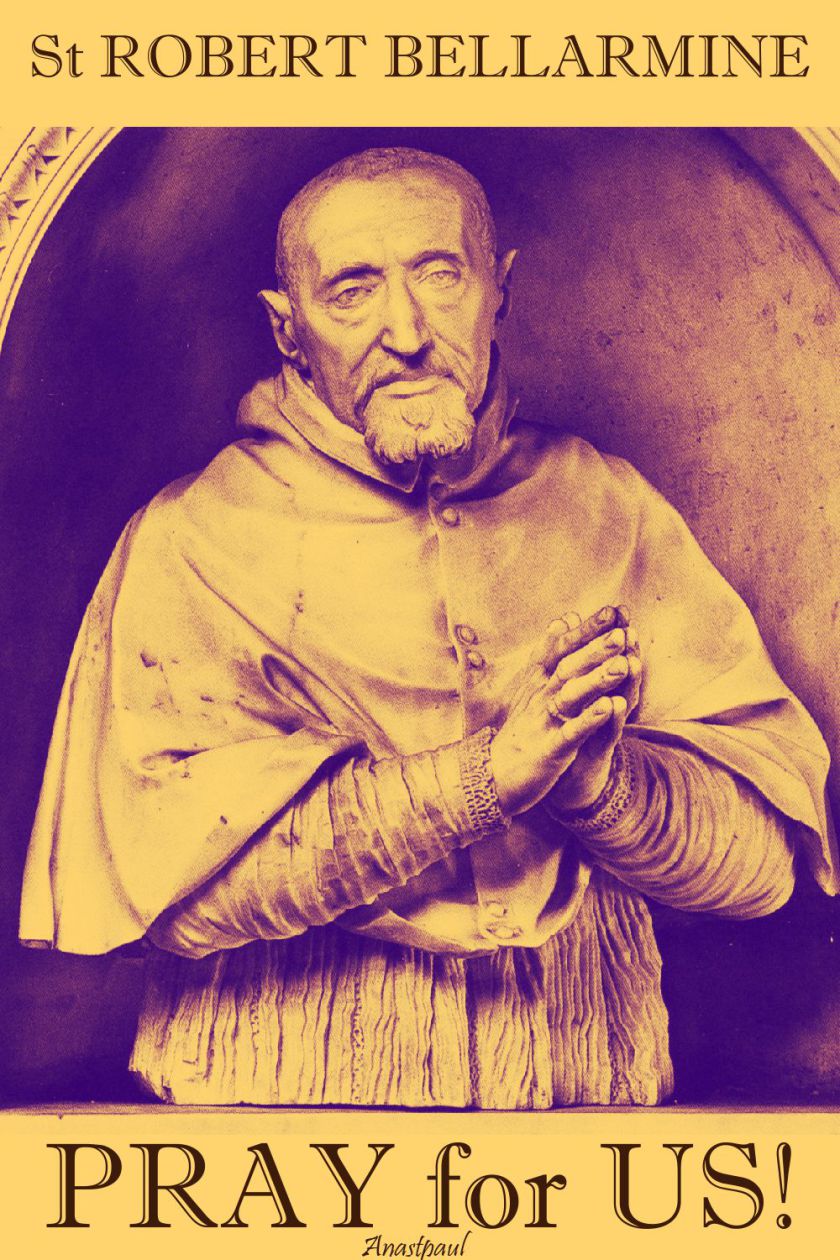
Thought for the Day – 17 September 2018 – The Memorial of Stigmata of St Francis of Assisi & St Robert Bellarmine SJ (1542-1621)
The glory of the Saints and of the Church never ceases to amaze me in every finer detail of the arrangement of our communal life together with them, thus confirming the presence of the Holy Spirit and the Divinity of this Mystical Body of Christ!
St Robert Bellarmine had a great devotion to St Francis of Assisi and was especially devoted to honouring Francis’ stigmata. Bellarmine urged that there be a special feast in honour of the five stigmata of St Francis. Bellarmine had an important position in the Vatican and he made sure that the feast was introduced in the Church, despite strong opposition.
As Providence arranged, Robert Bellarmine died on the feast of the Stigmata of St Francis, 17 September. And in the revised liturgical calendar St Bellarmine’s feast, which used to be celebrated on 13 May, has been moved to 17 September. In the Universal Church today is the feast of both!
St Francis of Assisi and St Robert Bellarmine, pray for us, your family here on earth and in great need of your prayers!
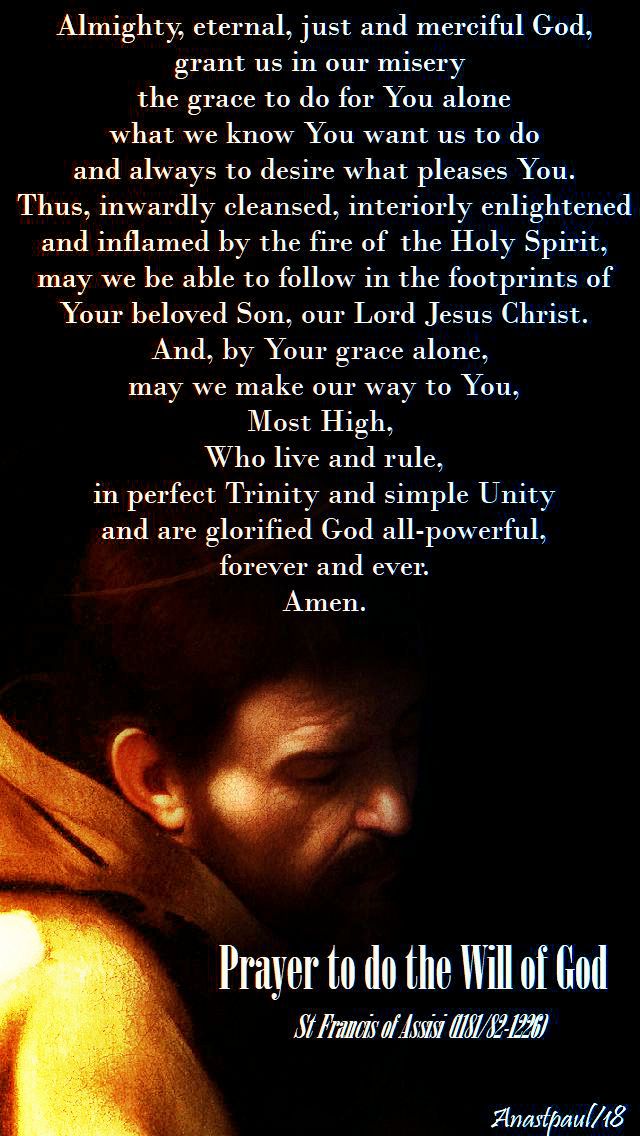
Prayer to do the Will of God By St Francis of Assisi (c 1181-1226)
Almighty, eternal, just and merciful God,
grant us in our misery, the grace to do for You alone
what we know You want us to do
and always to desire, what pleases You.
Thus, inwardly cleansed, interiorly enlightened
and inflamed by the fire of the Holy Spirit,
may we be able to follow in the footprints of
Your beloved Son, our Lord Jesus Christ.
And, by Your grace alone,
may we make our way to You,
Most High, Who live and rule in perfect Trinity and simple Unity
and are glorified God all-powerful, forever and ever.
Amen.
(From “A Letter to the Entire Order”)
Thought for the Day – 29 August – The Memorial of the Beheading of St John the Baptist
The drunken oath of a king with a shallow sense of honour, a seductive dance and the hateful heart of a queen combined to bring about the martyrdom of John the Baptist. The greatest of prophets suffered the fate of so many Old Testament prophets before him: rejection and martyrdom. The “voice crying in the desert” did not hesitate to accuse the guilty, did not hesitate to speak the truth. But why? What possesses a man that he would give up his very life?
This great religious reformer was sent by God to prepare the people for the Messiah. His vocation was one of selfless giving. The only power that he claimed was the Spirit of yjr Lord. “I am baptizing you with water, for repentance but the one who is coming after me is mightier than I. I am not worthy to carry His sandals. He will baptise you with the Holy Spirit and fire” (Matthew 3:11).
Scripture tells us that many people followed John looking to him for hope, perhaps in anticipation of some great messianic power. John never allowed himself the false honour of receiving these people for his own glory. He knew his calling was one of preparation. When the time came, he led his disciples to Jesus: “The next day John was there again with two of his disciples and as he watched Jesus walk by, he said, ‘Behold, the Lamb of God.’ The two disciples heard what he said and followed Jesus” (John 1:35-37).
It is John the Baptist who has pointed the way to Christ. John’s life and death were a giving over of self for God and other people. His simple style of life was one of complete detachment from earthly possessions . His heart was lifted on God and the call that he heard from the Spirit of God speaking to his heart. Confident of God’s grace, he had the courage to speak words of condemnation, repentance, and salvation.
Each of us has a calling to which we must listen. No-one will ever repeat the mission of John and yet all of us are called to that very mission. It is the role of the Christian to witness to Jesus. Whatever our position in this world, we are called to be disciples of Christ. By our words and deeds, others should realise that we live in the joy of knowing that Jesus is Lord. We do not have to depend upon our own limited resources but can draw strength from the vastness of Christ’s saving grace.
One Minute Reflection – 26 August – 21st Sunday of the Year in Ordinary Time, Year B – Today’s Gospel: John 6:60–69
Simon Peter answered him, “Lord, to whom shall we go? You have the words of eternal life and we have believed, and have come to know, that you are the Holy One of God.”...John 6:68-69
REFLECTION – “He does not say “where shall we go?” but “to whom shall we go?” The underlying problem, is not about leaving and abandoning the work undertaken but to whom to go. From Peter’s question, we understand, that fidelity to God is a question of fidelity to a person, to whom we bind ourselves, to walk together on the same road. And this person is Jesus. All that we have in the world does not satisfy our infinite hunger. We need Jesus, to be with Him, to be nourished at His table, on His words of eternal life!”…Pope Francis (Angelus, 23 August 2015)
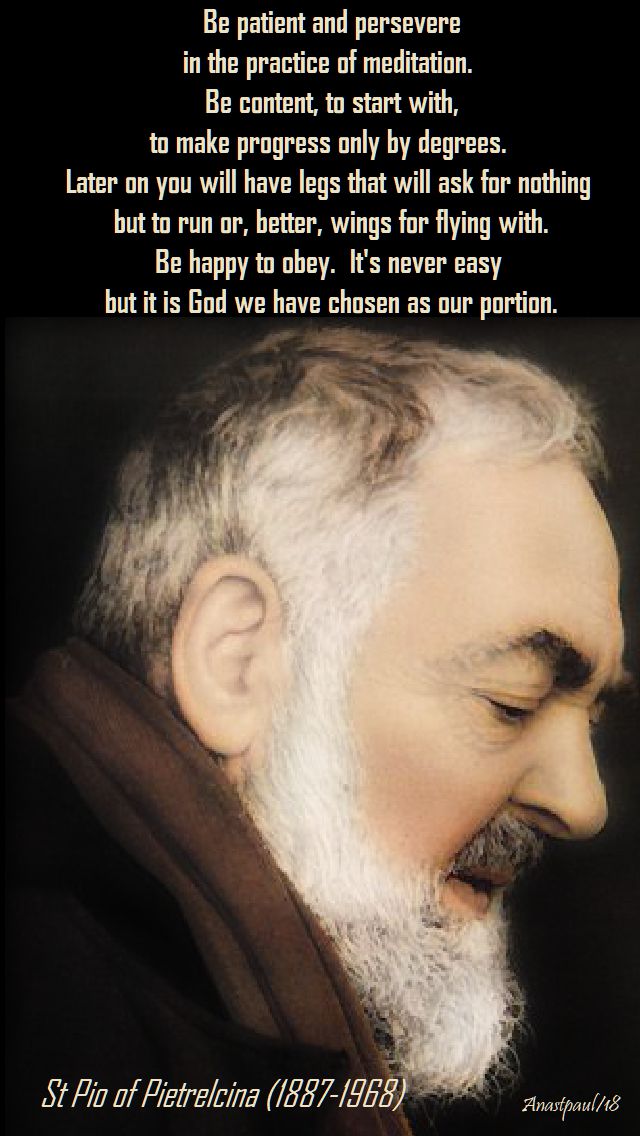
“Be patient and persevere in the practice of meditation. Be content, to start with, to make progress only by degrees. Later on you will have legs that will ask for nothing but to run or, better, wings for flying with.
Be happy to obey. It’s never easy but it is God we have chosen as our portion. Accept that, as yet, you are only a little bee in its nest but, very quickly, it will become one of those wonderful workers so skilful in making honey. Always remain humble before God and men, in love. Then our Lord will speak to you in truth and enrich you with His gifts.”…St Pio of Pietrelcina “Padre Pio” (1887-1968)
PRAYER – Lord, by Your grace, we are made one in mind and heart. Give us a love for what You command and a longing for what You promise, so that, amid this world’s changes, our hearts may be set on the world of lasting joy. May the intercession of Your faithful servant, St Pope Zephyrinus, bring us strength and courage. As it was Your will heavenly Father, that, at the angel’s message, Your Word should be conceived by the Blessed Virgin Mary, grant that as we believe her to be truly the Mother of God, so may we be helped always, by her intercession. Through our Lord, Jesus Christ, in union with the Holy Spirit, ‘totus tuus’ Maria – please pray for us, amen.
Our Morning Offering – 22 August – Memorial of The Queenship of Mary
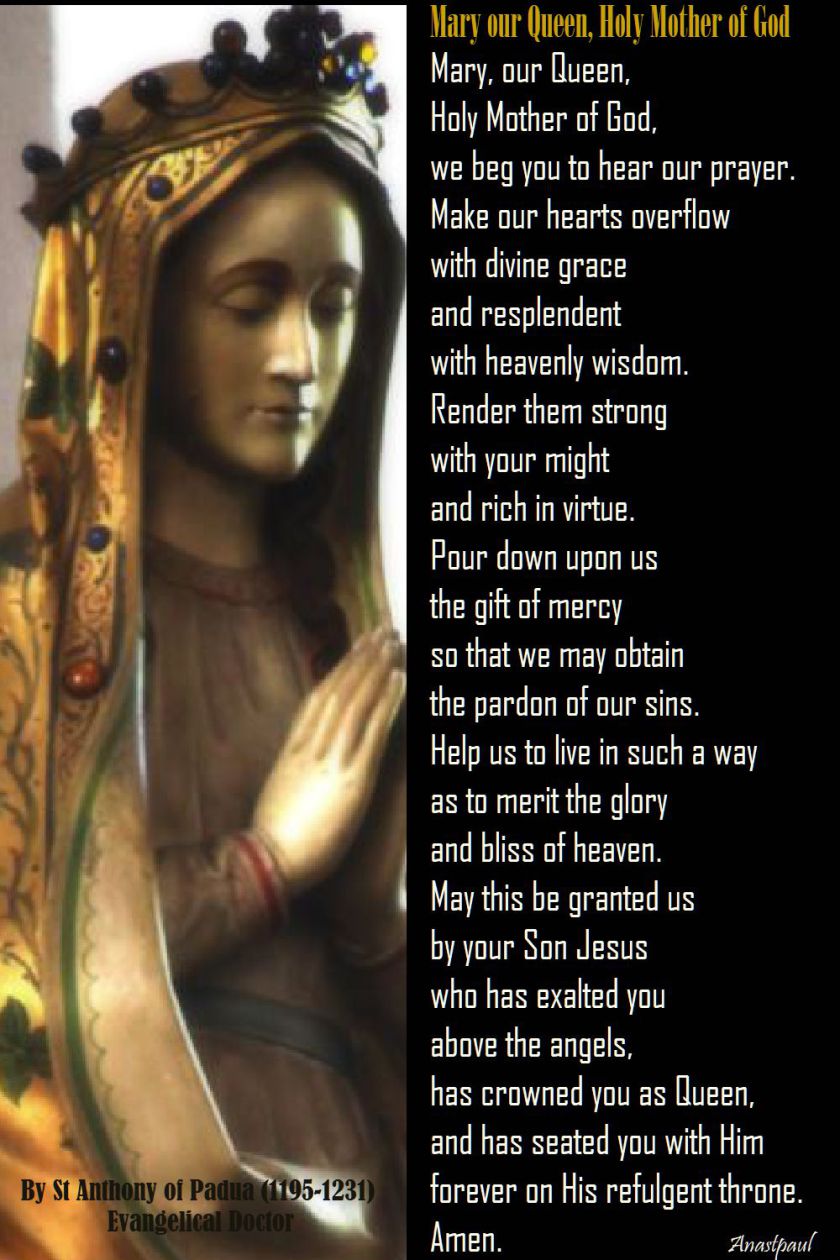
Mary our Queen, Holy Mother of God By St Anthony of Padua (1195-1231) Evangelical Doctor
Mary, our Queen,
Holy Mother of God,
we beg you to hear our prayer.
Make our hearts overflow with divine grace
and resplendent with heavenly wisdom.
Render them strong with your might
and rich in virtue.
Pour down upon us the gift of mercy
so that we may obtain the pardon of our sins.
Help us to live in such a way
as to merit the glory and bliss of heaven.
May this be granted us by your Son Jesus
who has exalted you above the angels,
has crowned you as Queen,
and has seated you with Him
forever on His refulgent throne.
Amen.
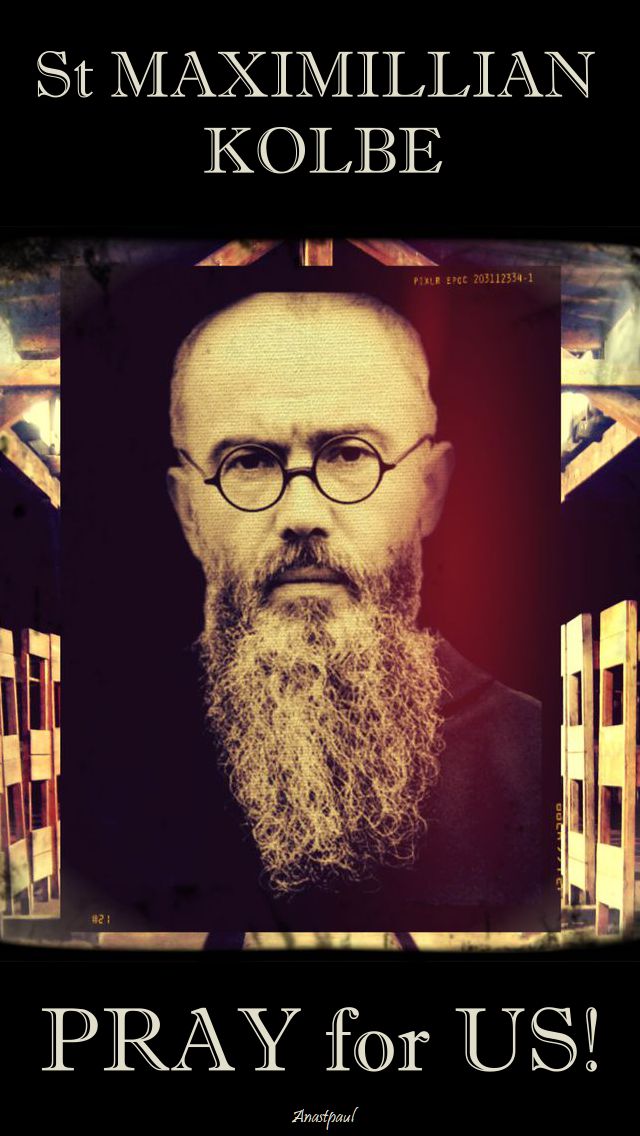
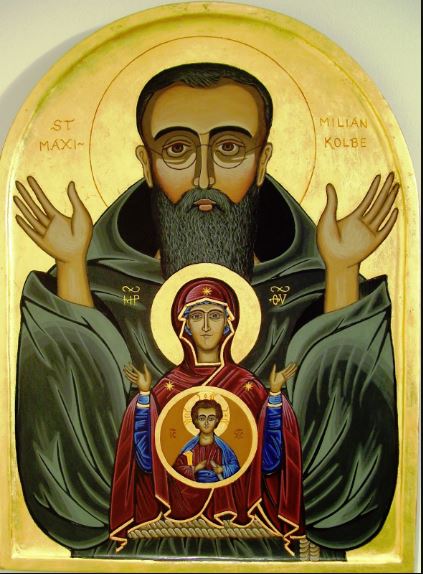
Thought for the Day – 14 August – The Memorial of St Maximillian Kolbe OFM Conv (1894 -1941) “Martyr of Charity”and “Apostle of Consecration to Mary”
“Greater love than this no man hath, that a man lay down his life for his friends.”
John 15:13
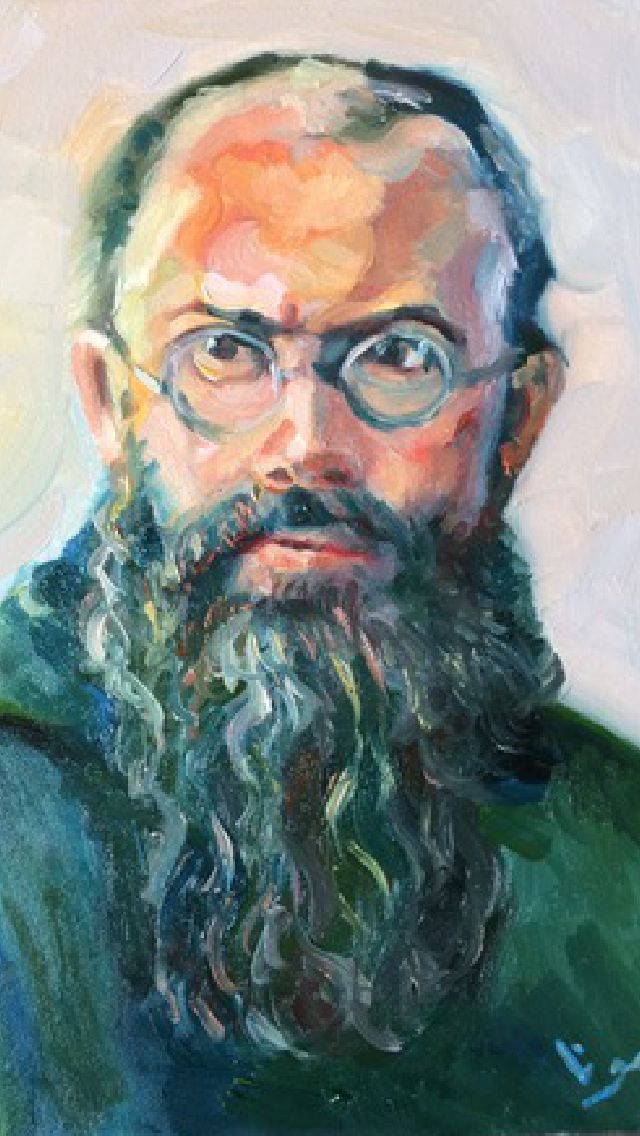
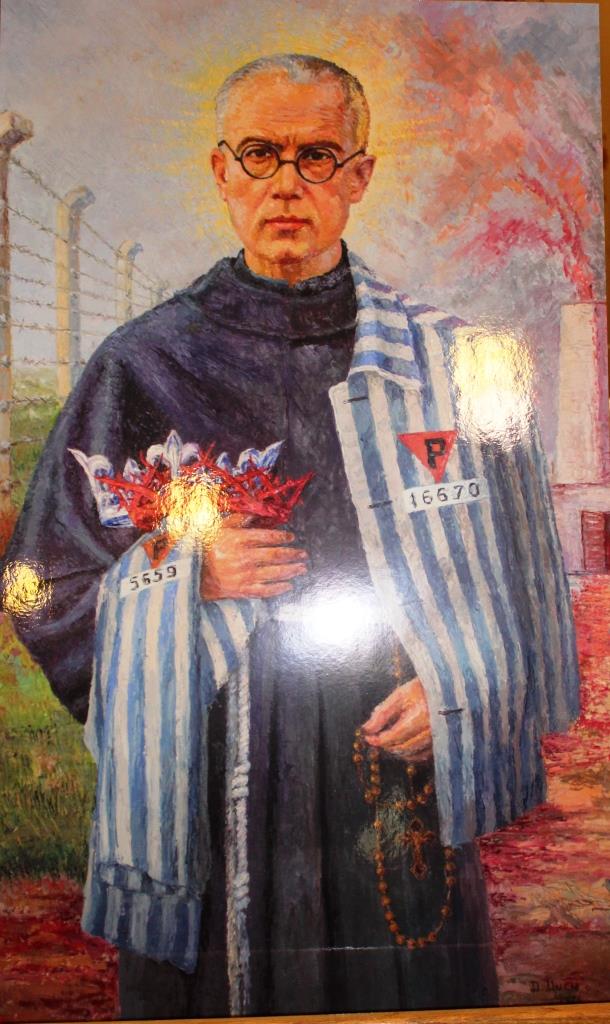
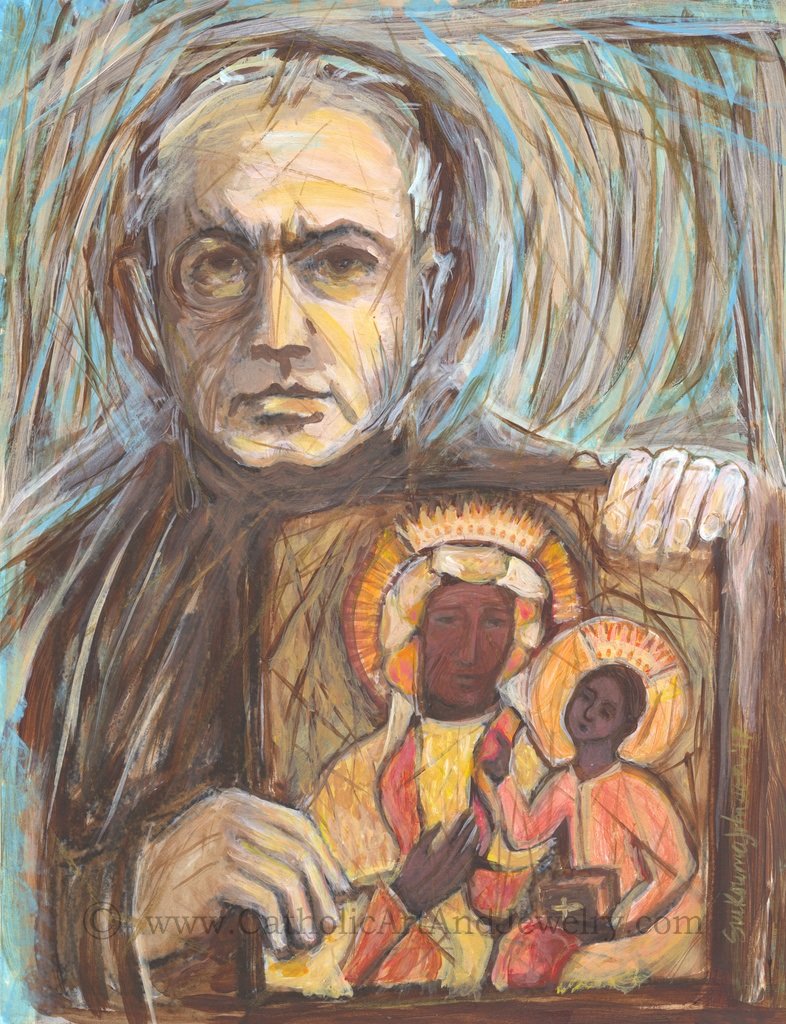
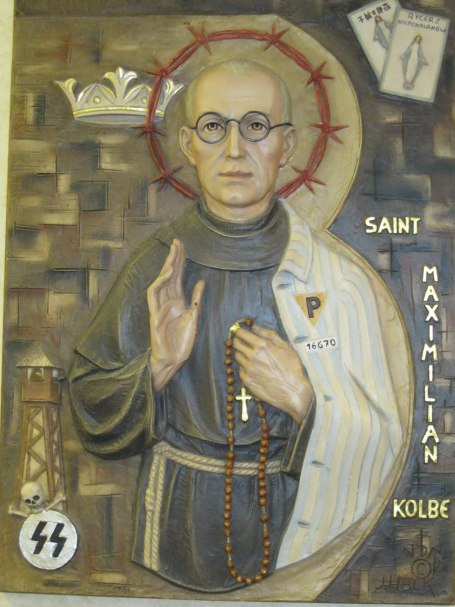
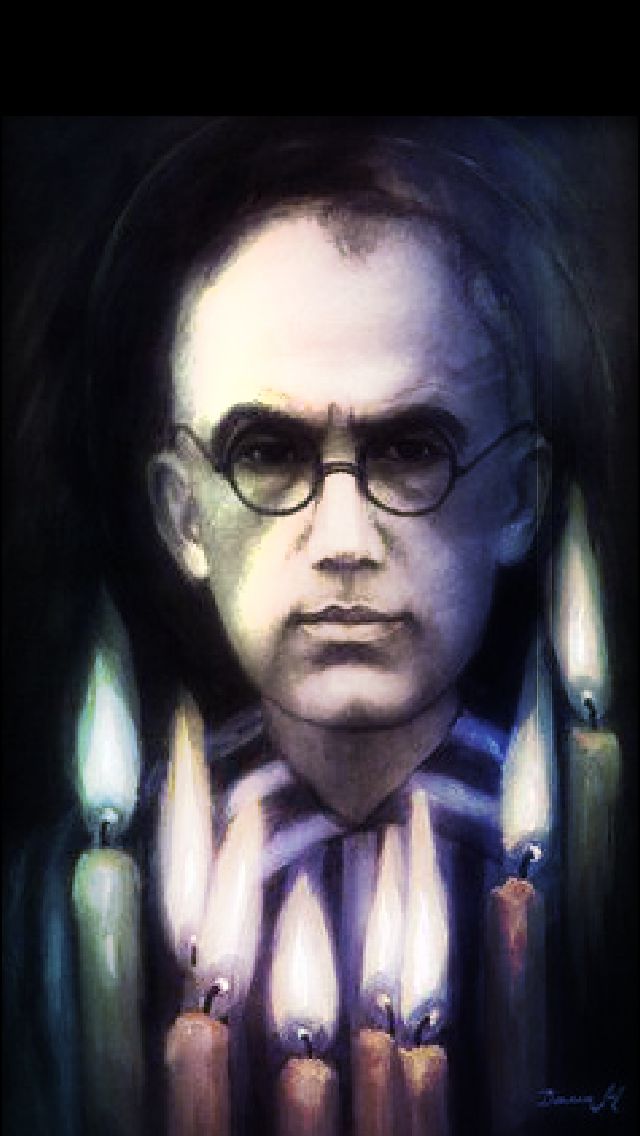
That verse certainly comes to mind whenever I think of St Maximilian Kolbe, whose feast we celebrate today. So it’s not surprising to read that these were the opening words of the papal decree introducing his Beatification. St Maximilian Kolbe was arrested in Poland in February of 1941 and in May sent to the Auschwitz death camp. As prisoner #16670, he eventually laid down his life for another prisoner on 14 August 1941, at the young age of 47.
Father Kolbe’s death was not a sudden, last-minute act of heroism. His whole life had been a preparation. His holiness was a limitless, passionate desire to convert the whole world to God. And his beloved Immaculata, was his inspiration.
St Maximillian is the patron saint of families, prisoners, journalists, political prisoners, drug addicts and the pro-life movement. St John Paul II declared him to be “the patron saint of our difficult century.” The evils which made the twentieth century so difficult were not left behind as we moved into the twenty-first century.
Let us continue to call upon the intercession of this saint and continue to come to Jesus through His mother, Mary, the Immaculata.
Daily Consecration Renewal to the Immaculata By St Maximillian Kolbe
Immaculata, Queen and Mother of the Church,
I renew my consecration to you for this day
and for always, so that you might use me
for the coming of the Kingdom of Jesus in the whole world.
To this end, I offer you all my prayers,
actions and sacrifices of this day.
Amen
Mary, Immaculata, Pray for us!
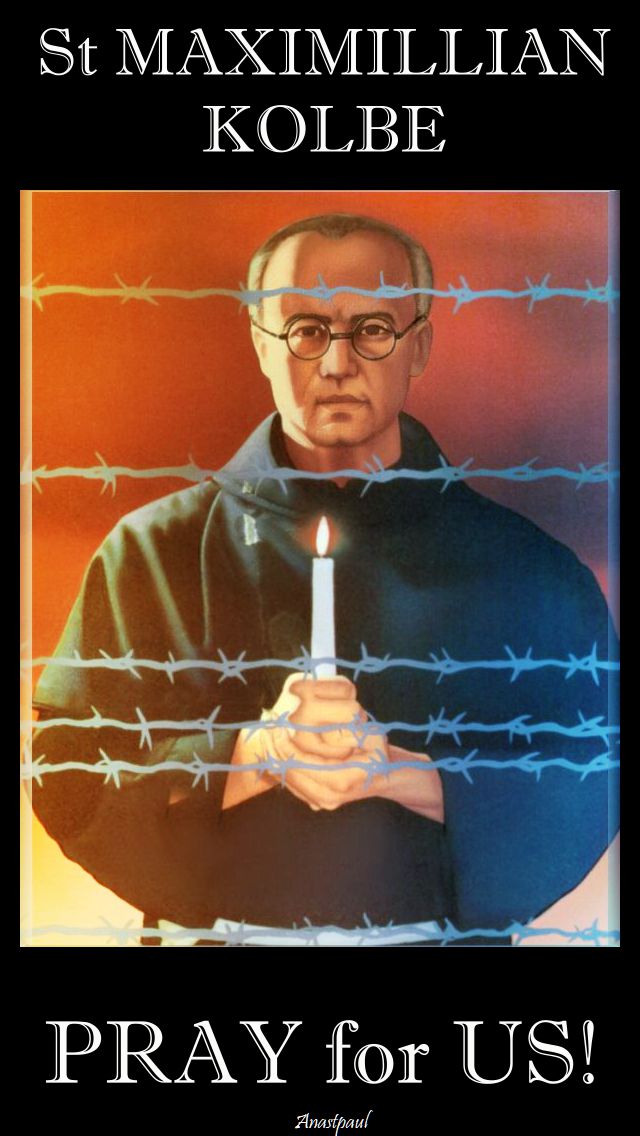
St Maximillian Kolbe, pray for us!
Quote/s of the Day – 14 August – The Memorial of St Maximillian Kolbe OFM Conv (1894 -1941) “Martyr of Charity”and “Apostle of Consecration to Mary”
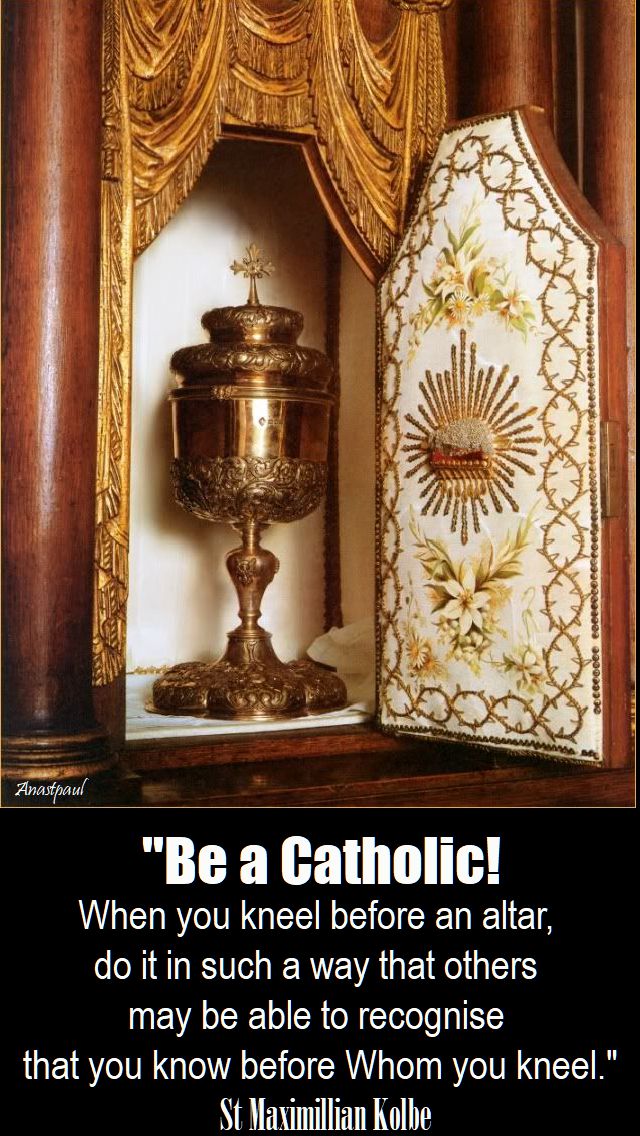
“Be a Catholic! When you kneel before an altar, do it in such a way that others may be able to recognise that you know before Whom you kneel.”
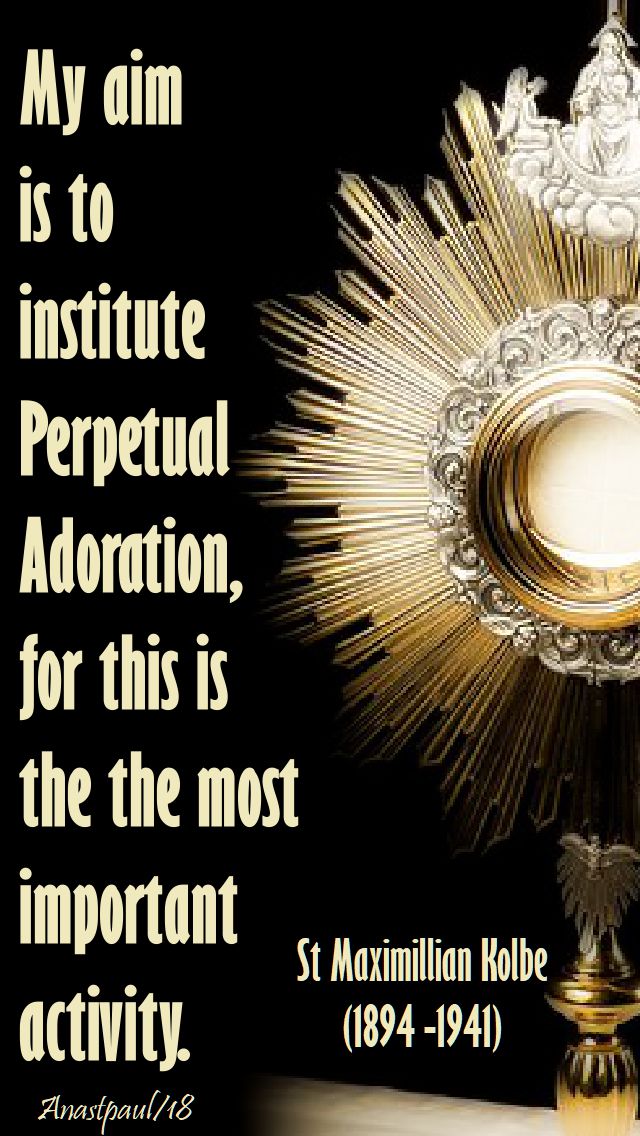
“My aim is to institute Perpetual Adoration, for this is the the most important activity.”
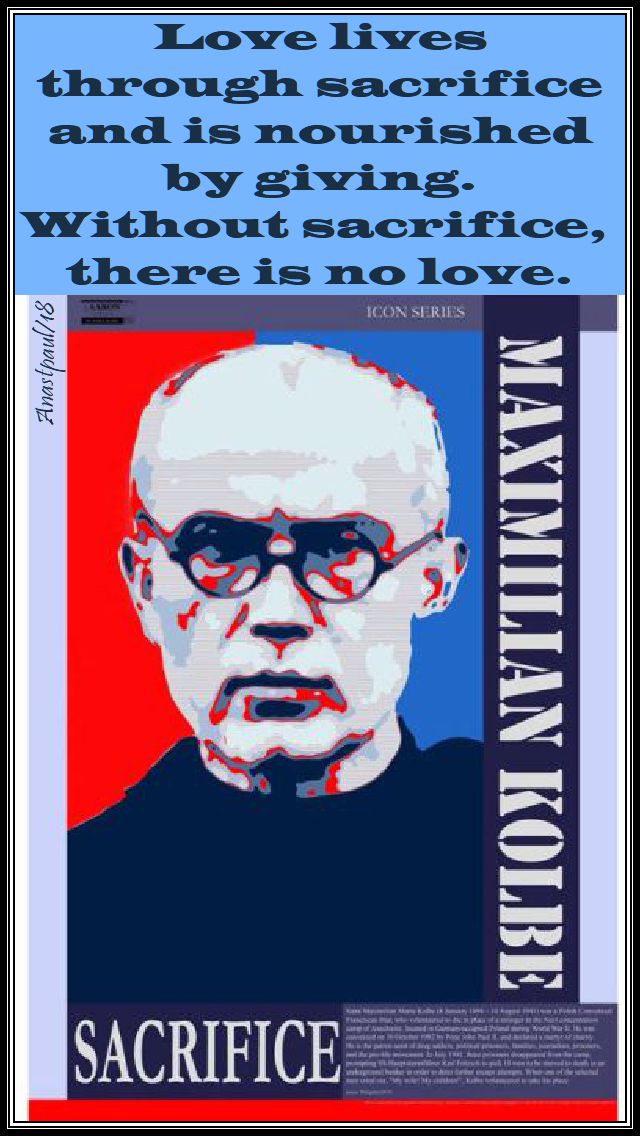
“Let us remember, that love lives through sacrifice and is nourished by giving. Without sacrifice, there is no love.”
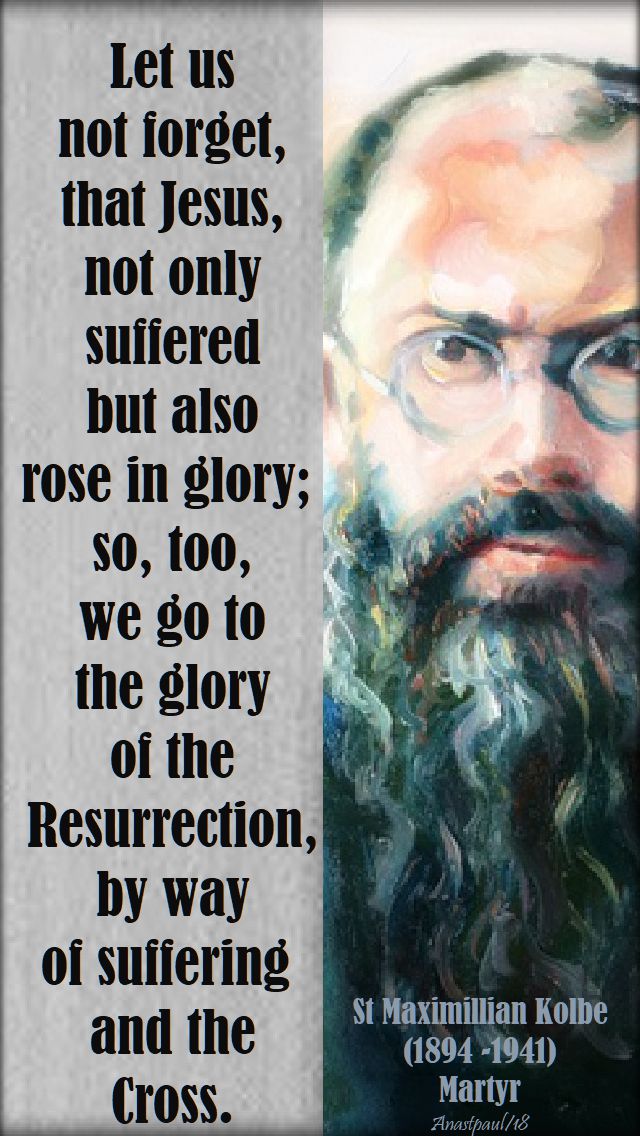
“Let us not forget, that Jesus not only suffered but also rose in glory; so, too, we go to the glory of the Resurrection, by way of suffering and the Cross.”
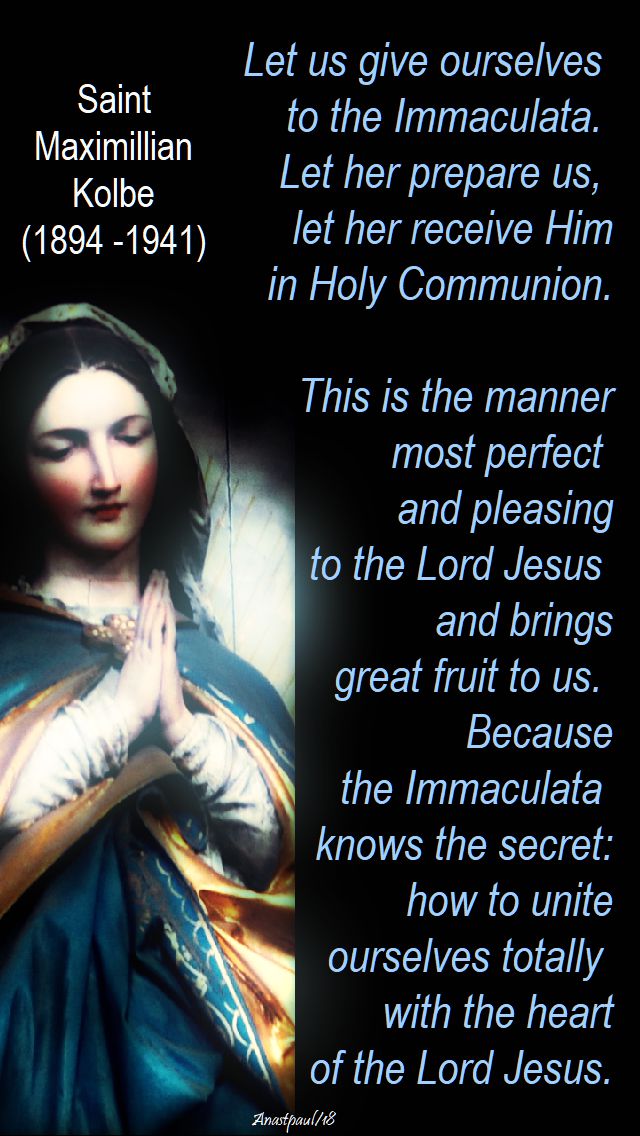
“Let us give ourselves to the Immaculata. Let her prepare us, let her receive Him in Holy Communion. This is the manner most perfect and pleasing to the Lord Jesus and brings great fruit to us.” Because “the Immaculata knows the secret, how to unite ourselves totally with the heart of the Lord Jesus…”
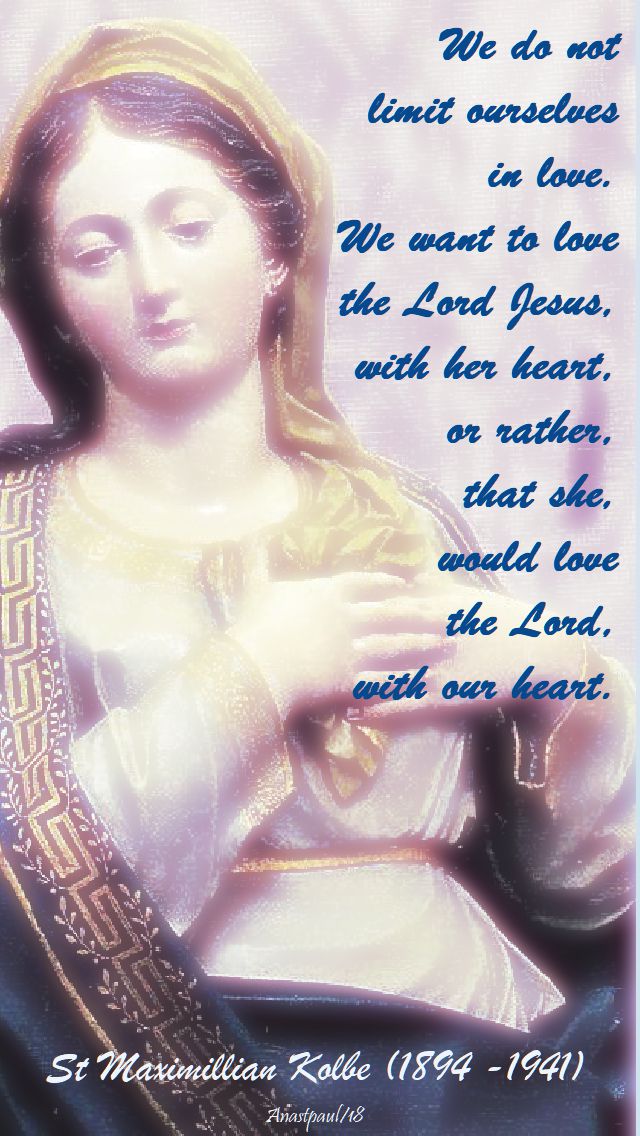
“We do not limit ourselves in love. We want to love the Lord Jesus, with her heart, or rather, that she would love the Lord, with our heart.”
One Minute Reflection – 14 August – The Memorial of St Maximillian Kolbe OFM Conv (1894 -1941) “Martyr of Charity”and “Apostle of Consecration to Mary”
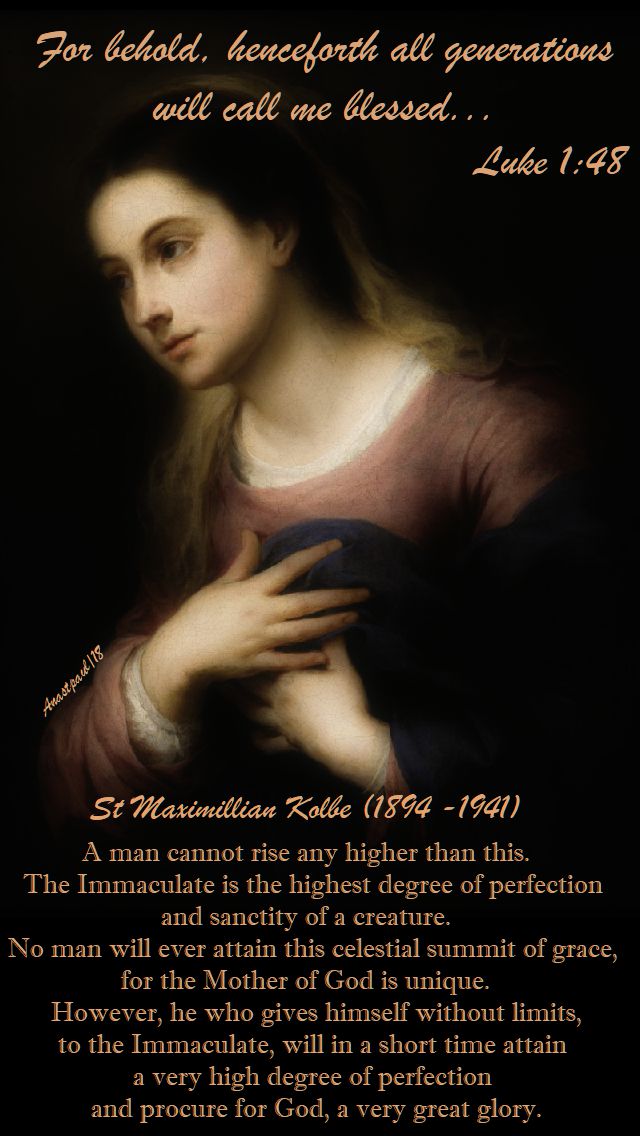
For behold, henceforth all generations will call me blessed…Luke 1:48
REFLECTION – “A man cannot rise any higher than this. The Immaculate is the highest degree of perfection and sanctity of a creature. No man will ever attain this celestial summit of grace, for the Mother of God is unique. However, he who gives himself without limits, to the Immaculate, will in a short time attain a very high degree of perfection and procure for God, a very great glory.”…St Maximillian Kolbe
PRAYER – My Lord and my God, You who are the fruit of Mary’s blessed womb and the most Divine Son of our Father, grant that we may always have recourse to You, through her who bore You. Grant that she may help and comforus me and lead us to You. Mary, Holy and loving Mother of God, pray for us all. Grant O Lord, that through the intercession of St Maximillian, we may entrust ourselves to You through Your and our blessed Mother, amen.
Our Morning Offering – 14 August – The Memorial of St Maximillian Kolbe OFM Conv (1894 -1941) “Martyr of Charity”
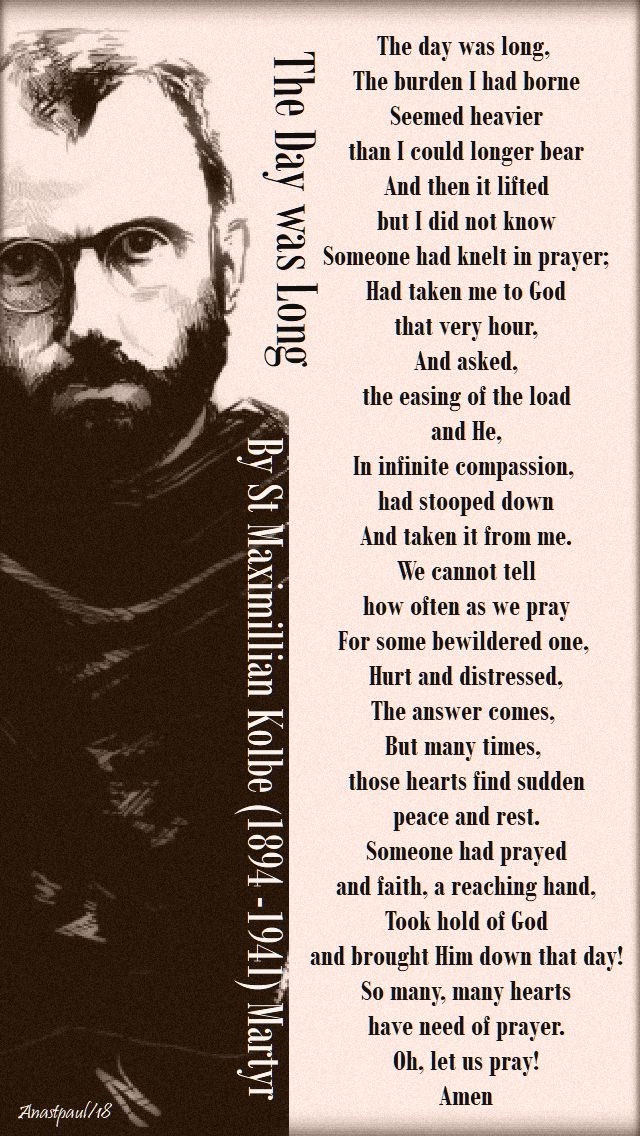
The Day was Long By St Maximillian Kolbe (1894 -1941) Martyr
The day was long,
The burden I had borne
Seemed heavier than I could longer bear
And then it lifted
but I did not know
Someone had knelt in prayer;
Had taken me to God that very hour,
And asked the easing of the load
and He,
In infinite compassion,
had stooped down
And taken it from me.
We cannot tell how often as we pray
For some bewildered one,
Hurt and distressed,
The answer comes,
But many times,
those hearts find sudden peace and rest.
Someone had prayed
and faith, a reaching hand,
Took hold of God
and brought Him down that day!
So many, many hearts have need of prayer.
Oh, let us pray!
Amen
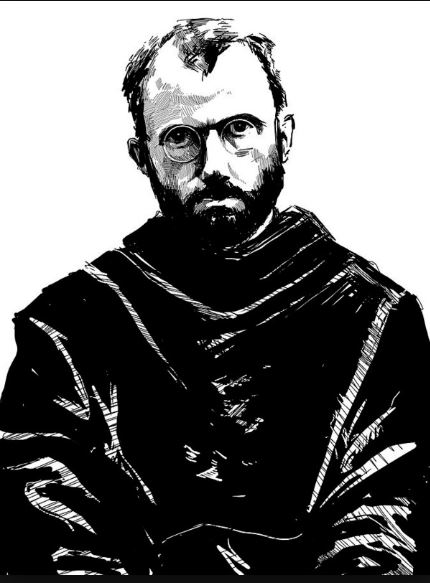
Saint of the Day – 14 August – St Maximilian Kolbe, Priest and Martyr (1894-1941) Prisoner 16670 – “Martyr of Charity”, “Apostle of Consecration to Mary”.
Raymond Kolbe was born on the 8th of January 1894 in Zdunska Wola, which at that time was occupied by Russia. The Kolbe home was poor but full of love. The parents, hardworking and religious, educated their three sons with rectitude.
Around 1906, an event took place that marks a fundamental milestone in the life of the young boy. His mother herself related the event a few months after her son’s martyrdom.
“I knew ahead of time, based on an extraordinary event that took place in his infancy, that Maximilian would die a martyr. I just don’t recall if it took place before or after his first confession. Once I did not like one of his pranks and I reproached him for it: ‘My son, what ever will become of you?!’ Later, I did not think of it again but I noticed that the boy had changed so radically, he was hardly recognisable. We had a small altar hidden between two dressers before which he used to often retire without being noticed and he would pray there crying. In general, he had a conduct superior to his age, always recollected and serious and when he prayed he would burst into tears. I was worried, thinking he had some sort of illness so I asked him: ‘Is there anything wrong? You should share everything with your mommy!’ Trembling with emotion and with his eyes flooded in tears, he shared: ‘Mama, when you reproached me, I pleaded with the Blessed Mother to tell me what would become of me. At Church I did the same, I prayed the same thing again. So then the Blessed Mother appeared to me holding in her hands two crowns: one white the other red. She looked at me with tenderness and asked me if I wanted these two crowns. The white one signified that I would preserve my purity and the red that I would be a martyr. I answered that I accepted them…(both of them). Then the Virgin Mary looked at me with sweetness and disappeared.’ The extraordinary change in the boys’ behaviour testified to me the truth of what he related. He was fully conscious and as he spoke to me, with his face radiatin,; it showed me his desire to die a martyr.”
When he was 13 years old he entered the Franciscan Fathers Seminary in the polish city of Lvov, which was at that time occupied by Austria. It was in the seminary where he adopted the name Maximilian. He completed his studies in Rome. Before his ordination as a priest in 1918, Maximilian founded the Immaculata Movement devoted to our Lady. He spread the movement through a magazine entitled “The Knight of the Immaculata”.“We should conquer the universe and each soul, now and in the future until the end of time, for the Immaculata and through her for the Sacred Heart of Jesus.”(St Maximilian Maria Kolbe, The Knight of the Immaculata)
Maximilian went to Japan and then on to India where he furthered the Movement. After a few years in Japan, St Maximilian was summoned back to Poland, largely due to his ever-declining health.
Three years later, in the midst of the Second World War, he was imprisoned along with other friars and sent to concentration camps in Germany and Poland. In February of 1941 he was again made a prisoner and sent to the concentration camp in Auschwitz, where in spite of the terrible living conditions he continued his ministry.
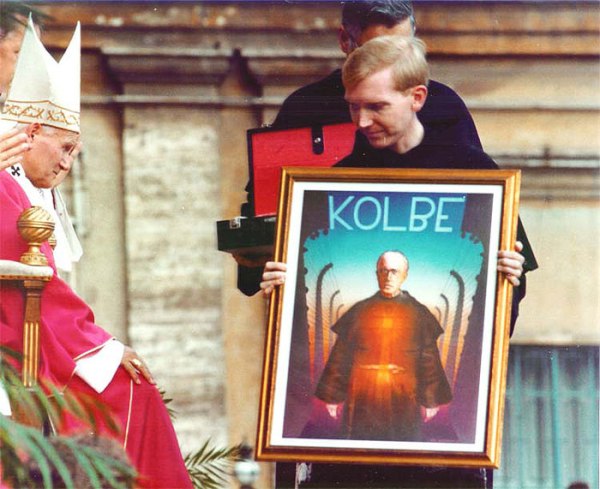
On 31 July 1941, in reprisal for one prisoner’s escape, ten men were chosen to die. Father Kolbe offered himself in place of a young husband and father. And he was the last to die, enduring two weeks of starvation, thirst and neglect. He was Canonised by St Pope John Paul II in 1982 as a Martyr of Charity.
St Maximillian Kolbe OFM Conv (1894 -1941) “Martyr of Charity” (Memorial)
Full Biography here: https://anastpaul.wordpress.com/2017/08/14/saint-of-the-day-14-august-st-maximillian-kolbe-ofm-conv-martyr-of-charity-and-apostle-of-consecration-to-mary/
Bl Aimo Taparelli
St Antony Primaldo
St Arnulf of Soissons
St Athanasia of Timia
St Callistus of Todi
St Demetrius of Africa
St Domingo Ibáñez de Erquicia
St Eberhard of Einsiedeln
St Eusebius of Palestine
St Eusebius of Rome
St Fachanan of Ross
St Francisco Shoyemon
Bl Juliana Puricelli
St Marcellus of Apamea
Bl Sanctes Brancasino
St Ursicius of Nicomedia
St Werenfridus
__
Martyred in the Spanish Civil War: 11 Beati
• Blessed Ángel de la Red Pérez
• Blessed Antonio María Martín Povea
• Blessed Basilio González Herrero
• Blessed Ezequiél Prieto Otero
• Blessed Félix Yuste Cava
• Blessed Joaquín Frade Eiras
• Blessed Jocund Bonet Mercadé
• Blessed José García Librán
• Blessed Ricardo Atanes Castro
• Blessed Segundo Pérez Arias
• Blessed Vicente Rubiols Castelló
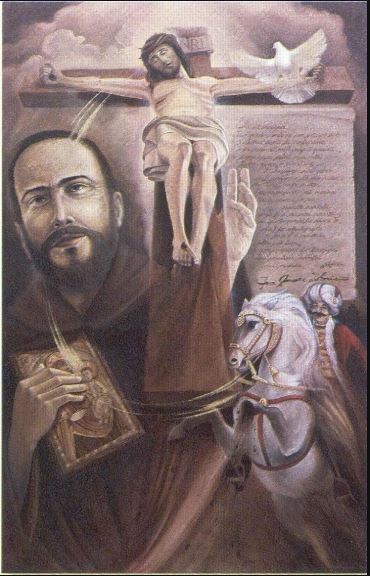
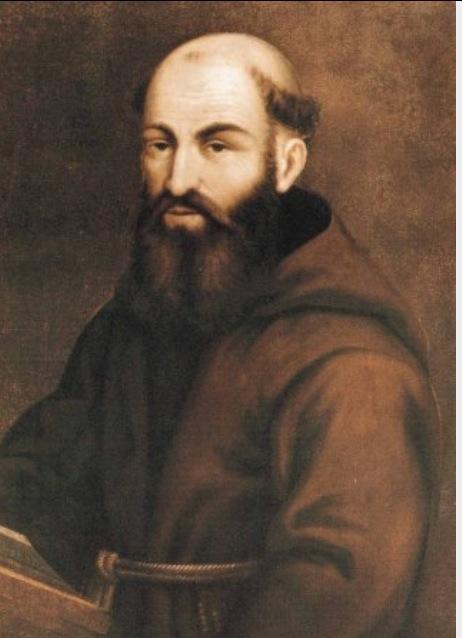
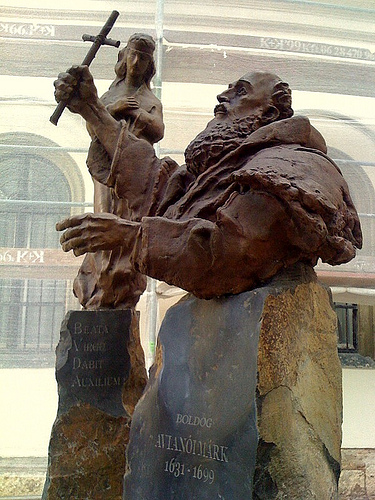
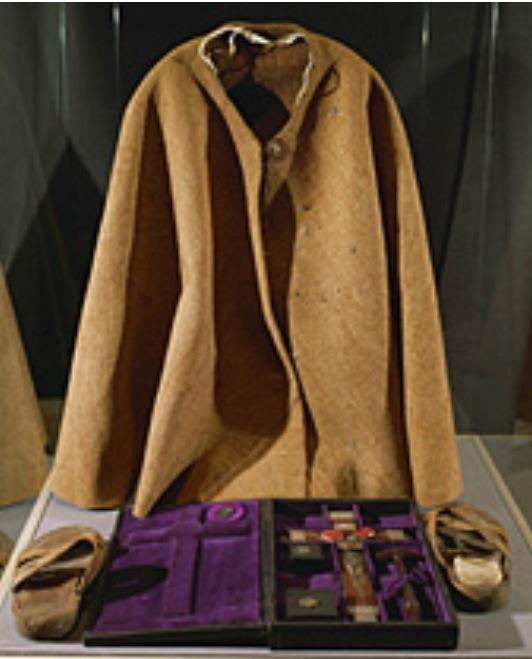
Saint of the Day – 13 August – Blessed Mark of Aviano OFM Cap (1631-1699) – Franciscan Capuchin Friar, Priest, Preacher, Spiritual Advisor, Political Advisor, Peace-maker, Miracle worker and the inventor of Cappuccino– born on 17 November 1631 at Aviano, Italy as Carlo Domenico Cristofori and died on 13 August 1699 of cancer in Vienna, Austria.
Carlo Domenico Cristofori was born in Aviano, a small community in the Republic of Venice (Italy). Educated at the Jesuit College in Gorizia, at 16 he tried to reach the island of Crete, where the Venetians were at war with the Ottoman Turks, in order to preach the Gospel and convert the Muslims to Christianity. On his way, he sought asylum at a Capuchin convent in Capodistria, where he was welcomed by the Superior, who knew his family and who, after providing him with food and rest, advised him to return home.
Inspired by his encounter with the Capuchins, he felt that God was calling him to enter their Order. In 1648, he began his novitiate. A year later, he professed his vows and took his father’s name, Marco, becoming Fra’ Marco d’Aviano. On 18 September 1655 he was ordained a priest in Chioggia. His ministry entered a new phase in 1664, when he received a licence to preach throughout the Republic of Venice and other Italian states, particularly during Advent and Lent. He was also given more responsibility when he was elected Superior of the convents of Belluno in 1672 and Oderzo in 1674.
His life took an unexpected turn in 1676, when he gave his blessing to a nun, bedridden for some 13 years, she was miraculously healed. The news spread far and wide and it was not long before the sick and many others from all social strata, began to seek him out.
Among those who sought his help was Leopold I, Holy Roman Emperor, whose wife had been unable to conceive a male heir. From 1680 to the end of his life, Marco d’Aviano became a close confidant and adviser to him, providing the irresolute and often indecisive emperor with guidance and advice for all problems, political, economic, military or spiritual. His forceful, energetic and sometimes passionate and fiery personality proved a good complement for Leopold’s Hamlet-like tendency to allow endless doubts and scruples to paralyse his capacity for action.
As the danger of war with the Ottoman Turks grew near, Marco d’Aviano was appointed by Pope Innocent XI (Memorial yesterday) as his personal envoy to the Emperor. An impassioned preacher and a skillful mediator, Marco d’Aviano played a crucial role in resolving disputes, restoring unity and energising the armies of the Holy League, which included Austria, Poland, Venice and the Papal States under the leadership of the Polish king Jan III Sobieski. In the decisive Battle of Vienna (1683), the Holy League succeeded in inflicting a defeat on the invading Ottoman Turks. This marked the end of the last Turkish attempt to expand their power in Europe and the beginning of the long European counter-offensive that was to continue ultimately until the disintegration of the Ottoman Empire in 1918. This may therefore be considered one of the decisive battles of history. It also put an end to the period of Ottoman revival in Europe.
From 1683 to 1689 Marco participated in the military campaigns, playing a crucial role in promoting good relations within the Imperial army and encouraging the soldiers. He was present at the liberation of Buda in 1686 and at the siege of Belgrade in 1688. He always maintained a strictly religious spirit, to which any violence and cruelty were repugnant. As a result, at the siege of Belgrade several hundred Muslim soldiers successfully appealed to him personally, in order to avoid being massacred upon capture.
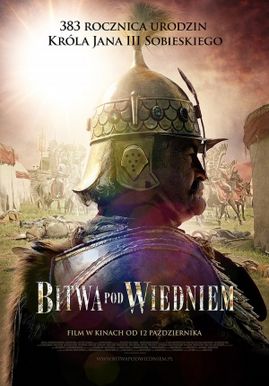
In the 2012 Polish and Italian historical drama film The Day of the Siege: September Eleven 1683 about the Battle of Vienna, Marco d’Aviano is portrayed by F. Murray Abraham.
Legend has it that when the Ottomans fled before the European army, they left behind a lot of their strong, bitter coffee. The Christian soldiers, to make this liberated coffee more palatable, mixed it with honey and milk and named the drink after Mark’s Order, the Capuchins and thus Cappuccino was created. It is probably just a fable but I favour believing it, allowing the reminder of a quick prayer to Blessed Mark whenever I drink one. We can never have too many intercessors, can we?
In the judgement of historians, Marco’s influence over Leopold was exercised responsibly, in the sole interests of Christianity and of the House of Austria. In one of his private letters to the Emperor, Marco actually scolds him quite forcefully for granting a benefit to one of his brothers, reminding him that, by so doing, he was only providing ammunition for the enemies of their cause.
Blessed Mark died of cancer on August 13, 1699 in Vienna. He is buried in the Kapuzinerkirche, in whose vault the Habsburg emperors are buried. He was Beatified on 27 April 2003 by St Pope John Paul II.
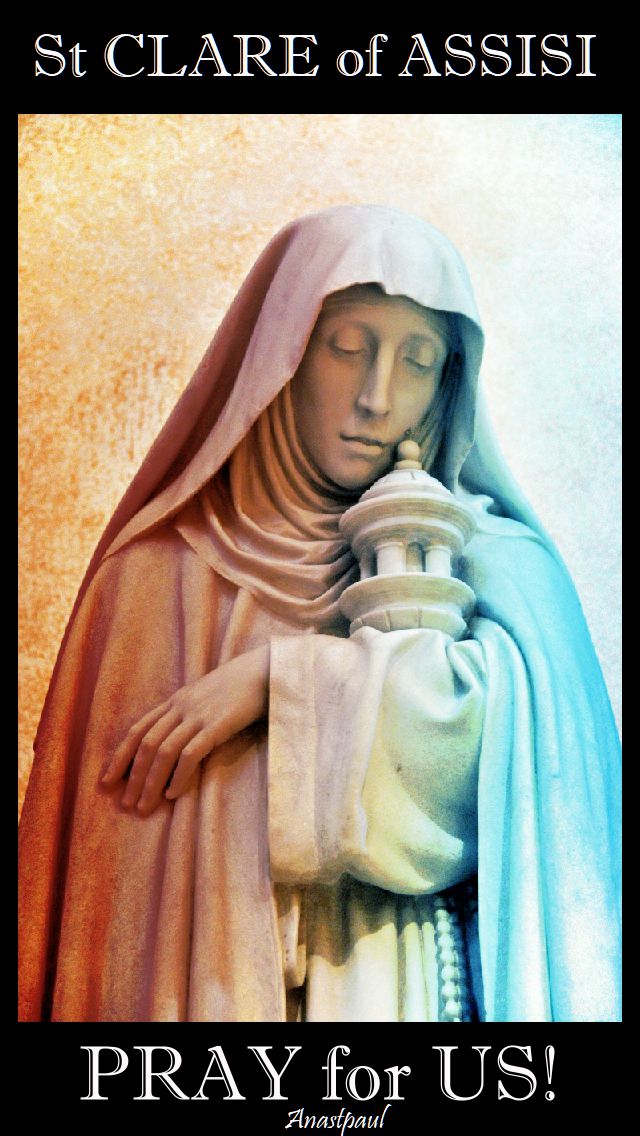
Quote/s of the Day – 11 August – The Memorial of St Clare of Assisi (1194-1253)
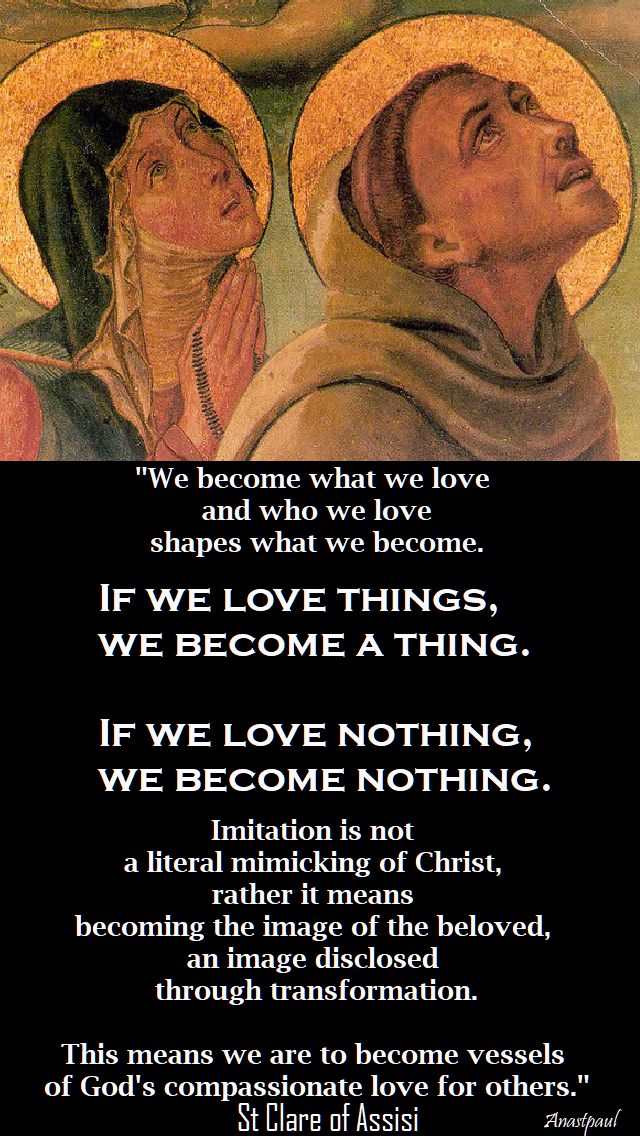
“We become what we love and who we love shapes what we become. If we love things, we become a thing. If we love nothing, we become nothing. Imitation is not a literal mimicking of Christ, rather it means becoming the image of the beloved, an image disclosed through transformation. This means we are to become vessels of God’s compassionate love for others.”
St Clare’s second letter to Blessed Agnes of Prague
“ Blessed be You, O God, for having created me. ”
St Clare’s Last Words
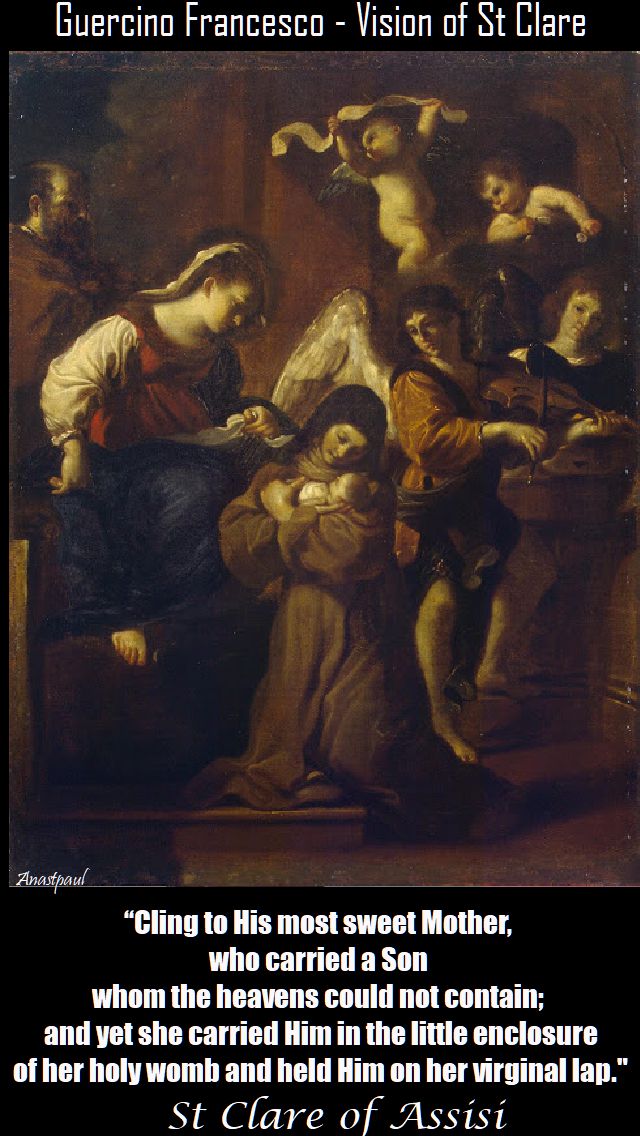
“Cling to His most sweet Mother, who carried a Son whom the heavens could not contain; and yet she carried Him in the little enclosure of her holy womb and held Him on her virginal lap.”
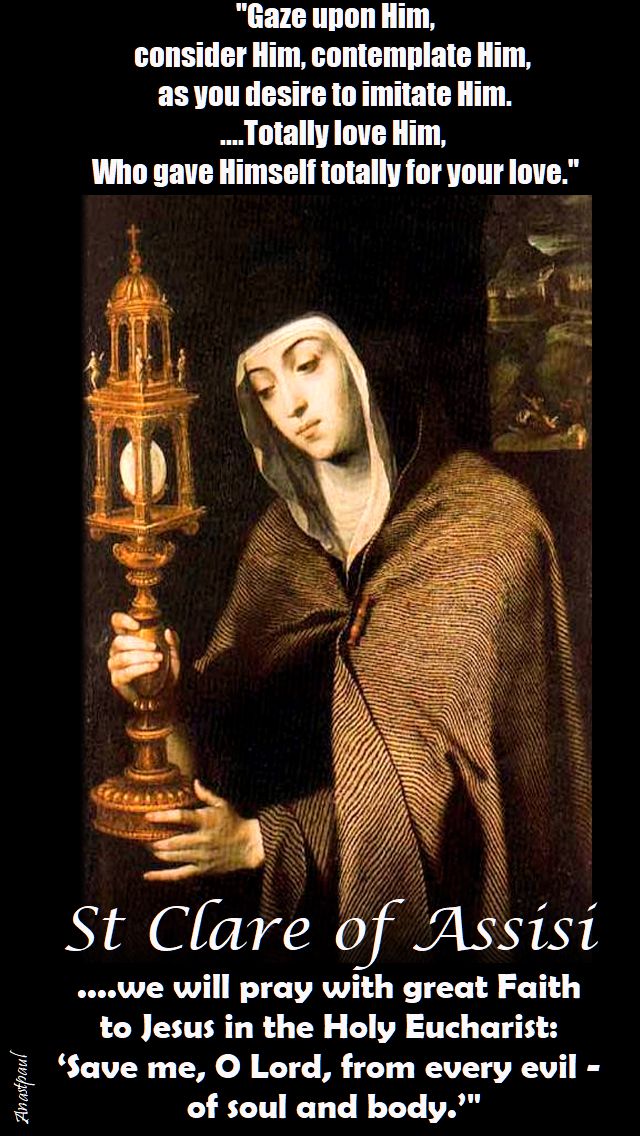
“Gaze upon Him, consider Him, contemplate Him, as you desire to imitate Him. ….Totally love Him, Who gave Himself totally for your love.”
“They say that we are too poor but can a heart which possesses the infinite God be truly called poor? We should remember this miracle of the Blessed Sacrament when in Church. Then we will pray with great Faith to Jesus in the Holy Eucharist: ‘Save me, O Lord, from every evil – of soul and body.’”
St Clare of Assisi (1194-1253)
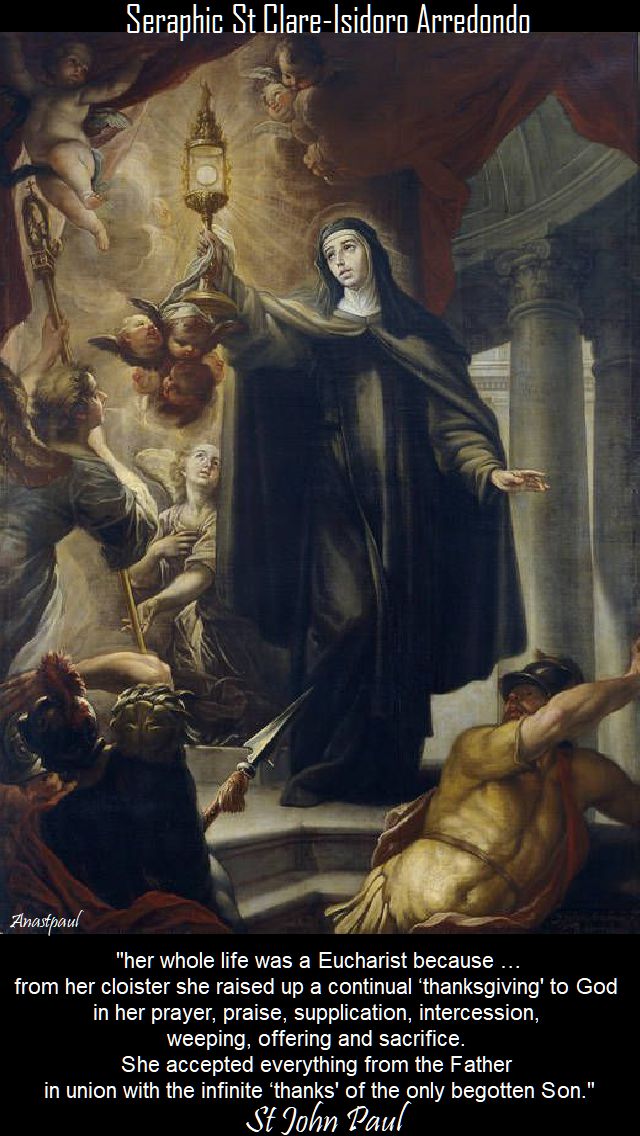
St Pope John Paul II said of Saint Clare: “her whole life was a Eucharist because … from her cloister she raised up a continual ‘thanksgiving’ to God in her prayer, praise, supplication, intercession, weeping, offering and sacrifice.
She accepted everything from the Father in union with the infinite ‘thanks’ of the only begotten Son.”
One Minute Reflection – 11 August – Saturday of the Eighteenth week in Ordinary Time, Year B – Today’s Gospel: Matthew 17:14–20
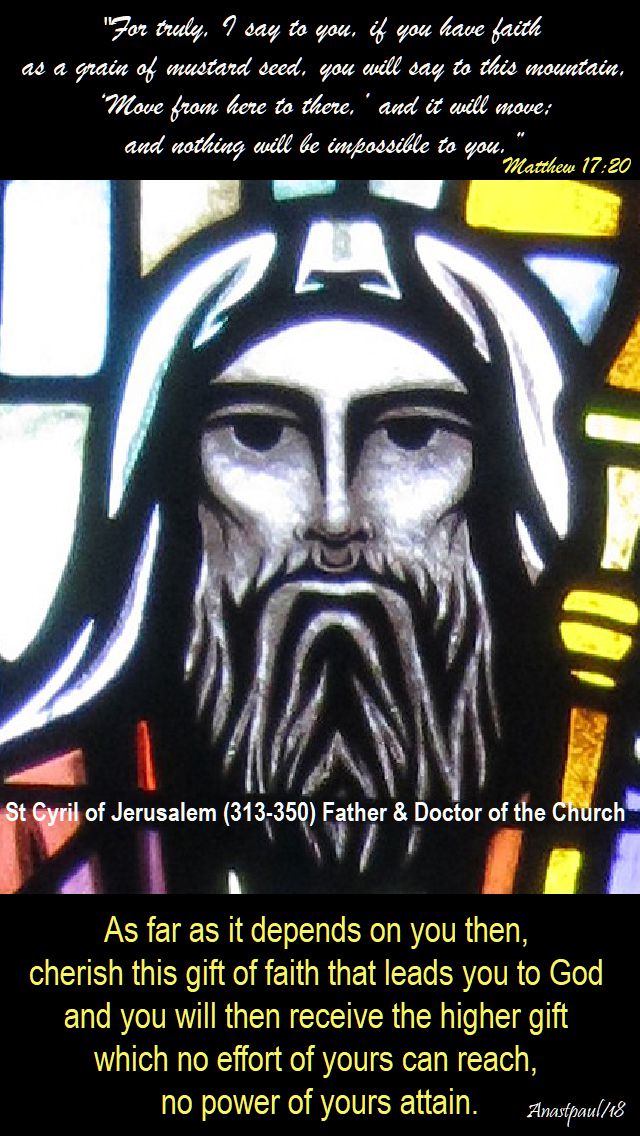
He said to them, “Because of your little faith. For truly, I say to you, if you have faith as a grain of mustard seed, you will say to this mountain, ‘Move from here to there,’ and it will move; and nothing will be impossible to you.”…Matthew 17:20
REFLECTION – “The word “faith” has one syllable but two meanings. First of all it is concerned with doctrine and it denotes the assent of the soul to some truth. Faith in this sense brings blessing and salvation to the soul, as the Lord said: “He who hears my word and believes in him who sent me, has eternal life.” (Jn 5:24)…
The word “faith” has a second meaning: it is a particular gift and grace of Christ. “To one is given throu gh the Spirit the utterance of wisdom and to another the utterance of knowledge according to the same Spirit, to another faith by the same Spirit, to another gifts of healing” (1Cor 12:8-9). Faith in the sense of a particular divine grace conferred by the Spirit is not, then, primarily concerned with doctrine but with giving a person powers quite beyond their natural capability. Whoever has this faith will say to a mountain: “Move from here to there” and it will move and anyone who can in fact say these words through faith and “believes without hesitation that they will come to pass,” (Mk 11:23) receives this particular grace. It is to this kind of faith that the Lord’s words refer: “If you have faith as a grain of mustard seed.” Now a mustard seed is small in size but its energy thrusts it upwards with the force of fire. Small are its roots, great the spread of its boughs and once it is fully grown the birds of the air find shelter in its branches (Mt 13:32). So too, in a flash, faith can produce the most wonderful effects in the soul.
Enlightened by faith the soul gazes at the glory of God so far as human nature allows and, even before the consummation of all things, ranging beyond the boundaries of the universe, it has a vision of the judgement and of God making good the rewards he promised. As far as it depends on you then, cherish this gift of faith that leads you to God and you will then receive the higher gift which no effort of yours can reach, no power of yours attain.”…Saint Cyril of Jerusalem (313-350) Bishop of Jerusalem, Father & Doctor of the Church (Baptismal Catechesis 5)
PRAYER – Holy God, grant we pray, Your Holy Spirit of love and divine grace to grow ever more in faith. By our prayers and love for You and our neighbour, may we merit Your divine assistance. Lord Jesus, help us to dwell often on the manner in which we are following You. Let us strive each day to become more and more like You in all things and, to become beacons of Your Light, to all the world. St Clare of Assisi, you who were a light to all, pray for us, amen.
Our Morning Offering – 11 August – The Memorial of St Clare of Assisi(1194-1253)
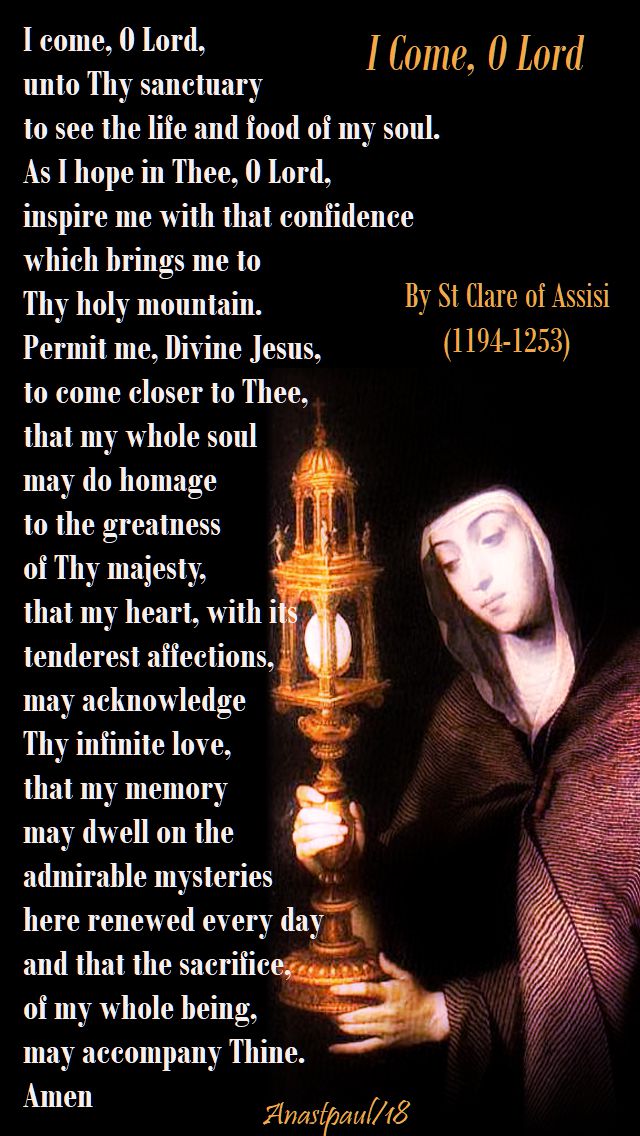
I Come, O Lord By St Clare of Assisi (1194-1253)
I come, O Lord,
unto Thy sanctuary
to see the life and food of my soul.
As I hope in Thee, O Lord,
inspire me with that confidence
which brings me to Thy holy mountain.
Permit me, Divine Jesus,
to come closer to Thee,
that my whole soul may do homage
to the greatness of Thy majesty,
that my heart,
with its tenderest affections,
may acknowledge Thy infinite love,
that my memory may dwell
on the admirable mysteries
here renewed every day
and that the sacrifice,
of my whole being,
may accompany Thine.
Amen
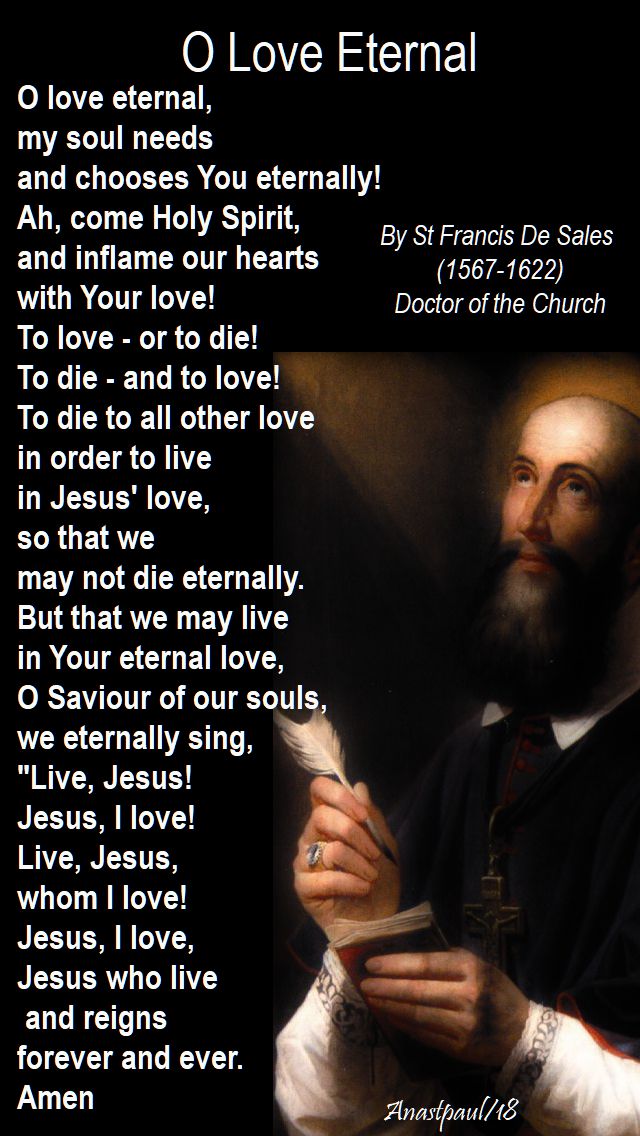
Our Morning Offering – 10 August – Feast of St Lawrence, Martyr (died 258)
O Love Eternal By St Francis De Sales OFM Cap (1567-1622) Doctor of the Church
O love eternal,
my soul needs
and chooses You eternally!
Ah, come Holy Spirit,
and inflame our hearts with Your love!
To love – or to die!
To die – and to love!
To die to all other love
in order to live in Jesus’ love,
so that we may not die eternally.
But that we may live in Your eternal love,
O Saviour of our souls,
we eternally sing,
“Live, Jesus!
Jesus, I love!
Live, Jesus, whom I love!
Jesus, I love,
Jesus who lives and reigns
forever and ever.
Amen















You must be logged in to post a comment.