Posted in franciscan OFM, Our MORNING Offering, PRAYERS of the SAINTS, The HOLY CROSS

Our Morning Offering – 29 January

Our Morning Offering – 29 January – Tuesday of the Third week in Ordinary Time, Year C

Prayer Before a Crucifix
By St Francis of Assisi (c 1181-1226)

Most High glorious God,
enlighten the darkness of my heart.
Give me right faith,
sure hope
and perfect charity.
Fill me with understanding
and knowledge
that I may fulfil
Your command.
Amenprayer before a crucifix - st francis - 29 jan 2019.jpg

Posted in franciscan OFM, SAINT of the DAY

Saint of the Day – 29 January – the Servant of God Brother Juniper OFM (Died 1258)

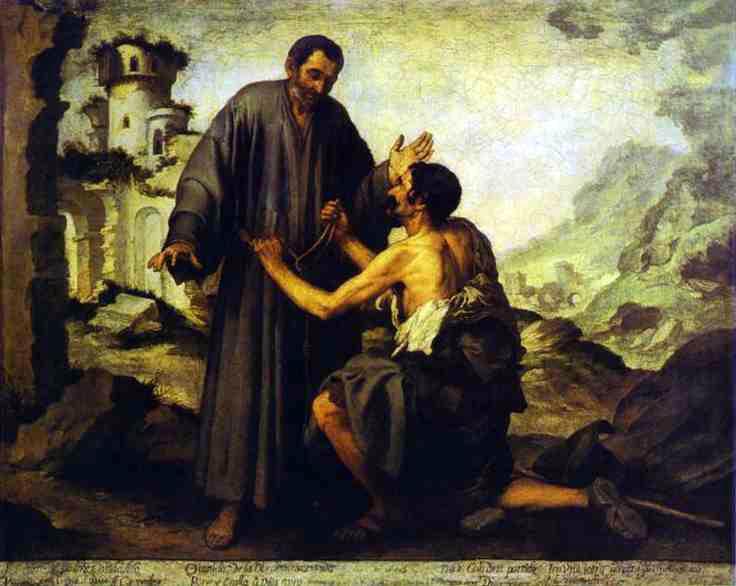
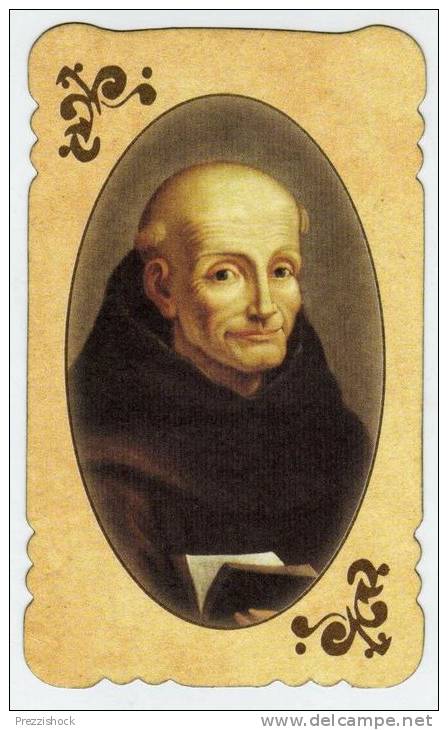
Saint of the Day – 29 January – the Servant of God Brother Juniper OFM (Died 1258) – Franciscan Friar.   Brother Juniper is called “the renowned jester of the Lord” and was one of the original followers of St Francis of Assisi.   Not much is known about Juniper before he joined the friars.   In 1210, he was received into the Order of Friars Minor by St Francis himself.   “Would to God, my brothers, that I had a whole forest of such Junipers” Saint Francis would say.Bartolomé_Esteban_Murillo-_Brother_Juniper_and_the_Beggar.JPG

We don’t know much about Juniper before he joined the friars in 1210.   Francis sent him to establish “places” for the friars in Gualdo Tadino and Viterbo.   When Saint Clare was dying, Juniper consoled her.   He was devoted to the passion of Jesus and was known for his simplicity.

Several stories about Juniper in the Little Flowers of St Francis illustrate his exasperating generosity.   Once Juniper was taking care of a sick man who had a craving to eat pig’s feet.   This helpful friar went to a nearby field, captured a pig and cut off one foot and then served this meal to the sick man.   The owner of the pig was furious and immediately went to Juniper’s superior.   When Juniper saw his mistake, he apologised profusely.   He also ended up talking this angry man into donating the rest of the pig to the friars!the-little-flowers-of-st-francis1

Another time Juniper had been commanded to quit giving part of his clothing to the half-naked people he met on the road.   Desiring to obey his superior, Juniper once told a man in need that he couldn’t give the man his tunic but he wouldn’t prevent the man from taking it either.   In time, the friars learned not to leave anything lying around, for Juniper would probably give it away.

He died in 1258 and is buried at Ara Coeli Church in Rome.   He was never formally Beatified.

Aracoeli-fachada.jpg
Ara Coeli Church in Rome

St Junípero Serra OFM (1713–1784), born Miquel Josep Serra i Ferrer, took his religious name in honour of Brother Juniper when he was received into the Order.

St Francis said of him:  A perfect friar would have “the patience of Brother Juniper, who attained the state of perfect patience because he kept the truth of his low estate constantly in mind, whose supreme desire was to follow Christ on the way of the cross.” 

Posted in DOMINICAN OP, franciscan OFM, MARIAN QUOTES, PRACTISING CATHOLIC, QUOTES of the SAINTS, QUOTES on LOVE, QUOTES on SACRIFICE, QUOTES on SUFFERING, SAINT of the DAY

Quote/s of the Day – 23 January – The Memorial of St Ildephonsus (607-667), Blessed Henry Suso OP (1295-1366) and St Marianne Cope (1838-1918)

Quote/s of the Day – 23 January – The Memorial of St Ildephonsus (607-667), Blessed Henry Suso OP (1295-1366) and St Marianne Cope (1838-1918)

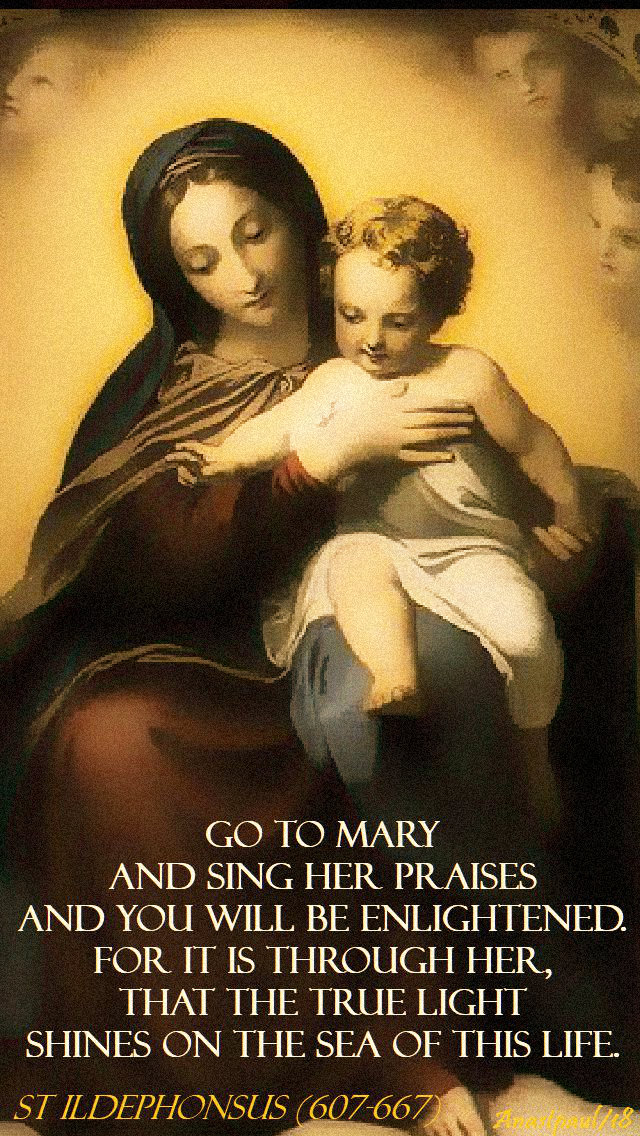
“Go to Mary and sing her praises
and you will be enlightened.
For it is through her,
that the true Light
shines on the sea of this life.”

St Ildephonsus (607-667)go-to-mary-st-ildephonsus-23-jan-2018.jpg

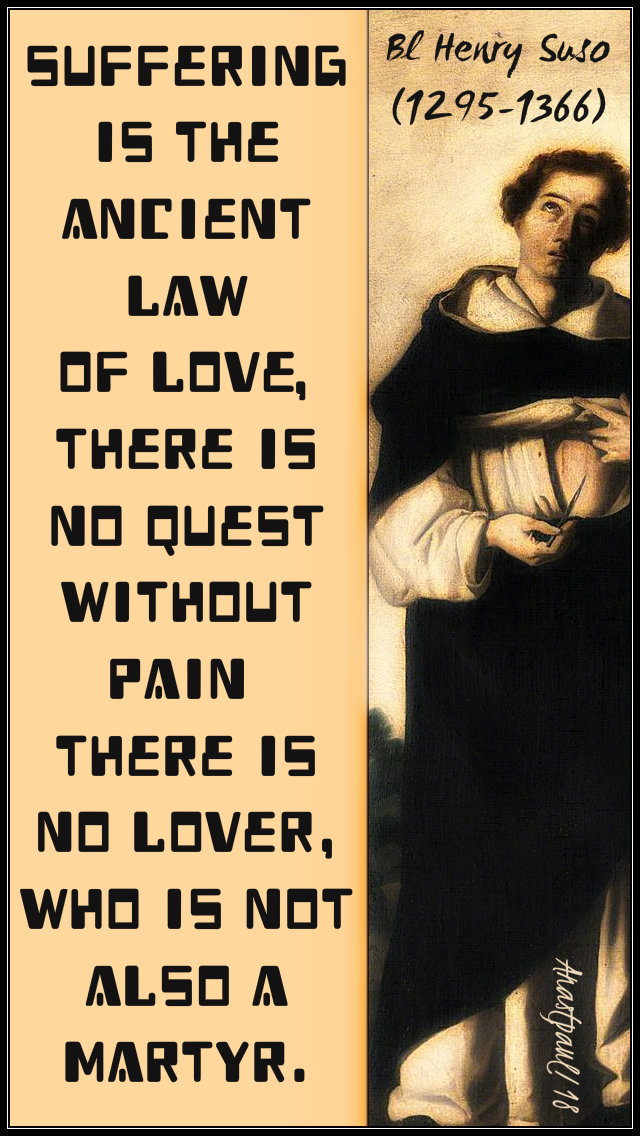
“Suffering is the ancient law of love;
there is no quest without pain;
there is no lover,
who is not also a martyr.”

Blessed Henry Suso (1295-1366)suffering is the ancient law of love - bl henry suso 23 jan 2019.jpg

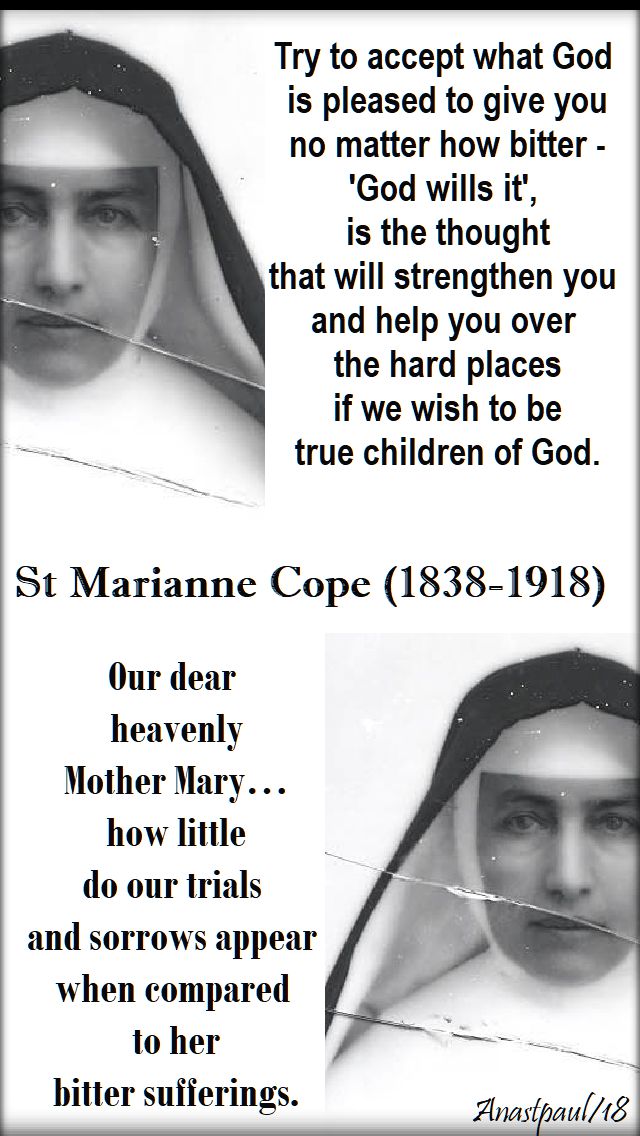
“Try to accept what God
is pleased to give you
no matter how bitter –
‘God wills it’,
is the thought
that will strengthen you
and help you over
the hard places
if we wish to be
true children of God.”

“Our dear
heavenly Mother Mary…
how little do our trials
and sorrows appear
when compared
to her bitter sufferings.”

St Marianne Cope (1838-1918)try-to-accept-what-god-st-marianne-cope-23-jan-2018.jpg

Posted in franciscan OFM, SAINT of the DAY

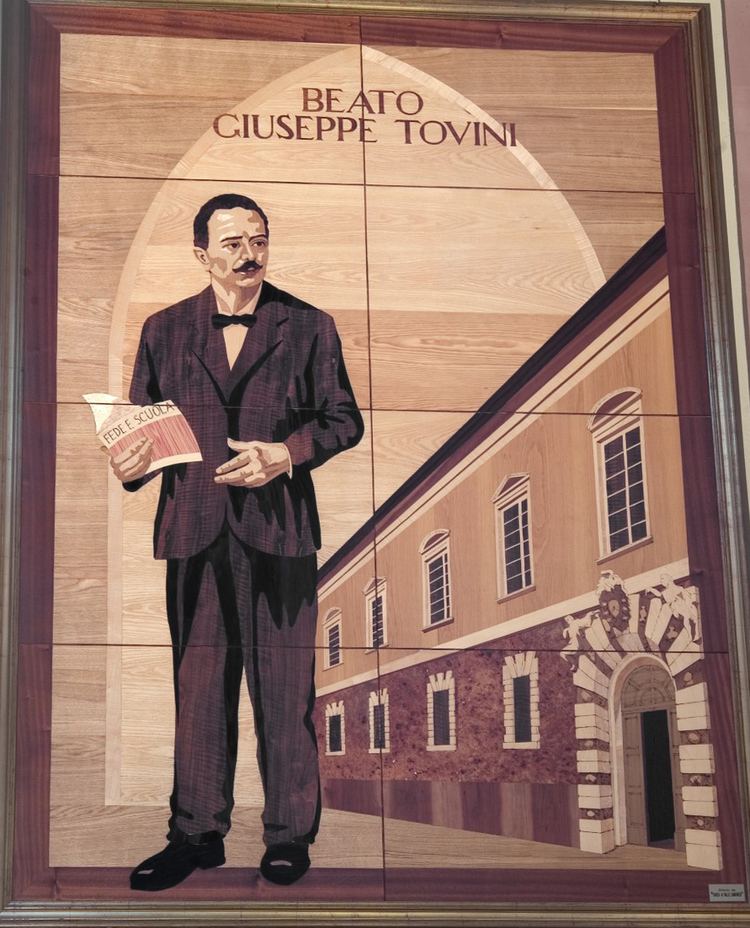
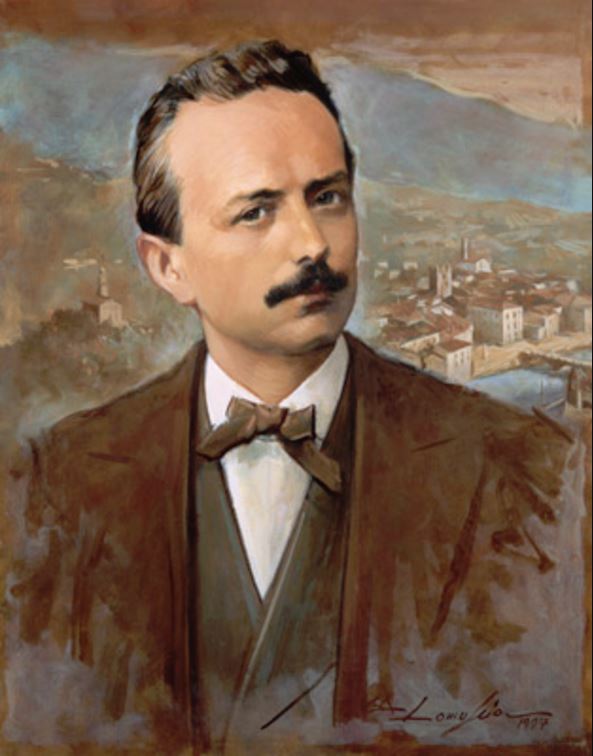
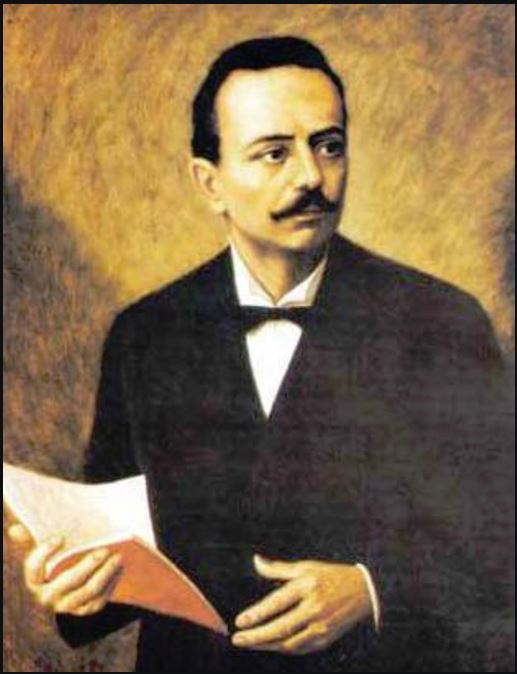
Saint of the Day – 16 January – Blessed Giuseppe Tovini OFS (1841-1897)

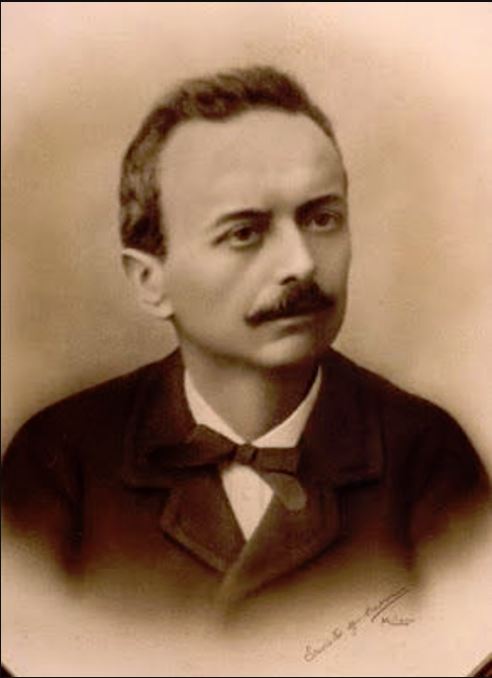
Saint of the Day – 16 January – Blessed Giuseppe Tovini OFS (1841-1897) Italian banker and lawyer who became a member of the Secular Franciscan Order, Social and Catholic educational activist, as well as charitable assistance and involved in the beginnings of Catholic Action.   His nephew was Blessed Mosè Tovini (1877– 1930).   He was born on 14 March 1841 as  Giuseppe Antonio Tovini, in Cividate Camuno, Brescia, Italy and died on 16 January 1897 in Brescia, Italy of natural causes.    Patronages – Franciscan tertiaries, Lawyers, Bankers, Cividate Camuno.giuseppe-tovini-6466887b-b082-4ac8-91df-a5a368ce1b6-resize-750

Giuseppe Antonio Tovini was born in 1841 as the first of seven children to Mosè Tovini and Rosa Malaguzzi.   He went to high school in Bergamo from 1852 to 1858 and later graduated from the University of Pavia in August 1865.   He then moved to Brescia in 1867 to become a lawyer and obtained all the appropriate qualifications to practice law in 1868.

He later married Emilia Corbolani on 6 January 1875 and they went on to have a total of ten children.   One son became a Jesuit priest and two daughters became nuns.   From 1871 to 1874, Tovini served as the mayor of Cividate Camuno, his birthplace.   As mayor, he made important decisions in the life of the city from promoting the establishment of banks to the construction of infrastructure like railway lines.  Most importantly, he worked to defend and help the poor and alienated.bl giuseppe my edit.JPG

Tovini also became a member of the Secular Franciscan Order and was among the founders of a Catholic newspaper which published its first edition in 1878 after its founding on 3 April.   He founded Banca di Valle Camonica in 1872, Banca San Paolo di Brescia in Brescia in 1888, Banco Ambrosiano in Milan in 1896.

In 1882 he founded Saint Joseph’s Kindergarten and helped founded the Union Leone XIII to support the faith of students in university in Brescia and worked support similar groups in other schools.   He founded the magazine Modern Italian School in 1893 and  the weekly journal La Voce del Popolo in 1893.    He helped the Canossian sisters found a teaching college in Cividate Camuno in 1894.    He also supported the Catholic University Federation and the creation of Catholic universities in Italy.  Further still, Blessed Giuseppe founded the Banca Santa Paolo in Brescia in 1888 and the Society for the Preservation of the Faith in Italian Schools in 1890.    The journal Faith and School was founded by Giuseppe in 1891.  bl giuseppe - upsized my edit

He died in 1897 with a reputation for personal holiness.

The cause of beatification was introduced on 14 April 1977 under Pope Paul VI  (who was a great admirer of Bl Giuseppe).   St Pope John Paul II declared he lived a life of heroic virtue and made him Venerable on 6 April 1995 and approved a miracle attributed to his intercession on 18 December 1997.   He was beatified on 20 September 1998.bl giuseppe vintage my edit

Posted in franciscan OFM, SAINT of the DAY

Saint of the Day – 11 January – St Tommaso da Cori OFM (1655-1729)

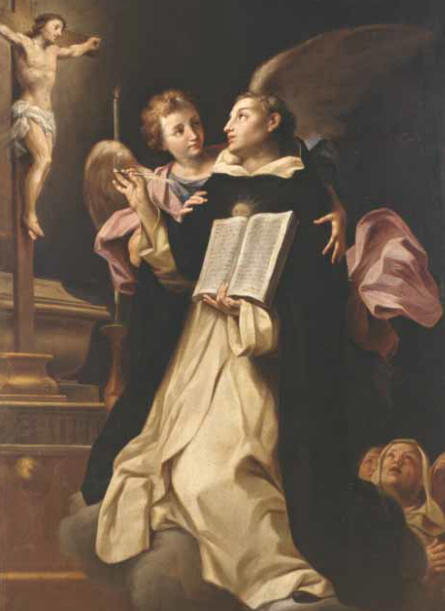
Saint of the Day – 11 January – St Tommaso da Cori OFM (1655-1729) Franciscan Friar and Priest, Preacher, Spiritual advisor, Evangeliser, Apostle of the Holy Eucharist, Prayer and Charity – known as the “Apostle of the Sublacense” – born Francesco Antonio Placidi on 4 June 1655 in Cori, Latina, Italy as Francesco Antonio Placidi and died on 11 January 1729 at Bellegra, Rome, Italy of natural causes.   Patronages – Subiaco, Province of Rome (co-patron), Preachers.119tomaso4_zpsfb73ac5d

St Tommaso was born in Cori (Latina) on 4 June 1655.   He knew a childhood marked by the premature loss first of his mother and then of his father, thus being left alone at the age of 14 to look after his younger sister.   Shepherding sheep, he learned wisdom from the simplest things.   Once his sister was married, the youth was free to follow the inspiration that for some years he had kept in the silence of his heart – to belong completely to God in the Religious Life of a Franciscan.   He had been able to get to know the Friars Minor in his own village at the St Francis convent.   Once his two sisters were settled in good marriages and he was rendered free of all other preoccupations, he was received into the Order and sent to Orvieto (PG) to fulfill his novitiate year.   After professing his vows according to the Rule of St Francis and completing his theological studies, he was ordained to the priesthood in 1683.   He was immediately nominated vice master of novices at Holy Trinity convent in Orvieto, since his superior recognised at once his gifts.

After a short time, Fr Tommaso heard of the hermitages that were beginning to bloom in the Order and the intention of the superiors of the Roman Province to inaugurate one at the convent at Civitella (today Bellegra).   His request was accepted and the young friar thus knocked at the door of the poor convent in 1684, saying, “I am Fr Tommaso of Cori and I come here to become holy!”   In speech perhaps distant from ours, he expressed his anxiousness to live the Gospel radically, after the spirit of Saint Francis.st tommaso young

From then, Fr Tommaso lived at Bellegra until death, with the exception of six years in which he was Guardian at the convent of Palombara, where he initiated the Hermitage modelled after the one at Bellegra.   He wrote the Rule first for one and then for the other, observing it scrupulously and consolidating by word and example the new institution of the two Hermitages.

The long years spent at Saint Francis of Bellegra can be summed up in three points:

Prayer:
St Tommaso of Cori was surely – as is said of St Francis – not so much a man who prayed as a man who became prayer.   This dimension animated the entire life of the founder of the Hermitage.   The most evident aspect of his spiritual life was undoubtedly the centrality of the Eucharist, as attested by St Tommaso in his celebration of the Eucharist, which was intense and attentive and in the silent prayer of adoration during the long nights at the Hermitage after the Divine Office, celebrated at midnight.   His life of prayer was marked by a persistent aridity of spirit.   The total absence of sensible consolation in prayer and in his life of union with God was protracted for a good 40 years, finding him always serene and totally in living the primacy of God.   Truly, his prayer was configured as a remembrance of God that made concretely possible a unity of life, notwithstanding his manifold activities.

Evangelisation:
St Tommaso did not close himself up in the Hermitage, forgetting the good of his brothers and sisters, and the heart of the Franciscan vocation, which is apostolic.   He was called with good reason the Apostle of Sublacense (the Subiaco region), having crossed the territory and its villages with the indefatigable proclamation of the Gospel, in the administration of the sacraments and the flowering of miracles at his passage, a sign of the presence and nearness of the Kingdom.   His preaching was clear and simple, convincing and strong.   He did not climb the most illustrious pulpits of his time, his personality was able to give its best in an ambit restricted to our territory, living his Franciscan vocation in littleness and in the concrete choice of the poorest.

Exquisite charity:
St  Tommaso of Cori was to his brothers, a very gentle father.   In the face of the resistance of some brothers before his will to reform and his radicality in living the Franciscan ideal, the Saint knew how to respond with patience and humility, even finding himself alone to mind the convent.   He had understood well that every true reform initiates itself.st tomasso of cori

The considerable correspondence left by him, demonstrates St Tommaso’ attention to the smallest expectations and needs of his Friars and of numerous friends, penitents and Friars who turned to him for his counsel.   In the convent, he demonstrated his spirit of charity in his availability for every necessity, even the most humble.

Rich in merits, he fell asleep in the Lord on 11 January 1729.   St Tommaso of Cori shines among us and in Rome, of which he is the co-patron, above all in his thirst for a Christian and Franciscan ideal that is pure and lived in its essentials.   A inspiration for all of us, not to take lightly the Gospel and its all-encompassing exigencies….Vatican.vastatua-san-tommaso-da-cori-620x639

St Tommaso’s body is enshrined in the Franciscan Chapel of Bellagra.   He was Beatified on 3 September 1786, at Saint Peter’s Basilica, by Pope Pius VI and Canonised on 21 November 1999, at Saint Peter’s Square, Vatican City by St Pope John Paul II.st tommaso body

Posted in franciscan OFM, SAINT of the DAY, VATICAN Resources

Saint of the Day – 8 January – Blessed Eurosia Fabris (1866-1932) “Mamma Rosa”

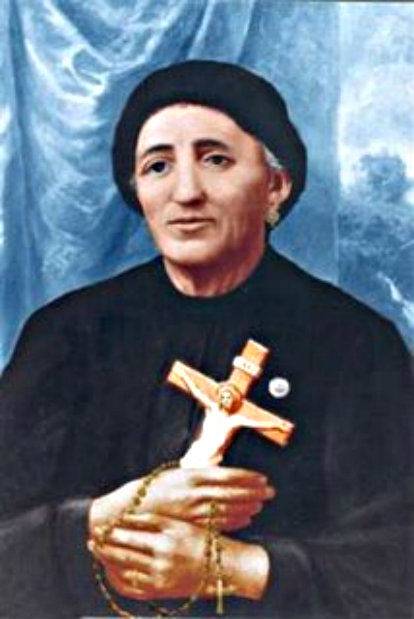
Saint of the Day – 8 January – Blessed Eurosia Fabris (1866-1932) “Mamma Rosa”Laywoman, Wife and Mother, Secular Franciscan, Apostle of Charity, Marian devotee, Apostle of Prayer and of the Holy Eucharist – born on 27 September 1866 in Quinto Vicentino, Italy and died on 8 January 1932 at Marola di Torri, Vicenza, Italy of natural causes.bl eurosia fabris 1855-1932.jpg
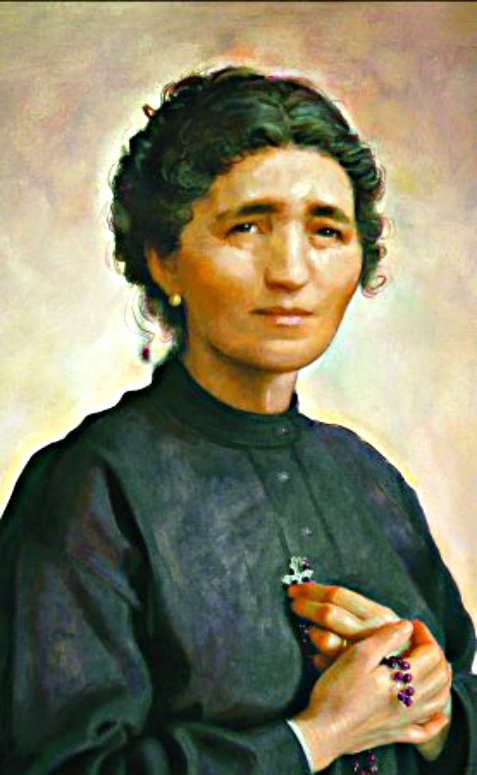
Eurosia Fabris was born in Quinto Vicentino, an agricultural area, some kilometers from Vicenza in Italy, on 27 of September 1866.   Her parents, Luigi and Maria Fabris, were farmers.   In 1870, at the age of four, Eurosia moved with her family to Marola, a village in the municipality of Torri di Quartesolo (Vicenza).   She lived there for the rest of her life.   She attended only the first two years of elementary school between 1872 and 1874 because even at such a young age, she was forced to help her parents with farm work and her mother in particular with the household chores.   It was enough, however, for her to learn to read and write with the help of the Holy Scriptures or religious books such as the Catechism, Church history, the Philothea and the Eternal Maxims of St Alfonso Liguori.

Besides her domestic tasks, she helped her mother in her work as a dressmaker, a practice which Eurosia would also take on later.   Even as a child, she was rich in virtue and spirituality, always very careful in providing for the needs of her family.

She was twelve years old when she made her First Holy Communion.   From then on, she received Holy Eucharist on all religious feasts, since at that time daily communion was not the practice.   It was not until 1905 that daily communion was permitted by a Decree of Pope St Pius X.

Eurosia joined the Association of the Daughters of Mary in the parish church of Marola, and was faithful in participating in their devotions.   She diligently observed the practices of the group which helped increase in her a love for Mary.   In Marola, she lived within sight of the shrine of the Madonna of Monte Berico.

Her favourite devotions were to the Holy Spirit, the infant Jesus, the Cross of Christ, the Eucharist, the Virgin Mary and the souls in the Purgatory.   She was an apostle of good will in her family, among her friends and in her parish, where she taught catechism to the children and sewing to the girls who came to her home.

At the age of eighteen, Eurosia was a dedicated, pious and hardworking young lady. These virtues, along with her pleasant personality, did not go unobserved and several young men proposed marriage to her, though she did not feel called to accept.

In 1885, Rosina, as she was called by her family, was affected by a tragic event.   A young married woman near her home died leaving three very young daughters.   The first of them died shortly after her mother.   The other two girls, Chiara Angela and Italia were only 20 months old and 2 months old, respectively.   The father of these girls was away, living with his uncle and a grandfather who suffered from a chronic disease.   They were three very different men, always quarrelling among themselves.

For six months, every morning, Rosina would go to care for the children and take care of their home.   Later, following the advice of her relatives and that of the parish priest and after praying about this turn of events, she decided to marry.   Rosina was joined in marriage to a man named Carlo Barban, well aware of the sacrifices that married life would hold for her in the future.   She accepted this fact as the will of God who she now felt was calling her through these two babies to embrace a new mission.   The parish priest would often comment:  “This was a true act of heroic charity towards others.”

The marriage was celebrated on the fifth of May 1886 and, in addition to the two orphaned babies, was blessed with nine other children.   Her home was always opened to other children as well.   Among them were Mansueto Mazzuco, who became a member of the Order of Friars Minor, taking the name, Brother Giorgio.   To all these children, “Mamma Rosa”, as she was called since her marriage, offered affection and care, sacrificing her own needs to provide for them a solid Christian formation.  Between 1918-1921, three of her sons were ordained priests, two for the Diocesan clergy and one as a Franciscan (Fr Bernardino), who would become her first biographer.

Once married, she embraced her marital obligations, always showing the greatest love and respect for her husband and becoming his confidante and adviser.   She had a tender love for all her children.   She was a hard worker and a person who could be counted on to fulfil her duties.

Mamma Rosa lived an intense life of prayer, which was evident by her great devotion to God love’s, to the Holy Eucharist and to the Blessed Virgin Mary.   Like the strong woman in Sacred Scripture, she became a real treasure to her family.   She knew how to balance the family budget and at the same time exercised great charity towards the poor, sharing her daily bread also with them.   She cared for the sick and gave them continuous assistance, showing heroic strength during the final illness of her husband Carlo, who died in 1930.

Mamma Rosa became a member of the Franciscan Third Order, known today as the Secular Franciscans.   She faithfully attended all their meetings but above all tried to live the true Franciscan spirit of poverty and joy in her home, in the midst of her daily work and prayer.   She had a gentle manner with everyone and praised God as the Creator and source of all good and the giver of all hope.

Mama Rosa’s family home was an ideal Christian community where her children were taught to pray, to obey, to respect the will of God and to practice Christian virtues.   In her vocation as a Christian mother, Mamma Rosa sacrificed and consumed herself day by day like a lamp burning brightly on the altar of charity.   She died on 8 January 1932 and was buried, with the hope of final resurrection, in the church of Marola.

The canonical process of beatification and canonisation was initiated on 3 February 2005 at the Diocesan curia of Padova, after getting passed several difficulties and misunderstandings among the different juridical persons trying to promote the Cause.

Mamma Rosa was a model of holiness in what should be the daily life of a Catholic family.   Her three sons who became priests were encouraged in their vocation by her example of holiness.   She was proclaimed Venerable on the 7th of July, 2003, by St Pope John Paul II who recognised the testimony of her heroic and singular virtues.   It was the wish of Venerable Pope Pius XII that the life of this marvellous woman be known among all Christian families of our day…Vatican.va

Blessed Eurosia was Beatified on 6 November 2005 by Pope Benedict XVI
the recognition was celebrated by Cardinal Saraiva Martins at Vincenza, Italy.
blessed-eurosia-fabris-barban-jan-8

Posted in franciscan OFM, SAINT of the DAY

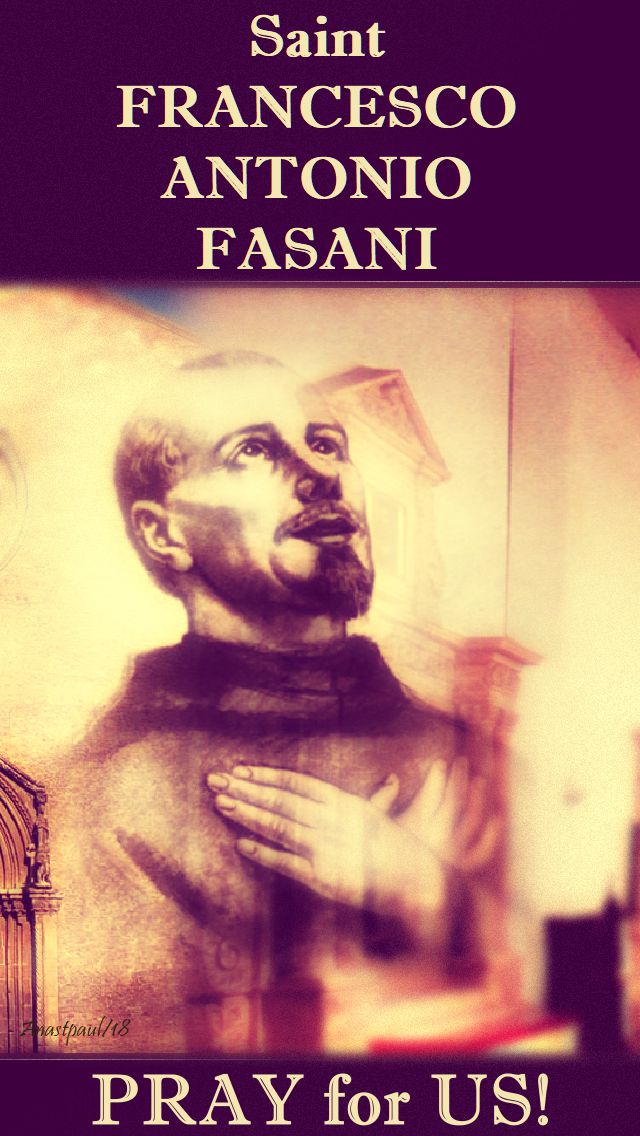
Thought for the Day – 29 November – The Memorial of St Francesco Antonio Fasani OFM Conv (1681 – 1742)

Thought for the Day – 29 November – The Memorial of St Francesco Antonio Fasani OFM Conv (1681 – 1742)

St Francesco was loving, devout and penitential.   He was a sought-after confessor and preacher.   One witness at the canonical hearings regarding Francesco’s holiness testified, “In his preaching he spoke in a familiar way, filled as he was with the love of God and neighbour; fired by the Spirit, he made use of the word and deed of holy Scripture, stirring his listeners and moving them to do penance.”   Francesco showed himself a loyal friend of the poor, never hesitating to seek from benefactors what was needed.

At his death in Lucera, children ran through the streets crying out, “The saint is dead! The saint is dead!”   Francesco was Canonised in 1986.

Eventually we become what we choose.   If we choose stinginess, we become stingy.   If we choose compassion, we become compassionate.   The holiness of Francesco Antonio Fasani resulted from his many small decisions to cooperate with God’s grace.

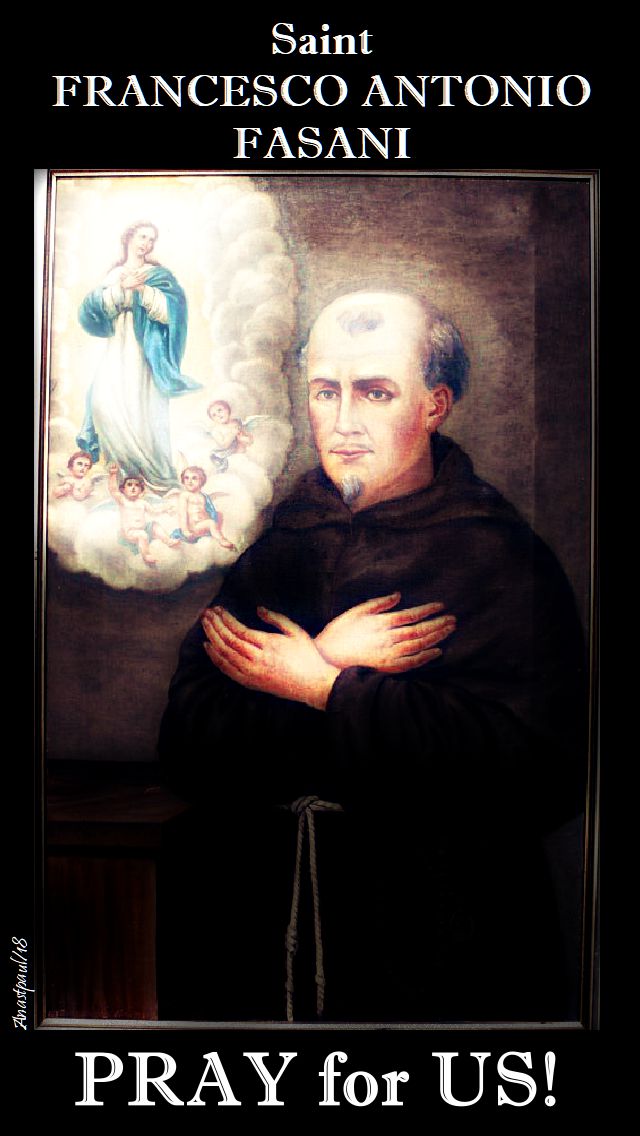
St Francesco Antonio Fasani, Pray for Us!st francesco antonio fasani pray for us - 29 nov 2018

Posted in franciscan OFM, QUOTES of the SAINTS, QUOTES on OBEDIENCE, QUOTES on TRUST and complete CONFIDENCE in GOD, SAINT of the DAY

Quote of the Day – 29 November – The Memorial of St Francesco Antonio Fasani OFM Conv (1681 – 1742)

Quote of the Day – 29 November – The Memorial of St Francesco Antonio Fasani OFM Conv (1681 – 1742)

“The Will of God –
that is my Paradise.”

St Francesco Antonio Fasani (1681 – 1742)the will of god that is my paradise st francesco antonio fasani - no 2 - 29nov2018

Posted in CATHOLIC Quotes, franciscan OFM, MORNING Prayers, PAPAL SERMONS, QUOTES on CONVERSION, QUOTES on GRACE, QUOTES on HEAVEN, SAINT of the DAY, The LAST THINGS, The WORD

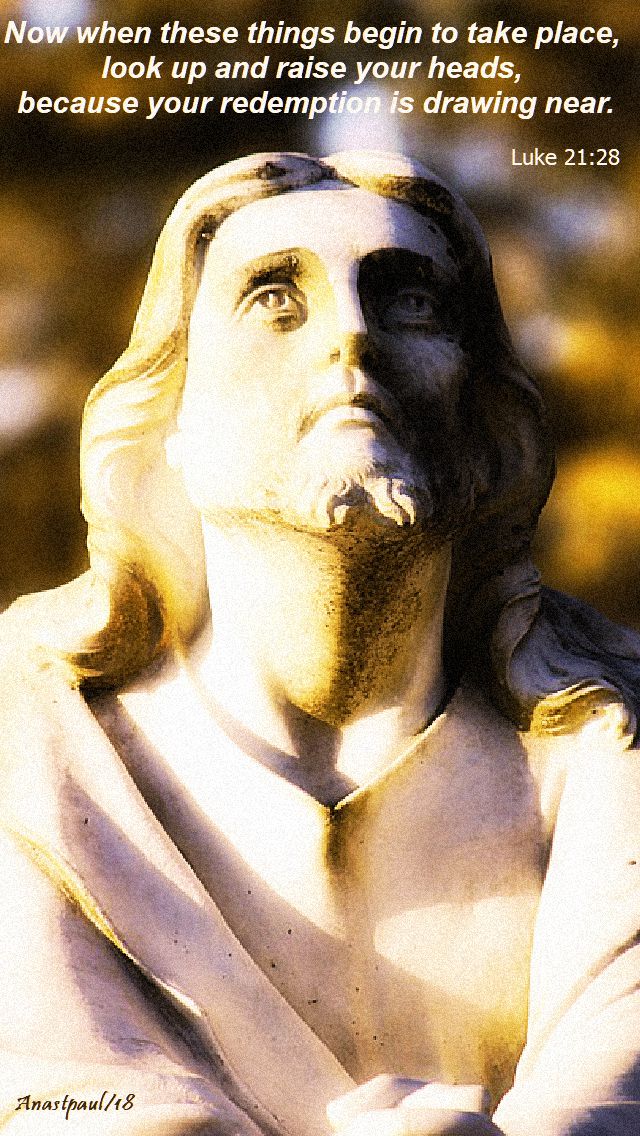
One Minute Reflection – 29 November – Today’s Gospel: Luke 21:20–28 – “Look up and raise your heads”

One Minute Reflection – 29 November – Today’s Gospel: Luke 21:20–28, Thursday of the Thirty Fourth week in Ordinary Time, Year B and the Memorial of St Francesco Antonio Fasani OFM Conv (1681 – 1742)

“Now when these things begin to take place, look up and raise your heads, because your redemption is drawing near.”...Luke 21:28now when these things begin to take place - luke 21 28 - 29nov2018

REFLECTION – “Babylon falls because of its corruption;  Jerusalem because of its distraction; its failing to welcome the Lord who comes to her rescue.   She did not feel the need of salvation.   She had the writings of the prophets, Moses and this was enough.  But sealed writings!   She left no room for salvation, her door was closed to the Lord!   The Lord was knocking at her door but there was no willingness to receive Him, to listen, to be rescued by Him.   And so she falls…
Corruption gives you a sort of happiness, it gives you power and it also makes you feel self-satisfied, however, it doesn’t leave room for the Lord, for conversion.   The word corruption speaks of many things today – of not only economic corruption but corruption with so many different sins.   The worst kind of corruption is the spirit of worldliness.
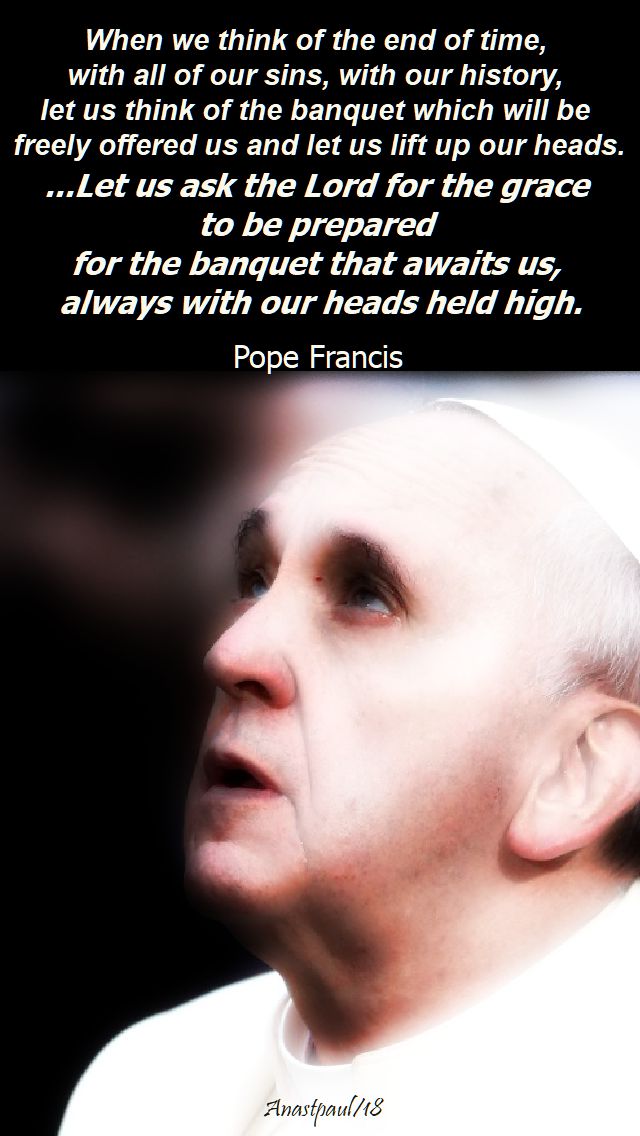
When we think of the end of time, with all of our sins, with our history, let us think of the banquet which will be freely offered us and let us lift up our heads.   Do not give way to depression:  Hope!   Reality is ugly.   There are many, many people, cities and people, so many people who are suffering; many wars, so much hatred, so much envy, so much spiritual worldliness and so much corruption.   Yes, it’s true!   All of this will fall!
Let us ask the Lord for the grace to be prepared for the banquet that awaits us, always with our heads held high.”…Pope Francis – Santa Marta, 27 November 2014when we think of the end of times - pope francis 29 nov 2018

PRAYER – Lord God, creator of all Light and creator of all good, grant that we may look up to You always and know that by Your Light and your goodness we are safe in this world of corruption.   May the Light of our Lord Jesus, make the path He has set out bright and clear and may the prayers of St Francesco Antonio Fasani be a help in our struggle.   Lead us, Lord, in Your kindness and mercy to the banquet which awaits us.  We make our prayer through Christ our Lord, with the Holy Spirit, God forever, amen.st francesco antonio fasani pray for us no 3 - 29 nov 2018

Posted in franciscan OFM, Our MORNING Offering, PRAYERS of the SAINTS, SAINT of the DAY

Our Morning Offering -29 November – Prayer to do the Will of God

Our Morning Offering -29 November – The Memorial of All Franciscan Saints and Blesseds and in particular, of St Francesco Antonio Fasani OFM Conv (1681 – 1742)

Prayer to do the Will of God
By St Francis of Assisi (c 1181-1226)

Almighty, eternal, just and merciful God,
grant us in our misery, the grace to do for You alone
what we know You want us to do
and always to desire, what pleases You.
Thus, inwardly cleansed, interiorly enlightened
and inflamed by the fire of the Holy Spirit,
may we be able to follow in the footprints of
Your beloved Son, our Lord Jesus Christ.
And, by Your grace alone, may we make our way to You,
Most High, Who live and rule in perfect Trinity and simple Unity
and are glorified God all-powerful, forever and ever.
Amen.
(From “A Letter to the Entire Order”)prayer to do the will of god by st francis of assisi - 29 nov 2018

Posted in franciscan OFM, SAINT of the DAY

Saint of the Day – 29 November – St Francesco Antonio Fasani (1681 – 1742) – 29 November

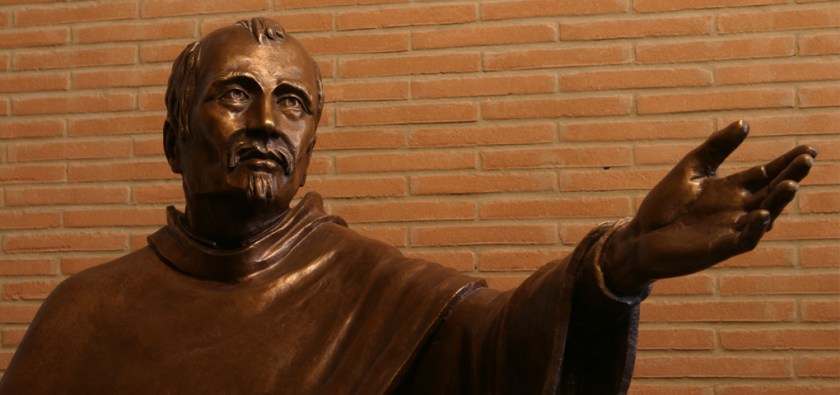
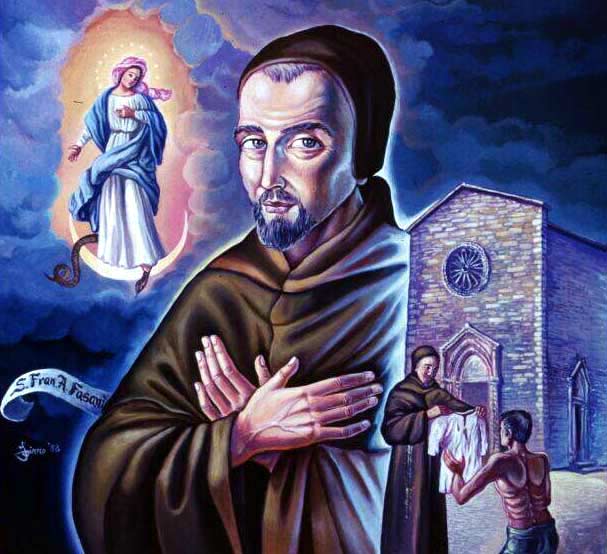
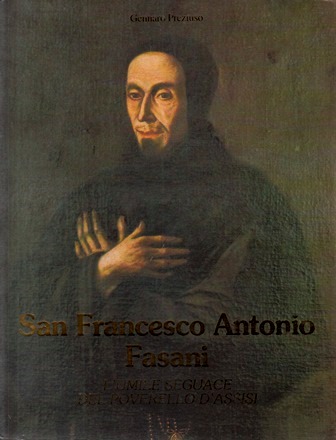
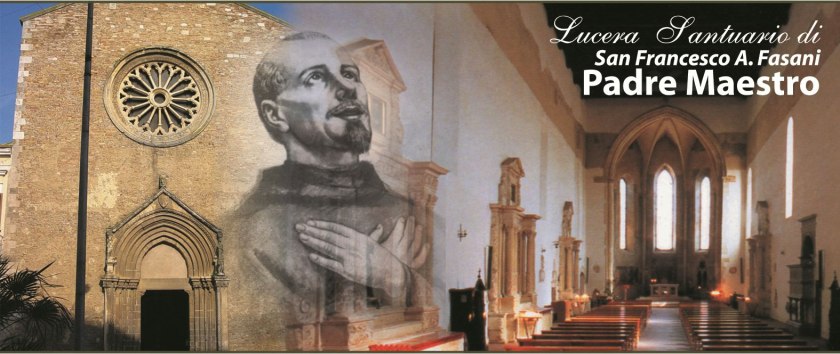
Saint of the Day – 29 November – St Francesco Antonio Fasani OFM Conv. (1681 – 1742) also known as Antony Fasani, Francis Anthony Fasani, Francis Fasani – was an Italian Friar and Priest of the Order of Conventual Friars Minor, Teacher, Confessor, Preacher, Mystic, Apostle of prayer and charity, Marian devotee – he was born on 6 August 1681 in Lucera, Foggia, Italy as Giovanniello Fasani and died on 29 November 1742 in Lucera, Foggia, Italy of natural causes.   Patronage – Lucera, his home town in Foggia.st fasani

St Francesco was the son of Giuseppe Fasani and Isabella della Monaca.   He began his studies at the Conventual friary in his town and there entered the Order, taking the religious names of Saints Francis and Anthony.   Fasani professed his religious vows in 1696.

Once having professed his vows, Fasani began theological studies in Agnone and continued them in the General Study Centre at Assisi, close to the tomb of St Francis.   It was there that Fasani was ordained to the priesthood in 1705.   He stayed in Assisi and completed his theological studies there in 1707.

From 1707 until his death in 1742, Fasani spent the rest of life in residence in his hometown of Lucera and endeared himself to the faithful of that town and all of Daunia and Molise.   In 1709, he received the degree of Doctor of Theology and, from that time on, Fasani became known to all as “Padre Maestro” (“Father Master”), a title which is still attributed to him today in Lucera.   Fasani also fulfilled many duties in the Franciscan Order, being a respected teacher of scholastic philosophy and was entrusted with the position of Master of novices and the junior professed friars. HEADER 1127francesco7

He was later appointed to serve as the guardian of the community of friars and the pastor of the town.   He came to be elected Minister Provincial of his province in the Order.   As a worthy ministry of “the one who uninterruptedly exercises his priestly mission for us in the Liturgy through the Spirit” (PO, 5), Fr Fasani dedicated himself with zeal-especially the administration of the sacrament of Penance and the celebration of the Holy Eucharist.   “He heard the confession of every type of person,” asserted a witness, “with the greatest patience and kindness on his face”.   He was charitable and welcoming to all, giving as his reason the hope of being able one day to say to the Lord:  “I was indulgent, I don’t deny it but it was You who taught me to be so.”SAN FRANCESCO ANTONIO FASANI (1994)-apulia

Fasani was known for having a deep life of prayer and was considered to be a mystic, becoming greatly in demand as a confessor and preacher.   He constantly preached popular parish missions, gave retreats and led Lenten devotions and novenas – either in his own town or wherever he was requested.   It was reported by his contemporaries that he would levitate while at prayer.   At the same time, he was a steadfast friend of the poor, constantly seeking out the financial support necessary for efforts to meet their needs.

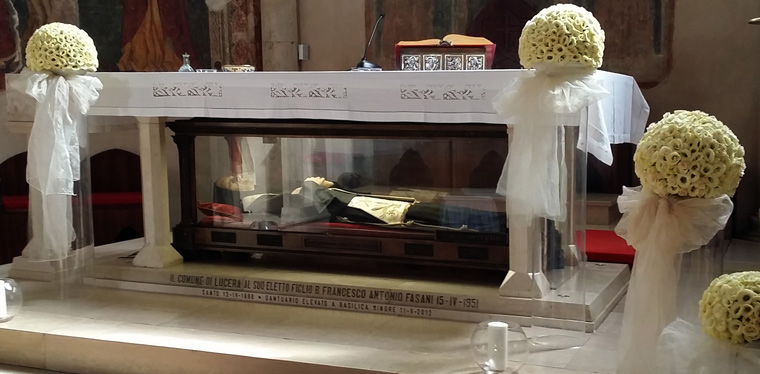
Fasani died in Lucera and was buried in the parish church there.   Upon the news of his death, children could be heard running through the streets shouting, “The saint is dead!   The saint is dead!”stainedglass-anthonyfasani

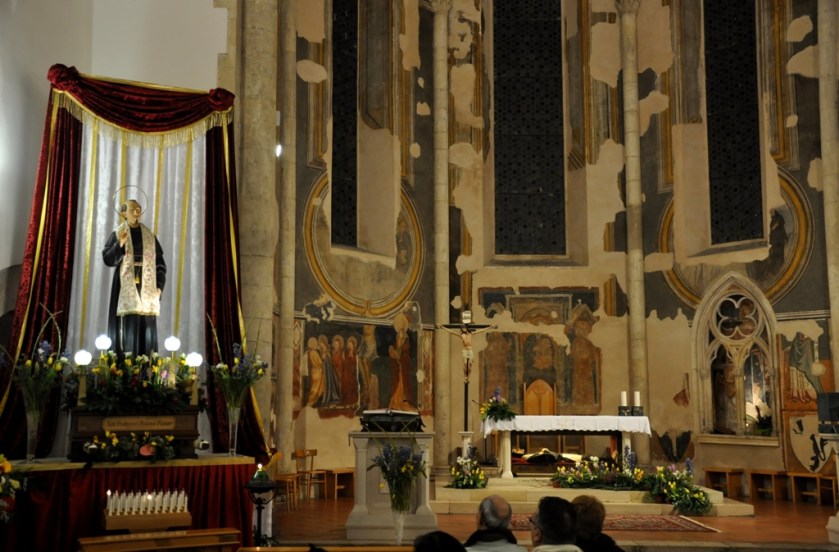
The proceedings to open the cause for his canonisation began several years after his death.   Testimony to his holy life was given by many people of region.   Among them was his old friend, Blessed Antonio Lucci (1682–1752), who by then was a Bishop in the region.   Progress did not take place, however, until the 20th century, when he was beatified in 1951 by Pope Pius XII and subsequently Canonised in 1986 by St Pope John Paul II.SHRINE of st francesco fasani Parde-Maestro-Santo_gSHRINE of st francesco fasani Parde-Maestro-Santo 2_gHEADER - beautiful - san-francesco-lucera-1

From the Vatican biography of St Francesco: – “The spiritual life of Fr Fasani was characterised by those virtues that made him like his Seraphic Father St Francis.   In fact, it was said in Lucera:  “Whoever wants to see how St Francis looked while he was alive should come to see Padre Maestro.”   In imitation of St Francis he built his religious life on the basis of a generous participation in the mysteries of Christ through the most faithful practice of the evangelical counsels, which he considered to be a radical expression of perfect charity.   In his constant prayers, inflamed with seraphic love, he called out to God, saying to Him:  “O Highest Love, Immense Love, Eternal Love, Infinite Love.”

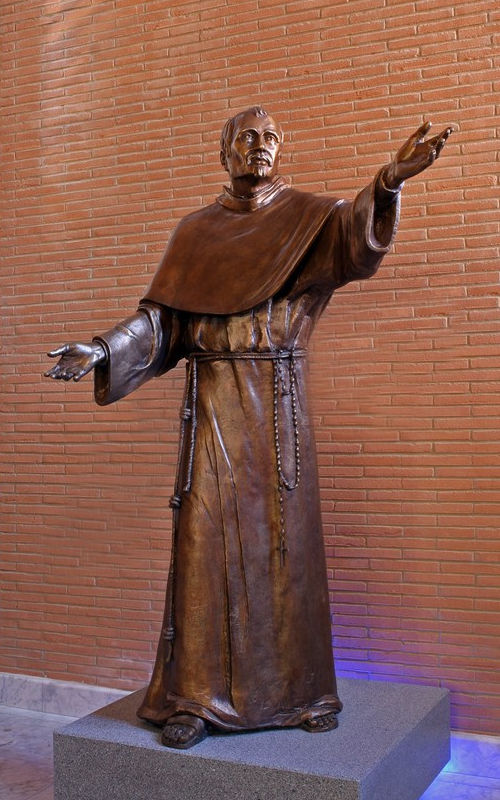
fasani statue

Posted in franciscan OFM, MARIAN DEVOTIONS, MARIAN TITLES, SAINT of the DAY, The BLESSED VIRGIN MARY

Memorial of Our Lady of Beauraing and of the Saints – 29 November

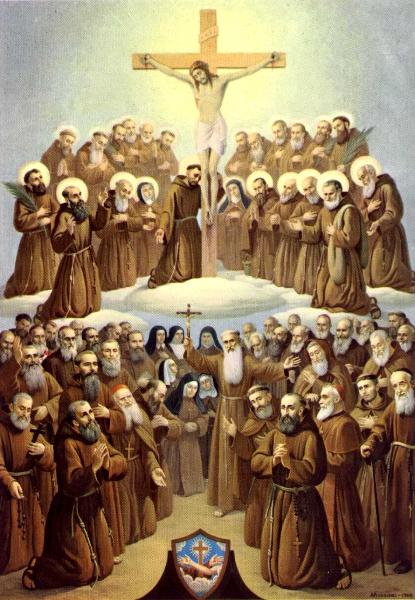
All Saints of the Seraphic Order (Franciscan):   the Church celebrates the many Franciscan saints who followed in the footsteps of St Francis.   It is a special day for all Franciscans to celebrate the feast of ‘All the Saints of the Seraphic Order.’all saints of the Franciscan order - 29 nov
According to tradition, St Francis of Assisi prayed the following prayer:
“O Lord Jesus Christ, two favours I beg of You before I die.   The first is that I may, as far as it is possible, feel in my soul and in my body the suffering in which You, O gentle Jesus, sustained in Your bitter passion.   And the second favour is that I, as far as it is possible, may receive in my heart that excessive charity by which You, the Son of God, were inflamed and which actuated You willingly to suffer so much for us sinners.”
In response to his earnest prayer, the Lord appeared in the form of a seraph, or a six-winged angel (They are usually considered the highest order of angelic beings, immediately above the Cherubim and their special duty is to love God).   Then Jesus bestowed on St Francis the wounds of His suffering.   St Francis had been marked with the love of Christ, the stigmata.   St Francis died two years later in 1226, leaving the world the Franciscan Order, which became synonymous with the Seraphic Order.   To this day, seraph wings and seraphs are symbolic of the Franciscan Order.
The final Rule of life for Franciscan friars was also approved on this day in 1223.   To commemorate this and all the saintly examples produced in the Franciscan Order, on this day all the saints of the Seraphic order are remembered at Franciscan churches.

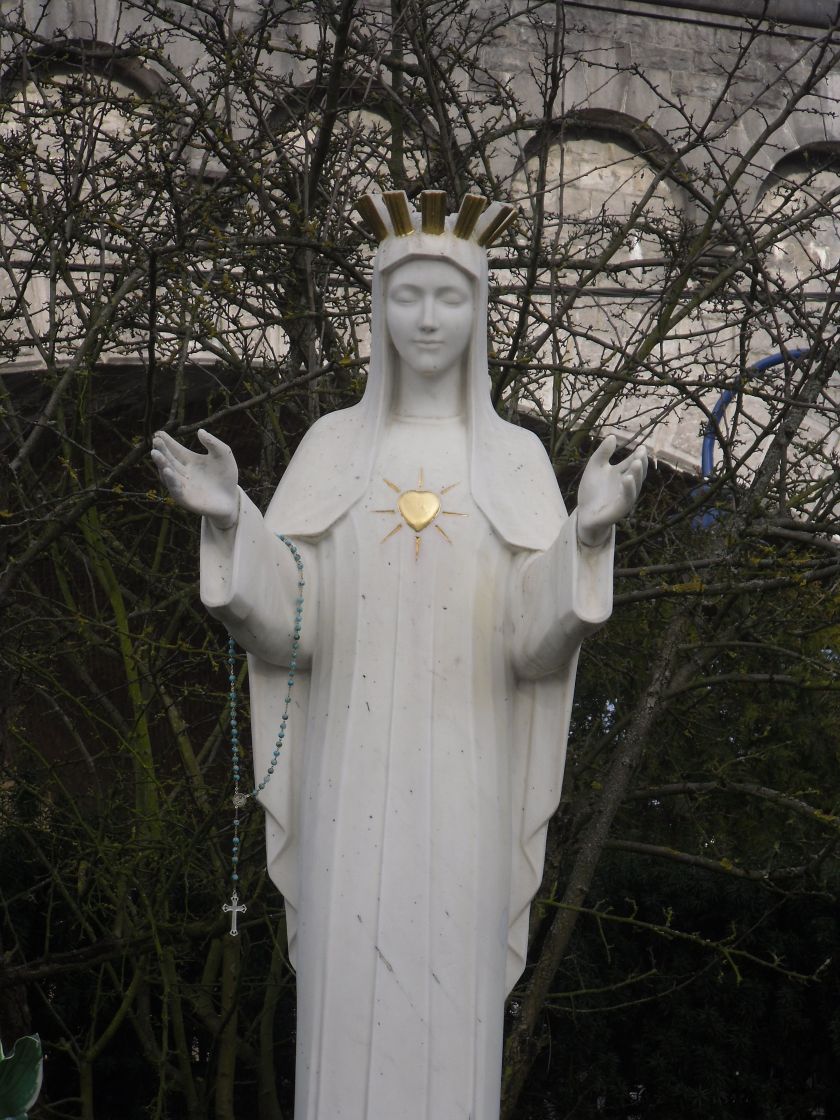
Our Lady of Beauraing/Our Lady of the Golden Heart:
Appeared multiple occasions between 29 November 1932 and 3 January 1933 On 2 February 1943, Bishop Andre Marie Charue authorized public devotion to Our Lady of Beauraing. On 2 July 1949 the Bishop declared that the Queen of Heaven had truly appeared to the children. Pilgrims flock to the small town of Beauraing, province of Namur (Belgium) and many cures are claimed. She is celebrated under this title on 29 November.

our lady of beauraing belgium - of the golden heart - 29 nov

Bl Alfredo Simón Colomina
Bl Bernardo Francisco de Hoyos Seña
St Blaise of Veroli
St Brendan of Birr
St Demetrius of Veroli
Bl Denis of the Nativity
Bl Edward Burden
St Francesco Antonio Fasani OFM Conv (1681 – 1742)
Bl Frederick of Ratisbon
Bl George Errington
St Hardoin of Brittany
St Illuminata of Todi
St James of Saroug
Bl Jutta of Heiligenthal
St Paphnutius of Heracleopolis
St Paramon
St Philomenus of Ancyra
St Radbod of Utrecht
Bl Redemptorus of the Cross
St Sadwen of Wales
St Saturninus of Rome
St Saturninus of Toulouse
St Sisinius of Rome
St Walderic of Murrhardt
Bl William Gibson
Bl William Knight

Posted in CATECHESIS, franciscan OFM, QUOTES of the SAINTS, QUOTES on DEATH, QUOTES on ETERNAL LIFE, QUOTES on HELL, QUOTES on PEACE, QUOTES on REPENTANCE, QUOTES on SANCTITY, QUOTES on SIN, SAINT of the DAY, The LAST THINGS

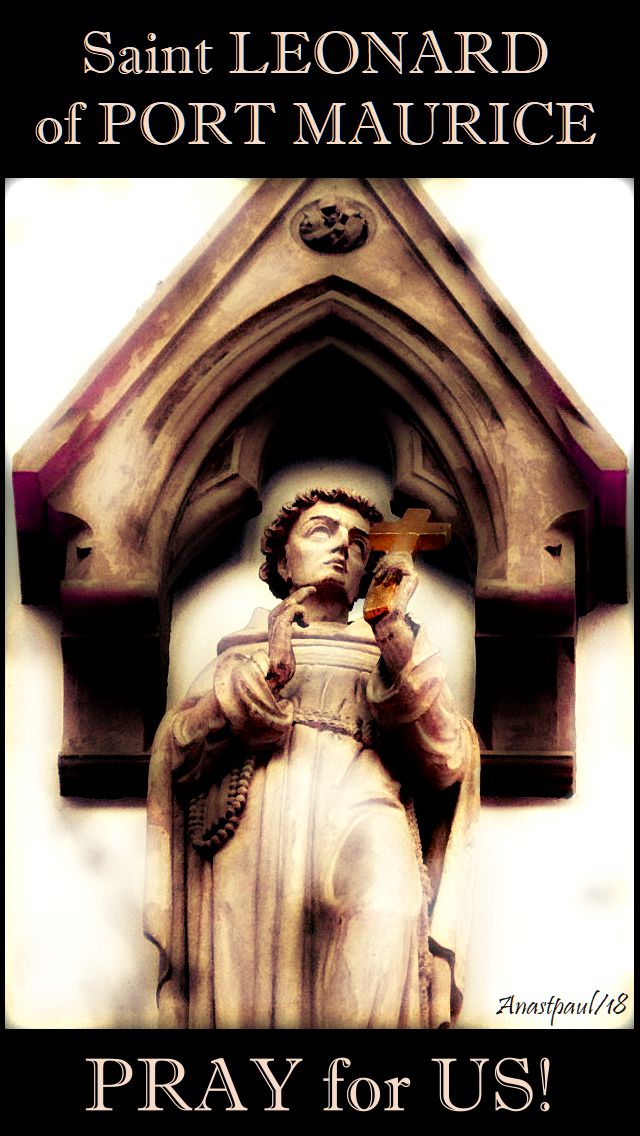
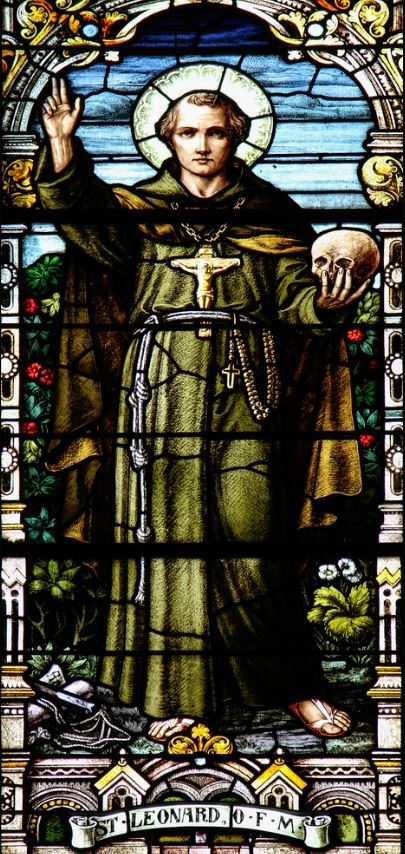
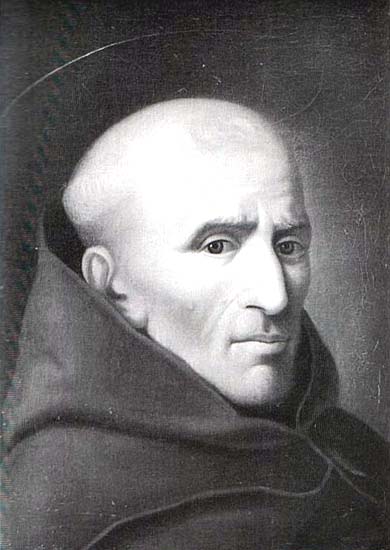
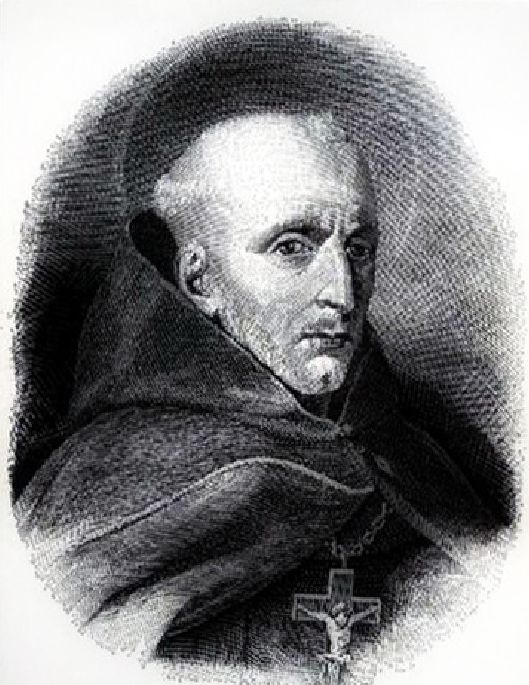
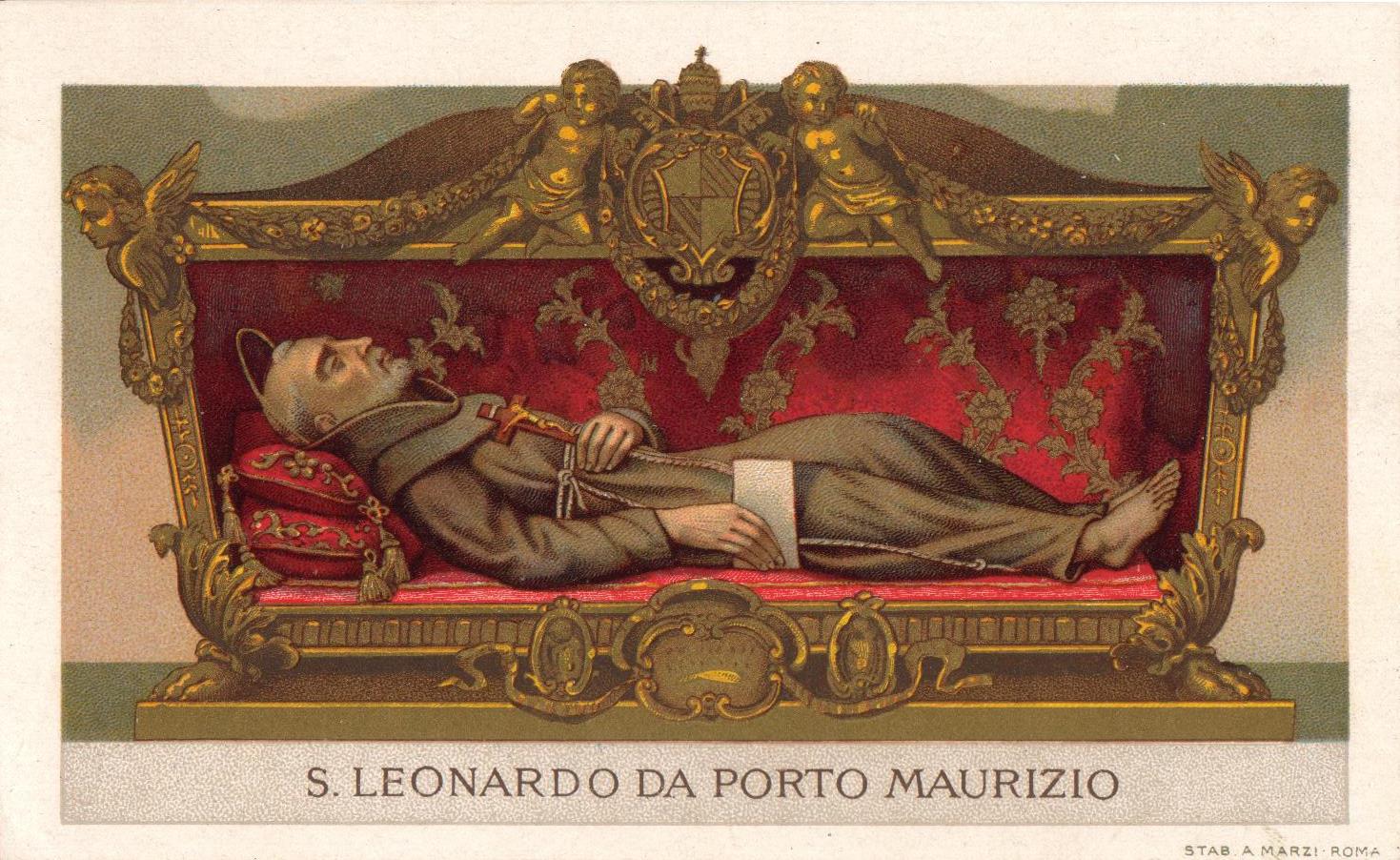
Thought for the Day – 27 November – The Little Number of Those Who Are Saved by St Leonard of Port Maurice OFM (1676-1751)

Thought for the Day – 27 November – The Little Number of Those Who Are Saved by St Leonard of Port Maurice OFM (1676-1751)

“Conclusion”
Brothers, I want to send all of you away comforted today.   So if you ask me my sentiment on the number of those who are saved, here it is:  Whether there are many or few that are saved, I say that whoever wants to be saved, will be saved and that no one can be damned if he does not want to be.   And if it is true that few are saved, it is because there are few who live well.   As for the rest, compare these two opinions – the first one states that the greater number of Catholics are condemned, the second one, on the contrary, pretends that the greater number of Catholics are saved.   Imagine an Angel sent by God to confirm the first opinion, coming to tell you that not only are most Catholics damned but that of all this assembly present here, one alone will be saved.   If you obey the Commandments of God, if you detest the corruption of this world, if you embrace the Cross of Jesus Christ in a spirit of penance, you will be that one alone who is saved.

Now imagine the same Angel returning to you and confirming the second opinion.   He tells you that not only are the greater portion of Catholics saved but that out of all this gathering, one alone will be damned and all the others saved.   If after that, you continue your usuries, your vengeances, your criminal deeds, your impurities, then you will be that one alone who is damned.

What is the use of knowing whether few or many are saved?   Saint Peter says to us, “Strive by good works to make your election sure.”   When Saint Thomas Aquinas’s sister asked him what she must do to go to heaven, he said, “You will be saved if you want to be.”   I say the same thing to you and here is proof of my declaration.   No one is damned unless he commits mortal sin – that is of faith.   And no one commits mortal sin unless he wants to – that is an undeniable theological proposition.   Therefore, no one goes to hell, unless he wants to – the consequence is obvious.   Does that not suffice to comfort you?

Weep over past sins, make a good confession, sin no more in the future and you will all be saved.   Why torment yourself so?   For it is certain, that you have to commit mortal sin to go to hell and that to commit mortal sin, you must want to and that consequently, no one goes to hell, unless he wants to.   That is not just an opinion, it is an undeniable and very comforting truth – may God give you to understand it and may He bless you.   Amen.”

The Little Number of Those Who Are Saved
by St Leonard of Port Maurice
Full Sermon here: https://www.olrl.org/snt_docs/fewness.shtml

St Leonard of Port Maurice, Pray for Us!st leonard of port maurice pray for us no 2 - 27nov2018

Posted in DIVINE Mercy, Goodness, Patience, DOCTORS of the Church, EUCHARISTIC Adoration, franciscan OFM, PRAYERS of the SAINTS, QUOTES of the SAINTS, QUOTES on DEATH, SAINT of the DAY, The HOLY EUCHARIST / The HOLY MASS

Quote/s of the Day – 27 November – The Memorial of St Leonard of Port Maurice OFM (1676-1751)

Quote/s of the Day – 27 November – The Memorial of St Leonard of Port Maurice OFM (1676-1751)

“What graces, gifts and virtues
the Holy Mass calls down!”

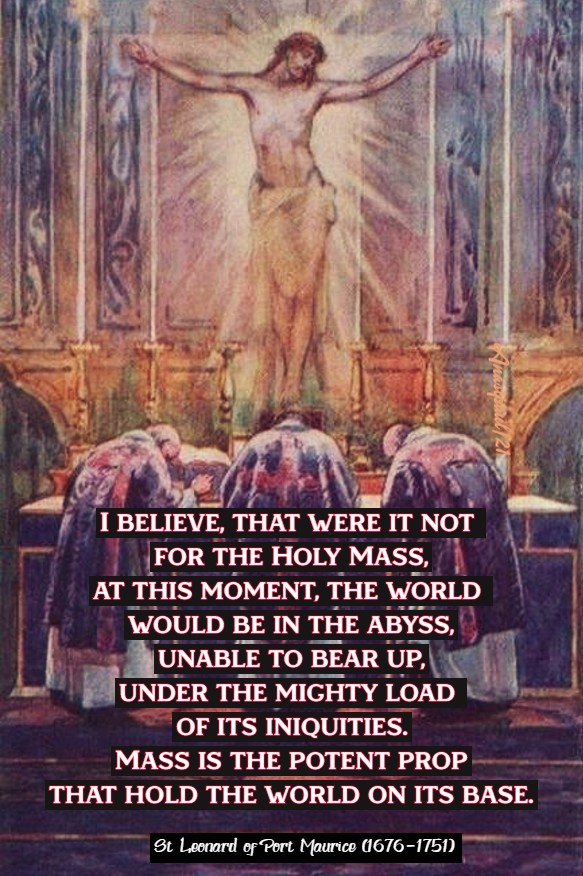
“I believe that were it not for the Holy Mass,
as this moment, the world would be in the abyss,
unable to bear up under the mighty load of its iniquities.
Mass is the potent prop that hold the world on its base.”

“If the Lord, at the moment of my death,
reproves me for being too kind to sinners,
I will answer, ‘My dear Jesus, if it is a fault
to be too kind to sinners, it is a fault
I learned from You, for You never scolded anyone
who came to You seeking mercy.'”if the Lord at the moment of my death - stleonardofportmaurice-27nov2918

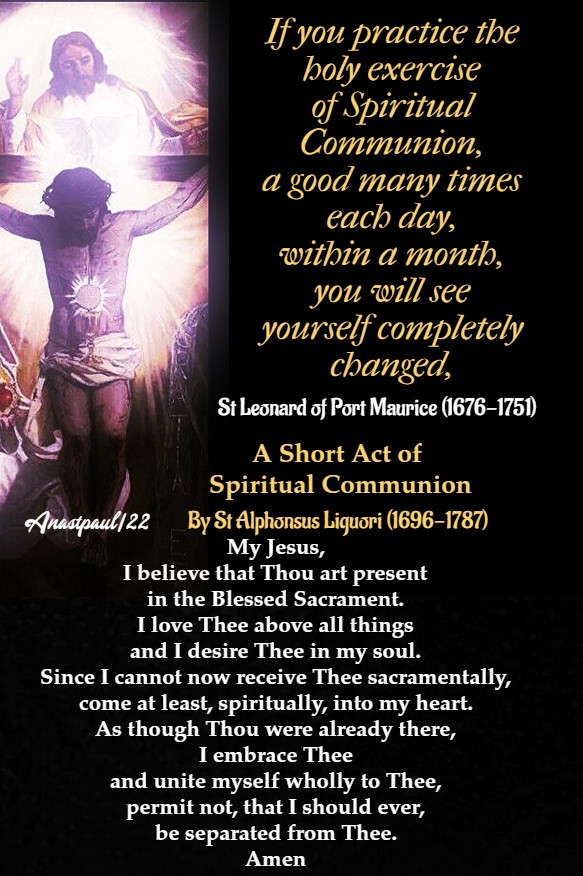
“If you practice the holy exercise
of Spiritual Communion,
a good many times each day,
within a month,
you will see yourself completely changed.”

St Leonard of Port Maurice OFM (1676-1751)

Act of Spiritual Communion
By St Alphonsus Liguori (1696-1787) Doctor of the Church

My Jesus,
I believe that You art present
in the Blessed Sacrament.
I love You above all things
and I desire You in my soul.
Since I cannot now receive You sacramentally,
come at least, spiritually, into my heart.
As though You were already there,
I embrace You
and unite myself wholly to You,
permit not, that I should ever,
be separated from You.
Amen

Posted in franciscan OFM, MORNING Prayers, PAPAL SERMONS, QUOTES on DEATH, SAINT of the DAY, The LAST THINGS, The WORD

One Minute Reflection – 27 November – Today’s Gospel: Luke 21:5–11

One Minute Reflection – 27 November – Today’s Gospel: Luke 21:5–11, Tuesday of the Thirty Fourth week in Ordinary Time, Year B and the Memorial of St Leonard of Port Maurice OFM (1676-1751)

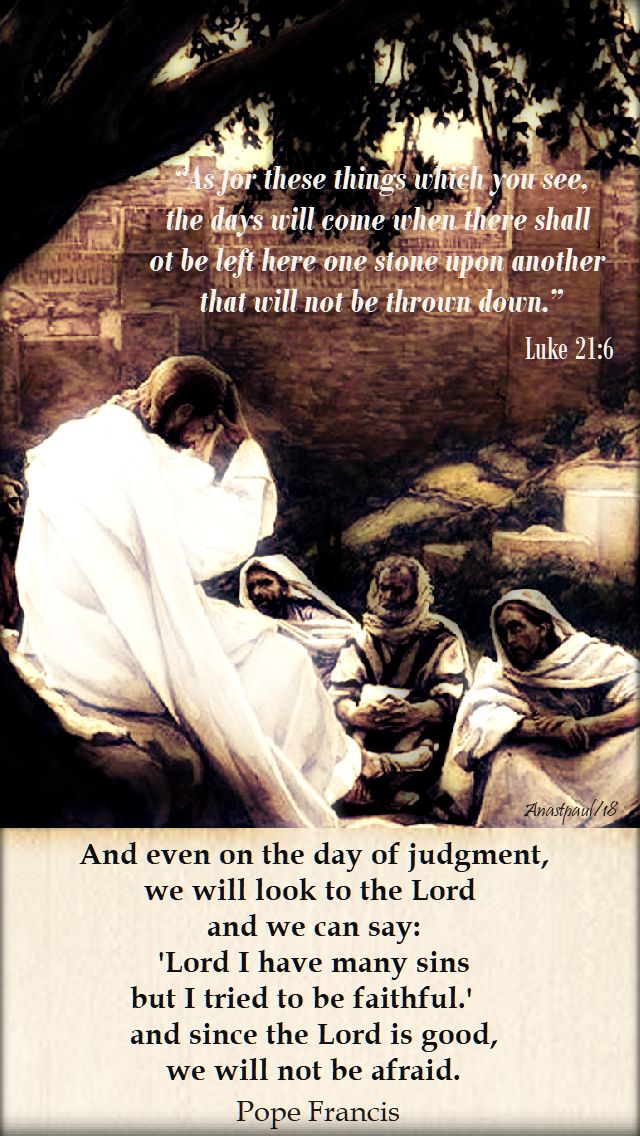
“As for these things which you see, the days will come when there shall not be left here one stone upon another that will not be thrown down.” …Luke 21:6

REFLECTION – ” Indeed, if each one of us is faithful to the Lord, when our death comes, as shall we say what St Francis said:  ‘sister death, come’.   It will not frighten us.   And even on the day of judgement, we will look to the Lord and we can say:  ‘Lord I have many sins but I tried to be faithful.’   And since the Lord is good, we will not be afraid.”…Pope Francis – Santa Marta, 22 November 2016luke 21 6 as for these things which you see the day will come - andevenonthedayofjudgment -pope francis - 26nov2018

PRAYER – True Light of the world, Lord Jesus Christ, as You enlighten all men for their salvation, give us grace, we pray, to herald Your coming, by preparing the ways of justice, love and peace.   Grant us the assistance of the intercession of St Leonard of Port Maurice, who so diligently worked to bring Your good news to all.   Let his example be an inspiration in our lives.   Lord Jesus Christ who live and reign with the Father and the Holy Spirit, God, forever, amen.st leonard of port maurice pray for us - 27 nov 2018

Posted in franciscan OFM, MISSIONS, MISSIONARIES, PREACHERS, SAINT of the DAY

Saint of the Day – 27 November – St Leonard of Port Maurice OFM (1676-1751)

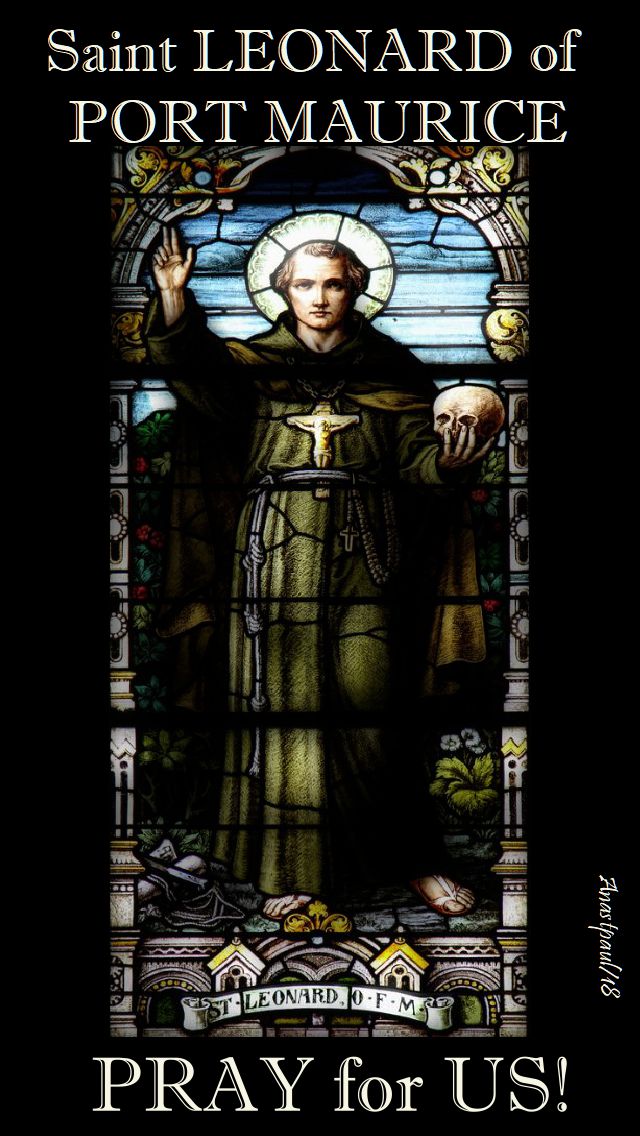
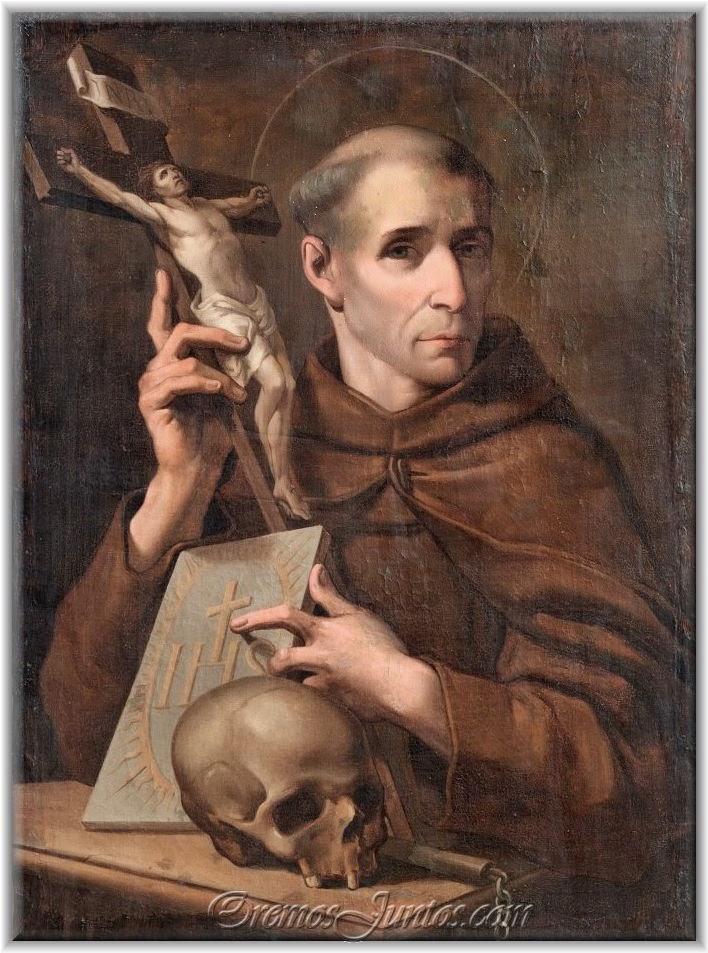
Saint of the Day – 27 November – St Leonard of Port Maurice OFM (1676-1751) – Born on 20 December 1676 at Porto Maurizio, Italy on the Riviera di Ponente as Paul Jerome Casanova and died at 11:00 pm on 26 November 1751 at the Monastery of Saint Bonaventura, Rome, Italy.    Franciscan Friar, Priest, Preacher – in particular Parish Mission Preacher, ascetic Writer, Spiritual Director.   His Memorial is celebrated in the universal calendar, today, 26 November.  St Leonard founded many pious societies and confraternities and exerted himself to spread devotion to the Sacred Heart of Jesus, the Perpetual Adoration of the Most Blessed Sacrament, the Blessed Virgin Mary and the Passion of Christ.   He was among the few to insist that the concept of the Immaculate Conception of Mary be defined as a Dogma of the Faith.   Patronages – Missionaries, Preachers, Imperia, Italy. header-San Leonardo de Puerto-Maurizio-26

Leonard was born in 1676 in Port Maurice, on the cost of northern Italy.   His father was a ship captain.   Because he was a gifted student, he was sent to Rome when he was 13 to live with his uncle while attending the Jesuits’ Roman College.   His family wanted him to become a doctor but after completing his studies, Leonard decided to become a Franciscan friar.   He hoped he could become a missionary to China.st leonard glass

After ordination, Leonard became seriously ill with a bleeding ulcer and was sent home.  No one knew if he would recover.   Leonard promised God that if he did get well, he would devote his life to the missions and to helping sinners change their lives.   It took more than four years but Leonard regained his health and began 40 years of mission work.   Surprisingly, he did not become a missionary in foreign lands.   He became a missionary to the people of his own country.S_Leonardo

Leonard travelled throughout Italy, preaching at parish missions and retreats.   He would often spend two or three weeks in a parish before moving on.   That gave him time to celebrate the Sacrament of Reconciliation with all who wanted to confess their sins and receive God’s forgiveness.   Leonard thought this was the most important part of his ministry.   It was a sign that through his preaching, the Holy Spirit had inspired people to transform their lives and begin to live as followers to Jesus.    St Alphonsus Liguori (1696-1787), called Leonard “the great missionary of the 18th century.”san-leonardo-di-artallo-208157.2.2

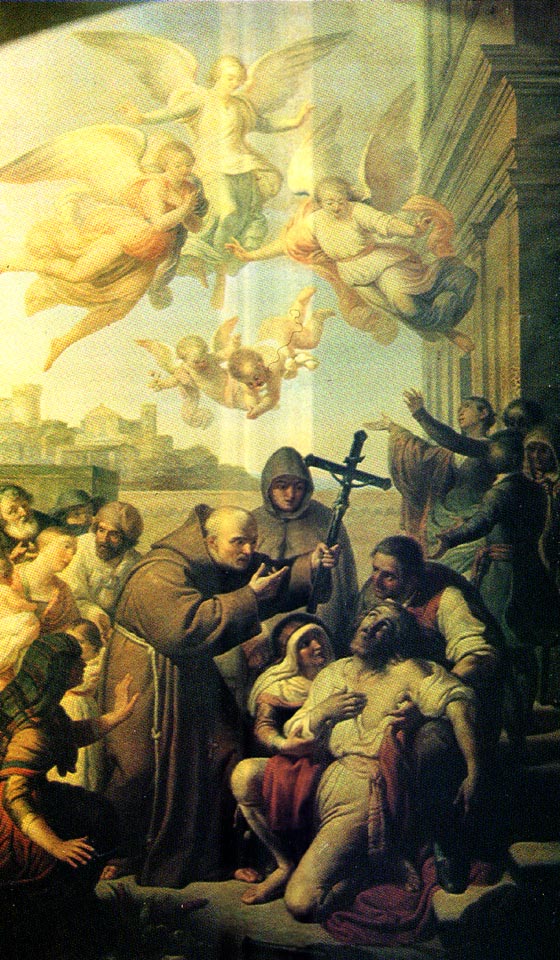
Everywhere the saint made conversions and was very often obliged both in cities and country districts to preach in the open, as the churches could not contain the thousands who came to listen.   Pope Clement XII and Pope Benedict XIV called him to Rome;  the latter especially held him in high esteem both as a preacher and as a propagandist and exacted a promise that he would come to Rome to die.   Pope Benedict XIV appointed him to several complex diplomatic assignments.   In Genoa and Corsica, in Lucca and Spoleto the citizens expected a jewelled cardinal to represent the intentions of the pope.   Instead, they were confronted by a humble, shoeless, muddy friar to confound their hostility and pride.st leonard preaching in corsica

Leonard had a great devotion to the Stations of the Cross.   He believed that praying the Stations would help people better understand that through His Passion and Death, Jesus showed His great love for us.   By this Franciscan saint’s work, almost 600 sets of the Stations of the Cross were erected throughout Italy, most of them in the parishes where he had preached and even one at the Colosseum in Rome, which to this day are used by the Holy Father during Lent and especially on Good Friday.   They were a lasting reminder to the people, of Jesus’ sacrifice on the cross and they encouraged people to stay close to Jesus through prayer.12_11_26_leonard_port_maurice

St Leonard died in Rome in 1751 at the age of 75.   He was Canonised in 1867 and in 1923 he was named the patron saint of parish mission preachers.   His ministry reminds us that Jesus is always calling us to grow in our love for Him and our brothers and sisters. When we think about Jesus’ Death on the Cross, we can remember all people who suffer in their daily journeys.   We can reach out to and pray for the hungry, the homeless, the unborn, the elderly and the neglected people of our world.leonard

Posted in CATECHESIS, franciscan OFM, MARIAN QUOTES, MARIAN TITLES, PAPAL SERMONS, SAINT of the DAY, The BLESSED VIRGIN MARY

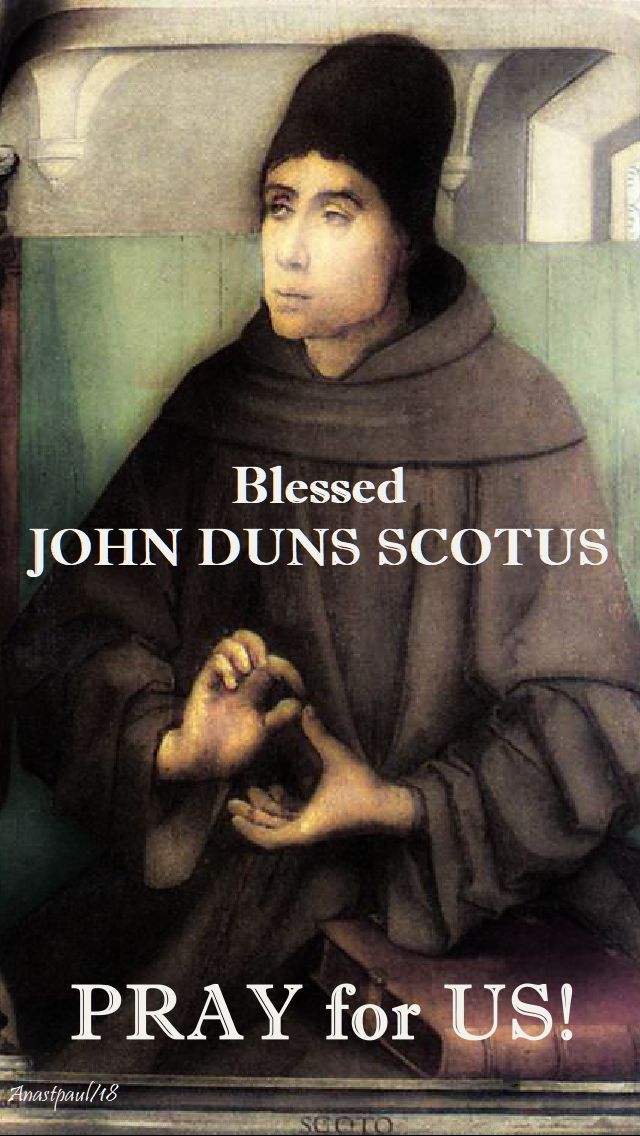
Thought for the Day – 8 November – Pope Benedict on Blessed John Duns Scotus

Thought for the Day – 8 November – The Memorial of Blessed John Duns Scotus OFM (c 1265-1308)

Excerpt from Pope Benedict XVI’s

Catechesis on Blessed John Duns Scotus
General Audience – 7 July 2010

“The Immaculate Conception”

This morning, after several Catecheses on various great theologians, I would like to present to you another important figure in the history of theology.   He is Blessed John Duns Scotus, who lived at the end of the 13th century.   An ancient epitaph on his tombstone sums up the geographical coordinates of his biography:  “Scotland bore me, England received me, France taught me, Cologne in Germany holds me”.   We cannot disregard this information, partly because we know very little about the life of Duns Scotus.   He was probably born in 1266 in a village called, precisely, “Duns”, near Edinburgh.
Attracted by the charism of St Francis of Assisi, he entered the Family of the Friars Minor and was ordained a priest in 1291.   He was endowed with a brilliant mind and a tendency for speculation, which earned him the traditional title of Doctor subtilis, “Subtle Doctor”.

Mary is the subject of the Doctor subtilis’ thought.   In the times of Duns Scotus the majority of theologians countered with an objection that seemed insurmountable, the doctrine which holds that Mary Most Holy was exempt from original sin from the very first moment of her conception – in fact, at first sight the universality of the Redemption brought about by Christ might seem to be jeopardised by such a statement, as though Mary had had no need of Christ or His redemption.   Therefore the theologians opposed this thesis.   Thus, to enable people to understand this preservation from original sin Duns Scotus developed an argument that was later, in 1854, also to be used by Bl Pope Pius IX when he solemnly defined the Dogma of the Immaculate Conception of Mary.   And this argument is that of “preventive Redemption”, according to which the Immaculate Conception is the masterpiece of the Redemption brought about by Christ because the very power of His love and His mediation obtained, that the Mother be preserved from original sin.   Therefore Mary is totally redeemed by Christ but already before her conception.   Duns Scotus’ confreres, the Franciscans, accepted and spread this doctrine enthusiastically and other theologians, often with a solemn oath, strove to defend and perfect it.

In this regard I would like to highlight a fact that I consider relevant.   Concerning the teaching on the Immaculate Conception, important theologians like Duns Scotus enriched what the People of God already spontaneously believed about the Blessed Virgin and expressed in acts of devotion, in the arts and in Christian life in general with the specific contribution of their thought.   Thus faith both in the Immaculate Conception and in the bodily Assumption of the Virgin was already present in the People of God, while theology had not yet found the key to interpreting it in the totality of the doctrine of the faith.   The People of God therefore precede theologians and this is all thanks to that supernatural sensus fidei, namely, that capacity infused by the Holy Spirit that qualifies us to embrace the reality of the faith with humility of heart and mind. In this sense, the People of God is the “teacher that goes first” and must then be more deeply examined and intellectually accepted by theology.

May theologians always be ready to listen to this source of faith and retain the humility and simplicity of children!   I mentioned this a few months ago saying: “There have been great scholars, great experts, great theologians, teachers of faith who have taught us many things.   They have gone into the details of Sacred Scripture… but have been unable to see the mystery itself, its central nucleus…. The essential has remained hidden!… On the other hand, in our time there have also been “little ones” who have understood this mystery.   Let us think of St Bernadette Soubirous; of St Thérèse of Lisieux, with her new interpretation of the Bible that is “non-scientific’ but goes to the heart of Sacred Scripture”

Dear brothers and sisters, Bl Duns Scotus teaches us that in our life the essential is to believe that God is close to us and loves us in Jesus Christ and, therefor,e to cultivate a deep love for Him and for His Church.   We on earth are witnesses of this love.   May Mary Most Holy help us to receive this infinite love of God, which we will enjoy eternally to the full in Heaven, when our soul is at last united to God for ever in the Communion of Saints.

Blessed John Duns Scotus, Pray for Us!bl john duns scotus pray for us - 8 nov 2018 no 2

Posted in DIVINE Mercy, Goodness, Patience, DOCTORS of the Church, franciscan OFM, MORNING Prayers, QUOTES of the SAINTS, QUOTES on DIVINE PROVIDENCE, SAINT of the DAY, The WORD

One Minute Reflection – 8 November – Today’s Gospel: Luke 15:1–10

One Minute Reflection – 8 November – Today’s Gospel: Luke 15:1–10 – Thursday of the Thirty First week in Ordinary Time, Year B and the Memorial of Blessed John Duns Scotus OFM (c 1265-1308)

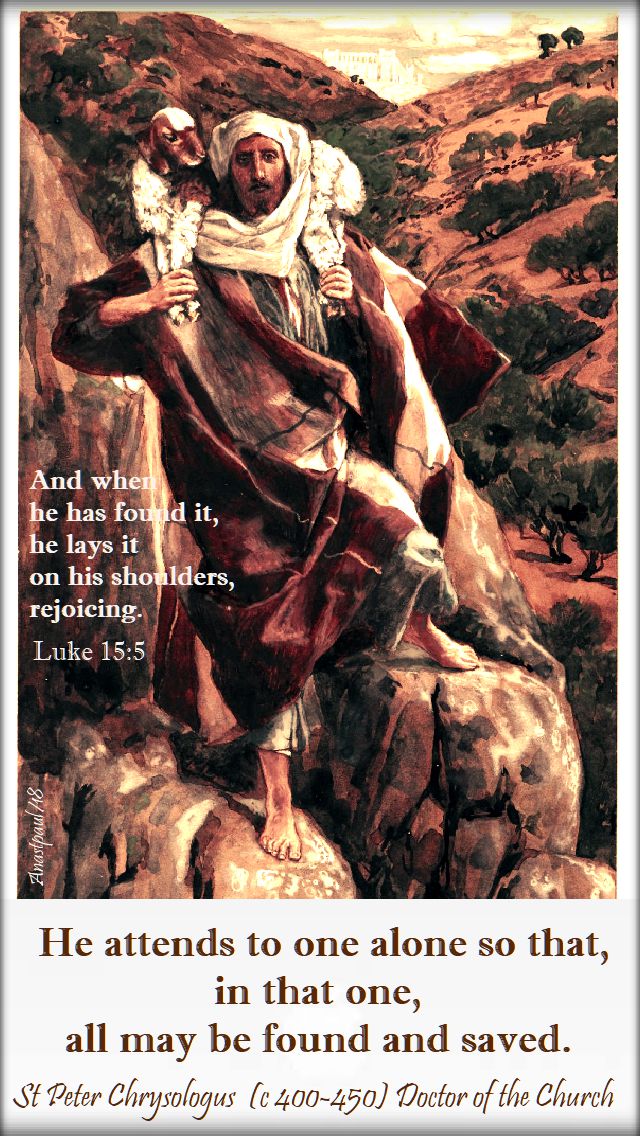
“What man of you, having a hundred sheep, if he has lost one of them, does not leave the ninety-nine in the wilderness and go after the one which is lost, until he finds it? And when he has found it, he lays it on his shoulders, rejoicing.”…Luke 15:4-5

REFLECTION – “The fact of re-finding something we had lost always fills us anew with joy.   And this joy is greater than that we felt before losing it, when the thing was safely kept.   But the parable of the lost sheep speaks more of God’s tenderness than of the way in which people usually behave.   It expresses a profound truth.   To leave behind something of importance for love of what is more humble, is characteristic of divine power, not of human possessiveness.   For God even brings into existence what is not, He sets out in search of what is lost while still keeping what He had left in place and He finds what had strayed without losing what He has under His protection.
That is why, this shepherd is not of earth but of heaven.   The parable is not in any respect, a representation of human achievements but it conceals divine mysteries, as the numbers it mentions immediately show: “What man among you,” says the Lord, “having a hundred sheep and losing one of them…”   As you see, the loss of a single sheep has sorely tried this shepherd, as though the whole flock, deprived of His protection, had set out along a treacherous path.   This is why, leaving the ninety-nine others there, He sets out in search of the one.   He attends to one alone so that, in that one, all may be found and saved.”…St Peter Chrysologus (c 400-450) Doctor of the Churchand when he has found it - luke 15 5 - he attends to one alone so that in that one all may be found and saved st peter chrysologus - 8 nov 2018

PRAYER – Lord God, in Your wisdom, You created us, by Your providence You rule us, penetrate our inmost being with Your holy light, so that our way of life, may always be one of faithful service to You. With great love we thank You for the great gifts You shower upon us and for being our Father, who seeks and finds us when we are lost.   Grant that by the intercession of Blessed John Duns Scotus, we may ever seek to stay true to our baptism.   Through Jesus, our Lord, with the Holy Spirit, God forever, amen.bl john duns scotus pray for us - 8 nov 2018

Posted in franciscan OFM, SAINT of the DAY

Saint of the Day – 8 November – Blessed John Duns Scotus OFM (c 1265-1308)

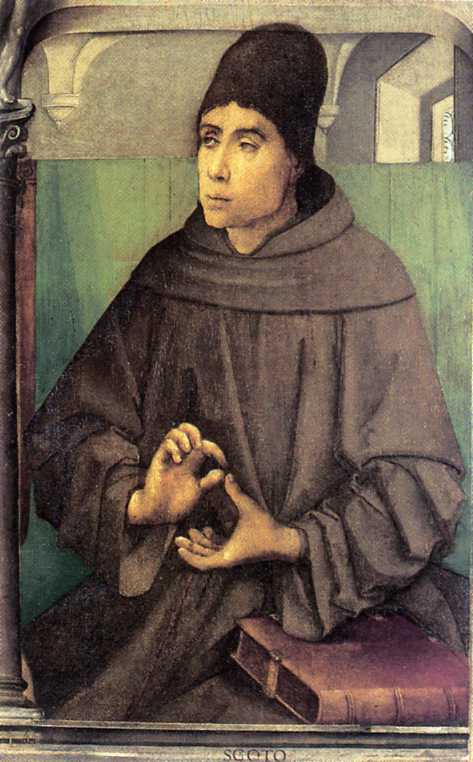
Saint of the Day – 8 November – Blessed John Duns Scotus OFM (c 1265-1308) Doctor Subtilis (Subtle Doctor) Franciscan Friar, Priest, Theologian, Philosopher, Lecturer – known as “The minstrel of the Word Incarnate” and “Defender of Mary’s Immaculate Conception”.HEADER bl john scotus

A humble man, John Duns Scotus has been one of the most influential Franciscans through the centuries.   Born at Duns in the county of Berwick, Scotland, John was descended from a wealthy farming family.   In later years, he was identified as John Duns Scotus to indicate the land of his birth – Scotia is the Latin name for Scotland.

John received the habit of the Friars Minor at Dumfries, where his uncle Elias Duns was superior.   After novitiate, John studied at Oxford and Paris and was ordained in 1291. More studies in Paris followed until 1297, when he returned to lecture at Oxford and Cambridge.   Four years later, he returned to Paris to teach and complete the requirements for the doctorate.BlJohnDunsScotus8-11

In an age when many people adopted whole systems of thought without qualification, John pointed out the richness of the Augustinian-Franciscan tradition, appreciated the wisdom of Aquinas, Aristotle, and the Muslim philosophers—and still managed to be an independent thinker.   That quality was proven in 1303, when King Philip the Fair tried to enlist the University of Paris on his side in a dispute with Pope Boniface VIII.  John Duns Scotus dissented and was given three days to leave France.

In Scotus’s time, some philosophers held that people are basically determined by forces outside themselves.   Free will is an illusion, they argued.   An ever-practical man, Scotus said that if he started beating someone who denied free will, the person would immediately tell him to stop.   But if Scotus didn’t really have a free will, how could he stop?   John had a knack for finding illustrations his students could remember!BL JOHN DUN SCOTUS

After a short stay in Oxford, Scotus returned to Paris, where he received the doctorate in 1305.   He continued teaching there and in 1307 so ably defended the Immaculate Conception of Mary that the university officially adopted his position.   That same year, the minister general assigned him to the Franciscan school in Cologne where John died in 1308.   He is buried in the Franciscan church near the famous Cologne cathedral.BL duns-scotus

Drawing on the work of John Duns Scotus, Pope Pius IX solemnly defined the Immaculate Conception of Mary in 1854.   On 20 March 1993 John Duns Scotus, the “Subtle Doctor,” was beatified by St Pope John Paul II at St Peter’s Basilica in Rome.

Bl John Duns Scotus, “The minstrel of the Word Incarnate” and “Defender of Mary’s Immaculate Conception” was presented by St Pope John Paul II to our age “wealthy of human, scientific and technological resources, but in which many have lost the sense of faith and lead lives distant from Christ and His Gospel,” as “a Teacher of thought and life.” For the Church, he is “an example of fidelity to the revealed truth, of effective, priestly and serious dialogue in search for unity.”header - Beato_Giovanni_Duns_Scoto_B

Posted in DOCTORS of the Church, franciscan OFM, MORNING Prayers, ON the SAINTS, QUOTES of the SAINTS, SAINT of the DAY, The WORD

One Minute Reflection – 7 November – Today’s Gospel: Luke 14:25–33

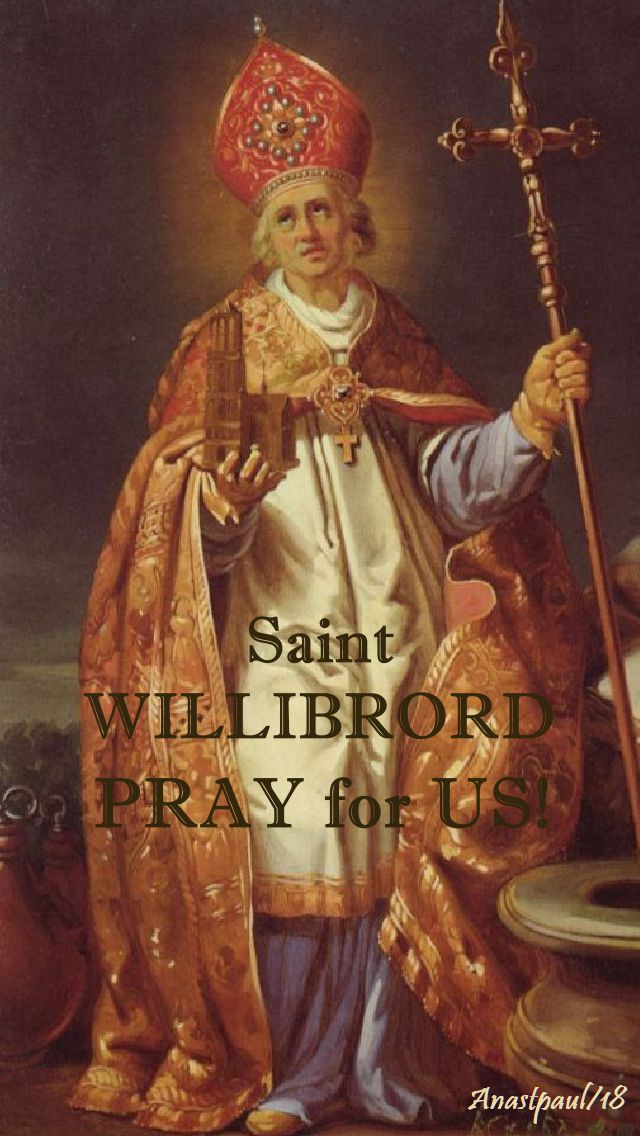
One Minute Reflection – 7 November – Today’s Gospel: Luke 14:25–33 – Wednesday of the Thirty First week in Ordinary Time, Year B and The Memorial of St Willibrord (c 658 – 739) “Apostle to the Frisians” and Bl Anthony Baldinucci SJ (1665-1717)

So therefore, whoever of you does not renounce all that he has cannot be my disciple...Luke 14:33

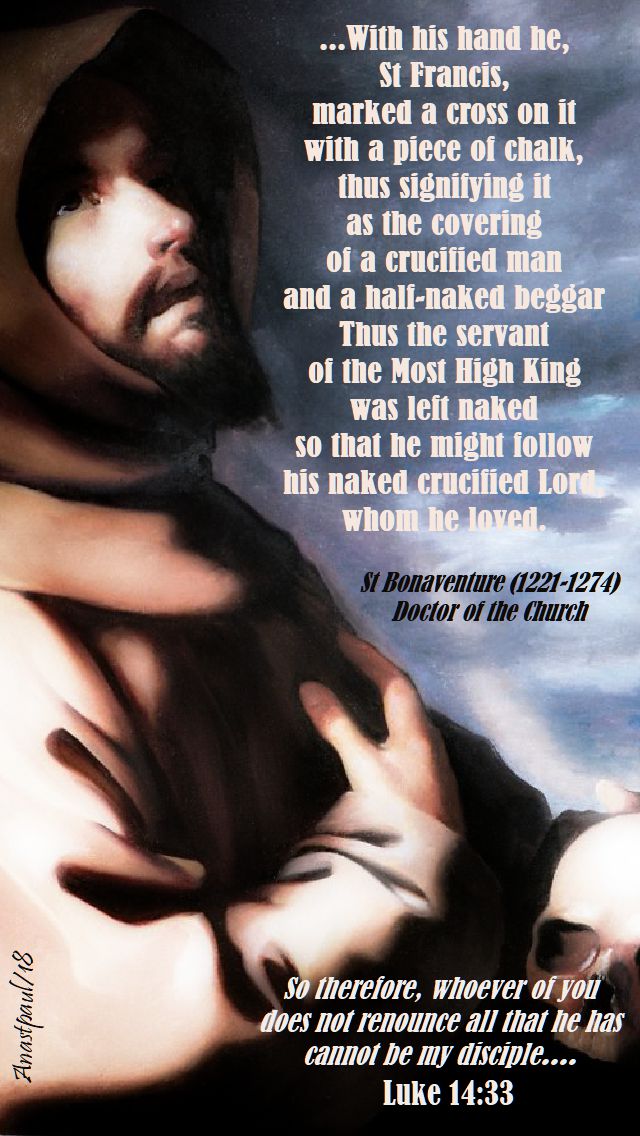
REFLECTION  – “Francis’ father led this child of his before the bishop.   He wanted to have Francis renounce into his hands his family possessions and return everything he   had. A true lover of poverty, Francis showed himself eager to comply;  he went before the bishop without delaying or hesitating.   He did not wait for any words nor did he speak any but immediately took his clothes and gave them back to his father… Drunk with remarkable fervour, he even took off his underwear, stripping himself completely naked before all.   He said to his father : “Until now I have called you father here on earth, but now I can say without reservation,  ‘Our Father who art in heaven’ (Matt. 6:9), since I have placed all my treasure and all my hope in him.”
When the bishop saw this, he was amazed at such intense fervour in the man of God.   He immediately stood up and in tears drew Francis into his arms, covering him with the mantle he was wearing, like the pious and good man that he was.   He bade servants give Francis something to cover his body.   They brought him a poor, cheap cloak of a farmer who worked for the bishop.   Francis accepted it gratefully and with his hand marked a cross on it with a piece of chalk, thus signifying it as the covering of a crucified man and a half-naked beggar.   Thus the servant of the Most High King was left naked so that he might follow his naked crucified Lord, whom he loved.”… St Bonaventure (1221-1274) Doctor of the Churchwith his hand, he marked a cross on it - st bonaventure - and luke 14 33 whoever does not renounce - 7 nov 2018

PRAYER – Holy God and Father, You sent your Son to show us the way to our eternal home.   Teach us always to understand that by relinquishing the things of this world and focusing our efforts only on following the Light He shines on our path, we may attain the eternal victory.   May the prayers of St Willibrord and St Anthony, assist us in carrying our cross after Him.   Through Christ our Lord, with the Holy Spirit, God forever, amen.st willibrord pray for us 7 nov 2018bl-anthony-baldinucci-pray-for-us-7-nov-2017-no2

Posted in franciscan OFM, MORNING Prayers, SAINT of the DAY

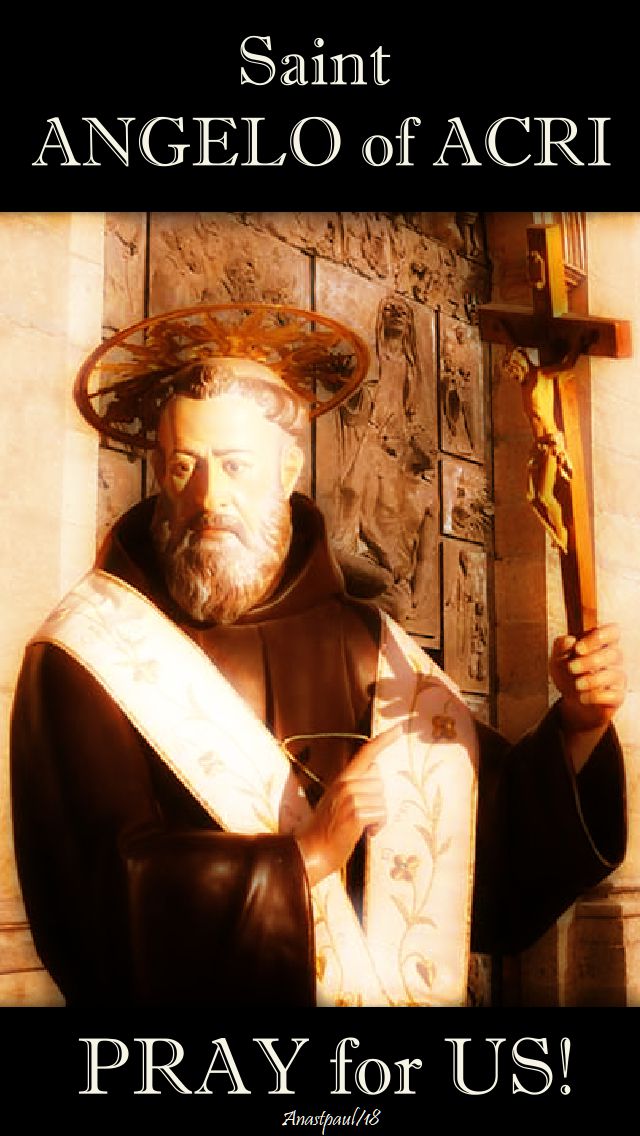
Thought for the Day – 30 October – The Memorial of St Angelo of Acri OFM Cap (1669-1739)

Thought for the Day – 30 October – The Memorial of St Angelo of Acri OFM Cap (1669-1739)

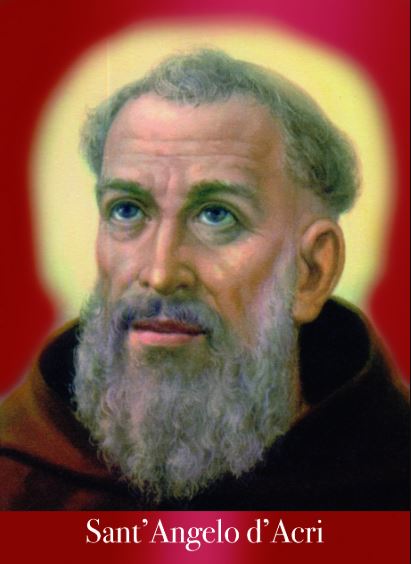
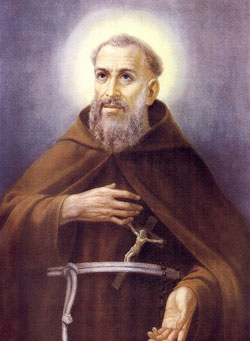
One of the oldest paintings of Br Angelo of Acri shows him looking at and contemplating the Crucified, the centre of his preaching and his prayer.   Meditation on the Passion of the Lord accompanied his long travels on foot from one place to another in his preaching tours.   In long hours of solitary prayer he meditated on the suffering of Christ moment by moment;  in the same way he cared for and embraced the sick in body and in spirit, recognising in their illnesses the wounds of Our Lord.   He kept in his heart the face and the name of Jesus crucified, the icon of a love without limit.

St Angelo of Acri, whom the Church gives us as a model and example of an authentic and realised life, teaches all Christians, how to proclaim the Gospel to a world thirsty for freedom.   Life in the Spirit leads us to that true freedom that makes us able to recognise the dignity of each human being.   This movement happens and grows when we embrace the Lord Jesus in faith;  He who, taking on our humanity, lifted up the human person to the dignity of a child of God.

His holiness, proclaimed by the Church, joins the great multitude of friars who have followed St Francis of Assisi, proclaiming the Kingdom of God with passion, loving the Church and embracing the lepers of their own time.
May all of us keep within ourselves a soul that is contemplative, simple and joyful. Let us ask the grace to contemplate Christ Crucified, that we might love Him in the suffering flesh of the poor, the marginalised and the one who has need of care and sympathy.

May all of you, as witnesses to the beauty of divine Mystery, be bearers of the peace and love of Christ our Saviour.   May the Immaculate Virgin remain with you and support you always.
Rome, 4 October 2017
Feast of our Seraphic Father St Francis
Br Mauro Jöhri, OFM Cap.
General Minister

St Angelo of Acri, Pray for us!st angelo of acri pray for us - 30 oct 2018

Posted in franciscan OFM, papal ENCYCLICALS, PAPAL ENCYLICALS, SAINT of the DAY

Quote of the Day – 30 October – The Memorial of St Angelo of Acri OFM Cap (1669-1739) Preacher

Quote of the Day =30 October – The Memorial of St Angelo of Acri OFM Cap (1669-1739) Preacher

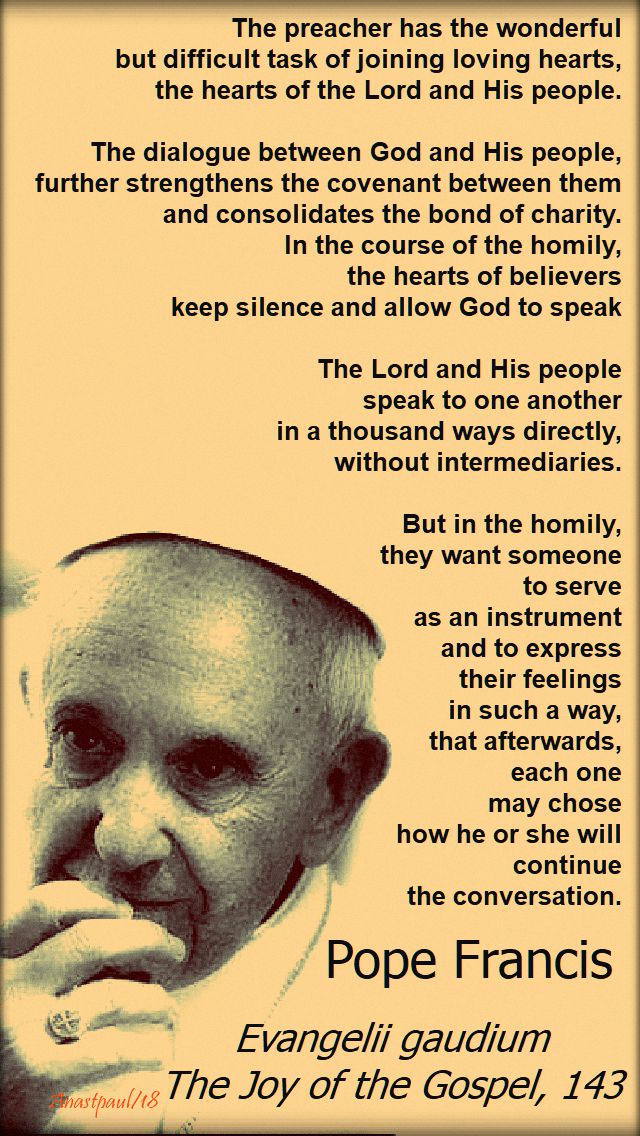
Pope Francis writes:

“The preacher has the wonderful but difficult task of joining loving hearts, the hearts of the Lord and His people.
The dialogue between God and His people further strengthens the covenant between them and consolidates the bond of charity.
In the course of the homily, the hearts of believers keep silence and allow God to speak. The Lord and His people speak to one another in a thousand ways directly, without intermediaries.   But in the homily, they want someone to serve as an instrument and to express their feelings in such a way, that afterwards, each one may chose how he or she
will continue the conversation.”

Pope Francis – Evangelii gaudium – The Joy of the Gospel, 143

the preacher has the wonderful but difficult task - evanelii guadium the joy of the gospel 143 - pope francis - 30 oct 2018

Posted in 7 GIFTS of the HOLY GHOST: Wisdom, Understanding, Prudence, Strength, Knowledge, Piety, Fear, DOCTORS of the Church, FATHERS of the Church, franciscan OFM, Our MORNING Offering, PRAYERS of the SAINTS, SAINT of the DAY

Our Morning Offering – 30 October – The Memorial of St Angelo of Acri OFM Cap (1669-1739)

Our Morning Offering – 30 October – The Memorial of St Angelo of Acri OFM Cap (1669-1739)

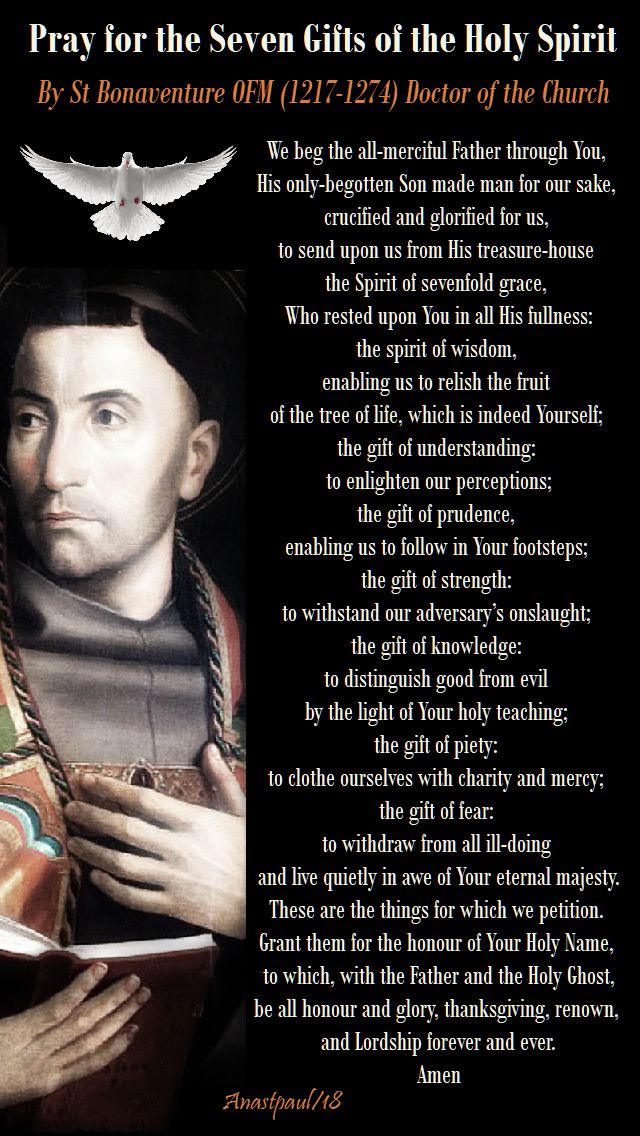
Pray for the Gifts of the Holy Spirit
By St Bonaventure OFM (1217-1274) Doctor of the Church

We beg the all-merciful Father through You,
His only-begotten Son made man for our sake,
crucified and glorified for us,
to send upon us from His treasure-house
the Spirit of sevenfold grace,
Who rested upon You in all His fullness:
the spirit of wisdom,
enabling us to relish the fruit
of the tree of life, which is indeed Yourself;
the gift of understanding:
to enlighten our perceptions;
the gift of prudence,
enabling us to follow in Your footsteps;
the gift of strength:
to withstand our adversary’s onslaught;
the gift of knowledge:
to distinguish good from evil
by the light of Your holy teaching;
the gift of piety:
to clothe ourselves with charity and mercy;
the gift of fear:
to withdraw from all ill-doing
and live quietly in awe of Your eternal majesty.
These are the things for which we petition.
Grant them for the honour of Your Holy Name,
to which, with the Father and the Holy Spirit,
be all honour and glory, thanksgiving, renown,
and Lordship forever and ever.
Amenprayer for the seven gifts of the holy spirit by st bonaventure - 30 oct 2018 mem of st angelo of acri

Posted in franciscan OFM, INCORRUPTIBLES, SAINT of the DAY

Saint of the Day – 30 October – Blessed Angelo of Acri OFM Cap

Saint of the Day – 30 October – Blessed Angelo of Acri OFM Cap – Priest of the Franciscan Capuchins, Confessor, Preacher, Missionary, Evangeliser, Miracle-Worker, Apostle of Charity and Mercy to the sick, Mystic with the gifts of prophecy, bi-location, visions and the ability to see into men’s souls in Confession.   St Angelo was born on 19 October 1669 at Acri, Cosenza, Italy and died on 30 October 1739 at the Friary of Acri, Consenza, Italy. header st angelo
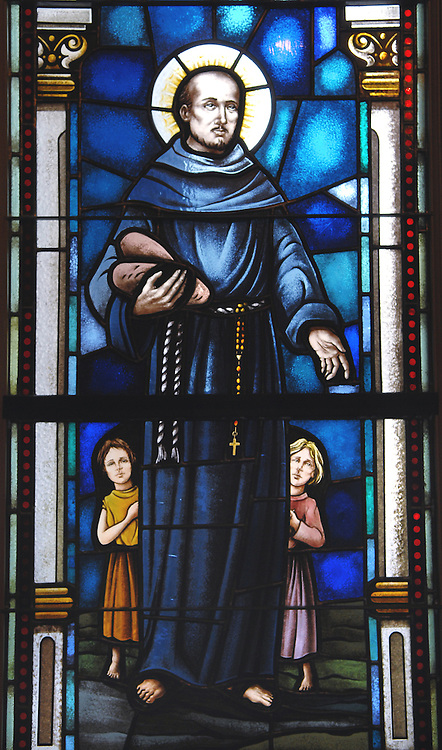
Luca Antonio Falcone was born in Acri, then a small town at the foot of the Sila mountainous plateau, in the heart of the of the old Casalicchio neighborhood, to a family of humble means.   Of this, he was always proud and in later years would recall in his conversations with the nobility, that he was the son of a baker and a goatherd. ,,He was baptised in the church of St Nicholas the day after he was born.

Having learned to read and write from a neighbour who had opened a sort of elementary school, he was also taught the fundamentals of Christian doctrine by frequenting the parish of St Nicholas and the friary church of the Capuchins, St Mary of the Angels.   As he grew up, an uncle who was a priest, his mother’s brother Fr Domenico Errico, put him to study in the hope of making of him a learned and cultivated person, able to be of assistance to his mother, who had been widowed at a young age.

As he turned twenty, after a brief experience of the eremitical life, Luca Antonio turned to consecrate himself among the Capuchins, casting aside all doubts in 1689 after hearing the charismatic preaching of the Capuchin Antonio of Olivadi.   But the young man soon faced a sort of obstacle course;  twice he put aside the religious habit and left the novitiate, discouraged by the austerity of Capuchin life and giving into how much he missed his mother, whom he had left in tears.   But on the third time, on 12 November 1690, Luca Antonio began the novitiate in the friary of Belvedere Marittimo with the name Angelo of Acri.

This time too, the second thoughts and temptations were not lacking but during the reading of the heroic deeds of Br Bernard of Corleone († 1667), whose cause for beatification was taking place at the time, Br Angelo lifted up a deep prayer to the Lord, asking for help in his struggle.   It is said that the young novice was encouraged by the Lord, who showed him that he should follow in the footsteps of Br Bernard, behaving just as he did.   It was the awaited sign.

Making profession of vows on 12 November 1691, Br Angelo set himself on the way of evangelical perfection, preparing himself also for priestly ordination, which he received in the cathedral of Cassano all’Ionio at Easter, 10 April 1700.   He was then called by obedience to prepare himself to be a preacher.   From 1702 until his death in 1739, he travelled tirelessly through all of Calabria and much of central Italy preaching Lenten sermons, retreats and popular missions.angelus of acri

The beginning of his preaching ministry was not very glorious – his debut in the pulpit of San Giorgio Albanese, near Corigliano Calabro, was a real failure.   For three consecutive evenings he was unable to remember the text which he had studiously committed to memory and, finding himself unable to continue to preach in some other way, could only go away in disappointment.

In tears before the crucifix in his cell, Br Angelo took stock of his failure and reached an irrevocable decision:  from then on he would preach, “Christ crucified and naked, far from esoteric rhetoric and also from the uneasiness of the Tuscan language but only in his native dialect,” repeating “step by step” what the Holy Spirit would suggest to him, as his heart was thus inflamed with zeal and spiritual unction.   And in this he was a success!cell of st angelo

Aware, however, that the preacher who does not also hear confessions is like a sower who does not think of the harvest, Angelo of Acri spent many hours in the confessional, never tiring of listening and of treating sinners with mercy.   He was convinced that the most difficult situations could be resolved with charity and that mercy was the easiest way to lead back to God the sinners that divine love had drawn to kneel at his confessional.   But he didn’t just wait for them; many times the love of God pushed him to seek out sinners in need of reconciliation, just as he was also solicitous for the sick who asked for his spiritual assistance.

Angelo’s love for the poor and those who suffered injustice moved him many times to call the Sanseverino family, for centuries the great nobles of Acri, to listen to the justified claims of the people such that their basic rights would be respected.   He had at heart the salvation of the whole person, of both the spiritually and materially poor, of those denied their dignity and those who distanced themselves from God.

He never left the place where he had preached the mercy of God and reconciled sinners without leaving some concrete signs: an image of Calvary and a statue of Our Lady of Sorrows as tangible reminders of the Love of God that suffers and offers itself that humanity might have Life.beato_angelo_-Acri

Angelo also had roles of authority in the Order and as Provincial Minister he did not fail to recall the friars to an authentic Capuchin life, offering them five precious gems: austerity, simplicity, the exact observance of the Constitutions and the Rule, innocence of life and boundless charity.

At the age of seventy, Angelo died in the friary of Acri, offering his life that God would lavish on the city and on all of Calabria, the greatest of gifts, those of peace and well-being for all.

He was Beatified on 18 December 1825 by Pope Leo XII.    His body is incorrupt and is enshrined in in the Basilica dedicated to him in Acri.   His face is covered by a wax mask.

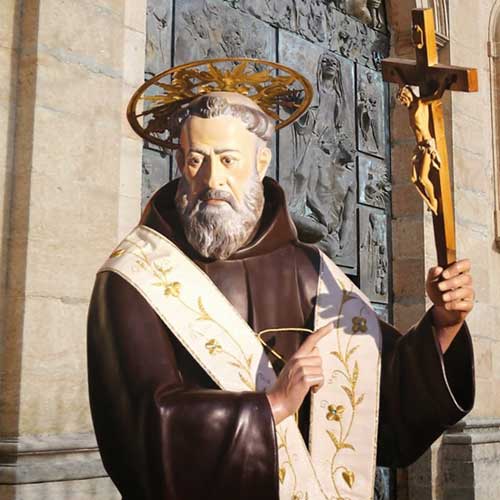
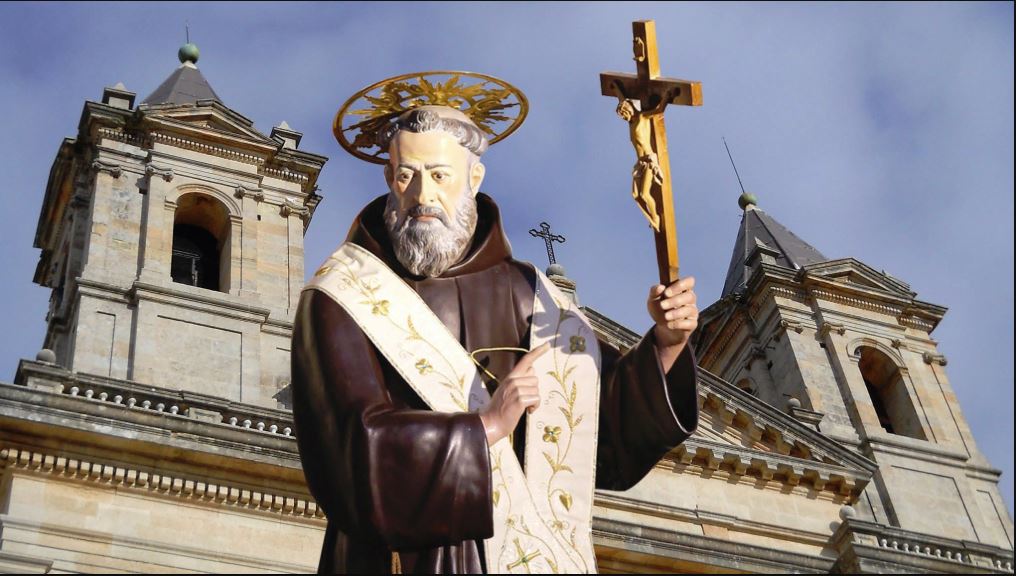
st angelo statue at acri basilicast angelo of acri

Posted in franciscan OFM, SAINT of the DAY

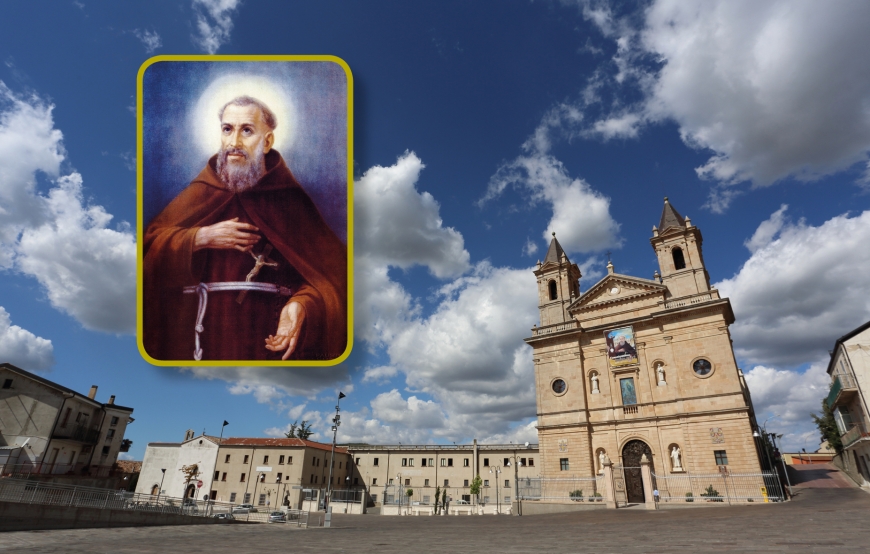
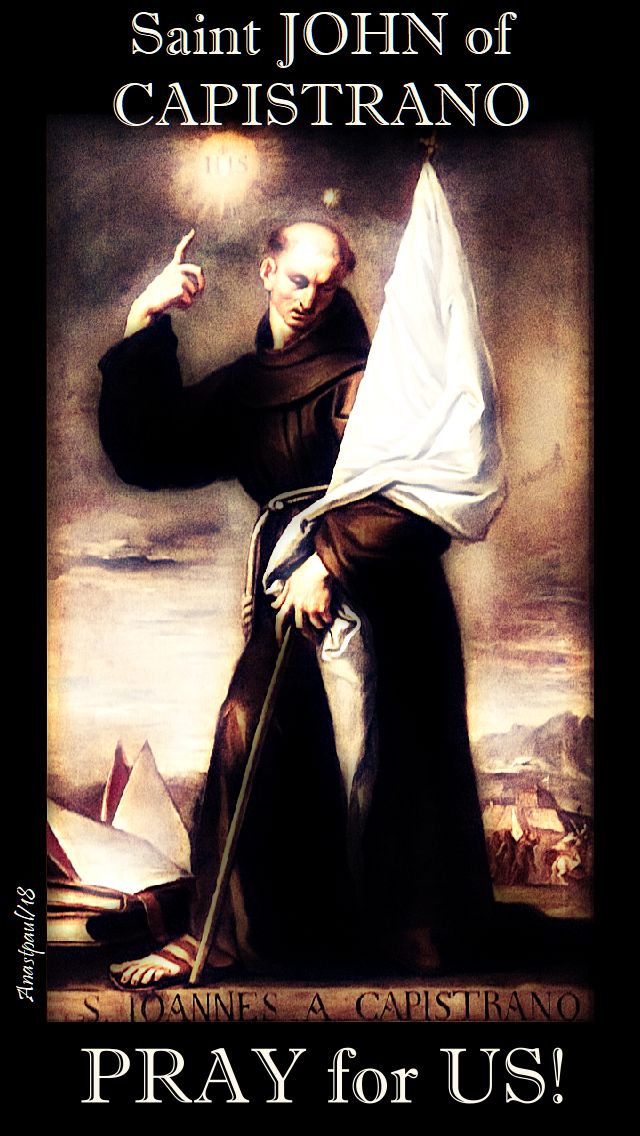
Thought for the Day – 23 October – The Memorial of St John of Capistrano OFM (1386-1456)

Thought for the Day – 23 October – The Memorial of St John of Capistrano OFM (1386-1456)

It has been said the Christian saints are the world’s greatest optimists.   Not blind to the existence and consequences of evil, they base their confidence on the power of Christ’s redemption.   The power of conversion through Christ extends not only to sinful people but also to calamitous events.

Imagine being born in the 14th century.   One-third of the population and nearly 40 percent of the clergy were wiped out by the bubonic plague.   The Western Schism split the Church with two or three claimants to the Holy See at one time.   England and France were at war.   The city-states of Italy were constantly in conflict.   No wonder that gloom dominated the spirit of the culture and the times.

John Capistrano was born in 1386.   His education was thorough.   His talents and success were great.   When he was 26 he was made governor of Perugia.   Imprisoned after a battle against the Malatestas, he resolved to change his way of life completely.   At the age of 30 he entered the Franciscan novitiate and was ordained a priest four years later.
John’s preaching attracted great throngs at a time of religious apathy and confusion.   He and 12 Franciscan brethren were received in the countries of central Europe as angels of God.   They were instrumental in reviving a dying faith and devotion.

The Franciscan Order itself was in turmoil over the interpretation and observance of the Rule of St Francis.   Through John’s tireless efforts and his expertise in law, the heretical Fraticelli were suppressed and the “Spirituals” were freed from interference in their stricter observance.

John of Capistrano helped bring about a brief reunion with the Greek and Armenian Churches.

When the Turks captured Constantinople in 1453, John was commissioned to preach a crusade for the defence of Europe.   Gaining little response in Bavaria and Austria, he decided to concentrate his efforts in Hungary.   He led the army to Belgrade.   Under the great General John Hunyadi, they gained an overwhelming victory and the siege of Belgrade was lifted.   Worn out by his superhuman efforts, Capistrano was an easy prey to an infection after the battle.   He died on October 23, 1456.
John Hofer, a biographer of John Capistrano, recalls a Brussels organisation named after the saint.   Seeking to solve life problems in a fully Christian spirit, its motto was: “Initiative, Organisation, Activity.”   These three words characterised John’s life.   He was not one to sit around.   His deep Christian optimism drove him to battle problems at all levels with the confidence engendered by a deep faith in Christ.   (Lives of the Saints – Franciscan Media)

St John of Capistrano, Pray for us!

St John’s full biography here: https://anastpaul.wordpress.com/2017/10/23/saint-of-the-day-23-october-st-john-capistrano-ofm-1386-1456-the-soldier-saint/st john of capistrano pray for us 23 oct 2018

Posted in franciscan OFM, MORNING Prayers, SAINT of the DAY, The HOLY CROSS, The PASSION

Thought for the Day – 19 October – The Memorial of St Peter of Alcantara OFM (1499-1562)

Thought for the Day – 19 October – The Memorial of St Peter of Alcantara OFM (1499-1562)

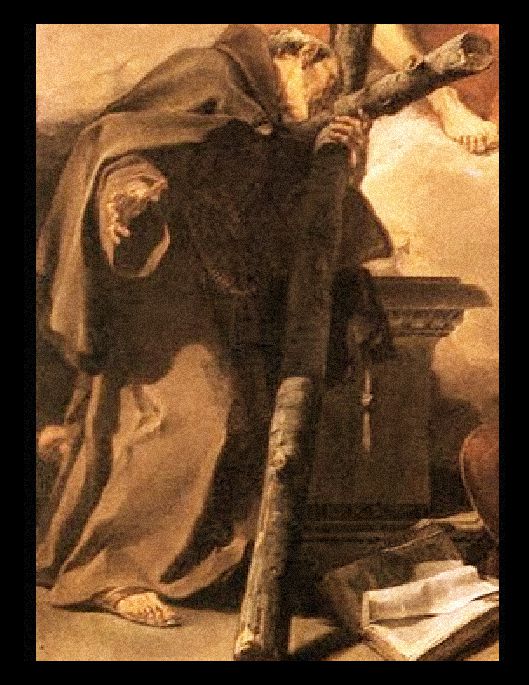
Everywhere he could do so, he planted crosses, for the Passion of Our Lord was engraved in his heart.

Wherever they were to be placed, even on mountains and however heavy they might be, he went to the destined sites carrying them on his shoulders.   From these heights he would then preach the mysteries of the Cross, afterwards remaining in prayer there. Shepherds saw him several times in the air, at the height of the highest trees of the forests.

Never did he go anywhere except on foot, even in his old age.   He was often seen prostrated before a large crucifix, shedding torrents of tears and he was found in ecstasy once at the height of the traverse of a crucifix.

The goal was following Christ in ever greater purity of heart.   Whatever obstructed that path could be eliminated with no real loss.   If men do not go about barefoot now, nor undergo sharp penances as Saint Peter did, there remain many ways of trampling on the spirit of the world and Our Lord teaches them, when He finds in souls the necessary courage.

St Peter of Alcantara, Pray for Us!st peter of alcantara pray for us no 2 - 19 oct 2018

Posted in franciscan OFM, JESUIT SJ, MORNING Prayers, QUOTES of the SAINTS, QUOTES on DIVINE PROVIDENCE, QUOTES on FAITH, QUOTES on JUSTICE, QUOTES on LOVE, QUOTES on TRUST and complete CONFIDENCE in GOD, QUOTES on TRUTH, QUOTES on WORK/LABOUR, SAINT of the DAY

Quote of the Day – 19 October

Quote of the Day – 19 October – The Memorial of St Peter of Alcantara OFM (1499-1562), St Isaac Jogues SJ (1607-1646) The North American Martyrs) & Bl Jerzy Popiełuszko (1947-1984)

“He does much
in the sight of God
who does his best,
be it ever so little.”he does much in the sight of god - st peter of alcantara - 19 oct 2018

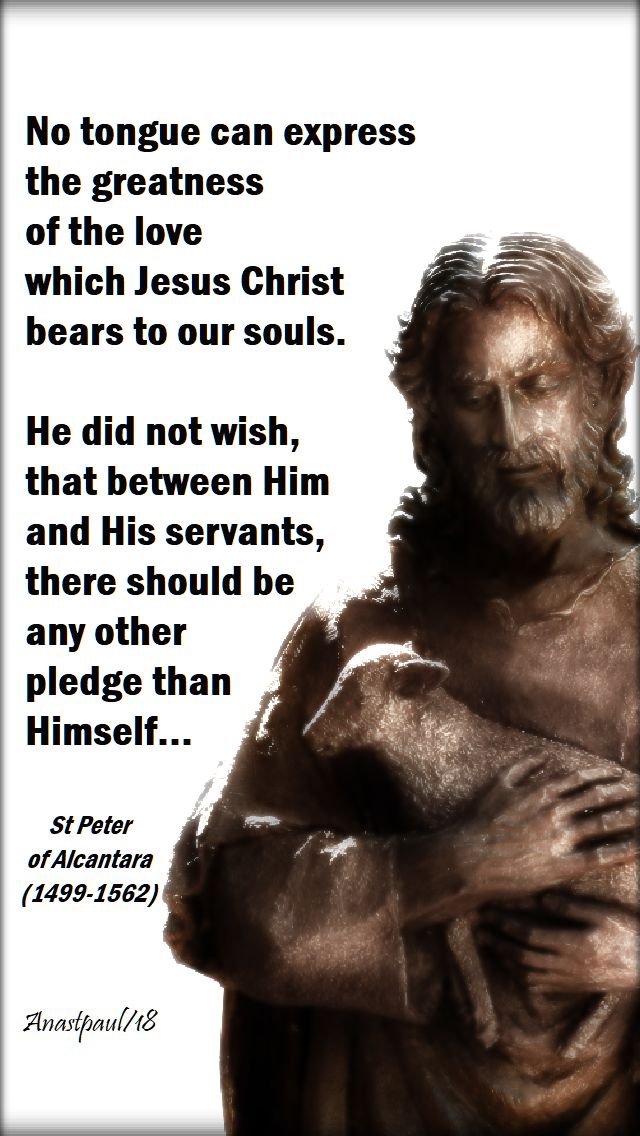
“No tongue can express
the greatness of the love
which Jesus Christ
bears to our souls.
He did not wish,
that between Him
and His servants,
there should be any other pledge
than Himself…

St Peter of Alcantara (1499-1562)no tongue can express - st peter of alcantara - 19 oct 2018

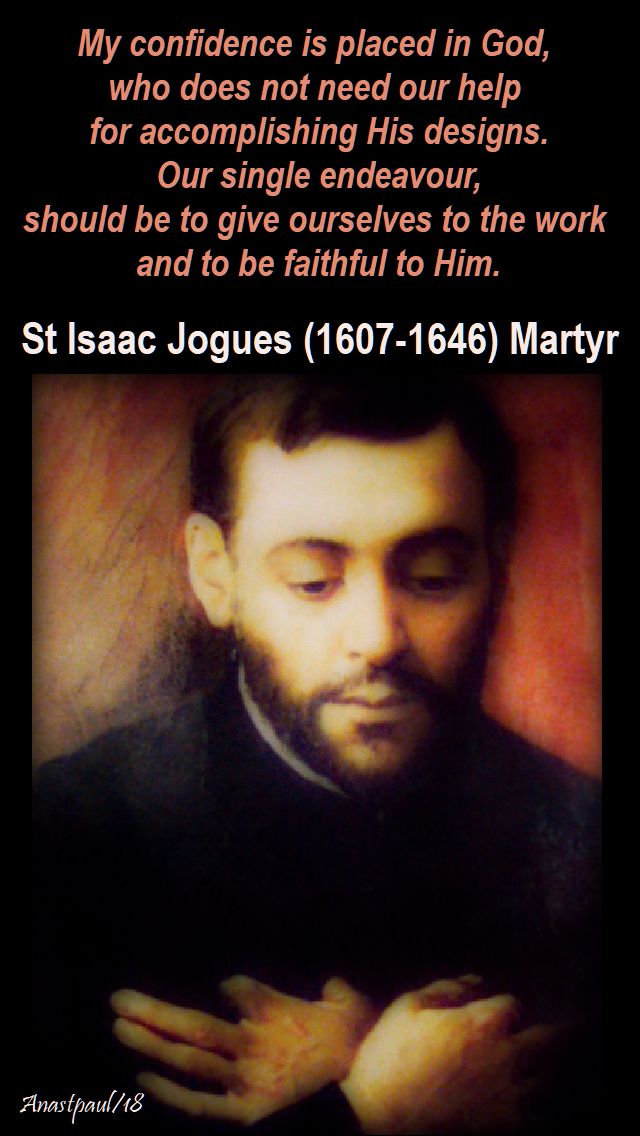
“My confidence is placed in God,
who does not need our help
for accomplishing His designs.
Our single endeavour,
should be to give ourselves to the work
and to be faithful to Him.”

St Isaac Jogues SJ (1607-1646) Martyrmy confidence is placed in god - st isaac jogues - 19 oct 2018

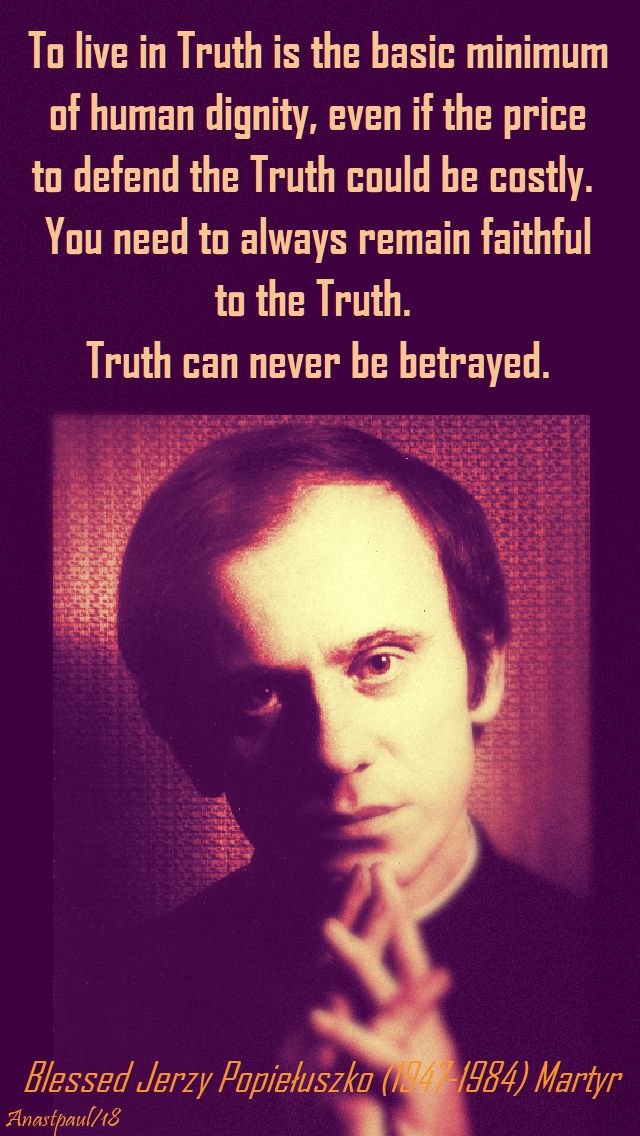
”To live in Truth is the basic minimum of human dignity,
even if the price to defend the Truth could be costly.
You need to always remain faithful to the Truth.
Truth can never be betrayed.”to live in truth - bl jerzy popieluszko - 19 oct 2018

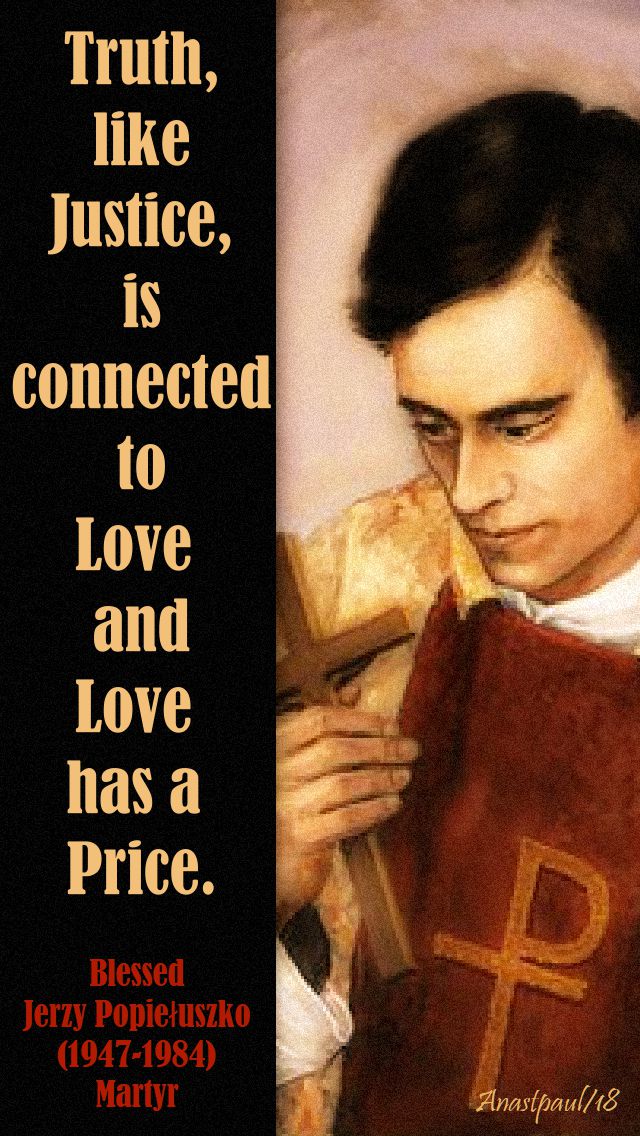
“Truth, like Justice,
is connected to Love
and Love has a Price.”

Blessed Jerzy Popiełuszko (1947-1984) Martyrtruth like justice - bl jerzy popieluszko - 19 oct 2018

Posted in franciscan OFM, Our MORNING Offering, PRAYERS of the SAINTS, SAINT of the DAY

Our Morning Offering – 19 October – The Memorial of St Peter of Alcantara OFM (1499-1562)

Our Morning Offering – 19 October – The Memorial of St Peter of Alcantara OFM (1499-1562)

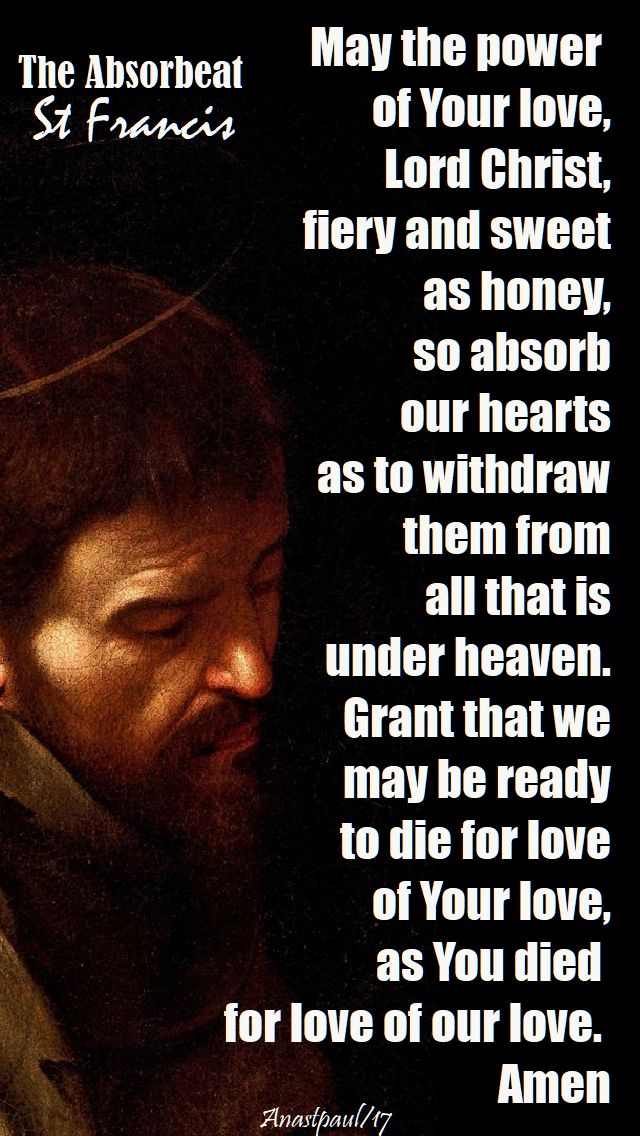
The Absorbeat
St Francis of Assisi (1181/82-1226)

May the power of Your love, Lord Christ,
fiery and sweet as honey,
so absorb our hearts
as to withdraw them
from all that is under heaven.
Grant that we may be ready
to die for love of Your love,
as You died for love of our love.
Amenthe-absorbeat-st-franics-13-oct-2017

Posted in EUCHARISTIC ADORATION and Nocturnal, franciscan OFM, PATRONAGE - NIGHT WARCHMEN, SAINT of the DAY

Saint of the Day – 19 October – St Peter of Alcantara OFM (1499-1562)

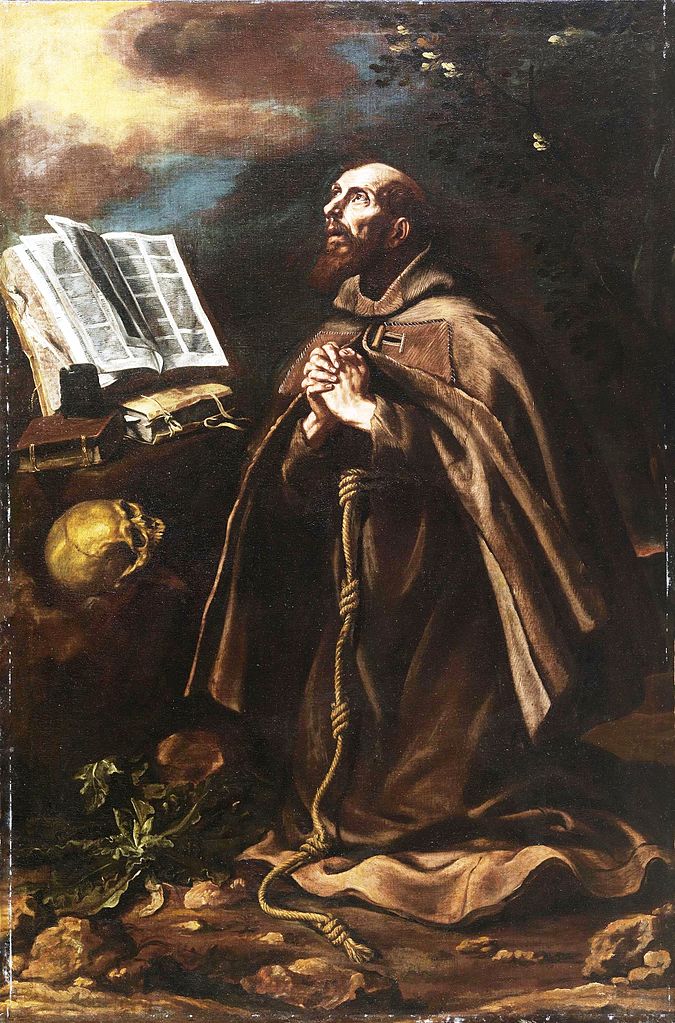
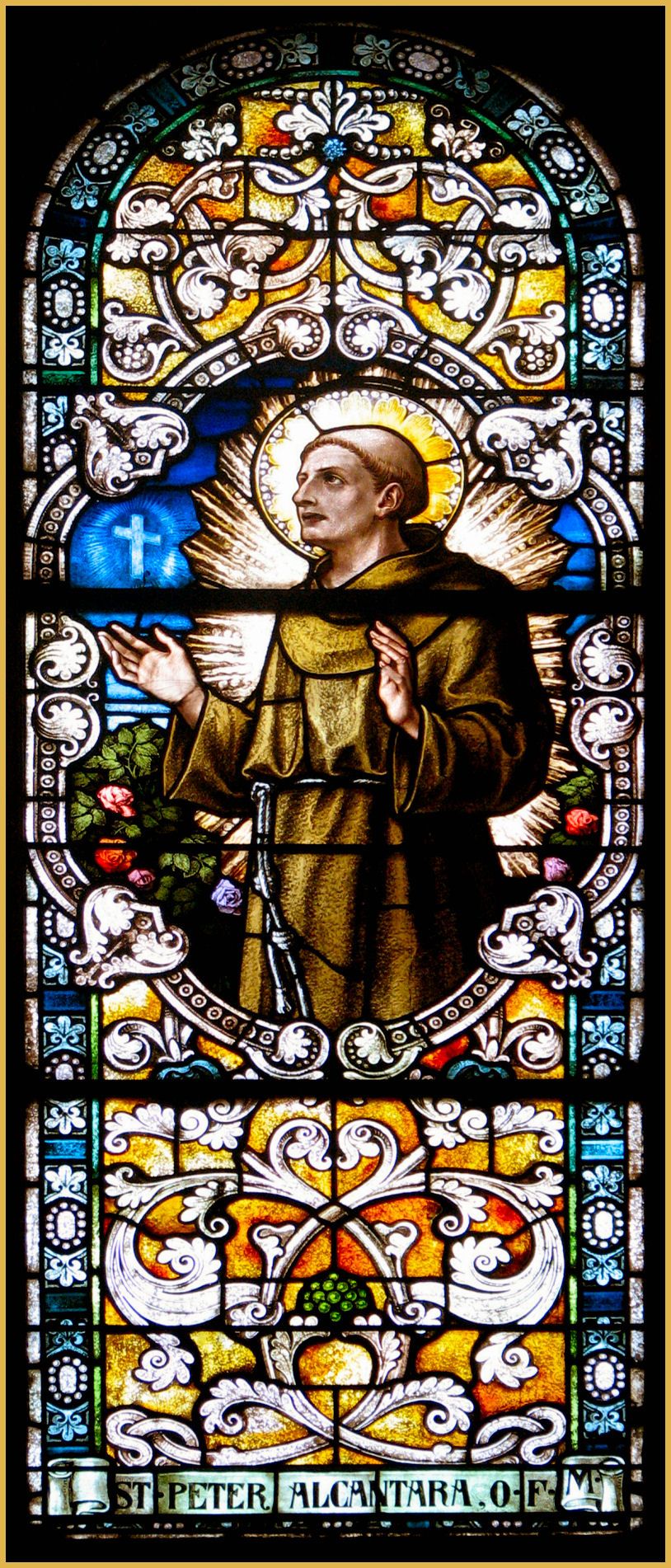
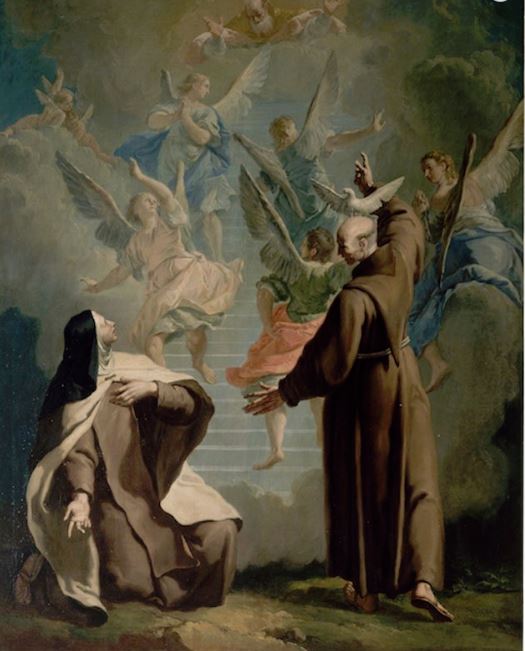
Saint of the Day – 19 October – St Peter of Alcantara OFM (1499-1562) – Franciscan Friar and Priest, Mystic, Ecstatic, Writer, Preacher, Reformer, Hermit, Apostle of Prayer, Eucharistic Adoration, the Passion and Charity, Miracle-worker – born in 1499 at Alcantara, Estremadura, Spain and died on 18 October 1562 at Estremadura, Spain of natural causes.   Patronages – Nocturnal Adoration of the Blessed Sacrament, Brazil (named by Pope Blessed Pius IX in 1862), Estremadura Spain (named in 1962), night watchmen, watchmen.header - San_Pedro_de_Alcántara_(Museo_de_El_Greco,_Toledo)

His father, Peter Garavita, was the governor of Alcantara and his mother was of the noble family of Sanabia.   After a course of grammar and philosophy in his native town, he was sent, at the age of fourteen, to the University of Salamanca.   Returning home, he became a Franciscan in the convent of the Stricter Observance at Manxaretes in 1515.   At the age of twenty-two he was sent to found a new community of the Stricter Observance at Badajoz.   He was ordained priest in 1524 and the following year made guardian of the convent of St Mary of the Angels at Robredillo.   A few years later he began preaching with much success.   He preferred to preach to the poor and his sermons, taken largely from the Prophets and Sapiential Books, breathe the tenderest human sympathy.st peter of alcantara glass

Having been elected minister of St Gabriel’s province in 1538, Peter set to work at once. At the chapter of Plasencia in 1540 he drew up the Constitutions of the Stricter Observants but his severe ideas met with such opposition that he renounced the office of provincial and retired with St John of Avila into the mountains of Arabida, Portugal, where he joined Father Martin a Santa Maria in his life of eremitical solitude.   Soon, however, other friars came to join him and several little communities were established. Peter being chosen guardian and master of novices at the convent of Pallais.   In 1560 these communities were erected into the Province of Arabida.   Returning to Spain in 1553 he spent two more years in solitude and then journeyed barefoot to Rome and obtained permission of Pope Julius III to found some poor convents in Spain under the jurisdiction of the general of the Conventuals.   Convents were established at Pedrosa, Plasencia, and elsewhere; in 1556 they were made a commissariat, with Peter as superior, and in 1561, a province under the title of St Joseph.    The reform spread rapidly into other provinces of Spain and Portugal.Peter-of-Alcantara-edit

In 1562 the province of St Joseph was put under the jurisdiction of the general of the Observants and two new custodies were formed.   Besides the above-named associates of Peter may be mentioned St Francis Borgia SJ,  St  John of Avila (Doctor of the Church) and Blessed Louis of Granada O.P.     In St Teresa of Avila OCD (Doctor of the Church), Peter perceived a soul chosen of God for a great work and her success in the reform of Carmel was in great measure due to his counsel, encouragement and defence.  It was a letter from St Peter (14 April 1562) that encouraged her to found her first monastery at Avila.  St Teresa’s autobiography is the source of much of our information regarding Peter’s life, work and gifts of miracles and prophecy.   According to St Teresa of Ávila, it was a very common thing for him to take food only once in three days and that sometimes he would go a week without eating.st peter alcantara and st teresa avila

Perhaps the most remarkable of Peter’s graces were his gift of contemplation and the virtue of penance.   Hardly less remarkable was his love of God, which was at times so ardent as to cause him, as it did St Philip Neri, sensible pain and frequently rapt him into ecstasy.   The poverty he practised and enforced was as cheerful as it was real and often let the want of even the necessaries of life be felt.   In confirmation of his virtues and mission of reformation God worked numerous miracles through his intercession and by his very presence.   Besides the Constitutions of the Stricter Observants and many letters on spiritual subjects, especially to St Teresa, he composed a short treatise on prayer, which has been translated into all the languages of Europe.

Download the book here:  http://catholicharboroffaithandmorals.com/A%20Golden%20Treastise%20of%20Mental%20Prayer.htmlcover-Peter_Alcantara_front-800_copy_2

He was a man of remarkable austerity and poverty who travelled throughout Spain preaching the Gospel to the poor.   He wrote a Treatise on Prayer and Meditation, which was considered a masterpiece by St Teresa, St Francis de Sales (Doctor of the Church) and Louis of Granada.st peter alcantara death

While in prayer and contemplation, he was often seen in ecstasies and levitation.   On his deathbed, he was offered a glass of water which he refused, saying that “Even my Lord Jesus Christ thirsted on the Cross…”   He died while on his knees in prayer on 18 October 1562 in a monastery at Arenas.

death of st peter alcantara
Death of St Peter of Alcantara

He was Beatified on 18 April 1622 by Pope Gregory XV and Canonised on 28 April 1669 by Pope Clement IX.

Vatikan,_Petersdom,_die_Statue_des_Saint_Peter_of_Alcantara
Statue of St Peter of Alcantara at St Peter’s Basilica

Posted in franciscan OFM, Our MORNING Offering, PRAYERS of the SAINTS, SAINT of the DAY

Our Morning Offering – 12 October

Our Morning Offering – 12 October

Grant me Grace O Lord
By St Paschal Baylon O.F.M. (1540-1592)

I am a sinner
and You are He
who justifies the impious.
I am poor,
You are rich in infinite riches.
Give me an increase of faith,
an increase of love,
a complement of all virtues
with which I may serve You
and praise You
all my life so that, at last,
I may enjoy You in Heaven.
Amengrant me grace o lord - st paschal baylon - 17 april 2018