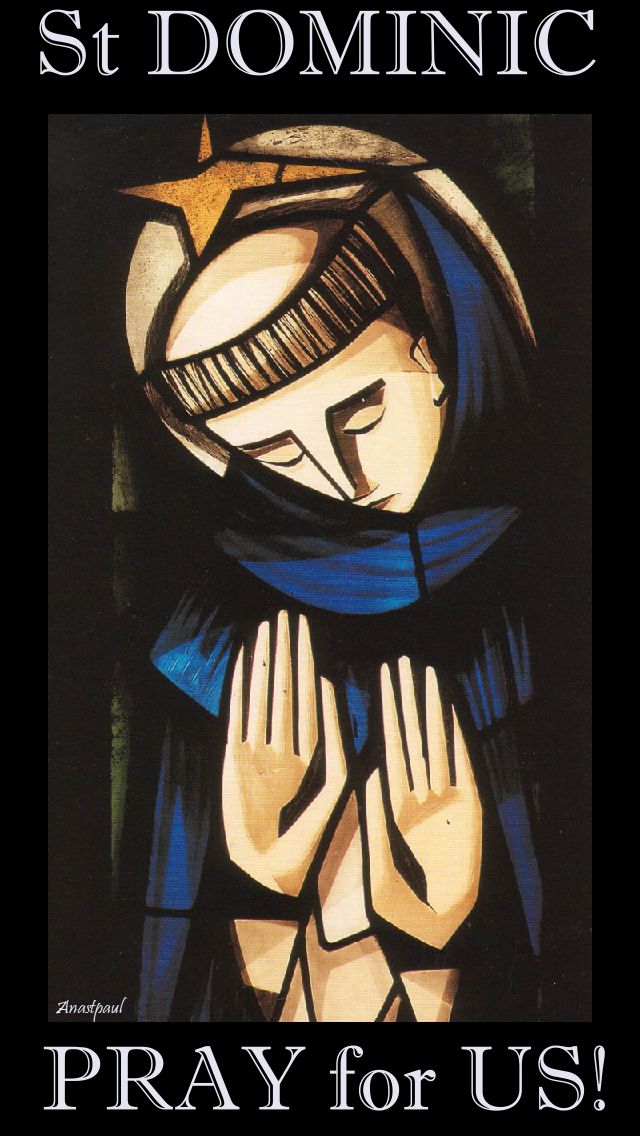
Thought for the Day – 8 August – The Memorial of St Dominic de Guzman
Words of Pope Benedict XVI on St Dominic
In the second volume of his work “Jesus of Nazareth”, in speaking of the first and last coming of Christ, he introduces a “middle coming”, through his word, the sacraments, events. And he continues: ” But there are also modalities of this coming season. The impact of two great figures -Francisco and Domingo- between the twelfth and thirteenth centuries, has been a way in which Christ has re-entered history, re-enforcing His word and his love; a way with which He has renewed the Church and has driven history to itself. ” In St Dominic’s words: “You are my companion and must walk with me. If we hold together, no earthly power can withstand us.”
Likewise, Benedict XVI, recognising the Marian devotion of Saint Dominic, manifested in his catechesis on February 3, 2010: ” First and foremost, Marian devotion, which he cultivated with tenderness and left his spiritual children as an inheritance, Which in the history of the Church have had the great merit of spreading the prayer of the holy rosary, so rooted in the Christian people and so rich in evangelical values, a true school of faith and piety.
Once, at a difficult point in the preaching ministry, St Dominic had a dream in which he saw heaven. Christ was there, arrayed like a king, with His Mother beside Him cloaked in a magnificent mantle. Around the Blessed Mother were countless souls from all walks of life: clergy, laypersons, and members of every religious order ever founded. Among the religious there were Benedictines, Augustinians, Carmelites, Franciscans, everyone, except the Order of Preachers. Struck to the heart, Dominic said, “Is there not a single one of mine?” The Lord gestured to his Mother, who opened her mantle. There, under it, were hundreds and hundreds of Dominican souls in their black and white habits. The Lord said, “Behold, I have left your Order in the care of My Mother.”
And, in the catechesis of August 8, 2012, he referred to another characteristic of St Dominic, the prayer : “St Dominic was a man of prayer. In love with God, he had no other aspiration than the salvation of souls, especially those who had fallen into the webs of the heresies of his time; Imitator of Christ, incarnated radically the three evangelical counsels joining to the proclamation of the Word the testimony of a poor life; under the guidance of the Holy Spirit, progressed in the path of Christian perfection. At all times prayer was the force that renewed and made more and more fruitful his apostolic works.
St Dominic reminds us that at the origin of the witness of faith, which every Christian should give in family, work, social commitment and also in times of relaxation, is prayer, personal contact with God. Only this real relationship with God gives us the strength to live intensely every event, especially moments of greater suffering. “
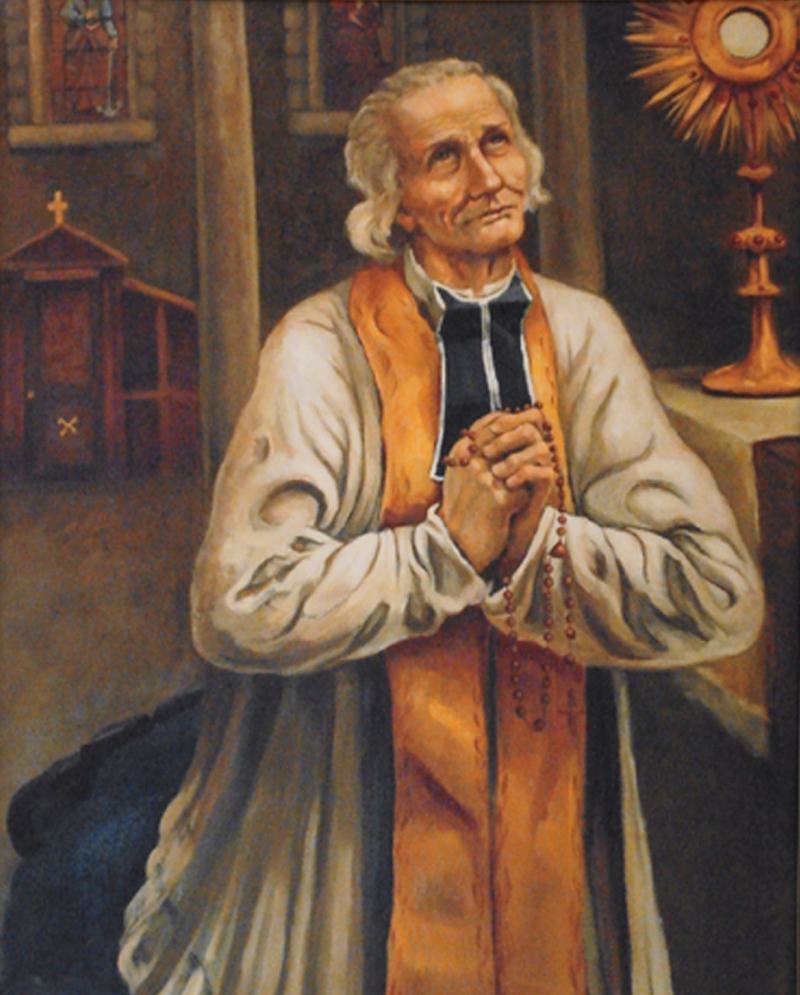
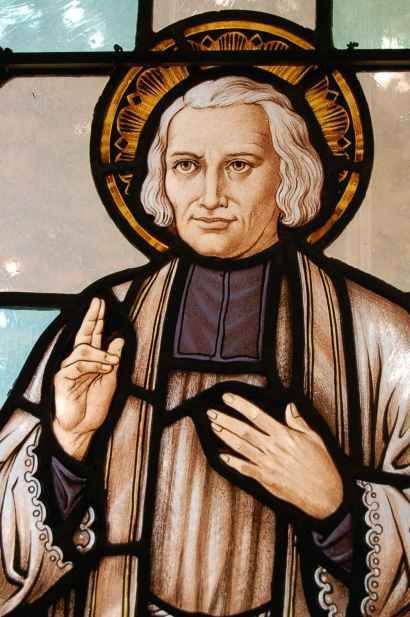
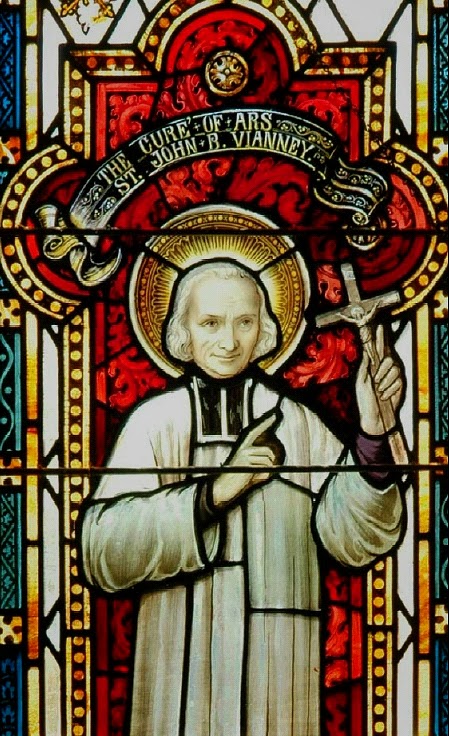
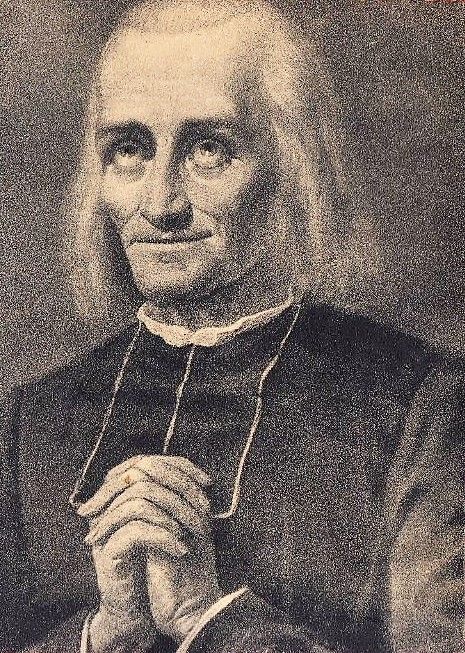
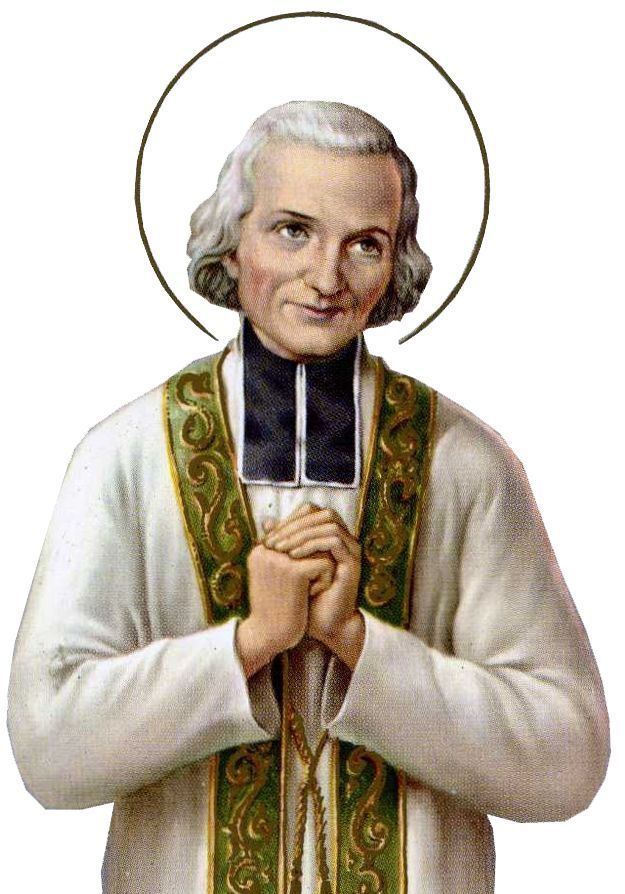
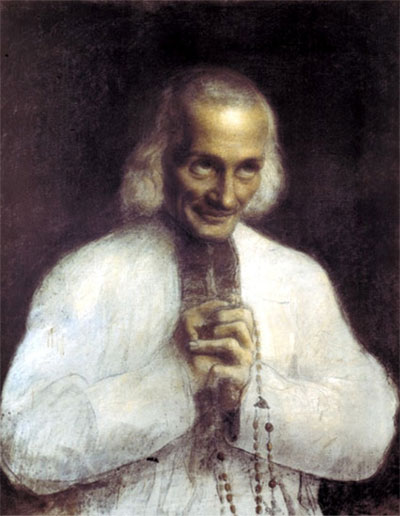
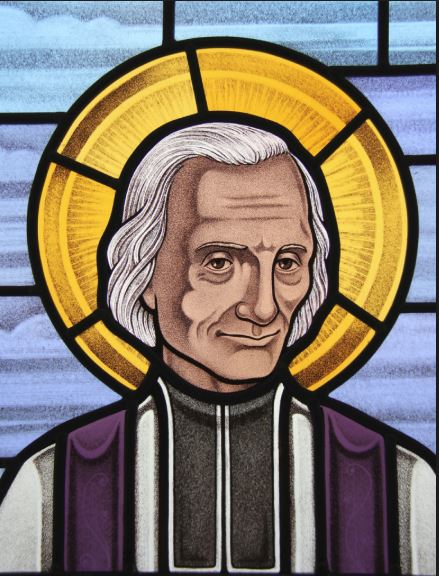
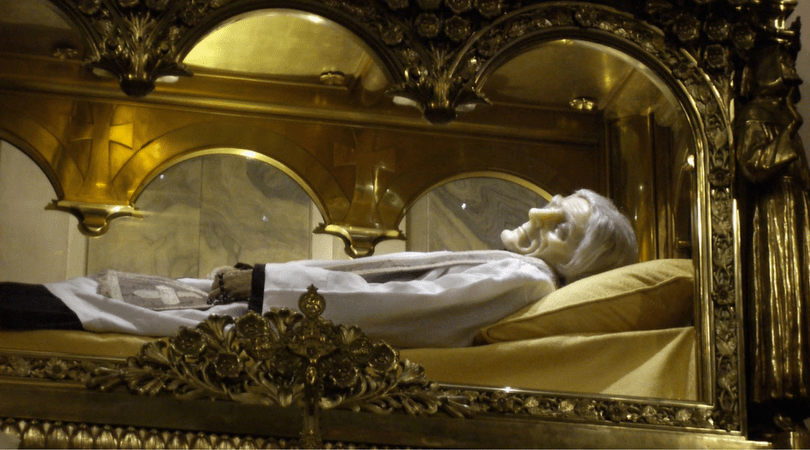
Saint of the Day – 9 August – St Jean-Baptiste Marie Vianney TOSF (1786-1859) – The Curé of Ars (Parish Priest of Ars) – Confessor Priest and Tertiary – (8 May 1786 at Dardilly, Lyons, France – 4 August 1859 at Ars, France of natural causes) His body is interred in the Basilica of Ars. He was Canonised on 31 May 1925 by Pope Pius XI. Patronages – Confessors, Priests (proclaimed on 23 April 1929 by Pope Pius XI), Personal Apostolic Administration of Saint John Mary Vianney, Dubuque, Iowa, Archdiocese of, Kamloops, British Columbia, Diocese of, Kansas City, Kansas, Archdiocese of, Lafayette, Louisiana, Diocese of, Saint Paul and Minneapolis, Minnesota, Archdiocese of. St John Vianney’s body is incorrupt.
St John Vianney was born on 8 May 1786, in the French town of Dardilly, France (near Lyon) and was baptised the same day. His parents, Matthieu Vianney and his wife Marie (Belize), had six children, of whom John was the fourth. The Vianneys were devout Catholics, who helped the poor and gave hospitality to St Benedict Joseph Labre, the patron saint of tramps, who passed through Dardilly on his pilgrimage to Rome.
St Benedict Joseph Labre
By 1790, the anticlerical Terror phase of the French Revolution forced many loyal priests to hide from the regime in order to carry out the sacraments in their parish. Even though to do so had been declared illegal, the Vianneys traveled to distant farms to attend Masses celebrated by priests on the run. Realising that such priests risked their lives day by day, Vianney began to look upon them as heroes. He received his First Communion catechism instructions in a private home by two nuns whose communities had been dissolved during the Revolution. He made his first communion at the age of 13 (normal in those times). During the Mass, the windows were covered so that the light of the candles could not be seen from the outside. His practice of the Faith continued in secret, especially during his preparation for confirmation.
The Catholic Church was re-established in France in 1802 by Napoleon Bonaparte, resulting in religious peace throughout the country, culminating in a Concordat. By this time, Vianney was concerned about his future vocation and longed for an education. He was 20 when his father allowed him to leave the farm to be taught at a “presbytery-school” in the neighbouring village of Écully, conducted by the Abbé Balley. The school taught arithmetic, history, geography and Latin. Vianney struggled with school, especially with Latin, since his past education had been interrupted by the French Revolution. Only because of Vianney’s deepest desire to be a priest—and Balley’s patience—did he persevere.
St Vianney’s studies were interrupted in 1809 when he was drafted into Napoleon’s armies. He would have been exempt, as an ecclesiastical student but Napoleon had withdrawn the exemption in certain dioceses because of his need for soldiers in his fight against Spain. Two days after he had to report at Lyons, he became ill and was hospitalised, during which time his draft left without him. Once released from the hospital, on 5 January, he was sent to Roanne for another draft. He went into a church to pray and fell behind the group. He met a young man who volunteered to guide him back to his group but instead led him deep into the mountains of Le Forez, to the village of Les Noes, where deserters had gathered. St Vianney lived there for fourteen months, hidden in the byre attached to a farmhouse and under the care of Claudine Fayot, a widow with four children. He assumed the name Jerome Vincent and under that name, he opened a school for village children. Since the harsh weather isolated the town during the winter, the deserters were safe from gendarmes. However, after the snow melted, gendarmes came to the town constantly, searching for deserters. During these searches, Vianney hid inside stacks of fermenting hay in Fayot’s barn.
An imperial decree proclaimed in March 1810 granted amnesty to all deserters, which enabled Vianney to go back legally to Ecully, where he resumed his studies. He was tonsured in 1811 and in 1812 he went to the minor seminary at Verrières-en-Forez. In autumn of 1813, he was sent to the major seminary at Lyons. Considered too slow, he was returned to Abbe Balley. However, Balley persuaded the Vicar general that Vianney’s piety was great enough to compensate for his ignorance and the seminarian received minor orders and the subdiaconate on 2 July 1814, was ordained a deacon in June 1815 and was ordained priest on 12 August 1815 in the Couvent des Minimes de Grenoble. He said his first Mass the next day and was appointed the assistant to Balley in Écully.
Curé of Ars
In 1818, shortly after the death of Balley, Jean-Marie Vianney was appointed parish priest of the parish of Ars, a town of 230 inhabitants. As parish priest, he realised that the Revolution’s aftermath had resulted in religious ignorance and indifference, due to the devastation wrought on the Catholic Church in France. At the time, Sundays in rural areas were spent working in the fields, or dancing and drinking in taverns. He spent time in the confessional and gave homilies against blasphemy and paganic dancing. If his parishioners did not give up this dancing, he refused them absolution. Abbe Balley had been St Vianney’s greatest inspiration, since he was a priest who remained loyal to his faith, despite the Revolution. He felt compelled to fulfill the duties of a curé, just as did Balley, even when it was illegal. With Catherine Lassagne and Benedicta Lardet, he established La Providence, a home for girls. Only a man of vision could have such trust that God would provide for the spiritual and material needs of all those who came to make La Providence their home.
Later years
Fr Vianney came to be known internationally and people from distant places began travelling to consult him as early as 1827. “By 1855, the number of pilgrims had reached 20,000 a year. During the last ten years of his life, he spent 16 to 18 hours a day in the confessional. Even the bishop forbade him to attend the annual retreats of the diocesan clergy because of the souls awaiting him yonder”. His work as a confessor is John Vianney’s most remarkable accomplishment. In the winter months he was to spend 11 to 12 hours daily reconciling people with God. In the summer months this time was increased to 16 hours. Unless a man was dedicated to his vision of a priestly vocation, he could not have endured this giving of self day after day.
Many people look forward to retirement and taking it easy, doing the things they always wanted to do but never had the time. But John Vianney had no thoughts of retirement. As his fame spread, more hours were consumed in serving God’s people. Even the few hours he would allow himself for sleep were disturbed frequently by the devil, who physically attacked and tormented St John and kept him from sleeping.
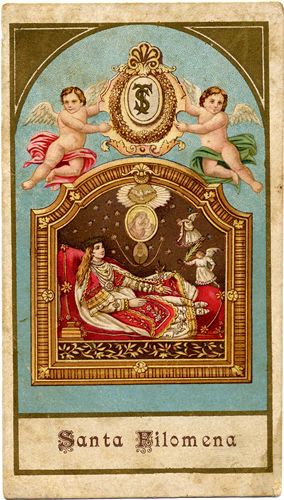
St Vianney had a great devotion to St. Philomena. He regarded her as his guardian and erected a chapel and shrine in honor of the saint. During May 1843, he fell so ill he thought that his life was coming to its end. St John Vianney attributed his cure to her intercession.
He yearned for the contemplative life of a monk and four times ran away from Ars, the last time in 1853. St John Vianney read much and often the lives of the saints, and became so impressed by their holy lives that he wanted for himself and others to follow their wonderful examples. The ideal of holiness enchanted him. This was the theme which underlay his sermons. “We must practice mortification. For this is the path which all the Saints have followed,” he said from the pulpit. He placed himself in that great tradition which leads the way to holiness through personal sacrifice. “If we are not now saints, it is a great misfortune for us: therefore we must be so. As long as we have no love in our hearts, we shall never be Saints.” The Saint, to him, was not an exceptional man before whom we should marvel but a possibility which was open to all Catholics. Unmistakably did he declare in his sermons that “to be a Christian and to live in sin is a monstrous contradiction. A Christian must be holy.” With his Christian simplicity he had clearly thought much on these things and understood them by divine inspiration, while they are usually denied to the understanding of educated men. He was a champion of the poor as a Franciscan tertiary and was a recipient of the coveted French Legion of Honour.
On 4 August 1859, Vianney died at the age of 73. The bishop presided over his funeral with 300 priests and more than 6,000 people in attendance. Before he was buried, Vianney’s body was fitted with a wax mask.
On 3 October 1874 Pope Pius IX proclaimed him “venerable”; on 8 January 1905, Pope Pius X declared him Blessed and proposed him as a model to the parochial clergy. In 1925 John Mary Vianney was canonized by Pope Pius XI, who in 1929 made him patron saint of parish priests.
In 1959, to commemorate the centenary of John Vianney’s death, Pope John XXIII issued the encyclical letter Sacerdotii nostri primordia. St Pope John Paul II visited Ars in person in 1986 in connection with the anniversary of Vianney’s birth and referred to the great saint as a “rare example of a pastor acutely aware of his responsibilities … and a sign of courage for those who today experience the grace of being called to the priesthood.”
In honour of the 150th anniversary of Vianney’s death, Pope Benedict XVI declared a Year of the Priest, running from the Feast of the Sacred Heart 2009–2010. The Vatican Postal Service issued a set of stamps to commemorate the 150th Anniversary. With the following words on 16 June 2009, Benedict XVI officially marked the beginning of the year dedicated to priests, “…On the forthcoming Solemnity of the Most Sacred Heart of Jesus, Friday 19 June 2009 – a day traditionally devoted to prayer for the sanctification of the clergy –, I have decided to inaugurate a ‘Year of the Priest’ in celebration of the 150th anniversary of the dies natalis of John Mary Vianney, the Patron Saint of parish priests worldwide…” In the Holy Father’s words the Curé d’Ars is “a true example of a pastor at the service of Christ’s flock.”
There are statues and stained glass windows of St John Vianney in many French churches and in Catholic churches throughout the world. Also, many parishes founded in the twentieth and twenty-first centuries are named after him. Some relics are kept in the Church of Notre-Dame de la Salette in Paris.
Thought for the Day – 21 July – The Memorial of St Lawrence of Brindisi (1559-1619) Apostolic Doctor
“It is surprising that St Lawrence of Brindisi was able to continue without interruption his work as an appreciated and unflagging preacher in many cities of Italy and in different countries, in spite of holding other burdensome offices of great responsibility. Indeed, within the Order of Capuchins he was professor of theology, novice master, for several mandates minister provincial and definitor general, and finally, from 1602 to 1605, minister general. In the midst of this mountain of work, Lawrence cultivated an exceptionally fervent spiritual life. He devoted much time to prayer and, especially, to the celebration of Holy Mass — often protracted for hours — caught up in and moved by the memorial of the Passion, death and Resurrection of the Lord.
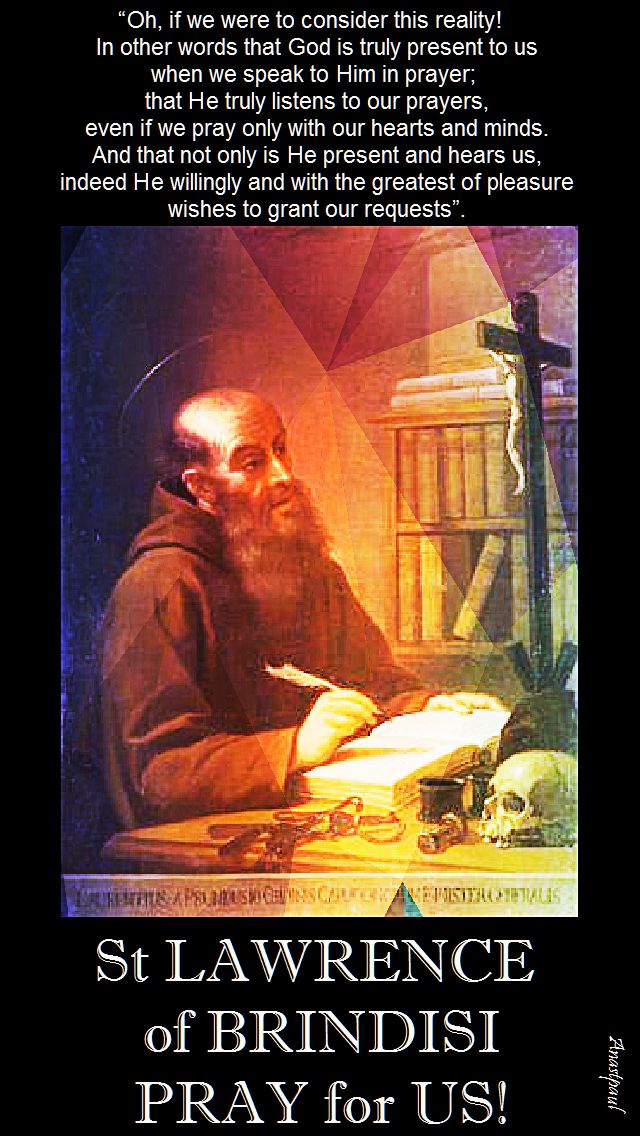
Moreover, with the unmistakable ardour of his style, Lawrence urged everyone and not only priests, to cultivate a life of prayer, for it is through prayer that we speak to God and that God speaks to us: “Oh, if we were to consider this reality!”, he exclaimed. “In other words that God is truly present to us when we speak to Him in prayer; that He truly listens to our prayers, even if we pray only with our hearts and minds. And that not only is He present and hears us, indeed He willingly and with the greatest of pleasure wishes to grant our requests”.
St Lawrence of Brindisi teaches us to love Sacred Scripture, to increase in familiarity with it, to cultivate daily relations of friendship with the Lord in prayer, so that our every action, our every activity, may have its beginning and its fulfilment in Him. This is the source from which to draw so that our Christian witness may be luminous and able to lead the people of our time to God.”…….Pope BENEDICT XVI (General Audience) – St. Peter’s Square, Wednesday, 23 March 2011
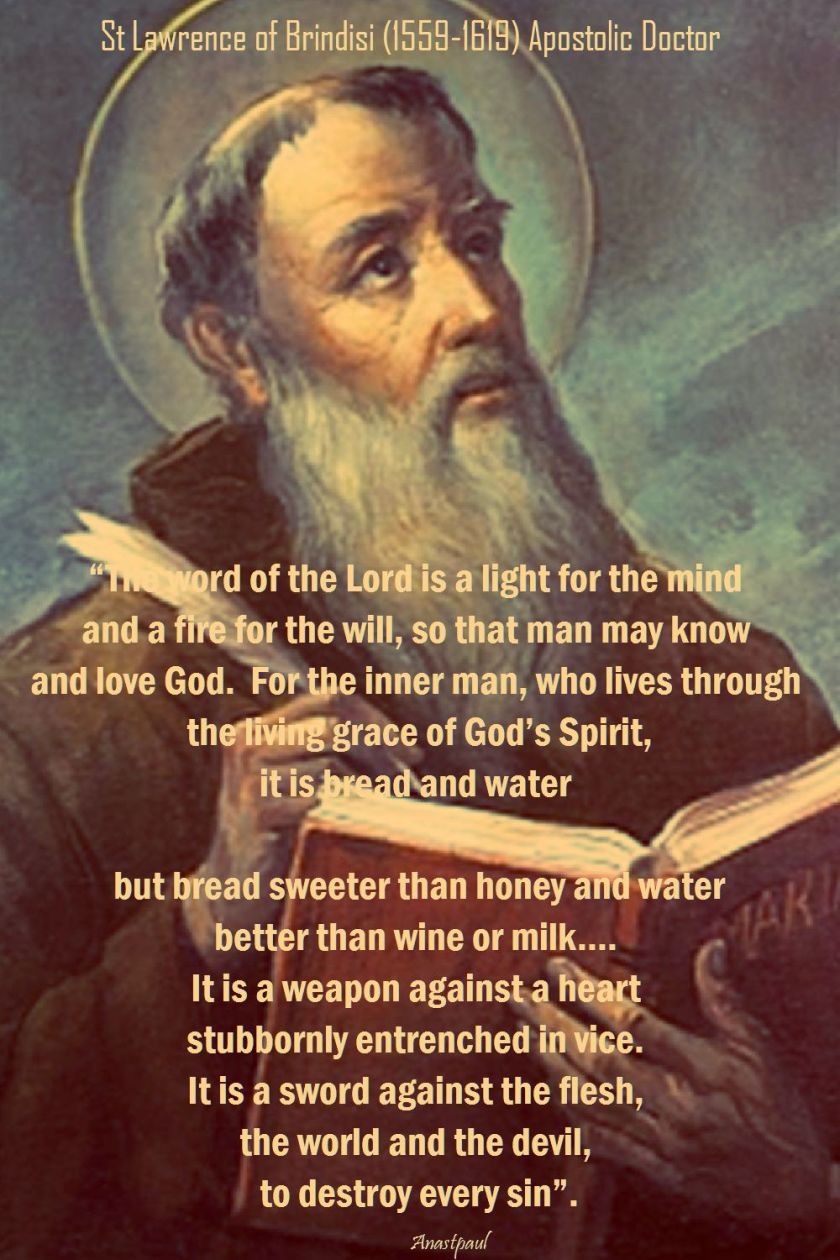
“The word of God is replete with manifold blessings, since it is, so to speak, a treasure of all goods. It is the source of faith, hope, charity, all virtue, all the gifts of the Holy Spirit, all the beatitudes of the Gospel, all good works, all the rewards of life, all the glory of paradise…For the word of God is a light to the mind and a fire to the will. It enables man to know God and to love Him. And for the interior man who lives by the Spirit of God through grace, it is bread and water, but a bread sweeter than honey and the honeycomb, a water better than wine and milk. For the soul it is a spiritual treasure of merits yielding an abundance of gold and precious stones. Against the hardness of a heart that persists in wrongdoing, it acts like a hammer. Against the world, the flesh and the devil it serves as a sword that destroys all sin.”
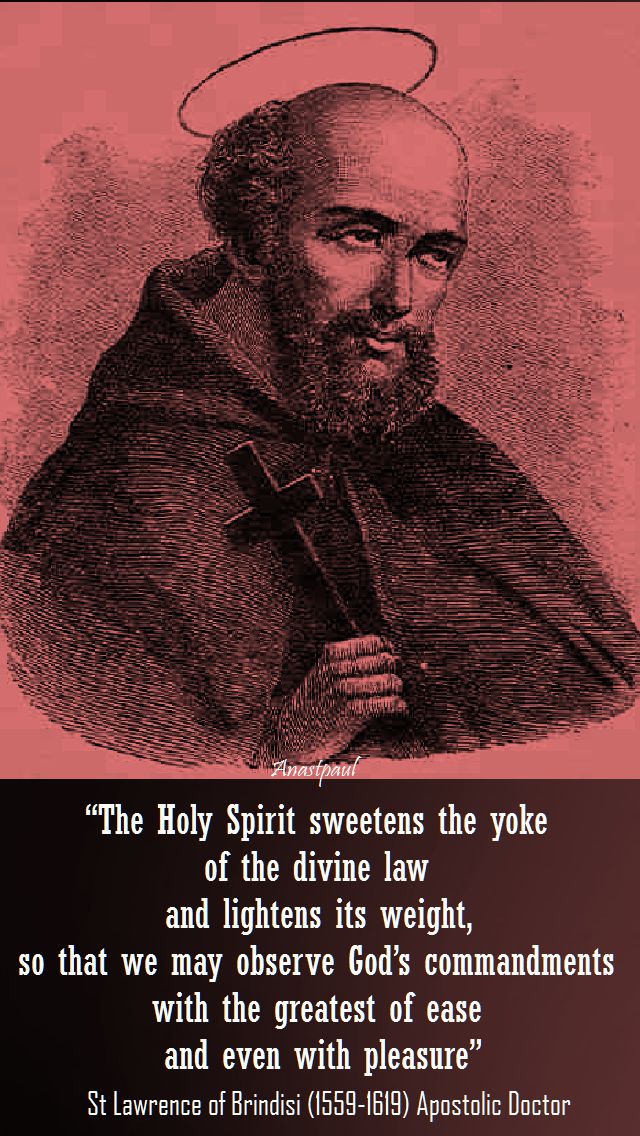
“The Holy Spirit sweetens the yoke of the divine law and lightens its weight, so that we may observe God’s commandments with the greatest of ease and even with pleasure”
St Lawrence of Brindisi (1559-1619) Apostolic Doctor
“I tell you, something greater than the temple is here.”………..Matthew 12:6
REFLECTION – “My dear souls, let us recognize, I pray you, Christ’s infinite charity towards us in the institution of this Sacrament of the Eucharist. In order that our love be a spiritual love, He wills a new heart, a new love, a new spirit for us. It is not with a carnal heart but with a spiritual one, that Christ has loved us with a gratuitous love, a supreme and most ardent love, by way of pure grace and charity. Ah! One needs to love Him back with one’s whole, whole, whole, living, living, living and true, true, true heart!!” …… St Lawrence of Brindisi (1559-1619) Apostolic Doctor
PRAYER – Lord God, You bestowed on St Lawrence of Brindisi the spirit of counsel and fortitude, so that Your name might be glorified and souls be saved. At the intercession of St Lawrence, grant that we may see what we have to do and, in Your mercy give us the strength to do it and the courage, love and charity to persevere. Grant above all, that by his prayers we may love You above all and with all we are. St Lawrence pray for us, amen.
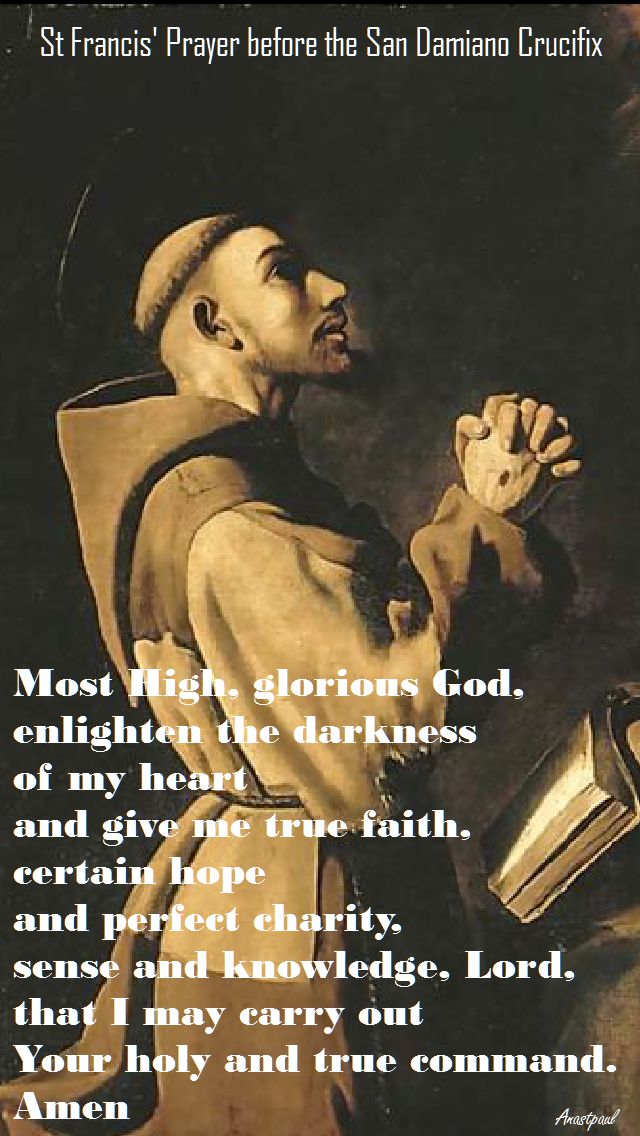
St Francis’s Prayer Before the San Damiano Crucifix
Most High, glorious God,
enlighten the darkness of my heart
and give me
true faith,
certain hope
and perfect charity,
sense and knowledge,
Lord, that I may carry out
Your holy and true command.
Amen
Saint of the Day – 21 July – St Lawrence of Brindisi O.F.M. Cap – Doctor of the Church – (22 July 1559 at Brindisi, Italy as Julius Caesar Rossi – 22 July 1619 at Lisbon, Portugal of natural causes). His remains are buried in the cemetery of the Poor Clares in Villafranca, Spain. He was Beatified on 1 June 1783 by Pope Pius VI and Canonised on 8 December 1881 by Pope Leo XIII. He was created a Doctor of the Church by Blessed Pope John XXIII in 1959 with the title Doctor apostolicus (Apostolic Doctor). Patronages – of Brindisi, Italy. Attributes – leading the Christian army against the Turks, receiving the embrace of the Child Jesus. He is known as the “Franciscan Renaissance Man” – he was a Religious member of the Franciscan Friars Minor Capuchin, a Priest, Theologian, Vicar General of the Franciscans, Language scholar, Humanist, Philosopher, Biblicist, Preacher, Missionary, Professor, International Administrator, Confidant of Popes, Emperors, Kings and Princes, Diplomatic envoy, Army Chaplain, Military Strategist and Morale builder, Polemicist, Prolific writer.
Despite Saint Lawrence of Brindisi’s later fame, little is known of his early years. His father was William Russo, a well-to-do Venetian merchant and his mother was Elizabeth Masella. He was born in the Southern Italian port city of Brindisi on the 22nd of July 1559. He received his early education at a day school run by the Conventual Franciscans and made rapid progress in his studies. At the tender age of six, following the Italian custom of the time, he publicly preached a short Christmastide sermon on the Child Jesus. However, by the time he was 14 he had lost both his parents and his education was entrusted to his uncle, a high-ranking cleric at Venice’s Saint Mark’s Cathedral. It was at Saint Mark’s College, a private school run by his uncle, that Julius Caesar received an excellent secondary education.
In Venice he came to know the Capuchin Friars Minor who had a small church dedicated to saint Mary of the Angels on the island of Giudeca. Impressed by their austere life of Poverty, he asked for admission to the Order and was invested with the habit as a novice at the Verona Capuchin novitiate friary of on the 18th of February 1575. At this time, Julius Caesar was given the religious name Brother Lawrence. He made his perpetual profession on the 24th of March the following year.
His writings fill fifteen volumes and his knowledge of Hebrew allowed him to preach so effectively to the Jewish people in Italy that the rabbis were certain that Lawrence must have been a Jew who had become a Christian. His skills in dealing with people meant that he served as a papal emissary to many countries but he never forgot that he was first and foremost a priest.
There is a very special title accorded by the Church to certain saints, who are named “Doctor of the Church” and this title indicates that the writings and preaching of such a person are useful to Christians “in any age of the Church.” Such men and women are also particularly known for the depth of understanding and the orthodoxy of their theological teachings. St. Lawrence of Brindisi was given this title and he is one of the thirty-six saints to be named “Doctor.”
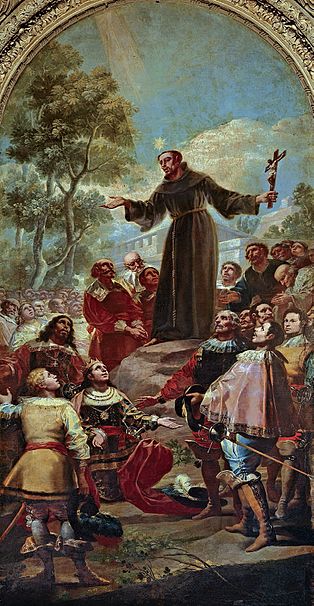
While still a deacon, St. Lawrence of Brindisi became known as an excellent preacher and after his ordination captured the whole of northern Italy with his amazing sermons. He was sent into Germany by the pope to establish Capuchin houses. While there, he became chaplain to Emperor Rudolf II and had a remarkable influence on the Christian soldiers fighting the Muslims who were threatening Hungary in 1601. Through his efforts, the Catholic League was formed to unify Catholics for the purpose of strengthening the Catholic cause in Europe. Sent by the emperor to persuade Philip III of Spain to join the League, he established a Capuchin friary in Madrid. He also brought peace between Spain and the kingdom of Savoy.
His compassion for the poor, the needy and the sick was legendary. Elected minister-general of his order in 1602, he made the Capuchins a major force in the Catholic Restoration, visiting every friary in the thirty-four provinces of the order and directing the work of nine thousand friars. He himself was a dominant figure in carrying out the work of the Council of Trent and was described by Pope Benedict XV as having earned “a truly distinguished place among the most outstanding men ever raised up by Divine Providence to assist the Church in time of distress.”
Yet in the midst of all this feverish activity, Brother Lawrence found peace and strength to keep going by taking refuge in prayer. Sometimes his Masses which were usually celebrated in private could last for up to twelve hours. He wept copious tears as he celebrated the Holy Sacrifice and was even witnessed being lifted into the air as he prayed at the Altar. When he entered the Order in 1575, he told the Provincial Minister who tried to dissuade him by describing in detail the rigours of the Capuchin lifestyle: “Nothing will be difficult for me as long as there is a Crucifix in my room.” Pictures of Saint Lawrence often show him contemplating the Crucifix.
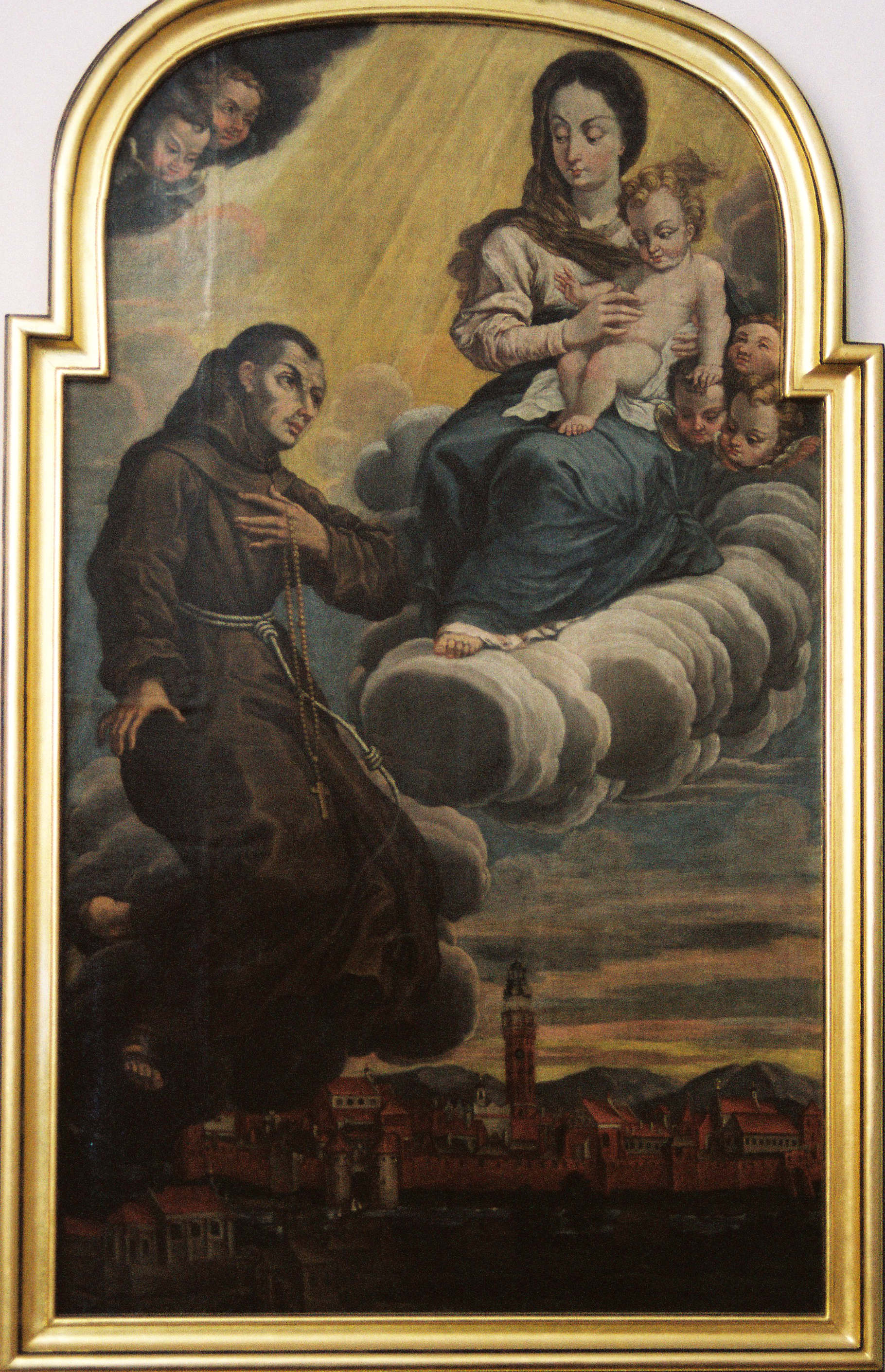
To Mary he attributed his vocation, his restoration to health as a student, his knowledge of Hebrew and all his successes. He went to her in all his needs. When elected Vicar General of the Order, he first went to the Shrine of Our Lady’s Holy House at Loreto and returned there at the end of his term of office. From his formation days onward, he prayed the Rosary and the Little Office of the Blessed Virgin daily. His favourite greeting for the Brothers was: “Nos, cum prole pia, benedicat Virgo Maria! May the Virgin Mary bless us with her loving Child!”
In 1619, at the request of the Pope, Brother Lawrence had to travel once more to Spain to make known to the Spanish King the plight of Naples’s citizens under the tyrannical rule of the Spanish Viceroy of the region, the Duke of Ossuna. He managed to escape the Duke’s attempts to block his mission and set sail secretly from Genoa. He had to go to Lisbon in Portugal to meet the King of Spain. His diplomatic mission was successfully concluded but worn out by the journey he fell critically ill. Having received the Last Sacraments, Brother Lawrence of Brindisi died in Lisbon, Portugal before he could board a ship to return home on the 22nd of July 1619. Saint Lawrence entered heaven the same date as he entered this world sixty years previously.
O God, who didst bestow on blessed Lawrence of Brindisi, Your Confessor and Doctor, the spirit of wisdom and fortitude to endure every labour for the glory of Your Name and the salvation of souls: grant us, in the same spirit, both to perceive what we ought to do, and by his intercession to perform the same; through Jesus Christ thy Son our Lord, who lives and reigns with You, in the unity of the Holy Spirit, ever one God, world without end, amen.
Thought for the Day – 15 July by Pope Benedict XVI – 10 March 2010 on St Bonaventure
“Of these his writings, which are the soul of his government and show the way to follow either as an individual or a community, I would like to mention only one, his masterwork, the “Itinerarium mentis in Deum,” which is a “manual” of mystical contemplation.
This book was conceived in a place of profound spirituality: the hill of La Verna, where St. Francis had received the stigmata. In the introduction, the author illustrates the circumstances that gave origin to his writing:
“While I meditated on the possibility of the soul ascending to God, presented to me, among others, was that wondrous event that occurred in that place to Blessed Francis, namely, the vision of the winged seraphim in the form of a crucifix. And meditating on this, immediately I realised that such a vision offered me the contemplative ecstasy of Father Francis himself and at the same time the way that leads to it” (Journey of the Mind in God, Prologue, 2, in Opere di San Bonaventura. Opuscoli Teologici / 1, Rome, 1993, p. 499).
The six wings of the seraphim thus became the symbol of six stages that lead man progressively to the knowledge of God through observation of the world and of creatures and through the exploration of the soul itself with its faculties, up to the satisfying union with the Trinity through Christ, in imitation of St. Francis of Assisi.
The last words of St. Bonaventure’s “Itinerarium,” which respond to the question of how one can reach this mystical communion with God, would make one descend to the depth of the heart:
“If you now yearn to know how that happens (mystical communion with God), ask grace, not doctrine; desire, not the intellect; the groaning of prayer, not the study of the letter; the spouse, not the teacher; God, not man; darkness not clarity; not light but the fire that inflames everything and transport to God with strong unctions and ardent affections. … We enter therefore into darkness, we silence worries, the passions and illusions; we pass with Christ Crucified from this world to the Father, so that, after having seen him, we say with Philip: that is enough for me” (Ibid., VII, 6).
Dear friends, let us take up the invitation addressed to us by St. Bonaventure, the Seraphic Doctor, and let us enter the school of the divine Teacher. We listen to his Word of life and truth, which resounds in the depth of our soul. Let us purify our thoughts and actions, so that He can dwell in us, and we can hear His divine voice, which draws us toward true happiness”. Pope Benedict XVI – 10 March 2010 on St Bonaventure
“Christ is both the way and the door. Christ is the staircase and the vehicle, like the “throne of mercy over the Ark of the Covenant,” and “the mystery hidden from the ages.” A man should turn his full attention to this throne of mercy and should gaze at Him hanging on the cross, full of faith, hope and charity, devoted, full of wonder and joy, marked by gratitude and open to praise and jubilation. Then such a man will make with Christ a “pasch,” that is, a passing-over. Through the branches of the cross. he will pass over the Red Sea, leaving Egypt and entering the desert. There he will taste the hidden manna and rest with Christ in the sepulcher, as if he were dead to things outside. He will experience, as much as is possible for one who is still living, what was promised to the thief who hung beside Christ: ‘Today you will be with me in paradise.'” – from Journey of the Mind to God by Saint Bonaventure
“The life of God — precisely because God is triune — does not belong to God alone. God who dwells in inaccessible light and eternal glory comes to us in the face of Christ and the activity of the Holy Spirit. Because of God’s outreach to the creature, God is said to be essentially relational, ecstatic, fecund, alive as passionate love. Divine life is therefore also our life. The heart of the Christian life is to be united with the God of Jesus Christ by means of communion with one another. The doctrine of the Trinity is, ultimately, therefore, a teaching not about the abstract nature of God, nor about God in isolation from everything other than God but a teaching about God’s life with us and our life with each other.”
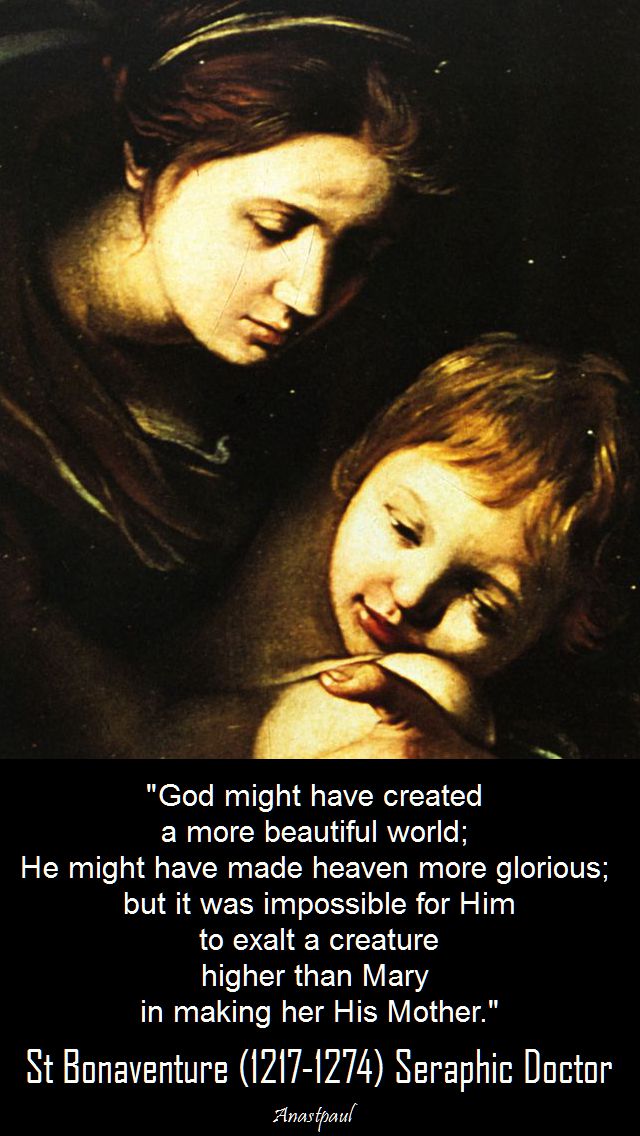
“God might have created a more beautiful world; He might have made heaven more glorious; but it was impossible for Him to exalt a creature higher than Mary in making her His Mother.”
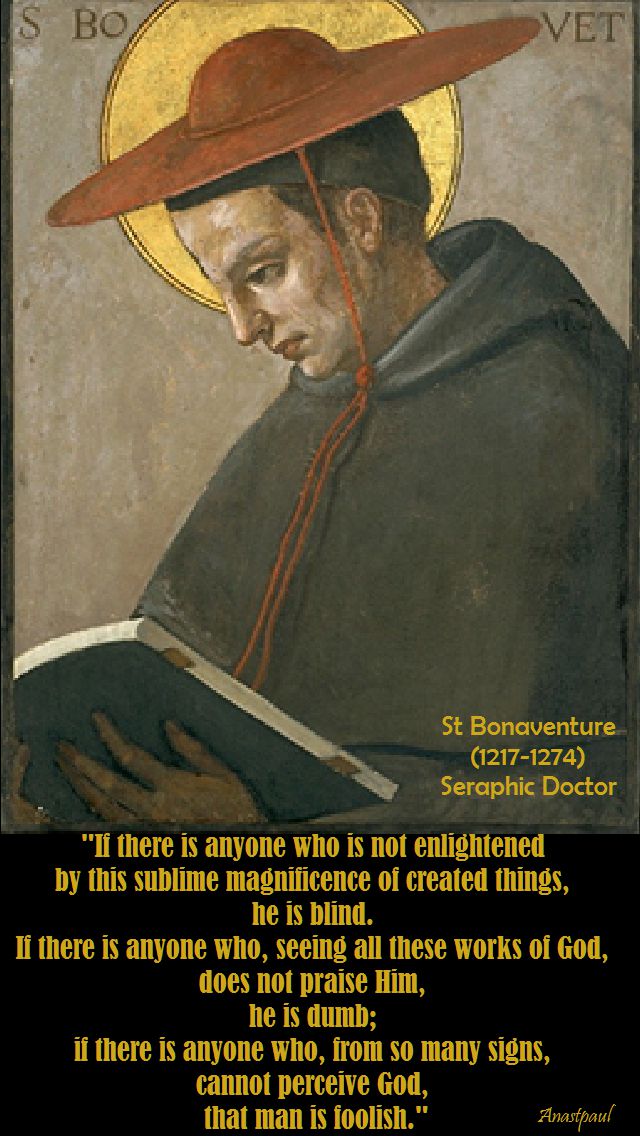
“If there is anyone who is not enlightened by this sublime magnificence of created things, he is blind. If there is anyone who, seeing all these works of God, does not praise Him, he is dumb; if there is anyone who, from so many signs, cannot perceive God, that man is foolish.”
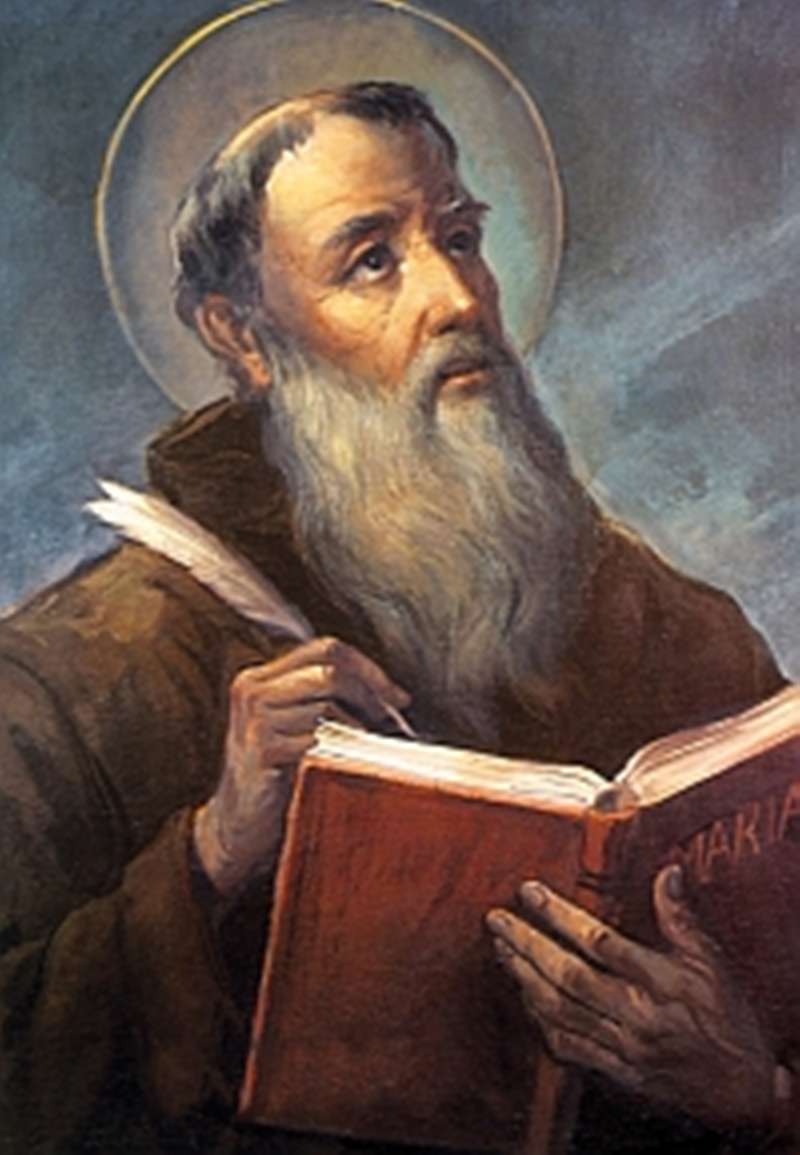
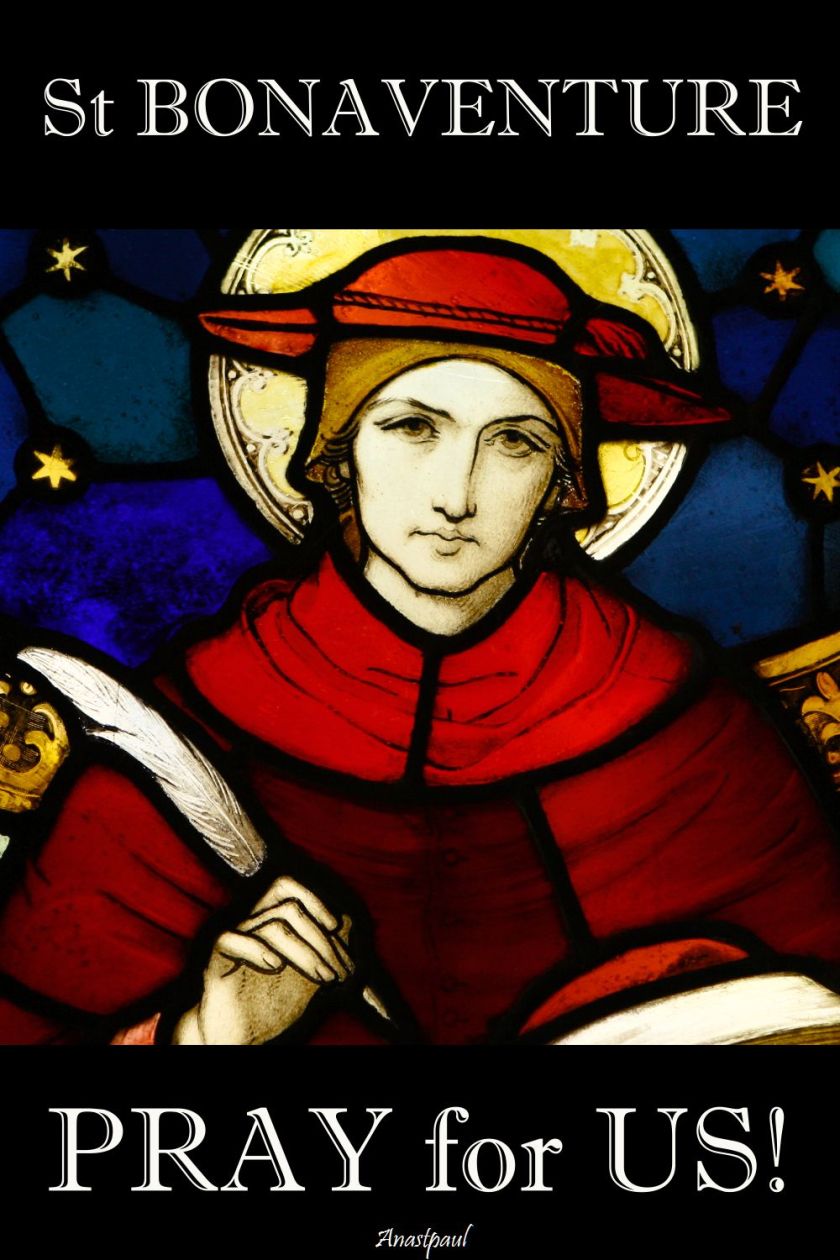
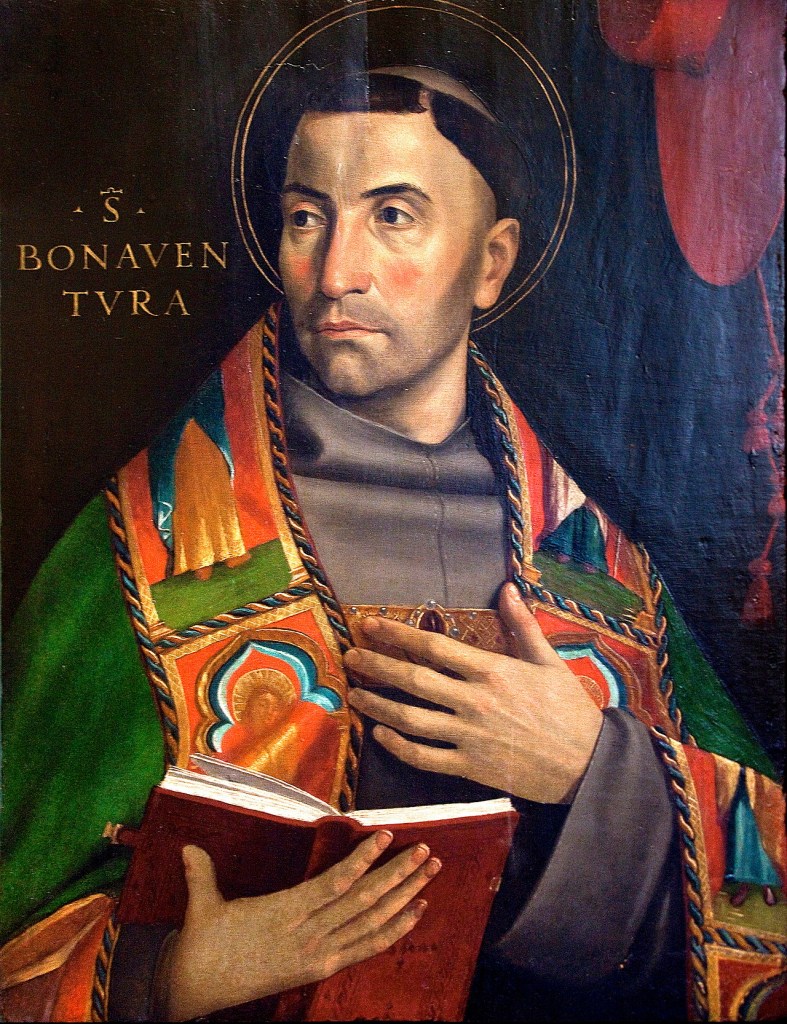
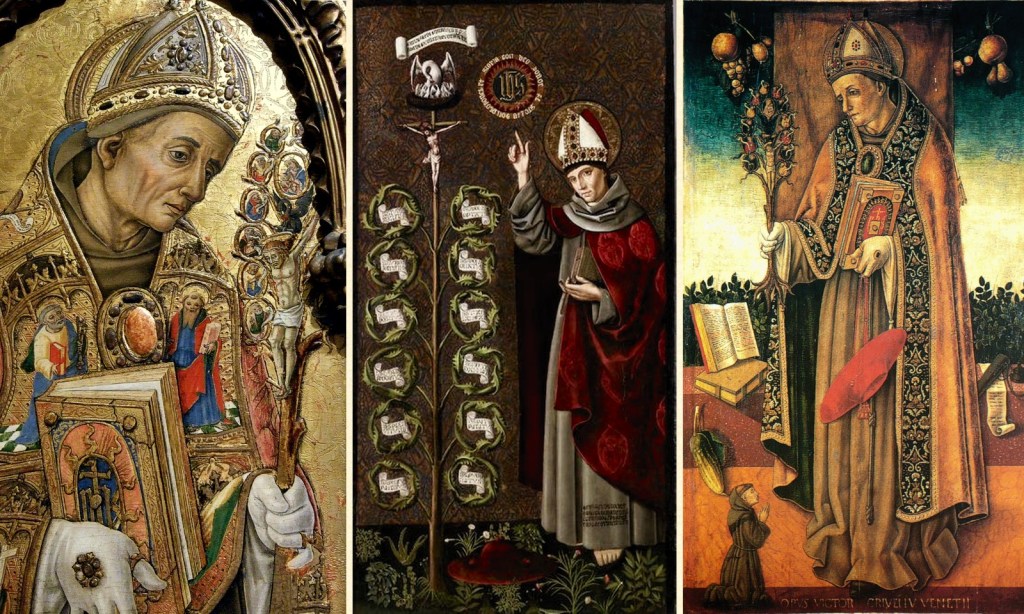
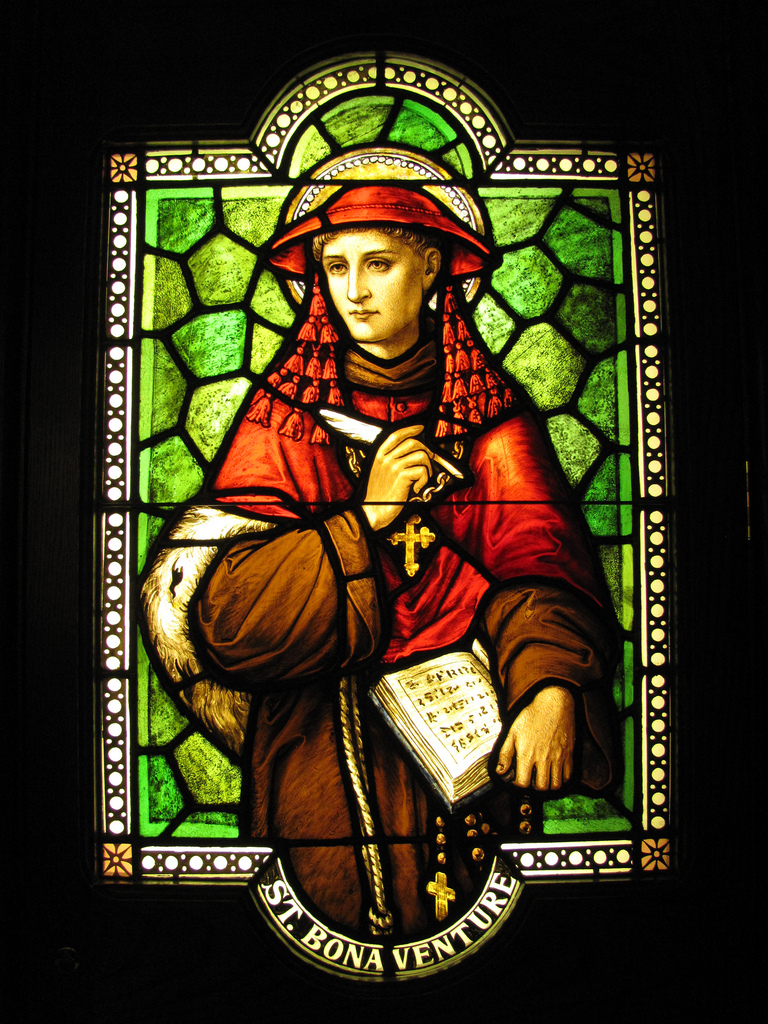
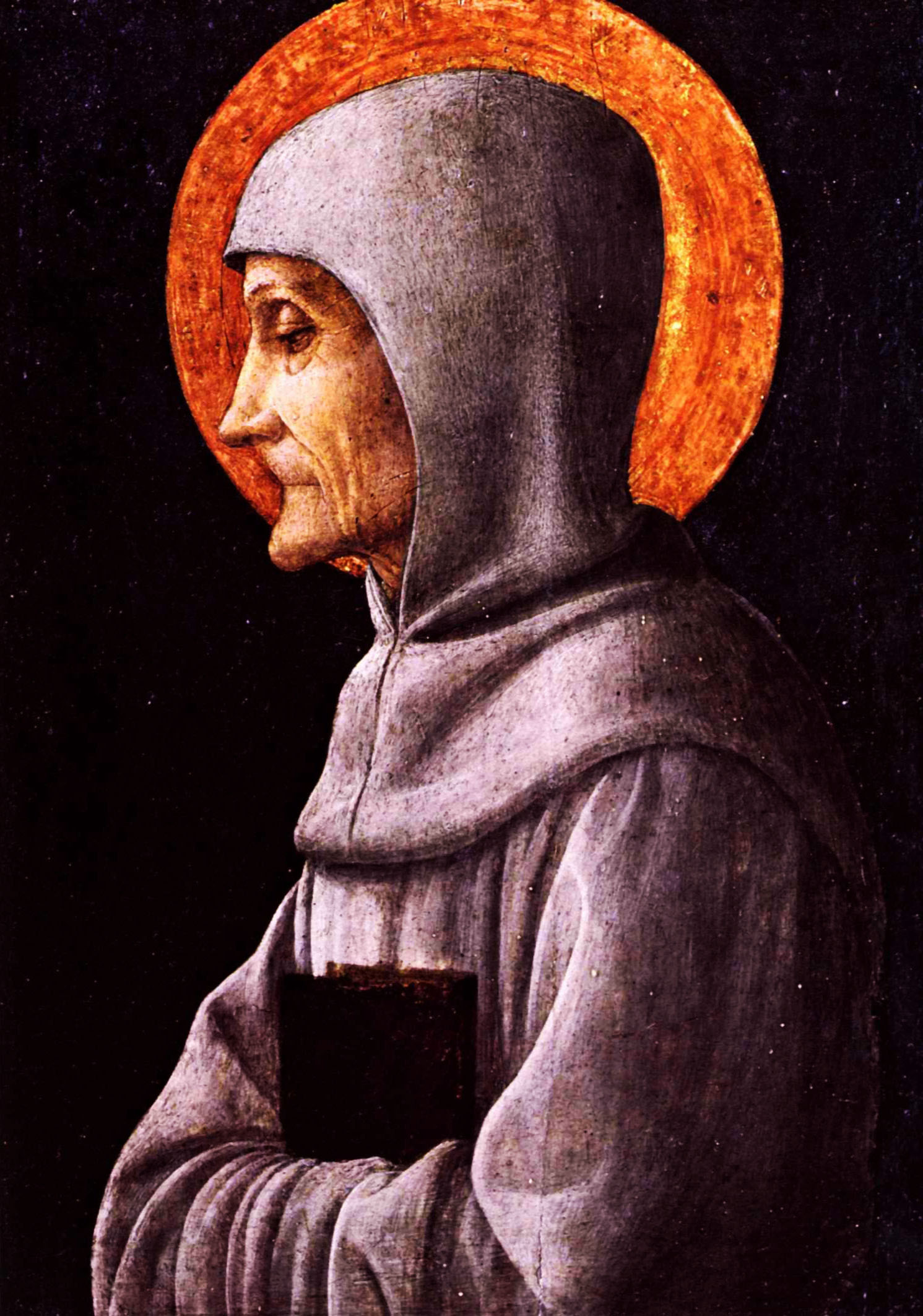
Saint of the Day – 15 July – St Bonaventure – Confessor, Bishop, Doctor of the Church – Friar, Theologian, Philosopher, Writer, Mystic, Preacher, Teacher – born in (1221 at Bagnoregio, Tuscany, Italy and died on 15 July 1274 at Lyon, France of natural causes). He was born Giovanni di Fidanza and was the seventh Minister General of the Order of Friars Minor, he was also Cardinal Bishop of Albano. Bonaventure was Canonised on 14 April 1482 by Pope Sixtus IV and declared a Doctor of the Church in the year 1588 by Pope Sixtus V. He is known as the “Seraphic Doctor” (Latin: Doctor Seraphicus). PATRONAGES – against intestinal problems, stomach diseases, of – Bagnoregio, Italy, Banja Luka, Bosnia and Herzegovina, Cochiti Indian Pueblo, Saint Bonaventure University, New York.
St Bonaventure was born at Bagnorea in Umbria, not far from Viterbo, then part of the Papal States. Almost nothing is known of his childhood, other than the names of his parents, Giovanni di Fidanza and Maria Ritella.
He entered the Franciscan Order in 1243 and studied at the University of Paris, possibly under Alexander of Hales and certainly under Alexander’s successor, John of Rochelle. In 1253 he held the Franciscan chair at Paris. A dispute between seculars and mendicants delayed his reception as Master until 1257, where his degree was taken in company with Thomas Aquinas. Three years earlier his fame had earned him the position of lecturer on The Four Books of Sentences—a book of theology written by Peter Lombard in the twelfth century—and in 1255 he received the degree of master, the medieval equivalent of doctor.
After having successfully defended his order against the reproaches of the anti-mendicant party, he was elected Minister General of the Franciscan Order. On 24 November 1265, he was selected for the post of Archbishop of York; however, he was never consecrated and resigned the appointment in October 1266.[6]
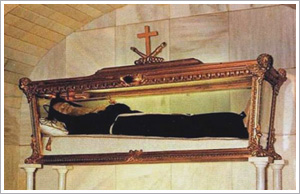
Bonaventure was instrumental in procuring the election of Pope Gregory X, who rewarded him with the title of Cardinal Bishop of Albano and insisted on his presence at the great Second Council of Lyon in 1274. There, after his significant contributions led to a union of the Greek and Latin churches, Bonaventure died suddenly and in suspicious circumstances. The 1913 edition of the Catholic Encyclopedia has citations that suggest he was poisoned but no mention is made of this in the 2003 second edition of the New Catholic Encyclopedia. The only extant relic of the saint is the arm and hand with which he wrote his Commentary on the Sentences, which is now conserved at Bagnoregio, in the parish church of St. Nicholas.
He steered the Franciscans on a moderate and intellectual course that made them the most prominent order in the Catholic Church until the coming of the Jesuits. His theology was marked by an attempt completely to integrate faith and reason. He thought of Christ as the “one true master” who offers humans knowledge that begins in faith, is developed through rational understanding and is perfected by mystical union with God.
Bonaventure’s feast day was included in the General Roman Calendar immediately upon his canonisation in 1482. In 1969 it was classified as an obligatory memorial and assigned to the date of his death, 15 July.
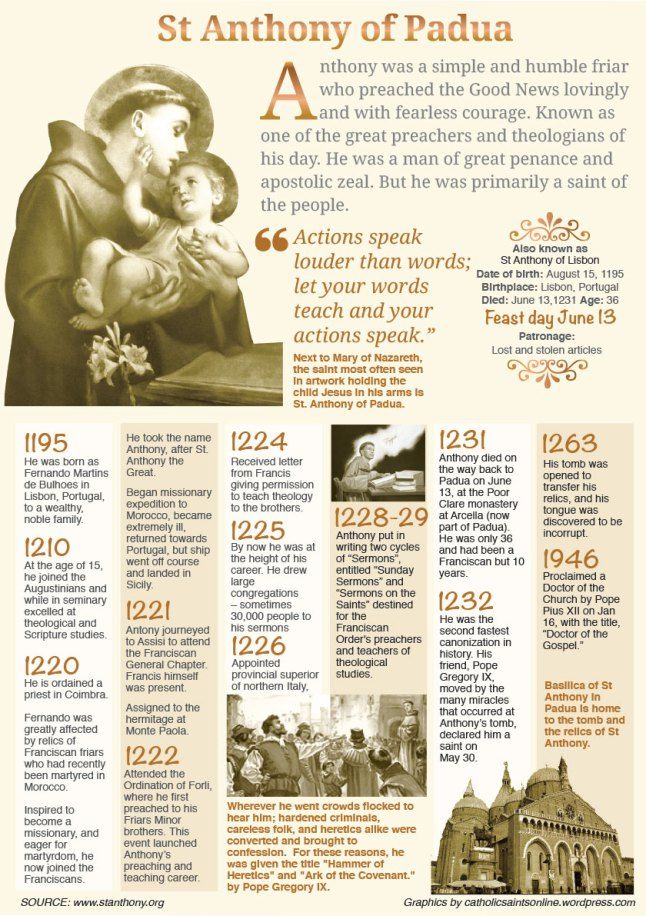
Celebrating the Life and Miracles of St Anthony of Padua on his Memorial today 13 June
St Anthony and the Holy Eucharist
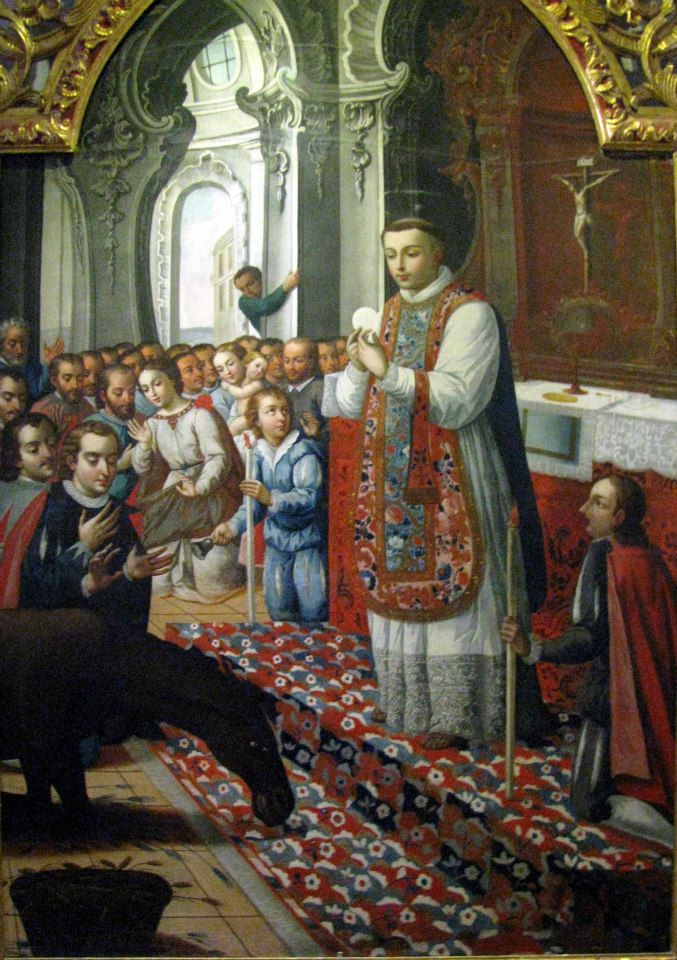
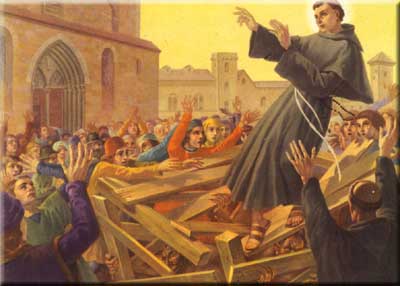
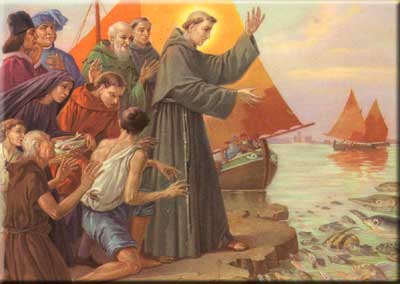
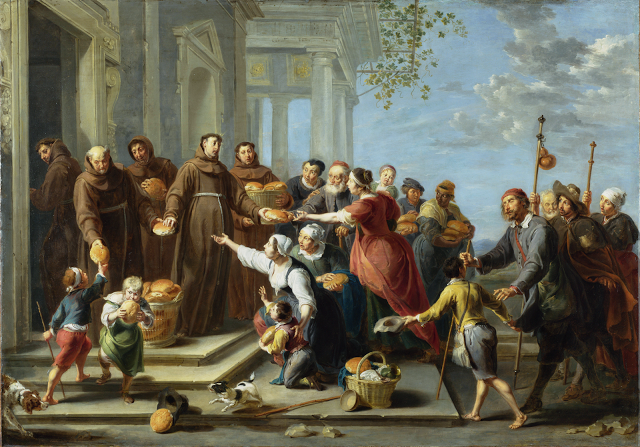
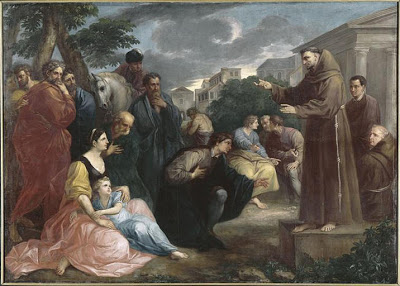
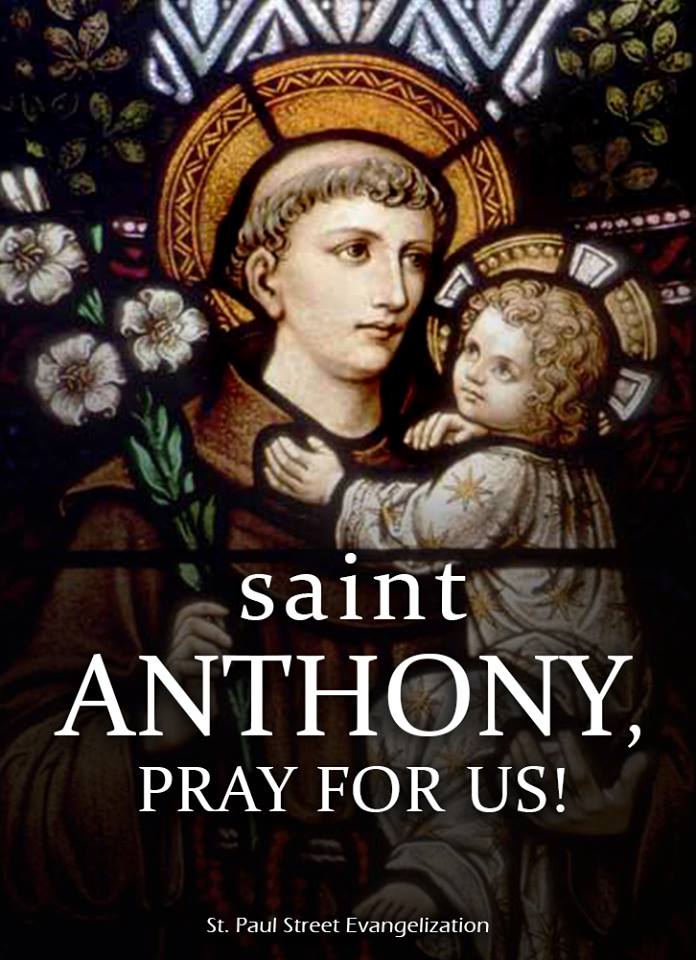
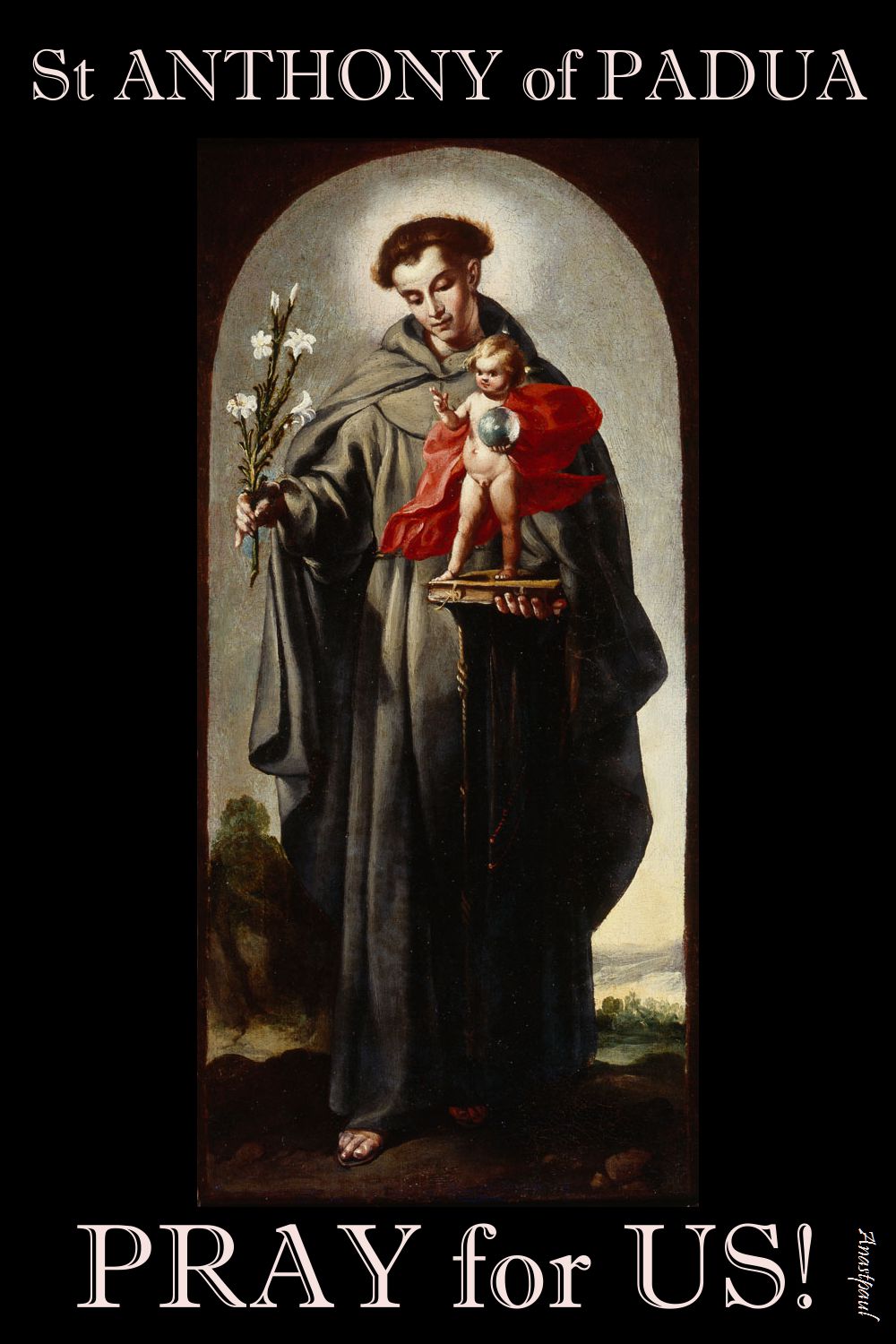
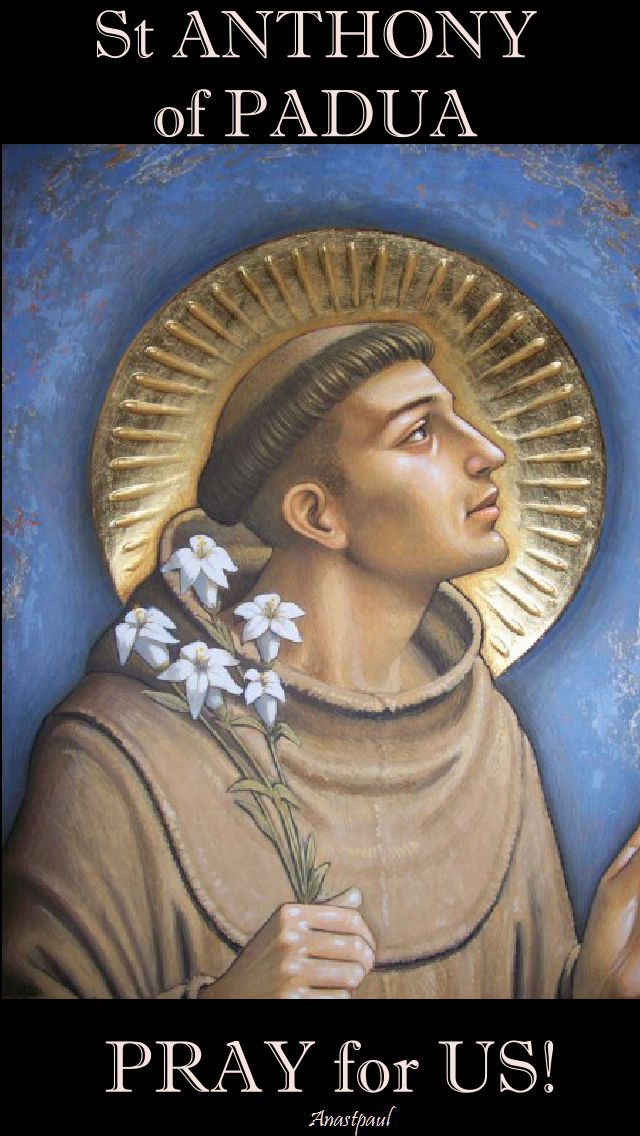
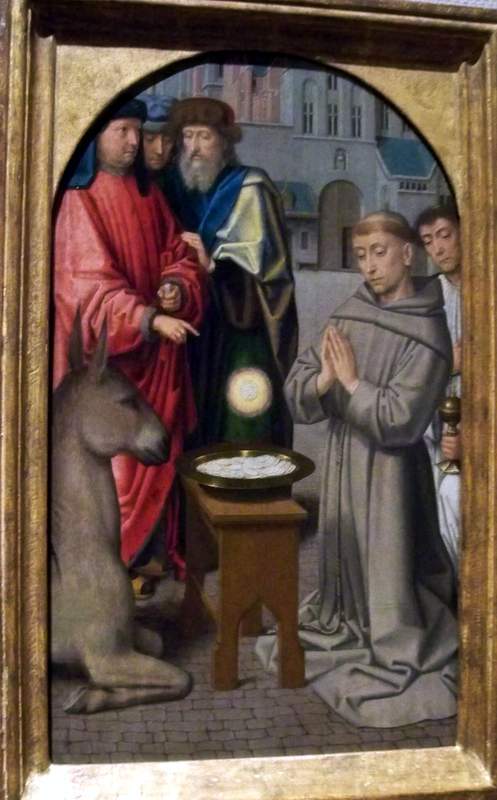
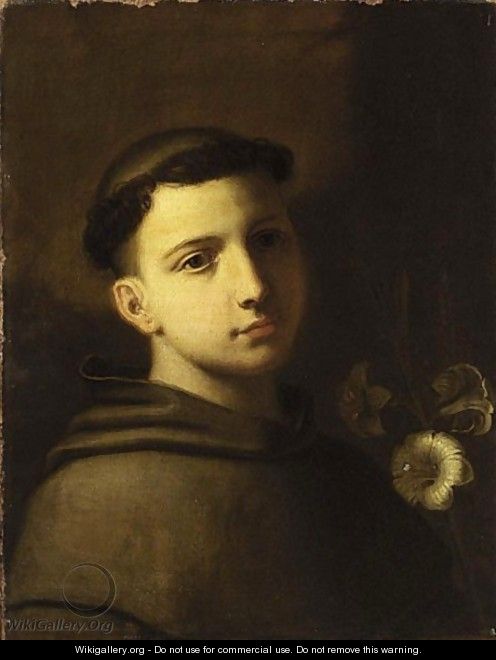
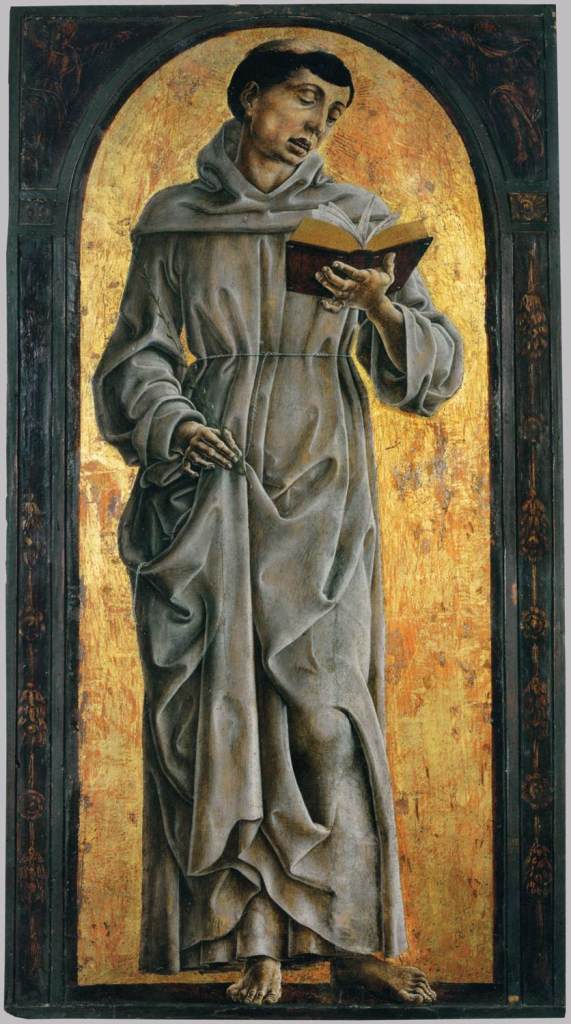
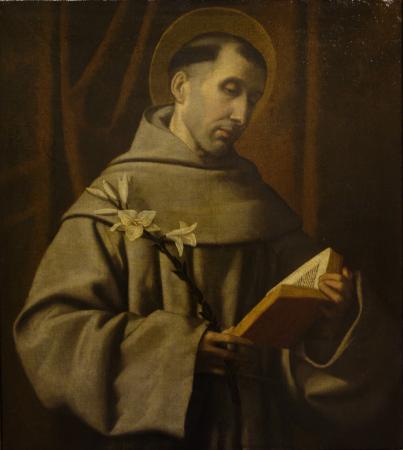
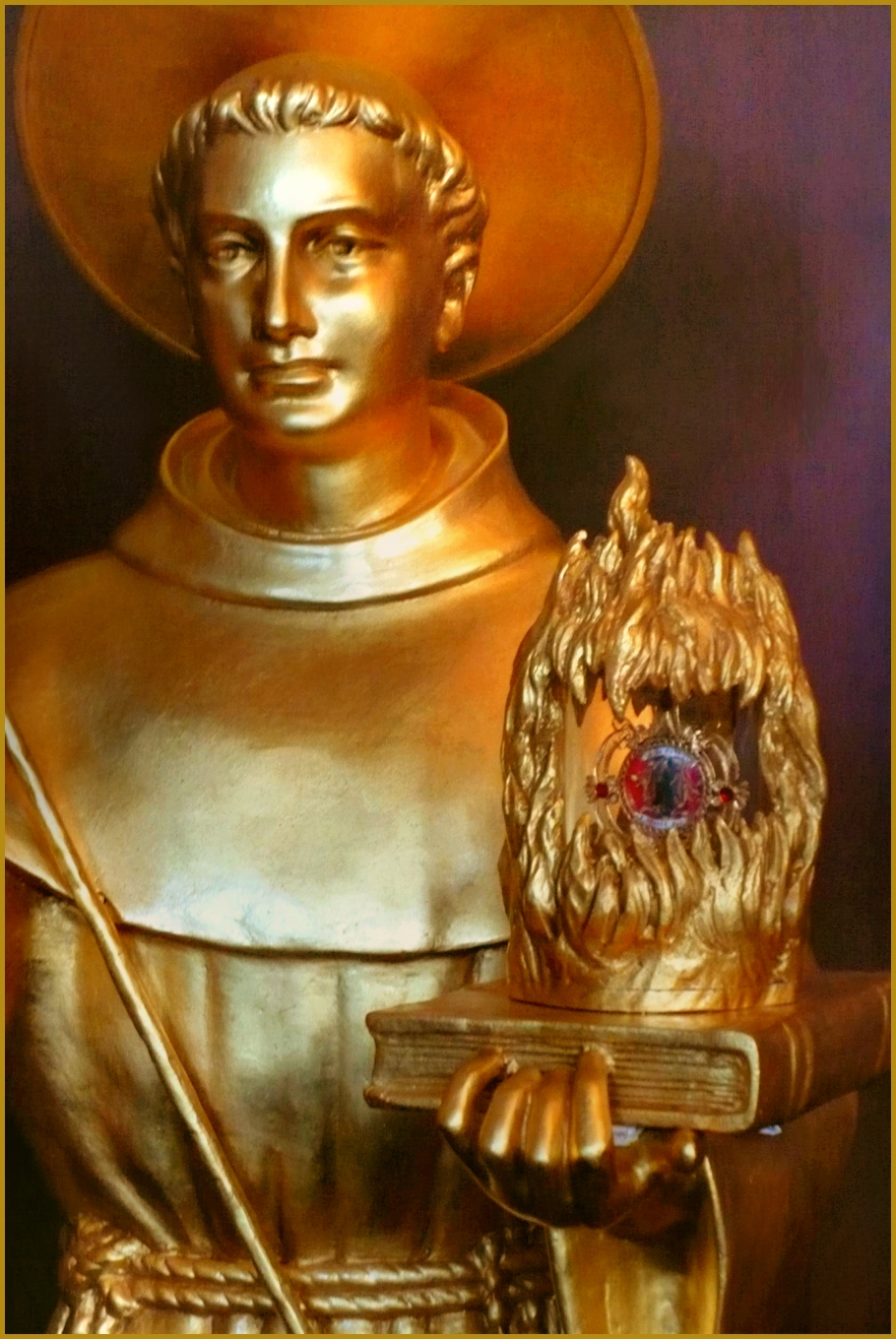
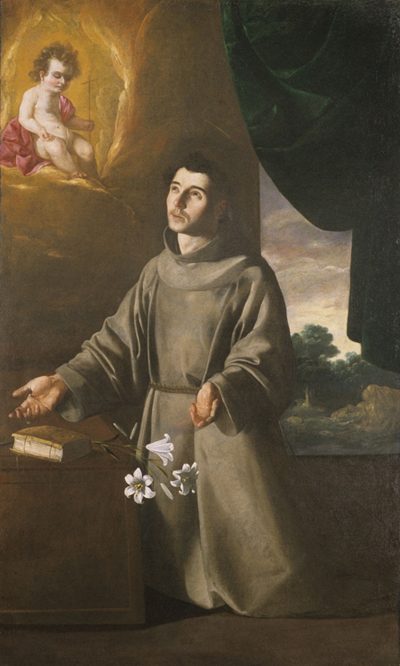
Anthony has been pictured by artists and sculptors in all kinds of ways. He is depicted with a book in his hands, with a lily or torch. He has been painted preaching to fish, holding a monstrance with the Blessed Sacrament in front of a mule or preaching in the public square or from a nut tree.
To prove to the heretics that Jesus is truly in the Blessed Sacrament, a horse was not given any food for three days. Oats were placed in front of him. The horse refused to eat the oats till he had knelt down and adored Jesus in the Holy Eucharist that St Anthony held in his hand. This took place in Rimini Italy.
St Anthony and the Child Jesus
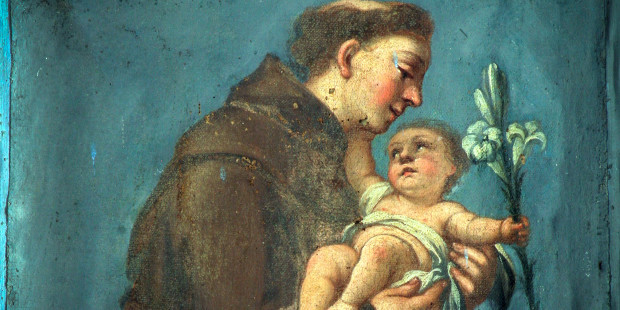
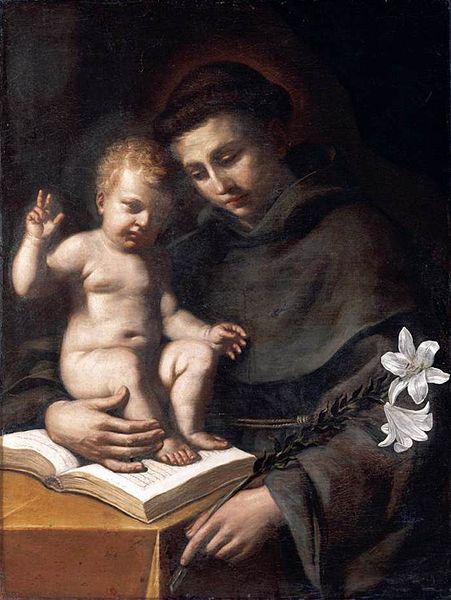
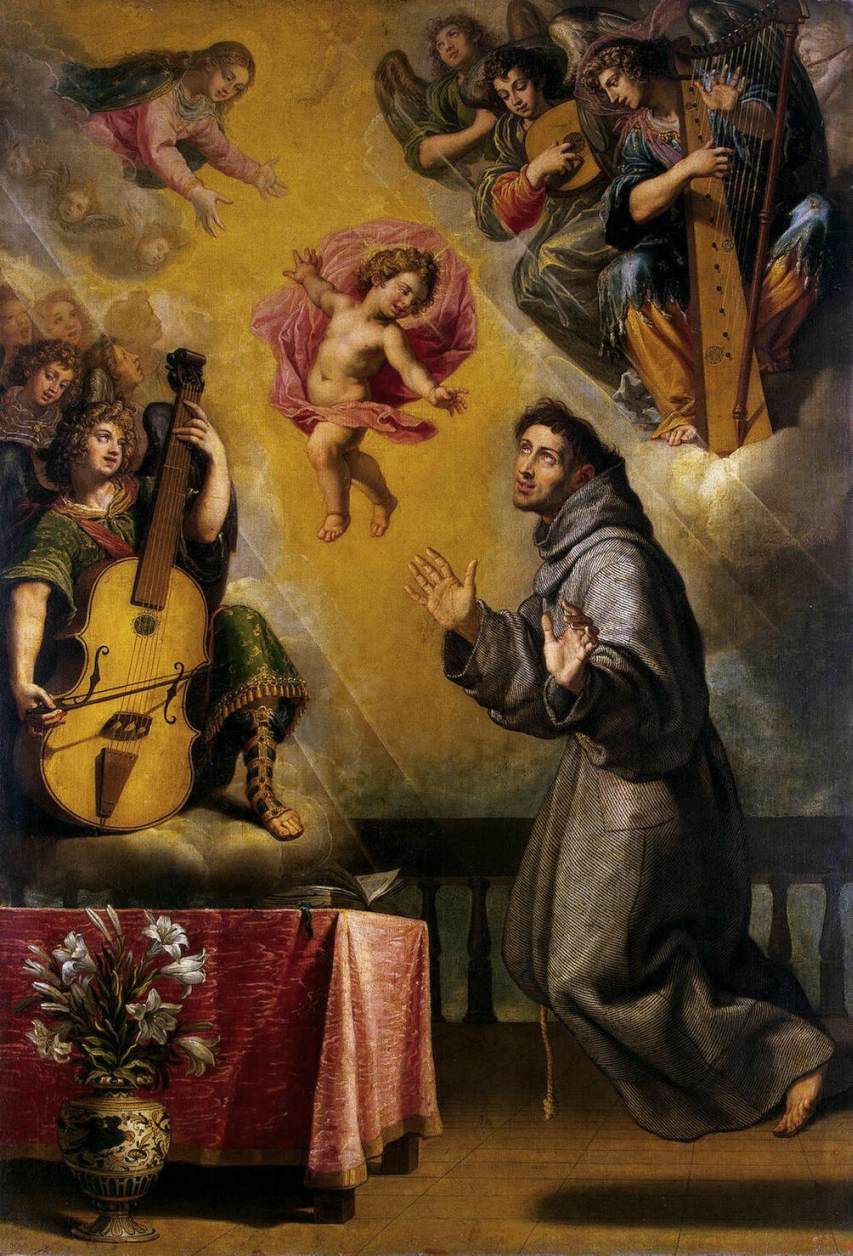
But since the 17th century we most often find the saint shown with the child Jesus in his arm or even with the child standing on a book the saint holds. A story about Saint Anthony related in the complete edition of Butler’s Lives of the Saints (edited, revised and supplemented by Herbert Anthony Thurston, S.J., and Donald Attwater) projects back into the past a visit of Anthony to the Lord of Chatenauneuf. Anthony was praying far into the night when suddenly the room was filled with light more brilliant than the sun. Jesus then appeared to Saint Anthony under the form of a little child. Chatenauneuf, attracted by the brilliant light that filled his house, was drawn to witness the vision but promised to tell no one of it until after Anthony’s death.
Some may see a similarity and connection between this story and the story in the life of Saint Francis when he re-enacted at Greccio the story of Jesus and the Christ Child became alive in his arms. There are other accounts of appearances of the child Jesus to Francis and some companions.
These stories link Anthony with Francis in a sense of wonder and awe concerning the mystery of Christ’s incarnation. They speak of a fascination with the humility and vulnerability of Christ who emptied himself to become one like us in all things except sin. For Anthony, like Francis, poverty was a way of imitating Jesus who was born in a stable and would have no place to lay his head.
Patron of Sailors, Travelers, Fishermen
In Portugal, Italy, France and Spain, Saint Anthony is the patron saint of sailors and fishermen. According to some biographers his statue is sometimes placed in a shrine on the ship’s mast. And the sailors sometimes scold him if he doesn’t respond quickly enough to their prayers.
Not only those who travel the seas but also other travelers and vacationers pray that they may be kept safe because of Anthony’s intercession. Several stories and legends may account for associating the saint with travelers and sailors.
First, there is the very real fact of Anthony’s own travels in preaching the gospel, particularly his journey and mission to preach the gospel in Morocco, a mission cut short by severe illness. But after his recovery and return to Europe he was a man always on the go, heralding the Good News.
There is also a story of two Franciscan sisters who wished to make a pilgrimage to a shrine of our Lady but did not know the way. A young man is supposed to have volunteered to guide them. Upon their return from the pilgrimage one of the sisters announced that it was her patron saint, Anthony, who had guided them.
Still another story says that in 1647 Father Erastius Villani of Padua was returning by ship to Italy from Amsterdam. The ship with its crew and passengers was caught in a violent storm. All seemed doomed. Father Erastius encouraged everyone to pray to Saint Anthony. Then he threw some pieces of cloth that had touched a relic of Saint Anthony into the heaving seas. At once, the storm ended, the winds stopped and the sea became calm.
Teacher, Preacher
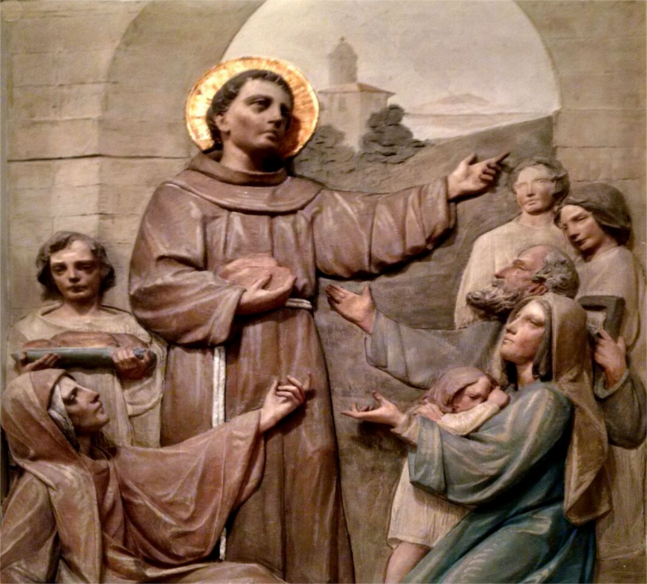
Among the Franciscans themselves and in the liturgy of his feast, Saint Anthony is celebrated as a teacher and preacher extraordinaire. He was the first teacher in the Franciscan Order, given the special approval and blessing of Saint Francis to instruct his brother Franciscans. His effectiveness as a preacher calling people back to the faith resulted in the title “Hammer of Heretics.” Just as important were his peacemaking and calls for justice.
In canonising Anthony in 1232, Pope Gregory IX spoke of him as the “Ark of the Testament” and the “Repository of Holy Scripture.” That explains why Saint Anthony is frequently pictured with a burning light or a book of the Scriptures in his hands. In 1946 Pope Pius XII officially declared Anthony a Doctor of the Universal Church. It is in Anthony’s love of the word of God and his prayerful efforts to understand and apply it to the situations of everyday life that the Church especially wants us to imitate Saint Anthony.
While noting in the prayer of his feast Anthony’s effectiveness as an intercessor, the Church wants us to learn from Anthony, the teacher, the meaning of true wisdom and what it means to become like Jesus, who humbled and emptied himself for our sakes and went about doing good.
Franciscan Father Norman Perry (1929-1999) served as editor-in-chief of St. Anthony Messenger magazine for 18 years.
St Anthony of Padua was a tireless preacher, teacher, defender of the faith. He brought many back to God by his example and words. But first he gave himself to God completely. Like all saints, he is a perfect example of turning one’s life over to Christ. God did with Anthony as God pleased — and what God pleased was a life of spiritual power and brilliance that still attracts admiration today. He whom popular devotion has nominated as finder of lost objects found himself by losing himself totally to the providence of God. Preaching was simply the overflow of his own inner life. For all of us, if God comes first and the cultivation of intimacy with Him, then everything else flows from this, as water flows from its source.
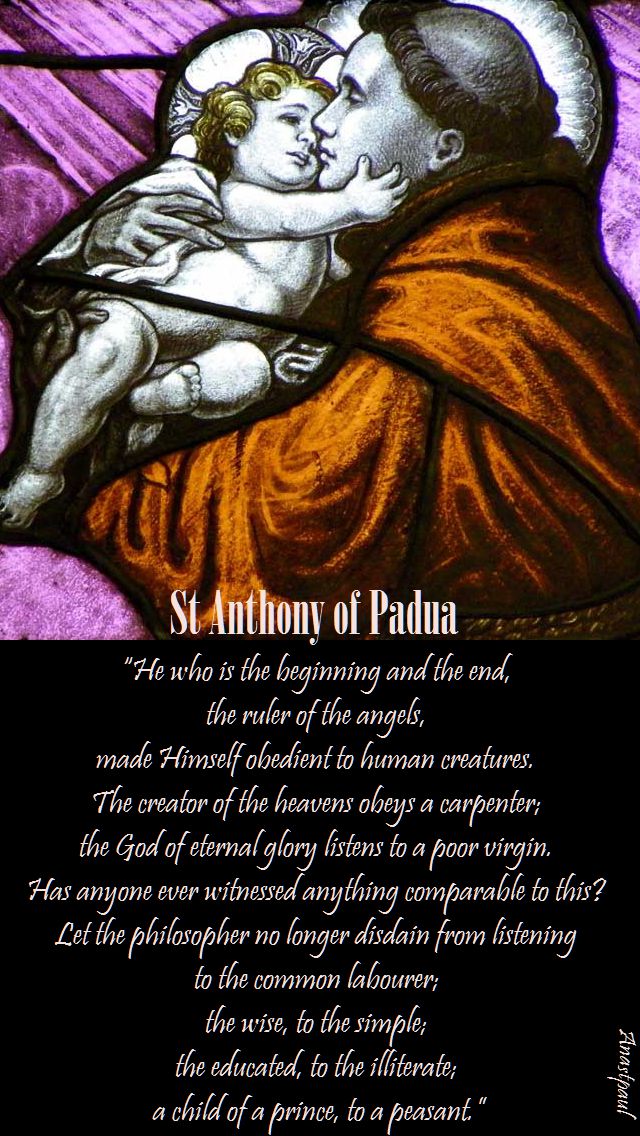
“He who is the beginning and the end,
the ruler of the angels,
made Himself obedient to human creatures.
The creator of the heavens obeys a carpenter;
the God of eternal glory listens to a poor virgin.
Has anyone ever witnessed anything comparable to this?
Let the philosopher no longer disdain from listening
to the common labourer;
the wise, to the simple;
the educated, to the illiterate;
a child of a prince, to a peasant.”
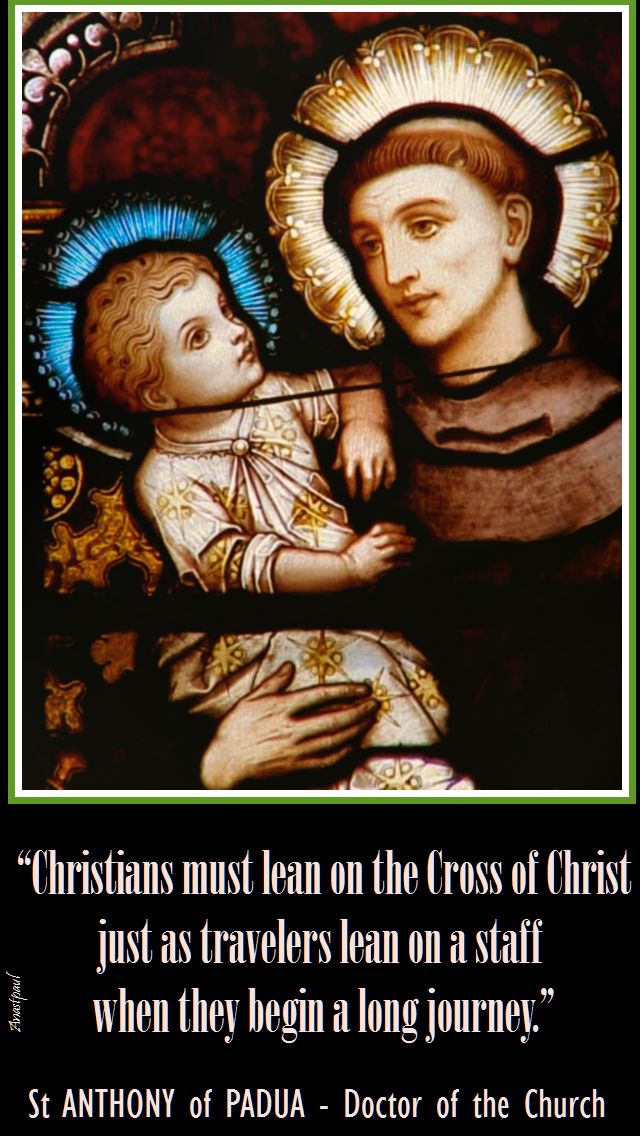
“Christians must lean on the Cross of Christ
just as travelers lean on a staff
when they begin a long journey.”
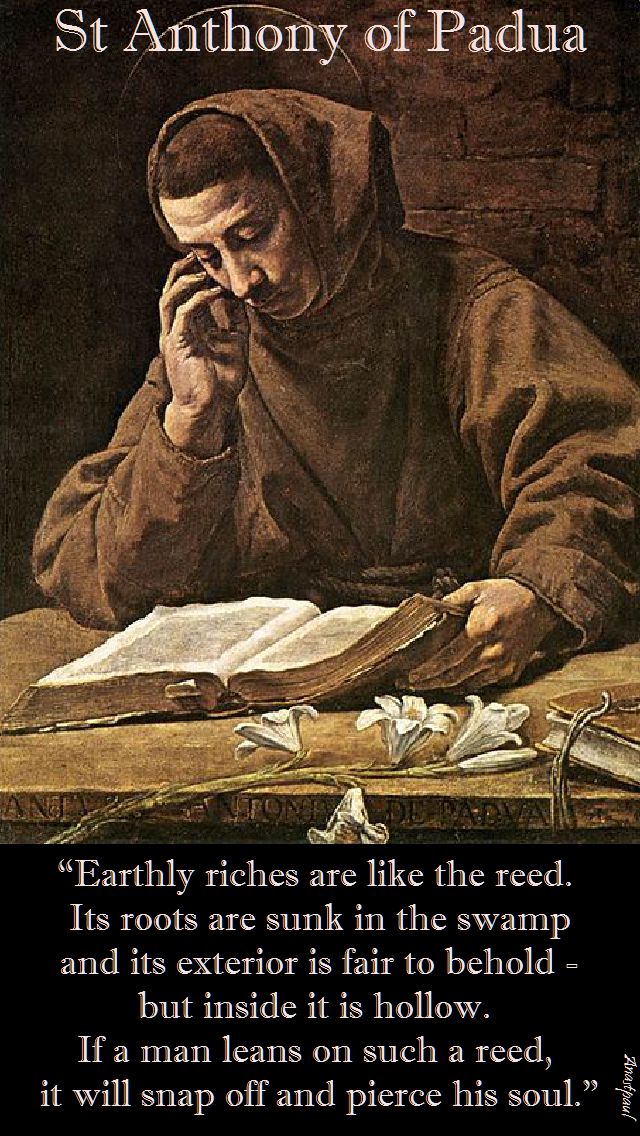
“Earthly riches are like the reed.
Its roots are sunk in the swamp
and its exterior is fair to behold –
but inside it is hollow.
If a man leans on such a reed,
it will snap off and pierce his soul.”
“Not without a long procession does the devil wish the sinner to be carried to his grave
and therefore he arranges the file after the usual manner:
Ambition carries the cross,
Detraction the incense,
Oppression the holy – or rather the cursed – water,
Hypocrisy bears the lights.
There are two chanters:
one is the Fallacious Confidence of living a long time
and he sings, Requiem aeternam – you still have abundant time;
the other is Presumption as to the Divine Mercy
and he sings, In Paradisnm le ducant angeli.
Pride celebrates the office.
Then follow Vain-Glory on the right,
Envy on the left, and, walking after,
Anger, Impatience, Insolence, Blasphemy,
Contumely, Arrogance, Lasciviousness,
Gluttony, Idle Talk, Boasting, Injury, Curiosity
and Uneasiness.
Lo! what a crowd in the conscience following him
who is dead in trespasses and sin.”
“You are the light of the world. A city built on a hill cannot be hid. No one after lighting a lamp puts it under the bushel basket, but on the lampstand, and it gives light to all in the house. In the same way, let your light shine before others, so that they may see your good works and give glory to your Father in heaven.”………….Matthew 5:15-16
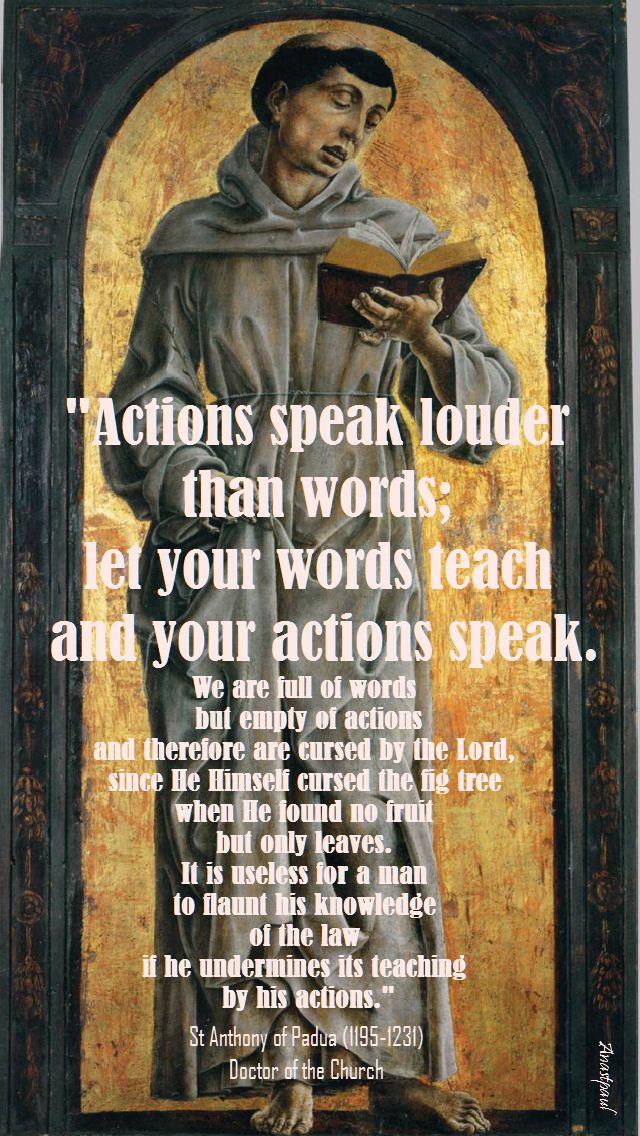
REFLECTION – “Actions speak louder than words;
let your words teach and your actions speak.
We are full of words but empty of actions
and therefore are cursed by the Lord,
since He Himself cursed the fig tree
when He found no fruit but only leaves.
It is useless for a man to flaunt his knowledge
of the law if he undermines its teaching by his actions.”…….St Anthony of Padua
PRAYER – My Lord and my God, teach me the gift of silence and the gift of charity. Help me to live as I speak and to do as You say. Let my fruit be the proof of my love for You and for my neighbour. St Anthony your preaching and teaching was always accompanied by love and charity, pray for us all that we may be a light for the world, amen.
O God, send forth Your Holy Spirit By St Anthony of Padua
O God,
send forth Your Holy Spirit into my heart
that I may perceive,
into my mind that I may remember,
and into my soul that I may meditate.
Inspire me to speak with piety,
holiness, tenderness and mercy.
Teach, guide and direct my thoughts
and senses from beginning to end.
May Your grace ever help and correct me,
and may I be strengthened now
with wisdom from on high,
for the sake of Your infinite mercy. Amen
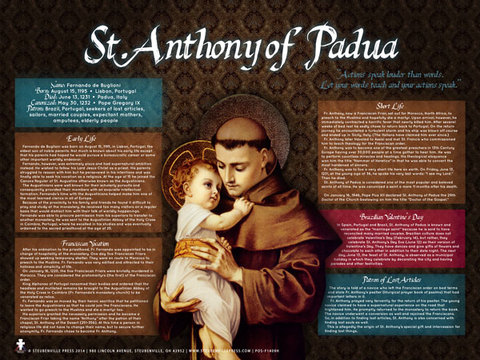
Saint of the Day – 13 June – St Anthony of Padua OFM (1195-1231) Evangelical Doctor – KNOWN AS THE Hammer of Heretics – Professor of Miracles – Wonder-Worker – Ark of the Testament – Repository of Holy Scripture (1195 at Lisbon, Portugal – 13 June 1231 of natural causes). Religious Priest and Friar of the Franciscan Order, Evangelist, Preacher, Teacher, Apostle of Charity, Apostle of the Holy Eucharist, Scriptural expert, Miracle Worker, Teacher, Confessor, Defender of the Faith. He was buried on the Tuesday following his death in the Church of Santa Maria Maggiore, Padua, Italy and legend says that all the sick who visited his new grave were healed. Also known as St Anthony of Lisbon.Patronages – against sterility, against shipwreck, against starvation, American Indians, amputees, animals – both wild and domestic, asses, mariners, elderly people, expectant mothers, for faith in the Blessed Sacrament, fishermen, for good harvests, horses, lost articles, seekers of lost articles, posted articles, oppressed people, poor people, swineherds, travel guides, travellers, Brazil, Portugal, Tigua Indians, 4 Diocese, 17 Cities.
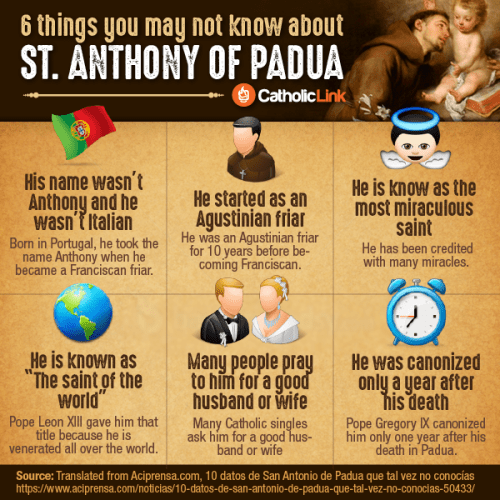
St Anthony of Padua/Lisbon, was a Portuguese Priest and Friar of the Franciscan Order. He was born and raised by a wealthy family in Lisbon, Portugal and died in Padua, Italy. Noted by his contemporaries for his forceful preaching, expert knowledge of scripture and undying love and devotion to the poor and the sick, he was one of the most-quickly Canonised Saints in Church history. He was proclaimed a Doctor of the Church by Pope Pius XII on 16 January 1946.
St. Anthony’s Youth & Conversion
St Anthony was born in the year 1195at Lisbon (Portugal) where his father was a captain in the royal army. Already at the age of fifteen years, he had entered the Congregation of Canons Regular of St Augustine and devoted himself with great earnestness both to study and to the practice of piety in the Monastery at Coimbra (Portugal).
About that time some of the first members of the Order of Friars Minor, which St. Francis has founded in 1206 came to Coimbra. They begged from the Canons Regular a small and very poor place, from which by their evangelical poverty and simplicity they edified everyone in the region. Then in 1219 some of these friars, moved by divine inspiration, went as missionaries to preach the Gospel of Christ to the inhabitants of Morocco. There they were brutally martyred for the Faith. Some Christian merchants succeeded in recovering their remains and so brought their relics in triumph back to Coimbra. The relics of St Bernard and companions, the first martyrs of the Franciscan Order, seized St. Anthony with an intense desire to suffer martyrdom in a like manner. So moved by their heroic example he repeatedly begged and petitioned his superiors to be given leave to join the Franciscan Order. In the quiet little Franciscan convent at Coimbra he received a friendly reception and in the same year his earnest wish to be sent to the missions in Africa was fulfilled.
St Anthony’s Arrival in Italy
But God had decreed otherwise. And so, St Anthony scarcely set foot on African soil when he was seized with a grievous illness. Even after recovering from it, he was so weak that, resigning himself to the will of God, he boarded a boat back to Portugal. Unexpectedly a storm came upon them and drove the ship to the east where it found refuge on coast of Sicily. St Anthony was greeted and given shelter by the Franciscans of that island and thus came to be sent to Assisi, where the general chapter of the Order was held in May, 1221. Since he still looked weak and sickly,and gave no evidence of his scholarship, no one paid any attention to the stranger until Father Gratian, the Provincial of friars living in the region of Romagna (Italy), had compassion on him and sent him to the quiet little convent near Forli (also in Italy). There St Anthony remained nine months as chaplain to the hermits, occupied in the lowliest duties of the kitchen and convent and to his heart’s content he practiced interior as well as exterior mortification.
St Anthony, Preacher and Teacher
But the hidden jewel was soon to appear in all its brilliance. For the occasion of a ceremony of ordination some of the hermits along with St Anthony were sent to the town of Forli. Before the ceremony was to begin, however, it was announced that the priest who was to give the sermon had fallen sick. The local superior, to avert the embarrassment of the moment, quickly asked the friars in attendance to volunteer. Each excused himself, saying that he was not prepared, until finally, St Anthony was asked to give it. When he too, excused himself in a most humble manner, his superior ordered him by virtue of the vow of obedience to give the sermon. St Anthony began to speak in a very reserved manner; but soon holy animation seized him and he spoke with such eloquence, learning and unction that everybody was fairly amazed.
When St Francis was informed of the event, he gave St Anthony the mission to preach throughout Italy. At the request of the brethren, St. Anthony was later commissioned also to teach theology, “but in such a manner,” St Francis distinctly wrote, ” that the spirit of prayer be not extinguished either in yourself or in the other brethren.” St Anthony himself placed greater value in the salvation of souls than on learning. For that reason he never ceased to exercise his office as preacher despite his work of teaching.
The number of those who came to hear him was sometimes so great that no church was large enough to accommodate and so he had to preach in the open air. Frequently St. Anthony wrought veritable miracles of conversion. Deadly enemies were reconciled. Thieves and usurers made restitution. Calumniators and detractors recanted and apologised. He was so energetic in defending the truths of the Catholic Faith that many heretics returned to the Church. This occasioned the epitaph given him by Pope Gregory IX “the ark of the covenant.”
In all his labours he never forgot the admonition of his spiritual father, St Francis, that the spirit of prayer must not be extinguished. If he spent the day in teaching and heard the confession of sinners till late in the evening, then many hours of the night were spent in intimate union with God.
Once a man, at whose home St Anthony was spending the night, came upon the saint and found him holding in his arms the Child Jesus, unspeakably beautiful and surrounded with heavenly light. For this reason St. Anthony is often depicted holding the Child Jesus.
St Anthony’s Death
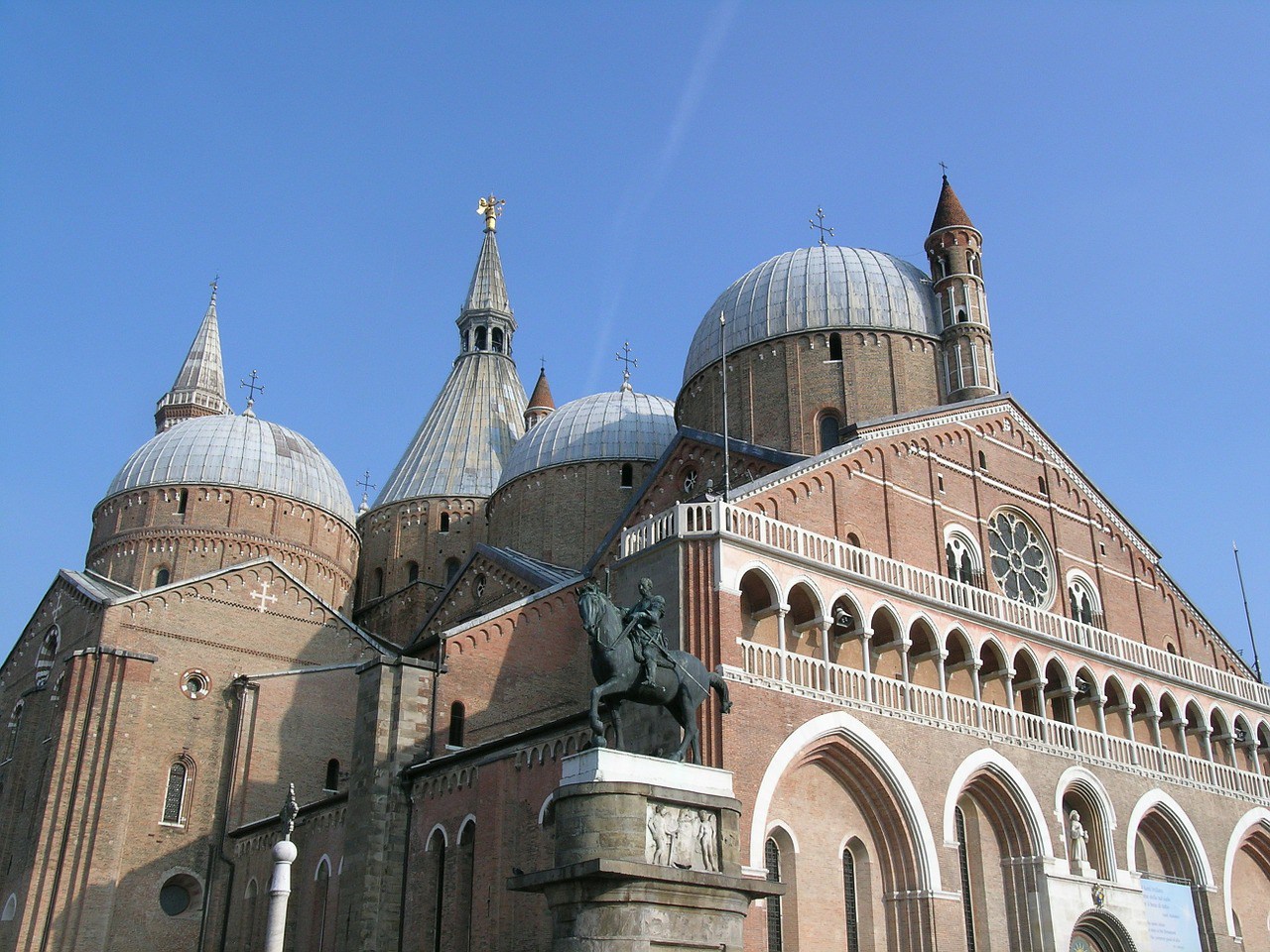
In 1227 St Anthony was elected Minister Provincial of the friars living in northern Italy. Thus he resumed the work of preaching. Due to his taxing labours and his austere penance, he soon felt his strength so spent that he prepared himself for death. After receiving the last sacraments he kept looking upward with a smile on his countenance. When he was asked what he saw there, he answered: “I see my Lord.”He breathed forth his soul on June 13, 1231 A. D., being only thirty six year old. Soon the children in the streets of the city of Padua were crying: “The saint is dead, Anthony is dead.” Anthony is buried in a chapel within the large basilica built to honour him, where his tongue is displayed for veneration in a large reliquary. For, when his body was exhumed thirty years after his death, it was claimed that the tongue glistened and looked as if it was still alive and moist; apparently a further claim was made that this was a sign of his gift of preaching.
Pope Gregory IX enrolled him among the saints in the very next year. At Padua, a magnificent basilica was built in his honour, his holy relics were entombed there in 1263. From the time of his death up to the present day, countless miracles have occurred through St. Anthony’s intercession, so that he is known as the Wonder-Worker. In 1946 St Anthony was declared a Doctor of the Church.
Basilica of St Anthony in Padua
Why do we ask St Anthony to help us find lost things?
St. Anthony had a book of psalms that was quite special to him. It was special because in those days before the printing press, books were rare and expensive. But it was also special because it contained many notes Anthony had made to help him in his preaching and teaching.
Late one night, a young Franciscan decided to leave the community. He’d had enough of that life, so he made plans to just sneak out in the middle of the night. He saw Anthony’s book of psalms on his way out and he snatched it up and ran. He knew that he could sell this precious book for a good deal of money.
Of course, Anthony was quite upset. He prayed that God would change the young man’s heart and bring him back to the Franciscan life. He also hoped that while God was at it, he would return Anthony’s book too. The next day, the young man returned, tired and ashamed, with Anthony’s book. He also brought back his own gifts and talents, which he decided once more to offer to the Franciscan community.
So that’s why we like to ask St Anthony to help us find lost things. He was an extraordinary man who can still help us from heaven, even in the most ordinary ways.
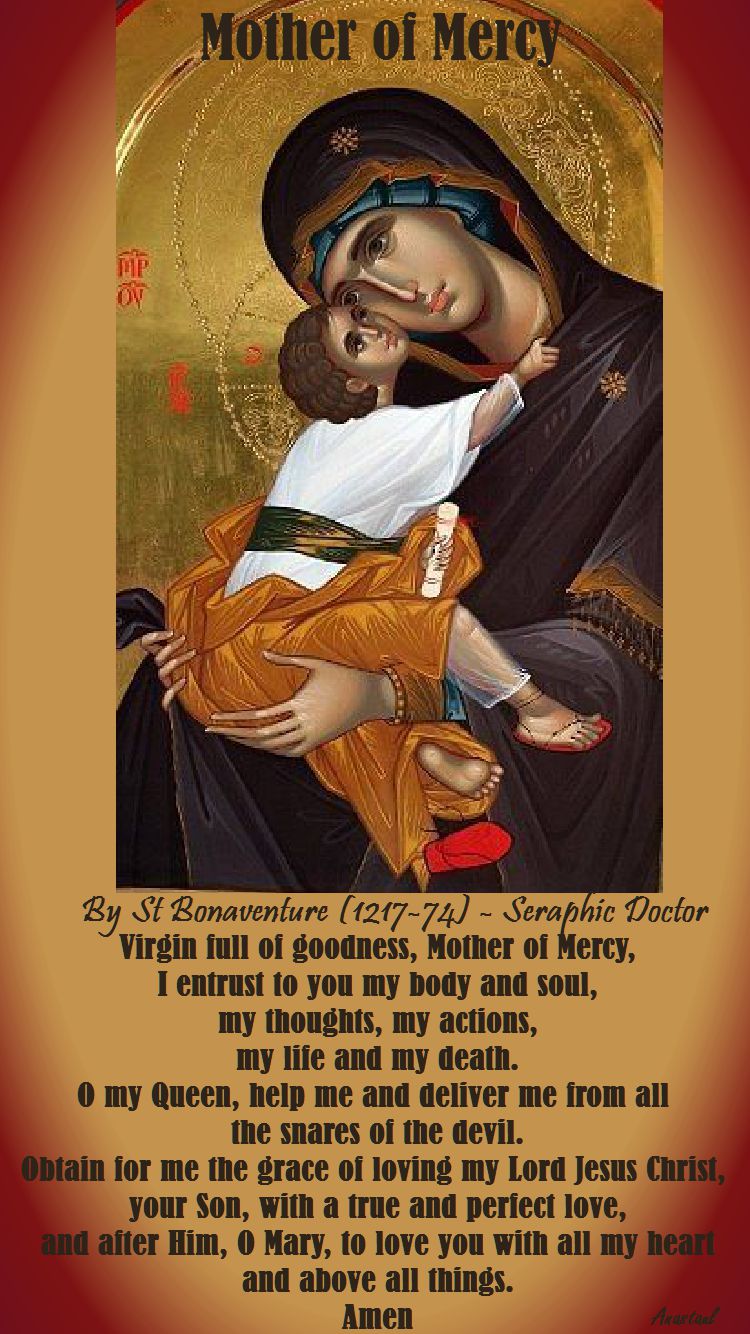
Mother of Mercy
By St Bonaventure (1217-74)
Seraphic Doctor
Virgin full of goodness,
Mother of Mercy,
I entrust to you my body and soul,
my thoughts, my actions,
my life and my death.
O my Queen, help me,
and deliver me from all
the snares of the devil.
Obtain for me the grace
of loving my Lord Jesus Christ,
your Son, with a true and perfect love,
and after Him, O Mary,
to love you with all my heart
and above all things.
Amen
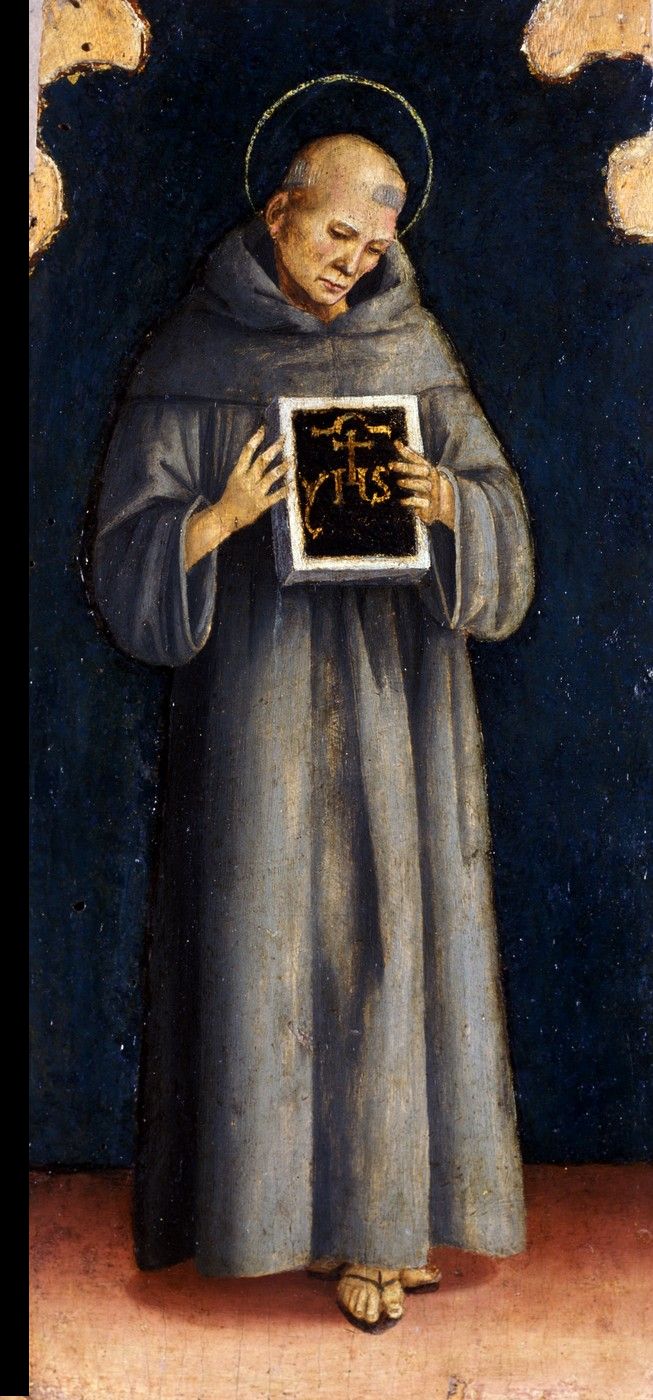
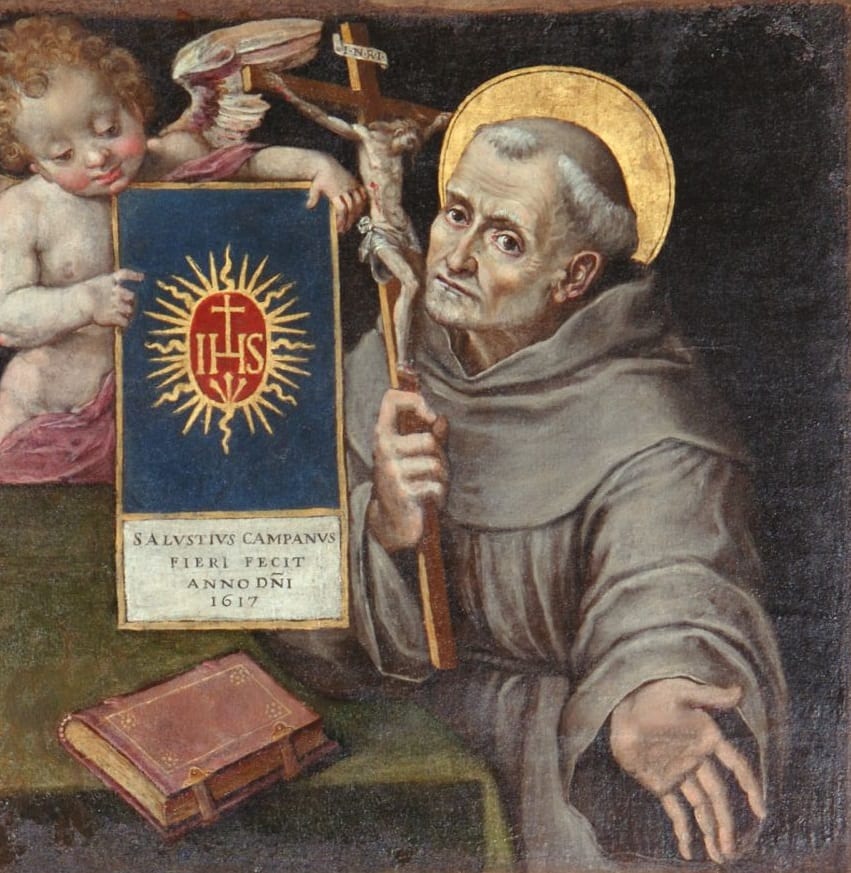
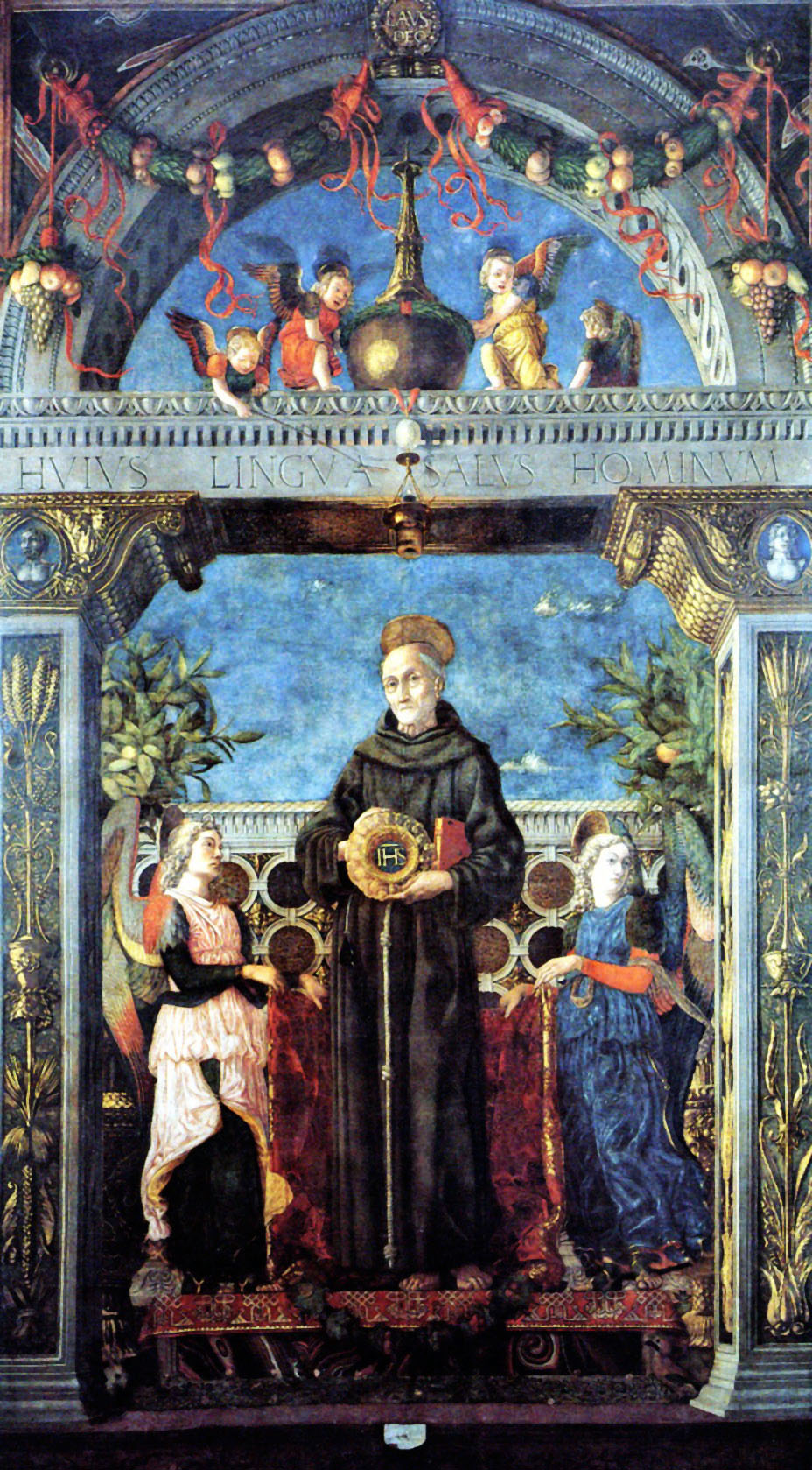
In St Bernardine’s day, cursing was almost part of the common speech and he combated it by promoting devotion to the Holy Name of Jesus.
He even had cards printed inscribed with the Holy Name and they were more popular than playing cards..
He knew that you do not root out an evil merely preaching against it, instead you must put something good in its place.
That is a piece of wisdom it would do us well to follow. Perhaps our attempts should be garnered universally to root out the sacrilegious habit of great portions of the world, which use the name of God and of Jesus in vain, so often with every sentence, so much so, that in public it is now an accepted practice!
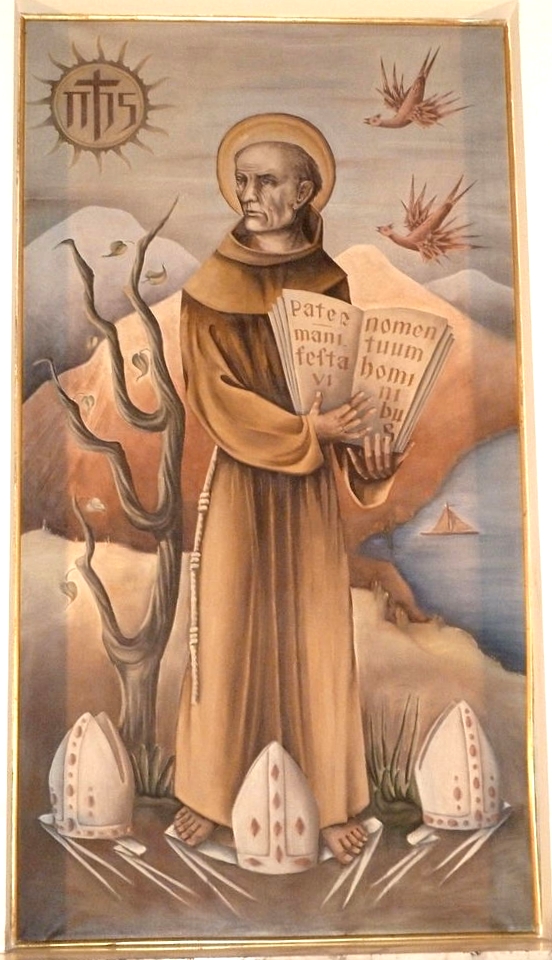
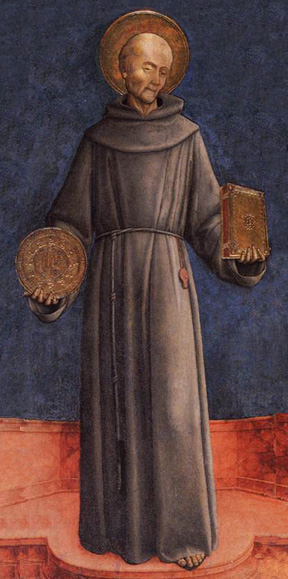
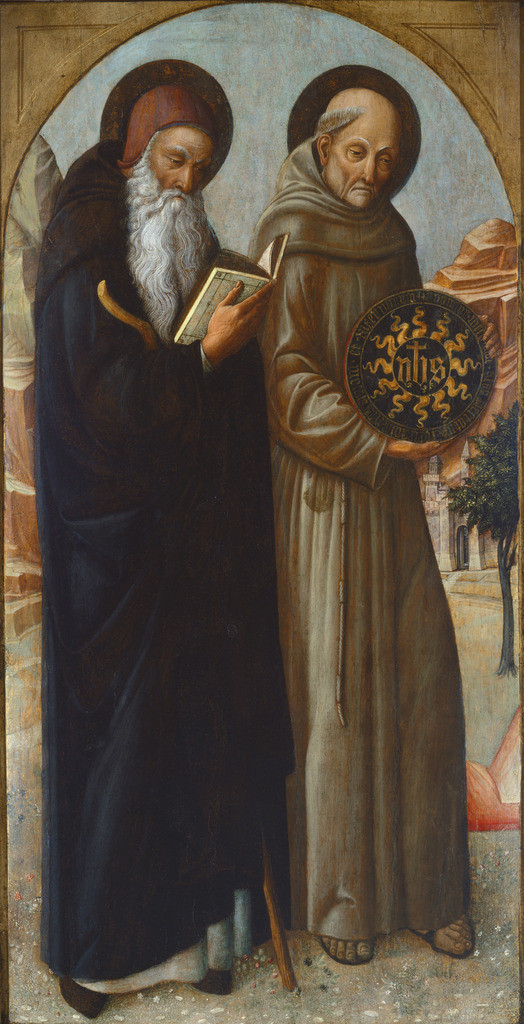
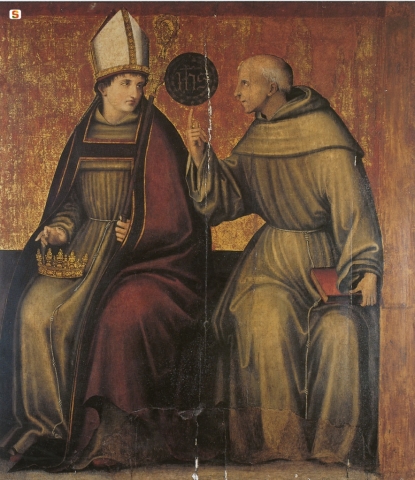
Especially known for his devotion to the Holy Name of Jesus, Bernardine devised a symbol—IHS, the first three letters of the name of Jesus in Greek–in Gothic letters on a blazing sun. This was to displace the superstitious symbols of the day, as well as the insignia of factions: for example, Guelphs and Ghibellines. The devotion spread and the symbol began to appear in churches, homes and public buildings.
The provenance of this item indicates that the prayer book belonged to Franciscan communities in Tuscany during the lifetime of Saint Bernardine of Siena.
“The name of Jesus is the glory of preachers because the shining splendour of that Name causes His word to be proclaimed and heard. And how do you think such an immense, sudden and dazzling light of faith came into the world, if not because Jesus was preached? Was it not through the brilliance and sweet savour of this Name that God called us into His marvelous light? When we have been enlightened and in that same light behold the light of heaven, rightly may the apostle Paul say to us: ‘Once you were darkness but now you are light in the Lord; walk as children of light.’ “
And coming to her, he said, “Hail, favoured one! The Lord is with you.”………..Luke 1:28
REFLECTION -“You must know that when you ‘hail’ Mary, she immediately greets you! Don’t think that she is one of those rude women of whom there are so many — on the contrary, she is utterly courteous and pleasant. If you greet her, she will answer you right away and converse with you!”……..St Bernardine of Siena
PRAYER – Lord God, You sent your angel to Mary and Your divine Son became man when she gave her consent to the angel’s announcement. Help me to give a perpetual consent to all that You will for me and a perpetual refusal to all that only I, in my pride, wish. Help me to see and understand and pray unceasingly to discern Your will. Holy Mary, Mother of God and our Mother, help us all. St Bernardine of Siena, please pray for us, amen.
Saint of the Day – 20 May – St Bernardine of Siena OFM (1380 at Massa di Carrara, Italy to 1444 at Aquila, Italy of natural causes) “Apostle of the Most Holy Name of Jesus,” Priest, Missionary, Preacher, known as the “Apostle of Italy,” the “Star of Tuscany,” and the “Second Paul.” Saint Bernadine is one of the most renowned Franciscan preachers and reformers, a prolific writer who graced the Church with countless sermons and writings and is largely responsible for increasing the popular devotion to the Holy Name of Jesus. St Bernadine is also remembered for his ardent devotion to Our Blessed Mother and the Holy Family. His numerous Patronages include – against chest and lung problems, respiratory illnesses, of Advertising and Communications and Public Relations workers, against gambling and gambling addictions, of Italy, Diocese of San Bernardino, California, of the Diocese of Capri, Italy, of the Italian Cities of Altavilla Irpina, Aquila, Camaiore, Carpi, Castelspina, Alessandria, Montecchio, Trevignano Romano Venice.
Saint Bernadine was the greatest preacher of his time, journeying across Italy, bringing peace to areas ridden with strife, attacking the paganism he found rampant. When he preached, he would attract large crowds of nearly 30,000 listeners, converting many on the spot. Above all, he followed St. Francis’s admonition to preach about “vice and virtue, punishment and glory.” Saint Antoninus described him as “a new star in the midst of the murky darkness of the earth; to shine with the brightness of Divine gifts; to beam far and wide the bright rays of his glorious life and teachings; to lead in the fear of God, by the holiness of his example, a people whose blindness had removed it from the straight path of the heavenly Homeland.”
He was born on the Feast of the Nativity of Mary in Siena, Italy. StBernadine entered the world in nobility, the son of a governor. At age six, he lost both his parents and thus orphaned, was raised by a pious aunt who attended to both his physical and spiritual needs. Bernadine excelled at school, demonstrating both intelligence and diligence, holiness and piety, and was well-liked and popular. At age 17, he entered a Marian confraternity at the La Scala hospital, beginning a secluded religious life devoted to prayer and meditation. At that time, the plague raged throughout Europe and Bernadine left seclusion to aid the sick, placing himself at great risk and assuming administration of the hospital. While he never contracted the plague, he fell ill from exhaustion and was confined to bed for several months. While he never fully recovered, his voice—hoarse and weak from his sickness- was fully restored through his devotion to Our blessed Mother, allowing him to develop profound preaching skills. Following his own sickness, his aunt fell ill and he nursed her until her death, never leaving her side. Upon her death, Saint Bernadine turned to fasting and prayer, spending his days seeking the will of the Lord in his life.
One day while he was kneeling at the foot of his crucifix, praying for guidance, Bernadine heard the voice of Jesus say to him: “My son Bernardine, you see Me hanging on the Cross, in a state of total denudation. If you love Me and want to walk in My footsteps, fasten yourself also to the cross, divested of everything.” Following this divine message, Bernadine joined the Franciscan Order, distinguishing himself through obedience, which he considered the virtue of highest import.
Bernadine was assigned to preaching, having a natural gift given by the Holy Spirit. Over the next decade of his life, he traveled throughout Italy, preaching in major cities, a natural successor to Saint Vincent Ferrer. The Adorable Name of Jesus was the usual theme of his sermons, stemming from his aunt’s instruction as a child. Wherever he traveled, he carried a tablet on which the Holy Name of Jesus (IHS) was written, adopting it as his standard and his “sole weapon.” He firmly held only in this Name could man be saved, as Saint Peter had instructed the elders in the Synagogue.
One of Bernadine’s listeners in Siena was to become Pope Pius II. In his notes, the Pope tells of one of Bernardine’s addresses: “One day, as he was preaching in the square in Siena, a thick cloud formed and threatened rain. Everyone wanted to run off. ‘Friends, remain in peace,’ exclaimed the orator. He knelt down and prayed, ordering the cloud, by virtue of the Name of Jesus, to go away. Scarcely had he spoken when the cloud scattered without a drop of rain, and the weather turned as fair as it had been before.”
Bernardine was a preacher of inspired eloquence. He has been called the Doctor of the Heart of Mary due to his writings on Mary’s heart. He wrote, “from her heart, as from a furnace of Divine Love, the Blessed Virgin spoke the words of the most ardent love.” He was also a distinguished master in the science of all things sacred, as is proved by the writings he has left us.
Bernadine’s watchword, like Saint Francis, was peace. He preached peace wherever he went, balancing the social climate of the day with the teachings of the Church. Mass reconciliations were reported as he celebrated Mass, given his encouragement of the kiss of peace between attendees.
Numerous miraculous occurrences were reported in his presence. One day, preaching in praise of the Blessed Virgin, he applied to Her the verse of the Apocalypse: “A great sign appeared in heaven, a Woman clothed with the sun…” At once a brilliant star appeared over his head. On other occasions, Bernadine was understood by all present when he spoke in Italian—even by those who didn’t speak Italian! He obtained miraculous conversions and reformed the greater part of Italy by his burning words and by the power of the Holy Name of Jesus.
Bernardine was appointed Vicar General of his Order in 1438, an office he held for five years. After five years, he began preaching again until, worn out from his missionary labors, he died on the Eve of the Ascension. At his death, his brothers surrounded him, chanting, “Father, I have manifested Thy Name to men.” Saint Bernadine was buried at Aquila in the Abruzzi. The miracles reported at his tomb encouraged Pope Nicholas V to canonise him only six years later.
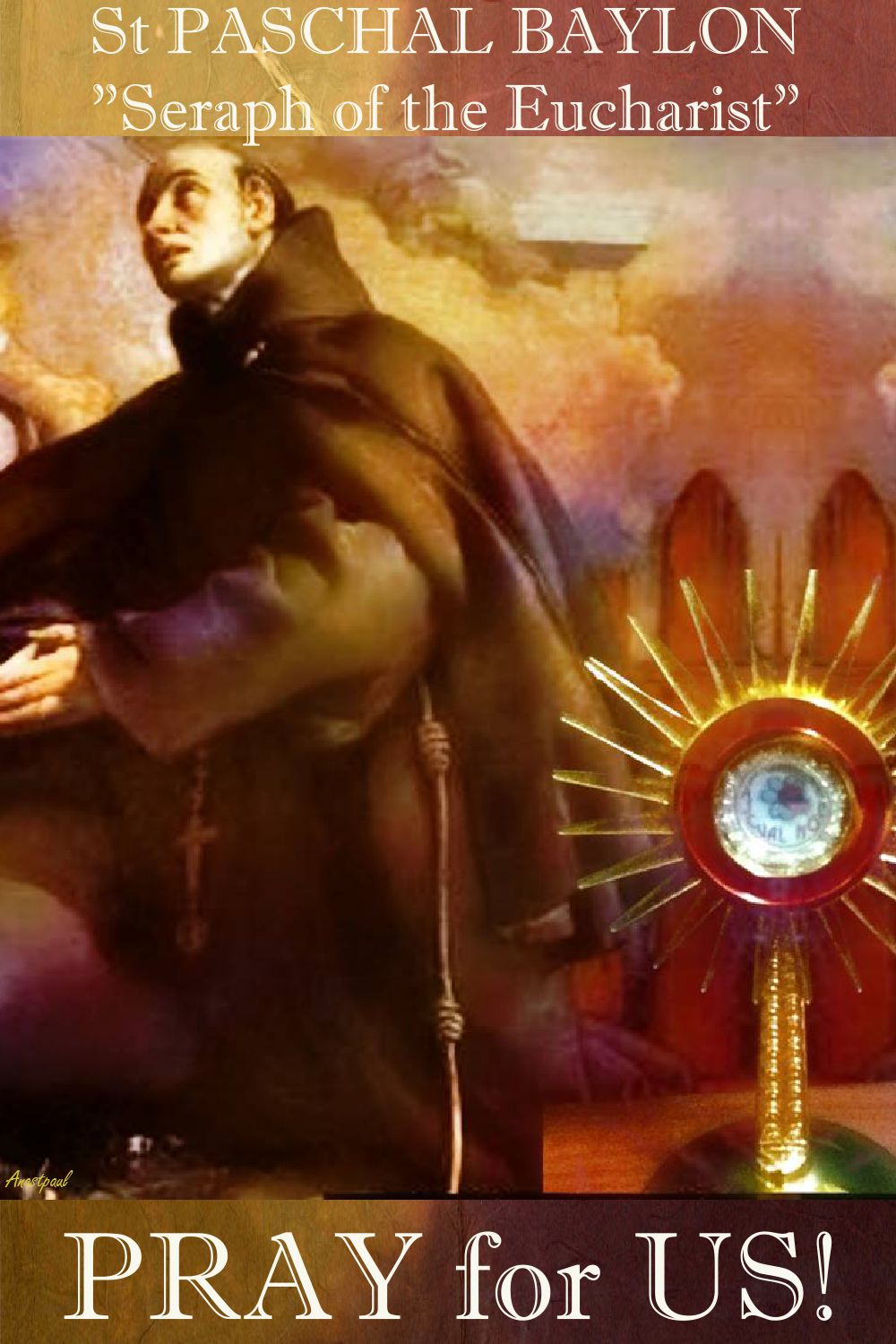
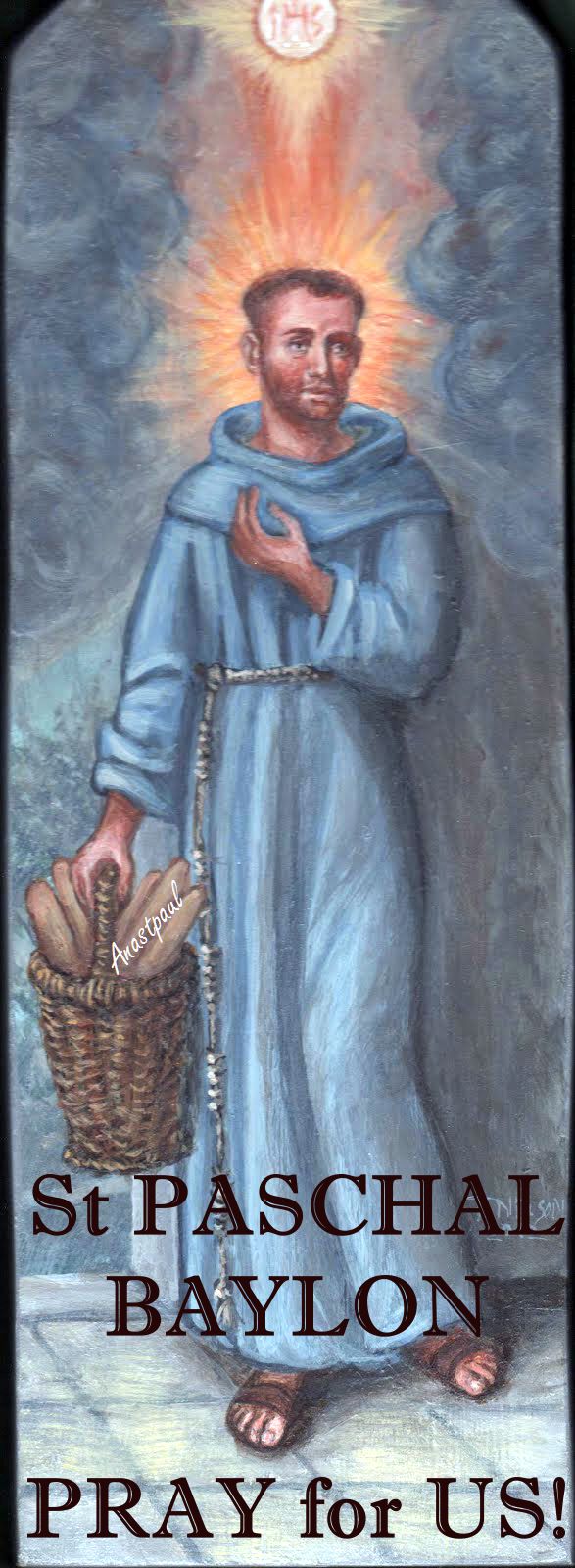
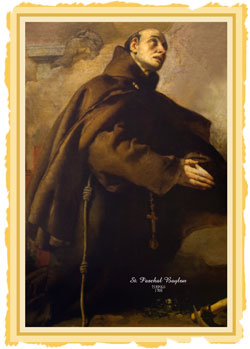
The life of St Paschal Baylon is one of simple adoration of the Lord. He recognised the importance of spending time before Our Saviour, in contemplation of His passion, love, and sacrifice—in the earthly presence of God. Through his devotion to the Blessed Sacrament, St Paschal was graced with wisdom beyond his education and obedience and charity beyond measure. His life inspires us to greater communion with the Lord, leading us to His spiritual treasures. As prayer before the Blessed Sacrament occupied much of Saint Francis’ energy. Most of his letters were to promote devotion to the Eucharist. St Paschal shared this concern. An hour in prayer before our Lord in the Eucharist could teach all of us a great deal! Many holy and busy Catholics today, across the world, find that their lives in every respect, are enriched by these minutes regularly spent in prayer and meditation.
O God, You filled St. Paschal with a wondrous love for the sacred mysteries of Your Body and Blood. May we draw from this Divine Banquet the same spiritual riches he received. St Paschal Baylon Pray for us amen!
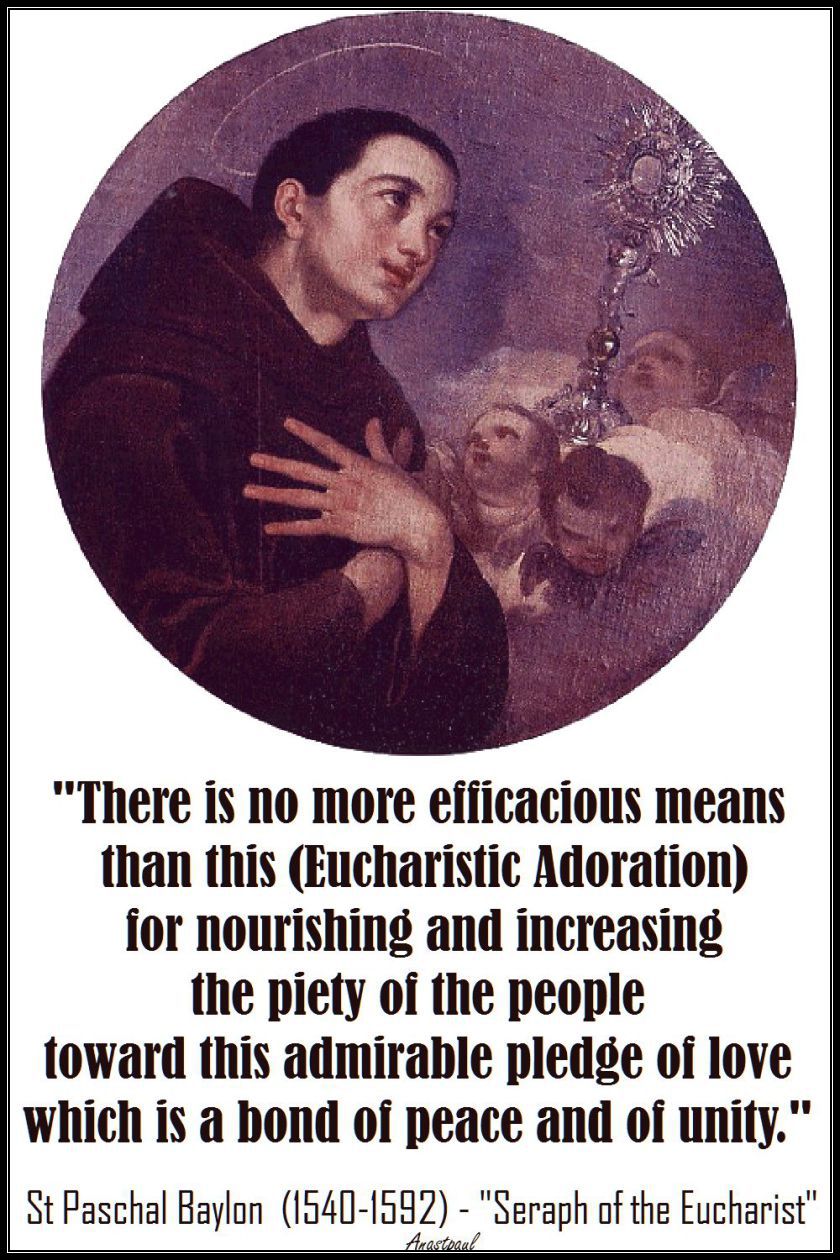
“There is no more efficacious means than this (Eucharistic Adoration)
for nourishing and increasing the piety of the people
toward this admirable pledge of love
which is a bond of peace and of unity.”
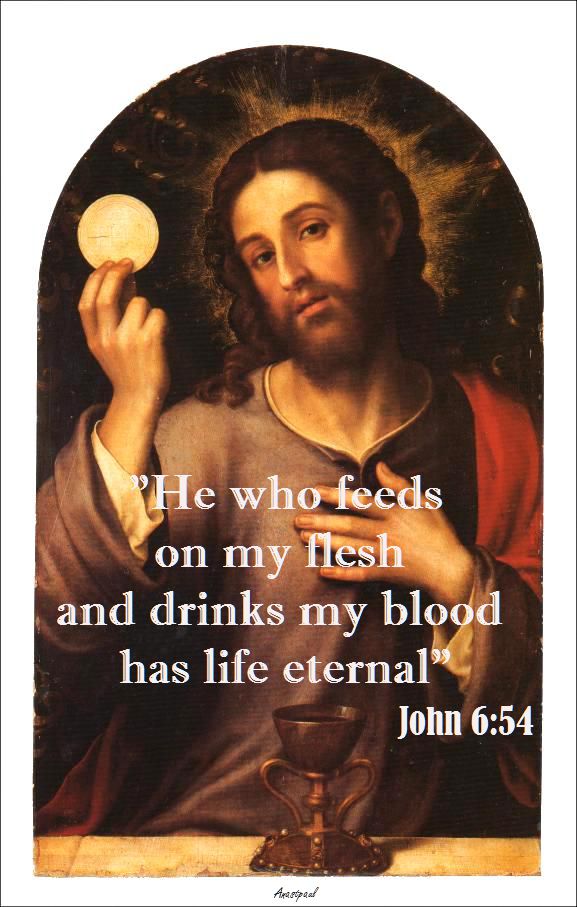
“He who feeds on my flesh and drinks my blood has life eternal”……………….John 6:54
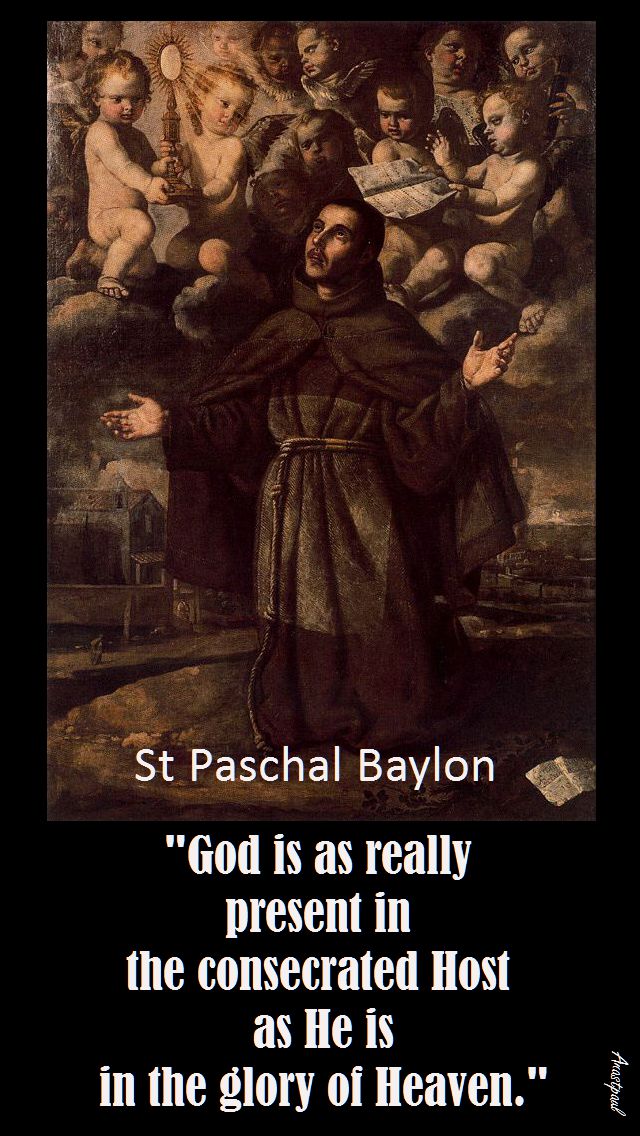
REFLECTION – “God is as really present in the consecrated Host as He is in the glory of Heaven”…..St Paschal Baylon
PRAYER – Lord Jesus Christ, never let me abstain from receiving You in Holy Communion and let me always find the time to visit You in the Tabernacle. Lord teach enlighten my mind with a fuller love and understanding of Your Eucharistic Heart. St Paschal Baylon, Seraph of the Eucharist, pray for us all! Amen
Virgin Mary, hear my prayer:
through the Holy Spirit
you became the Mother of Jesus;
from the Holy Spirit may I too have Jesus.
Through the Holy Spirit your flesh conceived Jesus;
through the same Spirit may my soul receive Jesus.
Through the Holy Spirit you were able to know Jesus,
to possess Jesus,
and to bring Him into the world.
Through the Holy Spirit may I too come to know your Jesus.
Imbued with the Spirit,
Mary, you could say:
“I am the handmaid of the Lord,
be it done unto me according to your word”;
in the Holy Spirit,
lowly as I am,
let me proclaim the great truths about Jesus.
In the Spirit you now adore Jesus as Lord
and look on Him as Son;
in the same spirit,
Mary, let me love your Jesus. Amen
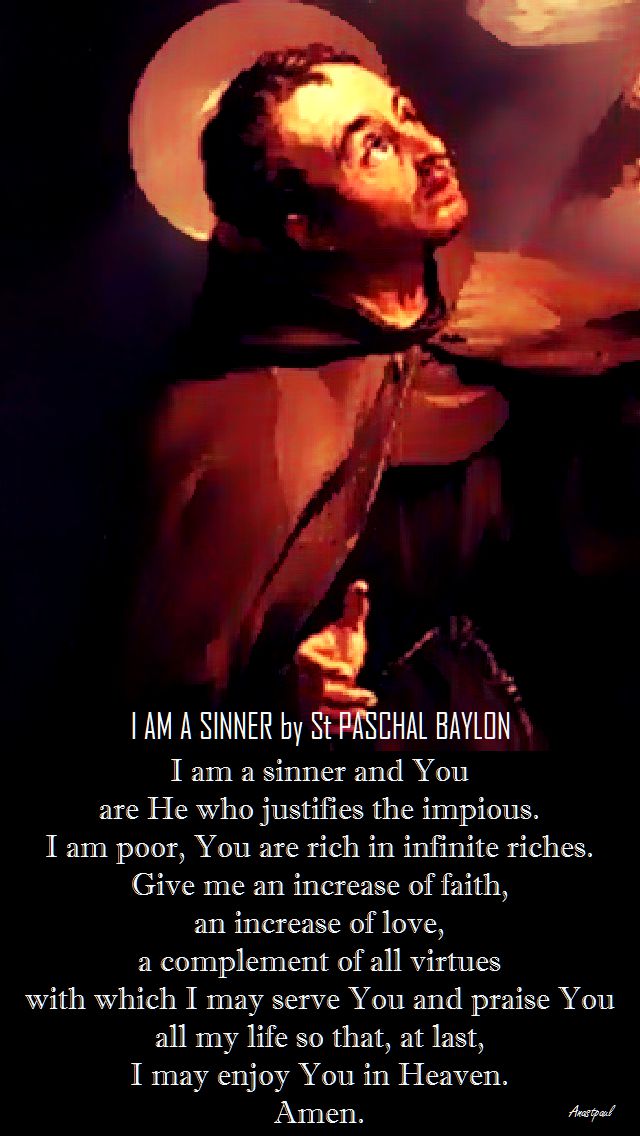
I AM A SINNER by ST PASCHAL BAYLON (Memorial today 17 May)
I am a sinner and You
are He who justifies the impious.
I am poor, you are rich in infinite riches.
Give me an increase of faith,
an increase of love,
a complement of all virtues
with which I may serve You and praise You
all my life so that, at last,
I may enjoy You in Heaven.
Amen.
Saint of the Day – 17 May – St Paschal Baylon (1540 (feast of Pentecost) at Torre Hermosa, Aragon, (modern Spain) – 15 May 1592 (feast of Pentecost) at Villa Reale, Spain of natural causes) Franciscan lay brother, Mystic, Contemplate, known as the “Seraph of the Eucharist,” “Saint of the Blessed Sacrament,” “Servant of the Eucharist.”Patron of cooks, shepherds, Eucharistic congresses and organisations (proclaimed by Pope Leo XIII on 28 November 1897), Diocese of Segorbe-Castellón de la Plana, Spain, Obado, Bulacan, Philippines. Attributes – The Eucharist, Monstrance, Franciscan habit.
Today, 17 May marks the Feast Day of Saint Paschal Baylon, mystic, known for his profound devotion to the Blessed Sacrament. While Saint Paschal never became a priest, he is the saint most often thought of in relation to the Holy Eucharist and Pope Leo XIII declared him the patron saint of Eucharistic congresses and associations. He wrote, “There is no more efficacious means than this for nourishing and increasing the piety of the people toward this admirable pledge of love, which is a bond of peace and of unity.” Among all those most devoted to the Eucharist, Paschal Baylon seemed to the Pope to be “the greatest.”
As a youth, Paschal Baylon tended his family’s sheep. He taught himself to read so that he could pray the Little Office of the Blessed Virgin, the popular prayer book of his day. Paschal disciplined himself to endure the harshness and loneliness of a shepherd’s work. And when his sheep trod on others’ vines, he scrupulously paid for the damage out of his own meager resources.
At twenty-one, St Paschal joined the reformed Franciscans of St. Peter of Alcántara at Loreto. As a lay brother, Paschal for many years served as porter and guestmaster with patience and good humor. John Ximenes, his biographer, reports that he was a model friar, always the first at prayer and never once behaving badly in a relationship. “In no single case,” said Ximenes, “do I remember to have noted even the least fault in him, though I lived with him in several of our houses and was his companion on two long journeys.”
Like other saintly doorkeepers Brother André and Solanus Casey, Paschal gained a reputation for miracles.
For example, Martin Crespo once told how the saint freed him from his determination to take vengeance on his father’s murderers:
“One Good Friday there was a lifelike representation of the descent from the cross. Along with everyone else in town, I followed the crucifix borne in triumph through the streets. In a last ditch effort to get me to repent, my friends boxed me in and forced me to endure the preacher’s address. He concluded his eloquent speech in a pathetic peroration, urging me to forgiveness in memory of our Saviour’s passion. His fine discourse left me unmoved and cold.
“Quit tormenting me,” I exclaimed angrily. “It’s no use. I will not forgive them.” Brother Paschal, whom I had not noticed before, stepped forward. He took me by the arm and drew me aside. “My son,” he said, “have you not just now seen a representation of our Lord’s passion?” Then with a glance that penetrated my soul he said: “For the love of Jesus Crucified, my son, forgive them.”
“Yes, Father,” I replied, hanging my head and weeping. “For the love of God I forgive them with all my heart.” I no longer felt the same person. The crowd anxiously awaited the outcome of our mysterious conference. When Paschal announced that I had forgiven my enemies, they burst into applause.”
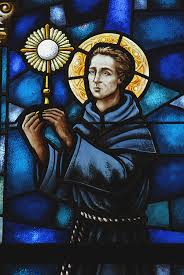
We remember Paschal Baylon most as the “Saint of the Blessed Sacrament.” Typically he spent as many hours a day as he could worshiping before the Tabernacle. Because of his faithful devotion, the Church has named him Patron of Eucharistic Congresses and conferences. He died in 1592 at the age of fifty-two.
Saint Paschal exhibited an ardent love for Christ and was especially devoted to the Eucharistic Mystery. He traveled from church to church, always on foot, visiting and praying before the Blessed Sacrament, referring to his encounters with “the real presence of Jesus” in these moments. During his prayers, he would often levitate above the floor, so much was his love and zeal for Christ.
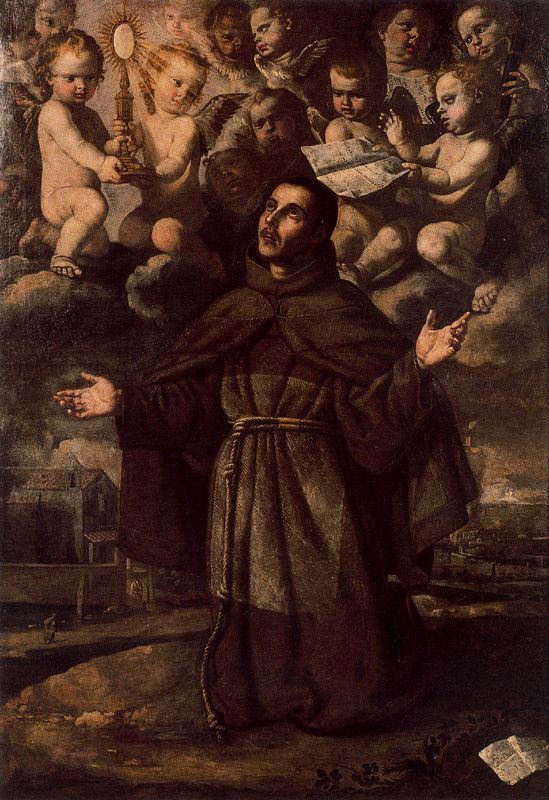
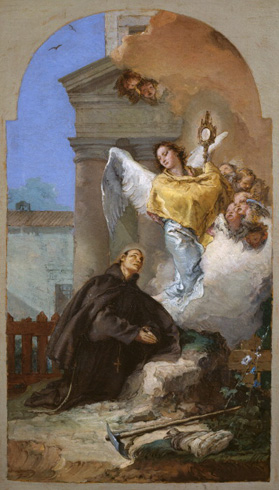
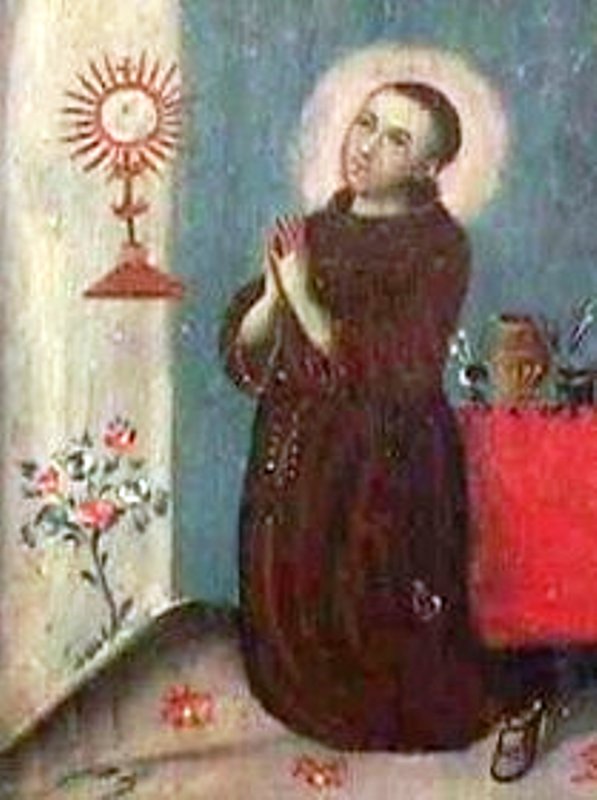
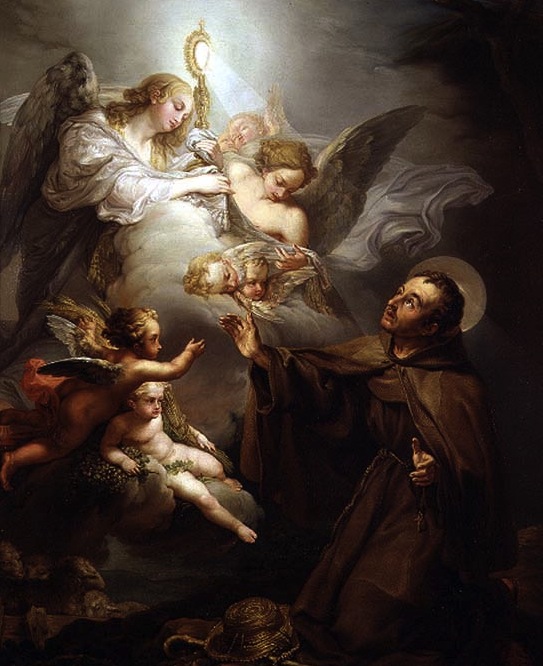
Many miracles are attributed to Saint Paschal, including creating fresh-flowing streams by striking the ground, healing, and miraculous charity. Saint Paschal also experienced mystical visions. On one such occasion, while he was out in the fields with his sheep and unable to go to Mass at the nearby monastery, Paschal was waiting for the sound of the Consecration Bell which he always observed in prayer. In his longing to be present at the Holy sacrifice of the Mass, he cried out, “My Master, My adorable Master, Oh that I might see Thee!” Suddenly before him he saw Angels bowed down before a Chalice, with the Blessed Sacrament floating above it. In the Divine Presence of Our Lord, Paschal fell flat on his face and adored God. Then taking courage he gazed upon the beautiful vision.
The “Servant of the Eucharist,” as he was commonly called, died on 17 May Pentecost Sunday, in 1592. His tomb at the Royal Chapel in Villareal, Valencia, Spain immediately became the object of innumerable pilgrimages, even by the king and the nobles of Spain. At his funeral Mass, Saint Paschal’s eyes miraculously opened during the Consecration, adoring the Blessed Sacrament even in death. Since his death, strange occurrences have continued to be reported, known as the “Knocks of St. Paschal.” At first, the knocks came from Paschal’s tomb. Later they came from relics and pictures of the saint. The knocking sound is believed to come as a kind of warning, to let people know that a terrible event was about to take place. It is also said that in Spain and Italy, those who are devoted to Saint Paschal, are warned about their death, days before, so that they may have a chance to receive the Last Sacraments. Beatified by Pope Paul V in 1618, he was Canonised by Pope Alexander VIII on 16 October 1690.
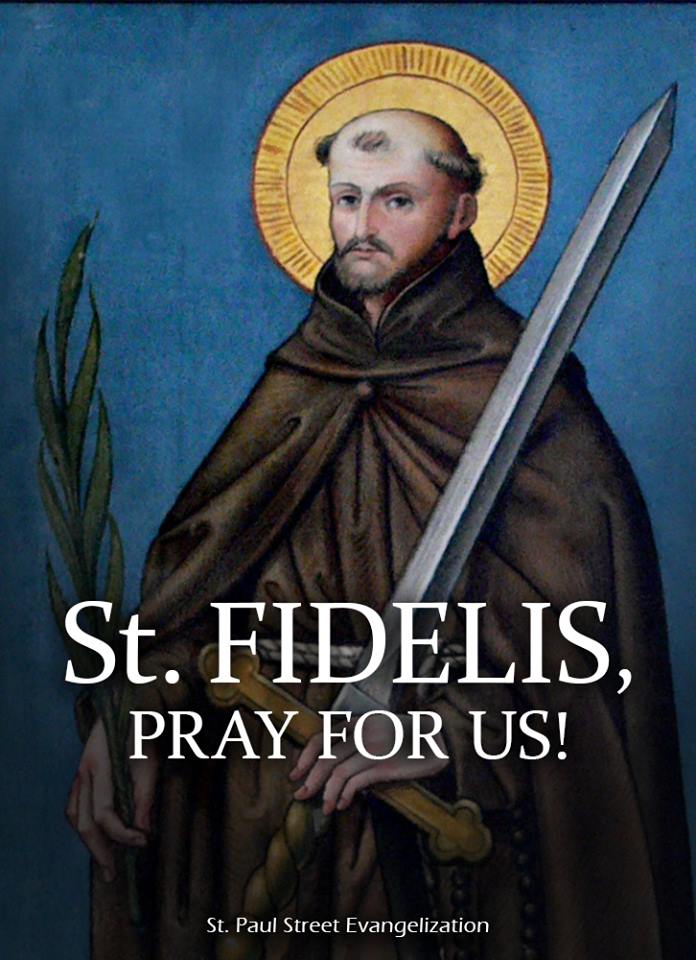
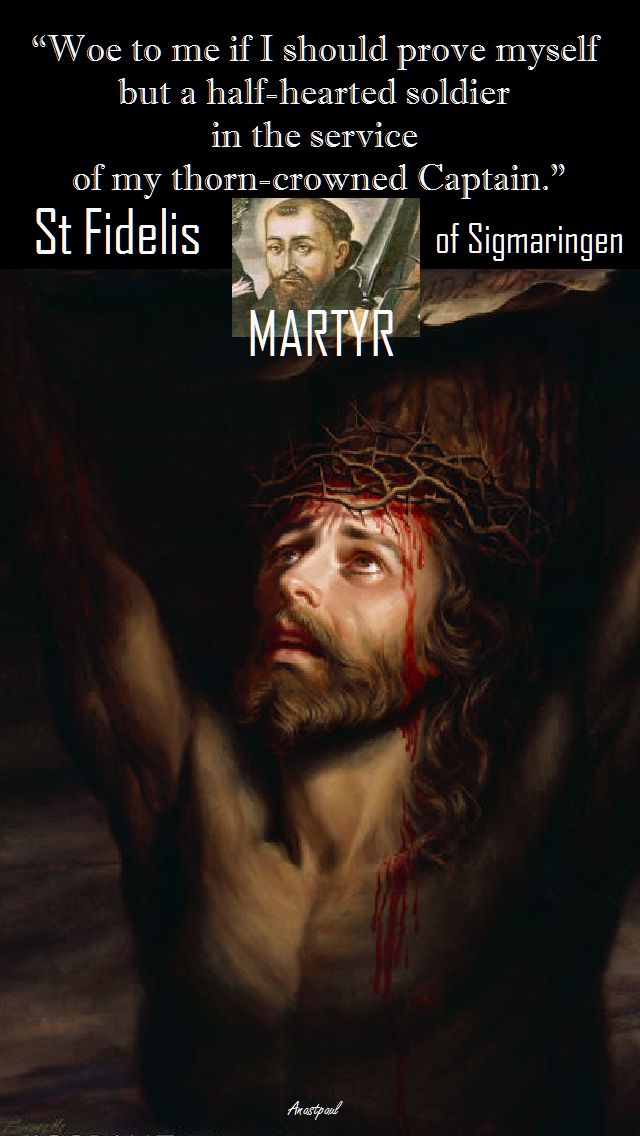
Many saints, like St Fidelis of Sigmaringen, realise that they are wasting their time in the midst of greed and foolish ambition and decide on another course. Their gifts were turned to doing good and to this they devote the whole of their lives. Sometimes, it is often easily apparent, that a change is demanded in our lives – feeling miserable, unsatisfied, uneasy, worried by the greed of the world, it’s lukewarmness or apathy and more! Courage now is needed and that courage comes from he grace of God in prayer. ‘You become what you love’ – what is it that you love?
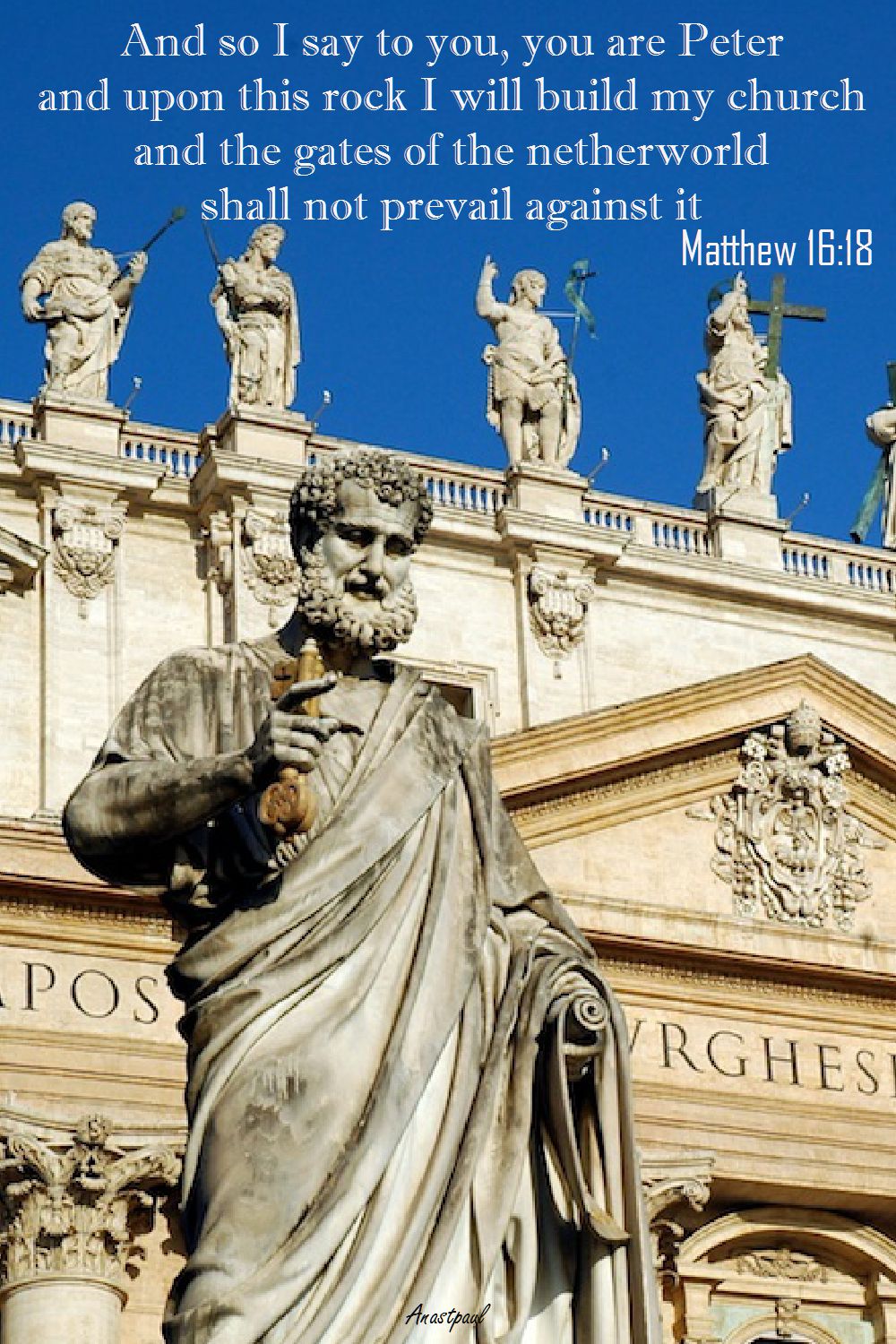
And so I say to you, you are Peter
and upon this rock I will build my church
and the gates of the netherworld
shall not prevail against it……….Matthew 16:18
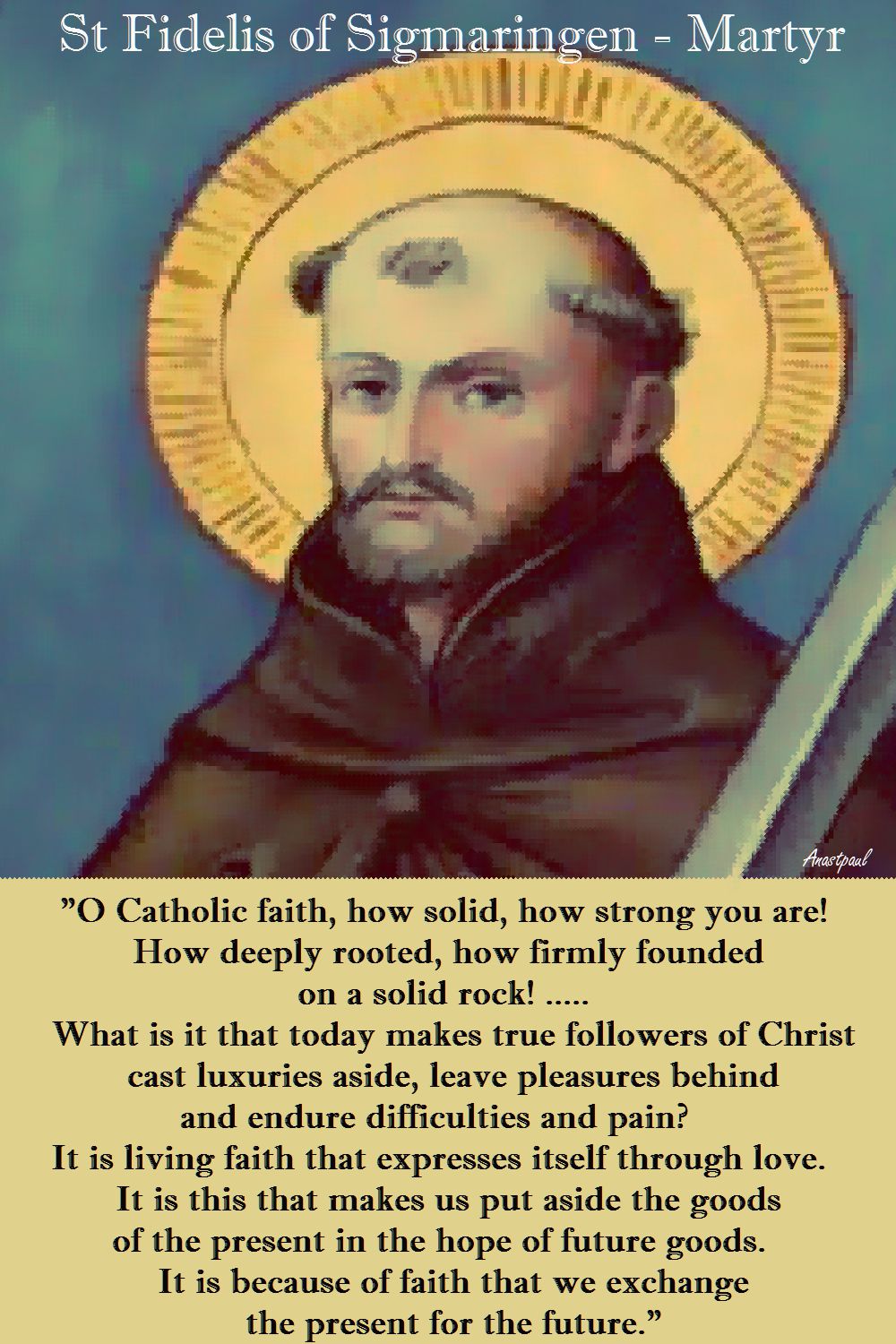
REFLECTION – “O Catholic faith, how solid, how strong you are! How deeply rooted, how firmly founded on a solid rock! Heaven and earth will pass away but you can never pass away. From the beginning the world opposed you but you mightily triumphed over everything. This is the victory that overcomes the world, our faith. It has subjected powerful kings to the rule of Christ; it has bound nations to His service. What made the holy apostles and martyrs endure fierce agony and bitter torments, except faith and especially faith in the resurrection? What is it that today makes true followers of Christ cast luxuries aside, leave pleasures behind and endure difficulties and pain? It is living faith that expresses itself through love. It is this that makes us put aside the goods of the present in the hope of future goods. It is because of faith that we exchange the present for the future.”…………………St Fidelis of Sigmaringen
PRAYER – Father, Son and Holy Spirit, we praise You and give You glory: we bless You for calling us to be Your holy people. Remain in our hearts and guide us in our love and service. Help us to let our light shine before others and lead them to the way of faith.
Holy Trinity of love, we praise You now and for ever. St Fidelis man of courage and true faith, pray for us, amen!
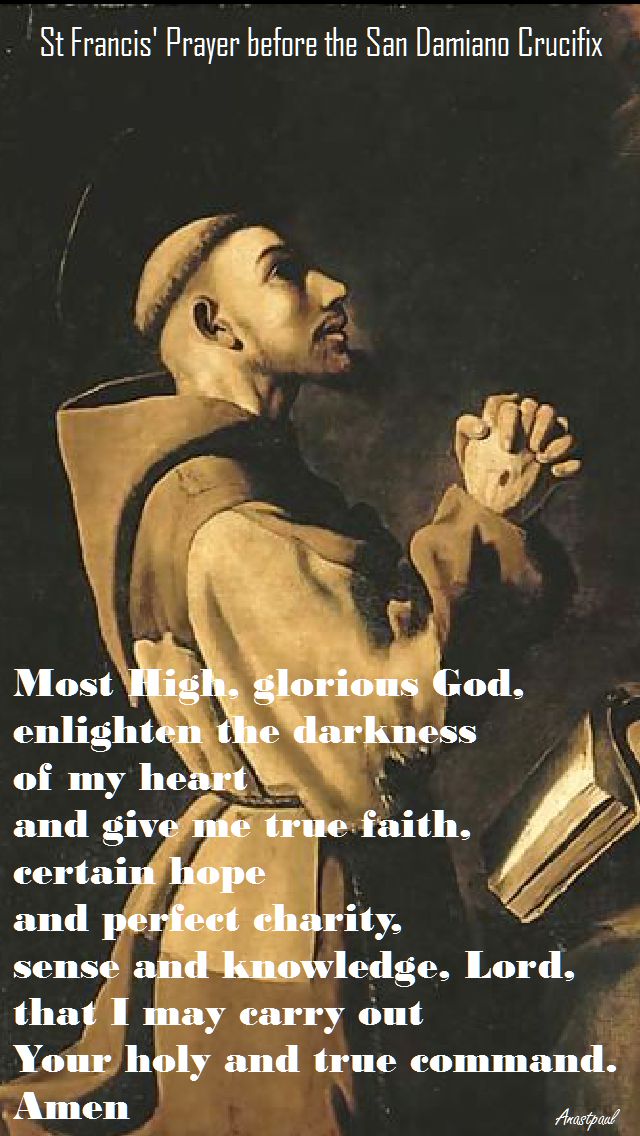
Prayer in front of the Crucifix of San Damiano
Francis used to recite this prayer already in 1205-1206, during the period of his vocational discernment, when he would visit the small abandoned church of San Damiano, where there was a Byzantine Crucifix which is nowadays venerated in the Basilica of Santa Chiara in Assisi.
Most High, glorious God,
enlighten the darkness of my heart
and give me true faith,
certain hope
and perfect charity,
sense and knowledge, Lord,
that I may carry out
Your holy and true command. Amen




















 AnaStpaul
You must be logged in to post a comment.