Our Morning Offering – 11 June – Solemnity of the Most Sacred Heart of Jesus
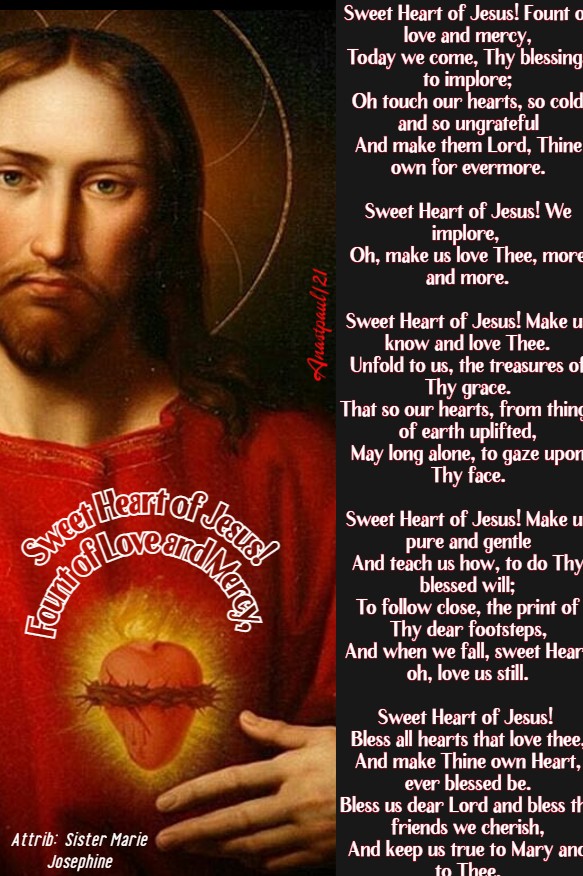
Sweet Heart of Jesus! Fount of Love and Mercy Attrib: Sister Marie Josephine.
Sweet Heart of Jesus! Fount of love and mercy, Today we come, Thy blessings to implore; Oh touch our hearts, so cold and so ungrateful And make them Lord, Thine own for evermore.
Sweet Heart of Jesus! We implore, Oh, make us love Thee, more and more.
Sweet Heart of Jesus! Make us know and love Thee. Unfold to us, the treasures of Thy grace. That so our hearts, from things of earth uplifted, May long alone, to gaze upon Thy face.
Sweet Heart of Jesus! Make us pure and gentle And teach us how, to do Thy blessed will; To follow close, the print of Thy dear footsteps, And when we fall, sweet Heart oh, love us still.
Sweet Heart of Jesus! Bless all hearts that love thee, And make Thine own Heart, ever blessed be. Bless us dear Lord and bless the friends we cherish, And keep us true to Mary and to Thee.
Quote/s of the Day – 6 June – “Month of the Sacred Heart” – Corpus Christi, The Solemnity of The Most Holy Body and Blood of Christ
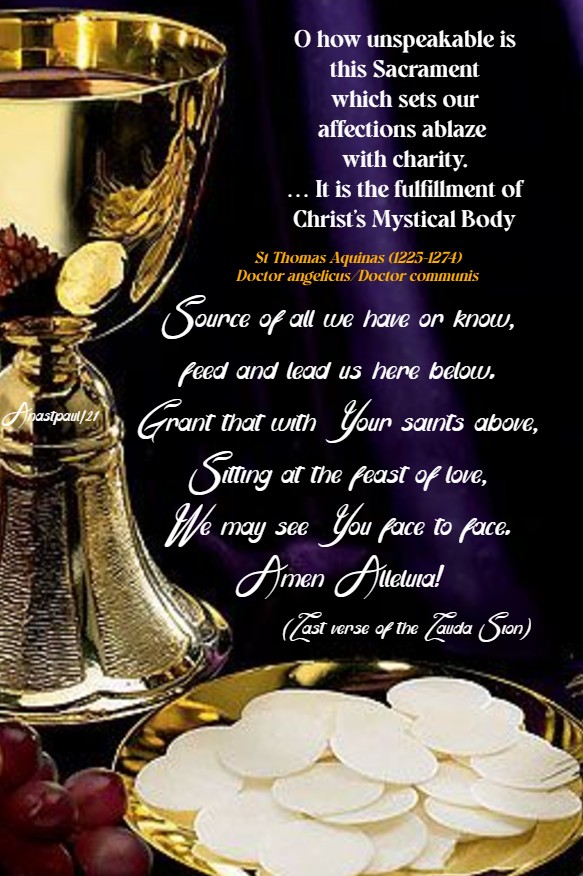
“O how unspeakable is this Sacrament which sets our affections ablaze with charity. … It is the fulfillment of Christ’s Mystical Body.”
“Source of all we have or know, feed and lead us here below. Grant that with Your saints above, Sitting at the feast of love, We may see You face to face.”
Amen Alleluia!
(Last verse of the Lauda Sion)
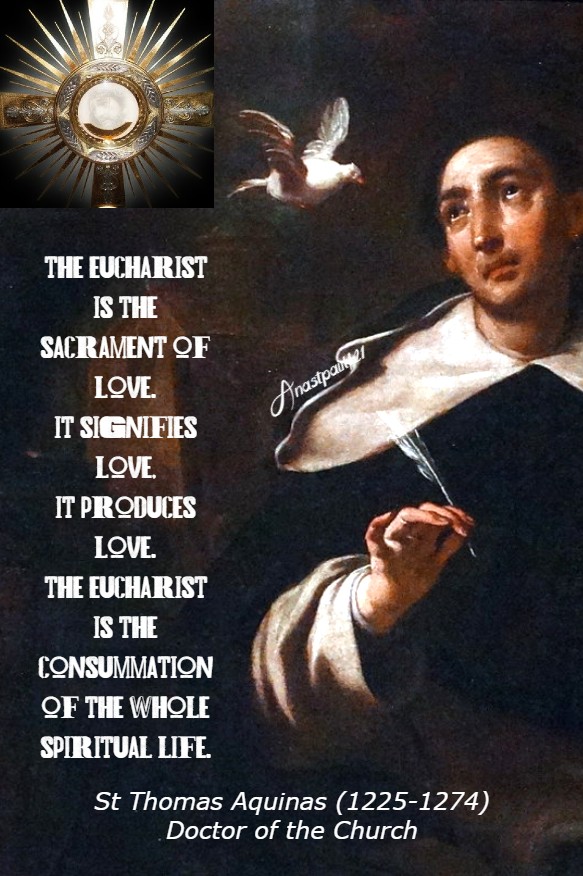
“The Eucharist is the Sacrament of Love. It signifies Love, It produces love. The Eucharist is the consummation of the whole spiritual life.”
St Thomas Aquinas (1225-1274) Doctor angelicus/Doctor communis
Our Morning Offering – 6 June – “Month of the Sacred Heart” – The Solemnity of Corpus Christi – The Most Holy Body ad Blood of Our Lord Jesus Christ
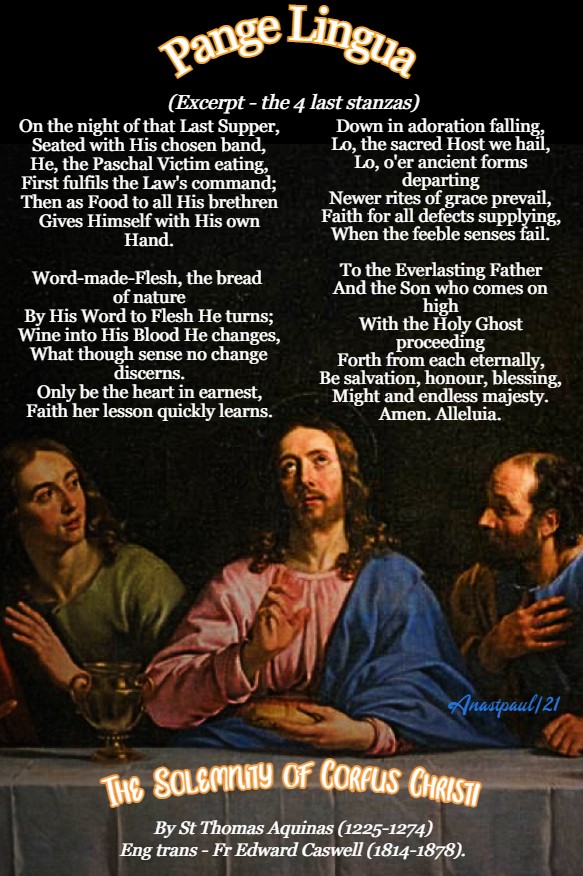
Pange Lingua Sing, My Tongue By St Thomas Aquinas (1225-1274) Eng trans – Fr Edward Caswell CO (1814-1878) (Excerpt on the image – the 4 last stanzas)
Sing, my tongue, the Saviour’s glory, Of His Flesh, the mystery sing; Of the Blood, all price exceeding, Shed by our Immortal King, Destined, for the world’s redemption, From a noble Womb to spring.
Of a pure and spotless Virgin Born for us on earth below, He, as Man, with man conversing, Stayed, the seeds of truth to sow; Then He closed in solemn order Wondrously His Life of woe.
On the night of that Last Supper, Seated with His chosen band, He, the Paschal Victim eating, First fulfils the Law’s command; Then as Food to all His brethren Gives Himself with His own Hand.
Word-made-Flesh, the bread of nature By His Word to Flesh He turns; Wine into His Blood He changes, What though sense no change discerns. Only be the heart in earnest, Faith her lesson quickly learns.
Down in adoration falling, Lo, the sacred Host we hail, Lo, o’er ancient forms departing Newer rites of grace prevail, Faith for all defects supplying, When the feeble senses fail.
To the Everlasting Father And the Son who comes on high With the Holy Ghost proceeding Forth from each eternally, Be salvation, honour, blessing, Might and endless majesty. Amen. Alleluia.
Written by St Thomas Aquinas (1225-1274) for the Solemnity of Corpus Christi, this Hymn is considered the most beautiful of Aquinas’ Hymns and one of the great seven Hymns of the Church. The Hymn is also used on Holy Thursday. The last two stanzas make up the Tantum Ergo (Down in Adoration Falling) that is used at Benediction of the Blessed Sacrament.
PANGE, lingua, gloriosi Corporis mysterium, Sanguinisque pretiosi, quem in mundi pretium fructus ventris generosi Rex effudit Gentium.
Nobis datus, nobis natus ex intacta Virgine, et in mundo conversatus, sparso verbi semine, sui moras incolatus miro clausit ordine.
In supremae nocte cenae recumbens cum fratribus observata lege plene cibis in legalibus, cibum turbae duodenae se dat suis manibus.
Verbum caro, panem verum verbo carnem efficit: fitque sanguis Christi merum, et si sensus deficit, ad firmandum cor sincerum sola fides sufficit.
Tantum ergo Sacramentum veneremur cernui: et antiquum documentum novo cedat ritui: praestet fides supplementum sensuum defectui.
Genitori, Genitoque laus et iubilatio, salus, honor, virtus quoque sit et benedictio: procedenti ab utroque compar sit laudatio. Amen. Alleluia.
Our Morning Offering – 3 June – Solemnty of Corpus Christ, The Most Holy Body and Blood of our Lord Jesus Christ
St Thomas Aquinas wrote the Liturgy for Corpus Christi when Pope Urban IV added the Solemnity to the universal Church’s Liturgical calendar in 1264. He provided a great sequence, one of the great poems chanted or recited before the proclamation of the Gospel. Lauda Sion is one of only four medieval sequences which were preserved in the Roman Missal published in 1570 following the Council of Trent (1545–1563)—the others being Victimae Paschali Laudes (Easter), Veni Sancte Spiritus (Pentecost) and Dies irae (requiem masses). (A fifth, Stabat Mater, would later be added in 1727.) Before Trent, many feasts had their own sequences. The existing versions were unified in the Roman Missal promulgated in 1570. The Lauda Sion is still sung today as solemn Eucharistic hymn, though its use is optional in the post-Vatican II Ordinary form. As with St Thomas’s other three Eucharistic Hymns, the last few stanzas of the Lauda Sion are often used alone, in this case, to form the “Ecce Panis Angelorum”.
Lauda Sion Salvatorem Sion, Lift Up thy Voice and Sing (Excerpt) By St Thomas Aquinas (1225-1274) Doctor Angelicus / Doctor Communis
Sion, lift thy voice and sing, Praise thy Saviour and thy King, Praise with hymns thy Shepherd true, Dare thy most to praise Him well, For He doth all praise excel, None can ever reach His due.
Special theme of praise is Thine, That true living Bread divine, That life-giving flesh adored, Which the brethren twelve received, As most faithfully believed, At the Supper of the Lord.
Let the chant be loud and high, Sweet and tranquil be the joy Felt to-day in every breast; On this festival divine Which recounts the origin Of the glorious Eucharist.
Our Morning Offering – 27 April – Tuesday of the Fourth Week of Easter
O the Word of My Lord Song of a Young Prophet By Brother Damian Lundy FSC (1944-1997)
O the word of my Lord Deep within my being, Oh the word of my Lord, You have filled my mind.
Before I formed you in the womb I knew you through and through, I chose you to be Mine. Before you left your mother’s side I called to you, My child, to be My sign. Refrain
I know that you are very young, But I will make you strong. I’ll fill you with My word And you will travel through the land, Fulfilling My command Which you have heard. Refrain
And everywhere you are to go My hand will follow you; You will not be alone. In all the danger that you fear You’ll find Me very near, Your words, My own. Refrain,
This hymn, based on Jeremiah 1, was composed by English Brother and teacher Brother Damian Lundy of the De La Salle Order. It is sometimes referred to as “Song of a Young Prophet.” It is set to an unnamed tune, also by Bro Damian. He died in 1997 at the age of 53. He is widely respected as a leading innovator in many forms of Catholic apostolate and education in the UK. He is credited with devising the currently standard form of Catholic Residential Youth Work and for writing many popular hymns and prayers and leading seminars and conferences. In 1975, Damian founded St Cassian’s Centre, Kintbury, which is still operating today as a widely visited and respected Catholic Youth Retreat Centre.
Our Morning Offering – 26 April– Monday of the Fourth Week of Easter
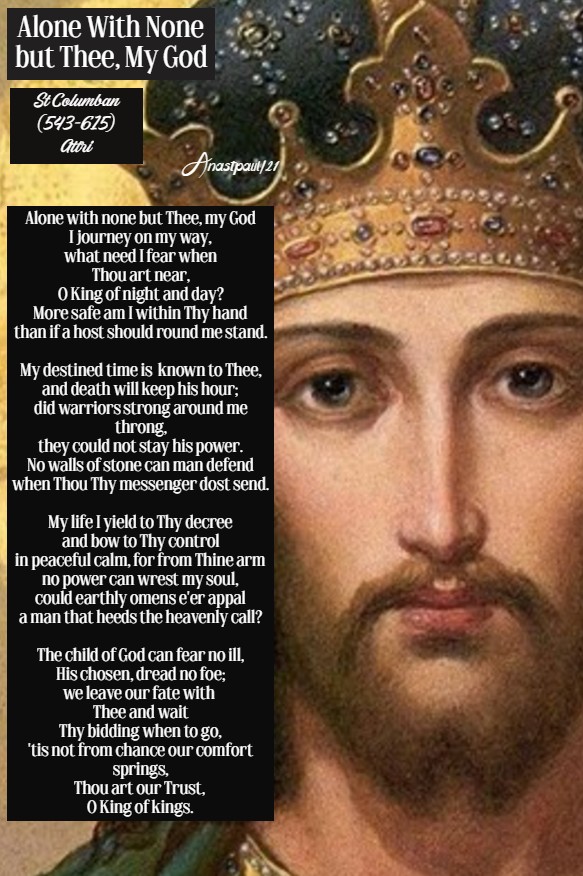
Alone With None but Thee, My God Attri. St Columban (543-615)
Alone with none but Thee, my God I journey on my way, what need I fear when Thou art near, O King of night and day? More safe am I within Thy hand than if a host should round me stand.
My destined time is known to Thee, and death will keep his hour; did warriors strong around me throng, they could not stay his power. No walls of stone can man defend when Thou Thy messenger dost send.
My life I yield to Thy decree and bow to Thy control in peaceful calm, for from Thine arm no power can wrest my soul, could earthly omens e’er appal a man that heeds the heavenly call?
The child of God can fear no ill, His chosen, dread no foe; we leave our fate with Thee and wait Thy bidding when to go, ’tis not from chance our comfort springs, Thou art our Trust, O King of kings.
Quote/s of the Day – 20 April – Tuesday of the Third Week of Easter, Readings: Acts 7:51–8:1, Psalm 31:3-4, 6-8, 17, 21, John 6:30-35
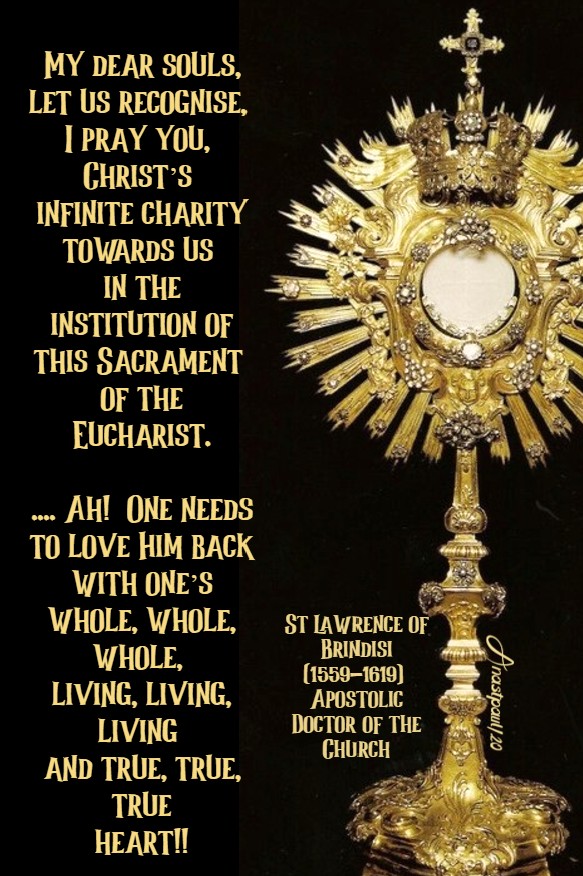
“My dear souls, let us recognise, I pray you, Christ’s infinite charity towards us in the institution of this Sacrament of the Eucharist. In order that our love be a spiritual love, He wills a new heart, a new love, a new spirit for us. It is not with a carnal heart but with a spiritual one, that Christ has loved us with a gratuitous love, a supreme and most ardent love, by way of pure grace and charity. Ah! One needs to love Him back with one’s whole, whole, whole, living, living, living and true, true, true heart!!”
St Lawrence of Brindisi(1559-1619) Apostolic Doctor of the Church
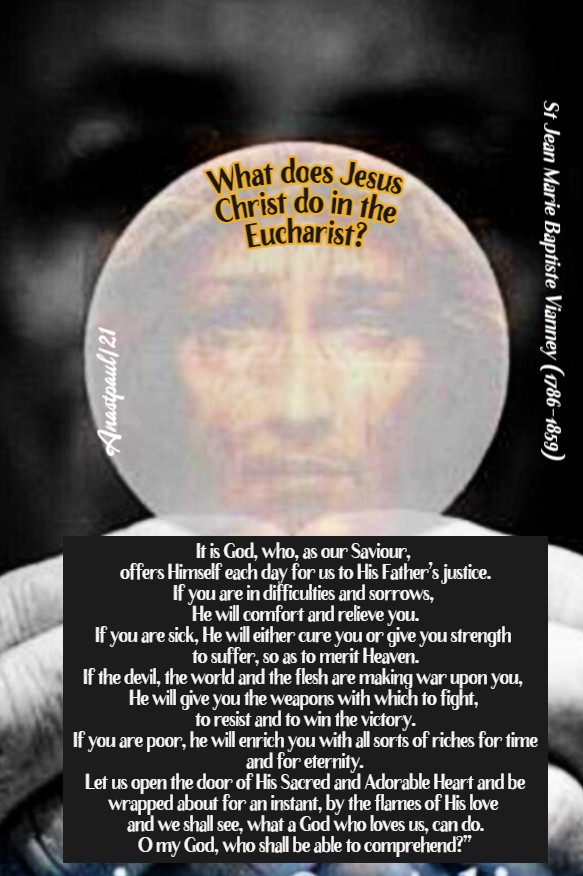
“What does Jesus Christ do in the Eucharist?
It is God, who, as our Saviour, offers Himself each day for us to His Father’s justice.
If you are in difficulties and sorrows, He will comfort and relieve you. If you are sick, He will either cure you or give you strength to suffer, so as to merit Heaven. If the devil, the world and the flesh are making war upon you, He will give you the weapons with which to fight, to resist and to win the victory. If you are poor, he will enrich you with all sorts of riches for time and for eternity. Let us open the door of His Sacred and Adorable Heart and be wrapped about for an instant, by the flames of His love and we shall see, what a God who loves us, can do. O my God, who shall be able to comprehend?”
St Jean Marie Baptiste Vianney (1786-1859)
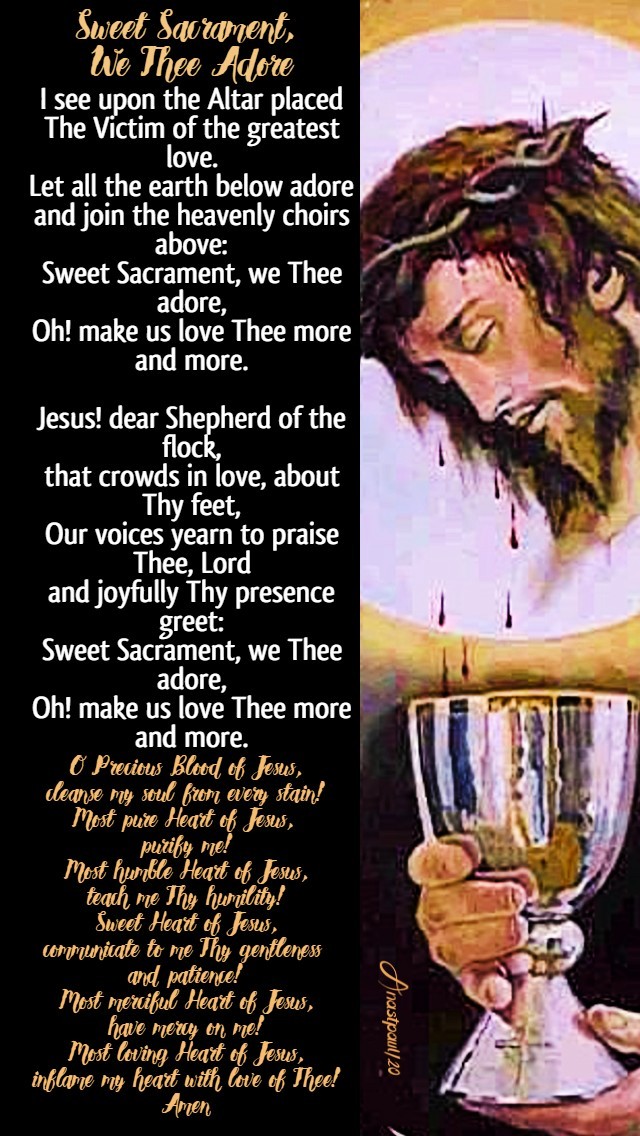
Sweet Sacrament, We Thee Adore
I see upon the Altar placed The Victim of the greatest love. Let all the earth below adore and join the heavenly choirs above: Sweet Sacrament, we Thee adore, Oh! make us love Thee more and more.
Jesus! dear Shepherd of the flock, that crowds in love, about Thy feet, Our voices yearn to praise Thee, Lord and joyfully Thy presence greet: Sweet Sacrament, we Thee adore, Oh! make us love Thee more and more.
O Precious Blood of Jesus, cleanse my soul from every stain! Most pure Heart of Jesus, purify me! Most humble Heart of Jesus, teach me Thy humility! Sweet Heart of Jesus, communicate to me Thy gentleness and patience! Most merciful Heart of Jesus, have mercy on me! Most loving Heart of Jesus, inflame my heart with love of Thee! Amen
Our Morning Offering – 20 April – Tuesday of the Third Week of Easter
Jesus, the Very Thought of Thee! By St Bernard of Clairvaux (1090-1153) Mellifluous Doctor
Jesus, the very thought of Thee With sweetness fills the breast! Yet sweeter far Thy face to see And in Thy presence rest. No voice can sing, no heart can frame, Nor can the memory find, A sweeter sound than Jesus’ name, The Saviour of mankind. O hope of every contrite heart! O joy of all the meek! To those who fall, how kind Thou art! How good to those who seek! But what to those who find? Ah! this nor tongue, nor pen can show The love of Jesus, what it is, None but His loved ones know. Jesus! our only hope be Thou, As Thou our prize shall be; In Thee be all our glory now And through eternity. Amen
Our Morning Offering – 13 April – Tuesday of the Second Week of Easter
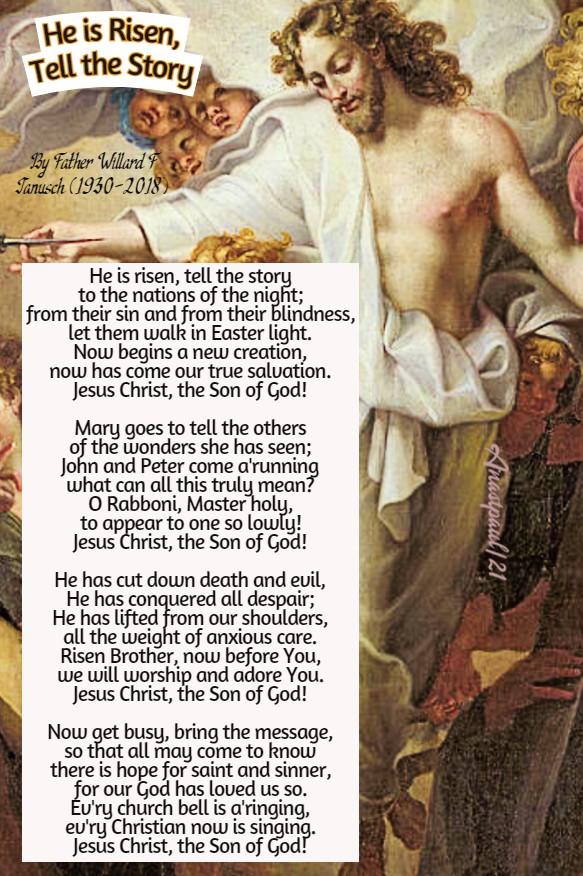
He is Risen, Tell the Story By Father Willard F Janusch (1930-2018)
He is risen, tell the story to the nations of the night; from their sin and from their blindness, let them walk in Easter light. Now begins a new creation, now has come our true salvation. Jesus Christ, the Son of God!
Mary goes to tell the others of the wonders she has seen; John and Peter come a’running what can all this truly mean? O Rabboni, Master holy, to appear to one so lowly! Jesus Christ, the Son of God!
He has cut down death and evil, He has conquered all despair; He has lifted from our shoulders, all the weight of anxious care. Risen Brother, now before you, we will worship and adore You. Jesus Christ, the Son of God!
Now get busy, bring the message, so that all may come to know there is hope for saint and sinner, for our God has loved us so. Ev’ry church bell is a’ringing, ev’ry Christian now is singing. Jesus Christ, the Son of God!
A Parish Priest, Seminary Professor and prolific Musician and Hymnist, Fr Willard wa Ordained in 1956 and died at the age of 88 in 2018.
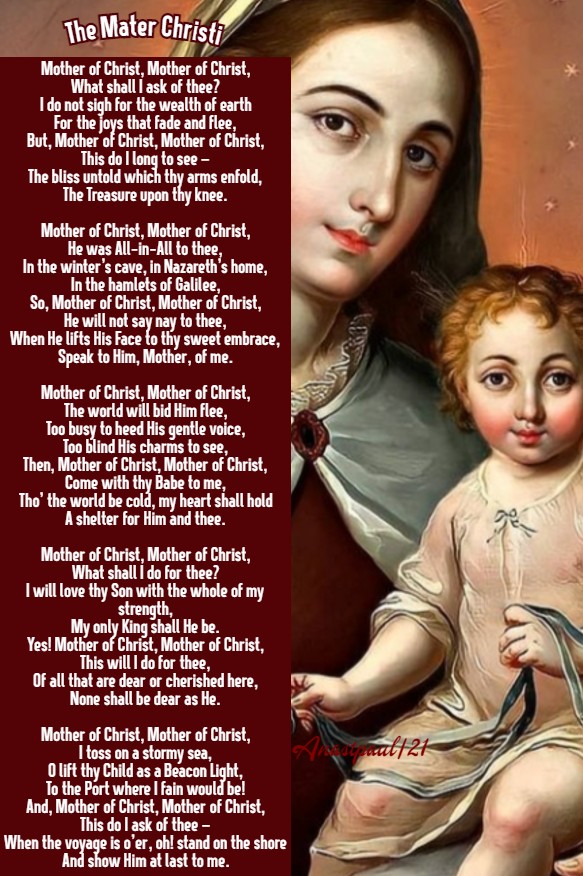
Mother of Christ, Mother of Christ, What shall I ask of thee? I do not sigh for the wealth of earth For the joys that fade and flee, But, Mother of Christ, Mother of Christ, This do I long to see — The bliss untold which thy arms enfold, The Treasure upon thy knee.
Mother of Christ, Mother of Christ, He was All-in-All to thee, In the winter’s cave, in Nazareth’s home, In the hamlets of Galilee, So, Mother of Christ, Mother of Christ, He will not say nay to thee, When He lifts His Face to thy sweet embrace, Speak to Him, Mother, of me.
Mother of Christ, Mother of Christ, The world will bid Him flee, Too busy to heed His gentle voice, Too blind His charms to see, Then, Mother of Christ, Mother of Christ, Come with thy Babe to me, Tho’ the world be cold, my heart shall hold A shelter for Him and thee.
Mother of Christ, Mother of Christ, What shall I do for thee? I will love thy Son with the whole of my strength, My only King shall He be. Yes! Mother of Christ, Mother of Christ, This will I do for thee, Of all that are dear or cherished here, None shall be dear as He.
Mother of Christ, Mother of Christ, I toss on a stormy sea, O lift thy Child as a Beacon Light, To the Port where I fain would be! And, Mother of Christ, Mother of Christ, This do I ask of thee — When the voyage is o’er, oh! stand on the shore And show Him at last to me.
The author is unclear – The 1920 St Gregory Hymn book (editor Nicola A. Montani) credits it to Nicola A Montani. The 1914 American Catholic hymn book credits it to “S. N. D. ” – most likely meaning a Sister of Notre Dame.
Quote/s of the Day – 2 April – Good Friday of the Passion of the Lord
“O SACRED HEAD” By St Bernard (1090-1153) Mellifluous Doctor
O Sacred Head surrounded By a crown of piercing thorn! O bleeding Head, so wounded, Reviled and put to scorn! Death’s pallid hue comes o’er Thee, The glow of life decays, Yet angel hosts adore Thee And tremble as they gaze.
I see Thy strength and vigour All fading in the strife, And death, with cruel vigour, Bereaving Thee of life; O agony and dying! O love to sinners free! Jesus, all grace supplying, O turn Thy face on me!
In this Thy bitter Passion, Good Shepherd, think of me, With Thy most sweet compassion, Unworthy though I be. Beneath Thy Cross abiding, ‘Forever would I rest, In Thy dear love confiding, And will Thy presence blest.
“Do not pass one day without devoting a half hour, or at least a quarter of an hour, to meditation on the sorrowful Passion of your Saviour. Have a continual remembrance of the agonies of your crucified Love and know, that the greatest saints, who now, in heaven, triumph in holy love, arrived at perfection in this way.”
Our Morning Offering – 16 March – Tuesday of the Fourth Week of Lent
God of Mercy and Compassion By Giovanni Battista Pergolesi (1710-1736) Composer
God of mercy and compassion, Look with pity upon me, Father, let me call Thee Father, ‘Tis Thy child returns to Thee.
Refrain: Jesus, Lord, I ask for mercy. Let me not implore in vain, All my sins, I now detest them, Never will I sin again.
By my sins I have deserved Death and endless misery, Hell with all its pains and torments, And for all eternity. (Refrain)
By my sins I have abandoned Right and claim to heav’n above. Where the saints rejoice forever In a boundless sea of love. (Refrain)
See our Saviour, bleeding, dying, On the cross of Calvary; To that cross my sins have nail’d Him, Yet He bleeds and dies for me. (Refrain)
Giovanni Battista Pergolesi 4 January 1710 – 16 or 17 March 1736 was an Italian Baroque composer, violinist and organist. His best-known works include his Stabat Mater and the opera La serva padrona (The Maid Turned Mistress). His compositions include operas and sacred Masses and music. He died of tuberculosis at the age of 26.
Our Morning Offering – 1 March – Monday of the Second week of Lent
Alone With None but Thee, My God Attri. St Columban (543-615)
Alone with none but Thee, my God I journey on my way, what need I fear when Thou art near, O King of night and day? More safe am I within Thy hand than if a host should round me stand.
My destined time is known to Thee, and death will keep his hour; did warriors strong around me throng, they could not stay his power. No walls of stone can man defend when Thou Thy messenger dost send.
My life I yield to Thy decree and bow to Thy control in peaceful calm, for from Thine arm no power can wrest my soul, could earthly omens e’er appal a man that heeds the heavenly call?
The child of God can fear no ill, His chosen, dread no foe; we leave our fate with Thee and wait Thy bidding when to go, ’tis not from chance our comfort springs, Thou art our Trust, O King of kings.
Our Morning Offering -23 February – Tuesday of the First week of Lent
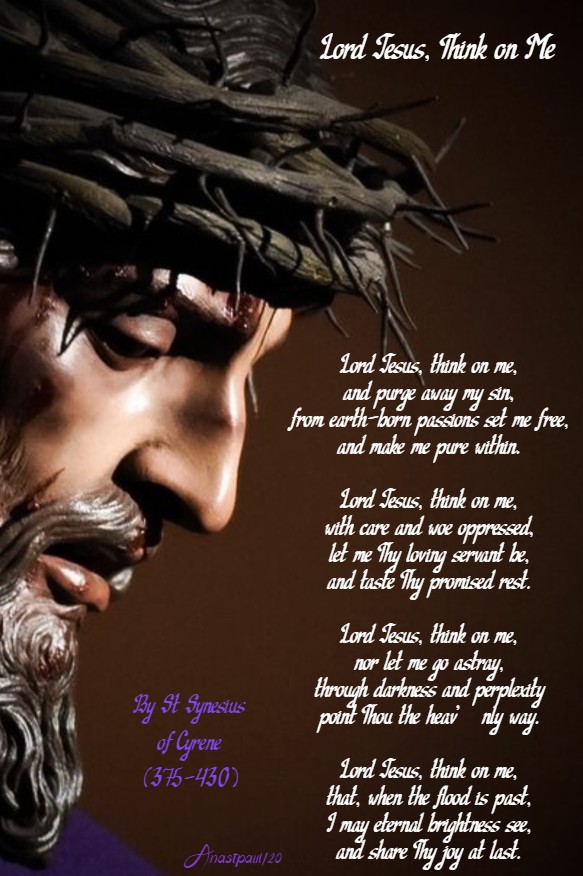
Lord Jesus, Think on Me By St Synesius of Cyrene (375-430) Bishop of Ptolemais
Lord Jesus, think on me, and purge away my sin, from earth-born passions set me free, and make me pure within. Lord Jesus, think on me, With care and woe oppressed, let me Thy loving servant be, and taste Thy promised rest. Lord Jesus, think on me, nor let me go astray, through darkness and perplexity point Thou the heav’nly way. Lord Jesus, think on me, that, when the flood is past, I may eternal brightness see, and share Thy joy at last.
St Synesius, a native of Cyrene, born circa 375. His descent was illustrious. His pedigree extended through seventeen centuries and in the words of Gibbon, “could not be equaled in the history of mankind.” He became distinguished for his eloquence and philosophy and as a statesman and patriot he took a noble stand. When the Goths were threatening his country he went to the court of Arcadius and for three years, tried to rouse it to the dangers that were coming on the empire. But Gibbon says, ”The court of Arcadius indulged the zeal, applauded the eloquence and neglected the advice of Synesius.” In 410 he was made Bishop of Ptolemaïs (modern Libya) but much against his will. He died in 430.We have extant one hundred and fifty-five epistles and ten hymns written at different periods of his life.
Our Morning Offering – 22 February – Feast of the Chair of St Peter
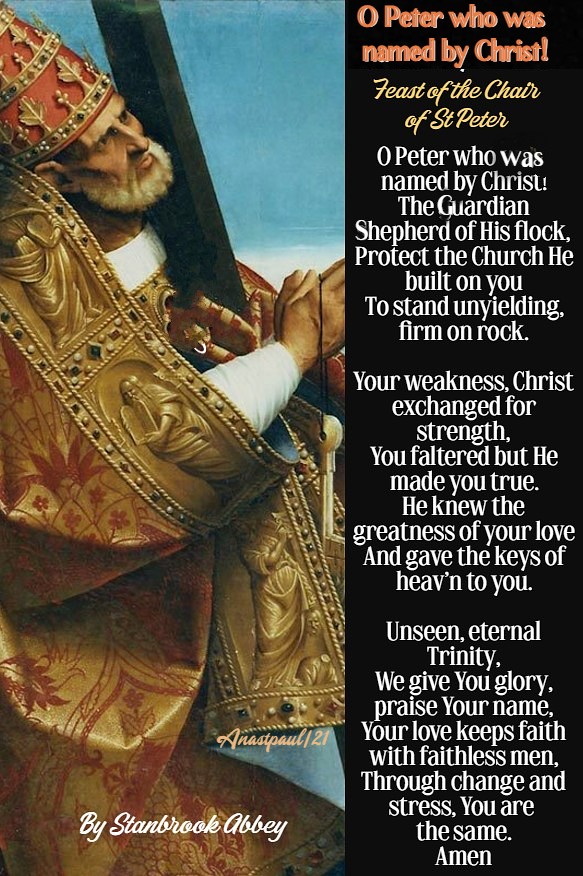
O Peter, who was Named by Christ! By Stanbrook Abbey For the Feast of the Chair of St Peter
O Peter who was named by Christ! The Guardian-Shepherd of His flock, Protect the Church He built on you To stand unyielding, firm on rock.
Your weakness, Christ exchanged for strength, You faltered but He made you true. He knew the greatness of your love And gave the keys of heav’n to you.
Unseen, eternal Trinity, We give You glory, praise Your name, Your love keeps faith with faithless men, Through change and stress, You are the same. Amen
Our Morning Offering – 11 February – The Memorial of Our Lady of Lourdes
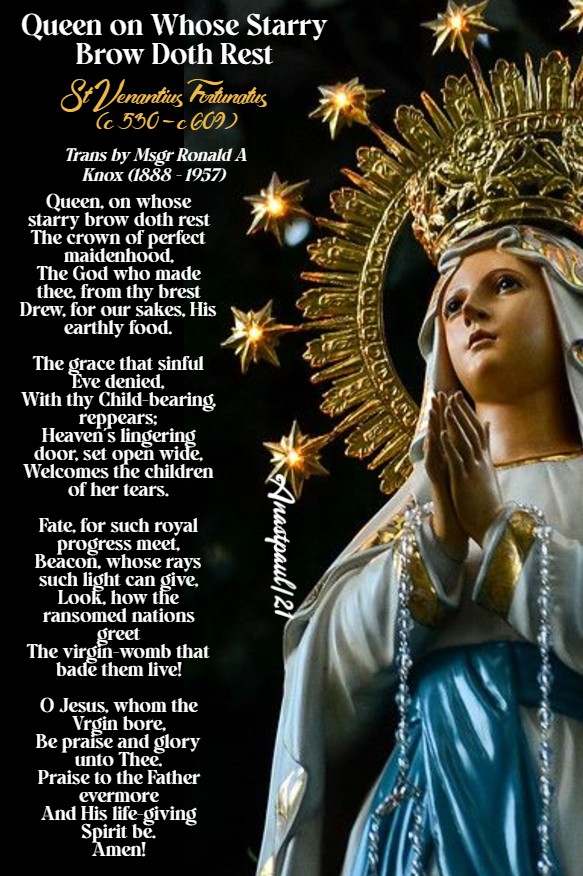
Queen on Whose Starry Brow Doth Rest St Venantius Fortunatus (c 530-c 609) Translation by Monsignor Ronald A Knox (1888 – 1957)
Queen, on whose starry brow doth rest The crown of perfect maidenhood, The God who made thee, from thy brest Drew, for our sakes, His earthly food.
The grace that sinful Eve denied, With thy Child-bearing, reppears; Heaven’s lingering door, set open wide, Welcomes the children of her tears.
Fate, for such royal progress meet, Beacon, whose rays such light can give, Look, how the ransomed nations greet The virgin-womb that bade them live!
O Jesus, whom the Vrgin bore, Be praise and glory unto Thee. Praise to the Father evermore And His life-givine Spirit be. Amen!
Saint Venantius Fortunatus (c 530 – c 609) Bishop, Poet, Hymnist, Writer – born c 530 at Rreviso, Italy and died c 609 at Poitiers, modern France of natural causes. St Venantius was unique, first a travelling lay poet, he later became a Priest and then a Bishop. But he always remained a professional author of poetry, a “troubadour” of Christ. He is the author of the Ave Maris Stella, amongst many others.
Lord, for Tomorrow and its Needs By Sister Mary Xavier (1877)
Lord, for tomorrow and its needs I do not pray; keep me, my God, from stain of sin, just for today. Let me both diligently work and duly pray; let me be kind in word and deed, just for today. Let me no wrong or idle word unthinking say; set thou a seal upon my lips, just for today. And if today my tide of life should ebb away, give me Thy sacraments divine, sweet Lord, today. So, for tomorrow and its needs I do not pray but keep me, guide me, love me, Lord, just for today.
Our Morning Offering – 31 January – Septuagesima Sunday or The Fourth Sunday in Ordinary Time
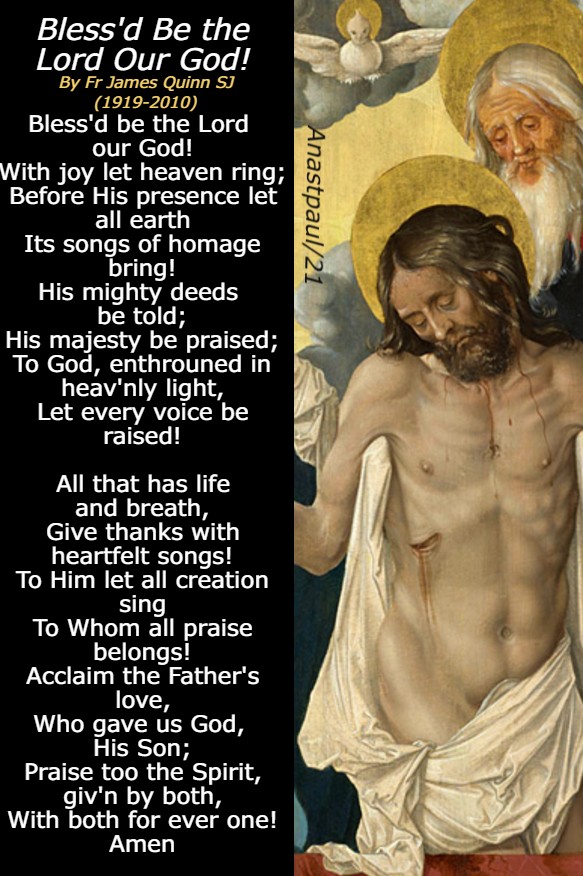
Bless’d Be the Lord Our God! By Fr James Quinn SJ (1919-2010)
Bless’d be the Lord our God! With joy let heaven ring; Before His presence let all earth Its songs of homage bring! His mighty deeds be told; His majesty be praised; To God, enthrouned in heav’nly light, Let every voice be raised!
All that has life and breath, Give thanks with heartfelt songs! To Him let all creation sing To Whom all praise belongs! Acclaim the Father’s love, Who gave us God, His Son; Praise too the Spirit, giv’n by both, With both for ever one!
In the Divine Office (1974) it is sung with Sunday Evening Prayer I (Week 2)
Our Morning Offering – 29 January – The Memorial of St Dallan Forgaill (c 530- 598) Martyr, Monk, Reformer, Poet
Be Thou My Vision By St Dallan Forgaill (c 530- 598)
Be Thou my vision, O Lord of my heart; Naught be all else to me, save that Thou art. Thou my best thought by day or by night, Waking or sleeping, Thy presence my light.
Be Thou my wisdom and Thou my true Word; I ever with Thee and Thou with me, Lord. Thou my great Father, I Thy true son; Thou in me dwelling and I with Thee one.
Be Thou my battle-shield, sword for my fight, Be Thou my dignity, Thou my delight. Thou my soul’s shelter, Thou my high tower. Raise Thou me heavenward, O Power of my power.
Riches I heed not, nor man’s empty praise, Thou mine inheritance, now and always. Thou and Thou only, first in my heart, High King of heaven, my Treasure Thou art.
High King of heaven, my victory won, May I reach heaven’s joys, O bright heaven’s Son, Heart of my heart, whatever befall Still be my vision, O ruler of all.
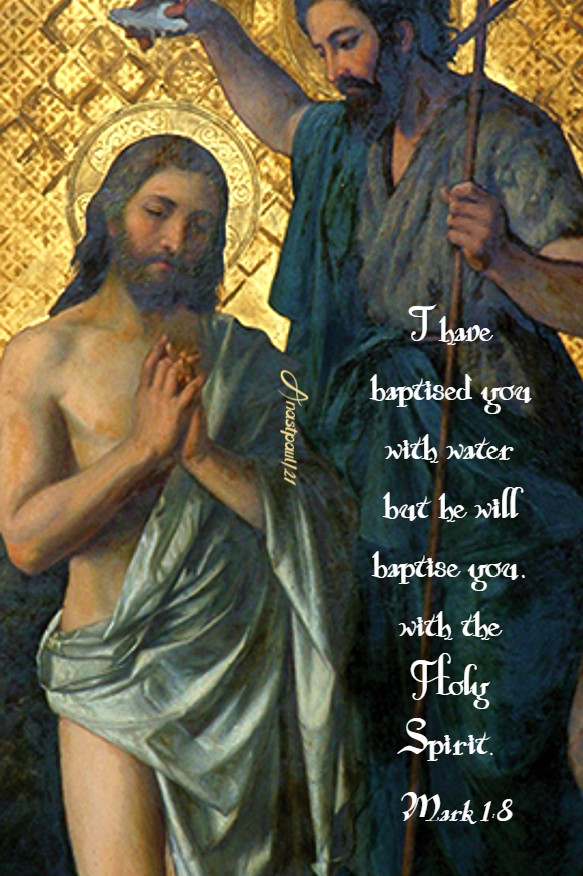
One Minute Reflection – 10 January – Feast of the Baptism of the Lord , Readings: Isaiah 55:1-11, Isaiah 12:2-3,4,5-6, 1 John 5:1-9, Mark 1:7-11
“I have baptised you with water but he will baptise you, with the Holy Spirit.” – Mark 1:8
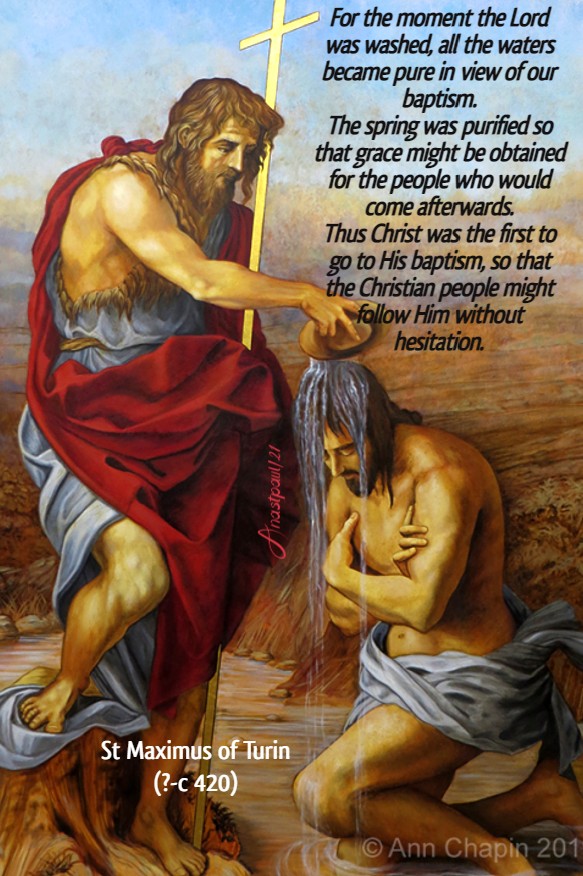
REFLECTION – “Today, the Lord Jesus has come to be baptised. He wanted to wash His body in the water of the Jordan. Someone might say: “Why did He who was the Holy One want to be baptised?” So listen. Christ was baptised, not in order to be sanctified by the water but so that He, Himself would sanctify the water and would purify the waves, that He touched by His personal action. Thus, we have to do with the consecration of the water much more than with that of Christ. For the moment the Lord was washed, all the waters became pure in view of our baptism. The spring was purified so that grace might be obtained for the people who would come afterwards. Thus Christ was the first to go to His baptism, so that the Christian people might follow Him without hesitation. And in this I perceive a mystery. Did not the column of fire go ahead into the Red Sea in this way, so as to encourage the children of Israel to walk behind it? It crossed the water first so as to break a path for those who would follow. According to the testimony of the Apostle Paul, this event was a symbol of baptism (1 Cor 10:1f.). Without any doubt, when the people were covered by the cloud and carried by the water, it was a kind of baptism. And all that was fulfilled by the same Christ our Lord, who in the column of His body now precedes the Christian people to baptism, just as He preceded the children of Israel across the sea, in the column of fire. The same column, which in times past enlightened the eyes of those who were walking, now gives light to the hearts of the believers. Then it marked a solid path in the waves, now in this bath, it strengthens the steps of faith.” – St Maximus of Turin (?-c 420) Bishop – Sermon for the feast of the Epiphany
PRAYER– By the Benedictines of Stanbrook When Jesus comes to be baptised, He leaves the hidden years behind, The years of safety and of peace, To bear the sins of all mankind.
The Spirit of the Lord comes down Anoints the Christ to suffering, To preach the word, to free the bound And to the mourner comfort bring.
Our everlasting Father, praise, With Christ, His well-beloved Son, Who with the Soirit reigns serene, Untroubled Trinity in One. Amen
Our Morning Offering – 6 January – The Solemnity of the Epiphany of the Lord
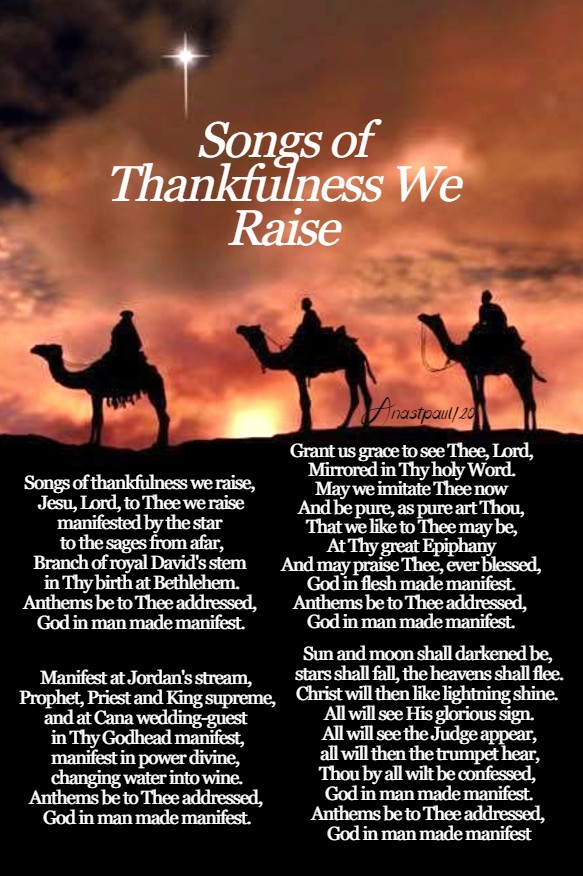
Songs of Thankfulness We Raise By Christopher Wordsworth (1807-1885) (1862)
Songs of thankfulness we raise, Jesu, Lord, to Thee we raise manifested by the star to the sages from afar, Branch of royal David’s stem in Thy birth at Bethlehem. Anthems be to Thee addressed, God in man made manifest.
Manifest at Jordan’s stream, Prophet, Priest and King supreme, and at Cana wedding-guest in Thy Godhead manifest, manifest in power divine, changing water into wine. Anthems be to Thee addressed, God in man made manifest.
Grant us grace to see Thee, Lord, Mirrored in Thy holy Word. May we imitate Thee now And be pure, as pure art Thou, That we like to Thee may be, At Thy great Epiphany And may praise Thee, ever blessed, God in flesh made manifest. Anthems be to Thee addressed, God in man made manifest.
Sun and moon shall darkened be, stars shall fall, the heavens shall flee. Christ will then like lightning shine. All will see His glorious sign. All will see the Judge appear, all will then the trumpet hear, Thou by all wilt be confessed, God in man made manifest. Anthems be to Thee addressed, God in man made manifest
Christopher Wordsworth (b. Lambeth, London, England, 1807; d. Harewood, Yorkshire, England, 1885), nephew of the great Romantic poet William Wordsworth, wrote this hymn in five stanzas.
Our Morning Offering – 29 December – The Fifth Day of the Octave of Christmas
Jesu, Dulcis Memoria Prayer, Poem, Hymn By St Bernard of Clairvaux (1090-1153) Doctor Mellifluous Tr. Fr Edward Caswell C.Orat. (1814-1878)
Jesus, the very thought of Thee With sweetness fills the breast! Yet sweeter far Thy face to see And in Thy presence rest. No voice can sing, no heart can frame, Nor can the memory find, A sweeter sound than Jesus’ Name, The Saviour of mankind. O hope of every contrite heart! 0 joy of all the meek! To those who fall, how kind Thou art! How good to those who seek! But what to those who find? Ah! this Nor tongue nor pen can show The love of Jesus, what it is, None but His loved ones know. Jesus! our only hope be Thou, As Thou our prize shall be; In Thee be all our glory now, And through eternity. Amen
Jesu, Dulcis Memoria is a celebrated 12th century prayer/hymn by St Bernard of Clairvaux (1090-1153), Doctor Mellifluous. The entire hymn has some 42 to 53 stanzas depending upon the translation. Parts of this hymn are used for the Feast of the Holy Name of Jesus on 3 January.
Our Morning Offering – 25 December – The Solemnity of the Nativity of Our Lord, Jesus Christ
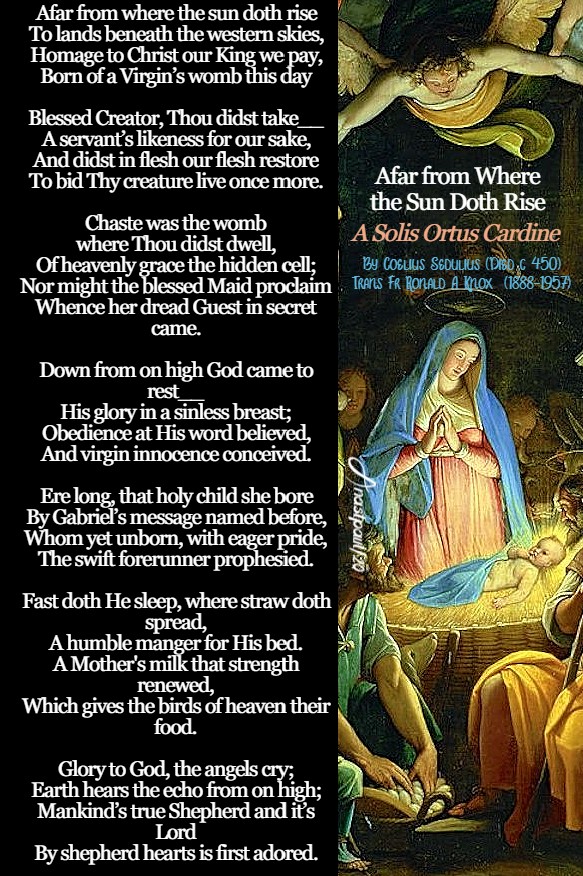
Afar from Where the Sun Doth Rise A Solis Ortus Cardine By Coelius Sedulius (Died c 450) Trans Fr Ronald A Knox (1888-1957)
Afar from where the sun doth rise To lands beneath the western skies, Homage to Christ our King we pay, Born of a Virgin’s womb this day
Blessed Creator, Thou didst take__ A servant’s likeness for our sake, And didst in flesh our flesh restore To bid Thy creature live once more.
Chaste was the womb where Thou didst dwell, Of heavenly grace the hidden cell; Nor might the blessed Maid proclaim Whence her dread Guest in secret came.
Down from on high God came to rest__ His glory in a sinless breast; Obedience at His word believed, And virgin innocence conceived.
Ere long, that holy child she bore By Gabriel’s message named before, Whom yet unborn, with eager pride, The swift forerunner prophesied.
Fast doth He sleep, where straw doth spread, A humble manger for His bed. A Mother’s milk that strength renewed, Which gives the birds of heaven their food.
Glory to God, the angels cry; Earth hears the echo from on high; Mankind’s true Shepherd and it’s Lord By shepherd hearts is first adored.
“A Solis Ortus Cardine…” (Latin for “From the Pivot of the Sun’s Rising”) is a poem by Christian Poet, Coelius Sedulius (Died c 450), recounting Christ’s life from His birth to His resurrection. Its 23 verses each begin with a consecutive letter of the Latin alphabet, making the poem an abecedarius. It is one of the oldest parts of the Roman Catholic liturgy, with two hymns formed from the first seven and four later verses. There have been monastic translations into Anglo-Saxon and later translations into other languages..
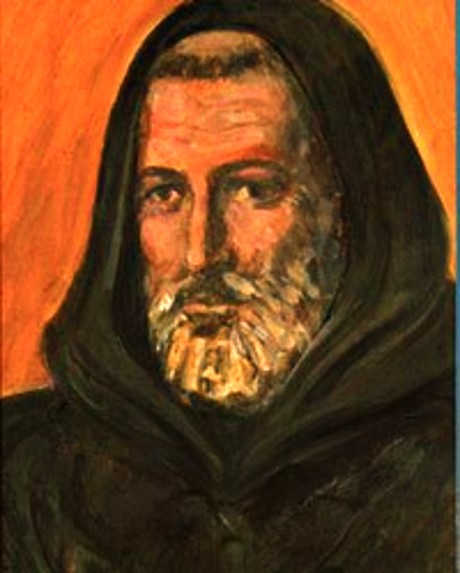
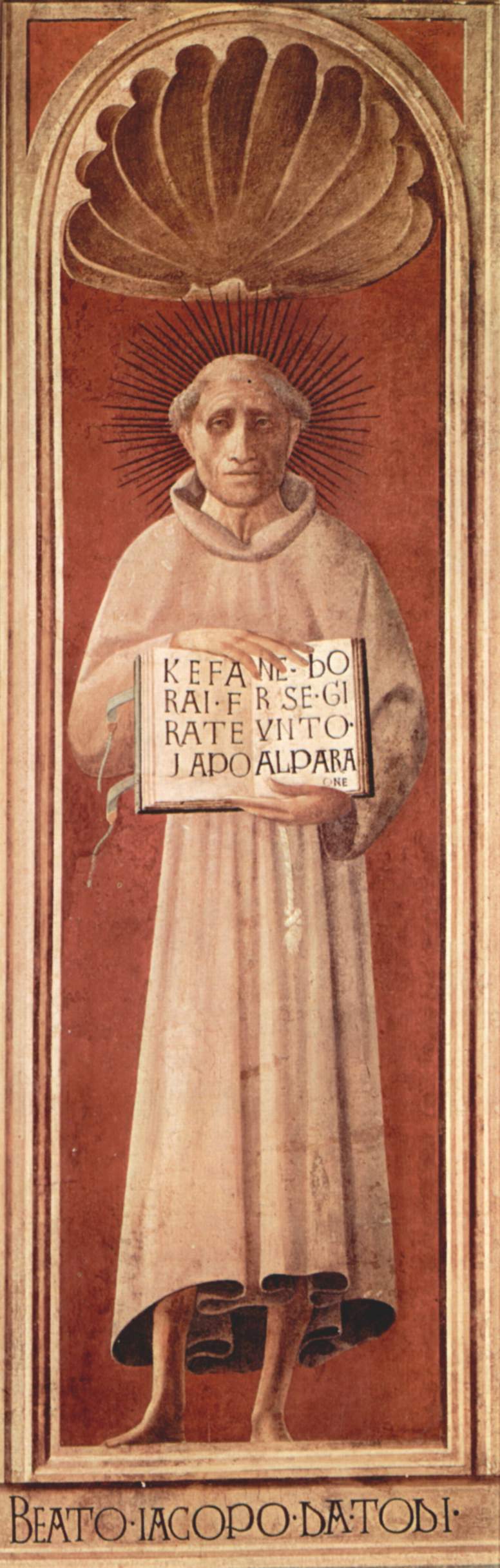
Saint of the Day – 25 December – Blessed Jacopone da Todi OFM (1230-1306) Franciscan Friar, Confessor, Hymnist, Poet, Mystic, Lawyer, – an Italian from Umbria in the 13th century. He wrote several laude (songs in praise of the Lord) in the local vernacular. He was an early pioneer in Italian theatre, being one of the earliest scholars who dramatised Gospel subjects. Born in c 1230 at Todi, Italy as Jacopo Benedetti and died on 25 December 1306 at Collazzone, Italy of natural causes, as the Priest intoned the Gloria from midnight Mass. He is also known as Jacomo da Todi, Jacopo Benedetti, Jacopo Benedicti, Jacopone Benedetti da Todi, Jacopone of Todi, James da Todi.
Jacomo, was born a noble member of the Benedetti family in the northern Italian city of Todi. He became a successful lawyer and married a pious, generous lady named Vanna.
His young wife took it upon herself to do penance for the worldly excesses of her husband. One day Vanna, at the insistence of Jacomo, attended a public tournament. She was sitting in the stands with the other noble ladies when the stands collapsed. Vanna was killed. Her shaken husband was even more disturbed when he realised that the penitential girdle she wore was for his sinfulness. On the spot, he vowed to radically change his life.
Jacomo divided his possessions among the poor and entered the Secular Franciscan Order. Often dressed in penitential rags, he was mocked as a fool and called Jacopone, or “Crazy Jim,” by his former associates. The name became dear to him.
After 10 years of such humiliation, Jacopone asked to be received into the Order of Friars Minor. Because of his reputation, his request was initially refused. He composed a beautiful poem on the vanities of the world, an act that eventually led to his admission into the Order in 1278. He continued to lead a life of strict penance, declining to be ordained a priest. Meanwhile, he was writing popular hymns in the vernacular.
Jacopone suddenly found himself a leader in a disturbing religious movement among the Franciscans. The Spirituals, as they were called, wanted a return to the strict poverty of Francis. They had on their side two cardinals of the Church and Pope Celestine V. These two cardinals though, opposed Celestine’s successor, Boniface VIII. At the age of 68, Jacopone was excommunicated and imprisoned. Although he acknowledged his mistake, Jacopone was not absolved and released until Benedict XI became Pope five years later. He had accepted his imprisonment as penance. He spent the final three years of his life more spiritual than ever, weeping “because Love is not loved.”During this time he wrote the famous Latin hymn, Stabat Mater.
On Christmas Eve in 1306 Jacopone felt that his end was near. He was in a convent of the Poor Clares with his friend, Blessed John of La Verna. Like Francis, Jacopone welcomed “Sister Death” with one of his favorite songs. It is said that he finished the song and died as the Priest intoned the “Gloria” from the midnight Mass at Christmas. From the time of his death, Brother Jacopone has been venerated as a saint, both within and outside of the Franciscan Order, although never formally Canonised.
Here lie the bones of Blessed Jacopone dei Benedetti da Todi, Friar Minor, who, having gone mad with love of Christ, by a new artifice deceived the world and took Heaven by violence. – from the tomb of Blessed Jacopone
Stabat Mater Dolorosa is a fine example of religious lyric in the Franciscan tradition. It was inserted into the Roman Missal and Breviary in 1727 for the Feast of the Seven Sorrows of the Blessed Virgin Mary, celebrated on the Friday before Good Friday. Following changes by Pope Pius XII, it now appears on the Feast of Our Lady’s Sorrows celebrated on 15 September. Many composers have set it to music
His contemporaries called Jacopone, “Crazy Jim.” We might well echo their taunt, for what else can you say about a man who broke into song in the midst of all his troubles? We still sing Jacopone’s saddest song, the Stabat Mater, but we Christians claim another song as our own, even when the daily headlines resound with discordant notes. Jacopone’s whole life rang out our song: “Alleluia!” May he inspire us to keep singing.
















 AnaStpaul
You must be logged in to post a comment.