Our Morning Offering – 18 October – The Feast of St Luke,
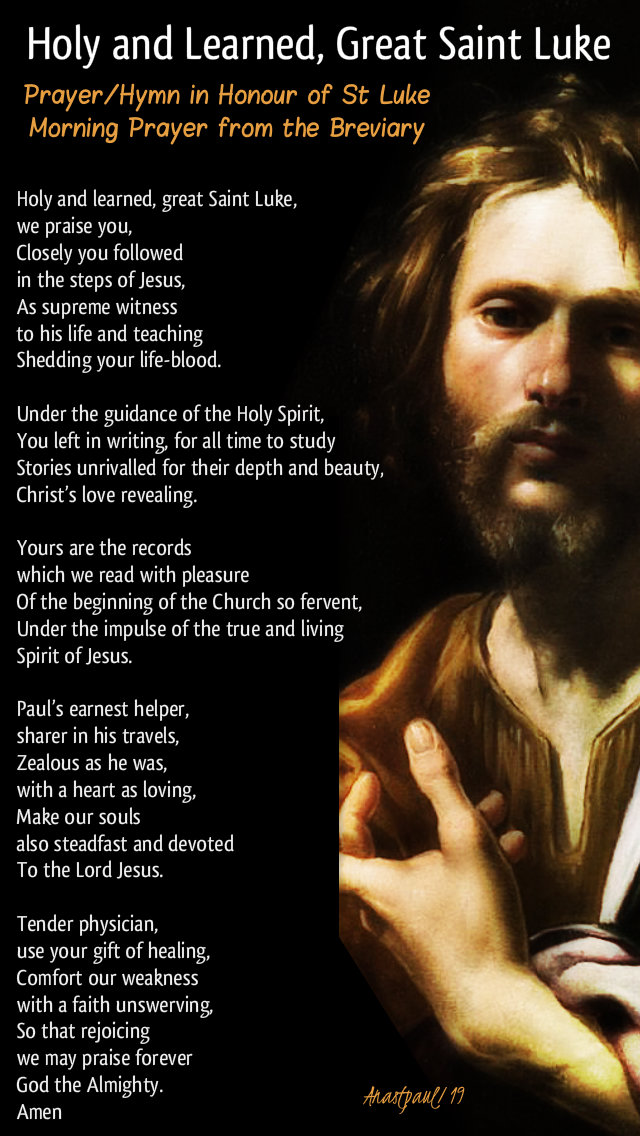
Holy and Learned, Great Saint Luke Prayer/Hymn in Honour of St Luke Morning Prayer from the Breviary
Holy and learned, great Saint Luke, we praise you,
Closely you followed in the steps of Jesus,
As supreme witness to his life and teaching
Shedding your life-blood.
Under the guidance of the Holy Spirit,
You left in writing, for all time to study
Stories unrivalled for their depth and beauty,
Christ’s love revealing.
Yours are the records which we read with pleasure
Of the beginning of the Church so fervent,
Under the impulse of the true and living
Spirit of Jesus.
Paul’s earnest helper, sharer in his travels,
Zealous as he was, with a heart as loving,
Make our souls also steadfast and devoted
To the Lord Jesus.
Tender physician, use your gift of healing,
Comfort our weakness with a faith unswerving,
So that rejoicing we may praise forever
God the Almighty.
Amen
Quote of the Day – 13 October – Twenty-eighth Sunday in Ordinary Time, Year C and today, John Henry Newman will be Canonised
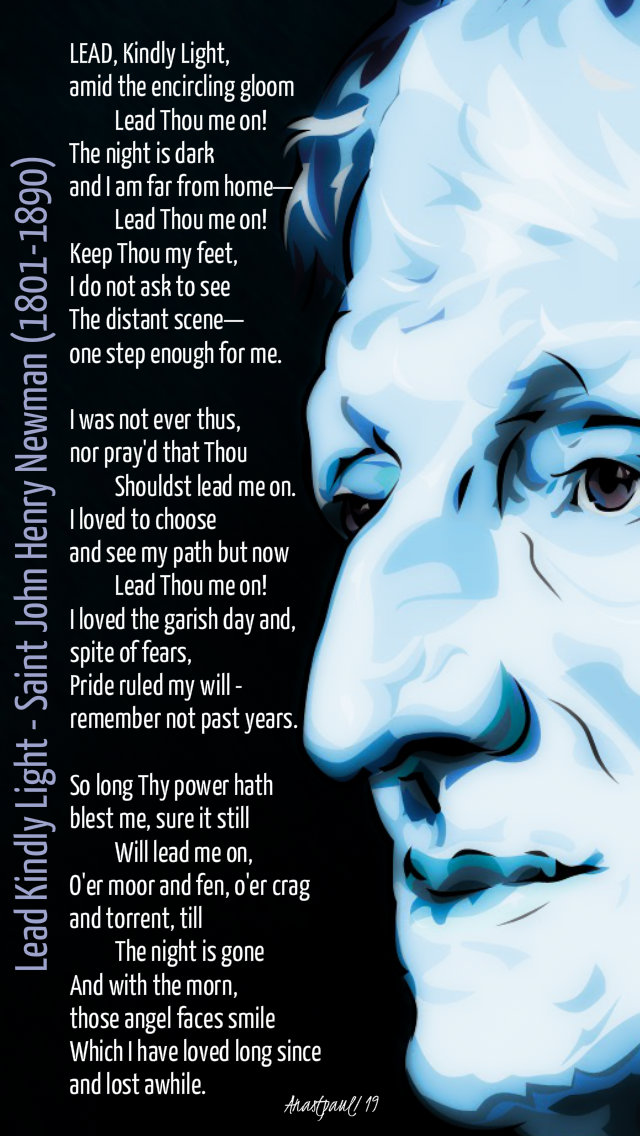
The Pillar of the Cloud By St John Henry Newman (1801-1890)
LEAD, Kindly Light, amid the encircling gloom Lead Thou me on! The night is dark and I am far from home— Lead Thou me on! Keep Thou my feet, I do not ask to see The distant scene—one step enough for me.
I was not ever thus, nor pray’d that Thou Shouldst lead me on. I loved to choose and see my path but now Lead Thou me on! I loved the garish day and, spite of fears, Pride ruled my will – remember not past years.
So long Thy power hath blest me, sure it still Will lead me on, O’er moor and fen, o’er crag and torrent, till The night is gone And with the morn, those angel faces smile Which I have loved long since and lost awhile.
Our Morning Offering – 9 October – Wednesday of the Twenty Seventh Week in Ordinary Time, Year C and the Memorial of Blessed John Henry Newman (1801-1890)
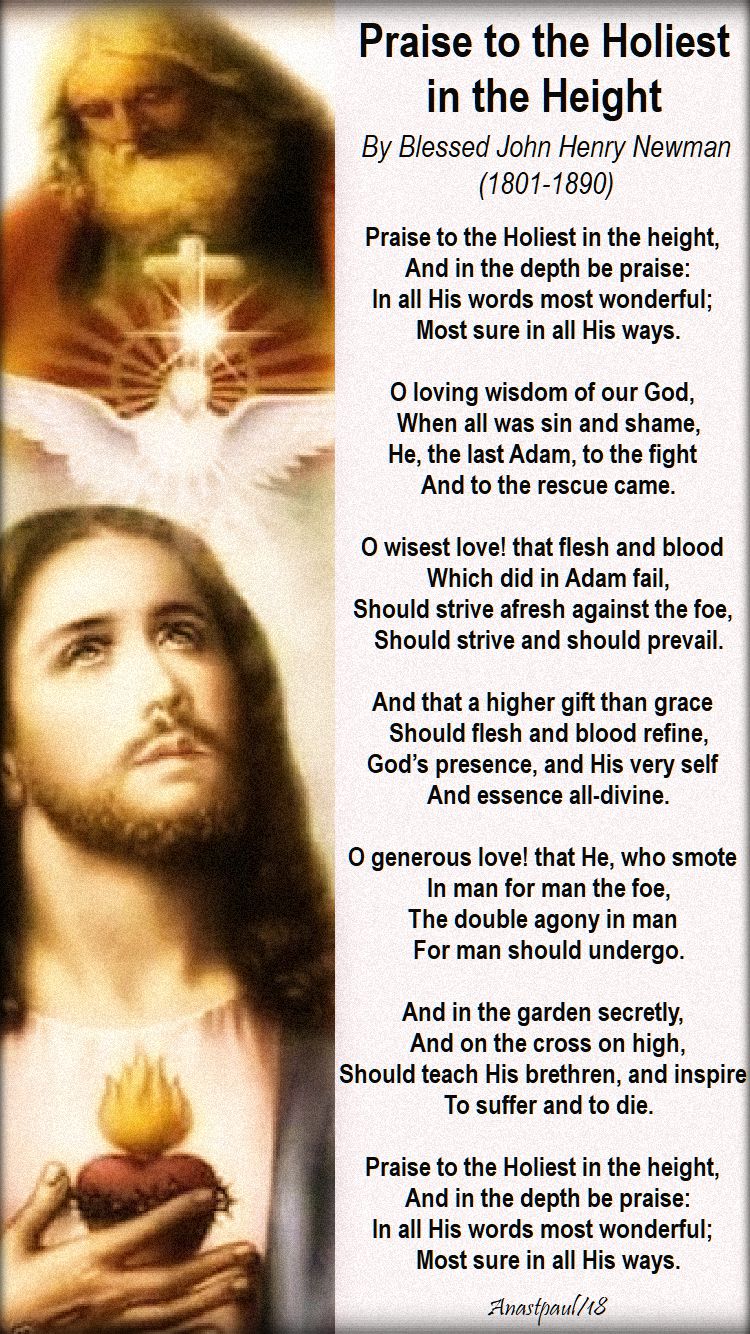
Praise to the Holiest in the Height By Blessed John Henry Newman (1801-1890)
Praise to the Holiest in the height,
And in the depth be praise:
In all His words most wonderful;
Most sure in all His ways.
O loving wisdom of our God,
When all was sin and shame,
He, the last Adam, to the fight
And to the rescue came.
O wisest love! that flesh and blood
Which did in Adam fail,
Should strive afresh against the foe,
Should strive and should prevail.
And that a higher gift than grace
Should flesh and blood refine,
God’s presence, and His very self
And essence all-divine.
O generous love! that He, who smote
In man for man the foe,
The double agony in man
For man should undergo.
And in the garden secretly,
And on the cross on high,
Should teach His brethren, and inspire
To suffer and to die.
Praise to the Holiest in the height,
And in the depth be praise:
In all His words most wonderful;
Most sure in all His ways.
Our Morning Offering – 26 September – Thursday of the Twenty Fifth week in Ordinary Time, Year C and The Memorial of Saints Cosmas and Damian (Died c 286) Martyrs
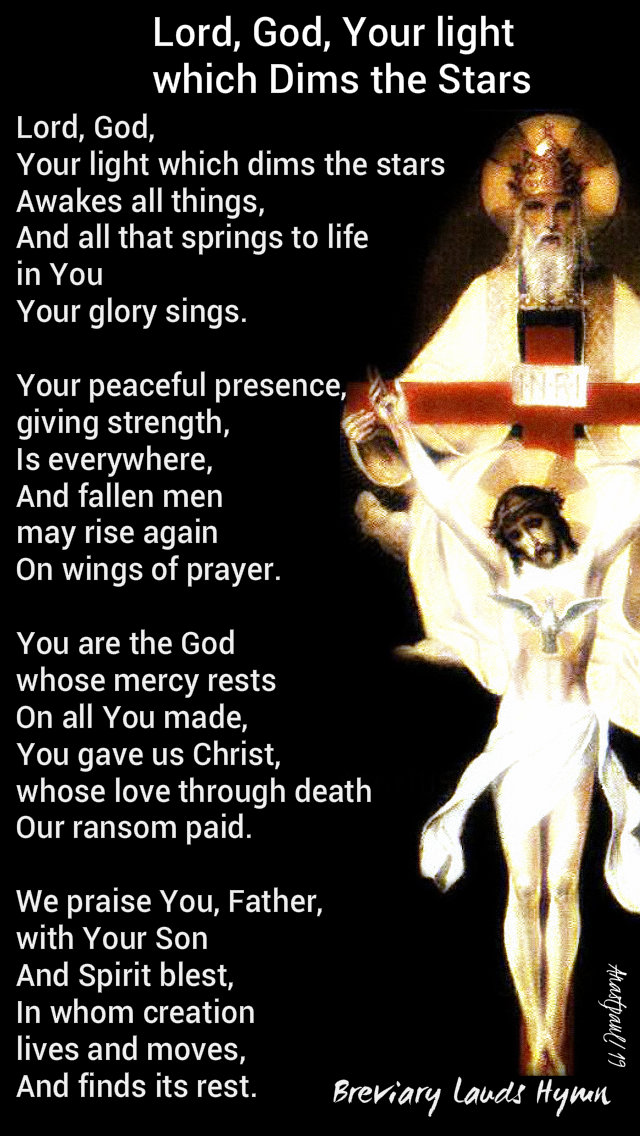
Lord, God, Your Light which Dims the Stars Breviary Hymn By the Benedictine Nuns of Stanbrook Abbey
Lord, God, Your light
which dims the stars
Awakes all things,
And all that springs to life in You
Your glory sings.
Your peaceful presence,
giving strength,
Is everywhere,
And fallen men may rise again
On wings of prayer.
You are the God whose mercy rests
On all You made.
You gave us Christ,
whose love through death
Our ransom paid.
We praise You, Father, with Your Son
And Spirit blest,
In whom creation lives and moves,
And finds its rest.
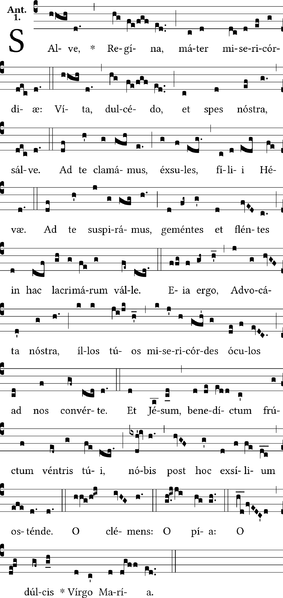
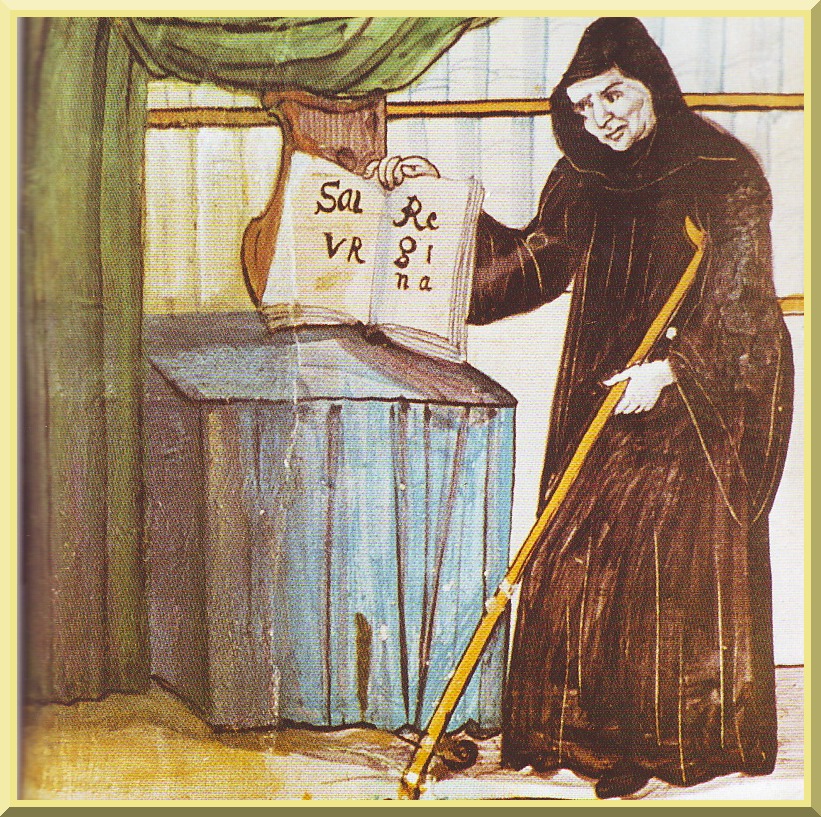
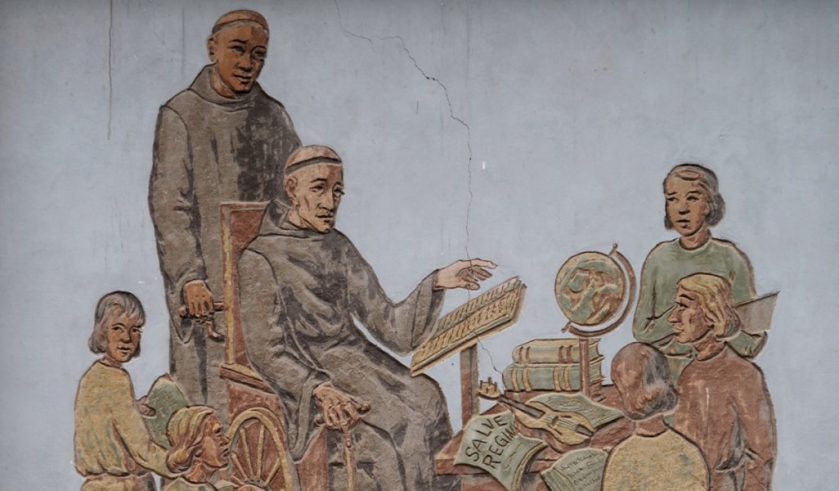
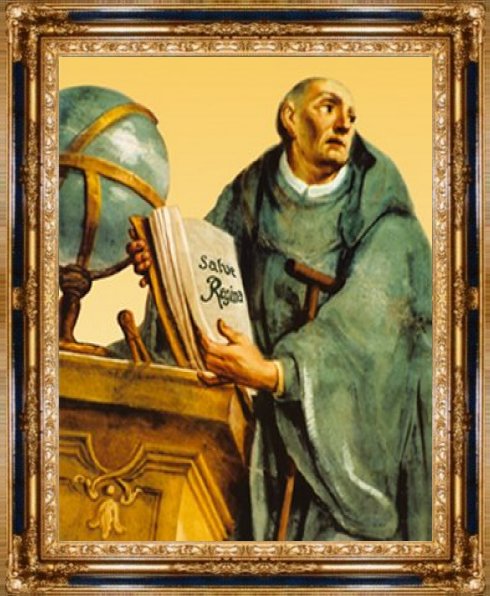
Quote/s of the Day – 25 September – The Memorial of Blessed Herman of Reichenau/the Cripple OSB (1013–1054) the Author of the Salve Regina, the Veni Sancte Spiritus and the Alma Redemptoris Mater
Let us thank God for Blessed Herman the Cripple. He stands as a shining light reminding us that God purposely chose what the world considers nonsense, in order to shame the wise and He chose what the world considers weak, in order to shame the powerful. He chose what the world looks down on and despises and thinks is nothing, in order to destroy what the world thinks is important.
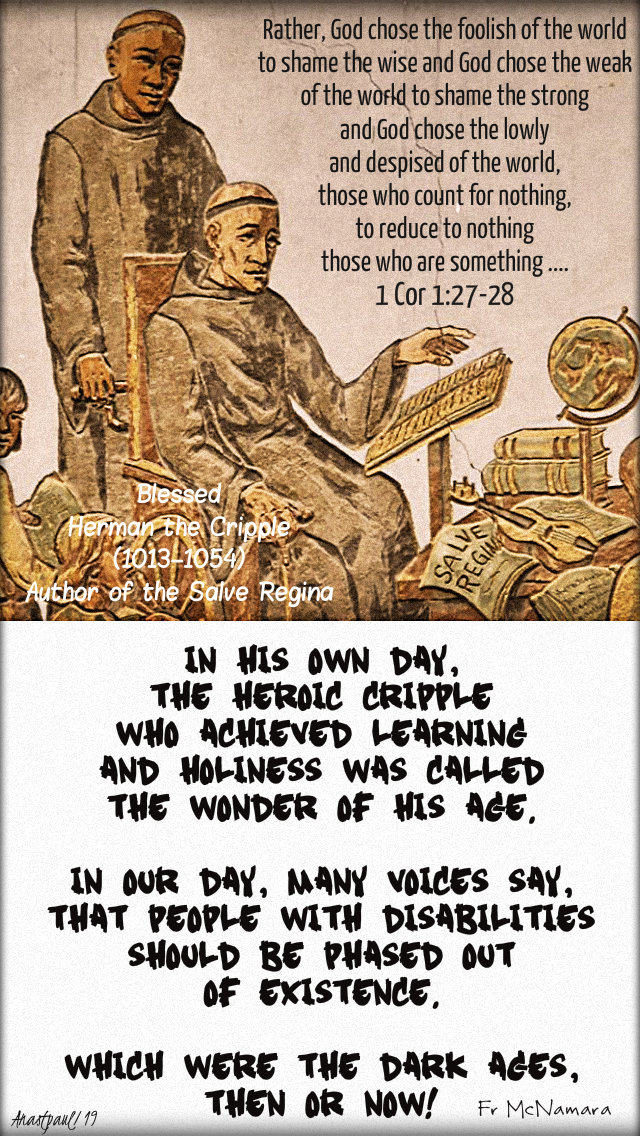
Rather, God chose the foolish of the world, to shame the wise and God chose the weak of the world, to shame the strong and God chose the lowly and despised of the world, those who count for nothing, to reduce to nothing those who are something ….
1 Corinthians 1:27-28
“In his own day, the heroic cripple who achieved learning and holiness
was called ‘The Wonder of His Age’.
In our day, many voices say
that people with disabilities.
should be phased out of existence.
Which were the Dark Ages, then or now!” … Father McNamara
Veni Sancte Spiritus This translation was by Father Edward Caswall (1814-1878)
Holy Spirit, Lord of light,
From Thy clear celestial height
Thy pure beaming radiance give.
Come, Thou Father of the poor,
Come with treasures which endure,
Come, Thou Light of all that live.
Thou, of all consolers best,
Thou, the soul’s delightsome Guest,
Dost refreshing peace bestow.
Thou in toil art comfort sweet,
Pleasant coolness in the heat,
Solace in the midst of woe.
Light immortal, Light divine,
Visit Thou these hearts of Thine,
And our inmost being fill.
If Thou take Thy grace away,
Nothing pure in man will stay;
All his good is turned to ill.
Heal our wounds; our strength renew;
On our dryness pour Thy dew;
Wash the stains of guilt away.
Bend the stubborn heart and will;
Melt the frozen, warm the chill;
Guide the steps that go astray.
Thou, on those who evermore
Thee confess and Thee adore,
In Thy sevenfold gifts descend:
Give them comfort when they die,
Give them life with Thee on high;
Give them joys that never end.
++++++++++++++++++
Alma Redemptóris Mater, quæ pérvia cæli Porta manes, et stella maris, succúrre cadénti, Súrgere qui curat pópulo: tu quæ genuísti, Natúra miránte, tuum sanctum Genitórem Virgo prius ac postérius, Gabriélis ab ore Sumens illud Ave, peccatórum miserére.
Mother of Christ! Hear thou thy people’s cry,
Star of the deep and portal of the sky!
Mother of Him Who thee from nothing made,
Sinking we strive and call to thee for aid;
Oh, by that joy which Gabriel brought to thee,
Thou Virgin first and last, let us thy mercy see.
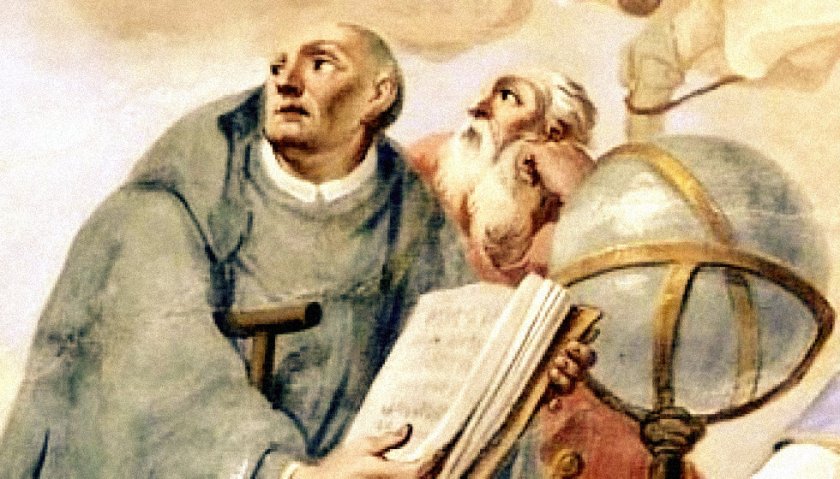
Saint of the Day – 25 September – Blessed Herman of Reichenau/the Cripple OSB (1013–1054) Benedictine Monk, Confessor, Scholar, Scientist, Writer, Hymnist, Poet, Musical Composer, Teacher – born on 18 February 1013 at Altshausen, Swabia (in modern Germany) and died on 21 September 1054 at Reichenau abbey, Germany of natural causes. Also known as Hermann Contractus, Herimanus Augiensis, Hermann von Reichenau.
In his own day, the heroic cripple who achieved learning and holiness was called ‘The Wonder of His Age’. He composed works on history, music theory, mathematics and astronomy, as well as many hymns. Composer of the “Salve Regina” Hail Holy Queen, “Veni Sancte Spiritus” Come Holy Spirit and “Alma Redemptoris Mater” Nourishing Mother of the Redeemer. He was renowned as a religious poet and musical composer. Among his surviving works are officia for St Afra and St Wolfgang. When he went blind in later life, he began writing hymns and these have carried the Church and still do for a 1000 years in joy and glory!
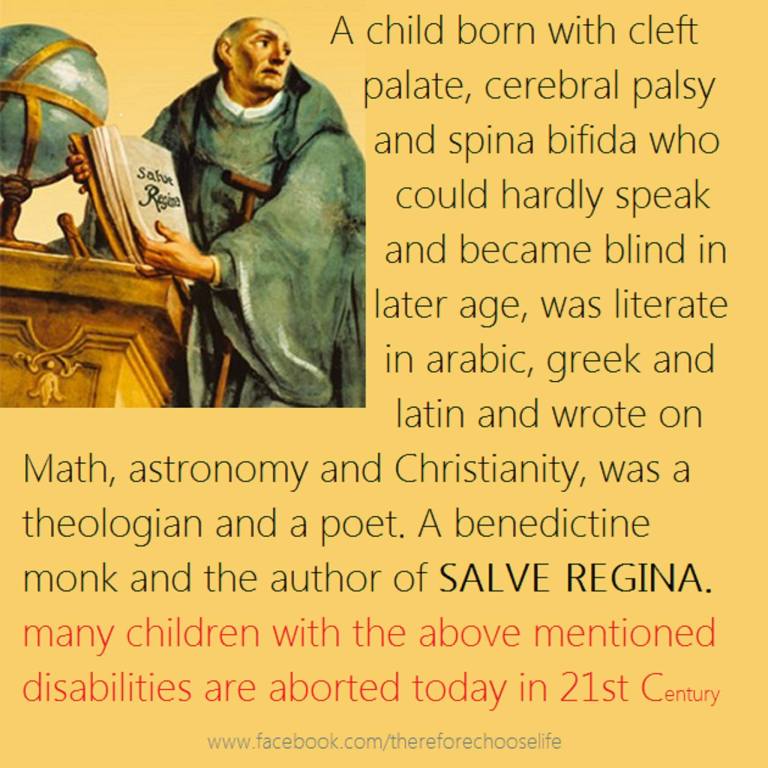
Blessed Herman was the son of Count Wolverad II von Altshausen. Being a cripple (born with a cleft palate, cerebral palsy and possibly spina bifida – though today it is thought that he had amyotrophic lateral sclerosis or spinal muscular atrophy) from birth (hence the surname Contractus) he was powerless to move without assistance and it was only by the greatest effort that he was able to read and write but he was so highly gifted intellectually, that when he was but seven years of age his parents confided him to the learned Abbot Berno, on the island of Reichenau.
His great love and sincere devotion for the “Mother of the afflicted ” secured him peace of soul and even lightened his bodily sufferings. We are told, however, that he continued to pray to his beloved Mother for restoration to health and strength, if it should be pleasing to God. Pious legend informs us, that when he had prayed thus for some months, the Blessed Virgin appeared to him and offered him the choice between two gifts, namely, health or wisdom. Herman, without hesitating a moment, chose the gift of wisdom. He made a wise selection, for notwithstanding his bodily infirmities he became one of the most learned men of his time. Under the poor form of a deformed body there dwelt a noble soul, a clear and richly gifted intellect and a humble and charitable heart.
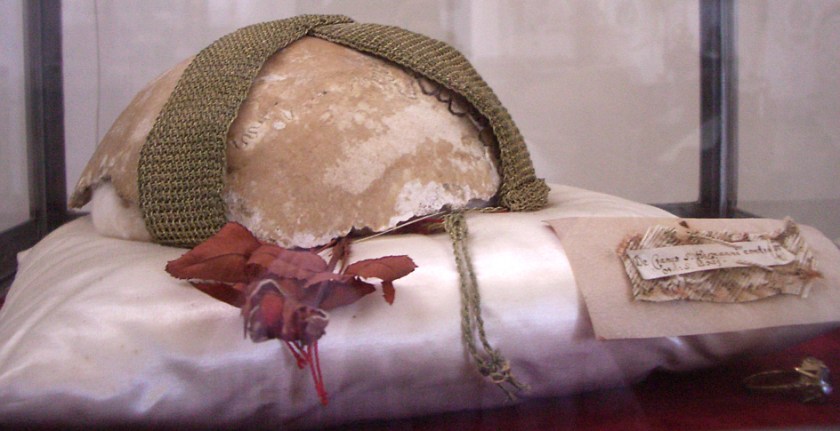
Herman spent his entire life in the monastery Reichenau as a teacher, researcher and musician. Herman was bound to a carrying chair and was completely dependent on his servants. He could only write with difficulty and one may assume that he has dictated a large part of his works. And even that might have been difficult, as his biographer writes that he could only speak with difficulty and was barely understandable. But if we are allowed to believe Berthold, his charisma, his cheerfulness and his modesty of intelligence were so impressive that everyone had to love him.
A good student of theology, he could also produce works of spiritual depth. For a readership of nuns he wrote a discourse “On the Eight Principal Vices.” It was cast in poetry and he handled the versification with great lyricism. He also knew how to give serious matters a light touch. The treatise for nuns was witty and he even began his world chronicle with a touch of self-depreciation: “Herman, the rubbish of Christ’s little ones, lagging behind the learners of philosophy more slowly than a donkey or a slug … ”
Herman was not just a music theoretician but, with that, he took on a special position – he himself created melodies – and he may be considered one of the first known composers of Gregorian chants. In contrast to the strict Gregorian chant, his music show an almost romantic melody. His “Salve Regina” is clearly the work of a master.
Herman gave instructions on how to measure the circumference of the earth at a time when there was not even clarity about the spherical shape of the earth. One of Herman’s inventions was the pillar sundial , which he called the horologium viatorum.
His iron will overcame all obstacles and it was not long before his brilliant attainments made him a shining light in the most diversified branches of learning, including, besides theology, mathematics, astronomy, music, the Latin, Greek and Arabic tongues. Students soon flocked to him from all parts, attracted not only by the fame of his scholarship but also by his monastic virtue and his lovable personality.
We are indebted to him chiefly for a chronicle of the most important events from the birth of Christ to his day. It is the earliest of the medieval universal chronicles now extant and was compiled from numerous sources, being a monument to his great industry as well as to his extraordinary erudition and strict regard for accuracy. While it is not improbable that this work was based on a previous state chronicle of Swabia, since lost (called “Chronicum Universale Suevicum”, or “Epitome Sangallensis”), it has nevertheless a significance entirely its own. But the full measure of his genius appears from the objectivity and clearness with which he wrote the history of his own time, the materials of which were accessible to him only by means of verbal tradition.
In later life he became blind and had to give up his academic writing.
He died on the island of Reichenau, Lake Constance, 21 September, 1054. He was Beatified in 1863 by Pope Pius IX.
Three of five symphonies that were written by Russian composer Galina Ustvolskaya are based on his texts.
Our Morning Offering – 15 August – Solemnity of the Assumption of the Blessed Virgin Mary into Heaven
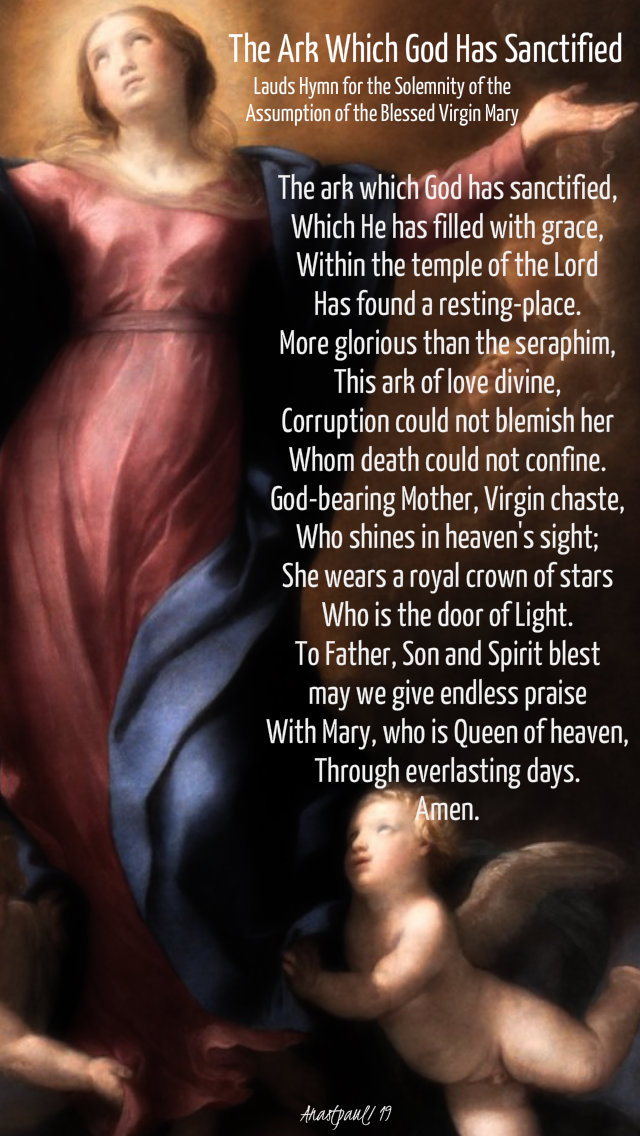
The Ark Which God Has Sanctified
The ark which God has sanctified,
Which He has filled with grace,
Within the temple of the Lord
Has found a resting-place.
More glorious than the seraphim,
This ark of love divine,
Corruption could not blemish her
Whom death could not confine.
God-bearing Mother, Virgin chaste,
Who shines in heaven’s sight;
She wears a royal crown of stars
Who is the door of Light.
To Father, Son and Spirit blest
may we give endless praise
With Mary, who is Queen of heaven,
Through everlasting days.
Amen.
The Ark Which God Has Sanctified is written by the Benedictine Nuns of Stanbrook Abbey. In the Divine Office (1974) it is sung with Morning Prayer on 15 August, the Solemnity of the Assumption of the Blessed Virgin Mary. It is set to the 1836 tune – St Peter (Reinagle) by Alexander Robert Reinagle (1799-1877).
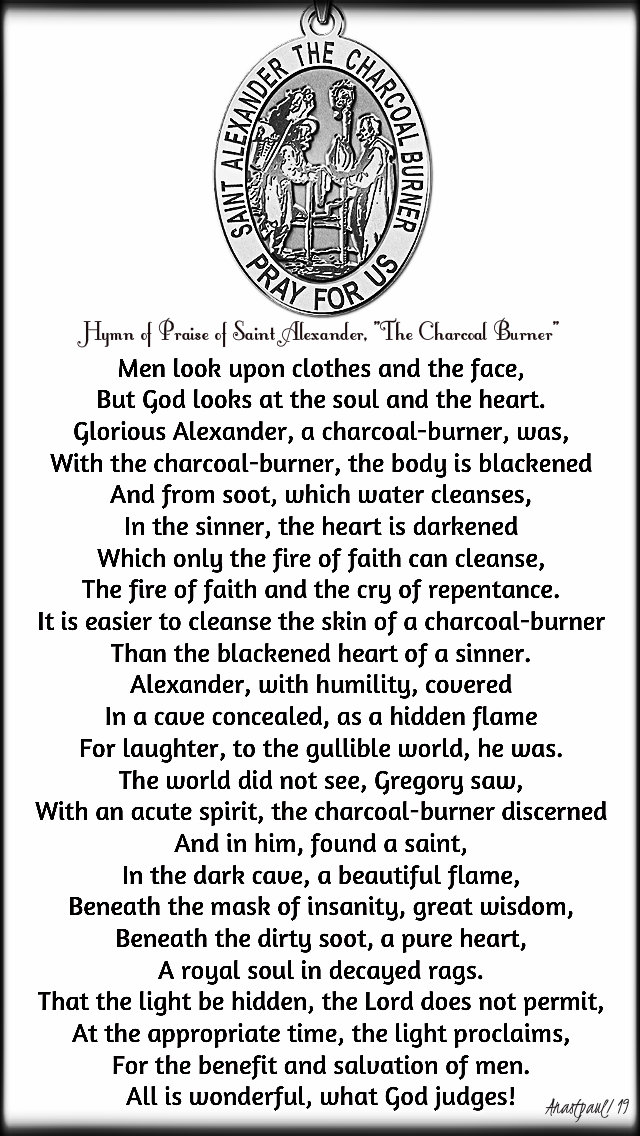
Quote of the Day – 11 August – Nineteenth Sunday in Ordinary Time, Year C and the Memorial of St Alexander of (Died c 251) “The Charcoal Burner” Bishop and Martyr
Men look upon clothes and the face, But God looks at the soul and the heart. Glorious Alexander, a charcoal-burner, was, With the charcoal-burner, the body is blackened And from soot, which water cleanses, In the sinner, the heart is darkened Which only the fire of faith can cleanse, The fire of faith and the cry of repentance. It is easier to cleanse the skin of a charcoal-burner Than the blackened heart of a sinner. Alexander, with humility, covered In a cave concealed, as a hidden flame For laughter, to the gullible world, he was. The world did not see, Gregory saw, With an acute spirit, the charcoal-burner discerned And in him, found a saint, In the dark cave, a beautiful flame, Beneath the mask of insanity, great wisdom, Beneath the dirty soot, a pure heart, A royal soul in decayed rags. That the light be hidden, the Lord does not permit, At the appropriate time, the light proclaims, For the benefit and salvation of men. All is wonderful, what God judges!
Hymn of Praise of Saint Alexander, Bishop of Comana,
from the Prologue of Ohrid
Our Morning Offering – 6 August – Feast of the Transfiguration of the Lord
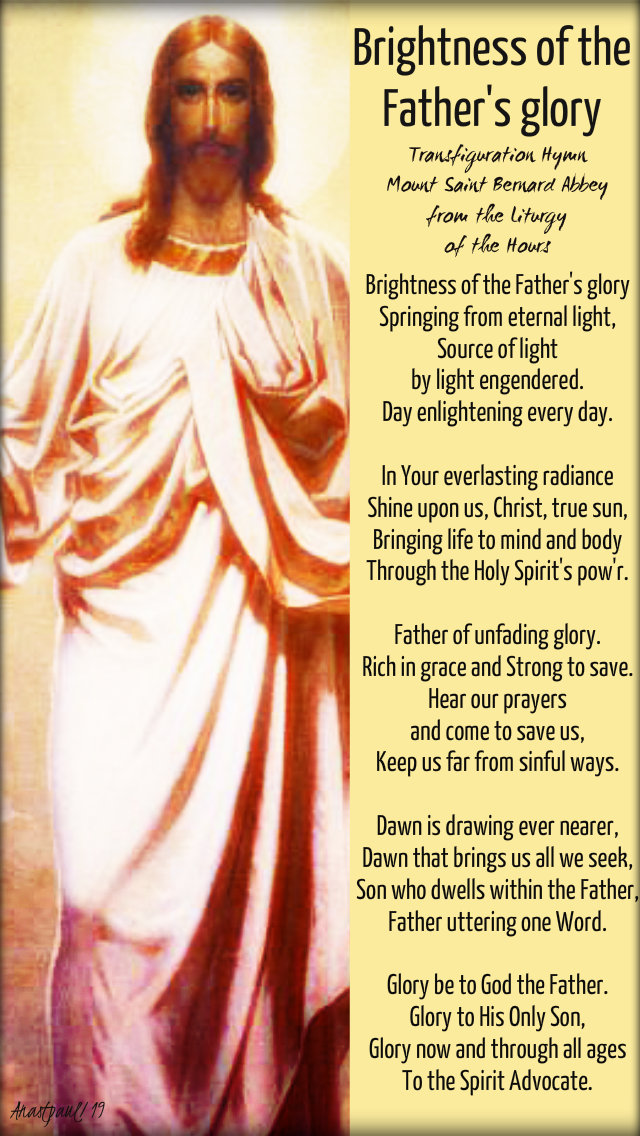
Brightness of the Father’s glory Transfiguration Hymn Mount Saint Bernard Abbey from the Liturgy of the Hours
Brightness of the Father’s glory
Springing from eternal light,
Source of light by light engendered.
Day enlightening every day.
In Your everlasting radiance
Shine upon us, Christ, true sun,
Bringing life to mind and body
Through the Holy Spirit’s pow’r.
Father of unfading glory.
Rich in grace and Strong to save.
Hear our prayers and come to save us,
Keep us far from sinful ways.
Dawn is drawing ever nearer,
Dawn that brings us all we seek,
Son who dwells within the Father,
Father uttering one Word.
Glory be to God the Father.
Glory to His Only Son,
Glory now and through all ages
To the Spirit Advocate.
Brightness of the Father’s Glory uses William Boyce’s tune Halton Holgate with new words by Mount Saint Bernard Abbey. Mount Saint Bernard Abbey is a Cistercian (Trappist) Monastery in Leicestershire, UK founded in 1835. In 1998, Nigerian born Cyprian Tansi was beatified by John Paul II. Blessed Cyprian had been a monk at Mount Saint Bernard for 14 years, from 1950, until his death, in 1964. In the Liturgy of the Hours, Brightness of the Father’s Glory is used during Ordinary Time for Morning Prayer.
Our Morning Offering – 5 August – Monday of the Eighteenth week in Ordinary Time, Year C and the Memorial of the Dedication of Mary Major
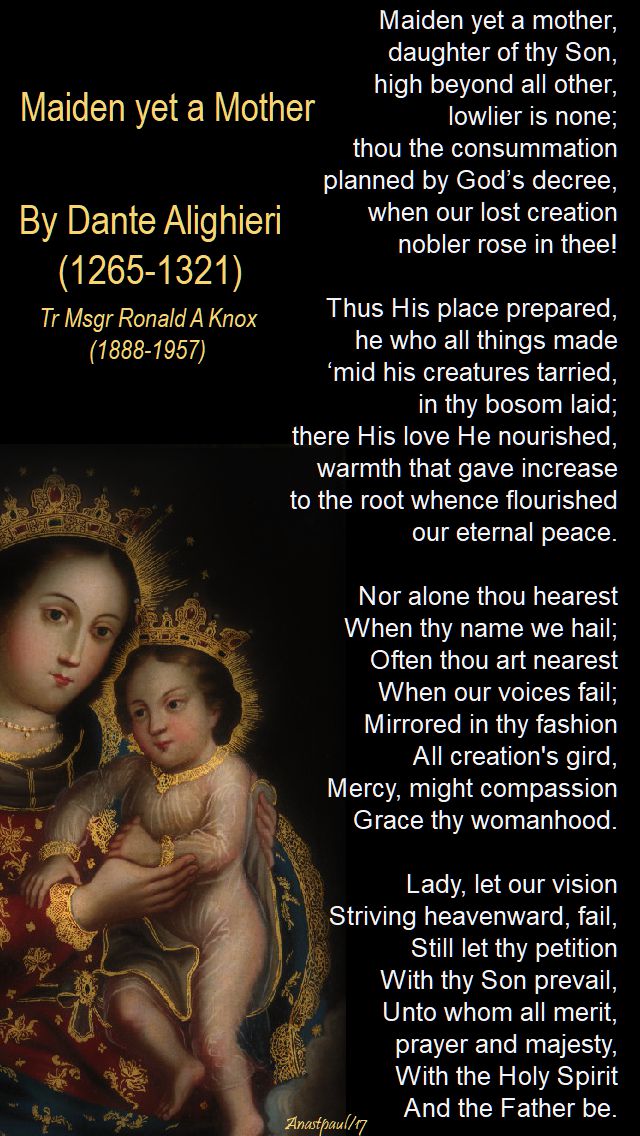
Maiden yet a Mother By Dante Alighieri (1265-1321) Tr Msgr Ronald A Knox (1888-1957)
Maiden yet a mother,
daughter of thy Son,
high beyond all other,
lowlier is none;
thou the consummation
planned by God’s decree,
when our lost creation
nobler rose in thee!
Thus His place prepared,
he who all things made
‘mid his creatures tarried,
in thy bosom laid;
there His love He nourished,
warmth that gave increase
to the root whence flourished
our eternal peace.
Nor alone thou hearest
When thy name we hail;
Often thou art nearest
When our voices fail;
Mirrored in thy fashion
All creation’s gird,
Mercy, might compassion
Grace thy womanhood.
Lady, let our vision
Striving heavenward, fail,
Still let thy petition
With thy Son prevail,
Unto whom all merit,
prayer and majesty,
With the Holy Spirit
And the Father be.
Maiden Yet A Mother is a translation of a poem by Durante (Dante) degli Alighieri (c 1265–1321). It is based upon the opening verses of Canto 33 of the Paradiso from his Divine Comedy in which St Bernard of Clairvaux (1090–1153) praises and prays to the Virgin Mother on behalf of Dante. It was translated from the original Italian into English by the Catholic convert, Monsignior Ronald A Knox (1888-1957). It is one of the Marian Hymns in the Breviary.
Thought for the Day – 1 August – Thursday of the Seventeenth week in Ordinary Time, Year C and the Feast of St Peter in Chains
Homily of St Augustine
Peter alone among the Apostles was accounted worthy to hear – A – men I say to thee, that thou art Peter and upon this rock I will build my Church. Worthy indeed was he, to be the foundation-stone, the supporting pillar, the key to the kingdom, in building up the peoples into the house of God. Concerning this, the divine word says – And they laid, it says, their sick, that when Peter passed by, his shadow at the least might fall on them. If at that time the shadow of his body could give aid, how much more now can the fullness of his power? If a mere breath of air from him, as he passed by, was of such benefit to suppliants, how much more his favour now that he remains steadfast? With good reason is the iron of those Penal chains held throughout all the churches of Christ to be more precious than gold.
If the shadow of him who visited was so potent to cure, how much more the chains of him who binds? If even the mere appearance of an empty image could have the force of healing in it, how much more healthfulness should the chains, with which he suffered, whose iron weight had pressed upon his sacred members, deserve to draw forth from his body? If he was so mighty to help his suppliants before his martyrdom, how much more must he avail after his triumph?
Happy those bonds, which by touching the Apostle rendered him a Martyr and so from manacles and fetters themselves were changed into a crown! Happy chains, which brought their prisoner even unto the cross of Christ, not so much for condemnation as for consecration!
Jesus said to His disciples – Who do men say that the Son of Man is? Peter answered and said – Thou art Christ, the son of the living God. And I say to thee – that thou art Peter and upon this rock I will build my Church!
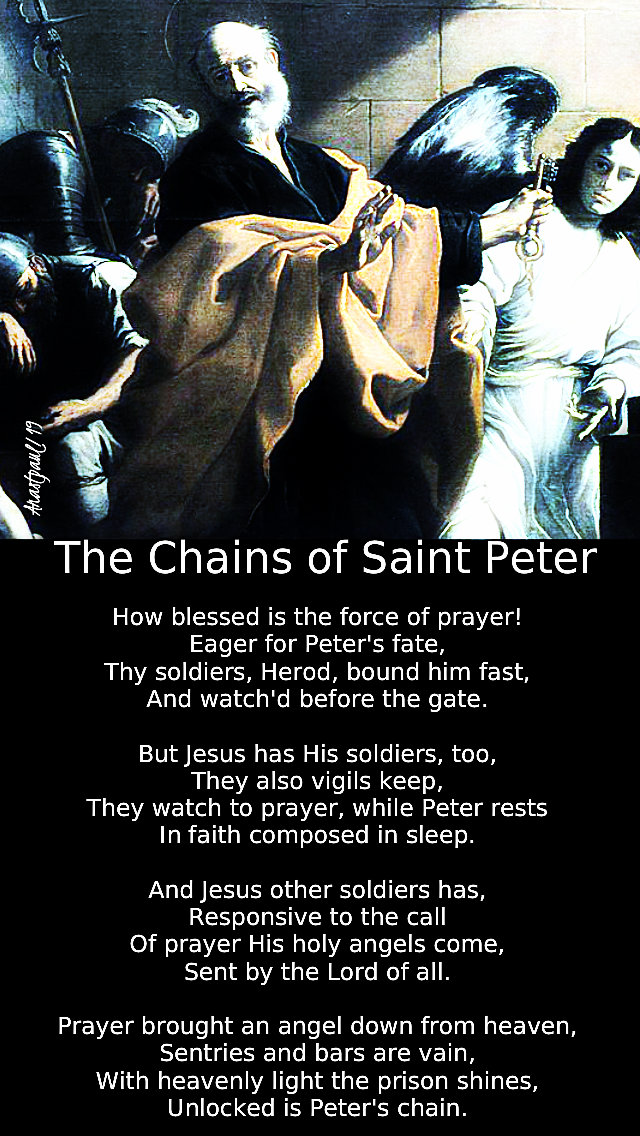
Hymn The Chains of Saint Peter
How blessed is the force of prayer!
Eager for Peter’s fate,
Thy soldiers, Herod, bound him fast,
And watch’d before the gate.
But Jesus has His soldiers, too,
They also vigils keep,
They watch to prayer, while Peter rests
In faith composed in sleep.
And Jesus other soldiers has,
Responsive to the call
Of prayer His holy angels come,
Sent by the Lord of all.
Prayer brought an angel down from heaven,
Sentries and bars are vain,
With heavenly light the prison shines,
Unlocked is Peter’s chain.
Our Morning Offering – 3 July – Feast of St Thomas Apostle
O Fathers of Our Ancient Faith
O Fathers of our ancient faith,
With all the heav’n, we sing your fame
Whose sound went forth in all the earth
To tell of Christ and bless His name.
You took the gospel to the poor,
The Word of God alight in you,
Which in our day is told again,
That timeless Word, forever new.
You told of God, who died for us
And out of death triumphant rose,
Who gave the truth that made us free
and changeless through the ages goes.
Praise Father, Son and Holy Spirit,
Whos gift is faith that never dies,
A light in darkness now, until
The day-star in our hearts arise.
O Fathers of Our Ancient Faith is written by the Benedictine Nuns of Stanbrook Abbey. In the Divine Office (1974) it is sung at Morning Prayer in the Common of Apostles. It is set to the anonymous tune associated with the 7th century Latin hymn, Creator Alme Siderum.
The Vatican announces the date of the Canonisation of Blessed John Henry Newman (1801-1890), along with four others on Sunday 13 October 2019, the 28th Sunday in Ordinary Time, Year C.
“Praise to the Holiest in the height And in the the depth be praise. In all His words most wonderful, Most sure in all His ways!”
Blessed John Henry Newman
In February, the Pope signed a decree recognising a second miracle attributed to Blessed John Henry Newman, the inexplicable healing of a woman with a “life-threatening pregnancy”.
Ordained a Catholic priest in 1847, he was made a cardinal by Pope Leo XIII in 1879, although he was not a bishop. Newman’s conversion to the Catholic faith was controversial in England and resulted in him losing many friends, including his own sister who never spoke to him again.
The British cardinal founded the Oratory of St Philip Neri in England and was particularly dedicated to education, founding two schools for boys. He died in Birmingham in 1890 at the age of 89.
In October, Cardinal Newman will become Britain’s first new saint since the Canonisation of St John Ogilvie (1579-1615) Martyr, Memorial 10 March, in 1976.
At Newman’s beatification Mass in Birmingham, England in September 2010, Pope Benedict XVI said that Newman’s “insights into the relationship between faith and reason, into the vital place of revealed religion in civilised society and into the need for a broadly-based and wide-ranging approach to education, were not only of profound importance for Victorian England but continue today, to inspire and enlighten many all over the world. “What better goal could teachers of religion set themselves than Blessed John Henry’s famous appeal for an intelligent, well-instructed laity: ‘I want a laity, not arrogant, not rash in speech, not disputatious but men who know their religion, who enter into it, who know just where they stand, who know what they hold and what they do not, who know their creed so well that they can give an account of it, who know so much of history that they can defend it…..”
As Blessed, John Henry’s Memorial is 9 October, the date he was received into the Catholic Church.
“God has created me to do Him some definite service. He has committed some work to me which He has not committed to another. I have my mission. I may never know it in this life but I shall be told it in the next. I am a link in a chain, a bond of connection between persons. He has not created me for naught. I shall do good, I shall do His work. I shall be an angel of peace, a preacher of truth in my own place, while not intending it, if I do but keep His commandments. Therefore, I will trust Him… If I am in sickness, my sickness may serve Him, in perplexity, my perplexity may serve Him… He does nothing in vain… He may take away my friends. He may throw me among strangers. He may make me feel desolate, make my spirits sink, hide the future from me. Still, He knows what He is about.”
+++++++++++++++++++++
The Others to be Canonised on the same day are:
Sister Mariam Thresia of India is the founder of the Congregation of the Sisters of the Holy Family.
Italian Sister Giuseppina Vannini is the founder of the Daughters of Saint Camillus.
Brazilian Sister Dulce Lopes Pontes of the Congregation of the Missionary Sisters of the Immaculate Conception of the Mother of God.
Marguerite Bays of Switzerland, of the Third Order of Saint Francis of Assisi.
Our Morning Offering – 29 June – The Solemnity of Saints Peter and Paul
What Fairer Light?
Hymn for the Solemnity of Sts Peter and Paul Elphis, c 493, wife of Boethius c 477– 524 Translation: R A Knox, 1888-1957
What fairer light is this than time itself doth own,
The golden day with beams more radiant brightening?
The princes of God’s Church this feast day doth enthrone,
To sinners heavenward bound their burden lightening.
One taught mankind its creed, one guards the heavenly gate,
Founders of Rome, they bind the world in loyalty;
One by the sword achieved, one by the cross his fate;
With laurelled brows they hold eternal royalty.
Rejoice, O Rome, this day, thy walls they once did sign
With princely blood, who now their glory share with thee.
What city’s vesture glows with crimson deep as thine?
What beauty else has earth that may compare with thee?
To God the three in one eternal homage be,
All honour, all renown, all songs victorious,
Who rules both heaven and earth by one divine decree
To everlasting years in empire glorious.
Our Morning Offering – 2 May “Mary’s Month” – Thursday of the Second week of Easter
Opening Hymn from the Little Office of Mary
O Mary of all women,
You are the chosen one,
Who, ancient prophets promised,
Would bear God’s only Son;
All Hebrew generations
Prepared the way to thee,
That in your womb the God-man,
Might come to set us free.
O Mary, you embody
all God taught to our race,
For you are first and foremost
In fullness of His grace;
We praise this wondrous honour
That you gave birth to Him,
Who from you took humanity
And saved us from our sin.
Our Morning Offering – 30 April – Tuesday of the Second week of Easter
Be Merciful, Be Gracious By Blessed John Henry Newman (1801-1890)
Be merciful, be gracious, Lord, deliver me.
From the sins that are past,
From Your frown and Your ire,
From the perils of dying,
From any complying
With sin or denying
My God, or relying
On self,
at the last,
From the nethermost fire,
From all that is evil,
From the power of the devil,
Your servant deliver,
For once and forever,
By Your Birth and By Your Cross,
Rescue me from endless loss,
By Your death and burial,
Save me from a final fall,
By Your rising from the tomb,
By Your mounting up above,
By the Spirit’s gracious love,
Save me in the day of doom.
This Sunday, called Palm or Passion Sunday, is the first day of Holy Week. Holy Thursday, Good Friday and the Easter Vigil on Holy Saturday are called the Triduum, three days that are the highlight of the Church year. There are two Gospels proclaimed at today’s Mass. The first Gospel, proclaimed before the procession with palms, tells of Jesus’ triumphant entrance into Jerusalem. Riding on a borrowed colt, Jesus was hailed by the crowds as they shouted blessings and praise to God. This event is reported in each of the four Gospels.
“Blessed the King who comes in the name of the Lord”...Luke 19:38
Saint Romanus the Melodist (c 490-c 556)
Composer of Hymns – Hymn 32
Seated on your throne in heaven and on a colt on earth, O Christ, You who are God, You welcomed the praise of the angels and the anthem of the children who called out to You : “Blessed are You, the one who comes to recall Adam”…
The King comes to us, humble, sitting on the foal of a donkey. He comes with haste to suffer His Passion and take sins away. Seated on a dumb animal, the Word, the Wisdom of God, wants to save all beings endowed with reason. And all humankind can contemplate, mounted on a colt, the One who rides on the cherubim (Ps 17:10) and who once bore up Elijah on a chariot of fire. “Though he was rich,” of his own will, “he became poor” (2Co 8:9) ; in choosing weakness he gives strength to all who cry to him :” Blessed are You, the one who comes to call Adam”…
You demonstrate Your strength by choosing poverty… The clothes of the disciples were a sign of this poverty but Your power was measured by the anthem of the children and the great crowd which cried : “Hosanna!”—which means : “Save!”—”Hosanna to You who are in the highest. O Almighty, save those who are humbled. Have mercy on us, in consideration of our palms, may the palms we wave move Your heart, You who come to call Adam”…
“You who are the work of my hands,” the Creator answered …, “I came to you myself. It was not the Law that was to save you since it had not created you, nor the prophets who, like you, I created. I alone can free you from your debt . I am sold for you and I free you. I am crucified for you and you are rescued from death. I die and I teach you to cry : ” Blessed are You, the one who comes to call Adam”.
Did I love the angels as much? No, it is you, the poor, whom I have cherished. I have hidden my glory and, out of my great love for you, have freely made my richness poor. For you I suffered hunger, thirst, fatigue. I roamed the mountains, ravines and valleys looking for you, my lost sheep. I took the name of Lamb to bring you back, calling you with my shepherd’s voice. And I want to give my life for you, to tear you away from claws of the wolf. I bear everything so that you may cry out : “Blessed are You, the one who comes to call Adam”.
Our Morning Offering – 14 April – Palm Sunday, Year C
My Song is Love Unknown Breviary Hymn for Passion Sunday By Samuel Crossman (1623-1648)
My song is love unknown,
My Saviour’s love to me.
Love to the loveless shown,
That they might lovely be.
O who am I, that for my sake
My Lord should take frail flesh and die?
He came from His blest throne
Salvation to bestow;
But men made strange and none
The longed-for Christ would know.
But O! my Friend, my Friend indeed,
Who at my need His life did spend.
Sometimes they strew His way,
And His sweet praises sing,
Resounding all the day
Hosannas to their King:
Then “Crucify!” is all their breath,
And for His death they thirst and cry.
Why, what hath my Lord done?
What makes this rage and spite?
He made the lame to run,
He gave the blind their sight,
Sweet injuries! Yet they at these
Themselves displease and ’gainst Him rise.
They rise and needs will have
My dear Lord made away,
A murderer they save,
The Prince of life they slay,
Yet cheerful He to suffering goes,
That He, His foes from thence might free.
Our Morning Offering – 10 April – Wednesday of the Fifth week of Lent, Year C
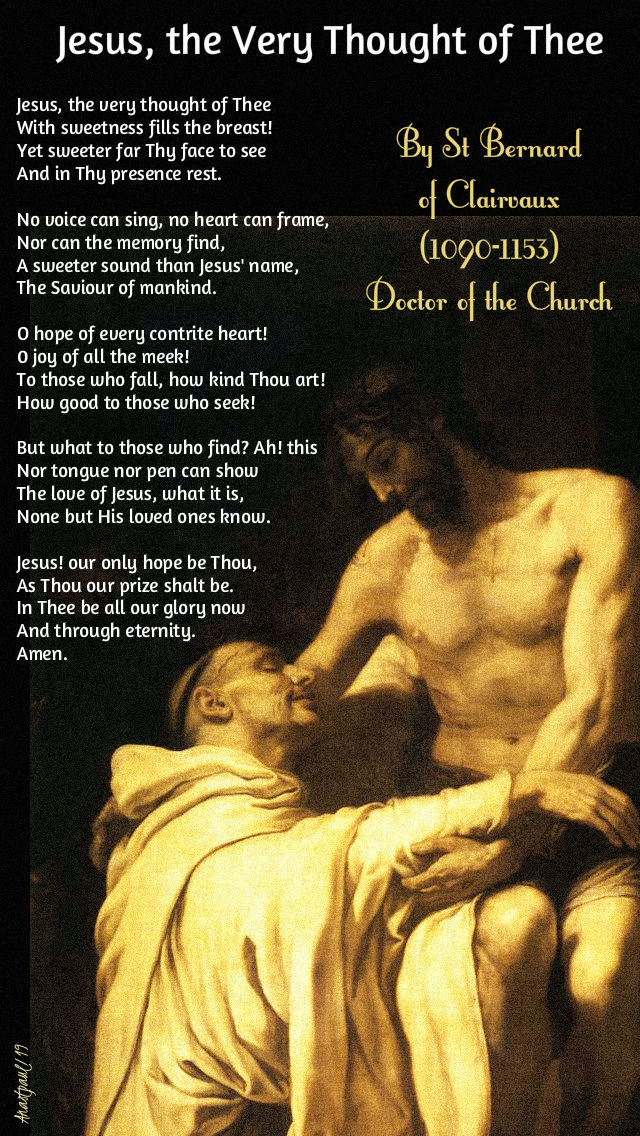
Jesus, the very thought of Thee! By St Bernard of Clairvaux (1090-1153) Mellifluous Doctor
Jesus, the very thought of Thee
With sweetness fills the breast!
Yet sweeter far Thy face to see
And in Thy presence rest.
No voice can sing, no heart can frame,
Nor can the memory find,
A sweeter sound than Jesus’ name,
The Saviour of mankind.
O hope of every contrite heart!
0 joy of all the meek!
To those who fall, how kind Thou art!
How good to those who seek!
But what to those who find? Ah! this
Nor tongue nor pen can show
The love of Jesus, what it is,
None but His loved ones know.
Jesus! our only hope be Thou,
As Thou our prize shall be;
In Thee be all our glory now,
And through eternity.
Amen
Our Morning Offering – 16 March – Saturday of the First week of Lent, Year C- “Marian Saturdays”
The Mater Christi
Mother of Christ, Mother of Christ,
What shall I ask of thee?
I do not sigh for the wealth of earth
For the joys that fade and flee,
But, Mother of Christ, Mother of Christ,
This do I long to see —
The bliss untold which thy arms enfold,
The Treasure upon thy knee.
Mother of Christ, Mother of Christ,
He was All-in-All to thee,
In the winter’s cave, in Nazareth’s home,
In the hamlets of Galilee,
So, Mother of Christ, Mother of Christ,
He will not say nay to thee,
When He lifts His Face to thy sweet embrace,
Speak to Him, Mother, of me.
Mother of Christ, Mother of Christ,
The world will bid Him flee,
Too busy to heed His gentle voice,
Too blind His charms to see,
Then, Mother of Christ, Mother of Christ,
Come with thy Babe to me,
Tho’ the world be cold, my heart shall hold
A shelter for Him and thee.
Mother of Christ, Mother of Christ,
What shall I do for thee?
I will love thy Son with the whole of my strength,
My only King shall He be.
Yes! Mother of Christ, Mother of Christ,
This will I do for thee,
Of all that are dear or cherished here,
None shall be dear as He.
Mother of Christ, Mother of Christ,
I toss on a stormy sea,
O lift thy Child as a Beacon Light,
To the Port where I fain would be!
And, Mother of Christ, Mother of Christ,
This do I ask of thee —
When the voyage is o’er, oh! stand on the shore
And show Him at last to me.
Our Morning Offering – 25 January – The Feast of the Conversion of St Paul
Lead, Kindly Light By Blessed John Henry Newman (1801-1890)
Lead, kindly Light, amid the encircling gloom,
Lead Thou me on;
The night is dark and I am far from home,
Lead Thou me on.
Keep Thou my feet, I do not ask to see
The distant scene, one step enough for me.
I was not ever thus, nor prayed that Thou
Should lead me on.
I loved to choose and see my path but now
Lead Thou me on.
I loved the garish day and, spite of fears,
Pride ruled my wil, remember not past years.
So long Thy power has blest me, sure it still
Will lead me on
O’er moor and fen, o’er crag and torrent, till
The night is gone
And with the morn those Angel faces smile,
Which I have loved long since and lost awhile.
Lead, Kindly Light is a hymn with words written in 1833 by Blessed John Henry Newman (1801-1890) as a poem titled “the Pillar and the Cloud” – it consists of 3 verses, anything after that is not by John Henry.
As a young priest, Newman became sick while in Italy and was unable to travel for almost three weeks. In his own words: “Before starting from my inn, I sat down on my bed and began to sob bitterly. My servant, who had acted as my nurse, asked what ailed me. I could only answer, “I have a work to do in England.” I was aching to get home, yet for want of a vessel I was kept at Palermo for three weeks. I began to visit the churches and they calmed my impatience, though I did not attend any services. At last I got off in an orange boat, bound for Marseilles. We were becalmed for whole week in the Straits of Bonifacio and it was there that I wrote the lines, Lead, Kindly Light, which have since become so well known.”
Why this for St Paul? – this time in Bl John Henry’s life was a time of internal “conversion’ – after, his well-known “Sicily providential illness”, he started to turn towards “Rome” – although first the Oxford Movement had to happen and then some more difficult years before his final conversion but once he had put his hand to the plough, there was no turning back in his journey towards Truth.
I am sure you will agree with me that the words of this most beautiful prayer/poem/hymn, fit the Feast of the Conversion of St Paul perfectly.
Our Morning Offering – 3 January – The Feast of the Most Holy Name of Jesus
Jesu, Dulcis Memoria is a celebrated 12th century hymn by St Bernard of Clairvaux (1090-1153), Doctor Mellifluous. The entire hymn has some 42 to 53 stanzas depending upon the manuscript. Parts of this hymn are used for the Feast of the Holy Name of Jesus.
Hymn or Prayer Jesu, Dulcis Memoria By St Bernard of Clairvaux (1090-1153)
Jesus, the very thought of Thee
With sweetness fills the breast!
Yet sweeter far Thy face to see
And in Thy presence rest.
No voice can sing,
no heart can frame,
Nor can the memory find,
A sweeter sound than Jesus’ Name,
The Saviour of mankind.
O hope of every contrite heart!
0 joy of all the meek!
To those who fall, how kind Thou art!
How good to those who seek!
But what to those who find?
Ah! this Nor tongue nor pen can show
The love of Jesus, what it is,
None but His loved ones know.
Jesus! our only hope be Thou,
As Thou our prize shall be;
In Thee be all our glory now,
And through eternity.
Amen
Today, the 200th anniversary of the first performance
of the beloved carol ‘Silent Night’
Exactly 200 years ago today, 24 December 1818 — in a little church in what is now Austria, the world heard for the first time a poem set to music that eventually would be hailed as one of the most popular and beloved Christmas carols of all time.
“Silent Night” was sung for the first time that Christmas Eve at a Midnight Mass at St Nicholas Church in Oberndorf, a village in the Austrian Empire. The lyrics were written by a young Catholic priest, Father Joseph Mohr (1792–1848) and the music was composed by his friend, the local organist and schoolmaster, Francis Xavier Gruber (1787–1863).
Silent night, holy night!
All is calm, all is bright,
Round yon Virgin Mother and Child!
Holy Infant so tender and mild,
Sleep in heavenly peace,
Sleep in heavenly peace.
Silent night, holy night!
Son of God, how the light
Radiates love from Thy heavenly face,
At the dawn of redeeming grace,
Jesus, Lord at Thy birth,
Jesus, Lord at Thy birth.
Fr Joseph Mohr’s final resting place is a tiny Alpine ski resort, Wagrain. He was born into poverty in Salzburg in 1792 and died penniless in Wagrain in 1848, where he had been assigned as pastor of the church. He had donated all his earnings to be used for elder care and the education of the children in the area. His memorial from the townspeople is the Joseph Mohr School located a dozen yards from his grave. The overseer of St Johann’s, in a report to the bishop, described Mohr as “a reliable friend of mankind, toward the poor, a gentle, helping father.”
Many generations of the Mohr family lived in the Lungau region, in the southern part of the Province of Salzburg. The pilgrimage church of St Nicholas in Mariapfarr, the little church where Father Mohr was the curate, is within walking distance of the former home of Joseph’s grandfather. The climate is so invigorating and the Alpine air so clean, the town has become a major vacation destination for Europeans who want to get away from city life. The pilgrimage church where Mohr celebrated Mass is undergoing the restoration of its centuries-old frescos.
The carol is believed to have caused a somewhat miraculous and well-documented Christmas truce during World War I. On Christmas Eve 1914, British and French troops were encamped in trenches in a face-off against German troops in Ypres in Flanders, Belgium. The two sides began singing Christmas carols to each other and “Silent Night” was the only hymn all the combatants knew. Singing it together broke the ice and led to a temporary cease-fire with soldiers from both sides meeting in the middle “No Man’s Land” to trade tobacco and candy, play soccer and sing carols.
As it marks its 200th anniversary, “Silent Night” remains as beloved as ever. I am sure that all of us who attend Midnight Mass tonight, wherever we are in the world, will be singing Silent Night in one of the 300 languages into which it has been translated.
May this Holy Infant so tender and mild, bless us all!
You must be logged in to post a comment.