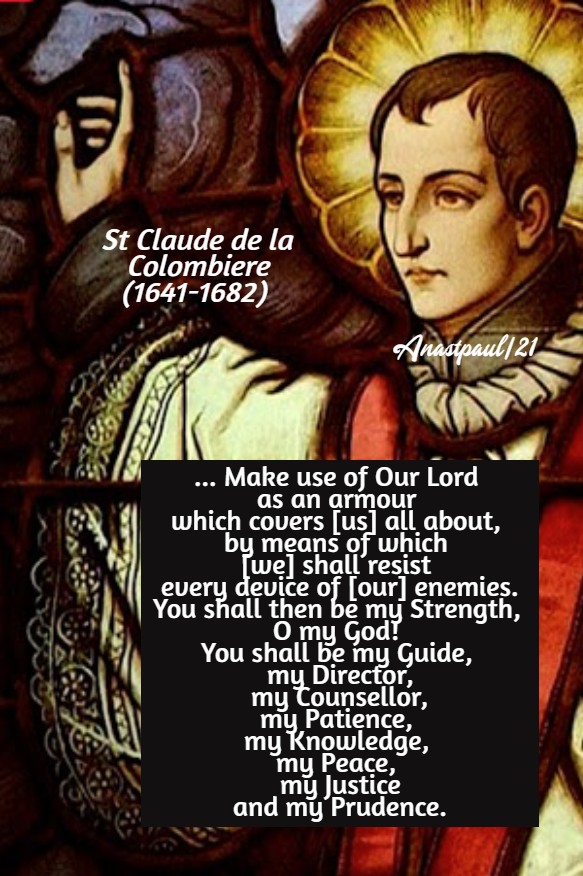
Our Morning Offering – 15 February – The Memorial of St Claude de la Colombiere SJ (1641-1682) “Apostle of the Sacred Heart”
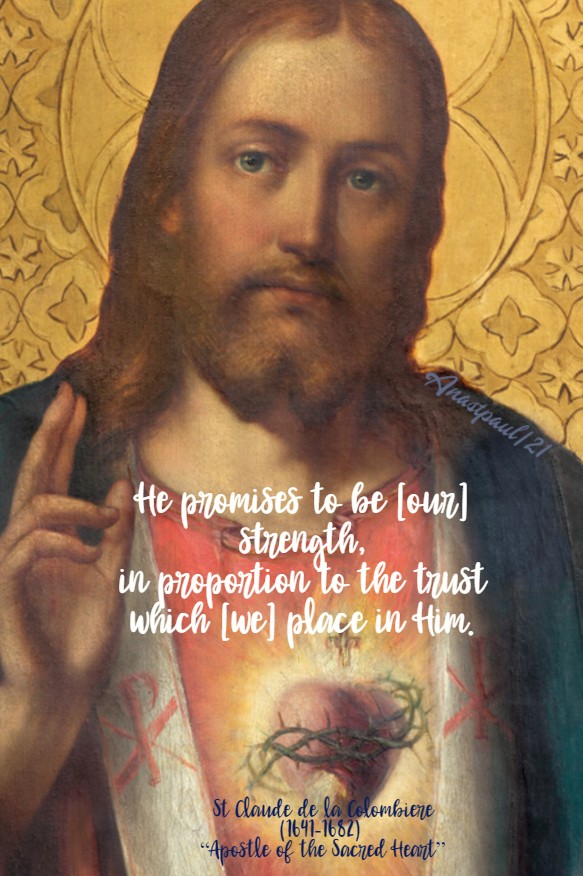
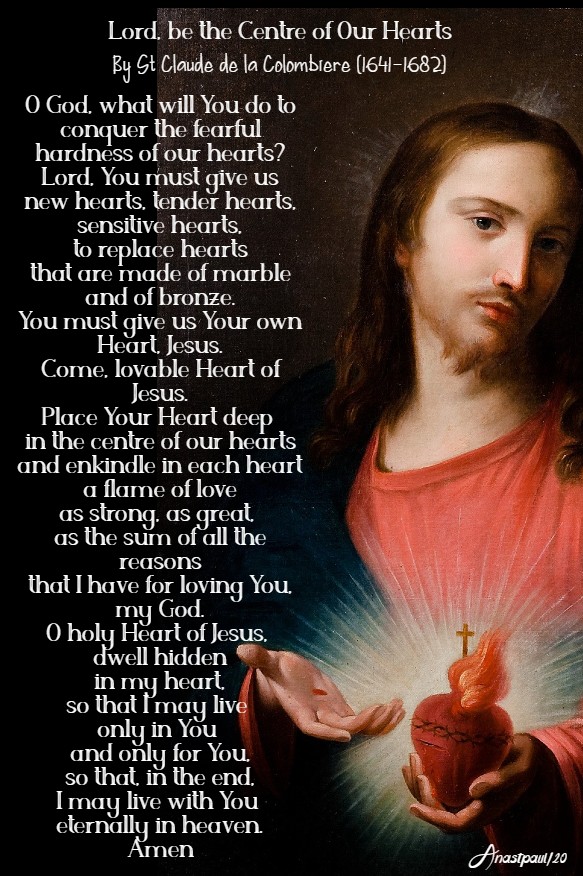
Lord, be the Centre of Our Hearts By St Claude de la Colombiere
O God, what will You do to conquer the fearful hardness of our hearts? Lord, You must give us new hearts, tender hearts, sensitive hearts, to replace hearts that are made of marble and of bronze. You must give us Your own Heart, Jesus. Come, lovable Heart of Jesus. Place Your Heart deep in the centre of our hearts and enkindle in each heart a flame of love as strong, as great, as the sum of all the reasons that I have for loving You, my God. O holy Heart of Jesus, dwell hidden in my heart, so that I may live only in You and only for You, so that, in the end, I may live with You eternally in heaven. Amen
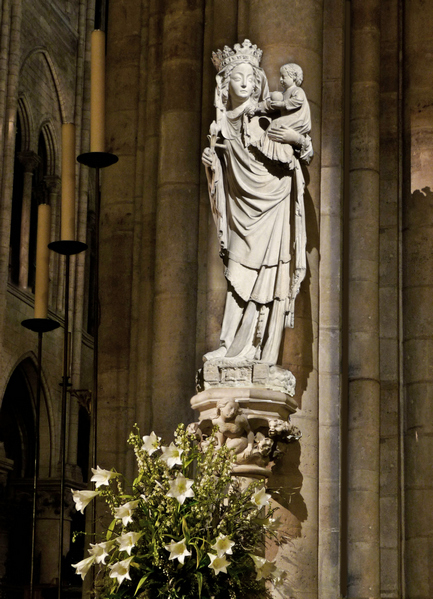
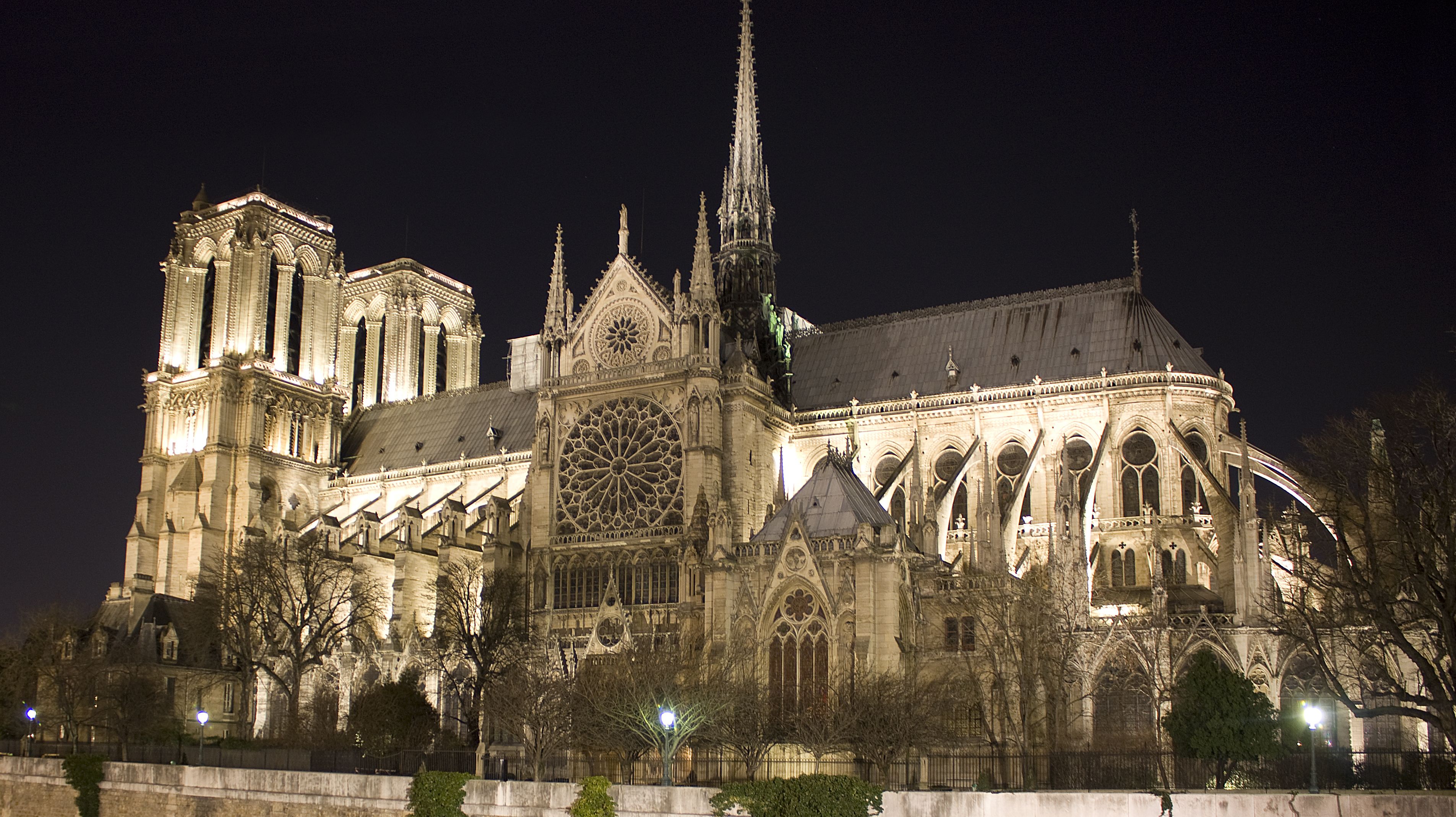
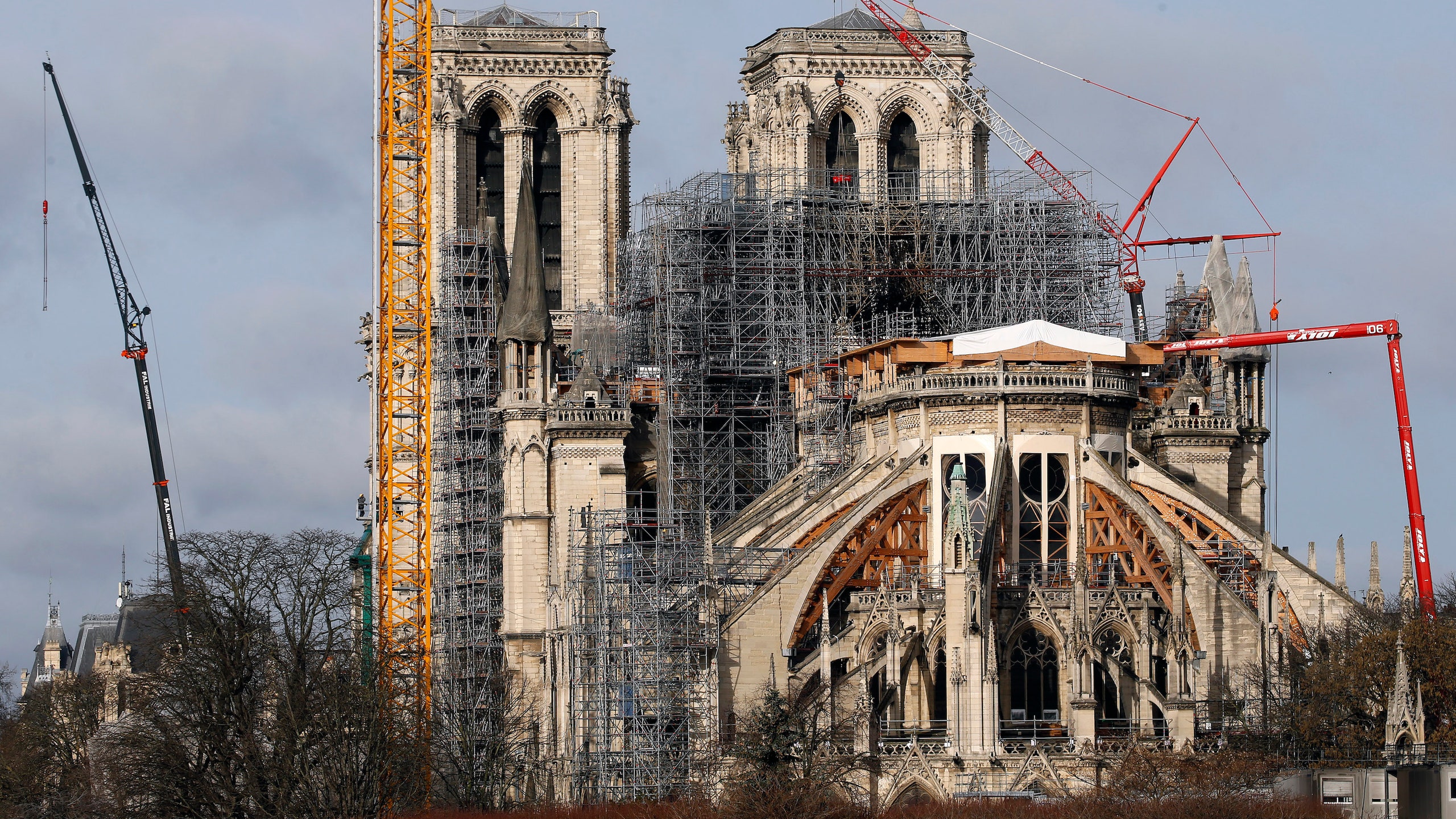
Notre-Dame de Paris / Our Lady of Paris, France (522) – 15 February:
There does not seem to be a great deal of information about Our Lady of Paris; it is an ancient title and can be traced well back before the 12th Century, when the Cathedral of Notre Dame de Paris (Our Lady of Paris) was begun. Some authorities say that veneration of the Blessed Virgin in Paris can be traced to the first apostles of the city. Since Saint Paul was in Gaul (France) during his travels, it may be assumed that this veneration dates to the first century of the Christian era. And, if Mary was venerated in Paris at that early date, it is possible that she was, even then, known as Our Lady of Paris. Briefly, as long as Christian minds can remember, Paris was consecrated to the Virgin Mary, whom the inhabitants always venerated. It is known that Our Lady of Paris was a Church first built by King Childebert in the year 522. About the year 1257, the King, Saint Louis IX assisted in the construction of a larger Church carried on in the same place, on the foundations which King Philip Augustus had laid in the year 1191. The older Church built by King Childebert, which had been dedicated to the Blessed Virgin, had became too ruinous to be repaired, so Maurice, Bishop of Paris, decided to rebuild it and, at the same time, adorn Paris with a Cathedral that would outshine all those which had hitherto been built anywhere.
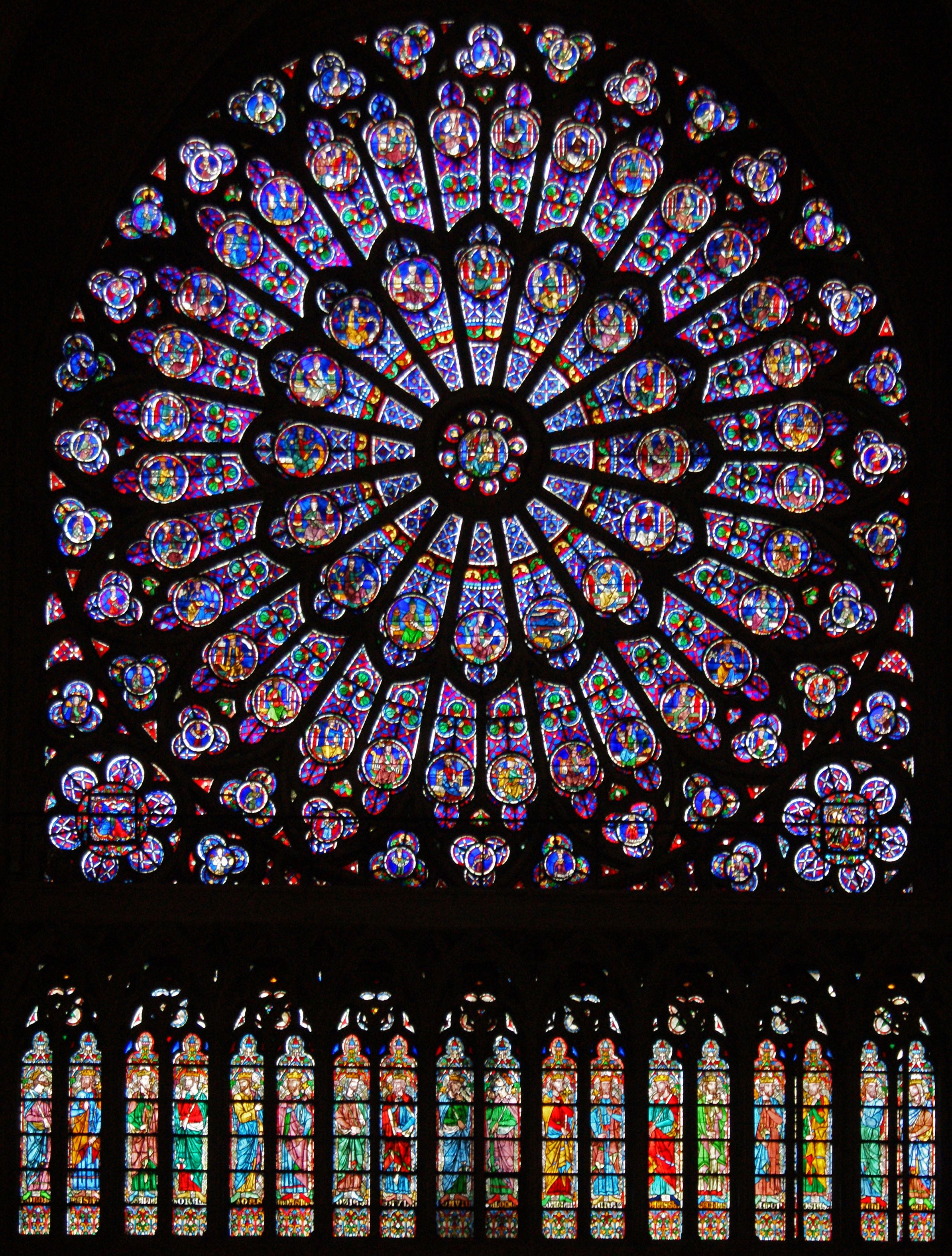
Plans were drawn up during the reign of King Louis VII and work had actually begun on Notre Dame de Paris, Notre Dame Cathedral, in 1162. The cornerstone was laid in the presence of Pope Alexander III. Notre Dame is a huge Gothic Cathedral on the Ile de la Cite, with beautiful flying buttresses to support the tremendous height of the walls and are adorned with stylish gargoyles. It is home to a reliquary which contains Christ’s Crown of Thorns. By the beginning of the fourteenth century, perhaps 1345, the Cathedral was finished, virtually as it stands today. Sometime during the building of the Cathedral, a statue of Our Lady was fashioned and installed in place. As was typical, the Cathedral was desecrated during the French Revolution and many of the religious artifacts were lost to future generations, although the incredible stained glass windows were not destroyed, including the three spectacular “rose window” that can still be seen today.
A smoke detector first alerted building staff to a fire beneath the roof at 6:18 pm on 15 April 2019, f Notre-Dame de Paris. By the time it was extinguished, the building’s spire collapsed and most of its roof had been destroyed and its upper walls severely damaged. Extensive damage to the interior was prevented by its stone vaulted ceiling, which largely contained the burning roof as it collapsed.
The restoration in early 2020
Many works of art and religious relics were moved to safety early in the emergency but others suffered some smoke damage and some exterior art was damaged or destroyed. The Cathedral’s altar, two pipe organs, and its three 13th-century rose windows suffered little to no damage.
The Nave before the fireThe Nave after the fire
Three emergency workers were injured. French President, Emmanuel Macron, said that the Cathedral would be restored by 2024 and launched a fundraising campaign which brought in pledges of over €1 billion as of 22 April 2019. A complete restoration could require twenty years or more. On 25 December 2019, the Cathedral did not host ChristmasMass for the first time since 1803.
Martyrs of Passae: Castulus Lucius Magnus Saturninus
Martyrs of Prague – 14 beati – Franciscan Friars Minor martyred together by a mob led by Lutherans – • Blessed Antonín of Prague • Blessed Bartolomeo Dalmasoni • Blessed Bedrich Bachstein • Blessed Christoffel Zelt • Blessed Didak Jan • Blessed Emmanuel of Prague • Blessed Gaspare Daverio • Blessed Giovanni Bodeo • Blessed Girolamo degli Arese • Blessed Jakob of Prague • Blessed Jan of Prague • Blessed Juan Martínez • Blessed Klemens of Prague • BlessedSimon of Prague They were martyred on • Shrove Tuesday 15 February 1611 at the Church of Our Lady of the Snows in Prague, Czech Republic • body dumped nearby but given Christian burial on 19 February 1611 in the monastery • re-interred in the side chapel of the church in 1616. Beatified 13 October 2012 by Pope Benedict XVI
Martyrs of Sweden: Sigfrid Sunaman Unaman Winaman
Martyred in the Spanish Civil War: Bl Pere Vallmitjana Abarca
Quote/s of the Day – 4 February – Thursday of the Fourth Week of Ordinary Time, Readings: Hebrews 12:18-19, 21-24, Psalms 48:2-3,3-4, 9, 10-11, Mark 6:7-13
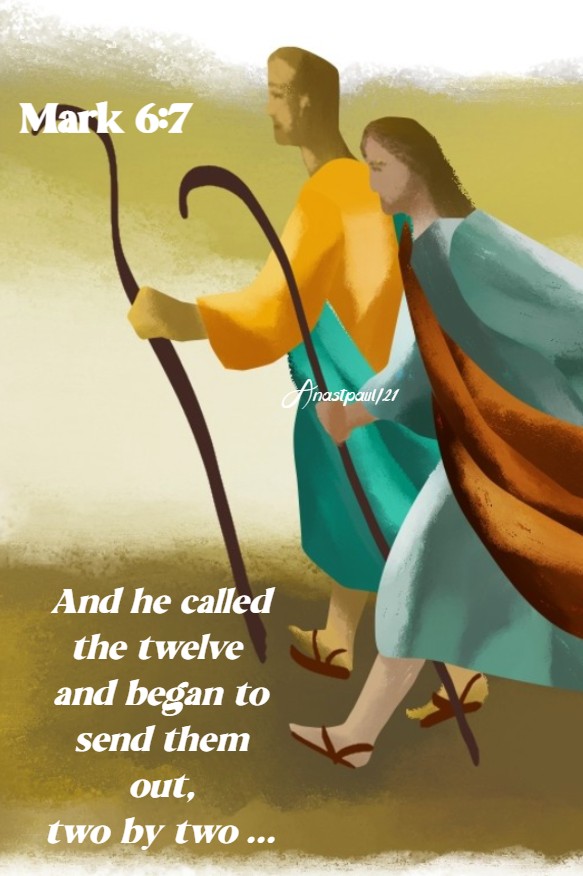
And he called the twelve and began to send them out, two by two …
Mark 6:7
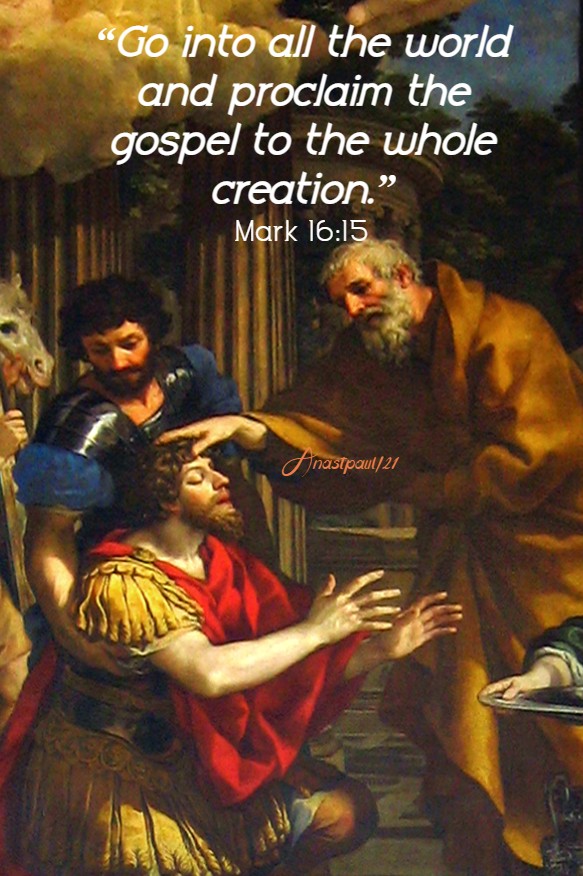
“Go into all the world and proclaim the gospel to vthe whole creation.”
Mark 16:15
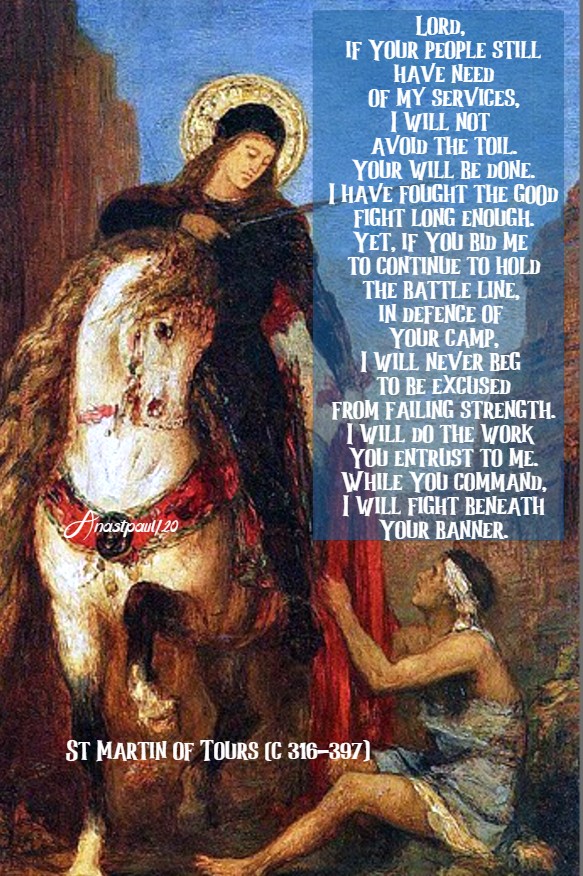
“Lord, if Your people still have need of my services, I will not avoid the toil. Your will be done. I have fought the good fight long enough. Yet, if You bid me to continue to hold the battle line, in defence of Your camp, I will never beg to be excused from failing strength. I will do the work You entrust to me. While You command, I will fight beneath Your banner. Amen”
St Martin de Tours (c 316-397)
“Pray as though everything depended on God. Work as though everything depended on you.”
St Augustine (354-430) Father & Doctor of the Church
“What a tragedy, how many souls are being shut out of heaven and falling into hell, thanks to you!”
St Francis Xavier (1506-1552)
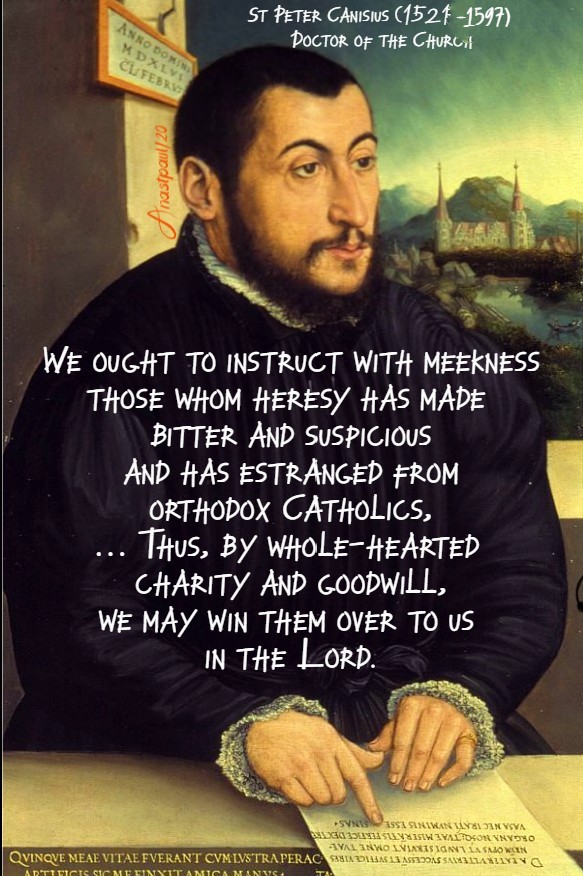
“We ought to instruct with meekness those whom heresy has made bitter and suspicious and has estranged from orthodox Catholics, … Thus, by whole-hearted charity and goodwill, we may win them over to us in the Lord.”
St Peter Canisius (1521-1397) Doctor of the Church
“Let us go in simplicity, where merciful Providence leads us, content to see the stone on which we should step, without wanting to discover, all at once and completely, the windings of the road.”
Blessed Frédéric Ozanam (1813–1853) “Servant to the Poor”
Saint of the Day – 3 February – Blessed John Nelson SJ (1535-1578) Priest Martyr, English Jesuit Martyr who was executed during the reign of Elizabeth I. Born in 1534 at Skelton, Yorkshire, England and died by being hung, drawn and quartered on 3 February 1578 at Tyburn, London England. Additional Memorial 29 October as one of the Martyrs of Douai.
John Nelson was born in Yorkshire in 1535 and was the son of Sir Nicholas Nelson. He was known for his intense practice of the faith and never feared to practice Catholicism openly although Queen Elizabeth’s government was unfavourable to Catholics and spies abounded. John was convinced that it was only by the shedding of blood that England could again be restored to the faith and driven by this firm conviction, at the age of 40, he left for Flanders and studied at the English college at Douai. He was delighted when his younger brothers, Martin and Thomas, followed him to Douai in 1574 and 1575 respectively. John was Ordained a Priest in 1576 at Bynche and 5 months later, he and 4 other newly Ordained Priests, left the continent for their native land England.
Fr Nelson spent only 1 year in his Priestly ministry and was forced to celebrate Mass secretly in Catholic households. On 1 December 1577, as he was reading his Breviary in the evening at his London residence, Priest-hunters surprised him and arrested him on suspicion of him being a Catholic Priest. He was brought to London’s Newgate Prison. A week after he was arrested, he was taken before the Queen’s High Commissioners but he adamantly refused to recognise the Queen’s authority over the Church. When asked who then was the Head of the Church, he unequivocally answered, that it was the Pope. He also boldly declared, when asked of the Queen’s position, that she was a schismatic, a heretic and that the religion practiced in England was of her own making. At his trial, he repeated the same remarks and because he refused to take the oath acknowledging the Queen’s supremacy in religious matters, he was found guilty of High Treason and condemned to be hanged, drawn and quartered as a traitor.
Fr Nelson spent the last two days of his life in a dark, damp, vermin-infested dungeon where he spent his time fasting, praying and preparing for death. On his execution day, 3 February 1578, he refused to see several Protestant ministers, after meeting with family members. When asked to beg pardon of the Queen, he responded, “I will ask no pardon of her, for I have never offended her.” He was then dragged to Tyburn for execution. Just before he was hanged, Fr Nelson asked the Catholics present to pray with him and aloud he recited the Creed, the Our Father and the Hail Mary, all in Latin. He then encouraged the bystanders to remain steadfast in their faith, asked forgiveness of all whom he might have offended and beseeched God to forgive his enemies and executioners. Just as he was finishing these words he was hanged. He was cut down while still alive to make him further suffer disembowelment. His severed head was then displayed on London’s Bridge and portions of his body exhibited at each of the city’s four gates.
Fr Nelson had been an admirer of the Jesuits since he had met them in France and as there was no Jesuit mission in England until 1580, 2 years after his death, he had written to the French Jesuits during his imprisonment for permission to be admitted to the Society. The Jesuits were happy to accept him, especially one about to be Martyred for Christ.
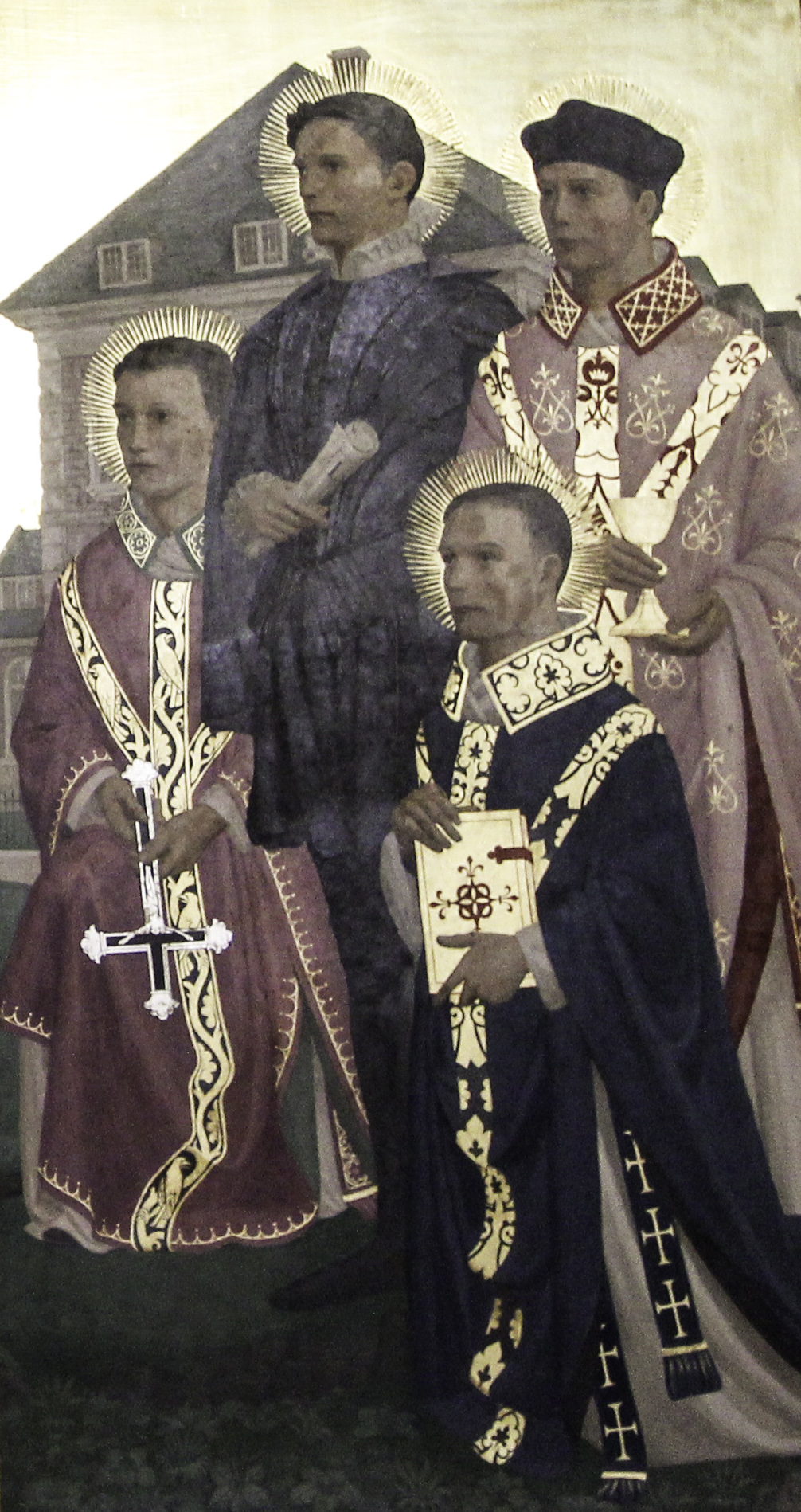
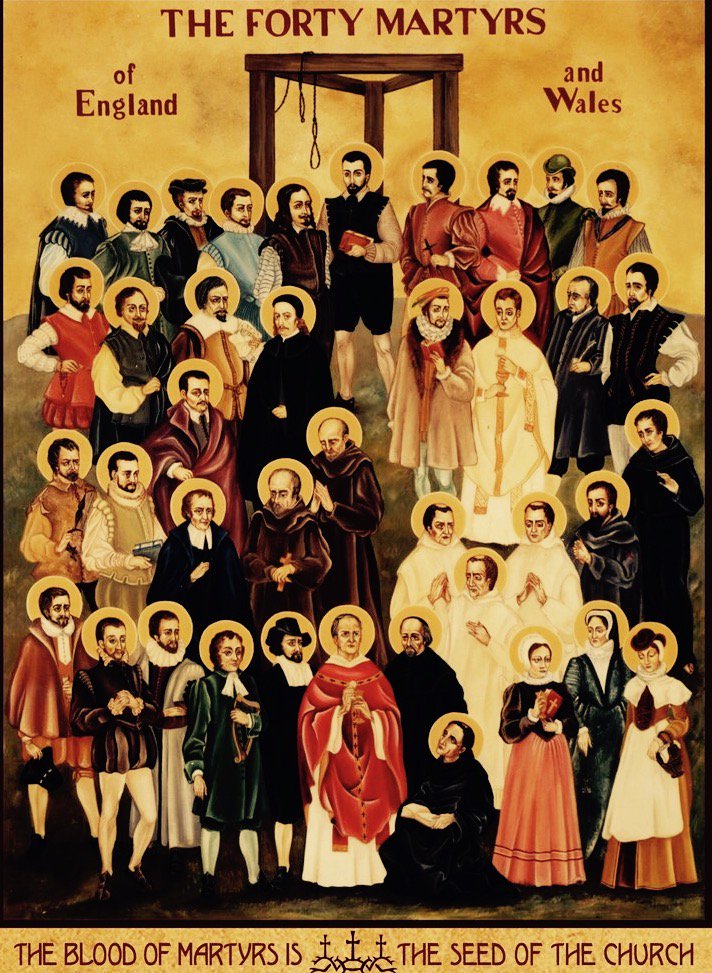
Fr John Nelson was Beatified by Pope Leo XIII on 9 December 1886, togetherWITH other Jesuit martyrs of England and Wales.
Outside of Palestine one of the most famous sanctuaries of the Mother of God in the Levant, is a Convent of Orthodox nuns, – Dair as-Sagura, located within the walls of an ancient fortress on a hill near Damascus. It is thought to be the site where Abel, the murdered brother of Cain, is buried and, is also the site of one of the world’s most ancient Monasteries.
Saidnaya, (or Saydnaya or Sednaya), is a city located in a mountainous region of Syria about 17 miles north of Damascus. The word Saidnaya means “Our Lady” and refers to a famous icon of the Virgin Mother of God that is still kept in the main Church. The origin of the Shrine of Our Lady of Saideneida goes back to a time long before the separation of the Orthodox Church from Old Rome. In fact, there is a tradition, that associates the Shrine to at least the time of the Roman Emperor Justinian I (died 565). According to this tradition, the Roman Emperor Justininian I was leading his army through the desert in modern day Syria. His army was suffering greatly from a lack of water and was near despair, when the Emperor saw a beautiful gazelle in the distance. Justinian chased the animal, which came to a rocky knoll where there was a spring of fresh water. He was preparing to shoot the animal when it suddenly transformed into an icon of the Mother of God which shone with a heavenly light. A voice could be heard to say, “No, thou shalt not kill me, Justinian but thou shalt build a Church for me here on this hill.” The light then faded and the beautiful figure disappeared. The water from the spring saved his army and Justinian told his commanders what he had seen. He ordered them to draw up the plans for the Church Our Lady had requested. The architects complained of insurmountable problems and the Blessed Virgin appeared to the Emperor in a dream and gave him the plan for the Church and convent, of which she herself would be the protectress. The project was completed on the Feast of Our Lady’s nativity.
Mosaic depiction of Mary ordering Justinian not to kill her but to build a church on the rock in the background, after having first appeared to him as a gazelle. The scroll she holds reads: “No, thou shalt not kill me, Justinian but thou shalt build a Church for me, here, on this rock.”
Once constructed, the convent became so renowned that it was second only to Jerusalem as a site of pilgrimage. The icon, called Our Lady of Saideneida and attributed to St Luke, was said to have been brought to its home in the year 870 from Jerusalem. The holy Abbess of the convent, a woman named Marina, spoke to a Greek pilgrim named Theodore who had stopped at the convent for rest on his pilgrimage to the Holy Land. Since he was on his way to Jerusalem, the holy abbess Marina asked Theodore to purchase an icon of the Blessed Virgin in the Holy City and bring it back to the convent. The hermit, once in Jerusalem, forgot about the Abbess’s request and began making his way home, when he was stopped by a voice which asked, “Have you not forgotten something in Jerusalem? What have you done in regard to the commission from the Abbess Marina?” Theodore turned back and purchased a beautiful icon of the Theotokos that he knew would be acceptable to the Abbess. His journey back to the convent was fraught with difficulties, as he and his companions were set upon by bandits and suffered the attack of wild beasts. The hermit turned to the Blessed Virgin in all these dangers, invoking her intercession as he prayed before the icon. Despite all the attacks and violence, all those in the caravan were miraculously saved from every danger through the aid of the Mother of God.
The hermit Theodore, was convinced of the powerful aid of the icon and was tempted to keep it for himself. He decided to return home by another route to avoid the Abbess and Saideneida completely. He paid to take ship but the vessel encountered such a furious storm that they were forced to turn back rather than be lost. Repenting of his error, he returned to the road he had taken and made his way back to Saideneida. Once back at the convent, the days passed and he found that he did not want to part with the icon. He lied to the Abbess, telling her he had not purchased the icon she had requested and planned to depart from the convent in secret rather than face the disappointed abbess again. Moving in the darkness the following morning, the hermit made his way soundlessly to the gate so as to begin his trek back to his homeland. As he attempted to pass through the convent gate, however, there was an invisible power that would not allow him to pass. It was as if he were trying to walk through a wall of solid stone, though nothing could be seen that barred his way. When he realised that he would not be able to leave the convent, he turned back and faced the Abbess, admitting to her that he had lied and had intended to keep the icon for himself. With tears of gratitude, the Abbess Marina gave glory to God and His Holy Mother and the icon found its home. That same icon, known as the Shaghoura, meaning “the illustrious,” is kept in a pilgrimage Shrine that is separate from the rest of the chapel. It is hidden in an ornate niche with silver doors. Childless couples especially and pilgrims seeking miracles of cures, still come seeking the Blessed Virgin’s intercession. The Shrine was formerly well known in the West, where from about 1200 it was popularised by the stories of miracles and miraculous cures. A German chronicler, during the ages of the crusades, wrote of his pilgrimage to the convent and spoke of the special properties of a miraculous, holy oil that was emitted from the icon. It was believed, that the oil could cure the sick and Templar knights, especially, would go to the Shrine to obtain the holy oil for their Churches. Interestingly, not only Catholics but also Moslems go to the Shrine as pilgrims. It is remembered, that a sultan, in thanksgiving for a prayer answered through the icon, set a lamp to burn perpetually before the image of Our Lady. The Middle Ages were certainly a time of faith and there were many images of Our Lord, the Blessed Virgin and various Saints that were produced for the edification of the people. Inflamed with a true zeal for the faith and anxious to give glory to God, there were many Shrines all over Europe, many of which are now long forgotten in our age when the world struggles mightily to extinguish the Light of Christ.
Bl Alois Andritzki St Anatolius of Salins St Ansgar OSB (801-865) “Apostle of the North”, Bishop Biography: https://anastpaul.com/2019/02/03/saint-of-the-day-3-february-saint-ansgar-osb-801-865-apostle-of-the-north/ St Anna the Prophetess St Berlinda of Meerbeke St Blasius of Armentarius St Blasius of Oreto St Caellainn St Celerinus of Carthage St Claudine Thevenet St Clerina of Carthage St Deodatus of Lagny St Eutichio St Evantius of Vienne St Felix of Africa St Felix of Lyons St Hadelin of Chelles Bl Helena Stollenwerk Bl Helinand of Pronleroy St Hippolytus of Africa St Ia of Cornwall St Ignatius of Africa Bl Iustus Takayama Ukon Blessed John Nelson SJ (1535-1578) Priest Martyr Bl John Zakoly St Laurentinus of Carthage St Laurentius of Carthage St Lawrence the Illuminator St Liafdag St Lupicinus of Lyon St Margaret of England Bl Marie Rivier St Oliver of Ancona St Philip of Vienne St Remedius of Gap St Sempronius of Africa St Tigrides St Werburga of Bardney St Werburga of Chester — Benedictine Martyrs: A collective memorial of all members of the Benedictine Order who have died as martyrs for the faith.
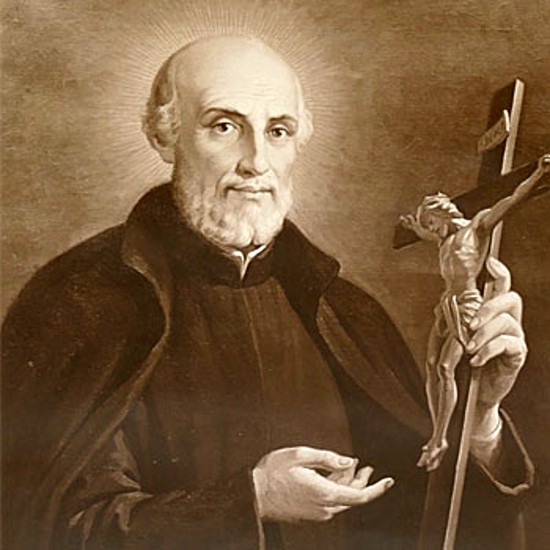
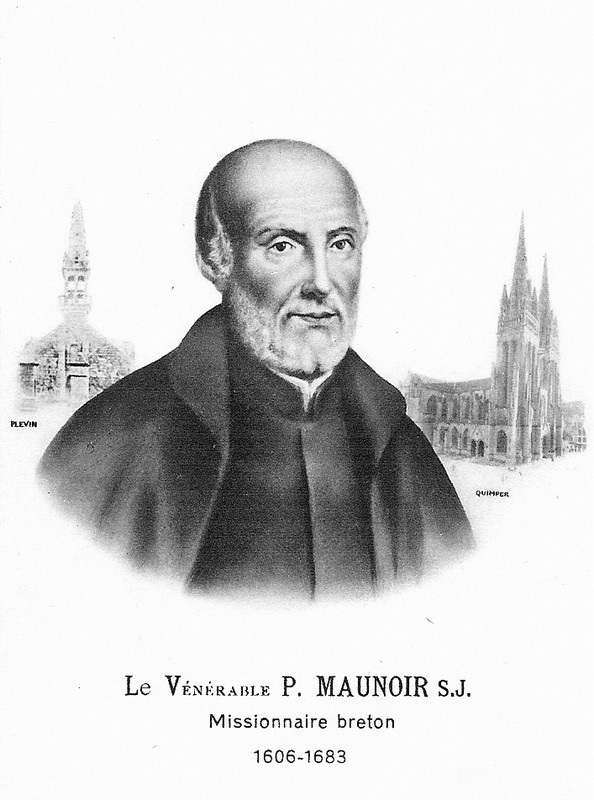
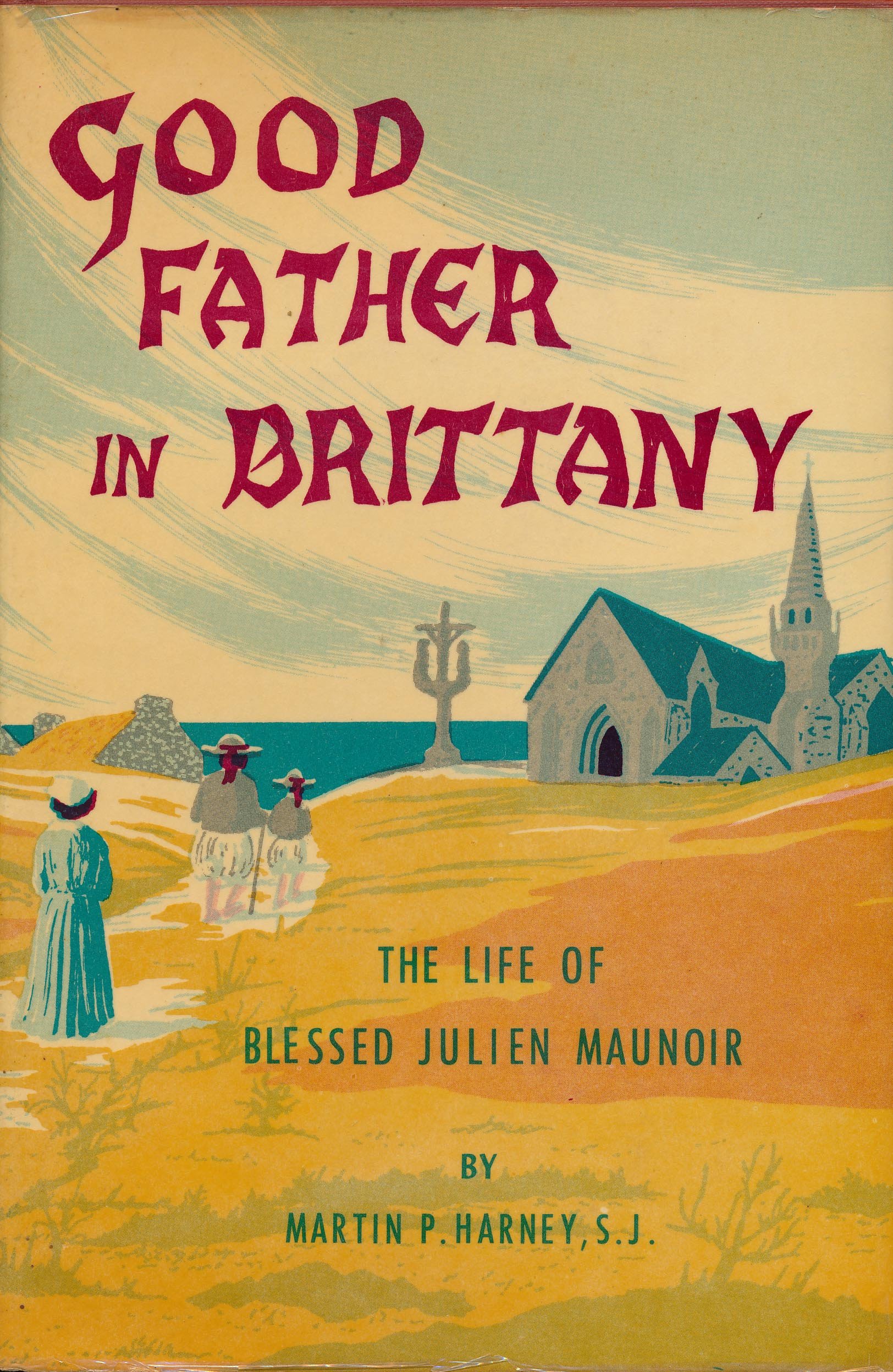
Saint of the Day – 28 January – Blessed Julian Maunoir SJ (1606-1683) Priest “The Apostle of Brittany,” “The Good Father of Brittany,” Missionary, Founder of the “Breton Missionaries” Apostolate. Born on 1 October 1606 at Saint-Georges-de-Reitembault, France and died on 8pm on 28 January 1683 at Plévin, France of natural causes. Also known as Julien. Additional Memorial – 2 July (Jesuits). Patronage – Brittany, France.
Julian was born in the tiny hamlet of Saint-George-de-Reintembault in 1606 and then studied at the Jesuit college in Rennes, where his teachers spoke often about the Jesuit Missionaries in China, Japan and Canada.
After he entered the Jesuits in 1625, he had several classmates who did become Missionaries and Saints and Martyrs, to foreign lands — including Saints Isaac Jogues and Gabriel Lalemant. But Maunoir’s path veered toward the people of Brittany after he learned to preach in the difficult Breton language during his period of formation. He is considered a noted orthographer of the Breton language, having completed a Breton grammar. He continued to preach in the hamlets of Brittany until he went to Tours to begin his theological studies, prior to Ordination.
The decision not to go to the foreign missions became clear, after he almost died when an infection in his arm became gangrenous. Maunoir was at the point of death, when he made a vow to devote his life to preaching to the Bretons if his health was restored. His rapid recovery showed God’s will and he was Ordained in 1637.
After finishing his studies, he returned to Quimper where he met Fr Michael Le Nobletz, an itinerant Missionary of Lower Brittany, who had retired because of ill health. The young Jesuit decided to follow the methods that Le Nobletz had used among the poor hardworking peasants and fisherman, the forgotten people of the peninsula and he was found to be uniquely suited for the difficult task of evangelising these impoverished people of Brittany in Northern France.
Accompanied by Father Pierre Bernard, Fr Julian visited cities and towns of the mainland as well as many offshore islands, some of which had not been visited by a Priest in many years. The two men gave missions that usually lasted four to five weeks and attempted to establish a good foundation in Christian doctrine. They used charts as visual aids showing the life of Christ, the seven deadly sins and key points of theology. They also used hymns that they had learned from Fr Nobletz but Maunoir also composed many new ones which the people learned during the missions. His methods managed to instil a deep spiritual meaning to what had sometimes become pious customs.
These missions were very successful. During the 43 years that Fr Maunoir travelled around Brittany, he gave approximately 400 missions. Often several Parishes came together for one mission, with up from 10,000 to 30,000 people taking part. The Parish Priests helped hear Confessions and teach Catechism and some of them asked permission of their Bishops to continue in the work with their Jesuit mentor. By 1683 there were almost 1,000 “Breton Missionaries” who carried on the work.
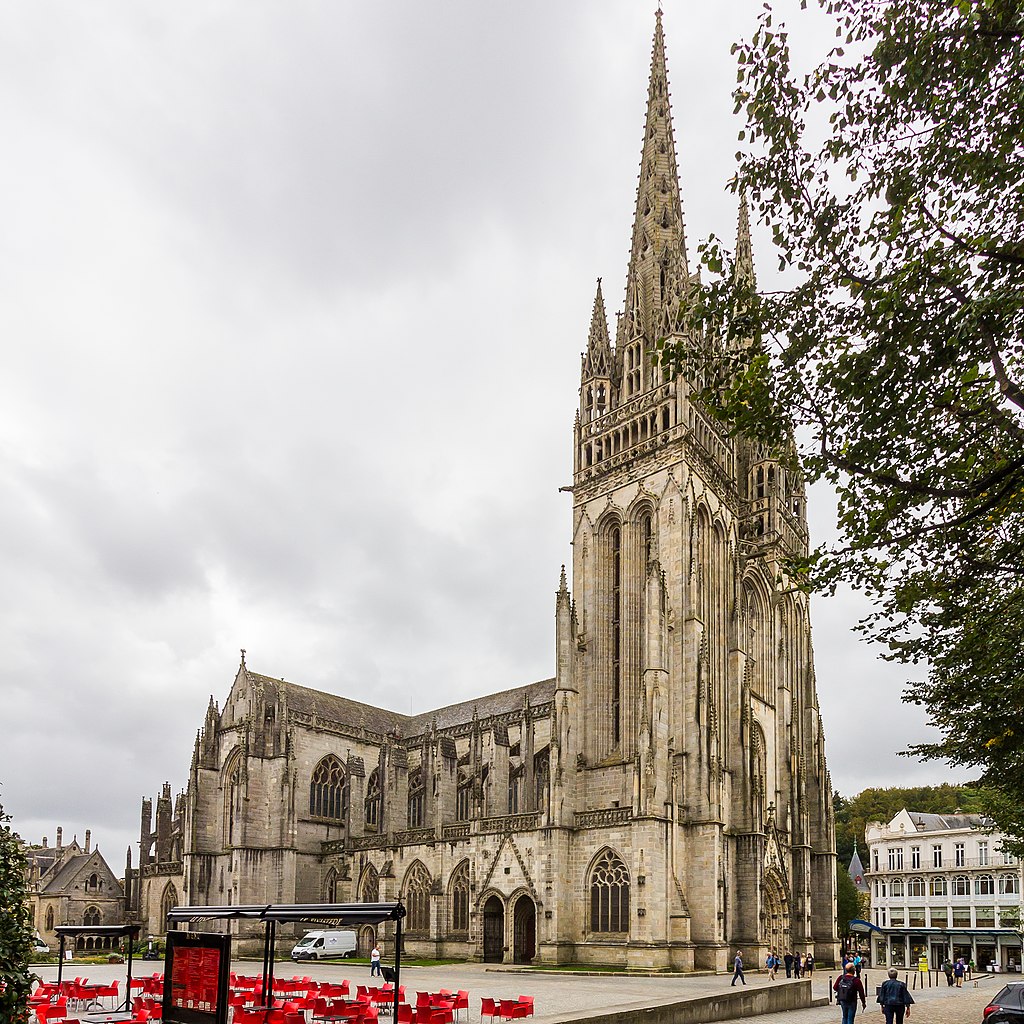
As he got older, Father Julian had to reduce the number of missions he gave. He was on his way to start a mission when he sensed that death was near. His Jesuit companions helped him to Plévin where he took to bed and contracted pneumonia. When he died several weeks later, the people demanded that he be buried in the Parish church there despite the Bishop’s desire that he be buried in the Quimper Cathedral. There is however a window in the Cathedral entitled “The Presentation of Fr Julian Maunoir to Monseigneur du Louët by Fr Michel Le Nobletz.”
The Presentation of Fr Julian Maunoir to Monseigneur du Louët by Fr Michel Le Nobletz.
Cathédrale Saint-Corentin de Quimper
On 20 May 1951 the Good Father Julian, Apostle of Brittany, was Beatified by Pope Pius XII.
St Aemilian of Trebi St Agatha Lin Bl Amadeus of Lausanne St Antimus of Brantôme St Archebran Bl Bartolomé Aiutamicristo St Brigid of Picardy St Callinicus St Cannera of Inis Cathaig Bl Charlemagne (a decree of Canonisation was issued by the anti-pope Paschal III but this was never ratified by valid authority.) St Constantly St Flavian of Civita Vecchia St Glastian of Kinglassie Bl James the Almsgiver St James the Hermit St Jerome Lu St John of Reomay St Joseph Freinademetz SVD (1852-1908) St Joseph’s Life: https://anastpaul.com/2020/01/28/saint-of-the-day-28-january-saint-joseph-freinademetz-svd-1852-1908-fu-shenfu-lucky-priest/
Blessed Julian Maunoir SJ (1606-1683) Priest “The Apostle of Brittany” St Julian of Cuenca St Lawrence Wang St Leucius of Apollonia Bl María Luisa Montesinos Orduña St Maura of Picardy Bl Mosè Tovini Bl Odo of Beauvais Bl Olympia Bida St Palladius of Antioch St Paulinus of Aquileia Bl Peter Won Si-jang St Richard of Vaucelles St Thyrsus of Apollonia — Martyrs of Alexandria: A group of 4th-century parishioners in Alexandria, Egypt. During the celebration of Mass one day an Arian officer named Syrianus led a troop of soldiers into their church and proceded to murder all the orthodox Christians in the place. 356 in Alexandria, Egypt.
Quote of the Day – 7 January – The Second Day within the Octave of Epiphany
Poem “The Epiphany”
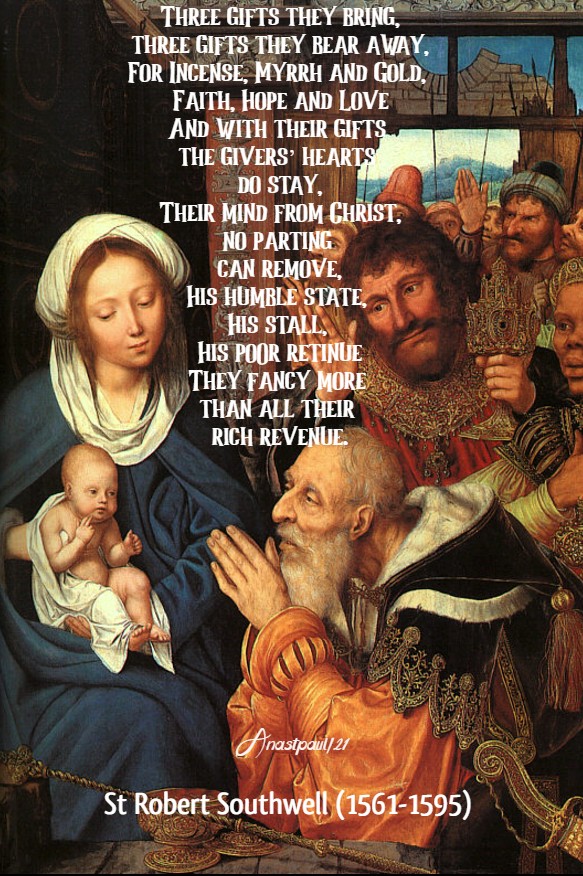
To blaze the rising of this glorious sun A glittering star appeareth in the east Whose sight to pilgrim toil three sages won To seek the light they long had in request, And by this star to nobler star they pace Whose arms did their desired sun embrace.
Still was the sky wherein these planets shined And want the cloud that did eclipse their rays, Yet through this cloud their passage they did find, And pierced these sages’ hearts by secret ways, Which made them know, the Ruler of the skies By Infant tongue and looks of babish eyes.
Heaven at her light, earth blusheth at her pride And of their pomp these peers ashamed be, Their crowns, their robes, their train they set aside When God’s poor cottage, clouts and crew they see, All glorious things their glory now despise Since God contempt doth more than glory prize.
Three gifts they bring, three gifts they bear away, For Incense, Myrrh and Gold, Faith, Hope and Love And with their gifts the givers’ hearts do stay, Their mind from Christ, no parting can remove, His humble state, His stall, His poor retinue They fancy more than all their rich revenue.
One Minute Reflection – 3 January – Feast of the Most Holy Name of Jesus, Readings: Epistle Acts 4:8-12, Psalm 105:47, Isa 63:16, Ps 144:21, Gospel Luke 2:21-24
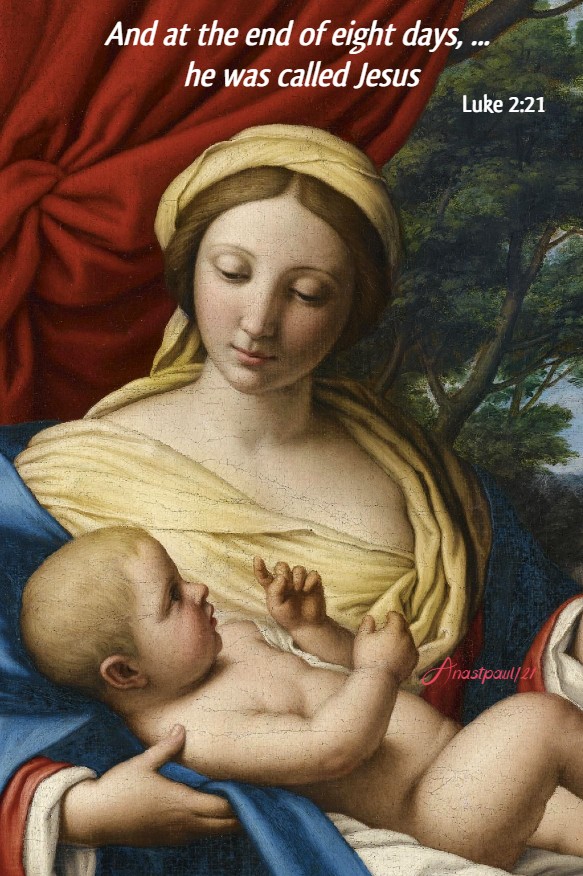
“And at the end of eight days, when he was circumcised, he was called Jesus”…Luke 2:21
REFLECTION – “The Name stands as a complete summary and description of our Lord’s character and office and it is under this aspect that it has been regarded by thousands of Saints, whose hearts have melted at its mere sound. To them Jesus is their God, Jesus is their King, Jesus is their Redeemer, Jesus is their Mediator, Jesus is their Saviour, Jesus is their great Priest, Jesus is their Intercessor, Jesus is the Captain under Whom they fight, Jesus is the Leader Whom they follow, Jesus is their Teacher, Jesus is the Giver of their law, Jesus is the Spouse and Shepherd of their souls, Jesus is their Light, Jesus is their Life, Jesus is the Judge before Whom they rejoice to think, that they must one day stand, Jesus is their final and eternal Reward, for which alone they live.
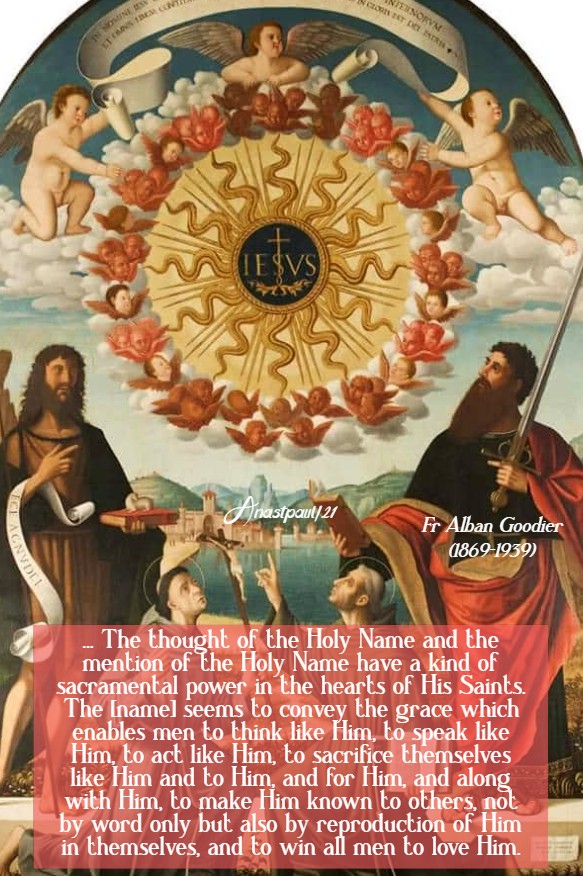
But He is also to them the Mirror of all the most glorious and winning virtues. He is, and His Name tells them that He is, unbounded Charity, infinite Mercy, extremest Kindness, deepest Humility, most devoted Piety, transparent Simplicity, uttermost Poverty, Chastity without a stain. It is the prerogative of love to transform those who love into the likeness of Him Whom they love and as the mere name of one who is loved cannot sound in the ear or be thought of in the mind, without adding to the love which is already there, so the thought of the Holy Name and the mention of the Holy Name have a kind of sacramental power in the hearts of His Saints. The [name] seems to convey the grace which enables men to think like Him, to speak like Him, to act like Him, to sacrifice themselves like Him and to Him, and for Him, and along with Him, to make Him known to others, not by word only but also by reproduction of Him in themselves, and to win all men to love Him.” – Fr Alban Goodier SJ (1869-1939) Archbishop – Excerpted from The Prince of Peace
PRAYER – O God, who founded the salvation of the human race on the Incarnation of Your Word, give Your people the mercy they implore, so that all may know there is no other Name to be invoked but the Name of Your Only Begotten Son. Who lives and reigns with You in the unity of the Holy Spirit, one God, forever and ever. Amen
St Pope Antherus (Died 235) Martyr Bl Arnold Wala St Athanasius of Cilicia St Bertilia of Mareuil St Bertille of Thuringia St Blitmund of Bobbio St Constant of Gap St Cyrinus of Cyzicus St Daniel Himmerod the Younger Bl Daniel of Padua St Eustadius St Finlugh St Fintan of Doon St Florentius of Vienne St Florentius of Vienne the Martyr St Genevieve (c 419-c 502) Biography: https://anastpaul.com/2020/01/03/saint-of-the-day-3-january-saint-genevieve-c-419-c-502/
Bl Gerard Cagnoli St Gordius of Cappadocia St Imbenia St Kuriakose Elias Chavara St Lucian of Lentini St Melorius St Peter of Palestine St Primus of Cyzicus St Salvator of Belluno St Theogenes of Cyzicus St Theonas St Theopemptus of Nicomedia St Wenog Bl Bl William Vives St Zosimus of Cilicia — Martyrs of Africa – 12 saints: A group of Christians martyred together in Africa, date unknown, exact location unknown. We know nothing more than their names – Acuta, Candidus, Constantius, Eugenia, Firmus, Hilarinus, Lucida, Martial, Poenica, Possessor, Rogatianus and Statutianus.
Martyrs of Tomi – 7 saints: A group of Christians martyred together, date unknown. We know nothing more than their names – Claudon, Diogenius, Eugene, Eugentus, Pinna, Rhodes and Rhodo. They were martyred at Tomi, Exinius Pontus, Moesia (modern Constanta, Romania).
Our Morning Offering – 30 December – The Sixth Day of the Octave of Christmas
Who lives in Love By St Robert Southwell SJ (1561-1595) Martyr
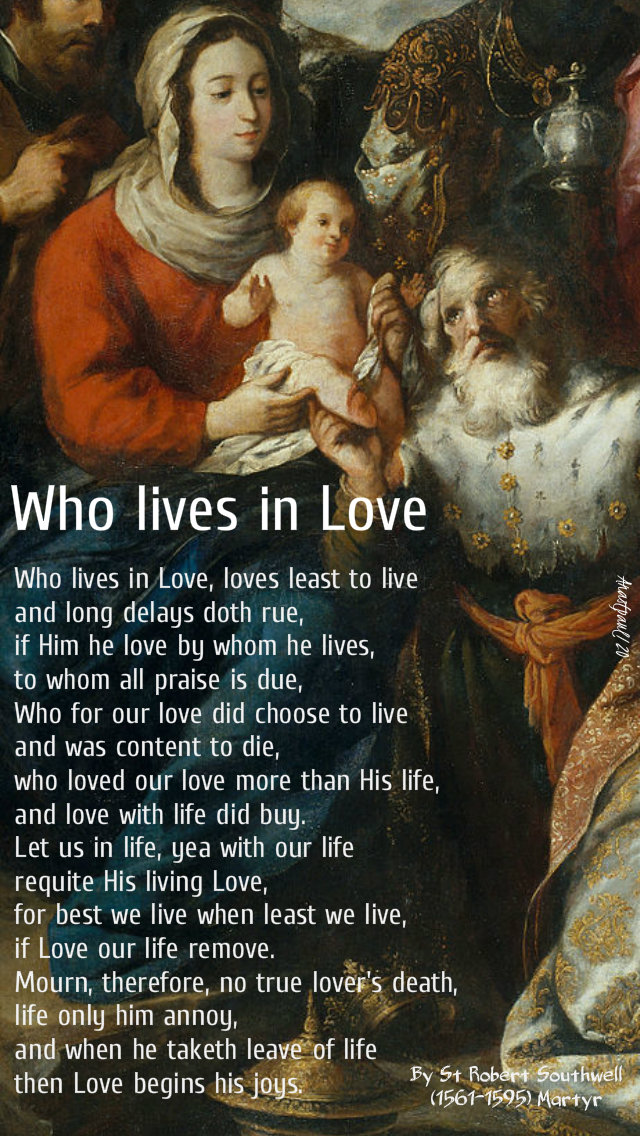
Who lives in Love, loves least to live and long delays doth rue, if Him he love by whom he lives, to whom all praise is due, Who for our love did choose to live and was content to die, who loved our love more than His life, and love with life did buy. Let us in life, yea with our life requite His living love, for best we live when least we live, if Love our life remove. Mourn, therefore, no true lover’s death, life only him annoy, and when he taketh leave of life then Love begins his joys.
Quote/s of the Day – 21 December – O Oriens/O Radiant Dawn – Weekdays of Advent and The Memorial of St Peter Canisius (1521-1597) Doctor of the Church
“Better that only a few Catholics should be left, staunch and sincere in their religion, than that they should, remaining many, desire as it were, to be in collusion with the Church’s enemies and in conformity with the open foes of our faith.”
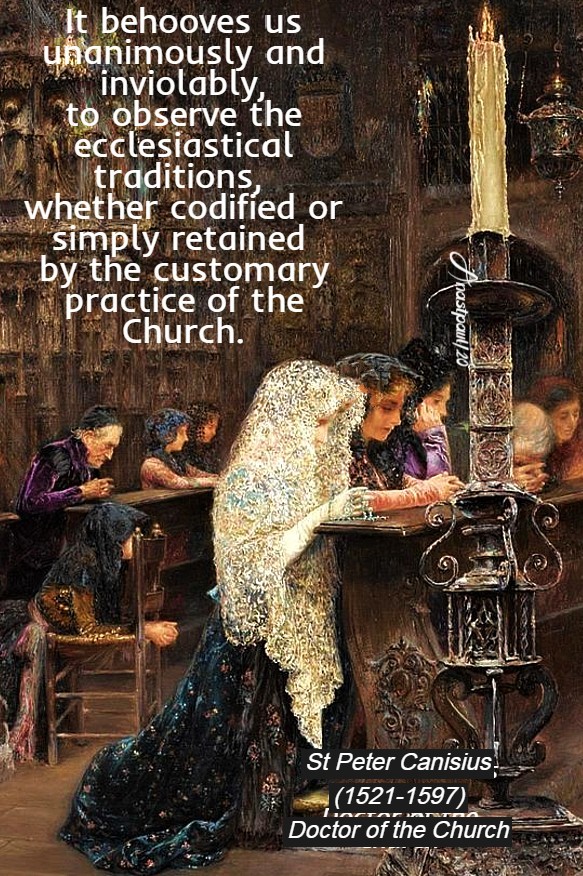
“It behooves us unanimously and inviolably, to observe the ecclesiastical traditions, whether codified or simply retained by the customary practice of the Church.”
“We ought to instruct with meekness those whom heresy has made bitter and suspicious and has estranged from orthodox Catholics, … Thus, by whole-hearted charity and goodwill, we may win them over to us in the Lord.”
St Peter Canisius (1521-1597) Doctor of the Church
Our Morning Offering – 21 December and the Memorial of St Peter Canisius (1521-1397) Doctor of the Church
Hail Mary, the Angelic Salutation
The Hail Mary/Ave Maria
Hail Mary, full of grace, the Lord is with thee. Blessed art thou among women, and blessed is the fruit of thy womb, Jesus. Holy Mary, Mother of God, pray for us sinners, now and at the hour of our death. Amen.
Áve María, grátia pléna, Dóminus técum. Benedícta tū in muliéribus, et benedíctus frúctus véntris túi, Iésus. Sáncta María, Máter Déi, óra pro nóbis peccatóribus, nunc et in hóra mórtis nóstrae. Ámen.
On today’s Memorial of St Peter Canisius, Catholics may wish to thank this Doctor of the Church for giving us the second half of the Hail Mary prayer.
This 16th-century saint, known as the second Apostle of Germany, followed in the giant footsteps of St Boniface, who evangelised Germany a thousand years earlier. He was also active at the Council of Trent and wrote much on the Blessed Virgin Mary.
The first half of the Hail Mary, of course, comes from Scripture. What many Catholics don’t know, is that the second half of this Catholic prayer is due to the intervention of St Peter Canisius at the Council of Trent. St Peter began adding on to the scriptural part of the Hail Mary, the “Holy Mary Mother of God pray for us sinners, now and at the hour of our death.” It was Trent that officially accepted this addition to the prayer and included it in their famous Catechism of the Council of Trent in 1566.
Bl Adrian of Dalmatia St Anastasius II of Antioch (Died 609) Bishop and Martyr St Anrê Tran An Dung St Baudacarius of Bobbio St Beornwald of Bampton Bl Bezela of Göda Bl Daniel of the Annunciation St Dioscorus Blessed Dominic Spadafora OP (1450-1521) Biography: https://anastpaul.com/2019/12/21/saint-of-the-day-21-december-blessed-dominic-spadafora-op-1450-1521/ St Festus of Tuscany St Glycerius of Nicomedia St James of Valencia St John of Tuscany St John Vincent St Micah the Prophet St Phêrô Truong Van Thi St Severinus of Trèves Bl Sibrand of Marigård St Themistocles of Lycia
Show forth Your power Lord and come. Come in Your great strength and save us.
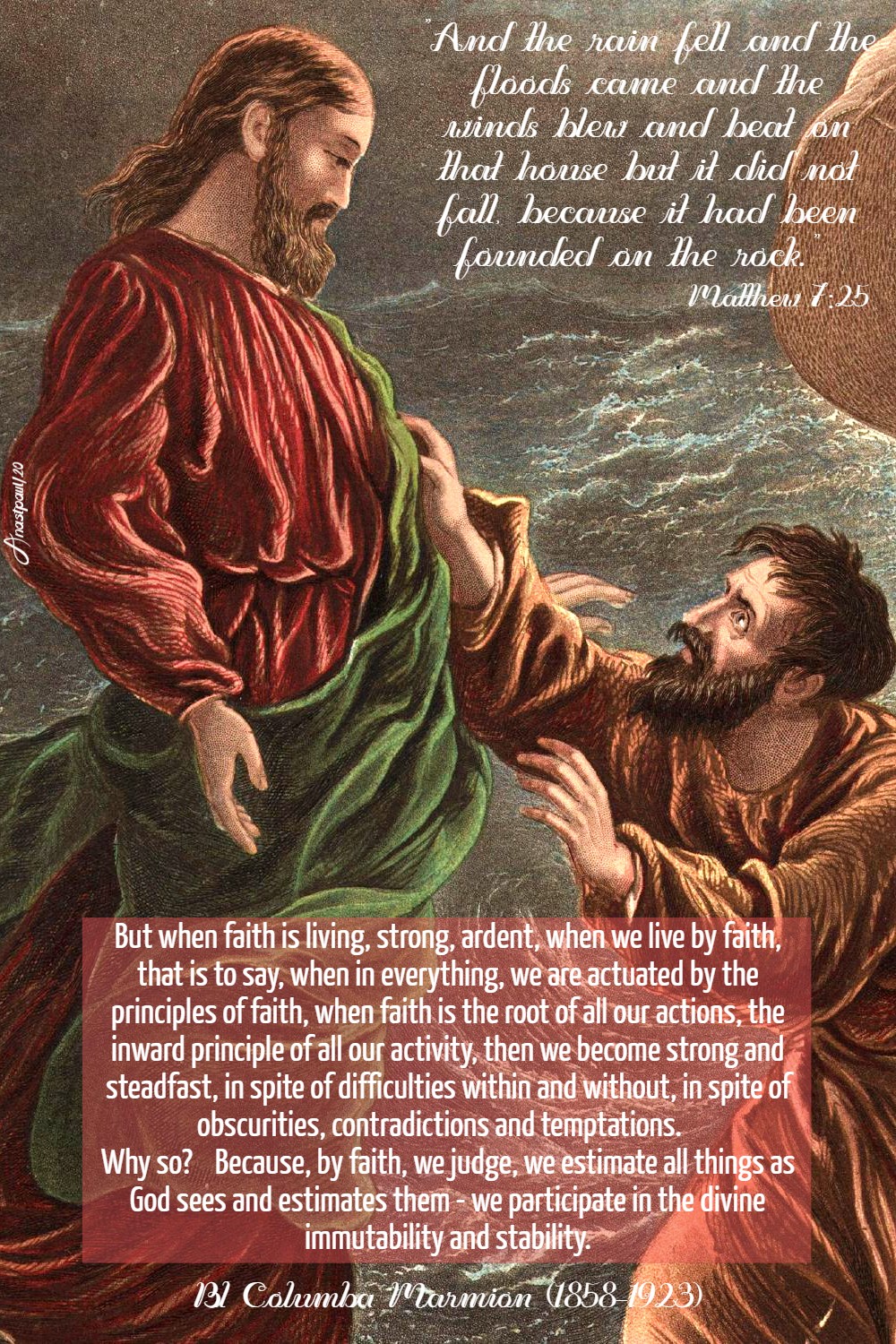
“Everyone then who hears these words of mine and does them will be like a wise man who built his house on the rock. And the rain fell and the floods came and the winds blew and beat on that house but it did not fall, because it had been founded on the rock.” … Matthew 7:24-25
REFLECTION – “The just, (that is to say those who in baptism have put on the new man created in justice) live, insofar as they are just, by faith, by the light that the sacrament of illumination brings to them. The more they live by faith, the more they realise in themselves, the perfection of His divine adoption. Notice this expression carefully: ‘EX fide,’ the exact meaning of this is that faith ought to be the root of all our actions, of all our life. There are souls who live with faith (CUM fide). They have faith and one cannot deny that they practise it. But it is only on certain occasions … that they remember their faith to any purpose. … But when faith is living, strong, ardent, when we live by faith, that is to say, when in everything, we are actuated by the principles of faith, when faith is the root of all our actions, the inward principle of all our activity, then we become strong and steadfast, in spite of difficulties within and without, in spite of obscurities, contradictions and temptations. Why so? Because, by faith, we judge, we estimate all things as God sees and estimates them – we participate in the divine immutability and stability. Is not this what our Lord said? “Everyone who listens to these words of mine and acts on them” – that is to live by faith – “will be like a wise man who built his house on rock. The rain fell, the floods came, and the winds blew and buffeted the house. But it did not collapse.” For Jesus Christ immediately adds: “it had been set solidly on rock” (Mt 7:24-25).” … Bl Columba Marmion (1858-1923) Abbot – Our Faith, the Victory over the World (Christ, the Ideal of the Monk)
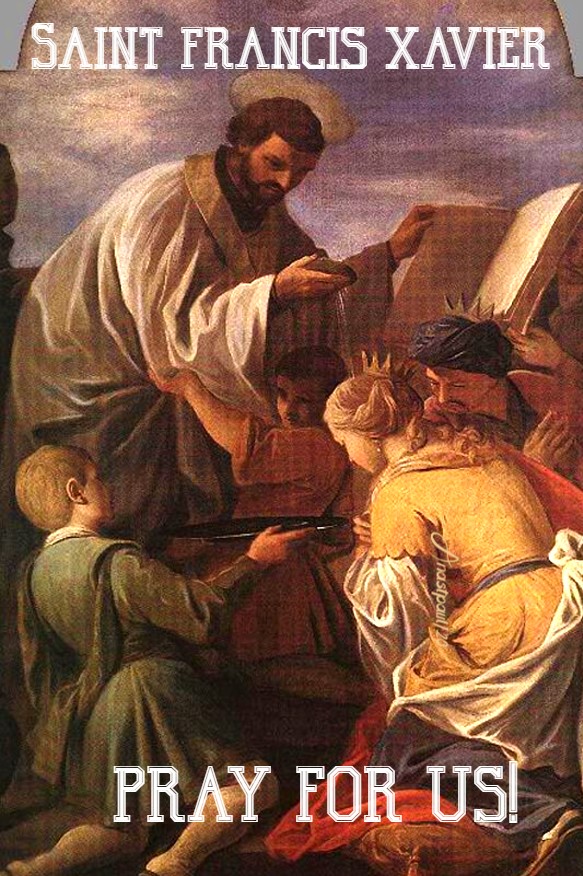
PRAYER – God our Father, You open the gates of the kingdom of heaven to those who are born again of water and the Holy Spirit. Increase the grace You have given, so that the people who have been purified from all sin, may not forfeit the promised blessing of Your love. Grant that we may ever keep Your Son, the Lord Jesus Christ, before our eyes and do all in Him and through Him and for Him. And may the prayers of Your great missioner, St Francis Xavier, he who lived Your words, strengthen our faith.
Our Morning Offering – 3 December – Thursday of the First week of Advent and The Memorial of St Francis Xavier SJ (1506-1552)
I Love Thee, God, I Love Thee By St Francis Xavier Translated by Gerard Manley Hopkins SJ (1844-1889)
I love Thee, God, I love Thee— Not out of hope for heaven for me Nor fearing not to love and be In the everlasting burning. Thou, my Jesus, after me Didst reach Thine arms out dying, For my sake suffered nails and lance, Mocked and marred countenance, Sorrows passing number, Sweat and care and cumber, Yea and death and this for me, And Thou could see me sinning. Then I, why should not I love Thee, Jesu so much in love with me? Not for heaven’s sake, not to be Out of hell by loving Thee, Not for any gains I see, But just the way that Thou didst me I do love and will love Thee. What must I love Thee, Lord, for then? For being my king and God. Amen
St Abbo of Auxerre St Abran St Agapius St Agricola of Pannonia St Alvaro González López St Anthemius of Poitiers St Attalia of Strasbourg Bl Bernard of Toulouse OP Martyr St Birinus of Dorchester St Cassian of Tangiers St Claudius of Africa St Claudius the Martyr St Crispin of Africa St Edward Coleman St Eloque of Lagny St Emma of Bremen (c 975–1038) St Ethernan St Francisco Delgado González St Francisco Fernández Escosura St Hilaria the Martyr St Jason the Martyr Blessed Johann Nepomuk von Tschiderer (1777-1860) His Life: https://anastpaul.com/2019/12/03/saint-of-the-day-3-december-blessed-johann-nepomuk-von-tschiderer-1777-1860/ St John of Africa St Juan Bautista Ferris Llopis St Julián Heredia Zubia St Lucius St Lucy the Chaste St Magina of Africa St Mamas St Manuel Santiago y Santiago St Marcos García Rodríguez St Maurus the Martyr St Seleucus St Stephen of Africa St Theodore of Alexandria St Theodulus of Edessa St Valeriano Rodríguez García St Veranus Zephaniah the Prophet
Martyrs of Nicomedia: Christians martyred together in the persecutions of Diocletian – Ambicus, Julius and Victor. c 303 in Nicomedia, Bithynia (modern Izmit, Turkey).
Martyred in the Spanish Civil War: Thousands of people were murdered in the anti-Catholic persecutions of the Spanish Civil War from 1934 to 1939. • Blessed Alvaro González López • Blessed Francisco Delgado González • Blessed Francisco Fernández Escosura • Blessed Juan Bautista Ferris Llopis • Blessed Julián Heredia Zubia • Blessed Manuel Santiago y Santiago • Blessed Marcos García Rodríguez • Blessed Valeriano Rodríguez García
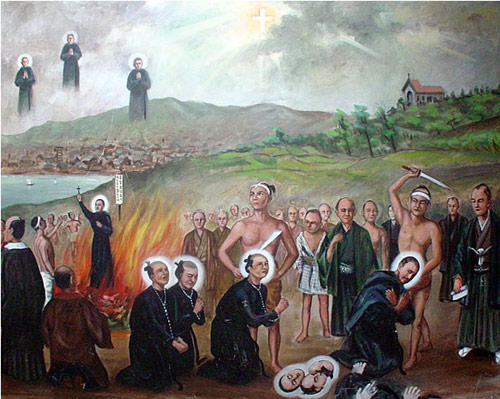
Saint of the Day – 1 November – Blessed Peter Paul Navarra SJ (1560-1622) Priest, Martyr, Missionary, Writer – born as Pietro Paolo in 1560 at Laino Borgo, Cosenza, Italy and died by being burned alive on 1 November 1622 at Ximabara, Nagasaki, Japan. As he was burning he prayed aloud the Litany of Our Lady. He is also known as Paul Navarro and Pietro Paolo Navarro. Additional Feast with the 205 Martyrs of Japan is 10 September.
Peter Paul Navarro was born in the small town of Laino, Basilicata in southern Italy. In 1579 when he was eighteen, he entered the Jesuit novitiate in Nola and requested to be sent to the Japanese mission. His request was granted and in 1584 he was sent to Goa, India for his studies and was Ordained in 1585. A year later in August, 1586 he arrived in Hirado, western Japan. There he spent a year studying Japanese and served in mission posts in Shikoku and Honshu. Fr Navarro knew that to be successful in evangelising the Japanese, he himself, must become one of them and this motivated him to speak and write fluently in the language. To prove to the Japanese that they did not have to relinquish their customs and cultural traditions to become Christians, he dressed like them, ate their food and used their type of furniture.
Fr Navarro went to northern Kyushu which became the centre of his missionary activity after he was expelled from his Hirado missions because of persecutions against Christians. Later, in 1614 when all foreign missionaries from Japan were expelled by the edict of Shogun Iyeyasu, Fr Navarro was one of the two dozen Jesuits who went underground rather than leave the country, as more than eighty other Priests had to. For the next seven years, he went about his priestly duties in Shimabara, western Kyushu, disguised as a beggar, wood seller, tradesman or farmer. In these disguises, Fr Navarro was able to enter the homes of Christians to celebrate Mass or administer the Sacraments at night to avoid being captured, since he was being hunted. During this period he wrote in Japanese, “An apology of the Christian Faith against the Calumnies of the Pagans.”
Peter Onizuka and Dennis Fujishima were the two lay Catechists helping Fr Navarro during his final years in Shimabara. Peter was a teenager whose father housed fugitive Priests. Dennis was in his forties and had been a Christian as a young man. Both of them were with Fr Navarro and his servant, Clement Yuemon, after Christmas in 1621 when they were all captured by priest-hunters. They were brought before the daimyo of Arima who treated the captives with great respect. The daimyo detained them in a house owned by a Christian where they were cared for by Christians and he even allowed Fr Navarro to celebrate Mass. He also came frequently to converse with Fr Navarro. The daimyo was prepared to release them if they could renounce Christianity, an offer which they turned down. The daimyo wanted to transfer them secretly to Macao where they could be set free. But before he could do anything, he received orders from the shogun that the three were to die by slow fire.
When Fr Navarro was informed of his impending death, he was happy that his prayers had been answered and wrote to his Jesuit friend, Fr John Baptist Zola, saying: “I give infinite thanks to the Lord and I ask you to thank him with me. I also ask your prayers for perseverance until my final breath.”
On the day of execution, 1 November, Fr Navarro celebrated the Mass of All Saints and the two Catechists, Peter and Dennis, who had asked to enter the Society, pronounced their Jesuit vows during that final Mass. While waiting for the executioners, Fr Navarro wrote his last letter to Fr Matthew de Couros: “For many years I have prayed for this great grace from God but always with some fear, that I would not be heard because of my many sins. The Father of mercies now gives me this long-desired grace. May he be blessed forever.”
In the afternoon the four prisoners escorted by fifty soldiers and a large crowd of Christian,s made their way to the place of execution, with Fr Navarro chanting the Litany of Our Lady and his companions joyfully sang the responses. As they approached the shore, the Martyrs saw the standing stakes awaiting them. The daimyo had instructed the soldiers to place the wood around the stakes so as not to prolong the prisoners’ suffering.
The three Jesuits, Frs Peter Paul Navarro, Peter Onizuka and Dennis Fujishima and their faithful servant, Clement Yeumon, alight in flames, gave final heroic witness of their great love for God.
They were beatified by Blessed Pope Pius IX together with another 201 Martyrs of Japan on 7 May 1867.
All Saints Day – 1 November (Solemnity) – (a Holy Day of Obligation) Instituted to honour all the saints, known and unknown. It owes its origin in the Western Church to the dedication of the Roman Pantheon in honour of the Blessed Virgin Mary and all the Martyrs by Pope Saint Boniface IV in 609, the anniversary of which was celebrated at Rome on 13 May. Pope Saint Gregory III consecrated a Chapel in the Vatican Basilica in honour of All Saints, designating 1 November as their feast. Pope Gregory IV extended it’s observance to the whole Church. It has a vigil and octave and is a holy day of obligation – the eve is popularly celebrated as Hallowe’en. Patronage – Arzignano, Italy.
St Amabilis of Auvergne St Austremonius St Benignus of Dijon St Cadfan St Caesarius of Africa St Caesarius of Damascus St Ceitho St Cledwyn of Wales Bl Clemens Kyuemon St Cyrenia of Tarsus St Dacius of Damascus St Deborah the Prophetess St Dingad Bl Dionysius Fugixima St Floribert of Ghent St Gal of Clermont St Genesius of Lyon St Germanus of Montfort St Harold the King St James of Persia St Jerome Hermosilla St John of Persia St Julian of Africa St Juliana of Tarsus St Lluís Estruch Vives St Marcel of Paris St Mary the Slave St Mathurin St Meigan St Nichole St Pabiali of Wales St Pere Josep Almató Ribera Auras St Peter Absalon Blessed Peter Paul Navarra SJ (1560-1622) Priest and Martyr Bl Petrus Onizuka Sadayu St Rachel the Matriarch St Ruth the Matriarch St Salaun of Leseven St Severinus of Tivoli St Valentin Faustino Berri Ochoa St Vigor of Bayeux
Our Morning Offering -27 October – Tuesday of the Thirtieth week in Ordinary Time
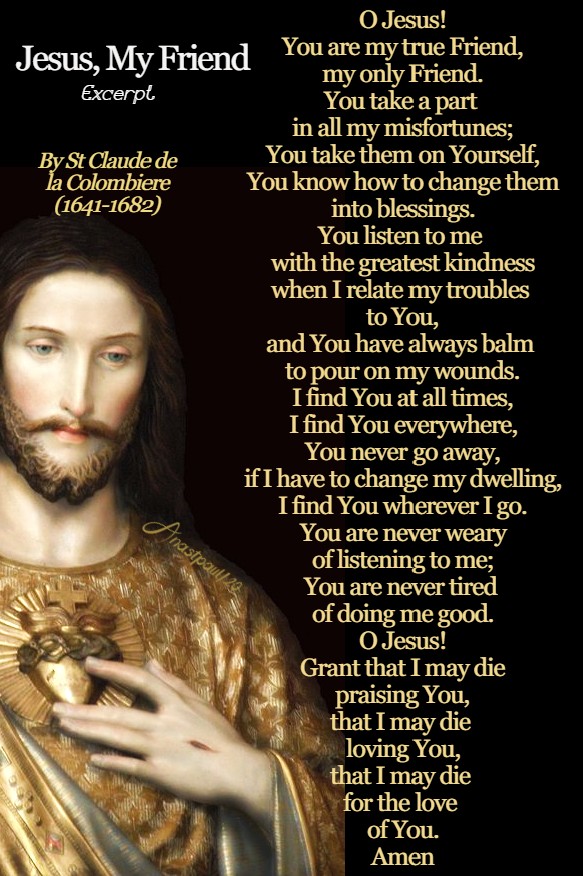
Jesus, My Friend By St Claude de la Colombiere (1641-1682) Excerpt
O Jesus! You are my true Friend, my only Friend. You take a part in all my misfortunes; You take them on Yourself, You know how to change them into blessings. You listen to me with the greatest kindness when I relate my troubles to You, and You have always balm to pour on my wounds. I find You at all times, I find You everywhere, You never go away, if I have to change my dwelling, I find You wherever I go. You are never weary of listening to me; You are never tired of doing me good. O Jesus! Grant that I may die praising You, that I may die loving You, that I may die for the love of You. Amen
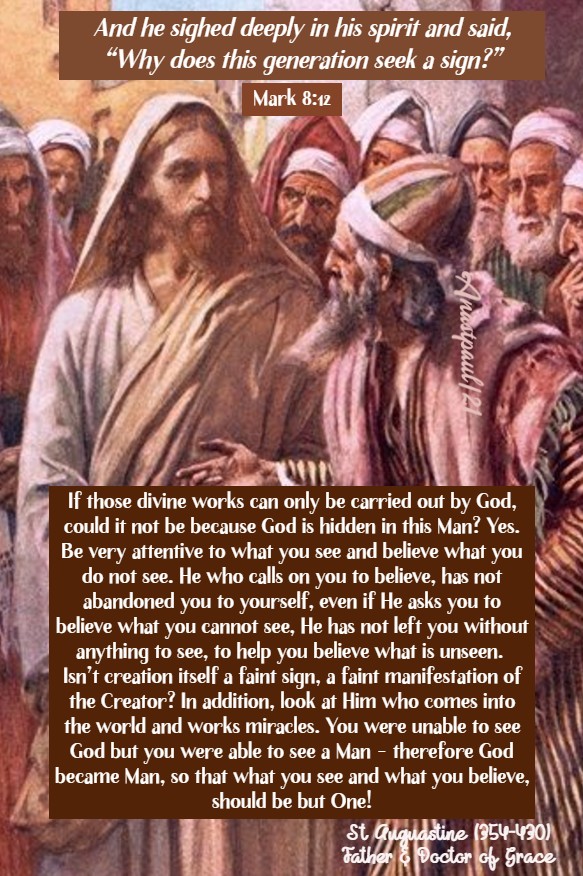
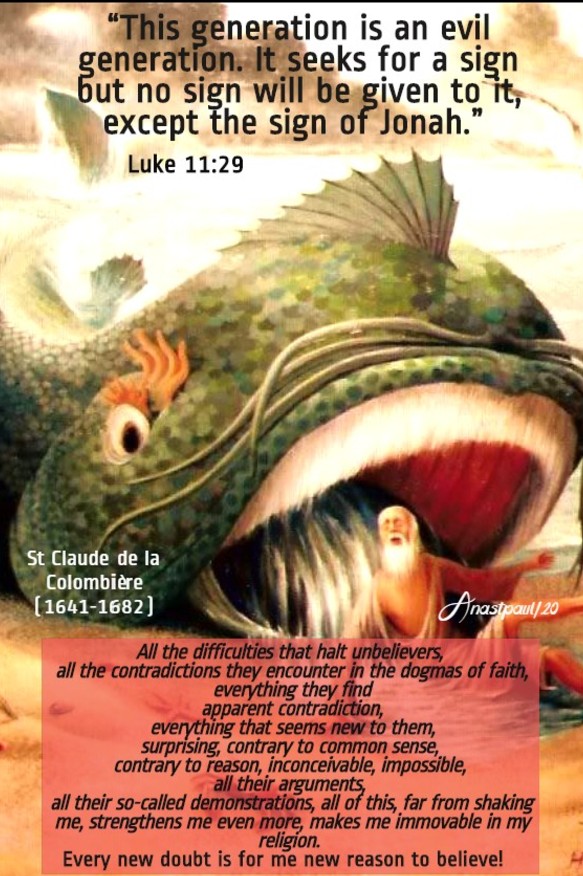
“This generation is an evil generation. It seeks for a sign but no sign will be given to it, except the sign of Jonah.” … Luke 11:29
REFLECTION – “Bad christians lack faith and do not deny it but they claim to be excused, in that they have no reasons for believing. Because of this there is nothing as common as this speech in the mouths of many people: “If I had witnessed a miracle I should be a saint!”“Evil and unfaithful generation! It seeks a sign!” (Mt 12:39). The wicked look for signs.
What is even more remarkable about this, is that, even though they have seen many taking place daily before their eyes, even though they are, so to speak, entirely surrounded, they never stop looking for more like the scribes and Pharisees; they would like to see them in heaven when they have seen them on earth. But neither the dead raised up during the life of the Saviour, nor the eclipse of the sun at death, make them believers; their envy becomes stronger, their hatred more malicious; each goes as far as raging, yet their unbelief is not healed by it. It used to be like this regarding those who, living badly, wait for miracles in order to believe: “They will not be persuaded if someone should rise from the dead” (Lk 16:31). (…)
All the difficulties that halt unbelievers, all the contradictions they encounter in the dogmas of faith, everything they find apparent contradiction, everything that seems new to them, surprising, contrary to common sense, contrary to reason, inconceivable, impossible, all their arguments, all their so-called demonstrations, all of this, far from shaking me, strengthens me even more, makes me immovable in my religion. (…) Every new doubt is for me, new reason to believe.” … St Claude de la Colombière (1641-1682) “Apostle of Sacred Heart” – Christian Reflections
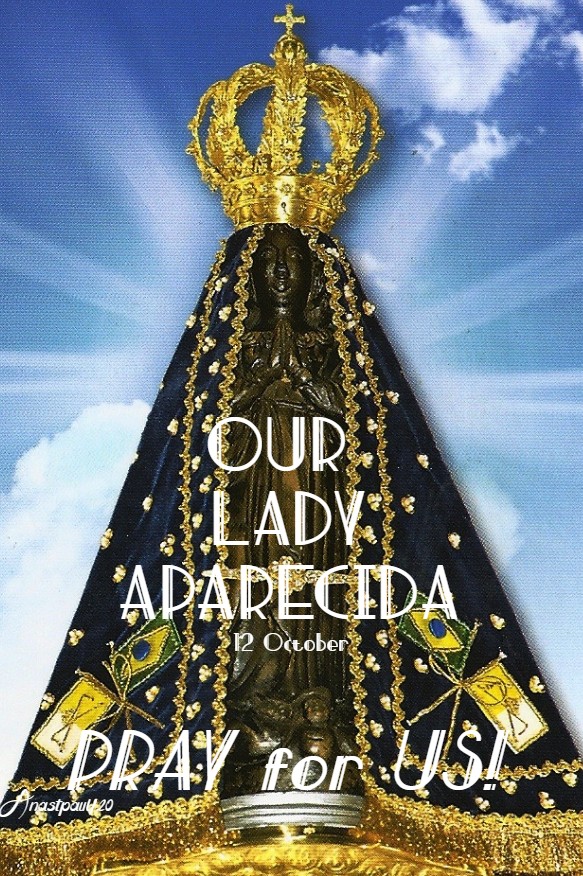
PRAYER – “Dear Lord! It is just when I am in the world that I have most need of You because You know it is full of snares that the devil has set for me. You must hold my hand, dear Lord, if You will not abandon me. A little of the world is not bad for me; it is even good, for it teaches me how small it is and I feel the greater happiness when I come back to You. But that I may surely do so, You must only loose Your hold a little, that it may not try me too far, You must not entirely leave hold. Do You see dear Lord? I wish to clasp Your hand – do not refuse me!” (I Wish to Clasp Your Hand – Do Not Refuse Me! – Prayer of Eugene de Ferronays)Our Lady Aparecida, Pray for Us!
Quote/s of the Day – 10 October – The Memorial of St Francis Borgia SJ (1510-1572) and St Daniel Comboni (1831-1881)
“We must perform all our works in God and refer them to His glory, so that they will be permanent and stable. Everyone—whether kings, nobles, tradesmen or peasants— must do all things for the glory of God and under the inspiration of Christ’s example. . . . ”
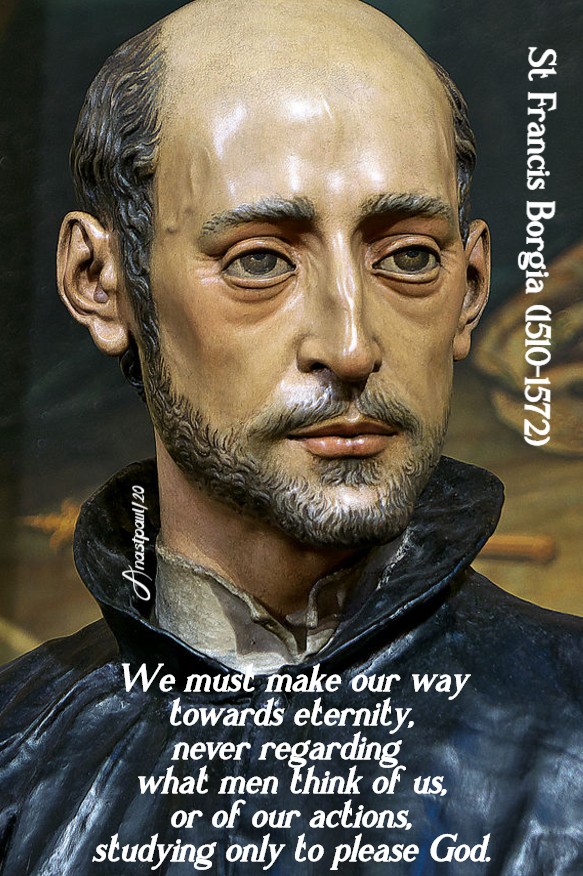
“We must make our way towards eternity, never regarding what men think of us, or of our actions, studying only to please God.”
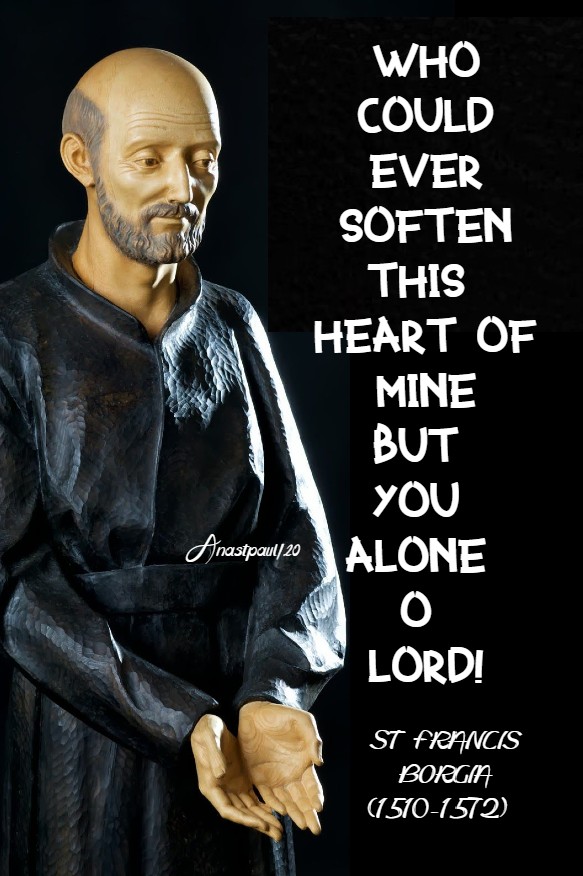
“Who could ever soften this heart of mine but YOU alone O Lord!”
One Minute Reflection – 10 October – “Month of the Most Holy Rosary” – Saturday of the Twenty SeventhWeek in Ordinary Time, Readings:Galatians 3: 22-29, Psalms 105: 2-3, 4-5, 6-7, Luke 11: 27-28 and the Memorial of St Paulinus of York (c 584-644) and St Francis Borgia SJ (1510-1572)
“While he was speaking, a woman from the crowd called out and said to him, ‘Blessed is the womb that carried you and the breasts at which you nursed.’” – Luke 11:27
REFLECTION – “Mary was more blessed in accepting the faith of Christ than in conceiving the flesh of Christ. To someone who said, “Blessed is the womb that bore you,” he replied, “Rather, blessed are they who hear the word of God and keep it.”
Finally, for his brothers, his relatives according to the flesh who did not believe in him, of what advantage was that relationship? Even her maternal relationship would have done Mary no good, unless she had borne Christ more happily in her heart, than in her flesh.” – St Augustine (354-430) Father & Doctor of Grace – Holy Virginity, 3/
PRAYER – Almighty God and Father, you sent St Paulinus and St Francis Borgia to be Your witnesses and to bring Your Church to the pagans for the salvation of souls. Sustain us by their prayers that by our lives we may lead all to You through Holy Mother Church. Through Jesus Christ our Lord, Who lives and reigns with You and the Holy Spirit, God forever and ever, amen.
St Fulk of Fontenelle St Gereon St Gundisalvus Bl Hugh of Macon Bl Leon Wetmanski St Maharsapor the Persian St Malo the Martyr St Patrician St Paulinus of Capua St Paulinus of York (c 584-644) First Bishop of York Bl Pedro de Alcantara de Forton de Cascajares St Pinytus of Crete Bl Pontius de Barellis St Tanca St Teodechilde St Victor of Xanten
Martyrs of Ceuta – 7 beati: A group of seven Franciscan Friars Minor missionaries to Muslims in the Ceuta area of modern Morocco. Initially treated as madmen, within three weeks they were ordered to convert to Islam and when they would not they were first abused in the streets, then arrested, tortured and executed. • Angelo • Daniele di Calabria • Donnolo • Hugolinus • Leone • Nicola • Samuele They were beheaded in 1227 in Mauritania Tingitana (Ceuta, Morocco). Local Christians secreted the bodies away and gave them proper burial in Ceuta. They were Beatified in 1516 by Pope Leo X.
Quote/s of the Day – 17 September – The Memorial of St Robert Bellarmine SJ (1542-1621) Doctor of the Church
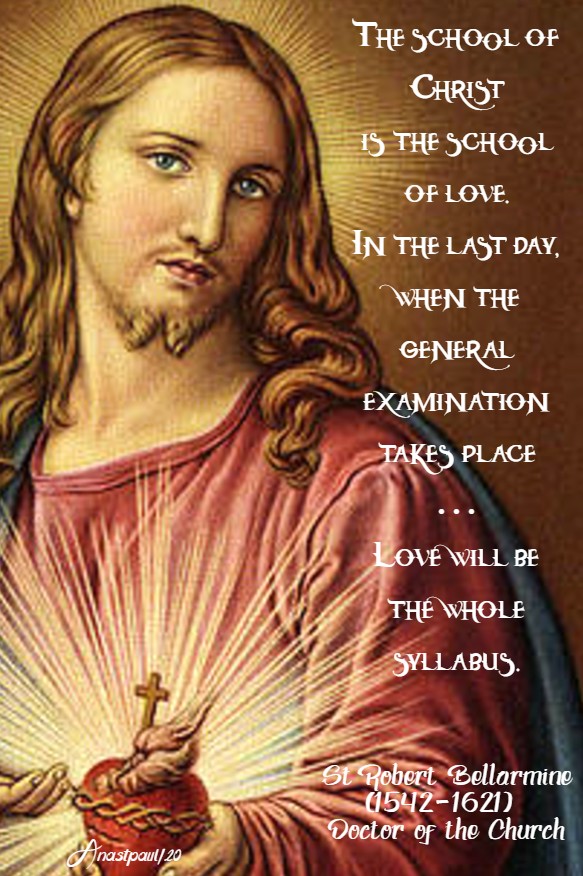
“The school of Christ is the school of love. In the last day, when the general examination takes place … Love will be the whole syllabus.”
“What is easier, sweeter, more pleasant, than to love goodness, beauty and love, the fullness of which, YOU ARE, O Lord, my God?”
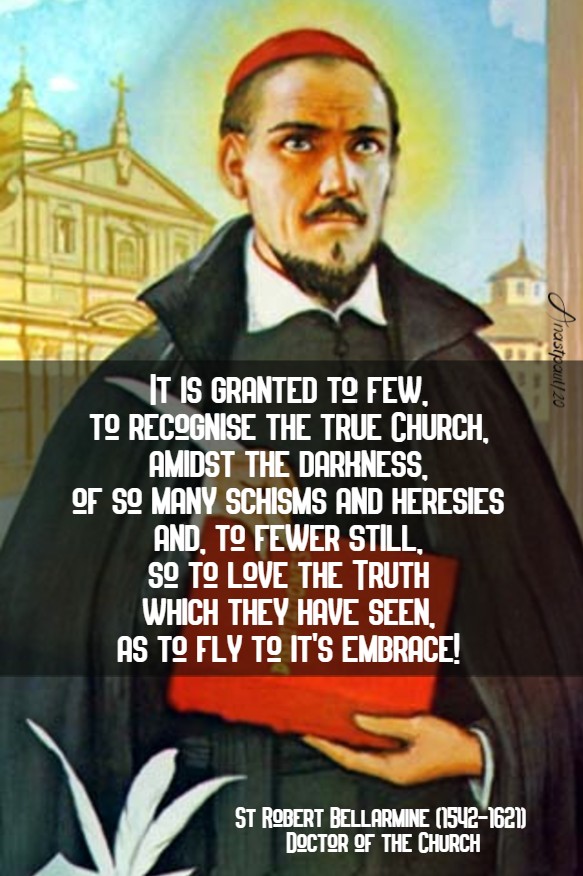
“It is granted to few, to recognise the true Church, amidst the darkness, of so many schisms and heresies and, to fewer still, so to love the Truth which they have seen, as to fly to it’s embrace!”
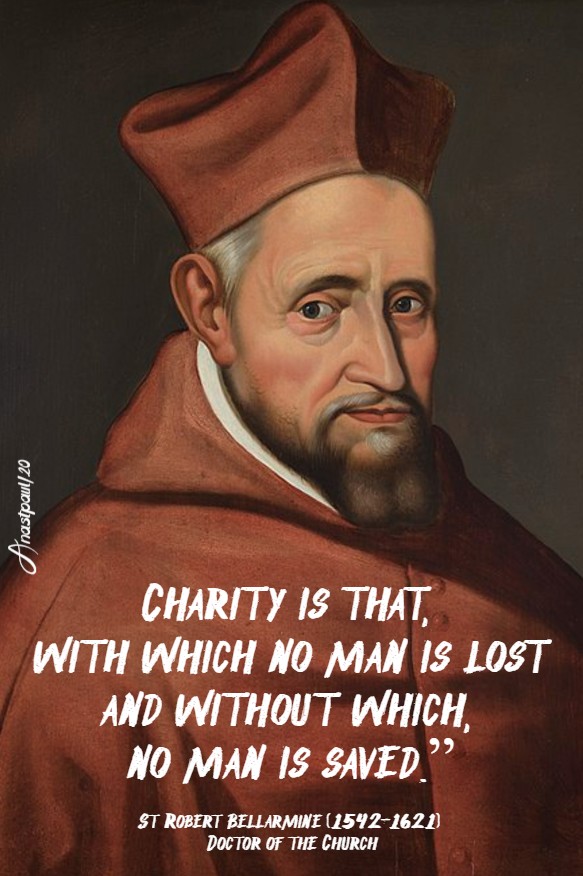
“Charity is that, with which no man is lost and without which, no man is saved.”
“It seems unbelievable that a man should perish in whose favour Christ said to His Mother: ‘Behold thy son’, provided that he has not turned a deaf ear to the words, which Christ addressed to him: ‘Behold thy Mother.’”
St Robert Bellarmine (1542-1621) Doctor of the Church
Quote/s of the Day 11 September – Friday of the Twenty Third week in Ordinary Time, Readings: 1 Corinthians 9:16-19, 22b-27, Psalms 84:3, 4, 5-6, 12, Luke 6:39-42 and the Memorial of Blessed Charles Spinola SJ (1564-1622) Priest, Martyr, Missionary to Japan
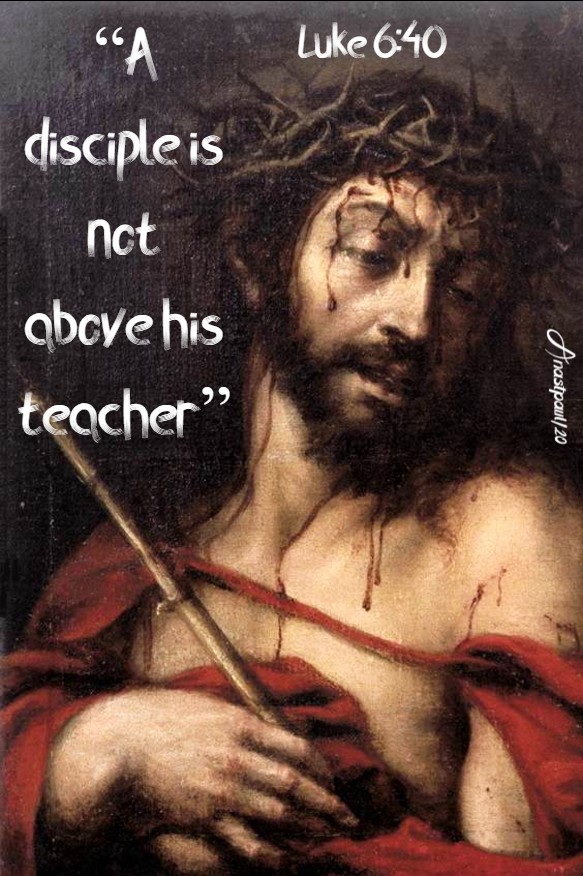
“A disciple is not above his teacher…”
Luke 6:40
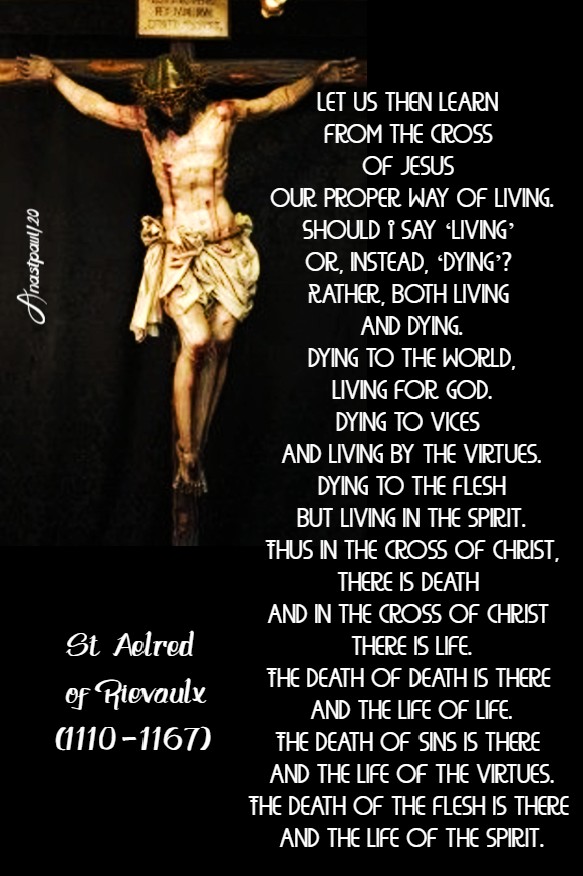
“Let us then learn from the Cross of Jesus our proper way of living. Should I say ‘living’ or, instead, ‘dying’? Rather, both living and dying. Dying to the world, living for God. Dying to vices and living by the virtues. Dying to the flesh, but living in the spirit. Thus in the Cross of Christ, there is death and in the Cross of Christ there is life. The death of death is there and the life of life. The death of sins is there and the life of the virtues. The death of the flesh is there and the life of the spirit.”
St Aelred of Rievaulx (1110-1167)
Blessed Charles Spinola went underground, going by the foreshadowing alias “Joseph of the Cross”, a haunt of the shadows who was obliged to conceal himself from daylight because his foreign features were instantly recognisable. With the help of Nagasaki’s ample Christian community he eluded capture for an amazingly long time.
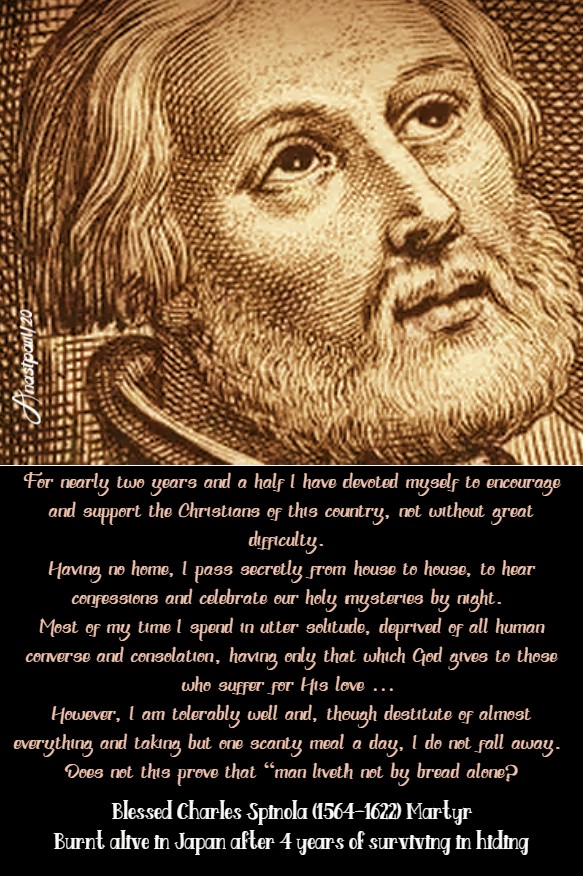
“For nearly two years and a half I have devoted myself to encourage and support the Christians of this country, not without great difficulty. Having no home, I pass secretly from house to house, to hear confessions and celebrate our holy mysteries by night. Most of my time I spend in utter solitude, deprived of all human converse and consolation, having only that which God gives to those who suffer for His love … However I am tolerably well and, though destitute of almost everything and taking but one scanty meal a day, I do not fall away. Does not this prove that “man liveth not by bread alone?”
-Letter of Spinola dated March 20, 1617
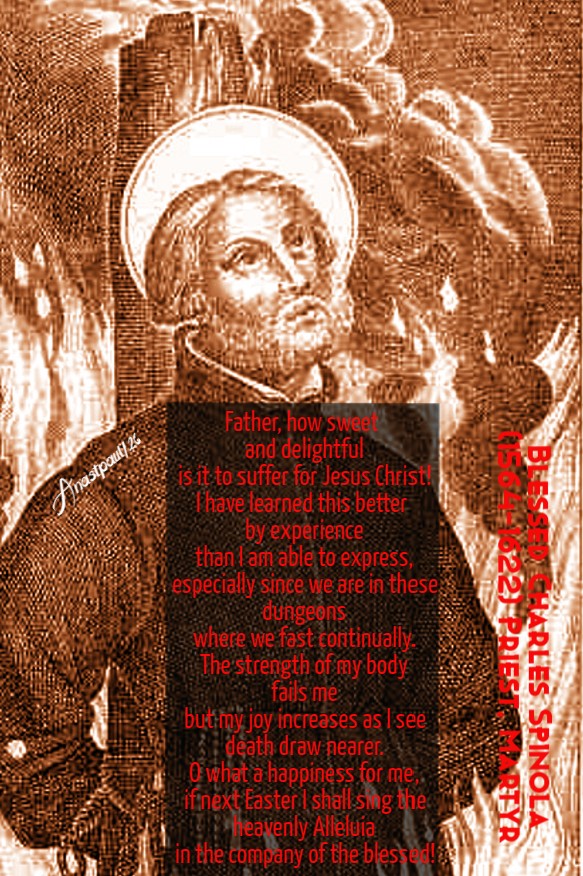
“Father, how sweet and delightful is it to suffer for Jesus Christ! I have learned this better by experience than I am able to express, especially since we are in these dungeons where we fast continually. The strength of my body fails me but my joy increases as I see death draw nearer. O what a happiness for me, if next Easter I shall sing the heavenly Alleluia in the company of the blessed!”
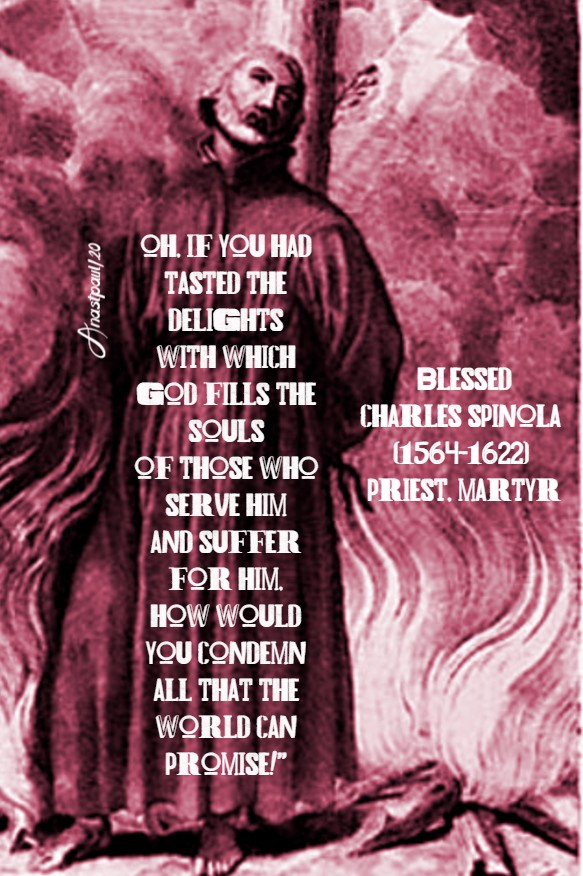
“Oh, if you had tasted the delights with which God fills the souls of those who serve Him and suffer for Him, how would you condemn all that the world can promise!”
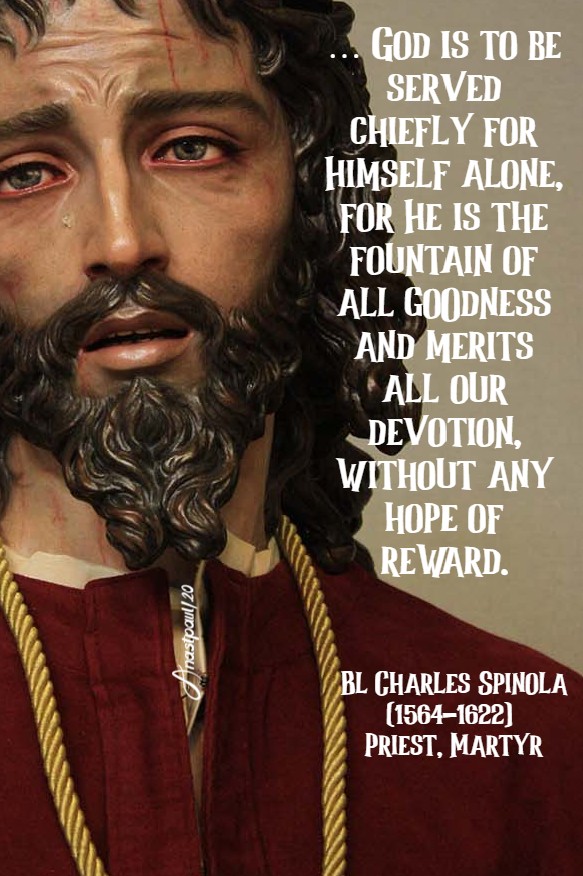
“… God is to be served chiefly for Himself alone, for He is the fountain of all goodness and merits all our devotion, without any hope of reward.”
Saint of the Day – 11 September – Blessed Charles Spinola SJ (1564-1622) Priest, Martyr, Missionary to Japan – born as Carlo Spinola in 1564 in Madrid, Spain and died by being slowly burned to death on 10 September 1622 at Nagasaki, Japan.
Charles Spinola was born in Madrid, Spain. His father, the Italian Count of Tassarolo, was tutor to Prince Rudolph, the Emperor’s son. After his early studies in Spain, Charles was sent to the Jesuit school in Nola, Italy where he lived with his uncle Philip Spinola, the Bishop of Nola. As a youth, Charles was so moved by the Martyrdom in India of Rudolph Acquaviva’s heroic example of love for God, that he too was determined to die for Christ and the faith. He entered the Society and became a novice at the Nola novitiate. In 1584 he went to Naples for his philosophy and after taking his vows, he was sent to Brera College in Milan where he completed his philosophy and his theology studies, though at the time his health was not too good. After his Ordination in 1594, he was assigned to give parish missions in Cremona although he had requested to go on foreign missions.
Two years later in 1596 Fr Spinola together with the Sicilian Jesuit, Jerome De Angelis, finally were assigned to the mission in Japan but it took him six years, eight ships and great patience to arrive in Nagasaki, Japan after overcoming shipwrecks, pirates and many unfortunate incidents along the way.
The first ship he took from Genoa struck a rock and was forced to return to Genoa. From Barcelona, he had to walk on foot across Spain and Portugal to reach Lisbon but there the ship met with a violent storm and its rudder was shattered. After five months, the ship was repaired in Brazil, they again set forth only to meet another storm and they found themselves drifted back to the Atlantic to its starting point. His second attempt was also unsuccessful and ended when English pirates captured the ship and took it to England and only managed to escape back to Lisbon after two years. It was only in 1600, when Fr Spinola set off on his third attempt did he reach Malacca, Malaya.
Eventually he reached Japan in 1602, after 6 years of attempts and he studied Japanese before going to Miyako (today’s Kyoto) where he was Novice Master at the Jesuit College and also teacher of mathematics and astronomy. He moved to Nagasaki seven years later to care for the temporal needs of the province. In 1614, the long period of peaceful relations with Shogan Iyeyasu ended, when the number of Christians in Japan had reached two million, causing the country leaders to become fearful that the Christians proposed a national threat and that their country might be taken over by Spain. This resulted in the Shogun’s decree banishing all foreign missionaries and forbidding Japanese Christians to harbour Priests or practice their religion.
Arising from this decree, about 100 Jesuits left Japan but some remained, including Fr Spinola and he eluded Priest-hunters for four years. Fr Spinola was captured together with Bro Ambrose Fernandes and their catechist, John Chogoku and were imprisoned for four years in a bird-like cage under harsh conditions.
We have the record of a letter from one Franciscan, Blessed Richard of St Anne, to his home Monastery in France:
“I have been for nearly a year in this wretched prison, where there are with me, nine religious of our order, eight Dominicans and six Jesuits. The others are native Christians who have helped us in our ministry. Some have been here for five years. Our food is a little rice and water. The road to martyrdom has been paved for us by more than 300 martyrs, all Japanese, on whom all kinds of tortures were inflicted. As for us survivors, we also are all doomed to death. We religious and those who have helped us, are to be burnt at a slow fire; the others will be beheaded… If my mother is still alive, I beg you to be so kind as to tell her of God’s mercy to me in allowing me to suffer and die for Him. I have no time left to write to her myself.”
In September 1622, the nine prisoners who had been caged together, were taken to Nagasaki and felt Martyrdom would soon be theirs. Before they left, Fr Spinola accepted the vows of his seven novices. On 9 September, the nine Jesuits together with twenty-four other prisoners at Suzuta, each with a rope round his neck and the Jesuits in their cassocks, were led to Martyrs’ Hill escorted by 400 soldiers. There they waited for another thirty-three prisoners from the city. When the 2 groups met, they embraced. Fr Spinola recognised Isabel Fernandez among them, the wife of Dominic Jorjes, who had sheltered Charles after he had Baptised her son, Ignatius, now a four-year-old. Isabel said “I brought him [Ignatius] with me to die for Christ before he is old enough to sin against Him.” The boy knelt for a blessing from Charles, witnessed the Martyrdom of his mother and was killed himself—all without crying out.
The religious, with exception of John Chugoku (being a lay person) were condemned to death by slow fire, the Christians and Chugoku were to be beheaded.
When fastened to his stake, Fr Spinola intoned the psalm, Praise the Lord, All You Nations and the martyrs joined in a song of thanksgiving to God. The fires were lit but the wood was so arranged to prolong the victims’ suffering. Fr Spinola died within half an hour as he was greatly weakened after four years of imprisonment. Fr Kimura, endured his martyrdom for three hours and was the last to die, during which time he remained immobile with his arms outstretched in the form of a cross.
The nine martyrs died on Martyrs’ Hill on 10 September 1622. When Pope Pius IX beatified the 205 Japanese Martyrs on 7 May 1867, Bro Ambrose Fernandes, who had died in prison, was also included.
Thought for the Day – 9 September – Meditations with Antonio Cardinal Bacci (1881-1971)
The Two Standards
“The well-known meditation of St Ignatius in his Spiritual Exercies on the two standards, remains applicable to our times. We need only glance at the world to see, that it contains two different kinds of people – the good and the bad, the enemies of Christ and His faithful followers. But, there is also a third group, those who are indifferent and apathetic, those who think of their own comfort and convenience and of nothing else! When one considers it, it is plain that those people who think only of themselves – and their number seems to grow every year – belong to the rearguard of those, who fight beneath the banner of Satan. That man is an enemy of Christ, who has no generosity, no spirit of sacrifice, no desire to combat the evil which threatens to submerge the world. “He who is not with me, is against me,” (Mt 12:30) said Jesus. He who thinks only of his own convenience and remains indifferent to the spread of evil, is not worthy of Jesus. One cannot be indifferent when faced with the alternative between good and evil because, indifference is tantamount to a betrayal. “The Christian,” writes Tertullian, “is another Christ!”
The fact that we are Christians imposes on us, the obligation to fight openly and courageously under the Standard of Christ. The battle must be waged on two fronts. On one side, the struggle is internal. We must resist our rebellious inclinations and self-centred egoism. At the same time, we must make a constant effort to advance in Christian perfection. On the second front, the struggle is external. It is not sufficient to sanctify ourselves but, we must try to sanctify others. When we consider the sacrifices made in the cause of evil by the enemies of Christ, how can we remain indifferent? We should work with zeal and with the help of God’s grace, to achieve our own sanctification and the reign of Christ in the universe. We should examine what we have already done and resolve to be more determined in our future efforts!“
Quote/s of the Day – 9 Sepember – The Memorial of St Peter Claver SJ (1581-1654) “Slave of the slaves” and Blessed Frédéric Ozanam (1813–1853) “Servant to the Poor” and Founder of the St Vincent de Paul Society
“We must speak to them with our hands, by giving, before we try to speak to them with our lips.”
“To love God as He ought to be loved, we must be detached from all temporal love. We must love nothing but Him, or if we love anything else, we must love it, only for His sake.”
“To do the will of God, man must despise his own; the more he dies to himself, the more he will live to God.”
St Peter Claver (1581-1654) “Slave of the slaves”
“Let us complain less of our times and more of ourselves. Let us not be discouraged, let us be better!”
“Let us learn of Him, that holy preference, which shows most love, to those who suffer most.”
“Let us go in simplicity, where merciful Providence leads us, content to see the stone on which we should step, without wanting to discover, all at once and completely, the windings of the road.”
Blessed Frédéric Ozanam (1813–1853) “Servant to the Poor”
You must be logged in to post a comment.