Posted in LENT 2026, The PASSION

Saturday of the Third Week of Lent – 14 March – Our Lenten Journey With St Thomas Aquinas – The Passion of Christ Reconciles us to God

Saturday of the Third Week of Lent –14 March – Our Lenten Journey With St Thomas Aquinas (1225-1274) Doctor of the Church

Saturday of the Third Week
The Passion of Christ Reconciles us to God

We were reconciled to God through the Death of His Son.” Rom v. 10
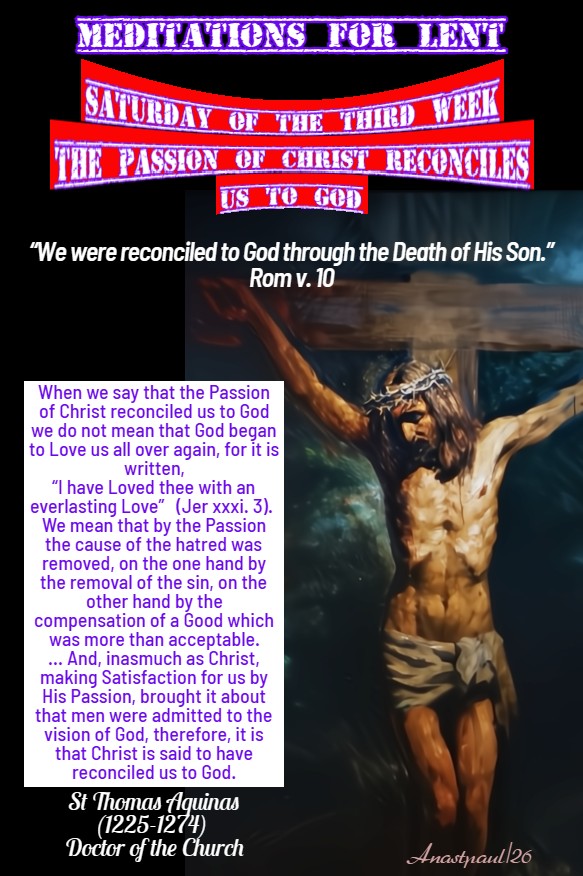
The Passion of Christ brought about our reconciliation to God in two ways.

  1. It removed the sin which had made the human race God’s enemy, as it says in Holy Scripture,
    “To God, the wicked and his wickedness are alike hateful” (Wis xiv. 9) and again, “Thou hatest all the workers of iniquity” (Ps. v. 7).

Secondly, the Passion was a sacrifice most acceptable to God.
It is in fact, the peculiar effect of sacrifice to be itself a method by which God is placated, just as a man remits offences done against him for the sake of some acknowledgment, pleasing to him which is made.
Whence it is said, “If the Lord stir thee up against me, let Him accept sacrifice” (1 Kings xxvi. 19).
Likewise, the voluntary Suffering of Christ was so good in itself that, for the sake of this good thing found in human nature, God was pleased beyond the totality of offences committed by all mankind, as far as concerns all those who are linked to Christ in His Suffering by faith and by charity.

When we say that the Passion of Christ reconciled us to God we do not mean that God began to Love us all over again, for it is written, “I have Loved thee with an everlasting Love” (Jer xxxi. 3).
We mean that by the Passion the cause of the hatred was removed, on the one hand by the removal of the sin, on the other hand by the compensation of a Good which was more than acceptable.

  1. As far as those who slew Our Lord were concerned,the Passion was indeed a cause of wrath.

But the Love of Christ Suffering, was greater than the wickedness of those who caused Him to Suffer.
And, therefore, the Passion of Christ was more powerful in reconciling to God the whole human race, than in moving God to anger.

God’s Love for us is shown by what it does for us.
God is said to Love some men because He gives them a share in His own Goodness, in that vision of His very Essence from which there follows this, that we live with Him, in His Company as His friends, for it is in that delightful condition that happiness (beatitude) consists.

God is then said to Love those whom He admits to that vision, either by giving them the vision directly or by giving them what will bring them to the vision as when he gives the Holy Ghost as a pledge of the vision.

It was from this sharing in the Divine Goodness, from this vision of God’s very Essence that man, by sin, had been removed and it is in this sense that we speak of man as deprived of God’s Love.

And, inasmuch as Christ, making Satisfaction for us by His Passion, brought it about that men were admitted to the vision of God, therefore, it is that Christ is said to have reconciled us to God.

ST THOMAS AQUINAS (1225-1274)
Priest, Theologian, Dominican
Doctor Angelicus (Angelic Doctor)
Doctor Communis (Common Doctor)
Added by Pope Saint Pius V in 1568
Posted in AUGUSTINIANS OSA, CONFESSION/PENANCE, DOCTORS of the Church, FATHERS of the Church, LENT 2026, QUOTES on FORGIVENESS, QUOTES on REPENTANCE, QUOTES on SIN, QUOTES on the DEVIL/EVIL

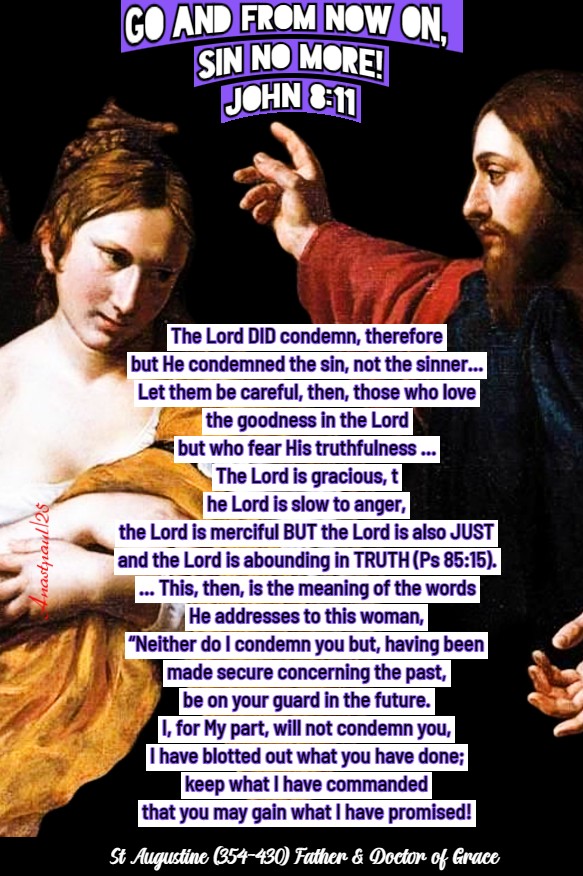
Quote/s of the Day – 14 March – From NOW on …

Quote/s of the Day – 14 March – Saturday of the 3rd Week in Lent – Ferial Day – Daniel 13:1-9,15-17,19-30,33-62 – John 8:1-11

Go and from now on,
sin no more

John 8:11

The Lord did condemn, therefore
but He condemned the sin, not the sinner…
Let them be careful, then, those who love
the goodness in the Lord
but who fear His truthfulness …
The Lord is gracious, t
he Lord is slow to anger,
the Lord is merciful BUT the Lord is also JUST
and the Lord is abounding in TRUTH (Ps 85:15).
… This, then, is the meaning of the words
He addresses to this woman,
“Neither do I condemn you but, having been
made secure concerning the past,
be on your guard in the future.
I, for My part, will not condemn you,
I have blotted out what you have done;
keep what I have commanded
that you may gain what I have promised
!”

You do not know
when your last day may come.
You are an ingrate!
Why not use the day, today,
that God has given you
to repen
t?”

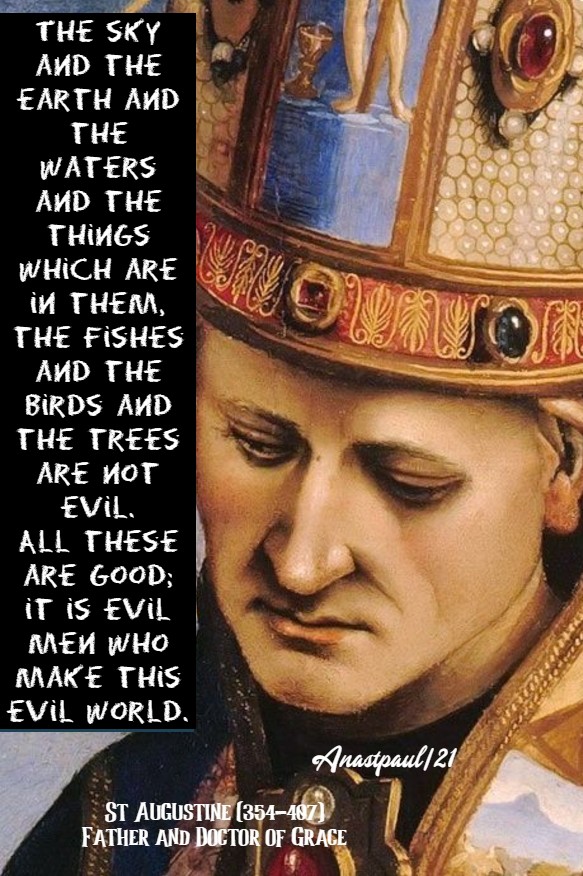
The sky and the earth and the waters
and the things which are in them, the fishes
and the birds and the trees are not evil.
All these are good;
it is evil men who make this evil world.

St Augustine (354-430)
Father & Doctor of Grace

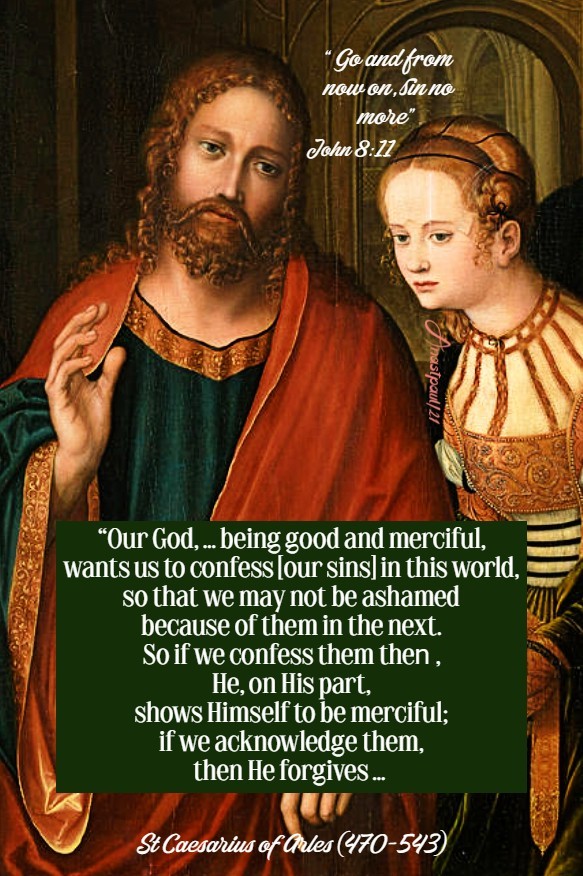
Our God, … being good and merciful,
wants us to confess [our sins] in this world,
so that we may not be ashamed
because of them in the next.
So if we confess them then,
He, on His part,
shows Himself to be merciful;
if we acknowledge them,
then He forgives
 … ”

St Caesarius of Arles (470-543)
Bishop and Monk

Posted in LENT 2026, QUOTES on HELL, QUOTES on SIN, QUOTES on THE MYSTICAL BODY, The PASSION, Thomas Aquinas

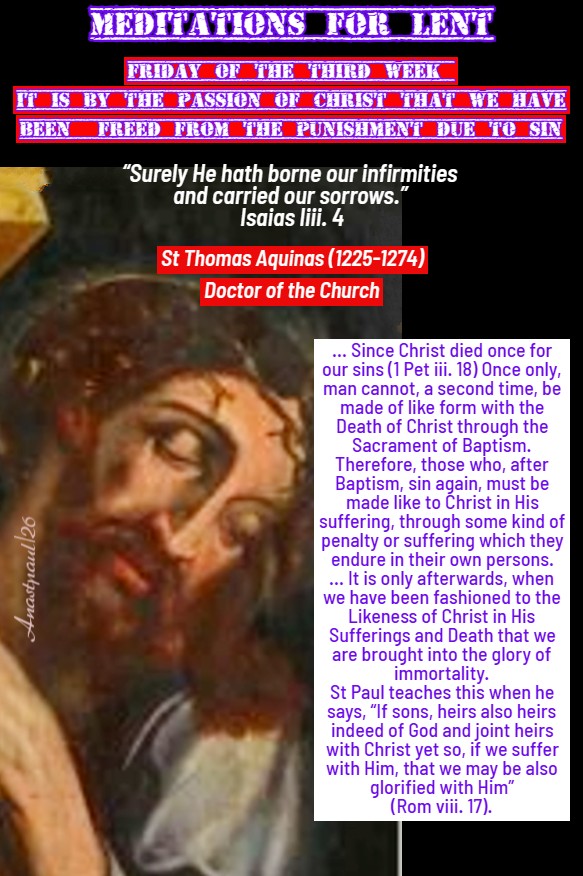
Friday of the Third Week of Lent –13 March – Our Lenten Journey With St Thomas Aquinas – It is by the Passion of Christ that we have been Freed from the Punishment Due to Sin

Friday of the Third Week of Lent –13 March – Our Lenten Journey With St Thomas Aquinas (1225-1274) Doctor of the Church

Friday of the Third Week
It is by the Passion of Christ that we have been
Freed from the Punishment Due to Sin

Surely He hath borne our infirmities
and carried our sorrows.

Isaias liii. 4.

By the Passion of Christ we are freed from the liability to be punished for sin with the punishment which sin calls for, in two ways, directly and indirectly.

We are freed directly ,inasmuch as the Passion of Christ made sufficient and more than sufficient Satisfaction for the sins of the whole human race.
Now once sufficient Satisfaction has been made, the liability to the punishment mentioned is destroyed.

We are freed indirectl, inasmuch as the Passion of Christ causes the sin to be remitted and, it is from the sin that the liability to the punishment derives.

Souls in hell, however, are not freed by the Passion of Christ because the Passion of Christ shares its effect with those to whom it is applied by faith and by charity and by the Sacraments of faith.
Therefore, the souls in hell, who are not linked to the Passion of Christ in the way just mentioned, cannot receive its effects thereof.

Now, although we are freed from liability to the precise penalty which sin deserves, there is, nevertheless, enjoined to the repentant sinner, a penalty or penance of satisfaction. For, in order that the effect of the Passion of Christ be fully achieved in us, it is necessary for us to be made of like form with Christ.
Now we are made of like form with Christ in Baptism by the Sacrament, as is said by St Paul, “We are buried together with Him by Baptism into death” (Rom vi. 4).
Whence it is, no penalty of satisfaction is imposed on those who are Baptised.
Through the Satisfaction made by Christ, they are wholly set free.
But since Christ died Once for our sins (1 Pet iii. 18) Once only, man cannot, a second time, be made of like form with the death of Christ through the Sacrament of Baptism. Therefore, those who, after Baptism, sin again, must be made like to Christ in His suffering, through some kind of penalty or suffering which they endure in their own persons.

If death which is a penalty due to sin, continues to subsist, the reason is this: The Satisfaction made by Christ produces its effect in us, insofar as we are made of One Body with Him, in the way limbs are One Body with the Head.
Now it is necessary that the limbs be made to conform to the head. Wherefore since Christ at first had, together with the Grace in His Soul, a liability to Suffer in His Body and came to His glorious immortality through the Passion, so also should it be with us, who are His Limbs. By the Passion we are indeed delivered from any punishment as a debt applied to us but, we are delivered in such a way that it is in the soul we first receive the spirit of the adoption of sons, by which we are added to the list for the inheritance of eternal glory, while we still retain a body which an suffer and die.

It is only afterwards, when we have been fashioned to the Likeness of Christ in His Sufferings and Death that we are brought into the glory of immortality.
St Paul teaches this when he says, “If sons, heirs also heirs indeed of God and joint heirs with Christ yet so, if we suffer with Him, that we may be also glorified with Him” (Rom viii. 17).

ST THOMAS AQUINAS (1225-1274)
Priest, Theologian, Dominican
Doctor Angelicus (Angelic Doctor)
Doctor Communis (Common Doctor)
Added by Pope Saint Pius V in 1568

Posted in "Follow Me", CHRIST the LIGHT, CHRIST the WORD and WISDOM, CHRIST, the WAY,TRUTH,LIFE, LENT 2026, The WORD, Thomas Aquinas

Thursday of the Third Week of Lent – 12 March – Our Lenten Journey With St Thomas Aquinas – The Preaching of the Samaritan Woman

Thursday of the Third Week of Lent – 12 March – Our Lenten Journey With St Thomas Aquinas (1225-1274) Doctor of the Church

Thursday of the Third Week
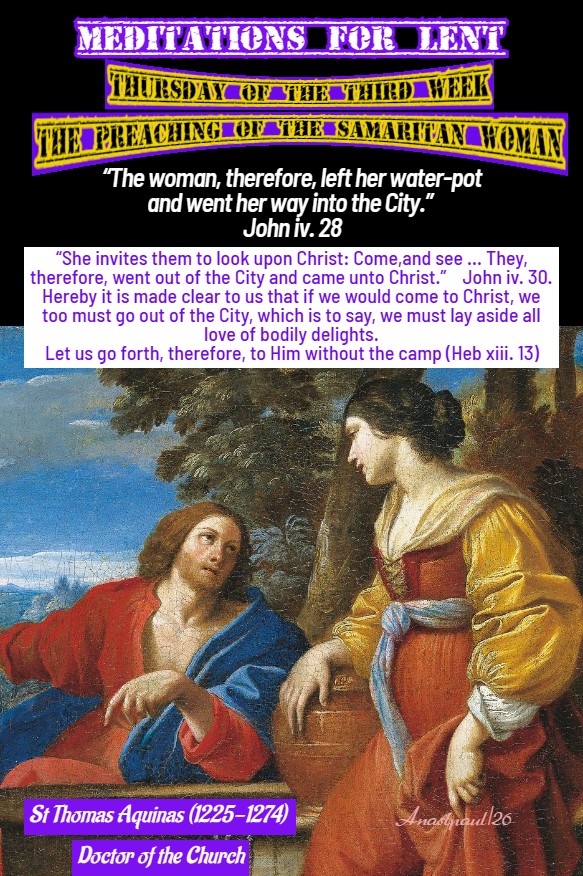
The Preaching of the Samaritan Woman

The woman, therefore, left her water-pot
and went her way into the City.

John iv. 28.

This woman, once Christ had instructed her, became an apostle.
There are three elements which we can gather from what she said and what she did.

  1. The entirety of her surrender to Our Lord.
    This is shown:

(i) From the fact that she left lying there, almost as if forgotten that for which she had come to the well, the water and the water-pot. So great was her absorption.
Hence it is said, The woman left her water-pot and went away into the city, went away to announce the wonderful works of Christ. She cared no longer for the bodily comforts, in view of the usefulness of better things, following in this, the example of the Apostles of whom it is said, “Leaving their nets, they followed the Lord” (Mark 1. 18).

The water-pot represents fashionable desire, by means of which men draw up pleasures from those depths of darkness, signified by the well, i.e. from practices which are of the earth.
Those who abandon such desires for the sake of God, are like the woman who left her water-pot.

(ii) From the multitude to whom she tells the news, not to one nor to two or three but to a whole City.
This is why she went away into the City.

  1. A method of preaching.
    “She saith to the men there: Come, and see a Man Who has told me all things whatsoever I hav done. Is not He the Christ?” John iv. 29.

(i) She invites them to look upon Christ: Come,and see a Man–she did not straightway say that they should give themselves to Christ, for that might have been for them an occasion for blasphemy but, to begin, she told them about Christ facits which were believable and open to observation. She told them He was a Man.
Nor did she say, Believe but come and see, for she knew that if they, too, tasted of that well, looked upon Our Lord, they, too, would feel all she had felt.
And she follows the example of a true preacher in that she attracts the men not to herself but, to Christ!

(ii) She gives them a hint that Christ is God when she says, A Man Who has told me all things whatsoever I have done, that is to say, how many husbands she had had. She is not ashamed to bring up facits which make for her own confusion because the soul, once it is aliight with the Divine Fire, in no way looks to earthly values and standards, cares neither for its own glory nor its shame but only for that Flame which holds and consumes it.

(iii) She suggests that this proves the majesty of Christ, saying, Is not He the Christ?
She does not dare to assert that He is the Christ, lest she have the appearance of wishing to teach others and the others, irritated thereat, refuse to go out to Him.
Nor, on the other hand, does she leave the matter in silence but she puts it before them questioningly, as though she left it to their own judgment.
For this is the easiest of all ways of persuasion.

  1. The Fruit of Preaching.
    “She invites them to look upon Christ: Come,and see … They, therefore, went out of the City and came unto Christ.” John iv. 30.

Hereby it is made clear to us that if we would come to Christ, we too must go out of the City, which is to say, we must lay aside all love of bodily delights.

Let us go forth, therefore, to Him without the camp (Heb xiii. 13)

ST THOMAS AQUINAS (1225-1274)
Priest, Theologian, Dominican
Doctor Angelicus (Angelic Doctor)
Doctor Communis (Common Doctor)
Added by Pope Saint Pius V in 1568
Posted in LENT 2026, QUOTES on SUFFERING, The MOST HOLY REDEEMER, Our SAVIOUR, The PASSION, The REDEMPTION, Thomas Aquinas

Wednesday of the Third Week of Lent – 11 March – Our Lenten Journey With St Thomas Aquinas – The Price of Our Redemption

Wednesday of the Third Week of Lent – 11 March – Our Lenten Journey With St Thomas Aquinas (1225-1274) Doctor of the Church

Wednesday of the Third Week
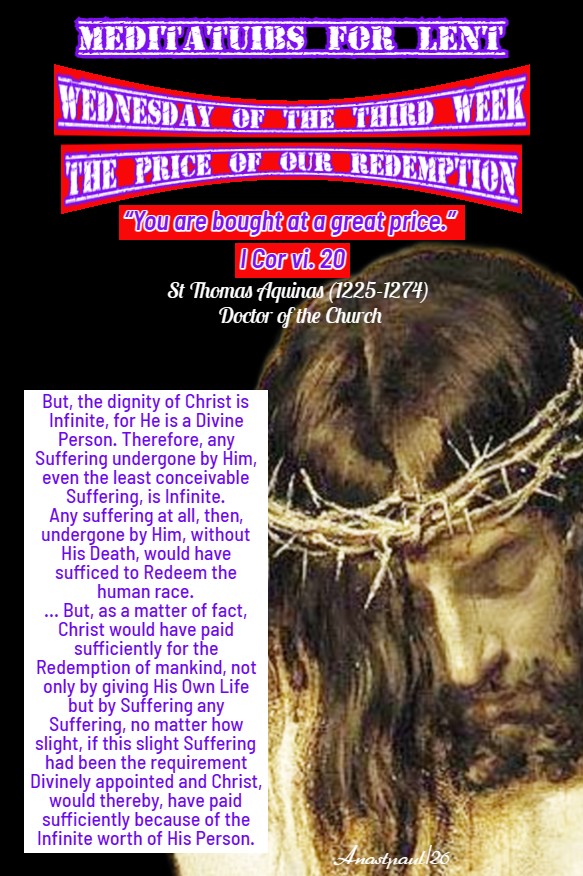
The Price of Our Redemption

You are bought at a great price.”
I Cor vi. 20

The indignities and sufferings anyone suffers are measured according to the dignity of the person concerned.
If a King is struck in the face, he suffers a greater indignity than does a private person.
But, the dignity of Christ is Infinite, for He is a Divine Person. Therefore, any Suffering undergone by Him, even the least conceivable Suffering, is Infinite.
Any suffering at all, then, undergone by Him, without His Death, would have sufficed to Redeem the human race.

St Bernard says – the least drop of the Blood of Christ would have sufficed for the Redemption of us all.
And Christ could have shed that One Drop without Dying. Therefore, even without Dying He could, by some kind of Suffering, have Redeemed, that is, Bought Back, all mankind.

Now in any purchase, two elements are required, i.e. an amount equal to the price demanded and, the assigning of that amount to the purpose of buying.
For if a man gives a price which is not equal in value to the item to be purchased, we do not say that he has bought it but only that he has partly bought it and partly been given it.
For example, if a man buys, for ten shillings, a book worth twenty shillings, he has partly bought the book and it has, partly been donated to him.

… If, therefore, when we speak of the Redemption and Buying Back of the human race, we have, in view, the amount of the Price required, we must say that any Suffering undergone by Christ, even without His Death, would have sufficed because of the Infinite worth of His Person.
If, however, we speak of the Redemption with reference to the setting of the Price to the purpose in hand, we have then to say that no other Suffering of Christ less than His Death, was set by God and by Christ, as the Price to be paid for the Redemption of man kind.

And this was so for three reasons:

  1. That the Price of our Redemption should not only be Infinite in value but be of the same kind as what it bought, i.e., that it should be with a Death that He Bought us Back from death.
  2. That the Death of Christ would be not only the Price of our Redemption but too, an example of courage, so that men would not be afraid to die, for the Truth.
    St Paul makes mention of this and the preceding cause when he says, That, through death, He might destroy him who had the empire of death (this is the first cause) and might deliver them, who throug the fear of death were subject to servitude all their lifetime (this for the second cause) (Heb ii. 14, 15).
  3. That the Death of Christ might be a Sacrament to work our Salvation; we, that is, dying to sin, to bodily desires and to our own will through the power of the Death of Christ. These reasons are given by St Peter when he says, Christ who Died once for our sins, the Just for the unjust that He might offer us to God, being put to Death indeed in the flesh but enlivened in the spirit (1 Pet iii. 18).

And so it is that mankind has not been Redeemed by any other Suffering of Christ without His Death.

But, as a matter of fact, Christ would have paid sufficiently for the Redemption of mankind, not only by giving His Own Life but by Suffering any Suffering, no matter how slight, if this slight Suffering had been the requirement Divinely appointed and Christ, would thereby, have paid sufficiently because of the Infinite worth of His Person.

ST THOMAS AQUINAS (1225-1274)
Priest, Theologian, Dominican
Doctor Angelicus (Angelic Doctor)
Doctor Communis (Common Doctor)
Added by Pope Saint Pius V in 1568
Posted in LENT 2026, QUOTES on the ANTI-christ, QUOTES on the DEVIL/EVIL, The PASSION, Thomas Aquinas

Monday of the Third Week of Lent – 8 March – Our Lenten Journey With St Thomas Aquinas – The Passion of Christ has Delivered us from the devil.

Monday of the Third Week of Lent – 8 March – Our Lenten Journey With St Thomas Aquinas (1225-1274) Doctor of the Church

Monday of the Third Week
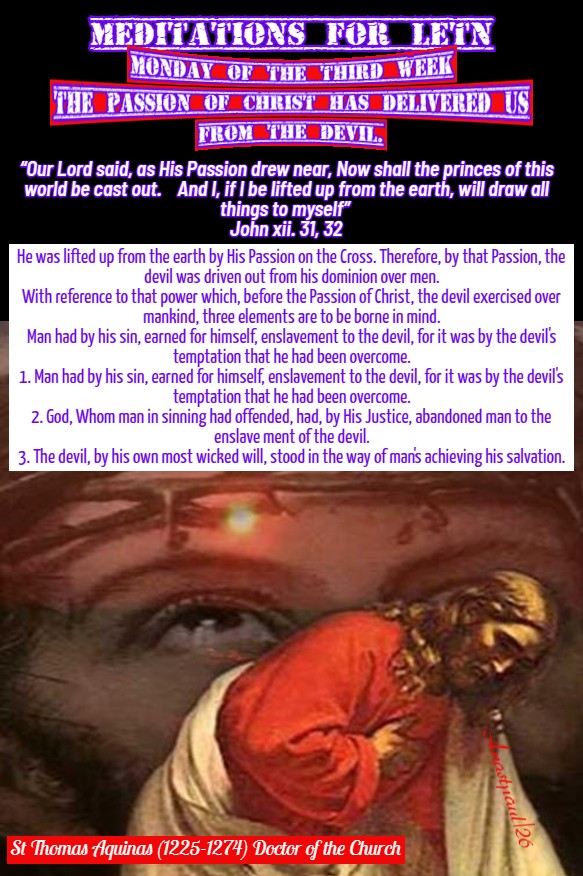
The Passion of Christ has Delivered us from the devil.

“Our Lord said, as His Passion drew near, Now shall the princes of this world be cast out.
And I, if I be lifted up from the earth, will draw all things to myself”
John xii. 31, 32

He was lifted up from the earth by His Passion on the Cross. Therefore, by that Passion, the devil was driven out from his dominion over men.

With reference to that power which, before the Passion of Christ, the devil exercised over mankind, three elements are to be borne in mind.

  1. Man had by his sin, earned for himself, enslavement to the devil, for it was by the devil’s temptation that he had been overcome.
  2. God, Whom man in sinning had offended, had, by His Justice, abandoned man to the enslave ment of the devil.
  3. The devil, by his own most wicked will, stood in the way of man’s achieving his salvation.

With regard to the first point, the Passion of Christ set man free from the devil’s power because the Passion of Christ brought about the forgiveness of sin.
As to the second point the Passion delivered man from the devil because it brought about a reconciliation between God and man. A
s to the third point, the Passion of Christ freed us from the devil’s power because, in his action during the Passion, the devil over-reached himself. He went beyond the limits of the power over men allowed to him by God, when he plotted the death of Christ, upon Whom, since he was without sin, there lay no debt payable by death.
Whence St Augustine s words, “The devil was overcome by the Justice of Christ. In Him the devil found nothing which deserved death but, nonetheless, he slew Him.
And, it was but just that those debtors who the devil detained, should go free since they believed in Him Whom, though He was under no bond to him, the devil had slain.”

The devil still continues to exercise a power over men.
He can, God permitting it, tempt them in soul and in body. There is, however, made available for man a remedy in the Passion of Christ, by means of which he can defend himself against these attacks, so that they do not lead him into the destruction of eternal death.
Likewise, all those, who before the Passion of Christ, resisted the devil had derived their power to resist from the Passion, although the Passion had not yet been accomplished.
But in one point, none of those who lived before the Passion had been able to escape the hand of the devil, namely, they all had to go down into hell, a thing from which, since the Passion, all men can, by His Power, defend them selves.

God also, allows the devil to deceive men in certain persons, times and places, according to the hidden character of His Designs.
Such, for example, will be anti-Christ.
But there always remains and, for the age of anti-Christ too, a remedy prepared for man through the Passion of Christ, a power of protecting himself against the wickedness of the devils.
The fact that there are some who neglect to make use of this remedy, does not lessen the efficacy of the Passion of Christ.

ST THOMAS AQUINAS (1225-1274)
Priest, Theologian, Dominican
Doctor Angelicus (Angelic Doctor)
Doctor Communis (Common Doctor)
Added by Pope Saint Pius V in 1568

Posted in LENT 2026, QUOTES on SIN, The PASSION, Thomas Aquinas

The Third Sunday of Lent – 8 March – Our Lenten Journey With St Thomas Aquinas – It is the Passion of Christ which has Freed Us from Sin

The Third Sunday of Lent – 8 March – Our Lenten Journey With St Thomas Aquinas (1225-1274) Doctor of the Church

The Third Sunday of Lent
It is the Passion of Christ
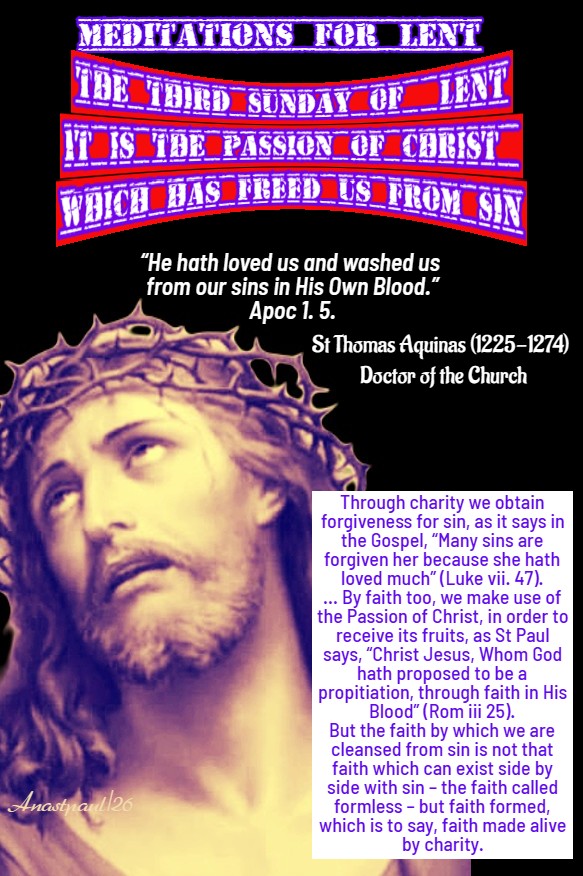
which has Freed Us from Sin

He hath loved us and washed us
from our sins in His Own Blood.

Apoc 1. 5.

The Passion of Christ is the proper Cause of the remission of our sins and that in three ways:

  1. Because it provokes us to love God. St Paul says, “God commendeth His Charity towards us because when, as yet we were sinners, Christ died for us” (Rom v. 8).

Through charity we obtain forgiveness for sin, as it says in the Gospel, “Many sins are forgiven her because she hath loved much” (Luke vii. 47).

2.The Passion of Christ is the Cause of the forgiveness of sins because it is an act of Redemption. Since Christ is Himself our Head, He has, by His Own Passion undertaken from Love and Obedience delivered us, His Members, from our sins, as it were, at the Price of His Passion.
Just as a man might, by some act of goodness undertaken with his hands, buy himself off for an error he had comitted with his feet.
For as man’s natural body is a unity, made up of different limbs, so the whole Church, which is the Mystical Body of Christ, is reckoned as a single person with its own Head and this Head is Christ.

3.The Passion of Christ was equal to its task.
For the Human Nature, through which Christ Suffered His Passion, is the instrument of His Divine Nature.
Whence all the actions and all the sufferings of that Human Nature wrought to drive out sin, are wrought by a Power which is Divine.

Christ, in His Passion, delivered us from our sins in a causal way, which is to say, He set up for us a Cause of our emancipation, a thing whereby any sin might, at any time, be remitted, whether committed now, or in times gone by, or in time to come: much as a physician might make a medicine from which all who are sick may be healed, even those sick in the years yet to come.

But since, what gives the Passion of Christ its excellence is the fact that it is the universal cause of the forgiveness of sins, it is necessary that we each of us ourselves make use of it for the forgiveness of our own particular sins. This is done through Baptism, Penance and the other sacraments, whose power derives from the Passion of Christ.

By faith too, we make use of the Passion of Christ, in order to receive its fruits, as St Paul says, “Christ Jesus, Whom God hath proposed to be a propitiation, through faith in His Blood” (Rom iii 25).
But the faith by which we are cleansed from sin is not that faith which can exist side by side with sin – the faith called formless – but faith formed, which is to say, faith made alive by charity.

So that the Passion of Christ is not through faith applied merely to our understanding but also, to our will. Again, it is from the Power of the Passion of Christ that the sins are forgiven which are forgiven by faith in this way.

ST THOMAS AQUINAS (1225-1274)
Priest, Theologian, Dominican
Doctor Angelicus (Angelic Doctor)
Doctor Communis (Common Doctor)
Added by Pope Saint Pius V in 1568
Posted in CHRIST the SUN of JUSTICE, LENT 2026, QUOTES on REPARATION/EXPIATION, QUOTES on SIN, QUOTES on the DEVIL/EVIL, The MOST HOLY REDEEMER, Our SAVIOUR, The PASSION, The REDEMPTION, Thomas Aquinas

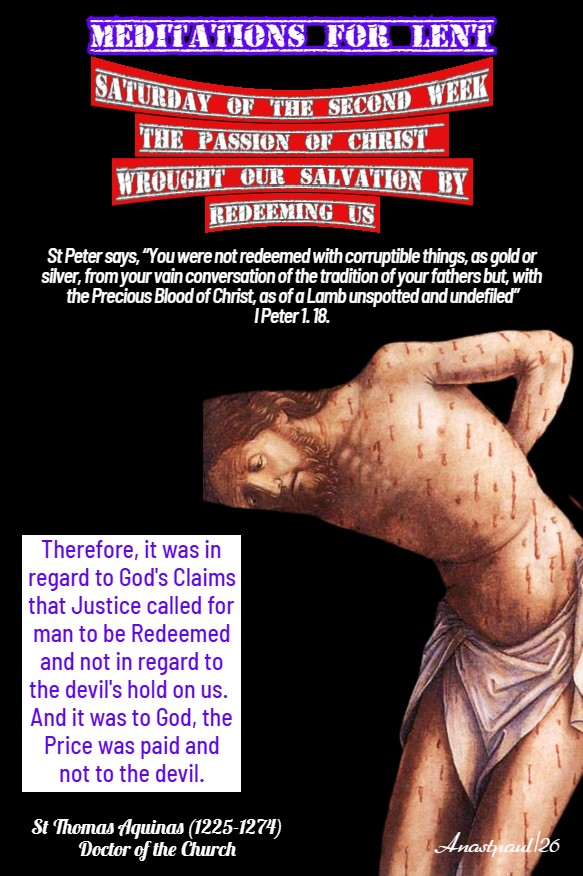
Saturday of the Second Week of Lent – 6 March – Our Lenten The Passion of ChristWrought our Salvation by Redeeming usJourney With St Thomas Aquinas –

Saturday of the Second Week of Lent – 6 March – Our Lenten Journey With St Thomas Aquinas (1225-1274) Doctor of the Church

Saturday of the Second Week
The Passion of Christ
Wrought our Salvation by Redeeming us

St Peter says, “You were not redeemed with corruptible things, as gold or silver, from your vain conversation of the tradition of your fathers but, with the Precious Blood of Christ, as of a Lamb unspotted and undefiled
I Peter 1. 18.

St.Paul says, “Christ hath Redeemed us from the curse of the law, being made a Curse for us“ (Gal iii. 13).
He is said to be accursed in our place, inasmuch as it was for us that He Suffered on the Cross. Therefore, by His Passion, He Redeemed us.

Sin, in fact, had bound man with a double obligation.

(i) An obligation which made him sin’s slave. For Jesus said, “whosoever committeth sin is the servant of sin” (John viii. 34).
A man is enslaved to whoever overcomes him.
Therefore, since the devil, in inducing man to sin, had overcome man, man was bound in servitude to the devil.

(ii) A further obligation existed, namely between man and the penalty due for the sin committed and man was bound in this way in accord with the Justice of God.
This too was a servitude, for to servitude or slavery, it belongs that a man must suffer, otherwise than he chooses, since the free man is the man who uses himself as he wills.

Since then, the Passion of Christ made sufficient and, more than sufficient, Satisfaction for the sins of all mankind and for the penalty due to them, the Passion was a Price through which we were freed from both these obligations.
For the satisfaction itself, by means of which, one makes satisfaction, whether for oneself or for another, is spoken of as a price by which one redeems or buys back oneself or another, from sin and from merited penalties.
So in Holy Scripture it is said, “Redeem thou thy sins with alms” (Dan iv. 24).

Christ made Satisfaction, not indeed by a gift of money or anything material but, by a gift which was the greatest of all, by giving Himself for us.
And thus it is that the Passion of Christ is called our Redemption.

By sinning man bound himself, not to God but to the devil.
As far as concerns the guilt of what he did, he had offended God and had made himself subject to the devil, assenting to the devil’s will.
Hence, he did not, by reason of the sin committed, bind himself to God but rather, deserting God’s Service, he had fallen under the yoke of the devil.
And God, with Justice if we remember the offence committed against Him, had not prevented this.

But, if we consider the matter of the punishment earned, it was chiefly and in the first place to God that man was bound, as to the Supreme Judge.
Man was, in respect of punishment, bound to the devil only in a lesser sense, as to the torturer, as it says in the Gospel, “Lest the adversary deliver thee to the Judge and the Judge deliver thee to the officer”(Matt v. 25) that is, to the cruel minister of punishments.

Therefore, although the devil unjustly, as far as was in his power, held man whom, by his lies he had deceived, bound in slavery, held him bound both on account of the guilt and of the punishment due for it, it was nevertheless just, that man should suffer in this way.
The slavery which he suffered on account of the evils committed which God did not prevent and, the slavery he suffered as punishment God decreed!

Therefore, it was in regard to God’s Claims that Justice called for man to be Redeemed and not in regard to the devil’s hold on us.
And it was to God, the Price was paid and not to the devil.

ST THOMAS AQUINAS (1225-1274)
Priest, Theologian, Dominican
Doctor Angelicus (Angelic Doctor)
Doctor Communis (Common Doctor)

Added by Pope Saint Pius V in 1568
Posted in DECEMBER - The DIVINE INFANCY and The IMMACULATE CONCEPTION, HOLY WEEK, IMMACULATE CONCEPTION Prayers and Novena, LENT 2026, QUOTES on CONSCIENCE, QUOTES on the CHURCH, The IMMACULATE CONCEPTION, The PASSION, The SEVEN PASSION Feasts, Thomas Aquinas

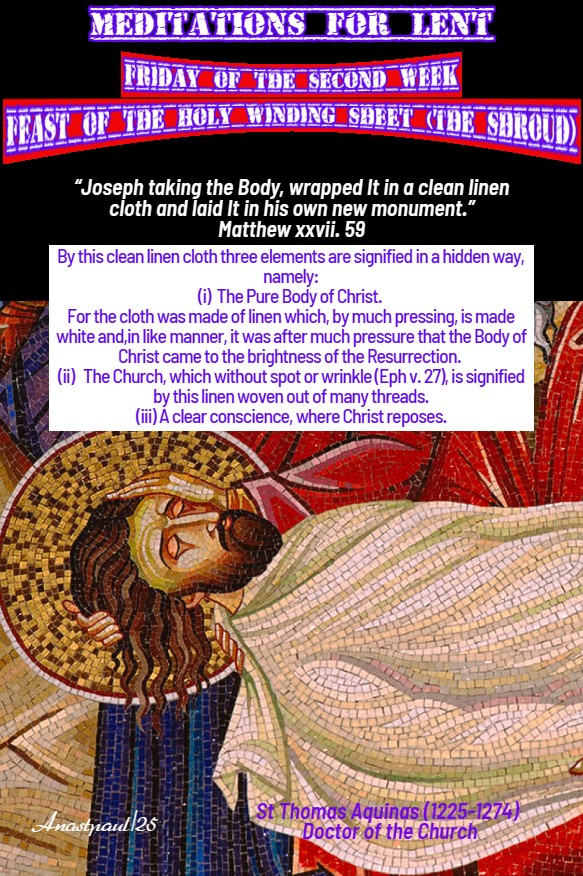
Friday of the Second Week of Lent – 6 March – Our Lenten Journey With St Thomas Aquinas – Feast of the Holy Winding Sheet (the Shroud)

Friday of the Second Week of Lent – 6 March – Our Lenten Journey With St Thomas Aquinas (1225-1274) Doctor of the Church

Friday of the Second Week
Feast of the Holy Winding Sheet (the Shroud)

Joseph taking the Body, wrapped It in a clean linen cloth and laid It in his own new monument.
Matthew xxvii. 59

By this clean linen cloth three elements are signified in a hidden way, namely:

(i) The Pure Body of Christ.
For the cloth was made of linen which, by much pressing, is made white and,in like manner, it was after much pressure that the Body of Christ came to the brightness of the Resurrection.
Thus it behoved Christ to Suffer and to Rise again from the dead on the third day (Luke xxiv. 46).

(ii) The Church, which without spot or wrinkle (Eph v. 27), is signified by this linen woven out of many threads.

(iii) A clear conscience, where Christ reposes.

And laid Him in his own new monument.
It was Joseph’s own grave and certainly it was appropriate that He Who had Died for the sins of others, should be buried in another man’s grave!

Notice that it was a new grave.
Had other bodies already been laid in it, there might have been a doubt which had arisen.
There is another fitness in this circumstance, namely – He Who was buried in this new tomb, as He who was born of a virgin mother.

As Mary’s womb knew no child before Him nor after Him, so was it with this tomb.
Again we may understand, it is in a renewed soul renewed where Christ is buried by faith, where Christ may dwell by faith in our hearts (Eph iii. 17).

St. John’s Gospel adds, Now there was in the place where He was crucified, a garden ; and in the garden a new sepulchre (John xix. 41). Which recalls to us that as Christ was taken in a garden and suffered His agony in a garden, so in a garden was He buried, and thereby we are reminded that it was from the sin committed by Adam in the garden of delightfulness that, by the power of His Passion, Christ set us free, and also that through the Passion the Church was consecrated, the Church which again is as a garden closed.

ST THOMAS AQUINAS (1225-1274)
Priest, Theologian, Dominican
Doctor Angelicus (Angelic Doctor)
Doctor Communis (Common Doctor)
Added by Pope Saint Pius V in 1568
Posted in LENT 2026, Our MORNING Offering, PRAYERS of the SAINTS, QUOTES on the CROSS of CHRIST, The HOLY CROSS, The PASSION

Our Morning Offering – 6 March – The Feast of the Holy Shroud of Jesus

Our Morning Offering – 6 March – The Feast of the Holy Shroud of Jesus

Faithful Cross! Above All Other
By St Venantius Fortunatus (c 530 – c 609)

Faithful Cross! above all other,
one and only noble tree!
None in foliage, none in blossom,
none in fruit thy peer may be;
sweetest wood and sweetest iron,
sweetest weight is hung on thee.

Bend thy boughs, O tree of glory!
Thy relaxing sinews bend;
for awhile the ancient rigour
that thy birth bestowed, suspend
and the King of heavenly beauty
gently on thine arms extend.

Praise and honour to the Father,
praise and honour to the Son,
praise and honour to the Spirit,
ever Three and ever One:
One in might and One in glory
while eternal ages run.

Posted in LENT 2026, QUOTES on SACRIFICE, The PASSION, Thomas Aquinas

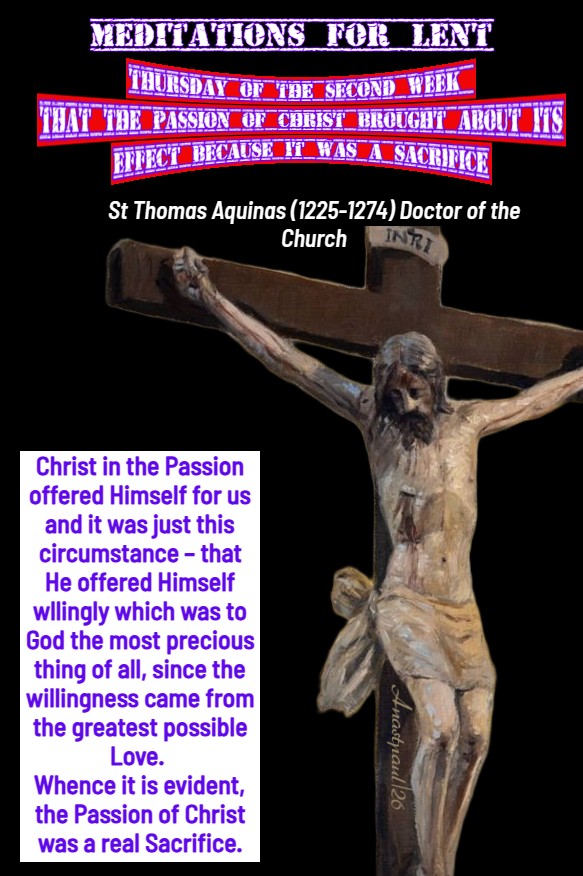
Thursday of the Second Week of Lent – 5 March – Our Lenten Journey With St Thomas Aquinas – That the Passion of Christ brought about its effect because it was a Sacrifice

Thursday of the Second Week of Lent – 5 March – Our Lenten Journey With St Thomas Aquinas (1225-1274) Doctor of the Church

Thursday of the Second Week
That the Passion of Christ brought about its effect
because it was a Sacrifice

A sacrifice, properly so called, is something done to render God the honour specially due to Him, in order to appease Him. St Augustine teaches this, saying, “Every work done in order that we may, in a holy union, cleave to God, is a true sacrifice; every work, that is to say, related to that final Good Whose possession alone can make us truly happy.”
Christ in the Passion offered Himself for us and it was just this circumstance – that He offered Himself wllingly which was to God the most precious thing of all, since the willingness came from the greatest possible Love. Whence it is evident, the Passion of Christ was a real Sacrifice.

And as He Himself adds later.
The former sacrifices of the saints were so many signs, of different kinds, of this One True Sacrifice. …
St Augustine speaks of four elements being found in every sacrifice, namely – Christ in the Passion offered Himself for us and it was just a person to whom the offering is made, one by whom it is made, the thing offered and those on whose behalf it is offered.
These are all found in the Passion of Our Lord. It is the same Person, the only, true Mediator Himself, Who through the sacrifice of peace reconciles us to God, yet remains One with Him to Whom He offers, those for whom He offers and is Himself One Who both offers and is offered.

It is true in those sacrifices of the old law which were types of Christ, human flesh was never offered but, it does not follow from this that the Passion of Christ was not a sacrifice.
For although the reality and that which typifies it must coincide in one point, it is not necessy that they coincide in every point, for the reality must go beyond that which typifies it.
It was then very fitting that the Sacrifice in which the Flesh of Christ is offered for us was typified by a sacrifice not of the flesh of man but of other animals, to fores-shadow the flesh of Christ which is the Most Perfect Sacrifice of all.

(i) Because, since it is the flesh of human nature which is offered, it is a thing fittingly offered for men and fittingly received by men in a Sacrament.

(ii) Because, since the Flesh of Christ was able to Suffer and to Die it was suitable for immolation.

(iii) Because, since that Flesh was itself without sin, it had a power to cleanse from sin.

(iv) Because, being the Flesh of the very Offerer, it was acceptable to God by reason of the unspeakable Love of the One Who was offering His Own Flesh.

Whence St Augustine says, “What is there more suitably received by men, of offerings made on their behalf, than human flesh and what is so suitable for immolation as mortal flesh? And what is as clean for cleansing mortal viciousness, as that flesh born, without stain of carnal desire, in the womb and of the womb of a virgin?
And what can be so graciously offered and received, as the Flesh of our Sacrifice, the Body so produced of our Priest?”

ST THOMAS AQUINAS (1225-1274)
Priest, Theologian, Dominican
Doctor Angelicus (Angelic Doctor)
Doctor Communis (Common Doctor)

Added by Pope Saint Pius V in 1568
Posted in AUGUSTINIANS OSA, CHRIST the WORD and WISDOM, DOCTORS of the Church, FATHERS of the Church, franciscan OFM, GOD ALONE!, LENT 2026, Of BEGGARS, the POOR, against POVERTY, QUOTES on ALMS, QUOTES on ETERNAL LIFE, QUOTES on GREED, WEALTH, QUOTES on HEAVEN, QUOTES on HUMILITY, QUOTES on SANCTITY, QUOTES on SUFFERING, QUOTES on the POOR, The HEART, The WORD

Quote/s of the Day – 5 March – ‘ … Give earth and receive Heaven! …’

Quote/s of the Day – 5 March – Ferial Day – Thursday of the Second Week in Lent – Jeremias 17:5-10 – Luke 16:19-31 – Scripture search here: https://www.drbo.org/

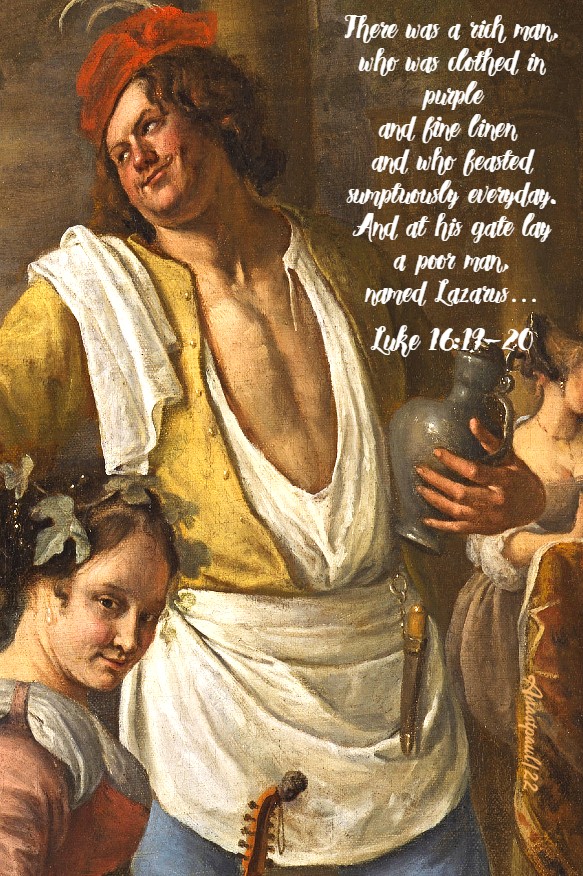
There was a rich man,
who was clothed in purple
and fine linen
and who feasted sumptuously everyday.
And at his gate lay a poor man,
named Lazarus
…”

Luke 16:19–20

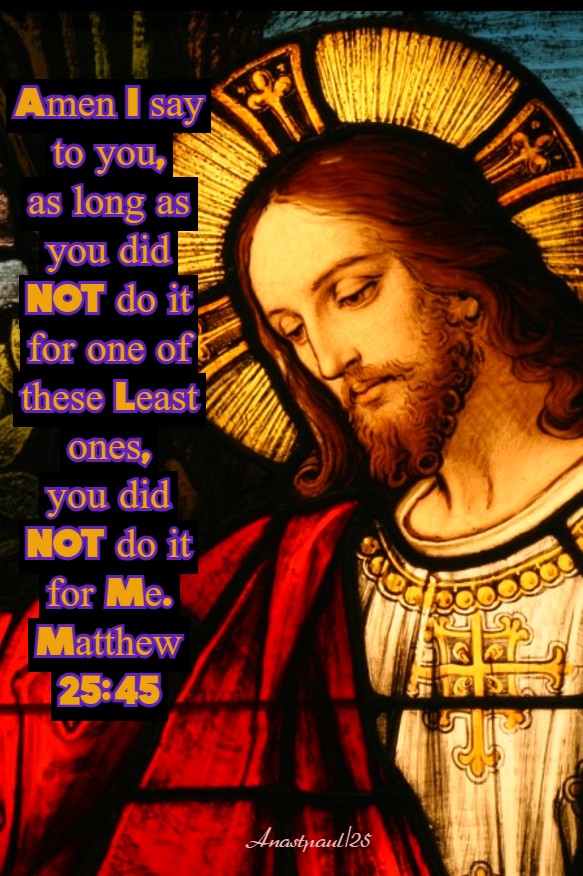
Amen I say to you,
as long as you did NOT do it
for one of these least ones,
you did NOT do it for Me.

Matthew 25:45

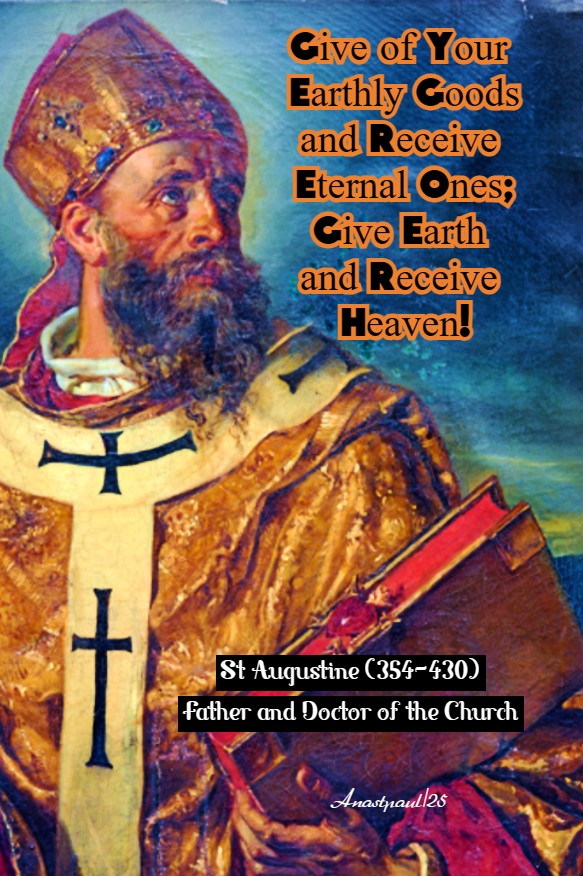
Give of your earthly goods
and receive eternal ones;
give earth and receive Heaven
!”

St Augustine (354-430)
Father and Doctor of the Church

What is a man’s treasure
but the heaping up of profits
and the fruit of his toil?
For, whatever a man sows,
this too will he reap and each man’s gain,
matches his toil and where delight
and enjoyment are found,
there the heart’s desire is attached.
Now, there are many kinds of wealth
and a variety of grounds for rejoicing –
every man’s treasure is that, which he desires.
If it is based on earthly ambitions,
its acquisition makes men not blessed but wretched.
… By distributing what might be superfluous
to support the poor, they are amassing
imperishable riches, so that what they have
discreetly given, cannot be subject to loss.
They have properly placed those riches,
where their heart is – it is a most blessed thing,
to work to increase such riches,
rather than to fear that they may pass away.

St Pope Leo the Great (400-461)
ather and Doctor of the Church

If thou wouldst see well, pluck out thine eyes and be blind;
if thou wouldst hear well, be deaf
and if thou wouldst speak well, become dumb;
if thou wouldst advance, stand still
and advance with thy mind;
if thou wouldst work well, cut off thy hands
and work with thy heart;
if thou wouldst love much, hate thyself;
if thou wouldst live well, mortify thyself;
if thou wouldst gain much and be rich,
first lose all and become poor
and if thou wouldst enjoy peace, afflict thyself
and be ever in fear and suspect thine own self;
if thou wouldst be exalted and have great honour,
humble and abase thyself;
if thou wouldst be held in great reverence, despise thyself
and do reverence to him who reviles thee;
if thou wouldst that it should be well with thee,
suffer all evil things and if thou wouldst be blessed,
desire that all should speak ill of thee
and if thou wouldst have true and eternal rest,
then toil and suffer and desire to have every temporal affliction.
O what great wisdom it is to know how to do
and to work out these things.”

Blessed Giles of Assisi (c1190-1262)

Posted in LENT 2026, REDEMPTIVE Suffering, The MOST HOLY REDEEMER, Our SAVIOUR, The PASSION, The REDEMPTION, Thomas Aquinas

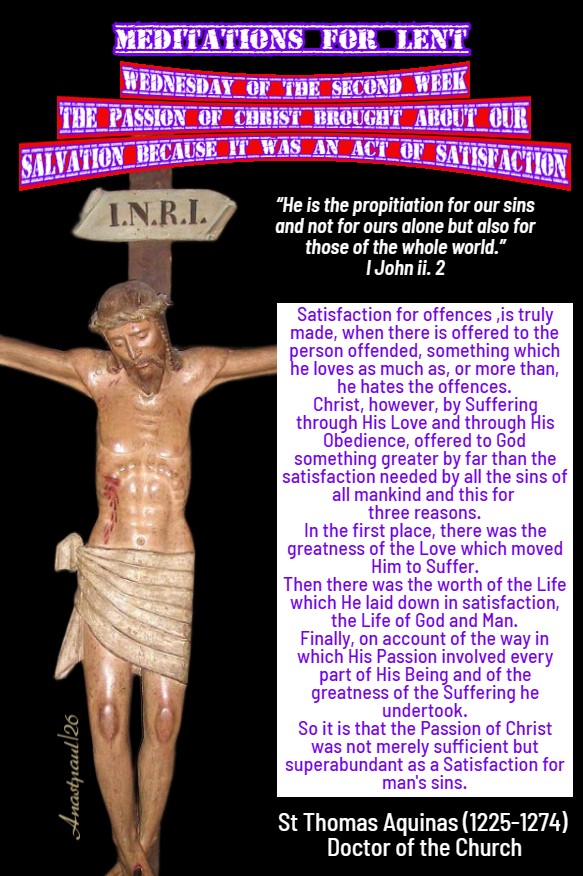
Wednesday of the Second Week of Lent – 4 March – Our Lenten Journey With St Thomas Aquinas The Passion of Christ brought about our Salvation because it was an Act of Satisfaction

Wednesday of the Second Week of Lent – 4 March – Our Lenten Journey With St Thomas Aquinas (1225-1274) Doctor of the Church

Wednesday of the Second Week
The Passion of Christ brought about our Salvation
because it was an Act of Satisfaction

He is the propitiation for our sins and not for ours alone but also for those of the whole world.
I John ii. 2.

Satisfaction for offences ,is truly made, when there is offered ,to the person offended, something which he loves as much as, or more than, he hates the offences.

Christ, however, by Suffering through His Love and through His Obedience, offered to God something greater by far than the satisfaction needed by all the sins of all mankind and this for three reasons.

In the first place, there was the greatness of the Love which moved Him to Suffer.
Then there was the worth of the Life which He laid down in satisfaction, the Life of God and Man.
Finally, on account of the way in which His Passion involved every part of His Being and of the greatness of the Suffering he undertook.
So it is that the Passion of Christ was not merely sufficient but superabundant as a satisfaction for man’s sins.

It would seem indeed to be the case that satisfaction should be made by the person who committed the offence. But Head and Members are, as it were, One Mystical Person and, therefore, the satisfaction made by Christ avails all the faithful as they are the Members of Christ. One man can always make satisfaction for another, as long as the two are one in charity.

  1. Although Christ, by His Death, made sufficient Satisfaction for Original Sin, it is not unfitting that the penal consequences of Original Sin should still remain even in those who are made sharers in Christ’s Redemption.
    This has been done fittingly and usefully, so that the penalties remain even though the guilt has been removed.

(i) It has been done so that there might be conformity between the faithful and Christ, as there is conformity between members and Head. Just as Christ, first of all, suffered many pains and came in this way to His Glory, so it is only right that His faithful should also first be subjected to sufferings and thence enter into immortality themselves, bearing as it were, the livery of the Passion of Christ so as to enjoy a glory somewhat like to His.

(ii) A second reason is that if men coming to Christ were straightaway freed from suffering and the necessity of death, only too many would come to Him attracted rather by these temporal advantages than by spiritual virtues.
And this would be altogether contrary to the intention of Christ, Who came into this world that He might convert men from a love of temporal advantages and win them to spiritual love and virtue.

(iii) Finally, if those who came to Christ were straightaway rendered immortal and impassible, this would, in a certain way compel men to receive the Faith of Christ and, therefore, the merit of believing would be lessened.

ST THOMAS AQUINAS (1225-1274)
Priest, Theologian, Dominican
Doctor Angelicus (Angelic Doctor)
Doctor Communis (Common Doctor)

Added by Pope Saint Pius V in 1568

Posted in LENT 2026, Quotes on SALVATION, The PASSION, Thomas Aquinas

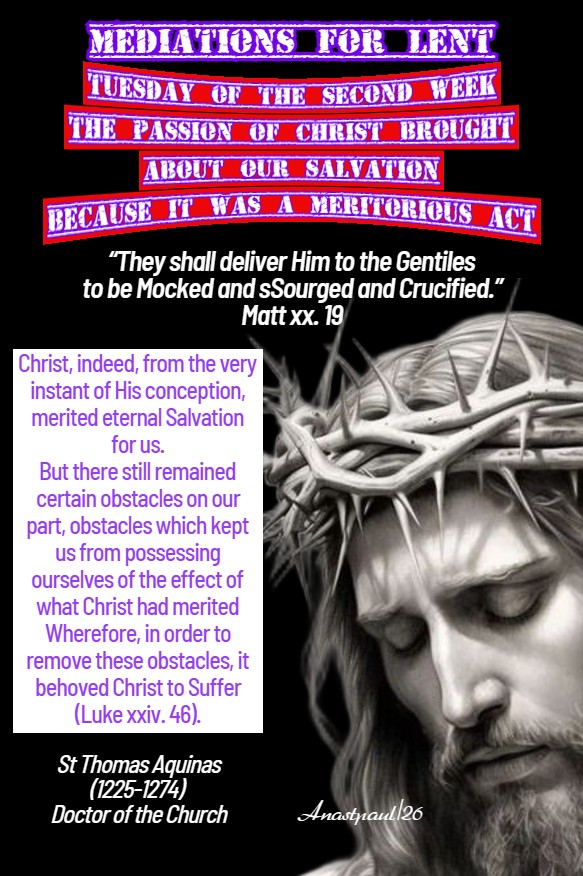
Tuesday of the Second Week of Lent – 3 March – Our Lenten Journey With St Thomas Aquinas – The Passion of Christ brought about our Salvationbecause it was a Meritorious Act

Tuesday of the Second Week of Lent – 3 March – Our Lenten Journey With St Thomas Aquinas (1225-1274) Doctor of the Church

Tuesday of the Second Week
The Passion of Christ brought about our Salvation
because it was a Meritorious Act

They shall deliver Him to the Gentiles
to be Mocked and Scourged and Crucified.

Matt xx. 19

Grace was given to Christ not only as to a particular person but also, as far as He is the Head of the Church, in order that the Grace might pass from Him to His Members. And the good works Christ performed, therefore, stand in this same way in relationship to Him and to His Members, as the good works of any other man in a State of Grace relate to himself.

Now it is evident that any man who, in a State of Grace, suffers for justice, merits for himself, by this very fact alone, salvation.
As is said in the Gospel, “Blessed are they who suffer persecution for justice sake” (Matt v. 10).
Whence Christ, by His Passion, merited Salvation, not only for Himself but for all His Members.

Christ, indeed, from the very instant of His conception, merited eternal Salvation for us.
But there still remained certain obstacles on our part, obstacles which kept us from possessing ourselves of the effect of what Christ had merited. Wherefore, in order to remove these obstacles, it behoved Christ to Suffer (Luke xxiv. 46).

Now although the love of Christ for us was not increased in the Passion and was not greater in the Passion than before it, the Passion of Christ had a certain effect which His previous meritorious activity did not.
The Passion produced this effect, not on account of any greater Love shown thereby but because, it was an action designed to produce that effect, as is evident from what has already been said on the fitness of the Passion of Christ.

Head and Members belong to One and the same Person. Now Christ is our Head, according to His Divinity and to the fullness of His Grace which overflows upon others too. We are His Members.
What Christ then meritoriously acquires, is not something external and foreign to us but, by virtue of the unity of the Mystical Body, it overflows upon us too.

We should know too, that although Christ, by His Death acquired merit sufficient for the whole human race, there are special elements needed for the particular Salvation of each individual soul and these each soul must itself seek out. The Death of Christ is, as it were, the cause of all Salvation, as the sin of the first man was the cause of all condemnation. But if each individual man is to share in the effect of a universal cause, the universal cause needs to be specially applied to each individual man.

Now the effect of the sin of the first parents is transmitted to each individual through his bodily origin (i.e., through his being a bodily descendant of the first man).
The effect of the Death of Christ is transmitted to each man through a spiritual rebirth, a re-birth in which man is, as it were, conjoined to Christ and incorporated with Him.

Therefore, it is that each individual must seek to be born again through Christ and to receive those other elements in which works the power of the Death of Christ.

ST THOMAS AQUINAS (1225-1274)
Priest, Theologian, Dominican
Doctor Angelicus (Angelic Doctor)
Doctor Communis (Common Doctor)
Added by Pope Saint Pius V in 1568
Posted in LENT 2026, The PASSION, Thomas Aquinas

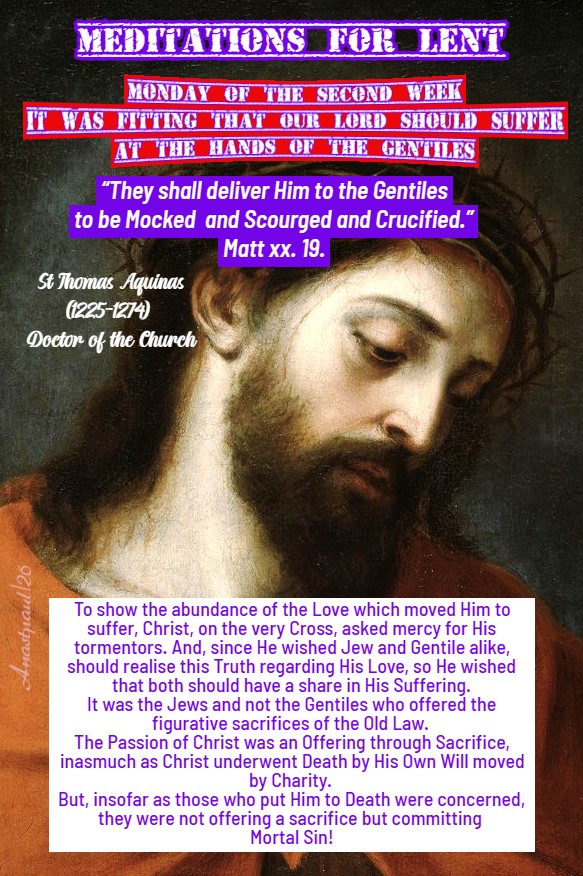
Monday of the Second Week of Lent – 2 March – Our Lenten Journey With St Thomas Aquinas – It was fitting that our Lord should Suffer at the hands of the Gentiles

Monday of the Second Week of Lent – 2 March – Our Lenten Journey With St Thomas Aquinas (1225-1274) Doctor of the Church

Monday of the Second Week
It was fitting that our Lord should Suffer
at the hands of the Gentiles

They shall deliver Him to the Gentiles
to be Mocked and Scourged and Crucified.

Matt xx. 19

In the very manner of the Passion of Our Lord its effects are foreshadowed.
In the first place, the Passion of Our Lord had, for its effect , the salvation of Jews, many of whom were baptised in His death.

Secondly, by the preaching of these Jews, the effects of the Passion passed to the Gentiles too. There was thus, a certain fitness in Our Lord’s Passion beginning with the Jews and then, the Jews handing Him on, that it should be completed at the hands of the Gentiles.

To show the abundance of the Love which moved Him to suffer, Christ, on the very Cross, asked mercy for His tormentors. And, since He wished Jew and Gentile alike, should realise this Truth regarding His Love, so He wished that both should have a share in His Suffering.

It was the Jews and not the Gentiles who offered the figurative sacrifices of the Old Law.
The Passion of Christ was an Offering through Sacrifice, inasmuch as Christ underwent Death by His Own Will moved by Charity.
But, insofar as those who put Him to Death were concerned, they were not offering a sacrifice but committing a Mortal Sin!

When the Jews declared, “It is not lawful for us to put any man to death” (John xix. 31), they may have had many areas of concern in mind.
It was not lawful for them to put anyone to death on account of the holiness of the Feast they had begun to keep. Perhaps they wished Christ to be killed not as a transgressor of their own law but as an enemy of the state, because He had made Himself a King, a charge concerning which they had no jurisdiction.
Or again, they may have meant that they had no power to crucify which was what they longed for but only to stone, as they later stoned St Stephen.
Or, the most likely thing of all, that their Roman Conquerors had taken away their power of life and death!

ST THOMAS AQUINAS (1225-1274)
Priest, Theologian, Dominican
Doctor Angelicus (Angelic Doctor)
Doctor Communis (Common Doctor)
Added by Pope Saint Pius V in 1568
Posted in CHRIST the LIGHT, FATHERS of the Church, LENT 2026, Our MORNING Offering, PRAYERS of the SAINTS, QUOTES on HEAVEN, QUOTES on PURITY

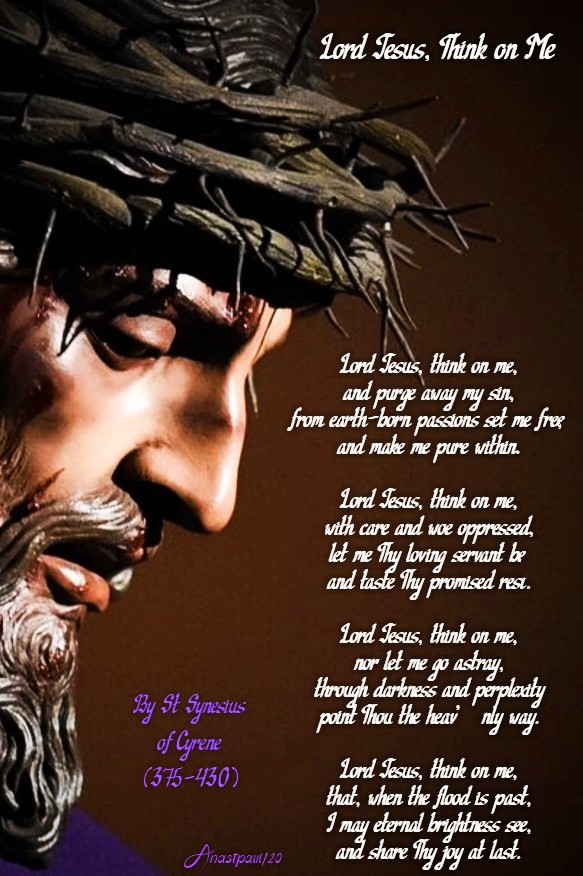
Our Morning Offering – 2 March – Lord Jesus, Think on Me By St Synesius

Our Morning Offering – 2 March – Monday of the Second Week of Lent

Lord Jesus, Think on Me
By St Synesius of Cyrene (375-430)
Bishop of Ptolemais
, Father

Lord Jesus, think on me
and purge away my sin,
from earth-born passions set me free,
and make me pure within.
Lord Jesus, think on me,
With care and woe oppressed,
let me Thy loving servant be
and taste Thy promised rest.
Lord Jesus, think on me,
nor let me go astray,
through darkness and perplexity
point Thou the heav’nly way.
Lord Jesus, think on me,
that, when the flood is past,
I may eternal brightness see
and share Thy joy at last.
Amen

Posted in GOD is LOVE, GOD the FATHER, LENT 2026, The PASSION, The WILL of GOD, Thomas Aquinas

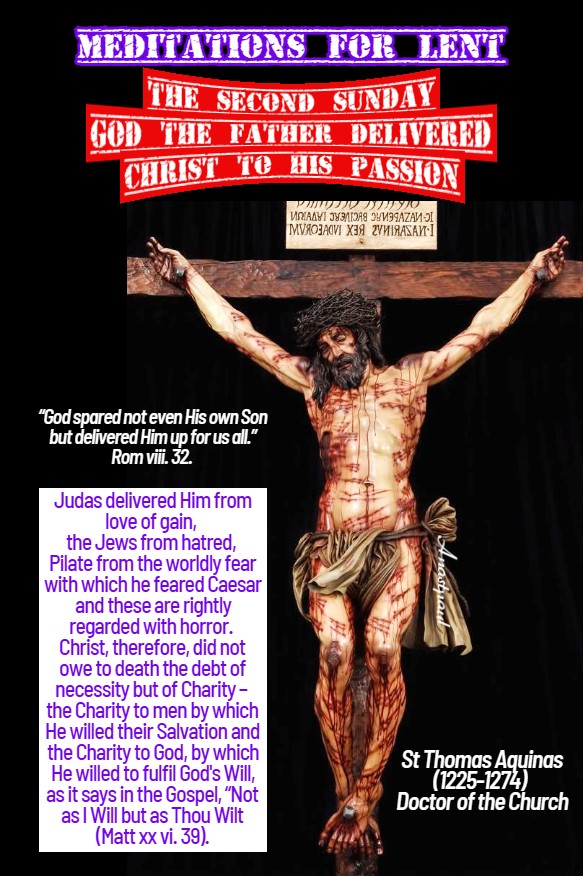
The Second Sunday of Lent – 1 March – Our Lenten Journey With St Thomas Aquinas – God the Father Delivered Christ to His Passion

The Second Sunday of Lent – 1 March – Our Lenten Journey With St Thomas Aquinas (1225-1274) Doctor of the Church

The Second Sunday
God the Father Delivered Christ to His Passion

God spared not even His own Son but delivered Him up for us all.
Rom viii. 32.

Christ suffered willingly, moved by obedience to His Father. Wherefore, God the Father delivered Christ to His Passion and this, in three ways:

  1. Because the Father, of His Eternal Will, preordained the Passion of Christ as the means whereby to free the human race. So it is said in Isaias, “The Lord hath laid on Him the iniquity of us all” (Isa liii. 6) and again, “The Lord was pleased to bruise Him in infirmity” (ibid liii. 10).
  2. Because He inspired Our Lord with the willingness to suffer for us, pouring into His Soul the Love which produced the will to suffer. Whence the Prophet goes on to say, “He was offered because it was His Own Will” (Isa liii. 7).
  3. Because He did not protect Our Lord from the Passion but exposed Him to His persecutors. Whence we read in St Matthew’s Gospel: as He hung on the cross Christ said, “My God, My God, why hast thou forsaken Me” (Matt xxvii. 46). For God the Father, that is to say, had left Him at the mercy of His torturers.

To hand over an innocent man to suffering and to death, against his will, compelling him to die as it were, would indeed be cruel and wicked.
But it was not in this way God the Father delivered Christ. He delivered Christ by inspiring Him with the Will to suffer for us. By so doing, the severity of God is made clear – no sin is forgiven without punishment! which St Paul again teaches when he says, God spared not His Own Son.

At the same time God’s kindness and goodness is exhibited in the fact that whereas man could not, no matter what his punishment, sufficiently make satisfaction, God has given man someone Who is able to make that satisfaction for him. Which is what St Paul means by, He delivered Him up for us all and again when he says, God hath proposed Christ to be an appeasement through faith in His Blood (Rom iii. 25).
The same activity in a good man and in a bad man is differently judged, inasmuch as the root from which it proceeds is different.
The Father, for example, delivered Christ and Christ delivered Himself and this from love and, therefore, They are praised.

Judas delivered Him from love of gain, the Jews from hatred, Pilate from the worldly fear with which he feared Caesar and these are rightly regarded with horror.
Christ, therefore, did not owe to death the debt of necessity but of Charity –
the Charity to men by which He willed their Salvation and the Charity to God, by which He willed to fulfil God’s Will, as it says in the Gospel, “Not as I Will but as Thou Wilt (Matt xx vi. 39).

ST THOMAS AQUINAS (1225-1274)
Priest, Theologian, Dominican
Doctor Angelicus (Angelic Doctor)
Doctor Communis (Common Doctor)

Added by Pope Saint Pius V in 1568
Posted in GOD is LOVE, LENT 2026, The PASSION, Thomas Aquinas

Saturday of the First Week of Lent – 28 February – Our Lenten Journey With St Thomas Aquinas – The Love of God Exhibited in the Passion of Christ

Saturday of the First Week of Lent – 28 February – Our Lenten Journey With St Thomas Aquinas (1225-1274) Doctor of the Church

Saturday of the First Week
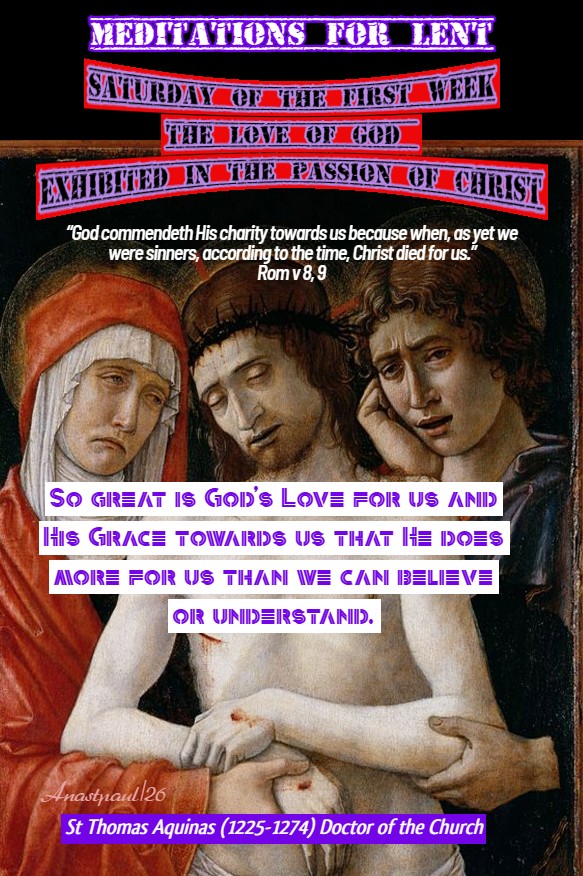
The Love of God
Exhibited in the Passion of Christ

God commendeth His charity towards us because when, as yet we were sinners, according to the time, Christ died for us.
Rom v 8, 9

  1. “Christ died for the ungodly” (ibid 6
    This is a great thing if we consider Who it is Who died, a great thing too if we consider on whose behalf He died.
    For scarcely for a just man, will one die (ibid 6), that is to say that you will not find anyone who will die even to set free a man who is innocent, nay even, it is said, “The just perisheth and no man layeth it to heart” (Isaias l vii).

Rightly, therefore, does St.Paul say scarcely will one die. There might perhaps be found one, someone rare person, who out of sa uperabundance of courage, would be so bold as to die for a good man. But this is rare, for the simple reason that so to act is the greatest of all things. “Greater love than this, no man hath, says Our Lord Himself, that a man lay down his life for his friends (John xv. 13).

But the like of that which Christ Himself did, to die for evildoers and the wicked, has never been seen.
Wherefore rightly do we ask in wonderment, why Christ did this.

  1. If in fact it be asked, why Christ died for the wicked, the answer is that God, in this way, commendeth His Charity towards us. He exhibits to us in this way that He Loves us with a Love which knows no limits, for while we were as yet sinners, Christ died for us.

The very death of Christ for us, depicts the Love of God, for it was His Son Whom He gave to die that satisfaction might be made for us. God so Loved the world, as to give His Only Begotten Son (John iii. 16).
And thus, as the Love of God the Father for us is proved in His giving us His Holy Spirit, so also is it proved in this way, by His Gift of His Only Son.

The Apostle says, God commendeth, signifying thereby that the Love of God cannot be measured. This is exhibited by the very fact of the matter, namely the fact that He gave His Son to die for us and it is proved too by reason of the kind of people we are, for whom He died.
“Christ was not stirred up to die for us by any merits of ours, when as yet we were sinners. God (who is rich in mercy) for His exceeding Charity wherewith He Loved us, even when we were dead in sins, hath quickened us together in Christ ” (Eph ii. 4).

  1. All this is almost too much to be believed.
    “A work is done in your days which no man will believe when it shall be told” (Habac i. 5).
    This Truth that Christ died for us is so difficult a Truth that scarcely can our intellect grasp it. Nay it is a Truth which our intellect can, in no way understand.
    And St Paul preaching, makes echo to Habacuc, I work a work in your days, a work which you will not believe, if any man shall tell it to you (Acts xiii 14).

So great is God’s Love for us and His Grace towards us that He does more for us than we can believe or understand.

ST THOMAS AQUINAS (1225-1274)
Priest, Theologian, Dominican
Doctor Angelicus (Angelic Doctor)
Doctor Communis (Common Doctor)
Added by Pope Saint Pius V in 1568

Posted in BLESSED TRINITY PRAYERS, Holy Name PRAYERS, JANUARY month of THE MOST HOLY NAME of JESUS, LENT 2026, LENTEN PRAYERS & NOVENAS, Our MORNING Offering, PRAYERS of the CHURCH, QUOTES on BLASPHEMY, QUOTES on REPARATION/EXPIATION

Our Morning Offering – 28 February – The Golden Arrow

Our Morning Offering – 28 February – “The Month of the Most Holy and Blessed Trinity” – Saturday of the First Week of Lent

The Golden Arrow

This prayer was revealed by Jesus Himself to a Carmelite Nun of Tours in 1843 as a Reparation for Blasphemy. “This Golden Arrow will wound My Heart delightfully” He said “and heal the wounds, inflicted by blasphemy.”

May the Most Holy,
Most Sacred,
Most Adorable,
Most Mysterious
and Unutterable Name of God
be always praised,
blessed, loved, adored
and glorified in Heaven.
on earth and under the earth,
by all the creatures of God
and by the Sacred Heart
of our Lord Jesus Christ
in the most Holy Sacrament
of the Altar.
Amen

Posted in JULY - The MOST PRECIOUS BLOOD, LENT 2026, The MOST PRECIOUS BLOOD, The PASSION, The SEVEN PASSION Feasts, Thomas Aquinas

Friday of the First Week of Lent – 27 February – Our Lenten Journey With St Thomas Aquinas – The Feast of the Holy Lance and Nails of Our Lord

Friday of the First Week of Lent – 27 February – Our Lenten Journey With St Thomas Aquinas (1225-1274) Doctor of the Church

Friday After First Sunday
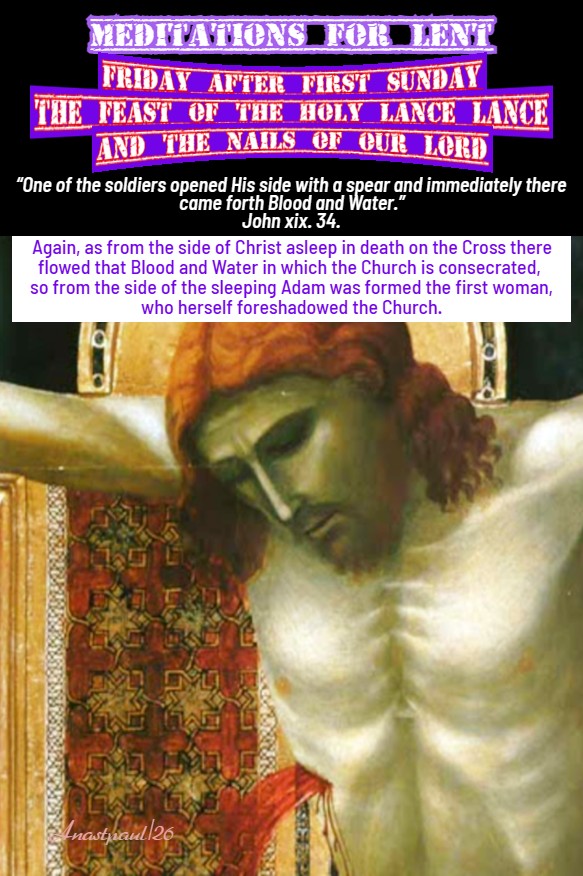
The Feast of the Holy Lance Lance
and the Nails of Our Lord

“One of the soldiers opened His side with a spear and immediately there came forth Blood and Water.”
John xix. 34.

  1. The Gospel deliberately says opened and not wounded because, through Our Lord’s Side, there was opened to us the Gate of Eternal Life.
    “ After these things I looked and behold, a gate was opened in heaven,” (Apoc iv. i). This is the door opened in the ark, through which enter the animals who will not perish in the flood.
  2. But this door is the cause of our salvation.
    Immediately there came forth Blood and Water a thing truly miraculous that, from a dead body, in which the blood congeals, Blood should come forth!

This was done to show that by the Passion of Christ we receive a full absolution, an absolution from every sin and every stain. We receive this absolution from sin through that Blood which is the price of our redemption. You were not redeemed with corruptible things as gold or silver, from your vain conversation with the tradition of your fathers but with the Precious Blood of Christ, as of a lamb unspotted and undefiled (i Pet i. 18).

We were absolved from every stain by the Water which is the laver of our redemption.
In the Prophet Ezechiel, it is said, “I will pour upon you clean water and you shall be cleaned from all your
filthiness” (Ezech xxxvi. 28) and in Zacharias,
“There shall be a fountain open to the house of David and to the inhabitants of Jerusalem for the washing of the sinner and the unclean woman” (Zach xiii. i).

And so, these two things may be thought of in relation to two of the Sacraments, the Water to Baptism and the Blood to the Holy Eucharist.
Or both may be referred to the Holy Eucharist since, in the Mass, water is mixed with the wine. Although the water is not of the substance of the Sacrament.

Again, as from the side of Christ asleep in death on the Cross there flowed that Blood and Water in which the Church is consecrated, so from the side of the sleeping Adam was formed the first woman, who herself foreshadowed the Church.

ST THOMAS AQUINAS (1225-1274)
Priest, Theologian, Dominican
Doctor Angelicus (Angelic Doctor)
Doctor Communis (Common Doctor)
Added by Pope Saint Pius V in 1568
Posted in EMBER DAYS, LENT 2026, SAINT of the DAY, The PASSION, The SEVEN PASSION Feasts

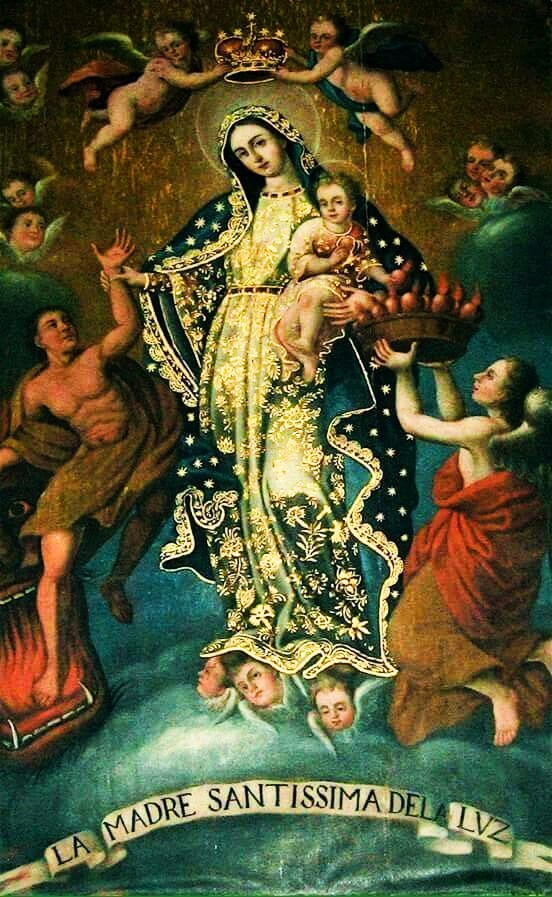
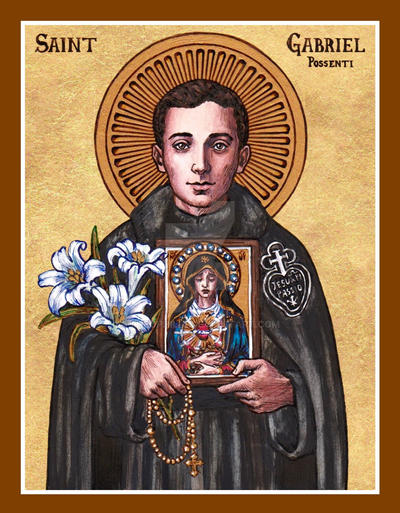
The Feast of the Sacred Lance and Nails, EMBER FRIDAY of the FIRST WEEK of LENT – Fast & Abstinence, Nostra Signora della Luce / Our Lady of Light, Palermo, Italy, (18th Century), St Gabriel of Our Lady of Sorrows and the Saints for 27 February

EMBER FRIDAY
of the FIRST WEEK of LENT – Fast & Abstinence

https://anastpaul.com/2020/12/16/today-is-an-ember-day-did-you-remember/

The Feast of the Sacred Lance and Nails – Friday after the 1st Sunday in Lent:
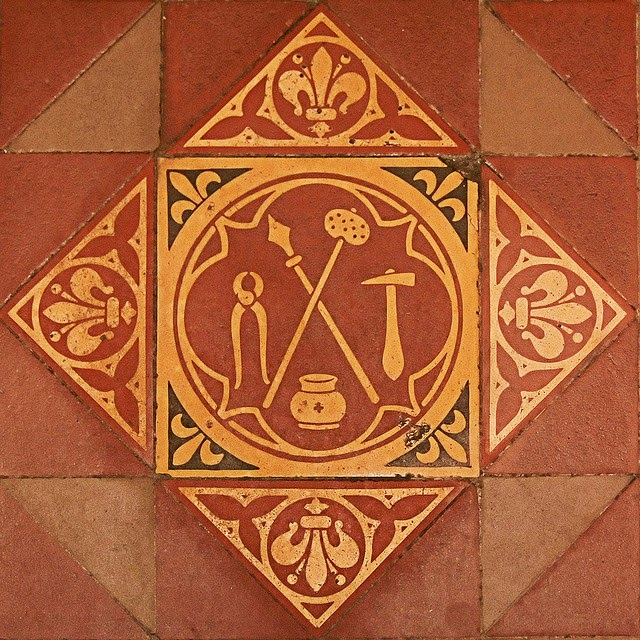
The Supreme Pontiff, Innocent VI, in his Decree establishing the Feast and Office of the Lance and Nails which pierced the Body of our Crucified Lord Jesus Christ, exhorts all the faithful to have a special veneration for and devotion to, all the Sacred Instruments of our Saviour’s Passion.
The following are the Holy Father’s words:
We should honour the most holy Passion of our Lord and Redeemer, Jesus Christ, in such manner that, meditating on all the mysteries and merits of the same Passion, we venerate also each Sacred Instrument thereof.
Then this holy and zealous Pontiff, coming more directly to the honour due to the Lance and Nails, says:
Although the Lance and Nails and the other Sacred Instruments of the Passion, should be enerated everywhere, by the faithful of Christ and although every year the Church celebrates the Solemn Offices of the same Passion, yet, we deem it proper and fitting, that a special Solemn Feast should be instituted and celebrated in honour of those particular Instruments of the Passion, more especially, in those places wherein these salutary Instruments are preserved. Hence, we wish to encourage this devotion by a special Office and privileges.” (Innocent VI in Decret. de Fest. Lane, et Clav. Domini).

The Lance, also known as “The Spear of Longinus” is kept in the Vatican Basilica, given to Innocent VIII in 1492. The Nails were kept with the Crown of Thorns, along with a small piece of the Lance of Longinus at Saint Chapelle, France and were subsequently lost during the French Revolution. The Crown of Thorns was the only Relic saved and is now kept at Notre Dame Cathedral.

Nostra Signora della Luce / Our Lady of Light, Palermo, Italy, (18th Century) – 27 February:
HERE:

https://anastpaul.com/2021/02/27/our-lady-of-light-palermo-italy-18th-century-and-memorials-of-the-saints-27-february/

St Gabriel of the Sorrowful Virgin/Gabriel Possenti CP (1838-1862) Confessor, Passionist Religious and student preparing for the Priesthood. Gabriel was known for his great devotion to the Sorrows of the Virgin Mary. St Gabriel was Canonised on 13 May 1920 by Pope Benedict XV.
Loving St Gabriel:

https://anastpaul.com/2021/02/27/saint-of-the-day-27-february-st-gabriel-of-our-lady-of-sorrows-cp-1838-1862/

St Abundius of Rome
St Alexander of Rome
St Alnoth
St Antigonus of Rome

St Baldomerus of Saint Just (Died c650) SubDeacon, Lay Brother, Blacksmith.
His Devoted Life:

https://anastpaul.com/2024/02/27/saint-of-the-day-27-february-saint-baldomerus-of-saint-just-died-c650-subdeacon/

St Basil (8th Century) Monk of Constantinople AND St Procopius (8th Century) Monk of Decapolis
St Comgan
Bl Emmanuel of Cremona Bishop
St Fortunatus of Rome
St Herefrith of Lindsey
St Honorina

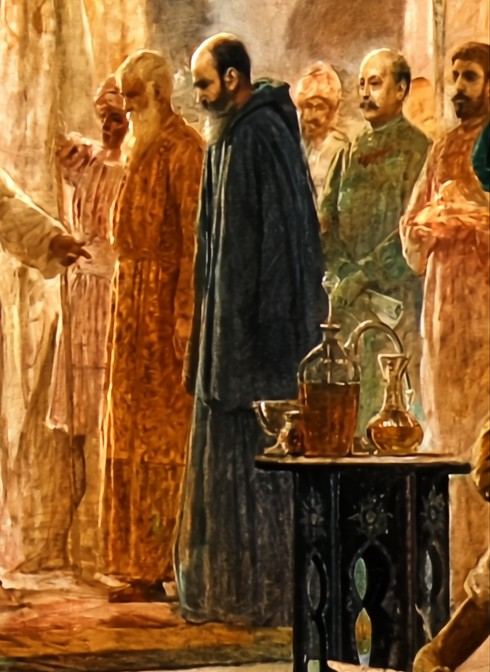
St John (c900-976) Abbot of Gorze Monastery, Penitent, Reformer, Diplomat, Apostle of the needy and sick.
His Penitent Life:

https://anastpaul.com/2025/02/27/saint-of-the-day-27-february-saint-john-c900-976-abbot-of-gorze/

St John with the White hair and beard before the Caliph

St Luke of Messina

Blessed Mark Barkworth OSB (c 1572–1601) Priest Martyr – one of the English Martyrs. Mark was Beatified by Pope Pius XI on 15 December 1929.
His Life and Death:

https://anastpaul.com/2022/02/27/saint-of-the-day-27-february-blessed-mark-barkworth-osb-c-1572-1601-priest-martyr/
St Thalilaeus

Blessed William Richardson (1572–1603) English Priest, Martyr. He was Beatified on 15 December 1929 by Pope Pius XI. Born in Yorkshire and died by being hanged, drawn and quartered on 27 February 1603 at Tyburn, London, aged just 31. William owns the dubious honour of being the last Martyr under Elizabeth I’s barbaric policy of murdering Catholics and especially Priests, in this manner.
His Life and Death:

https://anastpaul.com/2023/02/27/saint-of-the-day-27-february-blessed-william-richardson-1572-1603-english-priest-martyr/

Posted in DOCTORS of the Church, FATHERS of the Church, LENT 2026, The PASSION, Thomas Aquinas

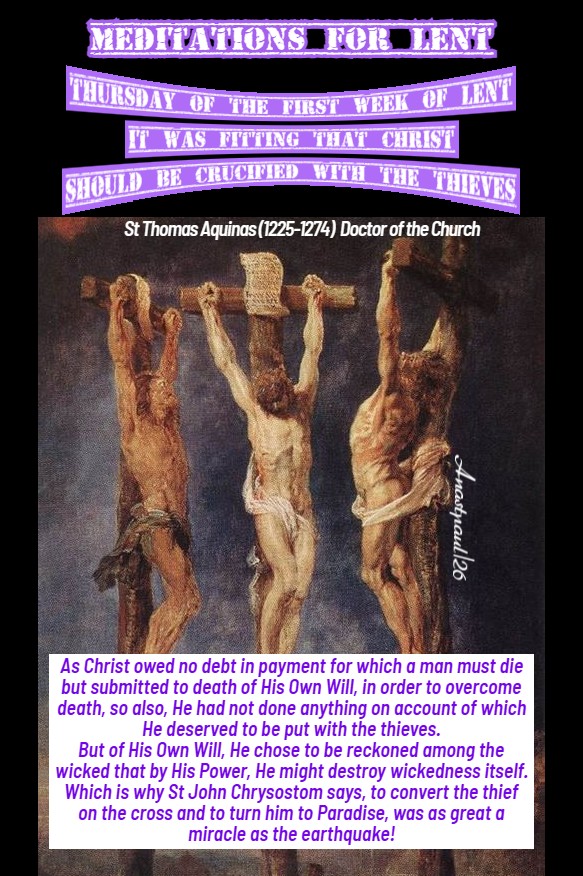
Thursday of the First Week of Lent – 26 February – Our Lenten Journey With St Thomas Aquinas – It was fitting that Christ should be Crucified with the Thieves

Thursday of the First Week of Lent – 26 February – Our Lenten Journey With St Thomas Aquinas (1225-1274) Doctor of the Church

Thursday of the First Week of Lent
It was fitting that Christ
should be Crucified with the Thieves

Christ was Crucified between the thieves because such was the will of the Jews and also because, this was part of God’s Design.
But the reasons why this was appointed, were not the same in each of these cases.

  1. As far as the Jews were concerned, Our Lord was Crucified with the thieves on either side to encourage the suspicion that He too was a criminal.
    But it transpired otherwise!
    The thieves themselves have left not a trace in the remembrance of man, while His Cross is everywhere held in honour. Kings lying their crowns aside, have embroidered the Cross on their Royal robes. They have placed it on their crowns; on their armiur. It has its place on the very Altars. Everywhere, throughout the world, we behold the splendour of the Cross.

In God’s Plan, Christ was Crucified with the thieves in order, for our sakes, He became accursed of the Cross, so, for our salvation, He is Cucified like an evil Man amongst evil men.

  1. The Pope, St Leo the Great, says that the thieves were crucified, one on either side of Our Lord, so that, in the very appearance of the scene of His Suffering, there might be set forth that distinction which should be made in the judgement of each one of us.
    St Augustine has the same thought. “The Cross itself,” he says, “was a tribunal. In the centre was the Judge. To the one side a man who believed and was set free, to the other side, a scoffer and he was condemned.”
    Already there was made clear the final fate of the living and the dead, the one class placed at His Right, the other on His Left.
  2. According to St Hilary, the two thieves, placed to right and to left, typify that the whole of mankind is called to the mystery of Our Lord’s Passion. And, since division of things, according to right and left is made with reference to believers and those who will not believe, one of the two, placed on the right, is saved by justifying faith.
  3. As St Bede says, the thieves who were crucified with Our Lord, represent those who, for the faith and to confess Christ, undergo the agony of martyrdom or the severe discipline of a more perfect life.
    Those who do this for the sake of eternal glory are typified by the thief on the Right Hand.
    Those whose motive is the admiration of whoever beholds them, imitate the spirit and the act of the thief on the Left Hand.

As Christ owed no debt in payment for which a man must die but submitted to death of His Own Will, in order to overcome death, so also, He had not done anything on account of which He deserved to be put with the thieves.
But of His Own Will, He chose to be reckoned among the wicked that by His Power, He might destroy wickedness itself.
Which is why St John Chrysostom says, to convert the thief on the cross and to turn him to Paradise, was as great a miracle as the earthquake!

ST THOMAS AQUINAS (1225-1274)
Priest, Theologian, Dominican
Doctor Angelicus (Angelic Doctor)
Doctor Communis (Common Doctor)
Added by Pope Saint Pius V in 1568
Posted in LENT 2026, QUOTES on SUFFERING, The PASSION, Thomas a Kempis

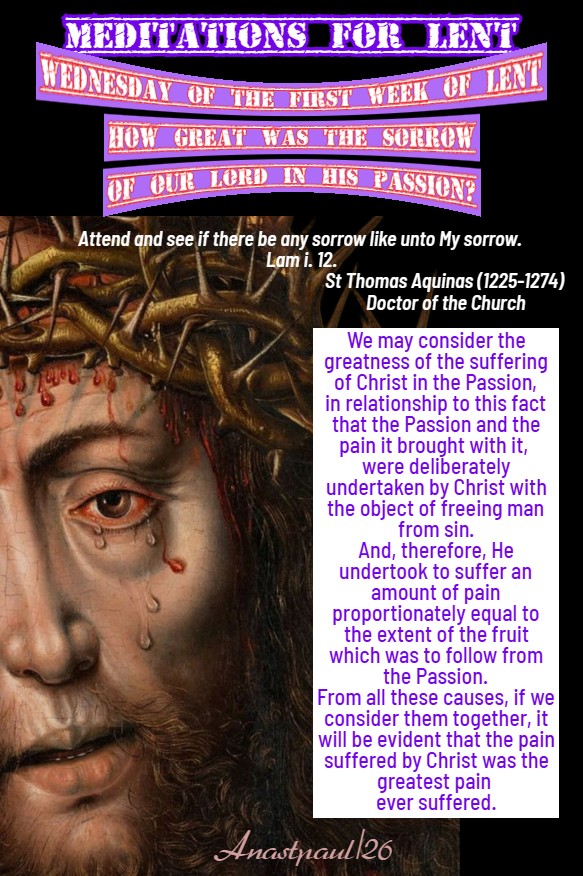
Wednesday of the First Week of Lent – 25 February – Our Lenten Journey With St Thomas Aquinas – How Great was the Sorrowo of Our Lord in His Passion?

Wednesday of the First Week of Lent – 25 February – Our Lenten Journey With St Thomas Aquinas (1225-1274) Doctor of the Church

Wednesday of the First Week of Lent
How Great was the Sorrow
of Our Lord in His Passion?

“Attend and see if there be any sorrow like unto My sorrow.
Lam i. 12.

Our Lord as He suffered felt in reality and in His Senses, that pain which is caused by some harmful bodily injuries.
He also felt that interior pain which is caused by the fear of something harmful and, which we call sadness.
In both these respects, the pain suffered by Our Lord was the greatest pain possible in this present life.
There are four reasons why this was so.

  1. The causes of the pain.
    The cause of the pain in the senses was the catastrophic injuries to the body, a pain whose bitterness derived partly from the fact that the sufferings attacked every part of His Body and partly, from the fact that, of all species of torture , death by Crucifixion is undoubtedly the most bitter.
    The nails are driven through the most sensitive of all places, the hands and the feet, the weight of the body itself increases the pain every moment.
    Add to this the long extentuated agony, for the Crucified do not die immediately as do those who are beheaded. The cause of the internal pain was:
    (i) All the sins of all mankind for which, by suffering, He was making satisfaction, so that, in a sense, He took them to Himself as though they were His own. The words of my sins, it says in the Psalms (Ps xxi. 2).

(ii) The special case of the Jews and the others who had had a share in the sin of His death and especially, the case of His disciples for whom His death had been a thing to be ashamed of.

(iii) The loss of His Bodily Life which, by the nature of things, is something from which human nature turns away in horror.

  1. We may consider the greatness of the pain according to the capacity, bodily and spiritual, for suffering of Him Who suffered. In
    His Body He was most admirably formed, for it was formed by the miraculous operation of the Holy Ghost and, therefore, Iits Sense of Touch, the sense through which we experience pain, was of the keenest.
    His Soul likewise, from Its interior powers, had a knowledge as from experience of all the causes of sorrow.
  2. The greatness of Our Lord’s Suffering can be considered in regard to this that the pain and sadness were without any alleviation. For, in the case of no matter what other sufferer, the sadness of mind and even the bodily pain, is lessened through a certain kind of reasoning, by means of which there is brought about a distraction of the sorrow from the higher powers to the lower.
    But when Our Lord suffered this did not happen, for He allowed each of His Powers to act and suffer to the fullness of its special capacity.
  3. We may consider the greatness of the suffering of Christ in the Passion, in relationship to this fact, that the Passion and the pain it brought with it, were deliberately undertaken by Christ with the object of freeing man from sin.
    And, therefore, He undertook to suffer an amount of pain proportionately equal to the extent of the fruit which was to follow from the Passion.

From all these causes, if we consider them together, it will be evident that the pain suffered by Christ was the greatest pain ever suffered.

ST THOMAS AQUINAS (1225-1274)
Priest, Theologian, Dominican
Doctor Angelicus (Angelic Doctor)
Doctor Communis (Common Doctor)
Added by Pope Saint Pius V in 1568
Posted in DIVINE Mercy, Goodness, Patience, DOCTORS of the Church, FATHERS of the Church, HYMNS, LENT 2026, Our MORNING Offering, PRAYERS of the SAINTS, QUOTES on FASTING, QUOTES on FORGIVENESS

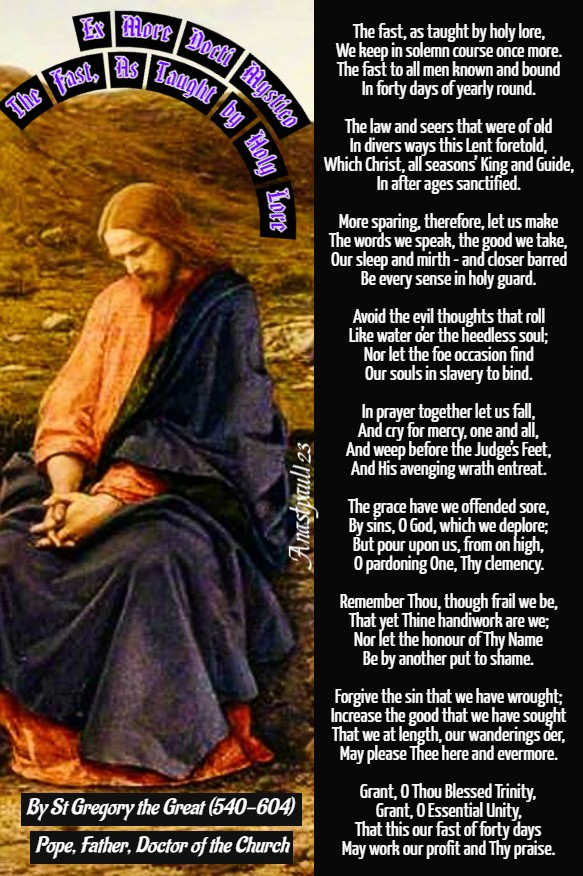
Our Morning Offering – 25 February – Ex More Docti Mystico, The Fast, As Taught by Holy Lore

Our Morning Offering – 25 February – “Wednesday of The First Week of Lent

Ex More Docti Mystico
The Fast, As Taught by Holy Lore
By St Gregory the Great (540-604)
Pope, Father, Doctor of the Church

Trans. John Mason Neale

The fast, as taught by holy lore,
We keep in solemn course once more.
The fast to all men known and bound
In forty days of yearly round.

The law and seers that were of old
In divers ways this Lent foretold,
Which Christ, all seasons’ King and Guide,
In after ages sanctified.

More sparing, therefore, let us make
The words we speak, the good we take,
Our sleep and mirth – and closer barred
Be every sense in holy guard.

Avoid the evil thoughts that roll
Like water o’er the heedless soul;
Nor let the foe occasion find
Our souls in slavery to bind.

In prayer together let us fall,
And cry for mercy, one and all,
And weep before the Judge’s Feet,
And His avenging wrath entreat.

The grace have we offended sore,
By sins, O God, which we deplore;
But pour upon us, from on high,
O pardoning One, Thy clemency.

Remember Thou, though frail we be,
That yet Thine handiwork are we;
Nor let the honour of Thy Name
Be by another put to shame.

Forgive the sin that we have wrought;
Increase the good that we have sought
That we at length, our wanderings o’er,
May please Thee here and evermore.

Grant, O Thou Blessed Trinity,
Grant, O Essential Unity,
That this our fast of forty days
May work our profit and Thy praise.

There are twelve translations of this lovely Lenten Hymn.
This one by L M Neale
Liturgical Use: Matins Hymn on Sundays
and week-days during Lent.

Posted in LENT 2026, QUOTES on SUFFERING, The PASSION, Thomas Aquinas

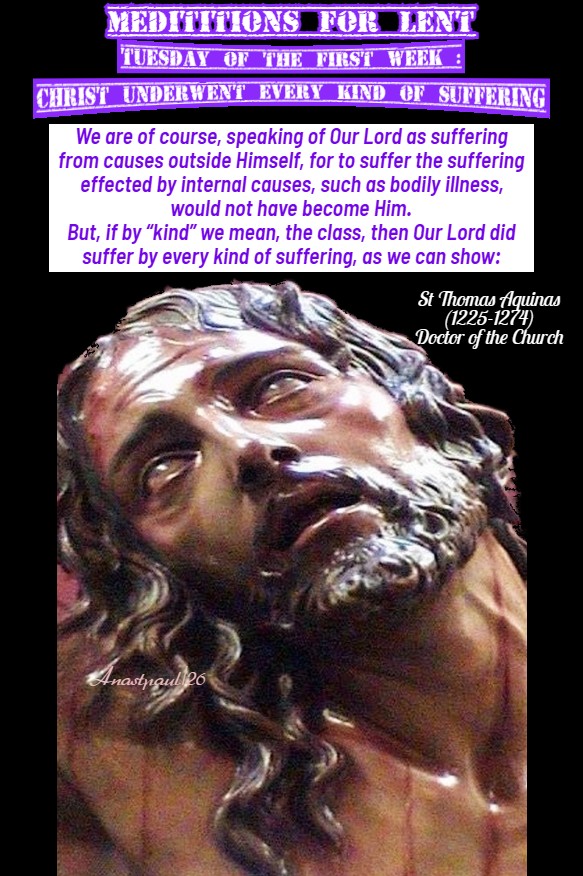
Tuesday of the First Week of Lent – 24 February – Our Lenten Journey With St Thomas Aquinas – Christ underwent every kind of suffering

Tuesday of the First Week of Lent – 24 February – Our Lenten Journey With St Thomas Aquinas (1225-1274) Doctor of the Church

Tuesday of the First Week :
Christ underwent every kind of suffering

Every kind of suffering.
The things men suffer may be understood in two ways.
By “kind” we may mean a particular, individual suffering and in this sense, there was no reason why Christ should suffer every kind of suffering, for many kinds of sufferings are contrary, one to the other, as for example, to be burnt and to be drowned.
We are of course, speaking of Our Lord as suffering from causes outside Himself, for to suffer the suffering effected by internal causes, such as bodily illness, would not have become Him.
But, if by “kind” we mean, the class, then Our Lord did suffer by every kind of suffering, as we can show
in three ways:

  1. By considering the men through whom He suffered.
    For He suffered something at the hands of Gentiles and of Jews, of men and even of women as the story of the servant girl who accused St.Peter goes to show.
    He suffered, again, at the hands of Rulers, of their Ministers, and of the people, as was prophesied, Why have the Gentiles raged and the people devised vain things? The Kings of the earth stood up and the Princes met together against the Lord and against His Christ (Ps ii. i, 2).
    He suffered, too, from His friends, the men He knew best, for Peter denied Him and Judas betrayed Him.
  2. If we consider the things through which suffering is possible. Christ suffered in the friends who deserted Him and in His good name through the blasphemies uttered against Him.
    He suffered in the respect, in the glory, due to Him through the derision and contempt bestowed upon Him.
    He suffered in all things, for He was stripped even of His clothing; in His soul, through sadness, through weariness and through fear; in His body through wounds and the scourging.
  3. If we consider what He underwent in His various members. His head suffered through the Crown of piercing Thorns, His hands and feet, through the nails driven through them, His face from the blows and the defiling spittle and His whole body through the scourging.

He suffered in every sense of His body.
Touch was afflicted by the scourging and the nailing, taste by the vinegar and gall, smell by the stench of corpses as He hung on the Cross in that place of the dead which is called Calvary.
His hearing was torn with the voices of mockers and blasphemers and He saw the tears of His Mother and of the disciple whom He loved.
If we only consider the amount of suffering required, it is true that one suffering alone, the least indeed of all, would have sufficed to redeem the human race from all its sins. But if we look at the fitness of the matter, it had to be that Christ should suffer in all the kinds of sufferings.

ST THOMAS AQUINAS (1225-1274)
Priest, Theologian, Dominican
Doctor Angelicus (Angelic Doctor)
Doctor Communis (Common Doctor)
Added by Pope Saint Pius V in 1568
Posted in LENT 2026, QUOTES on TEMPTATION, QUOTES on the DEVIL/EVIL, Thomas Aquinas

Monday of the First Week of Lent – 23 February – Our Lenten Journey With St Thomas Aquinas

Monday of the First Week of Lent – 23 February – Our Lenten Journey With St Thomas Aquinas (1225-1274) Doctor of the Church

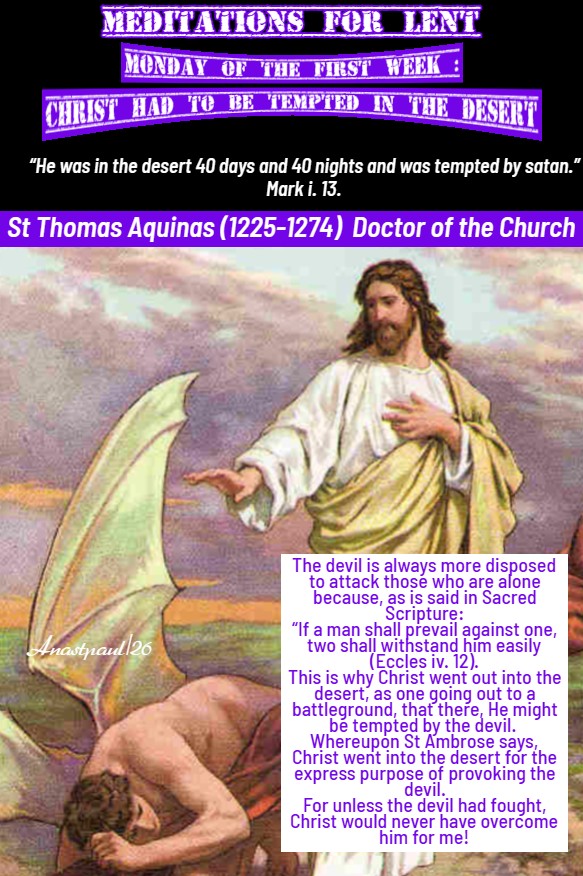
Monday of the First Week :
Christ had to be tempted in the desert

He was in the desert 40 days and 40 nights and was tempted by satan.
Mark i. 13.

  1. It was by Christ’s Own Will that He was exposed to the temptation by the devil, as it was also, by His Own Will that He was exposed to be slain by the limbs of the devil. Had He not so willed, the devil would never have dared to approach Him.

The devil is always more disposed to attack those who are alone because, as is said in Sacred Scripture: “If a man shall prevail against one, two shall withstand him easily (Eccles iv. 12).
This is why Christ went out into the desert, as one going out to a battleground, that there, He might be tempted by the devil. Whereupon St Ambrose says, Christ went into the desert for the express purpose of provoking the devil. For unless the devil had fought, Christ would never have overcome him for me!

St Ambrose gives other reasons too. He says Christ chose the desert as the place to be tempted for a hidden reason, namely, that He might free Adam from his exile who, from Paradise, was driven into the desert and again, that He did it for a reason in which there is no mystery, namely, to show us that the devil envies those who are tending towards a better life.

  1. We say with St Chrysostom that Christ exposed Himself to the temptation because the devil, most of all, tempts those whom he sees alone.
    So in the very beginning of things, he tempted the woman, when he found her away from her husband. It does not however follow from this that a man ought to throw himself into any occasion of temptation which presents itself.

Occasions of temptation are of two kinds.
One kind arises from man’s own action, when, for example, man himself goes near to sin, not avoiding the occasion of sin.
That such occasions are to be avoided we know and Holy Scripture reminds us of it. “Stay not in any part of the country round about Sodom” (Gen xix. 17).
The second kind of occasion arises from the devil’s constant envy of those who are tending to better things, as St Ambrose says and this occasion of temptation is not one we must avoid.
So, according to St John Chrysostom, not only Christ was led into the desert by the Holy Ghost but all the children of God who possess the Holy Ghost are led in like manner. For God’s children are never content to sit down with idle hands but the Holy Ghost ever urges them to undertake for God some great work. And this, as far as the devil is concerned, is to go into the desert, for in the desert, there is none of that wickedness in which the devil’s delight.
Every good work is, as it were, a desert to the eye of the world and of our flesh, for good works are contrary to the desire of the world.

To give the devil such an opportunity of temptation as this is not dangerous, for it is much more the inspiration of the Holy Ghost, Who is the promoter of every perfect work which prompts us, than the working of the devil, who hates them all.

ST THOMAS AQUINAS (1225-1274)
Priest, Theologian, Dominican
Doctor Angelicus (Angelic Doctor)
Doctor Communis (Common Doctor)
Added by Pope Saint Pius V in 1568

Posted in AUGUSTINIANS OSA, CHRIST the HIGH PRIEST, CHRIST the WORD and WISDOM, DOCTORS of the Church, LENT 2026, QUOTES on TEMPTATION, The WORD, Thomas Aquinas

The First Sunday of Lent – 22 February – Our Lenten Journey With St Thomas Aquinas – Christ willed to be tempted

The First Sunday of Lent – 22 February – Our Lenten Journey With St Thomas Aquinas (1225-1274), Doctor of the Church

The First Week of Lent – Sunday

It was fitting that Christ should be tempted

Jesus was led by the spirit into the desert,
to be tempted by the devil.

Matt iv. i

Christ willed to be tempted:

  1. That He might assist us against our own temptations.
    St Gregory says: “That our Redeemer, Who had come to earth to be killed, should will to be tempted, was not unworthy of Him. It was. indeed but just that He should overcome our temptations by His own, in the same way that He had come to overcome our death by His death.”
  2. To warn us that no man, however holy he be, should think himself safe and free from temptation.
    Whence again, His choosing to be tempted after His Baptism, about which St Hilary says: “The devil’s wiles are especially directed to trap us at times when we have recently been made holy because the devil desires no victory as much as a victory over the world of Grace.”
    Whence too, the Scripture warns us, “Son, when thou comest to the service of God, stand in justice and in fear and prepare thy soul for temptation” (Ecclus ii. i).
  3. To give us an example of how we should overcome the temptations of the devil, St Augustine says: “Christ gave Himself to the devil to be tempted that, in the matter of our overcoming those same temptations, He might be of service, not only by His assistance but too, by His example.”
  4. To fill and saturate our minds with confidence in His Mercy.
    “For we have not a High Priest Who cannot have compassion on our infirmities but One , without sin but ttempted in all things, like as we are, (Heb iv. 15).

ST THOMAS AQUINAS (1225-1274)
Priest, Theologian, Dominican
Doctor Angelicus (Angelic Doctor)
Doctor Communis (Common Doctor)
Added by Pope Saint Pius V in 1568
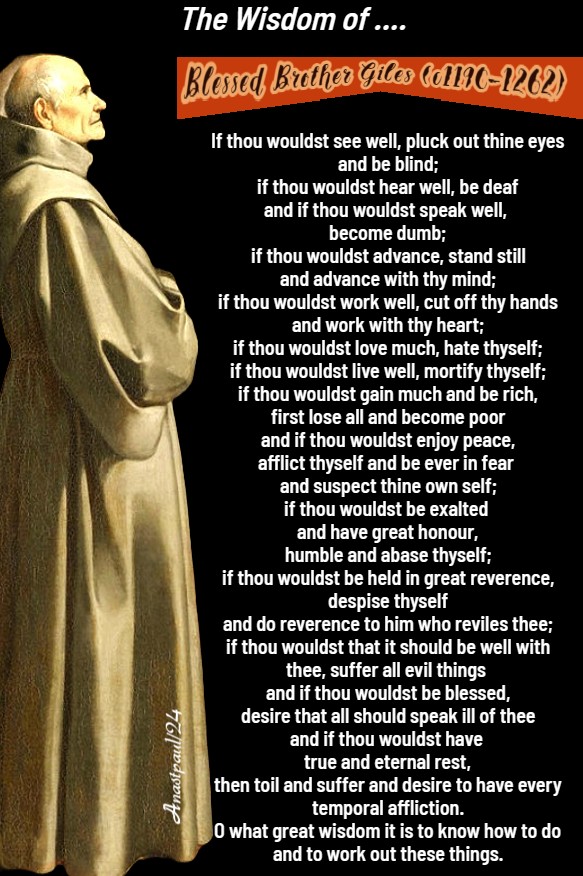
Posted in CHRIST the WORD and WISDOM, GOD ALONE!, GUARDIAN ANGELS - Prayers etc, In the PRESENCE of GOD, LENT 2026, QUOTES on TEMPTATION, The WORD

Quote/s of the Day – 22 February – Begone, Satan!

Quote/s of the Day – 22 February – The First Sunday of Lent – 2 Corinthians 6:1-10, Matthew 4:1-11

Begone, Satan!
for it is written:
The Lord thy God shalt thou adore
and Him only shalt thou serve.

Matthew 4:10

Do not, therefore, lose your confidence,
which has a great reward.
For you have need of patience that,
doing the Will of God,
you may receive the promise.
For yet a very little while
and He Who is to come,
will come
and will not delay.

Hebrews 10:35-37

It might even be said that we are fortunate
to have temptations, for these are the times
of spiritual harvest when we gather up for Heaven. …
If we were thoroughly saturated
with God’s Holy Presence,
it would be easy for us to resist the enemy.
With the thought ‘God sees you!’ we would never sin!

There was a Saint who complained to our Lord
after being tempted and said to Him:
“Where were Thou, my most loveable Jesus,
during that awful storm?”
Our Lord answered:
“I was in the centre of thou heart…

St John-Marie Baptiste Vianney (1786-1859)
The Curé of Ars

When tempted,
turn immediately to your
Guardian Angel and ask him,
with all your heart,
“My Guardian Angel help me now.
Do not let me offend my God!

St John Bosco (1815-1888)

Posted in CHRIST the WORD and WISDOM, LENT 2026, The SACRED PASSION - Meditations for LENT, The WORD, Thomas Aquinas

Saturday after Ash Wednesday – 21 February – Our Lenten Journey With St Thomas Aquinas – Saturday : The Grain of Wheat

Saturday after Ash Wednesday – 21 February – Our Lenten Journey With St Thomas Aquinas (1225-1274), Doctor of the Church

Saturday : The Grain of Wheat

Unless the grain of wheat falling into the ground die, itself remaineth alone.”
John xii. 24

We use the grain of wheat in two ways, for bread and for seed. Here the Word is to be taken in the second sense, grain of wheat meaning seed and not the matter out of which we make bread. For in this sense it never increases, so as to bear fruit.
When it is said that the grain must die, this does not mean that it loses its value as seed but that it is changed into another kind of thing. So St Paul (i Cor xv. 36) says, “That which then thou sowest is not quickened, except it die first.”

The Word of God is a seed in the soul of man, insofar as it is a thing introduced into man’s soul, by words spoken and heard, in order to produce the fruit of good works.
The seed is the Word of God (Luke viii. II). So also the Word of God garbed in Flesh is a Seed placed in the world, a Seed from which great crops should grow, whence it is compared in St Matthew’s Gospel (xiii. 31, 32) to a grain of mustard seed.

Our Lord, therefore, says to us, “I came as Seed, something meant to bear fruit and, therefore, I say to you, unless the grain of wheat falling into the ground die, itself remaineth alone” which is, as much as to say, “Unless I die, the fruit of the conversion of the Gentiles, will not follow.”
He compares Himself to a grain of wheat because He came to nourish and to sustain the minds of men and to nourish and sustain are precisely what wheaten bread does for men. In the Psalms it is written, That bread may strengthen man’s heart (Ps ciii. 15) and in St John, The bread that I will give is My Flesh for the life of the world(John vi. 52).

  1. “But if it die it bringeth forth much fruit” (John xii. 25). What is here explained is the usefulness of the Passion. It is as though the Gospel said, Unless the grain fall into the earth through the humiliations of the Passion, no useful result will follow, for the grain itself remaineth alone. But if it shall die, done to death and slain by the Jews, it bringeth forth much fruit, for example:

(i) The remission of sin.
This is the whole fruit, that the sin thereby should be taken away (Isaias xxvii. 9). And this is the fruit of the Passion of Christ as is declared by St Peter – Christ died once for our sins, the just for the unjust that He might offer us to God (i Pet iii. 18).

(ii) The conversion of the Gentiles to God.
“ I have appointed you that you shall go forth and bring forth fruit and that your fruit should remain” (John xv. 16). This fruit the Passion of Christ bore, if I be lifted up from the earth, I will draw all things to myself (John xii. 32).

(iii) The fruit of Glory.
The fruit of good labours is glorious (Wis. iii. 15).
And this fruit too, the Passion of Christ brough forth; We have, therefore, a confidence in the entering into the Holies by the Blood of Christ – a new and living way which He hath dedicated for us through the veil, that is to say, His Flesh (Hebr x. 19).

ST THOMAS AQUINAS (1225-1274)
Priest, Theologian, Dominican
Doctor Angelicus (Angelic Doctor)
Doctor Communis (Common Doctor)
Added by Pope Saint Pius V in 1568
Posted in CHRIST the LIGHT, CHRIST the WORD and WISDOM, LENT 2026, The WORD

Quote of the Day – 21 February – Isaias 58:9-11

Quote of the Day – 21 February – The First Saturday of Lent – Isaiah 58:9-14, Mark 6:47-56

Thus says the Lord God:
If you remove from your midst oppression,
false accusation
and malicious speech.
if you bestow your bread
on the hungry
and satisfy the afflicted;
then light shall rise
for you in the darkness
and the gloom
shall become for you,like midday;
then the Lord will guide you always
and give you plenty,
even on the parched land.
He will renew your strength
and you shall be like a watered garden,
like a spring whose water never fails.

Isaiah 58:9-11