Quote/s of the Day – 6 June – The Memorial of St Norbert (c 1080-1134) and St Marcellin Champagnat FMS (1789-1840)
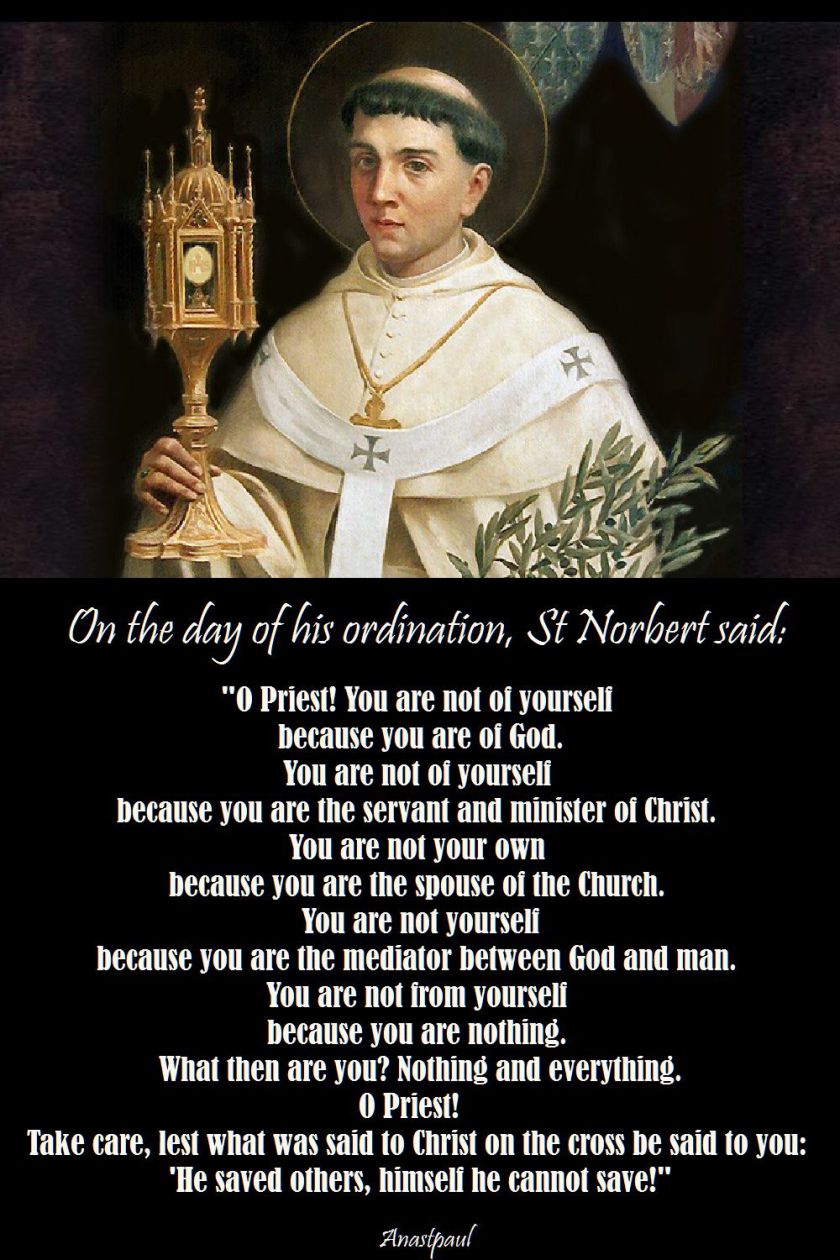
On the day of his ordination, St Norbert said:
“O Priest! You are not of yourself because you are of God. You are not of yourself because you are the servant and minister of Christ. You are not your own because you are the spouse of the Church. You are not yourself because you are the mediator between God and man. You are not from yourself because you are nothing. What then are you? Nothing and everything. O Priest! Take care, lest what was said to Christ on the cross be said to you: ‘He saved others, himself he cannot save!”
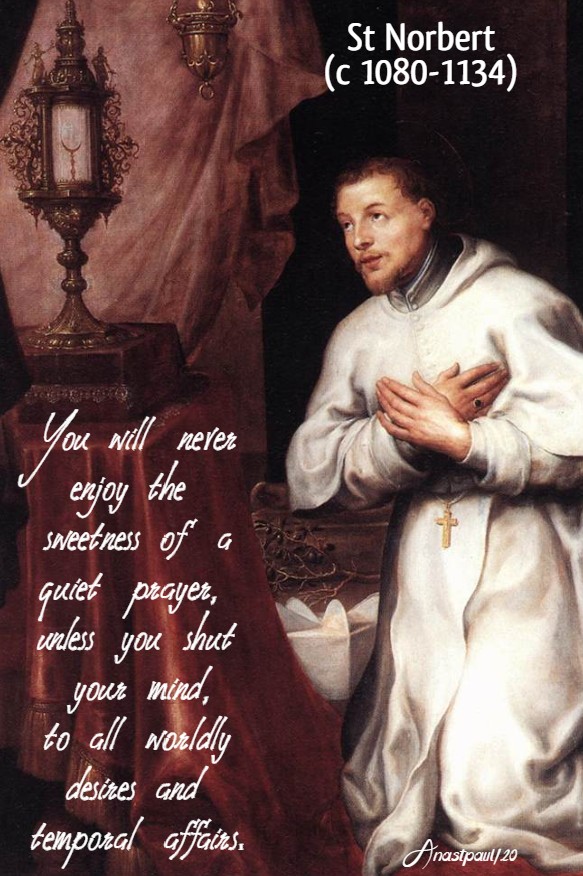
“You will never enjoy the sweetness of a quiet prayer, unless you shut your mind, to all worldly desires and temporal affairs.”
St Norbert (c 1080-1134)
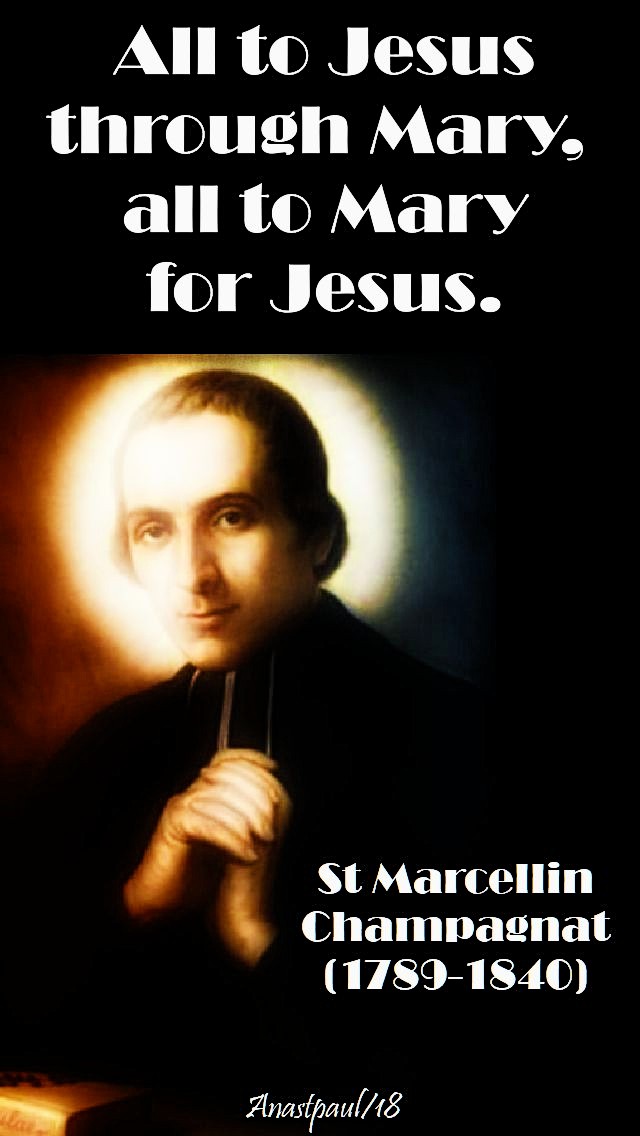
“All to Jesus through Mary, all to Mary for Jesus.”
Quote/s of the Day – 18 May – “Mary’s Month” – Monday of the Sixth Week of Easter and the One Hundredth Anniversary of St Pope John Paul’s Birthday (1920-2005)
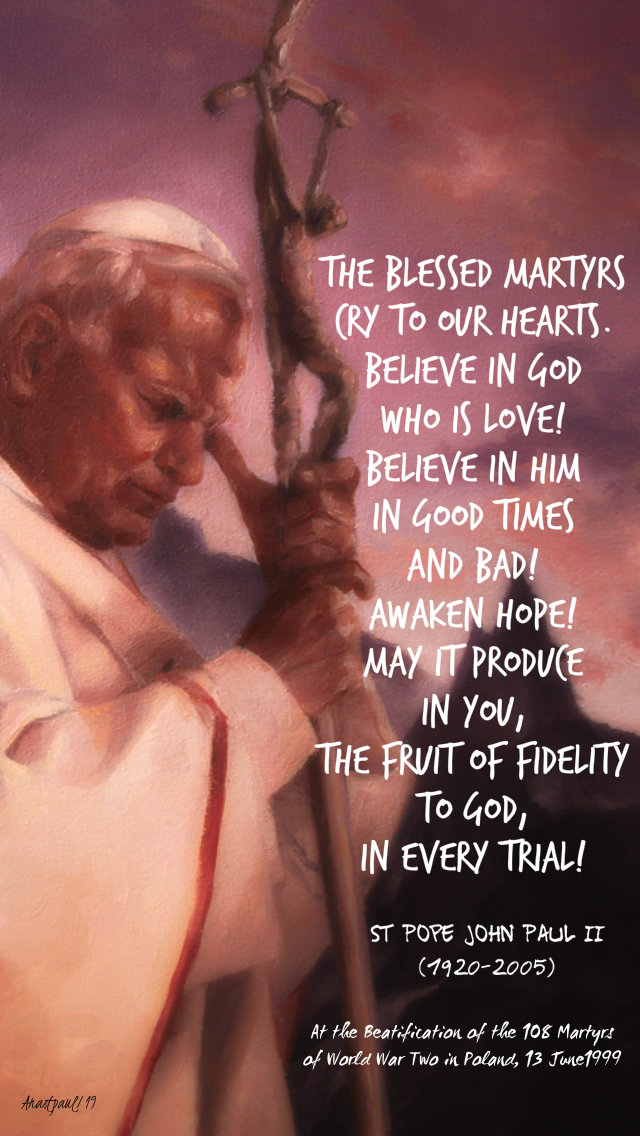
“The blessed martyrs cry to our hearts. Believe in God who is love! Believe in Him in good times and bad! Awaken hope! May it produce in you, the fruit of fidelity to God, in every trial!”
St Pope John Paul II (1920-2005) At the Beatification of the 108 Martyrs of World War Two in Poland, 13 June 1999
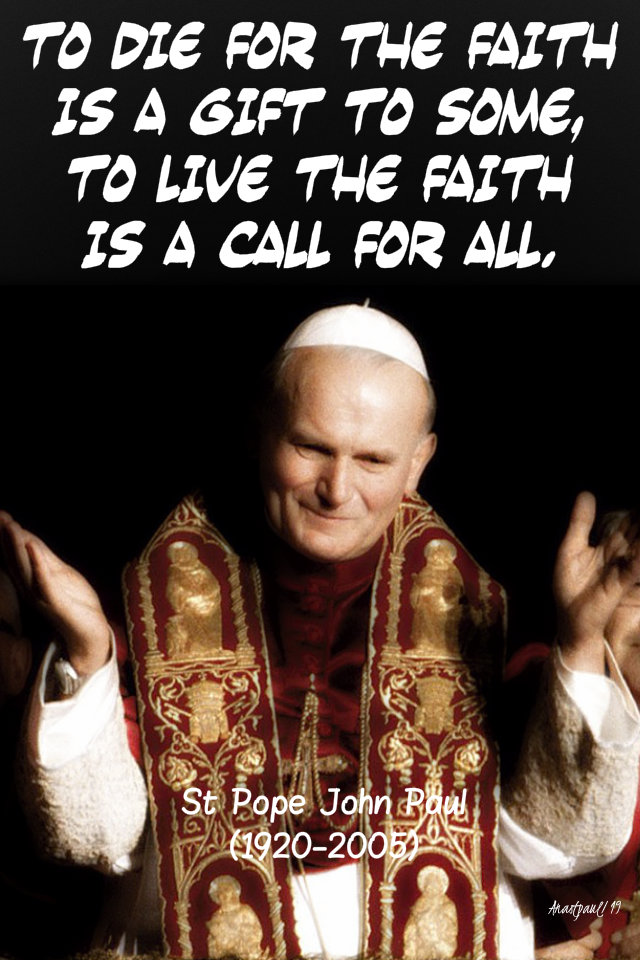
“To die for the faith is a gift to some, to live the faith is a call for all.”
“Let the eyes of our faith never wander from the Cross of Calvary.”
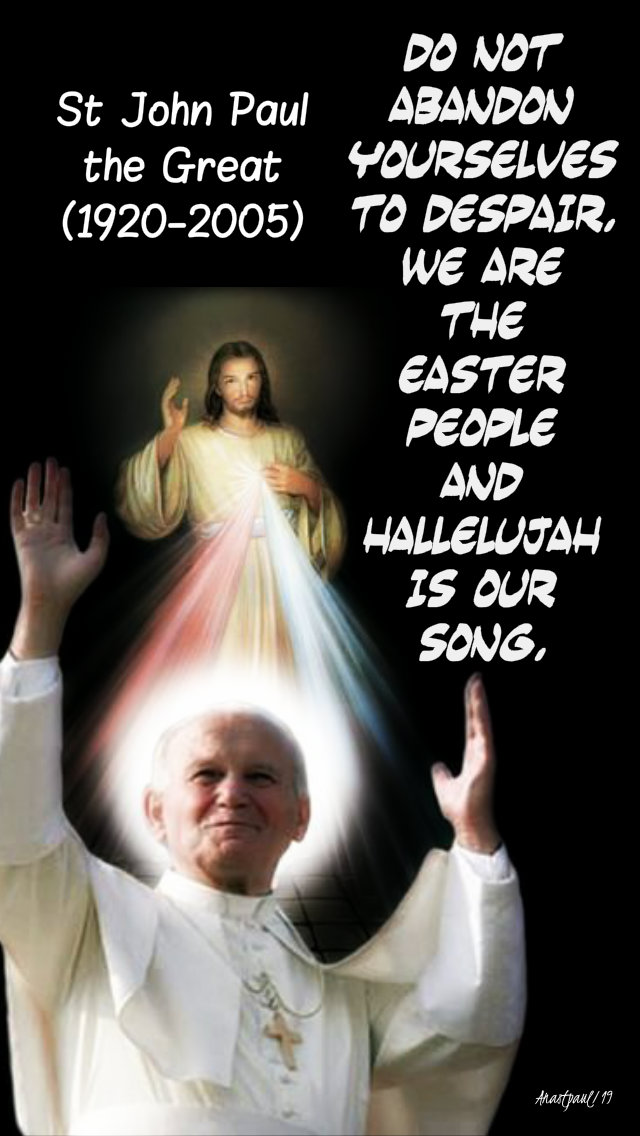
“Do not abandon yourselves to despair. We are the Easter people and hallelujah is our song.”
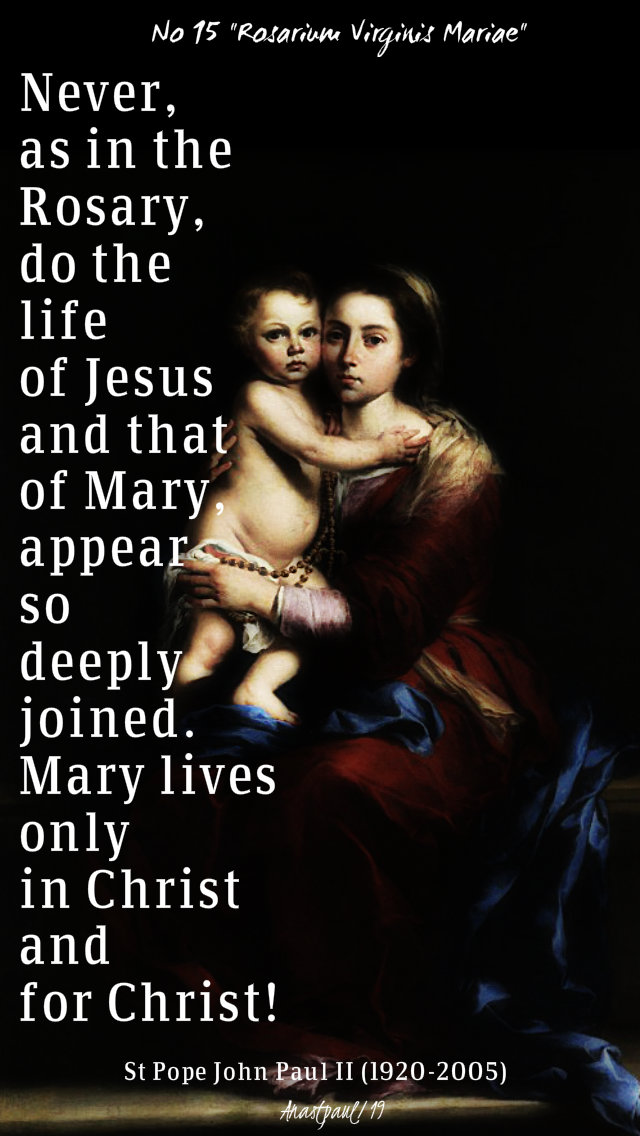
“Never, as in the Rosary, do the life of Jesus and that of Mary, appear so deeply joined. Mary lives only in Christ and for Christ!”
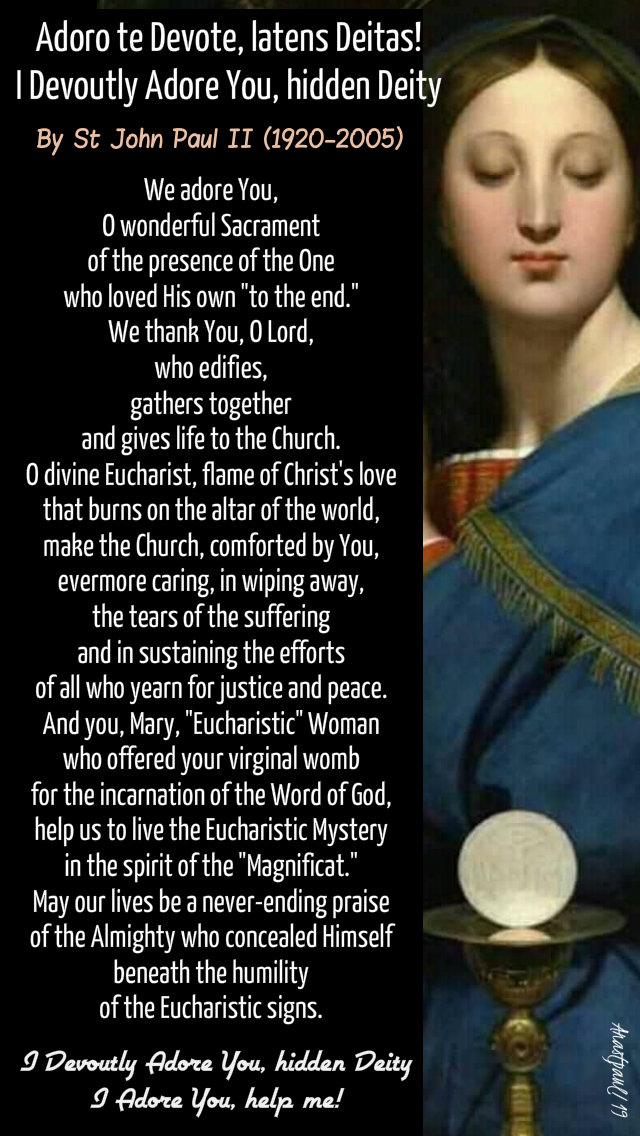
Adoro te Devote, latens Deitas! I Devoutly Adore You, hidden Deity By St John Paul II (1920-2005)
We adore You, O wonderful Sacrament of the presence of the One who loved His own “to the end.” We thank You, O Lord, who edifies, gathers together and gives life to the Church. O divine Eucharist, flame of Christ’s love that burns on the altar of the world, make the Church, comforted by You, evermore caring, in wiping away, the tears of the suffering and in sustaining the efforts of all who yearn for justice and peace. And you, Mary, “Eucharistic” Woman who offered your virginal womb for the incarnation of the Word of God, help us to live the Eucharistic Mystery in the spirit of the “Magnificat.” May our lives be a never-ending praise of the Almighty who concealed Himself beneath the humility of the Eucharistic signs.
Adoro te devote, latens Deitas. .. Adoro te… adiuva me!
I Devoutly Adore You, hidden Deity I Adore You, help me!
Praying With Our Mother
Moments with Saint Pope John XXIII (1881-1963)
“My dear brothers in Christ and in the love of Mary!
The Sacred Altar is the meeting point, of all, that is for the Christian and the Catholic, a vision of heavenly doctrine, inspired by divine grace, the inexhaustible source of strength, holiness and joy in our life here below, in the certainty of the eternal life to come.
Follow Me then to this Blessed Altar of My Sacrifice, which is the Sacrifice offered for you and with you, for all that is dearest to you in the innermost sanctuary of your souls and in your family life and in the various relationships of your civil and social activity.
The land where we were born, which is so dear to us, is always, even when resplendent with natural beauty, full of thorns and of things which cause us distress and pain.
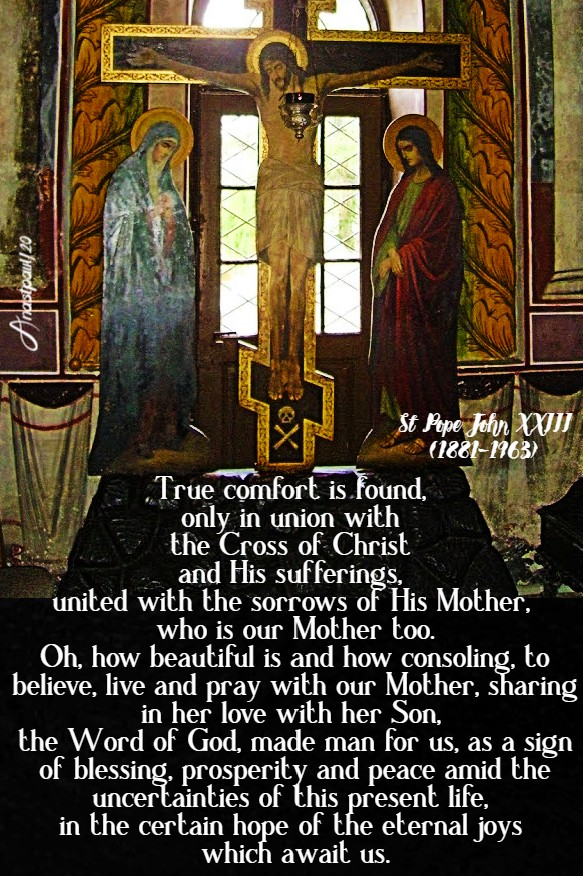
True comfort is found, only in union with the Cross of Christ and His sufferings, united with the sorrows of His Mother, who is our Mother too.
Oh, how beautiful is and how consoling, to believe, live and pray with our Mother, sharing in her love with her Son, the Word of God, made man for us, as a sign of blessing, prosperity and peace amid the uncertainties of this present life, in the certain hope of the eternal joys which await us. Amen.
Thought for the Day – 14 May – Meditations with Antonio Cardinal Bacci (1881-1971)
The Refuge of Sinners
“Refuge of sinners, pray for us.”
This is one of the most beautiful invocations in the Litany of Loreto.
In the second half of the Hail Mary, the Church, knowing that we are all sinners, teaches us to pay to our heavenly Mother: “Pray for us sinners, now and at the hour of our death.”
When a mother sees her sons going astray or behaving badly, she does not cease to love them.
One might say, that, she loves them all the more, because, in addition to her natural affection, she develops a sense of anxious compassion for them when she thinks of the way in which they have risked their eternal salvation by sinning.
Mary’s attitude to us is like this.
The only difference is, that our earthly mothers suffer as a result of our transgressions and ingratitude without being able to do much to change us.
Mary, on the other hand, being the Mother of Jesus as well as our Mother, is not only willing but able, to help us. No matter how enormous our sins may be, no matter how irresistible our carnal instincts may seem, no matter how hopelessly we may have plunged into the depths of evil, it is enough for us to raise our eyes in confidence towards Mary. Like a merciful Mother, she will obtain for us from God, forgiveness and the strength to return to the path of penitence and of peace. “Poor ship-wrecked sinners,” says St Bonaventure, “have recourse to Mary and she will lead you to the port of salvation.” (In Ps 8).
Our good Mother, St Bernard tells us, does not shrink in horror from the most wretched of sinners.
He need only turn to her for help and she will save him from damnation (Or Pan ad BV).
How comforting it should be for us to realise that we have such a merciful and powerful Mother. Let us turn to her with trust and humility and she will certainly assist us.”
Behold Your Mother
Moments with Saint Pope John XXIII (1881-1963)
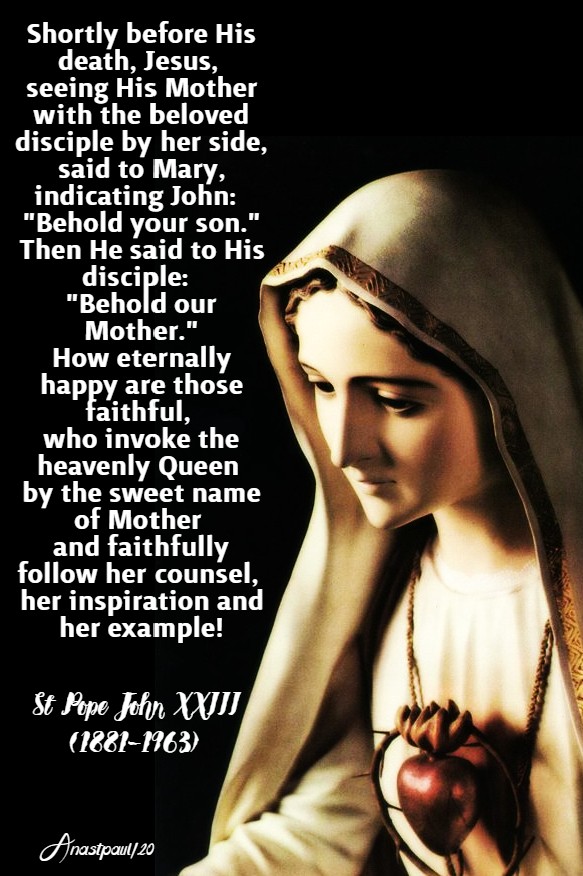
“Shortly before His death, Jesus, seeing His Mother with the beloved disciple by her side, said to Mary, indicating John: “Behold your son.”
Then He said to His disciple: “Behold our Mother.”
As if enraptured by the infinite generosity of God, St Robert Bellarmine asserts, that whoever draws near to the most high God with a frank and open heart may obtain grace and salvation. In fact, Jesus, who wanted us to be co-heirs with Himself of His Father’s Kingdom, invites us too, to share in the kindness of His perfect Mother and, she herself loves to carry on her work of mercy and solicitude for all who are working their way to their home with her Son.
“Let us then,” says Bellarmine, “hasten with confidence to Christ’s throne of grace and with prayers and profound contrition, let us beg Him to repeat for everyone of us, the words He said His Mother: “Behold your son.” In the same way, as He looks at Mary, may He repeat to everyone of us, the wonderful invitation: “Behold your Mother.”
In short, here we find our true relationship, already established on earth, with Jesus our Redeemer and our brother and our relationship with Mary, the Mother of Jesus and of all who belong to the to those He has wished to redeem.
It is, therefore, a glory of Catholic worship and of the Christian Doctrine, which always presents the Lord Jesus to us with His Mother by His side.
How eternally happy are those faithful, who invoke the heavenly Queen by the sweet name of Mother and faithfully follow her counsel, her inspiration and her example!”
Thought for the Day – 13 May – Meditations with Antonio Cardinal Bacci (1881-1971)
Mary, Our Hope
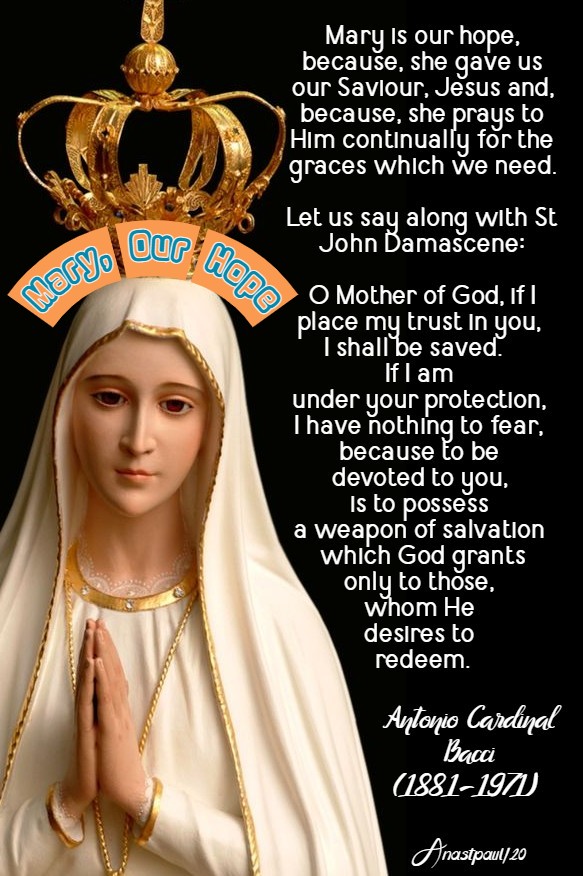
In the beautiful prayer, known as the Salve Regina or Hail, Holy Queen, the Church salutes Mary as “our life, our sweetness and our hope.” Mary is our hope, because, she gave us our Saviour, Jesus and, because, she prays to Him continually for the graces which we need. Following the example of Luther, modern Protestants raise the objection that Mary cannot be regarded as a source of hope, because, all our trust should be placed in God. Anyone who places his trust in creatures, draws down God’s curse upon himself, they say and, they go on to quote from Jeremiah: “Cursed be the man that trusteth in man” (Jer 17:5). But this is true only, when we trust in creatures independently of God, as if we can derive any good from them, without recourse to God. We invoke Mary, however, as the Mother of God and our Mediatrix with Him. She is our hope, insofar as she obtains for us from God, the graces and favours which we require. St Bernard assures us, that God has placed in Mary’s hands, all the riches which He wishes to bestow on us (Serm de aquaed). “He will never experience eternal ruin,” says St Anselm, “for whom Mary has once prayed.” St Bernard calls upon Mary as the foundation of all his hope (Ibid). Let us remember, that Mary is our loving Mother who wishes us to pray to her, because, she knows that if she intercedes on our behalf, she will certainly be heard. It should be most consoling to us to have such a good and powerful Mother in whom, we can safely trust in every peril and in every necessity. Let us pray to her with love and faith, in the certainty that, we shall be answered in the way that is best for us. Let us say along with St John Damascene: “O Mother of God, if I place my trust in you, I shall be saved. If I am under your protection, I have nothing to fear, because to be devoted to you, is to possess a weapon of salvation which God grants only to those, whom He desires to redeem” (Serm de Nat, cap 4).
Quote/s of the Day – 13 May – “Mary’s Month” The Memorial of Our Lady of Fatima
“Look, my Daughter,” Our Lady said to Lúcia on 10 December 1925, “at my heart, surrounded with thorns, with which ungrateful men pierce me. “
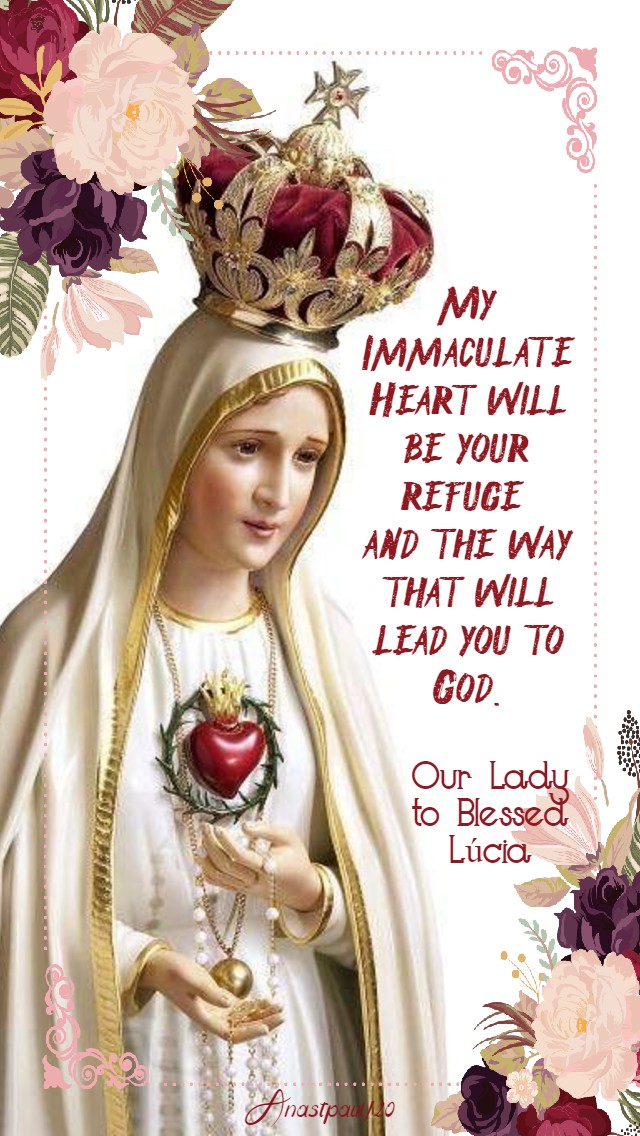
Our Lady assured Lúcia: “My Immaculate Heart will be your refuge and the way that will lead you to God.” Thus, if we devote ourselves to her Immaculate Heart, Mary will lead us to her Son, Jesus Christ and we will be on the way to Heaven.
To Jesus Through Mary
Moments with Saint Pope John XXIII (1881-1963)
The simple words of the first page of Matthew’s Gospel: “Mary, of whom Jesus was born, who is called Christ” (Mt 1:16) suffice for me, to establish the fundamental principle of all the great theological teaching which illustrates the connection between the Blessed Sacrament and Our Lady.
Christian piety has rejoiced to learn from the Book of Acts, that Mary was present at the first gatherings of the faithful, when they broke read together as brothers and spent long hours in prayer.
And modern art has often portrayed the heavenly Mother in the act of receiving, from the hand of St John, the beloved apostle, the Communion of the Body and Blood of her Son.
But all this is superfluous and unnecessary for our convinced belief.
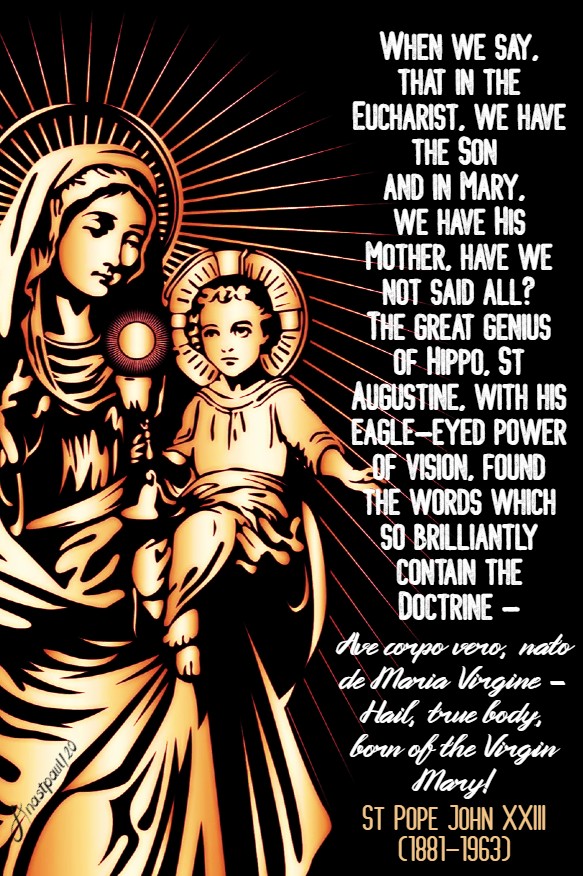
When we say, that in the Eucharist, we have the Son and in Mary, we have His Mother, have we not said all?
The great genius of Hippo, St Augustine, with his eagle-eyed power of vision, found the words which so brilliantly contain the Doctrine – Ave corpo vero, nato de Maria Virgine – Hail, true body, born of the Virgin Mary!
In this way – a delightful thing to say, a sublime thing to contemplate – the terms of this twofold mystery are merged into one, so that Mary appears to us radiant in the light of the Eucharistic mystery; they are merged and yet they are the two extreme points, between which is evolved and developed, the whole Catholic Dogma of the Incarnation and of the continuing life of the Church.
Thought for the Day – 12 May – Meditations with Antonio Cardinal Bacci (1881-1971)
“All Generations Shall Call Me Blessed”
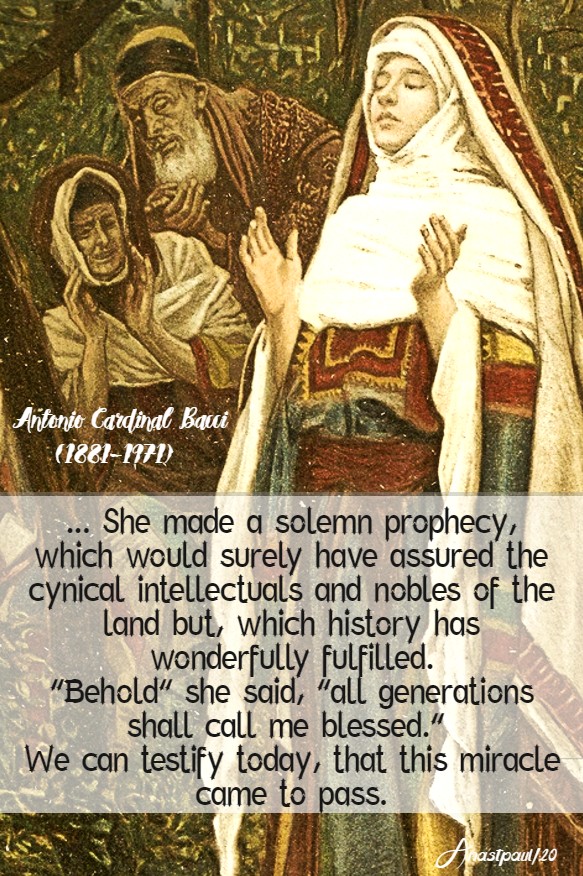
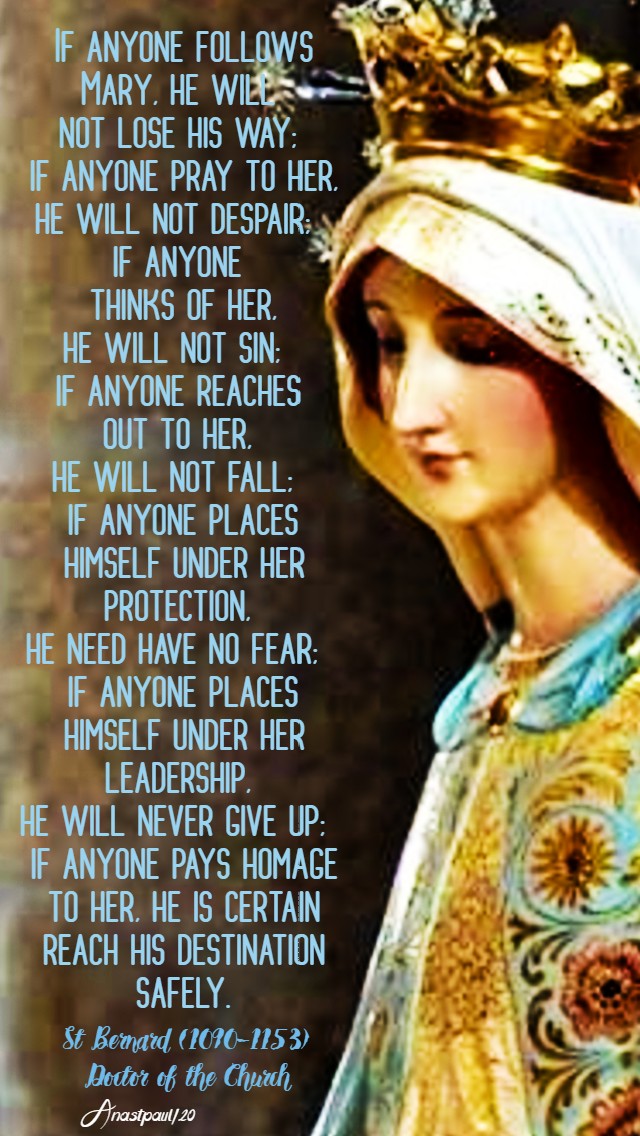
‘A Jewish girl, poor in this world’s goods but rich in virtue, arrived after a long and difficult journey at a village in the hills of Judea, called Hebron. There, she paid a visit to her cousin, Elizabeth. When Elizabeth saw the girl, she was immediately enlightened by the Holy Spirit with the knowledge, that her visitor, was the Mother of God. “How have I deserved,” she cried out, “that the mother of my Lord, should come to me?” (Lk 1:43). At these words, Mary looked up towards Heaven and gave spontaneous expression to a hymn of humble acknowledgement to God, Who had “regarded the lowliness of His Handmaid” (Lk 1:48). Then she made a solemn prophecy, which would surely have assured the cynical intellectuals and nobles of the land but, which history has wonderfully fulfilled. “Behold” she said, “all generations shall call me blessed” (ibid). We can testify today, that this miracle came to pass. All the nations have paid reverence to the Jewish girl, who became the Mother of God and our Mother, the Queen of Heaven and earth, the comforter of the afflicted, the conqueror of Satan and the invincible Guardian of the Church. From the engravings in the Catacombs, to the celestial Madonnas of the Angelico, from the rudimentary sculpture of Roman art, to the prayerful statues on the pinnacles of more modern Cathedrals, the image of Mary has shone as a beacon of hope for all generations. Men bow before her and ask for light, for comfort and for pardon. “If anyone follows Mary,” says St Bernard, “he will not lose his way; if anyone pray to her, he will not despair; if anyone thinks of her, he will not sin; if anyone reaches out to her, he will not fall; if anyone places himself under her protection, he need have no fear; if anyone places himself under her leadership, he will never give up; if anyone pays homage to her, he is certain reach his destination safely“ (Homil Missus est 2:17).”
Thought for the Day – 6 May – “Mary’s Month” Meditations with Antonio Cardinal Bacci (1881-1971)
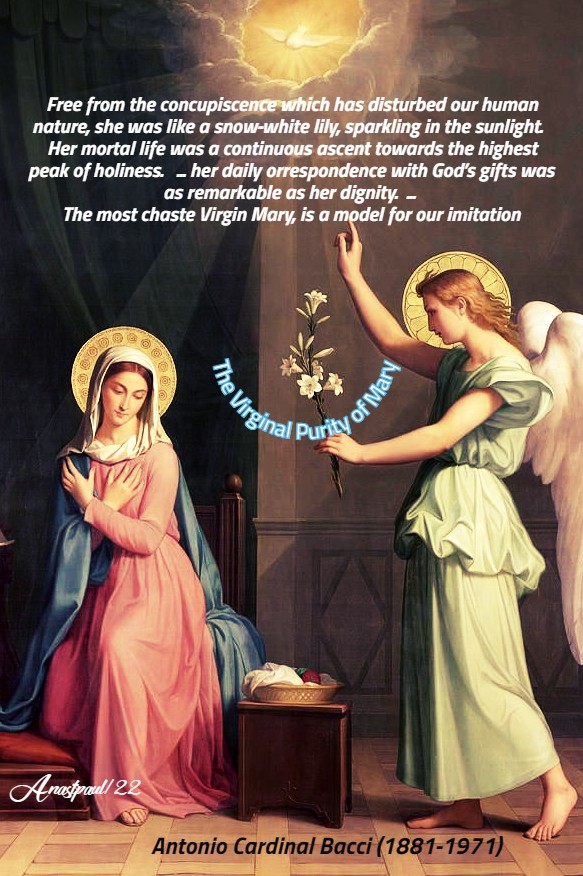
The Virginal Purity of Mary
“It is a Dogma of Faith, that Mary was always a virgin in body and soul. According to the teaching of the holy Fathers, Mary would have renounced her dignity as Mother of God, rather than lose her virginity. When the Archangel Gabriel appeared with the news of the great privilege which she was about to receive, Mary was afraid and asked meekly, how she could become the Mother of God, since she had promised to remain always a virgin. The Angel assured her, that it was through the power of the Holy Spirit, that the eternal Word of God, would take human flesh in her and become her son. Only then did she bow her had and reply: “Be it done to me according to thy word.” Mary’s perpetual virginity is complemented by her purity and absolute immunity from sin. When we consider sin of any kind, says St Augustine, Mary must always be the one exception to it (Cf De natura et gratia, c 36). She was preserved free from original sin and possessed the fullness of grace. The devil never had any power over her spotless soul. Not even the slightest tarnish marred her virginal splendour. Free from the concupiscence which has disturbed our human nature, she was like a snow-white lily, sparkling in the sunlight. Her mortal life was a continuous ascent towards the highest peak of holiness. It would be wrong to believe that the extraordinary privileges which God had granted her from her conception remained fixed and static, like an acquired inheritance. On the contrary, her daily correspondence with God’s gifts was as remarkable as her dignity. The most chaste Virgin Mary, is a model for our imitation. We cannot obtain her privileges but, we should try and imitate her heroic and constant co-operation with the gifts of God.”
Thought for the Day – 3 May – Meditations with Antonio Cardinal Bacci (1881-1971)
The Imitation of Mary
“Earthly mothers are delighted when they see a reflection of themselves in the features and mannerisms of their children. In the same way, Mary, our Heavenly Mother, is pleased when her sons seek to reproduce, as far as possible, in their lives, the faithful imprint of her spiritual motherhood. We should imitate Mary, therefore. Especially in this month, which is dedicated to her, we should not be content, merely, to pray before her altar and decorate it with flowers but, we should make daily progress in imitating her virtues, particularly, the virtue which we need most. We may be lacking in humility, that virtue which is so outstanding in Our Lady. Or perhaps we are lacking in purity, the most difficult yet, the most necessary of all the virtues. Then again, we may be wanting in acceptance of God’s will when we are suffering or misunderstood. We should try and do God’s will in everything and with perfect trust in Him, as Mary did at Nazareth and Bethlehem, in exile and in her own country, in her humble home and on the apostolic journeys in which she followed her divine Son, on the sorrowful way of the Cross, on Calvary, at the feet of Jesus, at the Resurrection and glorious Ascension and in the years in which she waited on earth for the final loving reunion in Heaven. Let us repeat with her always: “Be it done to me according to thy word” (Lk 1:38). There is a story told about a holy man who prayed to Mary in all his difficulties: “Show yourself to be my mother.” One day, he heard the reply: “Show yourself to be my son.” Mary says this to us as well. If we wish her to prove that she is our mother, we must show her, that we are really her sons, by mirroring in our lives, her outstanding sanctity.”
Thought for the Day – 2 May – Meditations with Antonio Cardinal Bacci (1881-1971)
The Intercession of Our Lady
“Our Lady’s intercession is very powerful with God. St Bernard tells us that it is the will of God, that everything comes to us through her holy hands (Sermo in Nativ BMV no 7). He assures us, that Mary is the Mediatrix through whom we receive all favours from God (In Assump. BMV sermo 2, no 2). Her power of intercession is the result of her divine and human motherhood. Because she is the Mother of God, Jesus refuses her nothing; because she is our mother, she loves us dearly and is eager to obtain from God, the spiritual favours, for which we ask. For this reason, we should approach her with complete confidence. St Bernard also writes: “If anyone feels that he is overwhelmed by the tempests of this world and cannot keep an even course, let him raise his eyes towards Mary, let him remember Mary and call upon her…. In danger and in doubt, let him remember and call upon her. Let the thought of Mary never leave his mind; let her name never be far from his lips and from his heart …” (Super Miss. Homil 2, no 17). In all our necessities, we should have confident recourse to our heavenly Mother. Let us remember, however, that if we wish to be true sons of Mary and to be sure of being heard by her, we should ask especially, for spiritual graces. Afterwards, we may ask, with equal confidence but, with resignation to God’s will, for temporal favours, provided they will not stand in the way of our eternal salvation.”
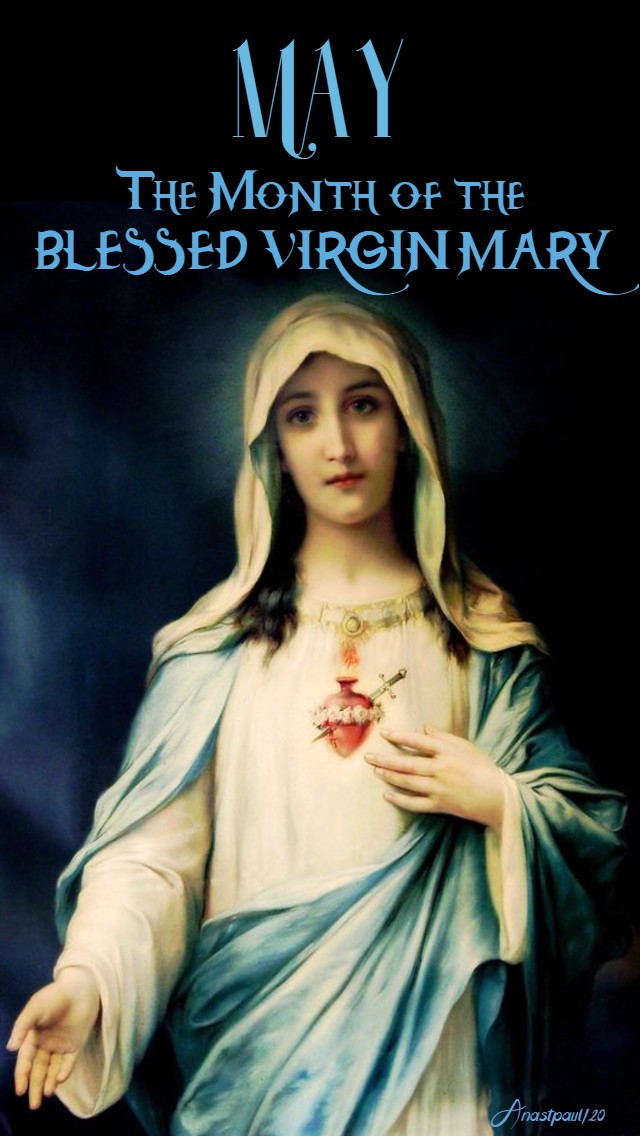
Rejoice! It’s 1 May and the Month of the Blessed Virgin Mary
“God wills that all his gifts should come to us through Mary”
St Bernard of Clairvaux (1090-1153) Mellifluous Doctor
“This is the month in which, in the churches and individual homes, the most affectionate and fervent homage of prayers and devotions from the hearts of Christians are raised to Mary. It is also the month in which from His throne, descend upon us, the most generous and abundant gifts of the Divine Mercy.”
Quote/s of the Day – 28 May – Tuesday of the Third Week of Easter and the Memorial of St Louis Marie Grignion de Montfort (1673-1716), St Peter Chanel (1803-1841) Priest and Martyr, St Gianna Beretta Molla (1922-1962), Blessed María Felicia of Jesus in the Blessed Sacrament OCD (1925-1959)
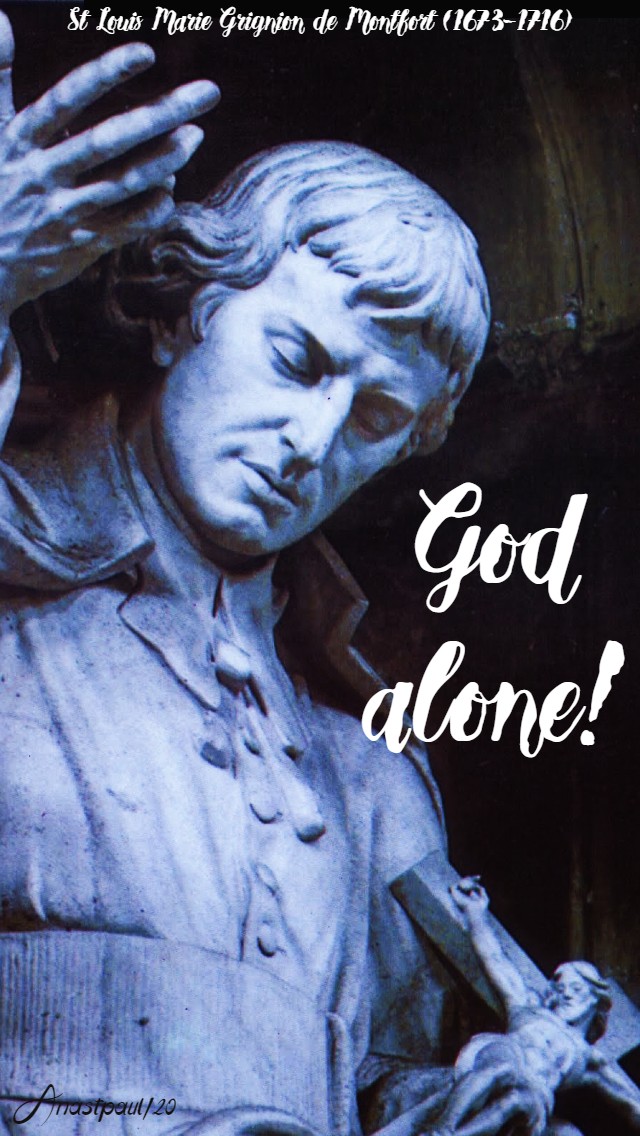
“God alone!”
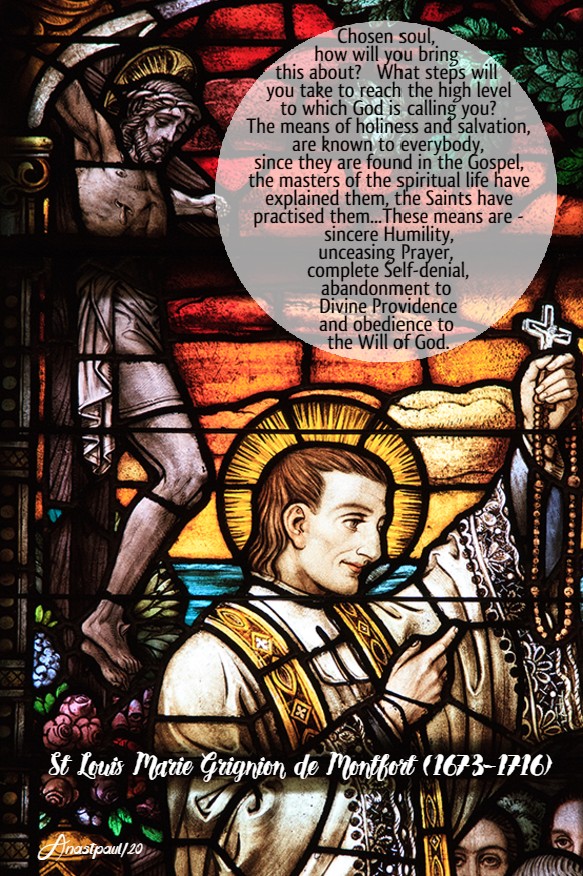
“Chosen soul, how will you bring this about? What steps will you take to reach the high level to which God is calling you? The means of holiness and salvation, are known to everybody, since they are found in the Gospel, the masters of the spiritual life have explained them, the Saints have practised them… These means are – sincere Humility, unceasing Prayer, complete Self-denial, abandonment to Divine Providence and obedience to the Will of God.”
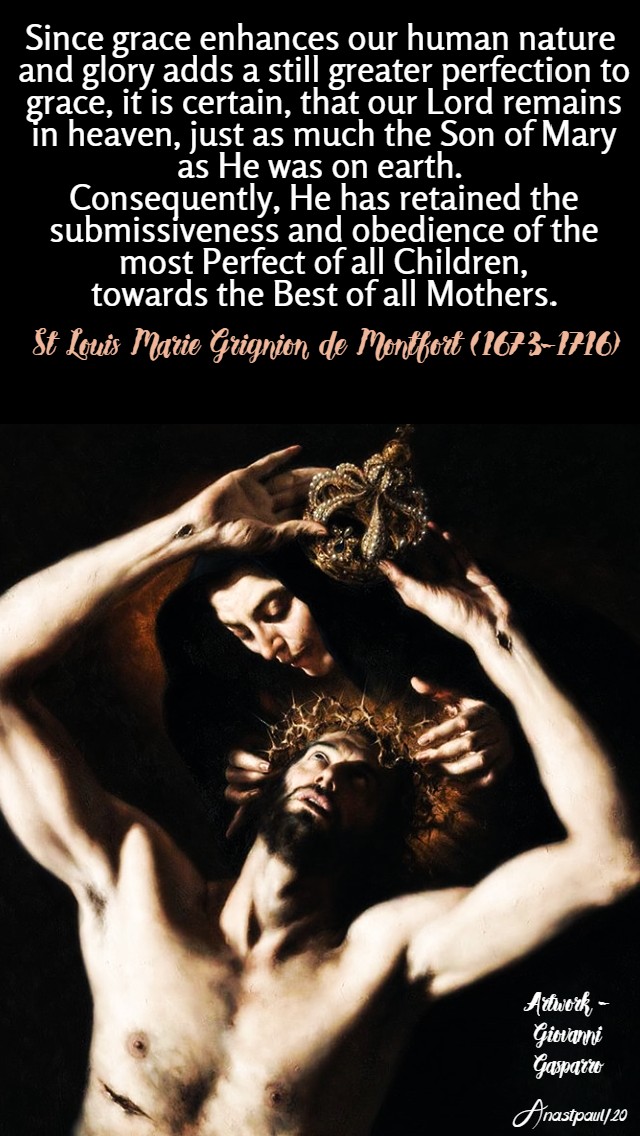
“Since grace enhances our human nature and glory adds a still greater perfection to grace, it is certain, that our Lord remains in heaven, just as much the Son of Mary as He was on earth. Consequently, He has retained the submissiveness and obedience of the most Perfect of all Children, towards the Best of all Mothers.”
True Devotion to the Blessed Virgin, #27
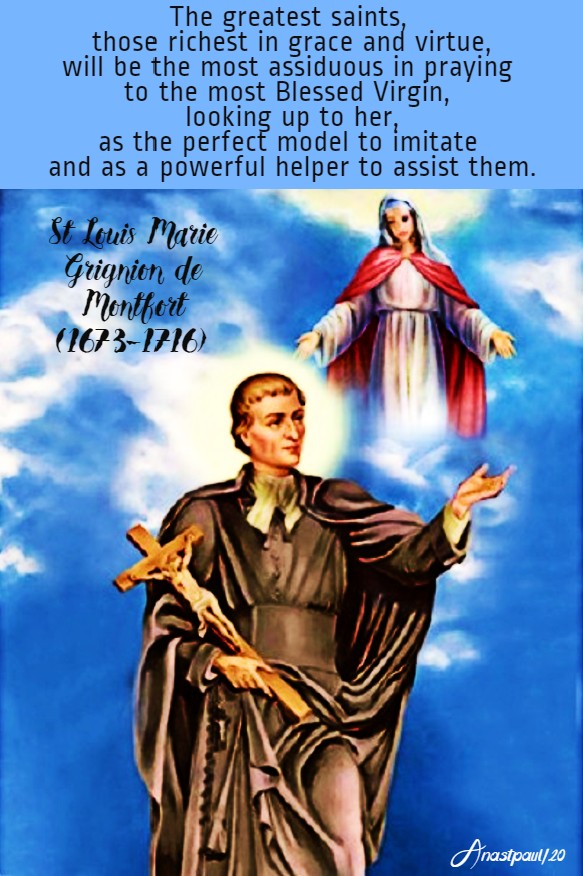
“The greatest saints, those richest in grace and virtue, will be the most assiduous in praying to the most Blessed Virgin, looking up to her, as the perfect model to imitate and as a powerful helper to assist them. “
St Louis Marie Grignion de Montfort (1673-1716)
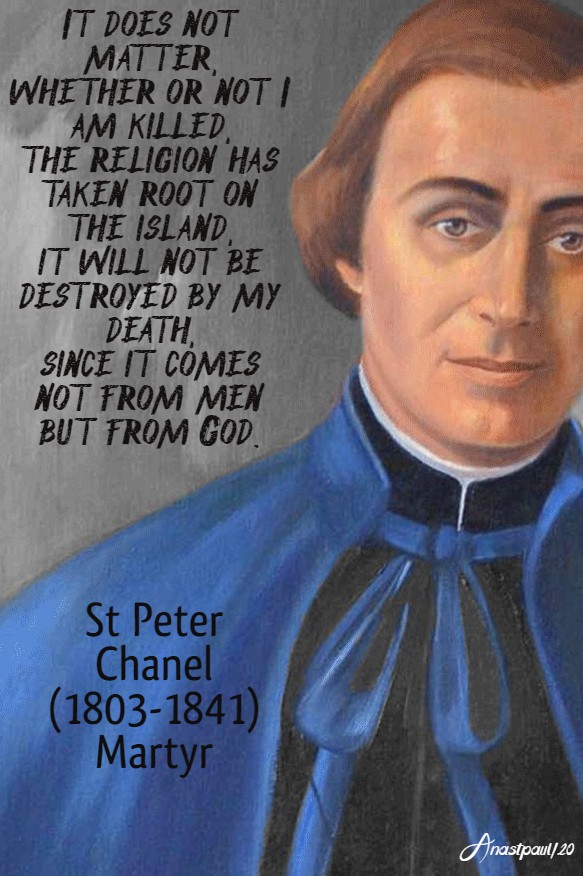
“It does not matter, whether or not I am killed, the religion has taken root on the island, it will not be destroyed by my death, since it comes not from men but from God.”
St Peter Chanel (1803-1841) Priest and Martyr
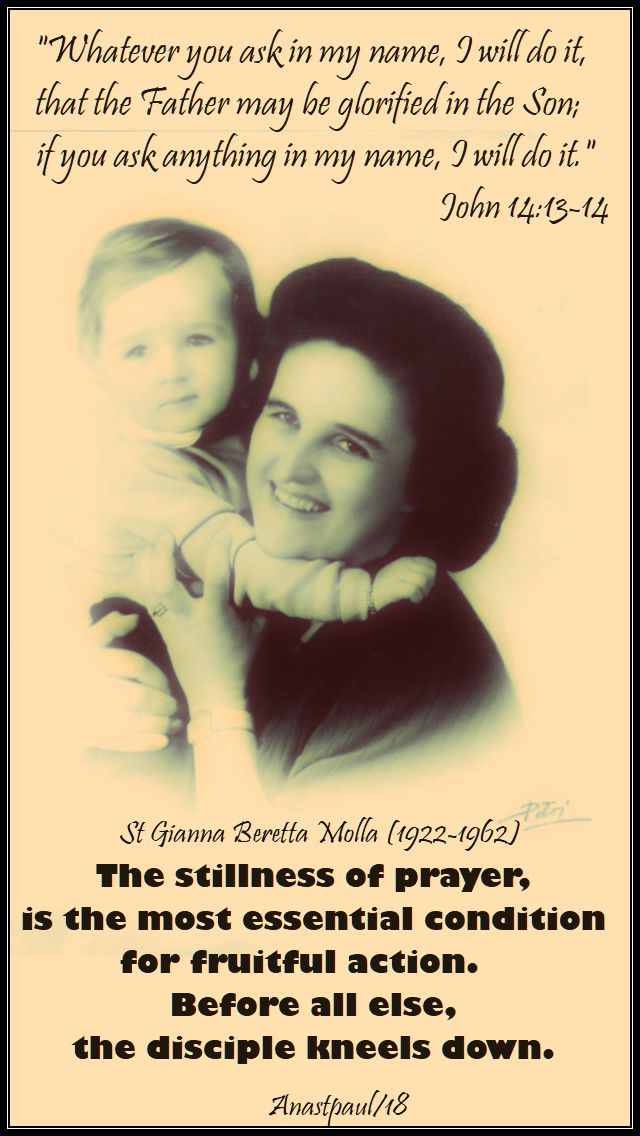
“The stillness of prayer is the most essential condition for fruitful action. Before all else, the disciple kneels down.”
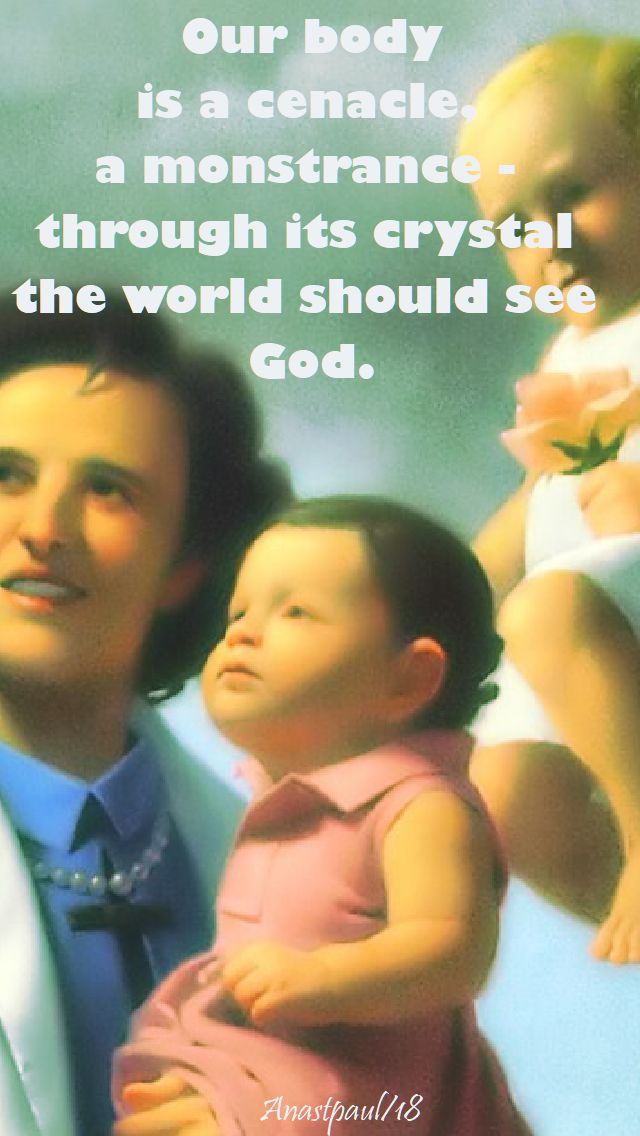
“Our body is a cenacle, a monstrance – through its crystal, the world should see God.”
St Gianna Beretta Molla (1922-1962)
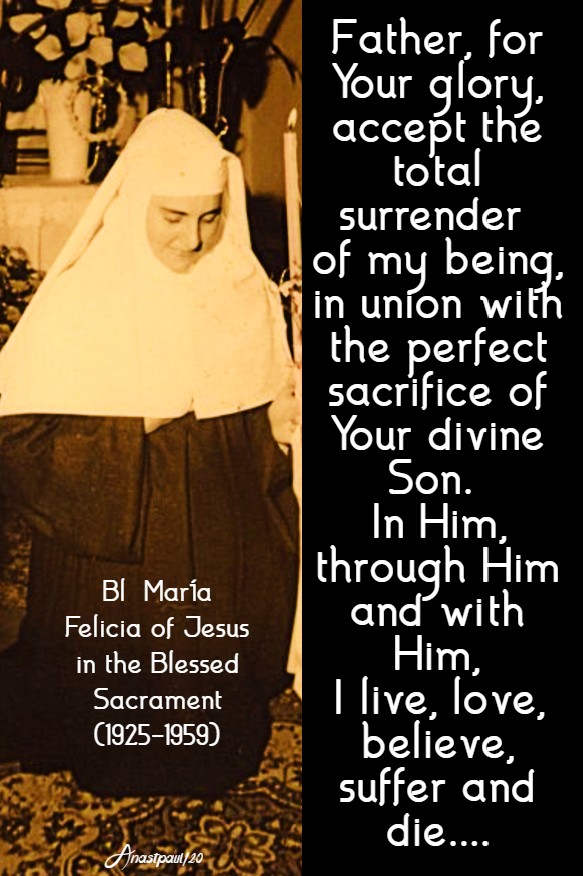
“Father, for Your glory, accept the total surrender of my being, in union with the perfect sacrifice of Your divine Son. In Him, through Him and with Him, I live, love, believe, suffer and die….”
Blessed María Felicia of Jesus in the Blessed Sacrament (1925-1959)
Quote/s of the Day – 26 April – Third Sunday of Easter
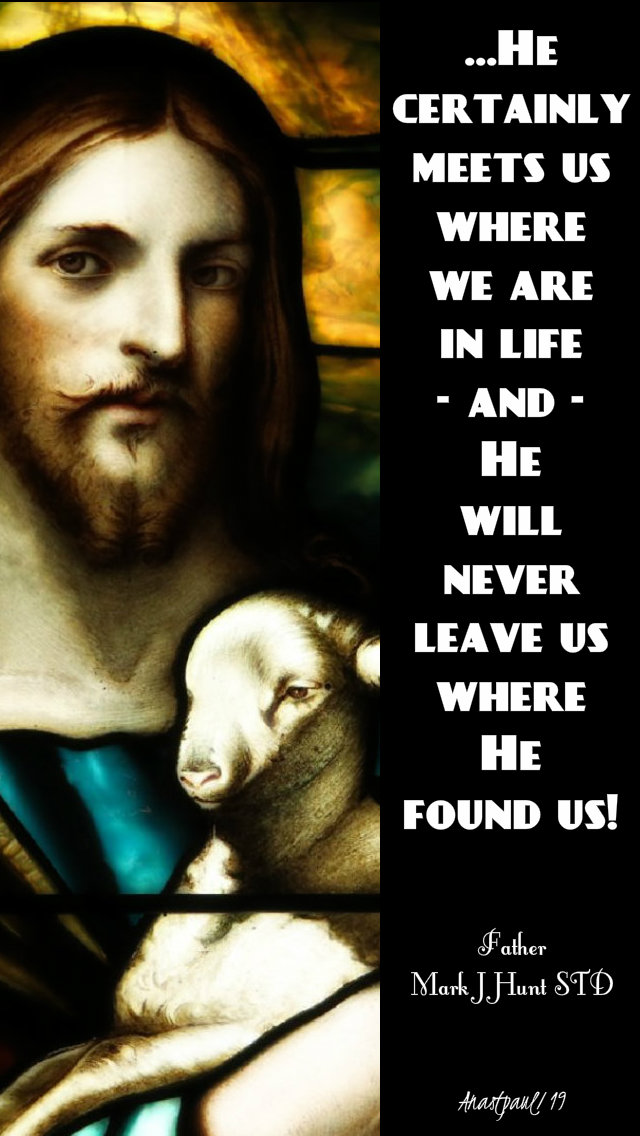
“…He certainly meets us where we are in life – and – He will never leave us where He found us!”
Fr Mark J Hunt STD
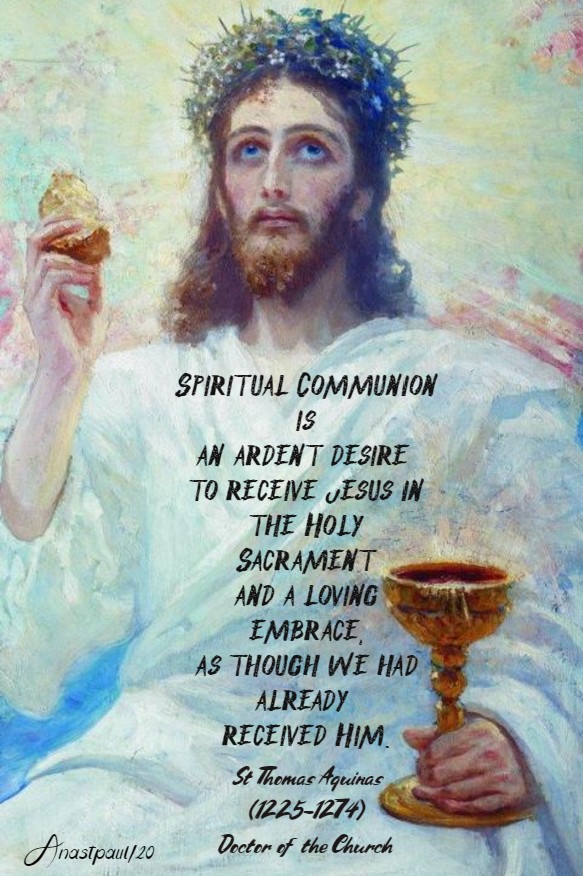
“Spiritual Communion is an ardent desire to receive Jesus in the Holy Sacrament and a loving embrace, as though we had already received Him.”
St Thomas Aquinas (1225-1274)
Doctor of the Church
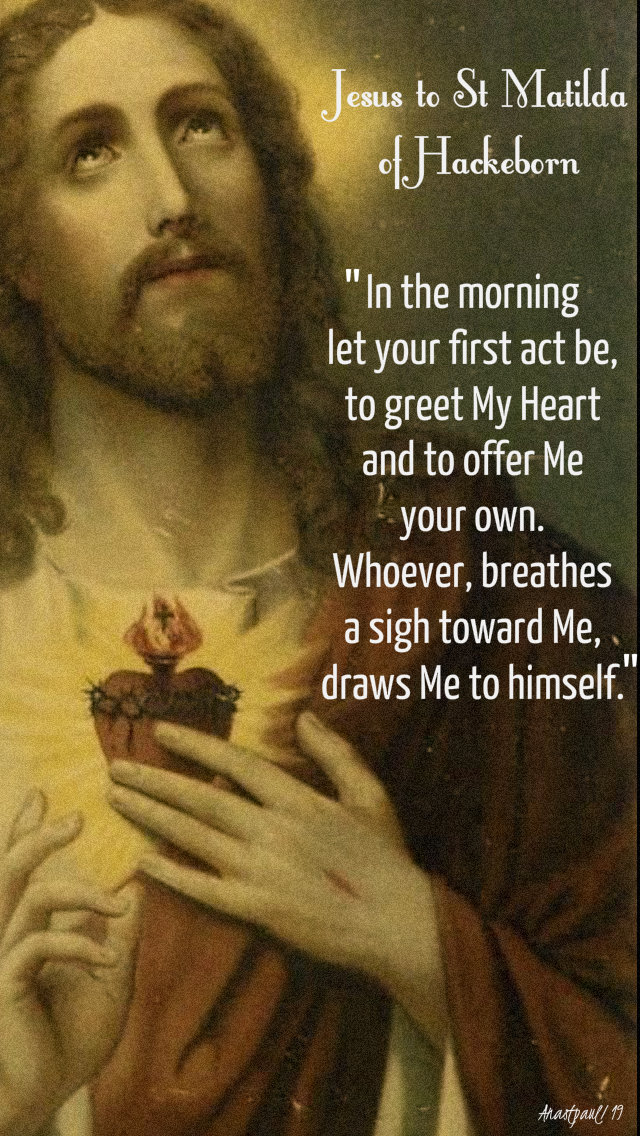
“In the morning let your first act be to greet My Heart and to offer Me your own. Whoever, breathes a sigh toward Me, draws Me to himself.”
Jesus to St Matilda/Mechtilde of Hackeborn
(c 1241-1298)
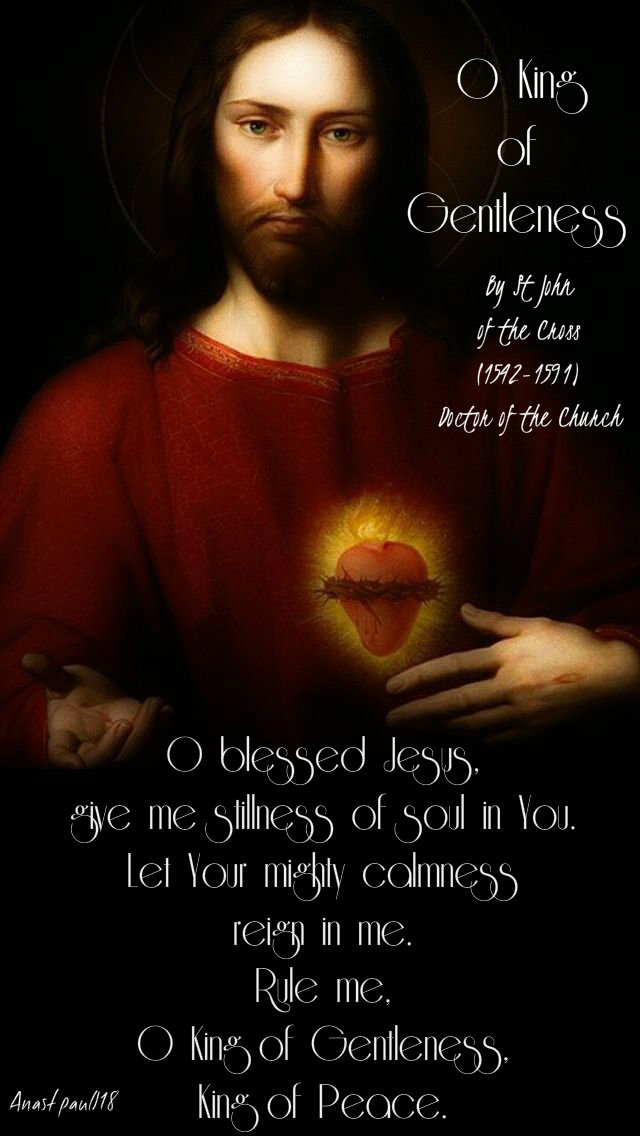
“O blessed Jesus, give me stillness of soul in You. Let Your mighty calmness reign in me. Rule me, O King of Gentleness, King of Peace.”
St John of the Cross (1542-1591)
Doctor of the Church
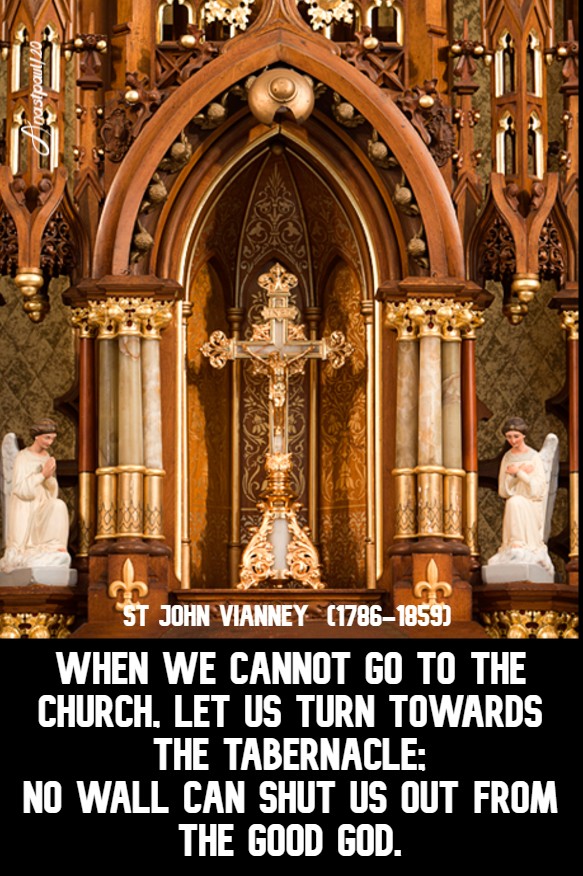
“There are some who make a spiritual communion everyday … If we are deprived of Sacramental Communion, let us replace it, as far as we can, by spiritual communion, which we can make every moment; for we ought to have always, a burning desire to receive the good God. Communion is to the soul, like blowing a fire that is beginning to go out but that has still plenty of hot embers; we blow and the fire burns again. After the reception of the Sacraments, when we feel ourselves slacken in the love of God, let us have recourse at once, to spiritual communion. When we cannot go to the church, let us turn towards the tabernacle; no wall can shut us out from the good God.”
St John Vianney (1786-1859)
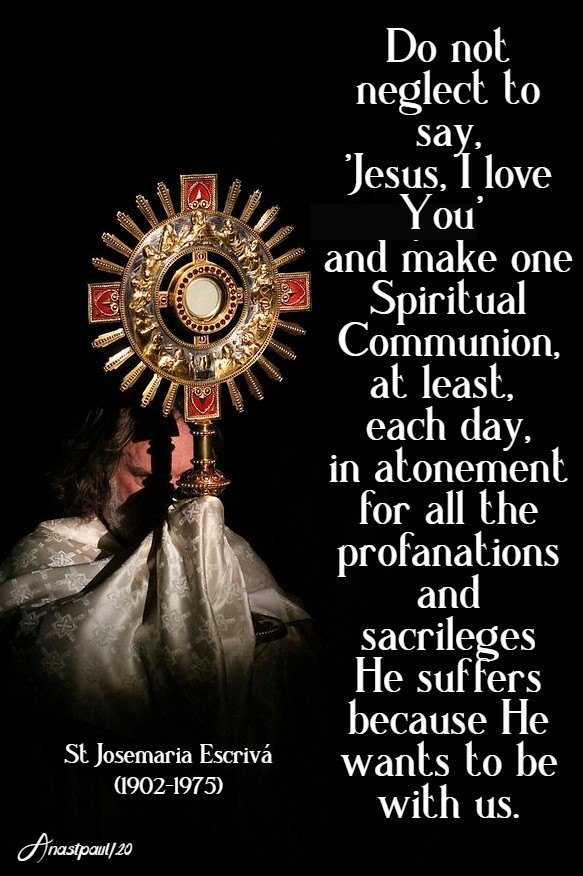
“Do not neglect to say, ‘Jesus, I love You’ and make one Spiritual Communion, at least, each day, in atonement for all the profanations and sacrileges He suffers because He wants to be with us.”
St Josemaria Escrivá (1902-1975)
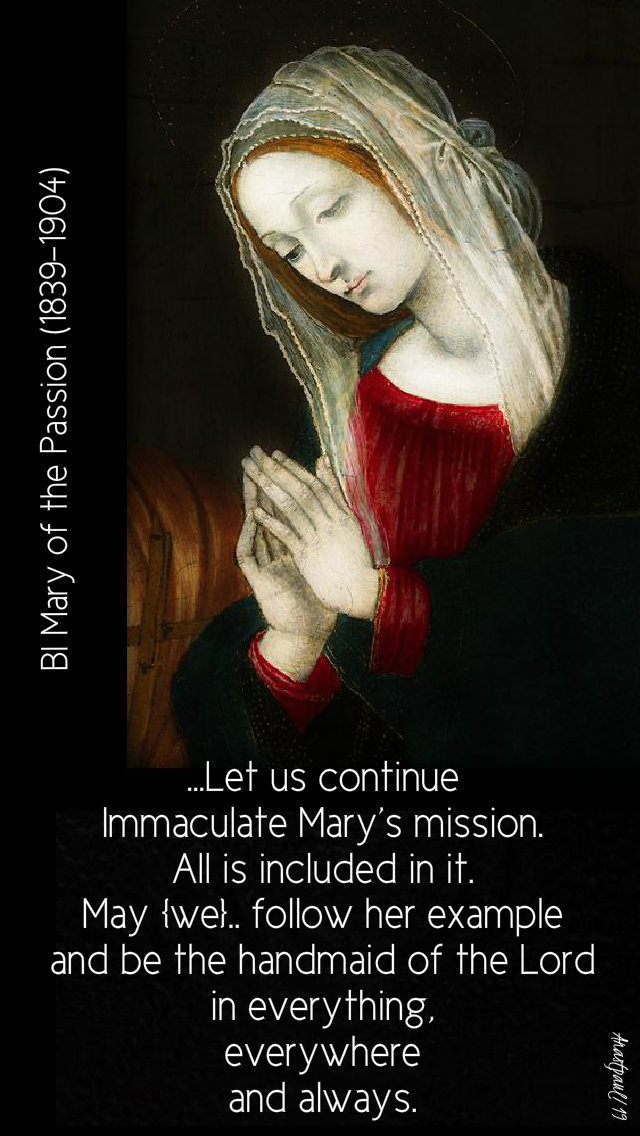
“…Let us continue Immaculate Mary’s mission. All is included in it. May [we].. follow her example and be the handmaid of the Lord in everything, everywhere and always.”
Sabbatum Sanctum – Holy Saturday, The “Second Sabbath” – 11 April
Holy Saturday (from Sabbatum Sanctum, its official liturgical name) is sacred as the day of the Lord’s rest. It has been called the “Second Sabbath” after creation.
The day is and should be, the most calm and quiet day of the entire Church year, a day broken by no liturgical function.
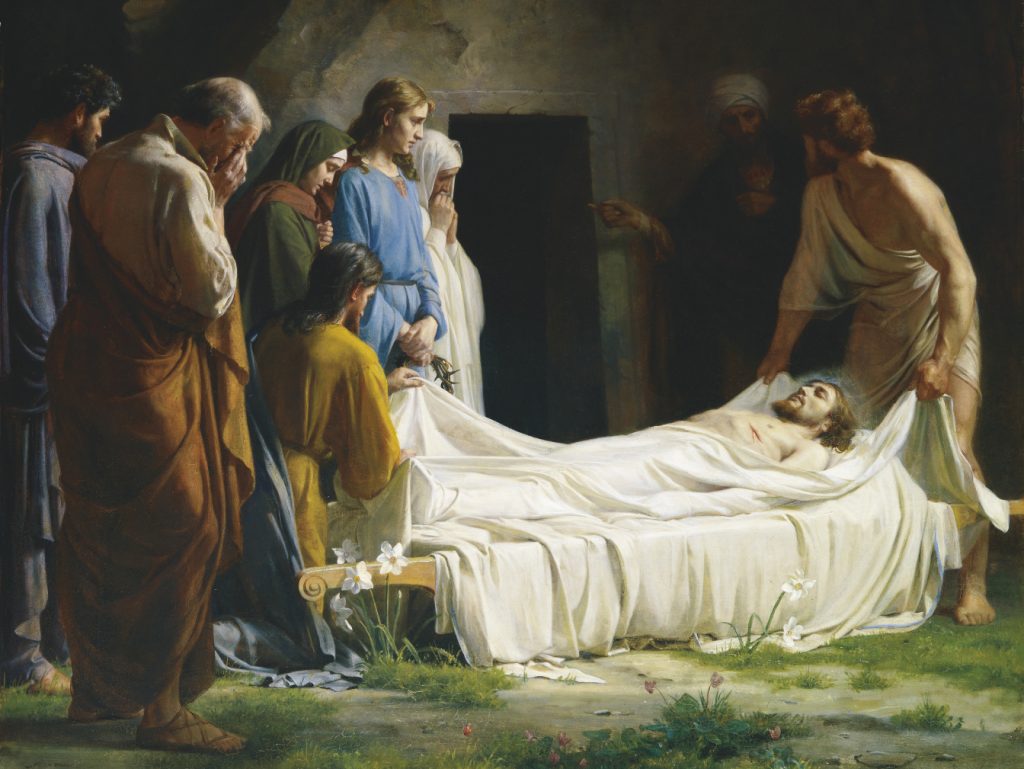
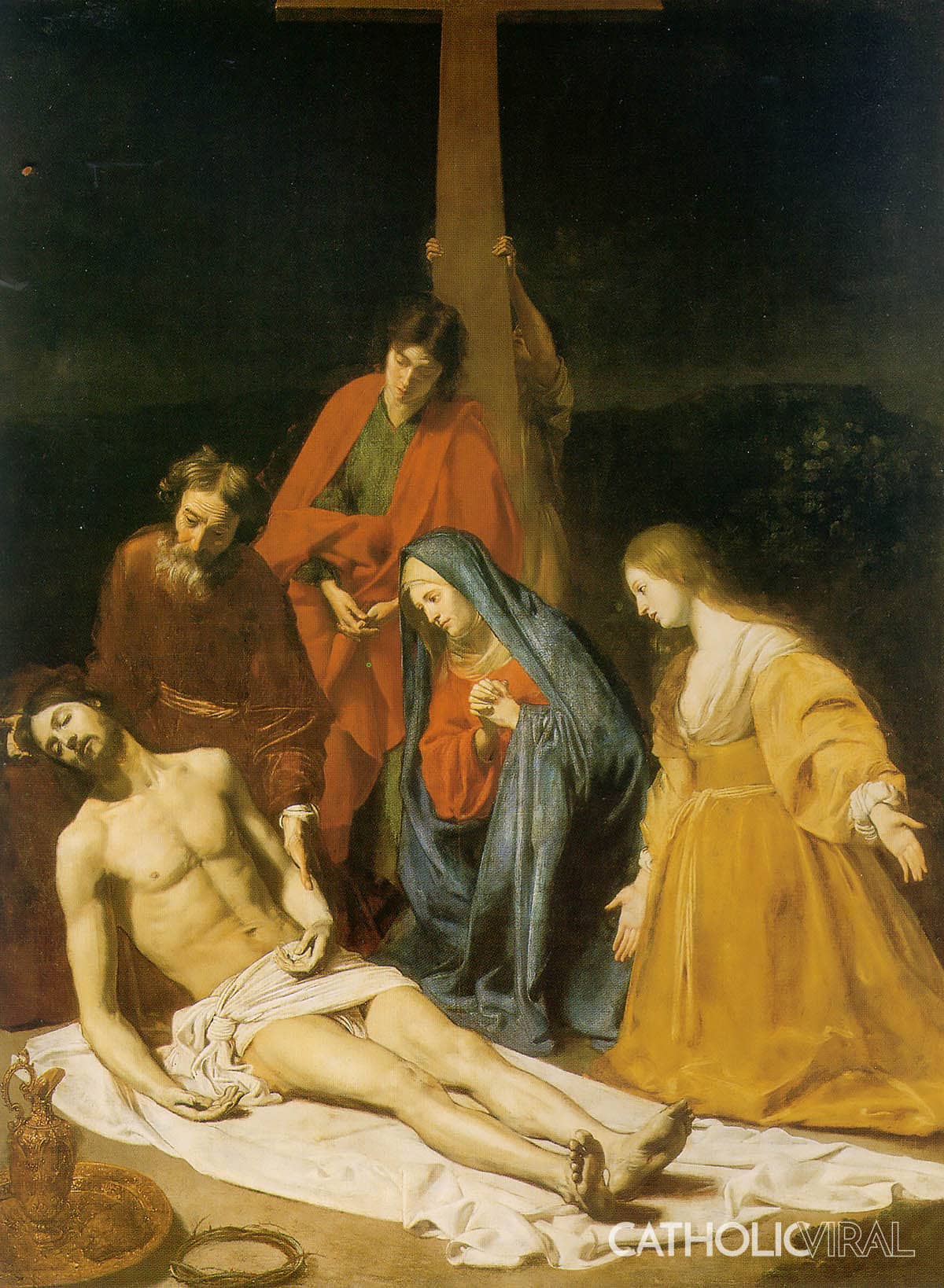
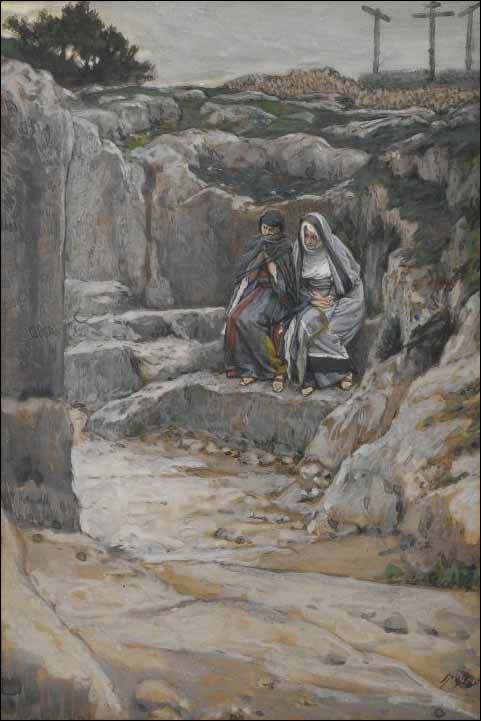
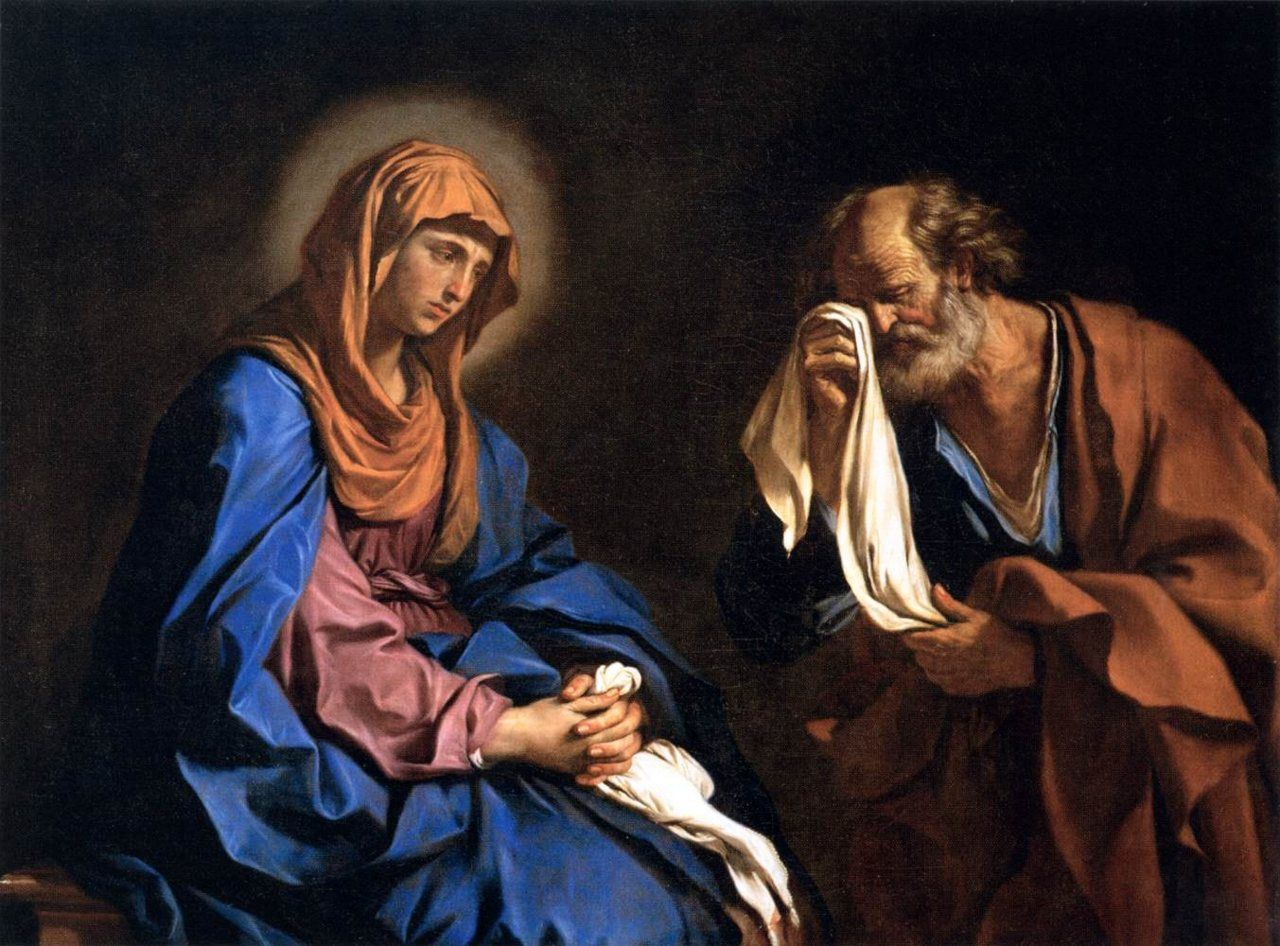
Christ lies in the grave, the Church sits near and mourns.
After the great battle He is resting in peace but upon Him we see the scars of intense suffering…
The mortal wounds on His Body remain visible…Jesus’ enemies are still furious, attempting to obliterate the very memory of the Lord by lies and slander.
Mary and the disciples are grief-stricken, while the Church must mournfully admit that too many of her children return home from Calvary cold and hard of heart.
When Mother Church reflects upon all of this, it seems as if the wounds of her dearly Beloved were again beginning to bleed.
We are tempted to rush from Good Friday to Easter. Mother Church with wisdom, separates the two with Holy Saturday – a day of peace and rest – a day to quietly ponder and pray – a day to sit in silence at the tomb of Jesus. “What is happening? Today there is a great silence over the earth, a great silence and stillness, a great silence, because the King sleeps, the earth was in terror and was still, because God slept in the flesh and raised up those who were sleeping from the ages.” We do not need words to express our misery. We need silence to ponder the mystery. Silence is the best expression of what is deepest in us, for silence alone, can express what words cannot.
According to tradition, the entire body of the Church is represented in Mary – she is the “credentium collectio universa” (the gathering of the universal Church) (Congregation for Divine Worship, Lettera circolare sulla preparazione e celebrazione delle feste pasquali, 73).
Thus, the Blessed Virgin Mary, as she waits near the Lord’s tomb, as she is represented in Christian tradition, is an icon of the Virgin Church keeping vigil at the tomb of her Spouse while awaiting the celebration of His Resurrection.
The pious exercise of the Ora di Maria is inspired by this intuition of the relationship between the Virgin Mary and the Church – while the body of her Son lies in the tomb and His soul has descended to the dead to announce liberation, from the shadow of darkness to His ancestors, the Blessed Virgin Mary, foreshadowing and representing the Church, awaits, in faith, the victorious triumph of her Son over death. — Directory on Popular Piety and the Liturgy
Quote of the Day – 25 March – The Solemnity of the Annunciation of the Lord
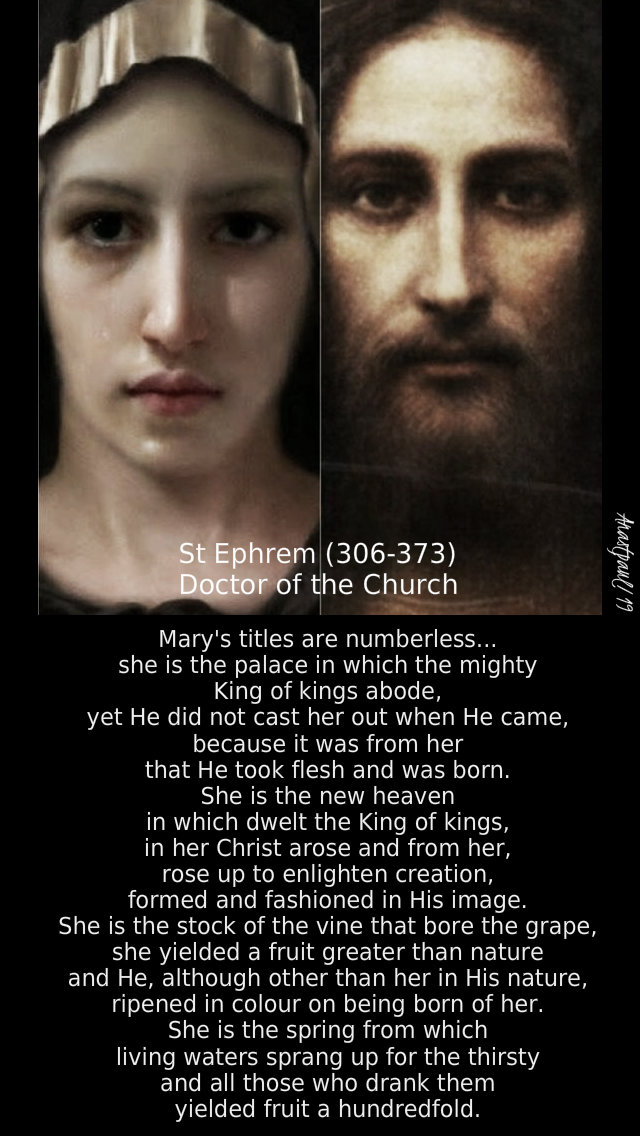
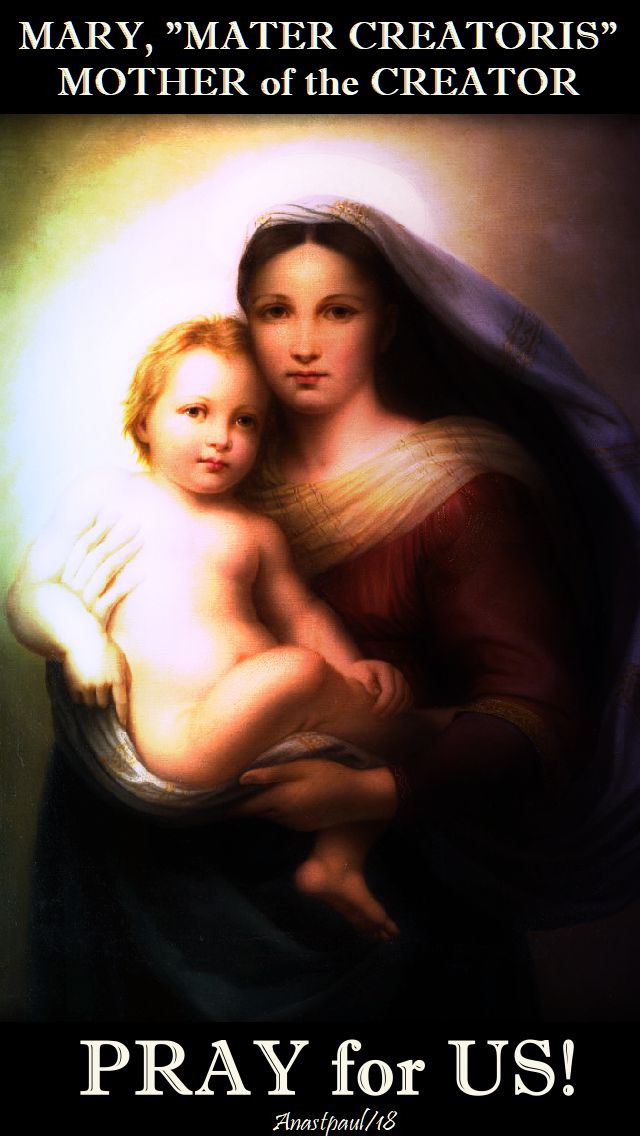
“Mary’s titles are numberless… she is the palace in which the mighty King of kings abode, yet He did not cast her out when He came, because it was from her that He took flesh and was born. She is the new heaven in which dwelt the King of kings, in her, Christ arose and from her, rose up to enlighten creation, formed and fashioned in His image. She is the stock of the vine that bore the grape, she yielded a fruit greater than nature and He, although other than her in His nature, ripened in colour on being born of her. She is the spring from which living waters sprang up for the thirsty and all those who drank them, yielded fruit a hundredfold.”
Lenten Reflection – 25 March – The Solemnity of the Annunciation of the Lord –- Readings: Isaiah 7:10-14; 8:10, Psalm 40:7-11, Hebrews 10:4-10, Luke 1:26-38
“Lord, open my lips, and my mouth shall declare your praise.”
Mary said, “Behold, I am the handmaid of the Lord. May it be done to me according to your word.” … Luke 1:38
Daily Meditation:
Today we step out of Lent, in one way.
We are nine months away from Christmas.
This is the feast of the Incarnation – the enfleshment of our God for us.
In Jesus, God entered this world, our world.
“God, who is Mighty has done great things for me, holy is his name” … Luke 1:49
“Contemplate Mary, my beloved, see how Gabriel went into her house and her questioning: “How can this be?” The Holy Spirit’s servant gave her this answer: “Nothing is impossible for God, for him, all is easy.” Consider how she believed the word she had heard and said: “Behold I am the handmaid of the Lord.” From that moment the Lord descended in a way known to Him alone, He bestirred Himself and came according to His good pleasure, He entered her without her feeling it and she opened herself to Him without experiencing any suffering. She bore within herself, as a child, Him by whom the world was filled. He descended to become the model that would renew Adam’s ancient image.” … Saint Ephrem (306-373) – Father and Doctor of the Church – Sermons on the Mother of God, 2, 93-145
Intercessions:
Let us give thanks to God, our Father:
through the power of the Spirit He purifies our heart and strengthens us in love.
Let us humbly ask Him:
Lord, give us Your Holy Spirit.
Help us to receive good things from Your bounty with a deep sense of gratitude;
-and to accept with patience the evil that comes to us.
Teach us to be loving not only in great and exceptional moments,
-but above all in the ordinary events of daily life.
May we abstain from what we do not really need,
-and help our brothers and sisters in distress.
May we bear the wounds of Your Son,
-for through His body He gave us life.
Closing Prayer:
God of infinite love,
I thank You for this feast of our salvation,
right here in the middle of Lent.
I turn to You to beg for Your help.
I need the inspiration and help of Mary on this journey.
Please grant me the grace to be humbly faithful
to what You are calling me to do.
Please give me what I need to be free and to be Your servant.
Please let Mary guide us in the path to peace in our world.
I ask You this, through Jesus our Lord.
May the Lord bless us,
protect us from all evil
and bring us to everlasting life.
Amen
One Minute Reflection – 25 March – The Solemnity of the Annunciation of the Lord –- Readings: Isaiah 7:10-14; 8:10, Psalm 40:7-11, Hebrews 10:4-10, Luke 1:26-38
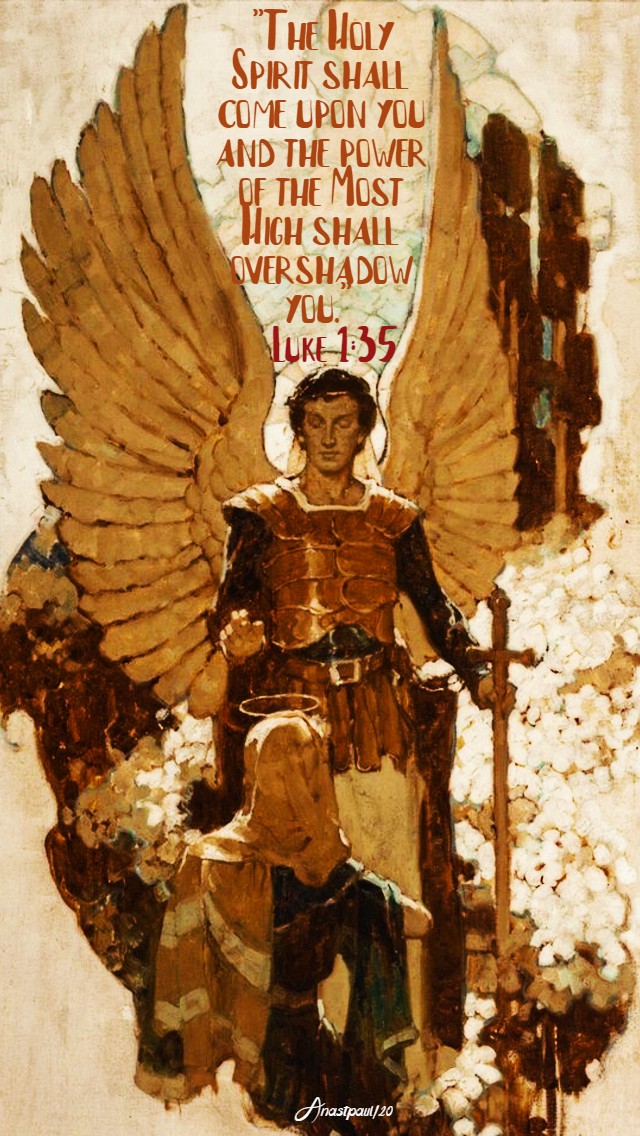
“The Holy Spirit shall come upon you and the power of the Most High shall overshadow you.” And Mary said, “Behold, I am the handmaid of the Lord, let it be to me according to your word.”...Luke 1:35, 38
REFLECTION – “The Word came from Himself and came down beneath Himself and dwelt among us (cf. Jn 1:14), when He emptied Himself, taking the form of a servant (Phil 2:7). That emptying was a decent. Yet He descended in such a way that He did not lose Himself. He was made flesh in such a way that He did not cease to be the Word, nor did the taking of humanity lessen the glory of His majesty. (…)
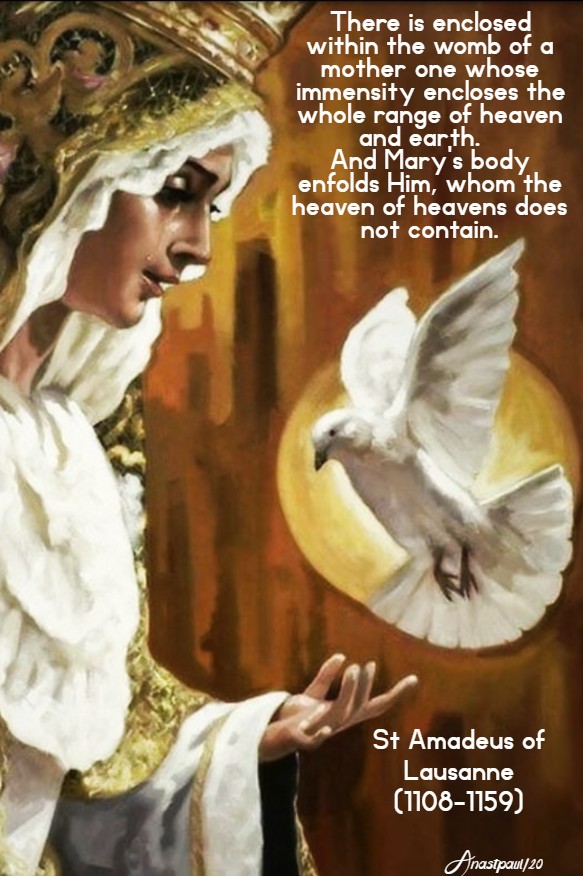
Indeed, just as the sun’s brightness penetrates glass without breaking it and as a glance of the eyes plunges into calm clear water without parting or dividing it, while it opens up all things to their very depth, so the Word of God drew near the Virgin’s dwelling and went forth from it, her virgin womb still closed. (…) Therefore, the invisible God was made visible man, the impassible and immortal showed Himself passible and mortal. He who was not confined within the garments of our substance, willed to be so confined. There is enclosed within the womb of a mother one whose immensity encloses the whole range of heaven and earth. And Mary’s body enfolds Him, whom the heaven of heavens does not contain.
If you ask how it was done, hear the Archangel setting forth the plan to Mary and saying to her: “The Holy Spirit shall come upon you and the power of the Most High shall overshadow you.” (cf. Lk 1:35) (…) For He chose you before and above all others, that you may surpass all those who have been before or after you or shall be in the fullness of grace.” … Saint Amadeus of Lausanne (1108-1159) Cistercian Monk, then Bishop – In praise of the Blessed Virgin Mary, Homily III
PRAYER – Shape us in the likeness of the Divine nature of our Redeemer, whom we believe to be true God and true man, since it was Your will, Lord God, that He, Your Word, should take to Himself, our human nature in the womb of the Blessed Virgin Mary. We make our prayer through our Lord Jesus, in the unity of the Holy Spirit, God for always and forever, amen.
Quote/s of the Day – 11 February – The Memorial of Our Lady of Lourdes and St Pope Gregory II (669-731)
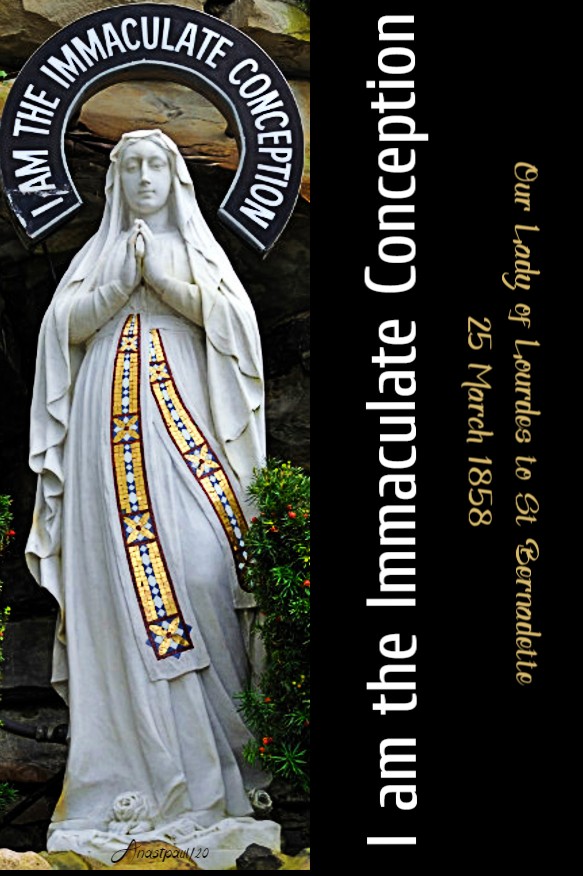
“I am the Immaculate Conception.”
Our Lady of Lourdes to St Bernadette
25 March 1858
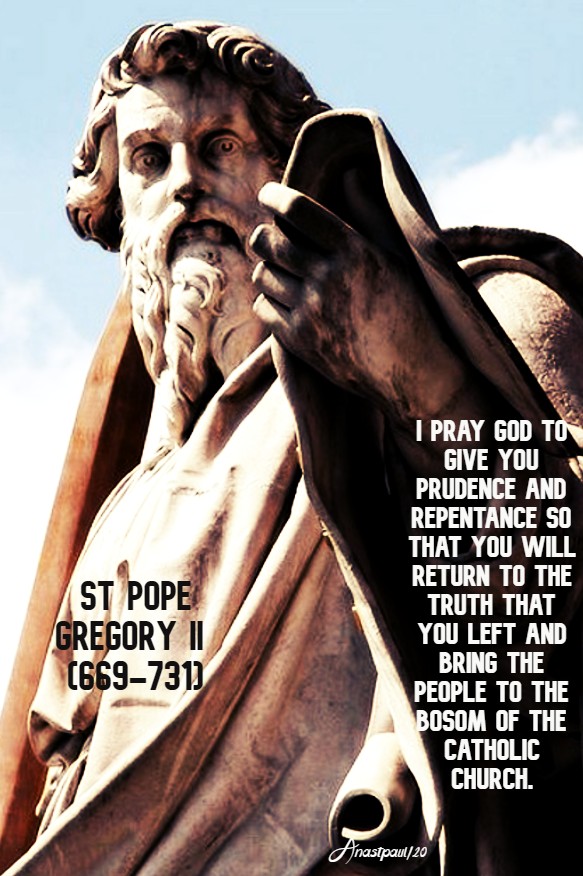
St Pope Gregory II “Defender of Icons”
Here is an excerpt of one of his letters to the Emperor of the Eastern Roman Empire, Leo III the Isaurian, who became an iconoclast and issued an imperial decree forbidding the use of sacred images:
“The pious Emperors were submissive to the Pontiffs of the Church and never dishonoured them. You, on the contrary, since the day when you apostatised from the Faith, incurring the same curse that [in previous letters] you made against those who persecute sacred ministers and condemning yourself by your own decree, you have separated yourself from the Holy Ghost and you do persecute and tyrannise us, by the hands of your soldiers and earthly weapons. We do not have weapons or armies but we invoke the King of the whole Universe, Christ, Who is seated in Heaven over all the celestial powers and armies, to deliver you to Satan, as the Apostle says, in the flesh and the spirit.
We are travelling to the far East to assist those who are asking for Baptism. I had already sent Bishops and priests from my Church to them. The Princes of those places have not yet been washed in the waters of the Baptism and they have chosen me as Godfather. So, we need to be on our way, fearful lest one day God will ask an account for our negligence.
I pray God to give you prudence and repentance so that you will return to the truth that you left and bring the people to the bosom of the Catholic Church.”
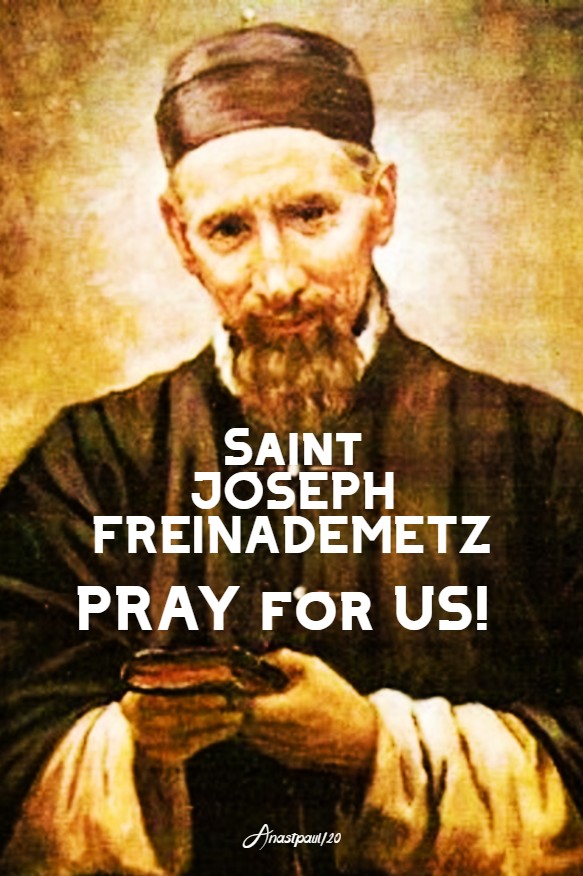
One Minute Reflection – 28 January – Tuesday of the Third week in Ordinary Time, Year A, Readings: 2 Samuel 6:12-15, 17-19, Psalm 24:7-10, Mark 3:31-35 and the Memorial of Joseph Freinademetz SVD (1852-1908) “Fu Shenfu” – Lucky Priest-
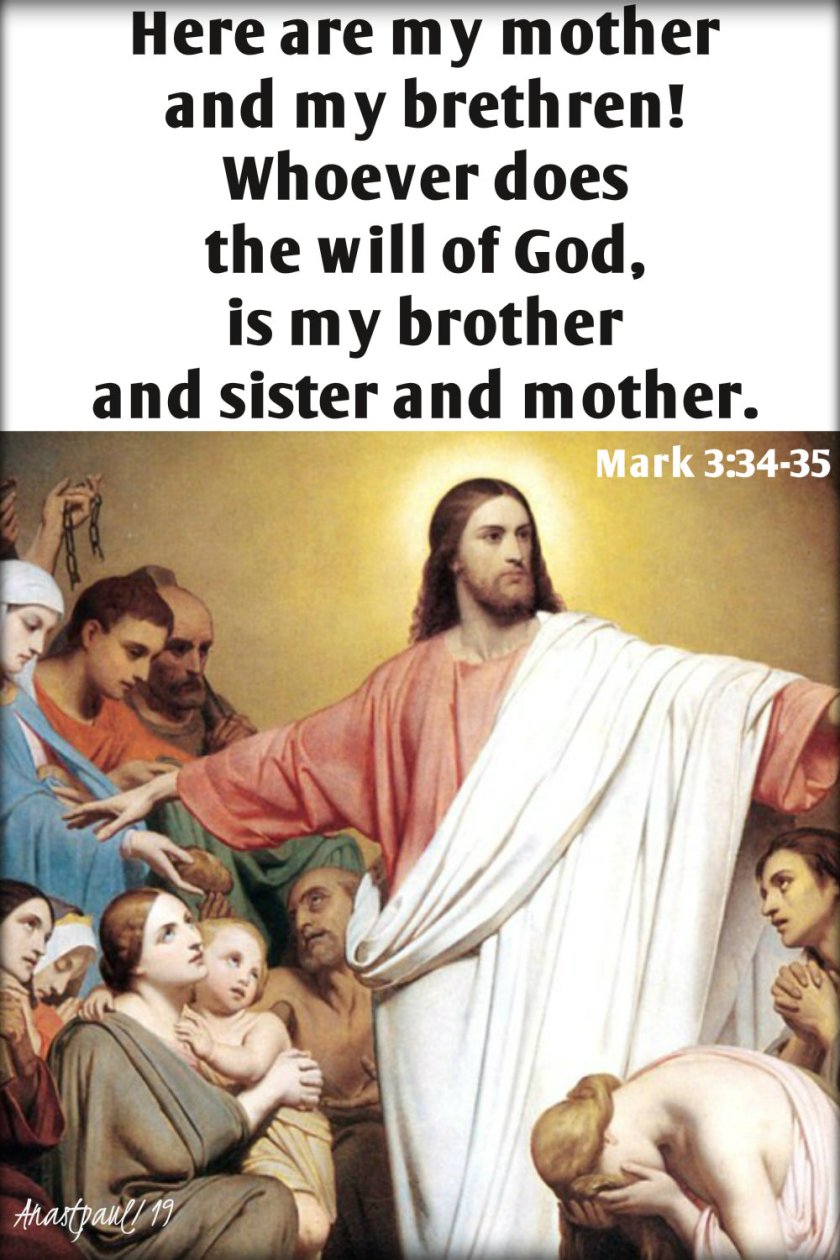
“Here are my mother and my brethren! Whoever does the will of God, is my brother, and sister and mother.”…Mark 34-35
REFLECTION – “Grace is thicker than blood – As mother, Mary made significant appearances in the life of Jesus. She followed Him in His ministry.
In today’s short Gospel text, she is outside with the relatives of Jesus asking for Him.
Notice the delicacy of Mary. She neither interrupts the ministry of Jesus nor enters the room where Jesus is ministering. She waits outside.
The response of Jesus to the one who brought the message seems like a rebuff.
In fact, it is a tribute to Mary.
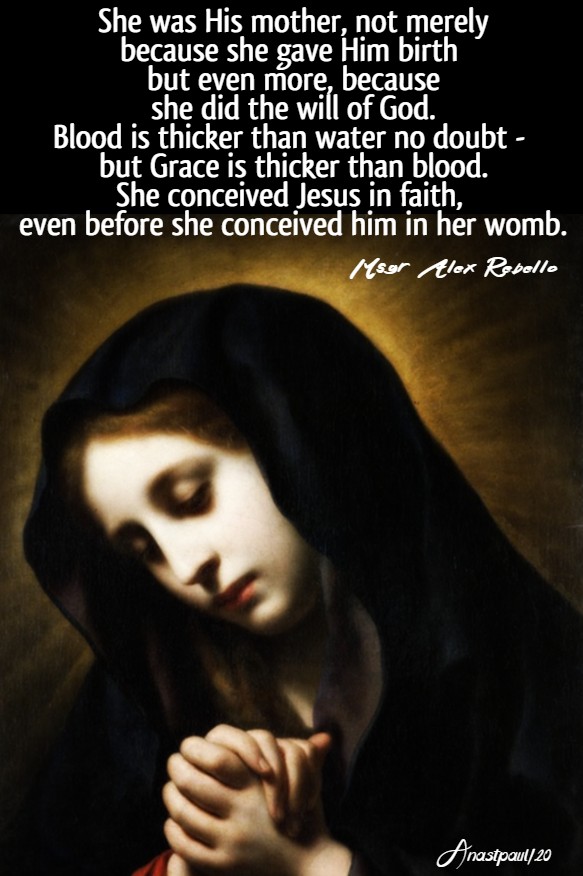
She was His mother, not merely because she gave Him birth but even more, because she did the will of God.
Blood is thicker than water no doubt – but Grace is thicker than blood.
She conceived Jesus in faith, even before she conceived him in her womb.” … Msgr Alex Rebello – Diocese of Wrexham, Wales – Daily Reflections, Year A
PRAYER – Loving Father, You gave us Your only-begotten Son to teach us, to make us Your adopted children by His adoption of ourselves as His siblings. What grace, what mercy, what love, is this! We give You our gratitude and our love. Mary, holy and blessed Virgin, Mother of God, pray for us. St Joseph Freinademetz, you survived solely on faith in a strange land and brought Christ to those who spoke another language by the language of Grace, please pray for us. Through Jesus, our brother and our Saviour, who gave us His mother to guide and protect us, we pray, with the Holy Spirit, God forever, amen.
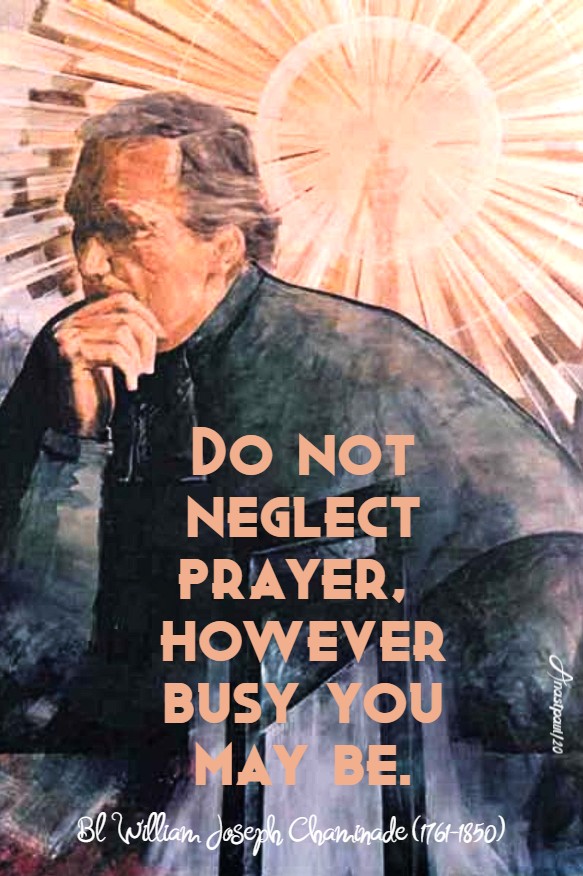
Quote/s of the Day – 22 January – Wednesday of the Second week in Ordinary Time, Year A and the Memorial of Blessed William Joseph Chaminade SM (1761-1850), Founder of the Marianists
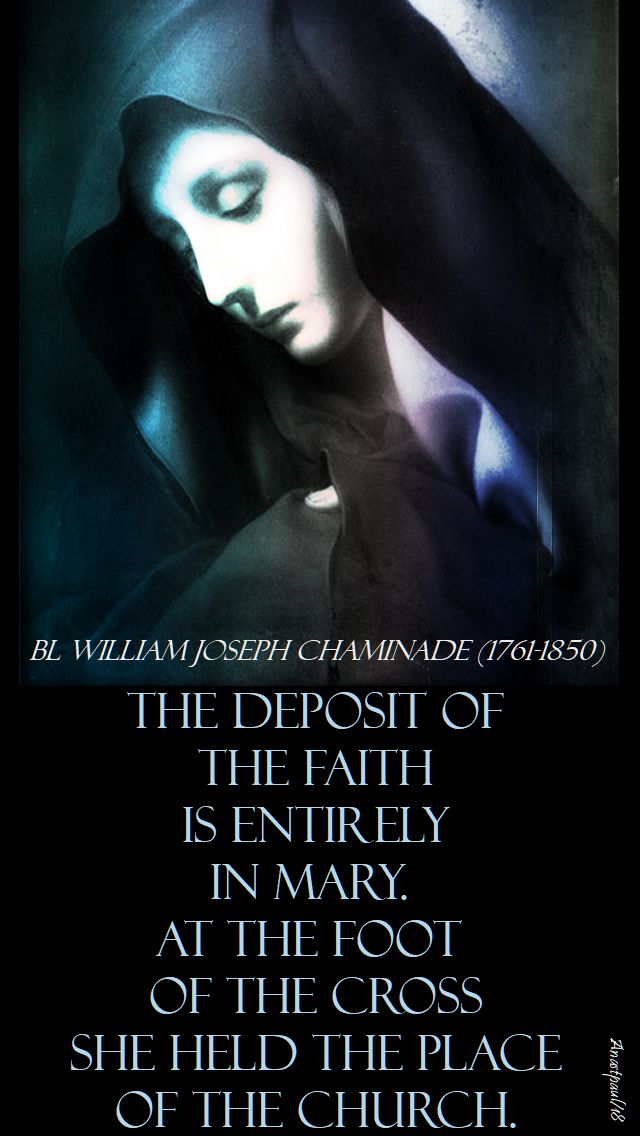
“The deposit of the Faith is entirely in Mary. At the foot of the Cross she held the place of the Church. “
“…We are, so to say, conceived of the Holy Spirit but we must, like the Saviour, be born of the Virgin Mary.”
Quote/s of the Day – 2 January – Christmas Weekday and The Memorial of St Basil the Great (329-379) and St Gregory of Nazianzen (330-390), Readings: 1 John 2:22-28, Psalm 98:1-4, John 1:19-2
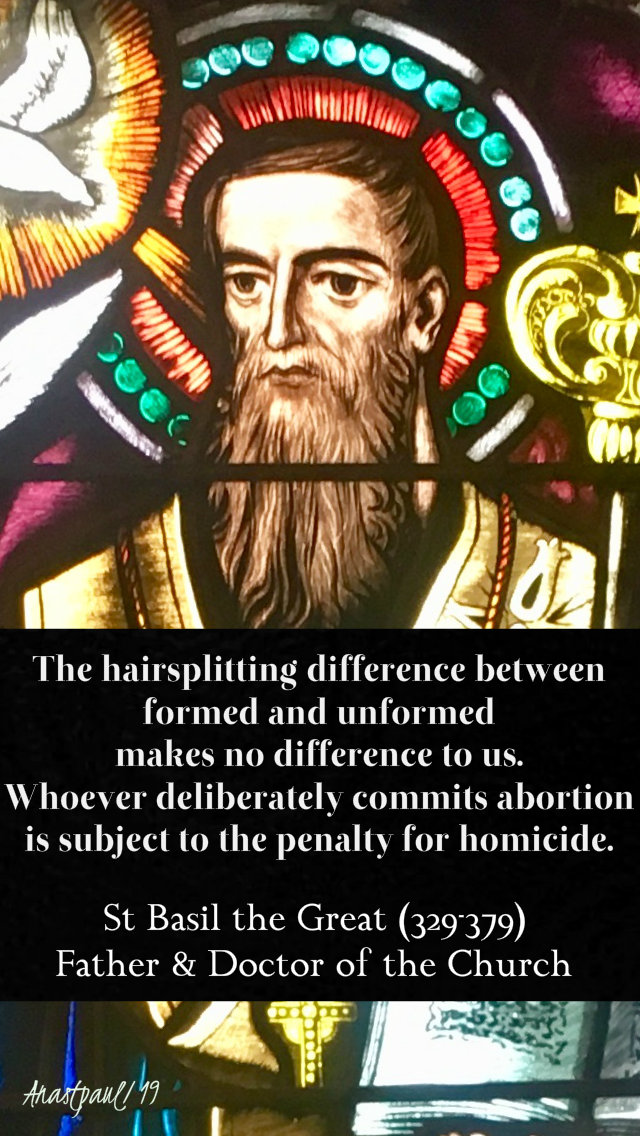
“The hairsplitting difference between formed and unformed makes no difference to us. Whoever deliberately commits abortion is subject to the penalty for homicide.”
St Basil the Great (329-379)
Father & Doctor of the Church
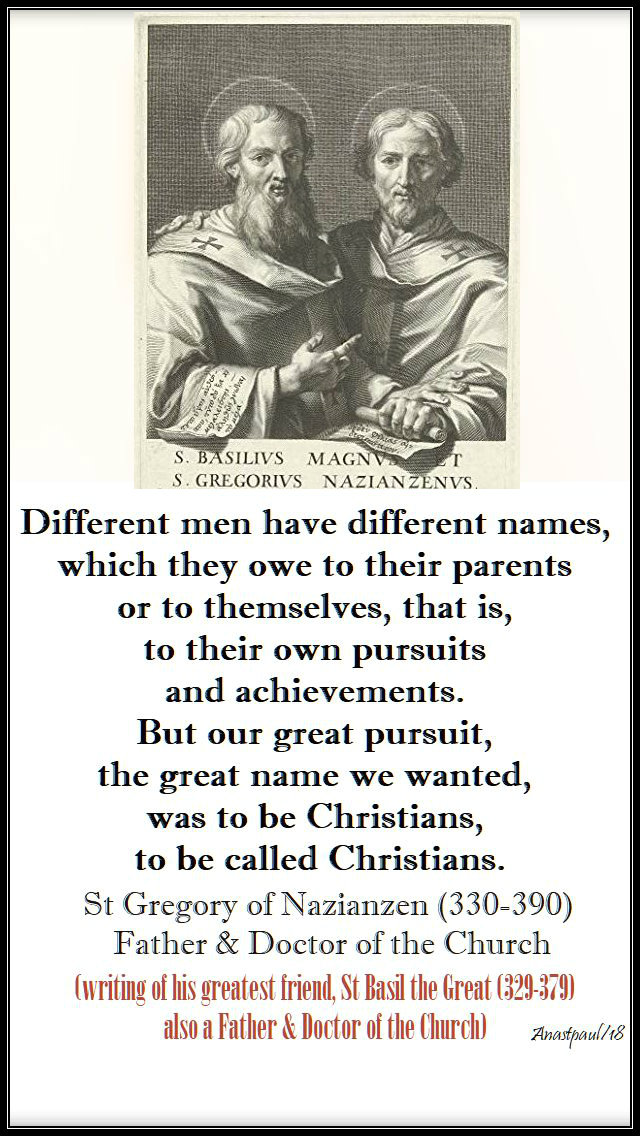
“Different men have different names, which they owe to their parents or to themselves, that is, to their own pursuits and achievements. But our great pursuit, the great name we wanted, was to be Christians, to be called Christians.”
St Gregory of Nazianzen (330-390)
(from his writings on his friendship with St Basil)
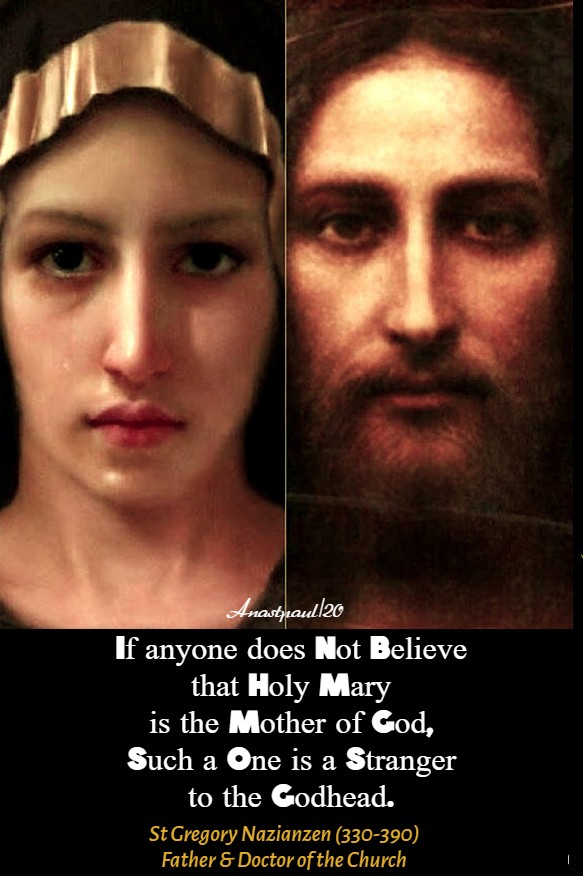
“If anyone does not believe that Holy Mary is the Mother of God, such a one is a stranger to the Godhead.”
St Gregory of Nazianzen (330-390) Father & Doctor of the Church
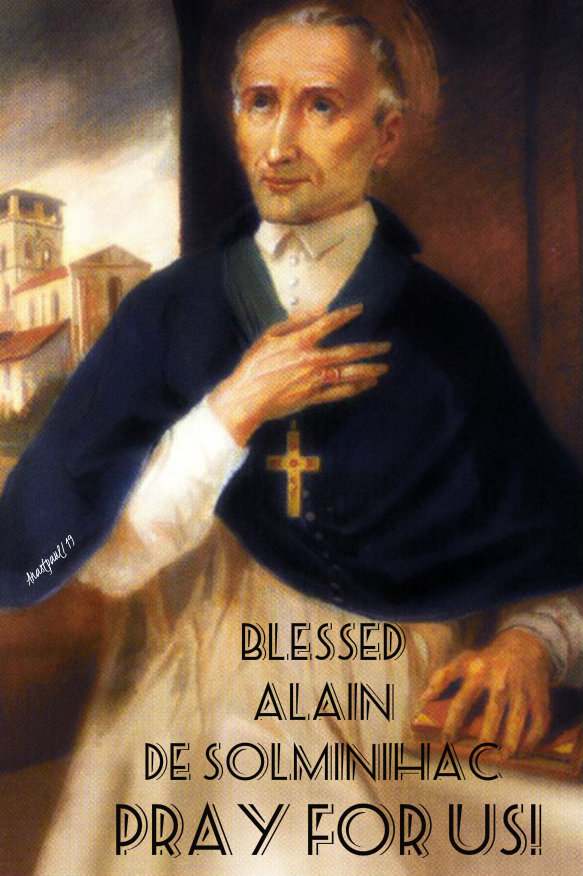
Second Thought for the Day – 31 December – The Seventh Day in the Octave of Christmas and the Memorial of Blessed Alain de Solminihac (1593-1659) Bishop of Cahors, France
2018 was the 400th Anniversary the Priestly Ordination of Blessed Alain de Solminihac. His Diocese of Cahors, France launched a Year of Vocations to conincide with this event of their former Bishop. One of their aims, besides promoting vocations, was to make known the life and holiness of Blessed Alain. Bishop Laurent Camiade, the current Bishop of Cahors, wrote:
“It is wonderful to know that you are called to holiness and it is inspiring to answer the call, to give your whole life, for consecration in the Church. All Christians are concerned with the “universal vocation to holiness.” Some are specifically called to give their whole life – religious consecration, or in an institute, hermit or order of the virgins, or commitment to celibacy with a view to being ordained a priest.
Providence wanted 2018 to be the 400th anniversary of the Priestly Ordination of Blessed Alain de Solminihac. He was Ordained Deacon on 25 March 1617 and Priest on 22 September 1618. In 1636, he was called again to become Bishop of Cahors. This is why, after having spoken to different councils, I hope that we will take advantage of this Anniversary to return to listening to the teachings of Blessed Alain. He teaches us with his vigorous and profound words … and by his exemplary life, to strive to be courageous, ardent and sober.
Today, as in Alain de Solminihac’s time, devoting his whole life to God involves difficulties. Celibacy according to a sober lifestyle has never been obvious. In the time of Blessed Alain, the choice of becoming a priest, religious or nun, made it possible to ensure material security, thanks to a system of benefits attached to abbeys or dioceses. As a result, in the 17th century, not all consecrated persons had internalised, the spiritual conditions, for living in accordance with their state and the clergy did not always give a good testimony. It is in this context, that Blessed Alain would become a “reformer”, that is to say, a demanding promoter of coherence between vocation and lifestyle.
Alain de Solminihac put spirituality and fidelity to the duties linked to the received mission first. “You must follow the good pleasure of God as soon as you know it , he wrote, and accomplish it by immediately turning your eyes to God, remaining in a simple expectation to receive another sign or command, without wasting time delight in the satisfaction of having accomplished this adorable Will of God.”
The requirements of Blessed Alain sometimes provoked reactions of opposition but they also attracted many young people, happy to give themselves, in a way that made sense and above all, pushed by the Holy Spirit who wanted this for the Church. His motto was Faith and Valour! and he lived up to it!
It is clearly a current need to relaunch the call to specific vocations (priests, religious, nuns, consecrated). The desire to give all of one’s life to follow Christ, exists in many young people (recent statistics prove it) but this is seldom realised, as we can see.
The priests and seminarians of our Diocese are deeply attached to Our Lady of Rocamadour, who played an often decisive role in their engagement. Blessed Alain fought with all the vigour of his temper, to keep this sanctuary in the Diocese of Cahors. We are therefore grateful to him for these graces which, by the will of God, reflect from the pierced heart of Christ, to our local Church. Blessed Alain considered Rocamadour to be the most famous Marian place in the kingdom . He was very attached to Mary who, he explains, “had more humility than all the other saints, because, holier than the others, she had a more perfect knowledge of the excellence of God and by consequence of her own nothingness. “
Relics of Blessed Alain de Solminihac in Cahors
May Blessed Alain de Solminihac help us to share his missionary ardour and his discreet humility.”
Quote/s of the Day – 27 December – Feast of St John the Evangelist and the Third Day of the Christmas Octave
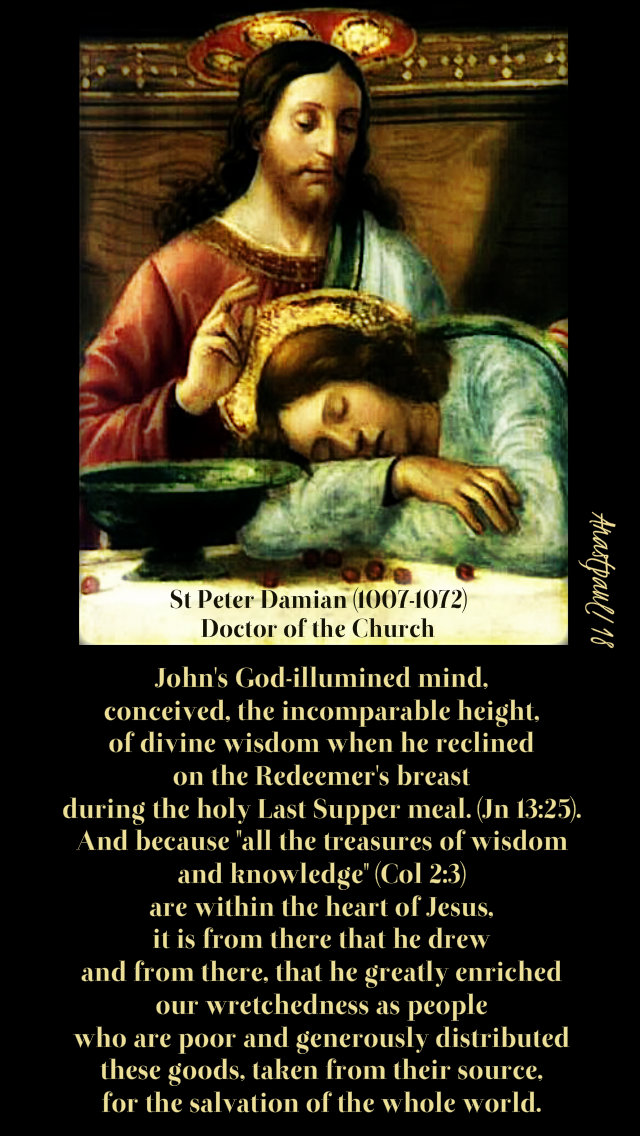
“John’s God-illumined mind, conceived the incomparable height of divine wisdom, when he reclined on the Redeemer’s breast, during the holy Last Supper meal (Jn 13:25). And because “all the treasures of wisdom and knowledge” (Col 2:3) are within the heart of Jesus, it is from there, that he drew and from there, that he greatly enriched our wretchedness, as people who are poor and generously distributed these goods, taken from their source, for the salvation of the whole world. And because this blessed John speaks about God in a marvellous way, that cannot be compared to that of anyone else, it is only right that the Greeks as well as the Latins have given him the name of “Theologian”. Mary is “Theotokos” because she has truly given birth to God; John is “Theologos” because he saw in an indescribable way, that the Word of God, was with the Father before the beginning of time and was God (Jn 1:1) and because, too, he spoke about this, with extraordinary depth.”
St Peter Damian (1007-1072) Doctor of the Church
“If Moses, after having conversed with God in the cloud, came from the Divine interview with rays of miraculous light encircling his head, how radiant must have been the face of St John, which had rested on the very Heart of Jesus, in Whom are hid all the treasures of wisdom and knowledge [Col. ii 3] how sublime his writings! how Divine his teaching!”
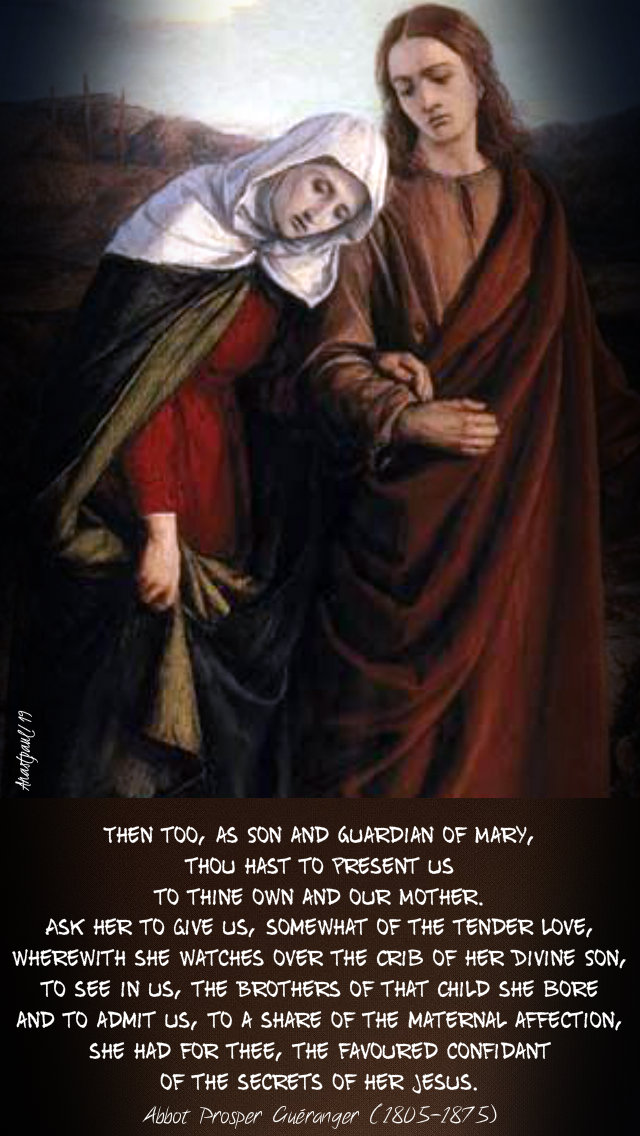
“Then too, as Son and Guardian of Mary, thou hast to present us to thine own and our Mother. Ask her to give us, somewhat of the tender love, wherewith she watches over the Crib of her Divine Son, to see in us, the Brothers of that Child she bore and to admit us, to a share of the maternal affection, she had for thee, the favoured confidant of the secrets of her Jesus.”
Thought for the Day – Saturday of Advent 21 December
Mary visits Elizabeth
Saint Ambrose of Milan (340-397)
Great Latin Father and Doctor of the Church
An excerpt from A Commentary on Luke, Book 2
When the angel revealed his message to the Virgin Mary, he gave her a sign to win her trust. He told her of the motherhood of an old and barren woman, to show that God is able to do all that He wills.
When she hears this, Mary sets out for the hill country. She does not disbelieve God’s word, she feels no uncertainty over the message or doubt about the sign. She goes eager in purpose, dutiful in conscience, hastening for joy.
Filled with God, where would she hasten but to the heights? The Holy Spirit does not proceed by slow, laborious efforts. Quickly, too, the blessings of her coming and the Lord’s presence are made clear, as soon as Elizabeth heard Mary’s greeting the child leapt in her womb and she was filled with the Holy Spirit.
Notice the contrast and the choice of words. Elizabeth is the first to hear Mary’s voice but John, is the first to be aware of grace. She hears with the ears of the body but he leaps for joy at the meaning of the mystery. She is aware of Mary’s presence but he is aware of the Lord’s – a woman aware of a woman’s presence, the forerunner aware of the pledge of our salvation. The women speak of the grace they have received, while the children are active in secret, unfolding the mystery of love with the help of their mothers, who prophesy by the spirit of their sons.
The child leaps in the womb, the mother is filled with the Holy Spirit, he fills his mother with the same Spirit. John leaps for you and the spirit of Mary rejoices in her turn. When John leaps for joy, Elizabeth is filled with the Holy Spirit but we know, that though Mary’s spirit rejoices, she does not need to be filled with the Holy Spirit. Her Son, who is beyond our understanding, is active in His mother, in a way beyond our understanding. Elizabeth is filled with the Holy Spirit after conceiving John, while Mary is filled with the Holy Spirit before conceiving the Lord. Elizabeth says: Blessed are you because you have believed.
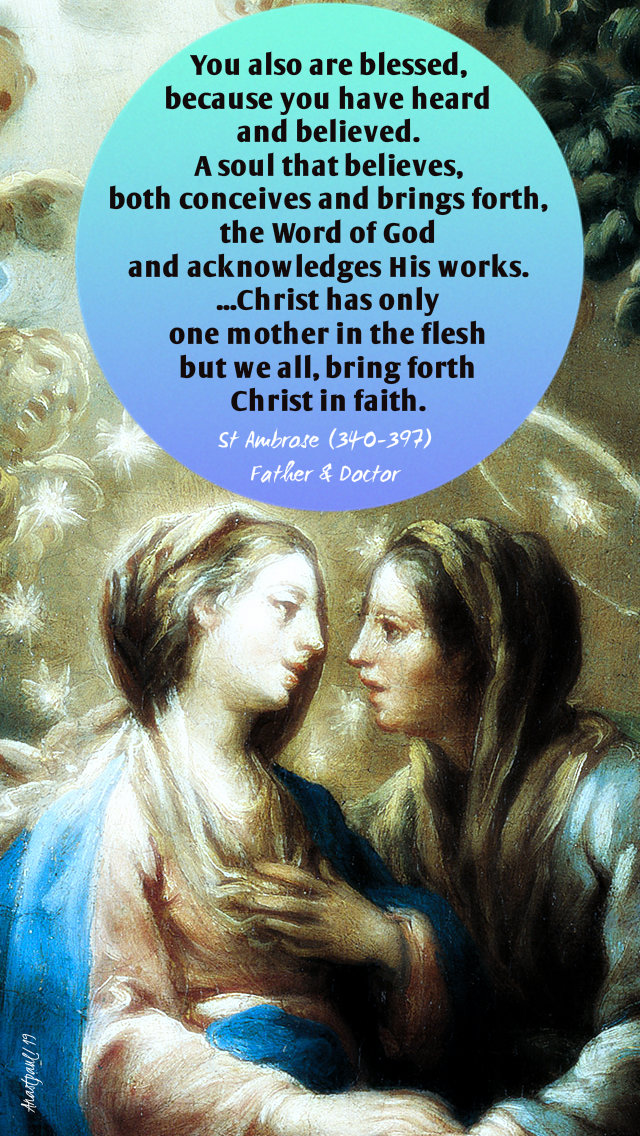
You also are blessed, because you have heard and believed. A soul that believes, both conceives and brings forth the Word of God and acknowledges His works.
Let Mary’s soul be in each of you, to proclaim the greatness of the Lord. Let her spirit be in each, to rejoice in the Lord. Christ has only one mother, in the flesh but we all bring forth Christ, in faith. Every soul receives the Word of God, if only it keeps chaste, remaining pure and free from sin, it’s modesty undefiled. The soul that succeeds in this, proclaims the greatness of the Lord, just as Mary’s soul magnified the Lord and her spirit rejoiced in God her Saviour. In another place we read – Magnify the Lord with me. The Lord is magnified, not because the human voice can add anything to God but, because He is magnified within us. Christ is the image of God and, if the soul does what is right and holy, it magnifies that image of God, in whose likeness it was created and, in magnifying the image of God, the soul has a share in its greatness and is exalted.
Quote/s of the Day – Saturday of Advent 21 December, Readings: Isaiah 7:10-14, Psalm 24:1-6, Luke 1:26-38 and The Memorial of St Peter Canisius (1521-1597) Doctor of the Church
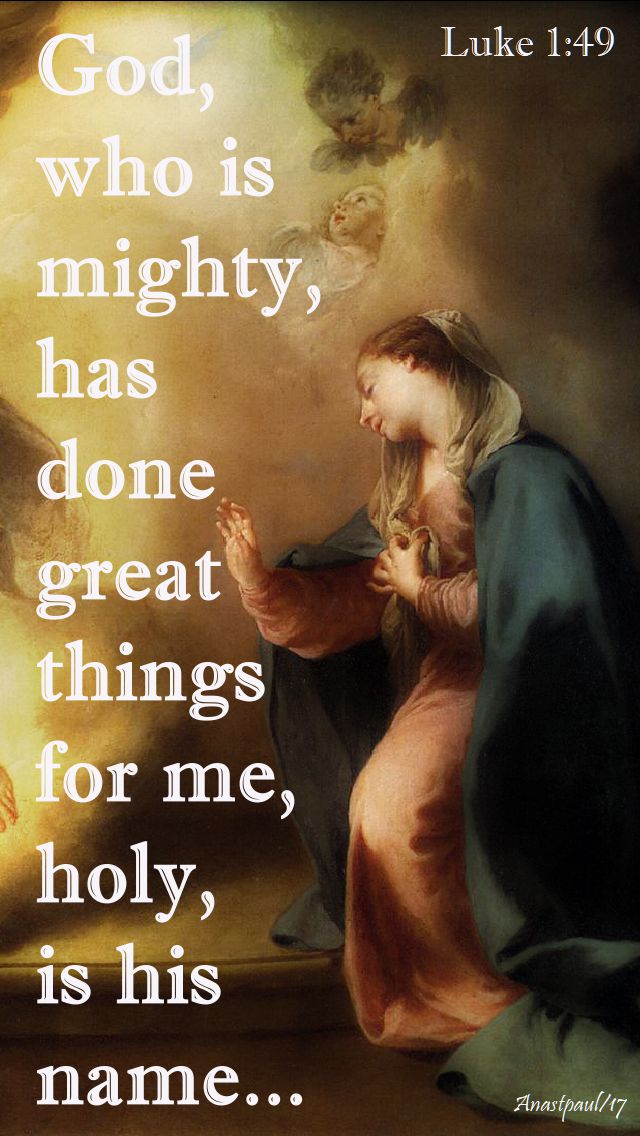
God who is mighty, has done great things for me, holy is his name…
Luke 1:49
“While remaining the Mother of our Judge, Mary is a mother to us, full of mercy. She constitutes our protection. She keeps us close to Christ and she faithfully takes, the matter of our salvation, into her charge.”
Advent Reflection – The Weekdays of Advent – 20 December, Readings: Isaiah 7:10-14, Psalm 24:1-6, Luke 1:26-38
The Lord is at hand, come, let us adore Him.
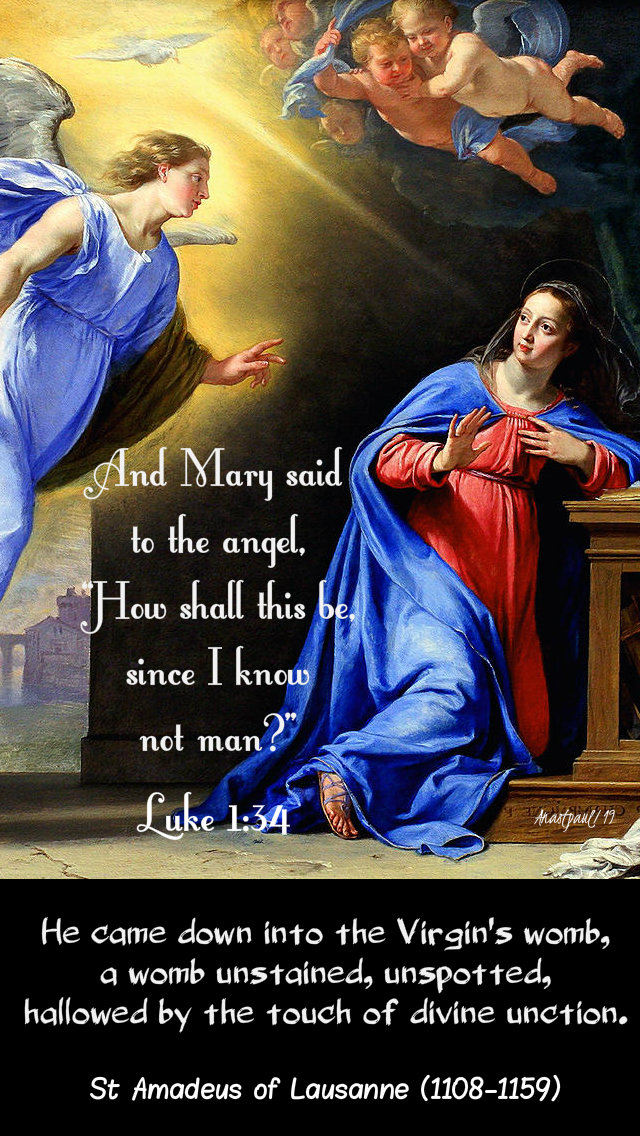
And Mary said to the angel, “How shall this be, since I have no husband?” … Luke 1:34
REFLECTION – “Tell us, blessed David, how [the Word] descended. “He came down as rain upon the fleece, and as drops that water the earth.” (Ps 71[72]:6 LXX). (…) It remains to discuss how the rain descends upon the fleece and how the drops flow out over the earth. (…)
The rain descends upon the fleece without sound, without movement, without any cleavage or division. It is gently poured out, peacefully received, sweetly drunk. Thus the drops gradually, little by little, spread over the earth falling down so wonderfully and so gently that their coming is scarcely perceived and as they depart, they bring forth the shoots. In the same way, the rain coming from beyond, above the heavenly waters, came down into the Virgin’s womb without human act, with no movement of concupiscence, her integrity unimpaired, the seal of her virginity still locked. Gently was it poured, calmly received, ineffably made flesh. It came drop by drop upon her soil, unseen as it entered and, as it departed, plainly going forth. (…)
We have told how the Word of God came down. Where He came down is made clear in like manner, for He came down into the Virgin’s womb, a womb unstained, unspotted, hallowed by the touch of divine unction.” … St Amadeus of Lausanne (1108-1159) Bishop, Cistercian Monk – On the praises of the Blessed Mary, homily III, SC 72
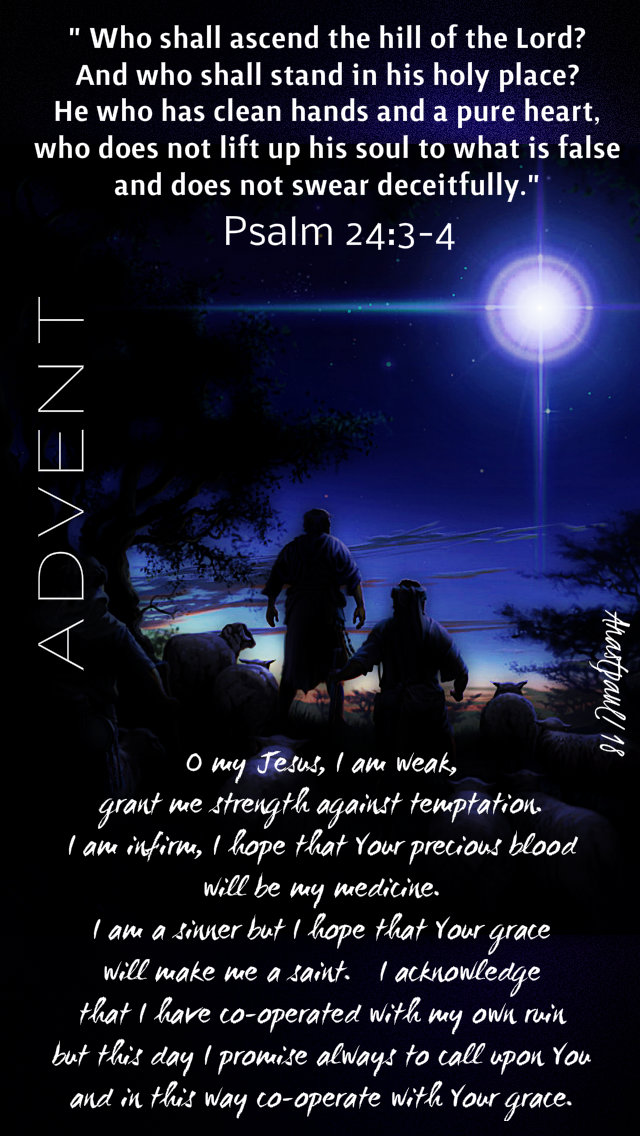
MEDITATION – ” Who shall ascend the hill of the Lord? And who shall stand in his holy place? He who has clean hands and a pure heart, who does not lift up his soul to what is false and does not swear deceitfully.” … Psalm 24:3-4
ADVENT ACTION – “O my Jesus, I am weak, grant me strength against temptation. I am infirm, I hope that Your precious blood will be my medicine. I am a sinner but I hope that Your grace will make me a saint. I acknowledge that I have co-operated with my own ruin but this day, I promise always, to call upon You and in this way co-operate with Your grace.” … St Alphonsus Liguori (1696-1787) Most Zealous Doctor
PRAYER
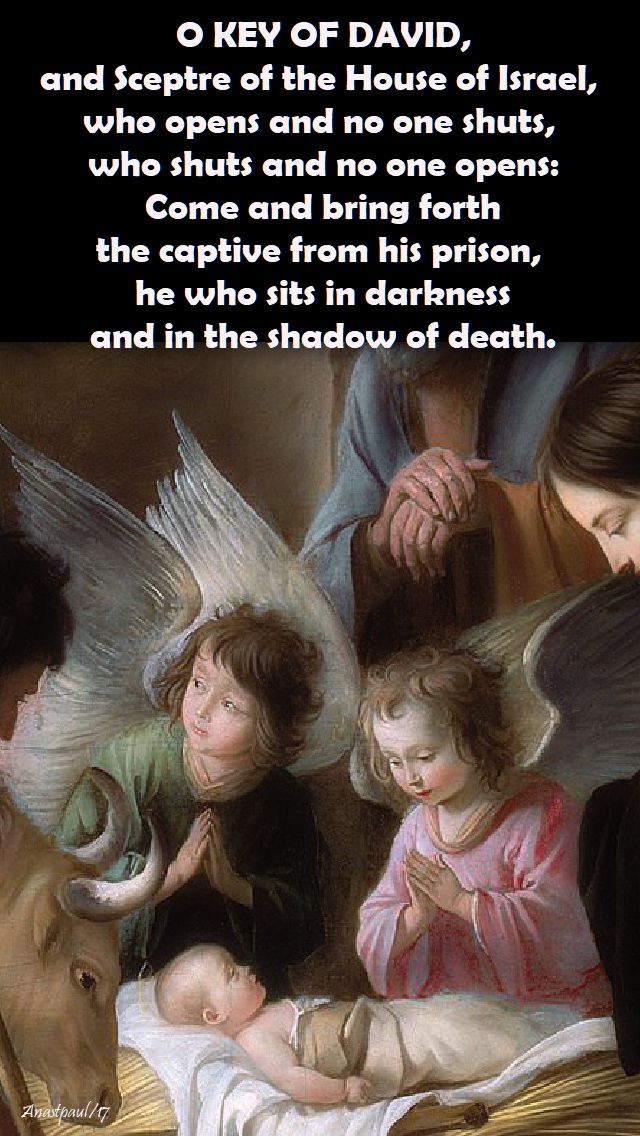
O KEY OF DAVID,
and Sceptre of the House of Israel, who opens and no-one shuts, who shuts and no-one opens. Come and bring forth the captive from his prison, he who sits in darkness and in the shadow of death.
Thought for the Day – The Weekdays of Advent, 18 December – Readings: Jeremiah 23:5-8, Psalm 72:1-2, 12-13, 18-19, Matthew 1:18-24
When his mother Mary had been betrothed to Joseph … Matthew 1:18
Saint Peter Chrysologus (c 400-450)
Bishop of Ravenna, Father and Doctor of the Church
Sermon 146, on Mt 1:18
“His mother, Mary, was betrothed.” It should have been enough to say: Mary was betrothed. What can a betrothed mother mean? If she is a mother then she isn’t betrothed, if she is betrothed, then she isn’t yet a mother! “His mother, Mary, was betrothed” – betrothed by virginity, mother by fecundity. This was a mother without experience of a man but who yet experienced motherhood. How could she not be a mother before she had conceived who, after giving birth, remains both virgin and mother? When was she not a mother, she who is about to conceive Him, who set in motion, the time that gives things their beginning?
Why was the mystery of heavenly innocence given to a betrothed girl and not to a virgin who was still free? Why did a fiancé’s jealousy put his betrothed in peril? Why should such great virtue appear to be sin or salvation to be eternal danger?… What mystery exercises us in all this, my brethren? There is not a stroke, a letter, a syllable, a word, a name, a person in all the Gospel that is empty of Divine significance.
A betrothed girl was chosen that the Church, Christ’s betrothed, might also be signified according to the word of the prophet Hosea: “I will betroth you to me in right and justice, in love and mercy; I will betroth you in fidelity” (Hos 2:21-22). That is why John said: “The one who has the bride is the Bridegroom” (Jn 3:29). And Saint Paul: “I betrothed you to one Spouse to present you as a chaste virgin to Christ” (2 Cor 11:2).
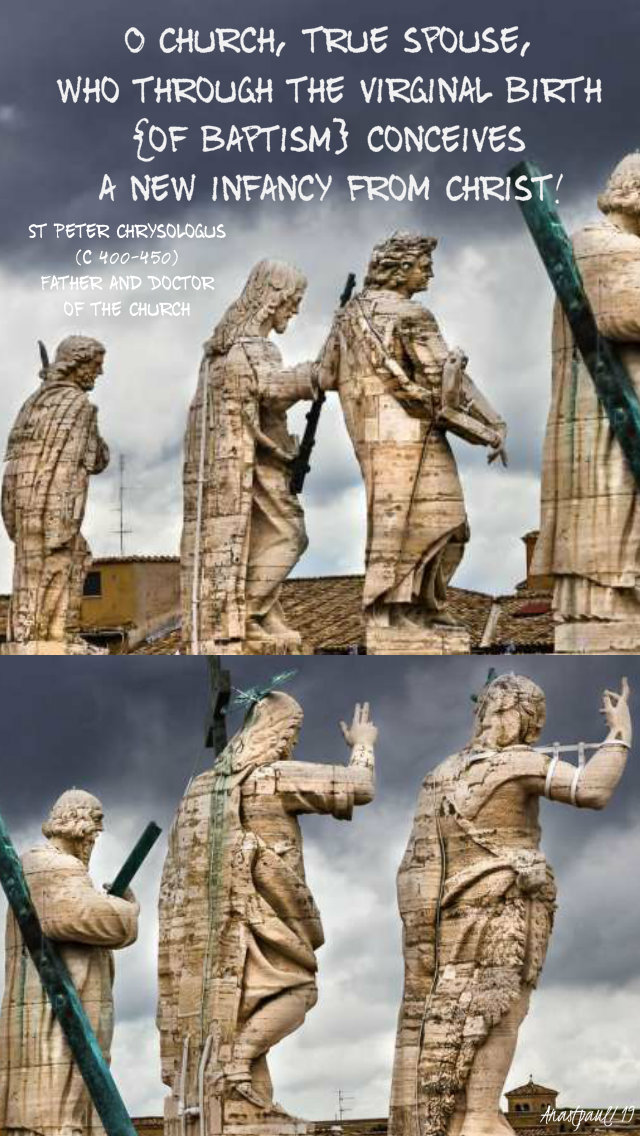
O Church, true spouse, who through the virginal birth [of baptism] conceives a new infancy from Christ!














 AnaStpaul
You must be logged in to post a comment.