One Minute Reflection – 10 June – Tenth Sunday of the Year B – Today’s Gospel Mark 3:20-35
“But whoever blasphemes against the holy Spirit will never have forgiveness but is guilty of an everlasting sin.”…Mark 3:29
REFLECTION – “Why is blasphemy against the Holy Spirit unforgivable? How should this blasphemy be understood? St Thomas Aquinas replies that it is a question of a sin that is “unforgivable by its very nature, insofar as it excludes the elements through which the forgiveness of sin takes place.” According to such an exegesis, “blasphemy” does not properly consist in offending against the Holy Spirit in words; it consists rather in the refusal to accept the salvation which God offers us through the Holy Spirit, working through the power of the Cross. If man rejects the “convincing concerning sin” which comes from the Holy Spirit (Jn 16:8) and which has the power to save, he also rejects the “coming” of the Counsellor (Jn 16:7) – that “coming” which was accomplished in the Paschal Mystery, in union with the redemptive power of Christ’s Blood: the Blood which “purifies the conscience from dead works” (Heb 9:15).
We know that the result of such a purification is the forgiveness of sins. Therefore, whoever rejects the Spirit and the Blood (cf. 1Jn 5:8) remains in “dead works,” in sin. And the blasphemy against the Holy Spirit consists precisely in the radical refusal to accept this forgiveness, of which he is the intimate giver and which presupposes the genuine conversion which he brings about in the conscience. If Jesus says that blasphemy against the Holy Spirit cannot be forgiven either in this life or in the next, it is because this “non-forgiveness” is linked, as to its cause, to “non-repentance,” in other words to the radical refusal to be converted…
Blasphemy against the Holy Spirit, then, is the sin committed by the person, who claims to have a “right” to persist in evil – in any sin at all – and who thus, rejects Redemption. One closes oneself up in sin, thus making impossible one’s conversion and consequently the remission of sins, which one considers not essential or not important for one’s life. This is a state of spiritual ruin, because blasphemy against the Holy Spirit does not allow one to escape from one’s self-imposed imprisonment.”… St John Paul II (1920-2005) Encyclical “Dominum et vivificantem”
PRAYER – Lord God strength of those who hope in You, support us in our prayer because we are weak and can do nothing without You. Grant always the help of Your grace so that, in fulfilling Your commandments, we may please You in the depths of our hearts and souls and be free of sin against You. Fill us with the Holy Spirit, who is our refuge, our strength, our truth. Through Christ, our Lord, with You and the Holy Spirit, one God forever, amen. “Whoever does the will of God is my brother, and sister, and mother.” Mark 3:35
Our Morning Offering – 10 June – Tenth Sunday of the Year B
Anima Christi
Soul of Christ, sanctify me.
Body of Christ, save me.
Blood of Chirst, inebriate me.
Water from the side of Christ, wash me.
Passion of Christ, strengthen me.
O good Jesus, hear me.
Within Your wounds hide me.
Suffer me not to be separated from You.
From the malicious enemy defend me.
In the hour of my death call me
and bid me come unto You,
that with Your saints I may praise You,
forever and ever.
Amen
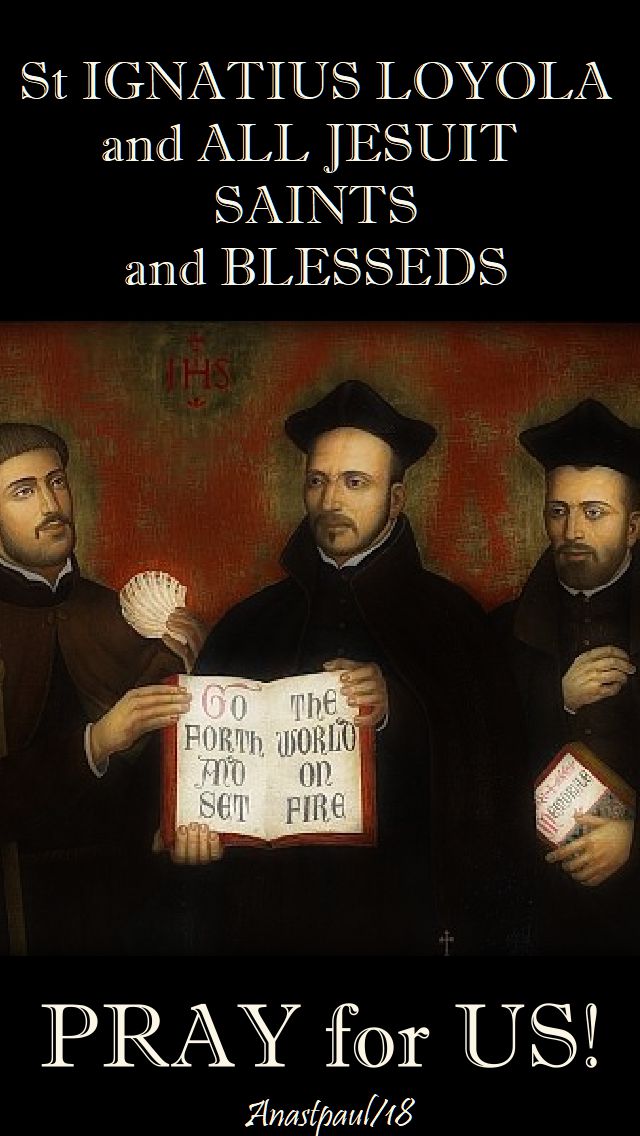
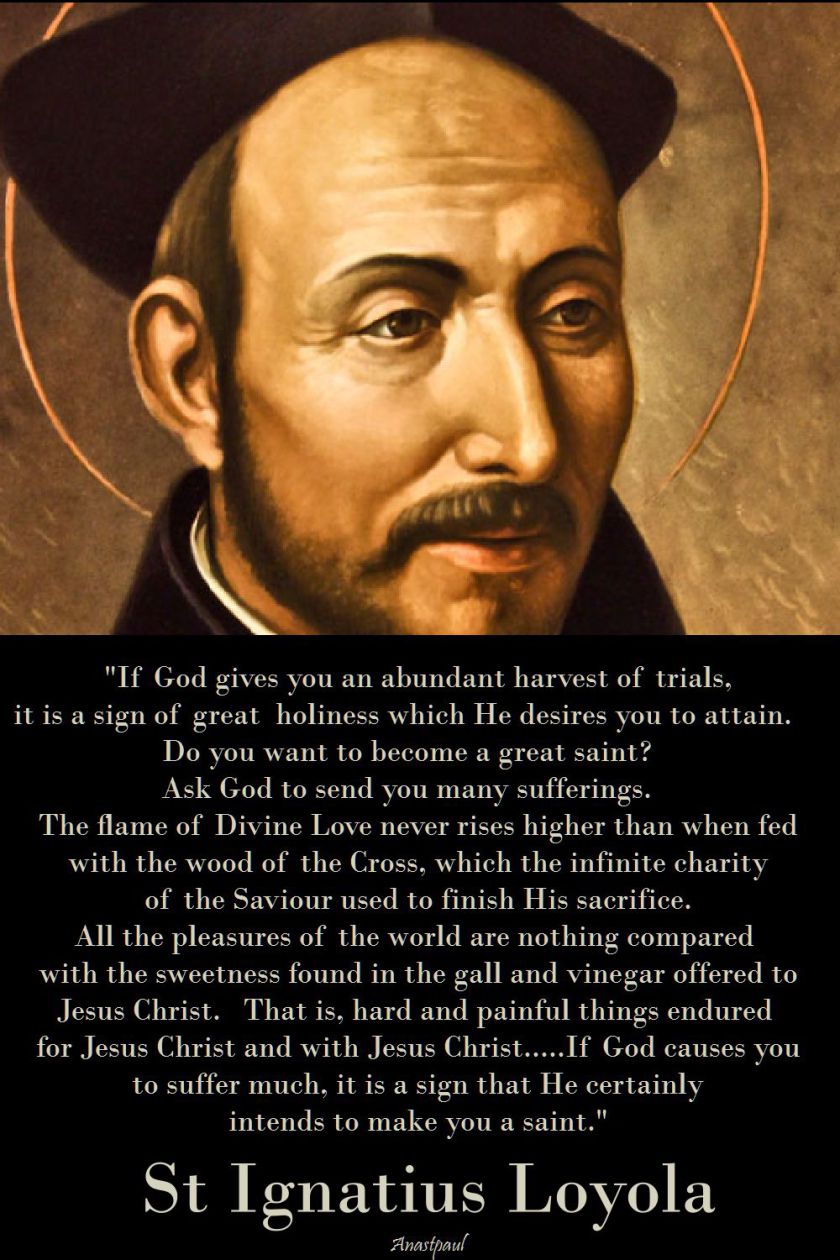
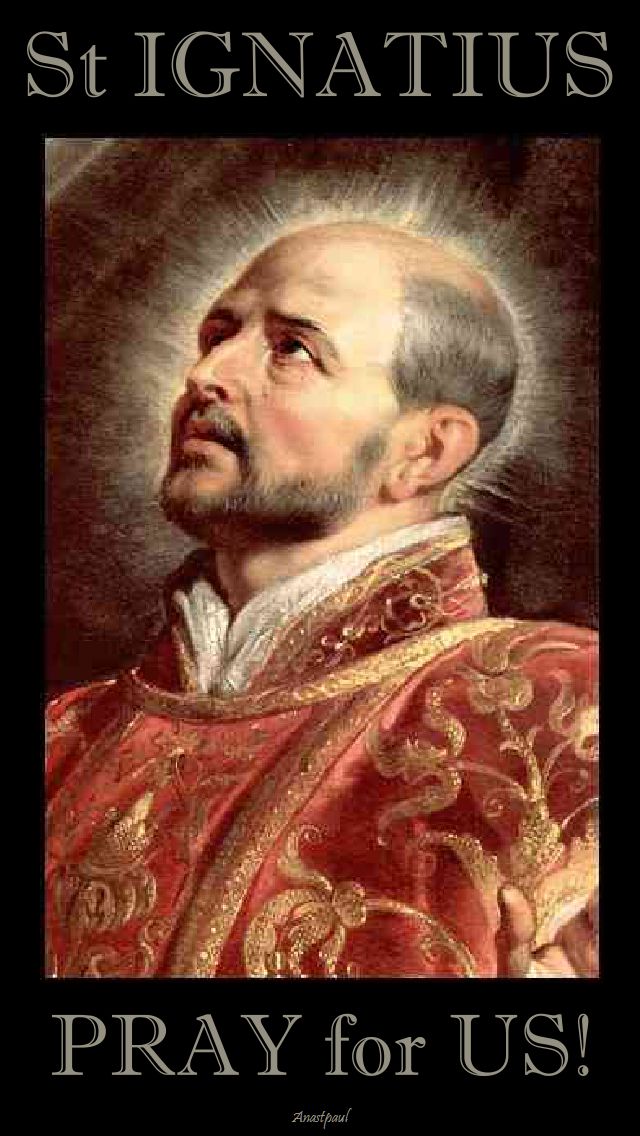
This well known Catholic prayer dates to the early fourteenth century and was possibly written by Pope John XXII but its authorship remains uncertain. The prayer takes its name from its Latin incipit, meaning “Soul of Christ”. The Anima Christi was popularly believed to have been composed by St Ignatius of Loyola (1491-1556), as he puts it at the beginning of his Spiritual Exercises and often refers to it but it was so well known and so popular at the time of St Ignatius, that in the first edition of his Spiritual Exercises he merely mentions it, evidently supposing that the reader would know it. In later editions, it was printed in full. It was by assuming that everything in the book was written by St Ignatius that it came to be looked upon as his composition.
Thought for the Day – 9 June – The Feast of the Immaculate Heart of Mary
“It was through the body of a young, Jewish girl, living in a tiny village called Nazareth, that Jesus, the divine Word, was made flesh. Mary belonged to that part of the people of Israel, who awaited the Lord’s coming with expectation and longing. She had no doubt read about His coming in the Old Testament Scriptures and prayed for it. But she had no idea how it would come about. Most Israelites thought the Messiah would manifest Himself gloriously.
When the Archangel Gabriel announced to Mary that she was to be the “door’ through which the long awaited desire of the nations would be fulfilled, she must have been astonished: “Hail, O favoured one, the Lord is with you! … You will conceive in your womb and bear a son, and you shall call His name Jesus” (Lk 1.28-31). A new life – filled with risks – opened before her. According to the Church’s tradition, Mary, in an exceptional gesture for a Jewish woman, had decided “not to know man” (Lk 1.34). She had discerned virginity to be God’s will. Her Immaculate Heart – the Feast we keep this day – prompted a total giving of herself to God and included the gift of both her body and her heart. Reassuring her that God had not disdained her vow, Gabriel told Mary that, like the glory of God coming upon the ark, so would the Spirit overshadow her. The young “handmaid of the Lord” contemplated the Angel’s words. She treasured them in her heart. Her response, known as her fiat – “let it be done to me as you say” (Lk 1.38) – shows that she entrusted herself fully to God’s designs. She chose to forgo her own plans for God’s. Through her fiat, the Word of God took flesh in the tabernacle of her womb…..
Today in this Eucharist, on the Feast of the Immaculate Heart of Mary, Jesus knocks at the door of our heart. In us, He wishes to take up His abode and, through our body, enter human history. When we welcome Him, He gives birth to divinity within the crib of our hearts. What answer will our heart give to His divine proposal?”…..Cardinal Robert Sarah (16 June 2012)
One Minute Reflection – 9 June – The Memorial of St Ephrem (306-373) Father & Doctor of the Church
…Show(ing) yourself as a model of good deeds in every respect, with integrity in your teaching, dignity and sound speech that cannot be criticised, so that the opponent will be put to shame, without anything bad to say about us…Titus 2:7-8
REFLECTION – “Anyone who wants to be an example to others, must first examine himself.”…St Ephrem
PRAYER – O Lord and Master of my life, take from me the spirit of sloth, meddling, lust of power and idle talk. But give rather the spirit of chastity, humility, patience and love to Thy servant. Yea, O Lord and King, grant me to see my own sins and not to judge my brother; for Thou art blessed unto ages of ages. Amen….Prayer of St Ephrem of whom we ask, please pray for us!
Our Morning Offering – 9 June – The Feast of the Immaculate Heart of Mary
Prayer to the Two Holy Hearts of Jesus and Mary
O Heart of Jesus pierced for our sins
and giving us Your Mother on Calvary!
O Heart of Mary pierced by sorrow
and sharing in the sufferings of your divine Son
for our redemption!
O sacred union of these Two Hearts!
Praised be the God of Love who united them together!
May we unite our hearts and every heart
so that all hearts may live in unity and in imitation
of that sacred unity which exists in these Two Hearts.
Triumph, O Sorrowful and Immaculate Heart of Mary!
Reign, O Most Sacred Heart of Jesus!
– in our hearts, in our homes and families,
in the hearts of those who as yet do not know You
and in all nations of the world.
Establish in the hearts of all mankind the sovereign triumph
and reign of your Two Hearts so that the earth may resound
from pole to pole with one cry:
Blessed forever be the Most Sacred Heart of Jesus
and the Sorrowful and Immaculate Heart of Mary!
Obtain for me a greater purity of heart
and a fervent love of the spiritual life.
May all my actions be done for the greater glory of God
in unions with the divine heart of Jesus
and the Immaculate Heart of Mary.
Hear and answer our prayers and intentions
according to Your most merciful will.
Amen
Feast of the Immaculate Heart of Mary – 9 June is a devotional name used to refer to the interior life of the Blessed Virgin Mary, her joys and sorrows, her virtues and hidden perfections and, above all, her virginal love for God the Father, her maternal love for her son Jesus and her compassionate love for all people. Pope Pius XII instituted the feast of the Immaculate Heart of Mary in 1944 to be celebrated on 22 August, coinciding with the traditional octave day of the Assumption. In 1969, Pope Paul VI moved the celebration of the Immaculate Heart of Mary to the Saturday, immediately after the Solemnity of the Sacred Heart of Jesus. This means in practice that it is now held on the third Saturday after Pentecost.
Historically, devotion to the Heart of Mary grew up in parallel but at a lesser intensity than that of devotion to the Heart of Jesus, only starting to become more prominent during the time of St John Eudes. John Eudes was born in 1601 in Normandy, France. He entered the Congregation of the Oratory of France, founded in 1611 by Cardinal de Berulle and was ordained to the priesthood on December 20, 1625. St John brought people to love Christ and the Virgin Mary by speaking tirelessly about their Hearts, the sign of the love God shows for us and the communion to which we are called.
To offer them liturgical worship, he composed Masses and Offices in their honour and had the first Feast of the Holy Heart of Mary celebrated on 8 February 1648, at Autun (France) and the Feast of the Heart of Jesus celebrated on 20 October 1672.
He died on August 19, 1680 and was canonised by Pope Pius XI on May 31, 1925.
Nevertheless, it was not until after the Apparitions at Rue du Bac concerning the “Miraculous Medal” made to Catherine Labouré in 1830 and the establishment of a society dedicated to the Immaculate Heart of Mary, at the Church of Our Lady of Victories in Paris in 1836, that this particular devotion became really well known.
Since then devotion to the Immaculate Heart of Mary, has gradually grown more widespread in the Church, particularly since the apparitions at Fatima.
The main difference between the devotions to the hearts of Jesus and Mary is that the one concerned with Jesus emphasises His divine heart as being full of love for mankind, but with this love for the most part being ignored or rejected, while devotion to Mary’s heart is essentially concerned with the love that her heart has for Jesus, for God.
Therefore, it is not an end in itself, so the love of her heart is meant to be a model for the way we should love God. The fact that her heart is immaculate, that is sinless, means that she is the only fully human person who is able to really love God in the way that He should be loved.
Honouring Mary’s Immaculate Heart is really just another way of honouring Mary as the person who was chosen to be the Mother of God, recognising her extraordinary holiness and the immense love she bestowed on Jesus as His mother, the person who was called to share in and co-operate in His redemptive sufferings.
The aim of the devotion is to unite mankind to God through Mary’s heart and this process involves the ideas of consecration and reparation. A person is consecrated to Mary’s Immaculate Heart as a way of being completely devoted to God. This involves a total gift of self, something only ultimately possible with reference to God but Mary is our intermediary in this process of consecration.
Because of the strong analogy between Jesus and Mary, the consecration to Mary’s Immaculate Heart is closely linked to the consecration to Jesus’ Sacred Heart, although it is subordinate and dependent on it. That is, although the act of consecration is ultimately addressed to God, it is an act that is made through Mary. And so we pray through Mary, through her Immaculate Heart, we ask to learn true love.
The whole world has been repeatedly consecrated to the Immaculate Heart of Mary by different popes:
Pius XII, 31 October 1942
Paul VI, 21 November 1964
John Paul II, 13 May 1982
John Paul II together with all the bishops of the world, 25 March 1984
Francis, 13 October 2013
Thought for the Day — 8 June – The Solemnity of The Most Sacred Heart of Jesus and The World Day for the Sanctification of Priests
The World Day for the Sanctification of Priests 2002 takes its inspiration from the theme of John Paul II’s Letters to Priests for Holy Thursday 2000, 2001, and 2002. Below is an excerpt from the Congregation of the Clergy to all our Priests all over the world.
From St John Chrysostom (347-407) Father & Doctor
“These are really the ones who are in charge of spiritual travail and responsible for the birth which comes through baptism. Through them we put on Christ and are buried in union with the Son of God and become members, obedient to our blessed Head (cf. Rom 6,1; Gal 3,27). For that reason they should not only be more justly feared than rulers and kings but also, be more honoured, than our parents. For our parents generated us of blood and the will of the flesh (cf. Jn 1,13) but the priests are the authors of our birth from God, even that blessed regeneration which is true freedom and adopted sonship according to grace” (cf. St John Chrysostom, De sacerdotio, III, 6, PG 48, 643-644).
From St Anthony of Padua (1195-1231) Evangelical Doctor
“Our altar of gold is the Heart of Christ. We must enter into the Holy of Holies, which is this same Heart of Jesus and gather up the riches of His love” (St Anthony of Padua).
From St John of Avila (1500-1569) Doctor of the Church
“If the Jewish High priest carried the names of the twelve tribes of Israel written on his shoulders and on his breast, how much more Christ, our High Priest, carries our names written on His Heart” (St John of Avila).
From the holy Curé of Ars (1786-1859) Patron of Priests
“The Priesthood is the love of the heart of Jesus” (CCC, n. 1589—St John Vianney, quoted in B. Nodet, Jean-Marie Vianney, Curé d’Ars, 100).
“The priest is not a priest for himself. He does not give absolution to himself. He does not administer the sacraments to himself. He does not exist for himself, he exists for you” (Curé of Ars: Monnin II 453).
From St Pope John XXIII (1881-1963)
“Today everything which concerns the Sacred Heart of Jesus has become familiar and doubly dear to me. My life seems destined to be spent in the light shining from the tabernacle and it is to the Heart of Jesus that I must look for a solution to all my troubles. I feel I would be ready to shed my blood for the cause of the Sacred Heart. My fondest wish is to be able to do something for that precious object of my love.
“At times the thought of my arrogance, of my unbelievable self-love and of my great unworthiness alarms and dismays me and robs me of my courage but I soon find reason for comfort, in the words spoken by Jesus to Blessed Margaret Mary Alacoque: ‘I have chosen you to reveal the marvels of my heart, because you are such an abyss of ignorance and insufficiency’.
“Ah! I wish to serve the Sacred Heart of Jesus, today and always. I want my devotion to His Heart to be the measure of all my spiritual progress. I desire to do everything in intimate union with the Sacred Heart of Jesus in the Blessed Sacrament.
“My greatest joy will be to seek and find comfort only in that Heart which is the source of all consolation. I am determined to give myself no peace until I can truly say, I am absorbed into the Heart of Jesus” (Bl. John XXIII, Journal of a Soul, [“During the retreat in preparation for the ordination to the diaconate, 9-18 December 1903”], pp. 208-209, New English Library: London, 1966).
Prayer for Priests
O Jesus, eternal High Priest, who, in an incomparable love for men, allowed Catholic priesthood to issue from Your Sacred Heart, deign to continue to pour out on Your priest, the life-giving streams of Infinite Love. Live in them, transform them into Yourself; Render them by Your grace instruments of Your Mercy; Act in them and through them and grant that they may perform in Your Name and by the strength of Your Spirit, the works which You Yourself accomplished for the salvation of this world. Divine Redeemer of souls, see how great is the multitude of those, who still sleep in the darkness of error; count the number of those unfaithful sheep, who are walking on the edge of an abyss; consider the crowds of the poor, the hungry, the ignorant and the weak, who are groaning in their state of abandonment. Return to us again, dear Sacred Heart of Jesus, live again in very truth in them; act through them and pass again through this world teaching, pardoning, consoling, offering sacrifice, renewing the Bonds of Love between the Heart of God and the hearts of men. We pray through the intercession of Mary, Mother of all hearts. Amen
One Minute Reflection – 8 June – The Solemnity of The Most Sacred Heart of Jesus
...But one soldier thrust his lance into his side and immediately blood and water flowed out...John 19:34
REFLECTION – “When the Church, in the days immediately succeeding her institution, was oppressed beneath the yoke of the Caesars, a young Emperor saw in the heavens across, which became at once the happy omen and cause of the glorious victory that soon followed. And now, to-day, behold another blessed and heavenly token is offered to our sight-the most Sacred Heart of Jesus, with a cross rising from it and shining forth with dazzling splendour amidst flames of love. …. there is in the Sacred Heart a symbol and a sensible image of the infinite love of Jesus Christ which moves us to love one another…”…Pope Leo XII – Annum Sacrum (Holy Year) 1899
PRAYER – “May Your heart dwell always in our hearts! May Your blood ever flow in the veins of our souls! O sun of our hearts, You give life to all things by the rays of Your goodness! I will not go, until Your heart has strengthened me, O Lord Jesus! May the heart of Jesus be the king of my heart! Blessed be God. Amen.”…St Francis De Sales (1567-1622) Doctor of Charity
Our Morning Offering – 8 June – The Solemnity of The Most Sacred Heart of Jesus
Prayer of Consecration to The Most Sacred Heart of Jesus By Pope Leo XIII (1810-1903)
Most sweet Jesus,
Redeemer of the human race,
look down upon us,
humbly prostrate before Your altar.
We are Yours and Yours we wish to be
but to be more surely united with You,
behold, each one of us,
freely consecrates himself today
to Your most sacred heart.
Many, indeed, have never known You, many too,
despising your precepts, have rejected You.
Have mercy on them all, most merciful Jesus
and draw them to Your sacred heart.
Be You king, O Lord, not only of the faithful
who have never forsaken You
but also of the prodigal children who have abandoned You;
grant that they may quickly return to their father’s house,
lest they die of wretchedness and hunger.
Be You king, of those who are deceived
by erroneous opinions,
or whom discord keeps aloof
and call them back to the harbour of truth and unity of faith,
so that soon there may be but one flock and one shepherd.
Be you king also, of all those who sit
in the ancient superstition of the Gentiles
and refuse not You to deliver them out of darkness
into the light and kingdom of God.
Grant, O Lord, to Your Church,
assurance of freedom and immunity from harm;
give peace and order to all nations
and make the earth resound from pole to pole with one cry:
Praise to the divine heart that wrought our salvation;
to it be glory and honour forever.
Amen.
and
Daily Consecration to the Sacred Heart of Jesus
Sacred Heart of Jesus,
filled with infinite love,
broken by my ingratitude,
pierced by my sins,
yet loving me still,
accept the consecration that I make to You,
of all that I am and all that I have.
Take every faculty of my soul and body,
and draw me, day by day,
nearer and nearer to Your Sacred Side,
and there, as I can bear the lesson,
teach me Your blessed ways.
Amen
8 June – Blessed and Holy Solemnity of the Most Sacred Heart of Jesus – (Friday after the Second Sunday after Pentecost) and The World Day of Prayer for the Sanctification of Priests.
Excerpt from ENCYCLICAL of Pope Pius XII HAURIETIS AQUAS – on DEVOTION TO The SACRED HEART
15 May 1956
Venerable Brethren: Health and Apostolic Benediction.
1. “You shall draw waters with joy out of the Saviour’s fountain.” These words by which the prophet Isaias, using highly significant imagery, foretold the manifold and abundant gifts of God which the Christian era was to bring forth, come naturally to Our mind when We reflect on the centenary of that year when Our predecessor of immortal memory, Pius IX, gladly yielding to the prayers from the whole Catholic world, ordered the celebration of the feast of the Most Sacred Heart of Jesus in the Universal Church.
2. It is altogether impossible to enumerate the heavenly gifts which devotion to the Sacred Heart of Jesus has poured out on the souls of the faithful, purifying them, offering them heavenly strength, rousing them to the attainment of all virtues. Therefore, recalling those wise words of the Apostle S. James, “Every best gift and every perfect gift is from above, coming down from the Father of Lights,” We are perfectly justified in seeing in this same devotion, which flourishes with increasing fervour throughout the world, a gift without price, which our divine Saviour the Incarnate Word, as the one Mediator of grace and truth between the heavenly Father and the human race imparted to the Church, His mystical Spouse, in recent centuries when she had to endure such trials and surmount so many difficulties.
3. The Church, rejoicing in this inestimable gift, can show forth a more ardent love of her divine Founder and can, in a more generous and effective manner, respond to that invitation which St John the Evangelist relates as having come from Christ Himself: “And on the last and great day of the festivity, Jesus stood and cried out, saying, ‘If any man thirst, let him come to Me and let him drink that believeth in Me. As the Scripture saith: Out of his heart there shall flow rivers of living waters.’ Now this He said of the Spirit which they should receive who believed in Him.”
8. The Church has always valued and still does, the devotion to the Most Sacred Heart of Jesus so highly, that she provides for the spread of it among Christian peoples everywhere and by every means. At the same time she uses every effort to protect it against the charges of so-called “naturalism” and “sentimentalism.” In spite of this it is much to be regretted that, both in the past and in our own times, this most noble devotion does not find a place of honour and esteem among certain Christians and, even occasionally, not among those who profess themselves moved by zeal for the Catholic religion and the attainment of holiness.
17. Through the years of Our pontificate–years filled not only with bitter hardships but also with ineffable consolations, these effects have not diminished in number or power or beauty but, on the contrary, have increased. Indeed, happily there has begun a variety of projects which are conducive to a rekindling of this devotion. We refer to the formation of cultural associations for the advancement of religion and of charitable works, publications setting forth the true historical, ascetical and mystical doctrine concerning this entire subject, pious works of atonement and, in particular, those manifestations of most ardent piety which the Apostleship of Prayer has brought about, under whose auspices and direction local gatherings – families, colleges, institutions – and sometimes nations have been consecrated to the Sacred Heart of Jesus. To all these We have offered paternal congratulations on many occasions, whether in letters written on the subject, in personal addresses, or even in messages delivered over the radio.
18. Therefore when We perceive so fruitful an abundance of healing waters, that is, heavenly gifts of divine love, issuing from the Sacred Heart of our Redeemer, spreading among countless children of the Catholic Church by the inspiration and action of the divine Spirit, We can only exhort you, venerable brethren, with fatherly affection to join Us in giving tribute of praise and heartfelt thanks to God, the Giver of all good gifts. We make Our own these words of the Apostle of the Gentiles: “Now to Him Who is able to do all things more abundantly than we desire or understand, according to the power that worketh in us, to Him be glory in the Church and in Christ Jesus unto all generations world without end. Amen.”
And the Twelve Promises here: https://anastpaul.wordpress.com/2017/06/23/friday-23-june-2017-blessed-and-holy-solemnity-of-the-most-sacred-heart-of-jesus-friday-after-the-second-sunday-after-pentecost/
The World Day of Prayer for the Sanctification of Priests
This celebration offers an opportunity to lift up our priests in prayer and thanksgiving, asking God, that they might continually rediscover the gift of their ordination and experience the joy of the mission entrusted to them, while always growing in sanctity.
Let us Pray:
“Our Father for Priests”
Our Father who art in heaven,
Give us priests according to Your Heart.
That Thy name be hallowed,
Give us priests according to Your Heart.
That Thy kingdom come,
Give us priests according to Your Heart.
That Thy will be done on earth as it is in heaven,
Give us priests according to Your Heart.
To give us each day the Bread of life,
Give us priests according to Your Heart.
To forgive us our trespasses,
Give us priests according to Your Heart.
That we be not led into temptation,
Give us priests according to Your Heart.
And deliver us
And all of Your priests from evil. Amen.
(Anonymous)
Issued by the Congregation for the Clergy (vatican.va)
One Minute Reflection – 7 June – Thursday of the Ninth Week of Ordinary Time, Year B – Today’s Gospel Mark 12:28-34.
Jesus replied, “The first is this: ‘Hear, O Israel! The Lord our God is Lord alone! You shall love the Lord your God with all your heart, with all your soul, with all your mind and with all your strength.’ The second is this: ‘You shall love your neighbour as yourself.’ There is no other commandment greater than these.” …Mark 12:29-31
REFLECTION – “We cannot truly love God without loving our neighbour, nor can we truly love our neighbour, without loving God. This is why… the Holy Spirit was given a second time to the disciples. First it was given by the Lord, while He was still dwelling on earth and later, while He was watching over us in heaven (Jn 20:22; Acts 2). He was given to us on earth, that we may love our neighbours, from heaven that we may love God. Why first on earth and later from heaven, except for the reason, given us openly by John: “How can anyone who does not love his brother whom he sees, love God whom he does not see?” So let us love our neighbours, my friends, let us love the one who is near us, so that we may be able to attain the love of the one, who is above us.”…St Gregory the Great (c 540-604), Pope, Doctor of the Church (Homilies on the Gospel, no 30)
PRAYER – Lord Almighty God, You sanctify Your Church, by the gifts of the Holy Spirit. Fulfil in us the words of Your Son that our love for You and Your children may be come to perfection. Grant that by the prayers of St Anthony Mary Gianelli, who served You through his neighbour, with love and zeal, we too may attain our heavenly home. Through Christ our Lord, in union with You and the Holy Spirit, one God, amen.
Our Morning Offering – 7 June – Thursday of the Ninth Week of Ordinary Time, Year B
Give me Yourself, O my God, St Augustine (354-430) Doctor of Grace
Give me Yourself, O my God,
give Yourself to me.
Behold I love You,
and if my love is too weak a thing,
grant me to love You more strongly.
I cannot measure my love to know how much
it falls short, of being sufficient
but let my soul hasten to Your embrace
and never be turned away, until it is hidden,
in the secret shelter, of Your presence.
This only do I know,
that it is not good for me
when You are not with me,
when You are only outside me.
I want You in my very self.
All the plenty in the world
which is not my God is utter want.
Amen
Thought for the Day – 6 June – The Memorial of St Marcellin Champagnat (1789-1840) Founder of the Marist Brothers and St Norbert (c 1080-1134)
Today’s 2 Saints certainly confirm, once again, that there are two sure ways to sanctity – through the Holy Eucharist and the Mother of God. These are the absolute totality of our Faith, these are the Source and the Heart, these are the only ways we will achieve our goal!
The relationship of Marcellin to Mary was deeply marked by an affective and total trust in her, as the “Good Mother” because it was her work that he undertook.
He wrote once: “Without Mary we are nothing and with Mary we have everything because Mary always has her adorable Son within her arms or in her heart.”
This belief remained constant all through his life. Jesus and Mary were the treasure on which Marcellin had learned to place his own heart. This intimate relationship helped shape the Marian dimension of the Marist spirituality. In the Marist tradition, the phrase “Ordinary Resource” has come to encapsulate our constant reliance on Mary. The motto attributed to Champagnat by his biographer, All to Jesus through Mary, all to Mary for Jesus, captures this close relationship between the Son and the Mother and our Founder’s attitude of confidence in Mary, which we are invited to live.
Mary, Mother, Intercede for us!
St Marcellin, Pray for us!
Excerpt from the Thought for the Day last year:
St Norbert was 33 years old before he took God seriously and during the next 20 years he made up for lost time. He did not stop to bewail lost years but gave everything he had to God. It is never too late to begin and God is always waiting for our service. We do not need a bolt of lightening to get started.
Unswerving loyalty to the Church and fervent devotion to the Eucharist, as practiced by Norbert, will continue immeasurably toward maintaining the people of God in accord with the heart of Christ.
Quote/s of the Day – 6 June – The Memorial of St Norbert (c 1080-1134)
On the day of his ordination, St Norbert said:
“O Priest! You are not of yourself because you are of God. You are not of yourself because you are the servant and minister of Christ. You are not your own because you are the spouse of the Church. You are not yourself because you are the mediator between God and man. You are not from yourself because you are nothing. What then are you? Nothing and everything. O Priest! Take care, lest what was said to Christ on the cross be said to you: ‘He saved others, himself he cannot save!”
St Norbert (c 1080-1134)
“All to Jesus through Mary, all to Mary for Jesus.”
One Minute Reflection – 6 June – Wednesday of the Ninth Week of Ordinary Time, Year B – Today’s Gospel Mark 12:18-27 and The Memorial of St Norbert (c 1080-1134) and St Marcellin Champagnat (1789-1840)
“As for the dead being raised, have you not read in the Book of Moses, in the passage about the bush, how God told him, ‘I am the God of Abraham, (the) God of Isaac and (the) God of Jacob’? He is not God of the dead but of the living. You are greatly misled.” …Mark 12:26-27
REFLECTION – “How blind are the eyes of the intellect on its own! For they have not noticed that “the blind see, the lame walk” (Mt 11:5) on earth at the Saviour’s word… so that we might believe that the flesh in its entirety will rise again at the resurrection. If He cured diseases of the flesh on this earth and restored wholeness to the body, how much more, will He do so at the moment of resurrection, so that the flesh might rise again wholly and without blemish… It seems to me that such people fail to look, at the divine action in its totality, at the beginning of creation, in the forming of man. They don’t attend to the reason why earthly things were made.
The Word said: “Let us make man in our image and likeness” (Gn 1:26)… Obviously man, formed in the image of God, was flesh. Therefore how absurd it is to claim that flesh formed by God in his own image is despicable and worthless! Clearly flesh must be precious in God’s eyes since it is His creation. And since the culmination of His plan for all the rest of creation is to be found in it, this is what has the greatest worth in the eyes of the Creator.”…St Justin (c 100-160), Martyr, Apologist, Philosopher, Father of the Church (Treatise on the resurrection, 2.4.7-9)
PRAYER – Holy Father, You made us, we belong to You. Grant that by the prayers of all your holy saints, we may attain eternal life with You to praise and worship You for all eternity. May the prayers of St Norbert and St Marcellin, assist us our earthly pilgrimage. We make our prayer through our Lord, Jesus, with You and in the unity of the Holy Spirit, one God forever, amen.
Our Morning Offering – 6 June – Wednesday of the Ninth Week of Ordinary Time, Year B
Excerpt of the Lorica St Patrick (c 385-461)
I arise today
Through God’s strength
to pilot me;
God’s might to uphold me,
God’s wisdom to guide me,
God’s eye to look before me,
God’s ear to hear me,
God’s word to speak for me,
God’s hand to guard me,
God’s way to lie before me,
God’s shield to protect me,
God’s hosts to save me
From snares of the devil,
From temptations of vices,
From every one who desires me ill,
Afar and anear,
Alone or in a mulitude.
I arise today
Through a mighty strength,
the invocation of the Trinity,
Through a belief in the Threeness,
Through a confession of the Oneness
Of the Creator of creation,
Amen
It is believed that St Patrick composed the prayer in 433, before he was about to convert High King of Ireland Lóegaire mac Néill. It is called a “lorica,” which literally means “deer leap” but is usually translated as “breastplate” and is a prayer of one who is going into battle, a prayer for protection. In this case, it was a spiritual battle against the paganism and evil spirits of the Emerald Isle.
Saint of the Day – 6 June – Saint Marcellin Champagnat (1789-1840) – Priest of the Society of Mary and Founder of the the Institute of the Little Brothers of Mary (Marist Brothers) ‘FMS’, a religious congregation of brothers devoted to Mary and dedicated to education. St Marcellin was born as Marcellin-Joseph-Benoît Champagnat on 20 May 1789 at Hameau du Rosey, Lyon, France and died on 6 June 1840 in in Saint-Chamond, Loire, France of natural causes.
MARCELLIN CHAMPAGNAT was born on 20th May 1789, in Marlhes, a village in the mountains of east-central France. The Revolution was about to burst upon the scene. He was the ninth child of a very Christian family, from whom he received his basic education. His mother and his aunt, a religious driven from her convent, awoke in him a solid faith and deep devotion to Mary. His father, who was a farmer and merchant, possessed an above-average education and played a significant role in the politics of the village and the region. He imparted to Marcellin his aptitude for manual work, a penchant for direct action, a sense of responsibility and openness to new ideas.
When Marcellin was 14, a priest passing through the village helped him to see that God was calling him to the priesthood. Marcellin, whose formal schooling was practically non-existent, began to study because “God wills it!”, even while those around him, aware of his limitations, tried to dissuade him. The difficult years he spent in the minor seminary in Verrieres (1805-1813) were for him a time of real human and spiritual growth.
Among his companions in the major seminary in Lyons were Jean-Marie Vianney, the future Cure of Ars and Jean-Claude Colin who was to become the founder of the Marist Fathers. He joined a group of seminarians whose goal was to found a congregation bearing Mary’s name and including priests, sisters and a lay third order the “Society of Mary” for the re-Christianisation of society. Deeply aware of the cultural and spiritual poverty of the children of the countryside, Marcellin felt a strong urge to include a branch of brothers for the Christian education of young people. “I cannot see a child without wanting to tell him how much Jesus loves him.” The day after their ordination on 22nd July 1816, these young priests went to consecrate themselves to Mary and to place their project under her protection at the shrine of Our Lady of Fourviere.
Basilica of Our Lady of Fourviere
Marcellin was sent as curate to the parish of La Valla. His ministry there included visiting the sick, catechising the children, helping the poor and helping families to live the Christian life. His simple, direct style of preaching, his deep devotion to Mary and his apostolic zeal, made a profound impression on his parishioners. His encounter with a dying 17-year-old boy, who had absolutely no religious instruction, shook him to his depths and moved him not to delay any longer in putting his plans into action.
On 2nd January 1817, only six months after his arrival in La Valla, Marcellin, a 27-year-old curate, brought together his first two disciples; the congregation of the Little Brothers of Mary, or Marist Brothers, was born in poverty, humility and total trust in God under Mary’s protection. While still carrying on his parish ministry, he went to live with his brothers, whom he trained and prepared for their mission as Christian teachers, catechists and educators of young people. Passionately devoted to the Kingdom of God, conscious of the tremendous needs of young people and an instinctive educator, Marcellin turned these uncultured young country lads into generous apostles. He lost no time in opening schools. Vocations arrived and the first little house, even though enlarged by Marcellin himself, was soon too small. There were many difficulties. The clergy in general did not understand what this inexperienced young priest with no material resources was trying to accomplish. However, the nearby villages continually requested brothers to see to the Christian education of their children.
Marcellin and his brothers shared in the construction of their new house, which could hold more than 100 persons and which would bear the name of “Our Lady of the Hermitage”. Freed from his parish duties in 1825, he thenceforth devoted himself totally to his congregation: the spiritual, pedagogical and apostolic formation and accompaniment of his brothers, visits to the schools and the opening of new ones.
Marcellin, a man of deep faith, never ceased to seek the will of God through prayer and dialogue with the religious authorities and with his brothers . Very conscious of his own limitations, he counted only on God and on the protection of Mary, his “Good Mother”, “Ordinary Resource” and “First Superior”. His deep humility and his acute awareness of the presence of God, helped him to live through many severe trials with great inner peace. He often prayed psalm 126: “If the Lord does not build the house”, convinced that this congregation of brothers was the work of God and Mary. His motto was, “All to Jesus through Mary and all to Mary for Jesus”.
“To make Jesus Christ known and loved” is the brothers’ mission. The school is the privileged setting for this mission of evangelisation. Marcellin taught his disciples to love and respect children and to give special attention to the poor, the most ungrateful and the most neglected, especially orphans. Spending a great deal of time with young people, with simplicity, family spirit and love of work and all of this carried out as Mary would have, were the essential points of his vision of education.
In 1836, the Church recognised the Society of Mary and entrusted to it the missions of Oceania. Marcellin took his vows as a member of the Society of Mary and sent three brothers with the first missionary Marist Fathers to the islands of the Pacific. “Every diocese of the world figures in our plans”, he had written.
Steps for obtaining legal recognition of his congregation made great demands on his time, energy and spirit of faith. He never stopped repeating, “When God is on your side and you rely only on Him, nothing is impossible!”
A lengthy illness gradually wore down his robust constitution. Worn out by his labours, he died at the age of 51 on 6th June 1840, leaving this message with his brothers: “May you be of one heart and one mind. May it be said of the Little Brothers of Mary as of the first Christians: see how they love one another!”…Vatican.va
St Marcellin Champagnat was declared Venerable in 1920 by Pope Benedict XV, Beatified by Pope Pius XII on 29 May 1955 and Canonised by St Pope John Paul II on 18 April 1999.
Canonisation Mass at the General HouseCaonisation celebration poster
Today there are about 5,000 Marist Brothers in 72 countries; their sloganA Heart Without Borders.
Thought for the Day – 5 June – The Memorial of St Boniface (672-754) “The Apostle of Germany” – Martyr
An excerpt from a letter by St Boniface (672-754) “The Apostle of Germany”, Bishop and Martyr:
“Let us stand fast in what is right and prepare our souls for trial. Let us wait upon God’s strengthening aid and say to Him: “O Lord, you have been our refuge in all generations.” Let us trust in Him, who has placed this burden upon us. What we ourselves cannot bear, let us bear with the help of Christ. For He is all-powerful and He tells us: “My yoke is easy and my burden light.” Let us continue the fight, on the day of the Lord. The days of anguish and of tribulation have overtaken us. If God so wills, “let us die for the holy laws of our fathers,” so that we may deserve, to obtain an eternal inheritance with them. Let us be neither dogs that do not bark, nor silent onlookers, nor paid servants, who run away before the wolf. Instead, let us be careful shepherds, watching over Christ’s flock. Let us preach the whole of God’s plan, to the powerful and to the humble, to rich and to poor, to men of every rank and age, as far as God gives us the strength, in season and out of season.”
One Minute Reflection – 5 June – Tuesday of the Ninth Week of Ordinary Time, Year B and the Memorial of St Boniface (672-754) “The Apostle of Germany” – Martyr
“Everything is possible to one who has faith.” Then the boy’s father cried out, “I do believe, help my unbelief!”…Mark 9:23-24
REFLECTION – “Faith is a grace: When St Peter confessed that Jesus is the Christ, the Son of the living God, Jesus declared to him that this revelation did not come “from flesh and blood” but from “my Father who is in heaven.” (Mt 16:17) Faith is a gift of God, a supernatural virtue infused by him. “Before this faith can be exercised, man must have the grace of God to move and assist him; he must have the interior helps of the Holy Spirit, who moves the heart and converts it to God, who opens the eyes of the mind and ‘makes it easy for all to accept and believe the truth.’” (Vatican II, DV 5)
Faith is a human act: Believing is possible only by grace and the interior helps of the Holy Spirit. But it is no less true, that believing is an authentically human act. Trusting in God and cleaving to the truths He has revealed are contrary neither to human freedom nor to human reason. Even in human relations it is not contrary to our dignity to believe what other persons tell us about themselves and their intentions or to trust their promises (for example when a man and a woman marry) to share a communion of life with one another. If this is so, still less is it contrary to our dignity, to “yield by faith the full submission of … intellect and will to God who reveals,” (Vatican I) and to share in an interior communion with Him.
In faith, the human intellect and will, cooperate with divine grace: “Believing is an act of the intellect, assenting to the divine truth, by command of the will, moved by God, through grace.”…St Thomas Aquinas
PRAYER – Lord, Your martyr Boniface, spread the faith by his teaching and witnessed to it with his blood. By the help of his prayers keep us loyal to our faith and give us courage to profess it in our lives. Grant this through our Lord Jesus Christ, Your Son, who lives and reigns with You and the Holy Spirit, one God, for ever and ever, amen.
Our Morning Offering – 5 June – The Memorial of St Boniface (672-754) “The Apostle of Germany”
Eternal God, our Refuge By St Boniface (672-754)
Eternal God,
the refuge and help of all Your children,
we praise You
for all You have given us,
for all You have done for us,
for all that You are to us.
In our weakness,
You are strength,
in our darkness,
You are light,
in our sorrow,
You are comfort and peace.
We cannot number Your blessings,
we cannot declare Your love
For all Your blessings,
we bless You.
May we live as in Your presence,
and love the things that You love,
and serve You in our daily lives;
through Jesus Christ our Lord.
Amen
Saint of the Day – 5 June – St Boniface (672-754) Martyr – Bishop/Archbishop, Missionary and Evangelist, Teacher, Writer, Preacher, Theologian, Founder of Schools, Convents, Monasteries and Churches – known as “The Apostle of Germany.” Patron of brewers, file cutters, tailors, Germany, Archdiocese of Saint-Boniface, Manitoba, Canada, diocese of Fulda, Germany.
Boniface, known as the Apostle of the Germans, was an English Benedictine Monk who gave up being elected Abbot to devote his life to the conversion of the Germanic tribes. Two characteristics stand out: his Christian orthodoxy and his fidelity to the Pope of Rome.
How absolutely necessary this orthodoxy and fidelity were, is borne out by the conditions Boniface found on his first missionary journey in 719 at the request of Pope Gregory II. Paganism was a way of life. What Christianity he did find, had either lapsed into paganism or was mixed with error. The clergy were mainly responsible for these latter conditions since they were in many instances uneducated, lax and questionably obedient to their bishops. In particular instances their very ordinations were questionable.
These are the conditions that Boniface was to report in 722 on his first return visit to Rome. The Holy Father instructed him to reform the German Church. The pope sent letters of recommendation to religious and civil leaders. Boniface later admitted that his work would have been unsuccessful, from a human viewpoint, without a letter of safe-conduct from Charles Martel, the powerful Frankish ruler, grandfather of Charlemagne. Boniface was finally made a regional bishop and authorised to organise the whole German Church. He was eminently successful.
In the Frankish kingdom, he met great problems because of lay interference in bishops’ elections, the worldliness of the clergy and lack of papal control.
In order to restore the Germanic Church to its fidelity to Rome and to convert the pagans, Boniface had been guided by two principles. The first was to restore the obedience of the clergy to their bishops in union with the pope of Rome. The second, was the establishment of many houses of prayer which took the form of Benedictine monasteries. A great number of Anglo-Saxon monks and nuns followed him to the continent, where he introduced the Benedictine nuns to the active apostolate of education.
For nearly 35 years, Boniface traveled all over Germany, preaching, teaching, and building schools, monasteries, and convents. He went to Rome to report to the pope about his work. There, the pope ordained him bishop and told him to return to Germany to continue missionary work. Boniface invited monks and sisters from England to come and help him. The monastery at Fulda is probably the most famous one started by Boniface, below is the Cathedral and a Statue of him there.
During a final mission to the Frisians, Boniface and 53 companions were massacred while he was preparing converts for confirmation by a band of angry natives. who rushed into the church and murdered them. Today Saint Boniface is the patron of Germany.
Martyrdom of St Boniface and Companions
St Boniface & the Christmas Tree
It is told that Saint Boniface, one day came upon a group of pagans gathered around a big oak tree about to sacrifice a child to the god Thor, which was represented by the tree. To stop the sacrifice and save the child’s life Boniface felled the tree with one mighty blow of his fist. Nearby grew a small fir tree. The saint told the pagan worshippers that the tiny fir was the Tree of Life and stood for the eternal life of Christ . Saint Boniface also used the triangular shape of the fir tree to describe the Holy Trinity of God the Father, Son and Holy Ghost. By the 12th Century, Christmas trees were used all over Europe as a symbol of Christianity.
More info on St Boniface here: https://anastpaul.wordpress.com/2017/06/05/saint-of-the-day-5-june-st-boniface/
Thought for the Day – 4 June – Ninth Week in Ordinary Time, Year B and the Memorial of St Filippo Smaldone (1848-1923) – Apostle of Eucharistic Adoration and of Charity
Speaking of: Eucharistic Adoration
“St Filippo Smaldone, son of South Italy, knew how to instil in his life the higher virtues characteristic of his land.
A priest with a great heart nourished continuously on prayer and Eucharistic Adoration, he was above all, a witness and servant of charity, which he manifested in an eminent way through service to the poor, in particular to deaf-mutes, to whom he dedicated himself entirely.
The work that he began developed thanks to the Congregation of the Salesian Sisters of the Sacred Hearts, founded by him and which spread to various parts of Italy and the world.
St Filippo Smaldone saw the image of God reflected in deaf-mutes and he used to repeat that, just as we prostrate before the Blessed Sacrament, so we should kneel before a deaf-mute.
From his example we welcome the invitation to consider the ever indivisible love for the Eucharist and love for one’s neighbour. But the true capacity to love the brethren, can come only, from meeting with the Lord in the Sacrament of the Eucharist.”
Pope Benedict XVI on the Canonisation of St Filippo Smaldone, St Peter’s Square, Sunday, 15 October 2006
Quote/s of the Day – 4 June – Ninth Week in Ordinary Time, Year B
Speaking of: “The Most Holy Eucharist/The Holy Mass”
“I am going to the Church’s press, to the altar. That is where the sacred wine of this delicious and unique grape’s blood, flows constantly and from which very few have the good fortune, to be able to become intoxicated. There, you know that – because I cannot do otherwise – I will present you, to the Father of Heaven united with His Son, it is in Him and with Him, that I am entirely yours in the Lord.”
“Lord Jesus, save them all. I offer myself as a victim for all of them. Make me stronger, take my heart, fill it with Your love and then ask of me, whatever You want.”
St Pio of Pietrelcina “Padre Pio” OFM CAP. (1887-1968)
“However it is very necessary to nourish one’s soul also and since nothing created, can nourish the soul, which is spirit, God wished to give Himself as food.”
“If only Christians could understand these words of our Lord saying to them: “In spite of your wretchedness, I desire to see from near, this beautiful soul I have created for Myself. I have made it so great, that there is none but Me, who is able to fill her. I have made it so pure, that there is only my Body capable of feeding it.”
One Minute Reflection – 4 June – Ninth Week in Ordinary Time, Year B – Today’s Readings: 2 Peter 1:2-7, Psalms 91(90):1-2.14-15ab.15c-16, Mark 12:1-12
Jesus began to speak to the chief priests, the scribes and the elders in parables. “A man planted a vineyard, put a hedge around it, dug a wine press and built a tower. Then he leased it to tenant farmers and left on a journey...Mark 12:1-2
REFLECTION – “With all my heart I bless God for having let me know really good souls. I could announce to them that they are also the Lord’s vineyard: their faith is the cistern, their hope is the tower, their love is the press, the law of God is the hedge which separates them from the children of darkness.”…St Pio of Pietrelcina “Padre Pio” OFM CAP. (1887-1968)
PRAYER – Lord, be the beginning and the end of all that we do and say. Prompt our actions with Your grace and complete them with Your all powerful help. St Filippo Smaldone, you shone the light of Christ on all around you, strengthened by love of Christ in the most Blessed Sacrament and by His Holy Mother. Pray for us, that we may be little lanterns in the darkness and ‘good vines’ pruned to perfection. Through Jesus Christ, our Lord and Saviour, with You and the Holy Spirit, one God forever, amen.
Sunday Reflection – 3 June 2018 – The Solemnity of Corpus Christi
There is a claim that the Adoro Te Devote, our morning offering today, was the prayer that St Thomas Aquinas addressed to Christ as he was dying. The claim remains doubtful, (in the sense that it is a highly intricate prayer and it would be difficult to write whilst very ill) but the account that his biographer, William of Tocco, gives of the holy Doctor’s last moments of life is, in itself, an extraordinary testimony of Eucharistic devotion and reveals the source of the doctrine that, directly or indirectly, inspired the most beautiful Eucharistic texts of the Latin Church, including the Adoro Te Devote.
“Feeling his strength failing and sensing the nearness of his departure from this world, the holy Doctor, with great devotion, requested the viaticum of the Christian pilgrimage, the Most Holy Body and Blood of Christ.
After the abbot and the monks had brought the Eucharist to him, he prostrated himself on the ground, weak in body but strong in spirit and went, with tears, to meet his Lord.
Then, in the presence of the Sacrament of the Body of Christ, as is the custom with every Christian at the moment of death, he was asked if he believed that in that consecrated host was the true Son of God, born of the womb of the Virgin, suspended from the scaffold of the Cross, who died and rose for us on the third day. With a free voice and great devotion, mingled with tears, he replied: “I truly believe and hold as certain that He is true God and true man, Son of God and of the Virgin Mother and I believe with my heart and profess with my lips, that which the priest has asked me of this most Holy Sacrament.”
And after some words of devotion (at this point it is believed St Thomas quoted the Adoro), receiving the Sacrament, he exclaimed: “I receive You, price of the Redemption of my soul, for love of which I have studied, watched and worked, I have preached and taught You, I have said nothing against You nor am I obstinate in my opinion, if in some part I have spoken poorly of this Sacrament, I submit all to the correction of the Holy Roman Church, in who obedience, I pass from this life.”
May we also, at the end of life, be able to say the same as St Thomas Aquinas!
Let us be transported to the same climate of expectation and joyful hope as we feel in the Adoro Te Devote with these last words of the Lauda Sion, the Eucharistic hymn/sequence also written by St Thomas Aquinas. (Fr Raneiro Cantalamessa O.F.M. “This is My Body”)
Source of all we have or know, feed and lead us here below. Grant that with Your saints above, Sitting at the feast of love, We may see You face to face.
Amen Alleluia!
Lord Jesus Christ, in the Most Blessed Sacrament, we Adore and Love You!
Thought for the Day – 3 June 2018 – The Solemnity of Corpus Christi
Excerpts from a homily given by Saint Josemaria Escrivá (1902-1975) on 28 May 1964, the feast of Corpus Christi and published in “Christ is Passing By.”
“Let’s turn our eyes to the holy Eucharist, toward Jesus. He is here with us. He has made us a part of Himself: “Now you are the body of Christ and individually members of it.” God has decided to stay in the tabernacle to nourish us, strengthen us, make us divine and give effectiveness to our work and efforts. Jesus is at one and the same time the sower, the seed and the final result of the sowing: the bread of eternal life.
The miracle of the holy Eucharist is being continually renewed and it has all Jesus’ personal traits. Perfect God and perfect man, Lord of heaven and earth, He offers Himself to us as nourishment in the most natural and ordinary way. Love has been awaiting us for two thousand years. That’s a long time and yet it’s not, for when you are in love time flies.
When we meet together around the altar to celebrate the holy Sacrifice of the Mass, when we contemplate the sacred host in the monstrance or adore it hidden in the tabernacle, our faith should be strengthened; we should reflect on this new life which we are receiving and be moved by God’s affection and tenderness.
In the Eucharist, Jesus gives us a sure pledge of His presence in our souls; of His power, which supports the whole world; of His promises of salvation, which will help the human family to dwell forever in the house in heaven, when time comes to an end. There we shall find God the Father, God the Son, God the Holy Spirit – the Blessed Trinity, the one and only God. Our whole faith is brought into play when we believe in Jesus, really present under the appearances of bread and wine.
On this feast of Corpus Christi in cities and towns throughout the world, Christians accompany our Lord in procession. Hidden in the host He moves through the streets and squares—just as during His earthly life—going to meet those who want to see Him, making Himself available to those who are not looking for Him. And so, once more, He comes among His own people. How are we to respond to this call of His?
The external signs of love should come from the heart and find expression in the testimony of a Christian life. If we have been renewed by receiving our Lord’s body, we should show it. Let us pray that our thoughts be sincere, full of peace, self-giving and service. Let us pray that we be true and clear in what we say—the right thing at the right time—so as to console and help and especially bring God’s light to others. Let us pray that our actions be consistent and effective and right, so that they give off “the good fragrance of Christ,” evoking is way of doing things.
The Corpus Christi procession makes Christ present in towns and cities throughout the world. But His presence cannot be limited to just one day, a noise you hear and then forget. It should remind us that we have to discover our Lord in our ordinary everyday activity. Side by side with this solemn procession, there is the simple, silent procession of the ordinary life of each Christian. He is a man among men, who by good fortune has received the faith and the divine commission to act so that he renews the message of our Lord on earth. We are not without defects; we make mistakes and commit sins. But God is with us and we must make ourselves ready to be used by Him, so that He can continue to walk among men.
Let us ask our Lord then to make us souls devoted to the Blessed Eucharist, so that our relationship with Him brings forth joy and serenity and a desire for justice. In this way we will make it easier for others to recognise Christ; we will put Christ at the centre of all human activities. And Jesus’ promise will be fulfilled: “I, when I am lifted up from the earth, will draw all men to myself.”
Comforted by Christ’s presence and nourished by His Body, we will be faithful during our life on earth and then we will be victors with Jesus and His Mother in heaven. “O death, where is your victory? O death, where is your sting?… Thanks be to God, who gives us the victory through our Lord Jesus Christ.”
Quote of the Day – 3 June 2018 – The Solemnity of Corpus Christi
“(Mary) is a young maiden but she is not afraid because God is with her, within her,… In a certain sense, we can say that her trip was ….. the first Eucharistic procession in history. Is not this also the joy of the Church, which receives Christ incessantly in the holy Eucharist and takes Him to the world with the testimony of active charity, full of faith and hope?
“Yes, to receive Jesus and to take Him to others is the true joy of the Christian!
Let us follow and imitate Mary, the profoundly Eucharistic soul and our whole life will become a Magnificat.”
You must be logged in to post a comment.