Thought for the Day – 7 September – Meditations with Antonio Cardinal Bacci (1881-1971)
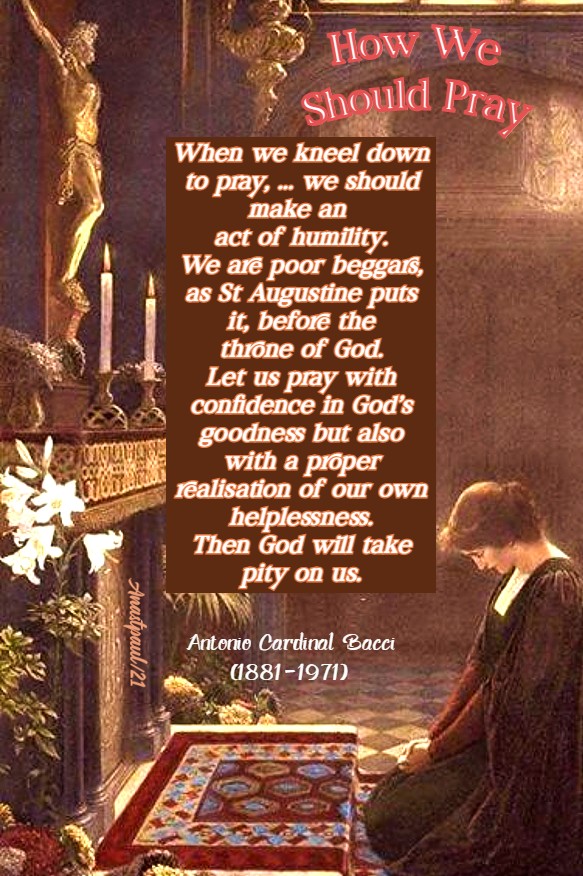
How We Should Pray
“We must pray with deep humility. Once again we find, that the Man-God Jesus, has given us an example. In Gethsemane He fell prostate on the ground and begged that, if it were possible, the bitter chalice might be taken away from Him. Immediately He added. with full submission to the will of His Heavenly Father – “Yet, not my will but thine be done” (Lk 22:42). Let us remember, moreover, the parable of the Pharisee and the publican. The former appeared to be full of virtue but he was proud and was rejected. The latter, recognised in all humility, that he was a poor sinner and he was exalted. “Everyone who exalts himself shall be humbled and he who humbles himself shall be exalted” (Lk 14:11). “God resists the proud but gives grace to the humble” (Js 4:6). “The prayer of the lowly pierces the clouds; it does not rest, until t reaches its goal” (Ecclus 35:17).
When we kneel down to pray, therefore, we should make an act of humility. We are poor beggars, as St Augustine puts it, before the throne of God. Let us pray with confidence in God’s goodness but also with a proper realisation of our own helplessness. Then God will take pity on us.
Thought for the Day – 6 September – Meditations with Antonio Cardinal Bacci (1881-1971) (Apologies for the late post – the usual South African problem to blame – Power Cuts! 🙄)
Pride is Robbery!
“When we are proud, we steal from God! Everything which we are and have, both in the natural and supernatural order, is a gift from God. Therefore, when we claim the credit for ourselves, we take from Him that which really belongs to Him. “What hast thou that thou hast not received.” asks St Paul. “And if thou has received it, why do thou boast as if thou had not received it?” (1 Cor 4:7).
Pride is a very grave sin, therefore. According to Sacred Scripture, “pride is the reservoir of sin, a source which runs over with vice” (Ecclus 10:15). “The beginning of pride,” says the same Book of Ecclsiasticus, “is man’s stubbornness in withdrawing his heart from his Maker” (10:14). It is worth meditating on these words, for because of this sin “God sends unheard-of afflictions and brings men to utter ruin” (Ecclus 10:15). As St Augustine points out, the first sin was one of pride and it changed an angel into a demon. (In Ps 18:15).
When we reflect on the matter, it becomes quite clear, that pride is the basis of every sin (Ibid). When man disobeys the law of God, he prefers sin to God. Sin, therefore, is always an act of rebellion against God. It is as if we were to say to Him: “I prefer to obey my own caprice, rather than to obey Your will.” In this sense, it is true to state, that every sin is founded on pride and involves a turning away from God. But, when we turn away from our Creator and Redeemer, where are we to go? “Lord,” let us say with St Peter, “to whom shall we go? Thou has the words of everlasting life …” (Jn 6:69).”
Thought for the Day – 5 September – Meditations with Antonio Cardinal Bacci (1881-1971)
My Life is Christ
“St Paul reached such a degree of union with Christ that he could exclaim” “To me to live is Christ” (Phil 1:21). Elsewhere he says” “It is now no longer I that live but Christ lives in me” (Gal 2:20). This is a characteristic of the Saints. They live their own lives no longer, for they live the life of Christ. That is to say, their minds and hearts are always fixed on Jesus. They love the Lord, more than all things and, more than themselves. God is the object of all their desires, affections and actions. As a result, the soul is transfigured and is infused with divine life, so that it does nothing which is not activated by grace. In the Saints, then, there is reflected something heavenly which attracts and stimulates one to virtue.
The Saints preached effectively in simple, unadorned language, as in the case of the Cure of Ars. But, their most effective sermon was the example of their lives. They could say with St Paul: “To me to live is Christ.” They could repeat the thought of St Jerome: “Christ is the breath of my lips.” Like St John Chrysostom, they could say: “My heart is the heart of Christ.” They could say with St Augustine: “I am only an instrument in the service of Christ” and, with St Anselm: “My eyes are the eyes of Christ.”
When we meditate on these words, which signify the height of sanctity, we feel very small, shabby and far from the Christian perfection to which we should aspire. Perhaps we are still immersed in sin, or perhaps, we are wavering between the things of this world and the things of God, or perhaps, as yet, we have not given up our egoism and complacent mediocrity in order to offer ourselves entirely to God. Real Christianity demands that we renounce ourselves, live the life of Christ and, make every effort to acquire perfection.”
Thought for the Day – 4 September – Meditations with Antonio Cardinal Bacci (1881-1971)
Christian Optimism
“There are two kinds of optimism. The first is the optimism of worldlings who expect nothing but pleasure from life. They run away from anything which smacks of sacrifice or self-control and, as a result, virtue is completely outside their grasp. Their motto is the “carpe diem” of the poet Horace (Carmina 1:11). Living for the day in this fashion, they seem to uphold the philosophy which the Book of Wisdom puts on the lips of the foolish: “Come, let us enjoy the good things that are real and use the freshness of creation avidly. Let us have our fill of costly wine and perfumes and let no springtime blossom pass us by. Let us crown ourselves with rosebuds ere they wither; let no meadow be free from our wantonness” (Wisdom 2:6-8).
This kind of optimism is an inversion of true human values. It is the result of the domination which man’s lower instincts can sometimes acquire over his reason. But because our natural longing for what is good can never be completely stifled, this pleasant epicurean approach, always leaves in its wake, a sense of disillusionment.
Sooner or later, this optimism is converted into pessimism. Human pleasure must always turn tp sorrow and at this stage, unless some miracle of divine grace intervenes, the spirit rebels and falls prey to despair. It is true, that most of us will have avoided the worst excesses of the epicurean outlook but, we may have developed a distortedly comfortable and selfish approach to life. If this is so, we should remember that our lives are in conflict with Christian principles.
“Unless the grain of wheat falls into the ground and dies,” Jesus said, “it remains alone. But, if it dies, it brings forth much fruit.” (Cf Jn 12:44). “Unless you repent, you will all perish” (Lk13:5). “The kingdom of heaven has been enduring violent assault and the violent have been seizing it by force” (Mt 11:12). “If anyone wishes to come after me, let him deny himself and take up his cross daily and follow me” (Lk 9:23),
Let us consider whether our lives are in accordance with this teaching. Christian optimism abhors the malice of sin, lightens our sufferings and moderates our pleasures. It helps us to see God’s image in all creatures, gives us joy in this life and hope in the hour of death. In this sense, let us be optimists!”
Thought for the Day – 3 September – Meditations with Antonio Cardinal Bacci (1881-1971)
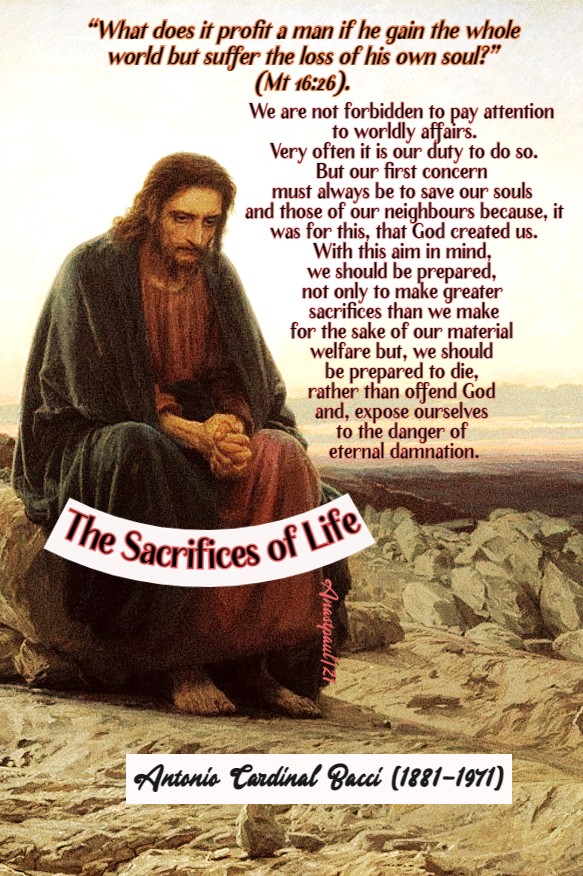
The Sacrifices of Life
“People make many sacrifices for the sake of the present life, to maintain health, to carve out a career, or to obtain money, success and honours. If you are a student, what pains you take to get a degree so that you may establish yourself in society. If you are a labourer, look at the efforts you must make to obtain the necessities of life. If you are a business executive, how you are prepared to strive and strain, in order to do better than your colleagues and gain promotion!
If you become ill, you spare neither expense, nor effort, in order to regain your health. You are even prepared to undergo a surgical operation if that is necessary to save your life.
But how many sacrifices do we make in order to do good or to become holy? We know that the present life is short and is only the forerunner of the true life, which is eternal. We should be able then, to appreciate the profundity of this question of Jesus Christ: “What does it profit a man if he gain the whole world but suffer the loss of his own soul?” (Mt 16:26).
We are not forbidden to pay attention to worldly affairs. Very often it is our duty to do so. But our first concern must always be to save our souls and those of our neighbours because, it was for this, that God created us. With this aim in mind, we should be prepared, not only to make greater sacrifices than we make for the sake of our material welfare but, we should be prepared to die, rather than offend God and, expose ourselves to the danger of eternal damnation.
Let us reflect. What sacrifices have we made so far for our own sanctification and for the sanctification of others? What sacrifices do we propose to make in the near future? We must be prepared to take up our cross voluntarily and generously, at least when we realise, that it is necessary or profitable for our salvation and sanctification.”
Thought for the Day – 2 September – Meditations with Antonio Cardinal Bacci (1881-1971)
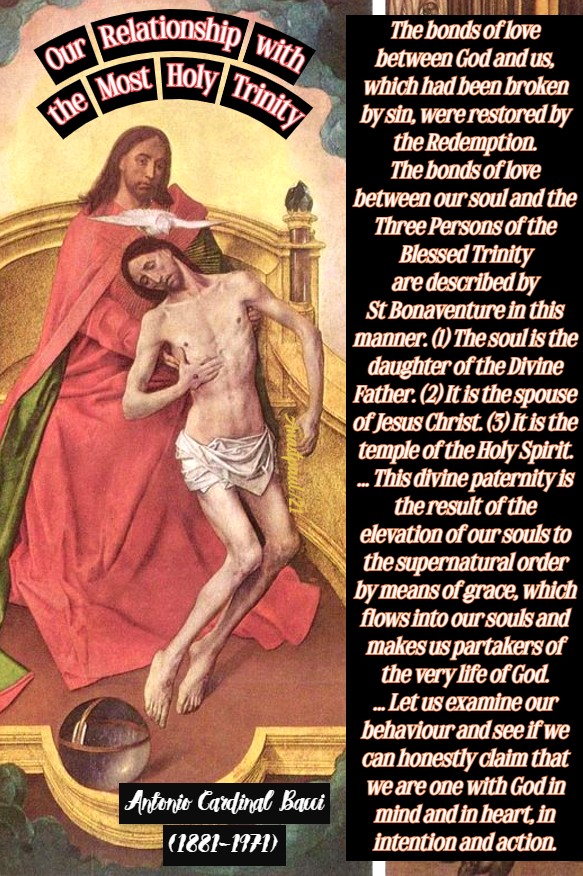
Our Relationship with the Most Holy Trinity
“The bonds of love between God and us, which had been broken by sin, were restored by the Redemption. The bonds of love between our soul and the Three Persons of the Blessed Trinity are described by St Bonaventure in this manner. (1) The soul is the daughter of the Divine Father. (2) It is the spouse of Jesus Christ. (3) It is the temple of the Holy Spirit.
The concept of our divine sonship can be found even in the Old Testament. “As one whom the mother caresseth,” God promises, “so will I comfort you” (Is 66:13). But Jesus insisted in a special way on this concept of our divine sonship, so that we might love our heavenly Father more. He told us to address God as Father in our prayers. He described Him as a loving Father, waiting with love and forgiveness for His prodigal sons. When leaving this earth, He told us: “I go to my Father and to your Father.”
“Behold what manner of love the Father has bestowed upon us.” writes St John, “that we should be called children of God and so we are” (1 Jn 3:1). “You have not received a spirit of bondage,” explains St Paul, “so as to be again in fear but, you have received a spirit of adoption as sons, by virtue of which, we cry: “Abba! Father!” (Rom 8:15). This divine paternity is the result of the elevation of our souls to the supernatural order by means of grace, which flows into our souls and makes us partakers of the very life of God. It is necessary, therefore, to nourish this grace in ourselves by praying to our heavenly Father with humility and with perseverance. It is equally essential for us to keep this grace alive by being obedient always to the commandments of God and to His holy will.
Let us examine our behaviour and see if we can honestly claim that we are one with God in mind and in heart, in intention and action.”
Thought for the Day – 1 September – Meditations with Antonio Cardinal Bacci (1881-1971)
The Problem of Evil
“In his second letter to the Thessalonians, the Apostle Paul speaks of the Anti-Christ, “the man of sin … the son of perdition, who opposes and is exalted above all that is called God…” “Already,” he says, “the mystery of iniquity is at work” (Cf 2 Thess 2:3-7). From the beginning of the Church’s history until the present time, it has always been the same.
There always have been and always will be, men who do evil, not from human weakness but, from motives of malice, so diabolical as to present something of a mystery to us. These can be called Anti-Christ because, they seem to be incarnations of the devil, the spirit of iniquity. They delight in spreading error, in corrupting minds and, in persecuting the Church. They are steeped in all kinds of baseness and nothing pleases them better, than to succeed in inducing the young and the innocent, to follow them in their sinful ways. For this purpose, they employ all the advantages of modern technical progress has to offer – the press, the cinema, the radio and television. In short, they use God’s gifts in their commercialisation of sin, in order to draw souls away from Him.
The realisation of this terrifying fact, provokes two questions. (1) How can such evil be permitted by God, Who made man for Himself and redeemed him with the Blood of His only-begotten Son? (2) What steps can we take to control this alarming and universal deluge of evil?
St Augustine answers the first question by pointing out, that the infinite and good God created us without any assistance from ourselves, but does not will to save us without our co-operatikon, since He has endowed us with the gift of liberty. Moreover, He prefers to draw good from evil, rather than to prevent the evil itself.
We must answer the second question ourselves, remembering that we have a serious obligation to combat evil in ourselves and in our fellow-men. What have we done up to now and what do wqe propose to do in the future?”
Thought for the Day – 31 August – Meditations with Antonio Cardinal Bacci (1881-1971)
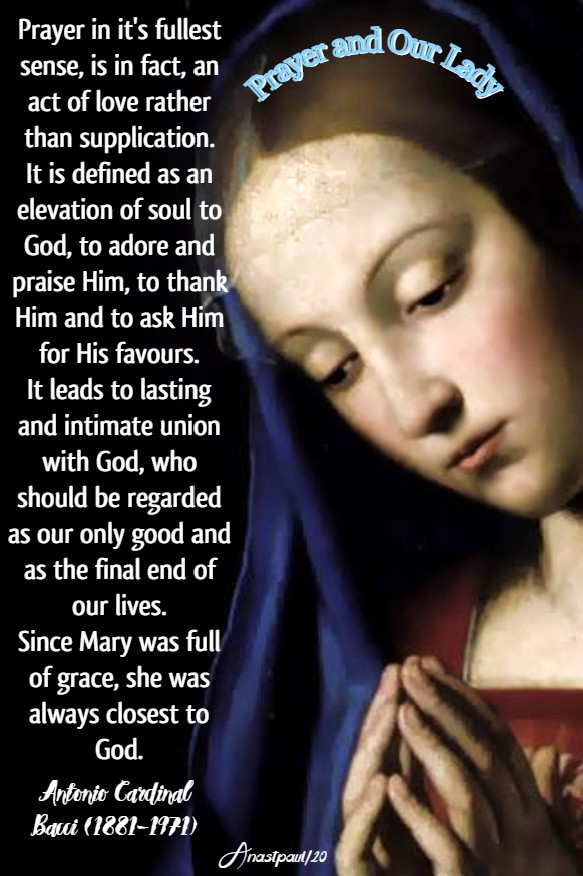
Prayer and Our Lady
“He told them a parable – that they must always pray and not lose heart” (Lk 18:1). Nobody else on earth ever carried out this command of Our Lord as perfectly as Our Lady. St Albert the Great says that, after Jesus Christ, the spirit of prayer is to be found at it’s most perfect, in Our Lady (Sup Miss 80). It was because of her immense love for her divine Son that Mary was able to put into practice, throughout her life, that Gospel precept of unceasing prayer. Prayer in it’s fullest sense, is in fact, an act of love rather than supplication. It is defined as an elevation of soul to God, to adore and praise Him, to thank Him and to ask Him for His favours. It leads to lasting and intimate union with God, who should be regarded as our only good and as the final end of our lives. Since Mary was full of grace, she was always closest to God. Even before she became His Mother, she constantly enjoyed His intimacy. Despite the many sorrows of her life, this intimacy became still greater and more beautiful, when she became the Mother of Jesus. From that time, she was able to hold Him to her immaculate bosom and to live in close familiarity with Him. She was able, too, to follow Him on His apostolic journeys, until He reached Calvary and the Cross and, finally, to see Him gloriously risen from the dead. After Jesus had ascended into Heaven, her soul expanded with a nostalgic love for her divine Son, until her earthly journey was over and she was taken up into Heaven. There, she reigns supreme among the Saints and Angels and never ceases to pray for us, her exiled children, who need her help so much. Let us learn from Mary, how to pray with love and perseverance. Then, we shall be able to follow her along the difficult way of perfection, which leads towards Heaven.”
Antonio Cardinal Bacci

On this last day of the Month of the Immaculate Heart of Mary, let us call upon her in all our great needs.
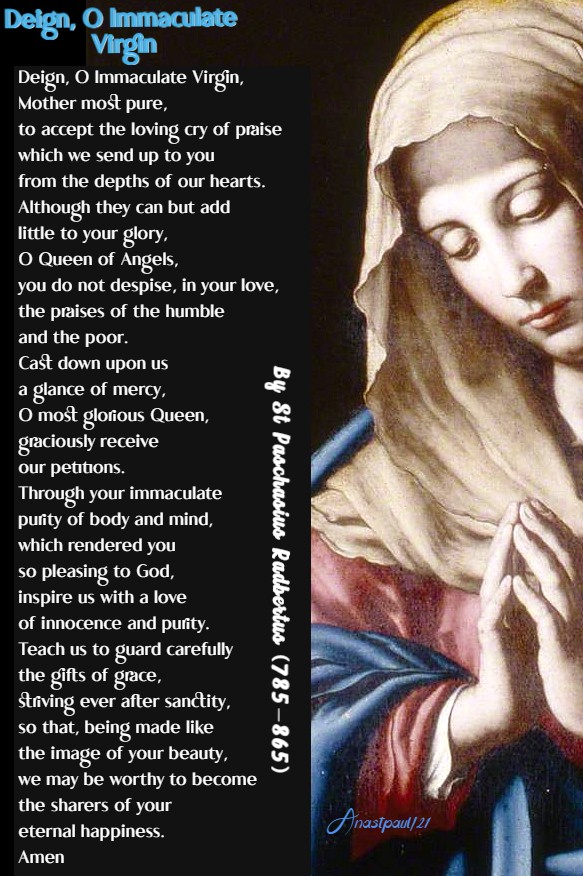
Deign, O Immaculate Virgin By St Paschasius Radbertus (785–865)
Deign, O Immaculate Virgin, Mother most pure, to accept the loving cry of praise which we send up to you from the depths of our hearts. Though they can but add little to your glory, O Queen of Angels, you do not despise, in your love, the praises of the humble and the poor. Cast down upon us a glance of mercy, O most glorious Queen, graciously receive our petitions. Through your immaculate purity of body and mind, which rendered you so pleasing to God, inspire us with a love of innocence and purity. Teach us to guard carefully the gifts of grace, striving ever after sanctity, so that, being made like the image of your beauty, we may be worthy to become the sharers of your eternal happiness. Amen
Thought for the Day – 30 August – Meditations with Antonio Cardinal Bacci (1881-1971)
Perseverance
“Perseverance may be a difficult virtue but nothing is really difficult to a person of strong resolution. When the sister of St Thomas Aquinas asked him how to become holy, he replied that it needed only one thing – a firm act of the will, for God will certainly supply the necessary grace.
Think of how much work and sacrifice is required to achieve worldly success. Cicero wrote that it required constant and tireless labour in order to become a great orator (Cf De Oratore, 1:39). St Paul cited the example of athletes who are prepared to make such great sacrifices, in order to train themselves to win. If they are prepared to do so much to gain a perishable crown, he comments, we should be prepared to do much more to gain an imperishable one (Cf 1 Cor 9:25).
The grace of God is the principal weapon upon which we must depend in order to gain our victory. We should pray for it humbly and perseveringly. There will be victors and losers in the battle for Heaven as well as in earthly contests. We must make sure that we are on the winning side! For this purpose, we should combine fervent and constant prayer with generous co-operation with the grace of God.”
Thought for the Day – 17 August – Meditations with Antonio Cardinal Bacci (1881-1971)

Doing Everything for the Love of God
“In one of his letters, Luther wrote that he was so busy that he had no time to read his Breviary, nor to offer Holy Mass. There is no doubt that it was this estrangement from prayer and from the love of God, which caused him to finish up as he did. Our work must be based on charity and the interior life, so that we may be always united with God. Otherwise, every action of ours, no matter how good it may appear, is sterile and valueless in the sight of God.
Today also, there are many people busily engaged in apostolic work but they have no interior life nourished by charity. This is what is known as the heresy of action.
Everything we do is useless and even harmful, if our external activity is not accompanied by a flourishing interior life, enriched by divine grace. St Gregory the Great paraphrases the words of the Gospel as follows: “Our Lord says: If anyone loves Me, let him keep my commandments. Love is proved by action. This is why St John (1 Jn 2:4) says, that the man who claims to love God and does not keep His commandments, is a liar. We love God sincerely if we keep His commandments and avoid the immoderate pleasures of our age. Anyone who surrenders without reserve to the unlawful desires of this world, certainly does not love God because, he is acting contrary to His will.” (Homil 30 in Ev).”
Thought for the Day – 16 August – Meditations with Antonio Cardinal Bacci (1881-1971)
Renouncing All Things
“If we want God to take possession of our souls, we must drive out every inordinate affection to earthly things. It is not possible for God to dwell within us, if we are still attached to sin or preoccupied with worldly aims.
God should reign supreme in us and inspire all our desires and actions. This can never happen if we retain an attachment to deliberate sin, even if it is not grave sin. In the case of venial sin, it is not so much the sin which prevents God from ruling us absolutely, as the attachment to sin.
It is possible for anybody to fall through human weakness, “for the just man falls seven times and rises again” (Prov 24:16). It is when we remain willingly in the state of sin, that we offend God and weaken our faith and charity. At such times, it is as if Jesus were asleep within us, as He slept in the boat during the storm on the lake of Galilee, when the terrified Apostles cried out: “Lord save us! We are perishing!” (Mt 8:25). We must keep ourselves free from all trace of sin, if we wish to remain intimately united with God and to be governed only by Him!”
Thought for the Day – 15 August – Meditations with Antonio Cardinal Bacci (1881-1971)

The Assumption of the Blessed Virgin into Heaven
“The fourth Book of Kings tells us, that the prophet Elias was brought up into Heaven in a fiery chariot without having first endured the pains and humiliations of death (Cf 4 Kings 2:11). Why did God not do likewise in the case of the Blessed Virgin, commanding His Angels to bear her to Heaven before death struck her innocent body? As St Paul says, it was sin which caused death to enter the world. From the moment of her conception, Mary was free from the slightest taint of sin, for she was immaculate and full of grace. Nevertheless, according to the most widely held tradition, Mary chose to die, even as her divine Son had willed to die. Jesus “was offered because it was his own will” (Isa 53:7). The same is true in Mary’s case, with only this difference. Jesus died a cruel death after the most hideous tortures in the midst of a blaspheming and hate-ridden mob. Nothing like this happened to Mary, although she is called the Queen of Martyrs because of the sword which pierced her soul at the sight of her divine Son, dying in such agony.
Jesus willed, however, that the immaculate body of His Mother would remain intact. It was only her great love and intense desire of being reunited with her Son, which gradually consumed her mortal life. Her ever-incresing love for God, broke the bonds of her mortal frame until she went to sleep at last, in the Lord.
Thought for the Day – 14 August – Meditations with Antonio Cardinal Bacci (1881-1971)
The New Life
“Anyone who takes life seriously in the Christian sense, will regard it as a difficult journey towards perfection and towards God. This journey will be, at the same time, painful and joyful. On the way, there will be trouble, which will sadden us and vices, which will impede our progress. Our falls and defeats will cause us to be disheartened. But, there will also be the grace of God to enlighten and encourage us. It is our own loss if we sit down lazily on the side of the road, which should lead us to Heaven. It is even more disastrous if we acknowledge defeat and lay down the spiritual weapons of prayer and renunciation, in order to surrender ourselves to sin or to indifference. Everyday we should say to ourselves in the presence of God – A new life is beginning … in You, by Your grac and for You! Amen”
Thought for the Day – 13 August – Meditations with Antonio Cardinal Bacci (1881-1971)

Fundamental Facts – But tomorrow?
“Life is passing. The days chase one another; time is flying. Childhood has become a distant memory. Perhaps youth and manhood have also passed and gone and we find ourselves on the threshold of old age. All those days, months and years that have passed were gifts of God. He gave them to us for our benefit and sanctification. But what use have we made of them? Have we laid up treasure for eternal life? And, if we have not done so up to now, for what are we waiting? Let us remember the old saying, that we should never put off till tomorrow, what we can do today. Today there is still time to turn from sin, regain sanctifying grace and lead a life of Christian perfection. But tomorrow? What do we know about tomorrow? Tomorrow is in the hands of the Lord and we do not know if the Lord will grant us further time to make amends!
Do not say, therefore, that you will change tomorrow, that tomorrow you will turn away from the path of sin and begin to lead a holy life. For not alone does time pass but, it often betrays us! Our Lord tells us that the judgement will come at a time when we least expect it. The time that is gone will never return; the future is uncertain; there remains, only the present. But the present is equally uncertain; it is something that passes and, every moment could be the last of our lives. How many whom we have known, were taken away suddenly in the flower of their youth … Is that not a warning to us?
Let us do good while we have time; let us gain merit now, for eternal life. Amen”
Thought for the Day – 12 August – Meditations with Antonio Cardinal Bacci (1881-1971)
The Blessedness of the Merciful
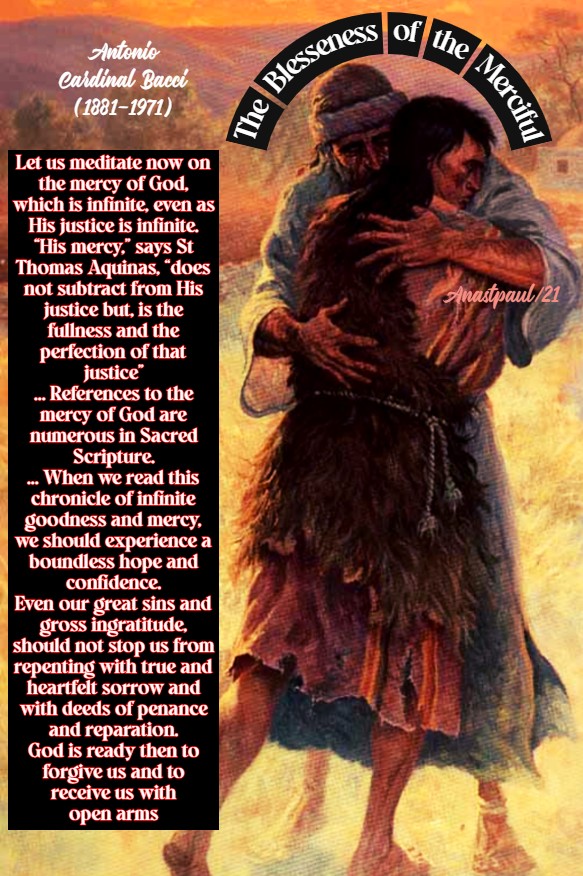
“Let us meditate now on the mercy of God, which is infinite, even as His justice is infinite. “His mercy,” says St Thomas Aquinas, “does not subtract from His justice but, is the fullness and the perfection of that justice” (Summa Theologica 1,q 21, a 3 ad 2). All the merits which we can acquire in the sight of God derive from His gratuitous gift of grace. God’s mercy and justice, therefore, are fused together in a wonderful harmony which claims our gratitude and fidelity.
References to the mercy of God are numerous in Sacred Scripture. “You, Lord, are good and forgiving,” says the Psalmist, “abounding in kindness to all who call upon you” (Ps 85:5). “Blessed be the Lord,” we read elsewhere, “my rock, … my refuge and my fortress, my stronghold, my deliverer …” (Ps 143:2). “Goodness and kindness follow me all the days of my life and I shall dwell in the house of the Lord for years to come” (Ps 22:6).
When we leave the Old Testament and open the Gospel, we discover tht it is a record of the goodness and mercy of God. We have only to recall Christ’s forgiveness of the Magdalene when she wept at His feet for her faults; the merciful judgement which He passed on the poor adulteress; His loving glance in the direction of St Peter, who had denied Him; the grace so miraculously granted to St Paul on the road to Damascus and, the parables of the good Samaritan, the prodigal son and the good shepherd who went in search of the lost sheep. Finally, there are the consoling words to the repentant thief: “This day thou shalt be with me in paradise.” When we read this chronicle of infinite goodness and mercy, we should experience a boundless hope and confidence. Even our great sins and gross ingratitude, should not stop us from repenting with true and heartfelt sorrow and with deeds of penance and reparation. God is ready then to forgive us and to receive us with open arms.”
Thought for the Day – 10 August – Meditations with Antonio Cardinal Bacci (1881-1971)
Following Jesus, the Divine Model
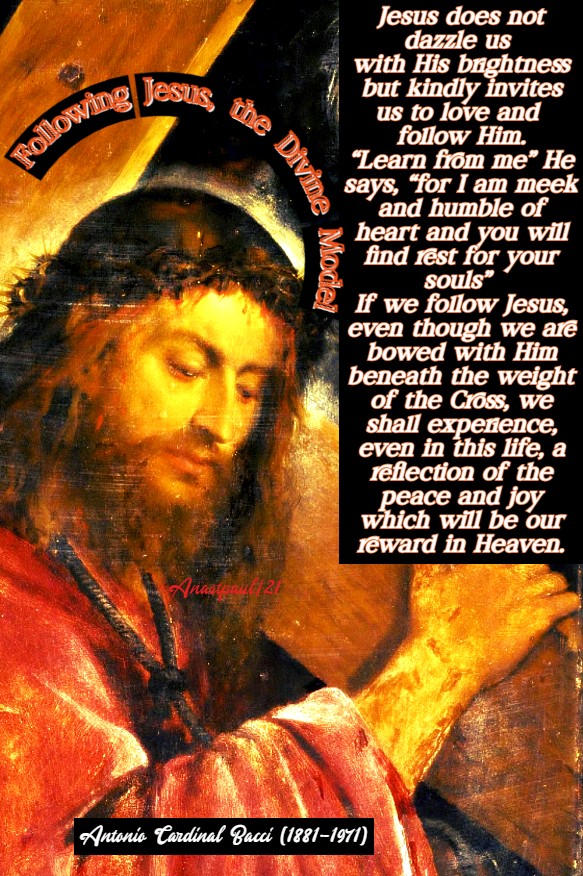
“Jesus is the Divine Model, Whom we ought to follow and imitate. In Him, the virtues possess both the infinite splendour of the Divinity and the gentle appeal of glorified Humanity. Jesus does not dazzle us with His brightness but kindly invites us to love and follow Him. “Learn from me” He says, “for I am meek and humble of heart and you will find rest for your souls” (Mt 11:29). After He has indicated humility, meekness and interior peace, as the foundations of the spiritual life, He invites us to take up the yoke of His law and assures us, that we shall find it light (Mt 11).
If we follow Jesus, even though we are bowed with Him, beneath the weight of the Cross, we shall experience, even in this life, a reflection of the peace and joy which will be our reward in Heaven.”
Thought for the Day – 8 August – Meditations with Antonio Cardinal Bacci (1881-1971)

The Eucharistic Life
“The Eucharist in our spiritual life could be compared to the sun in the physical life of the world. The sun gives light, heat and life. We can imagine what a terrible thing it would be if the sun set one evening and never rose again! Darkness would envelop the earth once more as at the beginning of creation. The cold would become relentless and life would be gradually extinguished everywhere. Men could, for sometime, depend on their reserves of artificial light to illuminate their creeping agony but, life would slowly decline, until it ended in death for everything and for everybody. Such would be the spiritual life without Jesus, especially without Jesus in the Blessed Eucharist, Who lives amongst us as our only true Friend, Who hears, helps and nourishes us.
He is the sun of our souls, the source of our enlightenment, fervour and consolation. Are we weary and discouraged beneath the weight of our daily cross and of our sins? Let us go to Jesus and He will help us to carry our cross. He will wash away our sins and give us the supernatural strength, never to sin again.
Let us unite ourselves to Jesus, by frequent Communion, by a daily visit to Him in the Tabernacle and, by making a spiritual communion whenever we cannot receive Him in the Blessed Eucharist. Let us make fervent aspirations, whenever we find our cross too heavy for us or when we are strongly tempted.
Many people go on long pilgrimages to famous Sanctuaries, such as Lourdes, Fatima and the Holy Places of Palestine. These are certainly worthwhile but, we should not forget that the greatest sanctuary of all is close at hand. It is in every Church which contains Jesus in the Tabernacle. Here, we have Jesus Himself, really present and anxious to listen to us and to help us. The Saints could find no greater joy on earth than to to pray before the Blessed Sacrament. We are all called to be saints!”
Thought for the Day – 7 August – Meditations with Antonio Cardinal Bacci (1881-1971)
Spiritual Languor
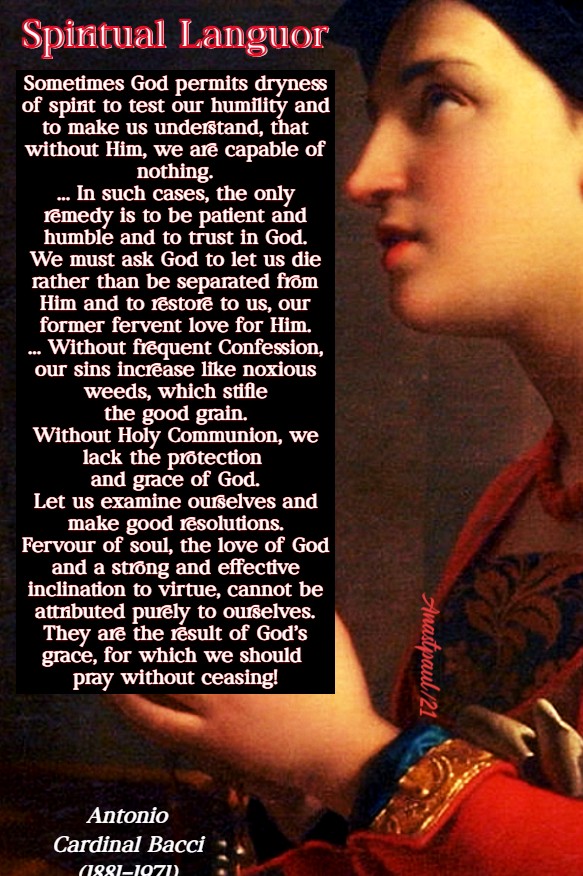
“Sometimes we become tired and sleepy. The love of God no longer warms our hearts nor prompts us to perform good works. We experience a kind of disgust for spiritual things and prayer becomes a burden. We no longer feel any pleausre in speaking with God, for our souls have grown arid and cold. We neglect our spiritual exercises and are careless about mediation and the Sacraments. We go on living on the edge of the abyss and never consider the fact, that it is a very short step from spiritual inactivity to actual sin.
This kind of languor is not always sinful, however. Sometimes God permits dryness of spirit to test our humility and to make us understand, that without Him, we are capable of nothing. Saints, like St Theresa and St Francis de Sales, were tried by spiritual aridity. In such cases, the only remedy is to be patient and humble and to trust in God. We must ask God to let us die rather than be separated from Him and to restore to us, our former fervent love for Him.
Most often this languor and inertia is caused by our neglect of the means necessary to preserve our spiritual life. We begin by omitting the prayers and penances which it is our duty to perform and by postponing Confession and Holy Communion. Without frequent Confession, our sins increase like noxious weeds, which stifle the good grain. Without Holy Communion, we lack the protection and grace of God.
Let us examine ourselves and make good resolutions. Fervour of soul, the love of God and a strong and effective inclination to virtue, cannot be attributed purely to ourselves. They are the result of God’s grace, for which we should pray without ceasing!”
Thought for the Day – 5 August – Meditations with Antonio Cardinal Bacci (1881-1971)
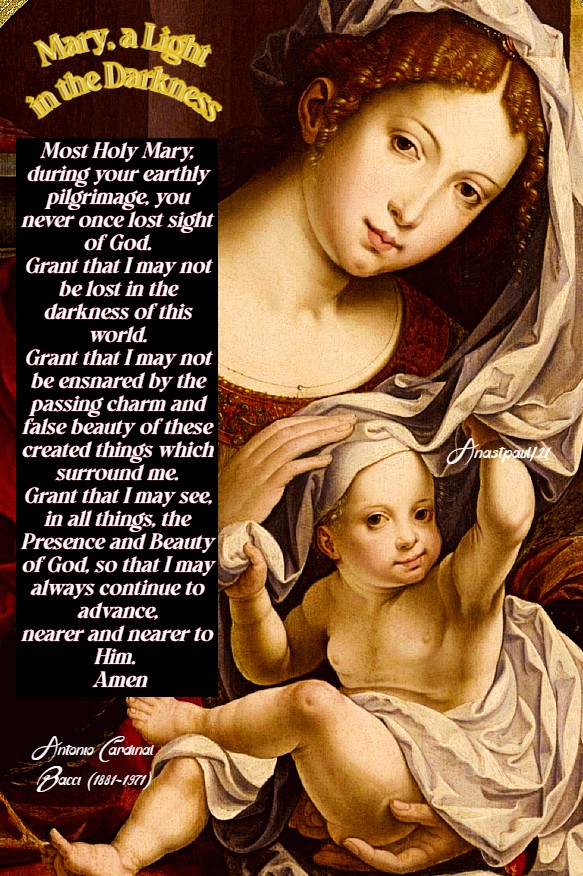
Mary, a Light in the Darkness
“Let us imagine for a moment, that we have grown blind and are forever plunged in darkness. It is an unhappy thought. Never again to see those who are dear to us, never to see the light of the sun nor any of the splendour of the universe. We should feel as if were alone, for we should have to depend only on sounds and on the voices of others for communication with the external world. As St Augustine points out, however, in his commentary on the miracle of the man who had been blind from birth, we are all more or less blind in the supernatural order. The world is the image of God but, do we see His Presence in everything which surrounds us? Is it not more often the case that created things distract us and lead us to forget their Creator because, we regard them as a means of satisfying our own comfort and our own ego? We should look on creatures as go-betweens which help us to ascend to God, the beginning and end of all creation.
Unfortunately, instead of climbing this mystical ladder which leads us to God, we often descend it. We forget God and become excessively wrapped up in worldly affairs. Sometimes matters may be even worse, not only do we forget God through our love of creatures but, we use them, to offend Him. God has given us eyes to admire His works and, as a result, to lead us to praise, thank and love Him. Instead, we often use this wonderful gift in order to commit sin. He has given us the gift of speech, the gift of hearing and other senses. But how do we employ them? The tongue is a marvellous invention but, as St James writes, “if anyone does not offend in the word, he is a perfect man, able also to lead round by the bridle, the whole body … With it we bless God the Father and, with it, we curse men, who have been made after the likeness of God. Out of the same mouth, proceed blessing and cursing. These things, my brethren ought not to be so” (Js 3:2-10). What can be said of vision and of speech can be said of all the senses and faculties of body and soul. They are all God’s gifts and should, therefore, be used as means of bringing ourselves closer to Him. If creatures lead us away from God and cause us to forget Him, or if, worse still, they cause us to offend Him, then we are spiritually blind and far more unfortunate than those who have lost their natural vision.
Most Holy Mary, during your earthly pilgrimage, you never once lost sight of God. Grant that I may not be lost in the darkness of this world. Grant that I may not be ensnared by the passing charm and false beauty of these created things which surround me. Grant that I may see, in all things, the Presence and Beauty of God, so that I may always continue to advance, nearer and nearer to Him. Amen.”
Thought for the Day – 4 August– Meditations with Antonio Cardinal Bacci (1881-1971)
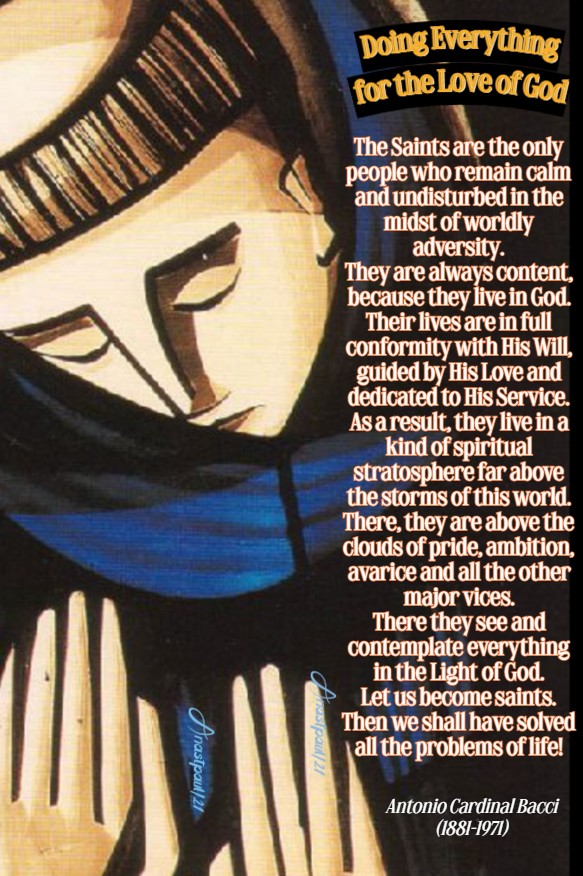
Doing Everything for the Love of God
“The beginning of perfection consists in doing the Will of God, even in our smallest actions. But, to do everything for the love of God, is the summit of Christian perfection. If we aimed always at doing God’s Will and acting from the motive of love for Him, we should be contented and at peace because we should be holy. The Saints are the only people who remain calm and undisturbed in the midst of worldly adversity. They are always content, because they live in God. Their lives are in full conformity with His Will, guided by His Love and dedicated to His Service. As a result, they live in a kind of spiritual stratosphere far above the storms of this world. There, they are above the clouds of pride, ambition, avarice and all the other major vices. There they see and contemplate everything in the Light of God. Let us become saints. Then we shall have solved all the problems of life!.” Amen
Thought for the Day – 3 August – Meditations with Antonio Cardinal Bacci (1881-1971)
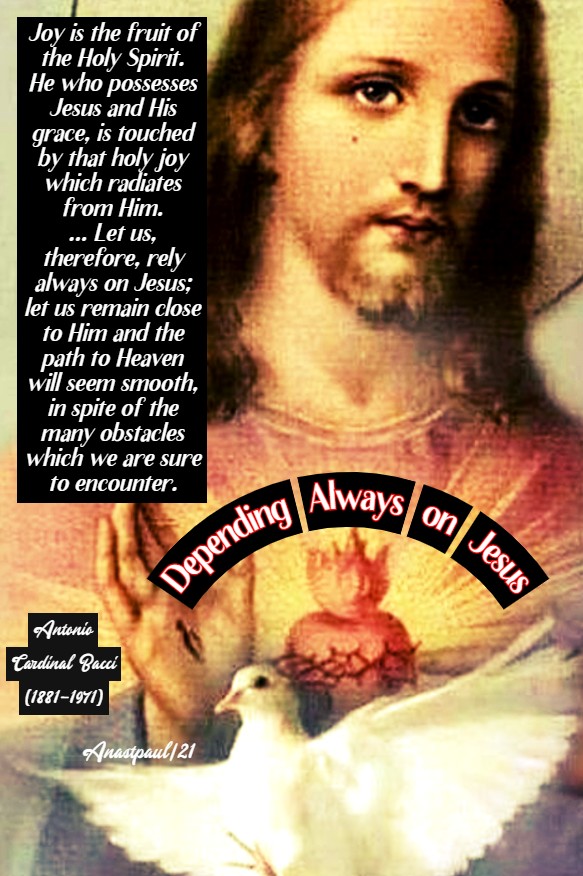
Depending Always on Jesus
“When we abandon ourselves to Jesus, we must do so cheerfully, as well as trustingly. St Basil calls the devil, the angel of sadness. The evil spirit is, in fact, sad, for this is the lot of one who has lost God forever. He wishes, moreover, to communicate that sadness to us also when he has drawn us into sin.
We should be happy in the Lord, as St Paul exhorts. Joy is the fruit of the Holy Spirit. He who possesses Jesus and His grace, is touched by that holy joy which radiates from Him. The Saints were joyful in persecution and in martyrdom, as the Apostles were before the Sanhedrin because, “they had been counted worthy to suffer disgrace for the name of Jesus” (Acts 5:41). It is related of St Romuald that in spite of great austerities, he was always smiling, so that he communicated happiness to those who saw him.
Let us, therefore, rely always on Jesus; let us remain close to Him and the path to Heaven will seem smooth, in spite of the many obstacles which we are sure to encounter.”
Thought for the Day – 2 August – Meditations with Antonio Cardinal Bacci (1881-1971)
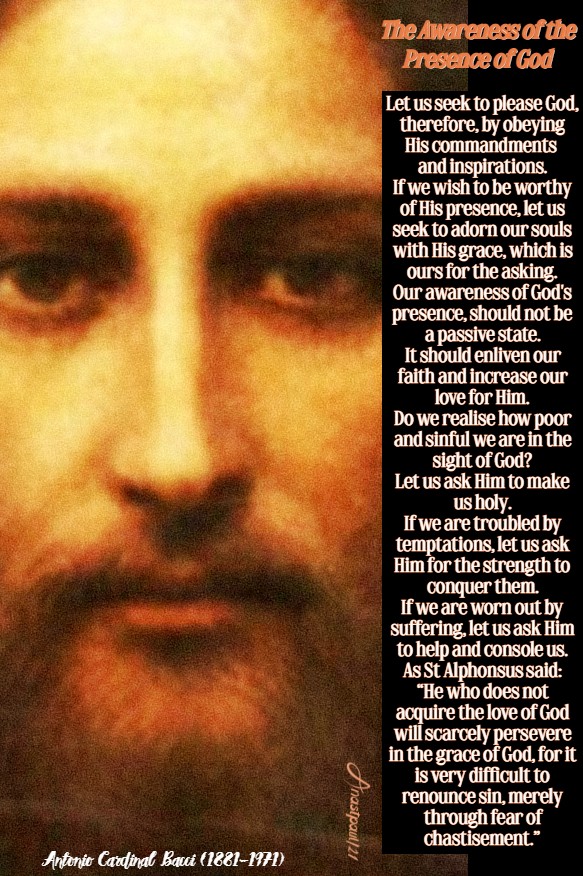
The Awareness of the Presence of God
“The presence of God, moreover, encourages us to do our best to acquire all the virtues. When He is always before our eyes, we have no difficulty in recognising, that He is the supreme Truth, Beauty and Goodness.
Let us seek to please God, therefore, by obeying His commandments and inspirations. If we wish to be worthy of His presence, let us seek to adorn our souls with His grace, which is ours for the asking. Our awareness of God’s presence, should not be a passive state. It should enliven our faith and increase our love for Him.
Do we realise how poor and sinful we are in the sight of God? Let us ask Him to make us holy. If we are troubled by temptations, let us ask Him for the strength to conquer them. If we are worn out by suffering, let us ask Him to help and console us. As St Alphonsus said: “He who does not acquire the love of God will scarcely persevere in the grace of God, for it is very difficult to renounce sin, merely through fear of chastisement.”
If we live in the presence of God and contemplate Him, we shall be moved to love Him more and more.”
Thought for the Day – 1 August – “Month of the Immaculate Heart of Mary” -Meditations with Antonio Cardinal Bacci (1881-1971)
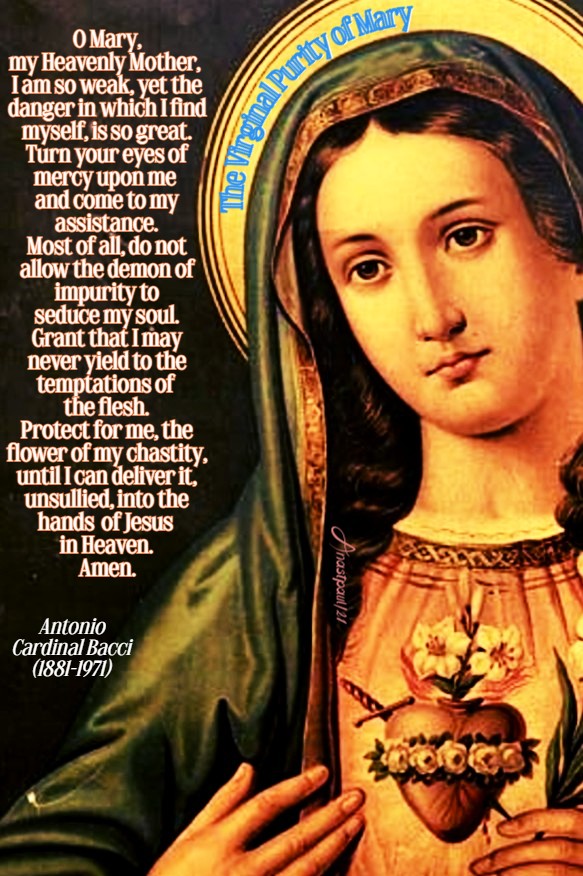
The Virginal Purity of Mary
O Mary, my Heavenly Mother, I am so weak, yet the danger in which I find myself, is so great. Turn your eyes of mercy upon me and come to my assistance. Most of all, do not allow the demon of impurity to seduce my soul. Grant that I may never yield to the temptations of the flesh. Protect for me, the flower of my chastity, until I can deliver it, unsullied, into the hands of Jesus in Heaven. Amen.
Thought for the Day – 31 July – Meditations with Antonio Cardinal Bacci (1881-1971)

Little Things
“Just as there are ordinary acts of virtue, so there are very ordinary sins. But it would be rash to regard acts of deception, vanity and impatience, as insignificant. Every deliberate sin is an offence against God our highest good and our Redeemer.
How can God be indifferent to these ungrateful violations of His law? After all, even as He has assured us, that a cup of cold water given in His Name to a thirsty man, will have its reward (Cf Mt 10:42), so He has assured us, that not even the slightest trace of sin can enter into eternal glory! We shall not be condemned to Hell for venial sins alone but, we shall suffer a decline in grace and shall be obliged to expiate our sins, either in this life, or in Purgatory.
Thought for the Day – 30 July – Meditations with Antonio Cardinal Bacci (1881-1971)
Daily Progress
“There are two ways in which we should make constant daily progress. The first is in the removal of our defects and imperfections. As the Imitation of Christ insists, we should soon become holy if we were to conquer, at least one sin, every year. It is opportune, at this stage, to ask ourselves how many years we have already spent on earth. During these years, how many personal defects can we claim to have remedied? Perhaps there was a time when we were better than we are now? If we have wasted time and have abused our Creator’s gifts and favours, we should humble ourselves and do penance before God.
Finally, we should resolve to do our best to remedy, at least, one Defect everyday. We should select first of all, whatever imperfection we know to be the most dangerous. This will be difficult and even heroic work but, it is very necessary. We must work on our own character as a sculptor works on a block of marble, hammering, cutting and chiselling patiently and perseveringly. With the help of God, we shall be successful. Even as the Saints succeeded, so we shall succeed if we depend on God’s grace and make the necessary sacrifices.”
Thought for the Day – 29 July – Meditations with Antonio Cardinal Bacci (1881-1971)
The Love of Our Neighbour
“The Gospel not only commands us to love God above all things but also, to love our neighbour as ourselves (Cf Mt 13:35-40). The Christian love of our neighbour, flows necessarily from the love of God. Our Creator loves all men as His own sons. Therefore, we ought to love one another as brothers, even as Our Lord loves us. We should see, in our neighbour, especially if he is in need, the person of Christ Himself, our elder brother, “the first-born among many brethren” (Rom 8:29).
If men sincerely loved one another, not merely as brothers but as much as they love themselves, what problems would be solved! Who can say how many evils would be abated and how many sorrows would be assuaged? To transform the world, it would be enough to put into practice the first great commandment of the Gospel, which is the commandment of charity. Admittedly, the world would not become an earthly paradise, for any such Utopia is an impossibility. But, it would become a dignified dwelling place of brothers, loving and helping one another. “Love is the fulfilment of the law,” St Paul very truly says (Rom 13:10). “Have charity, which is the bond of perfection” (Col 3:14).
Thought for the Day – 28 July – Meditations with Antonio Cardinal Bacci (1881-1971)
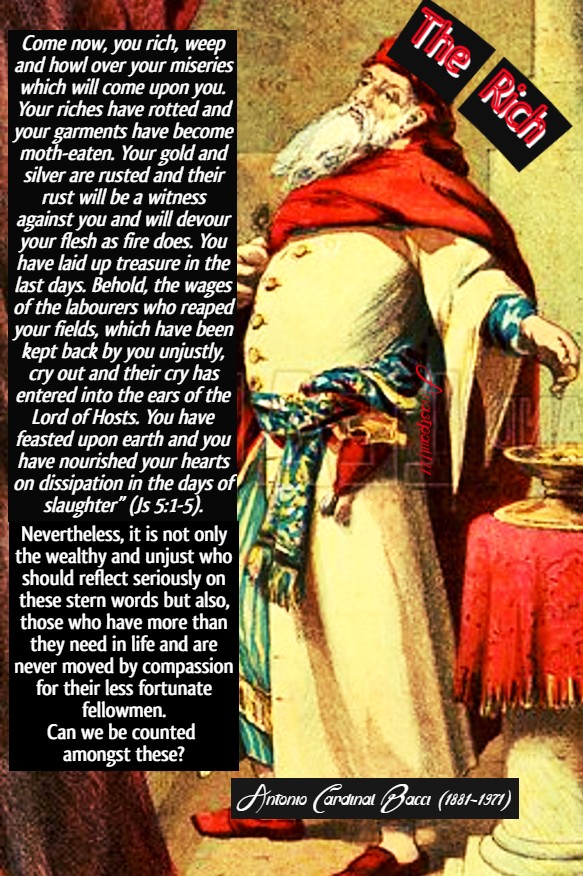
The Rich
“Sacred Scripture has some very severe and terrible things to say to the rich. “Woe to you rich! for you are now having your comfort” (Lk 6:24). “Amen, I say to you, with difficulty will a rich man enter the kingdom of heaven. And further, I say to you, it is easier for a camel top pass through the eye of a needle, than for a rich man to enter the kingdom of heaven” (Mt 19:23-24, CF Mk 10:24-25, Lk 18:24-25). St James adds: “Come now, you rich, weep and howl over your miseries which will come upon you. Your riches have rotted and your garments have become moth-eaten. Your gold and silver are rusted and their rust will be a witness against you and will devour your flesh as fire does. You have laid up treasure in the last days. Behold, the wages of the labourers who reaped your fields, which have been kept back by you unjustly, cry out and their cry has entered into the ears of the Lord of Hosts. You have feasted upon earth and you have nourished your hearts on dissipation in the days of slaughter”(Js 5:1-5).
These passages are not concerned with the rich as such, for men like Abraham, Job and St Louis, the King of France, were wealthy. They are directed against those who have become absorbed in their wealth (Mk 10:24) and have grown deaf to the rightful promptings of justice and charity.
Nevertheless, it is not only the wealthy and unjust who should reflect seriously on these stern words but also, those who have more than they need in life and are never moved by compassion for their less fortunate fellowmen. Can we be counted amongst these?”
Thought for the Day – 27 July – Meditations with Antonio Cardinal Bacci (1881-1971)

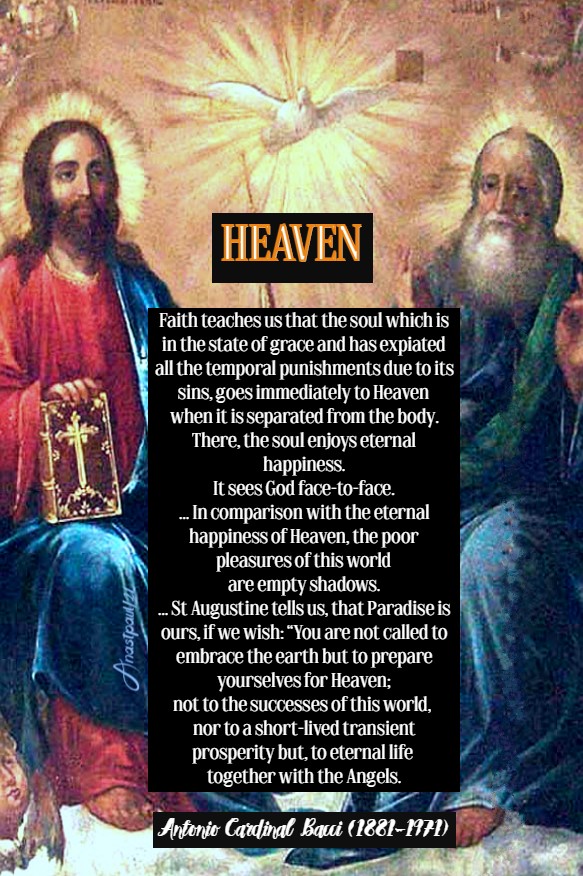
HEAVEN
“Faith teaches us that the soul which is in the state of grace and has expiated all the temporal punishments due to its sins, goes immediately to Heaven when it is separated from the body. There, the soul enjoys eternal happiness. It sees God face-to-face. It sees Him without any intervention of created things but as He is in Himself in the Unity and Trinity of His infinite perfections.
In this Beatific Vision, the intellect remains completely satisfied because, in God, there is every truth, beauty and goodness, The will abandons itself entirely to the Will of God, desiring nothing else and loving nothing else but God alone. There springs from this abandonment, a love which satisfies every desire, an inexpressible joy and a boundless peace. The happy soul will see the Blessed Virgin too and she will smile upon it with maternal tenderness. It will see the Angels and the Saints gathered around the King of Kings and the Queen of Heaven, singing praises. St Paul, who was taken up to the third Heaven, tells us that it is impossible to imagine or to describe the unknown joys which are experienced there. In comparison with the eternal happiness of Heaven, the poor pleasures of this world are empty shadows. We cannot imagine the happiness of those who have gained Heaven by their good lives upon earth. The concept of Heaven is so beautiful and immense, that it caused the Saints to desire death as a means of going there. They welcomed suffering too because, it brought them nearer to their goal.
St Augustine tells us, that Paradise is ours, if we wish: “You are not called to embrace the earth but to prepare yourselves for Heaven; not to the successes of this world, nor to a short-lived transient prosperity but, to eternal life together with the Angels.” (Serm 296, 6:7).”
Thought for the Day – 25 July – Meditations with Antonio Cardinal Bacci (1881-1971)
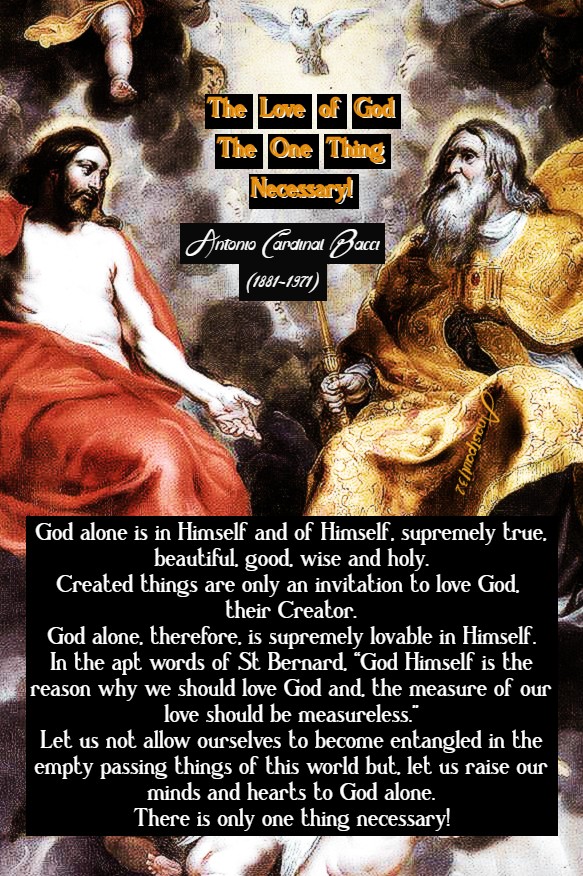
The Love of God The One Thing Necessary!
“If we really know God, we should love Him above all created things. “I have loved you too little, My God,” said St Augustine in his Confessions, “because I have not known You well enough.” If we knew God, we should recognise, that He is infinite beauty, goodness and wisdom. We should realise, that the beauty of creatures is like a passing cloud, for it is a vague and distant reflection of the eternal beauty of God. We should realise, that the wisdom of men, is only a ray of God’s light which comes from Him and must return to Him. Finally, we should perceive that men are good, only insofar, as they do their best to respond to the inspirations of grace which God has placed in their hearts. God alone is in Himself and of Himself, supremely true, beautiful, good, wise and holy. Created things are only an invitation to love God, their Creator. God alone, therefore, is supremely lovable in Himself. In the apt words of St Bernard, “God Himself is the reason why we should love God and, the measure of our love should be measureless.”
Let us not allow ourselves to become entangled in the empty passing things of this world but, let us raise our minds and hearts to God alone. There is only one thing necessary!”
Thought for the Day – 24 July – Meditations with Antonio Cardinal Bacci (1881-1971)

The Particular and General Judgements
“It is appointed unto men to die once and after this comes the judgement” (Heb 9:27).
To have to appear before the Face of the Living God is terrifying for everybody. How much more terrifying will it be for the sinner? Weighed down by numberless sins, he will stand before the scrutinising gaze of God. He will be able to hide nothing. Everything will be evident and clear. The Countenance of our Divine Redeemer, which was mild and merciful during life, will at that moment be that of a severe and just Judge. After having scorned so many graces, after having spurned so many calls to conversion and so many secret inspirations to change his life, after dying unrepentant …behold the sinner in the presence of his Eternal Judge. At that moment, he will hear the irrevocable sentence resounding in his ears “Depart from me, accursed ones, into the everlasting fire chich was prepared for the devil and his angels” (Mt 25:41). This terrible condemnation will be publicly repeated, moreover, at the general judgement. Memento mori!”
You must be logged in to post a comment.