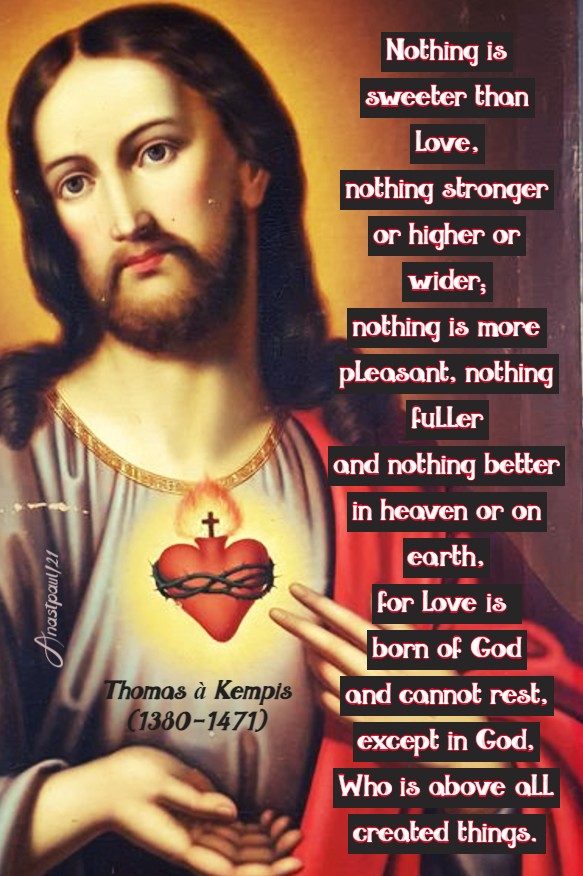
Quote/s of the Day – 5 May – Wednesday of the Fifth Week of Easter, Readings: First: Acts 15: 1-6; Psalm: Psalms 122: 1-2, 3-4ab, 4cd-5; Gospel: John 15: 1-8 and the Memorial of the Conversdion of St Augustine
“Without Me you can do nothing”
John 15:5
“You do not know when your last day may come. You are an ingrate! Why not use the day, today, that God has given you to repent?”
“What do you possess if you possess not God?”
St Augustine (354-430) Father & Doctor of Grace
“A saint is not someone, who never sins, but one who sins less and less frequently and gets up more and more quickly.”
St Bernard of Clairvaux (1090-1153) Mellifluous Doctor
“Each day then, we ought to renew our resolutions and arouse ourselves to fervour, as though it were the first day of our turning back to God. We ought to say: “Help me, O Lord God, in my good resolution and in Your holy service. Grant me now, this very day, to begin perfectly, for thus far I have done nothing.” … Just men depend on the grace of God rather than on their own wisdom in keeping their resolutions. In Him they confide every undertaking …” ”
Thomas à Kempis CRSA (1380-1471)
“A soul makes room for God by wiping away all the smudges and smears of creatures, by uniting its will perfectly to God’s, for to love is to labour, to divest and deprive oneself for God, of all that is not God . When this is done, the soul will be illumined by and transformed in God.”
St John of the Cross (1542-1591) Mystical Doctor of the Church
Thought for the Day – 3 May – “Mary’s Month – Meditations with Antonio Cardinal Bacci (1881-1971)

The Imitation of Mary
“At first sight, it seems a very difficult matter, to imitate Mary. More than any other creature, she reached the highest peak of perfection. But, if we examine the nature of her outstanding sanctity, it will seem easier to imitate her.
According to the masters of spiritual life, there are three kinds of holiness. First, there is extraordinary sanctity, which abounds in miracles and ecstasies. such as that of St Francis, St Aloysius Gonzaga, St Mary Magdalen dei Pazzi, St Catherine of Siena and many others. Secondly, there is ordinary holiness, where perfection is achieved without being manifested in miracles or in ecstasies. Thirdly, there is hidden sanctity, a relationship entirely between the soul and God, which consists in the faithful and loving fulfilment of Hs holy Will. It is unnoticed by men but one day, it will shine forth in the sight of God and the human race.
The holiness of Mary, falls into the latter two categories, for hers was a hidden sanctity, to outward appearances, quite ordinary. We read nothing of her having been in ecstasy or having performed miracles. We do read, however, that she did God’s Will on all occasions; that she lived an obscure life of humility and love; that she followed Jesus, as far as Calvary, along the sorrowful road of the Cross; that she loved Him above everything else and, that she lived for Him alone.
It is not too difficult to imitate Mary. With her protection and with the grace of God, it can become almost easy. All we need, is a firm resolution to accomplish the Will of God in all things, a great love for Jesus, which will make Him the object of all our actions and, a spirit of prayer, which will keep us close to God, in every kind of circumstance.”
Thought for the Day – 2 May – Meditations with Antonio Cardinal Bacci (1881-1971)
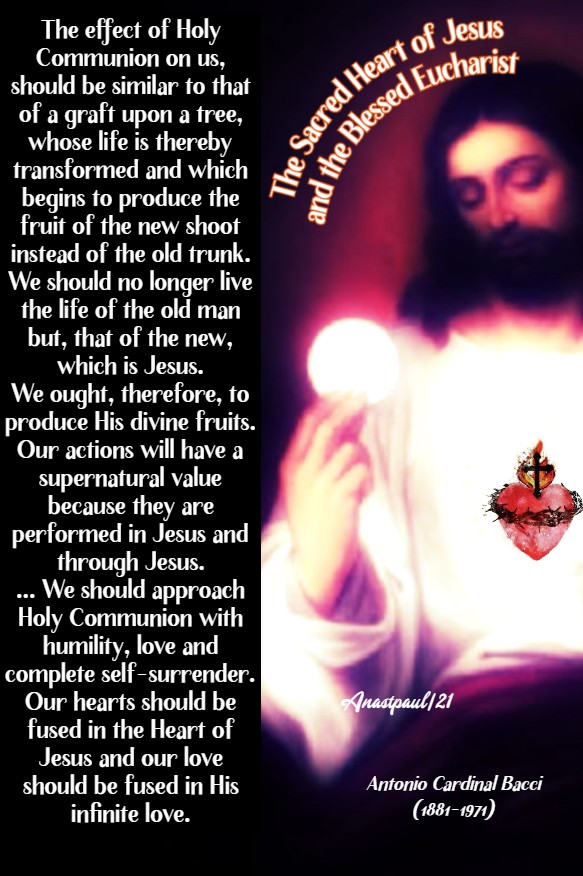
The Intercession of Our Lady
“There is a passage in the Gospel which illustrates, in outstanding fashion, Mary’s great power of intercession. St John relates (Cf Jn 2:1-2) that, along with Mary and the Apostles, Jesus took part at a wedding celebration in Cana of Galilee. During the banquet, the wine ran short. Mary realised how embarrassing this would be for the young couple and took pity on them. She said to Jesus in a tone of request: “They have no wine.” But Jesus seemed quite indifferent to her appeal. “What would thou have me do, woman?” He said, “My hour has not yet come.”
One would have imagined from the coolness of this reply, that it would have been useless to press the matter and further. Mary, on the other hand, was sure, that Jesus would not refuse the favour which she asked. She turned without any hesistation to the attendants and directed them: “Do whatever he tells you.”
As if disarmed by His Mother’s trustfulness, Jesus then worked His first miracle through her intercession. When we pray we should do so with the same confidence and we shall certainly be answered.
Remember Mary’s words,however, “Do whatever he tells you.” We must do whatever Jesus tells us, if we want Mary to listen to us and to work in us, the miracle of our sanctification. If we desire to be true sons of Mary, her advice to us, is to carry out the commands of Jesus Christ.”
Thought for the Day – 1 May – Meditations with Antonio Cardinal Bacci (1881-1971)
The Month of Mary
“This work of eradicating of our faults and replacing them by their opposite virtues, is a difficult task which we cannot carry out on our own. Prayer is necessary if we are to obtan the grace which we need. During Mary’s month, we should beseech our heavenly Mother, with greater earnestness, to obtain for us, from her divine Son, the grace which we need to correct the evil in our nature and to perfect it in goodness.
Mary wants us to pray to her because she wishes to obtain for us, the graces which we require. She loves us very much and is ready to help us to become, like her, living imitations of Jesus, insofar as the weakness of our nature will permit.
Among our other prayers, let us remember to give pride of place to the Holy Rosary, whether we recite it in Church or with the family. Let us include, at least a quarter of an hour meditation; a daily visit, however short, to the Blessed Sacrament and to Our Lady’s Altar; an examination of conscience in the evening and many ejaculatory prayers during the day, which will express our love for Mary and for her divine Son.”
Thought for the Day – 29 April – Meditations with Antonio Cardinal Bacci (1881-1971)
Pride
“Just as humility is the most difficult of the virtues to acquire, pride is the most common of the vices. We are all conceited and take pride in things, which do not belong to us but to God! One would imagine, that it would be easy to understand that we are nothing without God but, in practice, it is the other way round. It is not only prominent personalities, noted scientists and men of letters but also the most ordinary men, who believe, that they are unique and superior to their fellows.
Other vices follow pride. There is a presumption which leads us to believe that we are more important than we really are and attempt things which are beyond the power which God has given us.
There is ambition ,which drives us to make an immoderate quest for honours and responsibilities, our main goal in life, as if our hearts could be satisfied by these things, rather than by God and by our own sanctification.
There is empty vanity, the futile but burning desire to be praised and esteemed, as if our merits (if we have any) were anything else but a gift from God, which we have been able to develop only by His assistance and grace.
Let us examine ourselves in this regard and we shall find many distortions in our own personality. We shall discover many vain notions, which we ought to dispel and many selfish detractions from God’s glory of which we are and have been, guity. “Take away pride,” said St Augustine “and what are men but men?” Remove the mask of arrogance and affectation and who will find, that even those men, who regard themselves as outstanding personalities, are very insignificant creatures after all. Let us keep constantly in our mind the words of Jesus: “Amen, amen I say to you, the servant is not greater than his lord; neither is the apostle greater than he that sent him” (John 13:16).” We can learn a great deal from a meditation on this subject.
Thought for the Day – 28 April – Meditations with Antonio Cardinal Bacci (1881-1971)

The Only Remedy for All Our Ills
“Life is a continual battle. “Is not man’s life on earth a drudgery?” (Job 7:1). If we consider, only the material aspect of this battle, we are all among the vanquished. Admittedly, there is some joy and some victory. But, our pleasures are as short-lived as the flowers of the field, they are soon “withered and dried up like grass” (Cf Ps 101:5). Our conquests are also very insignificant; they can inflate us for a while but they do not last long and cannot satisfy us. After death, only our triumphs in virtue will persist. Moreover, whereas the joys of this life are few and fleeting, the physical and moral sufferings, are innumerable. Sometimes, they are so heavy and overwhelming, that they cause us to despair. But, surely there is a remedy for all the evils which afflict us? God is infinitely good and He has permitted suffering. Will He not give us the means of enduring it and the medicine to cure it? In fact, Our Lord, has given us a remedy for all our ills, even for the most distressing. It is a bitter medicine but, it will heal anyone who has the courage to swallow it and, it will give him perfect peace of soul. The treatment consists of three stages: (1) Doing the will of God in all things with complete resignation. (2) Doing everything for the love of God. (3) Doing everything and enduring everything for the love of God alone. When a man reaches this highest peak of the spiritual life, he acquires that perfect peace of soul, which the Saints possessed.”
Thought for the Day – 27 April – Meditations with Antonio Cardinal Bacci (1881-1971)
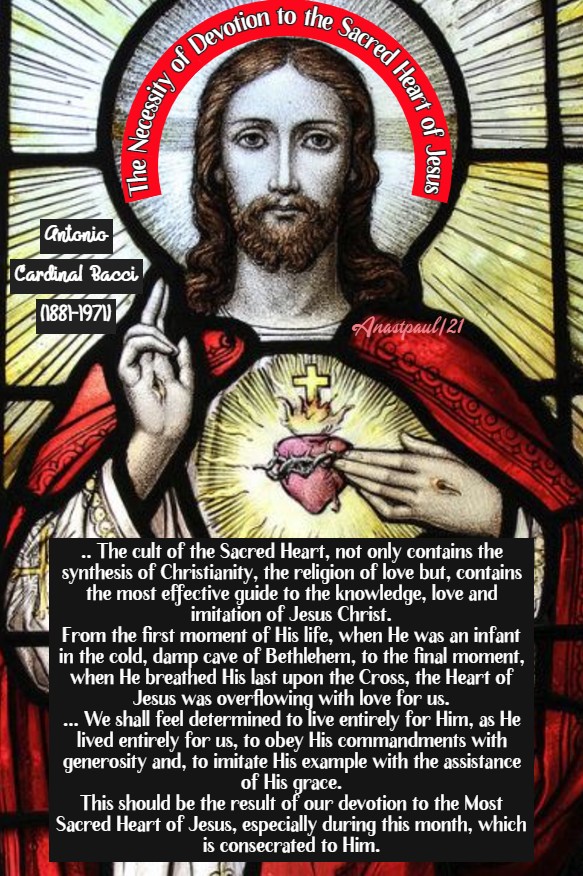
Putting Christianity into Practice
“Only the uiversal practice of Christianity, could change the world. Even after a period of twenty centuries, it is true to say, that for many Christans, the Gospel is an unexplained book, the principles of which, have yet to be fully realised in their ordinary lives.
None of us can change the world on his own but, each of us can accomplish that part of the task, which depends on himself.
Do we really love God whole-heartedly and above all things? Do we really love our neighbour as ourselves? Let us examine ourselves earnestly and find out how far we have still to go. Our love of God may be too feeble and this may be the reason why we have not acheved spiritual perfection. Our love of our neighbour may not be as generous as it should be. If this is so, we shall have to answer for it to God ,when He pronounces that terrible sentence on those who have been rejected: “Depart from me, accursed ones, into the everlasting fire which was prepared for the devil and his angels. For I was hungry and you did not give me to eat, I was thirsty and you gave me no drink, I was a stranger and you did not take me in, naked and you did not clothe me, sick and in prison and you did not visit me” (Mt 26:41-43). Let us resolve to be charitable and generous to all!”
Quote/s of the Day – 27 April – Tuesday of the Fourth Week of Easter, Readings: Acts 11:19-26, Psalm 87:1-7, John 10:22-30
“My sheep hear my voice and I know them and they follow me.”
John 10:27
“If anyone serves me, he must follow me and where I am, there will my servant be also. If anyone serves me, the Father will honour him.”
John 12:26
“Whatever you do, do from the heart, as for the Lord and not for others, knowing that you will receive from the Lord the due payment of the inheritance; be slaves of the Lord Christ.”
Colossians 3:23-24
“This is the glory of man – to persevere and remain in the service of God. For this reason, the Lord told His disciples: ‘You did not choose Me but I chose you.’ He meant that His disciples did not glorify Him by following Him but, in following the Son of God, they were glorified by Him. As He said: ‘I wish that where I am they also may be, that they may see My glory.’”
St Irenaeus (130-202) Father of the Church and Martyr
“My sheep follow me,” says Christ. By a certain God-given grace, believers follow in the footsteps of Christ. No longer subject to the shadows of the Law , they obey the commands of Christ, and guided by His words, rise through grace, to His own dignity, for they are called children of God. When Christ ascends into heaven, they also follow Him.”
St Cyril of Alexandria (380-444) Father & Doctor of the Church
I Will Love and Follow You By Thomas à Kempis CRSA (1380-1471)
Oh my Lord, Let my heart expand in Your love. Let me learn to know how sweet it is, to serve You, how joyful it is, to praise You and to be absorbed in Your love. Oh, I am possessed by love and rise above myself because of the great fervour I feel, through Your infinite goodness. I will sing the canticle of love to You and I will follow You, my Beloved, wherever You go and may my soul never weary of praising you, rejoicing in Your love. I will love You more than myself and myself, only for Your sake. I will love all others in You and for you, as Your law of love commands. Amen
Thought for the Day – 26 April – Meditations with Antonio Cardinal Bacci (1881-1971)
My Life is Christ
“Am I determined to live the Life of Christ, by striving to be indissolubly united with Him, through divine grace? Am I prepared to say, with St Paul “Who shall separate us from the love of Christ? For I am sure, that neither death, or life, nor angels, nor principalities, nor things present, nor things to come, nor powers, nor height, nor depth, or any other creature, will be able to separate us from the love of God, which is in Christ Jesus, our Lord” (Rom 8:35-39).
But, in order to bring this about, it is necessary for me to fly from every sin and to look for God in all things and in all actions. I must love God with my whole heart and nurture the divine life within me, by prayer, recollection and frequent Communion. If I fail to put these resolutions into practice, I shall become a barren branch, fit only for eternal fire!”
Quote/s of the Day – 26 April – Monday of the Fourth Week of Easter, Readings: First: Acts 11: 1-18, Psalm: Psalms 42: 2-3; 43: 3-4, Gospel: John 10: 1-10 and the Memorial of St Raphael Arnaiz Baron (1911-1938)
“I am the door. Whoever enters through me will be saved…. “
John 10:9
“In You is the source of life and in Your Light Lord, we see light“
Psalm 35(36)
“Now is the time for us to choose! … Listen to me, you holy seed, for I have no doubt, that it is here, in abundance… Listen to me or, rather, listen to Him, in me, Who was first called a good seed. Do not love your life in this world! If you truly love yourselves, do not thus love your life and then, you will save your life!”…
St Augustine (354-430) Father and Doctor of Grace
“He is the origin of all wisdom. The Word of God in the heights, is the source of wisdom. Christ is the source of all true knowledge, for He is “the way, the truth and the life.” (Jn 14:6). … As way, Christ is the teacher and origin of knowledge … Without this Light, which is Christ, no-one can penetrate the secrets of faith.”
St Bonaventure (1221-1274) Seraphic Doctor
“Love Him, then, keep Him as a friend. He will not leave you as others do, or let you suffer lasting death. Sometime, whether you will or not, you will have to part with everything. Cling, therefore, to Jesus in life and death, trust yourself to the glory of Him, Who alone can help you when all others fail.“
Thomas à Kempis (1380-1471) (Book 2 Ch 7)
“Where, then, is true freedom? It is in the heart of one who loves nothing more than God. It is in the heart of one who is attached neither to spirit nor to matter but only to God. It is in that soul which is not subject to the “I” of egoism, which soars above its own thoughts, feelings, suffering and enjoyment. Freedom resides in the soul whose one reason for existence is God, whose life is God and nothing else but God.”
St Raphael Arnaiz Baron (1911-1938) Spanish Trappist Monk
Thought for the Day – 25 April – Meditations with Antonio Cardinal Bacci (1881-1971)
The Good Shepherd
“The Good Shepherd is the theme of two of the most moving passages in the Gospel. “I am the good shepherd,” Jesus says. “The good shepherd lays down his life for his sheep. But, the hireling, who is not a shepherd, whose own the sheep are not, sees the wolf coming and leaves the sheep and flees. and the wolf snatches and scatters the sheep … I am the good shepherd and I know mine and mine know me, even as the father knows me and I know the Father and I lay down my life for my sheep” (Jn 10:11-15).
“What man of you, having a hundred sheep,” He says elsewhere “and losing one of them, does not leave the ninety-nine in the desert and go after that which is lost, until he finds it? And when he has found it, he lays it upon his shoulders rejoicing. And on coming home, he calls together his friends and neighbours, saying to them, “Rejoice with me because, I have found my sheep that was lost.” “I say to you that, even so, there will be joy in heaven over one sinner who repents, more than over ninety nine just, who have no need of repentance” (Cf Lk 15:4-7).
These texts vividly describe God’s mercy towards poor sinners.
We may often have been amongst the lost sheep which are separated from the flock of Jesus Christ. We found, perhaps, the poisoned pastures of error and vice and strayed from the path of truth and goodness. But what happened? We experienced disillusionment and remorse and knew that we had lost our only real good, which is God. How sad our fate would have been, if the Good Shepherd, Jesus, had not come to look for us and to enlighten us with His grace. We should have been lost forever, in the desert of sin!”
Thought for the Day – 24 April – Meditations with Antonio Cardinal Bacci (1881-1971)

Gospel Reading
“The Gospel is the books of books, for it contains, not the words of men but the words of God. In the beginning, the Word of God was made man ad became the life-giving Word during His earthly life. Thus we have the written Word in the Sacred Scriptures. When we read the Gospel, we should imagine that Jesus is there before us, so that we can hear the Words from His divine lips and feel the breath of His life and the fire of His love.
“In heaven” says St Augustine, “Jesus continues to speak to us on earth through His Gospel.” His Words are the bright stars which should gude men – often wandering in the darkness of error or engulfed in the abyss of sin – through the way of virtue and goodness towards Heaven.
The more one penetrates the Gospel, the more one gets to know Jesus Christ. St Augustine writes that the Gospel is another way, which Jesus has chosen, of remaining among us. The same holy Doctor does not hesitate to say, that “he who scorns even of these sacred words, would be no less guilty, than if he let the Blessed Eucharist fall on the ground through negligence.”
When we read the sacred pages, we begin to understand the infinite goodness of Jesus. We see Him whimper and suffer in the manger at Bethlehem; we see Him humbly working as a poor labourer in the workshop in Nazareth; we see Him pardon Magdalene and the penitent adulteress; we see Him restore life to the dead, sight to the blind and health to all kinds of sick people; in the supper room, we see Him give us Himself, under the veil of the Blessed Eucharist, at the very moment when He was forgotten, denied and betrayed; we see Him in the Praetorium before Pilate, where He was scourged for our sins; we see Him on Calvary dying on a cross for us, forgiving His crucifiers and promising Heaven to the penitent thief and, finally, we see Him rising from the dead and ascending gloriously into Heaven, where He went to prepare a place for us, should we persevere as His faithful followers, “I go to prepare a place for you” (Jn 14:2).
The Saints often read and meditated on the Gospel. It provided spiritual food for their souls. In the life os St Philip Neri, we read, that during his last years, he read nothing but the Gospels, especially the Gospel of St John, which treats profoundly of the love of God.
Do you read the Gospels? With what dispositions and with what results do you read it? In modern times, unfortunately, very few read it at all. That is why so many stray so far from the spirit of Jesus and why, they often display a material form of piety, insipid and useless, in the practice of the Catholic life!”
Thought for the Day – 22 April – Meditations with Antonio Cardinal Bacci (1881-1971)
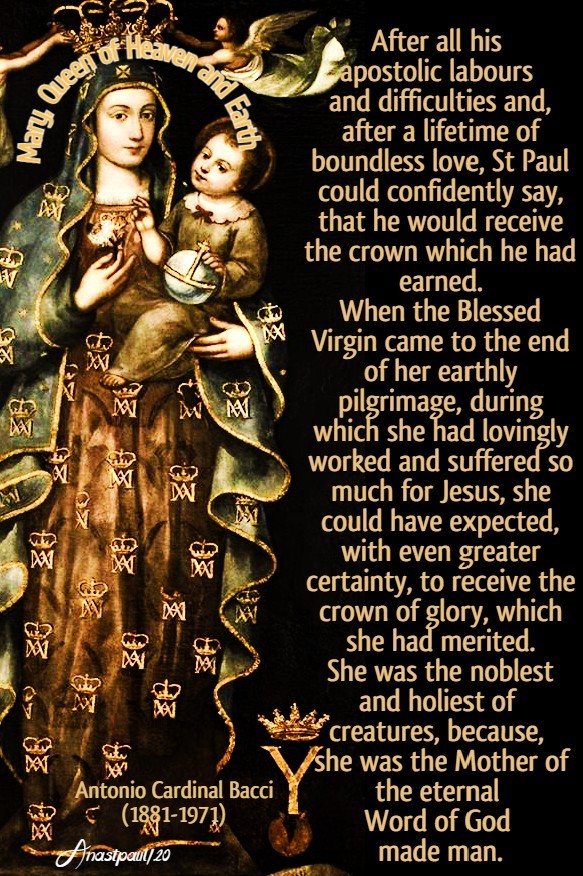
The Divided Heart
“Even if your heart has not become the property of the devil and retains a horror of mortal sin, it is still possible, that you have not given it completely to God. Your heart is divided. Part of it belongs to God and part of it to the world. You are distracted by your own self-love and earthly desires. A heart which is divided in its affections between God and the world, is dazzled by everything around it and tends to forget God, more and more.
We protest that we belong entirely to God but, in practice, we are so absorbed by work, ambition and pleasure, that we neglect God.
A man who is torn between love of God and love of the world is like Cain who, unlike Abel, did not offer God, the best part of his flock but kept this for himself and offered God whatever he had rejected. God was pleased with Abel’s sacrifice but had no regard for that of Cain, who finally became a murderer and was cursed by his Creator.
Do we offer God the leavings of life while we keep the best part of it for our selves? Do we think of ourselves nearly all the time and give very little thought to God? This is not the way in which God has dealt with us. Not only has He created us but, He loves us with an everlasting love. He came down to earth and lived as our fellow man. He redeemed us by His Precious Blood and gave Himself to us as our food!
Why are we not willing to give ourselves to Him forever in return? Gratitude demands that we should do so. God, moeover, is our supreme and only good.
Thought for the Day – 21 April – Meditations with Antonio Cardinal Bacci (1881-1971)
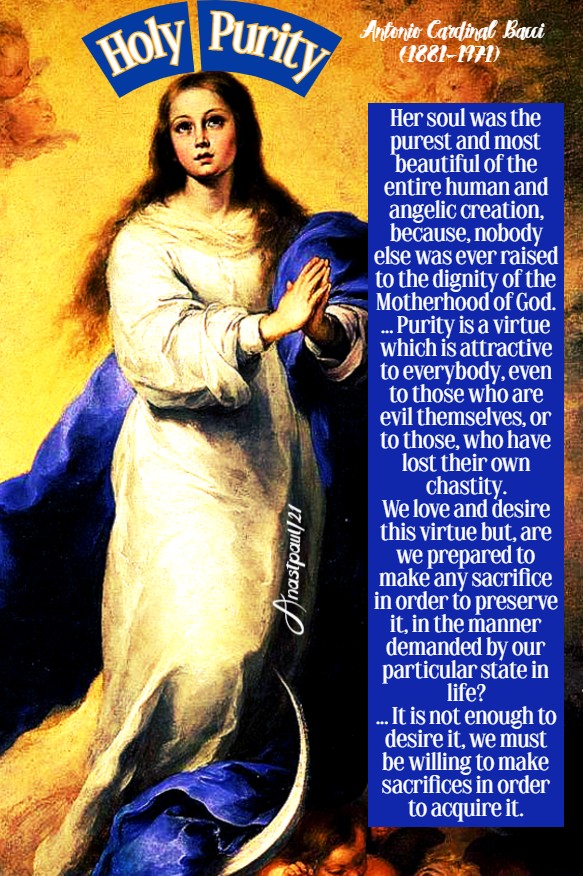
The Dignity and Responsibility of Being a Christian
“It is a great dignity to be a Christian. By Baptism, we become sons of God, heirs to Heaven, temples of the Holy Spirit and members of the Mystical Body of Jesus, which is the Church. God’s grace raises us to the supernatural order and makes us, as St Paul expresses it, sharers in the divine nature. By the Sacrament of Confirmation, the Holy Spirit fortifies our faith and gives us the strength to resist the temptations of the devil and to fight like loyal soldiers, for the triumph in ourselves and in others, of the Kingdom of Jesus Christ. The Sacrament of Penance, is our plank of salvation in the shipwreck of sin.
Although, we are all wretched sinners, by this give of the divine mercy, we can recover our lost innocence and return to the grace and friendship of God. Moreover, in order to prevent us from falling back into sin, Jesus give us Himself in the Blessed Eucharist, which is called, by St Thomas Aquinas, the greatest miracle of His infinite love (Opusculum 56, Officium de festo Corporis Christi, lectures 1-4).
But this is not all. If it is our vocation for form a family, God consecrates our union at the altar and gives us the graces necessary, to sanctify it, so that it may produce a good Christian family. If God has called us, on the other hand, to become spiritual fathers of the souls redeemed by His Precious Blood, He raises us to this high dignity, by the Sacrament of Holy Orders. Finally, when we shall have come to the end of our mortal lives, the Priest will be still by our side, to wash away, by the Sacrament of Extreme Unction, the last traces of sin and to comfort us in our passage to eternity. The whole life of a Christian, is a chain of favours which accompany him, from the cradle to the grave. We should be grateful to God for the goodness with which He has treated us and continues to treat us. We should co-operate generously with His gifts by recognising the lofty honour it is, to be a Christian and by living in accordance with this dignity.”
Thought for the Day – 20 April – Meditations with Antonio Cardinal Bacci (1881-1971)
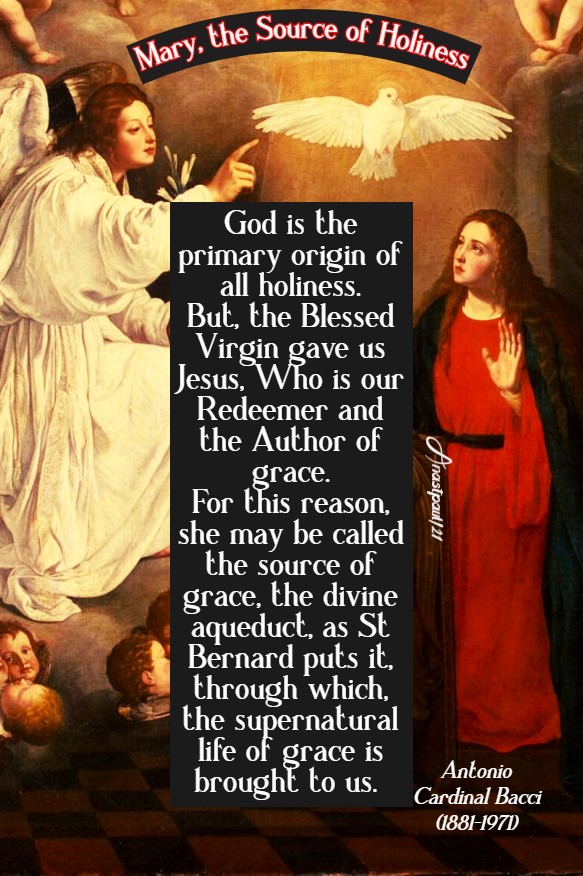
Frequent Confession and Communion
“The purifying and reforming action of frequent Confession is completed by the practice of receiving Communion, as frequently as possible.
Sacramental Confession gives us the grace of God, while Holy Communion gives us the Author of that grace, Jesus Christ, living and really present, Who comes to dwell in our poor hearts. How can anybody who goes frequently to Confession and Communion sin? How can any man cast himself once more into the clutches of the devil after experiencing the heavenly consolation of the Eucharist?
Do not protest that we are not worthy to go to Holy Communion frequently… It is true that we are not worthy but, we have a great need of this divine nourishment. If we wait until we are worthy, we shall never approach the Sacred Banquet but, if we realise our need of Jesus, we shall want to receive Him everyday. This was the practice of the early Christians, who were persevering in prayer and in the ‘Breaking of Bread’ that is, in receiving Holy Communion. From the divine Eucharist, they gained the courage to endure martyrdom. A good life is a slow martyrdom – we, who must be virtuous, have a continual need of Holy Communion, the food of the strong!”
Thought for the Day – 19 April – Meditations with Antonio Cardinal Bacci (1881-1971)
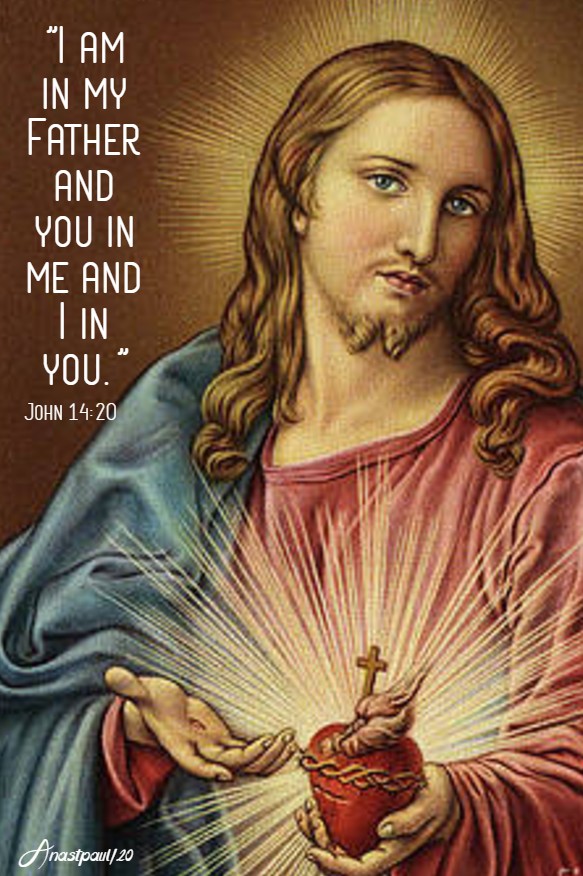
Faith and Charity
“Faith is a wonderful thing. As has been said, it is a supernatural gift from God, which we should keep alive by prayer. Faith alone is not enough, however. It is the foundation, on which we must build the structure of our Christian life. It is especially necessary for it to be united to the flame of charity. “Without love,” says St Augustine, “there is only the faith, which the devil has” (De Caritate 10) because, as St James explains, “the devil also believes and trembles” (Js 2:19). We, however, should believe and love. We must combine faith with charity towards God and towards our neighbour. Our faith should be active. As St Paul says, it should work under the influence of charity (Gal 5:6). Without charity and good works, faith is a lifeless thing.
If we really believe, we should love God above all things, even more than we love ourselves and, we should be ready to make any sacrifice for Him, even the sacrifice of our lives.
Faith should induce us to think constantly of God and charity should urge us to do everytig for His sake, rather than for any lesser purpose. If we lack this kind of charity, we cannot claim to be sincere Christians.”
Thought for the Day – 18 April – Meditations with Antonio Cardinal Bacci (1881-1971)
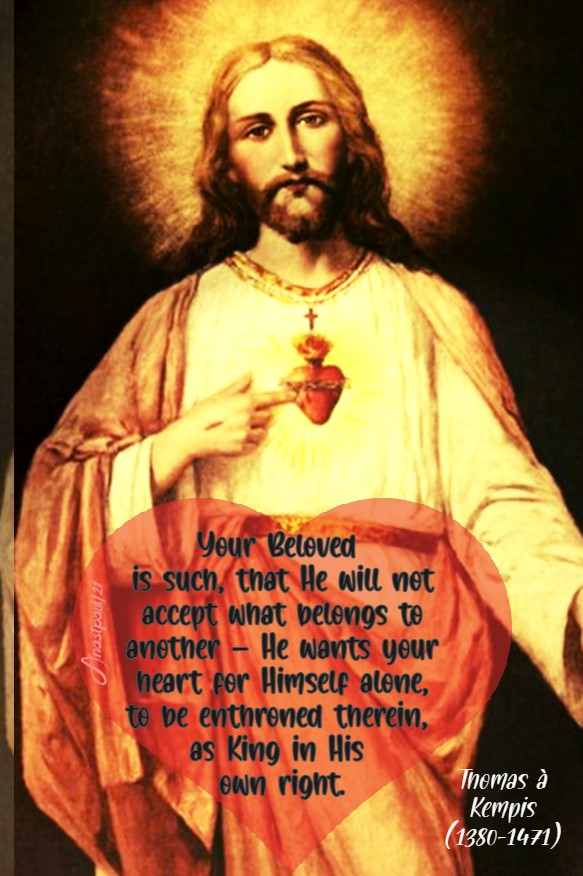
A Life of Fervour
“To pray is to love,” wrote St Augustine. The man who loves God, prays continually and with fervour, whereas the man who has little love for his Creator, prays rarely and apathetically. Prayer does not consist primarily in verbal expression but in the elevation of the mind to God in adoration, thanksgiving, propitiation and supplication. Love should be the inspiration of our communication with God, for where there is no love, there can be no prayer.
Jesus tells us that we “must always pray and not lose heart” (Lk 18:1). We may be working, talking, eating or sleeping but, whatever we are doing, the love of God, can transform it into a prayer. This is so, if we are engaged in our work but have offered it to God in advance. If we are in trouble, our sufferings will be pleasing to God. If we are walking about, everything will speak to us of God and cause us to make acts of gratitude and of love. We shall have dealings with men of the world but they will perceive and appreciate, that we are spiritually united to God. We shall sleep because sleep is necessary but, what appears to be hours of fruitless inactivity, will be dedicated to our Creator. Fervour in prayer and in action, should be the constant ideal of the good Christian, because, it makes his entire life pleasing to God.”
Thought for the Day – 17 April – Meditations with Antonio Cardinal Bacci (1881-1971)
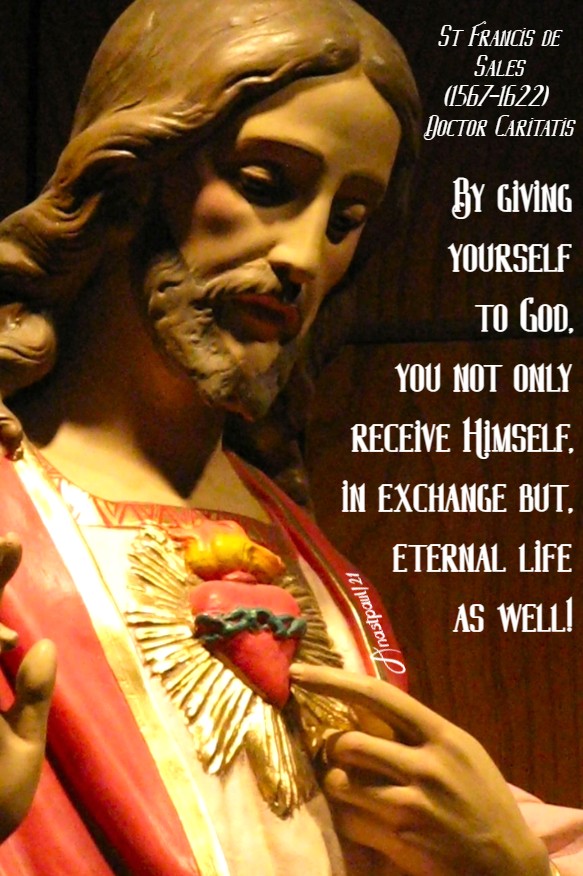
The Storms of Life
“The Evangelist describes how Jesus got nto a boat one day, alog with His Apostles and and set out across the lake of Genesareth. Suddenly a great storm arose, so furious, that the waves covered the tiny vessel and threatened to submerge it. The Apostles were terrified and turned to Jesus but, He was asleep. They woke Him, crying out: “Lord, save us! We are perishing!” He sat up and said to them: “Why are you afraid, O you of little faith?” Then, He rebuked the wind and the sea and immediately all was calm again. His followers were astonished. “What manner of man is this,” they asked one another, “that even the wind and the sea obey him?” (Mt 8:23-26; Mk 4:36-49; Lk 8:22-25).
We also are often subjected to the tempests of life. Sometimes, these storms, are purely interior, as when our lower impulses threaten to overcome our good resolutions and to submerge our purity of soul. In these serious crises, we should turn humbly and fervently to Jesus for help. Sometimes perhaps, Jesus will seem to be asleep and deaf to our anguished entreaties. But it is never so! He simply wishes to test us, as He tested His Apostles on the lake of Genesareth.
We must persevere. We must tell Him that we do not wish to lose His grace, that we do not wish to fall into sin but desire to go on loving Him. If our prayers are humble and insistent, we may rest assured, that after our moment of trial, Jesus Christ will speak to us. At the sound of His Voice, the tempest will be stilled and there will come, a great calm. Then, we shall experience the peace, which only God can give.
One Minute Reflection – 17 April – “Saturday of the Second Week of Easter, Readings: First: Acts 6: 1-7, Psalm: Psalms 33: 1-2, 4-5, 18-19, Gospel: John 6: 16-21 and the meorial of St Pope Anicetus I (Died 168)
“It is I, be not afraid.”…John 6:20
REFLECTION – “Enlighten me, good Jesus, with the brightness of internal light and take away all darkness from the habitation of my heart. Restrain my wandering thoughts and suppress the temptations which attack me so violently. Fight strongly for me, and vanquish these evil beasts — the alluring desires of the flesh — so that peace may come through Your power and the fullness of Your praise resound in the holy courts, which is a pure conscience. Command the winds and the tempests, say to the sea: “Be still” and to the north wind, “Do not blow” and there will be a great calm.
Send forth Your light and Your truth to shine on the earth, for I am as earth, empty and formless until You illumine me. Pour out Your grace from above. Shower my heart with heavenly dew. Open the springs of devotion to water the earth, that it may produce the best of good fruits. Lift up my heart pressed down by the weight of sins and direct all my desires to heavenly things, that having tasted the sweetness of supernal happiness, I may find no pleasure in thinking of earthly things.
Snatch me up and deliver me from all the passing comfort of creatures, for no created thing can fully quiet and satisfy my desires. Join me to Yourself in an inseparable bond of love because You alone can satisfy him who loves You and without You, all things are worthless.” – Thomas à Kempis CRSA (1380-1471) – The Imitation of Christ – Book 3 Ch 23
PRAYER – Let us praise You Lord, with voice and mind and deed and since life itself is Your gift, may all we have and are, be Yours! May our Mother be with us and pray for us and listen, we pray, to the prayers of St Pope Anicetus as we ask his intercession. Through Christ our Lord, with the Holy Spirit, in union with You, one God for all eternity, amen.
Acts 6: 1-7 1 And in those days, the number of the disciples increasing, there arose a murmuring of the Greeks against the Hebrews, for that their widows were neglected in the daily ministration. 2 Then the twelve calling together the multitude of the disciples, said: It is not reason that we should leave the word of God and serve tables. 3 Wherefore, brethren, look out among you seven men of good reputation, full of the Holy Ghost and wisdom, whom we may appoint over this business. 4 But we will give ourselves continually to prayer and to the ministry of the word. 5 And the saying was liked by all the multitude. And they chose Stephen, a man full of faith and of the Holy Ghost and Philip and Prochorus and Nicanor and Timon, and Parmenas and Nicolas a proselyte of Antioch. 6 These they set before the apostles; and they praying, imposed hands upon them. 7 And the word of the Lord increased; and the number of the disciples was multiplied in Jerusalem exceedingly, a great multitude also of the priests obeyed the faith.
Gospel: John 6: 16-21 16 And when evening was come, his disciples went down to the sea. 17 And when they had gone up into a ship, they went over the sea to Capharnaum; and it was now dark and Jesus was not come unto them. 18 And the sea arose, by reason of a great wind that blew. 19 When they had rowed, therefore ,about five and twenty or thirty furlongs, they saw Jesus, walking upon the sea and drawing nigh to the ship and they were afraid. 20 But he saith to them: It is I; be not afraid. 21 They were willing, therefore, to take him into the ship and presently the ship was at the land to which they were going.
Thought for the Day – 16 April– “Month of the Blessed Sacrament” – Meditations with Antonio Cardinal Bacci (1881-1971)
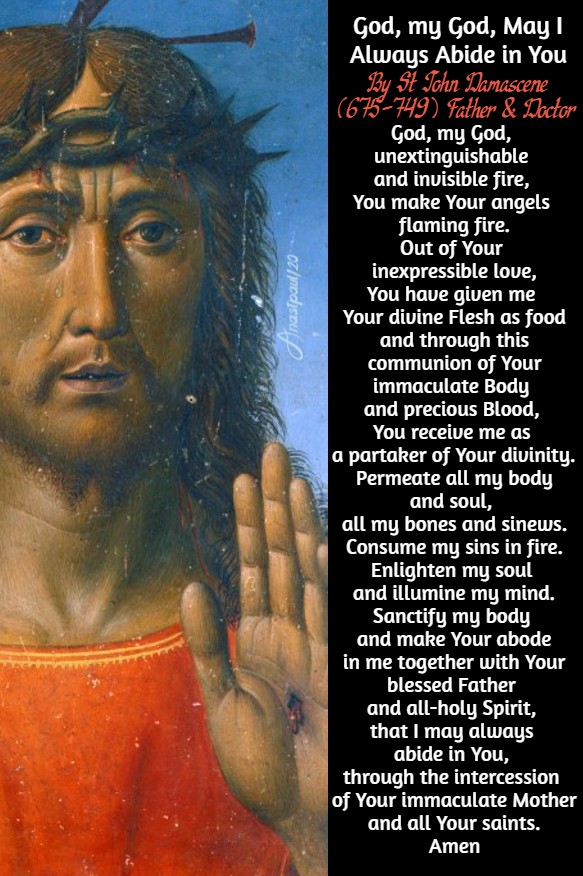
Holy Communion
“St Therese of the Child Jesus truly claimed, that one Holy Communion, made with perfect dispositions, was enough to produce a saint! When we receive Holy Communion properly, we are transformed into Jesus and, therefore, we become holy. We live, no longer as ourselves but, we live in Jesus. Not alone are we purified of all our imperfections but, we are emptied of ourselves in order to receive Jesus into ourselves. Jesus becomes the dominant thought in our minds and the central desire of our hearts.
Holy Commuion, therefore, should be a supernatural miracle which causes us to live the life of Jesus.
This is the reason why the early Christians gathered daily at the Eucharistic table. They felt the need of achieving, everyday, the transformation of their souls into Jesus. They hungered for Jesus, they burned with love for Him, they were one in heart and in soul.
Let us examine ourselves and see if our communions have anything like this effect on us. “Let a man prove himself,” says St Paul “and so let him eat of that bread and drink of the cup, for he who eats and drinks unworthily, eats and drinks judgement to himself ” (1 Cor 2:28-29).
We should examine ourselves before Holy Communion and make an act of sorrow for our sins and imperfections. Then we shall be able to approach Jesus with love and confidence. We need not be afraid, for it is He Who invites us. It is He Who desires to be united with us in order to make us like Himself.
Let us go to Him, with repentance, with humility and with love. Then He will make us holy.”
Thought for the Day – 15 April – Meditations with Antonio Cardinal Bacci (1881-1971)
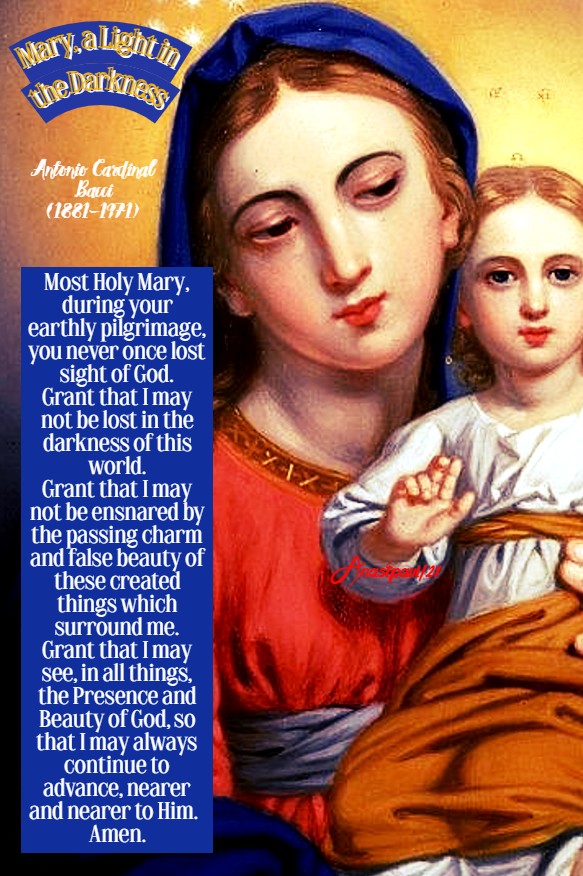
What the Holy Spirit Requires of Us
“The Holy Spirit, coming into our souls, asks us to do four things, in particular.
(1) To keep far from us everything which could be displeasing to God. This means that we must avoid sin, which is hateful to God and brings about the death of the soul. When the sin is grave, it destroys charity in us; when it is venial sin, it diminishes our fervour and capacity for good action. We have become the temples of the Holy Spirit. Let us do our best, therefore, to keep ourselves pure and free from every stain of sin. “Do not grieve the Holy Spirit of God, in whom you were sealed for the day of redemption” (Eph 4:30).
(2) To avoid contamination by the spirit of the world, which is repugnant to the Spirit of God. The world is selfish and we should be on fire with love for God and for our neighbour. The world is vain and proud and we should love obscurity, recollection and humility. The world looks for happiness in honour, wealth and pleasure in the passing goods of this life. We, on the other hand, should seek our happiness in eternal and heavenly values because God alone can satisfy our hearts and make us happy.
(3) Too avoid affections which are too human and sensual. Only the clean of heart can see and enjoy God. All the objects and all the people of this world, should form for us, a ladder which leads to God.
(4) To seek the divine inspiration of the Holy Spirit, in recollection and in prayer.
We should listen for His voice within us, inspiring and advising us. We should do, obediently, whatever He desires, no matter what sacrifices this may entail.”
Thought for the Day – 14 April – Meditations with Antonio Cardinal Bacci (1881-1971)
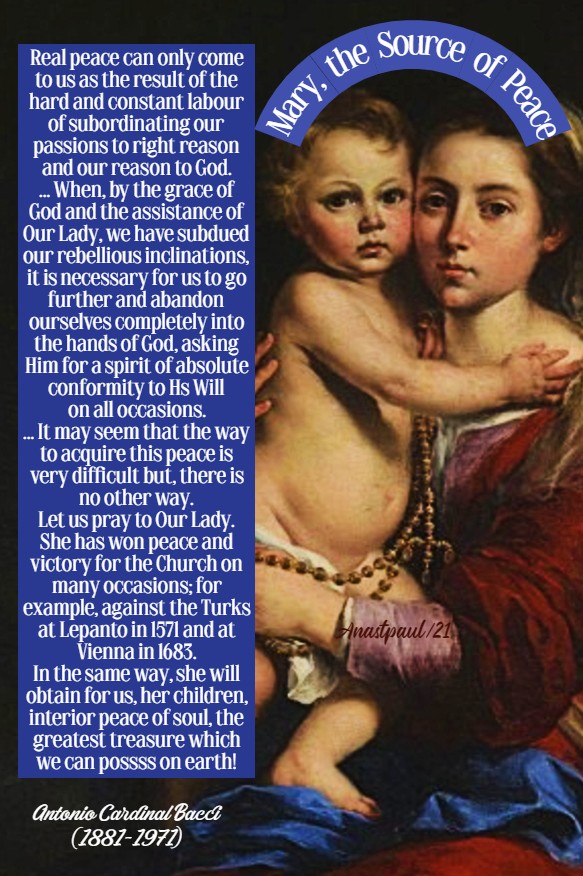
The Tabernacle Lamp
“Look up at the lamp quietly glowin before the Taberncle in honour of the Eucharistic Presence of Jesus, the Light of the world. We also, should be like living lamps of love.
The lamp burns night and day in the Presence of Jesus and burns itself out for Him. For what do we wear out our lives? In useless and unnecessary projects, perhaps for worldly reasons, for the satisfaction of our ego or of our passions? We shall certainly never find peace this way but only disillusionment and remorse.
The lamp is the light in the darkness. Our lives should be a light of good example to others.
The lamp has a flame which gives heat. We should burn with love for God, our one and only good and, for all men, whom we should regard as our brothers in Jesus Christ.
The lamp is raised above the ground and is suspended from tbe ceiling by three chains. We should be above earthly things and should be attached to Heaven by the three chains of faith, hope ad charity. As the lamp opens out, only on top, so should we be open to Heavenly inspirations and closed to worldly preoccupations. God should be tbe centre of our thoughts and our lives should be dedicated to Him. In this way, we shall find peace on earth and happiness hereafter.”
Thought for the Day – 13 April – Meditations with Antonio Cardinal Bacci (1881-1971)
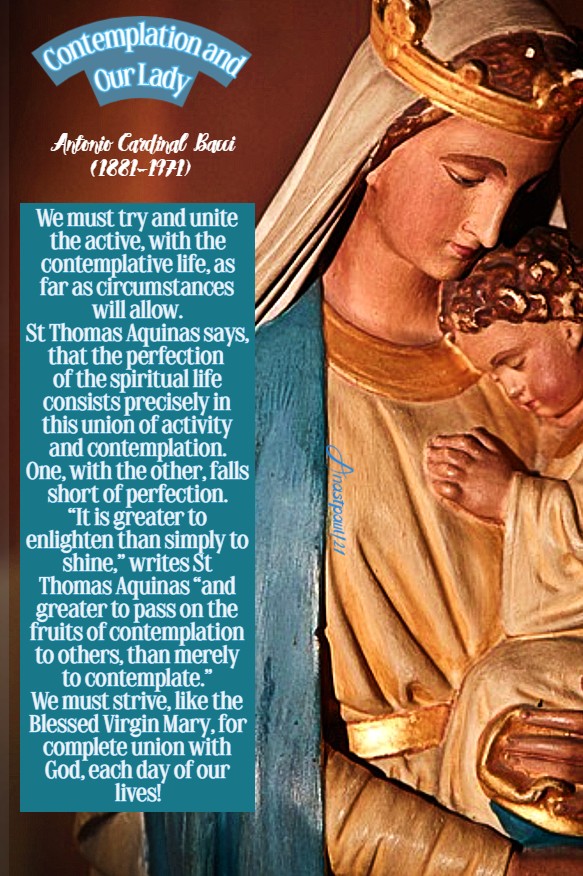
My Life is Christ
“St Paul reached such a degree of union with Christ that he could exclaim” “To me to live is Christ” (Phil 1:21). Elsewhere he says” “It is now no longer I that live but Christ lives in me” (Gal 2:20). This is a characteristic of the Saints. They live their own lives no longer, for they live the life of Christ. That is to say, their minds and hearts are always fixed on Jesus. They love the Lord, more than all things and, more than themselves. God is the object of all their desires, affections and actions. As a result, the soul is transfigured and is infused with divine life, so that it does nothing which is not activated by grace. In the Saints, then, there is reflected something heavenly which attracts and stimulates one to virtue.
The Saints preached effectively in simple, unadorned language, as in the case of the Cure of Ars. But, their most effective sermon was the example of their lives. They could say with St Paul: “To me to live is Christ.” They could repeat the thought of St Jerome: “Christ is the breath of my lips.” Like St John Chrysostom, they could say: “My heart is the heart of Christ.” They could say with St Augustine: “I am only an instrument in the service of Christ” and, with St Anselm: “My eyes are the eyes of Christ.”
When we meditate on these words, which signify the height of sanctity, we feel very small, shabby and far from the Christian perfection to which we should aspire. Perhaps we are still immersed in sin, or perhaps, we are wavering between the things of this world and the things of God, or perhaps, as yet, we have not given up our egoism and complacent mediocrity in order to offer ourselves entirely to God. Real Christianity demands that we renounce ourselves, live the life of Christ and, make every effort to acquire perfection.”
Thought for the Day – 12 April– Meditations with Antonio Cardinal Bacci (1881-1971)
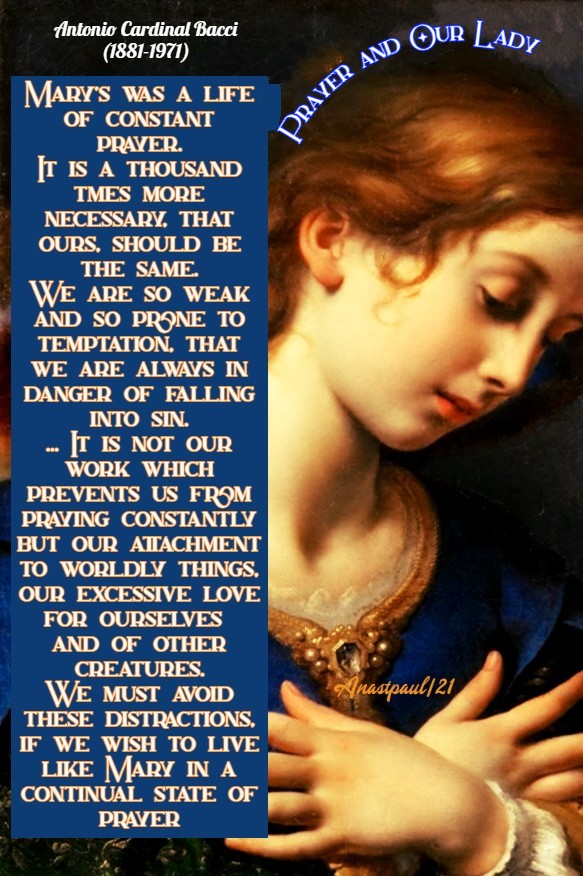
The Sacrament of Baptism
“Like the other Sacraments, Baptism is composed of a material and a spiritual element. The sensible outward sign produces the grace, or spiritual element, which it signifies. Since we are composed of body and soul, it is fitting that the Sacrament should also consist of this double element. Baptism, for example, being a spiritual cleansing of the soul, is conferred by the pouring of natural water, accompanied by the sacramental words by Jesus Christ.
The Church adds its own ceremonial to the essential part of the Sacrament. By means of the exorcisms, the devil is expelled and the tongue is consecrated with the salt of wisdom, to indicate, that it should be the instrument of goodness. The body is sanctified by the oil and chrism, so that it may always be the living temple of the Holy Spirit. The white garment, symbolises the innocence which we ought to preserve for the rest of our lives and the lighted candle, stands for the faith and charity, which ought always to inspire the soul.
All this is done for us before we are in a position to understand anything about it. Nevertheless, we should reflect today on the meaning of these sacred ceremonies and on how they should affect our lives. Can we claim to have kept our promises? Or are we forced to admit that we have not always lived up to our obligations? Let us renew our promises today and let us ask Jesus, for the grace, to be faithful to them all, until the end of our lives. Amen!
Thought for the Day – 11 April – Meditations with Antonio Cardinal Bacci (1881-1971)
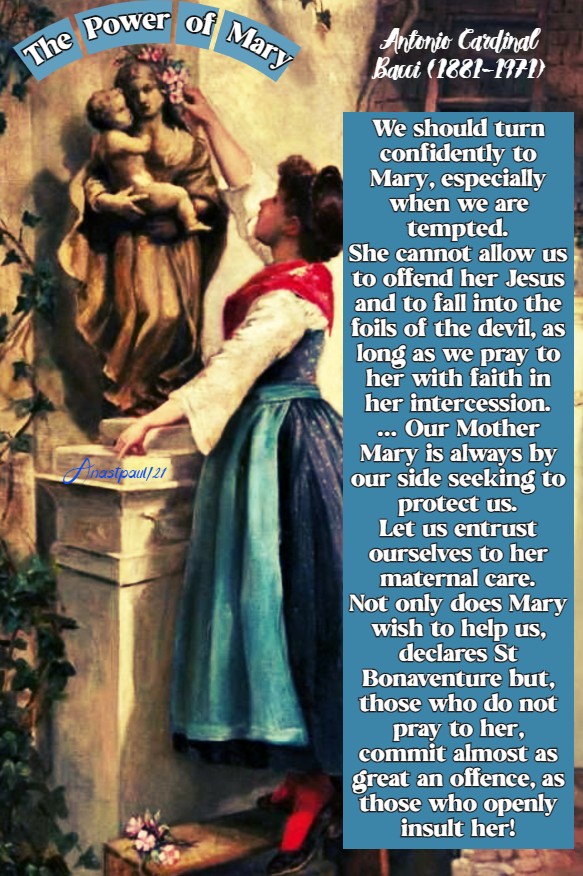
The Mercy of God
“God is the Being, Who is infinitely true, beautiful and good. His goodness is manifested in His infinite love for all the creatures which He has made but, it is in His relations with sinners, in particular, that we call Him merciful. He loves all things which He has created and directs them towards Himself, their beginning and their end. When He is dealing, however, with beings endowed with free will, who can separate themselves from Him and even offend Him, He tries, while respecting the liberty which He has given them, to recall them to Himself, by the influence of His love and of His grace. It is this supernatural outpouring of love towards sinners, which we call mercy.
The mercy of God shines forth in all the pages of Sacred Scripture. In the Old Testament, there is promised and foreshadowed, in many ways, the coming of the Saviour of the sinful human race. In the New Testament, Jesus appears, made man for our salvation, meek and humble of heart and merciful towards the unfortunate, especially towards sinners. For them, He offers His life and His Precious Blood, dying on the Cross with His arms outstretched, as if in an embrace of forgiveness. He tells us that He has not come to call the just but sinners, (Lk 5:32) and, that He has not come to those who are in health but to those who are sick (Mk 2:17); He assures us that, if we ask the Father for anything in His name, it will be given to us (Jn 16:23). So much goodness should move and soften our hearts. Even if we are unfaithful servants and are covered with the leprosy of sin, let us go to Him and He will heal us. Even if we have deserved Hell a thousand times, let us shed tears of repentance at His feet as Magdalen did and, He will give us His forgiveness and His peace.”
Quote/s of the Day – 11 April – The Octave Day of Easter, Readings; First: Acts 4: 32-35,salm: Psalms 118: 2-4, 13-15, 22-24,Second: First John 5: 1-6, Gospel: John 20: 19-31
“According to your faith, be it done to you.”
Matthew 9:30
“He [Christ], protects their faith and gives strength to believers, in proportion to the TRUST, that each man, who receives that strength, is willing to place in Him.”
St Cyprian of Carthage (c 200- c 258) Bishop and Martyr, Father of the Church
“Place all your trust in God, let Him be your fear and your love. He will answer for you, He will do what is best for you. You have here no lasting home. You are a stranger and a pilgrim wherever you may be and you shall have no rest, until you are wholly united with Christ. Why do you look about here when this is not the place of your repose?”
Thought for the Day – 10 April – Meditations with Antonio Cardinal Bacci (1881-1971)
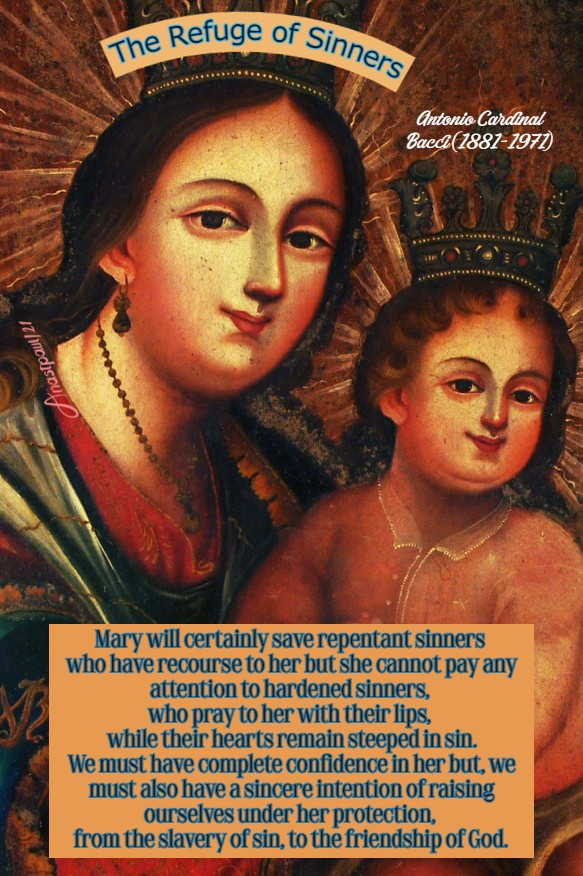
Word and Example
“Good example is the most effective sermon and we are all obliged to preach in this fashion. God entrusted the care of his neighbour to each one of us (Ecclus 17:12). Each of us is responsible for the salvation of those who have been entrusted to him in this way, especially for the salvation of those who live near him and are influenced by his behaviour. Jesus’ exhortations in this regard, have the force of a command. “Let your light shine before men,” He says, “in order that they may see your good works and give glory to your Father in heaven” (Mt 5:16). St Paul urges us to “provide good things, not only in the sight of God but also, in the sight of all men” (Cf Rom 12:17). This must not be interpreted as meaning, that we should be anxious for others to see our good deeds, in order that they may respect and praise us. It is our own undoing if our good example is tainted with ostentation, for we should lose all merit for it and should deserve to hear the words of the Eternal Judge: “You have received your reward” (Cf Mt 6:5). Our good example should be inspired only by the love of God and of our neighbour but never, by self-love. By saving the souls of others, we save our own!”
Thought for the Day – 9 April – Meditations with Antonio Cardinal Bacci (1881-1971)
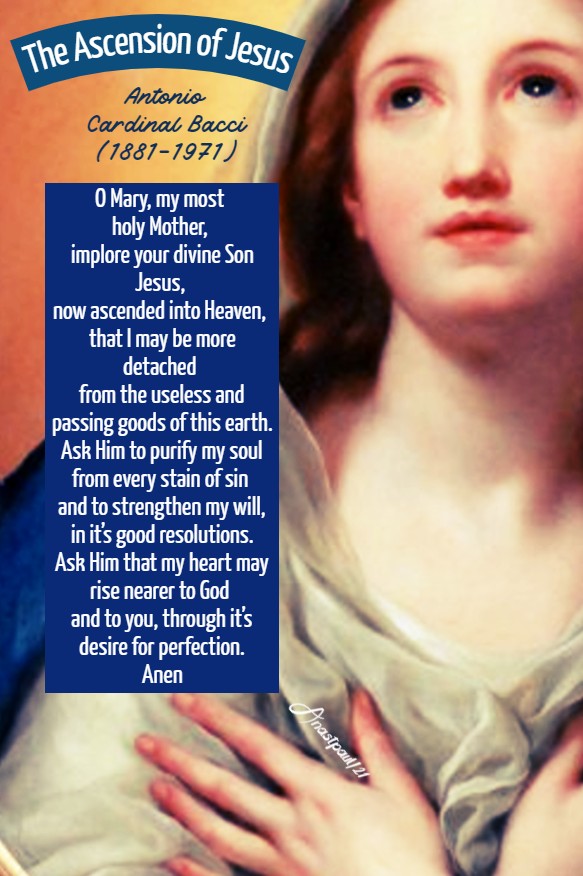
The Repentance of St Peter
“Peter had denied his Master three times. He was standing in the courtyard of the High Priest, waming hmself before a brazier and not even thinking of the depths to which he had descended. Jesus, caluminated, struck and mocked, as if He were a criminal, forgets altogether about Himself. Moved by compassion for the leader of His Apostles, now become a perjurer, He turns His gaze towards him. Peter is jerked back to his senses by this look, which is at the same time, stern and affectionate. He realises at last, the level to which he has fallen. He is stricken to the heart and feels a sudden tightness in hs throat. “And Peter went out and wept bitterly” (Lk 22:62).
Peter saw clearly, at this stage, the chasm into which he had fallen. He thought of all the gifts and favours which he had received from Jesus and recalled the prophecy which his Master had made. “A cock will not crow ths day, until thou hast denied, three times, that thou knowest me” (Lk 22:34). He remembered, also, how he had sworn that he would never deny Jesus. Now he saw himself in the role of the prodigal son or the lost sheep … and, as he wept bitterly, he saw again, the reproachful, yet loving gaze of Jesus. His grief found an outlet in hIs tears and he was filled with confidence, that Jesus, in His infinite goodness, wuld forgive him.
If we should fall (as we often do, unfortunately), let us rise again immediately, as Peter did. Let us weep for our sins and kneeling before Jesus, represented by the Priest, let us confess our faults and tell God, that we shall never offend Him again. ”
Thought for the Day – 8 April – Meditations with Antonio Cardinal Bacci (1881-1971)
Easter: The Herald of Peace
“For this interior peace to be complete, it is necessary that it should exist in our relations with God, with ourselves and with our neighbour. Peace with God, is especially necessary. This involves the subjection of the intellect and will, to Him, perfect obedience to His law, the avoidance of sin and the entire surrender of ourselves to Him. When we have prepared ourselves in this way, God will visit us with His grace and we shall experience the joy of inward peace.
Jesus came into the world to bring us this peace, which He provides for us with His Precious Blood, thereby, erasing sin and opening the gates of Heaven. So much the worse for us, if we destroy the work of God by turning back to sin. We shall no longer be at peace with God, Who hates sin so much, that in order to redeem us from it, He gave us His only-begotten Son, nor with ourselves because “there is not peace to the wicked” (Is 48:22). Remorse and disgust are the necessary results of sin.
Let us remember, that those who are really content, even in this world, are those who lead good lives. Whoever extinguishes divine grace in himself, destroys the harmony and order which reigned in his soul as a result of the subjection of his reason to his Creator and Redeemer. Then, because we are not at peace with God, nor with ourselves, we cannot really be at peace with men. It is our faith which teaches us, that they are our brothers, redeemed, as we have been, by the Precious Blood of Jesus Christ and that, therefore, we should always love and assist them.”
Thought for the Day – 7 April – Meditations with Antonio Cardinal Bacci (1881-1971)
The Meaning of Easter, Part Two
“In the course of this battle for our spiritual resurrection, it is necessary for us to grow continually in Jesus. When we make a good Confession t Easter, He favours us anew, by means of His grace. When we receive Holy Communion, He comes to us and is renally present in our souls. But, in what way is He present? Sometimes, He is silent and hidden. He may seem to be asleep, as He slept n the Apostles’ boat o the ea of Galilee, when the waves were raging violently all around them. Often, we have Jesus within us but do not listen to His Voice. He does not live actively in us; He does not speak to us. Why is this? It is because, we are distracted and indifferent, absorbed in the petty affairs of this world. We must be fervent! It is necessary to LISTEN for His Voice, to be united to Him and, above all, to LOVE Him. Then, our actions will not be our own but, HIS. He will grow in us by His grace and we shall act in Jesus, with Jesus and for Jesus. Then, Jesus will be everything to us and we shall be able to say with St Paul, “It is now, no longer I that live but, Christ lives in me” (Gal 2:20).
Does this goal seem too difficult to attain? Does it seem that it is not meant for us? Such a doubt is an insult to Our Lord, Who, has told us to be perfect, as His heavenly Father is perfect. (Cf Mt 5:48). It is enough, however, that we should earnestly desire to reach this goal and should try, with the help of God’s grace, to come gradually nearer to it everyday. THIS is the resurrection which should take place in us this Easter!”
You must be logged in to post a comment.