Posted in SAINT of the DAY

Saint of the day – 22 July – Blessed María Inés Teresa of the Blessed Sacrament

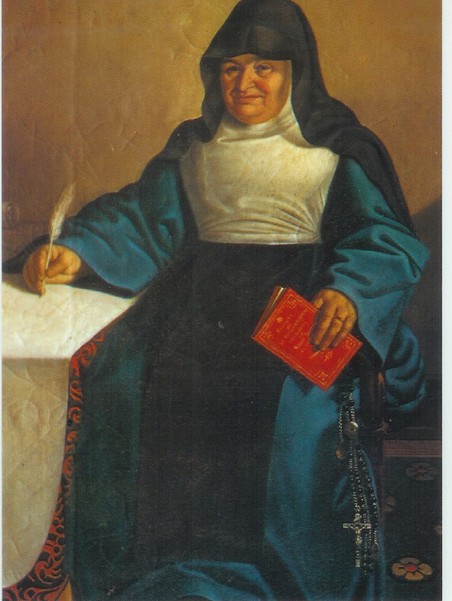
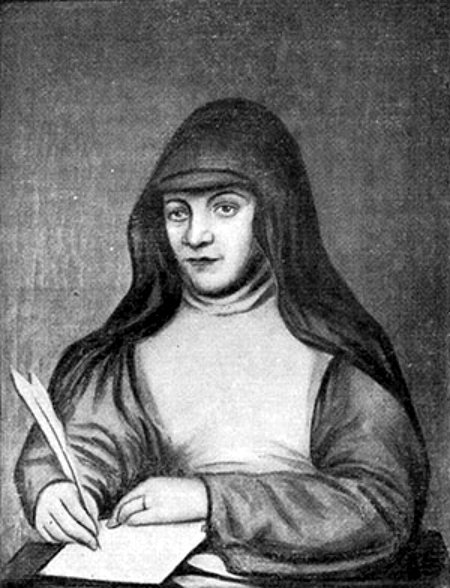
Saint of the day – 22 July – Blessed Manuela de Jesus Arias Espinosa (1904-1981) her religious name “María Inés Teresa of the Blessed Sacrament” – Sister and Founder of both the Poor Clare Missionary Sisters of the Blessed Sacrament (1945) and the Missionaries of Christ for the Universal Church (1979), of which orders, she is the Patron. She is known as “Manuelita”.   Born on 7 July 1904 in Ixtlán del Rio, Nayarit, Mexico and died on 22 July 1981 in Rome, Italy of natural causes.
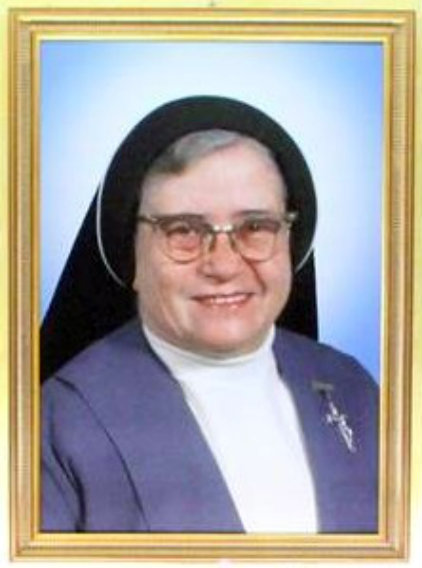
Manuela de Jesús Arias Espinosa was born in Mexico in 1904 as the fifth of eight children to the pious Eustaquio Arias Arroniz and María Espinosa López Portillo, she made her First Communion in 1911.

Her religious calling blossomed in 1924 after attending a religious congress in October 1924 and received inspiration after reading a life of Saint Thérèse of Lisieux but her firm decision to enter the religious life did not come until the Feast of Christ the King in 1926.

She entered the “Ave Maria” convent in Los Angeles on 5 June 1929. Espinosa made her initial vows on 12 December 1930 and she made her perpetual vows on 14 December 1933 and lived the cloistered life in the religious name of “María Inés Teresa of the Blessed Sacrament”.   Her time in the cloistered life lasted until 1949.

Maria founded – on 23 August 1945 – the Poor Clare Missionary Sisters of the Blessed Sacrament in Cuernavaca in Morelos and received the papal decree of praise in 1949 and the full approval of Pope Pius XII on 22 June 1951, she received the affectionate name of “Manuelita”.

Her next and final order founded was titled the Missionaries of Christ for the Universal Church and was established on 23 November 1979 in Nievo León.   On 9 December 1980 she had an audience with St Pope John Paul II in Rome.

In time, the nuns extended their evangelical activity to several countries of Asia and Africa, the US and several Latin American and European nations.

The Congregation of the Claretian Missionaries was further strengthened on 5 January 1953, when the Holy See authorised the formation of the Claretian Vanguards, a lay movement that has developed in step with the religious order.

The nuns are a Eucharistic, Marian and Missionary Congregation leading a contemplative-active life and adhering to the Divine Will, source of joy, with Jesus Christ as their centre.

They take the vows of chastity, poverty and obedience and witness fraternal love “always in a spirit of understanding and service, lived in love and peace, charity being what stimulates them to live not for themselves but for all souls in need.”PrayerCard bl maria teresa of the blessed sacrament

By the time of her death in Rome in 1981, she was over-seeing 36 missionary houses in 14 countries.

Over six thousand of her spiritual writings still remain.

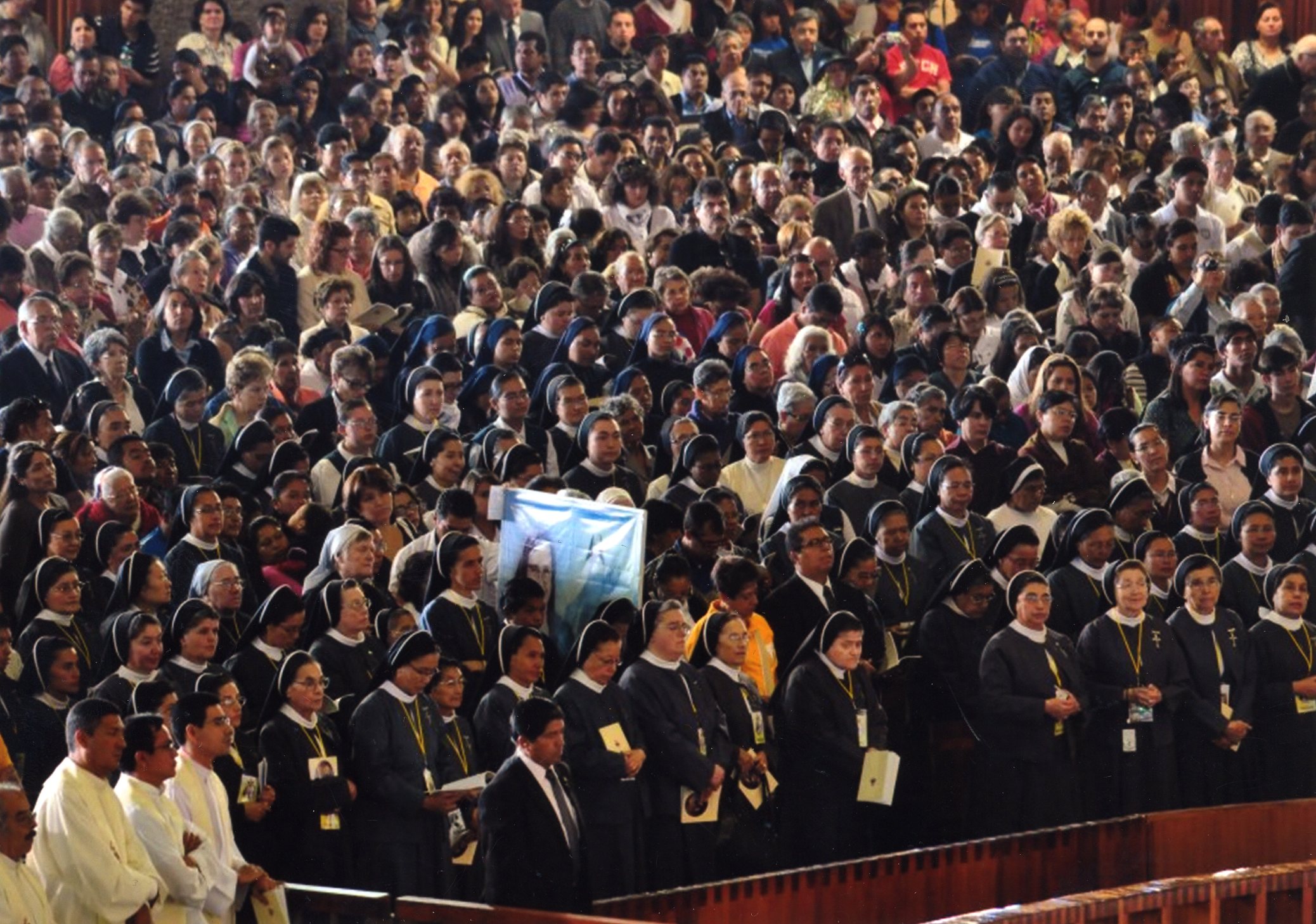
Mother Maria Inés Teresa of the Most Blessed Sacrament was beatified on Saturday 21 April in Mexico City by the prefect of the Vatican Congregation for Saints’ Causes, Card. Angelo Amato, who represented Pope Benedict XVI.   The Beatification ceremony, was held in the main Basilica of Our Lady of Guadalupe.

Posted in SAINT of the DAY

Feast of St Mary of Magdala and Memorials of the Saints – 22 July

St Mary of Magdala (Feast) “The Apostle of the Apostles” (St Thomas Aquinas)
About St Mary:
https://anastpaul.wordpress.com/2017/07/22/saint-of-the-day-22-july-the-feast-of-st-mary-of-magdala-apostle-to-the-apostles/

St Anastasius of Schemarius
St Andrea of Antioch
St Andreas Wang Tianqing
St Anna Wang
Bl Augustine Fangi O.P. (1430-1493)  Biography:  https://anastpaul.com/2018/07/22/saint-of-the-day-22-july-blessed-augustine-fangi-o-p-1430-1493/

St Baudry of Montfaucon
Bl Benno of Osnabruck
St Claudius Marius Victorinus of Saussaye
St Cyril of Antioch
St Dabius
Bl Jacques Lombardie
St John Lloyd
St Joseph of Palestine
St Lewine
St Lucia Wang Wangzhi
Bl “María Inés Teresa of the Blessed Sacrament” / Manuela de Jesus Arias Espinosa (1904-1981)
St Maria Wang Lishi
St Meneleus of Ménat
St Movean of Inis-Coosery
St Pancharius of Besancon
Bl Paolo de Lara
St Philip Evans
St Plato of Ancyra
St Syntyche of Philippi
St Theophilus of Cyprus
St Wandrille of Fontenelle

Martyrs of Marula/Massylis: – 3 saints: Three Christians martyred together. We know nothing else about them but the names – Ajabosus, Andrew and Elian. They were martyred in Massylis (Marula), Numidia (in modern Algeria).

Martyrs of Massilitani: A group of Christians martyred together in northern Africa. Saint Augustine of Hippo wrote about them.

Martyred in the Spanish Civil War:
Bl Jaime María Carretero Rojas
Bl Joaquin Rodríguez Bueno
Bl José María Mateos Carballido
Bl Juan Durán Cintas
Bl Ramón María Pérez Sous

Posted in CHRIST, the WAY,TRUTH,LIFE, DOCTORS of the Church, franciscan OFM, QUOTES of the SAINTS, SAINT of the DAY

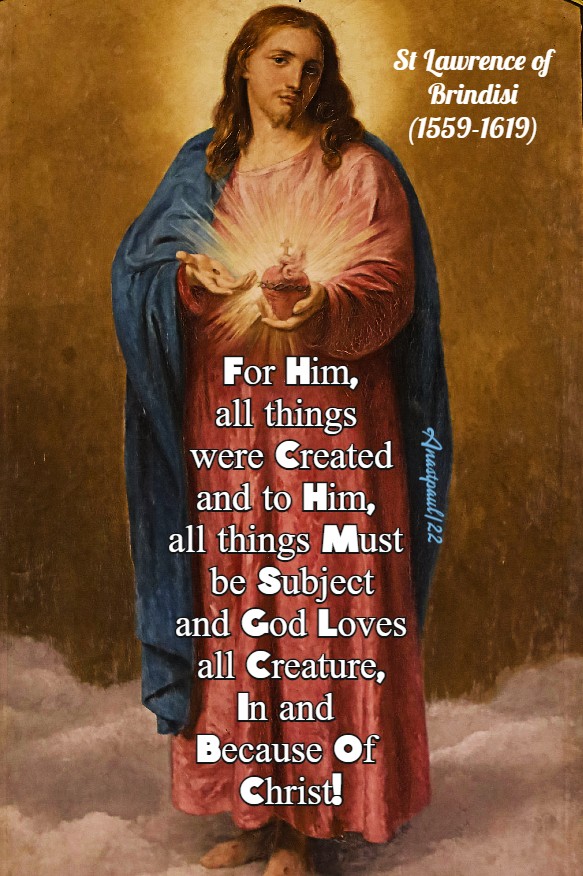
Quote of the Day – 21 July – ‘…In and because of Christ’

Quote of the Day – 21 July – The Memorial of St Lawrence of Brindisi OFM Cap (1559-1619) Doctor of the Church

“For Him all things were created
and to Him all things must be subject
and God loves all creature,
in and because of Christ.”

St Lawrence of Brindisi (1559-1619)

Posted in SAINT of the DAY

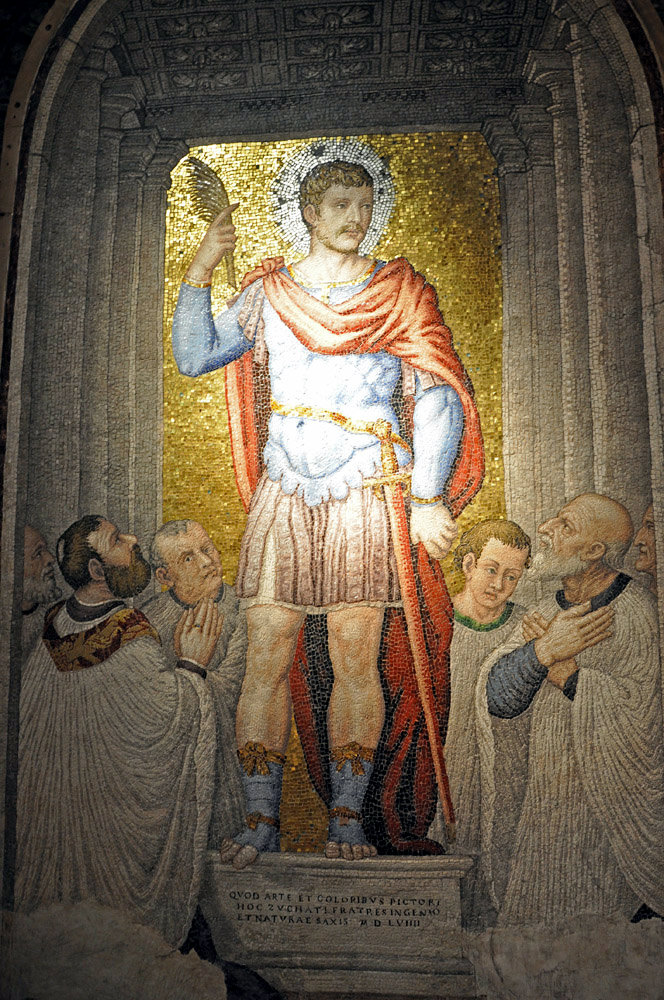
Saint of the Day – 21 July – St Victor (3rd century) Martyr

Saint of the Day – 21 July – St Victor (3rd century) Martyr and Confessor – also called St Victor of Marseilles – a Christian Roman army officer – Patronages – against lightning, cabinetmakers, millers, torture victims, Marseilles, France, Davoli, Italy.San_Vittore_A

The Emperor Maximian, reeking with the blood of the Thebæan legion and many other martyrs, arrived at Marseilles, where the Church then flourished.   The tyrant breathed here, nothing but slaughter and fury and his coming, filled the Christians with fear and alarm.   In this general consternation, Victor, a Christian officer in the troops, went about at night, from house to house, visiting the faithful and inspiring them, with contempt of a temporal death and the love of eternal life.

He was caught doing this and brought before the prefects Asterius and Eutychius, who exhorted him, not to lose the fruit of all his services and the favour of his prince, for the worship of a dead man, as they called Jesus Christ.   He answered, that he renounced those recompenses, if he could not enjoy them without being unfaithful to Jesus Christ, the eternal Son of God, who vouchsafed to become man for our salvation but who raised Himself from the dead and reigns with the Father, being God equally with Him.   The whole court heard him with shouts of rage.  saint_victor_of_marseilleVictor was bound hand and foot and dragged through the streets of the city, exposed to the blows and insults of the populace. He was brought back bruised and bloody to the tribunal of the prefects who, thinking his resolution must have been weakened by his sufferings, pressed him again to adore their gods.   But the martyr, filled with the Holy Spirit, expressed his respect for the emperor and his contempt for their gods.   He was then hoisted on the rack and tortured a long time, until, the tormentors being at last weary, the prefect ordered him to be taken down and thrown into a dark dungeon.   At midnight, God visited him by His angels; the prison was filled with a light brighter than that of the sun and the martyr sung with the angels the praises of God.
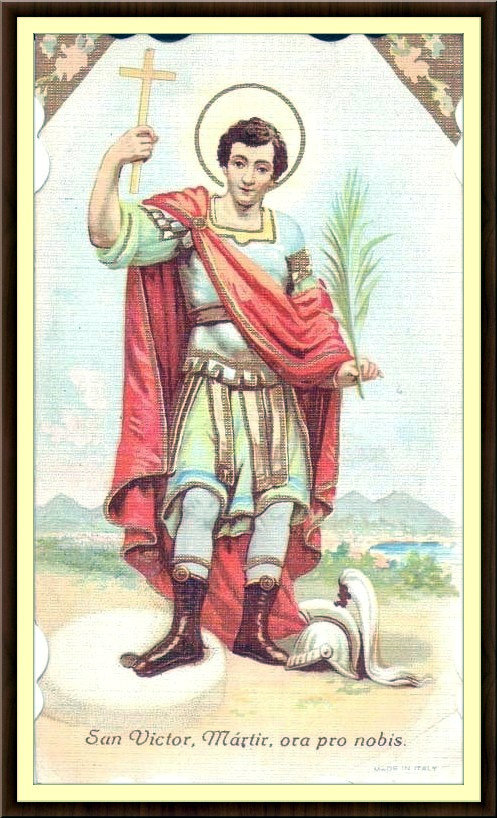
Three soldiers who guarded the prison, Saints Longinus, Alexander and Felician, seeing this light, cast themselves at the martyr’s feet, asked his pardon and desired Baptism.   Victor instructed them as well as time would permit, sent for priests the same night and, going with them to the seaside, had them baptised and returned with them again to his prison.   The next morning Maximian was informed of the conversion of the guards and in a transport of rage sent officers to bring them all four before him.   The three soldiers persevered in the confession of Jesus Christ and by the emperor’s orders were forthwith beheaded.ST VICTOR GLASS SNIP

Victor, after having been exposed to the insults of the whole city and beaten with clubs and scourged with leather thongs, was carried back to prison, where he continued three days, recommending to God his martyrdom with many tears.   After that term the emperor called him again before his tribunal and commanded the martyr to offer incense to a statue of Jupiter.   Victor went up to the profane altar and by a kick of his foot threw it down.   The emperor ordered the foot to be forthwith chopped off, which the Saint suffered with great joy, offering to God these first-fruits of his body.   A few moments after, the emperor condemned him to be put under the grindstone of a hand-mill and crushed to death.   The executioners turned the wheel and when part of his body was bruised and crushed the mill broke down.   The Saint still breathed a little but his head was immediately ordered to be cut off.ST VICTOR HOLY CARD

His and the other three bodies, were thrown into the sea but, being cast ashore, were buried by the Christians in a grotto hewn out of a rock.

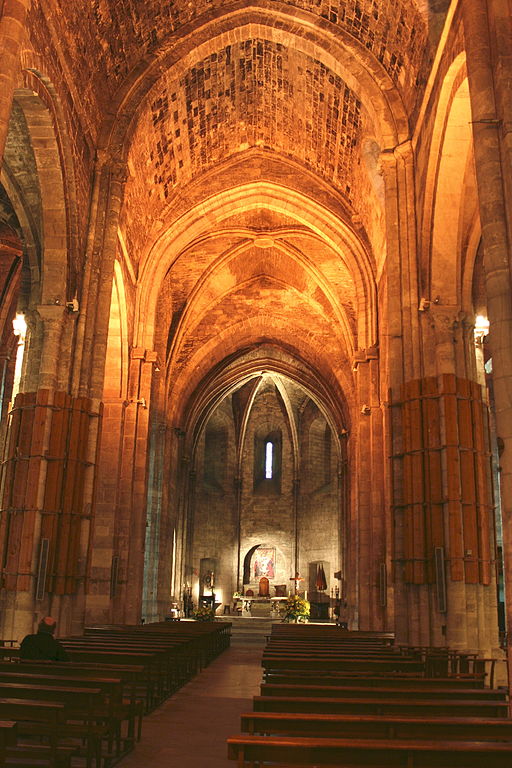
In the 4th century, Saint John Cassian (c 360-435), the disciple of St John Chrysostom, built a monastery over the site where their bodies had been buried in a cave, which later became a Benedictine abbey and minor basilica.   This is the Abbey of St Victor (Abbaye Saint-Victor), below.512px-Nef-Saint-Victor-Marseille

saint-victor-abbey-marseille

Saint Victor’s feast day, along with Saints Longinus, Alexander and Felician, is celebrated today, 21 July.ST VICTOR LG

Posted in SAINT of the DAY

Memorials of the Saints – 21 July

16th Sunday in Ordinary Time, Year C *2019

St Lawrence of Brindisi OFM Cap (1559-1619) Doctor of the Church (Optional Memorial)
Biography:
https://anastpaul.com/2018/07/21/saint-of-the-day-21-july-st-lawrence-of-brindisi-ofm-cap-1559-1619-doctor-of-the-church-the-franciscan-renaissance-man/

Our Lady of Kazan:
his miraculous icon, also known as the Theotokos of Kazan, is thought to have originated in Constantinople in the 13th century before it was taken to Russia. When the Turks took Kazan in 1438, the icon may have been hidden. Ivan the Terrible liberated Kazan in 1552 and the town was destroyed by fire in 1579.
The icon was eventually found in the ruins of a burnt-out house at Kazan on the River Volga on 8 July in 1579. According to tradition, the location of the icon was revealed during a dream by the Blessed Virgin Mary to a ten year old girl named Matrona. Matrona told the local bishop of her dream, but he did not believe her. There were two more similar dreams, after which Matrona and her mother went to the place indicated by the Blessed Virgin and dug in the ruins what had been a house until the uncovered the icon. It appeared untouched by the flames, with the colours as vivid and brilliant as if it were new. The bishop took the icon to the Church of Saint Nicholas and immediately there was a miracle of a blind man’s sight being restored to him. A monastery was built over the place where the icon had been found.
Known as the Holy Protectress of Russia, the icon was stolen on 29 June 1904. The thieves were later caught and claimed that they had destroyed the icon after taking the gold frame and jewels attached to the image. In any event, the original has never been found, though there are many copies in existence, thanks to the popularity of the icon. Many of the copies are known to be miracle working.
In 1993 a copy of the icon was given to Pope John Paul II, who kept it in his personal study before it was given to representatives of the Russian Orthodox Church in 2004.kazan_moscow.jpg

Bl Agrícola Rodríguez García de Los Huertos
St Alberic Crescitelli
St Arbogast of Strasbourg
St Barhadbescialas
St Benignus of Moyenmoutier
Bl Claudius of Avignon
St Claudius of Troyes
St Corona of Marceille
Bl Cristóbal López de Valladolid Orea
Bl Daniel Molini
St Daniel the Prophet
St Eleutherius of Marseille
St Eternus of Evreaux
Bl Gabriel Pergaud
St Iosephus Wang Yumei
St John of Edessa
St John of Moyenmoutier
Bl Juan de Las Varillas
Bl Juan de Zambrana
St Jucundinus of Troyes
St Julia of Troyes
St Justus of Troyes
Bl Parthenius of Thessaly
St Praxides of Rome
St Simeon Salus
St Victor (of Marseilles) (3rd century) Martyr

St Wastrada
St Zoticus of Comana

Martyrs of Africa – 6 saints: Six Christians who were martyred together. We know no other details about them but the names – Emilian, Hugal, Motanus, Saphus, Stercorius and Victor. They were martyred in an unknown location in Africa, date unknown.

Posted in SAINT of the DAY

Saint of the Day – 20 July – St Margaret of Antioch (3rd century) Martyr

Saint of the Day – 20 July – St Margaret of Antioch (3rd century) Martyr – also known as Saint Marina the Great Martyr – Virgin and Martyr – born in Antioch and died by being beheaded, date unknown (3rd century).   Patronages – childbirth, pregnant women, dying people, kidney disease, peasants, exiles, falsely accused people, Lowestoft, England; Queens’ College, Cambridge; nurses, Sannat and Bormla, Malta.

Margaret is one of the Fourteen Holy Helpers and is one of the saints who spoke to St Joan of Arc.saint-margaret-of-antioch-onorio-marinari.jpg

According to the version of the story in Golden Legend, she was a native of Antioch and the daughter of a pagan priest named Aedesius.   Her mother having died soon after her birth, Margaret was nursed by a Christian woman.   Having embraced Christianity and consecrated her virginity to God, Margaret was disowned by her father, adopted by her nurse and lived in the country keeping sheep with her foster mother (in what is now Turkey).st margaret of antioch header.jpg

Olybrius, Governor of the Roman Diocese of the East, asked to marry her but with the demand that she renounce Christianity.   Upon her refusal, she was cruelly tortured, during which various miraculous incidents occurred.

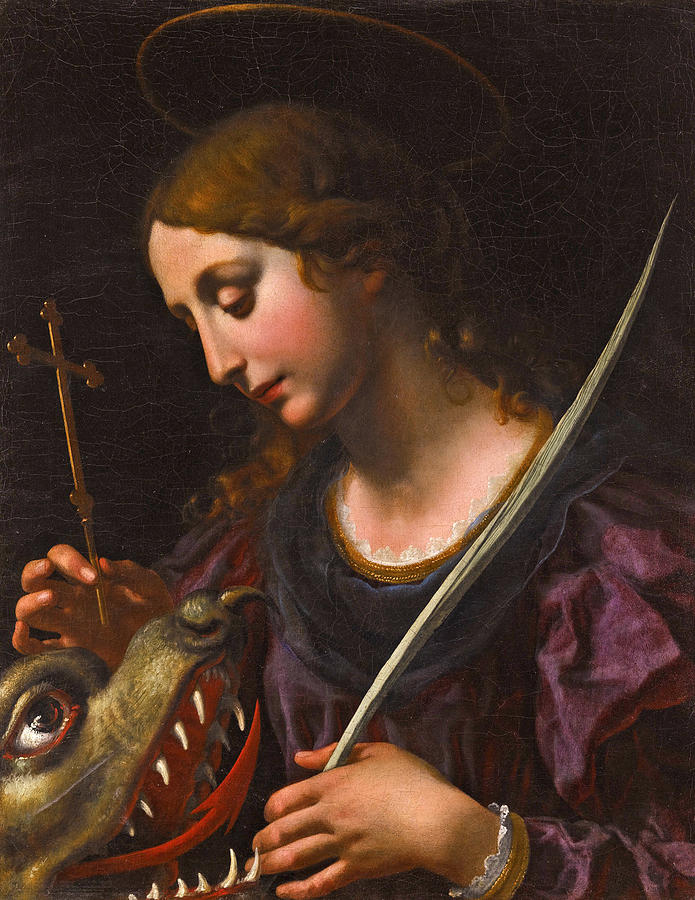
One of these involved being swallowed by Satan in the shape of a dragon, from which she escaped alive when the cross she carried irritated the dragon’s innards.   The Golden Legend describes this last incident as “apocryphal and not to be taken seriously” (trans. Ryan, 1.369).st margaret of antioch and the dragon.jpg

Whilst St Margaret is recognised as a saint by the Church, being listed as such in the Roman Martyrology for 20 July.   She was also included from the 12th to the 20th century among the saints to be commemorated wherever the Roman Rite was celebrated (on the Liturgical calendar) but was then removed from that list because of the entirely fabulous character of the stories told of her.

She became one of the most popular saints in England in the 9th century when her life was first recorded in English. Some two hundred early churches were dedicated to her, even though her legend had been declared apocryphal by the Pope as early as 494.   Be that as it may, the exaggerated miracles told of her life never deny her martyrdom for the faith.

Her remains and shrine are now kept at the Basilica of St Margaret at Monte-Fiascone in Tuscany, Italy – see below.basilica of st margaret.jpgcarlo-francesco-nuvolone-saint-margaret-of-antioch.jpg

Posted in FATHERS of the Church, SAINT of the DAY

Memorials of the Saints – 20 July

St Apollinaris of Ravenna – Disciple of St Peter – Martyr (Optional Memorial)
About holy St Apollinaris:
https://anastpaul.com/2017/07/20/saint-of-the-day-20-july-st-apollinaris/

Bl Anne Cartier
St Ansegisus
St Aurelius of Carthage
St Bernward of Hildesheim
St Cassian of Saint Saba
St Chi Zhuze
St Elijah the Prophet
St Elswith
Bl Gregory Lopez (1542-1596)
Biography:
https://anastpaul.com/2018/07/20/saint-of-the-day-20-july-blessed-gregory-lopez-1542-1596/
St José María Díaz Sanjurjo
St Joseph Barsabas
Bl Luigi Novarese
St Margaret of Antioch (3rd century) Martyr
St Maria Fu Guilin
St Mère
St Paul of Saint Zoilus
St Rorice of Limoges
St Severa of Oehren
St Severa of Saint Gemma
St Wulmar

Martyrs of Corinth – 22 saints: 22 Christians who were martyred together. We know nothing else about them but the names – • Appia • Calorus • Cassius • Celsus • Cyriacus • Donatus • Emilis • Felix • Fructus • Magnus • Maximus • Nestita • Partinus • Pasterus • Paul • Romanus • Spretus • Tertius • Theodolus • Ueratia • Valerian • Victor. They were martyred in Corinth, Greece.

Martyrs of Damascus – 16 saints: 16 Christians who were martyred together. We know the names of six of then, but no details about any of them – Cassia, Julian, Macrobius, Maximus, Paul and Sabinus. They were martyred in Damascus, Syria, date unknown.

Martyrs of Seoul – 8 saints: Eight lay native Koreans in various states of life who were murdered together for their faith.
• Anna Kim Chang-gum
• Ioannes Baptista Yi Kwang-nyol
• Lucia Kim Nusia
• Magdalena Yi Yong-hui
• Maria Won Kwi-im
• Martha Kim Song-im
• Rosa Kim No-sa
• Theresia Yi Mae-im
They were martyred on 20 July 1839 at the Small West Gate, Seoul, South Korea and Canonised on 6 May 1984 by St Pope John Paul.

Martyrs of Zhaojia – 3 saints: Married lay woman and her two daughters in the apostolic vicariate of Southeastern Zhili, China. During the persecutions of the Boxer Rebellion, the three of them hid in a well to avoid being raped. They were found, dragged out, and killed for being Christian. Martyrs. They were – Maria Zhao Guoshi (mother), Maria Zhao and Rosa Zhao (sisters). They were martyred in late July 1900 in Zhaojia, Wuqiao, Hebei, China.

Martyrs of Zhujiahe – 4 saints: Two Jesuit missionary priests and two local lay people who supported their work who were martyred together in the Boxer Rebellion during and immediately after Mass.
• Léon-Ignace Mangin
• Maria Zhu Wushi
• Paul Denn
• Petrus Zhu Rixin
They were martyred on 20 July 1900 in church in Zhujiahe, Jingxian, Hebei, China and Canonised on 1 October 2000 by St Pope John Paul.

Martyred in the Spanish Civil War:
• Blessed Abraham Furones y Furones
• Blessed Antoni Bosch Verdura
• Blessed Francisca Aldea y Araujo
• Blessed Jacinto García Riesco
• Blessed Joan Páfila Monllaó
• Blessed Josep Tristany Pujol
• Blessed Matías Cardona-Meseguer
• Blessed Rita Josefa Pujalte y Sánchez
• Blessed Vicente López y López

Posted in FATHERS of the Church, PRAYERS of the SAINTS, QUOTES of the SAINTS, SAINT of the DAY, The GOOD SHEPHERD, The WORD

Thought for the Day – 19 July – ‘You whom my soul loves’

Thought for the Day – 19 July – Friday of the Fifteenth week in Ordinary Time, Year C and the memorial of St Macrina the Younger – sister of St Gregory of Nyssa (c 335–395) Father of the Church

The Full Prayer as paraphrased in our Morning Offering today – This excerpt from St Gregory of Nyssa’s commentary on the Song of Songs (Cap. 2: PG 44, 802), using the imagery of Psalm 23, appeals to the Lord Jesus Christ for the promised green pastures, restful waters and noonday rest that is the final, eternal destination of those who love God and walk in His ways.   It is used in the Roman Catholic Office of readings for Thursday in the 33rd week in ordinary time with the corresponding biblical reading taken from Zechariah 11:4-12:8.

St Gregory of Nyssa (c 335–395)

Father of the Church

A Prayer to the Good Shepherd

Where are You pasturing Your flock, O good Shepherd, who carry the whole flock on Your shoulders?   (For the whole of human nature is one sheep and You have lifted it onto Your shoulders).   Show me the place of peace, lead me to the good grass that will nourish me, call me by name so that I, Your sheep, hear Your voice and by Your speech give me eternal life.   Answer me, You whom my soul loves.

I give You the name ‘You whom my soul loves’ because Your name is above every name and above all understanding and there is no rational nature that can utter it or comprehend it.   Therefore, Your name, by which Your goodness is known, is simply the love my soul has for You.   How could I not love You, when You loved me so much, even though I was black, that You laid down Your life for the sheep of Your flock?   A greater love cannot be imagined, than exchanging Your life for my salvation.

Show me then (my soul says) where You pasture your flock, so that I can find that saving pasture too and fill myself, with the food of heaven, without which no-one can come to eternal life and run to the spring and fill myself with the drink of God.   You give it, as from a spring, to those who thirst – water pouring from Your side cut open by the lance, water that, to whoever drinks it, is a spring of water welling up to eternal life.
If You lead me to pasture here, You will make me lie down at noon, sleeping at peace and taking my rest in light unstained by any shade.   For the noon has no shade and the sun stands far above the mountain peaks.   You bring Your flock to lie in this light, when You bring Your children to rest with You in Your bed.   But no-one can be judged worthy of this noonday rest who is not a child of light and a child of the day.   Whoever has separated himself equally from the shadows of evening and morning, from where evil begins and evil ends, at noon he will lie down and the sun of righteousness will shine on him.

Show me, then (my soul says), how I should sleep and how I should graze and where the path is to my noonday rest.   Do not let me fall away from Your flock because of ignorance and find myself one of a flock of sheep that are not Yours.

Thus my soul spoke, when she was anxious about the beauty that God’s care had given her and wanted to know how she could keep this good fortune forever.

Amen

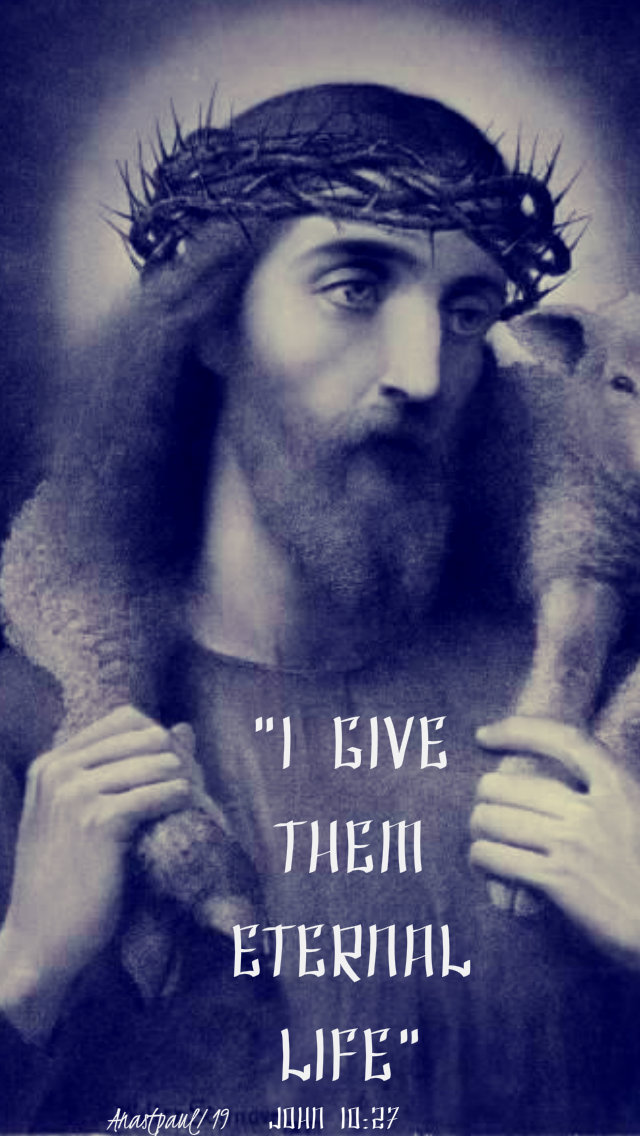
“I give them eternal life”

John 10:27john 10 27 - i give them eternal life - 12 may 2019 good shepherd sunday.jpg

Posted in MORNING Prayers, SAINT of the DAY, The WORD

One Minute Reflection – 19 July – “I desire mercy, not sacrifice”

One Minute Reflection – 19 July – Friday of the Fifteenth week in Ordinary Time, Year C, Gospel: Matthew 12:1-8 and the Memorial fo St Macina the Younger

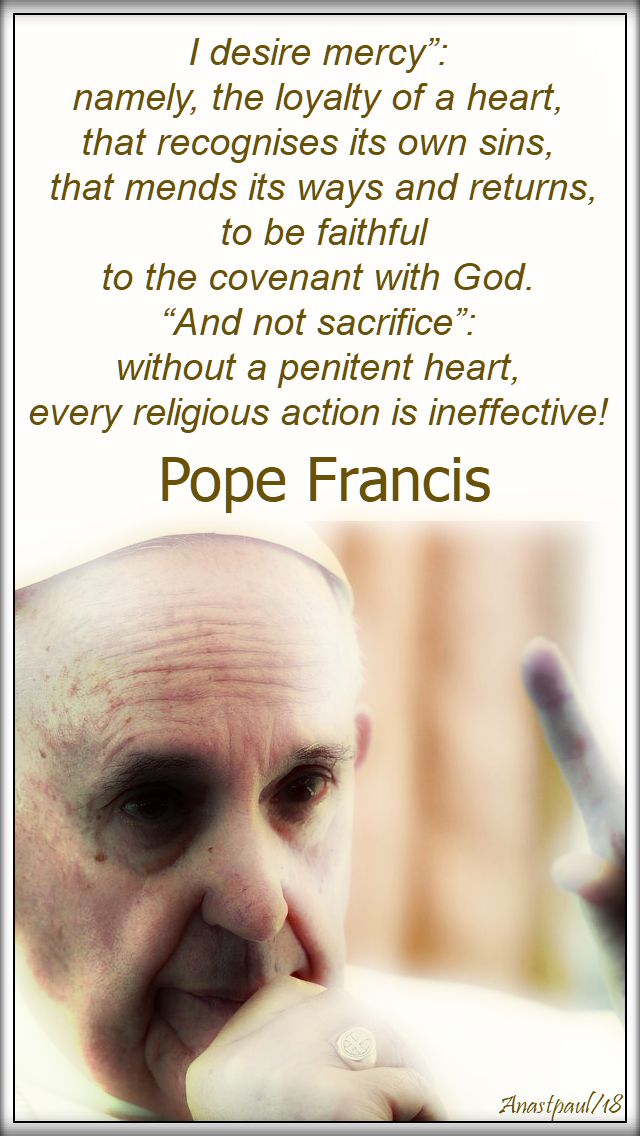
“I desire mercy, not sacrifice” … Matthew 12:7i desire mercy not sacrifice matthew 12 7 19 july 2019

REFLECTION – “I desire mercy”, namely the loyalty of a heart that recognises its own sins, that mends its ways and returns to be faithful to the covenant with God. “  And not sacrifice” – without a penitent heart, every religious action is ineffective! … Pope Francis (General Audience, 13 April 2016)i-desire-mercy-namely-the-loyalty-pope-francis-20-july-2018

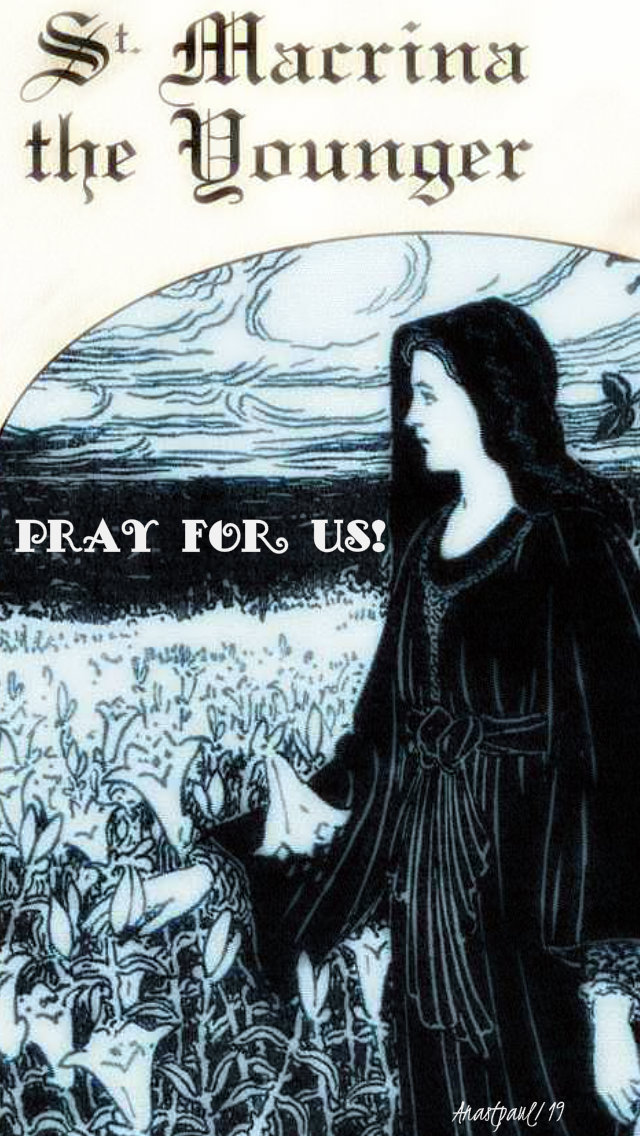
PRAYER – Father and almighty God, You have given Your Son to redeem us with complete and absolute love and mercy.   He has taken our flesh and given Himself to us and extended endless mercy for all time.   He has taught us the path of love and mercy.  Grant, we pray, that our hearts may grieve and repent with true sorrow.   And may the prayers of St Macrina, assist us to extend mercy to all.   We make our prayer through the merits of His saving love and the Holy Spirit, one God now and forever, amen.st macrina the younger pray for us 19 july 2019

Posted in FATHERS of the Church, Our MORNING Offering, PRAYERS of the SAINTS, SAINT of the DAY, The GOOD SHEPHERD

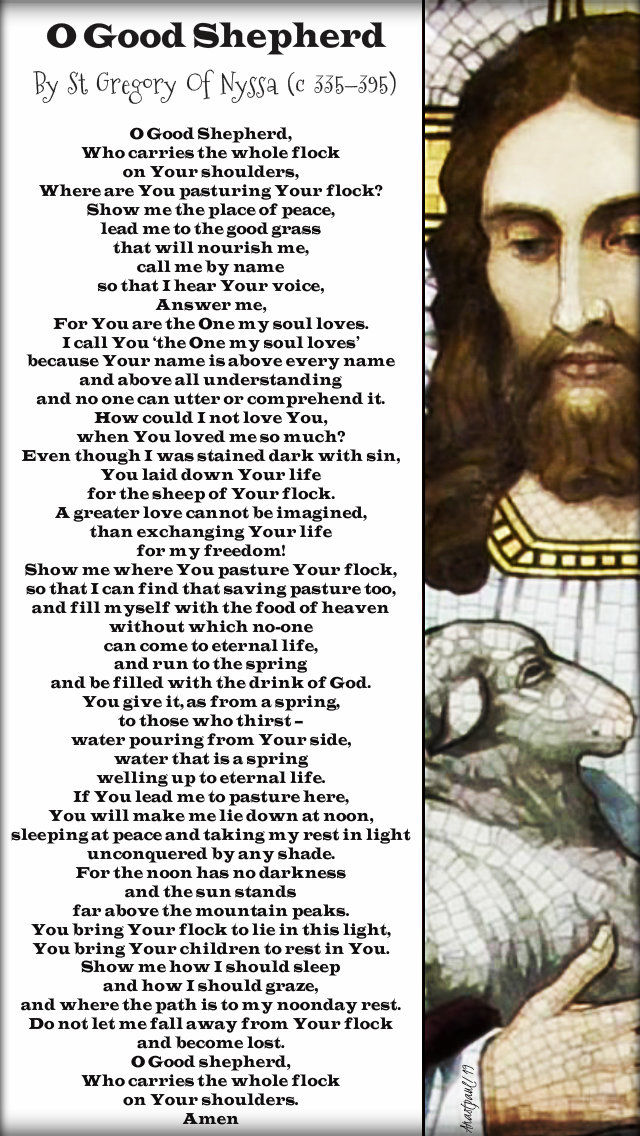
Our Morning Offering – 19 July – O Good Shepherd

Our Morning Offering – 19 July – Friday of the Fifteenth week in Ordinary Time and the memorial of St Macina the Younger – sister of St Gregory of Nyssa

Below is an edited and simplified version 
of St Gregory’s famous
“To the Good Shepherd” prayer.

O Good Shepherd
By St Gregory Of Nyssa (c 335–395)
Father of the Church

O Good Shepherd,
Who carries the whole flock on Your shoulders,
Where are You pasturing Your flock?
Show me the place of peace,
lead me to the good grass that will nourish me,
call me by name so that I hear Your voice,
Answer me,
For You are the One my soul loves.
I call You ‘the One my soul loves’
because Your name is above every name
and above all understanding
and no one can utter or comprehend it.
How could I not love You,
when You loved me so much?
Even though I was stained dark with sin,
You laid down Your life for the sheep of Your flock.
A greater love cannot be imagined,
than exchanging Your life for my freedom!
Show me where You pasture Your flock,
so that I can find that saving pasture too,
and fill myself with the food of heaven
without which no-one can come to eternal life,
and run to the spring
and be filled with the drink of God.
You give it, as from a spring, to those who thirst –
water pouring from Your side,
water that is a spring welling up to eternal life.
If You lead me to pasture here,
You will make me lie down at noon,
sleeping at peace and taking my rest in light
unconquered by any shade.
For the noon has no darkness
and the sun stands far above the mountain peaks.
You bring Your flock to lie in this light,
You bring Your children to rest in You.
Show me how I should sleep
and how I should graze,
and where the path is to my noonday rest.
Do not let me fall away from Your flock
and become lost.
O Good shepherd,
Who carries the whole flock on Your shoulders.
Ameno good shepherd no 1 st gregory of nyssa 19 july 2019.jpg

Posted in FATHERS of the Church, SAINT of the DAY

Saint of the Day -19 July – Saint Macrina the Younger (c 327-379)

Saint of the Day -19 July – Saint Macrina the Younger (c 327-379) Virgin, Ascetic  – born c 327 at Caesarea, Cappadocia (in modern Turkey) and died in 379 at Pontus (in modern Turkey) of natural causes.

With charm and grace, St Macrina ruled the roost in a family of saints.   St Basil the Elder and St Emmelia, her parents, had ten children including the younger St Basil (329-379) Doctor of the Church, St Gregory of Nyssa (c 335–C 395) and St Peter of Sebaste Bishop (c 340–391).   As the eldest child, Macrina exercised a formative influence on her more famous brothers and even on her mother.saint_macrina_the_younger.jpg

A beautiful young woman, Macrina had been betrothed at age twelve.   But when her fiancé died, she chose to remain single to devote herself to Christian service.   Emmelia had given her daughter a Christian version of a classic education, training her in Scripture instead of Greek literature.   In turn, Macrina conducted the early education of her younger brothers and sisters and formed them in piety.

Gregory of Nyssa, her biographer, reported that when Basil returned from Athens University all puffed up with self-importance, Macrina put him in his place—as only an older sister can.   Apparently, she persuaded her extremely talented brother to become a monk and subordinate his gifts to God’s purposes.st macrina the younger img-The-Sister-of-Saint-Basil.jpg

When Naucratius (he was a the famous Christian jurist), the handsome and athletic family favourite, died suddenly, Macrina supported Emmelia through her grief.   Later she persuaded her mother to join her in renouncing their high standard of living and embracing the simpler life of their servants. Together they formed a small monastic community of nuns under the younger Basil’s direction on the family estate at Annesi in Pontus in present-day Turkey.

In 379, shortly after Basil died, Macrina fell ill.   Gregory came to visit her and found her in a very weakened condition, lying on two planks.  Even on her deathbed, Macrina continued to live a life of sanctity, as she refused a bed and instead chose to lie on the ground.   Although Macrina could barely talk, she spoke eloquently with her brother about death and the future life.   Just before she died she prayed as follows:

“O Lord, You have freed us from the fear of death.

You have made the end of life here the beginning of a true life for us.

You, who compassionately gave paradise back to the man crucified with You, remember me also in Your kingdom.

If I have committed sins in word, deed or thought because of the weakness of our nature, don’t let Your eyes discover them.

You, who have power on earth to forgive sins, forgive me so that I may be refreshed.

May I be found before you once I have put off my body, having no fault in the form of my soul.

May my soul be received into Your hands, blameless and spotless, as an offering before You.”

St Gregory of Nyssa expanded his sister’s deathbed reflections on the future life in his book, “Dialogue on the Soul and Resurrection”

Macrina had a profound influence upon her brothers and her mother with her adherence to an ascetic ideal.   Her brother, St Gregory of Nyssa wrote a work entitled Life of Macrina in which he describes her sanctity throughout her life.   Macrina lived a chaste and humble life, devoting her time to prayer and the spiritual education of her younger brother, Peter.   Gregory presents her, as one who consciously rejected all Classical education, choosing instead devoted study of Scripture and other sacred writings.

Saint Macrina is significant in that her brother, Saint Gregory of Nyssa, was able to set standards for being a holy Early Christian woman.   He believed that virginity reflected the “radiant purity of God.”

250px-Macrina_the_Younger

Posted in SAINT of the DAY

Memorials of the Saints -19 July

St Ambrose Autpertus
Bl Antonio of Valladolid
St Aurea of Cordoba
Bl Bernhard of Rodez
St Daria of Constantinople
St Epaphras of Colosse
St Felix of Verona
St John Plessington (c 1637-1679) Martyr
About St John Plessington:

https://anastpaul.wordpress.com/2017/07/19/saint-of-the-day-19-july-st-john-plessington/

Bl Józef Puchala OFM Conv (1911-1943) Martyr
Bl Jozef’s Story:
https://anastpaul.com/2018/07/19/saint-of-the-day-19-july-blessed-jozef-achilles-puchala-ofm-conv-1911-1943-martyr/
St Macrina the Younger (c 327-379) 
St Martin of Trier
St Michael the Sabaitè
Bl Pascasio of Lyon
St Romain of Ryazan
St Pope Symachus
St Vicente Cecilia Gallardo

Martyrs of Meros – 3 saints: Three Christians tortured and martyred together in the persecutions of emperor Julian the Apostate and governor Almachio. We know nothing else about them but the names – Macedoniuis, Tatian and Theodule.
They were burned to death on an iron grill in Meros, Phrygia (in modern Turkey).

Martyrs of China: 3 Beati
Elisabeth Qin Bianshi Elisabeth
Ioannes Baptista Zhu Wurui
Simon Qin Chunfu

Posted in CHRIST, the WAY,TRUTH,LIFE, DOCTORS of the Church, FATHERS of the Church, MORNING Prayers, QUOTES of the SAINTS, QUOTES on HUMILITY, SAINT of the DAY, The WORD

One Minute Reflection – 19 July – “take my yoke upon you and learn from me” 

One Minute Reflection – 19 July – Thursday of the Fifteenth week in Ordinary Time, Year C – Today’s Gospel: Matthew 11:28-30.

“Take my yoke upon you and learn from me, for I am meek and humble of heart and you will find rest for yourselves…” … Matthew 11:29matthew 11 29 take my yoke upon you 18 july 2019

REFLECTION – “You are to “take my yoke upon you and learn from me.”   You are not learning from me how to refashion the fabric of the world, nor to create all things visible and invisible, nor to work miracles and raise the dead.   Rather, you are simply learning of me: “that I am meek and lowly in heart.”   If you wish to reach high, then begin at the lowest level.   If you are trying to construct some mighty edifice in height, you will begin with the lowest foundation.   This is humility.   However great the mass of the building you may wish to design or erect, the taller the building is to be, the deeper you will dig the foundation.   The building in the course of its erection, rises up high but he who digs its foundation, must first go down very low.   So then, you see even a building is low before it is high and the tower is raised, only after humiliation.”… St Augustine (354-430) Fater & Doctor (Sermon 69)if you wish to reach high then begin at the lowest level st augustine 18 july 2019

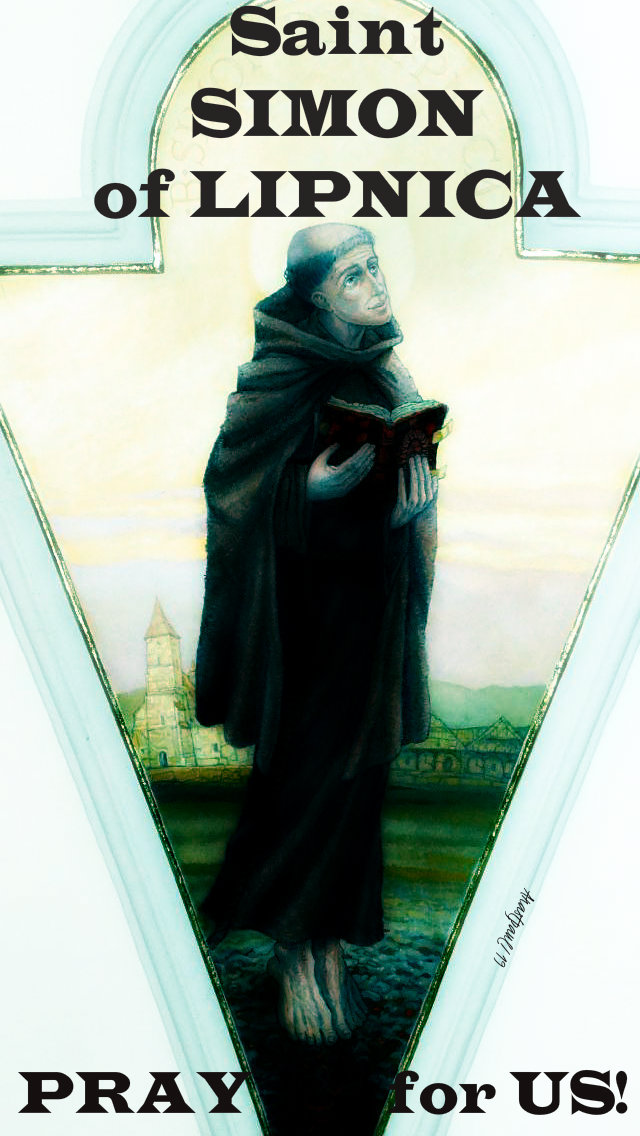
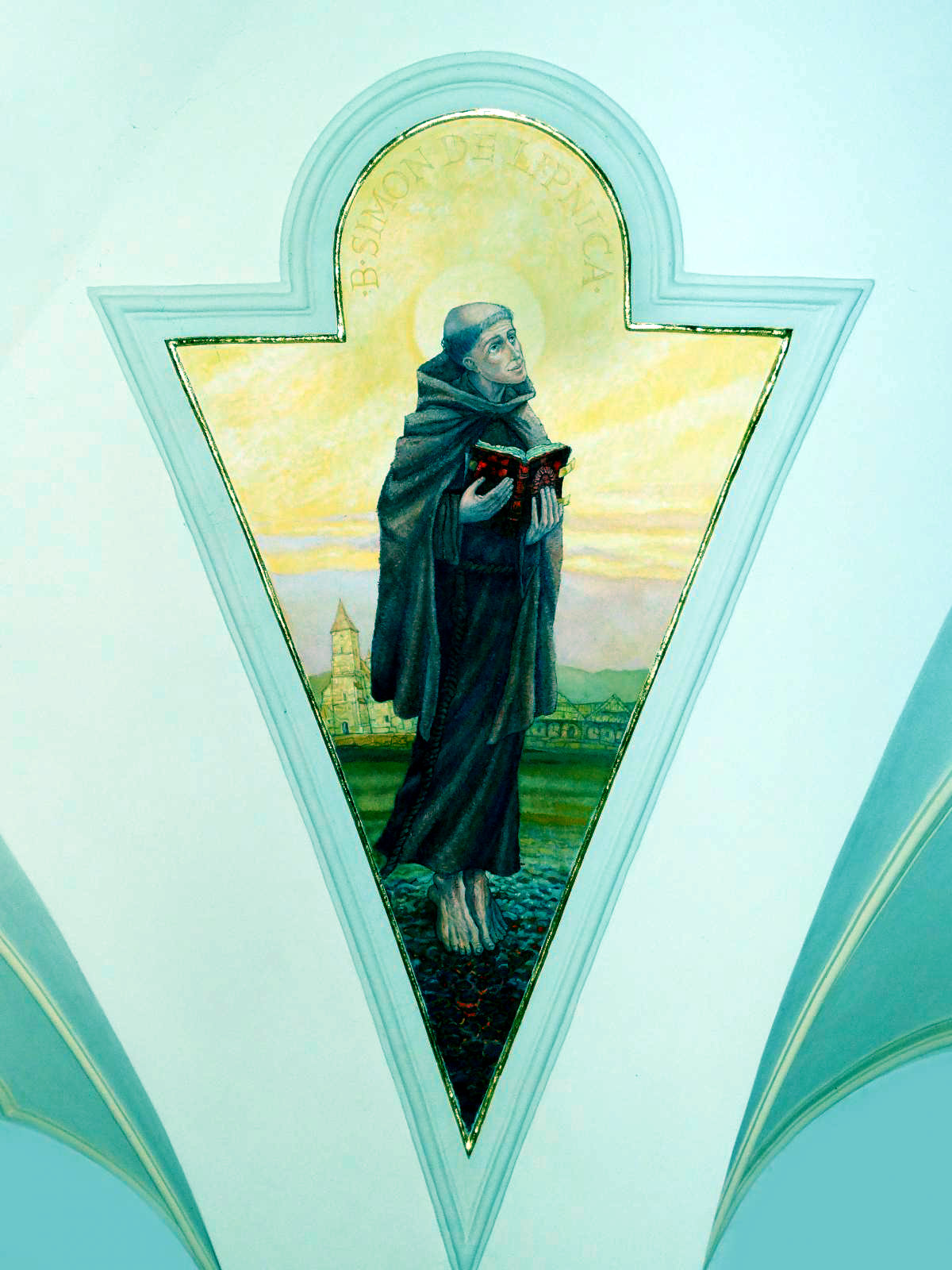
PRAYER“Holy God, our Father, we turn to You in confidence as children and pray, give us meekness of heart, make us “poor in spirit” that we may recognise that we are not self-sufficient, that we are unable to build our lives on our own but need You, we need to encounter You, to listen to You, to speak to You.   Help us to understand that we need Your gift, Your wisdom, which is Jesus Himself, in order to do the Your will in our lives and thus to find rest in the hardships of our journey.”   Hear the prayers we request of St Simon of Lipnica dear Lord and holy God, which we pray through Christ, our Light, in the Holy Spirit, one God for all eternity, amen. … Pope Benedict XVI, General Audience, 7 December 2011st simon of lipnica pray for us 18 july 2019

Posted in franciscan OFM, SAINT of the DAY, VATICAN Resources

Saint of the Day – 18 July – Saint Simon of Lipnica (1435/1440-c 1482)

Saint of the Day – 18 July – Saint Simon of Lipnica (1435/1440-c 1482) OFM Cap Priest of the Franciscan Order of Friars Minor (OFM), renowned Preacher, apostle of charity – also known as Szymon of Lipnicza – born in 1435/1440 in Lipnica Murowana, Malopolskie, Poland and died on 18 July 1482 in Kraków, Malopolskie, Poland during a plague epidemic.   Patronages – Krakow, Students.st simon szymon

Simon was born in Lipnica Murowana, in the south of Poland, between the years 1435-1440.   His parents, Gregory and Anne, knew how to give him a good education, inspired by the values of the Christian faith and, despite their modest conditions, they took care to secure him an adequate cultural formation.   Simon grew up with a pious and responsible nature, rich in a natural predisposition towards prayer and a tender love for the Mother of God.
He moved to Krakow, to attend the famous Jagiellonian Academy, in 1454.   It was precisely in those years that St John of Capestrano OFM (1386-1456) enthused the city through the sanctity of his life and the fervour of his preaching, attracting a dense crowd of young, generous men to the Franciscan vocation.   On the 8th September 1453, the Italian saint founded the first convent of the Observance, with the name of the recently Canonised St Bernardine of Siena (1380-1444), in Krakow.   It was for that reason that the Friars Minor of the convent were called the “Berdardini” by the people.

In 1457, the young Simon, fascinated by the Franciscan ideal, also chose to acquire the pearl of great price mentioned in the Gospel and left aside a possible successful and rich future.   He asked to be received, with another ten fellow students, into the convent of Stradom.401px-St

Under the wise guidance of the Novice Master, Br Christopher of Varese, a religious renown for his teaching and sanctity of life, Simon generously embraced the humble and poor life of the Friars Minor and received the priesthood about the year 1460.   He exercised his first ministry in the convent of Tarnów, where he was the Guardian of the fraternity.

He later established himself in Stradom (Krakow), dedicating himself untiringly to preaching with a clear word, full of ardour, faith and wisdom, which permitted a glimpse of his profound union with God and of his prolonged study of Sacred Scripture.

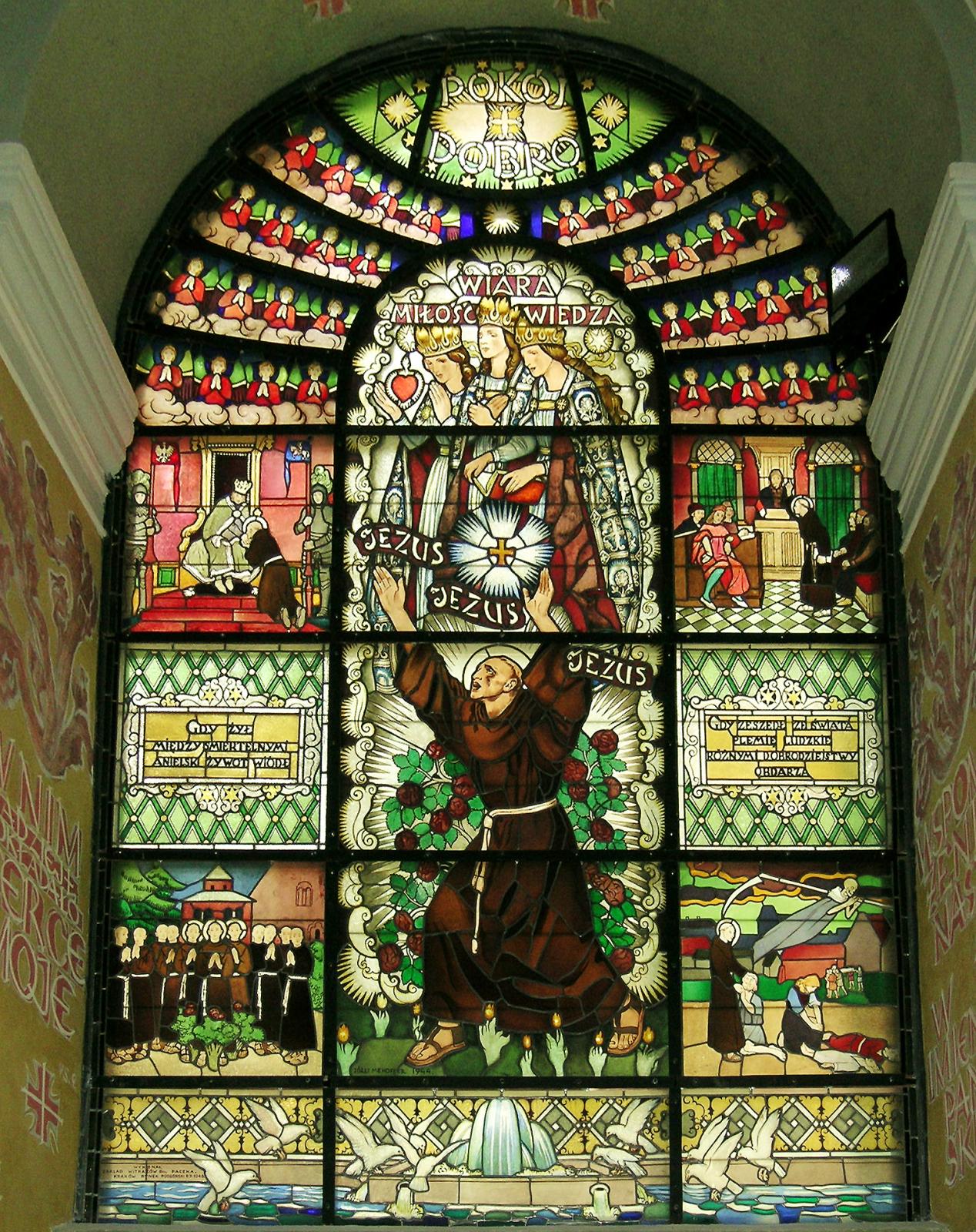
Like St Bernardine of Siena and St. John of Capestrano, Br Simon spread devotion to the Name of Jesus, obtaining the conversion of innumerable sinners.   He, the first of the Friars Minor, took up the duty of preacher in the Cathedral of Wawel in 1463.   Because of his dedication to preaching the Gospel, the ancient sources conferred the title of “predicator ferventissimus” “Zealous Preacher”, on him.st simon glass

In his desire to give homage to St Bernardine of Siena, the inspirer of his preaching, he, with some Polish confreres, went to Aquila to participate in the solemn transfer of the body of the saint, on the 17th May 1472, to the new Church erected in his honour.   He was again in Italy in 1478, on the occasion of the General Chapter of Pavia.   He had a way, then, to be able to satisfy his deepest desire to visit the tombs of the Apostles in Rome and to extend his pilgrimage to the Holy Land later.   He lived this experience in a spirit of penance, truly loving the passion of Christ, with the hidden aspiration of spilling his own blood for the salvation of souls, if it would please God.   He emulated St Francis in his love for the Holy Places.   In view of the possibility of being captured by the non-believers, he wished to learn the Rule of the Order by heart before undertaking the journey in order “to have it always before the eyes of his mind”.

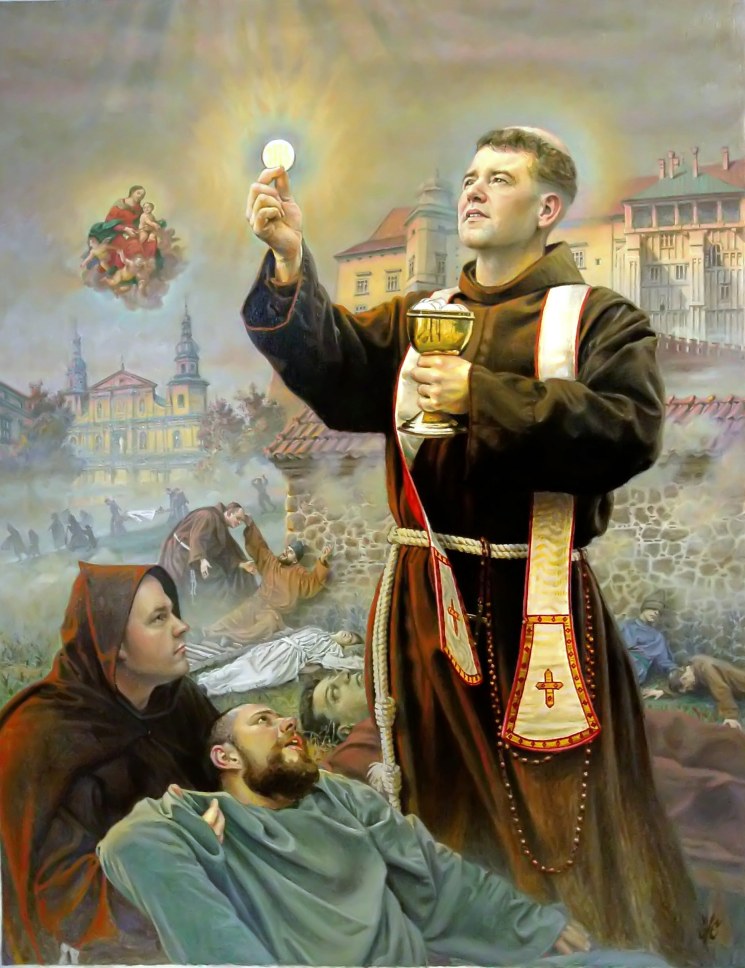
The love of Simon for his brothers and sisters was manifested in an extraordinary way during the last year of his life, when an epidemic of plague broke out in Krakow.   The city was under the scourge of the disease from July 1482 to the 6th January 1483. The Franciscans of the convent of St Bernardine tirelessly did all they could to care for the sick as true consoling angels.beautiful image - st simon of lipnica - Szymon-kanonizacyjny

Br Simone, held it to be a “propitious time” to exercise charity and to fulfil the offering of his own life.   He went everywhere comforting, giving succour, administering the sacraments and announcing the consoling Word of God to the dying.   He was soon infected.   He suffered the pain of the disease with extraordinary patience and, near the end, expressed his desire to be buried under the threshold of the church so that all could trample on him.   On the sixth day of the disease, the 18th July 1482, without fear of death and with his eyes fixed on the Crucifix, he gave his soul back to God.st simon in mural

The “ab immemorabili” cult rendered to Blessed Simon, which passed into the history of seraphic sanctity under the title of “Salutis omnium sitibundus”, was confirmed by Blessed Innocent XI on the 24th February 1685.

The cause of his Canonisation, taken up by the Holy Father Pius XII on the 25th June 1948, today reaches its happy ending, following the recognition of his heroic virtues and of the miraculous cure which occurred in Krakow in 1943 and attributed to the intercession of the Blessed.   The respective Decrees were promulgated by the Holy Father Benedict XVI on the 19th of December 2005 and the 16th December 2006.

This slideshow requires JavaScript.

Simon of Lipnica knew how to combine admirably his commitment to evangelisation and to giving witness to charity, which flowed from his great love for the Word of God and for the poor and suffering.   The Order of Friars Minor, on the vigil of the celebration of the VIII Centenary of its Foundation (1209-2009), salutes him as an authentic witness to poverty, humility and simplicity, as well as to the joy of belonging fully to the Lord and to being a gift to the life of the Friars.

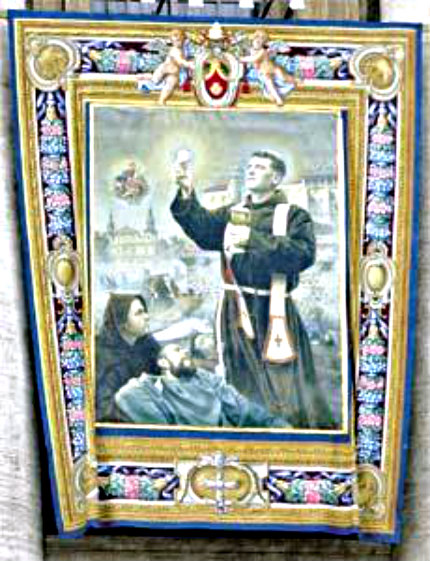
He was Canonised by Holy Father Pope Benedict XVI mere months after the decrees approved by him in 2006, on 3 June 2007 in Saint Peter’s Square upon the confirmation of a 1943 miracle attributed to his intercession….Vatican.vacanonisation st simon

Posted in MARIAN TITLES, SAINT of the DAY, The BLESSED VIRGIN MARY

Feast of Our Lady of Good Deliverance and Memorials of the Saints – 18 July

Our Lady of Good Deliverance:  Since the 1000s, the Church of Saint-Etienne-des-Grès in the old Latin Quarter of Paris had a chapel to Our Lady of Good Deliverance, where, across the centuries, pilgrims sought the Virgin’s help with all kinds of sufferings. During the Wars of Religion and counter-Reformation, her confraternity had 12,000 members, including the King and Queen of France. In 1587, young St Francis de Sales, feeling himself damned, recovered confidence and joy after saying the prayer that had been pasted to a tablet before her statue, the Memorare.our-lady-of-good-dliverance-18-july-2017.jpg

St Aemilian of Dorostorium
St Alanus of Sassovivo
St Alfons Tracki
Bl Arnold of Amiens
St Arnoul the Martyr
St Arnulf of Metz
St Athanasius of Clysma
Bl Bernard de Arenis
Bl Bertha de Marbais
St Bruno of Segni OSB (1049-1123)
About St Bruno:
https://anastpaul.com/2017/07/18/saint-of-the-day-18-july-st-bruno-of-segni-o-s-b/

St Ðaminh Ðinh Ðat
St Edburgh of Bicester
St Elio of Koper
St Frederick of Utrecht (c 815 – c 838) Martyr
Biography:
https://anastpaul.com/2018/07/18/saint-of-the-day-18-july-st-frederick-c-815-c-838-martyr/

St Goneri of Treguier
St Gundenis of Carthage
Bl Herveus
Bl Jean-Baptiste de Bruxelles
St Marina of Ourense
St Maternus of Milan
St Minnborinus
St Pambo of the Nitrian Desert
St Philastrius of Brescia
St Rufillus of Forlimpopoli
St Scariberga of Yvelines
St Simon (Szymon) of Lipnica (1435/1440-c 1482)
St Theneva
St Theodosia of Constantinople

Martyrs of Silistria – 7 saints: Seven Christians who were martyred together. No details about them have survived but the names – Bassus, Donata, Justus, Marinus, Maximus, Paulus and Secunda. They were martyred in Silistria (Durostorum), Moesia (in modern Bulgaria), date unknown.

Martyrs of Tivoli – 8 saints: A widow, Symphorosa and her seven sons ( Crescens, Eugene, Julian, Justin, Nemesius, Primitivus and Stracteus) martyred in Tivoli, Italy in the 2nd-century persecutions of Hadrian.

Posted in QUOTES of the SAINTS, QUOTES on ETERNAL LIFE, QUOTES on GRACE, QUOTES on GRATITUDE, QUOTES on HUMILITY, QUOTES on LOVE, SAINT of the DAY

Thought for the Day – 17 July – Let us love to be unknown! 

Thought for the Day – 17 July – Wednesday of the Fifteenth week in Ordinary Time, C, The memorial of St Alexius of Rome – “the Man of God” “the Beggar Saint”

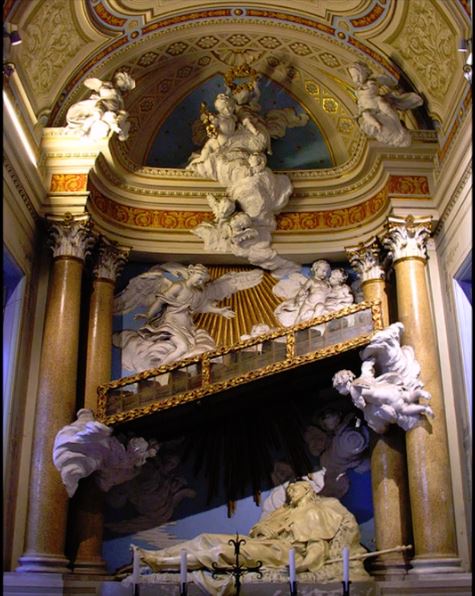
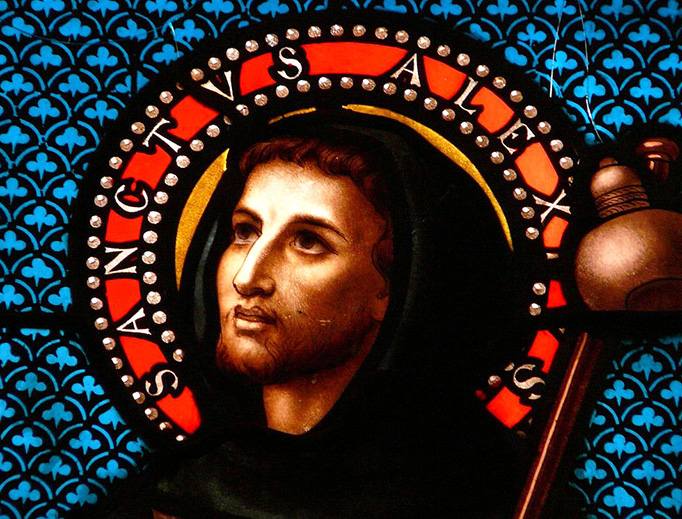
St Alexius is mentioned in the Roman Martyrology under 17 July in the following terms: “At Rome, in a church on the Aventine Hill, a man of God is celebrated under the name of Alexius, who, as reported by tradition, abandoned his wealthy home, for the sake of becoming poor and to beg for alms unrecognised.”

“With regard to God, there is no strict right to any merit on the part of man,” the Catechism plainly teaches us. “Between God and us there is an immeasurable inequality, for we have received everything from Him, our Creator” (#2007).   The Alexius of lore, who at least could’ve rightfully claimed the privileges associated with his family ties, instead embraced a life of severe deprivation and extravagant piety in absolute concealment.

Why?   Not for points, not to earn salvation but out of a rare plenitude of gratitude and love.   “In the evening of this life, I shall appear before you with empty hands, for I do not ask you, Lord, to count my works,” is how St Thérèse of Lisieux expressed the same notion.   “I wish, then, to be clothed in Your own justice and to receive from Your love the eternal possession of Yourself” (CCC 2011).

Even simpler, is St John of the Cross:   “At the end of your life, you will be judged by your love” (CCC 1022) and nobody will be comparing scores.at-the-end-of-your-life-st-j-of-the-cross-14-dec-2017.jpg

Let us love to be unknown!   (St Philip Neri).

St Alexius Pray for us!st alexius of rome pray for us no 2 17 july 2019.jpg

Posted in MORNING Prayers, QUOTES on HUMILITY, QUOTES on SANCTITY, QUOTES on TRUST and complete CONFIDENCE in GOD, SAINT of the DAY, The WORD

One Minute Reflection – 17 July – ‘…the necessary condition…’

One Minute Reflection – 17 July – Wednesday of the Fifteenth week in Ordinary Time, C – Today’s Gospel Matthew 11:25-27.

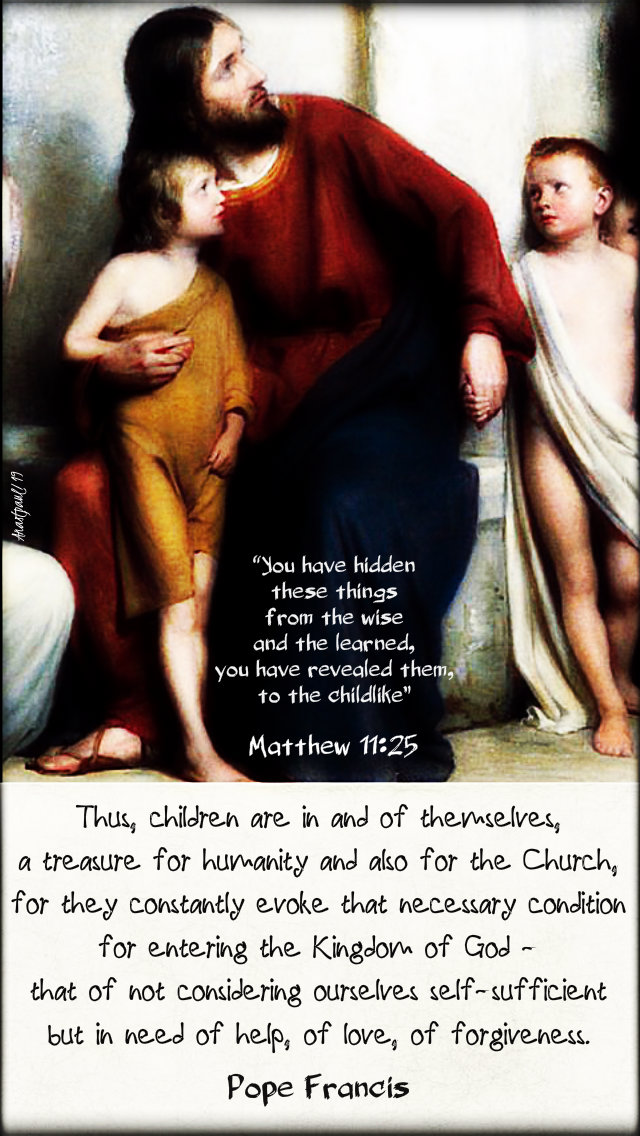
“You have hidden these things from the wise and the learned, you have revealed them, to the childlike”…Matthew 11:25

REFLECTION – “Thus, children are in and of themselves, a treasure for humanity and also for the Church, for they constantly evoke that necessary condition for entering the Kingdom of God – that of not considering ourselves self-sufficient but in need of help, of love, of forgiveness.”…Pope Francis (General Audience, 18 March 2015)matthew 11 25 you have hidden these things - thus children are - pope francis 17 july 2019.jpg

PRAYER – Lord God, in Your wisdom You created us, by Your Providence, You rule us. Penetrate our inmost being with Your holy light so that our way of life may always be one of faithful service and childlike trust in You.   Grant that we may always follow behind Your Son and grasp His hand, to lead us to You.   Hear the prayers of St Alexius of Rome, who trusted completely in You alone in childlike simplicity. Through Jesus Christ our Lord with the Holy Spirit, one God, forever, amen.st alexius of rome pray for us 17 july 2019.jpg

Posted in SAINT of the DAY

Saint of the Day – 17 July – Saint Alexius of Rome – (Died early 5th Century) “the Man of God” 

Saint of the Day – 17 July – Saint Alexius of Rome – (Died early 5th Century) Hermit, recluse, apostle of Prayer, Mystic, beggar – known as “the Man of God”  – Patronages – Alexians (a religious apostolate), beggars, belt makers, nurses, pilgrims, travellers.st alexius-of-rome-f7c534c7-3fc3-4fac-ad99-14bbf9779a6-resize-750.jpg

Saint Alexius, born in Rome in the fourth century, was the only son of parents pre-eminent among the Roman nobles for both their virtue and their great wealth.   They were particularly noted for their almsgiving; three tables were prepared every day for all who came for assistance — pilgrims, the poor and the sick.   Their son, fruit of their prayers, was married with splendid feasting to a noble young lady of the imperial family but on his wedding night, by God’s special inspiration, he secretly left Rome, longing for a solitude where he could serve God alone.

Garcia_Fernandes_-_Casamento_de_Santo_Aleixo,_1541
The Wedding of St Alexius

He went to Edessa in the far East, gave away all that he had brought with him, content thereafter to live by alms at the gate of Our Lady’s church in that city.   His family, in the deepest grief, could not fathom the mystery of his disappearance and would have been consoled if God had taken him instead through death.

It came to pass that the servants of Saint Alexius, whom his father had sent in search of him, arrived in Edessa and seeing him among the poor at the gate of Our Lady’s church, gave him an alms, not recognising him.   Whereupon, the man of God, rejoicing, said, I thank You, Lord, who have called me and granted that I should receive for Your Name’s name’s sake an alms from my own slaves.   Deign to fulfil in me the work You have begun.

After seventeen years spent at the portico of the church, when his sanctity was miraculously confirmed by the Blessed Virgin, speaking through Her image to an officer of the church, Saint Alexius once more sought obscurity by flight.  st alexius snip catholic art On his way to Tarsus contrary winds drove his ship to Rome.   There no-one recognised him, in this pale and tattered mendicant, the heir of Rome’s noblest house, not even his sorrowing parents, who had vainly sent throughout the world in search of him.   From his own father’s charity Saint Alexius begged a miserable shelter in his palace, under a staircase, with the leavings of his table as food.   There, he spent another seventeen years, bearing patiently the mockery and ill usage of his own servants and witnessing daily, the still inconsolable grief of his spouse and parents.

At last, when death had ended this cruel martyrdom, they learned too late, who it was that they had unknowingly sheltered.   A voice was heard by all in attendance at the Pope’s Mass, saying –‘Seek the man of God, he will pray for Rome and the Lord will be favourable to it, he will die on Friday.’   All the city undertook in vain to find this unknown Saint.  st alexius snip artBut God had commanded Alexius himself to write down his life story and sign it, in this way He Himself confirmed His servant’s sanctity, when he was found lifeless in his retreat, holding that document in his hand.   The Pope read aloud what was written on the parchment of the Saint and everywhere in Rome there was a single cry of admiration, impossible to describe. -saint-july-17-alexius-of-rome-wellcomeimages-org-cc

The house of Alexius’ father Euphemian was later transformed into a church dedicated to Saint Alexius and St Boniface and the staircase – suspended above an altar, under which he had lived for 17 years, is enshrined there as a relic.

the holy staircase of st alexius
The Holy Staircase of St Alexius at the Church of Sts Alexius and Boniface in Rome.   Below it is a statue of the pieta of St Alexius.

st alexius from the church of st pierre-es-liens in france header.jpg
Saint Alexius, from the Church of Saint-Pierre-ès-Liens in Pomport, Dordogne, France

Posted in SAINT of the DAY

Memorials of the Saints – 17 July

St Alexius of Rome (Died early 5th Century)

St Andrew Zorard
Bl Arnold of Himmerod
Bl Bénigne
Bl Biagio of the Incarnation
St Clement of Ohrid
St Cynllo
St Ennodius of Pavia
St Fredegand of Kerkelodor
St Generosus
St Gorazd
St Hedwig, Queen of Poland
St Hyacinth of Amastris
St Kenelm
St Pope Leo IV
St Marcellina
St Nerses Lambronazi
Bl Pavol Gojdic (1888-1960) Martyr
About Blessed Pavol:
https://anastpaul.com/2018/07/17/saint-of-the-day-17-july-blessed-pavol-peter-gojdic-1888-1960-martyr-the-man-with-a-heart-of-gold/

St Petrus Liu Zeyu
Bl Sebastian of the Holy Spirit
Bl Tarsykia Matskiv
St Theodosius of Auxerre
St Theodota of Constantinople
St Turninus

Martyrs of Compiegne (16 beati):   Sixteen Blessed Teresian Martyrs of Compiègne.
Eleven Discalced Carmelite nuns, three lay sisters and two lay women servants who were martyred together in the French Revolution. They were the earliest martyrs of the French Revolution that have been recognised.
• Angelique Roussel • Anne Pelras • Anne-Marie-Madeleine Thouret • Catherine Soiron • élisabeth-Julitte Vérolot • Marie Dufour • Marie Hanniset • Marie-Anne Piedcourt • Marie-Anne-Françoise Brideau • Marie-Claude-Cyprienne Brard • Marie-Françoise de Croissy • Marie-Gabrielle Trezel • Marie-Geneviève Meunier • Marie-Madeleine-Claudine Lidoine • Rose-Chretien de Neuville • Thérèse Soiron •
They were guillotined on 17 July 1794 at the Place du Trône Renversé (modern Place de la Nation) in Paris, France.

The 16 Martyrs Story:
https://anastpaul.com/2017/07/17/saints-of-the-day-17-july-the-carmelite-martyrs-of-compiegne-o-c-d/

Martyrs of Scillium (12 saints): A group of twelve Christians martyred together, the final deaths in the persecutions of Emperor Marcus Aurelius. Upon their conviction for the crime of being Christians, the group was offered 30 days to reconsider their allegiance to the faith; they all declined.   Their official Acta still exist.   Their names –
• Acyllinus • Cythinus • Donata • Felix • Generosa • Januaria • Laetantius • Narzales • Secunda • Speratus • Vestina • Veturius
They were beheaded on 17 July 180 in Scillium, Numidia (in North Africa).

Posted in CARMELITES, MARIAN PRAYERS, MARIAN TITLES, PRAYERS of the CHURCH, PRAYERS of the SAINTS, SAINT of the DAY, The BLESSED VIRGIN MARY

Our Morning Offering – 16 July – “The Flower of Carmel”

Our Morning Offering – 16 July – The Memorial of Our Lady of Mount Carmel

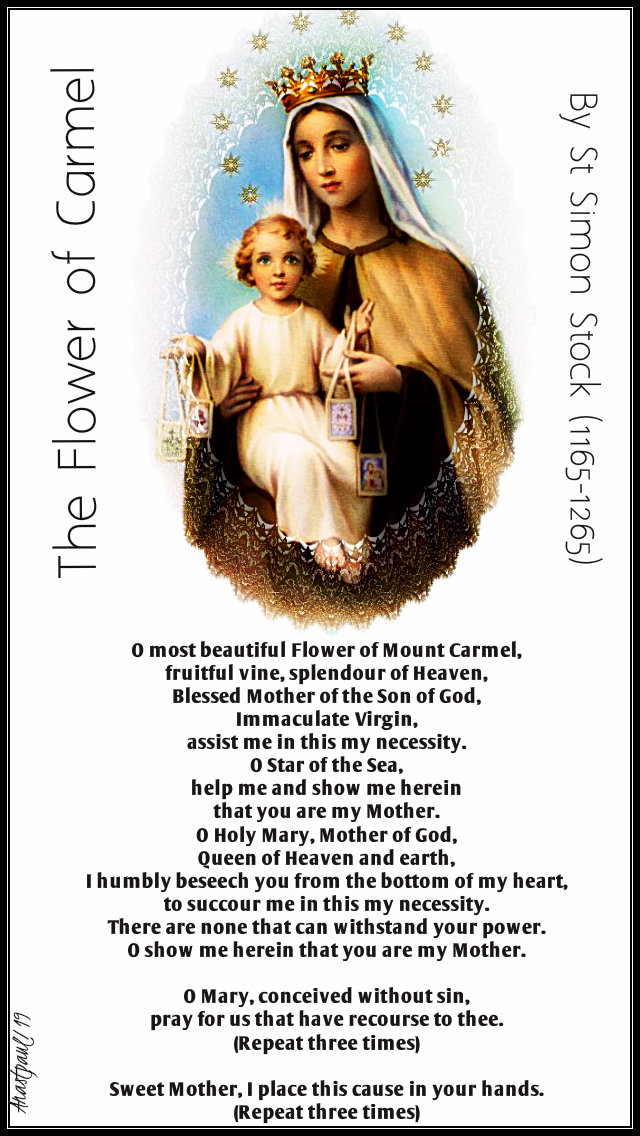
This prayer, also known as the “Flos Carmeli” (“The Flower of Carmel”), was composed by St Simon Stock (1165-1265), a Carmelite, so-called because he and other members of his order lived atop Mount Carmel in the Holy Land.   St Simon Stock was visited by the Blessed Virgin Mary on 16 July 1251, at which time, she bestowed upon him a scapular, or habit, (commonly called “the Brown Scapular”), which became part of the liturgical clothing of the Carmelite order.

O most beautiful Flower of Mount Carmel,
fruitful vine, splendour of Heaven,
Blessed Mother of the Son of God,
Immaculate Virgin,
assist me in this my necessity.
O Star of the Sea,
help me and show me herein
that you are my Mother.
O Holy Mary, Mother of God,
Queen of Heaven and earth,
I humbly beseech you from the bottom of my heart,
to succour me in this my necessity.
There are none that can withstand your power.
O show me herein that you are my Mother.

O Mary, conceived without sin,
pray for us that have recourse to thee.
(Repeat three times)

Sweet Mother, I place this cause in your hands.
(Repeat three times)the flower of carmel by st simon stopck 16 july 2019.jpg

Posted in SAINT of the DAY

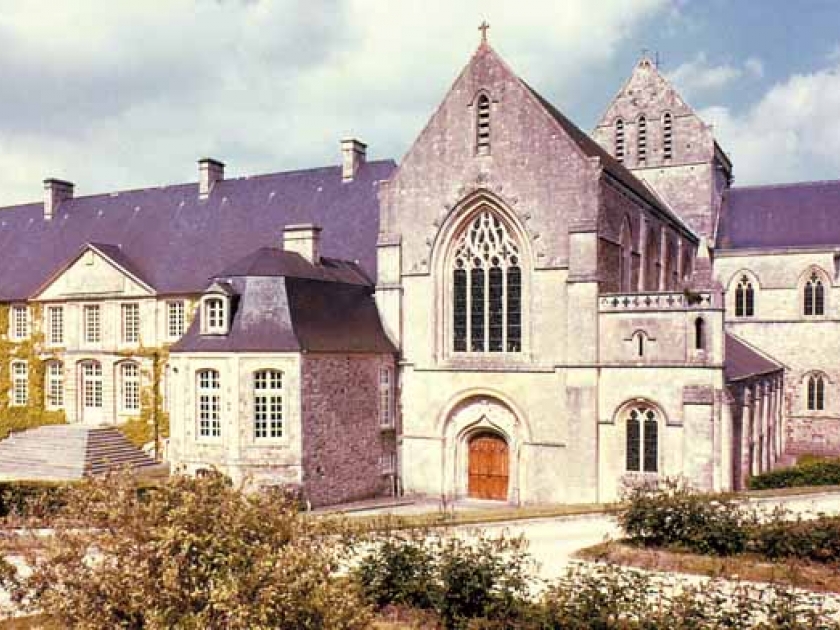
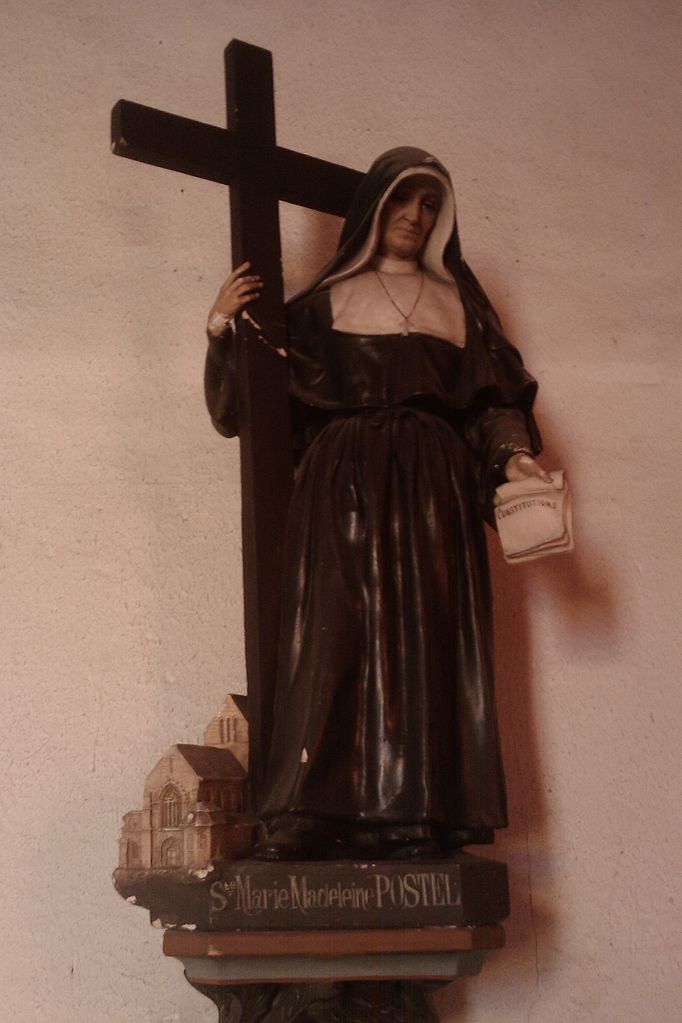
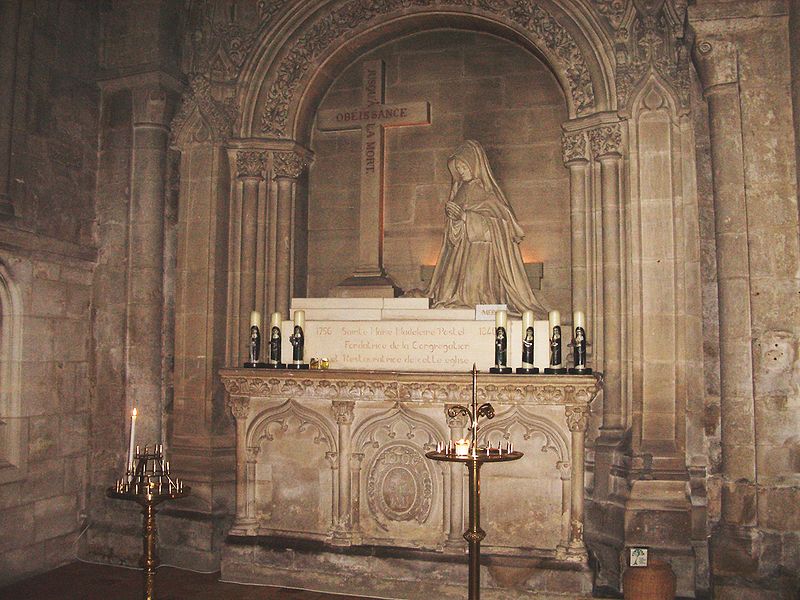
Saint of the Day – 16 July – St Marie-Madeline Postel (1756-1846)

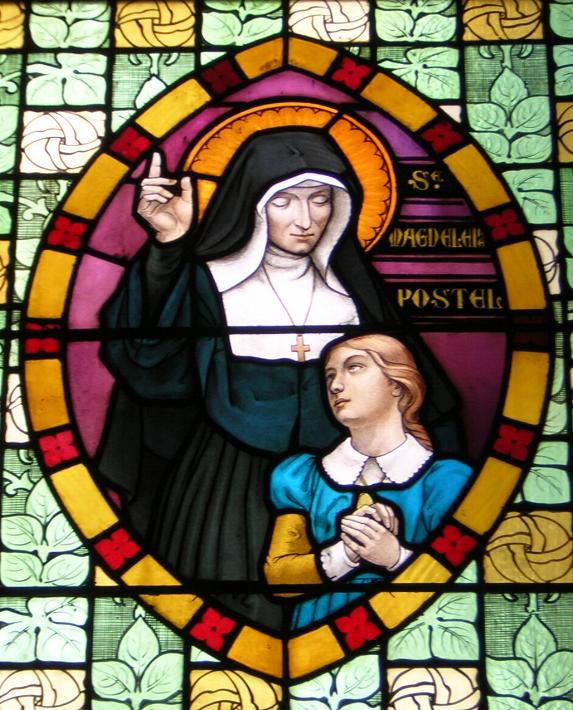
Saint of the Day – 16 July – St Marie-Madeline Postel (1756-1846) Religious Sister and Founder of the Sisters of Christian Schools of which she is the Patron, Teacher, Franciscan tertiary – born on 28 November 1756 at Barfleur, Normandy, France as Julie Françoise-Catherine Postel and died on 16 July 1846 at Saint-Sauveur-le-Vicoste, France of natural causes.   During the French Revolution she used her then-disbanded school to house fugitive priests despite the great risk that posed to her own life.

sisters of christian schools of mercy
Motherhouse and Schools of the Sisters of Christian Schools

Julie Françoise-Catherine Postel was born on 28 November 1756 in Barfleur to the fisherman Jean Postel and Thérèse Levallois.   She was the aunt to Blessed Placide Viel.

The Benedictine nuns oversaw her education in Valognes after her initial schooling and it was during that time that she discerned a call to serve God in the religious life.   She took a private vow to remain chaste as a step forward in this dream.

In 1774, she founded a school for girls in Barfleur that became a centre for underground religious activities during the French Revolution, for those who were unwilling to support the new regime.   This school had been shut down at the Revolution’s beginning. Authorisation was granted to her to keep the Blessed Sacrament in her house as the conflict continued and she carried it on her person at times to provide the Viaticum to those who were ill and at the verge of death.   The Jacobins often suspected her but never made allegations and left her alone.st marei-magdalene postel glass

The end of the Revolution saw Blessed Marie-Madeline take up teaching and catechising in Cherbourg where she taught around 300 children.  She made her religious profession into the Third Order of Saint Francis in 1798 (while assuming her religious name) and founded the Sisters of the Christian Schools (initally the words ‘of Mercy’ were added) in Cherbourg on 8 September 1807,  which was initially rather slow to achieve success until 1832 when she acquired a derelict convent in St-Sauveur-le-Vicomte to use as her headquarters which then prompted growth within the order.  st marie-magdalene postel glass 2.jpg

The Bishop of Coutances, Claude-Louis Rousseau issued diocesan approval for her order and it went on to receive the papal decree of praise from Pope Pius IX on 29 April 1859 and received full papal approval, much later, in 1901.   The order based itself on the Rule of the Franciscan Third Order, though this later changed in 1837, to be based upon that of the De La Salle Brothers which also prompted a name change for the congregation.Portrait,_St._Marie_Madeleine_Postel,_Sisters_of_Christian_Schools_of_Mercy

Marie-Madeline died in 1846 but her order continues its work in places such as Romania and Mozambique and in 2005 had 442 religious in 69 different locations worldwide.

The cause for her Canonisation began under Pope Leo XIII on 27 July 1897, at which stage Postel became titled as a Servant of God.   Pope Leo XIII later confirmed that Postel had lived a life of heroic virtue and named her as Venerable on 31 May 1903.   Pope Pius X later signified on 22 January 1908 his approval to two investigated miracles attributed to her intercession and so Beatified her on 17 May 1908.   Pope Pius XI confirmed two additional miracles and Canonised Blessed Marie-Madeline on 24 May 1925.

Below is the Church of St Marie-Madeline, her shrine and statue in the Church at St-Sauveur-le-Vicomte.church of st marie magdalene postelSaintMarieMagdalenPostelst marie- postel 800px-Tombeau_postel

Posted in DOMINICAN OP, SAINT of the DAY, VATICAN Resources

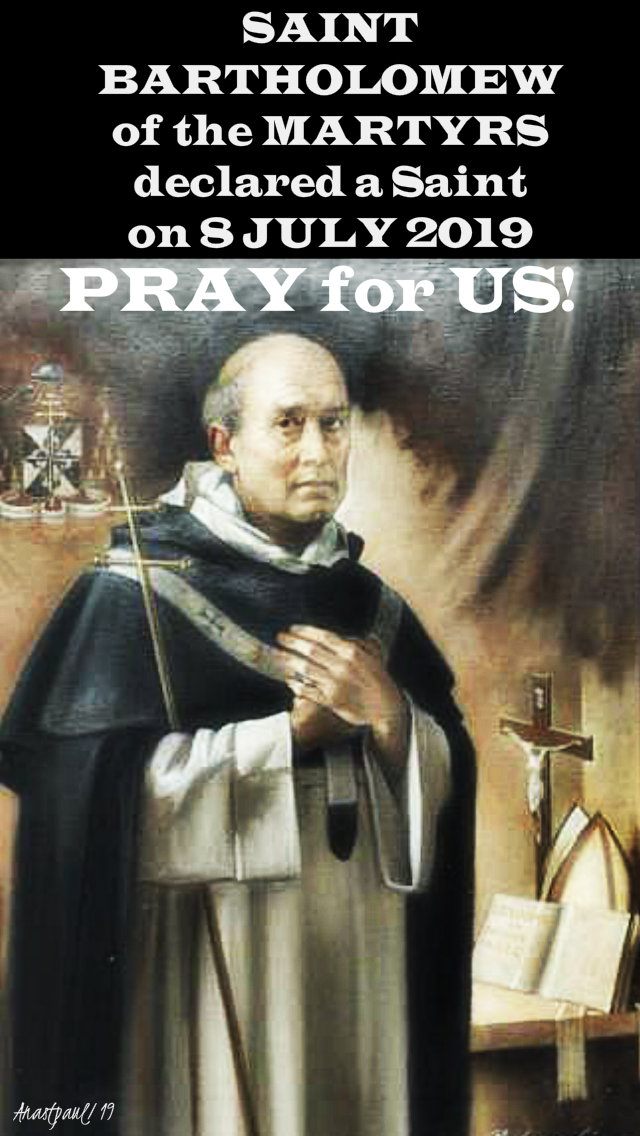
16 July – SAINT Bartholomew of the Martyrs/ of Braga OP (1514-1590)

16 July – SAINT Bartholomew of Braga OP ArchBishop of Braga also known as Bl Bartholomew of the Martyrs (Bartolomeu Fernandez dei Martiri Fernandes) (1514-1590)

https://anastpaul.com/2018/07/16/saint-of-the-day-16-july-blessed-bartholomew-of-the-martyrs-1514-1590/

On 8 July 2019, Pope Francis approved the favourable votes cast by the Eminent and Excellent members of the Congregation and extended to the Universal Church the liturgical worship in honour of Blessed Bartholomew of the Martyrs (born Bartolomeu Fernandes), of the Order of Preachers, archbishop of Braga, born in Lisbon, Portugal on 3 May 1514 and died in Viana do Castelo, Portugal, on 16 July 1590, inscribing him in the book of Saints (Equipollent Canonisation).

Alleluia!

Saint Bartholomew of the Martyrs, Pray for Us!st bartholomew of the martyrs - 16 july 2019.jpg

Posted in MARIAN TITLES, SAINT of the DAY, The BLESSED VIRGIN MARY

Feast of Our Lady of Mount Carmel and Memorials of the Saints – 16 July

Our Lady of Mount Carmel (Optional Memorial)

About:   https://anastpaul.wordpress.com/2017/07/15/feast-of-our-lady-of-mount-carmel-16-july/

The Brown Scapular of Our Lady of Mount Carmel:
https://anastpaul.com/2018/07/16/thought-for-the-day-16-july-the-memorial-of-our-lady-of-mount-carmel/

Bl André de Soveral
St Andrew the Hermit
St Antiochus of Sebaste
Bl Arnold of Clairvaux
Bl Arnold of Hildesheim
St Athenogenes of Sebaste
Bl Bartholomew of Braga OP ArchBishop of Braga also known as Bl Bartholomew of the Martyrs (Bartolomeu Fernandez dei Martiri Fernandes) (1514-1590)
Bl Bartholomew:
https://anastpaul.com/2018/07/16/saint-of-the-day-16-july-blessed-bartholomew-of-the-martyrs-1514-1590/

St Benedict the Hermit
Bl Ceslaus Odrowaz OP (c 1184– 242) (Brother of St Hyacinth)
Bl Claude Beguignot
Bl Domingos Carvalho
St Domnin
St Domnio of Bergamo
Bl Dorothée-Madeleine-Julie de Justamond
St Elvira of Ohren
St Eugenius of Noli
St Faustus
St Faustus of Rome and Milan
St Fulrad of Saint Denis
St Generosus of Poitou
St Gobbán Beg
St Gondolf of Saintes
St Grimoald of Saintes
St Helier of Jersey
Bl Irmengard
Bl John Sugar
St Landericus of Séez
Bl Madeleine-Françoise de Justamond
Bl Marguerite-Rose de Gordon
Bl Marguerite-Thérèse Charensol
Bl Marie-Anne Béguin-Royal
Bl Marie-Anne Doux
St Marie-Madeline Postel (1756-1846)
Bl Marie-Rose Laye
Bl Milon of Thérouanne
Bl Nicolas Savouret
Bl Ornandus of Vicogne
St Paulus Lang Fu
St Reinildis of Saintes
Bl Robert Grissold
Bl Simão da Costa
St Sisenando of Cordoba
St Tenenan of Léon
St Teresia Zhang Heshi
St Valentine of Trier
St Vitalian of Capua
St Vitaliano of Osimo
St Yangzhi Lang

Martyrs of Antioch – 5 saints: Five Christians who were martyred together. No details about them have survived by the names – Dionysius, Eustasius, Maximus, Theodosius and Theodulus. They were martyred in Antioch, Syria, date unknown.

Posted in CHRIST, the WAY,TRUTH,LIFE, DOCTORS of the Church, franciscan OFM, QUOTES of the SAINTS, SAINT of the DAY

Thought for the Day – 15 July – ‘Meditation on Christ in His humanity …’

Thought for the Day – 15 July – Monday of the Fifteenth week in Ordinary Time, Year C, Gospel: Matthew 10:34-11,1 and The Memorial of St Bonaventure OFM (1221-1274) Seraphic Doctor of the Church

Saint Bonaventure saw the spires of the great cathedrals reaching up to heaven as a reflection of the human soul’s reaching up to God in his The Soul’s Journey into God. Likewise, the streams of light coming into the church through the stained-glass windows, reflect God expressing Himself, in the wide variety of creatures upon whom He showers His gifts of grace.

And the images go on and on as the saint reaches into human experience of creation and cultural artifacts and finds vestigium (the footprints) of God since everything in creation, reflects in some way, the grandeur of God.   Human beings, of course, are the actual image of God.

It was this ability to take the spirituality of Saint Francis—as reflected in Saint Francis’ Canticle of the Sun, for instance—and place it at the heart of his writings, keeping the simplicity of the Franciscan insights and creating a sublime theology, that truly deserves the name “Seraphic.”

When Bonaventure was declared a Doctor of the Universal Church in 1588 by Pope Sixtus V, he was given the title “Seraphic Doctor.”   Merriam-Webster defines a seraph as one of the highest-ranking angels as well as “one of the six-winged angels standing in the presence of God.”   It was as a seraph that Christ appeared to Saint Francis when he received the stigmata on Mount La Verna.   Therefore, it is fitting to use the term to describe the soaring mysticism of Saint Bonaventure.

In his General Audience on 3 March 2010, Pope Benedict XVI spoke about the life of St Bonaventure.   He called to mind the great works of literature, art, philosophy and theology that were inspired by the Christian faith during the time period in which the saint lived.

“Among the great Christian figures who contributed to the composition of this harmony between faith and culture, Bonaventure stands out, a man of action and contemplation, of profound piety and prudent government,” Pope Benedict said.

The Pope called on the faithful to take note of “the central role that Christ always played in Bonaventure’s life and teaching,” and to imitate the way in which “the whole of his thinking was profoundly Christocentric.”

“Meditation on Christ in His humanity is corporeal in deed, in fact but spiritual in mind. . . . By adopting this habit, you will steady your mind, be trained to virtues and receive strength of soul….Let meditation of Christ’s life be your one and only aim, your rest, your food, your desire, your study.” – St Bonaventure

St Bonaventure, Pray for us!let meditationof christ's life - st bonaventure pray for us 15 july 2019.jpg

Posted in CHRIST, the WAY,TRUTH,LIFE, DOCTORS of the Church, franciscan OFM, FRUITS of the SPIRIT, QUOTES of the SAINTS, QUOTES on HAPPINESS, QUOTES on HUMILITY, QUOTES on SANCTITY, QUOTES on TRUST and complete CONFIDENCE in GOD, SAINT of the DAY

Quote/s of the Day – 15 July – The wisdom of St Bonaventure

Quote/s of the Day – 15 July – Monday of the Fifteenth week in Ordinary Time, Year C, Gospel: Matthew 10:34-11,1 and The Memorial of St Bonaventure (1221-1274) Doctor of the Church

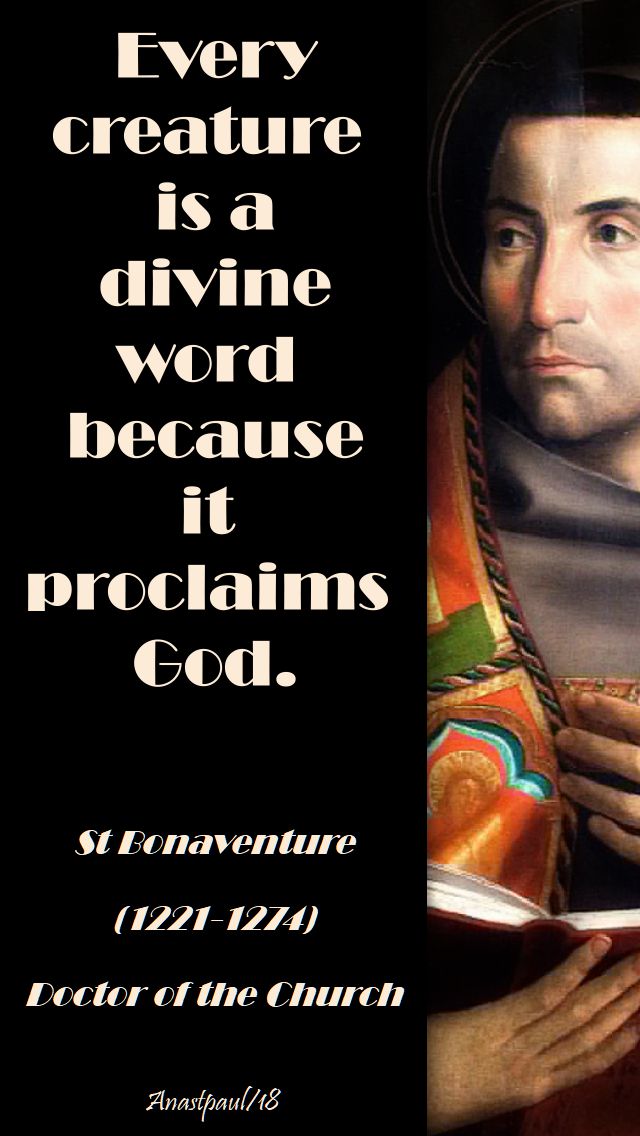
“Every creature
is a divine word
because it
proclaims God.”every-creature-st-bonaventure-15-july-2018.jpg

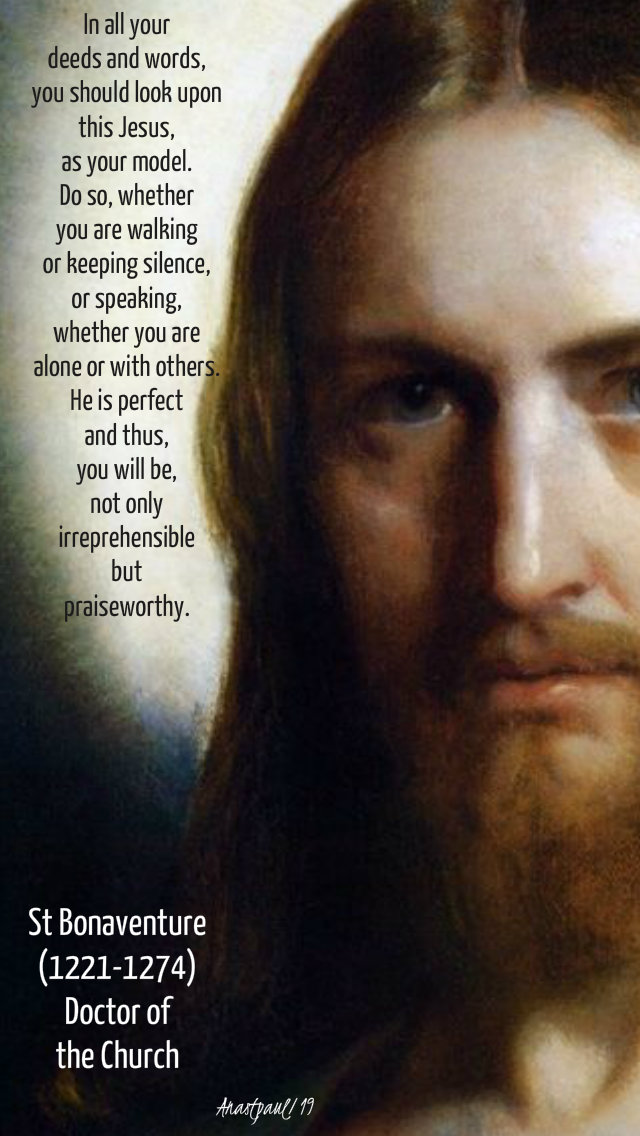
“In all your deeds and words,
you should look upon this Jesus, as your model.
Do so, whether you are walking
or keeping silence,
or speaking,
whether you are alone or with others.
He is perfect
and thus, you will be,
not only irreprehensible
but praiseworthy.”in all your deeds and words - st bonaventure 15 july 2019.jpg

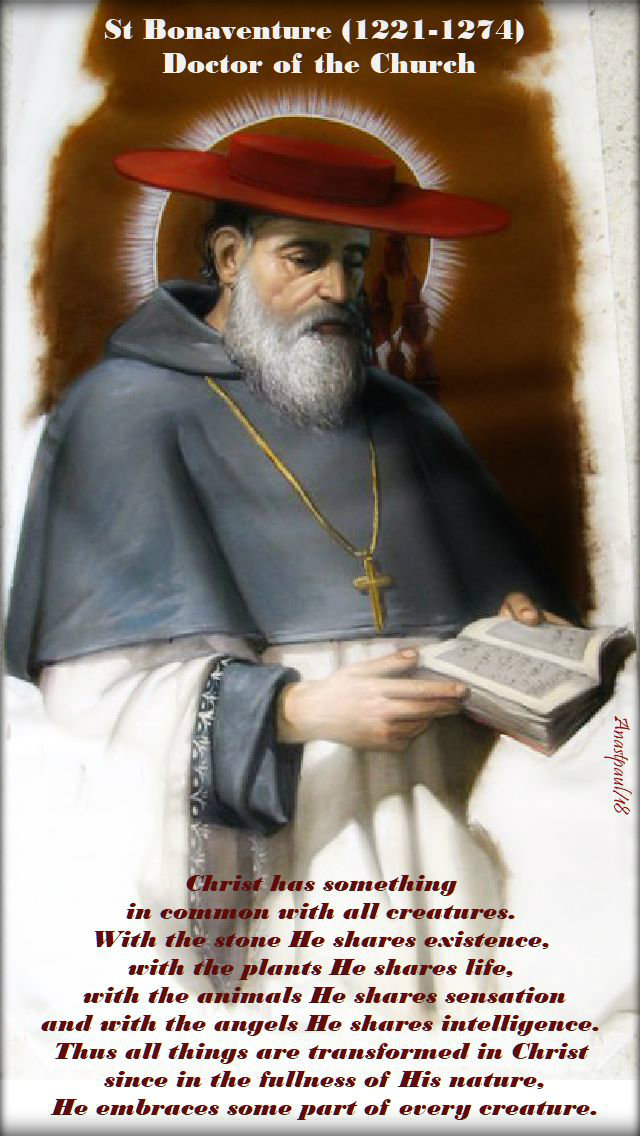
“Christ has something in common with all creatures.
With the stone He shares existence,
with the plants He shares life,
with the animals He shares sensation
and with the angels He shares intelligence.
Thus all things are transformed in Christ
since in the fullness of His nature,
He embraces some part of every creature.”christ-has-something-in-common-st-bonaventure-15-july-2018.jpg

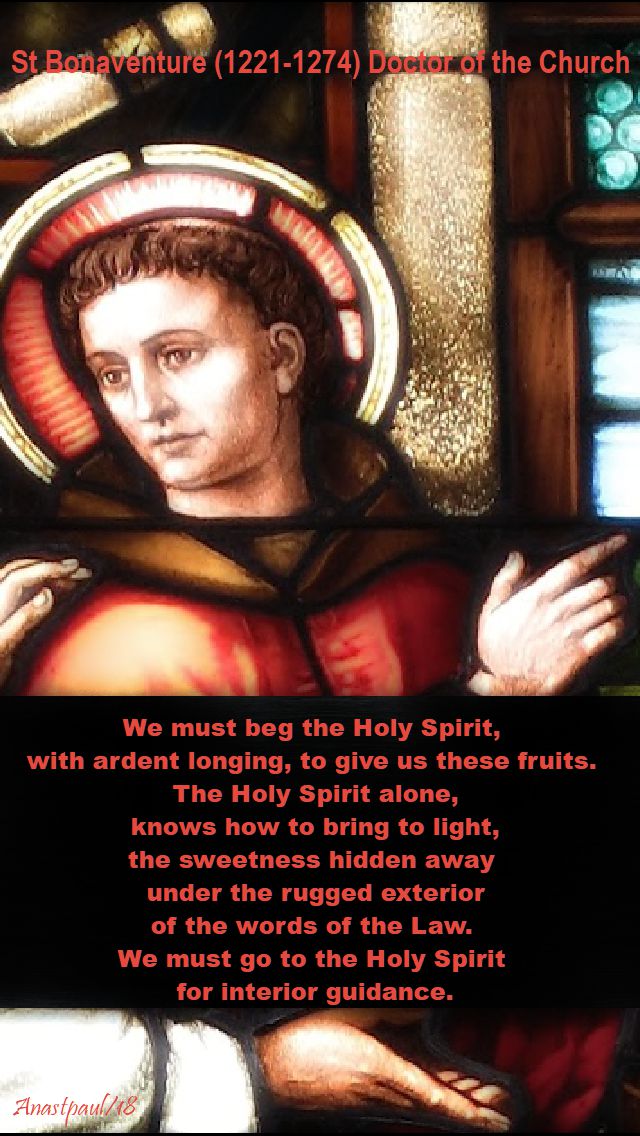
“We must beg the Holy Spirit,
with ardent longing, to give us these fruits.
The Holy Spirit alone,
knows how to bring to light,
the sweetness hidden away
under the rugged exterior of the words of the Law.
We must go to the Holy Spirit for interior guidance.”we-must-beg-the-holy-spirit-st-bonaventure-15-july-2018.jpg

“Since happiness is nothing else
than the enjoyment of the Supreme Good
and the Supreme Good is above us,
no-one can enjoy happiness,
unless he rises above himself.”since happiness is nothing else - st bonaventure 15 july 2019.jpg

“God might have created a more beautiful world,
He might have made heaven more glorious
but it was impossible for Him, to exalt a creature,
higher than Mary, in making her His Mother.”

St Bonaventure (1221-1274) Doctor of the Churchgod might have created a more beautiful world - st bonaventure 15 july 2019.jpg

Posted in DOCTORS of the Church, FATHERS of the Church, MORNING Prayers, QUOTES of the SAINTS, QUOTES on LOVE, QUOTES on MARRIAGE, MARRIED LOVE, QUOTES on the FAMILY, SAINT of the DAY, The WORD

One Minute Reflection – 15 July -‘… but not more than you love your God!’

One Minute Reflection – 15 July – Monday of the Fifteenth week in Ordinary Time, Year C, Gospel: Matthew 10:34-11:1 and The Memorial of St Bonaventure (1221-1274) Doctor of the Church and Bl Anne-Marie Javouhey (1779-1851)

“Whoever loves father or mother more than me is not worthy of me…” … Matthew 10:37

REFLECTION – “It is to those who are on fire with love or, rather, those He wants to set on fire with this love, that our Saviour addresses these words.   For our Saviour has not done away with but regulated, the love we owe to parents, spouse, children.   He did not say:  “Those who love them” but “Those who love them more than me”…   Love your father but love the Lord even more,  love him who brought you into the world but love yet more he who gave you being.   It was your father who brought you into the world but it was not he who created you, since he did not know, when he bred you, who you would be or what you would become.   It was your father who fed you but he is not the origin of the food that staunched your hunger.   Finally, your father must die if you are to inherit his goods but you will share the inheritance God intends for you, while living with him eternally.

So love your father but not more than you love your God, love your mother but love still more the Church who has begotten you into eternal life…   Indeed, if you owe such gratitude to those who begot you for mortality, what kind of love do you owe to those who begot you for eternity?   Love your spouse, love your children as God does, to lead them to serve God together with you and then, when you are reunited, you will not be afraid of being separated.   Your love for your family would indeed fall short if you did not lead them to God…

Take up your cross and follow the Lord.   Your Saviour Himself, wholly God as He was in the flesh, clothed with your flesh, He, too, showed human feelings when He said – “My Father, if it is possible, let this cup pass from me,” (Mt 26:39)…   The servant’s nature with which He clothed Himself for your sake caused His human voice, the voice of His flesh, to be heard.   He took your voice so as to express your weakness and give you His strength… and to show you, whose will to prefer.”… St Augustine (354-430) Father & Doctor of the Church – Sermon 344, #2-3matthew 10 37 whoever lovs father or mother - so love your father but not more - st augustine 15 july 2019.jpg

PRAYER – God our Father, we are Your children and You have set us aside to come home to You by the light of the way of Your divine Son.   Grant we pray, that we may grow in faith and love daily, by the intercession of Saint Bonaventure and Blessed Anne-Marie Javouhey (1779-1851) and may be a light of love, to all around us, as they were.   We make our prayer through our Lord Jesus with You in the unity of the Holy Spirit, God forever, amen.st bonaventure pray for us 15 july 2019

bl anne-marie javouhey pray for us 15 july 2019

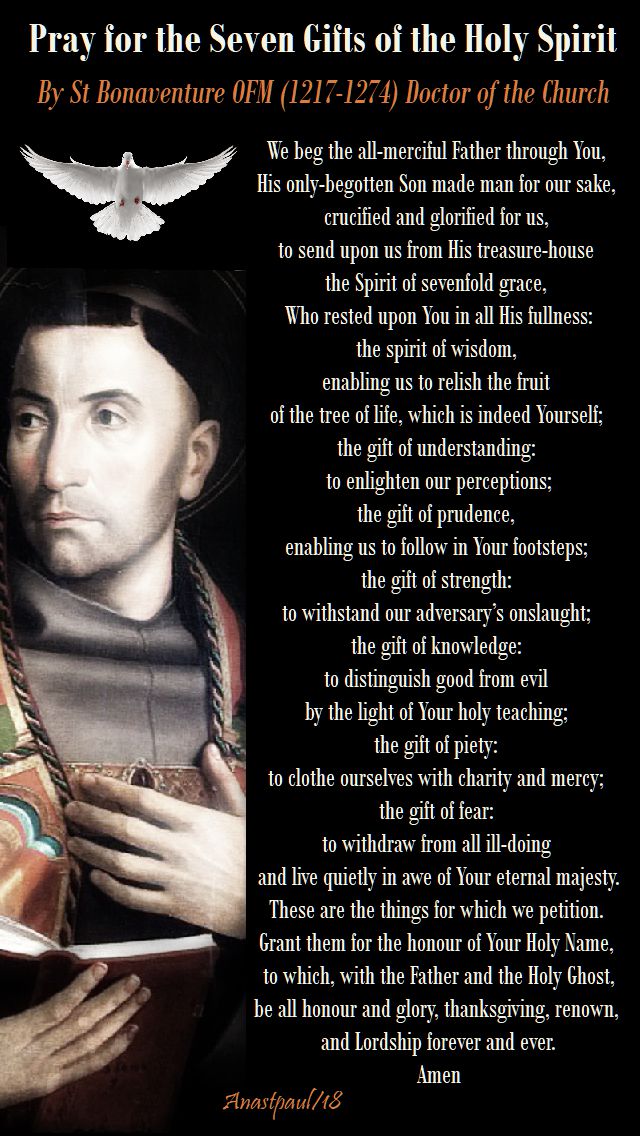
Posted in 7 GIFTS of the HOLY GHOST: Wisdom, Understanding, Prudence, Strength, Knowledge, Piety, Fear, DOCTORS of the Church, Our MORNING Offering, PRAYERS of the SAINTS, SAINT of the DAY

Our Morning Offering – 15 July – Prayer for the Gifts of the Holy Spirit

Our Morning Offering – 15 July – Monday of the Fifteenth week in Ordinary Time, Year C

Prayer for the Gifts
of the Holy Spirit
By St Bonaventure (1221-1274) – Seraphic Doctor of the Church

We beg the all-merciful Father through You,
His only-begotten Son made man for our sake,
crucified and glorified for us,
to send upon us, from His treasure-house,
the Spirit of sevenfold grace,
Who rested upon You in all His fullness.

The spirit of wisdom,
enabling us to relish the fruit of the tree of life,
which is indeed Yourself.
The gift of understanding:
to enlighten our perceptions.
The gift of prudence,
enabling us to follow in Your footsteps.
The gift of strength:
to withstand our adversary’s onslaught.
The gift of knowledge,
to distinguish good from evil
by the light of Your holy teaching.
The gift of piety,
to clothe ourselves with charity and mercy.
The gift of fear,
to withdraw from all ill-doing
and live quietly in awe
of Your eternal majesty.

These are the things for which we petition.
Grant them for the honour of Your Holy Name,
to which, with the Father and the Holy Spirit,
be all honour and glory, thanksgiving, renown
and Lordship forever and ever.
Amenprayer for the seven gifts of the holy spirit by st bonaventure - 30 oct 2018 mem of st angelo of acri.jpg

Posted in SAINT of the DAY

Saint of the Day – 15 July – Blessed Anne-Mary Javouhey (1779-1851)

Saint of the Day – 15 July – Blessed Anne-Mary Javouhey (1779-1851) aged 71 – Religious Sister, Missionary and Founder of the Sisters of Saint Joseph of Cluny.   She was born on 10 November 1779 at Jallanges, France and died on 15 July 1851 at Paris, France of natural causes.   She is known as the Liberator of the Slaves in the New World, a 19th-century “Mother Teresa” and as the mother of the town of Mana, French Guiana.  Patronages – Jallasnages, Mana and the Sisters she founded.   During the French Revolution through her teen years, she helped to hide and care for a number of priests persecuted by the French Revolution, including keeping watch for them as they said Mass.

Imagine a Mother Teresa in the France of Napoleon’s day and you will have a picture of Anne-Marie Javouhey.   Nanette, as she was called, was a “velvet brick,” a thin layer of gentleness covering her determined core.   A competent leader, Nanette dominated every scene in her adventurous life.Bl.-Anne-Marie-Javouhey

In 1800, she tested her vocation with the Sisters of Charity at Besançon.   One night she heard a voice say, “You will accomplish great things for me.”   A few nights later, St. Teresa of Ávila with black, brown and bronze children appeared to her.   “God wants you to found a congregation to care for these children,” said the saint.

In 1801, Nanette and her three natural sisters opened a school for poor children near Chamblanc.  Anne-Marie-JavouheyDuring the next decade she ran two day schools and an orphanage.   In 1812 she founded the Sisters of St Joseph of Cluny.   Then the dam burst, with demand for her sisters’ services clamouring throughout France.

Nanette, now Mother Javouhey, held her sisters to a high ideal of community life that she articulated in the following correspondence to them:

“As we are joined together in community, we should live in unity with all its members, having one heart and soul.   We should be always willing to labour and suffer privations without troubling others.   We must possess nothing of our own, aware that everything belongs to the community according to the spirit of community life.

If we find that we are in want for certain things—and surely we will be often—we should rejoice because holy poverty does not imply that we should want nothing.   But rather, it means that we should be happy to do without anything for the sake of God and the sake of others.

Each sister should be prepared to accept willingly the duties assigned to her, no matter how hard or how menial they may appear…”

In 1817, Mother Javouhey sent sisters to the African island of Reunion to open her first missionary outpost.  bl anne-marie lifeIt wasn’t long before she had sisters serving black, brown and bronze people at remote places in Africa at Senegal, Sierra Leone and Gambia and in South America at French Guiana.   With dogged faith the sisters battled extreme hardship everywhere.
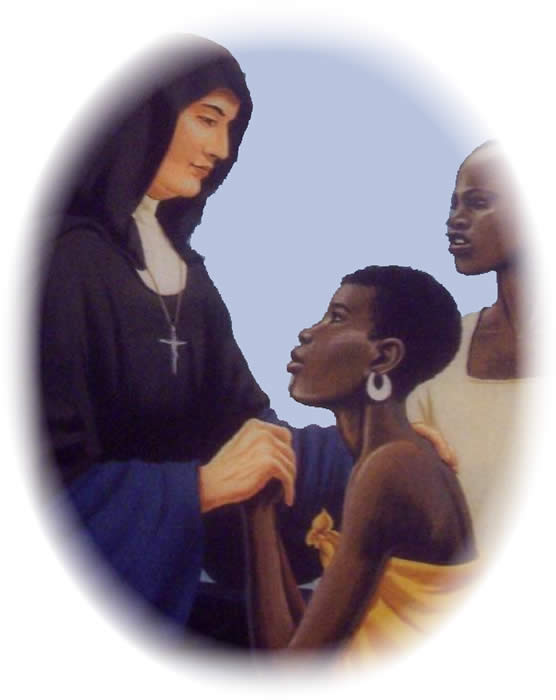
At the government’s request, Mother Javouhey undertook some very unusual tasks.   For example, she spent four years supervising the establishment of a colony for blacks at Mana, French Guiana.   Then in 1834 she accepted the most remarkable assignment of her life.   Six hundred slaves were to be liberated in Guiana and she was asked to prepare them for emancipation by training them in the ways of religion and civilised society.   As each family was ready to be freed, Mother Javouhey arranged for them to have money, some land and a cottage.bl anne-marie javouhey

Anne-Marie Javouhey spent the last years of her life in France directing the work of her burgeoning congregation.   When she died in 1851, her sisters were in thirty-two countries and colonies.   Today, the Congregation of the Sisters of St Joseph of Cluny numbers close to 3,000 Sisters serving in over 60 countries, including the United States, Canada, India and Ireland.

When news of her death in 1851 reached the black population of French Guiana, there was general grief for “the mother of the slaves”.   Blessed Anne-Marie was Beatified on 15 October 1950 by Ven Pope Pius XII.bl anne marie lg statue face.jpg

Posted in SAINT of the DAY

Memorials of the Saints – 15 July

St Bonaventure of Bagnoregio OFM (1221-1274) – Seraphic Doctor of the Church -(Memorial)
St Bonaventure!
https://anastpaul.com/2018/07/15/saint-of-the-day-15-july-st-bonaventure-o-f-m-1221-1274-doctor-of-the-church/
AND:
https://anastpaul.com/2017/07/15/saint-of-the-day-15-july-st-bonaventure-seraphic-doctor/

Dispersion of the Apostles:   Commemorates the missionary work of the Twelve Apostles. It was first mentioned in the 11th century and was celebrated in the northern countries of Europe during the Middle Ages. It is now observed in Germany, Poland and some dioceses of England, France and the United States.

St Abundantia of Spoleto
St Abudemius of Bozcaada
St Adalard the Younger
St Anrê Nguyen Kim Thông
Bl Anne-Mary Javouhey (1779-1851)
Bl Antoni Beszta-Borowski
St Apronia
St Athanasius of Naples
St Antiochus of Sebaste
St Benedict of Angers
Bl Bernard of Baden
St David of Sweden
St Donivald
St Eberhard of Luzy
St Edith of Tamworth
St Eternus
St Felix of Pavia
St Gumbert of Ansbach
St Haruch of Werden
St Jacob of Nisibis
St Joseph Studita of Thessalonica
Bl Michel-Bernard Marchand
Bl Peter Aymillo
St Phêrô Nguyen Bá Tuan
St Plechelm of Guelderland
Bl Roland of Chézery
St Valentina of Nevers
St Vladimir I of Kiev

Martyred Jesuit Missionaries of Brazil – 40 beati: A band of forty Spanish, Portugese and French Jesuit missionaries martyred by the Huguenot pirate Jacques Sourie while en route to Brazil. They are –
• Aleixo Delgado • Alonso de Baena • álvaro Borralho Mendes • Amaro Vaz • André Gonçalves • António Correia • Antônio Fernandes • António Soares • Bento de Castro • Brás Ribeiro • Diogo de Andrade • Diogo Pires Mimoso • Domingos Fernandes • Esteban Zuraire • Fernando Sánchez • Francisco Alvares • Francisco de Magalhães • Francisco Pérez Godoy • Gaspar Alvares • Gonçalo Henriques • Gregorio Escribano • Ignatius de Azevedo • Iõao • João Fernandes • João Fernandes • Juan de Mayorga • Juan de San Martín • Juan de Zafra • Luís Correia • Luís Rodrigues • Manuel Alvares • Manuel Fernandes • Manuel Pacheco • Manuel Rodrigues • Marcos Caldeira • Nicolau Dinis • Pedro de Fontoura • Pedro Nunes • Simão da Costa • Simão Lopes •
They were martyed on 15 and 16 July 1570 on the ship Santiago near Palma, Canary Islands. They were beatified on 11 May 1854 by Pope Pius IX.

Martyrs of Alexandria – 13 saints: Thirteen Christians who were martyred together. We know the names of three, no details about them and the other ten were all children. – Narseus, Philip and Zeno. Martyred in the early 4th-century in Alexandria, Egypt.

Martyrs of Carthage – 9 saints: A group of nine Christians who were martyred together. We know nothing else but their names – Adautto, Catulinus, Felice, Florentius, Fortunanziano, Januarius, Julia, Justa and Settimino. They were martyred in Carthaginian and their relics at the basilica of Fausta at Carthage.

Martyrs of Pannonia – 5 saints: Five 4th-century martyrs killed together. No information about them has survived except the names – Agrippinus, Fortunatus, Martialis, Maximus and Secundinus.

Posted in SAINT of the DAY

Thought for the Day – 14 July – …Holiness thrives on the Cross, anywhere

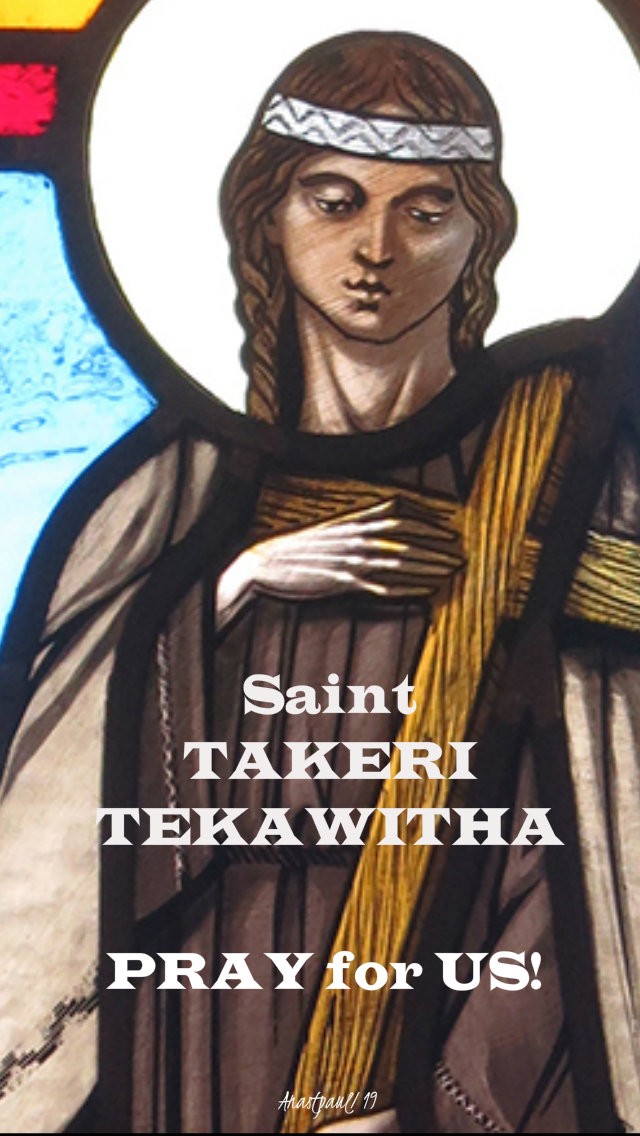
Thought for the Day – 14 July – Fifteenth Sunday in Ordinary Time, Year C, Luke 10:25–37 and the Memorial of Saint Kateri Tekakwitha (1656–1680) “Lily of the Mohawks”

The blood of martyrs is the seed of saints.   Nine years after the Jesuits, Isaac Jogues and Jean de Lelande were tomahawked by Iroquois warriors, a baby girl was born near the place of their martyrdom, Auriesville, New York.

Her mother was a Christian Algonquin, taken captive by the Iroquois and given as wife to the chief of the Mohawk clan, the boldest and fiercest of the Five Nations.   When she was four, Tekakwitha lost her parents and little brother in a smallpox epidemic that left her disfigured and half blind.   She was adopted by an uncle, who succeeded her father as chief.   He hated the coming of the Blackrobes—Jesuit missionaries—but could do nothing to them because a peace treaty with the French, required their presence in villages, with Christian captives.   She was moved by the words of three Blackrobes who lodged with her uncle but fear of him kept her from seeking instruction.   Tekakwitha refused to marry a Mohawk brave and at 20 finally received the courage ,to take the step of converting.   She was baptised with the name Kateri–Catherine–on Easter Sunday.

Now, she would be treated as a slave.   Because she would not work on Sunday, Kateri received no food that day.   Her life in grace grew rapidly.   She told a missionary that she often meditated on the great dignity of being baptised.   She was powerfully moved by God’s love for human beings and saw the dignity of each of her people.

She was always in danger, for her conversion and holy life created great opposition.   On the advice of a priest, Kateri stole away one night and began a 200-mile walking journey to a Christian Indian village at Sault S. Louis, near Montreal.

For three years she grew in holiness under the direction of a priest and an older Iroquois woman, giving herself totally to God in long hours of prayer, in charity, and in strenuous penance.   At 23, Kateri took a vow of virginity, an unprecedented act for an Indian woman whose future depended on being married.   She found a place in the woods where she could pray an hour a day—and was accused of meeting a man there!

Her dedication to virginity was instinctive – Kateri did not know about religious life for women until she visited Montreal.   Inspired by this, she and two friends wanted to start a community but the local priest dissuaded her.   She humbly accepted an “ordinary” life. She practised extremely severe fasting as penance for the conversion of her nation. Kateri Tekakwitha died the afternoon before Holy Thursday.   Witnesses said that her emaciated face changed colour and became like that of a healthy child.   The lines of suffering, even the pockmarks, disappeared and the touch of a smile came upon her lips. She was Beatified in 1980 and Canonised in 2012.

We like to think that our proposed holiness is thwarted by our situation.   If only we could have more solitude, less opposition, better health.   Kateri Tekakwitha repeats the example of the saints – holiness thrives on the cross, anywhere.   Yet she did have what Christians—all people—need, the support of a community.   She had a good mother, helpful priests, Christian friends.   These were present in what we call primitive conditions and blossomed in the age-old Christian triad of prayer, fasting and almsgiving, union with God in Jesus and the Spirit, self-discipline and often suffering, and charity for her brothers and sisters.   It is really simple, is it not?

Saint Kateri Tekakwitha, Pray for Us!st kateri tekakwitha pray for us no 2 14 july 2019.jpg