Posted in Our MORNING Offering, PRAYERS of the SAINTS, SAINT of the DAY

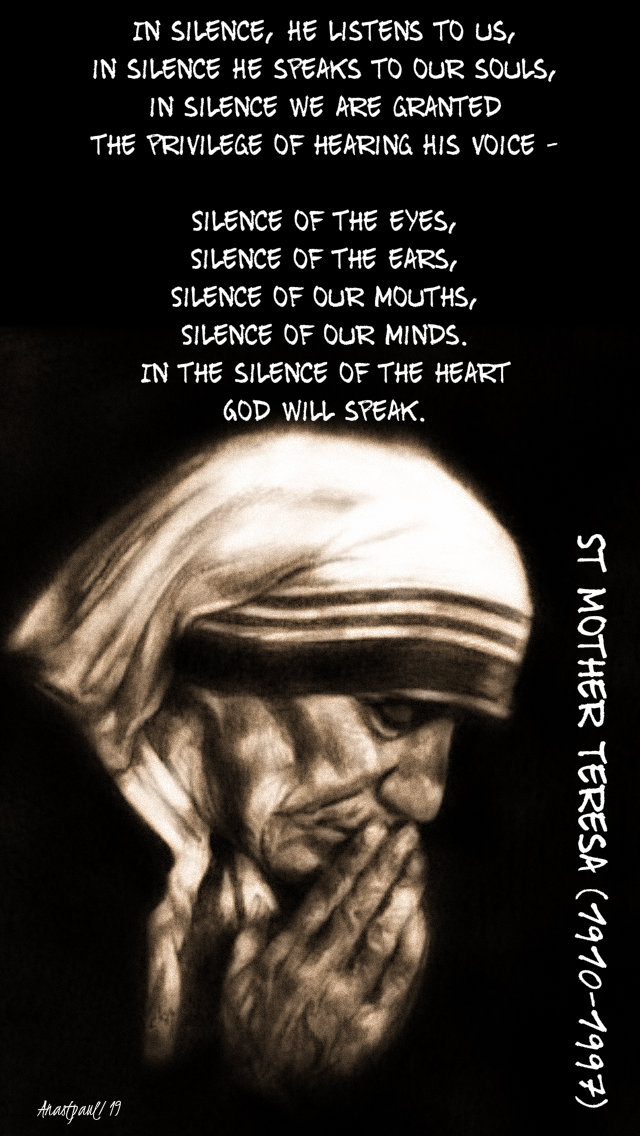
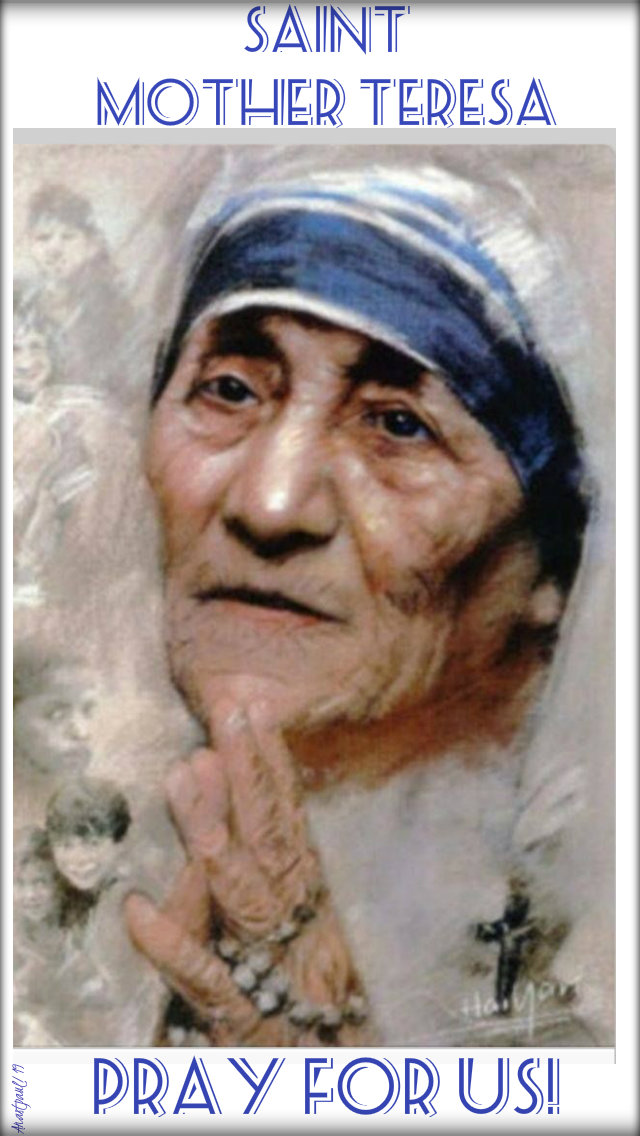
Our Morning Offering – 5 September – St Mother Teresa’s Daily Prayer

Our Morning Offering – 5 September – Thursday of the Twenty-second week in Ordinary Time, Year C and the Memorial of St Mother Teresa of Calcutta (1910-1997)

St Mother Teresa’s Daily Prayer
“Radiating Christ”
By Blessed John Henry Newman (1801-1890)

Dear Jesus,
help me to spread Your fragrance
wherever I go.
Flood my soul
with Your spirit and life.
Penetrate and possess
my whole being so utterly,
that my life may only be a radiance of Yours.
Shine through me
and be so in me,
that every soul I come in contact with
may feel Your presence in my soul.
Let them look up
and see no longer me
but only Jesus!
Stay with me
and then I shall begin to shine as You shine,
so to shine as to be a light to others.
The light, O Jesus, will be all from You,
none of it will be mine.
It will be You,
shining on others through me.
Let me thus praise You
the way You love best,
by shining on those around me.
Let me preach You without preaching,
not by words but by my example,
by the catching force
of the sympathetic influence of what I do,
the evident fullness
of the love my heart bears to You.
Amenradiating christ - bl john henry newman - 9 jan 2018

Posted in SAINT of the DAY

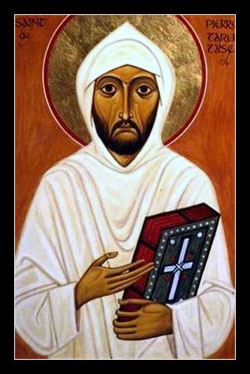
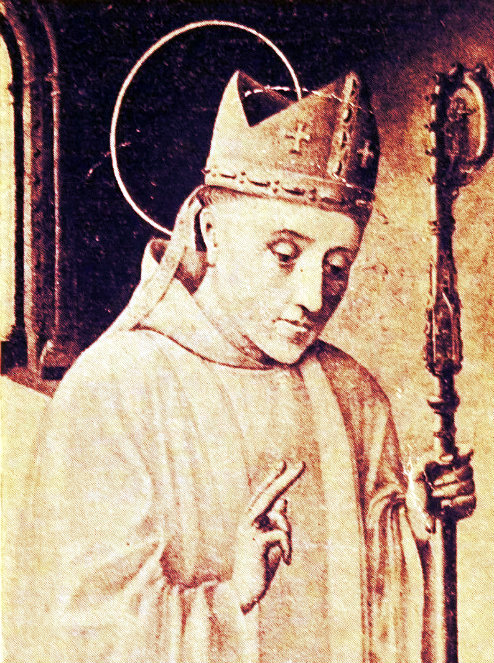
Saint of the Day – 5 September – Saint Bertin the Great (c 615-c 709)

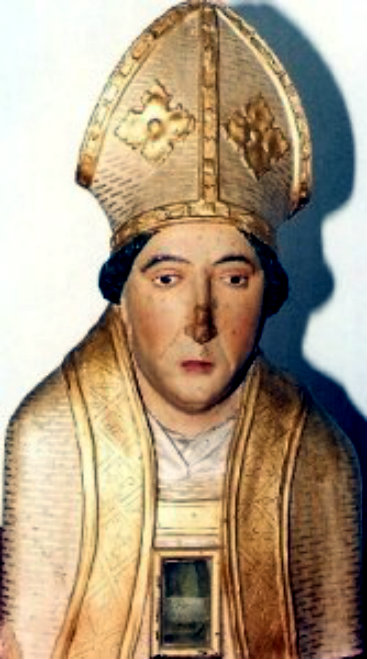
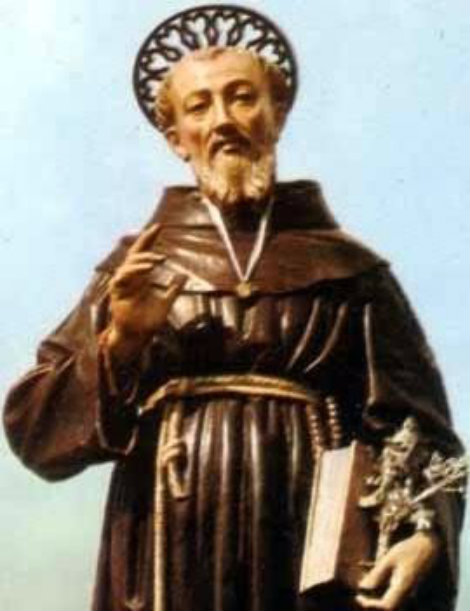
Saint of the Day – 5 September – Saint Bertin the Great (c 615-c 709) Benedictine Monk and Abbot – born in the early 7th century at Constance (in modern Germany) – died in c709 of natural causes.   Saint Bertin practiced great severities throughout his lifetime and was in continuous communion with God.   He travelled far and wide to share God’s message and trained his disciples to carry on his ministry after he was gone.st bertin statue

Bertin was born near Constance, then in the Frankish Duchy of Alamannia.   At an early age, he entered the Abbey of Luxeuil, where, under the austere rule of its abbot, St Columban (540-615), he prepared himself for a future missionary career.   About the year 638 he set out, in company with two fellow Monks, Mummolin and Ebertram, for the extreme northern part of France in order to assist his friend and kinsman, Bishop (Saint) Audomar (died c 670), in the evangelisation of the Morini.   This area was then one vast marsh, studded here and there with hillocks and overgrown with seaweed and bulrushes.   On one of these hillocks, Bertin and his companions built a small house and they went out daily to preach the Christian faith to the natives, most of whom were still pagans.st bertin line drawing

Gradually some converted pagans joined the little band of missionaries and a larger monastery had to be built.   A tract of land called Sithiu had been donated by a converted nobleman named Adrowald.   St Audomar now turned this whole tract over to the missionaries, who selected a suitable place on it for their new Abbey of St Peter. Additional villages were granted by Count Waldebert, later a monk at Bertin’s monastery of Sythiu and eventually Abbot of Luxueil and Canonised, who gave his son at the baptismal font to Bertin, from whom the boy received his name and his education.   The community grew so rapidly that in a short time this monastery also became too small and another was built where the city of St Audomar now stands.monks st bertin

The fame of Bertin’s learning and sanctity was so great that in a short time more than 150 monks lived under his rule, among them St Winnoc and his three companions who had come from Brittany to join Bertin’s community and assist in the conversion of the heathen.   When nearly the whole region was Christianised and the marshy land transformed into a fertile plain, Bertin, knowing that his death was not far off, appointed St Rigobert as his successor, while he himself spent the remainder of his life preparing for a happy death.   He had run the second monastery they founded for almost 60 years. Saint Bertin passed away at a very old age, some say older than 100, surrounded by his fellow monks.

St Bertin began to be venerated as a saint soon after his death.Saint-Omer_Abbaye_de_Saint-Bertin_386.jpg

Mummolin, perhaps because he was the oldest of the missionaries, was abbot of the two monasteries until he succeeded the deceased Eligius as Bishop of Noyon, about the year 659. Waldebert’s son Bertin, adopted by Bertin the founder, then became the third abbot.

In later times the abbey became famous as a centre of sanctity and learning.   About the 11th century, the name of the abbey was changed to that of Saint-Bertin.   The abbey church, now in ruins, was one of the finest 14th-century Gothic edifices.   In later times, its library, archives and art-treasures were renowned both in and out of France.800px-RuinsOfSaintBertin1850.jpg

The monks were expelled in 1791 by the invading forces of the French Revolutionary Army and in 1799 the abbey and its church were sold at auction.st bertin.jpg

Posted in SAINT of the DAY

Memorials of the Saints – 5 September

St Albert of Butrio
St Alvitus of León
Bl Anselm of Anchin
St Anseric of Soissons
St Bertin the Great (c 615-c 709)
St Charbel
Bl Florent Dumontet de Cardaillac
St Genebald of Laon
Bl Gendtilis
Bl Gerbrand of Dokkum
St Guise Hoang Luong Canh
Bl John the Good of Siponto
Bl Jordan of Pulsano
St Obdulia
St Phêrô Nguyen Van Tu
St Romulus of Rome
St Mother Teresa of Calcutta (1910-1997)
Full Biography here:
https://anastpaul.wordpress.com/2017/09/05/saint-of-the-day-5-september-st-mother-teresa-of-calcutta-mc/
And her story from the Vatican here:
https://anastpaul.com/2018/09/05/saint-of-the-day-5-september-st-teresa-of-calcutta-m-c-1910-1997/

St Victorinus of Amiterme
St Victorinus of Como
Bl William Browne

Martyrs of Armenia – 1,000 saints: A group of up to 1,000 Christian soldiers in the 2nd century imperial Roman army of Trajan, stationed in Gaul. Ordered to sacrifice to pagan gods, they refused and were transferred to Armenia. Ordered again to sacrifice to pagan gods, they refused again. Martyrs. We know the names of three of them, but nothing else – Eudoxius, Macarius and Zeno.

Martyrs of Capua – 3 saints: Three Christians who were martyred together. Long venerated in Capua, Italy. We know their names, but little else – Arcontius, Donatus and Quintius. They were martyred in Capua, Italy.

Martyrs of Nicomedia – 80 saints: A group of 80 Christians, lay and clergy, martyred together in the persecutions of Valens. We know little more than the names of three of them – Menedemo, Teodoro and Urbano. They were locked on a boat which was then set on fire on the shore of Nicomedia, Bithynia (in modern Turkey) c 370.

Martyrs of Porto Romano – 4+ saints: A group of Christians martyred together in the persecutions of Marcus Aurelius. We know little more than their names – Aconto, Herculanus, Nonno and Taurino. c180 at Porto Romano, Italy

Posted in DOMINICAN OP, MYSTICS, SAINT of the DAY

Thought for the Day – 4 September – Be imprinted in our hearts, Lord

Thought for the Day – 4 September – Wednesday of the Twenty-second week in Ordinary Time, Year C and the Memorial of Blessed Catherine of Racconigi OP (1486-1547)

Just as the Carmelites have their many famous Teresas so too do the Dominicans have their Catherines – St Catherine of Alexandria (c287-c305) (by adoption as patroness of the Order), St Catherine of Siena (1347-1380) Doctor of the Church, St Catherine de Ricci (1522-2590), Bl Catherine Jarrige (1754-1836) and Bl Catherine of Racconigi, today’s saint. Most of these Catherine’s were espoused to the Lord.   Many of them received crowns of thorns.   They all showed the greatness of God’s grace to draw hearts close to Him.

Aside from being espoused to the Lord at the age of five and aside from receiving the stigmata and a crown of thorns, Bl Catherine of Racconigi is a prime example of Christ drawing hearts close to Him.   Several times the Lord appeared to her and took her heart so that He might cleanse and beautify it.   Moreover, as the tradition holds, the words Jesu, spes mea –“Jesus, my hope!”–were inscribed on her heart in letters of gold.   Christ loves His virgin brides.   The tokens that He has given them, especially to the saintly Dominicans cloistered nuns and active sisters, shows that He desires nothing but union with souls.   Sometimes, this means sharing in the hardships of His Passion.   For Bl Catherine, this meant a life of destitute poverty, abandonment by many friends at death and even the challenge of being deprived of her confessor before she died.   Yet, through it all, her Hope–Christ the Lord, drew her to Himself, where she is now in perfect happiness in heaven.

O Lord, our Hope, who did enrich with an abundance of celestial gifts, the heart of Blessed Catherine, already filled with You, grant, through the intercession of that glorious Virgin, that You may be wholly fastened to our hearts, who for our sake, was wholly fastened to the cross, Christ our Lord. Amen.

Blessed Catherine of Racconigi, Pray for Us!bl catherine of racconigi pray for us 4 sept 2019.jpg

Posted in DOMINICAN OP, MYSTICS, SAINT of the DAY

Quote of the Day – 4 September – Jesu, spes mea!

Quote of the Day – 4 September – Wednesday of the Twenty-second week in Ordinary Time, Year C and the Memorial of Blessed Catherine of Racconigi OP (1486-1547)

Jesu, spes mea!

Jesus, my hope!

Bl Catherine of Racconigi (1486-1547)jesu spes mea - jesus my hope bl catberine of racconigi 4 sept 2019.jpg

Posted in Our MORNING Offering, PRAYERS of the SAINTS, SAINT of the DAY

Our Morning Offering – 4 September – Raise My Heart

Our Morning Offering – 4 September – Wednesday of the Twenty-second week in Ordinary Time, Year C

Raise My Heart
Blessed John Henry Newman (1801-1890)

O my God,
whatever is nearer to me than You,
things of this earth
and things more naturally pleasing to me,
will be sure to interrupt the sight of You,
unless Your grace interfere.
Keep You my eyes,
my ears,
my heart,
from any such miserable tyranny.
Keep my whole being fixed on You.
Let me never lose sight of You
and while I gaze on You,
let my love of You
grow more and more every day.
Amenraise my heart by bl john henry newman 4 sept 2019.jpg

Posted in DOMINICAN OP, MYSTICS, SAINT of the DAY

Saint of the Day – 4 September – Blessed Catherine of Racconigi OP (1486-1547)

Saint of the Day – 4 September – Blessed Catherine of Racconigi OP (1486-1547) – Third Order Dominican, Mystic, Stigmatist – born as Caterina Mattei in June 1486 in Racconigi, Cuneo, Italy and died on 4 September 1547 at Caramagna Piemonte, Cuneo, Italy.bl catherine of racconigi-header

Most of the information regarding Catherine Mattei is derived from a ‘vita’ written by her friend, John Francis Pico, Prince of Mirandola.   Catherine Mattei was born in the Piedmont region of Northwest Italy in 1487 into an impoverished household in the Province of Cuneo.   Intermittent conflicts in the area brought widespread poverty.   Her parents were Giorgio and Bilia de Ferrari Mattei.   Her father, an unemployed locksmith, became despondent and quarrelsome as so many do when they lose their livelihood.  Her mother supported the family by weaving coarse cloth at home.   Catherine and her brother grew up in an atmosphere that was absent of the peace of Christ.

Surprisingly, God reached the heart of little Catherine when she was only five.   It was then that her mystical experiences began.   Our Lady appeared to her while the tiny child was praying alone in her tiny room and told Catherine that Jesus wished to make her His spouse.   Then, as a child her own age, Jesus Himself appeared, accompanied by many other saints including Catherine of Siena and Peter Martyr and the Blessed Mother placed the ring of espousal on her finger.   Like the ring of Saint Catherine of Siena, it was visible to today’s saint but could not be seen by others.bl catherine.jpg

Thereafter Catherine had frequent ecstasies and visions.   Jesus always appeared to her as a man her own age, whatever that was at the time.   He talked with her, taught her how to pray and several times took her heart away to cleanse it.   When He appeared with His Cross, she offered to help Him.   He let it rest on her shoulder a moment and it left a wound for the rest of her life.   She also received the stigmata, though it too remained invisible to others and, at her request, it was only revealed by her confessor after her death.

And, of course, Jesus worked many miracles on behalf of His friend – made a broken dish whole again and provided money and food when the family’s poverty was extreme.   In times of trial, the heavenly hosts came to comfort the girl who received great consolation from the aspiration, “Jesus, my hope!”bl catherine of racconigi.jpg

Because her family opposed her becoming a Dominican, she took the habit of a tertiary. Her mystical experiences roused a storm of gossip among her neighbours, who were terrified at the lights and sounds that came from her home.   The devil stirred up more trouble to mitigate her influence over other souls.   Even the Dominican fathers ostracised her and eventually she was forced out of town and settled in Racconigi.

There rich and poor sought out Catherine for her wise counsel, prayers and material assistance.   She was almost continually in ecstasy.   The particular object of Catherine’s prayers was the salvation of soldiers dying in battle and the holy souls in Purgatory. Numerous miracles occurred before and after her death and a cult arose at her tomb almost immediately.   Even her persecutors were aware of her sanctity and retracted their bitter words.

Pope Pius VII confirmed her holiness and cult in 1810 by naming her Blessed.bl 486px-Catherine_de_Racconigi.jpg

Posted in MARIAN TITLES, SAINT of the DAY

Feast of Our Lady of Consolation and Memorials of the Saints – 4 September

Our Lady of Consolation, or Mary, Consoler of the Afflicted, comes from the Latin Consolatrix Afflictorum. It is found in the Litany of Loreto.   The feast of Our Lady of Consolation is one of the solemnities not inscribed in the General Roman Calendar but which are observed in particular places, regions, churches or religious institutes. Augustinians and many regions, observe today 4 September, the Benedictines 5 July.Our Lady of Consolation.2,jpg.jpg

More about Our Lady of Consolation here:  https://anastpaul.wordpress.com/2017/09/04/4-september-feast-of-our-lady-of-consolation/

St Ammianus the Martyr
St Pope Boniface I
St Caletricus of Chartres
St Candida of Naples
St Candida the Elder
St Castus of Ancyra
Bl Catherine of Racconigi OP (1486-1547)
St Fredaldo of Mende
St Hermione
St Ida of Herzfeld
St Irmgard of Süchteln
St Julian the Martyr
St Magnus of Ancyra
St Marcellus of Chalon-sur-Saône
St Marcellus of Treves
St Maximus of Ancyra
St Monessa
St Moses the Prophet
Bl Nicolò Rusca
St Oceanus the Martyr
Bl Peter of Saint James
St Rebecca of Alexandria
St Rhuddlad
St Rosalia/Rose of Viterbo TOSF (c 1233 – 1251)
Her Story:
https://anastpaul.com/2018/09/04/saint-of-the-day-4-september-st-rose-of-viterbo-c-1233-1251/

St Rufinus of Ancyra
St Salvinus of Verdun
Bl Scipion-Jérôme Brigeat Lambert
St Silvanus of Ancyra
St Sulpicius of Bayeux
St Thamel
St Theodore the Martyr
St Ultan of Ardbraccan
St Victalicus

Blessed Martyrs of Nowogródek:
The Eleven Nuns of Nowogródek or Blessed Mary Stella and her Ten Companions were a group of members of the Sisters of the Holy Family of Nazareth, a Polish Roman Catholic religious congregation, executed by the Gestapo in August 1943 in occupied Poland (present-day Navahrudak, Belarus). They have been declared Blessed by virtue of martyrdom by Pope John Paul II on 5 March 2000.Blessed Martyrs of Nowogrodek.jpg

Martyred in the Spanish Civil War:
• Blessed Adrián Saiz y Saiz
• Blessed Baltasar Mariano Muñoz Martínez
• Facundo Fernández Rodríguez
• Blessed Francisco Sendra Ivars
• Blessed José Bleda Grau
• Blessed José Muñoz Quero
• Blessed José Pascual Carda Saporta
• Blessed Juan Moreno Juárez
• Blessed José Vicente Hormaechea Apoita
• Blessed Pedro Sánchez Barba

Posted in MARIAN PRAYERS, MARIAN QUOTES, PRAYERS for VARIOUS NEEDS, QUOTES of the SAINTS, SAINT of the DAY

Thought for the Day – 3 September – Ad Jesum per Maria – to Jesus through Mary

Thought for the Day – 3 September – The Memorial of Blessed Brigida of Jesus Morello (1610-1679)

Ad Jesum per Maria – to Jesus through Mary

Blessed Brigida loved Mary, the Immaculate Mother of God, with tenderness.   She venerated Her and instilled in her daughters the truth that Mary is the most faithful follower of Her Son, Jesus.   Loving and imitating Her, is the shortest way to holiness – (Ad Jesum per Maria – to Jesus through Mary).   Constant union with God would be possible by devotion to the Eucharist, to the Word of God, wholly abandoned to His Providence.   Such was the spirituality of Brigida who, with filial devotion, could exclaim: “Confidence, Confidence! A large heart! God is a Father and He will never abandon us!”

The Ursuline Anthem:

Mary, Mother of God,
Immaculate Mother of God,
We see in you the pattern
of our mission and our life.
God’s will was your search,
God’s will was your joy.
Our joy also, shall be in surrender to His will.
Give us a heart like yours,
a heart that always loves.
A heart that’s never hardened,
a humble, noble heart.
A heart that lives for Jesus
and all for whom Jesus loves,
A heart whose sole desire
is fixed on loving, as Jesus loves.

Text and music by Fr JB Fernandez, SJ

St John Paul II said at the General Chapter of the Ursuline Sisters of Mary Immaculate on 27 August 2003:

“The secret of the apostolate consists precisely in knowing that “we have not loved God, but that He has loved us and has sent His Son to be the expiation for our sins” (I Jn 4: 10).3. Contemplating Christ crucified and risen – the heart of the spirituality of Bl Brigida Morello – will expand the horizons of your dedication to the poor, to the sick and to those reduced to the most stringent material and spiritual need, with particular attention to women and to youth.   Thus, you will faithfully safeguard the inheritance the blessed Foundress has left you, her spiritual daughters and you will be ready to adapt the charismatic inspiration to our time, stressing above all who you “are” before what you “do”.

Blessed Brigida of Jesus Morello, Pray for Us!bl brigida of jesus pray for us 3 sept 2019.jpg

Posted in DOCTORS of the Church, FATHERS of the Church, PRACTISING CATHOLIC, QUOTES of the SAINTS, QUOTES on CHARITY, QUOTES on COURAGE, QUOTES on FAITH, QUOTES on JUSTICE, QUOTES on MERCY, QUOTES on PATIENCE, QUOTES on PEACE, QUOTES on PERSEVERANCE, QUOTES on SANCTITY, QUOTES on the CROSS of CHRIST, QUOTES on TRUST and complete CONFIDENCE in GOD, SAINT of the DAY, The HOLY CROSS, The WORD

Quote/s of the Day – 3 September – St Gregory, Bl Brigida

Quote/s of the Day – 3 September – The Memorial of Saint Pope Gregory the Great (540-604) “Father of the Fathers” and Blessed Brigida of Jesus Morello (1610-1679)

“Holy Scripture presents a kind of mirror
to the eyes of the mind,
so that our inner face may be seen in it.
There we learn our own ugliness, there our own beauty.
And there too we discover the progress we are making
and how far we are from perfection.”holy-scripture-presents-st-pope-gregory-3-sept-2018one min r and 2019 - quotes

“When we attend to the needs of those in want,
we give them what is theirs, not ours.
More than performing works of mercy,
we are paying a debt of justice.”

St Pope Gregory the Great (540-604)
Father & Doctor of the Church
“Father of the Fathers”

More quotes from St Gregory:
https://anastpaul.com/2018/09/03/quote-s-of-the-day-3-september-the-memorial-of-st-pope-gregory-the-great-540-604-father-doctor-of-the-church-father-of-the-fathers/

when we attend to the needs of those in want - st gregory the great 3 sept 2019

“Let the Crucifix we wear be our mirror,
so that we may conform our life to that of Jesus,
our guide and model!”let the crucifix we wear be our mirror - bl brigida of jesus 3 sept 3019

“Confidence, Confidence!
A large heart! God is a Father
and He will never abandon us!”

Blessed Brigida of Jesus Morello (1610-1679)confidence confidence a large heart god is father - 3 sept 2019 bl brigida of jesus

Posted in ONE Minute REFLECTION, SAINT of the DAY, The WORD

One Minute Reflection – 3 September – “What is this word?”

One Minute Reflection – 3 September – Tuesday of the Twenty-second week in Ordinary Time, Year C, Gospel: Luke 4:31–37 and the Memorial of St Pope Gregory the Great (540-604) – Father & Doctor of the Church

And they were all amazed and said to one another, “What is this word?   For with authority and power he commands the unclean spirits and they come out.”…Luke 4:36luke 4 36 what is this word for with authority he commands the unclean spirits - 3 sept 2019.jpg

REFLECTION – “The power of Jesus confirms the authority of His teaching.   He does not just speak with words but He takes action.   In the Gospel in fact, we see that in His earthly mission, Jesus reveals the love of God both through preaching and through countless gestures of attention and aid to the sick, the needy, children and sinners.
Jesus is our Teacher, powerful in word and deed.   Jesus imparts to us all the light that illuminates the sometimes dark paths of our lives.   He also transmits to us the necessary strength to overcome difficulties, trials and temptations.   Let us consider what a great grace it is for us to have known this God who is so powerful and so good!   A teacher and a friend who shows us the path and takes care of us especially when we are in need.
May the Virgin Mary, the woman of listening, help us to create silence around us and within us, in order to hear, through the din of the messages of the world, the most authoritative word that there is – that of her Son Jesus, who proclaims the meaning of our existence and delivers us from all slavery, even that of the Evil one.”…Pope Francis – Angelus, 28 January 2018jesus-is-our-teacher-pope-francis-4-sept-2018

PRAYER – God our Father, Your rule is a rule of love, Your providence is full of mercy for Your people.   Through the intercession of St Gregory, grant the spirit of wisdom and understanding in Your Word through Your Son Jesus Christ.   Grant that by the light of His Resurrection we may know our eternal home and strive to attain eternal joy there with You.   Through Jesus Christ our Lord, with the Holy Spirit, one God forever, amen.st-pope-gregory-the-great-pray-for-us-3-sept-2017

Posted in DOCTORS of the Church, FATHERS of the Church, Our MORNING Offering, PAPAL PRAYERS, PRAYERS of the SAINTS, SAINT of the DAY, The PASSION

Our Morning Offering – 3 September – St Gregory the Great – Acclaim To The Suffering Christ

Our Morning Offering – 3 September – Tuesday of the Twenty-second week in Ordinary Time, Year C and the Memorial of St Pope Gregory the Great (540-604) – Father & Doctor of the Church

Acclaim To The Suffering Christ
By St Pope Gregory the Great (540-604)
Father & Doctor of the Church

O Lord, You received affronts
without number from Your blasphemers,
yet each day You free captive souls
from the grip of the ancient enemy.

You did not avert Your face
from the spittle of perfidy,
yet You wash souls in saving waters.

You accepted Your scourging without murmur,
yet through Your meditation
You deliver us from endless chastisements.

You endured ill-treatment of all kinds,
yet You want to give us a share
in the choirs of angels in glory everlasting.

You did not refuse to be crowned with thorns,
yet You save us from the wounds of sin.

In your thirst You accepted the bitterness of gall,
yet You prepare Yourself to fill us with eternal delights.

You kept silence under the derisive homage
rendered You by Your executioners,
yet You petition the Father for us
although You are his equal in Divinity.

You came to taste death,
yet You were the Life
and had come to bring it to the dead.
Amenacclaim to the suffering christ by st pope gregory the great 3 sept 2019 his memorial

Posted in SAINT of the DAY

Saint of the Day – 3 September – Blessed Brigida of Jesus Morello (1610-1679)

Saint of the Day – 3 September – Blessed Brigida of Jesus Morello (1610-1679) Religious Sister and Founder of the Ursuline Sisters of Mary Immaculate, Widow., Eucharistic adorer, apostle of the Passion of Christ and a Marian devotee.   She was born as born Brigida Morello, on 17 June 1610 in San Michele di Pagana di Rapallo, Genoa, Italy and died on 3 September 1679 in Piacenza, Italy of natural causes.   Patronages – Ursuline Sisters of Mary Immaculate, Widows.bl brigida of jesus morello

Brigida Morello was born on 17 March 1610 in Genoa as the sixth of eleven children to Nicolò Morello and Livinia Borzese.

She married Matteo Zancano from Cremona on 14 October 1633 and the pair moved to Salsomaggiore in Parma to live their new life together.   But this would be short and she was widowed at the age of 27 after he died on 11 November 1637.  She made a vow to remain chaste after her husband died and tried to join the female branch of the Order of Friars Minor but was rejected due to her widowhood.

She moved and became a spiritual student of the Jesuits in Piacenza in 1640 and also placed herself under their spiritual direction.   In obedience to her confessor she began a journal with entries that spanned from 1642 until 1645.

In September 1646 she began to gather a group of women at her home in Parma under the guidance of Saint Ursula and set the foundations for a new religious congregation that she herself would soon establish.   She devoted herself to a state of constant penance and charitable works to benefit the lives of others and encouraged this amongst her companions.   She declared her order would dedicate itself to the education of girl  s. The new institute was established on 17 February 1649 – on Ash Wednesday – in which she professed her vows as a member of it.   The founder assumed the name of “Brigida of Jesus” and placed her congregation under the care of the Jesuits.   Morello was not selected as the first superior but was appointed in 1665 and reconfirmed twice in 1670 and 1675 around the time health began to fail her.bl brigida of jesus

Brigida wrote down the rules and regulations for her dear Congregation.   Two weeks before her death she gathered her loving sisters and spoke to them her last words of instructions. beata-brigida-di-gesucc8012She commended herself into the hands of the Almighty on 3 September 1679.   She could say with St Paul – “I have run the race, I am ready Lord.”   Death is a beautiful experience for those who live close to God.

Brigida was a prophet of her times as she responded to the needs of an age where materialism and power had influenced even the Christian doctrine and faith adversely. Moved by the love of God, she pioneered the formal education of women, preparing them to love God and to become true Christian Mothers.   The Charism left by Brigida can be summed up in:  “Identification with Christ Crucified and Risen”.   She is usually portrayed with a Crucifix in her hand, thus implying that following Jesus Crucified is the only way to holiness.   Her Christo-centric spirituality stemmed from her contemplation of the Mystery of the Passion, Death and Resurrection of the Saviour, from her love of Jesus in the Eucharist and from her tender devotion to Mother Mary, the Immaculate.   A precious heritage indeed!

Her teachings were left in writing as a precious heritage for those who would follow her through the centuries under the Ursuline banner.   When unfolding this treasured gift so unique to their Foundress, we discover some of the striking characteristics of her spirituality and charism.

She was Beatified on 15 March 1998 by St Pope John Paul II at Rome, Italy.bl brigida sml

Posted in DOCTORS of the Church, FATHERS of the Church, SAINT of the DAY

Memorials of the Saints – 3 September

St Pope Gregory the Great (540-604) – Father & Doctor of the Church (Memorial)

All about this Great Holy Father:  https://anastpaul.wordpress.com/2017/09/03/saint-of-the-day-3-september-st-pope-gregory-the-great-540-604-father-doctor-of-the-church/

And Pope Benedict’s Catechesis on St Gregory:
https://anastpaul.com/2018/09/03/saint-of-the-day-3-september-st-pope-gregory-the-great-540-604-father-doctor-of-the-church-father-of-the-fathers/

St Aigulphus of Lérins
St Ambrose of Sens
St Ammon of Heraclea
Bl Andrew Dotti
St Auxanus
St Balin
St Basilissa of Nicomedia
Bl Brigida of Jesus Morello (1610-1679)
St Chariton
St Chrodegang of Séez
St Frugentius the Martyr
Bl Guala of Brescia
St Hereswitha
Bl Herman of Heidelberg
St Macanisius
St Mansuetus of Toul
St Marinus (Died c 366)
St Martiniano of Como
St Natalis of Casale
St Phoebe
St Regulus of Rheims
St Remaclus
St Sandila of Cordoba

Martyrs of Aquileia – 4 saints: Four young women, variously sisters and cousins, who were born to the nobility, the daughters of the pagans Valentinianus of Aquileia and Valentius of Aquileia. Each woman converted and made private vows, dedicating themselves to God. They were arrested, tortured and martyred by order of Valentius for becoming a Christian. We know little else but their names – Dorothy, Erasma, Euphemia and Thecla. They were martyred by beheaded in the 1st century in Aquileia, Italy and their bodies were thrown into a nearby river.

Martyrs of Nagasaki – 6 beati: A group of priests and clerics, native and foreign, murdered together in the anti-Christian persecutions in Japan. They were scalded in boiling water and then burned alive on 3 September 1632 in Nishizaka, Nagasaki, Japan and Beatified on 7 May 1867 by Pope Pius IX.

• Anthony Ishida
• Bartolomé Gutiérrez Rodríguez
• Francisco Terrero de Ortega Pérez
• Gabriel Tarazona Rodríguez
• Jerome of the Cross de Torres
• Vicente Simões de Carvalho

Martyrs of Seoul – 6 saints: A group of Christian lay people martyred together in the persecutions in Korea. They were beheaded on 3 September 1839 at the Small West Gate, Seoul, South Korea and Canonised on 6 May 1984 by Pope John Paul II.
• Agnes Kim Hyo-Ch’u
• Barbara Kwon Hui
• Barbara Yi Chong-hui
• Ioannes Pak Hu-jae
• Maria Pak K’Un-agi
• Maria Yi Yon-hui

Martyred in the Spanish Civil War:
• Blessed Andrea Calle González
• Blessed Concepción Pérez Giral
• Blessed Dolores Úrsula Caro Martín
• Blessed Joaquim Balcells Bosch
• Blessed Pius Salvans Corominas

Posted in QUOTES of the SAINTS, QUOTES on FAITH, SAINT of the DAY, The TEN COMMANDMENTS

Quote of the Day – 2 September – We believe

Quote of the Day – 2 September – The Memorial of St Solomon Le Clercq FSC (1745-1792) Martyr

“As for us, we hold, to what we believed,
ten and twenty years ago,
to what our forefathers believed,
one hundred years ago
and one thousand years ago
and to that which,
the whole Catholic world,
has always believed.”

St Solomon le Clercq (1745-1792)as-for-us-we-hold-to-what-we-believed-st-solomon-le-clercq-2 sept 2019 2018.jpg

Posted in INCORRUPTIBLES

Saint of the Day – 2 September – Blessed Antonio Franco (1585-1626)

Saint of the Day – 2 September – Blessed Antonio Franco (1585-1626) aged 41 – Monsignor, Priest, penitent, ascetic – born 26 September 1585 in Naples, Italy and died 2 September 1626 in Santa Lucia del Mela, Messina, Italy.   Patronage – Santa Lucia del Mela.   His body is incorrupt.Beato_Franco_santa_lucia

Bl Antonio was born in 1585 in Naples to a noble family of French origins.   He was born as the third of six children to Orlando Franco and Francesca Pisana di Antonio.    He studied theology and obtained a doctorate in civil and canon law on 23 September 1602 and he later pursued further studies at the behest of his father in Rome.  He then moved to Madrid to serve at the royal court at the insistence of his parents.

He was ordained to the priesthood in 1610 and he was requested by King Philip III to be a member of his court.   On 14 January 1611 he was named a royal chaplain and Bl Antonio was later appointed as the major chaplain of the Kingdom of Sicily in 1616.  With that appointment came the Prelature of Santa Lucia del Mela.   His appointment was confirmed by Pope Paul V.   He was formally installed in 1617.bl antonio

Franco was regarded as a man of extreme holiness who deprived himself of the pleasures in life.   He didn’t eat much and he slept on the floor.   He wore two chains all the time.   He died at the age of 41 due to his penances and his remains are incorrupt.  He is buried in the Basilica of Santa Lucia del Mela.bl antonio franco - Simulacro_contenente_il_corpo_incorrotto_Mons

The cause of Beatification for Franco commenced on 11 April 1984 under St Pope John Paul II with the declaration of “nihil obstat” – this stated there were no objections to the commencement of the cause.   That meant he could be made a Servant of God.   Pope Benedict XVI declared him to have lived a life of heroic virtue and proclaimed him to be Venerable on 14 January 2011.   He later approved a decree ratifying the existence of a miracle on 20 December 2012 leading to his Beatification.

He was Beatified on 2 September 2013 by Pope Francis.   Beatification recognition celebrated in the Co-Cathedral of Santa Maria Assunta, Santa Lucia del Mela, Messina, Italy, presided over by Cardinal Angelo Amato.

bl antonio franco relics
The body of the Blessed Antonio Franco coming back to Saint Lucia del Mela on 15 September 2013, after the beatification ceremony that took place in the Cathedral of Messina

Beato_Antonio_Franco


Posted in SAINT of the DAY

Memorials of the Saints – 2 September

Bl Albert of Pontida
St Antoninus of Pamiers
St Antoninus of Syria
Bl Antonio Franco (1585-1626)
St Brocard
St Castor of Apt
St Comus of Crete
St Eleazar the Patriarch
St Elpidius of Lyon
St Elpidius the Cappadocian
St Hieu
St Ingrid of Sweden (Died 1282)

Biography:  https://anastpaul.com/2018/09/02/saint-of-the-day-2-september-st-ingrid-of-sweden-o-p-died-1292/

St Justus of Lyons
St Lanfranco of Vercelli
St Lolanus
St Margaret of Louvain
St Maxima
St Nonnossus
St Prospero of Tarragona
St Solomon le Clerq FSC (1745-1792) Martyr

About St Solomon here:
https://anastpaul.wordpress.com/2017/09/02/saint-of-the-day-2-september-st-solomon-le-clercq-fsc/

St Theodota of Bithynia
St Valentine of Strasbourg
St William of Roeskilde

Marytrs of Nicomedia – 3 saints: Three Christians who were martyred together in the persecutions of Diocletian. No details about them but their names have survived – Concordius, Theodore and Zenone. They were martyrd in
Nicomedia, Bithynia (in modern Turkey).

Martyrs of September – 191 beati: Also known as – • Martyrs of Paris,• Martyrs of Carmes.
A group of 191 martyrs who died in the French Revolution. They were imprisoned in the Abbey of St-Germain-des-Prés, Hôtel des Carmes in the rue de Rennes, Prison de la Force and Seminaire de Saint-Firmin in Paris, France by the Legislative Assembly for refusing to take the oath to support the civil constitution of the clergy. This act placed priests under the control of the state, and had been condemned by the Vatican.
They were massacred by a mob on 2 September and 3 September 1792 and Beatified on 17 October 1926 by Pope Pius XI.

Martyrs of 2 September – 10 saints: A group of ten Christian martyrs; their names are on old martyrologies but we have lost all record of their lives and deaths. They were canonised.
• Antoninus
• Diomedes
• Eutychian
• Hesychius
• Julian
• Leonides
• Menalippus
• Pantagapes
• Philadelphus
• Philip

Martyred in the Spanish Civil War:
• Blessed Baldomer Margenat Puigmitja
• Blessed Fortunato Barrón Nanclares
• Blessed Joan Franquesa Costa
• Blessed José María Laguía Puerto
• Blessed Lorenzo Insa Celma

Posted in ONE Minute REFLECTION, QUOTES of the SAINTS, QUOTES on HUMILITY, QUOTES on OBEDIENCE, SAINT of the DAY

One Minute Reflection – 1 September -Always descend

One Minute Reflection – 1 September – Twenty-second Sunday in Ordinary Time, Year C,Gospel: Luke 14:7–14 and the Memorial of St Fiacre (Died 670)

“For everyone who exalts himself will be humbled and he who humbles himself will be exalted.” … Luke 14:11for everyone who exalts himself - luke 14 11 1 sept 2019.jpg

REFLECTION – “[Christ:] See [My] devotion to men and consider what your own should be.   See that humility for man’s good and learn to humble yourself to do good…  to make yourself small to win others, not to fear to go lower or lose your rights when it is a matter of doing good, not to believe that in descending you make yourself powerless to do good.   To the contrary, by descending you imitate Me, by descending you make use of the same means, for the love of humankind, that I Myself employed, by descending you walk in My way and, therefore, in the truth and you are in the best place to lay hold of life and give it to others…  By my incarnation I place Myself on a level with creatures, by My baptism …on that of sinners, descent, humility…  Always descend, always humble yourself.

Let those who are first always stand in the last place, through humility and in disposition of spirit, with an attitude of descent and service.   Love of men, humility, the last place, in the last place, so long as the divine will does not call you to another, since then you must obey.   Obedience before all else, conformity to God’s will.   In the first place, be spiritually in the last, through humility, occupy it in the spirit of service, telling yourself, that you are only there, to serve others and lead them to salvation.” … Blessed Charles de Foucauld (1858-1916) – Hermit and Missionary in the Sahara – Retreat, Holy Land, Lent 1898in the first place be spiritually in the last - bl charles foucauld 1 sept 2019.jpg

PRAYER – Lord God, teach us by Your Grace, lead us by Your Hand and turn our hearts to love.   Your Son took the last place and became the servant of all.   By our obedience, may we grow in humility and follow in His way.   May the prayers of St Fiacre help us on our way.   We make our prayer through Jesus our Lord, with the Holy Spirit, God forever, amen.st fiacre pray for us 1 sept 2019.jpg

Posted in SAINT of the DAY

Saint of the Day – 1 September – Saint Fiacre (Died 670)

Saint of the Day – 1 September – Saint Fiacre (Died 670) – Priest, Abbot, Monk, Hermit, apostle of charity, gardener – born (c 600-670).   Born in c 600 in Ireland and died on 18 August 570 probably in Saint-Fiacre, Seina-et-Marne, France.   Also known as Saint Fiacre of Breuil.   Patronages – gardeners, herbalists, victims of haemorrhoids and venereal diseases, Saint-Fiacre, Seine-et-Marne, France.

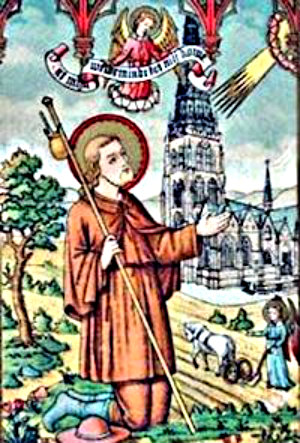
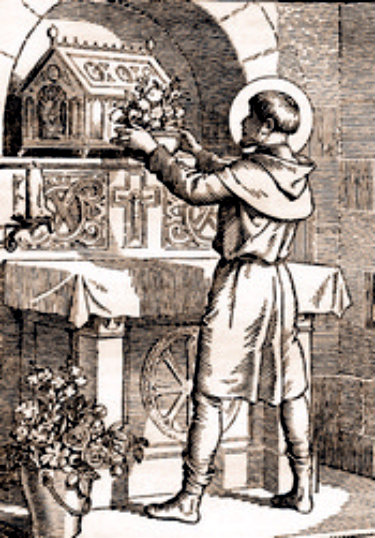
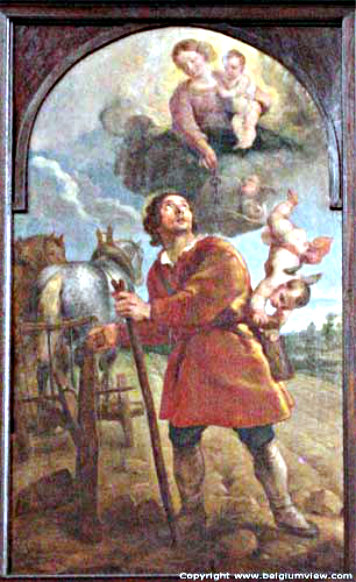
St Fiacre was famous for his sanctity and skill in curing infirmities.   He emigrated from his native Ireland to France, where he constructed for himself a hermitage together with a vegetable and herb garden, oratory and hospice for travellers.   He is the main patron saint of gardeners for he had what we call today “green fingers.”498px-Eglise_Notre-Dame_Bar-le-Duc_Vitrail_Saint_Fiacre_30_04_2012.jpg

St Fiacre is not mentioned in the earlier Irish calendars but it is said that he was born in Ireland in the early sixth century.  He was raised in a monastery where he became a monk and imbibed knowledge of herbal medicine.”   Fiacre was ordained a Priest and elevated to the rank of abbot.    In time he had his own hermitage and perhaps a monastery, possiblyst fiacre holy card.jpg near St Fiachra’s Well, County Kilkenny, Ireland.   As crowds flocked to him because of his reputation for his holiness and cures, he sailed to France in search of greater solitude, in which he might devote himself to God, unknown to the world.

He arrived at Meaux, where Saint Faro (Died 675), who was the Bishop of that city, gave him a solitary dwelling in a forest which was his own patrimony, called Breuil, in the province of Brie.   There is a legend that St Faro offered him as much land as he could turn up in a day and that St. Fiacre, instead of driving his furrow with a plough, turned the top of the soil with the point of his staff.   The anchorite cleared the ground of trees and briers, made himself a cell with a garden, built an oratory in honour of the Blessed Virgin and made a hospice for travellers which developed into the village of Saint-Fiacre in Seine-et-Marne.

Many resorted to him for advice and the poor, for relief.   His charity moved him to attend cheerfully those that came to consult him and in his hospice he entertained all comers, serving them with his own hands and sometimes miraculously restored to health those that were sick.

He lived a life of great mortification devoted to prayer, fasting, keeping vigils and manual cultivation of his garden.   His fame for miracles was widespread. He cured all manner of diseases by laying on his hands.   He died on 18 August 670 and his body was interred in the local church of the site of his hermitage complex, which church became his original shrine.st fiacre icon.jpg

The fame of Saint Fiacre’s miracles of healing continued after his death and crowds visited his shrine for centuries.   Mgr. Seguier, Bishop of Meaux in 1649 and John de Chatillon, Count of Blois, gave testimony of their own relief.   Anne of Austria attributed to the meditation of this saint, the recovery of Louis XIII at Lyons, where he had been dangerously ill, in thanksgiving for which, she made, on foot, a pilgrimage to the shrine in 1641.   She also sent to his shrine, a token in acknowledgement of his intervention in the birth of her son, Louis XIV.   Before that king underwent a severe operation, Bossuet, Bishop of Meaux, began a novena of prayers to Saint Fiacre to ask the divine blessing.

His relics at Meaux are still resorted to, and he is invoked against all sorts of physical ills, including venereal disease.   He isst fiacre french.jpg also a patron saint of gardeners and of cab-drivers of Paris. French cabs are called Fiacres because the first establishment to let coaches on hire, in the middle of the seventeenth century, was in the Rue Saint-Martin, near the hotel Saint-Fiacre, in Paris.   Saint Fiacre’s feast is kept in some dioceses of France and throughout Ireland on this date.   Many miracles were claimed through his working the land and interceding for others.

Posted in MARIAN TITLES, SAINT of the DAY

Sunday 22 C, Our Lady of Montevergine, 5th World Day of Prayer for the Care of Creation and Memorials of the Saints – 1 September

Twenty Second Sunday in Ordinary Time, Year C *2019
The 5th World Day of Prayer for the Care of Creation *2019

Our Lady of Montevergine:
Also known as –
• Madonna di Montevergine
• Madonna Bruna
• Mamma Schiavona
One of the so-called Black Madonnas, image of the Blessed Virgin Mary, normally holding the Christ Child, who have been “inculturated”, that is, made the little Jewish girl Mary look more like the people in the area of the artist, or which are actually black in color. This one serves as part of the altar piece of the Sanctuary on Montevergine. This site is the goal of thousands of pilgrims each year.
More on Our Lady of Montevergine here:
https://anastpaul.com/2018/09/01/1-september-the-memorial-of-our-lady-of-montevergine/

Abigail the Matriarch
St Aegidius
St Agia
St Anea
St Arcanus
St Arealdo of Brescia
Bl Colomba of Mount Brancastello
St Constantius the Bishop
St Donatus of Sentianum
St Felix of Sentianum
St Fiacre (Died 670)
St Gideon the Judge

St Giles (c 650 – c 710) One of the 14 Holy Helpers
About St Giles here:  https://anastpaul.wordpress.com/2017/09/01/saint-of-the-day-1-september-st-giles/
About the 14 Holy Helpers here:  https://anastpaul.wordpress.com/2018/07/25/thought-for-the-day-25-july-the-memorial-of-st-christopher-died-c-251-one-of-the-fourteen-holy-helpers/

Bl Giustino of Paris
Bl Giovanna Soderini
St Jane Soderini
St Joshua the Patriarch
Bl Juliana of Collalto
St Laetus of Dax
St Lupus of Sens
St Lythan
St Nivard of Rheims
St Priscus
St Regulus
St Sixtus of Rheims
St Terentian
St Verena
St Victorious
St Vincent of Xaintes

Exiles of Campania
Twelve Holy Brothers: Martyrs of the South –
A group of martyrs who died c 303 at various places in southern Italy. In 760 their relics were brought together and enshrined in Benevento, Italy as a group.
• Saint Arontius of Potenza
• Saint Donatus of Sentianum
• Saint Felix of Sentianum
• Saint Felix of Venosa
• Saint Fortunatus of Potenza
• Saint Honoratus of Potenza
• Saint Januarius of Venosa
• Saint Repositus of Velleianum
• Saint Sabinian of Potenza
• Saint Sator of Velleianum
• Saint Septiminus of Venosa
• Saint Vitalis of Velleianum
One tradition describes Saint Boniface of Hadrumetum and Saint Thecla of Hadrumetum as their parents.

Martyred in the Spanish Civil War:
Martyred Hospitallers of Saint John of God – (12 beati)
• Blessed Alejandro Cobos Celada
• Blessed Alfonso Sebastiá Viñals
• Blessed Amparo Carbonell Muñoz
• Blessed Antonio Villanueva Igual
• Blessed Carmen Moreno Benítez
• Blessed Crescencio Lasheras Aizcorbe
• Blessed Enrique López y López
• Blessed Francesc Trullen Gilisbarts
• Blessed Guillermo Rubio Alonso
• Blessed Isidro Gil Arano
• Blessed Joaquim Pallerola Feu
• Blessed Joaquín Ruiz Cascales
• Blessed José Franco Gómez
• Blessed José Prats Sanjuán
• Blessed Josep Samsó y Elias
• Blessed Manuel Mateo Calvo
• Blessed Mariano Niño Pérez
• Blessed Maximiano Fierro Pérez
• Blessed Miquel Roca Huguet
• Blessed Nicolás Aramendía García
• Blessed Pedro Rivera
• Blessed Pio Ruiz De La Torre
• Blessed Simó Isidre Joaquím Brun Ararà

Posted in QUOTES of the SAINTS, QUOTES on DEATH, SAINT of the DAY, The LAST THINGS, The WORD

Quote/s of the Day – 31 August – An eye to our end

Quote/s of the Day – 31 August – Saturday of the Twenty-first week in Ordinary Time, Year C, Gospel: Matthew 25:14–30 and the Memorial of  Blessed Pere (Peter) Tarrés i Claret (1905-1950)

“His master said to him,
‘Well done, good and faithful servant,
you have been faithful over a little,
I will set you over much, 
enter into the joy of your master.’ ”

Matthew 25:23matthew 25 23 his master said well done good and faithful 31 aug 2019.jpg

“Give me grace to amend my life
and to have an eye to mine end,
without grudge of death,
which to them that die in You,
good Lord,
is the gate of a wealthy life.”

St Thomas More (1478-1535) Martyrgive-me-grace-good-lord-st-thomas-more-31-aug-2018 and 2019.jpg

“A single resolution, Lord, cost what it may”

(on the eve of his Ordination)

Blessed Pere (Peter) Tarrés i Claret (1905-1950)a single resolution lord cost what it may bl pere tarres 31 aug 2019.jpg

Posted in INCORRUPTIBLES, VATICAN Resources

Saint of the Day – 31 August – Blessed Pere (Peter) Tarrés i Claret (1905-1950)

Saint of the Day – 31 August – Blessed Pere (Peter) Tarrés i Claret (1905-1950) aged 45 Priest, Medical Doctor, apostle of Eucharistic Adoration and of Mary, the Blessed Virgin, apostle of the sick and poor.  Co-Founder, with Dr Gerrado Manresa, of a clinic dedicated to the Blessed Mother for the ill but in particular for those who suffered from tuberculosis, he also ensured that the clinic would be able to cater to those people who could not afford adequate medical treatment. bl pere tarres claret

Pere (Peter) Tarrés i Claret was born on 30 May 1905 in Manresa, province of Barcelona, Spain, to Francesc Tarrés Puigdellívol and Carme Claret Masats.   His parents were deeply religious, which was a positive influence for himself and his two sisters, Francesca and Maria, who both entered the convent.

Pere had a very joyful and open spirit and loved nature and helping others.   As a boy, he assisted at the local pharmacy and the shop owner, Josep Balaguer, encouraged him to continue his studies in medicine.   In 1921 Pere transferred to Barcelona to study, he made the decision to follow his dream and one day become a doctor to help others.

During these years of study, Pere received spiritual direction from Fr Jaume Serra, a priest who encouraged him to enter the “Federation of Young Christians of Catalonia”. This organisation, which met regularly at the Oratory of St Philip Neri, worked for a renewal of the Christian spirit within society.   Pere was appointed President of the Federation and with his openness and enthusiasm, he knew how to give extraordinary “vigour” to the group.  bl pere tarres young.jpgHe was a beacon of good example for others and his zeal motivated him to travel the roads of Catalonia in his little automobile (which he called his “instrument of work”) as a lay missionary.   He spoke openly of God, the Church and Christian living to the youth and those who were gathered along the streets, he also assisted in the formation of new Federation groups.  Pere maintained a written correspondence with many members of the Federation (of whose federal council he was later appointed vice-president) and wrote articles that were published in the Federation’s weekly paper.

In addition to his work within this group, the young man was also involved in Catholic Action.   In 1935 he was appointed vice-secretary of the new diocesan committee, he later became secretary of the archdiocesan committee, having received the recommendation of the Cardinal, Francesc Vidal y Barraquer of Tarragona.

A year later, having earned his degree in medicine, Pere began his residency in Barcelona.   Here, together with Dr Gerardo Manresa, he founded a medical clinic for all those who needed assistance but could not afford it.

As a doctor, Pere was exemplary in his charity and life of piety.   He never lost his habitual joy and was always available to help and speak to those who needed him. During the Spanish Civil War (July 1936-April 1939), Pere lived as a “refugee” in Barcelona because the persecution of Christians forced many into hiding, during this time he prayed, read and studied.

In May 1938 he was forced to enter the Republican army to provide medical assistance; these were eight long months of suffering for Pere and living through the horrors of war probed deep into his soul.   Day after day he wrote about his life on the battle front in his “War Diary”.   The war experience and assistance given to the wounded and dying made Pere understand the necessity for “spiritual assistance” and he felt that God was calling him to be a “doctor of souls” by entering the priesthood.   As a result, he entered the Seminary of Barcelona on 29 September 1939 and was ordained a priest on 30 May 1942.pere_tarres.jpg

Fr Pere began by serving as a parochial vicar at the Parish of St Stephen Sesrovile and a year later he was sent to the Pontifical University of Salamanca to study theology.   After he earned his degree in 1944, Fr Pere returned to Barcelona where he dedicated much of his time to Catholic Action, as well as providing spiritual assistance to religious congregations and material and spiritual help to the sick, especially the poorest of the poor.   He also served as the diocesan delegate for the Protection of Women and as spiritual director of the “Magdalen Hospital” for female prostitutes.

Fr Pere lived his days to the full and had little time for res,; nonetheless, he carried out all his activity in peaceful recollection and a prayerful spirit.   Everyone who came into contact with him was left with the impression that he was a very holy priest who truly cared, sacrificing himself for the spiritual and physical well-being of all, particularly the most desolate.

At the beginning of 1950, Fr Pere noticed that his health was deteriorating.   Shortly thereafter, he was diagnosed with lymphatic cancer.   He accepted his illness and offered it up for the sanctification of priests, resolved to die “as a good priest”.

Fr Pere said that it was a “joy to have the possibility to be a priest and to die in a continual act of love and suffering… worthy of the Heavenly Father”. 

His “secret” in the spiritual life was Eucharistic devotion and filial love towards the Mother of God.

Fr Pere died on 31 August 1950 in the clinic that he founded.   He was 45 years old. … Vatican.va

Barcelona Cathedral Interior - Blessed Pere Tarrés by Montserrat García Rius
Monument in Barcelona Cathedral

His remains were re-located to the parish church of San Vicente de Sarria on 6 November 1975 where his Shrine now resides, see below.

383px-Església_Sarria_tomba_PereTarres_0084
Blessed Pere’s Shrine

In 1985 the Archbishop of Barcelona, Narcís Arnau,1024px-Fundació_Pere_Tarrés.jpg founded the Foundation Blessed Pere Tarrés in honour of the late priest, a nonprofit devoted to charitable works (above)

Posted in SAINT of the DAY

Memorials of the Saints – 31 August

St Aidan of Lindisfarne (died 651) Apostle of Northumbria
St Aidan’s Story:
https://anastpaul.com/2018/08/31/saint-of-the-day-31-august-st-aidan-of-lindisfarne-died-651-apostle-of-northumbria/
St Ammi of Caesarea
St Aristides the Philosopher
St Barbolenus of Bobbio
St Caesidius
St Cuthburgh of Wimborne
St Cwenburgh of Wimborne
St Mark of Milan
St Optatus of Auxerre
St Paulinus of Trier
Bl Pere (Peter) Tarrés i Claret (1905-1950)
St Raymond Nonnatus O.deM. (1204-1240)
Biography here:
https://anastpaul.wordpress.com/2017/08/31/saint-of-the-day-31-august-st-raymond-nonnatus-o-dem/

St Raymond Nonnatus Robustian of Milan
St Raymond Nonnatus Rufina of Caesarea
St Raymond Nonnatus Theodotus of Caesarea

Martyrs of Prague – 64 beati

Martyred in the Spanish Civil War:
Martyrs of Pozo de la Lagarta – 18 beati:
• Blessed Bernardo Cembranos Nistal
• Blessed Dionisio Ullivarri Barajuán
• Blessed Enrique Vidaurreta Palma
• Blessed Félix Paco Escartín
• Blessed Germán Martín y Martín
• Blessed Isidro Ordóñez Díez
• Blessed José María Palacio Montes
• Blessed Justo Zariquiegui Mendoza
• Blessed Marciano Herrero Martínez
• Blessed Miguel Menéndez García
• Blessed Tomás Alonso Sanjuán
• Blessed Ventureta Sauleda Paulís

Posted in PRAYERS for VARIOUS NEEDS, PRAYERS to the SAINTS, QUOTES of the SAINTS, QUOTES on SANCTITY, QUOTES on the CROSS of CHRIST, QUOTES on the DEVIL/EVIL, SAINT of the DAY, The SIGN of the CROSS

Thought for the Day – 30 August – The incorrupt Monk-Bishop-Cardinal-Man of God

Thought for the Day – 30 August – the Memorial of Blessed Alfredo Ildefonso Schuster OSB (1880-1954)

Today is the anniversary of the death of the Blessed Cardinal Alfredo Ildefonso Schuster, who passed to his reward in heaven in 1954, after serving the church of Milan as her shepherd for just over 25 years and was Beatified in 1996.

Blessed Alfredo had several difficult years as the Shepherd of Milan with rise of Fascism and then advent of WWII.   What is keenly recalled of Schuster as Bishop, is his solicitude for the people.   He visited every parish of the diocese five times, holding several diocesan synods, writing many pastoral letters and founding a Seminary in Venegono. Monk or not, he was a true apostle for the good of the Church’s holiness and engagement in the world.

The funeral Mass was offered by the Cardinal Roncalli, now St John XXIII.   In 1985, the cardinal’s tomb was opened and his mortal remains were found to be intact, the monk-bishop-cardinal-man of God was beatified by Saint John Paul II on 12 May 1996.   The relics were given for the veneration of the faithful in one of the side-altars of the Duomo in Milan.

A treasure of Blessed Schuster is his scholarship in the Liber Sacramentorum, known in its English translation as The Sacramentary.   It was written while he was Benedictine monk with the supreme reverence for tradition, adoration and intellect.   In some ways, the volumes are dated, yet the work remains an invaluable reference point for liturgical scholarship today.

To the seminarians of Milan he taught in a characteristically Benedictine manner of the futility of ministry without personal holiness:

“I have no memento to give you, apart from an invitation to holiness.   It would seem that people are no longer convinced by our preaching but faced with holiness, they still believe, they still fall to their knees and pray.   People seem to live ignorant of supernatural realities, indifferent to the problems of salvation.   But when an authentic saint, living or dead passes by, all run to be there.   Do not forget that the devil is not afraid of our [parish] sports fields and of our movie halls – he is afraid, on the other hand, of our holiness.

Prayer on the occasion
of the Beatification of
Cardinal Alfredo Ildefonso Schuster

Father, origin and source of all good,
we praise You and thank You
because, in the Blessed Cardinal Alfredo Ildefonso Schuster
You have given us and made known
a gentle and tireless pastor,
“all-prayerful” man,
witness to the peace that only You can give.
Lord Jesus, Son of God,
You have been for the Cardinal Schuster, a model of life,
for Your love, he was a passionate servant of all.
Lord of life, peace and joy, grant that
his example may inspire us
and his prayer accompany us,
as we also give our lives
to the service of every human being.
Spirit of love, that makes us saints,
grant us to remember
his constant invitation to holiness.
Make us capable, as he was,
to love the poor, the forgotten, the persecuted;
give us the strength to dialogue with everyone,
with the confidence, to discover in every heart,
the seed of God.
Amen

May we not forget, the devil is afraid of our active striving for holiness.

In the name of the Father and of the Son and of the Holy Spirit, amen.the-sign-of-the-cross-st-john-vianney.-new-version-17-jan-2018-jpg.jpg

Blessed Alfredo, Pray for our Seminarians and Priests, Pray for us All!bl schuste pray for us no 2 30 aug 2019.jpg

Posted in QUOTES of the SAINTS, QUOTES on SANCTITY, SAINT of the DAY

Quote of the Day – 30 August – An invitation to holiness

Quote of the Day – 30 August – the Memorial of Blessed Alfredo Ildefonso Schuster OSB (1880-1954)

“You want something to remember me by.
I have no memento to give you,
apart from an invitation to holiness.”

Blessed Alfredo’s parting words
to the seminarians at Venegono,
a few days before his deathi have no memento to give you - bl alfredo schuster 30 aug 2019.jpg

Posted in DOCTORS of the Church, FATHERS of the Church, ONE Minute REFLECTION, QUOTES of the SAINTS, QUOTES on CHARITY, QUOTES on LOVE, SAINT of the DAY, The WORD

One Minute Reflection – 30 August – “That way above the rest”

One Minute Reflection – 30 August – Friday of the Twenty-first week in Ordinary Time, Year C, Gospel: Matthew 25:1–13 and the Memorial of Blessed Alfredo Ildefonso Schuster OSB (1880-1954)

“The foolish ones, when taking their lamps, brought no oil with them but the wise brought flasks of oil with their lamps.” … Matthew 25:3-4

REFLECTION – “It is some great thing, some exceedingly great thing, that this oil signifies.   Do you think it might be charity?   If we try out this hypothesis, we hazard no precipitate judgement.   I will tell you why charity seems to be signified by the oil.   The apostle says, “I will show you a still more excellent way.”   “If I speak with the tongue of mortals and of angels but do not have love, I am a noisy gong or a clanging cymbal.”  This is charity.   It is “that way above the rest,” which is with good reason signified by the oil.   For oil swims above all liquids.   Pour in water and pour in oil upon it, the oil will swim above.   If you keep the usual order, it will be uppermost, if you change the order, it will be uppermost.   “Charity never fails.”St Augustine (354-430) Father & Doctor – Sermon 93matthew 25 3-4 the foolish ones took no oil - it is some great thing that this oil signifies - st augustine - 30 aug 2019.jpg

PRAYER – God our Saviour, through the grace of Baptism you made us children of light. Hear our prayer, that we may always walk in that light and work for truth, love and charity, as Your witnesses before men.   Dispel from our hearts the darkness of sin and keep us ever watchful for the true light, Christ Your Son, who lives and reigns with You and the Holy Spirit, God forever.   Blessed Alfredo Schuster, you lived a life of total charity ever watchful to the needs of your neighbour, please pray for us, amen.bl alfredo schuster pray for us 30 aug 2019

Posted in INCORRUPTIBLES

Saint of the Day – 30 August – Blessed Alfredo Ildefonso Schuster OSB (1880-1954)

Saint of the Day – 30 August – Blessed Alfredo Ildefonso Schuster OSB (1880-1954) aged 74 Cardinal, Archbishop of Milan, Benedictine Monk and Abbot, Writer, Liturgical scholar – born Alfredo Ludovico Luigi Schuster on 18 January 1880 at Rome, Italy and died on 30 August 1954 at Venegono, Italy of natural causes.   Patronage – Archdiocese of Milan.   His body is incorupt.bl card alfredo.jpg

Alfredo Ludovico Schuster was born on 18 January 1880 in Rome, Italy, the son of Giovanni (Johann) Schuster, a Bavarian tailor and double widower and Maria Anna Tutzer.   Schuster’s sister, Giulia, entered the Daughters of Charity of Saint Vincent de Paul.   Schuster also had three half-siblings from his father’s second marriage.   As a young child, Schuster was briefly kidnapped.   He served as an altar boy at the church of the German Cemetery, next to St. Peter’s Basilica.

Schuster completed his secondary-level studies at the Basilica of Saint Paul Outside the Walls in November 1891.   On 13 November 1898, he joined the Order of St Benedict at the novitiate of the monastery community of Saint Paul Outside the Walls, when he took the name Ildefonso and later professed monastic vows on 13 November 1900.   He graduated as a Doctor of Philosophy on 14 June 1903 and later received a doctorate in theology from the Pontifical Atheneum of St Anselm in Rome.

He was ordained on 19 March 1904 at the patriarchal Lateran Basilica in Rome by Cardinal Pietro Respighi, its archpriest and Vicar general of Rome.   He returned to the Basilica of Saint Paul Outside the Walls in 1904 and became Master of novices in 1908, prior in 1916 and was elected abbot-ordinary of the abbey on 6 April 1918.

On 26 June 1029 he was elected Archbishop of Milan.   On the following 13 July, he took the oath of loyalty to the Italian state in front of King Victor Emmanuel III of Italy, the first Italian bishop to do so, as required by the Lateran Treaty.bl alfredo.jpg

He was created Cardinal priest by Pope Pius XI on 15 July 1929, receiving the titular church of Santi Silvestro e Martino ai Monti on 18 July 1929.   He was consecrated on 21 July 1929 in the Sistine Chapel by Pope Pius personally.    Cardinal Schuster served as a papal legate on several occasions.   On 15 August 1932, he was appointed legate to the celebration of Our Lady of Caravaggio;  on 21 March 1934, to the millennial anniversary of Einsiedeln Abbey in Switzerland;  on 15 September 1937, to the inauguration of the new facade of the cathedral of Desio;  and on 2 August 1951, to the National Eucharistic Conference in Assisi.   Bl Alfredo participated in the papal conclave of 1939, which elected Pope Pius XII on the eve of World War II.bl Schustercardinal.jpg

There were claims during the process for Schuster’s beatification that he was sympathetic to Italian Fascism.   While there is evidence of some support for Italy’s military ambitions, there is also evidence that he denounced the anti-Christian element of Fascist philosophy.   He reportedly refused to participate in ceremonies involving Mussolini and condemned racist legislation during the Fascist period.

Schuster was an enthusiastic supporter of the Italian invasion of Ethiopia in 1935, comparing it to the Crusades and viewing it as a potential source of converts. On 28 October 1935, while celebrating Mass in the Cathedral of Milan, he asked God to protect the Italian troops as “they open the door of Ethiopia to the Catholic faith and Roman civilisation” and blessed the banners of the departing troops.   In 1938, Bl Alfredo’s views changed sharply, after the annexation of Austria by Nazi Germany and the introduction of German racial doctrines into Italy with the Italian Racial Laws.   During World War II the Cardinal was attacked by the Fascist and Nazi press without suffering any loss of esteem among his people.   In the postwar years, Cardinal Schuster frequently emphasised the danger of totalitarianism inspired either by Fascism or Communism.

Although the cardinal sought Mussolini out on 25 April 1945 and urged him to make his peace with God and his fellow man, Mussolini spurned the admonition and was assassinated within a week.bl alfredo older

Bl Alredo died on 30 August 1954 in the Archiepiscopal Seminary Pio XI near Milan. Cardinal Angelo Giuseppe Roncalli (the future St Pope John XXIII) celebrated his funeral. He was buried on 2 September 1954 in the metropolitan cathedral of Milan, next to his two immediate predecessors.   He was honoured with the Order of the Holy Sepulchre.

The diocesan process of his cause for sainthood was opened on 30 August 1957 by Archbishop Giovanni Battista Montini (the future St Pope Paul VI) and concluded on 31 October 1963.   After his tomb was opened on 28 January 1985, his body was found to be intact.   Schuster was declared Venerable on 26 March 1994 by St Pope John Paul II and Beatified on 12 May 1996, after acceptance of a miracle involving the curing of an eye disease.bl card alfredo schuster.jpg

As a Liturgical scholar. his mosst famous work Liber Sacramentorum, known in its English translation as The Sacramentary, was written while he was still a Benedictine monk of the Roman Rite and although dated in some respects, remains an invaluable reference point for liturgical scholarship.   When he was appointed Archbishop of Milan by Pope Pius XI, (who was himself Milanese and had held that office for six months before his Papal election), he embraced the Ambrosian liturgy wholeheartedly, and as the ex-officio head of the Congregation for the Ambrosian Rite, strongly defended and promoted the authentic uses of that tradition.   He also oversaw important new editions of the Ambrosian musical books, which are still used in both the Ordinary and Extraordinary Form of the Rite to this day.    He wrote:

“The Church’s Liturgy may…be considered as a sacred poem, in the framing of which both heaven and earth have taken part and by which our humanity, redeemed in the blood of the Lamb without spot, rises on the wings of the Spirit even unto the throne of God Himself.   This is more than a mere aspiration, for the Sacred Liturgy not only shows forth and expresses the ineffable and the divine but also, by means of the sacraments and of its forms of prayer, develops and fulfils the supernatural in the souls of the faithful, to whom it communicates the grace of redemption.   It may even be said, that the very source of holiness of the Church is fully contained in her Liturgy; for, without the holy sacraments, the Passion of our Lord, in the existing dispensation instituted by almighty God, we would have no efficacy in us, since there would be no channels capable of conveying its treasure to our souls.”
                     Ildefonso Schuster, The Sacramentary, vol. I 

Almighty God, through Your grace,
Blessed Alfredo Ildefonso Schuster,
by his exemplary virtue, built up the flock entrusted to him.
Grant that we, under the guidance of the Gospel,
may follow his teaching and walk in sureness of life,
until we come to see You face-to-face in Your eternal kingdom.
We ask this through our Lord Jesus Christ,
Your son, who lives and reigns with You
and the Holy Spirit, one God, forever and ever.
Amen

Blessed_Ildefonso_Schuster_-_Duomo_-_Milan_2014.jpg
Bl Alfredo’s tomb in the Cathedral of Milan.
Posted in SAINT of the DAY

Memorials of the Saints – 30 August

St Adauctus of Rome
St Agilus
Bl Alfredo Ildefonso Schuster OSB (1880-1954)
St Arsenius the Hermit
St Boniface of Hadrumetum
St Bononius of Lucedio
Bl Bronislava of Poland
Bl Edward Shelley
Bl Ero di Armenteira
Bl Euphrasia of the Sacred Heart of Jesus (1877-1952)
Bl Eustáquio van Lieshout
St Fantinus of San Mercurius
St Felix of Rome
St Fiacre
St Gaudentia of Rome
Bl Giovanni Giovenale Ancina
St Jeanne Jugan LSP (Mary of the Cross) (1792 – 1879)
Biography:
https://anastpaul.com/2018/08/30/saint-of-the-day-30-august-st-mary-of-the-cross-1792-1879-jeanne-jugan/


Bl John Roche
St Loarn
St Margaret Ward
Bl María Rafols-Bruna
St Narcisa de Jesus Martillo Moran
St Pammachius  (c 340 – 410)

Biography:   https://anastpaul.com/2017/08/30/saint-of-the-day-30-august-st-pammachius/

St Pelagius the Hermit
St Peter of Trevi
Bl Riccardo of Lotaringia
Bl Richard Flower
Bl Richard Leigh
Bl Richard Martin
St Rumon of Tavistock
St Sylvanus the Hermit
St Thecla of Hadrumetum
St Theodosius of Oria
Bl Yusuf Nehme

Martyrs of Colonia Suffetulana – 60 saints: A group of 60 Christians martyred for destroying a statue of Hermes.
They were martyred in Colonia Suffetulana, Africa.

Martyred in the Spanish Civil War:
• Blessed José Ferrer Adell
• Blessed Manuel Medina Olmos
• Blessed Vicente Cabanes Badenas
Martyrs of Barranco del Chisme (Spanish Civil War) – 10 beati:
• Blessed Alberto José Larrazábal Michelena
• Blessed Antonio María Arriaga Anduiza
• Carles Canyes Santacana
• Blessed Caterina Margenat Roura
• Diego Ventaja Milán
• Blessed Eleuterio Angulo Ayala
• Blessed Josefa Monrabal Montaner
• Manuel Medina Olmos
• Blessed Maria Dolores Oller Angelats
• Blessed Nicasio Romo Rubio

Posted in DOCTORS of the Church, FATHERS of the Church, QUOTES of the SAINTS, SAINT of the DAY, St JOHN the BAPTIST, The WILL of GOD

Quote/s of the Day – 29 August – Whatever He wants I want

Quote/s of the Day – 29 August – The Beheading of St John the Baptist and the Memorial of Blessed Sancja Szymkowiak CMBB (1910-1942)

“O great and admirable mystery!
He must increase but I must decrease, said John,
said the voice which personified all the voices
that had gone before announcing
the Father’s Word Incarnate in His Christ….
But He is said to grow in us, when we grow in Him.
To him, then, who draws near to Christ,
to him who makes progress in the contemplation of wisdom,
words are of little use, of necessity they tend to fail altogether.
Thus, the ministry of the voice falls short,
in proportion as the soul progresses towards the Word,
it is thus, that Christ must increase and John decrease.
The same is indicated by the beheading of John
and the exaltation of Christ upon the Cross,
as it had already been shown by their birthdays –
for, from the birth of John the days begin to shorten
and from the birth of Our Lord they begin to grow longer.”

St Augustine (354-420)
Father & Doctorthus-the-ministry-of-the-voice-falls-short-st-augustine -28 ayg 2019.jpg

“God’s will is my will.
Whatever He wants I want.”

Blessed Sancja Szymkowiak (1910-1942)

Blessed Sancja’s personal mottogod's will is my will - bl sancj szymkowiak 29 aug 2019.jpg

Posted in SAINT of the DAY

Saint of the Day – 29 August – Blessed Sancja Szymkowiak CMBB (1910-1942) – The “Angel of Goodness”

Saint of the Day – 29 August – Blessed Sancja Szymkowiak CMBB (1910-1942) aged 32 professed religious from the Daughters of the Sorrowful Mother of God, commonly known as the “Seraphic Sisters”.   Born on 11 July 1910 in Mozdzanów, Wielkopolskie, Poland as Janina “Giannina” Szymkowiak and died on 29 August 1942 in Poznan, Wielkopolskie, Poland of tuberculosis of the pharynx.   Patronages – Labourers and Translators.

Bl Sancja Szymkowiak, was born on 11 July 1910 in Mozdzanów (Ostrów Wielkopolski), Poland, to Augustine and Mary Duchalska.   She was the youngest of five children, her parents’ only girl.   She was baptised “Giannina.”   On 29 August 1942, she died of tuberculosis of the pharynx, brought on by the hardships of the war.   Throughout her life, she desired to become a saint in a “hidden way” and wanted only to do God’s will, living a profound union with Him in every event.

Her motto was “God’s will is my will.   Whatever He wants I want”.   By abandoning herself into the arms of a loving Father, she offered a wonderful example of serene acceptance of her sufferings.Janina-Szymkowiak

Education:
Giannina was born into a believing and well-to-do family, who gave her a wonderful education.   In 1929, after her high school studies, she studied Languages and Foreign Literature at the University of Poznan.   During her school years, she was an attractive person because she was a happy and joyful person who thought of those around her and was generous in reaching out to them in any need.   Throughout her school years, she was a member of the Sodality of Mary and was remembered for a discrete and effective apostolate of trying to share her happiness with those around her.

Giannina also went beyond her own circles and showed a special attention to the needs of the poor of the city.   She was interested in everyone, was open to others and had a “spirit of holiness” that struck those around her.

Call to religious life:
While still young, Giannina felt called to the religious life.   During the summer of 1934, she went on a pilgrimage to the Shrine of Lourdes, France and here offered herself to the Blessed Virgin, wanting to put her life entirely and without reserve into the hands of the Mother of God.   In June 1936, at Poznan, after spending a year with the Congregation of the Oblate Sisters of the Sacred Heart at Montluçon, she returned to Poland and entered the Congregation of the Daughters of Our Lady of Sorrows, better known as the “Seraphic Sisters.”   It was then that she received the name Mary Santia or Sancja in Polish.   From the beginning, she was zealous in observing the rules of the Congregation and in performing every kind of service.   Her life, which apparently had nothing extraordinary about it, hid a profound union with God with a total readiness to embraceHhis will in everything.   She desired to become a great saint and all her life tended to communion with Jesus, ready to bear any sacrifice and humiliation to console His Heart and make reparation for sin.

First Vows and apostolate:
On 30 July 1938 she made her first vows.   She once wrote in her diary:  “Jesus wants me to be a holy religious and He will not be happy with me until I use all my strength for Him and become a saint.   God is everything, I am nothing.   I have to become a saint at all costs.   This is my constant preoccupation”.

After her first vows, Sr Sancja worked for a year in the nursery school of Poznan-Naramowice and also began a course of studies in pharmacology.   However, she was unable to continue her studies, because in September 1939 the war broke out.sancja szymkowiak

World War II:
Poznan was occupied by the Germans and the sisters were put under house arrest.   They were forced to look after a hundred German soldiers who were housed there and English and French prisoners of war, who were lodged in and around the convent.   She was able to translate for the foreign prisoners.   The forced labour was very difficult but she was willing to serve everyone as she would Christ Himself.

In February 1940, the religious persecution worsened and Sr Sancja was given permission to return to her family for safety.   However, she stayed in the convent and submitted to the hard labour imposed by the occupying forces.   She believed it was God’s will that she remain, that she be a “mother” to those around her – the prisoners, the soldiers and her own sisters.   Sr Sancja was an instrument of God’s love and peace and became a sign of hope to those around her.   The English and French prisoners called her the “angel of goodness” and “Saint Sancja”.

The constant fatigue and difficult conditions took their toll on Sr Sancja and she began showing symptoms of tuberculosis.   She continued with the same spirit of abandonment and serenity and accepted her sufferings as a “preparation” for her solemn vows, which she professed on 6 July 1942  . She died a little more than a month later, on 29 August 1942, when she was 32 years old. … Vatican.va

Bl Sancja’s sainthood cause commenced under St Pope Paul VI on 24 March 1968 when she became titled as a Servant of God and St Pope John Paul named her as Venerable, upon the confirmation of her heroic virtue – on 18 December 2000 he presided over her Beatification on 18 August 2002 at Krakow, Poland.400px-Blessed_Sancja_Janina_Szymkowiak,_memorial_at_Poznan_convent

O God, You made Blessed Sancja, who lived, imitating the meek and humble Heart of Jesus, unite with You in perfect love, grant that we, following her path, may reach sainthood.   Through our Lord Jesus Christ, your Son, who lives and reigns with you in the unity of the Holy Spirit, one God, forever and ever. Amen.