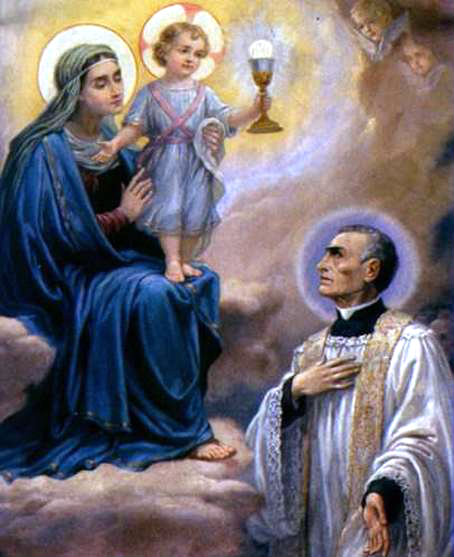
Posted in QUOTES of the SAINTS, QUOTES on SUFFERING, SAINT of the DAY, The WORD

Quote/s of the Day – 16 April – For to you has been granted…not only to believe in him but also to suffer for him…

Quote/s of the Day – 16 April – Tuesday of Holy Week and the Memorial of St Benedict Joseph Labre – Known as the Beggar of Perpetual Adoration (1748-1783) and St Bernadette Soubirous (1844-1879)

For to you has been granted, for the sake of Christ,
not only to believe in him but also to suffer for him…

Philippians 1:29for-to-you-has-been-granted-philippians-1-29 16 april 2018 (1).jpg

“God afflicts us
because He loves us
and it is very pleasing to Him,
when, in our afflictions,
He sees us abandon ourselves
to His paternal care.”

St Benedict Joseph Labre (1748-1783)god afflicts us because he loves us - st benedict joseph labre - 16 april 2019

“The more I am crucified,
the more I rejoice.”

St Bernadette Soubirous (1844-1879)the-more-i-am-crucified-st-bernadette-16-april-2018

Posted in SAINT of the DAY

Saint of the Day – 16 April – Saint Drogo (1105–1186)

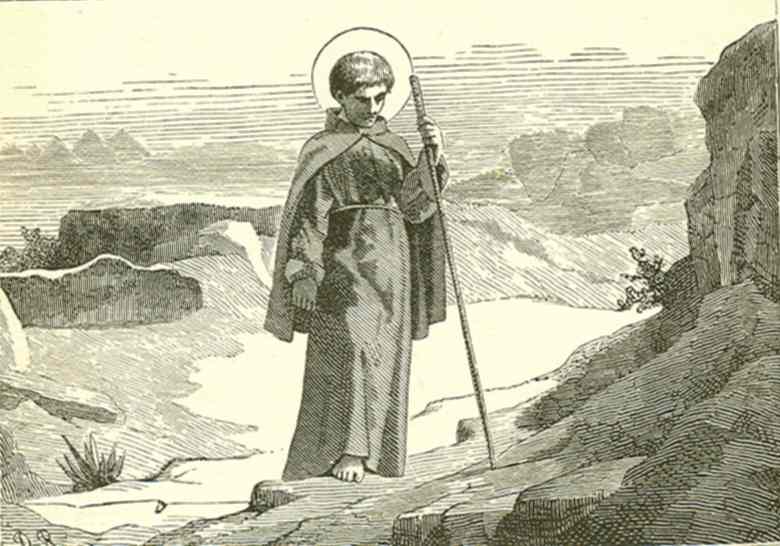
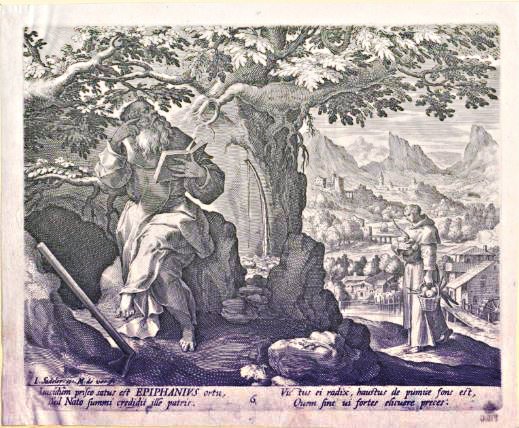
Saint of the Day – 16 April – Saint Drogo (1105–1186) – penitent pilgram, apostle of prayer and the Holy Eucharist, anchorite – also known as Dreux, Drugo and Druron, is a Flemish saint.   He was born in Epinoy, Flanders in 1105 and died in Sebourg, France in 1186. Patronages – those whom others find repulsive, unattractive people, Baume-les-Messieurs, bodily ills, broken bones, cattle, coffee house keepers, coffee house owners, deaf people, deafness, dumbness, Fleury-sur-Loire, gall stones, hernias, illness, insanity, mental illness, mentally ill people, midwives, mute people, muteness, mutes, orphans, ruptures, sheep, shepherds, sick people, sickness.st drogo

St Drogo was a child of Flemish nobility.   His mother died when he was born.   He learned the reason for her death and it made an emotional impact on him.   He held himself responsible.   Later in his life, he went to extreme penances, perhaps to relieve his guilt.   Drogo was orphaned when he was a teenager.

As Drogo approached manhood, he resolved to abandon his home and distribute his considerable inheritance to the poor.   Whatever circumstances precipitated this sudden change, we may well imagine that Drogo was inspired by Christ’s exhortation to another troubled young man:  “If thou wilt be perfect, go sell what thou hast, and give to the poor, and thou shalt have treasure in heaven: and come follow me” (Mt 19:21).   Drogo kept for himself no more than the clothes on his back and entrusting himself to Providence.

He became a shepherd for about six years, working in Sebourg, near Valenciennes. Cherishing his simple life, Drogo passed much of his time in prayerful contemplation and gave to the poor most of what he received in wages or gifts.   His humility, gentleness and generosity quickly earned the villagers’ admiration.   A constant tradition has it that, while Drogo was out in the fields, tending his flock or deep in prayer, he could sometimes simultaneously be seen attending Mass in the village.   This gave rise to a common saying, that reportedly persisted to the twentieth century, among the rural folk of that region, who, if charged with several onerous tasks, might protest, “I’m not Saint Drogo, I can’t ring the church bell for Mass and be in the procession!”

After six years in Sebourg, Drogo felt called by God to take up the pilgrim’s staff.   Setting off on foot like the Apostles before him, he travelled to Rome where he visited the tombs of Saints Peter and Paul, stopping along the way at many other renowned holy sites in France and Italy.   During his journey, Drogo occasionally used his skills as a shepherd to support himself and instructed other shepherds he encountered.drogo

Some accounts speculate that Drogo believed that only the pope himself could absolve him of his part in the death of his mother.   Although he never did meet the pope, Drogo pursued these peregrinations for nine years and nine voyages to Rome, each time returning briefly to Sebourg.   Drogo gladly suffered the hunger, thirst, harsh weather and other incommodities and dangers of pilgrimage in pursuit of holiness.   However, these restless years took their tol, and the weary pilgrim eventually made his way back to Sebourg for the last time, having developed a debilitating and disfiguring hernia.

His wandering days behind him, Drogo resolved to live as a solitary, still detached from worldly things.   The parishioners of Sebourg helped him to build a small anchorite’s cell adjoining the parish church.   From there, Drogo could adore the Holy Eucharist and hear the divine offices through a small opening in the church wall.   Still in his early thirties, Drogo shut himself within and vowed to remain there for the rest of his days.

Despite this solitary existence, Drogo never refused the people who sought his spiritual advice or the benefit of his prayers; those who visited his humble cell always left consoled and edified.   Drogo now sustained himself on little more than barley bread and water, if it happened that a kind visitor brought him some other food or gift, Drogo would give it away to the poor, keeping only what was strictly necessary for subsistence. Over time, Drogo’s painful malady worsened and he developed putrescent sores on his lower body.   Even in the face of these trials, he never lost the gay and serene disposition for which he was known.drogo (1)

Drogo died on16 April 1186 (it is thought or it might have been 1189), having attained a ripe old age for one whose earthly existence was marked by illness, hardship and self-abnegation.   Upon learning of his death, Drogo’s kin from Epinoy claimed the body, wishing to return it to his birthplace.   The parishioners of Sebourg acceded to the request in accordance with the custom of those days.   The body was thus placed in a fine casket and set on an ox-drawn cart.   Yet it appears that God intended Drogo to remain in his adoptive home.   Reportedly, as the procession made its way out of Sebourg, the saint’s casket seemed to grow heavier and heavier.   At last the cart reached a point at the boundary of the village where it could no longer advance at all, as though obstructed by a supernatural force.

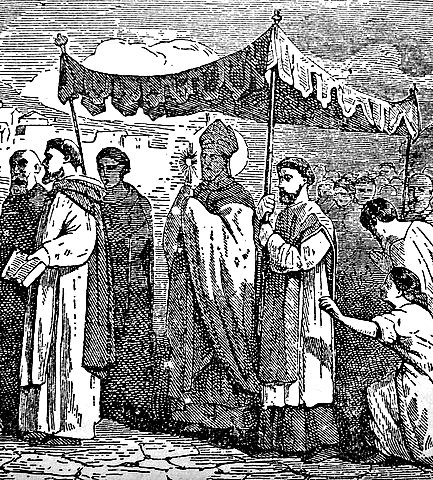
In any event, the attempt to repatriate Drogo’s remains had to be abandoned.   The body was brought back to Sebourg to general acclaim and interred in the village church with rustic pomp.   The villagers erected a cross on the spot where the ox-cart had been obliged to stop and although the cross itself has been replaced several times over the centuries, this simple monument still stands today in a field on the outskirts of Sebourg. Each year on Trinity Sunday, the modern-day villagers commemorate the event with a procession in which the saint’s reliquary is borne from the church to St Drogo’s Cross, preceded by the village children dressed as shepherds and shepherdesses.

Not long after Drogo’s death, accounts of miraculous intercessions attributed to his relics spread through the surrounding country and beyond and a stream of sick pilgrims made their way to Sebourg.   The miracles multiplied and over time the crowds became so substantial, de Gruyse tells us, that it was difficult to approach the saint’s tomb.

By the time of his enrollment in the Martyrologium Romanum, Drogo had long been acclaimed a saint in his homeland by vox populi.   In 1612, the archbishop of Cambrai ordered the formal elevation of Drogo’s relics at Sebourg.   Confraternities dedicated to St Drogo are active today in Sebourg and Carvin, and in Cambrai he is invoked at an annual “Shepherd’s Mass” at which sheep farmers and their lambs are blessed.

St Drogo’s patronage has come to be associated with a variety of occupations and conditions.   First, he is predictably a patron saint of shepherds and a protector of their flocks.   Drogo is also a patron saint of expectant mothers, presumably due to his special sympathy and gratitude toward the mother he never knew.   His physical malady has likewise made him a patron of those who suffer from hernias, kidney stones and other ailments of the abdomen, as well as of persons deemed physically unlovely.drogo icon

Most notable in the contemporary popular culture of the English-speaking world, however, are the surprising identification of Drogo as the patron saint of coffeehouse-keepers and his association more generally with coffee.   This might be dismissed as an apocryphal invention boosted by the coffeehouse boom of the past few decades, were it not historically attested.   A Belgian almanac from 1860 shows that in Mons—just across the present-day Franco-Belgian border from Sebourg—Drogo had already been claimed by the city’s cafetiers (coffeehouse-keepers) as their patron.

Nevertheless, the origin of St Drogo’s association with coffeehouses remains mysterious; coffee was not introduced into France and Belgium until the seventeenth century.   Some have ventured, tongue in cheek, that harried baristas might fittingly invoke a saint reputed to possess the mystical gift of bilocation.   A more plausible connection may reside in a minor detail from some biographical sources – during his years of reclusion, Drogo took no drink but warm water.   Perhaps also, the early coffeehouse-keepers of Hainaut marvelled at how the properties of the coffee bean are transformed by fire without being destroyed by it and were reminded of Drogo’s miraculous survival of the destruction of the church at Sebourg, when kneeling in prayer in his cell, he refused to leave during the fire – the Church was destroyed but NOT St Drogo’s abode.drogo 576px-Église_Saint-Druon_de_Sebourg_29

Thanks to Crises Magazine for most of St Drogo’s beautiful story.

Posted in SAINT of the DAY

Memorials of the Saints – 16 April

Bl Arcangelo Canetoli
St Benedict Joseph LabreKnown as the Beggar of Perpetual Adoration (1748-1783)
Dearest St Benedict Joseph:   https://anastpaul.wordpress.com/2017/04/16/saint-of-the-day-16-april-st-benedict-joseph-labre/

St Bernadette of Lourdes – The Visionary of Lourdes (1844-1879)
St Bernadette!https://anastpaul.wordpress.com/2018/04/16/saint-of-the-day-16-april-saint-bernadette-soubirous-1844-1879/

St Drogo (1105–1186)

St Elias
St Fructuosus of Braga
St Herveus of Tours
Bl Joachim Piccolomini
St Lambert of Saragossa
St Magnus of Orkney
St Turibius of Astorga
St Vaise
St William Gnoffi

Martyrs of Avrillé – 26 beati: – A group of lay people who were executed together for their faith during the anti-Christian persecutions of the French Revolution. They were martyred on 16 April 1794 at Avrillé, Maine-et-Loire, France.
• Blessed Anne Maugrain
• Blessed François Micheneau veuve Gillot
• Blessed François Suhard veuve Ménard
• Blessed Jean Ménard
• Blessed Jeanne Gourdon veuve Moreau
• Blessed Jeanne Leduc épouse Paquier
• Blessed Jeanne Onillon veuve Onillon
• Blessed Jeanne Thomas veuve Delaunay
• Blessed Madeleine Cady épouse Desvignes
• Blessed Madeleine Sallé épouse Havard
• Blessed Marguerite Robin
• Blessed Marie Forestier
• Blessed Marie Gingueneau veuve Coiffard
• Blessed Marie Lardeux
• Blessed Marie Piou épouse Supiot
• Blessed Marie Rechard
• Blessed Marie Roger veuve Chartier
• Blessed Marie-Genevieve Poulain de la Forestrie
• Blessed Marthe Poulain de la Forestrie
• Blessed Perrine Bourigault
• Blessed Perrine Laurent
• Blessed Perrine Pottier épouse Turpault
• Blessed Pierre Delépine
• Blessed Renée Bourgeais veuve Juret
• Blessed Renée Rigault épouse Papin
• Blessed Renée Sechet veuve Davy
16 April 1794 at Avrillé, Maine-et-Loire, France – Beatified: 19 February 1984 by Pope John Paul II at Rome, Italy

Martyrs of Corinth – 9 saints: A group of nine Christians who were tortured and martyred together in the persecutions of Decius. We know little more than three of their names – Callistus, Charisius and Leonide. They were thrown into the sea at Corinth, Greece c250

Martyrs of Saragossa: Group of eighteen martyrs murdered in 304 in Saragossa, Spain in the persecutions of Diocletian and the prefect Dacean. We know little more than the names – Apodemus, Caecilian, Caius, Crementius, Engratia, Eventius, Felix, Fronto, Gaius, Julia, Lambert, Lupercus, Martial, Optatus, Primitivus, Publius, Quintilian, Saturnius (4 men of this name), Succesus and Urban. Their graves re-discovered in 1389 in the crypt under the church of San Encrazia in Saragossa.

Posted in SAINT of the DAY

Saint of the Day – 15 April – St Ruadán (died 584)

Saint of the Day – 15 April – St Ruadán (died 584) – Priest and Monk –  also known Rowan, Ruadon, Roadan, Rodon and Rodan, was an Irish Christian abbot who founded the monastery of Lorrha (Lothra, County Tipperary, Ireland – see the ruins below), near Terryglass.   He was known for his prophesies. After his death, he was venerated as a saint and as one of the “Twelve Apostles of Ireland”.

img-Twelve-Apostles-of-Ireland.jpg
The Twelve Apostles of Ireland

Ruadhán is said to have been the son of Fergus Bern, son of Dera Dubh, of the race of the kings of Munster.  He studied and was ordained at Clonard.  He was educated in Clonard County Westmeath by St Finian (470-549).   He replaced St Brendan (the navigator) at Lorrha who preceded to cross the Shannon and set up his monastery at Clonfert Co. Galway.

Ruadhan founded a monastic settlement at Lorrha that would have consisted of a monastery and various other buildings including cells for the many monks that would have lived here.   Also a ditch or large mound would have been built around the settlement to keep animals in and intruders out, the outlines of these are still visible today.   Life for the monks would have been tough but simple, rising early from their beds which would have consisted of rushes or straw placed on the bare ground.   They then would pray and fast between their domestic chores.   The settlement would have been self-sufficient providing everything from food, clothing, to shelter.  Despite the evidence of conflicts with the surrounding hierarchy and with St Brendan, Ruadhán was highly regarded.   His monastery was said to have had 150 monks with a very holy reputation.

Ruadhan
St Ruadhan from a set of paintings of the Twelve Apostles of Ireland

On the site of this settlement are the remains of an 11th century church probably on the spot of Ruadhan’s original monastery.   It has at the west end of the south wall an ornate doorway that shows many carved motifs including a pelican drawing blood from its breast.   Also there are the remains of two high crosses with only the decorated shafts remaining, one of these is said to mark the grave of a Munster king who died at Lorrha, the other is said to mark St Ruadhan’s grave although it seems to have been crafted many years after his death.   Villages and towns often popped up around monastic settlements as trade and refuge attracted the local people, the origin of Lorrha village can be attributed to this.1024px-Lorrha_Priory_of_St._Ruadhan_SW_2010_09_04

There are many legends attributed to Ruadhan but he is probably most famous for his curse on the High King’s residence at Tara after the king, Diarmuid Mac Cerbhaill, had violated the sanctity of the church by taken a hostage from its protection.   The downfall of Tara from a once thriving royal residence is credited to Ruadhan.

Ruadhan’s hand, enshrined in silver, was preserved at Lorrha until the Reformation time, when it was lost.  The bell of St Ruadhan which was found in a well named after the Saint is kept in the British Museum after being discovered many years ago.   This well is situated across the road from the present day Church of Ireland.

“My splendid cloak adorned with gold which was on the altar of Rome, bring it to Ruadhan of Lortha, since we shall die this day” extract from the last will and testament of the high king of Cashel.

Today both the Catholic and Church of Ireland churches in Lorrha in the diocese of Killaloe, are dedicated to St Ruadhán.

Base of High Cross at St Ruadhan's Abbey.JPG
Base of the High Cross at St Ruadhan’s Abbey

Praise in the Féilire of Aengus
Aengus praises Ruadhán in his Féilire on his feast of 15th April:

Prímdae bréo nád athbi
ar-fich tola tothlai,
ba caín lie lógmar
Ródán lócharn Lothrai.

An excellent flame that does not wane,
that vanquishes urgent desires.
Fair was the gem,
Ruadhán, lamp of Lorrha.


Posted in SAINT of the DAY

Memorials of the Saints – 15 April

St Abbo II of Metz
St Abbondio
St Acuta
St Anastasia of Rome
St Basilissa of Rome
Bl Cesar de Bus (1544-1607)
Biography:  https://anastpaul.wordpress.com/2017/04/15/saint-of-the-day-15-april-bl-cesar-de-bus/

St Crescens of Myra
St Eutyches of Rome
St Eutychius of Ferentino
St Huna of Slättåkra
St Hunna (of Strasbourg) (died 679)
The life of St Hunna:   https://anastpaul.wordpress.com/2018/04/15/saint-of-the-day-15-april-st-hunna-died-679/

Bl Laurentinus Sossius
St Maro of Rome
St Maximus of Persia
St Mundus
St Nidger of Augsburg
St Olympiades of Persia
St Ortario of Landelles
St Paternus of Vannes
St Pausilopo of Thrace
St Ruadhan of Lorrha (died 584)
St Sylvester of Réome
St Theodore of Thrace
St Victorinus of Rome
St Waltmann of Cambrai

Mercedarian Martyrs of Africa: A group of Mercedarian monks sailing to Africa as on a mission to redeem capture Christians. Captured by Moors, they were tortured and executed for their faith. Martyrs. 1393

Posted in LENT 2019, MYSTICS, Of the SICK, the INFIRM, All ILLNESS, SAINT of the DAY

Saint of the Day – 14 April – Saint Lydwina of Schiedam (1380-1433)

Saint of the Day – 14 April – Saint Lydwina of Schiedam (1380-1433) aged 53 – Mystic, Ascetic, apostle of the Holy Eucharist and of penance and prayer, also known as Liduina, Lidwid, Lidwina, Lijdwine, Ludivine, Lydwid, Lydwine – born on 18 April 1380 (Palm Sunday) at Schiedam, Netherlands and died on 14 April (Easter Sunday) 1433 at Schiedam, Netherlands of natural causes.   Patronages – against all illness,  ice skating, prolonged suffering. skaters, Schiedam, Netherlands.

The story of Lydwina, the patron saint of ice skating, is a sad and fascinating one indeed. She was a Dutch girl born on a Palm Sunday and raised alongside eight brothers to a father and mother, Peter and Petronella who were a “poor noble” and ‘poor commoner”.

By all accounts, she was “a lovely and charming girl”. At age fifteen, in a severe winter Lydwina was skating with girlfriends when she fell and broke a rib and was put in bed in her family home. After her injury, gangrene set in and Lydwina became partially paralysed.

She never fully recovered and became progressively more disabled and ill throughout her life.   It is believed that she became paralysed with the exception of her left hand and that parts of her body… “fell off”.   Blood is reported to have spontaneously poured from her mouth, ears and nose.   Some historians have hypothesised that accounts of her affliction may have actually been describing one of the first known cases of Multiple Sclerosis, which of course would not have been known at that time.

Much of Lydwina’s time was spent in prayer, meditation and in offering her pain to God. Devoutly spiritual, she developed a devotion to The Eucharist, was visited by saints and had visions in which she was shown a “Heaven and Purgatory”.   Miracles reportedly occurred at her beside.st Lidwina_painting

After Lydwina’s fall while skating, she fasted constantly and became reputed as a healer and holy woman, although many viewed her as being ‘under the influence of an evil spirit’ due to her deteriorating health.

Her hometown of Schiedam created a document that attests to her fasting.   She ate only a little piece of apple, then part of a date, watered down wine and then river water that was contaminated with salt from the tides.   This document created by Schiedam town officials (which still exists) also claims that she shed skin, bones and part of her intestines, which her parents kept in a vase until Lydwina had her mother bury them after they drew much attention.

She lost her sight seven years before her death but continued to fast and report visions, in one of which her Guardian Angel assisted her, until her death at age fifty three.st lydwina snip

Posthumously, Lydwina’s grave became a place of pilgrimage.   Thomas à Kempis’s (1380-1471) publication, Vita Lidewigis, A Life of St Lydwina, caused an increase in veneration.  In 1615 her relics were taken to Brussels but in 1871 they were returned to Schiedam. In 1434, a chapel was built over it.   Her relics were taken to Brussels, Belgium in 1615 but returned to Schiedam in 1871.

In 1890, Pope Leo XIII Canonised her.   She is known as the patron saint of ice skaters and the chronically ill and her “feast day” is observed on 18 March, 14 April (universal memorial) or 14 June depending on the region and area’s tradition.st lydwina snip 2 statue

The Church of Our Lady of the Visatation, which was opened in 1859 in Schiedam closed in 1969 and her statue and relics were removed and moved to the chapel dedicated to her Basilica of Lydwina in West-Frankeland.   In Schiedam, her name is attached to numerous institutions and the Intorno Ensemble foundation presents a bi-annual musical theatrical production about Lydwina, the town saint, in one of Schiedam’s churches.

Of her suffering at the end of her life, Lidwina allegedly said, “If I live to be healthy by Ave Maria again I would not want to.”  Her final vision was of Christ administering last rites to her. 

This powerful and heartwarming history makes it so fitting that Lydwina was named the patron saint of ice skating.

Surely, one of the parables of the story of St Lydwina, is that if you fall down, you never give up and you too may become a Saint.   Your search for holiness, may, after all, only begin after the fall!st-lidwina-1

Posted in CATECHESIS, LENT 2019, SAINT of the DAY, The PASSION

Memorials of the Saints and Palm Sunday 2019 – 14 April

Palm Sunday *2019

St Abundius the Sacristan
St Antony of Vilna
St Ardalion the Actor
St Benezet the Bridge Builder
St Bernhard of Tiron
St Domnina of Terni
St Eustace of Vilna
St Fronto of Nitria
Bl Hadewych
St John of Monte Marano
St John of Vilna
St Lambert of Lyon
Bl Lucien Botovasoa (1908-1947) Martyr
Blessed Lucien’s life:   https://anastpaul.wordpress.com/2018/04/14/saint-of-the-day-14-april-blessed-lucien-botovasoa-o-f-s-1908-1947-martyr/

St Lydwina of Schiedam (1380-1433)

St Maximus of Rome
St Peter Gonzalez OP (1190 – 1246)
About St Peter:   https://anastpaul.wordpress.com/2017/04/14/saint-of-the-day-14-april-blessed-peter-gonzalez-o-p/

St Tassach of Raholp
St Thomaides of Alexandria
St Tiburtius of Rome
St Valerian of Trastevere

Posted in SAINT of the DAY

Saint of the Day – 13 April – Blessed Scubilion Rousseau FSC (1797-1867) the “Catechist of Slaves”

Saint of the Day – 13 April – Blessed Scubilion Rousseau FSC (1797-1867) the “Catechist of Slaves” – a professed Religious Brother of the Institute of the Brothers of the Christian Schools or the De La Salle Brothers, Teacher, Catechist, social reformer, anti-slave activist, apostle of the poor.   He assumed the religious name of “Scubilion” upon his profession and was dubbed the “Catechist of Slaves” due to his extensive decades-spanning work on Réunion Island.   Patronage – Catechists, Teachers.11.-Bx.-Scubilion-Rousseau

Jean-Bernard Rousseau was born in Yonne on 22 March 1797 as the eldest of four children to Bernard Rousseau and Regina Pelletier.   His parents aided and hid priests during the French Revolution in which anti-religious sentiment was at an all-time high.  He was baptised hours after his birth at the home of his grandparents and would receive both his First Communion and Confirmation around the age of ten in 1807.

Two parish priests oversaw his education.   Blessed Scubilion decided to devote his life to serving others and so desired to become part of the Institute of the Brothers of the Christian Schools – or De La Salle Brothers – in an attempt to follow the example of Saint Jean-Baptiste de La Salle.   He arrived in Paris on 9 November 1822 and commenced his novitiate with the De La Salle Brothers on 24 December 1822.   He assumed the religious name of “Scubilion”.

de la salle paris - maxresdefault
De La Salle, Paris 

On 4 November 1823 he was sent to Alençon and was put in charge of the De La Salle house’s kitchen and garden.   His triennial vows were made on 15 September 1825.   He made his perpetual vows on 27 September 1827 after a period of teaching and of studies.   He obtained his teaching degree in 1826.

In April 1833 he accepted an invitation to go to Réunion Island in the Indian Ocean to teach and evangelise.   He and two other companions, left on 20 April 1833 and arrived in Saint-Denis on 15 July 1833.   In the period of 1833 to 1843 he began to teach the poor children and at this time became a vocal advocate of slaves.   He also fought against the mistreatment and abuse that female slaves suffered.   On 17 November 1843 he was sent to Saint-Leu and began teaching there while also preparing slaves for baptism and their First Communion.   He arrived in Sainte-Marie on 14 December 1856 to continue his work.   Rousseau made a brief visit to Madagascar in 1866 to open a school.   He modified all his lessons to suit the natives and also started night classes.   He collaborated in his initiatives with the local priests.img-Blessed-Scubilion-Rousseau

After the emancipation of the slaves in 1848, he continued to care for them and to help them adapt to their new life of freedom and responsibility.   In the last years of his life, despite failing health, he assisted the local pastor in visiting the sick, winning over sinners, encouraging vocations and even effecting what seemed to be miraculous cures.

He died on 13 April 1867 after a long illness in Sainte-Marie and his funeral was celebrated on 14 April in which hundreds of people attended to mourn him.  At his death he was venerated everywhere on the island as a saint.   He was buried in Sainte-Marie but his remains were transferred in 1939 to the house of the De La Salle Brothers in Saint-Denis.

St Pope John Paul II approved a miracle due to the intercession of Blessed Scubilion in 1987 and beatified Rousseau on the occasion of his visit to the island of Réunion on 2 May 1989.

Posted in DOMINICAN OP, SAINT of the DAY

Memorials of the Saints – 13 April

St Pope Martin I (598-655) Martyr (Optional Memorial)
Biography:   https://anastpaul.wordpress.com/2017/04/13/saint-of-the-day-13-april-st-pope-martin-i/

St Agathonica of Pergamus
St Agathodorus of Pergamus
St Caradoc of Wales
St Carpus of Pergamus
Bl Edward Catherick
Bl Francis Dickenson
St Guinoc
St Hermengild
St Ida of Boulogne
Bl Ida of Louvain
Bl Isabel Calduch Rovira
Bl James of Certaldo
Bl John Lockwood
Bl Margaret of Castello OP (1287-1320)
About Blessed Margaret:   https://anastpaul.wordpress.com/2018/04/13/saint-of-the-day-13-april-blessed-margaret-of-castello-o-p-1287-1320/

St Martius of Auvergne
Bl Miles Gerard
St Papylus of Pergamus
St Proculus of Terni
St Sabas Reyes Salazar
Bl Scubilion Rousseau FSC (1797-1867)

St Ursus of Ravenna

Martyrs of Dorostorum – 3 saints: A lector and two students martyred together in the persecutions of Diocletian – Dadas, Maximus and Quinctillianus. Beheaded c303 in Dorostorum, Lower Mysia (modern Sillistria, Bulgaria.

Posted in CARMELITES, GOD the FATHER, QUOTES of the SAINTS, SAINT of the DAY

Thought for the Day – 12 April – The “Flower of the Andes”

Thought for the Day – 12 April – Friday of the Fifth Week, Year C and the Memorial of Saint Teresa de Jesús “de los Andes” OCD (1900-1920)

One needn’t live a long life to leave a deep imprint.   Teresa of Los Andes is proof of that.

As a young girl growing up in the early 1900’s in Santiago, Chile, Juana Fernandez read an autobiography of a French-born saint—Thérèse, popularly known as the Little Flower. The experience deepened her desire to serve God and clarified the path she would follow.   She became a Carmelite nun, taking the name of Teresa.

The convent offered the simple lifestyle Teresa desired and the joy of living in a community of women completely devoted to God  . She focused her days on prayer and sacrifice. “I am God’s,” she wrote in her diary.    “He created me and is my beginning and my end.”

Toward the end of her short life, Teresa began an apostolate of letter-writing, sharing her thoughts on the spiritual life with many people.   At age 20, she contracted typhus and quickly took her final vows.   She died a short time later, during Holy Week.

Known as the “Flower of the Andes,” Teresa remains popular with the estimated 100,000 pilgrims who visit her shrine in Los Andes each year.   Canonised in 1993 by St Pope John Paul II, she is Chile’s first saint.

The special graces given Saint Teresa reflect the mysterious wisdom of God at work in individuals whether young or old.   It appears, God has His own logic when it comes to who gets what in the realm of grace.   All we can say is, “Praised be the Lord.”

St Teresa de Jesús “de los Andes” Pray for Us!i am god's - st teresa de los andes pay for us 12 april 2019 no 2.jpg

Posted in EUCHARISTIC Adoration, QUOTES of the SAINTS, SAINT of the DAY, The HOLY EUCHARIST / The HOLY MASS

Quote of the Day – 12 April – He leaves His angels

Quote of the Day – 12 April – Friday of the Fifth Week, Year C and the Memorial of Saint Teresa de Jesús “de los Andes” OCD (1900-1920)

“How I would have loved, mother dear, to be by your side to console and weep with you. But our souls met by the tabernacle.   He leaves His angels and millions of people, to come into your soul, to consummate in you the most intimate union, to transform you into God, to nourish in you the life of grace with which you will attain heaven.”  … from the letters of Saint Terese de los Andes

St Teresa de Jesús “de los Andes” (1900-1920)he leaves his angels and - st teresa de los andes 12 april 2019.jpg

Posted in LENT 2019, PRACTISING CATHOLIC, QUOTES - J R R Tolkien and MORE, QUOTES on LOVE, SAINT of the DAY, The WORD

One Minute Reflection – 12 April – Kill the messenger

One Minute Reflection – 12 April – Friday of the Fifth Week, Year C, Gospel: John 10:31–42

Again they tried to arrest him but he escaped from their hands…John 10:39

REFLECTION – “As we approach Holy Week, we are confronted with one of the most paradoxical mysteries of our faith – Why do we reject the love of Jesus Christ in our lives? The daily Gospels have been slowly building to a crescendo through growing hatred of Jesus.   In the face of that hatred, Jesus continues to present them with the truth that He is the Son of God.   As He asks people to look to His teachings and works as proof that He is God’s Son, the teachings and works are completely overlooked and one message is clearly emerging – Kill the messenger.   Jesus’s offer of recognising Him in the world, is an offer, that is relevant and available today.   The “good works” He inaugurated are on view, whenever one goes beyond oneself and reaches out in love and compassion.   They are continued, when one speaks an enhancing word or performs a loving action.   These are visible in selfless service and forgiveness,.   They are visible when love is made real.”…Fr Errol Fernandes SJjohn 10 39 again they tried to arrest him - god;s word - jesus offer - 12 april 2019.jpg

PRAYER – Holy Father, our Father, help us to lay down the stones of hate and embrace Your Son who stands before us in need.   Teach us to see His Face in those who cry out to us.   Teach us compassion and love. Listen to the prayers of St Teresa de los Andes, she who in her short life proved the immense power of divine love extended to all.   Mary, your Immaculate Heart is our school.   We make our prayer through Christ our Lord, with the Holy Spirit, one God for all eternity, amen.

immaculate heart of mary - pray for usst teresa de jesus de los andes 12 april 2019 pray for us

Posted in CARMELITES, SAINT of the DAY

Saint of the Day – 12 April – Saint Teresa de Jesús “de los Andes” OCD (1900-1920)

Saint of the Day – 12 April – Saint Teresa de Jesús “de los Andes” OCD (1900-1920) aged 19 – Virgin, Carmelite Nun, Mystic, apostle of prayer.   Born on 13 July 1900 at Santiago, Chile and died on 12 April 1920 at the Carmelite convent at Los Andes, Chile of typhus. Patronages – Against disease, against illness, Ill people, Young people, Santiago, Los Andes.

The young woman who is today glorified by the Church with the title of Saint, is a prophet of God for the men and women of today  . By the example of her life, TERESA OF JESUS OF LOS ANDES shows us Christ’s Gospel lived down to the last detail.st teresa de los andes 4.jpg

She is irrefutable proof that Christ’s call to be Saints is indeed real, it happens in our time and can be answered.   She is presented to us to demonstrate that the total dedication that following Christ involves, is the one and only thing that is worth this effort and that gives us true happiness.   Teresa of Los Andes with the language of her ardent life, confirms for us, that God exists, that God is love and happiness and that He is our fulfilment.

She was born in Santiago de Chile on 13 July 1900.   At the font she was christened Juana Enriqueta Josefina of the Sacred Hearts Fernandez Solar.   Those who knew her closely called her Juanita, the name by which she is widely known today.

She had a normal upbringing surrounded by her family, her parents Miguel Fernandez and Lucia Solar, three brothers and two sisters, her maternal grandfather, uncles, aunts and cousins.   Her family were well-off and were faithful to their Christian faith, living it with faith and constancy.

Juana was educated in the college of the French nuns of the Sacred Heart.   Her brief but intense life unfolded within her family and at college.   When she was fourteen, under God’s inspiration, she decided to consecrate herself to him as a religious in the Discalced Carmelite Nuns.   This desire of hers was realised on 7 May 1919, when she entered the tiny monastery of the Holy Spirit in the township of Los Andes, some 90 kilometers from Santiago.   She was clothed with the Carmelite habit on 14 October the same year and began her novitiate with the name of Teresa of Jesus.   She knew a long time before, that she would die young.   Moreover the Lord revealed this to her.   A month before she was to depart this life, she related this to her confessor.   She accepted all this with happiness, serenity and confidence.  She was certain that her mission to make God known and loved would continue in eternity.

After many interior trials and indescribable physical suffering caused by a violent attack of typhus that cut short her life, she passed from this world to her heavenly Father on the evening of 12 April 1920.   She received the last sacraments with the utmost fervour and on 7 April, because of danger of death, she made her religious profession.   She was three months short of her 20th birthday and had yet 6 months to complete her canonical novitiate and to be legally able to make her religious profession.   She died as a Discalced Carmelite novice.santa_teresa_america_latina.jpg

Externally this is all there is to this young girl from Santiago de Chile.   It is all rather disconcerting and a great question arises in us, “What was accomplished?”   The answer to such a question is equally disconcerting: living, believing, loving.

When the disciples asked Jesus what they must do to carry out God’s work, he replied, “This is carrying out God’s work – you must believe in the one he has sent.” (Jn 6, 28-29).   For this reason, in order to recognise the value of Juanita’s life, it is necessary to examine the substance within, where the Kingdom of God is to be found.

She wakened to the life of grace while still quite young.   She affirms that God drew her at the age of six to begin to spare no effort in directing her capacity to love totally towards Him.   “It was shortly after the 1906 earthquake that Jesus began to claim my heart for himself.” (Diary n. 3, p. 26).

Juanita possessed an enormous capacity to love and to be loved joined with an extraordinary intelligence.   God allowed her to experience His presence.   With this knowledge He purified her and made her His own, through what it entails to take up the cross.   Knowing Him, she loved Him and loving Him, she bound herself totally to Him.

Once this child understood, that love demonstrates itself in deeds rather than words, the result was that she expressed her love through every action of her life.   She examined herself sincerely and wisely and understood that in order to belong to God it was necessary to die to herself, in al,l that did not belong to Him.   Her natural inclinations were completely contrary to the demands of the Gospel.   She was proud, self-centred, stubborn, with all the defects that these things suppose, as is the common lot.   But where she differed from the general run, was to carry out continual warfare on every impulse that did not arise from love.

At the age of ten she became a new person.   What lay immediately behind this was the fact that she was going to make her first Communion. st teresa --first-holy-communion-santa-teresa.jpg  Understanding that nobody less that God was going to dwell within her, she set about acquiring all the virtues that would make her less unworthy of this grace.   In the shortest possible time she managed to transform her character completely.   In making her first Communion she received from God the mystical grace of interior locutions, which from then on supported her throughout her fife.   God took over her natural inclinations, transforming them from that day into friendship and a life of prayer.

Four years later she received an interior revelation that shaped the direction of her life.   Jesus told her that she would be a Carmelite and that holiness must be her goal.

With God’s abundant grace and the generosity of a young girl in love, she gave herself over to prayer, to the acquiring of virtue and the practice of a life in accord with the Gospel.   Such were her efforts that in a few short years she reached a high degree of union with God.

Christ was the one and only ideal she had.   She was in love with Him and ready each moment to crucify herself for Him.   A bridal love pervaded her with the result that she desired to unite herself fully to Him who had captivated her.   As a result, at the age of fifteen she made a vow of virginity for 9 days, continually renewing it from then on.St.-TeresaAndes.gif

The holiness of her life shone out in the everyday occurrences, wherever she found herself – at home, in college, with friends, the people she stayed with on holidays.   To all, with apostolic zeal, she spoke of God and gave assistance.   She was young like her friends but they knew she was different.   They took her as a model, seeking her support and advice.   All the pains that are part of living, Juanita felt keenly and the happiness she enjoyed deeply, all in God.   She was cheerful, happy, sympathetic, attractive, communicative and involved in sport.   During her adolescence she reached perfect psychic and spiritual equilibrium.   These were the fruit of her asceticism and prayer. The serenity of her face was a reflection of the divine guest within.   Her life as a nun, from 7 May 1919, was the last rung on the ladder to holiness.   Only eleven months were necessary to bring to an end the process of making her life totally Christ-like.st 19930321_teresa_de_jesus de los andes.jpg

Her community was quick to discover the hand of God in her past life.   The young novice found in the Carmelite way of life the full and efficient channel for spreading the torrent of life that she wanted to give to the Church of Christ.  It was a way of life that, in her own way, she had lived amongst her own and for which she was born.   The Order of the Virgin Mary of Mount Carmel fulfilled the desires of Juanita.   It was proof to her, that God’s mother, whom she had loved from infancy, had drawn her to be part of it.

She was beatified by St Pope John Paul II in Santiago de Chile on 3 April 1987.   Her remains are venerated in the Sanctuary of Auco-Rinconada of Los Andes by the thousands of pilgrims who seek in her and find guidance, light and a direct way to God.

SAINT TERESA OF JESUS OF LOS ANDES is the first Chilean to be declared a Saint.   She is the first Discalced Carmelite Nun to become a Saint outside the boundaries of Europe and the fourth Saint Teresa in Carmel together with Saints Teresa of Avila, of Florence and of Lisieux….Vatican.va    She was Canonised on 21 March 1993, Saint Peter’s Square, Vatican City by St Pope John Paul II.st teresa de los andes 5.jpg

Posted in SAINT of the DAY

Memorials of the Saints – 12 April

St Acutina
St Alferius of La Cava
Bl Andrew of Montereale
Bl Angelo Carletti di Chivasso OFM (1411-1495)

Blessed Angelo’s Biography:   https://anastpaul.wordpress.com/2017/04/12/saint-of-the-day-12-apil-blessed-angelo-carletti-di-chivasso/

St Artemón of Caesarea

St Basil of Parion
St Constantine of Gap
St Damian of Pavia
St David Uribe Velasco
St Erkemboden of Thérouanne
St Florentin of Arles
St Pope Julius I
St Lorenzo of Belem
St Peter of Montepiano
St Sabas the Lector
St Teresa de Jesús “de los Andes” OCD (1900-1920)
St Tetricus of Auxerre
St Victor of Braga
St Vissia of Fermo
St Wigbert
St Zeno of Verona (c 300 – 371)
About St Zeno:   https://anastpaul.wordpress.com/2018/04/12/saint-of-the-day-12-april-st-zeno-of-verona-c-300-371/

Posted in LENT 2019, PRAYERS of the SAINTS, QUOTES of the SAINTS, QUOTES on SUFFERING, SAINT of the DAY, The PASSION

Quote of the Day – 11 April – “Make me feel Your passion…”

Quote of the Day – 11 April – Thursday of the Fifth Week of Lent, Year C and the Memorial of St Gemma Galgani (1878–1903) “Daughter of the Passion”

Do grant, oh my God,
that when my lips
approach Yours to kiss You,
I may taste the gall that was given to You;
when my shoulders lean against Yours,
make me feel Your scourging;
when my flesh is united with Yours,
in the Holy Eucharist,
make me feel Your passion;
when my head comes near Yours,
make me feel Your thorns;
when my heart is close to Yours,
make me feel Your spear.

St Gemma Galganido grant oh my god - st gemma galgani - 11 april 2019.jpg

Posted in INCORRUPTIBLES, SAINT of the DAY

Saint of the Day – 11 April – St Guthlac (674–715)

Saint of the Day – 11 April – St Guthlac (674–715) Monk, Hermit, Ascetic. St Guthlac was  from Lincolnshire in England. He is particularly venerated in the Fens of eastern England where many Churches are dedicated to him.  His sister is venerated as Saint Pega, an anchoress.   His body was incorrupt until its destruction in the 16th century by the dissolution of the Monasteries by Henry VIII.img-Saint-Guthlac-of-Croyland.jpg

St Guthlac was a saint from the Anglo-Saxon kingdom of Mercia.   He was a warrior in the Mercian border lands who, after nine years of fighting, had a religious conversion and became a hermit in Crowland, in Lincolnshire, where he lived in solitude on an island in the middle of a marsh.

Felix, his biographer, tells us that Guthlac was born roughly one year later than Bede, around 674 and died in 715.   He came from a tribe named the Guthlacingas.   Having given up his life as a soldier, he became a monk at the abbey of Repton at the age of 24, under the Abbess. (Repton was a double monastery.)   Feeling that he needed isolation in order to better contemplate God, Guthlac retreated to the Fens and took up residence in an ancient burial mound which had been partially excavated by treasure hunters.434px-Vita-Guthlaci-Parker-Library-Corpus-Christi-Cambridge.png

Guthlac built a small oratory and cells in the side of a plundered barrow on the island, and he lived there until his death on 11 April in 715.   Felix, writing within living memory of Guthlac, described his hermit’s life:

“Now there was in the said island a mound built of clods of earth which greedy comers to the waste had dug open, in the hope of finding treasure there, in the side of this there seemed to be a sort of cistern and in this Guthlac, the man of blessed memory, began to dwell, after building a hut over it.   From the time when he first inhabited this hermitage this was his unalterable rule of life, namely, to wear neither wool nor linen garments nor any other sort of soft material but he spent the whole of his solitary life wearing garments made of skins.   So great indeed was the abstinence of his daily life, that from the time when he began to inhabit the desert, he ate no food of any kind except that after sunset he took a scrap of barley bread and a small cup of muddy water.   For when the sun reached its western limits, then he thankfully tasted some little provision, for the needs of this mortal life.”

His pious and holy ascetic life became the talk of the land and many people visited Guthlac, to seek spiritual guidance from him.   He gave sanctuary to Æthelbald, future king of Mercia, who was fleeing from his cousin Ceolred.   Guthlac predicted that Æthelbald would become king and Æthelbald promised to build him an abbey if his prophecy became true.   Æthelbald did become king and, even though Guthlac had died two years previously, kept his word and started construction of Crowland Abbey on St Bartholomew’s Day 716.

Croyland_Abbey,_St_Mary,_St_Bartholomew_and_St_Guthlac,_Crowland_-_geograph.org.uk_-_430308
Crowland Abbey
crowland abbey
Quatrefoil in the Crowland Abbey depicting scenes of St. Guthlac’s life

Felix’s text was written in around 740 and vividly describes the horrible attacks St Guthlac suffered by demons, who violently tormented him. is full of exciting battles with demons which are vividly described.

St_Guthlac_Parish_Church_of_Crowland
This statue of St Guthlac is in a Church in Paris dedicated to him.

He also records Guthlac’s foreknowledge of his own death, conversing with angels in his last days.   At the moment of death a sweet nectar-like odour emanated from his mouth, as his soul departed from his body in a beam of light while the angels sang.   Guthlac had requested a lead coffin and linen winding sheet from Ecgburh, Abbess of Repton Abbey, so that his funeral rites could be performed by his sister St Pega.   Arriving the day after his death, she found the island of Crowland filled with the scent of ambrosia.   She buried the body on the mound after three days of prayer.   A year later Pega had a divine calling to move the tomb and relics to a nearby chapel –  Guthlac’s body was discovered incorrupt, his shroud shining with light.   Subsequently Guthlac appeared in a miraculous vision to Æthelbald.

The cult of Guthlac continued amongst a monastic community at Crowland, with the eventual foundation of Crowland Abbey as a Benedictine Order in 971.   Because of a series of fires at the abbey, few records survive.   It is known that in 1136 the remains of Guthlac were moved once more and that finally in 1196 his shrine was placed above the main altar.Guthlac

Posted in SAINT of the DAY

Memorials of the Saints – 11 April

St Stanislaus (1030-1079) Bishop and Martyr (Memorial)
St Stanislaus life:   https://anastpaul.wordpress.com/2017/04/11/saint-of-the-day-11-april-st-stanislaus/

St Agericus of Tours
St Aid of Achard-Finglas
Bl Angelo Carletti di Chivasso
St Antipas of Pergamon
St Barsanuphius of Gaza
St Domnio of Salona
Bl Elena Guerra
St Eustorgius of Nicomedia
St Gemma Galgani (1878-1903)
St Gemma:   https://anastpaul.wordpress.com/2018/04/11/saint-of-the-day-11-april-st-gemma-galgani-1878-1903/

Bl George Gervase
St Godeberta of Noyon
St Guthlac of Crowland (674–715)
St Hildebrand of Saint-Gilles
St Isaac of Monteluco
Bl James of Africa
Bl John of Cupramontana
Bl Lanunio
St Machai
St Maedhog of Clonmore
Bl Mechthild of Lappion
Bl Paul of Africa
St Philip of Gortyna
St Raynerius Inclusus
St Sancha of Portugal
St Stephen of Saint-Gilles
Bl Symforian Ducki

Posted in LENT 2019, MORNING Prayers, QUOTES on FREEDOM, SAINT of the DAY, The WORD

One Minute Reflection – 10 April – “…The truth will make you free.”

One Minute Reflection – 10 April – Wednesday of the Fifth week of Lent, Year C. Gospel John 8:31–42

“If you continue in my word, you are truly my disciples and you will know the truth and the truth will make you free.”...John 8:31-32

REFLECTION – “We learn that there is no opposition between serving God and being free.   The more we act in accord with God’s law and will, the freer we become.   “There is no true freedom except in the service of what is good and just.   The choice to disobey and do evil is an abuse of freedom and leads to the slavery of sin” (CCC, 1733).   As children of God, we are moved to act righteously not by slavish fear but by the Holy Spirit in freedom and out of love.

Freedom is not an indifferent ability to sin or to do good.   True freedom is a share in God’s freedom and is ordered to the good.   The nearer we approach God through moral progress, the less we are inclined to sin and abuse our freedom.   Knowledge of God (knowing the truth) and love for God (living according to the truth), make us truly free. On our own, we are powerless to break free from the devil and the bondage of sin.  Christ alone can liberate us and make us sons of the Father.  This is the great mystery we contemplate as we approach Holy Week.”…Fr Jason Mitchelljohn 8 31-32 - if you continue in my word - there is no true freedom - 10 april 2019

PRAYER – God of mercy, shed Your light on our hearts that are being purified by penance and in Your goodness, give us a favourable hearing.   Teach us to work with You and for You and thus fill the world with Your Spirit.   In Christ our Saviour, we become a new creation and all things are renewed.   May the prayers of St Magdalena of Canossa, who gave herself completely to You, assist us to do the same.   Through Christ our Lord, with the Holy Spirit, God forever, amen.st magdalena of canossa pray for us 10 april 2019

Posted in SAINT of the DAY

Saint of the Day – 10 April – Saint Magdalena of Canossa (1774-1835)

Saint of the Day – 10 April – Saint Magdalena of Canossa (1774-1835) Virgin, Foundress of the Canossian Family of Daughters and Sons of Charity – additional Memorial 8 May (Canossians) – born on 1 March 1774 in Verona, Italy and died on 10 April 1835 in Verona, Italy of natural causes.   St Magdalena was Canonised on 2 October 1988 by St Pope John Paul II. Patronage – the Canonssian Family.

MAGDALENA OF CANOSSA, was a woman who believed in the love of the Lord Jesus and, sent by the Holy Spirit among those most in need, she served them with a Mother’s heart and an Apostle’s zeal.BL_maddalena_di_canossa

Born in Verona on 1 March 1774, of a noble and wealthy family, she was the third of six children.   By way of painful events such as her father’s death, her mother’s second marriage, illness, misunderstanding, the Lord guided her towards unforeseen paths on which Magdalene tentatively set out.

A CALL
Drawn by the love of God, at the age of seventeen she planned to consecrate her life to God and twice tried her vocation at a Carmel.   However, the Holy Spirit urged her to follow a new path – to allow herself to be loved by Jesus Crucified, to belong to Him alone, in order to dedicate herself exclusively to those in greatest need.
She returned to her family and, being compelled by sad events and the tragic political circumstances at the end of the 18th century, she nurtured her true vocation in the depth of her heart and went on with life at Canossa Palace, shouldering the burden of running her family’s large estate.

A GIFT
With complete dedication, Magdalene carried out her daily tasks and widened her circle of friends, while at the same time remaining open to the mysterious action of the Holy Spirit, who gradually moulded her heart and enabled her to share in the love of the Father for mankind, revealed by Jesus’ complete and supreme offering of Himself on the Cross and by the example of Mary, the Sorrowful Virgin Mother.bl magdalena of canossa.jpg

Moved by that love, Magdalene responded to the cry of the poor, hungry for food, instruction, understanding and the Word of God.   She discovered them in the suburbs of Verona, where the echoes of the French Revolution, the occupation by various foreign powers and the Verona uprising had left evident signs of devastation and human suffering.

A PROJECT
Magdalene sought and found her first companions called to follow Christ, poor, chaste, obedient and who were to be sent out as witnesses of His unconditional Love towards all people.   In 1808, Magdalene overcame her family’s opposition and left Canossa Palace once and for all, to begin in the poorest district of Verona what she knew in her heart to be the Will of God, to serve the neediest persons, with the heart of Christ.st magdalena of canossa.jpg

A PROPHECY
Charity is like a blazing fire!   Magdalene opened her heart to the Holy Spirit who guided her to the poor in other cities – Venice, Milan, Bergamo, Trent … In only a few decades the number of her houses increased, her religious family grew in the service of the Kingdom of God.   The Love of the Crucified and Risen Lord burnt in Magdalene’s heart who, together with her companions, became a witness of that same love in five specific areas –
Charity schools, providing an all-round formation geared to pupils status in life. Catechesis, given to all classes of people, with special attention to those most ignorant of the Faith.   Support given to women patients in hospital.   Residential seminars, to train young teachers for rural areas and valuable helpers for parish priests, in their pastoral activities.   Yearly courses of Spiritual Exercises for Ladies of the nobility, with the aim of deepening their spiritual life and involving them in various charitable works.

Later on, this last activity was offered to all those who had a desire for it.

Contemporary to Magdalene and her apostolic work, flourished other witnesses of Charity – Leopoldina Naudet, Antonio Rosmini, Antonio Provolo, Carlo Steeb, Gaspare Bertoni, Teodora Campostrini, T. Eustochio Verzeri, Elisabetta Renzi, Cavanis brothers, Pietro Leonardi, all of whom founded Religious Institutes and all of whom are now Saints or on the path to the heights of honour.st magdalena

A FAMILY
The Institute of the Daughters of Charity, between 1819 and 1820, received its ecclesiastical approval in the various dioceses where the communities were present.

His Holiness Pope Leo XII approved the Rule of the Institute with the Brief Si Nobis, of 23 December 1828.

Towards the end of her life, after unsuccessful attempts with A Rosmini and A Provolo, Magdalene was able to start the male branch of the Institute which she had planned to set up from the very beginning.   On 23 May 1831 in Venice, she began the first Oratory of the Sons of Charity for the Christian formation of boys and men.   She entrusted it to the Venetian priest Don Francesco Luzzo, helped by two laymen from Bergamo, Giuseppe Carsana and Benedetto Belloni.st magdalena maxresdefault.jpg

Magdalene’s active and fruitful life ended when she was 61 years of age.   She died in Verona surrounded by her Daughters on 10 April 1835.   It was the Friday of Passion Week.

A MISSION
Above all, make Jesus Christ known!   This heartfelt concern of Magdalene’s was the great inheritance that the Daughters and Sons of Charity are called to live, a life of complete availability to God and service towards others, willing to go to the most distant countries for the sake of this holy work. (MAGDALENE, Ep. II/I, p. 266).

The Daughters of Charity travelled for the Far East in 1860.   Today, there are about 4000 sisters throughout the world, grouped into 24 provinces.

The Sons of Charity number about 200.   They work in various cities in Italy, Latin America and the Philippines.

Canossian Religious, called to a missionary vocation, “ad gentes” “to nations”, make themselves receptive to those basic Christian values, “the seeds of the Word”, present in every culture while giving witness to and proclaiming, what the “have seen, heard, contemplated…” the Love of the Father who, in Christ, reaches out to every person so that they may have life.   Through this giving and receiving, the charism is enriched and bears fruit for God’s Kingdom.

The charism which the Holy Spirit brought to life in Magdalene did not exhaust itself in the vitality of the two Institutes.   Subsequently, various groups of lay people have found in Magdalene and in her ideals, their special way of living the faith, of witnessing charity, in all walks of Christian life.st magdalena statue

A SONG OF THANKSGIVING
The Church draws our attention, especially that of her Sons and Daughters, to Magdalene, a Witness of the constant and freely given love of God.

We give thanks to Him for the gift of this Mother and Sister of ours and through her intercession we ask that we may love Him, as she did, above all other things and make Him known, to our fellow men by living our specific vocation…Vatican.va

Posted in SAINT of the DAY

Memorials of the Saints – 10 April

Bl Antony Neyrot OP (1425-1460) Martyr
Biography:  https://anastpaul.wordpress.com/2018/04/10/saint-of-the-day-10-april-blessed-antony-neyrot-o-p-1425-1460-martyr/

Bl Antonio Vallesio
St Apollonius of Alexandria
Bl Archangelus Piacentini
St Bademus
St Bede the Younger
St Beocca of Chertsey
Bl Boniface Zukowski
Bl Eberwin of Helfenstein
St Ethor of Chertsey
St Ezekiel the Prophet
St Fulbert of Chartres (c 960-1029) Bishop
About St Fulbert:  https://anastpaul.wordpress.com/2017/04/10/saint-of-the-day-10-april-st-fulbert-of-chartres/

St Gajan
St Hedda of Peterborough
St Macarius of Antioch
St Magdalena of Canossa (1774-1835)

St Malchus of Waterford
Bl Marco Mattia
Bl Mark Fantucci
St Michael de Sanctis
St Palladius of Auxerre
St Paternus the Scot

Martyrs of Carthage – 50 saints: A group of 50 Christians who were imprisoned in a pen of snakes and scorpions, and then martyred, all during the persecutions of Decius. Only six of their names have come down to us – Africanus, Alessandro, Massimo, Pompeius, Terence and Teodoro. Beheaded in 250 at Carthage.

Martyrs of Georgia: Approximately 6,000 Christian monks and lay people martyred in Georgia in 1616 for their faith by a Muslim army led by Shah Abbas I of Persia.

Martyrs of Ostia: A group of criminals who were brought to the faith by Pope Saint Alexander I while he was in prison with them. Drowned by being taken off shore from Ostia, Italy, in a boat which was then scuttled, c 115.

Posted in franciscan OFM, SAINT of the DAY

Saint of the Day – 9 April – Blessed Thomas of Tolentino OFM (c 1255–1321) Martyr

Saint of the Day – 9 April – Blessed Thomas of Tolentino OFM (c 1255–1321) Martyr, professed Franciscan Friar, Missionary.bl thomas of tolentino.JPG

Thomas was born in Tolentino in the March of Ancona within the Papal States around 1250 to 1260.   Becoming a Franciscan early in life, he developed a reputation for his strict adherence to its rule, particularly concerning his vow of poverty.   A fellow of St Nicholas of Tolentino (c 1246–1305) and one of Angelo da Clareno’s Spiritual Franciscans, Thomas was jailed twice for his excessive condemnation of luxury.

After being released through the intervention of Raymond Godefroy, a new minister general who sympathised with the Spiritualists, Thomas travelled with companion Franciscans as missionaries to Lesser Armenia in 1289.   In 1291, its King Haython II directed him to return to the courts of Rome, Paris and London to seek help against his Muslim foes.   His efforts to raise a new crusade were unsuccessful and he returned east, departing a second time to gather more missionaries.
Returning with twelve companions in 1302, he worked in Armenia and Persia.   He debated Armenian Christians he considered heretics and participated in the Council of Sis that partially reunited the Armenian and Roman Catholic churches in 1307.

While in Persia, two letters dated 1305 and 1306 arrived from John of Montecorvino, the Franciscan missionary to China and Thomas again travelled to Europe, delivering the correspondence to Rome in 1307.   While there, he addressed a public consistory of the pope and cardinals, praising John’s work in China and asking for assistance in developing his mission.   He also discussed the matter with Clement V at Poitiers in 1308, after which an ecclesiastical hierarchy was established for the Roman Catholics in China. The pontiff named John archbishop of Khanbaliq (now within modern Beijing) and seven Franciscan bishops and many friars were sent to join him.   Only three of the bishops and a few friars, however, successfully completed the journey.   Thomas seems to have then travelled a fourth time to Armenia and Persia.

There is a gap until 1320, during which Thomas may have laboured in India or China.   In 1320, Thomas left from Hormuz with his fellow Franciscan, Blessed James of Padua and Blessed Peter of Siena, the Dominican Blessed Jordan of Severac and the layman Blessed Demetrio da Tifliz.   A Georgian or Armenian, Demetrius was proficient at languages and served as the group’s interpreter.   A storm en route, forced the party to land at Thane on the island of Salsette Island near Mumbai in India. Jordan left them to preach at Bharuch, before he heard Demetrius and the Franciscans had been arrested.

The family with whom they were staying had fallen into a quarrel and the husband had beaten his wife.   When she went to the magistrate to report this abuse, she had mentioned the four clerics as witnesses and they were called before him.   Thomas, James and Demetrius had gone to the court while Peter remained behind to look after their things.   Having begun a discussion of religion, the magistrate had asked them their opinion of Muhammad and Thomas replied bluntly that he was “the son of perdition and had his place in Hell with the Devil his father”.   At this, the Muslims around the court called for their death for blasphemy.   Some accounts claim they were scourged and tortured before their execution by beheading on 8 April 1321. Peter was martyred three days later on 11 April.

Bernardino_Licinio_-_Franciscan_Martyrs_-_WGA12986
Bernardino Licini Franciscan Martyrs

The local Christians may have buried Thomas and his companions but Jordanus Catalani, arriving too late to save them, removed their bodies to the church at Supera with the help of a Genovese youth.   In 1323 or 1326, Blessed Odoric of Pordenone (1286-1331) passed through the region.   Having learned about Thomas and his companions, he took their relics with him to Quanzhou in Fujian.   Thomas’s skull he took back to Europe, where he bestowed it on the Franciscan chapter in Tolentino in 1330.   It was later moved to the town’s cathedral by a Pisan merchant in the late 14th century, who erected a chapel there in the martyr’s honour with the approval of Boniface IX.   It is now kept in the central cathedral in a silver bust.

Thomas and his companions had been unofficially reckoned beatified since the 14th century.   Jordan claimed to have miraculously healed the dysentery of his Genovese companion with one of Thomas’s teeth  . Thomas’s cult was approved by Pius VII in 1809 and again by Leo XIII in 1894.   He is venerated sometimes together with his companions as the Four Martyrs of Thane, on 9 April.franciscan saints

Posted in SAINT of the DAY

Memorials of the Saints – 9 April

St Acacius of Amida
St Aedesius of Alexandria
Bl Antony of Pavoni OP (1326-1374) Priest and Martyr
Biography:   https://wordpress.com/post/anastpaul.wordpress.com/9688
St Brogan
St Casilda of Toledo
St Concessus the Martyr
St Demetrius the Martyr
St Dotto
St Eupsychius of Cappadocia
St Gaucherius
St Hedda the Abbot
St Heliodorus of Mesopotamia
St Hilary the Martyr
St Hugh of Rouen
Bl James of Padua
Bl John of Vespignano
Bl Katarzyna Faron
St Liborius of Le Mans (early 4th century – 397)
St Liborius’ story:   https://anastpaul.wordpress.com/2018/04/09/saint-of-the-day-9-april-st-liborius-of-le-mans-early-4th-century-397/
St Madrun of Wales
St Marcellus of Die
Bl Marguerite Rutan
St Maximus of Alexandria
Bl Pierre Camino
St Prochorus
Bl Thomas of Tolentino OFM (c 1255–1321) Martyr
Bl Ubaldo Adimari
St Waltrude of Mons

Martyrs of Croyland – 9 saints: A group of Benedictine monks martyred by pagan Danes – Agamund, Askega, Egdred, Elfgete, Grimkeld, Sabinus, Swethin, Theodore and Ulric. Croyland Abbey, England.

Martyrs of Masyla: Massylitan Martyrs Group of Christians martyred in Masyla in northwest Africa.

Martyrs of Pannonia: Seven virgin-martyrs in Sirmium, Pannonia (modern Sremska Mitrovica, Serbia).

Martyrs of Thorney Abbey – 3+ saints: A group of Hermits, hermitesses and monks who lived in or around Thorney Abbey who were martyred together during raids by pagan Danes. We know little more than the names of three – Tancred, Torthred and Tova. 869 by raiders at Thorney Abbey, Cambridgeshire, England.

Posted in QUOTES of the SAINTS, SAINT of the DAY, The WORD

Quote of the Day – 8 April – “How lovely is your dwelling place, Lord, God of hosts.”

Quote of the Day – 8 April – Monday of the Fifth week of Lent, Year C and the Memorial of Blessed Augustus Czartoryski SDB (1858-1893)

“How lovely is your dwelling place, Lord, God of hosts. My soul is longing and yearning, is yearning for the courts of the Lord…. One day within your courts is better than a thousand elsewhere” …Psalm 84[83]: 2, 11

“Blessed Augusto Czartoryski wrote these words of the Psalm, his motto of life, on the holy card of his first Mass.   In them is contained the rapture of a man who, following the voice of the call, discovers the beauty of the ministerial priesthood.   In them resounds the echo of the different choices that the person who is discerning God’s will and wishes to fulfil it must make. Augustus Czartoryski, a young prince, carefully prepared an effective method to discern the divine plan.   In prayer, he presented to God all questions and deep perplexities and then in the spirit of obedience he followed the counsel given by his spiritual guides.   In this way he came to understand his vocation and to take up the life of poverty to serve the “least”.   The same method enabled him throughout the course of his life to make decisions, so that today we can say that he accomplished the designs of Divine Providence in a heroic way.   I would like to leave this example of holiness especially to young people, who today search out the way to decipher God’s will relating to their own lives and desire to faithfully forge ahead each day according to the divine word.   My dear young friends, learn from Blessed Augustus to ask ardently in prayer for the light of the Holy Spirit and wise guides, so that you may understand the divine plan in your lives and are able to walk constantly on the path of holiness.”…St Pope John Paul on the Beatification of Blessed Augustus on Sunday, 25 April 2004bl-augustus-czartoryski-wrote-these-words-st-john-paul-8-april-2018.jpg

Posted in SAINT of the DAY

Saint of the Day – Blessed Clement of Osimo OSA (1235-1291)

Saint of the Day – Blessed Clement of Osimo OSA (1235-1291) aged 56 – Priest, professed Augustinian Religious, Reformer, miracle-worker.   Additional Memorial – 19 May (Augustinians).bl clement of osimo.jpg

Blessed Clement was born in 1235 in the region of Marcas, Italy, probably in San Elpidio.

As a young man, he entered the Augustinians in Brettino.   He was chosen Prior Provincial of the Province of Marche of Ancona in 1269.   He was twice selected as Prior General of the Order, serving in that role from 1271 to 1274, when he resigned his office and returned to a more quiet way of life.  He participated in the Second Council of Lyons in 1274 that Pope Gregory X convoked and then retired but he was again elected Prior General in 1284, this time unanimously.   He served in that office until his death in 1291.

He, along with Blessed Augustine of Tarano (1240-1309), helped revise the Regensburg Constitutions of the Order (the basic law by which the Order is governed).   He encouraged formal studies on the part of the friars and founded five schools where those studies could be undertaken.   He supported the establishment of libraries.   He insisted on proper observance of the Augustinian way of life.   He promoted the foundation of Augustinian houses for women.

Blessed Clement of Osimo and Augustine of Tarano
Blesseds Clement and Augustine

Blesseds Clement and Augustine, whose lives are linked closely by history, share in common not only their religious profession and the office of Prior General but also the mark of sanctity.   Both were drawn by temperament to a love for the contemplative life but were equally engaged in many and important works for the good of the Order in its formative years.

Clement died on 8 April 1291.  His reputation for holiness prompted Pope Nicholas IV to suspend his funeral to allow people more time to flock to Orvieto – where he died – for his funeral.

He was first buried at the Augustinian house in Orvieto. Later his remains were divided, with a portion remaining in Orvieto and other portions sent for burial in Osimo and in San Elpidio.   In the early 18th Century, most of his remains were gathered together and reburied at the St Augustine Church, Rome.   Since 1970 his remains are preserved at the General Headquarters of the Order in Rome.  Pope Clement XIII proclaimed him Blessed in 1759.

Posted in SAINT of the DAY

Memorials of the Saints – 8 April

St Agabus the Prophet
St Amantius of Como
St Asynkritos of Marathon
Bl Augustus Czartoryski SDB (1858-1893)
Biography of this Prince Salesian Priest: https://anastpaul.wordpress.com/2018/04/08/saint-of-the-day-8-april-blessed-augustus-czartoryski-s-d-b-1858-1893/

St Beata of Ribnitz
Bl Clement of Osimo OSA (1235-1291)
St Concessa
St Dionysius of Alexandria
St Dionysius of Corinth
Bl Domingo Iturrate Zubero
Bl Gonzalo Mercador
St Herodion of Patras
St Julie Billiart (1751-1816)
About St Julie:   https://anastpaul.wordpress.com/2017/04/08/saint-of-the-day-8-april-st-julie-billiat/

Bl Julian of Saint Augustine
Bl Libania of Busano
St Phlegon of Hyrcania
St Redemptus of Ferentini

Martyrs of Africa – 3 saints: A group of African martyrs whose name appears on ancient lists, but about whom nothing is known but their names – Januarius, Macaria and Maxima.

Martyrs of Antioch – 4 saints: A group of Christians martyred together for their faith. We know little more than their names – Diogene, Macario, Massimo and Timothy. They died in Antioch, Syria.

Martyrs of Seoul – 5 saints: A group laymen who were martyred together in the apostolic vicariate of Korea.
• Augustinus Jeong Yak-jong
• Franciscus Xaverius Hong Gyo-man
• Ioannes Choe Chang-hyeon
• Lucas Hong Nak-min
• Thomas Choe Pil-gong
They died on 8 April 1801 at the Small West Gate, Seoul, South Korea
Beatified on 15 August 2014 by Pope Francis

Posted in GOD ALONE!, GOD the FATHER, QUOTES of the SAINTS, QUOTES on LOVE, QUOTES on LOVE of GOD, QUOTES on the CHURCH, QUOTES on THE MYSTICAL BODY, QUOTES on ZEAL, SAINT of the DAY, The PASSION

Quote of the Day – 7 April – “Be driven by the love of God”

Quote of the Day – 7 April – The Fifth Sunday of Lent, Year C, Gospel: John 8:1–11 and the Memorial of St John Baptiste de La Salle (1651-1719)

“Be driven by the love of God
because Jesus Christ died for all,
that those who live.
may live not for themselves but for Him,
who died and rose for them.
Above all, let your charity and zeal
show how you love the Church.
Your work is for the Church,
which is the body of Christ.”

St John Baptist de La Salle

more quotes by St John Baptiste here:  https://anastpaul.wordpress.com/2018/04/07/quote-s-of-the-day-7-april-easter-saturday-and-the-memorial-of-st-john-baptiste-de-la-salle-1651-1719/

be driven by the love of god - st john baptsiste de la salle 7 april 2019.jpg

Posted in franciscan OFM, INCORRUPTIBLES, SAINT of the DAY

Saint of the Day – 7 April – Blessed Maria Assunta Pallotta (1878-1905)

Saint of the Day – 7 April – Blessed Maria Assunta Pallotta (1878-1905) aged 27, born Assunta Maria Pallotta, was an Italian professed Religious who served as a member of the Franciscan Missionaries of Mary, Missionary to China.  Patronages – Missionaries, against typhus.   Her body is incorrupt.Bienheureuse_Maria_Assunta_Pallotta.jpg

Assunta Maria Pallotta was born on 20 August 1878 in a little village called Force, Italy. Of a gentle and peaceful nature, Assunta was the ray of sunshine in the family home where she was the eldest of four boys and two girls. Although Assunta’s childhood was relatively happy, her family lived in great poverty.   She attended school just for the time necessary to learn to read and write.   In spite of her young age, very soon she had to devote herself fully to the life of the family.   She was a skilful little housekeeper, full of good sense and very active and she helped her mother in everything.

In order to help her family, she courageously faced the humblest and hardest work.   At a certain time, she worked as a diligent little labourer, carrying in a willow basket the materials necessary for the construction work.

When still very young, her attraction for prayer could already be seen.   She had a filial tenderness for the Blessed Virgin and she could be seen setting up little altars or decorating with flowers the pictures of the beloved Madonna in the countryside.  Assunta’s piety very naturally radiated around her by means of a discreet apostolate.   She liked to gather the children of her own age together in the church or under the porch, to speak to them about the goodness of God with all the fervour of her heart.

​On Sundays and in her rare moments of leisure, she would be seen very often in the Church, kneeling for hours before the altar, conversing with the Friend of the humble and the lesser people.   Apprenticed to the old tailor in the village, she liked to place in front of her a holy picture which she looked at from time to time, while her lips murmured the Hail Marys of the Rosary.

At the age of twelve Assunta received Jesus in the Eucharist for the first time.   It was an inexpressible moment of happiness for her, the memory of which would remain as one of the most beautiful of her life.

As a teenager, everyone who knew her was struck by her serenity in look and manner. She was a girl of calm common sense.   Her spirituality was really quite simple.   To God she offered her heart in frequent prayer.   Then, as a continued prayer, she dedicated her exterior actions.

Drawn to give her life entirely to God, Assunta confided in her parish priest, her director, who encouraged her vocation.   When she was nineteen, Assunta decided to enter the convent but encountered many obstacles not least among them her mother’s objections and her lack of dowry.  mariaassuntasite.jpgBut prayer prevailed and at last a letter from Rome, from the Foundress of the Franciscan Missionaries of Mary, arrived, “Let the little one come as she is.   The doors of the convent of the Franciscan Missionaries of the Mary at 12 Via Giusti are open to receive her.”

Assunta began her postulancy at St Helen’s Convent in Rome.   During her time as a postulant, Assunta was employed in the kitchen.   Humble and silent, she fulfilled her charge so perfectly that for a long time she was cited as a model to those who came after her.

On 9 October 1898, Assunta was received as a novice and sent to the convent at Grottaferrata.   Here, Sr Maria Assunta was employed in work in the fields.   In this modest field of work, sparing herself neither time nor trouble, Sister Maria Assunta was as happy as in the most attractive work.   To serve God and her neighbour in the humblest and most mortified ways was her motto.   It enabled her to feel true Franciscan joy.

There at the end of November, 1898, Assunta met Mother Mary of the Passion.   Upon learning that Assunta came from an area called “The Marches” Mother Mary of the Passion said, “That is the land of saints.  You must become a saint too”. Assunta had her watchword.   In the depth of her heart, Assunta was stowing away these simple words as her precious heritage.

In January 1902, Sr. Assunta left her beloved Grottaferrata to join a new convent in Florence.   For two years she was to be the joy of this house.   Without having any fixed employment, she helped in all the charges.   When there was extra work or when a harder job presented itself, one was sure to find her ready  . She accepted the request for a service with a lovely smile, nothing changed her good humour.  This angelic patience, the gentleness of her character, caused her to be sent as a helper to the infirmary where the sick benefited from the charitable devotedness of their improvised nurse.

On 19 March 1904, together with nine other Franciscan Missionaries of Mary, Assunta set sail for China.   Ardently Sister Maria Assunta began to study the Chinese language in order to be able to speak of the goodness of God to those around her.   In the convent where the Franciscan nuns cared for four hundred orphans Maria Assunta joyfully worked in the kitchen.   She did her work there with as much diligence and care as she would have taught catechism.   To accomplish her daily duties as perfectly as possible seemed to her the best way of working as a true missionary.   Ever intimately united with God, she lived day by day the ordinary community life for His honour and glory.

A serious epidemic of typhus broke out in the community and she fell victim to it.   She bore the suffering with great patience and fortified by the rites of Holy Church, she died at sunset on 7 April 1905, being then only twenty-seven years old.   Non-believers as well as Christians flocked to the place where she lay as a mysterious perfume filled the entire house for three days after her death.bl maria assunta portrait

Eight years after Sister Assunta’s death when the community was moving to Tai-Yuan-Foo, the Bishop asked for the body of Sister Assunta to be transferred.   The disinterment revealed the fact that the body was incorrupt.    After being exhumed, the body remained exposed to the air in the chapel of the cemetery for a month without being affected.   Once again, God showed His favour for the little missionary Sister who lived for Him alone.

On 7 November 1954, Sister Assunta was beatified by Pope Pius XII.   The Church officially recognised the little Italian girl whose life had been a song of simplicity, purity and love and who is indeed the beloved of Christ whom she had served so devotedly.OLYMPUS DIGITAL CAMERA

Posted in SAINT of the DAY

Memorials of the Saints – 7 April

Fifth Sunday of Lent *2019 Year C

St John Baptiste de La Salle (1651-1719) (Memorial)
Biography – https://anastpaul.wordpress.com/2018/04/07/saint-of-the-day-7-april-st-john-baptiste-de-la-salle-1651-1719-the-father-of-modern-education/ 

St Albert of Tournai
Bl Alexander Rawlins
St Brenach of Carn-Engyle
St Calliopus of Pompeiopolis
Bl Cristoforo Amerio
St Cyriaca of Nicomedia
St Donatus of North Africa
Bl Edward Oldcorne
St Epiphanius the Martyr
St Finian of Kinnitty
St George the Younger
St Gibardus of Luxeuil
St Goran
St Guainerth
St Hegesippus of Jerusalem
St Henry Walpole
Bl Herman Joseph
Bl Maria Assunta Pallotta (1878-1905)
St Peleusius of Alexandria
St Peter Nguyen Van Luu
Bl Ralph Ashley
St Rufinus the Martyr
St Saturninus of Verona
Bl Ursuline of Parma

Martyrs of Pentapolis – 4 saints: A bishop, deacon and two lectors at Pentapolis, Lybia who for their faith were tortured, had their tongues cut out, and were left for dead. They survived and each died years later of natural causes; however, because they were willing to die and because there were attempts to kill them, they are considered martyrs. We know little else except their names – Ammonius, Irenaeus, Serapion and Theodore c 310 at Pentapolis, Lybia.

Martyrs of Sinope – 200 saints: 200 Christian soldiers martyred together for their faith. We don’t even have their names. They were martyred in Sinope, Pontus, Asia Minor (in modern Turkey).

Posted in QUOTES of the SAINTS, QUOTES on FAITH, QUOTES on HOPE, QUOTES on PATIENCE, QUOTES on SACRIFICE, QUOTES on SUFFERING, QUOTES on WORK/LABOUR, QUOTES on WORRY/ANXIETY, SAINT of the DAY

Quote of the Day – 6 April – Do not be dismayed

Quote of the Day – 6 April – Saturday of the Fourth week of Lent, Year C and the Memorial of Blessed Zefirino Agostini (1813-1896)

“Do not be dismayed by toil or suffering,
nor by the meagre fruit of your labours.
Remember that God rewards,
not according to results but effort.”

Blessed Zefirino, 1874do not be dismayed by the meagre fruits - bl sefirino agostino 6 april 2019.jpg

Posted in SAINT of the DAY

Saint of the Day – 6 April – Blessed Zefirino Agostini (1813-1896)

Saint of the Day – 6 April – Blessed Zefirino Agostini (1813-1896) Priest, Apostle of the Poor and Founder of the Pious Union of Sisters Devoted to Saint Angela Merici and the Ursuline Sisters of the Daughters of Mary Immaculate of which orders he is the Patron.bl zefirino.jpg

Blessed Zefirino Agostini was born in Verona, Italy on 24 September 1813.   He was the oldest son of his parents, his father was a physician, who died when Zefirino was very young.

Blessed Zefirino commenced his studies for the priesthood at the age of eighteen and was Ordained on 11 March 1837.    He was then and was assigned to a very poor parish in Verona.   There he established an after-school programs for girls, religious education for mothers and education for women.

He began a devotion to Saint Angela Merici for the female parishioners and founded the Pious Union of Sisters Devoted to Saint Angela Merici whose rule was approved by Bishop Ricabona in 1856.

On All Souls Day of that same year, he opened his first charitable school of poor girls.  In 1860, local women who worked in the school chose community life and Father Agostini prepared the first rule for the community and on 24 September 1869, the first 12 Ursulines made their profession.   On 18 November 1869, they founded the Congregation of Ursulines, Daughters of Mary Immaculate.zefirino agostini

Father Agostini died on 6 April 1869 in Verona, Italy of natural causes.   His order received diocesan approval on 24 June 1923 while the papal decree of praise of Pope Pius XI was issued on 14 March 1932 and full papal approval for the institute came on 3 April 1940 from Pope Pius XII during World War II.   The order now operates in places such as Switzerland and Benin and as of 2005 has 628 religious in 78 houses.

He was Beatified on 25 October 1998 by St Pope John Paul II, after approval of the required miracle.   At the Beatification St John Paul said:

“The Lord stood by me and gave me strength” (2 Tm 4:17).

“These words of the Apostle to Timothy certainly apply to Fr Zefirino Agostino, who never lost heart despite countless difficulties.   He stands before us today as a humble, steadfast witness to the Gospel in the latter half of the 19th century, a fruitful period for the Church in Verona.   His faith was steadfast, his charitable work effective and ardent was the priestly spirit that distinguished him.

The love of the Lord spurred him in his apostolate to the poor, especially in the Christian education of girls, particularly the most needy.   He understood well the important role women play in the rehabilitation of society by teaching the values of freedom, honesty and charity.

He advised the Ursulines, his spiritual daughters:  “Poor girls, let them be the favourite object of your care and attention.   Awaken their minds, teach their hearts virtue and save their souls from malignant contact with the wicked world” (Scritti alle Orsoline, 289).   May his example strongly encourage those who honour him today as blessed and invoke him as their protector.”

Zefirino_Agostini