Our Morning Offering – 30 January – Wednesday of the Third week in Ordinary Time, Year C and the Memorial of the Salesian Priest Blessed Bronislaw Markiewicz SDB (1842-1912)
Invocation to the Holy Spirit Daily Salesian Prayer
If Thou does not light our way,
Ever from Thee must we stray,
Sinful man with grace inspire!
What is stained by sin, renew,
What is dry, with grace bedew,
Strength to wounded souls restore!
Coldness with Thy ardour burn,
Wilfulness to wisdom turn,
Crooked ways make straight once more!
To Thy people come in love,
All our hope is from above,
With Thy sevenfold grace descend!
Come with virtues high reward,
Come in death as living Lord,
Come with joy that knows no end!
Amen
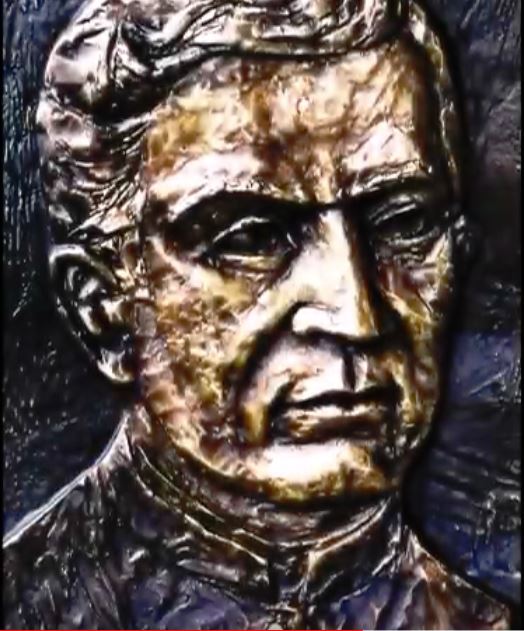
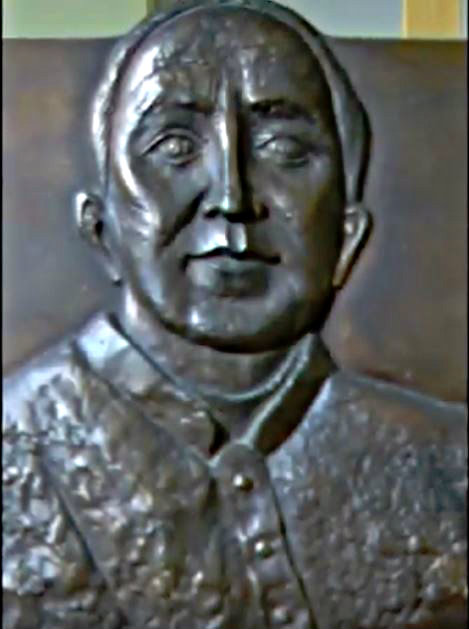
Saint of the Day – 29 January – Bl Bronislaw Markiewicz SDB (1842-1912) Religious Priest and Founder of the Orders of St Michael the Archangel with both priests and sisters – born on 13 July 1842 at Pruchnik, archdiocese of Przemysl dei Latini, Poland and died on 29 January 1912 at Miejsce Piastowe, Poland of complications related to tuberculosis.
“Bronislaw Markiewicz, the sixth of the eleven children of John Markiewicz, City Mayor, and Marianna Gryziecka, was born on the 13th of July 1842 in Pruchnik, Poland, in the present day Archdiocese of Przemysl dei Latini. In his family home, he received a solid religious formation. Nonetheless, during his secondary studies in Przemysl he experienced a certain wavering in the faith due, in large part, to the strong anti-religious atmosphere which dominated the school. However, he succeeded in overcoming this in a relatively short period, once again finding peace and serenity.
Feeling a call from God to the priesthood, the young Bronislao entered the major seminary of Przemysl in 1863 after having received the Maturity diploma. Upon completion of the regular course of study he was ordained to the priesthood on 15 September 1867. Following six years of pastoral wok as a parochial vicar in the Parish of Harta and the Cathedral of Przemysl, seeking to become better equipped to work with youth, he studied pedagogy, philosophy and history for two years in the Universities of Leopoli and Cracow. In 1875 he was named pastor at Gac and in 1877 pastor at Blazowa. In 1882 he was entrusted a teaching position in pastoral theology and the Major Seminary of Przemysl.
Hearing a call to the religious life, he left for Italy in the month of November 1885 and joined the Salesians where he had the joy of meeting Saint John Bosco (1815-1888) before whom he professed religious vows on March 25, 1887.
As a Salesian he carried out the various tasks assigned to him by his superiors, which he sought to accomplish with dedication and zeal. Due to the austerity of the lifestyle and the change of climate, Fr Bronislao fell gravely ill with consumption in 1889, to the point of having been considered close to death. Having recovered from his illness, he convalesced in Italy until 23 March 1892 when, with the permission of his Superiors, he returned to Poland where he assumed the assignment of Pastor at Miejsce Piastowe, in Przemysl his native Diocese.
In addition to his ordinary pastoral activity, Father dedicated himself, in the Spirit of St John Bosco, to the formation of poor and orphaned youth. He opened an institute in which he offered his students both material and spiritual support preparing them for life with a professional formation in the schools around the institute itself. To carry on his work, he decided in 1897 to found two new religious congregations based on the spirituality of St John Bosco, adapting his rules to reflect their own Charism. Once again received among the clergy of the Diocese of Przemysl, Father Markiewicz continued his work as Pastor and Director of the Society (erected in 1898) which he named Temperance and Work, seeking to obtain its approbation as a religious institute. The approbation was granted a few years after his death: in 1921 for the male branch and in 1928 for the female branch.
With the approval and blessing of his bishop Saint Joseph Sebastian Pelczar, Fr Bronislao continued his activity forming youth and abandoned and orphaned children. He was assisted by collaborators to whose preparation and formation he himself always contributed. Already at Miejce Piastowe he had offered a home and formation to hundreds of children giving of himself totally for them. Always desiring to do more for them, in the month of August of 1903, Fr Markiewicz opened a new house in Pawlikowice, near Cracow, where over 400 orphans found a house and the possibility for spiritual and professional formation.
His total dedication to children, his heroic self-denial and the enormous work he accomplished, quickly exhausted the strength of Fr Markiewicz,. undermining his health, which was already greatly compromised from his illness in Italy. All of this led rather rapidly to the end of his earthly pilgrimage which came on 29 January 1912.
Both before and after his death he was considered an extraordinary man. As the fame of the sanctity of Bronislao Markiewicz continued to constantly increase, the Superiors of both religious institutes of St Michael the Archangel, founded by him, asked the Bishop of Przemysl to initiate the process of beatification of their founder, which began in 1958. Having completed the procedure for the Cause, on 2 July 1994 in the presence of his Holiness John Paul II, the decree of heroic virtue was promulgated and ten years later on 20 December 2004 the decree of the Miracle performed by God through the intercession of Fr Bronislao was promulgated, thus opening the way for his beatification….Vatican.va
Blessed Bronislaw was Beatified on 19 June 2005 by Pope Benedict XVI. The recognition was celebrated by Cardinal Jozef Glemp in Pilsudski Square, Warsaw, Poland.
St Aldegundis
St Alexander of Edessa
St Amnichad of Fulda
St Armentarius of Antibes
St Armentarius of Pavia
St Barsen
St Barsimaeus of Edessa
St Bathilde Bl Bronislaw Markiewicz SDB (1842-1912)
Bl Carmen Marie Anne García Moyon St David Galván-Bermúdez (1881-1915) Martyr of the Mexican Revolution
Biography here: https://anastpaul.wordpress.com/2018/01/30/saint-of-the-day-30-january-st-david-galvan-bermudez-1881-1915-martyr/St Felician of Africa
St Felix IV, Pope
Bl Francis Taylor
Bl Haberilla
St Hippolytus of Antioch
St Hyacintha of Mariscotti
Bl Margaret Ball
Bl Maria Bolognesi
St Martina of Rome
St Matthias of Jerusalem
St Mutien Marie Wiaux
St Paul Ho Hyob
St Philippian of Africa
St Savina of Milan
Bl Sebastian Valfrè
St Theophilus the Younger
St Tôma Khuông
St Tudclyd
Bl Zygmunt Pisarski
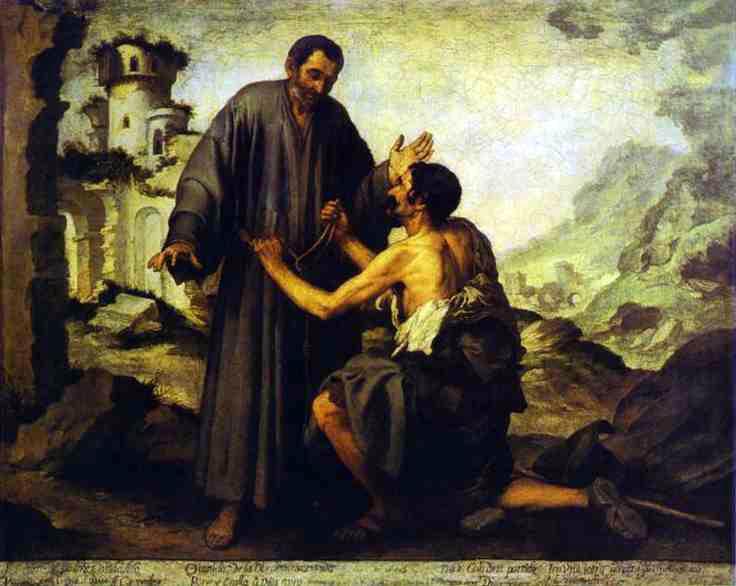
Saint of the Day – 29 January – the Servant of God Brother Juniper OFM (Died 1258) – Franciscan Friar. Brother Juniper is called “the renowned jester of the Lord” and was one of the original followers of St Francis of Assisi. Not much is known about Juniper before he joined the friars. In 1210, he was received into the Order of Friars Minor by St Francis himself. “Would to God, my brothers, that I had a whole forest of such Junipers”Saint Francis would say.
We don’t know much about Juniper before he joined the friars in 1210. Francis sent him to establish “places” for the friars in Gualdo Tadino and Viterbo. When Saint Clare was dying, Juniper consoled her. He was devoted to the passion of Jesus and was known for his simplicity.
Several stories about Juniper in the Little Flowers of St Francis illustrate his exasperating generosity. Once Juniper was taking care of a sick man who had a craving to eat pig’s feet. This helpful friar went to a nearby field, captured a pig and cut off one foot and then served this meal to the sick man. The owner of the pig was furious and immediately went to Juniper’s superior. When Juniper saw his mistake, he apologised profusely. He also ended up talking this angry man into donating the rest of the pig to the friars!
Another time Juniper had been commanded to quit giving part of his clothing to the half-naked people he met on the road. Desiring to obey his superior, Juniper once told a man in need that he couldn’t give the man his tunic but he wouldn’t prevent the man from taking it either. In time, the friars learned not to leave anything lying around, for Juniper would probably give it away.
He died in 1258 and is buried at Ara Coeli Church in Rome. He was never formally Beatified.
Ara Coeli Church in Rome
St Junípero Serra OFM (1713–1784), born Miquel Josep Serra i Ferrer, took his religious name in honour of Brother Juniper when he was received into the Order.
St Francis said of him: A perfect friar would have “the patience of Brother Juniper, who attained the state of perfect patience because he kept the truth of his low estate constantly in mind, whose supreme desire was to follow Christ on the way of the cross.”
St Abundantia the Martyr
St Aphraates
St Aquilinus of Milan
St Barbea of Edessa
St Blath of Kildare
Bl Boleslawa Maria Lament
St Caesarius of Angoulême
Bl Charles of Sayn
St Constantius of Perugia St Dallan Forgaill (c 530- 598) Martyr
St Dallan’s story: https://anastpaul.wordpress.com/2018/01/29/saint-of-the-day-29-january-st-dallan-forgaill-c-530-598/
St Pope Gelasius II
St Gildas the Elder St Gildas the Wise (c500-c 570)
Biography: https://anastpaul.wordpress.com/2017/01/29/saint-of-the-day-29-january-st-gildas-the-wise/
Blessed Juniper OFM (Died 1258)
St Maurus of Rome
St Papias of Rome
St Sarbellius
St Serrano
St Sulpicius Severus
St Valerius of Trier
St Voloc
Thought for the Day – 28 January – The Memorial of St Thomas Aquinas (1225-1274) Doctor of the Church
The Cross Exemplifies every Virtue
Saint Thomas Aquinas Priest and Doctor of the Church
An excerpt from a Conference
Why did the Son of God have to suffer for us? There was a great need and it can be considered in a twofold way – in the first place, as a remedy for sin and secondly, as an example of how to act.
It is a remedy, for, in the face of all the evils which we incur on account of our sins, we have found relief through the passion of Christ. Yet, it is no less an example, for the passion of Christ completely suffices to fashion our lives. Whoever wishes to live perfectly should do nothing but disdain what Christ disdained on the cross and desire what He desired, for the cross exemplifies every virtue.
If you seek the example of love: Greater love than this no man has, than to lay down his life for his friends. Such a man was Christ on the cross. And if He gave His life for us, then it should not be difficult to bear whatever hardships arise for His sake.
If you seek patience, you will find no better example than the cross. Great patience occurs in two ways – either when one patiently suffers much, or when one suffers things which one is able to avoid and yet does not avoid. Christ endured much on the cross and did so patiently, because when He suffered He did not threaten;,He was led like a sheep to the slaughter and He did not open His mouth. Therefore, Christ’s patience on the cross, was great. In patience let us run for the prize set before us, looking upon Jesus, the author and perfecter of our faith who, for the joy set before Him, bore His cross and despised the shame.
If you seek an example of humility, look upon the crucified one, for God wished to be judged by Pontius Pilate and to die.
If you seek an example of obedience, follow Him who became obedient to the Father even unto death. For just as by the disobedience of one man, namely, Adam, many were made sinners, so by the obedience of one man, many were made righteous.
If you seek an example of despising earthly things, follow Him who is the King of kings and the Lord of lords, in whom are hidden all the treasures of wisdom and knowledge. Upon the cross He was stripped, mocked, spat upon, struck, crowned with thorns and given only vinegar and gall to drink.
Do not be attached, therefore, to clothing and riches because they divided my garments among themselves. Nor to honours, for He experienced harsh words and scourgings. Nor to greatness of rank, for weaving a crown of thorns, they placed it on my head. Nor to anything delightful, for in my thirst they gave me vinegar to drink.
Quote/s of the Day – 28 January – The Memorial of St Thomas Aquinas (1225-1274) Doctor of the Church
“Believing is an act of the intellect, assenting to the divine truth, by command of the will, moved by God, through grace.”
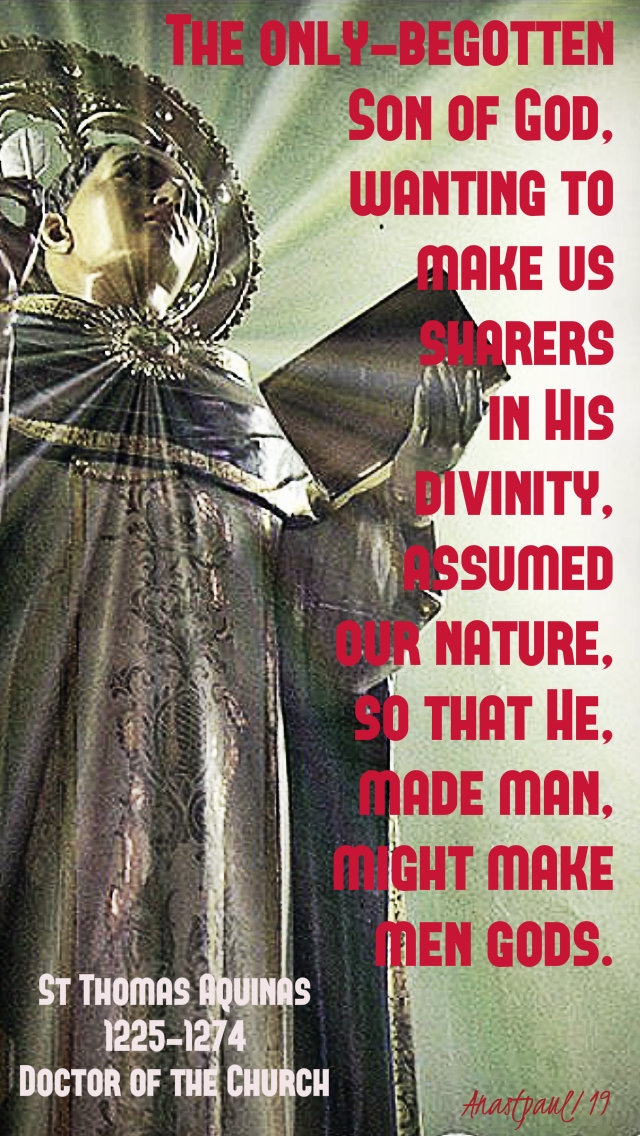
“The only-begotten Son of God, wanting to make us sharers in His divinity, assumed our nature, so that He, made man, might make men gods.”
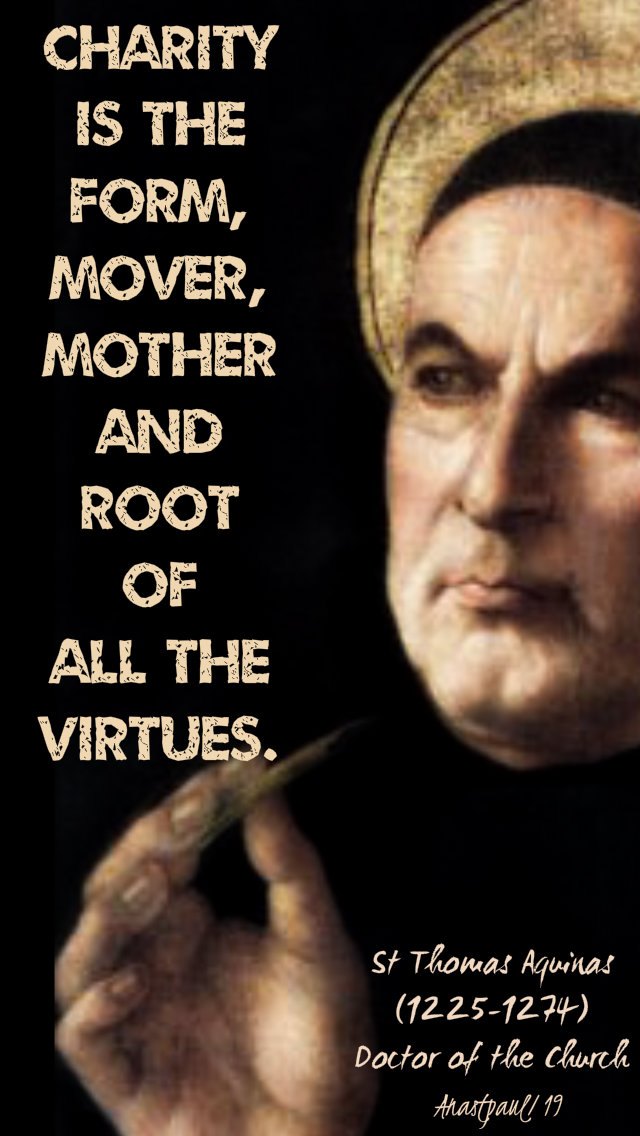
“Charity is the form, mover, mother and root of all the virtues.”
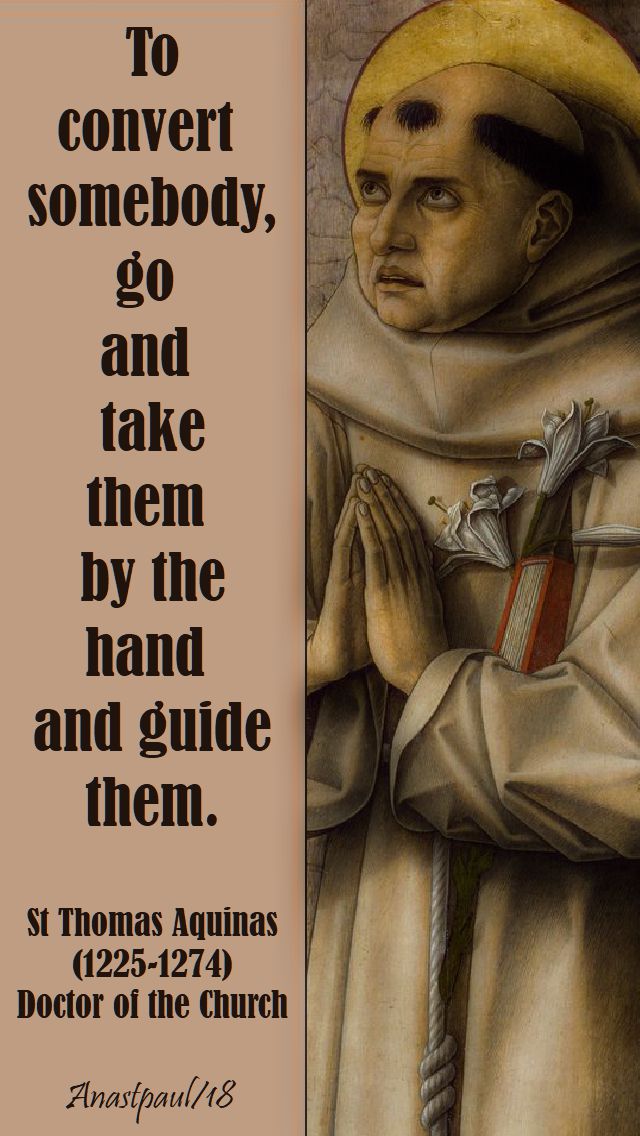
“To convert somebody, go and take them by the hand and guide them.”
“We are like children, who stand in need of masters to enlighten us and direct us and God has provided for this, by appointing His angels, to be our teachers and guides. “
“Just as a woman had announced the words of death to the first man, so also, a woman was the first to announce to the Apostles the words of life.”
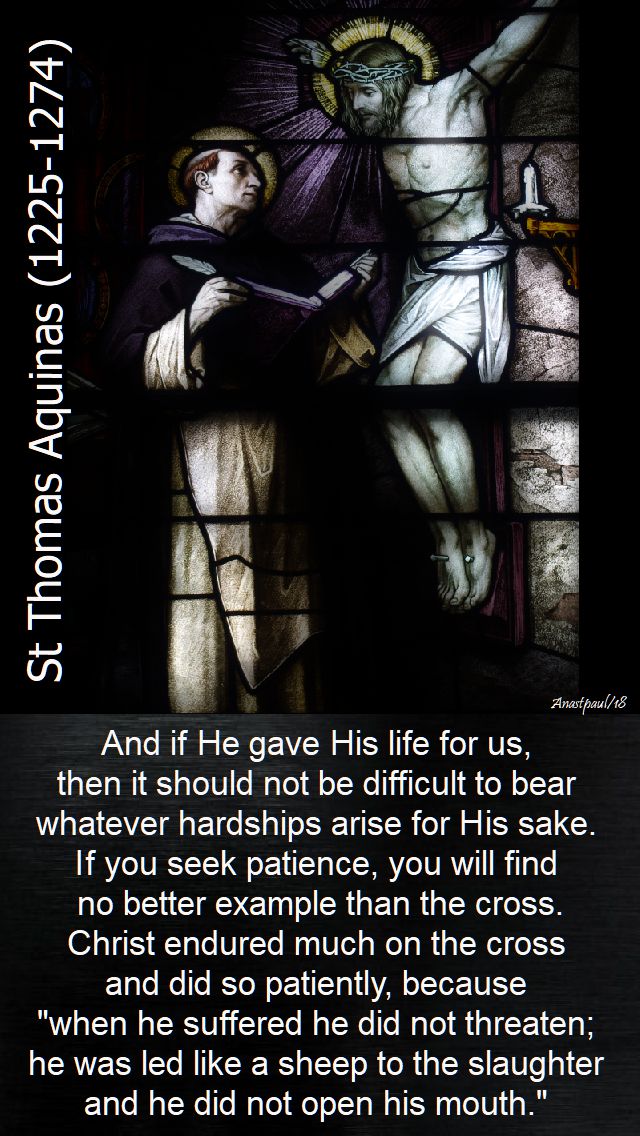
And if He gave His life for us, then it should not be difficult to bear whatever hardships arise for His sake. If you seek patience, you will find no better example than the cross. Christ endured much on the cross and did so patiently, because “when he suffered he did not threaten, he was led like a sheep to the slaughter and he did not open his mouth.”
St Thomas Aquinas (1225-1274) Doctor of the Church
One Minute Reflection – 29 January – Monday of the 3rd Week in Ordinary Time, Year C – Gospel: Mark 3:22-30 and The Memorial of St Thomas Aquinas (1225-1274) Doctor of the Church
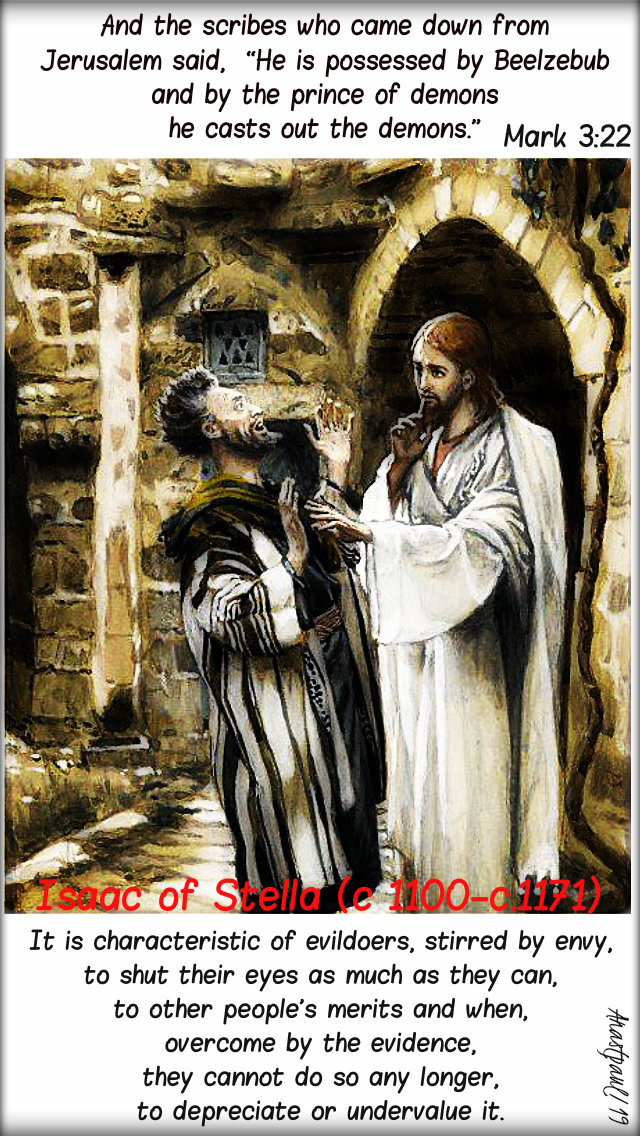
And the scribes who came down from Jerusalem said, “He is possessed by Beelzebub and by the prince of demons he casts out the demons.”...Mark 3:22
REFLECTION – “It is characteristic of evildoers, stirred by envy, to shut their eyes as much as they can, to other people’s merits and when, overcome by the evidence, they cannot do so any longer, to depreciate or undervalue it. Thus, when the crowd rejoiced in devotion and marvelled at the sight of Christ’s works, the scribes and Pharisees either closed their eyes to what they knew to be true, or minimised what is great, or undervalued what is good. Once, for example, feigning ignorance, they said to Him who had worked so many wonderful signs: “What sign can you do that we may believe in you?” (Jn 6:30). In this case, unable to blatantly deny the facts, they wickedly depreciate them… and they devalue them by saying: “It is by Beelzebub, the prince of devils, that he casts out devils.”
Now this, dear brethren, is the blasphemy against the Spirit that binds all those he has seized with the bonds of an eternal sin. This is not to say that it would be impossible for the repentant to gain forgiveness for it all if they “produce fruit as evidence of their repentance” (Lk 3:8). The only thing is that, crushed beneath such a weight of malice, they lack the strength to aspire to that praiseworthy repentance worthy of forgiveness… Those who, perceiving the proofs of grace and the Holy Spirit at work in a brother…, are not afraid to undermine and calumniate and brashly ascribe to the evil spirit what they clearly know to be of the Holy Spirit, such as these have been so forsaken by this Spirit of grace, that they no longer even desire the repentance that would obtain pardon. They are completely in the dark, blinded by their own malice. Indeed, what could be more serious than to dare, out of envy for a brother one had been commanded to love as oneself (Mt 19:19), to blaspheme God’s goodness… and insult his majesty by wanting to discredit another?”...Isaac of Stella (c 1100-c.1171) O.Cist. Cistercian monk
PRAYER – Lord, our God, keep us free from envy of others, for this is a poison that can destroy all community and love. Help us to know that to each You have given gifts and all are Your wonder and made to honour You alone. Help us to appreciate our neighbour’s talents and understand that we are all one in the Mystical Body of Your Son. And since it was by Your gift that St Thomas became so great a saint and theologian, give us grace to understand his teaching and follow his way of life. May his great love for Jesus Crucified and his pure adoration of the Blessed Sacrament, be our guide to follow in Your Son’s footsteps and take up our cross and follow Him. Grant that by the prayers of St Thomas, we may grow in love and sanctity. We make our prayer through our Lord Jesus Christ, with the Holy Spirit, God forever, amen.
Our Morning Offering – 28 January – The Memorial of St Thomas Aquinas (1225-1274)
Grant to me, O Merciful God By St Thomas Aquinas
O merciful God,
grant that I may ever perfectly
do Your Will in all things.
Let it be my ambition to work
only for Your honour and glory.
Let me rejoice in nothing
but that leads to You,
nor grieve for anything
that leads away from You.
May all passing things
be as nothing in my eyes,
and may all that is Yours
be dear to me,
and You, my God,
dear above them all.
May all joy be
meaningless without You
and may I desire
nothing apart from You.
May all labour and toil
delight me when it is for You.
Make me, O Lord,
obedient without complaint,
poor without regret,
patient without murmur,
humble without pretense,
joyous without frivolity,
and truthful without disguise.
Give me, O God,
an ever watchful heart
which nothing can ever
lure away from You;
a noble heart,
which no unworthy affection
can draw downwards to the earth;
an upright heart,
which no evil can warp,
an unconquerable heart,
which no tribulation can crush;
a free heart,
which no perverted affection
can claim for its own.
Bestow on me, O God,
understanding to know You,
diligence to seek You,
and wisdom to find You;
a life which may please You,
and a hope which may
embrace You at the last.
Amen
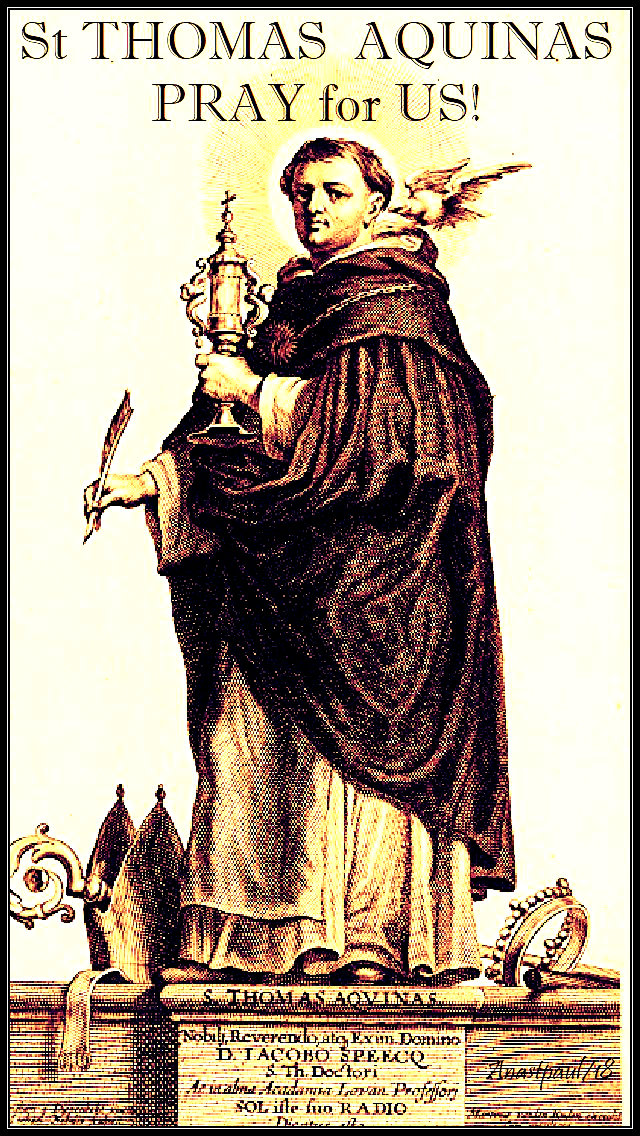
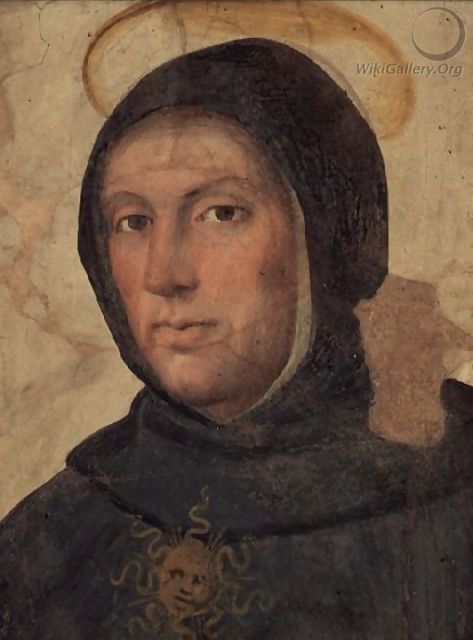
Saint of the Day – 28 January – St Thomas Aquinas OP (1225-1274 aged 49 ) Doctor angelicus (Angelic Doctor) and Doctor communis (Common Doctor). Priest, Religious, Master Theologian, Philosopher, Writer, Teacher, Jurist. Also known as – The Great Synthesiser, The Dumb Ox, The Universal Teacher.
St Thomas was born of noble parents at Aquino in Italy, in 1226. At the age of nineteen he received the Dominican habit at Naples, where he was studying.
Seized by his brothers on his way to Paris, he suffered a two years’ captivity in their castle of Rocca-Secca but neither the caresses of his mother and sisters, nor the threats and stratagems of his brothers, could shake him in his vocation.
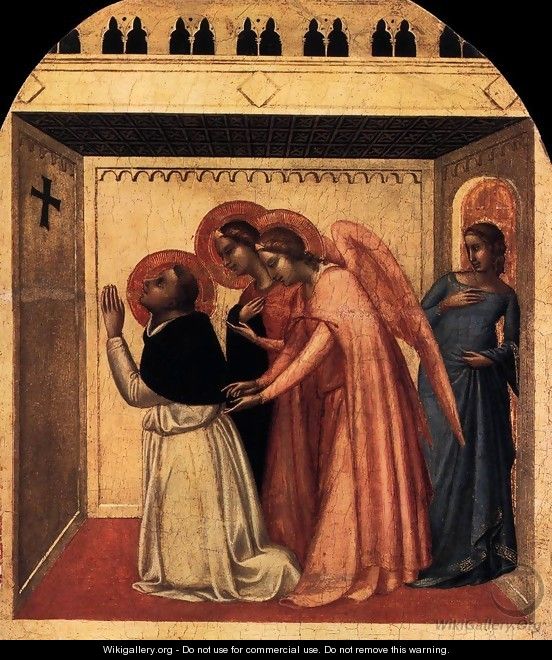
While St Thomas was in confinement at Rocca-Secca, his brothers endeavoured to entrap him into sin but the attempt only ended in the triumph of his purity. Snatching from the hearth a burning brand, the Saint drove from his chamber the wretched creature whom they had there concealed. Then marking a cross upon the wall, he knelt down to pray and forthwith, being rapt in ecstasy, an angel girded him with a cord, in token of the gift of perpetual chastity which God had given him. The pain caused by the girdle was so sharp that St Thomas uttered a piercing cry, which brought his guards into the room.
Diego Velazquez – The Temptation of St Thomas
But he never told this grace to anyone save only to Father Raynald, his confessor, a little while before his death. Hence originated the Confraternity of the “Angelic Warfare,” for the preservation of the virtue of chastity.
Bernardo Daddi – The Temptation of St Thomas
Having at length escaped, St Thomas went to Cologne to study under Blessed Albert the Great and after that to Paris, where for many years he taught philosophy and theology. The Church has ever venerated his numerous writings as a treasure-house of sacred doctrine – while in naming him the Angelic Doctor she has indicated that his science is more divine than human. The rarest gifts of intellect were combined in him with the tenderest piety. Prayer, he said, had taught him more than study.
His singular devotion to the Blessed Sacrament shines forth in the Office and hymns for Corpus Christi, which he composed. To the words miraculously uttered by a crucifix at Naples, “Well hast thou written concerning Me, Thomas. What shall I give thee as a reward?” he replied, “Naught save Thyself, O Lord.”
He died at Fossa-Nuova, 1274, on his way to the General Council of Lyons, to which Pope Gregory X had summoned him.
St Aemilian of Trebi
St Agatha Lin
Bl Amadeus of Lausanne
St Antimus of Brantôme
St Archebran
Bl Bartolomé Aiutamicristo
St Brigid of Picardy
St Callinicus
St Cannera of Inis Cathaig
Bl Charlemagne (a decree of canonization was issued by the anti-pope Paschal III but this was never ratified by valid authority.)
St Constantly
St Flavian of Civita Vecchia
St Glastian of Kinglassie
Bl James the Almsgiver
St James the Hermit
St Jerome Lu
St John of Reomay
St Joseph Freinademetz
Bl Julian Maunoir
St Julian of Cuenca
St Lawrence Wang
St Leucius of Apollonia
Bl María Luisa Montesinos Orduña
St Maura of Picardy
Bl Mosè Tovini
Bl Odo of Beauvais
Bl Olympia Bida
St Palladius of Antioch
St Paulinus of Aquileia
Bl Peter Won Si-jang
St Richard of Vaucelles
St Thyrsus of Apollonia
—
Martyrs of Alexandria: A group of 4th-century parishioners in Alexandria, Egypt. During the celebration of Mass one day an Arian officer named Syrianus led a troop of soldiers into their church and proceded to murder all the orthodox Christians in the place. 356 in Alexandria, Egypt.
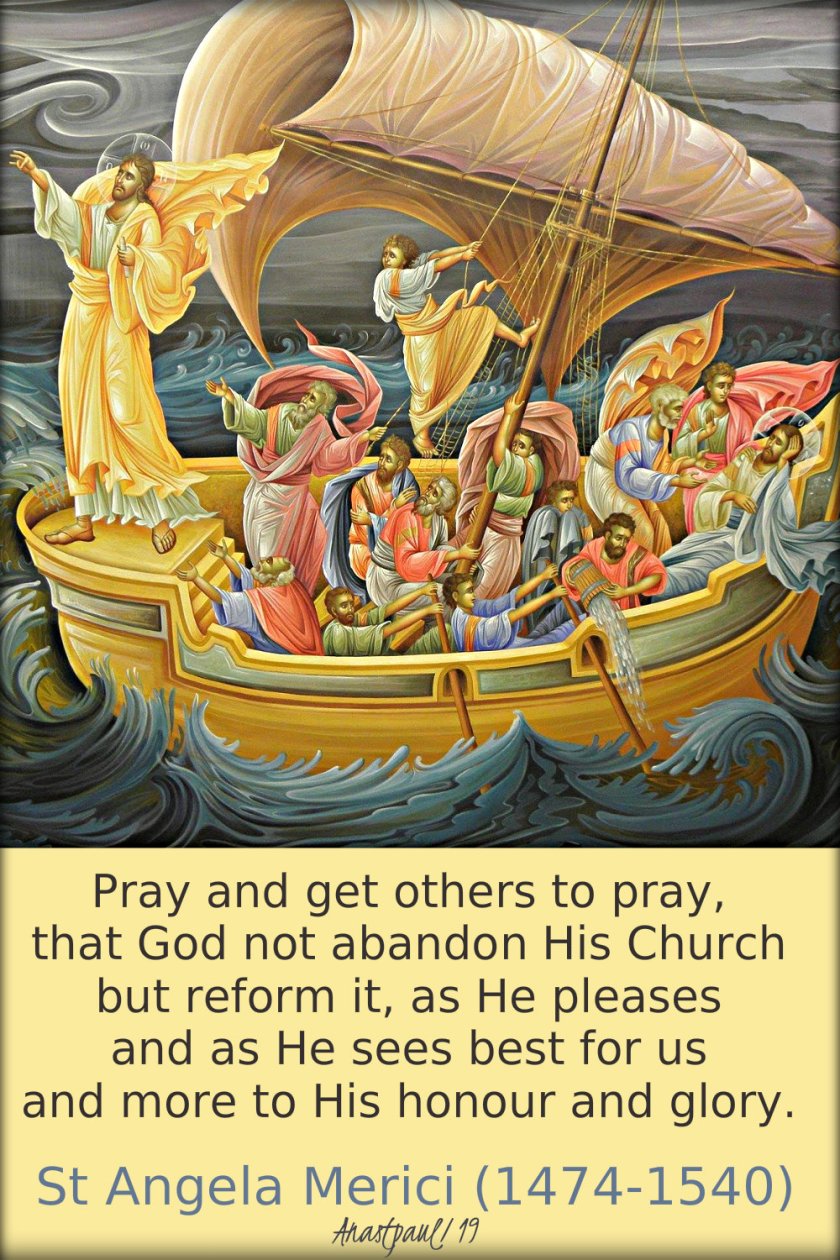
Quote of the Day – 27 January – The Memorial of St Angela Merici (1474-1540)
“Pray and get others to pray, that God not abandon His Church but reform it, as He pleases and as He sees best for us and more to His honour and glory.”
One Minute Reflection – 27 January – The Third Sunday in Ordinary Time, Year C – Gospel: Luke 4:14–21
“The Spirit of the Lord is upon me, because he has anointed me to preach good news to the poor. He has sent me to proclaim release to the captives and recovering of sight to the blind, to set at liberty those who are oppressed…”...Luke 4:18
REFLECTION – “Now let us imagine that we too enter the synagogue of Nazareth, the village where Jesus has grown up, until He is about 30 years old. Then, after a moment of silence filled with expectation on the part of everyone, He says, in the midst of their general amazement: “Today this scripture has been fulfilled in your hearing”.
Evangelising the poor – this is Jesus’ mission. According to what He says, this is also the mission of the Church and of every person baptised in the Church. Being a Christian is the same thing as being a missionary. Proclaiming the Gospel with one’s word and even before, with one’s life, is the primary aim of the Christian community and of each of its members.
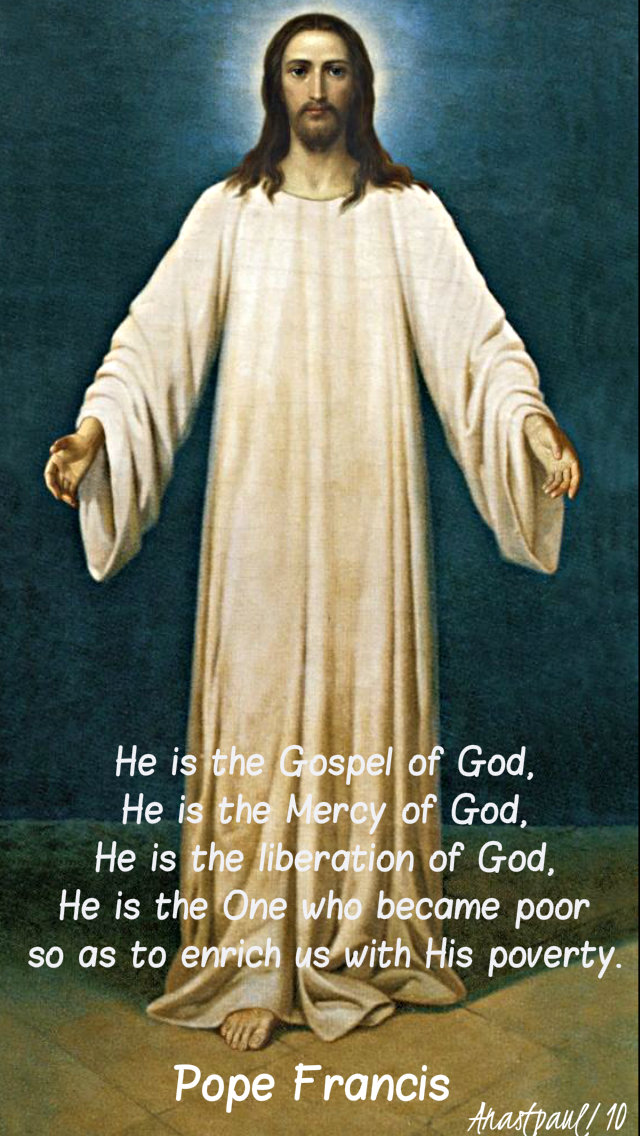
It is noted here that Jesus addresses the Good News to all, excluding no one, indeed favouring those who are distant, suffering sick, cast out by society. Let us ask ourselves: what does it mean to evangelise the poor? It means first of all drawing close to them, it means having the joy of serving them, of freeing them from their oppression, and all of this in the name of and with the Spirit of Christ, because He is the Gospel of God, He is the Mercy of God, He is the liberation of God, He is the One who became poor so as to enrich us with His poverty.”…Pope Francis – Angelus, 24 January 2016
PRAYER – All-powerful, ever-living God, direct our steps in the way of Your love, so that our whole life may be fragrant with all we do in our daily lives as missionaries of Your beloved Son, who sent us forth to proclaim the Good News. Lord God, let St Angela Merici ever commend us to Your love and care. May her charity and wisdom inspire us to treasure Your teaching and express it in our lives. Through our Lord Jesus, in union with the Holy Spirit, one God forever, amen.
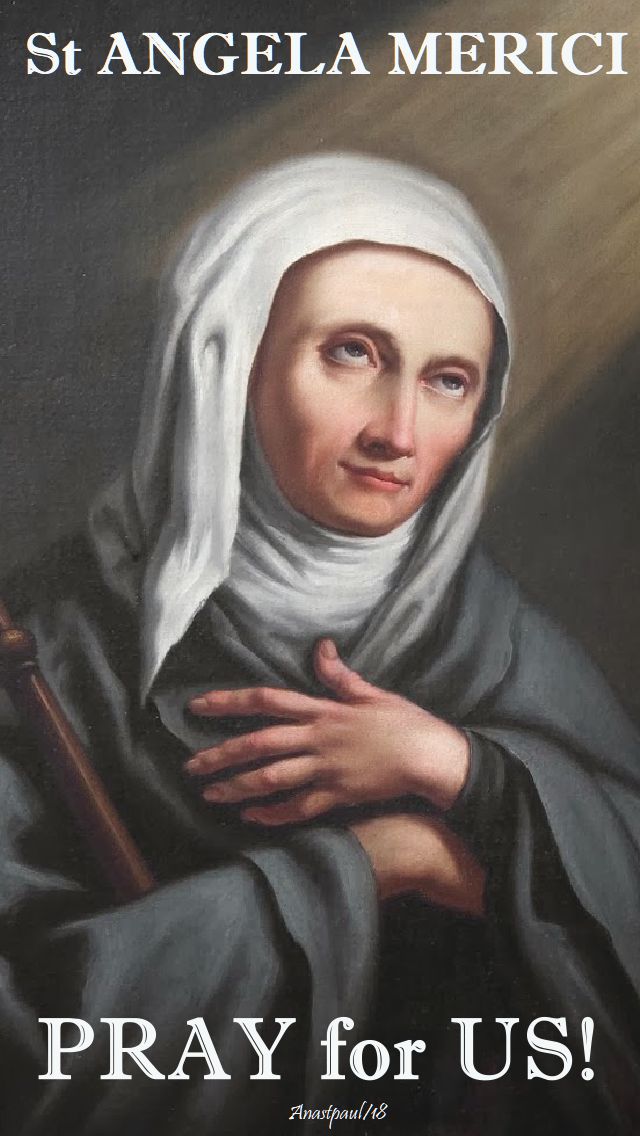
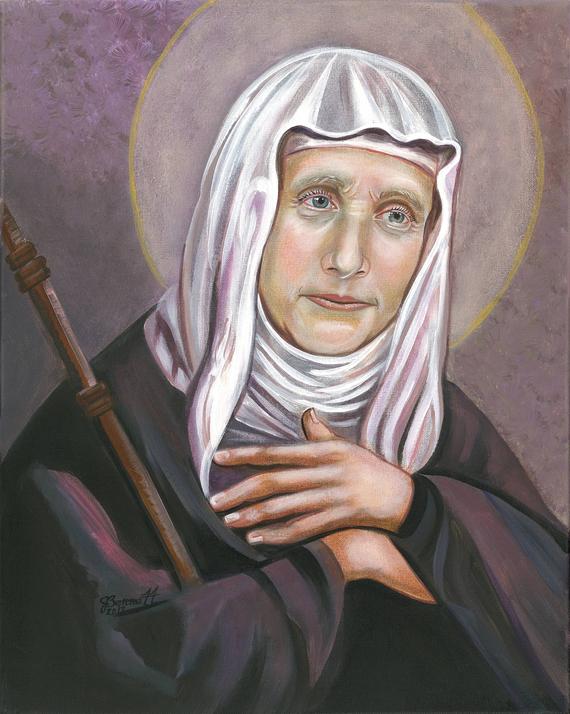
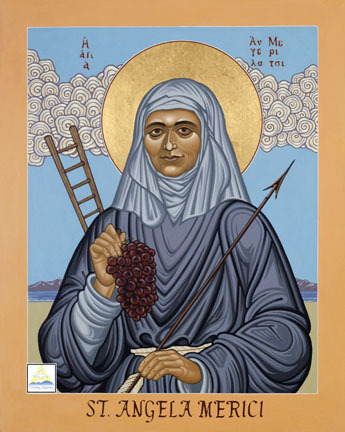
Saint of the Day – 27 January – St Angela Merici (1474-1540) Virgin, Founder. She founded the Company of St. Ursula in 1535 in Brescia, in which women dedicated their lives to the service of the Church through the education of girls. From this organisation later sprang the monastic Order of Ursulines, whose Nuns established places of prayer and learning throughout Europe and, later, worldwide, most notably in North America. Born on 21 March 1474 in Desenzano del Garda, Province of Brescia, Venice, Italy and died oh 27 January 1540 (aged 65) at Brescia of natural causes. Patronages – sickness, handicapped people, loss of parents, courage, She was Beatified on 30 April 1768 by Pope Clement XIII and Canonised on 24 May 1807 by Pope Pius VII.
Women like St Teresa of Ávila and St Catherine of Genoa contributed significantly to the Catholic Reformation. But in the 16th century church perhaps, no woman responded more creatively to the need for reform than St Angela Merici. She built communities that trained single women in Christian living and provided them a secure place of honour in their local societies.
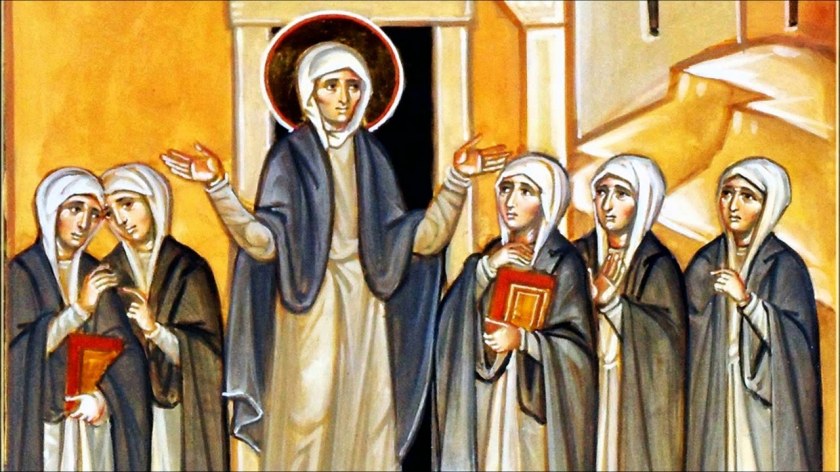
A single lay woman herself, Angela established groups of unmarried women of all classes in Brescia and other northern Italian cities. She wanted the women to be in the world but not of it. So they consecrated themselves to God and promised to remain celibate. But they lived at home with their families and looked for ways to serve their neighbours. In 1535, Angela organised the groups into the Company of St Ursula, later called the Ursulines. Unique for its time, her avant-garde association anticipated modern secular institutes and covenant communities.
Angela gave the Ursulines a military structure, dividing towns into districts governed hierarchically by mature Christian women. This design allowed the community to support members in daily Christian living and protect them from spiritually unhealthy influences.
The rule that Angela wrote for the company required members to remain faithful to the Christian basics. In the following excerpt, she explains the importance of daily vocal and mental prayer:
Each one of the sisters should be solicitous about prayer, mental as well as vocal, that is a companion to fasting. For Scripture says prayer is good with fasting. As by fasting we mortify the carnal appetites and the senses, so by prayer we beg God for the true grace of spiritual life. Thus, from the great need we have of divine aid, we must pray always with mind and heart, as it is written, “Pray constantly” (1 Thessalonians 5:17 NJB). To all we counsel frequent vocal prayer that prepares the mind by exercising the bodily senses. So each one of you, every day will say with devotion and attention at least the Office of the Blessed Virgin and the seven penitential psalms (Psalm 6, 32, 38, 51, 102, 130, and 143) because in saying the office we are speaking with God.
To afford matter and some method in mental prayer, we exhort each one to raise her mind to God and to exercise herself in it every day. And so in the secret of her heart, let her say:
“My Saviour, illumine the darkness of my heart and grant me grace rather to die than to offend your Divine Majesty anymore. Guard, O Lord, my affections and my senses, that they may not stray, nor lead me away from the light of your face, the satisfaction of every afflicted heart.
I ask you, Lord, to receive all my self-will, that by the infection of sin, is unable to distinguish good from evil. Receive, O Lord, all my thoughts, words and deeds, interior and exterior, that I lay at the feet of your Divine Majesty. Although I am utterly unworthy, I beseech you to accept all my being.”
At Angela Merici’s death in 1540 she had started 24 groups. Over the years the Ursulines have flourished as the oldest and one of the most respected of the church’s teaching orders.
To the long list of authorities Ursulines were to obey—Ten Commandments, Church, parents, civil laws—St Angela added “divine inspirations that you may recognise as coming from the Holy Spirit.” A refreshing and liberating rule. Also a dangerous one, for when it’s obeyed, the Holy Spirit may act in unexpected ways.
Bl Antonio Mascaró Colomina
St Avitus
St Candida of Bañoles
St Carolina Santocanale
St Devota of Corsica
St Domitian of Melitene
St Emerius of Bañoles
Bl Jurgis Matulaitis-Matulewicz/George Matulaitis
St Gilduin
Bl Gonzalo Diaz di Amarante
St Henry de Osso y Cervello
St John Maria Muzeyi
Bl John of Warneton
St Julian of Le Mans
St Julian of Sora
St Lupus of Châlons
Bl Manfredo Settala
St Marius of Bodon
Bl Michael Pini
St Natalis of Ulster
St Paul Josef Nardini
Bl Rosalie du Verdier de la Sorinière
St Theodoric of Orléans
St Pope Vitalian
—
Martyrs of North Africa – 30 saints: A group of 30 Christians martyred together by Arian Vandals. The only details to have survived are four of their names – Datius, Julian, Reatrus and Vincent. c 500 in North Africa.
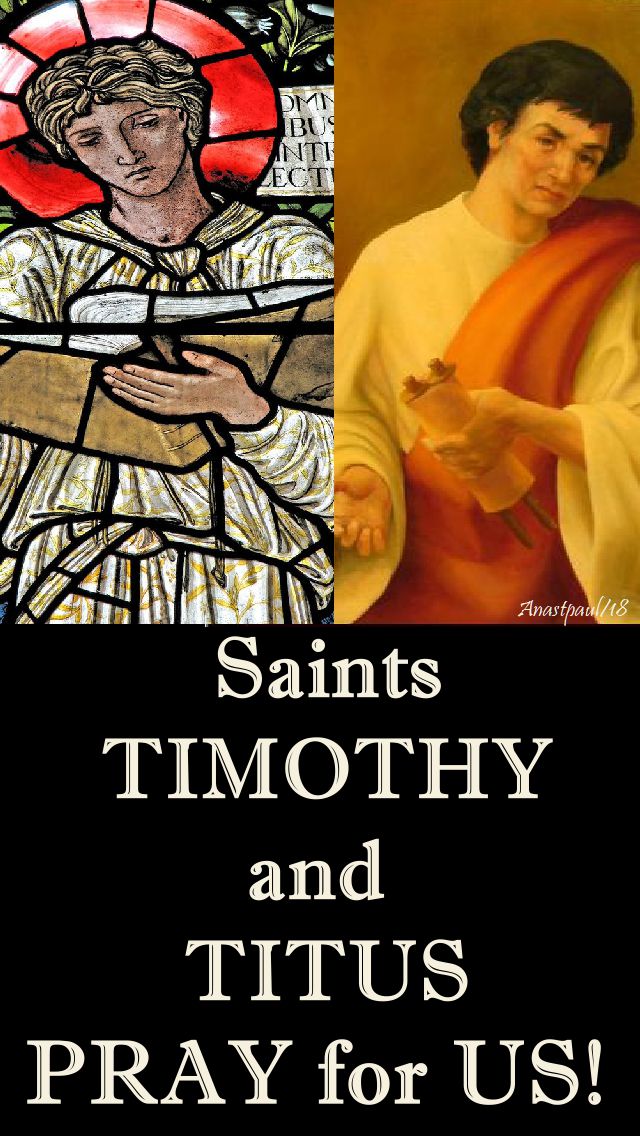
Thought for the Day – 26 January – The Memorial of Sts Timothy and Titus, Disciples and Companions of the Apostle Paul and Bishops of the Catholic Church
Timothy was comparatively young for the work he was doing. Several references seem to indicate that he was timid. And one of Paul’s most frequently quoted lines was addressed to him: “Stop drinking only water but have a little wine for the sake of your stomach and your frequent illnesses” (1 Timothy 5:23).
Titus has the distinction of being a close friend and disciple of Paul as well as a fellow missionary. He was Greek, apparently from Antioch. Even though Titus was a Gentile, Paul would not let him be forced to undergo circumcision at Jerusalem. Titus is seen as a peacemaker, administrator, great friend. Paul’s second letter to Corinth affords an insight into the depth of his friendship with Titus and the great fellowship they had in preaching the gospel.
In Timothy and Titus, we get another glimpse of life in the early Church – great zeal in the apostolate, great communion in Christ, great friendship. Yet always there is the problem of human nature and the unglamorous details of daily life, the need for charity and patience in “quarrels with others, fears within myself,” as Paul says. Through it all, the love of Christ sustained them.
After his experience with Jesus Christ, Paul realised that he was not alone on the road to salvation. Jesus Christ has already accomplished salvation for us. In faith and Baptism, Christians receive the grace of the Holy Spirit, who is our constant guide. The Holy Spirit helps us to live in relationship with God and others.
And so, we too, are always sustained by the love of Christ!
One Minute Reflection – 26 January – The Memorial of Sts Timothy and Titus, Disciples and Companions of the Apostle Paul and Bishops of the Catholic Church
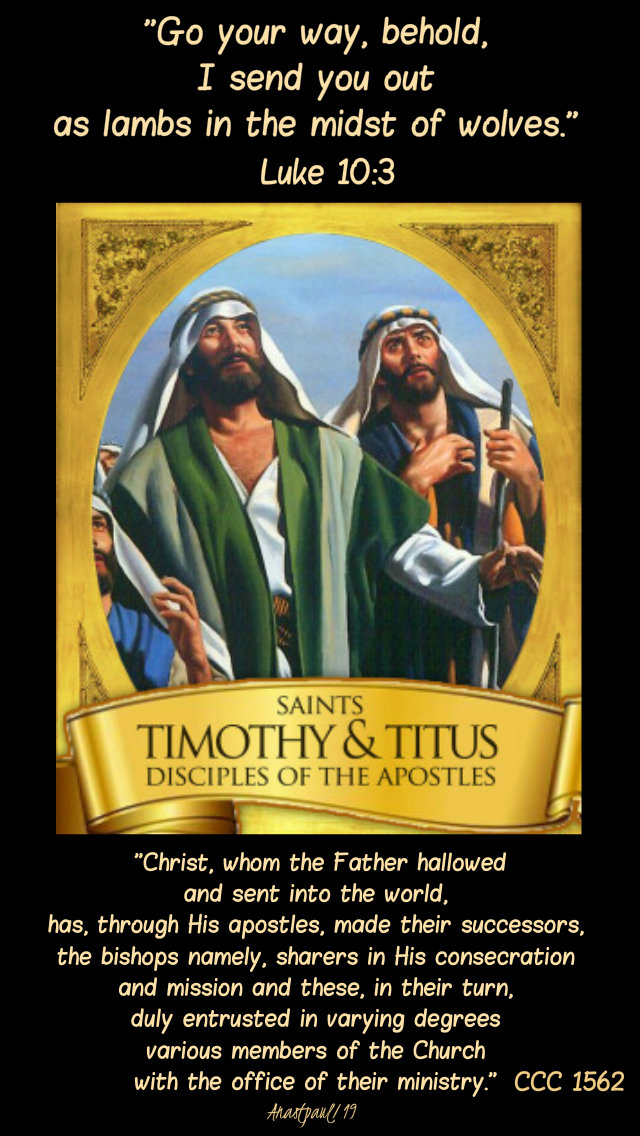
“And he said to them, “The harvest is plentiful but the labourers are few, pray therefore the Lord of the harvest to send out labourers into his harvest. Go your way, behold, I send you out as lambs in the midst of wolves.”...Luke 10:2-3
REFLECTION – 1562 “Christ, whom the Father hallowed and sent into the world, has, through His apostles, made their successors, the bishops namely, sharers in His consecration and mission and these, in their turn, duly entrusted in varying degrees various members of the Church with the office of their ministry.” 43 “The function of the bishops’ ministry was handed over in a subordinate degree to priests so that they might be appointed in the order of the priesthood and be co-workers of the episcopal order for the proper fulfilment of the apostolic mission that had been entrusted to it by Christ.”...CCC 1562 The ordination of priests – co-workers of the bishops
Another observation concerns the willingness of these collaborators. The sources concerning Timothy and Titus highlight their readiness to take on various offices that also often consisted in representing Paul in circumstances far from easy. In a word, they teach us to serve the Gospel with generosity, realising that this also entails a service to the Church herself.”…Pope Benedict XVI 13 December 2006
PRAYER – Almighty God, You endowed Saints Timothy and Titus with power to preach Your Word. Grant that, living a life of integrity and holiness in this world, reaching out to teach the Gospel both by our lives and our words, we may, through their prayers, come to our true home in heaven. Through our Lord Jesus Christ, in union with the Holy Spirit, one God forever, amen.
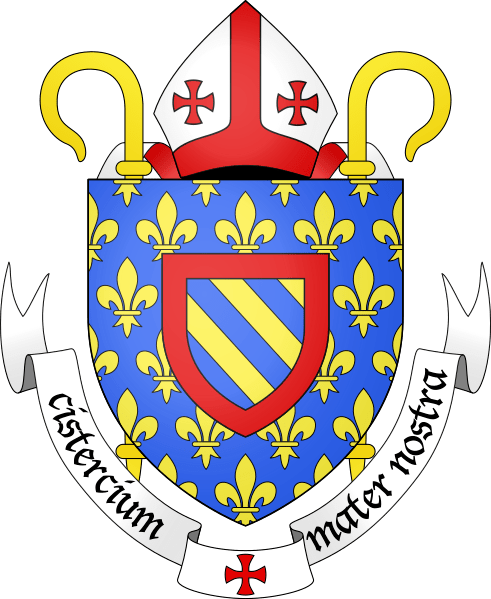
Our Morning Offering – 26 January – The Memorial of the 3 Founders of the Cistercian Order
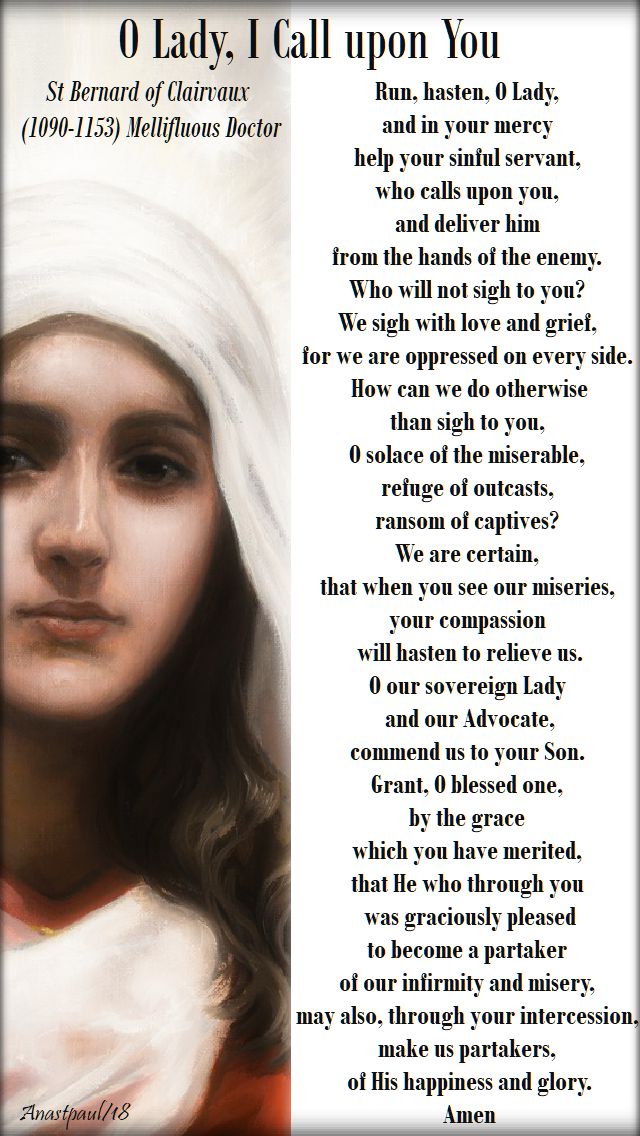
Run, Hasten, O Lady By St Bernard of Clairvaux (1090-1153) Doctor of the Church
Run, hasten, O Lady
and in your mercy,
help your sinful servant,
who calls upon you
and deliver him
from the hands of the enemy.
Who will not sigh to you?
We sigh with love and grief,
for we are oppressed on every side.
How can we do otherwise than sigh to you,
O solace of the miserable,
refuge of outcasts,
ransom of captives?
We are certain that when you see our miseries,
your compassion will hasten to relieve us.
O our sovereign Lady and our Advocate,
commend us to your Son.
Grant, O blessed one,
by the grace which you have merited,
that He Who through you
was graciously pleased to become
a partaker of our infirmity and misery,
may also through your intercession,
make us partakers
of His happiness and glory.
Amen
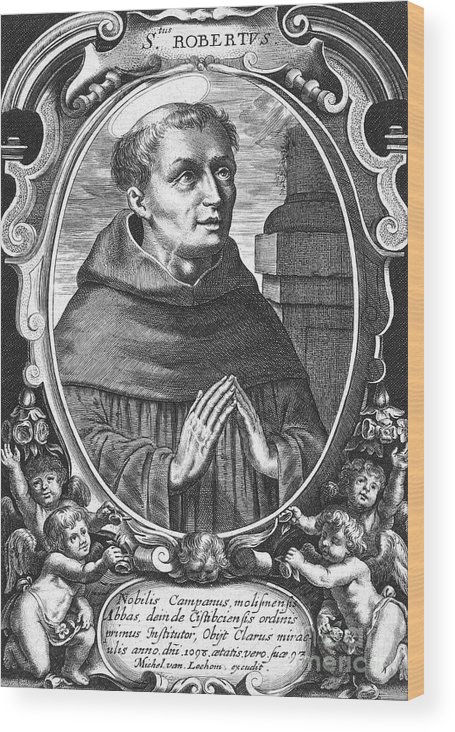
Saints of the Day – 26 January – St Alberic of Citeaux O.Cist (Died 1109) Monk and Abbot , St Robert of Molesme O.Cist (1028-1111) Abbot and St Stephen Harding O.Cist (c 1060-1134) Monk, Priest and the three are Co-Founders of the Cistercian Order.
Robert was born about 1029, a nobleman from Champagne, a younger son, who entered the Benedictine abbey of Montier-la-Celle near Troyes at age fifteen and rose to the office of prior. He was made the abbot of Saint Michel-de-Tonnerre around the year 1070 but he soon discovered that the monks were quarrelsome and disobedient, so he returned to Montier-la-Celle.
Meanwhile, two hermits from a group of monks that had settled at Collan went to Rome and asked Pope Gregory VII to give them Robert as their superior. The pope granted their request and as of 1074 Robert served as their leader. Soon after, Robert moved the small community to Molesme in the valley of Langres in Burgundy. Initially, the establishment consisted of only huts made of branches surrounding a chapel in the forest, dedicated to the Holy Trinity. Molesme Abbey quickly became known for its piety and sanctity and Robert’s reputation as a saintly man grew. It is because of this reputation that in 1082 St Bruno of Cologne (c 1030 -1101) came to Robert seeking advice. He lived with Robert’s community for a time before going on to found the Grande Chartreuse, the first Carthusian monastery.
In 1098 there were 35 dependent priories of Molesme and other annexes and some priories of nuns. Donors from the surrounding area vied with one another in helping the monks; soon they had more than they needed, slackened their way of life and became tepid. Benefactors sent their children to the abbey for education and other non-monastic activities began to dominate daily life. The vast land holdings they had acquired required a large number of employees. As the community grew increasingly wealthy, it began to attract men seeking entry for the wrong reasons. They caused a division among the brothers, challenging Robert’s severity. Robert twice tried to leave Molesme but was ordered back by the Pope.
In 1098, Robert and twenty-one of his monks left Molesme with the intention of never returning. Renaud, the viscount of Beaune, gave this group a desolate valley in a deep forest, there they founded Cîteaux Abbey. Saints Stephen Harding and Alberic – two of Robert’s monks from Molesme – were pivotal in founding the new house. The archbishop of Lyons, being persuaded that they could not subsist there without the endorsement of an influential churchman, wrote in their favour to Eudo, duke of Burgundy. Eudo paid for the construction they had begun, helped the monks finance their operating expenses and gave them much land and cattle. The bishop of Challons elevated the new monastery to the canonical status of an abbey.
In 1099, the monks of Molesme asked Robert to return and agreed to submit entirely to his interpretation of the Rule of St Benedict, the local bishop also pressured Robert to return. He agreed and Molesme became a major centre for the Benedictines under his tutelage. Albéric was made successor abbot at Cîteaux, with Stephen Harding as prior.
Robert died on 17 April 1111. Pope Honorius III Canonised him in 1222. His feast day in the Roman Catholic Church was at first observed on 17 April, later transferred to April 29 and finally combined with the feast of Alberic and Stephen Harding and is observed in our day on 26 January.
The Life of Saint Robert de Molesme was written by Guy, his immediate successor as abbot of Molesme.
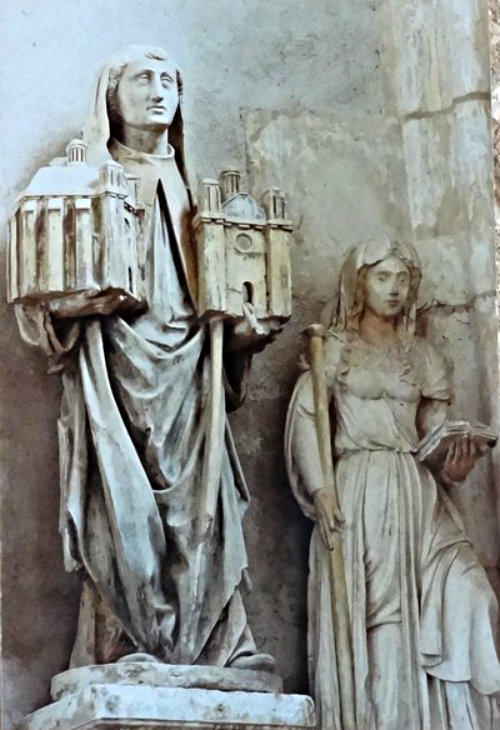
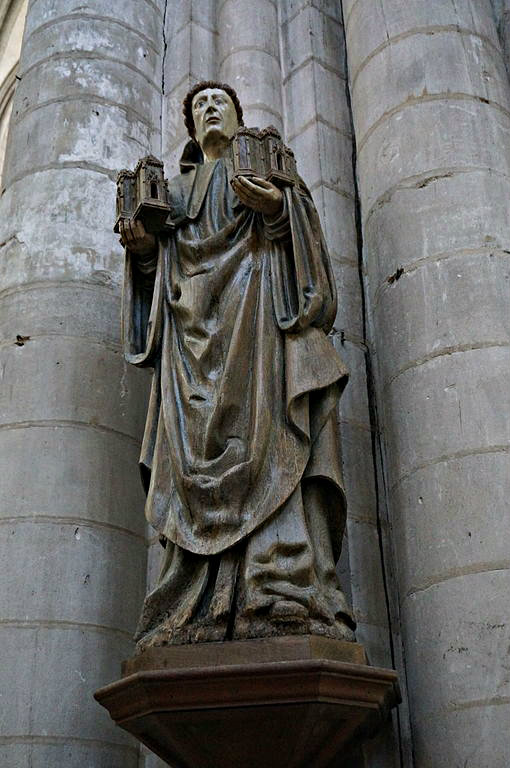
St Robert of Molesme, 15th Cent statue
Alberic was a hermit in the forest of Collan in France who, along with five other hermits, invited Abbot Robert of Molesme to begin a new monastery with them that would operate under the Rule of St Benedict.
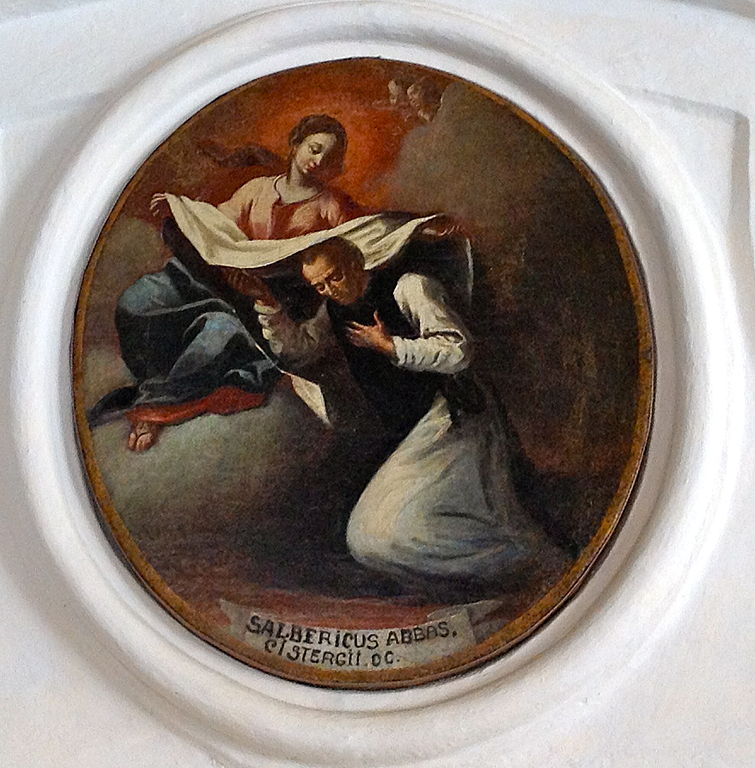
Alberic is credited with attaining the Cistercian Order’s legal foundation. Pope Pascal II granted this legitimacy with his Bull Desiderium quod (around 1100). Albéric also decided to move the monastery’s buildings a kilometer to the north and initiated construction on the first abbey church. The Church was consecrated less than six years later. Alberic also introduced the use of the white Cistercian cowl. It was given to him for the monks, according to legend, by the Virgin Mary as they were at choir praying vigils. Accordingly, the white cowl is one of Alberic’s attributes in hagiographical paintings.
Alberic’s feast day, together with that of Robert of Molesme and Stephen Harding, is celebrated on 26 January.
Harding was born in Sherborne, Dorset, in the Kingdom of England and spoke English, Norman, French and Latin. He was placed in Sherborne Abbey at a young age but eventually left the monastery and became a travelling scholar, journeying with one devout companion into Scotland and afterwards to Paris and then to Rome. He eventually moved to Molesme Abbey in Burgundy, under the Abbot Robert of Molesme (c. 1027-1111). During his time at Molesme abbey he seemed to have assumed the name Stephen.
When Robert left Molesme to avoid what he perceived to be the abbey’s increasing wealth and overly strong connections to the aristocracy, Harding and Alberic of Cîteaux went with him. Seeing no hope of a sufficient reformation in Molesme, Robert appointed another abbot for the abbey and then, with Alberic, Harding and twenty-one other monks, received permission from Hugh, the Archbishop of Lyons and legate of the Holy See, to found a new monastery in Citeaux, a marshy wilderness five leagues from Dijon. There, they formed a new, more austere monastery. Eudes, afterwards Duke of Burgundy, built them a little church which was placed under the patronage of the Blessed Virgin, as all the churches of the Cistercians from that time have been.
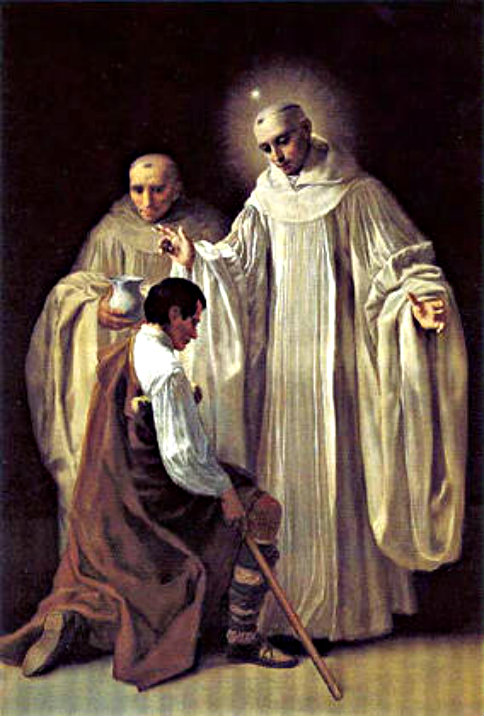
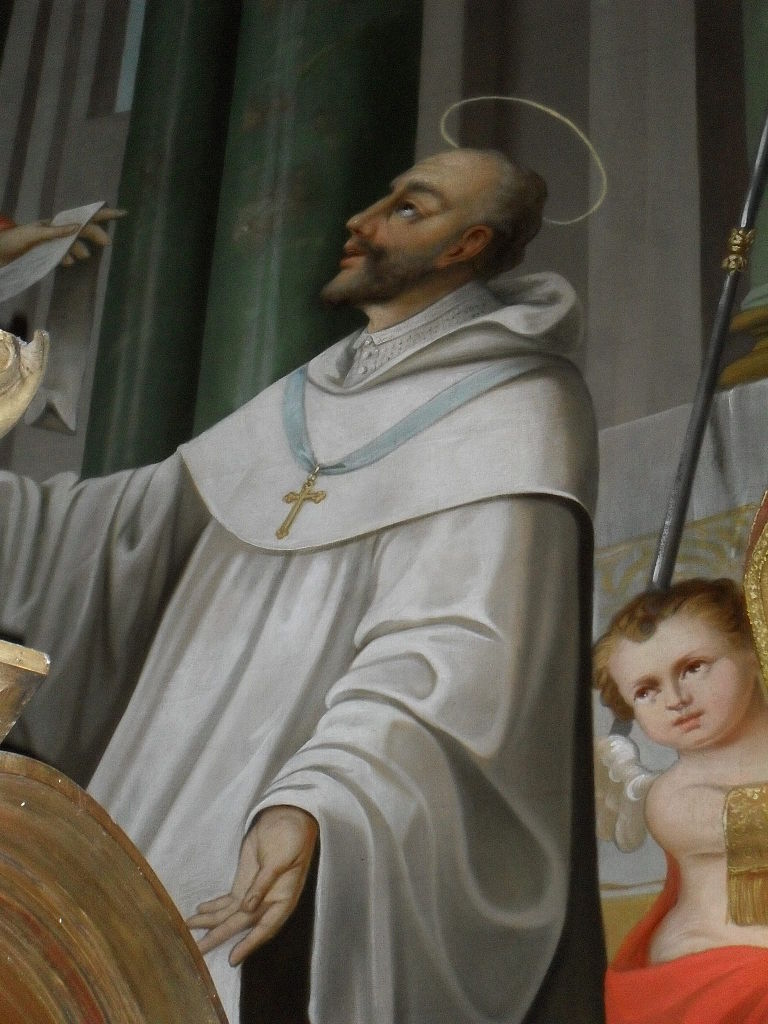
Stephen became the third abbot of Cîteaux. However, very few were joining the community and the monks were suffering from hunger and sickness. In 1112, Bernard of Clairvaux entered the community, bringing with him thirty companions. Between 1112 and 1119, a dozen new Cistercian houses were founded to accommodate those joining the young order. Harding’s organisational skills were exceptional, he instituted the system of general chapters and regular visitations. In 1119, he received official approbation for the Carta Caritatis (Charter of Charity), an important document for the Cistercian Order, establishing its unifying principles.
St Stephen receives St Bernard
Stephen Harding served Cîteaux Abbey as abbot for twenty-five years. While no single person is considered the founder of the Cistercian Order, the shape of Cistercian thought and its rapid growth in the 12th century were arguably due to Harding’s leadership. Insisting on simplicity in all aspects of monastic life, he was largely responsible for the severity of Cistercian architecture and the simple beauty of the Order’s liturgy and music. He was an accomplished scribe for the monastery’s scriptorium, his highest achievement is considered to be the Harding Bible, famous among medieval manuscripts. In 1133, he resigned as head of the order because of age and infirmity. He died on 28 March 1134 and was buried in the tomb of Alberic, his predecessor, in the cloisters at Cîteaux. Stephen was largely responsible for the severity of Cistercian architecture because he was an adherer of simplicity in all aspects of monastic life.
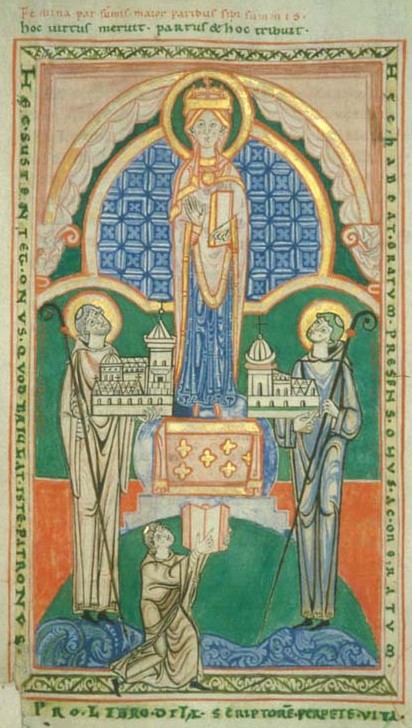
An illumination by St Stephen Harding presenting a model of his church to the Blessed Virgin Mary (Municipal Library, Dijon). Cîteaux, c 1125. At this period Cistercian illumination was the most advanced in France but within 25 years it was abandoned altogether under the influence of St Bernard of Clairvaux.
In a joint commemoration with Robert of Molesme and Alberic, the first two abbots of Cîteaux, the Roman Catholic Church celebrates Stephen Harding’s feast day on 26 January. There is a Catholic Baroque Church established by 1785, the patron saint of which is Stephen Harding, it is located in Hungary, in the village Apátistvánfalva.
The north aisle of the Church of St Sepulchre-without-Newgate in London was formerly a chapel dedicated to him (it became the Musicians’ Chapel in the 20th century).
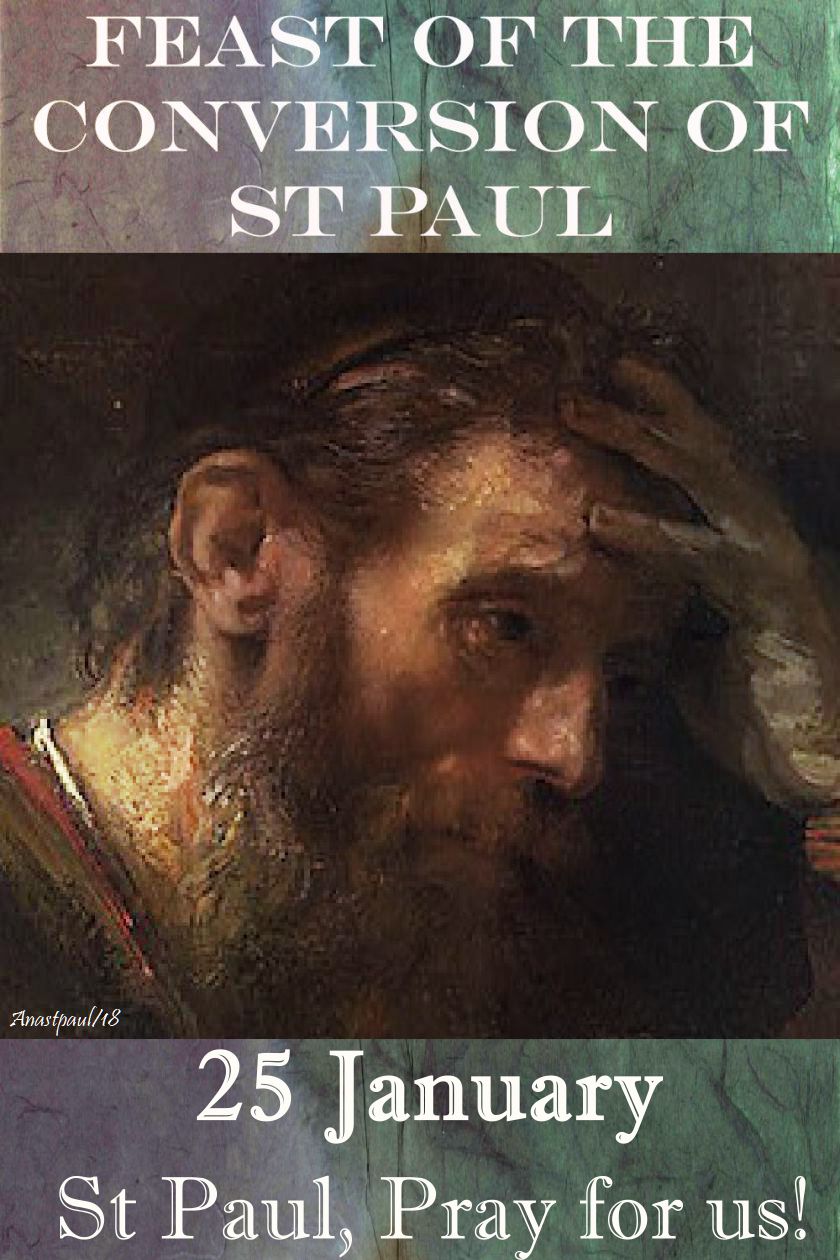
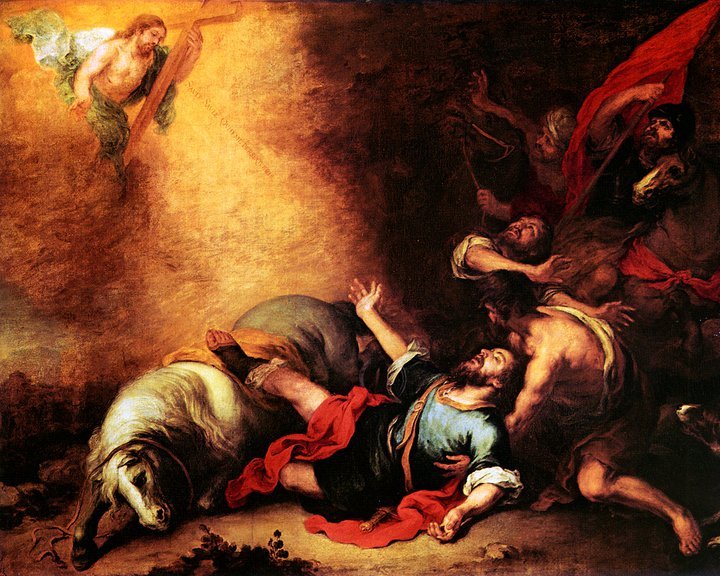
Saint Paul’s entire life can be explained in terms of one experience—his meeting with Jesus on the road to Damascus. In an instant, he saw that all the zeal of his dynamic personality was being wasted, like the strength of a boxer swinging wildly. Perhaps he had never seen Jesus, who was only a few years older. But he had acquired a zealot’s hatred of all Jesus stood for, as he began to harass the Church: “…entering house after house and dragging out men and women, he handed them over for imprisonment” (Acts 8:3b). Now he himself was “entered,” possessed, all his energy harnessed to one goal—being a slave of Christ in the ministry of reconciliation, an instrument to help others experience the one Saviour.
One sentence determined his theology: “I am Jesus, whom you are persecuting” (Acts 9:5b). Jesus was mysteriously identified with people—the loving group of people Saul had been running down like criminals. Jesus, he saw, was the mysterious fulfilment of all he had been blindly pursuing.
From then on, his only work was to “present everyone perfect in Christ. For this I labour and struggle, in accord with the exercise of his power working within me” (Colossians 1:28b-29). “For our gospel did not come to you in word alone but also in power and in the Holy Spirit and [with] much conviction” (1 Thessalonians 1:5a).
Paul’s life became a tireless proclaiming and living out of the message of the cross: Christians die baptismally to sin and are buried with Christ; they are dead to all that is sinful and unredeemed in the world. They are made into a new creation, already sharing Christ’s victory and someday to rise from the dead like Him. Through this risen Christ the Father pours out the Spirit on them, making them completely new.
So Paul’s great message to the world was – You are saved entirely by God, not by anything you can do. Saving faith is the gift of total, free, personal and loving commitment to Christ, a commitment that then bears fruit in more “works” than the Law could ever contemplate.
Conversion of Paul the Apostle (Feast)
Details: https://anastpaul.wordpress.com/2018/01/25/feast-of-the-conversion-of-st-paul-25-january/
St Agape the Martyr
St Agileus of Carthage
St Amarinus of Clermont
St Ananias of Damascus
Bl Antoni Swiadek
Bl Antonio Migliorati
St Apollo of Heliopolis
Bl Archangela Girlani
St Artemas of Pozzuoli
St Auxentius of Epirus
St Bretannion of Tomi
St Donatus the Martyr
St Dwynwen
St Emilia Fernández Rodríguez de Cortés
St Eochod of Galloway
Bl Francesco Zirano
Bl Henry Suso
St Joel of Pulsano
St Juventinus of Antioch
Bl Manuel Domingo y Sol
St Maximinus of Antioch
St Palaemon
St Poppo
St Praejectus of Clermont
St Publius of Zeugma
St Racho of Autun
St Sabinus the Martyr
Bl Teresa Grillo Michel
Thought for the Day – 24 January – “To Philotea – You and Me”
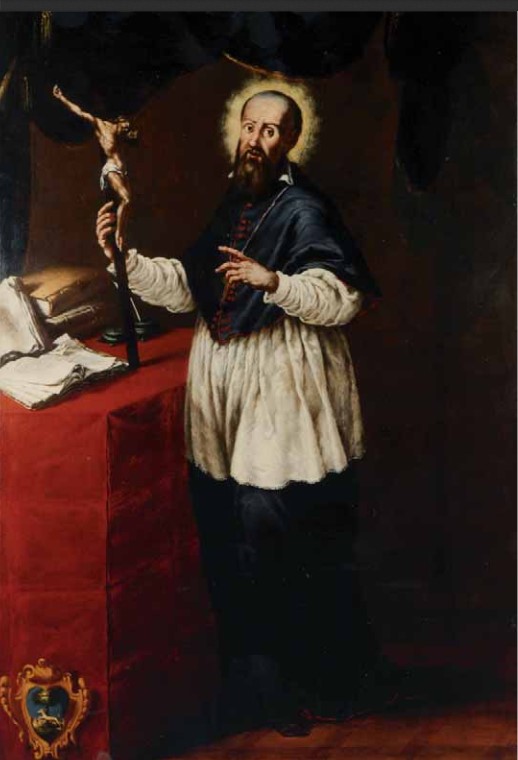
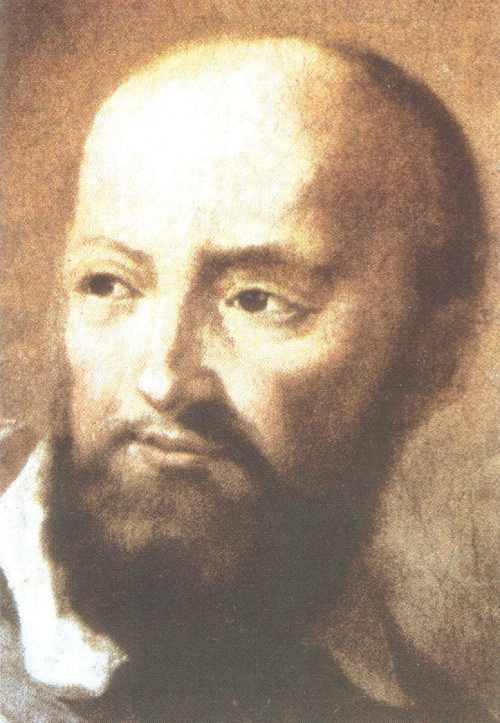
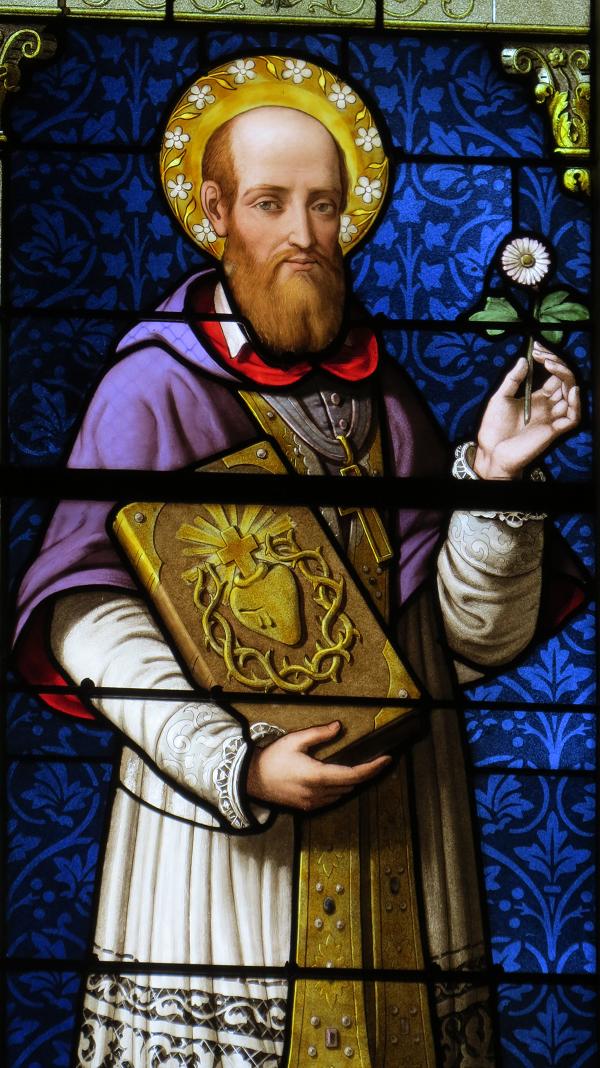
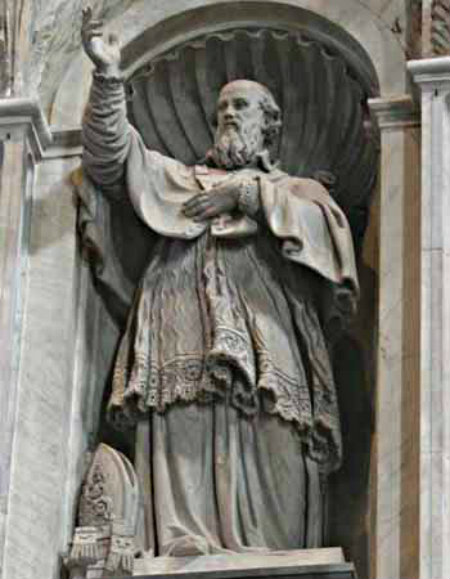
The Memorial of St Francis de Sales (1567-1622) Doctor of the Church:
Doctor Caritatis (Doctor of Charity) ‘The Gentle Christ of Geneva’
Excerpt from Pope Benedict’s Catechesis on St Francis de Sales Wednesday, 2 March 2011
To Philotea, the ideal person to whom he dedicated his Introduction to a Devout Life (1607), Francis de Sales addressed an invitation that might well have seemed revolutionary at the time. It is the invitation to belong completely to God, while living to the full, her presence in the world and the tasks proper to her state. “My intention is to teach those who are living in towns, in the conjugal state, at court” (Preface to The Introduction to a Devout Life).
The Document with which Pope Leo xiii, more than two centuries later, was to proclaim him a Doctor of the Church, would insist on this expansion of the call to perfection, to holiness.
It says: “[true piety] shone its light everywhere and gained entrance to the thrones of kings, the tents of generals, the courts of judges, custom houses, workshops and even the huts of herdsmen” (cf. Brief, Dives in Misericordia, 16 November 1877).
Thus came into being the appeal to lay people and the care for the consecration of temporal things and for the sanctification of daily life on which the Second Vatican Council and the spirituality of our time were to insist.
The ideal of a reconciled humanity was expressed in the harmony between prayer and action in the world, between the search for perfection and the secular condition, with the help of God’s grace that permeates the human being and, without destroying him, purifies him, raising him to divine heights.
Quote/s of the Day – 24 January – The Memorial of St Francis de Sales (1567-1622) Doctor of the Church: Doctor Caritatis (Doctor of Charity)
‘The Gentle Christ of Geneva’
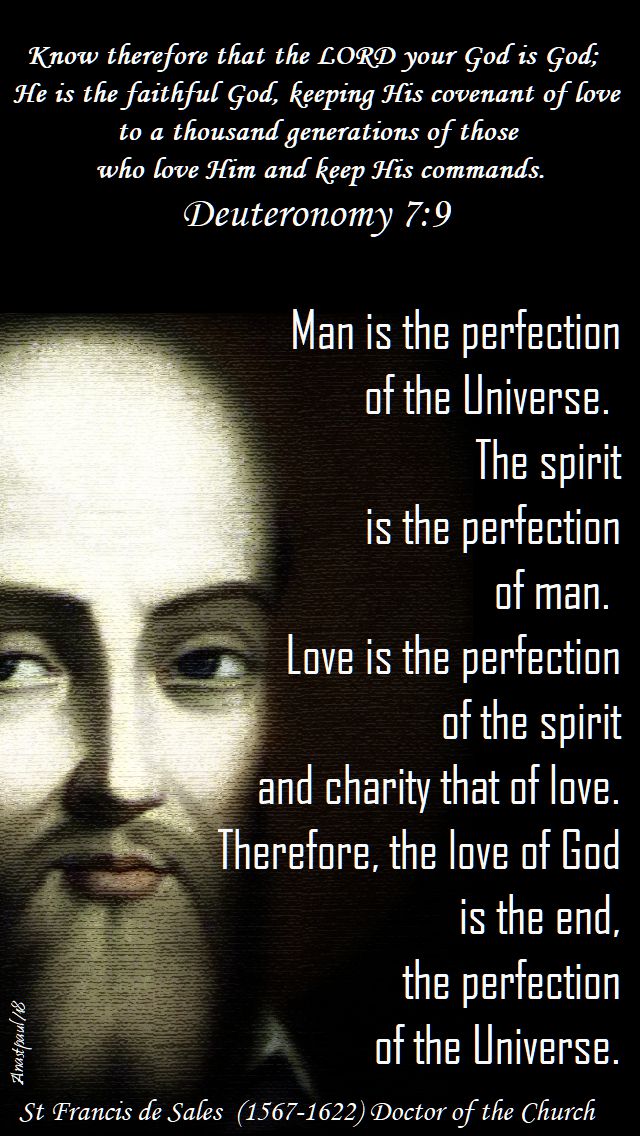
“Man is the perfection of the Universe. The spirit is the perfection of man. Love is the perfection of the spirit and charity that of love. Therefore, the love of God is the end, the perfection of the Universe.”
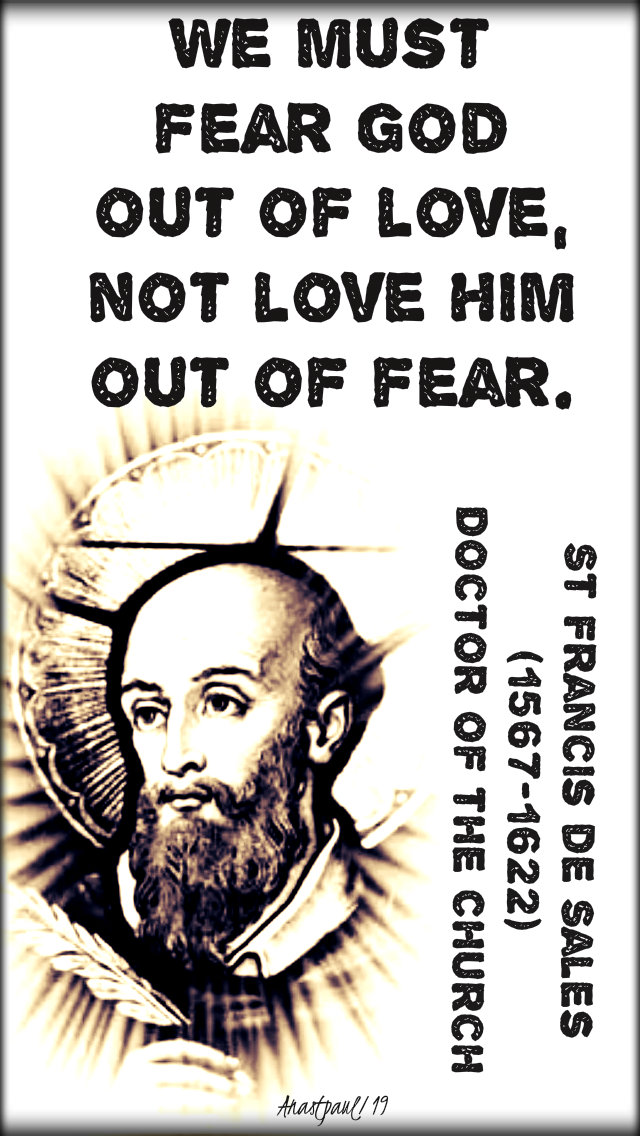
“We must fear God out of love, not love Him out of fear.”
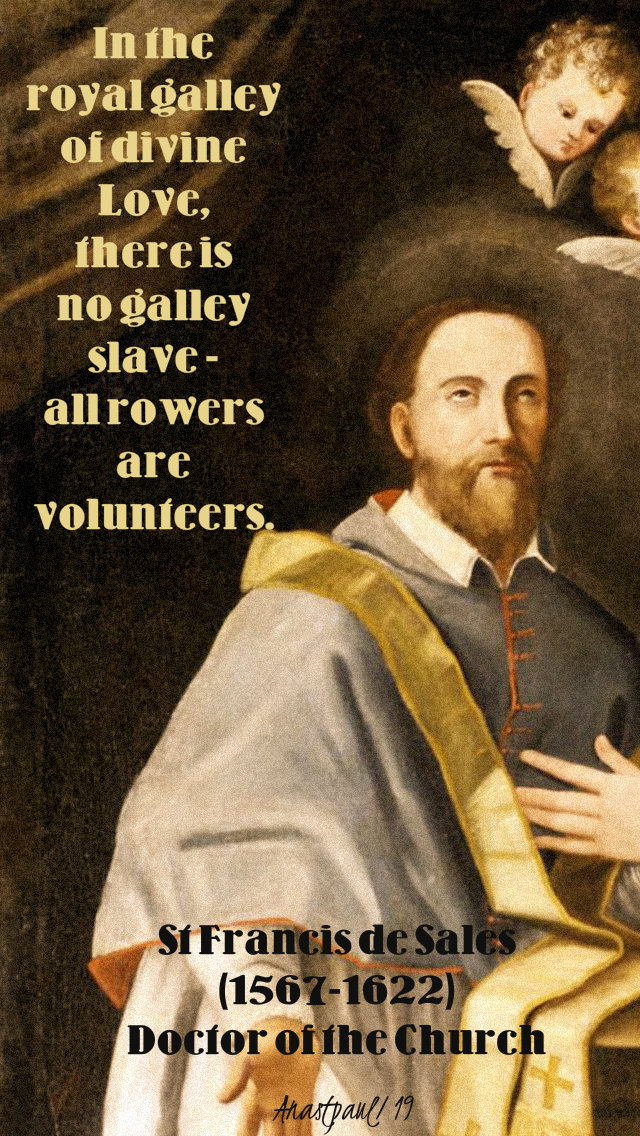
“In the royal galley of divine Love, there is no galley slave – all rowers are volunteers.”
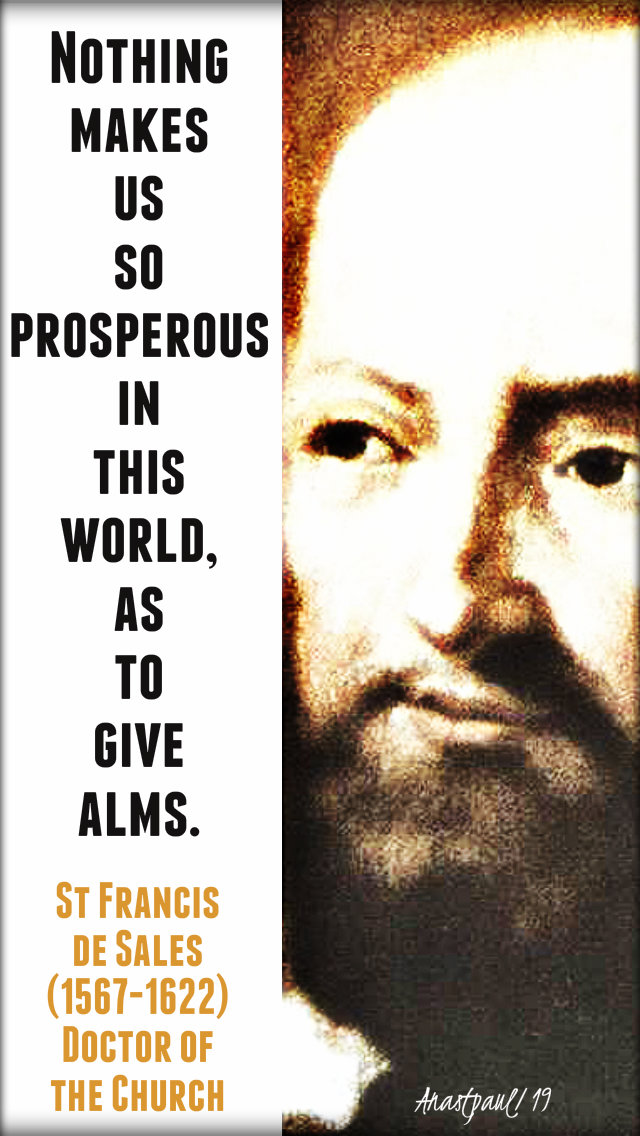
“Nothing makes us so prosperous in this world, as to give alms.”
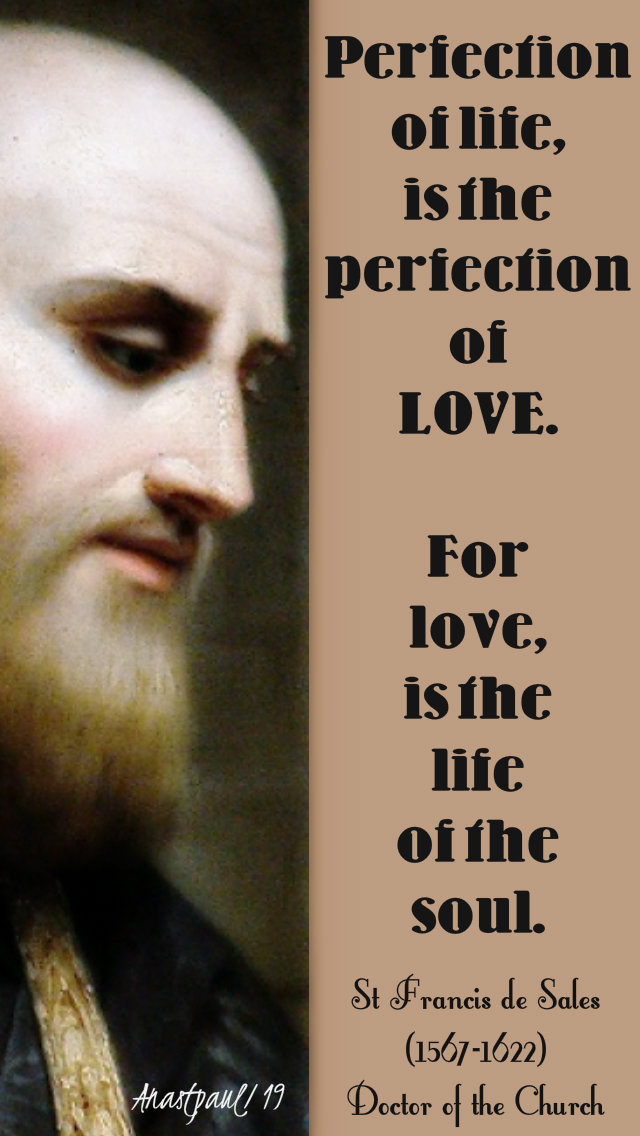
“Perfection of life, is the perfection of love. For love, is the life of the soul.”
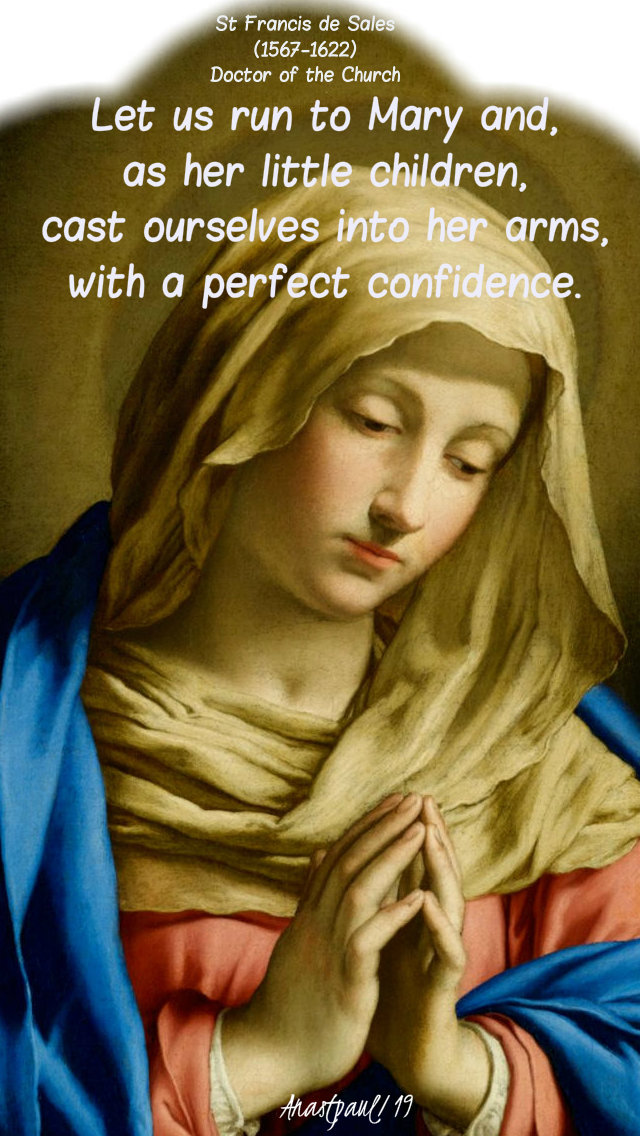
“Let us run to Mary and, as her little children, cast ourselves into her arms, with a perfect confidence.”
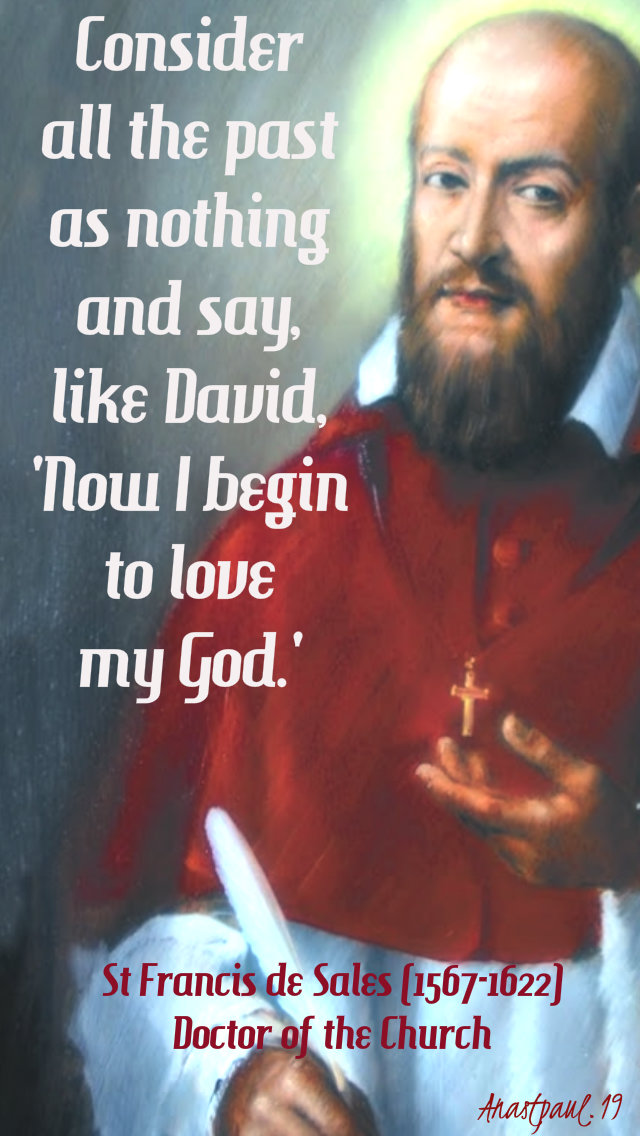
“Consider all the past as nothing and say, like David, ‘Now I begin to love my God.'”
One Minute Reflection – 24 January – Thursday of the Second week in Ordinary Time, Gospel Mark 3:7–12 and The Memorial of St Francis de Sales (1567-1622) Doctor of the Church: Doctor Caritatis (Doctor of Charity) ‘The Gentle Christ of Geneva’
“…a great multitude, hearing all that he did, came to him.”…Mark 3:8
REFLECTION – “Why did the multitude come? What did they need? Whether this multitude went to Jesus out of “need” or because “some were curious”, the true reason is seen in the fact that this crowd was drawn by the Father, it was the Father that drew the crowd to Jesus. We read in the Gospel that ‘Jesus was moved, because He saw these people as sheep without a shepherd’. Therefore, the Father, through the Holy Spirit, draws people to Jesus.
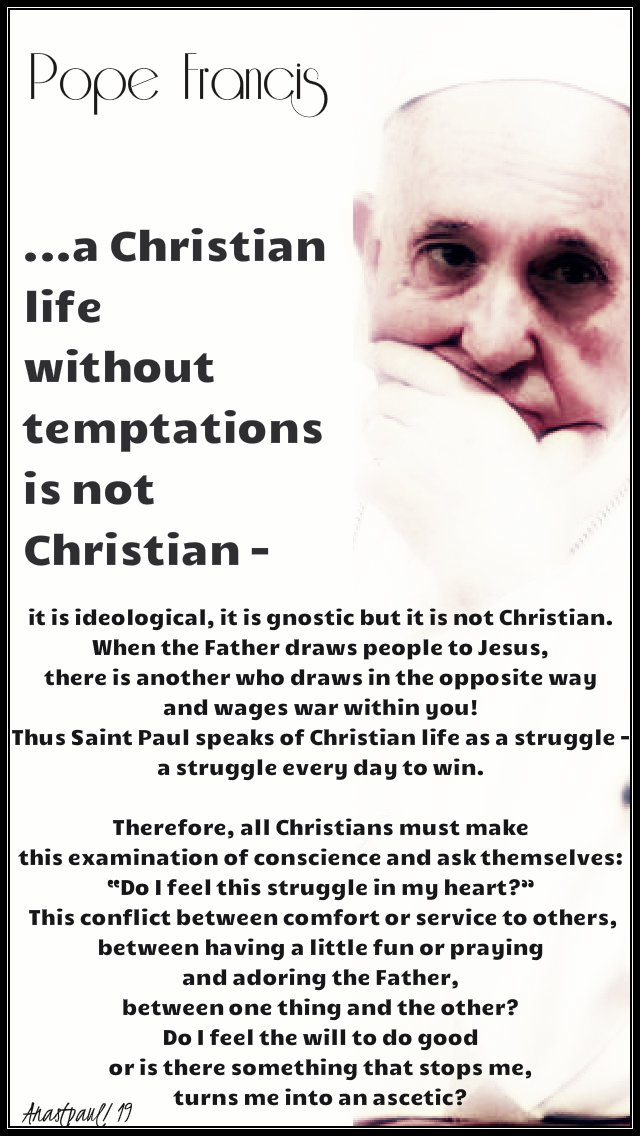
The impure spirits try to impede; they wage war on us. Someone might object – Father, I am very Catholic, I always go to Mass…. But I never have these temptations, thank God! “No! Pray, because you are on the wrong path! because a Christian life without temptations is not Christian – it is ideological, it is gnostic but it is not Christian. When the Father draws people to Jesus, there is another who draws in the opposite way and wages war within you! Thus Saint Paul speaks of Christian life as a struggle – a struggle every day to win.
Therefore, all Christians must make this examination of conscience and ask themselves: “Do I feel this struggle in my heart?” This conflict between comfort or service to others, between having a little fun or praying and adoring the Father, between one thing and the other? Do I feel the will to do good, or is there something that stops me, turns me into an ascetic? And also, do I believe that my life moves Jesus’ heart? If I don’t believe this, I must pray a lot to believe it, so that He may grant me this grace. And we ask the Lord to make us Christians who know how to discern what is happening in our hearts and to choose well the path, through which the Father draws us to Jesus.”..Pope Francis – Santa Marta, 19 January 2017
PRAYER – Lord God, true light and creator of light, grant us the grace to see clearly by the light who is Light, Your only Son. Lead us in His path and send us Your Spirit. Grant us the strength to grow in holiness so that our struggle against the powers of darkness may we a victory over temptation. May the intercession of the master of spirituality, St Francis de Sales, help us and protect us. We make our prayer through Christ our Lord, in the unity of the Holy Spirit, God for all eternity, amen.
Our Morning Offering – 24 January – The Memorial of St Francis de Sales CO, OM, OFM (Cap) (1567-1622) – Doctor of the Church: Doctor caritatis (Doctor of Charity) – ‘The Gentle Christ of Geneva’
I Will Love You Lord By St Francis de Sales
“Whatever happens, Lord,
You who hold
all things in Your hand
and whose ways
are justice and truth,
whatever You have ordained for me…
You who are ever a just judge
and a merciful Father,
I will love You Lord….
I will love You here,
O my God
and I will always hope
in Your mercy
and will always repeat Your praise….
O Lord Jesus,
You will always be my hope
and my salvation
in the land of the living.
Amen
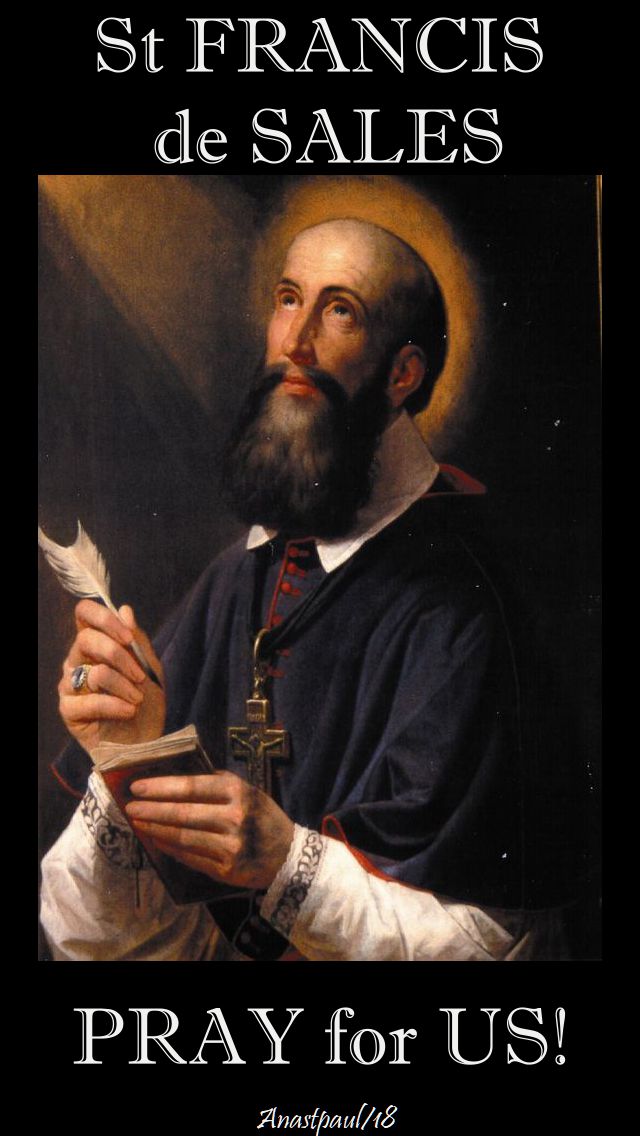
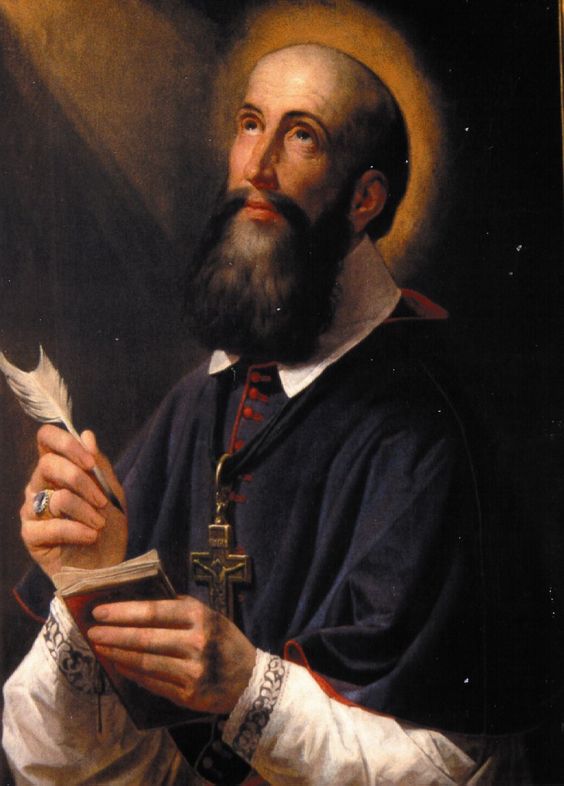
Saint of the Day – 24 January – St Francis de Sales CO, OM, OFM (Cap) (1567-1622) – Doctor of the Church: Doctor caritatis (Doctor of Charity) – ‘The Gentle Christ of Geneva’ and Patronages – against deafness, authors, writers, Catholic press, confessors, deaf people, journalists, teachers, Champdepraz, Aosta, Italy, 8 Diocese, 7 Cities, the Institute of Christ the King Sovereign Priest, the Salesians of Don Bosco. His motto ‘Non-excidet’ – (No failure).
Excerpt from Pope Benedict’s
Catechesis on St Francis de Sales
Wednesday, 2 March 2011
“God is God of the human heart” (The Treatise on the Love of God, I, XV). These apparently simple words give us an impression of the spirituality of a great teacher of whom I would like to speak to you toda – St Francis de Sales, a Bishop and Doctor of the Church.
Born in 1567, in a French border region, he was the son of the Lord of Boisy, an ancient and noble family of Savoy. His life straddled two centuries, the 16th and 17th and he summed up in himself the best of the teachings and cultural achievements of the century drawing to a close, reconciling the heritage of humanism striving for the Absolute that is proper to mystical currents. He received a very careful education, he undertook higher studies in Paris, where he dedicated himself to theology and at the University of Padua, where he studied jurisprudence, complying with his father’s wishes and graduating brilliantly with degrees in utroque iure, in canon law and in civil law.
In his harmonious youth, reflection on the thought of St Augustine and of St Thomas Aquinas led to a deep crisis. This prompted him to question his own eternal salvation and the predestination of God concerning himself, he suffered as a true spiritual drama the principal theological issues of his time. He prayed intensely but was so fiercely tormented by doubt, that for a few weeks he could barely eat or sleep. At the climax of his trial, he went to the Dominicans’ church in Paris, opened his heart and prayed in these words: “Whatever happens, Lord, You who hold all things in Your hand and whose ways are justice and truth, whatever You have ordained for me… You who are ever a just judge and a merciful Father, I will love You Lord…. I will love You here, O my God and I will always hope in Your mercy and will always repeat Your praise…. O Lord Jesus You will always be my hope and my salvation in the land of the living”(I Proc. Canon., Vol. I, art. 4).
The 20-year-old Francis found peace in the radical and liberating love of God – loving Him without asking anything in return and trusting in divine love, no longer asking what will God do with me – I simply love Him, independently of all that He gives me or does not give me. Thus I find peace and the question of predestination — which was being discussed at that time — was resolved, because he no longer sought what he might receive from God, he simply loved God and abandoned himself to His goodness. And this was to be the secret of his life which would shine out in his main work – the The Treatise on the Love of God.
Overcoming his father’s resistance, Francis followed the Lord’s call and was ordained a priest on 18 December 1593. In 1602, he became Bishop of Geneva, in a period in which the city was the stronghold of Calvinism so that his episcopal see was transferred, “in exile” to Annecy. As the Pastor of a poor and tormented diocese in a mountainous area whose harshness was as well known as its beauty, he wrote: “I found [God] sweet and gentle among our loftiest rugged mountains, where many simple souls love Him and worship Him in all truth and sincerity and mountain goats and chamois leap here and there between the fearful frozen peaks to proclaim His praise” (Letter to Mother de Chantal, October 1606, in Oeuvres, éd. Mackey, t. XIII, p. 223).
Nevertheless the influence of his life and his teaching on Europe in that period and in the following centuries is immense. He was an apostle, preacher, writer, man of action and of prayer dedicated to implanting the ideals of the Council of Trent, he was involved in controversial issues dialogue with the Protestants, experiencing increasingly, over and above the necessary theological confrontation, the effectiveness of personal relationship and of charity, he was charged with diplomatic missions in Europe and with social duties of mediation and reconciliation.
Yet above all St Francis de Sales was a director, from his encounter with a young woman, Madame de Charmoisy, he was to draw the inspiration to write one of the most widely read books of the modern age, The Introduction to a Devout Life. A new religious family was to come into being from his profound spiritual communion with an exceptional figure, St Jane Frances de Chantal -The Foundation of the Visitation, as the Saint wished, was characterised by total consecration to God lived in simplicity and humility, in doing ordinary things extraordinarily well – “I want my Daughters”, he wrote, not to have any other ideal than that of glorifying [Our Lord] with their humility” (Letter to Bishop de Marquemond, June 1615).
He died in 1622, at the age of 55, after a life marked by the hardness of the times and by his apostolic effort.”
St Anicet Hryciuk
St Artemius of Clermont
St Bartlomiej Osypiuk
Bertrand of Saint Quentin
St Daniel Karmasz
St Exuperantius of Cingoli
St Felician of Foligno
St Filip Geryluk
Bl Francesc de Paula Colomer Prísas
St Guasacht
St Ignacy Franczuk
Bl John Grove
St Julian Sabas the Elder
St Luigj Prendushi
St Macedonius Kritophagos
Bl Marcolino of Forli
Bl Marie Poussepin
Bl Paula Gambara Costa
St Projectus
St Sabinian of Troyes
St Suranus of Sora
St Thyrsus
Bl William Ireland
—
Martyrs of Asia Minor – 4 saints: A group of Christians martyred together for their faith. The only details to survive are four of their names – Eugene, Mardonius, Metellus and Musonius. They were burned at the stake in Asia Minor.
Martyrs of Podlasie – 13 beati: Podlasie is an area in modern eastern Poland that, in the 18th-century, was governed by the Russian Empire. Russian sovereigns sought to bring all Eastern-rite Catholics into the Orthodox Church. Catherine II suppressed the Greek Catholic church in Ukraine in 1784. Nicholas I did the same in Belarus and Lithuania in 1839. Alexander II did the same in the Byzantine-rite Eparchy of Chelm in 1874, and officially suppressed the Eparchy in 1875. The bishop and the priests who refused to join the Orthodox Church were deported to Siberia or imprisoned. The laity, left on their own, had to defend their Church, their liturgy, and their union with Rome.
On 24 January 1874 soldiers entered the village of Pratulin to transfer the parish to Orthodox control. Many of the faithful gathered to defend their parish and church. The soldiers tried to disperse the people, but failed. Their commander tried to bribe the parishioners to abandon Rome, but failed. He threaten them with assorted punishments, but this failed to move them. Deciding that a show of force was needed, the commander ordered his troops to fire on the unarmed, hymn-singing laymen. Thirteen of the faithful died, most married men with families, ordinary men with great faith.
We know almost nothing about their lives outside of this incident. Their families were not allowed to honour them or participate in the funerals, and the authorities hoped they would be forgotten. They were:
• Anicet Hryciuk
• Bartlomiej Osypiuk
• Daniel Karmasz
• Filip Geryluk
• Ignacy Franczuk
• Jan Andrzejuk
• Konstanty Bojko
• Konstanty Lukaszuk
• Lukasz Bojko
• Maksym Hawryluk
• Michal Wawryszuk
• Onufry Wasyluk
• Wincenty Lewoniuk
Martyrdom:
• shot on 14 January 1874 by Russian soldiers in Podlasie, Poland
• buried nearby without rites by those soldiers
Beatified
6 October 1996 by Pope John Paul II
Martyrs of Antioch:
Babylas
Epolonius
Prilidian
Urban
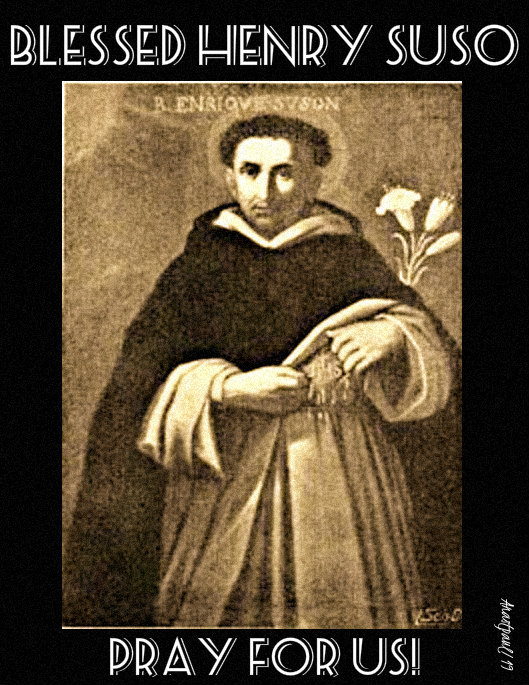
Thought for the Day – 23 January – The Memorial of Blessed Henry Suso OP (1295-1366)
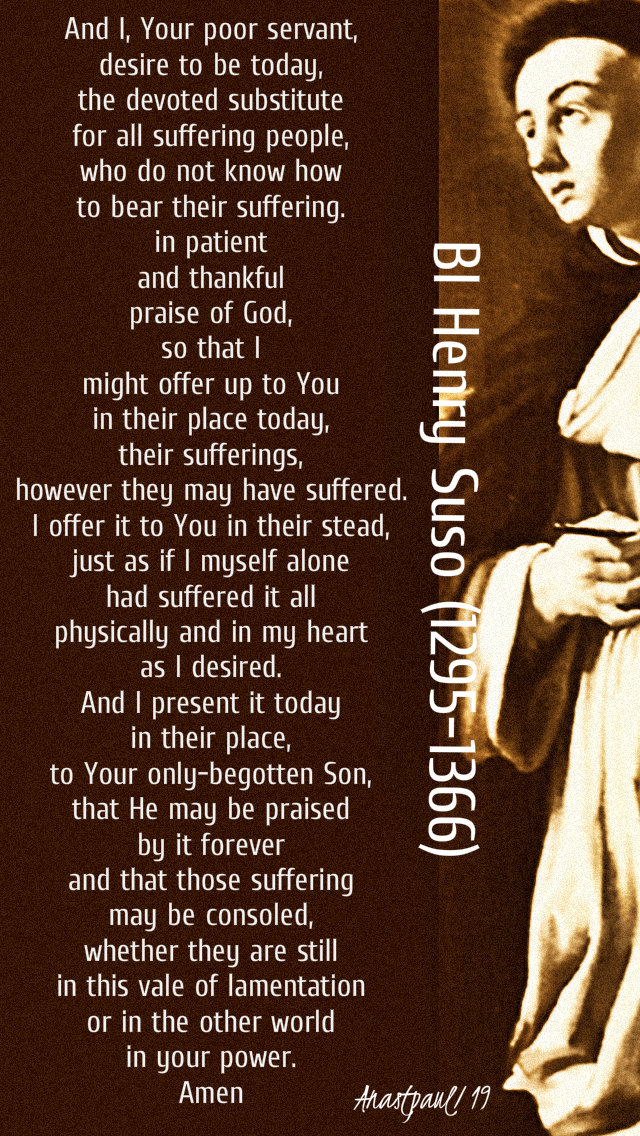
“I desire from the boundless abyss of my heart that all the sufferings and grief that I have ever experienced and, in addition, the painful suffering of all hearts, the pains of all wounds, the groans of all the sick, the sighs of all sad people, the tears of all weeping eyes, the insults suffered by all those oppressed, the needs of all poor indigent widows and orphans, the dire wants of all the thirsty and hungry, the blood spilled by all martyrs, the breaking of their selfish wills by all the joyful and blossoming youth, the painful practices of all the friends of God and all the hidden and open suffering and sorrow that I or any other afflicted person ever experienced with regard to their bodies, possessions, reputation, friends and relatives, or depression, or whatever any man shall suffer up to the last day—I desire that all this may praise You eternally, heavenly Father and honour Your only-begotten suffering Son from eternity to eternity.
And I, Your poor servant, desire to be today, the devoted substitute for all suffering people, who do not know how to bear their suffering in patient and thankful praise of God, so that I might offer up to You in their place today, their sufferings, however they may have suffered. I offer it to You in their stead, just as if I myself alone had suffered it all, physically and in my heart as I desired. And I present it today in their place to Your only-begotten Son, that He may be praised by it forever and that those suffering, may be consoled, whether they are still in this vale of lamentation, or in the other world in your power.”
Bl. Henry Suso offers this prayer with “the arms of his soul somehow stretched forth to the far ends of the world in heaven and earth.” Our desires too can be extended in prayer to encompass all times and all peoples, especially all those people today who “do not know how to bear their suffering in patient and thankful praise of God,”that even these sufferings may both praise God and win grace and consolation for the afflicted.
Bl Henry Suso, pray for us,
that we may suffer well ourselves and bear in our hearts to God the sufferings of others!
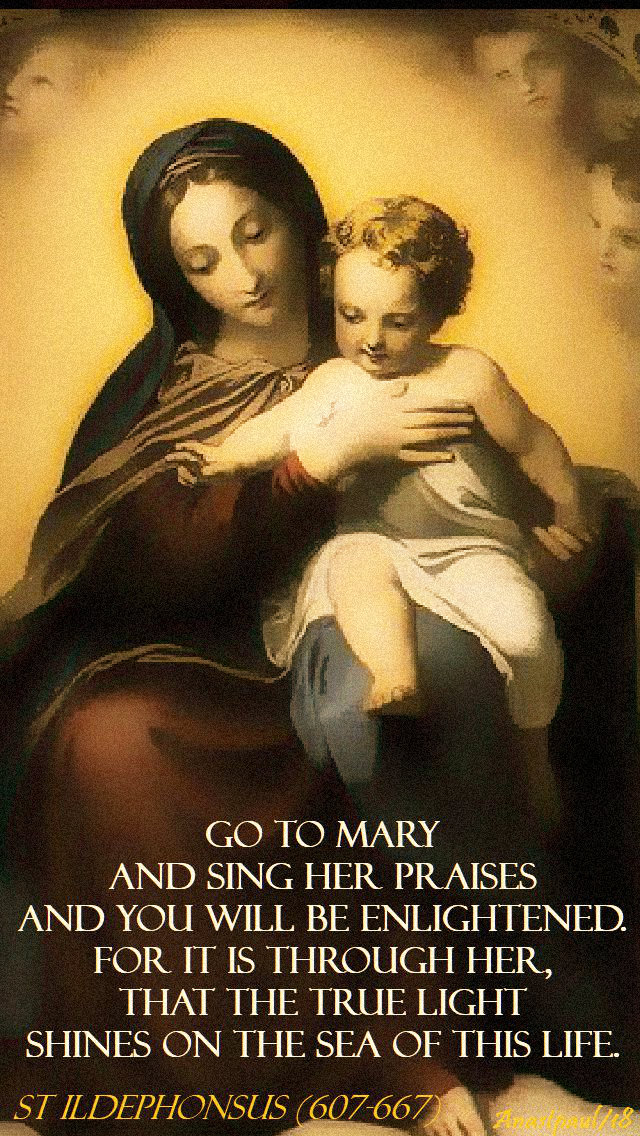
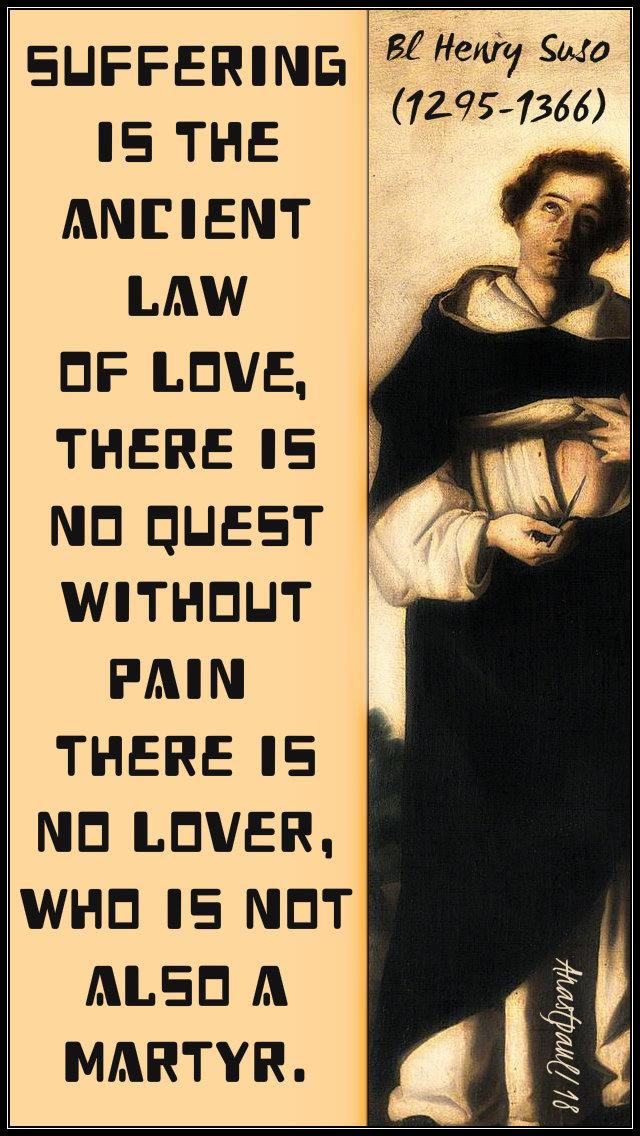
Quote/s of the Day – 23 January – The Memorial of St Ildephonsus (607-667), Blessed Henry Suso OP (1295-1366) and St Marianne Cope (1838-1918)
“Go to Mary and sing her praises and you will be enlightened. For it is through her, that the true Light shines on the sea of this life.”
St Ildephonsus (607-667)
“Suffering is the ancient law of love; there is no quest without pain; there is no lover, who is not also a martyr.”
Blessed Henry Suso (1295-1366)
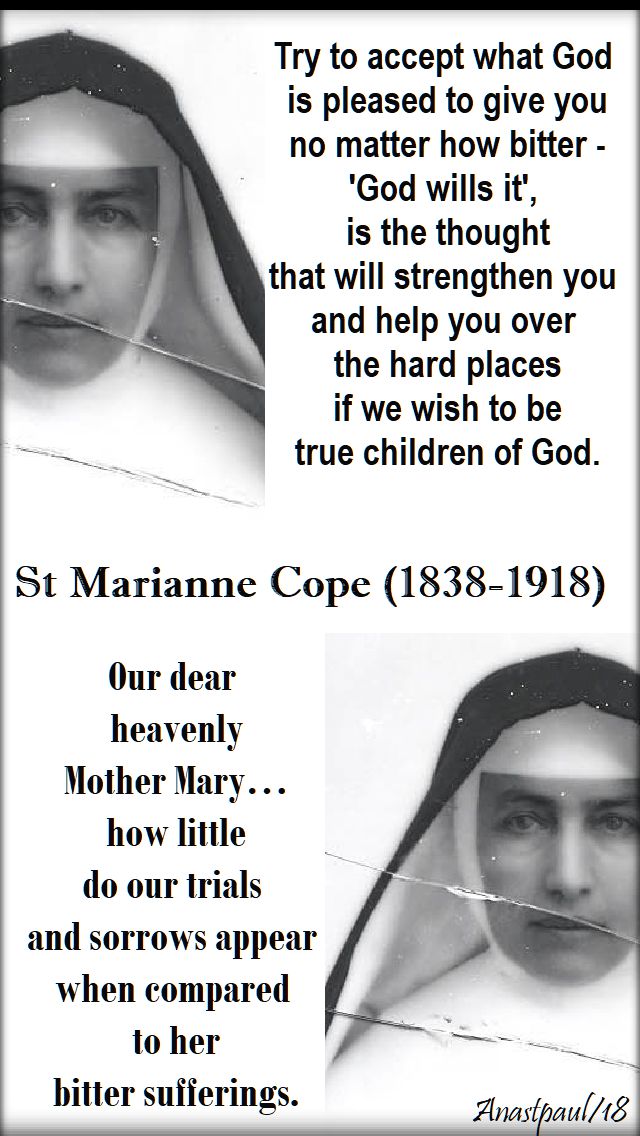
“Try to accept what God is pleased to give you no matter how bitter – ‘God wills it’, is the thought that will strengthen you and help you over the hard places if we wish to be true children of God.”
“Our dear heavenly Mother Mary… how little do our trials and sorrows appear when compared to her bitter sufferings.”















 AnaStpaul
You must be logged in to post a comment.