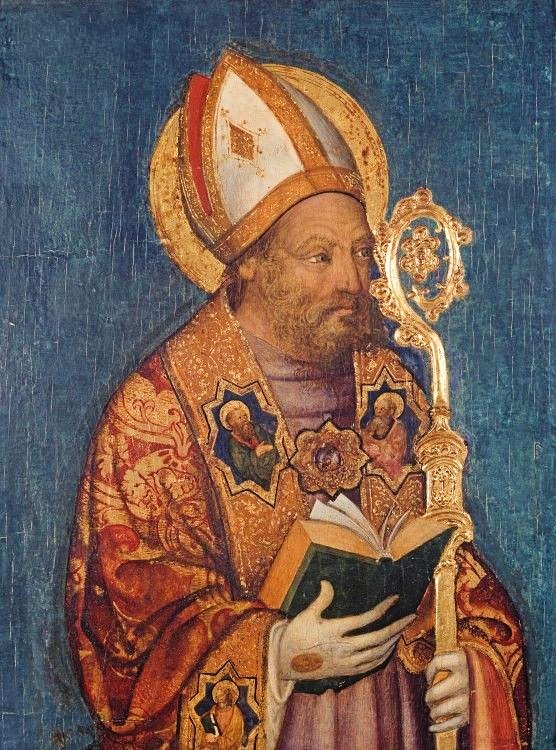
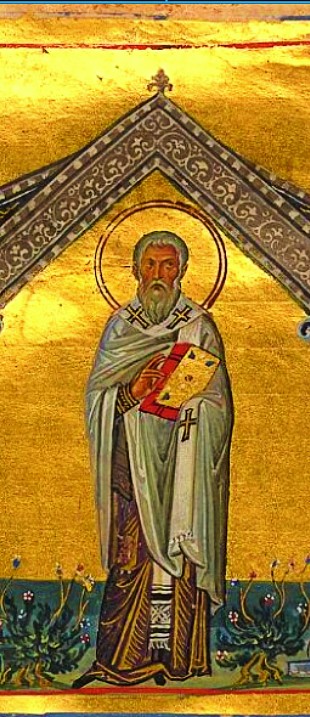
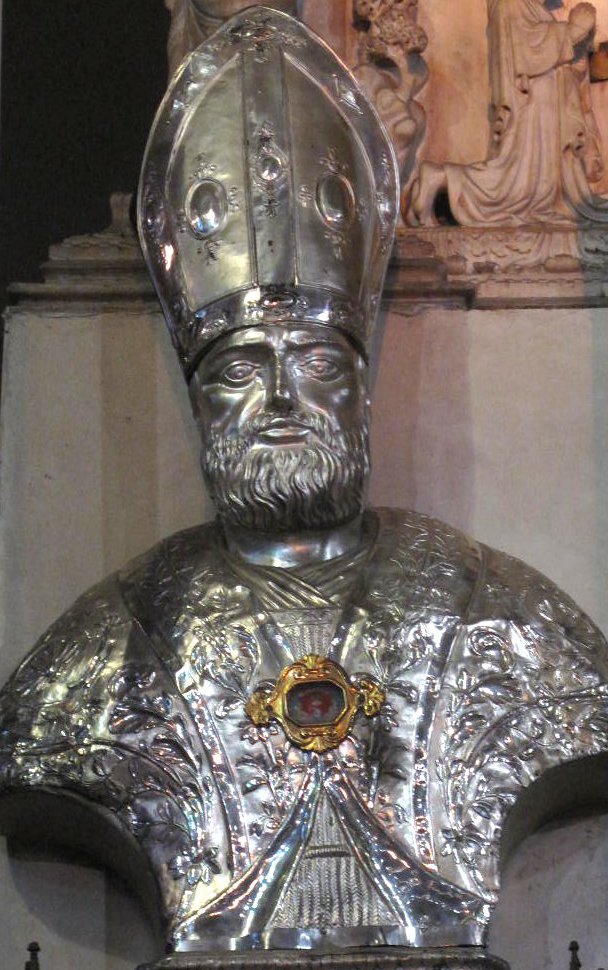
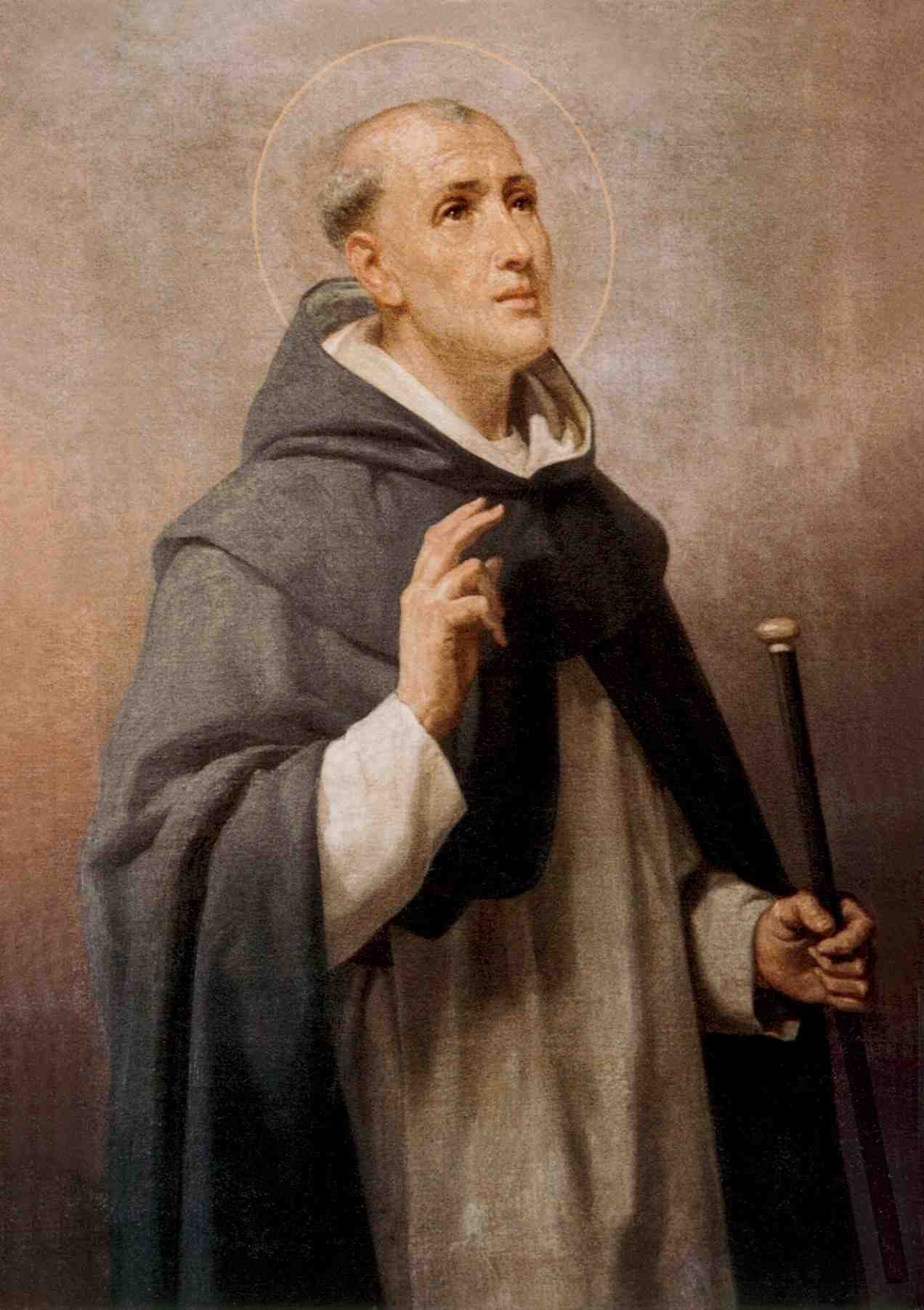
Saint of the Day – 24 February – Saint Modestus (Died c486) Bishop and Confessor. Modestus was the 19th Bishop of Trier. In the official records of Bishops, he succeeds Saint Miletus and precedes Maximian. Died in c486 in Trier of natural causes. Tradition remembers him as a tireless Preacher in the streets of the City. He was a man assiduous in prayer who systematically practiced fasting. Modestus fought against the discouragement and poverty of all his people. He was also tireless in the fight against the indiscipline of the Clergy and in the fight against all forms of corruption. Also known as – Modest, Modeste, Modesto.
The Roman Martyrology reads today: “At Treves, Sy Modestus, Bishop and Confessor.”
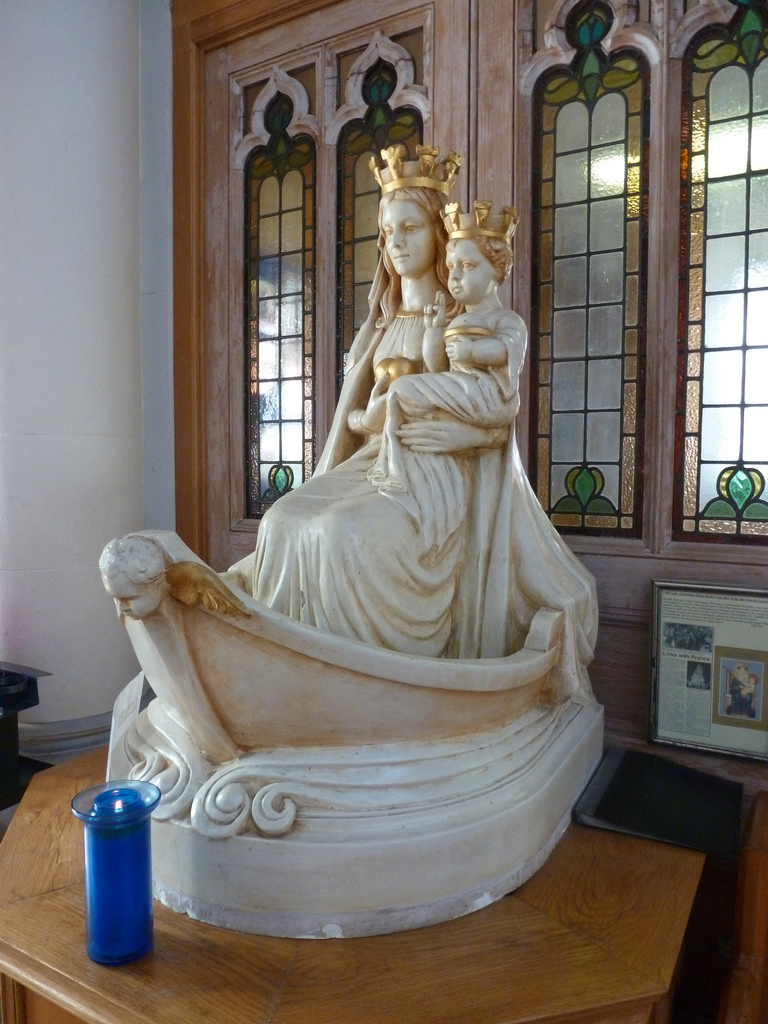
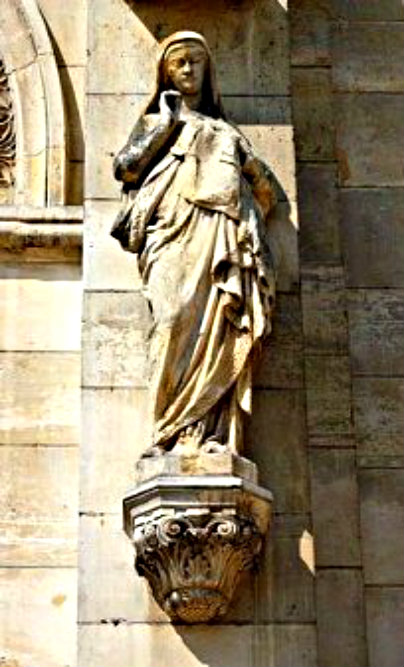
Statue of Saint Modestus, Bishop of Trier, in Notre-Dame-de-Bonsecours Church, L’Islet, Québec
Of his birth, youth and education nothing is known. That which we do know is but a few details of his Episcopate which are derived from brief mentions in various martyrologies from Germany and the Netherlands. From these sources, the information was later inserted into the Roman Martyrology.
As the Bishop, Modestus governed the Diocese of Trier in the last quarter of the 5th Century, that is, in the difficult times of the Frankish incursions and the devastation of the City and the Diocese.
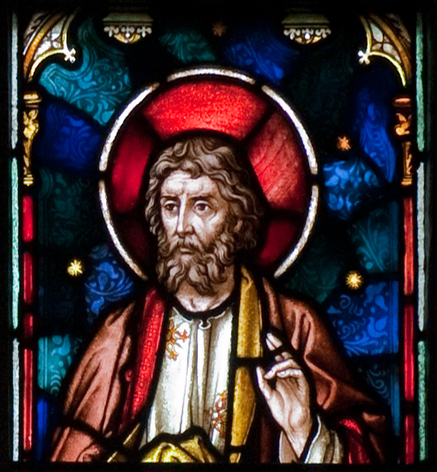
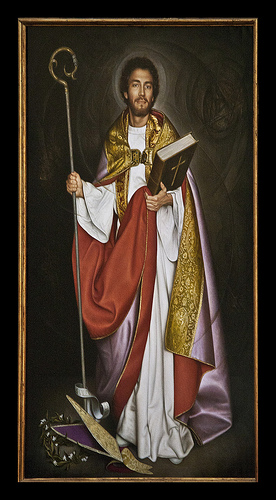
Modestus died, according to the Florarium Sanctorum manuscript, in 489. Today, after historical investigations, 486 is considered rather the year of his death. He was buried in the church of Saint Eucharist which, since the 12th Century has borne the name of Saint Matthias, Apostle, whose Feastday we appropriately celebrate today too. St Matthias Tomb is enshrined here as are those of Sts Eucharius and Valerius and our St Modestus, although I can find no images of the latter.
St Modestus (Died c486) Bishop and Confessor St Peter the Librarian St Praetextatus of Rouen St Primitiva St Sergius of Caesarea Bl Simon of Saint Bertin
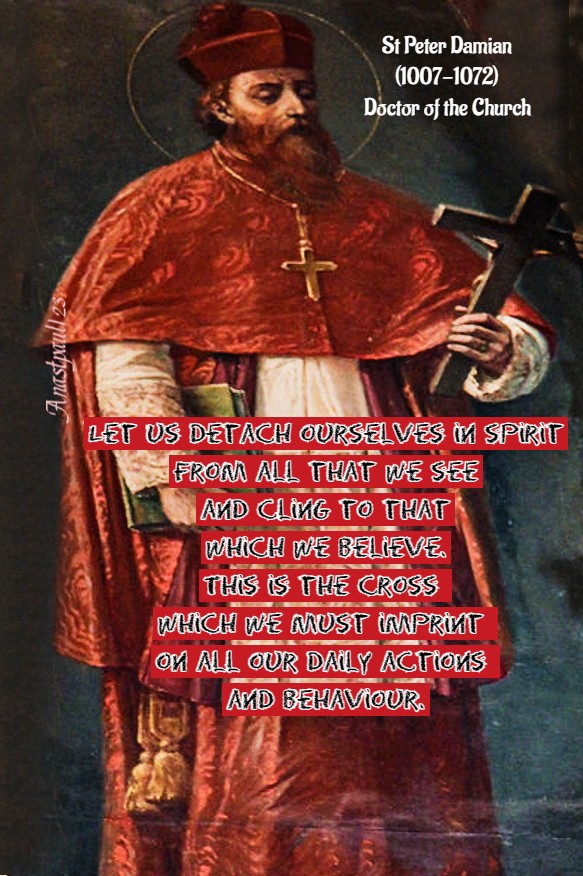
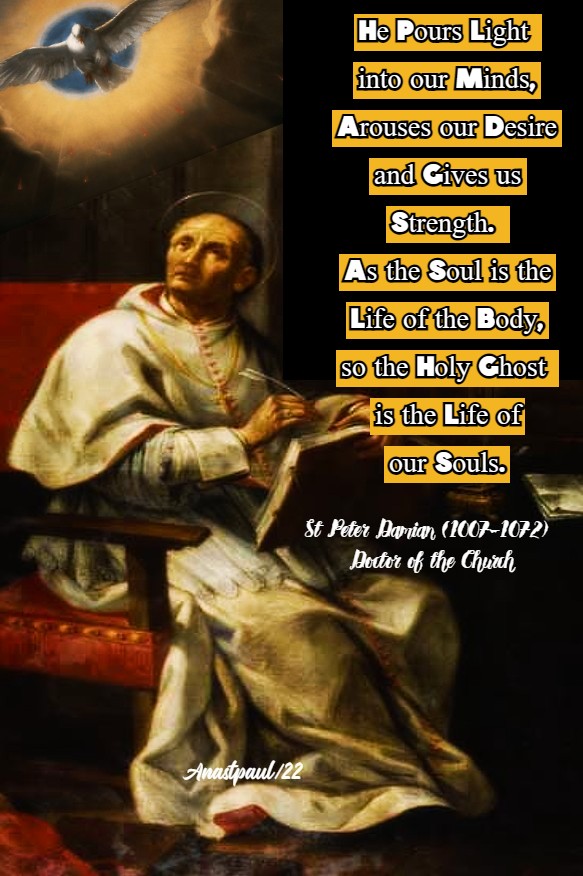
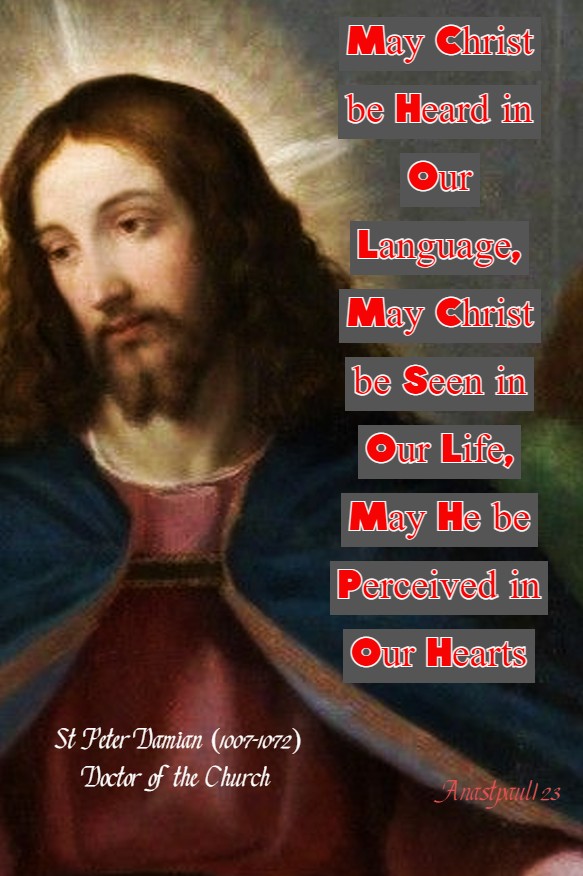
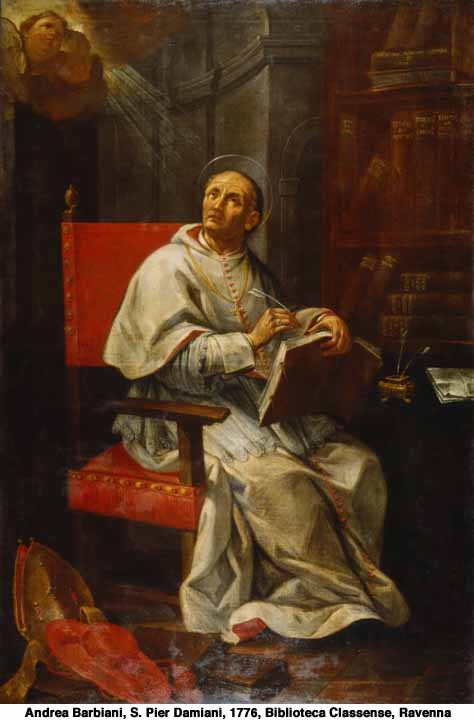
Quote/s of the Day – 23 February – St Peter Damian (1007-1072) Cardinal Bishop, Confessor, Father and Doctor of the Church
“Let us detach ourselves in spirit from all that we see and cling to that which we believe. This is the Cross which we must imprint on all our daily actions and behaviour.”
“He pours light into our minds, arouses our desire and gives us strength… As the soul is the life of the body, so the Holy Ghost is the life of our souls.”
“May Christ be heard in our language, may Christ be seen in our life, may He be perceived in our hearts”
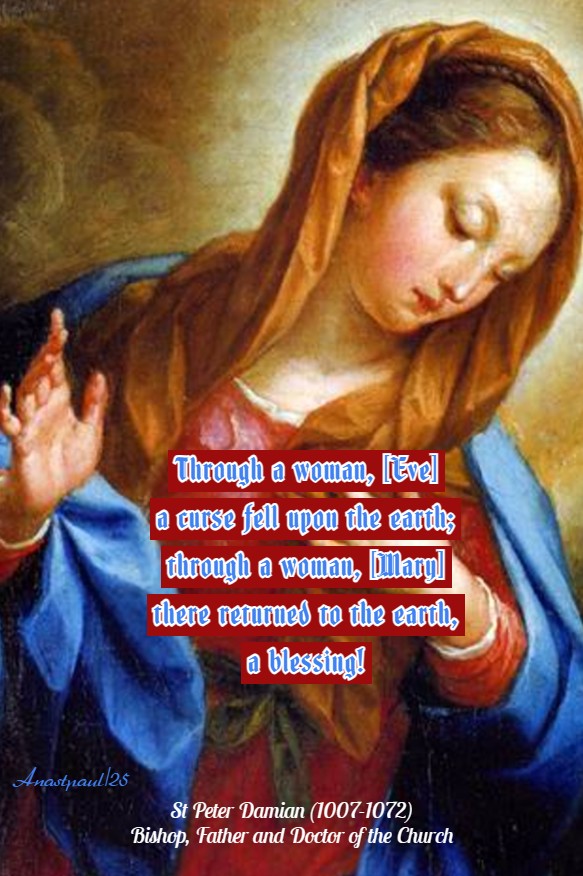
“Through a woman, [Eve] a curse fell upon the earth; through a woman, [Mary] there returned to the earth, a blessing!”
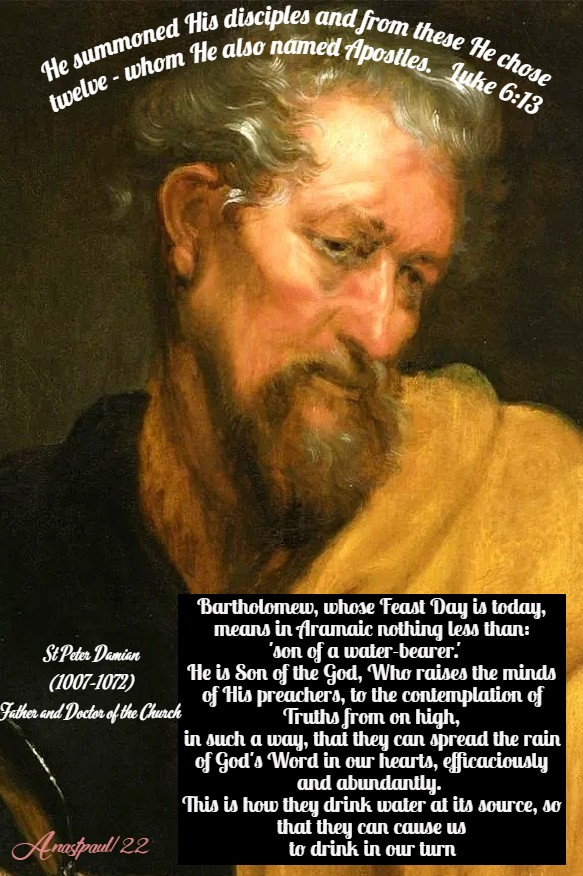
“And when day broke, He summoned His disciples and from these He chose twelve – whom He also named Apostles.” Luke 6:13
“Bartholomew, whose Feast Day is today, means in Aramaic, nothing less than: ‘son of a water-bearer.‘ He is Son of the God, Who raises the minds of His preachers, to the contemplation of Truths from on high, in such a way, that they can spread the rain of God’s Word in our hearts, efficaciously and abundantly . This is how they drink water at its source, so that they can cause us to drink in our turn.”
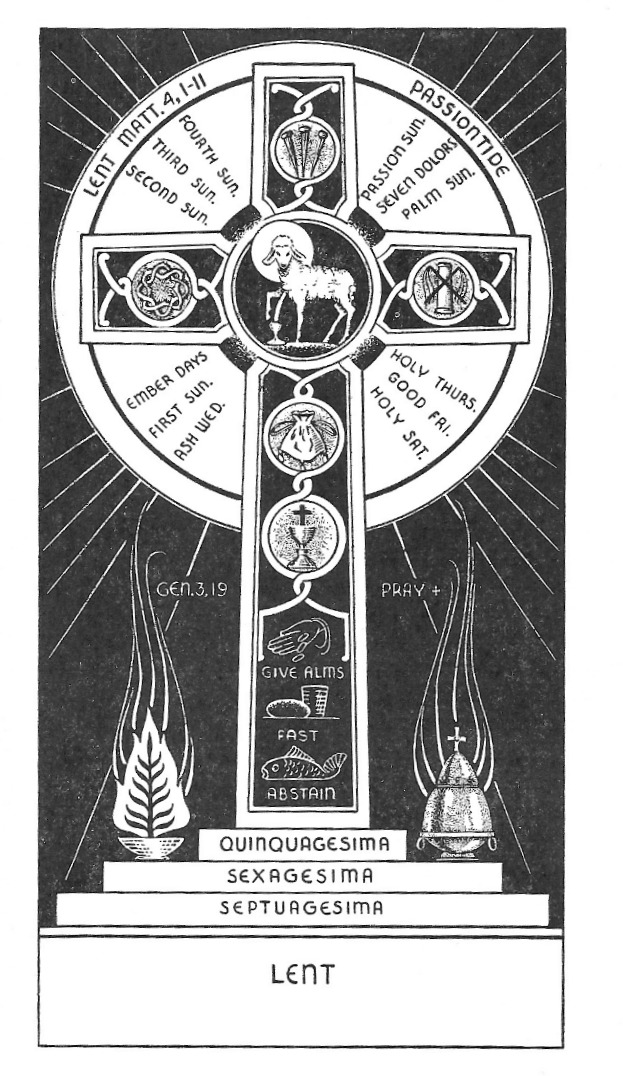
SEXAGESIMASUNDAY: (Latin – Sexagesima, sixieth) The name means “sixtieth” as it falls within the 50-60 day ranges before Easter and the second before Lent. The Ordo Romanus, St Alcuin and others, count the Sexagesima from this day to Wednesday after Easter. The name was already known to the Fourth Council of Orléans in 541. To the Latins it is also known as “Exsurge” from the beginning of the Introit. The Station was at Saint Paul’s Outside the Walls of Rome and hence, the oratio calls upon the Doctor of the Gentiles. The Epistle is from Paul, 2 Corinthians 11 and 12, describing his suffering and labours for the Church. The Gospel (Luke 8) relates the falling of the seed on good and on bad ground, while the Lessons of the first Nocturn continue the history of man’s iniquity and speak of Noah and of the Deluge.
St Alexander Akimetes St Boswell St Dositheus of Egypt St Felix of Brescia St Florentius of Seville St Giovanni Theristi (1049–1129) Monk Bl John of Hungary
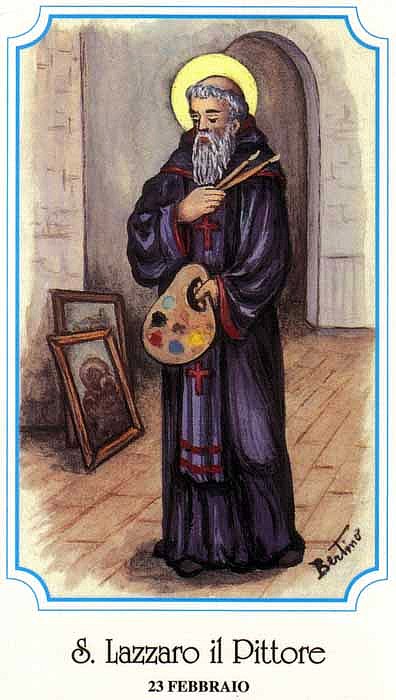
St Lazarus Zographos (c810-c 867) Priest, Monk known as “the Painter and the Iconographer.” Lazarus lived before and during the second period of Byzantine Iconoclasm. The Roman Martyrology states of him today: “St Lazarus, a Monk, whom the Iconoclast Emperor Theophilus ordered to be put to torture for having painted holy images. His hand was burned with a hot iron but, being healed by the power of God, he painted anew the holy images which had been defaced and finally rested in peace.” The Painter Saint: https://anastpaul.com/2022/02/23/saint-of-the-day-23-february-st-lazarus-zographos-810-865/
St Ordonius St Polycarp of Rome St Romana (Died c324) Virgin
St Serenus the Gardener (Died 307) Martyr. Serenus was by birth a Grecian. He left his family estate, friends and country to serve God in celibacy, penance and prayer. With this design he bought a garden in Sirmium in Pannonia, which he cultivated with his own hands and lived on the fruits and herbs it produced. His Life and Death: https://anastpaul.com/2019/02/23/saint-of-the-day-23-february-st-serenus-the-gardener-died-307-martyr/
Martyrs of Syrmium – 73 Christians who were Martyred together in the persecutions of Diocletian. We know no details about them, and only six of their names – Antigonus, Libius, Rogatianus, Rutilus, Senerotas and Syncrotas.
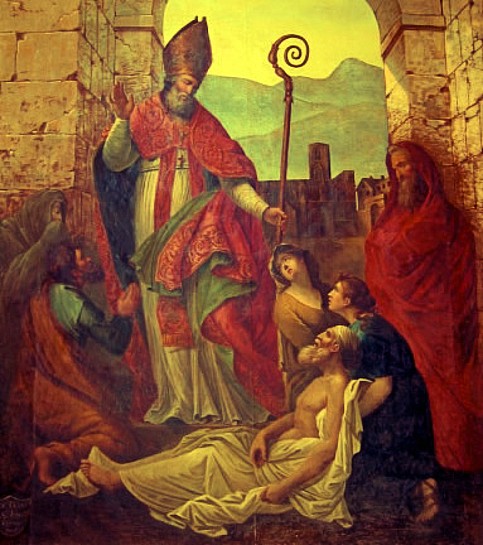
Saint of the Day – 22 February – St Abilius (Died c98) the 2nd Bishop of Alexandria, Egypt. He was the 2nd Bishop of Alexandria. He was Ordained by Saint Mark the Evangelist and was also the first convert Mark won to Christianity in the region. Also known as – Abilio, Abitius, Abylius, Avilio, Avilius, Anamia, Melyos, Mielo, Milius, Sabellius’
The Roman Martyrology reads today: “At Alexandria, St Abilius, Bishop, who was the 2nd shepherd of the City after St Mark and administered his charge with eminent piety.”
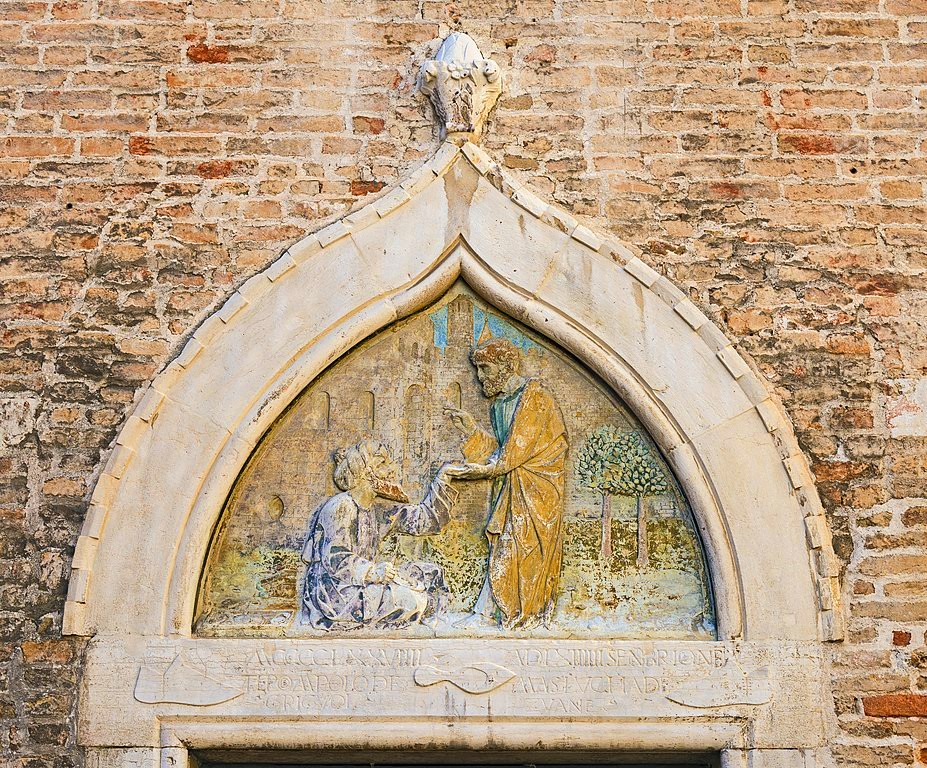
Relief of St Mark and St Abilius by Pietro Lombardo, 1478
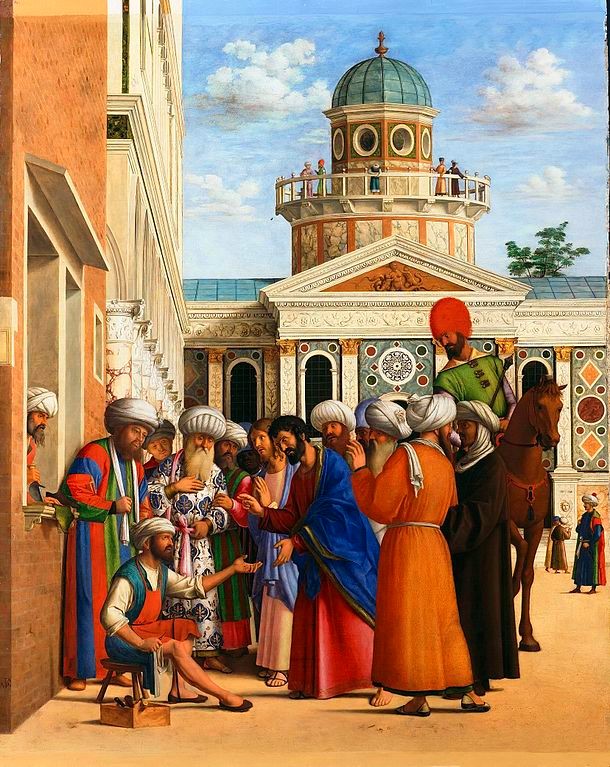
As St Mark was entering Rakotis, a suburb of Alexandria, after his travels from Cyrene, the strap of his sandal detached itself. He found a cobbler, Abilius, to repair it. While he was working on the sandal, the awl slipped in Abilius’ hand, piercing it. Anianus cried out “God is One – Heis ho Theos” in response to the pain. Mark took the opportunity to preach the Gospel to him, at the same time miraculously healing Abilius’ hand of its wound.
Mark was invited to Agilius’ house, where he taught him and his family the Gospel and, thereafter, Baptised them all. A large number of natives of the area were quickly converted by Mark too causing those pagans, who did not convert, to defend their local gods against the new Faith.
Mark, the outsider, decided it might be best if he were to leave the area for a while. He Ordained Abilius and Consecrated him as the Bishop in his absence. He also Ordained three Priests and seven Deacons, charging them with the care of the Church in his absence.
Mark was gone for a period of two years, during which time tradition believes that he attended St Peter in Rome. Abiliuss and his Priests, the meantime, spread the Gospel in the region, performing miracles and winning many to Christ. On Mark’s return, he found the Church in Alexandria had grown significantly and they were able to build a Church at Bucolia on the shore of the Alexandrian eastern harbour.
St Abilius repairing St Mark’s sandal by Cima da Conegliano
Following St Mark’s Martyrdom Abilius took his place in the Church in Alexandria. He would remain in that capacity for over seventeen years. During that time, the number of Christians in the area grew significantly and Abilius Ordained new Priests and Deacons for the growing Church. The extent of the evangelisation they performed is unknown, although it has been thought by some that it was done at least somewhat covertly, given the hostility the pagan population demonstrated to the new Faith.
Abilius died in bed and was buried next to St Mark at the Church in Baucalis. Later, as we know, St Mark’s Relics were translated to Venice.
The Chair of Saint Peter at Antioch – where the disciples were first entitled “Christians.” The Chair/Throne or Cathedra itself is a Relic conserved in St Peter’s Basilica although it seems not to be the original Chair. This Antioch is where the disciples were first called CHRISTIANS. https://anastpaul.com/2022/02/22/the-feast-of-the-chair-of-saint-peter-at-antioch-22-february/
St John the Saxon St Limnaes Bl Mohammed Abdalla St Papias of Heirapolis St Paschasius of Vienne St Raynerius of Beaulieu St Thalassius
Martyrs of Arabia – A memorial for all the unnamed Christians Martyred in the desert and mountainous areas south of the Dead Sea during the persecutions of Emperor Valerius Maximianus Galerius.
Saint of the Day – 21 February – St Felix (4th Century) Bishop of Metz. Also known as – Felice, Felix I, Felix I of Metz.
The Roman Martyrology simply reads today: “At Metz, St Felix, Bishop”
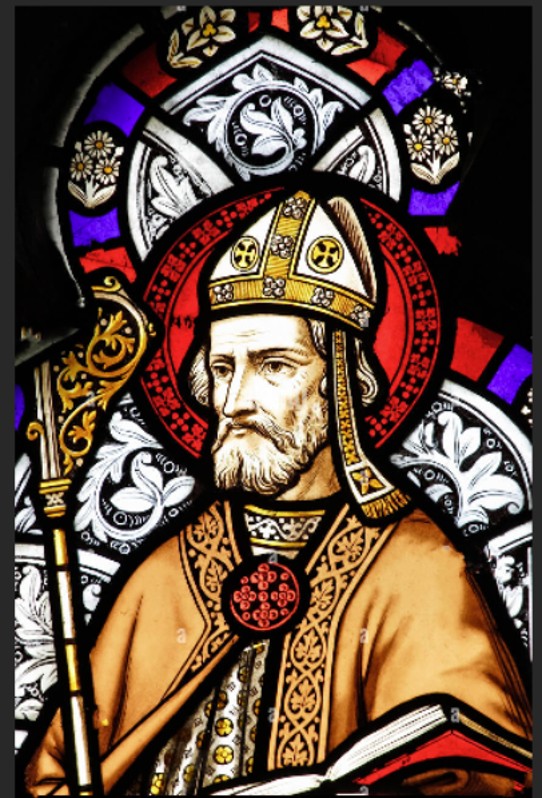
An ancient unknown French Bishop
Felix I was the 3rd Bishop of Metz. He was included in the chronology of the Diocese by a catalogue compiled around 776. He is preceded by Saint Clement and Saint Celeste and followed by Saint Patient, Saint Victor I and Saint Victor II.
Thanks to the presence of Saint Victor I, documented around 346, it is possible to hypothesise that Saint Felix I governed the City in the second or third decade of the 4th Century. Tradition believes that he was the shepherd of Metz for forty-two years and six months and died on 21 February in an unspecified year but, this information has no historical foundation.
The Bollandists, in their commentary on the Roman Martyrology, confirm that the origins of the Seat of Metz are very dubious and controversial.
Tradition has it that during the 11th Century Felix’s Relics were delivered by Tierry of Luxembourg, the 42nd Bishop of Metz from 1006-1047, to the Archbishop of Bamberg.
St Avitus II of Clermont Bl Claudio di Portaceli St Daniel of Persia Bl Eleanora St Ercongotha St Felix (4th Century) Bishop of Metz St George of Amastris St Germanus of Granfield St Gundebert of Sens
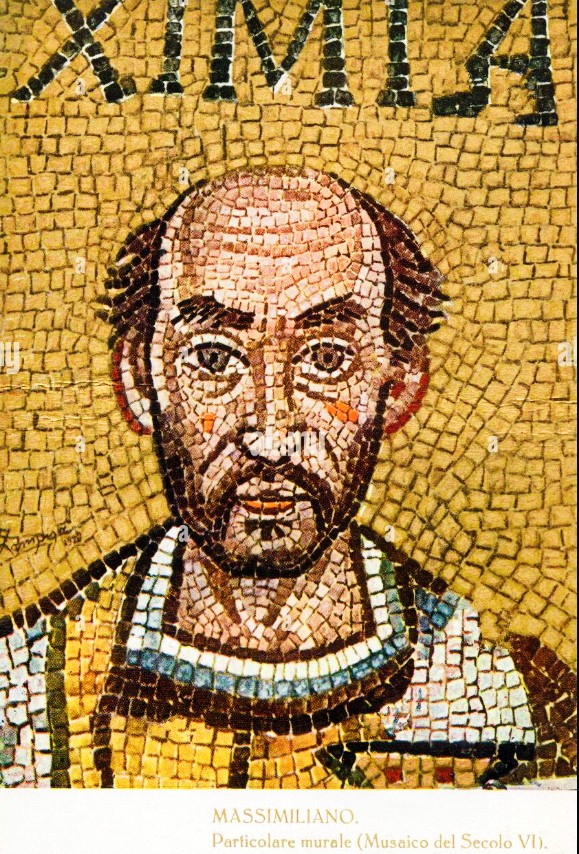
St Maximian of Ravenna (c499-556) Archbishop of Ravenna and Confessor. completor of the immensely renowned Basilica of St Vitalis and many more Churches. He was a man of creative talents who ordered the creation of many famous and very beautiful artworks of various types, for his See, as well as, a great lover of Books and literature, (being a prolific Writer himself) ensuring the acquisition of many illuminated manuscripts. Maximian may have been the first Latin Bishop to use the title ‘Archbishop.’ Biography – his Feast Day was changed after 1969 to 22 February. Being rather confused, I have revisted him today again: Talented St Maximian: https://anastpaul.com/2024/02/21/saint-of-the-day-21-february-saint-maximian-of-ravenna-c499-556-bishop-and-confessor/ AND: https://anastpaul.com/2023/02/22/saint-of-the-day-22-february-saint-maximian-of-ravenna-499-556-bishop/
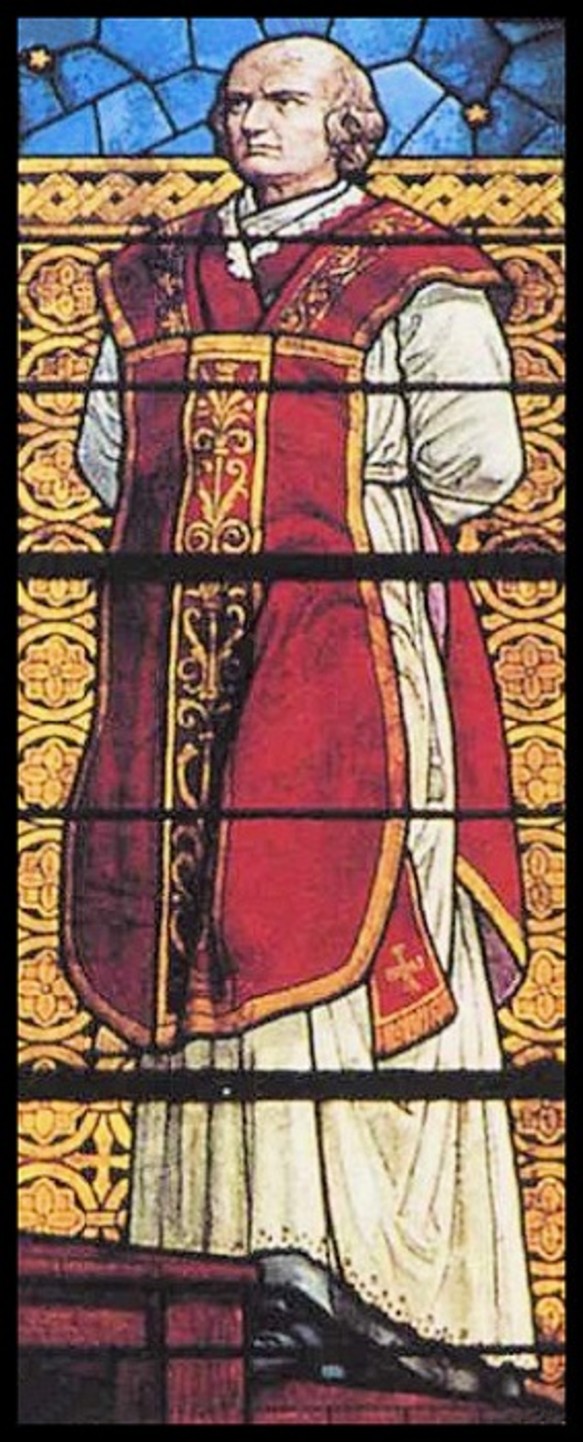
Blessed Noel Pinot (1747-1794) Priest and Martyr. During the French Revolution, he refused to take the oath of the Civil Constitution of the Clergy unlike his superio! He wore his Mass Vestments to execution and died reciting the opening words of the Mass. He was Beatified by Pope Pius XI on 31 October 1926. His Life and Death: https://anastpaul.com/2020/02/21/saint-of-the-day-21-february-blessed-noel-pinot-1747-1794-priest-and-martyr/
St Valerius of San Pedro de Montes St Verda of Persia
Martyrs of Sicily – 79 Saints: Sevent nine Christians Martyred together in the persecutions of Diocletian. They were Martyred in c 303 on Sicily.
Martyrs of Hadrumetum – A group of 26 Christians Martyred together by Vandals. We know little more than eight of their names – Alexander, Felix, Fortunatus, Saturninus, Secundinus, Servulus, Siricius and Verulus. c 434 at Hadrumetum (modern Sousse, Tunisia).
Saint of the Day – 20 February – St Wulfric (c1080-1154) Priest,Penitent, Hermit, Ascetic, Advisor to Kings, gifted with the charism of prophecy and healing, Miracle-worker. Born in around 1080 near Bristol, England and died in Haselbury, Somerset, England of natural causes on 20 February 1154. He was a Hermit in Wiltshire, England and was frequently visited by King Stephen. Also known as – Wulfrick, Ulric, Ulrico, Ulrich.
An Unknown Hermit
Wulfric was born at Compton Martin, ten miles south of Bristol. After becoming a Priest, he at first exercised his ministry at Deverill, near Warminster. At this stage, he was apparently much addicted to hunting, with both hawks and hounds. A chance conversation with a beggar, however, converted him to his true vocation as a Priest and he returned to Compton Martin as Parish Priest.
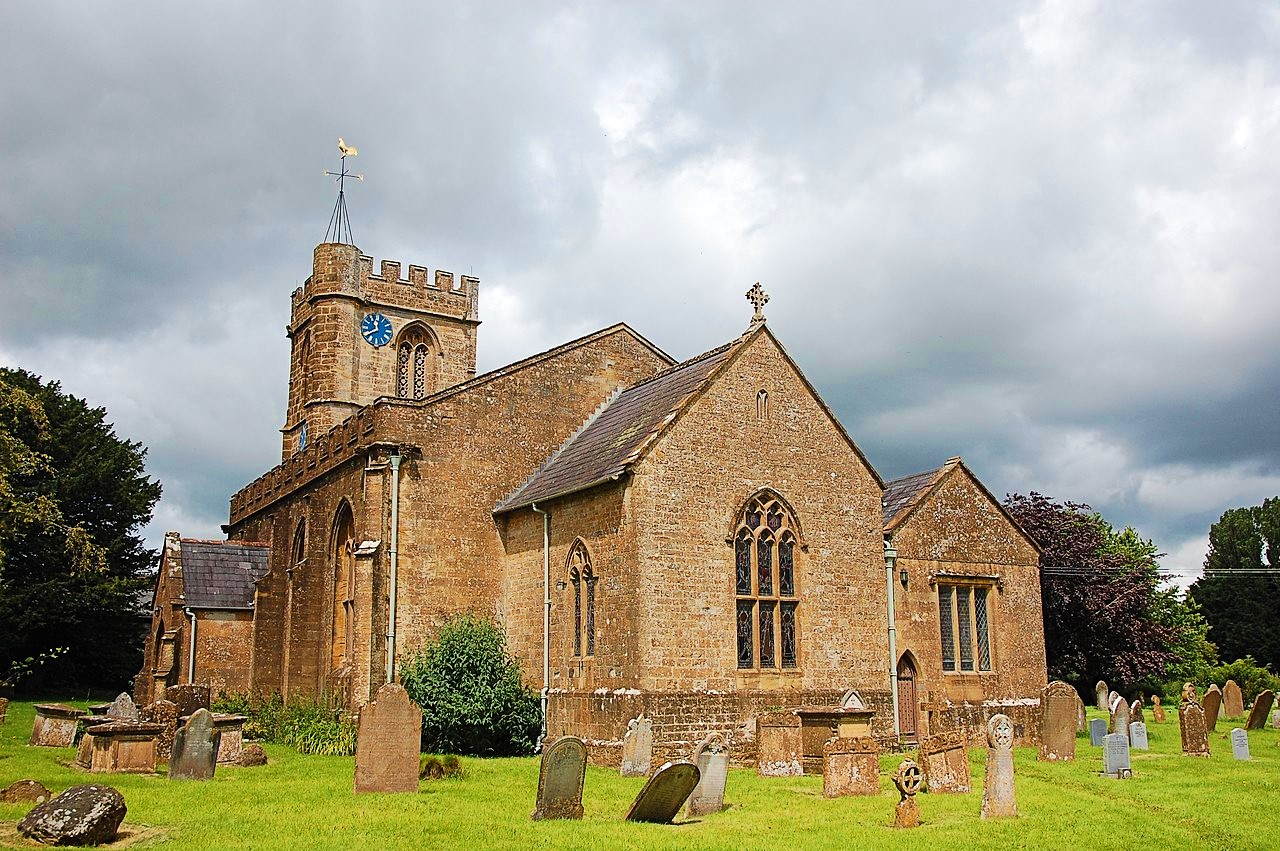
In the year 1125, Wulfric came to St Michael and All Angels Church in Haselbury Plucknett, Somerset. He wished to spend the rest of his life as a Hermit, withdrawn from the world, living in a cell adjacent to the Church. This cell stood on the cold northern side of the building. Although he apparently failed to obtain Episcopal permission for this move, he was supported by the Cluniac Monks at Montacute.
Sir William FitzWalter had a great respect for his saintly neighbour; he sent provisions to him and visited him from time to time. Wulfric numbered among his intimate friends Osbern, the village Priest; William, a lay brother of Forde Abbey and Brichtric, who seems to have joined him as a disciple.
Soon, people came to him for guidance and blessings. During the reigns of Kings Henry I and then King Stephen, Wulfric exercised a powerful influence, not only in his own neighbourhood but also at Court. Henry I was informed, correctly, that he would shortly die, while King Stephen was chastised for the evils of his government. Wulfric received the gifts of prophecy and healing and was involved in many miraculous happenings. He became known as a healer of body, mind, and spirit for all those who sought him out.
One of his visitors was Matilda of Wareham who had been planning to work overseas. Wulfric persuaded her that she should become a Recluse. She was committed and agreed to go to Wareham to work for over two years while a cell was created for her. She returned with her servant Gertrude. She died in the cell after fifteen years and Gertrude agreed to take her place.
According to Abbot John of Forde Abbey, Wulfric lived alone in these simple quarters for 29 years, devoting much of his time to reading the Sacred Scriptures, fasting and praying. He adopted stern ascetic practices: he deprived himself of sleep, ate a frugal and meatless diet, spent hours reciting the Psalms sitting in a bath of cold water and wore a hair shirt and heavy chain-mail tunic.
One of the most influential Hermit Priests of England, he died in his cell on 20 February 1154. At his death, a scuffle occurred in and around St Michael’s Church between black-robed Norman Cluniac Monks from Montacute and the laity from Haselbury and Crewkerne who had been summoned by Osbern, the Priest of Haselbury. The Monks maintained that providing food for the saintly Hermit which they had done for many years, gave them a claim to the holy man’s mortal remains. But the locals, forced them to withdraw and Wulfric was buried in his cell by the Bishop of Bath, who had visited him at his death-bed. For security reasons, Fr Osbern moved Wulfric’s remains twice, until they came to rest somewhere near the west end of the Church, “… in a place known only to himself and God” which we think would have suited St Wulfric’s penitent and humble spirit just fine especially as this Church would now be a protestant one.
St Leo of Catania (c720-789) Bishop, Defender of Sacred Images for which opposition he was forced to flee into exile for some years, Hermit. Born in c720 in Ravenna, Italy and died on 20 February 789 in Etna, Sicily, Italy, natural causes. St Leo was the 15th Bishop of Catania, Sicily, famed for his love and care for the poor, his brave opposition to the iconoclastic Government of the time and for his Miracles. Courageous St Leo: https://anastpaul.com/2024/02/20/saint-of-the-day-20-february-st-leo-of-catania-c720-789-bishop/ St Nemesius of Cyprus
St Pothamius of Cyprus St Serapion of Alexandria St Silvanus of Emesa St Valerius of Courserans St Wulfric (c1080-1154) Priest and Hermit St Zenobius of Antioch
Saint of the Day – 19 February – Saint Auxibius (Died c102) the 1st Bishop of Soloi on the Island of Cyprus. He was born in Rome and died in Soloi around the year 102. Also known as – Auxibius of Cyprus, … of Soloi, Ausibio…
The Roman Martyrology reads today: “At Soloi, St Auxibius, Bishop”
Auxibius was born into a wealthy family in Rome and grew up there with his brother, Tempstagoras. He was taught secular sciences.
To avoid his parents’ wish that he should marry, he secretly left Rome and came first to the Island of Rhodes and then, to the Island of Cyprus.
Auxibius lived in the area around Limnitis, near the then important City of Soloi. There he met the Apostle and Evangelist St Mark, who converted him through his preaching and Baptised him.
Auxibius was appointed as the Bishop of the City of Soli by Archbishop St Herakleidius, as a document from the 7th Century reports, although some give this honour to St Paul himself. This St Herakleidius (1st Century), showed the Apostles Paul and Barnabas, the way from Salamis to Paphos on their first missionary journey (45 – 53) in Cyprus and also led them to Tamassos, a City-Kingdom which was then important due to its copper mining. Paul and Barnabas BaptiSed Herakleidos and later Ordained him as Bishop of Tamassos, one of the first in Cyprus.
Auxibius held the Episcopal Seat for about 50 years before he died around the year 102.
The 4th Century Basilica, now in ruins, in Soli is named after St Auxibius.
St Quodvultdeus (Died c450) Bishop, Confessor, Father of the Church, Writer and Theologian, spiritual student, friend and correspondent of St Augustine, who dedicated some of his works to St Quodvultdeus. Name Meaning – “What God wants.” The Roman Martyrology reads: “In Naples, deposition of St Quodvultdeus, Bishop of Carthage, who was sent into exile together with his clergy by the Arian king Genseric and placed on disused ships without sails or oars. Against all hope he landed in Naples, where he died. Confessor of the faith.” His Holy Life: https://anastpaul.com/2022/02/19/saint-of-the-day-19-february-saint-quodvultdeus-died-c-450-f/
Saint of the Day – 18 February – St Helladius (c566-633) Bishop and Confessor, Archbishop of Tiledo for 18 years, Abbot before that, Apostle of the poor and needy. Born in c566 in Toledo, Spain and died there in 632 of natural causes. For his charity towards the poor, he was called “A Sun which Illuminates the Darkness.” Also known as – Eladio, Eladius, Elladio, Heladio.
The Roman Martyrology reads today: “At Toledo, St Helladius, Bishop and Confessor.”
Almsgiving of Saint Helladius (Eladius), oil painting by Francisco Bayeu c1770.
The life of Saint Helladius has been handed down to us from the account written by Saint Ildefonso (607-670) of Toledo, who is said to have received his diaconal Ordination from the hands of our Saint.
An Official at the Visigoth Court, he was its representative at the Council of Toledo in 589, designated for his particular merits, his ability and his erudition. Already at that time, according to Ildefonsus’ narrative, Helladius was attracted to religious life and used to help the Monks of Agalai, a Monastery on the banks of the Tagus River, with their manual laboUr.
He eventually entered as a Novice Monk and, in 605, was elected as the Abbot but despite the prestigious position, Helladius continued to carry out all the duties as a simple religious, even the heavy task of carrying wood for the stove.
Due to the extreme charity demonstrated by Helladius towards the poor, “it was as if his warmth and vitality, flowed directly into their limbs and their souls”.
In 615, when the Episcopal See of Toledo became vacant, Helladius accepted election as the new Archbishop, although reluctant to abandon the Monastery. Little is known, however, of his eighteen years as the Archbishop, beyond his generosity towards the neediest. Some authors point out that he may have retired to the Monastery to prepare for his death.
Helladius was venerated as a Saint immediately after his death.
St Gertrude Caterina Comensoli St Helladius (c566-633) Bishop and Confessor Bl John Pibush – one of the Martyrs of Douai St Leo of Patera St Paregorius of Patara St Sadoth of Seleucia St Tarasius of Constantinople
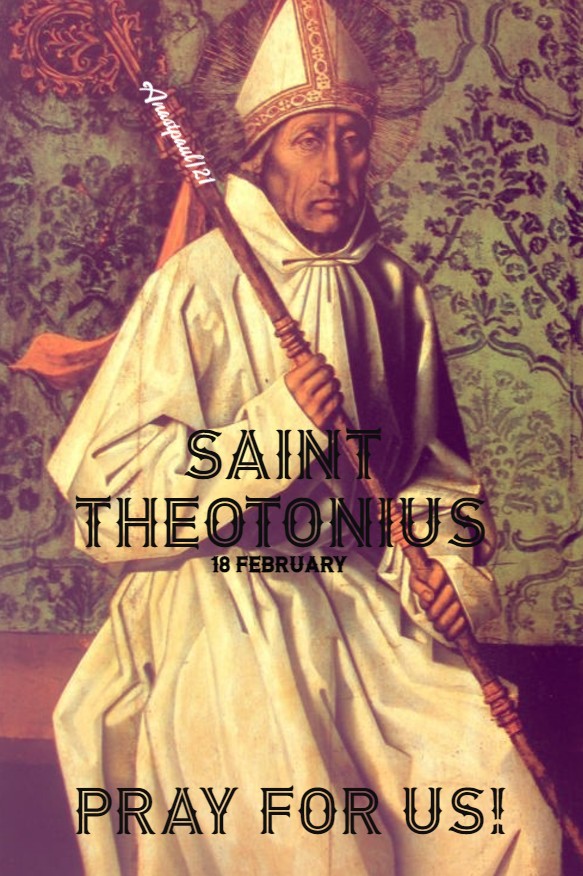
St Theotonius OSC (1082-1162) Priest of the Canons Regular, Reformer of religious life in Portugal, Royal Counsellor,, Apostle of the poor, Founder of the Canons Regular of the Holy Cross, now known as “The Crosiers.” He is the first Portuguese Saint. His Life Story: https://anastpaul.com/2021/02/18/saint-of-the-day-18-february-saint-theotinius-1082-1162/
Bl William Harrington
Martyrs of North Africa – 7 Saints: Group of Christians who were Martyred together, date unknown. We know nothing else but seven of their names – Classicus, Fructulus, Lucius, Maximus, Rutulus, Secundinus and Silvanus. They were born and martyred in North Africa.
Martyrs of Rome – 5 Saints: A group of Christians Martyred together in the persecutions of Diocletian. We know nothing else but their names – Alexander, Claudius, Cutias, Maximus and Praepedigna. They were martyred in 295 in Rome, Italy.
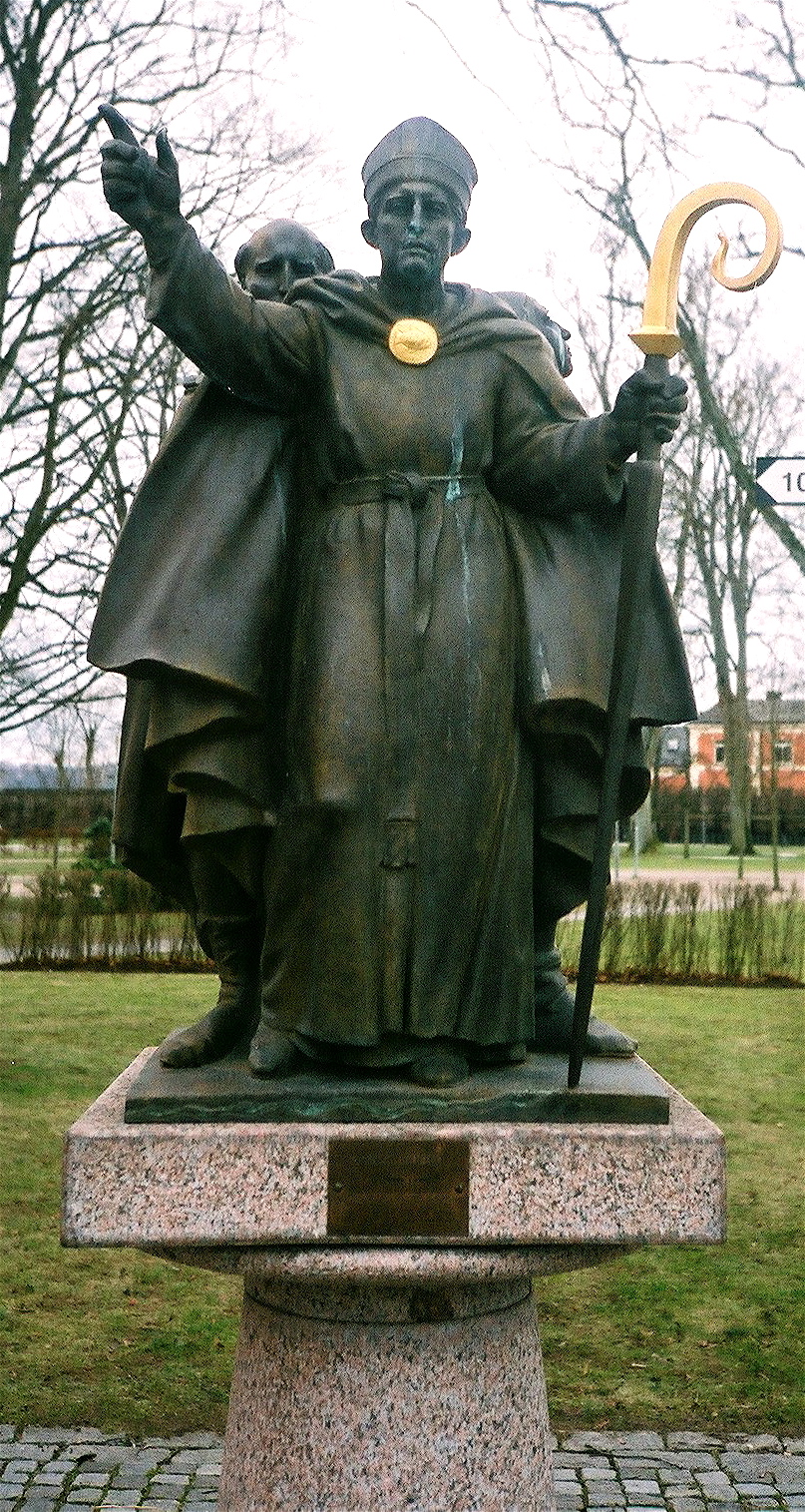
Saint of the Day – 17 February – Saint Silvinus (c650-c717) Bishop, Missionary evangeliser in north-eastern pagain regions of France, gifted with miracles. Born of Celtic origins and died on 15 February c717 at the Abbey of Auchy-les-Moines, Artois, in Belgium of natural causes. Also known as – Silvinus of Thérouanne, … of Toulouse, … of Auchy, Silvain…. Silvin …. Silvino…. Additional Memorial – 15 February in Auchy France.
The Roman Martyrology reads today: “In the territory of Thérouanne, St Silvinus, Bishop of Toulouse.”
Saint-Sylvain in the Church of Mazerolles
Born to a noble family, Sylvinus was of Celtic origins. He renounced a life of wealth and power, to embrace poverty and celibacy.
Ordained a Priest and then a Bishop, he devoted himself to evangelisation and charity, in north-eastern France, still largely pagan.
Silvinus was distinguished by his humility and austerity and was venerated during his life-time for his sanctity and his intercessory gifts of performing miracles.
He died in c717 and was buried in the Monastery of Auchy-les-Moines. Several Churches, Towns and Villages are named after him (Saint-Sylvain-d’Anjou or Saint-Sylvain [Calvados] ). The male first name, Sylvainm is very popular and common in France, Belgium and other French-speaking regions in Africa and, of course, Quebec, Canada.
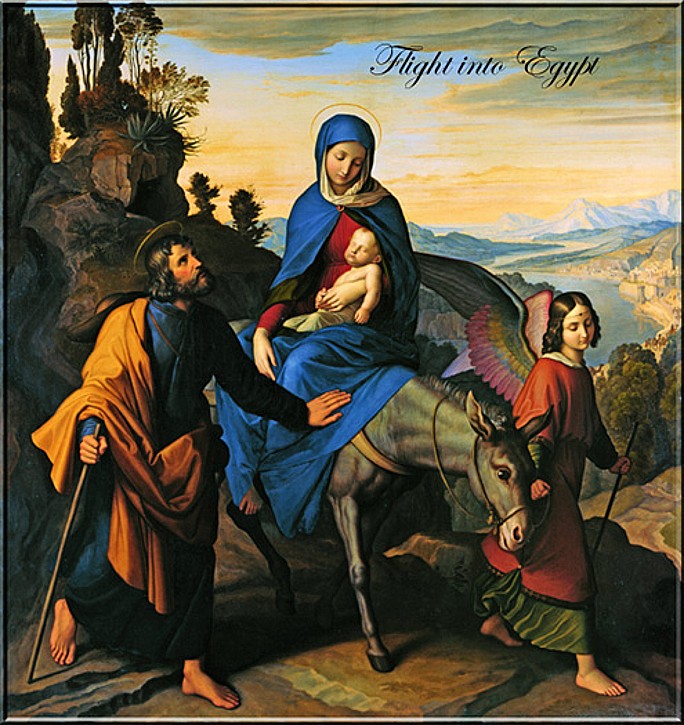
It was on the seventeenth of February, fifty five days after the Nativity of Jesus, when King Herod’s soldiers — sent to slaughter all little boys in Bethlehem and its neighbourhood who were two years old or under, in order to destroy a rival King, Jesus — were getting perilously near the cave at Bethlehem, where at first they little expected Our Lord to be. Saint Joseph received a message from God through an Angel, whereupon he took Our Lady and the Divine Infant and set off leaving the land of the Jews to travel to a land of the Gentiles. They took no-one with them, by way of servants or friends, as Saint Peter Chrysologus tells us.
The Town to which the Holy Family fled was called Fostat. It was three hundred miles from Bethlehem. A Church has been erected there, on the site of the house where the Holy Family lived during their exile. The little Town where the Holy Family lived in Egypt was not far from Heliopolis, a City in which — when Jesus, Mary and Joseph passed through it — statues of pagan gods crashed to the ground. Both Fostat and Heliopolis are not far from Cairo in Egypt.
St Lupiano St Mesrop the Teacher St Polychronius of Babylon St Romulus the Martyr St Secundian the Martyr St Silvinus (c650-c717) Bishop St Theodulus of Caesarea
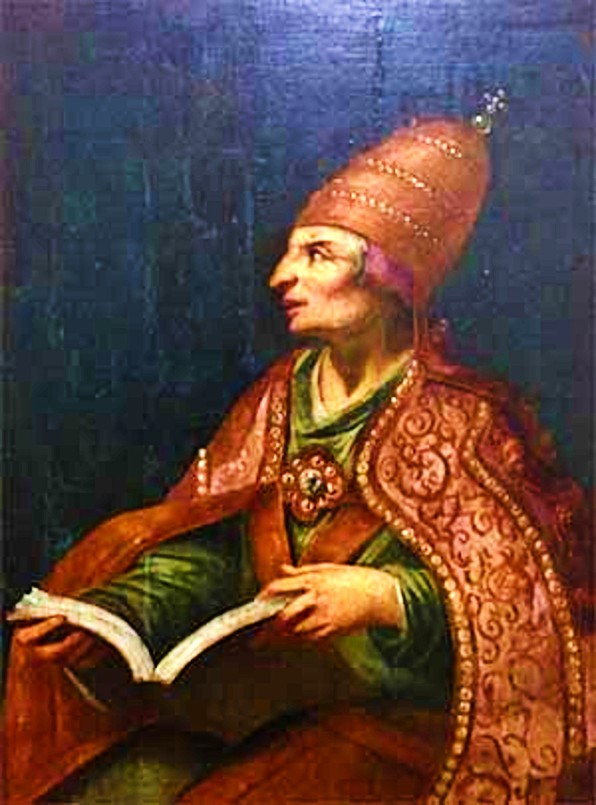
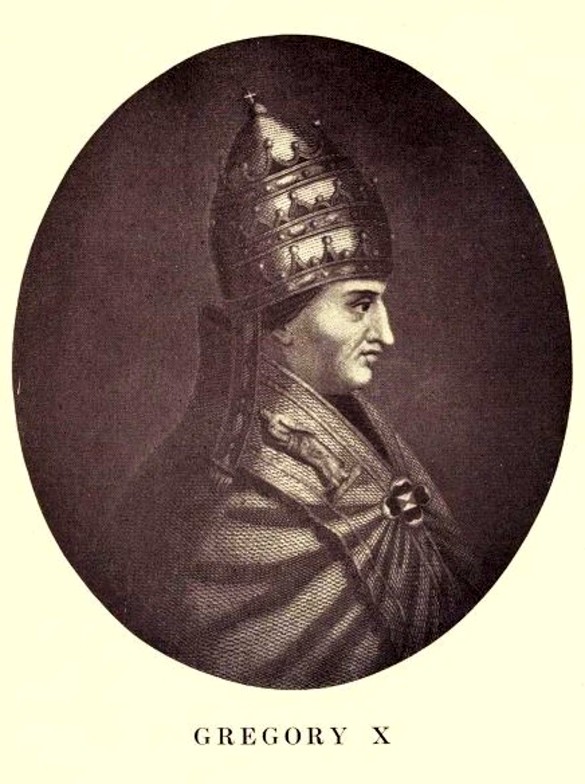
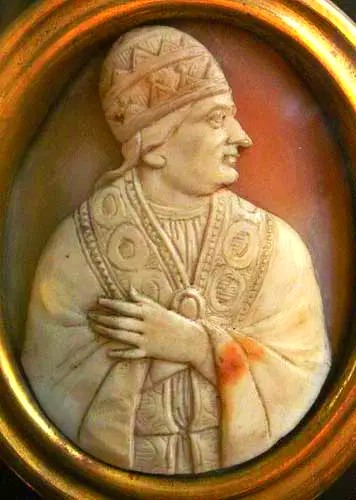
Saint of the Day – 16 February – Blessed Gregory X OFM (or TOSF) (1210-1276) Pope Papacy began 1 September 1271 until his death on 10 January 1276, Diplomat and Peacemaker, Reformer of Papal Elections, Third Order Franciscan. This Tertiary Pope, a friend of St. Bonaventure, was a true son of St Francis, known for his love for the holy places in Palestine and his efforts to promote peace. Born as Theobald Visconti in Piacenza, Italy, in 1210 and died at Rezzo, Italy, on 10 January 1276 of natural causes. Patronages – of Third Order Franciscans, of the Diocese of Aresso, Italy. He wwas Beatified on 8 July 1713 bvbPope Clement XI and addedd to the Martyrology by Pope Benedict XIV (reigned 1740-1758). A miracle is awaited for his Canonisation which remains an open Cause.
The Roman Martyrology reads today: “At Arezzo, in Tuscany, Blessed Gregory X, a native of Piacenza, who was elected Sovereign Pontiff while he was Archdeacon of Liege. He held the 2nd Council of Lyons, received the Greeks into the unity of the Church, appeaseddiscords among Christians, made generous efforts for the recovery of the Holy Land and governed the Church in the most holy manner.”
Gregory X, is remembered for his extraordinary journey from an Archdeacon to the Papacy, despite not being a Priest at the time of his election. His story reflects the influence of Saints and the shaping of Church history.
Theobald Visconti was born into a very distinguished family, studied Canon Law at Paris and Liege and became the Archdeacon of Liége. In this position he was entrusted with preaching the last Crusade. In Paris, where he engaged with intellectual circles for over twenty years, his closest friends were the Franciscans, particularly St Bonaventure.
He accompanied Cardinal Ottoboni on a mission to England. Theobald was at Acre in the Holy Land on pilgrimage, when he was informed that, although he was not yet Ordained, he had been chosen as the Supreme Pontiff. This had been enacted by a committee of six Cardinals who had been charged with selecting a new Pope, when the rest of the Cardinals failed to agree on a candidate to fill the Pontifical throne, which had been vacant for three years.
He returned to Rome, was Ordained a Priest on 19 March and then consecrated as Pope on 27 March 1272, taking the name Gregory X. Perhaps Gregory X’s most enduring legacy is the establishment of the Papal Conclave system. After the prolonged election process which led to his own Papacy, Gregory instituted reforms to expedite future Papal Elections. The Second Council of Lyons decreed that Cardinals should convene in isolation after a Pope’s death, with strict measures to encourage a swift decision. This marked the beginning of the Conclave process, isolating the Cardinals from external influences and streamlining the election process. The Conclave’s name, meaning “with a key”symbolises this seclusion.
He laboured to end the warfare between the Guelphs and the Ghibellines factions, placed Florence under interdict for refusing efforts at reconciliation with its neighbours and approved Rudulph of Hapsburg, as the German Emperor.
Gregory also convoked the 14th General Council at Lyons in 1274 which effected a short-lived reconciliation with the Eastern Churches but was unsuccessful in launching the Crusade (which was the general reason the Eastern Churches were willing to negotiate a reunion).
Gregory died on his way back from the Council in Lyons. He is buried inside the Cathedral Church of Arezzo. He was succeeded by the Dominican Peter of Tarantaise of Savoy (Pope Innocent V)Gregory’s close collaborator throughout his Pontificate.
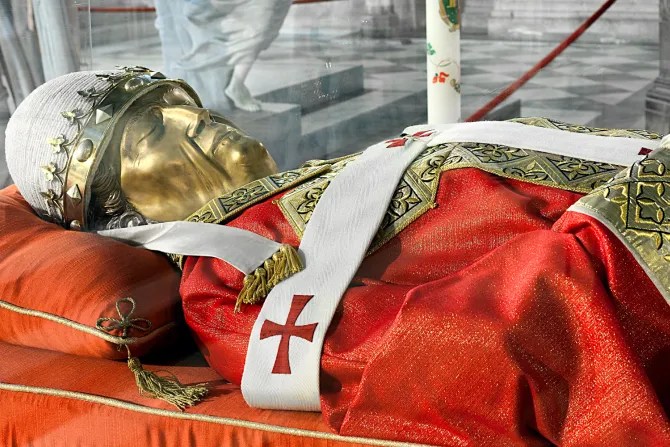
he effigy of Blessed Pope Gregory X can be found in the Cathedral of Arezzo.
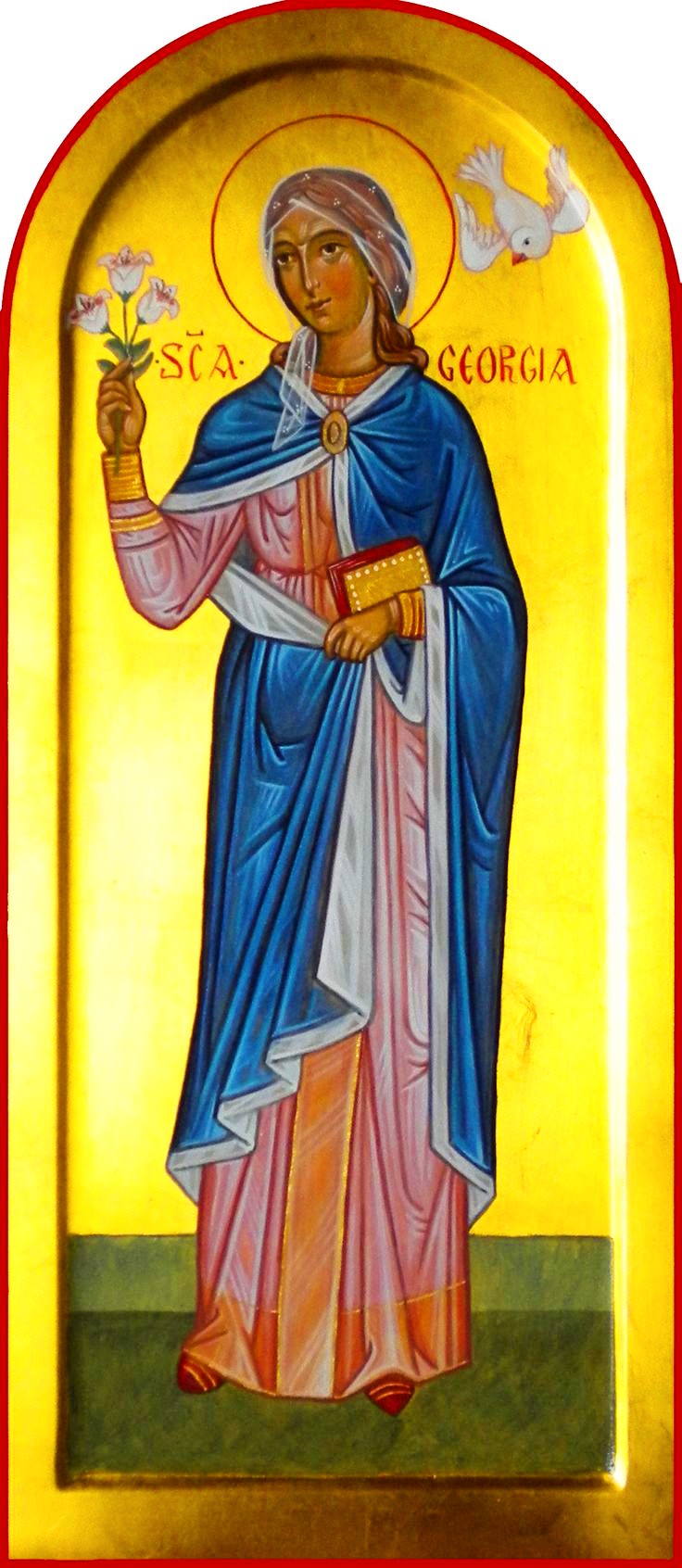
Saint of the Day – 15 February – St Georgia (6th Century) Virgin, Recluse. Also known as – Giorgia.
The Roman Martyrology reads today: “At Clermont in Auvergne, St Georgia Virgin.”
St Gregory of Tours (594), very well informed regarding the history of Auvergne due to the many years he spent there, reports the following concerning the existence and virtues of St Georgia. (De Gloria Confessorum XXXIV).
, “She lived, towards the beginning of the 6th Century, in Clermont, “pious and devoted to God” she retired to the countryside, to offer more freely to God “her hosts of praise” and, everyday, she dedicated herself to fasting and prayer.
At her death, while her body was being transported to the Church, it was accompanied by an immense flock of doves which, during the ceremony in the Church, went to rest on the roof, to then take flight again and follow the coffin as it was carried in procession to the cemetery. They remained to guard the tomb for the rest of the day.
The appearance of the doves symbolised and honoured, the virginity of the Saint.”
Georgia’s remains are kept in the Church of St Cassian in Clermont. The Roman Martyrology mentions her today on 15 Februar, the day on which the Proper of Clermont also inscribes her veneration.
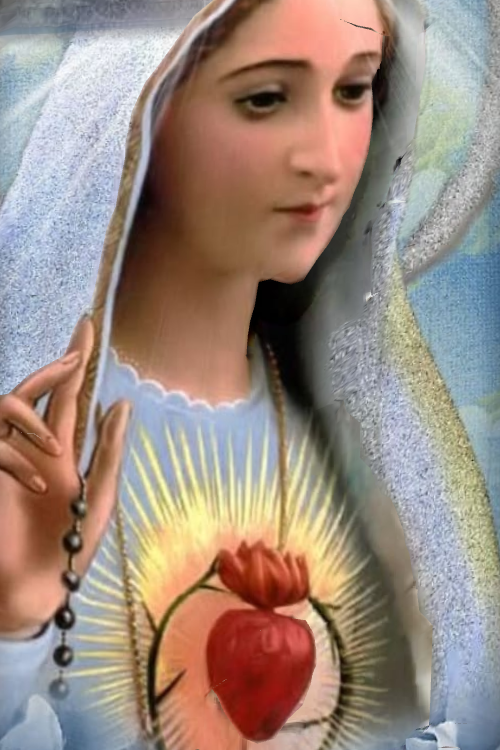
Immaculate Heart of Mary: Refuge of Sinner Listed in the Missal as a Feastday in some place. What does this Feastday mean? The Heart of Mary is the divinely-appointed Refuge of Sinners. “O God,” exclaims St Alphonsus, “how great shall be the remorse of the damned Christian in thinking that, during life, he could have saved his soul with so much facility by invoking the intercession of this Mother of mercy; that he had not done so and that, there shall be no more time to do it.” “Perhaps,” says St Bonaventure, “we are in doubt as to whether Our Lady will hear us when we address our prayers to her. No, Mary does not refuse and never has refused pity and aid, to any sinner who has invoked her intercession.”
St Berach of Kilbarry St Craton St Decorosus of Capua St Dochow St Druthmar of Corvey St Eusebius of Asehia St Farannan of Iona
St Faustinus AND St Jovinus (Died c 120) Martyrs, Priest and Deacon respectively. Brothers. Both Evangelists, Preachers. Born at Brescia, Lombardy, Italy and the two brothers died together. They was thrown to the lions but the animals refused to touch them. Then beheaded in 120 at Brescia, Italy.
St Faustus of Monte Cassino St Georgia (6th Century) Virgin St Joseph of Antioch St Onesimus the Slave St Quinidius of Vaison
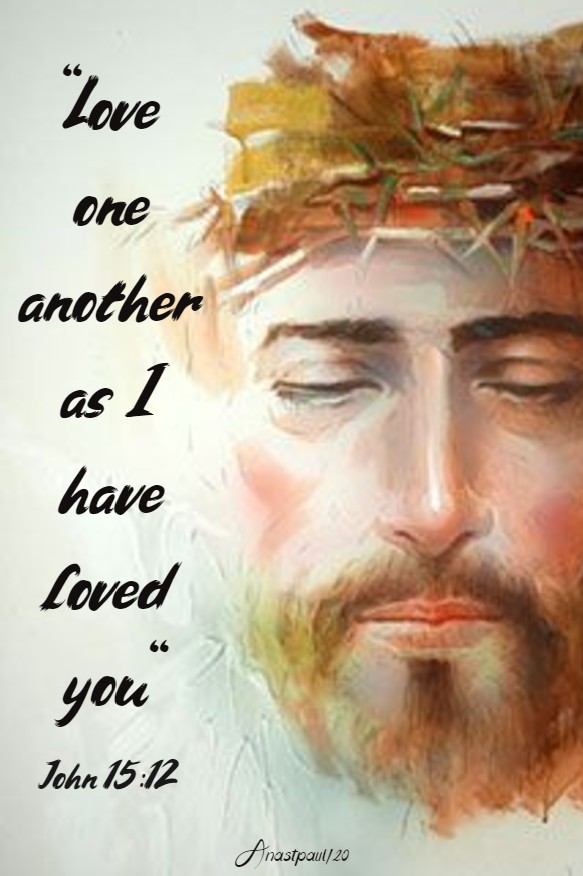
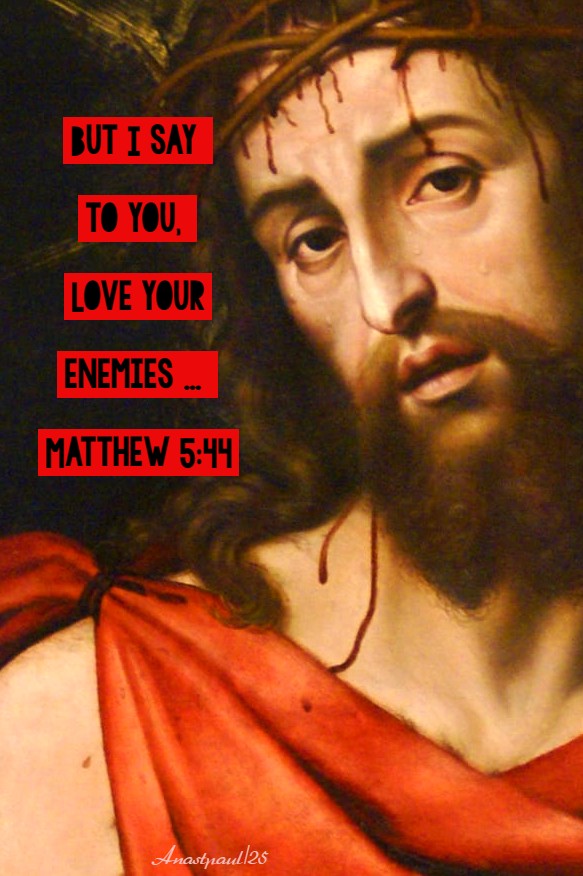
Quote of the Day – 14 February – St Valentine (176-273) Bishop and Martyr
“Love one another as I have loved you.”
John 15:12
“But I say to you, Love your enemies …”
Matthew 5:44
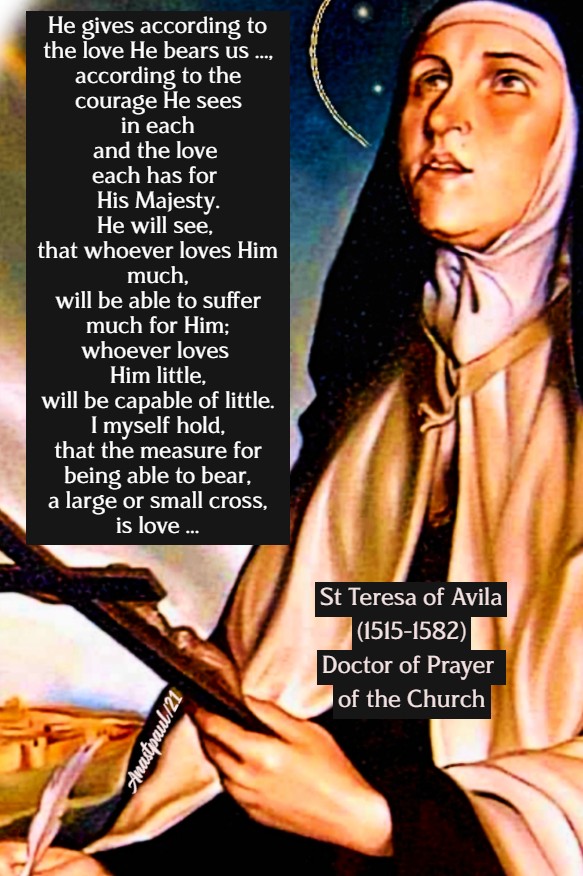
“He gives according to the love He bears us …, according to the courage He sees in each and the love each has for His Majesty. He will see, that whoever loves Him much, will be able to suffer much for Him; whoever loves Him little, will be capable of little. I myself hold, that the measure for being able to bear, a large or small cross, is love …”
St Teresa of Jesus of Avila (1515-1582)
“Take God for your Spouse and Friend and walk with Him continually and you will not sin and will learn to love and the things you must do will work out prosperously for you.”
“The one who walks in the love of God seeks neither gain nor reward but seeks only, with the will, to lose self and all things, for God and this loss, the lover judges to be a gain! Thus it is, as St Paul asserts: “For me death is gain” [Phil 1:21], that is, my death to all things and to myself, for Christ, is my spiritual gain. Consequently, the soul declares: “I was found.” The soul who does not know how to lose himself, does not find himself but rather, loses himself, as Our Lord teaches in the Gospel: “For he who will save his life, shall lose it and he who will lose his life for My Sake, will find it.” (Mt 16:25).”
St John of the Cross (1542-1591) Doctor of the Church
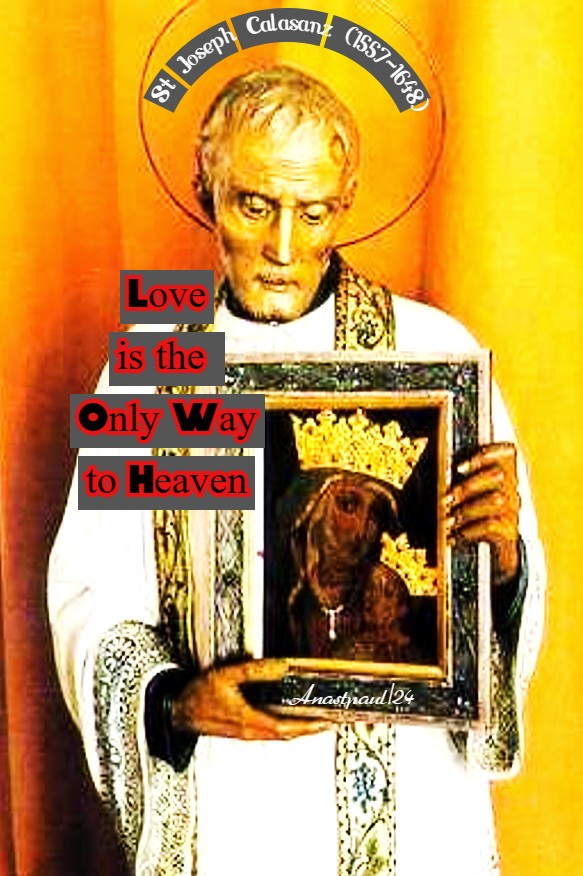
“LOVE is the only way to HEAVEN.”
St Joseph Calasanz (1557-1648)
“The measure of love, is to love without measure.”
St Francis de Sales (1567-1622) Doctor of the Church
Saint of the Day – 14 February – St Auxentius (Died c473) Priest and Abbot in Syria, ex-soldier and Imperial Guard, Hermit. Born in Syria amd died on 14 February 473 at Mount Skopas in Bithynia in present-day Turkey, of natural causes. Also known as – Aussenzio.
The Roman Martyrology reads today: “In Bithynia, the Abbot St Auxentius.”
Auxentius, probably the son of a Persian named Addas, spent much of his life as a Hermit in Bithynia, a region of Constantinople.
Previously, he had been one of the Equestrian Guards of the Eastern Emperor, Theodosius II, who reigned from 408 to 450. Having learned of the eremitic life practiced by numerous ascetics, Auxentius decided to embrace their way of life, settling on the desert hill of Oxia, not far from Constantinople.
Auxentius soon gained a reputation for sanctity and many sought his guidance and advice on spiritual matters. It seems that he too was accused of Monophysitism, a doctrine which denied the human nature of Jesus but, he was soon exonerated.
He built a new hermitage on Mount Skopas, near Chalcedon, dedicating the rest of his life to the practice of mortification and the instruction of his ever-increasing number of disciples, among whom were also some women, who lived at the foot of Mount Skopas in special communities and were known as “the sackcloth-wearers.”
Upon Auxentius’ death, on 14 February probably in 473, the above-mentioned reclusive woemn obtained the Saint’s remains and buried them in the ccommunity Cchurch. On this anniversary, Saint Auxentius, Priest and Abbot is still commemorated today by the Martyrologium Romanum.
St Nostrianus of Naples St Theodosius of Vaison St Valentine of Terni
St Vitale of Spoleto
Martyrs of Terni: Three Christians who gave proper burial to Saint Valentine of Terni. Martyred in the persecutions of Aurelius. 273 in Terni, Italy – Apollonius, Ephebus, Proculus.
Martyrs of Alexandria: A group of Christians murdered in various ways for their faith in Alexandria, Egypt. We know the names and a few details about 16 of them – Agatho, Agatone, Ammonio, Ammonius, Antonius, Bassiano, Bassianus, Cirione, Cyrio, Dionysius, Dionysius, Lucio, Moses, Moses, Proto and Tonione.
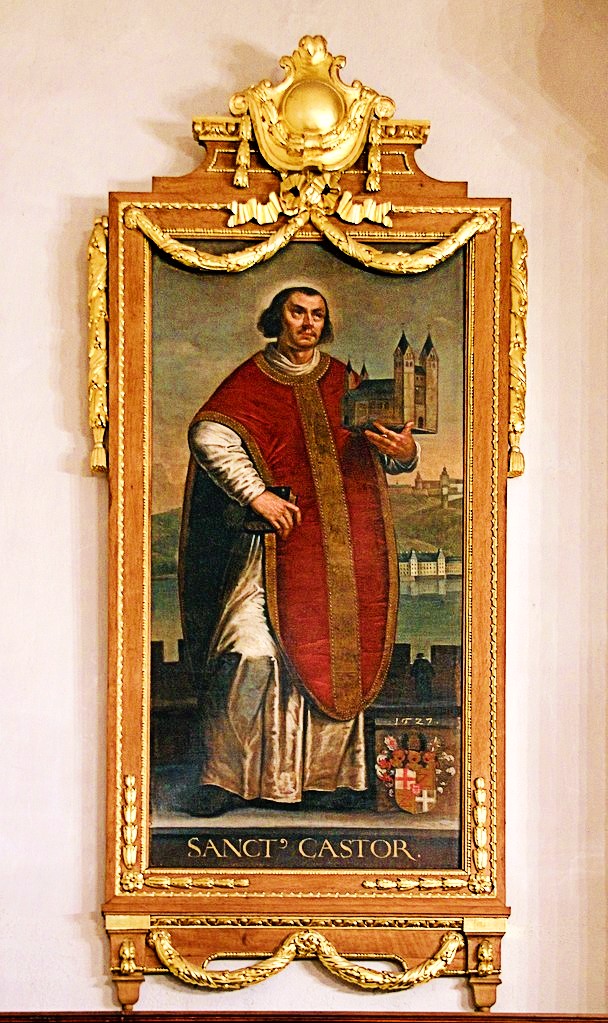
Saint of the Day – 13 February – Saint Castor (Died c400) Priest, Hermit, evangeliser. Born in Aquitaine in France and died in around 400 in Karden , today part of Treis-Karden on the Moselle in Rhineland-Palatinate, Germany. Patronage – of the City of Koblenz, in Germany. Also known as – Castore, Kastor, … of Karden. The name Castor is derived from Greek and means “the excellent one.”
This painting at the Basilica of St Castor in Koblenz
According to the legendary life story from the 10th/12th Century, Castor was a student of the Saint Bishop Maximinus of Trier and was Ordained a Priest by him.
St Castor is presented to Bishop Maximin by his parents. Designed by Joseph Anton Nikolaus Settegast for Frescoes in the Koblenz Cathedral.
He lived as a Hermit in Karden and there, united disciple companions to lead an exemplary pious life. Castor’s companions included the Aquitanian pilgrim Saint Potentinus and Potentinus’ two sons Felicius and Simplicius.
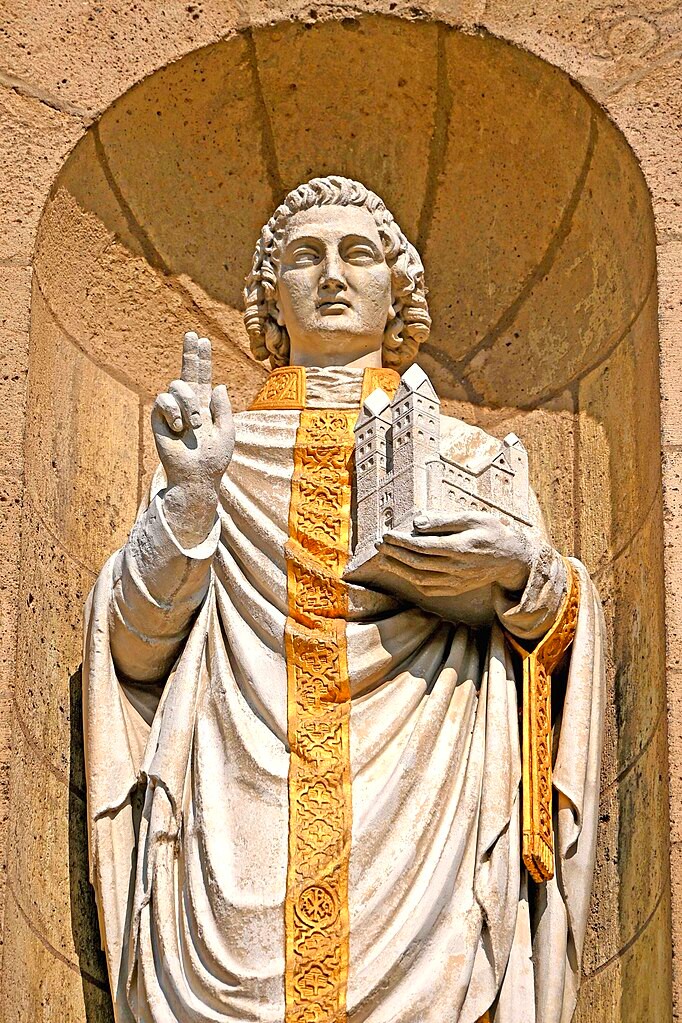
Statue in front of the Church of St Castor in Karden
A tale tells how Castor asked Moselle boatmen for salt. But they only mocked him and wanted to continue sailing. Suddenly a violent wind arose and whipped the waves so high that the boat threatened to capsize. In their distress, the boatmen begged the man of God for help. Castor knelt down and prayed – as suddenly as it had come, the storm subsided. The pagan boatmen were converted by this miracle and thanked Castor with plenty of salt.
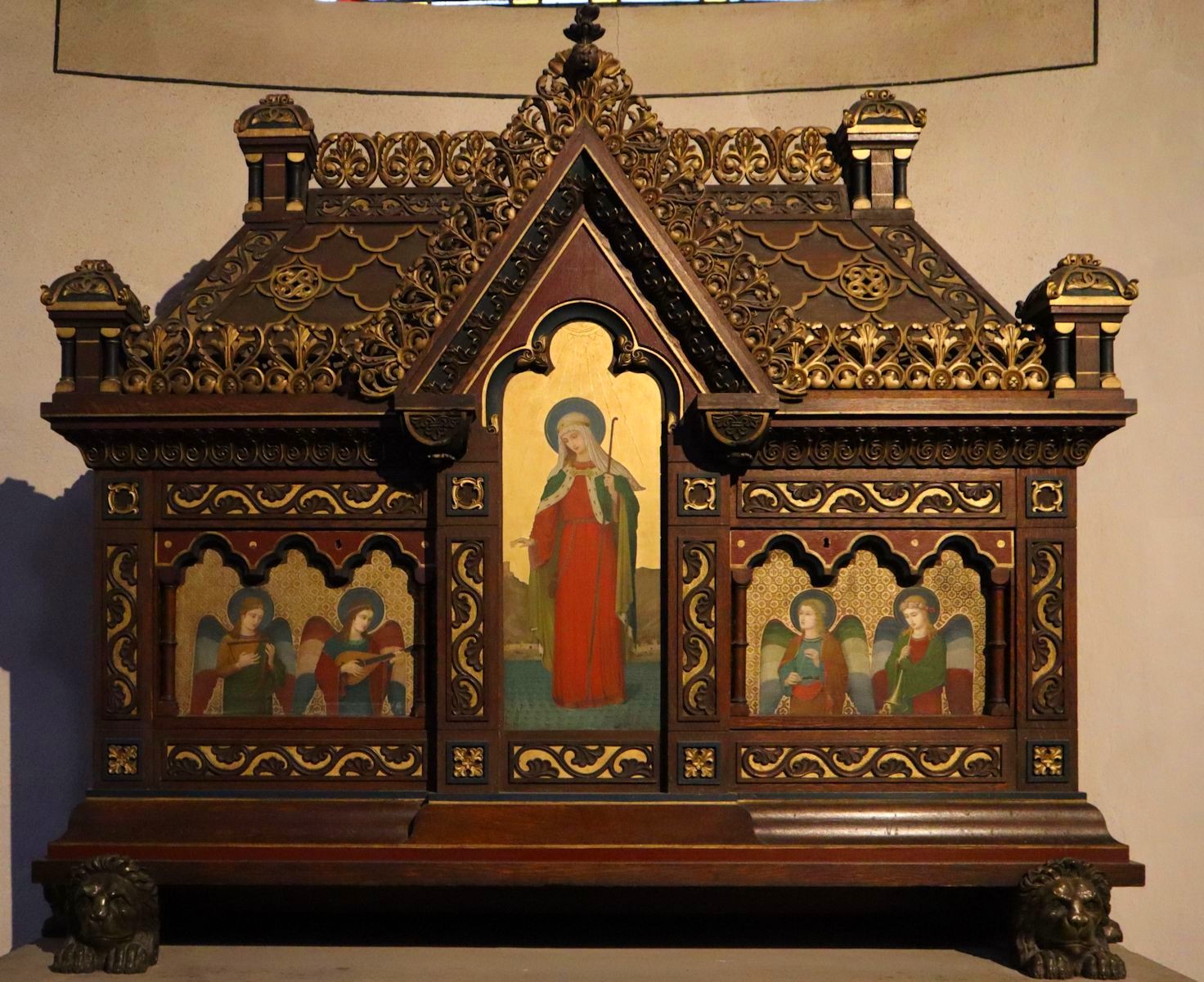
Relic Shrine, 1906, in the Kastorkirche in Koblenz
Castor died at Karden at an advanced age.
Reliquary made of gilded fir-tree wood, 15th Century, in the Church of St Castor in Karden
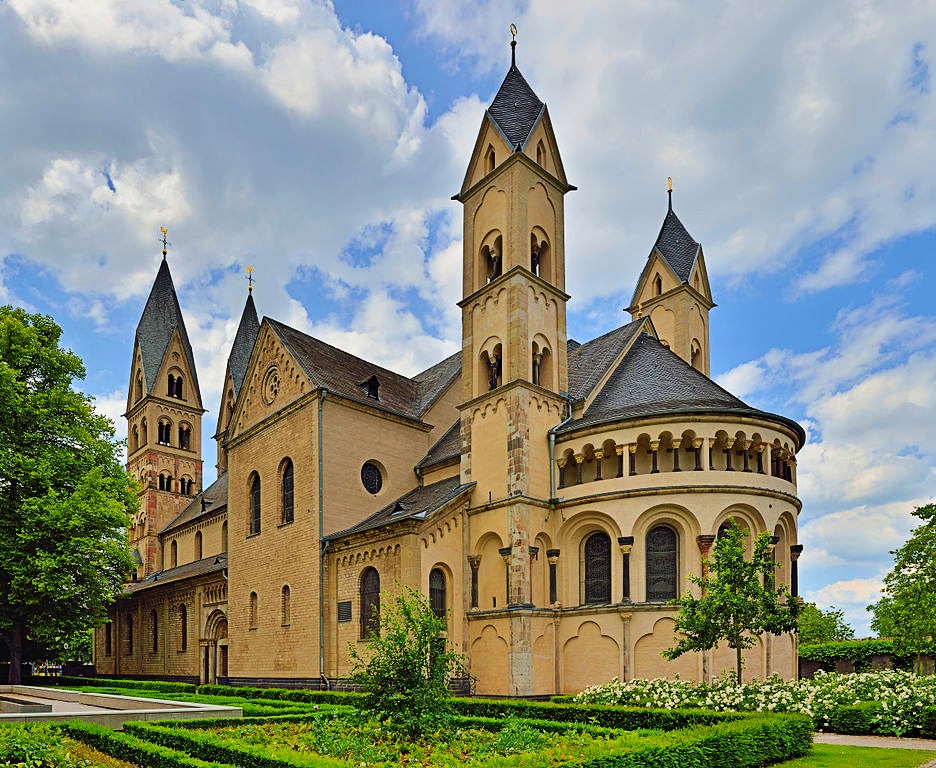
Castor’s cult maintained in Trier was – like that of Potentinus of Steinfeld – evidently intended to strengthen influence in the Lower Moselle region, since the area actually belonged to the Diocese of Mainz. Bishop Wiomad of Trier found – again possibly to document a claim to this area – bones in Karden around 782 which were identified as Castor’s Relics and transferred them to the Church then dedicated to St Paulinus of Trier which then received the Patronage of Castor. In 836, most of these Relics were then brought by Archbishop Hetti of Trier to Koblenz, to the later Collegiate Church built by him, of which Castor became the Patron; this Church was rebuilt in the 11th/12th Century as a Basilica dedicated to St Castor.
St Catherine de Ricci OP (1522-1590) Virgin, Tertiary of the Order of Preachers, Mystic, Stigmatist, Ecstatic, Counsellor to many in both secular and spiritual matters, a highly admired Administrator and Advisor,blessed with many mystical charism including visions of Christ, both as a Baby and Adult, bilocation and miracles. Her body is Incorrupt. A Mighty Handmaid: https://anastpaul.com/2022/02/13/saint-of-the-day-13-february-saint-catherine-de-ricci-op-1522-1590/
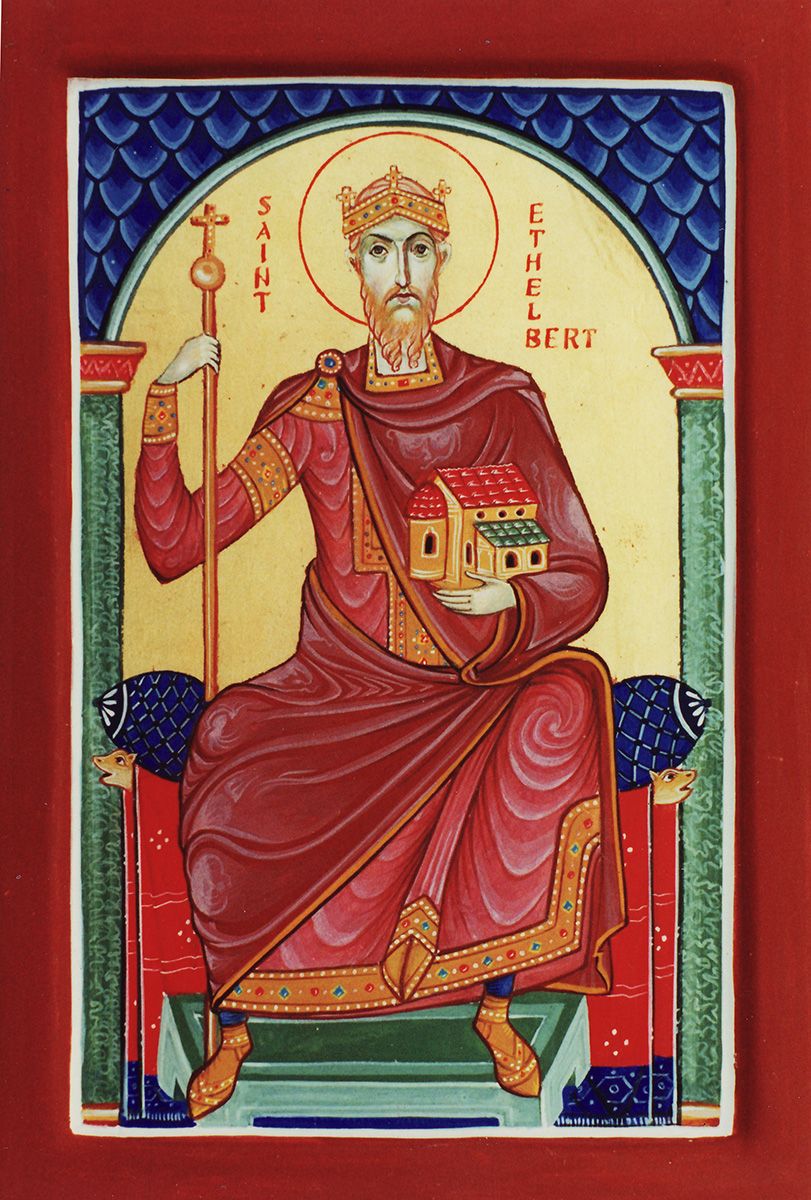
Saint of the Day – 12 February – Saint Ethelwald (Died c740) Bishop of Lindisfarne from 721 until his death, Abbot. Also known as – Aethelweald, Aedilauld, Ethilwald, Ethelwold. Additional Memorial – 21 April (translation of his Relics). Ethelwald is the last Bishop of Lindisfarne to have been revered as a Saint. He is often mistaken for his near contemporary, Æthelwold of Farne.
Born between the 7th and 8th Centuries, Ethelwald was a disciple of Saint Cuthbert (c634-687) known as “The Wonder-Worker of England.”
Having entered the Monastery of Melrose, he became first Prior and thethe Abbot. In 721, after the death of Bishop Ealfrid, he was elected as the Bishop of Lindisfarne.
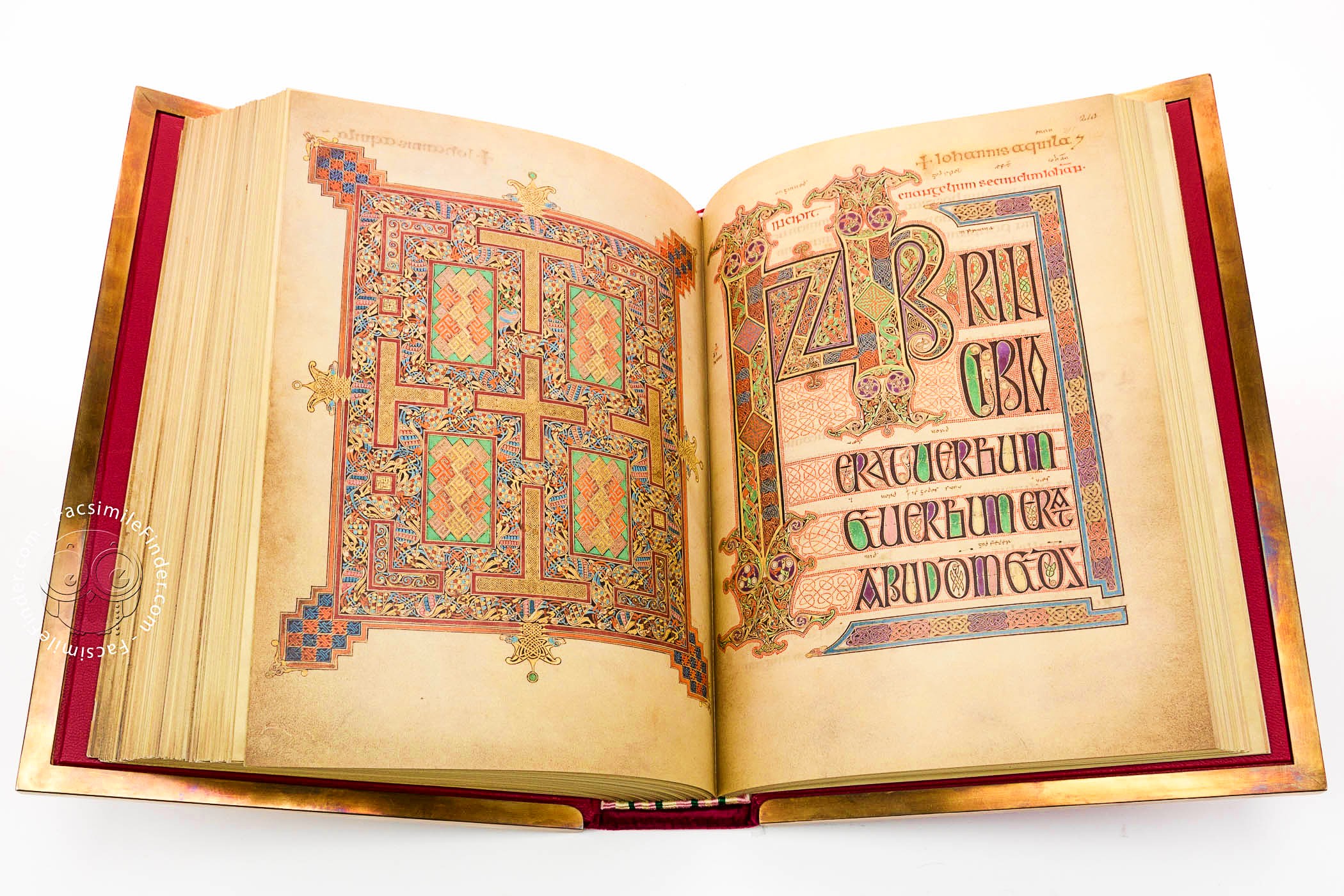
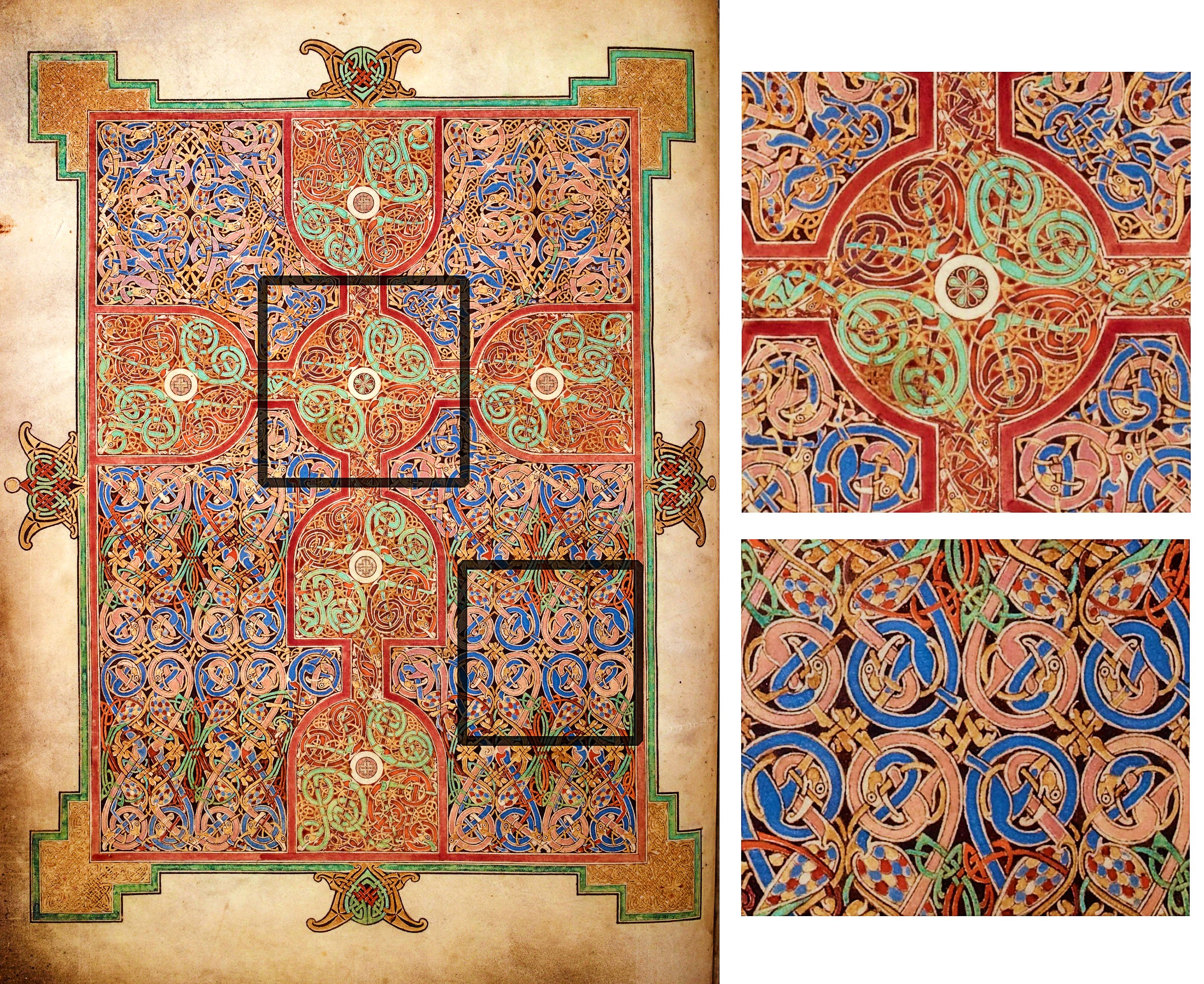
He is most remembered for his contribution to the production of the renowed Illuminated Lindisfarne Gospels. Ethelwald took the raw Manuscripts which his predecessor Eadfrith had collected and had Billfrith bind them. The Lindisfarne Gospel ( which I have been blessed to see) now resides in the British Museum.
He died around the year 740 and was buried in the Cathedral. His Relics, together with those of Saint Cuthbert and other Saints, were transferred to Scotland in 875, then to Chester in 883 and finally, to Durham in 995. Below might be St Ethelwald’s Tomb residing in the now protestant Cathedral at Durham. I have been there and have seen St Cuthbert’s Tomb but I cannot recall seeing St Ethelwald’s.
The Seven Holy Founders of the Order of the Blessed Virgin Mary (the Servites) Pope Leo XIII Canonised them all on 15 January 1888. After the Canonisation of the Seven Founders, their Feast was inserted in the General Roman Calendar for celebration on 11 February, the anniversary of the granting of canonical approval to the order in 1304. In 1909, 11 February became the Feast of Our Lady of Lourdes and the Feast of the seven founders was moved to 12 February. In 1969 the Feast was moved to 17 February. HERE: https://anastpaul.com/2018/02/17/saints-of-the-day-17-february-the-seven-holy-founders-of-the-servite-order-osm-formation-on-15-august-1233/
St Alexius of Kiev St Ammonius of Alexandria Bl Anthony of Saxony
St Anthony Kauleas of Constantinople (c829-901) Bishop, Confessor, Defender of orthodoxy. Anthony was a pious man exercising mortification and penances. He generously endowed monastic foundations and founded or re-founded the Kauleas Monastery with the support of the emperor, who preached at the Church’s dedication. Buried in the Church of his Monastery, Anthony was held responsible for many miracles. The Roman Martyrology reads: “At Constantinople, St Anthony, a Bishop in the time of the Emperor Leo VI.” Holy and Courageous St Anthony: https://anastpaul.com/2024/02/12/saint-of-the-day-12-february-st-anthony-kauleas-of-constantinople-c829-901-bishop-confessor/
St Modestus of Alexandria St Modestus of Carthage St Modestus the Deacon Bl Nicholas of Hungary St Sedulius Bl Thomas of Foligno
Martyrs of Albitina – 46 Saints: During the persecutions of Diocletian, troops were sent to the churches of Abitina, North Africa on a Sunday morning; they rounded up everyone who had arrived for Mass and took them all to Carthage for interrogation by pro-consul Anulinus. The 46 who proclaimed their Christianity were executed. We know some of their names and stories. They were tortured to death in 304 in prison at Albitina, North Africa.
Saint of the Day – 11 February – Saint Castrensis (5th Century) Bishop of Carthage and then in Italy, of Castel Volturno or Sessa Aurunca. Patronages – All in Italy: Castel Volturno, Marano di Napoli, the City and Archdiocese of Monreale, San Castrese di Sessa Aurunca. Also known as – Castrensis of Sessa, Castrensis of Campania, Castrensis of Africa, Castrense… Castrese… Castrenze… Additional Memorial – 1 September as one of the Exiles of Campania; in Castel Volturno he is celebrated in August; in Capua on 29 December and on the 2nd Sunday in May, as the date of the translation of his Relics.
The Roman Martyrology reads today: “At Capua, St Castrensis, Bishop.”
St Castrensis depicted in the Naplian Marble Calendar
Castrensis who lived around the 5th Century, is remembered in the “Marble Calendar” of Naples even though very little is known about him.
During the persecution of the Vandals led by Genseric (390-477), together with other Priests and faithful, he was sent off embarked on an old ship without a rudder, an anchor and cables, with the aim of drowning all on board. But they landed miraculously in Campania, Italy on 10 May, where he began to carry out his Apostolate.
It is uncertain whether he was the Bishop of Castel Volturno or Sessa Aurunca but he led the faithful of his City with love and zeal.
Biographers report two miraculous prodigies performed by him during his life and the liberation of a man possessed by the devil and the saving of a ship full of people (both episodes are depicted in two Mosaic panels in the Cathedral of Monreale, see below). The inscription above the Mosaics says: “He saves the sailors and rescues them from the anger of the demon which he had forced to go out from the body of the posessed man.”
Castrensis died at the end of the 5th Century “among his people, after having celebrated the Mysteries and having descended, by himself, into the tomb” and was immediately venerated by the people throughout Campania and in many other regions.
The Blessed Virgin with St Castrensis, on the right of St John the Baptist
He was considered a martyr because he was depicted in some paintings, discovered around 1881 in a cave in Calvi (Caserta) and dating to the 7th Century, together with the Martyr Priscus.
The Archbishop of Capua, Alfano, who had to accompany Princess Giovanna, daughter of King Henry II of England and sister of Richard the Lionheart, to Palermo, brought as a wedding gift to King William II, the body of St Castrensis without the head which remained in Capua (see Vita di Guglielmo II , Palermo 1770).
The Relics are today preserved in the Cathedral of Monreale, in the Chapel of the same name , inside a silver urn made by Cardinal Cosimo Torres, in 1637. On the plaque of the urn one can read: “ St Castrensis, eternal Bastion of the City of Monreale. ”
Castrensis is highly venerated in Castel Volturno (Caserta), where, in August, a procession along the river, is held in his honour. In Capua, which celebrates St Castrensis on 29 December and the second Sunday of May, the date of the translation).
A Processional Statue of St Castrensis probably from Castel Volturno
St Calocerus (Died c130) Bishop and Confessor of Ravenna St Castrensis (5th Century) Bishop St Dativus the Senator Bl Elizabeth Salviati St Etchen of Clonfad St Eutropius of Adrianopolis St Felix the Senator
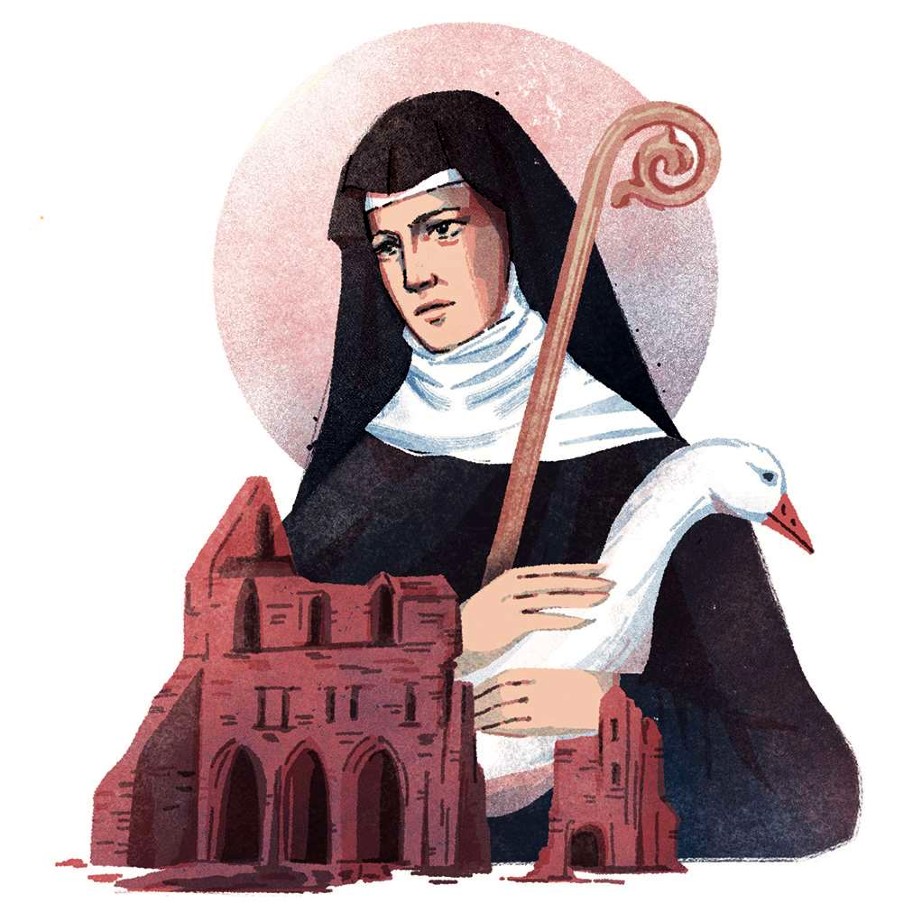
St Gobnata (6th Century) Abbess, Founder of a Convent and ‘Order’ of Sisters, Miracle-worker, Apostle of the sick. Patronages – of bees, beekeepers. About St Gobnata or Abigail:
St Lucius of Adrianople St Pedro de Jesús Maldonado-Lucero St Saturninus of Africa St Secundus of Puglia
St Severinus of Agaunum (Died c507) Abbot, Miracle-worker, gifted with Prophecy and healing the sick. Born in Burgundy, France and died in c507 at Chateau-Landon in Gatinais, of natural causes whilst travelling towards his Monastery. The Roman Martyrology reads: “At Chateau-Landon, St Severin, Abbot of the Monastery of Aqaunum, by whose prayers the Christian King Clovis, was deliovered from a long sickness.” Holy Severinus: https://anastpaul.com/2024/02/11/saint-of-the-day-11-february-st-severinus-of-agaunum-died-c507-abbot/
St Simplicius of Vienne (Died c417) Bishop St Theodora the Empress
Guardians of the Sacred Scriptures: Also known as – Anonymous Martyrs in Africa– Martyrs of Africa – Martyrs of Numidia – Martyrs of the Sacred Books A large number of Christians tortured and murdered in Numidia (part of modern Algeria) during the persecutions of Diocletian but whose names and individual lives have not survived. They were ordered to surrender their sacred books to be burned. They refused. Martyrs. c 303 in Numidia.
Martyrs of Africa – 5 Saints: A group of five Christians who were Martyred together; we know nothing else but the names of four of them – Cyriacus, Oecominius, Peleonicus and Zoticus.
Saint of the Day – 10 February – Saint Bruno von Waldeck (c1000-1055) Bishop of Minden, Germany, renowned and fervent Preacher, evangeliser, Apostle of the needy and careful defender and promotor of the social needs of his flock, In the list of Bishops of the Diocese he is ranked 16th after Siegbert, who died in 1036 and before Egilbert. The Diocese of Minden was erected by Charlemagne in the year 803, whose first Bishop was Erkanbert, a Monk of the Abbey of Fulda, one of the first missionaries in that territory. Through the story of tradition, it is believed that Saint Bruno led his community from 5 May 1037 to 10 February 1055, the date of his death. Also known as – Bruno of Waldeck, Brun/o of Minden, run…
Unknown German Bishop who might be our St Bruno
Saint Bruno von Waldeck, the 16th Bishop of Minden, from 1037 to 10 February 1055, was a man of deep faith and devotion, who dedicated himself passionately to his pastoral work, promoting the spread of Christianity and the well-being of his flock.
Born around 1000 to a noble family, Bruno received a high-level education which prepared him to hold important positions in the Church. He became a Royal Chaplain and in 1036 a Canon at the then Cathedral in Magdeburg.
In 1037, at the direction of Emperor Henry III, he was appointed as the Bishop of Minden, a Diocese located in north-western Germany. Bruno proved to be an enlightened and wise Bishop, who dedicated himself passionately to his pastoral work. He was a fervent preacher, who worked to spread Christianity among the pagan populations who inhabitedthe region.
He was also a tireless builder of Churches and Monasteries which helped strengthen the presence of the Church. One of his major contributions was the foundation of the Monastery of St Maurice on the Werder in the Town of Minden. The Monastery was an important centre of culture, education and devotion and contributed to the growth of the Christian Faith in the region. In 1434, the Monastery was moved to its current location on the opposite side of the Weser, due to the risk of flooding. In 1810, due to the protestant upheavels, this wonderful Monastery was closed after many oppresions and restrictions. Its Church remains and thank goodness still belongs to the Catholic Church.
Bruno also took an interest in the well-being of his faithful, promoting social justice and charity towards the needy.
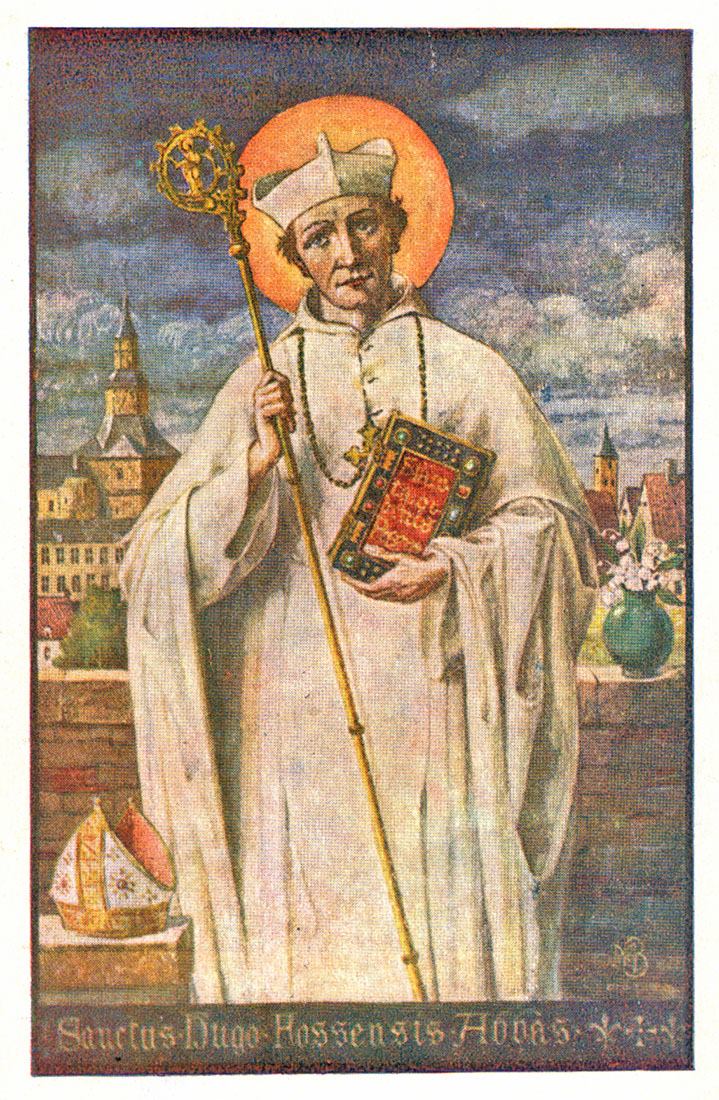
Blessed Hugh of Fosse OPraem (c1093-1164) Priest of the Order of Canons Regular of Prémontré, also known as the Premonstratensians, the Norbertines and the White Canons. Hugh was one of St Norbert’s first disciples and later became the first Abbot of Prémontré. Blessed Hugh was Beatified on 13 July 1927 by Pope Pius XI. Blessed Hugh’s Life of Grace: https://anastpaul.com/2023/02/10/saint-of-the-day-10-february-blessed-hugh-of-fosse-opraem-c1093-1164-priest-abbot/
St Paganus Bl Paul of Wallachia Bl Pierre Frémond St Porfirio St Prothadius of Besançon St Salvius of Albelda St Silvanus of Terracina
St Soteris the Martyr (Died c304) Virgin Martyr. The Roman Martyrology reads: “At Rome, on the Appian Way, St Soteres, Virgin and Martyr, who was descended of a noble race, as St Ambrose testifies but for the love of Christ, set at naught the consular and other dignities of her family. On her refusal to sacrifice to the gods, she was, for a long time, cruelly buffeted. After she had overcome varioys other torments, she was struck with the sword and joyfully went to her heavenly Spouse.” Her Life and Death: https://anastpaul.com/2024/02/10/saint-of-the-day-10-february-saint-soteris-the-martyr-died-c304-virgin-martyr/
Martyred Soldiers in Rome: A group of ten Christian soldiers who were Martyred together for their faith. We know little more about them but four of their names – Amantius, Hyacinth, Irenaeus and Zoticus. • 120 at Rome, Italy. They were buried on the Via Lavicana outside RomeAmantius, Hyacinth, Irenaeus, Zoticus.




































 AnaStpaul
You must be logged in to post a comment.