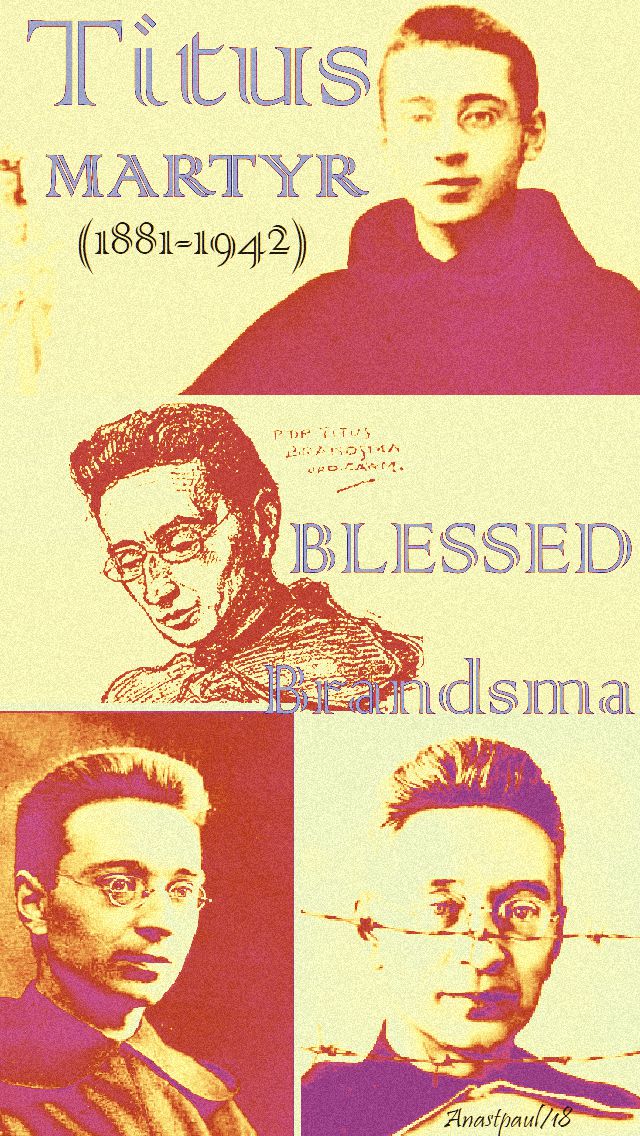
Our Morning Offering – 26 July – The Memorial of Blessed Titus Brandsma O.C.D. (1881-1942) Martyr of the Faith
Prayer Before Jesus Crucified By Blessed Titus Brandsma (1881-1942) Martyr
Dear Lord, when looking up at Thee,
I see Thy loving eyes on me,
Love overflows my humble heart,
Knowing what a faithful friend Thy art.
A cup of sorrow I foresee,
Which I accept for love of Thee,
Thy painful way I wish to go,
The only way to God I know.
My soul is full of peace and light,
Although in pain, this light shines bright.
For here Thou keep to Thou breast.
My longing heart to find there rest.
Leave me here freely all alone,
In cell where never sunlight shone.
Should no one ever speak to me,
This golden silence makes me free!
For though alone, I have no fear,
Never wert Thou, O Lord, so near.
Sweet Jesus, please, abide with me!
My deepest peace I find in Thee.
Amen
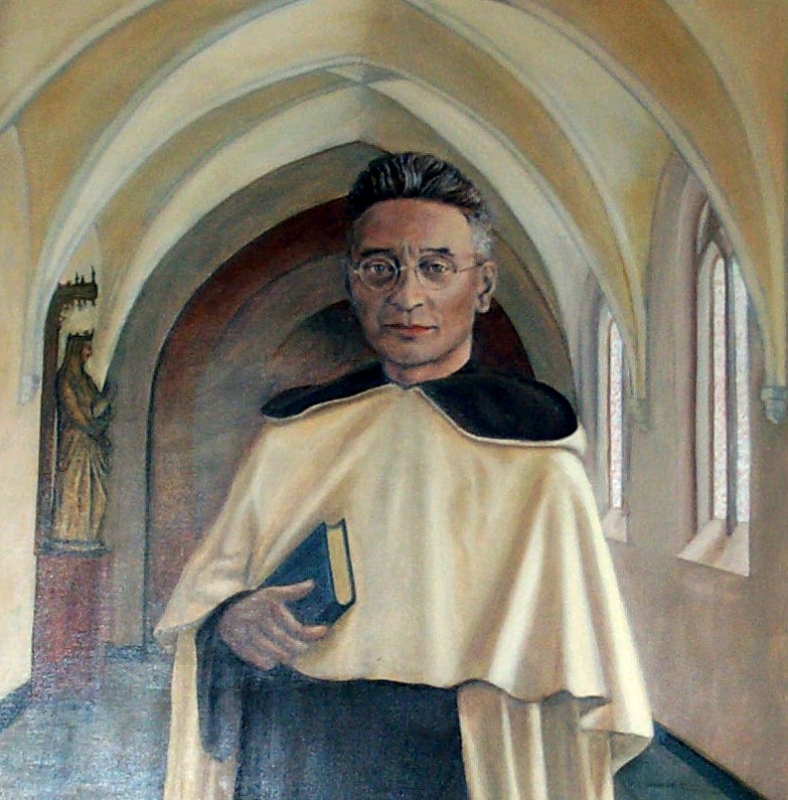
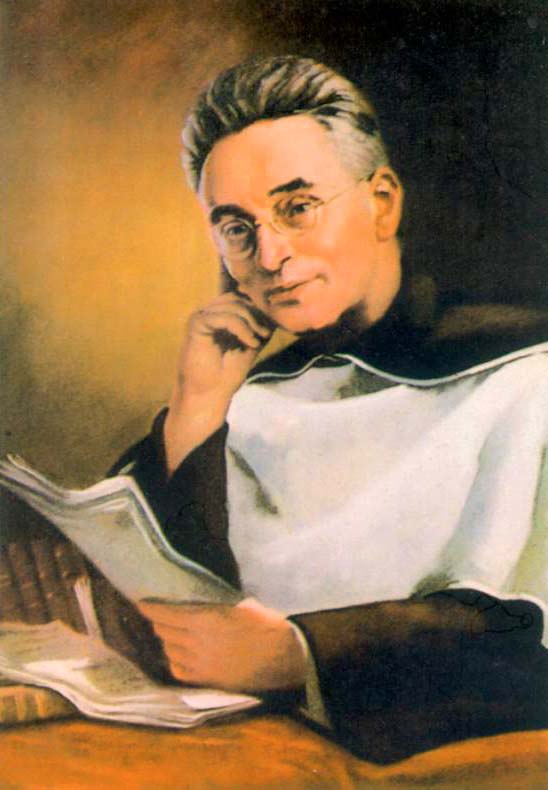
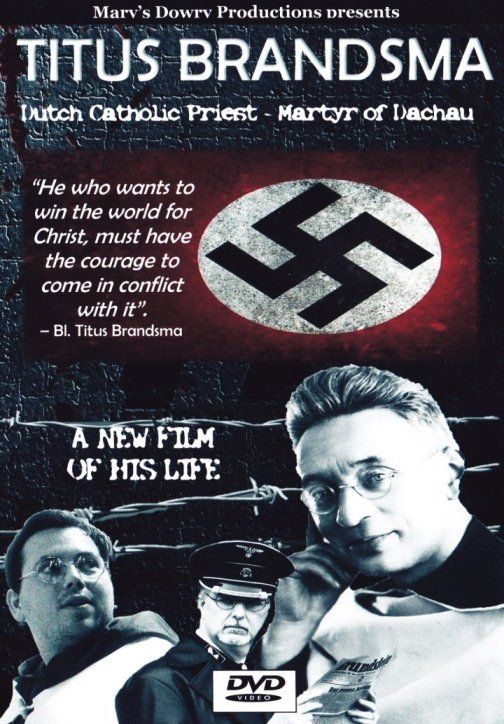
Saint of the Day – 26 July – Blessed Titus Brandsma O.C.D. (1881-1942) Martyr of the Faith – Carmelite Religious Priest, Mystic, Philosopher, Lecturer, Writer, Editor, Preacher, Linguist, Social Activist – born Anno Sjoerd Brandsma on 23 February 1881 at Oegeklooster, Friesland, Netherlands and was martyred on 26 July 1942 by lethal injection in the concentration camp at Dachau, Bavaria, Germany. His executioner was a nurse who had been raised Catholic but left the Church. His body was cremated and no relics remain.
Bl Titus’ parents, who ran a small dairy farm, were devout and committed Catholics, a minority in a predominantly-Calvinist region. With the exception of one daughter, all of their children entered religious orders. As a young boy, Brandsma did his secondary studies in the town of Megen, at a Franciscan-run minor seminary for boys considering a priestly or religious vocation, commonly known as a “Seminary Minor.” He entered the novitiate of the Carmelite friars in Boxmeer on 17 September 1898, where he took the religious name Titus (in honour of his father) by which he is now known. He professed his first vows in October 1899 and was Ordained a priest in 190. Brandsma was knowledgeable in Carmelite mysticism and was awarded a doctorate of philosophy at Rome in 1909. He then taught in various schools in the Netherlands. From 1916 on, he initiated and led a project to translate the works of St Teresa of Ávila into Dutch.
One of the founders of the Catholic University of Nijmegen (now Radboud University), Brandsma became a professor of philosophy and the history of mysticism at the school in 1923. He later served as Rector Magnificus. He was noted for his constant availability to everyone, rather than for his scholarly work as a professor. Brandsma also worked as a journalist and was the ecclesiastical adviser to Catholic journalists by 1935. That same year he did a lecture tour of the United States, speaking at various institutions of his Order.
After the invasion of the Netherlands by the Third Reich in May 1940, it was Brandsma’s fight against the spread of Nazi ideology and for educational and press freedom that brought him to the attention of the Nazis. In January 1942 he undertook to deliver by hand a letter from the Conference of Dutch Bishops to the editors of Catholic newspapers in which the bishops ordered them not to print official Nazi documents, as was required under a new law by the German occupiers. He had visited 14 editors before being arrested on the 19th of that month at the Boxmeer monastery.
After being held prisoner in Scheveningen, Amersfoort and Cleves, Brandsma was transferred to the Dachau concentration camp, arriving there on 19 June. His health quickly gave way and he was transferred to the camp hospital. He died on 26 July 1942, from a lethal injection administered by a nurse of the Allgemeine SS, as part of their program of medical experimentation on the prisoners.
In 1921 Brandsma worked to resolve a controversy concerning Belgian artist Albert Servaes’ depiction of the Stations of the Cross. From this came his series of meditations on each of the 14 stations, though he never finished the 14th Station as he wrote them whilst in Dachau and was executed before completing them.
He was beatified in November 1985 by Pope John Paul II. His feast day is observed within the universal Church today and within the Carmelite Order on 27 July.
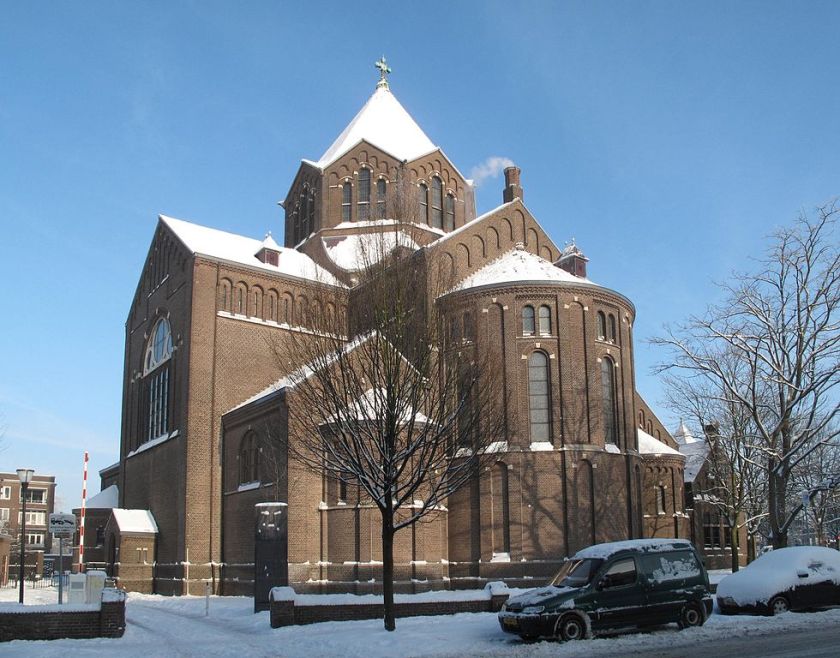
In 2005 Brandsma was chosen by the inhabitants of Nijmegen as the greatest citizen to have lived there. A memorial church now stands in the city dedicated to him.
Brandsma’s studies on mysticism was the basis for the establishment in 1968 of the Titus Brandsma Institute in Nijmegen, dedicated to the study of spirituality. It is a collaboration between the Dutch Carmelite friars and Radboud University Nijmegen. Brandsma was honoured by the city of Dachau with a street adjoining the former camp.
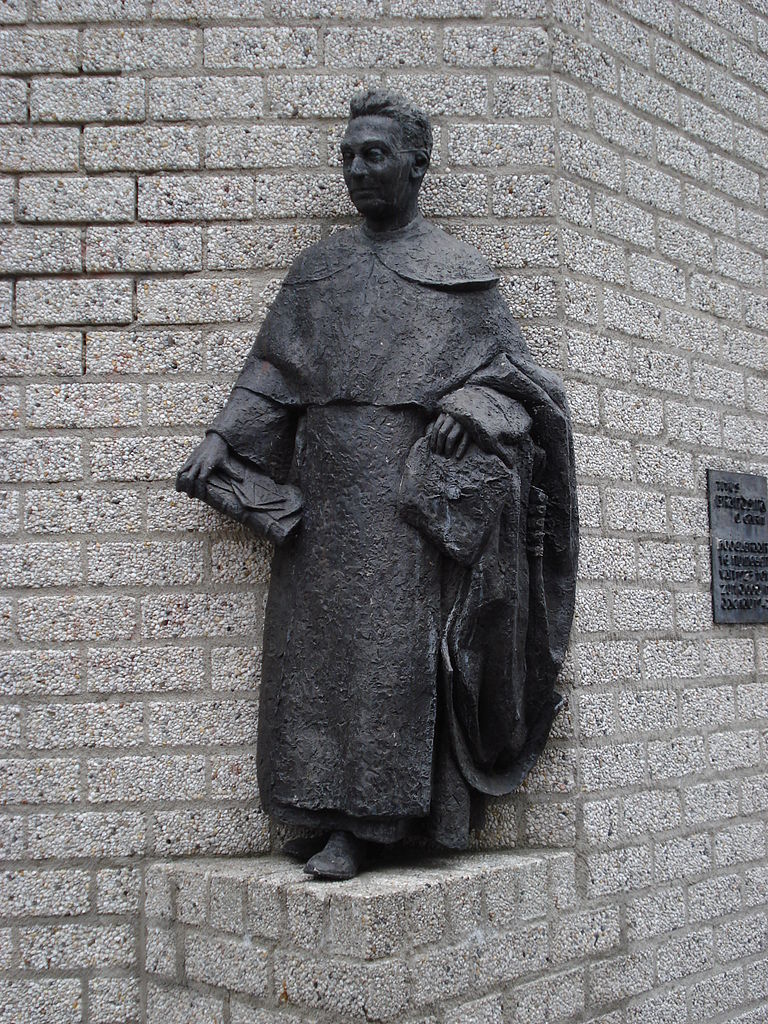
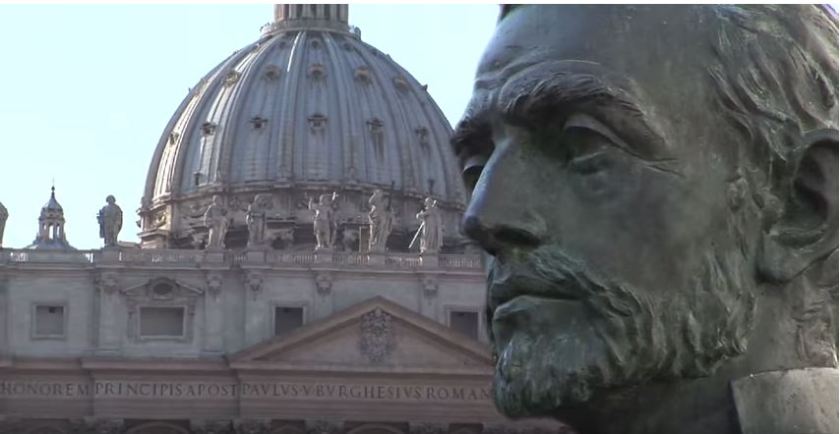
Statue of Titus Brandsma on the grounds of Radboud University, Nijmegen
Bl Andrew the Catechist
St Austindus of Auch
St Bartholomea Capitanio
St Benigno of Malcestine
Bl Camilla Gentili
St Charus of Malcestine
Bl Edward Thwing
Bl Élisabeth-Thérèse de Consolin
St Erastus
Bl Évangéliste of Verona
St Exuperia the Martyr
Bl George Swallowell
St Gérontios
Bl Giuseppina Maria de Micheli
St Gothalm
St Hyacinth
Bl Jacques Netsetov
Bl John Ingram
St Joris
Bl Marcel-Gaucher Labiche de Reignefort
Bl Marie-Claire du Bac
Bl Marie-Madeleine Justamond
Bl Marie-Marguerite Bonnet
St Olympius the Tribune
St Parasceva of Rome
St Pastor of Rome
Bl Pérégrin of Verona
Bl Pierre-Joseph le Groing de la Romagère
Bl Robert Nutter
St Simeon of Padolirone
St Symphronius the Slave
St Theodulus the Martyr
St Titus Brandsma O.C.D. (1881-1942) Martyr of the Faith
St Valens of Verona
Bl William Ward
—
Martyred in the Spanish Civil War:
Bl Aleix Miquel Rossell
Bl Amancio Marín Mínguez
Bl Antoni Jaume Secases
Bl Josep Maria Jordá i Jordá
Bl Josep Masquef Ferré
Bl Manuel Martín Sierra
Bl Miquel Vilatimó Costa
Bl Pau Roselló Borgueres
Bl Santiago Altolaguirre y Altolaguirre
Bl Vicente Pinilla Ibáñez
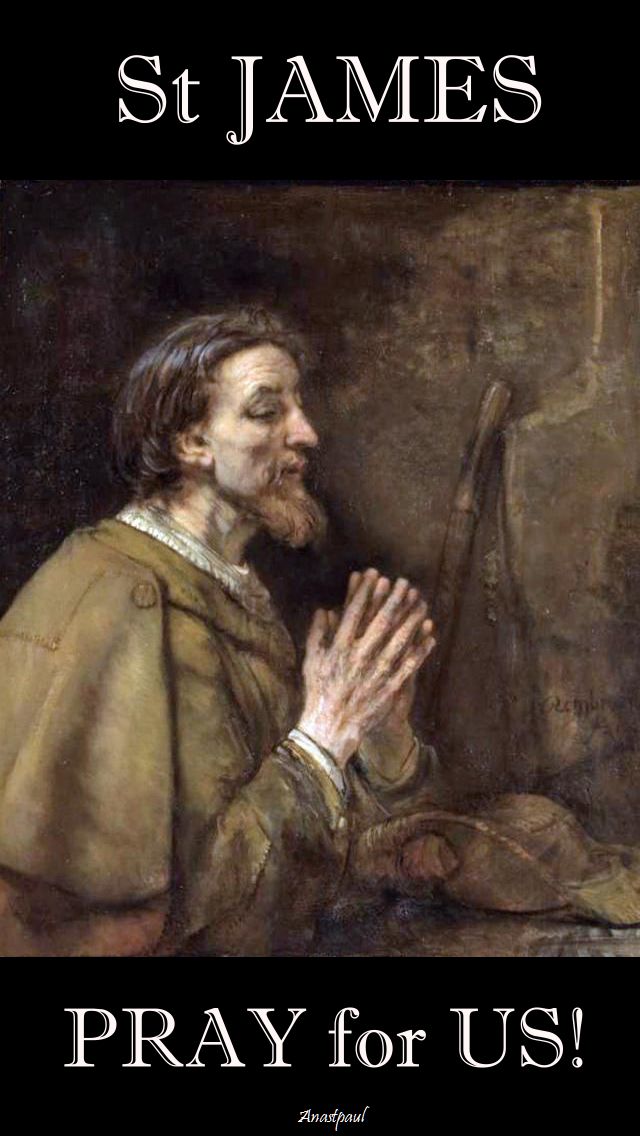
One Minute Reflection – 25 July – The Memorial of St James the Greater, Apostle of Christ – Today’s Gospel: Matthew 20:20–28
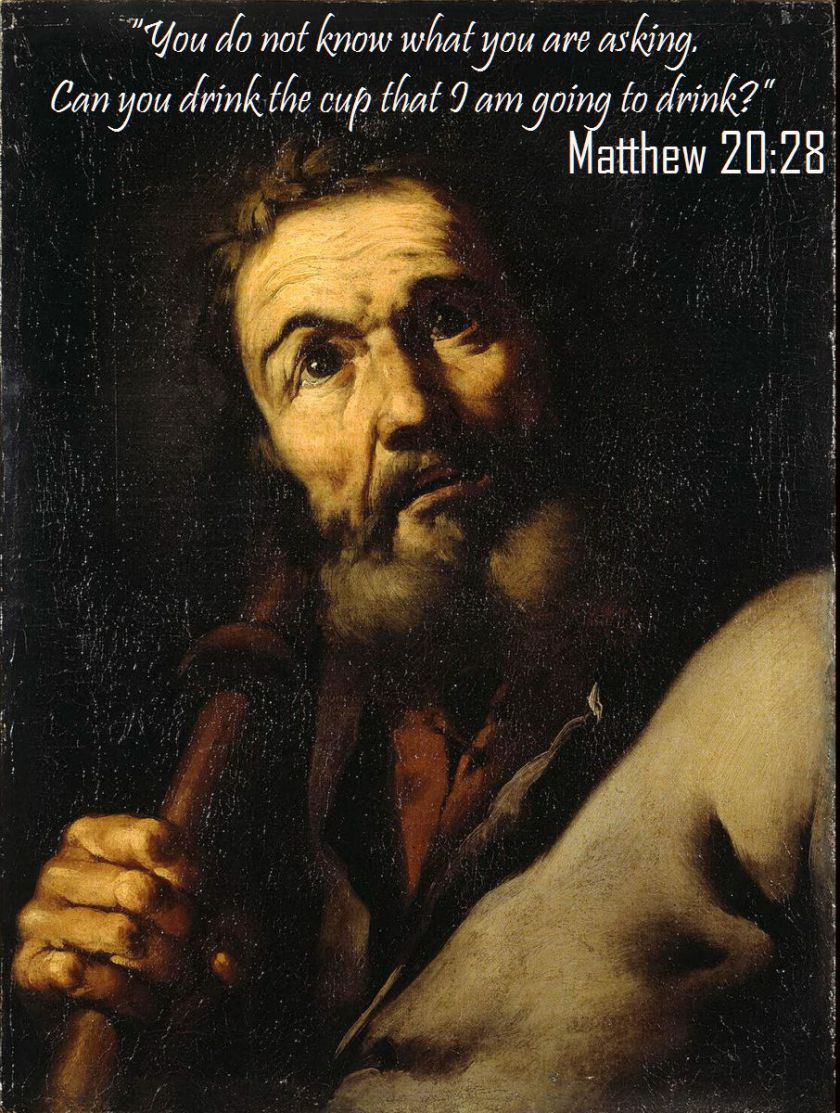
Jesus said in reply, “You do not know what you are asking. Can you drink the cup that I am going to drink?” They said to him, “We can.”……Matthew 20:28
REFLECTION – “Through their mother’s mediation, the sons of Zebedee press Christ as follows in the presence of their fellow apostles: “Command that we may sit, one at your right side and one at your left” (cf. Mk 10:35f.)… Christ hastens to free them from their illusions, telling them they must be prepared to suffer insults, persecutions, even death. “You do not know what you are asking. Are you able to drink the cup that I shall drink?” Let no one be surprised to see the apostles displaying such imperfect dispositions. Wait until the mystery of the cross has been fulfilled and the strength of the Holy Spirit given to them. If you want to see the strength of their souls, take a look at them later on and you will see them to be above all human weakness. Christ does not conceal their pettiness so you will be able to see what they become later on by the power of the grace that will transform them…”… St John Chrysostom (c 345-407) Father & Doctor of the Church
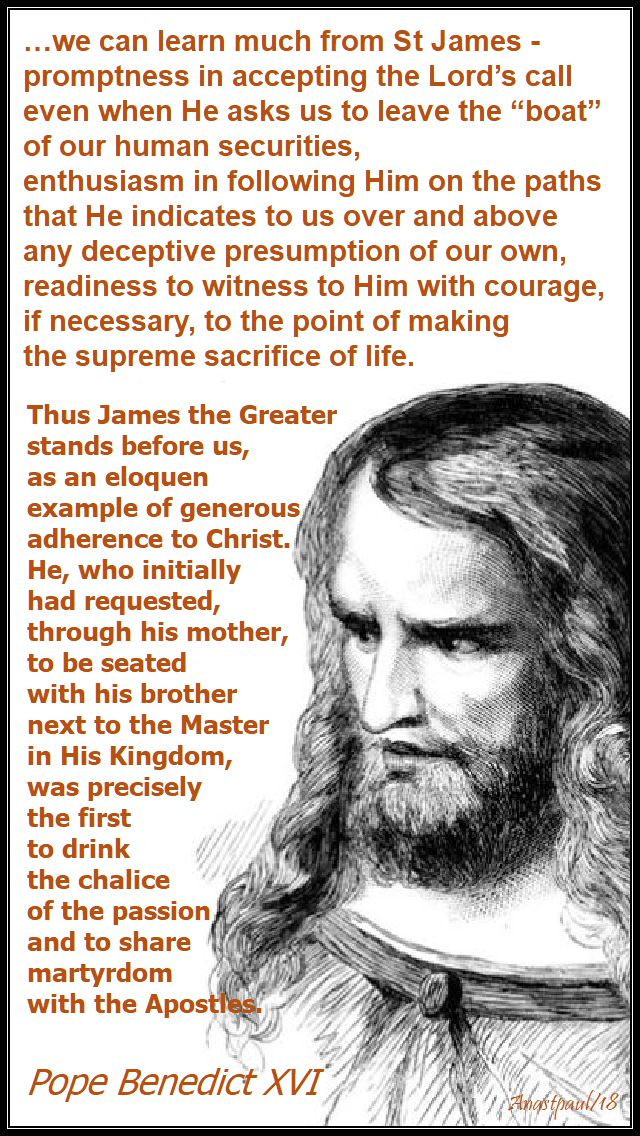
“…we can learn much from St James: promptness in accepting the Lord’s call even when He asks us to leave the “boat” of our human securities, enthusiasm in following Him on the paths that He indicates to us over and above any deceptive presumption of our own, readiness to witness to Him with courage, if necessary to the point of making the supreme sacrifice of life. Thus James the Greater stands before us, as an eloquent example of generous adherence to Christ. He, who initially had requested, through his mother, to be seated with his brother next to the Master in His Kingdom, was precisely the first to drink the chalice of the passion and to share martyrdom with the Apostles.”…Pope Benedict XVI – General Audience, 21 June 2006
PRAYER – Lord our God, You accepted the sacrifice of St James, the first of Your Apostles to give his life for Your sake. May Your Church find strength in his martyrdom and support in his constant prayer. Through our Lord Jesus Christ, your Son, who lives and reigns with you in the unity of the Holy Spirit, one God, for ever and ever. St James the Greater, Apostle of Christ, Pray for us! Amen
Our Morning Offering – 25 July – The Memorial of St Christopher (died c 251)
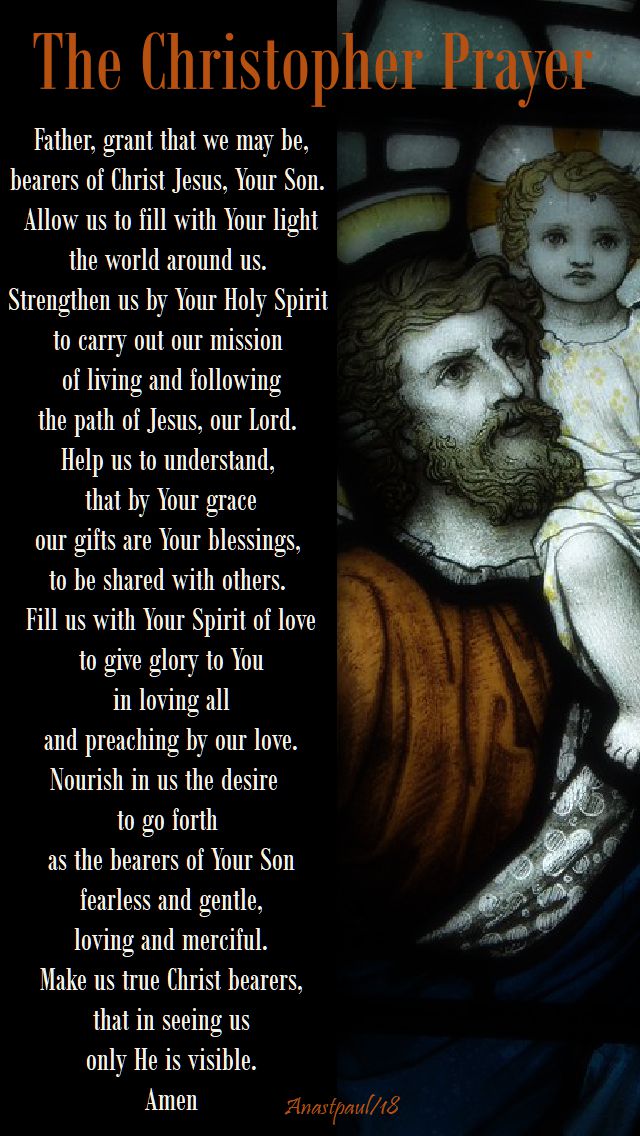
The Christopher Prayer
Father, grant that we may be,
bearers of Christ Jesus, Your Son.
Allow us to fill with Your light
the world around us.
Strengthen us by Your Holy Spirit
to carry out our mission
of living and following
the path of Jesus, our Lord.
Help us to understand,
that by Your grace
our gifts are Your blessings,
to be shared with others.
Fill us with Your Spirit of love
to give glory to You
in loving all
and preaching by our love.
Nourish in us the desire
to go forth
as the bearers of Your Son
fearless and gentle,
loving and merciful.
Make us true Christ bearers,
that in seeing us
only He is visible.
Amen
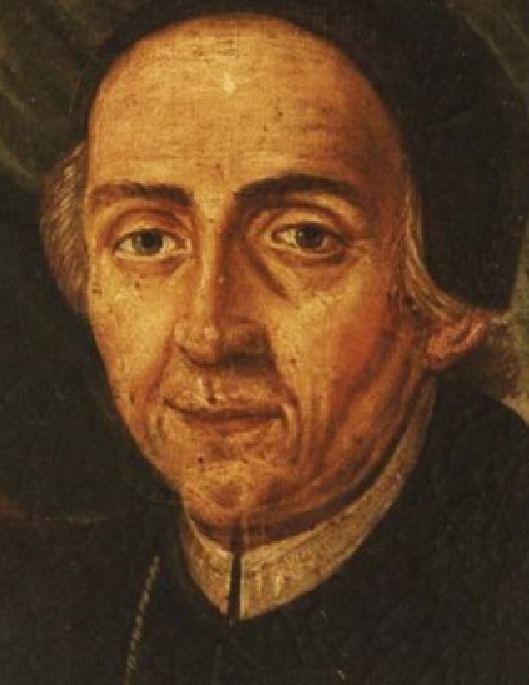
Saint of the Day – 25 July – Blessed Antonio Lucci O.F.M.Conv. (1682-1752) Bishop of Bovino, Franciscan Friar, Theologian, Professor, Writer, Apostle of Charity and Marian devotee – he was born as Angelo Nicola Lucci on 2 August 1681 in Agnone, Isernia, kingdom of Sicily (in modern Italy) as Angelo Nicola Lucci and died on 25 July 1752 in Bovino, Foggia, Italy of natural causes.
Blessed Angelo Nicola Lucci was born on 2 August 1682 to the cobbler and coppersmith Francesco Lucci and Angela Paolantonio. He attended the local school that the Order of Friars Minor Conventual managed and later joined them in 1698. Lucci made his solemn profession in 1698 in the religious name of “Antonio”. He completed his studies for the priesthood in Assisi where he was ordained in 1705. He studied rhetoric and philosophical studies before completing higher theological studies and then further studies led to a doctorate in theology. He was appointed as a professor in Agnone as well as at the Franciscan school in Ravello (from 1709 to 1712) and at the Franciscan school of San Lorenzo in Naples (from 1713 to 1718). He also served as Chaplain of the convent in Naples.
Lucci was elected as the Minister Provincial in 1718 and held that post until 1719; in 1719 he was appointed as a professor at St Bonaventure College in Rome and remained there until his appointment to the episcopate. In 1725 he received instructions from Pope Benedict XIII to write against Jansenism. It was rumoured that Pope Benedict XIII would appoint him as a cardinal but the Holy Fatber instead had decided to name him as the Bishop of Bovino in 1729 and explained of the appointment: “I have chosen as Bishop of Bovino an eminent theologian and a great saint”. Pope Benedict XIII himself, conferred episcopal consecration upon Lucci in Saint Peter’s Basilica.
He served his diocese the remaining 23 years of his life. Known for his charity to the poor (he gave away most of his personal income) and the creation of schools and catechism classes for the young and the poor, theological and training in public speaking for priests, all of whom had been much neglected in a tiny diocese beset with political problems. He travelled through the diocese, re-equipped and repaired churches, enforced discipline on his clergy who had fallen into worldly ways, raised the standards and revitalised the liturgy and parish life throughout his see and even visited hermits to ensure that their lives were in line with Church teachings. His reforms were opposed by local lords and princes who had fostered and who benefited from the lax and worldly ways of the priests and people, who wanted to control appointments of clergy and offices and who tried to treat Church property as their own. Bishop Antonio fought them at every step, always defending the poor and outcast and the rights of the Church and ignoring their demands for the appointment of friends and followers to positions that he filled with more qualified candidates. He restored the cathedral, which had fallen into disrepair and supported a resumption of devotions.
Somewhere along the way he managed to write Manual of Theology which was used as a standard textbook for many years and in 1740 a book about the saints and beati from the first 200 years of the Franciscan Conventuals.
Lucci studied with and was a close friend of Saint Francis Fasani (1681-1742) who – after Lucci’s death – testified on 29 November 1742 at the diocesan hearings regarding the holiness of Lucci’s life. He and Fasani were both ordained as priests together and were great and lifelong friends. aint Alphonsus Maria de’ Liguori (1696-1787) wrote of Lucci and heaped great praise upon him.
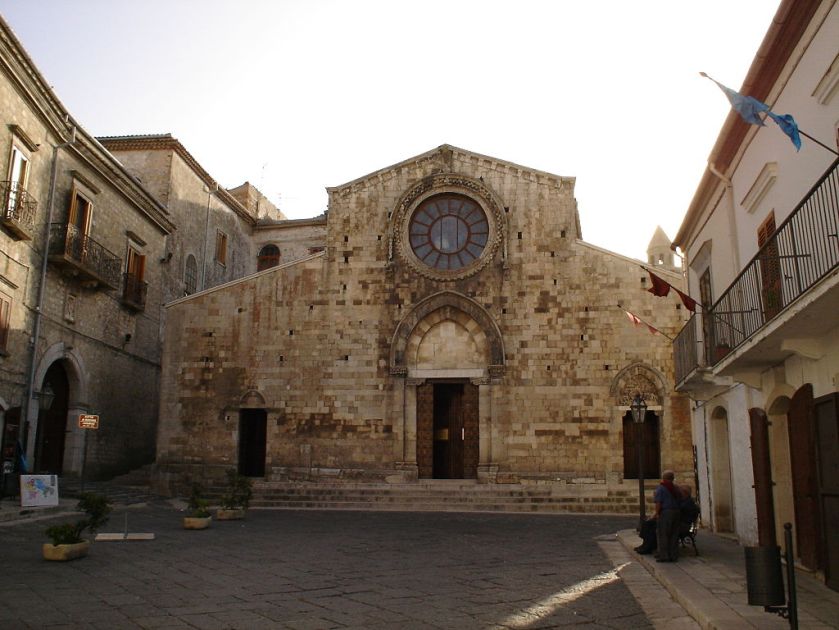
Lucci died in the morning of 25 July 1752 due to a high fever and his remains were interred in the Bovino Cathedral, which is dedicated to the Assumption of the Virgin Mary. It was formerly the episcopal seat of the Diocese of Bovino but since 1986 a co-cathedral in the Archdiocese of Foggia-Bovino and was granted the status of a minor basilica in 1970.
Bovino Minor Basilica
His Beatification cause commenced under Pope Clement XIII on 5 December 1764 and Lucci became titled as a Servant of God while Pope Pius IX confirmed that Lucci had lived a model life of heroic virtue and so named him as Venerable on 13 June 1847. The informative process for the miracle needed for beatification spanned from 1779 until 1780 and received validation in Rome on 10 September 1782 before a medical board met and approved this miracle two centuries later on 3 February 1988. Theologians approved the miracle on 7 July 1988 as did the Congregation for the Causes of Saints on 8 November 1988. St Pope John Paul II approved this miracle on 28 November 1988 and beatified Blessed Antonio Lucci on 18 June 1989 in Saint Peter’s Square. The current postulator for this cause is Fra Angelo Paleri.
St James the Greater (Feast) – Son of Zebedee and Salome, brother of Saint John the Apostle. He is called “the Greater” simply because he became an Apostle before Saint James the Lesser.
All about him here: https://anastpaul.wordpress.com/2017/07/25/saint-of-the-day-25-july-feast-of-st-james-the-greater-apostle-of-christ/
Bl Alexius Worstius
Bl Antonio Lucci O.F.M.Conv. (1682-1752) Bishop of Bovino
Bl Antonio of Olmedo
St Bantu of Trier
St Beatus of Trier
St Christopher
St Cugat del Valles
Bl Darío Acosta Zurita
St Ebrulfus
St Euphrasia
St Fagildo of Santiago
St Felix of Furcona
St Florentius of Furcona
St Glodesind of Metz
St Magnericus of Trier
Bl Michel-Louis Brulard
Bl Mieczyslawa Kowalska
St Mordeyren
St Nissen of Wexford
St Olympiad of Constantinople
St Paul of Palestine
Bl Pietro Corradini of Mogliano
St Theodemir of Cordoba
—
Martyrs of Caesarea – 3 saints: Three Christians martyred together in the pesecutions of emperor Maximilian and governor Firmilian – Paul, Tea and Valentina. 309 in Caesarea, Palestine.
Martyrs of Cuncolim – 20 saints: On 15 July 1583 the group met at the church of Orlim, and hiked to Cuncolim to erect a cross and choose land for a new church. Local anti-Christian pagans, seeing the unarmed Christians, gathered their weapons and marched on them. One of the parishioners, a Portuguese emigre named Gonçalo Rodrigues, carried a firearm, but Father Alphonsus Pacheco stopped him from using it. The pagans then fell upon them, and killed them all without mercy. They were –
• Alphonsus Pacheco
• Alphonsus the altar boy
• Anthony Francis
• Dominic of Cuncolim
• Francis Aranha
• Francis Rodrigues
• Gonçalo Rodrigues
• Paul da Costa
• Peter Berno
• Rudolph Acquaviva
• ten other native Christian converts whose names have not come down to us
They were martyred on Monday 25 July 1583 at the village of Cuncolim, district of Salcete, territory of Goa, India. Beatified on 30 April 1893 by Pope Leo XIII.
Martyrs of Furci:
Martyrs of Motril – 5 beati: Four priests and a brother, all members of the Augustinian Recollects, who were martyred together in the Spanish Civil War:
• Deogracias Palacios del Río
• José Rada Royo
• José Ricardo Díez Rodríguez
• Julián Benigno Moreno y Moreno
• León Inchausti Minteguía
They were shot on 25 July 1936 in Motril, Granada, Spain and Beatified on 7 March 1999 by Pope John Paul II.
Martyrs of Toledo – 4 beati: Four brothers and a priest, all members of the Hospitallers of Saint John of God, and all martyred together in the Spanish Civil War.
• Carlos Rubio álvarez
• Eloy Francisco Felipe Delgado Pastor
• Jerónimo Ochoa Urdangarín
• Primo Martínez De San Vicente Castillo
25 July 1936 in Talavera de la Reina, Toledo, Spain. They were Beatified on 25 October 1992 by Pope John Paul II.
Martyrs of Urda – 3 beati: Three members of the Passionists who were martyred together in the Spanish Civil War.
• Benito Solana Ruiz
• Felix Ugalde Irurzun
• Pedro Largo Redondo
They were shot on 25 July 1936 in Urdá, Toledo, Spain and Beatified on 1 October 1989 by Pope John Paul II.
Martyred in the Spanish Civil War:
Antonio Varona Ortega
Bl Dionisio Pamplona-Polo
Enric Morante Chic
Higinio Roldán Iriberri
Jaume Balcells Grau
Jesús Eduard Massanet Flaquer
Jesús Juan Otero
José López Tascón
José Luis Palacio Muñiz
Josep Bardolet Compte
Josep Más Pujolrás
Juan Crespo Calleja
Bl Miquel Peiro Victori
Ricard Farré Masip
Santos López Martinez
Vicente Fernández Castrillo
Thought for the Day – 24 July – The Memorial of St Charbel Makhluf
Joseph Makhluf was born in 1828 at Beqa-Kafra, Lebanon. His peasant family lived a strong faith, were attentive to the Divine Liturgy and had a great devotion to the Mother of God.
At the age of 23, Charbel (the name he chose when entering Novitiate) left his closely knit family to enter the Lebanese-Maronite Monastery called Notre-Dame de Mayfouk. Following studies and profession at St Cyprian de Kfifane Monastery, he was ordained in 1859.
For the next seven years, Charbel lived in the mountainous community of Anaya. After that he spent the next twenty-three years in complete solitude at Sts Peter and Paul Hermitage near Anaya. He died there on Christmas Eve, 1898.
Charbel had a reputation for his austerity, penances, obedience and chastity. At times, Charbel was gifted with levitations during prayer and he had great devotion to the Most Blessed Sacrament.
In all things, Charbel maintained perfect serenity. He was beatified in 1965 by Blessed Pope Paul VI and canonised by him in 1977.
The spirit of Charbel still lives in many people. His miracles include numerous healings of the body and of the spirit. Thomas Merton, the American Hermit, wrote in his journal: “Charbel lived as a hermit in Lebanon—he was a Maronite. He died. Everyone forgot about him. Fifty years later, his body was discovered incorrupt and in short time he worked over 600 miracles. He is my new companion. My road has taken a new turning. It seems to me that I have been asleep for 9 years—and before that I was dead.”
At the closing of the Second Vatican Council, on 5 December 1965 when St Charbel was beatified by Pope Paul VI, he said:
“…a hermit of the Lebanese mountain is inscribed in the number of the blessed…a new eminent member of monastic sanctity is enriching, by his example and his intercession, the entire Christian people… May he make us understand, in a world largely fascinated by wealth and comfort, the paramount value of poverty, penance, and asceticism, to liberate the soul in its ascent to God…”
St Charbel Makhluf, Pray for us!
The Chaplet of St Charbel here: https://anastpaul.wordpress.com/2017/07/24/the-chaplet-of-st-charbel-makhluf/
And listen to this special song too:
and the lyrics here: https://anastpaul.wordpress.com/2017/07/24/thought-for-the-day-24-july-the-memorial-of-st-charbel-of-makhluf/
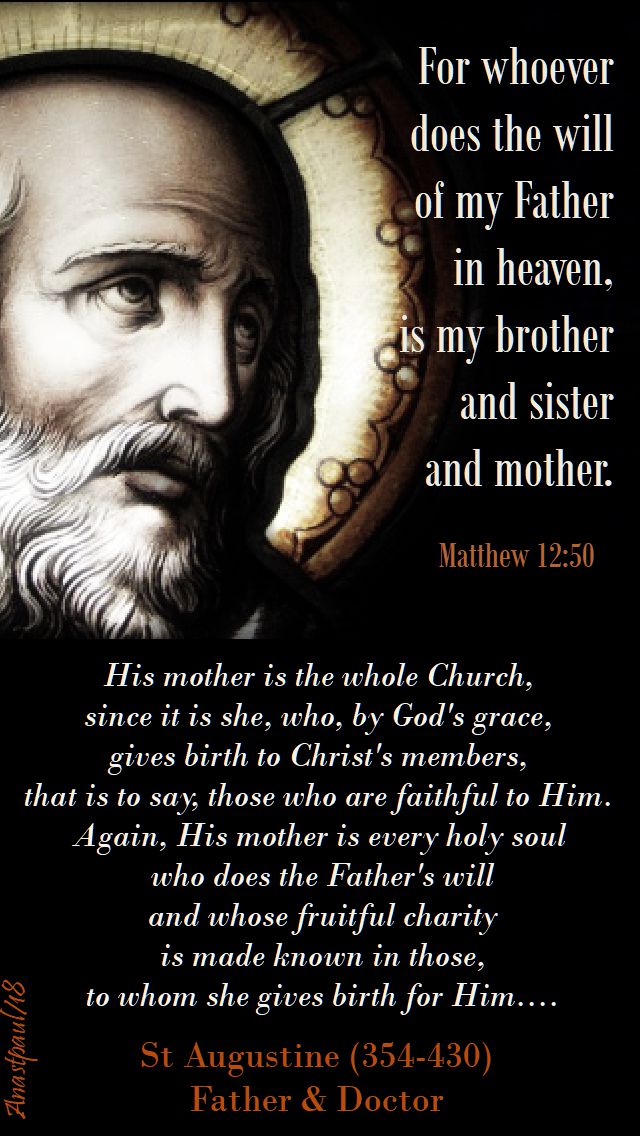
One Minute Reflection – 24 July 2018 – Tuesday of the Sixteenth week in Ordinary Time, Year B – Today’s Gospel: Matthew 12:46-50 and the Memorial of St Charbel Makhluf (1828-1898)
“For whoever does the will of my Father in heaven, is my brother and sister and mother.”…Matthew 12:50
REFLECTION – “His mother is the whole Church, since it is she, who, by God’s grace, gives birth to Christ’s members, that is to say, those who are faithful to Him. Again, His mother is every holy soul who does the Father’s will and whose fruitful charity is made known in those, to whom she gives birth for Him, “until he has been formed in them” (cf Gal 4:19)…St Augustine (354-430) Father & Doctor
PRAYER – Almighty Father, You made us Your children, You called us from all ages and You formed us by Holy Mother Church. Grant, we pray, that by Your grace, we may be ever faithful to her and be guided by Your Holy Spirit of love. O God may Your holy Saint Charbel Makhluf intercede for us that, being made imitators of the Lord’s Passion, we may merit to be co-heirs of His Kingdom. Who lives and reigns with You in the unity of the Holy Spirit, one God, forever, amen.
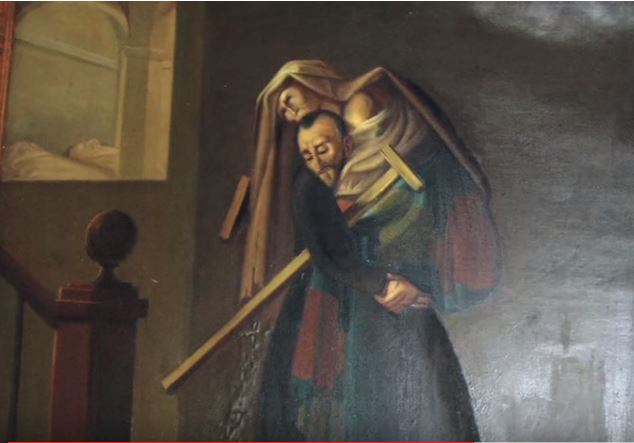
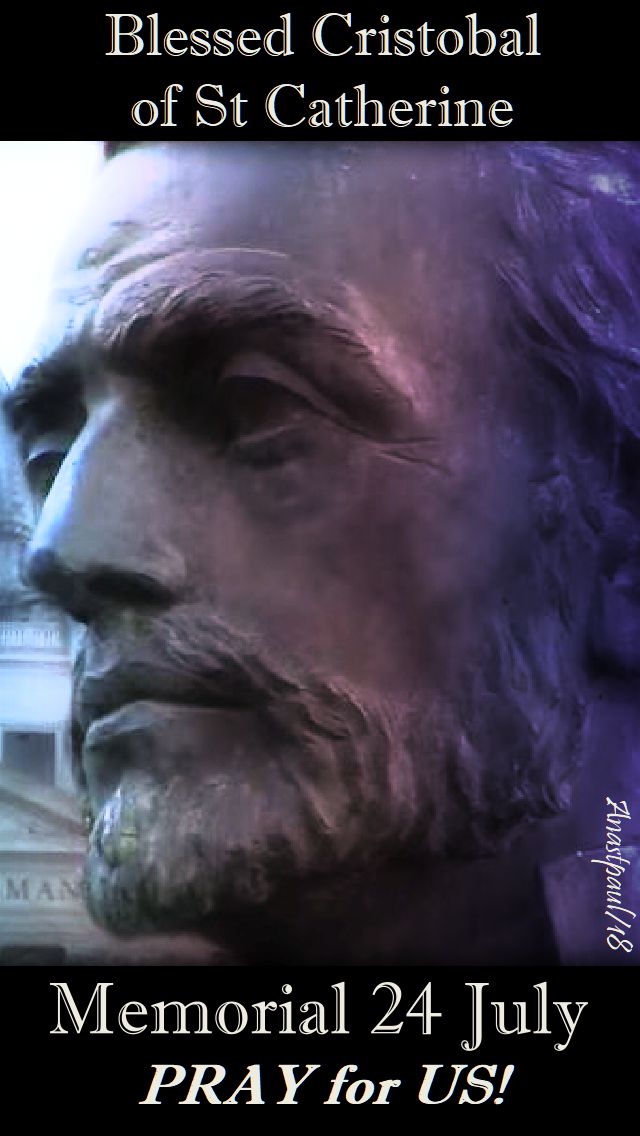
Saint of the Day – 24 July – Bl Cristobal of St Catherine T.O.S.F. (1638-1690) Priest, Founder of the Franciscan Hospitallers of Jesus of Nazareth, Franciscan Tertiary – born Cristóbal López de Valladolid Orea on 25 July 1638 at 8 Calle Baños, Mérida, Badajoz, Spain and died on 21 July 1690 in Córdoba, Spain of cholera. Patronage – the Franciscan Hospitallers of Jesus of Nazareth.
Cristóbal López de Valladolid Orea was born in 1638 as the son of poor labourers (he had five brothers) and was baptised in the church of Santa Eulalia. In either 1645 or 1646 he fled from his home in an effort to join the Order of Friars Minor but he soon returned home after his worried mother sent his brothers to bring him home. He served as an altar server and worked as a nurse in a hospital that the Order of Saint John of God managed.
He was ordained to the priesthood on 20 March 1663 in Badajoz and after was made a chaplain to armed services fighting in Portugal though he had to return home after falling ill. In 1667 he retired to a hermitage in the mountains of El Bañuelo but his desire to follow the Rule and the teachings of Saint Francis of Assisi prompted him to pursue the Franciscan charism in a concrete manner. It was for this reason he became a professed member of the Third Order of Saint Francis in 1671 and he assumed the religious name of “Cristóbal of Saint Catherine”. He established the Franciscan Hospitallers of Jesus of Nazareth in Córdoba on 11 February 1673 which pushed the boundaries of a range of both religious and social issues.
He died in 1690 clutching a Crucifix, a victim of the cholera epidemic in which he tended to the victims. It was said not long after his death, several miracles were attributed to his direct intercession. His order received papal approval from Pope Benedict XIV in 1746.
The cause of beatification commenced on 27 June 1770 under Pope Clement XIV and the late priest was declared a Servant of God. Pope Benedict XVI declared him to have lived a life of heroic virtue on 28 June 2012 and named him Venerable.
On 20 December 2012 the pope approved a decree that recognised a miracle attributed to his intercession which would allow for him to be beatified. The beatification was held on 7 April 2013 and Cardinal Angelo Amato presided over the celebration on the behalf of Pope Francis.
St Aliprandus of Pavia
St Antinogenes of Merida
St Aquilina the Martyr
St Arnulf of Gruyere
Bl Balduino of Rieti
St Boris of Kiev
St Capito
St Christiana
St Christina of Bolsena
St Christina of Tyre
St Christina the Astonishing
Bl Cristobal of St Catherine T.O.S.F. (1638-1690)
St Cyriacus of Ziganeus
St Declan of Ardmore
Bl Diego Martinez
Bl Donatus of Urbino
Bl Giovanni Tavalli
St Gleb
Bl Godo of Oye
St John Boste
Bl Joseph Fernandez
Bl Joseph Lambton
Bl Juan Solorzano
St Kinga
St Lewina of Seaford
Bl Louise of Savoy
Bl Menefrida
St Meneus
St Niceta
Bl Nicholas Garlick
Bl Paulus Yi Do-gi
Bl Pierre de Barellis
St Rainofle
Bl Richard Simpson
Bl Robert Ludlam
Rufinus of Mercia
St Sigolena of Trocar
St Stercatius of Merida
St Ursicinus of Sens
St Victor of Merida
St Victorinus of Amiterno
St Vincent of Rome
St Wulfhad of Mercia
—
Martyred in the Spanish Civil War:
Bl Cándido Castán San José
Bl Cecilio Vega Domínguez
St Ignacio González Calzada
St Jaime Gascón Bordas
Bl José Joaquín Esnaola Urteaga
Bl José Máximo Moro Briz
St Josep Guillamí Rodo
St Marcos Morón Casas
Bl Maria Angeles of Saint Joseph
Bl Maria Mercedes Prat
Bl Maria Pilar of Saint Francis Borgia
Bl Teresa of the Child Jesus and of Saint John of the Cross
St Xavier Bordas Piferrer
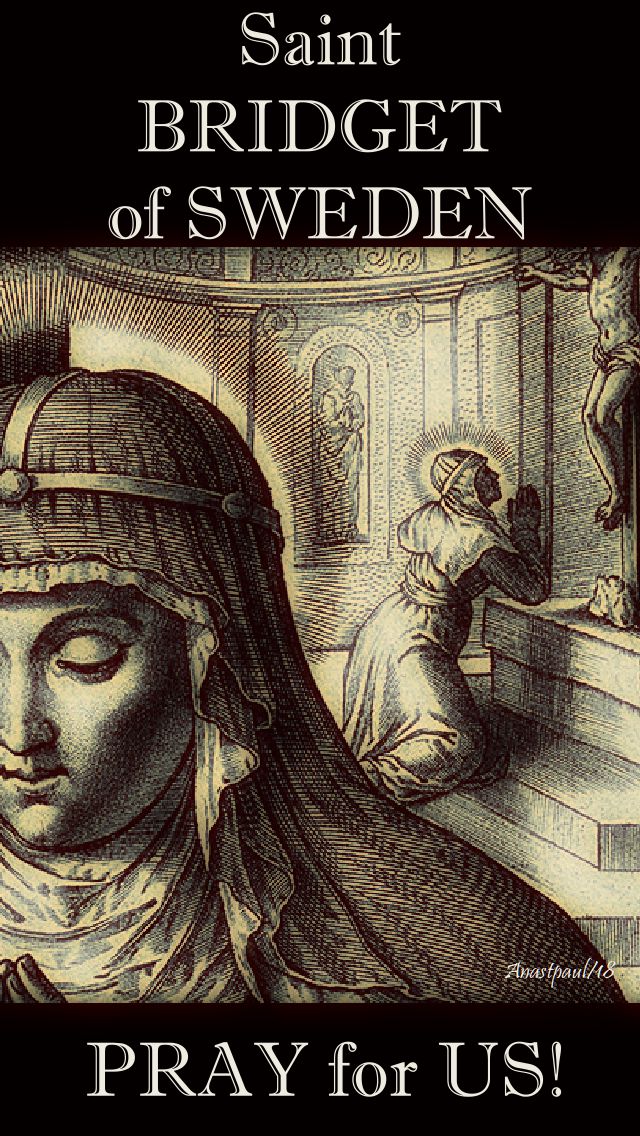
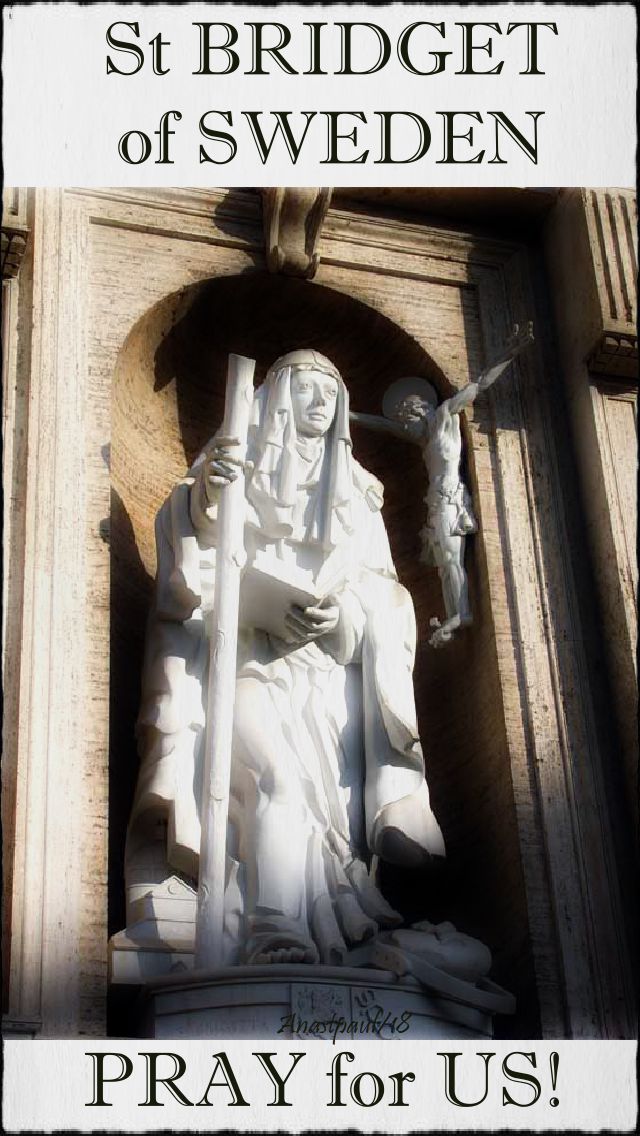
Thought for the Day – 23 July – The Memorial of St Bridget of Sweden (c 1303 – 1373)
The gift of mystical prayer, an experience of a special union with God in love, was given to Bridget. She often had visions of Christ’s passion. However, Bridget was also very practical in living out the Gospel.
After her husband’s death, Bridget founded an order of nuns known as the Bridgetines, who contributed to the culture of Scandinavia. She showed loving concern for people who were poor and sick and many people came to her for help. Bridget made pilgrimages around Italy and even to the Holy Land. She spent her last years in Rome. She urged the pope to leave Avignon in France and return to Rome.
Bridget’s visions, rather than isolating her from the affairs of the world, involved her in many contemporary issues, whether they be royal policy or the years that the legitimate Bishop of Rome lived in Avignon, France. She saw no contradiction between mystical experience and secular activity and her life is a testimony to the possibility of a holy life in the marketplace.
In 1999, Bridget, Saints Catherine of Siena and Teresa Benedicta of the Cross, were named co-patronesses of Europe, together with the co-patrons, St Benedict of Nursia and Sts Cyril and Methodius (the latter two were added in 1980).
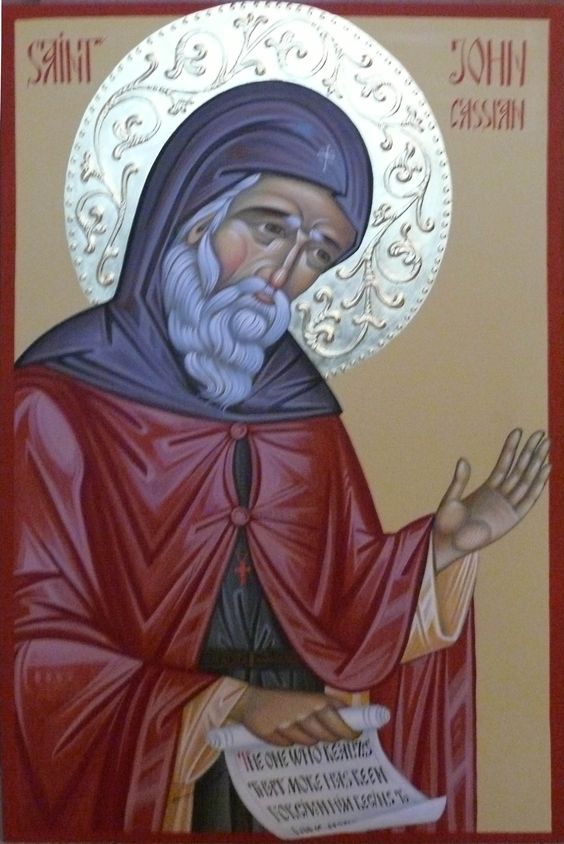
Quote of the Day – 23 July – The Memorial of St John Cassian (c 360- c 435)
“The thief on the cross certainly did not receive the Kingdom of Heaven as a reward for his virtues but as a grace and a mercy from God. He can serve as an authentic witness that our salvation is given to us only by God’s mercy and grace. All the holy masters knew this and unanimously taught that perfection in holiness can be achieved only through humility.”
One Minute Reflection – 23 July – The Memorial of St Bridget of Sweden (c 1303 – 1373) – Today’s Gospel: Matthew 12:38-42
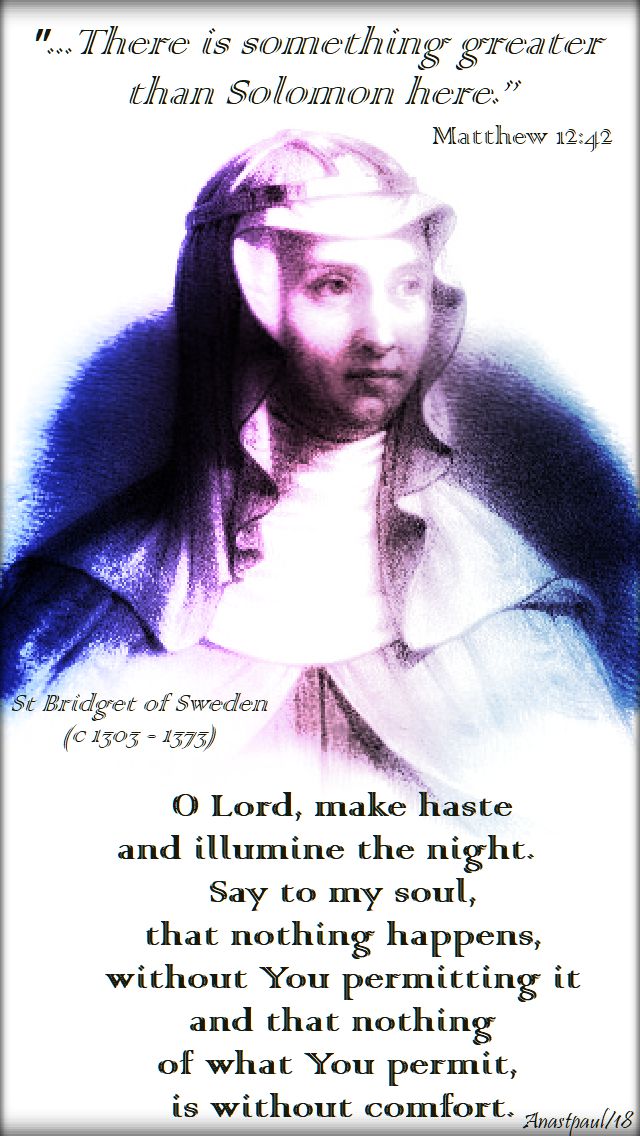
“…There is something greater than Solomon here.”…Matthew 12:42
REFLECTION – “O Lord, make haste and illumine the night. Say to my soul that nothing happens without You permitting it and that nothing of what You permit, is without comfort.”…St Bridget
PRAYER – “O Jesus, Son of God, You Who were silent in the presence of Your accusers, restrain my tongue until I find what should say and how to say it. Show me the way and make me ready to follow it. It is dangerous to delay, yet perilous to go forward. Answer my petition and show me the way. As the wounded go to the doctor in search of aid, so do I come to You. O Lord, give Your peace to my heart. “(St Bridget). And we ask God our Father that the prayers of St Bridget may serve as an aid as we strive to attain virtue, through Christ our Lord, with the Holy Spirit, God forever, amen.
Saint of the Day – 23 July – St John Cassian (c 360 – c 435) Priest, Monk, Theologian, Writer, Founder. Also known as John the Ascetic, or John Cassian the Roman (Latin: Ioannes Eremita Cassianus, Ioannus Cassianus, or Ioannes Massiliensis), was a Christian monk and theologian celebrated in both the Western and Eastern Churches for his mystical writings. St John Cassian is noted for his role in bringing the ideas and practices of Christian monasticism to the early medieval West. He was born in c 360 in Scythia Minor (modern-day Dobrogea, Romania) and died in c 435 in Massilia, Gaul (modern-day Marseilles, France), of natural causes.
Cassian was born around 360, most likely in the region of Scythia Minor (now Dobruja, a historical region shared today by Romania and Bulgaria), although some scholars assume a Gallic origin. The son of wealthy parents, he received a good education: his writings show the influence of Cicero and Persius. He was bilingual in Latin and Greek.
Cassian mentions having a sister in his first work, the Institutes, with whom he corresponded in his monastic life; she may have ended up with him in Marseilles.
Around 380, John Cassian migrated from Romania to Bethlehem, where he embraced the monastic life. After 385 he wandered the Egyptian desert, the heart of eastern monasticism. He visited abbots at monasteries and hermits in their caves, absorbing their teachings about the Christian life.
The year 400 found him on the staff of St John Chrysostom in Constantinople. When Chrysostom was unfairly deposed and exiled, Cassian was among his defenders who travelled to Rome to plead his case before the pope, who was Innocent I. At that time he was ordained a priest.
While he was in Rome, Cassian accepted the invitation to found an Egyptian-style monastery in southern Gaul, near Marseilles. He may also have spent time as a priest in Antioch between 404 and 415. In any case, he arrived in Marseilles around 415. His foundation, the Abbey of St Victor, was a complex of monasteries for both men and women, one of the first such institutes in the West and served as a model for later monastic development.
To instruct his monks and nuns, Cassian wrote two significant books. The Institutes described the eastern pattern of monastic life and the virtues required of monks. The Conferences presented the wisdom of the Egyptian desert in the form of discourses by famous abbots. In the following sample we hear “Abbot Isaac” on the practice of the presence of God:
“To keep the thought of God always in your mind you must cling totally to this formula for piety: ‘Come to my help, O God. Lord, hurry to my rescue’ (see Psalm 70:2).
“With good reason this verse has been chosen from the whole of Scripture as a device. It bears all the feelings that human nature can experience.
It can be adapted to every condition and deployed against every temptation. It carries a cry to God in the face of every danger. It piously confesses humility. It conveys our sense of frailty, our assurance of being heard, our confidence in help that is always and everywhere present. Someone forever calling out to his protector is very sure of his nearness. This short verse is an indomitable wall for all those struggling against the onslaught of demons.
Whatever the disgust, the anguish, or the gloom in our thoughts, it keeps us from despairing of our salvation since it reveals to us the One to whom we call, the One who sees our struggles and who is never far from those who pray to him.
If things go well for us in spirit, this verse is a warning. We must not get puffed up at being in a good condition that we cannot retain without the protection of God for whose continuous and speedy help it prays.
This little verse, I am saying, proves to be necessary and useful to each one of us in all circumstances.”
Cassian’s achievements and writings influenced Saint Benedict, who incorporated many of the principles into his monastic rule and recommended to his own monks that they read the works of Cassian. Since Benedict’s rule is still followed by Benedictine, Cistercian and Trappist monks, John Cassian’s thought still exercises influence over the spiritual lives of thousands of men and women in the Latin Church.
The Church also ranks him as a saint, with a feast day on 23 July. Like his contemporaries Saint Augustine of Hippo and Saint John Chrysostom, he was never formally canonised, a process that came into use several centuries after his death. Pope Urban V referred to him as sanctus (a saint) and he was included in the Gallican Martyrology. He is included also in the Roman Martyrology with a feast-day on 23 July. Like the great majority of recognised saints of the Church, he is not one of the saints in the General Roman Calendar, but the Archdiocese of Marseilles and some monastic orders celebrate his memorial on his feast day.
Cassian’s relics are kept in an underground chapel in the Monastery of St Victor in Marseilles. His head and right hand are in the main church there.
Today laypeople cannot practice the presence of God with the constancy that Cassian demanded. But we can frequently remind ourselves of God’s nearness and draw on his grace by praying “Come to my help, O God. Lord, hurry to my rescue.”
St Anne of Constantinople
St Apollonius of Rome
Bl Basil Hopko
Bl Beaudoin of Beaumont
St Conan of Cornwall
Bl Emilio Arce Díez
St Eugene of Rome
St Herundo of Rome
Bl Jane of Orvieto
St John Cassian (c 360- c 435)
Bl Josep Sala Picó
Bl Juan de Luca
Bl Juan de Montesinos
Bl Leonard da Recanati
Bl Margarita de Maturana
Bl Pedro Ruiz de los Paños Angel
St Phocas the Gardener
St Primitiva of Rome
St Rasyphus of Macé
St Rasyphus of Rome
St Ravennus of Macé
St Redempta of Rome
St Romula of Rome
St Severus of Bizye
St Theophilus of Rome
St Trophimus of Rome
St Valerian of Cimiez
Bl Wojciech Gondek
—
Martyrs of Barcelona – 7 beati: Seven Christians, some lay people, some members of the Missionaries of the Sacred Hearts of Jesus and Mary and some of the Franciscan Daughters of Mercy, who were martyred in two groups on the same day in the Spanish Civil War.
• Catalina Caldés Socías
• Francesc Mayol Oliver
• Miquel Pons Ramis
• Miquela Rul-Làn Ribot
• Pau Noguera Trías
• Prudència Canyelles Ginestà de Aguadé
• Simó Reynés Solivellas
23 July 1936 in Barcelona, Spain. They were Beatified on 28 October 2007 by Pope Benedict XVI.
Martyrs of Bulgaria: An unknown number of Christians killed for their faith during the 9th century war between the Greek Emperor Nicephorus and the Bulgars.
Martyrs of Carabanchel Bajo – 9 beati: A group of nine Passionist priests, brothers and clerics who were martyred together in the Spanish Civil War.
• Anacario Benito Nozal
• Felipe Ruiz Fraile
• Felipe Valcobado Granado
• José Osés Sainz
• José Ruiz Martinez
• Julio Mediavilla Concejero
• Laurino Proaño Cuesta
• Manuel Pérez Jiménez
• Maurilio Macho Rodríguez
22 July 1936 in Carabanchel Bajo, Madrid, Spain. They were Beatified on 1 October 1989 by Pope John Paul II.
Martyrs of Horta – 10 beati: A lay woman and nine Minim nuns who were martyred together in the Spanish Civil War.
• Ana Ballesta Gelmá
• Dolors Vilaseca Gallego
• Josefa Pilar García Solanas
• Josepa Panyella Doménech
• Lucrecia García Solanas
• Maria Montserrat Ors Molist
• Mercè Mestre Trinché
• Ramona Ors Torrents
• Teresa Ríus Casas
• Vicenta Jordá Martí
23 July 1936 at the Sant Genís dels Agudells highway, Horta, Barcelona, Spain. They were Beatified on
27 October 2013 by Pope Benedict XVI.
Martyrs of Manzanares – 5 beati: Five Passionist clerics who were martyred together in the Spanish Civil War.
• Abilio Ramos y Ramos
• Epifanio Sierra Conde
• José Estalayo García
• Vicente Díez Tejerina
• Zacarías Fernández Crespo
They were shot on 23 July 1936 in Manzanares, Ciudad Real, Spain and Beatified on 1 October 1989 by Pope John Paul II.
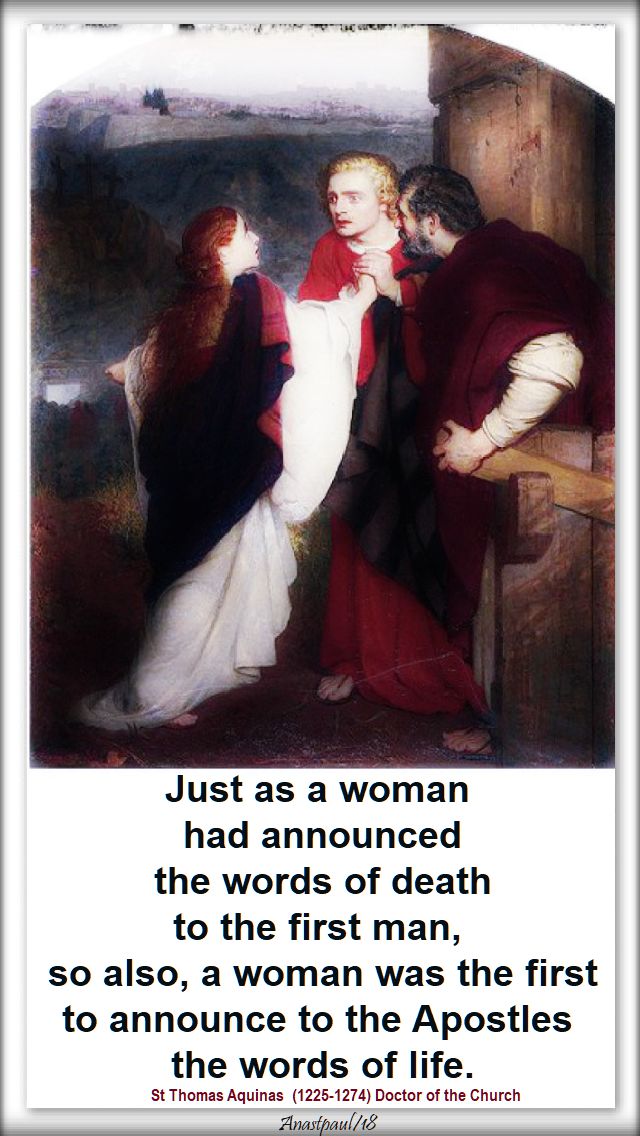
Thought for the Day – 22 July – Feast of St Mary of Magdala
“When Mary Magdalene came to the tomb and did not find the Lord’s body, she thought it had been taken away and so informed the disciples. After they came and saw the tomb, they too believed what Mary had told them. The text then says: “The disciples went back home,” and it adds: “but Mary wept and remained standing outside the tomb.”
We should reflect on Mary’s attitude and the great love she felt for Christ; for though the disciples had left the tomb, she remained. She was still seeking the one she had not found and while she sought she wept; burning with the fire of love, she longed for Him who she thought had been taken away.
And so it happened that the woman who stayed behind to seek Christ was the only one to see Him. For perseverance is essential to any good deed, as the voice of truth tell us: “Whoever perseveres to the end will be saved”…. Jesus says to her: “Mary.” Jesus is not recognised when He calls her “woman”, so He calls her by name, as though He were saying: ‘Recognise me as I recognise you, for I do not know you as I know others, I know you as yourself.’
And so Mary, once addressed by name, recognises who is speaking. She immediately calls Him ‘Rabboni’, that is to say, teacher, because the one whom she sought outwardly was the one who inwardly taught her to keep on searching.”
from a homily by St Pope Gregory the Great (540-604) Father & Doctor
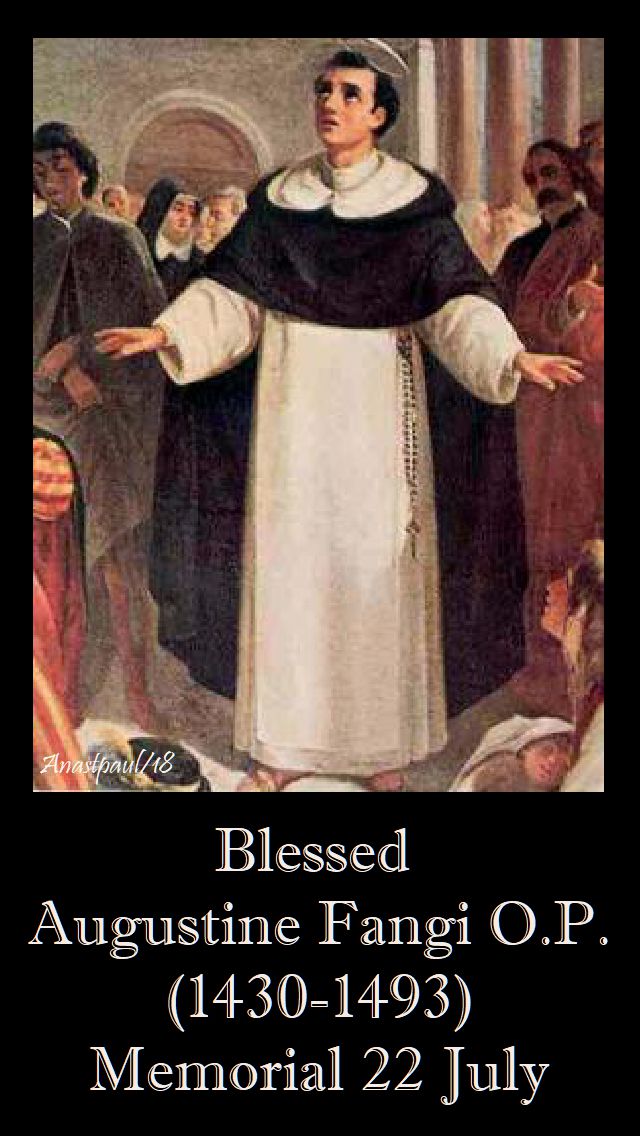
Saint of the Day – 22 July – Blessed Augustine Fangi OP (1430-1493) – Dominican Friar and Priest, Confessor, Mystic, known as “The Miracle Worker,” Augustine of Biella. He was commonly regarded, even in his time, as a miracle worker and, in serving as the Prior of several of his Order’s monasteries, was concerned with restoring and maintaining a faithful observance of the Rule of Saint Dominic. He was born in 1430 at Biella, Piedmont, Italy and died on 22 July 1493 at Venice, Italy of natural causes. In the 1530s, workmen found his coffin floating in the water that had seeped into the burial chamber – when opened, Augustine’s body and clothing were found to be Incorrupt and remains so.
Blessed Augustine’s father was a member of the Fangi family, who were wealthy and noble and, because of this, he had planned a secular career for his son. But when the Dominicans came to Biella, his plans were changed, for Augustine was completely charmed by their way of life and begged to be admitted. He entered, while quite young, the new convent that the Dominicans had built at Biella.
Augustine had a reputation for penance, even at a time when people were not as squeamish as they are today. Not only did he inflict harsh penances upon himself, he also bore with patience whatever pain and annoyance life granted him gratuitously.
One remarkable characteristic noted of Augustine, was his equanimity and ability to concentrate intensely on spiritual matters. One incident recorded, involves a surgical procedure, which he was required to undergo without anesthetic, as such an aid was not available in the fifteenth century. He did so without crying out at all. Afterwards, he simply stated that his mind was so intensely focused on something else that he hardly noticed what was being done. In prayer he was often seen levitating in ecstasy.
In 1464, Augustine was made Prior at Soncino. Several of his best known miracles were performed there. At one time, a deformed child, who had died without baptism, was restored to life, by Augustine’s prayer, long enough to be baptised. At another time, when he was passing down the street, he met a little boy who was crying bitterly, because he had broken a jug of wine. Augustine gathered up the shards and put them back together again. Then, with a prayer, he refilled the jug and handed it back to the startled child. Still another time, through his intercession, a woman was delivered from possession of five devils.
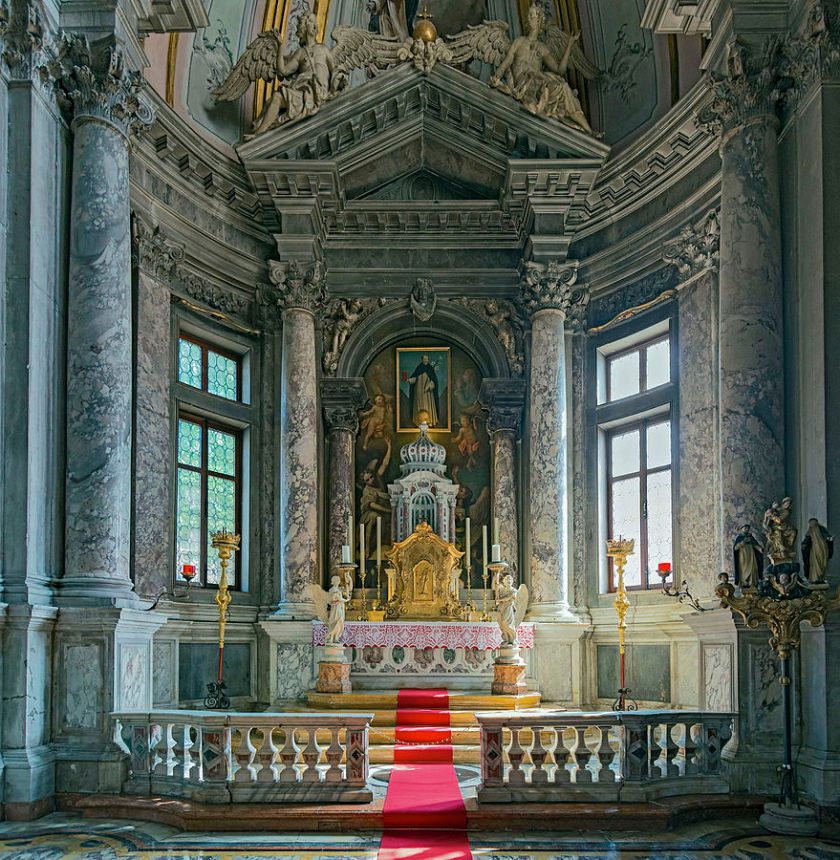
When his coffin, was opened in the 1530s and his body was found to be Incorrupt, interest was again revived in Blessed Augustine. Nevertheless, it was more than three centuries before his cultus was confirmed in 1872 by Pope Pius IX he was finally beatified in 1878 by Pope Leo XIII. His Shrine is at the Chapel of St Dominic in Venice (below).
St Anastasius of Schemarius
St Andrea of Antioch
St Andreas Wang Tianqing
St Anna Wang
Bl Augustine Fangi O.P. (1430-1493)
St Baudry of Montfaucon
Bl Benno of Osnabruck
St Claudius Marius Victorinus of Saussaye
St Cyril of Antioch
St Dabius
Bl Jacques Lombardie
St John Lloyd
St Joseph of Palestine
St Lewine
St Lucia Wang Wangzhi
Bl Manuela de Jesus Arias Espinosa
St Maria Wang Lishi
St Meneleus of Ménat
St Movean of Inis-Coosery
St Pancharius of Besancon
Bl Paolo de Lara
St Philip Evans
St Plato of Ancyra
St Syntyche of Philippi
St Theophilus of Cyprus
St Wandrille of Fontenelle
—
Martyrs of Marula/Massylis: – 3 saints: Three Christians martyred together. We know nothing else about them but the names – Ajabosus, Andrew and Elian. They were martyred in Massylis (Marula), Numidia (in modern Algeria).
Martyrs of Massilitani: A group of Christians martyred together in northern Africa. Saint Augustine of Hippo wrote about them.
Martyred in the Spanish Civil War:
Bl Jaime María Carretero Rojas
Bl Joaquin Rodríguez Bueno
Bl José María Mateos Carballido
Bl Juan Durán Cintas
Bl Ramón María Pérez Sous
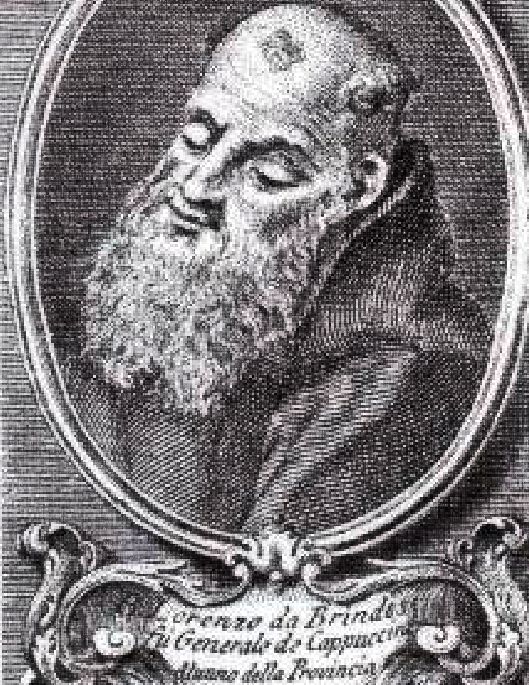
Thought for the Day – 21 July – The Memorial of St Lawrence of Brindisi OFM Cap (1559-1619) Doctor of the Church
St Lawrence’s compassion for the poor moved him to make a dangerous trip to Spain to oppose an oppressive tyrant. He realised that evil has to be opposed and that if good men do not oppose it, the evil will continue and grow.
Our voices – small as they may be – individual or collective – MUST be heard, always, in the cause of truth and justice.
Quote/s of the Day – 21 July – The Memorial of St Lawrence of Brindisi OFM Cap (1559-1619) Doctor of the Church
“God is love and all his operations proceed from love. Once he wills to manifest that goodness by sharing His love outside Himself, then the Incarnation becomes the supreme manifestation of His goodness and love and glory. So, Christ was intended before all other creatures and for His own sake. For Him all things were created and to Him all things must be subject and God loves all creature, in and because of Christ. Christ is the first-born of every creature and the whole of humanity. as well as the created world, finds its foundation and meaning in Him. Moreover, this would have been the case, even if Adam had not sinned.”
“God is love and all His operations proceed from LOVE…”
“For Him all things were created and to Him all things must be subject and God loves all creature, in and because of Christ.”
“Christ is the first-born of every creature and the whole of humanity. as well as the created world, finds its foundation and meaning in Him.”
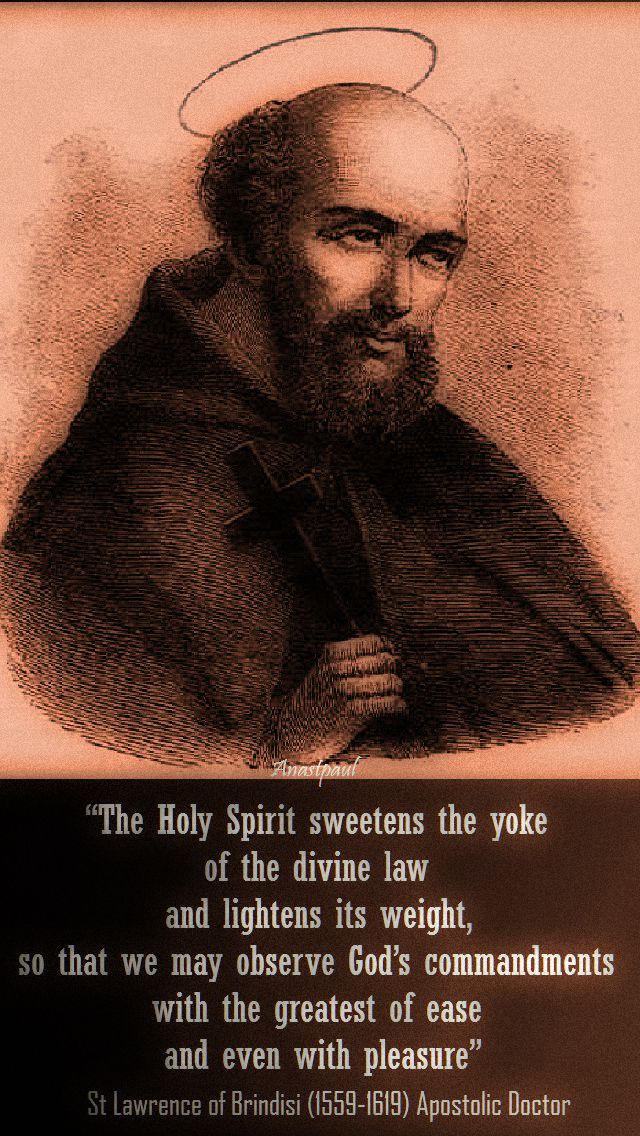
“The Holy Spirit sweetens the yoke of the divine law and lightens its weight, so that we may observe God’s commandments with the greatest of ease and even with pleasure”
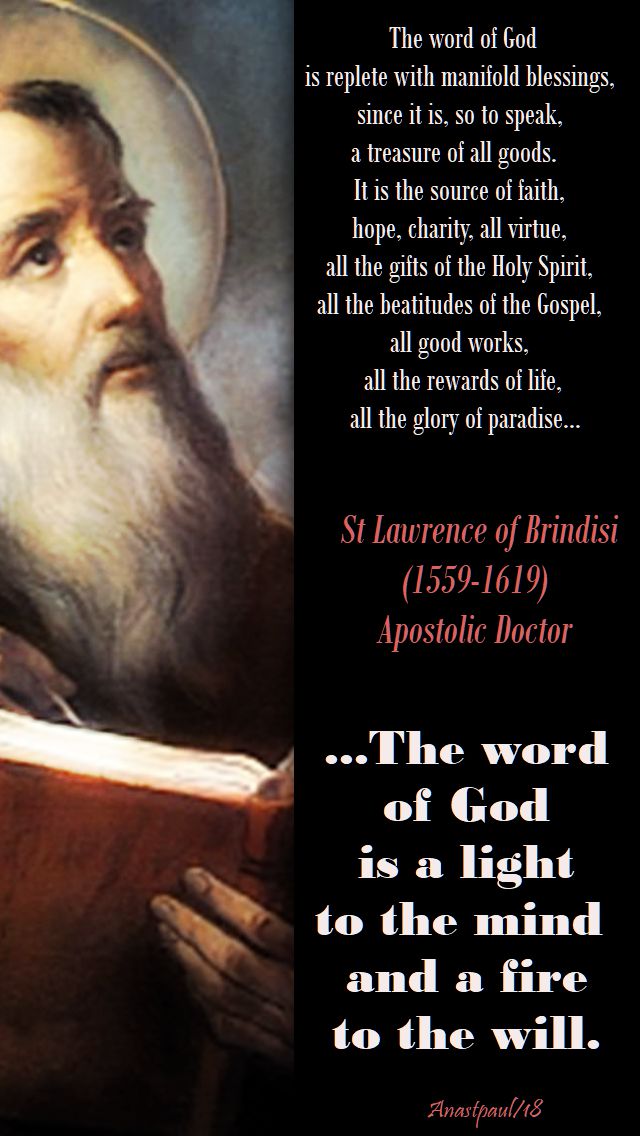
“The word of God is replete with manifold blessings, since it is, so to speak, a treasure of all goods. It is the source of faith, hope, charity, all virtue, all the gifts of the Holy Spirit, all the beatitudes of the Gospel, all good works, all the rewards of life, all the glory of paradise…”
“…The word of God is a light to the mind and a fire to the will.”
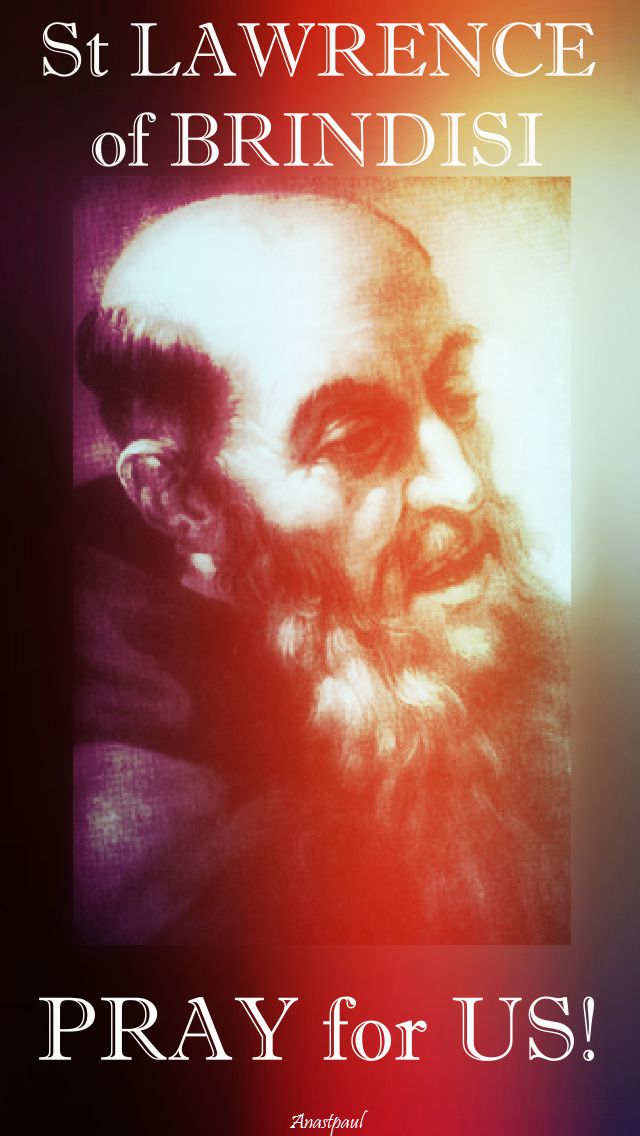
St Lawrence of Brindisi(1559-1619) Apostolic Doctor
One Minute Reflection – 21 July – Saturday of the Fifteenth week in Ordinary Time – The Memorial of St Lawrence of Brindisi OFM Cap (1559-1619) Doctor of the Church – Today’s Readings: Micah 2:1-5, Psalm 10:1-4, 7-8, 14, Matthew 12:14-21
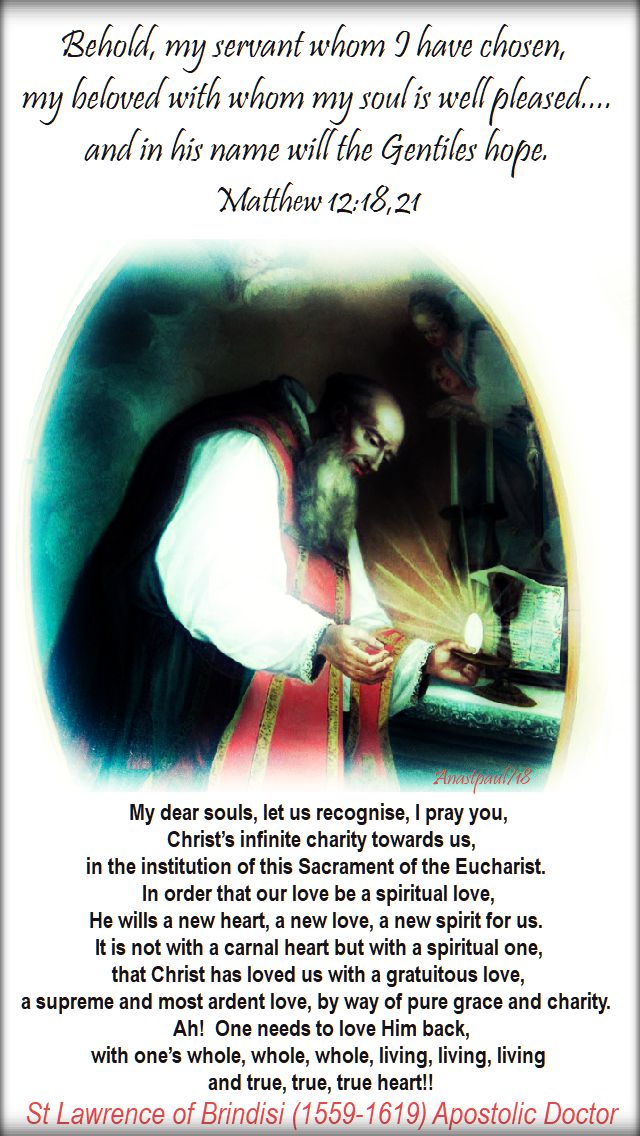
“Behold, my servant whom I have chosen, my beloved with whom my soul is well pleased…. and in his name will the Gentiles hope.”…Matthew 12:18,21
REFLECTION – “My dear souls, let us recognise, I pray you, Christ’s infinite charity towards us, in the institution of this Sacrament of the Eucharist. In order that our love be a spiritual love, He wills a new heart, a new love, a new spirit for us. It is not with a carnal heart but with a spiritual one, that Christ has loved us with a gratuitous love, a supreme and most ardent love, by way of pure grace and charity. Ah! One needs to love Him back with one’s whole, whole, whole, living, living, living and true, true, true heart!!” …… St Lawrence of Brindisi (1559-1619) Apostolic Doctor
PRAYER – Lord God, You bestowed on St Lawrence of Brindisi the spirit of counsel and fortitude, so that Your name might be glorified and souls be saved. At the intercession of St Lawrence, grant that we may see what we have to do and, in Your mercy give us the strength to do it and the courage, love and charity to persevere. Grant above all, that by his prayers we may love You above all and with all we are. St Lawrence pray for us, amen.
Our Morning Offering – 21 July – The Memorial of St Lawrence of Brindisi OFM Cap (1559-1619) Doctor of the Church – Today’s Readings: Micah 2:1-5, Psalm 10:1-4, 7-8, 14, Matthew 12:14-21
“Woe to those who devise wickedness and work evil upon their beds!”…Micah 2:1
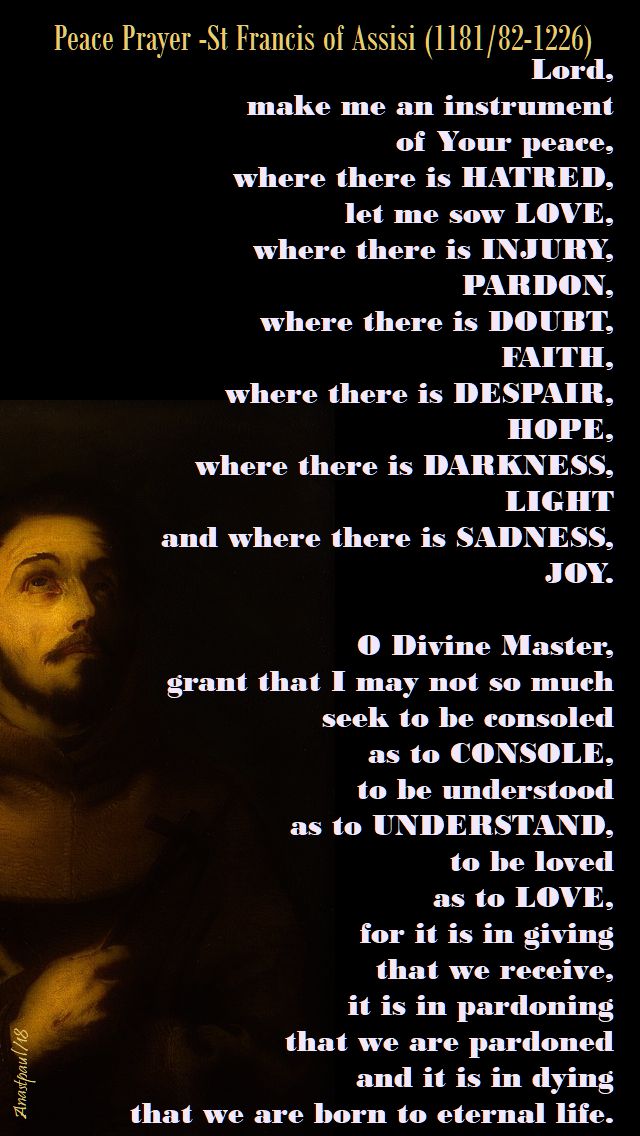
The Peace Prayer
By St Francis of Assisi (c 1181-1226)
Lord, make me an instrument of Your peace, where there is hatred, let me sow love, where there is injury, pardon, where there is doubt, faith, where there is despair, hope, where there is darkness, light and where there is sadness, joy. O Divine Master, grant that I may not so much seek to be consoled as to console, to be understood as to understand, to be loved as to love, for it is in giving that we receive, it is in pardoning that we are pardoned and it is in dying that we are born to eternal life.
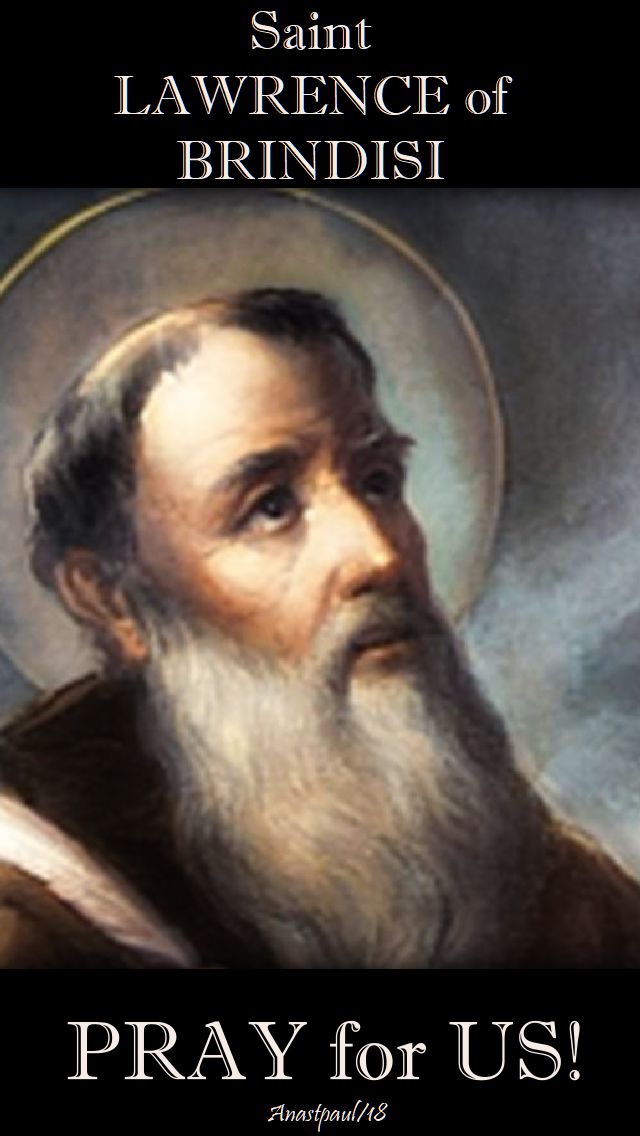
Saint of the Day – 21 July – St Lawrence of Brindisi OFM Cap (1559-1619) Doctor of the Church. He was created a Doctor of the Church by St Pope John XXIII in 1959 with the title Doctor apostolicus (Apostolic Doctor). Patronages – Brindisi, Italy.
St Lawrence is known as the “Franciscan Renaissance Man” – he was a Religious member of the Franciscan Friars Minor Capuchin, a Priest, Theologian, Vicar General of the Franciscans, Language scholar, Apologist of immense and calm resources, Humanist, Philosopher, Biblicist, Preacher, Missionary, Professor, International Administrator, Confidant of Popes, Emperors, Kings and Princes, Diplomatic envoy, Army Chaplain, Military Strategist and Morale builder, Polemicist, Prolific writer.
Saint Lawrence of Brindisi
By Pope Benedict XVI
General Audience, 23 March 2011
I still remember with joy the festive welcome I was given in Brindisi in 2008. It was in this city that in 1559 was born a distinguished Doctor of the Church, St Lawrence of Brindisi, the name that Julius Caesar Russo took upon entering the Capuchin Order.
He had been attracted since childhood by the family of St Francis of Assisi. In fact, his father died when he was seven years old and his mother entrusted him to the care of the Friars Minor Conventual in his hometown. A few years later, however, Lawrence and his mother moved to Venice and it was precisely there that he became acquainted with the Capuchins who in that period were generously dedicated to serving the whole Church in order to further the important spiritual reform promoted by the Council of Trent.
With his religious profession in 1575, Lawrence became a Capuchin friar and in 1582 he was ordained a priest. During his ecclesiastical studies for the priesthood he already showed the eminent intellectual qualities with which he had been endowed. He learned with ease the ancient languages, such as Greek, Hebrew and Syriac, as well as modern languages, such as French and German. He added these to his knowledge of Italian and of Latin that was once spoken fluently by all clerics and by all cultured people. Thanks to his mastery of so many languages, Lawrence was able to carry out a busy apostolate among the different categories of people. As an effective preacher, his knowledge, not only of the Bible but also of the rabbinic literature, was so profound that even the Rabbis, impressed and full of admiration, treated him with esteem and respect.
As a theologian steeped in Sacred Scripture and in the Fathers of the Church, he was also able to illustrate Catholic doctrine in an exemplary manner to Christians who, especially in Germany, had adhered to the Reformation. With his calm, clear exposition he demonstrated the biblical and patristic foundation of all the articles of faith disputed by Martin Luther. These included the primacy of St Peter and of his Successors, the divine origin of the Episcopate, justification as an inner transformation of man, and the need to do good works for salvation. Lawrence’s success helps us to realise that today too, in pursuing ecumenical dialogue with such great hope, the reference to Sacred Scripture, interpreted in accordance with the Tradition of the Church, is an indispensable element of fundamental importance. I wished to recall this in my Apostolic Exhortation Verbum Domini (n. 46). Even the simplest members of the faithful, those not endowed with great culture, benefited from the convincing words of Lawrence, who addressed humble people to remind them all to make their lives consistent with the faith they professed.
This was a great merit of the Capuchins and of other religious Orders which, in the 16th and 17th centuries, contributed to the renewal of Christian life, penetrating the depths of society with their witness of life and their teaching. Today too, the new evangelisation stands in need of well-trained apostles, zealous and courageous, so that the light and beauty of the Gospel, may prevail over the cultural tendencies of ethical relativism and religious indifference and transform the various ways of thinking and acting into genuine Christian humanism.
It is surprising that St Lawrence of Brindisi was able to continue without interruption his work as an appreciated and unflagging preacher in many cities of Italy and in different countries, in spite of holding other burdensome offices of great responsibility. Indeed, within the Order of Capuchins he was professor of theology, novice master, for several mandates minister provincial and definitor general and finally, from 1602 to 1605, minister general. In the midst of this mountain of work, Lawrence cultivated an exceptionally fervent spiritual life. He devoted much time to prayer and, especially, to the celebration of Holy Mass — often protracted for hours — caught up in and moved by the memorial of the Passion, death and Resurrection of the Lord.
At the school of the saints, every priest, as was emphasised frequently during the recent Year for Priests, may only avoid the danger of activism — acting, that is, without remembering the profound motives of his ministry — if he attends to his own inner life.
In speaking to priests and seminarians in the Cathedral of Brindisi, St Lawrence’s birthplace, I recalled that “the time he spends in prayer is the most important time in a priest’s life, in which divine grace acts with greater effectiveness, making his ministry fruitful. The first service to render to the community is prayer. And, therefore, time for prayer must be given true priority in our life… if we are not interiorly in communion with God, we cannot even give anything to others. Therefore, God is the first priority. We must always reserve the time necessary to be in communion of prayer with Our Lord” (Address of Benedict XVI to priests, deacons and seminarians of the Archdiocese of Brindisi, Cathedral of Brindisi, 15 June 2008).
Moreover, with the unmistakable ardour of his style, Lawrence urged everyone and not only priests, to cultivate a life of prayer, for it is through prayer that we speak to God and that God speaks to us: “Oh, if we were to consider this reality!”, he exclaimed. “In other words that God is truly present to us when we speak to him in prayer; that he truly listens to our prayers, even if we pray only with our hearts and minds. And that not only is he present and hears us, indeed he willingly and with the greatest of pleasure wishes to grant our requests”.
Another trait that characterises the opus of this son of St Frances, is his action for peace. Time and again both Supreme Pontiffs and Catholic Princes entrusted him with important diplomatic missions, to settle controversies and to encourage harmony among the European States, threatened in those days by the Ottoman Empire. The moral authority he enjoyed made him a counsellor both sought after and listened to. Today, as in the times of St Lawrence, the world is in great need of peace, it needs peaceful and peacemaking men and women. All who believe in God must always be sources and artisans of peace.
It was precisely on the occasion of one of these diplomatic missions that Lawrence’s earthly life ended, in 1619 in Lisbon, where he had gone to see King Philip III of Spain, to plead the cause of the Neapolitan subjects oppressed by the local authorities.
He was Canonised in 1881 and his vigorous and intense activity, his vast and harmonious knowledge, earned him the title of Doctor Apostolicus, “Apostolic Doctor”. The title was conferred on him by St Pope John XXIII in 1959, on the occasion of the fourth centenary of his birth. This recognition was also granted to Lawrence of Brindisi because he was the author of numerous works of biblical exegesis, theology and sermons. In them he offers an organic presentation of the history of salvation, centred on the mystery of the Incarnation, the greatest expression of divine love for humankind.
Furthermore, since he was a highly qualified Mariologist, the author of a collection of sermons on Our Lady entitled “Mariale”, he highlighted the unique role of the Virgin Mary, whose Immaculate Conception and whose role in the redemption brought about by Christ he clearly affirms.
With a fine theological sensitivity, Lawrence of Brindisi also pointed out the Holy Spirit’s action in the believer’s life. He reminds us that the Third Person of the Most Holy Trinity illumines and assists us with his gifts in our commitment to live joyously the Gospel message.
“The Holy Spirit”, St Lawrence wrote, “sweetens the yoke of the divine law and lightens its weight, so that we may observe God’s commandments with the greatest of ease and even with pleasure”.
I would like to complete this brief presentation of the life and doctrine of St Lawrence of Brindisi by underlining that the whole of his activity was inspired by great love for Sacred Scripture, which he knew thoroughly and by heart and by the conviction that listening to and the reception of the word of God produces an inner transformation that leads us to holiness.
“The word of the Lord”, he said, “is a light for the mind and a fire for the will, so that man may know and love God. For the inner man, who lives through the living grace of God’s Spirit, it is bread and water but bread sweeter than honey and water better than wine or milk…. It is a weapon against a heart stubbornly entrenched in vice. It is a sword against the flesh, the world and the devil, to destroy every sin”.
St Lawrence of Brindisi teaches us to love Sacred Scripture, to increase in familiarity with it, to cultivate daily relations of friendship with the Lord in prayer, so that our every action, our every activity, may have its beginning and its fulfilment in him. This is the source from which to draw so that our Christian witness may be luminous and able to lead the people of our time to God….vatican.va Pope Benedict
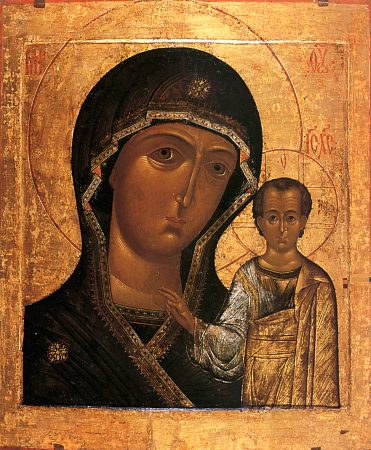
Our Lady of Kazan: This miraculous icon, also known as the Theotokos of Kazan, is thought to have originated in Constantinople in the 13th century before it was taken to Russia. When the Turks took Kazan in 1438, the icon may have been hidden. Ivan the Terrible liberated Kazan in 1552 and the town was destroyed by fire in 1579.
The icon was eventually found in the ruins of a burnt-out house at Kazan on the River Volga on 8 July in 1579. According to tradition, the location of the icon was revealed during a dream by the Blessed Virgin Mary to a ten year old girl named Matrona. Matrona told the local bishop of her dream, but he did not believe her. There were two more similar dreams, after which Matrona and her mother went to the place indicated by the Blessed Virgin and dug in the ruins what had been a house until the uncovered the icon. It appeared untouched by the flames, with the colours as vivid and brilliant as if it were new. The bishop took the icon to the Church of Saint Nicholas and immediately there was a miracle of a blind man’s sight being restored to him. A monastery was built over the place where the icon had been found.
Known as the Holy Protectress of Russia, the icon was stolen on 29 June 1904. The thieves were later caught and claimed that they had destroyed the icon after taking the gold frame and jewels attached to the image. In any event, the original has never been found, though there are many copies in existence, thanks to the popularity of the icon. Many of the copies are known to be miracle working.
In 1993 a copy of the icon was given to Pope John Paul II, who kept it in his personal study before it was given to representatives of the Russian Orthodox Church in 2004.
Bl Agrícola Rodríguez García de Los Huertos
St Alberic Crescitelli
St Arbogast of Strasbourg
St Barhadbescialas
St Benignus of Moyenmoutier
Bl Claudius of Avignon
St Claudius of Troyes
St Corona of Marceille
Bl Cristóbal López de Valladolid Orea
Bl Daniel Molini
St Daniel the Prophet
St Eleutherius of Marseille
St Eternus of Evreaux
Bl Gabriel Pergaud
St Iosephus Wang Yumei
St John of Edessa
St John of Moyenmoutier
Bl Juan de Las Varillas
Bl Juan de Zambrana
St Jucundinus of Troyes
St Julia of Troyes
St Justus of Troyes
Bl Parthenius of Thessaly
St Praxides of Rome
St Simeon Salus
St Victor of Marseilles
St Wastrada
St Zoticus of Comana
—
Martyrs of Africa – 6 saints: Six Christians who were martyred together. We know no other details about them but the names – Emilian, Hugal, Motanus, Saphus, Stercorius and Victor. They were martyred in an unknown location in Africa, date unknown.
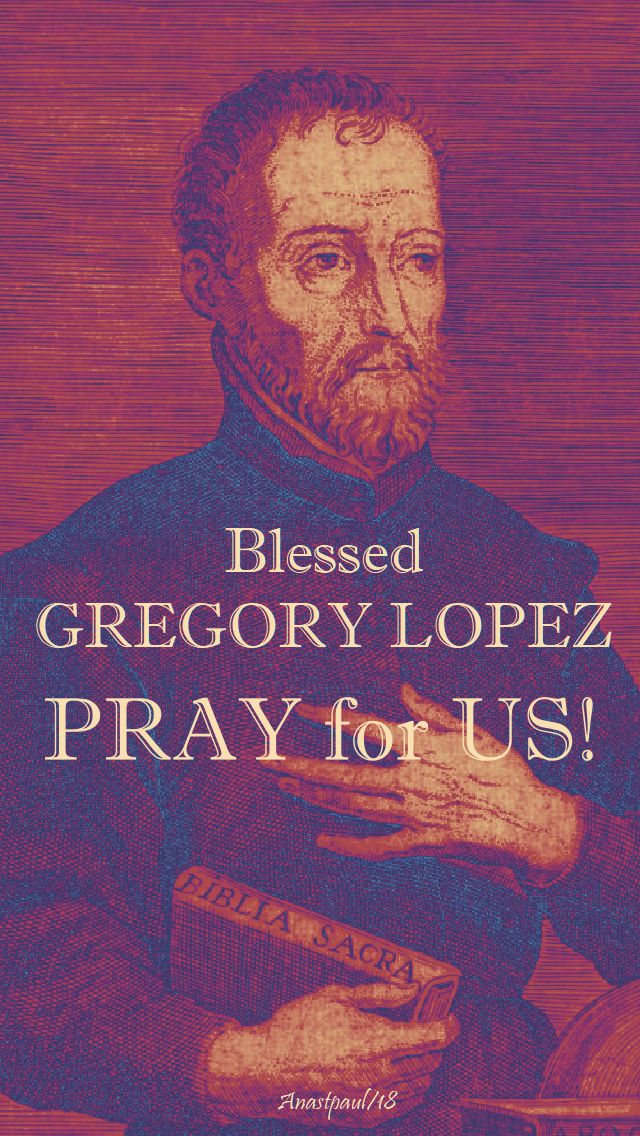
Thought for the Day – 20 July – The Memorial of Bl Gregory Lopez (1542-1596)
There are no patterns for sainthood and the Saints break all moulds.
God is interested in us, right where we are. He has placed us there and our own particular circumstances are as good a place as any other to become a saint . Holiness is within our reach! Only He knows where our pathways will lead. As Blessed Gregory and all our Saints show, it is about abandoning ourselves to Him and living our lives, where we are, in and for Him alone, keeping our eyes ever fixed on Christ . Over the course of time, our prayer evolves from acceptance of God’s will to a conscious act of love of God, to a devotion to and imitation of the person of Jesus, the Logos.
His Biographer, Fr Francisco de Losa said: “His soul appeared to be disengaged from all things else by a pure union with God.”
And as López said to him: “It is much better to treat with God than with man….The eyes of the true man are always fixed on Christ, who is his head and the soul that is touched with love of God is like a needle that is touched with the lodestone always pointing to the North.”…Blessed Gregory
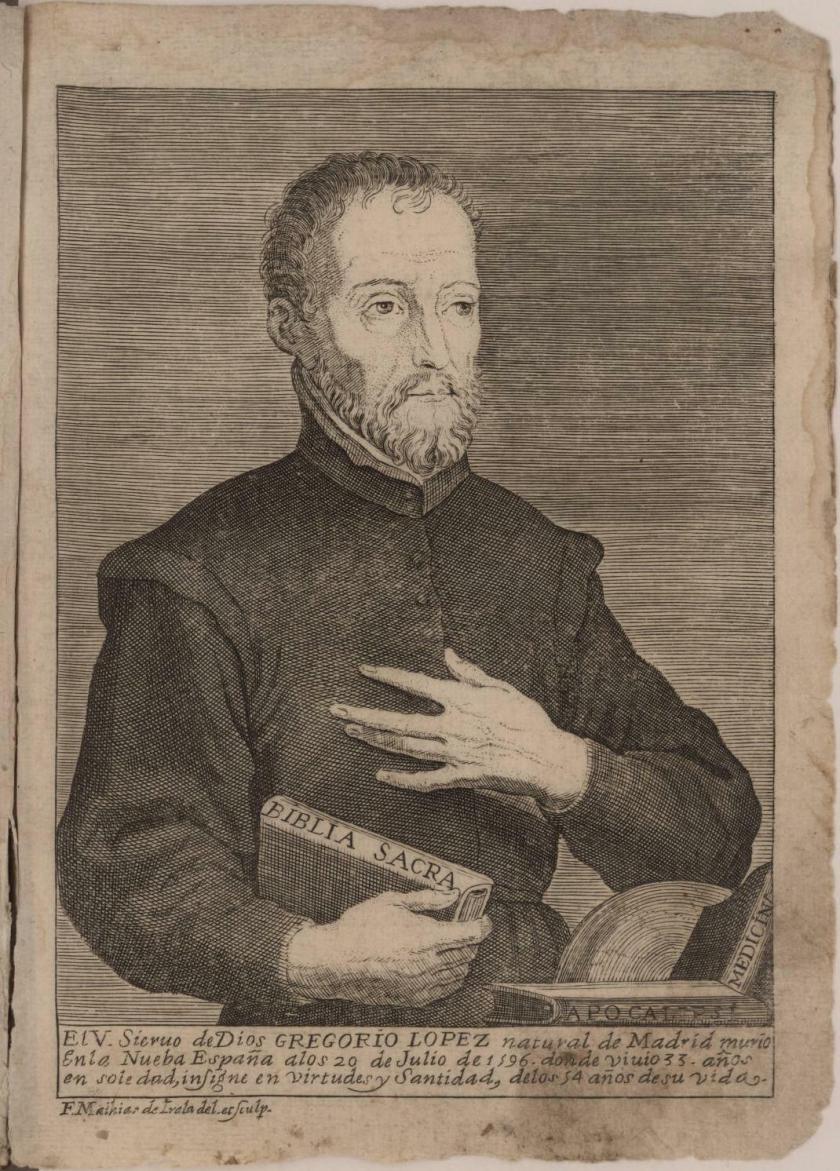
An old print of this servant of God states in a few lines:
“The miser runs o’er sea and land His riches to increase, But Lopez, on the other hand, For poverty and peace.”
Many miracles were ascribed to him in life and after death. In February, 1620, the King of Spain ordered his Treatise on the Apocalypse published, adding, “I do not wish to lose a single moment in procuring the canonisation of this holy man, who,” as he says elsewhere, “passed thirty-three years in solitude in a marvellous penance, humility and love of God and his neighbour and had an admirable gift of prayer and understanding of the Holy Scriptures and the supernatural and human sciences, with the general approbation of the prelates and people of Mexico.” In fact, in the examinations that took place, bishops and theologians of all the religious orders, bore unanimous testimony to his extraordinary virtue and progress in the science of the saints.
One Minute Reflection – 20 July – Friday of the Fifteenth week in Ordinary Time, B – Today’s First Reading: Isaiah 38:1-6.,1-22,7-8 and the Memorial of Bl Gregory Lopez (1542-1596)
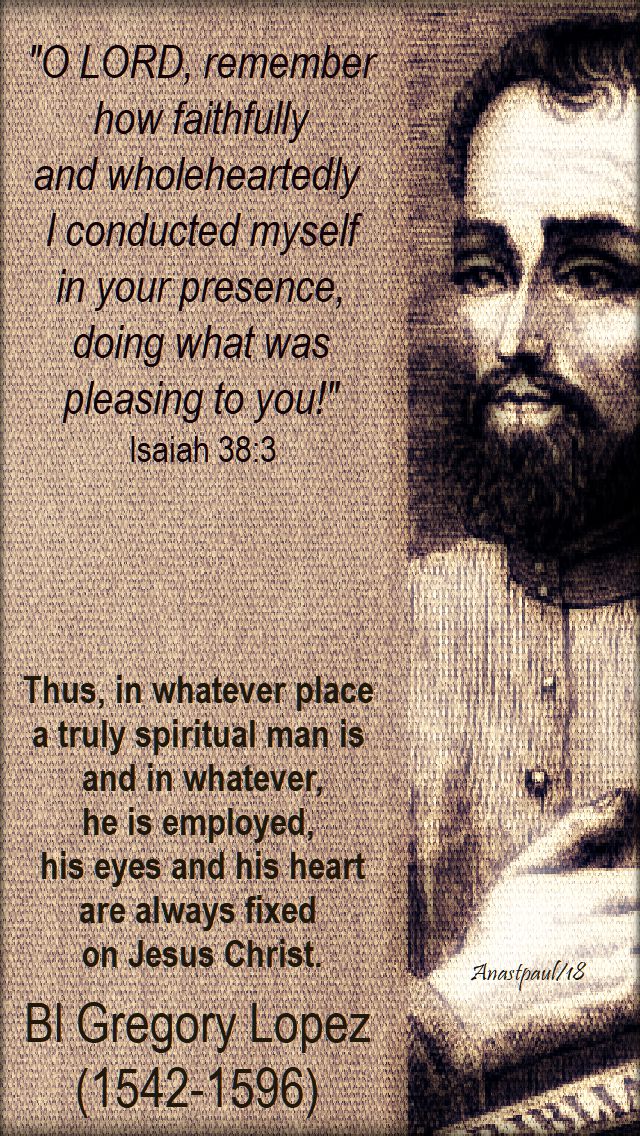
“O LORD, remember how faithfully and wholeheartedly I conducted myself in your presence, doing what was pleasing to you!” ….Isaiah 38:3
REFLECTION – “Thus, in whatever place a truly spiritual man is and in whatever, he is employed, his eyes and his heart are always fixed on Jesus Christ.”…Blessed Gregory Lopez
PRAYER – Almighty Father, let Your light so penetrate our minds, that walking by Your commandments, we may always follow You, our leader and our guide. Turn our hearts to see Your Son who “goes before us” and help us to never lose sight of His saving way. May the prayers of all Your holy ones in heaven, who are our examples and those of Blessed Gregory, be of assistance to us as we walk our earthly journey. We make our prayer through Christ, our Lord, amen.
Saint of the Day – 20 July – Blessed Gregory Lopez (1542-1596) – Hermit, Spiritual Advisor, Writer. Born on 4 July 1542 at Madrid, Spain and died on 20 July 1596 of natural causes near Mexico City.
Around 1585, word of a “Mystery Man” began to leak into Mexico City, a strange hermit who lived out in the lonely valley of Guesteca, who walked miles to go to Mass, lived totally subject to “Lady Poverty” and had travelled from the Shrine of Our Lady of Guadalupe in Spain (which dates from 712), to her Shrine in Mexico (which dates from 1531). Disturbed by the wagging tongues of the day and the stories becoming exaggerated with the telling, the Archbishop of Mexico, set up an investigating commission to examine the matter. What they discovered was quite remarkable and Blessed Gregory had to find a new place to hide.
He had been a Page in the Court of Philip II of Spain and while visiting the Shrine of Our Lady of Guadalupe in Estremadura, had heard of the Shrine of the same name in Mexico. He sold all his possessions and gave the money to the poor and then went to Mexico convinced that God would show him what to do. In Mexico, he went in search of a place to live as a hermit. He found a suitable place in Guesteca, walked 24 miles to Mass on Sundays and Feast days and caused a lot of gossip by his unusual way of life. To quiet the tongues, he lived on a plantation for a while to attend daily Mass regularly but after the earthquake of 1566, he returned to his hermitage.
Our Lady of Guadalupe in Estremadura
He thought he should perhaps become a Dominican Friar but he found that community life was not for him and returned to his solitude. When the Archbishop approved his way of life and Blessed Gregory became too popular, he went to work in a hospital and wrote a book on pharmacy for the nursing brothers.
In 1589, a priest friend, Fr Francisco de Losa (1536-1634) helped him to set up a Hermitage near his Parish. At this point, Fr Losa could more carefully observe the piety of his charge and the biography focuses on this aspect. Fr Losa was so edified that he retires from his pastoral duties to accompany and observe his friend.
“I then observed both day and night all his actions and words with all possible attention, to see if I could discover anything contrary to the high opinion which I had of his virtue. But far from this, his behaviour appeared everyday more admirable than before, his virtue more sublime and his whole conversation rather divine than human.”
They spent time in scriptural study, long hours in prayer and became Spiritual advisors to many. Fr Losa notes a typical day. Gregory would rise, wash, read a little, then fall into a “recollection”: “All one could conjecture from the tranquility and devotion which appeared in his countenance was that he was in the continual presence of God.” They would dine at one o’clock, afterwards engage in conversation or one might read aloud as a recreation. Then Gregory would return to his room until the next day, though sometimes he received visitors; in his last years the visitors were often ecclesiastics, the learned, or the nobility, going away much edified. Gregory’s routine remained not to use a candle and he retired by about 9:30 in the evening. Towards his last years he had reluctantly accepted the sheepskin quilt offered by Fr Losa and a bed rather than the floor. In any case, he seldom slept more than a few hours.
Among the virtues of Gregory was his mildness, patience, and humility — though he must have suffered greatly from his physical pain (a bad intestinal illness which caused bleeding). He never judged others: “For many years I have judged no man but believed all to be wiser and better than me. I have not pretended to set myself up above others or to assume any authority over others.”
He never complained, and Fr Losa says, “I never heard him speak one single word that could be reproved.” His conversation was never but “useful and spiritual,” though he preferred silence. Gregory used to say that “My silence will edify more than my words” and “I see that many talk well, but let us live well.” Ultimately, however, Gregory no longer identified with this world: “Ever since I came to New Spain I have never desired to see anything in this world, not even my relations, friends or country.”
Fr Losa attests to the vast knowledge of López, of ecclesiastical and profane history, ancient to contemporary, of astronomy, cosmography, geography, botany, zoology, anatomy, medicine and botanicals. These topics did not distract López from his spirituality, however, for he told Losa, “I find God alike in little things and in great.”
But his spiritual discernment was keen and Fr Losa says that Gregory “saw spiritual things with the eyes of his soul as clearly as outward things with those of his body and had an amazing accuracy in distinguishing what was of grace and what of nature.” For this Blessed Gregory was often consulted by visitors as if he was an “oracle from heaven, as a prodigy of holiness.” One can imagine how this edified Fr Losa, for in 1579 he began writing about López, even while yet a rector of a large parish in Mexico City.
Blessed Gregory remained a hermit all his life, wishing always to be alone with God. When he died in 1596 at the age of 54, miracles were attributed to him almost immediately. He was a most unusual man, who took his own path to holiness and remained convinced that it was the will of God for him. His fame reached as far as England, France and Germany. The sickness that had dogged him returned one last time in 1596. He lost all appetite and could swallow only liquids. The bloody flux would not stop and he grew progressively weaker. He told Fr Losa that he had entered “God’s time” and his comportment would consist in doing and not in talking. Fr Losa records that “I never perceived in him during his whole illness any repugnance to the order of God but an admirable peace and tranquillity, with an entire conformity to His will. All his virtue shone marvellously in his sickness, particularly his humility.” López died in July 1595 at 54 years of age, 34 of them spent in the New World. Due to the unflagging efforts of Losa, Gregory López was eventually named “Blessed” but was never formally beatified though he is regarded as having received equipollent Beatification and is highly revered most especially in Mexico and Spain. Interestingly, many Protestants including John Wesley, revered him as a man of wonderful holiness.
St Apollinaris of Ravenna Disciple of St Peter – Martyr (Optional Memorial)
Bl Anne Cartier
St Ansegisus
St Aurelius of Carthage
St Bernward of Hildesheim
St Cassian of Saint Saba
St Chi Zhuze
St Elijah the Prophet
St Elswith
Bl Gregory Lopez (1542-1596)
St José María Díaz Sanjurjo
St Joseph Barsabas
Bl Luigi Novarese
St Margaret of Antioch
St Maria Fu Guilin
St Mère
St Paul of Saint Zoilus
St Rorice of Limoges
St Severa of Oehren
St Severa of Saint Gemma
St Wulmar
—
Martyrs of Corinth – 22 saints: 22 Christians who were martyred together. We know nothing else about them but the names – • Appia • Calorus • Cassius • Celsus • Cyriacus • Donatus • Emilis • Felix • Fructus • Magnus • Maximus • Nestita • Partinus • Pasterus • Paul • Romanus • Spretus • Tertius • Theodolus • Ueratia • Valerian • Victor. They were martyred in Corinth, Greece.
Martyrs of Damascus – 16 saints: 16 Christians who were martyred together. We know the names of six of then, but no details about any of them – Cassia, Julian, Macrobius, Maximus, Paul and Sabinus. They were martyred in Damascus, Syria, date unknown.
Martyrs of Seoul – 8 saints: Eight lay native Koreans in various states of life who were murdered together for their faith.
• Anna Kim Chang-gum
• Ioannes Baptista Yi Kwang-nyol
• Lucia Kim Nusia
• Magdalena Yi Yong-hui
• Maria Won Kwi-im
• Martha Kim Song-im
• Rosa Kim No-sa
• Theresia Yi Mae-im
They were martyred on 20 July 1839 at the Small West Gate, Seoul, South Korea and Canonised on 6 May 1984 by St Pope John Paul.
Martyrs of Zhaojia – 3 saints: Married lay woman and her two daughters in the apostolic vicariate of Southeastern Zhili, China. During the persecutions of the Boxer Rebellion, the three of them hid in a well to avoid being raped. They were found, dragged out, and killed for being Christian. Martyrs. They were – Maria Zhao Guoshi (mother), Maria Zhao and Rosa Zhao (sisters). They were martyred in late July 1900 in Zhaojia, Wuqiao, Hebei, China.
Martyrs of Zhujiahe – 4 saints: Two Jesuit missionary priests and two local lay people who supported their work who were martyred together in the Boxer Rebellion during and immediately after Mass.
• Léon-Ignace Mangin
• Maria Zhu Wushi
• Paul Denn
• Petrus Zhu Rixin
They were martyred on 20 July 1900 in church in Zhujiahe, Jingxian, Hebei, China and Canonised on 1 October 2000 by St Pope John Paul.
Martyred in the Spanish Civil War:
• Blessed Abraham Furones y Furones
• Blessed Antoni Bosch Verdura
• Blessed Francisca Aldea y Araujo
• Blessed Jacinto García Riesco
• Blessed Joan Páfila Monllaó
• Blessed Josep Tristany Pujol
• Blessed Matías Cardona-Meseguer
• Blessed Rita Josefa Pujalte y Sánchez
• Blessed Vicente López y López














You must be logged in to post a comment.