Saint of the Day – 22 April – Blessed Wolfhelm of Brauweiler (c1020-1091) Abbot of Brauweiler Abbey, near Cologne, Theologian, Writer, Defender of the Doctrine of the Church and of the property of the Church, Miracle-worker. Born in c1020 in the Lower Rhineland (in modern Germany and died on 22 April 1091 at his Monastery of natural causes. Also known as – Wolfelmi Brunwilarensis, Wulfhelm… Wolphelmus… Name means: “the one who protects against the wolf” (Old High German). His sister Bertha, was a Nun of Vilich Abbey, who wrote a Vita of the Abbess Adelheid.
Wolfhelm was the son of a noble family from the Lower Rhine, He received his education at the Cathedral school in Cologne under Archbishop St Heribert(c970-1021) and then worked there as a teacher.
In Trier in 1036, Wolfhelm entered the Benedictine order in what was then the reform Monastery of St Maximinus. He later relocated to the Monastery in Gladbach – today’s Mönchengladbach – which was subordinate to his uncle, Abbot Heinrich of St Pantaleon in Cologne.
In 1065 he became the 3rd Abbot in Brauweiler. Wolfhelm wrote theological writings, for example in the Sacrament dispute against Berengar of Tours, who questioned the Doctrine of transubstantiation , and he campaigned emphatically for Church buildings and Monastery properties, especially the large Klotten estate on the Moselle River which was disputed between his own Monastery and the Archdiocese of Cologne. By his extreme difficult efforts, he managed to secure this inheritance from Queen Richeza for his Monastery of Brauweiler.
Even during his lifetime, numerous miracles were associated with his person. Around 1115, the Monk Konrad von Brauweiler wrote a life story with the aim of achieving Wolfhelm’s Canonisation.
Saint of the Day – 21 April – Saint Wolbodó of Liège (c950-1021) Bishop, Chaplain to the Emperor, supporter of Monasteries and the Founder of the Monastery of St Lawrence, which became his heir and where he is buried. Born in c950 in Flanders, Belgium and died on 21 April 1021 in Liège, Belgium of natural causes. Patronage – of Students. Also known as – Fulmodo, Vilpodo, Volbodo, Wolbodon.
His biography, although sparse in detail, tells us of a man of noble Flemish lineage, whose education at the Cathedral school of Utrecht, where he became a Canon, a Professor and finally led him to assume the role of Dean of the Cathedral of Saint Martin and, later, of Chaplain to the Court of Henry II.
Appointed as the Bishop of Liège in 1018 and in November of that year he was Consecrated Bishop by St Heribert of Cologne, assisted by Bishop Gerard of Cambrai, in the presence of Emperor Henry II. He led the Diocese with wisdom and devotion until 1021, the year of his death. He was responsible for the foundation of the Abbey of St Lawrence in Liège, testimony to his religious fervour and his commitment to the spread of the cult of the Saints.
St Lawrence Abbey Church
He named Olbert of Gamblou, as head of the Abbey of St James in Liège and in 1020 deposed Ingobrand as the Abbot of Lobbes Abbey, replacing him with Richard of Saint-Vanne. In 1020 he also installed St Poppo, the Prior of the Abbey of Saint-Vaast in Cambrai, as the Abbot of Stavelot Abbey.
In the official recorded listing of the Bishops, Wolbodó appears after Baldéric de Looz and before Durand.
Wolbodó bequeathed his moveables, 300 Marks of silver and his lands in Flanders, to the Abbey of St Lawrence, Liège and was buried in the Abbey’s Crypt which, at the time, was still under construction. In 1656 his tomb was opened and his remains reburied.
Saint Wolbodó is considered the Patron Saint of Students. In Delft, Holland, the Student Society, Menschen Vereeniging Wolbodó, is named after him.
St Conrad of Parzham OFM Cap (1818-1894) Franciscan Religious Lay Friar, Devotee of Blessed Sacrament and Marian, Apostle of Charity, Miracle worker with the charism of prophecy. His heroic virtues and the miracles he performed won for him the distinction to be ranked among the Blessed by Pope Pius XI in 1930. Four years later, the same pope, approving additional miracles which had been performed, solemnly inscribed his name in the list of Saints. Biography: https://anastpaul.com/2018/04/21/saint-of-the-day-21-april-st-conrad-of-parzham-ofm-cap-1818-1894/
St Crotates of Nicomedia St Cyprian of Brescia St Felix of Alexandria St Fortunatus of Alexandria St Frodulphus St Isacius of Nicomedia St Maelrubba of Applecross
St Silvius of Alexandria St Simeon of Ctesiphon St Vitalis of Alexandria Bl Vitaliy Bayrak St Wolbodó of Liège (c950-1021) Bishop
Saint of the Day – 20 April – Saint Peter Caedwalla of Wessex (c658-689) Layman, King of Wessex. Venerable St Bede wrote of him in his Ecclesiastical History of the English People. Born in c658 in Wessex, England and died on 20 April 689 at Rome, Italy. Reign as King of Wessex, 685–688, when he abdicated. Patronages – of converts, of reformed murderers. Also known as – Caedwalla of Wales, Cadwallader, Cadwallador, Cadwalla… Cadwallon… Ceadwalla… Cedualla… Peter Caedwalla.
From St Bede’s Ecclesiastical History of the English People, we learn that Caedwalla was a nobleman of the West Saxons, exiled from his Country as a youth, who returned with an army and killed the reigning Monarch. After much plunder and bloodshed, he became the new King.
Caedwalla then conquered the pagan Isle of Wight and did his best to exterminate all the natives and replace them with settlers from his own region, although Bede states that the natives remained a majority on the island.Although not yet Baptised, Caedwalla is said to have vowed that, should he conquer the Island, he would give a quarter of all the land and his spoils to the God of the Christians. This promise was honoured when he gave the promised bounty to Bishop Wilfrid. Wilfrid appointed a Priest to preach on the Island and to Baptise all who wished to convert to the Christian Faith.
When Cædwalla first attacked the South Saxons, Wilfrid was at the court of King Æthelwealh and on Æthelwealh’s death, Wilfrid attached himself to Cædwalla. The Life of Wilfrid records that Cædwalla sought Wilfrid out as a spiritual father.
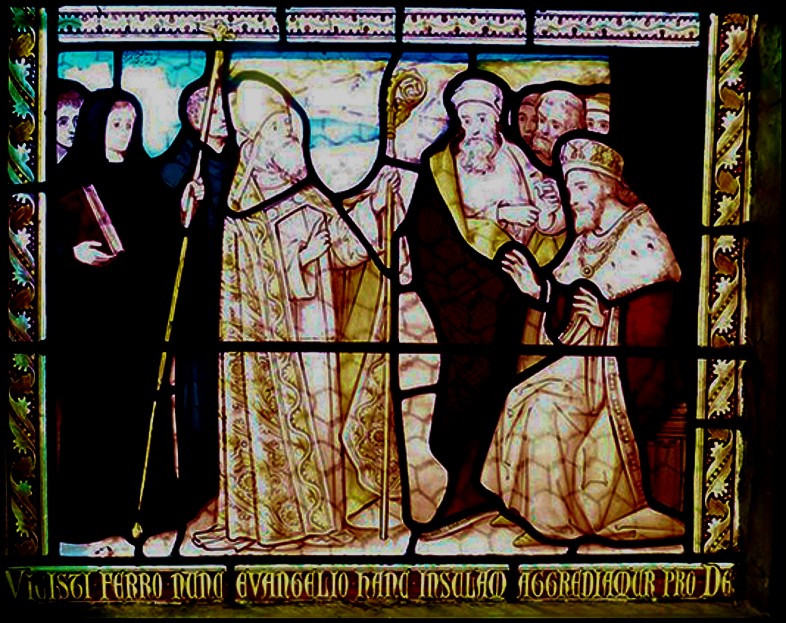
This stained glass window (above) can be seen in the south aisle of St Mary’s Church in Ryde. It was designed and installed by the Victorian Catholic artist, Nathaniel Westlake in 1882. It depicts St. Wilfrid, having landed on the Isle of Wight in 686, with Benedictine Monks, seeking permission from Caedwalla to preach the Gospel. Being granted permission and given land on the Island, St Wilfrid and his followers, built the Island’s first (wooden) Church at Brading, on the site of the present Church of St Mary the Virgin. Hence, it could be said that our St Peter Caedwalla was the first Isle of Wight Saint. (St Wilfred: https://anastpaul.com/2018/10/12/saint-of-the-day-12-october-st-wilfrid-c-633-709/).
Two young Princes, brothers of the former King, when Caedwalla invaded the Island, escaped across the Solent. They were eventually betrayed, however and ordered to be put to death. Caedwalla, at this time, was living in seclusion while he recovered from wounds received while fighting on the Isle of Wight. The Abbot of Redbridge petitioned him to allow the young Princes to receive instruction in the Christian Faith and to receive Baptism before their execution. Caedwalla consented to this request and they were duly instructed, Baptised and then executed.
In 688 Caedwalla, after governing the people of Wessex “most ably” for two years, abdicated his throne and went on pilgrimage to Rome, where he hoped to receive Baptism. He arrived in Rome during the Pontificate of Pope Sergius and was Baptised by him (and given the name of Peter on account of his devotion to the Apostle, which had inspired his pilgrimage).
On Holy Saturday 689, Peter Caedwalla fell ill while “still wearing his white robes” that is, during Easter Week when the newly Baptised were wearing the white garment received by them as a sign of their purification from sin. He died on 20 April that year and was buried in St Peter’s. The Pope directed that an Epitaph be inscribed on his tomb to preserve his memory and devotion. It was composed by the Archbishop of Milan and is given in full by St Bede. The stone was discovered in the 16th Century when the Basilica of St Peter was being rebuilt. A s 16th Century mural in Chichester Cathedral depicts St Peter Caedwalla giving land to St Wilfrid, see below.
A 16th Century Mural by Lambert Barnard in Chichester Cathedral, depicting Saint Peter Cædwalla granting land to Saint Wilfrid.
St Peter Caedwalla of Wessex (c658-689) Layman, King of Wessex. Venerable St Bede wrote of him in his History of the English Church. Bl Catwallon St Domninus of Digne Bl Gerald of Salles Bl Harduin
Blessed Hildegun of Schönau O.Cist. (Died 1188) Virgin, Cistercian Monk – yes! she was disguised as a boy as a child, for her own safety and after many frightening trials, decided to retain the identity in order to enter the Cistercian Monastery as Brother Joseph. Her true identity remained a secret until her death. Or Brother Joseph!: https://anastpaul.com/2023/04/20/saint-of-the-day-20-april-blessed-hildegun-of-schonau-died-1188-virgin/
St Marcian of Auxerre St Margaret of Amelia Bl Maurice MacKenraghty St Michel Coquelet Bl Oda of Rivreulle St Sara of Antioch St Secundinus of Córdoba St Servilian
Blessed Simon Rinalducci OSA (Died 1322) Priest, Friar of the Order of the Hermits of St Augustine, noted for his theological studies, Prior of several houses, renowned Preader, Miracle-worker. Blessed Simon was a model of humility and obedience, even in the face of great trials and obvious injustices. Simon was Beatified on 19 March 1833 by Pope Gregory XVI (cultus confirmed). His Life: https://anastpaul.com/2021/04/20/saint-of-the-day-blessed-simon-rinalducci-osa-died-1322/
St Sulpicius St Theodore Trichinas St Theotimus of Tomi St Vincent of Digne St Wiho of Osnabrück
Saint of the Day – 19 April – Saint Gerold of Saxony (c900-c978) Hermit. … Born in in Rhaetia, in the lower part of the Alps (part of modern Austria/Switzerland) and died on 16 April 978 of natural causes in Frisun, today the Town of St Gerold. Also known as – Gerold Graziato, Gerold of Einsiedeln, Gerold of Großwalsertal, Gerold of Grosswalsertal, Gerold of Vorarlberg, Adam… Geroldus…
On 1 January 949, Otto I returned to a certain Adam, involved in a conspiracy against the Sovereign and deprived him of his assets by judicial sentence, his possession which was located in present-day Vorarlberg. Otto calls Adam “vir Dei” in his act of 949 which allows us to deduce that this Adam, had consecrated himself to the service of God.
However, he is not designated as a Monk and, in Einsiedeln, tradition has never considered him such. The Einsiedeln Calendar does indeed name an Adam on 16 April but without defining him as a Monk. The tradition traced by the dean Albrecht von Bonstetten in 1494, narrates that the proscribed Adam took refuge in the solitude of the Wals Valley, where – in order not to be recognised – he lived under the name of Gerold Graziato, remained in solitude.
He donated his possessions to the Monastery of Einsiedeln and died around the year 978. The day of his death is placed on different dates. The obituary notices of Einsiedeln from the 10th Century, however, have an Adam on 16 April and the book of the anniversaries of Saint Gerold, dated to the 15th Century, indicates 19 April as the day on which his Feast is still celebrated today.
The place where Adam-Gerold lived, first called Frisun, appears in 1340 for the first time under the name of St Gerold. In Einsiedeln, the festival is celebrated on 19 April only after the exhumation of his bones which took place in 1663 and his Tomb is today preserved in the Monastery. When, in 1378, the suffragan Bishop of Chur consecrated the Altar of Saint Catherine to Saint Gerold, he granted an Indulgence for 4 June on the occasion of the commemoration of the blessed Gerolde – this proves that he was already venerated as a Saint then.
According to the tradition which makes Adam a Duke of Saxony (presumably because there is confusion with the old noble family of Sax, originally from Vorarlberg), he had two sons, Cuno (or also Chamo) and Ulrich (also called Henry), who by order of their father, became Monks of Einsiedeln. Cuno must have been dean and Ulrich custodian. After their father’s death, they both went to Frisun, where they died. Ulrich would have been buried in the provost’s Church, next to his father and Cuno in the Chapel of Saint Anthony ,next to the Church. However, there is no certain information about the two. In the Monastery, they were both venerated later (17th Century) as Blesseds, the Feast of Blessed Cuno on 8 March and that of Blessed Ulrich on 29 April.
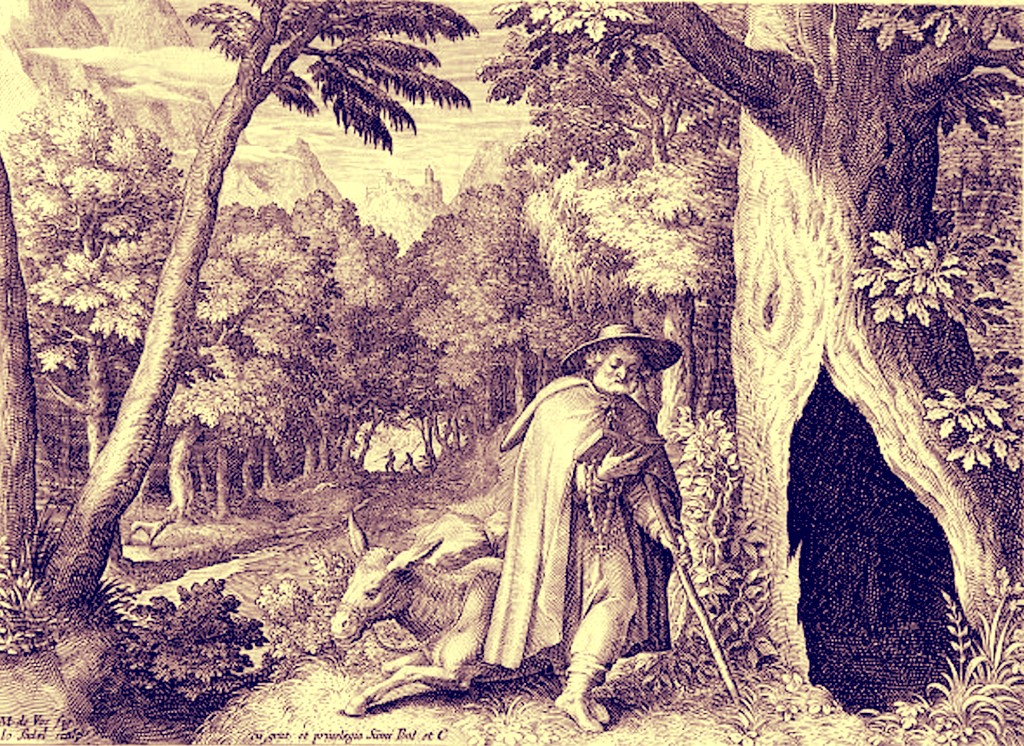
Saint Gerold is depicted as a pilgrim with a hat and staff, sometimes even with a donkey because the Saint vowed to settle where the donkey carrying all his possessions would kneel. Sometimes he is represented with a bear, who helped him in the construction of his cell. A cycle of paintings created around 1683, depicting the life of the Saint, is found in the Church of Frisun, while the painting of the main Altar (by Rodolfo Blaettler, 1877) shows him with his two sons.
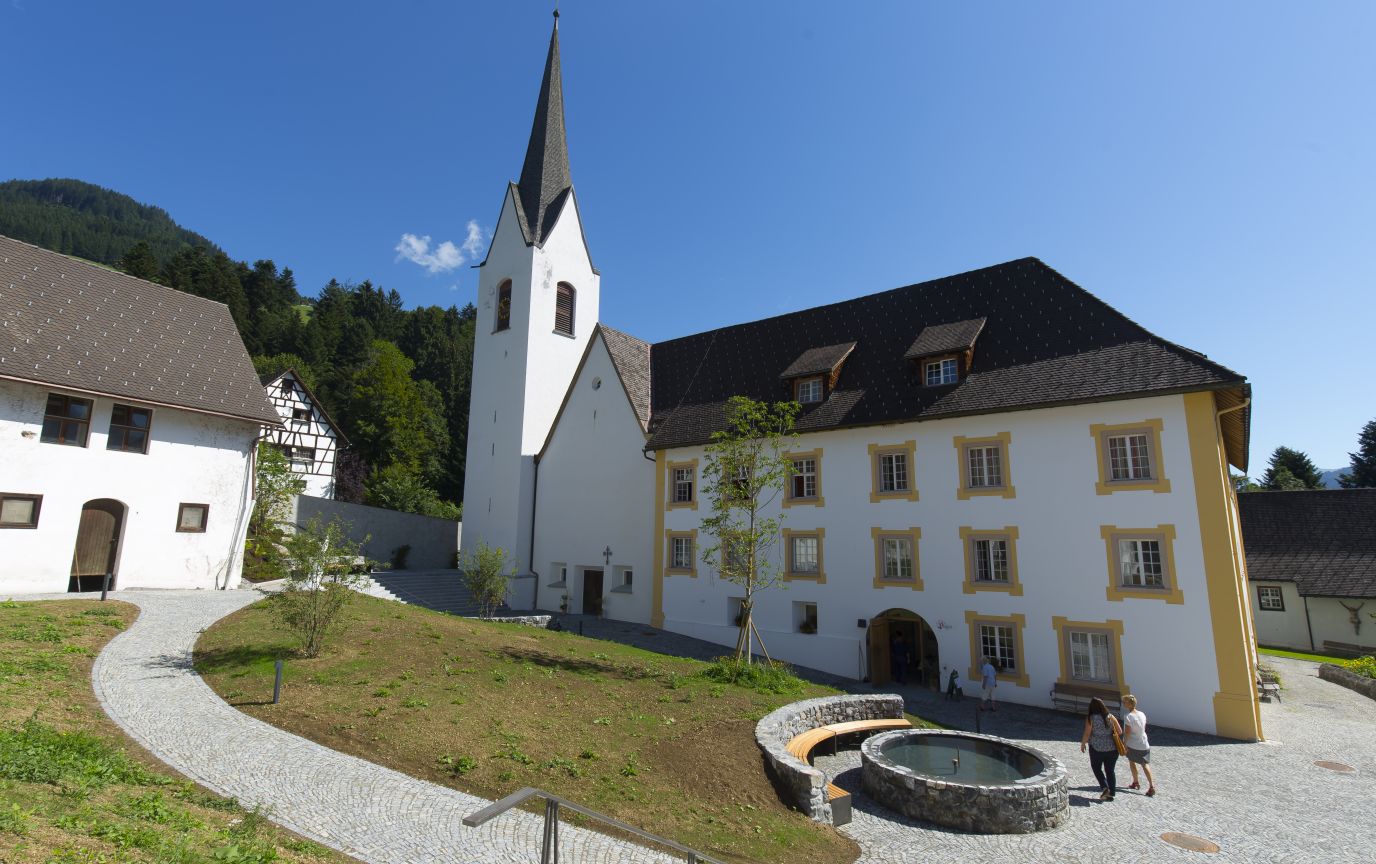
Statues in the provost’s house show the two sons as Monks and a 17th Century fresco in the Chapel of Saint Anthony represents the Blessed Cuno. Below is the Priory of St Gerold where these Statues reside although I can find no images of them.
St Apollonius the Priest St Aristonicus of Melitene
Blessed Bernard of Sithiu (Died 1182) Penitent, Pilgrim, Hermit. Patronages – of sinners, convicts, prisoners, penitents, pilgrims. The Roman Martyrology: “At the Monastery of Saint-Bertin in the territory of France in Thérouanne, lies the tomb of Blessed Bernard, penitent, who, eager to atone for the sins of his youth with an austere penitence, voluntarily chose exile and, barefooted, wearing rough garments, was a tireless pilgrim to the holy places.” Dear Blessed Bernard, pray for us!: https://anastpaul.com/2023/04/19/saint-of-the-day-19-april-blessed-bernard-of-sithiu-died-1182-layman-penitent/
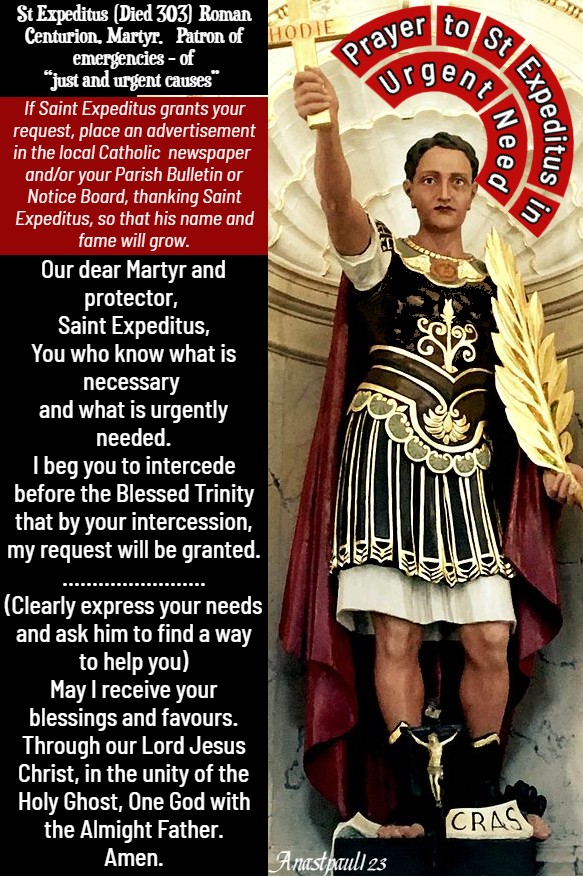
Our dear Martyr and protector, Saint Expeditus, You who know what is necessary and what is urgently needed. I beg you to intercede before the Blessed Trinity that by your intercession, my request will be granted. …………………… (Clearly express your needs and ask him to find a way to help you.) May I receive your blessings and favours. Through our Lord Jesus Christ, in the unity of the Holy Ghost, One God with the Almighty Father. Amen.
If Saint Expeditus grants your request, place an advertisement in the local Catholic newspaper and/or your Parish Bulletin or Notice Board, thanking Saint Expeditus, so that his name and fame will grow
St Gaius of Melitene St Galata of Melitene St George of Antioch St Gerold of Saxony (c900-c978)Hermit
St Pope Leo IX (1002-1054) known as “Apostolic Pilgrim” When the German Pope Damasus II died in 1048, Bishop Bruno was selected by the Emperor, Henry III, to succeed him. Bruno agreed to go to Rome and to accept the Papacy if freely elected thereto by the Roman people. He wished, at least, to rescue the See of Peter from its servitude to the German Emperors. When, in company with Hildebrand he reached Rome and presented himself to its people clad in pilgrim’s guise and barefooted but still tall and fair to look upon, they cried out with one voice that him and no other would they have as Pope. Assuming the name of Leo, he was solemnly enthronedon 12 February, 1049. Biography: https://anastpaul.wordpress.com/2018/04/19/saint-of-the-day-19-april-st-pope-leo-ix-1002-1954/
St Martha of Persia St Rufus of Melitene St Vincent of Collioure
Martyrs of Carthage – 17 Saints: A group of Christians Martyred in the persecutions of Decius. We know little more than the names – Aristo, Basso, Credula, Donato, Ereda, Eremio, Fermo, Fortunata, Fortunio, Frutto, Julia, Mappalicus, Martial, Paul, Venusto, Victorinus and Victor. Died in the year 250 in prison in Carthage, North Africa (modern Tunis, Tunisia).
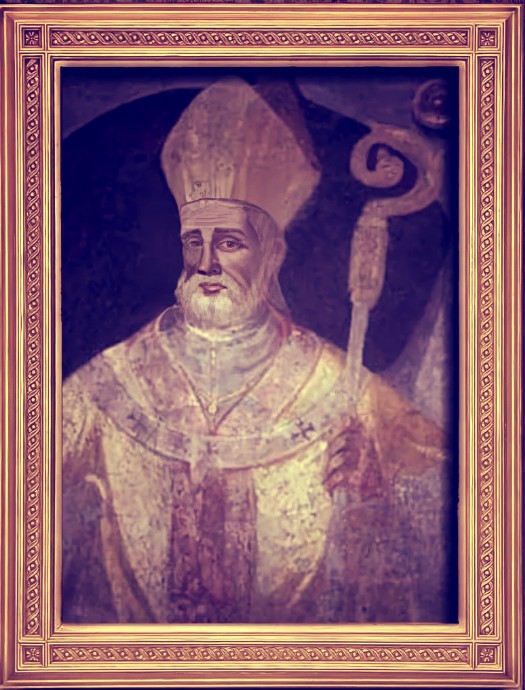
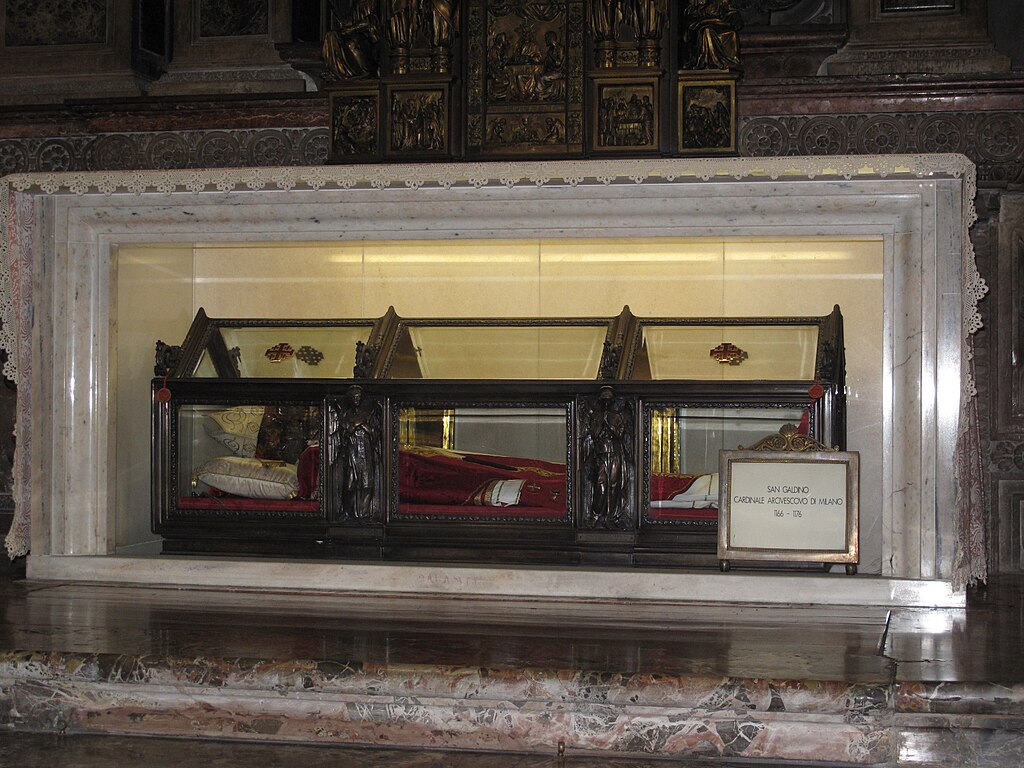
Saint of the Day – 18 April – Saint Galdinus della Sala of Milan (c1096-1176) Cardinal ArchBishop of Milan from 1166 until his death in 1176., Born in c1096 at Milan, Italy and died on 18 April 1176 at Milan, Italy of natural causes. Patronages – of the Archdiocese of Milan and of Lombardy. Galdinus was Canonised by Pope Alexander III. Also known as – Galdini, Galdimus, Galdin, Galdino.
The Roman Martyrology reads today: “At Milan, St Galdini, Cardinal and Bishop of the City, who, at the conclusion of a discourse against heretics, gave up his soul to God.”
Galdinus was the son of the noble della Sala family of Milan and from his childhood, he was educated for the Ecclesiastical life. He received Sacred Orders after occupying various important positions and became the Chancellor of the Church in Milan.
In 1165, Pope Alexander III honoured him with the Title of Cardinal in the Consistory of 15 December as the Cardinal Priest of the Titular Church of Santa Sabina and, a year later, made him the Archbishop of Milan.
One of his first aims was to destroy the schism created by partisans of the antipope, “pope” Victor IV favoured by Emperor Frederick Barbarossa and bring them to recognise the legitimate Pontiff Alexander III. In this mission, he skillfully employed the diplomatic gifts he had learned.
Galdinus was very humble, even after reaching this elevated position. He was known for his sweetness and goodness, welcoming all as equals, except in the case of defending his position, when he was an example of fortitude and vigour.
At that time, the Cathars from Cologne were spreading their errors throughout Lombardy and the area of Milan. Galdinus zealously strove to uproot those heresies. His constant preaching and efforts weakened him and his physical strength waned.
In 1176, the Sunday after conducting the Easter ceremonies, he went to the Altar of St Tecla in Milan Cathedral to celebrate Mass but found himself too weak to do so. Nonetheless, at the sermon, he went to the pulpit and delivered a long and vehement discourse refuting the heresies and infamies of the Cathars with greater vigour and virulence than ever. As he finished, he fainted and lost consciousness. He died as the Mass ended, whose Gospel had been that of the Good Shepherd.
St Bitheus St Calocerus of Brescia St Cogitosus St Corebus St Eleuterius of Illyria St Elpidius of Melitene St Eusebius of Fano St Galdinus della Sala of Milan (c1096-1176) Cardinal Bishop St Gebuinus of Lyons St Genocus St Hermogenes of Melitene
Blessed Idesbald of Dunes O.Cist (c1095-1167) Cistercian Priest and Abbot of Ten Duinen Abbey, Our Lady of the Dunes. The Roman Martyrology states: “In Bruges in Flanders, in today’s Belgium, Blessed Idesbaldo, Abbot, who, soon became a widower and exercised for another thirty years, duties in the palace of the Counts, entered the Monastery of Dune at a mature age, which he held holy, as the third Abbot for twelve years.” Biography: https://anastpaul.com/2021/04/18/saint-of-the-day-18-april-blessed-idesbald-of-dunes-o-cist-c-1095-1167/
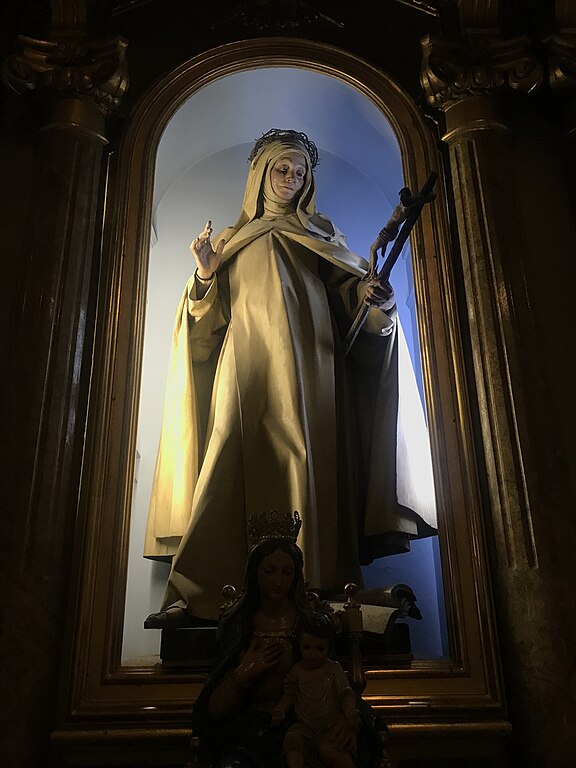
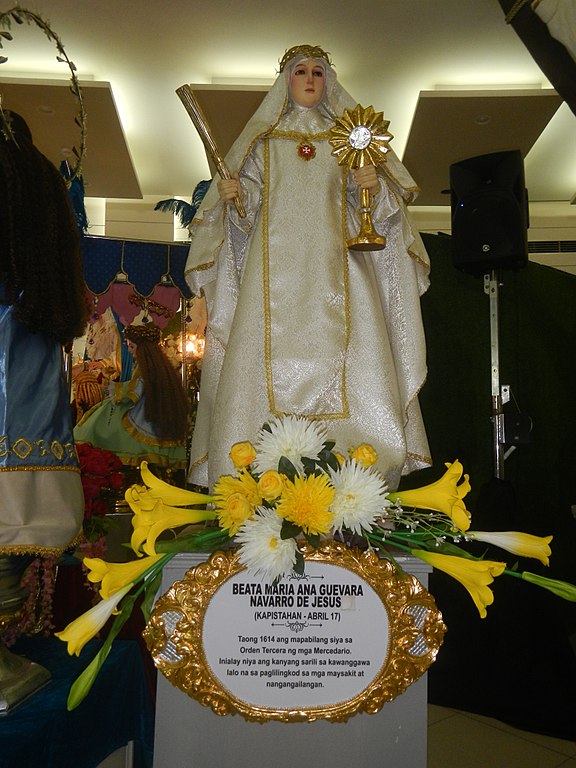
Saint of the Day – 17 April – Blessed Mariana of Jesus OdeM(c1565-1624) “The Lily of Madrid” Tertiary Sister of the Mercadarian Order (the Servants of Mary) Mystic and Ecstatic, graced with Visions of Our Lord and His Mother and granted the ability, by her intercession, to be responsible for many miracles, Spiritual Director and Apostle of the poor and the sick. In addition, Mariana was known to bilocate and levitate during her ecstasies. Born on 17 January 1565 at Madrid, Spain as María Ana Navarro de Guevara y Romero and died on 17 April 1624 of natural causes at Madrid, aged 59. Patronages – of Madrid, Mercedarian Tertiaries Mercedarian Lay Fraternities and Apostolates. Also known as – “The Lily of Madrid,” “The Saint of Madrid,”Mariana Navarra de Guevara, Mary Ann of Jesus Navarro, Maria Ana de Jesus Navarro de Guevara. Her body is Incorrupt.
Mariana was born in Madrid on 17 January 1565 into a wealthy family. Her father was an affluent merchant whose business supplied leather goods to the Spanish Court. He, himself being in the service of King Philip II.
She was Baptised on the 21st of the same month of her birth in the Church of Santiago (St James). Mariana was attracted very early to religious life. At the age of 22, she already had the firm determination to enter a Convent, despite the strong opposition of her father (who, widowed early, had remarried) and her stepmother, who had arranged her marriage. However, her parents’ attempts to separate her from her vocation were of little use. Legend says that she went as far as to disfigure her face and cut her hair in order to see herself rejected by the young man chosen for her..
In 1598 she retired as a penitent to the hermitage of Santa Bárbara in the Capital of the Kingdom. There she was assisted by Brother Juan Bautista Sacramento, a Mercedarian Religious and reformer of the Order, who was her Spiritual director until her death and by other pious people. She made her home in a small house, next to the Convent of the Discalced Mercedarians where she spent several years dedicated to prayer and penance, as well as serving the poor and needy of the City. In 1613 she was received into the Order of Mercy, given the Tertiary Habit by order of Brother Felipe Guimerán, Master General of the Order, who the following year, on 20 May 1614, received her profession.
The fame of her virtues and the supernatural appearances and miracles which accompanied her, spread quickly throughout Madrid. Her Superiors ordered her to write about these experiences. In these writings, Mariana narrates, among other things, the visions she had of Jesus Christ and the Virgin Mother and her mystical ecstasies.
The Queen of Spain , Isabel de Borbón, sent for Mariana to attend at the Palace whereafter their acquaintance grew so much that Mariana was considered one of the Queen’s closest friends. At that time, Mariana was already called “The Saint of Madrid.”
Mariana’s death occurred on 17 April 1624 in the Mercedarian Convent of Santa Bárbara in Madrid, as a result of a lung condition. He was 59 years old.
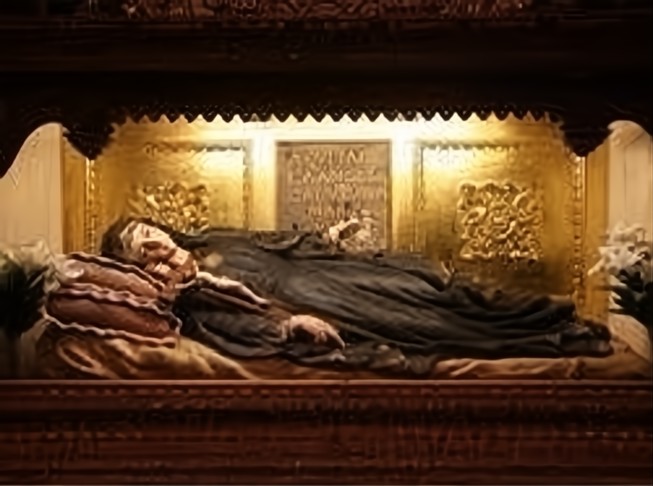
Her body is preserved Incorrupt in the Church of the Mercedarian Nuns of Don Juan Alarcón in Madrid as the Convent of Santa Bárbara was destroyed during later unrest. The Tomb where Mariana rests, was given by Queen Elizabeth II.
The extraordinary thing about her life of great solitude is precisely her ability to welcome, listen to and attend, to the spiritual and material needs of so many people who came to request assistance, or to ask for spiritual succour.
She was Beatified by Pope Pius VI on 18 January 1783.
If already during her life Mariana had achieved great renown for her piety and the prodigies of all kinds which were attributed to her, after her death, it only increased. It includes among them the fall of rain in Madrid, in times of severe drought, such as the one which devastated the two Castiles in 1613.
Mariana’s body was displayed to the public for two days in the midst of a large gathering. The artist Vicente Carducho made several death masks of the deceased. The same year of her death, the Canonical process of her Beatification began, encouraged by the people, the nobility and King Philip IV himself , a great devotee of hers. Barely a month after her death, the information process on the life and miracles of Mariana de Jesús began. 152 witnesses testified in it. On 8 August 1624, the Board of Theologians and Canonists of Madrid proposed that she could be given a private cult.
On 31 August 1627, her grave was opened and to the general astonishment, it was found that the body was intact, with fresh flesh and flexible limbs and exhaling a pleasant fragrance. Only her face was slightly disfigured due to the manipulations necessary to obtain the death mask. This fact has been verified each of the successive times when the mortal remains were inspected — in 1731, 1924 and 1965.
The Solemnity of the Patronage of St Joseph Wednesday preceding the Third Sunday after Easter: Few Catholics are likely familiar with the Eastertide Solemnity of St Joseph. According to Father Francis Xavier Lasance (1860-1946) it was instituted during the hostile occupation of Rome by the Troops of the Italian King, Victor Emmanuel II. The Pope proclaimed St Joseph the Patron of the oppressed Household of the Faith, entrusting to St Joseph, the defence of Holy Mother Church.
In the beginning, this Feast Day was observed on the Third Sunday after Easter but when Pope St Pius X reformed the Liturgical Calendar to restore the Sunday Offices to prominence over those of the Saints, the second Feast of St Joseph was moved to the Wednesday preceding the Third Sunday after Easter. In 1911, the Feast was raised to a Double of the First Class and it was assigned an Octave after it was moved to the Wednesday before the Third Sunday after Easter. It is a Common Octave, so the Octave may or may not be commemorated on the intra Octave days depending on the rank of the Feasts which occur during the Octave. While this Feast day is not in the 1962 Missal, it is still kept by Priests who celebrate Holy Mass according to the pre-1955 reforms.
Bl essed Andrés Hibernón Real OFM (1534-1602) Religious Friar, Apostle of the Holy Eucharist, the Blessed Virgin and the Holy Rosary, Apostle of the poor. He predicted the date of his death four years before the fact, which was 18 April 1602 in Gandia, Valencia, Spain of natural causes immediately after having prayed a rosary. He was Beatified on 22 May 1791 by Pope Pius VI. His body is incorrupt. Biography: https://anastpaul.wordpress.com/2018/04/17/saint-of-the-day-17-april-blessed-andres-hibernon-real-o-f-m-1534-1602/
St Agia of Hainault St Anthia of Illyria St Athanasia of Aegina St Bitheus St Calocerus of Brescia St Cogitosus St Corebus
St Eleuterius of Illyria St Elpidius of Melitene St Eusebius of Fano St Galdinus of Milan St Gebuinus of Lyons St Genocus St Hermogenes of Melitene St Innocent of Tortona Bishop and Confessor Bl Idesbald of Dunes Blessed James of Cerqueto OSA (1285-1366)
St Laserian of Leighlin Blessed Mariana of Jesus OdeM (c1565-1624)
St Pantagathus of Vienne Bishop St Perfecto of Córdoba St Pusicio
St Robert de Turlande/Chaise-Dieu OSB (c1000-1067) Priest, professed religious of the Order of St Benedict, Monk, Abbot, Apostle of Charity, Marian devotee. He was of noble stock, was related to Saint Gerald of Aurillac (c855–c909) and was a descendant of St Caesarius of Arles (470-543). He is best known for the establishment of the Benedictine Convent of La Chaise-Dieu (‘Home of God’) and for his total commitment to the poor. He became a spiritual inspiration for Pope Clement VI (1291–1352) – whose own origin,s in the religious life were based at that Convent – and it was Pope Clement who confirmed the Canonisation of the Benedictine Abbot on 19 September 1351 in Avignon. His Life: https://anastpaul.com/2019/04/17/saint-of-the-day-17-april-st-robert-de-chaise-dieu-osb-c-1000-1067/
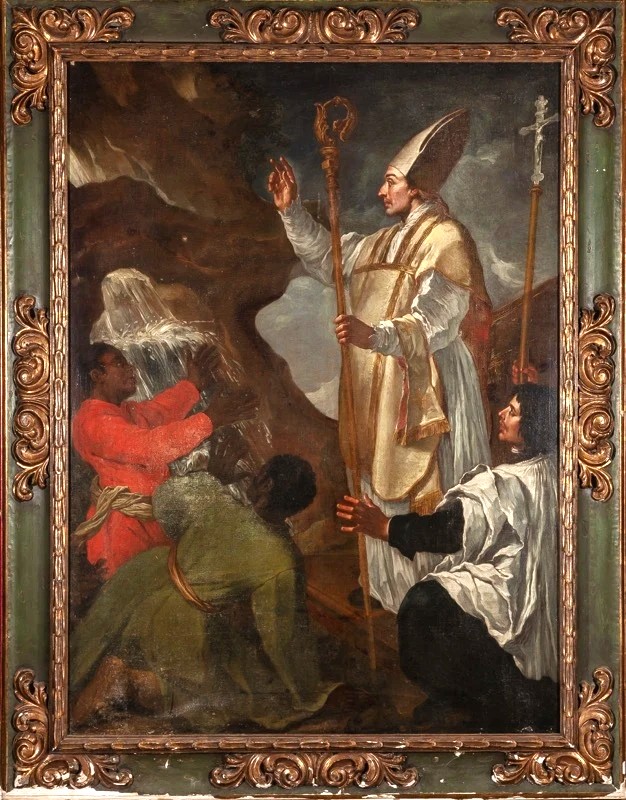
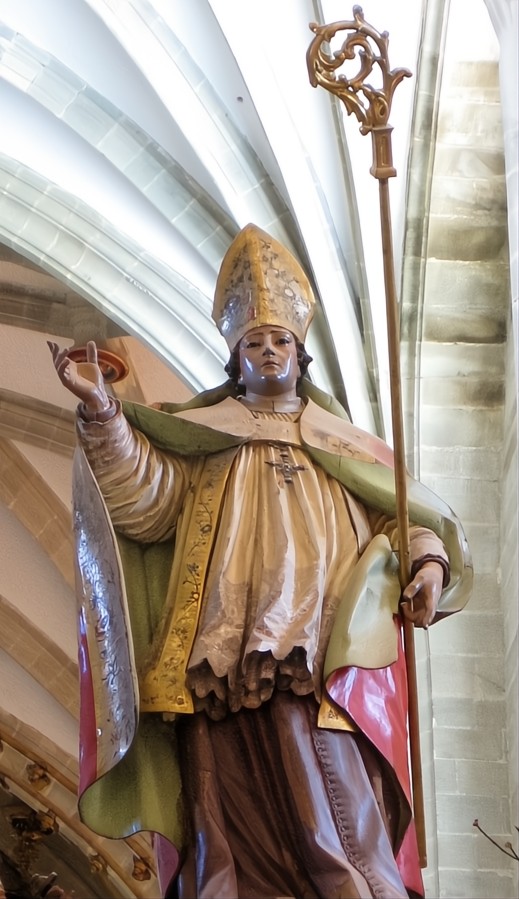
Saint of the Day – 16 April – Saint Turibius of Astorga (c402-c460) Bishop, Hermit, Monk, Defender of the Faith against heresy, in particular, the heresy of Priscilian., Miracle-worker (the image below is known as The Miracle of St Turibius of Astorga but unfortunately I can find no references to this ‘Miracle.’Born in Astorga in c402 and died there in c460 of natural causes. Patronages – Diocese of Palencia, Diocese of Santander, Diocese of Astorga. Also known as – Toribi, Toribio, Turrybiusz. Additional Memorial – On the Monday of the Second Week of Easter, a Solemnity is celebrated in the Diocese of Astorga.
The Roman Martyrology reads: “At Palencia, St Turibius, the Bishop of Astorga, Spain, who with the aid of Pope St Leo the Great, drove the heresy of Priscilian entirely out of Spain and, went to rest in the Lord with a great renown for miracles.”
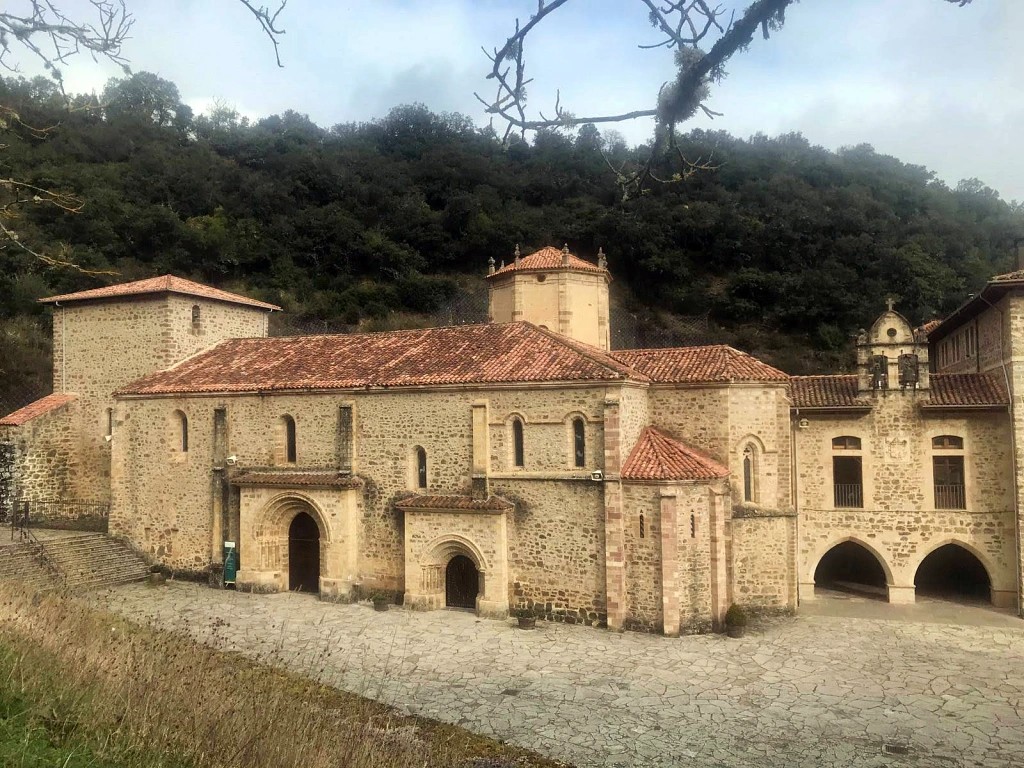
According to tradition, Turibius lived for some time as a Hermit in a cave in the mountains near the Monastery of Santo Toribio de Liébana near Pottes which has been named after Turibius of Liébana since 1181.
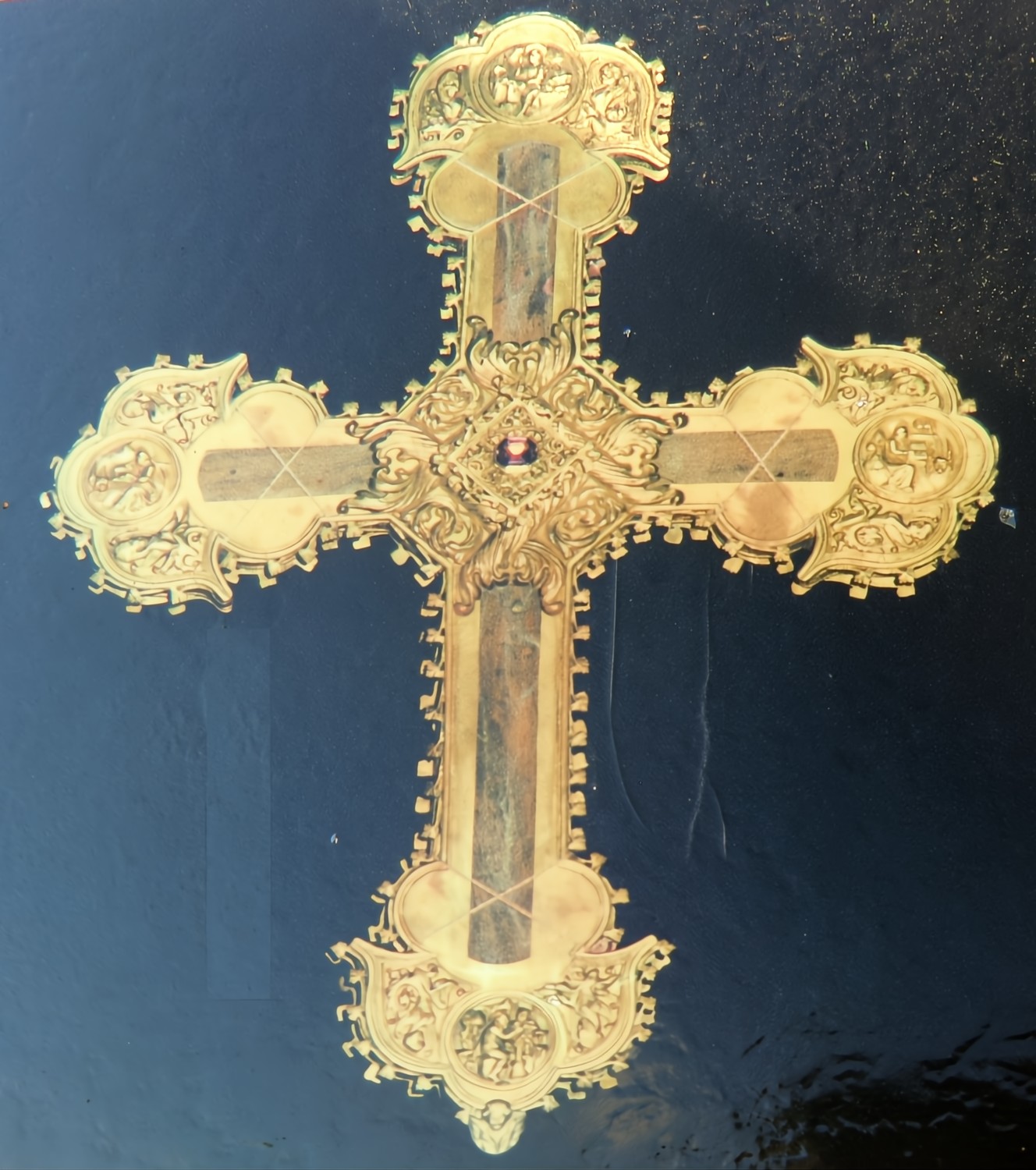
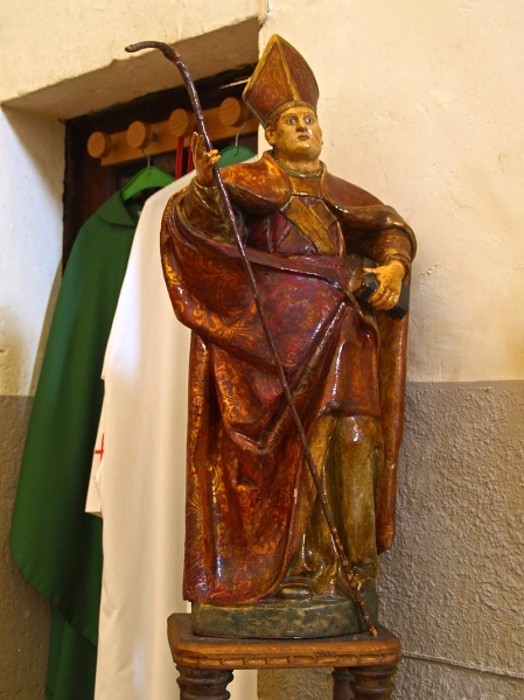
He undertook a pilgrimage to the Holy Land, was Ordained a Priest and was appointed as a Guard at the Holy places. Due to the Persian invasion of the Holy City, Turibius went to Rome taking with him a Relic belonging to the Cross of Jesus. In Rome, Pope Saint Leo the Great appointed him as the first Bishop of the Diocese of Astorga. Thus, he returned to his hometown as the Bishop and bringing the very important Relic with him. He solemnly deposited it in the Cathedral of Astorga. In the 8th Century and due to the Arab domination, it was brought to this Sanctuary of the Monestery of St Turibius of as a safe place.
The Cross containing the Relic of the Holy Cross of Jesus now residing in the Monastery of Sat Toribius of Liébana
This turned the Monastery into an important pilgrimage centre which is why, in 1512, Pope Julius II granted this place the privilege of the Holy Year. It is celebrated every time thathe Monastery lies on t 16 April, the Feast of Saint Turibius, falls on a Sunday. Another important aspect is the fact that the Monastery lies on route to Compostela and so attracts many visitors to view the Relic of the Holy Cross.
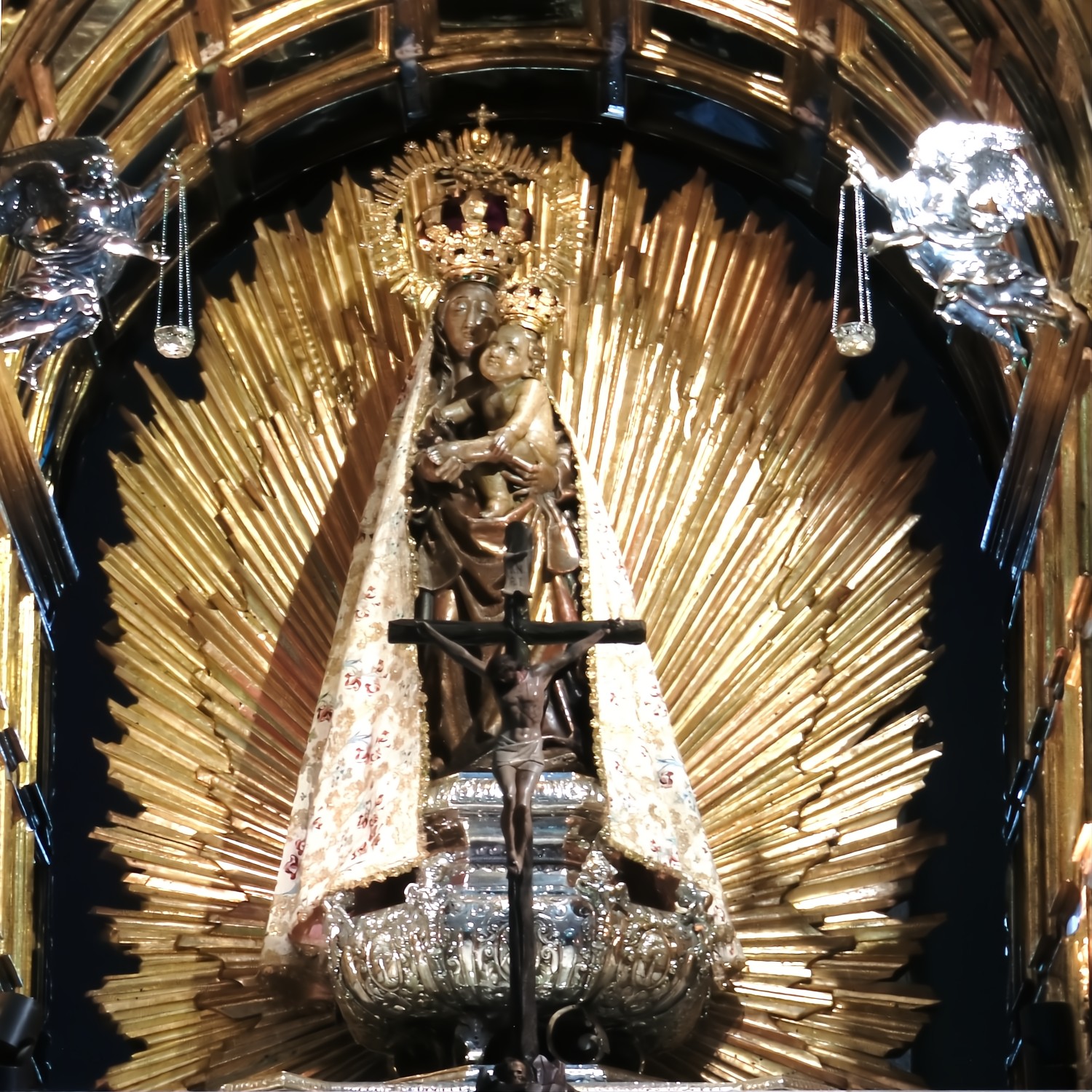
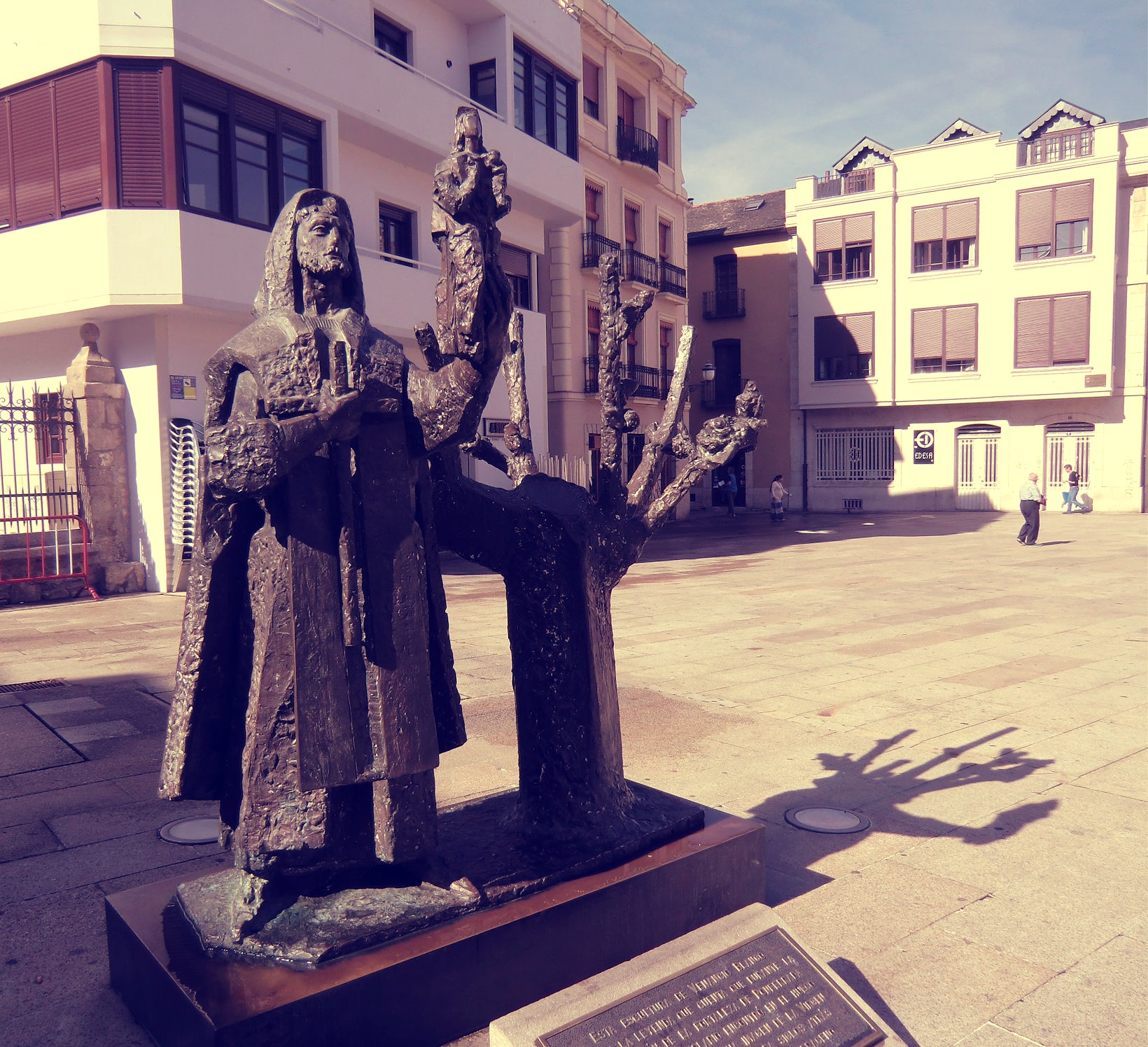
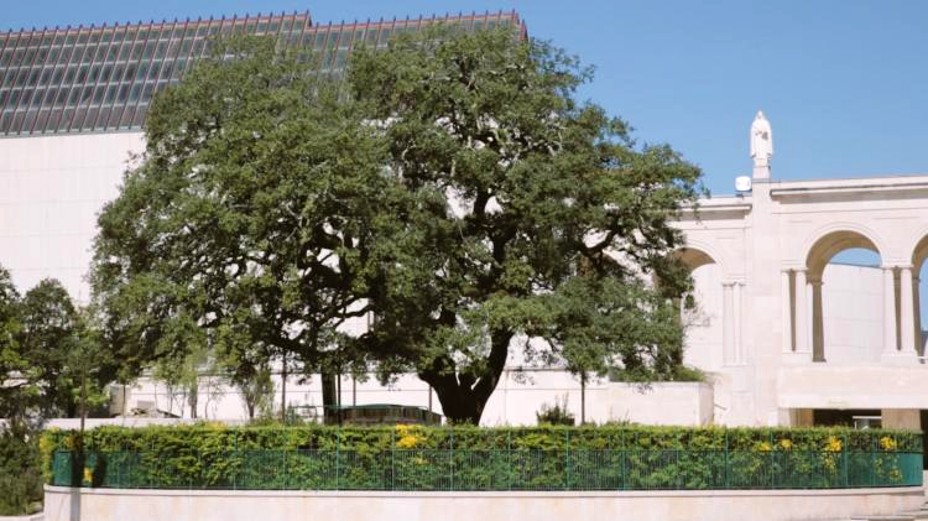
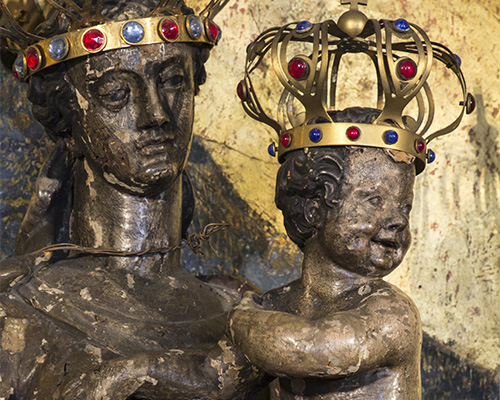
He also brought a Statue of the Blessed Virgin Mary which was, in later years, hidden from the Arabs during the times of war. For a long time the Statue was considered lost but was finally found around 1200, under a Holm Oak tree by a Knight Templar named Venacio Blanco who was involved in the construction of their new castle in Ponferrada. This Statue has been revered publicly ever since in that City; of Ponferrada.
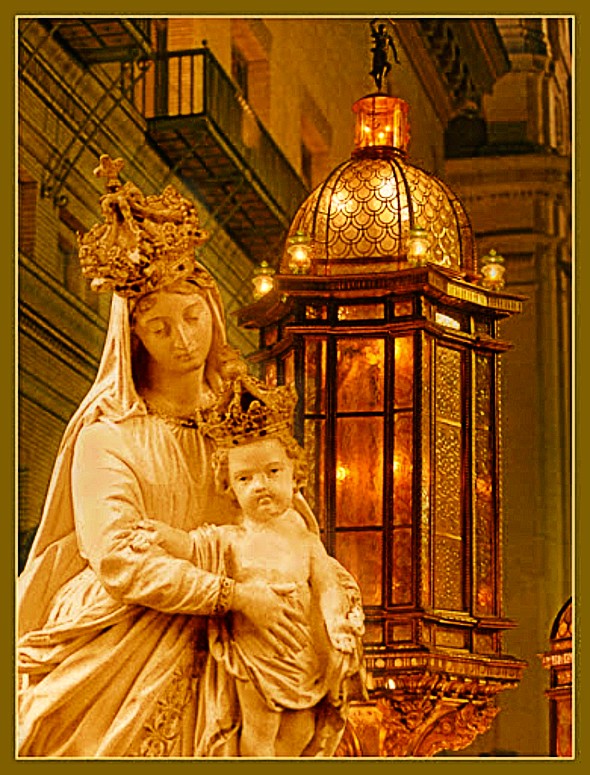
Our Lady of the Holm Oak
The Church of Nuestra Señora de la Encina, Our Lady of the Holm Oak , was built there in the 16th Century retaining the ancient Holm Oak in front of the Church which remains there today.
Venacio Blanco. the Templar finds the Statue of the Blessed Virgin Mary hidden under a Holm Oak. A modern sculpture in front of the Church of Nuestra Señora de la Encina in Ponferrada.
As Bishop, Turibius brought about the conversion of the Suebi peoples who were residing in the area and confronted the supporters of Priscillianism. He wrote two books criticising this heresy and presented them to Pope Leo I, who then commissioned him to call a Council. Turibius’ efforts against the heretics was succesful and he vanquished this heresy from the Spanish land.
When the Visigoth King Theuderic II, conquered Astorga in 456, Turibius was captured and taken to Gaul. After his release, he contributed to the reconstruction of the City of Astorga.
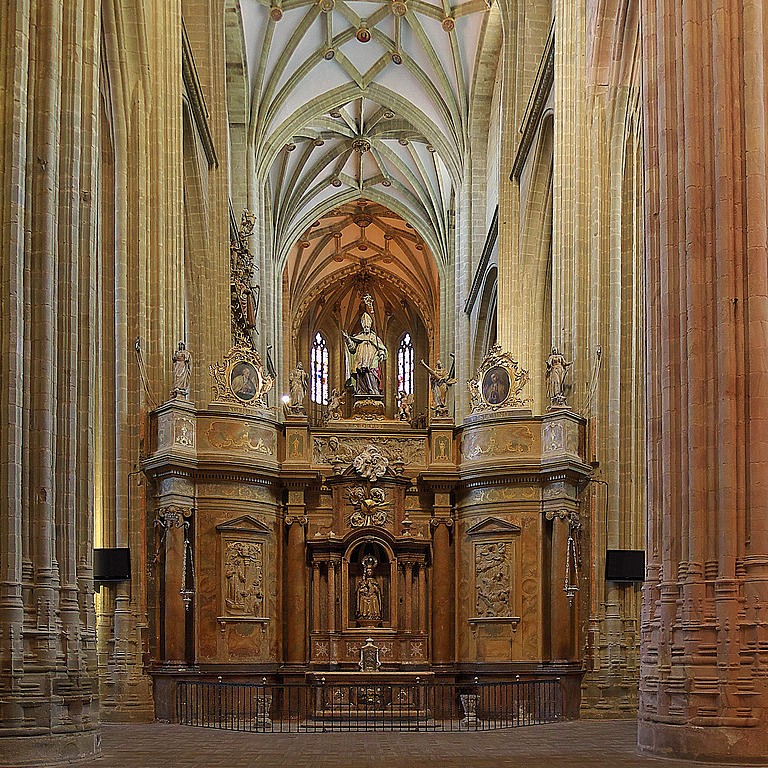
St Turibius in the Cathedral of Astorga
Over time, more Hermits settled in the mountains of Liébana, the Monastery of San Martín was founded there – probably in the 6th or at the latest in the 8th Century. After the Muslim occupation of Spain, Turibius’ Relics were brought here to safety. With the spread of the cult of St Turibius in the late 12th Century, the Monastery was now named after him which is why Turibius of Astorga is often confused with its Founder also St Truibius but remembered as “of Liébana.”
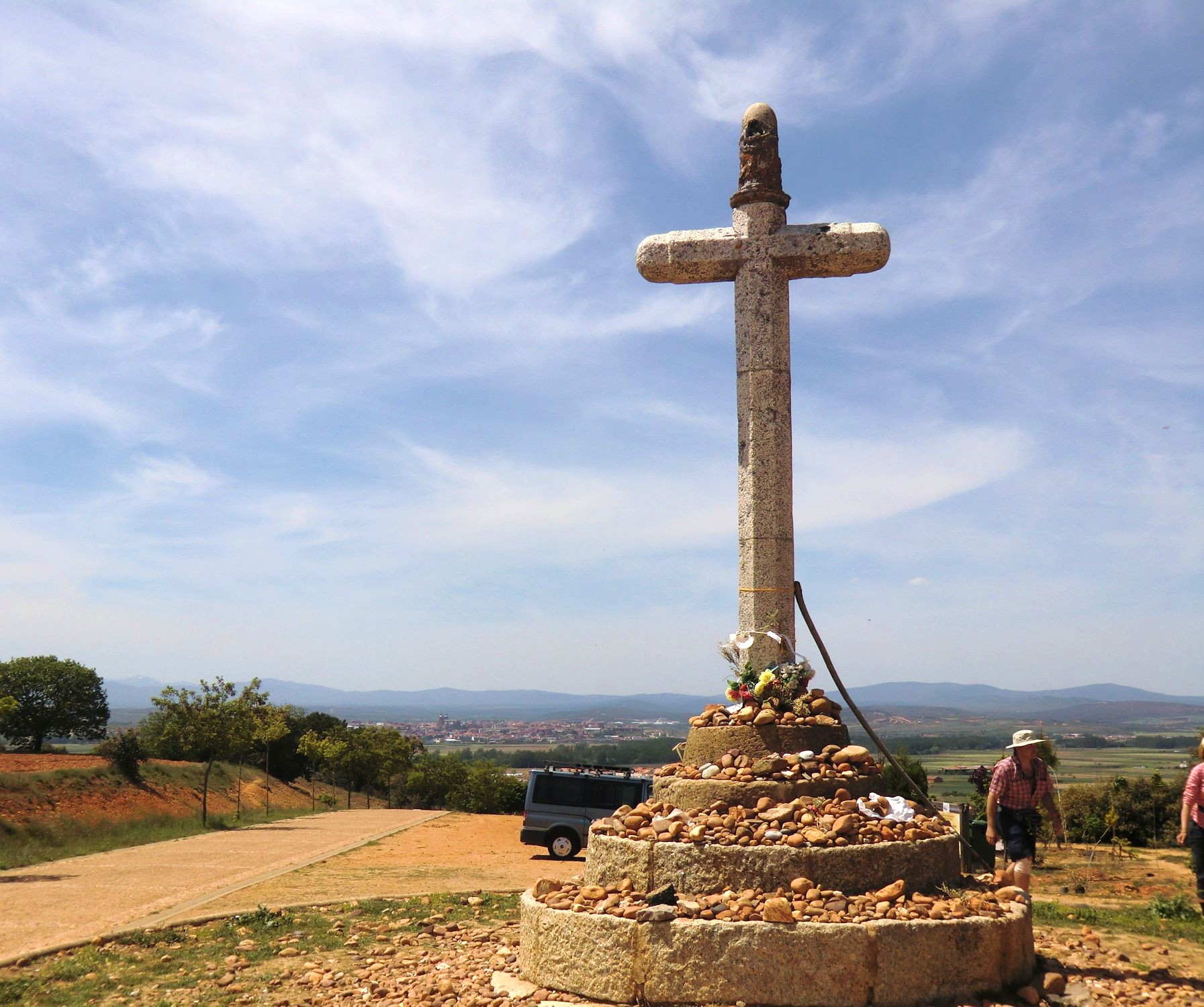
The Cross of Turibius on the Way of St James, 4 km west of Astorga.
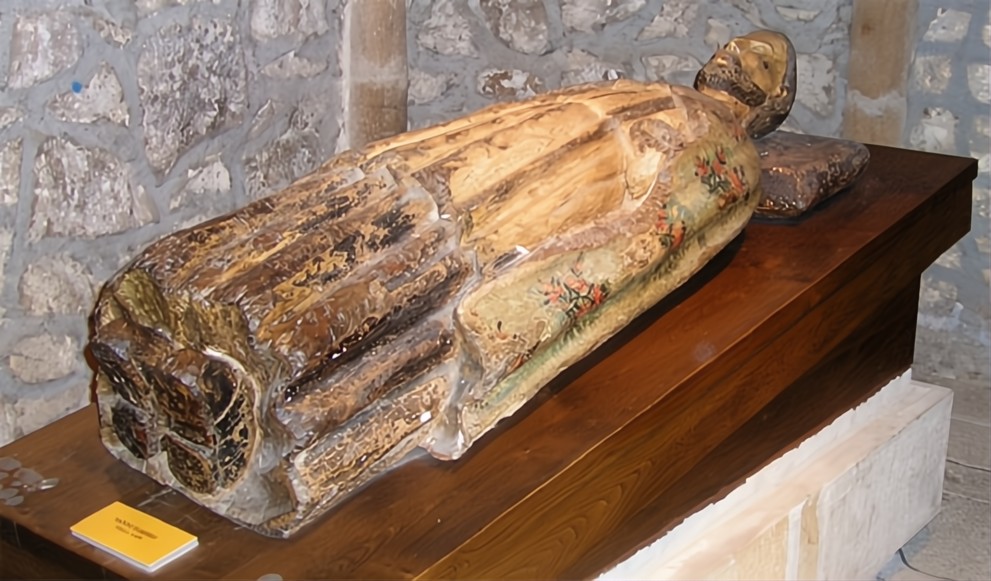
A recumbent Statue of St Turibius in the Monastery in Liébana.
St Benedict Joseph Labre – Known as the Beggar of Perpetual Adoration (1748-1783) Laqy Penitent and Pilgrim – he “abandoned his country, his parents and whatever is flattering in the world, to lead a new sort of life, a life most painful, most penitential, not in a wilderness, nor in a cloister but in the midst of the world, devoutly visiting as a pilgrim the famous places of Christian devotion.” Canonised by Pope Leo XIII on 8 December 1881. Dearest St Benedict Joseph: https://anastpaul.wordpress.com/2017/04/16/saint-of-the-day-16-april-st-benedict-joseph-labre/
Blessed Arcangelo Canetoli (1460-1513) Priest and Canon of the Canons Regular of the Congregation of the Most Holy Saviour at Bologna, Mystic gifted with the charism of prophecy and of many visions of the Blessed Virgin, Born in 1460 in Bologna, Italy and died on 16 April 1513 (aged 53) in Gubbio, Italy of natural causes. His body is incorrupt. Arcangelo was Beatified on 2 October 1748 by Pope Benedict XIV. Holy Arcangelo: https://anastpaul.com/2023/04/16/saint-of-the-day-16-april-blessed-arcangelo-canetoli-crssb-1460-1513-priest/
St Turibius of Astorga (c402-c460) Bishop St Vaise St William Gnoffi
Martyrs of Corinth – 9 Saints: A group of nine Christians who were tortured and Martyred together in the persecutions of Decius. We know little more than three of their names – Callistus, Charisius and Leonide. They were thrown into the sea at Corinth, Greece c250.
Martyrs of Saragossa: Group of 18 Martyrs murdered in 304 in Saragossa, Spain in the persecutions of Diocletian and the prefect Dacean. We know little more than the names – Apodemus, Caecilian, Caius, Crementius, Engratia, Eventius, Felix, Fronto, Gaius, Julia, Lambert, Lupercus, Martial, Optatus, Primitivus, Publius, Quintilian, Saturnius (4 men of this name), Succesus and Urban. Their graves re-discovered in 1389 in the crypt under the Church of San Encrazia in Saragossa.
Saint of the Day – 15 April – Saint Ortarius of Landelles (Died c580) Priest, Abbot of Landelles, near Vire in Normandy, France. A man of great wisdom, austerity and devotion, a renowned and rivetting Preacher, a skilled and beloved leader as well as the benefactor of all the poor and the sick within his reach. Also known as “The Apostle of Normandy,” Ortario. Additional Memorial – 21 May in Normandy.
The Roman Martyrology states: “In the Monastery of Landelles in the territory of Bayeux in Normandy, France, Saint Ortarius, the Abbot, dedicated to a life of austerity and prayer and assiduous in caring for the sick and assisting the poor.”
The figure of Saint Ortarius, the Abbot of Landelles in Normandy, emerges from the mists of the 6th Century as a beacon of holiness and dedication to others. His life, although shrouded in the patina of time and enriched by popular legends, nevertheless offers us a portrait of a deeply religious man and a charismatic leader.
We know nothing about his precedents or his life before becoming a Monk of great religious fervour was appointed as the Abbot of the Monastery of Landelles, located near today’s Vire. Under his leadership, the monastic community flourished, becoming a centre of spiritual learning and culture in the region. The holiness and wisdom of Ortarius spread rapidly, attracting disciples and the faithful from all over the region.
Ortarius is considered “The Apostle of Normandy,” for his fundamental role in the spread of Christianity in the region. His fiery preaching and his example of virtuous life converted many pagans and strengthened the faith of the Christians. His evangelisation work left an indelible mark on the history of Normandy, helping to shape its Christian identity.
In addition to his dedication to prayer and preaching, Ortarius stood out for his profound charity towards the poor and the sick. He did his utmost in charitable works, treating the sick with his own hands and giving relief to the suffering. His compassion and generous and kind heart, made him a shining example of Christian charity.
The remains of Saint Ortarius rested for centuries in the Monastery of Landelles, a destination for pilgrimages and a place of veneration. The cult of the Saint spread around Normandy and the surrounding regions, with his Feast celebrated on 21 May, the anniversary of a translation of the Relics. In some calendars, his memory is also commemorated on 15 April.
Saint Anastasia of Rome (Died c 68) Martyr, Spiritual Student of St Peter the Apostle AND: St Basilissa of Rome (Died c 68) Martyr, Spiritual Student of St Peter the Apostle. put to death during the reign of Nero. They were among the first converts to Christianity in the 1st century after Christ. The Roman Martyrology states today: “At Rome, the Saints Basilissa and Anastasia. Of noble families, they were disciples of the Apostles and, as they persevered courageously in the profession of their faith, in the time of the Emperor Nero, they had their tongues and feet cut off, were put to the sword and thus obtained the Crown of Martyrdom.” Their Life and Death: https://anastpaul.com/2022/04/15/saint-s-of-the-day-15-april-saints-anastasia-and-st-basilissa-died-c-68-martyrs/
St Crescens of Myra St Eutyches of Rome St Eutychius of Ferentino
Bl Laurentinus Sossius St Maro of Rome St Maximus of Persia St Mundus St Nidger of Augsburg St Olympiades of Persia St Ortarius of Landelles(Died c580) Priest, Abbot
St Sylvester of Réome St Theodore of Thrace St Victorinus of Rome St Waltmann of Cambrai O.Praem. (Died 1138) Abbot
Mercedarian Martyrs of Africa: A group of Mercedarian Monks sailing to Africa as on a mission to redeem capture Christians. Captured by Moors, they were tortured and executed for their faith. Martyrs. 1393.
Saints of the Day – 14 April – St Tiburtius of Rome (Died 3rd Century) Martyr, Layman, brother of St Valerian; St Maximus of Rome (Died 3rd Century) Martyr, Layman; St Valerian of Trastevere (c177-c229) Martyr, Layman, brother of St Tiburtius and husband of St Cecilia (Died c232) the Martyrs.
The Roman Martyrology reads: “At Rome, on the Appian Way, the birthday of the Holy Martyrs, Tiburtius, Valerian and Maximus, who suffered in the time of the Emperor, Alexander and the Prefect, Almachius. The first two being converted to Christ by the exhortations of the blessed Cecilia and Baptised by Pope St Urban, were beated with rods and decapitated for the True Faith. But Maximus, the Chamberlain of the Prefect, moved by their constancy and encouraged by the vision of an Angel, believed in Christ and was scourged with leaded whips until he expired.”
Saints Cecilia, Valerian and Tiburtius by Botticini
The three holy Martyrs Tiburtius, Valerian and Maximus, who lived in the 3rd Century in Rome, are remembered by ancient sources since the 5th Century, however, there are two versions which deal with their personality and historical existence – one is linked to the ‘Passio’ of St Cecilia, while the other is reported by the ‘Hieronymian Martyrology’ or the Martyurology of St Jerome.
In the aforementioned Martyrology they are mentioned four times, the first indicates them as buried in the Catacombs of Praetextatus on the Appian Way and remembered on 14 April and this version is the one then passed into the Roman Martyrology, still in use today.
The Martyrdom of St Valerian
The other versions remembers them as buried in other Cemeteries in Rome and celebrates them on various dates, sometimes confused, like the case of Tiburzio with another namesake. Scholars have not reached an absolute certainty, it seems however, that only St Tiiburtius is celebration on 14 April, while, in theCatacombs of of Callistus, the other two were buried and celebrated on 21 April. It seems that later, it was St Gregory the Great who united them in a single celebration today.
However, according to the ‘passio’ Valerian was St Cecilia’s husband and converted by her, he was Baptised by St Pope Urban I (222-230) and in his turn he converted hid brother, Tiburtius to Christianity. Both were sentenced to death by the Prefect Almachius, who entrusted them to the Adjutant (second-in-command of the Prefect) who, before having the sentence carried out, also converted, thus being condemned and killed a few days later.
Valerian and Tiburtius were martyred and buried in a place called Pagus da Cecilia, four miles from Rome but which, has not been identified. Maximus was placed in a different sarcophagus. Their tombs were restored first by Pope Gregory III (731-741) then by Pope Hadrian I (772-795) and finally by Pope Paschal I (817-824) who transferred their Relics to the Basilica of St Cecilia in Trastevere.
Amico Aspertini: Burial of Saints Valerian and Tiburtius
St Tiburtius of Rome (Died 3rd Century) Martyr, Layman St Maximus of Rome (Died 3rd Century) Martyr, Layman St Valerian of Trastevere (c177-c229) Martyr, Layman, brother of St Tiburtiusabove and husband of St Cecilia (Martyrs)
St Bernard of Tiron (1046-1117) Monk, Abbot, Founder of the the Tiron Abbey and the Tironensian Order. St Bernard had a deep devotion to the Passion of Christ, teaching and instruction his disciples in the love of the Holy Cross. The Roman Martyrology reads: “In the Monastery of Tiron near Chartres in France, Saint Bernard, Abbot, who on several occasions gave himself up to a hermit life in the woods and on the Island of Chausey but also dedicated himself to instructing and guiding the disciples, who in great numbers, flocked to him.” St Bernard’s Life: https://anastpaul.com/2022/04/14/saint-of-the-day-14-april-st-bernard-of-tiron-c-1046-1117/
St Domnina of Terni St Fronto of Nitria Abbot Bl Hadewych O.Praem. (c1150-c1200) Nun
Saint of the Day – 13 April – Saint Ida of Boulogne (c1040-1113) Widow, Countess, Apostle of charrity to the poor and needy, a lady of pious devotion and love for the Church to which she extended donations and assistance wherever needed. She supported and became a friend and correspondent of St Anselm of Canterbury who was deeply involved in the Cluniac reform in France. Born in c1040 in Ardennes, France and died on 13 April 1113 of natural causes. Patronage – of widows. Also known as – Ida of Lorraine, Ida of Lower Lorraine, Ida of Verdun, Ide…
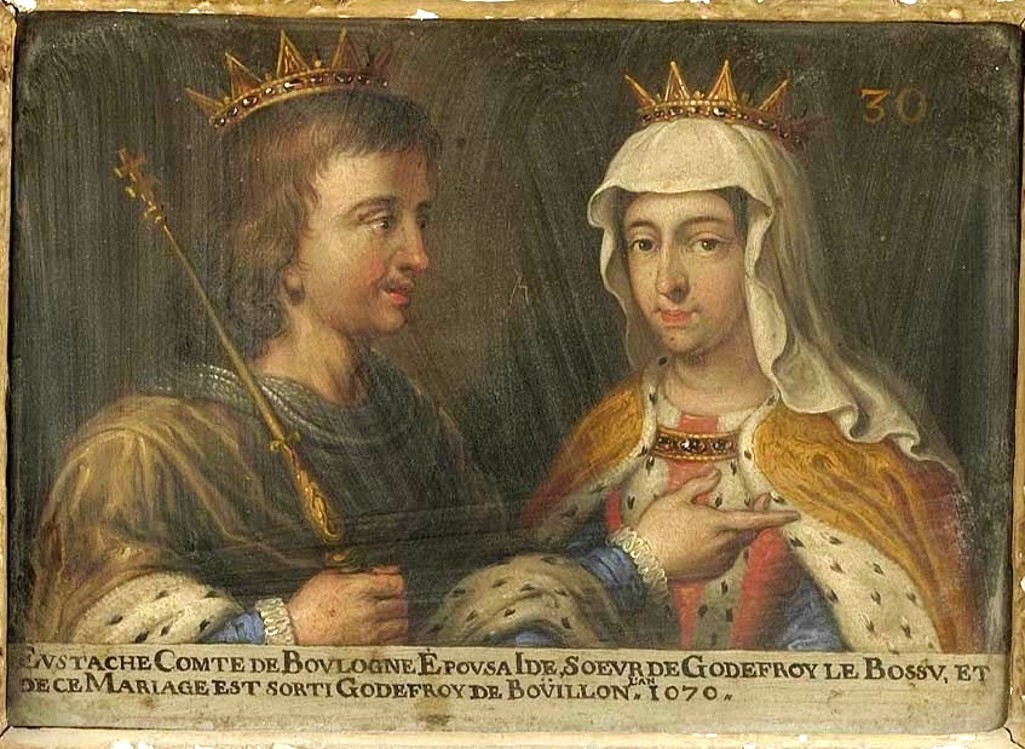
Ida was the daughter of Godfrey III, the Duke of Lower Lorraine and his wife Doda. She became the bride of Eustace II, Count of Boulogne and the couple became the parents of Eustace III, Godfrey of Bouillon, the Leader of the First Crusade and also the first Ruler of Jerusalem under the title, Advocate of the Holy Sepulchre, having refused the title of King and Baldwin, who did accept the title of King of Jerusalem.
Count Eustace and St Ida his Countess
She was a great benefactor of the Church and the poor. After her husband’s death she founded several monasteries: Saint-Wulmer in Boulogne for the Augustinian Canons, Saint-Michel-du-Wast for the Cluniac Monks. She made considerable donations to the Abbeys of Saint-Bertin, Bouillon and Afflighem, favoured the reform of Cluny under the influence of St Anselm of Canterbury who remained a great friend and in correspondence with her. Some of St Anselm’s letters to Ida have survived.This detail underlines the role the holy Archbishop had in the monastic reform in Flanders.
Ida did not take the Benedictine Habit, as has been believed but she obtained it from St Ugo at Cluny, so that she could consider herself a secular oblate of the Benedictine Order.
She died today in 1113 and was buried in the Church of Wast (we note that many biographical information read, wrongly, Saint-Waast, instead of Wast). In 1669 her Relics were transferred to the Benedictines of the Holy Sacrament in Paris, who took them with them, when, in 1808, they settled in Bayeux, where they are still kept (one Relic, however, was left in Wast).
Ida’s Feast which was celebrated in the ancient Diocese of Boulogne, was later authorised in the Diocese of Arras and Bayeux. The commemoration of the Saint is found in many medieval calendars on 13 April. Blessed Ida of Louvain is also remembered on this day, although the date of her death is unknown.
St Hermengild (Died 585) Martyr, Confessor, King. The Roman Martyrology reads: “At Seville in Spain, St Hermenegild, son of Leovigild, Arian King of the Visigoths, who was incarcerated for the confession of the Catholic Faith. By order of his wicked father, he was beheaded because he had refused to receive communion from an Arian Bishop, on the Paschal Solemnity and thus exchanging an earthly for a heavenly Kingdom, he entered the abode of the blessed, both as a King and as a Martyr.” His Life and Death: https://anastpaul.com/2023/04/13/saint-of-the-day-13-april-st-hermenegild-died-585-martyr-confessor/
St Carpus of Pergamus Bl Edward Catherick Bl Francis Dickenson St Guinoc St Ida of Boulogne (c1040-1113) Widow Bl Ida of Louvain Bl James of Certaldo Bl John Lockwood
Blessed Margaret of Castello OP (1287-1320) Italian professed member of the Third Order of the Order of Preachers of St Dominic. Margaret was disabled and became known for her deep faith and holiness. Her body is incorrupt. Beatified on 19 October 1609 by Pope Paul V (concession of indult for Mass and Office). About Blessed Margaret: https://anastpaul.wordpress.com/2018/04/13/saint-of-the-day-13-april-blessed-margaret-of-castello-o-p-1287-1320/
St Martius of Auvergne Bl Miles Gerard St Papylus of Pergamus St Proculus of Terni St Ursus of Ravenna Bishop and Confessor
Martyrs of Dorostorum – 3 Saints: A lector and two students Martyred together in the persecutions of Diocletian – Dadas, Maximus and Quinctillianus. Beheaded c303 in Dorostorum, Lower Mysia (modern Sillistria, Bulgaria.
Saint of the Day – 12 April – Saint Ailell of Cologne (Died 1040) Priest, Abbot of Great Saint Martin’s Monastery and of St Pantaleon’s in Cologne, Missionary, a strict disciplinarian and a talented and skilled leader, running two separate Monasteries for years. He was also a skilled Musician and is held to be the first to introduce Roman chant to Cologne. Born in Monaghan, Ireland and died in Cologne in 1040 of natural causes. Also known as – Helias.
Ailell was a native of what is now County Monaghan, Ireland. He became a Monk at the Monastery of Muckno which is now the Parish of the Town of Castleblayney. Johannes Trithemius, a German Monk Historian, states that he led “a most austere life, and was on that account an object of hatred to wicked men, who feared his reproof.
Ailell went to Cologne in Germany as a Missionary and in 1015, was elected as the Abbot of Great St Martin Monastery, Cologne. In the same year, he became the Abbot of St Pantaleon’s – both Monasteries would remain under his rule until his death in 1040.
Great St Martins
Amazingly, Ailell ran both St Martin’s and St Pantaleon’s, with the greatest success. He was remarkable, however, for uncommon strictness in the enforcement of discipline. A French Monk of St Pantaleon, having transcribed, a neat copy of the Missal for the use of the community, without having first obtained permission to do so,Ailell burned it, lest others should presume to act without previous licence.
Our Saint was a “bosom friend and counsellor” of St Heribert, Archbishop of Cologne. Heribert died in 1021. Heribert’s biographer, Landberth wrote about his death: “when this illustrious prelate felt his end approach, he sent for his beloved Ailell, who prepared him for death and administered to him the Sacrament of Extreme Unction and all the final consolations of the Church.” St Heribert’s life: https://anastpaul.com/2019/03/16/saint-of-the-day-16-march-st-heribert-c-970-1021/
Unfortunately, St Heribert’s Successor named Pilgrim, possessed an inveterate dislike for the Irish Monks and for Ailell, in particular. Departing on a pastoral visit, he vowed to expel them all upon his return. Ailell is said to have prayed to God that if it was the Lord’s Will, the Monks would depart but if not, Archbishop Pilgrim would never return to Cologne. Pilgrim died at Neomagnus in 1036 and it seems thus God willed him not to return to Cologne, leaving the Irish Monks in peace. Ailell is said to have established a good relationship with Pilgrim’s Successor, Archbishop Herman.
Ailell died in the odour of sanctity and was buried in the Chapel of St Benedict, with the Epitaph: “Haec tumuli fossa conduntur Praesulis ossa/Heliae miri mirificique viri.” (More or less – In these mounds are buried the bones of Praesulis/Helia’s wonderful men.)
St Acutina St Ailell of Cologne (Died 1040) Priest,Abbot
St Alferius Pappacarbone of La Cava (930–1050) Priest, Founder and Abbot of Arsicia (La Trinità della Cava) which follows the Benedictine Rule, nobleman, Diplomat to Prince Waimar III of Salerno, Cluniac reformer, cave Hermit, Mystic and Ecstatic, Miracle-worker. The Roman Martyrology states: “In the Monastery of Cava de ‘Tirreni in Campania, Saint Alferius, Founder and first Abbot, who, after having been adviser to Guaimario, Duke of Salerno, who became a disciple of Saint Odilone in Cluny, learned in an excellent way, the discipline of monastic life.” Biography: https://anastpaul.com/2021/04/12/saint-of-the-day-12-april-saint-alferius-of-la-cava-930-1050/
Blessed Andrew of Montereale OSA (c1479-1764) Priest and Friar of the Order oif the Hermits of St Augustine, renowned Scholar, Preacher, Teacher, Reformer. Confessor and Spiritual Director to the Royal Court of France, Miracle-worker. His life was devoted to teaching, preaching and leading the Augustinians from several positions of leadership. He was hailed, even during his lifetime, as a pious Miracle worker.
St Artemón of Caesarea St Basil of Parion St Constantine of Gap Bishop St Damian of Pavia (Died c710) Bishop St Erkemboden of Thérouanne St Florentin of Arles
St Pope Julius I (Died 337) Bishop of Rome from 6 February 337 until his death on 12 April 352. He fought against the Arian Heresy and it is also traditionally believed that he is also the Pope who set 25 December as the date of the Birth of Jesus. The Roman Martyrology reads: “At Rome, the birthday of Pope St Julius, who combated vigorously for the Catholic Faith against the Arians. After a life of brilliant deeds and great sanctity, he rested in peace.” His Life: https://anastpaul.com/2023/04/12/saint-of-the-day-12-april-saint-pope-julius-i-died-337/
St Lorenzo of Belem St Peter of Montepiano
St Sabas the Lector
St Tetricus of Auxerre St Victor of Braga St Vissia of Fermo St Wigbert
Saint of the Day – 11 April – St Leo I, the Great (c400-461) Confessor, Bishop of Rome, Great Western Father & Doctor of the Church. Born in c400 at Tuscany, Italy and died on 11 April 461 in Rome of natural causes. Papal Ascension – 29 September 440. Patronages – of Choristers, Musicians, of Castellana Grotte and Ponteginori, both in Italy and of the Diocese of Volterra also in Italy. St Leo was declared Doctor Unitatis Ecclesiae (Doctor of the Unity of the Church) Doctor of the Church by Pope Benedict XIV in 1754.
The Roman Martyrology reads: “At Rome, St Leo, Pope and Confessor, who was sunmaned “the Great” on account of his extraordinary merits. He gave the seal of his authority to the Holy Council of Chalcedon which was held in his time and which condemned Eutyches through his legates. After having merited the gratitude of the Church of God and the whole flock of Christ, by the many Decrees which he issued and the many excellent Treatise which he wrote, this good and zealous Shepherd, reseted in peace.”
He ranks among the most illustrious Sovereigns who ever occupied the Throne of St Peter. Of his life, we know little – with him, the man seems to disappear before the Pope.
He saw most clearly that one of his greatest tasks was to vindicate the primacy of the Roman Bishop, St Peter’s Successor and to raise the prestige of the Holy See before the entire world. Hardly any Pope in history has occupied a like position in the Ecclesiastical and political world.
As a writer, too, his name is famous. His sermons, which occur frequently in the Divine Office, belong to the finest and most profound in patristic literature. The Council of Chalcedon was held under his direction (451). The Breviary tells us: “Leo I, an Etruscan, ruled the Church at the time when Attila, King of the Huns, who was called the Scourge of God, invaded Italy. After a siege of three years, he took, sacked and burned Aquileia and then hurried on toward Rome. Inflamed with anger, his troops were already preparing to cross the Po, at the point where it is joined by the Mincio.
Here Attila was stopped by Leo (452). With God-given eloquence, the Pope persuaded him to turn back and when the Hun was asked by his servants why, contrary to custom, he had so meekly yielded to the entreaties of a Roman Bishop, he answered that he had been alarmed by a figure dressed like a Priest who stood at Leo’s side; this individual was holding a drawn sword and acted as if he would kill him if he advanced farther. As a result Attila retreated to Pannonia.”
The Painting below is a Fresco called “The Meeting of Leo I and Attila” by the Italian Renaissance artist Raphael. It was painted from 1513 to 1514 as part of Raphael’s commission to decorate the rooms which are now known as the “Stanze di Raffaello,” in the Apostolic Palace in the Vatican.
Meanwhile, Leo returned to Rome and was received with universal rejoicing. Some time later, the Vandal Genseric entered the City and again Leo, by the power of his eloquence and the authority of his holy life, persuaded him to desist from atrocity and slaughter (455).
Leo was also active in matters Liturgical. The Leonine Sacramentary, a compendium of Missal prayers, contains many of his compositions; some also give him credit for the beautiful offices of Advent.
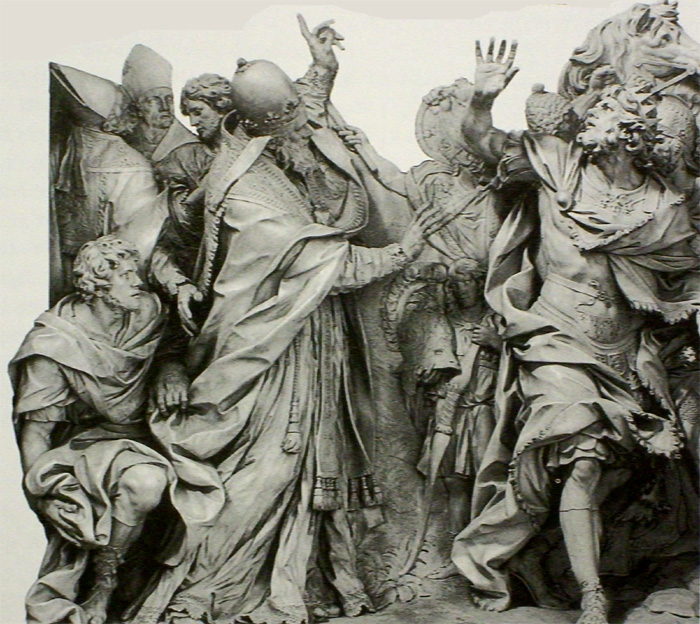
The Meeting between St Leo the Great and Attila is the only Altarpiece in St Peter’s consisting of a monumental marble relief. It depicts the Pope repelling Attila and the Huns from attacking Rome. Attila raises his arm as Sts Peter and Paul appear in the sky.
St Leo I the Great (c400-461) Confessor, Bishop of Rome, Great Western Father & Doctor of the Church. Elected in 440, he worked tirelessly as “Peter’s Successor,” guiding his fellow Bishops as “equals in the episcopacy and infirmities.” He is perhaps best known for having met Attila the Hun in 452 and persuaded him to turn back from his invasion of Italy. For the Church, he is greatly esteemed for his destruction of various heresies. One of Only 2 Popes surnamed as ‘the Great’!: https://anastpaul.com/2017/11/10/saint-of-the-day-10-november-st-pope-leo-i-doctor-of-the-church-c-400-461/
St Agericus of Tours St Aid of Achard-Finglas
St Antipas of Pergamum (Died c92) Martyr, Bishop of Pergamon, Greece (in modern Turkey), spiritual student of Saint John the Apostle and Evangelist. His Life and Death: https://anastpaul.com/2021/04/11/saint-of-the-day-11-april-st-antipas-of-pergamum-died-c-92-spiritual-student-of-saint-john-the-apostle-and-evangelist/
St Guthlac of Crowland (674–715) Monk, Hermit, Ascetic. St Guthlac was from Lincolnshire in England. He is particularly venerated in the Fens of eastern England where many Churches are dedicated to him. His sister is venerated as Saint Pega, an anchoress. His body was incorrupt until its destruction in the 16th century by the dissolution of the Monasteries by Henry VIII. Biography: https://anastpaul.com/2019/04/11/saint-of-the-day-11-april-st-guthlac-674-715/
St Hildebrand of Saint-Gilles St Isaac of Monteluco Bl James of Africa Bl John of Cupramontana Bl Lanunio St Machai St Maedhog of Clonmore Bl Mechthild of Lappion Bl Paul of Africa St Philip of Gortyna St Raynerius Inclusus St Sancha of Portugal St Stephen of Saint-Gilles
Saint of the Day – 10 April – Saint Palladius of Auxerre (Died c659) Bishop of Auxerre, previously the Abbot of Saint Germanus Monastery in Auxerre. He zealously served his people for more than 30 – some sources have proved an Episcopate of thirty six years – all of which working with untiring love for his flock, the Church in his Diocese and for the secular and political well-being of his See.. Also known as – Palladio, Palladium. This Statue below in one of the Chapels in the Cathedral of St Stephen, embellished by our Saint, might be St Palladius.
As the Abbot of St Germanus of Auxerre, a wise, generous and merciful man, our Saiunt Palladius was elected, by the faithful, as the new Bishop of the same City, Auxerre, after the death of St Desiderius in 623.
His thirty six year tennure, studded with acts of faith and wise government, saw him present at the Councils of Clichy and Chalon-sur-Saone and deeply committed to the care of the lands and peoples of his See. This is evidenced by his letter to St Desiderius of Cahors (Reign 630-655) which recommends to the Prelate’s concern, the lands and people belonging to the Diocese of Auxerre who were in the territories of Cahors and also recommends himself to the prayers of his fellow Bishop.
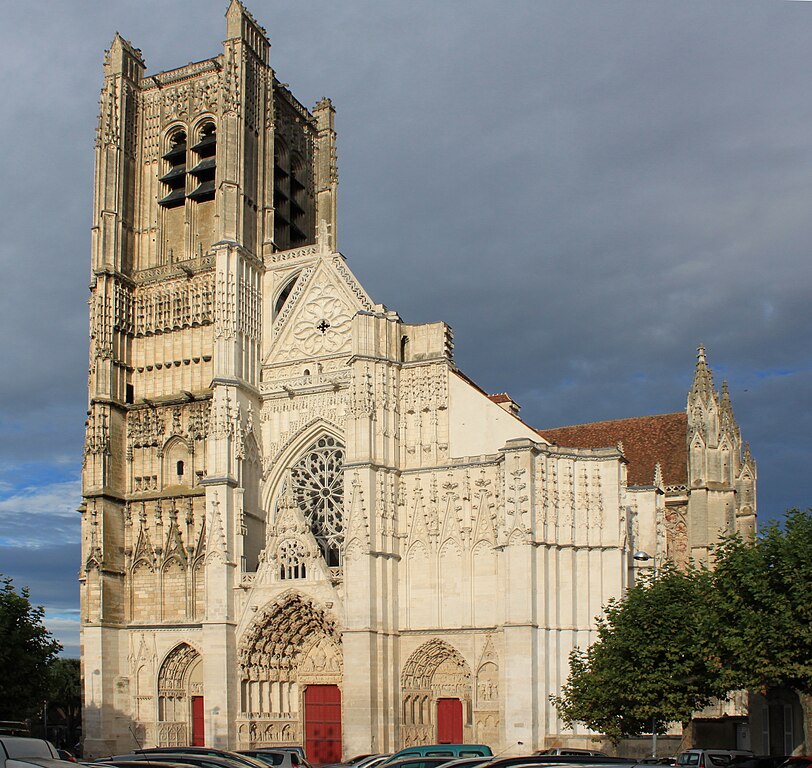
Palladius was responsible for the dedication of the Church of Vergers to St Germanus (later, this Church was re-dedicated to St Palladius himself), the transformation of the Basilica of St Julian into a double Abbey and the embellishment of the Cathedral of St Stephen. This is an amazing building – many images here: https://travelfrance.tips/auxerre-the-cathedral/
Auxerre Cathedral – St Stephen’s
Palladius founded and built the Church of St Eusebius of Vercelli in which he was later buried. He .died in c659. In 945, Bishop St Guy of Auxerre Canonised Palladius and his memory is celebrated on 10 April.
St Miguel de Sanctis O.SS.T (1591-1625) Priest of the Order of the Most Holy Trinity and of the Captives also known as the Trinitarian Order or the Trinitarians, Mystic, Penitent, Ecstatic, Apostle of prayer, mortification, of the poor and the sick, he had a special devotion to the Blessed Sacrament and would fall into ecstatic prayer during the Consecration at Holy Mass, so much so, that he became known as “El Extático”, “The Ecstatic.” Pope Pius IX Canonised Miguel on 8 June 1862. About St Miguel: https://anastpaul.com/2020/04/10/saint-of-the-day-10-april-st-miguel-de-sanctis-o-ss-t-1591-1625/
St Palladius of Auxerre (Died c659) Bishop St Paternus the Scot
Martyrs of Carthage – 50 Saints: A group of 50 Christians who were imprisoned in a pen of snakes and scorpions and then Martyred, all during the persecutions of Decius. Only six of their names have come down to us – Africanus, Alessandro, Massimo, Pompeius, Terence and Teodoro. Beheaded in 250 at Carthage.
Martyrs of Georgia: Approximately 6,000 Christian Monks and lay people Martyred in Georgia in 1616 for their faith by a Muslim army led by Shah Abbas I of Persia.
Martyrs of Ostia: A group ofcriminals who were brought to the faith by Pope Saint Alexander I while he was in prison with them. Drowned by being taken off shore from Ostia, Italy, in a boat which was then scuttled, c 115.
Saint of the Day – 9 April – Saint Madrun of Wales (Died early 6th Century) Widow, Mother, Queen of Gwent in Wales, Missionary with her son St Ceidio to Cornwall after the death of her husband. Born in c440 and died on 8 April in the early part of the 6th Century. Patronages – of the Towns of Minster andTintagel, Cornwall and Trawsfynydd in Wales. [The Patron Saint of the Parish of Madrun in Cornwall, however, is not our Madrun but the male Cornish Saint Madron whoe died in c545 (Maddern)]. Also known as – Madryn, Marcelliana, Materiana, Mertheriana, Merthiana, Modrun. Additional Memorials – 9 June (Trawsfynydd, Wales) and 19 October on some calendars.
According to Welsh genealogies, Madrun was the daughter of King Vortimer and wife of Ynyr Gwent, chieftain of East Monmouthshire.
Besides the fact that she bore her husband four children, all that is known about her with any certainty, is that she welcomed St Tathan (Tathaeus) an Irish Missionary.
Legend has it that while on pilgrimage, she received a dream in which she was told to build a convent where she slept; the Church there has survived. Madrun accompanied her son, St Ceidio as Misionnaries to Cornwall and assisted him in evangelising the region, hence the 2 patronages in Cornwall.
She is considered the Patron Saint of Trwfynydd in Merionethshire where her Feast Day is celebrated on 9 June. However, there exists some confusion with a St Materiana who emmoved to Cornwall in c450, although the two seem to be one person.
St Brogan St Casilda of Toledo St Concessus the Martyr St Demetrius the Martyr St Dotto St Eupsychius of Cappadocia St Gaucherius St Hedda the Abbot St Heliodorus of Mesopotamia St Hilary the Martyr
Blessed Ubaldo Adimari OSM (c 1245-1315) Priest and Servite Friar, Soldier, Politician, Penitent, miracle-worker, spiritul student and later assistant of St Philip Benezi (1233-1285) (one of the Seven Holy Founders of the Order of the Servants of Mary – the Servites). He was Beatified on 3 April 1821 by Pope Pius VII. Biography: https://anastpaul.com/2021/04/09/saint-of-the-day-9-april-blessed-ubaldo-adimari-osm-c-1245-1315/
St Waltrude of Mons (c612-686) Widow, Married Mother, later a Nun. By the life of St Waltrude, we should learn to despise the unjust censures of the world. It persecutes, by its calumnies, those by whose lives, its false maxims are condemned. But, it can only hurt a counterfeit virtue, as the fire consumes only the dross but renders true gold brighter and more pure. Solid virtue is not only tried by humiliations but, gains the greatest advantage and improvement, by making a good use of them. Biography: https://anastpaul.com/2023/04/09/saint-of-the-day-9-april-saint-waltrude-of-mons-c612-686-widow/
Martyrs of Croyland – 9 Saints: A group of Benedictine Monks Martyred by pagan Danes – Agamund, Askega, Egdred, Elfgete, Grimkeld, Sabinus, Swethin, Theodore and Ulric. Croyland Abbey, England.
Martyrs of Masyla: Massylitan Martyrs Group of Christians Martyred in Masyla in northwest Africa.
Martyrs of Pannonia: Seven Virgin-Martyrs in Sirmium, Pannonia (modern Sremska Mitrovica, Serbia).
Martyrs of Thorney Abbey – 3+ Saints: A group of Hermits, hermitesses and monks who lived in or around Thorney Abbey who were Martyred together during raids by pagan Danes. We know little more than the names of three – Tancred, Torthred and Tova. 869 by raiders at Thorney Abbey, Cambridgeshire, England.
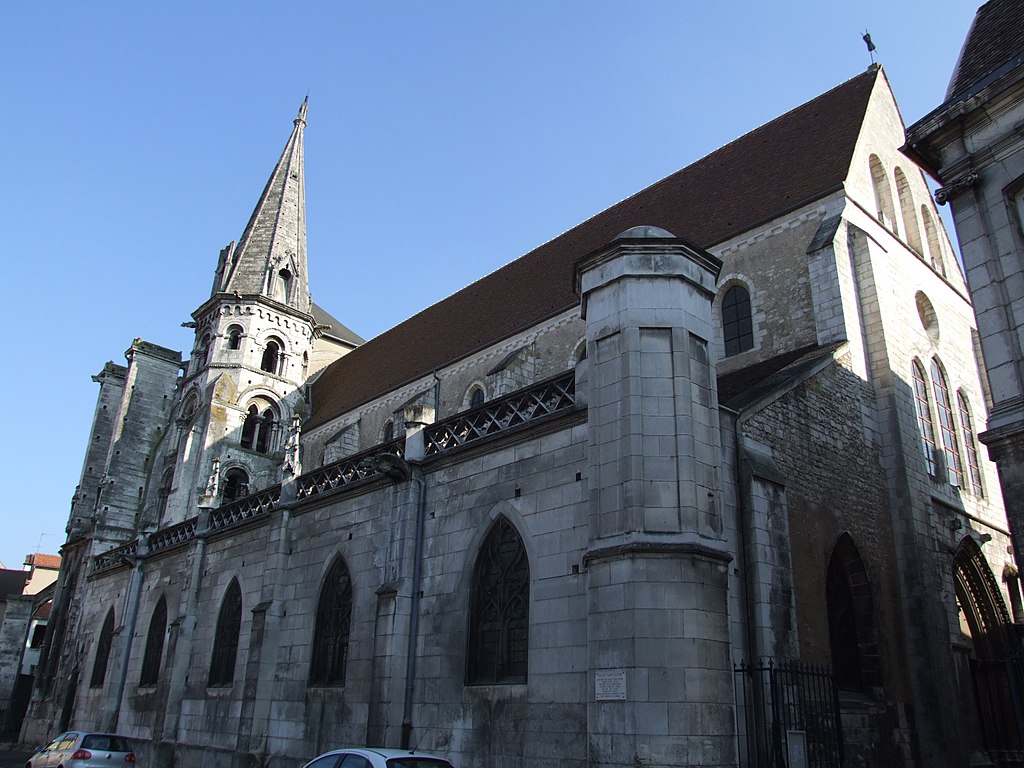
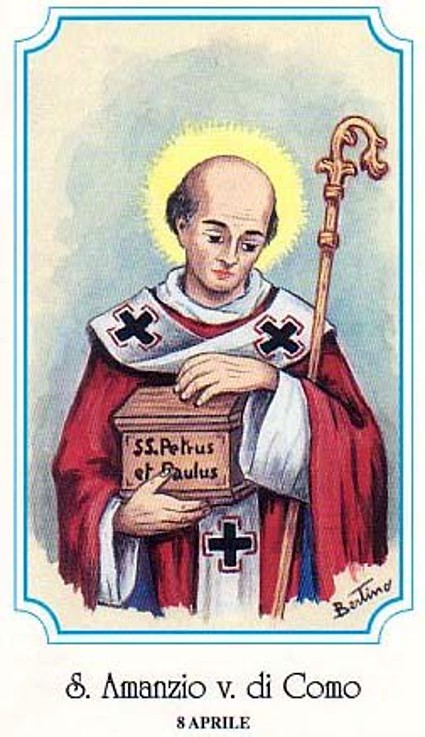
Saint of the Day – 8 April – Saint Amantius of Como (Died c448) the 3rd Bishop and Confessor. Born in Canterbury, England and died on 8 April c448 in Como, Italy of natural causes. Also known as – Amanzio …
The Roman Martyrology reads: “At Como, St Amantius, Bishop and Confessor.”
The figure of Amantius, the 3rd Bishop of Como, is illuminated against the background of the 5th Century, a period of profound changes for the Roman Empire and the Church. Born in Canterbury in England, he intertwined his history with that of the City of Como, leaving an indelible mark in its collective memory.
Information on his origins is fragmentary. Tradition has it that he was born in Canterbury, a British city that was part of the Roman Empire at the time. His Catholic family, of noble lineage, counted among its ancestors, the Emperor Theodosius III or, according to other sources, another Emperor of the 4th-5th Century. It is possible that Amantius initially operated as an Imperial Official and was sent to Italy in that role.
However he arrived in Italy, he settled in Como. Amantius undertook a trip to Rome, driven by faith and the desire to enrich his theological knowledge. In the eternal City he had the opportunity of venerainge the Relics of the Apostles Peter and Paul and obtained some for hisSee. Upon his return to Como, he immediately worked to build a Basilica in the Apostles’ honour. The Basilica, built on land owned by himself became an important centre of worship and devotion for the local community.
Elected the 3rd Bishop of Como after the death of St Provino in 420, Amantius led the Diocese with wisdom and apostolic zeal. His Episcopate coincided with a period of turbulence for the Roman Empire, threatened by barbarian invasions. In this difficult context, Amantius shone as a shepherd and model for all the faithful.
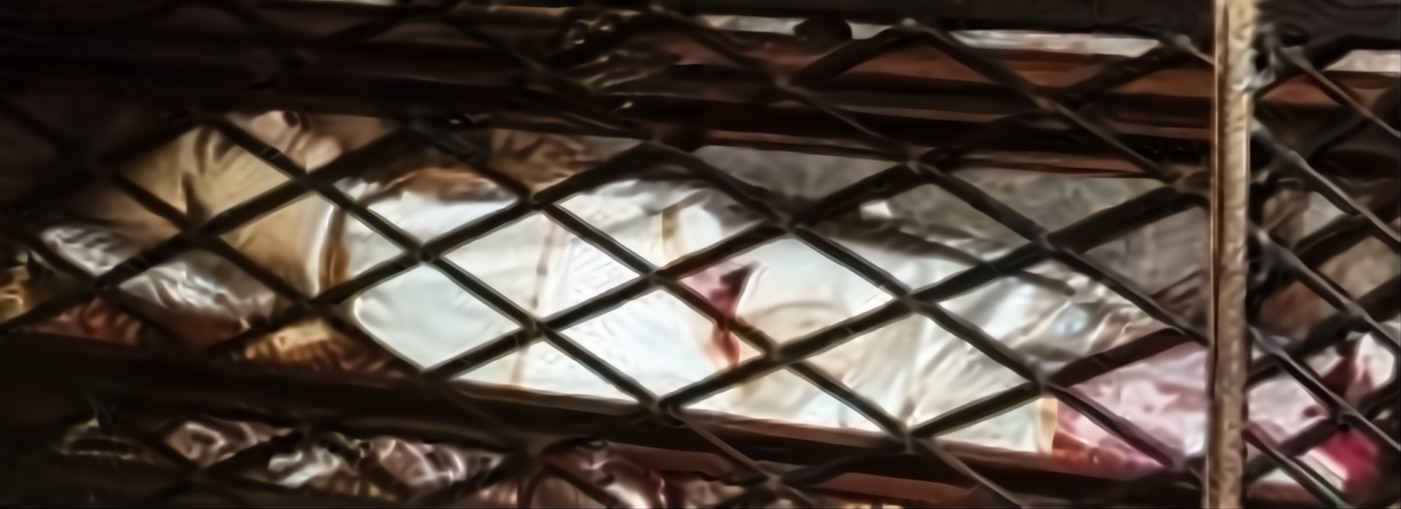
Saint Amantius died on 8 April, the day on which his liturgical memory is celebrated. The precise year of his death is uncertain but it is presumed to have occurred around 448. His remains rested in the Basilica he founded until 1590, when they were translated to the Jesuit Church of the Gesu in Como, of which he became Patron together with St Felix.
St Dionysius of Corinth (Died in the 2nd Century) Bishop of Corinth in Greece, Confessor. Some of his words are preserved from his 7th letter and are contained in the post link below. The Roman Martyrology reads: “At Corinth, the Bishop, St Denis, who instructed not only the people of his own City and Province by the learning and unction with which he preached the word of God but, also the Bishops of other Cities and Provinces, by the letters which he wrote to them. His veneration for the Roman Pontiff was such that he used to read their epistles publicly in the Church on Sundays. He lived in the time of Marcus Antoninus Verus and Lucius Aurelius Commodus.” His Life: https://anastpaul.com/2023/04/08/saint-of-the-day-8-april-saint-dionysius-of-corinth-died-in-the-2nd-century-bishop-confessor/
Bl Libania of Busan St Martin of Pegli St Phlegon of Hyrcania St Redemptus of Ferentino (Died 586) Bishop
Martyrs of Africa – 3 Saints: A group of African Martyrs whose name appears on ancient lists but about whom nothing is known but their names – Januarius, Macaria and Maxima.
Martyrs of Antioch – 4 Saints: A group of Christians Martyred together for their faith. We know little more than their names – Diogene, Macario, Massimo and Timothy. They died in Antioch, Syria.
Saint of the Day – 7 April – Saint Hegesippus (c110-c180) Lay Ancient Christian Writer. Born and died probably in Jerusalem. Also known as -Egesippo, Hegesippus of Jerusalem, Hegesippus the Nazarene.
The Roman Martyrology reads: “St Hegesippus, who lived near the time of the Apostles, He came to Rome whilst Anicetus was the Sovereign Pontiff and remained until the accession of Eleutherius. He wrote the history of the Church in a simple style, from the Passion of our Lord, to his own time and, delineated, in his narrative, the character of those whose lives he imitated.”
Hegesippus was, by nation and religion, a Jew, who joined the Church of Christ in Jerusalem, when the disasters prophesied of his unhappy land occurred and opened his eyes to see their cause.
His writings were known to Saint Jerome and St Eusebius and were praised by them and by all of antiquity. In fact all we know of our Saint came to us from the writings of St Eusebius.
Hegesippus journeyed to Rome, stopping to visit all important Churches along his way. He remained in Rome for nearly twenty years, from the Pontificate of Pope Saint Anicetus (Bishop of Rome c157–168) to that of Saint Eleutherius (Pontificate 174-189). During the time of the latter. he returned to Jerusalem, where he died at an advanced age, probably in Jerusalem, in the year 180.
In 133, Saint Hegisippus began a history of the Church entitled ‘Memoirs,’ which was composed of five books and covered the time from the Passion of Christ until that year, that is, one hundred years. The loss of this work, of which only a few fragments remain, is extremely regretted and lamented, for it is known that they still all existed in the 7th Century. In it he gave illustrious proofs of his faith and placed, in evidence, the Apostolic tradition, proving that although certain men had disturbed the Church by preaching heresies, yet, even to his day, no Episcopal See or individual Church had fallen into error. This testimony he gave after having personally visited all the principal Churches, both of the East and the West, with the intention of gathering all authentic traditions concerning the life of Our Lord and of the Apostles.
He says: “And the Church of the Corinthians remained in the true word until Primus was bishop in Corinth; I made their acquaintance in my journey to Rome, and remained with the Corinthians many days, in which we were refreshed with the true word. And when I was in Rome, I made a succession up to Anicetus, whose Deacon was Eleutherus. And in each succession and in each City, all is according to the ordinances of the law and the Prophets and the Lord Jesus.” (Eusebius, IV, 22).



























You must be logged in to post a comment.