St Eusebius of Rome (Died 357) Priest, Confessor. “At Rome, the birthday of the blessed Priest Eusebius, who for the defence of the Catholic Faith, was shut up in a room of his own house by the Arian Emperor, Constantius, where constantly persevering in prayer for seven months, he rested in peace. His body was removed by the Priests, Gregory and Orosius and buried in the cemetery of Cllistus on the Appian Way.” – Roman Martyrology. His Life: https://anastpaul.com/2020/08/14/saint-of-the-day-14-august-saint-eusebius-of-rome-died-357-priest-confessor/
Bl Aimo Taparelli
St Athanasia of Timia St Callistus of Todi St Demetrius of Africa St Eberhard of Einsiedeln (c890-958) Priest, Abbot St Eusebius of Palestine St Fachanan of Ross
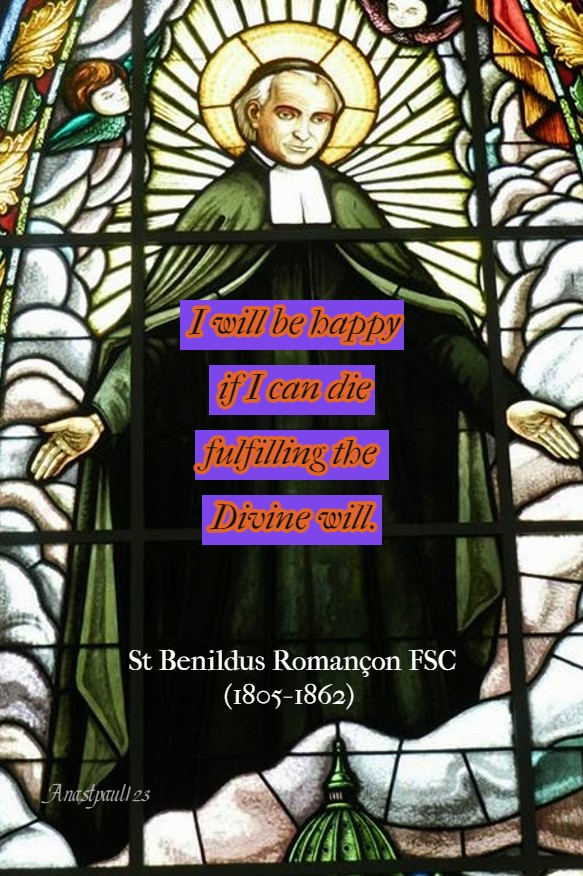
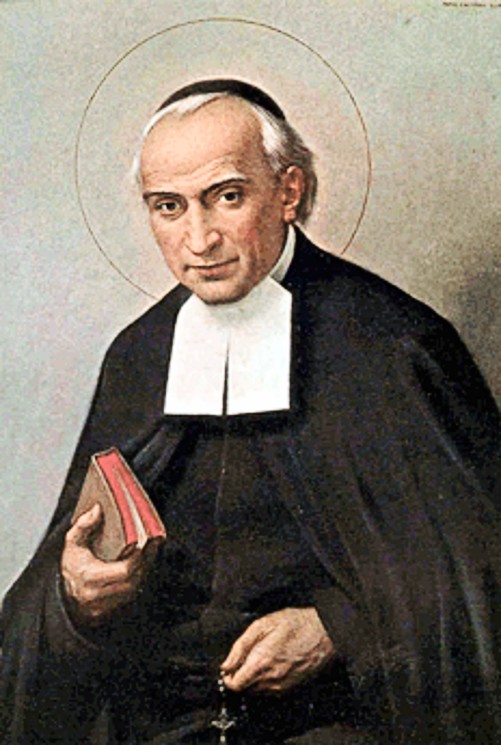
Saint of the Day – 13 August – St Benildus Romançon FSC (1805-1862) Confessor, Teacher, Principal and Brother of the Christian Schools, or the De La Salle Schools – Born on 14 June 1805 at Thuret, Auvergne. Central France as Pierre Romancon and died on 13 August 1862 at Saugues, France of natural causes, aged 57. Patronage – of Teachers, Accordionist and Concertina musicians (when working with the children’s groups, he would often lead songs by playing a Concertina) and of many Schools and Colleges dedicated to him. He is the first Brother of the Institute to be Canonised and the second Saint after St Jean Baptiste de La Salle Canonised in 1900 by Pope Leo XIII. Also known as – Benilde, Peter Romancon, Pierre Romancon, Benildo Romancon. Additional Memorial – 29 January for the De La Salle Brothers. St John Baptiste’s life here: https://anastpaul.com/2022/05/15/saint-of-the-day-15-may-st-john-baptiste-de-la-salle-1651-1719-confessor-known-as-the-father-of-modern-education/
Benildus was born Pierre Romançon on 14 June 1805, in the town of Thuret, Puy-de-Dôme, in France to a farming family. A small and frail-looking boy, he was not physically created to be a farmer but his enrolment in a Christian Brothers School at Riom, also in Auvergne led him to his vocation as a teacher. He was so far ahead of his classmates in Elementary School that, when he was only 14 years old, the Brothers often assigned him as a Substitute Teacher.
He joined the Brothers in 1820, just before turning 16 and served at several Brothers’ Schools in south-central France. In 1841 he was appointed Director of a School in Saugues, an isolated village on a barren plateau in southern France. For the next twenty years he worked quietly and effectively as Teacher and Principal to educate the boys in the village and some from the neighbouring farms, many of whom were in their teens and had never been to School before.
Short of stature as he was, he was known as a strict but fair disciplinarian. He also looked after his pupils by preparing meals in the Brothers’ kitchen for hungry childrens, converting old Brothers’ robes into coats or trousers for them and spending hours tutoring children who learned more slowly than others. He referred to all pupils, regardless of age or background, as “Monsieur – Mister.”
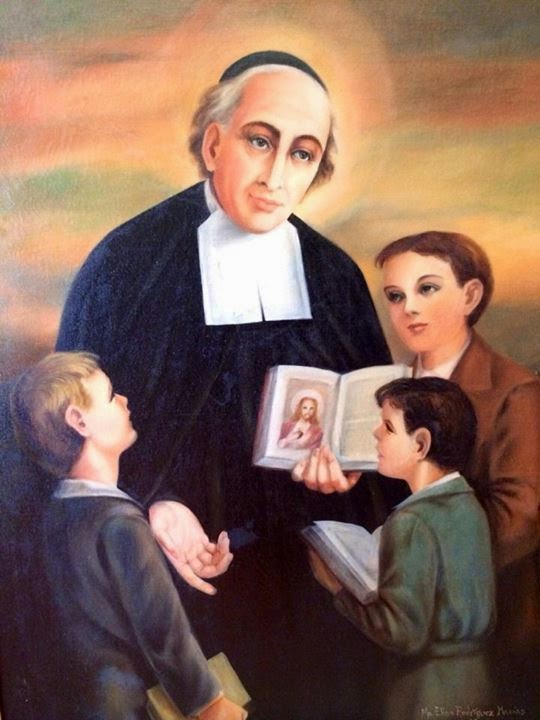
He always put particular effort into teaching the Catechism – in this matter, he did not allow any pupil to remain ignorant. He, therefore, took the those ones needing extra attention apart and persisted with them, until they had properly learned the teachings and their meaning. In fact, he is represented in this typical attitude on the Altar dedicated to him in the Chapel of the General House in Rome, by a beautiful marble group created by the Sculptor ,Ciocchetti; while a canvas by the Painter, Mariani depicts him in the act of consecrating the pupils to St Joseph, for whom he always showed great veneration and devotion.
In time, the little School became the centre of the social and intellectual life of the village, with evening classes for the adults and tutoring for the less gifted children. Brother Benildus’ extraordinary religious piety and love, was evident to everyone – at Mass with the children in the Parish Church, teaching Catechism, preparing boys for First Holy Communion, visiting and praying with the sick and amazing recounts of miraculous cures. He was especially effective in attracting religious vocations.
At his death, on 13 August 1862, more than 200 Brothers and an impressive number of Priests, had been his pupils at Saugues!
Benildus had such an ability to penetrate the souls of young people as a Teacher and, even more, as a spiritual guide that many sought special heavenly gifts, obtained by assiduous prayers and penance, under his guidance. Among the people of Saugues, he always enjoyed a true reputation for holiness. A Crucifix which belonged to him, is still carried today to the sick of the Town, who piously kiss it, invoking the intercession of the blessed, to whom a Chapel of the Parish Church is consecrated and where he is buried.
Benildus was Beatified on 4 April 1948 by Pope Pius XII, who mentioned that his sanctification was attained by enduring “the terrible daily grind” and by “doing common things in an uncommon way.”
St John Berchmans SJ (1599-1621) Jesuit Novice – born Jan Berchmans on 13 March 1599 at Driest, Brabant, Belgium and died on 13 August 1621 at Rome, Italy of natural causes. Patronages – Altar Servers, Jesuit novices and students. He had a special devotion to God’s Mother and to him is owed the Little Rosary of the Immaculate Conception. Biography: https://anastpaul.com/2019/08/13/saint-of-the-day-13-august-saint-john-berchmans-sj-1599-1621/
St Anastasius the Monk St Anastasius the Priest St Benildus Romançon FSC (1805-1862) Teacher of the Brothers of Christian Schools St Cassian of Todi St Concordia Bl Gertrude of Altenberg St Helen of Burgos St Herulph of Langres Bl John of Alvernia St Junian of Mairé St Ludolph
St Maximus the Confessor (c 580-662) Father of the Church, Monk, Abbot, Theologian, Confessor, Scholar, Writer. Also known as St Maximus of Constantinople and St Maximus the Theologian. St Maximus, a man of fearless courage in witnessing to – “confessing” – even while suffering, the integrity of his faith in Jesus Christ, true God and true man, Saviour of the world and of His Holy Catholic Church. His Life: https://anastpaul.com/2020/08/13/saint-of-the-day-13-august-saint-maximus-the-confessor-c-580-662-father-of-the-church/
St Wigbert of Fritzlar (c 675-c 746) Born in England, a learned Scholar and Abbot, Missionary, Miracle-worker, gifted with a penetrating understanding of Sacred Scripture as well as the gift of prophecy, companion of St Boniface, the Apostle of Germany. Wigbert was known as a quiet and gentle man and a great teacher. Both St Alcuin and St Bede knew and mentioned him in their historical writings of the times and of the Church. St Bede admired his contempt of this world and his learning. A fascinating and much-admired Saint: https://anastpaul.com/2022/08/13/saint-of-the-day-13-august-st-wigbert-of-fritzlar-c-675-c-746/
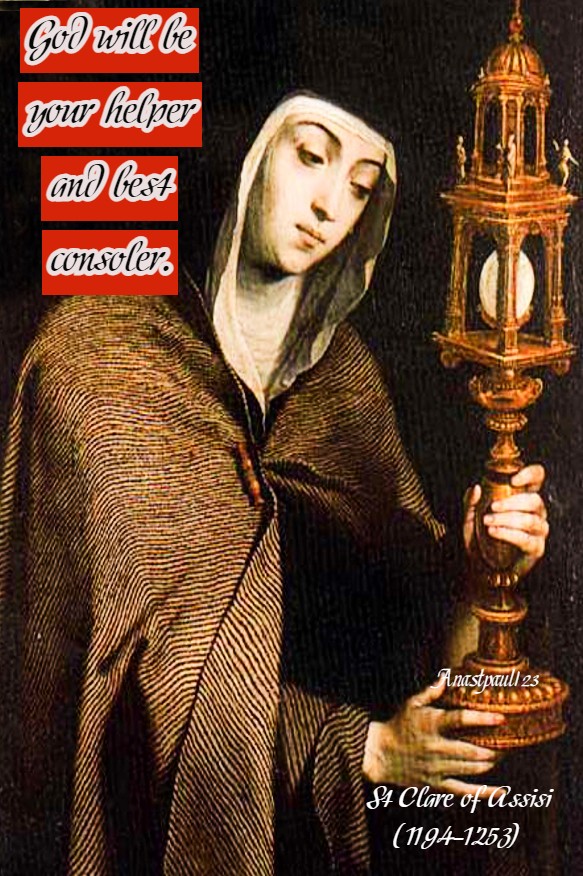
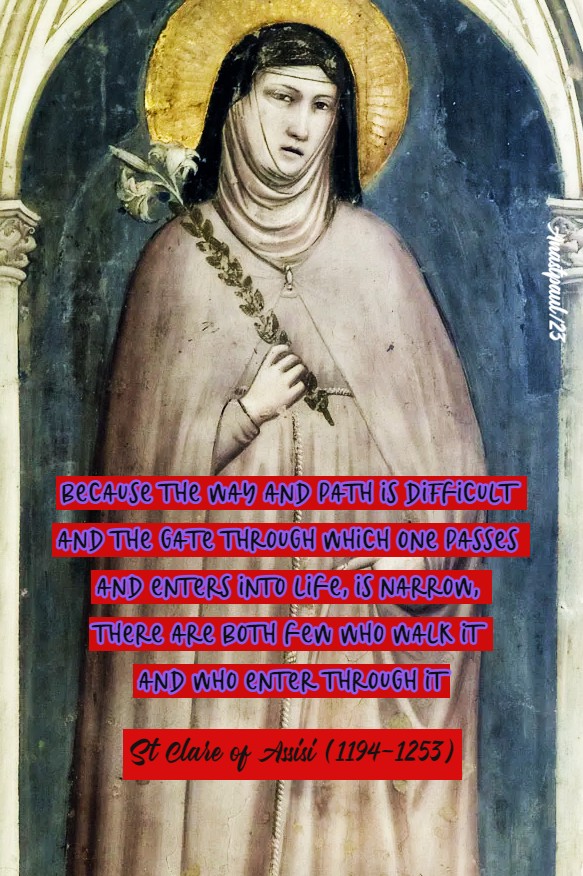
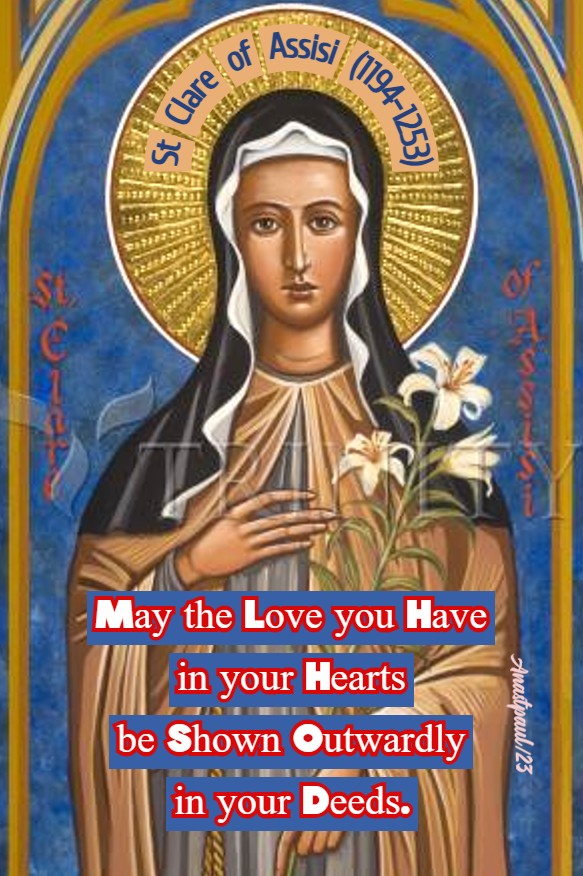
Quote/s of the Day – 12 August – St Clare of Assisi (1194-1253) Virgin
“God will be your helper and best consoler. …”
“Because the way and path is difficult and the gate through which one passes and enters into life, is narrow, there are both few who walk it and who enter through it.”
“May the love you have in your hearts be shown outwardly in your deeds.”
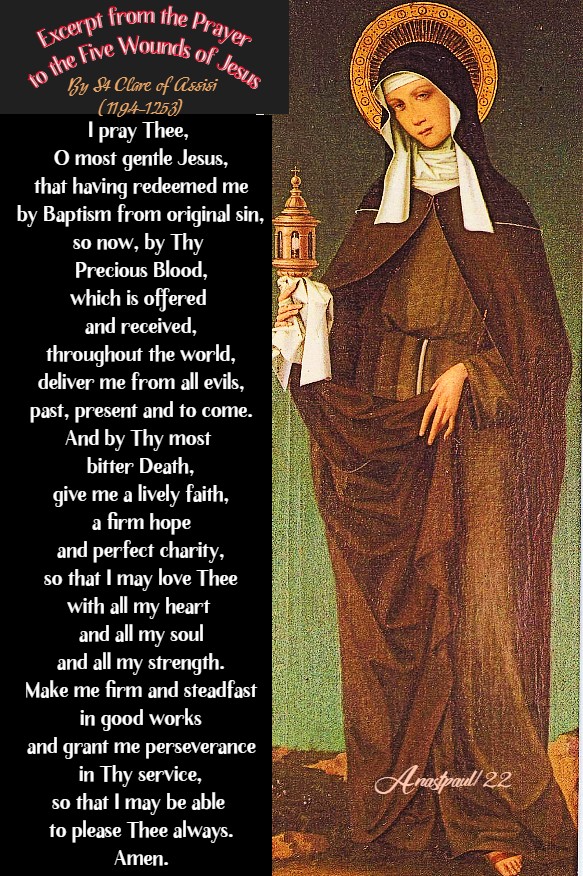
Excerpt from the Prayer to the Five Wounds of Jesus By St Clare of Assisi (1194-1253)
I pray Thee, O most gentle Jesus, that having redeemed me by Baptism from original sin, so now, by Thy Precious Blood, which is offered and received, throughout the world, deliver me from all evils, past, present and to come. And by Thy most bitter Death, give me a lively faith, a firm hope and perfect charity, so that I may love Thee with all my heart and all my soul and all my strength. Make me firm and steadfast in good works and grant me perseverance in Thy service, so that I may be able to please Thee always. Amen.
Saint of the Day – 12 August – St Eusebius of Milan (Died 462) Archbishop of Milan – Born in Greece (although some sources regard him as Milanese) and died on 12 August 462. He was the Archbishop from 449 until his death.
The Roman Martyrology reads: “In Milan, Saint Eusebius, Bishop, who worked diligently for the True Faith and rebuilt the Cathedral destroyed by the Huns.”
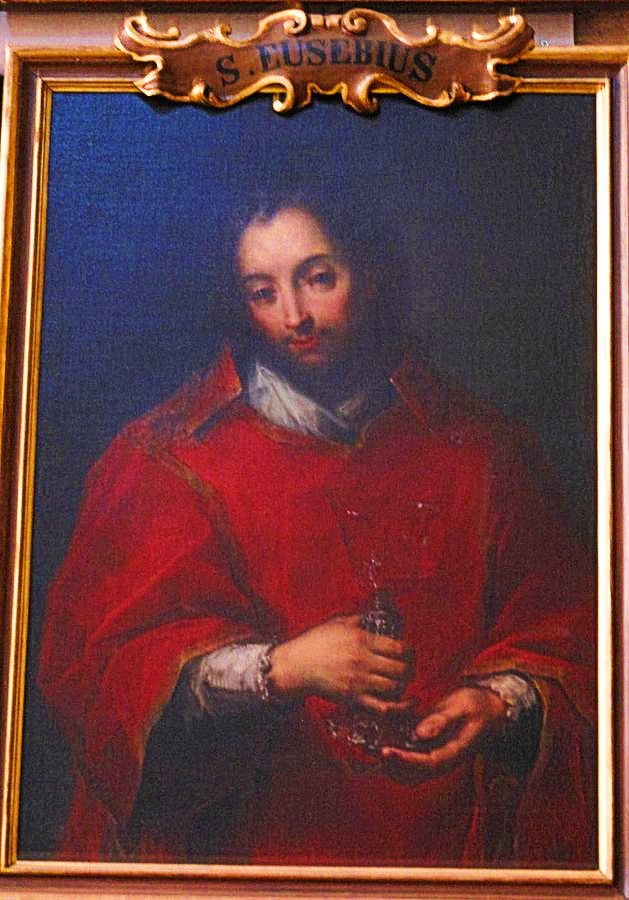
18th Century painting of Saint Eusebius
Eusebius succeeded Lazarus in the Episcopal chair of Milan shortly before 449. He participated in the Council convened in Rome in October 449 by Pope Leo the Great, to examine and condemn, the Terror of Eutyches regarding the Mystery of the Incarnation. The condemnation of Eutyches’ errors was communicated to the Imperial Court of Constantinople by a Papal embassy, which also included two Ecclesiastics from the Ecclesiastical Province of Milan, namely Bishop Abbondio of Como and the Priest Senator of Milan.
Advised by the Pope of the happy outcome of the embassy to the Imperial Court in Constantinople, Eusebius convened a Provincial Council of Bishops in Milan, who, through him, in the autumn of 451, sent the Pope a formula of Catholic Faith.
Eusebius’ great charity shone in a painful circumstance for Milan. In 452 Attila and the Huns descended on Italy, thirsty for revenge and blood – having destroyed many Cities in the Veneto (a northeastern Italian region stretching from the Dolomite Mountains to the Adriatic Sea. Venice, is its regional Capital). Attila took possession of Milan where his barbarian hordes indulged in violence and looting of all kinds. The City was destroyed, the Cathedral set on fire. Once the storm had passed, Eusebius set about repairing the ruins of the City and rescuing the starving citizens. He rebuilt the Cathedral and it is said that he instituted, in perpetual memory of the fact, the Feast of the Dedication, to be celebrated on the third Sunday of October. This Feast is still celebrated today but few remember the original intention – it is now celebrated as a reminder of the Dedication of the Cathedral by Saint Charles Borromeo. On that occasion, a Bishop, whose name has not survived, gave an official speech.
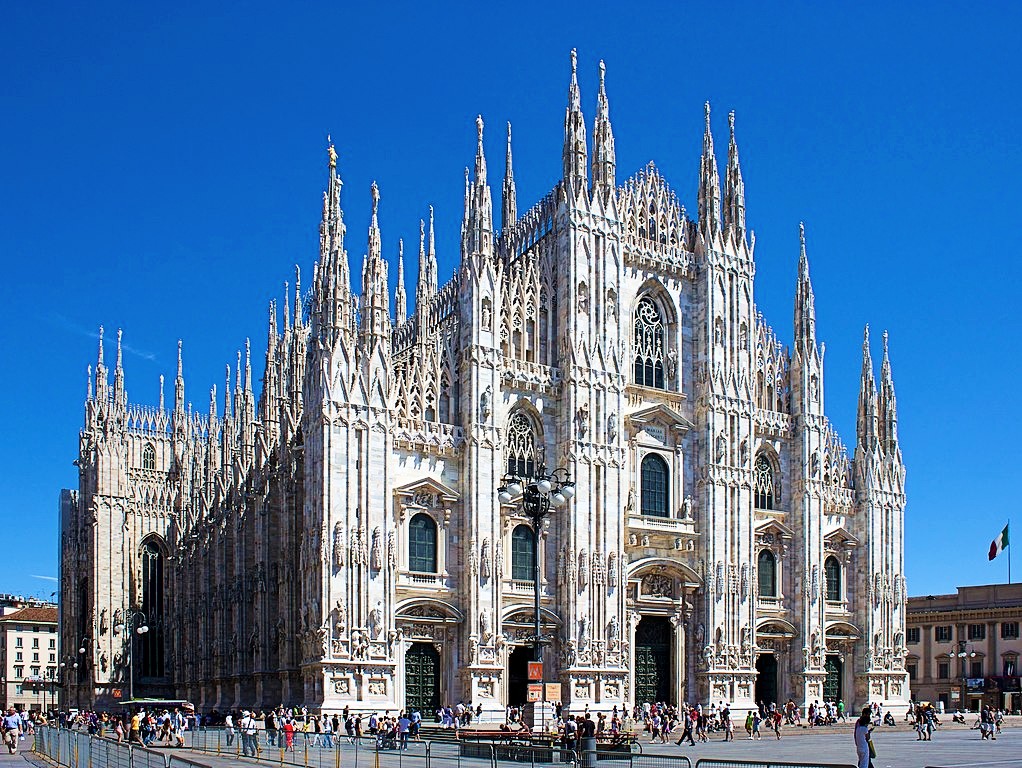
Milan Cathedral
In the Ambrosian Breviary we read that Eusebius, while still a Deacon, broke the glass Chalice used in the Mas, however, having resorted to the intercession of Saint Lawrence, the Chalice miraculously reassembled.
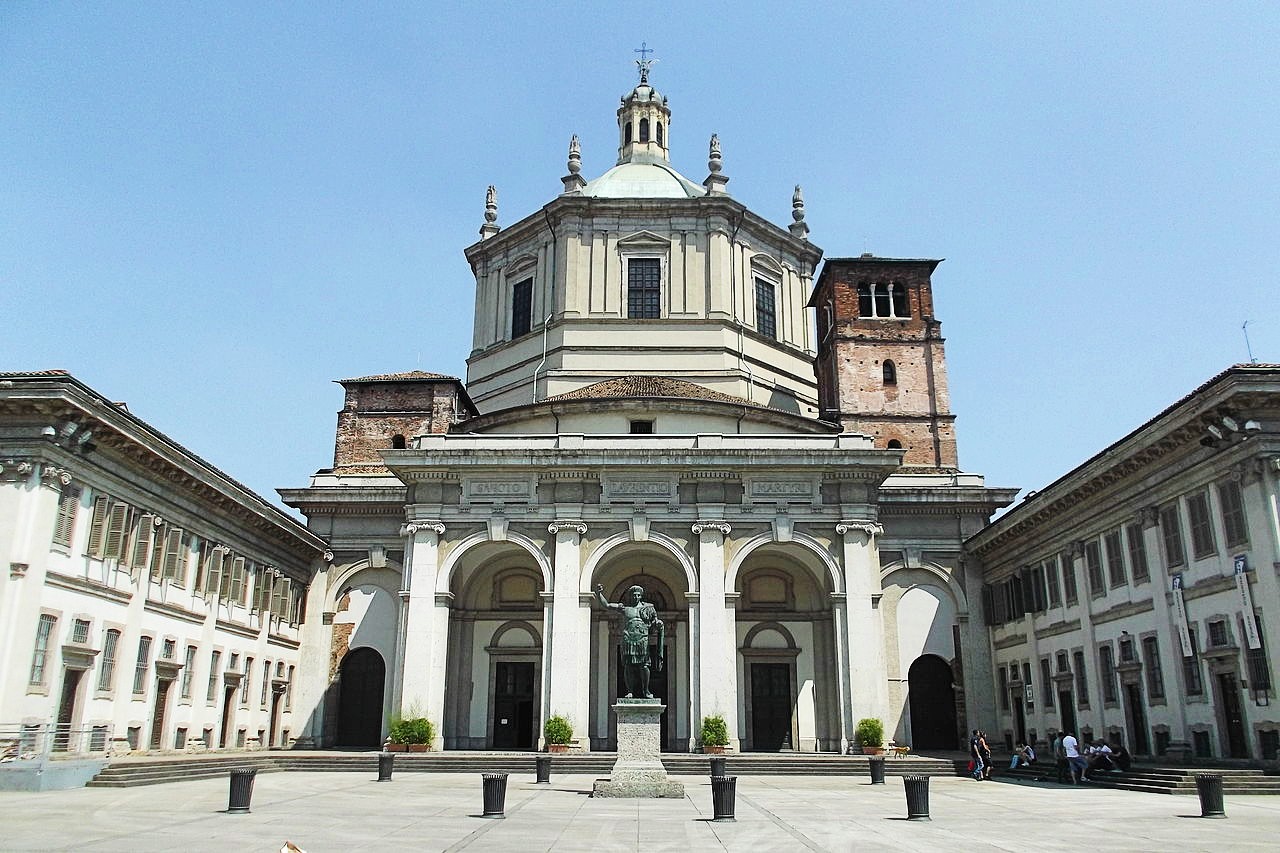
Eusebius’ death seems to have occurred in August 462. The Saint was buried in the Milanese Basilica of St Lawrence. The oldest catalogues of the Bishops of Milan mention St Eusebius’ death on 8 August, the most recent on 9 August. The Liber Notitiae Sanctorum Mediolani, of the beginning of the 14th Century, commemorates St Eusebius on 12 August, a date later passed into the Ambrosian calendar and into the Roman Martyrology.
The Basilica of St Lawrence where St Eusebius is buried
St Porcarius of Lerins St Simplicio of Vercelli St Ust
Martyrs of Augsburg – 4 Saints: The mother, Hilaria,and three friends of of Saint Afra ofAugsburg. While visiting the tomb of Saint Afra who were seized by the authorities and Martyred when they visited Afra’s tomb – Digna, Eunomia, Euprepia and Hilaria. They were burned alive c 304.
Martyrs of Rome – 5 Saints: A group of Christians Martyred together in the persecutions of Diocletian. We know little more than their names – Crescentian, Juliana, Largio, Nimmia and Quiriacus. They died in c304 in Rome, Italy and were buried on the Ostian Way outside Rome.
Saint of the Day – 11 August – Saint Tiburtius (Died c286) Martyr, Layman, the son of Saint Chromatius the Prefect of Rome, also a Martyr. St Damasus (c305-384), the Pope, wrote about Tiburtius. He died by being beheaded in c286 in Rome, Italy and his remains are entombed in the Ad Duas Lauros Cemetery at the three mile marker on the Via Lavicana in Rome. Also known as – Tiburcio, Tiburzio.
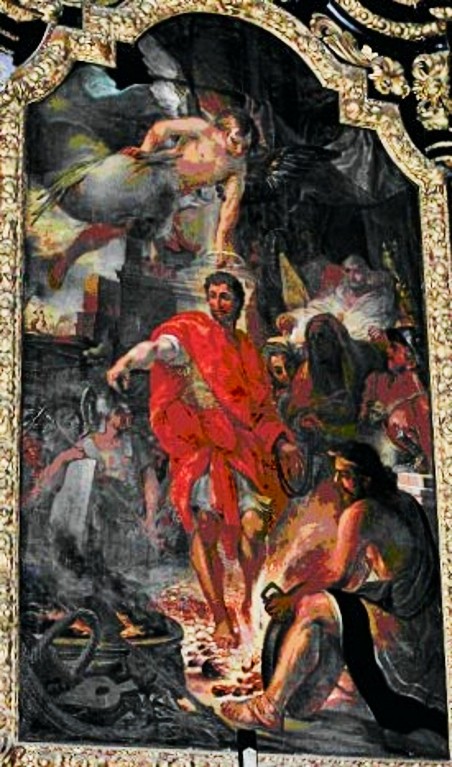
The Roman Martyrology reads today: “At Rome, between the two laurels situate about three miles from the City, the birthday of St Tiburtius, Martyr, under the Judge Fabian, in the persecution of Diocletian. After he had walked barefoot on burning coals and confessed Christ with increased constancy. he was put to the sword.”
St Tiburtius walking barefoot on burning coals
St Tiburtius, Martyr By Father Francis Xavier Weninger SJ (1805-1888)
Tiburtius, a son of the noble Roman Prefect, Chromatius, received holy Baptism at the same time as his father and, not only endeavoured to lead a Christian life but also, to bring others to the knowledge of the True Faith.
One day, while he was walking through the street, a boy fell from the roof of a house to the pavement. He was so injured that it was thought that every moment would be his last. Tiburtius going towards him, made the Sign of the Cross over him and commanded him, in the Name of Jesus Christ, to rise and to abandon heathenism. The boy immediately arose, became a Christian and persuaded many, who had witnessed the miracle, to do likewise.
At another time, Tiburtius went to a youth named Torquatus, who, although Baptised and calling himself a Christian, did not conduct himself according to the dictates of the Church. His dress was too luxurious; he spent too much time in idleness, gaming, dancing and other amusements; he was unrestrained and licentious in his conversation and conduct. He was seldom at prayer but frequently, in dangerous company. Tiburtius exhorted him most earnestly to change his unchristian behaviour. Torquatus feigned a determination to follow his advice but secretly went to the Judge Fabian and revealed to him that Tiburtius was a Christian.
This he did in revenge for the reproofs which Tiburtius had given him. But, that he might not be known as the accuser, he requested to be arraigned with Tiburtius. When this had taken place, the Judge asked Torquatus who he was. “I am a Christian,” was his reply, “and this man ,Tiburtius has converted me to the True Faith.” But Tiburtius said: “I have never recognised you as a Christian; for, your life has not been that of a Christian. To dress luxuriously, not to observe the fast days, to be indifferent to your prayers, to pass the day in idleness, to associate with the other sex, to be licentious in your words, are not the characteristics of a Christian. Christ does not recognise such as His followers.” Fabian the Judge, would not listen to these reproofs but, having the ground strewn with hot coals, he said to the Saint: “You have your choice either to throw incense over these coals and thus offer to the gods, or to walk barefoot over them.”
Tiburtius, without a moment’s hesitation, took off his shoes, and courageously stepping upon the coals, walked up and down over them, without a sign of pain. Addressing the Judge, he said: “See and know that the God of the Christians is the only God, Whom all creatures obey. Your live coals seem to me but lovely flowers.” The Judge, highly incensed, exclaimed: “I knew long since that your Christ instructed His followers in magic. I shall, however, pay no attention to it.” The holy Martyr rebuked this blasphemy and as Fabian saw that the heathens began to admire the God of the Christians, he ordered him to be beheaded, thus bestowing upon him the Crown of Martyrdom.
Our Morning Offering – 10 August – St Lawrence (Died 258) “Keeper of the Treasures of he Church,” Martyr, Archdeacon.
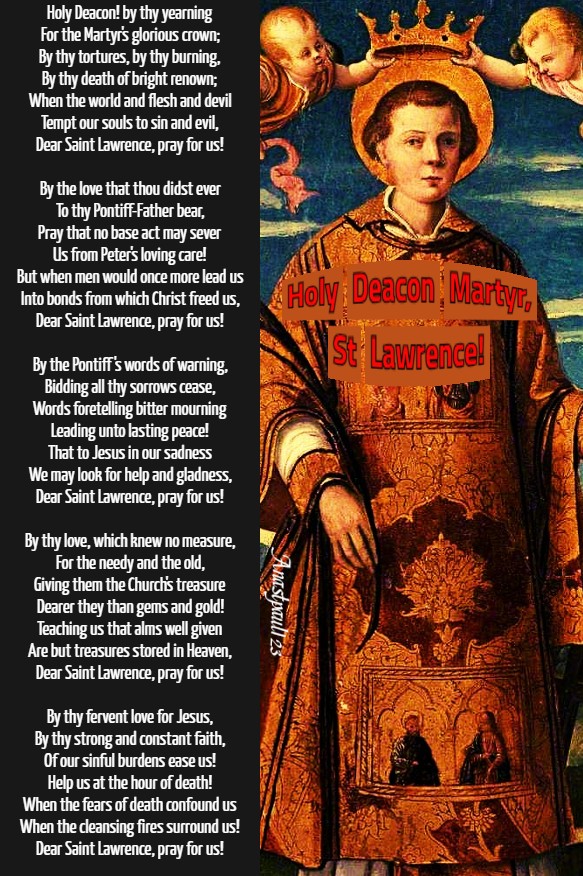
Holy Deacon Martyr, St Lawrence! Unknown Author
Holy Deacon! by thy yearning For the Martyr’s glorious crown; By thy tortures, by thy burning, By thy death of bright renown; When the world and flesh and devil Tempt our souls to sin and evil, Dear Saint Lawrence, pray for us!
By the love that thou didst ever To thy Pontiff-Father bear, Pray that no base act may sever Us from Peter’s loving care! But when men would once more lead us Into bonds from which Christ freed us, Dear Saint Lawrence, pray for us!
By the Pontiff’s words of warning, Bidding all thy sorrows cease, Words foretelling bitter mourning Leading unto lasting peace! That to Jesus in our sadness We may look for help and gladness, Dear Saint Lawrence, pray for us!
By thy love, which knew no measure, For the needy and the old, Giving them the Church’s treasure Dearer they than gems and gold! Teaching us that alms well given Are but treasures stored in Heaven, Dear Saint Lawrence, pray for us!
By thy fervent love for Jesus, By thy strong and constant faith, Of our sinful burdens ease us! Help us at the hour of death! When the fears of death confound us When the cleansing fires surround us! Dear Saint Lawrence, pray for us!
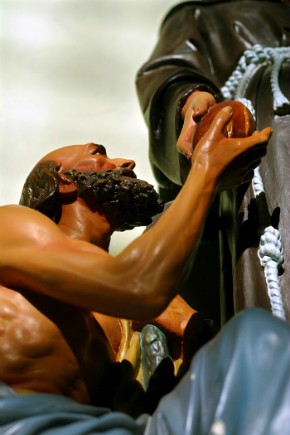
Saint of the Day – 10 August – St Deusdedit the Cobbler (6th Century) Confessor, Layman – Deusdedit was a poor layman shoemaker in 6th Century Rome, Italy. Patronages – shoemakers, of the poor. His name meaning, “dedicated to God.”
The Roman Martyrology reads of him today: “At Rome, the holy Confessor Deusdedit, a working man, who gave to the poor, every Saturday, whatever he had earned during the week.”
We have little information of Deusdedit except that which St Gregory the Great (540-604) left us, having lived in the same years and been the Pope at the time that this holy shoemaker visited St Peter’s on Saturdays. Besides this we know nothing further of his life.
There was a pious shoemaker named Deusdedit, in Rome [so Gregory tells us]. Every Saturday he took his week’s earnings to the courtyard of the Shrine of St Peter in the Vatican, Rome. With these hard-earned wages, he gave alms to the poor who assembled at the Shrine.
The result of the cobbler’s charity was revealed in a vision to a pious person praying nearby. The vision was of a house being built in Heaven. But this building occurred only on Saturdays. For Saturday was the day on which Deusdedit went to St Peter’s to give alms to the poor.
The house was the cobbler’s “Mansion” in Heaven, built by the “Treasure” which he had transferred to Heaven every Saturday through his gifts to the poor.
A similar vision revealed that these Mansions are Treasure Houses in themselves – for they are built with bricks of pure gold!
St Deusdedit the Cobbler (6th Century) St Gerontius Bl Hugh of Montaigu St Paula of Carthage St Thiento of Wessobrunn
Martyrs of Alexandria – 260+ Saints: A large number of Christians who were Martyred in Alexandria, Egypt between 260 and 267 in the persecutions of Decius and Valerian, whose names have not come down to us and who are commemorated together.
Martyrs of Rome – 165 Saints: Group of 165 Christians Martyred in the persecutions of Aurelian. 274 in Rome, Italy.
Our Morning Offering – 9 August – “The Month of the Immaculate Heart of Mary” and the Memorial of St John Vianney (1786-1859) Confessor
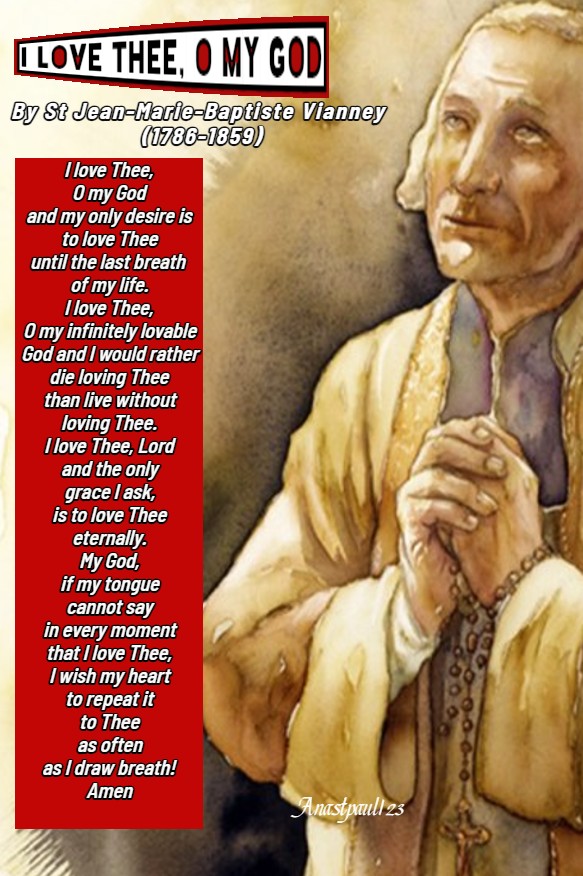
I Love Thee, O My God By St John Vianney (1786-1859)
I love Thee, O my God and my only desire is to love Thee until the last breath of my life. I love Thee, O my infinitely lovable God and I would rather die loving Thee than live without loving Thee. I love Thee, Lord and the only grace I ask, is to love Thee eternally. My God, if my tongue cannot say in every moment that I love Thee, I wish my heart to repeat it to Thee as often as I draw breath! Amen
Saint of the Day – 9 August – Saint Autor of Metz (5th Century) the 13th Bishop of Metz in France, for 29 years, Miracle-worker. Patronage – of Braunschweig, Germany. Also known as – Adinctor, Auctor, Auteur, Autore, Author. Additional Memorials – 11 August (Diocese of Metz, France), 10 August – the presumed date of his death (Martyrology of St Jerome), 20 August (Braunschweig, Germany), 13 March (translation of relics).
This image shows St Autor as the Patron of Braunschweig, Germany.
Tradition says that Autor was a cobbler, known in the City of Metz, France for his holiness. When Bishop Valerius was murdered, local people approached Autor to take the office. He initially refused but while he was arguing with the faithful, he dropped his leather awl – it landed point down, punched a small hole in the dirt and a spring of fresh water erupted from it. Both he and the townspeople knew a sign when they saw it and he became the 13th bishop of Metz
His position was assigned by the most ancient catalogue of the City’s Bishops, compiled around 776 and which has survived to this day. Saint Autor is mentioned in 451.
It is believed from these records that our Saint governed the Diocese for twenty-nine years. According to Paul the Deacon in his text ‘Gesta Episcoporum Metensium – Acts of the Bishops of Metz,’ Saint Autor lived at the time of Attila and, with many others, was deported by the Huns. But a miracle by Autor’s prayers, saved him from deportation. It is said, in fact, that he miraculously restored the sight of some barbarians who had been struck blind as they had come to send him out of Metz. Their vision returned when they freed Autor and he prayed for them.
Some historians inform us that Autor ruled the fate of the Diocese of Trier, as well as Metz, in a period in which it remained vacant but this statement has no historical basis.
There is a legend about the translation of his Relics. In the year 852, Bishop Drogone brought back his remains together with those of St Celeste, his predecessor, to the Monastery of Marmoutier. A procession had been organized to display the cloth Relics to the faithful but a strange thing happened. The remains of Saint Autor which were placed in front of those of St Celeste, would not move, until those of St Celeste were placed first in the procession.
St Autor’s Relics remained in the Alsatian Monastery of Marmoutier in Strasbourg, until the Saint is said to have appeared in a dream to the Margravine of Braunschweig, Gertrude the Younger, asking her to transport his remains to Braunschweig, to the newly founded Aegidien Monastery. This iis mentioned in an historical record, completed around 1210. According to another source, St Autor’s Relics were transferred from St. Maximin to the Helmarshausen Monastery as early as 1105 from where they were finally taken to Braunschweig.
In 1200 , during a throne dispute, the troops of the King Philip of Swabia besieged the City of Braunschweig. On 20 August of that year, Saint Autor saved the City from being taken, by appearing, sword in hand to the enemy troops, who then retreated in fear. Since then he has been the Patron Saint of Braunschweig and 20 August is the “Autor’s Day.”
The relatively peaceful ending of inner-city revolts during the 14th and 15th Centuries were also attributed to the intercession of the City Saint.
St Nathy St Numidicus of Carthage St Phelim St Rusticus of Sirmium St Rusticus of Verona St Secundian of Civitavecchia St Stephen of Burgos St Verian of Civitavecchia
Martyrs of Civitavecchia: Three Christians Martyred together in the persecutions of Decius. We know little more than the names – Marcellian, Secundian and Verian. 250 near Civitavecchia, Italy.
Martyrs of Constantinople: 10 Saints: A group of ten Christians who were arrested, tortured and executed for defending an icon of Christ in defiance of orders from Emperor Leo the Isaurian. We know the names of three, but nothing else about them – Julian, Marcian and Mary. They were beheaded in Constantinople.
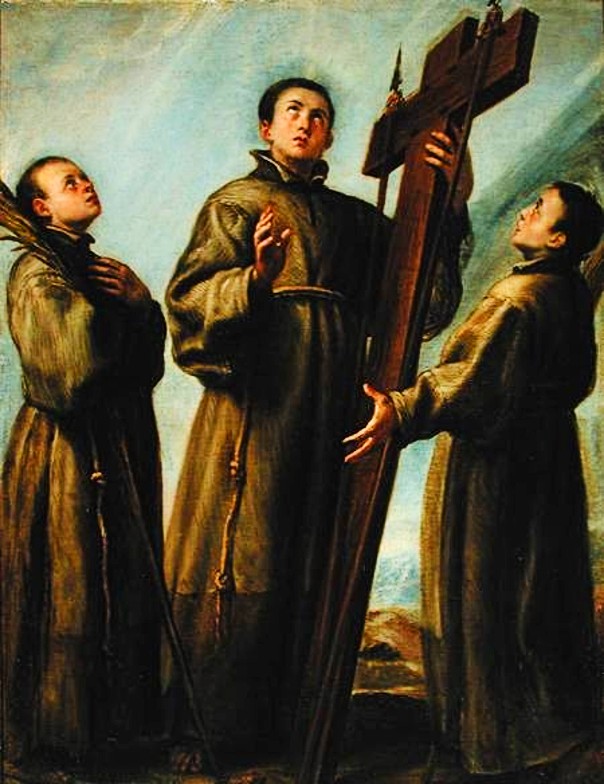
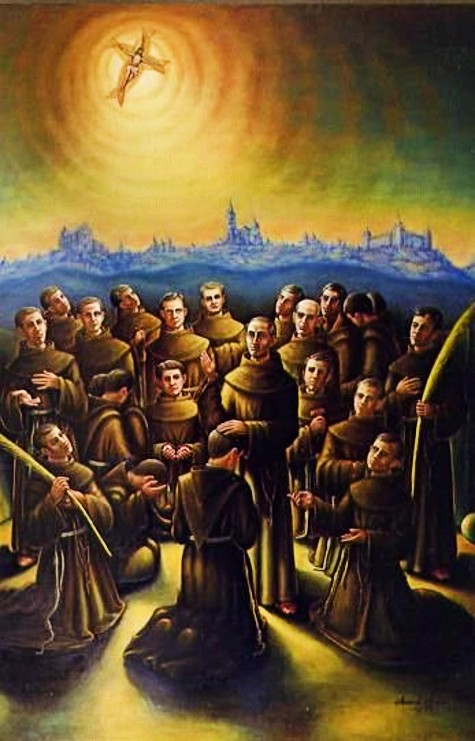
Saint of the Day – 8 August – Blessed William of Castellammare di Stabia OFM (Died 1364) Martyr, Friar of the Order of Friar’s Minor, Missionary to Palestine. Born in Castellammare di Stabia, Naples, Italy and died a most horrific death in 1364 in Gaza, Palestine. His body and all his property, including his Breviary, were burned. We have no images of Blessed William – those below are of various Franciscan Martyrs.
Franciscan Martyrs in China
Franciscans, have, from the earliest times of St Francis, had, as one of their objectives, the evangelisation of the Islamic world. Already St Francis went to Palestine in 1219, after two unsuccessful attempts, presenting himself to the Sultan Al-Malik al Kamil, establishing an interesting contact, which revealed, after the centuries-old struggles between Saracens and Christians, the possibility, at least on the Christian side, of a dialogue of the love between the two great religions, for their common origins in Abraham.
In 1220, one of the first disciples of Francis, the learned and miracle-worker St Anthony of Padua, attempted to go to North Africa among the Saracens, but a storm forced him to be shipwrecked in Sicily. But, already at that time, the beginning of 1220, there were the first Franciscan Martyrs at the hands of the Saracens – St Francis had sent five Friars as Missionaries to Muslim-occupied Spain, Saints Berard, Peter,Otho, Accursius, and Adjutus, considered the Protomartyrs of the Franciscans. They began to preach in the Mosques and were, therefore sentenced to death by the Sultan but then they were pardoned and, like so many other Christians in the region, sent to Morocco to work as forced labourers.
Franciscan Martyrs of the Spanish Civil War
However, the courageous Friars continued to preach the Gospel and were imprisoned again, they were flogged and finally beheaded on 16 January 1220. After them, many Franciscans lost their lives in an attempt to spread the Gospel in the hostile and closed Muslim world. Already, in 1227, there were seven more Franciscan Martyrs in Morocco, the Saints Daniel and companions and other Orders also brought their bloody contribution to the conversion of the Saracens, who, it is good to remember, dominated the coasts of the Mediterranean with violent raids, plundering, killing, kidnapping women and men enslaved, all in the name of a ‘holy war’ in name of Allah. The Mercedarian Order distinguished itself in that sad period, for the ransom of Christians from slavery in Arab land and many of them died Martyrs amid unheard-of torments.
This was the situation of those centuries of terror and the Holy Land was occupied by Muslims, generating the phenomenon of the Crusades, which sharpened even more the ideological contrast and the bloody clashes between the Christian and Muslim worlds, with excesses from both sides.
In this historical-religious context, the story of the Franciscan Friar Minor, Blessed William of Castellammare di Stabia, a native of the beautiful, historic, rich in thermal waters, City of the Gulf of Naples.
Unfortunately we have not received much information of this Franciscan Missionary in Palestine but that he proclaimed the Gospel publicly, courageously accusing the Muslim religion of falsehood. Perhaps, at the time, there was no other way to carry out the Apostolate, other than to make these public sermons which evidently were striking, both for the content and the great courage shown in preaching in this way at all!
Naturally, William was arrested and during his detention they tried to make him apostatise with threats and promises, it does not appear that he was tortured, as happened to many others. Refusing all attempts to bend his staunch convictions, William was finally Martyred in 1364 in Gaza (apparently sawn in two).
His body was burned together with his Breviary with which he recited the canonical prayers – the bodies of the Martyrs were burned so as not to create a cult of Relics among Christians, a cult which Muslims saw as smoke and mirrors.
Blessed William is commemorated on 8 August.
The Martyrs of Morocco, 1508, by Francisco Henriques
St Eleutherius of Constantinople St Ellidius St Famianus of Compostela St Gedeon of Besancon St Hormisdas of Persia St Largus St Leobald of Fleury St Leonidas of Constantinople St Marinus of Anzarba St Mummolus of Fleury St Myron the Wonder Worker St Rathard of Diessen St Severus of Vienne St Sigrada St Smaragdus St Ternatius of Besançon St Ultan of Crayke Blessed William of Castellammare di Stabia OFM (Died 1364) Martyr
Martyrs of Albano – 4 Saints: Four Christians who were Martyred together, and about we today know little more than their names – Carpóforo, Secondo, Severiano and Vittorino. They were martyred in Albano, Italy – their remains are interred in the San Senator cemetery, on the Appian Way, 15 miles from Rome, Italy.
Martyrs of Rome – 5 Saints: Five Christians Martyred together; we know nothing else about them but the names – Ciriaco, Crescenziano, Giuliana, Memmia and Smaragdus. They were martyred at the 7 mile marker, on the Via Ostia, Rome, Italy.
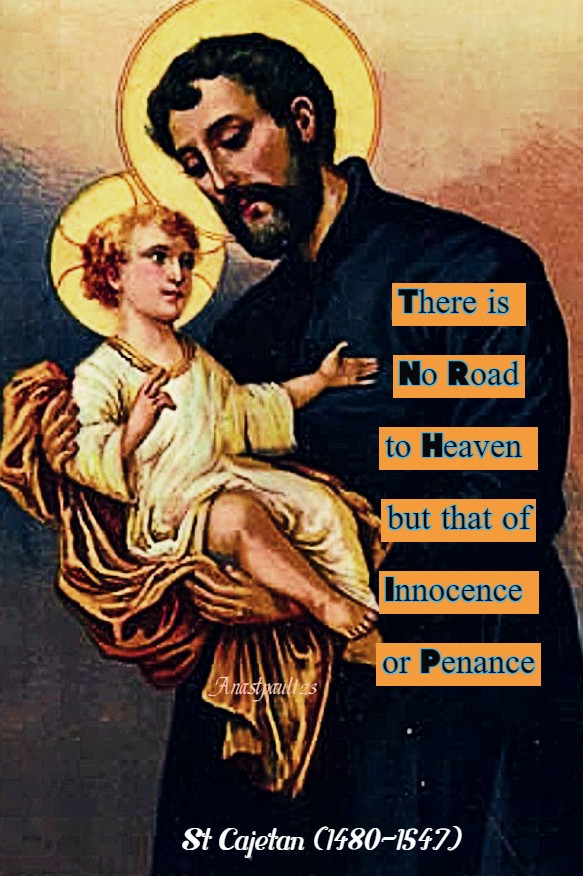
Quote/s of the Day – 7 August – St Cajetan (1480-1547) Confessor – “The Month of the Immaculate Heart of Mary” –
“There is no road to Heaven but that of innocence or penance.”
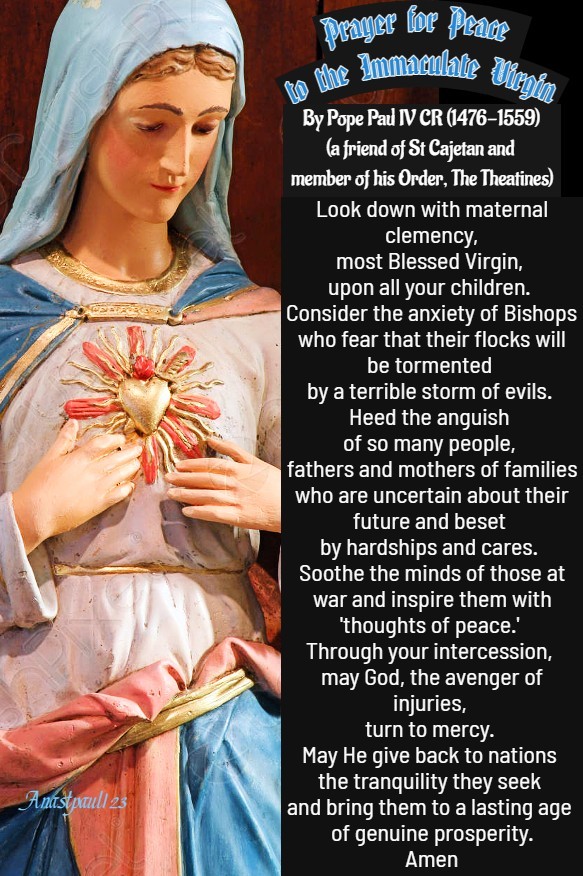
Prayer for Peace to the Immaculate Virgin By Pope Paul IV CR (1476-1559)
Look down with maternal clemency, most Blessed Virgin, upon all your children. Consider the anxiety of Bishops who fear that their flocks will be tormented by a terrible storm of evils. Heed the anguish of so many people, fathers and mothers of families who are uncertain about their future and beset by hardships and cares. Soothe the minds of those at war and inspire them with ‘thoughts of peace.’ Through your intercession, may God, the avenger of injuries, turn to mercy. May He give back to nations the tranquility they seek and bring them to a lasting age of genuine prosperity. Amen
(Pope Paul IV was a friend of St Cajetan and also a member of his Order, the Theatines, named after Paul IV’s See as Bishop) .
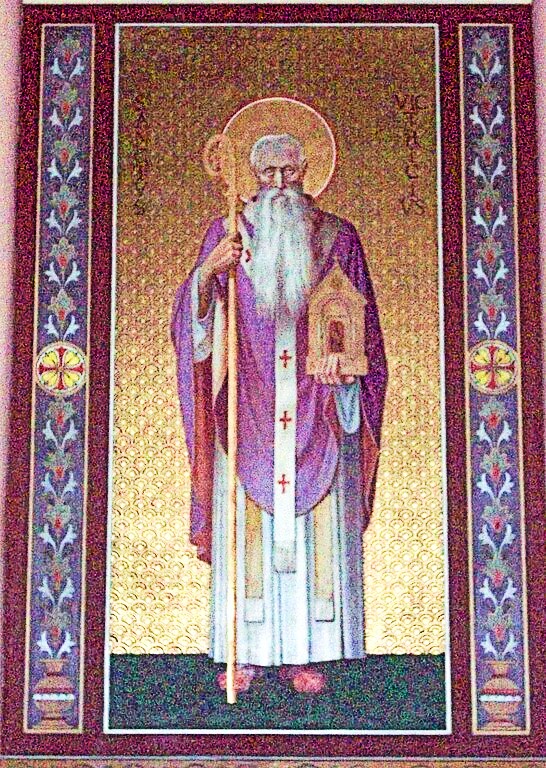
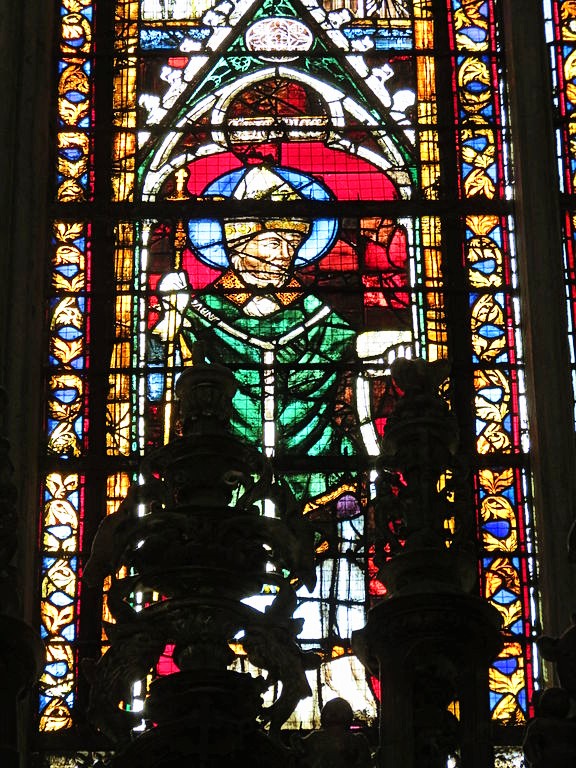
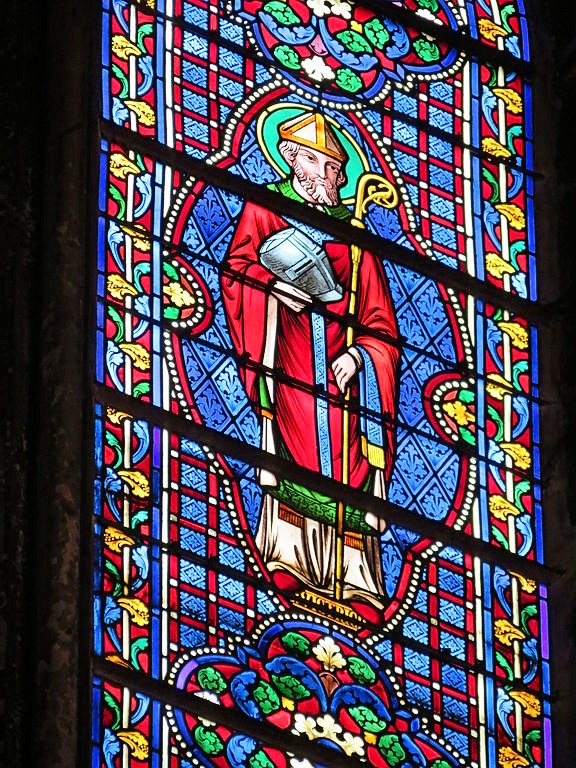
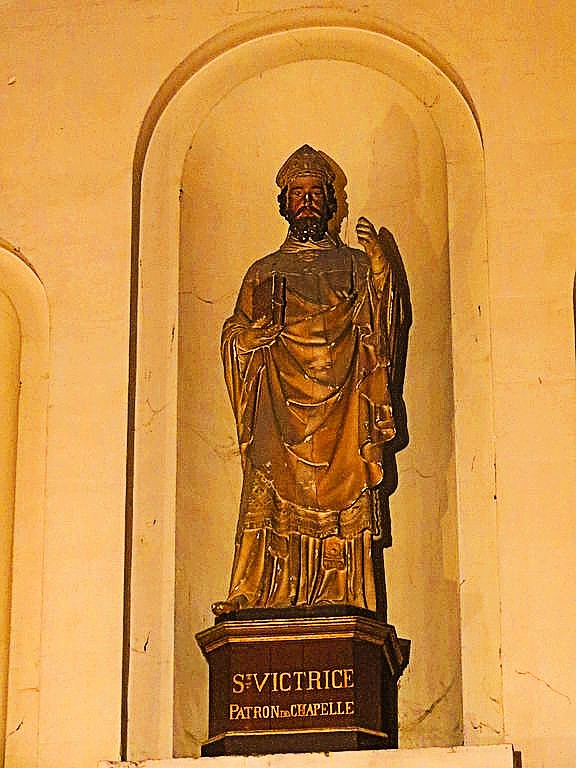
Saint of the Day – 7 August – Saint Victricius (c339-407) Confessor, Bishop of Rouen from 393 until his death in 407, of natural causes by the will of God, Victricius narrowly escaped Martyrdom, Miracle-worker, friend of St Martin of Tours, St Ambrose and other great Father Saints. Also known as – Victricius of Rouen, Victrice, Vittricio. Patronage – against blindness, of the blind, of eye disorders.
The Roman Martyrology reads: “At Rouen, the holy Bishop St Victricius. Whilst he was yet a soldier under Julian the Apostate, he threw away his military belt for Christ and after being subjected, by the Tribunal to many torments, was condemned to capital punishment. But, the executioner who had been sent to put him to death, being struck blind and, the Confessor’s chains being loosened, he made his escape. Afterwards, being made Bishop, by preaching the word of God, he brought the barbarous people of Belgic Gaul, to the Faith of Christ and finally, died a Confessor in peace.”
Victricius was born in the first half of the 4th Century on the borders of the Roman Empire. His family was illustrious and Victricius studied humanities before enlisting in the army, like Saint Martin (of Tours), his future friend. He served there for several years, the Christian religion was then honoured in the Roman army. The old soldiers of the first Christian Emperor, Constantine the Great, told of the marvellous appearance of the Cross ofd Christ which had announced victory to them on the banks of the Tiber, when they were marching against the pagan army of Maxentius. From then on, the Cross had always been part of the Banners, ceremonial dress, stationery etc.
But, in 360, the son of Constantine, Constance, was succeeded, byJulian the Apostate. Julian, after having renounced the Christian Faith to return to the worship of idols, put great energy into fighting Christianity. We know that he wanted several times to force the soldiers of his army to offer sacrifices to idols. Because of this and also because his military time was coming to an end, Victricius wanted to leave the army and, henceforth, dedicate himself to the service of God.
One day during the military review, when the Colonel passed in front of him, Victricius came forward and said, throwing down his arms: “I am a Christian and I ask for my release because I now wish to dedicate myself to peace and Christian justice.” .
The Colonel was a pagan and took this action as a protest against the Emperor’s edicts. Immediately he had the soldier Victricius, our Saint, flogged and when he was nothing more than a wound, he was thrown into a dungeon where he remained lying on the floor for a long time. This did not reduce his faith, his courage and his trust in God and by his contual refusal to deny his Faith in Christ, he was condemned to death.
On the way to the place of execution, the executioner mocked his victim while tightly restraining Victricius by his neck. He said to Victricius: “We are going to cut off this head. What madness to allow oneself to be killed in this way, for a God Whom the Jews Crucified!” The poor man had not finished his blasheming when he was struck blind!
Another miracle followed closely on this one . The jailer had so tightened the chains that they entered the flesh of the condemned man. Victricius begged the soldiers, who accompanied him, to loosen them a little but they refused. Then he began to invoke aloud the help of Jesus Christ and immediately the chains fell off by themselves. Seized with amazement, the soldiers dared not kill a man whom the heavens was so visibly protecting. They re-traced their steps to tell this to the Colonel who, having observed the facts for himself, became Victricius’ friend and had him released.
Victricius, his freedom regained, left to train in a Monastery, it is believed in Ligugé, near Poitiers, under the direction of Saint Hilairy and Saint Martin. He became a great evangeliser in modern day Belgium. Many were converted and baptised by his preaching.
A few years later, he was appointed as the Archbishop of Rouen. There he established a deep affection with his co-Bishops – Saint Martin, Saint Ambrose, Saint Paulinus of Nola. There is still extant correspondence which testifies to this fraternal friendship.
One day, in Chartres, while Saint Martin was there accompanied by Victricius, an inhabitant brought his daughter, who was blind from birth, to the holy Bishop, begging him to heal her. “Speak to the Bishop of Rouen,” replied Saint Martin, “he is more capable than us of obtaining these marvels for you.” Making the Sign of the Cross on the eyes of the child, the Bishop of Tours yielded and the child was immediately healed
Victricius had just returned to his Diocese when Saint Ambrose announced to him that he was sending him various Relics. Victriciud hastened to seek out this great treasure. So hehad a new Church built in Rouen to honourably place these precious Relics. When this was done, he made a great speech in which he exhorted the people to consider the Martyrs as their protectors:
“We must,” he said, “devoutly embrace these precious remains of the tortures and seek there, like the woman at the fringe of the mantle of the Saviour, the healing of our wounds…. for me, a soldier tested by years, aged in battles, fatigue and vigils, I only value present life in its relationship with eternity and, I never think myself richer, than when my hands are laden with the Relics of Saints. … The dwelling place of these blessed ones is in Heaven but, they are here as guests, to whom we can take our prayers.”
And he declared again that the small fragments of their remains. as well as larger parts. can be the instrument of many miracles… In 404, Pope Innocent I addressed an important Decree to Victricius on various points of discipline, about which the Bishop of Rouen had consulted him. At the same time, he instructed him to communicate this letter to his colleague Bishops in the surrounding Diocese.
Saint Victricius died in 407, his tomb was a source of miracles and remains in great veneration in Rouen.
In the middle of the 9th Century, to save his Relics from the devastation of Norman pirates, they were transported to the fortified castle of Braine, four leagues from Soissons. They were kept there until the revolution, that is to say, in 1793 when, fortunately, they were able to escape destruction. But it was not until 1865 – on 16 and 17 October that Cardinal de Bonnechose, Archbishop of Rouen, transferred the Relics of Saint Victricicious into a beautiful gilded copper casing, decorated with enamels and fine stones.
St Albert of Trapani O.Carm. (c 1240-1307) Carmelite Priest, Confessor, Preacher, Evangeliser, apostle of prayer and a devout servant of the Blessed Virgin and the Passion of Christ. St Teresa of Jesus (1515-1582) and St Mary Magdalene de Pazzi (1566-1607) were especially devoted to him, the Bl Baptist Spagnoli (1447–1516) composed a sapphic ode in his honour. His Life: https://anastpaul.com/2019/08/07/saint-of-the-day-7-august-saint-albert-of-trapani-o-carm-c-1240-1307/
Bl Cassian Vaz Lopez-Neto St Claudia of Rome St Donat St Donatian of Chalons-sur-Marne St Donatus of Besancon St Faustus of Milan St Hilarinus of Ostia St Hyperechios Bl Jordan Forzatei St Julian of Rome St Peter of Rome
Martyred Deacons of Rome – 6 Saints: A group of Deacons who were Martyred with Pope Saint Sixtus II. We know nothing about them but their names and their deaths – Agapitus, Felicissimus, Januarius, Magnus, Stephen and Vincent. They were beheaded on 6 August 258 in a cemetery on the Appian Way, Rome, Italy.
Martyrs of Como – 6 Saints: A group of Christian soldiers in the imperial Roman army. Martyred in the persecutions of Maximian. We know little else but the names – Carpophorus, Cassius, Exanthus, Licinius, Secundus and Severinus. c.295 on the north side of Lake Como, near Samolaco, Italy. Their relics in the church of San Carpoforo, Como, Italy.
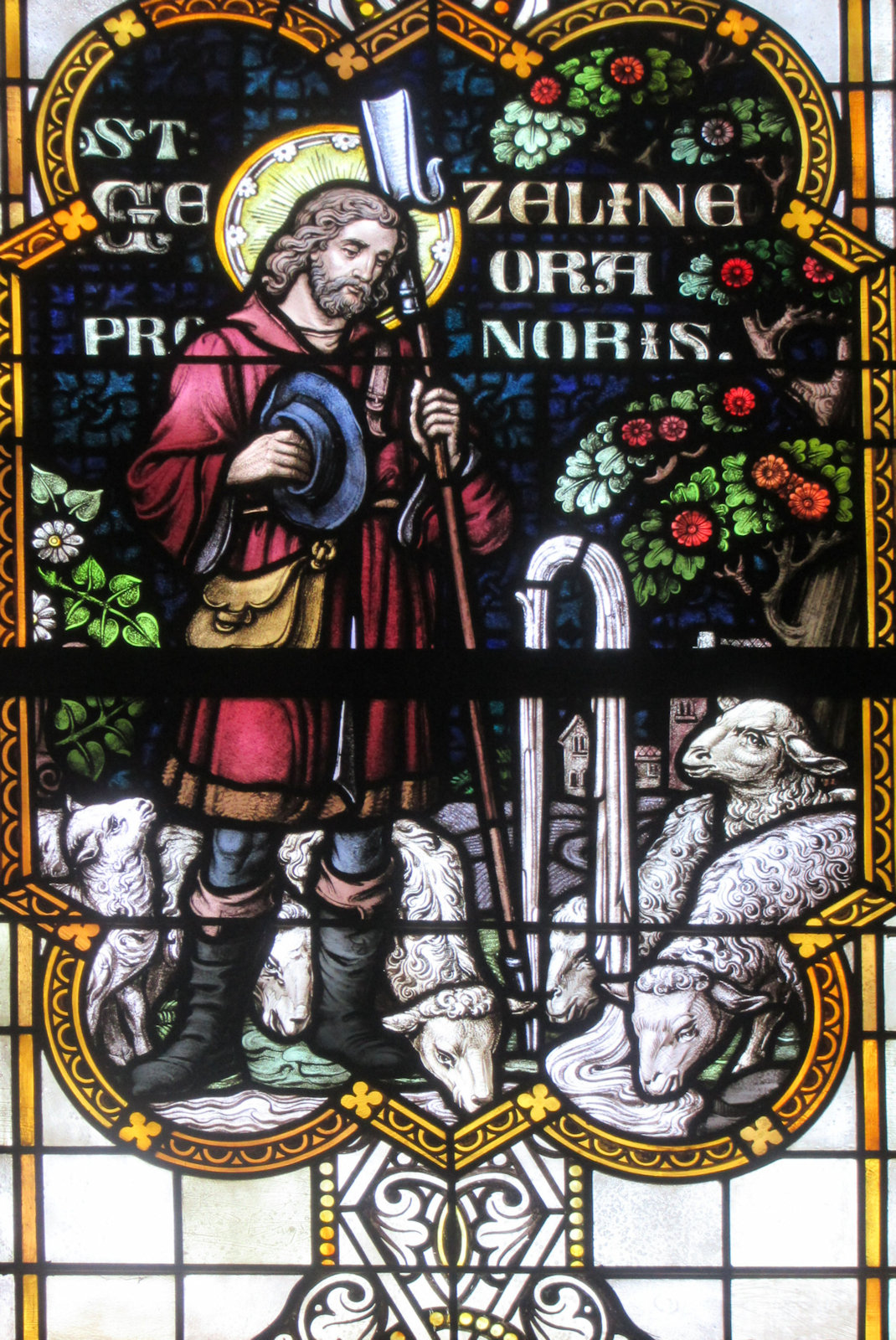
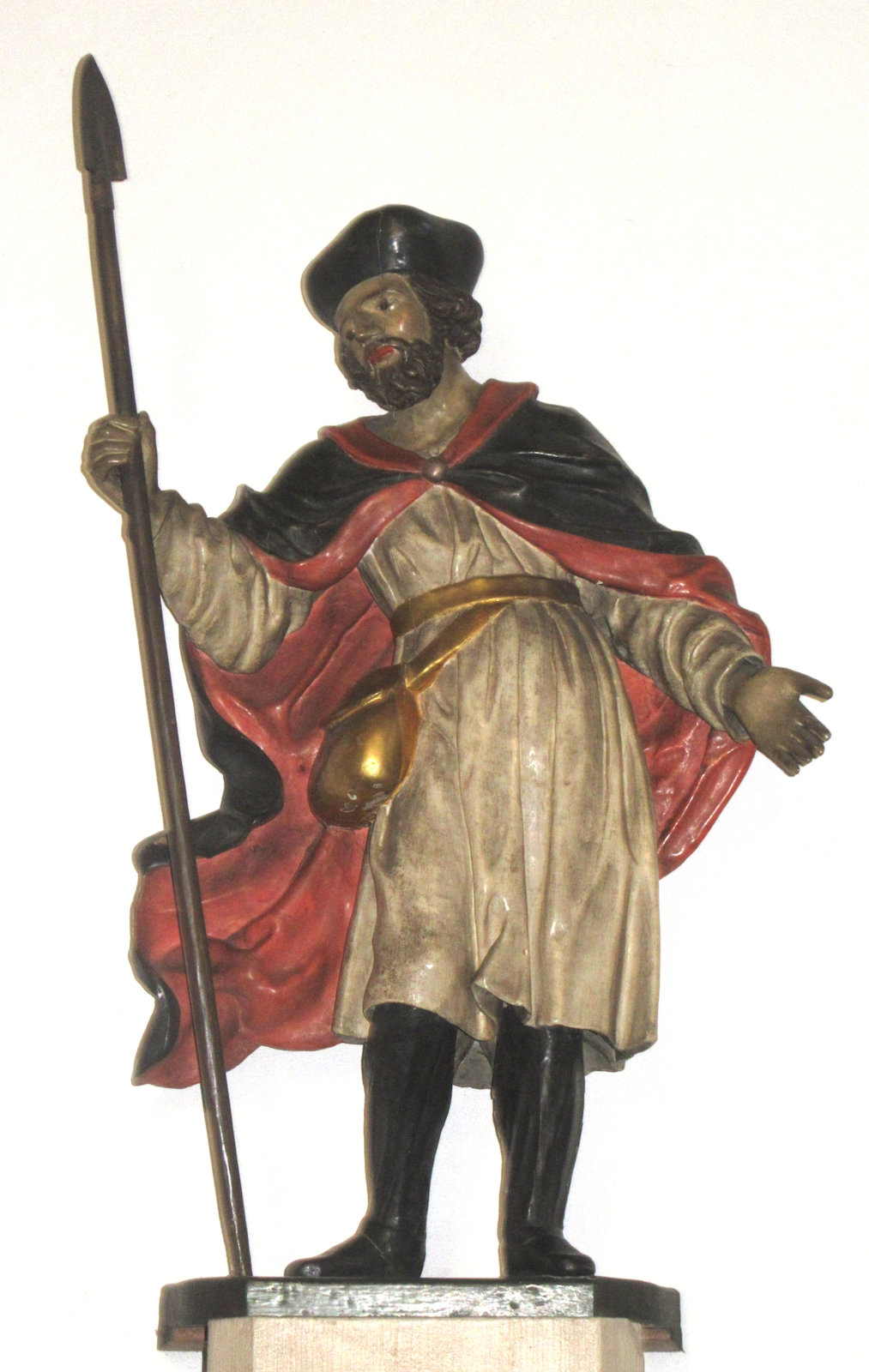
Saint of the Day – 6 August – Saint Gezelin of Schlebusch O.Cist. (Died 1149) known as “The Apostle of Hainaut” – Lay Brother of the Cistercian Order, Hermit, Gezelin’s duties included shepherding the sheep of the Monastery, Miracle-worker. Died on 29 July 1149 in Gut Alkenrath, Schlebusch, Germany. Patronages – children, against epilepsy in children, against eye disorders, against headaches. Also known as – Gezelin of Altenberg, Gezelinus of… Gezzelin of… Gezzelino of… Ghislain of… Gisle of… Gozelin of… Jocelin of… Schezelinus of… Gezelin was Canonised by the Bishop of Cologne, Germany, which was a common practice at that time.
The window of St Gezelin near his Shrine in the Andreas Church in Schlebusch
Gezelin was a lay brother in the Cistercian Monastery of Morimond – in today’s Fresnoy-en-Bassigny. In around 1135 he came to the new Altenberg Abbey and worked as a shepherd on the Alkenrath estate belonging to the Monastery in Schlebusch. Even during his lifetime, he was highly praised and revered for his always kind and helpful support of the rural population and the news of miraculous deeds spread more and more. For example, during a drought – in which even the Rhine had dried up – a copious Spring spurted out by his fervent prayers.
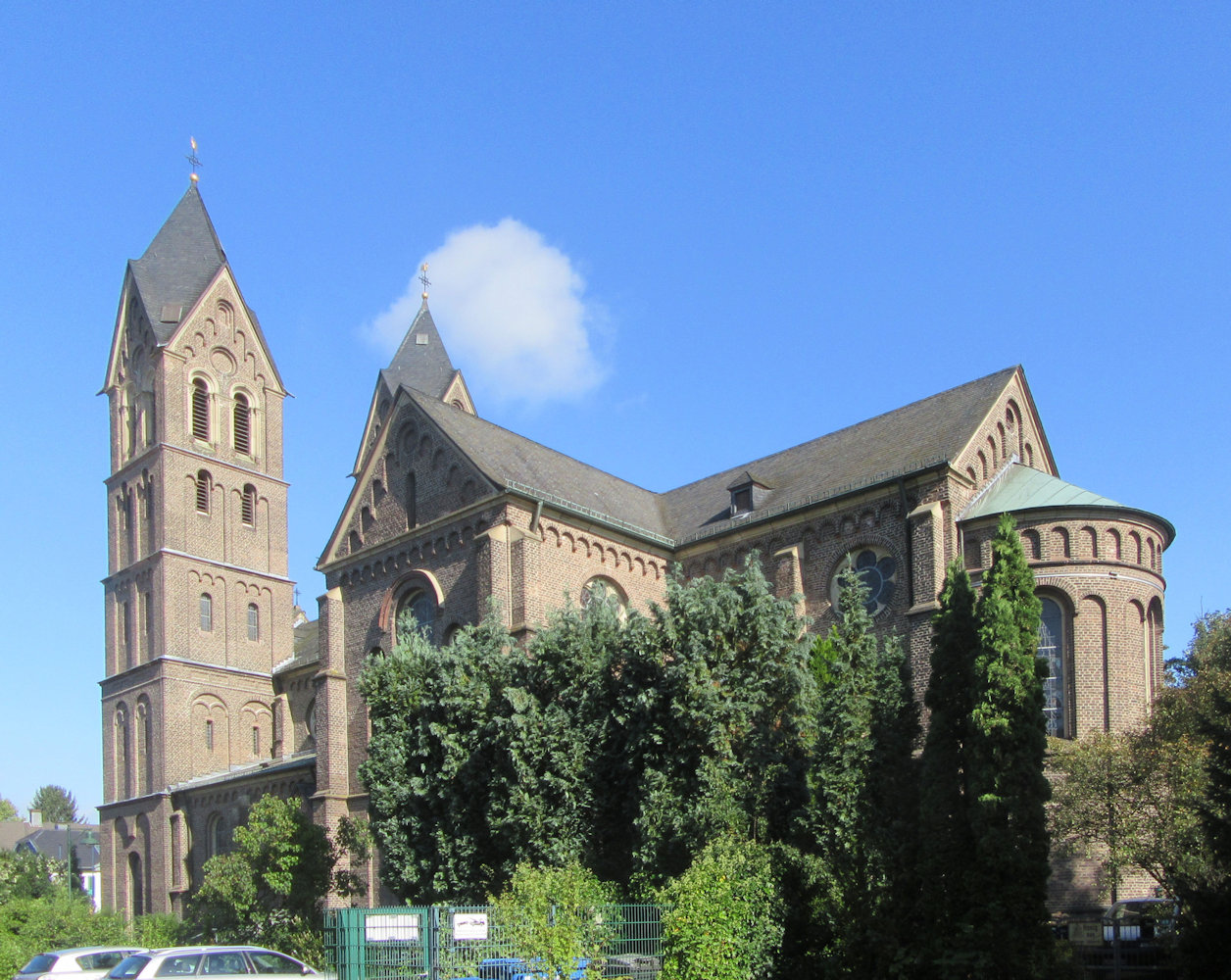
In his modesty, Gezelin requested not to be buried in the Abbey in Altenberg but, in the Parish Church near his sheep in Alkenrath. His bones were collected there in 1814. After the demolition of this Church, In 1890, the Relics were taken to the Andreas Church in Schlebusch where they now rest in an oak Shrine made in 1903. More of Gezelin’s Relics were enshrined in Altenberg Cathedral.
The Andreas Church
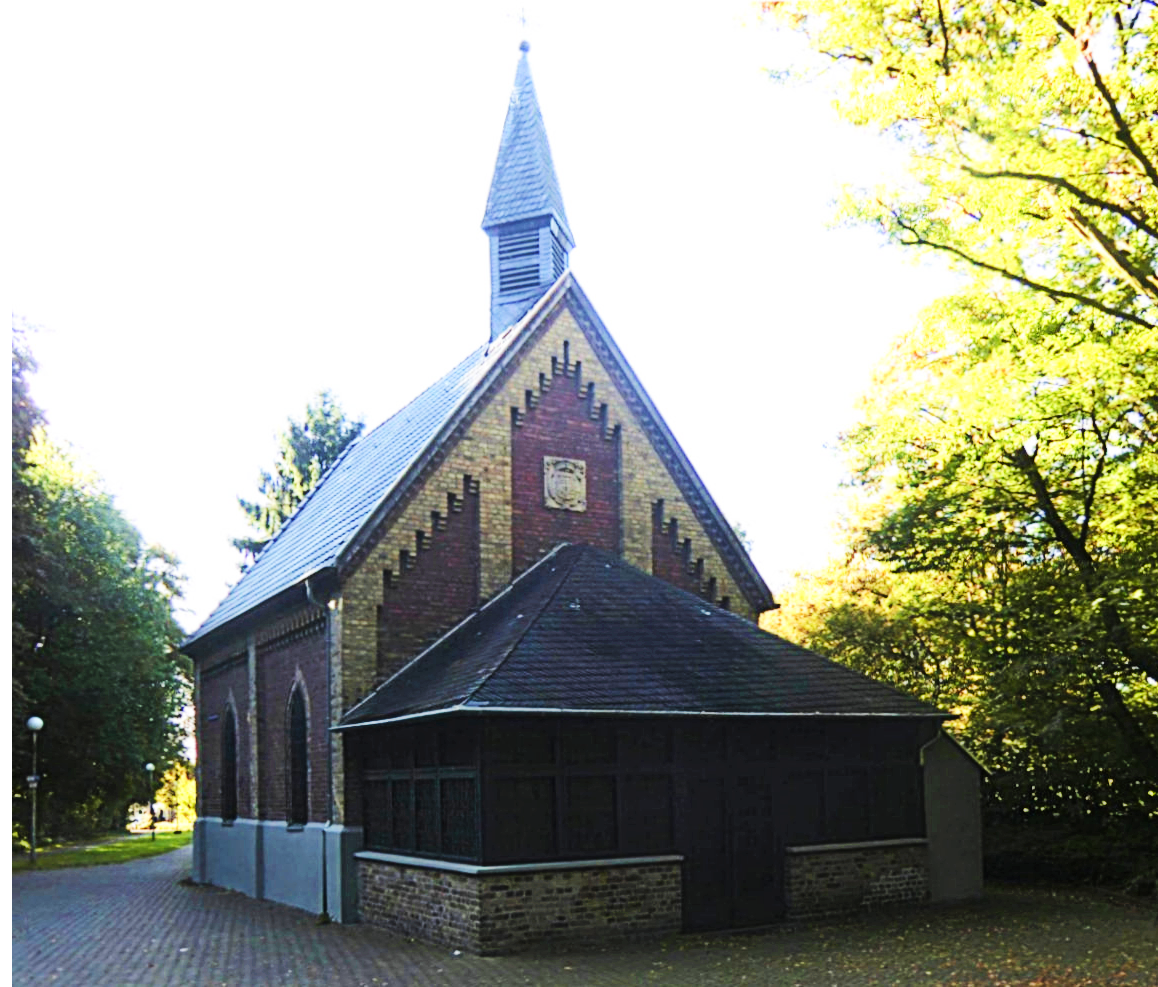
A Chapel dedicated to him, renovated in 1659 and rebuilt from 1864 to 1868, still stands above the Holy Spring in Gut Alkenrath, which Gezelin caused to rise and whose water heals head and eye ailment and which is still a site of pilgrimage. Many local residents used to fetch their drinking water there and to this day the Baptismal water for the Andreas Church in Schlebusch, is fetched from it. A pilgrimage takes place on the Sunday after Corpus Christi and on his Feast day . The source flow was disturbed by canal work in the 1950s, since then the water is pumped at certain times to the outflow on the west side of the Chapel. The St Gezelin Chapel is normally locked except, of course, during Mass but the Miraculous Spring flows everyday – a sign is posted outside the Chapel of the times when it is pumped.
St Pope Sixtus II/ Xystus (Died 258) Pope and Martyr, Philosopher. 25th Pope from St Peter. Papal Ascension 30 August 257. He was Martyred along with seven deacons, (St Lawrence of Rome a few days later) during the persecutions of Christianity by Emperor Valerian. This is the St Sixtus who is commemorated in the Roman Canon Eucharistic Prayer. His Life and Death: https://anastpaul.com/2021/08/06/saint-of-the-day-6-august-saint-sixtus-ii-died-258-pope-and-martyr/
St Gezelin of Schlebusch O.Cist. (Died 1149) Lay Brother of the Cistercian Order, Hermit. St Gislain of Luxemburg St Glisente of Brescia Bl Goderanno Bl Guillermo Sanz St Hardulf of Breedon
Bl Octavian of Savona St Stephen of Cardeña Bl William of Altavilla
Martyrs of Cardeña: Two hundred Benedictine Monks at the Saint Peter of Cardegna monastery, Burgos, Spain who were Martyred in the 8th century by invading Saracens. They were buried by local Christians in a nearby churchyard in Burgos, Spain and Beatified in 1603 by Pope Clement VIII (cultus confirmed).
Saint of the Day – 5 August – St Nonna of Nazianzen (c305-374) Widow of St Gregory Nazianzen the Elder, (c276-374) the saintly Bishop of Nazianzen and Mother of St Gregory Nazianzen (330-390) Doctor of the Church, his younger brother St Caesarius Nazianzen (c331-368) a Physician and St Gorgonia (Died c375) Married, Mother. Born in Nazianzen in Cappadocia (modern day Turkey) in around 305 and died in c374 in her home town, of natural causes. Patronages – death of children, Information services. Also known as – Nona.
The Roman Martyrology states: “In Nazianzus in Cappadocia, in today’s Turkey, Saint Nonna, who was the wife of the holy Bishop Gregory the Elder and mother of the Saints Gregory, Cesario and Gorgonia.”
Nonna was born and raised as a deeply religious Christian. After she married, she converted her husband Gregory to Christianity. He had been a member of the Hypsistarians, a Jewish-pagan sect which worshipped Hypsistos, the “Most High” God. Both Gregory and Nonna came from wealthy families and Gregory was able to personally finance the construction of a Church in the region. In 328, Gregory was selected as the Bishop of Nazianzen, a position he held until his death. At one point, Gregory subscribed to an Arian understanding of the Blessed Trinity. However, this was for a very brief time and he quickly renounced that position.
Nonna became the mother of three children, each of whom became Saints, the most notable of whom being the Doctor of the Church, St Gregory Nazianzen.
Nonna outlived her husband and two of her children, dying, almost certainly in 374.
Her son Gregory tells of an occasion in 351 when Nonna fell terribly sick with a severe illness and appeared to be at the point of death. On his way to visit a friend, Gregory hurried instead to his mother who, in the meantime, had begun to recover. She had a vision in which Gregory had given her magical cakes marked with the Sign of the Cross and blessed by him.
Gregory championed Nonna as a model of Christian motherhood. He wrote of her:
“My mother was a worthy companion for such a man [as my father] and her qualities were as great as his. She came from a pious family but was even more pious than they, although, in her body she was but a woman, in her spirit she was above all men…
Her mouth knew nothing but the truth but, in her modesty, she was silent about those deeds which brought her glory. She was guided by the fear of God. …”
St Eusignius St Gormeal of Ardoilen Bl James Gerius St Margaret the Barefooted (1335-1395) Married Laywoman St Mari St Memmius of Châlons-sur-Marne St Nonna of Nazianzen (c305-c374) Widow. Mother
St Sobel St Theodoric of Cambrai-Arras St Venantius of Viviers St Viator
Martyrs of the Salarian Way: Twenty-three Christians who were Martyred together in the persecutions of Diocletian. Died in 303 on the Salarian Way in Rome, Italy.
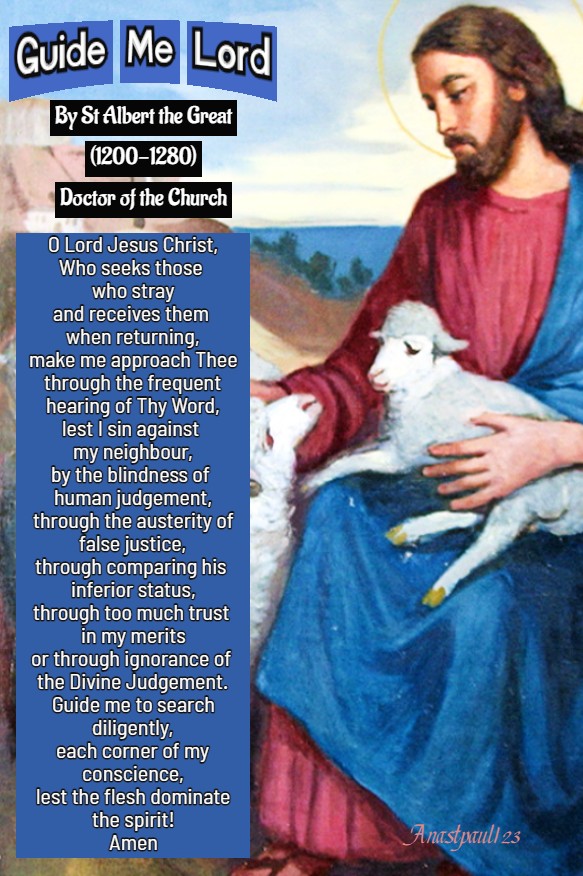
Our Morning Offering – 4 August – On the Feast of St Dominic, we pray a prayer by one of his most illustrious children, St Albert the Great
Guide Me Lord By St Albert the Great (1200-1280) Doctor of the Church
O Lord Jesus Christ, Who seeks those who stray and receives them when returning, make me approach Thee through the frequent hearing of Thy Word, lest I sin against my neighbour, by the blindness of human judgement, through the austerity of false justice, through comparing his inferior status, through too much trust in my merits or through ignorance of the Divine Judgement. Guide me to search diligently, each corner of my conscience, lest the flesh dominate the spirit! Amen
Saint of the Day – 4 August – Saint Agabius of Verona (Died c350) Bishop, Confessor – the Ninth Bishop of Verona, Italy. His birth date and place are unknown but he died in c350 in Verona, of natural causes. Also known as – Agabio, Agapio, Agapito. Agabius was the Bishop of the Diocese of Verona who lived in the 4th Century. The name Agabius is of Greek origin and derives from the verb “agapao” to love.
We know very little about our Saint today. Our only certain knowledge is that he was buried in the Church of St Proculus and when the Church was suppressed on 28 September 1806, his remains were moved to the crypt of the Basilica of St Zeno, the Cathedral Church of Verona.
The Martyrology of the Veronese Church states: “Saint Agabius of Verona, Bishop of the same City, who, excelling in piety to God and gentleness of manners, he of all virtues, of great faith … and of liberality to all the poor, left behind him examples to the … Bishops.” (The gaps are due to the Italian translation which makes little sense).
Another clarification on this holy Bishop is made by Msgr Dario Cervato in his recent work “Verona Agiografica” where he states: “some said he was a native of Caesarea in Palestine, where he was the Bishop, successor of Teotemius and then transferred to Verona but this is unsupported information.”
St Dominic de Guzman OP (1170-1221) Confessor, Founder of the Dominicans – The Order of Preachers – Priest, Founder, Teacher, Preacher, Mystic, Miracle-Worker, Apostle of the Holy Rosary. At Dominic’s Baptism, Blessed Joan, his Mother, saw a star shining from his chest, which became another of his symbols in art and led to his patronage of astronomy. https://anastpaul.wordpress.com/2017/08/08/saint-of-the-day-8-august-st-dominic-de-guzman-founder-of-the-dominican-order-of-preachers/ A lovely personal description of St Dominic here: https://anastpaul.com/2022/08/04/saint-of-the-day-4-august-st-dominic-confessor/ The Roman Martyrology states today: “At Bologna, St Dominic, Confessor, Founder of the Order of Friars Preachers, most renowned for sanctity and learning. He preserved his chastity unsullied to the end of his life and by his great merits, raised three persons from the dead. After having repressed heresies by his preaching and instructed many in the religious and Godly life, he rested in peace on the 6th of this month. His Feast, however, is celebrated on this day by decree of Pope Paul IV.”
St Agabius of Verona (Died c350) Bishop St Aristarchus of Thessalonica (1st Century) St Crescentio of Rome St Eleutherius of Bithynia St Epiphanes of Besançon
St Hyacinth of Rome St Ia of Persia St Isidore of Besançon St Lua of Limerick St Onofrio of Panaia St Perpetua of Rome St Protasius of Cologne St Rainerio of Split St Sithney (Died c 529) St Tertullinus of Rome Blessed William Horne O.Cart. (Died 1540) Martyr, Carthusian Lay Brother
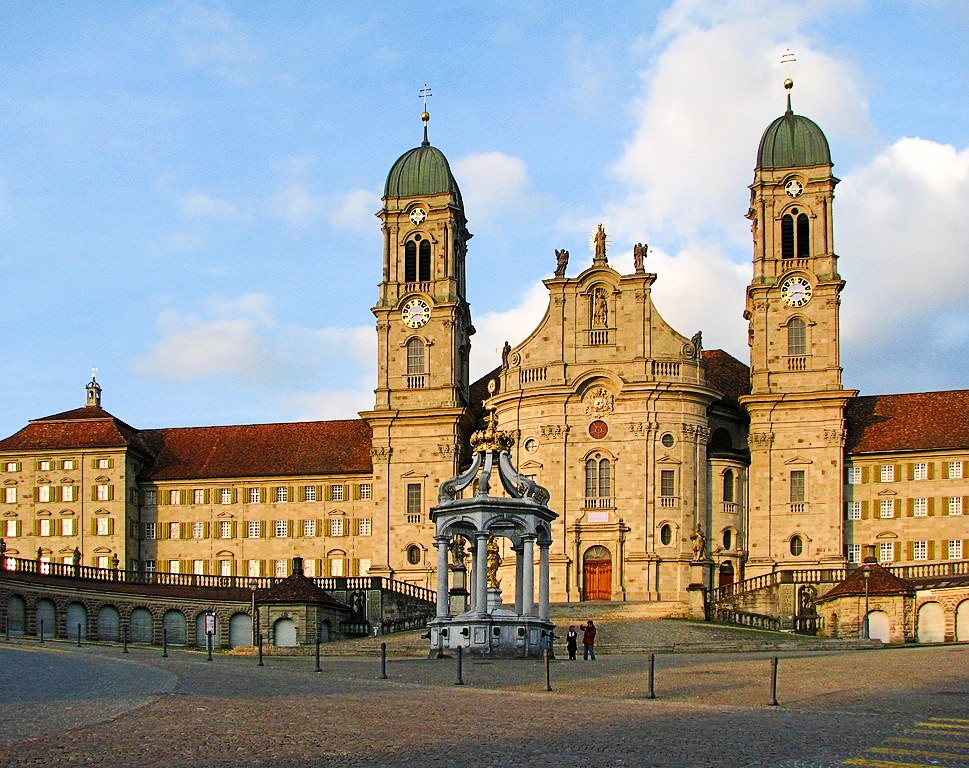
Saint of the Day – 3 August – St Benno of Einsiedeln (Died 940) Bishop of Metz, Hermit, Monk, Co-founder of the renowned Einsiedeln Abbey in Switzerland. Born in the late 9th Century in Swabia (part of modern Germany) and died on 3 August 940 in Einsiedeln, Switzerland of natural causes. Also known as – Benno of Metz.
Born in the late 9th Century in the Swabian region of Germany, Benno was a member of the Duke of Swabia’s noble family. But Benno chose rather the service of the Lord and he became a hermit in Einsiedeln and is, together with his kinsman, St Eberhard, the founder of the Monastery there.
Einsiedeln Abbey
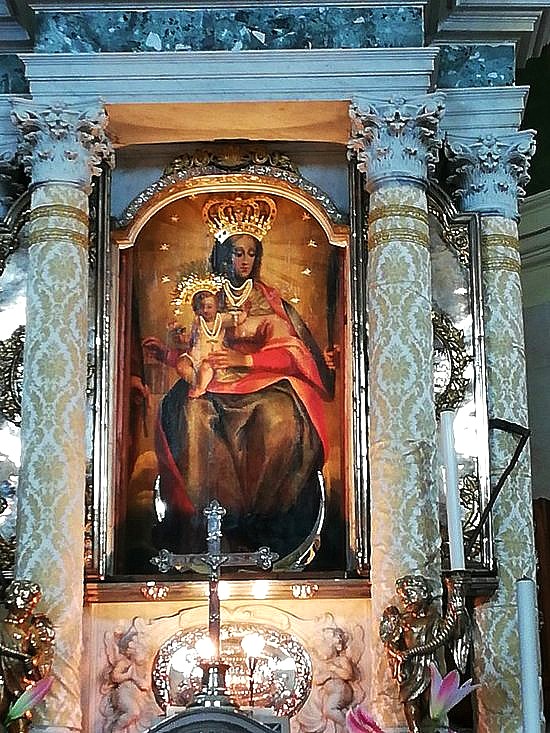
After Ordination to the Priesthood, he served as a Canon at Strasbourg in France. In 906, he retired to the former hermitage of St Meinrad, on Mount Etzel near Lake Zurich in Switzerland. There Benno rebuilt Meinrad’s Chapel, restored the miraculous Statue of Our Lady of Einsiedeln to a place of honour and soon attracted a group of disciples.
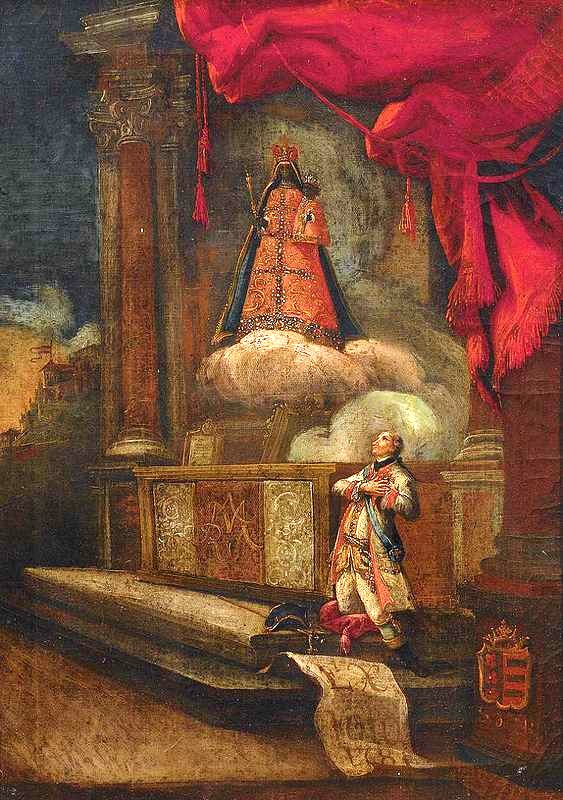
May be St Benno before Our Lady of Einsiedeln – also known as the Black Madonna of Einsiedeln
In 927, Benno was named Bishop of Metz in France, by King Henry I of Germany, in opposition to the locally elected candidate. Bishop Benno was attacked and blinded by the disgruntled opposition of his Diocese and in 929 he resigned his office and returned to his hermitage at Einsiedeln. He was joined by his kinsman St Eberhard in 934 and the Benedictine Monastery was soon established.
Hillside pastures near the Monastery
Fathers of Einsiedeln – Detail from the Icon in the Russian-Orthodox Church of Christ’s Resurrection in Zurich.
Benno lived his remaining years as a Monk in peace at the Monastery until his death on 3 August in the year 940, his Feast day. Benno’s Relics are kept at Einsiedeln Abbey.
Metz Cathedral – equally famous for its Art and Architecture
Blessed Augustine Gazotich OP (1262-1323) Bishop of Lucera, Croatia, of the Order of Preachers. He was also noted for being the guide for Dante Alighieri as the poet travelled through Croatia. His reputation for personal holiness remained noted long after his death; this resulted in Pope Innocent XII confirming the late Bishop’s Beatification in 1700. Biography: https://anastpaul.com/2018/08/03/saint-of-the-day-3-august-blessed-augustine-gazotich-o-p-1262-1323/
St Benno of Einsiedeln (Died 940) Bishop
St Dalmatius St Euphronius of Autun St Gamaliel St Gaudentia Bl Godfrey of Le Mans Bl Gregory of Nonantula St Hermellus St Nicodemus St Senach of Clonard (Died 6th Century) One of the Twelve Apostles of Ireland St Trea of Ardtree
St Alphonsus Maria de Liguori (1696-1787) Bishop, Confessor, Most Zealous Doctor of the Church, Founder of the Redemptorists, Spiritual Writer, Composer, Musician, Artist, Poet, Lawyer, Scholastic Philosopher and Theologian.
St Auspicius of Apt St Betharius of Chartres St Centolla of Burgos St Etheldritha of of Croyland Bl Frederic Campisani Bl Gundekar of Eichstätt Bl Joanna of Aza Bl John of Rieti St Maximus of Padua St Pedro de Osma St Plegmund St Rutilius


















 AnaStpaul
You must be logged in to post a comment.