Bl Adolphus of Tunis Bl Arnaldo of Tunis St Albina of Caesarea St Ananias St Azarias St Bean of Lough Derg St Beoc Bl Clemente Marchisio St Dominic Dosso Bl Elizabeth of Saint Francis
St Everard of Friuli (c 815-867)Duke, Count, Soldier, Founder of Churches and a Monastery. Bl Filip Siphong Onphithakt St Irenion Bl James of Tunis Bl Jaume Mases Boncompte St Jean Wauthier St Macarius of Collesano
Martyred Women of North-West Africa: A large group of women martyred in the persecutions of Hunneric, Arian King of the Vandals. 482 in North-West Africa.
Martyrs of Ravenna – (4 saints): A group of Christians martyred together. Four names and no other information has survived – Agricola, Concordius, Navalis and Valentine. c 305 at Ravenna, Italy.
Saint of the Day – 15 December – Blessed Marino of Cava OSB (Died 1170) Monk, the Seventh Abbot of the famous Abbey of The Holy Trinity of Cava (La Trinità della Cava) in the Province of Salerno, southern Italy. The Abbey was founded in 1011 by Alferius of La Cava (930–1050). Marino was a powerful administrator, so much so, that many other Monasteries elected to be governed by him. He was also appointed as a Royal and secular Governor, through the efforts of his diplomatic peace negotiations.
The Roman Martyrology states: “In the Monastery of Cava de ‘Tirreni in Campania, blessed Marino, Abbot, admirable in his fidelity to the Roman Pontiff.”
We have no information of our Saints early life but we know that Marino was at first a simple Monk, who distinguished himself by the task of the care of the precious vessels and the ancient books and documents of the Monastery.
When Marino was elected Abbot on 9 July 1146, he went to Rome, at the beginning of his mandate, according to the custom at La Cava, to obtain the Papal blessing. The then Cistercian Pope Eugene III (1145-1153),the disciple of St Bernard, welcomed him with honour and on that occasion also entrusted him with the reform of the Monastery of S.t Laurence in Panisperna, according to the manner in which La Cava was administered.
The same Pope by a Bull of 6 May 1149, took the La Cava Abbey under his own protection, making it subject to the Apostolic See, thus appointing it independent of the Diocesan authorities.
The government of Abbot Marino was fruitful in works and prosperity thanks to the generous donations of Bishops, Princes and feudal Lords. So much so, that other Monasteries and other Churches came to place themselves under Abbot Marino’s wise and careful protection and care.
The wealth that flowed ,was used to help the poor and suffering, for the sustenance of the numerous Monks, for the construction of buildings and for the splendour of worship. Below is the Interior of the Abbey Basilica, one of grand proportions and beauty.
(La Trinità della Cava Interior
The Abbey Basilica was covered with precious inlaid marble, decorated with frescoes, paved with polychrome mosaics; moreover, for his work as negotiator for peace between the King of Sicily, William the Bad (1120-66) and Pope Adrian IV (1154-1159), having gone to the Court of Palermo, he obtained a document from the King, confirming the possessions fof his Abbey, taking it under Royal protection and exempting it from taxes. Marino was then a secular administrator too, enabling him to appoint vassals, enlist soldiers, appoint judges and notaries.
(La Trinità della Cava
Marino died a holy death on 15 December 1170. His body was buried in the Abbey’s Basilica. In 1648 his relics were translated to a Shrine Altar in the Basilica after the confirmation of the Marino’s Beatification on 16 May 1928, by Pope Pius XI.
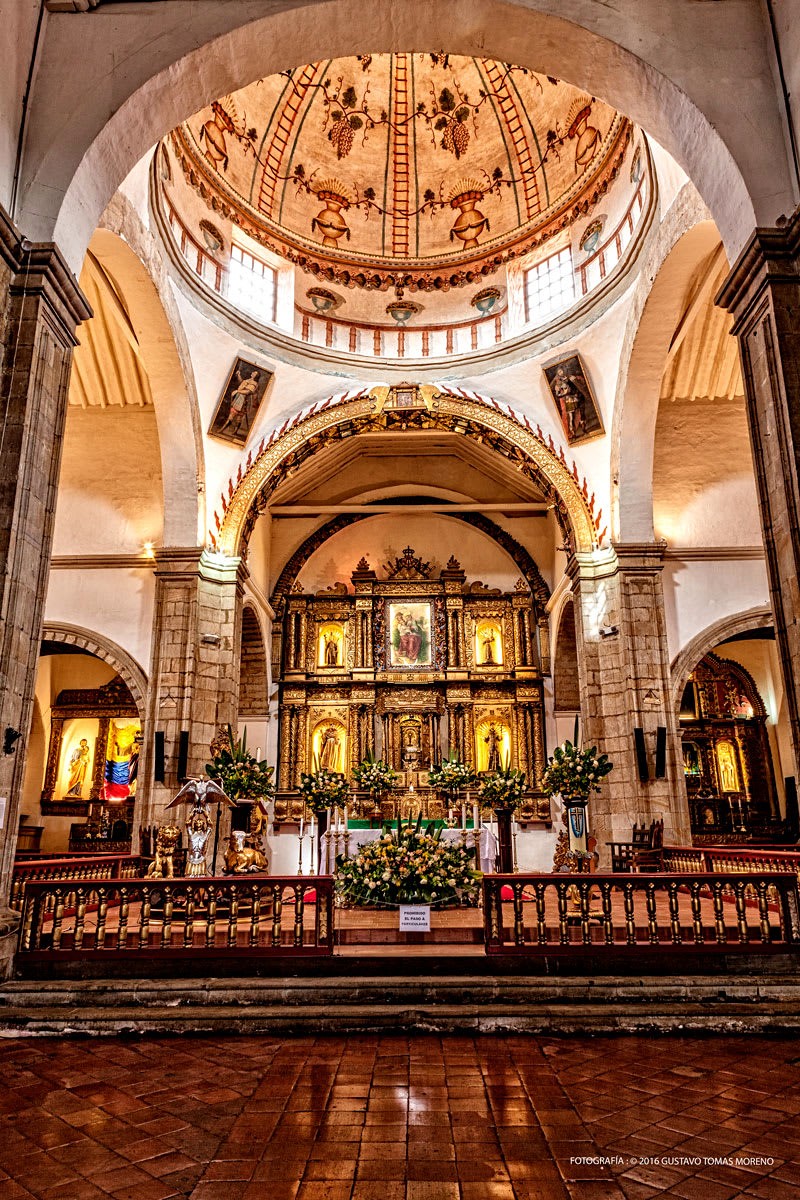
Nuestra Señora de Monguí / Our Lady of Mongui, Monguí, Boyacá, Colombia (16th Century) – 15 December:
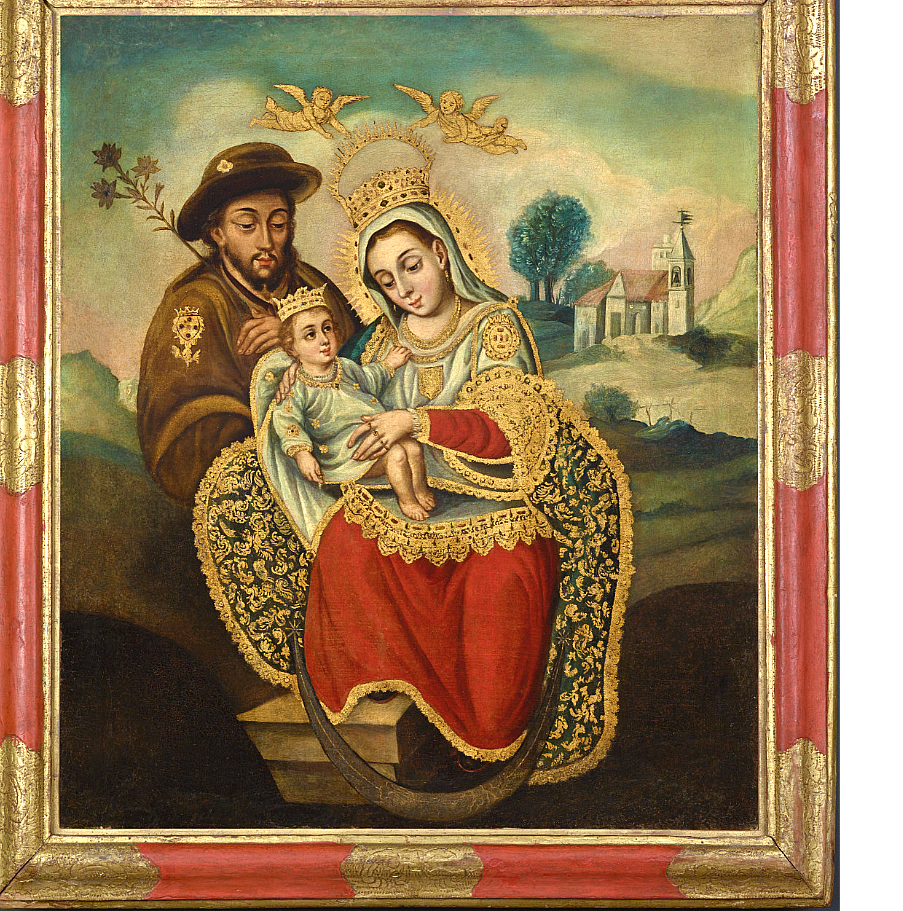
Highly venerated, the Virgin of Monguí, is the Patroness of Boyacá. When King Charles I of Spain retired from his throne, he went to the Monastery of Yuste in the Spanish Province of Cáceres to prepare for death. He went into the Monastery looking for painted works of the Virgin Mary to send to the New World, in order to express gratitude to indigenous leaders for their loyalty to the Spanish Crown. In 1558, King Philip II, his son and successor, sent two paintings: one of St Martín which was to be presented to the leader of Monguí and another of the Holy Family, for Sogamoso. Although the works were marked, there was confusion and the destinations were reversed. Given the error, the inhabitants of Sogamoso protested and asked for the exchange. But the pictures inexplicably returned to the same places and the exchange, through divine intervention, could, therefore, not be accomplished. All agreed that this was a miraculous occurence and the great devotion to the Blessed Virgin began to grow. This painting still includes its original frame, a rare but fortunate occurrence and the fine gold-leaf embellishments. It is because of miraculous events like these, among others, that the Virgin Mary is present in the history of Boyacá and its inhabitants feel entrusted to her protection. Between 1694 and 1760, the present Church was built to house the image and still draws thousands of pilgrims to its Shrine each year. The Church has been elevated to the status of a Basilica.
St Maximinus of Micy St Offa of Essex Bl Pau Gracia Sánchez St Paul of Latros Bl Ramón Eirin Mayo St Silvia of Constantinople St Urbicus St Valerian of Abbenza Blessed Victoria Strata (1562-1617) Widow,
Martyrs of Drina – (5 beati): Also known as • Daughters of Divine Charity of Drina • Drina Martyrs Five members of the Daughters of Divine Charity who were martyred while fighting off Chetnik rapists. They were – Jozefa Bojanc Jozefa Fabjan Karoline Anna Leidenix Kata Ivanisevic Terezija Banja Their martyrdom occured in December 1941 in Gorazde, Bosansko-Podrinjski, Bosnia-Herzegovina They were Beatified on 24 September 2011 by Pope Benedict XVI.
Martyrs of North Africa – (7 saints): A group of Christians martyred together for their faith in North Africa. The only details about them that survive are their names – Caelian, Candidus, Faustinus, Fortunatus, Januarius, Lucius and Mark.
Martyrs of Rome – (22 saints): A group of 22 Christians martyred together in the persecutions of Valerian. The only details we have are five of their names – Antonius, Irenaeus, Saturnin, Theodorus and Victor. c 258 in Rome, Italy.
Quote/s of the Day – 14 December – The Memorial of St Venantius Fortunatus (c 530 – c 609)
“On whose dear arms, so widely flung, The weight of this world’s ransom hung, The price of humankind to pay And spoil the spoiler of his prey All hail, O Cross, our only hope!”
“There are the gates of our true country, the two lights of the immense world. There Paul’s voice is heard like thunder; there Peter withholds or hurls the bolt . The former opens the hearts of men, the latter opens Heaven. Peter is the Foundation-stone, Paul the Architect of the temple where stands the Altar by which God is propitiated. Both together form a single Fountain, which pours out its healing and refreshing waters.”
St Venantius Fortunatus (c 530 – c 609) “The Troubadour of Christ”
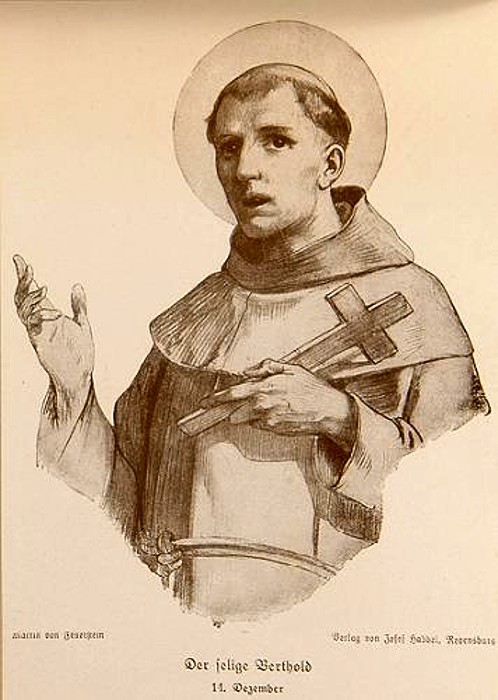
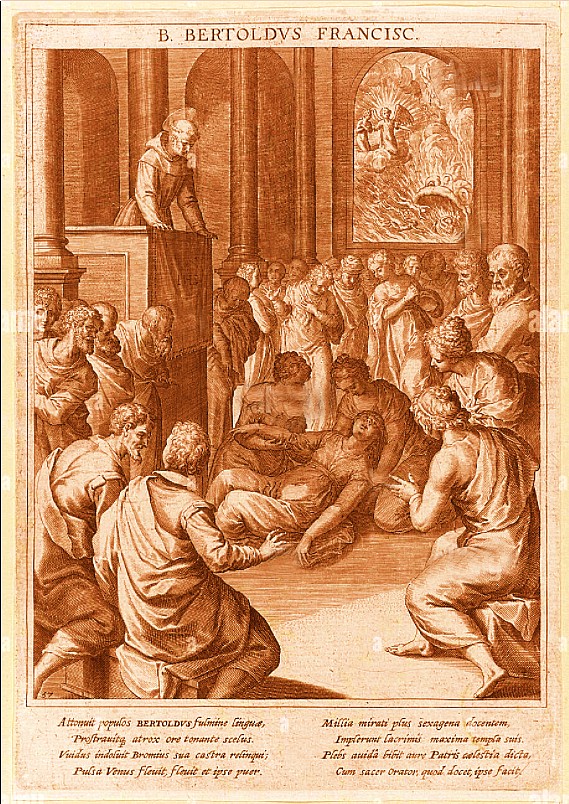
Saint of the Day – 14 December – Saint Berthold of Regensburg OFM (c 1220-1272) Friar of the Order of the Friars Minor, Renowned Preacher for which reason he was known as “Sweet Brother Berthold,” “The Beloved of God and man,” “A Second Elias,” “The Teacher of the Nations,” Missionary Evangelist covering large areas of Germany. It is recorded that he would preach to up to 100,000 people at one time. Born as Berthold Sachs, at Ratisbon, which is now Regensburg, Germany in c 1220 and died there on 14 December 1272 of natural causes. Also known as – Berthold of Ratisbon. Berthold was a Franciscan Friar in the Monastery of Regensburg and the most powerful preacher of repentance in the Thirteenth Century. Patronage – of Preachers.
Berthold was probably a member of a well-to-do middle-class family of Ratisbon named Sachs. The excellence of his literary training is proved by his sermons ,which show more than common acquaintance with the ancient classics. From his knowledge of the usages of secular life, it may be inferred that he was of mature age before he entered the Franciscans. The first fixed date in Berthold’s life is 1246, when the Papal Legate appointed him and David of Augsburg (another Franciscan Friar) as Inspectors of the Convent of Niedermünster. One of his contemporaries, the Abbot of Niederaltaich, a reliable Historian, speaks in 1250 of the great reputation that Berthold had in Bavaria as a preacher.
Four years later, the missionary journeys of this preacher extended as far as the Valley of the Rhine, Alsace and Switzerland. During the next ten years Berthold’s apostolic labours led him eastward into Austria, Moravia, Bohemia and Silesia. In 1263 Pope Urban IV appointed him to preach the Crusade and Saint Albert the Great was designated as his assistant. When speaking to Slavonic audiences, Berthold naturally employed an interpreter, just as St Bernard, in his day, made use of an interpreter in Germany. Notwithstanding any difficulties that might arise as to understanding, wherever he went Berthold exerted an extraordinary power of attraction over his hearers so that the Churches were not able to hold the great crowds of the faithful who came from all quarters to his Masses, and he was often obliged to preach in the open air. When this was the case, a Pulpit was generally arranged under the spreading branches of a linden tree. Long after his day “Berthold’s Linden” was to be seen at Glatz.
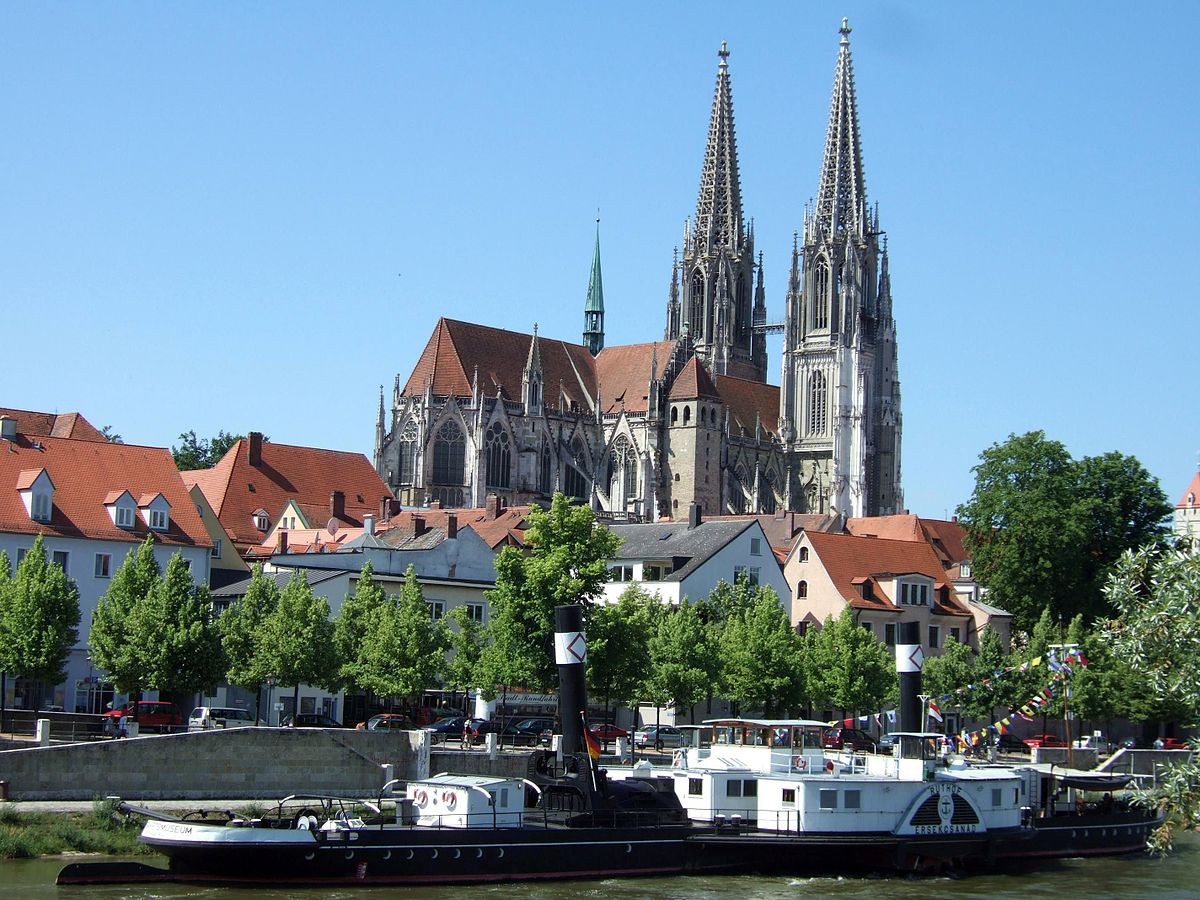
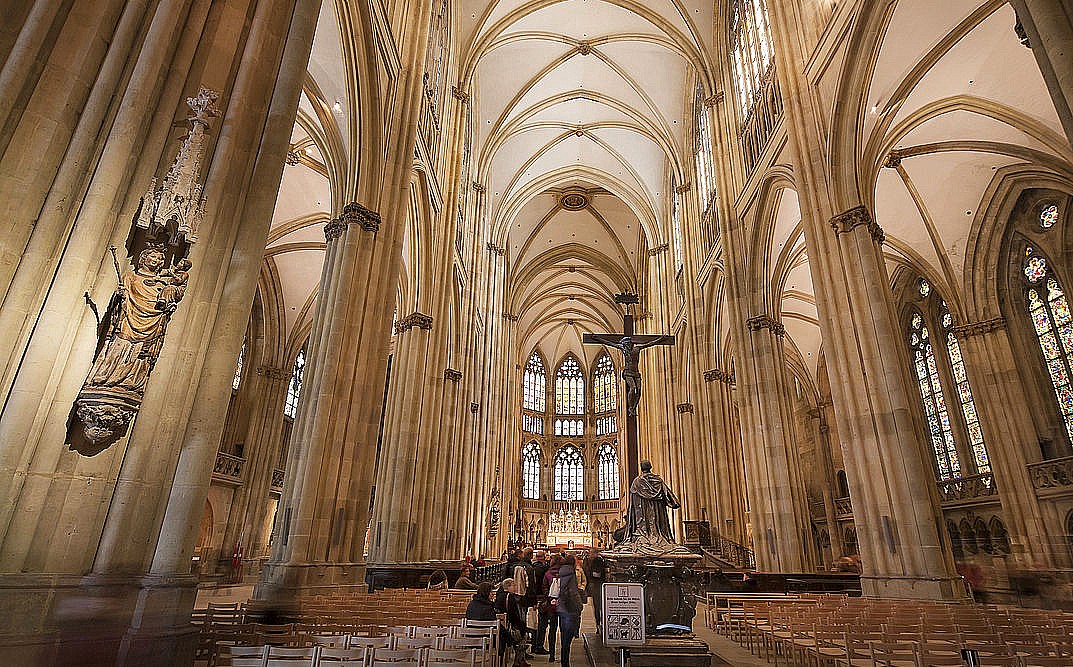
About 1270 he seems to have returned to Regensburg where he remained until his death on 14 December 1272. He had fallen down the stairs a few days prior to his death. His remains form the most precious relic among the treasures of the Cathedral of Regensburg.
Regensburg Cathedral
The poets and chroniclers of Bertold’s time made frequent reference to him. He was called “Sweet Brother Berthold,” “The Beloved of God and man,” “A Second Elias,” “The Teacher of the Nations.” All of these expressions are proofs of the high esteem in which his preaching and missionary zeal were held. The secret of the Preacher’s success, lay partly in the saintliness of his life and partly in his power to make use of the language of humble life. He became the great master, it may be said, the classic of homely speech and this rank has been maintained by his sermons to the present day. One of his two popular discourses on the Last Judgment became a favourite book of the people under the title “The Valley of Josaphat“. There is no doubt, that Brother Berthold preached in German., and used translators when necessary, as said above
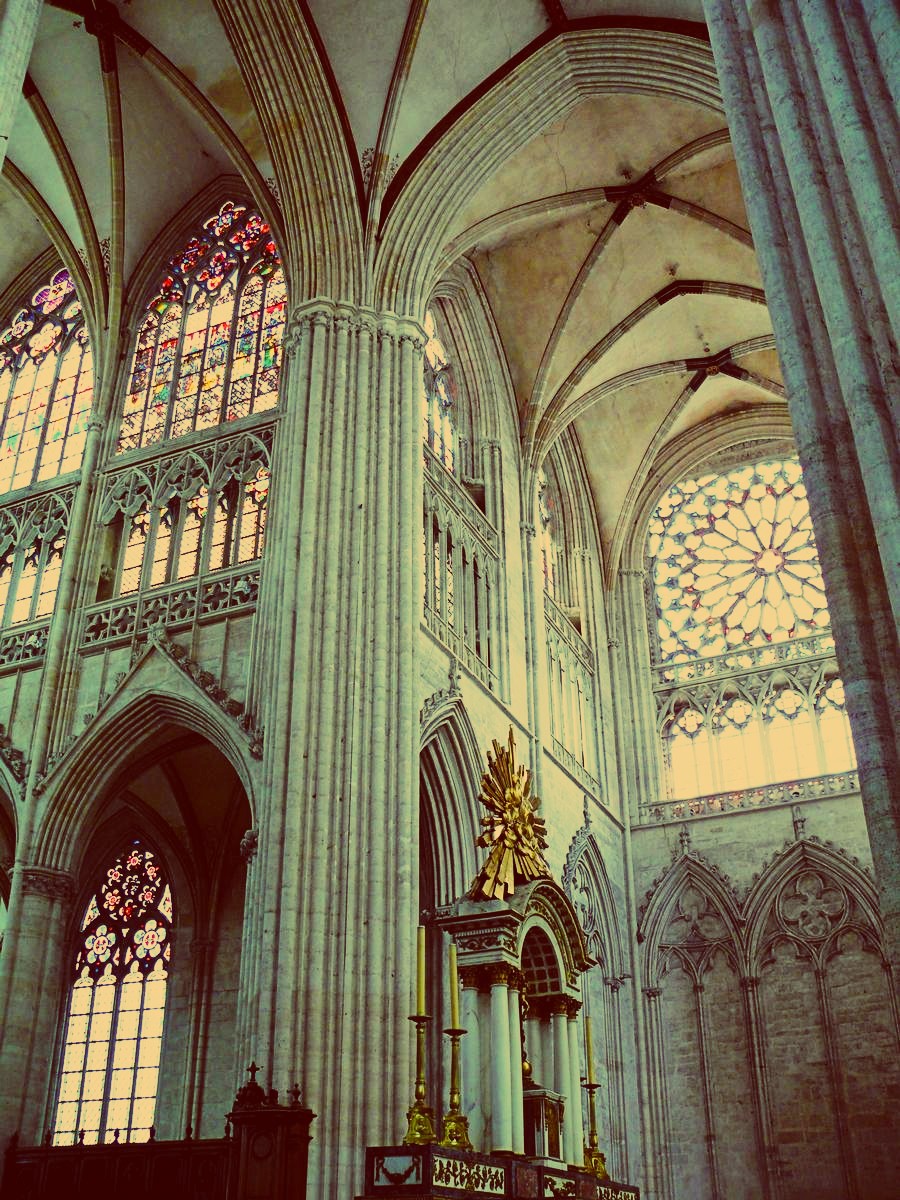
The Interior of Regensburg Cathedral
For a long time scholars disagreed as to how his sermons had been preserved. It is now generally accepted, that the sermons were often written down afterwards in Latin, frequently with marginal comments in German – these reports of the sermons, as they may be called, partly German, partly Latin, or at times in the language in which they were delivered (recorded by the translators, we presume), are what have been handed down to posterity.
The discourses thus preserved, are of the greatest importance for the history of the development of the literature of homiletics; -they are of equal value as rich sources for determining the condition of education and culture in the thirteenth century. It is difficult, therefore, to understand, how this greatest of Catholic Preachers to the poor, could have been forgotten for centuries! It was not until some of Brother Berthold’s sermons were published in 1824 that attention was called to the eloquent Franciscan and his holy and zealous life of a true disciple of Christ! Since this date, the enthusiasm for Berthold grew steadily, so that he has become a favourite, both of Germanic scholars and of the historians of the development of German civilization and of the Faith. He is also regarded as the great pattern of homely Pulpit eloquence.
Seventy-two of his sermons have been preserved for our edification, some of which are available online.
Madonna del Patrocinio / Our Lady of Defence – also known as Santa Maria del Calcare (Faenza, Ravenna, Emilia-Romagna, Italy) (1685) – 14 December:
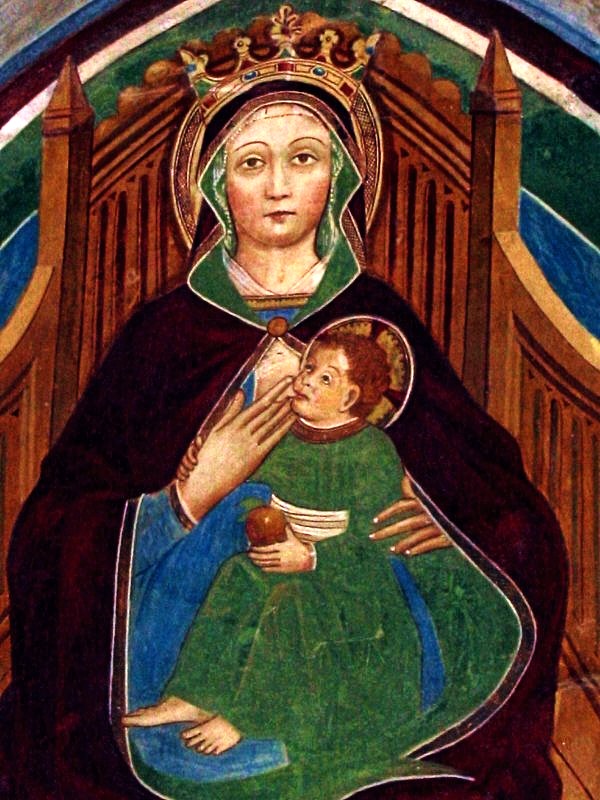
In Forlì, in eastern Italy, the Baldi family owned a painting of the Madonna nursing the Christ Child. A woman of the family joined the Camaldolese Benedictine Convent there under the name of Sister Frances and at her death, the Bishop requested that the sacred image be moved to the Convent Church. In 1614, such great crowds attended the Madonna’s transfer ceremony that the Sisters decided to build a special Chapel for the Blessed Virgin of Defence. On the last Sunday of September, 1650, the painting was installed in its new marble Shrine. An annual festa on that day commemorated the beginning of public veneration of the Virgin of Defence. During the night of 20 November 1685, a fire spread from the Convent laundry to the parlour and Sacristy and had almost entered the Chapel of the holy image when the flames stopped unexpectedly. Only in morning did the nuns realise what happened. This miracle rekindled public devotion to the Blessed Virgin of Defence, which the Vatican approved officially in 1721. During the Risorgimento, the government closed many religious communities and seized their goods. When their Convent was suppressed in 1862, the Camaldolese Nuns of Forlì moved with their Madonna to Faenza, about 15 miles away. The small Sanctuary of the Madonna del Patrocinio, is located along the old mule track that led from Bieno and Santino to the sunny pastures of Ompio. The Sanctuary, built at the beginning of the 18th century, was the destination of endless penitential processions of peasants, shepherds and woodcutters. The place is surrounded by dense chestnut and oak woods; almost a border between the lakes (Maggiore and Mergozzo) and the infinite forest of the Val Grande. On 14 December 1954, at the close of the Marian Year, the sacred image was solemnly crowned by the Bishop of Faenza, Msgr Giuseppe Battaglia. At the nuns’ request, the Virgin’s crown was made of the gold rings they had received at their solemn profession, together with pilgrims’ votive offerings. St Catherine’s Convent was demolished in 2008 for construction of a Catholic rest home. I believe the miraculous image now resides in the local Parish Church.
St Abundius of Spain St Agnellus of Naples St Berthold of Regensburg OFM (c 1220-1272) Friar of the Order of the Friars Minor, Renowned Preacher for which reason he was known as “Sweet Brother Berthold,” “The Beloved of God and man,” “A Second Elias,”,”The Teacher of the Nations.” Bl Buenaventura Bonaccorsi St Folcuino of Therouanne Bl Joan Lambertini St John Pan y Agua (Bread-and-Water) Bl John Discalceat St Justus of Spain St Matronianus of Milan St Pompeius of Pavia Bl Protasi Cubells Minguell
St Viator of Bergamo St Yusuf Jurj Kassab al-Hardini Bl William de Rovira — Martyrs of Alexandria – 4 saints: A group of Egyptian Christians martyred together in the persecutions of Decius – Arsenius, Dioscurus, Heron and Isidore. They were burned to death in 250 at Alexandria, Egypt.
Martyrs of Apollonia – 7 saints: Martyred in the persecutions of Decius. The only surviving details are three names – Callinicus, Leucio and Tirso. Apollonia, Bithynia (in modern Turkey).
Martyrs of Ashkelon – 3 saints: Several pilgrims from Egypt to Cilicia (in modern Turkey) who planned to minister to fellow Christians suffering in the persecutions of emperor Maximinus. They were arrested, torture, mutilated and then imprisoned in Ashkelon. Some were ordered to forced labour in the mines, but we have the names of three who were martyred by order of governor Firmilian – Ares, Elijah and Promo. They were burned at the stake or beheaded at the gates of Ashkelon c 308.
Martyrs of Hayle – 2+ saints: Several Christians, including a brother and sister, who were martyred together by pagans. The only other information to survive are the names of the two siblings – Fingar and Phiala. 5th century at Hayle, Cornwall, England.
Martyrs of Syria – 3 saints: Three Christians who were martyred together. Known to Saint John Chrysostom who preached on their feast day and left us the only details we have – their names – Drusus, Theodore and Zosimus. The date and precise location of their martyrdom is unknown, but it was in Syria, possibly in Antioch.
Quote/s of the Day – 13 December – The Memorial of St Lucy (c 283-304) Virgin Martyr “Bringer of Light” and St Odilia of Alsace (c 660-720) Virgin Both Patrons of those with eye ailments
“I am the light of the world; he who follows me will not walk in darkness but will have the light of life.”
John 8:12
Saint Lucy’s name (Lucia in Italian) shares the root luc with the Latin word for light, lux. Because of this connection, Saint Lucy is often depicted in art and religious custom as a bringer of light – which also ties in to her Patronage of eyes and sight. Her feast day today, is during Advent when we await the Light of Christ and is in winter, for the Northern Hemisphere, so there is significant iconography of Lucy as a bringer of light in the darkness.
“In your light God, we see light.”
Psalm 35:36
Let us pray to St Lucy, for the intercession for all those with eye illnesses and for the protection of the ‘eyes of our faith’ of all of us.
“Let your light shine before men”
Matthew 5:16
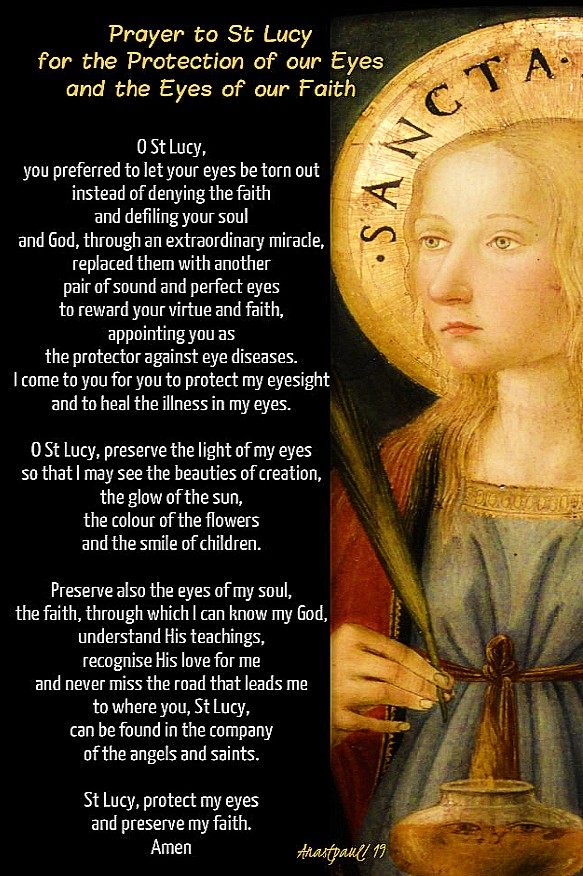
O St Lucy, you preferred to let your eyes be torn out instead of denying the faith and defiling your soul and God, through an extraordinary miracle, replaced them with another pair of sound and perfect eyes to reward your virtue and faith, appointing you as the protector against eye diseases. I come to you for you to protect my eyesight and to heal the illness in my eyes.
O St Lucy, preserve the light of my eyes so that I may see the beauties of creation, the glow of the sun, the colour of the flowers and the smile of children.
Preserve also the eyes of my soul, the faith, through which I can know my God, understand His teachings, recognise His love for me and never miss the road that leads me to where you, St Lucy, can be found in the company of the angels and saints. St Lucy, protect my eyes and preserve my faith.
St Lucy, “Bringer of Light” Pray for those with eye ailments, Pray for us all!
“Light came into the world.”
John 3:19
St Odilia, born blind – at the age of 12, her bodily eyes were opened and she was equally enlightened by the “eyes of faith” when she was Baptised, Pray for those with eye ailments, Pray for us all that our faith may grow and strengthen as those around us grow more and more blind!
“Then again He laid His hands upon his eyes and he looked intently and was restored and saw everything clearly.”
Mark 8:25
Prayer for the Intercession of St Odilia
Merciful God, I come to You to ask Your aid that my life may always give You praise. I ask through the intercession of St Odilia and all your holy people to be a beacon of Your Light to all I meet. Give me holiness of soul and body and bring me into Your divine Light. May I obtain these favours, as well as my special prayer, St Odilia, pray for my eyes and the eyes of my faith. Through the merits of Our Saviour, Jesus Christ, Your Son, our Lord, Who lives with you and the Holy Spirit, God forever and ever. Amen.
Saint of the Day – 13 December – Saint Odilia of Alsace (c 660-720) Virgin Abbess, born blind, but was miraculously granted her sight, miracle-worker. Born of a noble family in c 660 at Oberheim in the Vosges Mountains, Germany and died on 13 December 720 at Niedermunster, Mount Sainte Odile, Germany of natural causes. Also known as – Odilia of Hohenbourg, Odilia of Hohenburg, Adilia, Odile, Odilia, Othilia, Ottilia.Patronages – against eye diseases and partial sightedness, ear diseases and ailments, of Alsace, France (proclaimed in 1807 by Pope Pius VII). Additional Memorial 7 July – translation of her relics.
The Roman Martyrology states: “In the territory of Strasbourg in ancient Burgundia in France, Saint Ottilia, Virgin and first Abbess of the Monastery of Hohenbourg founded by her father, Duke Adalríco.”
A Mosaic Depiction of St Odilia in Mont Sainte-Odile, Alsace
Odilia, daughter of Duke Adalric of Alsace, (also known as Etichon, Alderic, Aldarico, Athich) a region of eastern France but which region, in the past centuries, belonged to France or Germany alternatively, several times – she was, therefore, born in Alsace in the seventh century, blind from birth and according to legend, her father entrusted her to a peasant family.
When Odilia was 12 years old, they took the child to the Monastery of Balma (Baume-les-Dames) to be educated. At the time when the Bishop, St Erhard of Regensburg who was led by an angel to the Monastery, Baptised Odilia. When he touched her with the Oil of Chrism, she received her sight. Her younger brother Hugo had her brought home again, for [purposes of arranging a marriage for Odilia. Aldaric was so enraged at Hugo’s presumption, that he accidentally killed his son. Odilia miraculously revived him and immediately fled the family home again.
She fled across the Rhine to a cave or cavern in one of two places (depending on the source – the Musbach valley near Freiburg im Breisgau, Germany, or Arlesheim near Basel, Switzerland.) The cliff face opened up in order to rescue her from her plight. In the cave, she hid from her father. When he tried to follow her, he was injured by falling rocks and relinquished his search. This mountain has since then been called “Odilienberg.”
But when Aldaric fell ill, Odile returned to nurse him. He finally capitulated, ceased resisting his headstrong daughter and founded the monastic community of Mont Ste. Odile (also known as Hohenburg Abbey) for her.
Some years later Odile was shown, in a vision, the site of Niedermünster at the foot of the mountain by St John the Baptist. There she founded a second Monastery, including a hospital. Here, the head and an arm of St Lazarus of Marseille were displayed but later transferred to Andlau. The buildings of the Niedermünster burned down in 1542 but the local well is still said to cure eye diseases.
Odilia died on 13 December 720 and the holy Abbess was buried in Hohenbourg in the Church of St John. This Church and Odilia’s Tomb were first mentioned by Pope Leo IX on 17 December 1050.
St Odilia in Avolsheim, Alsace
The relics have a history all of their own, the Emperor Charles IV received her right arm on 4 May 1353, which is now kept in Prague. Other relics which were in Odilienberg were saved from the French Revolution, although the marble covering the Sarcophagus was then lost. In 1842 the relics were placed in a chest under the Altar in Hohenbourg in the Church of St John and some are found in Alsace.
Odilia’s cult was widespread throughout the Middle Ages, in all Germanic Abbeys and in some French regions. She is still greatly venerated today in the Diocese of Alsace, Munich, Meissen, Strasbourg and in the Austrian fBenedictine Abbeys and by those all over the world suffering from eye ailments.
St Odilia has been the patron saint of Alsace since 1807, where she receives a great popular cult. Mont-Sainte-Odile is a very popular pilgrimage site, where her Feast day is celebrated on the anniversary of the transfer of her relics, which took place on 7 July 1842.
Chapels in her honour are built on hills and mountains, she is invoked especially for the healing of eyes, ears or headaches, in fact she is represented in the guise of Abbess, with an open book on which two eyes rest.
Sometimes she is depicted while freeing the soul of her father Aldaric from Purgatory and sometimes she carries a Chalice in her hand, which refers to a miraculous episode in which Odilia, being seriously ill, died without having received the Viaticum. Thanks to the prayers of her sorrowful Sisters, she rose again and had the Chalice with the Consecrated Hosts brought to her bedside. After communicating she died again.
La Reina del Rosario de Banos de Agua Santa / Queen of the Holy Rosary, also known as the Virgin of the Holy Waters, Baños de Agua Santa, Ecuador (1570) 13 December:
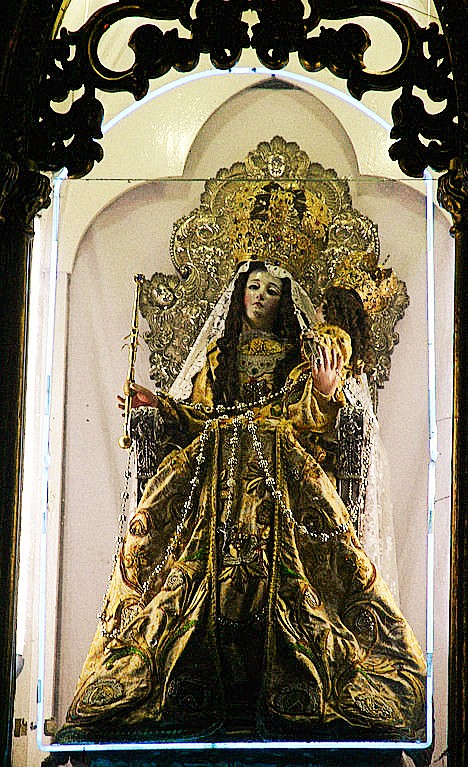
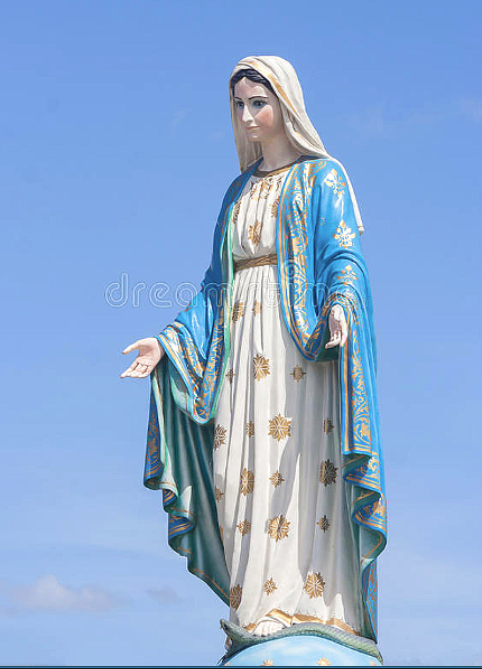
This is or is similar to, the Statue which stands at the Holy Waters
A few years before the founding of Quito, Dominican Missionaries travelled throughout the Ecuadorian Province of Tungurahua, bringing the Faith to the people. A bamboo Chapel was erected at Baños de Agua Santa ( Bath) wherein was venerated the Blessed Virgin of Montserrat. One night the Sacristan of the Church saw a small Statue of the Virgin accompanied by two beautiful Angels hovering in the air then coming down to the foot of a waterfall that flowed from the mountain. This event was repeated several times, causing the people gathered in the Chapel, to beseech the Blessed Virgin to clearly manifest her intentions. The following night the Virgin appeared asking for the erection of a Church at the spring, promising to cure the sick who bathe with faith, in those waters.
A new Church was built as Our Lady asked but the Statue of the Virgin of Montserrat had disappeared before it could be transferred to the new Church. A mule came to the Town Square carrying a box containing a beautiful Statue of Our Lady of the Rosary. When this was unclaimed by anyone, it was seen as a gift from Our Lady and the image of “La Reina del Rosario de Agua Santa” was lovingly placed in the Church. The present Basilica was completed in 1929. A brief of Pope Pius XII in 1957 declared the Virgin of Banos de Agua Santa “Principal Patroness of the missions of eastern Ecuador.” On 13 December 1959, the Cardinal Archbishop of Quito, Carlos M de la Torre, solemnly crowned the Statue of the Virgin in the presence of President of the Republic, Dr Camilo Ponce, who offered to the Mother of God, the Presidential baton invoking her as the Patron of Ecuador.
Many miracles and cures were granted by Our Lady of the Rosary of Agua Santa and numerous times, the Church has provided a sanctuary when the volcano Tungurahua hsd erupted. On one occasion, a horrendous eruption began while many were gathered to honour Our Lady. Lava was flowing toward the Church. The people raised the Statue of Our Lady of Agua Santa on high and processed to the Town Square. There, Our Lady lifted her hand silencing the roaring volcano and and diverting the flow of lava. In 1916, a nearby farmhouse was burned completely to the ground, except for a picture of Our Lady of the Rosary of Agua Santa.
St Lucy (of Syracuse) – St Lucy/Lucia of Syracuse (c 283-304) Virgin and Martyr Patron of the blind, eye disorders, martyrs, Perugia, Italy, Malta; epidemics; salesmen, Syracuse, Italy, throat infections, writers, against fire, against poverty, against spiritual blindness, peasants, penitent prostitutes, poor people, sick children, authors, cutlers, farmers, glass blowers, glass makers, glaziers, labourers, lawyer, maid servants, notaries, ophthalmologists, opticians, porters, printers, saddler, sailors, salesmen, seamstresses, stained glass workers, tailors, upholsterers, weavers and 10 further towns and cities. St Lucy’s Life and Death: https://anastpaul.wordpress.com/2017/12/13/saint-of-the-day-13-december-st-lucy-c-283-304/
St Aristone St Arsenius of Latro St Aubert of Arras Bl Bartholomew of Tuscany St Edburgh of Lyminge St Einhildis of Hohenburg Bl Elizabeth Rose St Jodocus
St Martino de Pomar St Odilia of Alsace (c 660-720) Virgin Abbess St Roswinda St Tassio of Bavaria St Wifred
Blessed Mercedarian Knights – (7 beati): A group of Mercedarian knights who fought the enemies of the Catholic faith in the first century of the Order. • Blessed Bernardo de Podio • Blessed Giacomo de Copons • Blessed Giovanni de Bruquera • Blessed Guglielmo de Sa • Blessed Pietro Boguer • Blessed Pietro Ricart • Blessed Raimondo de Frexa
Martyrs of Jeongju – (6 saints): Six Christian laymen who were imprisoned, tortured and martyred together in the persecutions in Korea. They were beheaded on 13 December 1866 in Supjeong-i, Jeongju, Chungcheong-do, South Korea and Canonised on 6 May 1984 by St Pope John Paul II. • Bartholomaeus Chong Mun-Ho • Iosephus Han Won-So • Peter Cho Hwa-so • Petrus Son Son-Ji • Petrus Yi Myong-So • Petrus Chong Won-Ji
Martyrs of Sebaste – (5 saints): A group of Christians martyred together in the persecutions of Diocletian. We know little more than their names – Auxentius, Eustratius, Eugene, Mardarius and Orestes. They were martyred in c 302 at Sebaste, Armenia (in modern Turkey) and their relics are enshrined at the church of Saint Apollinaris in Rome, Italy.
Saint of the Day – 12 December – Saint Pope Callistus II (c 1065-1124) Bishop of Rome 1 February 1119-13 December 1124) Born in c1065 Quingey, France as Guy or Guido and died on 13 December 1124 in Rome, Italy of natural causes. Also known as – Calixtus II, Guy of Burgundy, Guido of Burgundy.
Guy or Guido in Italian, as he was called before his elevation to the Papacy, was the son of Count William of Burgundy and both by his father’s and mother’s side, was closely connected with nearly all the Royal Houses of Europe. He was the uncle of the Queen of France, cousin of the King of England, related to the German Emperor. His brother Hugh had been appointed Archbishop of Besançon and he himself was named Archbishop of Vienne in 1088 and afterwards appointed Cardinal and Papal Legate in France by Pope Paschal II.
When appointed Papal Legate in France by Pope Paschal II, Guido strenuously opposed Paschal’s “Privilege,” extorted by Henry V, which would have surrendered most of the political positions held by Church officials in the Empire. After protesting the “Privilege” at the Lateran Synod of 1112, he called and presided over a Synod of French and Burgundian Bishops at Vienne, which denounced lay investiture of the clergy as heretical and excommunicated Henry V as hostile to the welfare of the Church. When Gelasius II, who succeeded Pascal, refused to confirm the “Privilege,” the angry Henry V set up Archbishop Burdinus of Braga as antipope Gregory VIII and installed him in Rome. Gelasius was forced to spend his brief, harassed Pontificate in exile and died at Cluny within a year. Some of the Cardinals who had come to Cluny now elected Guido, who was crowned in Vienne on 1 February 1119.
Callistus took immediate steps to establish peace with the imperial government, since both sides were tired of the long investiture struggle. Henry V favourably received a Papal Embassy and temporarily withdrew his support from Gregory VIII. A meeting between Pope and Emperor was arranged.
After presiding over a Synod at Toulouse (1119), which was mainly concerned with reform of the French Church, Callistus proceeded to Reims, where he held a great Council (1119), attended by some 400 Prelates and by Louis VI of France. Negotiations with Henry V broke down after he came to Mousson with a large army and Papal plans to meet with the Emperor were abandoned. The Emperor was excommunicated again (October 1119).
Callistus then went to Rome, where he was enthusiastically received by the people, who had meanwhile driven out the antipope. He allied himself with the Normans, who aided in the capture of antipope Gregory VIII. Gregory, who had taken refuge at Sutri, was held prisoner and subsequently other enemies of the Pope in Italy were overcome too.
Callistus then sent a new embassy to Henry V. A preliminary understanding with a truce was arranged at Würzburg in 1121. The following year, the famous Concordat of Worms (1122) was arrived at, in a Synod held in that City. Because of the Pope’s patience and perseverance, the Concordat was a reasonably satisfactory arrangement for both sides, although a complete victory for neither, bringing peace to both Empire and Church, to the great relief of Christendom.
The First Lateran Council (1123), convoked by Callistus, solemnly confirmed the Concordat of Worms and issued Decrees against clerical marriage and simony. It provided penalties against violators of the Truce of God and against forgers of Ecclesiastical documents and renewed Indulgences for crusading.
During his Pontificate, Callistus also secured from Henry I of England, the acceptance of his candidate, Thurstan, for the Archbishopric of York, transferred metropolitan rights in Spain from the ancient See of Merida to the popular See of Santiago de Compostela and settled the old French rivalry over metropolitan disagreements between Aries and Vienne, in favour of the latter.
Callistus died in 1124 and after some dispute Honorius II was selected as his successor. As to the great influence of the reign of Callistus II on the policy of the Church, there can be no dispute. Owing mainly to him ,the concessions so weakly made by Pope Paschal II were recalled and on his own accession to the Papal throne, his firmness and strength of character secured a settlement of the controversy between Church and State which, although not entirely satisfactory, was at least sufficient to assure a much needed peace.
Through his exertions he put an end to the wholesale bestowal of Ecclesiastical offices by laymen; he re-established the freedom of canonical elections and secured recognition of the principle that Ecclesiastical jurisdiction can come, only from the Church, while on the other hand, he conceded to the secular authorities, the influence to which they were rightly entitled, in the election of Prelates who were at the same time the most powerful and richest subjects of the State.
Callistus II was not very remarkable for his literary productions, yet a few works have come down to us which are ascribed to his pen. They are: “De Miraculis Sancti Jacobi Apostoli,” “De obitu et Vita Sanctorum,”,”Vita Caroli Magni Imperatoris.” Many letters attributed to him are preserved.
Martyrs of Alexandria – (6 saints): A group of six Christians martyred for their faith during the persecutions of Decius. We know little more than five of their names – Alexander, Ammonaria, Dionysia, Epimachus and Mercuria. They were burned to death c 250 in Alexandria, Egypt.
Martyrs of Trier – (4 saints): A group of six Christians martyred for their faith during the persecutions of Decius. We know little more than five of their names – Alexander, Ammonaria, Dionysia, Epimachus and Mercuria. They were burned to death c 250 in Alexandria, Egypt.
Saint of the Day – 11 December – Blessed Jerome Ranuzzi OSM (c 1410-c 1468) “The Angel of Good Counsel,” “The Blessed Bachelor,” Priest and Friar of the Order of the Servants of Mary, the Servites, Theologian, Adviser both spiritual and secular, renowned for his learning and scholarship, Penitent and Hermit with a great love of solitude and silence. Born as Girolamo Ranuzzi in c 1410 at Sant’Angelo, Vado, Pesaro-Urbino, Italy and died in c 1468 of natural causes. Also known as – Jerome Ranucci, Girolamo and “The Angel of Good Counsel,” “The Blessed Bachelor.” Additional Memorials, 10 and 12 December on local calendars. Patronage – Sant’Angelo, Vado. His body is incorrupt and is still available for veneration in St Mary of the Servites.
The Roman Martyrology states: “In Sant’Angelo in Vado always in the Marches, Blessed Girolamo, Priest of the Order of the Servants of Mary, who in solitude and silence reached the wisdom of holiness.”
“Becoming holy is the vocation of every man and woman who comes into this world. The Servants of Mary lived this noble toil within the Church of Christ. The results of this journey are as colourful as ever, precisely because the Holy Spirit renews everything without ever repeating Himself. The saints are alike but none are the same.” (The journey of the Servants of Mary, Servitium editrice, 2001).
Jerome, who was born around 1410 in Sant’Angelo in Vado, of the wealthy Ranuzzi family (or Ranucci, according to the spelling of contemporary documents). The family became regarded as part of nobles. In 1404, his father Antonio, became the municipal guardian for the Parish of St Eusebius, two kilometers away from his home.
Jerome, while still a teenager, entered the Convent of the Servants of Mary of St Angelo in Vado, from where he went to Bologna to study. There he applied himself to philosophy and theology, obtaining the degree of bachelor and after being Ordained a Priest, returned to his hometown Convent.
The first documented report of Jerome’s presence in St Angelo among the Servants of Mary, dates to 1449. Jerome was at this time, the Vicar of the Provincial Superior Michael Ambrosi, who called a General Chapter at his Convent in St Angelo. Another document certifying his presence in the said Convent is his signing of a contract dated 20 November 1454.
Jerome was undoubtedly a man of doctrine, in fact, several of his famous contemporaries mention him in their historical works as the “bachelor,” from the title obtained for his studies in the ecclesiastical universities of the time.
The famous Duke Federick of Montefeltro of Urbino, used his advice for the most important affairs and then always venerated his memory, when, as shown by subsequent documents of 1471 and 1478, the Duke Federick visited Jerome’s Convent to pay homage at the Tomb of the Blessed.
His contemporaries and fellow Friars, narrated his fame as an ascetic, a rigorous penitent, a persuasive adviser, who was very much alive in St Angelo in Vado. A local tradition indicates a cave where our Blessed Jerome lived his periods of solitude located along the road that leads to Montata, right where the Shrine of the Virgin called “Madonnina di Pagnignò” stands.
In 1462 the “Blessed Bachelor” began the foundation of the female Monastery of St Mary of Gracenear, nearby the male Monastery.
The date of his death is around 1468 and from then on, a crowd of people went to his Tomb to recommend themselves to his intercession. Shortly after his death, when the fame of miracles grew, Friar Jerome was acclaimed a saint by the voice of the people. His incorrupt body is preserved under the main Altar of the Church of St Mary of the Servites, where it is still venerated by the faithful today.
After a long process, his cult was confirmed on 1 April 1775 by Pope Pius VI with the title of Blessed. The Roman Martyrology celebrates his feast today, the 11th December.
Bl Hugolinus Magalotti Bl Jean Laurens Blessed Jerome Ranuzzi OSM (c 1410-c 1468) “The Angel of Good Counsel,” “The Blessed Bachelor,” Priest and Friar of the Order of the Servants of Mary, the Servites Bl Kazimierz Tomasz Sykulski
Bl Martín Lumbreras Peralta Bl Martino de Melgar Bl Melchor Sánchez PérezPens Bl Pilar Villalonga Villalba Bl Severin Ott Martyrs of Saint Aux-Bois – (3 saints): Two Christian missionaries and one of their local defenders who faith in the persecutions of governor Rictiovarus – Fuscian, Gentian and Victoricus. They were beheaded in 287 in Saint Aux-Bois, Gaul (in modern France).
Martyrs of Rome – (3 saints): Three Christians murdered in the persecutions of Diocletian for giving aid to Christian prisoners – Pontian, Practextatus and Trason. They were imperial Roman citizens. They were martyred in c 303 in Rome, Italy.
Saint of the Day – 10 December – Saint John Roberts (1577-1610) Priest Martyr, Monk, Missionary. Born in 1577 at Trawsfynydd, Merionethshire, Gwynedd, northern Wales and died by being hung, drawn and quartered on 10 December 1610 at Tyburn, London, England. Additional Memorials – • 25 October as one of the Forty Martyrs of England and Wales, 1 December as one of the Martyrs of Oxford University.
John Roberts was the eldest son of Robert and Anna of Rhiw Goch Farm, Trawsfynydd. He was a descendant of the Welsh Princes, including Maelgwn Gwynedd, Hywel Dda and Llewelyn the Great.
Despite being raised a Protestant, it is believed that he received his early education from a Monk who had been forced to leave nearby Cymer Abbey after Henry VIII’s dissolution of the monasteries.
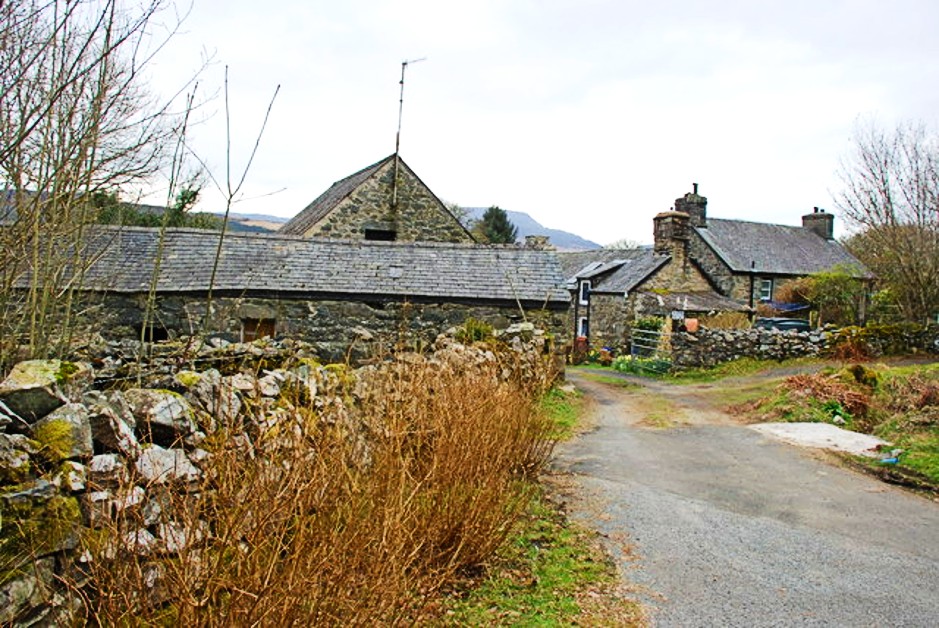
St John Robert’s Birthplace
John studied at St John’s College at Oxford. However, he left without earning a degree and entered as a law student at one of the Inns of Court. He travelled throughout the continent and more so, Paris and through the influence of a Catholic fellow traveller, he was converted to Catholicism. By the advice of John Cecil, an English Priest, he decided to enter the English College, at Douai in 1598.
He left College the following year for the Abbey of St Benedict and was sent to make his novitiate at San Martin Pinario, Santiago de Compostela. He made his profession towards the end of 1600. He was Ordained and set out for England in December 1602. Although a Government spy observed him, John and his companions succeeded in entering the country in April 1603 but he was arrested and banished in May. He soon managed to return to England, and worked among the plague victims in London. In 1604 while preparing to leave for Spain with four postulants, he was arrested again. Not recognised as a Priest, he was released and again banished but he returned to England, once again.
In 1605, he was found at the house of Mr And Mrs Thomas Percy, who was involved in the Gunpowder Plot. Although he was not found guilty of being involved, in July 1606. he was imprisoned in the Gatehouse Prison at Westminster for seven months and then exiled This time he was gone for fourteen months, nearly all of which he spent at Douai where he founded and became the first Abbot of a house for English Benedictine Monks, who had entered through Spanish Monasteries. This was the beginning of the Monastery of St Gregory at Douai.
In October 1607, John returned to England. In December, he was again arrested and placed in the Gatehouse at Westminster. After several months, he escaped. He lived in London for about a year and in May 1609, he was taken to Newgate Prison. He would have been executed but the French Ambassador interceded on his behalf and his sentence was reduced to banishment. He visited Spain and Douai but returned to England within the year. He was captured again on 2 December 1610, just as he was concluding Mass. They took him to Newgate in his Vestments. On 5 December he was tried and found guilty under the Act forbidding Priests to minister in England.
On 10 December he was hung, drawn and quartered along with Father Thomas Somers at Tyburn, London. His body was recovered and taken to St Gregory’s at Douai. His arm was found in the possession of the Spanish Royal family before being returned to Santiago de Compostela, where he served as a novice. One of his fingers is kept in the Sacred Cross Church, Gellilydan, while another is at the Tyburn convent and one more in Taunton.
He was Beatified by Pope Leo XIII in 1886 and Canonised by Pope Paul VI as one of the “Forty Martyrs of England and Wales.”
His life is commemorated in Trawsfynydd’s heritage centre, Llys Ednowain. There is an information board about him outside the centre, one of six posted along a walk past significant locations in his life.
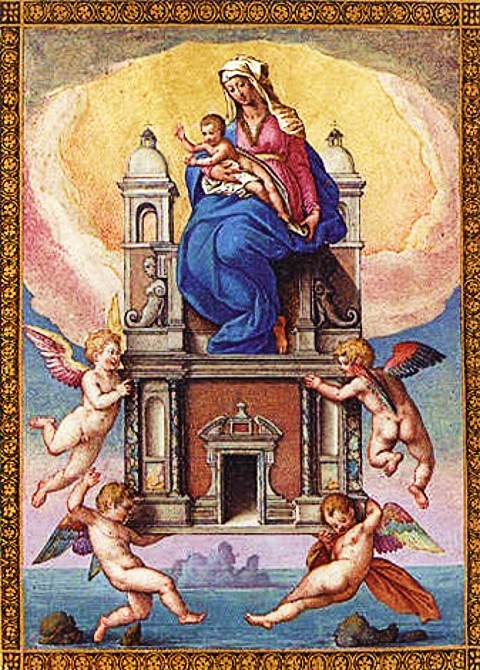
The title Our Lady of Loreto refers to the Holy House of Loreto, the house in which Mary was born and where the Annunciation occurred and to an ancient statue of Our Lady which is found there. Tradition says that a band of angels scooped up the little house from the Holy Land and transported it first to Tersato, Dalmatia in 1291, then Recanati, Italy in 1294 and finally to Loreto, Italy where it has been for centuries. It was this flight that led to her patronage of people involved in aviation and the long life of the house that has led to the patronage of builders, construction workers, etc. It is the first shrine of international renown dedicated to the Blessed Virgin and has been known as a Marian centre for centuries. Popes have always held the Shrine of Loreto in special esteem and it is under their direct authority and protection.
The Holy House of Loreto – The feast is so named from the tradition that the house where the Holy Family lived in Nazareth, was transported by angels to the city of Loreto, Italy. The Holy House is now encased by a basilica. It has been one of the famous shrines of the Blessed Virgin since the 13th century.
St Abundius St Albert of Sassovivo St Angelina of Serbia Bl Brian Lacey BL Bruno of Rommersdorf St Caesarius of Epidamnus St Carpophorus St Deusdedit of Brescia
Bl Guglielmo de Carraria St Guitmarus St Hildemar of Beauvais Bl Jerome Ranuzzi Bl John Mason St John Roberts (1577-1610) Priest Martyr St Julia of Merida St Lucerius Bl Marco Antonio Durando St Maurus of Rome St Mercury of Lentini St Pope Miltiades St Polydore Plasden Bl Sebastian Montanol Bl Sidney Hodgson St Sindulf of Vienne St Swithun Wells St Thomas of Farfa Bl Thomas Somers St Valeria Martyrs of Alexandria – 3 saints – A group of Christians murdered for their faith in the persecutions of Galerius Maximian – c312. The only details that have survived are three of the names – Eugraphus, Hermogenes and Mennas.
Saint of the Day – 9 December – Saint Syrus of Pavia (1st Century) the First Bishop of Pavia, Italy, Confessor, miracle-worker, Defender of the Faith, Evangeliser. His birthplace is unknown but he died at Pavia where his relics are enshrined in the City’s Cathedral. Also known as – Cyrus, Cyril, Siro.Patronages – the City and the Diocese of Pavia, Italy.
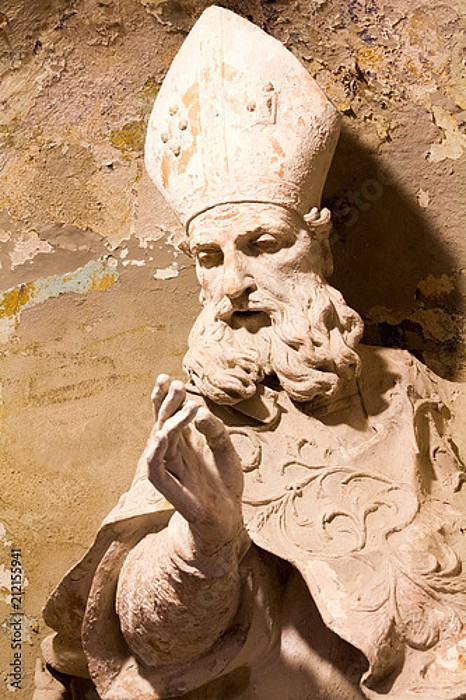
Detail of St Syrus on Pavia Cathedral facade. Full image below.
The Roman Martyrology states: “At Pavia, St Syrus, the first Bishop of that City, who was renowned for miracles and virtues worthy of an apostle.”
Nothing is known of St Syrus early life but some believe that he was the little boy with the five loaves and 2 fish, who appears in the Gospels.
Syrus is said to have followed Saint Peter to Rome and from there he was sent to the Po valley to preach and convert the people to the Christian faith. He preached in all of the major cities of northern Italy.
Another tradition, from the eighth century, states that Syrus was also a disciple of St Hermagoras, the first Bishop of Achilles, himself a disciple of St Mark the Evangelist.
In the company of St Juventius, Syrus fought against Arianism. Syrus worked to challenge and convert those who followed Arianism in his Diocese.
St Syrus refuting the Arians
Syrus’ relics are enshrined in the Chapel of Saint Syrus in the Pavia Cathedral on the facade of which the Statue below is displayed.
Nostra Signora dell’Immacolata Concezione / Our Lady of the Conception, Naples, Italy (1618) – 9 December:
The Abbot Orsini wrote: “Our Lady of the Conception, at Naples, so called because, in the year 1618, the Viceroy, with all his Court and the soldiery of Naples, made a vow, in the Church of Our Lady the Great, to believe and defend the Immaculate Conception of the Blessed Virgin.”
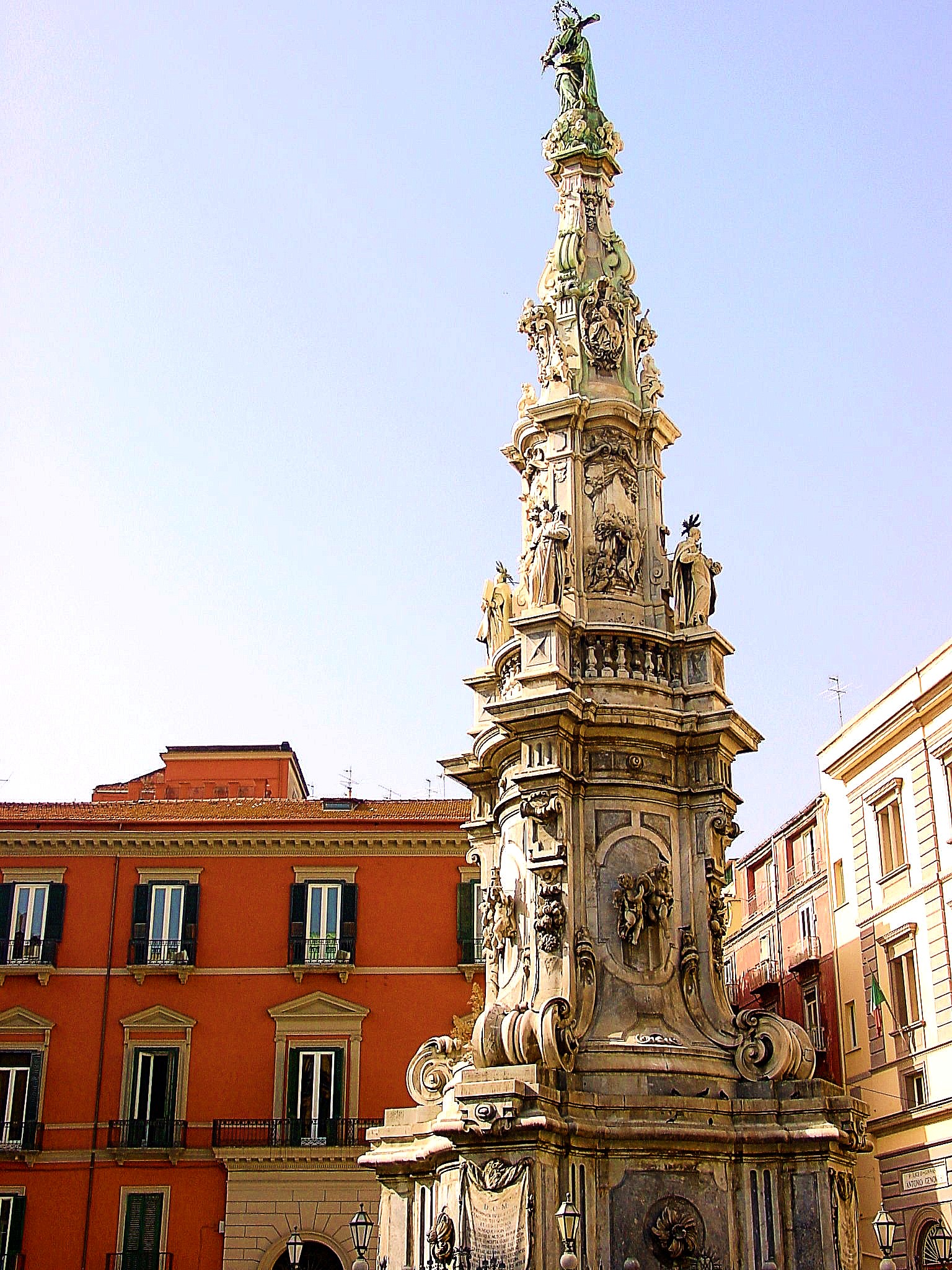
Pedro Tellez-Giron, 3rd Duke of Osuna, was the Viceroy of Naples under King Philip III of Spain. He was a Spanish nobleman born in 1574 and married in 1594. He joined the army of the Archduke of Austria as a mere private but his ability and courage, must have been considerable, as he was soon placed in command of two cavalry companies. He fought in several battles and was seriously wounded on two occasions before being made the Viceroy of Sicily in 1610. When he took this new position as Viceroy, the Spanish had not a single galley on the island that was seaworthy. It was necessary to remedy that problem at once, as Sicily was vulnerable to Barbary pirates as well as potential attacks of the fleet of the Ottoman Empire. Within two years he was no longer in a weak position, and as he had 8 galleys and several other ships in the new navy, he used them to attack Ottoman territory. In the summer of 1613 his fleet encountered a larger Ottoman fleet under the command of Sinari Pasha. The encounter lasted three hours and became known as the Battle of Cape Corvo. Sinari Pasha was captured, and Mahamet, Bey of Alexandria and son of Muezzinzade Ali Pasho, Commander of the Ottoman fleet at the battle of LepanTo, was also captured. In 1616 Pedro Tellez-Giron was promoted to Viceroy of Naples and it was during this time, that the now Knight of the Order of the Golden Fleece ,made his vow to defend what would later become a Dogma of the Catholic Faith, the Immaculate Conception of the Blessed Virgin Mary. This doctrine was not actually formally proclaimed by the Church until the Blessed Pope Pius IX formally proclaimed it, on 8 December 1854, in the Papal Bull, Ineffabilis Deus. The Napule have a great devotion to the Blessed Virgin of the Immaculate Conception as manifested by this immense “Guglia” Column or Spire proudly displayed in Naples.
St Adam Scotus Bl Agustín García Calvo * Bl Antonio Martín Hernández * St Auditor of Saint-Nectaire St Balda of Jouarre St Bernhard Mariea Silvestrelli St Budoc of Brittany Bl Carmen Rodríguez Banazal * St Caesar of Korone St Cephas Bl Clara Isabella Fornari St Cyprian of Perigueux Bl Dolores Broseta Bonet * Bl Estefanía Irisarri Irigaray * St Ethelgiva of Shaftesbury St Gorgonia Bl Isidora Izquierdo García * Bl José Ferrer Esteve * Bl José Giménez López * Bl Josefa Laborra Goyeneche * Bl Josep Lluís Carrera Comas * St Julian of Apamea Bl Julián Rodríguez Sánchez *
Bl María Pilar Nalda Franco * St Michaela Andrusikiewicz St Nectarius of Auvergne
St Peter Fourier CRSA (1565-1640) “The Good Father of Mattaincourt,” Priest, Founder, Reformer, Confessor, Ascetic, Theologian, Teacher, Preacher, Apostle of Prayer, Penance and Charity, Marian devotee. Together with the Blessed Alix Le Clerc, in 1597, Fourier founded the Congregation of Notre Dame of Canonesses Regular of St Augustine, who were committed to the free education of children, taking a fourth vow to that goal. Biography: https://anastpaul.com/2018/12/09/saint-of-the-day-9-december-st-peter-fourier-c-r-s-a-1565-1640/
St Proculus of Verona Bl Recaredo de Los Ríos Fabregat * St Syrus of Pavia (1st Century) Bishop St Valeria of Limoges St Wulfric of Holme
Blessed Mercedarian Fathers – (10 beati): The memorial of ten Mercedarian friars who were especially celebrated for their holiness. • Arnaldo de Querol • Berengario Pic • Bernardo de Collotorto • Domenico de Ripparia • Giovanni de Mora • Guglielmo Pagesi • Lorenzo da Lorca • Pietro Serra • Raimondo Binezes • Sancio de Vaillo
Martyred Salesians of Valencia – (5 beati) Martyrs of North Africa – (4 saints): Twenty-four Christians murdered together in North Africa for their faith. The only details to survive are four of their names – Bassian, Peter, Primitivus and Successus.
Martyrs of Paterna – (7 beati) Martyrs of Samosata – (7 saints): Seven martyrs crucified in 297 in Samosata (an area of modern Turkey) for refusing to perform a pagan rite in celebration of the victory of Emperor Maximian over the Persians. They are – Abibus, Hipparchus, James, Lollian, Paragnus, Philotheus and Romanus. They were crucified in 297 in Samosata (an area in modern Turkey).
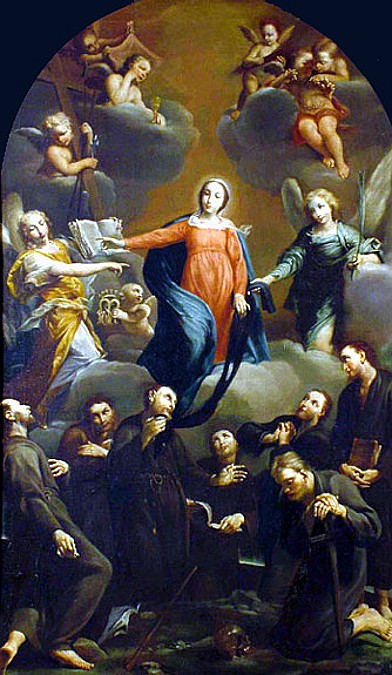
Martyrs of the Spanish Civil War – (13 beati): • Blessed Agustín García Calvo • Blessed Antonio Martín Hernández • Blessed Carmen Rodríguez Banazal • Blessed Dolores Broseta Bonet • Blessed Estefanía Irisarri Irigaray • Blessed Isidora Izquierdo García • Blessed José Ferrer Esteve • Blessed José Giménez López • Blessed Josefa Laborra Goyeneche • Blessed Josep Lluís Carrera Comas • Blessed Julián Rodríguez Sánchez • Blessed María Pilar Nalda Franco • Blessed Recaredo de Los Ríos Fabregat
St Gunthildis of Ohrdruf Bl Jacob Gwon Sang-yeon Bl Johanna of Cáceres Bl José María Zabal Blasco St Macarius of Alexandria St Marin Shkurti St Patapius Bl Paul Yun Ji-chung St Rafael Román Donaire St Romaric of Remiremont St Sofronius of Cyprus
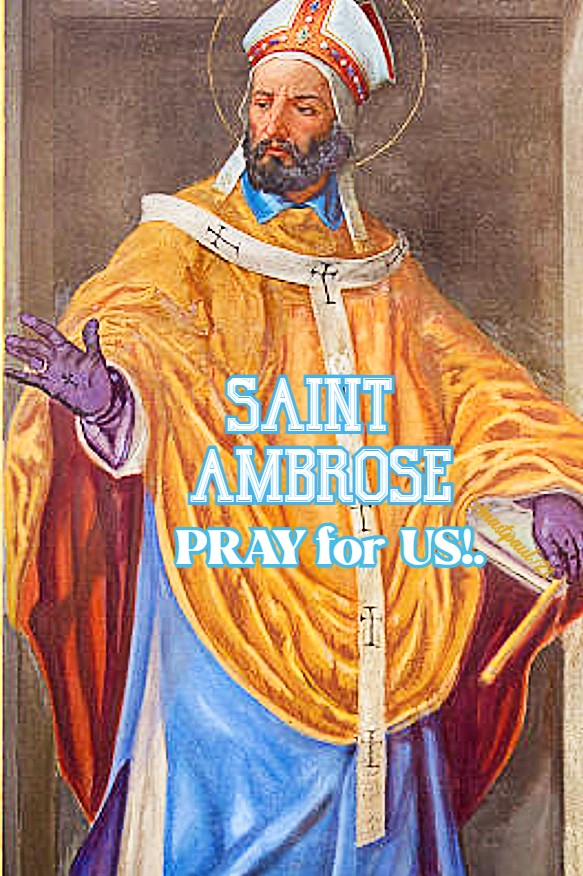
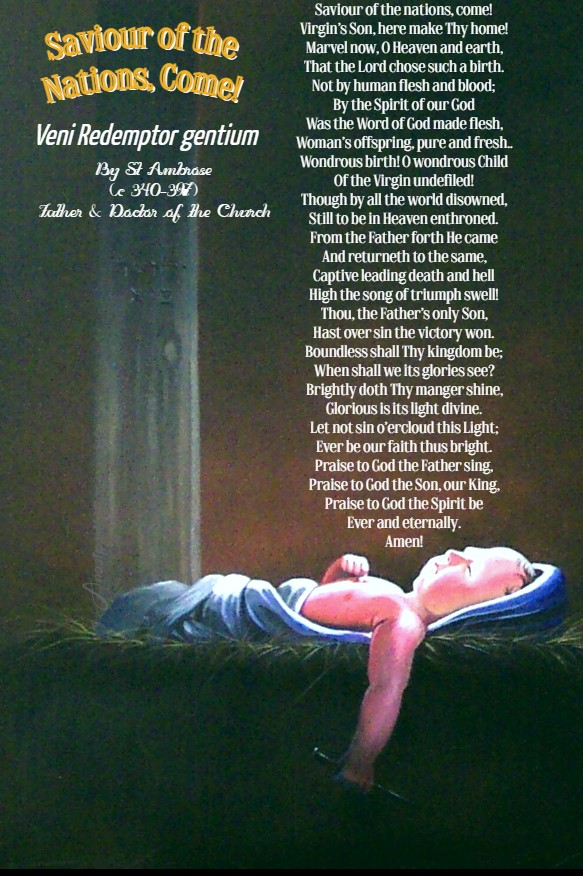
Quote/s of the Day – 7 December – Tuesday of the Second Week of Advent and the Memorial of St Ambrose (c 340-397)- Father and Doctor of the Church
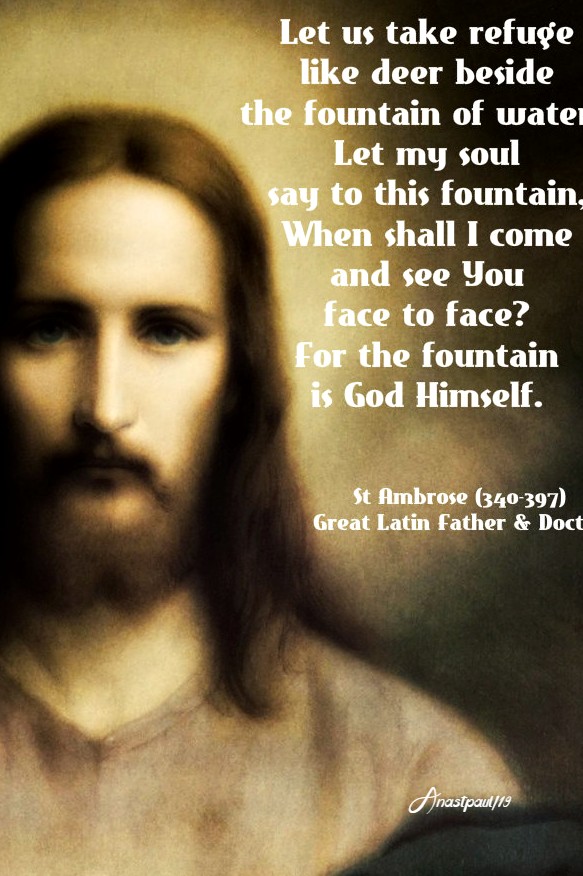
“Let us take refuge like deer beside the fountain of waters. Let our soul thirst, as David thirsted, for the fountain. What is that fountain? Listen to David – With you is the fountain of life. Let my soul say to this fountain, When shall I come and see You face to face? For the fountain is God Himself.”
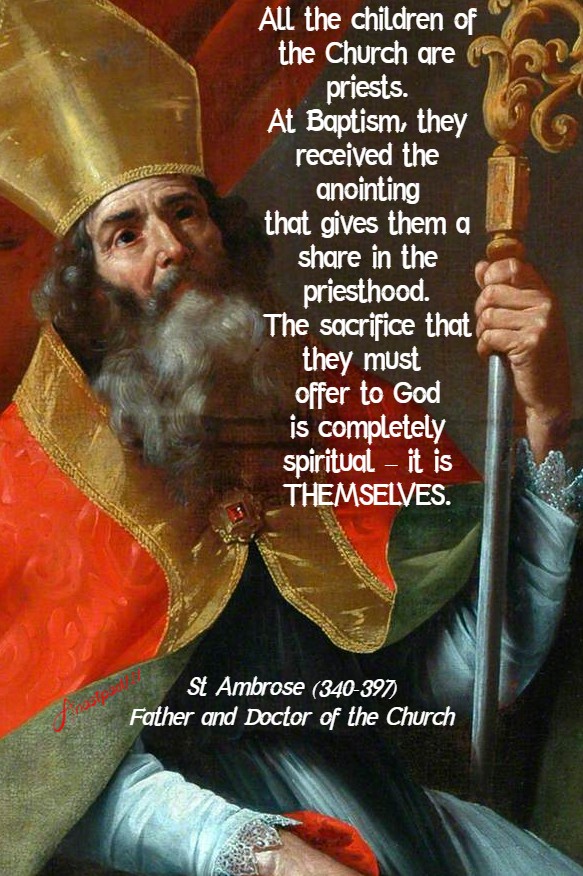
“All the children of the Church are priests. At Baptism, they received the anointing that gives them a share in the priesthood. The sacrifice that they must offer to God is completely spiritual – it is themselves.”
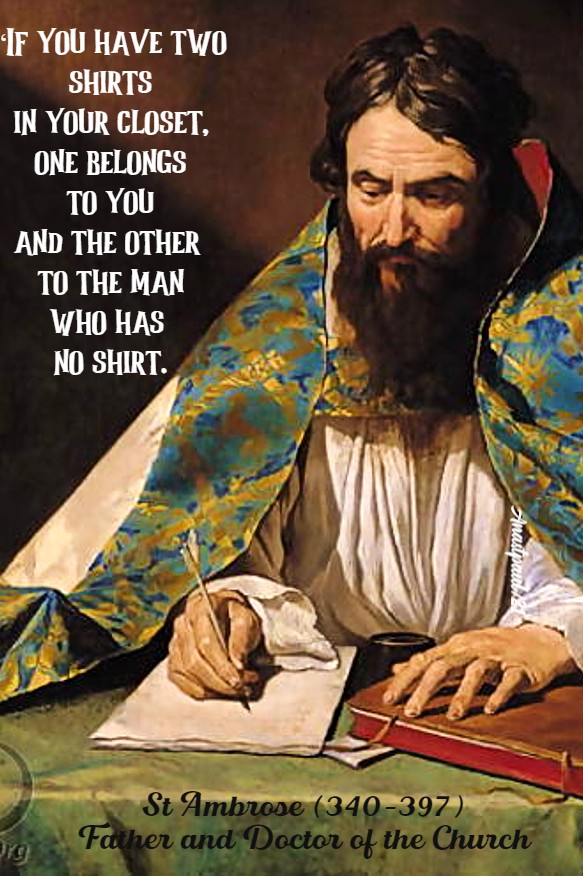
“If you have two shirts in your closet, one belongs to you and the other to the man who has no shirt.”
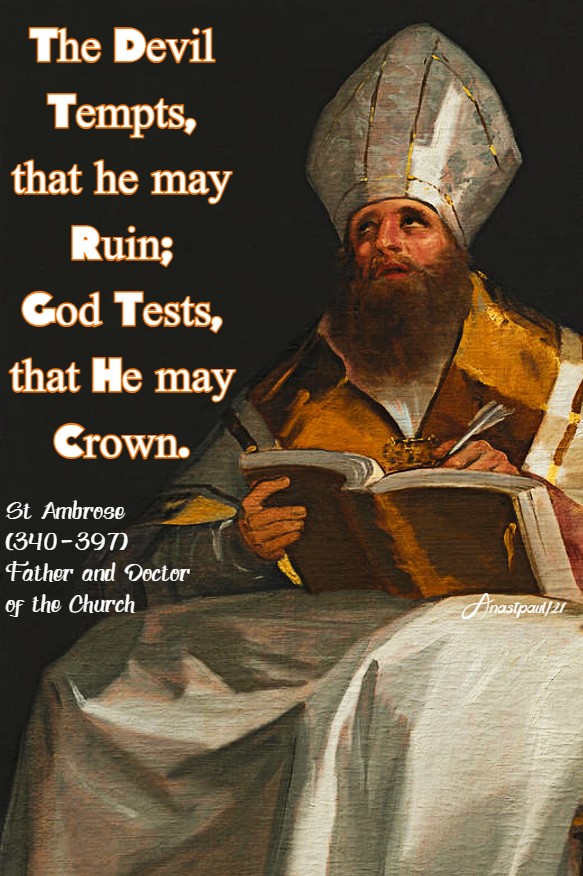
“The devil tempts, that he may ruin; God tests, that He may crown.”
St Ambrose (340-397) Father and Doctor of the Church
One Minute Reflection – 7 December – Tuesday of the Second Week of Advent, Readings: Isaiah 40: 1-11; Psalm 96: 1-3 and 10-13; Matthew 18: 12-14 and the Memorial of St Ambrose (c 340-397) Father and Doctor of the Church
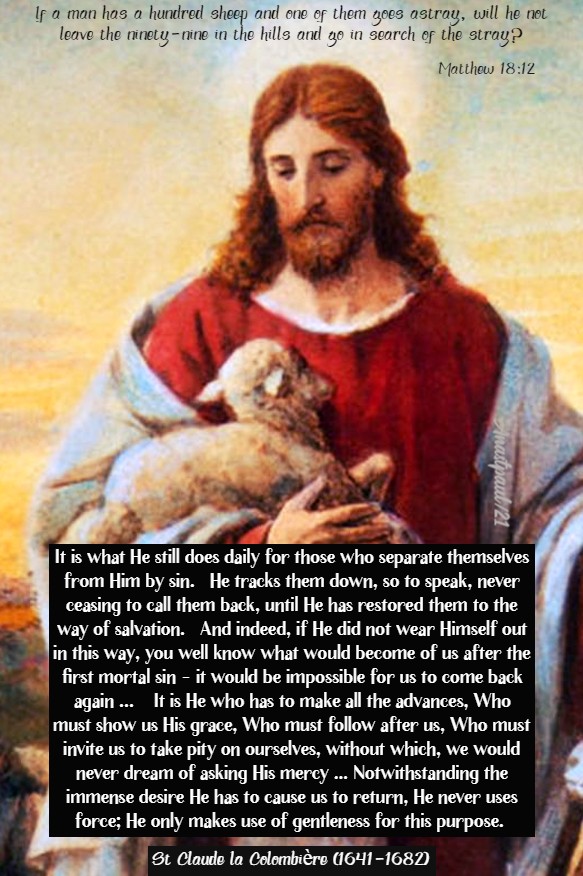
“If a man has a hundred sheep and one of them goes astray, will he not leave the ninety-nine in the hills and go in search of the stray?” Matthew 18:12
REFLECTION – “Imagine to yourself the sadness of the poor shepherd, whose sheep has strayed. The only thing to be heard in the fields roundabout, is the call of this unfortunate lad who, having abandoned the better part of the flock, runs about in woods and hills, passes by thicket and bush, mourning and calling out as hard as he can, unable to make up his mind to go back, until he has found his sheep again and led it back to the fold.
Here is what the Son of God did when men had gone astray, through their disobedience, from their Creator’s way of behaving. He came down to earth and did not stint, either care or labour ,to restore us again to the state from which we had fallen. It is what He still does daily for those who separate themselves from Him by sin. He tracks them down, so to speak, never ceasing to call them back, until He has restored them to the way of salvation. And indeed, if He did not wear Himself out in this way, you well know what would become of us after the first mortal sin – it would be impossible for us to come back again … It is He who has to make all the advances, Who must show us His grace, Who must follow after us, Who must invite us to take pity on ourselves, without which, we would never dream of asking His mercy …
The zeal with which God pursues us is undoubtedly the result of a very great mercy. But the sweetness by which this zeal is accompanied shows an even more wonderful goodness. Notwithstanding the immense desire He has to cause us to return, He never uses force; He only makes use of gentleness for this purpose. In all the Gospel I see no sinner who was invited to repent except by endearments and kindness.” – St Claude la Colombière SJ (1641-1682) “Apostle of the Sacred Heart” (A sermon preached in London before the Duchess of York).
PRAYER – Lord God, You made St Ambrose a teacher of the Catholic Faith and a pattern of apostolic fortitude. Raise up in the Church today, men after Your own heart, to lead Your people with wisdom, strength and courage in the face of widespread evil. And may his prayers intercede for us all. We make our prayer, through our Lord Jesus Christ, Your Son in the unity of the Holy Spirit, one God forever and ever, amen.
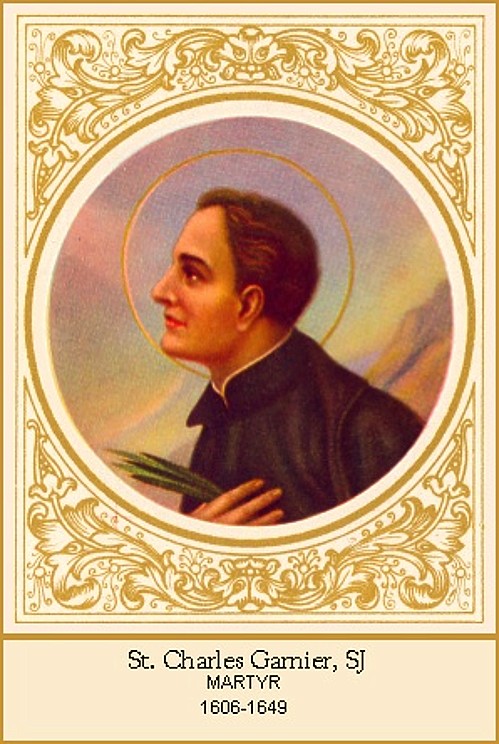
Saint of the Day – 7 December – St Charles Garnier SJ (1606-1649) Priest Martyr, Missionary. Born in 1606 in Paris, France and died by being shot in the chest and abdomen and then tomahawked in the head on 7 December 1649 at Fort Saint Jean, Canada, he was just 43 years old. Additional Memorials – 19 October as one of the Martyrs of North America, 26 September in Canada.
Charles was the son of a secretary to King Henri III of France. He attended the Collège de Clermont in Paris and joined the Jesuit Seminary in Clermont in September 1624
After his novitiate, he returned to the College of Clermont as Prefect. When he finished his studies in rhetoric and philosophy, he spent two years teaching at the College of Eu. Completing years of studies in language, culture and theology, he was Ordained in 1635.
Charles had to be persistent in asking to become a missionary because his father, a wealthy Parisian gentleman, opposed his desires and obstructed his first request. That same persistence proved invaluable as he worked with the Petun people who initially were hostile to the Black Robes, as they called the Jesuits.
Garnier spent his first three years in New France learning the Huron language and ministering at the mission in Ossossané. In November 1639 he and Father Isaac Jogues were sent to the Petuns who would not accept them because they remembered the accusation that the Black Robes had caused the epidemic that swept through the Huron lands in 1636. The two Jesuits spent the winter months among the Petun, then returned to Ossossané because they thought they had failed. Father Garnier returned the following autumn and then left again. Finally he returned during the winter of 1647 and founded two missions. For now, the people were more responsive than on his previous visits.
For several years the Iroquois had been increasing their attacks on the Huron world; they had already killed Father Anthony Daniel in 1648, so Garnier took the report very seriously, which he received in November 1649, that the Iroquois were on the warpath against the Petun and threatened to burn their villages. He sent his newly-arrived assistant, Father Noel Chabanel back to the mission headquarters because he did not want to leave him at risk but Charles himself was firm in wanting to stay with his people. On 7 November at mid-afternoon, the Iroquois attacked, killing anyone they found. Garnier was shot twice, once in the chest and once in the abdomen. He was stripped of his cassock and left to die in the cold but he regained consciousness and tried to move towards a Petun man who had been wounded. An attacker scalped him and then killed him with a blow to the head. Another Jesuit came to the village the next day and buried the gentleman’s son, our Saint, in a shallow grave among the people he so wanted to bring to Christ.
Charles Garnier was Canonised on 29 June 1930 by Pope Pius XI with the seven other Canadian Martyrs (also known as the North American Martyrs).
Vigil of the Solemnity of the Immaculate Conception – 7 December On this vigil day, Catholics stand in the remains of the night as the dawn makes its appearance. This resplendent dawn is that Singular Conception, the Immaculate Conception, who ushers in the Light of Christ. A day of Fast and Abstinence following the Rubrics of Pope Pius X for the Universal Calendar of the Church.
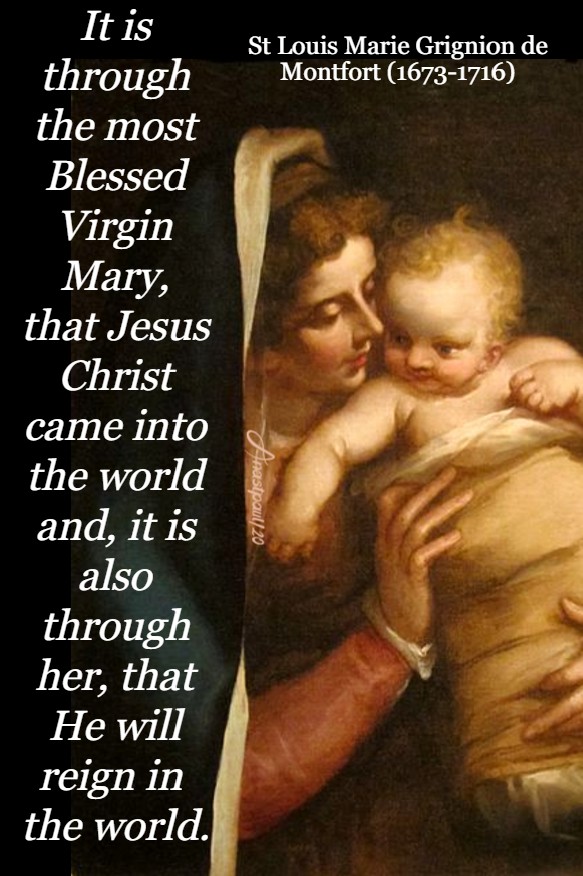
“It is through the most Blessed Virgin Mary, that Jesus Christ came into the world and, it is also through her, that He will reign in the world.” – St Louis Marie Grignion de Montfort (1673-1716)
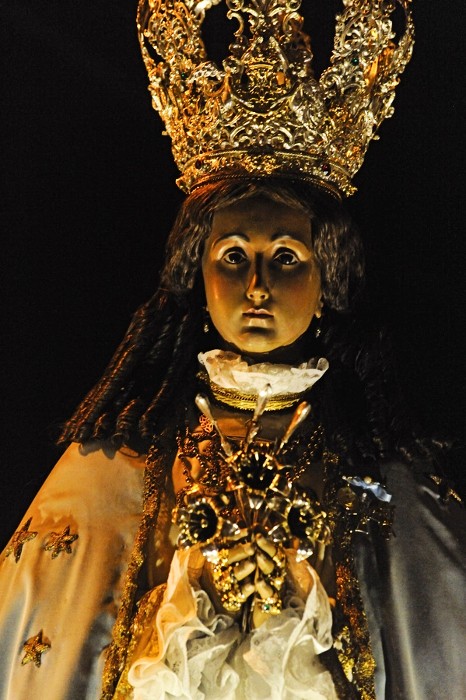
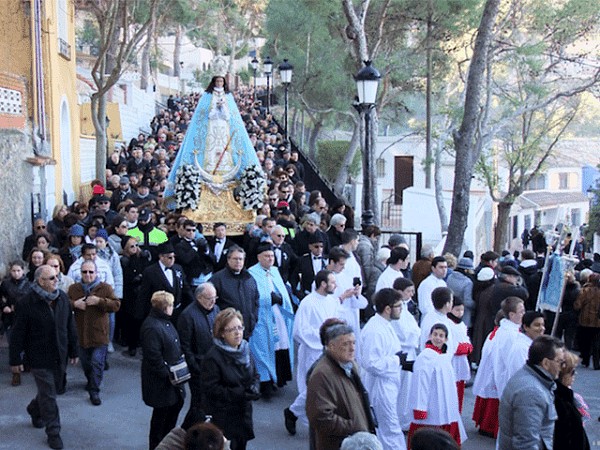
Virgen del Castillo, Inmaculada Concepción / Virgin of the Castle, Yecla, Spain (1642) – 7 and 8 December:
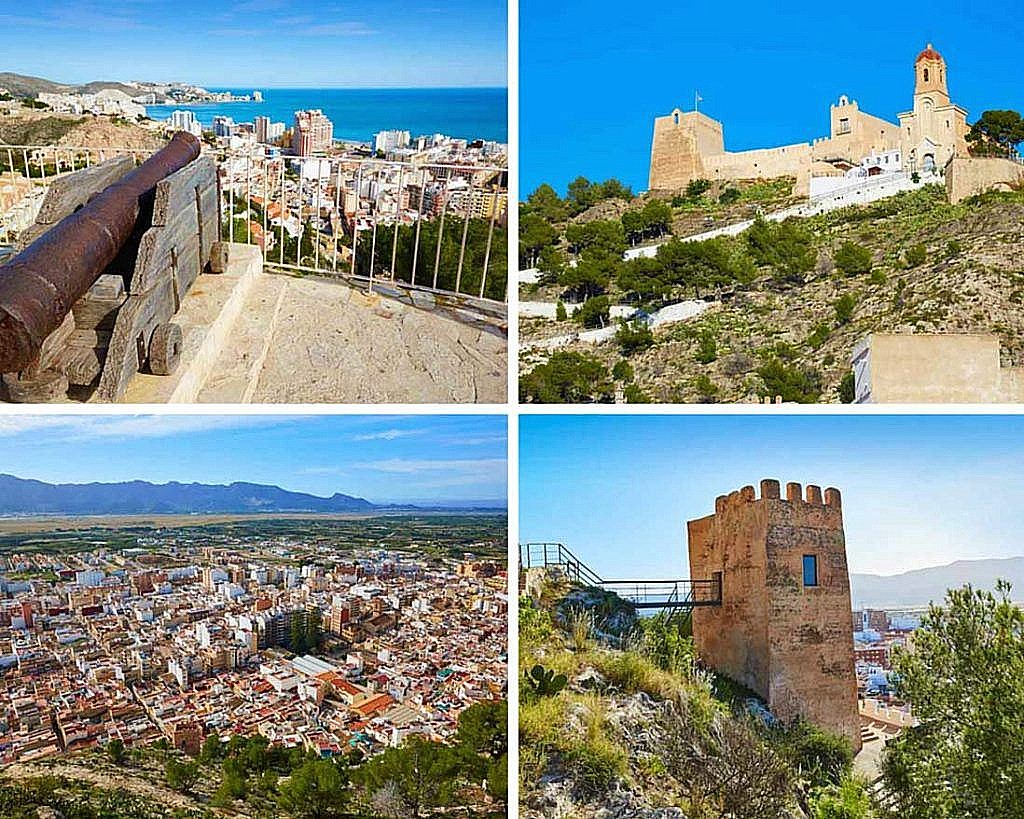
The Virgen del Castillo, Inmaculada Concepción, is venerated as Patron in the City of Yecla ( Murcia, Spain ). The Sanctuary constitutes a pilgrimage centre not only for the people of Yecla but also for the inhabitants of the entire region and even the neighboring Provinces. The name of Virgen del Castillo or Virgin of the Castle, even though it is not the official title, is the popular name with which the faithful have called their Patron because she is enshrined in the Castle Sanctuary, which is next to the medieval fortress that crowns the hill on which the City is situate. The invocation actually corresponds to the Immaculate Conception, being venerated in the aforementioned Sanctuary since time immemorial. The existence in that same place of a Mozarabic Church, dedicated to Santa María, which even became a Parish until the middle of the 16th century, is documented .
But the event that marked the transcendence of the old Sanctuary would occur during the reign of Felipe IV, when a group of Yeclans led by Captain Martín Soriano Zaplana, returned to the City after fighting against the French troops that had invaded Catalonia. The combatants return to Yecla without having suffered any casualties, a fact that they knew was miraculous, due to their devotion to the Virgin Mary and for which, they went to the hermitage of the Castle in thanksgiving. That act was an event for the City, which from then on would see in the image of Our Lady of the Castle, a symbol of protection.
The Church where the Virgin is enshrined has undergone numerous reconstructions and restorations throughout its history. The current building dates from the 19th century . The carving that is venerated today, is not the original either, since it disappeared in the Spanish Civil War – it is a replica made by Miguel Torregrosa in 1941 in the likeness of the original one, which was canonically crowned in 1954. The Procession is held on 7 December and the High Mass on the Solemnity of the Immaculate Conception, 8 December.
St Agatho of Alexandria St Anianas of Chartres St Antonius of Siya St Athenodoros of Mesopotamia St Buithe of Monasterboice St Burgundofara St Charles Garnier SJ (1606-1649) Priest Martyr St Diuma St Geretrannus of Bayeux Bl Humbert of Clairvaux St Martin of Saujon
Saint of the Day – 6 December – Saint Asella of Rome (Died c 406) Virgin Hermit Friend of St Jerome., Ascetic, Prioress, “A Flower of the Lord.” She died in c 406 of natural causes. Also known as Osella and Ocella.
The Roman Martyrology states: “At Rome, St Asella, Virgin, who according to the words of St Jerome, being blessed from her mother’s womb, lived to old age in fasting and prayer.”
Asella was a disciple and friend of Saint Jerome, who spoke of her in his writings. She was a member of a noble and wealthy Roman Christian family, perhaps the sister of Marcella, another ascetic and saint.
When Asella was ten years old, she heard St Athanasius speak during his third and final visit to Rome and that, already being a “pious child”, inspired her to “dedicate her life to the service of Christ.” At first, her parents would not allow her to wear the garments usually worn by ascetics but she secretly sold a gold necklace, paid for the garment’s production and when she was 12, surprised her parents by appearing to them in “this garb of consecration.”
From that time on, Asella lived in silence and seclusion, living in a small cell, sleeping on the ground or on a stone, upon which she also prayed. She fasted all year, living on bread, salt, and water, often eating nothing for two or three days,and would fast for many weeks at a time during Lent. She lived a life of self-isolation, leaving her cell only to visit the Churches of the Martyrs and often, without being seen by others and rarely by her own sister.
According to historian Claude Fieury, Asella never spoke to any man. As hagiographer Agnes Dunbar stated, “She worked with her hands and sang psalms.” Despite her austere lifestyle, it did not affect her health. Jerome wrote that “with a sound body and even sounder soul, she found for herself a monkish cell in the midst of a busy Rome.” Fleury also said about Asella: “Her life was simple and regular and in the midst of Rome led a life of perfect solitude.”
St Jerome also cited Asella as an example and role model for young women, widows and virgins, calling her “A Flower of the Lord.”
In 405, the Bishop and Historian ,Palladius of Galatia visited Rome and met Asella, who was 70 years old at the time. He called her “the gentlest of women” and reported that she was in charge of a community of nuns.
Notre-Dame de Séez/ Our Lady of Séez, Normandy, France (5th Century) – 6 December:
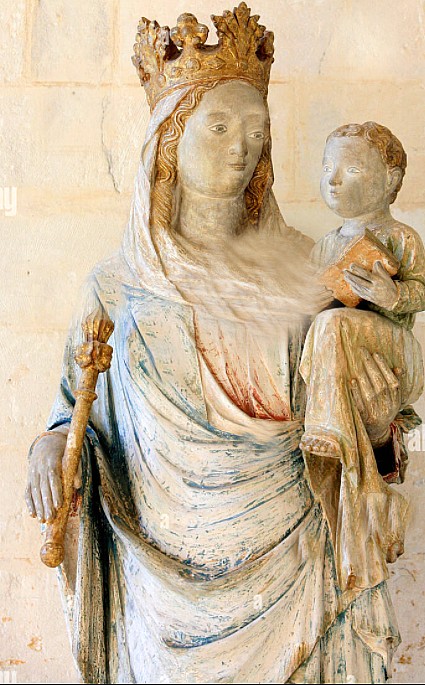
Saint Latuinus (Died c 440), the first Bishop of Séez, built the first Cathedral to Our Lady in the Diocese of Seez. The original Cathedral would date back to the middle of the 5th century. A later Church replaced it – one dedicated under the title of Notre-Dame-du-Vivier. The Normans, at the beginning of the 5th century, destroyed this structure. A third Church was built, a hundred meters away on the site of a pagan temple. This one had added to it, the names of the martyrs Saints Fervais and Protase, whose relics were enshrined there. A special Chapel in the Cathedral recalled the memory of the first cathedral dedicated to Our Lady of Seez, for Mary remained the principal Patroness of the Diocese. Many famous people made pilgrimages to Our Lady of Seez – among them were Saint Germain, Bishop of Paris; Saint Evroult, Founder of the Abbey of Ouche; Saint Osmond, Count of Seez, who became Bishop of Salisbury; Saint Thierry, Abbot of Saint Evroult; Saint Louis IX was there in 1259 and about the same time Blessed Giles, one of the early companions of Saint Francis of Assisi, came to recommend to Mary’s protection, the first French Franciscan Convent, which he was going to found at Seez. The Augustinians served the sanctuary from 1127. In the latter half of the 18th century, the Bishop of Seez, in response to the wishes of the entire Diocese, repaired and embellished the Chapel of Our Lady at considerable expense. Later the work of redoing the entire Cathedral was undertaken. In June of 1784, the Cathedral chapter asked the Bishop to consecrate the new Altar and the entire Cathedral under the patronage of Our Lady. This was done in 1786. Mary rewarded the prelates for their zeal in promoting her honour, by granting all of them the grace of Martyrdom in the violent persecution that broke out in 1792. The beautiful façade of the Cathedral was destroyed in 1795. A revolutionary bought the debris with the intent of building a private property, however, two attempts proved failures and he finally gave up the attempt. After the revolution, a new Cathedral was built when the Diocese was re-established by the Concordat of 1802.
St Aemilianus the Martyr Bl Angelica of Milazzo St Asella of Rome (Died c 406) Virgin Hermit Friend of St Jerome St Boniface the Martyr St Dativa the Martyr St Dionysia the Martyr St Gerard of La Charite St Gertrude the Elder St Giuse Nguyen Duy Khang St Isserninus of Ireland Bl Janos Scheffler St Leontia the Martyr St Majoricus the Martyr
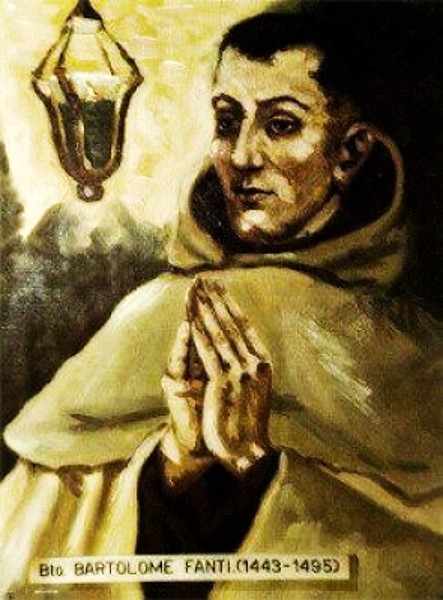
Saint of the Day – 5 December – Blessed Bartholomew Fanti of Mantua O.Carm. (c 1443-1495) Carmelite Priest renowned Preacher. Born in c 1428 at at Mantua, Italy and died on 5 December 1495 of natural causes. Patronage – Mantua.
Bartholomew became a professed member of the Carmelite Order at the age of seventeen and by the age of 24 was already Ordained as a Priest.
On 1 January 1460, he became the Spiritual Director and the Rector of the Confraternity of the Blessed Virgin Mary and composed their Rule and Statues. Long before he formalised the Confraternity’s Rule, he had been a member and remained so for all his life, serving the Confraternity and the Blessed Virgin faithfully for 35 years in his hometown of Mantua.
He became a spiritual teacher of the Carmelite Priest Blessed John Baptist Spagnuolo, a Poet and Writer who also served as Prior General of the Carmelite Order. Bartholonew became well known for being an effective preacher with an ardent devotion to the Blessed Sacrament.
He died on 5 December 1495 in Mantua. His remains were relocated to another chapel in 1516 and again in 1783 to the Church of Saint Mark in Mantua before being relocated for the final time, in 1793.
Humble and gentle, Bartholomew gave an example to everyone of a life of prayer, of loving kindness and generosity to all and of faithful service to the Lord. He was remembered and revered, even during his life, for his great love ot the Blessed Sacrament, which was the source and the summit of his apostolic life, together with his love and devotion to the Virgin Mother.
His Beatification received the papal approval of Pope Pius X on 18 March 1909 (cultus confirmed).
Prayer: Lord God, You made Blessed Bartholomew Fanti outstanding in his zeal for the salvation of souls, in his devotion to the Holy Eucharist and to the Blessed Virgin Mary. May we experience, by his intercession, the same fullness of devotion and love. We ask this through our Lord Jesus Christ, Your Son, Who lives and reigns with You and the Holy Spirit, one God, forever and ever. Amen
The Sodality of Our Lady / Our Lady of the Jesuit College, Rome (1584) – 5 December:
The Abbot Orsini wrote: “In the year 1584 was instituted, the first congregation of Our Lady at the Jesuits’ college, at Rome, whence is derived their custom of establishing it in all their houses.”
The Sodality of Our Lady, or the Sodality of the Blessed Virgin Mary, was actually founded in 1563 by a Belgian Jesuit, Father John Leunis, at the Collegio Romano in Rome. It was established for young schoolboys and the Papal Bull Superna Dispositione opened it to adults, under the authority of the Superior General of the Society of Jesus. A Jesuit historian recorded that it was originally “made up especially of younger boys from the college, who agreed to go to daily Mass, weekly confession, and monthly Communion, as well as to engage in a half-hour of meditation each day and do some other pious exercises.” The youths who felt drawn to the spirit of the Jesuits and were often called the “Congregation Mariana.” Once formed into a Sodality of Our Lady, they were to do apostolic work in the City of Rome, while also serving the poor. Since the time of its humble beginnings in 1563, twenty-two Sodalists have become Popes. After Fr Leunis’ death in 1584, Pope Gregory XIII canonically established the Sodality Group of the Roman College in his bull “Omnipotentis Dei.” The sodality of Fr Leunis was declared to be the mother of all such subsequent sodalities. Having attained the status of Prima Primaria, it had gained the right to partner with other similar groups, and through that affiliation ,all could share in the indulgences and privileges of the Prima Primaria, with the General of the Society of Jesus having the authority to grant such an affiliation. These sodalities were established all over Europe, India and Asia, as well as in the Americas and included both sexes. They reached their greatest number in the 17th century, when it was estimated that there were as many as 2500 such groups. In 1773, Pope Clement XIV suppressed the Society of Jesus and separated the sodalities from their jurisdiction. From that time on it was Catholic bishops who established Marian Sodalities throughout the world.
St Abercius St Anastasius St Aper of Sens Blessed Bartholomew Fanti of Mantua O.Carm. (c 1428-1495) Carmelite Priest St Basilissa of Øhren St Bassus of Lucera St Bassus of Nice St Cawrdaf of Fferreg St Christina of Markyate St Consolata of Genoa St Crispina St Cyrinus of Salerno St Dalmatius of Pavia St Firminus of Verdun St Gerald of Braga St Gerbold St Gratus
St Joaquín Jovaní Marín St John Almond Bl Giovanni/John Gradenigo St Justinian St Martiniano of Pecco Bl Narcyz Putz St Nicetius of Trier Bl Niels Stenson St Pelinus of Confinium
St Vicente Jovaní Ávila — Martyrs of Thagura – (12 saints): A group of twelve African Christians who were martyred together in the persecutions of Diocletian. The only details about them that have survived are five of their names – Crispin, Felix, Gratus, Juliua and Potamia. 302 in Thagura, Numidia
Martyred in the Spanish Civil War: • Blessed Joaquín Jovaní Marín • Blessed Vicente Jovaní Ávila
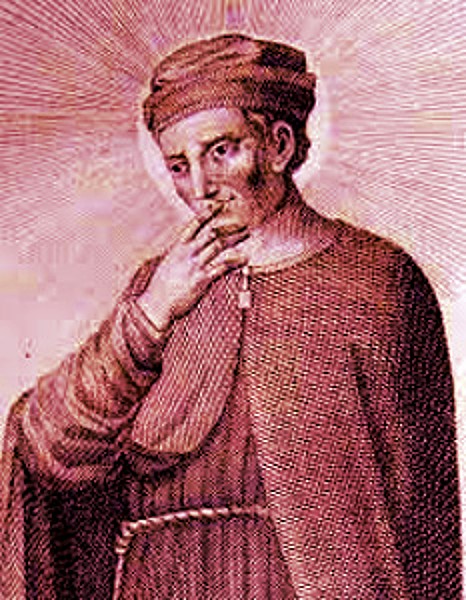
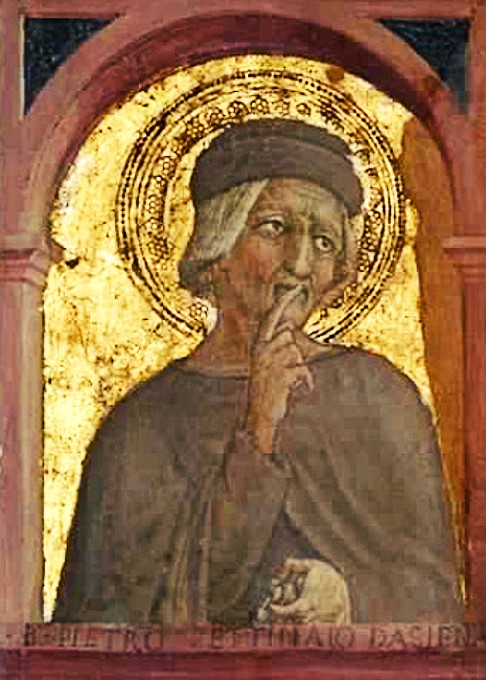
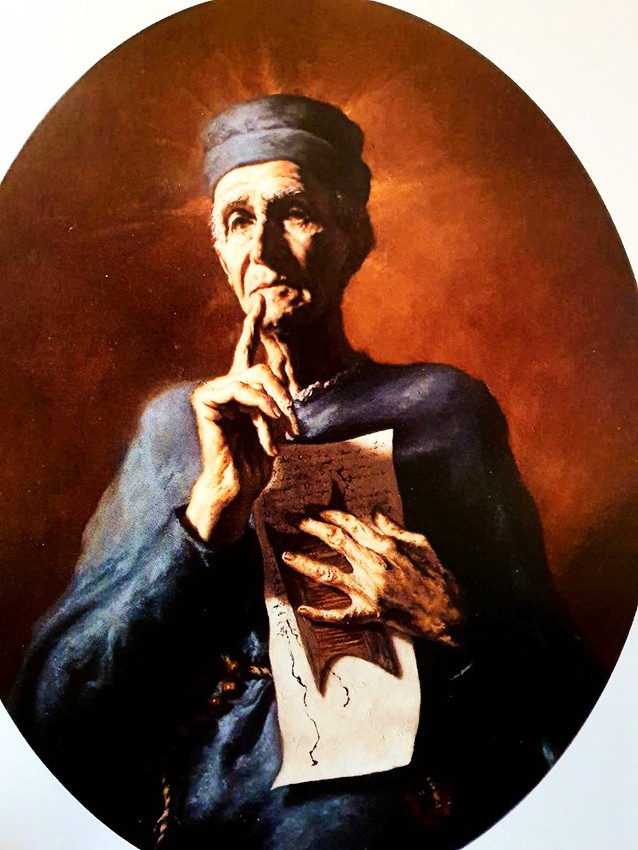
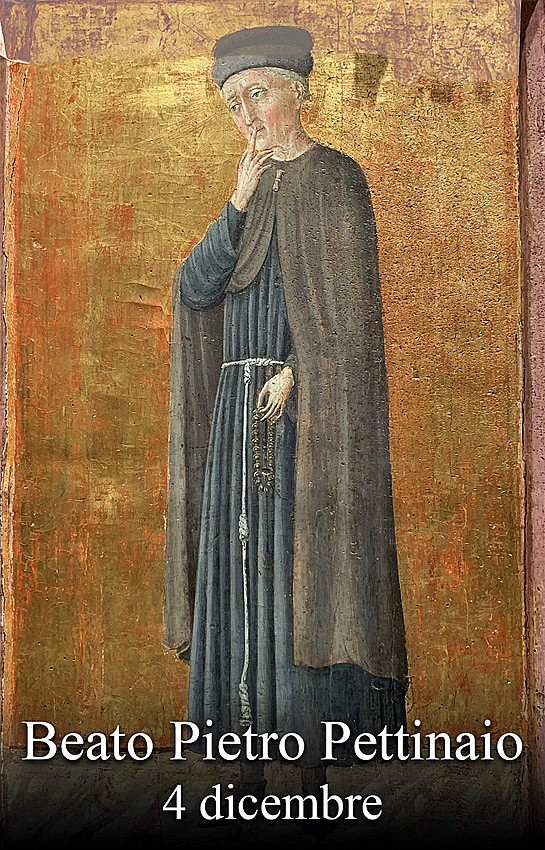
Saint of the Day – 4 December – Blessed Pietro Tecelano TOSF (c 1200 – 1289) Layman, Widower, Franciscan Tertiary, Apostle of the sick and the poor, spiritual and secular adviser, miracle-worker. Born in c 1200 at Campi, Tuscany, Italy and died in early December 1289 in Siena, Italy of natural causes. Patronages – Siena, Italy and Comb-makers. Also known as – Pietro Pettinaio, Peter…. Pier…. Additional Memorials – 16 March, 4 and 11 November, 10 December – Memorials on different Calendars.
The Roman Martyrology states: “In Siena, Blessed Pietro Pettinario, religious of the Third Order of St Francis, distinguished for his particular charity towards the needy and the sick and for his life of humility and silence.”
Pietro was born around 1200 in Campi, a village of Castelnuovo Berardenga near Siena and moved with his parents to Siena at some point during his childhood.
He married but the couple remained childless. In order to provide for his new wife he worked as a comb-maker, that is a merchant of bone and mother-of-pearl combs used in spinning. .. He purchased a house in which vines flourished so as to make wine. Sadly his wife died and Pietro then lived alone and devoted his time to his business and soon became rich and famous.
Perhaps converted thanks to the newly born Franciscan Order, he became famous once more but now for his generosity towards his competitors – on market days he arrived late to sell, so as not to damage them too much. In addition to carrying out his working activity, he also dedicated himself to assisting the sick at the hospital of Santa Maria della Scala where he bound wounds and sores and helps the most needy. In this work he was assisted by eight friends – merchants and lawmen, who he had encouraged to join him in his apostolate.
He lived a simple life, giving excess wealth to the Franciscans and he spent his evenings in meditation and devoting such nights to God in prayer.
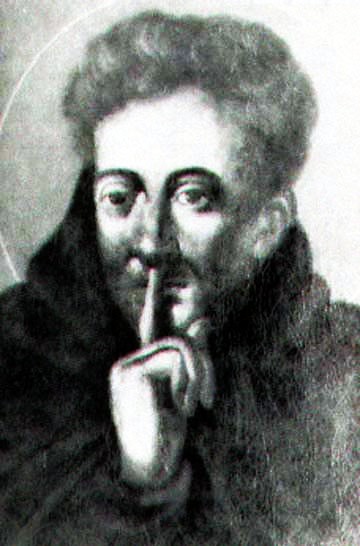
Pietro left no writings and is remembered for his silences, we often see him depicted with a finger on his lips. The few things he said and the many he did, were very effective, to the point that some traffickers, after having defrauded the City, returned the money to him, he then returned it to the relevant section of the City administration. The governors, in turn, often called upon him for help and advice – in 1282 , for example, he was asked to choose the five inmates to be amnestied.
When the Franciscans of Siena had doubts about the authentic vocation of their novices , they had them examined by him. His life was inspired by the most rigorous followers of St Francis of Assisi, the spirituals.
The Dominican preacher, Blessed Ambrogio Sansedoni, who went to Pietro for spirtual guidance, renounced his election as a Bishop on Pietro’s advice.
Seeking solitude, he sold his home and business, donating the proceeds to the poor and spent the last few years of his life, as a guest of the Franciscans. There, considered himself far too talkative, Pietro aimed at living amongst them in silence.He undertook several pilgrimages to religious sites including Assisi, where Saint Francis of Assisi worked and lived.
During his lifetime he was hailed as a miracle-worker and was considered a great saint. He became a sought after adviser to Priests as well as to the people of Siena and was considered charismatic.
Pietro died in early December 1289 (possilby the 4th) at an advanced age and was buried at the Franciscan Church in Siena. His grave soon became a pilgrimage site and the scene of miracles. A Shrine was built over his grave in 1326 and an annual local feast in his honour was established in 1329. The Shrine was lost to fire in 1655 and remaining relics were preserved when the Poor Clare nuns took them into their care
The people of Siena adored Pietro and called for his Canonisation. Official recognition of Pietro’s holiness led to Pope Pius VII confirming his “cultus” acting as formal Beatification on 18 August 1802.
Dante Alighieri included Pietro in his work (Divina Comedia) in “Canto XIII” through the character of Pier the Comb-Seller.
Notre-Dame-de-la-Chapelle d’Abbeville / Our Lady of La Chapelle, at Abbeville, France(1400) – 4 December:
The Abbot Orsini wrote: “This Church was built about the year 1400, on a small hill, where formerly they worshipped idols.”
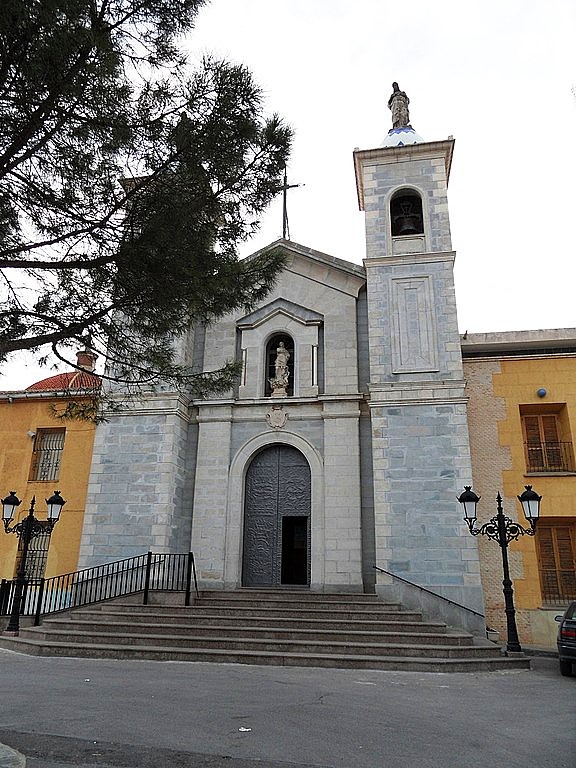
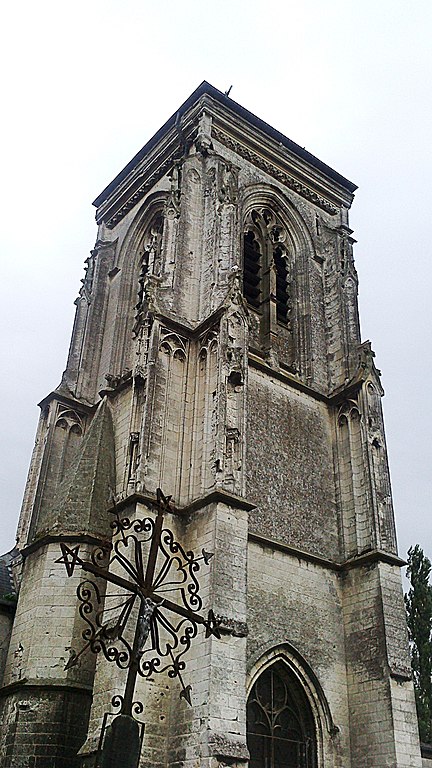
The Town of Abbeville is located in Picardy in the northern region of France. It is located on the Somme River. Fortunately for us, there still exists today a plan for the Town of Abbeville that was etched in the year 1653. Our Lady of La Chapelle can easily be distinguished in the foreground of the etching, dominating the City though built outside the walls. The church was initially only a Chapel in which there was exhibited a religious icon of Our Lady that earned the Church its name, of Our Lady of the Chapel. The structure was indeed erected on the remains of a temple devoted to paganism. The growing number of the faithful coming to pray there, made it a true Parish, and so, the Church expanded to have 3 naves and 7 Altars, reflecting the expansion of the City. The Church was built in limestone in the flamboyant Gothic style. It survived numerous dangers and setbacks over the coming centuries, exposed to wind and rough weather at the top of the hill, including being struck several times by lightning. In 1619, the high Bell Tower did not survive a violent storm,and was rebuilt the following year. All of this is nothing compared to the danger that the Church faced in 1637-1638. At that time, Spain and France were at war. King Louis XIII came to Abbeville, a strategic Town and realised that the Chapel could serve as a type of fortress in case of a siege. Aware of the danger, Cardinal Richelieu gave the order to demolish the Church. The Mayor at the time, Guilaume Sanson and his aldermen, managed to talk him out of it. The Church was saved, but for how long? Then, in 1789, came the French Revolution. The Church that had survived so much was destroyed in 1794. Yet, in 1804 another large Chapel was built to replace the lost church, a building retaining the tower of 1620. (That bell tower has been classified as an Historic Monument since 1901. The cemetery that once surrounded the Church was preserved and has been significantly expanded to become the cemetery of the City since the year 1844.
The original Bell Tower still remains a part of the new Church
St Bernardo degli Uberti St Bertoara of Bourges St Christianus St Clement of Alexandria St Cyran of Brenne St Eraclius St Eulogio Álvarez López St Ezequiel Álvaro de La Fuente St Felix of Bologna Bl Francis Galvez St Francisco de la Vega González St Giovanni Calabria St Heraclas of Alexandria St Jacinto García Chicote Bl Jerome de Angelis St John the Wonder Worker St Maruthas St Melitus of Pontus
Blessed Pietro Tecelano TOSF (c 1189-1289) Layman, Widower, Tertiary of the Order of Friars Minor St Prudens St Robustiano Mata Ubierna St Sigiranus Bl Simon Yempo St Sola St Theophanes
Martyred in the Spanish Civil War: • Blessed Eulogio Álvarez López • Blessed Ezequiel Álvaro de La Fuente • Blessed Francisco de la Vega González • Blessed Jacinto García Chicote • Blessed Robustiano Mata Ubierna










































 AnaStpaul
You must be logged in to post a comment.