Posted in SAINT of the DAY

Saint of the Day – 18 February – St Simeon (Died c 106) Martyr

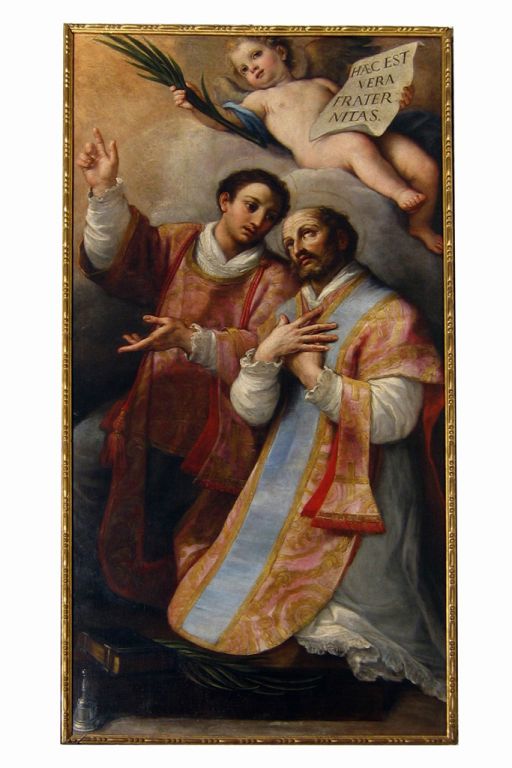
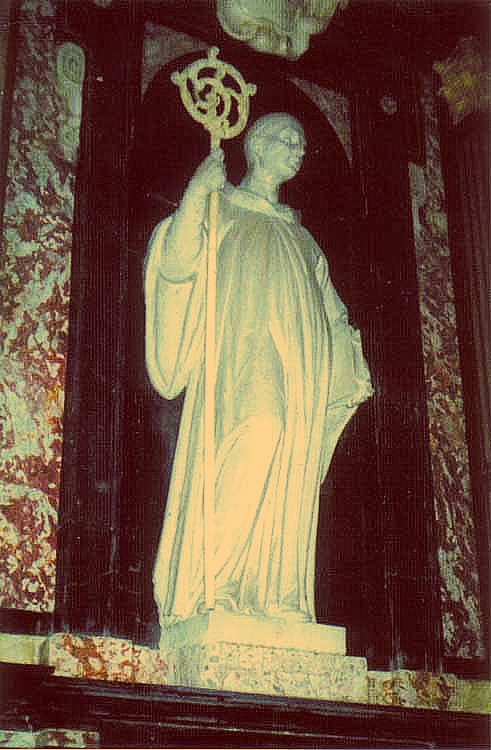
Saint of the Day – 18 February – St Simeon (Died c 106) Martyr, Bishop of Jerusalem, son of Cleopas, was a Jewish Christian leader and the second Bishop of Jerusalem (62 or 70–106). Died by crucifixion in c 106. Aldo known as – Simon. Saint Simeon succeeded his kinsman, Saint James the Lesser, during the persecution of Christians in Jerusalem. He led the early Church in that City for nearly 50 years until his Martyrdom.

The Roman Martyrology states: “At Jerusalem, the birthday of St Simeon, Bishop and Martyr, who is said to have been the son of Cleopas and a relative of the Saviour according to the flesh. He was Consecrated Bishop of Jerusalem after St James, the kinsman of our Lord and in the persecution of Trajan, after having endured many torments, he consummated his Martyrdom. All who were present, even the Judge himself, were astonished that a man, one hundred and twenty years of age, could bear the torment of crucifixion with such fortitude and sonstancy.”
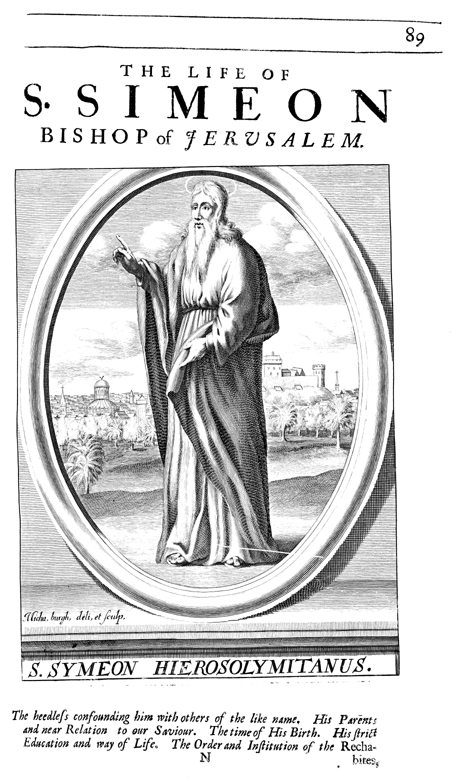
Cleophas, according to tradition, was Saint Joseph’s brother, making Saint Simeon the first cousin of Jesus.

Simeon is mentioned only three times in the Holy Scriptures, in the Gospels of Matthew and Mark and in the Acts of the Apostles. When Jesus preached in His hometown and was poorly received, Simeon was present:

“53 When Jesus had finished these parables, he moved on from there. 54 Coming to his hometown, he began teaching the people in their synagogue and they were amazed. “Where did this man get this wisdom and these miraculous powers?” they asked. 55 “Isn’t this the carpenter’s son? Isn’t his mother’s name Mary and aren’t his brothers James, Joseph, Simeon and Judas? 56 Aren’t all his sisters with us? Where then did this man get all these things?” 57 And they took offense at him.
But Jesus said to them, “A prophet is not without honor except in his own town and in his own home
.”
58 And he did not do many miracles there because of their lack of faith.” (Matthew 13: 53-58)
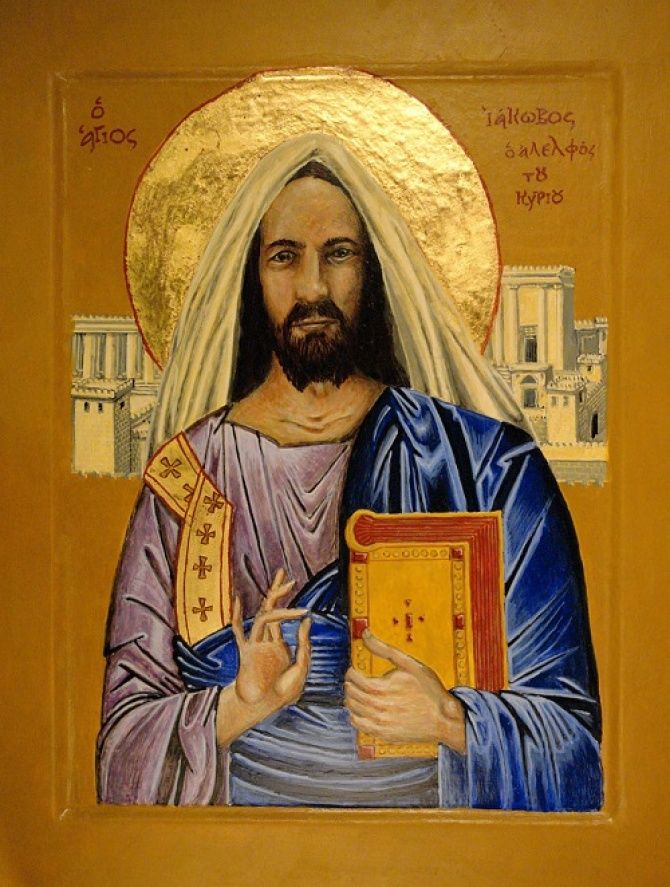
No doubt he was one of those brethren of Christ who are mentioned in the Acts of the Apostles as having received the Holy Spirit on the day of Pentecost. St Eusebius says that when the Jews massacred St James the Lesser, Simeon upbraided them for their cruelty. The Apostles and disciples afterwards met together to appoint a successor to James as Bishop of Jerusalem and they unanimously chose Simeon, who had probably assisted in the government of that Church.
In the year 66 civil war broke out in Palestine, as a consequence of Jewish opposition to the Romans. The Christians in Jerusalem were warned of the impending destruction of the City and appear to have been divinely ordered to leave it. Accordingly that same year, before Vespasian entered Judaea, they retired with St Simeon at their head, to the other side of the Jordan, occupying a small City called Pella.

After the capture and burning of Jerusalem, the Christians returned and settled among the ruins until the Emperor Hadrian afterwards entirely razed it. We are told by Eusebius that the Church here flourished greatly and that many Jews were converted by the miracles wrought by the Saints.

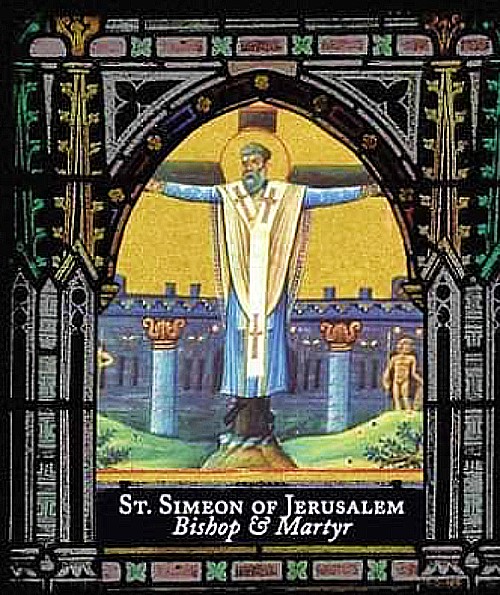
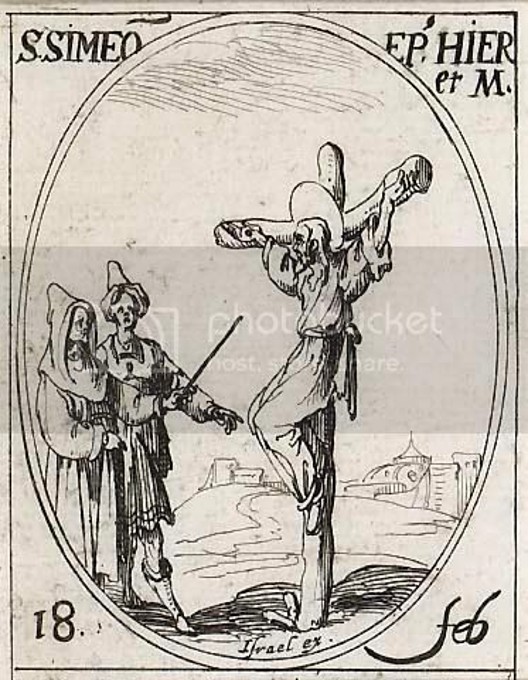
When Vespasian and Domitian had ordered the destruction of all who were of the race of David, St Simeon had escaped their search but when Trajan gave a similar injunction, he was denounced as being not only one of David’s descendants but also a Christian and he was brought before Atticus, the Roman governor. He was condemned to death and, after being tortured, was crucified. Although he was extremely old – tradition reports him to have attained the age of 120 – Simeon endured his sufferings with a degree of fortitude which roused the admiration of Atticus himself.
Posted in MARIAN TITLES, SAINT of the DAY

Notre-Dame de Laon / Our Lady of Laon, Rheims, France (500), founded by St Remigius and Memorials of the Saints – 18 February

Notre-Dame de Laon / Our Lady of Laon, Rheims, France (500), founded by St Remigius – 18 February:
HERE:
https://anastpaul.com/2021/02/18/our-lady-of-laon-rheims-france-500-and-memorials-of-the-saints-18-february/

St Esuperia of Vercelli
St Ethelina

St Flavian (Died 449) Martyr, Archbishop of Constantinople, Confessor, Defender of the Christ’s two natures, both divine and human.
Biography:

https://anastpaul.com/2019/02/18/saint-of-the-day-18-february-st-flavian-of-constantinople-died-449-martyr/

St Francis Regis Clet CM (1748-1820) Martyr, Religious Priest of the Vincentian Order, Missionary to China.
His Life and Death:

https://anastpaul.com/2020/02/18/saint-of-the-day-18-february-saint-francis-regis-clet-cm-1748-1820-priest-and-martyr/

Blessed John of Fiesole/Fra Angelico OP – The Angelic Friar Giovanni (1387-1455)
The Artist:

https://anastpaul.wordpress.com/2018/02/18/saint-of-the-day-18-february-blessed-john-of-fiesole-fra-angelico-o-p-1387-1455/

St Gertrude Caterina Comensoli
St Helladius of Toledo
St Ioannes Chen Xianheng
St Ioannes Zhang Tianshen
St Jean-François-Régis Clet
St Jean-Pierre Néel
Bl Jerzy Kaszyra
Bl John Pibush – one of the Martyrs of Douai
St Leo of Patera
St Martinus Wu Xuesheng
Bl Matthew Malaventino
St Paregorius of Patara
St Sadoth of Seleucia
St Simeon of Jerusalem (Died c 106) Martyr, Bishop of Jerusalem, Cousin of Jesus

St Tarasius of Constantinople

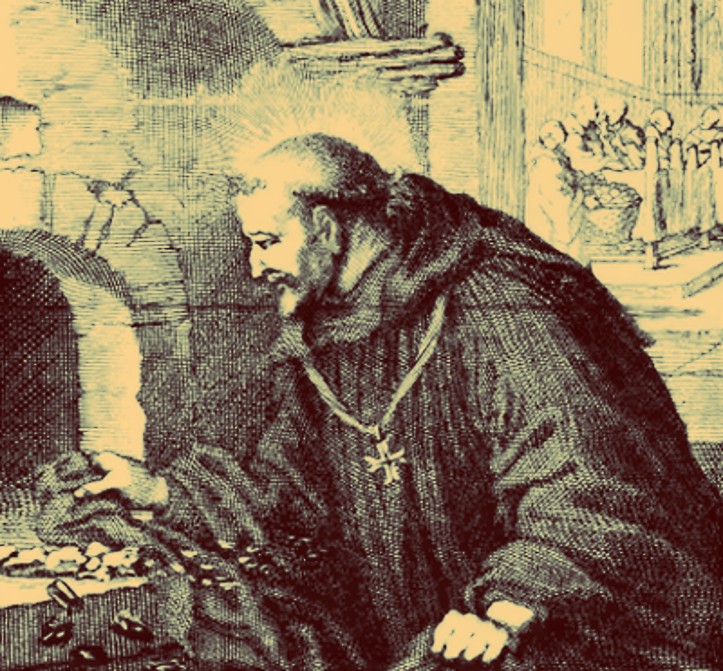
St Theotonius OSC (1082-1162) Priest of the Canons Regular, Reformer of religious life in Portugal, Royal Counsellor,, Apostle of the poor, Founder of the Canons Regular of the Holy Cross, now known as “The Crosiers.” He is the first Portuguese Saint.
His Lifestory:

https://anastpaul.com/2021/02/18/saint-of-the-day-18-february-saint-theotinius-1082-1162/

Bl William Harrington

Martyrs of North Africa – 7 Saints: Group of Christians who were Martyred together, date unknown. We know nothing else but seven of their names – Classicus, Fructulus, Lucius, Maximus, Rutulus, Secundinus and Silvanus.
They were born and martyred in North Africa.

Martyrs of Rome – 5 Saints: A group of Christians Martyred together in the persecutions of Diocletian. We know nothing else but their names – Alexander, Claudius, Cutias, Maximus and Praepedigna. They were martyred in 295 in Rome, Italy.

Posted in SAILORS, MARINERS, NAVIGATORS, SAINT of the DAY

Saint of the Day – 17 February – Saint Constabilis of Cava OSB (c 1070-1124)

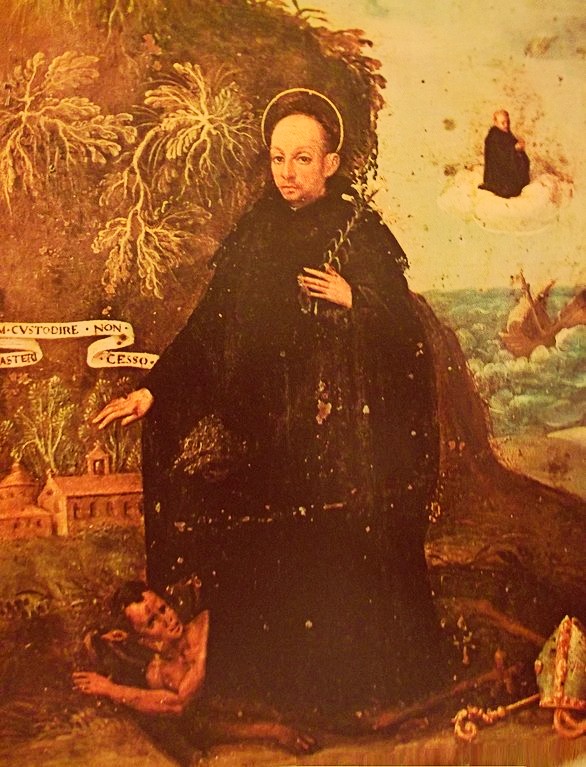
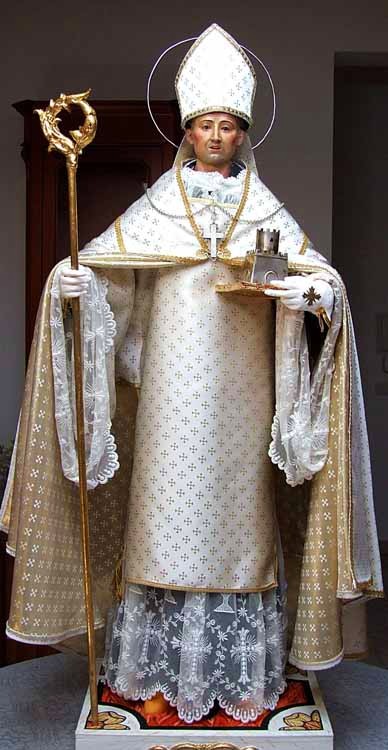
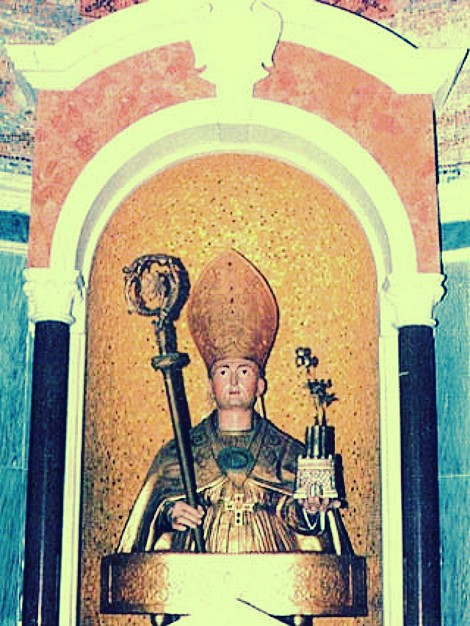
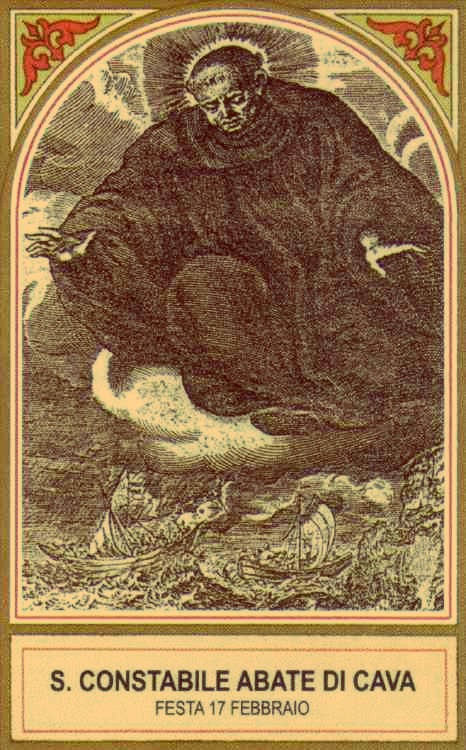
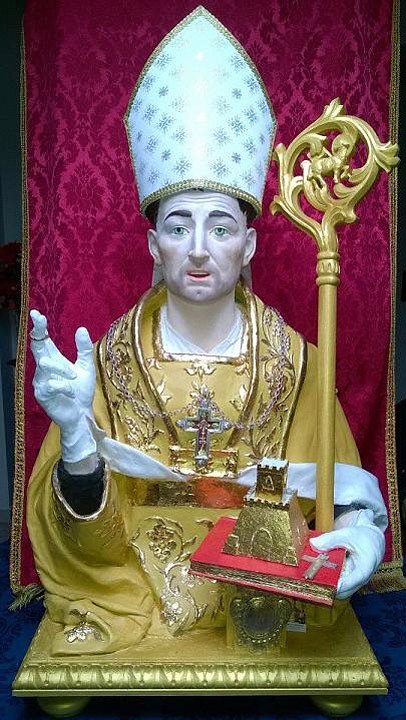
Saint of the Day – 17 February – Saint Constabilis of Cava OSB (c 1070-1124) Abbot, miracle-worker, known as “The Blanket of the Brothers” for his gentle kindness and caring humility for all the Monks in their trials and sorrows. He is the Patron Saint of the Town of Castellabate in Cilento, which he founded in 1123 and whose name clearly indicates it. Born in c1070 at Lucania, Italy and died on 17 February 1124 at Cava de’ Tirreni of natural causes. Patronages – • Castelabbate, Italy, of sailors, since 1979 he has been elevated to Co-Patron of the Diocese of Vallo della Lucania. Also known as – Constabile, Costabile.

Miracle of the ships saved from wreckage

The Roman Martyrology reads today: “In the monastery of Cava de ‘Tirreni in Campania, Saint Constabilis, Abbot: – for his extraordinary meekness and his charity towards everyone, he was commonly called the “Blanket” of the brothers.”

Constabilis was born around 1070 at Tresino, in Lucania to the noble Gentilcore family. At the age of seven, he was entrusted to the care of Abbot of Cava, St Leo I.

He became a Monk at the Abbey, which followed the Benedictine Rule . Constabilis zealously lived the Rule to perfection and was entrusted by the Abbot to manage important negotiations and transactions on behalf of the Abbey.

On 10 January 1118, he was promoted by Abbot St Peter of Pappacarbone to the position of Coadjutor. He subsequently succeeded Peter as the Abbot after the latter’s death on 4 March 1122. His work was carried out with kindness, understanding for each of the Monks and their individual problems, without imposing authoritarian superiority over them. He approached each with humility and gentleness in his administration of the Abbey,.

He died on 17 February 1124 at the age of around 53 and was buried in the part of the Church overlooking the ‘Arsicia’ Cave used by St Alferius. After his death he appeared several times to his successor Abbots, coming to their aid in contingencies, there are records of his miraculous interventions for the salvation of the ships, which later belonged to the famous Abbey. These miraculous intercessions granted him widespread veneration as the protector of sailors.

Protector of Sailors

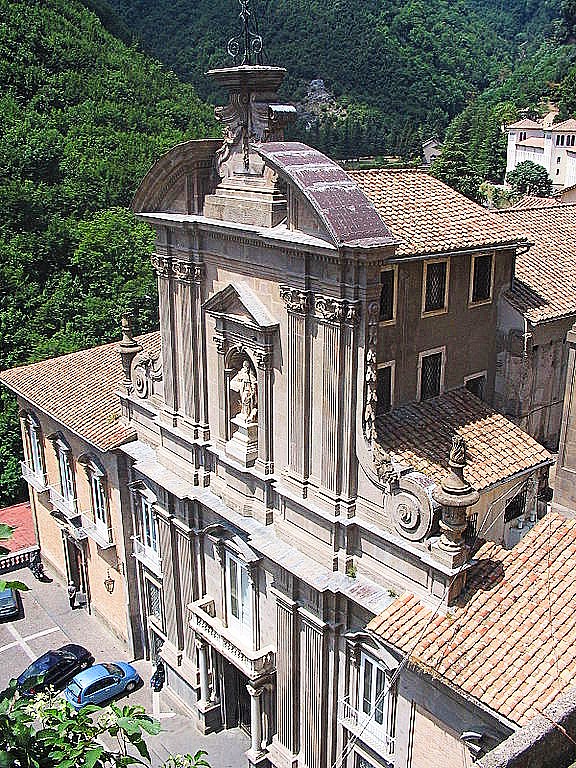
On 21 December 1893, Pope Leo XIII recognised the ancient verneration and the title of Saint, to the first four Abbots, of the famous Abbey of Trinità di Cava dei Tirreni, founded in the 11th century. They are St Alferius the Founder and first Abbot († 1050), St Leo I (1050-1079), St Peter Pappacarbone (1079-1123) and St Constabilis (c 1122-1124). Their relics rest in the Abbey Church in the Chapel of the Saintly Fathers.’

If you would like to discover St Alferius, his Biography is here:
https://anastpaul.com/2021/04/12/saint-of-the-day-12-april-saint-alferius-of-la-cava-930-1050/

La Trinità della Cava
Posted in MARIAN TITLES, SAINT of the DAY, The FLIGHT into EQYPT

The Flight into Egypt, Our Lady of Constantinople, Bari, Turkey (566) and Memorials of the Saints – 17 February

The Flight into Egypt (year 1)- 17 February:

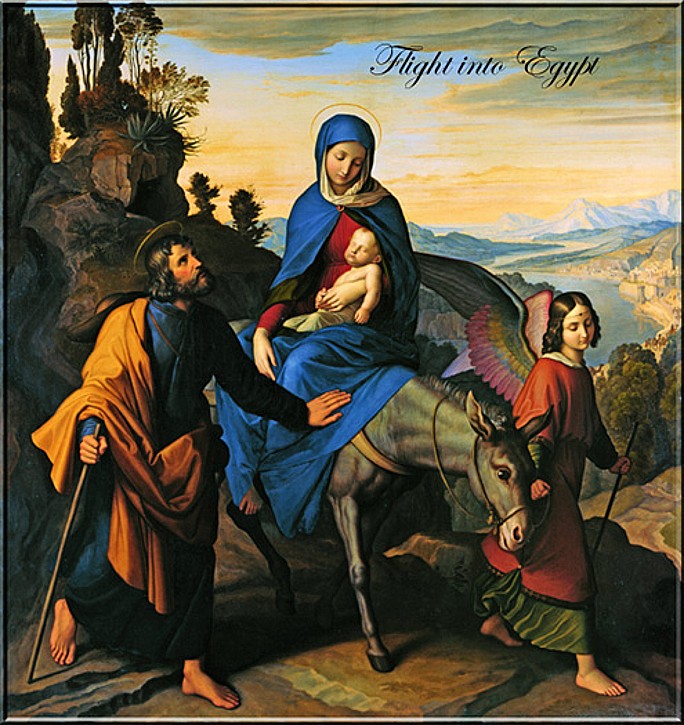
It was on the seventeenth of February, fifty five days after the Nativity of Jesus, when King Herod’s soldiers — sent to slaughter all little boys in Bethlehem and its neighbourhood who were two years old or under, in order to destroy a rival King, Jesus — were getting perilously near the cave at Bethlehem, where at first they little expected Our Lord to be. Saint Joseph received a message from God through an Angel, whereupon he took Our Lady and the Divine Infant and set off leaving the land of the Jews to travel to a land of the Gentiles. They took no-one with them, by way of servants or friends, as Saint Peter Chrysologus tells us.

The Town to which the Holy Family fled was called Fostat. It was three hundred miles from Bethlehem. A Church has been erected there, on the site of the house where the Holy Family lived during their exile. The little Town where the Holy Family lived in Egypt was not far from Heliopolis, a City in which — when Jesus, Mary and Joseph passed through it — statues of pagan gods crashed to the ground. Both Fostat and Heliopolis are not far from Cairo in Egypt.

Our Lady of Constantinople, Bari, Turkey (566) – 17 February:
HERE:

https://anastpaul.com/2021/02/17/our-lady-of-constantinople-bari-turkey-566-and-memorials-of-the-saints-17-february/

St Alexis Falconieri OSM (Died 1310) – One of the Seven Holy Founders of the Servites.
His Life:

https://anastpaul.com/2020/02/17/saint-of-the-day-17-february-saint-alexis-falconieri-13th-century-1310/

St Antoni Leszczewicz
St Bartholomew degli Amidei – One of the Seven Holy Founders of the Servites.
St Benedict dell’Antella – One of the Seven Holy Founders of the Servites.
St Benedict of Cagliari
St Buonfiglio Monaldi – One of the Seven Holy Founders of the Servites.
St Bonosus of Trier
St Constabilis of Cava OSB (c 1070-1124) Abbot
St Donatus the Martyr
Bl Elisabetta Sanna
St Evermod of Ratzeburg
St Faustinus the Martyr
St Finan of Iona

St Fintan of Clonenagh (c 524 – 603) Abbot, “Father of the Irish Monks,” disciple of St Columba of Iona. Fintan was granted the gifts of prophecy and miracles.
St Fintan’s Life:

https://anastpaul.com/2021/02/17/saint-of-the-day-17-february-saint-fintan-of-clonenagh-c-524-603-father-of-the-irish-monks/

St Flavian of Constantinople
St Fortchern of Trim
St Gherardino Sostegni – One of the Seven Holy Founders of the Servites.
St Guevrock
St Habet-Deus
St Hugh dei Lippi-Uguccioni – One of the Seven Holy Founders of the Servites.
St John Buonagiunta Monetti – One of the Seven Holy Founders of the Servites.
St Julian of Caesarea
St Loman of Trim

Blessed Luke Belludi OFM (c 1200- c 1285) Friar of the Order of Friars Minor, companion of St Anthony of Padua on his travels, miracle-woker, founder of convents.
Biography:

https://anastpaul.com/2019/02/17/saint-of-the-day-17-february-blessed-luke-belludi-ofm-c-1200-c-1285/

St Lupiano
Bl Martí Tarrés Puigpelat
St Mesrop the Teacher
St Petrus Yu Chong-nyul
St Polychronius of Babylon
St Romulus the Martyr
St Secundian the Martyr
St Silvinus of Auchy
St Theodulus of Caesarea
Bl William Richardson

Posted in SAINT of the DAY

Saint of the Day – 16 February – Saint Maruta (Died c 415)

Saint of the Day – 16 February – Saint Maruta (Died c 415) Bishop, Confessor, Theologian, Writer, honoured in the Syrian Rite Church as a Doctor of the Church. He was a friend of Saint John Chrysostom and acted as an Ambassador between the East Roman Emperor and the Persian Emperor. Died in 425 of natural causes.

The Roman Martyrology reads: “In the kingdom of Persia, St Maruta, Bishop, who, having restored peace for the Church, presided over the Council of Seleucia, restored the Churches of God which had collapsed during the persecution of King Sabor and placed the relics of the Martyrs of Persia in the City Seat of the Bishop, since then called Martiropoli.”

Maruta was Bishop of Mayferkqat, a Syrian City between the Tigris River and Lake Van, on the borders of the kingdom of Persia, an area where Christians frequently suffer aggression. When Yezdigerd I ascended the throne in 399, Maruta went to Constantinople to ask the Emperor Arcadius to intercede with the new sovereign in favour of persecuted Christians. His appeal, however, remained unattended as the court was already committed to resolving the question of the exile of St. John Chrysostom – in other words, they had no time to assist Maruta and the Persians. However, it was precisely the latter, St John, who was personally interested in Maruta’s difficult situation, asking St Olimpia, a friend of his, to go to Maruta, as St John was worried at Maruta’s lack of reply to St John’s letters. St John Chrysostom wrote to her: “I urgently need him for Persian matters. Try to find out what success he has achieved in his mission. If you are reluctant to put it in writing, let me know the result somehow through others. Do not delay trying to meet him. ”

Maruta went in person to the King’s court to try to get his support towards the Christians and in the delicate fundamental mission. Maruta’s prayer and medical knowledge allowed him to cure the Sovereign from violent migraine headaches. The pagan priests, worried that this could induce the King to convert to Christianity, came up with a way to discredit Maruta in his eyes – they hid a man under the floor of the temple, who, when the King entered the temple for worship, appeared out of nowhere and screamed. “Send away from this holy place, he who, wickedly, believes in a priest of Christians.” The King was impressed and decided to drive Maruta away but Maruta showed him the hidden trap door from which the impostor had appeared. The Sovereign thus began to tolerate Christianity in his kingdom,

During this period of truce, Maruta was able to dedicate himself to the reconstruction of many Churches previously destroyed under the persecutions induced by King Shapur. He also compiled the “Acts” of those ferocious persecutions and collected an innumerable series of relics, which earned the City the name of Martiropoli, still an Episcopal Seat today.

He was present at the general First Council of Constantinople in 381 and at a Council of Antioch in 383 (or 390), at which the Messalians were condemned. For the benefit of the Persian Church he held two Synods at Ctesiphon. A great organiser, he was one of the first to give a regular structure to the Syriac Church.

His writings include:
Acts of the Persian Martyrs (these acts remember the victims of the persecution of Shapur II and Yazdegerd I)
History of the Council of Nicea
A translation in Syriac of the Canons of the Council of Nicea
A Syrian liturgy
Commentaries on the Gospels
Acts of the Council of Seleucia-Ctesiphon (26 canons of a synod held in 410)
He also wrote hymns on the Holy Eucharist, on the Passion and the Holy Cross and on Martyred Saints killed in Shapur’s persecution.

Most of Maruta’s hymns and works are still in use in the Syriac Rite. Maruta died around 415 and just in that period a new wave of persecutions broke out. Due to the numerous writings attributed to him, he was honoured as the principal Doctor of the Syriac Rite Church.

Posted in DOMINICAN OP, franciscan OFM, MARIAN TITLES, SAINT of the DAY

Notre-Dame de l’ Epine / Our Lady of the Thorn, Chalons-sur-Marne, France (1400) and Memorials of the Saints – 16 February

Notre-Dame de l’ Epine / Our Lady of the Thorn, Chalons-sur-Marne, France (1400) – 16 February:
HERE:
https://anastpaul.com/2021/02/16/our-lady-of-the-thorn-chalons-sur-marne-france-1400-and-memorials-of-the-saints-16-february/

St Aganus of Airola

Blessed Bernard Scammacca OP (1430-1487) Priest and Friar of the Order of Preachers, Preacher, Apostle of charity, Mystic, with a gift of prophecy and a great devotion to the Passion of Christ.
About Bl Bernard:

https://anastpaul.wordpress.com/2018/02/16/saint-of-the-day-16-february-blessed-bernard-scammacca-o-p-1430-1487/

St Faustinus of Brescia (not the St Faustinus brother of St Jovinus – 15 February)
St Gilbert of Sempringham
St Honestus of Nimes
St John III of Constantinople

Blessed Joseph Allamano (1851–1926) Priest, Founder of the Consolata Missionaries (I.M.C.) congregation for males and another for females, known as the Consolata Missionary Sisters.
Biography:

https://anastpaul.com/2019/02/16/saint-of-the-day-16-february-blessed-joseph-allamano-1851-1926/

St Julian of Egypt
St Juliana of Campania
St Juliana of Nicomedia
Blessed Mariano Arciero
St Maruta (Died 415) Bishop

Blessed Nicola Paglia OP (1197-1256) Priest of the Order of Preachers , faithful travelling companion of St Dominic, Superior General (twice). A cultured and far-sighted man, he promoted the study of Sacred Scripture and the compilation of biblical Concordances.
Blessed Nicola’s
Life:
https://anastpaul.com/2020/02/16/saint-of-the-day-16-february-blessed-nicola-paglia-op-1197-1256/

St Onesimus of Ephesus

Blessed Philippa Mareria OSC (c 1195-1236) Nun of the Poor Clares, foundress of the monastery of Franciscan Sisters of Saint Philippa Mareri of the Poor Clares, Penitent.
Her Life:

https://anastpaul.com/2021/02/16/saint-of-the-day-16-february-blessed-philippa-mareri-osc-c-1195-1236/

Martyrs of Cilicia – 12 Saints: A group of Christians who ministered to other Christians who were condemned to work the mines of Cilicia in the persecutions of Maximus. They were arrested, tortured and martryed by order of the governor Firmilian.
• Daniel
• Elias
• Isaias
• Jeremy
• Samuel
The group also includes the three known have been sentenced to the mines –
• Pamphilus
• Paul of Jamnia
• Valens of Jerusalem
and those who were exposed as Christians as a result of these murders –
• Julian of Cappadocia
• Porphyrius of Caesarea
• Seleucius of Caesarea
• Theodule the Servant
They were martyred in 309 in Cilicia, Asia Minor (in modern Turkey).

Posted in DOCTORS of the Church, FATHERS of the Church, ONE Minute REFLECTION, Quotes on SALVATION, QUOTES on the CHURCH, SAINT of the DAY, The WORD

One Minute Reflection – 15 February – ‘ … We really are first to receive a denarius … ‘

One Minute Reflection – 15 February – “Month of the Most Blessed Trinity” – the Commemoration of Sts Faustinus and Jovinus – 1 Cor. 9:24-27; 10:1-5, Matthew 20:1-16

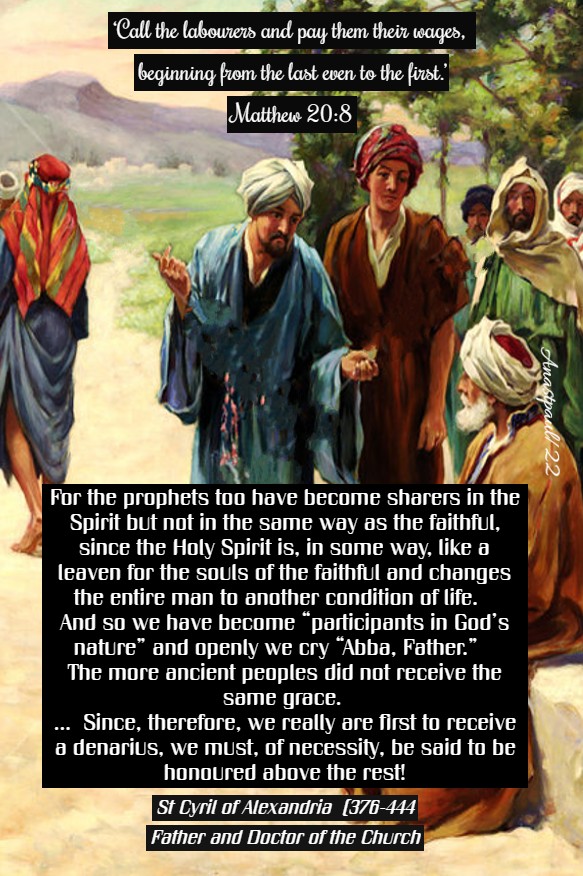
“When evening had come, the owner of the vineyard said to his steward, ‘Call the labourers and pay them their wages, beginning from the last even to the first.’” – Matthew 20:8

REFLECTION – The last ones, receiving the generosity of the Master instead of troubles, are first to receive their reward, since all those, after the Lord’s coming, have become — through Baptism and the union with the Spirit — “sharers in God’s nature” and are called sons of God. For the prophets too have become sharers in the Spirit but not in the same way as the faithful, since the Holy Spirit is ,in some way, like a leaven for the souls of the faithful and changes the entire man to another condition of life. And so, we have become “participants in God’s nature” and openly we cry “Abba, Father.” The more ancient peoples did not receive the same grace. So Paul too says, “For you did not receive a spirit that makes you a slave again to fear but you received the Spirit of sonship.” The ancients then received a spirit of slavery without the honour of adoption. Since, therefore, we really are first to receive a denarius, we must, of necessity, be said to be honoured above the rest!” – St Cyril of Alexandria (376-444) Archbishop of Alexandria, Father and Doctor of the Incarnation of the Church (Fragment 226).

PRAYER – O God, Who gladden us each year by the feast of Your holy Martyrs, Faustinus and Jovinus, graciously grant that, as we rejoice in their merits, we may be inspired by their example. Through Jesus Christ, Thy Son our Lord, Who lives and reigns with Thee, in the unity of the Holy Ghost, God, world without end. Amen (Collect).

Posted in SAINT of the DAY

Saint of the Day – 15 February – Saints Faustinus and Jovinus (Died c 120) Martyrs

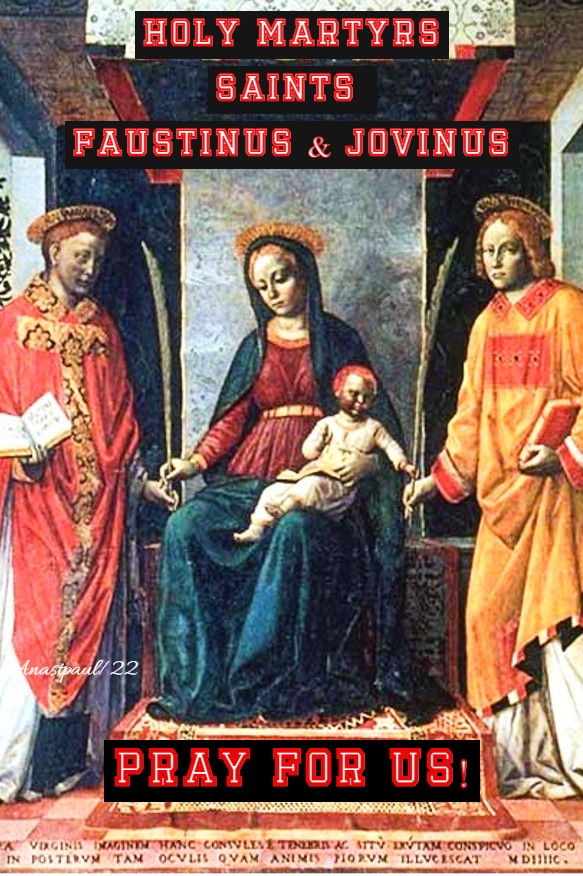
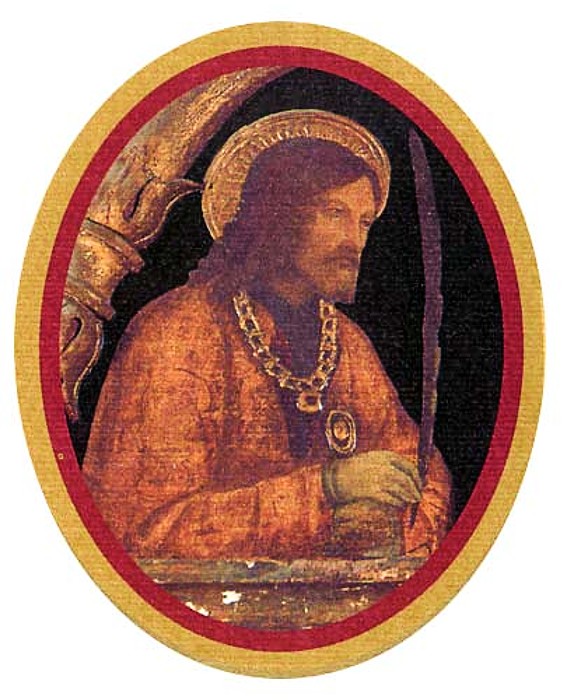
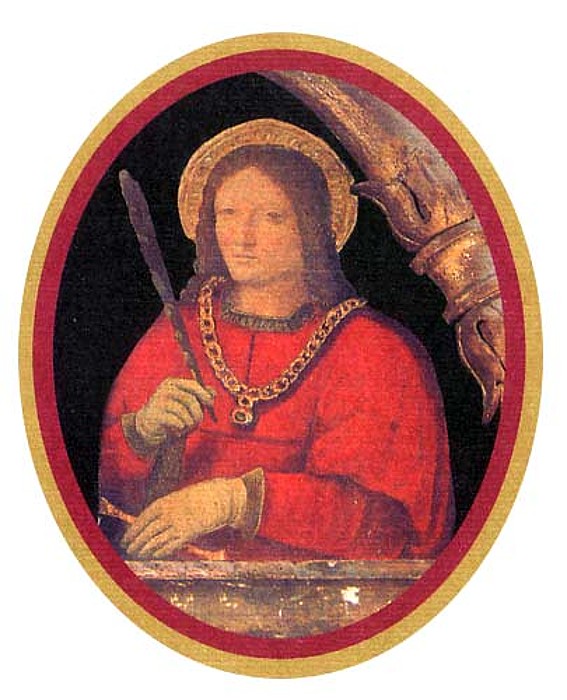
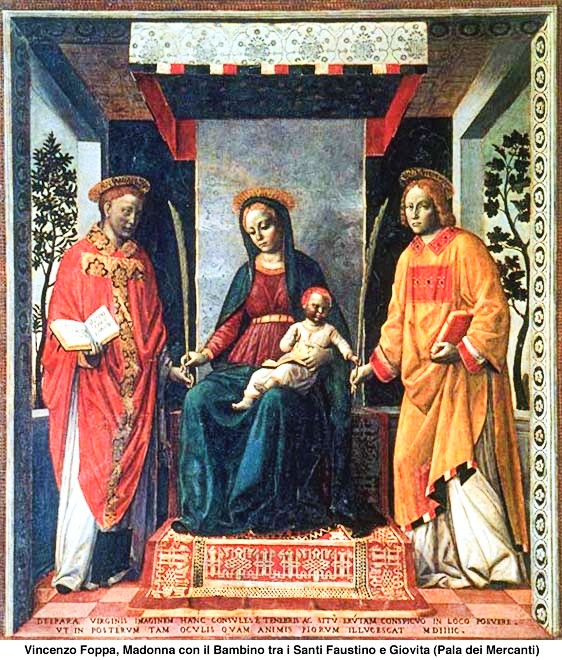
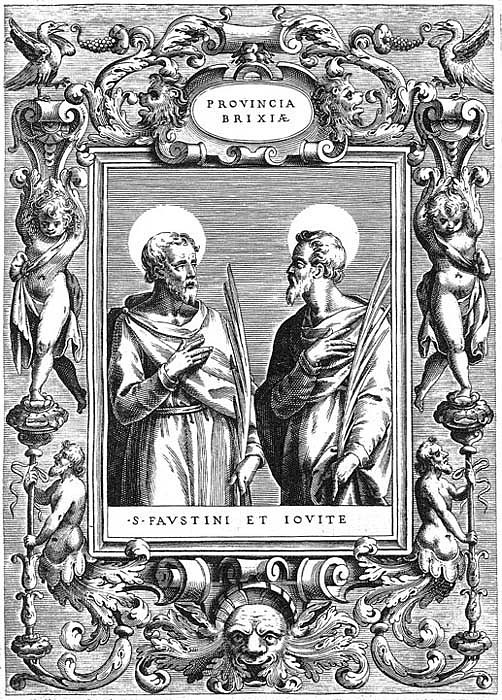
Saint of the Day – 15 February – Saints Faustinus (Died c 120) Martyr, Priest and Jovinus Martyr Deacon, both Evangelisers, Preachers. Born at Brescia, Lombardy, Italy and the two brothers died together. They was thrown to the lions but the animals refused to touch them. Then beheaded in 120 at Brescia, Italy. Patronages – Brescia, City and Diocese and the City of Credera Rubbiano, Italy.

The Roman Martyrology reads today: “At Brescia, in the time of the Emperor Hadrian, the birthday of the holy Martyrs Faustinus and Jovinus, who received the triumphant Crown of Martyrdom after many glorious combats for the Faith of Christ.”

Faustinus and Jovinus were born to the nobility in the 2nd century in Italy. They were zealous preachers in Brescia, Milan, Rome and Naples, during the persecution of Emperor Hadrian.

Julian, a heathen lord, apprehended them and the Emperor himself, passing through Brescia, when neither threats nor torments could shake their constancy, commanded them to be beheaded.

Both Saints Faustinus and Jovinus, are honoured as the chief Patrons of Brescia and their relics are located in the ancient Church bearing the names of both.

Brescia, the Capital of one of the Italian Provinces, can scarcely remember the names of those who were its governors or leading men, in the second century and yet, here are two of her citizens, whose names will be handed down, with veneration and love, to the end of the world and the whole of Christendom is filled with the praise of their glorious Martyrdom. Glory, then, to these sainted Brothers, whose example so eloquently preaches to us the great lesson of our Season,–fidelity in God’s service. (from the Liturgical Year, 1870).

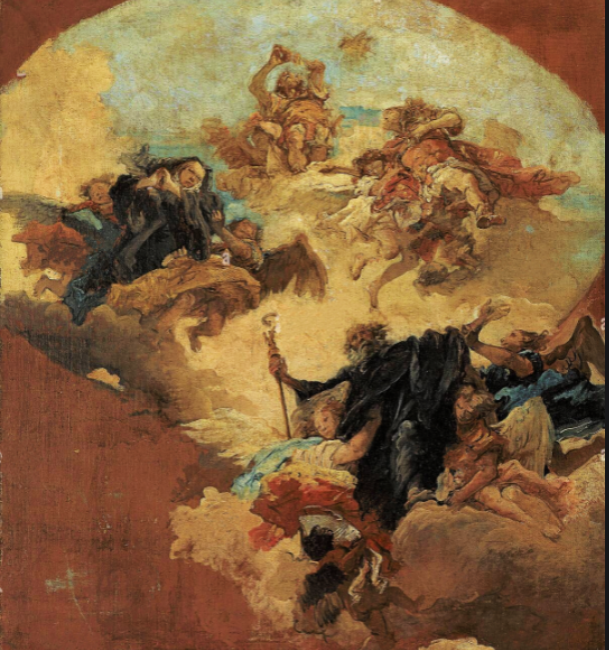
The glorification of Sts Faustinus and Jovinus by Giovanni Battista Tiepolo
Posted in AUGUSTINIANS OSA, JESUIT SJ, MARIAN TITLES, SAINT of the DAY

Notre-Dame de Paris / Our Lady of Paris, France (522) and Memorials of the Saints – 15 February

Notre-Dame de Paris / Our Lady of Paris, France (522) – 15 February:
HERE:

https://anastpaul.com/2021/02/15/our-lady-of-paris-france-522-and-memorials-of-the-saints-15-february/

St Agape of Terni

Blessed Angelus de Scarpetti OSA (Died c 1306) Religious of the Order of the Hermits of St Augustine, Missionary, miracle-worker.
Biography:

https://anastpaul.com/2021/02/15/saint-of-the-day-15-february-blessed-angelus-de-scarpetti-osa-died-c-1306/

St Berach of Kilbarry

St Claude de la Colombiere SJ (1641-1682) Religious Priest, Confessor, Patron of the Sacred Heart of Jesus, Apostle of the Society of Jesuscal Writer, Teacher, Preacher, Missionary.
Beautiful St Claude of the Sacred Heart:

https://anastpaul.wordpress.com/2018/02/15/saint-of-the-day-15-february-st-claude-de-la-colombiere-s-j-1641-1682/

St Craton
St Decorosus of Capua
St Dochow
St Druthmar of Corvey
St Eusebius of Asehia
St Farannan of Iona
St Faustinus (Died c 120) Martyr, Priest

St Faustus of Monte Cassino
St Georgia
St Joseph of Antioch
St Jovita
St Onesimus the Slave
St Quinidius of Vaison

St Sigfrid of Sweden (Died 11th Century) “Apostle of Sweden,” Bishop, Missionary, Miracle-worker.
About St Sigfrid:

https://anastpaul.com/2020/02/15/saint-of-the-day-15-february-saint-sigfrid-of-sweden-died-11th-century-apostle-of-sweden/

St Severus of Abruzzi
St Walfrid

Martyrs of Antioch: 5 Saints:
A group of Christians murdered together. We know the names of five of them – Agapev, Baralo, Isicio, Joseph and Zosimus.

Martyrs of Passae:
Castulus
Lucius
Magnus
Saturninus

Martyrs of Prague – 14 Beati – Franciscan Friars Minor martyred together by a mob led by Lutherans –
• Blessed Antonín of Prague
• Blessed Bartolomeo Dalmasoni
• Blessed Bedrich Bachstein
• Blessed Christoffel Zelt
• Blessed Didak Jan
• Blessed Emmanuel of Prague
• Blessed Gaspare Daverio
• Blessed Giovanni Bodeo
• Blessed Girolamo degli Arese
• Blessed Jakob of Prague
• Blessed Jan of Prague
• Blessed Juan Martínez
• Blessed Klemens of Prague
• BlessedSimon of Prague
They were martyred on
• Shrove Tuesday 15 February 1611 at the Church of Our Lady of the Snows in Prague, Czech Republic
• body dumped nearby but given Christian burial on 19 February 1611 in the monastery
• re-interred in the side Chapel of the Church in 1616.

Martyrs of Sweden:
Sigfrid
Sunaman
Unaman
Winaman

Martyred in the Spanish Civil War:
Bl Pere Vallmitjana Abarca

Posted in "Follow Me", CHRIST the WORD and WISDOM, GOD ALONE!, LOVE of NEIGHBOUR, ONE Minute REFLECTION, PRAYERS to the SAINTS, QUOTES on JUSTICE, QUOTES on LOVE of GOD, Quotes on SALVATION, QUOTES on VIRTUE, SAINT of the DAY, The KINGDOM of GOD / HEAVEN, The WORD

One Minute Reflection – 14 February – ‘ … Be aware that we have been hired as labourers…. ‘

One Minute Reflection – 14 February – “Month of the Most Blessed Trinity” – The Memorial of St Valentine (176-273) Bishop and Martyr, 1 Cor. 9:24-27; 10:1-5, Matthew 20:1-16

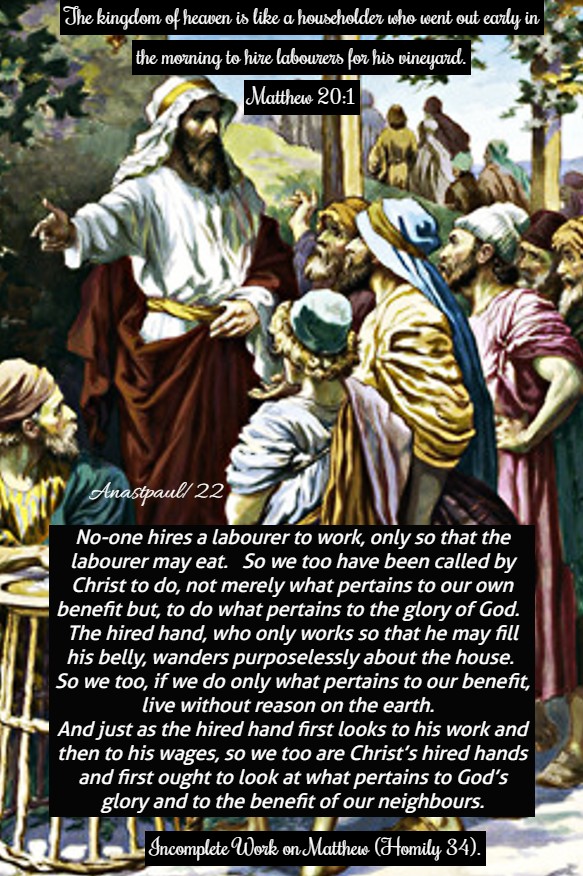
“The kingdom of heaven is like a householder who went out early in the morning to hire labourers for his vineyard.” – Matthew 20:1

REFLECTION – “To hire labourers for his vineyard.” What is the vineyard of God here? Not men, as elsewhere; for men are called the cultivators of the vineyard. The vineyard is justice and in it different kinds of virtues are placed like vines. For example, gentleness, chastity, patience, high-mindedness and countless other good qualities, which are all in general called virtues. So let us note how earnestly we should cultivate the heavenly vineyard. Adam was put in paradise to cultivate it and work it, but because he neglected it, he was ejected from it. We have been put here to cultivate justice; if we neglect it, we will be cast out, just as the Jews also were cast out, of whom it was written: “Add iniquity to their iniquity, that they may not enter thy justice.” The fall of those going before, should be a warning for those following. But if we the followers have also fallen into ruin, those who were the first to fall, deserve pardon more than we, who follow. A hired hand placed in the vineyard will not only lose his pay if he neglects it but, he will also be charged with the loss of the abandoned vineyard! So we too, if we neglect the justice committed to us, will not only have no reward but, we will also be charged for the justice that has been abolished. For God’s vineyard is not outside us but has been planted inside our very selves. So anyone who commits sin destroys the justice of God within himself but anyone who does good works, cultivates it in himself. The well-cultivated justice of God within you, brings forth grapes, that is, Christ. For those who do just deeds form Christ in themselves, as is written: “My little children, with whom I am again in travail, until Christ be formed in you.”
Anyone who consigns a vineyard to another to work consigns it, not so much for the other’s benefit, as for his own but God, giving His justice to our understanding, gave it, not for His own benefit but for ours. God does not need our labour but we, who do just work, may live because of it. The owner who consigned the vineyard to someone else for his own benefit, expects to receive it back in the same condition as He handed it over. How then will justice not be demanded back from us, in as immaculate a condition as He created it in us, particularly as He gave it, not for His own benefit but for our salvation?
Be aware that we have been hired as labourers. If we have been hired as labourers, we ought to know what our tasks are, for a hired labourer cannot be without a task. Our tasks are the works of justice, not to till our fields and vineyards; not to amass riches and pile up honours but to benefit our neighbours. And although we can do this tilling and amassing without sin, yet they are not our tasks but our daily occupations.

No-one hires a labourer to work, only so that the labourer may eat. So we too have been called by Christ, to do, not merely what pertains to our own benefit but, to do what pertains, to the glory of God. The hired hand, who only works so that he may fill his belly, wanders purposelessly about the house. So we too, if we do only what pertains to our benefit, live without reason on the earth. And just as the hired hand first looks to his work and then to his wages, so we too are Christ’s hired hands and first ought to look at what pertains to God’s glory and to the benefit of our neighbours …. Charity and true love toward God “does not insist on its own way” but desires to perform everything to the wish of the Beloved—than to what pertains to our own benefit.” – An anonymous Ancient Christian Writer (ACW) known as the Incomplete Work on Matthew (Sermon 34).

PRAYER – O glorious advocate and protector, St Valentine,
look with pity upon our wants,
hear our requests,
attend to our prayers,
relieve by your intercession,
the miseries under which we labour
and obtain for us the divine blessing,
that we may be found worthy
to join you in praising the
Almighty for all eternity:
through the merits of
Our Lord Jesus Christ.
Amen

Posted in SAINT of the DAY

Saint of the Day – 14 February – Saint Modestinus of Avellino (c 245-311) Martyr

Saint of the Day – 14 February – Saint Modestinus of Avellino (c 245-311) Bishop Martyr. Confessor, Missionary, miracle-worker. Also known as – Modestinus of Mercogliano, Modestin…Modestino… Additional Memorials – 10 June (re-internment of relics), 13 August on some calendars. Patronages – Avellino, Italy, City of (given in 1220 by Ruggiero of Avellino). Avellino, Italy, Diocese of (given in 1220 by Ruggiero of Avellino), Mercogliano, Italy.

Modestinus was born in Antioch in c 245 of a noble family. In 302 he was Consecrated Bishop of the City and Patriarch of the region of Antioch. During the persecution of Diocletian (year 303), he retired to a hermitage on Mount Silpio,. But in 310 he returned to his See.

He preached the Gospel of Christ and performed numerous miracles and cures. Arrested and tortured, he was released from prison by the faithful of his Diocese.
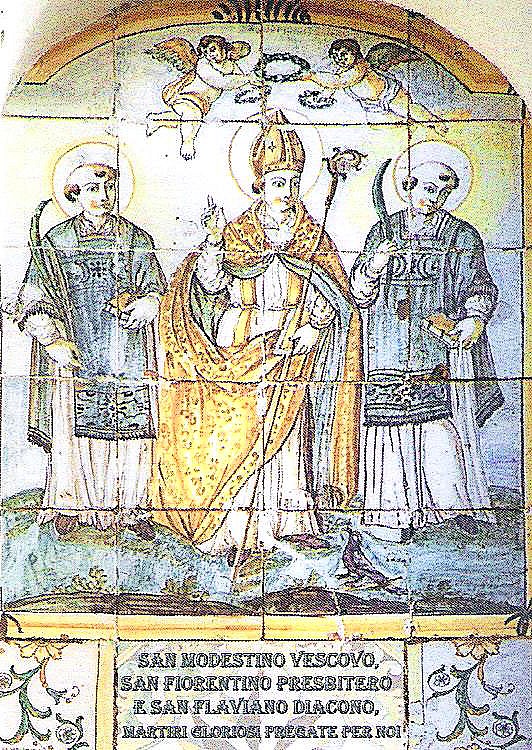
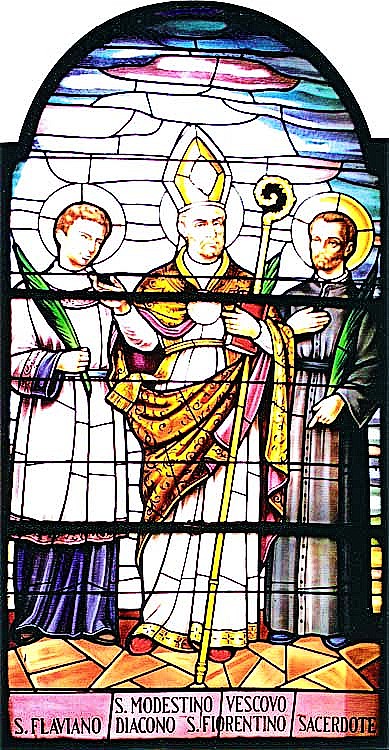
Modestinus, with his collaborators Fiorentinus a Priest and Flavianus a Deacon, left to travel to Italy. They arrived by sea in Locri (in Calabria) where they preached the Gospel, were arrested again and taken to prison in Sibari. .According to tradition, they were freed by the Archangel Michael.

They left by sea and reached near Avellino – it is believed that St Michael led the Saint to the regions that most needed the Gospel teachings and the truth of Christ. It is reported that Modestinus and his assistants, were successful in their preaching, converting and Baptising around 4,000 souls in one area. Modestinys performed many miracles and cures.

Again they were arrested, imprisoned and tried by an envoy of the Emperor Maxentius and taken to the place called the “Praetorium” where they suffered Martyrdom wrapped in red-hot robes and burned to death. They died in the night between 14 and 15 February in the year 311.

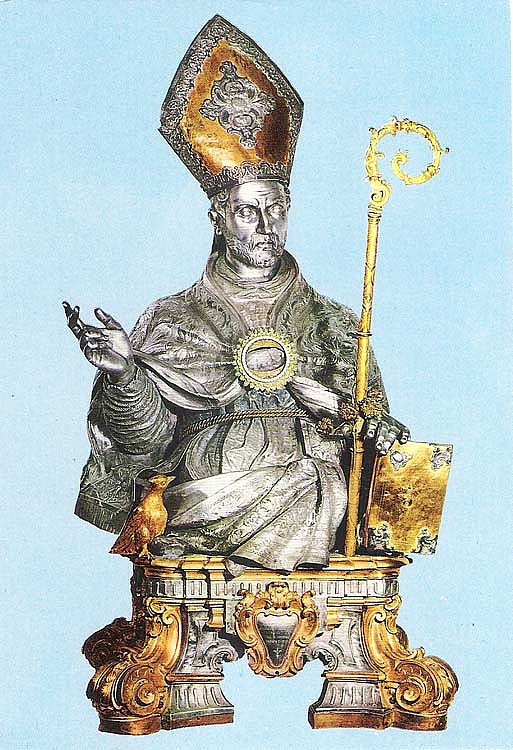
Their bodies were collected by the Christians and buried. A sign with their names was placed on the graves. In St Modestinus Church, a silver sculpture depicting a dove was placed on the tomb.

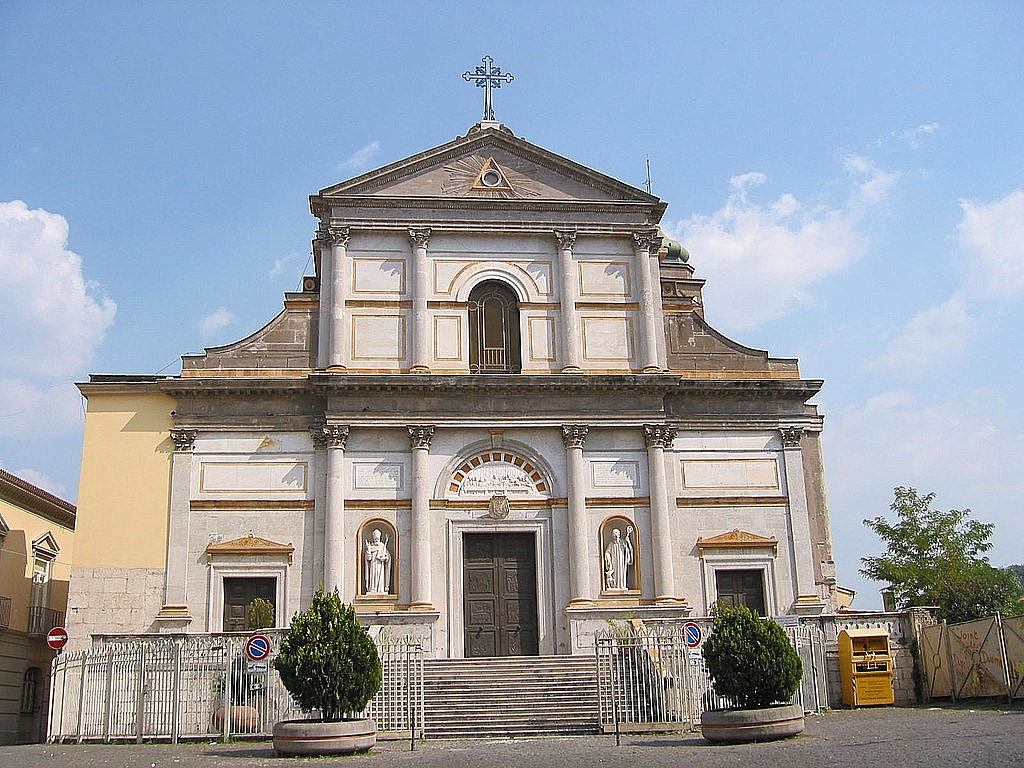
The Cathedral of Avellino dedicated to the Blessed Virgin and St Modestinus
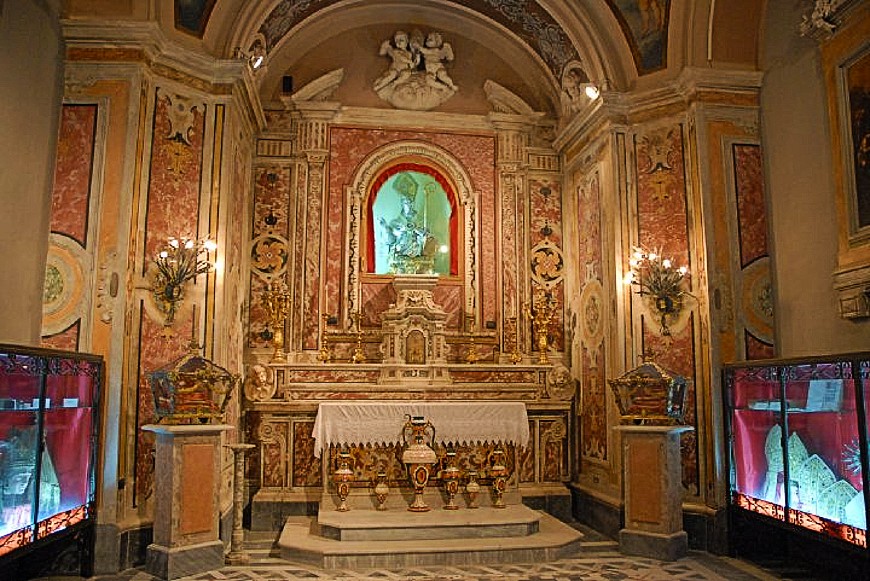
The Chapel of St Modestinus

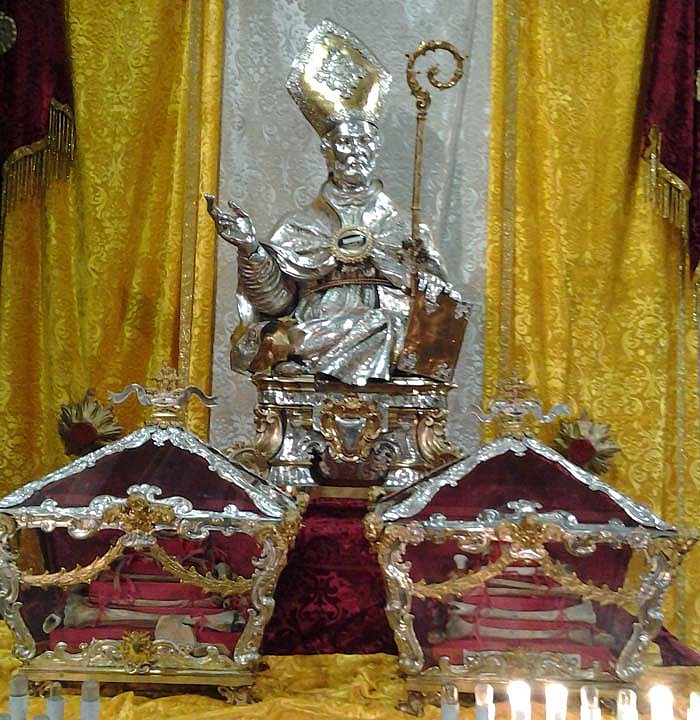
Their bodies, found in the summer of 1166, were taken to the Cathedral of Avellino, where they are still preserved today in the Chapel of St Modestinus.
In 1220 they were appointed primary Patrons of the City and of the Diocese of Avellino by the Bishop Ruggiero.

Relics of the three Sains
Posted in MARIAN TITLES, SAINT of the DAY

Notre-Dame de Bourbourg / Our Lady of Bourbourg, Flanders (1383) and Memorials of the Saints – 14 February

Notre-Dame de Bourbourg / Our Lady of Bourbourg, Flanders (1383) – 14 February:
HERE:

https://anastpaul.com/2021/02/14/quinquagesima-sunday-2021-our-lady-of-bourbourg-flanders-1383-and-memorials-of-the-saints-14-february/

St Valentine (176-273) Bishop and Martyr (Memorial)
The story of Saint Valentine:

https://anastpaul.wordpress.com/2017/02/14/blessed-memorial-of-st-valentine-14-february/

St Cyril (827-869) (Memorial) “Apostles to the Slavs,” Sibling Brother Bishops, Confessors, Theologians, Missionaries, Writers, Preachers, Patrons of Europe. Creators of the Glagolitic alphabet, the first alphabet used to transcribe Old Church Slavonic and Cyrillac Alphabet, which was developed from it.
St Methodius (826-885) (Memorial)
Their Feast Day is 7 July (moved in 1969)
The great Saints Cyril & Methodius:
https://anastpaul.wordpress.com/2018/02/14/saints-of-the-day-14-february-sts-cyril-827-869-methodius-826-885/

St Abraham of Harran

St Antoninus of Sorrento OSB (c 555-625) Italian Abbot, Hermit, miracle-worker.
Biography:

https://anastpaul.com/2021/02/14/saint-of-the-day-14-february-saint-antoninus-of-sorrento-osb-c-555-625-abbot/

St Auxentius of Bithynia
St Conran of Orkney
St Eleuchadius

St Juan García López-Rico O.SS.T. (1561-1613) Priest of the Trinitarian Order (The Order of the Most Holy Trinity and of the Captives), Reformer, Ascetic and Penitent, prolific Writer, Theologian.
Biography:

https://anastpaul.com/2019/02/14/saint-of-the-day-14-february-st-juan-garcia-lopez-rico-o-ss-t-1561-1613/

St Modestinus of Avellino (c 245-311) Bishop Martyr

St Nostrianus of Naples
St Theodosius of Vaison
St Valentine of Terni

Blessed Vicente Vilar David (1889-1937) Martyr, Martyr, Layman, Social reformer, Worker for Justice and Peace, Apostle of Charity.
His Life and Death:

https://anastpaul.com/2020/02/14/saint-of-the-day-14-february-blessed-vicente-vilar-david-1889-1937-martyr/

St Vitale of Spoleto

20 Mercedarians of Palermo
Martyrs of Alexandria – 16 saints
Martyrs of Rome

Felicula
Vitalis
Zeno

Martyrs of Terni: Three Christians who gave proper burial to Saint Valentine of Terni. Martyred in the persecutions of Aurelius.
273 in Terni, Italy – Apollonius, Ephebus, Proculus.

Martyrs of Alexandria: A group of Christians murdered in various ways for their faith in Alexandria, Egypt. We know the names and a few details about 16 of them – Agatho, Agatone, Ammonio, Ammonius, Antonius, Bassiano, Bassianus, Cirione, Cyrio, Dionysius, Dionysius, Lucio, Moses, Moses, Proto and Tonione.

Posted in "Follow Me", GOD ALONE!, GOD is LOVE, MYSTICS, PRACTISING CATHOLIC, QUOTES on GRACE, QUOTES on GRATITUDE, QUOTES on HUMILITY, QUOTES on LOVE of GOD, QUOTES on PEACE, QUOTES on PURITY, QUOTES on PURITY of INTENTION, QUOTES on SANCTITY, QUOTES on SELF-DENIAL, QUOTES on SUFFERING, QUOTES on THE WORLD, SAINT of the DAY, The FAITHFUL on PILGRIMAGE, The HEART, The WILL of GOD

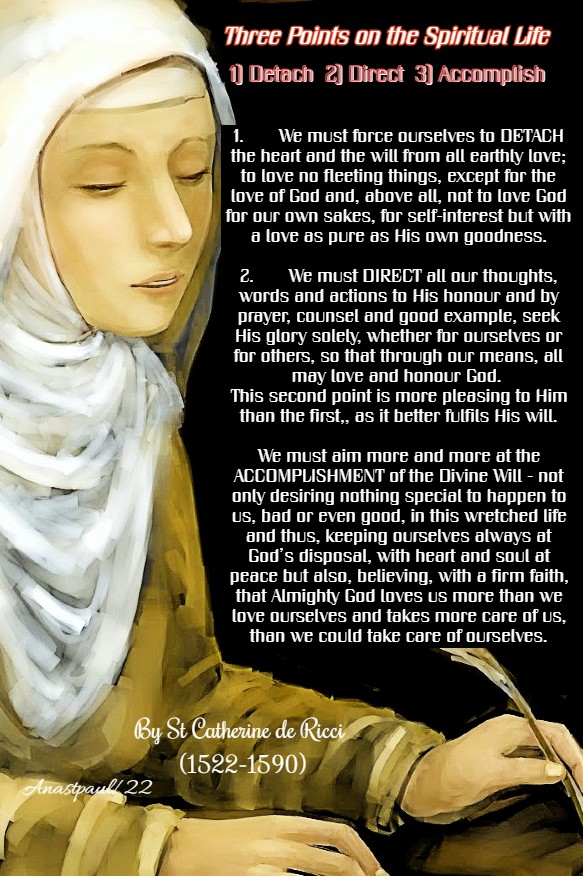
Quote/s of the Day – 13 February – Three Points on the Spiritual Life By St Catherine de Ricci

Quote/s of the Day – 13 February – Septuagesima Sunday and the Memorial of Saint Catherine de Ricci OP (1522-1590) Virgin, Mystic, Stigmatist.

Three Points on the Spiritual Life
By St Catherine de Ricci (1522-1590)
1) Detach 2) Direct 3) Accomplish

Letter to a Fellow Nun
by St Catherine de Ricci

Very dear daughter, I have already sent you a letter to exhort you to the service of our Lord and now, I send you this one, in which I am going to give—first for myself and then for you—an account of the true way of faithfullyserving our Divine Spouse and a resume of the spiritual life, so that, by following it, we shall carry out the Holy Will of God.

If, then, my daughter, you would be the true spouses of Jesus, you must do His Holy Will in all things and you will do this, if you entirely give up your own will on every occasion and if you love the divine Spouse with your whole heart, your whole soul and your whole strength. Then, you must carefully attend to the following points (but it is necessary to weigh all these words), as they contain the summary of Christian perfection:

  1. We must force ourselves to DETACH the heart and the will from all earthly love; to love no fleeting things, except for the love of God and, above all, not to love God for our own sakes, for self-interest but with a love as pure as His own goodness.
  2. We must DIRECT all our thoughts, words and actions to His honour and by prayer, counsel and good example, seek His glory solely, whether for ourselves or for others, so that through our means, all may love and honour God.
    This second point is more pleasing to Him than the first, as it better fulfils His will.
  3. We must aim more and more at the ACCOMPLISHMENT of the Divine Will – not only desiring nothing special to happen to us, bad or even good, in this wretched life and thus, keeping ourselves always at God’s disposal, with heart and soul at peace but also, believing, with a firm faith, that Almighty God loves us more than we love ourselves and takes more care of us, than we could take care of ourselves.

The more we conform to this way of acting, the more we shall find God present to help us and the more we shall experience, His most gentle love.
But no-one can reach such perfection except by constant and courageous sacrifice of self-will and, if we would learn to practice such abnegation, it is necessary to keep ourselves in a state of great and deep humility, so that, by perfect knowledge of our own misery and weakness, we may rise to learn the greatness and beauty of our God.

Consider how just and necessary it is, to serve Him unceasingly, with love and obedience.
I say just, because, God being Father and Master of all things, it is just that His Son and Servant, should obey and love Him.
I say necessary because,, by acting otherwise, we could not be saved.

Let us always remember, never doubting, that it is the Eternal, Sovereign, All-powerful God, Who does, orders, or allows, everything that happens and that nothing comes to pass, without His Divine Will.

Let us remember that He is Himself that Wisdom, which, in the government of the universe – of heaven, earth and every single creature – cannot be deceived. (He would be neither God nor most wise, if it were otherwise). Let us look upon Him as supremely good, loving and beneficent.

If, through His Mercy, this conviction becomes strongly impressed upon our wills, we shall easily take all things from His Sacred Hand, with well-contented hearts, always thanking Him for fulfilling His most holy will in us. By acting thus. (with the help of His holy grace) we shall unite ourselves to Him, by true love in this life and by glory in eternity.

May He grant it to us in His goodness! Of your charity pray for me, a wretched sinner, who commends herself to you all.”

Your sister in Christ,
Amen
Catherine

Posted in DOMINICAN OP, INCORRUPTIBLES, MYSTICS, SAINT of the DAY

Saint of the Day – 13 February – Saint Catherine de Ricci OP (1522-1590)

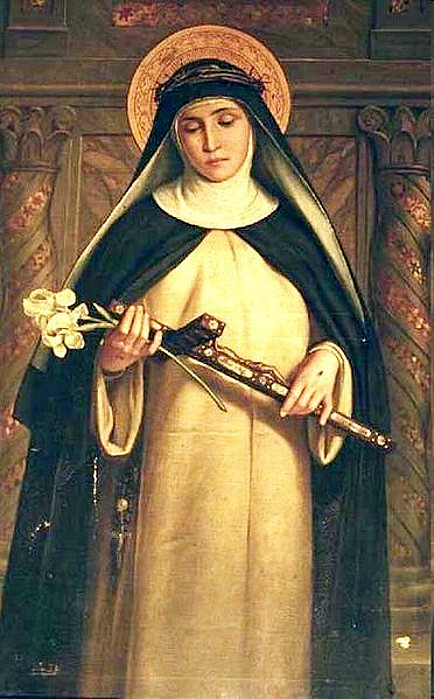
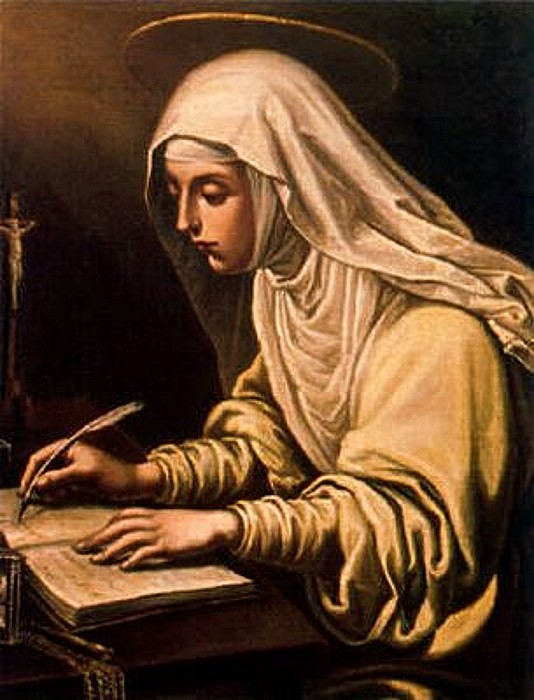
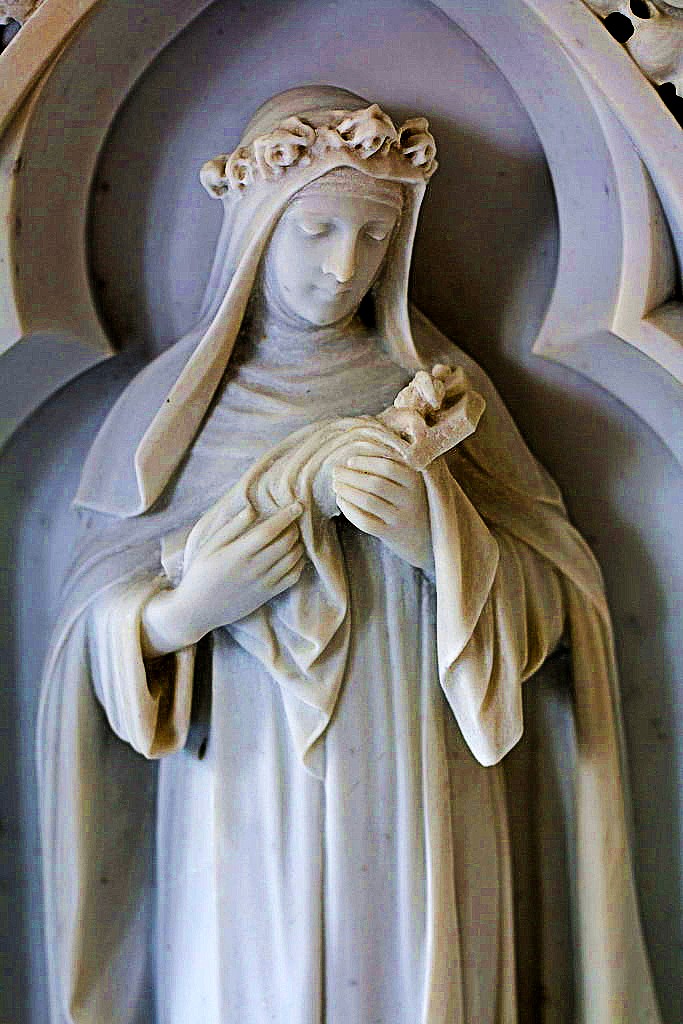
Saint of the Day – 13 February – Saint Catherine de Ricci OP (1522-1590) Virgin, Tertiary of the Order of Preachers, Mystic, Stigmatist, Ecstatic, Counsellor to many in both secular and spiritual matters, a highly admired Administrator and Advisor,blessed with many mystical charism including visions of Christ, both as a Baby and Adult, bilocation and miracles. Born as Alessandra Lucrezia Romola de’ Ricci in Florence on 23 April 1522 and died on 2 February 1590 (aged 67) at Prato, Grand Duchy of Tuscany, of natural causes. Patronage – the sick. Her body is incorrupt.

The Roman Martyrology states of her today: “At Prato, in Tuscany, St Catherine de Ricci, a Florentine Virgin of the Order of St Dominic, replenished with her heavenly gifts, whom Pope Benedict XIV inscribed on tbe catalogue of holy Virgins. She died in virtues and merits, on the 2nd of this month but her festival is celebrated on this day, 13th.”

The Ricci are an ancient family, which still subsists in a flourishing condition in Tuscany today. Alessandra was born in Florence to Pier Francesco de’ Ricci, of a patrician family and his wife, Caterina Bonza, who died soon after the birth of Alessandra. At age 6 or 7, her father enrolled her in a school run by a Monastery of Benedictine Nuns in the Monticelli quarter of the City, near their home and the City gates, where her Aunt, Luisa de’ Ricci, was the Abbess.

Catherine was a devout and pious child and it was here, in the Convent of her Aunt, that she developed a lifelong devotion to the Passion of Christ. After a short time back at home and after finally persuading her father,, at the age of 14, she entered the Convent of St Vincent in Prato, Tuscany, a cloistered community of religious sisters of the Third Order of St Dominic, disciples of the noted Dominican Friar Girolamo Savonarola, who followed the strict regimen of life she desired. In May 1535 she received the religious habit from her uncle, Timoteo de’ Ricci, who was Confessor to the Convent and the religious name of Catherine, after the Dominican tertiary, St Catherine of Siena.

Her novitiate was a time of trial. She would experience ecstasies during her routine, which caused her to seem asleep during community prayer , dropping plates and food, so much so, that the community began to question her competence, if not her sanity. Eventually, the other Sisters became aware of the spiritual basis for her behaviour. By the age of 30 she had risen to the post of Prioress.

After the recovery of her health, which seemed miraculous, she studied more perfectly to die to her senses and to advance in a penitential life and spirit, in which God had begun to conduct her, by practising the greatest austerities which were compatible with the obedience she had professed; – she fasted two or three days a week on bread and water alone and sometimes passed the whole day without taking any nourishment and chastised her body with disciplines and a sharp iron chain which she wore next her skin. Her obedience, humility and meekness were still more admirable than her spirit of penance. Much of penitential practice and oblation of her sufferings, were directed to the succour of the Souls in Purgatory.

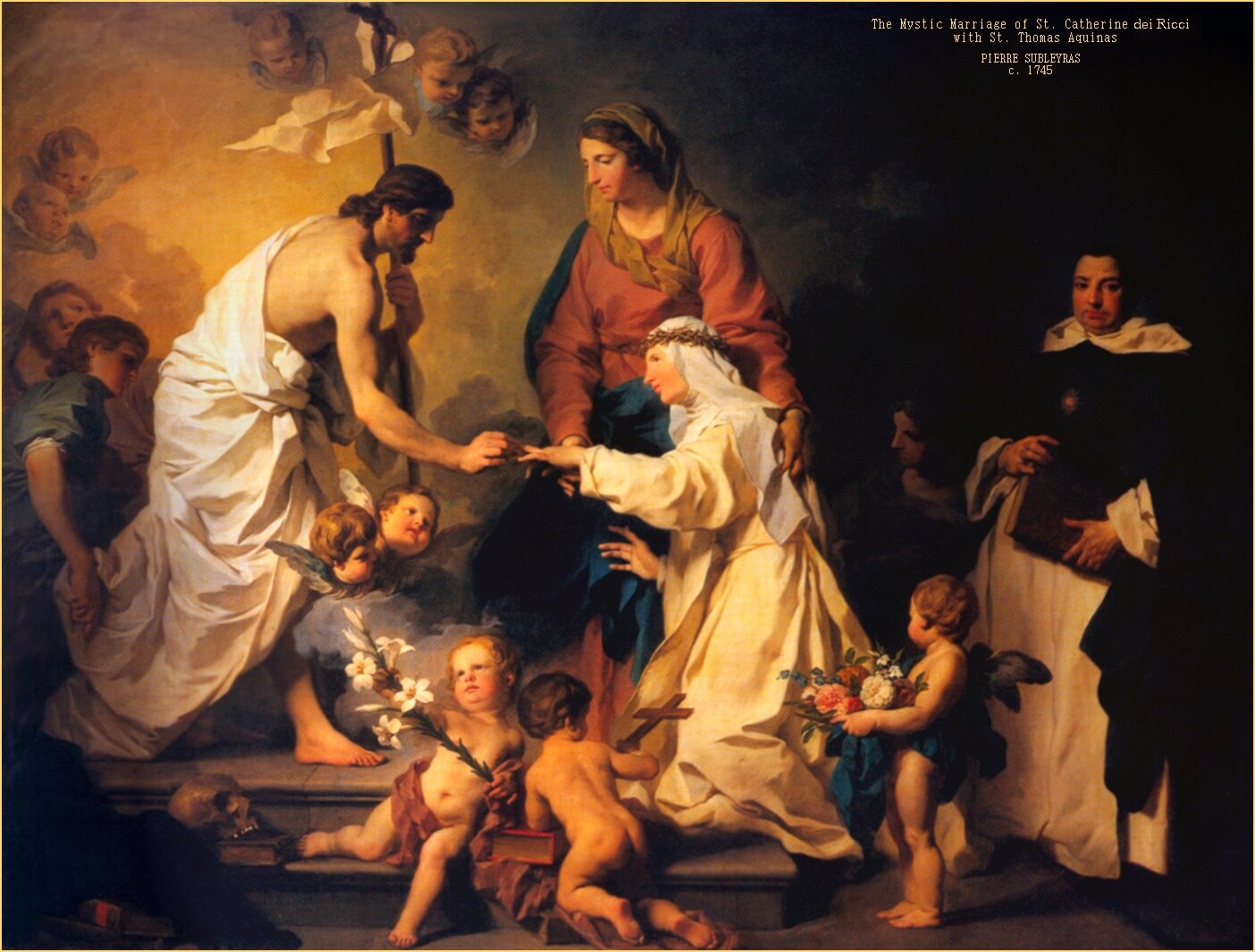
It was by profound humility and perfect interior self-denial that she learned to vanquish in her heart, the sentiments or life of the first Adam – that is, of corruption, sin and inordinate self-love. But this victory over herself,and purgation of her affections, was completed by a perfect spirit of prayer. By the union of her soul with God and the establishment of the absolute reign of His love in her heart, she was dead to and disengaged from, all earthly things. Her visions became most vivid allowing her to hold Baby Jesus dressed in swaddling clothes and to be mystically married and united with adult Jesus. Catherine’s meditations on the Passion of Christ were so deep, that she spontaneously bled, as if scourged. She also bore the Stigmata. During times of deep prayer, like Catherine of Siena, her Patron Saint, a coral ring representing her marriage to Christ, appeared on her finger.

Crowds gathered to witness her prayer and ecstasies and it began to distract from the life of the Convent. Catherine herself was embarrassed by all the attention. The community prayed that her wounds and experience would lessen in intensity so that they could go about the work of their common life together in peace and in 1554 the visions ceased.

As the Prioress, Catherine developed into an effective and greatly admired administrator. She was an advisor on various topics to Princes, Bishops and Cardinals. She corresponded with three figures who were destined to become Popes: Pope Marcellus II, Pope Clement VIII and Pope Leo XI. An expert on religion, management and administration, her advice was widely sought. She gave counsel both in person and through exchanging letters. It is reported that she was extremely effective in her work, managing her priorities with great zeal and efficiency.

One of the miracles that was documented for her Canonisation was her appearance many hundreds of miles away from where she was physically located, in a vision to St Philip Neri, a resident of Rome, with whom she had maintained a long-term correspondence. St Philip, who was otherwise very reluctant to discuss miraculous events, confirmed the event.

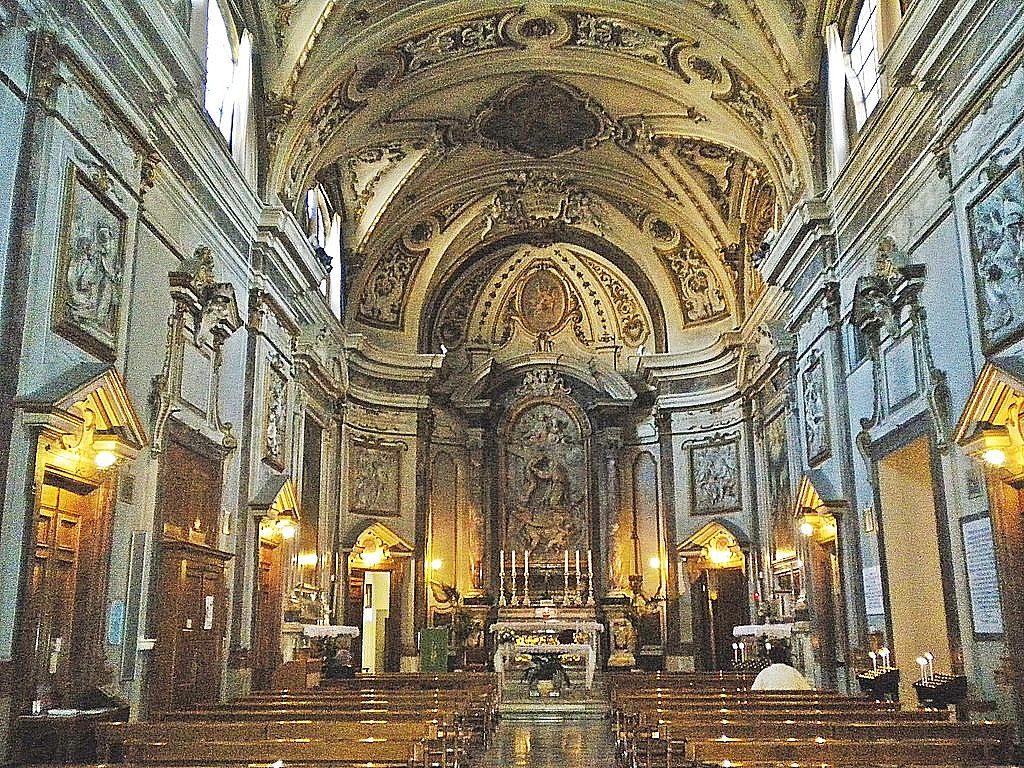
Catherine lived in the Convent until her death in 1590 after a prolonged illness. Her remains are visible under the Altar of the Minor Basilica of Santi Vicenzo e Caterina de’ Ricci, Prato, which is next to the Convent associated with her life..

The Minor Basilica of Santi Vicenzo e Caterina de’ Ricci, Prato, Italy

Catherine was Beatified by Pope Clement XII in 1732 and Canonised by Pope Benedict XIV in 1746 in a spectacular ceremony for which a magnificent ‘canopy’ was constructed. In celebration of the Saint’s Canonisation, Domenico Maria Sandrini wrote an authorative biography of the new Saint.

Posted in AUGUSTINIANS OSA, DOMINICAN OP, INCORRUPTIBLES, LENT, LENT 2022, MARIAN TITLES, MYSTICS, SAINT of the DAY

Septuagesima Sunday, Notre-Dame de Pellevoisin / Our Lady of Pellevoisin, France (1876) and Memorials of the Saints – 13 February

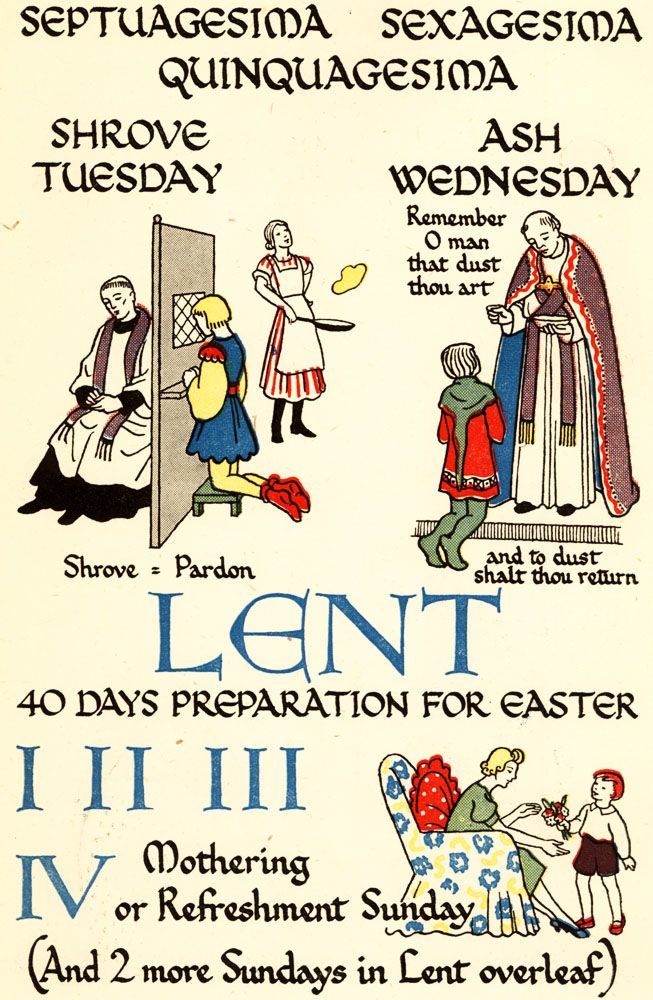
Septuagesima Sunday:
The word Septuagesima is Latin for “seventieth.” It is both the name of the liturgical season and the name of the Sunday. Septuagesima Sunday marks the beginning of the shortest Liturgical season. This season is seventeen (17) days long and includes the three Sundays before Ash Wednesday. The length of the season never changes but the start date is dependent on the movable date of Easter, which can fall between 22 March-25 April. Septuagesima Sunday can be as early as 18 January.
The Septuagesima season helps the faithful ease into Lent. It is a gradual preparation for the serious time of penance and sorrow; to remind the sinner of the grievousness of his errors and to exhort him to penance.
Liturgically it looks very much like Lent. The Gloria and Alleluia are omitted, the tone becomes penitential with the Priest wearing purple vestments. The main difference is that there are no fasting requirements.

Mother of Mercy, Notre-Dame de Pellevoisin / Our Lady of Pellevoisin, France (1876) – 13 February:
HERE:

https://anastpaul.com/2021/02/13/mother-of-mercy-our-lady-of-pellevoisin-france-1876-and-memorials-of-the-saints-13-february/

St Adolphus of Osnabruk
St Aimo of Meda

Blessed Archangela Girlani O Carm (1460-1494) Virgin, Carmelite Nun, Mystic with the gift of levitation.
Her Life:

https://anastpaul.com/2020/02/13/saint-of-the-day-13-february-blessed-archangela-girlani-o-carm-1460-1494/

Bl Beatrix of Ornacieux
St Benignus of Todi
Bl Berengar of Assisi
St Castor of Karden
St Catherine de Ricci OP (1522-1590) Virgin, Tertiary of the Order of Preachers, Mystic, Stimatist. Her body is incorrupt.

Blessed Christine of Spoleto OSA (1435-1458) Widow, mother, religious nun of the Order of Saint Augustine.
About Blessed Christine:

https://anastpaul.com/2019/02/13/saint-of-the-day-13-february-blessed-christine-of-spoleto-osa-1435-1458/

St Dyfnog
St Ermenilda of Ely
Bl Eustochium of Padua OSB (1444-1469) Virgin

St Fulcran of Lodève (Died 1006) Bishop of Lodève, Reformer, especially within the clergy and religious orders, builder of many Churches, Convents and Hospitals, apostle of the poor and needy, miracle-worker.
St Futeran’s Life:

https://anastpaul.com/2021/02/13/saint-of-the-day-13-february-saint-fulcran-of-lodeve-died-1006-bishop/

St Fusca of Ravenna
St Gilbert of Meaux
St Gosbert of Osnabruck
St Pope Gregory II
St Guimérra of Carcassone
St Huno

Blessed Jordan of Saxony OP (1190-1237) Religious Priest, Preacher, the Second Master-General of the Order of Preachers, after St Dominic.
Biography:

https://anastpaul.wordpress.com/2018/02/13/saint-of-the-day-13-february-blessed-jordan-of-saxony-o-p-1190-1237/

St Julian of Lyon
St Lucinus of Angers
St Marice
St Martinian the Hermit
St Maura of Ravenna
St Modomnoc
St Paulus Lio Hanzuo
St Peter I of Vercelli
St Phaolô Lê Van Loc
St Stephen of Lyons
St Stephen of Rieti

Posted in MARIAN PRAYERS, Our MORNING Offering, SAINT of the DAY

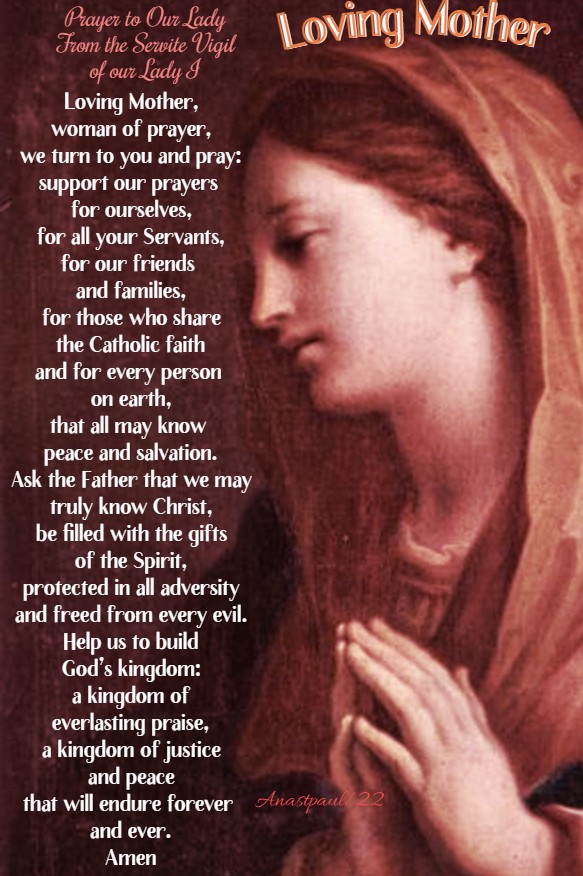
Our Morning Offering – 12 February – Loving Mother

Our Morning Offering – 12 February – The Memorial of the Seven Holy Founders of the Servite Order (1233) and Mary’s Day

Loving Mother
Prayer to Our Lady
From the Servite Vigil of our Lady I

Loving Mother,
woman of prayer,
we turn to you and pray:
support our prayers for ourselves,
for all your Servants,
for our friends and families,
for those who share the Christian faith
and for every person on earth,
that all may know peace and salvation.
Ask the Father that we may truly know Christ,
be filled with the gifts of the Spirit,
protected in all adversity
and freed from every evil.
Help us to build God’s kingdom:
a kingdom of everlasting praise,
a kingdom of justice and peace
that will endure forever and ever.
Amen.

Posted in SAINT of the DAY

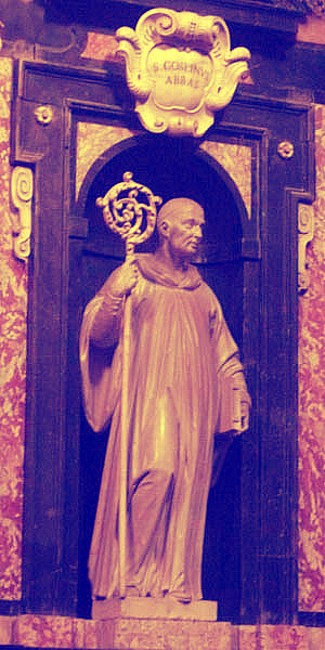
Saint of the Day – 12 February – Saint Goscelinus of Turin OSB (Died c 1053)

Saint of the Day – 12 February – Saint Goscelinus of Turin OSB (Died c 1053) Monk, Abbot. Died on 12 February c 1053 of natural causes. at his Monastery in Turin. Also known as – Goscelinus of San Solutore, Goslin, Goslino, Gozzelino, Gozzelinus.

In the Middle Ages, wars were continuous and severely tested entire populations, often already tried by hunger and epidemics. In most Cities, the highest authority was the Bishop. Turin, being part of a Marquisate with Susa, while undergoing the raids of the Hungarians and Saracens, had the Burgundians as particular enemies. Political instability also caused the malpractice of both the people and the clergy.

Around the year 1000, Bishop Gezone, a lover of the Monastic ideal, saw in the foundation of new Monasteries, a way to counter this moral decline. While St William of Montevergine founded the famous Abbey of Fruttuaria and St Giovanni Vincenzo illuminated the Abbey of St Michael with his holiness, a Benedictine Monastery was born in Turin at the Chapel of the the Protomartyrs of Turin, Sts Solutore, Adventore and Octavius.

The Monks, far from earthly affections, dedicated to prayer and the study of Sacred Scripture, humbly respected the vows of poverty, chastity and obedience. To love the Lord meant to love one’s neighbour and their example was of edification to all. Day and night the incessant prayers accompanied the various occupations to which each one was in charge. The task of the Monks was also to counter the spread of heresies.

The Monastery of St Solutore was founded in the year 1006 and one of the first young people who offered their life to God was Goscelinus.

Goscelinu belonging to the noble Turin Avari family, he was educated and instructed in literature and human sciences.

The religious vocation arrived early and, therefore, he renounced the world to embrace the Rule of St Benedict. His master was the first Abbot, Romanus, while his privileged companion was Atanasius.

Goscelinus respect for the Rule was exceptionable, no leniency was granted, even when he was sick. Most humble, he never dominated his companions although he was superior to most in education and doctrine. Fasts and penances were the weapon to fight the passions while food for the soul was the reading of spiritual books.

In 1031, although he had always declined all honour, he was elected Abbot. Everyone agreed on his appointment and he accepted to fulfill God’s will. He entrusted the care of material things to some trusted collaborators, while he only wished to take care of the spiritual ones. The observance of the Rule by all the Monks guaranteed the path of the community towards evangelical perfection and Goscelinus, first of all, was the model. He was very attentive to the poor, both to those of the surrounding area and to pilgrims, even at the cost of considerably impoverishing the Monastery’s food. Helping others in material needs meant being able to attend to those of the Spirit. The Lord watched over the Monks and they never lacked what they needed. Bishop Cunibert, for his part, made new donations (1048).

Loaded with hard work and above all merits, he died on 12 February c 1053. (some say 1051). He was venerated and esteemed by both the people and the clergy. Considered a Saint, his memory was handed down to the ancient writers of the Order. Unfortunately, however, time has not given us the manuscripts of those who, his contemporaries, had the opportunity to know him.

Goscelinus was buried humbly, as he had lived, but over the centuries, traces of his tomb were lost. It was only in 1472 that the sacred body dressed with a miter and crosier was found – an epitaph clearly indicated that this was our Saint. The whiteness of his bones aroused great astonishment, as if to testify to his holy life. The discovery had a wide effect and numerous were the graces that the people obtained through his intercession. The first miracle was granted to the court doctor, Michele Brutis.

The Monastery was destroyed by the French in 1536. Its relics, along with those of the Protomartyrs and of the Blessed Giuliano, had fortunately been placed in safety in the Consolata Monastery, also run by the Benedictines. It was the last Abbot of St Solutore, Vincent Parpaglia, who took care to give them a worthy location. During one of his missions to Rome, he met St Frances Borgia, third General of the Society of Jesus and Pope St Pius V. It was defined that the Jesuits, who had recently arrived in Turin, would build a Church dedicated to the three Turin Protomartyrs to welcome their remains, as well as the 2 Saints of the Monastery, St Goscelinus and St Giuliano.

The translation of the five Saints was solemnly celebrated, in the presence of Duke Emanuele Filiberto di Savoia on 19 January 1575. . The relics of St Goscelinus were sealed in a Reliquary and kept with the others, first in the oratory, then in the Chapel of St Paul. Today, they are preserved under the his Statue. The memorial is locally fixed on 12 February.

Posted in MARIAN TITLES, SAINT of the DAY

Madonna del Pilerio, Italy (12th Century), Notre-Dame-de- Argenteuil / Our Lady of Argenteuil, Paris, France (c 500) and Memorials of the Saints – 12 February

Madonna del Pilerio, Italy (12th Century) – 12 February:
HERE:

https://anastpaul.com/2021/02/12/madonna-del-pilerio-our-lady-of-argenteuil-paris-france-and-memorials-of-the-saints-12-february/

Notre-Dame-de- Argenteuil / Our Lady of Argenteuil, Paris, France (c 500) – 12 February: Cathedral of Our Lady of Argenteuil, Paris, built by King Clovis I containing a portion of the Seamless Garment of Christ.
All about this Marian Title:

https://anastpaul.com/2019/02/12/feast-of-our-lady-of-argenteuil-and-the-seamless-tunic-12-february/

The Seven Holy Founders of the Order of the Blessed Virgin Mary (the Servites)
Pope Leo XIII Canonised them all on 15 January 1888. After the Canonisation of the Seven Founders, their Feast was inserted in the General Roman Calendar for celebration on 11 February, the anniversary of the granting of canonical approval to the order in 1304. In 1909, 11 February became the Feast of Our Lady of Lourdes and the Feast of the seven founders was moved to 12 February.
In 1969 the Feast was moved to 17 February.
HERE:

https://anastpaul.com/2018/02/17/saints-of-the-day-17-february-the-seven-holy-founders-of-the-servite-order-osm-formation-on-15-august-1233/

St Alexius of Kiev
St Ammonius of Alexandria
Bl Anthony of Saxony
St Anthony Kauleas

St Benedict of Aniane OSB (747-821) “The Second Benedict,” Monk. Next to St Benedict himself, St.Benedict of Aniane influenced the shape of Benedictine monasticism in the West more than anyone else.
About St Benedict:

https://anastpaul.wordpress.com/2018/02/12/saint-of-the-day-12-february-st-benedict-of-aniane-747-821-the-second-benedict/

Bl Benedict Revelli
St Damian of Africa
St Damian of Rome
St Ethelwald of Lindisfarne

St Eulalia of Barcelona (c 290-c 303) Virgin Martyr
Her Life and Death:

https://anastpaul.com/2020/02/12/saint-of-the-day-12-february-saint-eulalia-of-barcelona-c-290-c-303-virgin-and-martyr/

St Gaudentius of Verona
St Goscelinus of Turin (Died 1053) Abbot
Bl Gregory of Tragurio
Bl Humbeline of Jully
St Jak Bushati
St Julian of Alexandria

St Julian the Hospitaller / St Julian the Poor – Layman
About St Julian:

https://anastpaul.wordpress.com/2017/02/12/saint-of-the-day-12-february-st-julian-the-hospitaller/
Bl Ladislaus of Hungary
Bl Ludan

St Meletius of Antioch (Died 381) Bishop of Antioch, Confessor.
His Life:

https://anastpaul.com/2021/02/12/saint-of-the-day-12-february-saint-meletius-of-antioch-died-381-bishop-of-antioch/

St Modestus of Alexandria
St Modestus of Carthage
St Modestus the Deacon
Bl Nicholas of Hungary
St Sedulius
Bl Thomas of Foligno

Martyrs of Albitina – 46 Saints:
During the persecutions of Diocletian, troops were sent to the churches of Abitina, North Africa on a Sunday morning; they rounded up everyone who had arrived for Mass and took them all to Carthage for interrogation by pro-consul Anulinus. The 46 who proclaimed their Christianity were executed. We know some of their names and stories. They were tortured to death in 304 in prison at Albitina, North Africa.

Martyred in England:
Bl George Haydock
Bl James Fenn
Bl John Nutter
Bl John Munden
Bl Thomas Hemeford

Martyred in the Spanish Civil War:
Josep Gassol Montseny

Posted in SAINT of the DAY

Saint of the Day – 11 February – Saint Gobnata (6th Century)

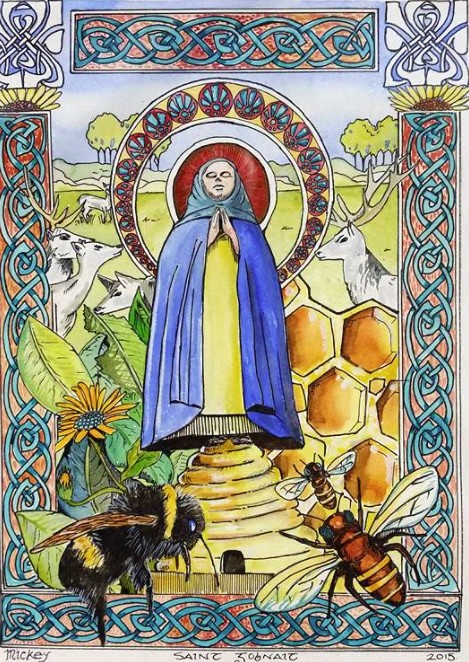
Saint of the Day – 11 February – Saint Gobnata (6th Century) Abbess, Founder of a Convent and ‘Order’ of Sisters, Miracle-worker, Apostle of the sick. Patronages – of bees, beekeepers. Also known as – Abigail, Albina, Deborah, Gobnat, Gobnet, Gobnait.

Gobnait was born in County Clare in the 5th or 6th Century and is said to have been the sister of Saint Abban. She fled a family feud, taking refuge in Inis Óir in the Aran Islands. Here an Angel appeared and told her that this was “not the place of her resurrection” and that she should look for a place where she would find nine white deer grazing. She found the deer at the place now known as St.Gobnet’s Wood. Saint Abban is said to have worked with her on the foundation of the Convent and to have placed Saint Gobnait over it as Abbess.

Gobnait is said to have added beekeeping to her life’s work, developing a lifelong affinity with them. She started a religious Order and dedicated her days to helping the sick. It has been speculated that she used honey as a medicinal aid. She is credited with being the intercessor who assisted and saved the people at Ballyvourney from the plague.

One story tells of how she drove off a brigand by sending a swarm of bees after him and making him restore the cattle he had stolen.

St Gobnait’s well (also known as St Debora’s, Deriola’s or Abigail’s well) is situated to the North of Ballyagran in a high field to the left of the road to Castletown. Pilgrimages have consistently, throughout the Centuries, been held to the well. The well has now dried up but the site is still known. It is said that a white dder or stag is sometimes seen at the well.

In 1601 Pope Clement VIII granted a special indulgence to those who, on Gobnata’s feast day, visited the Parish Church, went to Confession and Communion and who prayed for peace among ‘Christian princes’, the expulsion of heresy and the exaltation of the Church.

Posted in DECEMBER - The DIVINE INFANCY and The IMMACULATE CONCEPTION, MARIAN TITLES, MIRACLES, SAINT of the DAY, The IMMACULATE CONCEPTION

Notre-Dame-de-Lourdes / Our Lady of Lourdes and Memorials of the Saints – 11 February

Notre-Dame-de-Lourdes / Our Lady of Lourdes (11 February and 16 July of 1858) – (Optional Memorial)
Our Lady of Lourdes:
HERE:

https://anastpaul.com/2021/02/11/our-lady-of-lourdes-and-memorials-of-the-saints-11-february/
AND:
https://anastpaul.com/2018/02/11/the-memorial-of-the-apparitions-of-our-lady-of-lourdes-our-lady-of-the-immaculate-conception-and-the-26th-world-day-of-prayer-for-the-sick/

St Ampelius of Africa
St Ardanus of Tournus
Bl Bartholomew of Olmedo

St Caedmon (Died c 680) Monk and the is the earliest English known Poet of Sacred verse,
Biography of St Caedmon:

https://anastpaul.com/2019/02/11/saint-of-the-day-11-february-st-caedmon-died-c-680/

St Calocerus of Ravenna
St Castrensis of Capua
St Dativus the Senator
Bl Elizabeth Salviati
St Etchen of Clonfad
St Eutropius of Adrianopolis
St Felix the Senator
St Gobnata (6th Century) Abbess

St Pope Gregory II (669-731) Bishop of Rome from 715-731, Pope Gregory was a man of immense intellect and used his talents in negotiating peace in times of war and fought for the truth of the faith against heresies. He was a miracle-worker who placed all his trust in God ‘s Divine Providence.
About “The Defender of Icons”

https://anastpaul.com/2020/02/11/saint-of-the-day-11-february-saint-pope-gregory-ii-669-731-defender-of-icons/

Bl Gaudencia Benavides Herrero
St Helwisa
St Jonas of Muchon

St Lazarus of Milan (Died 449) Archbishop of Milan.
About this St Lazarus:

https://anastpaul.com/2021/02/11/saint-of-the-day-11-february-saint-lazarus-of-milan-died-449-archbishop-of-milan/

St Lucius of Adrianople
St Pedro de Jesús Maldonado-Lucero
St Saturninus of Africa
St Secundus of Puglia
St Severinus of Agaunum
St Soter of Rome
St Theodora the Empress
Bl Tobias Francisco Borrás Román

Guardians of the Sacred Scriptures: Also known as –
• Anonymous Martyrs in Africa
• Martyrs of Africa
• Martyrs of Numidia
• Martyrs of the Sacred Books
A large number of Christians tortured and murdered in Numidia (part of modern Algeria) during the persecutions of Diocletian but whose names and individual lives have not survived. They were ordered to surrender their sacred books to be burned. They refused. Martyrs. c 303 in Numidia.

Martyrs of Africa – 5 Saints: A group of five Christians who were Martyred together; we know nothing else but the names of four of them – Cyriacus, Oecominius, Peleonicus and Zoticus.

Posted in DOCTORS of the Church, QUOTES on CONSCIENCE, QUOTES on GRACE, QUOTES on REPENTANCE, QUOTES on SIN, SAINT of the DAY, The HOLY GHOST, The WORD

One Minute Reflection – 10 February – ‘The souls’ husband is the Holy Spirit, by His grace. …’

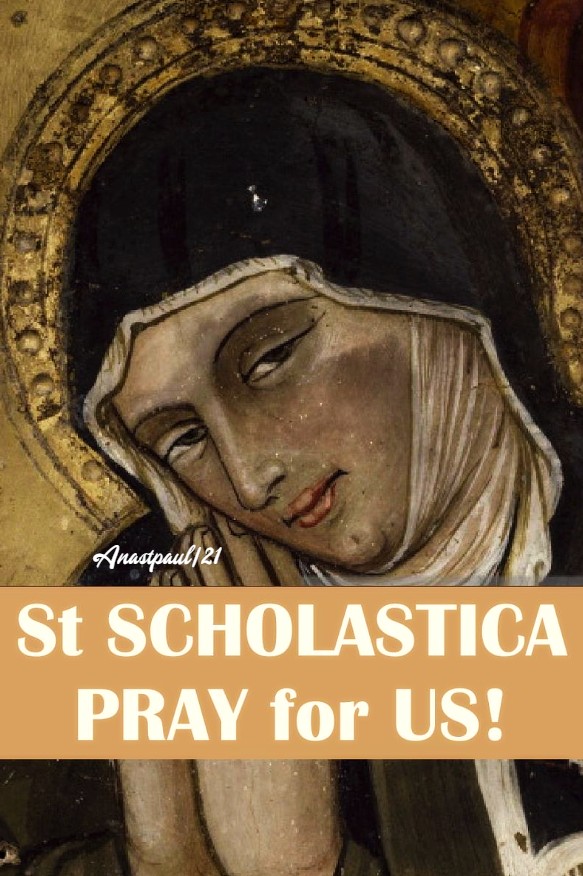
One Minute Reflection – 10 February – The Memorial of St Scholastica (c482-547) Virgin – 2 Cor 10:17-18; 11:1-2,
Matthew 25:1-13

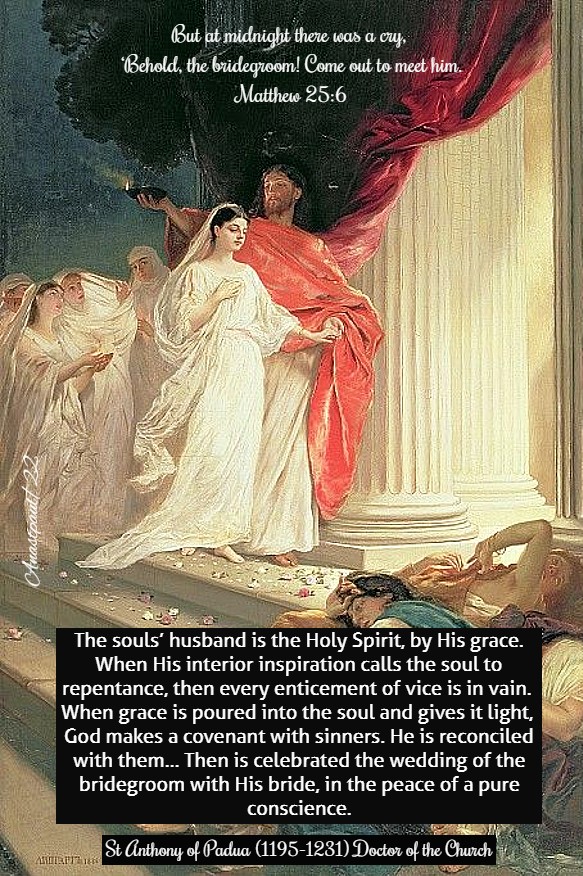
“But at midnight there was a cry, ‘Behold, the bridegroom! Come out to meet him.” – Matthew 25:6

REFLECTION – “The souls’ husband is the Holy Spirit, by His grace. When His interior inspiration calls the soul to repentance, then every enticement of vice is in vain. The pride that wants command, the greed and lust that consumes everything: this was the master that used to control and ravage the soul. Their very names have been removed from the repentant sinner’s mouth… When grace is poured into the soul and gives it light, God makes a covenant with sinners. He is reconciled with them… Then is celebrated the wedding of the Bridegroom with His bride, in the peace of a pure conscience.” – St Anthony of Padua (1195-1231) Doctor of the Church

PRAYER – O God, Who, to show us the way of innocence, caused the soul of Your Virgin, blessed Scholastica, to fly up to Heaven in the likeness of a dove, grant us, through her merits and prayers, to live innocently, so that we may be found worthy to reach everlasting joys. Through Jesus Christ, Thy Son our Lord, Who lives and reigns with Thee, in the unity of the Holy Ghost, God, world without end. Amen (Collect).

Posted in SAINT of the DAY

Saint of the Day – 10 February – Blessed Clare Agolanti of Rimini OSC (1282-1346)

Saint of the Day – 10 February – Blessed Clare Agolanti of Rimini OSC (1282-1346) Married, Widowed, Nun., Penitent, Mystic. Born as Chiara Agolanti in 1282 at Rimini, Italy and died on 10 February 1344 at Rimini, Italy of natural causes.

The Vision of the Blessed Clare of Rimini / Francesco da Rimini (Master of the Blessed Clare). ca. 1333–1340.

Chiara Agolanti was born to a wealthy family of Rimini. Married at a young age, she was sent into exile upon the death of her husband. Upon her return, she witnessed the horrifying hanging of her father and brother by a rival political faction. She remarried and soon fell a prey to the dangers to which her youth and beauty exposed her, and began to lead a life of sinful dissipation.

One day when she was attending Mass in the Church of the Franciscan Friars, she seemed to hear a mysterious voice that bade her say an Our Father and a Hail Mary at least once with fervour and attention. Clare obeyed the command, not knowing from where it came and then began to reflect upon her life.

She made the decision to enter into the Third Order of Saint Francis, resolving to expiate her sins by a life of penance. She soon became a model of every virtue but more especially of charity towards the destitute and afflicted.

She abandoned her life of luxury and established a convent for a group of women under her direction. When the Poor Clares were compelled to leave Regno on account of the prevailing wars, it was mainly through the exertions of Clare that they were able to obtain a Convent and means of sustenance at Rimini.

Later, Clare herself entered the Order of Poor Clares Nuns, along with several other pious women and became Prioress of the Convent of Our Lady of the Angels at Rimini. She is believed to have worked numerous miracles and towards the close of her life to have been favoured in an extraordinary manner with the gift of contemplation.

Her body is now in the cathedral of Rimini.

On 22 December 1784 her cutus was confirmed by Pope Pius VI.

Posted in MARIAN TITLES, SAINT of the DAY

Nostra Signora delle Colombe / Our Lady of the Doves (Bologna, Italy) and Memorials of the Saints – 10 February

Nostra Signora delle Colombe / Our Lady of the Doves (Bologna, Italy) – 10 February:
HERE:

https://anastpaul.com/2021/02/10/our-lady-of-the-doves-bologna-italy-and-memorials-of-the-saints-10-february/

St Scholastica (c482-547) (Memorial) Virgin Nun.
About this twin of St Benedict:

https://anastpaul.wordpress.com/2017/02/10/saint-of-the-day-10-february-st-scholastica/

Bl Alexander of Lugo

Blessed Alojzije/Aloysius Cardinal Stepinac (1898–1960) Martyr, Cardinal, Archbishop of Zagreb.
About:

https://anastpaul.com/2019/02/10/saint-of-the-day-10-february-blessed-aloysius-stepinac-1898-1960/

St Andrew of Bethlehem
St Aponius of Bethlehem

St Austrebertha of Pavilly OSB (630–704) Abbess, Benedictine Nun and Abbess of Pavilly, France, miracle-worker.
Her Life:

https://anastpaul.com/2021/02/10/saint-of-the-day-10-february-saint-austrebertha-of-pavilly-osb-630-704/

St St Baldegundis
St Baptus of Magnesia
Bl Catherine du Verdier de la Sorinière
St Charalampias
Blessed Clare Agolanti of Rimini OSC (1282-1346) Married, Widowed, Nun
St Desideratus of Clermont
St Erluph of Werden
Bl Eusebia Palomino Yenes
Bl Hugh of Fosse

St José Sánchez del Río “Joselito” (1913-1928) Boy Martyr was a Mexican Cristero who was put to death by government officials because he refused to renounce his Catholic faith. His death was seen as a largely political venture on the part of government officials in their attempt to stamp out dissent and crush religious freedom in the area. Patronages – Persecuted Christians, Catholic Children and Adolescents, Sahuayo, Mexico, his birthplace.
Biography:

https://anastpaul.wordpress.com/2018/02/10/saint-of-the-day-10-february-st-jose-sanchez-del-rio-joselito-1913-1928-boy-martyr/

Bl Louise Bessay de la Voûte
Bl Louise Poirier épouse Barré
Bl Marie-Anne Hacher du Bois
Bl Marie-Louise du Verdier de la Sorinière
Bl Mikel Beltoja
Bl Paganus
Bl Paul of Wallachia
Bl Pierre Frémond
St Porfirio
St Prothadius of Besançon
St Salvius of Albelda
St Silvanus of Terracina
St Soteris the Martyr
St Troiano of Saintes
St Trumwin of Whitby

St William the Hermit (Died 1157) Hermit, Penitent, Spiritual Director, Miracle-worker, gifted with the charism of Prophecy.
About St William:

https://anastpaul.com/2020/02/10/saint-of-the-day-10-february-saint-william-the-hermit-died-1157/

Martyred Soldiers in Rome: A group of ten Christian soldiers who were Martyred together for their faith. We know little more about them but four of their names – Amantius, Hyacinth, Irenaeus and Zoticus. • 120 at Rome, Italy. They were buried on the Via Lavicana outside RomeAmantius, Hyacinth, Irenaeus, Zoticus.

Posted in "Follow Me", CHRIST the HIGH PRIEST, CHRIST the JUDGE, CHRIST the KING, CHRIST the PHYSICIAN, CHRIST the WORD and WISDOM, CHRIST, the WAY,TRUTH,LIFE, DOCTORS of the Church, EUCHARISTIC, FATHERS of the Church, GOD ALONE!, LOVE of NEIGHBOUR, MARIAN PRAYERS, MARIAN QUOTES, MOTHER of GOD, PRACTISING CATHOLIC, PRAYERS of the SAINTS, QUOTES on CHASTITY, QUOTES on GRATITUDE, QUOTES on HEAVEN, QUOTES on LOVE, QUOTES on LOVE of GOD, QUOTES on Lukewarmness, QUOTES on OBEDIENCE, QUOTES on PRIDE, QUOTES on PURITY, QUOTES on TEMPTATION, SAINT of the DAY, The GOOD SHEPHERD, The LAMB of GOD

Quote/s of the Day – 9 February – St Cyril of Alexandria

Quote/s of the Day – 9 February – The Memorial of St Cyril of Alexandria (376-444) Bishop, Confessor, Father and Doctor of the Church

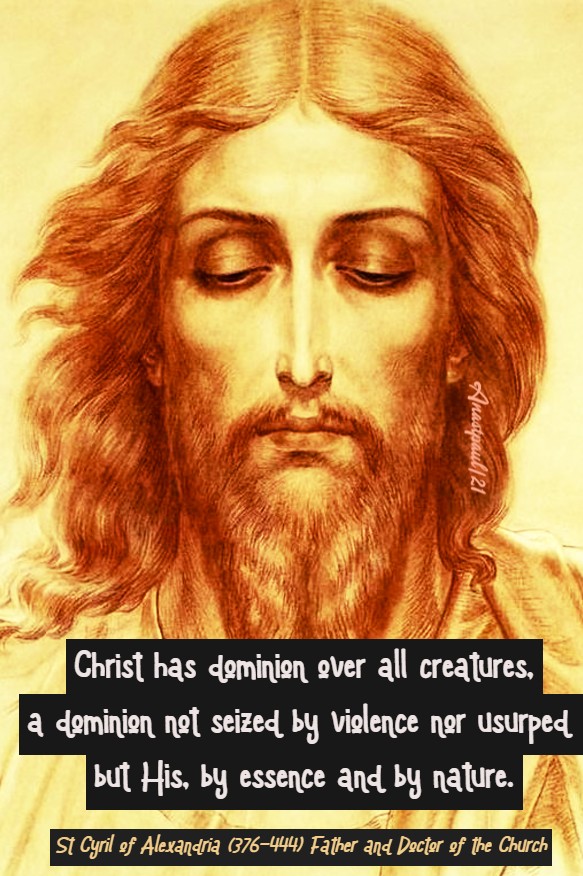
“Christ has dominion
over all creatures,
a dominion not seized
by violence
nor usurped but His,
by essence and by nature
.”

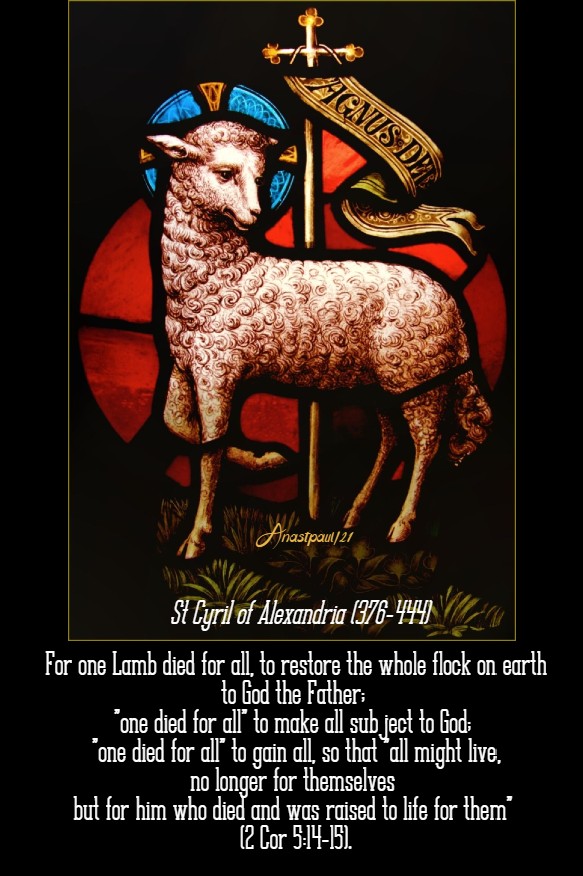
“For one Lamb died for all,
to restore the whole flock on earth
to God the Father;
“one died for all”
to make all subject to God;
“one died for all”
to gain all, so that
“all might live,
no longer for themselves
but for Him who died
and was raised to life for them
”
(2 Cor 5:14-15).”

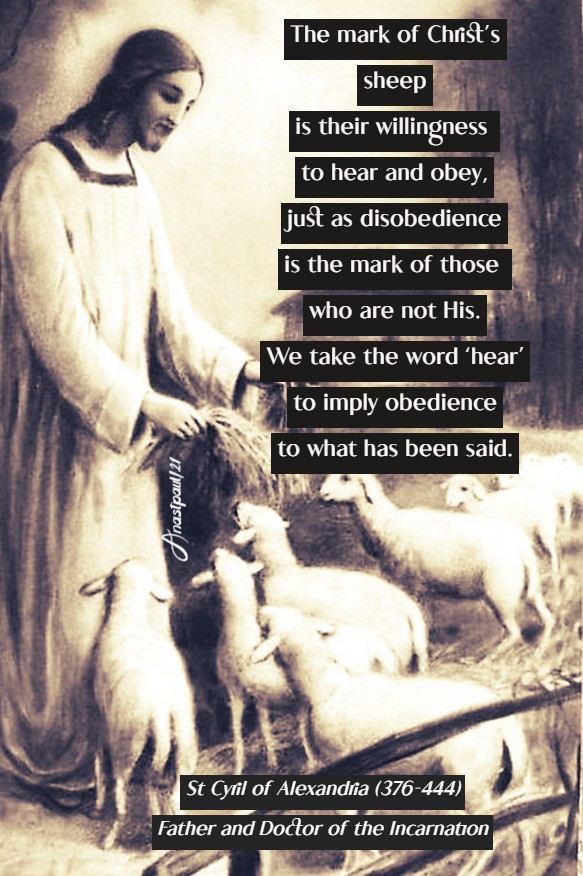
“The mark of Christ’s sheep
is their willingness to hear and obey,
just as disobedience
is the mark of those who are not His.
We take the word ‘hear’
to imply obedience
to what has been said
.”

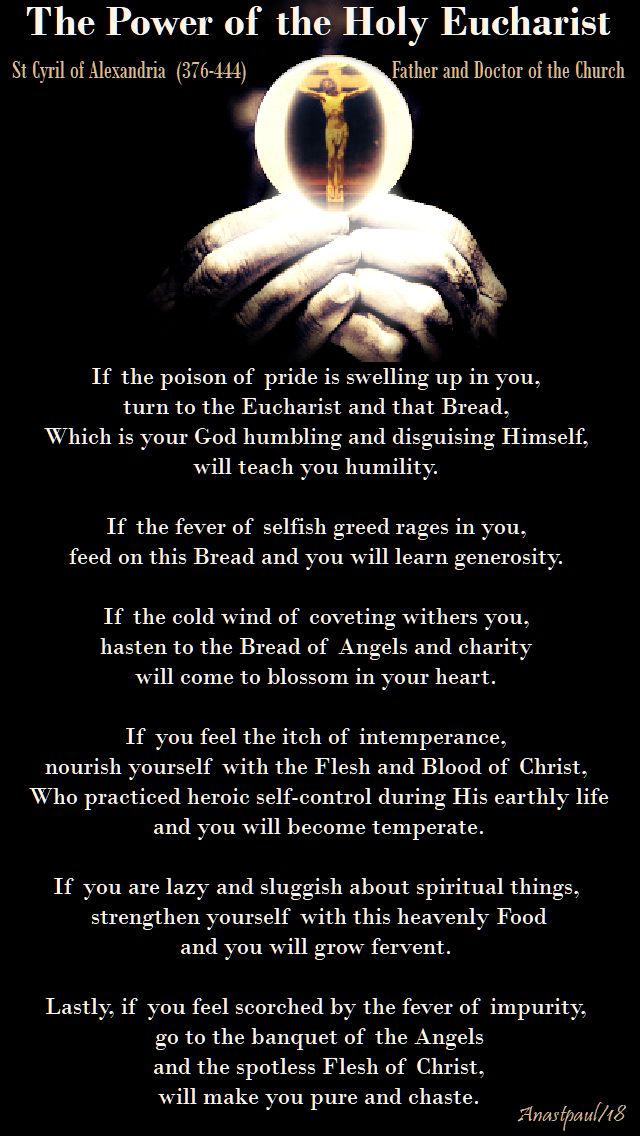
“If the poison of pride is swelling up in you,
turn to the Eucharist and that Bread,
Which is your God humbling and disguising Himself,
will teach you humility.

If the fever of selfish greed rages in you,
feed on this Bread and you will learn generosity.

If the cold wind of coveting withers you,
hasten to the Bread of Angels and charity
will come to blossom in your heart
.

If you feel the itch of intemperance,
nourish yourself with the Flesh and Blood of Christ,
Who practiced heroic self-control during His earthly life
and you will become temperate.

If you are lazy and sluggish about spiritual things,
strengthen yourself with this heavenly Food
and you will grow fervent.

Lastly, if you feel scorched by the fever of impurity,
go to the banquet of the Angels
and the spotless Flesh of Christ,
will make you pure and chaste.
”

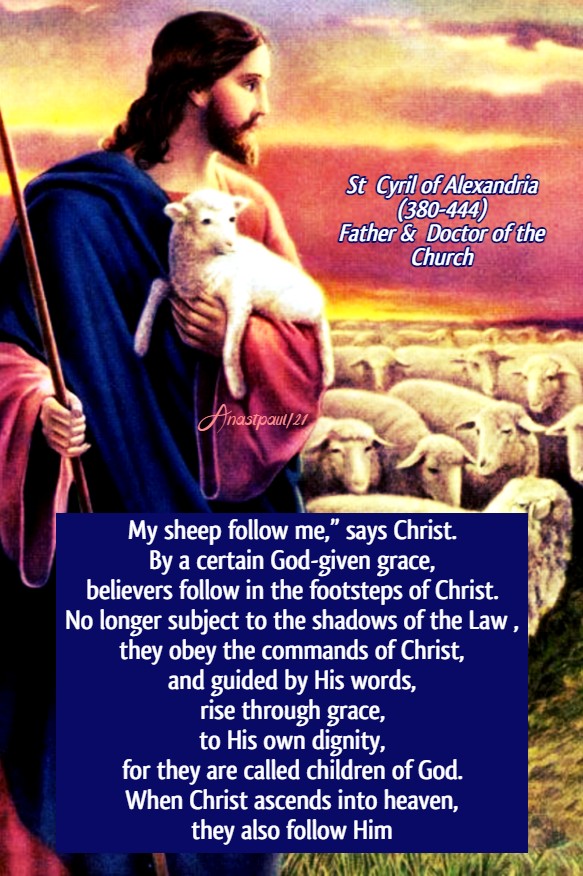
“My sheep follow me,” says Christ.
By a certain God-given grace,
believers follow in the footsteps of Christ.
No longer subject to the shadows of the Law ,
they obey the commands of Christ,
and guided by His words,
rise through grace,
to His own dignity,
for they are called children of God.
When Christ ascends into heaven,
they also follow Him.”

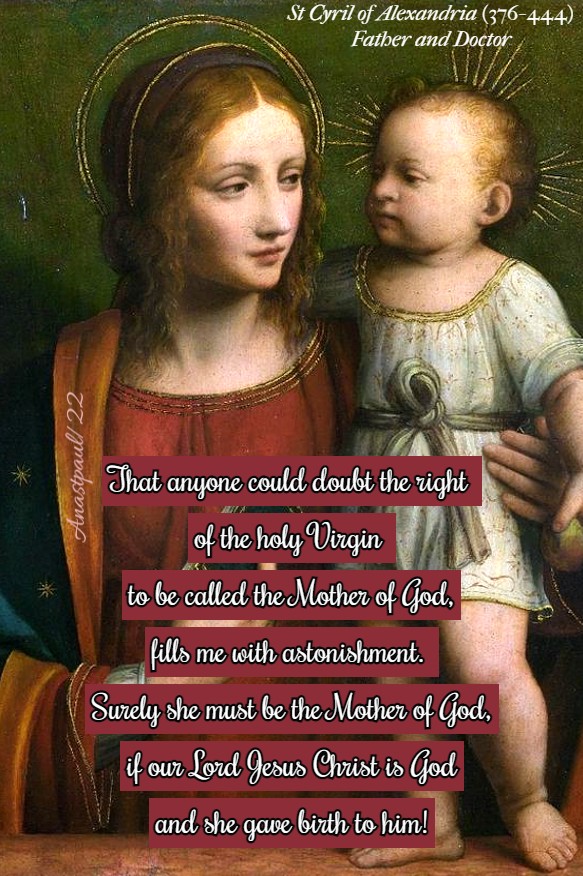
“That anyone could doubt the right
of the holy Virgin
to be called the Mother of God,
fills me with astonishment.
Surely she must be the Mother of God,
if our Lord Jesus Christ is God
and she gave birth to him
!”

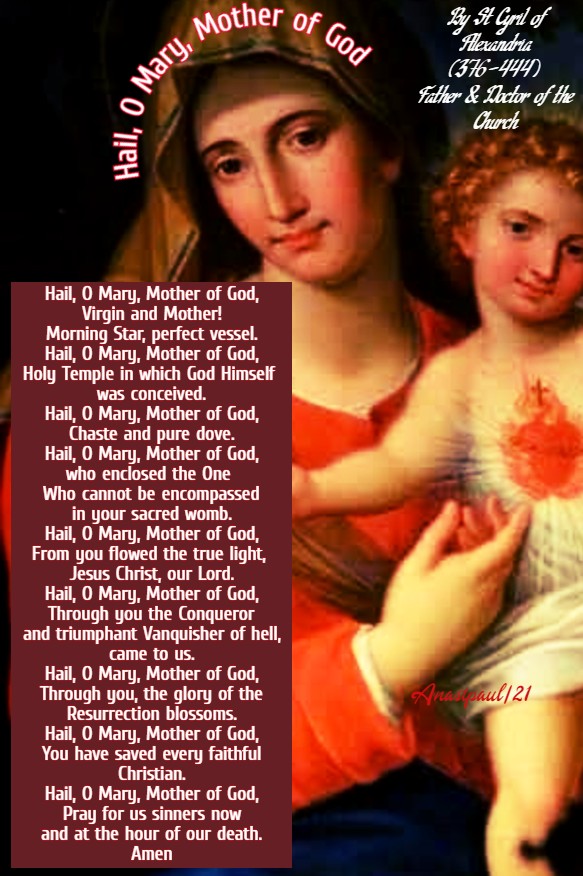
Hail, O Mary, Mother of God
By St Cyril of Alexandria (376-444)
Father & Doctor of the Church

Hail, O Mary, Mother of God,
Virgin and Mother!
Morning Star, perfect vessel.
Hail, O Mary, Mother of God,
Holy Temple in which God Himself was conceived.
Hail, O Mary, Mother of God,
Chaste and pure dove.
Hail, O Mary, Mother of God,
who enclosed the One Who cannot be encompassed
in your sacred womb.
Hail, O Mary, Mother of God,
From you flowed the true light, Jesus Christ, our Lord.
Hail, O Mary, Mother of God,
Through you the Conqueror
and triumphant Vanquisher of hell, came to us.
Hail, O Mary, Mother of God,
Through you, the glory of the Resurrection blossoms.
Hail, O Mary, Mother of God,
You have saved every faithful Christian.
Hail, O Mary, Mother of God,
Pray for us sinners now
and at the hour of our death.
Amen

St Cyril of Alexandria (376-444)

Posted in INCORRUPTIBLES, SAINT of the DAY

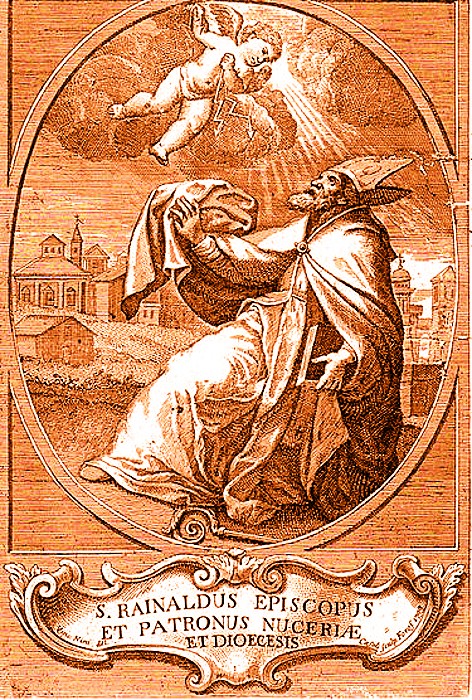
Saint of the Day – 9 February – Saint Raynald of Nocera (c 1150-1217)

Saint of the Day – 9 February – Saint Raynald of Nocera (c 1150-1217) Bishop of Nocera, Umbria, Italy, Hermit, Monk, Abbot. Born in c 1150 smf died on 9 February 1217 in Nocera, Umbria, Italy of natural causes. Patronages – the Diocese of Assisi-Nocera Umbria-Gualdo Tadino, Italy. and City of Norcera. Also known as Rainaldus and Rainaldo. His body is incorrupt.

The Roman Martyrology reads: “In Nocera Umbra, St. Rainaldo, Bishop, formerly a Camaldolese Monk of Fonte Avellana, who, while carrying out the Episcopal office, firmly preserved the habits of monastic life.”

Raynald was a rather singular figure of a Hermit Monk and Bishop, who broke away from the mentality of his time, to radically change his life, becoming an admirable example of piety and charity, faith and obedience, in a world characterised by wealth and power, compromises and collusions between secular and spiritual powers.

He was the eldest son of one of the local Lords who dominated Nocera nd Foligno, heir to the fief of Postignano and already destined for posts of political and military importance of the first degree, Raynald received a refined education as befitted his rank.

But at the age of twenty, he abandoned all his possessions to give himself to the hermitage on the mountain of Gualdo, the Serrasanta, famous for the presence of men dedicated to prayer and penance. Here he was able to live “a perfect eremitical life.” However, he soon felt, in his heart the need to submit to a superior, who could guide him in constantly following God’s will and he then became a Monk at the Camaldolese Monastery of Fonte Avellana, where “together with his brothers, he served God perfectly and devoutly” and was also elected Abbot.

Raynald was associated in the Episcopate with Bishop Ugo,who was engaged in high juridical positions in the Roman Curia. In 1213, on the death of Ugo, the holy hermit became the Bishop of the Diocese.

The Episcopate of Raynald was distinguished by his unusual choice – to remain a Monk even as a Bishop and he did so with the typical obstinacy of Saints, always entirely dedicated to God and to his brothers, as the Minor Legend narrates: “he kept his life perfect, as when he was in the Monastery with fasts, vigils and prayers, dedicating himself to God and busy in the Bishop’s care as a celebrant of divine worship and a helper of the poorest and most needy people .”

To give a living example of Christian love, he adopted a child from Nocera, an orphan, keeping him in the Bishop’s palace and honouring him every day at the table, as if it had been Christ Himself Who was asking for help.

The presence of the holy Bishop was important at the promulgation of the Indulgence of the Portiuncula in August 1216, commissioned by St Francis of Assisi.

Raynald died on 9 February 1217 near Nocera Umbra and his body was immediately honoured. With a trial on miracles, promoted by his successor Bishop Pelagius, after a few months, he was raised on the main Altar of the Cathedral and, therefore, proclaimed a Saint according to the customs of the time.

The troubled political events soon dispersed, attributed to the intercession of the Saint. In 1248 Nocera, a Guelph City, was destroyed by the army of Frederick II who encamped in the aforementioned Cathedral. An extraordinary event was the discovery of the body of St Raynald, intact. St Raynald was then proclaimed Patron of Nocera and his tomb was transferred to the Church of Santa Maria dell’Arengo, now dedicated to St John the Baptist. The destroyed City was rebuilt and the devotion to the Saint persisted over the centuries.

When in 1448 the reconstruction of the Cathedral resumed again, the memory of St Raynald was added to the official title of the Church, which, for seven centuries had been dedicated to the Virgin of the Assumption. His body was solemnly transported to the new Cathedral in 1456 and for centuries it was the centre of the cult that made St Raynald the protector of the City and of the Diocese of Nocera.

The Saint did not fail to help his faithful with protective intercession in the tragic moments of wars, destruction and calamitous events such as frequent earthquakes. Today, after the painful events of the 1997 earthquake, the Patron’s still incorrupt body was venerated in the Church of St Felicissimus.
On the anniversary of his death, St Raynald is commemorated by the Camaldolese Monastery.

Posted in MARIAN TITLES, SAINT of the DAY

Notre-Dame-des-Cloches / Our Lady of the Bells, Cathedral of Saintes, France and Memorials of the Saints – 9 February

Notre-Dame-des-Cloches / Our Lady of the Bells, Cathedral of Saintes, France – 9 February:
HERE:

https://anastpaul.com/2021/02/09/our-lady-of-the-bells-cathedral-of-saintes-france-and-memorials-of-the-saints-9-february/

St Cyril of Alexandria (376-444) “The Pillar of Faith” & “Seal of all the Fathers,”, Bishop, Confessor, Father and Doctor, Doctor Incarnationis (Doctor of the Incarnation) Added by Pope Leo XIII in 1883.
St Cyril’s Feast Day is today 9 February (1882–1969).

https://anastpaul.com/2017/06/27/saint-of-the-day-27-june-st-cyril-of-alexandria-doctor-father-of-the-church-the-pillar-of-faith-seal-of-all-the-fathers-doctor-incarnationis-doctor-of-the-incarnation/
AND:
https://anastpaul.com/2018/06/27/saint-of-the-day-27-june-st-cyril-of-alexandria-376-444-father-and-doctor-of-the-church/

St Alexander of Rome
St Alexander of Soli
St Alto of Altomünster
St Ammon of Membressa
St Ammonius of Soli

Blessed Anne Catherine Emmerich (1774-1824) Handicapped, Virgin, Religious, Penitent, Marian Visionary, Mystic, Ecstatic, Writer and Stigmatist. Her body is incorrupt.
Biography:

https://anastpaul.wordpress.com/2018/02/09/saint-of-the-day-9-february-blessed-anna-katharina-emmerick-anne-catherine-emmerich-1774-1824/

St Ansbert of Rouen

St Apollonia of Alexandria (Died c 249) Virgin Martyr, Deaconess.
St Apollonia’s life and death:

https://anastpaul.com/2019/02/09/saint-of-the-day-9-february-st-apollonia-of-alexandria-died-c-249/

St Attracta of Killaraght
St Brachio of Auvergne
St Cuaran the Wise
St Didymus of Membressa
St Donatus the Deacon
St Eingan of Llanengan
St Emilian of Membressa
Bl Erizzo
Bl Francisco Sanchez Marquez

Blessed Giacomo Abbondo (1720-1788) Priest, Apostle of the poor, Spiritual guide, renowned Preacher.
His Life:

https://anastpaul.com/2020/02/09/saint-of-the-day-9-february-blessed-giacomo-abbondo-1720-1788/

Bl Godeschalk of Želiv
St Lassa of Membressa
Bl Marianus Scotus
St Maro

St Miguel Febres Cordero Muñoz FSC (1854-1910) Christian Brother, Teacher, Writer.
About St Miguel:

https://anastpaul.wordpress.com/2017/02/09/saint-of-the-day-9-february-st-miguel-febres-cordero-munozbrother-miguel/

St Nebridius of Egara
St Nicephorus of Antioch
St Poëmus of Membressa
St Primus the Deacon
St Raynald of Nocera (c 1150-1217) Bishop
St Romanus the Wonder Worker
St Ronan of Lismore
St Sabino of Abellinum

St Sabinus of Canosa (c 461–566) Bishop, Confessor, Benedictine Monk, Papal Legate, miracle-worker, graced with the charism of prophecy, Defender of the Faith against heretics, friend of Saint Benedict of Nursia, builder of Churches and Monasteries, following the Benedictine discipline of Ora et labora.
His Life:

https://anastpaul.com/2021/02/09/saint-of-the-day-9-february-saint-sabinus-of-canosa-c-461-566-bishop/

St Teilo of Llandaff

Martyrs of Alexandria: An unknown number of Christians who were massacred in church in 4th century Alexandria, Egypt by Arian heretics for adhering to the orthodox faith.

Martyrs of Membressa: A group of 44 Christians martyred together. We know little else about them some names –
• Ammon
• Didymus
• Emilian
• Lassa
• Poemus
They were martyred in Membressa in Africa.

Posted in CHEFS and/or BAKERS, CONFECTIONERS, SAINT of the DAY

Saint of the Day – 8 February – St Paul of Verdun (c 576-c 648)

Saint of the Day – 8 February – St Paul of Verdun (c 576-c 648) Bishop of Verdun, in the Lorraine region of France from 630 until his death., Abbot. Patronage – Verdun, bakers and pastry chefs. Also known as St Paulus of Verdun.

The Roman Martyrology states: “At Verdun in France, St Paulus, Bishop renowned for miracles.”

Paul was the son of a wealthy family – his name suggests that he was part of the old Gallo-Roman aristocracy. According to St Augustine Abbey’s Book of Saints, Paulus was the brother of Saint Germanus of Paris, although in St Germanus’s Vita we find no reference to a brother, not that this is decisive, considering the little information we have of our ancient Saints.

Paul became a hermit and spent time in the mountains of Paulsberg (named for him in modern France), near Trier in modern Germany. Later he became a Monk at the Monastery at Tholey, Germany, where he was firstly appointed as the Master of the School and then the second Abbot.

In around 630, Paul was named the Bishop of Verdun, by King Dagobert I. According to his Vita he was made Bishop against his will and due to the influence of one of his students, Adalgisel Grimo. Reportedly he found the Diocese in a very poor financial state and was aided by grants from said Adalgisel and the Frankish King of Austrasia.

One of his numerous miracles relates, that as Paul was working in the bakery in the Abbey of Tholey when the oven became clogged with ash and malfunctioned. He feared that the bread would not be ready in time for the meal, so he climbed into the burning oven in full habit, cleaned it with his hood, arranged the loaves to be baked and later emerged from the oven with the fully baked loaves. Because of this miracle, Paulus became the Patron Saint of bakers and pastry chefs. On his feast day the “bread of Saint Paul” is distributed annually on the streets of Verdun.

Paul died in c 648 and was buried in the Church of St Saturninus in Verdun, which he had built and which was later renamed St Paul’s after him.

The Abbey of Saint-Paul de Verdun, founded by Bishop Viefrid from 970 to 973 was dedicated to him.

The Abbey of Verdun

In addition, the “Paul-Cross” was erected in stone a few kilometers from Verdun, at a place called “Le Rozelier”. The Bishop Saint represented there was recognisable as Saint Paulus from the bread that he is holding. The Plague beneath this Cross states:

“In the late Ninth Century, the Monks of Tholey translated to their Abbey in Saarland the relics of Saint Paul, Bishop of Verdun, a former Monk of Tholey Abbey, in order to evade the Norman invasion. Here they were stopped by a mysterious and miraculous force. A cross was erected in this place, commemorating the miraculous event and is called the Paul Cross. The Abbey of Saint-Vanne de Verdun established a Priory there in the 12th century. The current Cross and the Altar, which contains a relic of St Paul, were blessed by Monseigneur Petit, Bishop of Verdun, on 14 August 1963.”

St Paul distributing bread from the “St Paul Cross” near Verdun

Added to the ramparts of the City of Verdun in the Nineteenth Century is a gate called “St Paul’s Gate.” iI is composed of two arched passages (entry and exit), each one protected by a drawbridge. The Gate allowed the Army conscripts arriving at the Station to enter the City centre and reach the Jeanne d’Arc Barracks. In the 1920s the ramparts around the lower City, weakened by the bombardments of 1916, were pulled down. The only surviving remnants are the Saint-Paul Gate along with the Tour Chaussée. The former has been decorated with commemorative plaques dedicated to victory in the Battle of Verdun and to the reconstruction of the City., believed, of course, to be due to the prayers of their people for the Intercession of the Blessed Virgin of Verdun and the beloved St Paul.

Posted in SAINT of the DAY

Abbey of Notre-Dame du Lys / Our Lady of the Lily, Melun, France (13th Century) and Memorials of the Saqints – 8 February

Abbey of Notre-Dame du Lys / Our Lady of the Lily, Melun, France (13th Century) – 8 February:
HERE:

https://anastpaul.com/2021/02/08/abbey-of-our-lady-of-the-lily-melun-france-13th-century-and-memorials-of-the-saints-8-february/

St John of Matha O.SS.T (1160-1213) – Priest, Founder of The Order of the Most Holy Trinity and of the Captives, also known as the Order of the Most Holy Trinity or the Trinitarians,
Feast day is today – moved in 1969.
Biography:

https://anastpaul.com/2018/12/17/saint-of-the-day-17-december-st-john-of-matha-o-ss-t-1160-1213/

St Jerome Emiliani CRS (1486–1537) Layman, Founder of the Somascan Fathers, Apostle of the poor, orphans, the sick. Patronages – the Somaschians, orphans, abandoned children.
St Jerome was numbered amongst the Saints by Pope Clement XIII and assigned the Feast Day of 20 July.
About St Jerome:
https://anastpaul.com/2019/02/08/saint-of-the-day-8-february-st-jerome-emiliani-crs-1486-1537/

St Josephine Bakhita FDCC (1869-1947) (Memorial) Former Slave, Canossian Religious Sister in Italy, living and working there for 45 years.
Biography:

https://anastpaul.wordpress.com/2018/02/08/saint-of-the-day-8-february-st-josephine-bakhita-1869-1947/

St Cointha of Alexandria
St St Cuthman
St Cyriacus of Rome
St Dionysus of Armenia
St Elfleda of Whitby
St Emilian of Armenia

Blessed Maria Esperanza de Jesus (1893-1983) Nun and Founder of both the Handmaids of Merciful Love in 1930 and the Sons of Merciful Love in 1951.
About Bl Maria:

https://anastpaul.com/2020/02/08/saint-of-the-day-8-february-blessed-maria-esperanza-de-jesus-1893-1983/

St Giacuto
St Gisela
St Honoratus of Milan
St Inventius of Pavia
St Isaias Boner
St Jacoba
Bl Josephina Gabriella Bonino
St Kigwe
St Lucius of Rome
St Meingold
St Mlada of Prague
St Nicetius of Besançon
St Oncho of Clonmore
St Paul of Rome
St Paul of Verdun (c 576-c 648) Bishop

Blessed Pietro Igneus OSB Vall. (c 1020 – 1089) Cardinal Bishop of Albano, Reformer – particularly against simony, Papal Legate and peace-maker.
His Life:

https://anastpaul.com/2021/02/08/saint-of-the-day-8-february-blessed-pietro-igneus-osb-vall-c-1020-1089-cardinal-bishop/

St Sebastian of Armenia
St Stephen of Muret

Martyrs of Constantinople: Community of 5th century Monks at the Monastery of Saint Dius at Constantinople. Imprisoned and martyred for loyalty to the Vatican during the Acacian Schism. 485 in Constantinople.

Martyrs of Persia: An unknown number of Christians murdered in early 6th-century Persia. Legend says that so many miracles occurred through the intercession of these Martyrs that the King decreed an end to the persecution of Christians.

Posted in QUOTES on PRAYER, SAINT of the DAY

Quote/s of the Day –7 February – St Romuald

Quote/s of the Day –7 February – The Memorial of St Romuald, Abbot (c 951-1027) – Ecclus 45:1-6, Matthew 19:27-29.

“Better to pray one psalm
with devotion and compunction,
than a hundred. with distraction.
”

“Sit in your cell as in paradise.
Put the whole world
behind you and forget it.
Watch your thoughts
like a good fisherman
watching for fish.
”

“Realise above all,
that you are in God’s presence
and stand there
with the attitude
of one, who stands
before the Emperor
.”

St Romuald (c 951-1027)

Posted in SAINT of the DAY

Saint of the Day – 7 February – Saint Richard the King Pilgrim (Died c 722)

Saint of the Day – 7 February – Saint Richard the King Pilgrim (Died c 722) Layman Prince, Married and was the Father of the West Saxon Saints Willibald (Bishop of Eichstadt), Winnibald (Abbot of Heidesheim) and Walburga. (Virgin, Nun). Died in722 at Lucca, Italy of natural causes. Also known as – Richard of Lucca, Richard the Pilgrim, Richard the Saxon, Ricanus, Ricarius, Richard of Wessex.

The Roman Martyrology reads: “In Lucca, deposition of St Riccard, Father of the Saints Willibald, Winnibald and Walburga, who died on the way with his children from England to Rome.”

Richard, Prince of the Western Saxons, husband of a relative of Saint Boniface, St Wuna.

This noble and devout family came from Wessex, an English region and according to an account of the Nun Hugebure of Heidenheim, in 720, he entrusted his eleven-year-old daughter Walburga to the Abbess of Wimborne in Dorset, renounced his estates, and left with his two sons on a pilgrimage to Rome. Willibald was just twenty and Wunibald was nineteen.

Left to right – St Willibald, St Wuna, St Richard, St Walburga, St Winnibald

Sailing on the River Hamble, near Southampton, they crossed the English Channel and then up the Seine, finally arriving at Rouen in France. Not before having visited and prayed at numerous French Shrines and Sanctuaries, the three pilgrims then made their way to Italy.

Riccard died unexpectedly after developing a fever, near Lucca in c 722, before reaching Rome. In this Tuscan City, the pilgrim Saint still rests today and his relics are the object of veneration in the Basilica of St Fredian.

St Willibald then joined the famous St Boniface in the evangelisation of Germany, founding the double Monastery of Heidenheim and becoming the first Bishop of the City of Eichstatt. Wunibald was also a Missionary with them and ran the Heidenheim Monastery with his sister Walburga., when she joined them. When Willibald died and was buried in Eichstadt, it was desired that Riccard’s remains, which were still deposited in Lucca, would be transferred there so that they could rest next to those of his son. The faithful of Lucca, however, firmly opposed this suggestion and the inhabitants of Eichstadt had to be content with a little dust from his tomb.

However, in consideration of the sublime holiness of his offspring and the numerous miracles that occurred at his tomb in St Fredian, a life of “Saint Richard, King of England” was then written, a title thus also bestowed upon him by the Catholic Martyrology until 1956.

Richard is depicted with the Blessed Mother and his three children at Eichstädt Cathedral. In religious artworks, Richard is portrayed as a royal pilgrim in an ermine-lined cloak with two sons, one a Bishop and one an Abbot.

St Willibald:
https://anastpaul.com/2021/07/07/saint-of-the-day-7-july-st-willibald-of-eichstatt-c-700-787/

St Winnibald:
https://anastpaul.com/2020/12/18/saint-of-the-day-18-december-saint-winebald-osb-c-701-761/

St Walburga:
https://anastpaul.com/2017/02/25/saint-of-the-day-25-february-st-walburga/