Posted in FEASTS and SOLEMNITIES, MORNING Prayers, PRAYERS of the CHURCH, QUOTES - J R R Tolkien and MORE, SAINT of the DAY, The APOSTLES & EVANGELISTS, The WORD

One Minute Reflection – 18 November – The Feast of the Dediciation of the Basilicas of Sts Peter and Paul

One Minute Reflection – 18 November – The Feast of the Dediciation of the Basilicas of Sts Peter and Paul

To you all, God’s beloved in Rome, called to be his holy people…..Romans 1:7romans 1 - 7

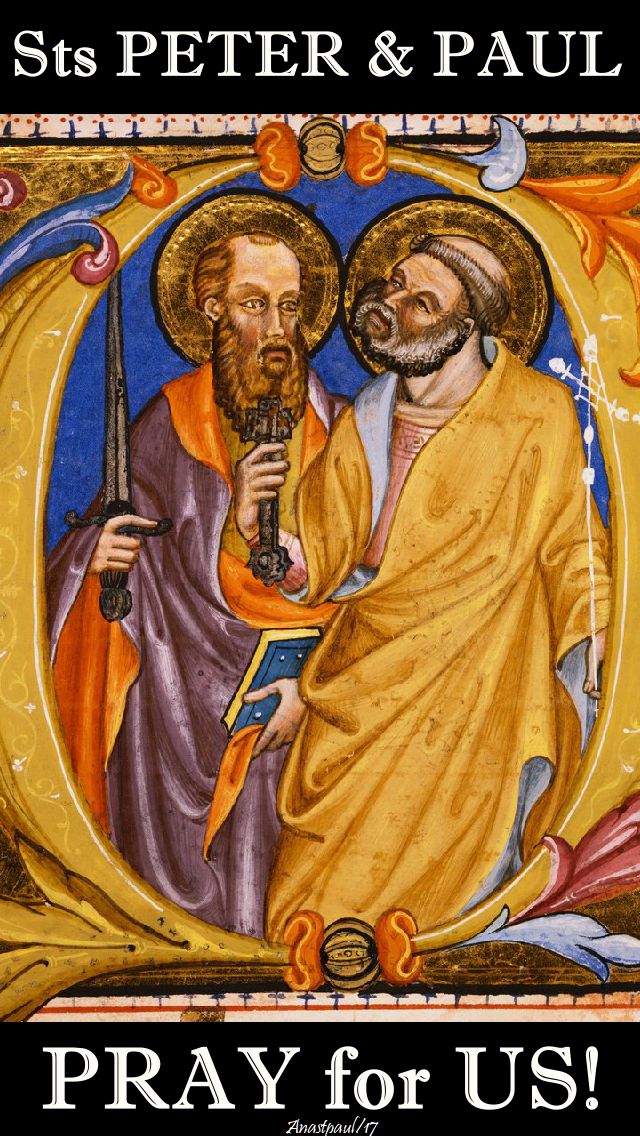
REFLECTION – “The present feast therefore deserves to be more than a local solemnity;  its extension to the Universal Church is a subject for the world’s gratitude.   Thanks to this Feast we can all make together in spirit today the pilgrimage, which our ancestors performed with such fatigue and danger, yet never thought they purchased at too high a price its holy joys and blessings. “Heavenly mountains, glittering heights of the new Sion!”  There are the gates of our true country, the two lights of the immense world.   There Paul’s voice is heard like thunder;   there Peter withholds or hurls the bolt.   The former opens the hearts of men, the latter opens Heaven.   Peter is the foundation-stone, Paul the architect of the temple where stands the altar by which God is propitiated.   Both together from a single fountain, which pours out its healing and refreshing waters” …Bishop Venantius Fortunatus (c 530 – c 609).there are the gares of our true country - Bishop Venantius Fortunatus (c 530 - c 609). - 18 nov 2017

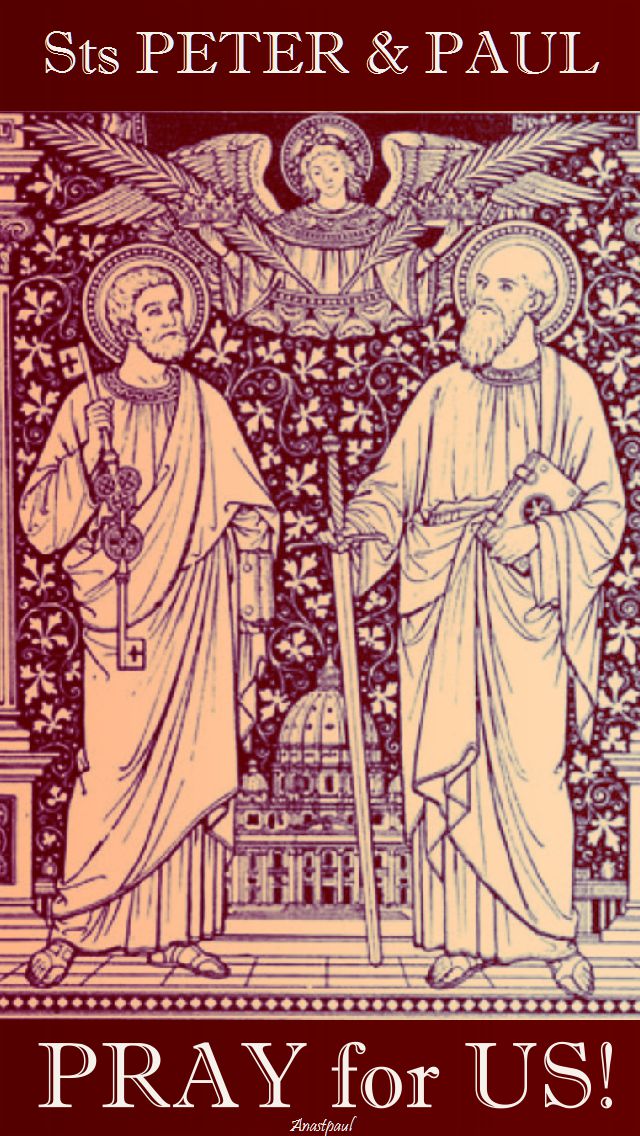
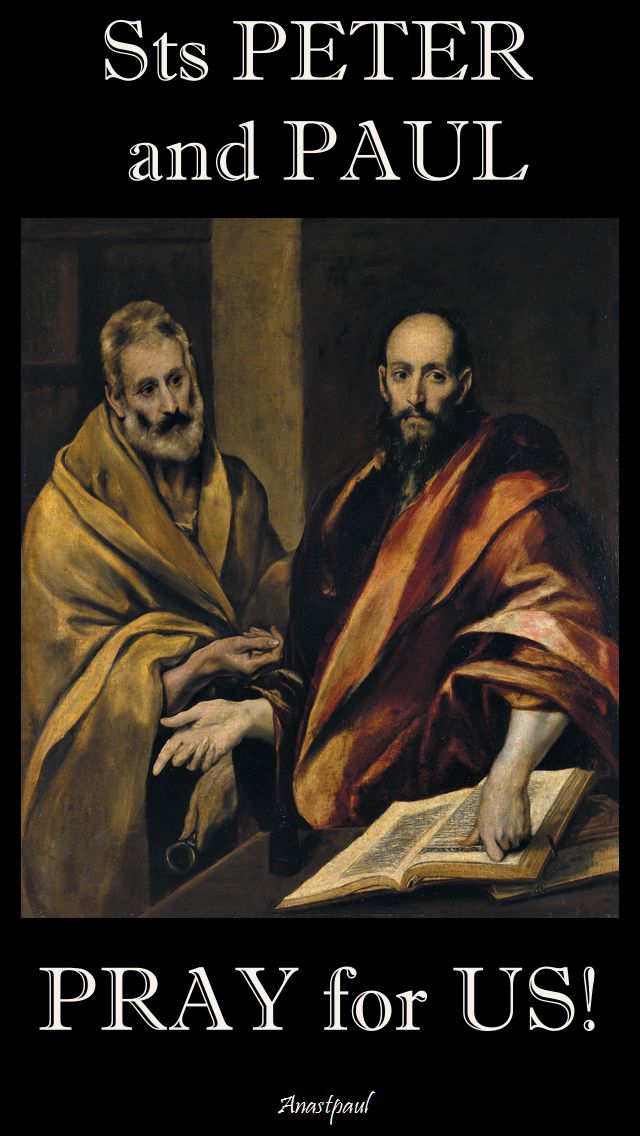
PRAYER –  Lord God, give Your Church the help of the Apostles Peter and Paul, who first brought it the knowledge of the faith;  may they always obtain for it an increase of grace and continue to run with us on our journey home to You.   Through Jesus Christ our Lord, in union with the Holy Spirit, one God forever and ever, amen.sts peter and paul pray for us - 18 nov 2017

Posted in FEASTS and SOLEMNITIES, MARIAN QUOTES, MORNING Prayers, QUOTES of the SAINTS, SAINT of the DAY, The APOSTLES & EVANGELISTS

Thought for the Day – 18 October – The Feast of St Luke the Evangelist

Thought for the Day – 18 October – The Feast of St Luke the Evangelist

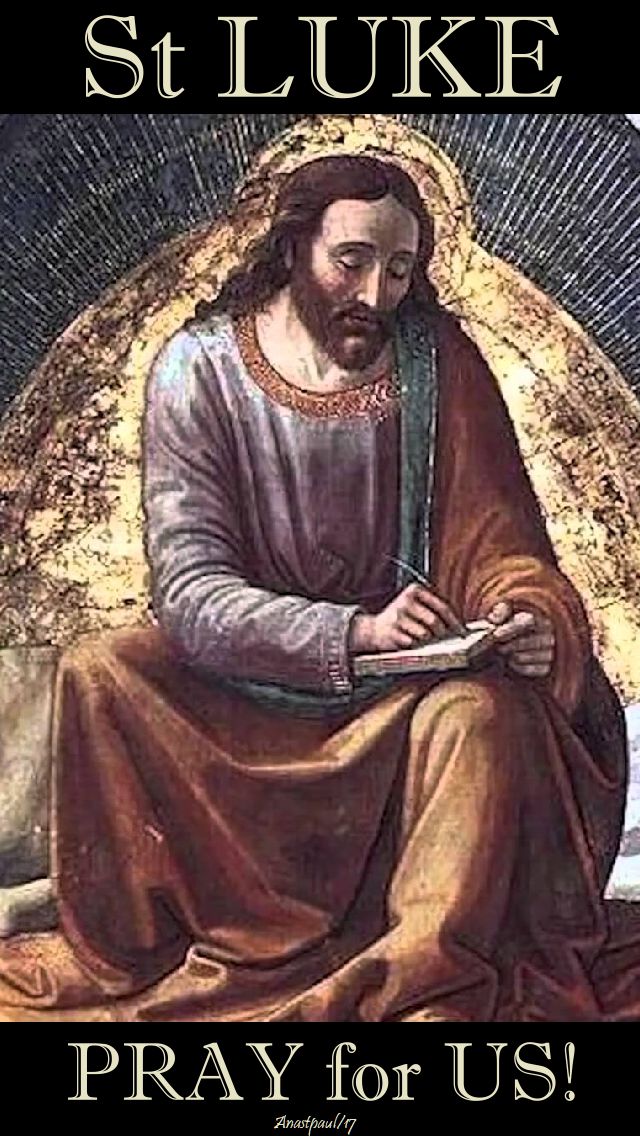
According to a pious tradition, Luke is thought to have painted the image of Mary, the Virgin Mother.   But the real portrait that Luke draws of Jesus’ Mother is the one that emerges from the pages of his work:   in scenes that have become familiar to the People of God, he draws an eloquent image of the Virgin.   The Annunciation, the Visitation, the Nativity, the Presentation in the Temple, life in the home of Nazareth, Jesus’ discussion with the doctors and his being lost and Pentecost have provided abundant material down the centuries for the ever new creations of painters, sculptors, poets and musicians.

What is most important however is to discover that, through pictures of Marian life, Luke introduces us to Mary’s interior life, helping us at the same time to understand her unique role in salvation history.

Mary is the one who says fiat, a personal and total “yes” to God’s invitation, calling herself the “handmaid of the Lord” (Lk 1: 38).   This attitude of total assent to God and unconditional acceptance of his Word represents the highest model of faith, the anticipation of the Church as the community of believers.

The life of faith grows and develops in Mary through sapiential meditation on the words and events of Christ’s life (cf. Lk 2: 19, 51).   She “ponders in her heart” to understand the deep meaning of his words, in order to assimilate it and share it with others.

The Magnificat hymn (cf. Lk 1: 46-55) shows another important aspect of Mary’s “spirituality”: she embodies the figure of the poor person, capable of putting all her trust in God, who casts down the mighty from their thrones and raises up the lowly.

Luke also describes the figure of Mary in the early Church, showing that she is present in the Upper Room as they await the Holy Spirit:  “All these [the 11 Apostles] with one accord devoted themselves to prayer, together with the women and Mary the mother of Jesus, and with his brethren” (Acts 1: 14).

The group gathered in the Upper Room forms the original nucleus of the Church.   Within it Mary carries out a double role:  on the one hand, she intercedes for the birth of the Church through the Holy Spirit; on the other, she shares her experience of Jesus with the newborn Church. (St John Paul on the Feast of St Luke, Padua 2000 at the Shrine of St Luke)

Luke wrote as a Gentile for Gentile Christians.   His Gospel and Acts of the Apostles reveal his expertise in classic Greek style as well as his knowledge of Jewish sources.   There is a warmth to Luke’s writing that sets it apart from that of the other synoptic Gospels and yet it beautifully complements those works.   The treasure of the Scriptures is a true gift of the Holy Spirit to the Church and the Marian writings of St Luke are a great treasure to us all!

St Luke, pray for us.
Holy Mother of God, pray for us.
St John Paul, pray for us.st luke pray for us 18 oct 2017 - no 2HOLY MARY MOTHER OF GOD - PRAY FOR USst john paul pray for us

Posted in FEASTS and SOLEMNITIES, MORNING Prayers, QUOTES of the SAINTS, SAINT of the DAY, The APOSTLES & EVANGELISTS, The HOLY GHOST, Uncategorized

Quote/s of the Day – 18 October – The Feast of St Luke the Evangelist

Quote/s of the Day – 18 October – The Feast of St Luke the Evangelist

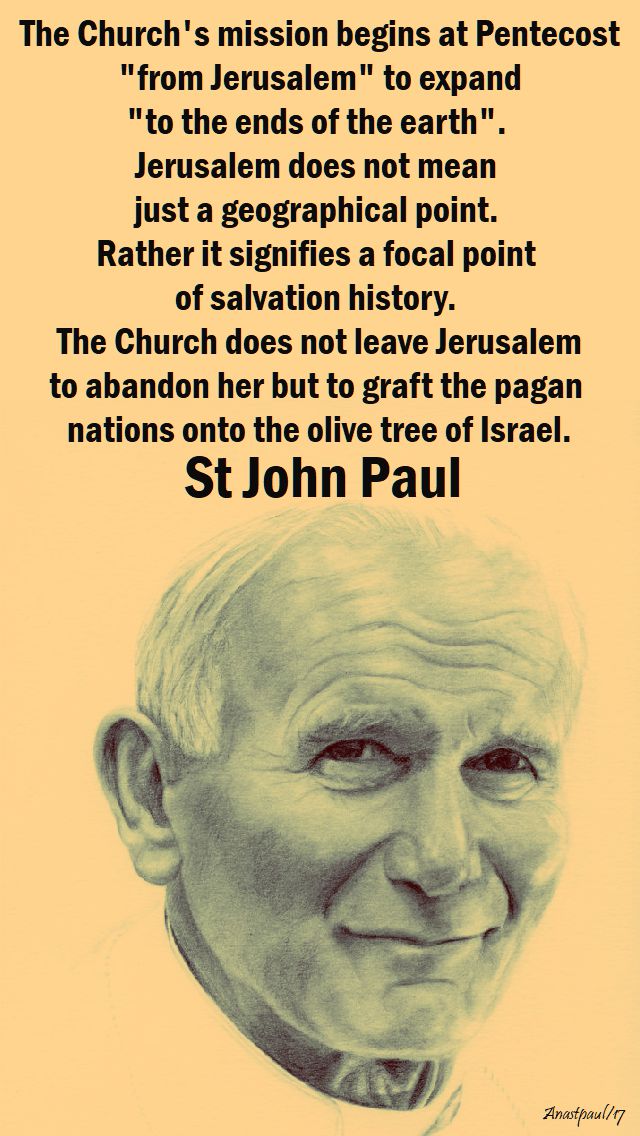
“The Church’s mission begins at Pentecost
“from Jerusalem” to expand “to the ends of the earth”.
Jerusalem does not mean just a geographical point.
Rather it signifies a focal point of salvation history.
The Church does not leave Jerusalem to abandon her
but to graft the pagan nations onto the olive tree of Israel.”the church's mission - 18 oct 2017

“We must abandon ourselves to the power of the Spirit,
who is able to infuse light and especially love for Christ;
we must open ourselves to the inner fascination that Jesus works
in the hearts of those who aspire to authenticity,
while fleeing from half measures.”

St John Paul on the Feast of St Luke, Padua 2000 at the Shrine of St Lukewe must abandon - st jp on the feast of st luke - 18 oct 2017

Posted in FEASTS and SOLEMNITIES, MORNING Prayers, SAINT of the DAY, The APOSTLES & EVANGELISTS, The WORD

One Minute Reflection – 18 October – The Feast of St Luke the Evangelist

One Minute Reflection – 18 October – The Feast of St Luke the Evangelist

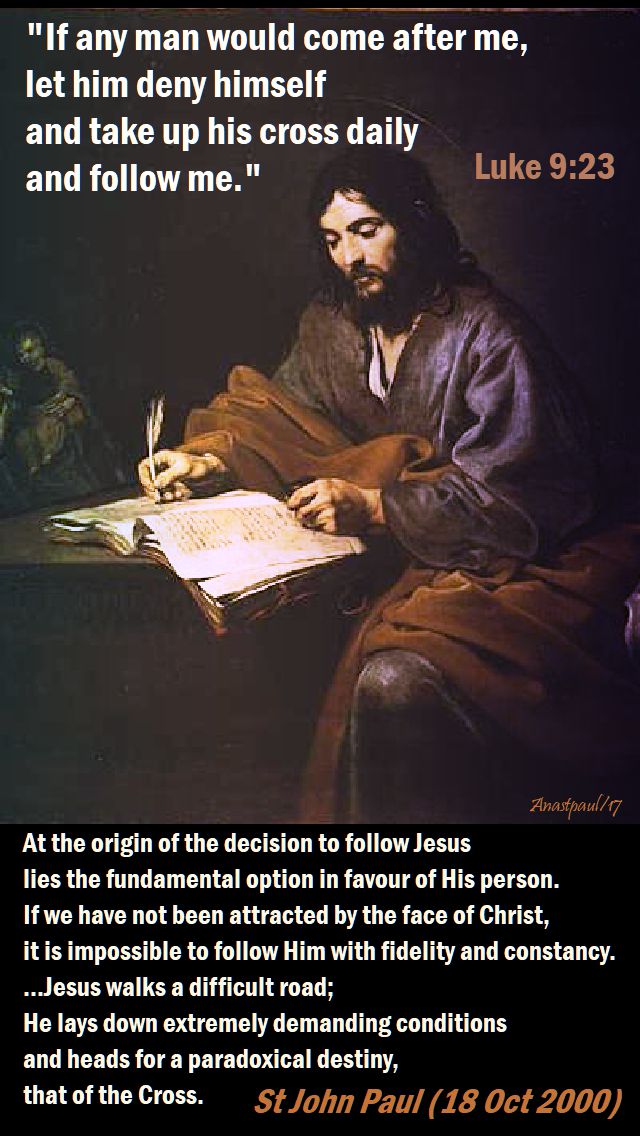
“If any man would come after me, let him deny himself and take up his cross daily and follow me.”…Luke 9: 23.

REFLECTION – “To be a Christian for Luke means to follow Jesus on the path that he takes.  It is Jesus Himself who takes the initiative and calls us to follow Him and He does it decisively, unmistakably, thus showing His extraordinary identity,   His mystery of being the Son who knows the Father and reveals Him.   At the origin of the decision to follow Jesus lies the fundamental option in favour of His person.   If we have not been attracted by the face of Christ, it is impossible to follow Him with fidelity and constancy. This is also because Jesus walks a difficult road;  He lays down extremely demanding conditions and heads for a paradoxical destiny, that of the Cross. Luke emphasises that Jesus does not like compromises and requires a commitment of the whole person, a decisive detachment from any nostalgia for the past, from family demands, from material possessions (cf. Lk 9: 57-62; 14: 26-33).”….St John Paul 18 Oct 2000at the origin of the decision - st john paul - feat of st luke 18 oct 2017

PRAYER – Lord God, You chose St Luke to reveal the mystery of Your love in his preaching and his writings. Grant, we pray, that we may grow in love for the Holy Face of Christ, His words and His directions, revealed to us in the Gospels, in the example of your saints. Today, on his feast, we especially look to St Luke, to guide, teach and pray for us. We make our prayer through our Lord Jesus Christ, with the Holy Spirit, one God with You, forever and ever, amen.st luke pray for us 18 oct 2017

Posted in BREWERS, DOCTORS, / SURGEONS / MIDWIVES., FEASTS and SOLEMNITIES, Of BACHELORS, Of LAWYERS & CANON Lawyers, Attorneys, Solicitors, Barristers, Notaries, Para-Legals, SAINT of the DAY, The APOSTLES & EVANGELISTS

Saint of the Day – St Luke the Evangelist – 18 October

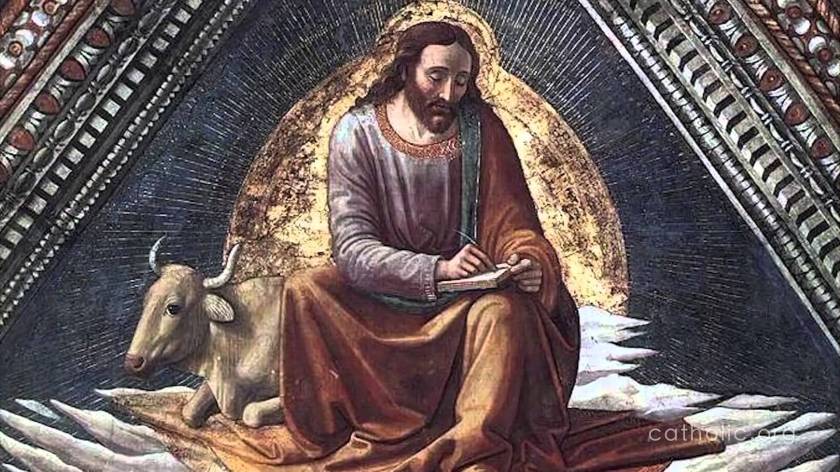
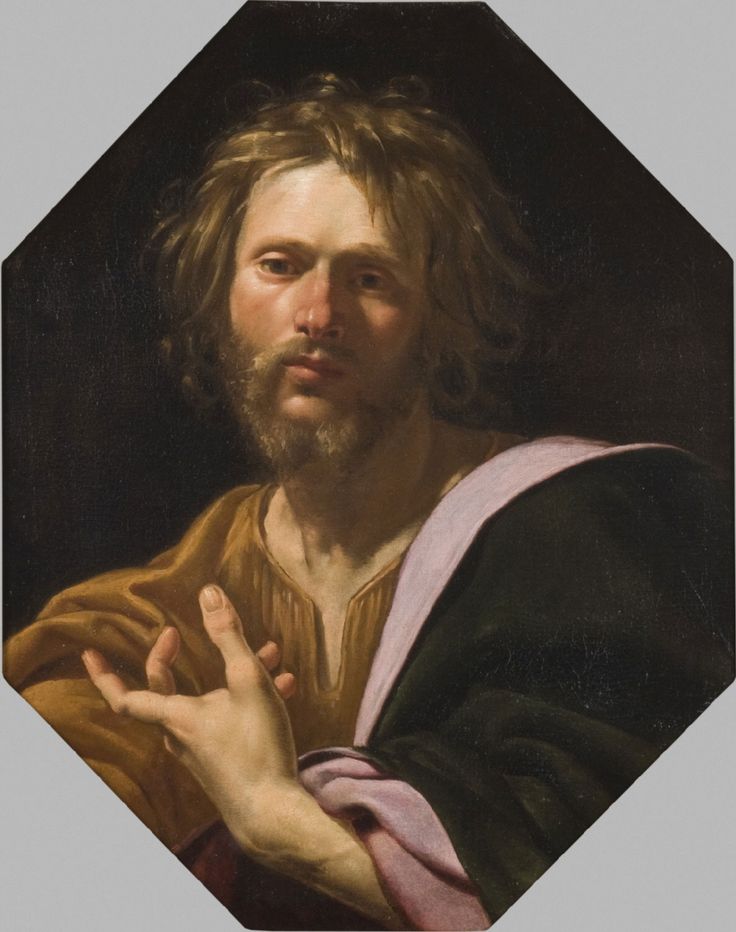
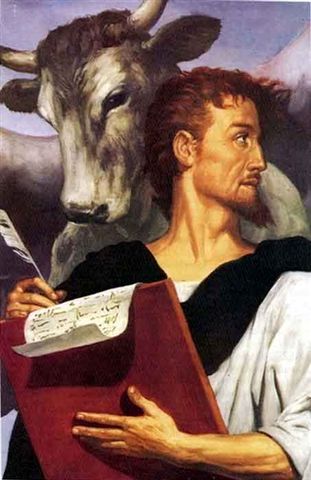
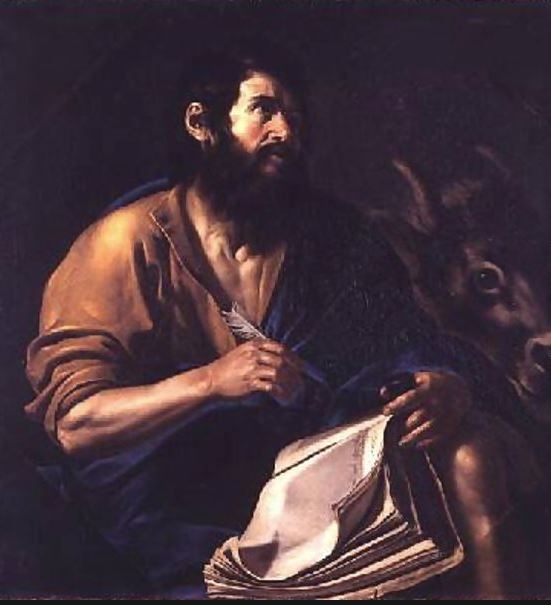
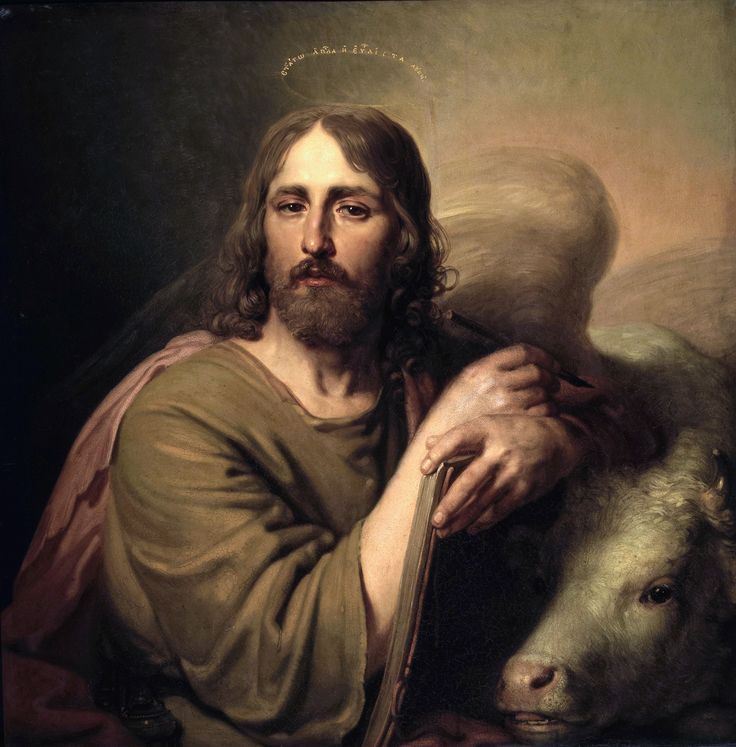
Saint of the Day – St Luke the Evangelist – 18 October – Physician,Ddisciple of St Paul, Evangelist, Author of the Gospel according to Luke and the Acts of the Apostles.   Tradition says he was an Artist too.  He was born at Antioch and Died in c 74 in Greece.   Some say he was Martyred, others that he died of natural causes.  His relics reside at Padua, Italy.   Patronages – artists, bachelors, bookbinders, brewers, butchers, doctors, glass makers, glassworkers, glaziers, gold workers, goldsmiths, lacemakers, lace workers, notaries, painters, physicians, sculptors, stained glass workers, surgeons, 2 cities.   Attributes – Evangelist, Physician, a Bishop, a book or a pen, a man accompanied by a winged ox/winged calf/ox, a man painting an icon of the Blessed Virgin Mary, a brush or a palette (referring to the tradition that he was a painter).   St Luke is one of the Four Evangelists—the four traditionally ascribed authors of the canonical Gospels.   The early Church Fathers ascribed to him authorship of both the Gospel according to Luke and the book of Acts of the Apostles, which would mean Luke contributed over a quarter of the text of the New Testament, more than any other author.   Prominent figures in early Christianity such as Jerome and Eusebius later reaffirmed his authorship.   The New Testament mentions Luke briefly a few times and the Pauline epistle to the Colossians refers to him as a physician (from Greek for ‘one who heals’);  thus he is thought to have been both a physician and a disciple of Paul. Christians since the faith’s early years have regarded him as a saint.   He is believed to have been a martyr, reportedly as having been hanged from an olive tree, though some believe otherwise.

HEADER - st luke

Luke came from the large metropolitan city of Antioch, a part of modern-day Turkey.   In Luke’s lifetime, his native city emerged as an important center of early Christianity. During the future saint’s early years, the city’s port had already become a cultural center, renowned for arts and sciences.   Historians do not know whether Luke came to Christianity from Judaism or paganism, although there are strong suggestions that Luke was a gentile convert.SOD-1018-SaintLuke-790x480

Educated as a physician in the Greek-speaking city, Luke was among the most cultured and cosmopolitan members of the early Church.   Scholars of archeology and ancient literature have ranked him among the top historians of his time period, besides noting the outstanding Greek prose style and technical accuracy of his accounts of Christ’s life and the apostles’ missionary journeys.LUKE!!!luke

Other students of biblical history adduce from Luke’s writings that he was the only evangelist to incorporate the personal testimony of the Blessed Virgin Mary, whose role in Christ’s life emerges most clearly in his gospel.   Tradition credits him with painting several icons of Christ’s mother and one of the sacred portraits ascribed to him – known by the title “Salus Populi Romano – Salvation of the Roman People”– survives to this day in the Basilica of St Mary Major.

Some traditions hold that Luke became a direct disciple of Jesus before His ascension, while others hold that he became a believer only afterward.   After St Paul’s conversion, Luke accompanied him as his personal physician– and, in effect, as a kind of biographer, since the journeys of Paul on which Luke accompanied him occupy a large portion of the Acts of the Apostles.   Luke probably wrote this text, the final narrative portion of the New Testament, in the city of Rome where the account ends.

Luke appears in Acts during Paul’s second journey, remains at Philippi for several years until Paul returns from his third journey, accompanies Paul to Jerusalem and remains near him when he is imprisoned in Caesarea.   During these two years, Luke had time to seek information and interview persons who had known Jesus.   He accompanied Paul on the dangerous journey to Rome where he was a faithful companion   After the martyrdom of St Paul in the year 67, St Luke is said to have preached elsewhere throughout the Mediterranean and possibly died as a martyr.   However, even tradition is unclear on this point.   Fittingly, the evangelist whose travels and erudition could have filled volumes, wrote just enough to proclaim the gospel and apostolic preaching to the world.

Luke’s unique character may best be seen by the emphases of his Gospel, which has been given a number of subtitles:
1) The Gospel of Mercy
2) The Gospel of Universal Salvation
3) The Gospel of the Poor
4) The Gospel of Absolute Renunciation
5) The Gospel of Prayer and the Holy Spirit
6) The Gospel of Joy

luke 3.Евангелист Лука

Posted in DOCTORS of the Church, FATHERS of the Church, FEASTS and SOLEMNITIES, MORNING Prayers, QUOTES of the SAINTS, SAINT of the DAY, The APOSTLES & EVANGELISTS

Quote/s of the Day – 21 September – The Feast of St Matthew, Apostle and Evangelist

Quote/s of the Day – 21 September – The Feast of St Matthew, Apostle and Evangelist

“On hearing Christ’s voice, we open the door to receive Him,
as it were, when we freely assent to His promptings
and when we give ourselves over to doing what must be done.
Christ, since He dwells in the hearts of His chosen ones
through the grace of His love, enters so that He might eat with us
and we with Him. He ever refreshes us by the light of His presence
insofar as we progress in our devotion to and longing for the things of heaven.
He Himself is delighted by such a pleasing banquet.”

St Bede the Venerable (673-735) Doctor of the Churchon hearing christ's voice - st bede the venerable - 21 sept 2017

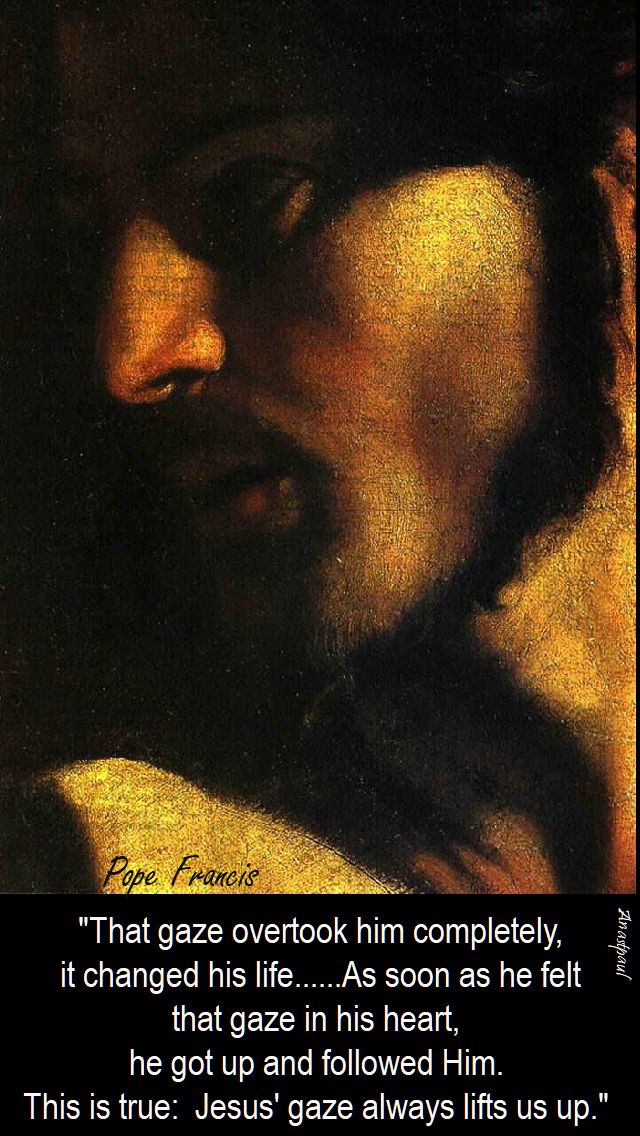
“That gaze overtook him completely, it changed his life.
We say he was converted. He Changed his life.
As soon as he felt that gaze in his heart, he got up and followed Him.
This is true: Jesus’ gaze always lifts us up.
It is a look that always lifts us up and never leaves you in your place,
never lets us down, never humiliates. It invites you to get up –
a look that brings you to grow, to move forward, that encourages you,
because the One who looks upon you loves you.
The gaze makes you feel that He loves you.
This gives the courage to follow Him: ‘and he got up and followed Him.'”

Pope Francis 21 September 2013that gaze overtook him completely-pope francis

Posted in ACCOUNTANTS, MONEY MANAGERS etc, Of BANKERS, SAINT of the DAY, TAX COLLECTORS, CUSTOMS OFFICERS, STOCK BROKERS, The APOSTLES & EVANGELISTS

Saint of the Day – 21 September – The Feast of St Matthew, Apostle and Evangelist

Saint of the Day – 21 September – The Feast of St Matthew, Apostle and Evangelist, Martyr (born Levi) – Patronages – accountant, bookkeepers, bankers, customs officers, financial officers, money managers, guards, security forces, security guards, stock brokers, tax collectors, Diocese of Trier, Germany, Archdiocese of Washington,  5 cities.

Calling-of-Saint-Matthew-HEADER BEAUTIFUL(1)

Saint Matthew, the first-century tax collector turned apostle who chronicled the life and ministry of Christ in his Gospel, is celebrated by the Church today, September 21. Although relatively little is known about the life of St Matthew, the account he wrote of Christ’s ministry – his Gospel was written in Aramaic, the language that our Lord Himself spoke and was written to convince the Jews that their anticipated Messiah had come in the person of Jesus.

The Gospel accounts of Mark and Luke, like Matthew’s own, describe the encounter between Jesus and Matthew under the surprising circumstances of Matthew’s tax-collecting duties.   Jewish publicans, who collected taxes on behalf of the Roman rulers of first-century Judea, were objects of scorn and even hatred among their own communities, since they worked on behalf of the occupying power and often earned their living by collecting more than the state’s due.

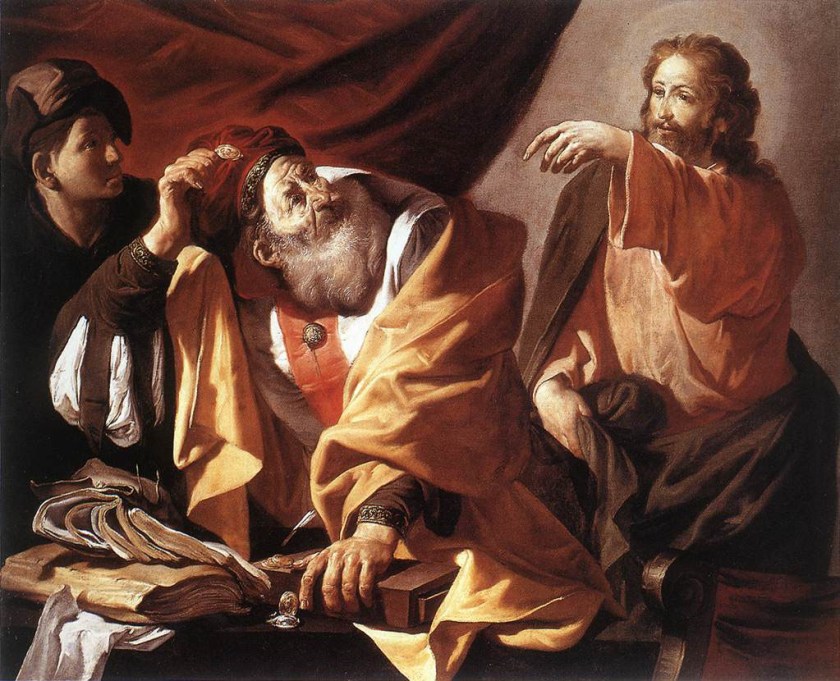
17-terbrugghen-h-the-calling-of-st-matthewCALLING OF ST MATTHEW

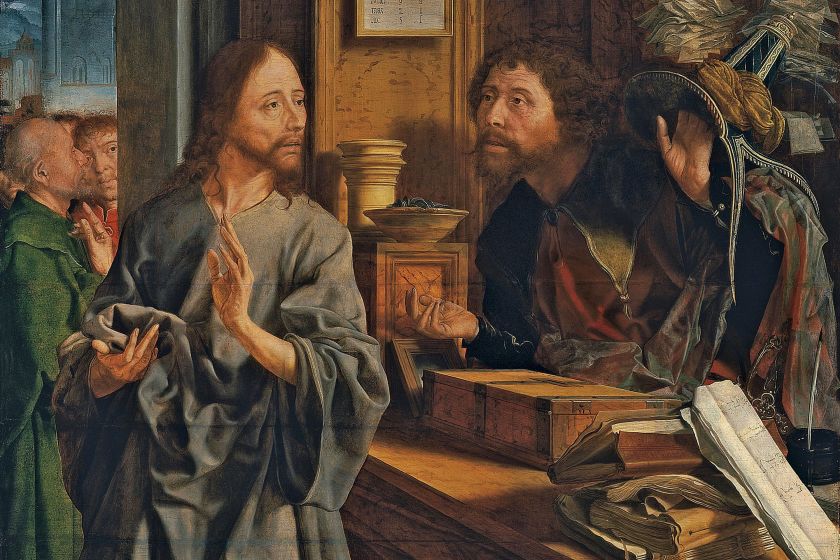
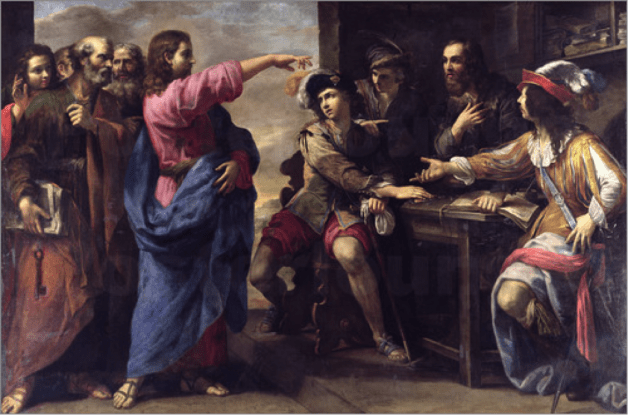
Jesus most likely first encountered Matthew near the house of Peter, in Capernaum near the Sea of Galilee.   The meeting of the two was dramatic, as Matthew’s third-person account in his Gospel captured:  “As Jesus passed on,” the ninth chapter recounts, “he saw a man named Matthew sitting at the customs post. He said to him, ‘Follow me’. And he got up and followed him.”

Matthew’s calling into Jesus’ inner circle was a dramatic gesture of the Messiah’s universal message and mission, causing some religious authorities of the Jewish community to wonder:  “Why does your teacher eat with tax collectors and sinners?” Jesus’ significant response indicated a central purpose of his ministry:  “I did not come to call the just but sinners.”

A witness to Christ’s resurrection after death, as well as his ascension into heaven and the events of Pentecost, Matthew also recorded Jesus’ instruction for the apostles to “go, therefore, and make disciples of all nations, baptizing them in the name of the Father, and of the Son, and of the holy Spirit, teaching them to observe all that I have commanded you.”

Like 11 of the 12 apostles, St. Matthew is traditionally thought to have died as a martyr while preaching the Gospel.   The Roman Martyrology describes his death as occurring in a territory near present-day Egypt.

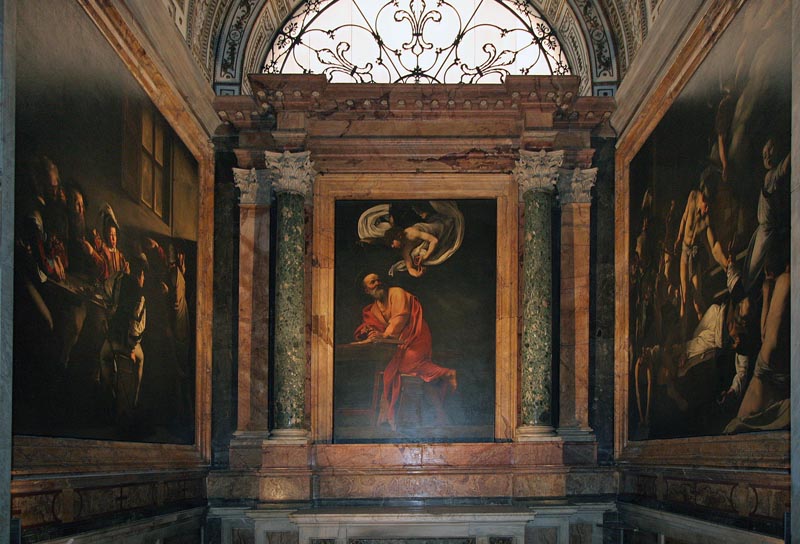
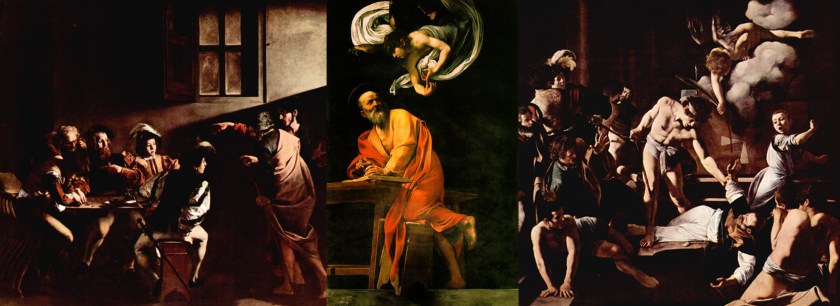
Both the saint himself and his Gospel narrative, have inspired important works of religious art, ranging from the ornate illuminated pages of the Book of Kells in the ninth century, to the St Matthew Passion of J.S. Bach.   Three famous paintings of Caravaggio, depicting St. Matthew’s calling, inspiration and martyrdom, hang within the Contarelli Chapel in Rome’s Church of St Louis of the French.Contarelli Chapel in Rome's Church of St Louis of the French.caravaggio (1)

Reflecting on St.Matthew’s calling, from the pursuit of dishonest financial gain to the heights of holiness and divine inspiration, Pope Benedict said in 2006 that “in the figure of Matthew, the Gospels present to us a true and proper paradox:  those who seem to be the farthest from holiness can even become a model of the acceptance of God’s mercy and offer a glimpse of its marvelous effects in their own lives.”

Posted in SAINT of the DAY, The APOSTLES & EVANGELISTS

Feast of St Matthew Apostle and Evangelist and Memorials of the Saints – 21 September

St Matthew the Apostle (Feast)

St Alexander of the Via Claudia
Bl Diego Hompanera París
St Eusebius of Phoenicia
St Francisco Pastor Garrido
St François Jaccard
St Gerulph
St Herminio García Pampliega
St Iphigenia
St Isaac of Cyprus
Bl Jacinto Martínez Ayuela
St Jacques Honoré Chastán
St Johannes Ri
St Jonah the Prophet
Bl José María Azurmendi Mugarza
Bl Josep Vila Barri
Bl Manuel Torró García
Bl Mark Scalabrini
St Maura of Troyes
St Meletius of Cyprus
Bl Nicolás de Mier Francisco
St Pamphilus of Rome
St Pierre Philibert Maubant
St Tôma Tran Van Thien
Bl Vicente Galbis Gironés
Bl Vicente Pelufo Orts

Martyrs of Gaza – 3 saints: Three brothers, Eusebius, Nestulus and Zeno, who were seized, dragged through the street, beaten and murdered by a pagan mob celebrating the renunciation of Christianity by Julian the Apostate. They were burned to death in 362 on a village garbage heap in Gaza, Palestine.

Martyred in the Spanish Civil War:
• Blessed Diego Hompanera París
• Blessed Jacinto Martínez Ayuela
• Blessed José María Azurmendi Mugarza
• Blessed Josep Vila Barri
• Blessed Manuel Torró García
• Blessed Nicolás de Mier Francisco
• Blessed Vicente Galbis Gironés
• Blessed Vicente Pelufo Orts

Posted in BREVIARY Prayers, CATHOLIC-PRAYERS OF THE CHURCH, FATHERS of the Church, MORNING Prayers, SAINT of the DAY, The APOSTLES & EVANGELISTS, The WORD

St John Chrysostom and St Paul – 13 September the Memorial of St John Chrysostum (347-407) of the “Golden Mouth”

St John Chrysostom and St Paul – 13 September the Memorial of St John Chrysostum (347-407) of the “Golden Mouth”

St John Chrysostom and St Paul
John Chrysostom here gives eloquent praise to the passionate love of Christ that drove St. Paul to face persecution and hardship with joy and leave behind the honours and benefits of the world.   It is read each year on January 25, the Feast of the Conversion of St. Paul, persecutor turned apostle.st PAUL!!!

Paul, more than anyone else, has shown us what man really is and in what our nobility consists and of what virtue this particular animal is capable.   Each day he aimed ever higher;  each day he rose up with greater ardour and faced with new eagerness the dangers that threatened him.  He summed up his attitude in the words:  “I forget what is behind me and push on to what lies ahead.”   When he saw death imminent, he bade others share his joy:  “Rejoice and be glad with me!”  And when danger, injustice and abuse threatened, he said:  “I am content with weakness, mistreatment and persecution.”   These he called the weapons of righteousness, thus telling us that he derived immense profit from them.

Thus, amid the traps set for him by his enemies, with exultant heart he turned their every attack into a victory for himself;  constantly beaten, abused and cursed, he boasted of it as though he were celebrating a triumphal procession and taking trophies home, and offered thanks to God for it all:  “Thanks be to God who is always victorious in us!”   This is why he was far more eager for the shameful abuse that his zeal in preaching brought upon him than we are for the most pleasing honours, more eager for death than we are for life, for poverty than we are for wealth;   he yearned for toil far more than others yearn for rest after toil.   The one thing he feared, indeed dreaded, was to offend God;   nothing else could sway him.   Therefore, the only thing he really wanted was always to please God.

The most important thing of all to him, however, was that he knew himself to be loved by Christ.   Enjoying this love, he considered himself happier than anyone else;   were he without it, it would be no satisfaction to be the friend of principalities and powers.   He preferred to be thus loved and be the least of all, or even to be among the damned, than to be without that love and be among the great and honoured.

To be separated from that love was, in his eyes, the greatest and most extraordinary of torments  the pain of that loss would alone have been hell and endless, unbearable torture.   So too, in being loved by Christ he thought of himself as possessing life, the world, the angels, present and future, the kingdom, the promise and countless blessings. Apart from that love nothing saddened or delighted him;  for nothing earthly did he regard as bitter or sweet.

Paul set no store by the things that fill our visible world, any more than a man sets value on the withered grass of the field.   As for tyrannical rulers or the people enraged against him, he paid them no more heed than gnats.   Death itself and pain and whatever torments might come were but child’s play to him, provided that thereby he might bear some burden for the sake of Christ.

This excerpt from a homily preached by St. John Chrysostom around c 400 in praise of St. Paul (Hom. 2 de laudibus sancti Pauli: PG 50, 477-480) is used in the Roman Office of Readings for the Feast of the Conversion of Saint Paul on January 25 with the biblical reading taken from Galatians 1, the story of Paul’s Conversion on the road to Damascus.st john chrysostom pray for us.3ST PAUL PRAY FOR US

Posted in ART DEI, SAINT of the DAY, The APOSTLES & EVANGELISTS, The BLESSED VIRGIN MARY

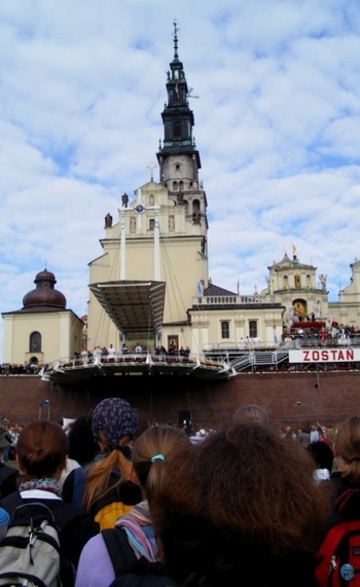
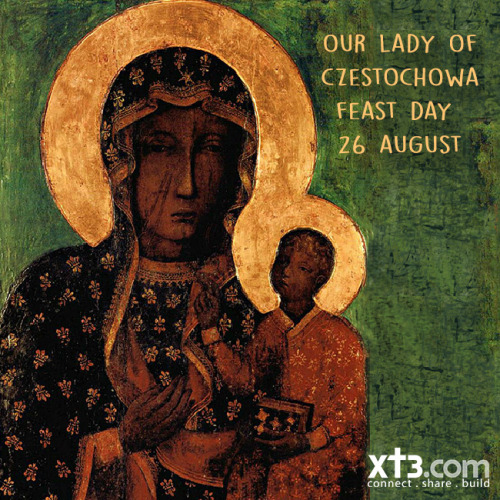
Blessed Feast of Our Lady of Czestochowa, Queen of Poland – 26 August

Blessed Feast of Our Lady of Czestochowa, Queen of Poland – 26 August – Also known as – The Black Madonna of Czestochowa, Czarna Madonna, Hodegetria, Imago thaumaturga Beatae Virginis Mariae Immaculatae Conceptae, Matka Boska Czestochowska, One Who Shows the Way.   Our Lady of Czestochowa is a revered icon of the Virgin Mary housed at the Jasna Góra Monastery in Częstochowa, Poland.   Several Pontiffs have recognised the venerated icon, beginning with Pope Clement XI who issued a Canonical Coronation to the image on 8 September 1717 via the Vatican Chapter.    Patron of Poland.

According to tradition, the icon of Jasna Góra (Bright Mountain) was painted by Luke the Evangelist on a tabletop built by Jesus Himself and the icon was discovered by St Helen, mother of Emperor Constantine and collector of Christian relics in the Holy Land.   The icon was then enshrined in the imperial city of Constantinople, where it remained for the next 500 years.

jasna gora monastery
JASNA GORA MONASTERY
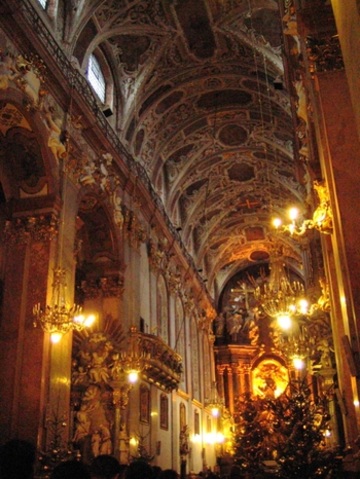
basilica of our lady of czestochowa at jasna gora
BASILICA OF OUR LADY OF CZESTOCHOWA AT JASNA GORA

In 803, the painting is said to have been given as a wedding gift from the Byzantine emperor to a Greek princess, who married a Ruthenian nobleman.   The image was then placed in the royal palace at Belz, where it remained for nearly 600 years.

History first combines with tradition upon the icon’s arrival in Poland in 1382 with a Polish army fleeing the Tartars, who had struck it with an arrow.

Legend has it that during the looting of Belz, a mysterious cloud enveloped the chapel containing the image.   A monastery was founded in Częstochowa to enshrine the icon in 1386 and soon King Jagiello built a cathedral around the chapel containing the icon.

However, the image soon came under attack once again.   In 1430, Hussites (pre-Reformation reformers) attacked the monastery, slashed the Virgin’s face with a sword, and left it desecrated in a puddle of blood and mud.

It is said that when the monks pulled the icon from the mud, a miraculous fountain appeared, which they used to clean the painting.   The icon was repainted in Krakow, but both the arrow mark and the gashes from the sword were left and remain clearly visible today.

The miracle for which the Black Madonna of Częstochowa is most famous occurred in 1655, when Swedish troops were about to invade Częstochowa.   A group of Polish soldiers prayed fervently before the icon for deliverance and the enemy retreated.   In 1656, King John Casimir declared Our Lady of Częstochowa “Queen of Poland” and made the city the spiritual capital of the nation.

The Virgin again came to the aid of her people in 1920, when the Soviet Russian Red Army gathered on the banks of the Vistula River, preparing to attack Warsaw.   The citizens and soldiers fervently prayed to Our Lady of Częstochowa and on September 15, the Feast of Our Lady of Sorrows, she appeared in the clouds above Warsaw.   The Russians were defeated in a series of battles later dubbed the “Miracle at the Vistula.”

During Nazi occupation, Hitler prohibited pilgrimages to Jasna Góra but many still secretly made the journey.   In 1945, after Poland was liberated, half a million pilgrims journeyed to Czestochowa to express their gratitude.   On September 8, 1946, 1.5 million people gathered at the shrine to rededicate the entire nation to the Immaculate Heart of Mary.   During the Cold War, Jasna Góra was a centre of anti-Communist resistance.  Czestochowa is regarded as the most popular shrine in Poland, with many Polish Catholics making a pilgrimage there every year.   A pilgrimage has left Warsaw every August 6 since 1711 for the nine-day, 140-mile trek.  Elderly pilgrims recall stealing through the dark countryside at great personal risk during the German Nazi occupation. Pope John Paul II secretly visited as a student pilgrim during World War II.   He was a fervent devotee of the Virgin Mary and of her icon at Czestochowa.   As pope, he made pilgrimages to pray before the Black Madonna in 1979, 1983, 1991 and 1997.   In 1991, he held his Sixth World Youth Day at Czestochowa, which was attended by 350,000 young people from across Europe.

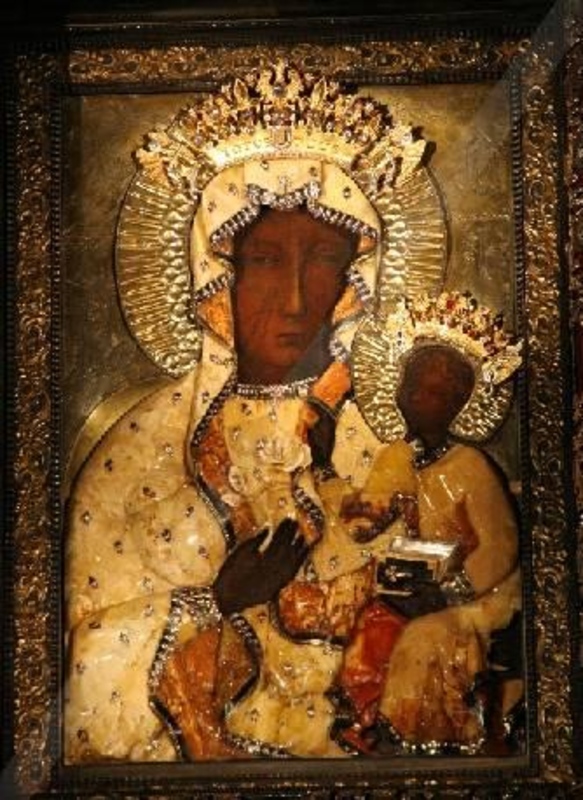
The four-foot-high painting displays a traditional composition well known in the icons of Eastern Christians.   The Virgin Mary is shown as the “Hodegetria” (“One Who Shows the Way”).   In it the Virgin directs attention away from herself, gesturing with her right hand toward Jesus as the source of salvation.   In turn, the child extends his right hand toward the viewer in blessing while holding a book of gospels in his left hand.  The icon shows the Madonna in fleur-de-lis robes.

our lady of czestochowa

dressed in special robes at Jasna Gora Monastery
This image shows Our Lady dressed in special robes at Jasna Gora
Posted in DOCTORS of the Church, MORNING Prayers, SAINT of the DAY, The APOSTLES & EVANGELISTS

Thought for the Day – 24 August The Feast of St Bartholomew, Apostle

Thought for the Day – 24 August The Feast of St Bartholomew, Apostle

“…Philip told this Nathanael that he had found “him of whom Moses in the law and also the prophets wrote, Jesus of Nazareth, the son of Joseph” (Jn 1: 45).   As we know, Nathanael’s retort was rather strongly prejudiced:  “Can anything good come out of Nazareth?” (Jn 1: 46).   In its own way, this form of protestation is important for us. Indeed, it makes us see that according to Judaic expectations the Messiah could not come from such an obscure village as, precisely, Nazareth (see also Jn 7: 42).

But at the same time Nathanael’s protest highlights God’s freedom, which baffles our expectations by causing Him to be found in the very place where we least expect Him. Moreover, we actually know that Jesus was not exclusively “from Nazareth” but was born in Bethlehem (cf. Mt 2: 1; Lk 2: 4) and came ultimately from Heaven, from the Father who is in Heaven.

Nathanael’s reaction suggests another thought to us:  in our relationship with Jesus we must not be satisfied with words alone.   In his answer, Philip offers Nathanael a meaningful invitation: “Come and see!” (Jn 1: 46). Our knowledge of Jesus needs above all a first-hand experience:  someone else’s testimony is of course important, for normally the whole of our Christian life begins with the proclamation handed down to us by one or more witnesses.

However, we ourselves must then be personally involved in a close and deep relationship with Jesus;  in a similar way, when the Samaritans had heard the testimony of their fellow citizen whom Jesus had met at Jacob’s well, they wanted to talk to Him directly and after this conversation they told the woman:  “It is no longer because of your words that we believe, for we have heard for ourselves and we know that this is indeed the Saviour of the world” (Jn 4: 42).

…To conclude, we can say that despite the scarcity of information about him, St Bartholomew stands before us to tell us that attachment to Jesus can also be lived and witnessed to without performing sensational deeds.   Jesus Himself, to whom each one of us is called to dedicate his or her own life and death, is and remains extraordinary.”

Note: the name “Nathanael” means “God has given”.

Pope Benedict XVI – General Audience 4 October 2006

St Bartholomew Pray for us!

st bartholomew pray for us 2

Posted in MORNING Prayers, QUOTES of the SAINTS, SAINT of the DAY, The APOSTLES & EVANGELISTS, The WORD

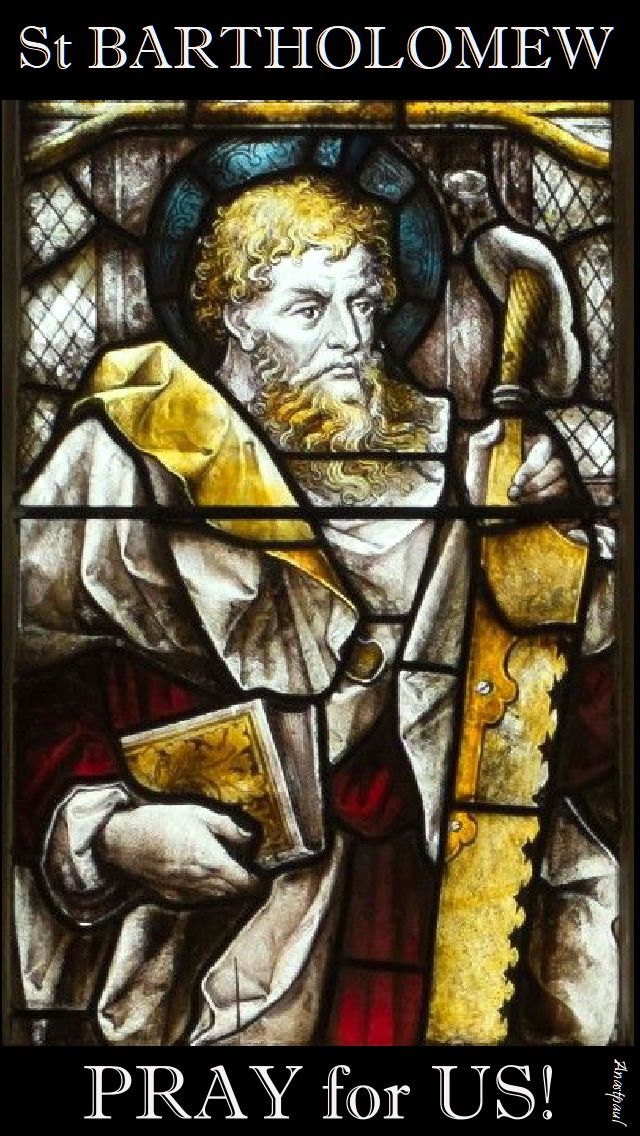
One Minute Reflection – August 24 – The Feast of St Bartholomew

One Minute Reflection – August 24 – The Feast of St Bartholomew

(God) chose to reveal His Son to me
that I might spread among the Gentiles
the good tidings concerning Him…………Galatians 1:16

galatians 1 16

REFLECTION – “No matter where you may be or where you may be working, make sure the world will be renewed upon contact with you.
Make the Lord more present to human beings and the Gospel more known and loved by them.”… Bl Pope Paul VIno matter where you may be - bl pope paul VI

PRAYER – Heavenly Father, teach me to imitate Your divine Son in my life. Grant that by my presence as well as by my deeds, I may bring Christ and His message to everyone I meet. Let me follow Your Apostles and manifest the love and zeal of St Bartholomew. May all the Apostles Pray for us. Amenst bartholomew pray for us

Posted in Of BUILDERS, CONSTRUCTION WORKERS, PATRONAGE - WRITERS, PRINTERS, PUBLISHERS, EDITORS, etc, SAINT of the DAY, SKIN DISEASES, RASHES, The APOSTLES & EVANGELISTS

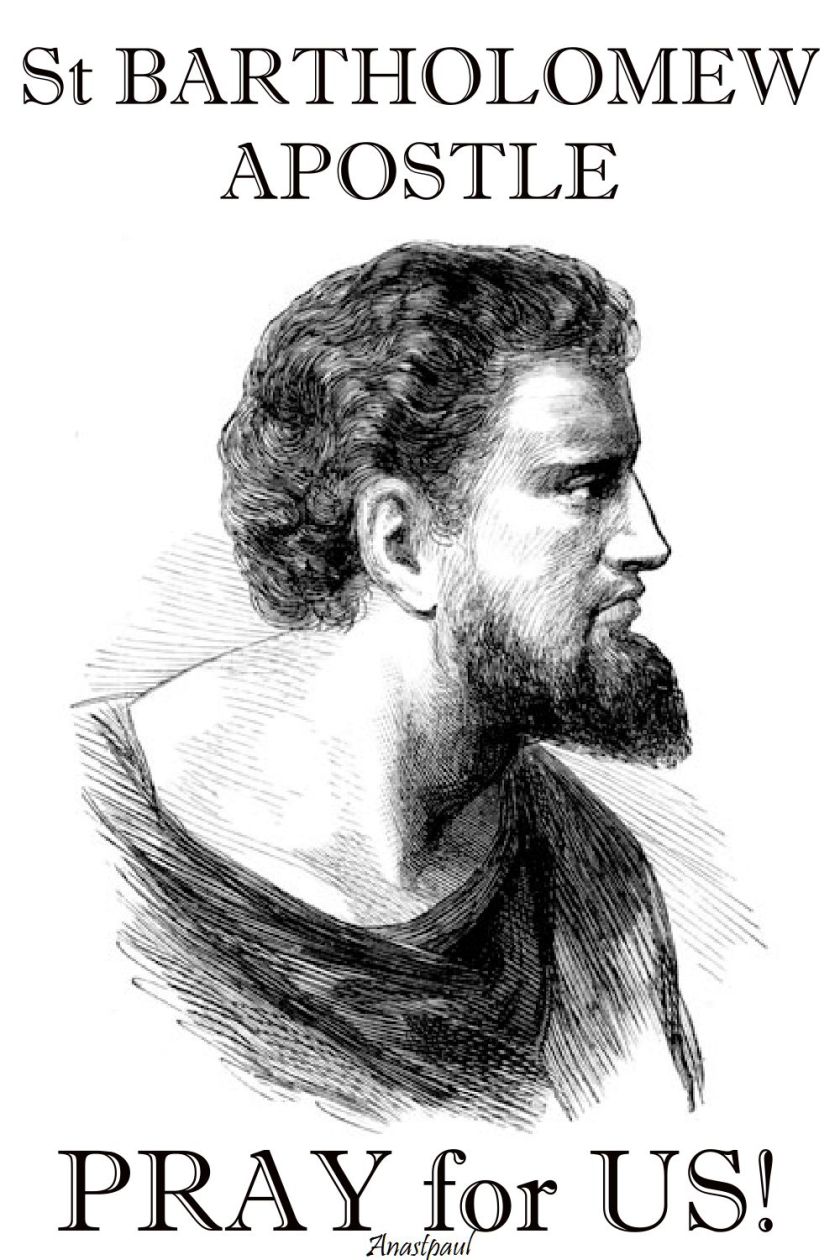
Saint of the Day – 24 August – St Bartholomew Apostle of Christ

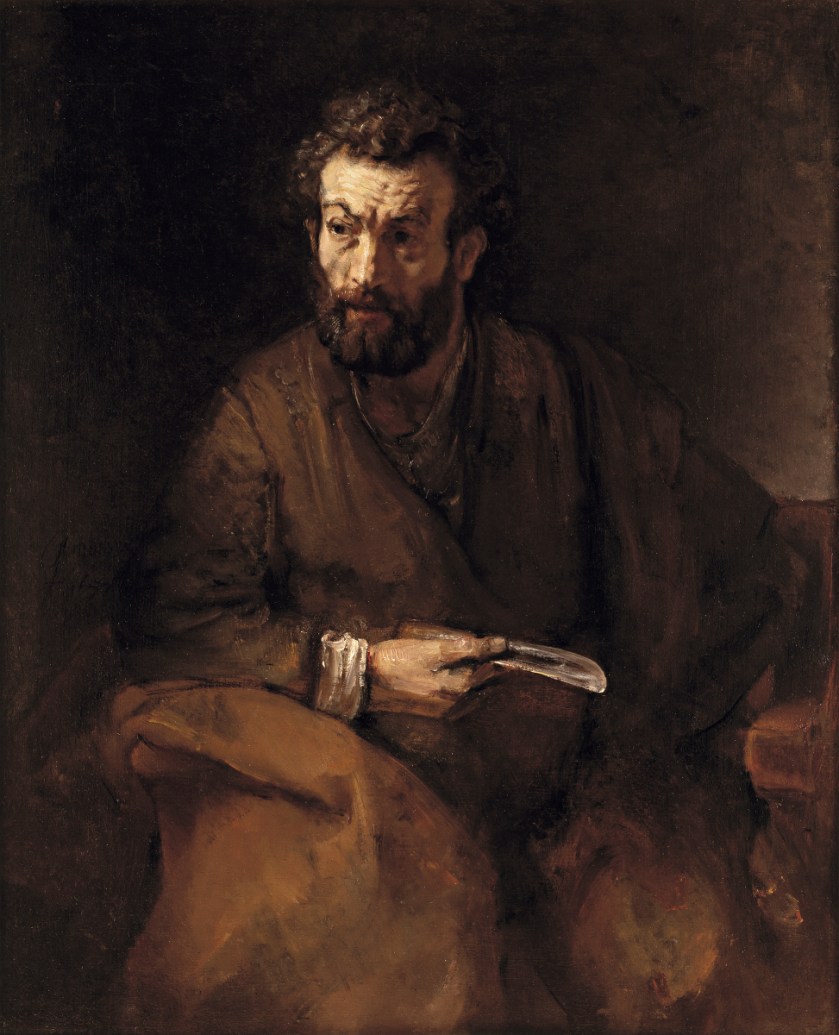
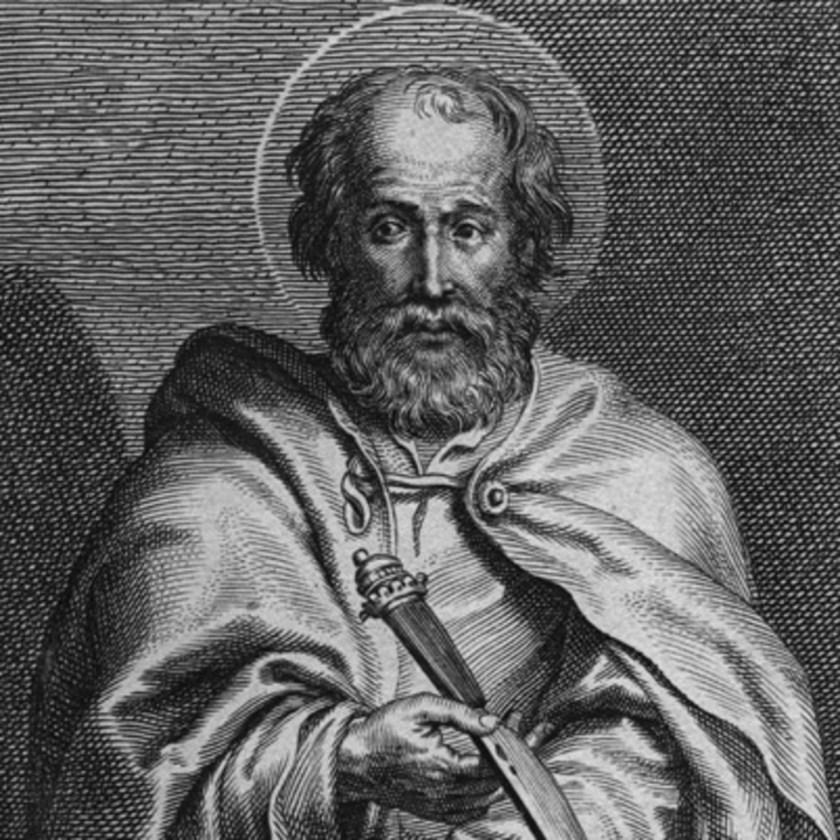
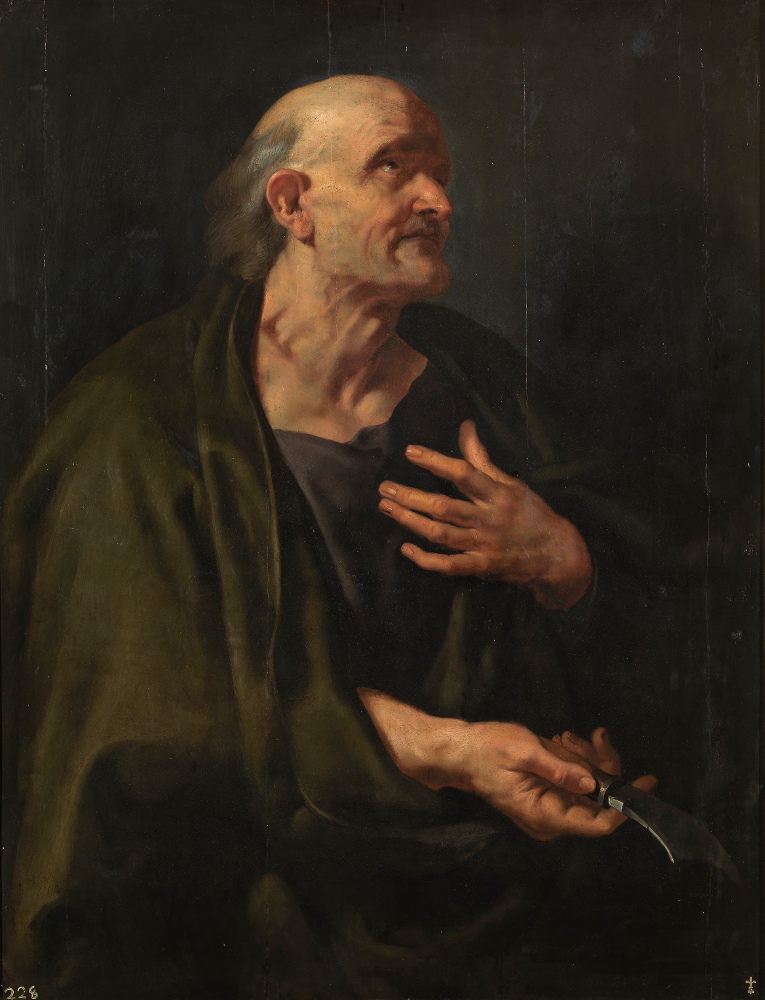
Saint of the Day – 24 August – St Bartholomew Apostle of Christ – Martyr – Patronages – Armenia; bookbinders/publishers; butchers; Florentine cheese and salt merchants; Gambatesa, Italy; Catbalogan, Samar; Għargħur, Malta; leather workers; neurological diseases; plasterers/construction workers; shoemakers; tanners; trappers; skin diseases/rashes, against involuntary  shaking disorders;  Los Cerricos (Spain), 16 further cities all over the world.   Attributes –  cross, elderly man holding a tanner’s knife and a human skin, tanner’s knife, bright red (skinless) man holding his own skin.

Bartholomew-Andrew-James-5712a8d55f9b588cc2255962
Apostles Bartholomew, Andrew, James

Saint Bartholomew is one of the Twelve Apostles, mentioned sixth in the three Gospel lists (Matthew 10:3; Mark 3:18; Luke 6:14) and seventh in the list of Acts (1:13).   The name (Bartholomaios) means “son of Talmai” which was an ancient Hebrew name.

Rembrandt Harmensz. van Rijn- The apostle Bartholomew (1657)
Rembrandt van Rijn

Besides being listed as an Apostle, he is not otherwise mentioned in the New Testament, at least not under the name Bartholomew:  many ancient writers and Catholic tradition have identified Bartholomew as Nathaniel in the Gospel of John (John 1:45-51, and 21:2).

The Gospel passage read at Mass on the feast of Saint Bartholomew is precisely this passage from John (1:45-51) where Nathaniel is introduced to Jesus by his friend Phillip, and Jesus says of him “Here is a true child of Israel. There is no duplicity in him (1:47).”

saint-bartholomew-HEADER

We are presented with the Apostle’s character in this brief and beautiful dialogue with the Lord Jesus.   He is a good Jew, honest and innocent, a just man, who devotes much time to quiet reflection and prayer – “under the fig tree (1:48)” – and has been awaiting the Messiah, the Holy One of God.

At Jesus’ mention that “Before Philip called you, when you were under the fig tree, I saw you (1:48),” Nathaniel responded “Rabbi, you are the Son of God! You are the King of Israel (1:49)!”

Being “a true child of Israel,” Nathaniel was a man well-read in the Scriptures and knew what they said of the Messiah and where he would come from.   This is why he is skeptical of Phillip’s claim that Jesus is the Messiah, “Can anything good come out of Nazareth (1:46)?”

But Nathaniel was lacking “duplicity” – that is, his heart was undivided, his intentions pure – his openness to reality was always ready to recognise and surrender to the truth when he encountered it.   He remained open to his friend Phillip’s invitation to “Come and see (1:46).”   In encountering Jesus and hearing His words, he found himself face to face with the Truth Himself, and, like John the Baptist’s leap in his mother’s womb at the Lord’s presence, Nathaniel’s words leapt out of his own heart in a clear and simple confession of faith, “Rabbi, you are the Son of God! You are the King of Israel!”

Jesus, in Matthew 5:8, says, “Blessed are the pure of heart, for they shall see God.”   In Nathaniel we have an example of the pure man who sees – recognises –  God when confronted with Him and on seeing Him believes in Him and upon believing in Him, follows Him.

Nothing is known for sure about the life of Nathaniel/Bartholomew after the Ascension of Jesus but tradition holds that he preached in the East and died a martyr’s death in Armenia, being flayed alive for having won converts to the Lord Jesus.

rubens_apostel_bartolomeus_grt
Rubens
Posted in MORNING Prayers, SAINT of the DAY, The APOSTLES & EVANGELISTS

One Minute Reflection – 25 July

One Minute Reflection – 25 July

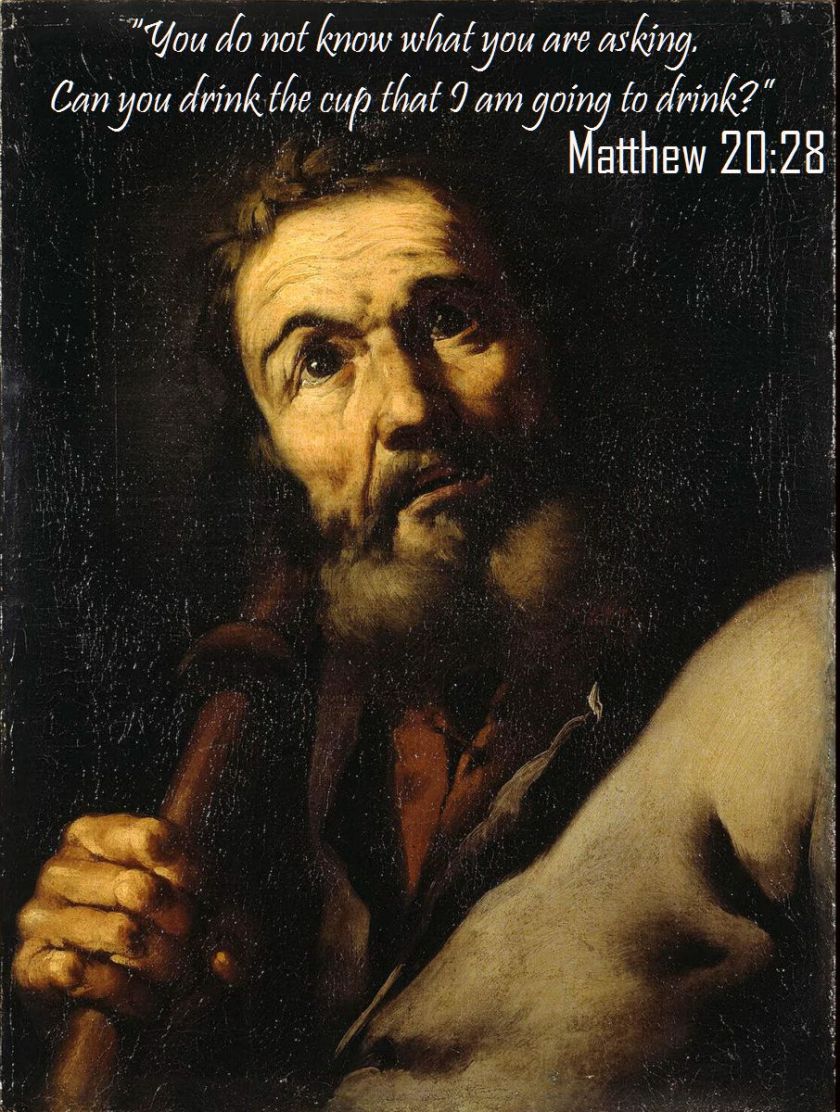
Jesus said in reply, “You do not know what you are asking. Can you drink the cup that I am going to drink?” They said to him, “We can.”……Matthew 20:28

matthew 20 28

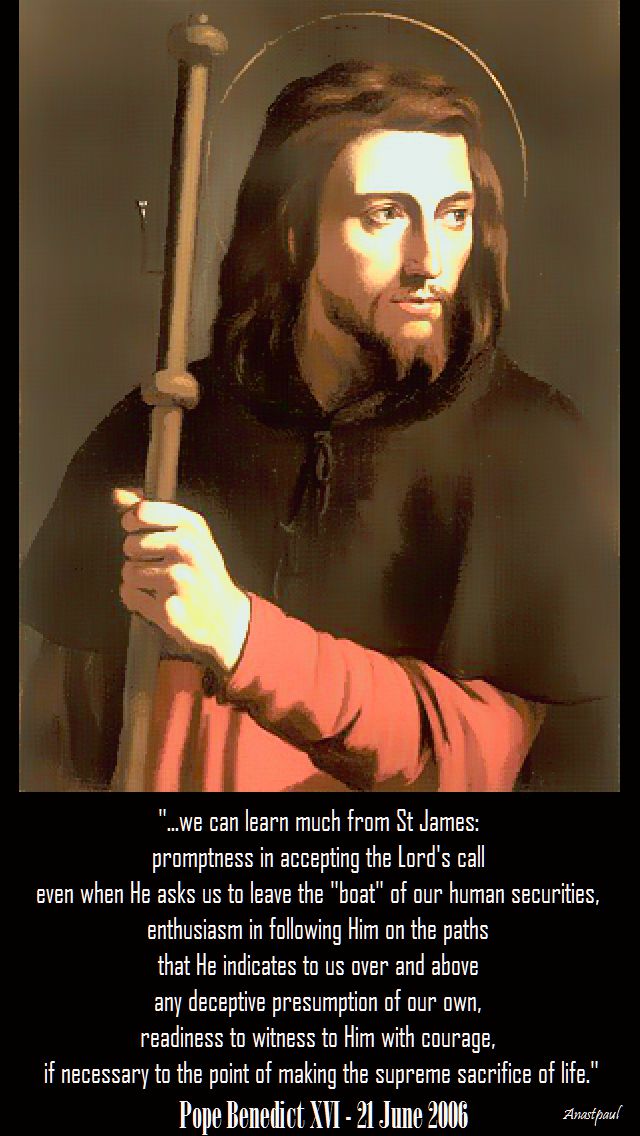
REFLECTION – “…we can learn much from St James: promptness in accepting the Lord’s call even when He asks us to leave the “boat” of our human securities, enthusiasm in following Him on the paths that He indicates to us over and above any deceptive presumption of our own, readiness to witness to Him with courage, if necessary to the point of making the supreme sacrifice of life. Thus James the Greater stands before us as an eloquent example of generous adherence to Christ. He, who initially had requested, through his mother, to be seated with his brother next to the Master in His Kingdom, was precisely the first to drink the chalice of the passion and to share martyrdom with the Apostles.
And, in the end, summarising everything, we can say that the journey, not only exterior but above all interior, from the mount of the Transfiguration to the mount of the Agony, symbolises the entire pilgrimage of Christian life, among the persecutions of the world and the consolations of God, as the Second Vatican Council says. In following Jesus, like St James, we know that even in difficulties we are on the right path.”…..Pope Benedict XVI – General Audience, June 21, 2006

we can learn much from st james - pope benedict

PRAYER – Almighty ever-living God, who consecrated the first fruits of Your Apostles by the blood of Saint James, grant, we pray, that Your Church may be strengthened by his confession of faith and constantly sustained by his protection. Through our Lord Jesus Christ, your Son, who lives and reigns with you in the unity of the Holy Spirit, one God, for ever and ever. St James the Greater, Apostle of Christ, Pray for us! Amen

st james pray for us 25 july

Posted in MORNING Prayers, PRAYERS of the CHURCH, SAINT of the DAY, The APOSTLES & EVANGELISTS

Our Morning Offering – 25 July

Our Morning Offering – 25 July

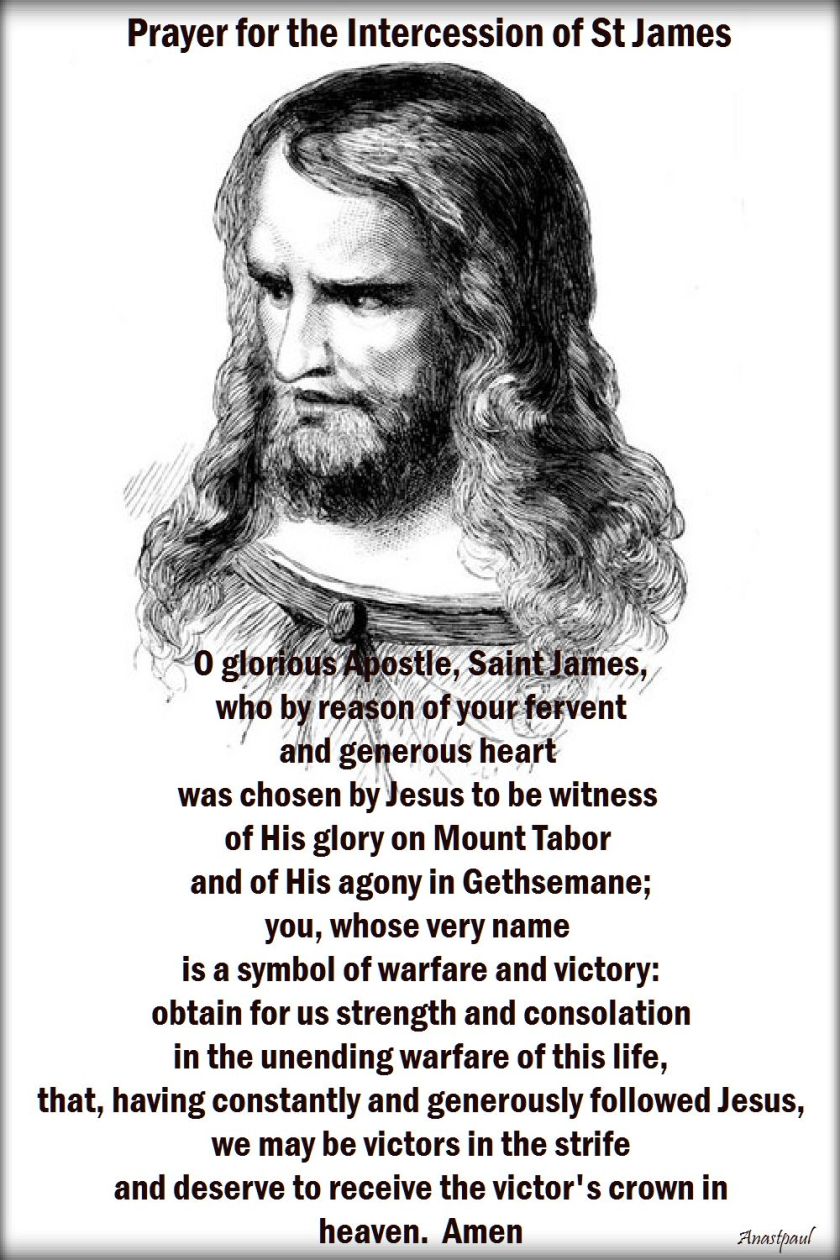
Prayer for the Intercession of St James

O glorious Apostle, Saint James,
who by reason of your fervent
and generous heart
was chosen by Jesus to be witness
of His glory on Mount Tabor
and of His agony in Gethsemane;
you, whose very name is a symbol
of warfare and victory:
obtain for us strength and consolation
in the unending warfare of this life,
that, having constantly and generously followed Jesus,
we may be victors in the strife
and deserve to receive the victor’s crown in heaven.
Amen

Prayer for the Intercession of St James

Posted in SAINT of the DAY, The APOSTLES & EVANGELISTS

Saint of the Day – 25 July – Feast of St James the Greater, Apostle of Christ

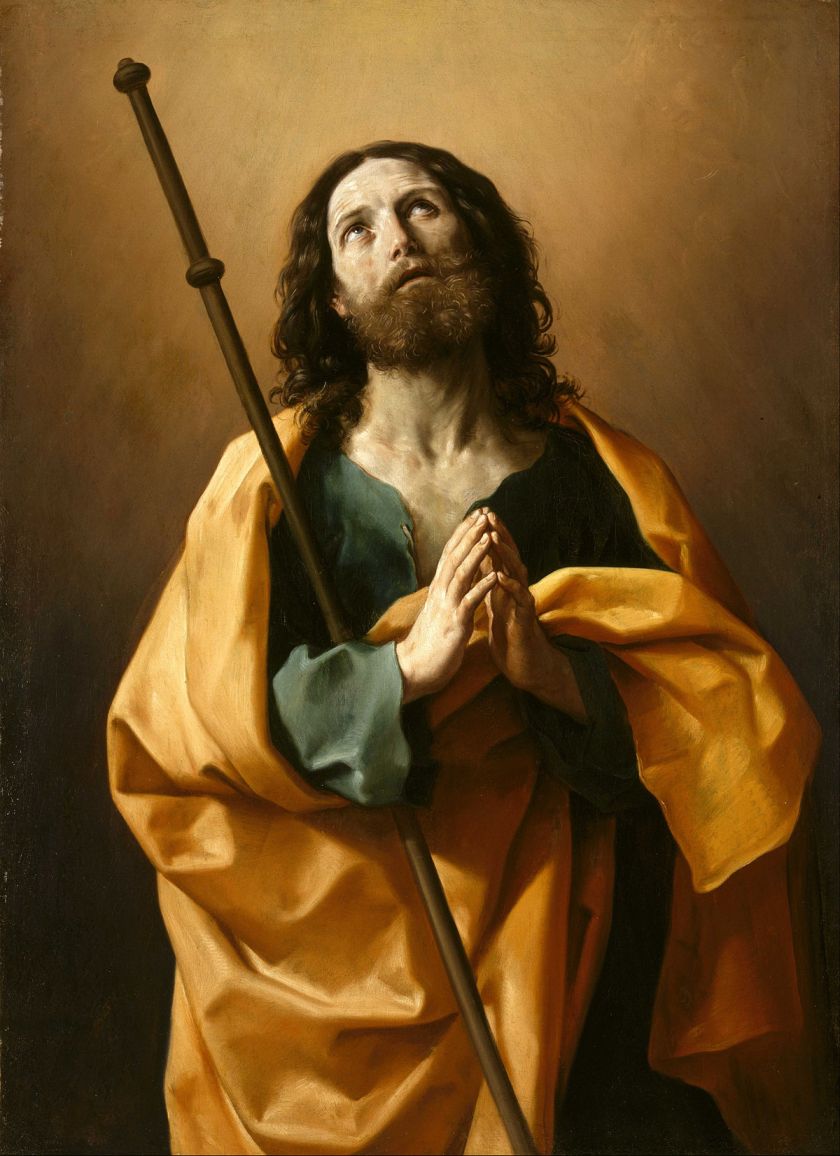
Saint of the Day – 25 July – Feast of St James the Greater, Apostle of Christ and Marytr – Also known as: James Major, James the Elder, James the More, James, son of Zebedee, Santiago de España, Son of Thunder, Iago, Santiago, the Moor Slayer.   Martyred – stabbed with a sword by King Herod Agrippa I in 44 at Jerusalem.   Tradition says his body was taken by Angels and sailed in a rudderless, unattended boat to Spain where a massive rock closed around it.   His relics are at at Compostela, Spain.  Patronages – against arthritis or rheumatism, apothecaries, druggists or pharmacists, blacksmiths, equestrians, horsemen, riders, furriers, knights, labourers, pilgrims, soldiers, tanners, veterinarians, Spanish conquistadors, Chile, Guatemala, Nicaragua, Spain, Archdiocese of Seattle, Washington, diocese of Bangued, Philippines, 20 cities.    St James was one of the Twelve Apostles of Jesus and traditionally considered the first Apostle to be Martyred.   He was a son of Zebedee and Salome and brother of John the Apostle.   He is also called James the Greater or James the Great to distinguish him from James, son of Alphaeus and James the brother of Jesus (James the Just).  James the son of Zebedee is the patron saint of Spaniards and as such is often identified as Santiago.
james and santiago de compostelajames the greater.BIG.6.- GUIDO RENI

His parents seem to have been people of means.   Zebedee, his father, was a fisherman of the Sea of Galilee, who probably lived in or near Bethsaida, present Galilee, Israel, perhaps in Capernaum and had some boatmen or hired men.   Salome, his mother, was one of the pious women who afterwards followed Christ and “ministered unto him of their substance” and his brother John was personally known to the high-priest and must have had wherewithal to provide for the Mother of Jesus.james the greater

It is probable that he and his brother had not received the technical training of the rabbinical schools;  in this sense they were unlearned and without any official position among the Jews.   But, according to the social rank of their parents, they must have been men of ordinary education, in the common walks of Jewish life.   James is described as one of the first disciples to join Jesus.   The Synoptic Gospels state that James and John were with their father by the seashore when Jesus called them to follow him.[Matt. 4:21-22][Mk. 1:19-20] James was one of only three Apostles whom Jesus selected to bear witness to his Transfiguration.

James and John asked Jesus to grant them seats on his right and left in his glory.   Jesus rebuked them and the other ten apostles were annoyed with them.   James and his brother wanted to call down fire on a Samaritan town but were rebuked by Jesus[Lk 9:51-6].   The Acts of the Apostles records that “Herod the king” (traditionally identified with Herod Agrippa) had James executed by sword.   He is the only apostle whose martyrdom is recorded in the New Testament.   He is, thus, traditionally believed to be the first of the twelve apostles martyred for his faith.[Acts 12:1-2]   Biblical scholars suggest that this may have been caused by James’ fiery temper, for which he and his brother earned the nickname Boanerges or “Sons of Thunder”

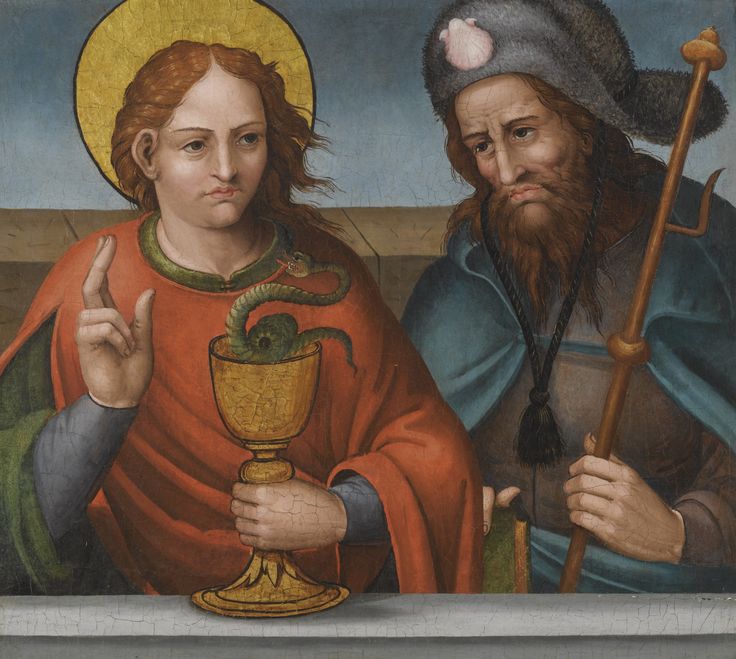
Saints John the Evangelist and James the Greater Martín Gómez the ElderChrist with sons of Zebedee James and John

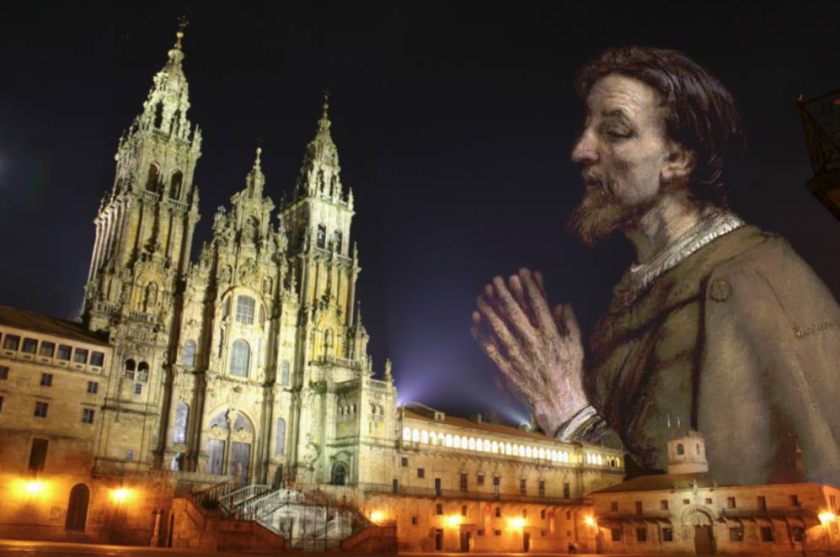
Saint James is the Patron Saint of Spain and, according to legend, his remains are held in Santiago de Compostela in Galicia.   (The name Santiago is the local evolution of Vulgar Latin Sanctu Iacobu, “Saint James.”)   The traditional pilgrimage to the grave of the Saint, known as the “Way of St James,” has been the most popular pilgrimage for Western European Catholics from the Early Middle Ages onwards.   Some 237,886 pilgrims registered in 2014 as having completed the final 100 km walk (200 km by bicycle) to Santiago to qualify for a Compostela.   When 25 July falls on a Sunday, it is a “Jubilee” year (an Año Santo Jubilar Compostelano or Año Santo Jacobeo) and a special east door is opened for entrance into Santiago Cathedral.   Jubilee years fall every 5, 6, and 11 years.   In the 2004 Jubilee year, 179,944 pilgrims received a Compostela.    In 2010 the number had risen to 275,135.

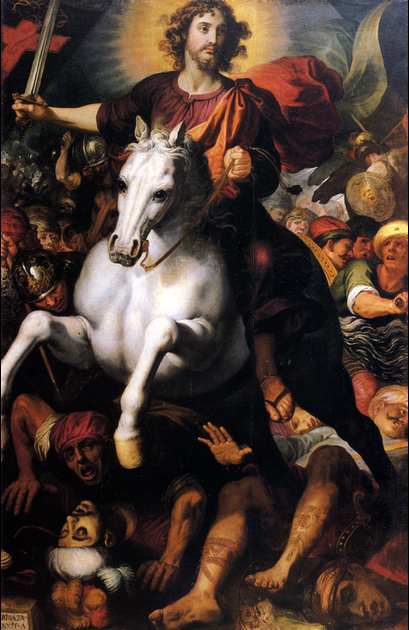
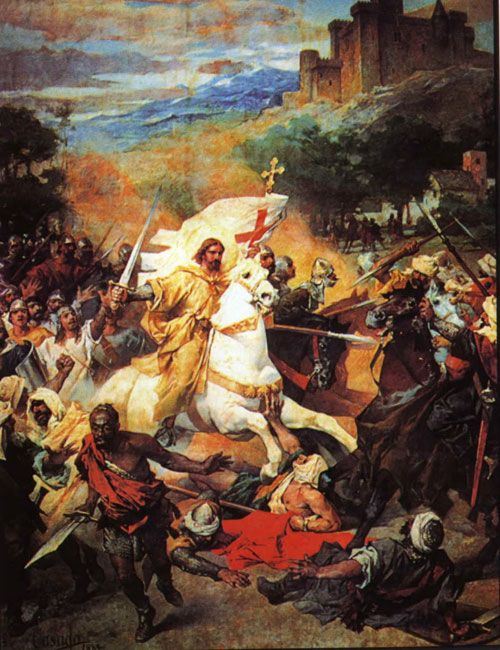
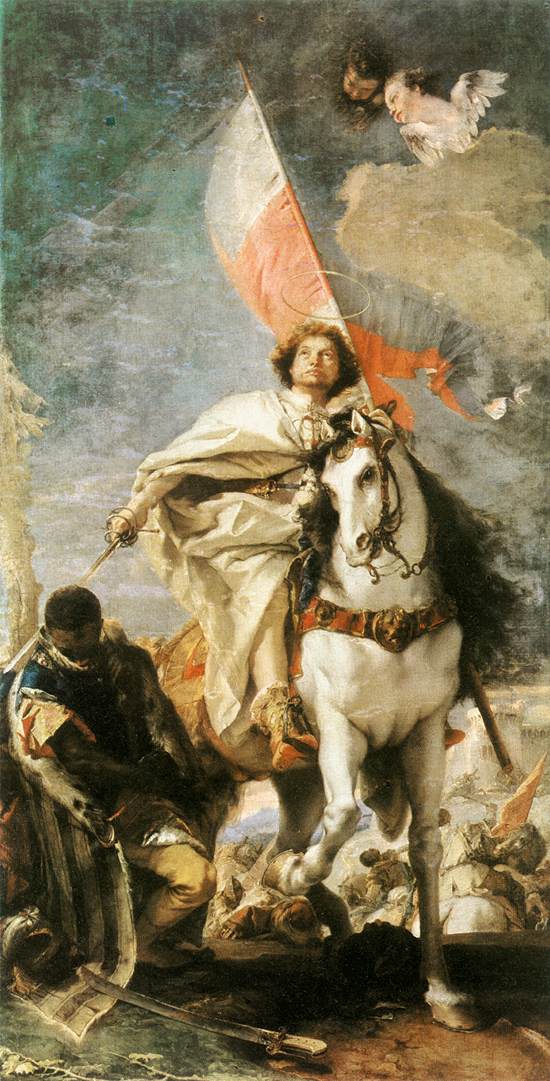
Medieval “Santiago Matamoros” legend – tradition states that he miraculously appeared to fight for the Christian army during the legendary battle of Clavijo and was henceforth called Santiago MatamorosSaint James the Moor-slayer.   Cervantes has Don Quixote explaining that “the great knight of the russet cross was given by God to Spain as Patron and Protector.”

james moorslayer3.

james moorslayer

Tiepolo-St-James-the-Greater-Conquering-the-Moors

Posted in MORNING Prayers, SAINT of the DAY, The APOSTLES & EVANGELISTS

Thought for the Day – 3 July

Thought for the Day – 3 July

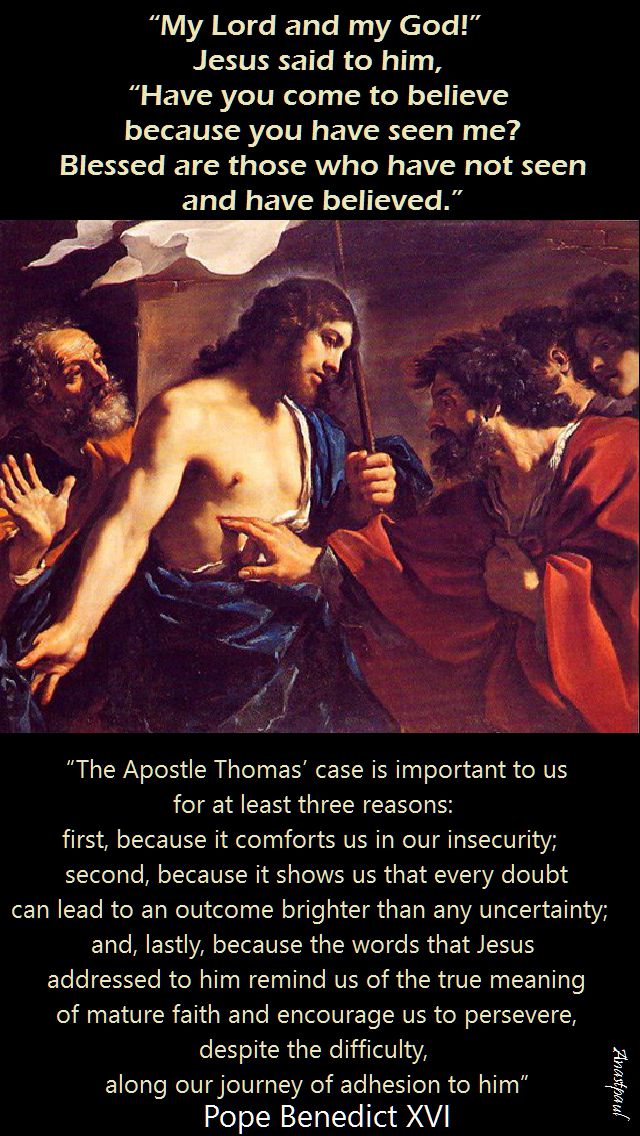
“Poor Thomas! He made one remark and has been branded as “Doubting Thomas” ever since.   But if he doubted, he also believed.   He made what is certainly the most explicit statement of faith in the New Testament:  “My Lord and My God!” and, in so expressing his faith, gave Christians a prayer that will be said till the end of time.   He also occasioned a compliment from Jesus to all later Christians:  “Have you come to believe because you have seen me? Blessed are those who have not seen and have believed” (John 20:29).

Thomas should be equally well-known for his courage.   Perhaps what he said was impetuous—since he ran, like the rest, at the showdown—but he can scarcely have been insincere when he expressed his willingness to die with Jesus.   The occasion was when Jesus proposed to go to Bethany after Lazarus had died.   Since Bethany was near Jerusalem, this meant walking into the very midst of his enemies and to almost certain death.   Realising this, Thomas said to the other apostles,  “Let us also go to die with him” (John 11:16b).

Thomas shares the lot of Peter the impetuous, James and John, the “sons of thunder,” Philip and his foolish request to see the Father—indeed all the apostles in their weakness and lack of understanding.   We must not exaggerate these facts, however, for Christ did not pick worthless men.   But their human weakness again points up the fact that holiness is a gift of God, not a human creation – it is given to ordinary men and women with weaknesses, it is God who gradually transforms the weaknesses into the image of Christ, the courageous, trusting and loving one.” Fr. Don Miller, OFM

Saint John Chrysostom said about Thomas:  “Thomas, being once weaker in faith than the other apostles, toiled through the grace of God more bravely, more zealously and tirelessly than them all, so that he went preaching over nearly all the earth, not fearing to proclaim the Word of God to savage nations.”   If Thomas can be transformed, so, too, can we.  When our faith is shaken, we think of Thomas’ doubt… but we also must think of his courage.   What will we accomplish when our faith overflows within us, pouring forth in the courageous acclamation, “My Lord and My God!”?

St Thomas, Apostle of Christ, Pray for us!

st thomas pray for us 2

Posted in MORNING Prayers, SAINT of the DAY, The APOSTLES & EVANGELISTS

One Minute Reflection – 3 July

One Minute Reflection – 3 July

“My Lord and my God!” Jesus said to him, “Have you come to believe because you have seen me?
Blessed are those who have not seen and have believed.”…John 20:28-29

REFLECTION – “the Apostle Thomas’ case is important to us for at least three reasons: first, because it comforts us in our insecurity; second, because it shows us that every doubt can lead to an outcome brighter than any uncertainty; and, lastly, because the words that Jesus addressed to him remind us of the true meaning of mature faith and encourage us to persevere, despite the difficulty, along our journey of adhesion to him”………….Pope Benedict XVI, 27 September 2006.

pope benedict - the apostle Thomas case

PRAYER – Father, let our celebration of the Feast of St Thomas the Apostle, be the source of his unfailing help and protection. Fill us with Your life-giving grace through faith in Your Son, whom St Thomas acknowledged to be his Lord and God. St Thomas continue to intercede for us that we may grow strong in faith and trust. Through our Lord Jesus Christ, in union with the Holy Spirit, one God forever and ever Amen.

st thomas pray for us

Posted in Against DOUBT, those in DOUBT, EYES - Diseases, of the BLIND, Of BUILDERS, CONSTRUCTION WORKERS, SAINT of the DAY, The APOSTLES & EVANGELISTS

Saint of the Day – 3 July – St Thomas the Apostle of Christ

Saint of the Day – 3 July – St Thomas the Apostle of Christ – Apostle, Martyr, Preacher, Evangelist (called Didymus which means “the twin” was one of the Twelve Apostles of Jesus Christ.   He is informally called ‘Doubting Thomas’ because he doubted Jesus’ Resurrection when first told (in the Gospel of John account only), followed later by his confession of faith, “My Lord and my God,”, on seeing Jesus’ wounded Body.   He was ready to die with Jesus when Christ went to Jerusalem but is best remembered for doubting the Resurrection until allowed to touch Christ’s wounds.   An old tradition says that Thomas Baptised the three Magi.   He was Martyred by being stabbed with a spear in c 72 while in prayer on a hill in Mylapur, India and is buried near the site of his death.   His relics later moved to Edessa, Mesopotamia and finally to Tortona, Italy in the 13th Century.   His Patronages are:people in doubt; against doubt• architects• blind people and against blindnessbuilders• construction workers• geometricians• stone masons and stone cutters• surveyors• theologians• Ceylon• East Indies• India• Indonesia• Malaysia • Pakistan• Singapore• Sri Lanka• Diocese of Bathery, India• Castelfranco di Sopra, Italy• Certaldo, Italy• Ortona, Italy.

st thomas.8

We feel great kinship for the Apostle Thomas because, like him, most of us curiously combine faith and doubt.   We sometimes share the enthusiasm St Thomas expressed when upon Lazarus’s death Jesus decided to go to Bethany.   “Let’s go too,” Thomas said to the other disciples,“that we may die with him” (see John 11:16).   But also like him we sometimes wonder where Jesus is headed and where He is taking us (see John 14:5).

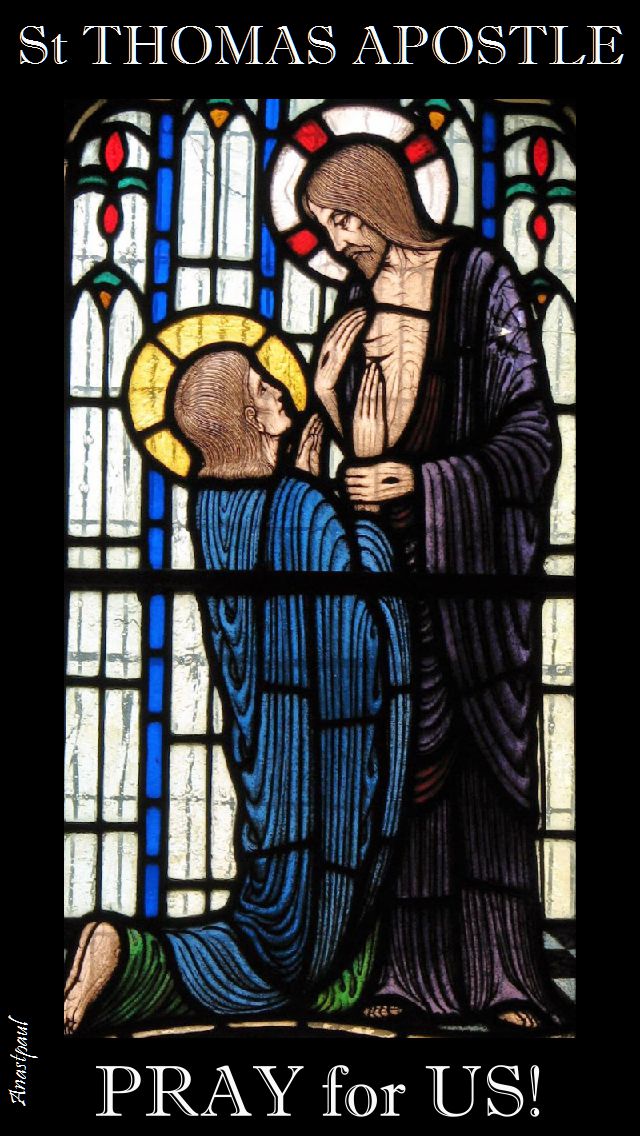
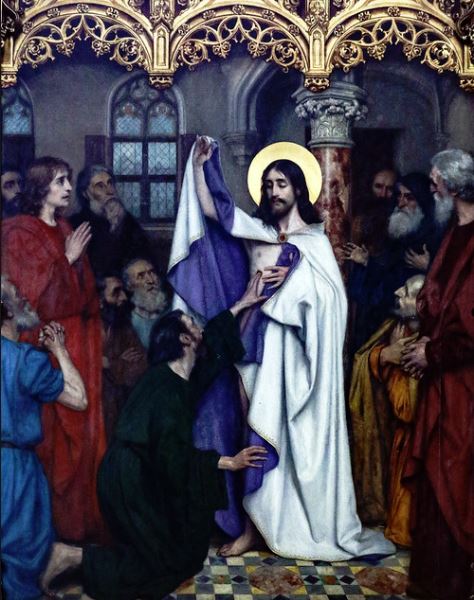
However, we are most like Thomas because doubts occasionally rattle our brains and cloud our souls.   So we all relate to the story of doubting Thomas (see John 20:25–29). Thomas was absent the first time Jesus appeared after his resurrection.  The apostle swore he would not believe, “Unless I see in his hands the print of the nails, and place my finger in the mark of the nails and place my hand in his side”.   Eight days later Jesus appeared again and told Thomas to touch his wounds. “My Lord, and my God,” Thomas exclaimed, recovering his faith.st thomas apostle kneeling before christ glass

Some early Christian writers criticised Thomas’s faithless behaviour.  But others praised him for helping us cure our doubts, as Gregory the Great does in this homily:

“. . . For the faithlessness of Thomas aids us in our belief more than does the faith of the disciples who believed. . . . When he is brought to believe by feeling with his own hand, every doubt having been removed, our own mind is confirmed in faith. . . .The divinity cannot be seen by any mortal man.   So Thomas saw man and confessed him to be God, saying, “My Lord, and my God.”
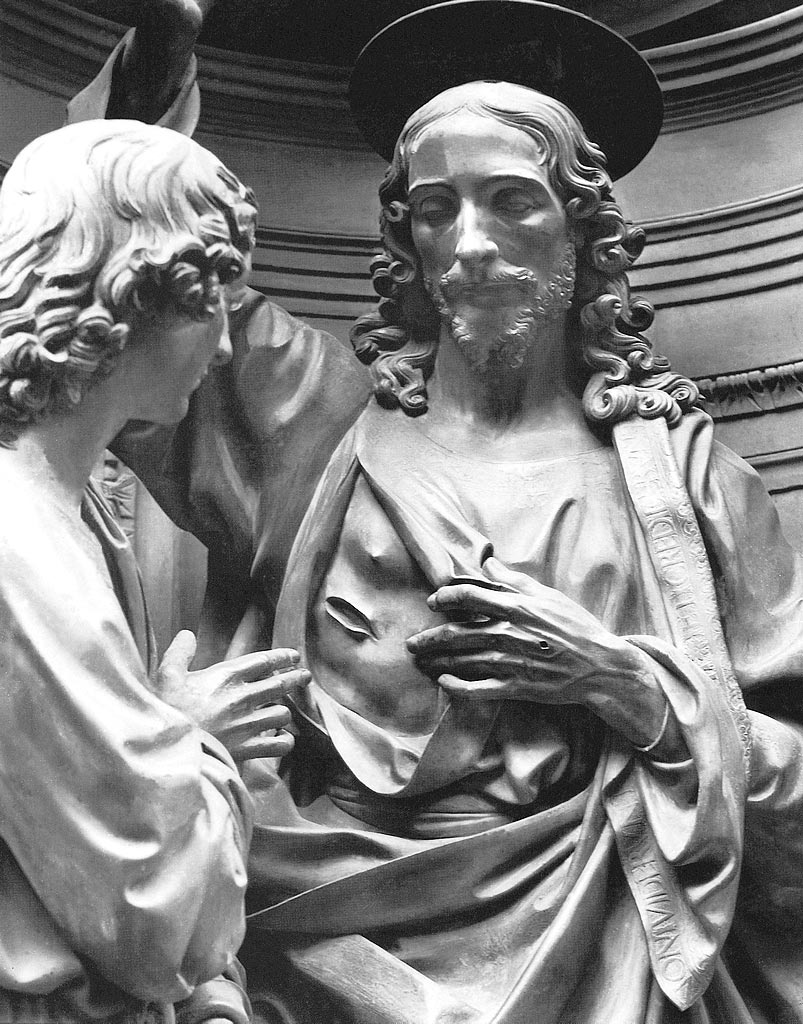
On seeing, then, he believed, and proclaimed him to be God whom he could not see.THOMAS - verrocch_ph96_pl124_050404

Then Jesus spoke these words that give us much joy:  “Blessed are they who have not seen and yet have believed” (see John 20:29).   This sentence undoubtedly signifies to us who hold in our minds Him whom we have not seen in the flesh.   But we are signified only if we follow up our faith by works.   For he really believes, who carries out in deed what he believes.

We do not know for sure where Thomas conducted his missionary activity after Pentecost.    Some claim that he evangelised among the Parthians.   But a stronger tradition says he carried the gospel to India.  He is supposed to have recruited the Christians of Malabar and died a martyr by the spear at Mylapore, near Madras.   An ancient stone cross there marks the place where his remains lay buried until they were removed to Edessa in 394 and then later to Italy.

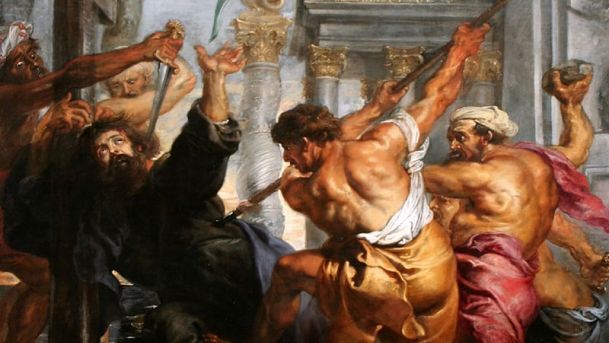
Thomas the Apostle is murdered in India

St Thomas, Apostle of Christ pray for our unbelief!

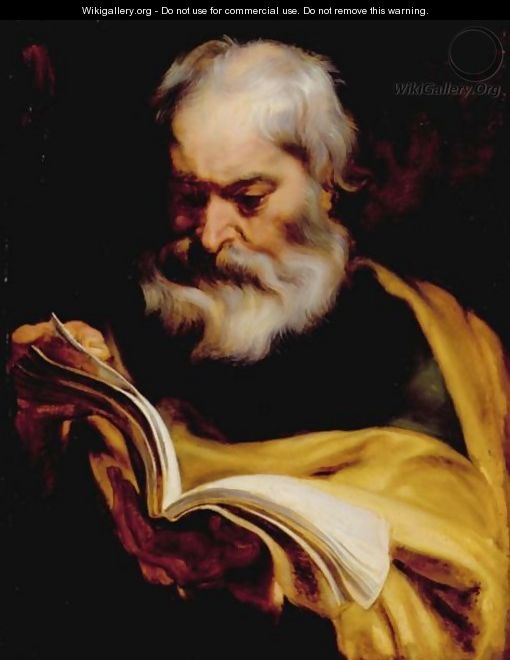
Bust Of The Apostle Thomas - Sir Anthony Van Dyck

st thomas.3.

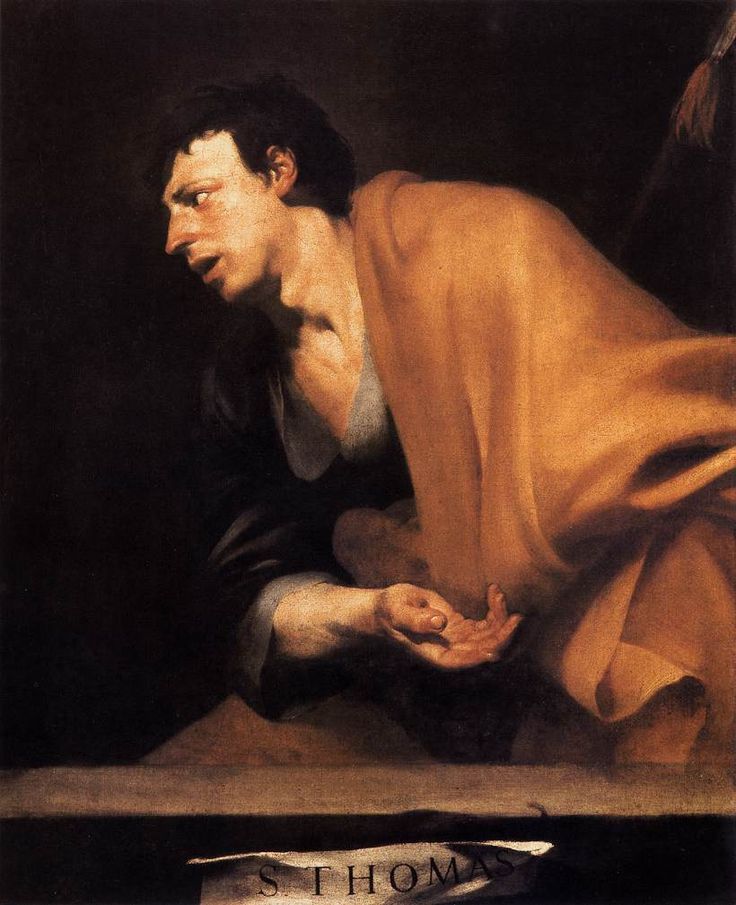
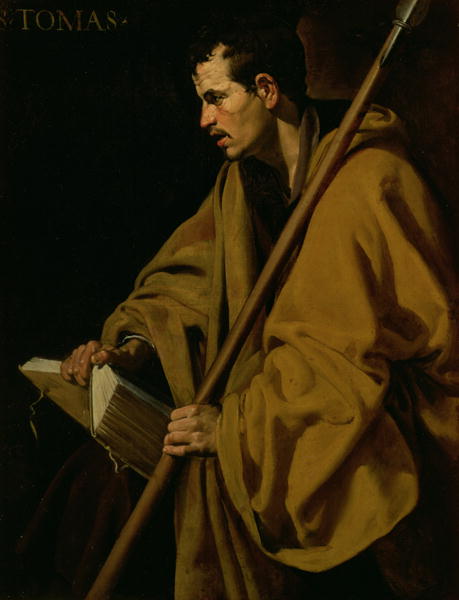
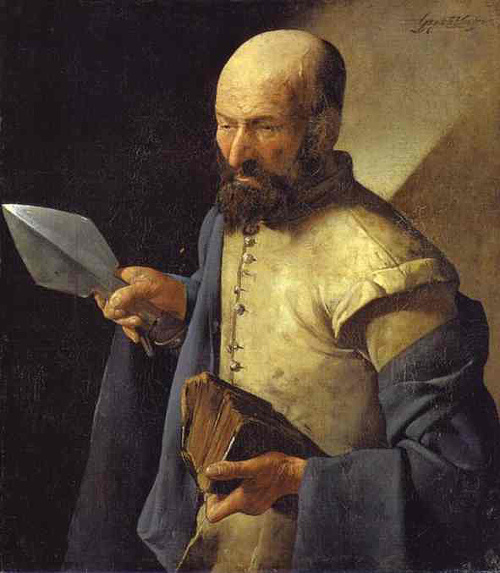
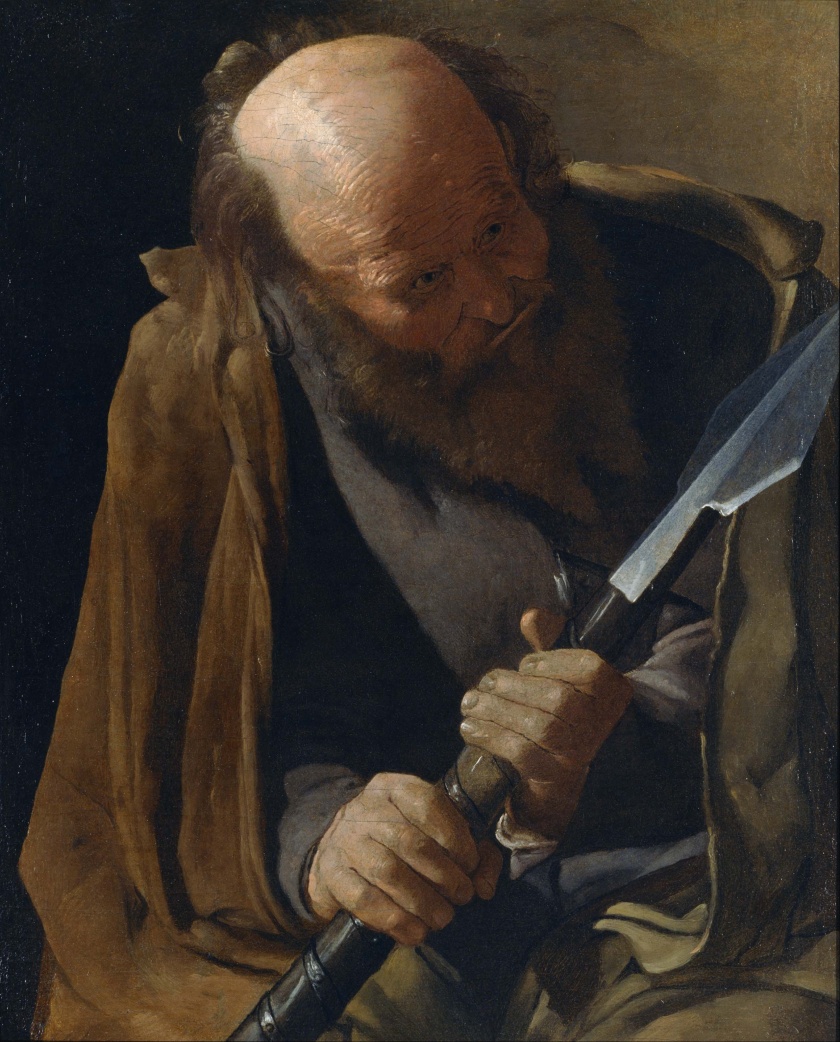
LaTour, St Thomas with pike c1632

Georges_de_La_Tour_-_St._Thomas_-_Google_Art_Projectst thomas.10

Posted in FATHERS of the Church, MORNING Prayers, SAINT of the DAY, The APOSTLES & EVANGELISTS

Thought for the Day – 29 June

Thought for the Day – 29 June

By their lives and labours, Peter and Paul established the faith and by their deaths they bore witness to is power and truth.   They are part of the Church’s own confession of faith – they were the architects of that faith and they have left their mark indelibly upon Christian history and belief.   After Christ, these two are the cornerstones of the Church and as such they are enshrined in the Church’s memory.   They embody in themselves everything a Christian admires in being a follower of Christ, they are Apostles, Martyrs, Witnesses, Evangelists, Teachers, Prophets and Founders of Churches wherever they went in the footsteps of our Lord.   The two great basilicas in Rome are dedicated to them – St Peter’s is the largest Church in Christendom and St Paul’s Outside the Walls, carries the history of all our Popes and is the site of the Martyrdom of St Paul.
We owe our faith to these two great Fathers and hold them in hallowed love and memory.
Like Jesus Himself, their deaths are our lives!

Sts Peter and Paul, pray for us and for the entire universal Church, protect us by your prayers.

sts peter and paul - pray for us.2

Posted in DOCTORS of the Church, FATHERS of the Church, FEASTS and SOLEMNITIES, MORNING Prayers, QUOTES of the SAINTS, SAINT of the DAY, The APOSTLES & EVANGELISTS

Quote/s of the Day – 29 June

Quote/s of the Day – 29 June

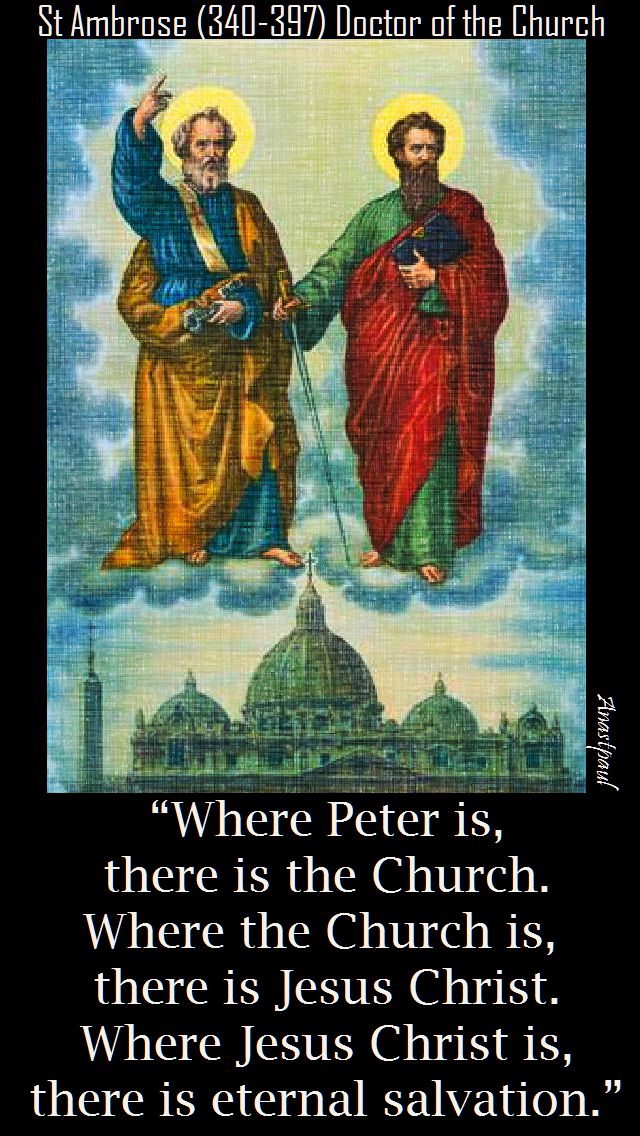
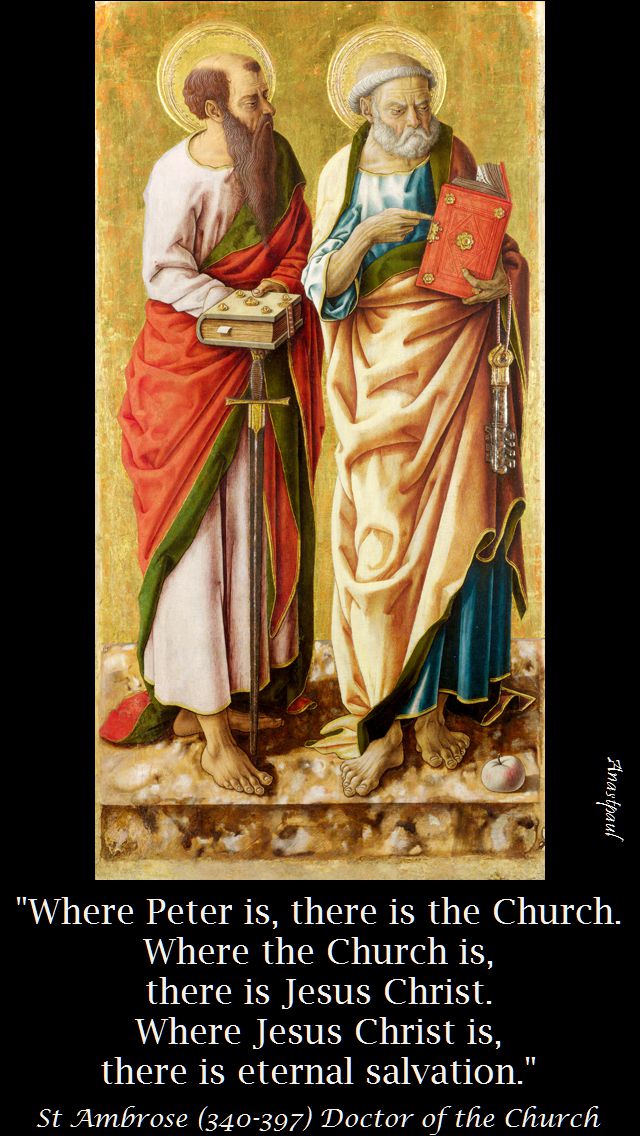
“Where Peter is,
there is the Church.
Where the Church is,
there is Jesus Christ.
Where Jesus Christ is,
there is eternal salvation.”

St Ambrose (340-397)
One of the original four Doctors of the Church

where peter is 2

where peter is, there is the church - st ambrose

“There must be general rejoicing, dearly beloved,
over this holy company whom God has appointed
for our example in patience and for our confirmation in faith.
But we must glory even more in the excellence of their fathers,
Peter and Paul, whom the grace of God has raised
to such a height among all the members of the Church
that He has set them like twin lights
of eyes in that Body whose head is Christ.”

St Pope Leo the Great (400-461) Doctor of the Church’s Unity

he has set them like twinlight - st pope leo the great


Posted in FATHERS of the Church, FEASTS and SOLEMNITIES, MORNING Prayers, QUOTES of the SAINTS, SAINT of the DAY, The APOSTLES & EVANGELISTS, The WORD

One Minute Reflection – 29 June

One Minute Reflection – 29 June

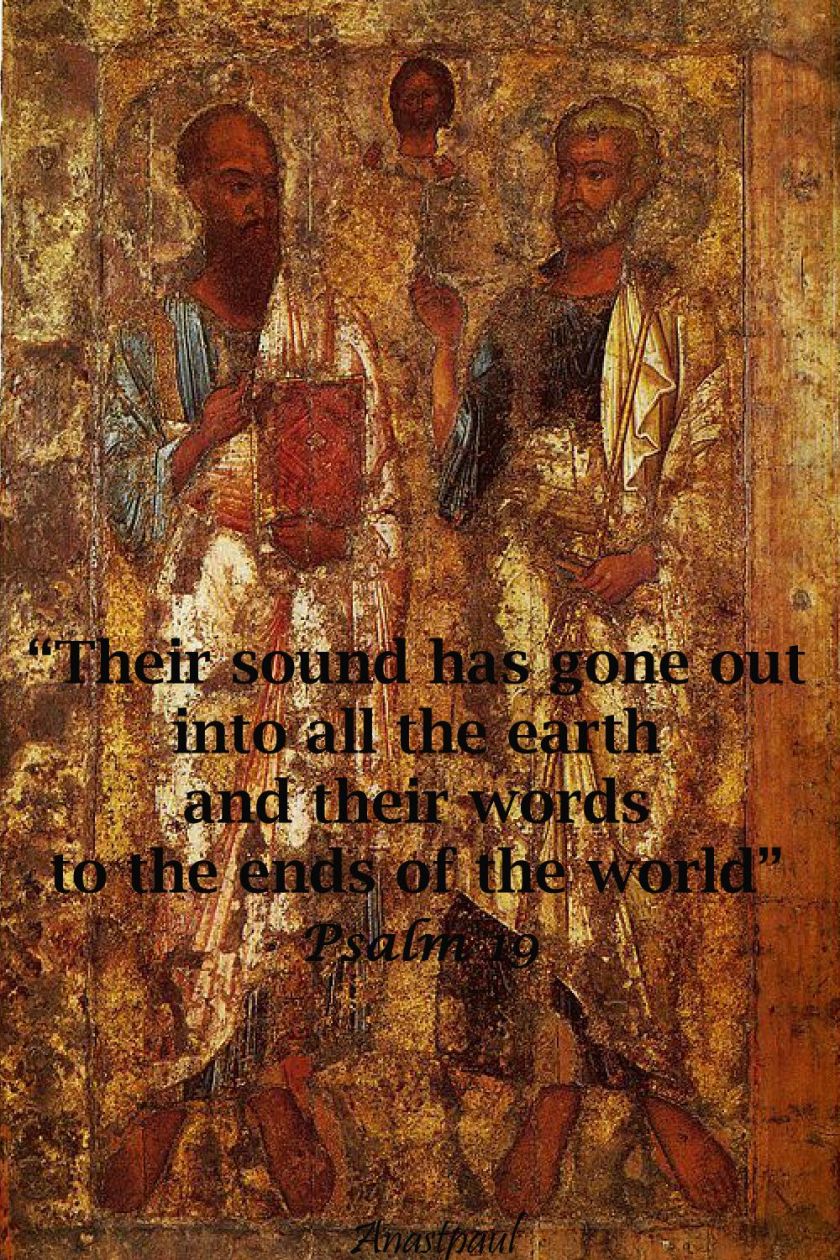
“Their sound has gone out into all the earth and their words to the ends of the world” ……….Psalm 19

psalm 19 - sts peter and paul

REFLECTION – “There is one day for the passion of two apostles. But these two also were as one; although they suffered on different days, they were as one. Peter went first, Paul followed. We are celebrating a feast day, consecrated for us by the blood of the apostles. Let us love their faith, their lives, their labours, their sufferings, their confession of faith, their preaching.”………St Augustine

these two also were as one-staugustine

PRAYER – Almighty God, whose blessed Apostles Peter and Paul glorified you by their martyrdom: grant that your Church, instructed by their teaching and example and knit together in unity by your Spirit, may ever stand firm upon the one foundation, which is Jesus Christ our Lord;  who lives and reigns with you, in the unity of the Holy Spirit, one God, for ever and ever. Sts Peter and Paul, pray for us and for the universal Church, amen.

sts peter and paul - pray for us

Posted in FEASTS and SOLEMNITIES, SAINT of the DAY, The APOSTLES & EVANGELISTS, The WORD

Blessed and Holy Solemnity of Sts Peter and Paul – 29 June

Blessed and Holy Solemnity of Sts Peter and Paul – 29 June – Today we celebrate St Peter and Paul as co-founders of the Church.   St Peter is also celebrated on 22 February (feast of the Chair of Peter, emblematic of the world unity of the Church), 1 August (Saint Peter in Chains) and 18 November (feast of the dedication of the Basilicas of Peter and Paul). St Paul is also celebrated on 25 January – his conversion and 16 February (Saint Paul Shipwrecked).

St Peter Patronages:  Universal Church, against fever, against foot problems, against frenzy, bakers, bridge builders, butchers, clock makers, cobblers, shoe makers, fishermen, harvesters, locksmiths, longevity, net makers, papacy, popes, ship builders, shipwrights, stone masons, watch makers, Isle of Guernsey, Exeter College, Oxford, England, 17 dioceses, 46 cities, 3 abbeys

St Paul Patronages:  against hailstorms, against snake bites, against snakes, Catholic Action, Cursillo movement, lay people, authors, writers, evangelists, journalists, reporters, missionary bishops, musicians, newspaper editorial staff, public relations personnel and work, publishers, rope braiders and makers, saddle makers; saddlers, tent makers, Malta, Bath Abbey, England, 16 dioceses, 28 cities,

peter and paul HEADER 3Peter-and-Paul-Stroman_school_circa_1620_saints_peter_and_paul.jpg - header

SOLEMNITY OF STS PETER AND PAUL

(Excerpt) HOMILY OF HIS HOLINESS BENEDICT XVI

St Peter’s Basilica
Wednesday, 29 June 2005

Dear Brothers and Sisters,

The Feast of the Holy Apostles Peter and Paul is at the same time a grateful memorial of the great witnesses of Jesus Christ and a solemn confession for the Church: one, holy, catholic and apostolic. It is first and foremost a feast of catholicity. The sign of Pentecost – the new community that speaks all languages and unites all peoples into one people, in one family of God -, this sign has become a reality. Our liturgical assembly, at which Bishops are gathered from all parts of the world, people of many cultures and nations, is an image of the family of the Church distributed throughout the earth.

Strangers have become friends; crossing every border, we recognize one another as brothers and sisters. This brings to fulfilment the mission of St Paul, who knew that he was the “minister of Christ Jesus among the Gentiles, with the priestly duty of preaching the Gospel of God so that the Gentiles [might] be offered up as a pleasing sacrifice, consecrated by the Holy Spirit” (Rom 15: 16).
The purpose of the mission is that humanity itself becomes a living glorification of God, the true worship that God expects: this is the deepest meaning of catholicity – catholicity that has already been given to us, towards which we must constantly start out again. Catholicity does not only express a horizontal dimension, the gathering of many people in unity, but also a vertical dimension: it is only by raising our eyes to God, by opening ourselves to him, that we can truly become one.

Like Paul, Peter also came to Rome, to the city that was a centre where all the nations converged and, for this very reason, could become, before any other, the expression of the universal outreach of the Gospel. As he started out on his journey from Jerusalem to Rome, he must certainly have felt guided by the voices of the prophets, by faith and by the prayer of Israel.magnificent glass sts peter and paul

The mission to the whole world is also part of the proclamation of the Old Covenant: the people of Israel were destined to be a light for the Gentiles. The great Psalm of the Passion, Psalm 22[21], whose first verse Jesus cried out on the Cross: “My God, my God, why have you forsaken me?”, ends with the vision: “All the ends of the earth shall remember and turn to the Lord; all the families of the nations shall bow down before him” (Ps 22[21]: 28). When Peter and Paul came to Rome, the Lord on the Cross who had uttered the first line of that Psalm was risen; God’s victory now had to be proclaimed to all the nations, thereby fulfilling the promise with which the Psalm concludes.

Catholicity means universality – a multiplicity that becomes unity; a unity that nevertheless remains multiplicity. From Paul’s words on the Church’s universality we have already seen that the ability of nations to get the better of themselves in order to look towards the one God, is part of this unity. In the second century, the founder of Catholic theology, St Irenaeus of Lyons, described very beautifully this bond between catholicity and unity and I quote him. He says: “The Church spread across the world diligently safeguards this doctrine and this faith, forming as it were one family: the same faith, with one mind and one heart, the same preaching, teaching and tradition as if she had but one mouth. Languages abound according to the region but the power of our tradition is one and the same. The Churches in Germany do not differ in faith or tradition, neither do those in Spain, Gaul, Egypt, Libya, the Orient, the centre of the earth; just as the sun, God’s creature, is one alone and identical throughout the world, so the light of true preaching shines everywhere and illuminates all who desire to attain knowledge of the truth” (Adv. Haer. I 10, 2). The unity of men and women in their multiplicity has become possible because God, this one God of heaven and earth, has shown himself to us; because the essential truth about our lives, our “where from?” and “where to?” became visible when he revealed himself to us and enabled us to see his face, himself, in Jesus Christ. This truth about the essence of our being, living and dying, a truth that God made visible, unites us and makes us brothers and sisters. Catholicity and unity go hand in hand. And unity has a content: the faith that the Apostles passed on to us in Christ’s name.

… We have said that the catholicity of the Church and the unity of the Church go together. The fact that both dimensions become visible to us in the figures of the holy Apostles already shows us the consequent characteristic of the Church: she is apostolic. What does this mean?sts peter and paul - snip

The Lord established Twelve Apostles just as the sons of Jacob were 12. By so doing he was presenting them as leaders of the People of God which, henceforth universal, from that time has included all the peoples. St Mark tells us that Jesus called the Apostles so “to be with him, and to be sent out” (Mk 3: 14). This seems almost a contradiction in terms. We would say: “Either they stayed with him or they were sent forth and set out on their travels”. Pope St Gregory the Great says a word about angels that helps us resolve this contradiction. He says that angels are always sent out and at the same time are always in God’s presence, and continues, “Wherever they are sent, wherever they go, they always journey on in God’s heart” (Homily, 34, 13). The Book of Revelation described Bishops as “angels” in their Church, so we can state: the Apostles and their successors must always be with the Lord and precisely in this way – wherever they may go – they must always be in communion with him and live by this communion.

… Today’s Gospel tells of the profession of faith of St Peter, on whom the Church was founded: “You are the Messiah… the Son of the living God” (Mt 16: 16). Having spoken today of the Church as one, catholic and apostolic but not yet of the Church as holy, let us now recall another profession of Peter, his response on behalf of the Twelve at the moment when so many abandoned Christ: “We have come to believe; we are convinced that you are God’s holy one” (Jn 6: 69). …

Let us pray to the Lord that the truth of these words may be deeply impressed in our hearts, together with his joy and with his responsibility; let us pray that shining out from the Eucharistic Celebration it will become increasingly the force that shapes our lives.B.Vivarini, Apostel Petrus und Paulus - The Apostles Peter and Paul / Vivarini -


Posted in Against STORMS, EARTHQUAKES, THUNDER & LIGHTENING, FIRES, DROUGHT / NATURAL DISASTERS, MORNING Prayers, Of and For PEACE, SAINT of the DAY, The APOSTLES & EVANGELISTS

Saint of the Day – St Barnabas the Apostle, Son of Encouragement – 11 June

Saint of the Day – 11 June –  St Barnabas the Apostle – his name means  “Son of Encouragement.”   Patronages – Cyprus, Antioch, against hailstorms, invoked as peacemaker.

Say the word “Apostles” and most people will respond, “the twelve.”   By which, they mean the twelve-become-eleven-and-then-twelve-again:  Simon Peter, Andrew, James (son of Zebedee) John, Philip, Bartholomew, Thomas, Matthew, James (Son of Alphaeus), Jude (Thaddeus), Simon the Zealot, Judas and Matthias, who replaced Judas.   How, then, can the Church celebrate the Feast of St. Barnabas the Apostle every 11 June?
There are more than twelve apostles. The list includes Paul, Luke, John Mark, Lazarus and, today’s saint, Barnabas, who, like Paul, his travelling and preaching companion, was probably converted after Christ’ death, resurrection and ascension. We first hear of Barnabas in Acts 4:36-37:

“There was a Levite, a native of Cyprus, Joseph, to whom the apostles gave the name Barnabas (which means “son of encouragement”).   He sold a field of that belonged to him, then bought the money and laid it at the apostles’ feet.”
The story of Barnabas is told just before the story of Ananias and Sapphira, who kept back part of the proceeds from land they, like Barnabas, had sold and then, unlike Barnabas, lied to Peter about it.   Ananias and Sapphira wanted to be thought of as faithful without doing the work of faithfulness.   It’s instructive that Luke links their stories.

1128

From the day of his conversion Barnabas was faithful.   He was generous and open to all who came seeking Christ.   When the elders of the Jerusalem Church doubted Paul’s conversion, Barnabas vouched for him.   Born, like Paul, a Jew, Barnabas welcomed gentile converts and did not insist that their conversion be two-fold, first to Judaism and only then to Christianity.   With Paul, he spent a year in Antioch preaching Christ crucified to the gentiles.   From Antioch, Barnabas and Paul went to Cyprus and Asia Minor.   They had only one message: Jesus of Nazareth was crucified, died and was buried.   On the third day he rose again and appeared to the ones who have been sent out to tell this good news to all the world.

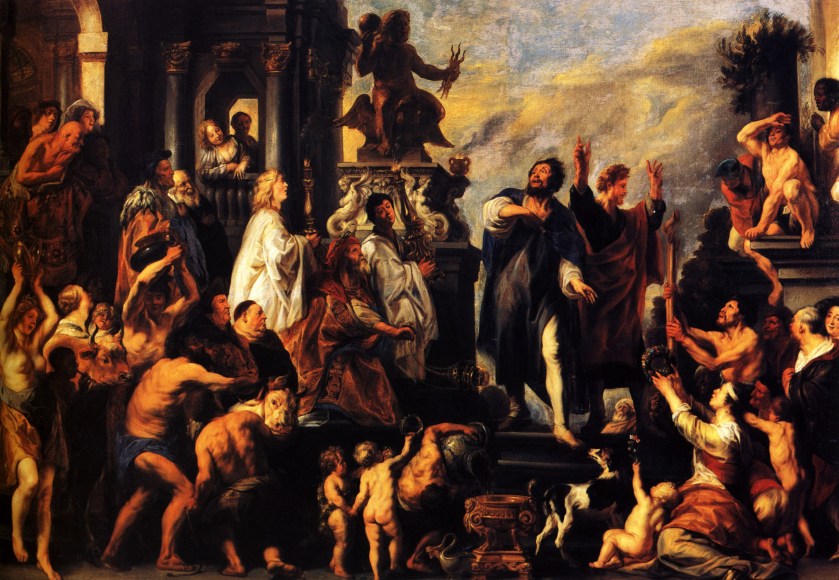
the-apostles-st-paul-and-st-barnabas-at-lystra-1645
← → The Apostles, St. Paul And St. Barnabas At Lystra Jacob Jordaens – 1645

Barnabas and Paul finally separated in their ministries, while remaining apostles of the one Catholic Church, over Paul’s insistence that Mark not travel with them again.

In death, however, the “Apostles to the Gentiles” were reunited. Mark is said to have buried Barnabas after he was killed by a mob in Cyprus around the year 62.   St Paul and St Mark were, in turn, reconciled before St. Paul’s martyrdom five years later.

He is said to have been stoned to death in Salamis in the year 61.

Paul writes of him in first letter to the church at Corinth, where he makes clear that both he and Barnabas have to work for a living.   So we know he was preaching and teaching as late as 56 or 57 A.D.   Some sources say he was the first Bishop of Milan.   In Acts 11:24, St. Luke called him “a good man, full of the Holy Spirit and of faith.”   Luke writes as a result of Barnabas’ preaching in Antioch, “a great many people were brought to the Lord.”

Sometimes the stories of martyrdoms are so dramatic and so compelling that we focus on the death of the saint rather than the life.   Barnabas calls us to consider the way we live, and then through this way, preparing for our deaths.

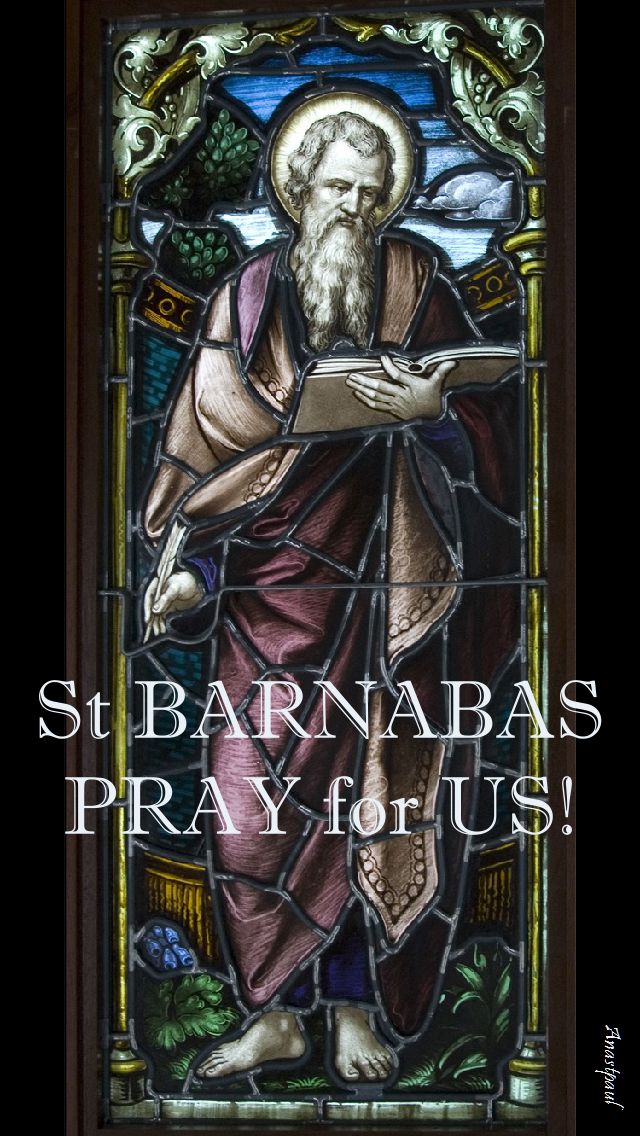
St Barnabas, pray for us!

st barnabas pray for us

Posted in MORNING Prayers, SAINT of the DAY, The APOSTLES & EVANGELISTS

Thought for the Day – 14 May

Thought for the Day – 14 May

What was the holiness of Matthias? Obviously, he was suited for apostleship by the experience of being with Jesus from His baptism to His ascension.   He must also have been suited personally, or he would not have been nominated for so great a responsibility.   Must we not remind ourselves that the fundamental holiness of Matthias was his receiving gladly the relationship with the Father offered him by Jesus and completed by the Holy Spirit?   The Apostles were given the mission to bring the Good News of Jesus Christ to the world, bearing witness to His Resurrection and establishing the Kingdom of God upon the earth.   For that, they left all things and gave themselves totally.   All of us share in this mission and we all have to be apostles wherever we are.   By our very Baptism, we are sent to share the Gospel, just as St Matthias did.    If the apostles are the foundations of our faith by their witness, they must also be reminders, that holiness is entirely a matter of God’s giving but it is offered to all, in the everyday circumstances of life. We receive, we must accept and now we must give!

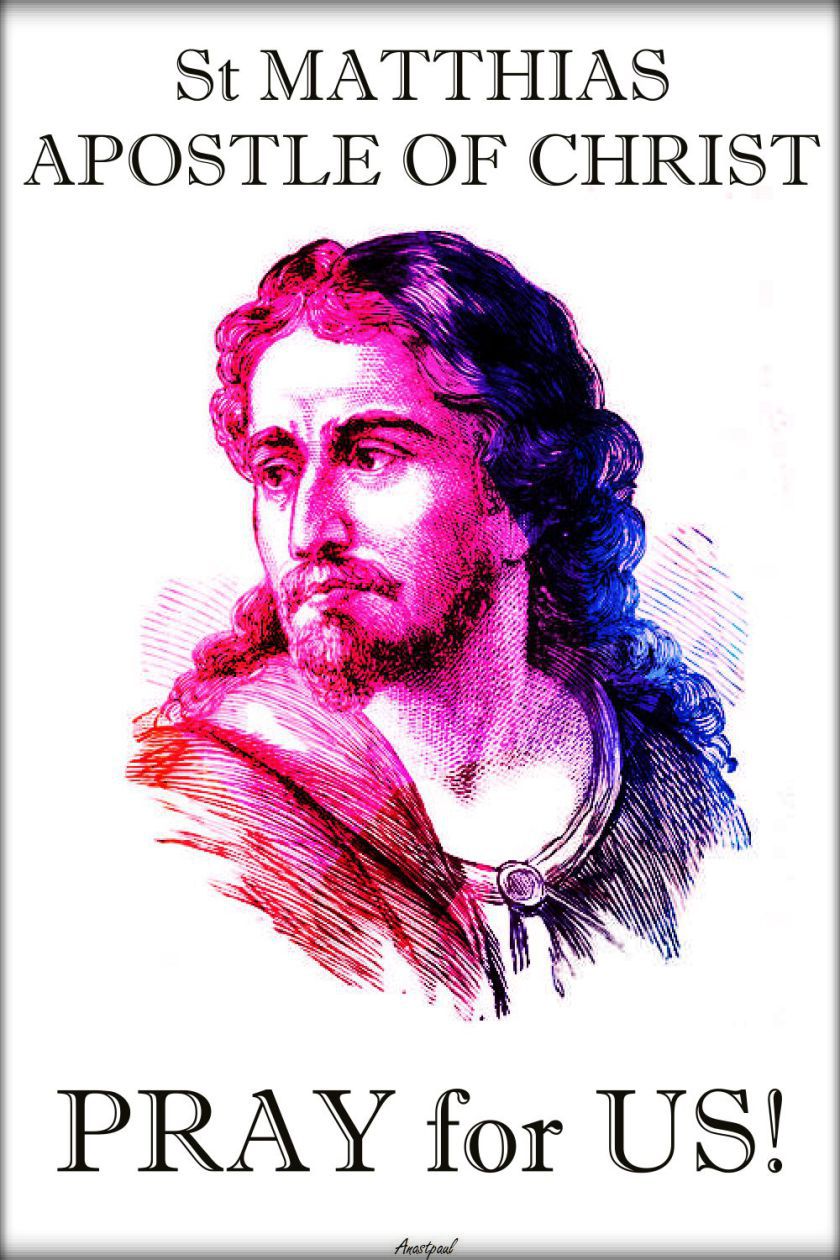
St Matthias, Apostle of Christ, Pray for us!

st-matthias-pray-for-us-14 may 2018-2

Posted in FEASTS and SOLEMNITIES, MORNING Prayers, SAINT of the DAY, The APOSTLES & EVANGELISTS

Quote of the Day – 14 May

Quote of the Day – 14 May

“We know nothing else about him (St Matthias), if not that he had been a witness to all Jesus’ earthly events (cf. Acts 1: 21-22), remaining faithful to Him to the end.    To the greatness of his fidelity was later added the divine call to take the place of Judas, almost compensating for his betrayal.

We draw from this a final lesson:  while there is no lack of unworthy and traitorous Christians in the Church, it is up to each of us to counterbalance the evil done by them with our clear witness to Jesus Christ, our Lord and Saviour.” – Pope Benedict GENERAL AUDIENCE, Saint Peter’s Square, Wednesday, 18 October 2006

ST MATTHIAS - POPE BENEDICT

Posted in SAINT of the DAY, The APOSTLES & EVANGELISTS

Saint and Feast of the Day – 14 May – St Matthias, Apostle of Christ

Saint and Feast of the Day – 14 May – St Matthias, Apostle of Christ, Martyr (1st Century- c80) – Patron of alcoholics; carpenters; smallpox; tailors; hope; perseverance, diocese of Gary, Indiana, diocese of Great Falls-Billings, Montana.   Attributes – lance, spear.

ST MATTHIAS 4

St Matthias is according to the Acts of the Apostles, the apostle chosen by lot to replace Judas Iscariot following Judas’ betrayal of Jesus and his subsequent suicide (as in the Gospel According to Matthew).   His calling as an apostle is unique, in that his appointment was not made personally by Jesus, who had already ascended into heaven and it was also made before the descent of the Holy Spirit upon the early Church.

There is no mention of a Matthias among the lists of disciples or followers of Jesus in the three synoptic gospels but according to Acts, he had been with Jesus from his baptism by John until his Ascension.    In the days following, Peter proposed that the assembled disciples, who numbered about one hundred and twenty, nominate two men to replace Judas.    They chose Joseph called Barsabas (whose surname was Justus) and Matthias. Then they prayed, “Thou, Lord, which knowest the hearts of all [men], shew whether of these two thou hast chosen, That he may take part of this ministry and apostleship, from which Judas by transgression fell, that he might go to his own place.”[Acts 1:24–25]    Then they cast lots and the lot fell to Matthias; so he was numbered with the eleven apostles.   Matthias was present with the other apostles at Pentecost.

No further information about Matthias is to be found in the canonical New Testament. Even his name is variable: the Syriac version of Eusebius calls him throughout not Matthias but “Tolmai”, not to be confused with Bartholomew (which means Son of Tolmai), who was one of the twelve original Apostles.

The tradition of the Greeks says that St. Matthias planted the faith about Cappadocia and on the coasts of the Caspian Sea, residing chiefly near the port Issus.    Clement of Alexandria observed (Stromateis vi.13.):

“Not that they became apostles through being chosen for some distinguished peculiarity of nature, since also Judas was chosen along with them.    But they were capable of becoming apostles on being chosen by Him who foresees even ultimate issues.    Matthias, accordingly, who was not chosen along with them, on showing himself worthy of becoming an apostle, is substituted for Judas.”

The feast of Saint Matthias was included in the Roman Calendar in the 11th century and celebrated on the sixth day to the Calends of March (February 24 usually but February 25 in leap years).   In the revision of the General Roman Calendar in 1969, his feast was transferred to May 14, so as not to celebrate it in Lent but instead in Eastertide close to the Solemnity of the Ascension, the event after which the Acts of the Apostles recounts that Matthias was selected to be ranked with the Twelve Apostles.

St Matthias stoned to death at Colchis in 80.    It is claimed that St Matthias the Apostle’s remains are interred in the Abbey of St. Matthias, Trier, Germany, brought there through Empress Helena of Constantinople, mother of Emperor Constantine I (the Great) and St Mary Major Rome.


Posted in FEASTS and SOLEMNITIES, MORNING Prayers, SAINT of the DAY, The APOSTLES & EVANGELISTS

Thought for the Day – 3 May

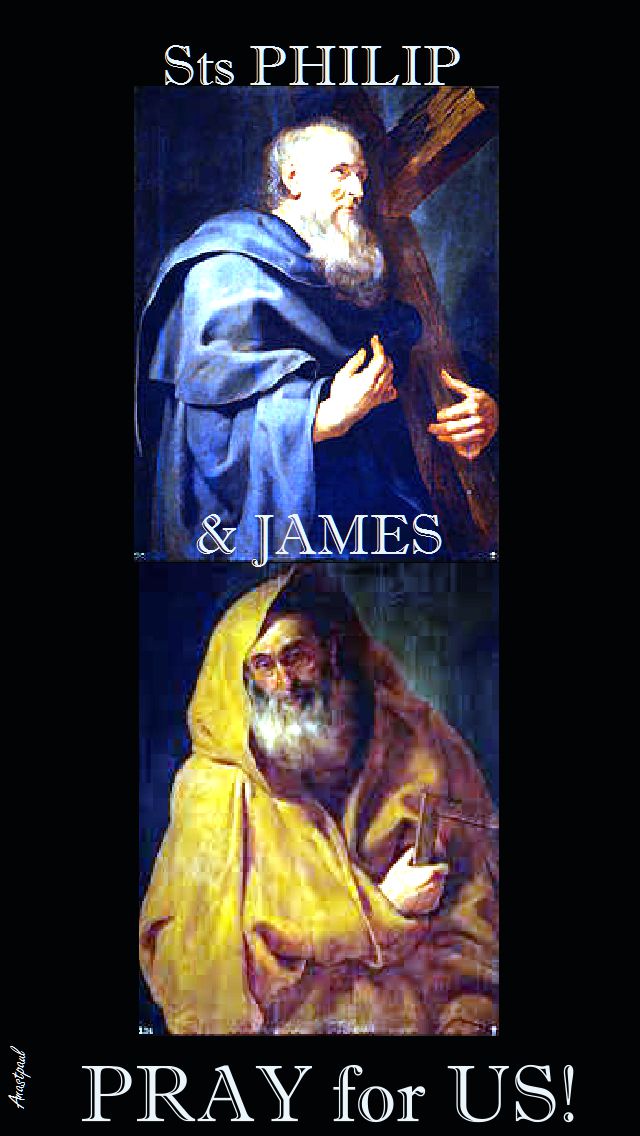
Sts Philip and James left all to follow Jesus, to become His heralds to the whole world.   They faced only difficulties, opposition and – finally – death by violence.   We cannot avoid the difficulties that come with professing our faith and we are all called to be apostles.   Let us pray for the courage to face our task with the same courage with which the Apostles faced theirs.   As in the case of the other apostles, we see in James and Philip human men who became foundation stones of the Church and we are reminded again that holiness and its consequent apostolate are entirely the gift of God, not a matter of human achieving.    All power is God’s power, even the power of human freedom to accept his gifts. “You will be clothed with power from on high,” Jesus told Philip and the others.   Their first commission had been to expel unclean spirits, heal diseases, announce the kingdom.    They learned, gradually, that these externals were sacraments of an even greater miracle inside their persons—the divine power to love like God.

Sts Philip and James, Pray for us!

STS PHILIP AND JAMES PRAY FOR US 2

Posted in FEASTS and SOLEMNITIES, MORNING Prayers, QUOTES of the SAINTS, SAINT of the DAY, The APOSTLES & EVANGELISTS

One Minute Reflection – 3 May

One Minute Reflection – 3 May

What was from the beginning, what we have heard,
what we have seen with our eyes, what we looked upon
and touched with our hands concerns the Word of life
for the life was made visible;  we have seen it and testify to it……….1 John 1:1-2

REFLECTION – “Two of the favoured witnesses of our beloved Jesus’ Resurrection come before us today.    Sts. Philip and James are here, bearing testimony to us that their Master is truly risen from the dead, that they have seen Him, that they have touched Him, that they have conversed with Him during these forty days.   And, that we may have no doubt as to the truth of their testimony, they hold in their hands the instruments of the martyrdom they underwent for asserting that Jesus, after having suffered death, came to life again and rose from the grave.”………………..Abbot/Dom Prosper Guéranger

TWO OF THE FAVOURED - Dom Prosper Guéranger

PRAYER – O God, who gladden us each year with the feast day of the Apostles Philip and James, grant us, through their prayers, a share in the Passion and Resurrection of your Only Begotten Son, so that we may merit to behold You for eternity. Through our Lord Jesus Christ, your Son, who lives and reigns with You in the unity of the Holy Spirit, one God, for ever and ever.

STS PHILIP AND JAMES PRAY FOR US

Posted in FEASTS and SOLEMNITIES, SAINT of the DAY, The APOSTLES & EVANGELISTS

Blessed Feast Day of Sts Philip and James, Apostles of Jesus Christ

Blessed Feast Day of Sts Philip and James, Apostles of Jesus Christ

ST PHILIPphilip-670

The Apostle Philip was one of Christ’s first disciples, called soon after his Master’s baptism in the Jordan.    The fourth Gospel gives the following detail:  “The next day Jesus was about to leave for Galilee and He found Philip.    And Jesus said to him:  Follow Me. Now Philip was from Bethsaida, the town of Andrew and Peter.    Philip found Nathanael, and said to him:   We have found Him of whom Moses in the Law and the Prophets wrote, Jesus the Son of Joseph of Nazareth.    And Nathanael said to him:  Can anything good come out of Nazareth?    Philip said to him: Come and see” (John 1:43ff). — The Church’s Year of Grace, Pius Parsch

Patronages:  Hatters; Luxembourg; pastry chefs; Uruguay, 37 cities.   Attributes:  basket; basket and Tau cross or letter Tau; two or three loaves and a cross; patriarchal cross and spear; knotted cross; broken idols; inverted cross; tall column; dragon; carpenter’s square and cross; long staff and spear; tall cross and book.

On Wednesday, 27 July 2011, the Turkish news agency Anadolu reported that archaeologists had unearthed a tomb that the project leader claims to be the Tomb of Saint Philip during excavations in Hierapolis close to the Turkish city Denizli.   The Italian archaeologist, Professor Francesco D’Andria stated that scientists had discovered the tomb within a newly revealed church.    He stated that the design of the Tomb and writings on its walls, definitively prove it belonged to the martyred Apostle of Jesus.

ST JAMES THE LESSER

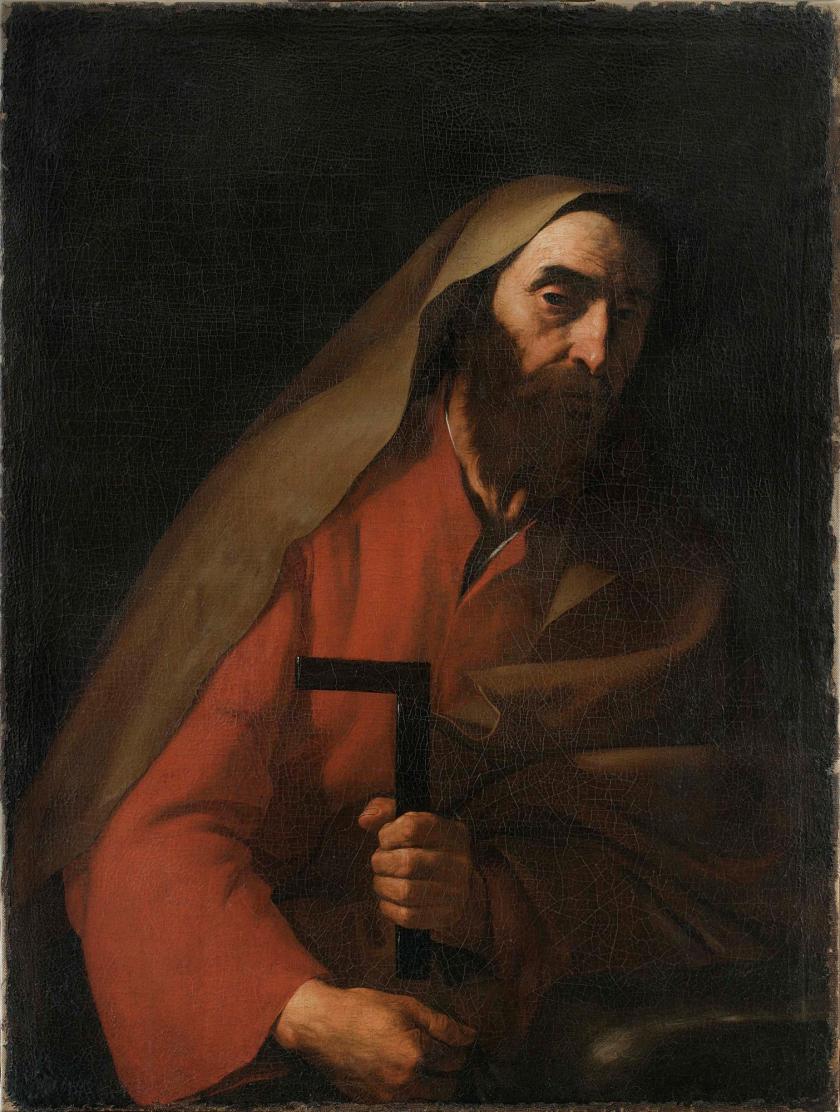
Also known as:  Jacobus Minor, James the Just, James the Less, James the Younger, James, son of Alphaeus.   James, Son of Alphaeus:  We know nothing of this man except his name and, of course, the fact that Jesus chose him to be one of the 12 pillars of the New Israel, His Church.   He is not the James of Acts, son of Clopas, “brother” of Jesus and later bishop of Jerusalem and the traditional author of the Letter of James.   James, son of Alphaeus, is also known as James the Lesser to avoid confusing him with James the son of Zebedee, also an apostle and known as James the Greater.
Patronage:   dying people, apothecaries, druggists, pharmacists, fullers, hatmakers, hatters, milliners, Uruguay, 8 cities in Italy.   Attributes:   fuller’s club, man holding a book, square rule

Today’s Mass tells us that the example of the Apostles is the most certain and direct path to heaven.    They suffered and were persecuted but they placed their confidence in God and now they rejoice in heaven.   We too must have confidence in God and not be troubled in our adversities.    In our Father’s house there are many mansions and if we follow the way indicated by Him, Christ will come at the end of our life and take us to Himself.