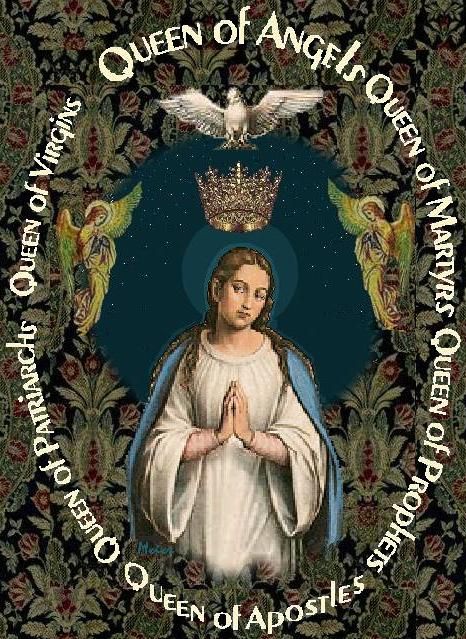
Queenship of Mary (Memorial): On 22 August, the Church celebrates a Feast in honour of the Queenship of Mary. The Queenship can be considered a prolongation of the celebration of the Assumption. The Memorial of the Queenship of Mary – 22 August – A Marian feast day decreed by Pope Pius XII on 11 October 1954, in his encyclical Ad caeli reginam to recognise and celebrate the Blessed Virgin Mary as Queen of the world, of the universe, of the Angels, of Heaven, Prophets, Apostles, Martyrs, Confessors, Virgins, all Saints,of Families, Queen conceived without original sin Queen assumed into Heaven, Queen of the Most Holy Rosary, Queen of Mercy, Queen of Peace. Amen, Holy Queen and Mother! Here too: https://anastpaul.wordpress.com/2017/08/22/the-memorial-of-the-queenship-of-mary-22-august/
St Andrew of Fiesole
St Anthusa of Seleucia
St Antoninus of Rome
St Arnulf of Eynesbury
St Athanasius of Tarsus
Bl Bernard Perani
St Dalmau Llebaría Torné
Bl Élie Leymarie de Laroche
St Epictetus of Ostia
St Ethelgitha of Northumbria
St Fabrician of Toledo
St Felix of Ostia Bl Giacomo/James Bianconi OP (1220–1301)
St Gunifort
St Joan Farriol Sabaté St John Kemble (1599 – 1679) Martyr Biography: https://anastpaul.com/2018/08/22/saint-of-the-day-22-august-st-john-kemble-1599-1679-martyr/
St John Wall
St Josep Roselló Sans
St Julio Melgar Salgado
St Maprilis of Ostia
St Martial of Ostia
St Maurus of Rheims
St Narciso de Esténaga y Echevarría
St Philibert of Toledo
Bl Richard Kirkman
St Saturninus of Ostia
Bl Simeon Lukach
St Sigfrid of Wearmouth
St Symphorian of Autun
St Thomas Percy
St Timothy of Rome
Bl William Lacey
_
Martyred in the Spanish Civil War:
• Blessed Dalmau Llebaría Torné
• Blessed Joan Farriol Sabaté
• Blessed Josep Roselló Sans
• Blessed Julio Melgar Salgado
• Blessed Narciso de Esténaga y Echevarría
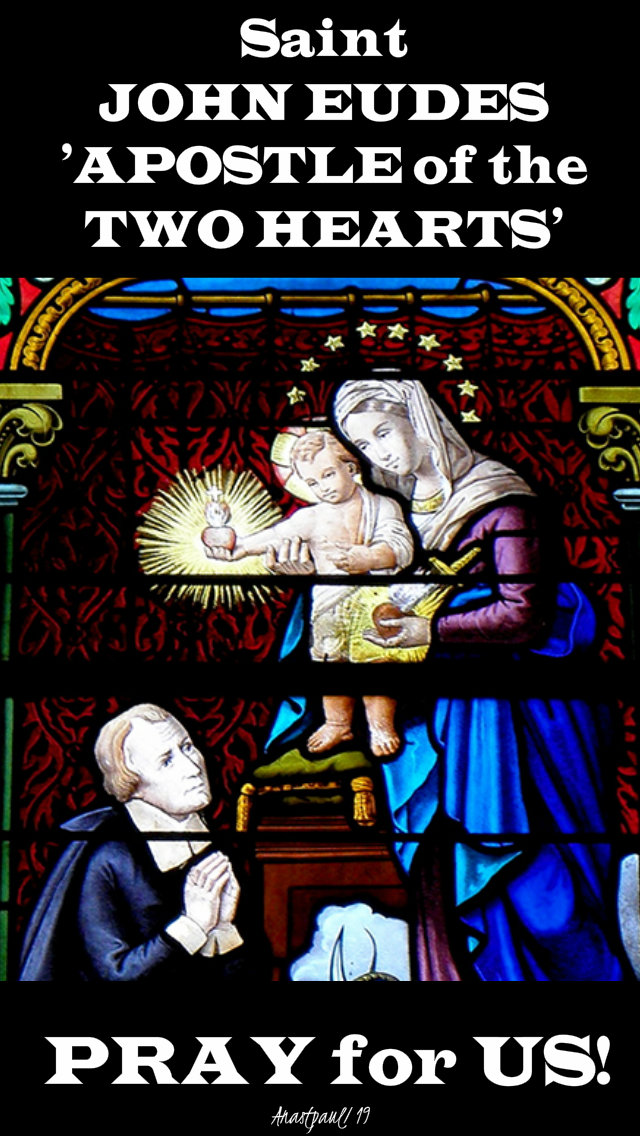
Thought for the Day – 19 August – The Memorial of St John Eudes Orat. (1601-1680) “Apostle of Two Hearts”
St John Eudes captured the devotion to the Sacred Heart of Jesus and the Immaculate Heart of Mary by honouring them in the liturgy. Thanks to this saint, Holy Cross priests have as their patron Jesus’ Sacred Heart and Notre Dame has a Basilica dedicated to the Sacred Hearts of Jesus and Mary.
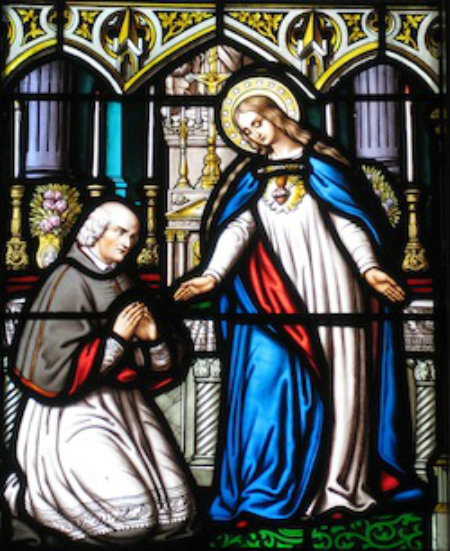
In fact, even though John was Canonised a saint after the Basilica was constructed, he is depicted there in a stained glass window leading people in devotion to the Immaculate Heart of Mary.
John’s spirituality focused on the love of Jesus and Mary, symbolised in their sacred hearts. He began a feast day for people to honour the heart of Mary and the Sacred Heart of Jesus, these feast days spread quickly and were taken up around the Church. While John was not the first to be devoted to the Sacred Hearts of Jesus and Mary, he was the first to capture this devotion in the liturgy, which gave the Church a way to participate and spread it.
He died after giving a parish mission in his old age that left him sick and weak—he preached outdoors, in the winter, every day for nine weeks and never recovered. He died on this date in 1680.
John Eudes is probably best known for the central theme of his writings – Jesus as the source of holiness and Mary as the model of the Christian life. His devotion to the Sacred Heart and to the Immaculate Heart led Pope Pius XI to declare him the father of the liturgical cult of the Hearts of Jesus and Mary.
He believed in the unity of the hearts of Jesus and Mary and wrote: ”You must never separate what God has so perfectly united. So closely are Jesus and Mary bound up with each other that whoever beholds Jesus, sees Mary, whoever loves Jesus, loves Mary, whoever has devotion to Jesus, has devotion to Mary.”
St John Eudes, you help us form our hearts in the shape of Jesus’ Sacred Heart and our lives in the obedience and love of the Immaculate Heart of His Mother — pray for us!
Our Morning Offering – 17 August – Saturday of the Nineteenth week in Ordinary Time, Year C and a Marian Saturday
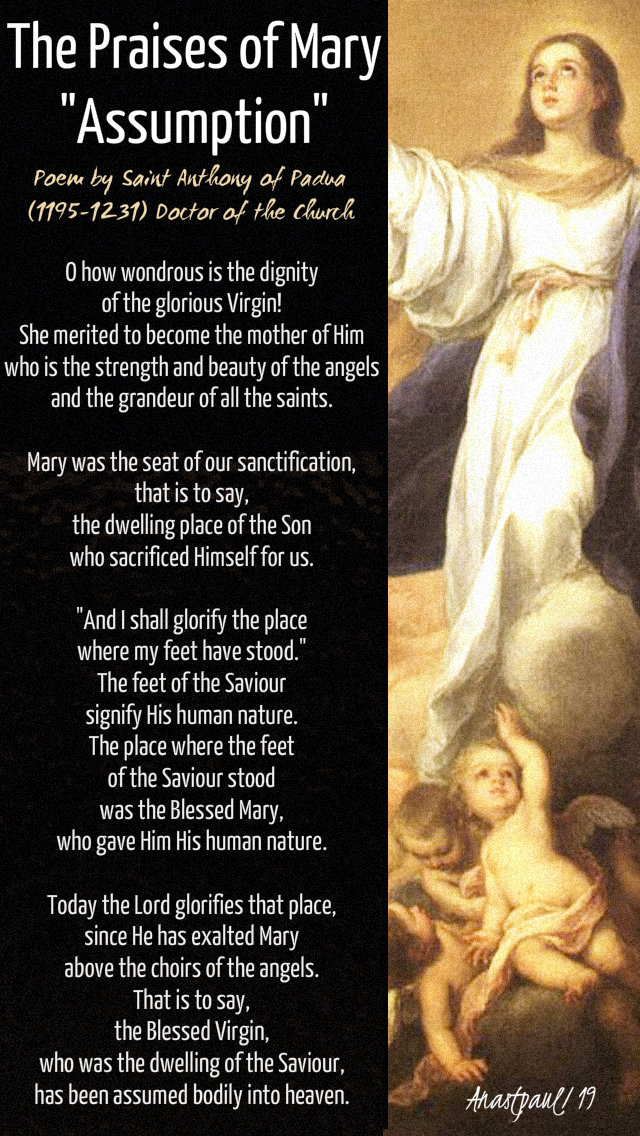
The Praises of Mary “Assumption” Poem by Saint Anthony of Padua (1195-1231) Doctor of the Church
O how wondrous is the dignity of the glorious Virgin!
She merited to become the mother of Him
who is the strength and beauty of the angels
and the grandeur of all the saints.
Mary was the seat of our sanctification,
that is to say,
the dwelling place of the Son
who sacrificed Himself for us.
“And I shall glorify the place where my feet have stood.”
The feet of the Saviour signify His human nature.
The place where the feet of the Saviour stood
was the Blessed Mary,
who gave Him His human nature.
Today the Lord glorifies that place,
since He has exalted Mary
above the choirs of the angels.
That is to say,
the Blessed Virgin,
who was the dwelling of the Saviour,
has been assumed bodily into heaven.
Thought for the Day – 15 August – Solemnity of the Assumption of the Blessed Virgin Mary into Heaven
You have Borne for us the Clothing of Immortality
Saint John Damascene (675-749)
Priest and Father and Doctor of the Church
An excerpt from his Homily 9 – On the Dormition of the Blessed Virgin Mary
“Once indeed God ejected the mortals and first parents of the human race from the paradise of Eden, when they had drunk deeply, from the wine of disobedience and had become so affected by the hangover of sin, through the intoxication of that transgression, which led to the sleepiness of the mind’s eye. Now, however, shall not paradise receive her who repelled the onslaught of all sin, producing the seed of obedience to God and Father and bringing forth life, for all races of mortal men? How can death devour this truly blessed woman, who gave birth to the whole person of the Word of God through union with God? How can hell receive her? When Christ, who is the way and the truth, said Where I am, there will my servant be also, why would there not be a dwelling for His own mother with Him with an even greater justification? It is well said that precious in the sight of the Lord God of Hosts, is the death of His saints but even more precious, is the passing of the Mother of God from this life.
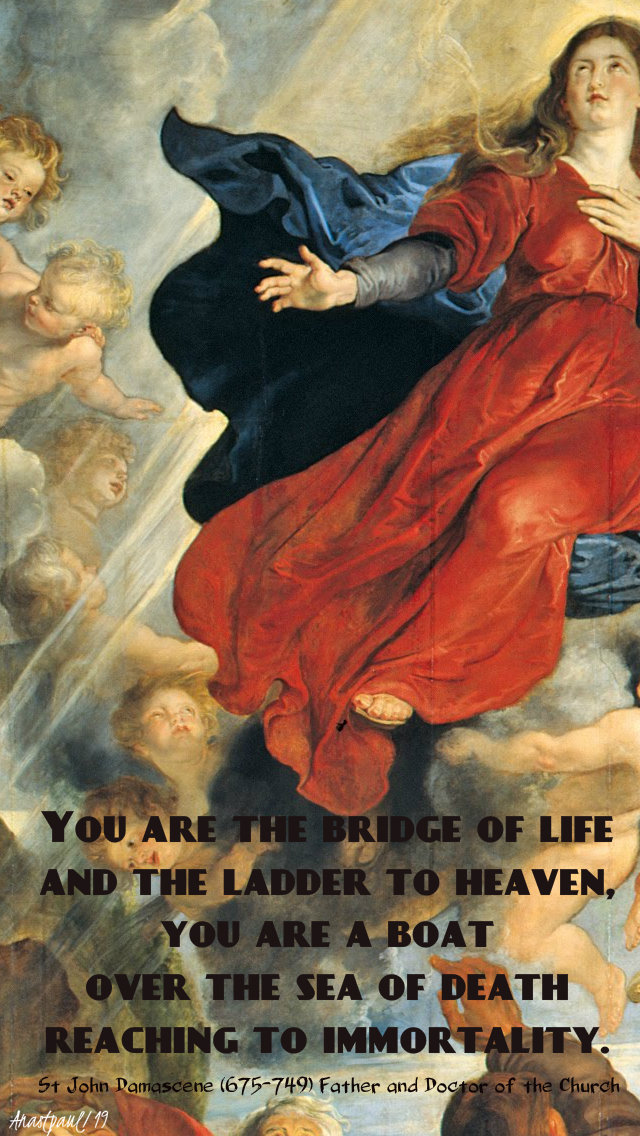
Then Adam and Eve, the founders of our race, exclaimed with a loud voice in great rejoicing: “Blessed are you, O daughter, who bore for us the penalties of the commands that had been broken. When you had gained a mortal body from us, you gave birth to a covering of immortality for us. You repaid us so that it might be well with us, since you received birth from our loins. From beyond the grave you have called us back to our ancient seat, we closed paradise for ourselves but you made open the way of the tree of life. Through our actions, sadness came forth from happiness, through you even more joyful things have returned from sorrow. In what possible way could you be acceptable to death, O Immaculate one? You are the bridge of life and the ladder to heaven, you are a boat over the sea of death reaching to immortality.”
But the woman herself, as she did not shrink from the truth, said: “Into Your hands, my Son, I commend my spirit. Receive this soul which is dear to You, which You have preserved free from any sin. I hand over my body, not to the earth but to You. Take me to Yourself, that where You are, You, the child of my womb, so there I also may be Your companion. I am hastening to You, who have often come to me on this side of that long distance.”
When she had said this, she heard in reply: “Come to my rest, my blessed Mother, arise, come, my beloved, most blessed among all women. Behold, the winter is ended. You are all fair, my beloved and there is no spot of stain found in you, the odour of your ointments are more precious than all other aromas.”
++++++++++
There is an invocation in a Litany to Our Lord in which we ask: ut ad celestia desideria erigas, te rogamus, audi nos – that our souls be raised to the desire for celestial things, we pray Thee, hear us. This invocation should be the conclusion of our meditation on the Assumption of Our Lady. We should ask, that we may love the celestial happiness of Our Lady, to give her glory and that we may one day be with her in Paradise. We should also love and meditate on her joys, as a way to accept with peace and resignation the sorrows and sufferings God sends us, so that we might prove our love for Him.
Quote of the Day – 15 August – Solemnity of the Assumption of the Blessed Virgin Mary into Heaven
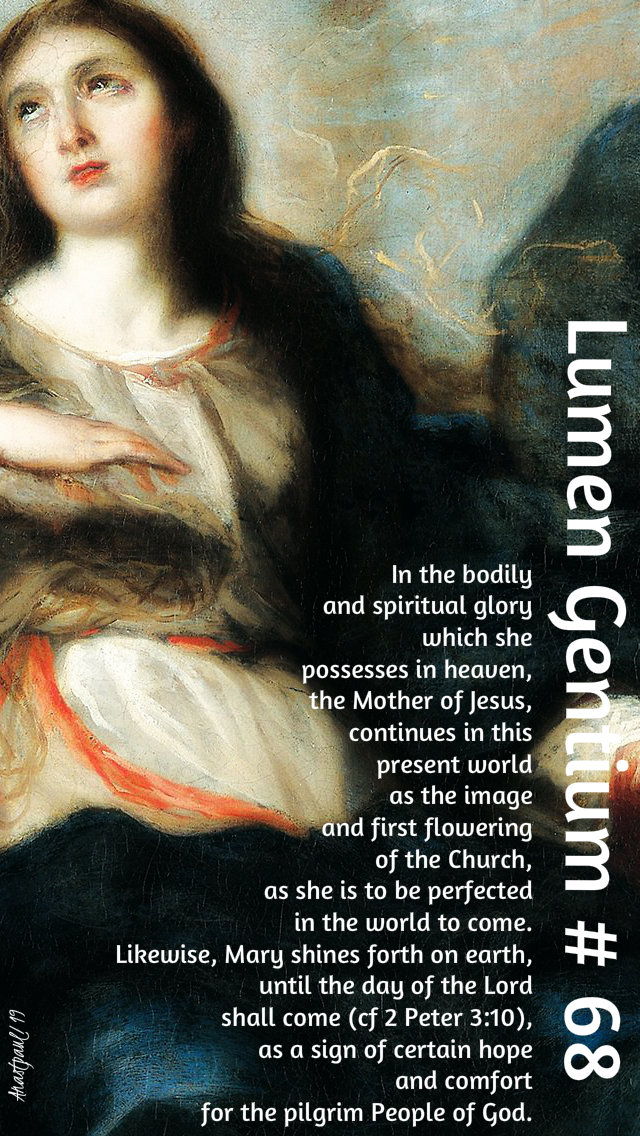
“In the bodily and spiritual glory which she possesses in heaven, the Mother of Jesus, continues in this present world as the image and first flowering of the Church, as she is to be perfected in the world to come. Likewise, Mary shines forth on earth, until the day of the Lord shall come (cf 2 Peter 3:10), as a sign of certain hope and comfort for the pilgrim People of God.”
Lumen Gentium
Dogmatic Constitution on the Church #68.
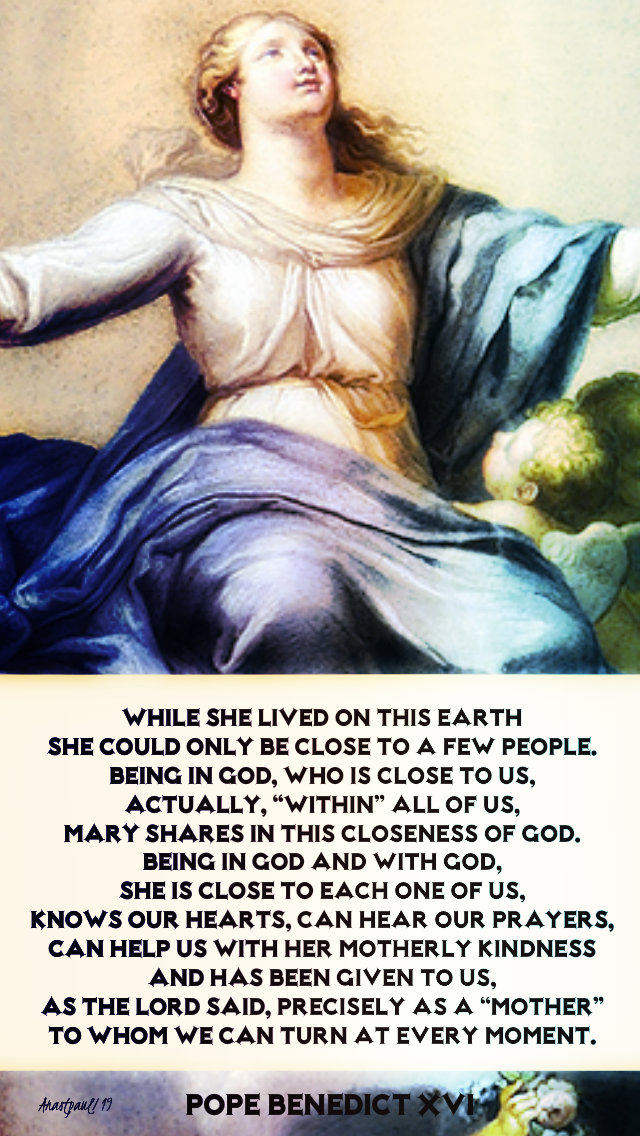
“While she lived on this earth she could only be close to a few people. Being in God, who is close to us, actually, “within” all of us, Mary shares in this closeness of God. Being in God and with God, she is close to each one of us, knows our hearts, can hear our prayers, can help us with her motherly kindness and has been given to us, as the Lord said, precisely as a “mother” to whom we can turn at every moment.”
Pope Benedict XVI
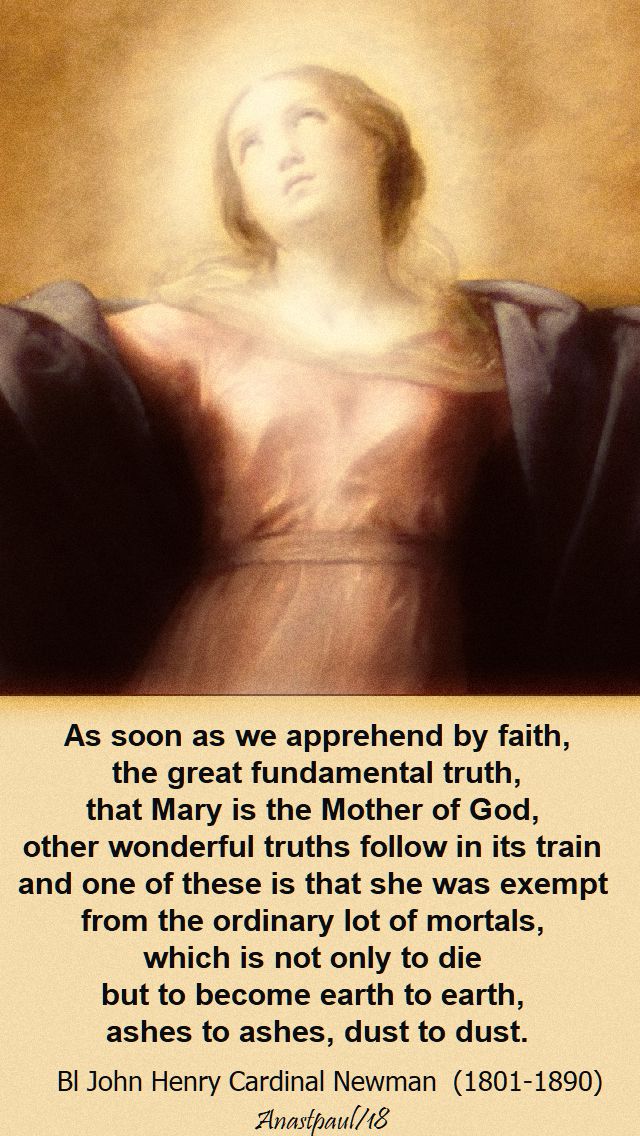
“As soon as we apprehend by faith, the great fundamental truth, that Mary is the Mother of God, other wonderful truths follow in its train and one of these, is that, she was exempt from the ordinary lot of mortals, which is not only to die but to become earth to earth, ashes to ashes, dust to dust.”
One Minute Reflection – 15 August – Solemnity of the Assumption of the Blessed Virgin Mary into Heaven, Gospel: Luke 1:39–56
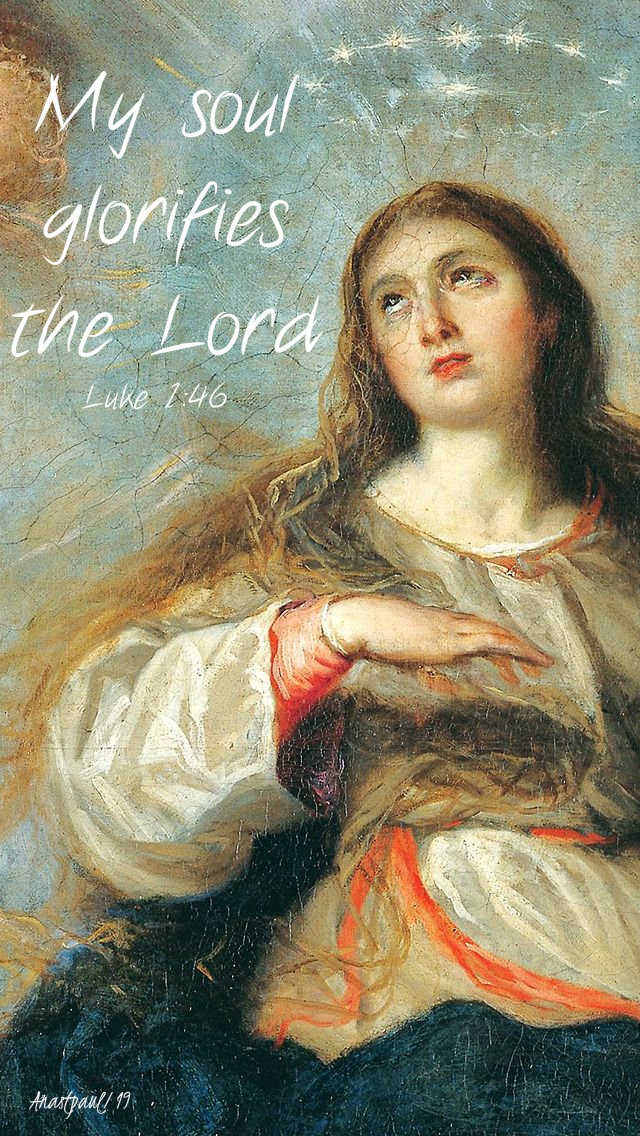
My soul glorifies the Lord ... Luke 1:46
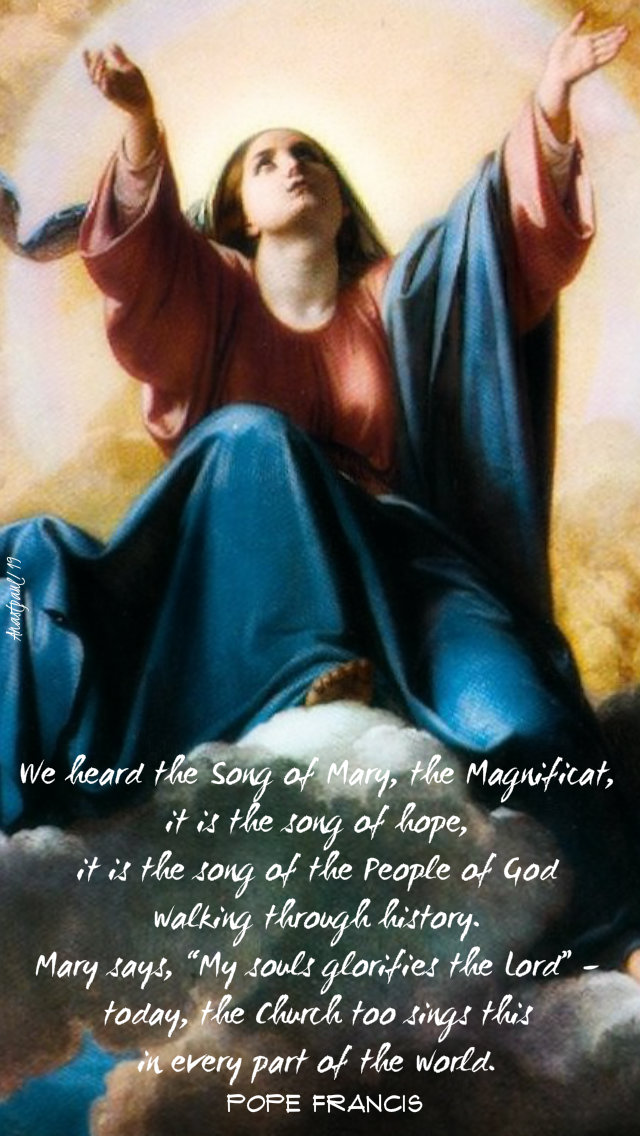
REFLECTION – “We heard the Song of Mary, the Magnificat – it is the song of hope, it is the song of the People of God walking through history. It is the song many saints, men and women, some famous and very many others unknown to us but known to God, mums, dads, catechists, missionaries, priests, sisters, young people, even children and grandparents – these have faced the struggle of life while carrying in their heart the hope of the little and the humble. Mary says, “My souls glorifies the Lord” – today, the Church too sings this in every part of the world.” … Pope Francis (Holy Mass on the Solemnity of the Assumption of the Blessed Virgin Mary, 15 August 2013)
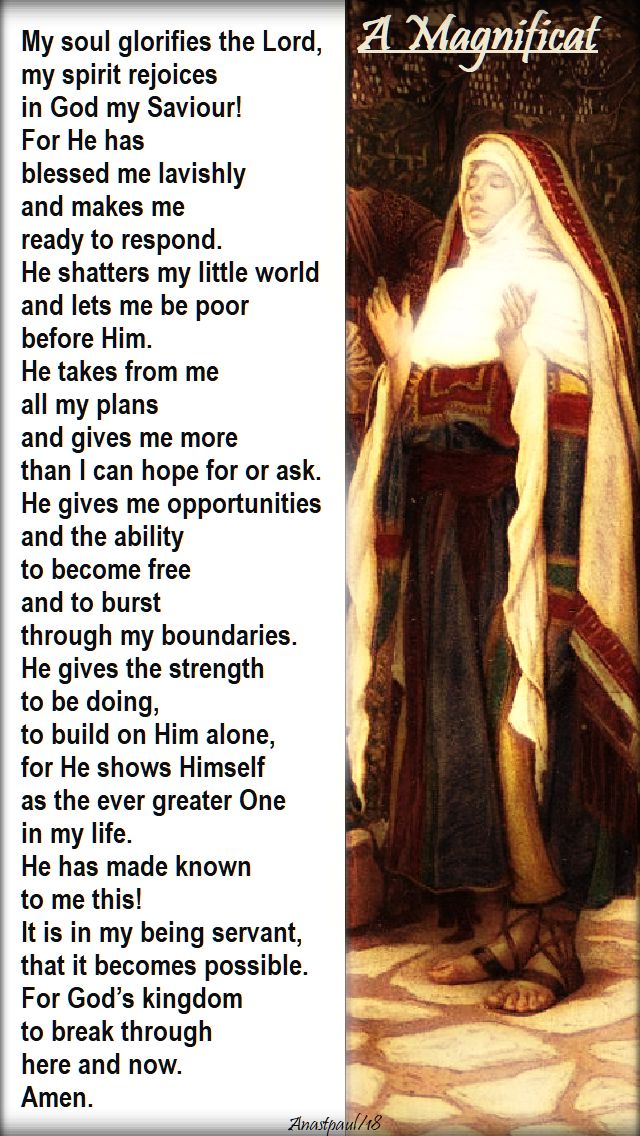
PRAYER – My soul glorifies the Lord,
my spirit rejoices in God my Saviour!
For He has blessed me lavishly
and makes me ready to respond.
He shatters my little world
and lets me be poor before Him.
He takes from me all my plans
and gives me more than I can hope for or ask.
He gives me opportunities
and the ability to become free
and to burst through my boundaries.
He gives the strength to be doing,
to build on Him alone,
for He shows Himself
as the ever greater One in my life.
He has made known to me this!
It is in my being servant that it becomes possible.
For God’s kingdom to break through
here and now.
Amen. A Magnificat Translated from the German by Olga Warnke of the Institute of the Blessed Virgin Mary
Our Morning Offering – 15 August – Solemnity of the Assumption of the Blessed Virgin Mary into Heaven
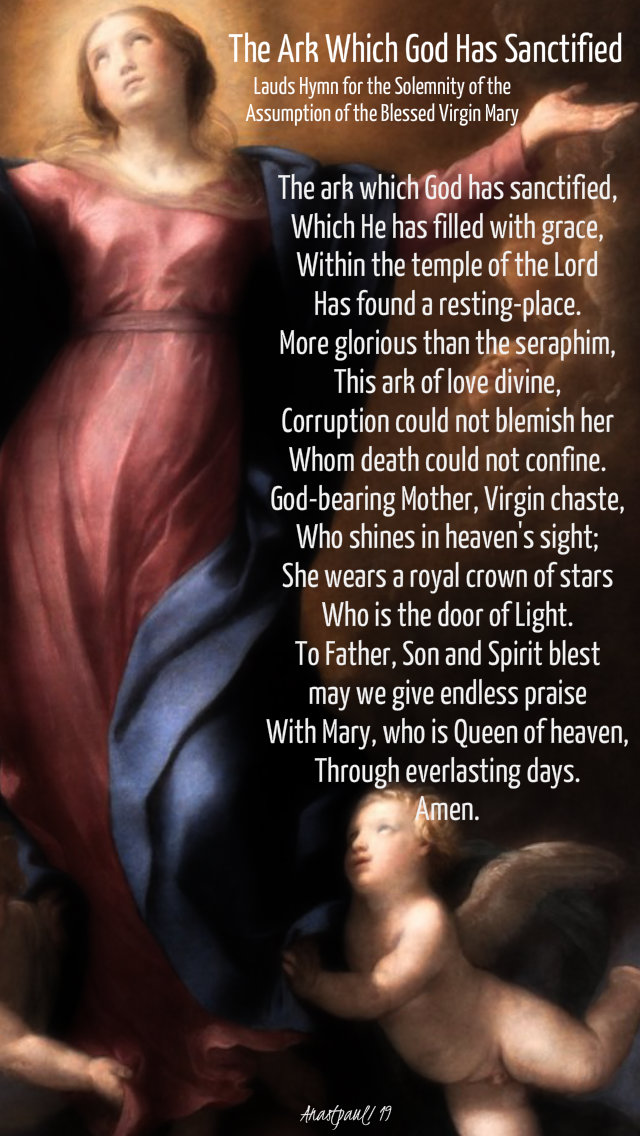
The Ark Which God Has Sanctified
The ark which God has sanctified,
Which He has filled with grace,
Within the temple of the Lord
Has found a resting-place.
More glorious than the seraphim,
This ark of love divine,
Corruption could not blemish her
Whom death could not confine.
God-bearing Mother, Virgin chaste,
Who shines in heaven’s sight;
She wears a royal crown of stars
Who is the door of Light.
To Father, Son and Spirit blest
may we give endless praise
With Mary, who is Queen of heaven,
Through everlasting days.
Amen.
The Ark Which God Has Sanctified is written by the Benedictine Nuns of Stanbrook Abbey. In the Divine Office (1974) it is sung with Morning Prayer on 15 August, the Solemnity of the Assumption of the Blessed Virgin Mary. It is set to the 1836 tune – St Peter (Reinagle) by Alexander Robert Reinagle (1799-1877).
Solemnity of the Assumption of the Blessed Virgin Mary (in the US, however, in most countries of Africa, the Solemnity will celebrated on the Sunday following the 15th). The feast celebrates the assumption of the body of the Blessed Virgin Mary into heaven upon her death. According to Pope Benedict XIV, it is a probable opinion, which it is impious to deny, though not an article of faith but has since in 1950 has been raised to a DOGMA of the Faith. The origin of the feast day is not known but it was celebrated in Palestine before the year 500. It is a holy day of obligation, its vigil being a fast day, in many English-speaking countries. Among the many masters who have painted the subject of the Assumption are Fra Angelico, Ghirlandajo, Rubens, Del Sarto and Titian.
Patronages: Acadians, Cajuns, Cistercian Order, Cistercians, fish dealers, fish-mongers, French air crews, harness makers, France, Guatemala, India, Jamaica, Malta, Paraguay, Slovakia, east Africa (region of east Africa which includes diverse countries, proclaimed on 15 March 1952 by Pope Pius XII) South Africa (this is not a region but a country) and the Assumption is, therefore, the Patronal Feast of the Country of South Africa – proclaimed on 15 March 1952 by Pope Pius XII), 24 dioceses, 38 cities.
St Alipius of Tagaste
Bl Alfred of Hildesheim
Bl Agustín Hurtado Soler
St Arduinus of Rimini
Bl Claudio Granzotto
Bl George Halley Bl Isidore Bakanja (c 1887-1909) Martyr
St Napoleon of Alexandria
Bl Pio Alberto del Corona St Simplician (c 320-c 401) Bishop and Successor of St Ambrose (340-397) Doctor of the Church in the Archdiocese of Milan. Details of the life of St Simplician here:https://anastpaul.wordpress.com/2017/08/15/saint-of-the-day-15-august-st-simplician-of-milan/ St Tarcisius (3rd century) Martyr About St Tarcisius:
Martyrs of Nicomedia – 3 saints: Three Christians martyred together. No details survive but the names – Eutychian, Philip and Straton. They were martyred in Nicomedia, Bithynia (in modern Turkey).
Martyred in the Mexican Revolution: 4 Saints –
St David Roldán Lara
St Luis Batiz Sainz
St Manuel Moralez
St Salvador Lara Puente
Martyred in the Spanish Civil War: Thousands of people were murdered in the anti-Catholic persecutions of the Spanish Civil War from 1934 to 1939.
• Blessed Agustì Ibarra Angüela
• Blessed Carmelo Sastre y Sastre
• Blessed Clemente Vea Balaguer
• Blessed Francisco Míguez Fernández
• Blessed Ildefonso Alberto Flos
• Blessed Jaume Bonet Nadal
• Blessed Joan Ceró Cedó
• Blessed Josep Santonja Pinsach
• Blessed Juan Francisco Barahona Martín
• Blessed Juan Mesonero Huerta
• Blessed Luis Ros Ezcurra
• Blessed Manuel Formigo Giráldez
• Blessed Miguel Alberto Flos
• Blessed Sebastià Balcells Tonijuan
• Blessed Severiano Montes Fernández
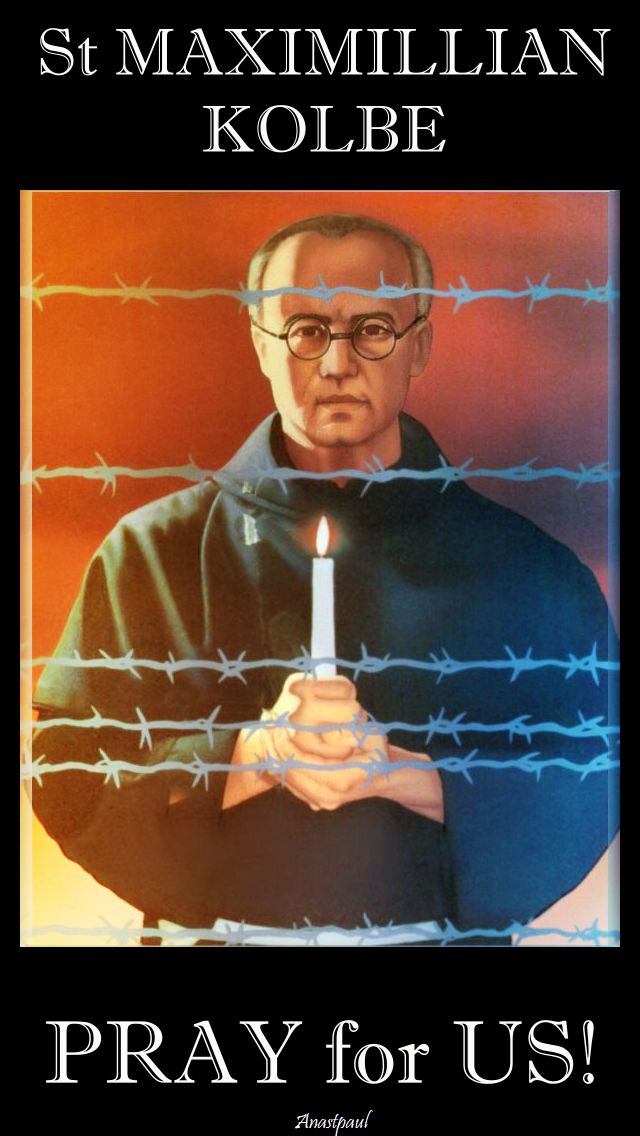
Thought for the Day – 14 August – Memorial of Saint Maximilian Mary Kolbe OFM Conv (1894 -1941) “Martyr of Charity”
Apostolic Zeal for the Salvation and Sanctification of Souls
An excerpt from the Letters of Saint Maximilian Kolbe
“The burning zeal for God’s glory that motivates you fills my heart with joy. It is sad for us to see in our own time that indifferentism in its many forms is spreading like an epidemic not only among the laity but also among religious. But God is worthy of glory beyond measure and, therefore, it is of absolute and supreme importance, to seek that glory with all the power of our feeble resources. Since we are mere creatures we can never return to Him all that is His due.
The most resplendent manifestation of God’s glory is the salvation of souls, whom Christ redeemed by shedding His blood. To work for the salvation and sanctification of as many souls as possible, therefore, is the preeminent purpose of the apostolic life. Let me, then, say a few words that may show the way toward achieving God’s glory and the sanctification of many souls.
God, who is all-knowing and all-wise, knows best what we should do to increase His glory. Through hHs representatives on earth, He continually reveals His will to us, thus it is obedience and obedience alone, that is the sure sign to us of the divine will. A superior may, it is true, make a mistake but it is impossible for us to be mistaken in obeying a superior’s command. The only exception to this rule is the case of a superior commanding something, that in even the slightest way, would contravene God’s law. Such a superior would not be conveying God’s will.
God alone is infinitely wise, holy, merciful, our Lord, Creator and Father; He is beginning and end, wisdom and power and love, He is all. Everything other than God, has value to the degree, that it is referred to Him, the maker of all and our own redeemer, the final end of all things. It is He who, declaring His adorable will to us through His representatives on earth, draws us to Himself and whose plan is, to draw others to Himself through us and to join us all to Himself in an ever-deepening love.
Look, then, at the high dignity that by God’s mercy belongs to our state in life. Obedience raises us beyond the limits of our littleness and puts us in harmony with God’s will. In boundless wisdom and care, His will guides us to act rightly. Holding fast to that will, which no creature can thwart, we are filled with unsurpassable strength.
Obedience is the one and the only way of wisdom and prudence, for us to offer glory to God . If there were another, Christ would certainly have shown it to us by word and example. Scripture, however, summed up His entire life at Nazareth in the words: He was subject to them, Scripture set obedience as the theme of the rest of His life, repeatedly declaring that He came into the world, to do His Father’s will.
Let us love our loving Father with all our hearts. Let our obedience increase that love, above all, when it requires us to surrender our own will. Jesus Christ crucified is our sublime guide toward growth in God’s love.
We will learn this lesson more quickly through the Immaculate Virgin, whom God has made the dispenser of His mercy. It is beyond all doubt, that Mary’s will represents to us, the will of God Himself. By dedicating ourselves to her, we become in her hands, instruments of God’s mercy even as she was such an instrument in God’s hands. We should let ourselves be guided and led by Mary and rest quiet and secure in her hands. She will watch out for us, provide for us, answer our needs of body and spirit, she will dissolve all our difficulties and worries.”
Quote/s of the Day – 14 August – The Memorial of St Maximillian Kolbe OFM Conv (1894 -1941) “Martyr of Charity”
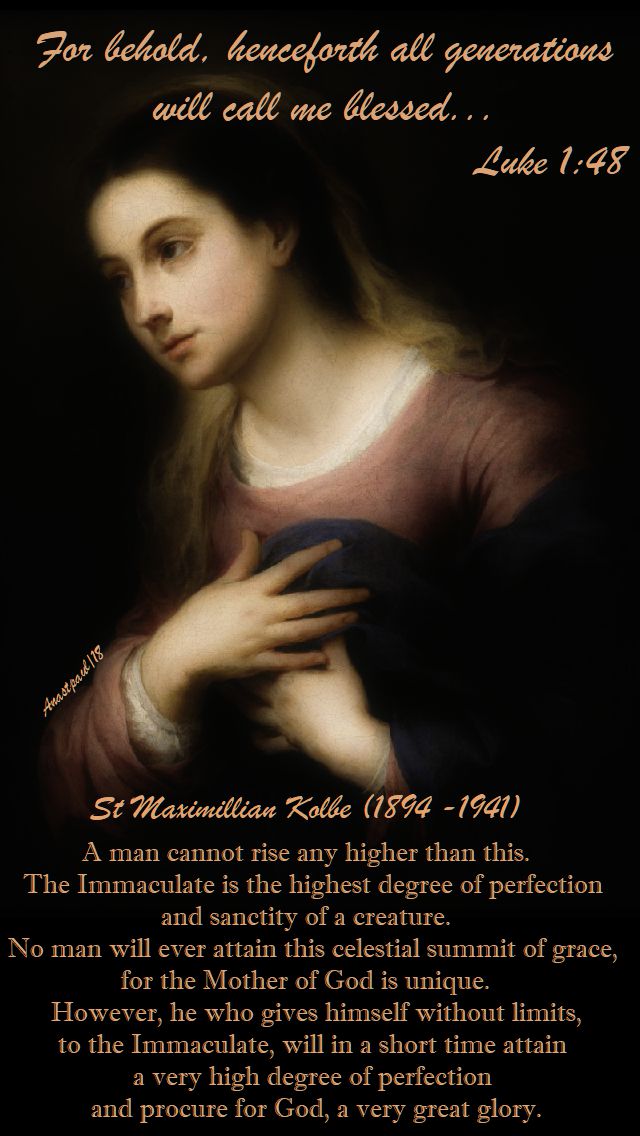
“A man cannot rise any higher than this. The Immaculate is the highest degree of perfection and sanctity of a creature. No man will ever attain this celestial summit of grace, for the Mother of God is unique. However, he who gives himself without limits, to the Immaculate, will in a short time, attain a very high degree of perfection and procure for God, a very great glory.”
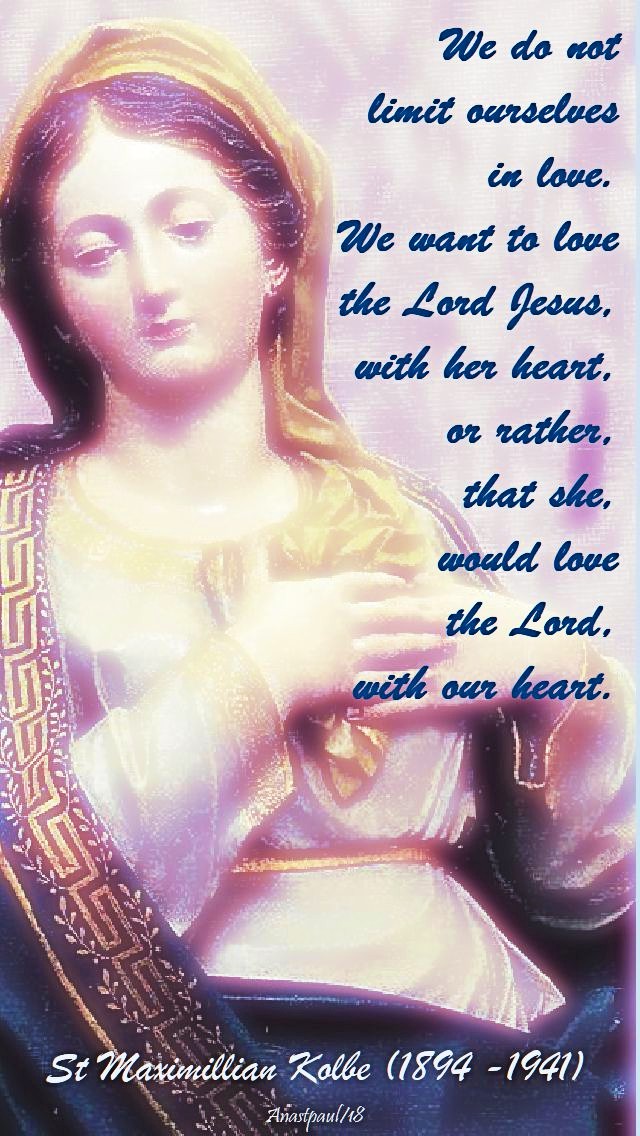
“We do not limit ourselves in love. We want to love the Lord Jesus, with her heart, or rather, that she would love the Lord, with our heart.”
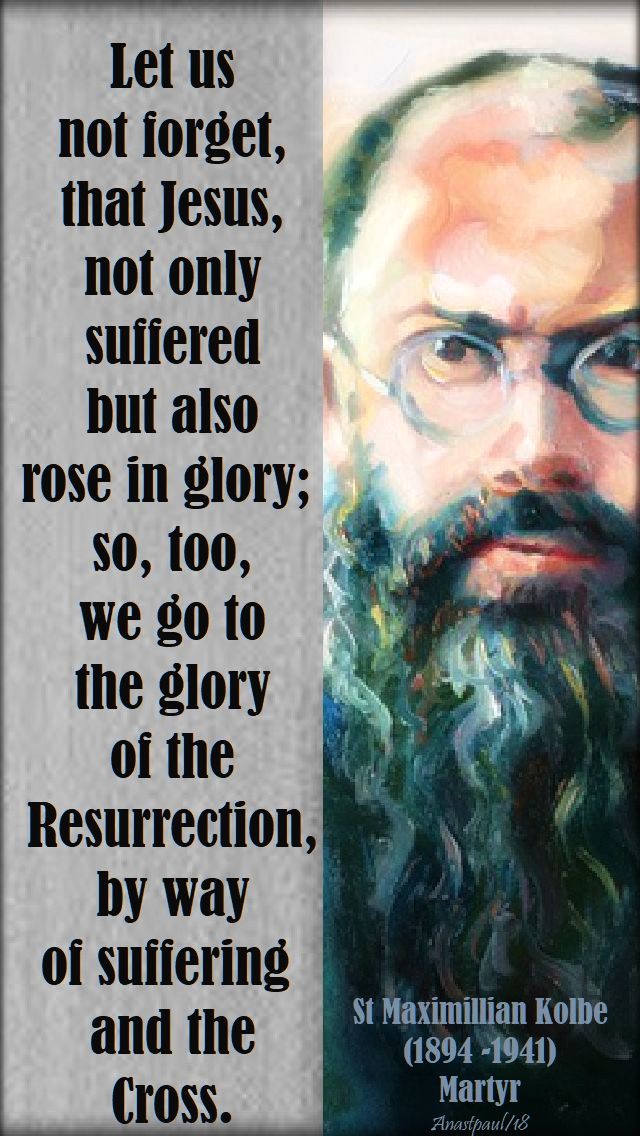
“Let us not forget, that Jesus not only suffered but also rose in glory; so, too, we go to the glory of the Resurrection, by way of suffering and the Cross.”
“The most deadly poison of our times is indifference. And this happens, although the praise of God should know no limits. Let us strive, therefore, to praise Him to the greatest extent of our powers!”
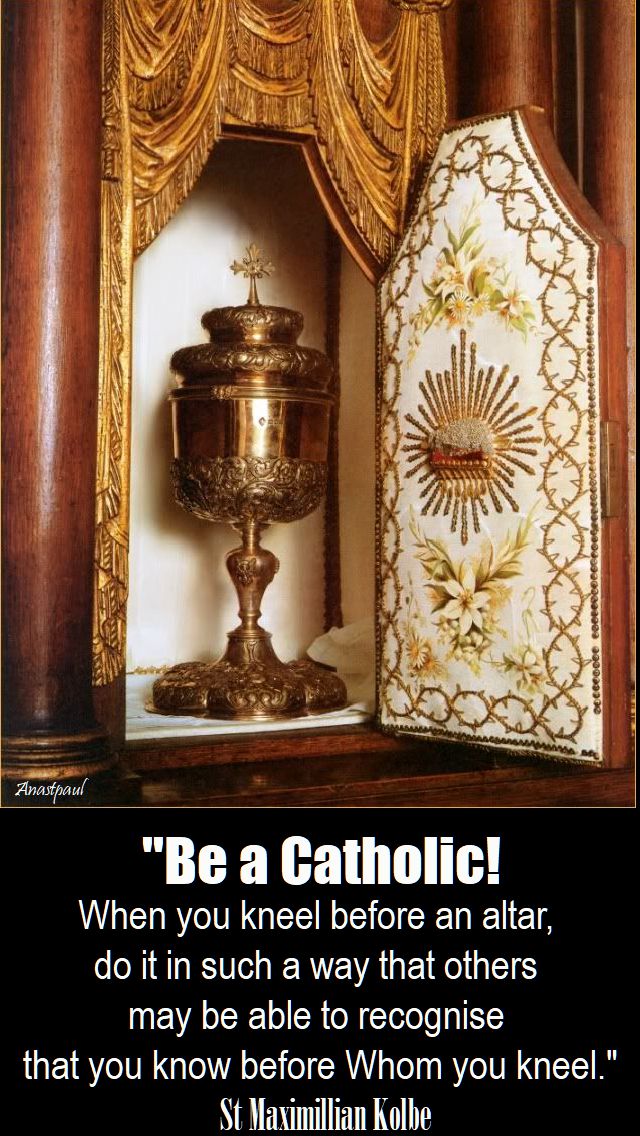
“Be a Catholic! When you kneel before an altar, do it in such a way that others may be able to recognise that you know before Whom you kneel.”
Our Morning Offering – 14 August – The Memorial of St Maximillian Kolbe OFM Conv (1894 -1941) “Martyr of Charity”
Daily Consecration Renewal to the Immaculata By St Maximillian Kolbe
Immaculata,
Queen and Mother of the Church,
I renew my consecration to you for this day
and for always, so that you might use me
for the coming of the Kingdom of Jesus
in the whole world.
To this end, I offer you all my prayers,
actions and sacrifices of this day.
Amen
Our Morning Offering – 13 August – Tuesday of the Nineteenth week in Ordinary Time, Year C and the Memorial of St John Berchmans (1599-1621)
An Act of Consecration to the Blessed Virgin Mary By St John Berchmans (1599-1621)
Holy Mary,
Mother of God and Virgin,
I choose you this day
for my queen, patron and advocate
and firmly resolve and purpose
never to abandon you,
never to say or do anything against you,
nor to permit that aught be done
by others to dishonour you.
Receive me, then, I beg you,
as thy perpetual servant,
assist me in all my actions
and do not abandon me
at the hour of my death.
Amen
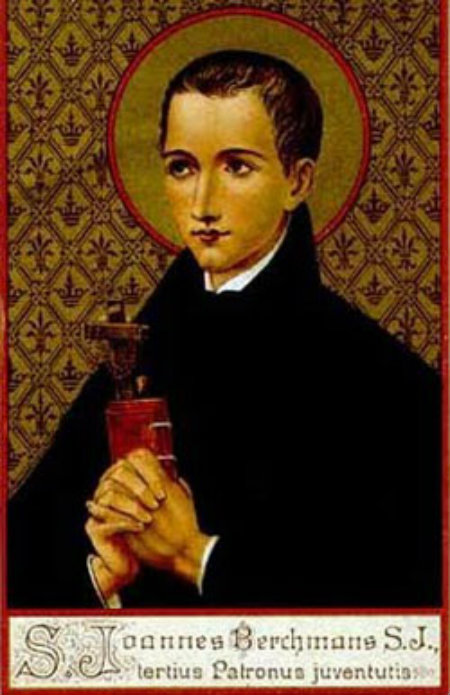
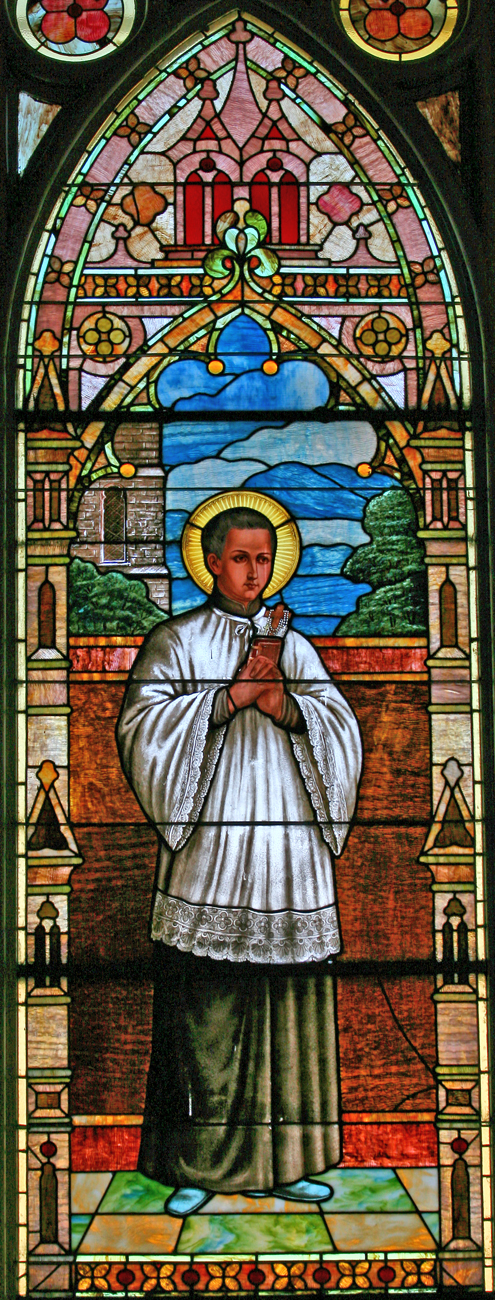
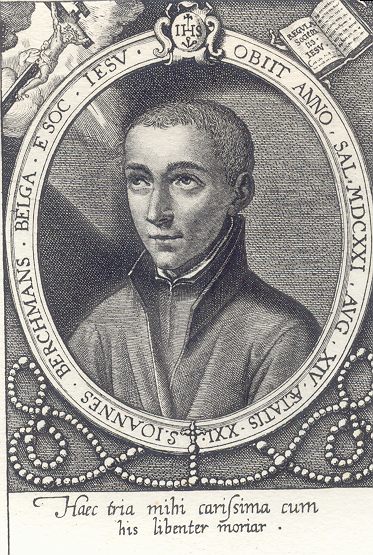
Saint of the Day – 13 August – Saint John Berchmans SJ (1599-1621) Jesuit Novice – born Jan Berchmans on 13 March 1599 at Driest, Brabant, Belgium and died on 13 August 1621 at Rome, Italy of natural causes. Patronages – Altar Servers, Jesuit novices and students. He had a special devotion to God’s Mother and to him is owed the Little Rosary of the Immaculate Conception.
Born in 1599 in Diest, a town of northern Belgium near Brussels and Louvain, this angelic young Saint was the oldest of five children. Two of his three brothers became priests and his father, after the death of John’s mother when he was eleven years old, entered religion and became a Canon of Saint Sulpice.
John was a brilliant student from his most tender years, manifesting also a piety which far exceeded the ordinary. Beginning at the age of seven, he studied for three years at the local communal school with an excellent professor. And then his father, wanting to protect the sacerdotal vocation already evident in his son, confided him to a Canon of Diest who lodged students aspiring to the ecclesiastical vocation. After three years in that residence, the family’s financial situation had declined owing to the long illness of the mother and John was told he would have to return and learn a trade. He pleaded to be allowed to continue his studies. And his aunts, who were nuns, found a solution through their chaplain, he proposed to take John into his service and lodge him.
Saint John was ordinarily first in his classes at the large school, a sort of minor seminary, even when he had to double his efforts in order to rejoin his fellow students, all of excellent talent, who sometimes had preceded him for a year or more in an assigned discipline. He often questioned his Superiors as to what was the most perfect thing to say or do in the various circumstances in which he found himself. Such was the humility which caused the young to advance without ceasing on the road to heaven. Later he continued his studies at Malines, also not distant from Diest, under the tutelage of another ecclesiastic, who assigned to him the supervision of three young boys of a noble family. In all that John did he sought perfection and he never encountered anything but the highest favour for his services, wherever he was placed.
He found his vocation through his acquaintance with the Jesuits of that city and manifested his determination to pursue his course, although his father and family opposed it for a time. It had been decided that he would continue his studies at the Jesuit novitiate of Malines, with about 70 other novices. With another young aspirant, he was waiting in the parlour to be introduced, when he saw in the garden a coadjutor Brother turning over the ground in the garden. He proposed to his companion to go and help him, saying: Could we begin our religious life better than with an act of humility and charity? And with no hesitation, both went to offer their assistance. How many young persons in that situation would have thought of such an offer? This incident reveals the profound charity and interior peace which characterised this young religious at all times.
As a novice he taught catechism to the children in the regions around Malines. He made his instructions so lively and interesting that the country folk preferred his lessons to the ordinary sermons. The children became attached to him and in a troop would conduct him back to the novitiate, where he distributed holy pictures, medals and rosaries to them. At the end of his novitiate in 1619 he was destined to go to Rome to begin serious application to philosophy but his superiors decided to send him home for a few days first. A shock awaited him at the train station of Malines, where he was expecting to meet his father, he had died a week earlier. John was given time to take the dispositions necessary to provide for the younger brothers and sister. When he departed, it was apparently with a premonition that he would perhaps never see them again, for he said in a letter to the Canon of Diest with whom he had dwelt, to tell the younger ones for him – “Increase in piety, in fear of God and in knowledge. Adieu.”
With a fellow novice he began the two months’ journey on foot to Rome, by way of Paris, Lyons and Loreto, where the two assisted at the Christmas Midnight Mass. Both of these two young Jesuits would die within three years’ time, his companion in a matter of several months. John had time during these three years to give unceasing proofs of his already perfected sanctity, nothing that he did was left to chance but entrusted to the intercession of his Heavenly Mother, to whom his devotion continued to increase day by day.
He made an extraordinary effort during an intense heat wave in the summer of 1621, participating splendidly in a debate, which took place at a certain distance from the Jesuit residence, despite the fact he did not feel well. Two days later he was felled by a fever, which continued implacably to mine his already slight resistance, and he died in August of that year, after one week of illness. The story of his last days is touching indeed, in a residence of several hundred priests and students, there was none who did not follow with anxiety and compassion the progress of his illness. When the infirmarian told his patient that he should probably receive Communion the next morning — an exception to the rule prescribing it for Sundays only, in those times — John said, In Viaticum? and received a sad affirmative answer. He himself was transported with joy and embraced the Brother, the latter broke into tears. A priest who knew John well went to him the next morning and asked him if there was anything troubling or saddening him and John replied, Absolutely nothing.
He asked that his mattress be placed on the floor and knelt to receive his Lord, when the Father Rector pronounced the words of the Ritual – Receive, Brother, in viaticum, the Body of Our Lord Jesus Christ, all in attendance wept. Their angelic, ever joyous and affectionate young novice was called to leave them, no clearer tribute than their tears could have been offered to the reality of his sanctity, his participation in the effusive goodness of the divine nature.
Devotion to his memory spread rapidly in Belgium, already in 1624 twelve engraving establishments of Anvers had published his portrait. He was Canonised in 1888 by Pope Leo XIII, at the same time as two other Jesuits who lived during the first century of that Society’s existence, so fruitful in sanctity — Peter Claver and Alphonsus Rodriguez. … (Saint Jean Berchmans, by Hippolyte Delehaye, SJ (J. Gabalda – Paris, 1922)
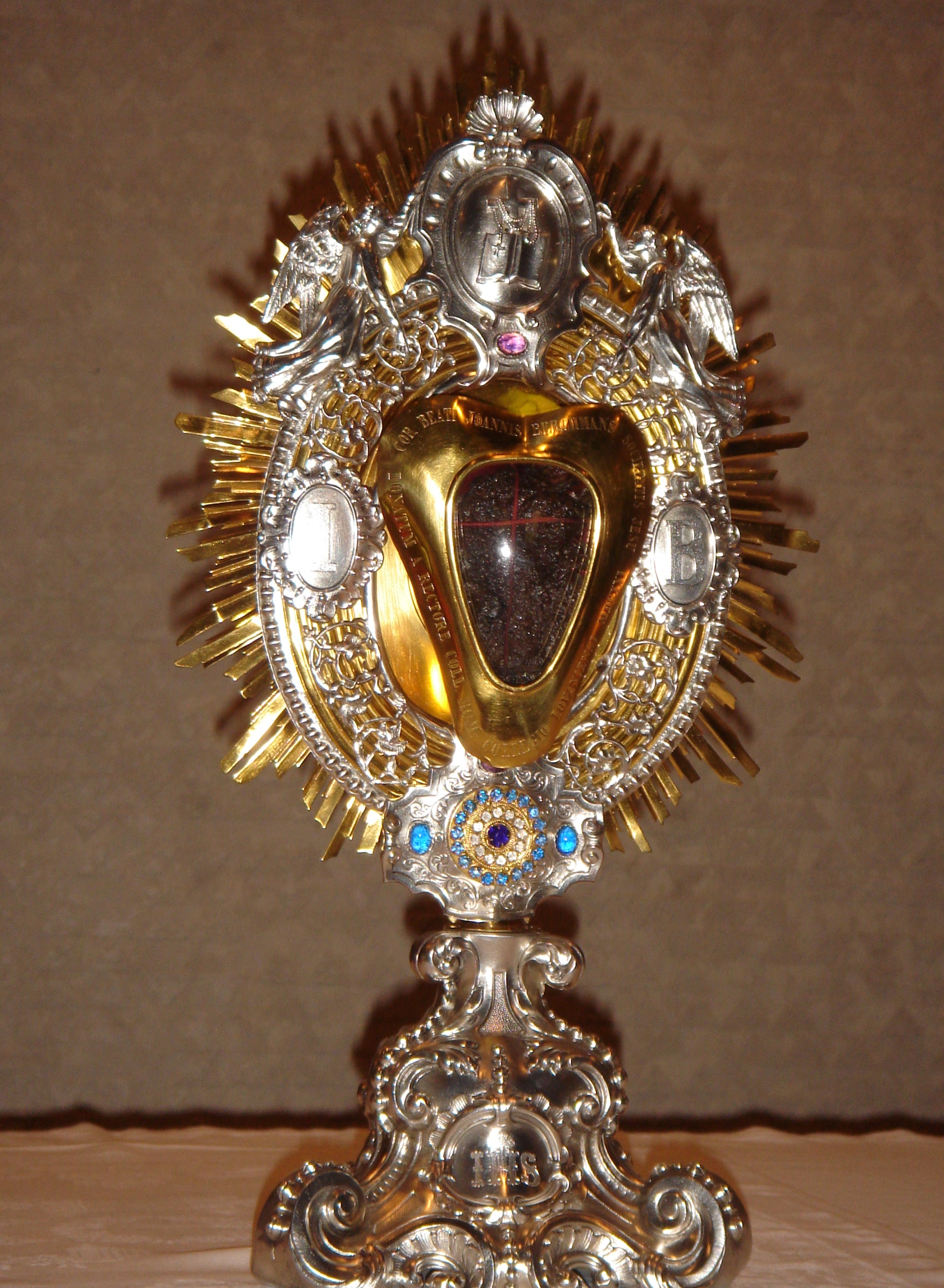
St John Berchman’s Heart
At the time of Berchmans’s death, his heart was returned to his homeland in Belgium where it is kept in a silver reliquary on a side altar in the church at Leuven (Louvain).
Our Lady, Refuge of Sinners/Refugium Peccatorum: St John Damascene calls Mary a city of refuge to all who flee to Her.
Blessed Antonio Baldinucci SJ (1665-1717) had a particular devotion to the Refugium Peccatorum image of Virgin Mary in the Church of the Gesu (Frascati) in Italy and commissioned a copy which he considered miraculous and carried it with him in his travels. The Jesuits spread copies of the image of the Madonna of Refuge in Mexico by the 19th century and it began to be depicted in missions there, often with clouds surrounding the lower portion of the image of the Virgin Mary holding the Child Jesus.
The term “Refugium peccatorum” is also used other works of Roman Catholic Marian art. For instance, there is a marble statue representing the Virgin Mary, on the grand staircase of the old municipal palace in Venice, Italy. The name came from the fact that the convicts were allowed to stop in front of the Virgin Mary’s statue to pray for their soul on the way to the scaffold.
The traditional feast day of Our Lady, Refuge of Sinners is today, 13 August.
St Anastasius the Monk
St Anastasius the Priest
St Benildus
St Cassian of Imola
St Cassian of Todi
St Concordia
St Conn O’Rourke
Bl Gertrude of Altenberg
St Helen of Burgos
St Herulph of Langres
Bl Jakob Gapp
Bl John of Alvernia St John Berchmans SJ (1599-1621)
St Junian of Mairé
St Ludolph Bl Marco d’Aviano/Mark of Aviano OFM Cap (1631-1699) Biography: https://anastpaul.com/2018/08/13/saint-of-the-day-13-august-blessed-mark-of-aviano-ofm-cap-1631-1699/
St Maximus the Confessor
St Nerses Glaietsi
St Patrick O’Healy
Bl Pierre Gabilhaud
St Radegund
St Radegunde
St Wigbert of Fritzlar
Bl William Freeman
—
Martyred in the Spanish Civil War:
• Blessed Francesc Castells Areny
• Blessed Inocencio García Díez
• Blessed José Bonet Nadal
• Blessed José Boher y Foix
• Blessed José Juan Perot y Juanmarti
• Blessed Jose Tàpies y Sirvant
• Blessed Josep Alsina Casas
• Blessed Luciano Hernández Ramírez
• Blessed Maria de Puiggraciós Badia Flaquer
• Blessed Mateo Despóns Tena
• Blessed Modesto García Martí
• Blessed Pascual Araguàs y Guàrdia
• Blessed Pedro Martret y Molet
• Blessed Silvestre Arnau y Pascuet
Martyred Claretians of Barbastro – 51 beati:
• Blessed Agustín Viela Ezcurdia
• Blessed Alfons Miquel Garriga
• Blessed Alfons Sorribes Teixidó
• Blessed Antolín Calvo y Calvo
• Blessed Antoni Dalmau Rosich
• Blessed Atanasio Vidaurreta Labra
• Blessed Eduardo Ripoll Diego
• Blessed Esteve Casadevall Puig
• Blessed Eusebi Maria Codina Millà
• Blessed Felipe de Jesús Munárriz Azcona
• Blessed Francesc Roura Farró
• Blessed Francisco Castán Meseguer
• Blessed Gregorio Chirivas Lacamba
• Blessed Hilario Llorente Martín
• Blessed Jaume Falgarona Vilanova
• Blessed Joan Baixeras Berenguer
• Blessed Joan Codinachs Tuneu
• Blessed José Amorós Hernández
• Blessed José Blasco Juan
• Blessed José Figuero Beltrán
• Blessed José Pavón Bueno
• Blessed Josep Maria Badía Mateu
• Blessed Josep Ormo Seró
• Blessed Josep Ros Florensa
• Blessed Juan Díaz Nosti
• Blessed Juan Echarri Vique
• Blessed Juan Sánchez Munárriz
• Blessed Leoncio Pérez Ramos
• Blessed Lluís Escalé Binefa
• Blessed Lluís Lladó Teixidor
• Blessed Lluís Masferrer Vila
• Blessed Manuel Buil Lalueza
• Blessed Manuel Martínez Jarauta
• Blessed Manuel Torras Sais
• Blessed Miquel Masip González
• Blessed Nicasio Sierra Ucar
• Blessed Pedro García Bernal
• Blessed Pere Cunill Padrós
• Blessed Rafael Briega Morales
• Blessed Ramon Illa Salvia
• Blessed Ramon Novich Rabionet
• Blessed Salvador Pigem Serra
• Blessed Sebastià Riera Coromina
• Blessed Sebastián Calvo Martínez
• Blessed Secundino Ortega García
• Blessed Teodoro Ruiz de Larrinaga García
• Blessed Tomàs Capdevila Miró
• Blessed Wenceslau Clarís Vilaregut
They were martyred on 2 August through 18 August 1936 in Barbastro, Huesca, Spain and Beatified on 25 October 1992 by Pope John Paul II.
Our Morning Offering – 10 August – Feast of Saint Lawrence, Deacon and Martyr and a Marian Saturday
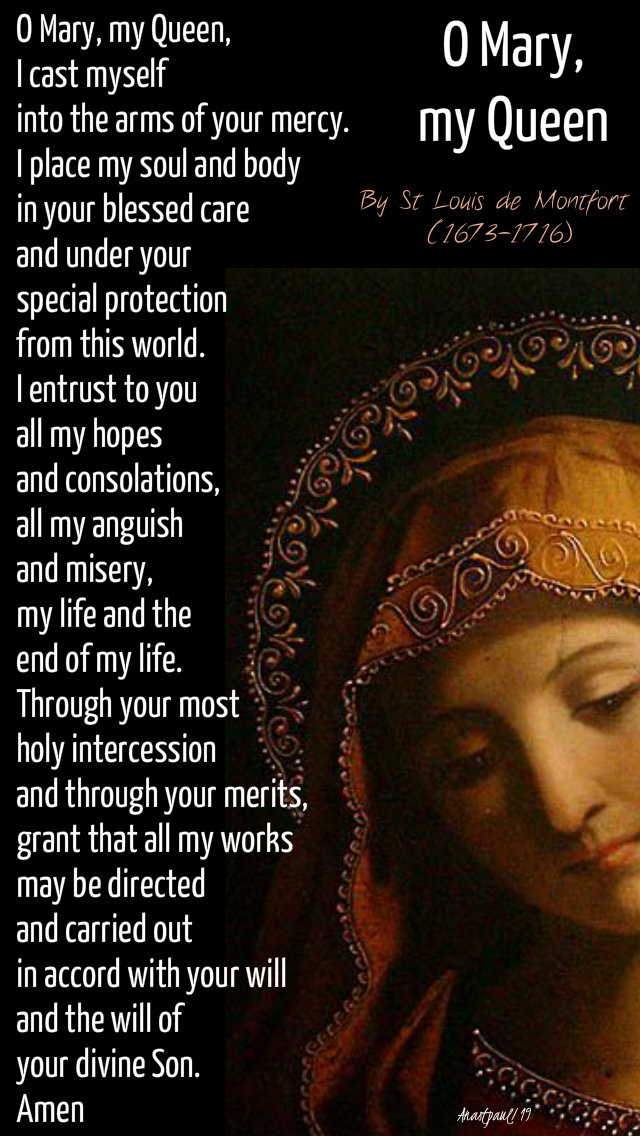
O Mary, my Queen By St Louis de Montfort (1673-1716)
O Mary, my Queen,
I cast myself into the arms of your mercy.
I place my soul and body
in your blessed care
and under your special protection
from this world.
I entrust to you
all my hopes and consolations,
all my anguish and misery,
my life and the end of my life.
Through your most holy intercession
and through your merits,
grant that all my works
may be directed and carried out
in accord with your will
and the will of your divine Son.
Amen
One Minute Reflection – 6 August – Feast of the Transfiguration of the Lord – Today’s Gospel: Luke 9:28-36
“This is my beloved Son. listen to him.”...Luke 9:35
REFLECTION – “Jesus is the Son-made-Servant, sent into the world to save us all through the Cross, fulfilling the plan of salvation. His full adherence to God’s will renders His humanity transparent to the glory of God, who is love. He is the fulfilment of revelation, that is why, beside Him appear transfigured, Moses and Elijah appear, they represent the Law and the Prophets, so as to signify that everything finishes and begins in Jesus. Their instructions for the disciples and for us, is this: “Listen to Him!”.
Listen to Jesus. He is the Saviour – follow Him.
To listen to Christ, in fact, entails taking up the logic of his Pascal Mystery, setting out on the journey with Him to make of oneself a gift of love to others, in docile obedience to the will of God, with an attitude of detachment from worldly things and of interior freedom. One must, in other words, be willing to “lose one’s very life” (cf. Mk 8:35), by giving it up so that all men might be saved, thus, we will meet in eternal happiness. The path to Jesus always leads us to happiness, don’t forget it!” … Pope Francis (Angelus, 1 March 2015)
PRAYER – Father, at the Transfiguration in glory of Your only-begotten Son, You confirmed the mysteries of faith by the witness to Jesus of the prophets Moses and Elijah. You foreshadowed what we shall be when You bring our sonship to its perfection. Grant that by listening to the voice of Jesus, we may become heirs with Him, who lives and reigns with You and the Holy Spirit, God forever and may Mary, our tender and caring Mother, help us to be bright rays of the saving light of her Son Jesus. Amen
Thought for the Day – 3 August – Saturday of the Seventeenth week in Ordinary Time, Year C, Marian Saturdays
Speaking of: Our Lady
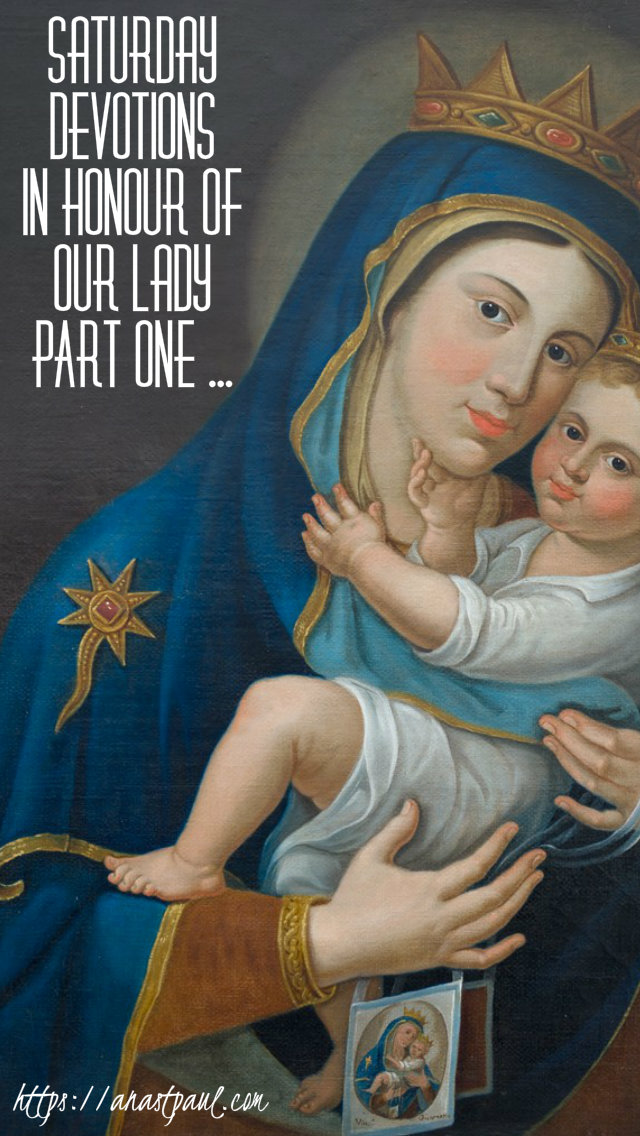
Saturday Devotions in Honour of Our Lady
Part One By Sr M Jean Frisk SSM
Historical Background of the Saturdays in Honour of Mary
To dedicate Saturday in honour of Mary is an ancient custom. It is based on a legendary account that Jesus appeared to Mary on the Saturday, the day after His death. He did so to reward her for her steadfast faith in His divinity, which did not waver under the Cross. Another strain of devotional thought explains that Divine Wisdom, becoming flesh of the Virgin Mary, rested (Saturday=Sabbath=day of rest) in Mary as on a bed.
One of the oldest customs traced to honouring Mary on Saturday in the Church of Rome, took place on the Saturday before “Whitsunday” [White Sunday]. The newly-baptised members of the Church were led from St John’s baptistry of the Lateran to Mary’s great shrine on the Esquilin, St Mary Major [built under Pope Liberius 352-66]. St John of Damascus’ († 754) writings testify to the celebration of Saturdays dedicated to Mary in the Church of the East. The liturgical books of the ninth and tenth centuries contain Masses in honour of Mary on Saturday.
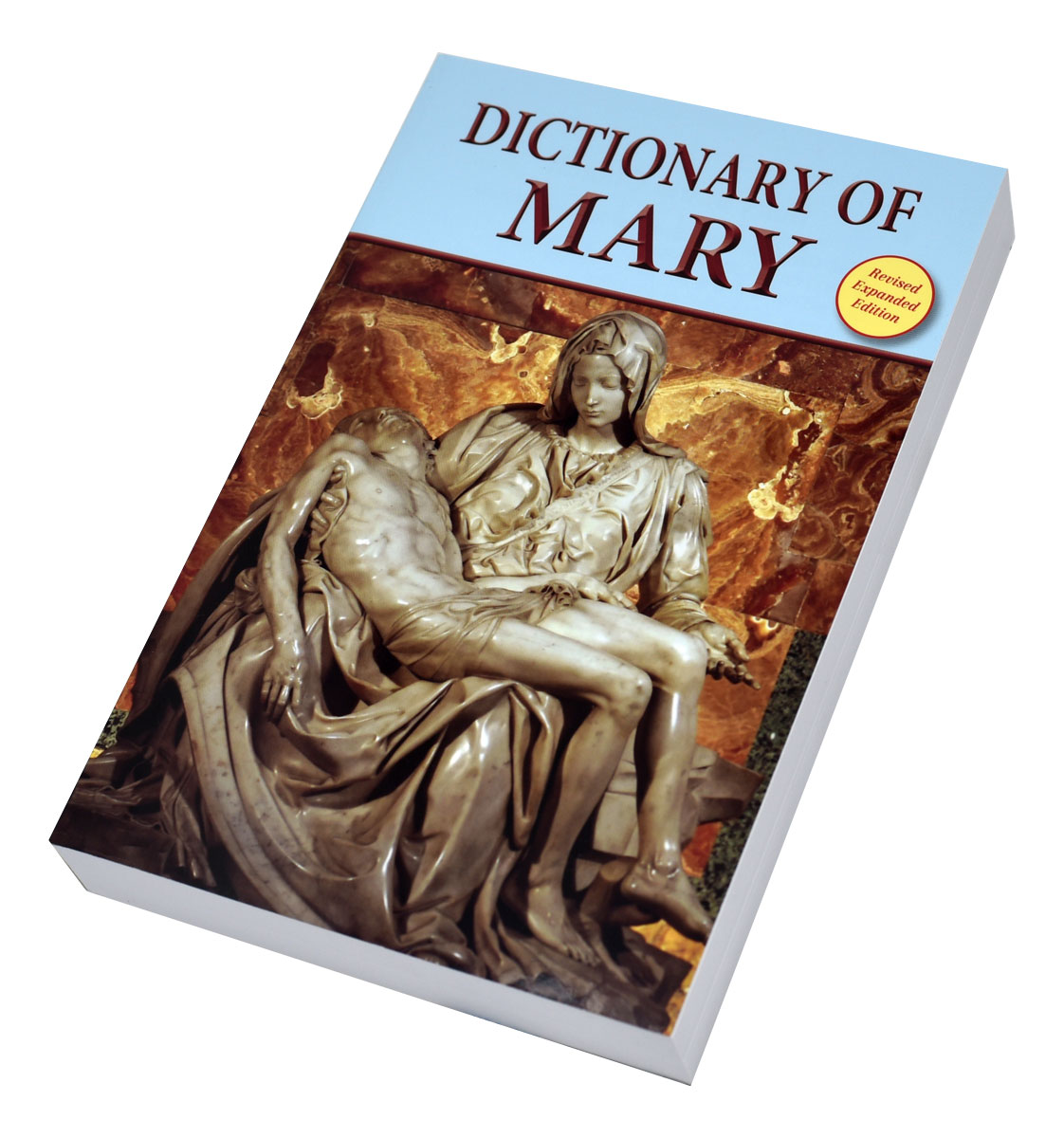
The Dictionary of Mary states:
Hence, Saturday acquired its great Marian tone and the existing fast on that day became associated with Mary. Today, the strongest trace of Mary’s relationship with Saturday occurs in the Liturgy. Saturday is dedicated to Mary by a Mass or Office of the Blessed Virgin Mary. Through these liturgical acts, Christians exalt the person of Mary in the action that renews the sacrifice of Christ and in the action that prolongs His prayer.
This liturgical attribution of Saturday to Mary was largely the work of Alcuin (735-804), the Benedictine monk who was “Minister of Education” at the court of Charlemagne and who contributed in a decisive manner to the Carolingian liturgical reform. Alcuin composed six formularies for Votive (that is, devotional) Masses – one for each day of the week. And he assigned two formularies to Saturday in honour of Our Lady. The practice was quickly and joyously embraced by both clergy and laity. St Cardinal Peter Damian († 1072) fostered the Marian Saturday celebration as well.
The custom was specially furthered during the time of the crusades. Peter of Amiens preached the first crusade and started out with a vanguard for Constantinople on a Saturday, March 8, 1096. Pope Urban II admonished the faithful to pray the hours of the liturgy in honour of the most holy Virgin for the crusaders. At the Synod of Clermont the year before, he had prescribed priests to do so.
The custom of dedicating Saturday Masses to Mary was fostered specially in the cloister churches of the various orders and quickly spread throughout the whole Church. In addition to the liturgical celebrations on Saturdays, other customs kept step – especially works of neighbourly love. For example, King Louis of France († on the last crusade) fed over one hundred of the poor at his palace. He ate with them and sent them away richly-laden with gifts.
The great theologians of the twelfth and thirteenth centuries, Sts Bernard, Thomas and Bonaventure explained the dedication of Saturdays to Mary by pointing to the time of Christ’s rest in the grave. Everyone else had abandoned Christ, only Mary continued to believe. This was her day!
A Dominican missal of the fifteenth century listed additional reasons in a hymn: -Saturday is the day when creation was completed. Therefore it is also celebrated as the day of the fulfilment of the plan of salvation, which found its realisation through Mary. Sunday is the Lord’s Day, so it seemed appropriate to name the day preceding as Mary’s day.
In the centuries to follow, the Marian Saturdays were expressed in several devotions. This was the day the faithful selected to go on pilgrimages. Sodalities held their meetings on Saturdays and called them Fraternity Saturdays or Sodality Saturdays. The seven dolors or sorrows of Mary were commemorated on seven consecutive Saturdays. The fifteen Saturdays before the liturgy in honour of Mary as Queen of the Rosary [October 7] recalled the fifteen decades of the rosary. In some areas this was the day that the crops and harvests were blessed and celebrated. A German manuscript from 1673 states:
‘The people of Hamingen have from ancient times vowed to hold a procession to this church every Saturday from the feast of St Gregory to the feast of St James [to ask] for protection for the fruits of the fields and against the storms and hail. Their descendants failed to do so to their great misfortune because the hail did great damage. After they renewed the practice, no one heard further of great damage.’
The growing devotion in honour of the Immaculate Conception by the Franciscans contributed to furthering the Marian Saturdays. In 1633 the Order’s Chapter determined that a Holy Mass in honour of this mystery was to be celebrated.
Over time, it became customary for Catholics everywhere to consider Saturday as Mary’s day just as Sunday is the Lord’s Day. Many of the faithful commemorated the day by attending Mass, receiving the Eucharist and praying the rosary as a family or attending an evening devotion at the Church, as well as performing works of neighbourly love in many forms.
Vatican II with its liturgical reforms did not abolish the practice of Masses in honour of Our Lady. In fact, it increased them and additions were made to expand the number of the liturgies. In 1986 A new sacramentary and lectionary were published with forty-six options for votive Masses in honour of Our Lady.
One Minute Reflection – 3 August – Saturday of the Seventeenth week in Ordinary Time, Year C, Gospel: Matthew 14:1-12
And his disciples came and took the body and buried it and they went and told Jesus. ... Matthew 14:12
REFLECTION – “Before Pilate, Christ proclaims that he “has come into the world, to bear witness to the truth,” (Jn 18:37). The Christian is not to “be ashamed then of testifying to our Lord,” (2 Tim 1:8). In situations that require witness to the faith, the Christian must profess it without equivocation, after the example of St Paul before his judges. We must keep “a clear conscience toward God and toward men,” (Acts 24:16).
The duty of Christians to take part in the life of the Church impels them to act as witnesses of the Gospel and of the obligations that flow from it. This witness is a transmission of the faith in words and deeds. Witness is an act of justice that establishes the truth or makes it known: “All Christians by the example of their lives and the witness of their word, wherever they live, have an obligation to manifest the new man which they have put on in Baptism and to reveal the power of the Holy Spirit by whom they were strengthened at Confirmation” (Vatican II).
Martyrdom is the supreme witness given to the truth of the faith – it means bearing witness even unto death. the martyr bears witness to Christ who died and rose, to whom he is united by charity. He bears witness to the truth of the faith and of Christian doctrine. He endures death through an act of fortitude… The Church has painstakingly collected the records of those who persevered to the end in witnessing to their faith. These are the acts of the Martyrs. They form the archives of truth written in letters of blood…:
“I bless You for having judged me worthy from this day and this hour to be counted among Your martyrs…. You have kept Your promise, God of faithfulness and truth. For this reason and for everything, I praise You, I bless You, I glorify You through the eternal and heavenly High Priest, Jesus Christ, Your beloved Son” (St. Polycarp) … CCC #2471-2474
PRAYER – Almighty God, teach us to bear witness to Christ, Your only-begotten Son, who died for our sins. May each moment of our lives radiate the truth of the Word, Christ our Lord. Through the intercession of our holy Mother, the Channel of all Graces, may our strength be such, that we would bear witness even unto death. We make our prayer, through Jesus Christ with the Holy Spirit, God forever, amen.
Our Morning Offering – 3 August – Saturday of the Seventeenth week in Ordinary Time, Year C and a Marian Saturday
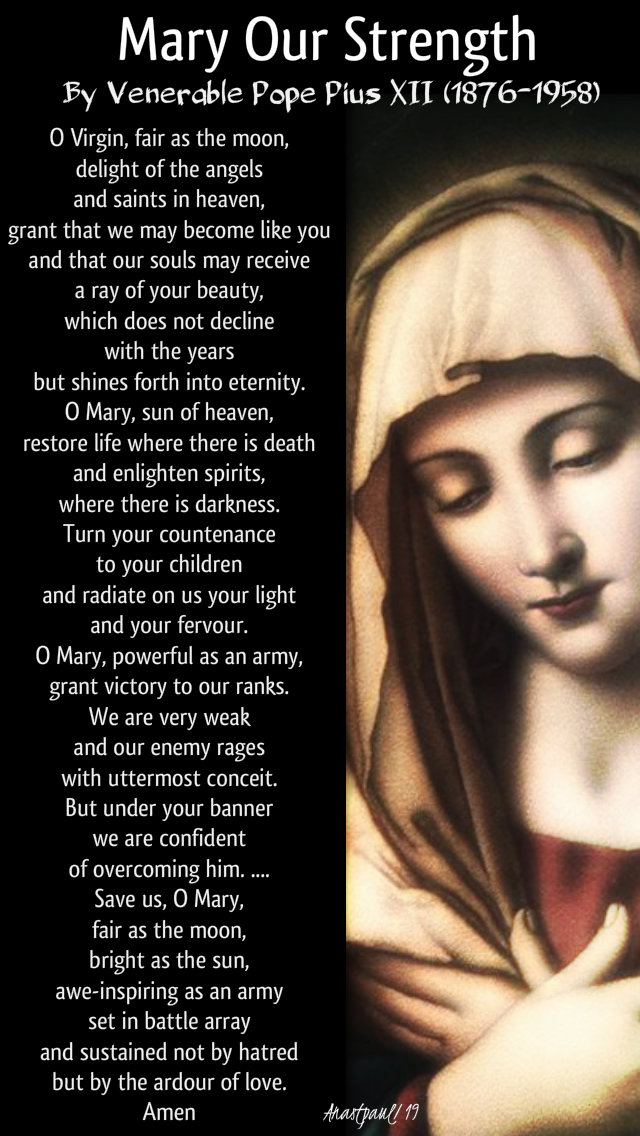
Mary Our Strength By Venerable Pope Pius XII (1876-1958)
(Pontiff 1939-1958)
O Virgin, fair as the moon,
delight of the angels and saints in heaven,
grant that we may become like you
and that our souls may receive a ray of your beauty,
which does not decline with the years
but shines forth into eternity.
O Mary, sun of heaven,
restore life where there is death
and enlighten spirits, where there is darkness.
Turn your countenance to your children
and radiate on us your light and your fervour.
O Mary, powerful as an army,
grant victory to our ranks.
We are very weak
and our enemy rages with uttermost conceit.
But under your banner
we are confident of overcoming him. ….
Save us, O Mary,
fair as the moon,
bright as the sun,
awe-inspiring as an army set in battle array
and sustained not by hatred
but by the ardour of love.
Amen
Quote/s of the Day – 3 August – Friday of the Seventeenth week in Ordinary Time, Year C and the Memorial of St Peter Faber SJ (1506-1546) and St Peter Julian Eymard SSS (1811-1868) “Apostle of the Eucharist”
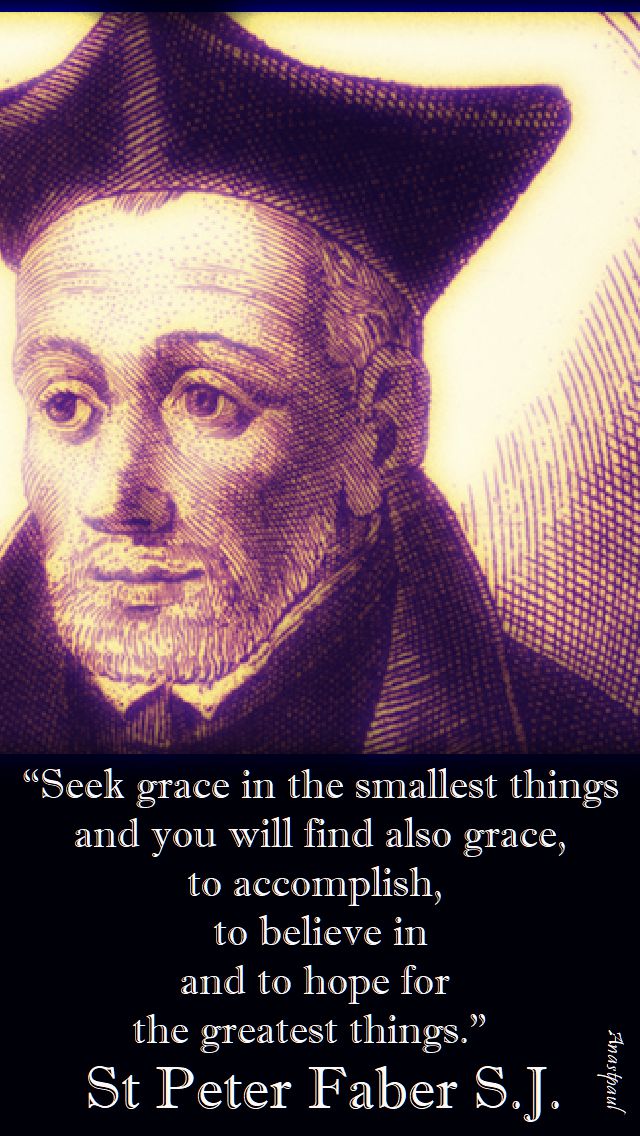
“Seek grace for the smallest things, and you will find grace to accomplish, to believe in, and to hope for, the greatest things. Attend to the smallest things, examine them, think about putting them into effect, and the Lord will grant you greater.”
St Peter Faber (1506-1546)
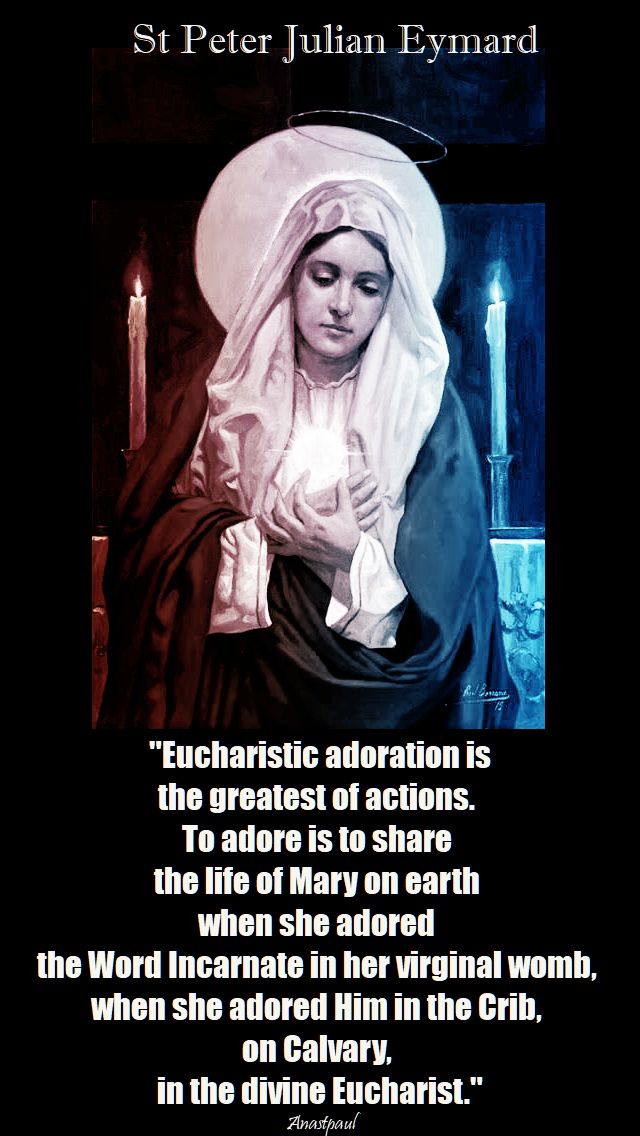
“Eucharistic adoration is the greatest of actions. To adore is to share the life of Mary on earth when she adored the Word Incarnate in her virginal womb, when she adored Him in the Crib, on Calvary, in the divine Eucharist.”
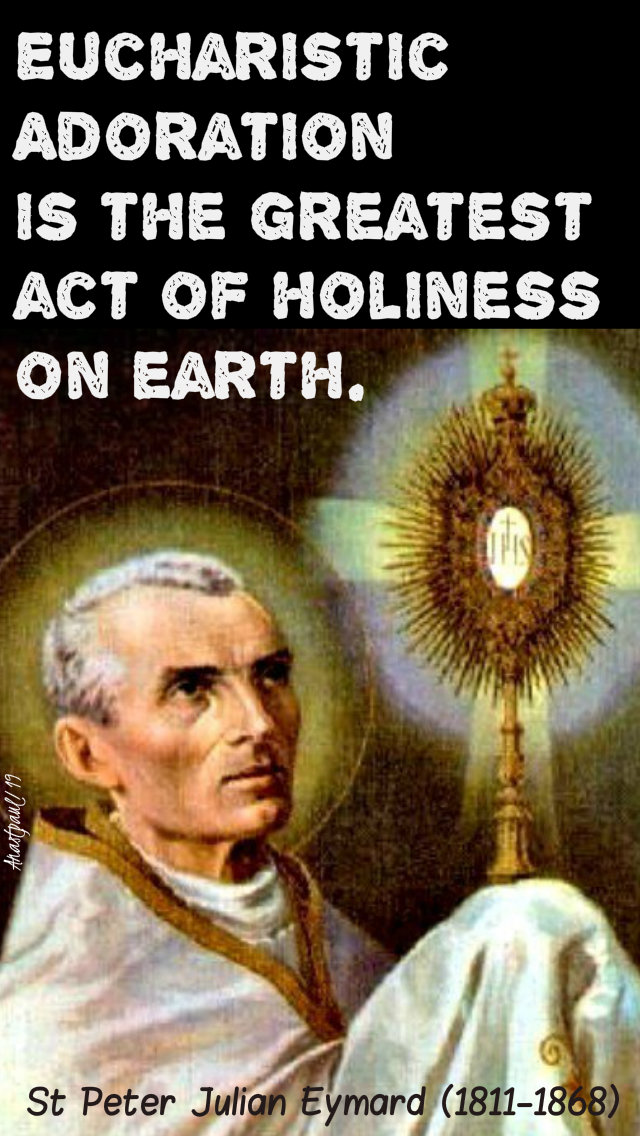
“Eucharistic Adoration is the greatest act of holiness on earth.”
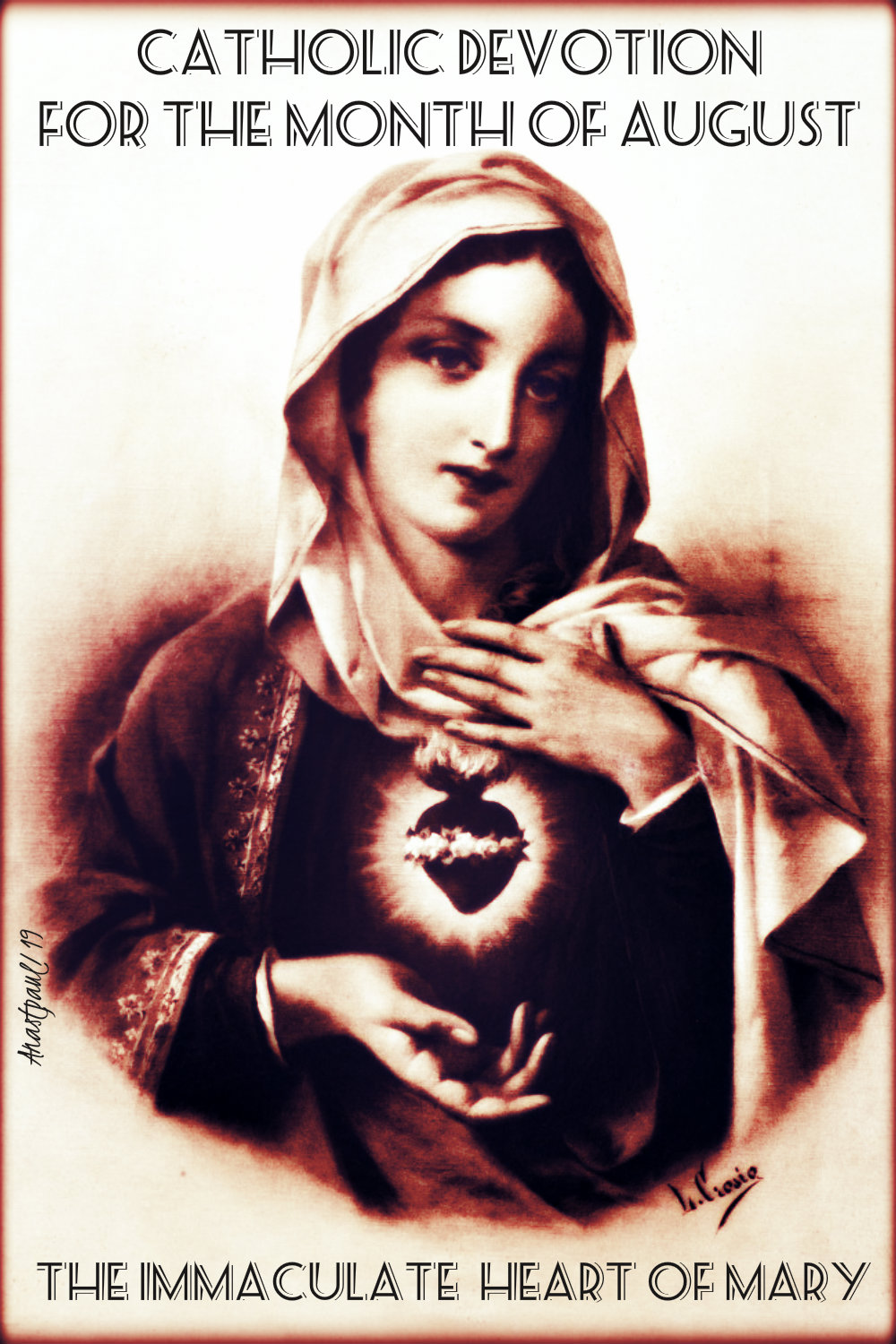
August – The Month of the Immaculate Heart of Mary
The Catholic Church dedicates the month of August to the Immaculate Heart of Mary. The Immaculate Heart is often venerated together with the Sacred Heart of Jesus (the devotion we celebrate in June) and, with good reason. Just as the Sacred Heart represents Christ’s love for mankind, the Immaculate Heart represents the desire of the Blessed Virgin to bring all people to her Son.
There is no better example of the Christian life than that offered by Mary. We do not worship Mary or place her above Christ, but we come to Christ through Mary, as Christ came to us through her.
Daily Prayer for August for the Intercession of the Immaculate Heart of Mary
O Most Blessed Mother,
heart of love, heart of mercy,
ever listening, caring, consoling, hear our prayer.
As your children, we implore your intercession,
with Jesus your Son.
Receive with understanding and compassion,
the petitions we place before you today,
especially those so deep in our heart.
We are comforted in knowing your heart is ever open
to those who ask for your prayer.
We trust to your gentle care and intercession,
those whom we love
and who are sick or lonely or hurting.
Help all of us, Holy Mother,
to bear our burdens in this life,
until we may share eternal life and peace
with God, our Father forever.
Amen
Quote/s of the Day – 30 July – The Memorial of St Peter Chrysologus “Golden Words” (c 400-450) Father & Doctor and St Maria de Jesus Sacramentado(1868-1959)
“A gentle maiden having lodged a God in her womb, asks as its price, peace for the world, salvation for those who are lost and life for the dead.”
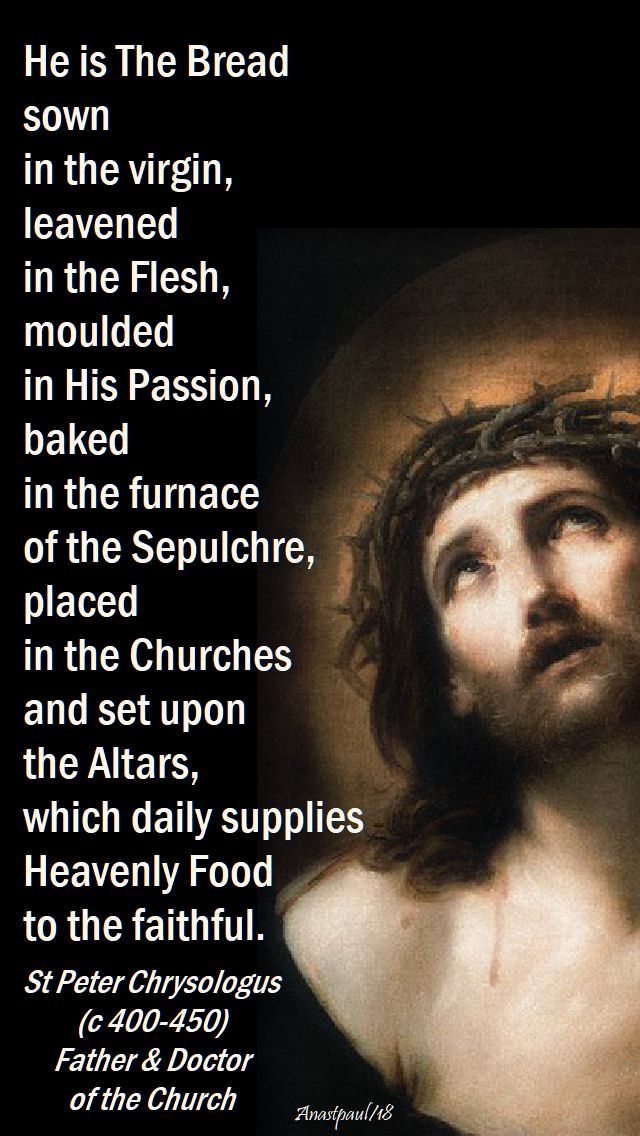
“He is The Bread sown in the virgin, leavened in the Flesh, moulded in His Passion, baked in the furnace of the Sepulchre, placed in the Churches and set upon the Altars, which daily supplies Heavenly Food to the faithful.”
“For he who touches the Body of Christ unworthily, receives his damnation.”
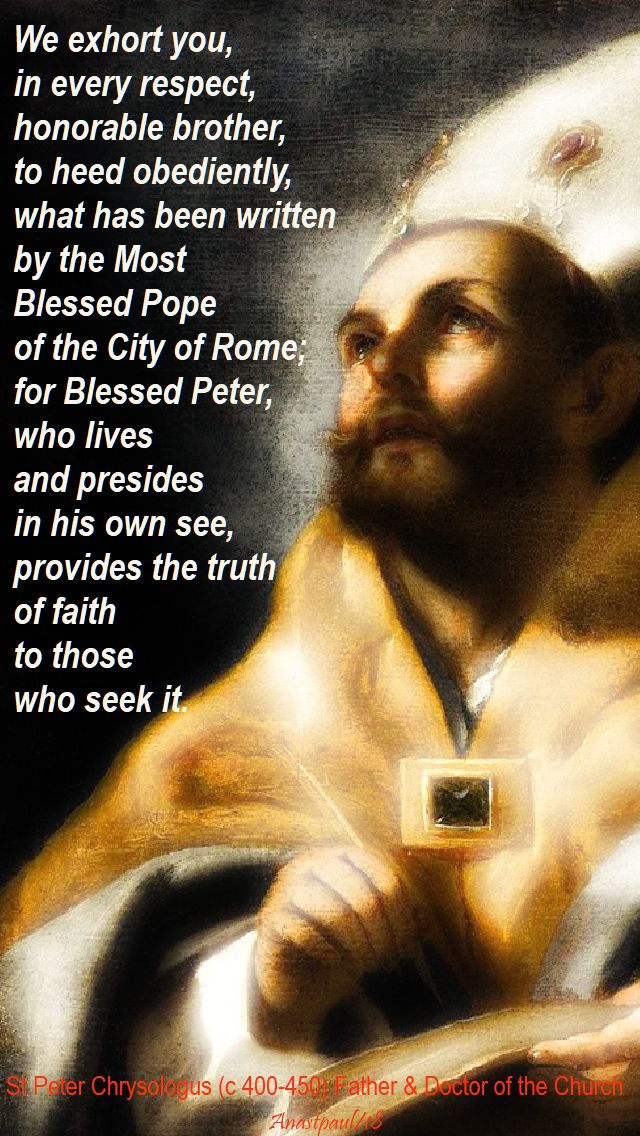
“We exhort you, in every respect, honourable brother, to heed obediently what has been written by the Most Blessed Pope of the City of Rome; for Blessed Peter, who lives and presides in his own see, provides the truth of faith to those who seek it.”
“The poor stretch out the hand but God receives what is offered.”
St Peter Chrysologus “Golden Words”
(c 400-450) Father & Doctor
“Those who are merciful with the needy of the world will not lack God’s mercy.”
“The weight of the cross is burdensome for those carrying it but not, for those, who embrace it.”
One Minute Reflection – 27 July – Saturday of the Sixteenth week in Ordinary Time, Year C, Gospel: 13:24-30
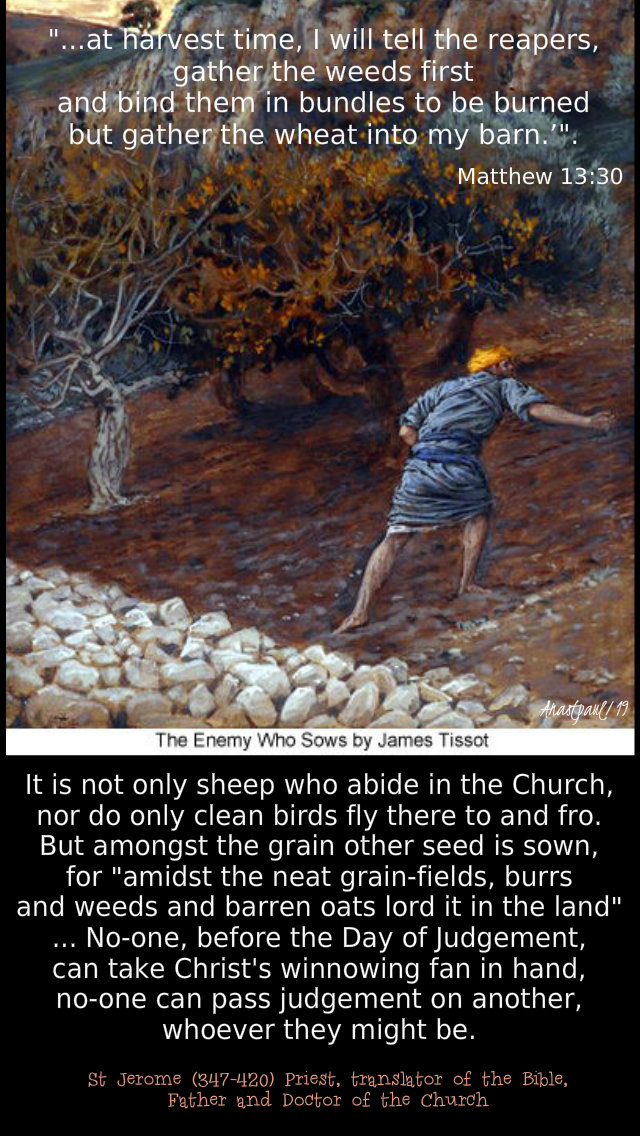
“Let both grow together until the harvest and at harvest time, I will tell the reapers, gather the weeds first and bind them in bundles to be burned but gather the wheat into my barn.’”… Matthew 13:30
REFLECTION – “It is not only sheep who abide in the Church, nor do only clean birds fly there to and fro. But amongst the grain other seed is sown, for “amidst the neat grain-fields, burrs and weeds and barren oats lord it in the land” (Virgil’s Georgics). What is the farmhand to do? Root up the darnel? In that case the whole harvest is destroyed along with it!
Every day the farmer diligently drives away the birds by making a noise or by frightening them with scarecrows (…) Nevertheless he suffers from the raids of nimble roes or the wantonness of wild asses, on the one hand, voles convey the grain to their underground barns, on the other, ants in a moving column ravage the crop. This is how things are! No-one who has land is free from care.
While the householder slept, the enemy sowed tares, when the servants hastened to go and root them up, the Master prevented them, reserving for Himself the separation of wheat and chaff. (…) No-one, before the Day of Judgement, can take Christ’s winnowing fan in hand, no-one can pass judgement on another, whoever they might be.”… St Jerome (347-420) Priest, translator of the Bible, Father and Doctor of the Church – The dialogue against the Luciferians (SC 473, p 179-180)
PRAYER – All-powerful and ever-living God, splendour of true light and never-ending day, chase away the night of sin and fill our minds with the glory of Your coming. Take away our heart of stone and give us a heart of flesh, help us in our battle with sin and the devil. By our prayers, Your holy sacraments and the strength of the Holy Spirit, may we be ever vigilant of the evil one. Grant we pray, that the Blessed Virgin’s prayers, may protect us from all dangers. We make our prayer through Christ, our Lord with the Holy Spirit, one God forever, amen.
Our Morning Offering – 27 July – Saturday of the Sixteenth week in Ordinary Time, Year C – a “Marian Saturday”
Shelter Me Under Your Mantle By St Alphonsus Liguori (1696-1787) Doctor of the Church
Most holy Virgin Immaculate, my Mother Mary,
to you who are the Mother of my Lord,
the Queen of the Universe, the Advocate,
the hope, the refuge of sinners,
I, who am the most miserable of all sinners,
have recourse this day.
I venerate you, great Queen
and I thank you for the many graces
you have bestowed upon me even unto this day,
in particular for having delivered me from the hell
which I have so often served by my sins.
I love you, my dearest Lady
and because of that love,
I promise to serve you willingly forever
and to do what I can,
to make you loved by others also.
I place in you all my hopes for salvation,
accept me as your servant
and shelter me under your mantle,
you who are the Mother of Mercy.
And since you are so powerful with God,
deliver me from all temptations,
or at least obtain for me the strength
to overcome them until death.
From you I implore a true love for Jesus Christ.
Through you I hope to die a holy death.
My dear Mother, by your love for Almighty God,
I pray you to assist me always
but most of all, at the last moment of my life.
Forsake me not then,
until you shall see me safe in heaven,
there to bless you
and sing of your mercies through all eternity.
Such is my hope.
Amen
Thought for the Day – 26 July – The Memorial of Sts Joachim and Anne, Parents of the Blessed Virgin Mary and Grandparents of Jesus
In the Scriptures, Matthew and Luke furnish a legal family history of Jesus, tracing ancestry to show that Jesus is the culmination of great promises. Not only is his mother’s family neglected, we also know nothing factual about them except that they existed. Even the names Joachim and Anne come from a legendary source written more than a century after Jesus died.
The heroism and holiness of these people, however, is inferred from the whole family atmosphere around Mary in the Scriptures. Whether we rely on the legends about Mary’s childhood or make guesses from the information in the Bible, we see in her a fulfilment of many generations of prayerful persons, herself steeped in the religious traditions of her people.
The strong character of Mary in making decisions, her continuous practice of prayer, her devotion to the laws of her faith, her steadiness at moments of crisis and her devotion to her relatives—all indicate a close-knit, loving family that looked forward to the next generation even while retaining the best of the past.
Joachim and Anne—whether these are their real names or not—represent that entire quiet series of generations who faithfully perform their duties, practice their faith and establish an atmosphere for the coming of the Messiah but remain obscure.
This is the “feast of grandparents.” It reminds grandparents of their responsibility to establish a tone for generations to come – they must make the traditions live and offer them as a promise to little children. But the feast has a message for the younger generation as well. It reminds the young that older people’s greater perspective, depth of experience and appreciation of life’s profound rhythms, are all part of a wisdom not to be taken lightly or ignored.
Prayer for Grandparents
By Pope Benedict XVI
Lord Jesus,
You were born of the Virgin Mary,
the daughter of Saints Joachim and Anne.
Look with love on grandparents the world over.
Protect them!
They are a source of enrichment
for families, for the Church and for all of society.
Support them!
As they grow older,
may they continue to be for their families
strong pillars of Gospel faith,
guardian of noble domestic ideals,
living treasuries of sound religious traditions.
Make them teachers of wisdom and courage,
that they may pass on, to future generations the fruits
of their mature human and spiritual experience.
Lord Jesus,
help families and society
to value the presence and roles of grandparents.
May they never be ignored or excluded,
but always encounter respect and love.
Help them to live serenely and to feel welcomed
in all the years of life which You give them.
Mary, Mother of all the living,
keep grandparents constantly in your care,
accompany them on their earthly pilgrimage,
and by your prayers, grant that all families
may one day be reunited in our heavenly homeland,
where you await all humanity
for the great embrace of live without end.
Amen!
All her life Anne lived in the obscure town of Nazareth. All her days were spent in a tiny house, a home of common people.
Her ancestors might have lived in the royal palaces of David and of his descendants. It was Anne’s destiny to know no palaces, to be content with a cottage that was made beautiful chiefly by the love that filled it. But Anne was great. A thousand, thousand churches are built to her name.
A thousand schools and hospitals are erected under her patronage.
Pilgrims by the millions pour every year into her shrines, kneeling before her altars and begging her to remember them to God.
Unknown in her own day, she is now known across the world.
Having lived during her lifetime in a little cottage, she is now honoured by great buildings of the world. From her mansion in heaven she looks down to see once more how the buildings that bear her name shelter the Son of God, house the shrines of Mary, His Mother and serve for the peace and strength of God’s sons and daughters of every generation.
To her who was honoured on earth and is enthroned in heaven we pray:
Daily Prayer:
O glorious St Anne,
you are filled with compassion
for those who invoke you
and with love for those who suffer!
Heavily burdened with the weight of my troubles,
I cast myself at your feet and humbly beg of you
to take the present intention
which I recommend to you in your special care.
…………………(make your intention)
Please recommend it to your daughter,
the Blessed Virgin Mary
and place it before the throne of Jesus,
so that He may bring it to a happy issue.
Continue to intercede for me until my request is granted.
But, above all, obtain for me the grace, one day,
to see my God face to face
and with you and Mary and all the saints,
to praise and bless Him for all eternity.
Amen
Our Father . . . Hail Mary . . . Glory Be . . .
O Jesus, Holy Mary, St Anne, help me now and at the hour of my death.
Good St Anne, intercede for me.
NINTH DAY:
Good St Anne,
I have reached the end of this novena in your honour.
I have asked and ask again.
Good mother, let not your kind ear grow weary of my prayers,
though I repeat them so often.
Bounteous Lady,
implore for me from divine Providence
all the help I need through life.
May your generous hand bestow on me
the material means to satisfy my own needs
and to alleviate the plight of the poor.
Good St Anne,
fortify me by the sacraments of the Church
at the hour of my death.
Admit me into the company of the blessed
in the kingdom of heaven,
where I may praise and thank the adorable Trinity,
your grandson Christ Jesus,
your glorious daughter Mary
and yourself, dear St Anne,
through endless ages.
Amen
Next to Mary, Anne is the favourite name for all the world. It is the symbol of her motherly virtues. It is so intimately associated with Mary and with Jesus that it commands our affection. Thousands of girl babies each year are named for the mother of Mary. Time was, when the highest honour that could be conferred upon a baby girl, was to call her Mary Anne, linking in a double name the virtue and intercession of the world’s two most powerful women.
Today that name remains the symbol of strength and power.
We call upon Anne, knowing that the Saviour will listen to the prayers of His devoted grandmother.
In her name we ask favours and blessings, sure that the God, who chose her daughter, to be His Mother, will be generous to the woman who shaped His Mother to her high career.
Fortunate the women whose name is Anne.
Blessed the millions across the world who pray to the great Saint Anne, knowing that her name is dear to God and that prayer to her is prayer that the Saviour, her Grandson, will willingly heed.
To her whose name and fame we love, we pray:
Daily Prayer:
O glorious St Anne,
you are filled with compassion
for those who invoke you
and with love for those who suffer!
Heavily burdened with the weight of my troubles,
I cast myself at your feet and humbly beg of you
to take the present intention
which I recommend to you in your special care.
…………………(make your intention)
Please recommend it to your daughter,
the Blessed Virgin Mary
and place it before the throne of Jesus,
so that He may bring it to a happy issue.
Continue to intercede for me until my request is granted.
But, above all, obtain for me the grace, one day,
to see my God face to face
and with you and Mary and all the saints,
to praise and bless Him for all eternity.
Amen
Our Father . . . Hail Mary . . . Glory Be . . .
O Jesus, Holy Mary, St Anne, help me now and at the hour of my death.
Good St Anne, intercede for me.
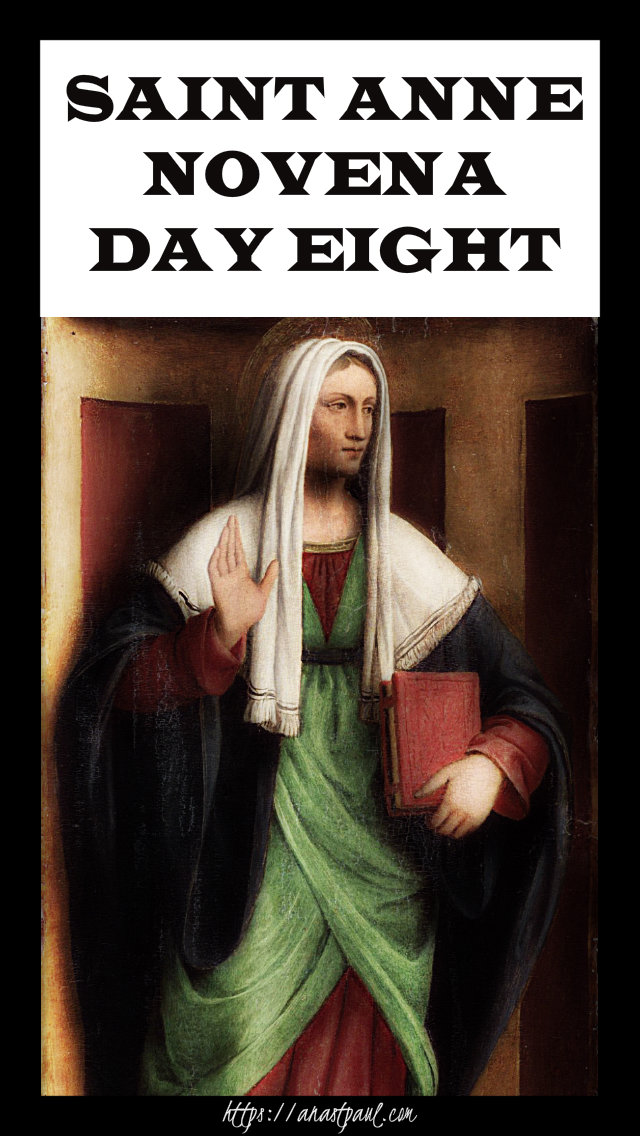
EIGHTH DAY
Hail, St Anne! I rejoice at your exalted glory.
You gave birth to Mary,
whose divine Son brought salvation to our lost world
by conquering death and restoring life and hope to sinners.
Pray to Him who, for love of us,
clothed Himself with human flesh
in the chaste womb of your daughter.
Glorious S. Anne,
with your blessed daughter,
deliver me from everything that is displeasing in the sight of God.
Pray to your gentle and powerful Grandson,
that He may cleanse my soul in His precious blood,
that He may send His Holy Spirit to enlighten
and direct me in all that I do,
always obedient to His holy inspirations.
Good mother, keep a watchful eye on me.
Help me bear all my crosses.
Please give me the fullness of your bounty
and sustain me with courage.
Amen
Who can describe the joy that came to the house of Anne and Joachim with the coming of Mary? Never had a sweeter baby smiled into a mother’s face.
Never had a more obedient child grown up to bring happiness to a household.
Her first spoken words were music in their ears.
Her first conscious kiss was a blessing and the sweet mark of her gratitude to her parents.
She listened avidly to Anne’s telling of the story of God’s dealings with His people. From Anne she heard for the first time about the Saviour who was to be born. From Anne she learned the gentle arts that she was later to use as Mother of the Son of God. It was from Anne she learned the dignity of a woman’s work.
Now there was laughter in the house, the happy young laughter of a sinless child. The hearts of Anne and Joachim echoed to that laughter in delight and with a sense of gracious fulfilment.
God had been slow to answer their prayers; His answer had come in measure far beyond their fondest hopes. In God’s Providence did they put their trust and their trust was not in vain.
To this model set before the child Mary we pray:
Daily Prayer:
O glorious St Anne,
you are filled with compassion
for those who invoke you
and with love for those who suffer!
Heavily burdened with the weight of my troubles,
I cast myself at your feet and humbly beg of you
to take the present intention
which I recommend to you in your special care.
…………………(make your intention)
Please recommend it to your daughter,
the Blessed Virgin Mary
and place it before the throne of Jesus,
so that He may bring it to a happy issue.
Continue to intercede for me until my request is granted.
But, above all, obtain for me the grace, one day,
to see my God face to face
and with you and Mary and all the saints,
to praise and bless Him for all eternity.
Amen
Our Father . . . Hail Mary . . . Glory Be . . .
O Jesus, Holy Mary, St Anne, help me now and at the hour of my death.
Good St Anne, intercede for me.
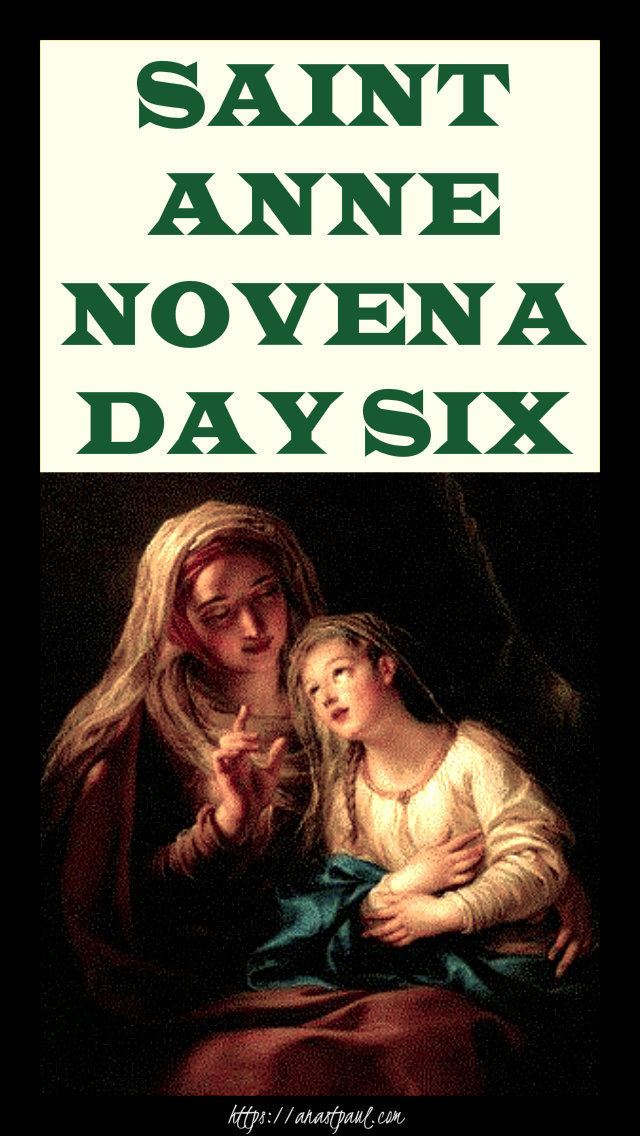
SIXTH DAY
Good St Anne,
do not allow my soul,
a masterpiece of God’s creative power,
to be lost forever.
Free my heart of pride, vanity, self-love.
May I know myself as I really am
and learn meekness and simplicity of heart.
God’s great love for me,
often leaves me cold and unresponsive.
I must reflect this love through works of mercy
and charity toward my neighbor.
In your boundless charity, good St. Ann,
help me to merit the glorious crown
which is given for those
who have fought the good fight
against the world, the devil and the flesh.
Assist me to preserve purity of heart and body.
With Mary and her divine Son,
please protect me always.
Amen




 With another young aspirant, he was waiting in the parlour to be introduced, when he saw in the garden a coadjutor Brother turning over the ground in the garden. He proposed to his companion to go and help him, saying: Could we begin our religious life better than with an act of humility and charity? And with no hesitation, both went to offer their assistance. How many young persons in that situation would have thought of such an offer? This incident reveals the profound charity and interior peace which characterised this young religious at all times.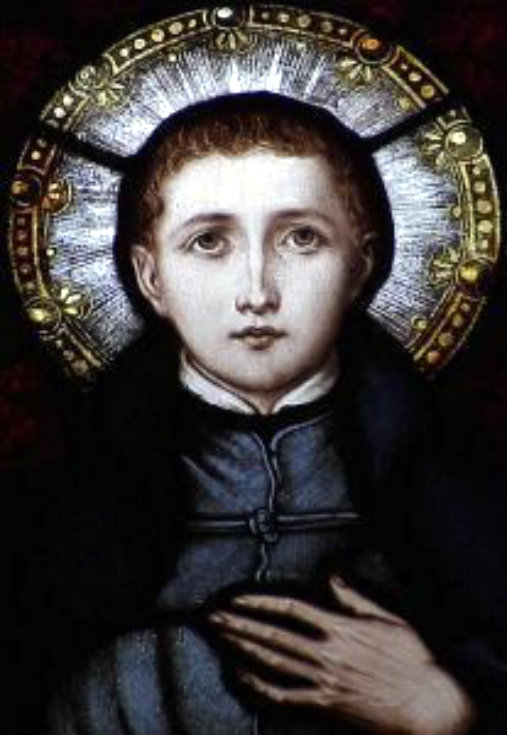











 AnaStpaul
You must be logged in to post a comment.