Quote/s of the Day – 23 September – The Memorial of St Padre Pio (1887-1968)
“Keep close to the Catholic Church at all times, for the Church alone can give you true peace, since she alone possesses Jesus, the true Prince of Peace, in the Blessed Sacrament.”
“Every Holy Mass, heard with devotion, produces in our souls marvellous effects, abundant spiritual and material graces which we, ourselves, do not know… It is easier for the earth to exist without the sun than without the Holy Sacrifice of the Mass!”
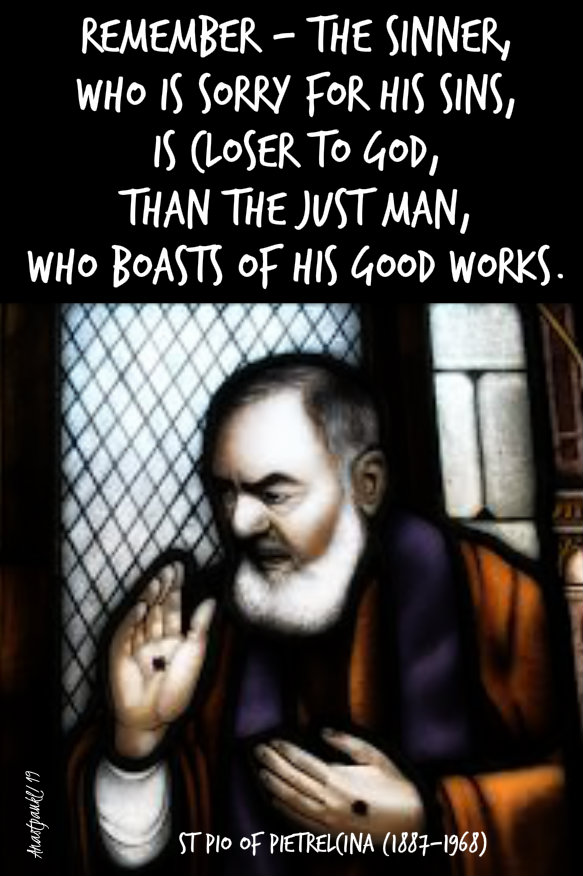
“Remember – the sinner, who is sorry for his sins, is closer to God, than the just man, who boasts of his good works.”
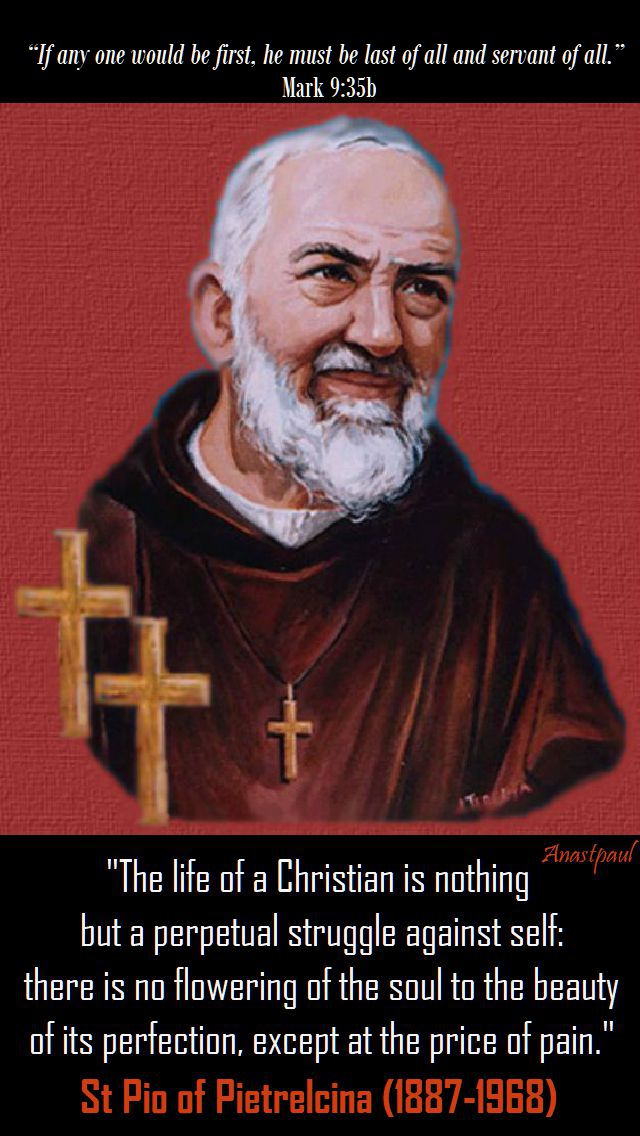
“If any one would be first, he must be last of all and servant of all.”
Mark 9:35b
“The life of a Christian is nothing but a perpetual struggle against self: there is no flowering of the soul to the beauty of its perfection, except at the price of pain.”
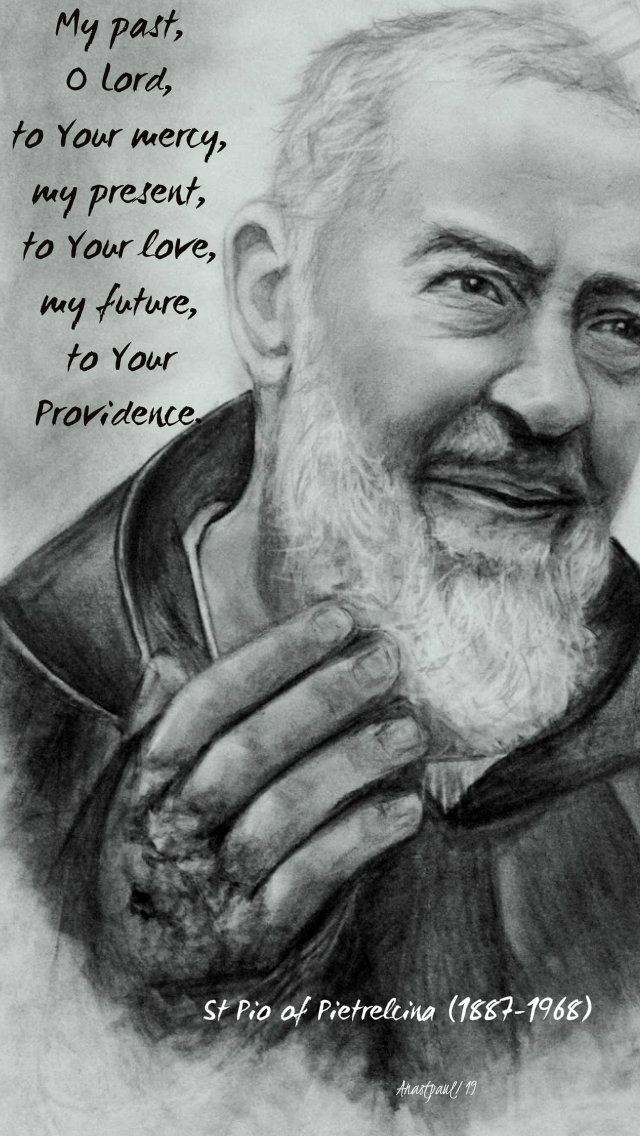
“My past, O Lord, to Your mercy, my present, to Your love, my future, to Your Providence.”
Sunday Reflection – 22 September – The Twenty Fifth Sunday in Ordinary Time, Year C
Jesus’ Sacrifice on Calvary
In the book “Padre Pio’s Mass” written by Fr Tarcisio of Cervinara, we again are given proof that the Holy Mass is the unbloody Holy Sacrifice of Jesus Christ, offered once and for all on Calvary. At the Council of Trent in the 22nd. session it states:
“Jesus Christ, our Lord and God, when he was about to offer himself once on the altar of the Cross to God the Father, making intercession by means of his death, so that he might gain there an eternal redemption, since his priesthood was not to be extinguished by death, at the last Supper, ‘on the night that he was handed over’, left to his beloved Spouse the Church a visible sacrifice, such as the nature of man requires, by which the bloody sacrifice achieved once upon the Cross might be represented and its memory endure until the end of the age and its saving power be applied to the remission of those sins which are daily committed by us.”
St Padre Pio is the first priest to have received the “stigmata,” the wounds of Jesus in his body (hands, feet and side). St Francis received them but only as a deacon. This is important because Padre Pio offered the sacrifice of the Holy Mass and St Francis was only able to assist.
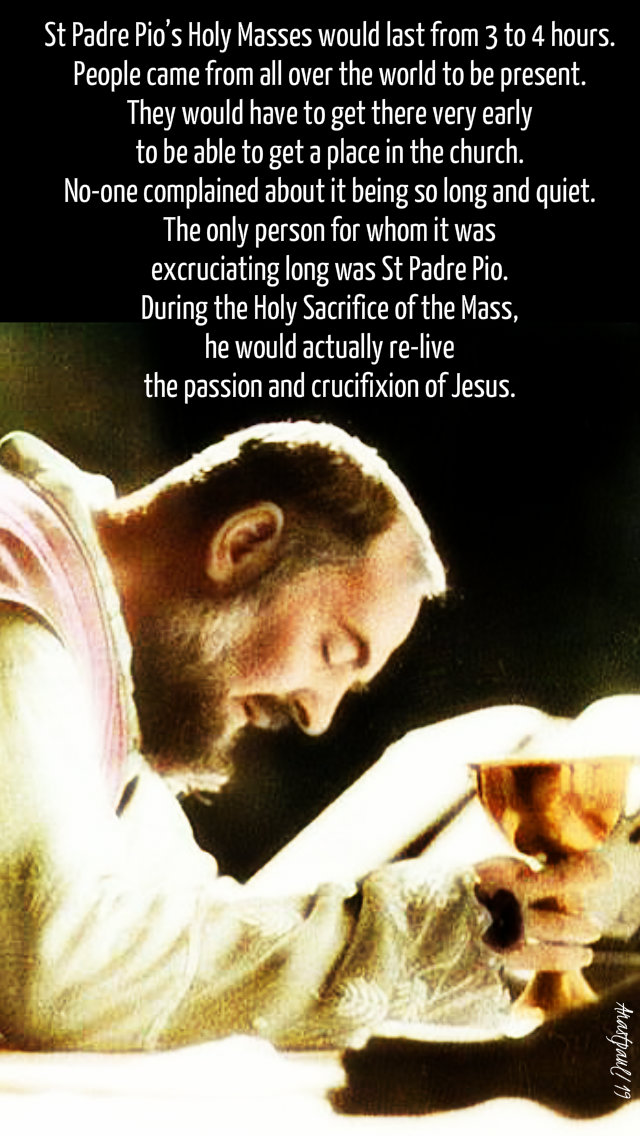
St Padre Pio’s Holy Masses would last from 3 to 4 hours. People came from all over the world to be present. They would have to get there very early to be able to get a place in the church. No-one complained about it being so long and quiet. The only person for whom it was excruciating long was St Padre Pio. During the Holy Sacrifice of the Mass, he would actually re-live the passion and crucifixion of Jesus.
First we need to be reminded, that at every Holy Mass, Jesus is, in an un-bloody form, offering His life on the Cross for the salvation of sinners. Then that the priest is truly an Alter Christus, which means the priest actually becomes the victim with Jesus Christ at the Holy Mass. This is shown by the priest saying: “This is My Body” and “This is My Blood”. The priest does not say: This is Jesus‘ Body or This is Jesus‘ Blood.
So when St Padre Pio would offer the Holy Sacrifice of the Mass, he would become literally this Alter Christus in suffering the crucifixion and bleeding in his wounds. One priest who was next to the altar during Padre Pio’s Mass, said he could never do that again, because he could not stand to see Padre Pio go through that agony again.
Cleonice Morcaldi, one of the spiritual daughters of Padre Pio, asked him several times what he felt and lived in each of his Masses. She wrote carefully each of his answers and thanks to her, we have a unique testimony from the Father himself about his Mass.
– Father, what is your Mass?
– A sacred accomplishment of the Passion of Jesus.
– What should I comprehend in your Holy Mass?
– All of Calvary.
– Father, tell me all that you suffer at the Holy Mass.
– All that Jesus suffered in His Passion, I inadequately suffer to the extent a human creature can possibly suffer. All of it, at no merit of my own and only because of His Goodness.
Father, is it true that you suffer the torment of the crowning of thorns during the Holy Mass?
– And you doubt it?
– During the whole Mass?
– And also before and after it. The crown is never taken away.
Saint Padre Pio’s Feast Day is tomorrow, 23 September.
Our Morning Offering – 22 September – Twenty Fifth Sunday in Ordinary Time, Year C
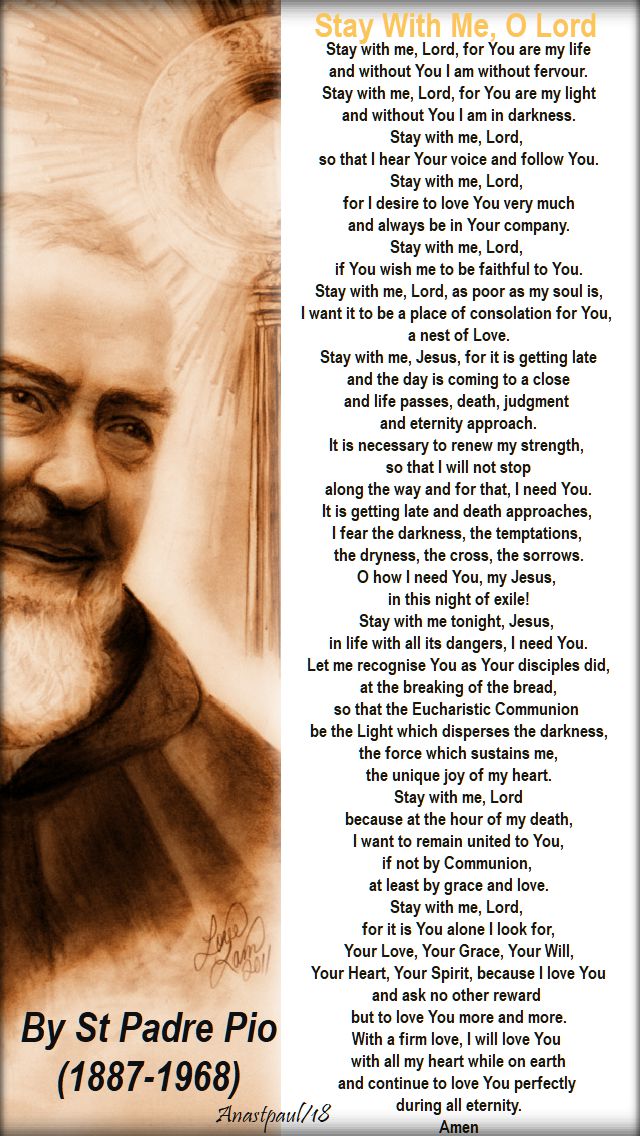
Stay With Me, O Lord St Padre Pio (1887-1968)
Stay with me, Lord, for You are my life
and without You I am without fervour.
Stay with me, Lord, for You are my light
and without You I am in darkness.
Stay with me, Lord,
so that I hear Your voice and follow You.
Stay with me, Lord,
for I desire to love You very much
and always be in Your company.
Stay with me, Lord,
if You wish me to be faithful to You.
Stay with me, Lord, as poor as my soul is,
I want it to be a place of consolation for You,
a nest of Love.
Stay with me, Jesus, for it is getting late
and the day is coming to a close
and life passes, death, judgement
and eternity approach.
It is necessary to renew my strength,
so that I will not stop
along the way and for that, I need You.
It is getting late and death approaches,
I fear the darkness, the temptations,
the dryness, the cross, the sorrows.
O how I need You, my Jesus, in this night of exile!
Stay with me tonight, Jesus,
in life with all its dangers, I need You.
Let me recognise You as Your disciples did,
at the breaking of the bread,
so that the Eucharistic Communion be the Light
which disperses the darkness,
the force which sustains me,
the unique joy of my heart.
Stay with me, Lord, because at the hour of my death,
I want to remain united to You,
if not by Communion, at least by grace and love.
Stay with me, Lord, for it is You alone I look for,
Your Love, Your Grace, Your Will,
Your Heart, Your Spirit, because I love You
and ask no other reward but to love You more and more.
With a firm love, I will love You
with all my heart while on earth
and continue to love You perfectly during all eternity.
Amen
Quote/s of the Day – 16 September – The Memorial of Sts Cornelius & Cyprian
“Not by words alone but also by deeds, has God taught us to pray. He Himself prayed frequently and demonstrated what we ought to do, by the testimony of His own example. As it is written: “But he himself was in retirement in the desert and in prayer” and again, “He went out into the mountain to pray and continued all night in prayer to God.” But if He who was without sin prayed, how much more ought sinners to pray and if He prayed continually, watching through the whole night with uninterrupted petitions, how much more ought we to lie awake at night in continuing prayer!”
“So, my brothers, let us pray as God our master has taught us. To ask the Father in words His Son has given us, to let Him hear the prayer of Christ ringing in His ears, is to make our prayer one of friendship, a family prayer. Let the Father recognise the words of His Son. Let the Son who lives in our hearts, be also on our lips. We have Him as an Advocate for sinners, before the Father, when we ask for forgiveness for ours sins, let us use the words given by our Advocate. He tells us – Whatever you ask the Father in my name, He will give you. What more effective prayer could we then make, in the name of Christ, than in the words of His own prayer?”
An excerpt from his “On the Lord’s Prayer”
“As we do battle and fight, in the contest of faith, God, His angels and Christ Himself, watch us. How exalted is the glory, how great the joy of engaging in a contest with God presiding, of receiving a crown, with Christ as judge.” An excerpt from his Letter 58
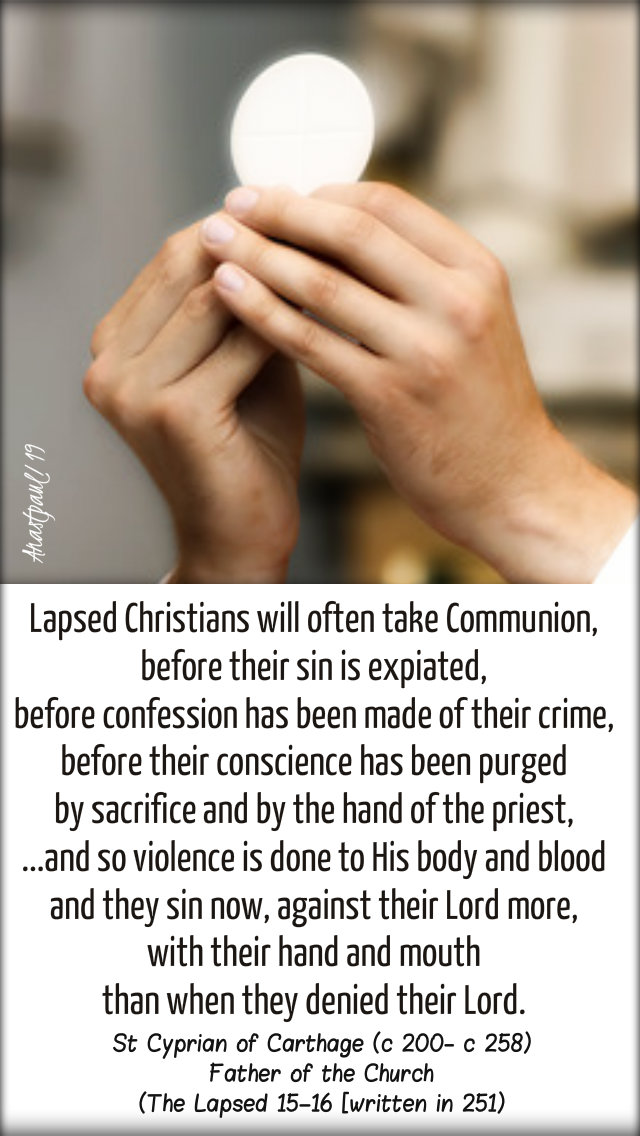
“{Lapsed Christians} will often take Communion before their sin is expiated, before confession has been made of their crime, before their conscience has been purged by sacrifice and by the hand of the priest, before the offence of an angry and threatening Lord has been appeased, [and so] violence is done to His body and blood and they sin now, against their Lord, more with their hand and mouth than when they denied their Lord.” (The Lapsed 15–16 [written in 251])
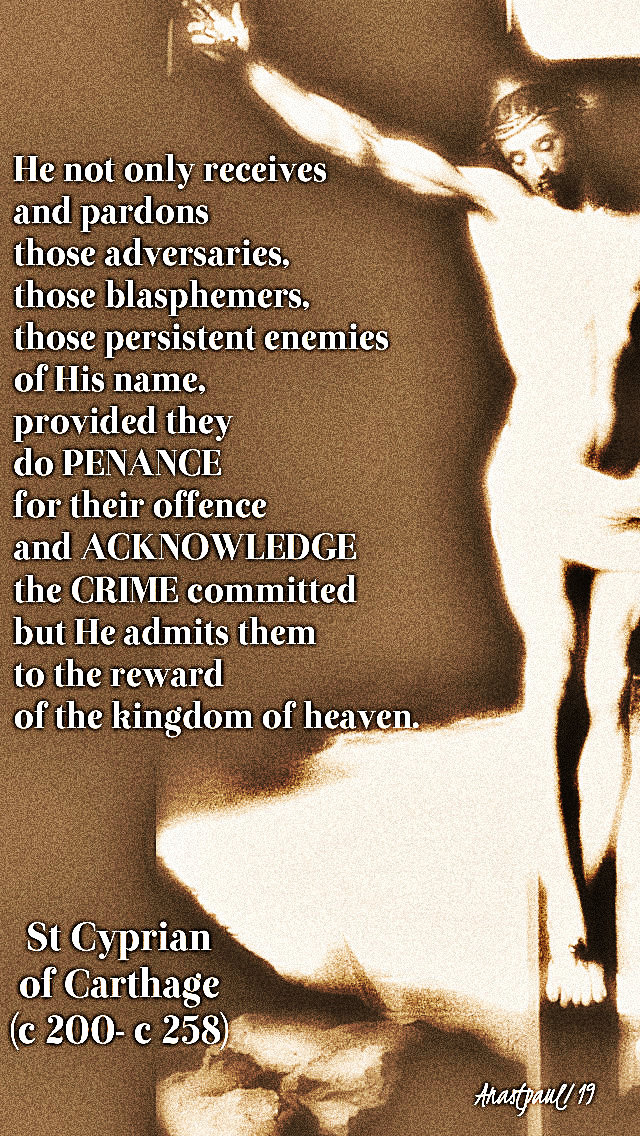
“He not only receives and pardons those adversaries, those blasphemers, those persistent enemies of His name, provided they do penance for their offence and acknowledge the crime committed but He admits them to the reward of the kingdom of heaven.”
“Whatever a man prefers to God, that, he makes, a god to himself.”
St Cyprian of Carthage (c 200-258)
Bishop and Martyr, Father of the Church
Sunday Reflection – 15 September – Twenty Fourth Sunday in Ordinary Time, Year C
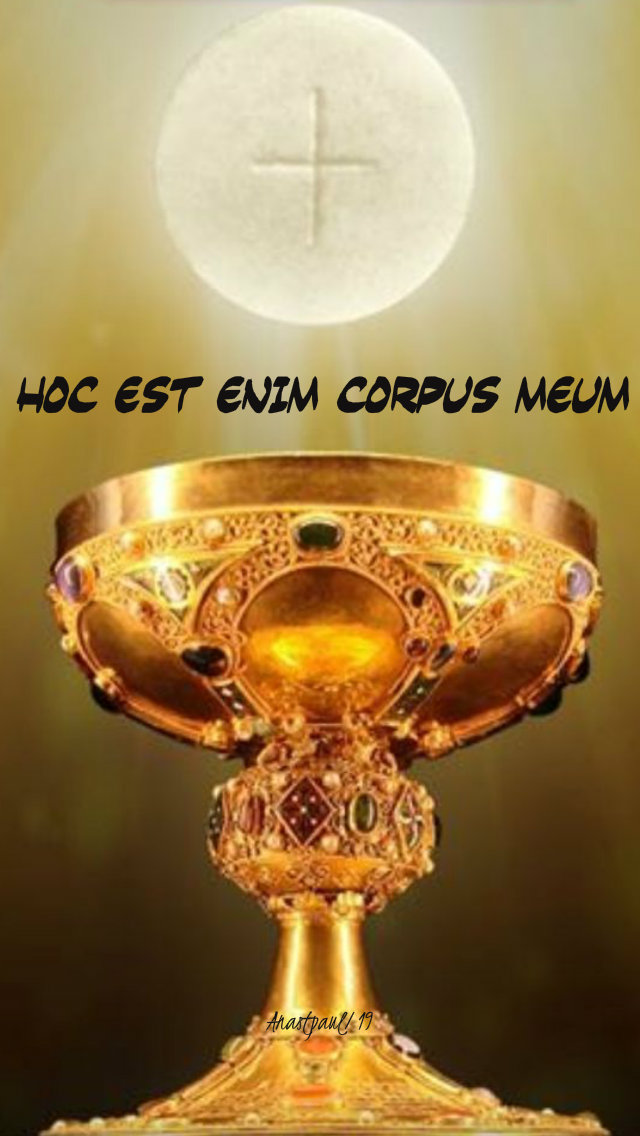
Hoc est enim Corpus meum
Blessed Columba Marmion OSB (1858-1923)
This is my body, this is my blood, take, eat and you shall have life – you have said it, Lord and that is sufficient. I believe it.
This bread that You give is Your own self, the Christ, the beloved Son of the Father, who became incarnate and was delivered up for me, who was born at Bethlehem and dwelled in Nazareth, who cured the sick and gave sight to the blind, who forgave Magdalen and the good thief, who, at the Last Supper let St John lay his head upon Your heart, You, who are the Way, the Truth and the Life, who died for love of me and ascended into heaven and now, at the right hand of the Father, reigns and intercedes unceasingly for us!
O Jesus, Eternal Truth, You declared that You are present upon the altar, really and substantially, with Your humanity and all the treasures of Your divinity – I believe it and because I believe it, I cast myself down and adore You.
Receive, as my God and my All, the homage of my adoration. I yield myself entirely to You, that You may be the Master of all my being and of all my activity, that I may live only on You, by You and in You.
You have the power, O Christ Jesus, of drawing me entirely to Yourself, so that I may be transformed into You!
Our Morning Offering – 15 September – Twenty Fourth Sunday in Ordinary Time, Year C
As we celebrate today the holy mystery of the Sacrifice of the Mass,
let us contemplate our Lord Crucified.
Sonnet to our Lord Crucified Anonymous
I am not moved to love You, O my God,
That I might hope in promised heaven to dwell,
Nor am I moved by fear of pain in hell,
To turn from sin and follow where You trod.
You move me, Lord, broken beneath the rod,
Or stretched out on the cross, as nails compel
Your hand to twitch. It moves me that we sell,
To mockery and death, Your precious blood.
It is, O Christ, Your love which moves me so,
That my love rests not on a promised prize,
Nor holy fear on threat of endless woe,
It is not milk and honey but the flow
Of blood from blessed wounds before my eyes,
That waters my buried soul and makes it grow.
Amen
Quote/s of the Day – 13 September – the Memorial of St John Chrysostom (347-407) Father & Doctor of the Church
“Are we in poverty? Let us give thanks.
Are we in sickness? Let us give thanks.
Are we falsely accused? Let us give thanks.
When we suffer affliction, let us give thanks.
This brings us near to God.“
“What prayer, could be more true before God the Father, than that which the Son, who is Truth, uttered with His own lips?”
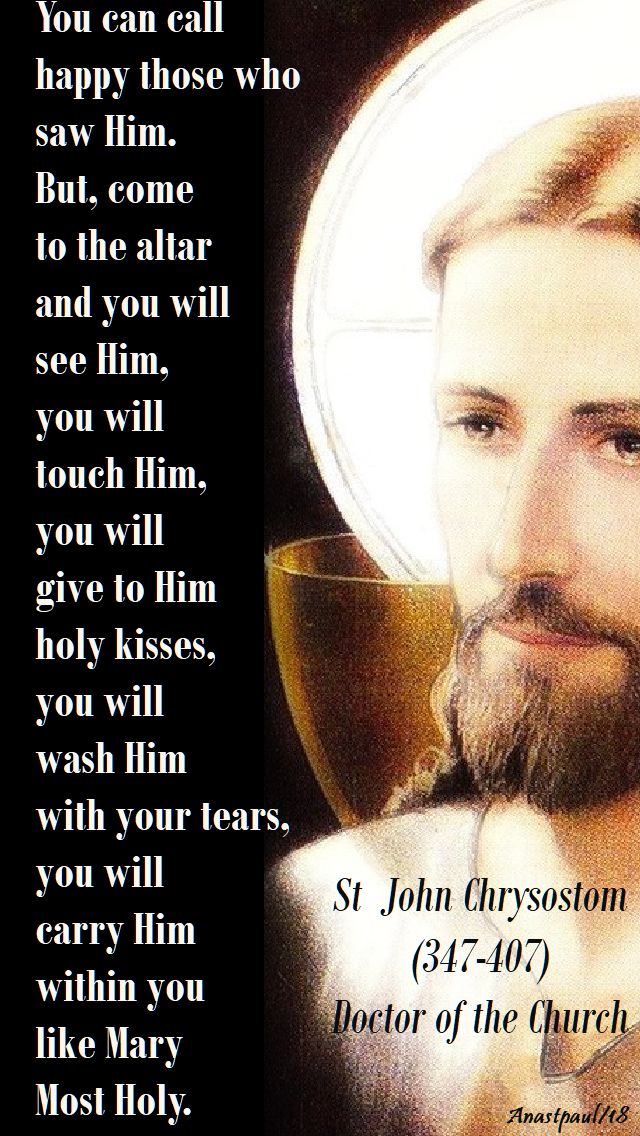
“You can call happy those who saw Him. But, come to the altar and you will see Him, you will touch Him, you will give to Him holy kisses, you will wash Him with your tears, you will carry Him within you like Mary Most Holy.”
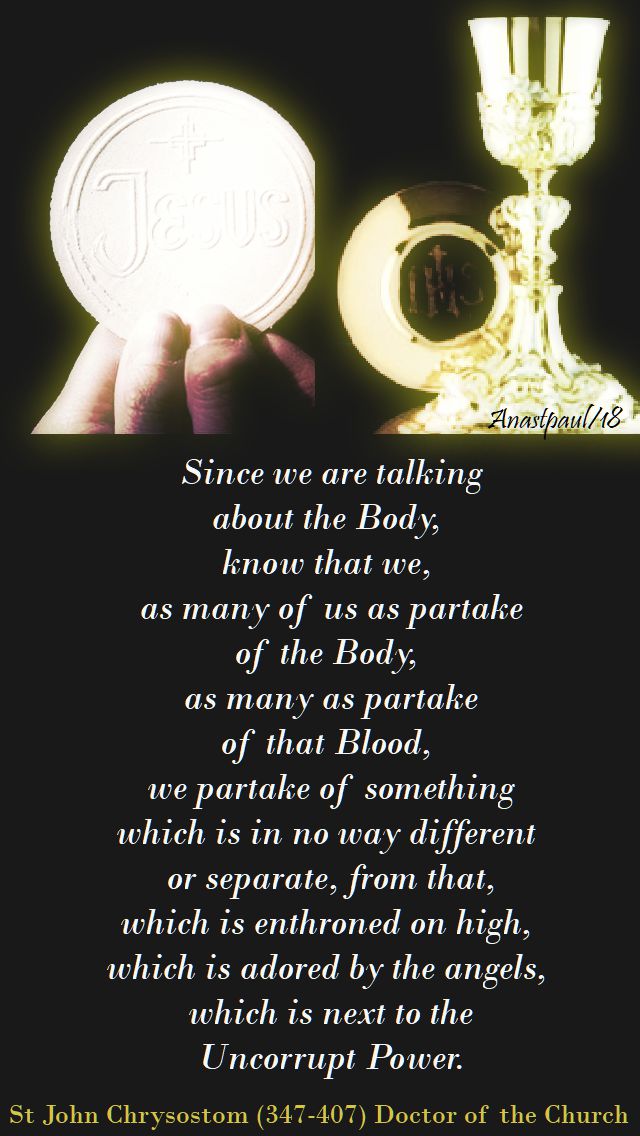
“Since we are talking about the Body,
know that we, as many of us as partake of the Body,
as many as partake of that Blood,
we partake of something which is in no way different
or separate from that which is enthroned on high,
which is adored by the angels,
which is next to Uncorrupt Power.”
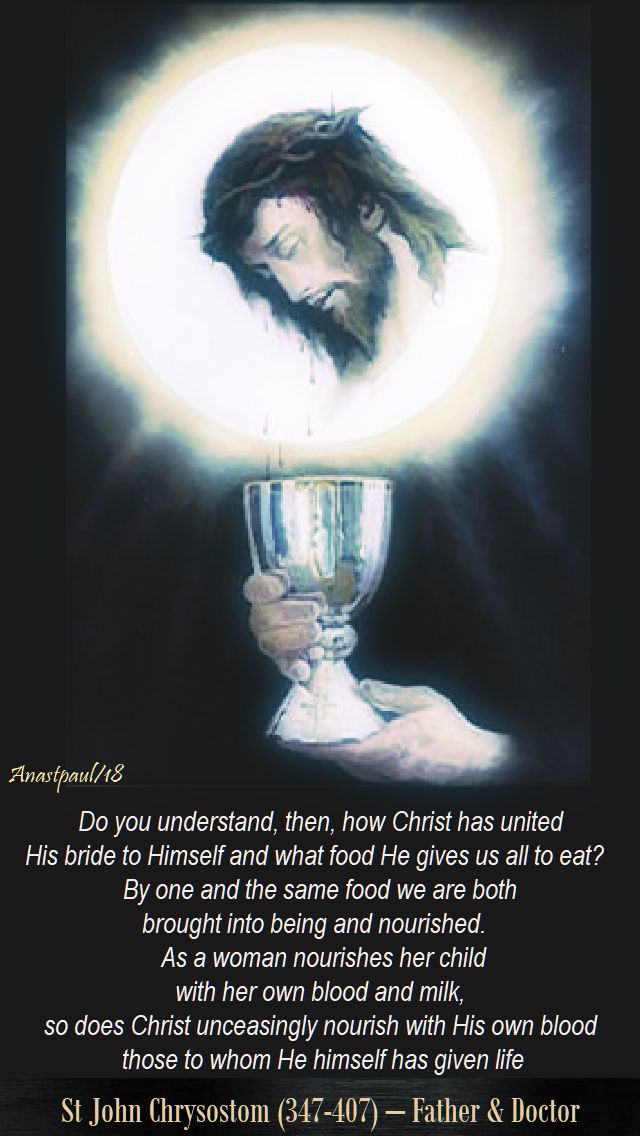
“Do you understand, then, how Christ has united His bride to Himself and what food He gives us all to eat? By one and the same food, we are both brought into being and nourished. As a woman nourishes her child with her own blood and milk, so does Christ unceasingly nourish with His own blood those to whom He himself has given life.’”
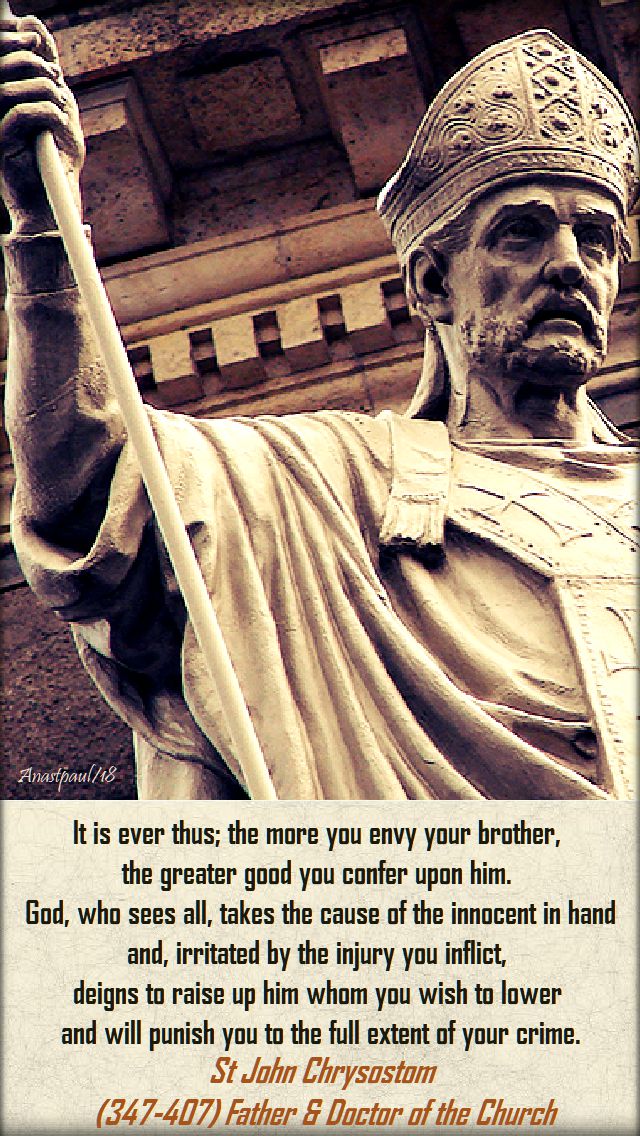
” …It is ever thus; the more you envy your brother, the greater good you confer upon him. God, who sees all, takes the cause of the innocent in hand and, irritated by the injury you inflict, deigns to raise up him whom you wish to lower and will punish you to the full extent of your crime. If God usually punishes those who rejoice at the misfortunes of their enemies, how much more will He punish those who, excited by envy, seek to do an injury to those who have never injured them?”
Sunday Reflection – 8 September – Twenty-third Sunday in Ordinary Time, Year C
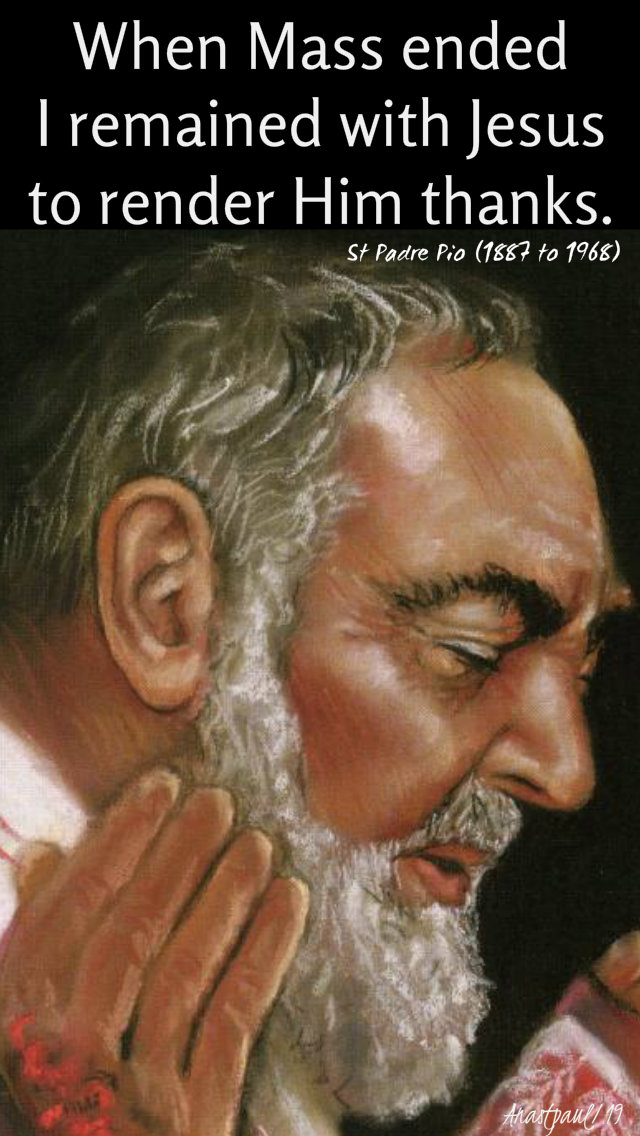
“When Mass ended I remained with Jesus to render Him thanks.
My thirst and hunger do not diminish after I have received Him in the Blessed Sacrament but rather, increase steadily.
Oh, how sweet was the conversation I held with Paradise this morning.
The Heart of Jesus and my own, if you will pardon my expression, fused.
They were no longer two hearts beating but only one.
My heart disappeared, as if it were, a drop in the ocean.”
St Pio of Pietrelcina aka St Padre Pio (1887 to 1968)
Our Morning Offering – 8 September – Twenty-third Sunday in Ordinary Time, Year C
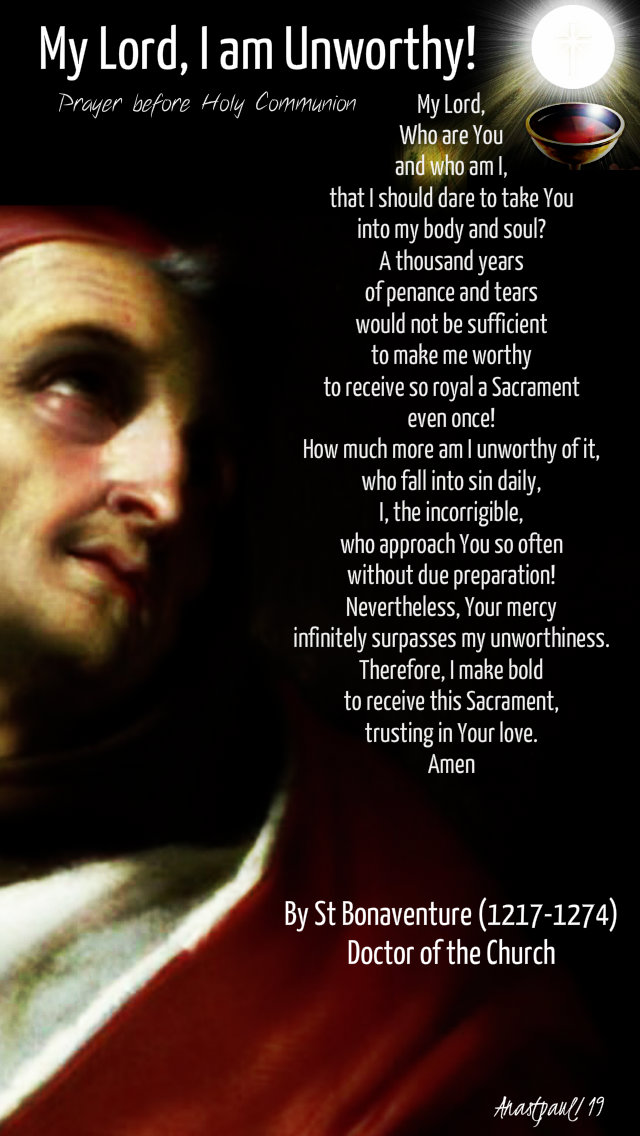
My Lord, I am Unworthy! Prayer before Holy Communion By St Bonaventure (1217-1274) Doctor of the Church
My Lord,
Who are You
and who am I,
that I should dare to take You
into my body and soul?
A thousand years
of penance and tears
would not be sufficient
to make me worthy
to receive so royal a Sacrament
even once!
How much more am I unworthy of it,
who fall into sin daily,
I, the incorrigible,
who approach You so often
without due preparation!
Nevertheless, Your mercy
infinitely surpasses my unworthiness.
Therefore, I make bold
to receive this Sacrament,
trusting in Your love.
Amen
Sunday Reflection – 1 September – Twenty-second Sunday in Ordinary Time, Year C
“When you see (the Most Blessed Sacrament) exposed, say to yourself –
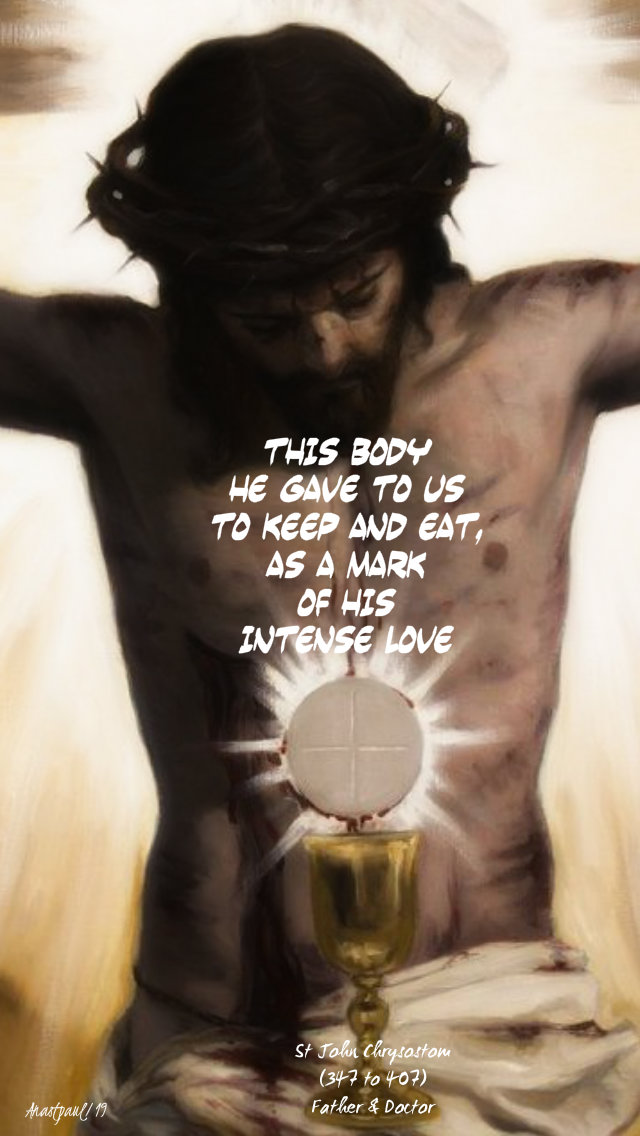
‘Thanks to this Body, I am no longer dust and ashes, I am no more a captive but a freeman, hence, I hope to obtain heaven and the good things that are there in store for me… eternal life, the heritage of the angels, companionship with Christ; death has not destroyed this Body which was pierced by nails and scourged . . . this is that Body which was once covered with blood, pierced by a lance, from which issued saving fountains upon the world, one of blood and the other of water. . . This Body He gave to us to keep and eat, as a mark of His intense love’.”
Our Morning Offering – 1 September – Twenty second Sunday in Ordinary Time, Year C
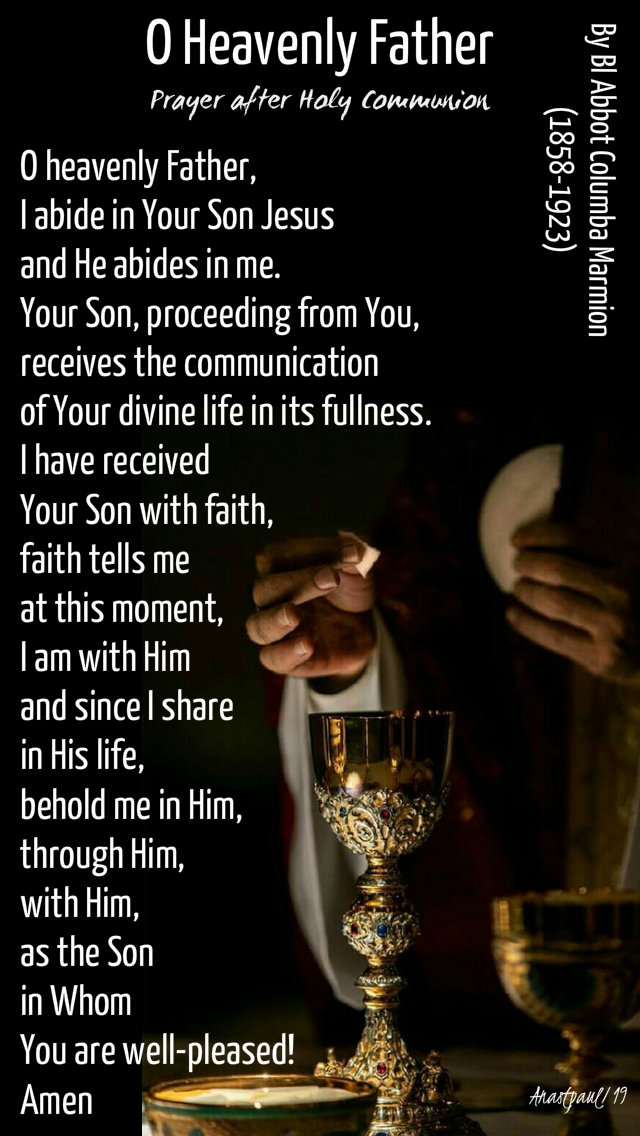
O Heavenly Father Prayer after Holy Communion By Blessed Abbot Columba Marmion OSB (1858-1923)
O heavenly Father,
I abide in Your Son Jesus
and He abides in me.
Your Son, proceeding from You,
receives the communication
of Your divine life in its fullness.
I have received Your Son with faith,
faith tells me at this moment,
I am with Him
and since I share in His life,
behold me in Him,
through Him,
with Him,
as the Son
in Whom
You are well-pleased!
Amen
Quote/s of the Day – 28 August – The Memorial of St Augustine (354-430)
Father and Doctor of Grace
“God in his omnipotence could not give more, in His wisdom – He knew not how to give more, in His riches: – He had not more to give, than the EUCHARIST!”
“I will suggest a means whereby you can praise God all day long, if you wish. Whatever you do, do it well and you have praised God.”
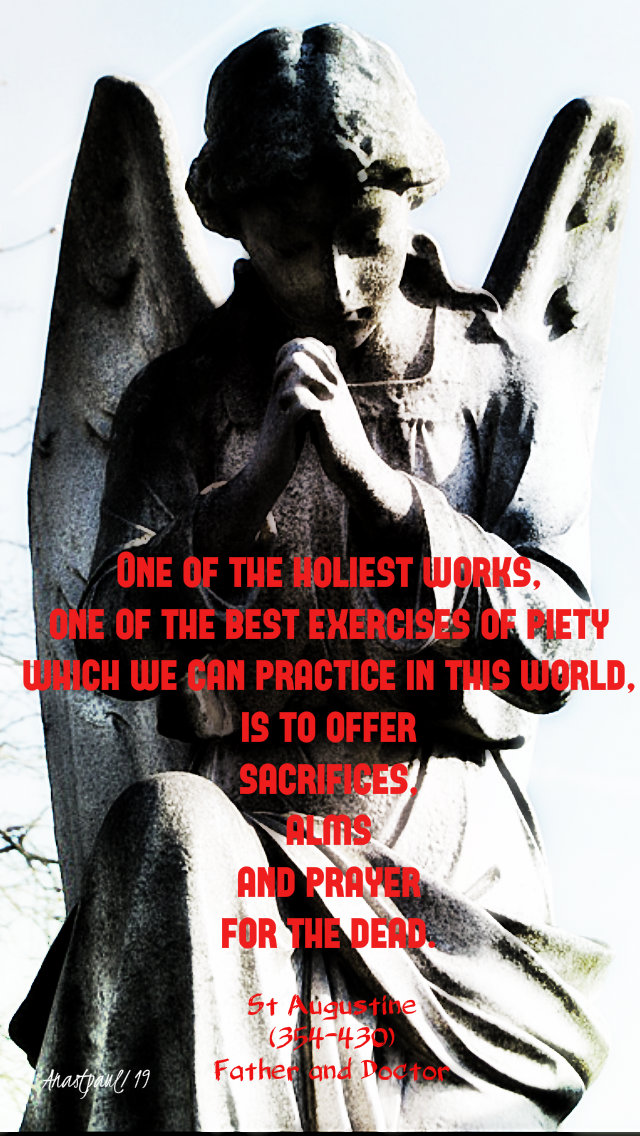
“One of the holiest works, one of the best exercises of piety which we can practice in this world, is to offer sacrifices, alms and prayer for the dead.”
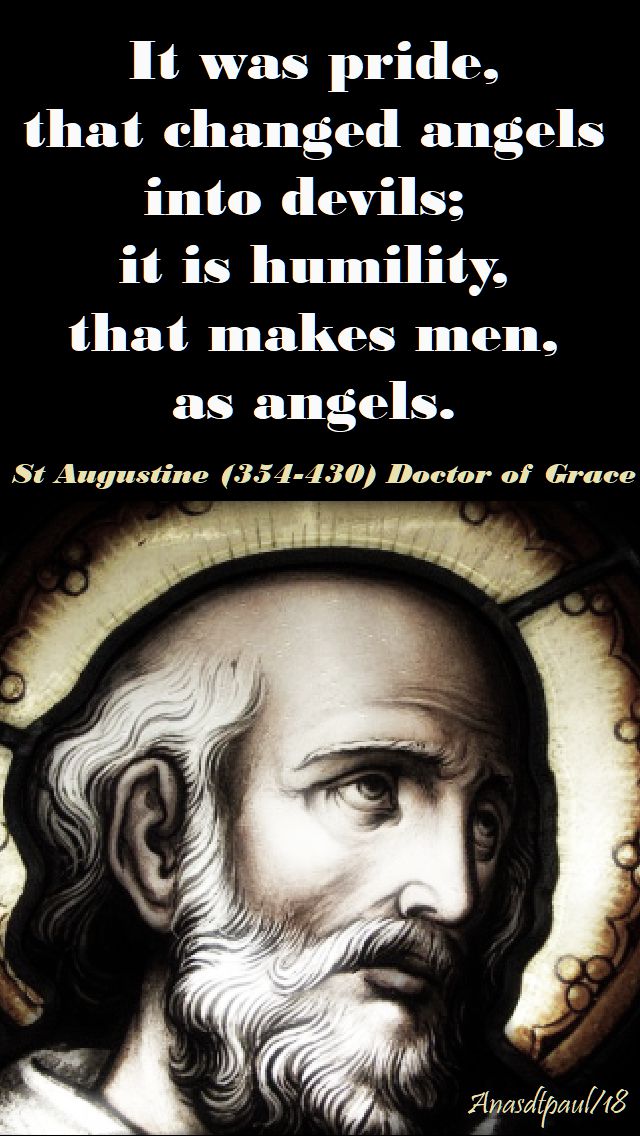
“It was pride, that changed angels into devils; it is humility that makes men as angels.”
“
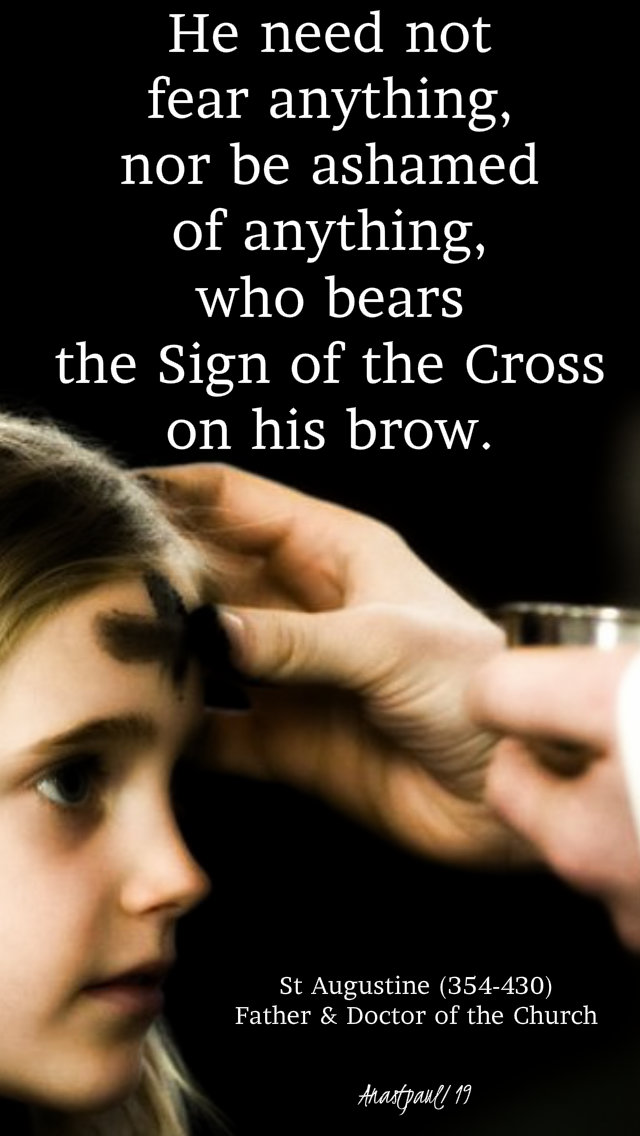
“He need not fear anything nor be ashamed of anything, who bears the Sign of the Cross on his brow.”
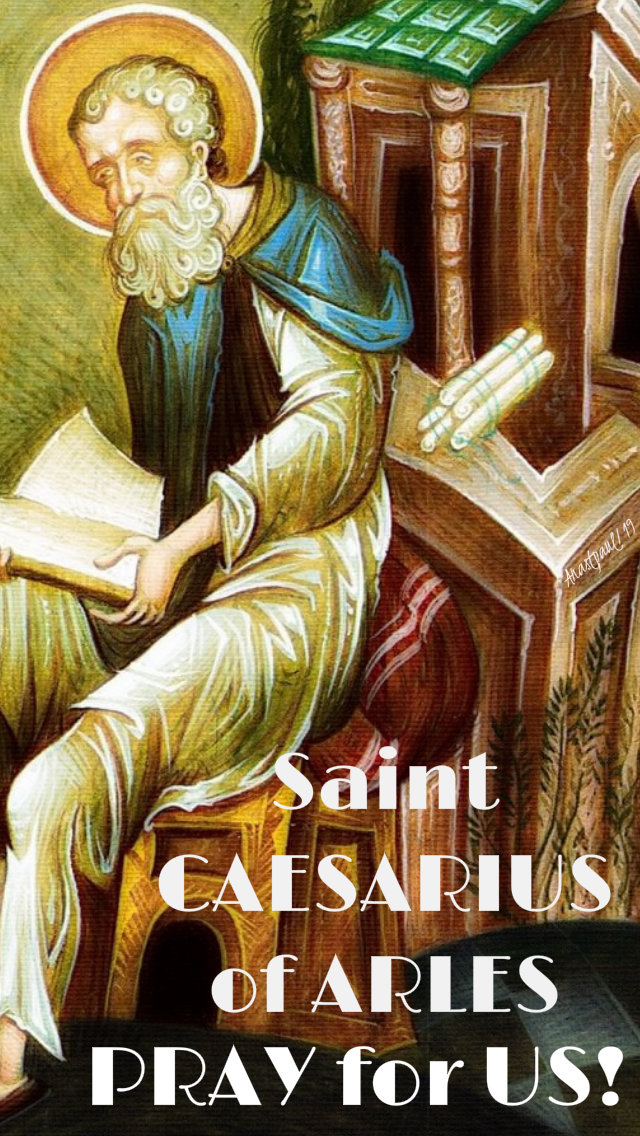
One Minute Reflection – 27 August – Tuesday of the Twenty-first week in Ordinary Time, Year C, Gospel: Matthew 23:23–26 and The Memorial of St Caesarius of Arles (470-542) Father of the Church
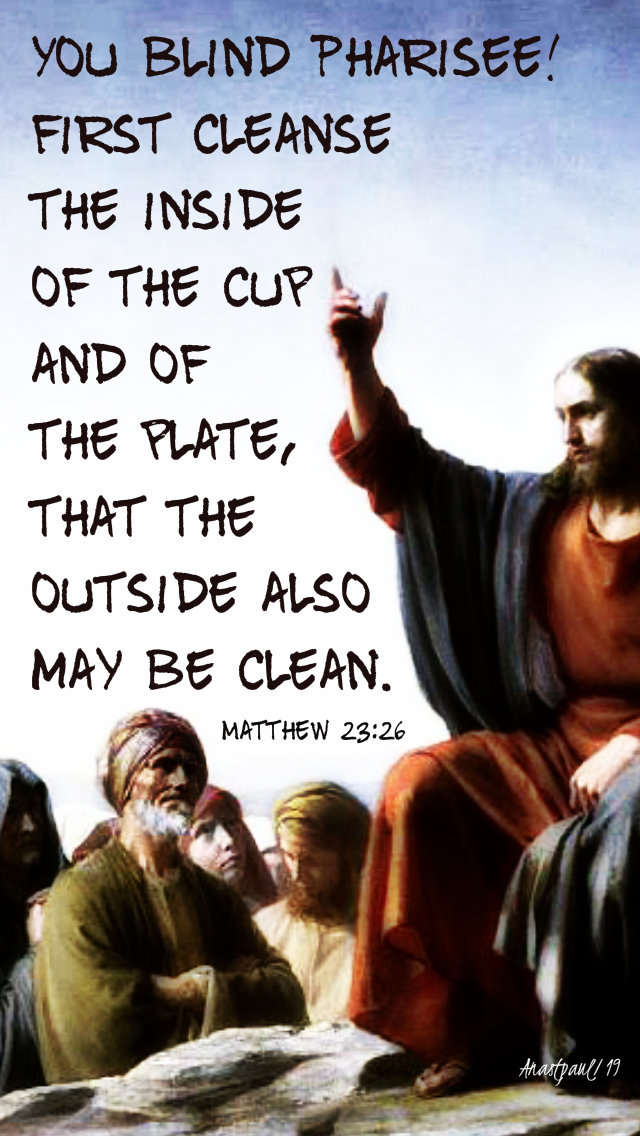
“You blind Pharisee! first cleanse the inside of the cup and of the plate, that the outside also may be clean.”…Matthew 23:26
REFLECTION – “And so, dearly beloved brethren, let us each examine his conscience and when he sees that he has been wounded by some sin, let him first strive to cleanse his conscience by prayer, fasting, almsgiving and so dare to approach the Eucharist. If he recognises his guilt and is reluctant to approach the holy altar, he will be quickly pardoned by the Divine Mercy, “for whoever exalts himself will be humbled and whoever humbles himself will be exalted” (Mt 23:12). If then, as I have said, a man conscious of his sins, humbly decides to stay away from the altar until he reforms his life, he will not be afraid of being completely excluded from the eternal banquet of heaven.
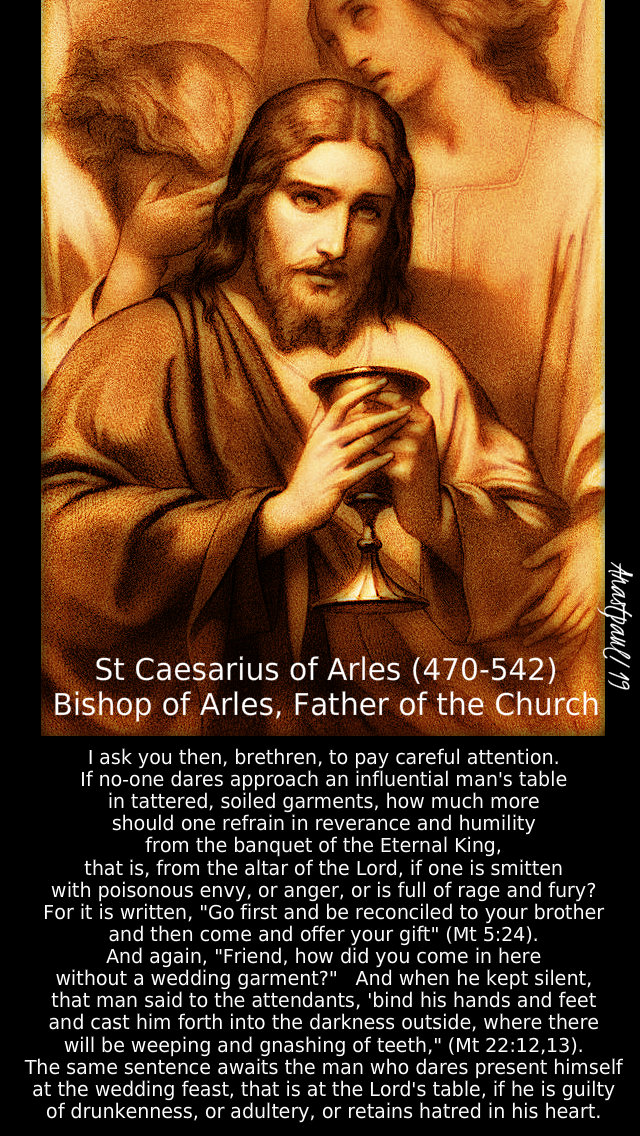
I ask you then, brethren, to pay careful attention. If no-one dares approach an influential man’s table in tattered, soiled garments, how much more should one refrain in reverence and humility from the banquet of the Eternal King, that is, from the altar of the Lord, if one is smitten with poisonous envy, or anger, or is full of rage and fury? For it is written, “Go first and be reconciled to your brother and then come and offer your gift” (Mt 5:24). And again, “Friend, how did you come in here without a wedding garment?” And when he kept silent, that man said to the attendants, ‘bind his hands and feet and cast him forth into the darkness outside, where there will be weeping and gnashing of teeth,” (Mt 22:12,13). The same sentence awaits the man who dares present himself at the wedding feast, that is at the Lord’s table, if he is guilty of drunkenness, or adultery, or retains hatred in his heart.” … St Caesarius of Arles (470-542) Bishop of Arles, Father of the Church
PRAYER – Lord God, renew Your Church with the Spirit of wisdom and love which You gave to St Caesarius. Lead us by that same Spirit, to seek You, the only fountain of true wisdom and the source of everlasting love. May we turn to You in sorrow and true repentance when we fail and strive always and everywhere to live in Your truth and Your love for all. Through our Lord Jesus Christ, Your Son, in union with the Spirit, one God, forever and ever. St Caesarius, pray for the Church and for us all, amen.
Sunday Reflection – 25 August – 21st Sunday of the Year in Ordinary Time, Year C
Sunday
Pope Benedict XVI
And let us also keep present that the Eucharist, joined to the Cross and Resurrection of the Lord, has dictated a new structure to our time.
The Risen One was manifested the day after Saturday, the first day of the week, day of the sun and of creation. From the beginning, Christians have celebrated their encounter with the Risen One, the Eucharist, on this first day, on this new day of the true sun of history, the Risen Christ.
And thus time always begins again with the encounter with the Risen One and this encounter gives content and strength to everyday life. Because of this, it is very important for us Christians, to follow this new rhythm of time, to meet with the Risen One on Sunday and thus “to take” with us His presence, which transforms us and transforms our time. … 17 June 2010
Our Morning Offering – 25 August – 21st Sunday of the Year in Ordinary Time, Year C
Prayer of Thanksgiving for the Holy Eucharist By St Pope John Paul (1920-2005)
O Christ the Saviour,
we give You thanks
for Your redeeming sacrifice,
the only hope of men!
O Christ the Saviour,
we give You thanks
for the eucharistic breaking of bread,
which You instituted
in order to really meet Your brothers,
in the course of the centuries!
O Christ the Saviour,
put into the hearts of the baptised,
the desire to offer themselves with You
and to commit themselves,
for the salvation of their brothers!
You, who are really present
in the Blessed Sacrament,
spread Your blessings
abundantly on Your people
Amen
Quote/s of the Day – 19 August – The Memorial of St John Eudes Orat. (1601-1680) “Apostle of Two Hearts”
“A Christian has a union with Jesus Christ – more noble, more intimate and more perfect than the members of a human body have with their head!”
“The Christian life is a continuation and completion of the life of Christ in us. We should be so many Christs here on earth, continuing His life and His works, labouring and suffering in a holy and divine manner in the spirit of Jesus.”
“Our wish, our object, our chief preoccupation must be to form Jesus in ourselves, to make His spirit, His devotion, His affections, His desires and His disposition, live and reign there. All our religious exercises should be directed to this end. It is the work which God has given us to do unceasingly. “
“Faith is a beam, radiating from the face of God.”
Sunday Reflection – 18 August – Twentieth Sunday in Ordinary Time, Year C,
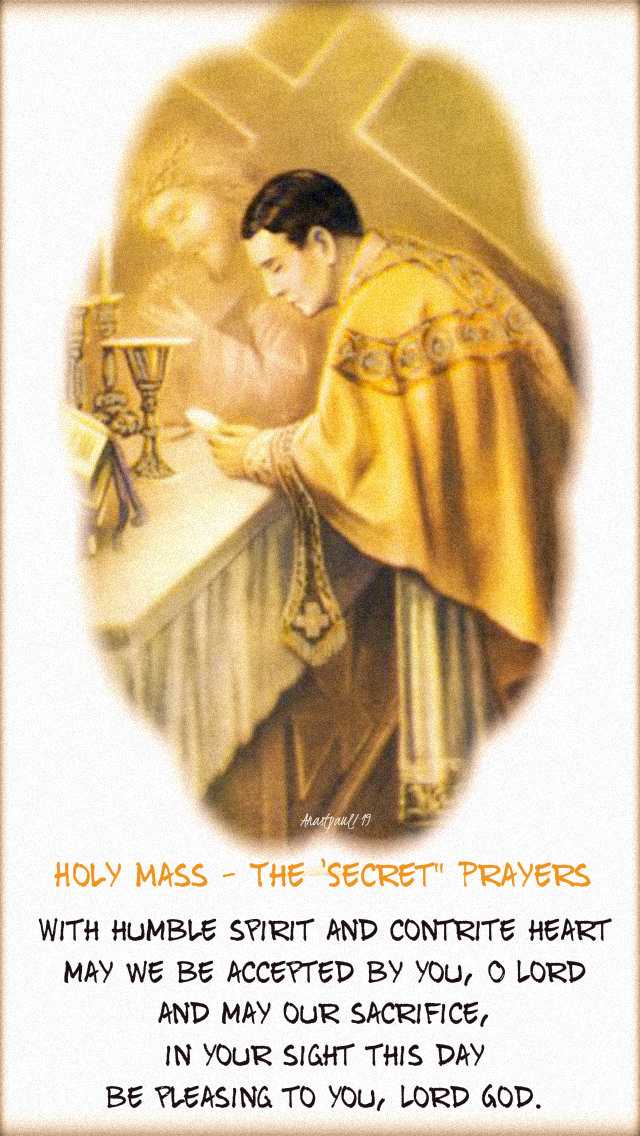
The ‘Secret’ Prayers (Offertory)
If you watch very closely, you’ll notice that the priest is moving his lips and praying some prayers very, very quietly during the preparation of the Gifts. The rubrics indicate that the priest should pray them ‘sub secreto’, which is translated as ‘inaudibly’ or ‘secret.’
But there’s really no secret, because the prayers are printed in the Roman Missal or other worship resources for the whole world to see. And even though the rubrics indicate that the priest is to pray these prayers, there is absolutely no reason why you can’t do that too!
As the priest pours wine and a little water into the chalice, he prays quietly: “By the mystery of this water and wine may we come to share in the divinity of Christ, who humbled himself to share in our humanity.”
Then the priest bows profoundly and says quietly: “With humble spirit and contrite heart may we be accepted by you, O Lord and may our sacrifice in your sight this day be pleasing to you, Lord God.”
Finally, as he washes his hands he prays, “Wash me, O Lord, from my iniquity, and cleanse me from my sin.”
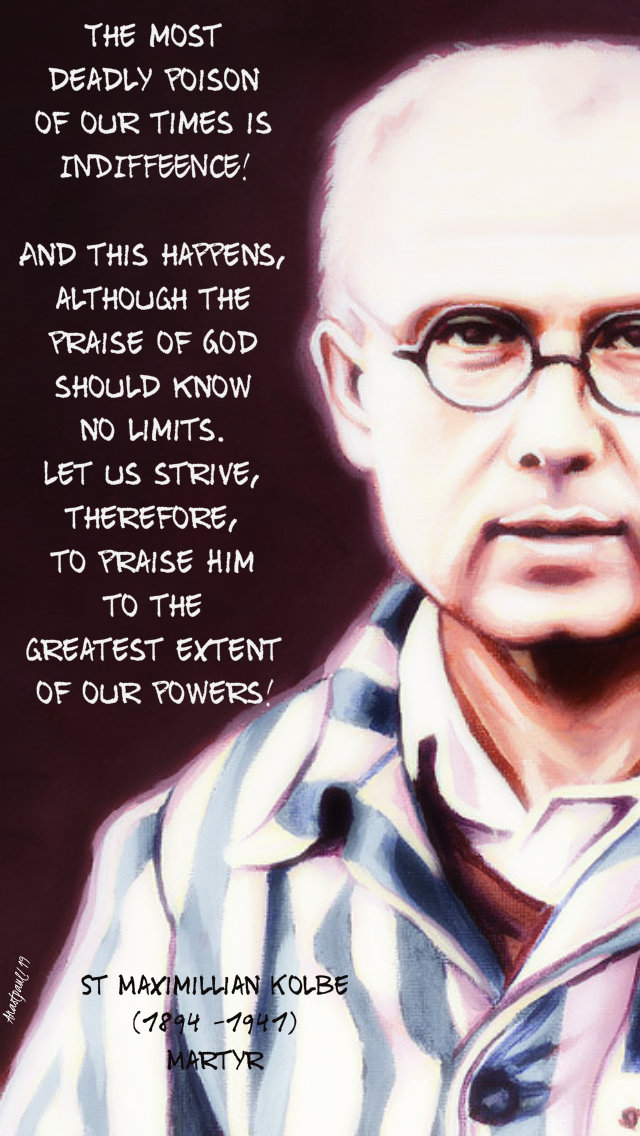
Quote/s of the Day – 14 August – The Memorial of St Maximillian Kolbe OFM Conv (1894 -1941) “Martyr of Charity”
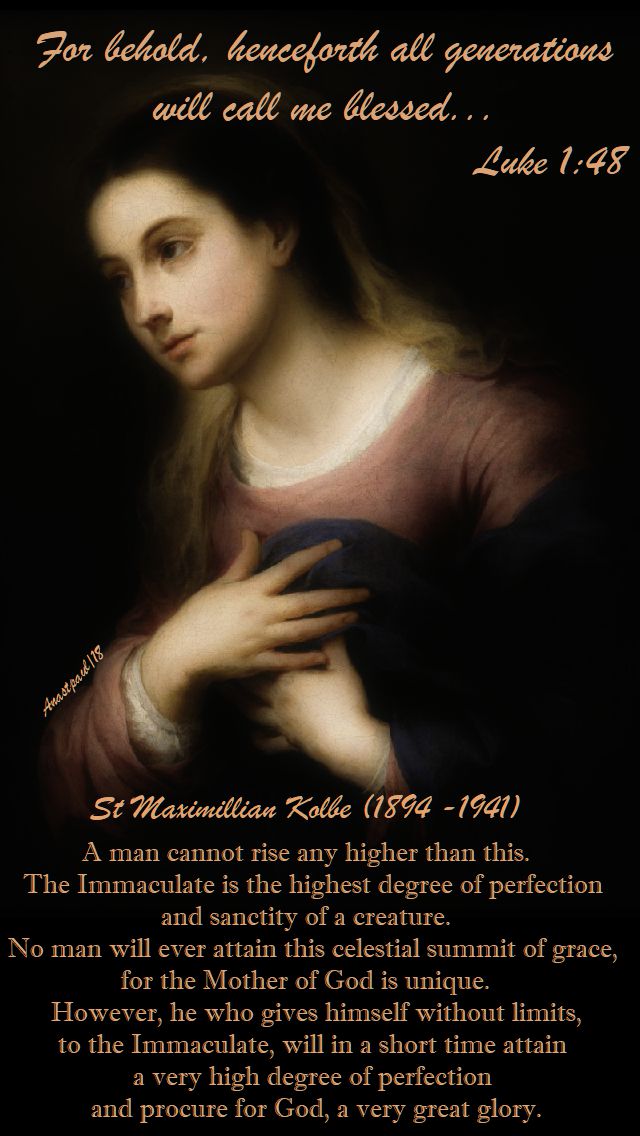
“A man cannot rise any higher than this. The Immaculate is the highest degree of perfection and sanctity of a creature. No man will ever attain this celestial summit of grace, for the Mother of God is unique. However, he who gives himself without limits, to the Immaculate, will in a short time, attain a very high degree of perfection and procure for God, a very great glory.”
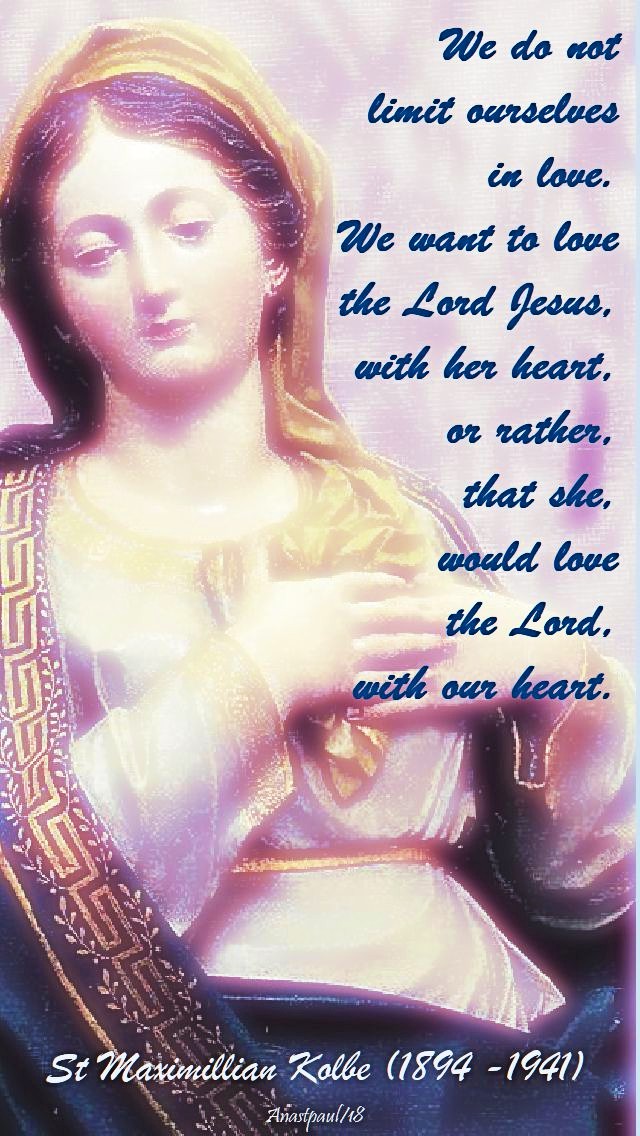
“We do not limit ourselves in love. We want to love the Lord Jesus, with her heart, or rather, that she would love the Lord, with our heart.”
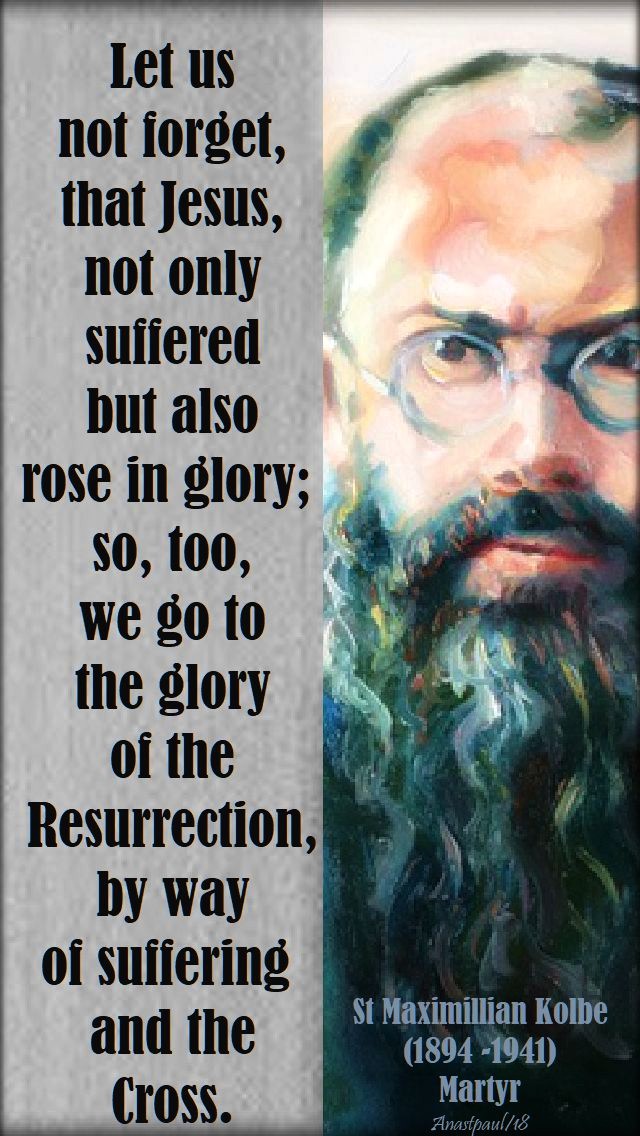
“Let us not forget, that Jesus not only suffered but also rose in glory; so, too, we go to the glory of the Resurrection, by way of suffering and the Cross.”
“The most deadly poison of our times is indifference. And this happens, although the praise of God should know no limits. Let us strive, therefore, to praise Him to the greatest extent of our powers!”
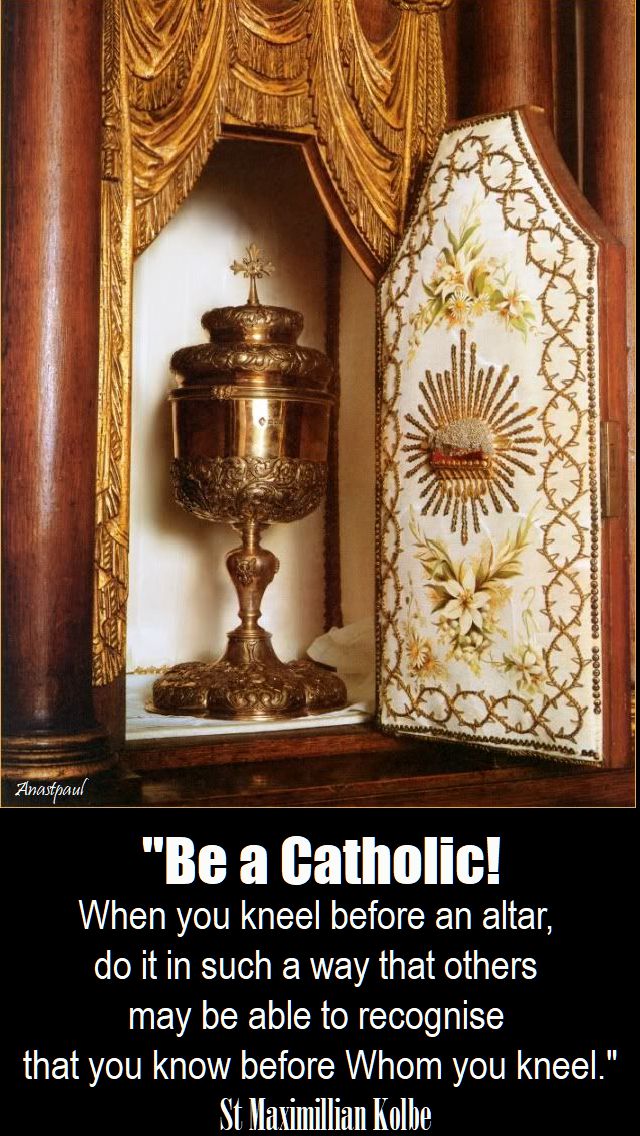
“Be a Catholic! When you kneel before an altar, do it in such a way that others may be able to recognise that you know before Whom you kneel.”
Thought for the Day – 11 August – Nineteenth Sunday in Ordinary Time, Year C, Gospel: Luke 12:32–48 and the Memorial of St Clare of Assisi (1194-1253)
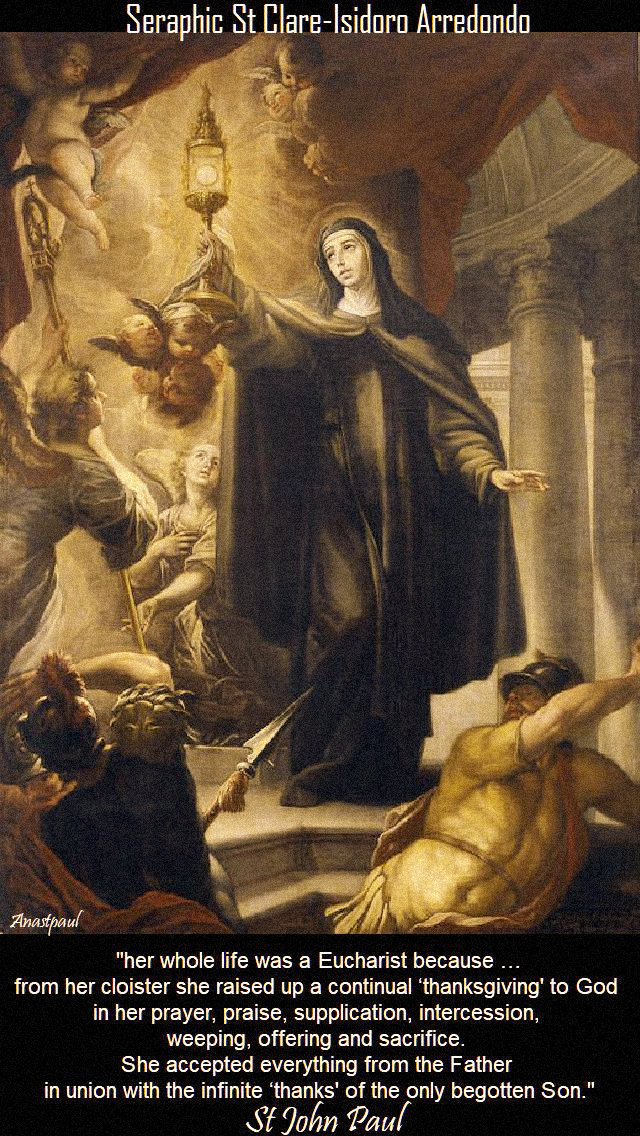
St Pope John Paul II said of Saint Clare – “her whole life was a Eucharist because … from her cloister she raised up a continual ‘thanksgiving’ to God in her prayer, praise, supplication, intercession, weeping, offering and sacrifice.
She accepted everything from the Father in union with the infinite ‘thanks’ of the only begotten Son.”
St Pope John Paul II (1920-2005)
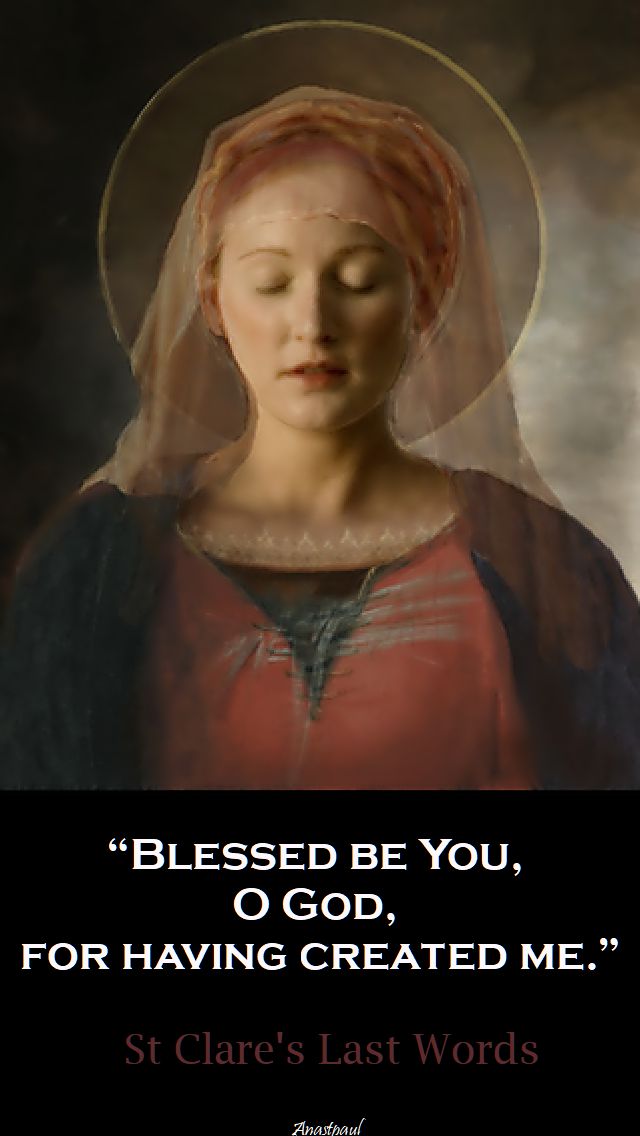
“ Blessed be You, O God, for having created me. ”
St Clare’s Last Words
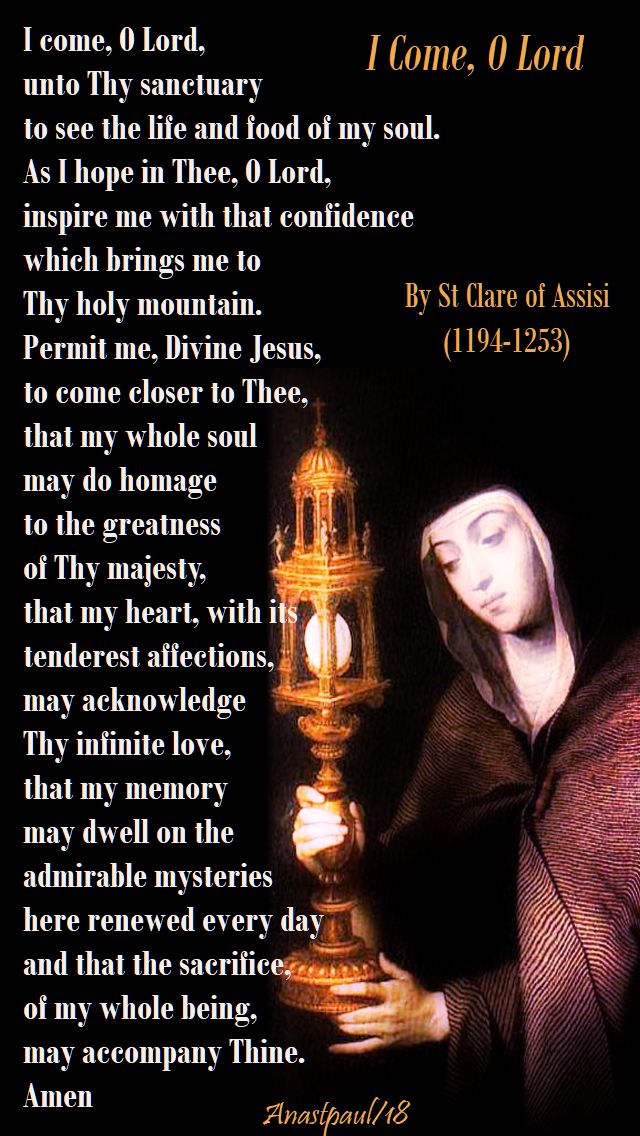
I Come, O Lord By St Clare of Assisi (1194-1253)
I come, O Lord,
unto Thy sanctuary
to see the life and food of my soul.
As I hope in Thee, O Lord,
inspire me with that confidence
which brings me to Thy holy mountain.
Permit me, Divine Jesus,
to come closer to Thee,
that my whole soul may do homage
to the greatness of Thy majesty,
that my heart,
with its tenderest affections,
may acknowledge Thy infinite love,
that my memory may dwell
on the admirable mysteries
here renewed every day
and that the sacrifice,
of my whole being,
may accompany Thine.
Amen
Sunday Reflection – 11 August – The Nineteenth Sunday in Ordinary Time, Year C
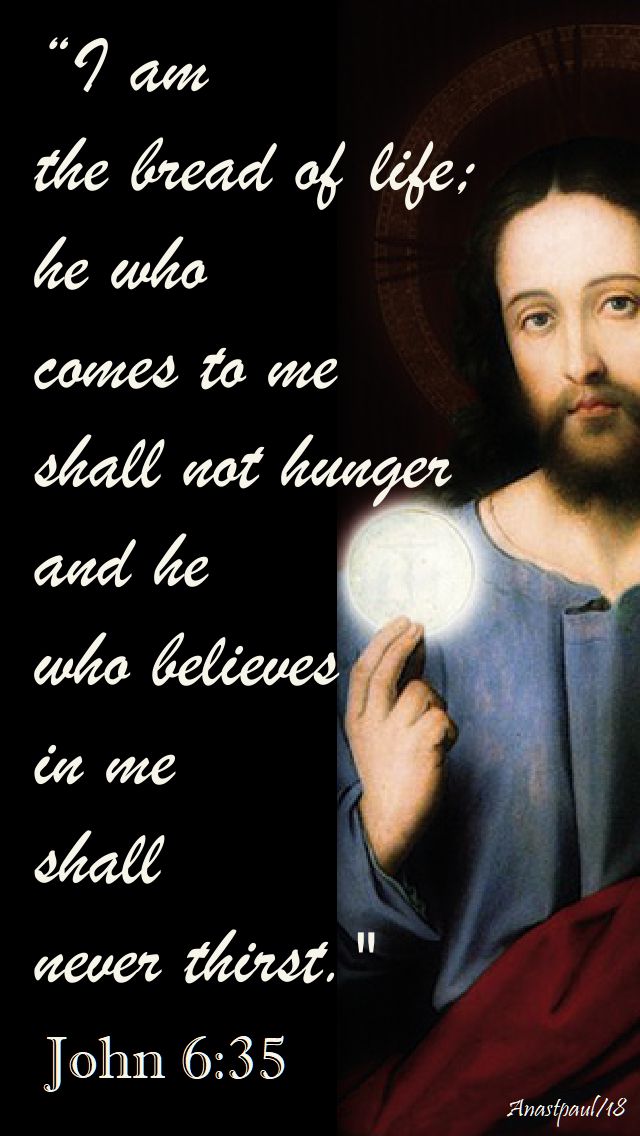
They said to him, “Lord, give us this bread always.” Jesus said to them, “I am the bread of life; he who comes to me shall not hunger and he who believes in me shall never thirst.”…John 6:34-35
“The soul’s bread is Christ, “the living bread that came down from heaven” (Jn 6:51) who gives food to His own, by faith here and by vision in the world to come. For Christ dwells in you by faith and faith in Christ, is Christ in your heart (Eph 3:17). The measure of your faith in Christ is the measure of your possession of Him.
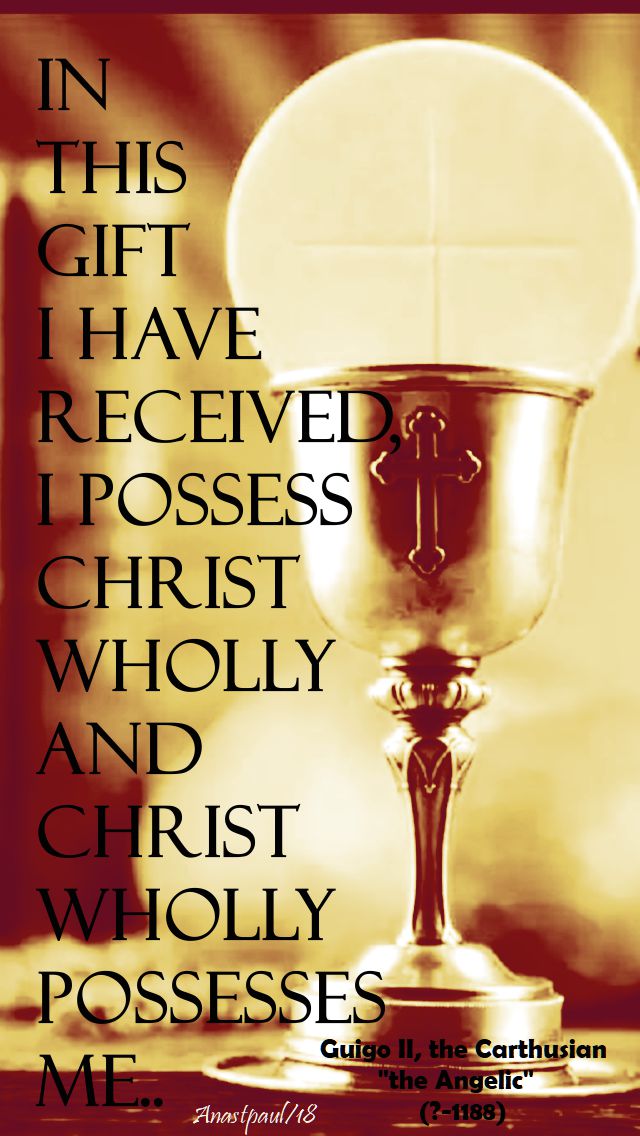
… In this gift I have received, I possess Christ wholly and Christ wholly possesses me, just as the member belonging to the whole body likewise possesses the body in its entirety. And so this portion of faith you have received as your share, is like the morsel of bread in your mouth. But unless you often devoutly meditate over what you believe, unless you chew over it, so to speak, moving it about and turning it over with your teeth, that is to say with your spiritual senses, it will never enter your throat, in other words it won’t get as far as your understanding.
For indeed, how could you understand anything that you reflect over only rarely and carelessly, especially when it concerns something subtle and unseen?… So, by means of meditation, let “the Law of the Lord be ever on your lips” (Ex 13:9) so that a sound understanding may be brought to birth within you. Through a good understanding, spiritual food passes into your heart, so that you will not neglect what you have understood but will lovingly reflect over it.”
Guigo II the Carthusian “the Angelic” (?-1188)
9th Prior of the Grande Chartreuse
(Meditation 10 (SC 163, p. 181 rev.)
Guigo II is considered the first writer in the western tradition to consider stages of prayer as a ladder which leads to a closer mystic communion with God. The work was among the most popular of medieval spiritual works (in part because it commonly circulated under the name of the renowned Bernard of Clairvaux or even Augustine), with over one hundred manuscripts surviving. It was also translated into some vernacular languages, including into Middle English.
It is still a basic guide for those who wish to practice lectio divina.
Guigo II also wrote twelve Meditations, which were clearly less widely known as they survive in only a few manuscripts. From internal evidence, it appears they may have been written before the Scala Claustralium.
Our Morning Offering – 11 August – Nineteenth Sunday in Ordinary Time, Year C
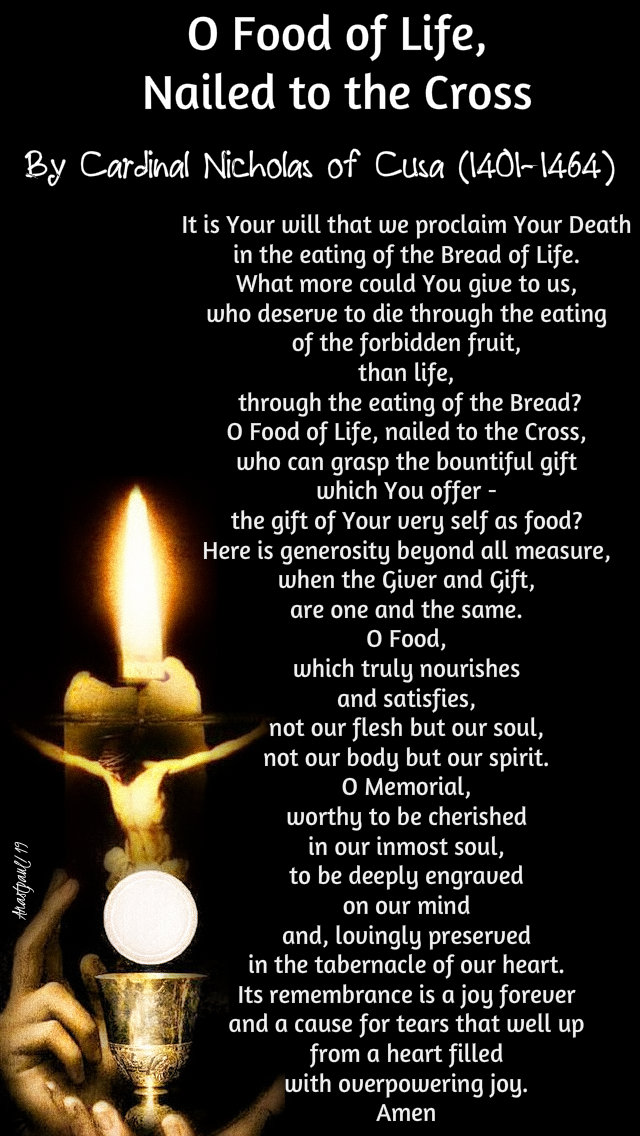
O Food of Life, Nailed to the Cross By Cardinal Nicholas of Cusa (1401-1464)
It is Your will that we proclaim Your Death
in the eating of the Bread of Life.
What more could You give to us,
who deserve to die through the eating
of the forbidden fruit,
than life through the eating of the Bread?
O Food of Life, nailed to the Cross,
who can grasp the bountiful gift
which You offer – the gift of Your very self as food?
Here is generosity beyond all measure,
when the Giver and Gift, are one and the same.
O Food, which truly nourishes and satisfies,
not our flesh but our soul,
not our body but our spirit.
O Memorial, worthy to be cherished
in our inmost soul,
to be deeply engraved on our mind
and, lovingly preserved in the tabernacle of our heart.
Its remembrance is a joy forever
and a cause for tears that well up
from a heart filled with overpowering joy.
Amen
Quote of the Day – 7 August – The Memorial of St Cajetan (1480-1547)
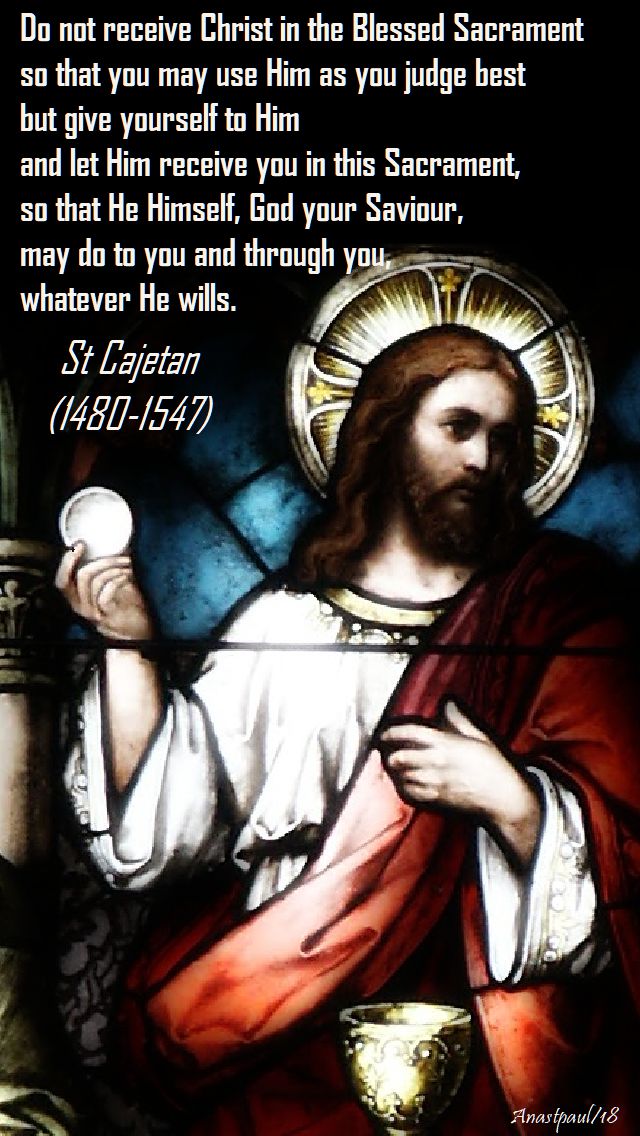
“Do not receive Christ in the Blessed Sacrament so that you may use Him as you judge best but give yourself to Him and let Him receive you in this Sacrament, so that He Himself, God your Saviour, may do to you and through you, whatever He wills.”
One Minute Reflection – 5 August – Monday of the Eighteenth week in Ordinary Time, Year C, Gospel: Matthew 14:13-21 and the Memorial of the Dedication of Mary Major
“Taking the five loaves and the two fish, he looked up to heaven and blessed,, and broke and gave the loaves” … Matthew 14:19
REFLECTION – “Jesus loves us so much and wants to be close to us and looks after those who follow Him. The Lord meets the needs of mankind but wants to render each one of us, a concrete participant in His compassion.
Now let us pause on this, Jesus’ gesture of blessing: “taking the five loaves and the two fish, he looked up to heaven and blessed and broke and gave the loaves” (v. 19). As you see, they are the same signs that Jesus performed at the Last Supper and they are also the same gestures, that each priest performs when he celebrates the Holy Eucharist. The Christian community is born and reborn continually from this Eucharistic communion. Living communion with Christ is, therefore, anything but being passive and detached from daily life, on the contrary, it includes us more and more in the relationship with the men and women of our time, in order to offer them the concrete sign of mercy and of the attention of Christ.
Jesus wants to reach everyone, in order to bring God’s love to all.” … Pope Francis (General Audience, 17 August 2016)
PRAYER – Forgive the sins of Your people Lord and since of ourselves, we are unable to do what pleases You, lead us on the way of salvation in Your divine Son who lives in us and gives us life. May the prayers of Mary, His Mother help us to constantly meditate on His eternal sustenance. He is our food, our Lord Jesus Christ, who lives and reigns with You and the Holy Spirit, God forever and ever, amen.
Sunday Reflection – 4 August – Eighteenth Sunday in Ordinary Time, Year C
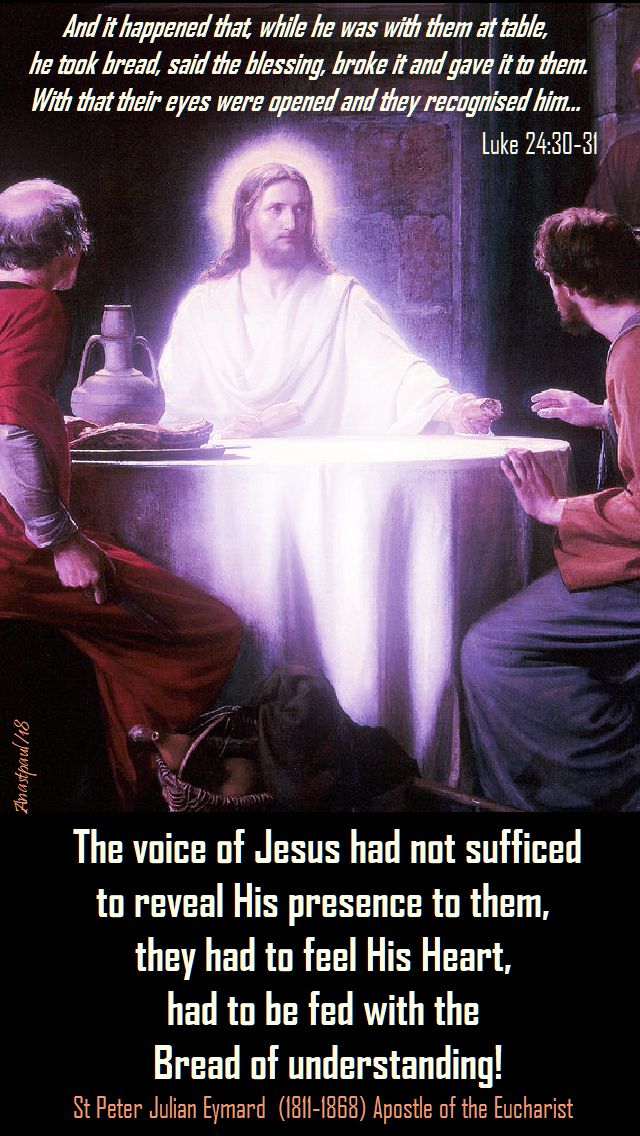
“And it happened that, while he was with them at table, he took bread, said the blessing, broke it and gave it to them. With that their eyes were opened and they recognised him… but he vanished from their sight.”…Luke 24:30-31
“Before Communion you hear about Jesus Christ and you know Him – you are told of His Cross, of His suffering; doubtless you are affected, are even touched with compassion.
But let these same truths be presented to you after Communion. Oh, how much more deeply your soul is moved! It cannot hear enough, it understands much more perfectly. Before Communion, you contemplate Jesus outside you, now you contemplate Him within you, with His own eyes!
It is the mystery of Emmaus re-enacted. When Jesus taught the two disciples along the way, explaining the Scriptures to them, their faith still wavered, though they felt inwardly some mysterious emotion. But participating in the Fraction of the bread, immediately their eyes were opened and their hearts were like to burst with joy.
The voice of Jesus had not sufficed to reveal His presence to them, they had to feel His Heart, had to be fed with the Bread of understanding!”
St Peter Julian Eymard (1811-1868)
Apostle of the Eucharist
Quote/s of the Day – 3 August – Friday of the Seventeenth week in Ordinary Time, Year C and the Memorial of St Peter Faber SJ (1506-1546) and St Peter Julian Eymard SSS (1811-1868) “Apostle of the Eucharist”
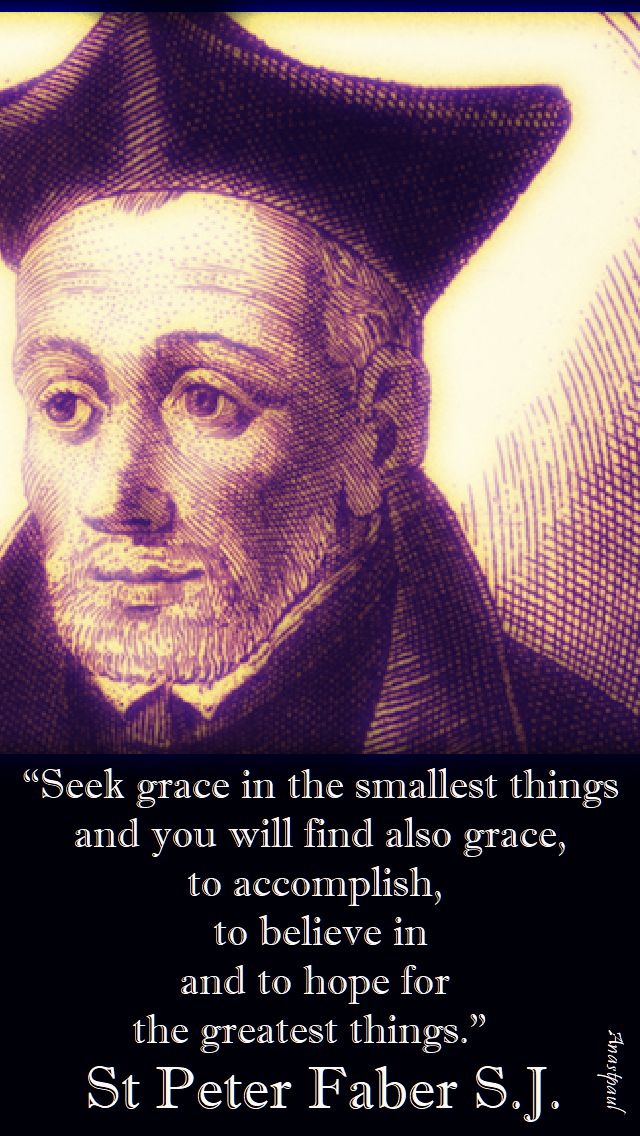
“Seek grace for the smallest things, and you will find grace to accomplish, to believe in, and to hope for, the greatest things. Attend to the smallest things, examine them, think about putting them into effect, and the Lord will grant you greater.”
St Peter Faber (1506-1546)
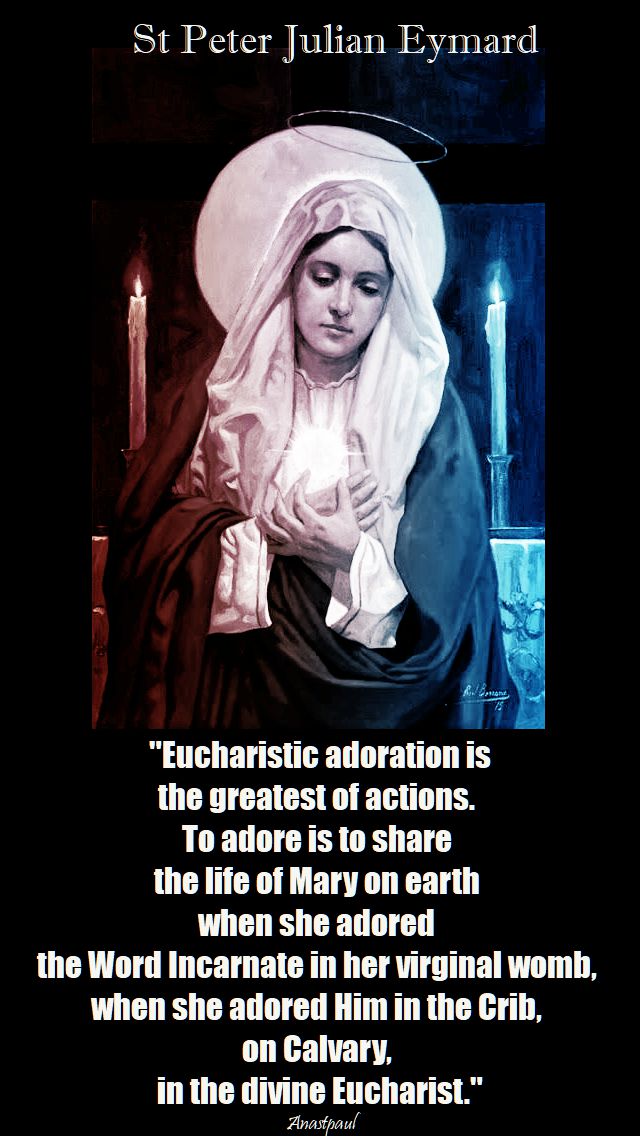
“Eucharistic adoration is the greatest of actions. To adore is to share the life of Mary on earth when she adored the Word Incarnate in her virginal womb, when she adored Him in the Crib, on Calvary, in the divine Eucharist.”
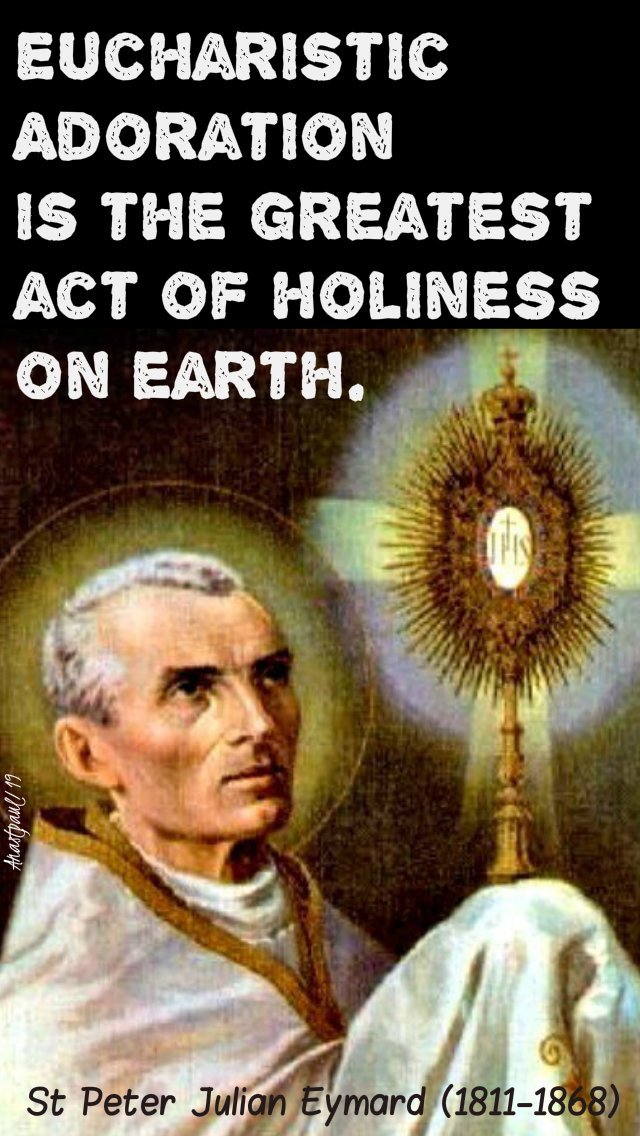
“Eucharistic Adoration is the greatest act of holiness on earth.”
Our Morning Offering – 2 August – The Memorial of By St Peter Julian Eymard SSS (1811-1868) “Apostle of the Eucharist”
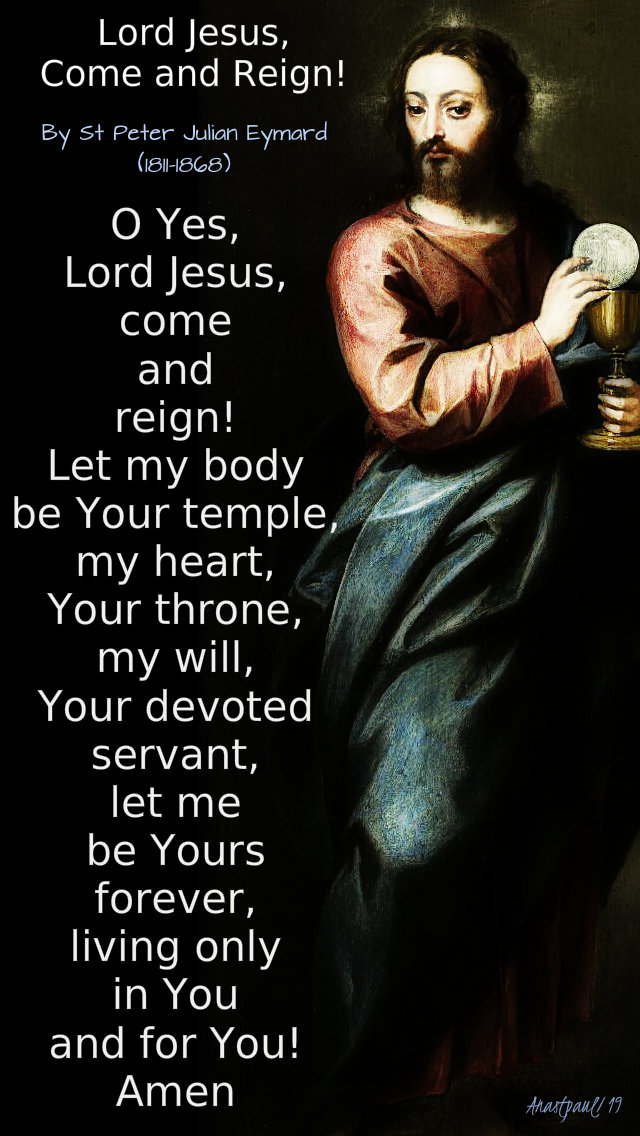
Lord Jesus, Come and Reign! By St Peter Julian Eymard (1811-1868)
O Yes, Lord Jesus,
come and reign!
Let my body
be Your temple,
my heart,
Your throne,
my will,
Your devoted servant,
let me be Yours forever,
living only in You
and for You!
Amen
Quote/s of the Day – 1 August – Thursday of the Seventeenth week in Ordinary Time, Year C and the Memorial of St Alphonsus Liguori (1696-1787) Doctor of the Church
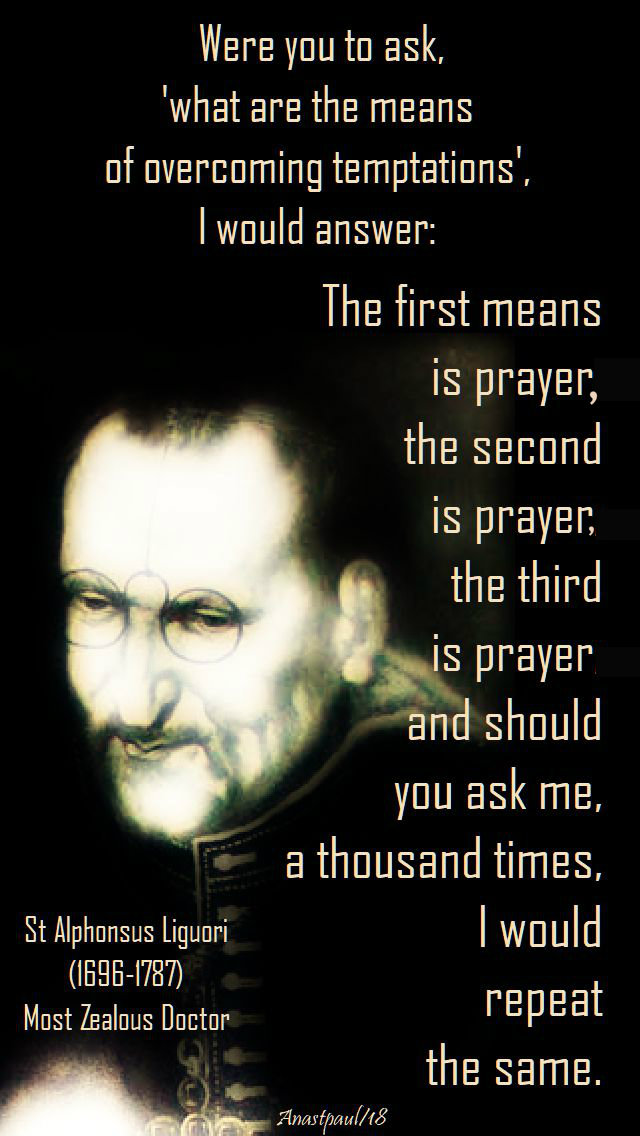
“Were you to ask, ‘what are the means of overcoming temptations’, I would answer: the first means is prayer, the second is prayer, the third is prayer and should you ask me a thousand times, I would repeat the same.”
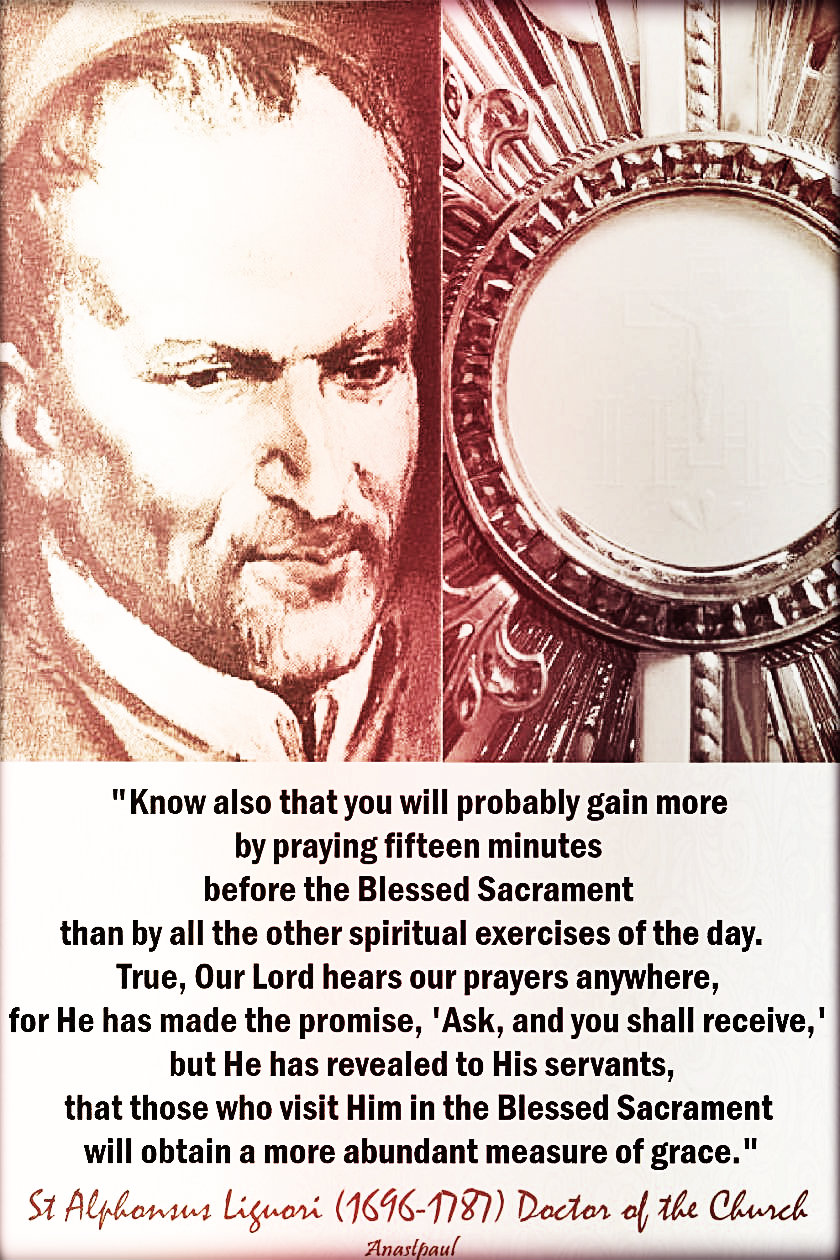
“Know also that you will probably gain more by praying fifteen minutes before the Blessed Sacrament than by all the other spiritual exercises of the day. True, Our Lord hears our prayers anywhere, for He has made the promise, ‘Ask, and you shall receive,’ but He has revealed to His servants, that those who visit Him in the Blessed Sacrament will obtain a more abundant measure of grace.”
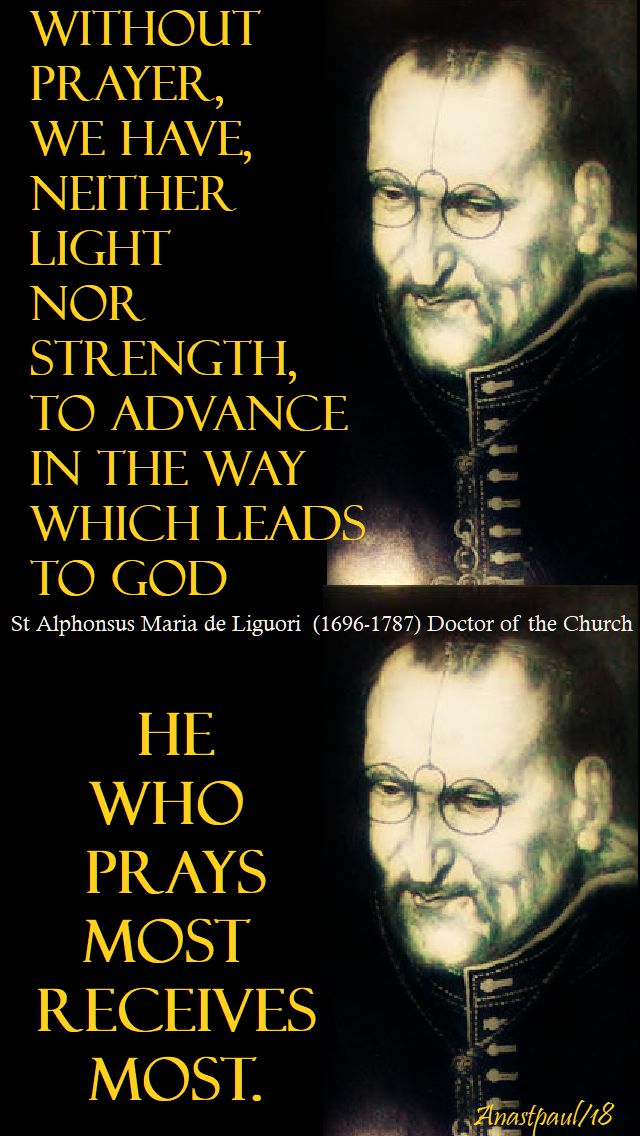
“Without prayer, we have neither light nor strength, to advance in the way which leads to God.”
“He who prays most receives most.”
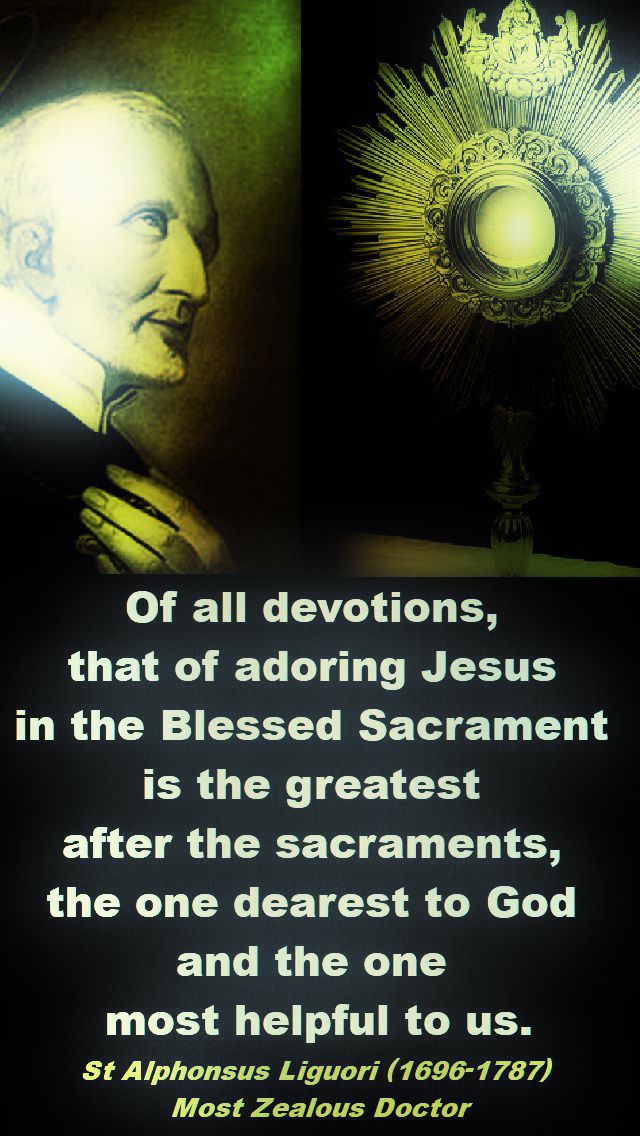
“Of all devotions, that of adoring Jesus in the Blessed Sacrament is the greatest, after the sacraments, the one dearest to God and the one most helpful to us.”
St Alphonsus Liguori (1696-1787) Doctor of the Church
One Minute Reflection – 31 July – Wednesday of the Seventeenth week in Ordinary Time, Year C, Gospel: Matthew 13:44-46 and The Memorial of St Ignatius Loyola (1491-1556)
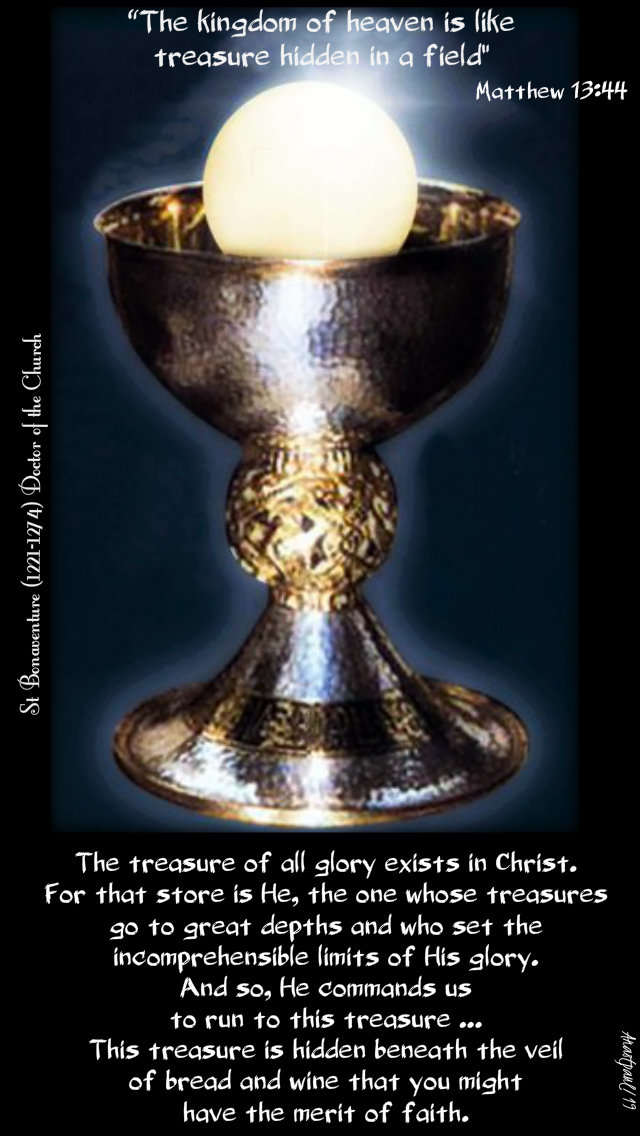
“The kingdom of heaven is like treasure hidden in a field” … Matthew 13:44
REFLECTION – “Christ is the treasure store of all grace for He is “filled with grace and truth” (Jn 1:14) and angels and humans receive from His fullness. He possesses the very source of fullness and, when He opens His hand, He fills all rational creatures with blessings. But this treasure store of graces, is concealed beneath the veil of the sacrament of the altar. Is it not true that “the Kingdom of heaven is like a treasure hidden in a field”? (Mt 13:44). And is not the field, in this case, the sacrament of the body of Christ, gathered in the fields? In this field we possess a hidden treasure because all kinds of graces are hidden there. “The man who discovered it went away in his joy, sold all he possessed and bought it” (Mt 13:44). Someone who knows the wealth of this sacrament willingly renounces all other activity, to freely give himself to participation and devotion towards this sacrament. He knows he will gain possession of eternal life according to the words of the Lord: “He who eats my flesh and drinks my blood has eternal life” (Jn 6:55).
The treasure of all glory exists in Christ. All the glory, possessed by both angels and men, who are to be saved until the day of judgement, whether it be glory of body or glory of soul, is drawn from that store of treasure. For that store is He, the one whose treasures go to great depths and who set the incomprehensible limits of His glory. And so, He commands us to run to this treasure when He says: “Gather up treasure for yourselves in heaven” (Mt 6:20). This treasure is hidden beneath the veil of bread and wine that you might have the merit of faith.
So may the Lord be praised for His mercies since He represented His Body to us beforehand under the image of heavenly treasure!” … St Bonaventure (1221-1274) Doctor of the Church
PRAYER – Almighty God, grant that the example of Your saints may spur us on to perfection, so that we, who are celebrating the feast of St Ignatius, may follow him step-by-step in his way of life to reach You in heaven. Grant us the grace, by his intercession, to find our treasure in Your divine Son, through Christ our Lord, with the Holy Spirit, God for always and forever, amen.
Quote/s of the Day – 30 July – The Memorial of St Peter Chrysologus “Golden Words” (c 400-450) Father & Doctor and St Maria de Jesus Sacramentado(1868-1959)
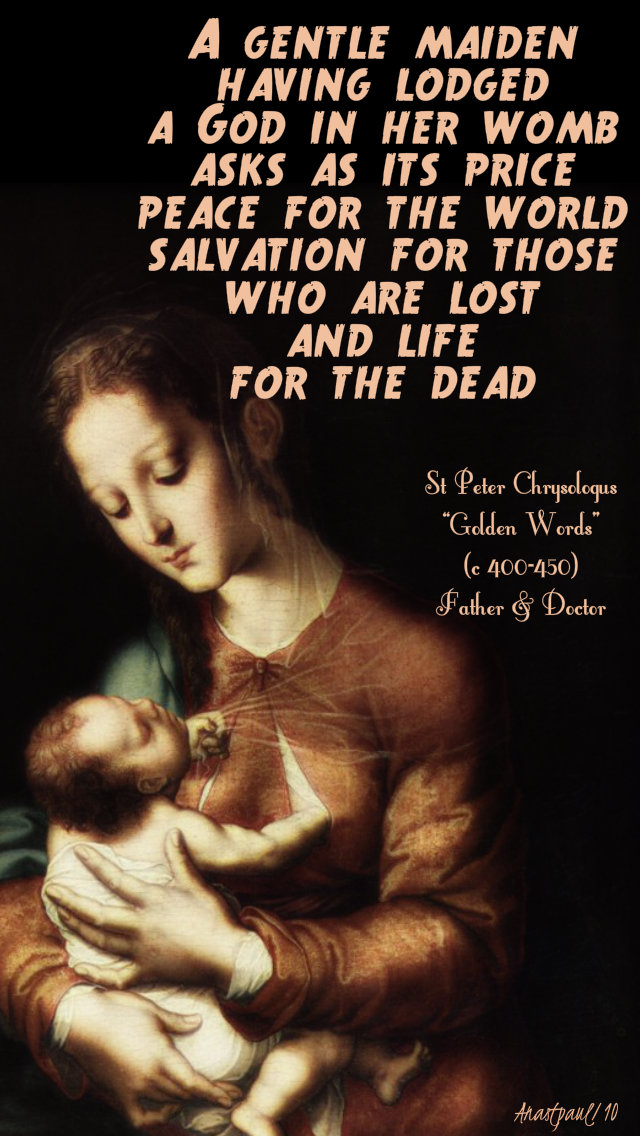
“A gentle maiden having lodged a God in her womb, asks as its price, peace for the world, salvation for those who are lost and life for the dead.”
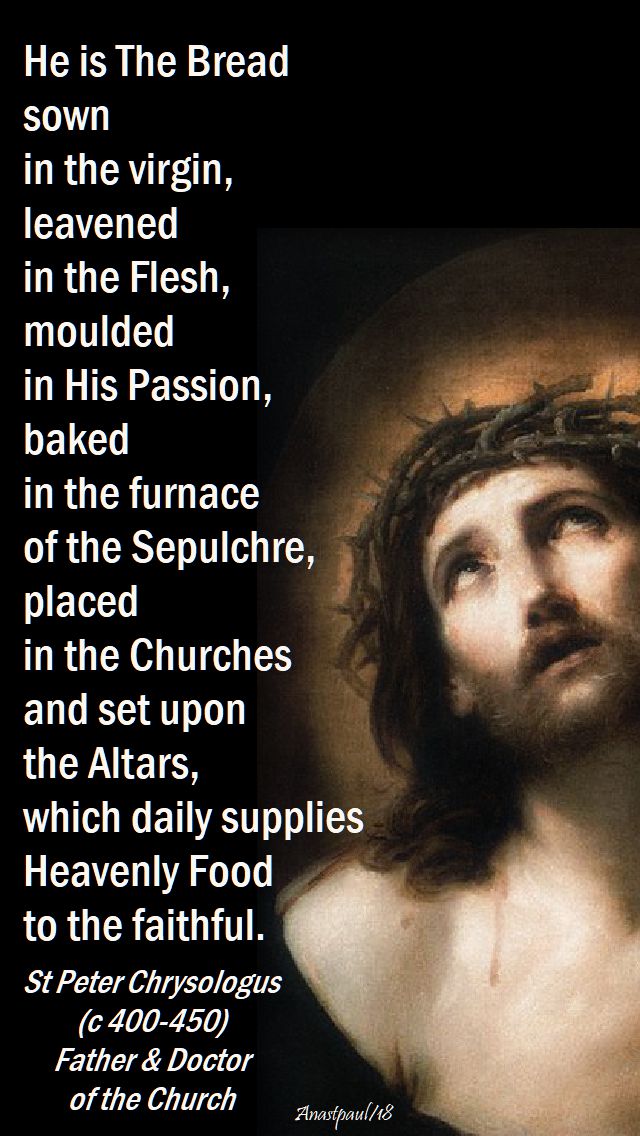
“He is The Bread sown in the virgin, leavened in the Flesh, moulded in His Passion, baked in the furnace of the Sepulchre, placed in the Churches and set upon the Altars, which daily supplies Heavenly Food to the faithful.”
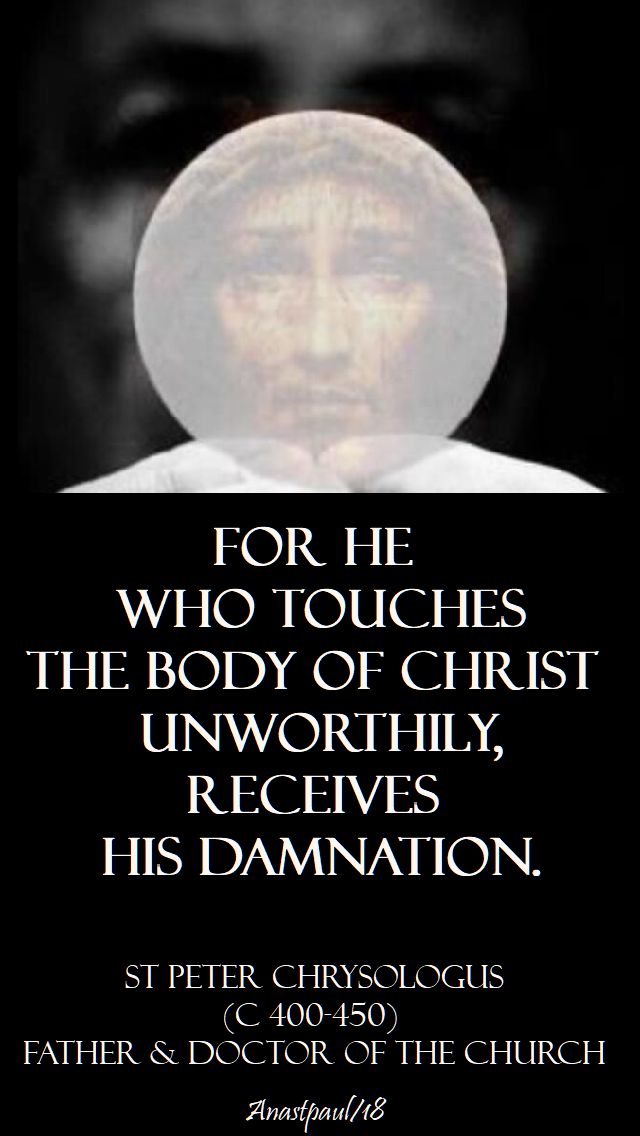
“For he who touches the Body of Christ unworthily, receives his damnation.”
“We exhort you, in every respect, honourable brother, to heed obediently what has been written by the Most Blessed Pope of the City of Rome; for Blessed Peter, who lives and presides in his own see, provides the truth of faith to those who seek it.”
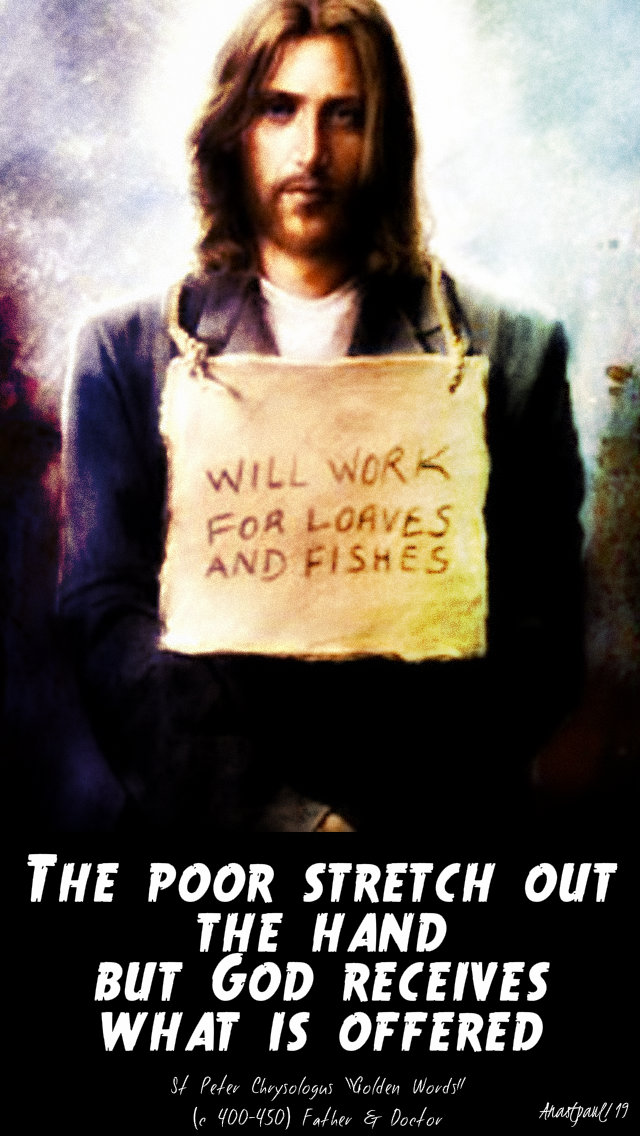
“The poor stretch out the hand but God receives what is offered.”
St Peter Chrysologus “Golden Words”
(c 400-450) Father & Doctor
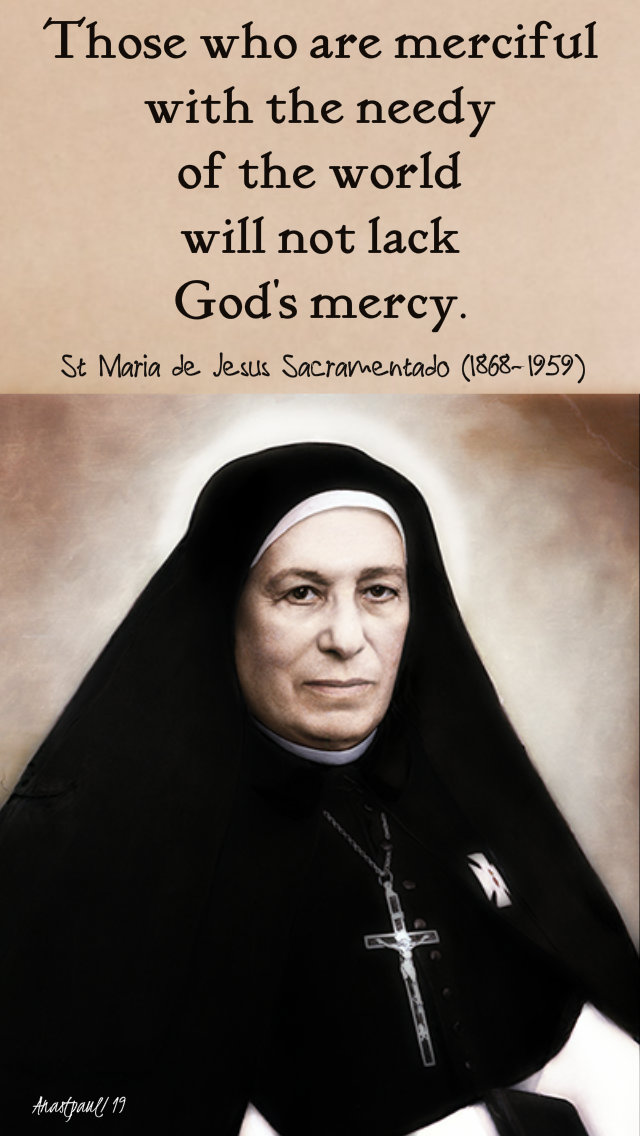
“Those who are merciful with the needy of the world will not lack God’s mercy.”
“The weight of the cross is burdensome for those carrying it but not, for those, who embrace it.”
Sunday Reflection – 28 July – Seventeenth Sunday in Ordinary Time, Year C, Gospel: Luke 11:1–13
Become the bread of Christ
St Bernard (1090-1153) Doctor of the Church
Saint Bernard teaches that it is not enough for us to take and eat the Bread from Heaven. We must also offer ourselves to be eaten. Holy Communion is a wondrous exchange in which we become the bread of Christ. Listen to Saint Bernard:
“My penitence, my salvation are His food. I myself am His food. I am chewed. as I am reproved by Him; I am swallowed by Him. as I am taught; I am digested by Him. as I am changed; I am assimilated. as I am transformed; I am made one with Him, as I am conformed to Him. He feeds upon us and is fed by us, that we may be the more loosely bound to Him.”
Saint Bernard, ever the poet, uses images of eating and assimilation to describe how Christ unites us to Himself. Our Lord becomes our food that we might become His. We need the language of poets and preachers in our approach to the Eucharist.
Saint Bernard says, “Christ eats me that He may have me in Himself and Christ, in turn, is eaten by me, that He may be in me and the bond between us, will be strong and the union complete.”
What awaits you in Holy Communion exceeds all that you can desire. Eat, then and offer yourself to be eaten. Receive the Bread of God and become the bread of God.















 AnaStpaul
You must be logged in to post a comment.