
Quote of the Day – 13 May – The Solemnity of the Ascension of the Lord
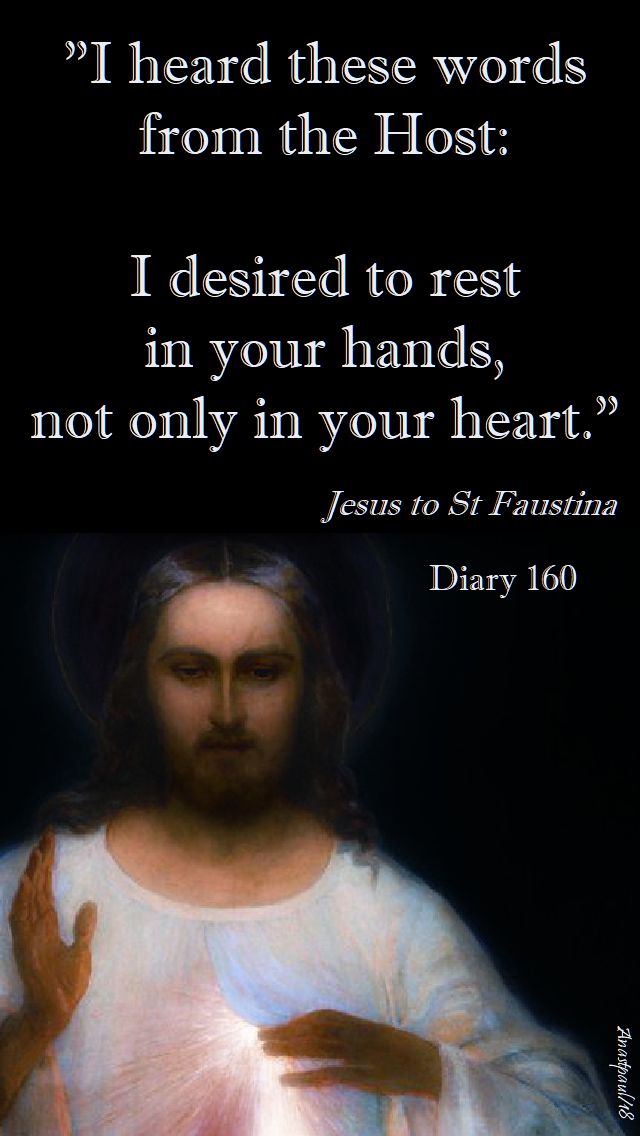
“I heard these words from the Host:
I desired to rest in your hands,
not only in your heart.”Jesus to St Faustina Kowalska (1905-1938)
Diary 160
Quote of the Day – 13 May – The Solemnity of the Ascension of the Lord
“I heard these words from the Host:
I desired to rest in your hands,
not only in your heart.”Jesus to St Faustina Kowalska (1905-1938)
Diary 160
Feast of Our Lady of the Most Blessed Sacrament – 13 May
History of the Title of Our Lady of the Most Blessed Sacrament
St Peter Julian Eymard (1811-1868), of France, had a strong devotion to the Holy Eucharist and Our Lady and began his priestly life in the Society of Mary. “But his heart burned with the desire to establish perpetual adoration of Jesus in the Blessed Sacrament exposed upon a royal throne and surrounded by a large court of adorers.” On 2 February 1851, at the shrine of Fourvière, the most Blessed Virgin had made him understand its necessity. ‘All the mysteries of my Son have a religious order of men to honour them. The Eucharist alone has none . . . .’


After several years of prudent reflection and interior combat, encouraged by Pope Pius IX, he founded the Congregation of the Most Blessed Sacrament at Paris on 13 May 1856
The title of Our Lady of the Blessed Sacrament was first given to Mary by St Peter Julian Eymard in May 1868, while speaking to his novices. A few years later he described what her statue should look like: “The Blessed Virgin holds the Infant in her arms and He holds a chalice in one hand and a Host in the other.” He exhorted them to invoke Mary: “Our Lady of the Blessed Sacrament, pray for us who have recourse to thee!”
Later, Pius IX enriched the invocation with indulgences. Twice, St Pius X did the same. On 30 December 1905, he granted a 300 days indulgence to the faithful who pray: “Our Lady of the Most Blessed Sacrament, pray for us.”
“This title, Our Lady of the Blessed Sacrament, is perhaps the most meaningful of all,” said St. Pius X.
In 1921 the Sacred Congregation of Rite authorised the Blessed Sacrament Congregations to celebrate each year, on 13 May, a “solemn commemoration of the Blessed Virgin,” with the intention of honouring Mary under the title of “Our Lady of the Most Blessed Sacrament.” And of course this Feast is still celebrated today with great joy by all the spiritual sons and daughters of St Peter Julian Eymard.
St Pope John XXIII codified the title of Our Lady of the Most Blessed Sacrament when he declared St Peter Julian Eymard a saint on 9 December 1962, at the end of the last session of the Second Vatican Council.
Quote of the Day – 12 May – Saturday of the Sixth Week of Eastertide
“My TV is the tabernacle.”

Quote/s of the Day – 11 May – “Mary’s Month!” – Friday of the Sixth Week of Eastertide
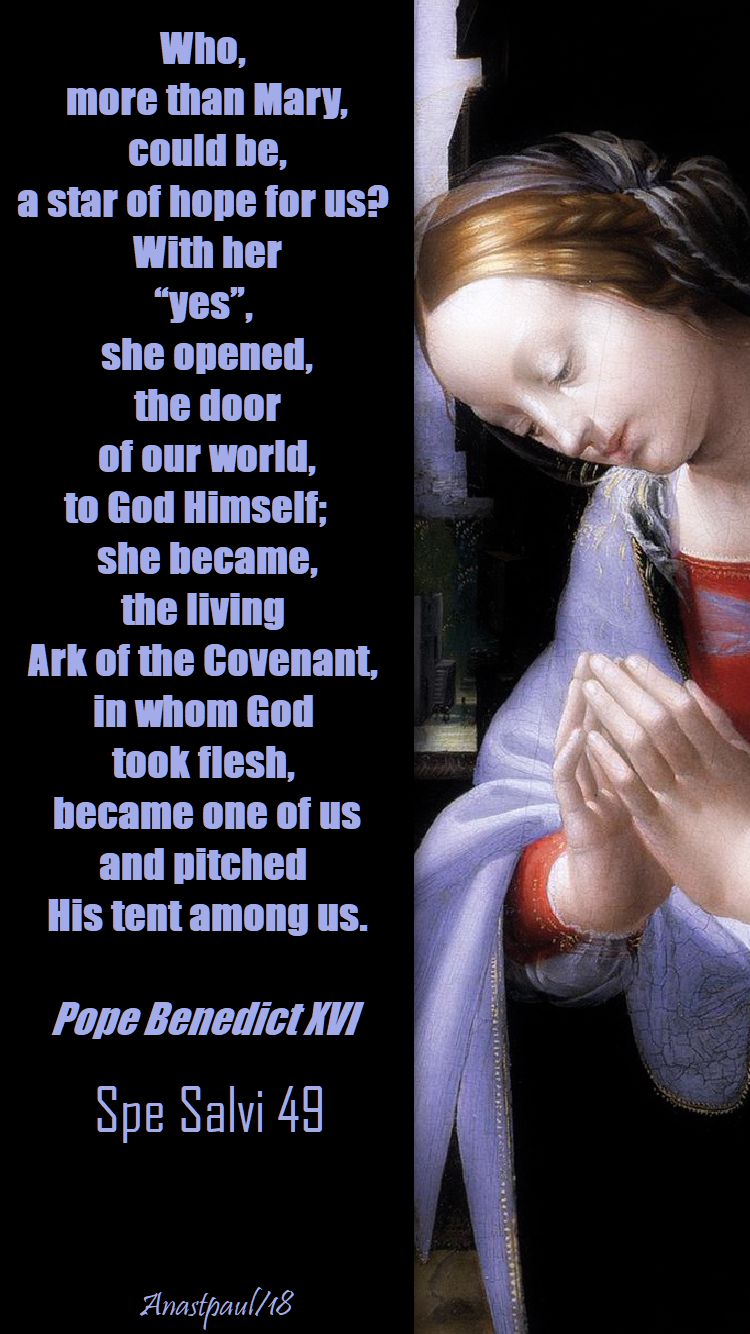
“Who, more than Mary, could be, a star of hope for us?
With her “yes”, she opened the door of our world,
to God Himself; she became the living Ark of the Covenant,
in whom God took flesh, became one of us
and pitched His tent among us.”
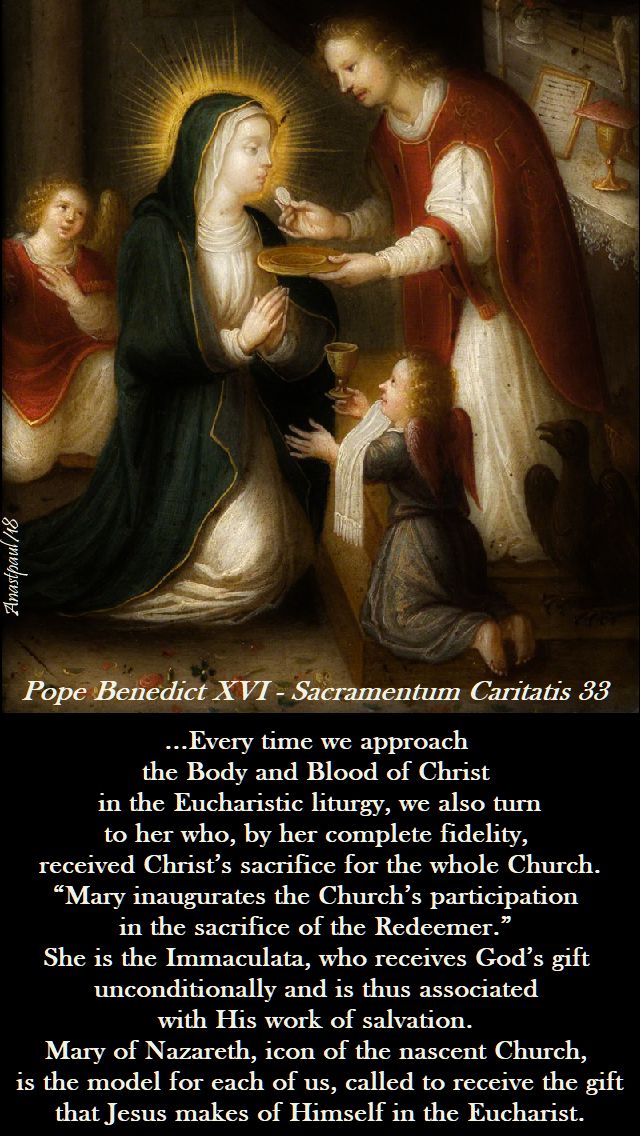
“Consequently, every time we approach
the Body and Blood of Christ in the Eucharistic liturgy,
we also turn to her who, by her complete fidelity,
received Christ’s sacrifice for the whole Church.
The Synod Fathers rightly declared that
“Mary inaugurates the Church’s participation
in the sacrifice of the Redeemer.”
She is the Immaculata, who receives God’s gift
unconditionally and is thus associated with His work of salvation.
Mary of Nazareth, icon of the nascent Church,
is the model for each of us, called to receive the gift
that Jesus makes of Himself in the Eucharist.”
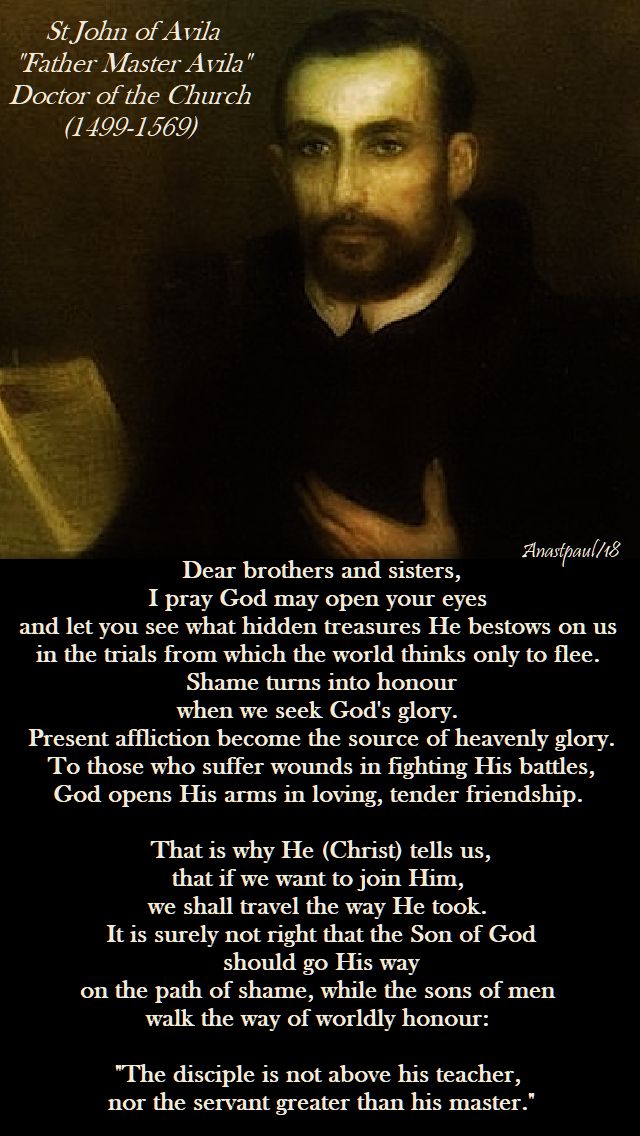
Quote/s of the Day – 10 May – Thursday of the Sixth Week of Eastertide, the Memorials of St John of Avila (1499-1569) “Apostle of Andalusia” “Father Master Avila” – Doctor of the Church and St Joseph de Veuster (1840-1889) – St Damian of Molokai
“Turn yourself round like a piece of clay and say to the Lord:
I am clay, and You, Lord, the potter.
Make of me what You will.”
“Withdraw your heart from the world
before God takes your body from it.”
Dear brothers and sisters, I pray God may open your eyes
and let you see what hidden treasures He bestows on us
in the trials from which the world thinks only to flee.
Shame turns into honour when we seek God’s glory.
Present affliction become the source of heavenly glory.
To those who suffer wounds in fighting His battles,
God opens His arms in loving, tender friendship.
That is why He (Christ) tells us, that if we want to join Him,
we shall travel the way He took.
It is surely not right that the Son of God should go His way
on the path of shame, while the sons of men
walk the way of worldly honour:
“The disciple is not above his teacher,
nor the servant greater than his master.”
“The Blessed Sacrament is indeed the stimulus for us all, for me as it should be for you, to forsake all worldly ambitions. Without the constant presence of our Divine Master upon the altar in my poor chapels, I never could have persevered casting my lot with the lepers of Molokai, the foreseen consequence of which, begins now to appear on my skin and is felt throughout the body. Holy Communion being the daily bread of a priest, I feel myself happy, well pleasedand resigned in the rather exceptional circumstances, in which it has pleased Divine Providence to put me.”

One Minute Marian Reflection – 8 May – “Mary’s Month!” – Tuesday of the Sixth Week of Eastertide
And the angel said to her in reply, “The holy Spirit will come upon you, and the power of the Most High will overshadow you. Therefore the child to be born will be called holy, the Son of God…Luke 1:35
REFLECTION – MARY: MOTHER OF CHRIST – “Jesus Christus, Deus homo: Jesus Christ, God man. This is one of the ‘mighty works of God,’ which we should reflect upon and thank Him for. He has come to bring ‘peace on earth to men of good will,’ to all who want to unite their wills to the holy will of God – not just the rich, not just the poor but everyone, all the brethren. We are all brothers in Jesus, children of God, brothers of Christ. His mother is our mother .”…St Josemaría Escrivá (1902-1975) – “Christ Triumphs through Humility” – “Christ is Passing By – 13”
Let us offer to our Mother today:
Jesus Himself, when we receive Him in Holy Communion.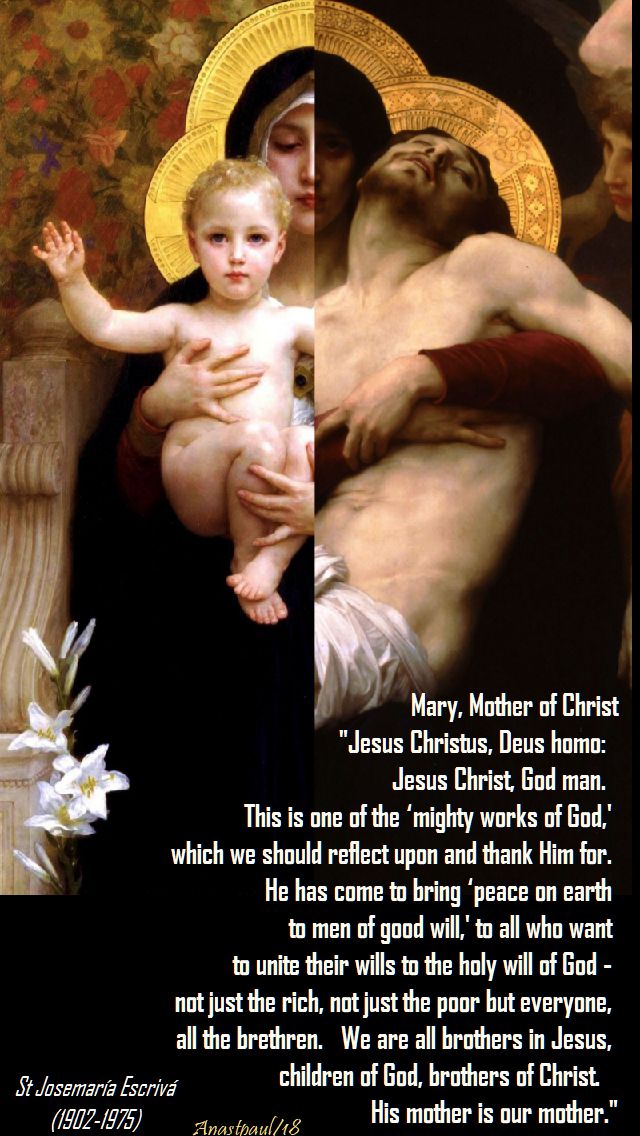
PRAYER – Shape us in the likeness of the divine nature of our Redeemer, whom we believe to be true God and true man, since it was Your will, Lord God, that He, Your Word, should take to Himself our human nature in the womb of the Blessed Virgin Mary. Grant, we pray, that by intercession of the Mother of our Lord Jesus Christ, we may reach eternal life. We make our prayer, through Christ, our Lord, in union with You and the Holy Spirit, one God, forever, amen.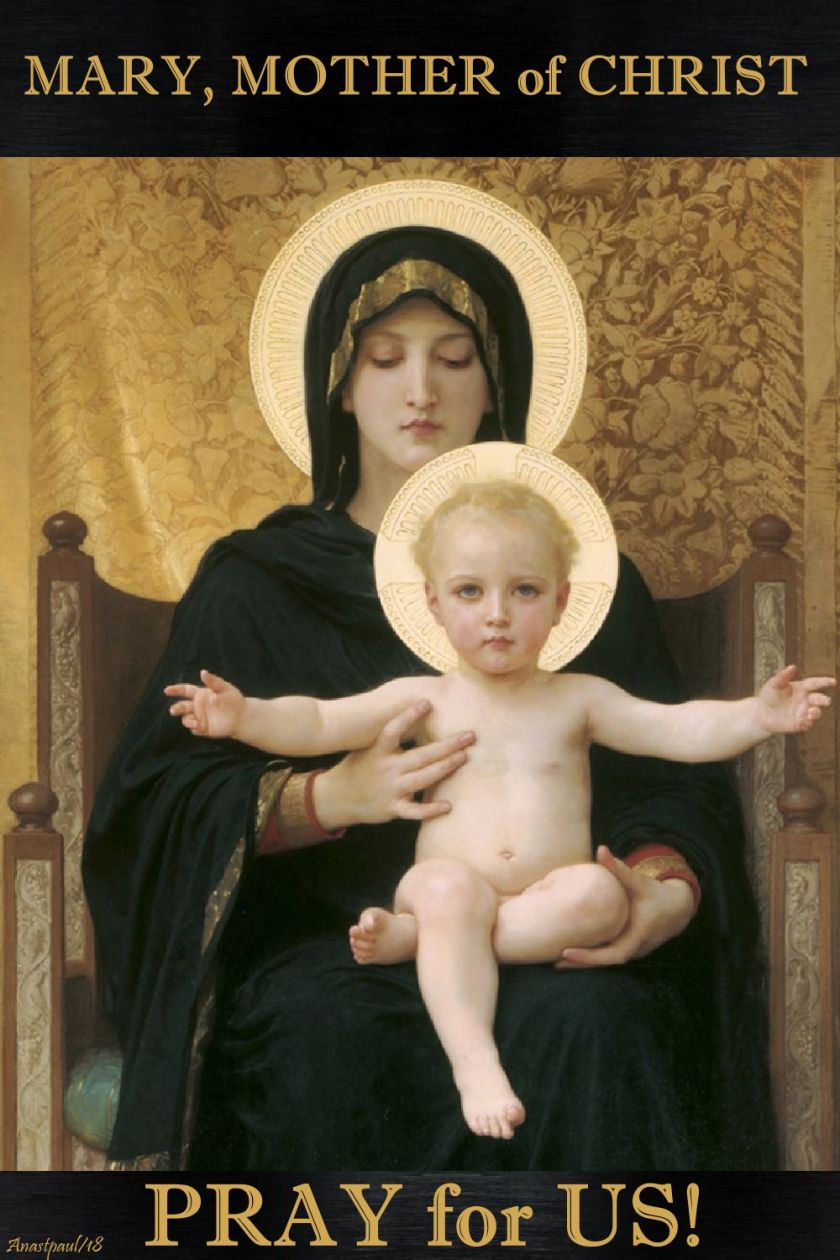
Sunday Reflection – 6 May – Sixth Sunday of Eastertide B
Lay your whle being, your faculties and all your works in homage at the foot of the Eucharistic Altar and Throne and say to the Lord:
“To You alone be love and glory!”
Offer Him the homage of your thoughts, desiring the Divine Eucharist to be the dominant thought of your life;
the homage of your affections, calling Jesus, the King and God of your heart;
the homage of your will, desiring henceforth to have no other law,
no other end than His service,
His love
and His glory;
the homage of your memory, in order to remember Him alone and thus to live
in Him,
by Him
and for Him alone.
Then contemplate the greatness of the love of Jesus as He institutes, multiplies and perpetuates His Divine Eucharist, to the end of time.
Marvel at His wisdom in the Divine invention which excites the wonder of the angels themselves.
Praise His power which has triumphed over every obstacle and exalt His goodness,
which has determined the gifts of that power.
On realising that you are the very end of the greatest and the holiest of Sacraments,
break forth into a transport of joy and love,
for you alone,
what He has done for all!
What LOVE!
Marian Thought for the Day – 6 May “Mary’s Month!” – Sixth Sunday of Eastertide B
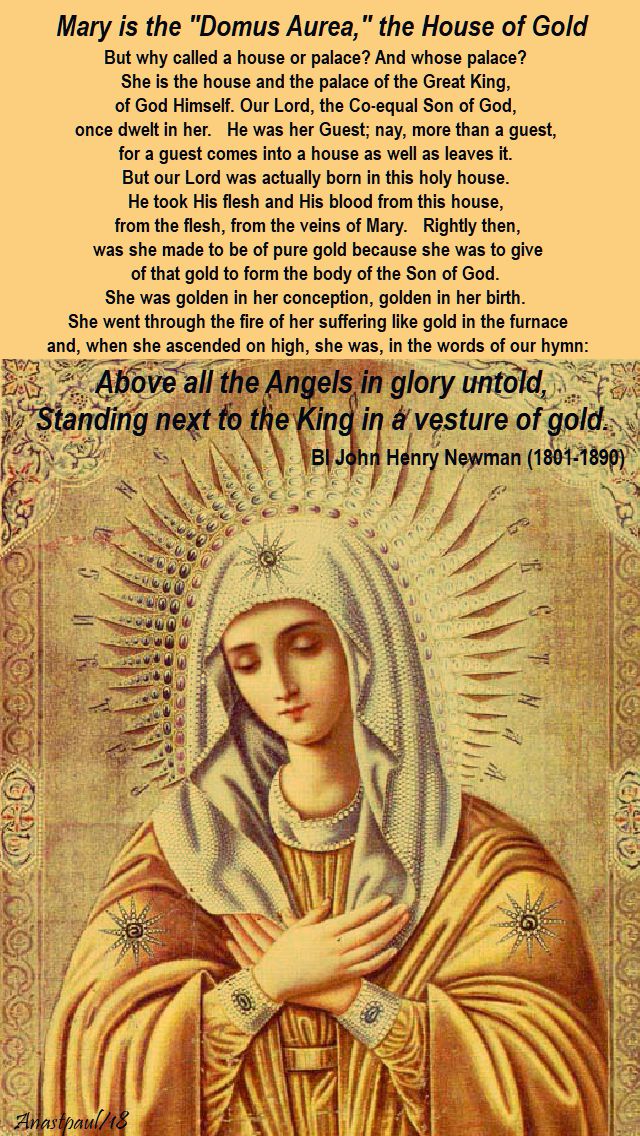
WHY is she called a House? And why is she called Golden? Gold is the most beautiful, the most valuable, of all metals. Silver, copper and steel may in their way be made good to the eye but nothing is so rich, so splendid, as gold. We have few opportunities of seeing it in any quantity but anyone who has seen a large number of bright gold coins knows how magnificent is the look of gold. Hence it is that in Scripture the Holy City is, by a figure of speech, called Golden. “The City,” says St. John, “was pure gold, as it were transparent glass.” He means of course to give us a notion of the wondrous beauty of heaven, by comparing it with what is the most beautiful of all the substances which we see on earth.
Therefore, it is that Mary too, is called golden because her graces, her virtues, her innocence, her purity, are of that transcendent brilliancy and dazzling perfection, so costly, so exquisite, that the angels cannot, so to say, keep their eyes off her any more than we could help gazing upon any great work of gold.
But observe further, she is a golden house, or, I will rather say, a golden palace. Let us imagine we saw a whole palace or large church all made of gold, from the foundations to the roof; such, in regard to the number, the variety, the extent of her spiritual excellences, is Mary.
But why called a house or palace? And whose palace? She is the house and the palace of the Great King, of God Himself. Our Lord, the Co-equal Son of God, once dwelt in her. He was her Guest, nay, more than a guest, for a guest comes into a house as well as leaves it. But our Lord was actually born in this holy house. He took His flesh and His blood from this house, from the flesh, from the veins of Mary. Rightly then was she made to be of pure gold because she was to give of that gold to form the body of the Son of God. She was golden in her conception, golden in her birth. She went through the fire of her suffering like gold in the furnace and when she ascended on high, she was, in the words of our hymn,

Quote of the Day – 6 May “Mary’s Month!” – Sixth Sunday of Eastertide B
The great St Hilary (315-368) , Father and Doctor of the Church (Doctor of the Divinity of Christ), wrote this excellent passage:
“The greatest joy that we can give Mary
is that of bearing Jesus in the Blessed Sacrament
within our breast.”
Her motherly union with Jesus becomes a union also with whoever is united to Jesus, especially in Holy Communion. And what can give as much joy to one who loves, as union with the person loved? And we—–do we not happen to be beloved children of the heavenly Mother?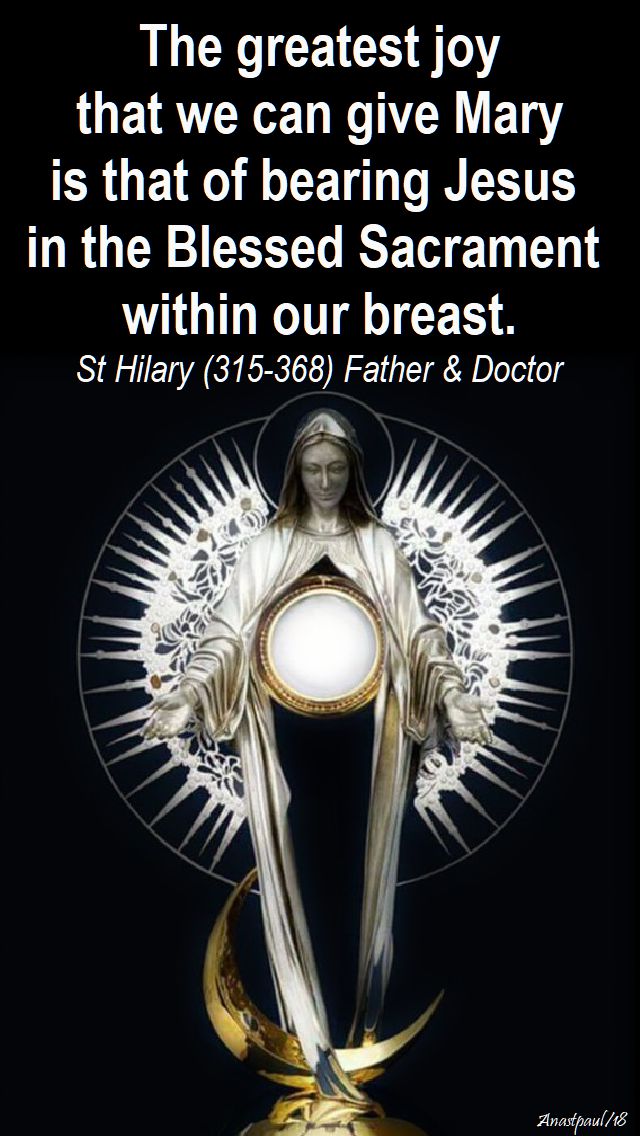
Our Morning Offering – 6 May – The Sixth Sunday of Easter, Year B
Prayer to the Eucharistic Heart of Jesus
By Fr Vincent Martin Luca
With all my heart, I love You, Jesus
because You are all good
and deserving of all my love,
for You died for my sins,
the just man for the sake of the unjust,
that You may lead me to God the Father.
From Your Eucharistic Heart,
the Source of all Love,
renew Your Spirit within me
that I may love others,
with a new heart
made from Your very own Love.
Amen
Our Morning Offering – 29 April – Fifth Sunday of Eastertide
An Act of Confidence
Before Holy Mass
By St Alphonsus Liguori (1696-1787) Most Zealous Doctor
My soul expand your heart.
Your Jesus can do You every good
and indeed, love you.
Hope for great things from Your Lord,
who, urged by love,
comes all love to You.
Yes, my dear Jesus, my hope,
I trust in Your goodness,
that in giving Yourself to me this morning,
You will enkindle in my poor heart,
the beautiful flame of Your pure love
and a real desire to please You,
so that, from this day forward,
I may never will anything
but what You will.
Amen
Quote/s of the Day – 24 April – Tuesday of the Fourth Week of Eastertide and the Memorial of St Mary Euphrasia Pelletier (1796-1868)
“Draw near to our Lord, thoroughly aware
of you own nothingness and you may hope
all things from His Goodness and Mercy.
Never forget that Jesus Christ is no less generous
in the Blessed Sacrament than He was
during His mortal life on earth.”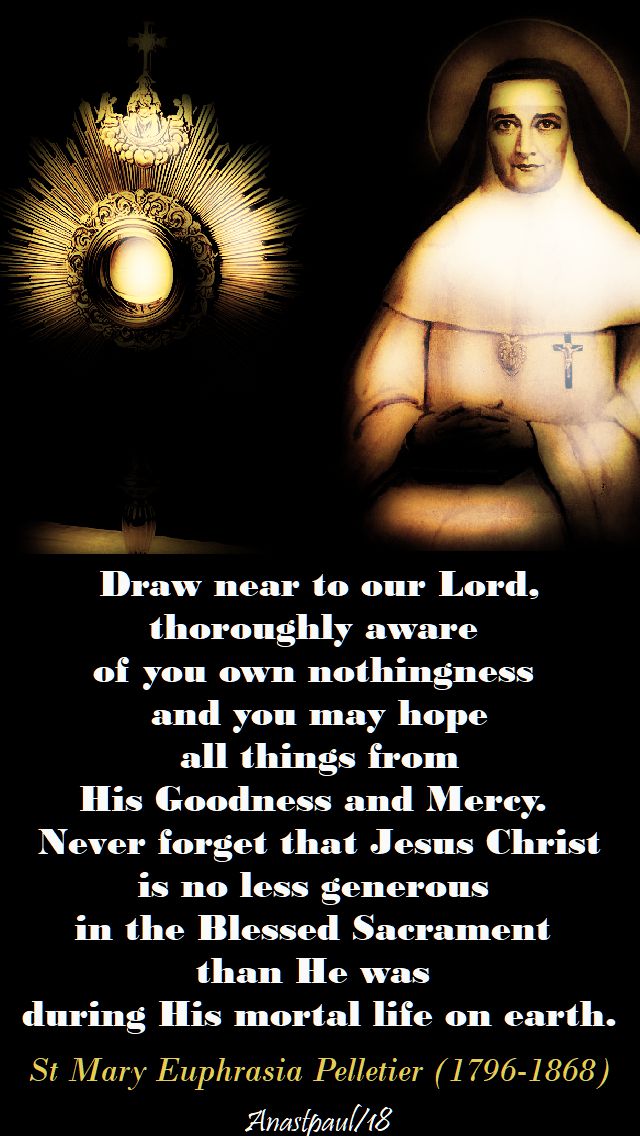
“The Blessed Sacrament is the first
and supreme object of our worship.
We must preserve, in the depths of our hearts,
a constant and uninterrupted, profound adoration,
of this precious pledge, of Divine Love.”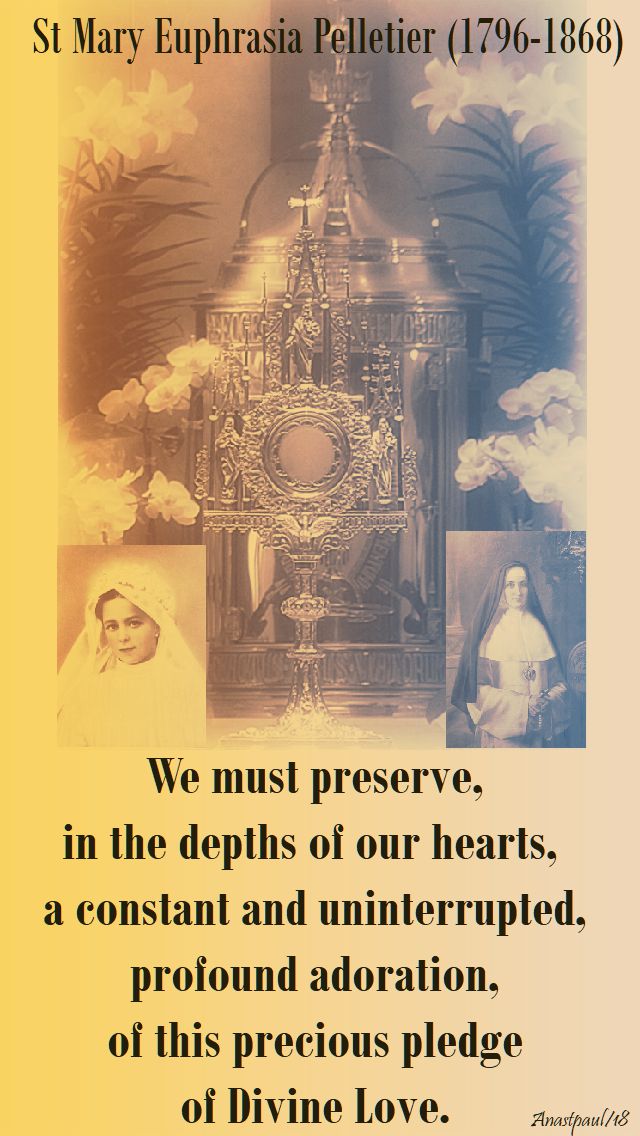
“To speak of the Blessed Sacrament,
is to speak of what is most sacred.
How often, when we are in a state of distress,
those to whom we look for help leave us;
or what is worse, add to our affliction
by heaping fresh troubles upon us.
He is ever there waiting to help us.”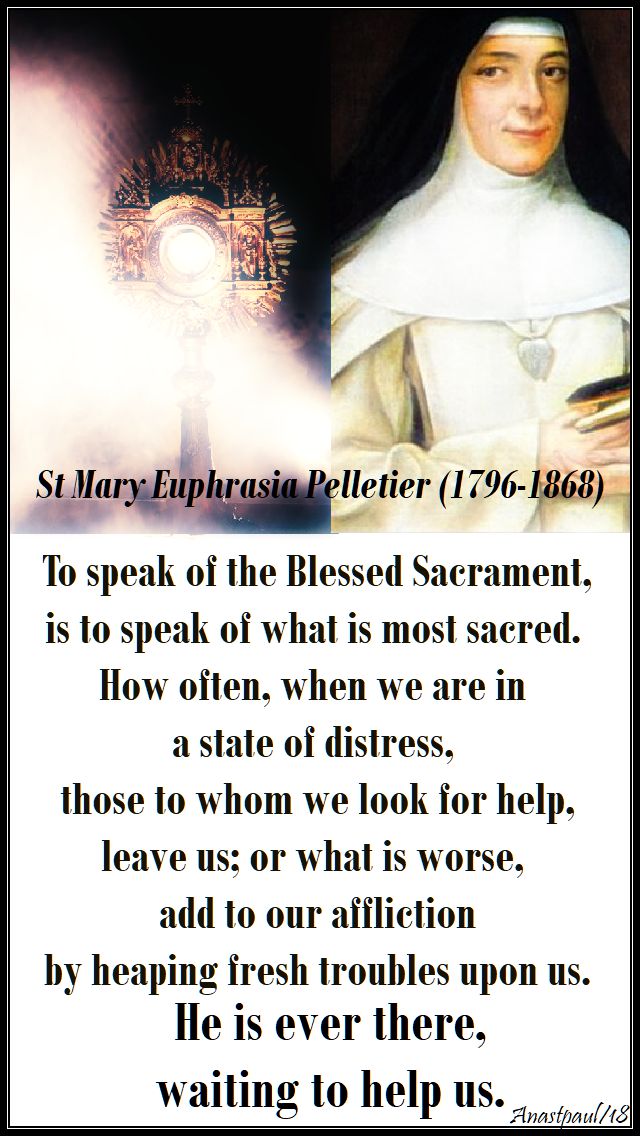
“May your heart be an altar,
from which the bright flame,
of unending thanksgiving
ascends to heaven.”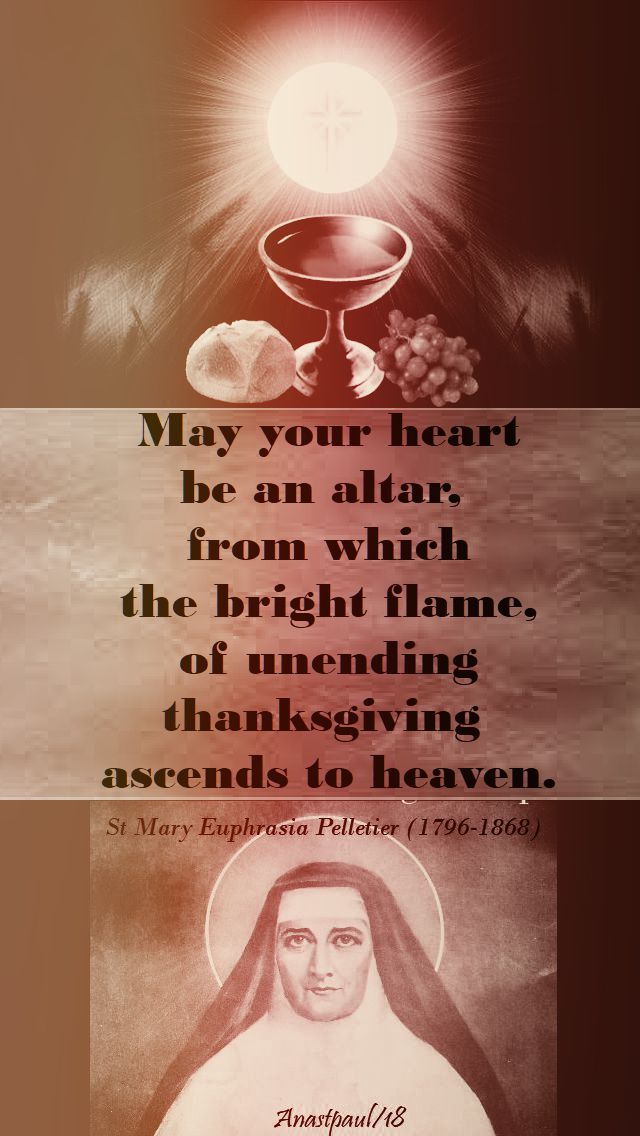
“It is human to fall
but angelic to rise again.”
“One person is of more value
than the whole world.”
“Do well ALL that you do!”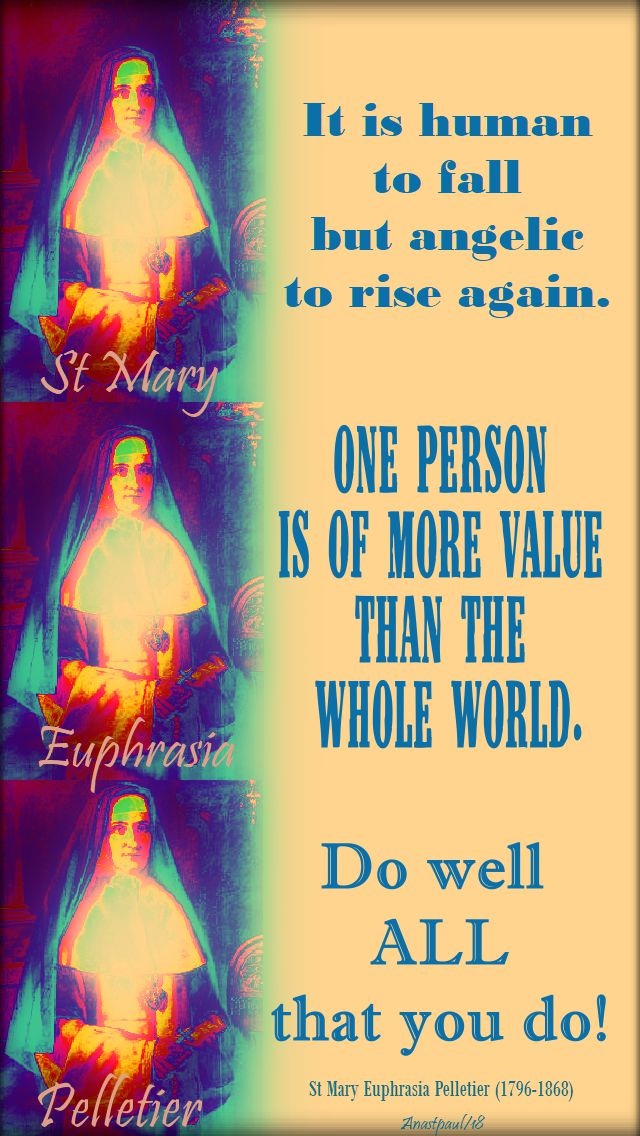
Sunday Reflection – 22 April – The Fourth Sunday of Easter – Good Shepherd/Vocations Sunday – Year B
“There flowed from His side water and blood. Beloved, do not pass over this mystery without thought; it has yet another hidden meaning, which I will explain to you. I said that water and blood symbolised Baptism and the Holy Eucharist. From these two sacraments the Church is born:- from baptism, the cleansing water that gives rebirth and renewal through the Holy Spirit and from the holy Eucharist.
Since the symbols of baptism and the Eucharist flowed from His side, it was from His side that Christ fashioned the Church, as He had fashioned Eve from the side of Adam. Moses gives a hint of this when he tells the story of the first man and makes him exclaim:- Bone from my bones and flesh from my flesh! As God then took a rib from Adam’s side to fashion a woman, so Christ has given us blood and water from His side to fashion the Church. God took the rib when Adam was in a deep sleep and in the same way Christ gave us the blood and the water after His own death.
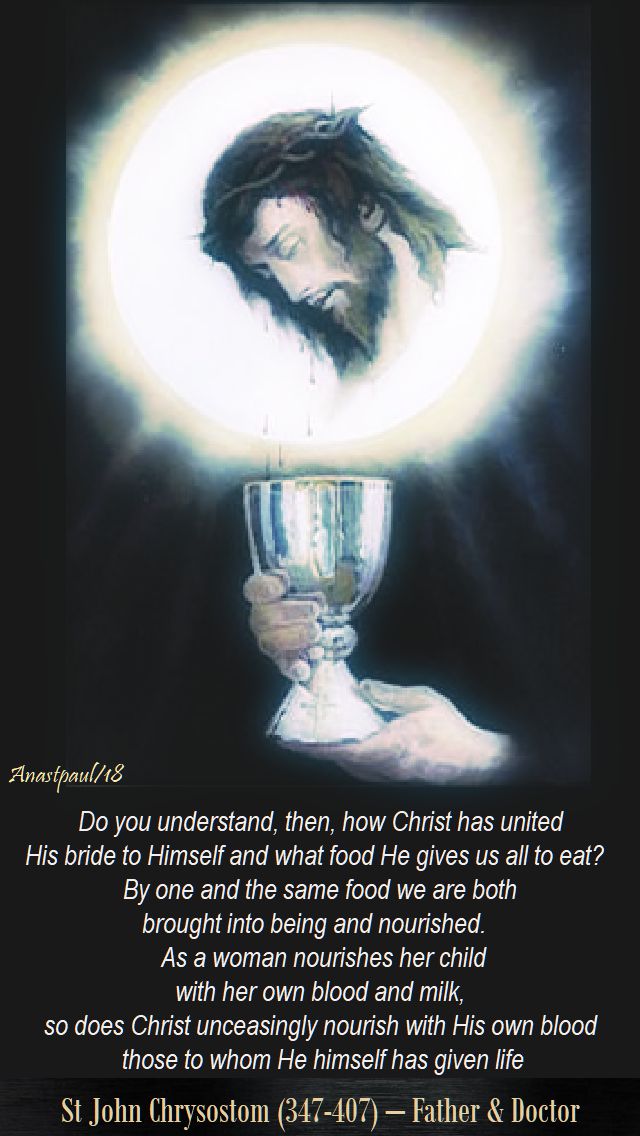
Do you understand, then, how Christ has united His bride to Himself and what food He gives us all to eat? By one and the same food we are both brought into being and nourished. As a woman nourishes her child with her own blood and milk, so does Christ unceasingly nourish with His own blood those to whom He himself has given life.’”
Our Morning Offering -22 April – The Fourth Sunday of Easter Year B
Give me Yourself, O My God
By St Augustine (354-430) Doctor of Grace
Give me Yourself, O my God,
give Yourself to me.
Behold I love You
and if my love is too weak a thing,
grant me to love You more strongly.
I cannot measure my love
to know how much it falls short of being sufficient
but let my soul hasten to Your embrace
and never be turned away,
until it is hidden in the secret shelter
of Your presence.
This only do I know,
that it is not good for me
when You are not with me,
when You are only outside me.
I want You in my very self.
All the plenty in the world
which is not my God is utter want.
Amen
Quote/s of the Day – 21 April – Saturday of the Third Week of Eastertide, the Memorial of St Anselm (1033-1109) Doctor of the Church and of St Conrad of Parzham OFM Cap. (1818-1894)
“Remove grace
and you have nothing
whereby to be saved.
Remove free will
and you have nothing
that could be saved.”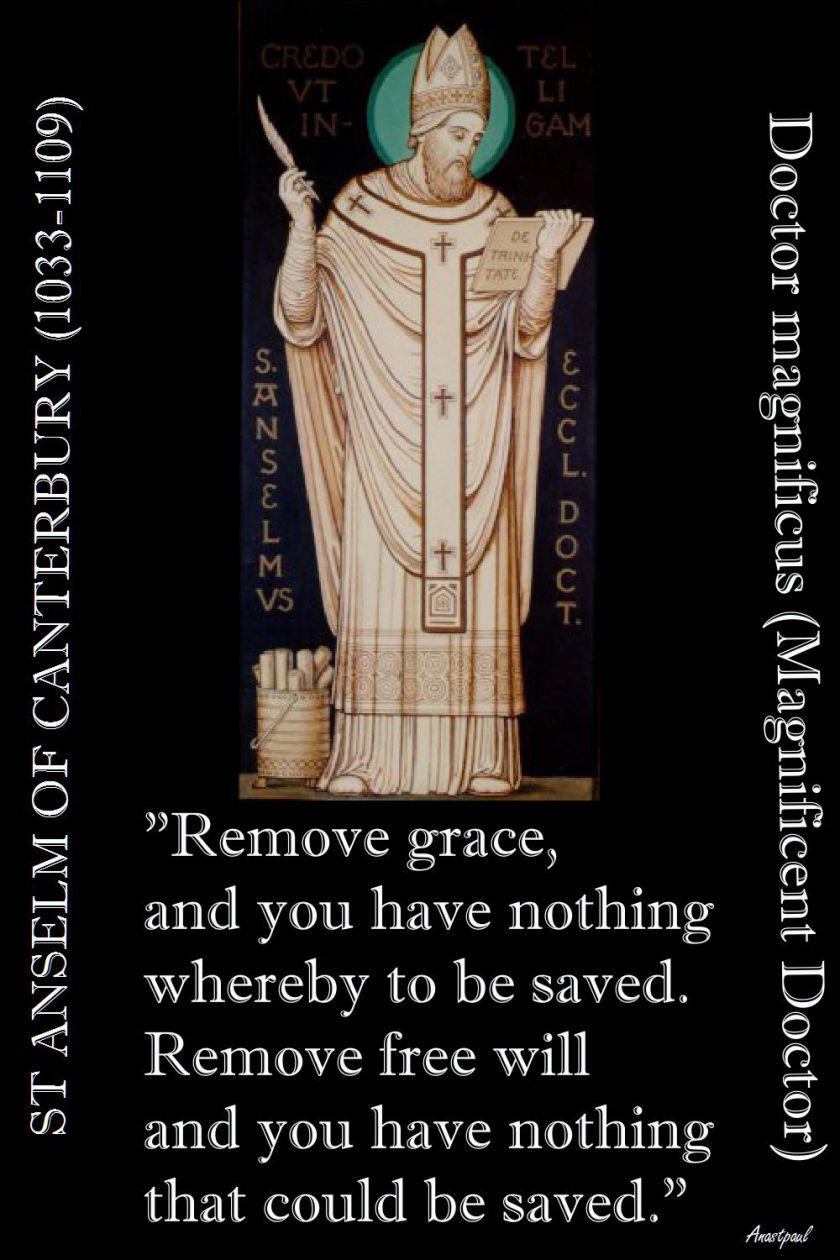
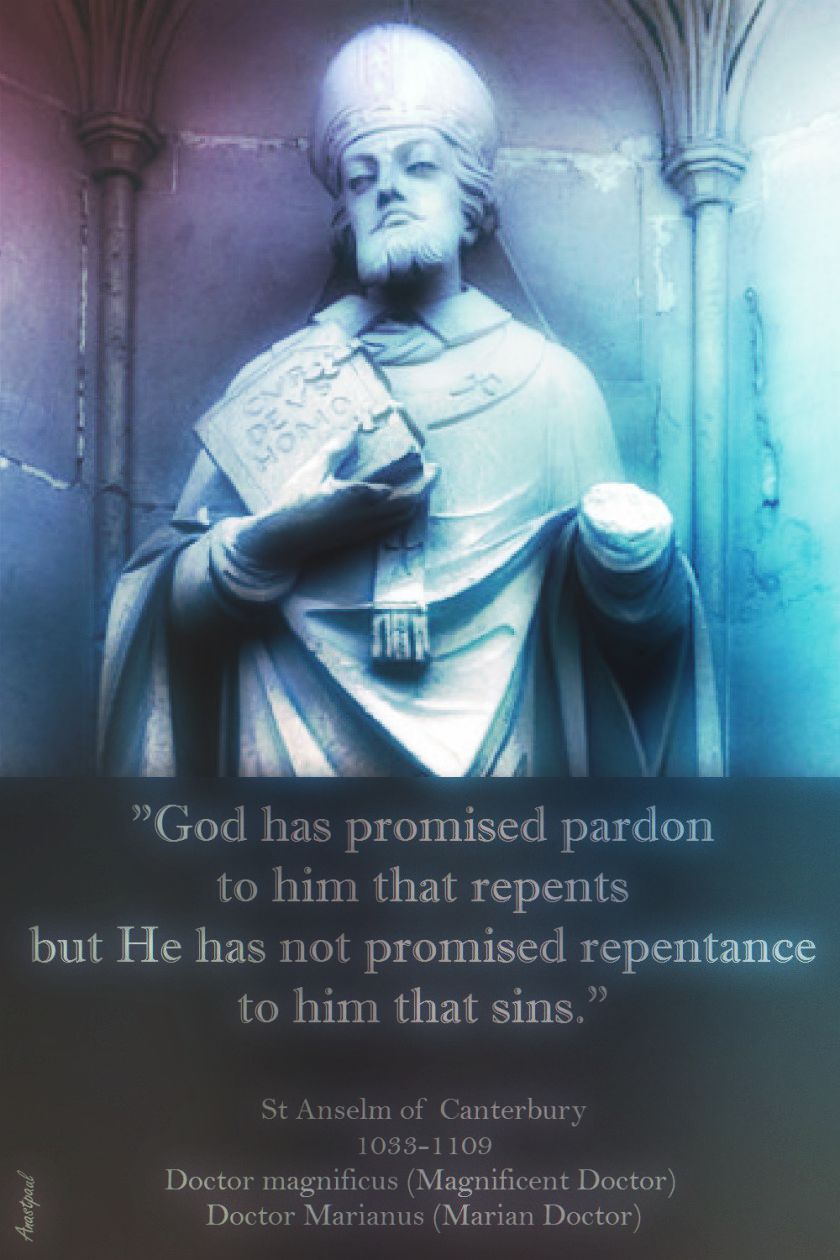
“God has promised pardon
to him that repents
but he has not promised repentance
to him that sins.”
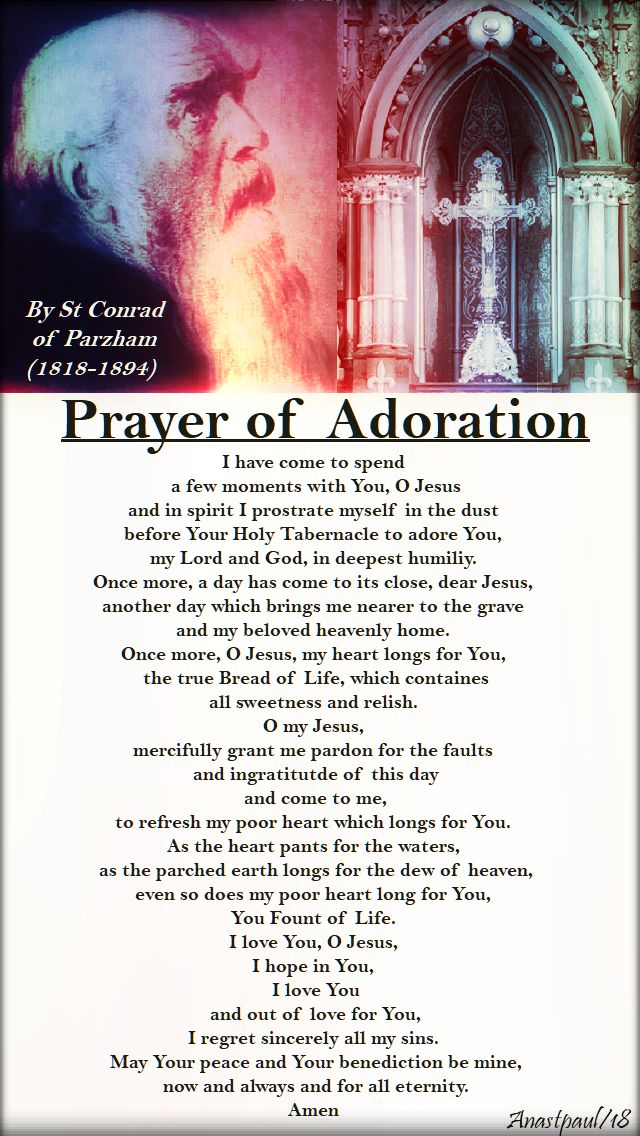
Prayer of Adoration and Repentance/Night Prayer
By St Conrad of Parzham (1818-1894)
I have come to spend
a few moments with You, O Jesus
and in spirit I prostrate myself in the dust
before Your Holy Tabernacle to adore You,
my Lord and God, in deepest humility.
Once more, a day has come to its close, dear Jesus,
another day which brings me nearer to the grave
and my beloved heavenly home.
Once more, O Jesus, my heart longs for You,
the true Bread of Life, which contains
all sweetness and relish.
O my Jesus,
mercifully grant me pardon for the faults
and ingratitude of this day
and come to me,
to refresh my poor heart which longs for You.
As the heart pants for the waters,
as the parched earth longs for the dew of heaven,
even so does my poor heart long for You,
You Fount of Life.
I love You, O Jesus,
I hope in You,
I love You
and out of love for You,
I regret sincerely all my sins.
May Your peace and Your benediction be mine,
now and always and for all eternity.
Amen
Quote/s of the Day – 20 April – Friday of the Third Week of Eastertide – Today’s Gospel: John 6:52-59
“You can call happy those who saw Him.
But, come to the altar and
you will see Him,
you will touch Him,
you will give to Him holy kisses,
you will wash Him with your tears,
you will carry Him within you
like Mary Most Holy.”
“The Blessed Eucharist is the perfect Sacrament
of the Lord’s Passion, since
It contains Christ Himself and his Passion.”
“The last degree of love
is when He gave Himself to us
to be our Food;
because He gave Himself to be
united with us in every way.”
“Of all devotions, that of adoring Jesus
in the Blessed Sacrament
is the greatest after the sacraments,
the one dearest to God
and the one most helpful to us.”

“Upon receiving Holy Communion,
the Adorable Blood of Jesus Christ
really flows in our veins and His Flesh
is really blended with ours.”

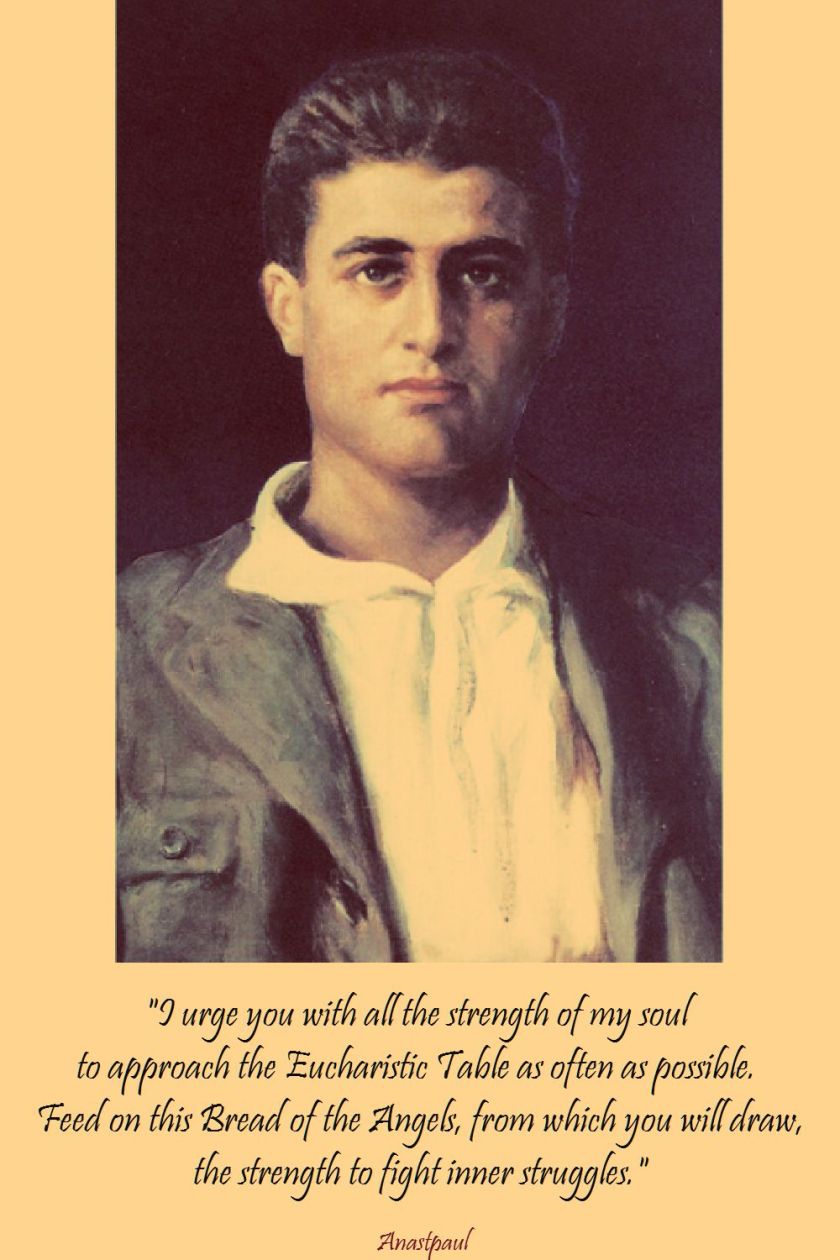
“I urge you with all the strength of my soul
to approach the Eucharistic Table
as often as possible.
Feed on this Bread of the Angels from which
you will draw the strength to fight inner struggles.”
One Minute Reflection – 20 April – Friday of the Third Week of Eastertide
So Jesus said to them, “Truly, truly, I say to you, unless you eat the flesh of the Son of man and drink his blood, you have no life in you; he who eats my flesh and drinks my blood has eternal life and I will raise him up at the last day. For my flesh is food indeed and my blood is drink indeed.”...John 6:53-55
REFLECTION – “About these words I observe, first, that they evidently declare on the face of them some very great mystery. How can they be otherwise taken? If they do not, they must be a figurative way of declaring something which is not mysterious but plain and intelligible. But is it conceivable, that He who is the Truth and Love itself, should have used difficult words, when plain words would do? Why should He have used words, the sole effect of which, in that case, would be to perplex, to startle us needlessly? Does His mercy delight in creating difficulties? Does He put stumbling-blocks in our way without cause? Does He excite hopes and then disappoint them? It is possible; He may have some deep purpose in so doing but which is more likely, that His meaning is beyond us, or His words beyond His meaning?
All who read such awful words as those in question will be led by the first impression of them, either with the disciples to go back, as at a hard saying, or with St Peter to welcome what is promised: they will be excited in one way or the other, with incredulous surprise or with believing hope? And are the feelings of these opposite witnesses, discordant indeed, yet all of them deep, after all unfounded? Are they to go for nothing? Are they no token of our Saviour’s real meaning? This desire and again this aversion, so naturally raised, are they without a real object and the mere consequence of a general mistake on all hands, of what Christ meant as imagery, for literal truth? Surely this is very improbable!”…Blessed John Henry Newman (1801-1890)
PRAYER – Lord God, source of our freedom and our salvation, listen to our humble prayer. We stand with St Peter and welcome what our divine Saviour, Your Son, our Lord Jesus Christ has promised. Help us to grow in love and faith at each Holy Sacrifice we attend. Help us to accept with total commitment this great Mystery and as He gives Himself to and for us, help us to give ourselves to and for the glory of Your Kingdom. Through our Lord Jesus, in the unity of the Holy Spirit, one God, forever and ever, amen. Peter, the spokesman for the apostles, proclaims, “Lord, to whom shall we go? You have the words of eternal life and we have believed and have come to know, that you are the Holy One of God” (Jn 6:67-69).
Thought for the Day – – Tuesday of the Third Week of Eastertide – Today’s Gospel: John 6:30–35 & the Memorial of Bl Andrés Hibernón Real O.F.M. (1534-1602) ) ‘Apostle of Eucharistic Adoration’
Meditation, wherever it is made,
pleases God.
But it seems that Jesus,
especially delights in prayer,
made before the Blessed Sacrament.
Did he not leave Himself for us
in this sacrament to be food for our spirit
and to be present for all who seek Him?
We cannot all make pilgrimages
to the places where Jesus lived
but the Lord who died for us
on the cross of Calvary
now dwells in person,
in the tabernacle – waiting.
We need not await a command
as we would of an earthly king,
to enter His presence –
He is waiting for us
to lay before Him our wants
and to seek His help.
So that we may taste
the sweetness of His presence,
it is good to empty ourselves
of earthly desires.
Be still and know that I am God. Psalm 46: 10
What pleasure is found in spending
a long time before the altar
where the Lord dwells!
What heavenly sweetness the Lord
allows us to taste and enjoy!
We should stay there, not to enjoy
sweetness and consolation
but to give pleasure to God
by making acts of love, saying
O my God, I love
and desire nothing but You.
Grant that I may always love You;
then do with me and all I possess,
as You please.
These acts of love,
even when made without sensible delight,
please god greatly.
For good people often have to bear
with distractions and dryness in prayer.
As for distractions,
of these we must not make much account.
It is enough to drive them away
when they come.
Do not on this account leave off prayer.
Saint Francis de Sales said:
“If, in meditation, we do nothing
but drive away distractions,
our meditation would be of great profit.”
And as for dryness:
this is the greatest pain
for those given to prayer,
for we find ourselves without
any sensible desire of loving God.
Added to this, at times, is the fear
of being separated from God
because of our sins.
There is the feeling
of being in utter darkness
without any way of escape.
At such times let us unite our desolation
with that which Jesus suffered on the cross.
If we can say nothing else,
it is enough to say,
at least by an act of the will:
My God, I desire to love You.
Have pity on me;
Leave me not.
PRAYER of one in deep affliction.
My God, I love You tenderly
though I feel You far away.
I will seek You ceaselessly
lest from You I stray.
AMEN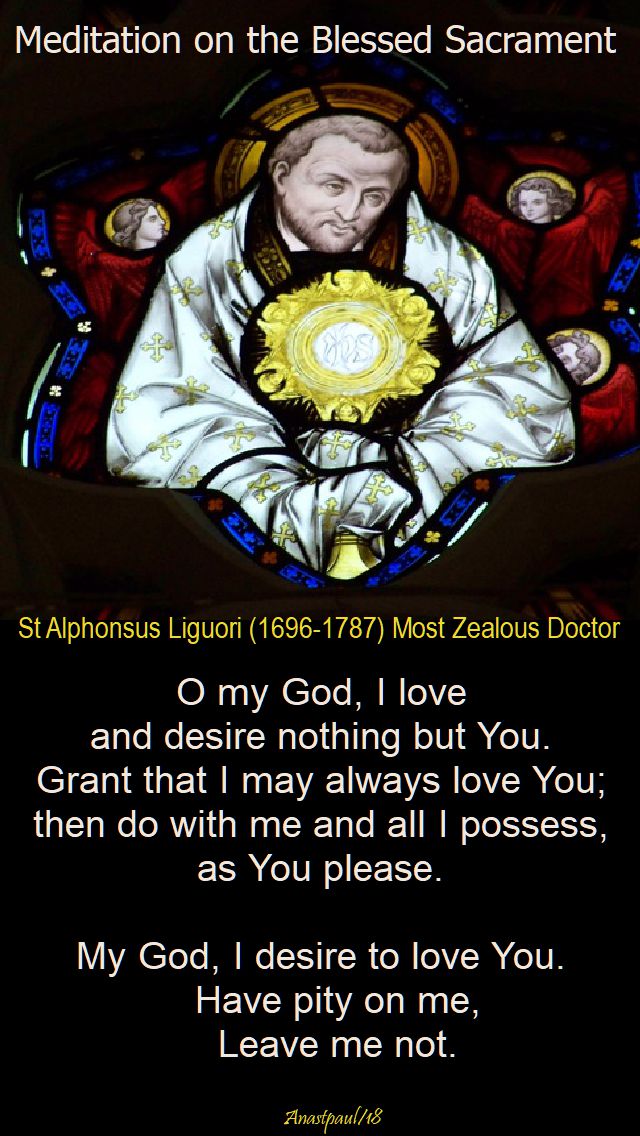
One Minute Reflection – Tuesday of the Third Week of Eastertide – Today’s Gospel: John 6:30–35 & the memorial of Bl Andrés Hibernón Real O.F.M. (1534-1602)
Jesus said to them, “I am the bread of life; he who comes to me shall not hunger and he who believes in me shall never thirst…John 6:35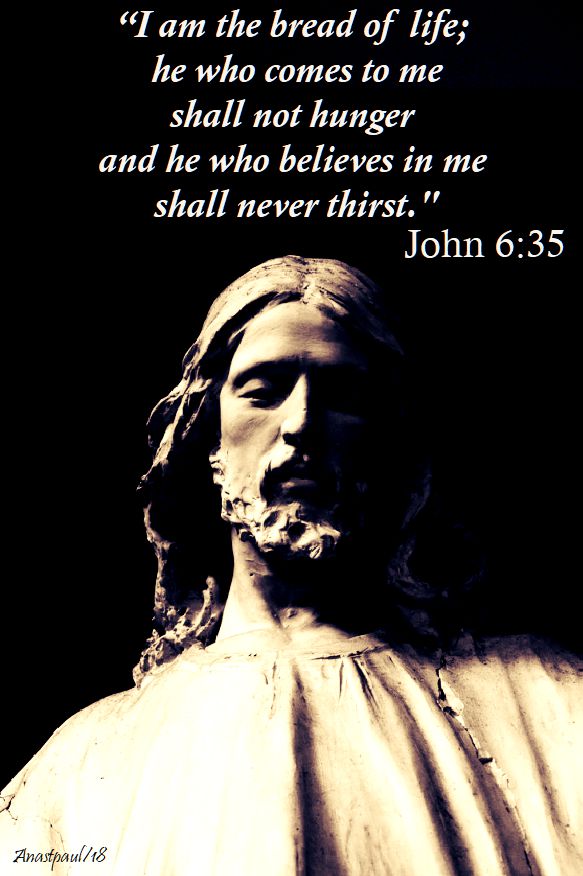
REFLECTION – “When I stand up to talk, people listen to me; they will follow what I have to say. Is it any power of mine? Of course not. St Paul says, ‘What have you that you have not received and you who have received, why do you glory as if you had not?’ But the secret of my power is that I have never, in fifty-five years, missed spending an hour in the presence of our Lord, in the Blessed Sacrament. That’s where the power comes from. That’s where sermons are born. That’s where every good thought is conceived.” …Venerable Archbishop Fulton J Sheen (1895-1979)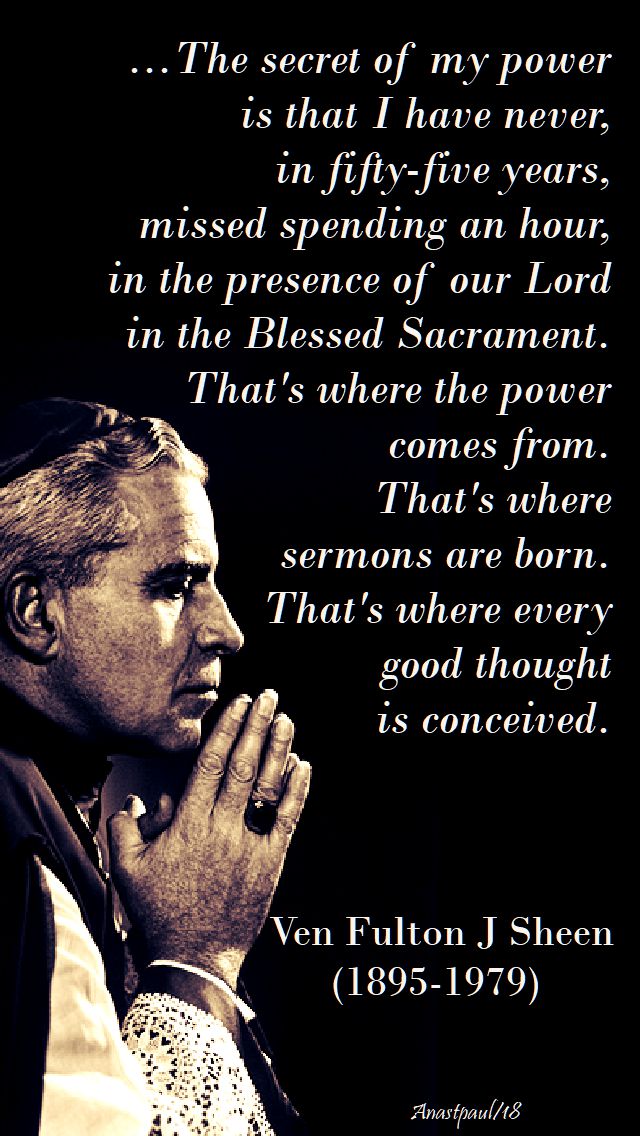
PRAYER – Lord Jesus, present for me in the Holy Eucharist, everyday, everywhere. Lord Jesus, the life of my soul, the food of my life, the quenching of my thirst. Let me love You in the Holy Eucharist. May Your Sacred Heart become my heart. Blessed Andrés Hibernón Real, you who loved to spend time with the Lord, who never missed a day being with Him, please pray for us, amen.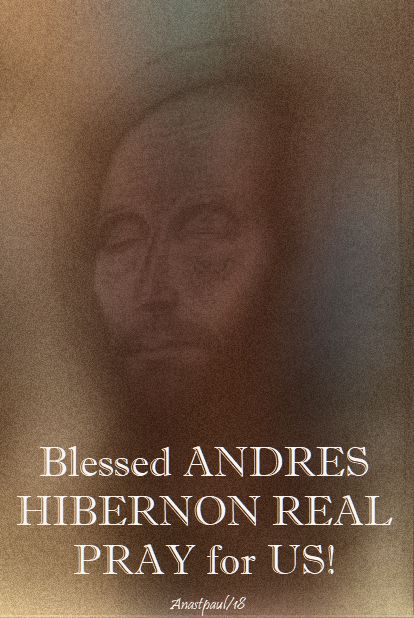
Thought for the Day – 16 April – Monday of the Third Week of Eastertide and the Memorial of St Benedict Joseph Labre – Known as the Beggar of Perpetual Adoration (1748-1783)
Benedict Joseph Labre was truly eccentric, one of God’s special little ones. Born in France and the eldest of 18 children, he studied under his uncle, a parish priest. Because of poor health and a lack of suitable academic preparation he was unsuccessful in his attempts to enter the religious life. Then, at age 16, a profound change took place. Benedict lost his desire to study and gave up all thoughts of the priesthood, much to the consternation of his relatives.
He became a pilgrim, traveling from one great shrine to another, living off alms. He wore the rags of a beggar and shared his food with the poor. Filled with the love of God and neighbour, Benedict had special devotion to the Blessed Mother and to the Blessed Sacrament. In Rome, where he lived in the Colosseum for a time, he was called “the poor man of the Forty Hours devotion” and “the beggar of Rome.”
On 16 April 1783, the last day of his life, Benedict dragged himself to a church in Rome and prayed there for two hours before he collapsed, dying peacefully in a nearby house. Immediately after his death, the people proclaimed him a saint.
Benedict Joseph Labre was canonised by Pope Leo XIII in 1881.
St Benedict’s life reminds us that the Lord loves and has a beautiful plan for all His creations, despite what society may judge or view them as. I, personally, do not regard him as being mentally ill, though many do and he is the Patron of mental illness and against insanity. For me, his mission was simply a striving, throughout his life to grow closer to the Lord, to serve Him through his neighbour and to serve as an example for others. I see shades of St Francis and many other Saints. He faced multiple rejections with grace and eventually changed his plan in obedience to God, never giving up his search for holiness. We are challenged by the life of this saint to consider our own actions, both when we encounter difficulties in our lives that prevent us from following what we perceive to be the will of God and also when we encounter those individuals in our communities who society has written off, marginalised and judged as ‘less than’ and ‘unworthy’.
My thought is this, that if we seek Christ who sought us first, we will find Him, for He is right beside us, whatever our circumstances. St Benedict found Him, in his neighbour and waiting quietly, in the Real Presence of the Blessed Sacrament, as He waits for you and me.
St Benedict Joseph Labre, pray for us! (Last year’s Saint of the Day – https://anastpaul.wordpress.com/2017/04/16/saint-of-the-day-16-april-st-benedict-joseph-labre/)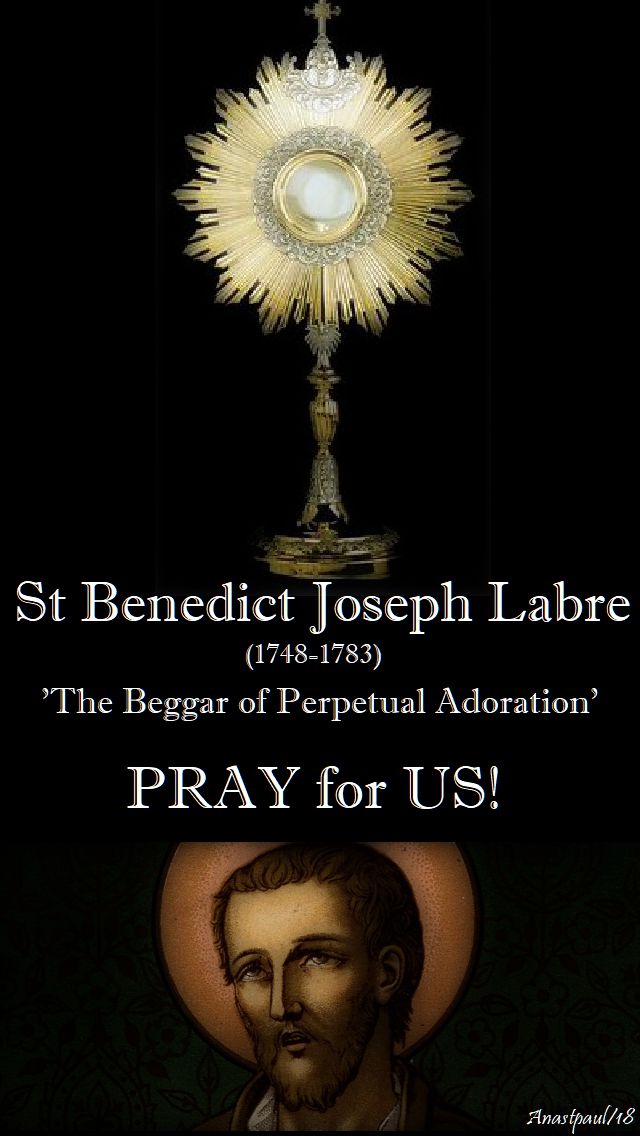
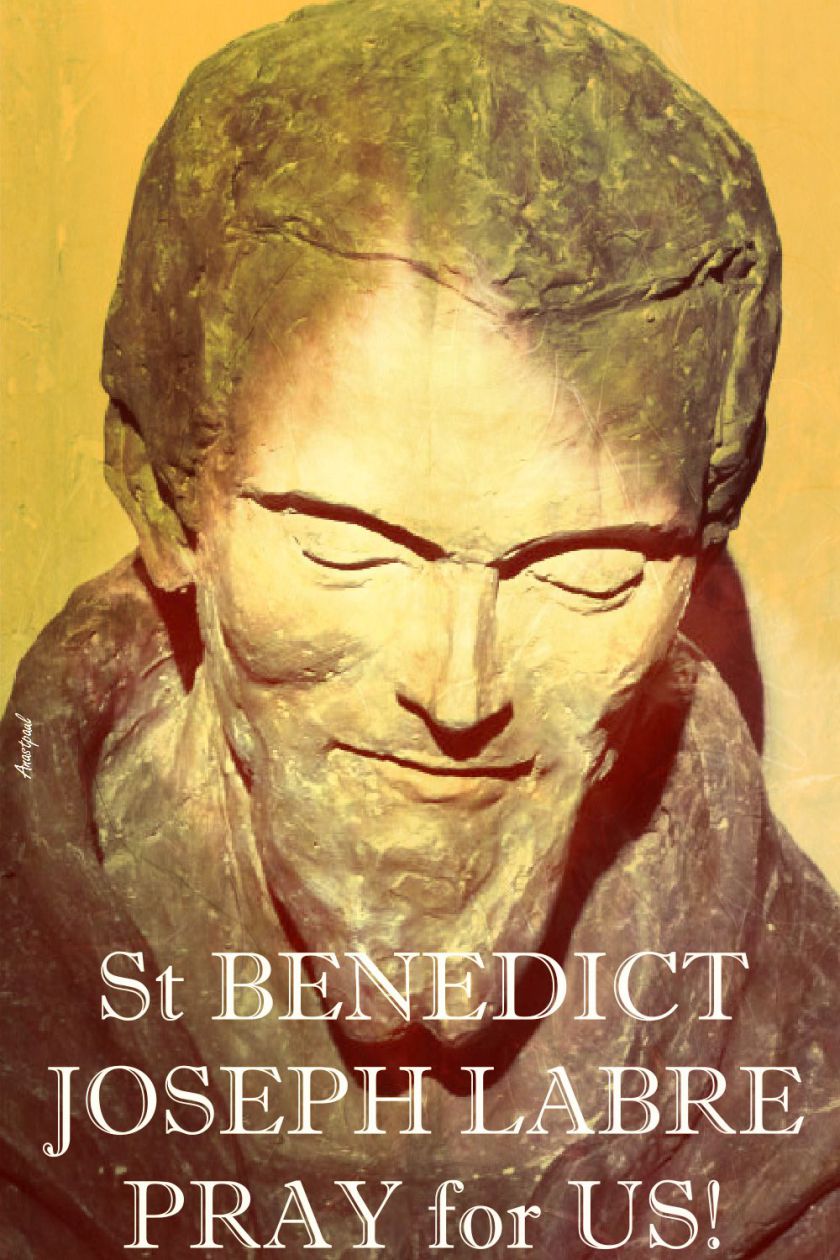
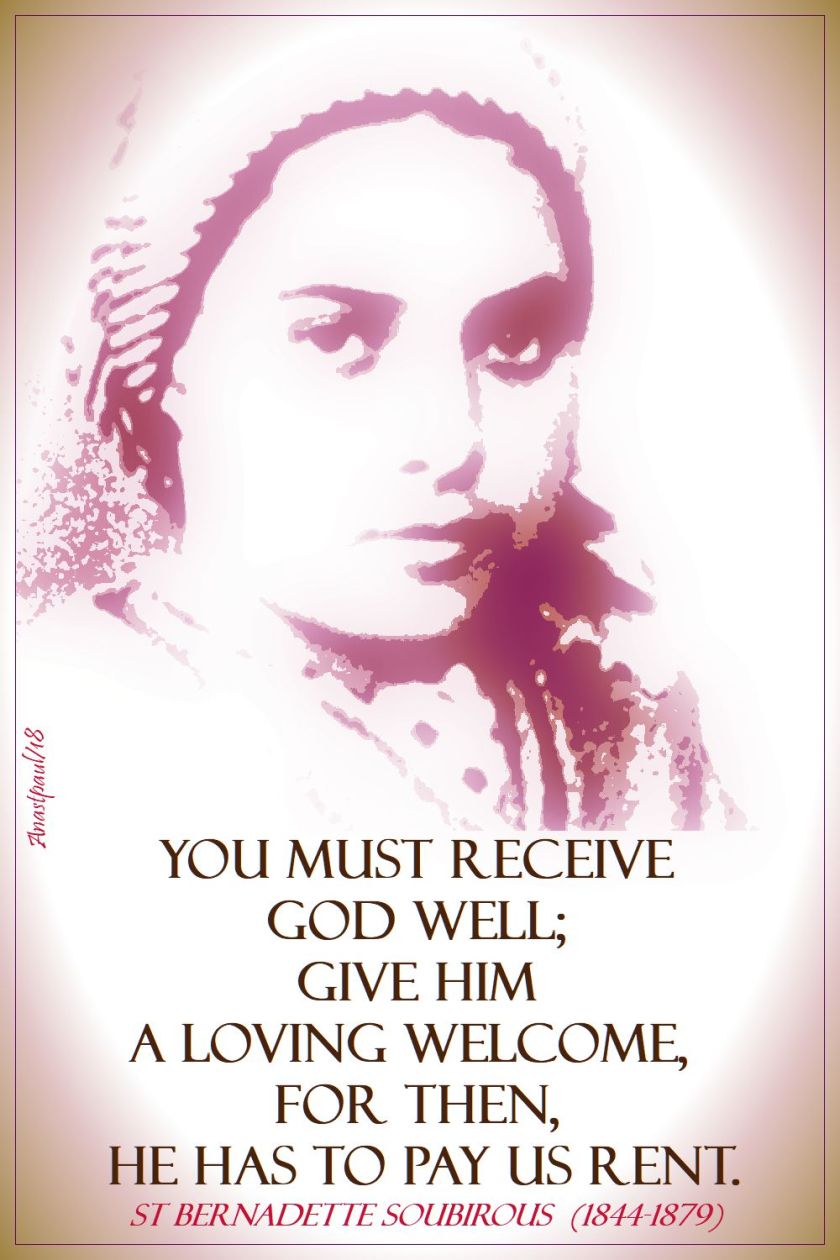
Quote/s of the Day – 16 April – Monday of the Third Week of Eastertide and the Memorial of St Bernadette Soubirous (1844-1879)
“Nothing is anything anymore to me,
everything is nothing to me,
only Jesus!
Neither things,
nor persons,
neither ideas,
nor emotions,
neither honour,
nor sufferings.
Jesus is for me honour,
delight,
heart and soul.”
“You must receive God well –
give Him a loving welcome,
for then, He has to pay us rent.”
Sunday Reflection – 15 April – The Third Sunday of Easter Year B
“Christ wished to choose this sacred symbol of human life, which bread is, to make an even more sacred symbol of Himself. He has transubstantitated it but has not taken away its expressive power – rather, He has elevated this expressive power to a new meaning, a higher meaning, a mystical, religious, divine meaning. He has made of it a ladder for an ascent that transcends the natural level.
As a sound becomes a voice and as the voice becomes word, thought, truth – so that sign of the bread has passed from its humble and pious being to signify a mystery, it has become a Sacrament, it has acquired the power to demonstrate the Body of Christ present.”
Blessed Pope Paul VI (1897-1978) – when Archbishop of Milan from a homily on the Solemnity of Corpus Christi
Quotes of the Day – 15 April – The Third Sunday of Easter Year B
“Recognise in this bread what hung on the cross
and in this chalice what flowed from His side…
whatever was in many and varied ways
announced beforehand in the sacrifices
of the Old Testament
pertains to this one sacrifice
which is revealed in the New Testament.”

“Jesus taught a new sacrifice
which the Church received
from the Apostles and offers
throughout the whole world.”

“All the good works in the world
are not equal to the Holy Sacrifice of the Mass
because they are the works of men –
but the Mass is the work of God.
Martyrdom is nothing in comparison,
for it is but the sacrifice of man to God –
but the Mass is the sacrifice of God for man.”

“Many Christians take their time
and have leisure enough in their social life
(no hurry here).
They are leisurely, too, in their professional activities,
at table and recreation (no hurry here either).
But isn’t it strange, how those same Christians.
find themselves in such a rush
and want to hurry the priest,
in their anxiety to shorten the time devoted
to the most holy sacrifice of the altar?“

One Minute Reflection – 15 April – The Third Sunday of Easter Year B
Then he opened their minds to understand the scriptures and said to them, “Thus it is written, that the Christ should suffer and on the third day rise from the dead and that repentance and forgiveness of sins should be preached in his name to all nations, beginning from Jerusalem.”... Luke 24:45-48
REFLECTION – “This very experience of repentance and forgiveness is relived in every community in the Eucharistic celebration, especially on Sundays. The Eucharist, the privileged place in which the Church recognises “the Author of life” (Acts 3: 15) is “the breaking of the bread”, as it is called in the Acts of the Apostles. In it, through faith, we enter into communion with Christ, who is “the priest, the altar and the lamb of sacrifice” (see Preface for Easter, 5) and is among us. Let us gather round Him to cherish the memory of His words and of the events contained in Scripture; let us relive His Passion, death and Resurrection. In celebrating the Eucharist, we communicate with Christ, the victim of expiation and from Him we draw forgiveness and life. What would our lives as Christians be without the Eucharist? The Eucharist is the perpetual, living inheritance which the Lord has bequeathed to us in the Sacrament of His Body and His Blood and which we must constantly rethink and deepen so that, as venerable Pope Paul VI said, it may “impress its inexhaustible effectiveness on all the days of our earthly life” (Insegnamenti, V [1967], p. 779).”…Pope Benedict XVI
PRAYER – Lord God, grant Your people constant joy in the renewed vigour of their souls. Grant them sorrow for their sins and gratitude for the suffering of Your Son. Grant them forgiveness and life in the Holy Eucharist, through which we meet Him, who saved us. Grant, we pray, that we may grow in our love for the saving banquet to which we are called so that we may one day rejoice eternally, with You, in union with our Lord, Jesus Christ and the Holy Spirit, one God, forever amen. “O Lord, let the light of your countenance shine upon us”!
Our Morning Offering – 15 April – The Third Sunday of Easter Year B
Prayer to the Blessed Virgin Mary
Before Holy Mass
O most blessed Virgin Mary,
Mother of tenderness and mercy,
I, a miserable and unworthy sinner,
fly to you with all the affection of my heart
and I beseech your motherly love,
that, as you stood by your most dear Son,
while he hung on the Cross,
so, in your kindness,
you may be pleased to stand by me, a poor sinner,
and all Priests who today are offering the Sacrifice
here and throughout the entire holy Church,
so that with your gracious help
we may offer a worthy and acceptable oblation
in the sight of the most high and undivided Trinity.
Amen.
(This prayer is adapted from the Priests’ Prayers Before each Mass)
Sunday Reflection – 8 April – Low Sunday the Octave Day of Easter and Divine Mercy Sunday
“He is not past, He is present now.” – Bl John Henry Newman (1801-1890) on the Eucharist
In every Mass Christ comes to us, in the Blessed Eucharist, Christ remains with us – Christ counteracts Time and the World
What makes Christianity in its fullness, much more than a historical religion – though Protestants claim their religion to be just that, and, indeed, Christ died long ago – is the fact that He is “living among us with a continual presence”.
In every Holy Mass we are touched by Christ’s spiritual presence when the Gospel is proclaimed. We are touched by His real, full and personal presence in the Eucharist. When we walk up to receive the Eucharist, Christ Jesus comes to us. He remains with us in the Blessed Sacrament, whether in the tabernacle or exposed for our adoration. With Newman’s words from a sermon of 25th May 1858:
“He is not past, He is present now. And though He is not seen, He is here. The same God who walked the water, who did miracles, etc., is in the Tabernacle. We come before Him, we speak to Him just as He was spoken to … years ago.”
We receive Christ Jesus, when we receive the consecrated host. We adore Him, we listen to Him and we dare to speak to Him. When we receive Holy Communion, He wants to grow in us and wants us to grow towards Him:
“In every holy mass and especially in communion but also whenever we adore Christ Jesus, kneeling before the tabernacle or before the exposed Blessed Sacrament, our fleeting lives touch eternity as the living God touches us. God, does not merely present Himself before us as the Object of worship but God actually gives Himself to us to be received into our breasts. wonderful communion”!
The Eucharist brings Christians of all times, whether in the action of holy Mass or in the stillness of the Blessed Sacrament into the presence of Christ and is the living reminder that we live at all times in the presence of God and have the presence of God within us and before us in a passing world. It makes us realise that although every day and hour passes and will never come back, we are held and find our stay in the presence and love of God. The real presence of God in the Holy Eucharist makes us realise that eternal life, our life with God, has begun for us with baptism and cannot be lost to us by any outward force, only by severe sin. Therefore Newman can say that by the Holy Eucharist “We are brought into the unseen world.” (Excerpted Sr Brigitte Maria Hoegemann FSO)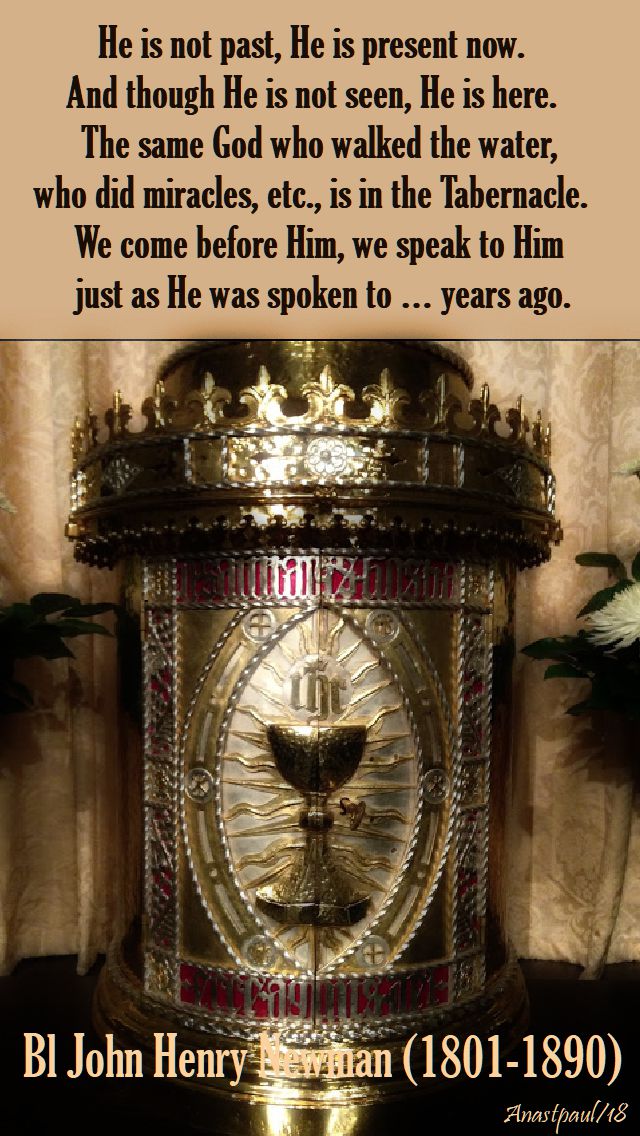
Quote/s of the Day – 7 April – Easter Saturday and the Memorial of St John Baptiste de La Salle (1651-1719)
“When you are at Mass,
be there as if you were on Calvary.
For it is the same sacrifice
and the same Jesus Christ
Who is doing for you
what He did on the Cross
for all human beings.”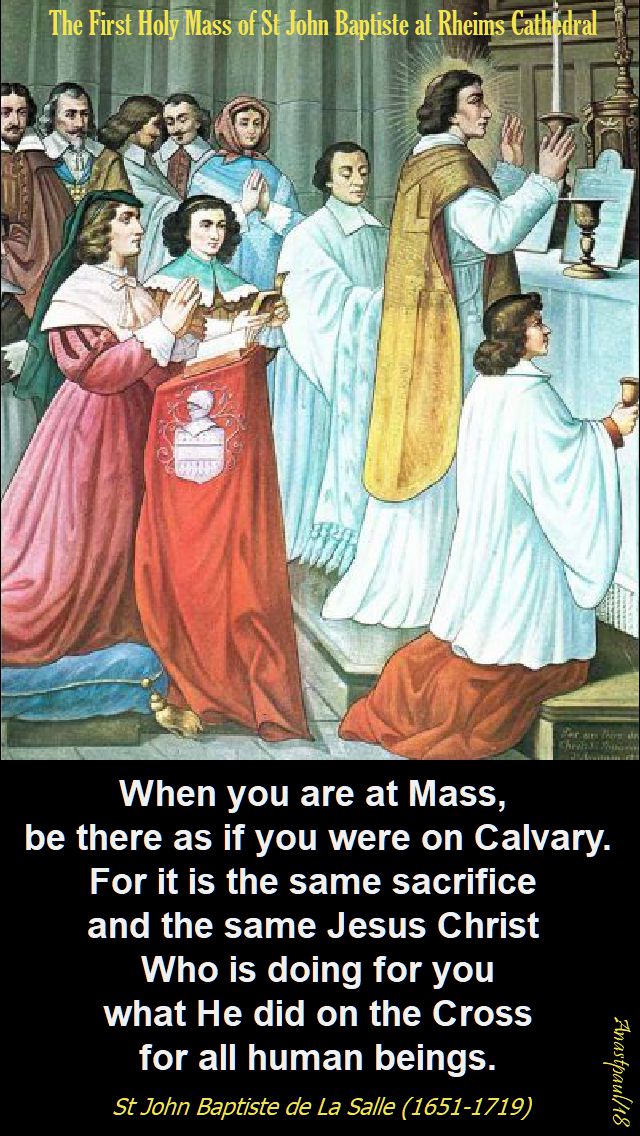
“Jesus Christ came to this earth to reign here
but not, says Saint Augustine, as other kings do,
to raise tribute, enroll armies and visibly do battle
against his enemies, for Jesus Christ assures us
that His kingdom is not of this world
but to establish His reign within our souls,
according to what He Himself says,
in the holy Gospel, that His kingdom is within us.”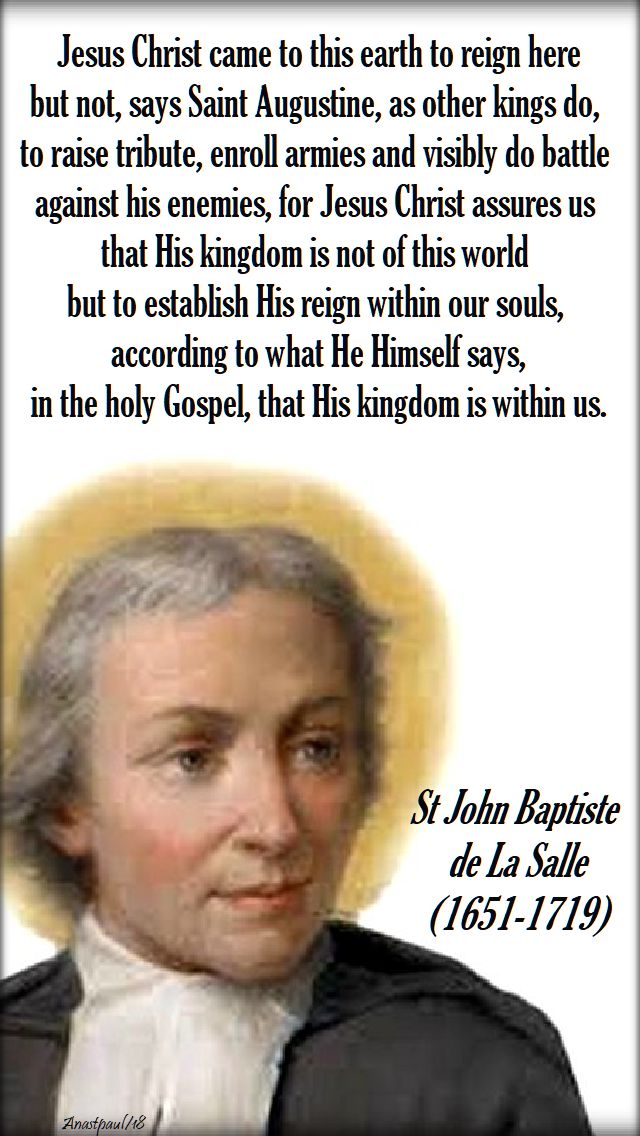
“We must strive to place ourselves completely in God’s hands.
Then He will cause us to feel the effects
of His goodness and protection – which are, at times extraordinary.”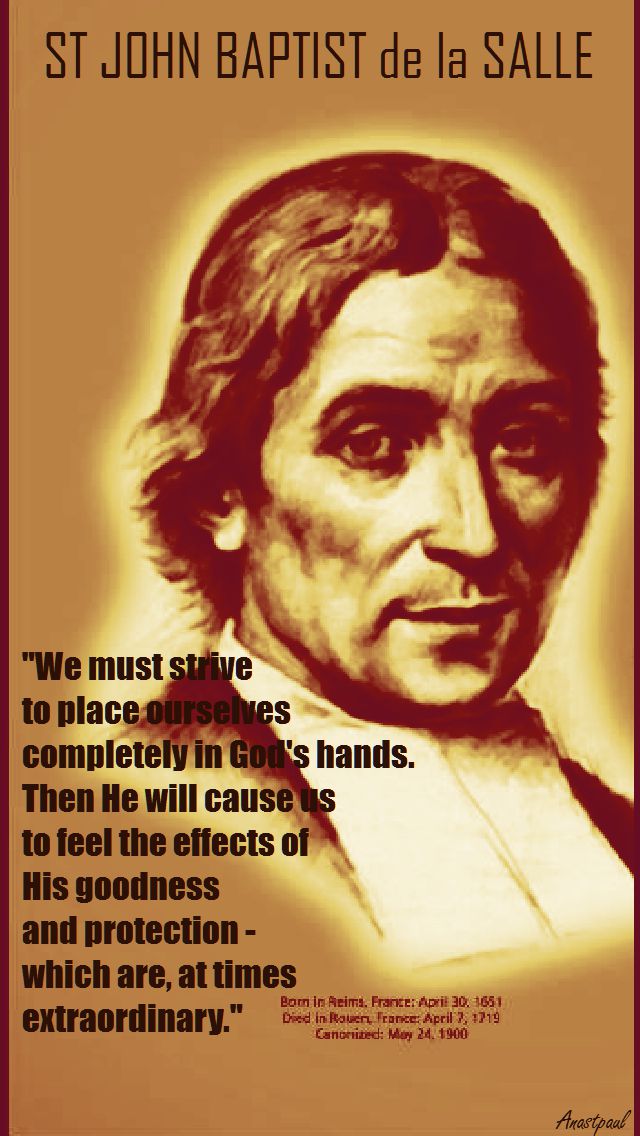
“Miracles happen by touching hearts.”
“You are called like the apostles
to make God known to others.”
“God has chosen you
to do his work.”
“Say to Jesus as the apostles
did: ‘Lord, teach us to pray’.“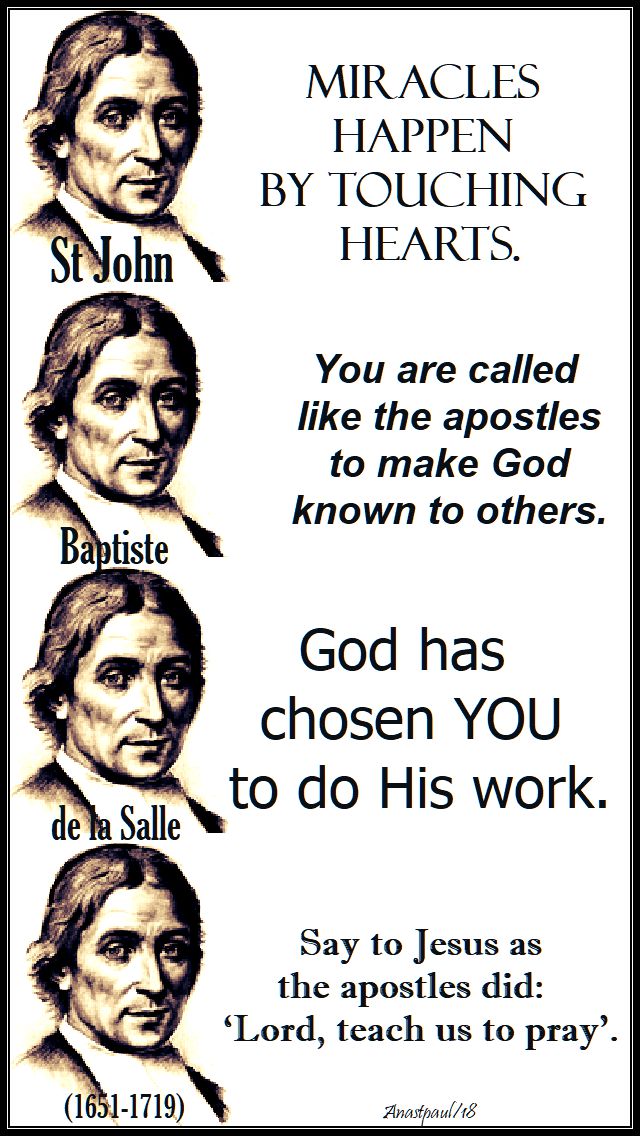
Quote/s of the Day – 6 April – Easter Friday the Sixth day in the Easter Octave
“Nothing is sweeter than love,
nothing stronger or higher or wider;
nothing is more pleasant, nothing fuller
and nothing better in heaven or on earth,
for love is born of God
and cannot rest except in God,
Who is above all created things.”
“Love is watchful.
Sleeping – it does not slumber.
Wearied – it is not tired.
Pressed – it is not straitened.
Alarmed – it is not confused
but like a living flame,
a burning torch,
it forces its way upward
and passes unharmed,
through every obstacle.”

“What does love look like?
It has the hands to help others.
It has the feet to hasten to the poor and needy.
It has eyes to see misery and want.
It has the ears to hear the sighs
and sorrows of men.
That is what love looks like.”

“The proof of love is in the works.
Where love exists, it works great things.
But when it ceases to act, it ceases to exist.”

“The Eucharist is the Sacrament of Love;
It signifies Love,
It produces love.
The Eucharist is the consummation
of the whole spiritual life.”

Love knows no limit to its endurance,
no end to its trust,
no fading of its hope,
it can outlast anything.
Love still stands,
when all else has fallen.

“The person who does not decide to love forever
will find it very difficult to really love, even for one day.”

Devotion for the Month of April – The Holy Eucharist
The Church has historically encouraged the month of April for increased devotion to Jesus in the Holy Eucharist. “The Church in the course of the centuries has introduced various forms of this Eucharistic worship which are ever increasing in beauty and helpfulness; as, for example, visits of devotion to the tabernacles, even every day; Benediction of the Blessed Sacrament; solemn processions, especially at the time of Eucharistic Congresses, which pass through cities and villages; and adoration of the Blessed Sacrament publicly exposed . . . These exercises of piety have brought a wonderful increase in faith and supernatural life to the Church militant upon earth and they are re-echoed to a certain extent by the Church triumphant in heaven, which sings continually a hymn of praise to God and to the Lamb ‘Who was slain.'” -Venerable Pope Pius XII (1876-1958) Pope from 1939 to his death in 1958.
Prayer before Holy Communion
By St Peter Julian Eymard (1811-1868)
Oh! Yes, Lord Jesus, come and reign!
Let my body be Your temple,
my heart Your throne,
my will Your devoted servant;
let me be Yours forever,
living only in You and for You!
Amen
Eucharistic Adoration By: St Pope John Paul II
“I encourage Christians regularly to visit Christ present in the Blessed Sacrament, for we are all called to abide in the presence of God. In contemplation, Christians will perceive ever more profoundly the mystery at the heart of Christian life.
I urge priests, religious and lay people to continue and redouble their efforts to teach the younger generations the meaning and value of Eucharistic adoration and devotion. How will young people be able to know the Lord if they are not introduced to the mystery of His presence? Like the young Samuel, by learning the words of the prayer of the heart, they will be closer to the Lord, who will accompany them in their spiritual and human growth. The Eucharistic mystery is in fact the “summit of evangelisation” (Lumen Gentium) for it is the most eminent testimony to Christ’s resurrection.”
Private Eucharistic Adoration
Venerable Fr Benedict Groeschel points out in the book, “In the Presence of Our Lord : The History, Theology and Psychology of Eucharistic Devotion” that there are “four kinds of prayer most appropriate in the presence of the Eucharist, namely adoration and praise, thanksgiving, repentance and trusting intercession.” Accordingly, here are suggestions for what to do during private Eucharistic adoration.
1. Pray the Psalms or the Liturgy of the Hours
Whether you are praising, giving thanks, asking for forgiveness or seeking an answer, you’ll find an appropriate psalm. The ancient prayer of the Church called the Liturgy of the Hours presents an excellent way to pray through the Book of Psalms throughout the year.
2. Recite the “Jesus Prayer”
Say “Lord Jesus, have mercy on me, a sinner”, repeatedly as you quiet your heart and mind.
3. Meditate using Scripture
Choose a passage from the Bible. read the words and ask God to let the passage speak to you. Pay special attention to anything that strikes you and ask God what He wishes for you to draw from that message.
4. Read the life of a saint and pray with him or her
Most holy men and women have had a great devotion to Our Lord in the Eucharist. Therese of Lisieux, Catherine of Siena, Francis of Assisi, Thomas Aquinas, Peter Julian Eymard, Dorothy Day. Mother Teresa of Calcutta and Baroness Catherine de Hueck are just a few. Read about them and pray their prayers before the Blessed Sacrament.
5. Pour out your heart to Christ and adore Him
Speak to Jesus, aware that you are in His presence and tell Him all that comes to your mind. Listen for His response. Pray the prayer that St Francis instructed his brothers to pray whenever they were before the Blessed Sacrament: “I adore You, O Christ, present here and in all the churches of the world, for by Your holy cross You have redeemed the world.”
6. Ask for forgiveness and intercede for others
Think of those who have hurt you and request a special blessing for them. Ask God to forgive you for all the times you have neglected or hurt someone else. Bring before the Blessed Sacrament all those who have asked you to pray for them. Ask the Lord to address their concerns.
7. Pray the Rosary
St Pope John Paul II reminds us, “…is not the enraptured gaze of Mary as she contemplated the face of the newborn Chris and cradled him in her arms that unparalleled model of love which should inspire us every time we receive Eucharistic communion?” (The Church and the Eucharist, 55) Ask Mary to join you as you gaze on Christ in the Eucharist and as you pray the Rosary.
8. Sit quietly and just “be” in the presence of God
Think of a visit to the Blessed Sacrament as coming to see your best friend. Sit quietly and enjoy being in each other’s company. Instead of talking to the Lord, try listening to what He wants to tell you.
Prayer before the Eucharistic Presence
By Bl John Henry Newman (1801-1890)
I place myself in the presence of Him,
in whose Incarnate Presence I am,
before I place myself there.
I adore You, O my Saviour,
present here as God and man,
in soul and body,
in true flesh and blood.
I acknowledge and confess,
that I kneel before the Sacred Humanity,
which was conceived in Mary’s womb
and lay in Mary’s bosom;
which grew up to man’s estate
and by the Sea of Galilee, called the Twelve,
wrought miracles and spoke words of wisdom and peace;
Who in due season hung on the cross,
lay in the tomb, rose from the dead
and now reigns in heaven.
I praise and bless
and give myself wholly to Him,
Who is the true Bread of my soul
and my everlasting joy. Amen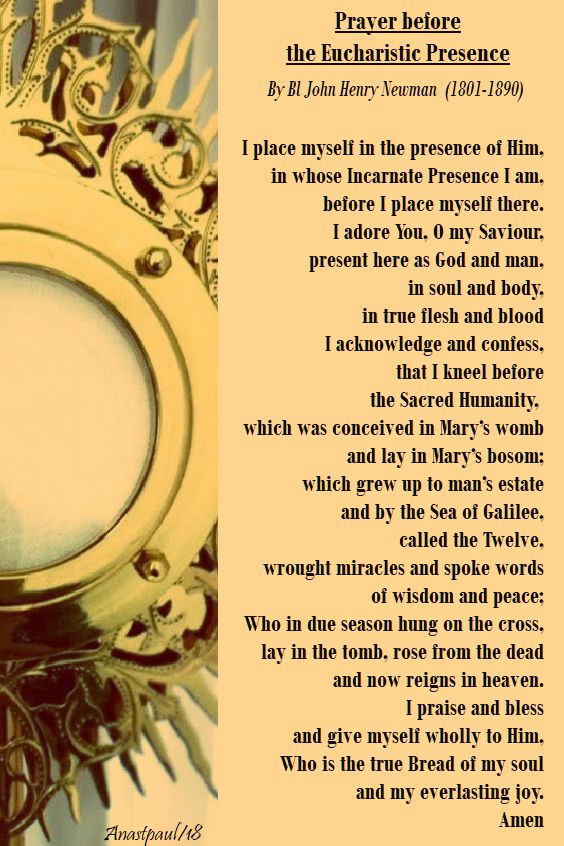
Quote/s of the Day – 29 March – Holy Thursday 2018
“Christianity is above all a gift: God gives himself to us – He does not give some thing but Himself. And this takes place not only at the beginning, at the moment of our conversion. He continually remains the One who gives. He always offers us His gifts anew. He always precedes us. For this reason, the central action of being Christians is the Eucharist: gratitude for having been gratified, the joy for the new life that He gives us.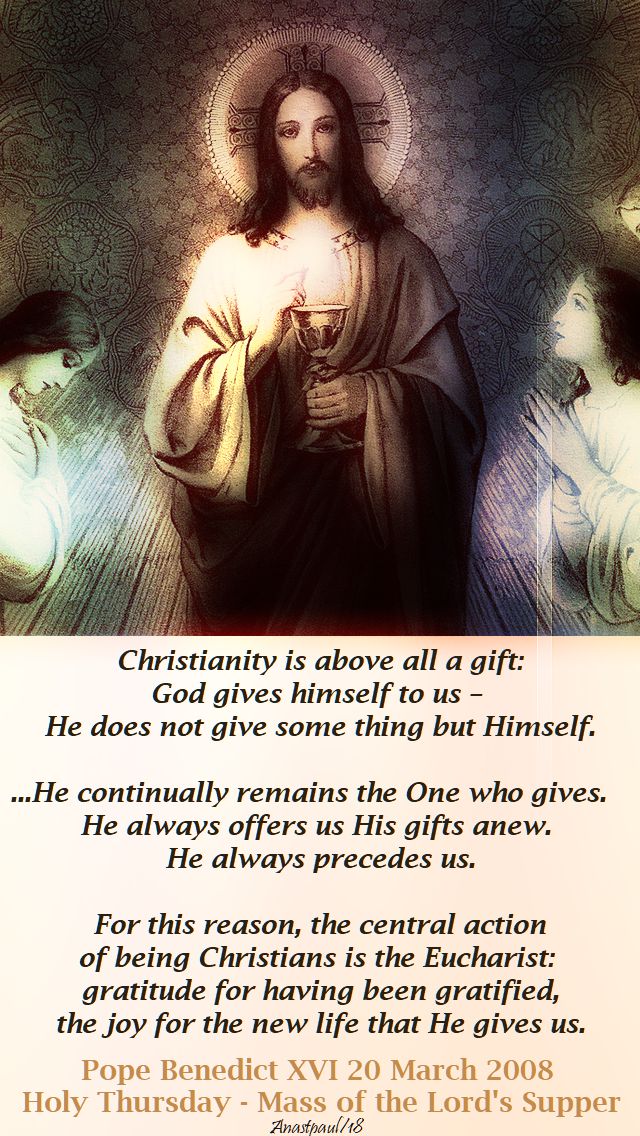
In spite of all this, we do not remain passive recipients of the divine goodness. God gratifies us as personal and living partners. The love that is given is the dynamic of “loving together,” it is intended to be a new life within us, beginning from God. We thus understand the words that, at the end of the account of the washing of the feet, Jesus speaks to His disciples and to all of us: “I give you a new commandment: love one another. As I have loved you, so you also should love one another” (John 13:34). The “new commandment” does not consist in a new and difficult norm, one that did not exist before. The new commandment consists in a loving together with Him who loved us first.”

 AnaStpaul
You must be logged in to post a comment.