Friday of the Second Week of Lent – 6 March – Our Lenten Journey With St Thomas Aquinas (1225-1274) Doctor of the Church
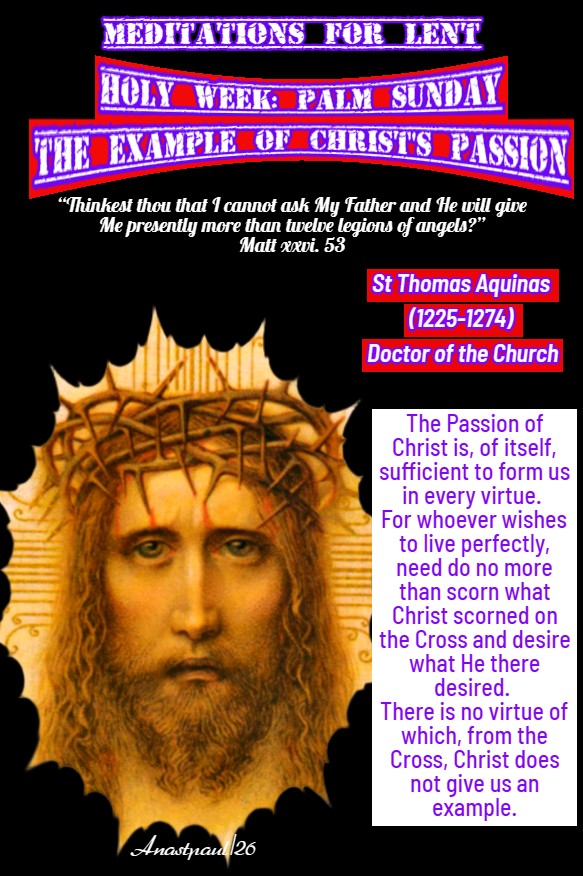
Friday of the Second Week Feast of the Holy Winding Sheet (the Shroud)
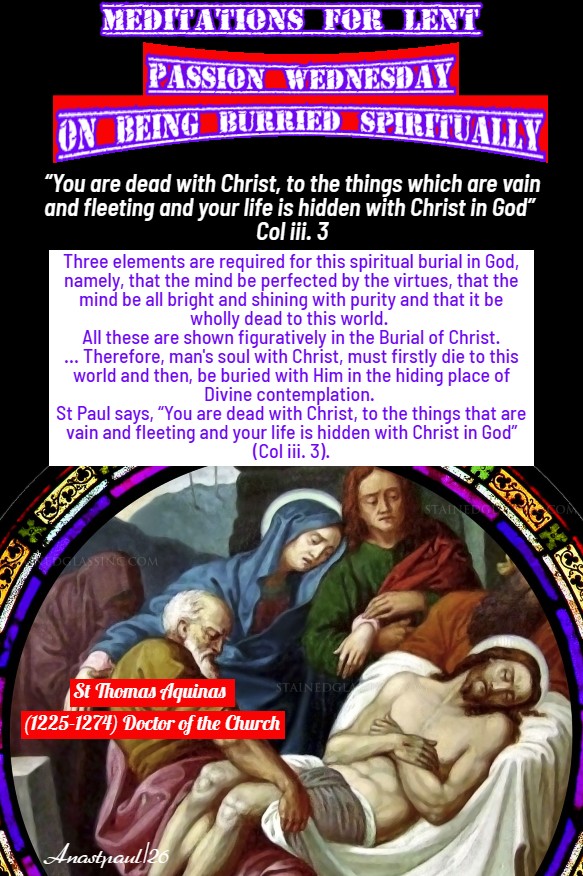
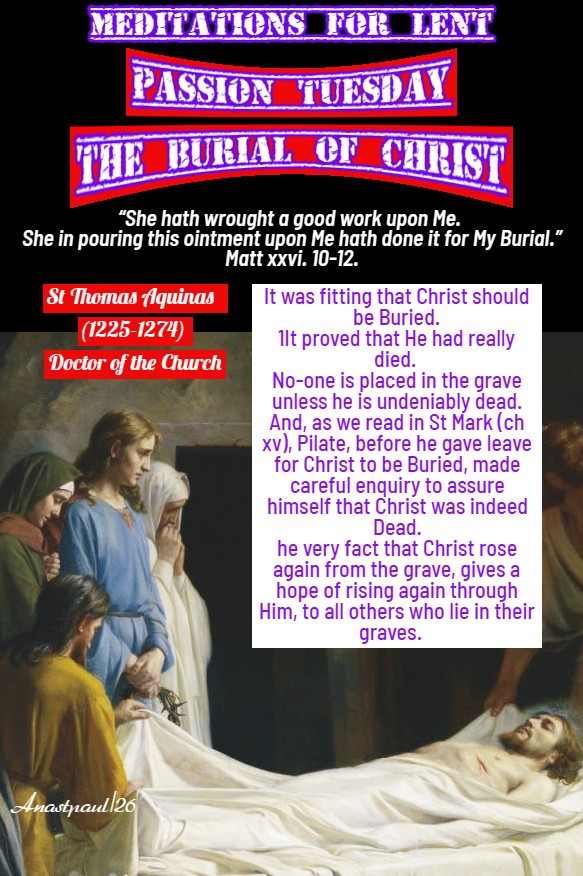
“Joseph taking the Body, wrapped It in a clean linen cloth and laid It in his own new monument.” Matthew xxvii. 59
By this clean linen cloth three elements are signified in a hidden way, namely:
(i) The Pure Body of Christ. For the cloth was made of linen which, by much pressing, is made white and,in like manner, it was after much pressure that the Body of Christ came to the brightness of the Resurrection. Thus it behoved Christ to Suffer and to Rise again from the dead on the third day (Luke xxiv. 46).
(ii) The Church, which without spot or wrinkle (Eph v. 27), is signified by this linen woven out of many threads.
(iii) A clear conscience, where Christ reposes.
And laid Him in his own new monument. It was Joseph’s own grave and certainly it was appropriate that He Who had Died for the sins of others, should be buried in another man’s grave!
Notice that it was a new grave. Had other bodies already been laid in it, there might have been a doubt which had arisen. There is another fitness in this circumstance, namely – He Who was buried in this new tomb, as He who was born of a virgin mother.
As Mary’s womb knew no child before Him nor after Him, so was it with this tomb. Again we may understand, it is in a renewed soul renewed where Christ is buried by faith, where Christ may dwell by faith in our hearts (Eph iii. 17).
St. John’s Gospel adds, Now there was in the place where He was crucified, a garden ; and in the garden a new sepulchre (John xix. 41). Which recalls to us that as Christ was taken in a garden and suffered His agony in a garden, so in a garden was He buried, and thereby we are reminded that it was from the sin committed by Adam in the garden of delightfulness that, by the power of His Passion, Christ set us free, and also that through the Passion the Church was consecrated, the Church which again is as a garden closed.
ST THOMAS AQUINAS (1225-1274) Priest, Theologian, Dominican Doctor Angelicus (Angelic Doctor) Doctor Communis (Common Doctor) Added by Pope Saint Pius V in 1568

Our Morning Offering – 6 March – The Feast of the Holy Shroud of Jesus
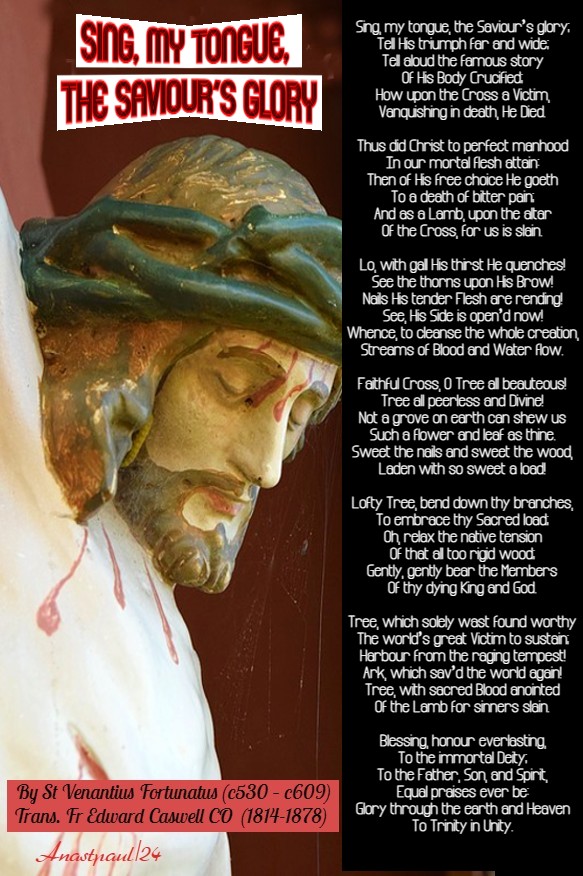
Faithful Cross! Above All Other By St Venantius Fortunatus (c 530 – c 609)
Faithful Cross! above all other, one and only noble tree! None in foliage, none in blossom, none in fruit thy peer may be; sweetest wood and sweetest iron, sweetest weight is hung on thee.
Bend thy boughs, O tree of glory! Thy relaxing sinews bend; for awhile the ancient rigour that thy birth bestowed, suspend and the King of heavenly beauty gently on thine arms extend.
Praise and honour to the Father, praise and honour to the Son, praise and honour to the Spirit, ever Three and ever One: One in might and One in glory while eternal ages run.
St Balther of Lindisfarne St Basil (Died c335) Bishop of Bologna St Cadroë
St Chrodegang of Metz (c714-776) The First Bishop of Metz, Protector and Father of the poor and orphans, Reformer of the Clergy, a relative of King Pepin and of Prince Charles Martel, both of whom he was Court Chancellor, Royal Diplomat, Saint Opportuna of Montreuil was his brother. The Roman Martyrology states: “In Metz in Austrasia, in today’s France, St Crodegango, Bishop, who arranged for the Clergy to live as if within the walls of a cloister under an exemplary rule of life and greatly promoted liturgical chant.” An Ardemt Shepherd: https://anastpaul.com/2022/03/06/saint-of-the-day-6-march-saint-chrodegang-of-metz/
St Colette PCC (1381-1447) Abbess and Foundress of the Colettine Poor Clares, a reform branch of the Order of Saint Clare. Patronages – against eye disorders, against fever, against headaches, against infertility, against the death of parents, of women seeking to conceive, expectant mothers and sick children, craftsmen, Poor Clares, servants, Corbie, France, Ghent, Belgium. St Colette was Canonised on 24 May 1807 by Pope Pius VII. Lovely St Colette: https://anastpaul.com/2017/03/06/saint-of-the-day-6-march-st-colette/ AND: https://anastpaul.com/2019/03/06/saint-of-the-day-6-march-st-colette-2/
St Cyriacus of Trier St Cyril of Constantinople St Evagrius of Constantinople
Bl Guillermo Giraldi St Heliodorus the Martyr Bl Jordan of Pisa St Julian of Toledo St Kyneburga of Castor St Kyneswide of Castor St Marcian (Died c122) Bishop and Martyr of Tortona
St Ollegarius Bonestruga OSA (1060-1137) Bishop, Canon Regular of the Augustinians, Reformer, in both the religious sphere and the social one, Abbot, Diplomat, Peacemaker and Proptector of his people from possible violent incursions. The Roman Martyrology reads: “At Barcelona in Spain, the blessed St Ollegarius, who was first a Canon and afterwards the Bishop of Barcelona and Archbishop of Tarragona.” A Very Busy Shepherd https://anastpaul.com/2024/03/06/saint-of-the-day-6-march-st-ollegarius-bonestruga-osa-1060-1137-bishop/
Martyrs of Amorium – 42 Saints – Also known as Martyrs of Syria and Martyrs of Samarra; A group of 42 Christian senior officials in the Byzantine Empire who were captured by forces of the Abbasid Caliphate when the Muslim forces overran the City of Amorium, Phrygia in 838 and massacred or enslaved its population. The men were imprisoned in Samarra, the seat of the Caliphate, for seven years. Initially thought to be held for ransom due to their high position in the empire, all attempts to buy their freedom were declined. The Caliph repeatedly ordered them to convert to Islam and sent Islamic scholars to the prison to convince them; they refused until the Muslims finally gave up and killed them. Martyrs. We know the names and a little about seven of them: Aetios Bassoes Constantine Constantine Baboutzikos Kallistos Theodore Krateros Theophilos but details about the rest have disappeared over time. However, a lack of information did not stop several legendary and increasingly over-blown “Acts” to be written for years afterward. One of the first biographers, a monk name Euodios, presented the entire affair as a judgement by God on the empire for its official policy of Iconoclasm. Deaths: beheaded on 6 March 845 in Samarra (in modern Iraq) on the banks of the Euphrates river by Ethiopian slaves the bodies were thrown into the river, but later recovered by local Christians and given proper burial.
Thursday of the Second Week of Lent – 5 March – Our Lenten Journey With St Thomas Aquinas (1225-1274) Doctor of the Church
Thursday of the Second Week That the Passion of Christ brought about its effect because it was a Sacrifice
A sacrifice, properly so called, is something done to render God the honour specially due to Him, in order to appease Him. St Augustine teaches this, saying, “Every work done in order that we may, in a holy union, cleave to God, is a true sacrifice; every work, that is to say, related to that final Good Whose possession alone can make us truly happy.” Christ in the Passion offered Himself for us and it was just this circumstance – that He offered Himself wllingly which was to God the most precious thing of all, since the willingness came from the greatest possible Love. Whence it is evident, the Passion of Christ was a real Sacrifice.
And as He Himself adds later. The former sacrifices of the saints were so many signs, of different kinds, of this One True Sacrifice. … St Augustine speaks of four elements being found in every sacrifice, namely – Christ in the Passion offered Himself for us and it was just a person to whom the offering is made, one by whom it is made, the thing offered and those on whose behalf it is offered. These are all found in the Passion of Our Lord. It is the same Person, the only, true Mediator Himself, Who through the sacrifice of peace reconciles us to God, yet remains One with Him to Whom He offers, those for whom He offers and is Himself One Who both offers and is offered.
It is true in those sacrifices of the old law which were types of Christ, human flesh was never offered but, it does not follow from this that the Passion of Christ was not a sacrifice. For although the reality and that which typifies it must coincide in one point, it is not necessy that they coincide in every point, for the reality must go beyond that which typifies it. It was then very fitting that the Sacrifice in which the Flesh of Christ is offered for us was typified by a sacrifice not of the flesh of man but of other animals, to fores-shadow the flesh of Christ which is the Most Perfect Sacrifice of all.
(i) Because, since it is the flesh of human nature which is offered, it is a thing fittingly offered for men and fittingly received by men in a Sacrament.
(ii) Because, since the Flesh of Christ was able to Suffer and to Die it was suitable for immolation.
(iii) Because, since that Flesh was itself without sin, it had a power to cleanse from sin.
(iv) Because, being the Flesh of the very Offerer, it was acceptable to God by reason of the unspeakable Love of the One Who was offering His Own Flesh.
Whence St Augustine says, “What is there more suitably received by men, of offerings made on their behalf, than human flesh and what is so suitable for immolation as mortal flesh? And what is as clean for cleansing mortal viciousness, as that flesh born, without stain of carnal desire, in the womb and of the womb of a virgin? And what can be so graciously offered and received, as the Flesh of our Sacrifice, the Body so produced of our Priest?”
ST THOMAS AQUINAS (1225-1274) Priest, Theologian, Dominican Doctor Angelicus (Angelic Doctor) Doctor Communis (Common Doctor) Added by Pope Saint Pius V in 1568
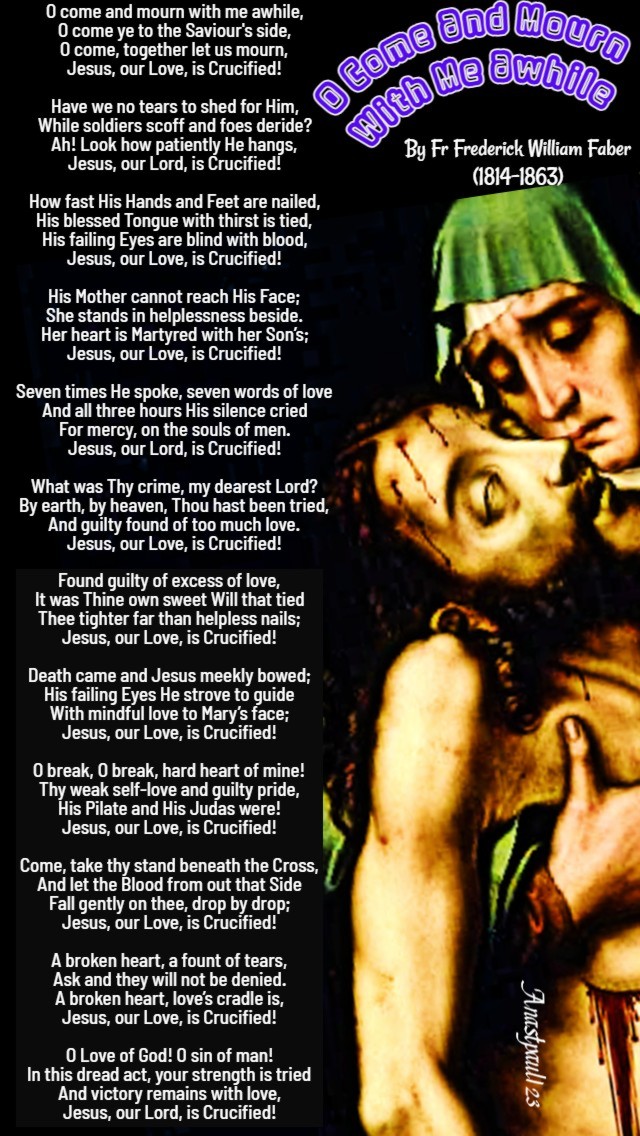
Our Morning Offering – 5 March – Thursday of the Second Week of Lent
Daily Morning Prayer Of St Francis de Sales (1567-1622) Doctor Caritatis
Lord, I lay before Thee my weak heart, which Thou fills with good desires. Thou knows that I am unable to bring the same to good effect, unless Thou bless and prosper them and, therefore, O Loving Father, I entreat Thee to help me by the merits and Passion of Thy dear Son, to Whose honour I would devote this day and my whole life. Amen
Wednesday of the Second Week of Lent – 4 March – Our Lenten Journey With St Thomas Aquinas (1225-1274) Doctor of the Church
Wednesday of the Second Week The Passion of Christ brought about our Salvation because it was an Act of Satisfaction
“He is the propitiation for our sins and not for ours alone but also for those of the whole world.” I John ii. 2.
Satisfaction for offences ,is truly made, when there is offered ,to the person offended, something which he loves as much as, or more than, he hates the offences.
Christ, however, by Suffering through His Love and through His Obedience, offered to God something greater by far than the satisfaction needed by all the sins of all mankind and this for three reasons.
In the first place, there was the greatness of the Love which moved Him to Suffer. Then there was the worth of the Life which He laid down in satisfaction, the Life of God and Man. Finally, on account of the way in which His Passion involved every part of His Being and of the greatness of the Suffering he undertook. So it is that the Passion of Christ was not merely sufficient but superabundant as a satisfaction for man’s sins.
It would seem indeed to be the case that satisfaction should be made by the person who committed the offence. But Head and Members are, as it were, One Mystical Person and, therefore, the satisfaction made by Christ avails all the faithful as they are the Members of Christ. One man can always make satisfaction for another, as long as the two are one in charity.
Although Christ, by His Death, made sufficient Satisfaction for Original Sin, it is not unfitting that the penal consequences of Original Sin should still remain even in those who are made sharers in Christ’s Redemption. This has been done fittingly and usefully, so that the penalties remain even though the guilt has been removed.
(i) It has been done so that there might be conformity between the faithful and Christ, as there is conformity between members and Head. Just as Christ, first of all, suffered many pains and came in this way to His Glory, so it is only right that His faithful should also first be subjected to sufferings and thence enter into immortality themselves, bearing as it were, the livery of the Passion of Christ so as to enjoy a glory somewhat like to His.
(ii) A second reason is that if men coming to Christ were straightaway freed from suffering and the necessity of death, only too many would come to Him attracted rather by these temporal advantages than by spiritual virtues. And this would be altogether contrary to the intention of Christ, Who came into this world that He might convert men from a love of temporal advantages and win them to spiritual love and virtue.
(iii) Finally, if those who came to Christ were straightaway rendered immortal and impassible, this would, in a certain way compel men to receive the Faith of Christ and, therefore, the merit of believing would be lessened.
ST THOMAS AQUINAS (1225-1274) Priest, Theologian, Dominican Doctor Angelicus (Angelic Doctor) Doctor Communis (Common Doctor) Added by Pope Saint Pius V in 1568

Tuesday of the Second Week of Lent – 3 March – Our Lenten Journey With St Thomas Aquinas (1225-1274) Doctor of the Church
Tuesday of the Second Week The Passion of Christ brought about our Salvation because it was a Meritorious Act
“They shall deliver Him to the Gentiles to be Mocked and Scourged and Crucified.” Matt xx. 19
Grace was given to Christ not only as to a particular person but also, as far as He is the Head of the Church, in order that the Grace might pass from Him to His Members. And the good works Christ performed, therefore, stand in this same way in relationship to Him and to His Members, as the good works of any other man in a State of Grace relate to himself.
Now it is evident that any man who, in a State of Grace, suffers for justice, merits for himself, by this very fact alone, salvation. As is said in the Gospel, “Blessed are they who suffer persecution for justice sake” (Matt v. 10). Whence Christ, by His Passion, merited Salvation, not only for Himself but for all His Members.
Christ, indeed, from the very instant of His conception, merited eternal Salvation for us. But there still remained certain obstacles on our part, obstacles which kept us from possessing ourselves of the effect of what Christ had merited. Wherefore, in order to remove these obstacles, it behoved Christ to Suffer (Luke xxiv. 46).
Now although the love of Christ for us was not increased in the Passion and was not greater in the Passion than before it, the Passion of Christ had a certain effect which His previous meritorious activity did not. The Passion produced this effect, not on account of any greater Love shown thereby but because, it was an action designed to produce that effect, as is evident from what has already been said on the fitness of the Passion of Christ.
Head and Members belong to One and the same Person. Now Christ is our Head, according to His Divinity and to the fullness of His Grace which overflows upon others too. We are His Members. What Christ then meritoriously acquires, is not something external and foreign to us but, by virtue of the unity of the Mystical Body, it overflows upon us too.
We should know too, that although Christ, by His Death acquired merit sufficient for the whole human race, there are special elements needed for the particular Salvation of each individual soul and these each soul must itself seek out. The Death of Christ is, as it were, the cause of all Salvation, as the sin of the first man was the cause of all condemnation. But if each individual man is to share in the effect of a universal cause, the universal cause needs to be specially applied to each individual man.
Now the effect of the sin of the first parents is transmitted to each individual through his bodily origin (i.e., through his being a bodily descendant of the first man). The effect of the Death of Christ is transmitted to each man through a spiritual rebirth, a re-birth in which man is, as it were, conjoined to Christ and incorporated with Him.
Therefore, it is that each individual must seek to be born again through Christ and to receive those other elements in which works the power of the Death of Christ.
ST THOMAS AQUINAS (1225-1274) Priest, Theologian, Dominican Doctor Angelicus (Angelic Doctor) Doctor Communis (Common Doctor) Added by Pope Saint Pius V in 1568
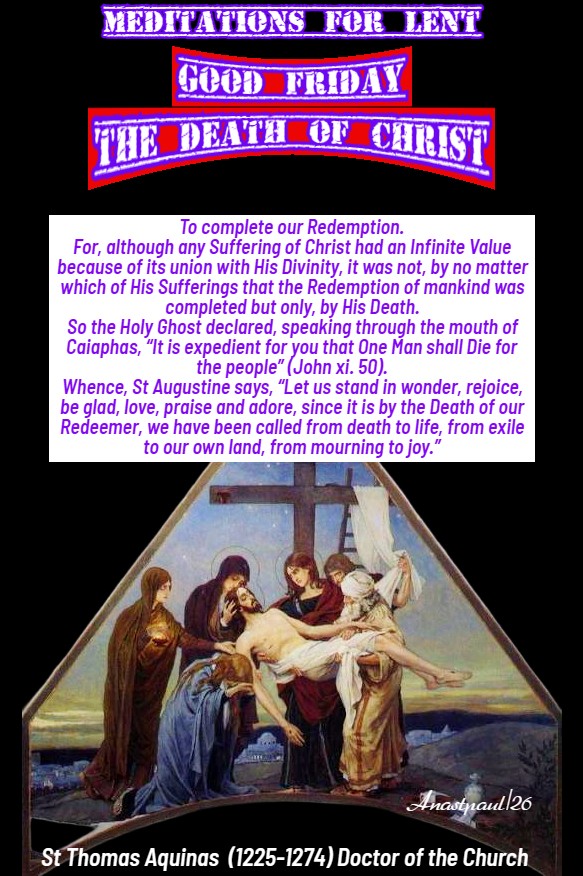
Monday of the Second Week of Lent – 2 March – Our Lenten Journey With St Thomas Aquinas (1225-1274) Doctor of the Church
Monday of the Second Week It was fitting that our Lord should Suffer at the hands of the Gentiles
“They shall deliver Him to the Gentiles to be Mocked and Scourged and Crucified.” Matt xx. 19
In the very manner of the Passion of Our Lord its effects are foreshadowed. In the first place, the Passion of Our Lord had, for its effect , the salvation of Jews, many of whom were baptised in His death.
Secondly, by the preaching of these Jews, the effects of the Passion passed to the Gentiles too. There was thus, a certain fitness in Our Lord’s Passion beginning with the Jews and then, the Jews handing Him on, that it should be completed at the hands of the Gentiles.
To show the abundance of the Love which moved Him to suffer, Christ, on the very Cross, asked mercy for His tormentors. And, since He wished Jew and Gentile alike, should realise this Truth regarding His Love, so He wished that both should have a share in His Suffering.
It was the Jews and not the Gentiles who offered the figurative sacrifices of the Old Law. The Passion of Christ was an Offering through Sacrifice, inasmuch as Christ underwent Death by His Own Will moved by Charity. But, insofar as those who put Him to Death were concerned, they were not offering a sacrifice but committing a Mortal Sin!
When the Jews declared, “It is not lawful for us to put any man to death” (John xix. 31), they may have had many areas of concern in mind. It was not lawful for them to put anyone to death on account of the holiness of the Feast they had begun to keep. Perhaps they wished Christ to be killed not as a transgressor of their own law but as an enemy of the state, because He had made Himself a King, a charge concerning which they had no jurisdiction. Or again, they may have meant that they had no power to crucify which was what they longed for but only to stone, as they later stoned St Stephen. Or, the most likely thing of all, that their Roman Conquerors had taken away their power of life and death!
ST THOMAS AQUINAS (1225-1274) Priest, Theologian, Dominican Doctor Angelicus (Angelic Doctor) Doctor Communis (Common Doctor) Added by Pope Saint Pius V in 1568
The Second Sunday of Lent – 1 March – Our Lenten Journey With St Thomas Aquinas (1225-1274) Doctor of the Church
The Second Sunday God the Father Delivered Christ to His Passion
“God spared not even His own Son but delivered Him up for us all.” Rom viii. 32.
Christ suffered willingly, moved by obedience to His Father. Wherefore, God the Father delivered Christ to His Passion and this, in three ways:
Because the Father, of His Eternal Will, preordained the Passion of Christ as the means whereby to free the human race. So it is said in Isaias, “The Lord hath laid on Him the iniquity of us all” (Isa liii. 6) and again, “The Lord was pleased to bruise Him in infirmity” (ibid liii. 10).
Because He inspired Our Lord with the willingness to suffer for us, pouring into His Soul the Love which produced the will to suffer. Whence the Prophet goes on to say, “He was offered because it was His Own Will” (Isa liii. 7).
Because He did not protect Our Lord from the Passion but exposed Him to His persecutors. Whence we read in St Matthew’s Gospel: as He hung on the cross Christ said, “My God, My God, why hast thou forsaken Me” (Matt xxvii. 46). For God the Father, that is to say, had left Him at the mercy of His torturers.
To hand over an innocent man to suffering and to death, against his will, compelling him to die as it were, would indeed be cruel and wicked. But it was not in this way God the Father delivered Christ. He delivered Christ by inspiring Him with the Will to suffer for us. By so doing, the severity of God is made clear – no sin is forgiven without punishment! which St Paul again teaches when he says, God spared not His Own Son.
At the same time God’s kindness and goodness is exhibited in the fact that whereas man could not, no matter what his punishment, sufficiently make satisfaction, God has given man someone Who is able to make that satisfaction for him. Which is what St Paul means by, He delivered Him up for us all and again when he says, God hath proposed Christ to be an appeasement through faith in His Blood (Rom iii. 25). The same activity in a good man and in a bad man is differently judged, inasmuch as the root from which it proceeds is different. The Father, for example, delivered Christ and Christ delivered Himself and this from love and, therefore, They are praised.
Judas delivered Him from love of gain, the Jews from hatred, Pilate from the worldly fear with which he feared Caesar and these are rightly regarded with horror. Christ, therefore, did not owe to death the debt of necessity but of Charity – the Charity to men by which He willed their Salvation and the Charity to God, by which He willed to fulfil God’s Will, as it says in the Gospel, “Not as I Will but as Thou Wilt (Matt xx vi. 39).
ST THOMAS AQUINAS (1225-1274) Priest, Theologian, Dominican Doctor Angelicus (Angelic Doctor) Doctor Communis (Common Doctor) Added by Pope Saint Pius V in 1568
Saturday of the First Week of Lent – 28 February – Our Lenten Journey With St Thomas Aquinas (1225-1274) Doctor of the Church
Saturday of the First Week The Love of God Exhibited in the Passion of Christ
“God commendeth His charity towards us because when, as yet we were sinners, according to the time, Christ died for us.” Rom v 8, 9
“Christ died for the ungodly” (ibid 6 This is a great thing if we consider Who it is Who died, a great thing too if we consider on whose behalf He died. For scarcely for a just man, will one die (ibid 6), that is to say that you will not find anyone who will die even to set free a man who is innocent, nay even, it is said, “The just perisheth and no man layeth it to heart” (Isaias l vii).
Rightly, therefore, does St.Paul say scarcely will one die. There might perhaps be found one, someone rare person, who out of sa uperabundance of courage, would be so bold as to die for a good man. But this is rare, for the simple reason that so to act is the greatest of all things. “Greater love than this, no man hath, says Our Lord Himself, that a man lay down his life for his friends (John xv. 13).
But the like of that which Christ Himself did, to die for evildoers and the wicked, has never been seen. Wherefore rightly do we ask in wonderment, why Christ did this.
If in fact it be asked, why Christ died for the wicked, the answer is that God, in this way, commendeth His Charity towards us. He exhibits to us in this way that He Loves us with a Love which knows no limits, for while we were as yet sinners, Christ died for us.
The very death of Christ for us, depicts the Love of God, for it was His Son Whom He gave to die that satisfaction might be made for us. God so Loved the world, as to give His Only Begotten Son (John iii. 16). And thus, as the Love of God the Father for us is proved in His giving us His Holy Spirit, so also is it proved in this way, by His Gift of His Only Son.
The Apostle says, God commendeth, signifying thereby that the Love of God cannot be measured. This is exhibited by the very fact of the matter, namely the fact that He gave His Son to die for us and it is proved too by reason of the kind of people we are, for whom He died. “Christ was not stirred up to die for us by any merits of ours, when as yet we were sinners. God (who is rich in mercy) for His exceeding Charity wherewith He Loved us, even when we were dead in sins, hath quickened us together in Christ ” (Eph ii. 4).
All this is almost too much to be believed. “A work is done in your days which no man will believe when it shall be told” (Habac i. 5). This Truth that Christ died for us is so difficult a Truth that scarcely can our intellect grasp it. Nay it is a Truth which our intellect can, in no way understand. And St Paul preaching, makes echo to Habacuc, I work a work in your days, a work which you will not believe, if any man shall tell it to you (Acts xiii 14).
So great is God’s Love for us and His Grace towards us that He does more for us than we can believe or understand.
ST THOMAS AQUINAS (1225-1274) Priest, Theologian, Dominican Doctor Angelicus (Angelic Doctor) Doctor Communis (Common Doctor) Added by Pope Saint Pius V in 1568
Friday of the First Week of Lent – 27 February – Our Lenten Journey With St Thomas Aquinas (1225-1274) Doctor of the Church
Friday After First Sunday The Feast of the Holy Lance Lance and the Nails of Our Lord
“One of the soldiers opened His side with a spear and immediately there came forth Blood and Water.” John xix. 34.
The Gospel deliberately says opened and not wounded because, through Our Lord’s Side, there was opened to us the Gate of Eternal Life. “ After these things I looked and behold, a gate was opened in heaven,” (Apoc iv. i). This is the door opened in the ark, through which enter the animals who will not perish in the flood.
But this door is the cause of our salvation. Immediately there came forth Blood and Water a thing truly miraculous that, from a dead body, in which the blood congeals, Blood should come forth!
This was done to show that by the Passion of Christ we receive a full absolution, an absolution from every sin and every stain. We receive this absolution from sin through that Blood which is the price of our redemption. You were not redeemed with corruptible things as gold or silver, from your vain conversation with the tradition of your fathers but with the Precious Blood of Christ, as of a lamb unspotted and undefiled (i Pet i. 18).
We were absolved from every stain by the Water which is the laver of our redemption. In the Prophet Ezechiel, it is said, “I will pour upon you clean water and you shall be cleaned from all your filthiness” (Ezech xxxvi. 28) and in Zacharias, “There shall be a fountain open to the house of David and to the inhabitants of Jerusalem for the washing of the sinner and the unclean woman” (Zach xiii. i).
And so, these two things may be thought of in relation to two of the Sacraments, the Water to Baptism and the Blood to the Holy Eucharist. Or both may be referred to the Holy Eucharist since, in the Mass, water is mixed with the wine. Although the water is not of the substance of the Sacrament.
Again, as from the side of Christ asleep in death on the Cross there flowed that Blood and Water in which the Church is consecrated, so from the side of the sleeping Adam was formed the first woman, who herself foreshadowed the Church.
ST THOMAS AQUINAS (1225-1274) Priest, Theologian, Dominican Doctor Angelicus (Angelic Doctor) Doctor Communis (Common Doctor) Added by Pope Saint Pius V in 1568
Quote/s of the Day – 27 February – St Gabriel of the Sorrowful Virgin/Gabriel Possenti CP (1838-1862) Confessor
“The Infinite Mercy of God has been able to arrange all things sweetly and today, the Feast of Our Lady of Sorrows, our Protectress and our Mother, I have put on, with unutterable joy, this holy religious Habit and taken the name of Confrater Gabriel of Our Lady of Sorrows.”
(Letter to his Father, From Morrovalle on 21 September 1856)
“What caution, in fact, does it not require, to live as a good Christian in the world!”
(Letter to his Father, From Morrovalle on 21 September 1856)
“Oh, be assured, he whom God calls to the religious life receives a very great favour, a favour which is impossible to estimate at its real value.”
The Feast of the Sacred Lance and Nails – Friday after the 1st Sunday in Lent: The Supreme Pontiff, Innocent VI, in his Decree establishing the Feast and Office of the Lance and Nails which pierced the Body of our Crucified Lord Jesus Christ, exhorts all the faithful to have a special veneration for and devotion to, all the Sacred Instruments of our Saviour’s Passion. The following are the Holy Father’s words: “We should honour the most holy Passion of our Lord and Redeemer, Jesus Christ, in such manner that, meditating on all the mysteries and merits of the same Passion, we venerate also each Sacred Instrument thereof.” Then this holy and zealous Pontiff, coming more directly to the honour due to the Lance and Nails, says: “Although the Lance and Nails and the other Sacred Instruments of the Passion, should be enerated everywhere, by the faithful of Christ and although every year the Church celebrates the Solemn Offices of the same Passion, yet, we deem it proper and fitting, that a special Solemn Feast should be instituted and celebrated in honour of those particular Instruments of the Passion, more especially, in those places wherein these salutary Instruments are preserved. Hence, we wish to encourage this devotion by a special Office and privileges.” (Innocent VI in Decret. de Fest. Lane, et Clav. Domini).
The Lance, also known as “The Spear of Longinus” is kept in the Vatican Basilica, given to Innocent VIII in 1492. The Nails were kept with the Crown of Thorns, along with a small piece of the Lance of Longinus at Saint Chapelle, France and were subsequently lost during the French Revolution. The Crown of Thorns was the only Relic saved and is now kept at Notre Dame Cathedral.
St Basil (8th Century) Monk of Constantinople AND St Procopius (8th Century) Monk of Decapolis St Comgan Bl Emmanuel of Cremona Bishop St Fortunatus of Rome St Herefrith of Lindsey St Honorina
Blessed William Richardson (1572–1603) English Priest, Martyr. He was Beatified on 15 December 1929 by Pope Pius XI. Born in Yorkshire and died by being hanged, drawn and quartered on 27 February 1603 at Tyburn, London, aged just 31. William owns the dubious honour of being the last Martyr under Elizabeth I’s barbaric policy of murdering Catholics and especially Priests, in this manner. His Life and Death: https://anastpaul.com/2023/02/27/saint-of-the-day-27-february-blessed-william-richardson-1572-1603-english-priest-martyr/
Thursday of the First Week of Lent – 26 February – Our Lenten Journey With St Thomas Aquinas (1225-1274) Doctor of the Church
Thursday of the First Week of Lent It was fitting that Christ should be Crucified with the Thieves
Christ was Crucified between the thieves because such was the will of the Jews and also because, this was part of God’s Design. But the reasons why this was appointed, were not the same in each of these cases.
As far as the Jews were concerned, Our Lord was Crucified with the thieves on either side to encourage the suspicion that He too was a criminal. But it transpired otherwise! The thieves themselves have left not a trace in the remembrance of man, while His Cross is everywhere held in honour. Kings lying their crowns aside, have embroidered the Cross on their Royal robes. They have placed it on their crowns; on their armiur. It has its place on the very Altars. Everywhere, throughout the world, we behold the splendour of the Cross.
In God’s Plan, Christ was Crucified with the thieves in order, for our sakes, He became accursed of the Cross, so, for our salvation, He is Cucified like an evil Man amongst evil men.
The Pope, St Leo the Great, says that the thieves were crucified, one on either side of Our Lord, so that, in the very appearance of the scene of His Suffering, there might be set forth that distinction which should be made in the judgement of each one of us. St Augustine has the same thought. “The Cross itself,” he says, “was a tribunal. In the centre was the Judge. To the one side a man who believed and was set free, to the other side, a scoffer and he was condemned.” Already there was made clear the final fate of the living and the dead, the one class placed at His Right, the other on His Left.
According to St Hilary, the two thieves, placed to right and to left, typify that the whole of mankind is called to the mystery of Our Lord’s Passion. And, since division of things, according to right and left is made with reference to believers and those who will not believe, one of the two, placed on the right, is saved by justifying faith.
As St Bede says, the thieves who were crucified with Our Lord, represent those who, for the faith and to confess Christ, undergo the agony of martyrdom or the severe discipline of a more perfect life. Those who do this for the sake of eternal glory are typified by the thief on the Right Hand. Those whose motive is the admiration of whoever beholds them, imitate the spirit and the act of the thief on the Left Hand.
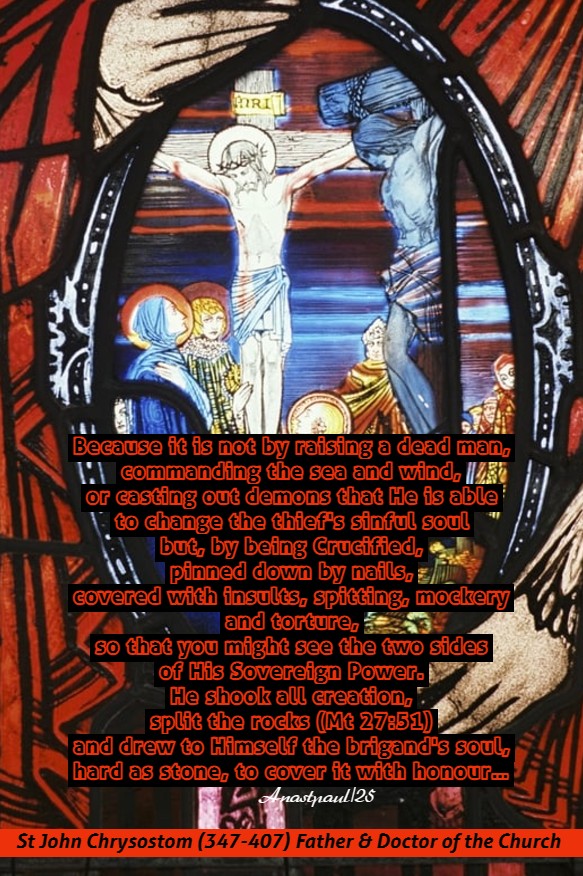
As Christ owed no debt in payment for which a man must die but submitted to death of His Own Will, in order to overcome death, so also, He had not done anything on account of which He deserved to be put with the thieves. But of His Own Will, He chose to be reckoned among the wicked that by His Power, He might destroy wickedness itself. Which is why St John Chrysostom says, to convert the thief on the cross and to turn him to Paradise, was as great a miracle as the earthquake!
ST THOMAS AQUINAS (1225-1274) Priest, Theologian, Dominican Doctor Angelicus (Angelic Doctor) Doctor Communis (Common Doctor) Added by Pope Saint Pius V in 1568
Wednesday of the First Week of Lent – 25 February – Our Lenten Journey With St Thomas Aquinas (1225-1274) Doctor of the Church
Wednesday of the First Week of Lent How Great was the Sorrow of Our Lord in His Passion?
“Attend and see if there be any sorrow like unto My sorrow.” Lam i. 12.
Our Lord as He suffered felt in reality and in His Senses, that pain which is caused by some harmful bodily injuries. He also felt that interior pain which is caused by the fear of something harmful and, which we call sadness. In both these respects, the pain suffered by Our Lord was the greatest pain possible in this present life. There are four reasons why this was so.
The causes of the pain. The cause of the pain in the senses was the catastrophic injuries to the body, a pain whose bitterness derived partly from the fact that the sufferings attacked every part of His Body and partly, from the fact that, of all species of torture , death by Crucifixion is undoubtedly the most bitter. The nails are driven through the most sensitive of all places, the hands and the feet, the weight of the body itself increases the pain every moment. Add to this the long extentuated agony, for the Crucified do not die immediately as do those who are beheaded. The cause of the internal pain was: (i) All the sins of all mankind for which, by suffering, He was making satisfaction, so that, in a sense, He took them to Himself as though they were His own. The words of my sins, it says in the Psalms (Ps xxi. 2).
(ii) The special case of the Jews and the others who had had a share in the sin of His death and especially, the case of His disciples for whom His death had been a thing to be ashamed of.
(iii) The loss of His Bodily Life which, by the nature of things, is something from which human nature turns away in horror.
We may consider the greatness of the pain according to the capacity, bodily and spiritual, for suffering of Him Who suffered. In His Body He was most admirably formed, for it was formed by the miraculous operation of the Holy Ghost and, therefore, Iits Sense of Touch, the sense through which we experience pain, was of the keenest. His Soul likewise, from Its interior powers, had a knowledge as from experience of all the causes of sorrow.
The greatness of Our Lord’s Suffering can be considered in regard to this that the pain and sadness were without any alleviation. For, in the case of no matter what other sufferer, the sadness of mind and even the bodily pain, is lessened through a certain kind of reasoning, by means of which there is brought about a distraction of the sorrow from the higher powers to the lower. But when Our Lord suffered this did not happen, for He allowed each of His Powers to act and suffer to the fullness of its special capacity.
We may consider the greatness of the suffering of Christ in the Passion, in relationship to this fact, that the Passion and the pain it brought with it, were deliberately undertaken by Christ with the object of freeing man from sin. And, therefore, He undertook to suffer an amount of pain proportionately equal to the extent of the fruit which was to follow from the Passion.
From all these causes, if we consider them together, it will be evident that the pain suffered by Christ was the greatest pain ever suffered.
ST THOMAS AQUINAS (1225-1274) Priest, Theologian, Dominican Doctor Angelicus (Angelic Doctor) Doctor Communis (Common Doctor) Added by Pope Saint Pius V in 1568
Tuesday of the First Week of Lent – 24 February – Our Lenten Journey With St Thomas Aquinas (1225-1274) Doctor of the Church
Tuesday of the First Week : Christ underwent every kind of suffering
“Every kind of suffering.” The things men suffer may be understood in two ways. By “kind” we may mean a particular, individual suffering and in this sense, there was no reason why Christ should suffer every kind of suffering, for many kinds of sufferings are contrary, one to the other, as for example, to be burnt and to be drowned. We are of course, speaking of Our Lord as suffering from causes outside Himself, for to suffer the suffering effected by internal causes, such as bodily illness, would not have become Him. But, if by “kind” we mean, the class, then Our Lord did suffer by every kind of suffering, as we can show in three ways:
By considering the men through whom He suffered. For He suffered something at the hands of Gentiles and of Jews, of men and even of women as the story of the servant girl who accused St.Peter goes to show. He suffered, again, at the hands of Rulers, of their Ministers, and of the people, as was prophesied, Why have the Gentiles raged and the people devised vain things? The Kings of the earth stood up and the Princes met together against the Lord and against His Christ (Ps ii. i, 2). He suffered, too, from His friends, the men He knew best, for Peter denied Him and Judas betrayed Him.
If we consider the things through which suffering is possible. Christ suffered in the friends who deserted Him and in His good name through the blasphemies uttered against Him. He suffered in the respect, in the glory, due to Him through the derision and contempt bestowed upon Him. He suffered in all things, for He was stripped even of His clothing; in His soul, through sadness, through weariness and through fear; in His body through wounds and the scourging.
If we consider what He underwent in His various members. His head suffered through the Crown of piercing Thorns, His hands and feet, through the nails driven through them, His face from the blows and the defiling spittle and His whole body through the scourging.
He suffered in every sense of His body. Touch was afflicted by the scourging and the nailing, taste by the vinegar and gall, smell by the stench of corpses as He hung on the Cross in that place of the dead which is called Calvary. His hearing was torn with the voices of mockers and blasphemers and He saw the tears of His Mother and of the disciple whom He loved. If we only consider the amount of suffering required, it is true that one suffering alone, the least indeed of all, would have sufficed to redeem the human race from all its sins. But if we look at the fitness of the matter, it had to be that Christ should suffer in all the kinds of sufferings.
ST THOMAS AQUINAS (1225-1274) Priest, Theologian, Dominican Doctor Angelicus (Angelic Doctor) Doctor Communis (Common Doctor) Added by Pope Saint Pius V in 1568
Ash Friday – 20 February – Our Lenten Journey With St Thomas Aquinas (1225-1274), Doctor of the Church
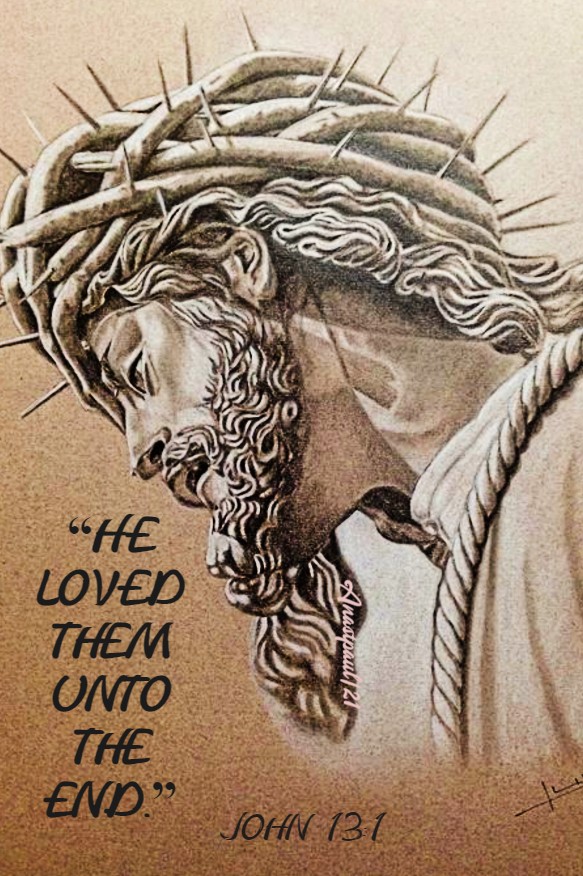
Friday : The Crown of Thorns
“Go forth, ye daughters of Sion and see King Solomon in the diadem, wherewith his mother crowned him in the day of his espousals and in the day of the joy of his heart.” Cant iii. n.
This is the voice of the Church inviting the souls of the faithful to behold the marvellous beauty of her Spouse. For the daughters of Sion, who are they but the daughters of Jerusalem, holy souls, the citizens of that City which is above, who with the Angels enjoy the peace which knows no end and, in consequence, look upon the glory of the Lord?
Go forth, shake off the disturbing commerce of this world so that, with minds set free, you may be able to contemplate Him Whom you love. And see King Solomon, the true Peacemaker, that is to say, Christ Our Lord.
In the diadem wherewith his mother crowned him, as though the Church said, “Look on Christ garbed with Flesh for us, the Flesh He took from the flesh of His Mother.” For it is His Flesh which is here called a Diadem, the Flesh which Christ assumed for us, the Flesh in which He died and destroyed the reign of death, the Flesh in which, rising once again, He brought to us the hope of resurrection.
This is the Diadem of which St.Paul speaks, We see Jesus for the suffering of death crowned with glory and honour (Heb ii. 9). His Mother is spoken of as crowning Him because Mary the Virgin it was, who from her own flesh gave Him Flesh.
In the day of His espousals, that is, in the hour of His Incarnation, when He took to Himself the Church not having spot or wrinkle (Eph v. 27), the hour again when God was joined with man. And in the day of the joy of His heart. For the joy and the gaiety of Christ, is for the human race, salvation and redemption. And coming home, He calls together His friends and neighbours saying to them, Rejoice with Me because I have found My sheep which was lost (Luke xv. 6).
We can, however, refer the whole of this text simply and literally, to the Passion of Christ. For Solomon, foreseeing through the centuries the Passion of Christ, was uttering a warning for the daughters of Sion, that is, for the Jewish people.
Go forth and see King Solomon, that is, Christ, in His Diadem, that is to say, the Crown of Thorns, with which His Mother, the Synagogue has crowned Him; in the day of His espousals, the day when He joined to Himself the Church and in the day of the joy of His heart, the day in which He rejoiced that by His Passion, He was delivering the world from the power of the devil. Go forth, therefore, and leave behind the darkness of unbelief and see, understand with your minds, He Who suffers as Man is really God!
Go forth, beyond the gates of your City, that you may see Him, on Mount Calvary, Crucified.
ST THOMAS AQUINAS (1225-1274) Priest, Theologian, Dominican Doctor Angelicus (Angelic Doctor) Doctor Communis (Common Doctor) Added by Pope Saint Pius V in 1568
Friday after Ash Wednesday – FASTING and ABSTINENCE
THE FEAST OF THE SACRED CROWN OF THORNS One of the “Seven Passion Feasts” – celebrated on the the Friday after Ash Wednesday. The first Feast in honour of the Sacred Crown of Thorns (Festum susceptionis coronae Domini) was instituted at Paris in 1239, when Saint Louis IX of France brought there the Relic of the Crown of Thorns which was deposited later in the Royal Chapel, erected in 1241–1248 to guard this and other Relics of the Passion. https://anastpaul.com/2024/02/16/feast-of-the-sacred-crown-of-thorns-of-our-lord-jesus-christ-friday-after-ash-wednesday/
St Leo of Catania (c720-789) Bishop, Defender of Sacred Images for which opposition he was forced to flee into exile for some years, Hermit. Born in c720 in Ravenna, Italy and died on 20 February 789 in Etna, Sicily, Italy, natural causes. St Leo was the 15th Bishop of Catania, Sicily, famed for his love and care for the poor, his brave opposition to the iconoclastic Government of the time and for his Miracles. Courageous St Leo: https://anastpaul.com/2024/02/20/saint-of-the-day-20-february-st-leo-of-catania-c720-789-bishop/ St Nemesius of Cyprus
One Minute Reflection – 27 December – “The Month of the Divine Infancy and the Immaculate Conception of the Blessed Virgin Mary” – St John, the Apostle and Evangelist, the Beloved – St John the Apostle and Evangelist – Ecclesiasticus 15:1-6 – John 21:19-24 – Scripture search here: https://www.drbo.org/
“What if I want him to remain until I come? What concern is it of yours? You follow Me.” – John 21:22
REFLECTION – “The Church knows of two lives advocated and recommended by God . One in faith, the other in vision; one in our pilgrimage through time, the other in the abode of eternity; one in working, the other in repose; one on the way, the other in our homeland; one in the labour of action, the other in the reward of contemplation. … The first is represented by the Apostle Peter, the second, by John. The first wholly takes place here below, until the end of the world and then comes to an end. The second only reaches its fulfilment after the world’s end; in the world to come, it will never end.
“What if I want him to remain until I come? What concern is it of yours? You follow Me” …. Let your action follow Me, perfect and modelled on the example of My Passion; let the contemplation which has begun, remain until My return: I will perfect it when I come again. For this persevering fervour which stands firm to the death, is a following of Christ and this knowledge, which will then be manifested in fullness, remains until the return of Christ. Here, in the country of mortal men, we must undergo the afflictions of this world; there, we shall contemplate the Lord’s blessings, in the land of the living (Ps 26:13). …
So let no-one divide one from the other of these two, glorious Apostles, for both are contained in what Peter symbolises and both, will be in what John represents.” – St Augustine (354-320) Father and Doctor of Grace (Sermons on Saint John’s Gospel No 124: 5-7).
PRAYER – O Lord, graciously shed light upon Thy Church, so that, enlightened by the teachings of blessed John, ThyApostle and Evangelist, she may gain YThy everlasting rewards.Through Jesus Christ, Thy Son our Lord, Who lives and reigns with Thee, in the unity of the Holy Ghost, God, world without end. Amen (Collect).
Quote/s of the Day – 13 December – St Lucy, Virgin Martyr – 2 Corinthians 10:17-18; 11:1-2 – Matthew 13:44-52 – Scripture search here: https://www.drbo.org/
“Jesus said in parables: The Kingdom of Heaven is like unto a treasure, hidden in a field. … Again, the Kingdom of Heaven is like unto a merchant seeking good pearls. ”
Matthew 13:44, 45
“Do not lay up for yourselves treasures on earth, where rust and moth consume and where thieves break in and steal but lay up for yourselves, treasures in Heaven …”
Matthew 6:19-20
“Listen, then, my son and give me your ear. Break off all ties which bind and entangle you in this world. Change your secular service into something better, start being a soldier for the eternal King!”
St Paulinus of Nola (c354-431)
“Watch, therefore and pray and labour diligently and do not delay to weave the web of your wedding-garment that you may be found ready and adorned to meet the Bridegroom! And remember daily that He, Who gives you the morning, does not promise you the evening and although He gives the evening, yet promises not the morrow. Spend, therefore, every moment of every hour according to God’s will, as if it were your last and so much the more carefully, as, for every moment, you will have to give the strictest account!
Finally, I warn you to account that day lost, in which you will neither have gained some victory over your evil inclinations and your self-will, although it may have been full of busy action, nor returned thanksgiving to your Lord for His mercies and especially for His bitter Passion endured for you and for His sweet and fatherly correction, when He has made you worthy to receive, at His Hand, the inestimable treasure of suffering.”
Quote/s of the Day – 4 December – St Peter Chrysologus (c400-450) “Golden Words” Confessor, Father & Doctor of the Church
“He is The Bread sown in the virgin, leavened in the Flesh, moulded in His Passion, baked in the furnace of the Sepulchre, placed in the Churches and set upon the Altars, which daily supplies Heavenly Food to the faithful.”
“For he who touches the Body of Christ unworthily receives his damnation!”
Quote/s of the Day – 5 November – All Saints and Blesseds of the Society of Jesus (SJ)
I Love Thee, O Thou Lord Most High! Translation and Parphrase of St Ignatius Loyola’s Latin Hymn By Fr Edward Caswell CO (1814-1878)
I love, I love Thee, Lord most high! Because Thou first hast loved me; I seek no other liberty But that of being bound to Thee.
May memory no thought suggest, But shall to Thy pure glory tend; My understanding find no rest Except in Thee, its only End.
My God, I here protest to Thee, No other will have I than Thine; Whatever Thou hast given me, I here again to Thee resign.
All mine is Thine — say but the word, Whate’er Thou wllest shall be done; I know Thy Love, all-gracious Lord; I know It seeks my good alone.
Apart from Thee, all things are naught; Then grant, O my supremest bliss! Grant me to love Thee as I ought; Thou givest all in giving this!
“A precious crown is reserved in Heaven for those who endow their actions with all the diligence of which they are capable, for, it is not enough to do good, we must do it well!”
“God takes special care to detach from the passing pleasures of this world, those whom He Loves with special predilection, by sending them desires after heavenly bliss and, by the sorrows and bitterness of the present life.”
St Ignatius Loyola (1491-1556)
I Love Thee, God, I Love Thee O Deus Ego Amo Te By St Francis Xavier (1506-1552) Translated by Gerard Manley Hopkins SJ (1844-1889)
I love Thee, God, I love Thee— Not out of hope for Heaven for me Nor fearing not to love and be in the everlasting burning. Thou, my Jesus, after me Didst reach Thine arms out dying, For my sake suffered nails and lance, Mocked and marred countenance, Sorrows passing number, Sweat and care and cumber, Yea and death and this for me, And Thou could see me sinning. Then I, why should not I love Thee, Jesu so much in love with me? Not for Heaven’s sake, not to be Out of hell by loving Thee, Not for any gains I see, But just the way that Thou didst me I do love and will love Thee. What must I love Thee, Lord, for then? For being my King and God. Amen
“We must make our way towards eternity, never regarding what men think of us, or of our actions, studying only to please God.”
St Francis Borgia (1510-1572)
““Man’s salvation and perfection consists in doing the Will of God which he must have in view in all things and, at every moment of his life.”
St Peter Claver (1581-1654)
“Can we think, the life of man, better employed than in this good work? What do I say? Would not all the labours of a thousand men, be well rewarded, in the conversion of a single soul gained to Jesus Christ? I have always felt a great love for this kind of life and for a profession so excellent and so akin to that of the Apostles.”
St Isaac Jogues (1607-1646) Martyr
“Are we in the habit of seeing all thing in God and God in all things? Do we accept all things from His Holy Hands and do His Will cheerfully and lovingly? Do we try to control ourselves when God sends us sorrows, in addition to joy? If we find we are in need of reform in this matter, we should make good resolutions and fulfil them!”
One Minute Reflection – 4 Novemer – “The Month of The Holy Souls in Purgatory” – Saint Charles Borromeo (1538-1584) – Sirach 44:16-27; 45:3-20 – Matthew 25:14-23 – Scripture search here: https://www.drbo.org/
“Well done, good and faithful servant … Enter thou into the joy of thy Lord.”- Matthew 25:21
REFLECTION – “The Word of the Father, Only-begotten Son of God, Sun of Justice (Mal 3:20), is the great Merchant Who has brought us the price of our redemption. It is a truly precious exchange which we can never value sufficiently, when a King, Son of the King Most High, has become the Coin, the Gold has paid our dues, the Just Man is given for the sinner. Truly unmerited mercy, perfectly disinterested love, astonishing goodness …, it is a completely disproportionate purchase, in which the Son of God is delivered up for the servant, the Creator is put to death for the one He has created, the Lord is condemned for His slave.
O Christ, these are Thine Works, Thou Who descended from Heaven’s brightness into our hellish darkness, to bring Light to our gloomy prison. Thou came down from the Right Hand of the Divine Majesty, into our human misery, to redeem the human race, Thou Who descended from the Father’s glory, to death on the Cross, to triumph over death and its author. Thou art the only One and there is no other but Thee Who could have been drawn to redeem us through Thine Own Goodness…
Let all the merchants of Teman (Bar 3:23) withdraw from this place … it is not they but Israel [Thy] beloved whom [Thou hast] chosen, Thou Who hide these mysteries from the wise and prudent and have revealed them to those babes and humble servants of Thine (Lk 10:21) … O Lord, I willingly embrace this purchase since it concerns me!… I remember all the things Thou hast done, Thou Who desire that I should keep them alive … Therefore, I shall profit by this talent which Thou hast lent to me until Thy return and will stand before Thee with great joy. O God, grant that I may then hear these sweet words: “Well done, good and faithful servant! Enter thou into the joy of thy Lord” (Mt 25:21).” – St Bernard O.Cist. (1091-1153) Cistercian Monk, known as the Last Father and the Mellifluous Doctor of the Church (Selected sermons, no 42: The Five Purchases).
PRAYER – Safeguard Thy Church, O Lord, under the continual protection of St Charles, Thy Confessor and Bishop, so that just as his concern for his flock made him glorious, so his intercession may make us ever fervent in loving Thee. Through Jesus Christ, Thy Son our Lord, Who lives and reigns with Thee, in the unity of the Holy Ghost, God, world without end. Amen (Collect).
Our Morning Offering – 4 Novemer – “The Month of The Holy Souls in Purgatory”
My God! I Recommend to Thee … Prayer for the Holy Souls in Purgatory By St Alphonsus Maria de Liguori (1696-1787) Most Zealous Doctor
My God! I recommend to Thee, the souls of my relatives, my benefactors, my friend, my enemies and of those, who are in Purgatory on my account. I recommend to Thee, the souls of Evangelical labourers, of Religious and Priests and especially of those, who had charge of my soul. I recommend to Thee, the souls of those, who were most devout to the Passion of Our Lord, to the Blessed Sacrament, to the Sacred Heart of Jesus and to the Blessed Virgin Mary, the souls, who are most abandoned, those, who suffer most and those, who are nearest to the entrance into Paradise. Amen.
Thought for the Day – 14 October – Meditations with Antonio Cardinal Bacci (1881-1971)
“Month of the Holy Rosary” The First Glorious Mystery The Resurrection of Our Lord
“Do we wish to share also in the joy of the Resurrection of Jesus Christ? Let us imitate Mary. First of all, we must participate as she did in the sufferings of Christ. By meditating frequently on the Passion and Death of Christ, we can nourish in our hearts, an intense love for Him Who suffered so much for our salvation. Let us learn to carry our cross, as He carried His, with resignation and with conformity to God’s Will. Spiritual joy is always the fruit of renunciation and love.
We cannot be happy with Jesus triumphant ,if we have not first imitated Jesus suffering. We cannot rise gloriously into Heaven, if we have not first walked patiently with Mary along the Way of Calvary!”
Thought for the Day – 13 October – Meditations with Antonio Cardinal Bacci (1881-1971)
“Month of the Holy Rosary” The Fifth Sorrowful Mystery The Crucifixion
“At last, Jesus reaches Calvary, breathless and reduced to utter exhaustion. The instrument of torture is taken from Him and laid upon the ground. Our divine Redeemer suffers acute pain as Her is again stripped of His garments, which have stuck to His wounds. Now, He is stretched, an innocent victim, on the altar of sacrifice, the Cross. One of the executioners grasps His hand, pierces it with a large nail and attaches it to the wood. Then, he does the same with the other hand and with the two feet. His Mother is close at hand. She feels in her heart the blows of the hammer which lacerate the living flesh of Jesus. Jesus remains silent “as a meek lamb that is carried to be a victim” (Jer 11:19).
Now, the executioners raise up the Cross and fix it in the hold already prepared for it. The shock of this impact sends a shudder of terrible pain through the Victim’s members and entire frame. Behold Him now, suspended between Heaven and earth, the Mediator between God and humanity, the Victim of Expiation for the innumerable sins of men.
Come near to the Cross and kiss the bloodstained feet. While the Jews are insulting Him and most of the Apostles have abandoned Him, let us tell Him how much we love Him. Let us tell Him of our sorrow for our sins and of our determination to make amends for our faults and for our ingratitude, by living in accordance with His teachings and example.”
Thought for the Day – 12 October – Meditations with Antonio Cardinal Bacci (1881-1971)
“Month of the Holy Rosary” The Fourth Sorrowful Mystery The Road to Calvary
“Scourged, crowned with thorns and derided, Jesus is finally condemned to death. Burdened with the Cross, He sets out for the place of execution in the midst of a crowd of enemies, blasphemers and idle speculators. Among them , there is only a tiny group which sympathises with Jesus, namely, Mary His Mother, the devout women and the beloved Apostle, St John.
The divine Redeemer goes forward laboriously beneath the heavy weight of the Cross. He has already lost a large quantity of blood in Gethsemane and during the scourging and crowning with thorns. His strength seems to be failing but love sustains Him. Looking feebly around Him, He sees the mocking Jews, the indifferent and disrespectful Roman soldiers and a throng of curious spectators looking for something to amuse them. Is there nobody else? Where are those whom He cured miraculously and those whom He comforted and forgave? Has nobody any pity for Him? Suddenly the crowd falls silent. A woman, pale and tearful, is approaching Him, supported by her friends. She defies the commands of soldiers and the scowls of the executions and comes close to Him.
Here and there, a murmur is heard – It must be His Mother, poor woman! Jesus and Mary gaze at one another. It would be impossible for us to guess at the immense depths of love contained in that loving exchange of glances. Neither utters a word, for no words could express their anguish, nor manifest their love. They look and understand one another, offering themselves as a holocaust for the redemption of wayward humanity.
Nevertheless, in this silent meeting, there was great consolation for the Heart of Jesus, for He had found someone who loved and understood Him, amongst those malicious throngs. Why do we not sympathise with Him too and love Him with all our hearts?”
Thought for the Day – 10 October – Meditations with Antonio Cardinal Bacci (1881-1971)
“Month of the Holy Rosary” The Third Sorrowful Mystery The Crowning with Thorns
“This new torture was a diabolical invention decreed by no law or authority. Purely for their own savage entertainment, the soldiers procured a bundle of thorned reeds, which they wound into the shape of a crown and pressed into Jesus’ head.
Mary knew what was going on. She was there with the holy women when Pilate brought her bloodstained Son before the people and, their blasphemous yells pierced her tender heart. Her mother’s heart felt the sharp thorns too but, she accepted this affliction with resignation, silently protesting against the insults of the crowd by acts of adoration and of love. We should behave in this way also. We should participate in the passion of Jesus, by offering our own sufferings and we should make acts of love and of self-surrender, in reparation for these acts of blasphemy!”
Thought for the Day – 9 October – Meditations with Antonio Cardinal Bacci (1881-1971)
“Month of the Holy Rosary” The Second Sorrowful Mystery The Scourging
“Tradition holds that Mary followed Jesus through the various stages of His Passion. It is impossible to believe that she would have abandoned Him in these tragic hours. She must, at least, have known of the cruel flogging which He endured and, while His body was being torn by lashes, she was most probably not far away, participating, by her maternal sorrow, in her Son’s torment. Here, then, was a double Martyrdom – the Martyrdom of Blood and the Martyrdom of tears.
Life demands the shedding of blood and the shedding of tears! What are the motives which cause you sorrow in life? Are yours the tears of unsated ambition, of frustrated caprice, or of discouragement in times of trouble? Such tears are not worthy of a Christian. His, should be tears of repentance for his sins and tears of love for Jesus and Mary.”
You must be logged in to post a comment.