Our Morning Offering – 13 June – “The Month of the Sacred Heart of Jesus” and the Feast of the Eucharistic Heart of Jesus instituted by Pope Benedict XV
O Most Sacred Heart of Jesus! By Pope Benedict XV (1854-1922)
O Most Sacred Heart of Jesus! O Fount of every good! I adore Thee, I love Thee and sincerely repenting of my sins, I present to Thee my poor heart. Give it back to me humble, patient, pure and in everything, conformed to Thy wishes. Make me, O good Jesus, live in Thee and for Thee. Protect me in dangers, comfort me in afflictions, grant me health of body, succour in my temporal needs, Thy blessing in all my works and the grace of a holy death. Amen
Indulgence – 100 days Once a day Pope Benedict XV 4 December 1916
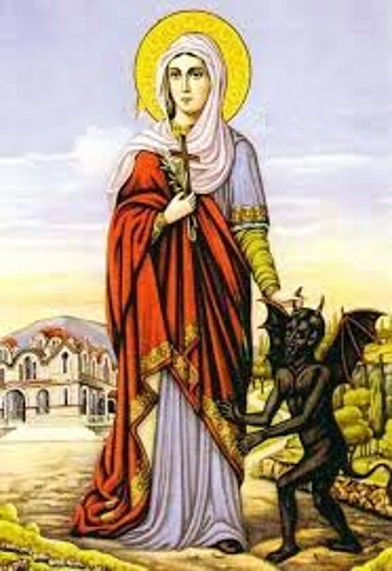
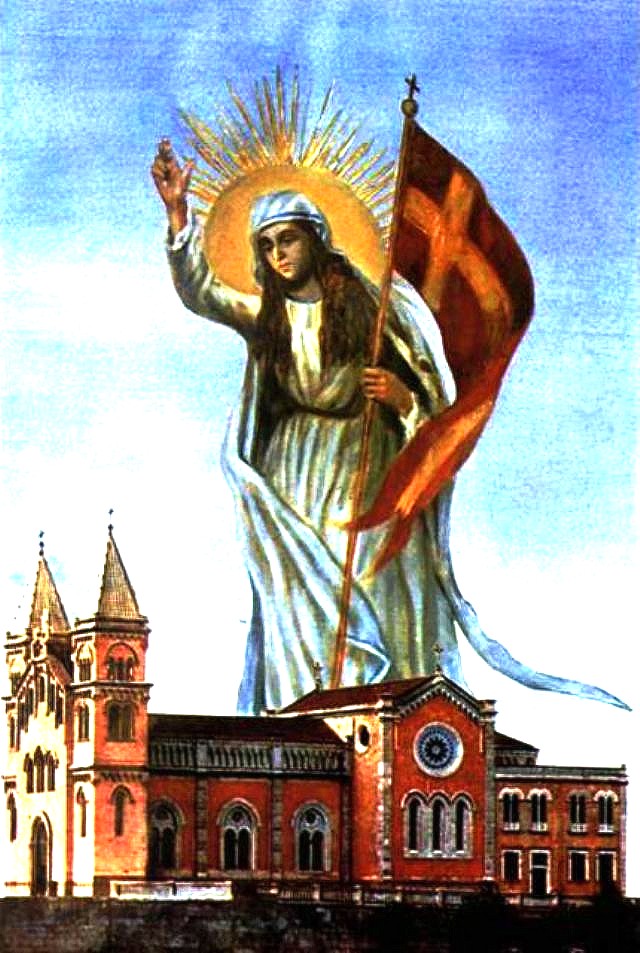
Saint of the Day – 13 June – Saint Aquilina of Syria (281–293) Virgin Child Martyr. Born in 281 in Byblos, Phoenicia (in modern Lebanon) and died by torture in 293 in Byblos during the reign of Diocletian. Also known as – Aquilina of Byblos, Aquilina of Biblus, Aquilina of Lebanon..
The Roman Martyrology reads today: “At Byblos, in Palestine, St Aquilina, Virgin and Martyr, at the age of 12 years, under the Emperor Diocletian and the Judge Volusian. For the confession of the Faith, she was buffeted, scourged, pierced with red-hot bodkins and, being struck with the sword, consecrated her virginity by Martyrdom.”
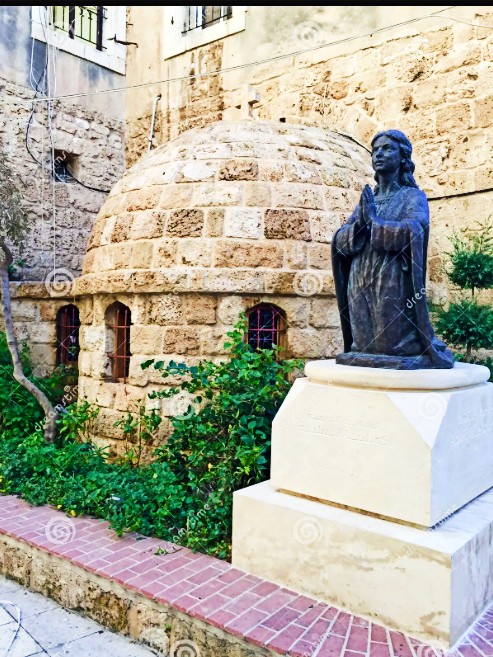
Statue of St Aquilina outside the Church dedicated to her in Lebanon
Between 63 and 330 Byblo in modern Lebanon was under Roman rule and, although Christianity existed there from the time of the Apostles, Christians were a minority among the majority pagans. During their rule, the Romans not only strengthened the worship of idols but some of their governors actively persecuted the Christians. When Aquilina was condemned to death in 293, Volusian was the Magistrate of Byblos.
Aquilina, a native of the Phoenician (now Lebanon) City of Byblos, suffered under Emperor Diocletian in the 3rd Century. Her father’s name was Eutolmius. She was raised in Christian piety by her parents. She received her catechism from Evthalios, the Bishop of Byblos.
When she was only twelve years old, she persuaded a pagan friend to convert to Christ through her example and teachings. One of the servants of Governor Volusian accused her of teaching others to reject paganism. She was taken before the Governor where she firmly confessed her belief in Christ and said that she would not renounce Him. Volusian tried to influence her through persuasion and flattery but, seeing her confidence, he ordered her to be tortured.
She was struck upon the face, then stripped and flogged. Heated metal rods were then drilled through her ears and Aquilina fell down as if dead. The torturers thought that she had actually died and gave orders that her body be thrown outside the City to be eaten by dogs. However, later that night, an Angel appeared to Aquilina, roused her and said, “Arise and be healed. Go and denounce Volusian, so that he and his plans may come to nothing.”
Aquilina regained consciousness and went before Volasian, who sentenced her to be decapitated in the morning, saying that she was a sorceress who refused his imperial decrees. Before the executioner could carry out the sentence, the Martyr gave up her spirit. The Christians buried her body outside the City where her Tomb became a site for pilgrimage and cures.
Later her holy Relics were transported to Constantinople where a great Basilica was built in her honour near the Forum of Constantine in the Philoxene quarter. This Basilica was later destroyed in a fire.
St Fandilas of Penamelaria St Felicula of Rome St Fortunatus of North Africa
Blessed Gerard of Clairvaux (Died 1138) – was the elder brother of Saint Bernard of Clairvaux. He was a Soldier. When he was wounded in combat at the siege of Grancy, Gerard resolved to become a Monk. He became a Benedictine Cistercian Monk at Citeaux. He worked with Saint Bernard at Clairvaux and became his closest confidant. He died in 1138 of natural causes.
St Lucian of North Africa St Mac Nissi of Clonmacno St Maximus of Cravagliana St Nicolas Bùi Ðuc The St Peregrinus of Amiterno St Rambert St Salmodio Bl Servatius Scharff St Thecla
Thought for the Day – 12 June – Meditations with Fr Richard Frederick Clarke SJ (1839-1900)
PATIENCE Meditations for a Month
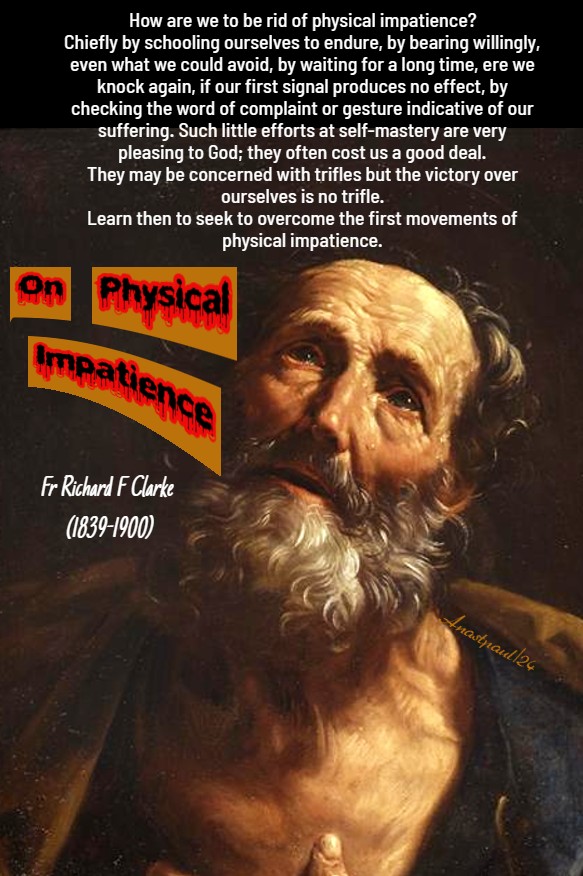
On Physical Impatience
Physical impatience is that involuntary feeling of irritation which is aroused in us by some external and physical cause. We are looking for something and cannot find it. We are trying to focus our thoughts and some distracting noise renders it impossible. We are trying to compose ourselves to sleep and some troublesome neighbour wakes us just as slumber was creeping over us. On account of all such impatience, we should humble ourselves, as being a sign of faults indulged in the past, not of present sin.
2. This sort of physical impatience, anticipating our reason, is very often the result of impatience, pride, self-will long indulged. The ghost of past sins reappearing to remind us of what we have forgotten and, to keep us humble. Not always, for St Teresa tells us that owing to ill-health and desolation, she had the greatest difficulty in remaining calm and gentle and in resisting the impulse to speak sharply and disagreeably. But as a general rule, such physical impatience may be taken, at all events, while we are in good health, as a mark of pride not completely subdued and of self-will, which has not fully learned to submit.
3. How are we to be rid of physical impatience? Chiefly by schooling ourselves to endure, by bearing willingly, even what we could avoid, by waiting for a long time, ere we knock again, if our first signal produces no effect, by checking the word of complaint or gesture indicative of our suffering. Such little efforts at self-mastery are very pleasing to God; they often cost us a good deal. They may be concerned with trifles but the victory over ourselves is no trifle. Learn then to seek to overcome the first movements of physical impatience.
Quote/s of the Day – 12 June – Ecclesiasticus i 31:8-11; Luke 12:35-40– Scripture search here: https://www.drbo.org
“Let your loins be girt about and your lamps burning …”
Luke 12:35
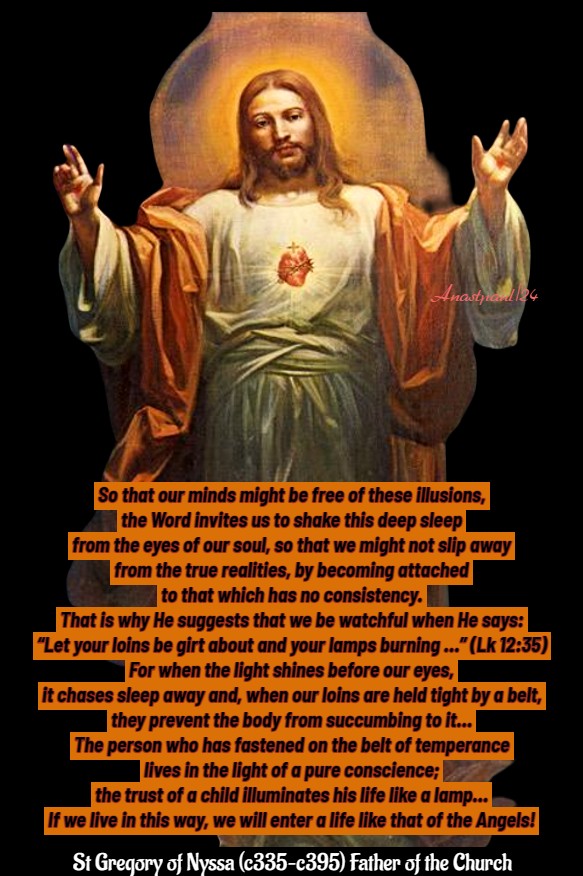
“So that our minds might be free of these illusions, the Word invites us to shake this deep sleep from the eyes of our soul, so that we might not slip away from the true realities, by becoming attached to that which has no consistency. That is why He suggests that we be watchful when He says: “Let your loins be girt about and your lamps burning …” (Lk 12:35) For when the light shines before our eyes, it chases sleep away and, when our loins are held tight by a belt, they prevent the body from succumbing to it… The person who has fastened on the belt of temperance lives in the light of a pure conscience; the trust of a child illuminates his life like a lamp… If we live in this way, we will enter a life like that of the Angels!”
St Gregory of Nyssa (c335–c395) Father of the Church (Brother of St Basil the Great)
“ The fire of the Lord is Light Eternal; the lamps of believers are lit at this fire: “Gird your loins and light your lamps,” (Lk 12:35). It is because the days of our life are still night that a lamp is necessary. This is the fire which, according to the testimony of the disciples at Emmaus, the Lord Himself set within them: “Were not our hearts burning within us while He spoke to us on the way and opened the scriptures to us?” (Lk 24:32). He gives us evident proof of this fire’s action, enlightening man’s inmost heart. That is why the Lord will come in fire (Is 66,15) so as to devour our faults at the resurrection, fulfil each one’s desires with His Presence and cast His Light over their merits and mysteries.”
St Ambrose (340-397) Father and Doctor of the Church
“It is time now for us to rise from sleep!”
St Benedict (c 480-547)
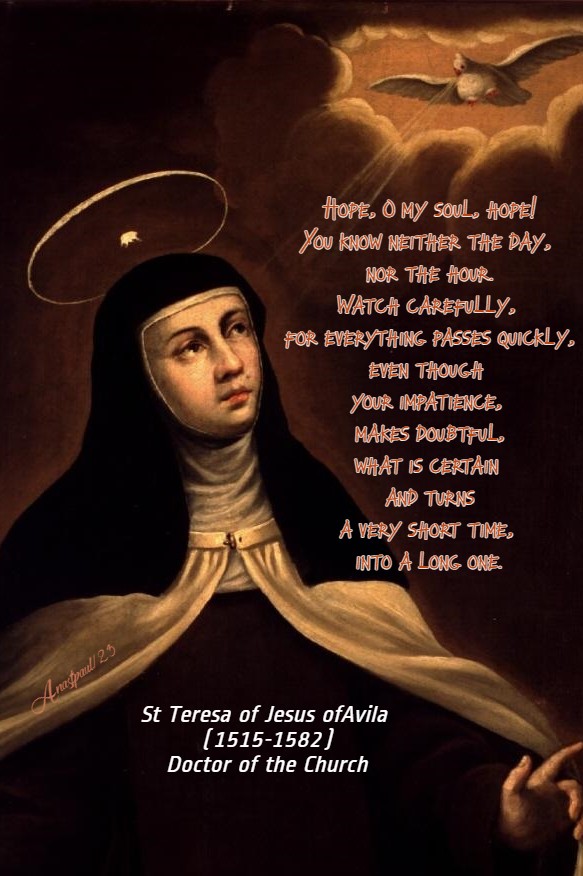
“Hope, O my soul, hope! You know neither the day, nor the hour. Watch carefully, for everything passes quickly, even though your impatience, makes doubtful, what is certain and turns a very short time, into a long one.”
St Teresa of Jesus of Avila (1515-1582) Doctor of the Church
One Minute Reflection – 12 June – “The Month of the Sacred Heart of Jesus” – Within the Octave of the Sacred Heart – St Juan de Sahagun (1419-1479) Confessor, Priest and Friar of the Order of the Augustinians – – Ecclesiasticus i 31:8-11; Luke 12:35-40– Scripture search here: https://www.drbo.org/
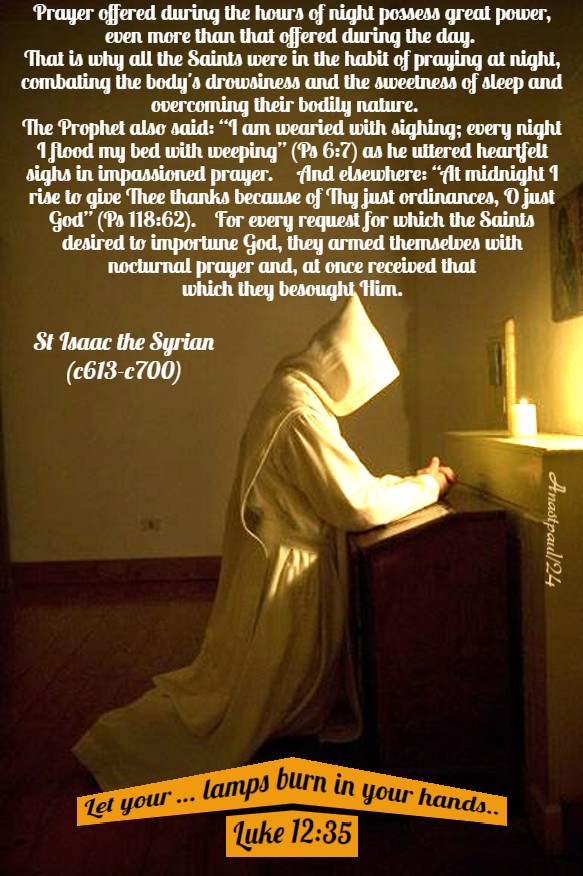
“Jesus said to His disciples: Let your … lamps burn in your hands.” – Luke 12:35
REFLECTION – “Prayer offered during the hours of night possess great power, even more than that offered during the day. That is why all the Saints were in the habit of praying at night, combating the body’s drowsiness and the sweetness of sleep and overcoming their bodily nature. The Prophet also said: “I am wearied with sighing; every night I flood my bed with weeping” (Ps 6:7) as he uttered heartfelt sighs in impassioned prayer. And elsewhere: “At midnight I rise to give Thee thanks because of Thy just ordinances, O just God” (Ps 118:62). For every request for which the Saints desired to importune God, they armed themselves with nocturnal prayer and, at once received that which they besought Him.
Satan himself fears nothing as much as prayer offered during the night watches. Even if they are accompanied by distractions, it does not return fruitless, as long as something inappropriate is not being asked for. That is why Satan engages in severe combat against those who keep watch at night, so as to deter them from this practice if he can, especially if they show themselves to be persevering. But those who are in any way defended against his pernicious wiles and have tasted the gifts God grants, at these times of vigil and, have had personal experience, of the greatness of the help God gives them, wholly despise him, he and all his craftiness.” – St Isaac the Syrian of Nineveh (c613-c700) Bishop of Nineveh, Monk at Mosul, Father of the Church (Ascetical Discourses)
PRAYER – O God, Author of peace and lover of charity, Who endowed blessed John, Your Confessor, with a wondrous grace for reconciling enemies; grant by his merits and intercession that, being ourselves firmly rooted in Thy charity, we may not be separated from Thee by any temptations.Through Jesus Christ, Thy Son our Lord, Who lives and reigns with Thee, in the unity of the Holy Ghost, God, world without end. Amen (Collect).
Jesus, meek and humble of heart, make my heart like unto Thine. – 300 Days, EVERYTIME. (Unless otherwise stated, e.g., “once a day,” a partial Indulgence may be gained any number of times in succession.) St Pope Pius X, 15 September 1905.
Our Morning Offering – 12 June – “The Month of the Sacred Heart of Jesus”
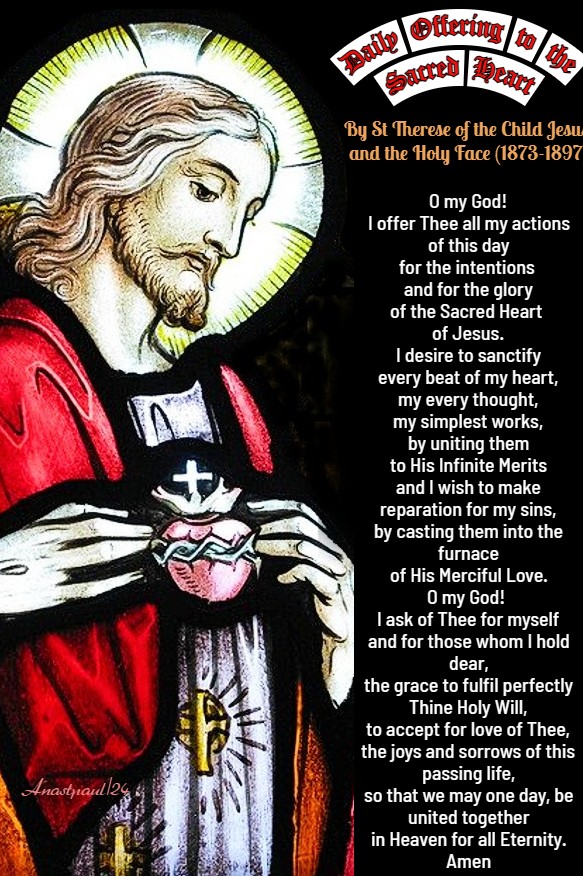
Daily Offering to the Sacred Heart By St Thérèse of the Child Jesus and the Holy Face (of Lisieux) OCD (1873-1897)
O my God! I offer Thee all my actions of this day for the intentions and for the glory of the Sacred Heart of Jesus. I desire to sanctify every beat of my heart, my every thought, my simplest works, by uniting them to His Infinite Merits and I wish to make reparation for my sins, by casting them into the furnace of His Merciful Love. O my God! I ask of Thee for myself and for those whom I hold dear, the grace to fulfil perfectly Thine Holy Will, to accept for love of Thee, the joys and sorrows of this passing life, so that we may one day, be united together in Heaven for all Eternity. Amen
Saint of the Day – 12 June – Saint Odulf of Utrecht (Died c865) Priest, Monk, Prior, zealous Missionary to the Frisians. Odulf was gifted with the charism of prophecy. Born in Brabant (in modern Belgium) and died in c865 of natural causes at his Monastery, Saint Martin of Utrecht. Patronages – Borgloon, Belgium, Evesham, England, Stavoren, Holland, Utrecht, Holland. Also known as – Odulph of Stavoren, Odulf of Evesham, Odolfo…Odulf…Odulfo…Odulphus… Additional Memorial – 18 July on some calendars.
According to a fairly reliable Vita from the 10th Century, Odulf, son of the Frankish Ludgis of Oorschoot, was educated at the school of Utrecht, where he excelled in his studies and attracted all by his piety and learning. Ordained a Priest, he was attracted by the monastic life of prayer and detachment from the world but his parents ardently desired him to exercise pastoral care in Oorschoot, since the local Church stood on their property and probably belonged to them.
After a few years, having distributed his goods among the poor, Odulf took on the monastic Habit in the Monastery of Saint Martin of Utrecht attached to the Cathedral. He became Prior there while St Frederick was the Bishop, who, havingby the aid of Odulf, completed the mission among the Frisians, asked him to dedicate himself to pastoral care in the recently erected Church of Pensoren. Odulf accepted, on condition that he could later return to the Monastery to retire and die there.
St Martin’s Abbey Monastery, Utrecht
After a very fruitful activity, he returned in an unspecified year to his Monastery. The Norman incursions of the following decades brought serious damage and suffering to Oorschoot, as Odulf had predicted if the community had strayed from the straight path of Christian truth. Odulf intervened decisively in the election of Bishop Ungaro.
He died around the year 865 and his cult soon spread around Holland and Belgium. His remains were later transferred from Utrecht, where however a Relic remained, to Pensoren and from there, in around 1034 to London and Evesham Abbey – it is told that St Odulf’s Relics were actually stolen and re-appeared in England, where our Saint became the Patron of Evesham. His Feast Day is on June 12th.
St Amphion of Nicomedia Bl Antonio de Pietra St Arsenius of Konev St Christian O’Morgair of Clogher St Chrodobald of Marchiennes St Cominus Bl Conrad of Maleville St Cunera St Cuniald St Cyrinus of Antwerp St Eskil St Galen of Armenia St Gerebald of Châlons-sur-Seine St Geslar
St Pope Leo III (c 750-816) Bishop of Rome and Ruler of the Papal States from 26 December 795 to his death. Defender of the City ad peoples of Rome and of the Church. Peacemaker and restorer of Churches and Monasteries, Patron of the Arts and Apostle of the poor. Know as “Charlemagne’s Pope” His Life: https://anastpaul.com/2021/06/12/saint-of-the-day-12-june-st-pope-leo-iii-c-750-816/
St Odulf of Utrecht (Died c865) Priest, Monk, Prior St Olympius of Aenos St Onuphrius of Egypt Bl Pelagia Leonti of Milazzo St Peter of Mount Athos St Placid of Val d’Ocre St Ternan of Culross St Valerius of Armenia
Martyrs of Bologna: Three Christians who were Martyred at different times and places, but whose relics have been collected and enshrined together – Celsus, Dionysius, and Marcellinus. Their relics were enshrined in churches in Bologna and Rome in Italy.
St Basilides and Companions / Martyrs of Rome: Four members of the Imperial Roman nobility. They were all soldiers, one or more may have been officers, and all were Martyred in the persecutions of Diocletian – Basilides, Cyrinus, Nabor and Nazarius. They were martyred in 304 outside Rome, Italy and buried along the Aurelian Way.
Three Holy Exiles: Three Christian men who became Benedictine Monks at the Saint James Abbey in Regensburg, Germany, then Hermits at Griestatten and whose lives and piety are celebrated together. – Marinus, Vimius and Zimius.
Thought for the Day – 11 June – Meditations with Fr Richard Frederick Clarke SJ (1839-1900)
HUMILITY Meditations for a Month
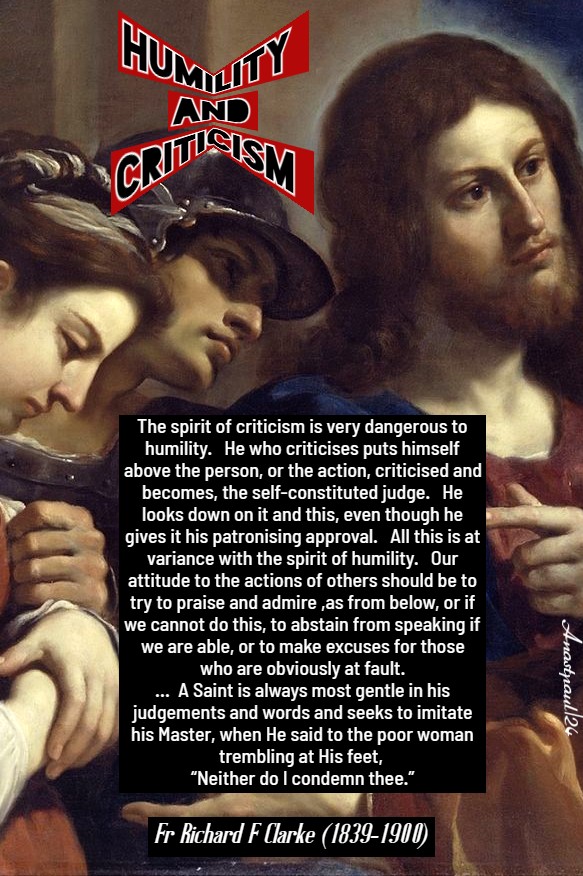
Humility and Criticism
The spirit of criticism is very dangerous to humility. He who criticises puts himself above the person, or the action, criticised and becomes, the self-constituted judge. He looks down on it and this, even though he gives it his patronising approval. All this is at variance with the spirit of humility. Our attitude to the actions of others should be to try to praise and admire ,as from below, or if we cannot do this, to abstain from speaking if we are able, or to make excuses for those who are obviously at fault.
Unjust and bitter criticism is one of the marks of inveterate pride. The devil is the accuser of the brethren. Much that he urges against them is true but this is no excuse. Much is false and, in this, those who criticise rashly and uncharitably, are sure to imitate their model. They fall unconsciously into false and rash judgements and, even where they were quite certain that they were correct, they nevertheless, often do serious wrong to those whom they criticise. If they were more humble, they would have a clearer and truer view of the characters and actions, of those around them.
Yet how general is this habit of criticism? Many who are reputed good Catholics, run down their neighbours with a freedom which shows how little they have imbibed of the spirit of the Church and of her Saints. A Saint is always most gentle in his judgements and words and seeks to imitate his Master, when He said to the poor woman trembling at His feet, “Neither do I condemn thee.” Ask yourself whether you are free from fault in this respect and promise amendment.
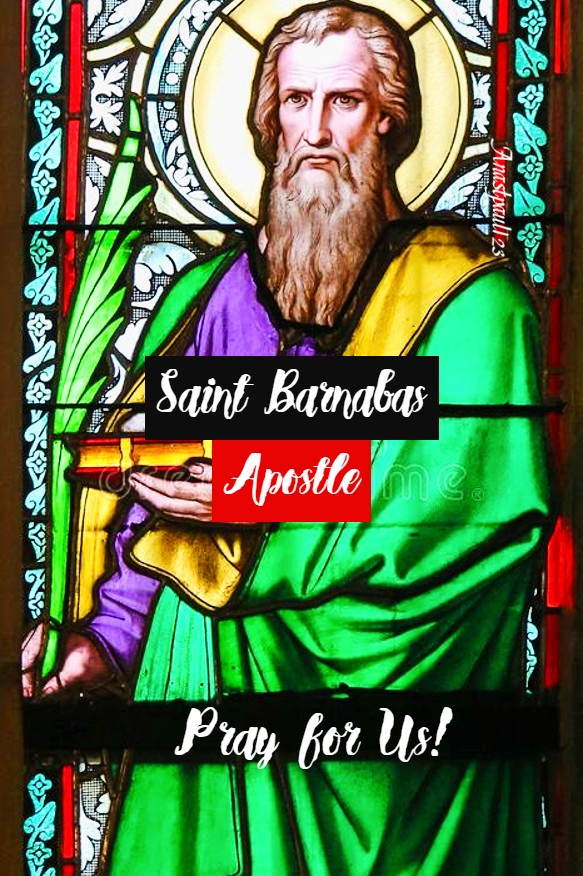
Quote/s of the Day – 11 June – “The Month of the Sacred Heart of Jesus” – Feast of St Barnabas the Apostle, Martyr, The “Son of Encouragement” – Acts 11:21-26; 13:1-3; Matthew 10:16-22.– Scripture search here: https://www.drbo.org/
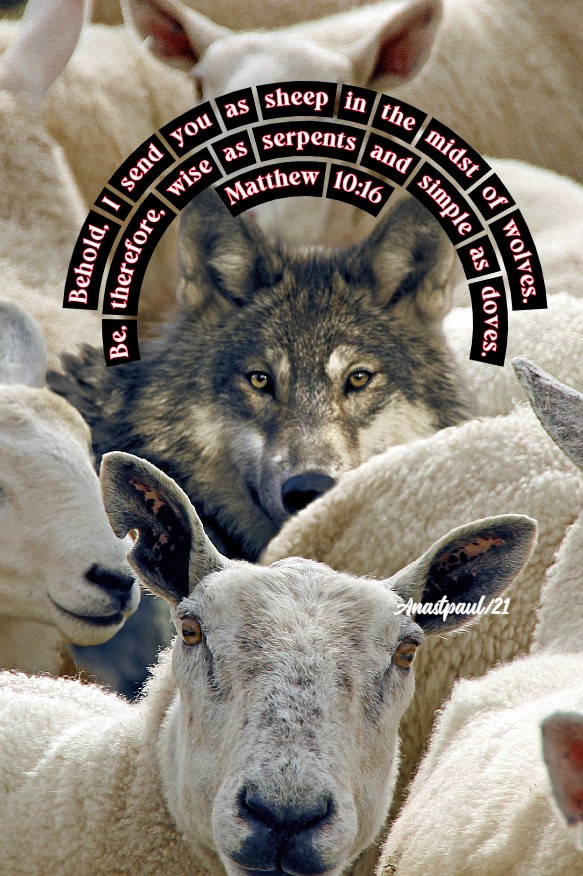
“Behold I send you as sheep in the midst of wolves. Be, therefore, wise as serpents and simple as doves. ”
Matthew – 10:16
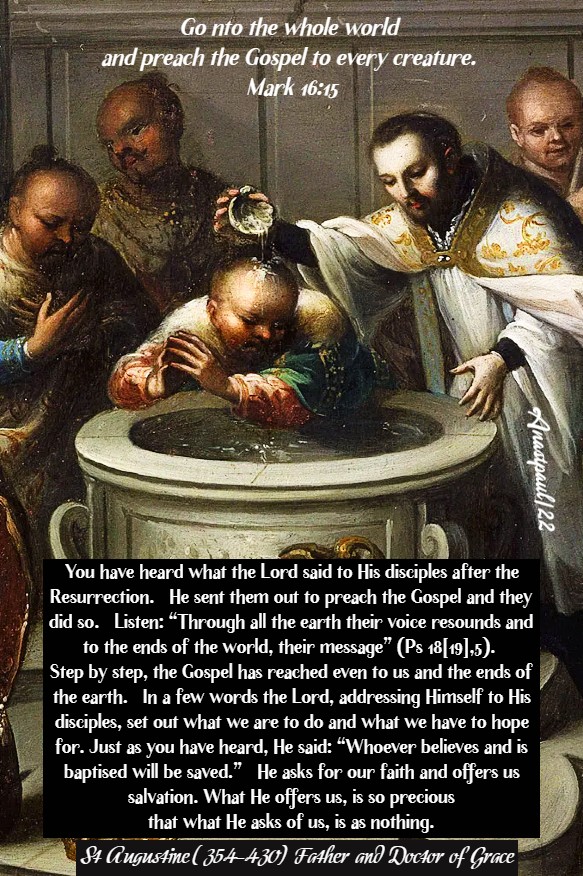
“Go into the whole world and preach the Gospel to every creature.” Mark 16:15
“You have heard what the Lord said to His disciples after the Resurrection. He sent them out to preach the Gospel and they did so. Listen: “Through all the earth their voice resounds and to the ends of the world, their message” (Ps 18[19],5). Step by step, the Gospel has reached even to us and the ends of the earth. In a few words the Lord, addressing Himself to His disciples, set out what we are to do and what we have to hope for. Just as you have heard, He said: “Whoever believes and is Baptised will be saved.” He asks for our faith and offers us salvation. What He offers us, is so precious that what He asks of us, is as nothing.”
St Augustine (354-430) Father and Doctor of Grace
“All the brothers should strive to follow the humility and the poverty of our Lord Jesus Christ … And they must rejoice when they live among people who are considered to be of little worth and who are looked down upon, among the poor and the powerless, the sick and the lepers and the beggars by the wayside. And when it may be necessary, let them go to seek alms. And they should not be ashamed but rather recall that our Lord Jesus Christ, the Son of the living and all-powerful God … was a poor man and a transient and lived on alms, He and the Blessed Virgin and His disciples.”
St Francis of Assisi (c1181-1226)
(Earlier Rule, #8-9).
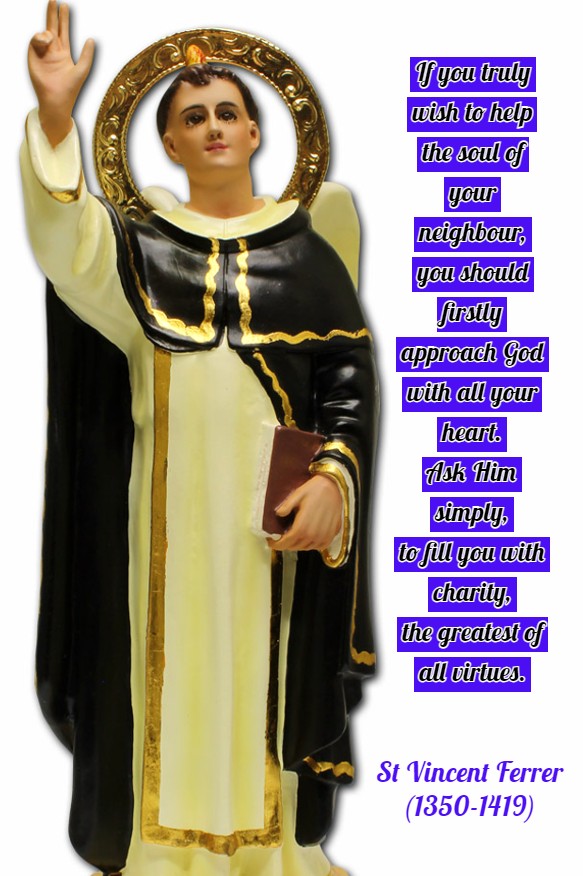
“If you truly wish to help the soul of your neighbour, you should firstly approach God with all your heart. Ask Him simply, to fill you with charity, the greatest of all virtues.”
St Vincent Ferrer OP (1350-1419)
“If you wish to enter into life, keep My commandments. If you will know the truth, believe in Me. If you will be perfect, sell all. If you will be My disciple, deny yourself. If you will possess the blessed life, despise this present life. If you will be exalted in Heaven, humble yourself on earth. If you wish to reign with Me, carry the Cross with Me. For only the servants of the Cross find the life of blessedness and of true Light.”
One Minute Reflection – 11 June – “The Month of the Sacred Heart of Jesus” – Feast of St Barnabas the Apostle, Martyr, The “Son of Encouragement” – Acts 11:21-26; 13:1-3; Matthew 10:16-22.– Scripture search here: https://www.drbo.org/
“Behold I send you as sheep in the midst of wolves. Be, therefore, wise as serpents and simple as doves. ” – Matthew – 10:16
REFLECTION – “Christ also suffered for you, leaving you an example that you should follow in His Footsteps,” (1Pt 2:21). Which of the Lord’s examples will we have to follow? Is it His raising of the dead? Is it to walk on the sea? Not in the least. But it is that of being meek and humble of heart (Mt 11:29) and of loving not only our friends but even our enemies (Mt 5:44).
“So that you might follow in His Footsteps,” writes St Peter. The blessed Evangelist John also says the same thing: “Whoever claims to abide in Christ ought to walk as He has walked,” (1 Jn 2:6). And how has Christ walked? He prayed for His enemies on the Cross, saying: “Father, forgive them, for they know not what they do,” (Lk 23:34). They have actually lost their senses and are possessed by an evil spirit and while they are persecuting us, they themselves are undergoing a far greater persecution from the devil. Hence, we should be praying more for their deliverance than for their condemnation.
That is indeed what Blessed Stephen did, he who was the first so gloriously to follow in the Footsteps of Christ. For, when he was struck by a hail of stones, he prayed standing for himself but, falling to his knees, he cried out with all his strength for his enemies: “Lord Jesus Christ, do not hold this sin against them,” (Ac 7:60). So even if we think we cannot imitate our Lord, let us at least imitate him who was just as much His servant as we are.” – St Caesarius of Arles (470-543) Father of the Church, Bishop (Sermons to the people, No 37).
PRAYER – O God, Who gladden us by the merits and intercession of blessed Barnabas, Thy Apostle, mercifully grant that we, who ask of Thee favours through him, may obtain them by the gift of Thy grace.ThroughJesus Christ, Thy Son our Lord, Who lives and reigns with Thee, in the unity of the Holy Ghost, God, world without end. Amen (Collect).
SACRED Heart of JESUS, I trust in Thee. 300 Days Indulgence Once a Day – Plenary, Once a month. Raccolta 175 – St Pius X, 19 August 1905 and 27 June 1906.
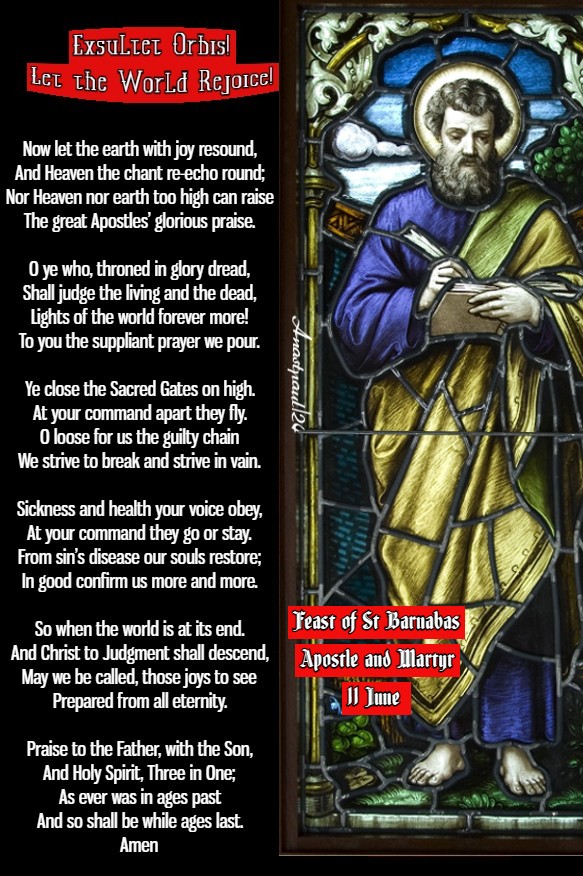
Our Morning Offering – 11 June – Feast of St Barnabas the Apostle, Martyr, The “Son of Encouragement.”
Exsultet Orbis! Let the World Rejoice! Unknown Author
Now let the earth with joy resound, And Heaven the chant re-echo round; Nor Heaven nor earth too high can raise The great Apostles’ glorious praise.
O ye who, throned in glory dread, Shall judge the living and the dead, Lights of the world forever more! To you the suppliant prayer we pour.
Ye close the Sacred Gates on high. At your command apart they fly. O loose for us the guilty chain We strive to break and strive in vain.
Sickness and health your voice obey, At your command they go or stay. From sin’s disease our souls restore; In good confirm us more and more.
So when the world is at its end. And Christ to Judgment shall descend, May we be called, those joys to see Prepared from all eternity.
Praise to the Father, with the Son, And Holy Spirit, Three in One; As ever was in ages past And so shall be while ages last. Amen
(Roman Breviary for the Common of Apostles) An Office Hymn that was traditionally prescribed for Vespers and Lauds on the Feasts of Apostles and Evangelists outside Easter time. The Hymn is found as early as the 10th Century in a Hymnal of Moissac Abbey.
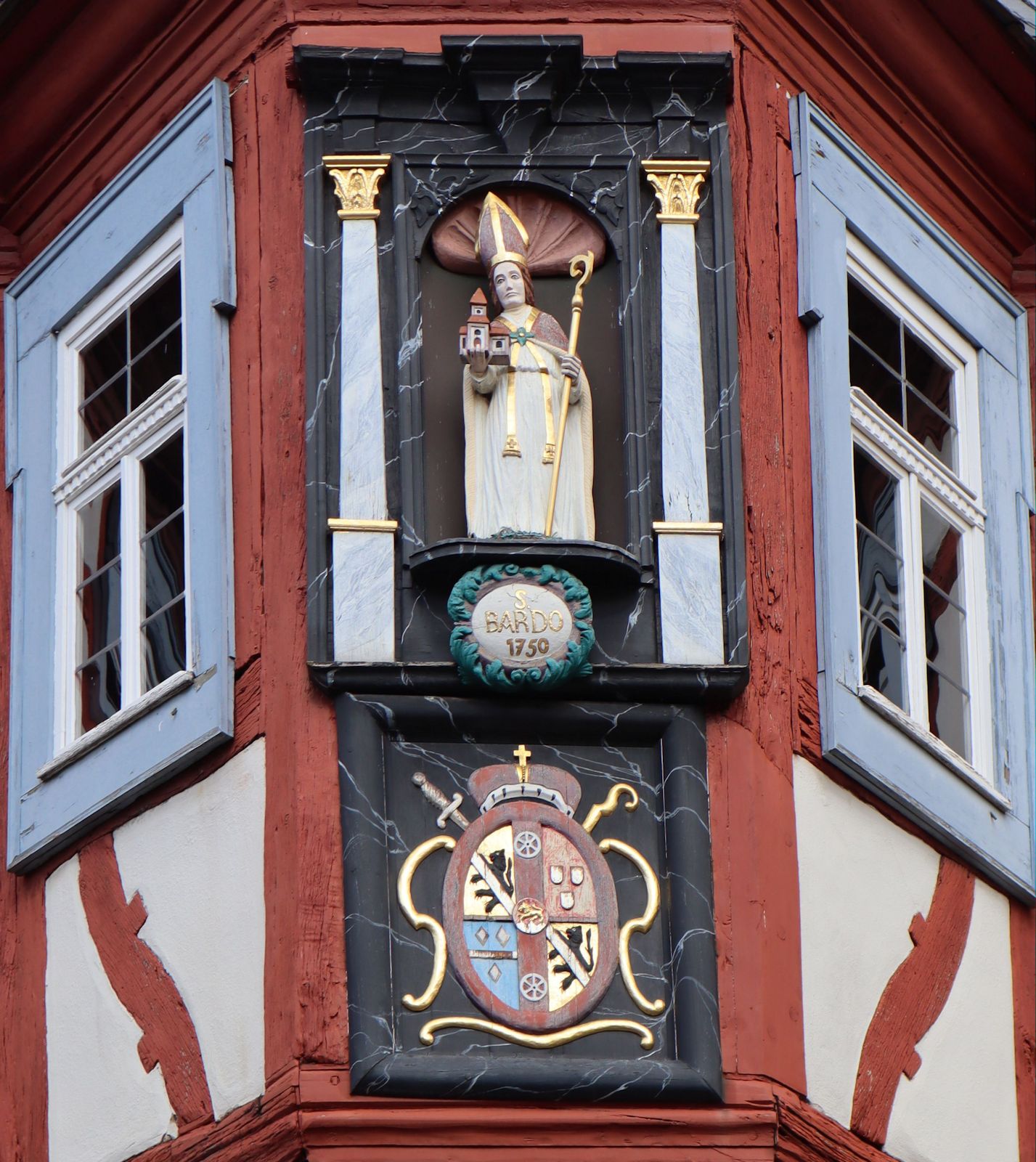
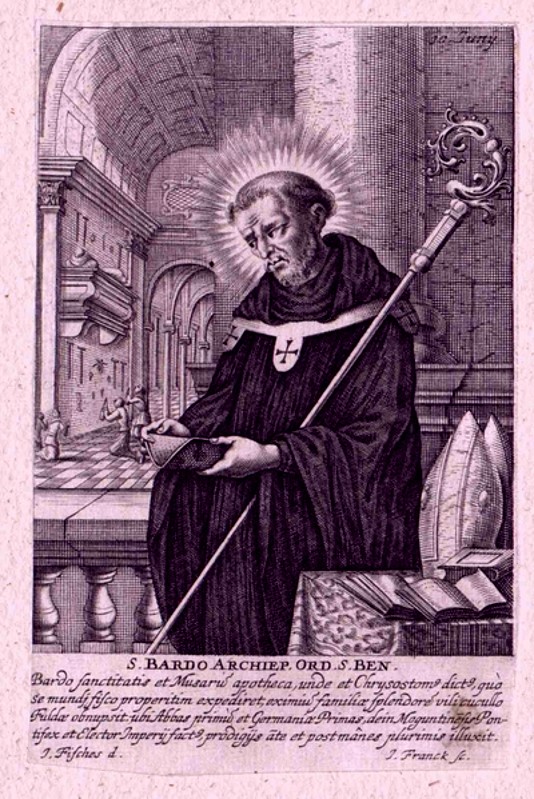
Saint of the Day – 11June – Saint Bardo of Mainz (c981-c1053) Archbishop of Mainz from 1031 until 1051, the Abbot of Werden from 1030 until 1031 and the Abbot of Hersfeld in 1031. Ascetic, renowned for his piety and devotion, for his care and love of the poor, renowned Preacher, called “The Chrysostom” of his time. Born in c981 in Oppershofen, Germany and died on 10 or 11 June in 1051 or 1053 (records vary) in Oberdorla near Mühlhausen in Thuringia, of natural causes. Patronage – of Oppershofen. Also known as – “The Chrysostom” of his time and area, Bardo of Magonza, Bardon, Bardone. Additional Memorial – 15 June (Cathedral of Mainz, Germany) and 10 June (depending on the date chosen for his death. Name means: battle axe and/or wolf [which our Saint was neither] (Old High German).
Statue at the town hall in St Bardo’s birthplace Oppershofen of which Town he is the Patron Saint
Bardo was the son of a noble family, related to Empress Gisela, the wife of Emperor Conrad II. He became a Benedictine Monk in the Monastery – on the site of the present Cathedral – in Fulda. There, in around 1018, Bardo was appointed as the Head of the Cathedral school and Provost of the new provostship at St Andreas in Fulda.
In 1029, Bardo was appointed as the Abbot in Werden – today the district of Essen-Werden and in 1031, as the Abbot also in Hersfeld – today’s Bad Hersfeld. From 1031 Bardo became the Archbishop of Mainz. Then, in 1036, Bardo Consecrated the new Cathedral dedicated to St Martin of Tours, the construction of which Bardo had been involved.
Statue of St Bardo in the Crypt of the Fulda Cathedral
Bardo lived so ascetically that Pope Leo IX admonished him to pay more attention to his health. His piety and charity became famous, especially towards the travelling people.
Bardo was also praised as a preacher and was called “The Chrysostom” of his time . Under Bardo, Mainz Cathedral was completed. he Consecrated it in 1036 in the presence of Emperor Conrad and Bardo founded the Cathedral and St John’s Foundation in Mainz, as well as the Monastery of St James. In 1041/42 he went to war against Bohemia with Emperor Henry III .
Bardo died during a journey and was buried in his new Cathedral in Mainz . His Tomb in the Cathedral in Mainz became a place of pilgrimage where numerous miracles occurred and still do.
The Cathedral built and Consecrated by St Bardo in Mainz
St Herebald of Bretagne Bl Hugh of Marchiennes Bl Jean de Bracq
Bl Kasper of Grimbergen St Maximus of Naples
St Parisius ECMC (c1160-1267) Priest and Monk of the Camaldolese Hermits of Mount Corona, Spiritual Director, Reformer, Miracle-worker during his life and after his death. A very long life of humble and loving service, for the glory of God!: The Roman Martyrology reads: “In Treviso, Saint Parisio, Priest of the Camaldolese Order, who for seventy-seven years took care of the spiritual direction of the Nuns with healthy advice, dying at the age of one hundred and eight.” https://anastpaul.com/2022/06/11/saint-of-the-day-11-june-st-parisius-ecmc-c-1160-1267-a-very-long-life-of-humble-and-loving-service-for-the-glory-of-god/
St Rembert of Hamburg (c830-888) Archbishop of Hamburg-Bremen, Missionary, Miracle-worker, Founder of Churches and Monasteries, Disciple of St Ansgar (801-865) “The Apostle of the North.” The Roman Martyrology reads : “In Bremen in Saxony, in today’s Germany, Saint Rembert, Bishop of Hamburg and Bremen, who, a faithful disciple of Saint Ansgar and his successor, extended his ministry to the regions of Denmark and Sweden and, at the time of the invasions of the Normans, he took care of the ransom of the Christian prisoners.” A True Shepherd: https://anastpaul.com/2023/06/11/saint-of-the-day-11-june-st-rembert-of-hamburg-c830-888-archbishop/
St Riagail of Bangor Bl Stephen Bandelli OP St Tochumra of Kilmore St Tochumra of Tuam
Martyrs of Tavira – 7 Beati: Members of the Knights of Santiago de Castilla. During the re-conquest of the Iberian peninsula from the Muslims by Christian forces, in a period of truce between the armies, the group was allowed to leave the Portuguese camp to hunt. Near Tavira, Portugal, he and his companions were ambushed and killed by a Muslim force. Making a reprisal attack, the Portuguese army took the city of Tavira. The murdered knights were considered to be martyrs as they died in an action defending the faith. They were – Blessed Alvarus Garcia, Blessed Beltrão de Caia, Blessed Damião Vaz, Blessed Estêvão Vasques, Blessed Garcia Roiz, Blessed Mendus Valle, Blessed Pedro Rodrigues’ They were Martyred in 1242 outside Tavira, Faro, Portugal. Their relics are enshrined under the altar of Saint Barnabas in the Church of Our Lady, Queen of the Angels (modern Santa Maria do Castelo) in Tavria, Portugal.
Mercedarian Martyrs of Damietta: Three Mercedarian Lay Knights who worked to ransom Christians enslaved by Muslims. During the 7th Crusade, a plague swept through the Christian army and these knights volunteered to work with the sick. During this work they were captured by Muslims and ordered to convert to Islam; they refused. They were tortured, taken to Damietta, Egypt where they were murdered for their faith. They were thrown from a tower in the mid-13th century in Damietta, Egypt.
Thought for the Day – 10 June – Meditations with Fr Richard Frederick Clarke SJ (1839-1900)
HUMILITY Meditations for a Month
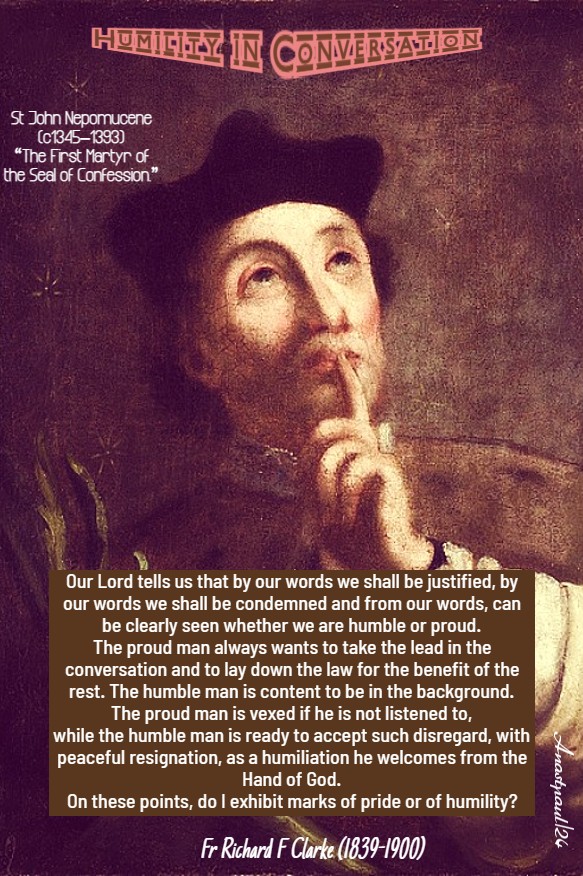
Humility in Conversation
Our Lord tells us that by our words we shall be justified, by our words we shall be condemned and from our words, can be clearly seen whether we are humble or proud. The proud man always wants to take the lead in the conversation and to lay down the law for the benefit of the rest. The humble man is content to be in the background. The proud man is vexed if he is not listened to, while the humble man is ready to accept such disregard, with peaceful resignation, as a humiliation he welcomes from the Hand of God. On these points, do I exhibit marks of pride or of humility?
There is, moreover, in the conversation of the proud an undercurrent of self-praise. They talk chiefly about themselves and what they have said and done and, in a tone of boastfulness, more or less, thinly veiled. The humble seem to forget themselves; they consider what is interesting to those to whom they speak and they do this because, for God’s sake, they seek to please others rather than themselves. Try to cultivate this humility in conversation. It will make you loved by God and by men.
We perceive the contrast between humility and pride, most clearly, when some rebuff is given. See the meekness of the one and the indignation of the other; the patience of the one and the eagerness of the other to assert himself and prove himself in the right. In this respect, we shall do well to contemplate the perfect humility of the Holy Mother of God at the marriage feast at Cana. In answer to the apparent rebuke which she received from her Son, she uttered not a word of self-justification but an instruction to the servants, to be exact in their obedience to Jesus.
Quote/s of the Day – 10 June – “The Month of the Sacred Heart of Jesus” – Within the Octave of the Sacred Heart – Proverbs 31:10-31; Matthew 13,44-52 – Scripture search here: https://www.drbo.org/
“Who, when he had found one pearl of great price, … sold all that he had and bought it.”
Matthew 13:46
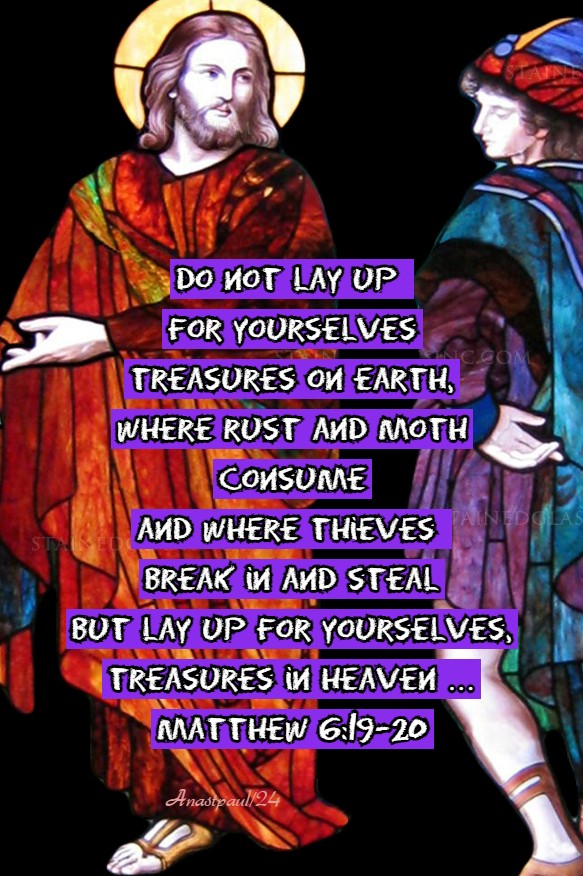
“Do not lay up for yourselves treasures on earth, where rust and moth consume and where thieves break in and steal but lay up for yourselves, treasures in Heaven …”
Matthew 6:19-20
“Sell what you possess and give alms. Make for yourselves purses which do not grow old, a treasure unfailing in Heaven, where neither thief draws near, nor moth destroys.”
Luke 12:33
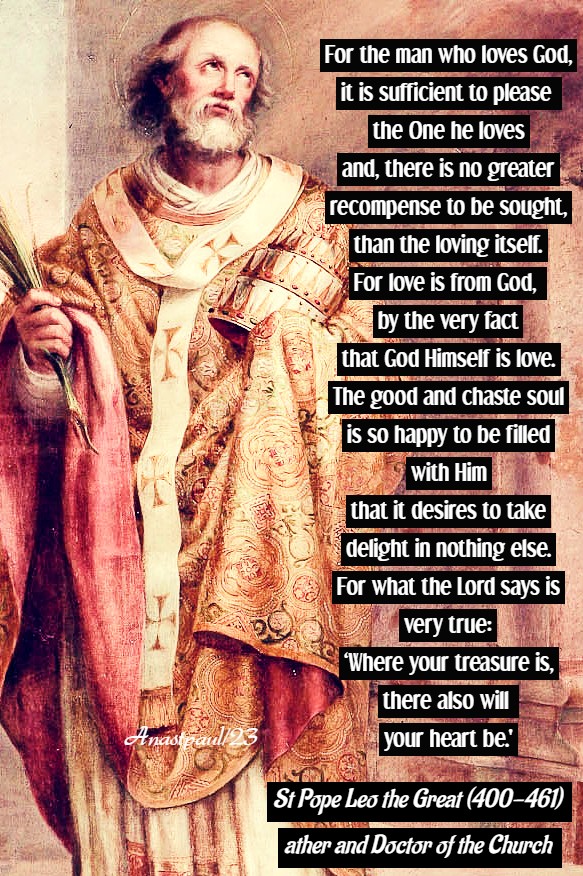
“For the man who loves God, it is sufficient to please the One he loves and, there is no greater recompense to be sought, than the loving itself. For love is from God, by the very fact that God Himself is love. The good and chaste soul is so happy to be filled with Him that it desires to take delight in nothing else. For what the Lord says is very true: ‘Where your treasure is, there also will your heart be.’”
St Pope Leo the Great (400-461) ather and Doctor of the Church
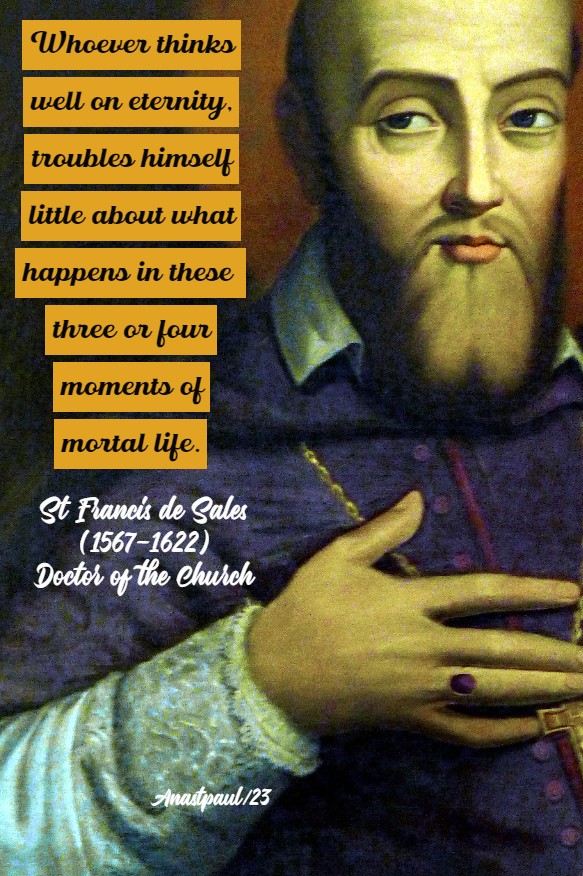
“Whoever thinks well on eternity, troubles himself little about what happens in these three or four moments of mortal life.”
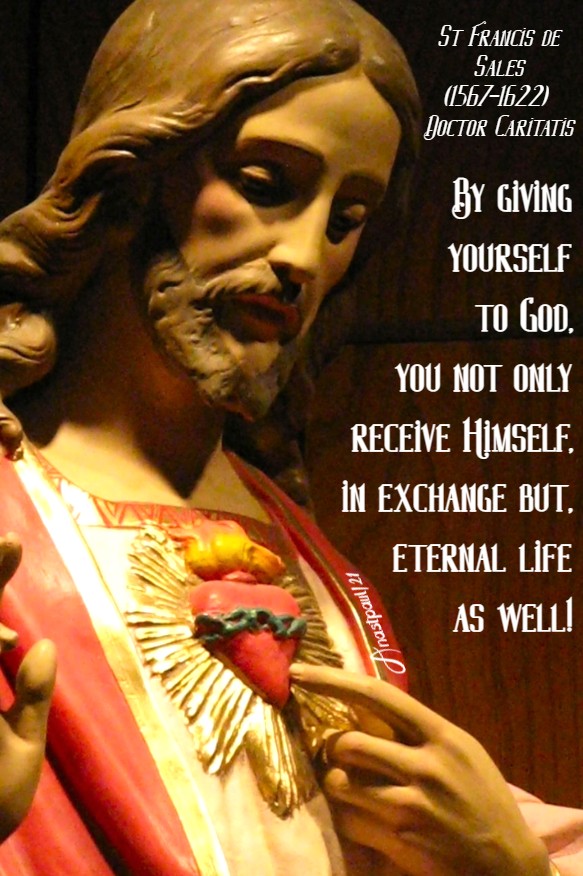
“By giving yourself to God, you not only receive Himself in exchange but, eternal life as well!”
One Minute Reflection – 10 June – “The Month of the Sacred Heart of Jesus” – Within the Octave of the Sacred Heart – St Margaret of Scotland (1045-1093) Widow – Proverbs 31:10-31; Matthew 13,44-52 – Scripture search here: https://www.drbo.org/
“Who, when he had found one pearl of great price, … sold all that he had and bought it.” – Matthew 13:46
REFLECTION – “Among the gifts of grace which Francis received from God the generous Giver, he merited, as a special privilege, to grow in the riches of simplicity through his love of the highest poverty. The holy man saw that poverty was the close companion of the Son of God and now that it was rejected by the whole world, he was eager to espouse it in everlasting love. For the sake of poverty, he not only left his father and mother but also gave away everything he had. No -one was so greedy for gold, as he was for poverty; nor was anyone so anxious, to guard his treasure, as he was in guarding this pearl of the Gospel.
In this, especially, would his sight be offended, if he saw in the friars, anything which did not accord completely with poverty. Indeed, from the beginning of his religious life until his death, his only riches were a tunic, a cord and underclothes and, with this much, he was content. He used to frequently call to mind with tears the poverty of Jesus Christ and his mother, claiming that it was the queen of the virtues because, it shone forth so preeminently in the King of kings (1Tm 6:15) and in the Queen, His Mother.
When the Friars asked him at a gathering what virtue does more to make one a friend of Christ, he replied as if opening the hidden depths of his heart: “Know, brothers, that poverty is the special way to salvation, as the stimulus of humility and the root of perfection, whose fruit is manifold but hidden. This is the Gospel’s treasure “hidden in a field” (Mt 13:44); to buy this, we should sell everything and, in comparison to this, we should spurn everything we cannot sell.” – St Bonaventure (1221-1274) Franciscan, Doctor of the Church (Life of Saint Francis).
PRAYER – O God, Who made blessed Queen Margaret glorious by her remarkable charity toward the poor; grant, by her intercession and example that Thy charity may continually increase in our hearts. Through Jesus Christ, Thy Son our Lord, Who lives and reigns with Thee, in the unity of the Holy Ghost, God, world without end. Amen (Collect).
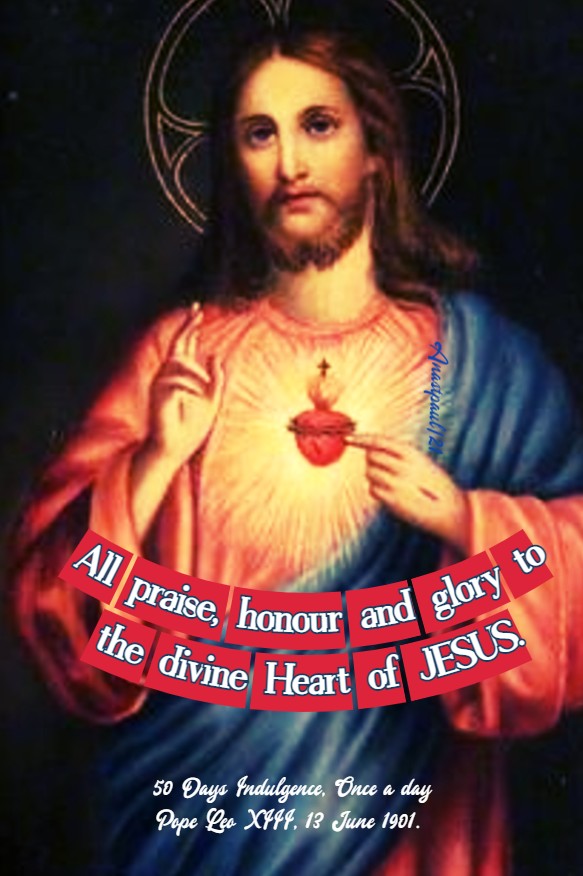
ALL PRAISE, honour and glory to the Divine Heart of JESUS.Indulgenced– 50 Days, once a day. 168 Pope Leo XIII, 14 June 1901.
Our Morning Offering – 10 June – “The Month of the Sacred Heart of Jesus” – Within the Octave of the Sacred Heart
Be the Heart of My Heart By St John Eudes (1601-1680) Apostle of the Sacred Heart
O Heart all Lovable and all Loving of my Saviour, be the Heart of my heart, the Soul of my soul, the Spirit of my spirit, the Life of my life and the sole Principle of all my thoughts, words and actions, of all the faculties of my soul and of all my senses, both interior and exterior. Amen
St John Eudes is the Author of the Proper for the Mass and Divine Office of the Sacred Heart of Jesus Christ and the Immaculate Heart of the Blessed Virgin. St John was an ardent proponent of the Sacred Heart and dedicated himself to it’s promotion and celebration. The Masses he compiled for both the Sacred Heart of Jesus and for the Immaculate Heart of Mary, were both first celebrated during his lifetime. He preached missions across France, including Paris and Versailles, while earning recognition as a popular Evangelist and Confessor. St John Eudes was also a prolific writer and wrote on the two Holy Hearts despite opposition from the Jansenists.
Saint of the Day – 10 June – Saint Maurinus of Cologne (9th Century) Abbot, Martyr. Died in the 9th Century in Cologne. Also known as – Maurino.
The Roman Martyrology reads today: “At Cologne, St Maurinus, Abbot and Martyr.”
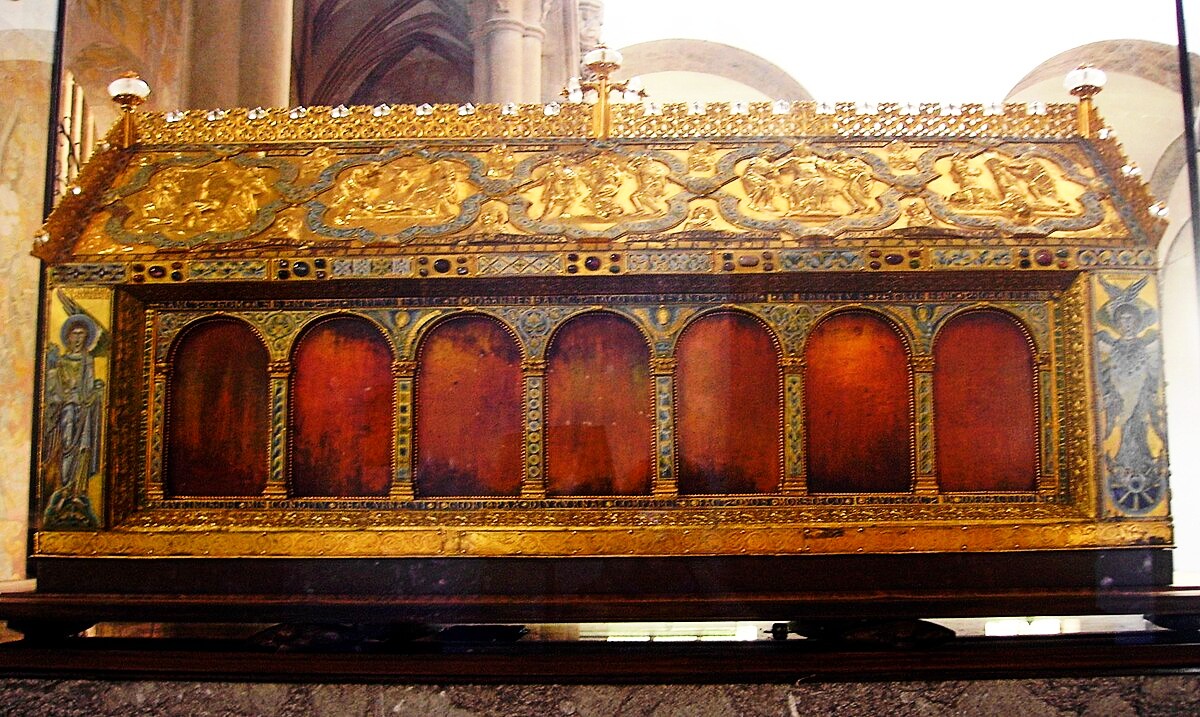
St Maurinus Shrine in Cologne
On 13 October 966, during the reconstruction of the Church of St Pantaleone in Cologne, at the time of Archbishop Folcmarus, successor of St Brunone, the Relics of our Saint were found with an epitaph indicating the his identity.
This epitaph recalled that he was an Abbot and that he was killed in the atrium of the same Church of St Pantaleone. The epitaph does not indicate a date but only the month of June.
For this reason, it is not possible to specify the era in which he lived, especially since there is no mention of him in any document prior to the discovery in 966. Even the title of Abbot is not sufficient to indicate a Monastery but he could have been Abbot of a Collegiate Chapter founded in the same Church. as they existed at that time. Nor is there any further explanation as to his Martyrdom, why and how.
His Relics are kept in a Romanesque casket, a true masterpiece of goldsmith’s craft, dated around 1180. In 1922, it was brought back to the Church of St Pantaleone, from the Chapel of St Maria alla Schnurgasse. Since the 12th Century the Feast of St Maurinud is celebrated throughout the Diocese of Cologne on 10 June and in the Universal Church.
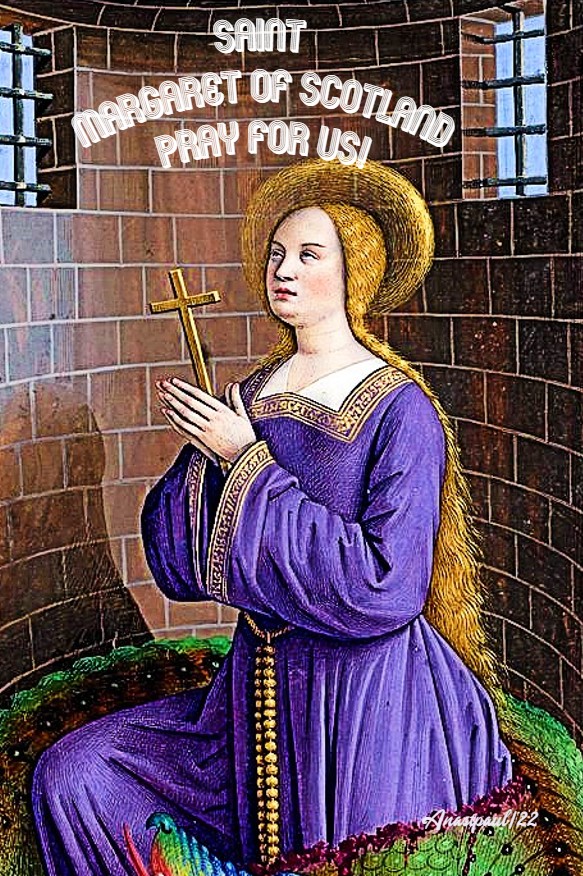
St Margaret of Scotland (1045-1093) Queen consort of Scotland, Wife and Mother, Apostle of the poor, Reformer. Saint Margaret’s name signifies “pearl” “a fitting name,” says Bishop Turgot, her Confessor and her first Biographer, “for one such as she.” Her soul was like a precious pearl. A life spent amidst the luxury of a Royal Court never dimmed its lustre, or stole it away from Him who had bought it with His Blood. Pope Innocent IV Canonised St Margaret in 1250 in recognition of her personal holiness, fidelity to the Roman Catholic Church, work for Ecclesiastical reform and charity. In 1693 Pope Innocent XII moved her feast day to 10 June but it was changed after Vatican II to 16 November. Illustrious St Margaret: https://anastpaul.com/2018/11/16/saint-of-the-day-16-november-st-margaret-of-scotland-1045-1093-queen/ AND: https://anastpaul.com/2022/06/10/saint-of-the-day-10-june-st-margaret-of-scotland-1045-1093/
Bl Amata of San Sisto St Amantius of Tivoli St Asterius of Petra St Bardo of Mainz
St Caerealis of Tivoli St Censurius of Auxerre (Died 486) Bishop St Crispulus of Rome
Blessed Diana d’Andalo OP (1201-1236) Virgin, Nun of the Order of Preachers Beatified on 8 August 1888 by Pope Leo XII. The Roman Martyrology states: “In Bologna, blessed Diana d’Andalò, Virgin, who, having overcome all the impediments posed by her family, took a vow of cloistered life in the hands of Saint Dominic himself, entering the Monastery of Saint Agnes, which she founded.” Her Holy Life: https://anastpaul.com/2023/06/10/saint-of-the-day-10june-blessed-diana-dandalo-op-1201-1236-virgin/
Bl Elisabeth Hernden Bl Elizabeth Guillen St Evermund of Fontenay St Faustina of Cyzicus Bl Gerlac of Obermarchtal St Getulius of Tivoli
St Landericus of Novalese St Landericus of Paris St Maurinus of Cologne (9th Century) Abbot, Martyr St Primitivus of Tivoli St Restitutus of Rome Bl Thomas Green St Timothy of Prusa Bl Walter Pierson St Zachary of Nicomedia
Martyrs of North Africa – 17 Saints: A group of seventeen Christians Martyred together in North Africa; the only surviving details are two of their names – Aresius and Rogatius. Both the precise location in North Africa and the date are unknown.
Martyrs of the Aurelian Way – 23 Saints: A group of 23 Martyrs who died together in the persecutions of Aurelian. The only details that survive are three of their names – Basilides, Mandal and Tripos. c.270-275 on the Aurelian Way, Rome, Italy.
Thought for the Day – 9 June – Meditations with Fr Richard Frederick Clarke SJ (1839-1900)
HUMILITY Meditations for a Month
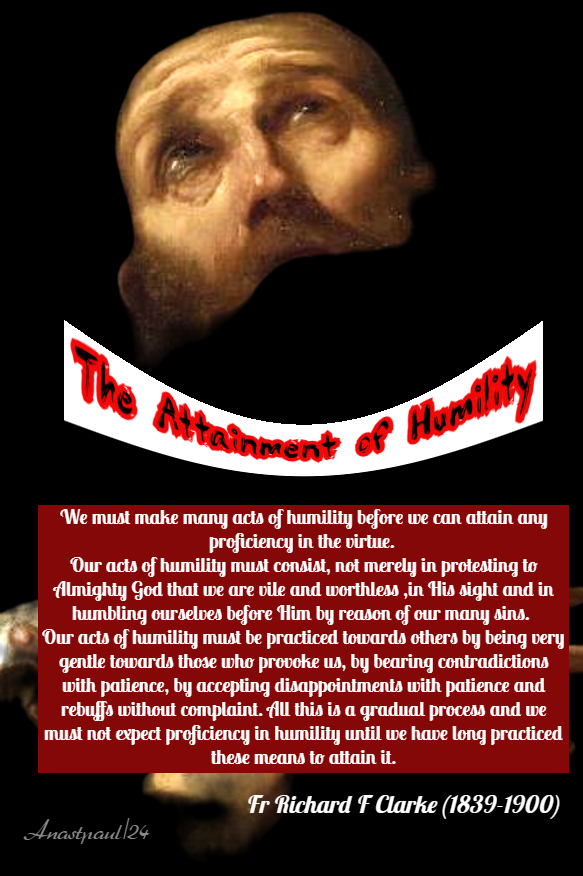
The Attainment of Humility
Humility does not spring up in our souls of its own accord. On the contrary, every child of Adam has a deep root of pride within his soul. It is only by a long and painful process that the generality of mankind can attain humility. We cannot expect to become humble unless we fulfill the necessary conditions.
We must make many acts of humility before we can attain any proficiency in the virtue. Our acts of humility must consist, not merely in protesting to Almighty God that we are vile and worthless ,in His sight and in humbling ourselves before Him by reason of our many sins. Our acts of humility must be practiced towards others by being very gentle towards those who provoke us, by bearing contradictions with patience, by accepting disappointments with patience and rebuffs without complaint. All this is a gradual process and we must not expect proficiency in humility until we have long practiced these means to attain it.
We must pray for humility. No gift of God can be won without prayer and humility least of all because it is so opposed to the natural bent of our nature and, can never be had without a special grace from God. Prayer, moreover, is an acknowledgement of our dependence upon God,and humility consists in nothing else, than a recognition of this dependence and an acquiescence in it. Pray, then, for humility! It is not much use praying for humility unless we also pray for the means that are to implant it in our souls. We must ask God, from our hearts, not to spare us if He sees that we shall not become humble without suffering. We must leave ourselves in His Hands, saying only, “O my God, make me humble at any cost! Amen.”
Quote/s of the Day – 9 June – “The Month of the Sacred Heart of Jesus” and within the Octave of the Sacred Heart – Pentecost III
“Learn of the Heart of God in the Words of God, so that you may ardently long for eternal things.”
St Pope Gregory the Great (540-604) Great Father and Doctor of the Church
“In the Sacred Heart, there is the Symbol and the express Image of the Infinite Love of Jesus Christ which moves us to love in return.”
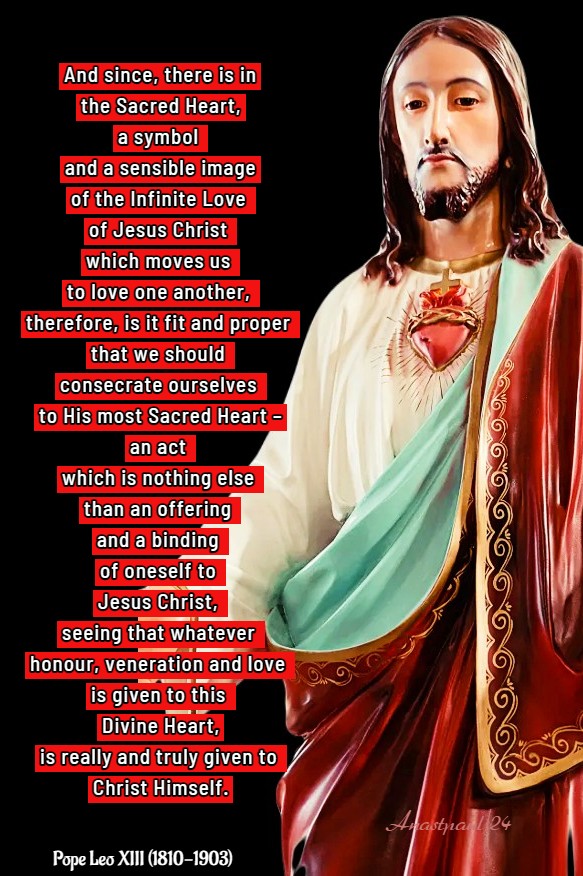
“And since, there is in the Sacred Heart, a symbol and a sensible image of the Infinite Love of Jesus Christ which moves us to love one another, therefore, is it fit and proper that we should consecrate ourselves to His most Sacred Heart – an act which is nothing else than an offering and a binding of oneself to Jesus Christ, seeing that whatever honour, veneration and love is given to this Divine Heart, is really and truly given to Christ Himself.”
Encyclical Annum Sacrum (1899)
“This Devotion, [to the Sacred Heart] which we recommend to all, will be profitable to all!”
Pope Leo XIII (1810-1903)
“Devotion to the Most Sacred Heart is the extraordinary remedy for the extraordinary needs of our time.”
Pope Pius XI (1857-1939)
(1928)
“It is altogether impossible to enumerate the heavenly gifts which Devotion to the Sacred Heart of Jesus has poured out upon the souls of the faithful, purifying them, offering them heavenly strength, rousing them to the attainment of all virtues.”
(1956)
“His Heart is the natural Sign and Symbol of His boundless love for the human race.”
One Minute Reflection – 9 June – “The Month of the Sacred Heart of Jesus” and within the Octave of the Sacred Heart – Saints Primus and Felicianus (Died c304) Confessors, Brother Lay Martyrs – 1 Peter 5:6-11; Luke 15:1-10 – Scripture search here: https://www.drbo.org/
“ Rejoice with Me because I have found My sheep which was lost.” – Luke 15:6
REFLECTION – “When the time of mercy had come (Ps 101:14) the Good Shepherd came down from His Father’s side… as had been promised from all eternity. He came in search of the one sheep which had been lost. Promised to her from all eternity, He was sent to her in time; for her sake He was born and handed over, eternally predestined for her. She is unique, drawn from both Jews and Gentiles. .., present among all peoples; she is one in her mystery, many in persons, many through the flesh according to nature, one through the Spirit according to grace – in short, one single sheep, yet a crowd without number! …
As for those whom this Shepherd acknowledges as His Own: “No-one can snatch them out of His Hands” (Jn 10:28). For true Strength cannot be forced, Wisdom cannot be deceived, Charity cannot be destroyed, That is why He speaks with assurance, saying…: “I have lost none, Father, of all those Thou hast given me” (Jn 18:9)…
He was sent as Truth for the misled, Way for the straying, Life for the dead, Wisdom for the foolish, Medicine for the sick, Ransom for captives and Food for the starving. For all those, we might say, He was sent to “the lost sheep of the house of Israel” (Mt 15:24) that they might be lost no more. He was sent like the spirit into a rigid body, so that, at His coming, its members might become warm again and quicken with a new, supernatural and divine life – this is the first resurrection (Apoc 20:5). Thus, He Himself can say: “The hour is coming and is now here, when the dead will hear the Voice of the Son of God and those who hear It will live” (Jn 5:25). And so He can say of His sheep: “They will hear My Voice and follow Me” (Jn 10:4-5).” – Blessed Isaac of Stella O.Cist. (c1100 – c1170) Cistercian Abbot, Theologian, Philosopher (Sermon 35; Second Sunday of Lent).
PRAYER – Grant O Lord, we pray, that we may ever honour the festival of thy holy Martyrs, Primus and Felicianus and Thy truth of the Church of Saints. Through Jesus Christ, Thy Son our Lord, Who lives and reigns with Thee, in the unity of the Holy Ghost, God, world without end. Amen (Collect).
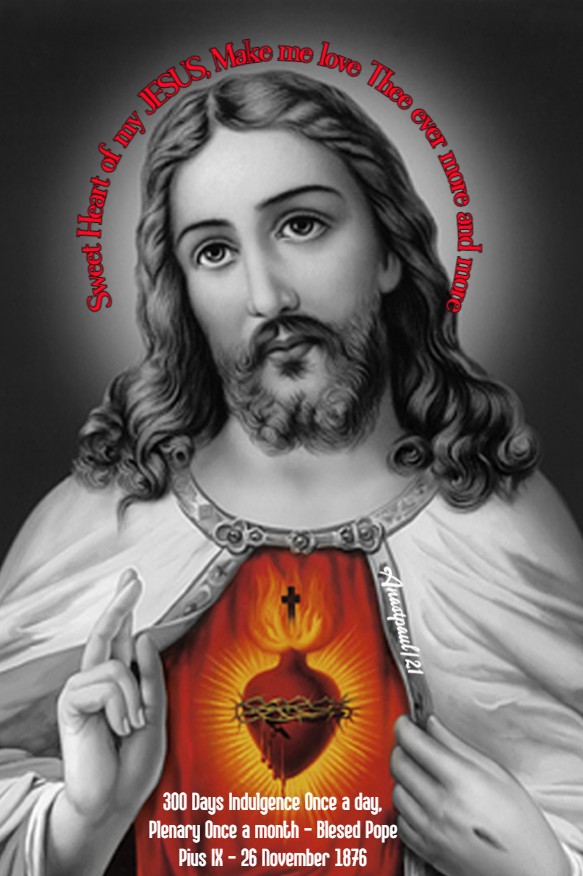
Sweet Heart of my JESUS, Make me love Thee ever more and more! – 300 Days Indulgence Once a day, Plenary Once a month – Blessed Pope Pius IX – 26 November 1876
Our Morning Offering – 9 June – “The Month of the Sacred Heart of Jesus” – Sunday Within the Octave of the Sacred Heart – Pentecost III
Prayer in Adoration of the Sacred Heart By St Margaret Mary Alacoque (1647-1690) Visionary and Apostle of the Sacred Heart of Jesus
Jesus Christ, my Lord and my God, Whom I believe to be really present in the Blessed Sacrament of the Altar, receive this most profound Act of Adoration to supply for the desire I have, to adore Thee unceasingly and in thanksgiving, for the sentiments of love which Thy Sacred Heart has for me in this Sacrament. I cannot better acknowledge them, than by offering Thee, all the Acts of Adoration, resignation, patience and love which this same Heart has made during its mortal life and which it makes still and which it shall make eternally in Heaven, in order that through it, I may love Thee, praise Thee and adore Thee worthily, as much as it is possible for me. I unite myself to this Divine Offering which Thou dost make to Thy Divine Father and I consecrate to Thee, my whole being, praying Thee, to destroy in me, all sin and not to permit that I should be separated from Thee, in time and eternally. Amen.
Saint of the Day – 9 June – Saint Maximian of Syracuse (Died 594) Bishop, Monk at St Gregory the Great’s Monastery in Rome and a close friend and collaborator with St Gregory in many instances and on many projects. Born in Sicily and died in 594 of natural causes at Syracuse, Sicily. Also known as – Massimiano.
The Roman Martyrology states: “In Syracuse, Saint Maximian, Bishop, of whom Saint Pope Gregory the Great often makes mention.”
Master of Portillo The Mass of Saint Gregory the Great (possibly the Bishop is our St Maximian)
Originally from Sicily (John the Deacon calls him Siculus), he became a Monk in Rome and after the death of Valenzione he was the second Abbot of the Monastery of St Andrew, Coelian Hill,, built before 583, by the noble Gregory (I believe it was built from St Gregory’s own ancestral home).
When St Gregory was sent by Pope Pelagius II as Papal Delegate to Constantinople to the Emperor Tiberius, Maximian joined him with some of his Monks. St Maximian seems to have prolonged St Gregory’s stay so much that the Pontiff wrote to Gregory to urge his return to Rome, as he was necessary to his Monastery and to the Apostolic See for an important matter. Upon returning, the following year, 585, after eight days of adventurous navigation in the Adriatic, the ship was shipwrecked in Crotone and Maximian, who had shown trust in God, was saved with all his companions.
When Gregory ascended to the Pontificate on 3 September 590, he chose some of his Monks, among them Maximian, to lead a monastic life in his palace which, according to John the Deacon, became “an ascetery of perfect virtue, a school of Ecclesiastical discipline, a Council of very wise government, so venerated in Rome and throughout the Church that anyone who did not have their papers in order, did not even dare appear, deeming it more appropriate to remain absent.”
In December 591, Maximian was already the Bishop of Syracuse. The Pope granted him the use of the Pallium and renewed the privileges of the ancient Bishopric; he also entrusted his representation over the entire Sicilian Church.
Vicar of the Pope and responding to his hopes, Maximian exercised a general supervision over Ecclesiastical discipline and affairs; he resolved the causes of lesser importance, referring the most difficult ones or those which he did not believe he could judge for himself, to the Pope.
Saint Gregory who, in entrusting him with these very broad powers, had minutely established the directives of Ecclesiastical politics in Sicily, addressed several letters to him and, in the end, showed himself pleased with what Maximian had done in just under three years in the vast territory of the Sicilian Island.
Even if the titles of “venerable, bishop of venerable memory” and “most holy” which often occur in the Epistolary of Saint Gregory, can obviously only be attributed a meaning of honour and respect, nevertheless the esteem which the Pope had for Maximian is evident from the expressions written in November 594 upon his death.
To the Deacon Cyprian, his rector in Sicily, the Pontiff wrote, expressing his great sorrow: “It is not Maximian who must mourn, having already flown to that eternal prize he so desired but these unhappy people of Syracuse ”. He let the Syracusans know that they “should keep in mind that another Maximian was not easy to find.”
An interesting aspect of Maximian’s activity was his collaboration with the St Gregory on the Memoirs relating to the Saints of Italy. Saint Gregory mentions it repeatedly; indeed, in 594, he would have liked to see him again, to know more distinctly, some edifying facts learned from St Maximian in the past, in order to insert them into the Dialogues. Our Saint Maximian, who was no longer able to travel to Rome, briefly and in writing, reported to Saint Gregory what he knew about Saint Nonnosus (c500-560) and some other Saints. Sadly for St Gregory, St Maximian was about to leave this earth and travel home.
St Felicianus and St Primus * (Died c304) Brothers, Confessors, Lay Martyrs. The Roman Martyrology reads today: “At Rome, on Mount Caelius, the birthday of the holy Martyrs, Primus and Felician, under the Emperor Diocletian and Maximian. These glorious Martyrs lived long in the service of the Lord and endured sometimes together, sometimes separately, various cruel torments. They were finally beheaded by Promotus, Governor of Nomentum and thus happily ended their combat.” Their Lives and Death: https://anastpaul.com/2023/06/09/saints-of-the-day-9-june-saints-primus-and-felicianus-died-c304-martyrs-confessors/
St Alexander of Prusa St Arnulf of Velseca
St Baithen of Iona (c 536-c 599) Abbot, the first successor of St Columba of Iona. An Irish Monk, especially selected by St Columba, as one of the band of Missionaries who set sail for Scotland in 563. St Baithen of Iona is generally known as Baithen Mor, to distinguish him from eight other Saints of the same name — the affix mor meaning “the Great.” This holy man was closely related to the great St Columba. His Illustrious Life: https://anastpaul.com/2022/06/09/saint-of-the-day-9-june-st-baithen-of-iona-c-536-c-599/
St Comus of Scotland St Cumian of Bobbio St Cyrus Bl Diana d’Andalo OP St Diomedes of Tarsus St Julian of Mesopotamia St Luciano Verdejo Acuña St Maximian of Syracuse (Died 594) Bishop St Pelagia of Antioch St Primus * St Richard of Andria Bl Robert Salt Bl Sylvester Ventura St Valerius of Milan St Vincent of Agen
Martyrs of Arbil – 5 Saints: Five Nuns who were Martyred together in the persecutions of Tamsabur for refusing to renounce Christianity for sun-worship – Amai, Mariamne, Martha, Mary and Tecla. They were beheaded on 31 May 347 at Arbil, Assyria (in modern Kurdistan, Iraq).
Thought for the Day – 8 June – Meditations with Fr Richard Frederick Clarke SJ (1839-1900)
HUMILITY Meditations for a Month
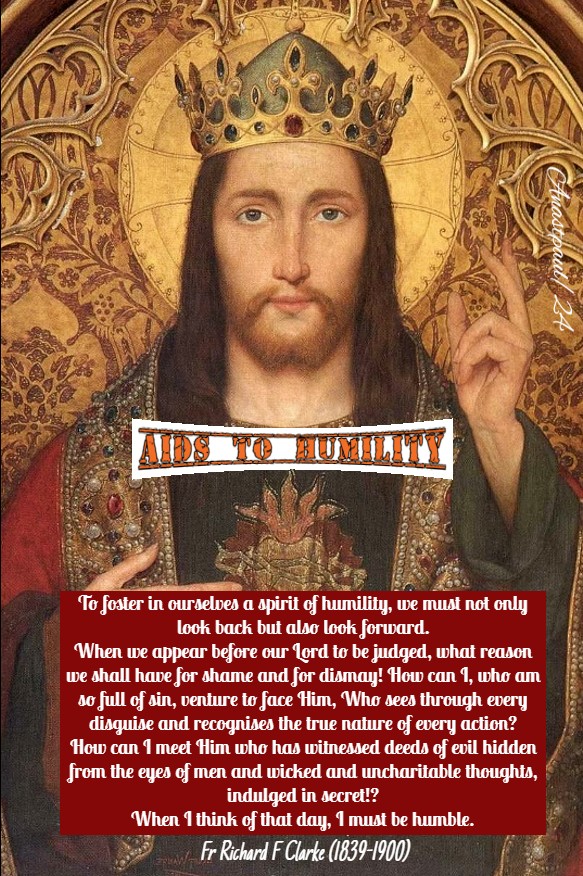
Aids to Humility
To foster in ourselves a spirit of humility, we must not only look back but also look forward. When we appear before our Lord to be judged, what reason we shall have for shame and for dismay! How can I, who am so full of sin, venture to face Him, Who sees through every disguise and recognises the true nature of every action? How can I meet Him who has witnessed deeds of evil hidden from the eyes of men and wicked and uncharitable thoughts, indulged in secret!? When I think of that day, I must be humble.
Nothing will then be such a cause of shame to me as my pride. Nothing will so turn away the Face of my Judge from me in anger. If God abhors the proud, how can I look forward to that day without trembling? St Teresa said that when she had the privilege of seeing our Blessed Lord in a vision, the prevailing thought in her mind was, what a terrible thing it would be, if He were to be angry with her. He will be angry with me, then, unless I learn more humility! O my God, make me humble at any cost!
What will be the punishment of pride? Will it be the fire of Hell that was prepared for the devil and his angels, simply and solely because of their pride? None will endure such misery as the proud; not the gluttonous, or the impure, or the covetous, except, so far as their other vices fostered pride in them. O my God, if nothing else will make me humble, grant that the thought of the lowest Hell, reserved for the proud, may conquer in me that hateful vice of pride!
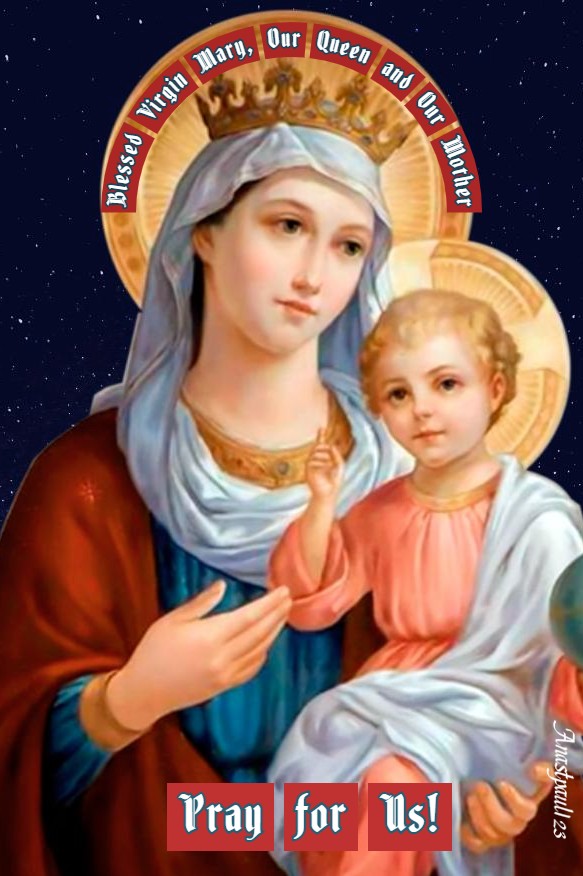
Quote/s of the Day – 8 June – The Queenship of Mary
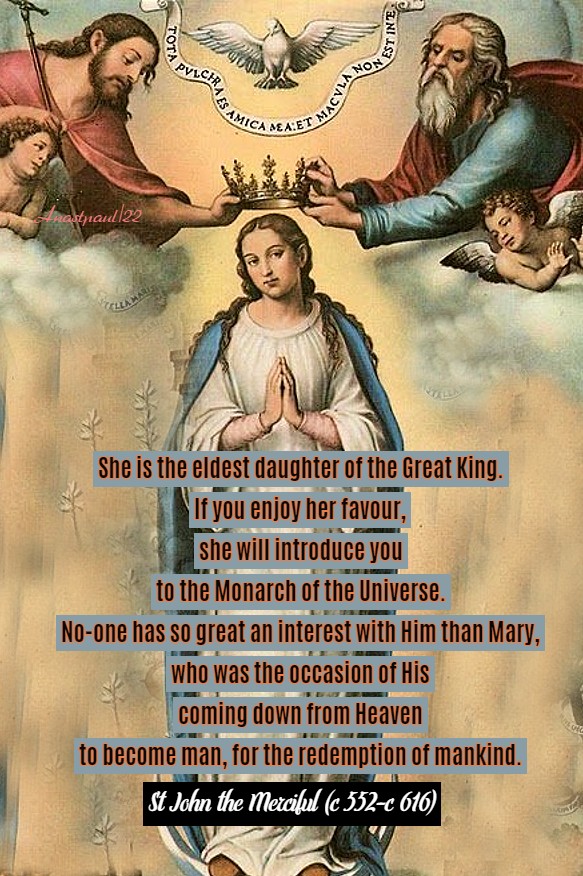
“She is the eldest daughter of the Great King. If you enjoy her favour, she will introduce you to the Monarch of the Universe. No-one has so great an interest with Him than Mary, who was the occasion of His coming down from Heaven to become man, for the redemption of mankind.”
St John the Merciful (c 552-c 616)
“And as Queen, she possesses, by right, the whole Kingdom of her Son.”
Rupert of Deutz OSB (c 1075- c 1130) Benedictine Abbot
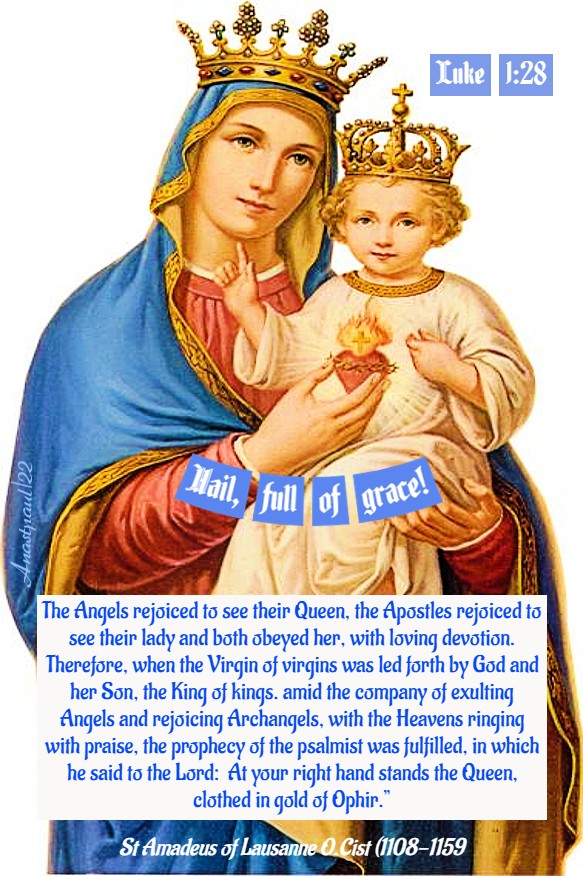
“The Angels rejoiced to see their Queen, the Apostles rejoiced to see their lady and both obeyed her, with loving devotion. … Therefore, when the Virgin of virgins was led forth by God and her Son, the King of kings. amid the company of exulting Angels and rejoicing Archangels, with the Heavens ringing with praise, the prophecy of the psalmist was fulfilled, in which he said to the Lord: At your right hand stands the Queen, clothed in gold of Ophir.”
St Amadeus of Lausanne O.Cist (1108-1159)
“So Mary is a Queen. And, for our consolation, we ought to remember that she is a most tender and kind Queen, eager to help us in our miseries. So much so, that the Church wants us to call her in this prayer, a Queen of Mercy. Hail, Holy Queen, Mother of Mercy!”
St Alphonsus Liguori (1696-17
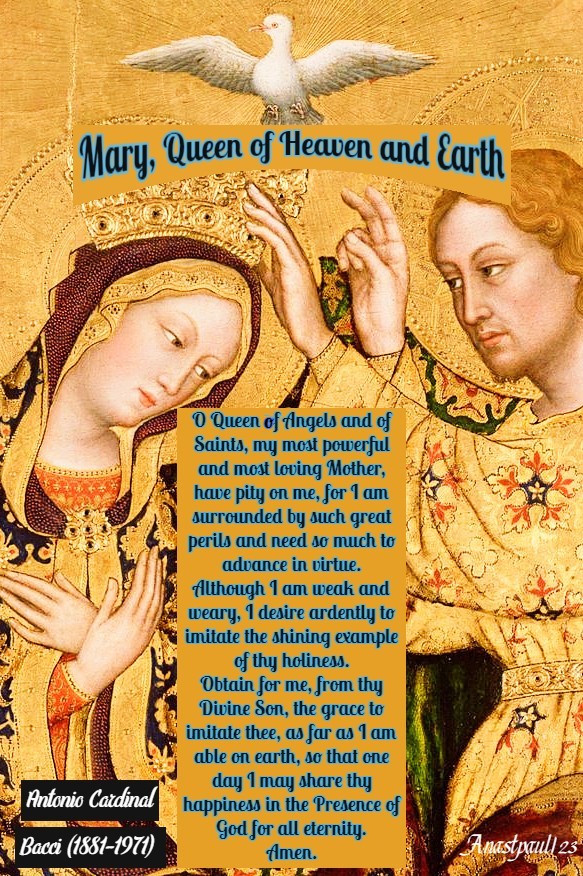
“O Queen of Angels and of Saints, my most powerful and most loving Mother, have pity on me, for I am surrounded by such great perils and need so much to advance in virtue. Although I am weak and weary, I desire ardently to imitate the shining example of thy holidness. Obtain for me, from thy Divine Son, the grace to imitate thee, as far as I am able on earth, so that one day I may share thy happiness in the Presence of God for all eternity. Amen.”
One Minute Reflection – 8 June – The Queenship of the Blessed Virgin Mary – Ecclesiasticus 24:5; 14:7; 14:9-11; 24:30-31; Luke 1:26-33 – Scripture search here: https://www.drbo.org/
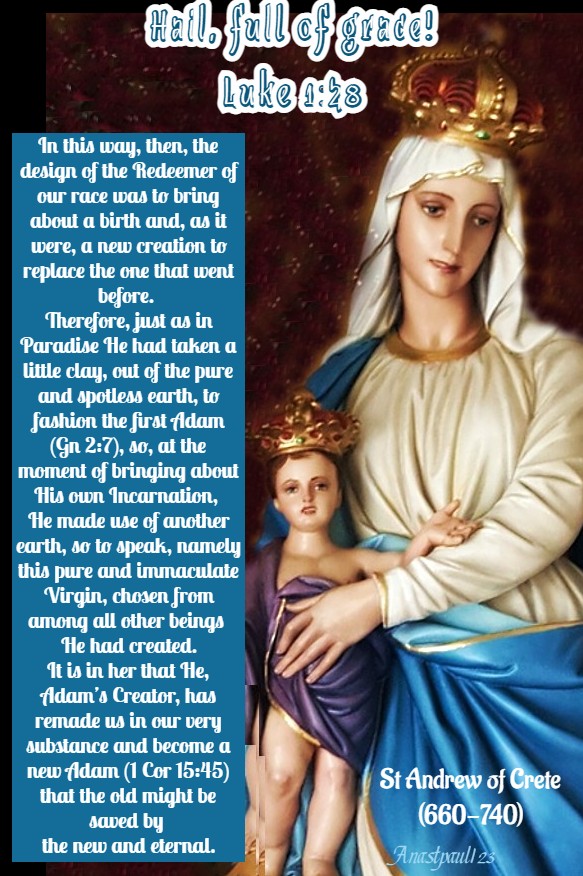
“Hail, full of grace!”– Luke 1:28
REFLECTION – “The degeneration caused by sin had obscured the beauty of our original nobility. But when the mother of supreme Beauty is born, our nature finds its purity once more and sees itself moulded according to the perfect model, worthy of God (Gn 1:26)… We had all preferred the world below to that above. There no longer remained any hope of salvation. The state of our nature cried aloud to Heaven to come to the rescue… Then, at last, in His good pleasure, the world’s Divine Artificer determined to make a new world appear, a different world full of harmony and youth.
Now, was it not fitting, that a most pure virgin without stain, should place herself at the service of this mysterious plan, first of all?… And where was this virgin to be found if not in this woman, alone of her kind, chosen by the world’s Creator before all generations? Yes, she indeed is Mother of God, divinely named Mary, whose womb gave birth to God Incarnate and whom, He Himself, had supernaturally prepared as His temple…
In this way, then, the design of the Redeemer of our race was to bring about a birth and, as it were, a new creation to replace the one that went before. Therefore, just as in Paradise He had taken a little clay, out of the pure and spotless earth, to fashion the first Adam (Gn 2:7), so, at the moment of bringing about His own Incarnation, He made use of another earth, so to speak, namely this pure and immaculate Virgin, chosen from among all other beings He had created. It is in her that He, Adam’s Creator, has remade us in our very substance and become a new Adam (1 Cor 15:45) that the old might be saved by the new and eternal.” – St Andrew of Crete (660-740) Bishop, Father (Sermon 1 for the Nativity of the Mother of God).
PRAYER – Grant we beseech Thee, O Lord, that we who keep the Feast of the Blessed Virgin Mary, Our Queen, safe under her protection, may be worthy to have peace now and glory, in the future. Through Jesus Christ, Thy Son our Lord, Who lives and reigns with Thee, in the unity of the Holy Ghost, God, world without end. Amen (Collect).Through the same Jesus Christ, Thy Son our Lord, Who lives and reigns with Thee, in the unity of the Holy Ghost, God, world without end. Amen (Collect).
All praise, honour and glory to the divine HEART of JESUS. – Indulgence 50 Days, Once a day. Raccolta 168 Pope Leo XIII, 14 June 1901.






































 AnaStpaul
You must be logged in to post a comment.