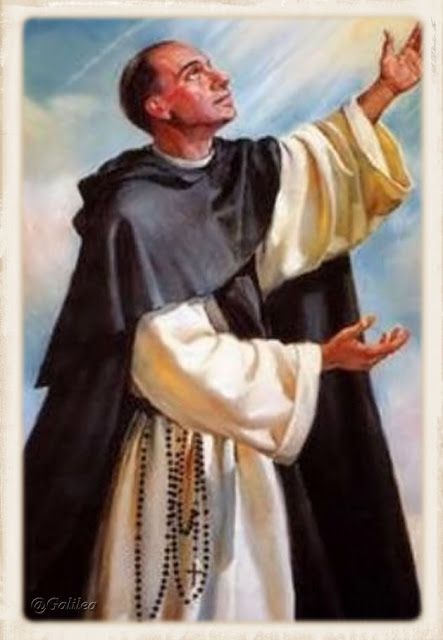
Quote/s of the Day – 7 March – St Thomas Aquinas OP (1225-1274) Confessor, Doctor
“We are like children, who stand in need of masters, to enlighten us and direct us and God has provided for this, by appointing His Angels, to be our teachers and guides.”
“To one who has faith, no explanation is necessary. To one without faith, no explanations is possible.”
“Love takes up, where knowledge leaves off.”
“If the highest aim of a Captain were to preserve his ship, he would keep it in Port, forever!”
“If then, you are looking for the way by which you should go, take Christ, for He, Himself, is the Way.”
“Happiness is secured through virtue; it is a good attained by man’s own will.”
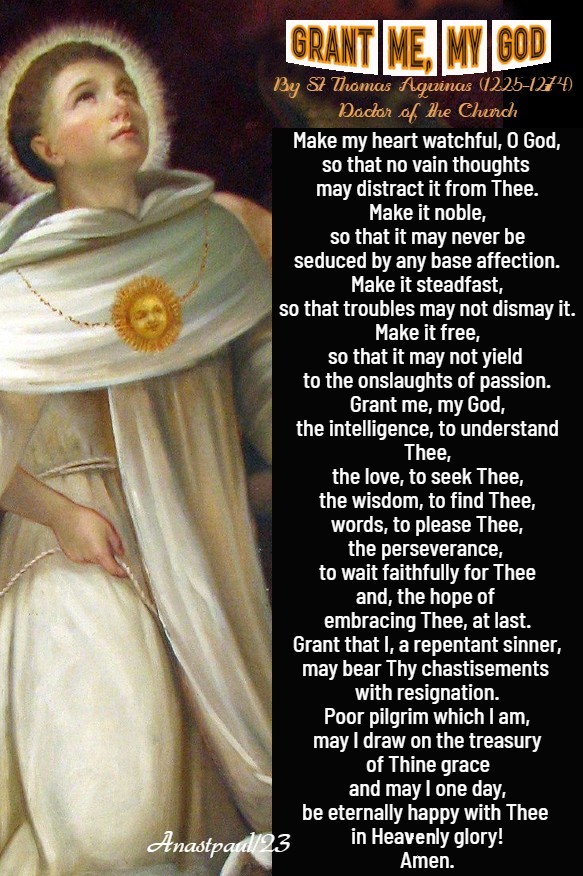
Grant Me Grace, O Merciful God Prayer of St Thomas Aquinas (1225-1274) Doctor Angelicus & Doctor Communis which he was accustomed to recite everyday before the image of Christ.
Grant me grace, O merciful God, to desire ardently all that is pleasing to Thee, to examine it prudently, to acknowledge it truthfully and to accomplish it perfectly, for the praise and glory of Thy Name. Amen
Our Lenten Journey with the Angels and the Saints – 7 March – Wisdom 7:7-14; Matthew 5:13-19 – Scripture search here: https://www.drbo.org/
“For she is an infinite treasure to men! which they that use, become the friends of God” Wisdom 7:14
“Neither do men light a candle and put it under a bushel but upon a candlestick …” Matthew 5:15
Exercise Your Soul
St Clement of Alexandria (c150-c215) Father of the Church
“A well, when pumped regularly, produces purer water. If neglected and no-one uses it, it changes into a source of pollution. Use keeps metal brighter but disuse produces rust.
For, in a word, exercise produces a healthy condition, both in souls and bodies.
So “No-one lights a candle and puts it under a bushel but upon a candlestick that it may give light.”
For of what use is wisdom, if it fails to make those who hear it wise?” (Stromateis 1)
One Minute Reflection – 7 March – “The Month of St Joseph” – – St Thomas Aquinas OP (1225-1274) Confessor, Doctor – Wisdom 7:7-14; Matthew 5:13-19 – Scripture search here: https://www.drbo.org/
“Therefore, whoever breaks one of the least of these commandments and teaches others to do so, will be called least in the Kingdom of Heaven. But whoever obeys and teaches these commandments, will be called greatest in the Kingdom of Heaven.” – Matthew 5:19
REFLECTION – “For what reason then does He call some of these commandments “least,” although they are so magnificent and lofty? Jesus spoke this way because He was about to introduce His own teaching, as a new law . As He humbles Himself and speaks of Himself with great modesty, so He refers to His own teaching in the same manner. In this way, Jesus teaches us to practice humility in everything. And besides, since some suspected His teaching to be a new departure, He temporarily taught it in a more reserved way.
But when you hear “least in the Kingdom of Heaven,” you are to think of nothing but hell and punishment. For it was His practice to speak, not only of the joy the Kingdom brings but also, of the time of the resurrection and the fearful event of the Second Coming.
Think of one who calls a brother a fool. That one, transgresses only one commandment, maybe even the slightest one and falls into hell. Compare that one with another, who breaks all the commandments and instigates others to break them too. Do both have the same relationship to the Kingdom? This is not the argument Jesus is making. Rather, He means, that one who transgresses only one of the commands will, on the final day, be the least—that is, cast out—and last and will fall into hell!” – St John Chrysostom (347-407) Archbishop of Constantinople, Father and Doctor of the Church (The Gospel of Saint Matthew, Homily 16).
PRAYER – O God, Who enlightened Thy Church with the wondrous learning of blessed Thomas, Thy Confessor and enriched her through his holy life, grant us, we beseech Thee, both to understand what he taught and by following his example, to do what he did. Through tJesus Christ, Thy Son our Lord, Who lives and reigns with Thee, in the unity of the Holy Ghost, God, world without end. Amen (Collect).
Our Morning Offering – 7 March – Thursday of the Third Week in Lent – St Thomas Aquinas OP (1225-1274) Confessor, Doctor
O Merciful God By St Thomas Aquinas (1225-1274) Doctor Angelicus Doctor Communis
O merciful God, grant that I may ever perfectly do Thy Will in all things. Let it be my ambition to work only for Thy honour and glory. Let me rejoice in nothing but that which leads to Thee, nor grieve for anything, which leads away from Thee. May all passing things be as nothing in my eyes and may all which is Thine be dear to me and Thou, my God, dear above them all. May all joy be meaningless without Thee and may I desire nothing apart from Thee. May all labour and toil delight me, when it is for Thee. Make me, O Lord, obedient without complaint, poor without regret, patient without murmur, humble without pretence, joyous without frivolity, and truthful without disguise. Amen
Saint of the Day – 7 March – Blessed John Larke (Died 1544) Priest Martyr. He was a notable personal friend of St Thomas More (1478-1535) Martyr, the Lord High Chancellor of England. Died on 7 March 1544 (aged in his late forties) at Tyburn, London, England. He was Beatified on 29 December 1886 by Pope Leo XIII.
John studied at Cambridge University prior to 26 years of serving as the Parish Priest of St Ethelburga’s in Bishopsgate in the City of London. In 1526, he transferred to a prosperous Parish at Woodford, in Essex. In 1530, 4 years later, he returned to London when St Thomas More appointed him as the Vicar of Chelsea.
There is evidence that John swore the Oath of Supremacy in 1534 but, as Cresacre More (1572–1649), Great-grandson and Biographer of St Thomas More expressed it: “the example of St Thomas More’s death so wrought on his mind that afterwards, he followed his own sheep and suffered a famous Martyrdom.”
He was formally charged on 15 February 1544, together with John Ireland, Parish Priest at Eltham, German Gardiner and Thomas Heywood. All were condemned but Heywood recanted on the hurdle and lived to give testimony against Cranmer – one of the original apostates. The other three, along with another Priest from Lancashire, Robert Singleton, whose arrest was never explained, were executed on 7 March 1544 for the crime of being Catholic Priests.
St Ardo of Aniane Bl Daniel of Wichterich St Deifer of Bodfari St Drausinus of Soissons Bishop St Enodoch St Esterwine of Wearmouth Abbot St Eubulus of Caesarea Bl German Gardiner Bl Henry of Austria Bl Jermyn Gardiner Bl John Ireland BlessedJohn Larke (Died 1544) Priest Martyr. He was a notable personal friend of St Thomas More (1478-1535) , Martyr the Lord High Chancellor of England. St Paul of Prusa
Bl Volker of Segeberg OSA (Died c1135) Priest Martyr Bl William of Assisi
Martyrs of Carthage – 4 Saints: A catechist and three students Martyred together for teaching and learning the faith. We know little more than their names – Revocatus, Saturninus, Saturus and Secundulus. Mauled by wild beasts and beheaded 7 March 203 at Carthage, North Africa
Thought for the Day – 6 March – The Spiritual Combat (1589) – Dom Lorenzo Scupoli OSM (c1530-1610)
“None shall be crowned who has not fought well.” 2 Tim 2: 5
XXIX: … Of the Efforts of the Devil to Prevent the Conversion of Those Who Desire It (Part One)
“When a man begins to perceive the evil of his life and to desire to change it, the devil often deludes and overcomes him by such means as these: “Presently, presently.” “Cras, cras” (tomorrow, tomorrow) as the raven cries. “I wish first to consider and dispatch this business, this perplexity that I may then be able to give myself, with greater tranquillity to spiritual things.”
These are snares in which many men have been and are still daily entangled and, the cause of this, is our own negligence and heedlessness, seeing that, in a matter touching the honour of God and the salvation of the soul, we neglect to seize, instantly that effectual weapon — “Now, now!” … “Even supposing this ‘presently’ and this ‘tomorrow’ should be granted to me, is it the way of safety and of victory to seek first to be wounded and to commit fresh disorders?!”
You see, then, that the way to escape these snares and that mentioned in the preceding chapter and, to subdue the enemy, is, to yield prompt obedience to all heavenly thoughts and inspirations.”
Quote/s of the Day – 6 March – Wednesday of the Third Week in Lent – Ecclesiasticus Sirach 51:13-17; Matthew 13:44-52 – Scripture search here: https://www.drbo.org/
“The Kingdom of Heaven is like a treasure hidden in a field.”
Matthew 13:44
“Do not lay up for yourselves treasures on earth, where rust and moth consume and where thieves break in and steal but lay up for yourselves, treasures in Heaven …”
Matthew 6:19-20
“For the man who loves God, it is sufficient to please the One he loves and, there is no greater recompense to be sought, than the loving itself. For love is from God, by the very fact that God Himself is love. The good and chaste soul is so happy to be filled with Him that it desires to take delight in nothing else. For what the Lord says is very true: ‘Where your treasure is, there also will your heart be.’”
St Pope Leo the Great (400-461) ather and Doctor of the Church
“Watch, therefore and pray and labour diligently and do not delay to weave the web of your wedding-garment that you may be found ready and adorned to meet the Bridegroom! And remember daily that He, Who gives you the morning, does not promise you the evening and although He gives the evening, yet promises not the morrow. Spend, therefore, every moment of every hour according to God’s will, as if it were your last and so much the more carefully, as, for every moment, you will have to give the strictest account!
Finally, I warn you to account that day lost, in which you will neither have gained some victory over your evil inclinations and your self-will, although it may have been full of busy action, nor returned thanksgiving to your Lord for His mercies and especially for His bitter Passion endured for you and for His sweet and fatherly correction, when He has made you worthy to receive, at His Hand, the inestimable treasure of suffering.”
Fr Lorenzo Scupoli OSM (c1530-1610)
“Where is the heart which loves? On the thing it loves. Therefore, where our love is, there our heart is held captive. It cannot leave it; it cannot be lifted higher, it cannot go either to the right or the left; see, it is fixed. Where the miser’s treasure is, there is his heart and where our heart is, there is our treasure. And what is so deplorable is that the things which hold us in servitude, are, for the most part, such unworthy things!”
Our Lenten Journey with the Angels and the Saints – 6 March – Wednesday of the Third Week in Lent – Ecclesiasticus Sirach 51:13-17; Matthew 13:44-52 – Scripture search here: https://www.drbo.org/
“Nor then do thou leave me, Angelical friend! But at the tribunal Of Judgement attend And cease not to plead For my soul, till, forgiven, Thou bear it aloft To the Palace of Heaven!”
“The Kingdom of Heaven is like a treasure hidden in a field.” Matthew 13:44
Sweet Angel of Mercy! By Fr Edward Caswell C.Orat. (1814-1878)
Sweet Angel of mercy! By Heaven’s decree Benignly appointed To watch over me! Without thy protection, So constant and nigh, I could not well live; I should tremble to die.
All thanks for thy love, Dear companion and friend! Oh may it continue With me to the end! Oh cease not to keep me, Blest guide of my youth, In the ways of religion And virtue and truth.
Support me in weakness, My spirit inflame; Defend me in danger, Secure me from shame, That safe from temptation, Or sudden surprise, I may mount the straight path That ascends to the skies.
When Satan his snares For my ruin shall lay, Be thou, gentle comrade, My comfort and stay And in every event Which may happen to me, Make all my desires With thine to agree.
When I wander in error, My footsteps recall, Remove from my path What might cause me to fall. Preserve me from sin And in all that I do, May God and His glory Be ever in view.
O thou who didst witness My earliest breath, Be with me, I pray, In the hour of death. Console me in sadness, Refresh me in pain And teach me how best I may mercy obtain.
That, cleansed by confession Complete and sincere, From every defilement Afflicting me here, All glowing with love, I may gladly depart. With faith on my lips And with hope in my heart.
Nor then do thou leave me, Angelical friend! But at the tribunal Of Judgement attend And cease not to plead For my soul, till, forgiven, Thou bear it aloft To the Palace of Heaven!
One Minute Reflection – 6 March – “The Month of St Joseph” – Wednesday of the Third Week in Lent Sts Perpetua and Felicity (Died c203) Martyrs – Ecclesiasticus Sirach 51:13-17; Matthew 13:44-52 – Scripture search here: https://www.drbo.org/
“The Kingdom of Heaven is like a treasure hidden in a field.” – Matthew 13:44
REFLECTION – “Some of the brethren think that they are excluded from the Holy Ghost’s gifts of grace. Because they neglect to practise the commandments, they do not know that he who has an unadulterated faith in Christ, has within himself, the sum total of all the Divine gifts. Since, through our laziness, we are far from having an active love for Him — a love which shows us the Divine Treasures within us — we naturally think that we are excluded from these gifts.
If, as St Paul says: “Christ dwells in our hearts through faith” (Eph 3:17) and, “all the treasures of wisdom and spiritual knowledge are hidden in Him” (Col 2:3), then, all the treasures of wisdom and spiritual knowledge are hidden in our hearts! They are revealed to the heart, in proportion to our purification by means of the commandments. This is the treasure, hidden in the field of your heart which you have not yet found because of your laziness. Had you found it, you would have sold everything and bought that field. But now, you have abandoned that field and give all your attention to the land nearby, where there is nothing but thorns and thistles! It is for this reason that the Saviour says: “Blessed are the pure in heart, for they shall see God” (Mt 5:8) for He is hidden in the hearts of those who believe in Him.They shall see Him and the riches that are in Him, when they have purified themselves, through love and self-control. And, the greater their purity, the more they will see!” – St Maximus the Confessor (c580-662) Abbot and Theologian (Centuries of love 4:69).
PRAYER – Grant, we beseech Thee, O Lord our God, that we may venerate with unceasing devotion Thy holy Martyrs Perpetua and Felicitas and, although we cannot pay them the honour that is their due, may we at least present to them, our humble homage. Through Jesus Christ, Thy Son our Lord, Who lives and reigns with Thee, in the unity of the Holy Ghost, God, world without end. Amen (Collect).
Our Morning Offering – 6 March – “The Month of St Joseph” and Wednesday, the Day of Saint Joseph – Saint Joseph is known as the Prince and Chief Patron of the Church. As the earthly Foster-Father of Jesus, he had a special role in protecting, providing for and instructing Jesus during His earthly life. Now that Christ is ascended into Heaven, St Joseph continues his fatherly Guardianship of Christ’s Body, the Church. He is a very powerful assistant to all of us.
Ad Te, Beate Joseph To Thee, O Blessed Joseph By Pope Leo XIII (1810-1903)
O most watchful Guardian of the Holy Family, defend the chosen children of Jesus Christ. O most loving father, ward off from us, every contagion of error and corrupting influence. O our most mighty protector, be propitious to us and from heaven assist us in our struggle with the power of darkness and, as once you rescued the Child Jesus from deadly peril, so now protect God’s Holy Church from the snares of the enemy and from all adversity. Shield, too, each one of us by your constant protection, so that, supported by your example and your aid, we may be able to live piously, to die holy and to obtain eternal happiness in Heaven. Amen
Saint of the Day – 6 March – St Ollegarius Bonestruga OSA (1060-1137) Bishop, Canon Regular of the Augustinians, Reformer, in both the religious sphere and the social one, Abbot, Diplomat, Peacemaker and Proptector of his people from possible violent incursions. Born in 1060 at Barcelona, Spain and died in Tarragona in 1137 of natural causes. Ollegarius was the Bishop of Barcelona from 1116 and at the same time, the Archbishop of Tarragona from 1118 until his death. He was an intimate friend and Counsellor-Confessor of Count Ramon Berenguer III of Barcelona and often accompanied the Count, on military ventures. Also known as – Ollegarius of Tarragona, Ollegarius of Barcelona, Olaguerand, Oldegar, Olegari, Olegarius, Oligarius, Oleguer, Olegario. Ollegarius was Canonised in 1675 and his major Shrine and Sepulchre is in the side Chapel of Christ of Lepanto, in the Cathedral of Barcelona (see image at the end of the page). His Feast is celebrated the date of his death, today 6 March.
The Roman Martyrology reads: “At Barcelona in Spain, the blessed St Ollegarius, who was first a Canon and afterwards the Bishop of Barcelona and Archbishop of Tarragona.”
This Statue resides in the Interior of Barcelona Cathedral
Ollegarius was born in 1060 into a wealthy family in Barcelona. At the age of 10, he was included in the Cathedral Chapter in his hometown. He was Ordained a Priest in 1094. Over time, he became the Superior of Canons in Barcelona and Sant Adria de Besós (1095-1108) and the Abbot of the Augustinian Monastery of St Rufus in Avignon (1113-1118). He also joined the confraternity of San Pedro de la Portella.
Raymon Berenguer III, Count of Barcelona, appointed him Bishop of that City in 1116. Ollegarius was Consecrated by Cardinal Boso in the Cathedral of Maguelone in Provence, during the Pontificate of Paschal II. In 1117 he went to Rome to pay homage to Pope Gelasius II.
Saint Ollegarius, Sculpture by Pere Villar in the Choir of the Barcelona Cathedral, 16th Century
Ollegarius was a zealous reformer. He participated in the Synods of Toulouse (1119), Reims (1120), the First Lateran Council (1123), Narbonne (1129), Clermont (1130) and again in Reims (1131). He was also involved in implementing the Augustinian Reform of Monasteries in Catalonia – in the 1220s he transformed the Monastery of St Eulalia (then outside Barcelona) into the community of Augustinian Canons. On 8 March 1118, Olegarius, then still the Bishop of Barcelona, was also appointed the Bishop of Tarragona. He had the difficult task of rebuilding the Church in this region, after regaining the region from the Moors.
After 1124 he went on a pilgrimage to the Holy Land but due to his concern for his new Diocese, he shortened his stay in Antioch and returned before 1127. Between 1126 and 1130, he was very active in rebuilding the City, especially the Churches. He brought in new inhabitants and knights who would defend the City in the future. The years 1126-1127 were a time of efforts to organise the Second Crusade. Olegarius compensated William V for sending his knights to Barcelona in 1124-1125 and brought about an agreement between William and his son, Bernard IV, thus strengthening the alliance against the Almoravida pirates.
In March 1129, Ollegarius transferred his secular powers to Robert Bordet, making him Duke of Tarragona. He himself returned to caring for the renewal of his Diocese. The Synod of Narbonne (1129) approved the existence of the Archfraternity, which Ollegarius had founded a year earlier — its aim was to rebuild the Church in Tarragona. Members of the Archfraternity, clergy and laity, wealthy and poor, made monetary donations which were allocated to the Archdiocese of Tarragona.
A Life of St Ollegarius 1617
Ollegarius died on 6 March 1137. He was Canonis ed on 18 May 1675 by Pope Clement X. The Tomb of the Bishop of Barcelona and Tarragona, is located in the Cathedral of Barcelona.
The Sepulchre of St Ollegarius in the Cathedral of Barcelona
St Aetius St Bairfhion St Baldred of Strathclyde St Baldred the Hermit St Balther of Lindisfarne St Basil of Bologna St Cadroë
St Chrodegang of Metz (c714-776) The First Bishop of Metz, Protector and Father of the poor and orphans, Reformer of the Clergy, a relative of King Pepin and of Prince Charles Martel, both of whom he was Court Chancellor, Royal Diplomat, Saint Opportuna of Montreuil was his brother. The Roman Martyrology states: “In Metz in Austrasia, in today’s France, St Crodegango, Bishop, who arranged for the Clergy to live as if within the walls of a cloister under an exemplary rule of life and greatly promoted liturgical chant.” Biography: https://anastpaul.com/2022/03/06/saint-of-the-day-6-march-saint-chrodegang-of-metz/
St Colette PCC (1381-1447) Abbess and Foundress of the Colettine Poor Clares, a reform branch of the Order of Saint Clare. Patronages – against eye disorders, against fever, against headaches, against infertility, against the death of parents, of women seeking to conceive, expectant mothers and sick children, craftsmen, Poor Clares, servants, Corbie, France, Ghent, Belgium. St Colette was Canonised on 24 May 1807 by Pope Pius VII. Biography: https://anastpaul.com/2017/03/06/saint-of-the-day-6-march-st-colette/ AND: https://anastpaul.com/2019/03/06/saint-of-the-day-6-march-st-colette-2/
St Cyriacus of Trier St Cyril of Constantinople St Evagrius of Constantinople
Bl Guillermo Giraldi St Heliodorus the Martyr Bl Jordan of Pisa St Julian of Toledo St Kyneburga of Castor St Kyneswide of Castor St Marcian of Tortona St Ollegarius Bonestruga OSA (1060-1137) Bishop St Patrick of Malaga St Sananus
Martyrs of Amorium – 42 Saints – Also known as Martyrs of Syria and Martyrs of Samarra; A group of 42 Christian senior officials in the Byzantine Empire who were captured by forces of the Abbasid Caliphate when the Muslim forces overran the City of Amorium, Phrygia in 838 and massacred or enslaved its population. The men were imprisoned in Samarra, the seat of the Caliphate, for seven years. Initially thought to be held for ransom due to their high position in the empire, all attempts to buy their freedom were declined. The Caliph repeatedly ordered them to convert to Islam and sent Islamic scholars to the prison to convince them; they refused until the Muslims finally gave up and killed them. Martyrs. We know the names and a little about seven of them: Aetios Bassoes Constantine Constantine Baboutzikos Kallistos Theodore Krateros Theophilos but details about the rest have disappeared over time. However, a lack of information did not stop several legendary and increasingly over-blown “Acts” to be written for years afterward. One of the first biographers, a monk name Euodios, presented the entire affair as a judgement by God on the empire for its official policy of Iconoclasm. Deaths: beheaded on 6 March 845 in Samarra (in modern Iraq) on the banks of the Euphrates river by Ethiopian slaves the bodies were thrown into the river, but later recovered by local Christians and given proper burial.
Thought for the Day – 5 March – The Spiritual Combat (1589) – Dom Lorenzo Scupoli OSM (c1530-1610)
“None shall be crowned who has not fought well.” 2 Tim 2: 5
XXVIII: … Of the Devil’s Devices Against Those Already Held, in the Bondage of Sin
“When the devil holds a man in the bondage of sin, his chief care is to blind his eyes more and more and to avert everything from him which might lead to a knowledge of his most wretched condition. And not only does he, by instilling contrary thoughts, drive from him all reflections and inspirations which call him to conversion but, by affording him ready opportunities, he makes him fall into new and greater sins.
Hence, the thicker and darker waxes his blindness, the more desperate and habitual becomes his course of sin and thus, from blindness to deeper blindness, from sin to fouler sin, his wretched life will whirl on, even unto death, unless God, by His grace, should intervene to save him.
The remedy for one in this unhappy condition is, to be ready to give dilligent heed to the thoughts and inspirations which call him from darkness to light, crying with all his heart to his Creator: “O Lord, help me, help me speedily, leave me no longer in the darkness of sin.” And let him not fail to repeat this cry for mercy over and over again in these or the like words. If possible, let him have immediate recourse to some spiritual guide and ask aid and counsel that so he may be delivered from the power of the enemy. And if he cannot do this, at the moment, let him with all speed, fly to the Crucifix, prostrating himself before it and asking mercy and aid also, from the Mother of God.
On this speed does the victory depend, as you will learn in the next chapter.”
Quote/s of the Day – 5 March – Tuesday of the Third Week of Lent – 4 Kings 4:1-7; Matthew 18:15-22
“Then Peter came up and said to Him, “Lord, how often shall my brother sin against me and I forgive him? As many as seven times?” Jesus said to him, “I do not say to you seven times but seventy times seven.”
Matthew 18:21-22
“Lord, do not hold this sin against them.”
Acts 7:60
“No-one heals himself by wounding another.”
“Our own evil inclinations are far more dangerous, than any external enemies. ”
St Ambrose (340-397) Father and Doctor of the Church
“If a man finds it very difficult to forgive injuries, let him look at a Crucifix and think that Christ shed all His Blood for him and not only forgave His enemies but, even prayed His Heavenly Father, to forgive them too. Let him remember, that when he says the Pater Noster, everyday, instead of asking pardon for his sins, he is calling down VENGEANCE UPON HIMSELF!”
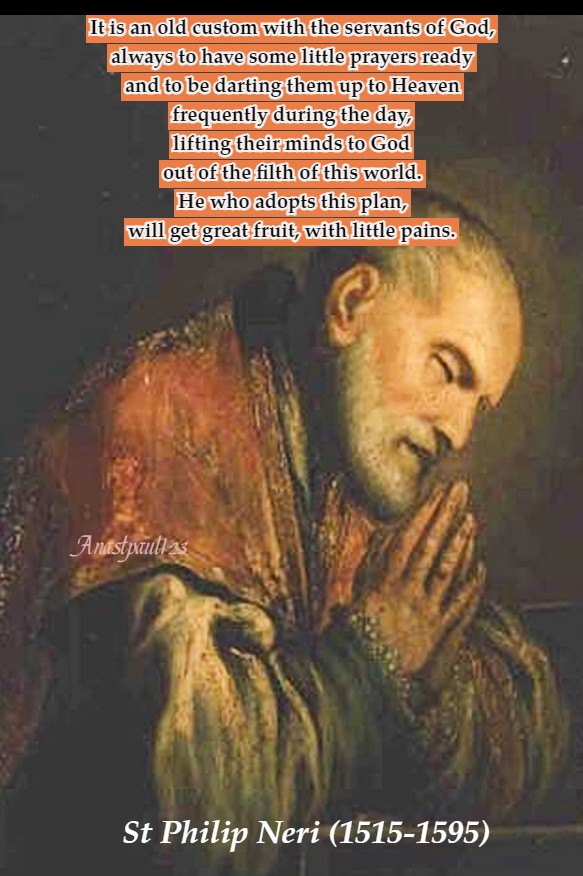
St Philip Neri (1515-1595)
“You must be reconciled to your enemies, speak to them, as if they had never done you anything but good, all your life, keeping nothing in your heart but the charity, which the good Christian should have, for everyone, so that we may all appear with confidence, before the tribunal of God.”
Our Lenten Journey with the Angels and the Saints – 5 March – Tuesday of the Third Week in Lent – 4 Kings 4:1-7; Matthew 18:15-22 – Scripture search here: https://www.drbo.org/
“And forgive us our sins, for we also forgive everyone who is indebted to us.” Luke 11:4
“Then Peter came up to him and said, “Lord, how often shall my brother sin against me and I forgive him? As many as seven times?” Jesus said to him, “I do not say to you seven times but seventy times seven.” Matthew 18:21-22
Forgiving Our Brother With All Our Heart
By St Francis de Sales (1567-1622) Doctor of the Church
“The first word our Lord spoke on the Cross was a prayer for those who were Crucifying Him; thus, He carried out what Saint Paul wrote: “In the days of His flesh, He offered prayer and sacrifice” (Heb 5:7). It is true that those who were Crucifying our Divine Saviour did not know Him … for, if they had known Him, they would not have Crucified Him (1 Cor 2:8). Therefore, our Lord, seeing the ignorance and weakness of those torturing Him, began to make excuses for them and offer this Sacrifice to His heavenly Father for them – for prayer is a sacrifice: … “Father, forgive them, for they know not what they do” (Lk 23:34). How great was the flame of love burning in our sweet Saviour’s heart, since amidst the strongest of His pains, at the time when the strength of His sufferings seemed to take from Him even the ability to pray for Himself, He came, through the strength of charity, to forget Himself but not those He had created …
By this He wanted to make us understand the love He bore for us, a love which could not be lessened by any kind of suffering and, to teach us, too, what our hearts ought to be feeling with regard to our neighbour …
Now, since this Divine Lord had been occupying Himself in asking forgiveness for us, it is absolutely certain that His request was granted. For His Divine Father honoured Him too much to refuse Him anything He asked.” – (Sermon for Good Friday 25/03/1622).
One Minute Reflection – 5 March – Tuesday of the Third Week of Lent – 4 Kings 4:1-7, Matthew 18:15-22 – “The Month of St Joseph”
“Then Peter came up to him and said, “Lord, how often shall my brother sin against me and I forgive him? As many as seven times?” Jesus said to him, “I do not say to you seven times but seventy times seven.” – Matthew 18:21-22
REFLECTION – “He is our peace, for He has made both one. Since we think of Christ as our peace, we may call ourselves true Christians, only if our lives express Christ by our own peace. As the Apostle says: He has put enmity to death. We must never allow it to be rekindled in us in any way but, must declare, that it is absolutely dead. Gloriously has God slain enmity, in order to save us, may we never risk the life of our souls by being resentful or by bearing grudges. …
No, since we possess Christ Who is Peace, we must put an end to this enmity and live as we believe He lived. He broke down the separating wall, uniting what was divided, bringing about peace by reconciling in His single person, those who disagreed. In the same way, we must be reconciled not only with those who attack us from outside but also with those who stir up dissension within; flesh then will no longer be opposed to the spirit, nor the spirit to the flesh. Once we subject the wisdom of the flesh to God’s law, we shall be re-created as one single man, at peace. Then, having become one instead of two, we shall have peace within ourselves.
Now peace is defined as harmony among those who are divided. When, therefore, we end that civil war within our nature and cultivate peace within ourselves, we become peace. By this peace we demonstrate that the Name of Christ, which we bear, is authentic and appropriate.
When we consider that Christ is the True Light, having nothing in common with deceit, we learn that our own life also must shine with the rays of that True Light. Now these rays of the Sun of Justice are the virtues which pour out to enlighten us so that we may put away the works of darkness and walk honourably as in broad daylight. When we reject the deeds of darkness and do everything in the light of day, we become light and, as light should, we give light to others by our actions. If we truly think of Christ as our source of holiness, we shall refrain from anything wicked or impure in thought or act and thus, show ourselves to be worthy bearers of His Name. For the quality of holiness is shown, not by what we say but by what we do in life.” – St Gregory of Nyssa (c 335–C 395) – Bishop and Father of the Church (Excerpt from his treatise, On Christian Perfection).
PRAYER – O God, Thou Who sees how we are deprived of all strength, guard us inwardly and outwardly that in body, we may be protected against all misfortunes and in mind, cleansed of evil thoughts and by the intercession of blessed and gloriosus ever Virgin Mary, Mother of God, be assisted on this earthly pilgrimage. Through Jesus Christ, Thy Son our Lord, Who lives and reigns with Thee, in the unity of the Holy Ghost, God, world without end. Amen (Collect).
Our Morning Offering – 5 March – Tuesday of the Third Week in Lent
Hear Me, O Lord By St Peter of Alcantara (1499-1562)
Hear me, O Lord, my soul’s delight, joy of my heart, not because of my merits but because of Thy boundless goodness. Teach me, enlighten me, direct me, help me in all things that I may never say or do anything but that which I know to be pleasing in Thou sight. Guide me, O God, my Love, my Light and my Life! Amen
Saint of the Day – 5 March – Saint Theophilus of Caesarea (Died c217) Bishop, Theologian, Writer , Apologist and Defender of the Faith. Born in Caesarea, Palestine and died c195 of natural causes. Also known as – Theophilus of Palestine.
The Roman Martyrology reads: “At Caesarea, in Palestine, in the time of the Emperor, Severus, St Theophilus, Bishop, who was conspicuous for his wisdom and the purity of his life.”
St Theophilus at Notre-Dame Basilica, Geneva (Switzerland)
Saint Theophilus was born in Caesarea in Palestine around 110. He was educated in a Christian environment and soon became a leader of the local Church. In 189 he was appointed as the Bishop of Caesarea.
He was a prolific Theologian and wrote several works, including the “Letter to Autolycus” an apologetic work defending Christianity against pagan accusations. In this work, Theophilus argues that Christianity is the true religion and that Jesus Christ is the Son of God.
Theophilus was an important leader of the Church. He was one of the main supporters of celebrating Easter on Sunday, according to Western tradition. In 190, he attended a Synod in Caesarea, in which it was decided that Easter would be celebrated on Sunday.
He died in Caesarea of Palestine around 217. He was officially Canonised in the 16th Century with a Feast today, 5 March.
St Adrian of Caesarea St Caron St Carthach the Elder Bl Christopher Macassoli of Vigevano St Clement of Santa Lucia St Colman of Armagh St Conon of Pamphylia Bl Conrad Scheuber Bl Dietmar von Minden St Eusebius of Cremona St Eusebius the Martyr St Gerasimus of Palestine (Died c475) Monk, Hermit Bl Giovanna Irrizaldi
Martyrs of Africa – A group of 304 Christians Martyred together for their faith. We know nothing else about them but five of their names Eusebius, Evolus, Hadrian, Julian and Octavian. They Died in 254 in Africa, exact location and date unknown.
Thought for the Day – 4 March – The Spiritual Combat (1589) – Dom Lorenzo Scupoli OSM (c1530-1610)
“None shall be crowned who has not fought well.” 2 Tim 2: 5
XXVII: … The Methods Used by the Devil to Tempt Those Who Desire Virtue
“You must know that the devil is intent upon nothing but our ruin and that he does not use the same method of assault with all persons.
In order, then, to make known to you some of his modes of attack, his stratagems and devices, I will set before you several different conditions of men.
+++ Some remain in the service of sin without a thought of escape. +++ Some would fain be free but never make the attempt. +++ Others think they are walking in the way of holiness, while they are wandering far from it. +++ And lastly, some, after having attained unto holiness, fall into deeper perdition.
Quote/s of the Day – 4 March – Wisdom for Lent and for Life
“Abide in Me and I in you. As the branch cannot bear fruit of itself, unless it abide in the vine, so neither can you, unless you abide in Me.”
John 15:4
“Strive to preserve your heart in peace; let no event of this world, disturb it.”
St John of the Cross (1542-1591) Doctor of the Church
“If, when stung by slander or ill-nature, we wax proud and swell with anger, it is a proof that our gentleness and humility are unreal and mere artificial show!”
“Do not look forward to the changes and chances of this life in fear – rather look to them with full hope that, as they arise, God, Whose you are, will deliver you out of them. He is your keeper. He has kept you hitherto. Do you but hold fast to His dear Hand and He will lead you safely through all things and, when you cannot stand, He will bear you in His arms. Do not look forward to what may happen tomorrow. Our Father will either shield you from suffering, or He will give you strength to bear it.”
“The truly patient man neither complains of his hard lot, nor desires to be pitied by others. He speaks of his sufferings in a natural, true and sincere way, without murmuring, complaining, or exaggerating them.”
St Francis de Sales (1567-1622) Doctor Caritatis
“If we live good lives, hoping for a Heavenly reward and guided by the action of the Holy Spirit, dwelling within us, we shall possess this spiritual joy. Once we possess it, it will be erased, neither by temptation, nor by suffering, nor by persecution, as long, as our faith, remains firm and steadfast. The sincere Christian accepts pleasure and pain with equal readiness because he places everything in God’s hands. … We must try, at least, to achieve that spirit of complete resignation to God’s will which is always rewarded by peace of soul!”
Our Lenten Journey with the Angels and the Saints – 4 March – St Casimir (1458-1484) Confessor, Prince – 4 Kings 5:1-15; Luke 12:35-40 – Scripture search here: https://www.drbo.org/
“The just shall flourish like the palm tree, he shall grow up, like the cedar of Lebanon.” Psalm 91:13
“There were many widows in Israel” Luke 4:25
The Precept of Hospitality
St Ambrose (340-397) Father and Doctor of the Church
“At that time, when the whole human race was afflicted by famine, Elias was sent to a widow? And see how, for each is reserved her own special grace. An Angel is sent to the Virgin, a Prophet to the widow. In the one case it is Gabriel, in the other Elisha. The most excellent chiefs of the number of Angels and Prophet,s are seen to be chosen! But there is no praise, simply in widowhood, unless there be added the virtues of widowhood. For, indeed, there were many widows but one is preferred to all, by whose example of virtue, they are stimulated … The grace of hospitality is not lost sight of by God, Who, as He hHmself relates in the Gospel, rewards a cup of cold water with the exceeding recompense of eternity (Mt 10:42) and compensates the small measure of meal and oil, by an unfailing abundance of plenty …
Why consider the fruits of the earth are private, when the earth itself is common property? … But we turn aside the warnings of a general utterance to our private advantage. God says: “Every tree which has in it the fruit of a tree yielding seed, shall be to you for food and, to every beast and to every bird and to everything that creeps on the earth.” (Gn 1:29-30). By heaping up, we come to want and need. For we cannot hope for the promise if we do not keep God’s will. It is also good for us to attend to the precept of hospitality, to be ready to give to strangers, for we, too, are strangers in the world.
How holy was that widow, who, when pinched by extreme hunger, observed the reverence due to God! She was not using the food for herself alone but was dividing it with her son. A beautiful example of tenderness but, even more of faith! She should not have set anyone before her son, yet, she set the Prophet of God before her own preservation. You may well believe she not only gave him a little food but all she had to live on. She kept nothing back for herself. So hospitable was she that she gave all she had, so full of faith that her trust was total.” – (On Widows).
One Minute Reflection – 4 March – St Casimir (1458-1484) Confessor, Prince – 4 Kings 5:1-15; Luke 12:35-40 – Scripture search here: https://www.drbo.org/
There were many widows in Israel” – Luke 4:25
REFLECTION – “My wretched soul is naked and cold and benumbed, it longs to warm itself at the fIre of Your love… Out of my wide wilderness and the great emptiness of my heart, I have collected only these few tiny twigs, like the widow of Sarepta; so that, when I do come to the tabernacle of my house, I may have a handful of flour and a vessel of oil to eat before I die (1 Kgs 17:10). Or maybe, Lord, I shall not die as quickly as all that! It may be rather that “I shall not die at all but live and declare the works of the Lord” (Ps 117:17).
So I stand in the house of solitude… I open my mouth in Your direction, Lord; I breathe in the Spirit. And sometimes, Lord,… You do put something in my heart’s mouth but You do not permit me to know just what it is. A savour I perceive, so sweet, so gracious and so comforting that… I should seek nothing more. But when I receive this thing, neither by bodily sight, nor by spiritual sense, nor by understanding of the mind, do You allow me to discern what it is. When I receive it, then I want to keep it, and think about it and assess its flavour but forthwith, it has gone… But every time this happens I hear the Lord say to me: “The Spirit blows whither he will. ” And I know, even in myself, that He breathes not, when I will but when He Himself wills…
I know that it is to You alone, O Fount of Life, that I must lift up my eyes, that “in your light I may see light” (Ps 35:10). Towards You, then, Lord, are all things turned… But in the meantime, Lord, how much longer are You going to put me off? How often must my wretched, harassed, gasping soul trail after You? “Hide me,” I beseech you, “in the secret place of Your Face away from the troubles of men, protect me in Your tabernacle from the strife of conguest!” (Ps 30:21).” – William of Saint-Thierry (c 1085-1148) Cistercian Monk, Theologian (The Contemplation of God 12).
PRAYER – O God, Who strengthened St Casimir with the virtue of steadfastness amid the luxuries of a Royal Court and the allurements of the world, we beseech Thee that through his intercession, Thy faithful may treat earthly things as naught and ever aspire to those of Heaven. Through Jesus Christ, Thy Son our Lord, Who lives and reigns with Thee, in the unity of the Holy Ghost, God, world without end. Amen (Collect).
Our Morning Offering – 4 March – Monday of the Third Week in Lent
Morning Offering By St Thérèse of the Child Jesus (1873 – 1897)
O my God! I offer Thee all my actions of this day for the intentions and for the glory of the Sacred Heart of Jesus. I desire to sanctify every beat of my heart, my every thought, my simplest works, by uniting them to It’s infinite merits and I wish to make reparation for my sins, by casting them into the furnace of It’s Merciful Love. O my God! I ask Thee for myself and for those whom I hold dear, the grace to fulfil perfectly Thy Holy Will, to accept for love of Thee, the joys and sorrows of this passing life, so that we may one day be united together in Heaven for all Eternity. Amen.
Saint of the Day – 4 March – Blessed Humbert III, Count of Savoy (1136–1189) Layman Prince. It is recorded of Humberto “who, forced to leave the cloister to deal with public affairs, practiced the monastic life with greater dedication, to which he later returned.” Born in 1136 in Avigliana, Italy and died on 4 March 1189 in Chambéry, France of natural causes. Beatified in 1838 by Pope Gregory XVI.
Humbert III was born around 1136 in the Castle of Avigliana, Piedmont, near Turin, to Count Amadeus III of Savoy and Mahaut (Mathilde), Countess of Albon and Vienne. Humbert III is an important figure in medieval society, as attested in the history of House of Savoy. His life was characterised by certain key features, including mysticism, borne of a vocation and tradition of the contemplative life . But he events of his time and of his place by birth, forced instead that he become a warrior and politician which he undertook exclusively for Dynastic reasons., having inherited the dream of his father and grandfather of unifying the kingdoms of Burgundy.
Humbert’s education was entrusted to Saint Amadeus of Lausanne, the former Abbot of Hautecombe and, under his guidance, little Humbert made great progress in his studies and spiritual formation, despising the apparent splendour of worldly things and wishing to devote himself to prayer, meditation and penance. To better achieve his lofty goals, he often retreated to the Abbey of Hautecombe, on the banks of Lake Bourget in Savoy, founded by his father. He always left this holy place with regret, each time the family and the Savoyard nobility, called him back to deal with political issues.
In 1122, Humbert’s much older brother, Amadeus III, who had inherited the Dynastic leadership from their father, went on pilgrimage to the Holy Land out of gratitude towards Pope Callixtus II and from 1146, he participated in the Second Crusade. However, in 1148, he died on the island of Cyprus, where he was buried, leaving young Humbert as heir – Humbert III was then just twelve years old.
At the age of 15 Humbert married Fedica, daughter of Count Alfonsus-Giordanus of Toulouse, who soon died without children. Later he married a cousin, Gertrude, daughter of Count Theodoric of Flanders and Clemenza of Burgundy. Unfortunately, this second marriage was annulled, due to sterility. In 1164 he married Clementina of Zharinghen, who however gave him only two daughters, Alice and Sofia. Widowed again in 1173, Humbert decided to retire to Hautecombe Monastery, until, in 1177, the nobility managed to convince him to marry for the fourth time, hoping for a male heir,. Finally, his fourth wife, Beatrice, daughter of Count Gerard of Macon bore a son, Thomas, who would continue the Dynasty and another daughter, who however died at the age of seven.
The long reign of Humbert III which lasted aaround forty years, was characterised by particular conflicts with the Emperor, the various Lords and Bishop-Counts. In 1187, he was in fact, banished from the Empire by Henry VI, as he supported the Emperor’s opponents. Humbert retreated to his Alpine domains, dedicating himself to the practice of personal virtues and fraternal charity and the promotion of Monastic foundations.
Humbert ‘s spirituality undoubtedly blossomed in an environment of ancient Christian traditions, favoured in particular by the example of his father, a pilgrim and Crusader in the Holy Land and of the holy Bishop St Amadeus of Lausanne, his spiritual father. The life of thisPrince passed almost entirely under the sign of contradictions – a lover of peace, he had to encounter frequent hostilities and wars; penitent, contemplative ascetic –the care of the government imposed on him a life of action, finding himself almost forced into marriage to leave an heir. However, he gave undoubted signs of great moral balance, of severity with himself and of indulgence and charity towards others. He was very generous towards Churches, Monasteries and above all, towards the poor.
The death of Humbert III, on 4 March 1189 in Chambéry, at the age of fifty-two, was mourned with sincerity by all the people. He was the first Savoy Prince to be buried in the Hautecombe Abbey,which, since then, became a necropolis for the dynasty, so much so, that Humbert II and Maria José, the last Italian Empress, still rest there today. The deceased Count immediately received great veneration, also supported by many miracles, until in 1838 King Charles Albert of Sardinia managed to obtain from Pope Gregory XVI the official approval of the title of “Blessed” for his ancestor, as well as for nephew of these, Blessed Boniface, Carthusian Monk and later Archbishop of Canterbury. The two Blessed of the House of Savoy, rest today in two valuable Sarcophagi behind the High Altar of the Abbey Church in Hautecombe.
In Italy, Blessed Humbert III is still remembered today, in particular in Racconigi, where a painting of the Blessed donated by Queen Elena and restored by King Humbert II, is kept in the Royal Sanctuary of the Madonna delle Grazie. Furthermore he is venerated in Aosta, where he is depicted on the facade of the Cathedral and in the Castle of Sarre, also in the Aosta Valley.
St Lucius I (Died 254) Pope and Martyr. The 22nd Bishop of Rome from 25 June 253 to his death on 5 March 254. He was banished soon after his consecration but gained permission to return. Patronage – Copenhagen, Denmark. Lucius I’s Tombstone is still extant in the Catacomb of Callixtus. His Relics were later brought to the Church of Santa Cecilia in Trastevere, along with the Relics of St Cecilia and others. His head is preserved in a reliquary in St. Ansgar’s Cathedral in Copenhagen, Denmark. This Relic was brought to Roskilde around the year 1100, after Lucius had been declared Patron Saint of the Danish region Zeeland. The Roman Martyrology reads today: “At Rome, on the Appian Way. during the persecution of Valerian, the birthday of St Lucius, Pope and Martyr, who was first exiled for the Faith of Christ but, being permitted by Divine Providence to return to his Church, he suffered Martyrdom by decapitation, after having combated the Novatians. His praises have been published by the blesseed Saint Cyprian, Bishop of Carthage(200-258).” His Life and Death: https://anastpaul.com/2023/03/04/saint-of-the-day-4-march-st-lucius-i-died-254-pope-and-martyr/
St Adrian of May St Adrian of Nicomedia Bl Alexander Blake St Appian of Comacchio St Arcadius of Cyprus St Basinus of Trier Bl Christopher Bales St Felix of Rhuys St Gaius of Nicomedia Blessed Humbert III Count of Savoy (1136–1189) Layman Prince St Leonard of Avranches Bl Nicholas Horner St Nestor the Martyr St Owen Bl Paolo of Brescia
Martyrs on the Appian Way – 900 Saints: Group of 900 Martyrs buried in the Catacombs of Saint Callixtus on the Appian Way, Rome.
Martyrs of Nicomedia – 20 Saints: A group of 20 Christians murdered together for their faith. The only details about them to survive are three of their names – Archelaus, Cyrillos and Photius. Nicomedia, Bithynia (in modern Turkey)
Martyrs of the Crimea – 7 Saints: A group of 4th century missionary Bishops who evangelised in the Crimea and southern Russia and were Martyred for their work. We know little else beyond the names – Aetherius, Agathodorus, Basil, Elpidius, Ephrem, Eugene and Gapito.
“This exercise is very displeasing to the devil, both because he sees it to be most acceptable to God and, also because, he is enraged to see himself overcome by one,over whom he had been at first victorious. And, therefore, he seeks by many artful wiles, to make us relinquish it and, through our carelessness and lack of vigilance, he is but too often successful! The more difficult, therefore, this exercise may seem to you, the greater violence must you do to yourself, renewing it repeatedly, even after a single fall.
And, if after any fall, you feel uneasy, distrustful,and confused in mind, the first thing to be done is to recover your peace and quietness of mind, and together with it, your confidence in God. Armed with these, turn again to the Lord — for your uneasiness on account of your sin arises, not from the consideration of the offence against God but, of the injury to yourself.
To recover this peace, discard entirely from your mind, the thought of your fall and set yourself to meditate on the unspeakable goodness of God — how He is beyond measure, ready and willing to forgive every sin, how grievous soever; calling the sinner by manifold ways and means, to come to Him that He may unite him to Himself in this life, by His grace, in order to his sanctification and, in the life to come, by His glory, for his eternal beatication.
And having quieted your mind by these and the like reflections, turn your thoughts once more to your fall, according to the instructions given you above.
Again, at the time of sacramental Confession, to which I exhort you to have frequent recourse, recall to mind all your falls and ,with renewed sorrow and indignation at the offence against God and, renewed purpose, never again to offend Him, disclose them with all sincerity to your spiritual Father.”
Quote/s of the Day – 3 March – The Third Sunday of Lent – Ephesians 5:1-9; Luke 11:14-28 – Scripture search here: https://www.drbo.org/
“We fight the monsters of Africa in imagination but, from lack of attention, we allow ourselves, in reality, to be killed by the little serpents which lie in our way!”
(Intro to the Devout Life III:37)
St Francis de Sales (1567-1622) Doctor of Charity of the Church
O Jesus, My Sweet Love! (I too have kept Thee suffering) Prayer of Contrition By St Alphonsus Maria de Liguori (1696-1787) Most Zealous Doctor of the Church
O Jesus, my sweet Love! I too have kept Thee suffering through all Thy life. Tell me, then, what I must do in order to win Thy forgiveness. I am ready to do all Thou askest of me. I am sorry, O sovereign Good, for all the offences I have committed against Thee. I love Thee more than myself, or at least, I feel a great desire to love Thee. Since it is Thou Who hast given me this desire, do Thou also give me the strength to love Thee exceedingly.
It is only right that I, who have offended Thee so much, should love Thee very much. Always remind me of the love Thou hast borne me, in order that my soul may ever burn with love of Thee and long to please Thee alone. O God of love, I, who was once a slave of hell, now give myself all to Thee. Graciously accept me and bind me to Thee with the bonds of Thy love. My Jesus, from this day and forever, in loving Thee will I live and in loving Thee will I die.
O Mary, my Mother and my hope, help me to love Thy dear God and mine. This is the only favour I ask of thee and through thee, I hope to receive it. Amen
Our Lenten Journey with the Angels and the Saints – 3 March – The Third Sunday in Lent – Ephesians 5:1-9; Luke 11:14-28 – Scripture search here: https://www.drbo.org/
“Walk then, as children of the Light. For the fruit of the Light is in all goodness and justice and truth.” Ephesians 5:8-9
“And He was casting out a devil and the same was dumb.” Luke 11:14
On Concealing Sins in Confession
St Alphonsus Maria de Liguori (1696-1787) Most Zealous Doctor
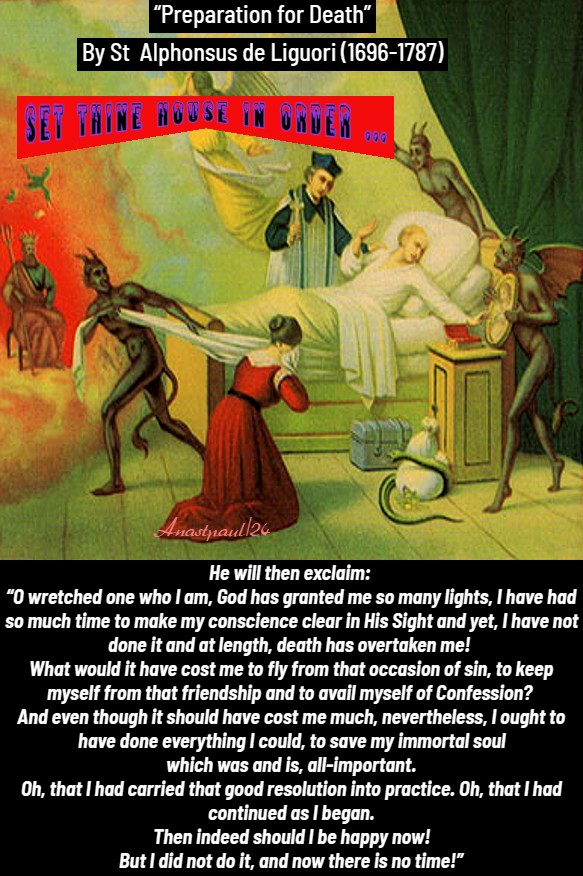
“THE devil does not bring sinners to hell with their eyes open — he first blinds them with the malice of their own sins. “For their own malice blinded them.” (Wis 2:21) He thus leads them to eternal perdition. Before we fall into sin, the enemy labours to blind us that, we may not see the evil we do and, the ruin we bring upon ourselves, by offending God. After we commit sin, he seeks to make us dumb that, through shame, we may conceal our guilt in Confession. Thus, he leads us to hell by a double chain, inducing us, after our transgressions, to consent to a still greater sin the sin of sacrilege!
… St Augustine says that, to prevent the sheep from seeking assistance by there cries, the wolf seizes them by the throat and thus securely carries them away and devours them. The devil acts in a similar manner with the sheep of Jesus Christ. After having induced them to yield to sin, he seizes them by the throat that they may not confess their guilt and thus, he securely brings them to hell. For those who have sinned grievously, there is no means of salvation but the confession of their sins! But, what hope of salvation can he have who goes to Confession and conceals his sins and makes use of the tribunal of penance to offend God and to make himself doubly the slave of Satan? What hope would you entertain of the recovery of the man, who, instead of taking the medicine prescribed by his physician, drank a cup of poison instead? God! What can the Sacrament of Penance be to those who conceal their sins but a deadly poison which adds to their guilt, the malice of Sacrilege? In giving Absolution, the Confessor dispenses to his patient the Blood of Jesus Christ; for it is through the merits of that Blood that he absolves from sin.
What, then, does the sinner do, when he conceals his sins in Confession? He tramples underfoot, the Blood of Jesus Christ. And should he afterwards receive the Holy Communion in a state of sin, he is, according to St Chrysostom, as guilty as if he threw the Consecrated Host into a sink … Accursed shame! how many poor souls do you bring to hell? … Unhappy souls! they think only of the shame of confessing their sins and do not reflect that, if they conceal them, they shall be certainly damned!” (Extract from the Sermon for the Third Sunday of Lent, 1 and 5).
You must be logged in to post a comment.