Our Morning Offering – 24 January – Feast of Saint Timothy, Bishop and Martyr
O Fathers of Our Ancient Faith
O Fathers of our ancient faith, With all the heav’n, we sing your fame Whose sound went forth in all the earth To tell of Christ and bless His Name.
You took the Gospel to the poor, The Word of God alight in you, Which in our day is told again, That timeless Word, forever new.
You told of God, Who died for us And out of death triumphant rose, Who gave the Truth which made us free and changeless through the ages goes.
Praise Father, Son and Holy Spirit, Whose gift is faith that never dies, A light in darkness now, until The Day-Star in our hearts arise.
O Fathers of Our Ancient Faith is written by the Benedictine Nuns of Stanbrook Abbey. In the Divine Office it is sung at Morning Prayer in the Common of Apostles. It is set to the anonymous tune associated with the 7th century Latin hymn, Creator Alme Siderum.
Saint of the Day – 24 January – Blessed William Ireland SJ (1636-1679) Priest Martyr. Born in 1636 in Lincolnshire, England and died by hanging on 24 January 1679 at Tyburn, London, England. Also known as – William Ironmonger, William Iremonger. He was Beatified on 15 December 1929 by Pope Pius XI.
William was the eldest son of William Ireland of Crofton Hall, Yorkshire, by his wife, Barbara, a daughter of Ralph Eure, 3rd Baron Eure of Washingborough, Lincolnshire. He had several sisters, to whom he remained close, and who worked tirelessly to prove his innocence After he was falsely accused of conspiring to murder King Charles II during the Popish Plot conspiracy and hysteria,
He was educated at the English College at St Omer in France and was admitted to the Society of Jesus at the age 19 at Watten, Belgium. He studied Theology in Liege and in 1667, aged 31, was Ordained a Priest. For 10 years William was the Confessor to the Poor Clares at Gravelines in Northern France, waiting to return to England.
In 1677, when he finally succeeded, entering his country as William Ironmonger, (William Iremonger) he had only been working as Procurator of his Order (responsible for finances) for a year, when he already became the first victim of the nefarious conspiracy hatched by Titus Oates.
The apostate and perverted Titus Oates, was an Anglican Minister, who hated all Catholics and most particularly, he harboured a deeply vicious hatred towards the Society of Jesus. Together with another Minister, Israel Tonge, he invented the plot which the English Jesuits had supposedly planned wherein the assassination of King Charles II, the fall of the Government and its official religion and the re-establishment of Catholicism. This fictional tale caused an uproar and a new furious persecution against Catholics.
Among the first victims was Fr William, who was arrested together with Fr John Fenwick and William’s assistant, Mr John Grove. They were locked up in Newgate Prison and secured with heavy shackles which embedded itself into the bare flesh of their legs. On 17 December 1678, after three months in the horrors of the most notorious Prison in England, they were finally tried, along with Fr Thomas Whitbread and Thomas Pickering, a Benedictine Brother. At the trial, Titus Oates claimed to have witnessed a meeting of the Jesuits in April of that year and heard the Jesuits plotting to kill the King. He claimed that William, Fr Fenwick and John Grove were at the meeting and the Frs Whitbread and Pickering were to carry out the plan. They allegedly tried to carry out the murder but Fr Pickering’s gun allegedly failed three times. Another witness largely confirmed these statements.
Fr William, however, proved that at the time when he was supposed to be walking around the Royal Palace, he was in fact in the Midlands and in the north of Wales. As evidence to the contrary, Oates bribed a maid who claimed to have seen him in London at the time. On these trumped-up charges and blatant lies, William, John Grove and Fr Pickering were found guilty of high treason and sentenced to be hanged,drawn and quartered.
The execution was postponed by Royal Order for one month because the King, Charles II, himself did not believe that the Jesuits were involved in a conspiracy against him. Oates, however, procured and bribed, several more so-called witnesses of dubious repute, after which the King, fearing the wrath of the people, allowed the execution of the sentence.
William and John Grove were taken to Tyburn on 24 January 1679. The mob pelted them with stones and verbal abuse as they were led to the gallows. The King, who had already stated privately that they were innocent, as a special act of clemency, ordered that they be allowed to hang until they were dead, thus sparing them the usual horrors of drawing and quartering whilst still alive. They were hanged,and when they died, they were taken down so that they could be drawn and dismembered.
St Projectus St Sabinian of Troyes St Suranus of Sora St Thyrsus Bl essed William Ireland SJ (1636-1679) Priest Martyr
Martyrs of Asia Minor – 4 Saints: A group of ChristiansMmartyred together for their faith. The only details to survive are four of their names – Eugene, Mardonius, Metellus and Musonius. They were burned at the stake in Asia Minor.
Martyrs of Antioch: Babylas Epolonius Prilidian Urban
Thought for the Day – 23 January – The Spiritual Combat (1589) – Dom Lorenzo Scupoli OSM (c1530-1610)
“None shall be crowned who has not fought well.” 2 Tim 2: 5
The Third Weapon of the Spiritual Combat
XII: … Of the Diverse Wills in Man and the Warfare Between Them (Part One)
“Although in this combat, we may be said to have within us, two wills, the one of the reason which is called rational and superior, the other of the senses, called sensual and inferior and commonly described, by the words — appetite, flesh, sense and passion; yet, as it is the reason which constitutes us men, we cannot be said to will anything which is willed by the senses, unless we be also inclined thereto, by the superior will.
And herein does our spiritual conflict principally consist. The Reasonable Will. being placed, as it were, midway between the Divine Will which is above it — and, the Inferior Will, or Will of the Senses which is beneath it, is continually assaulted by both — each seeking, in turn, to attract and subdue and bring it into obedience. Much hard toil and trouble must, however, be undergone by the unpracticed, especially at the outset, when they resolve to amend their evil lives and, renouncing the world and the flesh, to give themselves up to the love and service of Jesus Christ.
For the opposition encountered by the Superior Will, from the continual warfare between the Divine and Sensual Will, is sharp and severe and accompanied by acute suffering. It is not so with those who are well practiced in the way of virtue or of vice — they pursue, without difficulty, the path on which they have entered — the virtuous yielding readily to the Divine Will and the vicious yielding, without resistance, to the will of the senses.”
Quote/s of the Day – 23 January – St Raymond of Peñafort OP (1175-1275) Confessor, “Father of Canon Law”
“May you never be numbered among those whose house is peaceful, quiet and free from care, those on whom the Lord’s chastisement does not descend, those who live out their days in prosperity and in the twinkling of an eye, will go down to hell!”
“Your purity of life, your devotion, deserve and call for a reward because you are acceptable and pleasing to God. Your purity of life must be made purer still, by frequent buffetings, until you attain perfect sincerity of heart. If, from time to time, you feel the sword falling upon you with double or treble force, this also should be seen as sheer joy and the mark of love!”
“Look then on Jesus, the Author and Preserver of faith — in complete sinlessness, He suffered and, at the hands of those who were His own and was numbered among the wicked. As you drink the cup of the Lord Jesus (how glorious it is!), give thanks to the Lord, the Giver of all blessings. May the God of love and peace set your hearts at rest and speed you on your journey; may He meanwhile, shelter you from disturbance by others in the hidden recesses of His Love, until He brings you, at last, into that place of complete plenitude, where you will repose forever in the vision of peace, in the security of trust and in the restful enjoyment of His riches. ”
One Minute Reflection – 23 January – “The Month of the Most Holy Name of Jesus and of the Holy Family”– St Raymond of Peñafort (1175-1275) – Sirach 31:8-11, Luke 12:35-40 – Scripture search here: https://www.drbo.org/
“Blessed are those servants whom the Master, on His return, shall find watching.” – Luke 12:37
REFLECTION – “We must sleep in such a way as to be easily awakened. For Scripture says, “Gird your loins and light your lamps and be like servants who await their master’s return from a wedding, ready to open immediately when He comes and knocks.” (Lk 12:35-36). For a sleeping man is of no more use than a dead man. Therefore, we ought often to get up at night and bless God!
Blessed are those who watch for Him and so, make themselves like the Angels, whom we call “Watchers.” A man asleep is worth nothing, no more than if he were dead. But whoever has the light keeps watch and “darkness does not overcome him” (Jn 1:5) neither does sleep. Whoever has been illumined is, therefore, wakened to God and such a person is alive, “for what came to be in him was life.” (Jn 1:4) “Happy the man,” says Wisdom,“who obeys me and happy those who keep my ways, happy the man watching daily at my gates, waiting at my doorposts” (Pr 8:34).
Therefore, “let us not sleep, as the rest do but let us stay alert and sober” as Scripture says. “For those who sleep, go to sleep at night and those who are drunk, get drunk at night,” that is, in the darkness of ignorance. “But since we are of the day, let us be sober.” (1Th 5:6-8) “For all of you are children of the light and children of the day. We are not of the night or of darkness.” (1Th 5:5).” – St Clement of Alexandria (c150- c215) Father of the Church, Theologian and Philosopher, Professor who taught at the Catechetical School of Alexandria (The Instructor II:9).
PRAYER – O God, Thou Who chose blessed Raymond to be a renowned minister of the Sacrament of Penance and miraculously brought him through the waves of the sea, grant that, by his intercession, we may produce good results from our penance and reach the Heaven of eternal salvation Through Jesus Christ, Thy Son our Lord, Who lives and reigns with Thee, in the unity of the Holy Ghost, God, world without end. Amen (Collect).
Our Morning Offering – 23 January – “The Month of the Most Holy Name of Jesus and of the Holy Family”
The Love of Thy Name By Thomas à Kempis CRSA (1380-1471) The Imitation of Christ (Book 3 Ch 26:1-4)
My God, Sweetness beyond words, make bitter all the carnal comfort which draws me from love of the eternal and lures me to its evil self, by the sight of some delightful good in the present. Let it not overcome me, my God. Let not flesh and blood conquer me. Let not the world and its brief glory deceive me, nor the devil trip me by his craftiness. Give me courage to resist, patience to endure and constancy to persevere. Give me the soothing unction of Thy spirit, rather than all the consolations of the world and in place of carnal love, infuse into me, the love of Thy Name. Amen
Saint of the Day – 23 January – St Raymond of Peñafort OP (1175-1275) Confessor, “Father of Canon Law” Dominican Priest, Co-Founder of the Mercedarian Friars with St Peter Nolasco, Miracle-Worker – born on 1175 at Peñafort, Catalonia, Spain and died on 6 January 1275 at Barcelona, Spain of natural causes. Raymond compiled the Decretals of St Gregory IX (Reign 1227-1241), a collection of Canonical Laws which remained a major part of Church Law until the 1917 Code of Canon Law abrogated it. Patronages – Lawyers, Canon Lawyers, Medical Record Librarians, Barcelona, Spain, Navarre, Spain. Also known as – Ramon de Penyafort, Raymond of Rochefort. … of Penyafort, Raymund. https://anastpaul.com/2019/01/07/saint-of-the-day-st-raymond-of-penafort-op-1175-1275-father-of-canon-law/
Decretals of St Gregory IX
St Raymond of Peñafort OP (1175-1275) By Fr Francis Xavier Weninger SJ (1805-1888)
“Raymond, sprung from the noble race of Peñafort, was born at Barcelona, in Catalonia, Spain, in the year 1175. Even in early childhood. his only delight was in prayer and study and, when but a mere youth, he was so advanced in learning, as to be deservedly appointed to instruct others. Subsequently, he devoted himself to Canon and Civil Law and soon excelled amongst the most celebrated Jurists of his time.
At Bologna he lectured publicly and gratuitously. At this time, Berengarius, Bishop of Barcelona, happening to pass through Bologna and hearing of Raymond’s wide-spread fame, persuaded him to return to his native land, where he first installed him as Canon, subsequently, however, as Provost. Nor did the Bishop hesitate to consult him in his most important affairs.
At the age of forty-four Raymond entered the Order of St Dominic, in which he soon acquired a great reputation for learning and piety. Pope Gregory IX, called him to Rome and chose him for his Spiritual Guide and Confessor, of which duties he acquitted himself with remarkable modesty and frankness. Observing that many poor people visited the Papal Palace, in whose fate no-one seemed to interest themself, Raymond imposed upon the Pope, as a penance, the duty of better providing for Christ’s poor. The Pope, who tells this anecdote himself, loved Raymond the more and valued him the more highly on this account, carefully regulating his manner of life, according to the instructions of the Saint.
As some reward for his many services, the Holy Father wished to appoint him to the Bishopric of Taragona but Raymond, steadfastly refused the proffered dignity, only begging to be dismissed from the Papal Court. In fact, his physicians had already decided that, if he wished to recover from a malady with which he was afflicted, he must seek his native air. Once more restored to his old home, he resumed his primitive fervour, in which he ever persevered. He wrote various instructions for the use of his neighbour, to whose eternal salvation he entirely devoted himself.
In the foundation of the Order for the Redemption of Captives, he took no little part; for he too, like St. Peter Nolasco, was admonished, in an apparition of Our Lady, to interest himself in its cause. He compiled Rules for those who wished to enter the Order, received St Peter as its first member, afterwards appointing him, with permission of the Holy See, its first General. In 1238, Raymond himself was elected the 3rd General but hastened, after three years, to resign, preferring the quiet of the cloister, devoted to prayer, the writing of edifying books and other such holy and useful occupations. He was looked upon by all, as a model of Christian perfection,but he excelled especially in a wonderful humility, an obliging condescension to the poor and a most childlike devotion to the Virgin Mother.
Many and remarkable are the miracles recorded of him but the following, which is the most known, may suffice here. James the First, King of Arragon, had chosen Raymond for his Confessor and desired him to favour him with his company on a journey to the Island of Majorca. But the King, incited by an unholy love for a certain woman, clandestinely conveyed her with him. Raymond had repeatedly and with holy zeal conjured the King to dismiss her and James had even promised to comply with the holy man’s request but upon their arrival at Majorca the Saint, soon perceiving that the King had broken his promise, went up to him and thus addressed him: “Your Majesty must either dismiss this person, or I shall be obliged to set sail for Barcelona to return to my cloister.” The King, growing angry at this reproof, gave strict orders that no-one should give passage to Raymond, should he wish to return to Spain. The holy man, unconscious of the intrigues of the King, hastened to the sea-coast, where a vessel lay ready to sail. He sought for admission in vain, the Officers showed him the Royal Mandate in Raymond’s regard.
Full of confidence in God, the Saint stepped upon a huge rock which stretched far into the sea. After making the Sign of the Cross, he spread his cloak upon the water and mounted the same, as if it were a seaworthy vessel. In vain did he press a fellow-Religious to join him, who had followed him to the coast but who now stood stupefied at this manner of sailing. Raymond did not allow himself to be shaken in his purpose by the fright of his companion but, placing his staff upright on his cloak and gathering up the folds in front in the manner of a sail, he glided off, to the most profound astonishment of all present! He arrived safely in Barcelona within six hours after his departure, the distance being 160 miles. In the presence of a large concourse of people, he stepped ashore, and, throwing his perfectly dry cloak over his shoulders, he hurried to his Monastery.
There, he lived for some time in great sanctity and, when he had almost reached his hundreth year, he slept quietly in the Lord, full of virtues and merits.” Below is St Raymon’d Tomb and Shrine in Barcelona Cathedral.
St Raymond of Peñafort OP (1175-1275) “Father of Canon Law” Dominican Priest, Doctor of Canon Law, the Third Master of the Order of Preachers, Founder of the Mercedarian friars, Writer, Teacher, Miracle-Worker. St Raymond of Peñafort’s Feast day was inserted in the General Roman Calendar in 1671 for celebration on 23 January. In 1969 it was moved to 7 January, the day after that of his death. He is the Patron Saint of canon lawyers, specifically and lawyers, in general. Biography: https://anastpaul.com/2019/01/07/saint-of-the-day-st-raymond-of-penafort-op-1175-1275-father-of-canon-law/
St Abel the Patriarch St Agathangelus St Amasius of Teano St Aquila the Martyr St Asclas of Antinoe St Clement of Ancyra St Colman of Lismore St Dositheus of Gaza
St Ildephonsus (506-667) Archbishop of Toledo. Theologian, Scholar, Marian devotee, Writer, Evangeliser. Abbot Dom Guéranger calls him the Doctor of the Virginity of Mary. Saint Ildephonsus established the Feast of the Expectation of the Blessed Virgin Mary, which is still kept in some places on 18 December. Biography: https://anastpaul.wordpress.com/2018/01/23/saint-of-the-day-23-january-st-ildephonsus-607-667/
Thought for the Day – 22 January – The Spiritual Combat (1589) – Dom Lorenzo Scupoli OSM (c1530-1610)
“None shall be crowned who has not fought well.” 2 Tim 2: 5
The Third Weapon of the Spiritual Combat
XI: … Of some Considerations which May Incline the Will to Seek to Please God in All Things
“Furthermore, to incline the Will more readily to seek God’s honour and glory in all things, always remember that, in many and various ways, He has first loved and honoured you!
In creation: — by creating you out of nothing after His Own Likeness and all other creatures for your service. In Redemption: — by sending, not an Angel but, His Only-begotten Son, to redeem you, not with the corruptible price of silver and gold but with His Precious Blood and, by His most painful and ignominious death. Remember, that every hour, nay, every moment, He protects you from your enemies, fights for you by His grace, offers you continually, in the Sacrament of the Altar, His well-beloved Son, to be your food and your defence; are not all these tokens of the inestimable regard and love borne for you by the Infinite God?
It is not in man to conceive, on the one hand, how great is the value which so great a Lord sets upon us poor creatures, in our loneliness and misery and, on the other, how great the return we are bound to make to His Supreme Majesty, Who has done so many and such great things for us.
For if earthly lords, when honoured even by poor and lowly men, feel bound to honour them in return, how should our vile nature demean itself towards the Supreme King of Heaven and earth, by Whom we are so dearly loved and so highly prized?
And besides all this and before all things, keep ever vividly in mind that the Divine Majesty is infinitely worthy to be loved for Himself alone and to be served, purely for His own good pleasure.”
Quote/s of the Day – 22 January – “The Month of the Most Holy Name of Jesus and of the Holy Family” – St Vincent of Saragossa (Died 304) Protomartyr of Spain and St Anastasius the Persian (Died 628) Martyr – Wisdom 3:1-8; Luke 21:9-19 – Scripture search here: https://www.drbo.org/
“And you shall be hated by all men, for My Name’s sake.”
Luke 21:17
“The fruits of the earth are not brought to perfection immediately but by time, rain and care. Similarly, the fruits of men ripen through ascetic practice, study, time, perseverance, self-control and patience.”
St Anthony Abbot (251-356)
“Rejoice and be happy! Persevere to the end and prefer to die rather than abandon the post, to which God has called you!”
St Catherine of Siena (1347-1380) Doctor of the Church
“Love consists, not in feeling great things but, in having great detachment and in suffering for the Beloved.”
St John of the Cross (1542-1591) Doctor Mysticus
“Now, you must always persevere in firmly placing all your trust in our Lord, in the troublesome business you have in hand. It will give you a fine opportunity of laying a good foundation of submission to God’s will and peace of soul.”
St Francis de Sales (1567-1622) Doctor Caritatis
Excerpt from the Prayer to the Five Wounds of Jesus By St Clare of Assisi (1194-1253)
I pray Thee, O most gentle Jesus, that having redeemed me by Baptism from original sin, so now, by Thy Precious Blood, which is offered and received, throughout the world, deliver me from all evils, past, present and to come. And by Thy most bitter Death, give me a lively faith, a firm hope and perfect charity, so that I may love Thee with all my heart and all my soul and all my strength. Make me firm and steadfast in good works and grant me perseverance in Thy service, so that I may be able to please Thee always. Amen.
One Minute Reflection – 22 January – “The Month of the Most Holy Name of Jesus and of the Holy Family” – St Vincent of Saragossa (Died 304) Protomartyr of Spain and St Anastasius the Persian (Died 628) Martyr – Wisdom 3:1-8; Luke 21:9-19 – Scripture search here: https://www.drbo.org/
“Resolve, therefore, in your hearts, not to meditate beforehand, how you are to make your defence. For I Myself, will give you utterance and wisdom …” – Luke 21:14-15
REFLECTION – “O strong love of God!I really think, nothing seems impossible, to one who loves. O happy soul which has obtained this peace, from its God! For it has become mistress over all the trials and perils of the world. If only it can serve its good Spouse and Lord, it fears none of them – and, with good reason … Think of something which occurs to me now and which, is applicable to those who are naturally pusillanimous and have little courage … Although, in actual fact, their soul has been raised up to this state, the weakness of their nature makes them afraid. We must be on the watch, or this natural weakness, will deprive us of a great crown. When you find yourselves as pusillanimous as this, my daughters, have recourse to faith and humility and do not fail to go forward with faith, for nothing is impossible to God (Lk 1:37). He has thus been able to give many holy Saints, the courage to endure all the cruel tortures which they had resolved to suffer for His sake!
It is of this resolution and this free-will that the soul wishes to make Him Master, though He has no need of our efforts. Indeed, His Majesty is pleased that His works should shine forth in those who are weak, since in these, there is more scope for His power and, for the fulfilment of His desire, to grant us favours…
Pay no heed to the arguments adduced by your mind and your own weakness – this weakness will only grow, if you begin to imagine, what will and what will not happen …This is no time to think about your sins, leave them alone, humility is out of place now, it comes at the wrong time… Be assured that the Lord never forsakes those who love Him and risk everything for His sake!” – St Teresa of Jesus of Avila (1515-1582) Carmelite, Doctor of the Church (Conceptions of the Love of God Ch 3:4-6).
PRAYER – Give heed to our humble prayers, O Lord, that we who know we are guilty of our own sin, may be saved by the intercession of Thy blessed Martyrs Vincent and Anastasius.Through Jesus Christ, Thy Son our Lord, Who lives and reigns with Thee, in the unity of the Holy Ghost, God, world without end. Amen (Collect).
Our Morning Offering – 22 January – “The Month of the Most Holy Name of Jesus and of the Holy Family”
To Thee, O Master Morning Offering By St Macarius the Wonder-Worker (Died 850)
To Thee, O Master, who loves all mankind I hasten on rising from sleep. By Thy mercy, I go out to do Thy work and I make my prayer to Thee. Help me at all times and in all things. Deliver me from every evil thing of this world and from pursuit by the devil. Save me and bring me, to Thy Eternal Kingdom, For Thou art my Creator, Thou inspire all good thoughts in me. In Thee is all my hope and to Thee I give glory, now and forever. Amen
Saint of the Day – 22 January – Blessed Antonio della Chiesa OP (1394-1459) Priest and Friar of the Order of Preachers, the Dominican Order (Ordo Fratrum Praedicatorum – OP), Prior, Reformer. Antonio was a known Miracle worker and was able to read the consciences of all which gifts made him a sought-after Spiritual Counsellor. Antonio was a Mystic and had a special devotion to the Blessed Virgin Mary and he was known to have conversed with her several times, in ecstasy. Born in 1394 in San Germano Vercellese, in the region of Piedmont in northern Italy and died on 22 January 1459 in the Dominican Convent in Como, Lombardy, of natural causes, Also known as – Anthony of San Germano. Beatified on 15 May 1819 by Pope Pius VII. Additional Memorial – 28 July in his Hometown of San Germano Vercellese, the date his Relics were translated to the Parish Church there.
Antonio belonged to the noble and illustrious Piedmontese family of the Marquis della Chiesa and, via a connexted line, he was an ancestor of Pope Benedict XV (Reign 1914-1922) (Giacomo Giovanni della Chiesa).
He received a good education and early in life he showed pious traits. He grew up hoping to become a Monk but his father, who was a man of some importance, opposed this. In 1417, as a twenty-year-old, he nevertheless, joined the Dominican Order in Vercelli, despite his family’s protests.
He became known as a popular and effective Preacher, particularly against usurious interest. He also became a sought-after Confessor. He accompanied Saint Bernardine of Siena on a range of missions and served in various capacities in the Dominican Monasteries. Among those positions was that of the Prior and he served at the Friaries of Como and Florence, as well as in Savona and Bologna.
In Como, he reformed the life and morals of the entire Town and following this success Antonio was sent to govern other Convents. It was at these Convents that he insisted on a rigorous observance to their Rule of Life according to Saint Dominic. He is remembered as a kind Prior who had mercy on sinners and, at the same time, was firm with them that they may amend their ways.
Antonius was also one of the leaders in opposition to the last antipope, Felix V, who troubled the Church from 1440 until 1449. Felix V had a large support network stemming from Switzerland and Antonio vigourously opposed his work. He succeeded in winning over a large number of the antipope’s adherents to the lawful power of the recognised Pontiff, Pope Eugene IV and later Pope Nicholas V.
While on a trip from Savona to Genoa, he was captured by pirates but he was released unharmed. He had been apprehended with a fellow Friar and the pirates released the pair, after being so impressed with their gentle and kind demeanour.
Antoniuo, worn out by activity and penance, he died at the age of 65 having poredicted the date of his death, on 22 January 1459 in Como while he was Prior there. He was buried in the Dominican Church in the City and many miracles happened at his grave. On 28 July 1810 his Relics were translater to the Parish Church of San Germano Vercellese, his birth Town. He was Beatified on 15 May 1819 when his cult was confirmed by Pope Pius VII (1800-1823).
St Anastasius the Persian (Died 628) Martyr, Monk. The Roman Martyrology reads: “At Rome, at Aquiae, Salviae, St Anastasius, a Persian Monk, who, after suffering much at Caesarea in Palestine, from imprisonment, stripes and fetters, had to bear many afflictions from Chosroes, King of Persia, who caused him to be beheaded. He had sent before him, to Martyrdom, seventy of his companions, who were precipitated into rivers. His head was brought to Rome, together with his venerable likeness, by the sight of which, the demons are expelled and diseases cured, as is attested by the Acts of the Second Council of Nicacea.” His Life and Death: https://anastpaul.com/2023/01/22/saint-of-the-day-21-january-st-anastasius-the-persian-died-628-martyr-monk/
Blessed Antonio della Chiesa OP (1394-1459) Priest and Friar of the Order of Preachers St Blaesilla of Rome St Brithwald of Ramsbury St Caterina Volpicelli St Dominic of Sora St Guadentius of Novara
Blessed Maria Mancini of Pisa OP (1356-1431) Widow, Second Order Sister of the Order of Preachers, spiritual disciple of St Catherine of Siena, Prioress, Mystic, Reformer, Apostle of the poor and the sick. The Roman Martyrology states: “In Pisa, Blessed Maria Mancini, who, twice widowed and all her children lost, under the exhortation of St Catherine of Siena, began community life in the Monastery of St Domenic, which she led for ten years.” Her Life: https://anastpaul.com/2022/01/22/saint-of-the-day-22-january-blessed-maria-mancini-of-pisa-op-1356-1431/
Bl Walter of Himmerode Bl William Patenson
Martyrs of Puigcerda: St Orontius St Victor St Vincent
Thought for the Day – 21 January – The Spiritual Combat (1589) – Dom Lorenzo Scupoli OSM (c1530-1610)
“None shall be crowned who has not fought well.” 2 Tim 2: 5
The Third Weapon of the Spiritual Combat
X: … Of the Exercise of the Will and the End to which all our Actions, whether Interior or Exterior, Should Tend (Part Three)
“… For he, who acts only as moved by God and with a view to please Him alone, desires not one thing above another. He wishes only to have, what it pleases God he should have and, at the time and in the way which may be most agreeable to Him and, whether he have it or not, he is equally tranquil and content because, in either case, he obtains his wish and fulfils his intention which is, nothing else but simply, to please God.
Therefore, recollect yourself seriously and be careful always, to direct every action to this perfect end.
And although the bent of your natural disposition should move you to do good through fear of the pains of hell or hope of the joys of paradise, you may even here ,set before you, as your ultimate end, the will and pleasure of God, Who is pleased that you should enter into His Kingdom and not into hell. It is not in man, fully to apprehend the force and virtue of this motive; — for the most insignificant action, done with a view to please God alone and for His sole glory, is (if we may so speak) of infinitely greater value than many others, of the greatest dignity and importance, done without this motive. Hence a single penny given to a poor man, with the sole desire to please His Divine Majesty, is more acceptable to God, than the entire renunciation of all earthly goods — for any other end, even for the attainment of the bliss of Heaven; an end in itself, not only good but supremely to be desired.
This exercise of doing all things with the single aim to please God alone, seems difficult at first but, will become simple and effortless by practice, if, with the warmest affections of the heart, we desire God alone and long for Him as our only and most perfect good; Who deserves that all creatures should seek Him for Himself and serve Him and love Him above all things.
The deeper and more continual our meditations are upon His infinite excellence, the more fervent and the more frequent will be these exercises of the will and we shall thus, acquire more easily and more speedily, the habit of performing every action from pure love for that gracious Lord, Who alone is worthy of our reverence and love.
Lastly, in order to achieve the attainment of this divine motive, I advise you to seek it of God by importunate prayer and to meditate frequently upon the innumerable benefits which He, of His pure and disinterested love, has bestowed upon us.”
Quote/s of the Day – 21 January – St Agnes (c 291- c 304) Virgin and Martyr – Romans 12:16-21; Matthew 8:1-13 – – Scripture search here: https://www.drbo.org/
“The centurion said in reply, “Lord, I am not worthy to have you enter under my roof; only say the word and my servant will be healed.”
Matthew 8:8
“By viewing himself as unworthy, he showed himself worthy, for Christ to come, not merely into his house but also into his heart.”
“For the Master of humility, both by word and example, sat down also, in the house of a certain proud Pharisee, Simon and although He sat down in his house, there was no place in his heart. For in his heart. the Son of Man could not lay His head.”
St Augustine (354-430) Father and Doctor of Grace
“The obedience of the Star calls us to imitate its humble service: to be servants, as best we can, of the grace which invites all men to find Christ.”
St Pope Leo the Great (400-461) Father and Doctor of the Church
“To receive the grace of God into our hearts, we ought to empty them of our own glory.”
St Francis de Sales (1567-1622) Doctor of Charity
“Keep your heart in peace and let nothing trouble you, not even your faults. You must humble yourself and amend them peacefully, without being discouraged or cast down, for God’s dwelling, is in peace.”
One Minute Reflection – 21 January – “The Month of the Most Holy Name of Jesus and of the Holy Family” – St Agnes (c 291- c 304) Virgin and Martyr – Romans 12:16-21; Matthew 25:1-13 –Scripture search here: https://www.drbo.org/
“Many will come from the east and the west and will recline… at the banquet in the Kingdom of Heaven” – Matthew 8:11
REFLECTION – “I have seen our Lord in the Gospel accomplish many miracles and, reassured by them, have strengthened my fearful words. I have seen the centurion throw himself at the Lord’s feet, nations send their firstfruits to Christ. The Cross has not yet been erected and already, pagans hasten towards their Master. The words “Go, teach all nations” have not yet been heard (Mt 28,19) but the nations are already hastening. Their race precedes their call, they are burning with desire for the Lord. The sound of preaching has not yet been heard but they are hurrying towards the One Who preaches. Peter… has now been instructed and they gather around the One Who is teaching him; the light of Paul has not yet blazed beneath Christ’s standard and nations are coming with incense to adore the King (Mt 2:1).
And now, see how a centurion begs Him and says to him: “Lord, my servant is lying at home paralysed, suffering dreadfully.” Here is a new miracle indeed! The servant, whose limbs are paralysed leads his master to the Lord; the slaves’ sickness gives health to his owner. Seeking his servant’s healing, he finds our Lord and while he is seeking for his slave’s cure, he becomes Christ’s conquest!” – Basil of Seleucia (Died c 468) Archbishop (Homily 19 on the centurion, PG 85, 235f).
PRAYER – Almighty, eternal God, Thou Who choose the weak things of the world to confound the strong, mercifully grant that we, who are celebrating the feast of blessed Agnes, Thy Virgin and Martyr, may reap the benefit ofher patronal intercession with Thee. Through Jesus Christ, Thy Son our Lord, Who lives and reigns with Thee, in the unity of the Holy Ghost, God, world without end. Amen (Collect).
Our Morning Offering – 21 January – “The Month of the Most Holy Name of Jesus and of the Holy Family” – The Third Sunday after Epiphany
Give me Thyself, O My God By St Augustine (354-430) Father and Doctor of Grace
Give me Thyself, O my God, give Thyself to me. Behold I love Thee and if my love is too weak a thing, grant me to love Thee more strongly. I cannot measure my love, to know how much it falls short of being sufficient but let my soul hasten to Thine embrace and never be turned away, until it is hidden in the secret shelter of Thine presence. This only do I know, that it is not good for me when Thou art not with me, when Thou art only outside me. I want Thee in my very self. All the plenty in the world which is not my God, is utter want! Amen
Saint of the Day – 21 January – St Publius of Athens (2nd Century) Bishop of Athens and Martyr. Died around 112. (Not to be confused with St Publius of Malta who is remembered on 22 January).
The Roman Martyrology reads today: “At Athens, the birthday of St Publius, Bishop, who as successor of St Denis (Dionysius) the Areopagite, nobly governed the Church at Athens. No less celebrated for the lustre of his virtues than for the brilliance of his learning, he was gloriously crowned for having borne testimony to Christ.”
St Eusebius of Caesarea, speaking of Bishop Dionysius (Denis) of Corinth, recalls the letters he sent to various Christian communities. Regarding the one sent to the Christianity of Athens, he tells us that Dionysius blamed the Athenians for having become somewhat lukewarm in the profession of faith “after their leader, Publius had been Martyred during the persecutions of those times” and recalled that “after the Martyrdom of Publius, Quadratus had been elected their Bishop.”
Publius was, therefore, the Bishop of Athens during the 2nd Century and suffered Martyrdom in one of the persecutions of that time, probably at the beginning of the empire of Marus Aurelius, between 161 and 170.
St Agnes of Aislinger St Anastasius of Constantinople St Aquila of Trebizond St Brigid of Kilbride St Candidus of Trebizond Bl Edward Stransham
St Epiphanius of Pavia (c 439–496) Bishop of Pavia, Italy from from 466 until his death. Papal and Secular Mediator and Peacemaker, Known as – “Epiphanius the Peacemaker,” “The Glory of Italy,” “The Light of Bishops.” The Roman Martyrology for 21 January reads : “In Pavia, Saint Epifanio, Bishop , who, at the time of the barbarian invasions, worked zealously for the reconciliation of the peoples, for the liberation of prisoners and for the reconstruction of the destroyed City.” Biography: https://anastpaul.com/2022/01/21/saint-of-the-day-21-january-saint-epiphanius-of-pavia-439-496/
St Eugenius of Trebizond St Gunthildis of Biblisheim
Blessed Josefa María Inés de Benigánim OAD (1625–1696) Nun of the Discalced Augustinian Nuns with the religious name of “Josefa María of Saint Agnes,” Virgin, Mystic, gifted with the charism of prophecy and counsel. She became known for her profound spiritual and theological insight as well as for her severe austerities she practised during her life. Her body is incorrupt. Blessed Josefa was Beatified on 26 February 1888, at Saint Peter’s Basilica by Pope Leo XIII. Biography: https://anastpaul.com/2020/01/21/saint-of-the-day-21-january-blessed-josefa-maria-ines-de-beniganim-oad-1625-1696/
St Lawdog St Maccallin of Waulsort
St Meinrad of Einsiedeln OSB (c 797–861) “Martyr of Hospitality,” Martyr, Priest, Monk, Hermit. In 1039, the year of Meinrad’s Canonisation as a Saint, his remains were brought back to Einsiedeln. During the French Revolution, Meinrad’s relics were hidden at Tyrol, Austria, by Abbot Conrad Tanner and his reliquary is now enshrined in the Grace Chapel of the Abbey Church at Einsiedeln. St Meinrad’s Life and Death: https://anastpaul.com/2021/01/21/saint-of-the-day-21-january-saint-meinrad-of-einsiedeln-osb-c-797-861-martyr/
St Patroclus of Troyes St Publius of Athens (2nd Century) Bishop
St Valerian of Trebizond St Vimin of Holywood St Zacharias the Angelic
Blessed Martyrs of Laval – 19 Beati: Fifteen men and four women who were Martyred in Laval, France by anti-Catholic French Revolutionaries. The were born in France and they were Martyred on several dates in 1794 in Laval, Mayenne, France. They were Beatified on 19 June 1955 by Pope Pius XII at Rome, Italy. They are: Blessed André Duliou Blessed Augustin-Emmanuel Philippot Blessed François Duchesne Blessed François Migoret-Lamberdière Blessed Françoise Mézière Blessed Françoise Tréhet Blessed Jacques André Blessed Jacques Burin Blessed Jean-Baptiste Triquerie Blessed Jean-Marie Gallot Blessed Jeanne Veron Blessed John Baptist Turpin du Cormier Blessed Joseph Pellé Blessed Julien Moulé Blessed Julien-François Morin Blessed Louis Gastineau Blessed Marie Lhuilier Blessed Pierre Thomas Blessed René-Louis Ambroise
Martyrs of Rome – 30 Saints: Thirty Christian soldiers executed together in the persecutions of Diocletian. They were Martyred in 304 in Rome, Italy.
Martyrs of Tarragona: Augurius, Eulogius, Fructuosus.
Thought for the Day – 20 January – The Spiritual Combat (1589) – Dom Lorenzo Scupoli OSM (c1530-1610)
“None shall be crowned who has not fought well.” 2 Tim 2: 5
The Third Weapon of the Spiritual Combat
X: … Of the Exercise of the Will and the End to which all our Actions, whether Interior or Exterior, Should Tend (Part Two)
“I will now show you a way to avoid this way which would impede you in the path of perfection and to accustom yourself to Will and to Do all things as moved by the Spirit of God and with the pure intention of honouring and pleasing Him alone, Who desires to be the one End and Principle, of our every word and action.
When anything presents itself to you as if willed by God, do not permit yourself to will it until you have first raised your thoughts to Him, to discover whether He wills you to will it and because, He so wills it and to please Him alone. Let your will, then, being thus moved and attracted by His, be impelled to will it because He wills it and solely to please and honour Him.
In like manner, if you would refuse things which are contrary to God’s will, refuse them, not until you have first fixed the eye of your mind upon His divine will, Who wills that you should refuse them ,solely to please Him. Know, however that the frauds and deceits of wily nature are but little suspected; for, ever secretly seeking self, it often leads us to fancy that our end and motive, is to please God when in reality, it is far otherwise. Thus, when we choose or refuse anything for our own interest and satisfaction, we often imagine that we are choosing or refusing it, in the hope of pleasing, or in the fear of displeasing God. The true and effectual remedy for this delusion, is purity of heart which consists in this — which is indeed the aim and object of all this spiritual warfare — the putting off the old man and the putting on the new.
And to this end, seeing you are full of self, take care in the beginning of every action, to free yourself, as much as possible, from all additions of anything which seems to be your own will. Choose nothing, do nothing, refuse nothing, unless you first feel yourself moved and drawn thereto, by the pure and simple Will of God!”
Quote/s of the Day – 20 January – St Fabian, Pope and St Sebastian, Martyrs – Hebrews 11:33-39, Luke 6:17-23 – Scripture search here: https://www.drbo.org/
“They were stoned, they were sawed asunder, they were tempted, they were put to death by the sword. They went about in sheepskins and goatskins, destitute, distressed, afflicted – of whom the world was not worthy – wandering in deserts, mountains, caves and holes in the earth. And all these, approved by the testimony of faith, were found in Christ Jesus our Lord.”
Hebrews 11:37-39
“And all who wish to live piously in Christ Jesus, will suffer persecution.”
2 Timothy 3:12
“What is the surest kind of witness? “Anyone who acknowledges that Jesus Christ came among us in the flesh” (cf 1 Jn 4:2) and who keeps the commands of the Gospel… How many there are, each day, of these hidden martyrs of Christ who confess the Lord Jesus! … So be faithful and courageous in interior persecutions, so that you may also win the victory in exterior persecutions.”
St Ambrose (340-397) Father & Doctor of the Church
“Do not love your life in this world! If you truly love yourselves, do not thus love your life and then, you will save your life!”…
St Augustine (354-430) Father and Doctor of the Church
One Minute Reflection – 20 January – “The Month of the Most Holy Name of Jesus and of the Holy Family”– St Fabian, Pope and St Sebastian, Martyrs – Hebrews 11:33-39, Luke 6:17-23 – Scripture search here: https://www.drbo.org/
“And He, lifting up His eyes on His disciples, said: Blessed are you …” – Luke 6:20
REFLECTION – “Lord Jesus Christ, to teach us the summit of virtue, You ascended the mountain with Your disciples and taught them the Beatitudes and highest virtues, promising them the rewards applicable to each. Grant that my weakness may hear Your Voice, that I may apply myself, through their practice, to acquire the merit of the virtues, so that by Your Mercy, I may receive the promised reward. As I consider the payment, do not let me refuse the effort of the labour. Make my hope of eternal salvation, sweeten the bitterness of the cure, inflaming my soul with the splendour of Your work. Out of the wretched person I am, create one of the blessed; from the blessedness here below, lead me, by Your Grace, to the blessedness of the homeland.
Come, Lord Jesus Christ, in search of Your servant, seeking Your erring and exhausted sheep. Come, Spouse of the Church, in search of Your lost coin. Come, Father of mercies, welcome the prodigal son returning to You. Come, then, Lord, for You are the only One, able to call back the sheep that has strayed, to find the lost drachma, to reconcile the runaway son. Come, that there may be salvation on earth and joy in Heaven! Turn me towards You and grant that I may carry out a true and perfect repentance, so that I may become an occasion for joy, among the Angels. Sweetest Jesus, I pray Thee, by the immensity of Thine Love for me, a sinner, grant that I may love Thee alone, above all things, that I may be consoled by none but Thee, my sweetest God!” – Ludolph of Saxony (c1300-1378) Monk, Theologian, Writer, Dominican then a Carthusian (Prayers to Jesus Christ).
PRAYER – Be mindful of our weakness, Almighty God and since the burden of our sins weighs heavily upon us, may the glorious intercession of Thy holy Martyrs, Fabian and Sebastian sustain us. Through Jesus Christ, Thy Son our Lord, Who lives and reigns with Thee, in the unity of the Holy Ghost, God, world without end. Amen (Collect).
Our Morning Offering – 20 January – “The Month of the Most Holy Name of Jesus and of the Holy Family” and Our Lady’s Day (IHM, Refuge of Sinners)
Shelter Me Under Thy Mantle, Refuge of Sinners By St Alphonsus Liguori (1696-1787) Most Zealous Doctor
Most holy Virgin Immaculate, my Mother Mary, to thee, who art the Mother of my Lord, the Queen of the Universe, the Advocate, the Hope, the Refuge of sinners, I, who am the most miserable of all sinners, have recourse this day. I venerate thee, great Queen and I thank thee for the many graces thou hast bestowed upon me, even unto this day, in particular, for having delivered me from the hell which I have so often deserved by my sins. I love thee, my dearest Lady and because of that love, I promise to serve thee willingly forever and to do what I can to make thee loved by others. I place in thee all my hopes for salvation, accept me as thy servant and shelter me under thy mantle, thou, who art the Mother of Mercy. And since thou are so powerful with God, deliver me from all temptations, or at least, obtain for me the strength to overcome them until death. From thee, I implore, a true love for Jesus Christ. Through thee, I hope to die a holy death. My dear Mother, by thy love for Almighty God, I pray thee to assist me always but most of all, at the last moment of my life. Forsake me not then, until thou shalt see me safely in Heaven, there to bless thee and sing of thy mercies, throughout all eternity. Such is my hope. Amen
Saint of the Day – 20 January – Saint Féchín of Fore (Died 665) Abbot, Priest, Founder of several Irish Monasteries, Féchín name is particularly connected with that of Fobhar (Fore or Foure) in Westmeath which was his first Monastic foundation and an important one for its renowned Manuscripts. Born in Connacht, Ireland and died in 665 ofthe Plague in Ireland. Also known as – Feichin, Vigean, Mo-Ecca.
Saint Féchín statue at Fore Abbey
Born of Irish Royal stock, he was the son of Coelcharna, descendant of Eochad Fionn, brother to the famous King Conn of the Hundred Battles and his mother, Lassair, was of the Royal blood of Munster. When fit to be sent to school he was placed under St Nathy of Achonry (Died 610) Bishop of Achonry/
Having finished his studies, he was Ordained Priest and retired to a solitary place at Fore in Westmeath, there to live as a Hermit. But he was followed by many disciples and Fore became a Monastery. Here he eventually governed over 300 Monks. He is said to have so pitied the Monks engaged in grinding their corn, that he, brought water from a marsh to the Monastery, by cutting a tunnel through the rock and then established a water mill. Of this miracle, the Monk, Scholar and Historian,, Gerald of Wales (Giraldus Cambrensis) relates the following :-
“There is a mill at Foure, in Meathwhich St Fechin made most miraculously with his own hands, in the side of a certain rock. No women are allowed to enter, either this mill or the Church of the Saint and the mill is held, inasmuch reverence, by the natives as any of the Churches dedicated to the Saint.”
Féchín’s influence, being himself Royal, was very great with the Kings and Princes of his age. The Saint finding a poor leper, full of sores one day, took him to the Queen and bade her minister to him, as if to Christ. She bravely overcame her repugnance and tended him with gentle care as if of three hundred Monks.
He also established a religious house on the Island of Immagh, near the coast of Galway. The inhabitants were then pagans but Féchín, with his Monks, evangelised and converted them.
The Monastery dedicated to the Virgin Mary which he founded in Cong is renowned because of the Cross of Cong, one of the great treasures of Ireland which had been hidden in an old oaken chest in the village and now resides in the National Museum in Dublin. Both the Church and Monastery at Cong were rebuilt in 1120 for the Augustinians by Turlough O’Connor, who gave them the bejewelled processional Cross he had made to enshrine a particle of the True Cross. Cong Abbey also served as the refuge for the last high king of Ireland, Roderick O’Connor. The Monastery was suppressed by King Henry VIII.
The Cross of Cong
St Féchín’s numerous monastic foundations include those at Ballysadare (his birthplace?), Imaid Island, Omey and Ard Oilean, from which came the oldest Manuscript recording the details of his life. All of these Monasteriest are now in ruins. His memory, however, is also perpetuated at Ecclefechan and Saint Vigean’s (the name under which he is invoked in the Dunkeld Litany), near Arbroath in Scotland, where a fair was held on his Feast day. There are also pilgrimages undertaken to explore St Féchín’s foundations and the holy mill.
St Pope Fabian (c200 – c 250) Martyr, Confessor, Peacemaker, Administrator and Reformer, Apostle of Charity. Bishop of Rome from 10 January 236 until his death in 250, succeeding Anterus. He is famous for the miraculous nature of his election, in which a dove is said to have descended on his head to mark him as the Holy Spirit’s unexpected choice. He was succeeded by Cornelius. Biography: https://anastpaul.com/2019/01/20/saint-of-the-day-20-january-st-pope-fabian-c-200-c-250-martyr/
Thought for the Day – 19 January – The Spiritual Combat (1589) – Dom Lorenzo Scupoli OSM (c1530-1610)
“None shall be crowned who has not fought well.” 2 Tim 2: 5
The Third Weapon of the Spiritual Combat
X: … Of the Exercise of the Will and the End to which all our Actions, whether Interior or Exterior, Should Tend (Part One)
“Besides this necessary exercise of the Understanding, you must so regulate your Will that it may not be left to follow its own desires but, may, in all things, be conformed to the Divine pleasure. And remember that, it is not enough only to strive after those things which are most pleasing to God but you must so will them and so do them, as moved thereto. by Him and with a view to please Him alone.
In this exercise of the Will, even more than in that of the Understanding, we shall meet with strong opposition from nature which seeks itself and its own ease and pleasure in all things but especially, in such as are holy and spiritual. It delights itself in these, feeding greedily upon them as upon wholesome food. As soon, therefore, as they are presented to us we look wistfully upon them and desire them, not because such is the will of God, nor with the sole view to please Him but, for the sake of the satisfaction and benefit to be derived from willing those things which God wills.
This delusion is the more subtle from the very excellence of the thing desired. Hence, even in the desire after God Himself, we are exposed to the delusions of self-love which often leads us to look more to our own interests and to the benefits we expect from God, than to His will which is, that we should love and desire and obey Him for His own glory alone.”
Quote/s of the Day – 19 January – “The Month of the Most Holy Name of Jesus and of the Holy Family” – St Marius and Family of Persia, (Died c 270) Martyrs – Hebrews 10:32-38, Matthew 24:3-13 – Scripture search here: https://www.drbo.org/
“Tell us when shall these things be? and what shall be the sign of Thy Coming and of the consummation of the world? ”
Matthew 24:3
“Watch, therefore because you know not the day, nor the hour.” Matthew 25:13
“ In the hours of the night, think always on Christ and hope for His coming at every moment. … Christ enters at the open door. He will not fail to do so, for He has promised to enter. Embrace Him, Whom you have sought. Approach Him and be illumined. Hold Him and ask Him not to go away quickly. Beg Him not to depart. For “His Word runs swiftly” (Ps 147:15) and will not be held by the slothful or negligent soul. Let your soul run to His call and follow closely, the sound of His heavenly Voice, for His passing is swift. …”
St Ambrose (340-397) Father and Doctor of the Church
“… In fact, according to the merit and fervour of each one, there is a frequent and familiar advent of the Lord that, in this intermediary period, between His First and Last Coming, models us on one and prepares us to the other. The Lord comes to us now, so that His First Coming to us, may not be in vain and that the Last One, may not be that of wrath. Through His Present Coming, in fact, He works at reforming our pride, in the image of the humility of His first advent, to then remodel our humble body, in the image of the glorified body He will show us, when He will return. This is why we should desire and fervently ask this personal coming – which gives us the grace of this first advent and promises us the glory of the last. …”
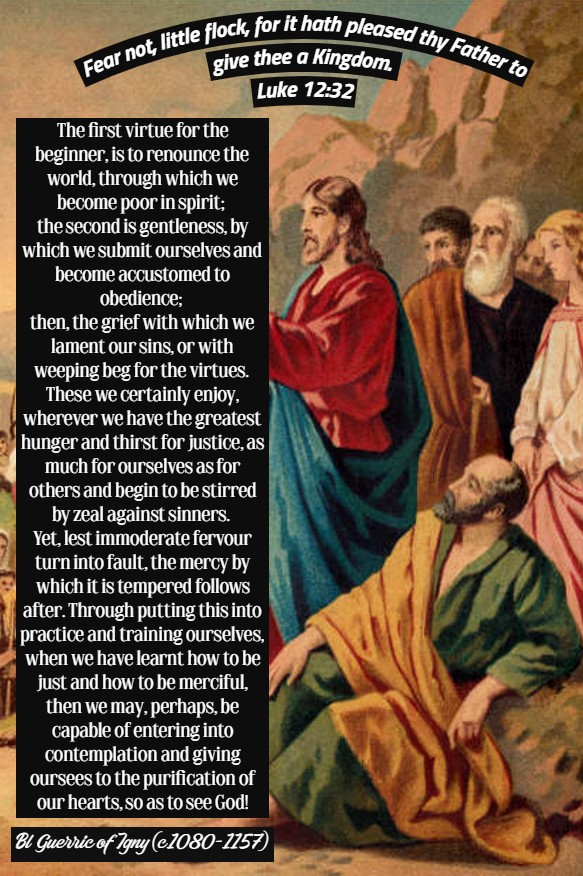
Bl Guerric of Igny (c1080-1157) Cistercian Abbot
(2nd sermon for Advent, 2-4)
Grant Me, My God By St Thomas Aquinas (1225-1274) Angelic Doctor, Common Doctor
Make my heart watchful, O God, so that no vain thoughts may distract it from Thee. Make it noble, so that it may never be seduced by any base affection. Make it steadfast, so that troubles may not dismay it. Make it free, so that it may not yield to the onslaughts of passion. Grant me, my God, the intelligence, to understand Thee, the love, to seek Thee, the wisdom, to find Thee, words, to please Thee, the perseverance, to wait faithfully for Thee and, the hope of embracing Thee, at last. Grant that I, a repentant sinner, may bear Thy chastisements with resignation. Poor pilgrim which I am, may I draw on the treasury of Thine grace and may I one day, be eternally happy with Thee in Heavnely glory! Amen.
One Minute Reflection – 19 January – “The Month of the Most Holy Name of Jesus and of the Holy Family”– St Marius and Family of Persia, (Died c270) Martyrs – Hebrews 10:32-38, Matthew 24:3-13 – Scripture search here: https://www.drbo.org/
“For yet a very little while and He, Who is to come, will come …” – Hebrews 10:37
REFLECTION – “ It is only right, my brothers, to celebrate our Lord’s coming with all possible devotion, so greatly does His comfort gladden us… and His love burn within us. But do not just think about His first coming, when He came “to seek and save the lost” (Lk 19:10); think, too, of that other coming when He will come to take us with Him. I should like to see you constantly occupied in meditating on these two comings… “resting among the sheepfolds” (Ps 67:14), for they are the two arms of the Bridegroom, in which the Bride of the Song of Songs took her rest: “His left arm is under my head and His right arm embraces me” (2:6)…
But, there is a third coming between the two, to which I have just referred and those who know of it, can rest in it, for their greater happiness. The other two are visible but this one is not. In the first, “ the Lord has appeared on earth and has spoken to us” (Bar 3:38)… in the last, “all mankind shall see the salvation of God” (Lk 3:6; Is 40:5)… But the one that comes between them is secret – it is that in which the elect alone see the Saviour within themselves and their souls find salvation.
In His first coming, Christ came in our flesh and in our weakness; in His coming in the midst of time, He comes in Spirit and power; in His final coming, He will come in His glory and majesty. But it is by the strength of the virtues that we attain to glory, as it is written: “The Lord, the King of armies, He is the King of glory” (Ps 23:10) and, in the same book: “That I may see Thy power and Thy glory” (Ps 62:3). And so, the second coming is like a road leading from the first to the last. In the first, Christ has been our Redemption; in the last, He will appear as our Life; in His coming between, He is our Rest and our Consolation!” – St Bernard (1091-1153) Cistercian Monk, The Last Father and Mellifluous Doctor of the Church (Sermons 4 and 5 for Advent).
PRAYER – O Lord, hear Thy people as they humbly pray, in union with the patronal intercession of Thy Saints that Thou wouldst grant us to enjoy peace, during our life on earth and to find help for life eternal. Through Jesus Christ, Thy Son our Lord, Who lives and reigns with Thee, in the unity of the Holy Ghost, God, world without end. Amen (Collect).
You must be logged in to post a comment.