Saint of the Day – 15 March – Saint Eusebius II of Vercelli (Died c520) Bishop of Vercelli, Italy. Also known as – Eusebio II.
Neither the volume printed in 1581, edited by the Eusebian Chapter which contained the ancient litanies and the Offices of the Cathedral of Vercelli, nor the Eusebian Calendar, published in 1676, mention him.
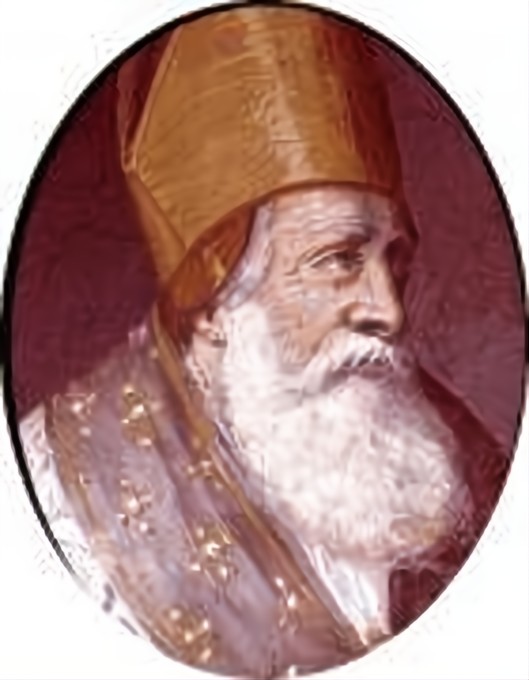
What is certain, is that under this portrait, part of the ancient series of the first 40 Bishops of Vercelli, painted in the Cathedral, one could read his name, with the ranking of “the Second.”
Now let us frame the historical period of his Episcopate — to the left, i.e. a predecessor, is the Bishop Emilian, who ruled the Diocese of Vercelli at the end of the 5th Century (Died 501), was succeeded by a Bishop whose name is unknown. Then immediately after came our Eusebius II, who, in fact was the 12th Bishop of the See. Some local historians believe his Episcopacy to have occurred from 515 to 534 but without proof of this supposition.
The Bollandist hagiographers, who placed his memory on 15 March, established the date of his death around 520 and expressed themselves with his praise, saying that, following the example of the Diocesan Protobishop, St Eusebius I of Vercelli (Died 1 August 371), his namesake, fulfilled his pastoral duties with the utmost diligence and charity.
And Bishop Ferrero also expressed himself in these terms, in his work on the Bishops of Vercelli,which he published in the second edition, in 1609.
Bl Anthony of Milan St Aristobulos of Britannia St Bodian of Hanvec St Eoghan of Concullen St Eusebius II of Vercelli (Died c520) Bishop Bl Francis of Fermo St Longinus the Centurian Bl Ludovico de la Pena St Mancius of Evora St Matrona of Capua St Matrona of Thessaloniki St Menignus of Parium Bl Monaldus of Ancona St Nicander of Alexandria St Peter Pasquale St Sisebuto St Speciosus St Vicenta of Coria Bl Walter of Quesnoy
Thought for the Day – 14 March – The Spiritual Combat (1589) – Dom Lorenzo Scupoli OSM (c1530-1610)
“None shall be crowned who has not fought well.” 2 Tim 2: 5
XXXII: … The Last Artifice of the Devil – Making even Virtue, an Occasion of Sin! (Part Three)
“Consider next, that not only do all the works which you have done. fall short of the Light which has been given you to know them and the grace to execute them but too, that in themselves, they are very imperfect and are deficient of that pure intention and due diligence and fervour, with which they should be performed and which should always accompany them.
If, then, you will well consider this, you will see reason, rather for shame, than for vain complacency because, it is but too true that the graces which we receive pure and perfect from God, are sullied in their use, by our imperfections.
Again, compare your works with those of the Saints and other servants of God — for by such comparison, you will find that your best and greatest, are of base alloy and of little worth. Next, measure them by those which Christ wrought for you in the Mystery of His life and of His continual Cross and setting aside the consideration of His Divinity, view His works in themselves alone — considering both the fervour and the purity of the love with which they were wrought and, you will see that all your works are indeed, as nothing.
And lastly, if you will raise your thoughts to the Divinity and the boundless Majesty of your God and the service which He deserves at your hands, you will plainly see that your works should excite in you not vanity but fear!
Therefore, in all your ways, in all your works, however holy they maybe, you must cry unto your Lord with all your heart, saying: “God be merciful to me a sinner!”
Quote/s of the Day – 14 March – St Lawrence Justinian on Prayer
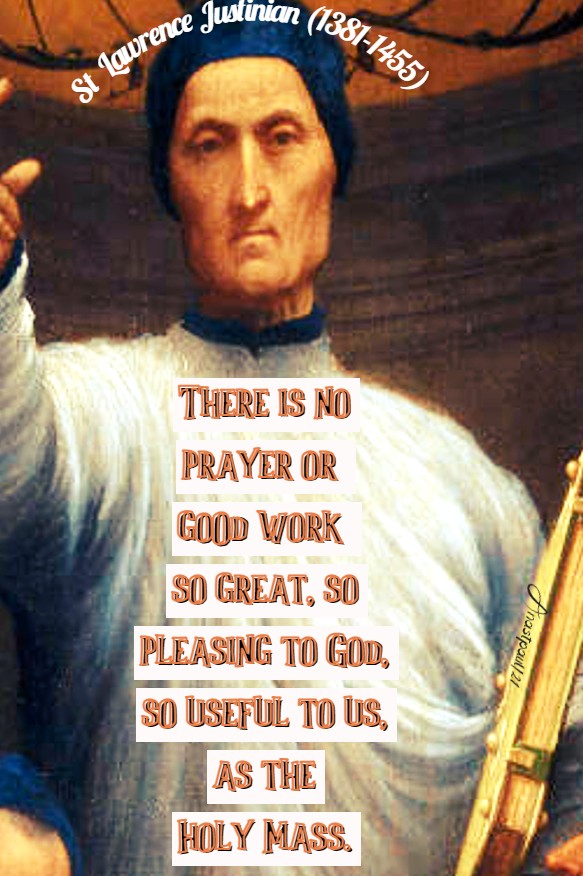
“There is no prayer or good work so great, so pleasing to God, so useful to us, as the Holy Mass.”
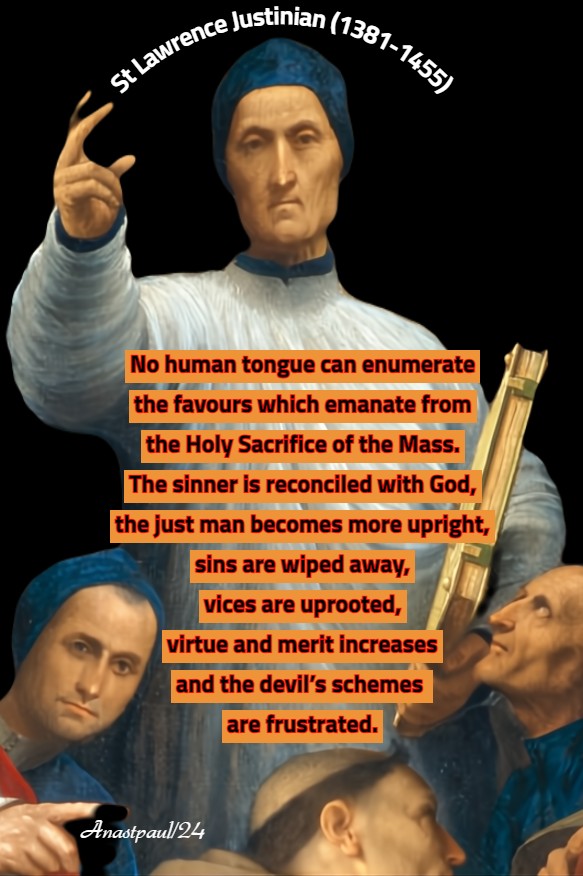
“No human tongue can enumerate the favours which emanate from the Holy Sacrifice of the Mass. The sinner is reconciled with God, the just man becomes more upright, sins are wiped away, vices are uprooted, virtue and merit increases and the devil’s schemes are frustrated.”
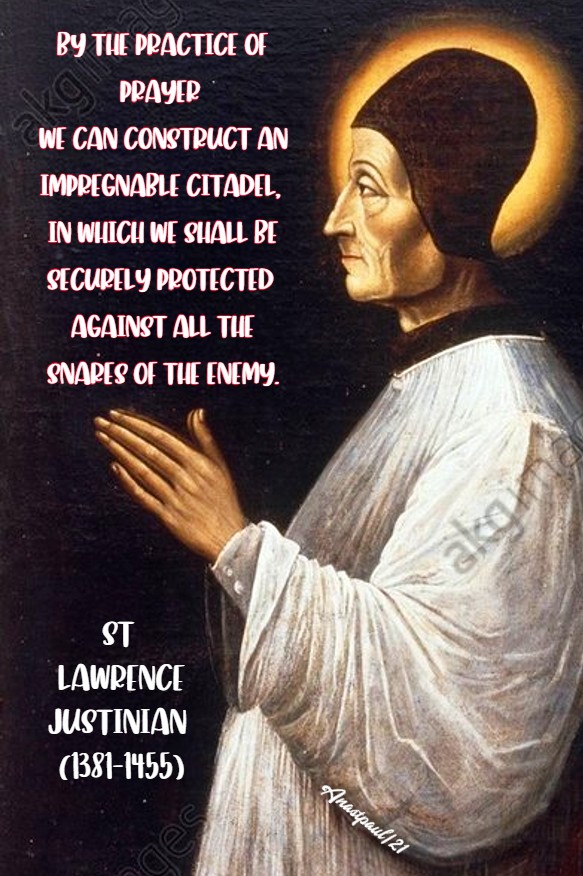
“By the practice of prayer we can construct an impregnable citadel, in which we shall be securely protected against all the snares of the enemy.”
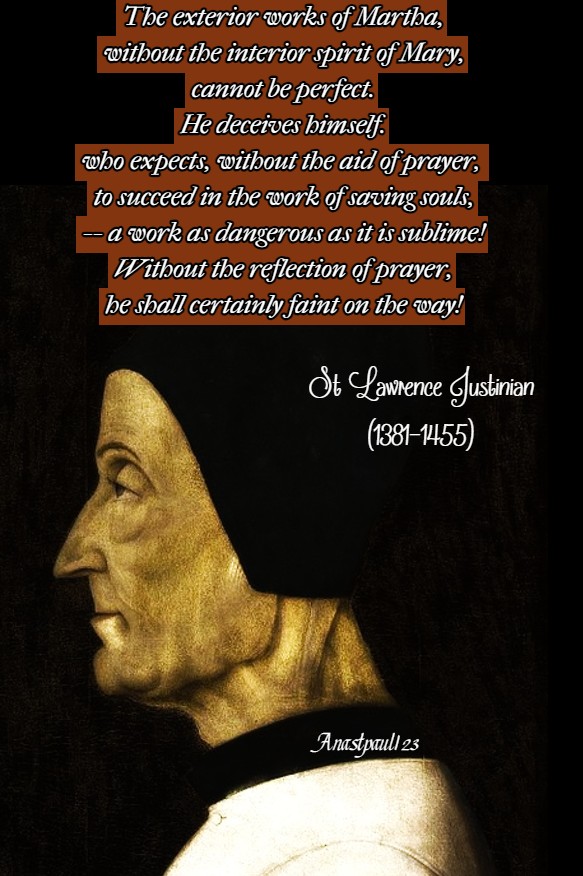
“The exterior works of Martha, without the interior spirit of Mary, cannot be perfect. He deceives himself. who expects, without the aid of prayer, to succeed in the work of saving souls, — a work as dangerous as it is sublime! Without the reflection of prayer, he shall certainly faint on the way!”
Our Lenten Journey with the Angels and the Saints – 14 March – Thursday of the Fourth Week in Lent – 4 Kings 4:25-38, Luke 7:11-16 – Scripture search here: https://www.drbo.org/
“Seek the Lord and be strengthened, seek His Face evermore.” Psalm 104:4
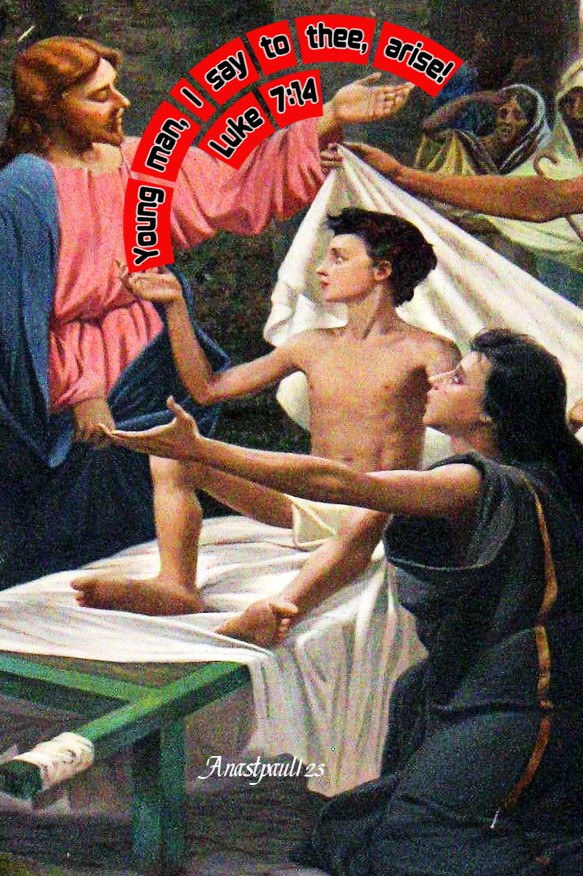
“Young man, I say to thee, arise!” Luke 7:14
His Life-giving Eucharist
St Cyril of Alexandria (376-444) Father & Doctor of the Church
“Even for restoring the dead to life, the Saviour did not stop at acting by Word alone, although it was the bearer of Divine Commands. For such a surpassing work, He took His own Flesh as His assistant – if one might put it that way – that He might show, that it has the power to give life and, that He might cause it to be seen that it is entirely One with Him. For, it is indeed His very own Flesh and not an alien body.
This is what happened when He restored life to the synagogue leader’s daughter, saying to her: “My child, arise!” (Mk 5:41). He took her by the hand, as it is written. As God, He gave her back her life, by His all-powerful command and animated her too, by contact with His Holy Flesh. Thus, He bore witness that, in Flesh as in His Word, one and the same Divine energy was at work. In the same way, too, when he came to a Town called Nain, where the widow’s only son was being buried, He touched the coffin, saying: “Young man, I say to thee, arise!” (Lk 7:14).
Thus, He not only conferred to His Word the power to raise the dead but He even touched the dead, to show that His Body is Life-giving and, through His Flesh, He caused life to pass into their corpses. If the touch alone of His Sacred Flesh restores life to a corrupting body, what profit shall we not discover in His Life-giving Eucharist when we make of it our food? It will wholly transform into its own property which is immortality, those who participate in it.” – (Commentary on the Gospel of John Ch 4).
One Minute Reflection – 14 March – “The Month of St Joseph” – Thursday of the Fourth Week in Lent – 4 Kings 4:25-38, Luke 7:11-16 – Scripture search here: https://www.drbo.org/
“Young man, I say to thee, arise!” – Luke 7:14
REFLECTION – “Our Lord, the great and excellent Physician of our infirmities, announced everywhere, before coming into this world, both His arrival and the maladies He would cure; sometimes by His prophets. …”
What wonder then if, in the Gospel, we find Him surrounded by the sick, by sinners and by publicans! O vain and foolish murmuring of the Hebrews, when they said: “This man receiveth sinners.” Whom would you wish Him to receive? Is it not the honour of a Physician to be sought for by the sick and so much the more, as their maladies are considered incurable? …
Thus, how were the poor Prodigal and the unfortunate Absalom received by their fathers? And, otherwise, what would become of us, for all have sinned? Every man is a liar, that is to say, a sinner. If we say that we are without sin, we deceived ourselves. Return to the Lord, and forsake your injustice, for His Mercy is great towards those who are converted to Him. Why is He called Saviour, unless in order to save? …
But, oh, miserable that we are! We are often called and we only turn a deaf ear. “I have called and you have not heard,” says God. We are drawn and we obstinately resist Him. He complains, saying: “All the day long have I stretched out My hands to this incredulous and rebellious people! ”…
Let us then depart, let us depart from Egypt, let us approach Our Lord, let us make provision of good works; let the feet of our affections be bare, let us clothe ourselves with innocence, let us not be satisfied with crying for mercy, let us go forth from Egypt, let us delay no longer. The hour is come to arise from sleep, since we know that He receives sinners; the Angels await our repentance, the Saints pray for it!” – (Consoling Thoughts on God and Providence).
PRAYER – Grant, we beseech Thee, Almighty God, that we who are chastising the flesh by fasting, may rejoice in this holy practice and thus, with earthly passions subdued, we may the more readily direct our thoughts to Heavenly things. Through the same Jesus Christ, Thy Son our Lord, Who lives and reigns with Thee, in the unity of the Holy Ghost, God, world without end. Amen (Collect).
Our Morning Offering – 14 March – Thursday of the 4th Week in Lent
Lord Jesus Christ, Have Mercy Upon Me. The Dying Prayer of St Richard of Chichester (1197-1253)
Lord Jesus Christ, I thank Thee for all the blessings Thou hast given me and for all the sufferings and shame, Thou didst endure for me, on which account, that pitiable cry of sorrow was Thine: “Behold and see, if there was any sorrow like unto My sorrow!” Thou knowest Lord, how willing I should be, to bear insult and pain, and death for Thee, therefore, have mercy upon me, for to Thee do I commend my spirit. Amen
St Richard recited this prayer on his deathbed, surrounded by the Clergy of his Diocese. The words were transcribed, in Latin, by his Confessor and friend, Fr Ralph Bocking (who ultimately also became his Biographer), a Dominican Friar. The prayer was eventually published in the Acta Sanctorum, an encyclopedic text in 68 folio volumes of documents examining the lives of Saints. The British Library copy contains Fr Bocking’s transcription of the prayer in his handwriting as below:
Gratias tibi ago, Domine Jesu Christe, de omnibus beneficiis quae mihi praestitisti; pro poenis et opprobrious, quae pro me pertulisti; propter quae planctus ille lamentabilis vere tibi competebat. Non est dolor similis sicut dolor meus.
However, the first English translation is as above an not the version below, or the one more commonly known as “Day by Day” which words were never in the original and were added and used in the extremely sacrilegious and blasphemous “Godspell” – even though the common version with the rhyming “Triplet” (i.e. clearly, dearly, nearly) – is the one found commonly in Hymn and Prayer Books. Bearing in mind that this was “The Dying Prayer ” of St Richard, it is obviously highly unlikely that he would have requested the grace of daily sanctity, “day by day!”
Thanks be to Thee, my Lord Jesus Christ For all the benefits Thou hast given me, For all the pains and insults Thou hast borne for me. O most merciful Redeemer, Friend and Brother, May I know Thee more clearly, Love Thee more dearly, Follow Thee more nearly. Amen
Saint of the Day – 14 March – Saint Pauline of Thuringia (Died 1107) Widow, Mother, Nun. Died on 14 March 1107 in Fulda, Germany of natural causes. Also known as – Pauline of Fulda, Pauline of Hirsau, Pauline of Münsterschwarzach, Pauline of Zell, Paolina, Paulina.
Born to the Saxon nobility, Pauline was married, after the early death of her first husband to Ulric de Scharaplan. The couple were blessed with children, although we do not know anything about them.
After the death of Ulric and the sole upbringing of her children, she decided to enter religious life and asked the Pope for advice. He directed her to Udone, the Abbot of St Blasien Monastery. Unfortunately, however, in that period both the Abbot and Pauline’s father died.
Pauline then decided to retire with some companions to a forest in Thuringia, where she founded a double Monastery. The direction was entrusted to a Monk while Werner, Pauline’s son, took care of material things as a Lay Brother and Administrator.
In 1107 Pauline and her Nuns decided to separate from the Monks at Thuringia. She undertook to lead them to a Monastery at Hirsau but while travelling Pauline fell ill and was admitted to the Hospice at Munsterchwarzach. Here she received a visit from the Superior of Thuringia Monastery, who blessed her with the administration of the last Rites and Sacraments. She died on 14 March 1107.
St Maximilian St Pauline of Thuringia (Died 1107) Widow St Peter of Africa St Philip of Turin St Talmach Bl Thomas Vives
47 Martyrs of Rome – Forty-sevenpeople who were Baptised into the Faith in Rome, Italy by Saint Peter the Apostle and were later Martyred together during the persecutions of Nero. Martyred c67 in Rome, Italy
Martyrs of Valeria – Two Monks Martyred by Lombards in Valeria, Italy who were never identified. After the monks were dead, their killers could still hear them singing Psalms. They were hanged on a tree in Valeria, Italy.
Thought for the Day – 13 March – The Spiritual Combat (1589) – Dom Lorenzo Scupoli OSM (c1530-1610)
“None shall be crowned who has not fought well.” 2 Tim 2: 5
XXXII: … The Last Artifice of the Devil – Making even Virtue, an Occasion of Sin! (Part Two)
“Again, in the life of grace and the performance of good works, what good or meritorious deed, could your nature perform by itself, if deprived of Divine assistance?
For, considering, on the other hand, the multitude of your past transgressions and moreover, the multitude of other sins from which, God’s compassionate Hand, has alone withheld you, you will find that your iniquities, being multiplied, not only by days and years but, by acts and habits of sin, (one evil habit drawing another after it), would have swelled to an almost infinite amount and so, have made of you, another infernal Lucifer!
Hence, if you would not rob God of the praise of His goodness but cleave faithfully to Him, you must learn, day-by-day, to think more humbly of yourself. And be very careful to deal justly in this judgement of yourself, or it may do you no little injury. For, if in the knowledge of your own iniquity, you surpass a man who, in his blindness, accounts himself to be something, you will lose exceedingly and fall far below him in the action of the will, if you desire to be esteemed and regarded by men, for that which you know yourself, not to be.
If, then, you desire that the consciousness of your vileness and sinfulness should protect you from your enemies and make you dear to God, you must not only despise yourself, as unworthy of any good and deserving of every evil but, you must love to be despised by others, detesting honours, rejoicing in shame and stooping on all occasions to offices which others hold in contempt. You must make no account at all of their judgement, lest you be, thereby, deterred from this holy exercise. But take care that the end in view be solely your own humiliation and self-discipline, lest you be in any degree influenced by a certain lurking pride and spirit of presumption which, under some specious pretext or other, often causes us to make little or no account of the opinions of others.
And should you perchance come to be loved, esteemed, or praised by others for any good gift bestowed upon you by God, be not moved, a single step, thereby but, collect yourself steadily within the stronghold of this true and just judgement of yourself, first turning to God and saying to Him with all your heart :
“O Lord, never let me rob Thee of Thy honour and the glory of Thy grace. To Thee be praise and honour and glory, to me, confusion of face.”
And then say mentally of him who praises you:
“Whence is it that he accounts me good, since truly, my God and His works, are alone good?”
For by thus, giving back to the Lord that which is His own, you will keep your enemies afar off and prepare yourself to receive greater gifts and favours from your God.
And if the remembrance of good works exposes you to any risk of vanity, view them instantly, not as your own but as God’s and say to them :
“I know not how you did appear and originate in my mind, for you derived not your being from me but the good God and His grace created, nourished and preserved you. Him alone, then, will I acknowledge as your true and first Parent, Him will I thank and to Him, will I return all the praise. Amen!”
Quote/s of the Day – 13 March – Wednesday of the Fourth Week in Lent – Isaias 1:16-19, John 9:1-38 – Scripture search here: https://www.drbo.org/
“I am the Light of the world; he who follows me will not walk in darkness but will have the light of life.”
John 8:12
“Arise, be enlightened, … for thy Light is come!”
Isaias 60:1
“Let us listen to the holy Voice of God which summons us from on high, from the holy mountain top. There, we must hasten – I make bold to say – like Jesus, Who is our leader and has gone before us into Heaven. There, with Him, may the eyes of our mind shine with His light and the features of our soul be made new; may we be transfigured with Him and moulded to His image, ever becoming divine, being transformed in an ever greater degree of glory.”
St Anastasius Sinaita (Died 6th Century) Priest and Abbot
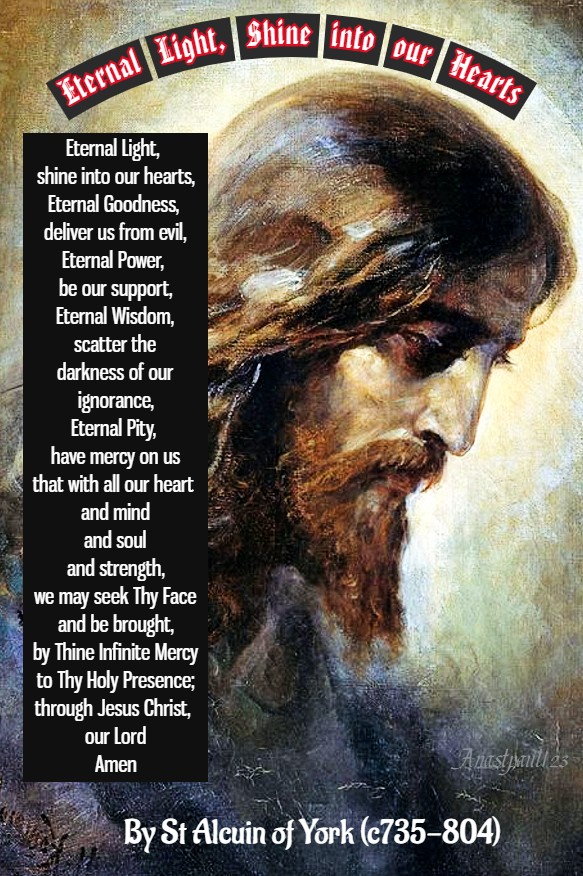
Eternal Light, Shine into our Hearts By St Alcuin of York (735-804)
Eternal Light, shine into our hearts, Eternal Goodness, deliver us from evil, Eternal Power, be our support, Eternal Wisdom, scatter the darkness of our ignorance, Eternal Pity, have mercy on us that with all our heart and mind and soul and strength, we may seek Thy Face and be brought, by Thine Infinite Mercy to Thy Holy Presence; through Jesus Christ, our Lord Amen
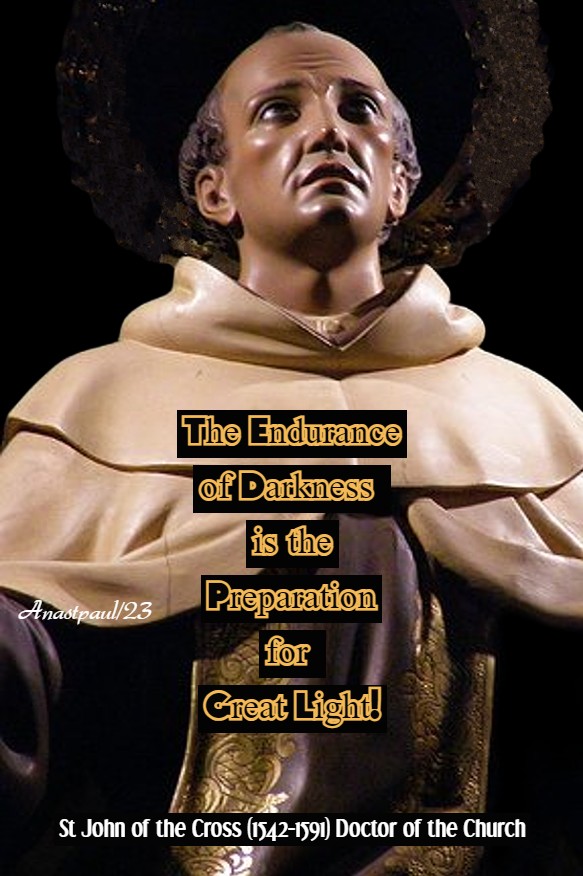
“The endurance of darkness is the preparation for great light!”
Our Lenten Journey with the Angels and the Saints – 13 March – Wednesday of the Fourth Week in Lent – Isaias 1:16-19, John 9:1-38 – Scripture search here: https://www.drbo.org/
“Wash yourselves, be clean, take away the evil of your deeds from my eyes …” Isaias 1:16
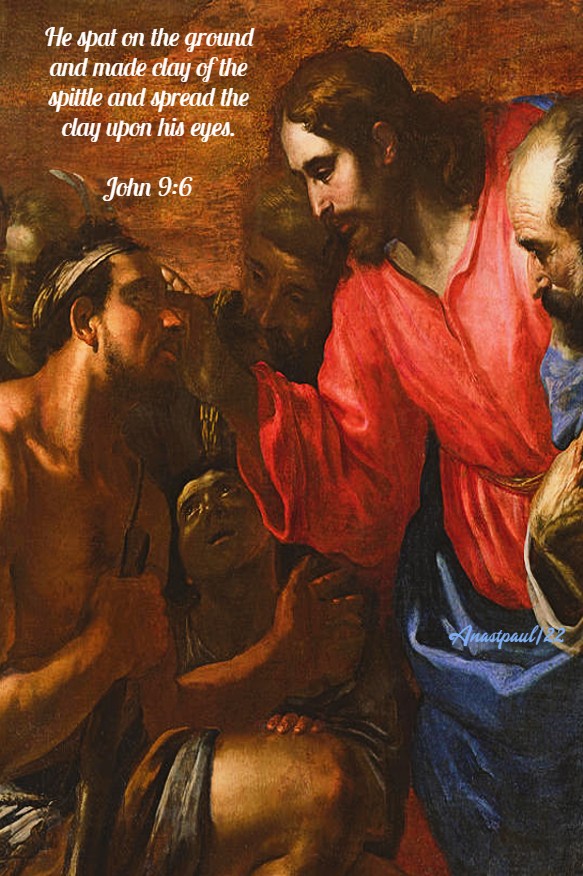
“And Jesus passing by, saw a man who was blind from his birth. … As long as I Am in the world, I Am the Light of the world. When He had said these things, He spat on the ground and made clay of the spittle and spread the clay upon his eyes,” John 9:1,5-6
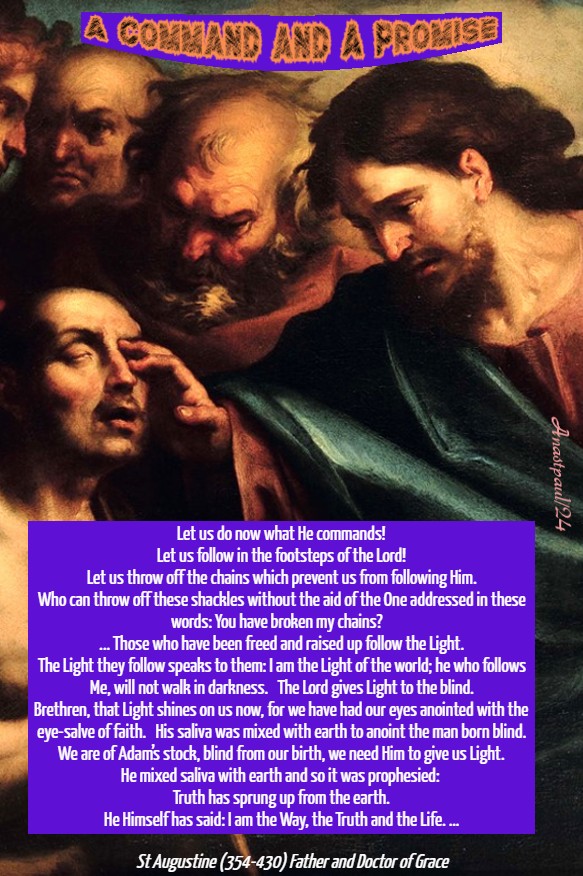
A Command and A Promise
St Augustine (354-430) Father and Doctor of Grace
“The Lord tells us – I am the Light of the world; he who follows Me, will not walk in darkness but will have the Light of life. In these few words He gives a COMMAND and makes a PROMISE. Let us do what He commands, so that we may not blush to covet what He promises and to hear Him say on the Day of Judgement: “I laid down certain conditions for obtaining My Promises. Have you fulfilled them?” If you say: “What did you command, Lord our God?” He will tell you: “I commanded you to follow Me. You asked for advice on how to enter into life. What life, if not the life about which it is written: With Thee is the fountain of life?”
Let us do now what He commands! Let us follow in the footsteps of the Lord! Let us throw off the chains which prevent us from following Him. Who can throw off these shackles without the aid of the One addressed in these words: You have broken my chains? Another psalm says of Him: The Lord frees those in chains, the Lord raises up the downcast.
Those who have been freed and raised up follow the Light. The Light they follow speaks to them: I am the Light of the world; he who follows Me, will not walk in darkness. The Lord gives Light to the blind. Brethren, that Light shines on us now, for we have had our eyes anointed with the eye-salve of faith. His saliva was mixed with earth to anoint the man born blind. We are of Adam’s stock, blind from our birth, we need Him to give us Light. He mixed saliva with earth and so it was prophesied: Truth has sprung up from the earth. He Himself has said: I am the Way, the Truth and the Life. …
If you love Me, follow Me. “I do love you,” you protest “but how do I follow you?” If the Lord your God said to you: “I am the Truth and the Life,” in your desire for truth, in your love for life, you would certainly ask Him to show you the way to reach them. You would say to yourself: “Truth is a great reality, life is a great reality – if only it were possible for my soul to find them!” – (An excerpt from: On John [Treatise 34]).
One Minute Reflection – 13 March – “The Month of St Joseph” – Wednesday of the Fourth Week in Lent – Isaias 1:16-19, John 9:1-38 – Scripture search here: https://www.drbo.org/
“I am the light of the world. When He had said these things, He spat on the ground and made clay of the spittle and spread the clay upon his eyes,” – John 9:5-6
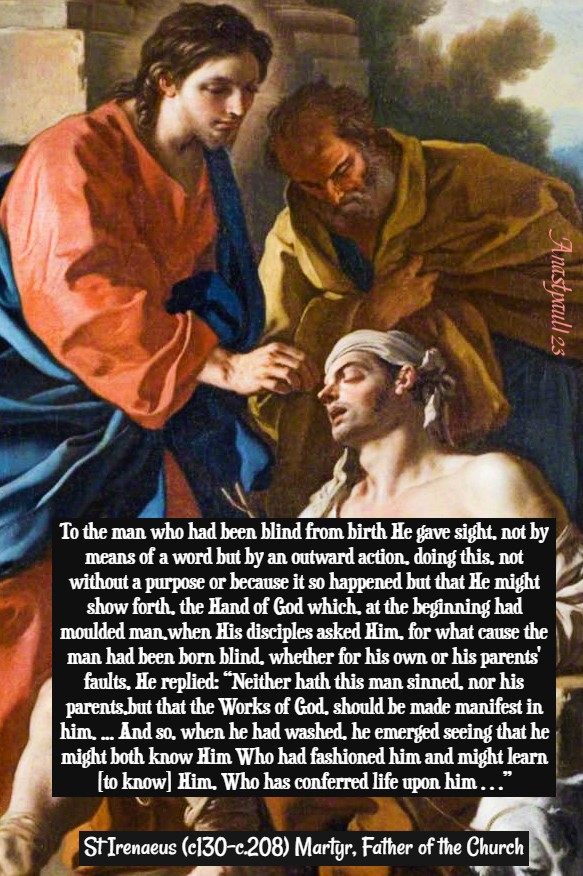
REFLECTION – “To the man who had been blind from birth He gave sight, not by means of a word but by an outward action, doing this, not without a purpose or because it so happened but that He might show forth, the Hand of God which, at the beginning had moulded man. And, therefore, when His disciples asked Him, for what cause the man had been born blind, whether for his own or his parents’ faults, He replied: “Neither hath this man sinned, nor his parents,but that the Works of God, should be made manifest in him.” Now the Work of God is the fashioning of man. For, as Scripture says, He made [man] by a kind of process: “And the Lord took clay from the earth and formed man.” (Gn 2:7). Wherefore also, the Lord spat on the ground and made clay and smeared it upon the eyes, pointing to the original fashioning, how it was effected and manifesting the Hand of God to those who can understand, by what [Hand] man was formed out of the dust…
And, inasmuch, as man, with respect to that formation which, after Adam, had fallen into transgression, needed the layer of regeneration, [the Lord] said to him [upon whom He had conferred sight], after He had smeared his eyes with the clay: “Go to Siloam and wash,” thus restoring to him, both [his perfect] confirmation and that regeneration which took place, by means of the smearing. And so, when he had washed, he emerged seeing that he might both know Him Who had fashioned him and might learn [to know] Him, Who has conferred life upon him …
But He, the very same Who formed Adam at the beginning, with Whom also the Father spoke, [saying], “Let Us make man after Our Image and Likeness,” revealing Himself in these last times to men, formed visual organs for him, who had been blind, [in that body which he had derived] from Adam.” – St Irenaeus (130-202) Bishop, Martyr, Theologian, Father of the Church (Against Heresies, V, 15, 2-4).
PRAYER – O Lord, we beseech Thee, in Thy mercy, pour forth Thy grace into our hearts, that, as we abstain from material food, so may we restrain our senses from sin. Through Jesus Christ, Thy Son our Lord, Who lives and reigns with Thee, in the unity of the Holy Ghost, God, world without end. Amen (Collect)
Our Morning Offering – 13 March – Wednesday of the Fourth Week in Lent – “The Month of the St Joseph” and his special day of the week in Catholic time
Glorious St Joseph! Prayer for the Intercession of St Joseph in All Our Needs By St Francis de Sales (1567-1622) Doctor Caritatis
Glorious St Joseph, Spouse of Mary, grant us thy paternal protection, we beseech thee, by the Heart of Jesus Christ. O thou, whose power extends to all our necessities and can render possible for us, the most impossible things. Open thy fatherly eyes to the needs of thy children. In the trouble and distress which afflicts us, we confidently have recourse to thee. Deign to take under thy charitable charge this important and difficult matter, cause of our worries. Make its happy outcome be for God’s glory and for the good of His devoted servants. Amen
Saint of the Day – 13 March – Saint Nicephorus (c758-829) Bishop and Confessor, Defender of Sacred images. Nicephorus was the Bishop of Constantinople from 806-815, Scholar and Writer. Born in c758 in Constantinople (modern-day Istanbul, Turkey) and died at the Monastery he had founded on the Black Sea coast on 5 April 828 or 2 June 829 (sources vary). Both these dates are variously celebrated in his honour.
The Roman Martyrology reads today: “At Constantinople, the Bishop St Nicephorus. In defence of the traditions of his forefathers and of the Churrch, the worship of Sacred images, he opposed the Iconoclast Emperor, by whom he was sent into exile, where he underwent a long martyrdom of fourteen years and departed for the Kingdom of God.”
This champion of the orthodox view in the second contest over the veneration of images belonged to a noted family of Constantinople. He was the son of the Imperial Secretary Theodore and his pious wife ,Eudoxia. Eudoxia was a strict adherent of the Church and Theodore had been banished by the Emperor Constantine Copronymus (741-75) on account of his steadfast support of the teaching of the Church concerning images.
While still young Nicephorus was brought to the Court, where he too became an Imperial Secretary. In 787, with two other officials of high rank, he represented the Empress Irene in 787 at the Second Council of Nicaea (the Seventh Ecumenical Council) which declared the Doctrine of the Church regarding images. Shortly after this Nicephorus sought solitude on the Thracian Bosporus, where he had founded a Monastery. There he devoted himself to ascetic practices and to the study both of secular learning, as grammar, mathematics and philosophy as well as to the that of the Sacred sciences especially the Scriptures.
Later he was recalled to the capital and given charge of the great hospital for the destitute, possibly that founded by St Basil the Great. Upon the death of Bishop Tarasius (25 February, 806), there was great division among the Clergy and higher Court officials, as to the choice of his successor. Finally, with the assent of the Bishops and Emperor, Nicephorus was appointed. Although still a layman, he was known by all to be very religious and highly educated. He received Holy Orders and was Consecrated Bishop on Easter Sunday, 12 April 806. He was opposed for a time by St Theodore the Studite after Nicephorus forgave a Priest who married Emperor Constantine VI toTheodota, despite the fact the Constantine’s wife, Mary, still lived. He seems to have been a gentle and forgiving man, devoted to reconciliation.
But in regard to Sacred images, Nicephorus challenged the Iconoclast policies of Emperor Leo V the Armenian without fear and was deposed by a Synod of Iconoclast Bishops at the conniving of the Emperor. Nearly assassinated on several occasions, Nicephorus was finally exiled to the Monastery he had founded on the Black Sea, spending his remaining years there in prayer.
He died in 829, never having been able to return to his See. While Bishop, he brought various reforms to his large Diocese and inspired zealous shepherded his faithful flock. He was also the Author of anti-Iconoclast writings and two historical works, a Chronographia and Brevianim.
In 847, St Nicephorus’ remains were solemnly brought back to Constantinople by Bishop Methodius I and interred in the Church of the Holy Apostles, where they were the object of an annual festival celebrated with much devotion.
NOVENA for the INTERCESSION of ST JOSEPH DAY FOUR:Clink Link here:DAY FOUR
St Leander of Seville (c534-c 600) BIshop, Confessor of the Faith, Teacher, Writer, Apostle of Spain and Evangelisation, Father of the Church – Patron of Episcopal attire and Liturgical garments. Saint Leander, as Bishop, instituted the practice of praying the Nicene Creed during Mass—a practice which continues today. Biography: https://anastpaul.wordpress.com/2017/03/13/saint-of-the-day-13-march-st-leander-of-seville/
Bl Judith of Ringelheim St Kevoca of Kyle St Mochoemoc St Nicephorus (c758-829) Bishop and Confessor, Defender of Icons Bl Peter II of La Cava St Pientius of Poitiers St Ramirus of Leon
Thought for the Day – 12 March – The Spiritual Combat (1589) – Dom Lorenzo Scupoli OSM (c1530-1610)
“None shall be crowned who has not fought well.” 2 Tim 2: 5
XXXII: … The Last Artifice of the Devil – Making even Virtue, an Occasion of Sin! (Part One)
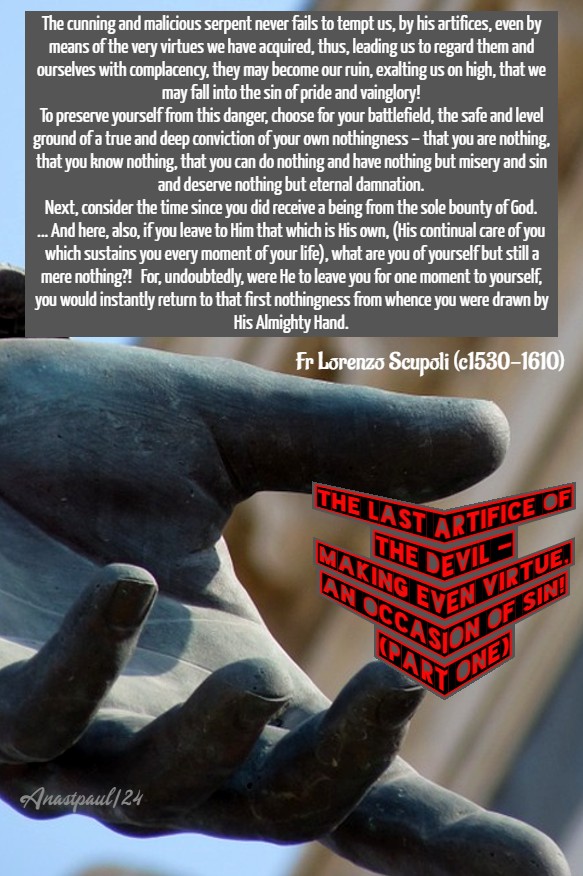
“The cunning and malicious serpent never fails to tempt us, by his artifices, even by means of the very virtues we have acquired, thus, leading us to regard them and ourselves with complacency, they may become our ruin, exalting us on high, that we may fall into the sin of pride and vainglory!
To preserve yourself from this danger, choose for your battlefield, the safe and level ground of a true and deep conviction of your own nothingness – that you are nothing, that you know nothing, that you can do nothing and have nothing but misery and sin and deserve nothing but eternal damnation.
Entrench yourself firmly within the limits of this truth and suffer not yourself to be enticed, so much as a hair’s breadth therefrom, by any evil thought, or anything else which may befall you; knowing well that there are so many enemies, who would slay or wound you, should you fall into their hands.
In order to acquit yourself well in this exercise of the true knowledge of your own nothingness, observe the following rule:
“As often as you reflect upon yourself and your own works and worth, consider always what you are of yourself and not what you are by the aid of God’s grace and so, esteem yourself, as you shall thus find yourself to be.”
Consider first the time before you were in existence and you will see yourself to have been, during all that abyss of eternity, a mere nothing and, that you did nothing and could have done nothing, towards giving yourself an existence!
Next, consider the time since you did receive a being from the sole bounty of God. And here, also, if you leave to Him that which is His own, (His continual care of you which sustains you every moment of your life), what are you of yourself but still a mere nothing?!
For, undoubtedly, were He to leave you for one moment to yourself, you would instantly return to that first nothingness from whence you were drawn by His Almighty Hand. It is plain that, in the order of nature and viewed in yourself alone, you have no reason to esteem yourself, or to desire the esteem of others!”
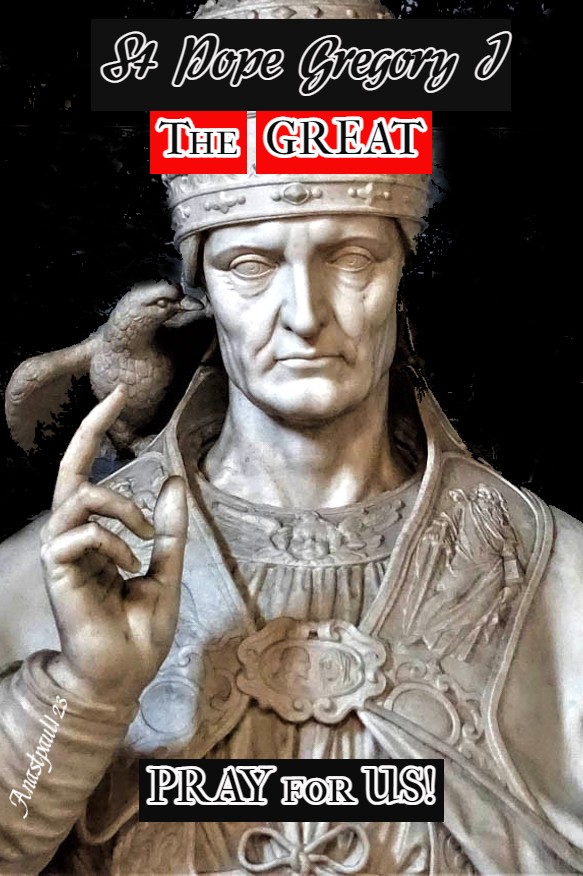
Quote/s of the Day – 12 March – St Gregory the Great (540-604) Pope, Confessor, Father & Doctor of the Church, “Father of the Fathers” “The Apostle of England”
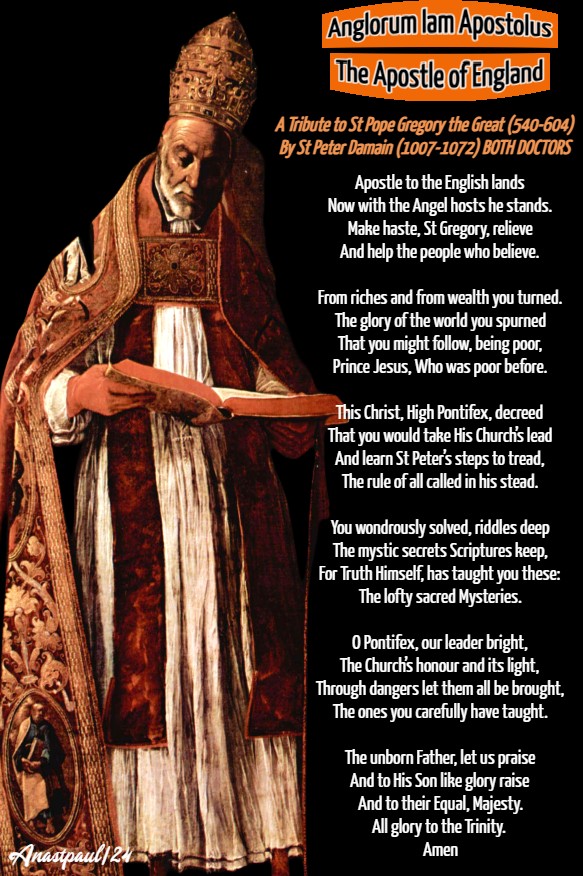
Anglorum Iam Apostolus The Apostle of England By St Peter Damian (1007-1072) Bishop, Confesssor, Father and Doctor A Tribute to his fellow Monk St Gregory the Great (540-604) Pope, Confessor, Father & Doctor of the Church
Apostle to the English lands Now with the Angel hosts he stands. Make haste, St Gregory, relieve And help the people who believe.
From riches and from wealth you turned. The glory of the world you spurned That you might follow, being poor, Prince Jesus, Who was poor before.
This Christ, High Pontifex, decreed That you would take His Church’s lead And learn St Peter’s steps to tread, The rule of all called in his stead.
You wondrously solved, riddles deep The mystic secrets Scriptures keep, For Truth Himself, has taught you these: The lofty sacred Mysteries.
O Pontifex, our leader bright, The Church’s honour and its light, Through dangers let them all be brought, The ones you carefully have taught.
The unborn Father, let us praise And to His Son like glory raise And to their Equal, Majesty. All glory to the Trinity. Amen
Our Lenten Journey with the Angels and the Saints – 12 March – Tuesday of the Fourth Week in Lent – St Gregory the Great (540-604), Pope, Confessor, Father & Doctor of the Church, “Father of the Fathers” “The Apostle of England”
Pride, Strength, That I May See!
St Gregory the Great (540-604), Pope, Confessor, Father & Doctor of the Church
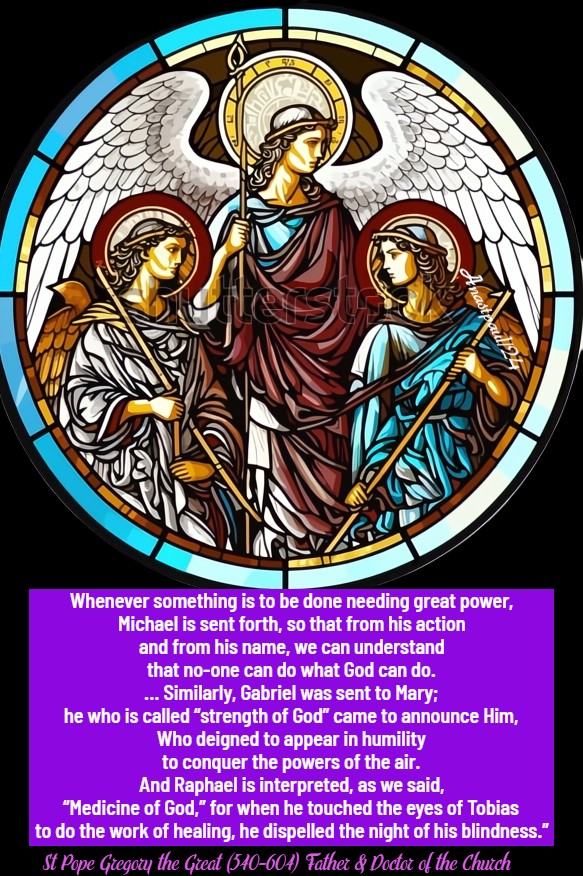
“Whenever something is to be done needing great power, Michael is sent forth, so that from his action and from his name, we can understand that no-one can do what God can do. Hence that old enemy, who through pride, desired to be like God, saying, “I will scale the heavens, I will set up my throne, I will be like the Most High,” is shown at the end of the world, left to his own strength and about to undergo the final punishment, as destined to fight with Michael the Archangel. Similarly, Gabriel was sent to Mary; he who is called “strength of God” came to announce Him, Who deigned to appear in humility to conquer the powers of the air. And Raphael is interpreted, as we said, “Medicine of God,” for when he touched the eyes of Tobias to do the work of healing, he dispelled the night of his blindness.”
Practice: If I am tempted to pride today I will ask St Michael to help me conquer my pride. I will have great confidence in his prayers for this intention since it was he who brought down Lucifer, the very spirit of pride. “Who is like unto God!” And to St Gabriel, in my weakness, I may ask prayers for strength and of St Raphael, his prayers to cure my many hurts, both physical and spiritual.
One Minute Reflection – 12 March – “Tuesday of the Fourth Week in Lent – St Gregory the Great (540-604), Pope, Confessor, Father & Doctor of the Church, “Father of the Fathers” – 1 Peter 5:1-4; 5:10-11; Matthew 16:13-19 – Scripture search here: https://www.drbo.org/
“And I say to thee: That thou art Peter and upon this rock, I will build My Church and the gates of hell shall not prevail against it.” – Matthew 16:18
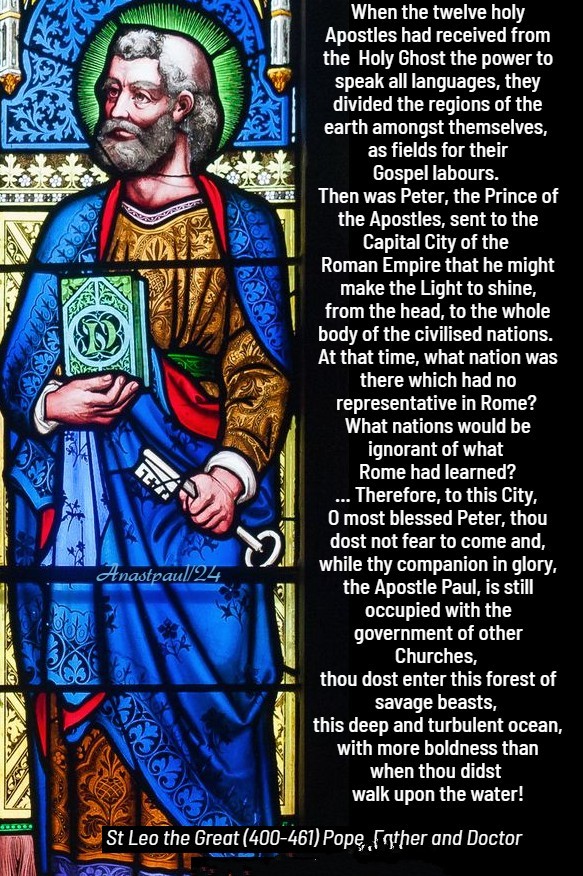
REFLECTION – “When the twelve holy Apostles had received from the Holy Ghost the power to speak all languages, they divided the regions of the earth amongst themselves, as fields for their Gospel labours. Then was Peter, the Prince of the Apostles, sent to the Capital City of the Roman Empire that he might make the Light to shine, from the head, to the whole body of the civilised nations. At that time, what nation was there which had no representative in Rome? What nations would be ignorant of what Rome had learned?
Here were to be refuted the theories of philosophers, here dissolved the vanities of earthly wisdom, here overthrown the worship of devils, here destroyed the impiety of every sacrilege; here, where superstitious zeal had collected all the error and vanity of the world. Therefore, to this City, O most blessed Peter, thou dost not fear to come and, while thy companion in glory, the Apostle Paul, is still occupied with the government of other Churches, thou dost enter this forest of savage beasts, this deep and turbulent ocean, with more boldness than when thou didst walk upon the water!
Thou hadst already taught those, of the circumcision who had been converted, thou hadst founded the Church of Antioch, the first that bore the noble name of Christian; thou hadst published the law of the Gospel throughout Pontus, Galatia, Cappadocia, Asia and Bithynia and, thou didst not fear for the difficulty of thy work, nor turn back because of thine old age but didst boldly set up the trophy of the Cross of Christ, upon those Roman walls, where the Providence of God had appointed the throne of thine honour and the glorious scene of thy passion.” – St Leo the Great (400-461) Pope, Father and Doctor of the Church (Sermon on the Feast of St Peter’s Chair at Rome).
PRAYER – O God, Who granted the rewards of everlasting happiness to the soul of Thy servant Gregory, mercifully grant that we, who are weighed down with the burden of our sins, may be raised up by his prayers to Thee. Through Jesus Christ, Thy Son our Lord, Who lives and reigns with Thee, in the unity of the Holy Ghost, God, world without end. Amen (Collect).
Our Morning Offering – 12 March – Tuesday of the Fourth Week in Lent and the Memorial of St Pope Gregory the Great (540-604) – Father & Doctor
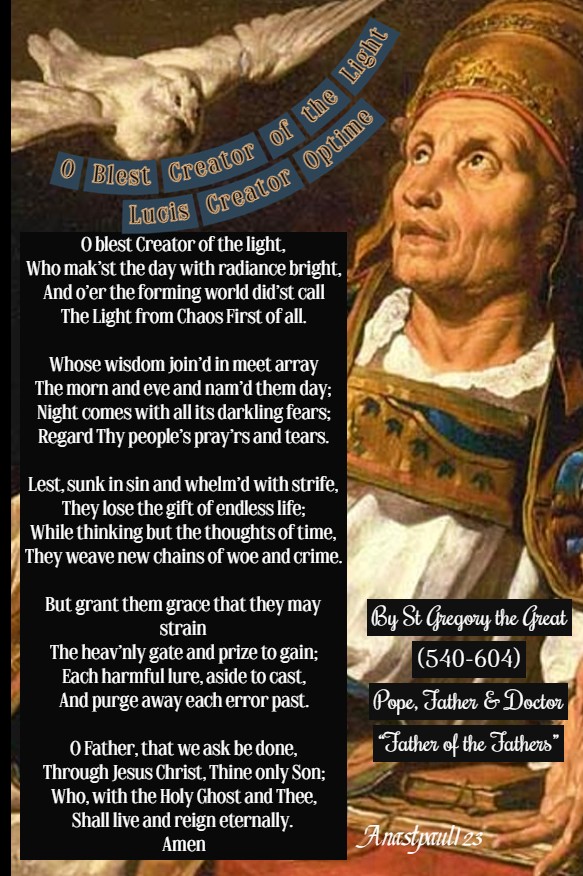
Lucis Creator Optime O Blest Creator of the Light By St Gregory the Great (540-604) Pope, Father & Doctor “Father of the Fathers”
O blest Creator of the light, Who mak’st the day with radiance bright, And o’er the forming world did’st call The Light from Chaos First of all.
Whose wisdom join’d in meet array The morn and eve and nam’d them day; Night comes with all its darkling fears; Regard Thy people’s pray’rs and tears.
Lest, sunk in sin and whelm’d with strife, They lose the gift of endless life; While thinking but the thoughts of time, They weave new chains of woe and crime.
But grant them grace that they may strain The heav’nly gate and prize to gain; Each harmful lure, aside to cast, And purge away each error past.
O Father, that we ask be done, Through Jesus Christ, Thine only Son; Who, with the Holy Ghost and Thee, Shall live and reign eternally. Amen
This hymn is used for Vespers (II) on Sundays throughout the year in the Extraordinary Form of the Roman Breviary. Trans John M Neale (1818-1866), 1851. Tune: “Lucis Creator Optime” Gregorian Chant, Mode VIII, traditional.
Saint of the Day – 12 March – Saint Theophanes (c758-817) Abbot, Confessor, Founder of Monasteries, Defender of Sacred images, Writer and Historian. Born in Samothrace, Thrace, Greece and died there on 12 March 817 of natural causes (aged 57–59). Also known as – Theophanus of Isaurius, Teofane…
The Roman Martyrology reads today: “At Constantinople, St Theophanes, who gave up great wealth to embrace poverty in the monastic state. By Leo the Armenian, he was kept in prison for two years for the worship of holy images, then, being exiled in Samothracia, where, overwhelmed with afflictions, he breathed his last and wrought many miracles.”
Theophanes was born in Constantinople of wealthy and noble iconodule parents, being Isaac, the Governor of the Islands of the Aegean Sea and Theodora, of whose family nothing is known. His father died when Theophanes was three years old and the Byzantine Emperor, Constantine V (740–775) subsequently saw to the boy’s education and upbringing, at the Imperial Court. Theophanes would later hold several offices under Leo IV.
He was married at the age of eighteen but convinced his wife to lead a life of virginity. In 779, after the death of his father-in-law, they separated with mutual consent, to embrace the religious life. She chose a Convent on an Island near Constantinople, while he entered the Polychronius Monastery, located in the district of Sigiane on the Asian side of the Sea of Marmara. Later, he built a Monastery on his own lands, on the Island of Calonymus (now Calomio), where he acquired a high degree of skill in transcribing manuscripts.
After six years there, Theophanes returned to Sigriano, where he founded an Abbey known by the name ‘of the big settlement’ and governed it as the Abbot. In this position of leadership, he was present at the Second Council of Nicaea in 787 and signed its decrees in defence of the veneration of Icons.
During the years 810-815, Theophanes undertook, at the urgent request of his friend, the Monk and Historian, George Syncellus, who died shortly after Theophanes acceptance, the continuation of Syncellus’ Christian History. The language used occupies a place midway between the stiff Ecclesiastical and the vernacular Greek. Theophanes’ part of the History covered events from the accession of Diocletian in 284 to 813. This part of the History is valuable for having preserved the accounts of Byzantine Ecclesiatical history, for the 7th and 8th Centuries which would otherwise have been lost.
When Emperor Leo V the Armenian (813–820) resumed his iconoclastic warfare, he ordered Theophanes brought to Constantinople. The Emperor tried in vain to induce him to condemn the veneration of icons which had been sanctioned by the second Council of Nicaea. Theophanes was cast into prison and for two years suffered cruel treatment. After his release in 817, he was banished to Samothrace, where overwhelmed with afflictions, he lived only seventeen days in his home country.
He is credited with many miracles which occurred after his death, on 12 March, the day he is commemorated in the Roman Martyrology.
Blessed Jerome of Recanati OSA (Died 1350) Priest, Friar of the Hermits of Saint Augustine, Peacemaker. He was Beatified in 1804 by Pope Pius VII. The Roman Martyrology reads : “In Recanati in the Marche, Blessed Girolamo Gherarducci, Priest of the Order of the Hermits of St Agustine, who worked for peace and harmony between peoples.” About Bl Jerome: https://anastpaul.com/2022/03/12/saint-of-the-day-12-march-blessed-jerome-of-recanati-osa-died-1350/
St Theophanes (c758-817) Abbot, Confessor, Defender of Icons
Martyrs of Nicomedia – 8 Beati: Christians who were Martyred in succession in a single incident during the persecutions of Diocletian. First there were the eight imprisoned Christians, Domna, Esmaragdus, Eugene, Hilary, Mardonius, Maximus, Mígdonus and Peter, about whom we know little more than their names. Each day for eight days one of them would be strangled to death in view of the others so that they would spend the night in dread, not knowing if they were next. Peter was the Chamberlain or Butler in the Palace of Diocletian. When he was overheard complaining about this cruelty, he was exposed as a Christian, arrested, tortured and executed by having the flesh torn from his bones, salt and vinegar poured on the wounds and then being roasted to death over a slow fire. Gorgonio was an army officer and member of the staff in the house of emperor Diocletian, Doroteo was a staff clerk. They were each exposed as Christians when they were overhead objecting to the torture and murder of Peter. This led to their own arrest, torture and executions. Died in 303 in Nicomedia, Bithynia (in modern Turkey) Additional Memorial – 28 December as part of the 20,000 Martyrs of Nicomedia. Beatified on 14 January 1891 by Pope Leo XIII (cultus confirmation).
Thought for the Day – 11 March – The Spiritual Combat (1589) – Dom Lorenzo Scupoli OSM (c1530-1610)
“None shall be crowned who has not fought well.” 2 Tim 2: 5
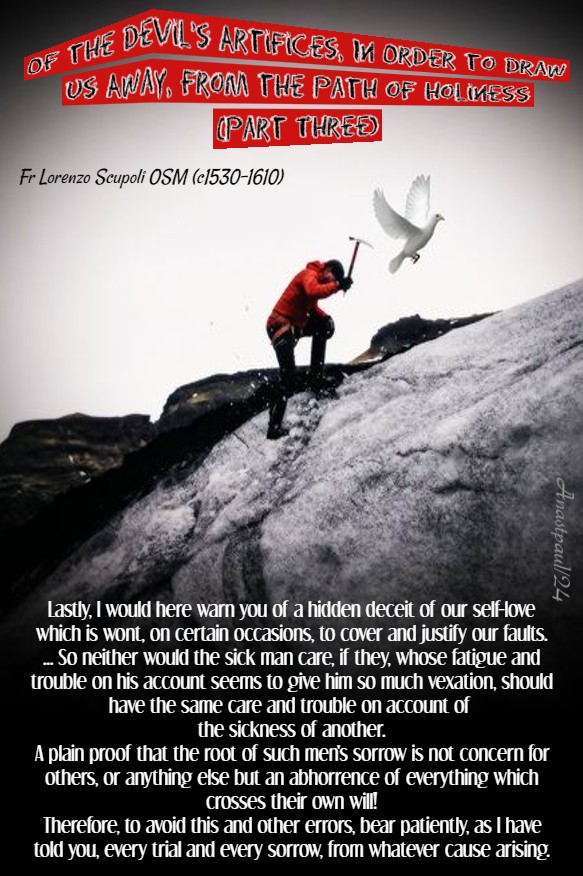
XXXI: … Of the Devil’s Artifices, In Order to Draw Us Away, From the Path of Holiness (Part Three)
“Lastly, I would here warn you of a hidden deceit of our self-love which is wont, on certain occasions, to cover and justify our faults. For instance, a sick man who has but little patience with his sickness, conceals his impatience under the cover of zeal for some apparent good — saying, that his vexation arises, not really from impatience under his sufferings but, is a reasonable sorrow because he has incurred it by his own fault, or else because others are harassed or wearied by the trouble he gives them, or by some other cause.
In like manner, the ambitious man, who frets after some unattained honour, does not attribute his discontent to his own pride and vanity but to some other cause, which he knows, fullwell, would give him no concern did it not touch himself.
So neither would the sick man care, if they, whose fatigue and trouble on his account seems to give him so much vexation, should have the same care and trouble on account of the sickness of another. A plain proof that the root of such men’s sorrow is not concern for others, or anything else but an abhorrence of everything which crosses their own will!
Therefore, to avoid this and other errors, bear patiently, as I have told you, every trial and every sorrow, from whatever cause arising.”
Quote/s of the Day – 11 March – Monday of the Fourth Week in Lent – 3 Kings 3:16-28; John 2:13-25 – Scripture search here: https://www.drbo.org/
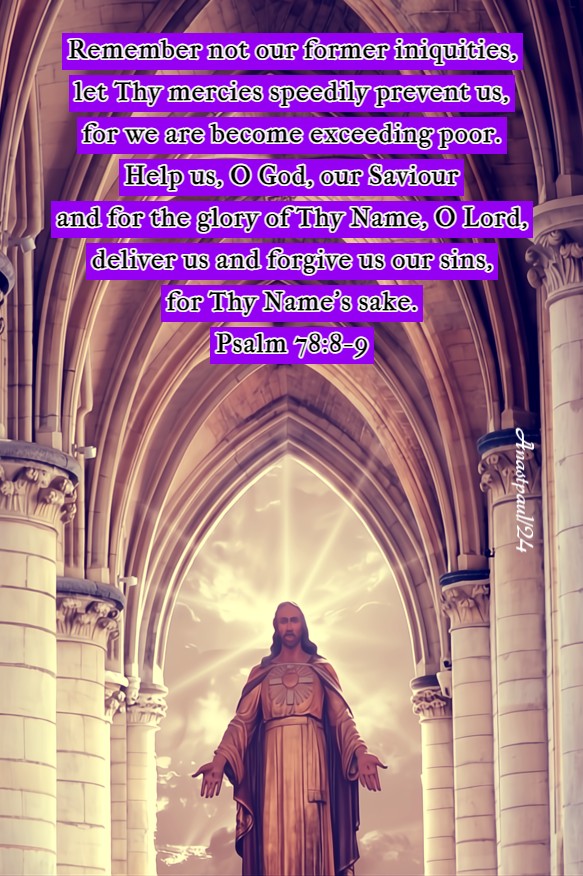
“Remember not our former iniquities, let Thy mercies speedily prevent us, for we are become exceeding poor. Help us, O God, our Saviour and for the glory of Thy Name, O Lord, deliver us and forgive us our sins, for Thy Name’s sake.”
Psalm 78:8-9
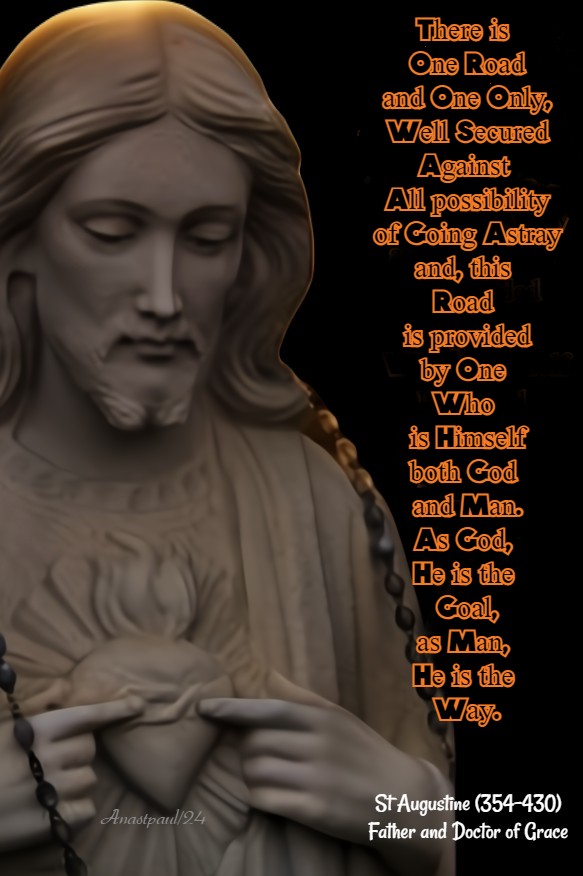
“… There is one Road and one only, well secured against all possibility of going astray and, this Road is provided by One, Who is Himself both God and Man. As God, He is the Goal, as Man, He is the Way.”
St Augustine (354-430) Father and Doctor of Grace
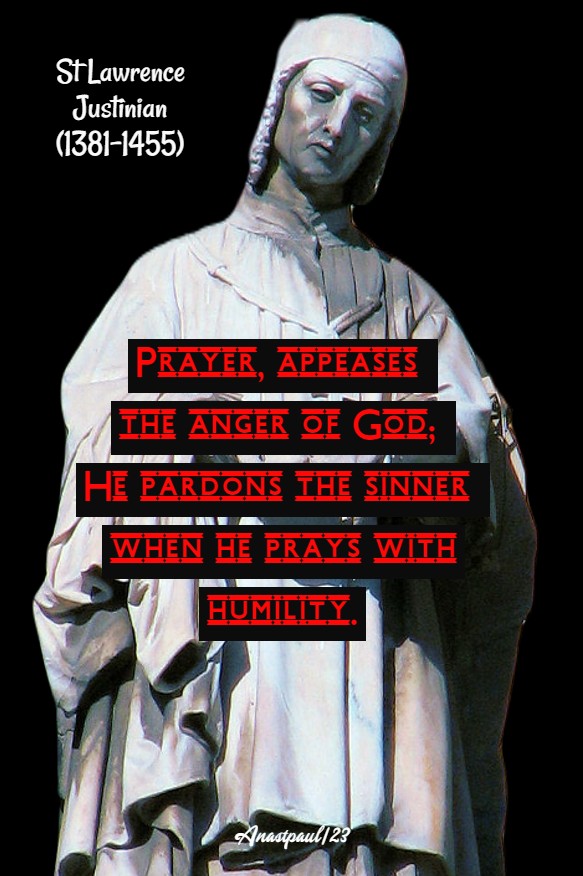
“Prayer, appeases the anger of God; He pardons the sinner when he prays with humility.”
St Lawrence Justinian (1381-1455)
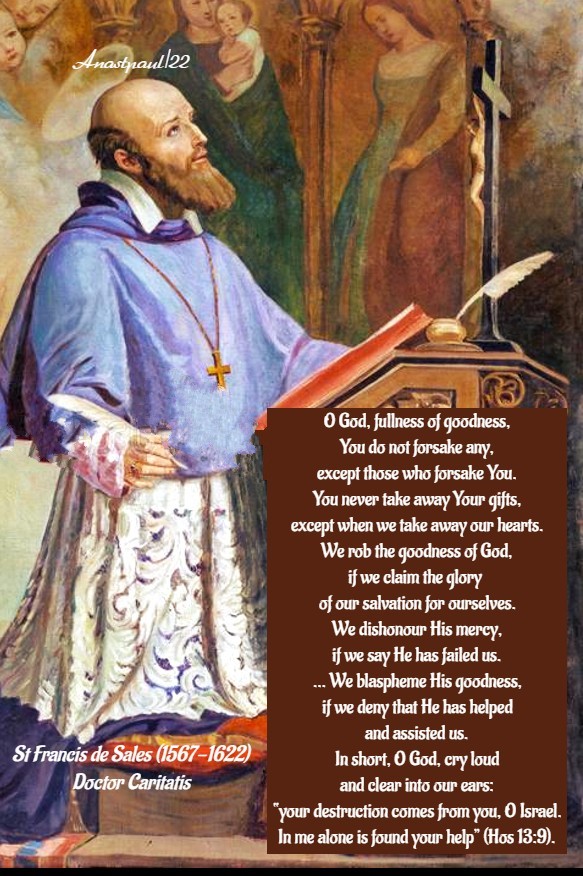
“O God, fullness of goodness, You do not forsake any, except those who forsake You. You never take away Your gifts, except when we take away our hearts. We rob the goodness of God, if we claim the glory of our salvation for ourselves. We dishonour His mercy, if we say He has failed us. … We blaspheme His goodness, if we deny that He has helped and assisted us. In short, O God, cry loud and clear into our ears: “your destruction comes from you, O Israel. In me alone is found your help” (Hos 13:9).
Our Lenten Journey with the Angels and the Saints – 11 March – Monday of the Fourth Week in Lent – 3 Kings 3:16-28; John 2:13-25 – Scripture search here: https://www.drbo.org/
“Be my rock of refuge, O God, a stronghold to give me safety.” Psalm 30:3
“Destroy this temple and in three days, I will raise it up. ” John 2:19
In Every Part of Your Soul
By St Augustine (354-430) Father and Doctor of Grace
“As they were looking on, so we too gaze on His Wounds as He hangs. We see His Blood as He dies. We see the price offered by the Redeemer, touch the scars of His Resurrection.
He bows His Head, as if to kiss you. His Heart is made bare open, as it were, in love to you. His arms are extended that He may embrace you. His whole body is displayed for your redemption.
Ponder how great these things are. Let all this be rightly weighed in your mind, as He was once fixed to the Cross in every part of His Body for you, so He may now be fixed in every part of your soul!”
One Minute Reflection – 11 March – Monday of the Fourth Week in Lent – 3 Kings 3:16-28; John 2:13-25 – Scripture search here: https://www.drbo.org/
“Destroy this temple and in three days, I will raise it up. ” – John 2:19
REFLECTION – “We are still God’s workmen who are building the temple of God. This temple’s dedication has already taken place in its Head, in that the Lord has Risen from the dead after His victory over death and, having destroyed in Himself what was mortal, He has Ascended to Heaven … But now, we are building this temple through faith, so that its dedication may also be made at the final resurrection. That is why … one of the Psalms has the title: “When the Temple was rebuilt after the captivity” (95:1). Call to mind our own former captivity, when the devil held the whole world in his power, like a flock of the unfaithful. It was due to this captivity that our Redeemer came. He shed His Blood for our ransoming and, by the Blood He poured out, He cancelled the debt which was holding us captive (Col 2:14) … Sold beforehand to sin, we have now been set free by grace.
Following this captivity, the temple is now being built and, to raise it up, the Good News is proclaimed. That is why this Psalm begins as follows: “Sing to the Lord a new song” And, lest you think this temple is being constructed in some insignificant corner, as the heretics who separate themselves from the Church build it, pay attention to what follows: “Sing to the Lord, all you lands” …
“Sing to the Lord a new song; sing to the Lord, all you lands.” Sing and clap your hands! Sing and “bless the Name of the Lord” (v. 2). Proclaim the Day born of the Day of Salvation, the Day born of the Day of Christ. For Who is the Salvation of God if not His Christ? This is the Salvation we pray for in the Psalm: “Show us, Lord, your mercy and give us your saving help.” Just men of old longed for this salvation, those of whom the Lord said to His disciples: “Many desired to see what you see, but did not see it” (Lk 10:24) … “Sing to the lord a new song; sing to the Lord” See the fervour of the builders! “Sing to the Lord and bless His Name.” Proclaim the Good News! What good news is that? Day is born from Day … Light from Light; the Son from the Father, the Saving Power of God! This is how the temple is built after the captivity.” – St Augustine (354-430) Father and Doctor of Grace (Sermon 163:5).
PRAYER – Grant, we beseech Thee, Almighty God, that we who devoutly keep the sacred observances, year by year, may be pleasing to Thee, both in body and soul. Through Jesus Christ, Thy Son our Lord, Who lives and reigns with Thee, in the unity of the Holy Ghost, God, world without end. Amen (Collect).
Our Morning Offering – 11 March – Monday of the Fourth Week in Lent
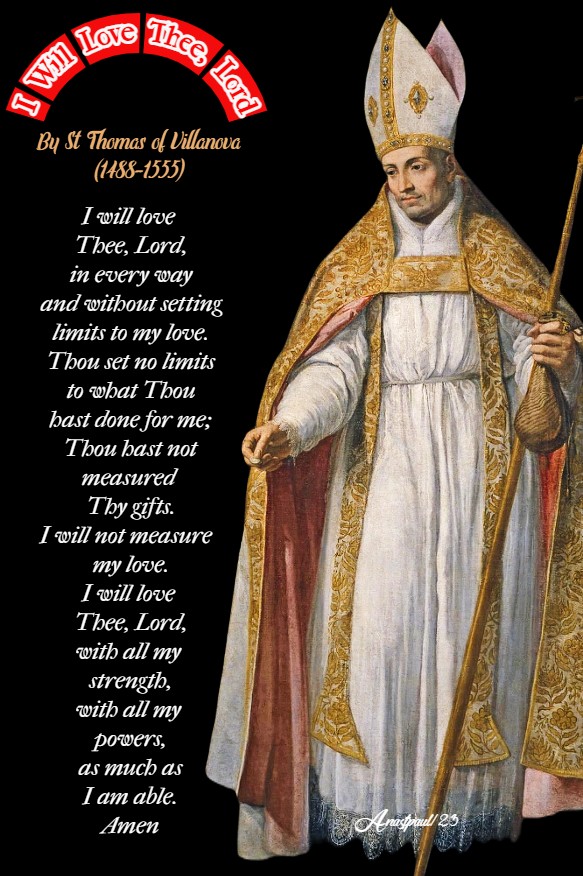
I Will Love Thee, Lord By St Thomas of Villanova (1488-1555)
I will love Thee, Lord, in every way and without setting limits to my love. Thou set no limits to what Thou hast done for me; Thou hast not measured Thy gifts. I will not measure my love. I will love Thee, Lord, with all my strength, with all my powers, as much as I am able. Amen
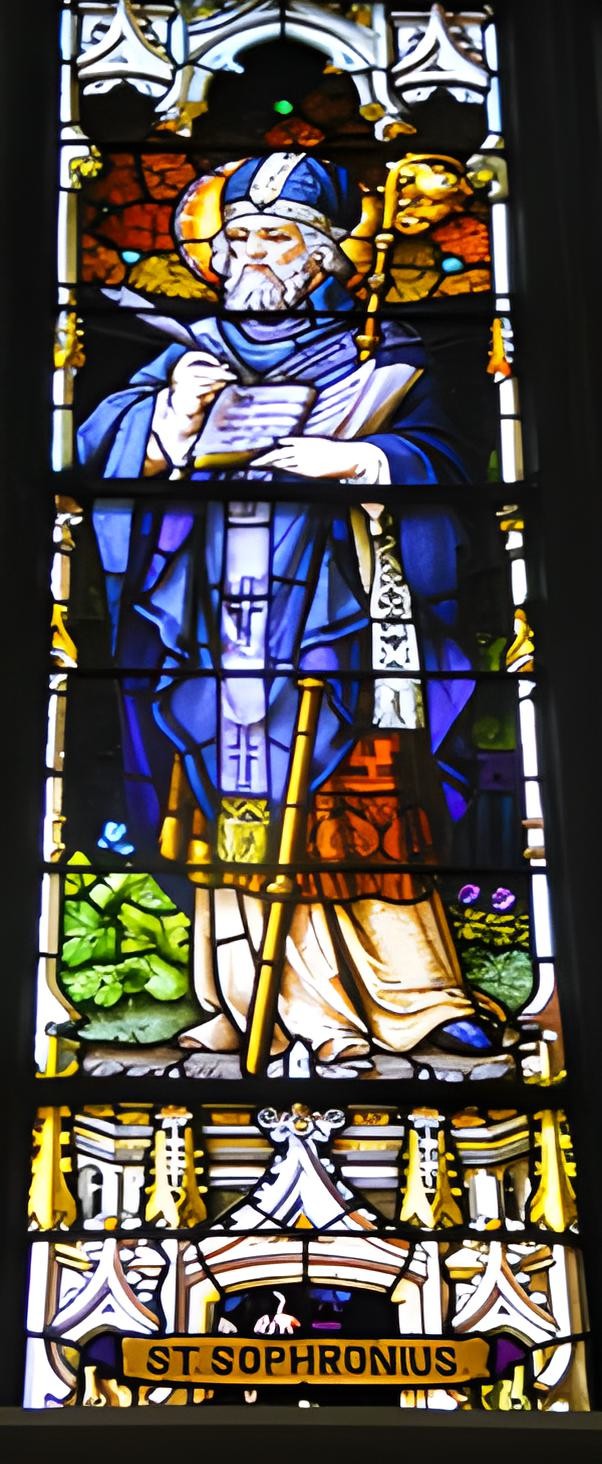
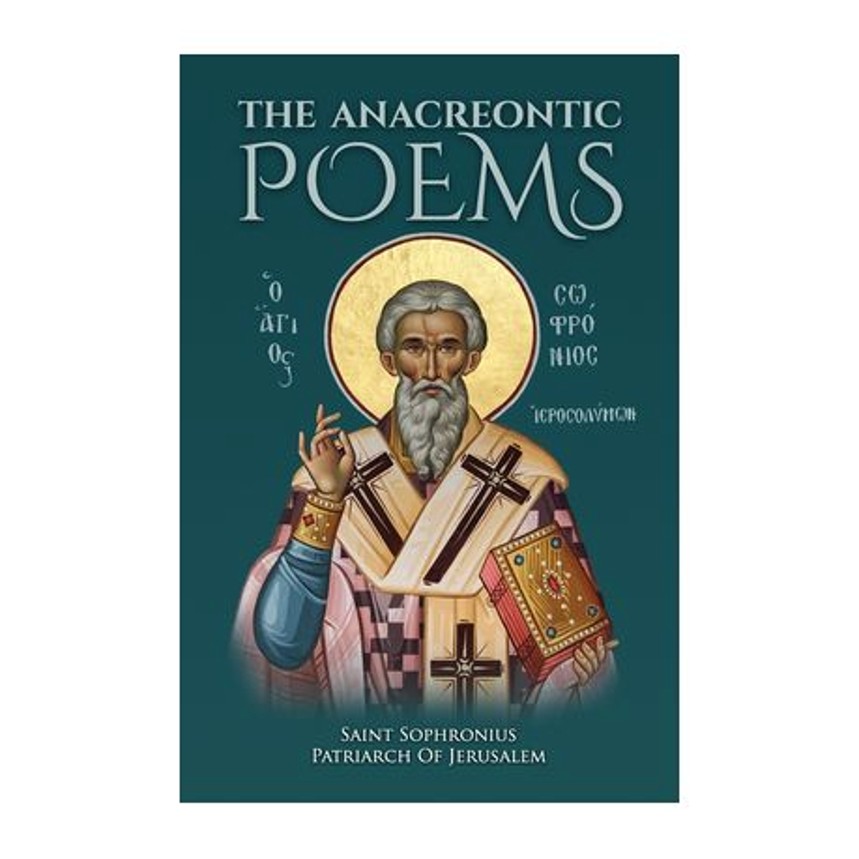
Saint of the Day – 11 March – Saint Sophronius of Jerusalem (c550-c638) Bishop of Jerusalem from 634 until his death, Father of the Church. Before rising to the primacy of the See of Jerusalem, he was a Monk, Theologian and Philosopher, who was the chief protagonist for orthodox teaching in the doctrinal controversy on the essential nature of Jesus. He was a well-travelled and honoured Teacher of Rhetoric, living for several years in Alexandria, Egypt near St John the Almoner. Ecclesiastical and Liturgical Writer, Poet and exercised an extensive correspondence, some of which has survived and some of which we still use within the Liturgy. He is also renowned in history for his peace negotiations with the invading Saracens, thus ensuring a level of protection to the City’s Christians Born in Damascus, Syria in the 6th Century and died in c638; sources disagree on cause and location. Also known as – Sophronius of Damascus, “Sophronius the Sophist” Sofronio…
Sophronius the Sophist, was one of the most rivetting personalities of the time, cultured, open-minded and a passionate defender of orthodoxy, was born in Damascus around 550. He abandoned his hometown as a young man to undertake numerous journeys but always remained proud of his place of origin: “where Paul arrived blind and left healed, where a fleeing persecutor became a preacher; the City which gave refuge to the Apostle and from which he fled in a basket lowered from the window, thus earning the graces of the saints and acquiring great fame […] ”
Sophronius completed his studies mainly in Damascus, where he was educated in Greek and Syriac culture. Eager to become a Monk, he visited the Monastery of San Theodosius, near Bethlehem in Judea and here he met the Monk ascetical Writer John Moschus (c550 – 619), with whom he formed a lasting bond of friendship.
It is difficult to evaluate the influence which each exerted on the other — Sophronius was decidedly more cultured but, he considered his friend his spiritual guide and advisor. Their main bond was perhaps their common Chalcedonian faith but they also began a collaboration in passing on the lives of the Desert Fathers to future generations. The conflicts already present at that time in the Middle Eastern world, caused the two friends to move around a lot, being hosted by different Monasteries. Between 578 and 584, they were in Egypt, where Sophronius was a pupil of the Aristotelian Stephen of Alexandria and both became friends of Theodore, the Philosopher and Zoilus, the latter an erudite Calligrapher. In this period, Sofronio began to lose his sight but he was miraculous cured of his ailment by visiting the Tombs of Saints Cyrus and John near Menuti and, in thanksgiving, he wrote an account of seventy miracles attributed to their intercession.
From 584 onwards it becomes difficult to reconstruct their movements exactly. For a certain time it seems they took different paths — Sophronius became a Monk in the Monastery of Saint Theodosius, while John Moschus wandered between Sinai, Cilicia and Syria. The two friends finally found themselves in the service of the Bishop of Alexandria, Saint John the Almoner, appointed in 610. A few years later the Persians occupied the holy places and headed towards Egypt, so the Bishop with Sophronius and John, left through Cyprus, moving onto other islands and finally arrived in Rome. In 619, in the Eternal City St John the Almoner, handing over his last wishes to Sophronius. Here too, sadly, our Saint lost another great friend and staunch advocate of orthodoxy, John Moschus, who also died in Rome in 619. Sophronius accompanied the body of his friend and spiritual advisor, back to Jerusalem for monastic burial.
Sophronius made great efforts to counteract the rampant heresies, in particular the Monothelitism which the Emperor Heraclius had imposed on the entire Empire with the approval of the Patriarch, Sergius of Constantinople. From 634 Sophronius was the new Bishop of Jerusalem, a rolewhich allowed him to continue his battle against heresy, with greater authority. As the heresies into which Sergius was falling, were increasingly evident and in fear that Pope Honorius might fall into the trap, he commissioned Bishop Stephen of Dora, to go to Rome in his stead, as he was unable to do so due to an imminent Saracen invasion and made him swear on Calvary, to remain faithful to the One True Faith taught our Saint so deeply by the Chalcedonian Fathers (remember we clebrated one of them recently – St Gregory of Nyssa).
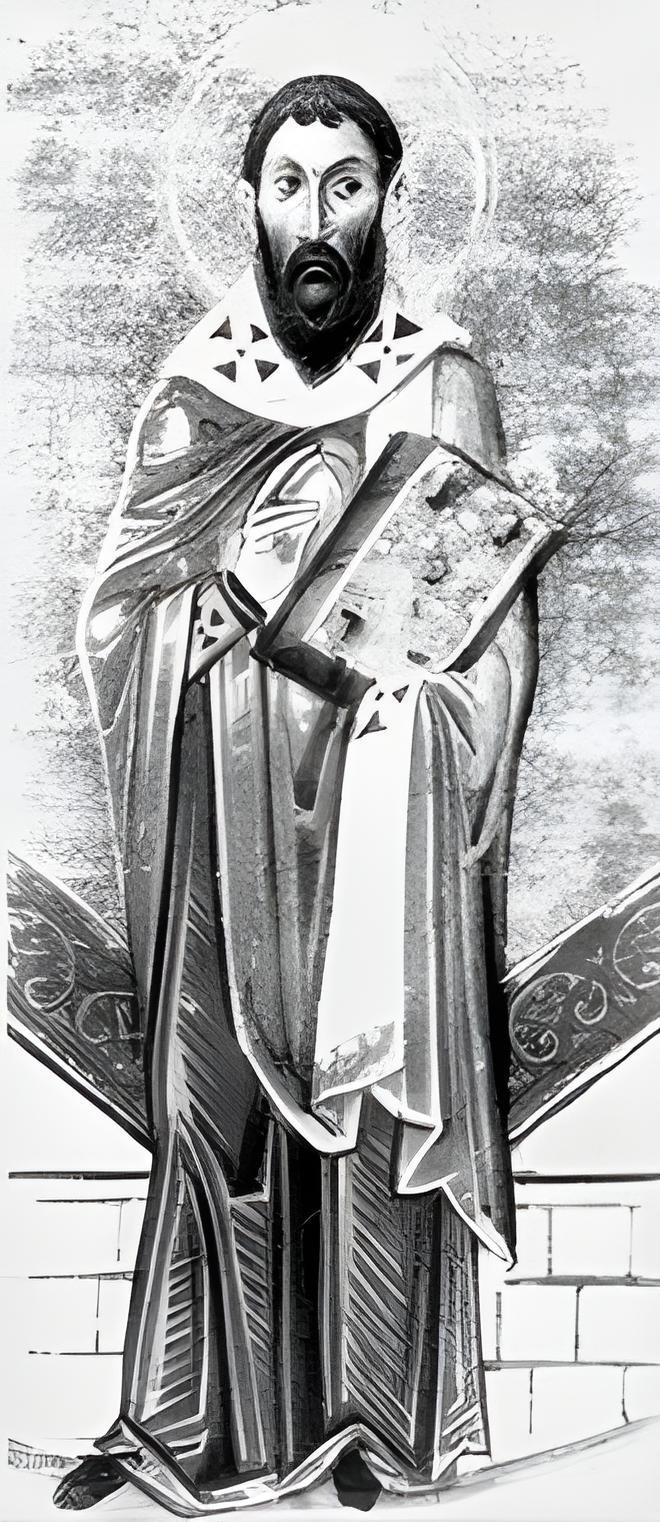
The envoy, Bishop Stephen of Dora, reported Sophronius’ will to the Lateran Council of 649 (the image below shows St Sophronius on the left, St Michael the Archangel in the middler and St? Stephen of Dora on the right): “There he made me promise with a solemn oath: “If you forget or despise the Faith which is now threatened, you will have to give an account to Him Who, although God, was Crucified in this saintly place, when in His Next Coming, He will judge the living and the dead. As you know, I cannot make this journey, due to the invasion of the Saracens […]. Go without delay to the other end of the earth, to the Apostolic See, the Foundation of Orthodox teaching and tell the holy men who are there, not once, not twice but many times, what is happening — tell them the whole truth and nothing more. Do not hesitate, ask them and insistently pray to them, to use their inspired wisdom to pass a final judgement and destroy this new teaching which has been inflicted on us.” Impressed by the solemn appeal which Sophronius had pronounced in that holy and venerable place and, considering the Episcopal power which had been conferred on me, by the grace of God, I immediately left for Rome. I am here before you for the third time, bending before the Apostolic See imploring, as Sophronius and many others did, “come to the aid of the threatened Catholic faith!”.
St Sophronius on the left, St Michael the Archangel in the middler and St? Stephen of Dora on the right
It took a good ten years before Pope Saint Martin I condemned the heresy at the same Council. Sophronius came to terms with the Saracens, to avoid massacres of the people in Jerusalem but, he died a few months later. He left several sermons and writings to posterity, a splendid prayer (which we still use) to bless the water on the Feast of the Baptism of the Lord, as well as Hymns and Canticles of extraordinary beauty! His Antiphons for Holy Week constituted the source of the “Improperia” — lso known as the Reproaches, they are sung in the Liturgy as part of the observance of the Passion, usually on the afternoon of Good Friday.
St Benedict Crispus of Milan (Died 725) Archbishop of Milan from c 685 until his death. A poem written about ten years after his death, De laudibus Mediolani- In Praise of Milan, praises him and remembers his veneration by the entire land and informs us that he was buried in the Basilica of Saint Ambrose. His Life: https://anastpaul.com/2020/03/11/saint-of-the-day-11-march-saint-benedict-crispus-of-milan-died-725/
St Candidus the Martyr St Constantine II St Constantine of Carthage
St Peter the Spaniard St Pionius St Piperion the Martyr St Rosina of Wenglingen St Sophronius of Jerusalem (c550-c638) Bishop of Jerusalem from 634 until his death, Father of the Church. St Thalus the Martyr St Trophimus the Martyr St Vigilius of Auxerre St Vincent of Leon

























You must be logged in to post a comment.