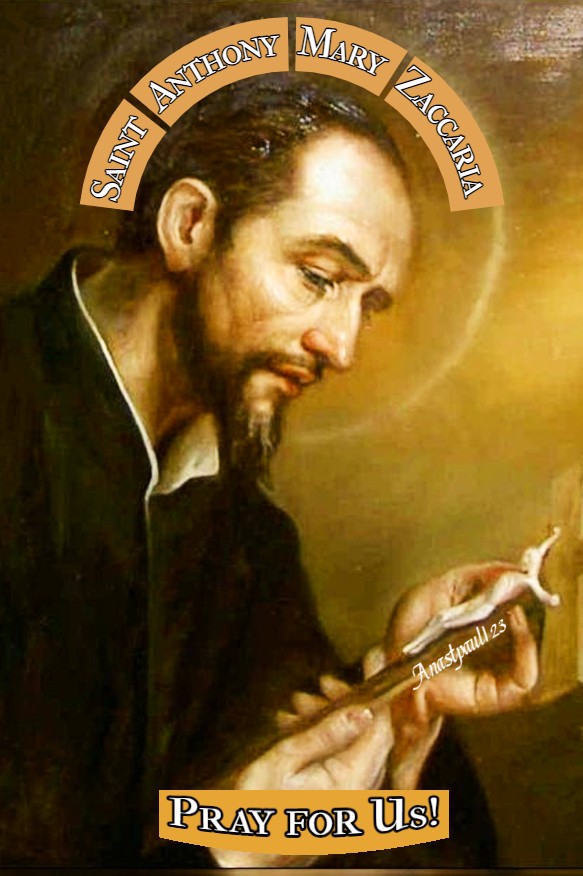
Quote/s of the Day – 5 July – St Anthony Mary Zaccaria (1502-1539) Confessor, Priest, Founder
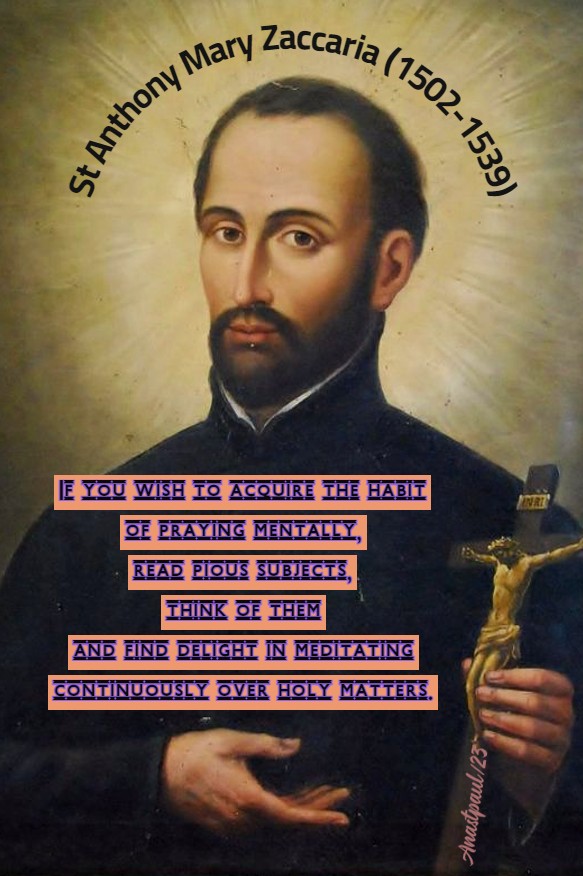
“If you wish to acquire the habit of praying mentally, read pious subjects, think of them and find delight in meditating continuously over holy matters.”
(Constitutions X)
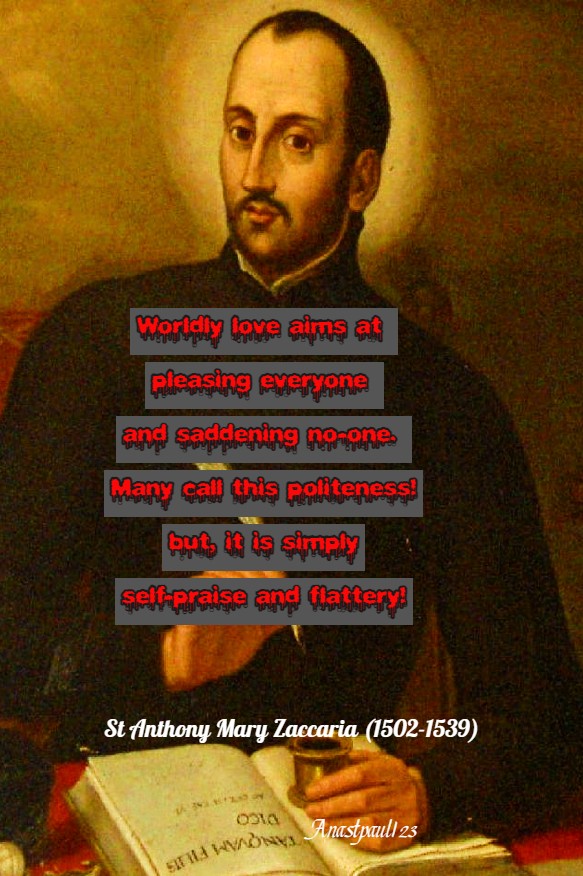
“Worldly love aims at pleasing everyone and saddening no-one. Many call this politeness! but, it is simply self-praise and flattery!”
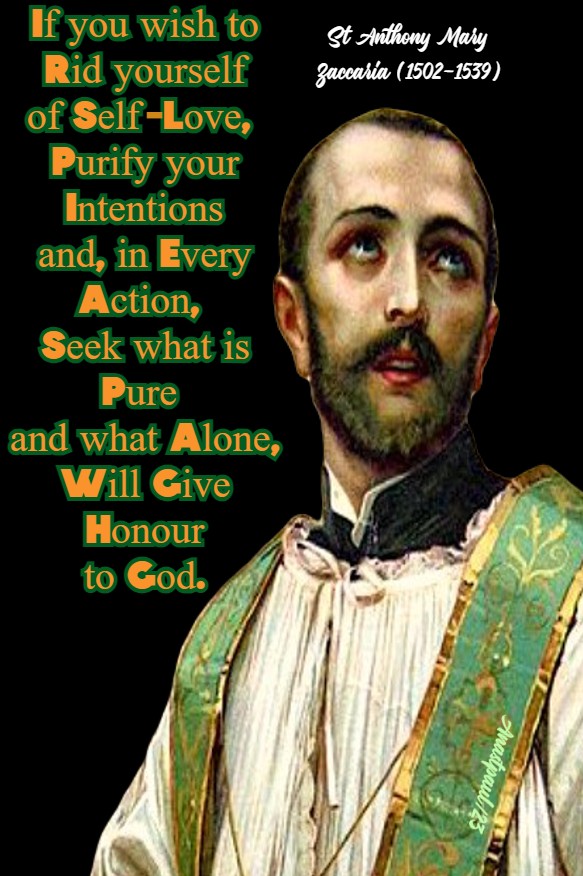
“If you wish to rid yourself of self-love, purify your intentions and, in every action, seek what is pure and what alone, will give honour to God.”
One Minute Reflection – 5 July – “The Month of the Most Precious Blood of Jesus” – St Anthony Mary Zaccaria (1502-1539) Confessor, Priest, Founder – 1 Timothy 4:8-16, Mark 10:15-21 – Scripture search here: https://www.drbo.org/
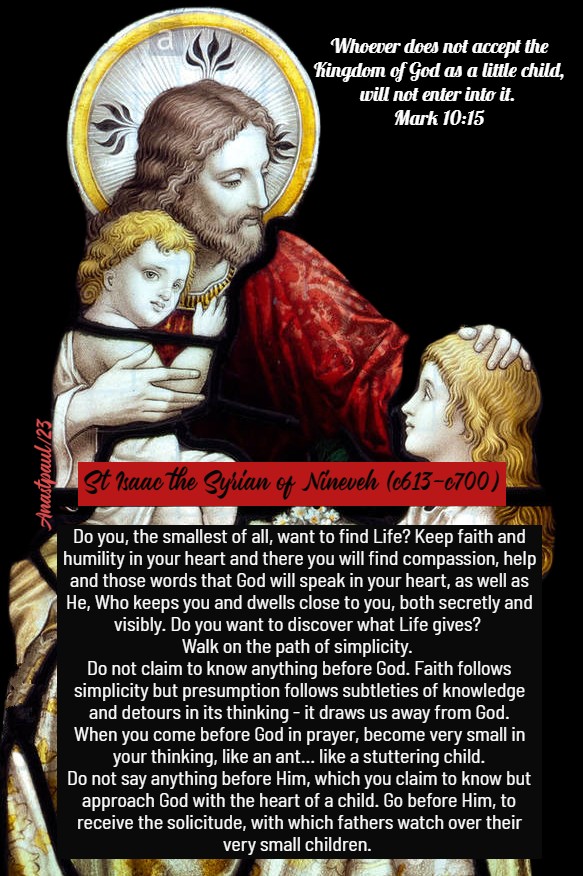
“Whoever does not accept the Kingdom of God as a little child, will not enter into it. ” – Mark 10:15
REFLECTION – “Do you, the smallest of all, want to find Life? Keep faith and humility in your heart and there you will find compassion, help and those words that God will speak in your heart, as well as He, Who keeps you and dwells close to you, both secretly and visibly. Do you want to discover what Life gives? Walk on the path of simplicity. Do not claim to know anything before God. Faith follows simplicity but presumption follows subtleties of knowledge and detours in its thinking – it draws us away from God.
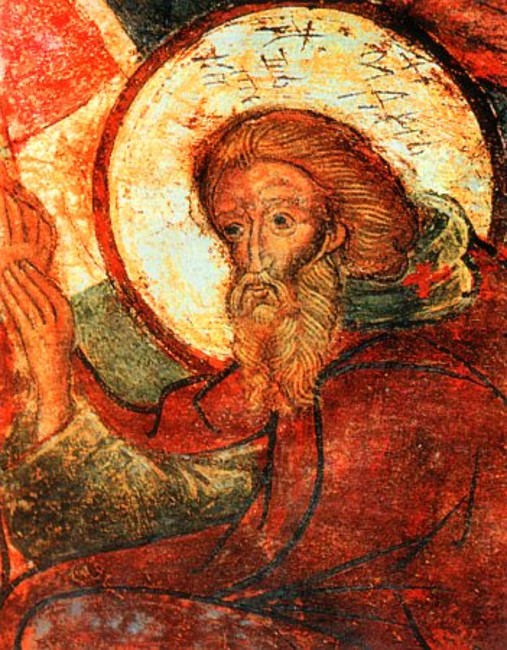
When you come before God in prayer, become very small in your thinking, like an ant… like a stuttering child. Do not say anything before Him, which you claim to know but approach God with the heart of a child. Go before Him, to receive the solicitude, with which fathers watch over their very small children. It has been said: “The Lord guards the little children.” The one who is like a little child can approach a snake and the snake will not harm him… In its innocence, the body of the person who is like a little child, is such that the hidden providence, which watches over its fragile members, covers it with an invisible garment, so that nothing can harm it.” – St Isaac the Syrian of Nineveh (c613-c700) Bishop of Nineveh, Monk at Mosul, Father (Ascetical Discourses, 1st series, #19).
PRAYER – Grant, O Lord God that in the spirit of Paul the Apostle, we may learn the knowledge of Jesus Christ which surpasses all understanding, wherein the blessed Anthony Mary was marvelously learned, who gathered together in Thy Church new households of Clerics and of Virgins. Through our Lord, Jesus Christ, Thy Son, Who liveth and reigneth with Thee in the unity of the Holy Spirit, God world without end. Amen (Collect).
Our Morning Offering – 5 July – “The Month of the Most Precious Blood of Jesus”
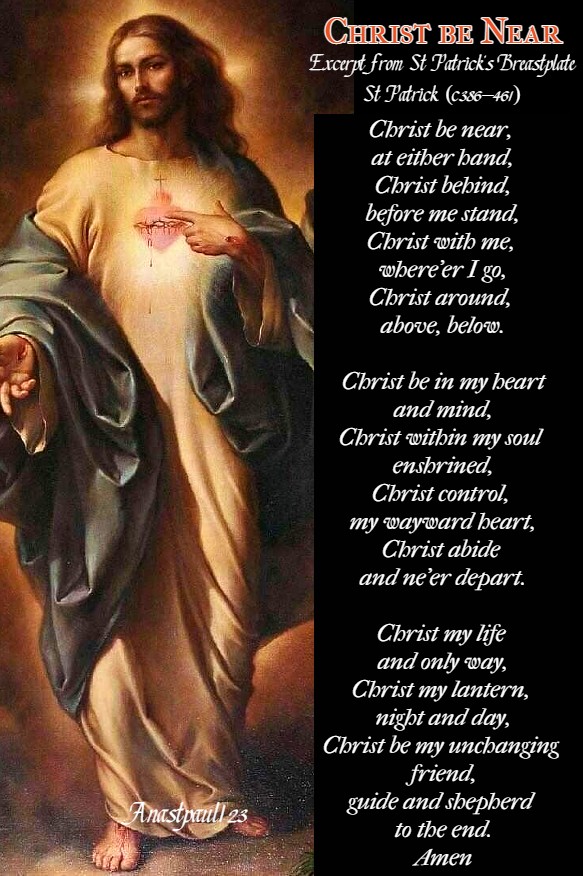
Christ be Near Excerpt from St Patrick’s Breastplate St Patrick (c 386 – 461)
Christ be near, at either hand, Christ behind, before me stand, Christ with me, where’er I go, Christ around, above, below.
Christ be in my heart and mind, Christ within my soul enshrined, Christ control, my wayward heart, Christ abide and ne’er depart.
Christ my Life and only Way, Christ my Lantern, night and day, Christ be my unchanging Friend, Guide and Shepherd to the end.
We have this prayer and his own story in one of the certainly authentic writings of this beloved Saint Patrick – his Confessio, which is, above all, an act of homage to God, for having called Patrick, unworthy sinner, to the apostolate.
Saint of the Day – 5 July – Saint Modwenna (9th Century) Irish Virgin Princess, Nun, Founder of Burton Abbey in Staffordshire, Miracle-worker.
According to the medieval Life of St Modwenna, she was an Irish noblewoman by birth and founded the Abbey on an island in the River Trent.
Modwenna is reported to have performed many holy miracles at Burton Abbey, and to this day the well on the site is said to have healing properties. After a time Modwenna left Burton-upon-Trent and travelled to Scotland where she died in Langfortin, near Dundee, reportedly at the age of 130. Her body was returned to Burton-upon-Trent for burial.
However, there are many conflicting legends of Modwenna and confusion with other Saints, some as far as 200 and more years apart.
The Chapel at Pillaton Hall and St Mary and St Modwen Church, Burton-on-Trent are dedicated to St Modwenna.
St Agatho of Sicily St Athanasius the Athonite St Athanasius of Jerusalem St Cast St Cyprille of Libya St Cyrilla of Cyrene St Domèce St Domitius of Phrygia St Edana of West Ireland
St Erfyl St Fragan St Grace of Cornwall St Gwen St Marinus of Tomi St Mars of Nantes St Marthe St Modwenna (9th Century)Irish Princess, Nun, Founder St Numerian of Treves St Philomena of San Severino St Probus of Cornwall St Rosa Chen Aijieh St Sedolpha of Tomi St Stephen of Reggio St Teresia Chen Qingjieh St Theodotus of Tomi St Thomas of Terreti St Triphina of Brittany St Triphina of Sicily St Zoe of Rome
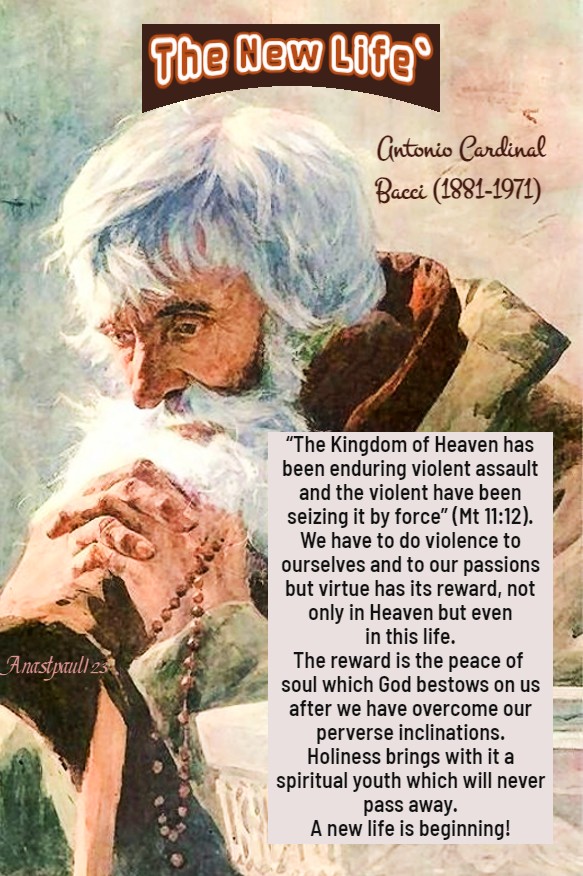
Thought for the Day – 4 July – Meditations with Antonio Cardinal Bacci (1881-1971)
The New Life
“All this is difficult and may demand heroism. “The Kingdom of Heaven has been enduring violent assault and the violent have been seizing it by force” (Mt 11:12). We have to do violence to ourselves and to our passions but virtue has its reward, not only in Heaven but even in this life. The reward is the peace of soul which God bestows on us after we have overcome our perverse inclinations.
Holiness brings with it a spiritual youth which will never pass away. A new life is beginning!”
Quote/s of the Day – 4 July – St Andrew of Crete (c660-c740) Bishop, Father of the Church
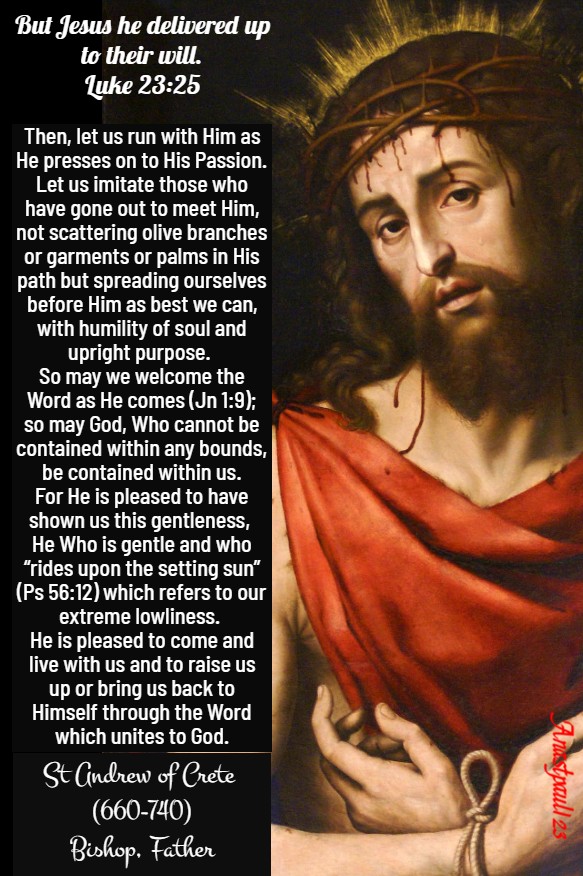
“But Jesus he delivered up to their will.” Luke 23:25
“Then, let us run with Him as He presses on to His Passion. Let us imitate those who have gone out to meet Him, not scattering olive branches or garments or palms in His path but spreading ourselves before Him as best we can, with humility of soul and upright purpose. So may we welcome the Word as He comes (Jn 1:9); so may God, Who cannot be contained within any bounds, be contained within us. For He is pleased to have shown us this gentleness, He, Who is gentle and who “rides upon the setting sun” (Ps 56:12) which refers to our extreme lowliness. He is pleased to come and live with us and to raise us up or bring us back to Himself
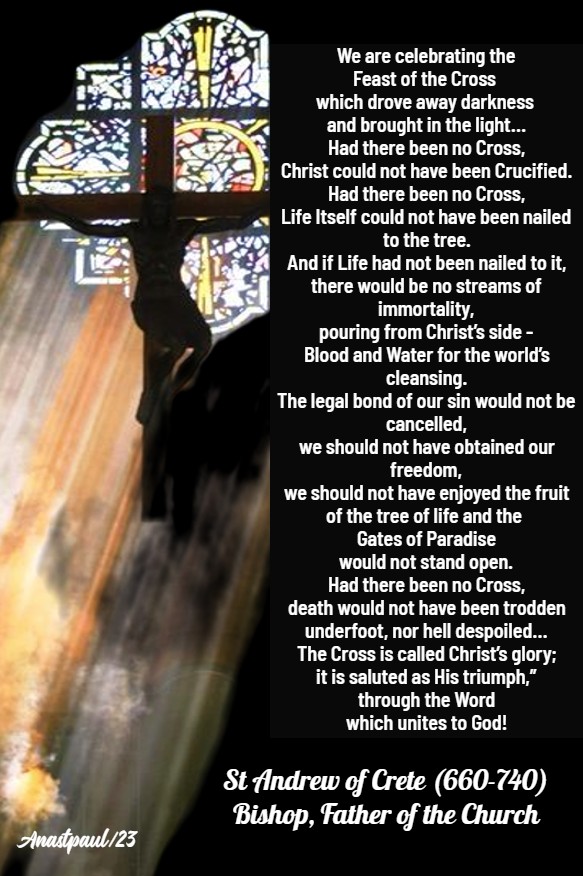
“We are celebrating the Feast of the Cross which drove away darkness and brought in the light… Had there been no Cross, Christ could not have been Crucified. Had there been no Cross, Life Itself could not have been nailed to the tree. And if Life had not been nailed to it, there would be no streams of immortality, pouring from Christ’s side – Blood and Water for the world’s cleansing. The legal bond of our sin would not be cancelled, we should not have obtained our freedom, we should not have enjoyed the fruit of the tree of life and the Gates of Paradise would not stand open. Had there been no Cross, death would not have been trodden underfoot, nor hell despoiled… The Cross is called Christ’s glory; it is saluted as His triumph, through the Word which unites to God!”
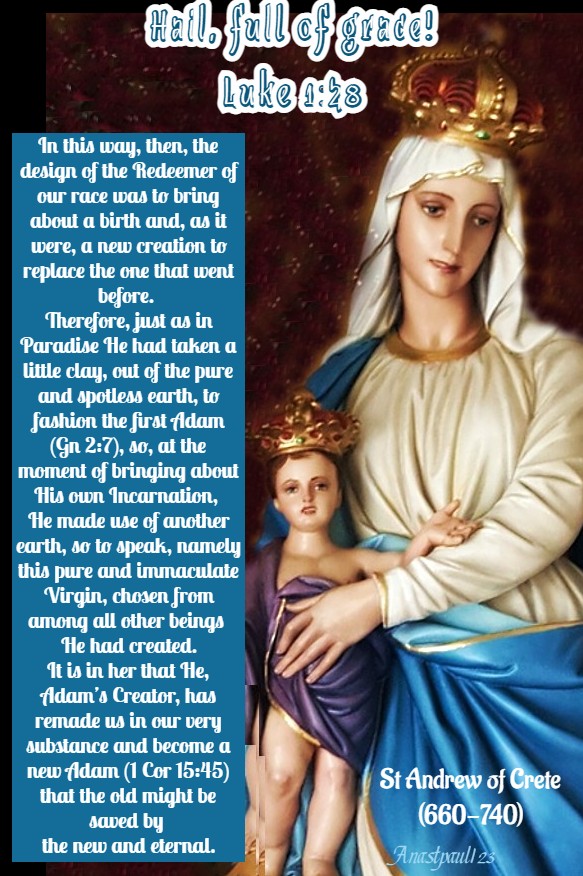
“… The design of the Redeemer of our race was to bring about a birth and, as it were, a new creation to replace the one that went before. Therefore, just as in Paradise, He had taken a little clay out of the pure and spotless earth, to fashion the first Adam (Gn 2,7), so, at the moment of bringing about His Own Incarnation, He made use of another earth, so to speak, namely, this Pure and Immaculate Virgin, chosen from among all other beings He had created. It is in her that He, Adam’s Creator, has remade us in our very substance and became a new Adam (1Cor 15,45) that the old might be saved by the new and eternal.”
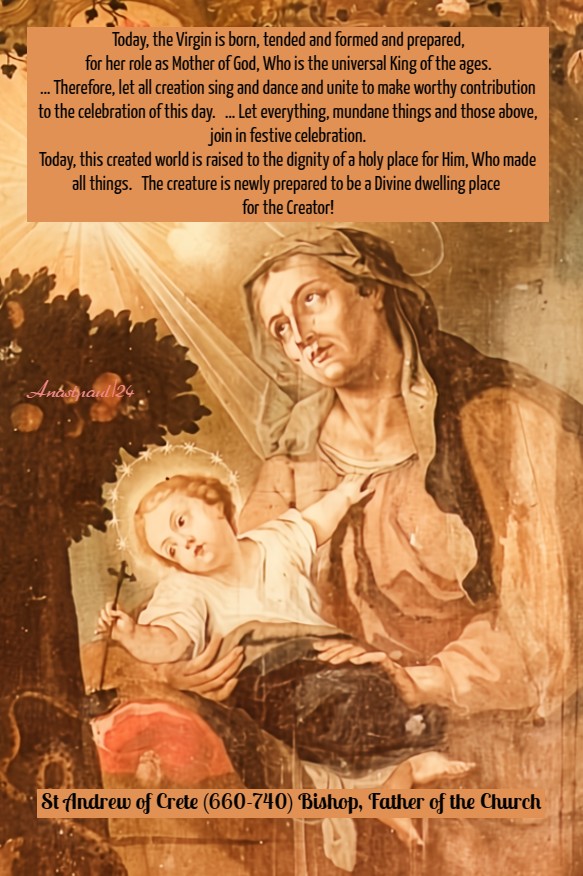
“Today the Virgin is born, tended and formed and prepared for her role as Mother of God, who is the universal King of the ages. … Therefore, let all creation sing and dance and unite, to make worthy contribution to the celebration of this day. … Let everything, mundane things and those above, join in festive celebration. Today, this created world is raised to the dignity of a holy place for Him, Who made all things. The creature is newly prepared to be a Divine Dwelling Place for the Creator.”
St Andrew of Crete (660-740) Bishop, Father of the Church
One Minute Reflection – 4 July – “The Month of the Most Precious Blood of Jesus” – Within the Octave of Sts Peter and Paul – Acts 5:12-16, Matthew 19:27-29 – Scripture search here: https://www.drbo.org/
“And everyone who has left house, or brethren, or sisters, or father, or mother, or wife, or children, or lands, for My Name’s sake, shall receive a hundredfold and shall possess life everlasting.” – Matthew 19:29
REFLECTION – “In almost every passage of Scripture, the spiritual meaning plays an important part. But in this passage especially, we must look for spiritual depth within the thread of its meaning. … How is it that He Himself can say: “Peace I leave with you, My own peace I give you” (Jn 14:27) if He has come to divide fathers from their sons, sons from their fathers, breaking their relationship? How can we be called “cursed if you dishonour your father” (Dt 27:16) yet fervent, if we abandon him?!
If we understand that religion comes first and filial devotion second, then we will understand, this question to be clarified – for we have to pass onto the human, after the Divine. For if we have duties towards our parents, how much more to the Father of our parents, to Whom we owe thanksgiving for our parents? … He does not say, then that we must give up those we love but that, we must prefer God before all else. Besides, do we not find in another book: “Whoever loves father or mother more than Me is not worthy of Me” (Mt 10:37). What is forbidden is not to love your parents but to prefer them to God. For our blood relations are among God’s blessings and no-one is to love the good things they have received, more than the God Who conserves the blessings He has given!” – St Ambrose (340-397) Father and Doctor of the Church (Commentary on the Gospel of Luke, 7)
PRAYER – God, Who hast consecrated this day to the Martyrdom of Thy Apostles Peter and Paul, give Thy Church a precept to follow them in all things. Through Jesus Christ, Thy Son our Lord, Who lives and reigns with Thee, in the unity of the Holy Ghost, God, world without end. Amen (Collect).
Our Morning Offering – 4 July – “The Month of the Most Precious Blood of Jesus”
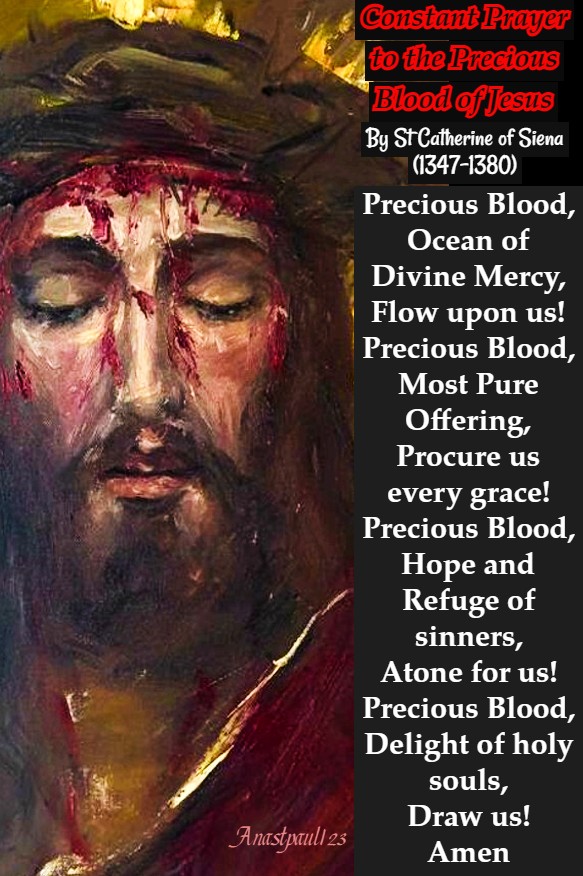
Constant Prayer to the Precious Blood of Jesus By St Catherine of Siena (1347-1380) Doctor of the Church
Precious Blood, Ocean of Divine Mercy, Flow upon us! Precious Blood, Most Pure Offering, Procure us every grace! Precious Blood, Hope and Refuge of sinners, Atone for us! Precious Blood, Delight of holy souls, Draw us! Amen
Saint of the Day – 4 July – Saint Andrew of Crete (c660-c740) Bishop of Gorvina, Constantinople, Monk at Mar Sabas, Noted and eloquent Preacher, Poet and Hymnist. Born in c660 at Damascus, Syria and died in c740 in Crete of natural causes. Also known as – Andrew of Jerusalem, Andrew of Gortina, Andrea, Andreas.
Andrew was born in Damascus around 660, i.e. towards the middle of the 7th Century. At the age of fifteen, having reached Jerusalem, he decided to enter the Monastery of San Sabas and the Holy Sepulchre.
In 685 Theodore, Bishop of Jerusalem, sent him as his delegate to the VI Ecumenical Council (known as Constantinopolitan III) to support the condemnation of Monothelitism, a heretical theory that supported one divine will of Christ. During his stay in the imperial capital, Andrew received Ordination as a Deacon and was entrusted with the management of an orphanage and a home for the elderly. It didn’t take long, before perhaps already around the year 700, he was elected to the Episcopal office at Gortyna, the metropolitan Arch-episcopal See of the island of Crete.
In 711 Philippicus Bardane ascended the throne and convened a Synod to try to overturn the response of the previous Synod and establish Monotheism as the official religion of the Empire. Andrew also participated in this Synod and for a short time he even came to recognise the heretical decrees but finally, Bardane was then expelled and the Bishop of Constantinople was left with nothing but to retract, in writing, to the Pope, apologising also in the name of those who had participated in the illegitimate synod.
Andrea was famous as a preacher and composer of sacred Hymns. About fifty sermons have been handed down to us and tradition has arbitrarily attributed to him, the introduction of the type of Hymn, known as Kanon or Canon, typical of the Byzantine Liturgy. In reality, it is true, that he, nevertheless, wrote many of them, some of which are still sung today, remarkable for the originality of their metric and musical form. Among them, the so-called “Great Canon” stands out as his masterpiece, of a Lenten character and made up of two hundred and fifty stanzas!
His sermons proved to be important for the development of Marian devotion – in fact, he exalted the Virgin Mother of God as Immaculate and Assumed into Heaven, thus prefiguring the Dogmatic definitions of Popes Pius IX and Pius XII, which occurred in the 19th and 20th Centuries.
Sainy Andrew of Crete died on the Island of Lesbos in 740 and the Martyrologium Romanum commemorates him on 4 July.
St Albert Quadrelli St Andrew of Crete (c660-c740) Bishop St Anthony Daniel St Aurelian of Lyons St Bertha of Blangy St Carileffo of Anille Bl Catherine Jarrige St Cesidio Giacomantonio Bl Damiano Grassi of Rivoli St Donatus of Libya St Edward Fulthrop St Elias of Jerusalem St Finbar of Wexford St Fiorenzo of Cahors St Flavian of Antioch St Giocondiano Bl Giovanni of Vespignano St Haggai the Prophet Bl Hatto of Ottobeuren Bl Henry Abbot St Henry of Albano St Hosea the Prophet St Innocent of Sirmium Bl John Carey
Blessed John Cornelius SJ (1557– 1594) Martyr, English Priest of the Society of Jesus, Missionary. Additional Memorials – 29 October as one of the Martyrs of Douai, 1 December as one of the Martyrs of Oxford University. Fr Cornelius and his three companions, the Martyrs of England, were Beatified by Pope Pius XI on 15 December 1929. All their bodies were retrieved and given proper burial by Lady Arundell. His Life and Death: https://anastpaul.com/2021/07/04/saint-of-the-day-4-july-blessed-john-cornelius-sj-1557-1594-martyr/
St Jucundian St Laurian of Seville St Lauriano of Vistin St Namphanion the Archmartyr Bl Natalia of Toulouse St Odo the Good Bl Odolric of Lyon Bl Patrick Salmon St Sebastia of Sirmium St Theodore of Cyrene St Theodotus of Libya Bl Thomas Bosgrave Bl Thomas Warcop
Thought for the Day – 3 July – Meditations with Antonio Cardinal Bacci (1881-1971)
The Tabernacle Lamp
“The Tabernacle Lamp keeps Jesus company by night and by day. We should keep Him company too. We could not remain on our knees forever in front of the Tabernacle, neither could most of us spend as long as the Saints did in intimate conversation with Jesus.
But, our hearts can remain with Jesus and can burn with love for Him like the flame of the Lamp. It is easy to remain in union with Jesus by doing everything, even the most unimportant actions, from the motive of love for Him. We can offer Him all our sufferings and joys and, whatever sacrifices we make in order to remain good. As the magnetic needle of the mariner’s compass is fixed in the direction of the north, so our thoughts and affections should be always turned towards Jesus.”
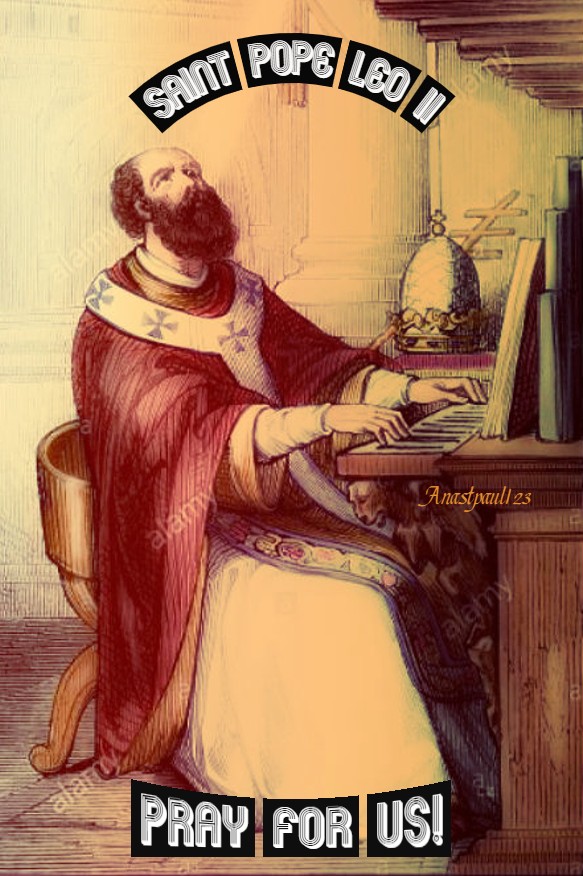
Quote/s of the Day – 3 July – “The Month of the Most Precious Blood of Jesus” – St Leo II (611–683) Pope, Confessor – 1 Peter 5:1-4; 5:10-11, Matthew 16:13-19 – Scripture search here: https://www.drbo.org/
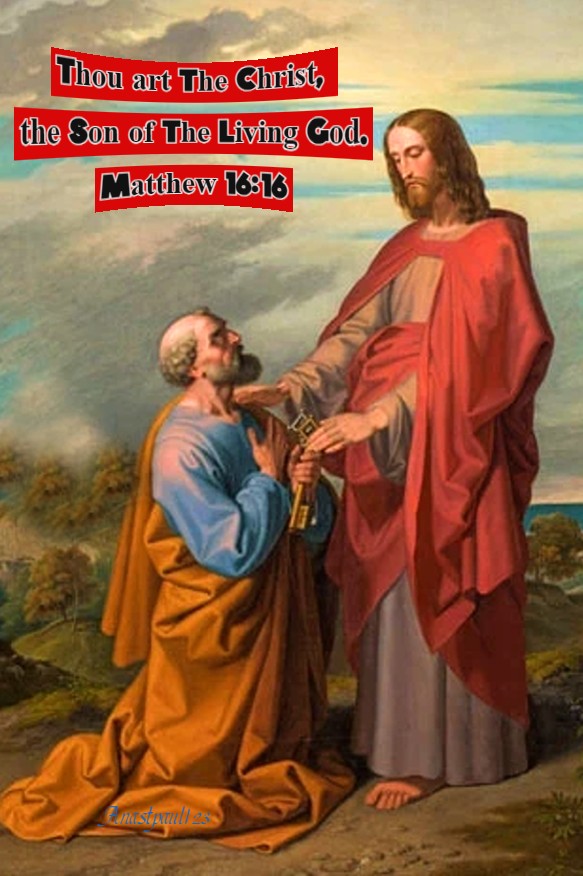
“Thou art the Christ, the Son of the living God.”
Matthew 16:16
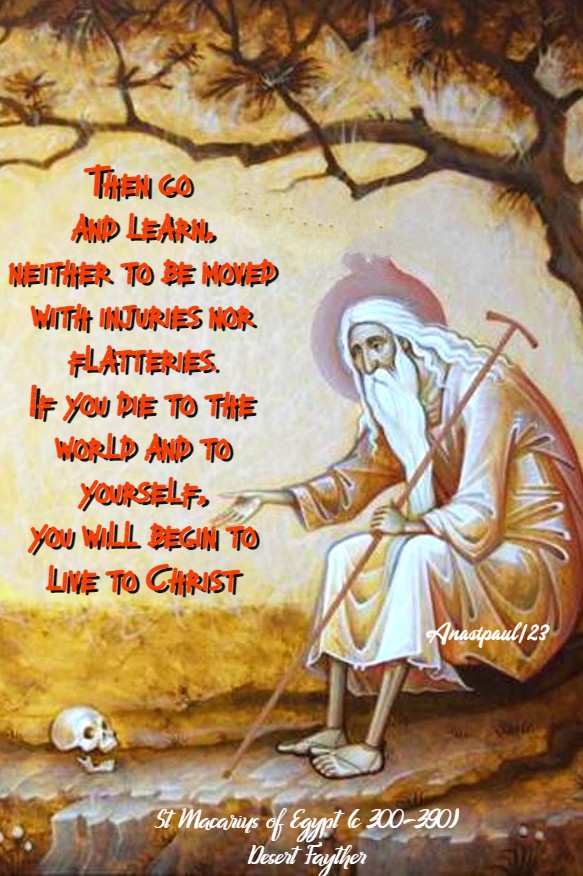
“Then go and learn, neither to be moved with injuries nor flatteries. If you die to the world and to yourself, you will begin to live to Christ.”
St Macarius of Egypt (c300-390)
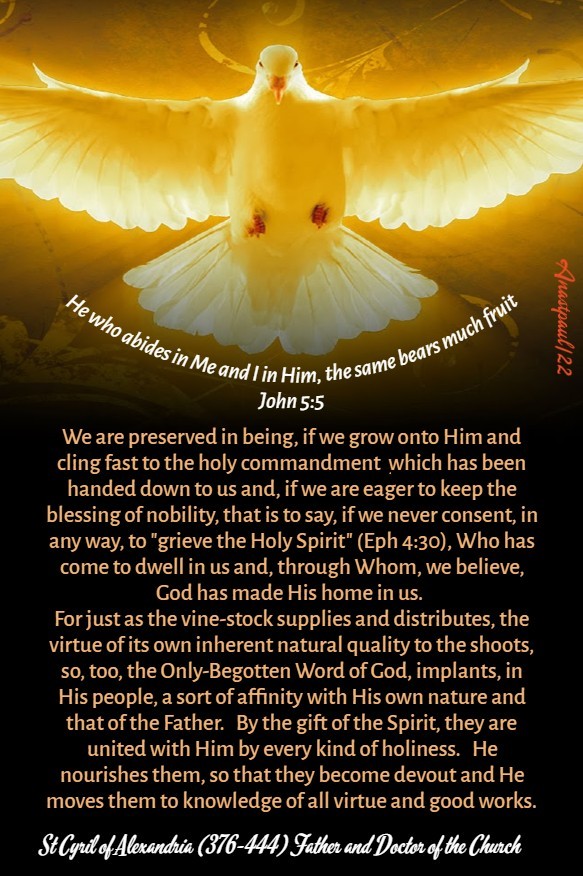
“He who abides in Me and I in Him, the same bears much fruit”
John 5:5
“We are preserved in being, if we grow onto Him and cling fast to the holy commandment, which has been handed down to us and, if we are eager to keep the blessing of nobility, that is to say, if we never consent, in any way, to “grieve the Holy Spirit” (Eph 4:30), Who has come to dwell in us and, through Whom, we believe, God has made His home in us. … For just as the vine-stock supplies and distributes, the virtue of its own inherent natural quality to the shoots, so, too, the Only-Begotten Word of God, implants, in His people, a sort of affinity with His own nature and that of the Father. By the gift of the Spirit, they are united with Him by every kind of holiness. He nourishes them, so that they become devout and He moves them to knowledge of all virtue and good works.”
St Cyril of Alexandria (376-444) Father & Doctor of the Church
“Christ said that the shepherd enters through the gate and that He is Himself the Gate, as well as the Shepherd. Then, it is necessary, that He enter through Himself. By so doing, He reveals Himself and through Himself, He knows the Father. But we enter through Him because through Him. we find happiness.”
St Thomas Aquinas (1225-1274) Doctor Angelicus Doctor Communis
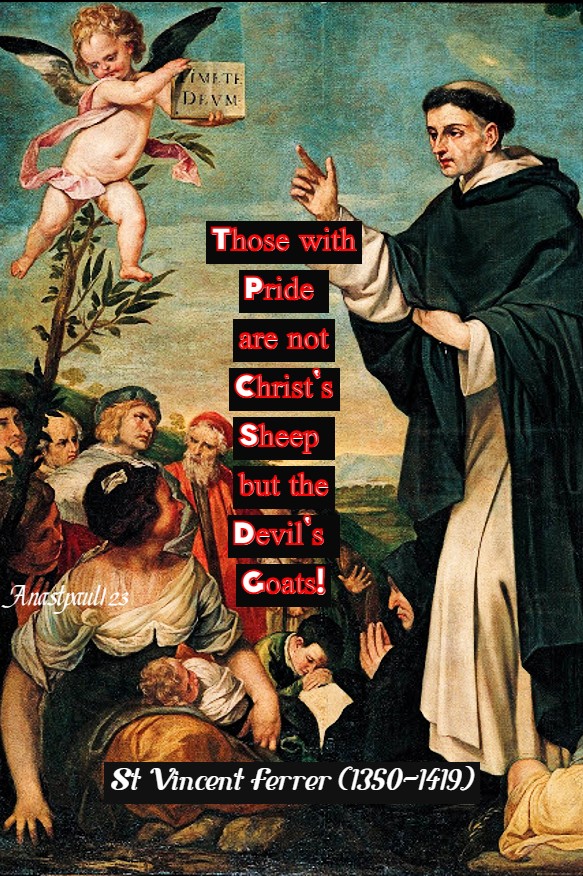
“Those with pride are not Christ’s sheep but the devil’s goats!”
One Minute Reflection – 3 July – “The Month of the Most Precious Blood of Jesus” – St Leo II (611–683) Pope, Confessor – 1 Peter 5:1-4; 5:10-11, Matthew 16:13-19 – Scripture search here: https://www.drbo.org/
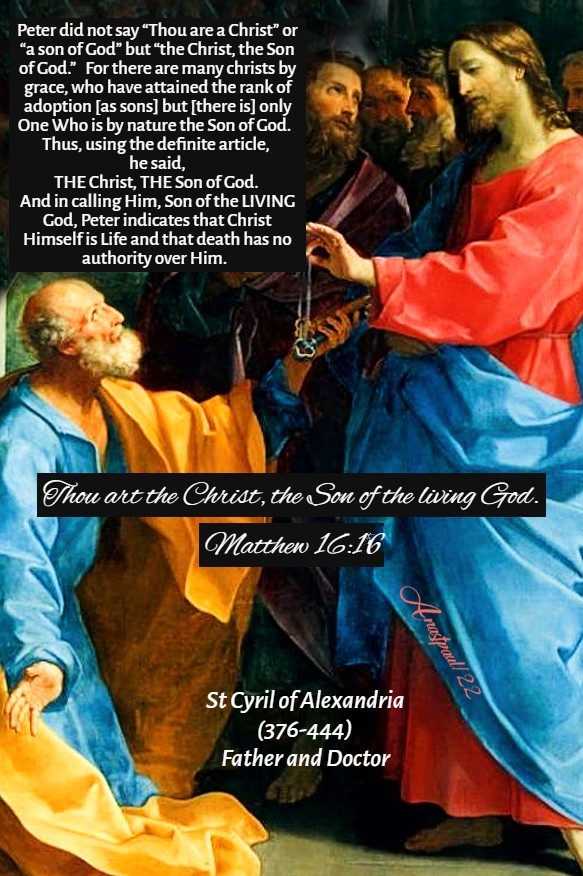
“Thou art the Christ, the Son of the living God.” – Matthew 16:16
REFLECTION – “Peter did not say “Thou are a Christ” or “a son of God” but “the Christ,the Son of God.” For there are many christs by grace, who have attained the rank of adoption [as sons] but [there is] only One Who is by nature the Son of God. Thus, using the definite article, he said, THE Christ, THE Son of God. And in calling Him, Son of the LIVING God, Peter indicates that Christ Himself is Life and that death has no authority over Him. And even if the flesh, for a short while, was weak and died, nevertheless, it rose again, since the Word, Who dwelled in it, could not be held under the bonds of death.” – St Cyril of Alexandria (376-444) Known as “The Pillar of Faith” Archbishop of Alexandria, Father and Doctor Incarnationis (Doctor of the Incarnation) (Fragment 190).
PRAYER – Look forgivingly on Thy flock, Eternal Shepherd and keep it in Thy constant protection, by the intercession of blessed Leo Thy Sovereign Pontiff, whom Thou didst constitute Shepherd of the whole Church. Through Jesus Christ, Thy Son our Lord, Who lives and reigns with Thee, in the unity of the Holy Ghost, God, world without end. Amen (Collect).
Our Morning Offering – 3 July – “The Month of the Most Precious Blood of Jesus”
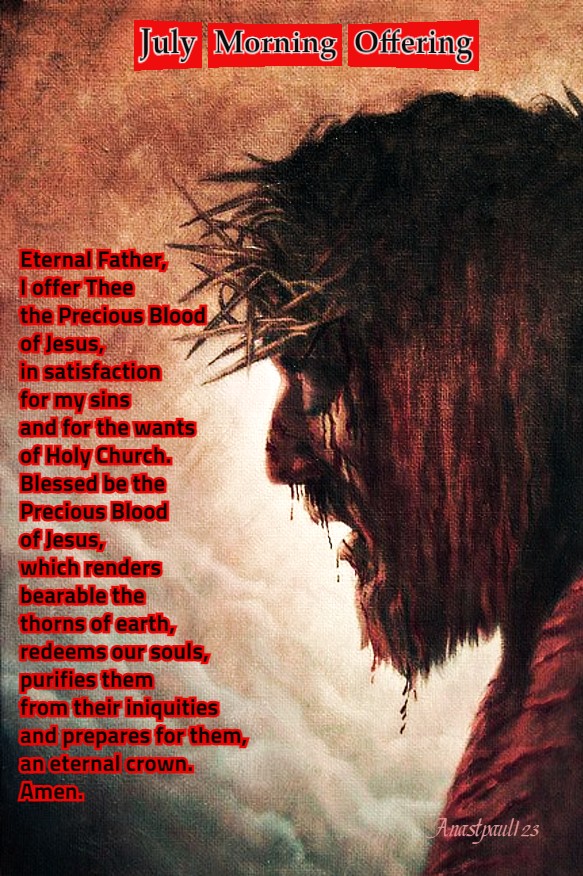
July Morning Offering
Eternal Father, I offer Thee the Precious Blood of Jesus, in satisfaction for my sins and for the wants of Holy Church. Blessed be the Precious Blood of Jesus, which renders bearable the thorns of earth, redeems our souls, purifies them from their iniquities and prepares for them, an eternal crown. Amen.
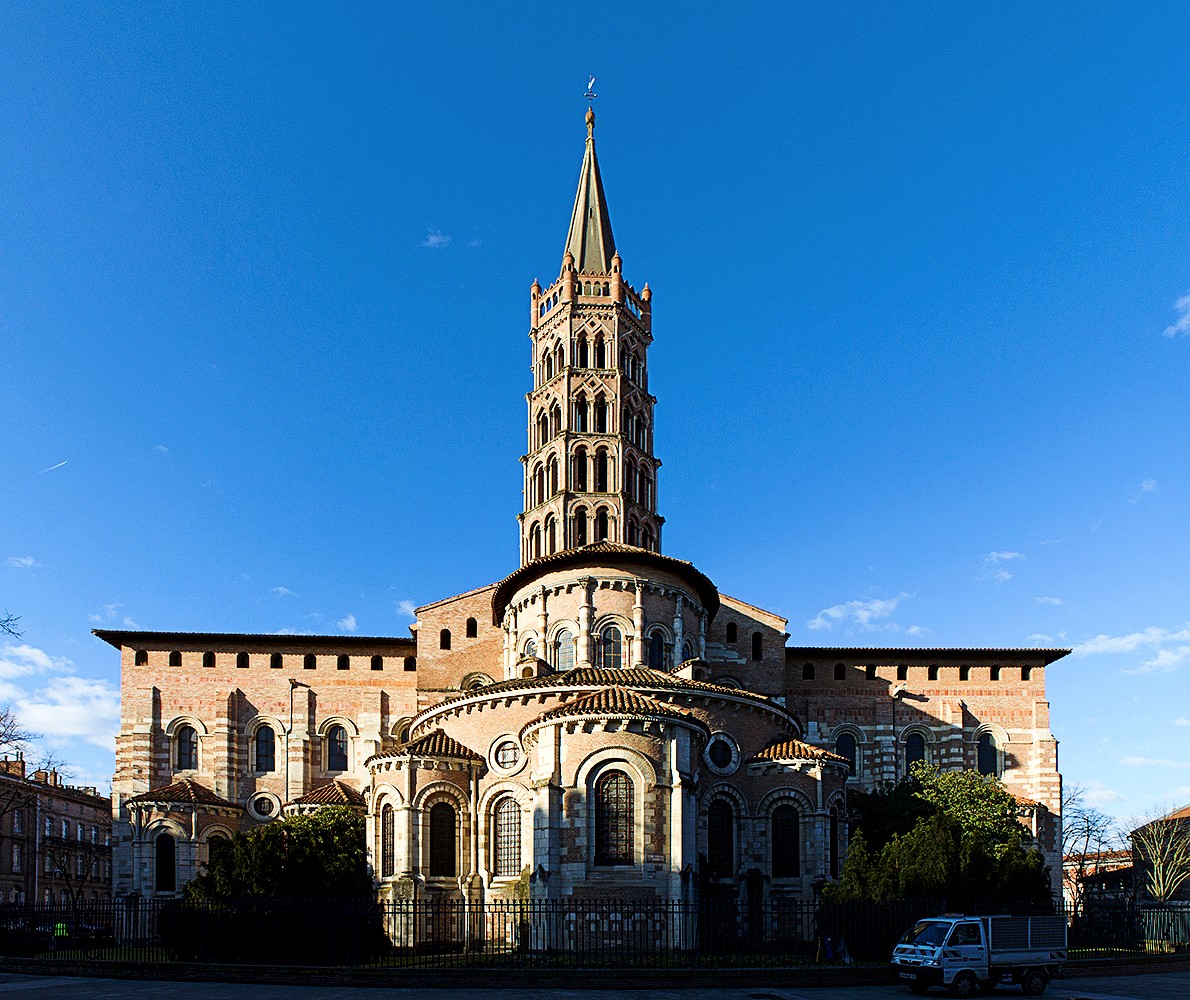
Saint of the Day – 3 July – Saint Raymond of Toulouse (Died 1118) Archdeacon, Canon of the Lateran Canons Regular at St Sernin Basilica in Toulouse, France. Born at Toulouse, France as Raymond Gayrard and Died on 3 July 1118 of natural causes. Also known as – Raymond Gayrard, Raimund, Raimundus. Additional Memorial – 8 July when Raymond is commemorate in the Order of the Lateran Canons.
The Roman Martyrology reads: “In Toulouse on the Garonne in France, Saint Raymond Gayrard, who, as a teacher, remained a widower, passionately devoted himself to works of charity, founded a hospice and was finally admitted among the Canons of the Basilica of San Saturnin.”
What we know of Raymond has come down to us as narrated in a ‘Vita’ written in the 13th Century, based on older documents, therefore, relatively close to the years of his existence.
Following a custom of the time, Raymond, of noble birth, was placed at the service of the Church of St Sernin dedicated to the first Bishop of Toulouse, becoming its Cantor while remaining a layman.
He married but his wife died shortly after the wedding; Raymond in his grief, renounced ever to remarry and decided to devote himself entirely to the service of others.
He distributed generous alms to the poor of the area and founded a Hospice. True rescuer of his fellow citizens, he had two bridges built over the Hers river, whose frequent floods were an obstacle to the passage of people and trading.
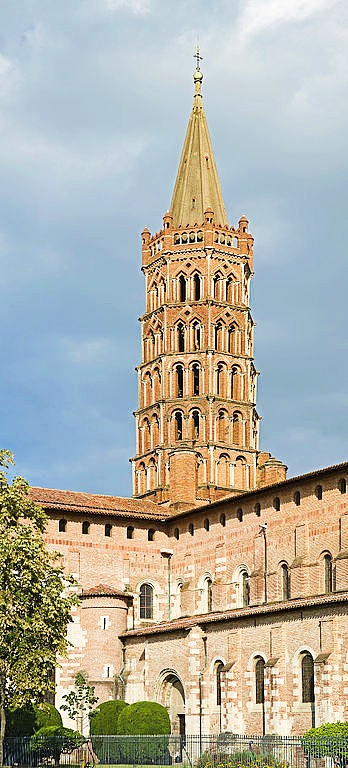
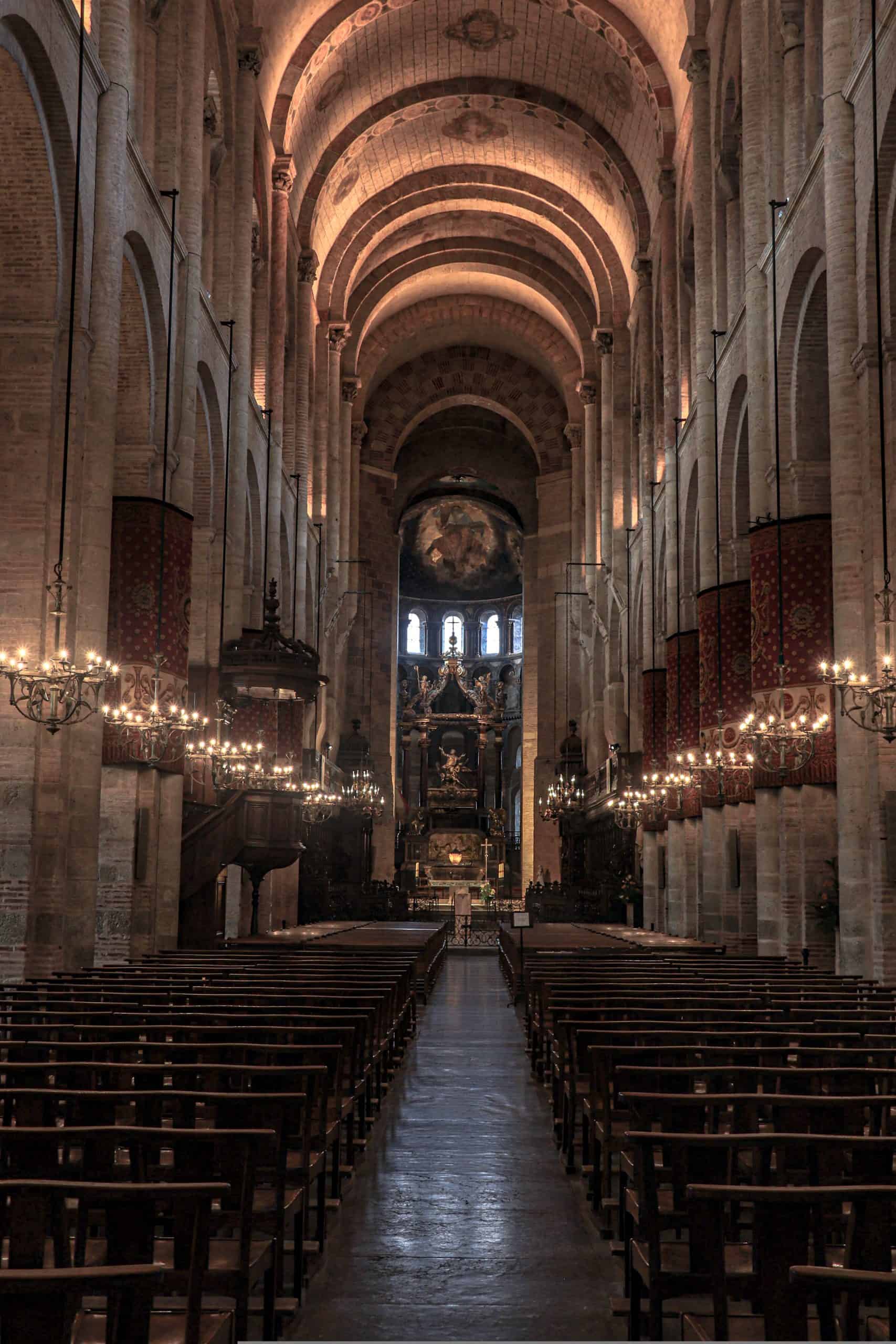
But his most important work remains his participation in the re-construction of the Church of St Sernin; the ancient complex had been under restoration since the beginning of the 11th Century, under the Bishop Ruggero. The Choir had been consecrated by Pope Urban II on 24 May 1096 but the transept, a large part of the nave and the aisles, still had to be built. Thanks to Raymond’s skills in architecture, he took over the management of the construction site, giving great impetus to the works; the long construction, to which he devoted all his activities, had great repercussions on his spiritual life, who, to bind himself even more to this Church, asked to be accepted among the Canons of St Sermin, who later elected him as Provost of the Chapter.
The Crypt at St Sernin
Unfortunately, he could not see the long and laborious work completed, in fact Raymond died on 3 July 1118 and it is recorded that by that date, he had “brought the walls all the way around up to the completion of the windows…”
Raymond was buried at the Hospice which he had founded.
Numerous miracles soon took place at his grave, for which he became the object of a local cult. In 1652, on the occasion of an epidemic which had brought a large number of sick people to his tomb, Pope Innocent III officially confirmed his cult.
(Not to be confused with Raymond, Count of Toulouse).
Below is a Welcome Note from the Curé of St Sernin.
Dear pilgrims and visitors, welcome!
Going through the doors of the Basilica of Saint-Sernin is to touch the millennial history of the Christian faith of the City of Toulouse, to be amazed by the majesty of Romanesque art, to be edified by the testimony of the Martyr Saint Saturnin, to venerate an impressive number of Relics of Saints. Stopping on the way to Santiago de Compostela, feeling the prayers rising to Heaven, being in the presence of the Lord Jesus Christ. Whatever the reason that brings you to Saint-Sernin, this Church will not leave you indifferent. Take the time to soak up its atmosphere, ask the volunteers to give you a spiritual visit, light a candle as a sign of prayer, come and attend the Masses and the Offices. You will then contemplate the true beauty of this Basilica, a jewel of Romanesque art in the heart of Toulouse, and will understand why people from Toulouse are said to have always had two Parishes – theirs and Saint-Sernin
Bl Andreas Ebersbach Bl Barbara Jeong Sun-mae St Bladus St Byblig St Cillene St Dathus of Ravenna St Eusebius of Laodicea St Firminus St Firmus Bl Gelduin St Giuse Nguyen Ðình Uyen St Gunthiern St Guthagon St Heliodorus of Altinum St Hyacinth of Caesarea Bl Ioannes Baptista Zhao Mingxi St Irenaeus of Chiusi St Maelmuire O’Gorman St Mark of Mesia St Mennone the Centurian St Mucian of Mesia St Paul of Mesia Bl Petrus Zhao Mingzhen Bl Philiphê Phan Van Minh St Raymond of Toulouse (Died 1118) Layman
Martyrs of Alexandria – 13 Saints: Thirteen Christian companions Marytred together. No details about them have survived but the names – Apricus, Cyrion (2 of), Eulogius, Hemerion, Julian, Julius, Justus, Menelaus, Orestes, Porfyrios and Tryphon (2 of). They martyred in Alexandria, Egypt, date unknown.
Martyrs of Constantinople – 24 Saints: A group of 24 Christians Martyred in the persecutions of Arian Emperor Valens. We know little more than their names – Acacios, Amedinos, Ammonius, Ammus, Cerealis, Cionia, Cionius, Cyrianus, Demetrius, Eulogius (2), Euphemia, Heliodoros, Heraclios, Horestes, Jocundus, Julian, Martyrios, Menelaeus, Sestratus, Strategos, Thomas, Timotheos and Tryphon. They were martyred in c367 in Constantintinople.
Theodotus and Companions – 6 Saints: Six Christians who were imprisoned, tortured and Martyred together in the persecutions of Trajan. Saint Hyacinth ministered to them in prison. We know nothing else about them but their names – Asclepiodotus, Diomedes, Eulampius, Golinduchus, Theodota and Theodotus. They were beheaded in c110, location unknown.
Thought for the Day – 2 July – Meditations with Antonio Cardinal Bacci (1881-1971)
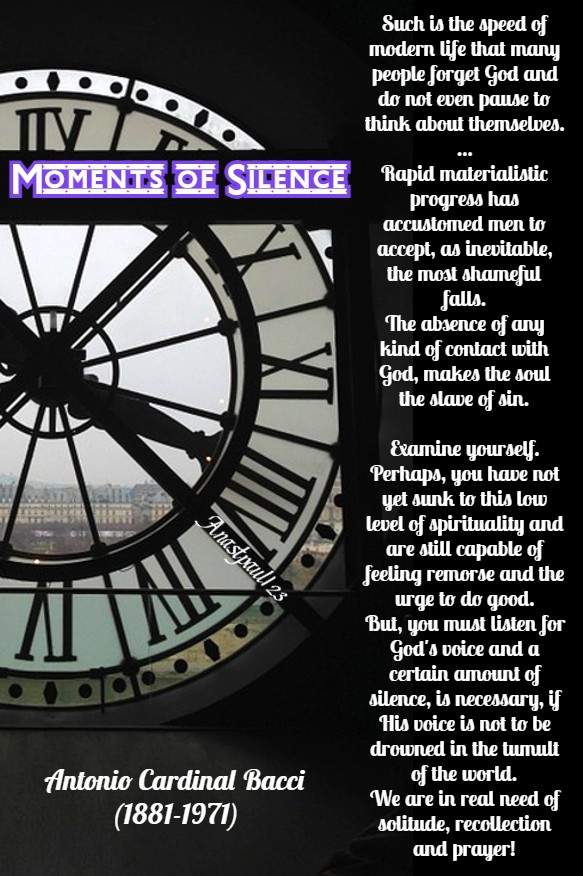
Moments of Silence
“Such is the speed of modern life that many people forget God and do not even pause to think about themselves. Action is everything. There is no time for reflection, no time for prayer. Life has become mechanical and superficial, for nobody has the time, nor the inclination, to think about spiritual matters.
What is the result? Since men are not machines but living beings, composed of soul and body and are capable of feeling and passion, their lower inclinations break loose and insist on being satisfied. In the absence of prayer and of all effort to lead a good life, grace is lacking to inspire the mind, to strengthen the will and to keep the heart pure. Rapid materialistic progress has accustomed men to accept, as inevitable, the most shameful falls. The absence of any kind of contact with God, makes the soul the slave of sin.
Examine yourself. Perhaps, you have not yet sunk to this low level of spirituality and are still capable of feeling remorse and the urge to do good. But, you must listen for God’s voice and a certain amount of silence, is necessary, if His voice is not to be drowned in the tumult of the world. We are in real need of solitude, recollection and prayer!”
Quote/s of the Day – 2 July – The Visitation of the Blessed Virgin Mary
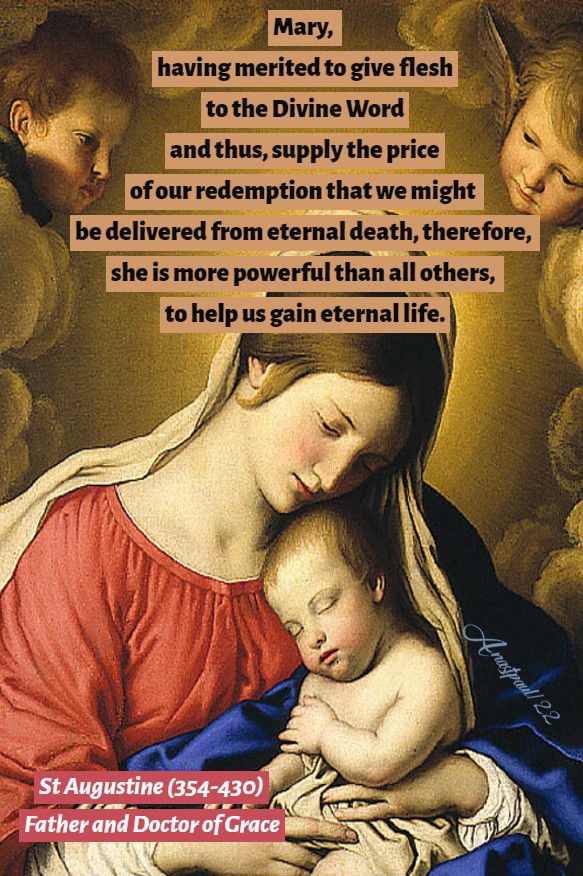
“Mary, having merited to give flesh to the Divine Word and thus, supply the price of our redemption that we might be delivered from eternal death, therefore, she is more powerful than all others, to help us gain eternal life.”
St Augustine (354-430) Father and Doctor of Grace
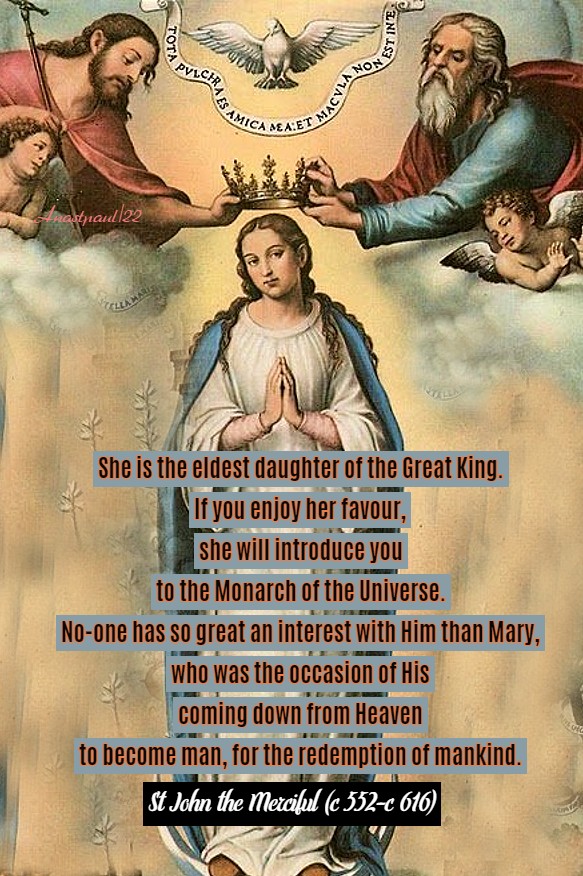
“She is the eldest daughter of the Great King. If you enjoy her favour, she will introduce you to the Monarch of the Universe. No-one has so great an interest with Him than Mary, who was the occasion of His coming down from Heaven to become man, for the redemption of mankind.”
St John the Merciful (c 552-c 616)
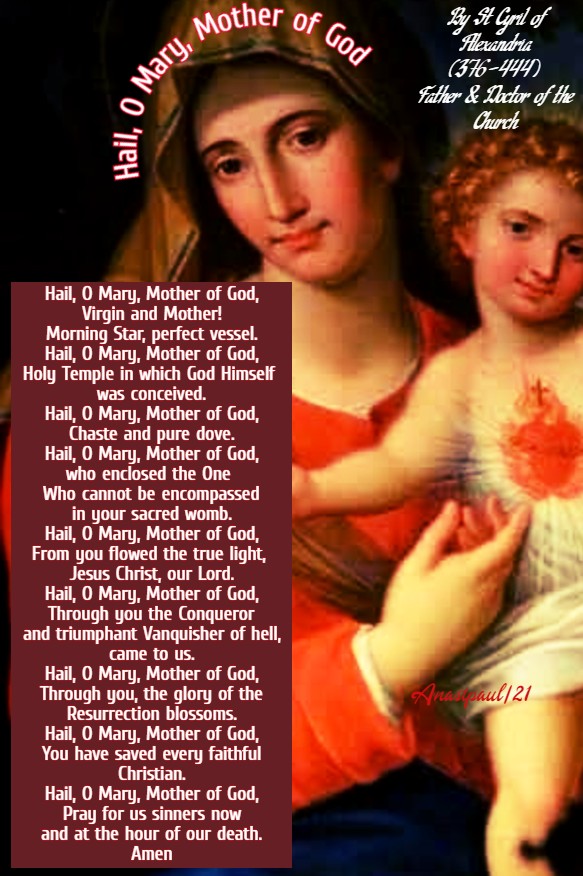
Hail, O Mary, Mother of God By St Cyril of Alexandria (376-444) Father & Doctor of the Church
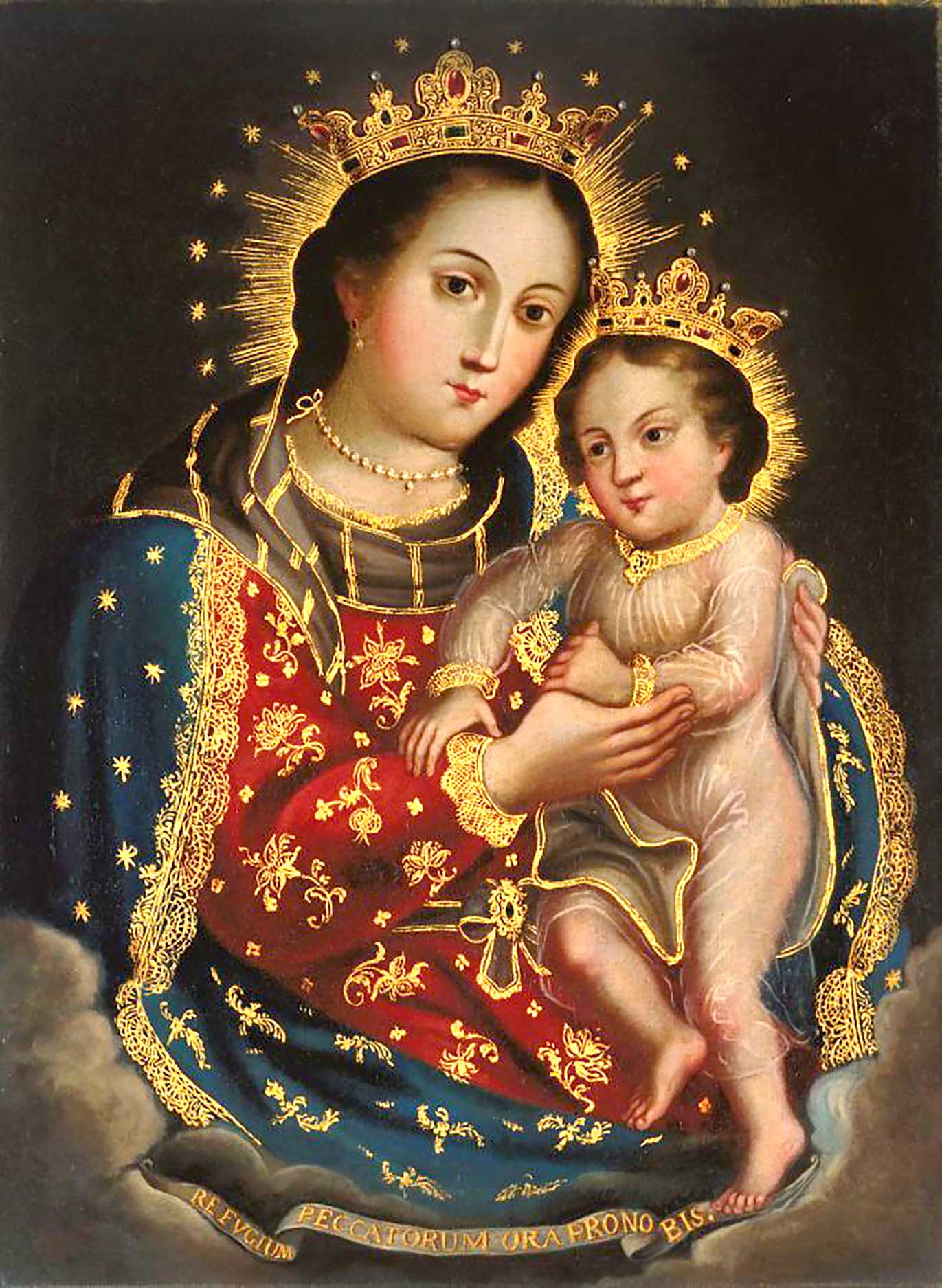
Hail, O Mary, Mother of God, Virgin and Mother! Morning Star, perfect vessel. Hail, O Mary, Mother of God, Holy Temple in which God Himself was conceived. Hail, O Mary, Mother of God, Chaste and pure dove. Hail, O Mary, Mother of God, who enclosed the One Who cannot be encompassed in your sacred womb. Hail, O Mary, Mother of God, From you flowed the true light, Jesus Christ, our Lord. Hail, O Mary, Mother of God, Through you the Conqueror and triumphant Vanquisher of hell, came to us. Hail, O Mary, Mother of God, Through you, the glory of the Resurrection blossoms. Hail, O Mary, Mother of God, You have saved every faithful Christian. Hail, O Mary, Mother of God, Pray for us sinners now and at the hour of our death. Amen
Adapted from a sermon preached by St Cyril, Archbishop of Alexandria (444), presiding as representative of the Holy See at the Ecumenical Council of Ephesus, in 431. In refuting Nestorianism, he is called “Doctor of the Incarnation.
“O daughter of King David and Mother of God, the universal King. O Divine and living object whose beauty has charmed God the Creator; your whole soul is completely open to God’s action and attentive to God alone. … Your womb will be the abode of the one whom no place can contain. Your milk will provide nourishment for God, in the little Infant Jesus. Your hands will carry God and your knees will serve as a throne for Him that is more noble than the throne of the Cherubim. … You are the temple of the Holy Spirit, the city of the living God, made joyous by abundant flowers, the sacred flowers of Divine grace. You are all-beautiful and very close to God, above the Cherubim and higher than the Seraphim, right near God Himself! Amen”
St John Damascene (675-749) Father and Doctor of the Church
One Minute Reflection – 2 July – “The Month of the Most Precious Blood of Jesus” – The Visitation of the Blessed Virgin Mary – Song 2:8-14, Luke 1:39-47 – Scripture search here: https://www.drbo.org/
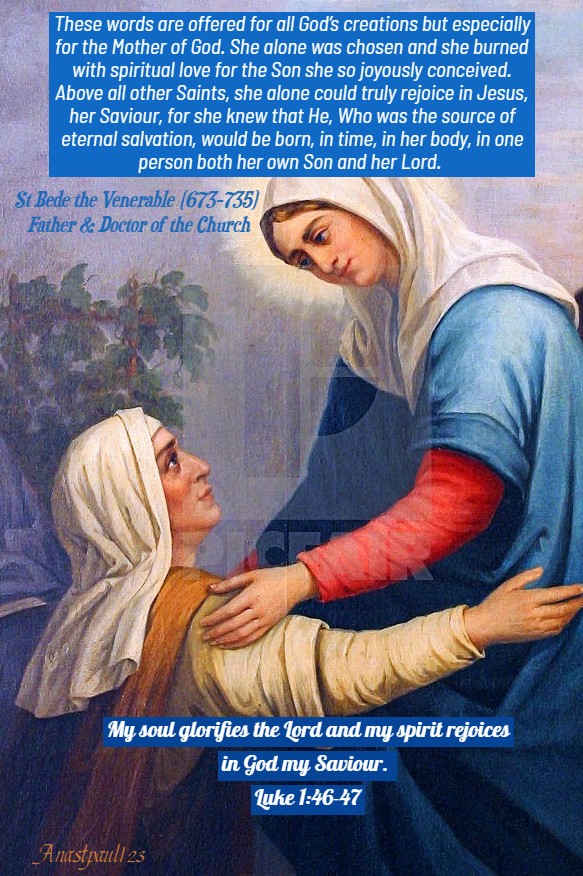
“My soul glorifies the Lord and my spirit rejoices in God my Saviour.”- Luke 1:46-47
REFLECTION – “When a man devotes all his thoughts to the praise and service of the Lord, he proclaims God’s greatness. His observance of God’s commands, moreover, shows that he has God’s power and greatness always at heart. His spirit rejoices in God his Saviour and delights in the mere recollection of his Creator Who gives him hope for eternal salvation.
These words are offered for all God’s creations but especially for the Mother of God. She alone was chosen and she burned with spiritual love for the Son she so joyously conceived. Above all other Saints, she alone could truly rejoice in Jesus, her Saviour, for she knew that He, Who was the source of eternal salvation, would be born, in time, in her body, in one person both her own Son and her Lord.
Therefore, it is an excellent and fruitful custom of holy Church that we should sing Mary’s hymn at the time of evening prayer. By meditating upon the Incarnation, our devotion is kindled and by remembering the example of God’s Mother, we are encouraged to lead a life of virtue. Such virtues are best achieved in the evening. We are weary after the day’s work and worn out by our distractions. The time for rest is near and our minds are ready for contemplation.” – St Bede the Venerable (673-735) Father & Doctor of the Church
PRAYER – Bestow upon Thy servants, we beseech Thee, O Lord, the gift of heavenly grace that as the child-bearing of the Blessed Virgin marked the beginning of our salvation, so may the solemn Feast of her Visitation bring us an increase of peace.Through Jesus Christ, Thy Son our Lord, Who lives and reigns with Thee, in the unity of the Holy Ghost, God, world without end. Amen (Collect).
Our Morning Offering – 2 July – The Solemnity of Saints Peter and Paul, Apostles and Martyrs
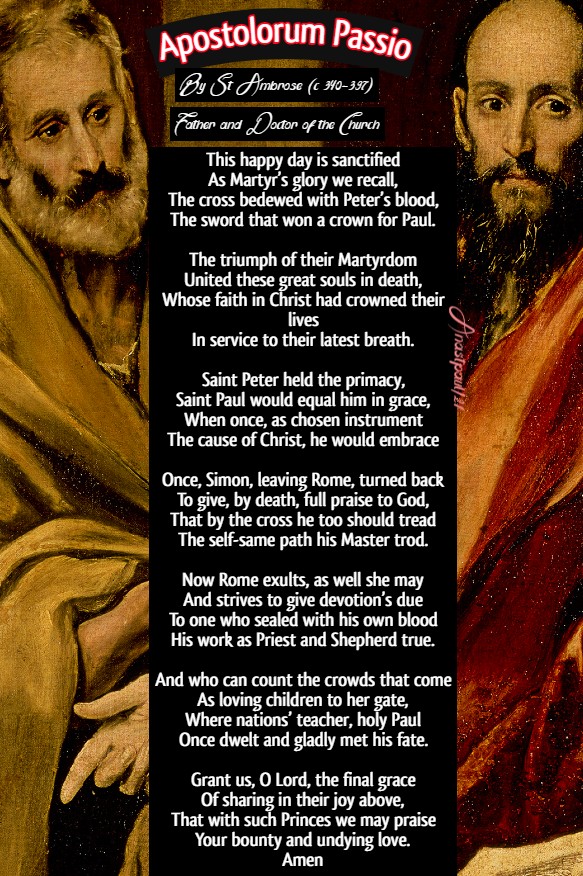
Apostolorum Passio By St Ambrose (c 340-397) Father and Doctor of the Church
This happy day is sanctified As Martyr’s glory we recall, The cross bedewed with Peter’s blood, The sword that won a crown for Paul.
The triumph of their Martyrdom United these great souls in death, Whose faith in Christ had crowned their lives In service to their latest breath.
Saint Peter held the primacy, Saint Paul would equal him in grace, When once, as chosen instrument The cause of Christ, he would embrace
Once, Simon, leaving Rome, turned back To give, by death, full praise to God, That by the cross he too should tread The self-same path his Master trod.
Now Rome exults, as well she may And strives to give devotion’s due To one who sealed with his own blood His work as Priest and Shepherd true.
And who can count the crowds that come As loving children to her gate, Where nations’ teacher, holy Paul Once dwelt and gladly met his fate.
Grant us, O Lord, the final grace Of sharing in their joy above, That with such Princes we may praise Your bounty and undying love. Amen
Trans: The Benedictines of St Cecilia’s Abbey, Ryde, UK
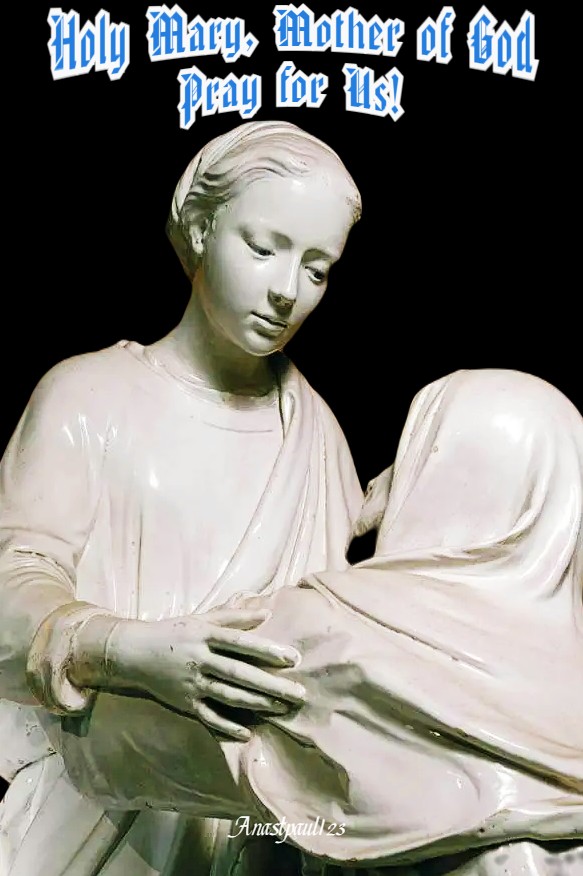
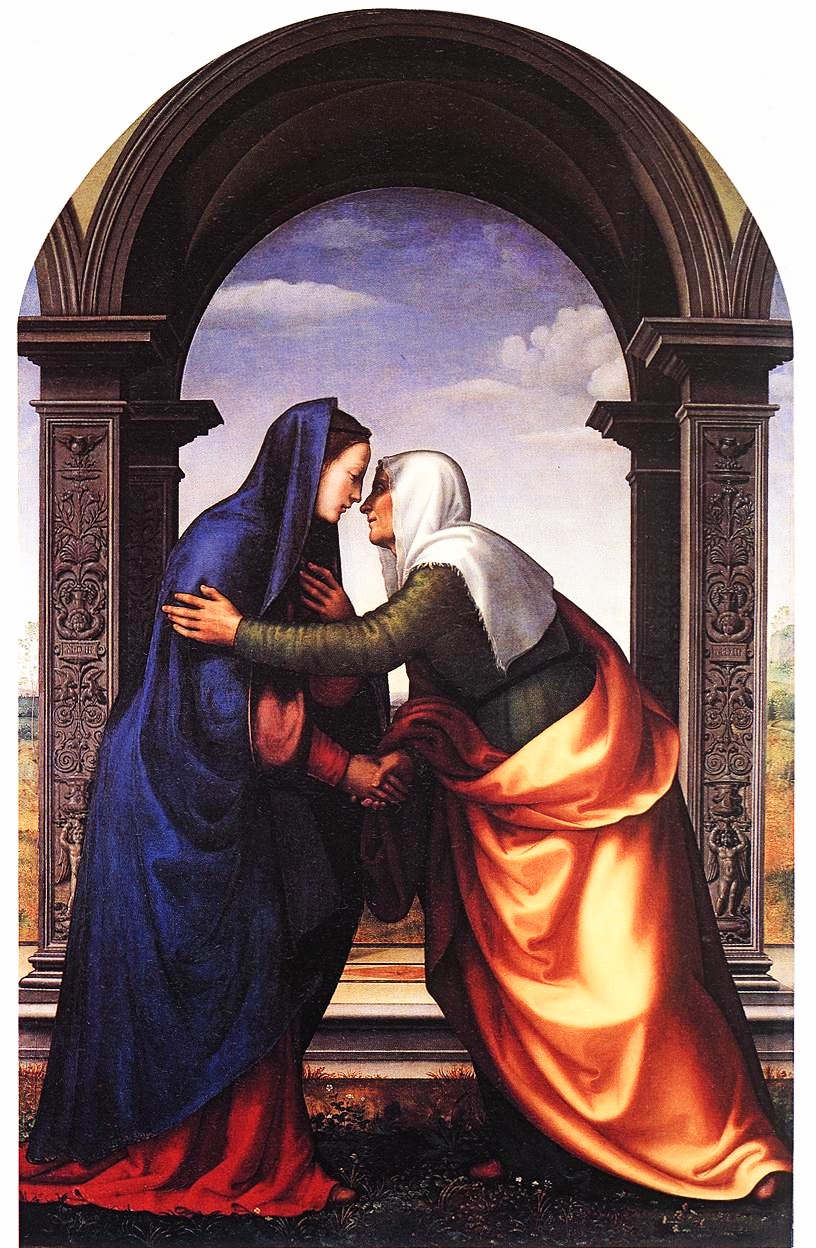
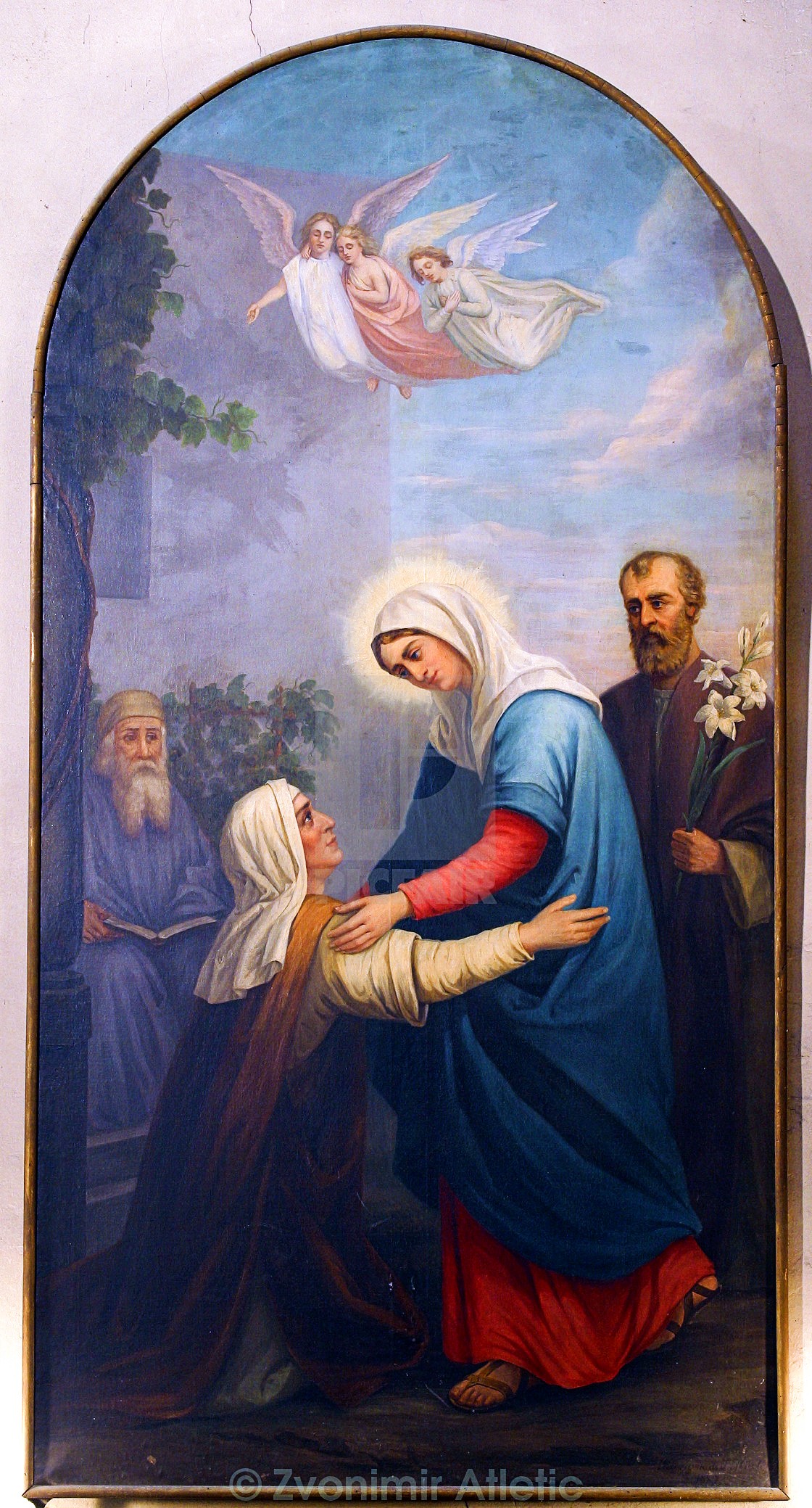
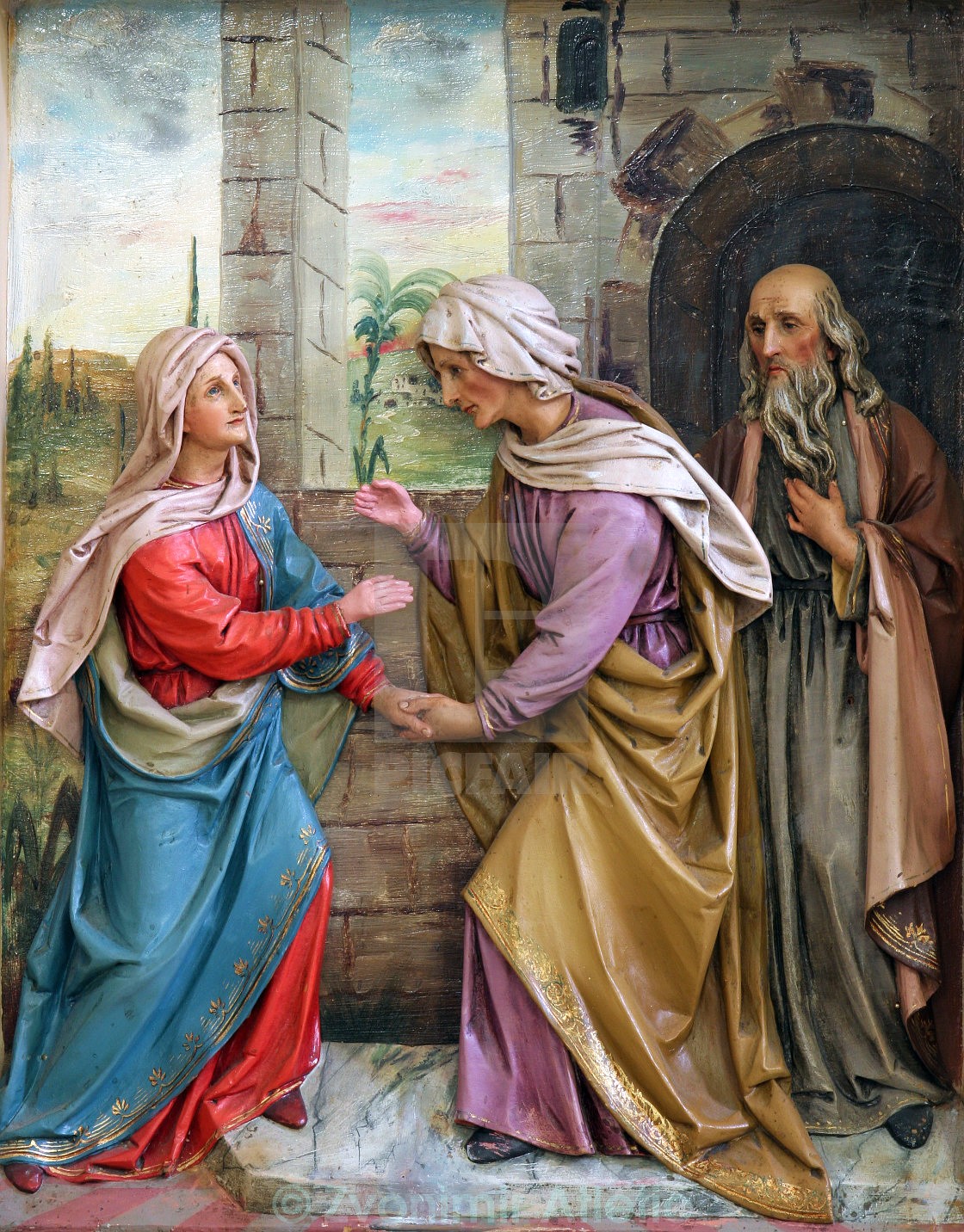
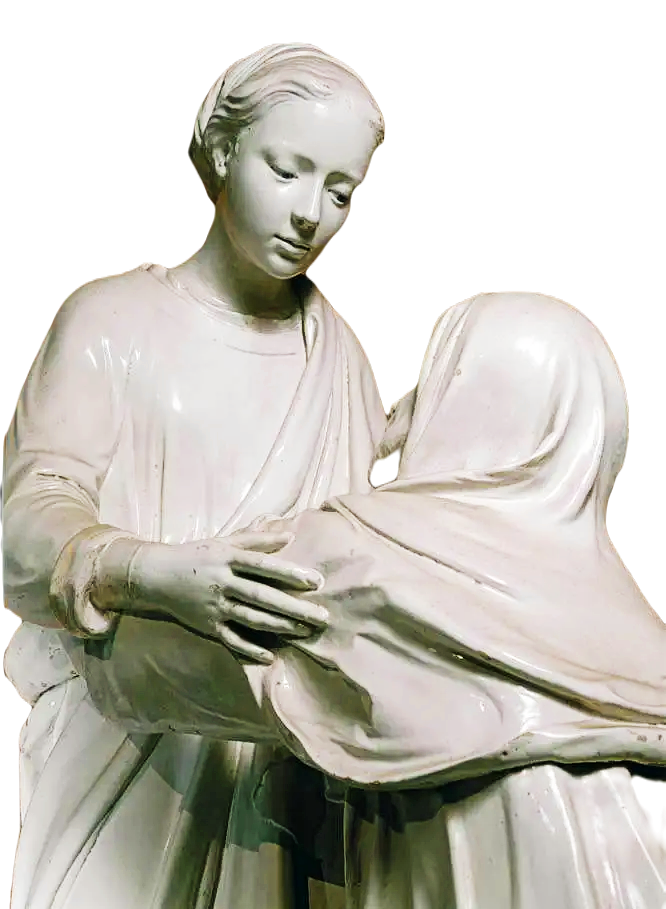
The Feast of the Visitation of Our Lady, instituted in 1385 by Pope Urban IV – 2 July.
Mary’s first thought after the Archangel’s visit was to hasten to the little Town of Ain Kharin and congratulate her cousin, Elizabeth on the wonderful event about to take place. As Mary hastened along, those who met her, little realised that she bore the Son of God – humble, sweet and gracious, to all.
So the young girl from Nazareth, passed unobserved upon her way. But as she raised her voice in loving salutation to Elizabeth, when entering the house, a marvelous thing occurred, for the unborn infant in Elizabeth’s womb, leapt for joy, as he heard the voice of God’s Mother sounding in his ears. Elizabeth, stricken with amazement, cried out:
“Blessed art thou among women and blessed is the fruit of thy womb. And whence is this to me, that the mother of my Lord should come to me? For behold, as soon as the voice of thy salutation sounded in my ears, the infant in my womb leapt for joy. And blessed art thou that hast believed because those things shall be accomplished which were spoken to thee by the Lord.”
In that instant Elizabeth knew that she was standing in the presence of God; she knew that the young girl standing before her was God’s Mother; knew all that had taken place at Nazareth; knew of Mary’s fiat.
Then Mary lifted up her voice in high thanksgiving and gave forth the marvelous canticle:
“My soul doth magnify the Lord. And my spirit hath rejoiced in God my Saviour. Because He hath regarded the humility of His handmaid; for behold, from henceforth, all generations shall call me blessed. Because He that is mighty, hath done great things for me and holy is His name. And His mercy is from generation unto generations, to them that fear Him. He hath shewed might in His arm; He hath scattered the proud in the conceit of their heart. He hath put down the mighty from their seat and hath exalted the humble. He hath filled the hungry with good things and the rich He hath sent empty away. He hath received Israel His servant, being mindful of His mercy, as He spoke to our fathers, to Abraham and to his seed forever.”
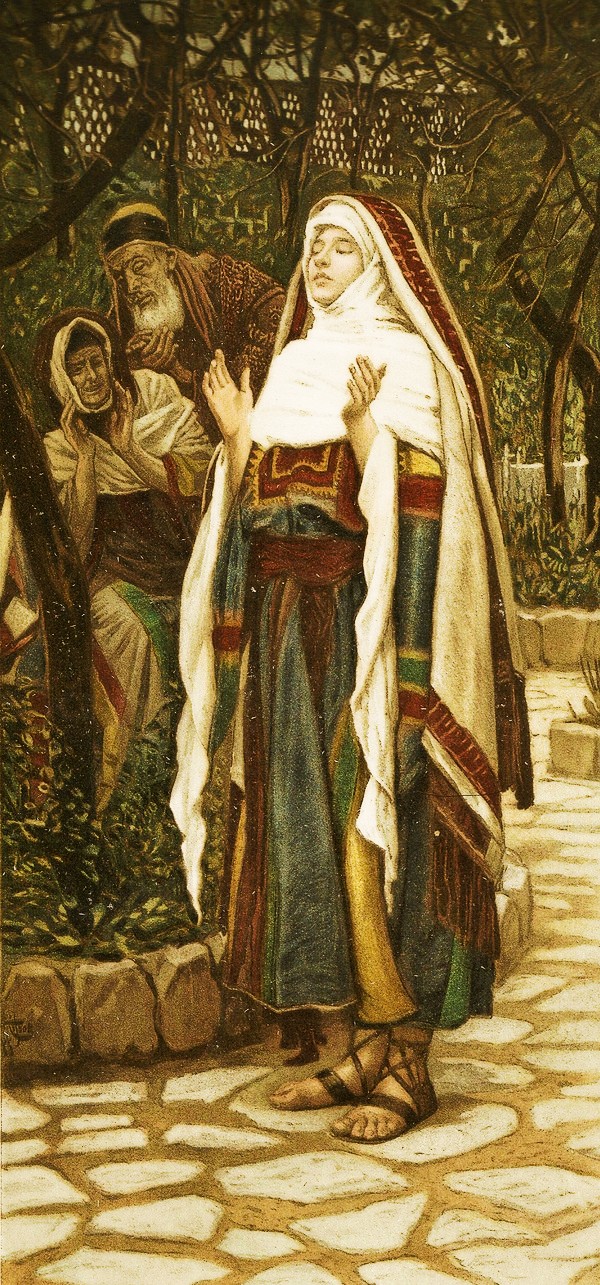
The Magnificat nbby James Tissot
In this Magnificat of the humble young girl of Nazareth, there is an intense personal note; she sees why it is that she is exalted – her humility. She prophesies and foretells her future glory. Then she says that God’s mercy follows those who fear Him; she sings of God’s might; she returns to the thought of God’s mercy and with this mercy in mind, the young virgin ends her triumphant song.
For three months Mary and Elizabeth rejoiced in each other’s company and gave thanks to God for all the wonderful mercy He had bestowed upon them – one, the mother of the Herald of God, the other, the Mother of God Himself. Yet these months saw nothing outwardly extraordinary; it was just the quiet outwardly ordinary daily round, such as might be seen in any family.
After those three months the Virgin set out on her way home to Nazareth and her return was as little noted as her going. She came full of joy and she returned full of joy, for no hint of coming sorrow cast a shadow upon her.
This Feast of the Visitation of Our Lady was instituted by Pope Urban IV, in the year 1385 and confirmed by Pope Boniface IX, in the year 1389.
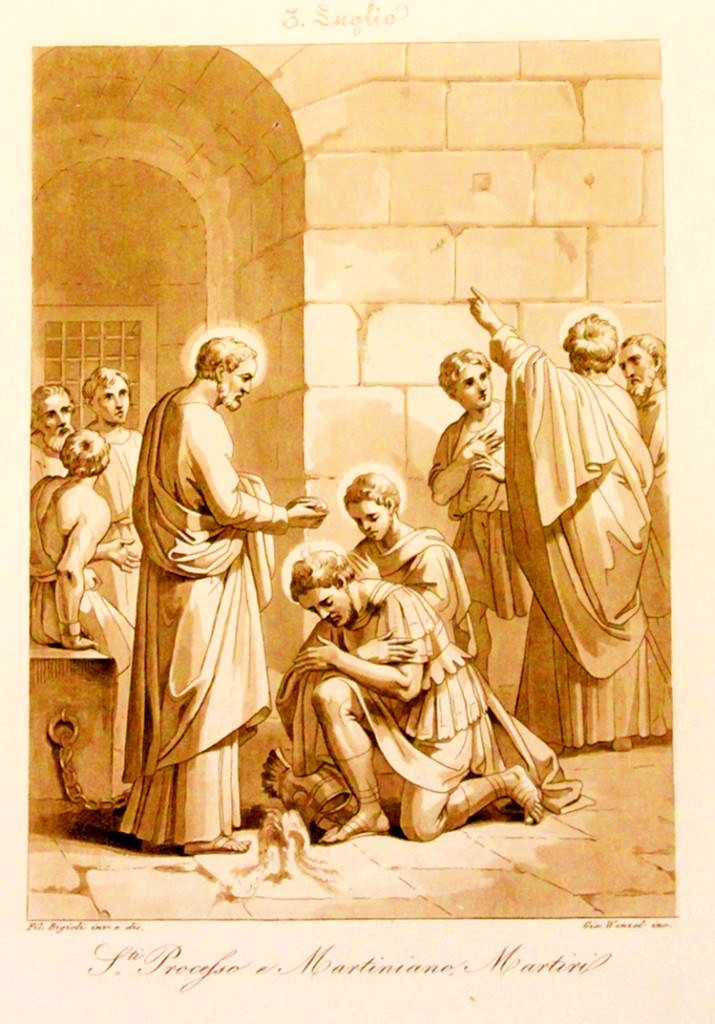
Saints of the Day – 2 July – Saints Processus and Martinian of Rome * (Died c67) Martyrs, Laymen, Prison guards at the Mamertine prison in Rome. They were among the Guards of St Peter and St Paul, the Apostles. They converted to Christ and were Baptised by Peter and Paul. Patronage – Bagnolo Mella, Italy.
The Roman Martyrology reqads today: “At Rome, on the Aurelian Way, the birthday of the holy Martyrs, Processus and Martinian, who were Baptised by the blessed Apostle Peter, in the Mamertine Prison. After being struck on the mouth, racked, scourged with thongs and whips tipped with metal, after being beaten with rods and exposed to the flames, they were beheaded in the days of Nero and thus obtained the Crown of Martyrdom.”
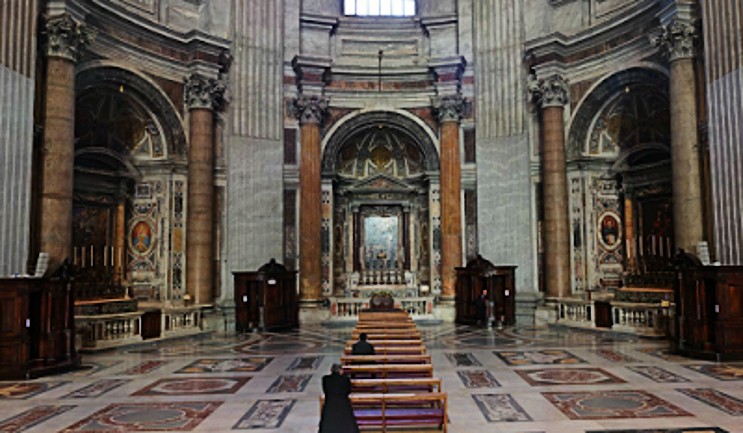
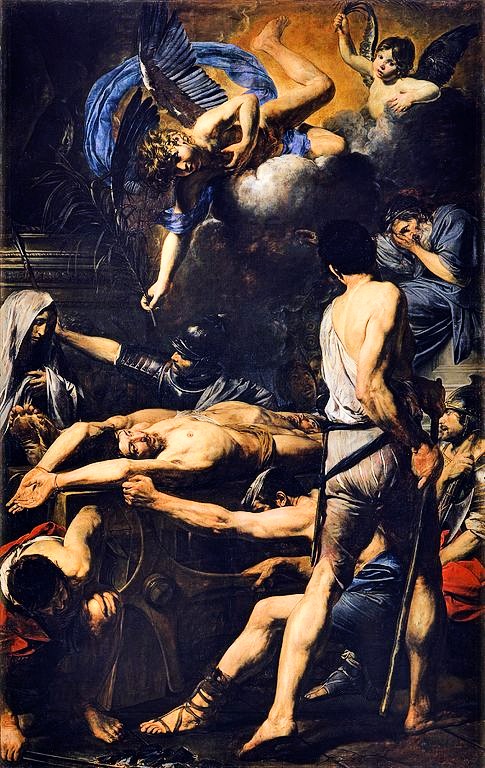
For many Centuries before the Feast of the Visitation was instituted, the 2nd of July was kept as the Feast of the Martyrs Saints Processus and Martinian, who remain as a commemoration on that day in the Extraordinary Form. According to a legend current since the Sixth Century, they were the jailers in charge of keeping Sts Peter and Paul, in the Mamertine prison in Rome, during the reign of the Emperor Nero and having been converted by the Apostles, allowed them to escape. For this, they were put to death after a long series of torments, through which they simply said over and over again, “Blessed be the Name of our Lord, Jesus Christ, Whom His blessed Apostles have preached!” Originally buried in a cemetery off the via Aurelia, their remains were transferred to the ancient Basilica of St Peter by Pope Paschal I in the early Ninth Century. The north transept of the new Basilica is named for them, where their Relics are kept under the middle of the three Altars.
The north transept of St Peter’s Basilica
The central Altar is where this painting of their Martyrdom, by the French painter Valentin de Boulogne (1629) was originally displayed – it is now replaced by a mosaic copy.
Interesting Note: Since the windows of St Peter’s Basilica are so high up, the marble walls are never exposed to direct sunlight for any great length of time and, generally remain cooler than the air. In the summertime, when Italy is often very hot and humid, a great deal of moisture comes into the building and condenses on the cooler marble. In the middle of the 18th Century, it was realised that the paintings over the Altars were being destroyed because they had a slick of condensation over them for several months of the year. They were, therefore, all removed and replaced by mosaics. The original of our painting of the Martyrdom, is now in the Painting Gallery of the Vatican Museums. (GREGORY DIPIPPO).
Bl Giovanni da Fabriano Becchetti St Jacques Fermin Bl Jarich of Mariengaarde St Jéroche St Lidanus of Sezze St Martinian of Rome * (Died c67) Martyr, Layman
Martyred Soldiers of Rome – 3 Saints: Three soldiers who were converted at the Martyrdom of Saint Paul the Apostle. Then they were martyred, as well. We known nothing else about them but their names – Acestes, Longinus and Megistus. Martyred c68 in Rome, Italy
Martyrs in Carthage by Hunneric – 7 Saints: A group of seven Christians tortured and murdered in the persecutions of the Arian Vandal king Hunneric for remaining loyal to the teachings of orthodox Christianity. They were some of the many who died for the faith during a period of active Arian heresy. – Boniface, Liberatus, Maximus, Rogatus, Rusticus, Septimus and Servus.
Martyrs of Campania – 10 Saints: A group of ten Christians Marytred together in the persecutions of Diocletian. The only details about them to have survived are their names – Ariston, Crescention, Eutychian, Felicissimus, Felix, Justus, Marcia, Symphorosa, Urban and Vitalis. Martyred in 284 in Campania, Italy.
Jesus shed His Precious Blood Seven times and the price of these Seven Sheddings of Blood is found in the Seven Sacraments, by which we are cleansed from sin and sanctified.
These Seven Sheddings of Blood remind us too, of the Three Theological and the Four Cardinal Virtues; of the Seven virtues – infused into us at Baptism (opposed to the Seven Deadly or Capital sins); of the Seven Gifts of the Holy Ghost, which we receive in Confirmation and finally, of the Seven days of the week which we should dedicate to the service of God.
The Covenant between God and the Israelites was sealed with blood. The New Covenant was sealed with the Precious Blood of Jesus Christ. The Covenant between God and men, is sealed again, as many times as the Holy Sacrifice of the Mass is offered to God. Assist, whenever you can, at the tremendous Sacrifice of the Mass, and frequently receive Holy Communion, the promise of our resurrection..
Thought for the Day – 1 July – “The Feast and Month of the Most Precious Blood of Jesus” – Meditations with Antonio Cardinal Bacci (1881-1971)
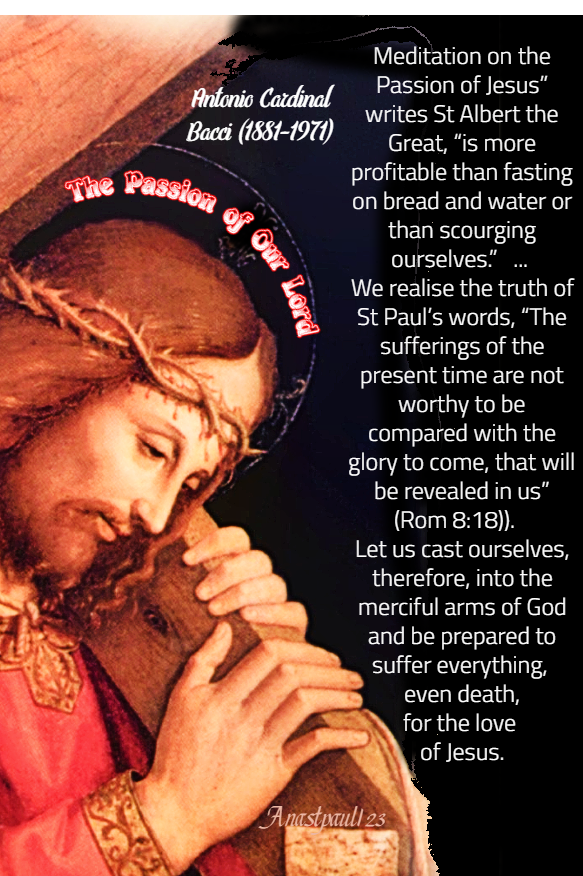
The Passion of Our Lord
“Meditation on the Passion of Jesus” writes St Albert the Great, “is more profitable than fasting on bread and water or than scourging ourselves.”
This is because, when we meditate with love and gratitude on the Passion of our Redeemer, we have the experience of being transformed and set aglow with charity. We realise the truth of St Paul’s words, “The sufferings of the present time are not worthy to be compared with the glory to come, that will be revealed in us” (Rom 8:18)).
Let us cast ourselves, therefore, into the merciful arms of God and be prepared to suffer everything, even death, for the love of Jesus.”
Quote/s of the Day – 1 July – “The Feast and Month of the Most Precious Blood of Jesus”
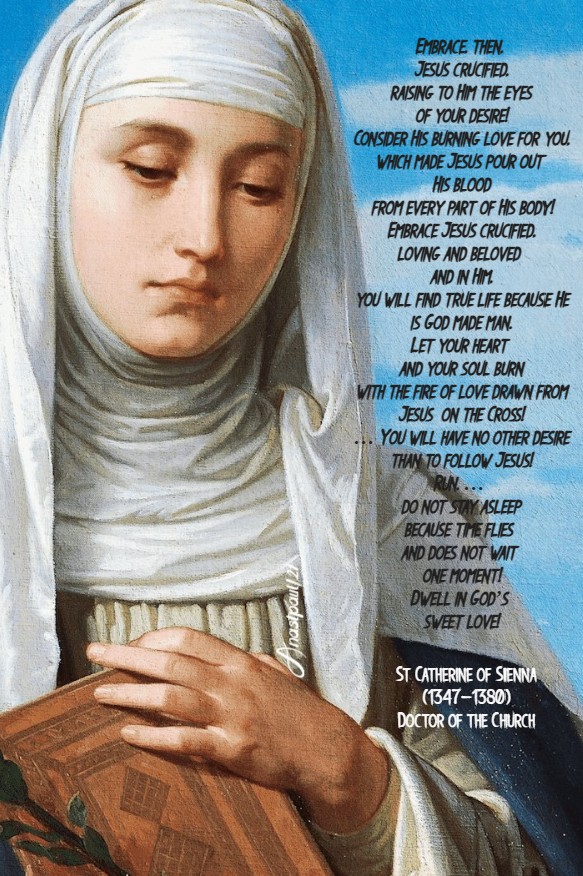
“Embrace, then, Jesus Crucified, raising to Him the eyes of your desire! Consider His burning love for you which made Jesus pour out His Blood from every part of His body! Embrace Jesus Crucified, loving and beloved and in Him, you will find true life because He is God made Man. Let your heart and your soul burn with the fire of love drawn from Jesus on the Cross! … You will have no other desire than to follow Jesus! Run, … do not stay asleep because time flies and does not wait one moment! Dwell in God’s sweet love!”
St Catherine of Sienna (1347-1380) Doctor of the Church
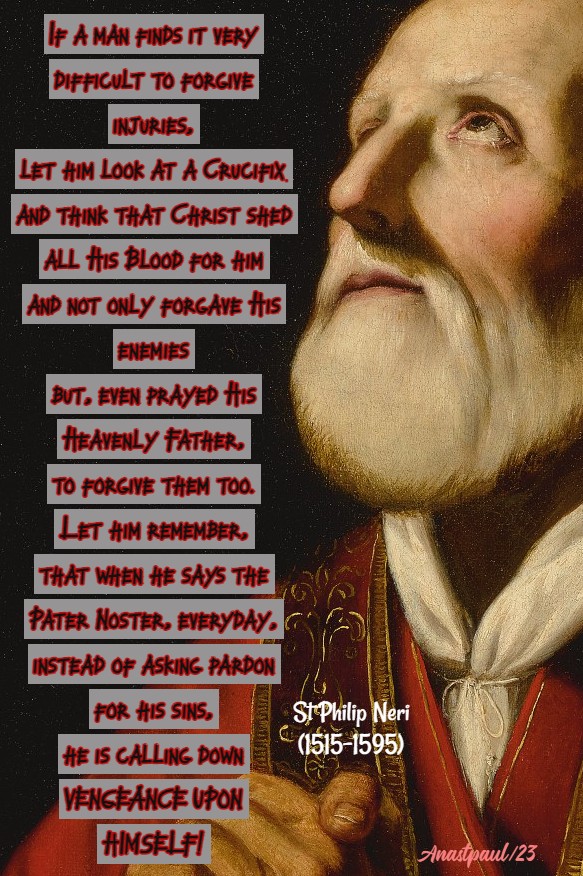
“If a man finds it very difficult to forgive injuries, let him look at a Crucifix and think that Christ shed all His Blood for him and not only forgave His enemies but, even prayed His Heavenly Father, to forgive them too. Let him remember, that when he says the Pater Noster, everyday, instead of asking pardon for his sins, he is calling down VENGEANCE UPON HIMSELF!”
St Philip Neri (1515-1595)
“The Saviour has instituted the most glorious Sacrament of the Eucharist, which truly contains His Body and His Blood, so that, whoever eats it will live forever. Therefore, those who receive it frequently, with devotion, strengthen their spiritual life and well-being, to such an extent, that it is almost impossible for them to be poisoned by any kind of evil attachment.”
(Introduction to the Devout Life, Part II, Chapter 20)
St Francis de Sales (1567-1622) Doctor of the Church
One Minute Reflection – 1 July – “The Feast and Month of the Most Precious Blood of Jesus” – Hebrews 9:11-15, John 19:30-35 – Scripture search here: https://www.drbo.org/
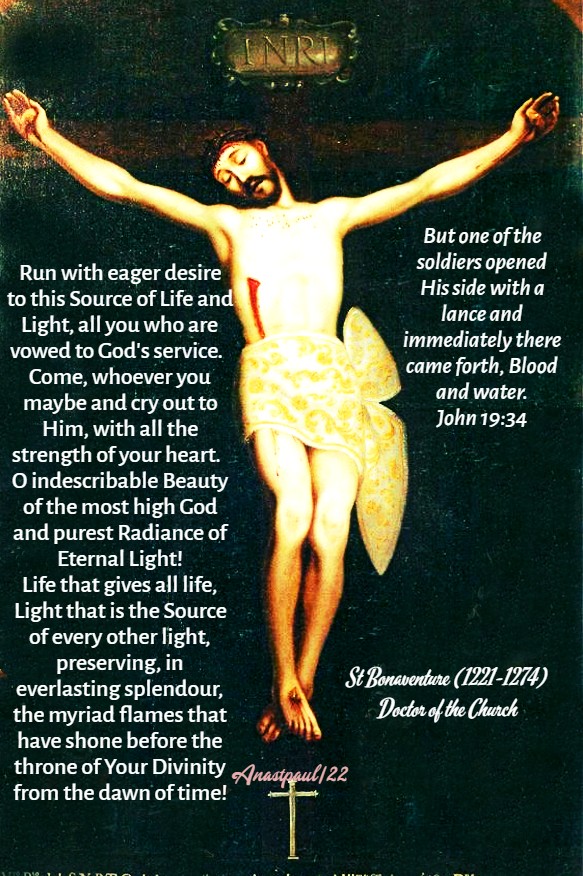
“But one of the soldiers opened His side with a lance and immediately there came forth, Blood and water.” – John 19:34
REFLECTION – “Take thought now, redeemed man and consider how great and worthy is He, Who hangs on the Cross for you… Arise, then, beloved of Christ! Imitate the dove ‘that nests in a hole in the cliff’ (Jr 48:28), keeping watch at the entrance ‘like the sparrow that finds a home’(Ps 84:4). There, like the turtledove, hide your little ones, the fruit of your chaste love. Press your lips to the Fountain, draw water from the wells of your Saviour; for this is the spring flowing out of the middle of paradise, dividing into four rivers, inundating devout hearts, watering the whole earth and making it fertile.
Run with eager desire to this Source of Life and Light, all you who are vowed to God’s service. Come, whoever you may be and cry out to Him, with all the strength of your heart. O indescribable Beauty of the most high God and purest Radiance of Eternal Light! Life that gives all life, Light that is the Source of every other light, preserving, in everlasting splendour, the myriad flames that have shone before the throne of Your Divinity from the dawn of time!
Eternal and inaccessible Fountain, clear and sweet stream, flowing from a hidden spring, unseen by mortal eye! None can fathom Your depths nor survey Your boundaries, none can measure Your breadth, nothing can sully Your purity. From You flows ‘the river which gladdens the city of God’ (Ps 46:5) and makes us cry out with joy and thanksgiving, in hymns of praise to You, for we know, by our own experience, that ‘with You is the Source of Life and in Your Light we see light’ (Ps 36:10).” – St Bonaventure (1221-1274) Doctor of the Church (The Tree of Life, 29-30, 47, – Breviary)
PRAYER – Almighty, eternal God, Who made Thine Only-begotten Son the Redeemer of the world and, willed to be reconciled by His Blood, grant us, we beseech Thee, so to worship in this Sacred rite the price of our salvation and to be so protected, by its power against the evils of the present life on earth, that we may enjoy its everlasting fruit in Heaven. Through the same Jesus Christ, Thy Son our Lord, Who lives and reigns with Thee, in the unity of the Holy Ghost, God, world without end. Amen (Collect).
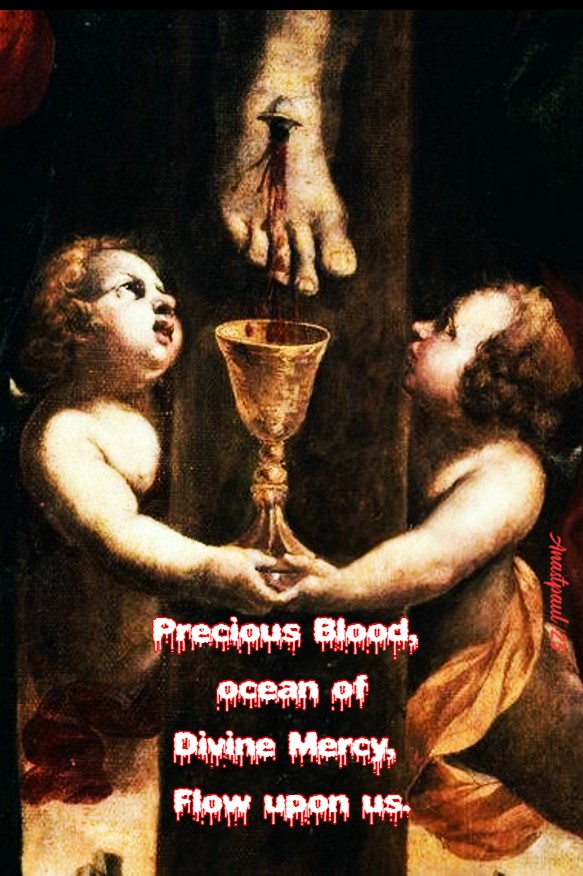
Aspiration:Precious Blood, ocean of Divine Mercy, Flow upon us.
Our Morning Offering – 1 July – “The Feast and Month of the Most Precious Blood of Jesus”
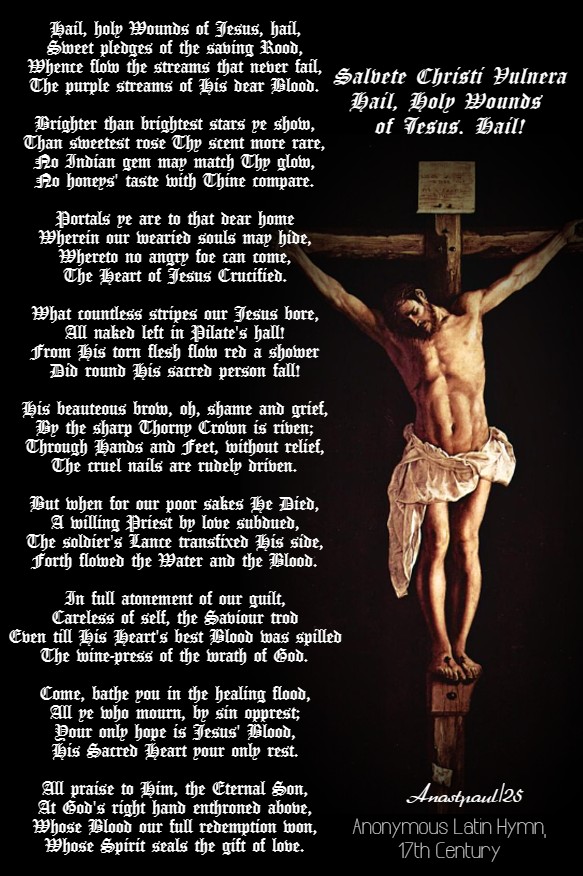
Salvete Christi vulnera Hail, Holy Wounds of Jesus, Hail! Anonymous Latin Hymn, 17th Century
Hail, holy Wounds of Jesus, hail, Sweet pledges of the saving Rood, Whence flow the streams that never fail, The purple streams of His dear Blood.
Brighter than brightest stars ye show, Than sweetest rose your scent more rare, No Indian gem may match Your glow, No honeys taste with Yours compare.
Portals ye are to that dear home Wherein our wearied souls may hide, Whereto no angry foe can come, The Heart of Jesus crucified.
What countless stripes our Jesus bore, All naked left in Pilates hall! From His torn flesh flow red a shower Did round His sacred person fall!
His beauteous brow, oh, shame and grief, By the sharp thorny crown is riven; Through hands and feet, without relief, The cruel nails are rudely driven.
But when for our poor sakes He died, A willing Priest by love subdued, The soldiers lance transfixed His side, Forth flowed the Water and the Blood.
In full atonement of our guilt, Careless of self, the Saviour trod Een till His Hearts best Blood was spilt The wine-press of the wrath of God.
Come, bathe you in the healing flood, All ye who mourn, by sin opprest; Your only hope is Jesus Blood, His Sacred Heart your only rest.
All praise to Him, the Eternal Son, At Gods right hand enthroned above, Whose Blood our full redemption won, Whose Spirit seals the gift of love.
Office Hymn at Lauds on the Feast of the Most Precious Blood. (The Hymn is also used for Lauds on the Friday after the Fourth Sunday in Lent, for the Office of the Instruments of the Passion.) Translated by – Henry Nutcombe Oxenham (1829-1888) for whom I find little information.
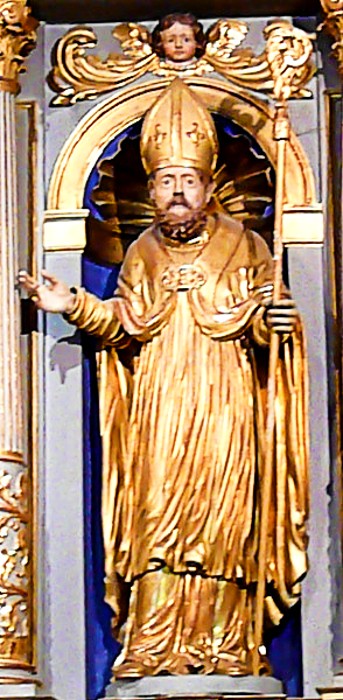
Saint of the Day – 1 July – Saint Fleuret of Estaing (Died c621) Bishop of Auvergne, France , Miracle-worker. Patronages – the blind, those with eye ailments, the lame and crippled, Estaing (modern Aveyron), France. Also known as – Fleuret of Auvergne.
The only known medieval narrative about our Saint is in the Estaing Breviary which says he was the Bishop of Auvergne, the Province north of Rouergue.
The local Abbot was returning with our Bishop from a Synod in Rome and invited him to stay in the village for a while. During this sojourn, a blind man was cured by washing his eyes in water which Fleuret had used and a lame man was enabled to walk, when the Saint gave him a piece of bread.
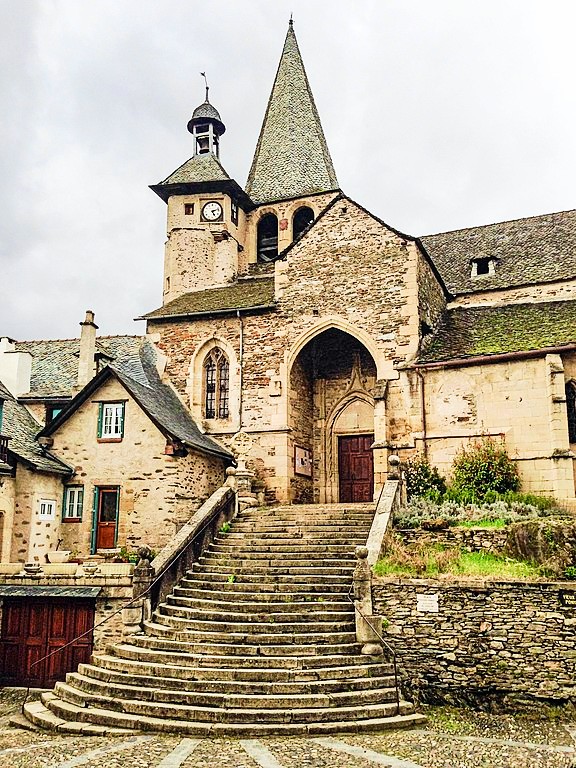
Local tradition summarised in literature at the Parish Church, has it that he converted the village to Christ by his preaching.
St Fleuret’s Parish Church
The people were amazed and encouraged the Bishop to extend his stay. He did,but after two weeks he took ill and died.
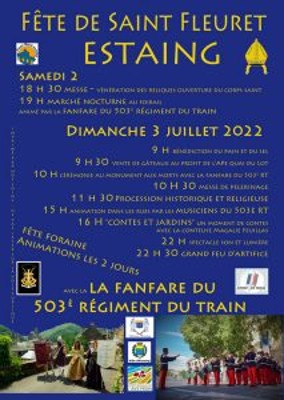
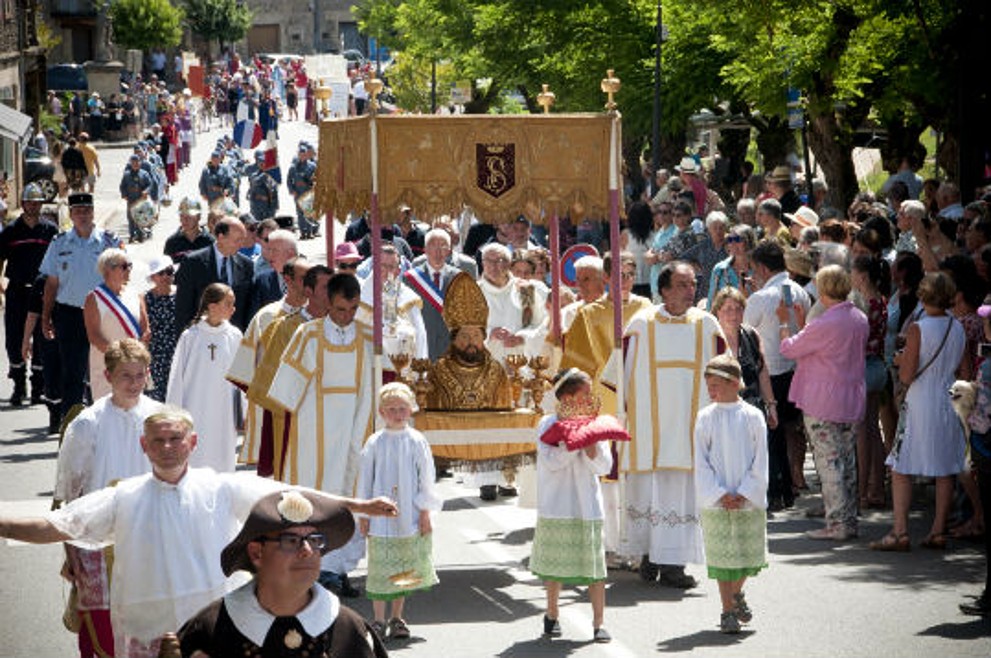
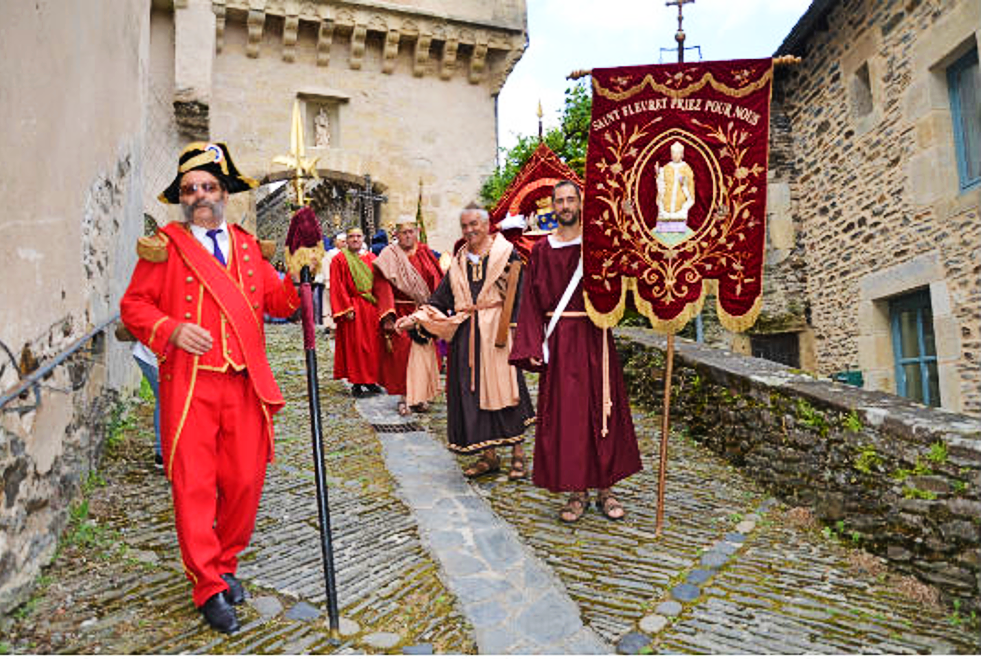
St Fleuret’s Procession in Estaing: According to tradition, St Fleuret, regional Bishop of Auvergne, stopped off at Estaing where he died in 621. St Fleuret’s cult has been attested since the 15th Century. In the 17th and 18th Centuries.
The festival was the occasion for the election of a youth king and a queen. This became more profane than religious, and was condemned by the Church. The Festival was restored in the 19th Century in the form that we now celebrate it as a symbolic, historical and religious tribute.
Every first Sunday of July the Procession of Saint Fleuret takes place. A parade representing Saints of Paradise, members of the Ecclesiastical hierarchy, Angels, Archangels, faithful of the old brotherhoods, pilgrims and the most illustrious characters of the Estaing family… accompanied by the clergy and the civil Officials.
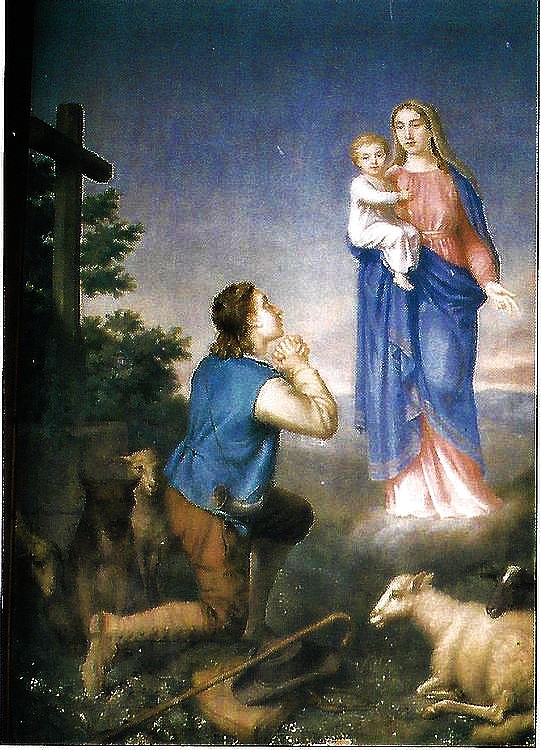
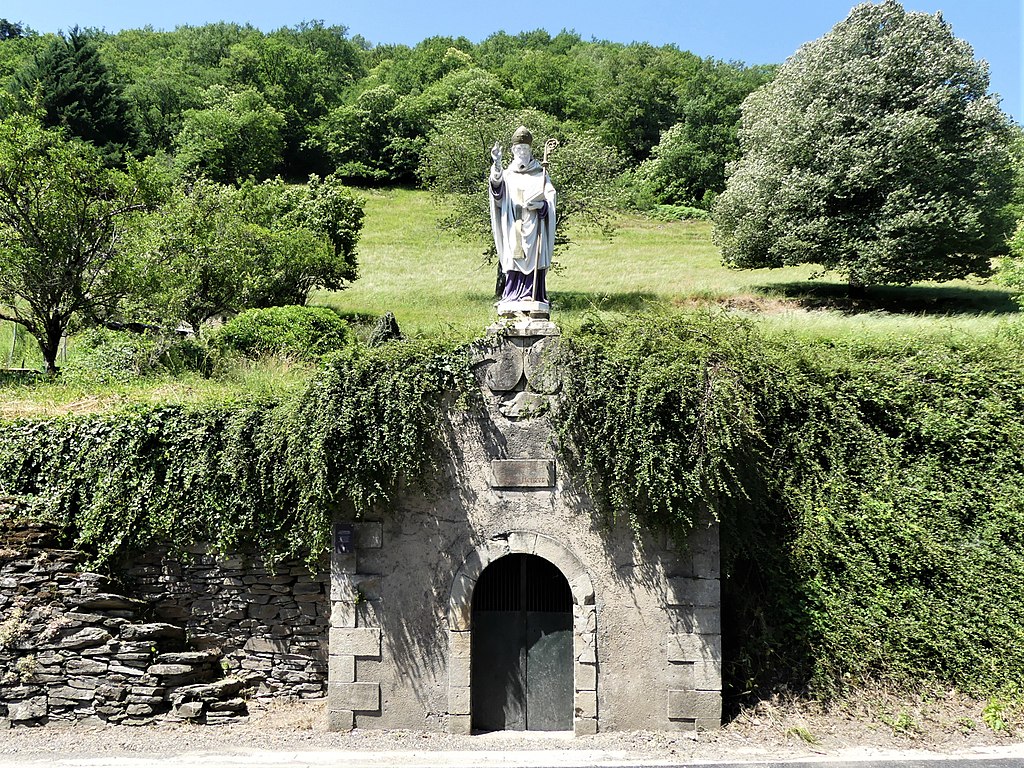
They venerate the Relics and the bust in gilded wood of St Fleuret which are carried all along the roads under the triumphal canopy and visiting St Fleuret’s miraculous spring (see below).

















 AnaStpaul
You must be logged in to post a comment.