Our Morning Offering – 3 June – Ember Saturday of Pentecost – “The Month of the Sacred Heart of Jesus” and First Saturday
To the Two Loving Hearts By St John Eudes (1601-1680)
O Jesus, only Son of God, only Son of Mary, I offer You the most loving Heart of Your divine Mother which is more precious and pleasing to You than all hearts.
O Mary, Mother of Jesus, I offer you the most adorable Heart of your well-beloved Son, who is the life and love and joy of your Heart.
Blessed be the Most Loving Heart and Sweet Name of Our Lord Jesus Christ and the most glorious Virgin Mary, His Mother, in eternity and forever. Amen
Saint of the Day – 3 June – St Clotilde of France (c475-545) Widow, Mother, Queen, Apostle of the poor and the sick. Born in c475 at Lyons, France and died on 3 June 545 at Tours, France of natural causes. Patronages – against death of children, adopted children, brides, exiles, parenthood, parents of large families, people in exile, queens, widows. Also known as – Chlodechildis, Chrodechildis, Clothilde, Clotichilda, Clotild, Clotilda, Clotildus, Croctild, Crotildes, Hlodihild, Hlotild, Hroþihildi, Rotilde.
The Roman Martyrology reads today: “At Paris, St Clotilde, Queen, by whose prayers her husband, King Clovis, was converted to the Faith of Christ.”
Clotilde was born in Lyon around 475, almost coinciding with the disappearance of the Roman Empire in the West (476). Even Roman Gaul had been disintegrating through the establishment of various independent Kingdoms by barbarian peoples, not infrequently rivals. With her birth she was already a Princess, as the daughter of King Childeric I, leader of the Burgundians, an eastern Germanic group which had arrived first on the left of the Rhine and then on the middle Rhone. However, in her life there would be the adverse fate of a painful series of tragedies and royal assassinations, among which she found salvation with a great faith in Christ Jesus.
In 481 her father was killed and then she, with her mother and older sister Croma, retired to Geneva. Together they gave themselves to a life of prayer and then of assistance to the needy. According to some stories, the young woman was also subjected to persecution and to the loss of her mother to assassination, until, through the Ambassadors, she received a proposal of marriage by Clovis, the young King of the Franks, another Germanic people who had settled in territories north of the Seine .
Clovis, who would become the progenitor of the Merovingians, was a pagan man, rather rude and irreligious. However, he gave his wife permission to Baptise each of his five children.. With the help and protection of the Bishop of Rheims, the future St Remigius, Clotilde was also beginning the slow but profound work of the moral conversion of her husband.
A true prodigy occurred in 496, when Clovis found himself forced to engage in battle against his enemies near Cologne. Fearing the worst, he called upon his wife’s God and emerged victorious. He then promised conversion to the Catholic Faith and on Christmas night of that year, he was Baptised in Rheims by the Bishop himself. Most of his subjects followed suit. This act was a success of Queen Clotilde, so important as to make France the “eldest daughter of the Church. ”
The Baptims of King Clovis I by St Remigius of Rheims
After his conversion, Clovis made friends with many Bishops, extending his power over a large part of France, which shortly after would have Paris as its Capital.
We also owe Clotilde the replacement of the three toads with three lilies in the shield of the French Monarchy, after she received one with the lilies as a gift from a mysterious hermit of the forest of Saint-Germain-en-Laye.
Widowed after twenty years of marriage, the Queen of France underwent many other poignant dynastic trials, until she retired to Tours, near the tomb of St Martinto whom she was particularly devoted. In that region she founded Churches and Monasteries, dedicating herself to penance and works of charity.
Clotilde died in Tours on 3 June 545. In later times, she was brought from that City as a virtuous and courageous Saint to the tomb in Paris, next to the bodies of Clovis and Saint Guinevere Patroness of the Capital . Her mortal remains were then cremated in 1793 to prevent revolutionary desecration. Now they rest in a Basilica dedicated to her and built between 1846 and 1856, where on 3 June of each year, the Saint is solemnly commemorated.
St Albert of Como St Athanasius of Traiannos St Auditus of Braga Bl Beatrice Bicchieri St Caecilius of Carthage St Clotilde of France (c475-545) Widow, Mother, Queen, Apostle of the poor and the sick. St Conus of Lucania St Cronan the Tanner St Davinus of Lucca Bl Diego Oddi St Gausmarus of Savigny St Genesius of Clermont St Glunshallaich St Hilary of Carcassone St Isaac of Córdoba
St Laurentinus of Arezzo St Liphardus of Orléans St Morand of Cluny St Moses of Arabia St Oliva of Anagni St Paula of Nicomedia St Pergentinus of Arezzo St Phaolô Vu Van Duong St Urbicius
Martyrs of Africa – 156 Saints: 156 Christians Martyred together in Africa, date unknown; the only other information to survive are some of their names – Abidianus• Demetria• Donatus• Gagus• Januaria• Juliana• Nepor• Papocinicus• Quirinus• Quirus.
Martyrs of Byzantium – 5 Saints: A group of Christians, possibly related by marriage, who were Martyred together. They were – Claudius, Dionysiu, Hypatius, Lucillian, Paul. They were Martyred in 273 in Byzantium.
Martyrs of Rome – 8 Saints: A group of Christians Martyred together. We know nothing else about them but the names – Amasius, Emerita, Erasmus, Lucianus, Orasus, Satuaucnus, Septiminus• Servulus. They were Martyred in Rome, Italy, date unknown.
Martyrs of Rome – 85+ Christians Martyred together in Rome, Italy, date unknown. The only details that have survived are some of their names –
Quote/s of the Day – 2 June – Pentecost Friday – Joel 2:23-24; 26-27, Luke 5:17-26 – Scripture search here: https://www.drbo.org/
“Thy sins are forgiven thee … Arise and walk.”
Luke 5:23
Prayer for Mercy and Forgiveness By St Macarius of Egypt (c 300-390)
Lord, be merciful now that my life is approaching its end and the evening awaits me. There is not enough time for me to cleanse myself of my sins, for they are so many. Heal me while I am still on earth and I shall be truly healthy. In Thy mercy, move me to repent, so that I shall not be ashamed, when I meet Thee in Heaven. Amen
“What evil can your enemy do to you which would be comparable to that, which you do to yourself? … If you let yourself go, in indignation and anger, you will be wounded, not because of the injury your enemy inflicted upon you but, from the resentment you feel because of it. So do not say: “He insulted me, he slandered me, he did a great number of wretched things to me.” The more you say he did evil things to you, the more you show that he did you good, since he gave you an opportunity to purify yourself of your sins. Thus, the more he offends you, the more he places you in a state of obtaining the forgiveness of your faults from God. For if we want, no-one can damage us; even our enemies are thus doing us a great service… So consider how many advantages you draw from an injury that is suffered humbly and gently!”
St John Chrysostom (347-407) Father and Doctor of the Church
“Then the righteous shall shine like the sun in the kingdom of their Father.” Matthew 13:43
“So from now on, run well (cf. Gal 5:7) and may the devil not bewitch you (cf Gal 3:1) nor hinder you! … May mercy, peace, charity, freedom from envy, from jealousy and ostentation come upon you, docility, friendly speech, solidarity, compassion towards each other, humility.”
St Theodore the Studite (759-826)
“By sin, O Jesus, I gave Thee Thy Death but I do not despair of Thy Forgiveness. Those Scourges call me, those Arms extended invite me that injured Heart offers me a secure shelter.”
St Gabriel Francis Possenti of Our Lady of Sorrows (1838-1862)
One Minute Reflection – 2 June – “The Month of the Sacred Heart of Jesus” – The Feast of the Martyrs Saints Marcellinus and Peter the Exorcist (Martyred in 304) – Joel 2:23-24; 26-27, Luke 5:17-26 – Scripture search here: https://www.drbo.org/
“Jesus knew their thoughts and said to them in reply, “What are you thinking in your hearts?” – Luke 5:22
REFLECTION – “Thanks to the faith of others the cripple’s soul would be cured before his body. “Seeing their faith,” the Gospel says. Note here, my brethren, that God is not interested in what foolish people want and does not expect to find faith among the ignorant … among those who conduct themselves badly. On the other hand, He does not refuse to come to the help of others’ faith. Such faith is a gift of grace, at one with God’s will … In His Divine Goodness, Christ the Physician, strives to draw to salvation, even in spite of themselves, those affected by sickness of soul, those whom the burden of their sins and offences overwhelms, even to delirium. Yet, they do not want to submit.
O my brethren, if only we wanted to, if only we all wanted to perceive our soul’s paralysis in all its depth! Then we would see that it is lying on a stretcher of sins, deprived of strength. Christ’s action within us, would be a source of light and we would understand that each day He sees our lack of faith, harmful as it is, that He draws us towards healing remedies and sharply presses our rebellious wills. “My son” He says, “your sins are forgiven you.”– St Peter Chrysologus (c 400-450) Bishop of Ravenna, Father and Doctor of the Church (Sermon 50 ; PL 52, 339).
PRAYER – O God, Who made thy blessed Martyrs, Marcellinus and Peter the Exorcist, glorious by their remarkable confession of Thy glory; grant, by their intercession and example, that Thy charity may continually increase in our hearts. Through Jesus Christ, Thy Son our Lord, Who lives and reigns with Thee, in the unity of the Holy Ghost, God, world without end. Amen (Collect). SACRED Heart of JESUS, I trust in Thee. 300 Days Indulgence Once a Day – Plenary, Once a month. Raccolta 175 – St Pius X, 19 August 1905 and 27 June 1906.
O Holy Spirit of God By Desiderius Erasmus Roterodamus (1466-1536) (Fr Erasmus of Rotterdam)
O Holy Spirit of God with Your holy breath, You purify the hearts and minds of humankind, comforting them, when they are in sorrow, leading them, aright when they have gone astray, kindling them, when their hearts are cold, reconciling them, when they are at variance and enriching them, with Your many gifts. By Your working, all things live. We make our prayer to You, maintain and day by day, increase, the gifts which You have granted us, so that with Your Light before us and within us, we may pass through this world, without stumbling and without straying. Who with the Father and the Son, are One God, now and forever. Amen
Fr Erasmus of Rotterdam was a Dutch Philosopher and Theologian who is considered one of the greatest scholars of the northern Renaissance. As a Catholic Priest, he was an important figure in classical scholarship who wrote in a pure Latin style.
Saint of the Day – 2 June – Saint Eugene I (Died 657) the 75th Bishop of Rome elected on 10 August 654 and died at Rome on 2 June 657 of natural causes, aged just 42. He was chosen to become Pope after the exile of Martin I by Emperor Constans II over the dispute regarding the Monothelitism Heresy.
Eugene was a Roman from the Aventine region along the Tiber, He was the son of Rufinianus and had become a cleric in the Church at an early age and spent his life in dedication to the Church.
His election to papacy came under unusual circumstances. His predecessor, Pope Martin I, was still alive and living in exile as a prisoner of Emperor Constans II. In fact, on 18 June 653, Constans troops forcibly carried Martin out of the City for refusing to submit to their demand o accept Monothelitism. This is a belief that Jesus had only one will and which is considered blasphemous by the Church.
At the time of his appointment, many Romans believed that Pope Eugene I was being placed on the Throne of St Peter as a pawn to do the Emperors’ will against the wishes of Pope Martin I. However, a letter sent by Martin shortly before his death indicated his approval of Eugene as his successor and Pope Eugene I’s actions,, once in power, demonstrated that he was no puppet of the Byzantine Emperor.
The challenges facing Pope Eugene I began as soon as he took power. Emperor Constans II immediately demanded that Eugene capitulate to the demands which Pope Martin had refused to do. These included acknowledging Peter as the Patriarch of Constantinople and allowing the tolerance of Monthelites. Despite threats to exile him like Martin and to roast him alive along with his Roman supporters, Pope Eugene I stood firm against the demands and refused to deny the Mysteries of the Faith
Emperor Constans II did not get the chance to make good on his threats against Pope Eugene I. The capture of the City of Rhodes in 654 and Constans’ defeat at the naval battle of Phoenix in 655 ,stopped his aggression towards the Church.
Pope Eugene I went onto lead the Church for another two years until his peaceful death at the young age of 42 of natural causes. Pope Eugene I consecrated 21 Bishops to serve throughout the world during his time as the Pope. He was buried at St Peter’s Basilica. St Eugene I was succeeded by Pope Vitalian.
The Cathedral of Saint Eugene, where Pope St Eugene I is the Patron Saint, is in the Diocese of Santa Rosa in California.
St Ada of Ethiopia St Adalgis of Thiérarche St Armin of Egypt St Barbarinus St Blandina the Slave St Bodfan of Wales St Daminh Ninh Bl Demetrios of Philadelphia St Dorotheus of Rome
St Eugene I (Died 657) Bishop of Rome elected on 10 Augugust 654, and died at Rome on 2 June 657 of natural causes, aged just 42. St Evasius Bl Giovanni de Barthulono
St Guido of Acqui (c 1004-1070) Bishop of Acqu in north-west Italy from 1034 until his death, zealous Reformer both in the lives of his clergy and his people. He built the Cathedral of Acqui amongst other religious buildings, including a Convent for Nuns. He donated his personal inheritance to the upkeep of the Diocese, the poor and for his building projects. Biography: https://anastpaul.com/2022/06/02/saint-of-the-day-2-june-saint-guido-of-acqui-c-1004-1070-patron-saint-against-famine/
St Honorata St Humatus St John de Ortega St Joseph Tien
St Photinus of Lyons St Rogate Bl Sadoc of Sandomierz St Stephen of Sweden
Martyrs of Lyons and Vienne: A group of 48 Christians from the areas of Vienne and Lyon, France, who were attacked by a pagan mob, arrested and tried for their faith, and murdered in the persecutions of Marcus Aurelius. A letter describing their fate, possibly written by Saint Irenaeus of Lyons, was sent to the churches in the Middle East. Only a few names and details of their lives have survived; some of them have separate entries on this date –
Alexander of Vienne
Attalus of Pergamos
Biblis of Lyons
Blandina the Slave
Cominus of Lugdunum
Epagathus of Lugdunum
Maturus the Novice
Photinus of Lyons
Ponticus of Lugdunum
Sanctius of Vienne
Vettius of Lugdunum They were martyred in assorted ways on on various during 177.
Martyrs of Sandomierz: A group of 49 Dominicans, some of whom received the habit from Saint Dominic de Guzman himself. They worked separately and together to bring the faith and establish the Dominican Order in Poland, basing their operations in and around Sandomierz. In 1260 they were all Martyred by the Tartars as they were singing the Salve Regina at Compline; the custom of singing the Salve Regina at the deathbed of Dominicans, stems from this incident. We know a few details about a few of the martyrs, but most survive only as names –
Devotion to the Sacred Heart is a wonderful expression of the Church’s piety and love for Christ, her Spouse and Lord: it calls for a fundamental attitude of conversion and reparation, of love and gratitude, apostolic commitment and dedication to Christ and His saving work.
Among the promises made by our Lord to St Margaret Mary was the assurance that, “Those who shall promote this devotion shall have their names written in my Heart, never to be blotted out.”
The Twelve Promises of Jesus to Saint Margaret Mary Alacoque (1647-1690) “Apostle of the Sacred Heart For those Devoted to His Sacred Heart:
I will give them all the graces necessary for their state of life.
I will establish peace in their families.
I will console them in all their troubles.
They shall find in My Heart an assured refuge during life and especially at the hour of their death.
I will pour abundant blessings on all their undertakings.
Sinners shall find in My Heart the source of an infinite ocean of mercy.
Tepid souls shall become fervent.
Fervent souls shall speedily rise to great perfection.
I will bless the homes where an image of My Heart shall be exposed and honoured.
I will give to Priests the power of touching the most hardened hearts.
Those who propagate this devotion shall have their names written in My Heart, never to be effaced.
The all-powerful love of My Heart will grant to all those who shall receive Communion on the First Friday of nine consecutive months, the grace of final repentance – they shall not die under my displeasure, nor without receiving their Sacraments. My Heart shall be their assured refuge at that last hour.
From Saint Margaret Mary Alacoque’s Vision of Jesus
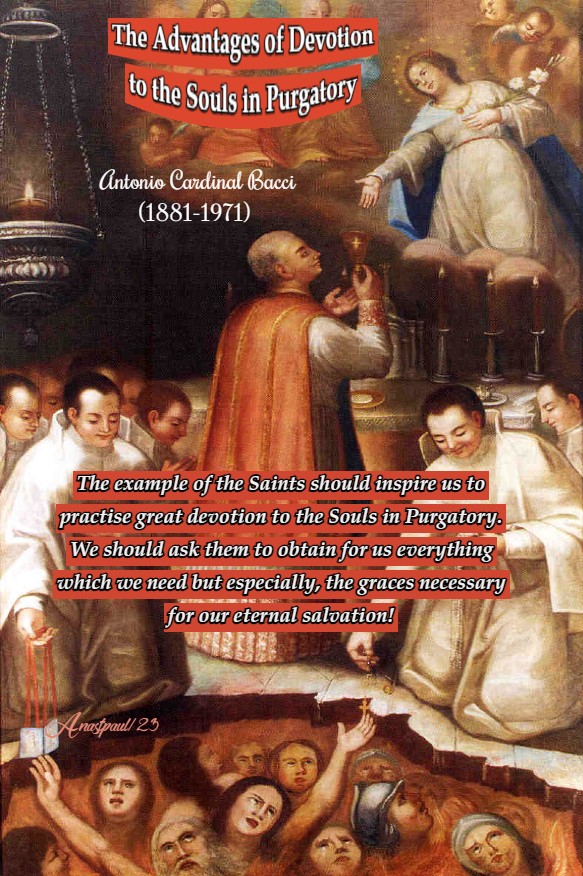
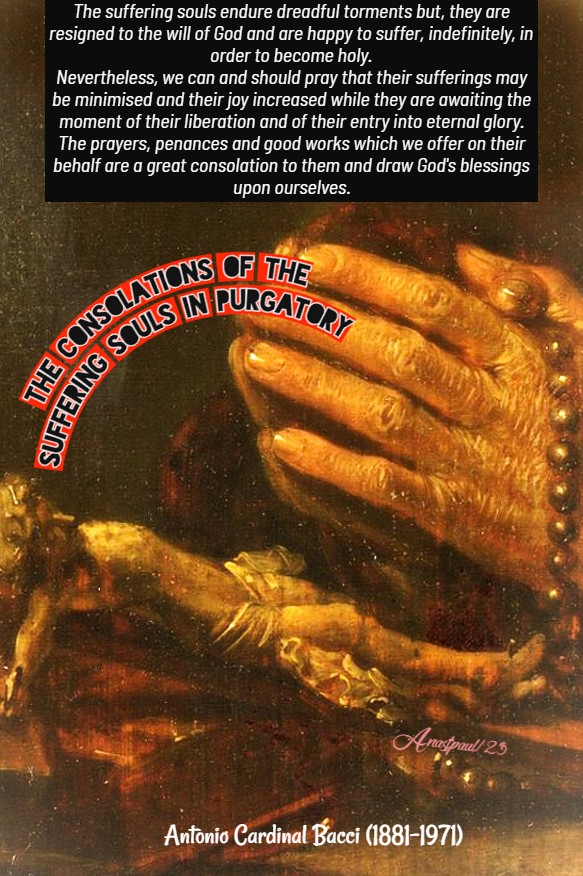
Thought for the Day – 1 June – Meditations with Antonio Cardinal Bacci (1881-1971)
Devotion to the Sacred Heart
“All devotions which have been approved by the Church are valuable because they are acts of religion which have as their object, the author of all holiness and source of all goodness. By these acts, God is adored, thanked and supplicated by His children who have been redeemed by the Precious Blood of Christ. Devotion to the Blessed Virgin and to the Saints, is also directed, ultimately, towards God, Who has endowed His faithful servants, especially the Mother of Jesus, with His gifts and graces and has established them as mediators by His Throne. Devotion to the Sacred Heart of Jesus, however, is not one of the many pious practices merely permitted or recommended by the Church. Fundamentally, it is a devotion which is essential for any Christians, insofar, as it is the cult of the love of God made man for our sakes.
We know that Christianity is the religion of love. “God is love and he who abides in love, abides in God and God in him” (1 Jn 4:16). Everything flows from God’s love for mankind – both the Creation and the Redemption, for God created us out of love and redeemed us with the love of His Only-begotten Son Who became man and died for us and, both the Old and the New Law, for the basis of the Old Law was “You shall love the Lord, your God, with all your heart and with all your soul and with all your strength,” (Deut 6:4) and the commandment of charity, was called by Jesus His own commandment, on which His entire teaching was based. The Sacraments, especially the Blessed Eucharist, have their origin in the same infinite love. So have the graces which God gives us, our justification, through the merits of our Redeemer and the final reward for which we hope in Heaven. Devotion to the Sacred Heart is the worship of this infinite love, of which, it is a living symbol.”
Antonio Cardinal Bacci
I am running out of the wondrous words of our beloved Cardinal Bacci. As many enriching writings as there are in our beautiful Faith, I have found none other as direct and powerful as he AND, most importantly, one who covers the entire Liturgical year. I will, therefore, introduce, where appropriate, other reflections but where no-one else, in my knowledge, has a suitable meditation, I will be re-visiting our dear Cardinal Bacci, i.e. starting from post one and perhaps highlighting a different quote than previously.
Quote/s of the Day – 1 June – The Memorial of St Angelica de Merici (1474-1540)
“As our Saviour says: “A good tree is not able to produce bad fruit.” He says: A good tree, that is, a good heart and a soul on fire with charity, can do nothing but good and holy works. For this reason Saint Augustine said: “Love and do what you will,” namely, possess love and charity and then do what you will. It is as if he had said: Charity is not able to sin.”
“We must give alms. Charity wins souls and draws them to virtue.”
“Disorder in society is the result of disorder in the family.”
One Minute Reflection – 1 June – “The Month of the Sacred Heart of Jesus” – Pentecost Thursday – Acts 8:5-8, Luke 9:1-6 – Scripture search here: https://www.drbo.org/
“And He sent them to preach the Kingdom of God …” – Luke 9:2
REFLECTION – “Since I came here, I have had no rest. I have been from village to village and every child not yet Baptised I have Baptised… But the children would not let me say my Office or eat or rest until I had taught them some prayers. It was then that I really began to feel that of such is the Kingdom of Heaven (Mk 10:14). I could not reject so religious a request without myself being irreligious. I made a start with the Sign of the Cross and taught them the Apostles’ Creed, the Our Father and the Hail Mary. I saw, immediately, that they were very intelligent. If only there were someone to train them in the principles of Christianity, I am sure that they would be extremely good Christians.
Very many out here fail to become Christians simply because there is no-one available to make them Christian. I have very often had the notion, to go round the universities of Europe and especially, Paris and to shout aloud everywhere, like a madman and to bludgeon those people who have more learning than love, with these words: “Alas! what an immense number of souls are excluded from Heaven through your fault and thrust down to hell!”
If only those people devoted themselves to this care in the way they do to literature. Then they would be able to render God an account of their doctrine and of the talents entrusted to them! Many of them, moved by this thought and helped by meditation on the things of God, would take pains to hear what the Lord is speaking in them and, putting aside their own selfish desires and worldly matters, would put themselves fully at God’s service and call. They would indeed cry from their soul: “Lord, here I am. What would you have me do? Send me wherever you wish, even as far as India.” – St Francis Xavier (1506-1552) Jesuit Missionary (Letters 4 and 5 to Saint Ignatius Loyola).
PRAYER – O God, Thou Who on this day have taught the hearts of the faithful by the Light of the Holy Spirit, grant us by that Holy Spirit Himself, to know what is right and ever to rejoice in His consolation. Through Jesus Christ, Thy Son our Lord, Who liveth and reigneth with Thee, in the unity of the same Holy Ghost, God, world without end. Amen (Collect). Sweet Heart of my JESUS, Make me love Thee ever more and more! – 300 Days Indulgence Once a day, Plenary Once a month – Blessed Pope Pius IX – 26 November 1876
Our Morning Offering – 1 June – “The Month of the Sacred Heart of Jesus”
O DIVINE Heart of JESUS Pope Leo XIII Indulgence 100 Days, Once a day Raccolta 167 13 March 1901.
O DIVINE Heart of JESUS, grant, we beseech Thee, eternal rest to the souls in purgatory, the final grace to those who shall die today, true repentance to sinners, the light of the faith to pagans and Thy Blessing to me and mine. To Thee, O most compassionate Heart of JESUS! I commend all these souls and I offer to Thee, on their behalf, all Thy merits, together with the merits of Thy most Holy Mother and of all the Saints, Angels and all the Sacrifices of the Holy Mass, Communions, prayers and good works, which shall be accomplished today, throughout the Christian world. Amen
Saint of the Day – 1 June – St Peter of Pisa (744–799) Deacon, Hermi, Poet, Linguist, Grammartician. Peter was born in Lombardy, in the first half of the 8th Century and died there too, around 799. Also known as – Petrus, Petrus Grammaticus.
We have little personal information of Peter. All we know is that in 776, after Charlemagne’s conquest of the Lombard Kingdom, Peter was summoned to the Carolingian Court along with Paul the Deacon and St Alcuin of York.
Peter had originally taught at Pavia, in Italy. Peter of Pisa was asked to be Charlemagne’s primary Latin teacher. Peter’s poetry provides a personal look at the workings of the innermost sanctum surrounding Charlemagne. Peter’s grammar texts provide insight into the transformation Latin education underwent in this period.
Already a mature man, he was Charlemagne’s honoured guest for several years and an integral part of his learned Court circle . Another Lombardian Saint Paulinus of Aquilrisa (c726-802) Priest, Theologian and a most eminent Scholar also joined our Peter in Charlemagne’s Court of learned teachers.
A close bond existed between Charlemagne and Peter and between Peter and Paulinus but Peter apparently was not much liked by either Einhard or St Alcuin of York. Peter seems to have been proud of Paulinus’ intellectual superiority over the others, including himself. He instructed Charlemagne in Latin grammar and probably read the Latin authors with him. Einhard mentions this fact and describes Peter as elderly.
It seems likely that both Peter and Paulinus brought manuscripts from Italy which kept Carolingian scribes busy for many years.
Like Paul the Deacon, Peter was important as a grammartician. In a manner typical of the 8th Century, he illustrated his teaching with writings of ancient pagan and Christian authors. His Book on Grammar is preceded by a dedication in elegiac verse stating that the work was composed “by Peter for love of his lord” and praising Charlesmagne as the Conqueror of the Lombards, builder of Churches, Converter of heathen and punisher of evildoers.
Peter returned to Italy around 790, where he lived as a hermit in prayer and fasting, seeking the Lord in solitude. Peter died there he in 799.
St Agapetus of Ruthenia Bl Alfonso Navarrete Benito Bl Arnald Arench Bl Arnold of Geertruidenberg St Atto of Oca St Candida of Whitchurch St Caprasius of Lérins St Clarus of Aquitaine St Claudius of Vienne Bl Conrad of Hesse St Conrad of Trier St Crescentinus St Cronan of Lismore St Damian of Scotland St Dionysius of Ruthenia St Donatus of Lucania St Felinus of Perugia Bl Ferdinand Ayala St Firmus St Fortunatus of Spoleto Bl Gaius Xeymon St Gaudentius of Ossero St Giuse Túc St Gratian of Perugia Bl Herculanus of Piegare St Iñigo of Oña St Ischryrion and Companions Bl James of Strepar Bl John Pelingotto Bl John Storey St Juventius Bl Leo Tanaka St Melosa St Pamphilus of Alexandria St Peter of Pisa (744–799) Deacon, Hermit St Porphyrius of Alexandria St Proculus of Bologna St Proculus the Soldier St Ronan St Secundus of Amelia St Seleucus of Alexandria St Simeon of Syracuse St Telga of Denbighshire St Thecla of Antioch
Blessed Teobaldo Roggeri (c1100-1150) Layman Shoemaker, Porter, Apostle of the poor and needy, Penitent, Pilgrim. The Roman Martyrology states of him today: “In Alba in Piedmont, Blessed Teobaldo, who, driven by love for poverty, gave all his possessions to a widow and became a porter out of a spirit of humility, to carry the burdens of others on himself.” Biography: https://anastpaul.com/2021/06/01/saint-of-the-day-1-june-blessed-teobaldo-roggeri-c-1100-1150/
St Thespesius of Cappadocia St Wistan of Evesham St Zosimus of Antioch
Martyrs of Alexandria – 5 Saints: A group five of imperial Roman soldiers assigned to guard a group of Egyptian Christians who were imprisoned for their faith in the persecutions of Decius. During their trial, they encouraged the prisoners not to apostatize. This exposed them as Christians, were promptly arrested and executed. Martyrs. Their names are – Ammon, Ingen, Ptolomy, Theophilis and Zeno. They were beheaded in 249 at Alexandria, Egypt.
Martyrs of Caesarea – 3 Saints: Three Christians Martyred together in the persecutions of Galerius. We know little more about them than the name – Paul, Valens and Valerius. They diedf in 309 at Caesarea, Palestine.
Martyrs of Lycopolis – 6 Saints: Five foot soldiers and their commander who were Martyred for their faith by order of the imperial Roman prefect Arriano during the persecutions of Decius. In Lycopolis, Egypt.
Martyrs of Rome – 6 Saints: A group of spiritual students of Saint Justin Martyr who died with him and about whom we know nothing else but their names – Carito, Caritone, Evelpisto, Ierace, Liberiano and Peone. In Rome, Italy.
Thought for the Day – 31 May – Meditations with Antonio Cardinal Bacci (1881-1971)
Pray for Us … at the Hour of Our Death
“O Mary, my tender Mother, be at my side throughout my life but especially at the hour of death. Shelter me beneath thy maternal mantle and never let me be far apart from thee. Grant that I may have a calm and peaceful death like thine own, a death made easy by a great love for Jesus and for thee, by the reception of the Holy Sacraments and by thy special blessing and presence, amen.”
Quote/s of the Day – 31 May – “The Month of the Blessed Virgin Mary” – The Queenship of Mary
“She is the eldest daughter of the Great King. If you enjoy her favour, she will introduce you to the Monarch of the Universe. No-one has so great an interest with Him than Mary, who was the occasion of His coming down from Heaven to become man, for the redemption of mankind.”
St John the Merciful (c 552-c 616)
“Just as Mary surpassed in grace all others on earth, so also, in Heaven, is her glory unique. If eye has not seen, nor ear heard, nor the human heart conceived what God has prepared for those who love Him (1 Corinthians 2:9), who can express, what He has prepared, for the woman who gave Him birth and who loved Him, as everyone knows, more than anyone else?”
St Bernard (1090-1153) The Last Father and Mellifluous Doctor of the Church
“The Angels rejoiced to see their Queen, the Apostles rejoiced to see their lady and both obeyed her, with loving devotion. … Therefore, when the Virgin of virgins was led forth by God and her Son, the King of kings. amid the company of exulting Angels and rejoicing Archangels, with the Heavens ringing with praise, the prophecy of the psalmist was fulfilled, in which he said to the Lord: At your right hand stands the Queen, clothed in gold of Ophir.”
One Minute Reflection – 31 May – “The Month of the Blessed Virgin Mary” – The Queenship of Mary – Eccli 24:5; 14:7; 14:9-11; 24:30-31, Luke 1:26-33 – Scripture search here: https://www.drbo.org/
“Hail, full of grace!”– Luke 1:28
REFLECTION – “The degeneration caused by sin had obscured the beauty of our original nobility. But when the mother of supreme Beauty is born, our nature finds its purity once more and sees itself moulded according to the perfect model, worthy of God (Gn 1:26)… We had all preferred the world below to that above. There no longer remained any hope of salvation. The state of our nature cried aloud to Heaven to come to the rescue… Then, at last, in His good pleasure, the world’s Divine Artificer determined to make a new world appear, a different world full of harmony and youth.
Now, was it not fitting, that a most pure virgin without stain, should place herself at the service of this mysterious plan, first of all?… And where was this virgin to be found if not in this woman, alone of her kind, chosen by the world’s Creator before all generations? Yes, she indeed is Mother of God, divinely named Mary, whose womb gave birth to God Incarnate and whom, He Himself, had supernaturally prepared as His temple…
In this way, then, the design of the Redeemer of our race was to bring about a birth and, as it were, a new creation to replace the one that went before. Therefore, just as in Paradise He had taken a little clay, out of the pure and spotless earth, to fashion the first Adam (Gn 2:7), so, at the moment of bringing about His own Incarnation, He made use of another earth, so to speak, namely this pure and immaculate Virgin, chosen from among all other beings He had created. It is in her that He, Adam’s Creator, has remade us in our very substance and become a new Adam (1 Cor 15:45) that the old might be saved by the new and eternal.” – St Andrew of Crete (660-740) Bishop, Father (Sermon 1 for the Nativity of the Mother of God).
PRAYER – Grant we beseech Thee, O Lord, that we who keep the Feast of the Blessed Virgin Mary, Our Queen, safe under her protection, may be worthy to have peace now and glory, in the future. Through Jesus Christ, Thy Son our Lord, Who lives and reigns with Thee, in the unity of the Holy Ghost, God, world without end. Amen (Collect).Through the same Jesus Christ, Thy Son our Lord, Who lives and reigns with Thee, in the unity of the Holy Ghost, God, world without end. Amen (Collect).
Our Morning Offering – 31 May – Pentecost Wednesday
Prayer for the Gifts of the Holy Ghost By St Bonaventure (1221-1274) Seraphic Doctor of the Church
We beg the All-Merciful Father through Thee, His Only-Begotten Son, made Man for our sake, Crucified and Glorified for us, to send upon us, from His treasure-house, the Spirit of Sevenfold Grace, Who rested upon Thee in all His fullness.
The Spirit of Wisdom, enabling us to relish the fruit of the tree of life, which is indeed Thyself. The Gift of Understanding, to enlighten our perceptions. The Gift of Prudence, enabling us to follow in Thine Footsteps. The Gift of Strength, to withstand our adversary’s onslaught. The Gift of Knowledge, to distinguish good from evil, by the light of Thine holy teaching. The Gift of Piety, to clothe ourselves with charity and mercy. The Gift of Fear, to withdraw from all ill-doing and live quietly in awe of Thy Eternal Majesty.
These are the things for which we petition. Grant them for the honour of Thy Holy Name, to which, with the Father and the Holy Ghost, be all honour and glory, thanksgiving, renown and Lordship, forever and ever. Amen
Saint of the Day – 31 May – St Petronilla (1st Century) Virgin Martyr. Born in the 1st Century as a Roman citizen and died in the same Century. Her Relics reside at Saint Peter’s Basilica Rome. Patronages – against fever, heirs of the Throne [Dauphins] of France, mountain travellers, treaties between Popes and Frankish Emperors, Acciano, Italy. Also known as – Petronilla of Rome, Aurelia Petronilla, Pernelle, Perolin, Perrenotte, Perrette, Perrine, Perronell, Petronella, Peyronne, Peyronnelle, Pierrette, Pérette, Périne, Pétronille.
The Roman Martyrology reads today: “In Rome in the cemetery of Domitilla on the Via Ardeatina, Saint Petronilla, Virgin and Martyr.”
As for many Saints of the early Christian era, even in this case there are conflicting reports or ‘Vitas.’ Also for Petronilla, despite the fact that she has had such a widespread cult, we have dubious legends about her.
What is certain is that she was buried in the Domitilla Cemetery near or within the underground Basilica of the Catacombs. Archaeological sources indicate the oldest testimony in a 4th Century fresco which still exists behind the apse of the underground Basilica, built by Pope Siricius between 390 and 395. The fresco depicts the blessed introduced into a paradise full of roses, held by the hand of a girl with her head covered and on whose side is written “Petronilla Mart(yr). ”
Fresco of the mid-4th Century, with the Martyr Petronilla on the right, leading a young woman named Veneranda into the garden of Paradise.
Petronilla is traditionally identified as the daughter of the Apostle St Peter, although this may stem simply from the similarity of their names. It is believed she may have been a converted by St Peter (and thus a “spiritual daughter”or his disciple or servant. It is said that Peter cured her of paralysis.
Many stories found in the writings of St Marcellus (and retold in The Golden Legend) say that Peter, who thought his daughter too beautiful, asked God to afflict her with a fever, of which he refused to cure her until she began to be perfected in the love of God.
She is said to have refused Count Flaccus’ hand in marriage. Traditions say she died a natural death but accounts of her Martyrdom can be found.
Petronilla is thought to have been Aurelia Petronilla, a scion of the gens Flavius, the family of Vespasian and Domitian. She was also related to St. Domitilla, who was exiled in the 1st Century to Pandateria, whose property on the Via Ardentina became a Catacomb Cemetary. Inscriptions there describe Petronilla as a Martyr.
During the Papacy of Siricius (384-399), a Basilica was built on the site of her tomb. In the 8th Century, Pope Gregory III established a place of public prayer in the Basilica and her Relics were translated o St Peter’s, where a Chapel was dedicated in her honour.
The Burial and Reception of St Petronilla into Heaven by Giovanni Francesco Barbieri (Guercino)
Emperors Charlemagne (died 814) and Carlomen (died 771) were considered adopted sons of St Peter and they, along with the French Monarchs who succeeded them, considered Petronilla their sister. Her Chapel became the Chapel of the Kings of France. Her emblem, like that of St. Peter, is a set of keys.
St Petronilla Statue on the Colonnade of St Peter’s Basilica, Rome
St Camilla Battista da Varano OSC (1458-1524) Virgin, Italian Princess, Poor Clare Nun and Abbess, Mystic, Spiritual Writer, Stigmatist. Both Saint Philip Neri and St Alphonsus Liguori recorded their admiration for her. On 8 April 1821 Pope Leo XIII approved the acts of the process for her Canonisation. She was Beatified by Pope Gregory XVI on 7 April 1843, following recognition of her long-standing public cult. On 4 February 1893 her writings were also approved. On 17 October 2010 Pope Benedict XVI Canonised her, along with five others. Biography: https://anastpaul.com/2020/05/31/saint-of-the-day-31-may-saint-camilla-battista-da-varano-osc-1458-1524/
St Crescentian of Sassari St Donatian of Cirta St Felice of Nicosia St Galla of Auvergne St Hermias of Comana
Blessed James Salomoni OP (1231-1314) Priest of the Order of Preachers, “Father of the Poor,” “Apostle of the Afflicted,” Miracle-worker graced with the ability to cure sickness. Patronages – cancer patients, of the sick. He died on 31 May 1314, in his eighty-third year. His relics now lie in the Basilica of Sts John and Paul in Venice. Devotion to Blessed James has been approved and encouraged by several Popes. In 1526 he was officiallt Beatified by Pope Clement VII Biography: https://anastpaul.com/2022/05/31/saint-of-the-day-31-may-blessed-james-salomoni-op-1231-1314-apostle-of-the-afflicted/
St Juan Moya Collado Bl Kasper Gerarz St Lupicinus of Verona St Mancus of Cornwall Bl Mariano of Roccacasale St Mechtildis of Edelstetten St Myrbad of Cornwall Bl Nicholaus of Vangadizza Bl Nicholaus of Vaucelles St Nowa Mawaggali St Paschasius of Rome St Petronilla of Rome (1st Century) Virgin Martyr St Silvio of Toulouse Bl Vitalis of Assisi St Winnow of Cornwall
Martyrs of Aquileia – 3 Saints: Three young members of the imperial Roman nobility and who were raised in a palace and had Saint Protus of Aquileia as tutor and catechist. To escape the persecutions of Diocletian, the family sold their property and moved to Aquileia, Italy. However, the authorities there quickly ordered them to sacrifice to idols; they refused. Martyrs all – Cantianilla, Cantian and Cantius. They were beheaded in 304 at Aquae-Gradatae (modern San-Cantiano) just outside Aquileia, Italy.
Martyrs of Gerona – 29 Saints: A group of Christians Martyred together in Gerona, Catalonia, Spain, date unknown. No details about them have survived but the names – • Agapia• Amelia• Castula• Cicilia• Donatus• Firmus• Fortunata• Gaullenus• Germanus• Honorius• Istialus• Justus• Lautica• Lupus
Martyrs of the Via Aurelia – 4 Saints: Four Christians Martyred together. No information about them has survived except their names – Justa, Lupus, Tertulla and Thecla. The martyrdom occurred in 69 on the Via Aurelia near Rome, Italy.
Thought for the Day – 30 May – Meditations with Antonio Cardinal Bacci (1881-1971)
Bearer of the Treasures of Grace
“The Apostles were completely transformed after the Feast of Pentecost. They had ben ignorant rustics, timid and vacillating. They had hardly understood at all, the lofty teachings of Christ, for they were hoping still for an earthly kingdom in which they would occupy the highest posts.
When they received the Holy Spirit, however, their minds were flooded with supernatural light and they became heroic in their resolution. Ignorant, though they had been, they became masters of Truth, far superior to the sages of Athens or the philosophers of Rome! They were no longer timid and hesitating but, fearlessly encountered the power of the Sanhedrin, the whips of the soldiery, the dangers of long voyages and, Martyrdom itself.
We too have received the illumination and favours of the Holy Spirit. Many times, when we have invoked Him, He has inspired and consoled us. But we may not have responded with the same fervour and self-denial as the Apostles. Let us remember that, to neglect God’s gifts, is to risk our eternal salvation!”
Quote/s of the Day – 30 May – The Memorial of St Joan of Arc (1412-1431) “The Maid of Orléans” Holy Virgin
“Go forward bravely. Fear nothing. Trust in God – all will be well.”
“All battles are first won or lost, in the mind!”
“It is better to be alone with God. His Friendship will not fail me, nor His Counsel, nor His Love. In His Strength, I will dare and dare and dare, until I die.”
One Minute Reflection – 30 May – “Pentecost Tuesday – Acts 8:14-17, John 10:1-10 – Scripture search here: https://www.drbo.org/
“I am the Door. By Me, if any man enter in, he shall be saved and he shall go in and go out and shall find pastures.” – John 10:9
REFLECTION – “I am the Door of the sheep” our Lord says He is the Door of the sheepfold. Now what is this sheepfold, the pen into which Christ is the Door? It is the Father’s Heart, into which and of which, Christ, Who has unsealed and opened for us, the Heart hitherto closed to humankind, is indeed our most lovable Door. All the Saints are gathered inside this fold. The Shepherd is the eternal Word; the Door, the humanity of Christ – by the sheep in this house, we understand human souls. But Angels, too, belong to the sheepfold… the Holy Ghost is the Doorkeeper… because all Truth, understood and expressed, comes from Him…
O with what love and goodness He opens the Door of the Father’s Heart to us and grants us access, unceasingly, to the hidden treasure, the inmost dwelling places and all the wealth, of this house! No-one could imagine or comprehend, how welcoming God is, always ready to receive, yes, longing and thirsting to do so and how He precedes us at every moment and each hour… O my children, how obstinately deaf we remain, to this loving invitation… so often we refuse Him our acceptance of this invitation! How many of the Holy Ghost’s summons and appeals are repulsed; we refuse them on the grounds of all kinds of things here below. So often we want something else and not the place God where wants us!” – Fr Johnnes Tauler OP (c1300-1361) Dominican Friar, renowned Preacher and Theologian , leaving us more than 80 sermons. (Sermon 27, 3rd for Pentecost).
PRAYER – Let the power of the Holy Ghost be present within us, O Lord, graciously to cleanse our hearts and to guard us from all harm. Through Jesus Christ, Thy Son our Lord, Who liveth and reigneth with Thee, in the unity of the same Holy Ghost, God, world without end. Amen (Collect).
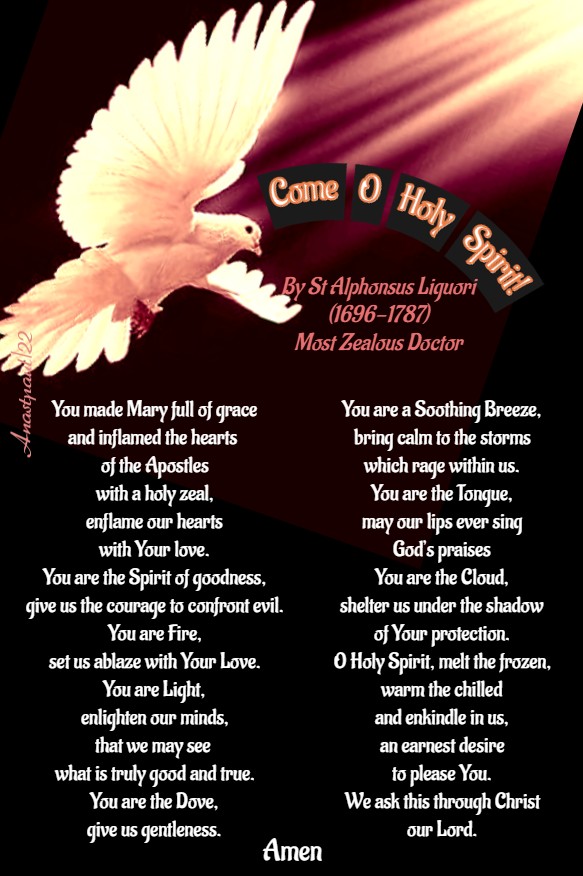
Come O Holy Spirit! By St Alphonsus Liguori (1696-1787) Most Zealous Doctor
You made Mary full of grace and inflamed the hearts of the Apostles with a holy zeal, enflame our hearts with Your love. You are the Spirit of goodness, give us the courage to confront evil. You are Fire, set us ablaze with Your Love. You are Light, enlighten our minds, that we may see what is truly igood and true. You are the Dove, give us gentleness. You are a Soothing Breeze, bring calm to the storms which rage within us. You are the Tongue, may our lips ever sing God’s praises You are the Cloud, shelter us under the shadow of Your protection. O Holy Spirit, melt the frozen, warm the chilled and enkindle in us, an earnest desire to please You. We ask this through Christ our Lord. Amen
Saint of the Day – 30 May – Blessed Thomas Cottam SJ (1549-1582) Priest of the Society of Jesus, Martyr. Born in 1549 in Dilworth, Lancashire, England and died by being hanged on 30 May 1582 at Tyburn, London, England – another victim of Elizabeth I’s reign of terror. Additional Memorials – 29 October as one of the Martyrs of Douai, 1 December as one of the Martyrs of Oxford University.. Blessed Thomas was Beatified on 29 December 1886 by Pope Leo XIII .
Thomas Cottam was sentenced to death at the same trial as St Edmund Campion but had to wait six months to follow his more famous companion to Martyrdom. His ministry was very limited because English spies in France targeted him before he even left for England and he was arrested as soon as he arrived.
Thomas was born of Protestant parents and received a good education, earning a Bachelor’s Deegree from Oxford in 1569. He became a schoolmaster in London, where he also became a Catholic and was encouraged to become a Priest. In May 1577 he left England for Flanders to attend the English College at Douai. After he was Ordained a Deacon, he travelled to Rome and entered the Society in April 1579. He wanted to become a missionary to India but became ill so his Physician suggested that he first return north to recover his health.
A brief stay in Lyons, France, did not improve his physical condition but it set the stage for his eventual arrest because he met there a man named Sledd, an Englishman who sought to identify Priests who would be returning to England. Sledd pretended to befriend the young Jesuit and travelled with him as far as Rheims before leaving him to give the English Ambassador in Paris a detailed description of Thomas.
Thomas was Ordained a Priest at Soissons, France, on 28 May 1580 and departed for England a week later. Port authorities were waiting to arrest him because of the information from Sledd and they recognised the young Jesuit Priest immediately. Thomas was able to escape because the lawyer who was responsible for accompanying him to London, allowed him to get away. That act of kindness put the lawyer in peril, so Cottam turned himself in, to save the lawyer.
He was charged with being a Priest, which led to his imprisonment in the Tower of London where he suffered horrible tortures. He was tried along with Father Campion and condemned to die but he had to wait six more months for the sentence to be executed. On 30 May 1582, Thomas and three Diocesan Priests were dragged to Tyburn to be hung and quartered. The Jesuit had to watch his three companions die before his own turn came. Afterwards the four bodies were cast into vats of boiling water so that bystanders could not take relics.
St Pope Felix I (Died 274) Martyr, the 26th Bishop of Rome from 5 January 269 to his death in 274. The Roman Martyrology reads: “At Rome on the Aurelian road, the birthday of St Felix, Pope and Martyr, who was crowned with Martyrdom under the Emperor Aurelian.” His Life and Death: https://anastpaul.com/2022/05/30/saint-of-the-day-30-may-saint-felix-i-died-274-pope-martyr/
St Ferdinand III of Castile (1199-1252) King of Castile and Toledo, Knight, a man of great virtue and goodness who sought sanctity in all things, a man of great justice who sought to elevate even those he conquered, a man who was a great father, bringing his children up in the fear and love of God alone, a diplomatic genius because of his great goodness, a unifier of all, he had a great devotion to Our Lady – born in 1198 near Salamanca, Spain and died on 30 May 1252 at Seville, Spain of natural causes. Patronages – authorities, governors, rulers, engineers, large families, magistrates, parenthood, paupers, poor people, prisoners, Spanish monarchy, tertiaries, Seville, Spain The Life of the Holy St Ferdinand: https://anastpaul.com/2020/05/30/saint-of-the-day-30-may-st-ferdinand-iii-of-castile-1199-1252/
St Joan of Arc (1412-1431) “The Maid of Orléans” Holy Virgin. The Church officially remembers Joan of Arc not as a Martyr but as a Virgin—the Maid of Orleans. Of course, Joan was a Martyr, but not in the technical sense. Yes, she died because she did what she thought God wanted her to do. But she was killed for her politics, not for her faith. Pagans did not execute her for refusing to worship their gods. Infidels did not slay her for defying them. Political enemies burned her at the stake for defeating them at war. St Joan! https://anastpaul.com/2018/05/30/saint-of-the-day-30-may-st-joan-of-arc-1412-1431/ AND: https://anastpaul.com/2017/05/30/saint-of-the-day-30-may-st-joan-of-arc/
St Anastasius II of Pavia St Basil the Elder St Crispulus of Sardinia Bl Elisabeth Stagel St Emmelia St Euplius St Exuperantius of Ravenna St Gamo of Brittany St Gavino of Sardinia St Isaac of Constantinople Bl Lawrence Richardson St Luke Kirby St Madelgisilus St Reinhildis of Riesenbeck St Restitutus of Cagliari Bl Richard Newport Blessed Thomas Cottam SJ (1549-1582) Priest of the Society of Jesus, Martyr St Venantius of Lérins St Walstan of Bawburgh Bl William Filby Bl Willilam Scott
Martyrs of Aquileia – 3 Saints: Three Christians Martyred together. We have no other details than their names – Cantianus, Euthymius and Eutychius. Aquileia, Italy.
Thought for the Day – 29 May – Meditations with Antonio Cardinal Bacci (1881-1971)
The Great Exile
“Holy Mary my Mother, grant that God may rule my mind and that thou may be always in my thoughts. Help me to live always in the Presence of God and to dedicate all my thoughts, desires ands affections to Him. Grant that all the actions of my poor life, may be in accordance with His Holy Will. Amen”
“These Gifts are not only inseparable from charity but they are, the principal virtues, properties and qualities of charity.
WISDOM is nothing else, than the love which relishes, tastes and experiences, how sweet and gentle God is.
UNDERSTANDING is nothing else, than love attentive to consider and penetrate the beauty of the truths of faith.
KNOWLEDGE is simply the same love keeping us attentive to know ourselves and creatures, to obtain a more perfect knowledge of the service we owe to God.
COUNSEL is also love, as it renders us careful, attentive and skilled in choosing the means proper to serve God in a holy manner.
FORTITUDE is love which encourages and animates the heart, so as to carry out, that which Counsel has determined must be done.
PIETY is the love which sweetens labour and makes us, with good heart, gratitude and filial affection, do works that please God our Father.
FEAR is simply love as it causes us to fly and shun what is displeasing to God’s majesty.” (Treatise on the Love of God, Book 11, Chapter 15)
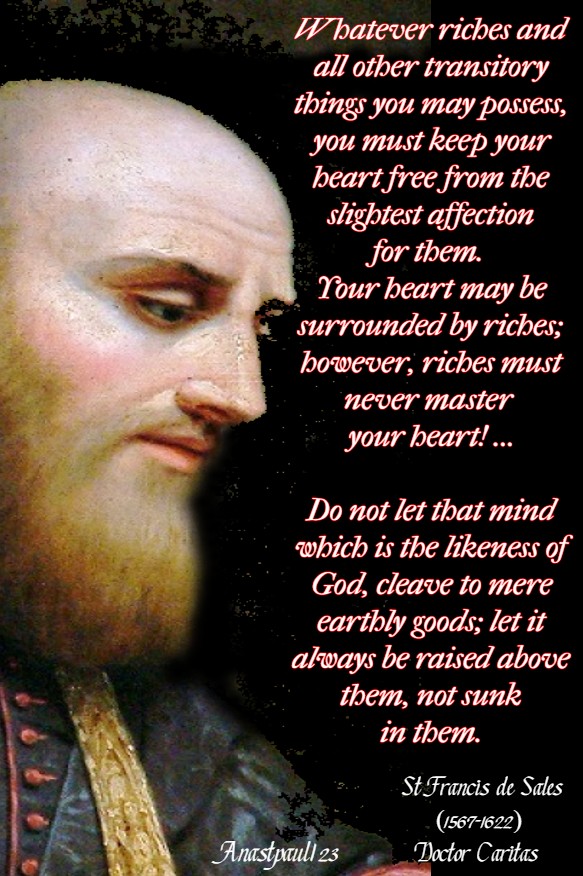
St Francis de Sales (1567-1622) Doctor of the Church
You must be logged in to post a comment.