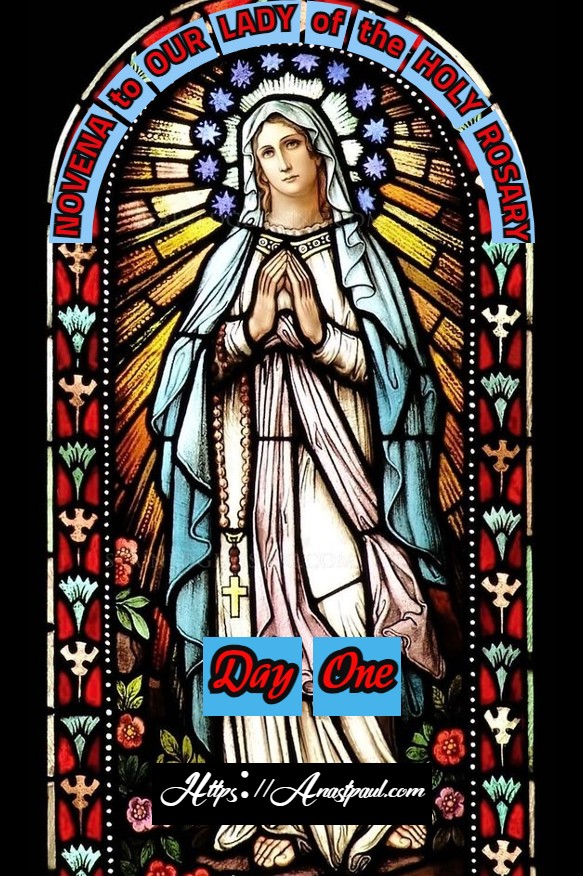
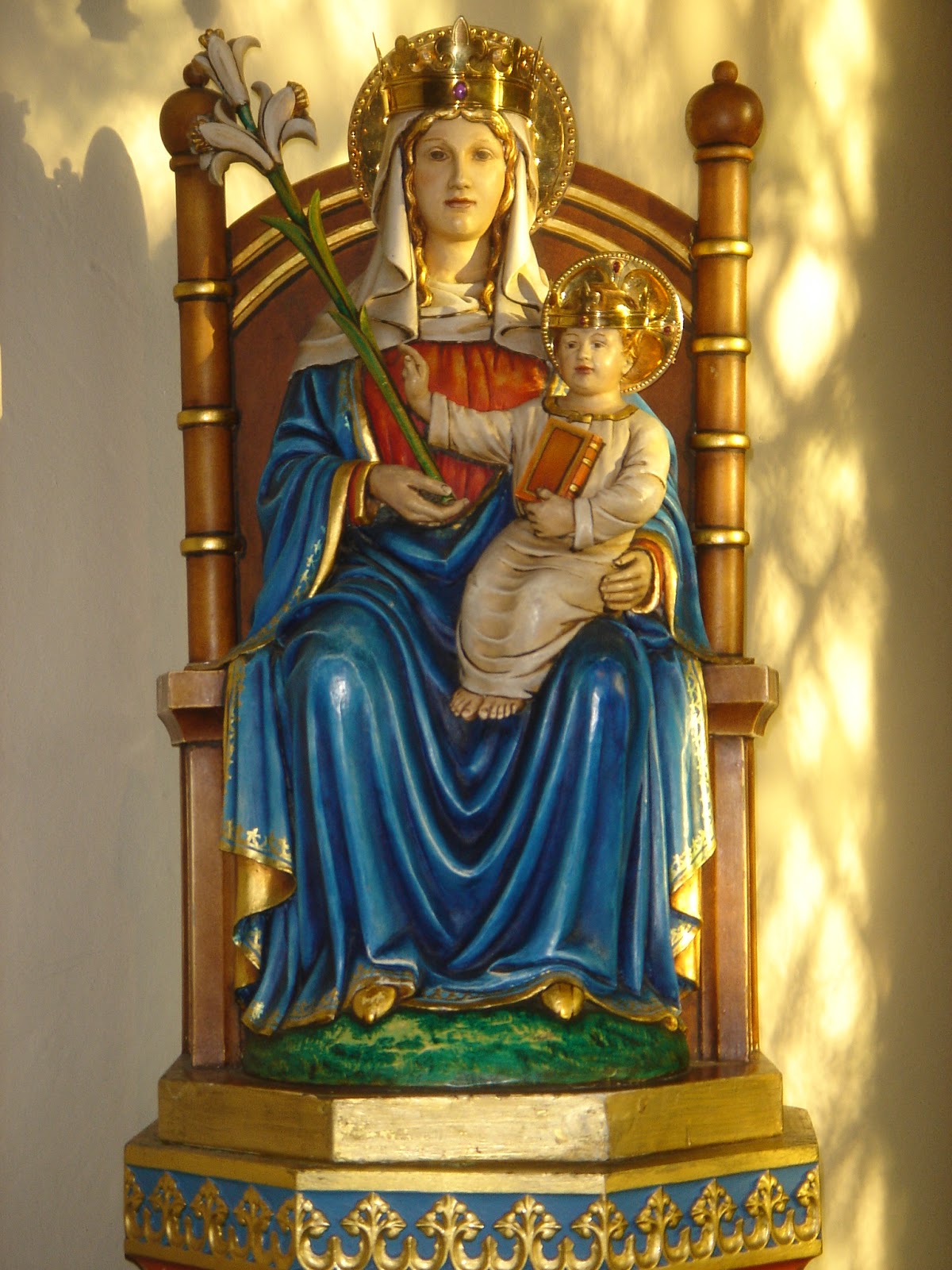
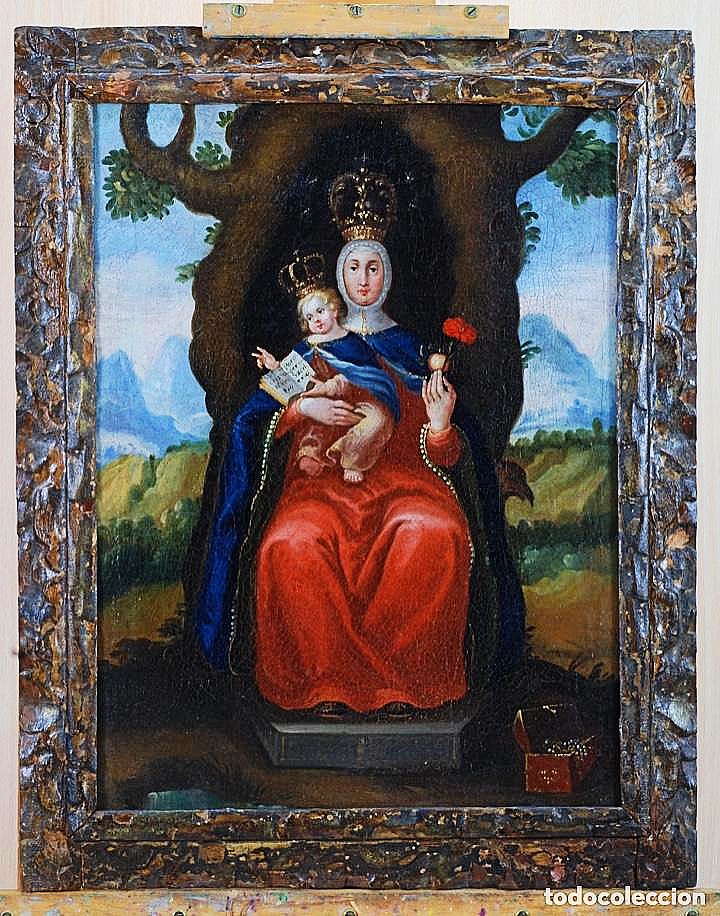
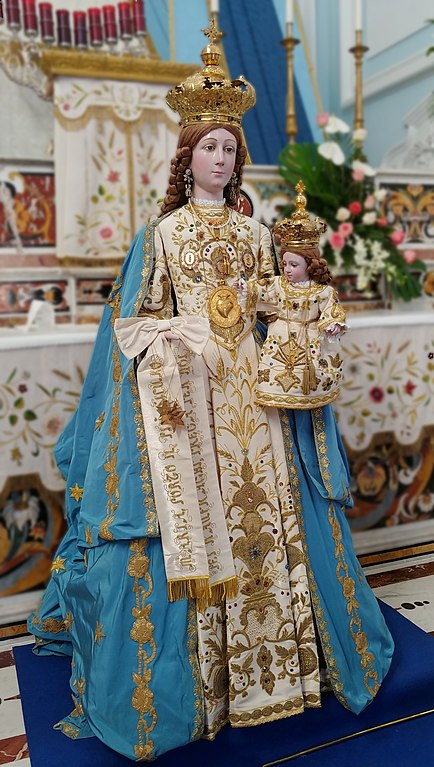
Novena to the Immaculate Heart of Mary, Queen of the Most Holy Rosary
By Father Joseph Cacella, 1947
FIRST DAY
Intention:
Reparation to the Immaculate Heart of Mary
Oh Immaculate Heart of Mary, Mother of Jesus, Our Lady of Fatima, Our Lady of the Holy Rosary, inspire me to grieve sincerely, for the sins which weigh heavily upon the souls of men.
Sorrowfully I recall the bitter and harsh punishments heaped upon thy Divine Son, when He was cruelly scourged at the pillar, unmercifully crowned with thorns. I recall His sad journey to Calvary, His Crucifixion and ignominious death on the Cross. Yet, they were but the instruments of pain. It was my sins which really caused His Precious Blood to be shed. His excessive love willed that He should suffer for my salvation. Thus, I will give my little love to make amends and atone for a thoughtless and unappreciative world.
Oh Immaculate Heart of Mary, thy who suffered and shared with Him each pain caused and inflicted by our sins, intercede for us that we may be privileged to unite our hearts with thine in an effort to make reparation for our sins and the sins of ungrateful mankind. Amen.
Our Lady of Fatima inflame our hearts with the love of Reparation.
Pray your Daily Rosaryafter each Day’s Novena Prayer with the same Intention.
It is no fallacy, or historical legend that the Cape can be rocked by frightening storms. From Sunday 24 September until Tuesday night (27th) record gale force winds and rainfall wrecked havoc across the Cape from Table Bay, up the coastal areas, on both sides and inland, with rivers bursting their banks, flooding nearby areas, bridges and roads being submerged and much, much more.
Naturally there has been extensive damage to the infrastructure, as well as to private homes. Many towns and villages were cut off completely and, of course, suprise, suprise, power lines were extensively damaged. There have also been reports of missing people – let us pray for their safe recovery.
For nearly 3 days we were without power. Unfortunately my auxiliary power supply was no match for this extreme and extended outage – once again! I must find and work towards a better solution for the future.
Many thanks to God for bringing me back safely to Breathing Catholic and in time to begin the Novena to Our Lady of the Rosary.Let us not forget to mention those who have lost their homes, possessions, means of earning a living and motor vehicles and those who are still reported as missing. Thank you for your patience and loving support – Deo Gratias! 🙏💘 Ana
Our Morning Offering – 26 September – “Month of The Seven Sorrows of the Blessed Virgin Mary and The Holy Cross”
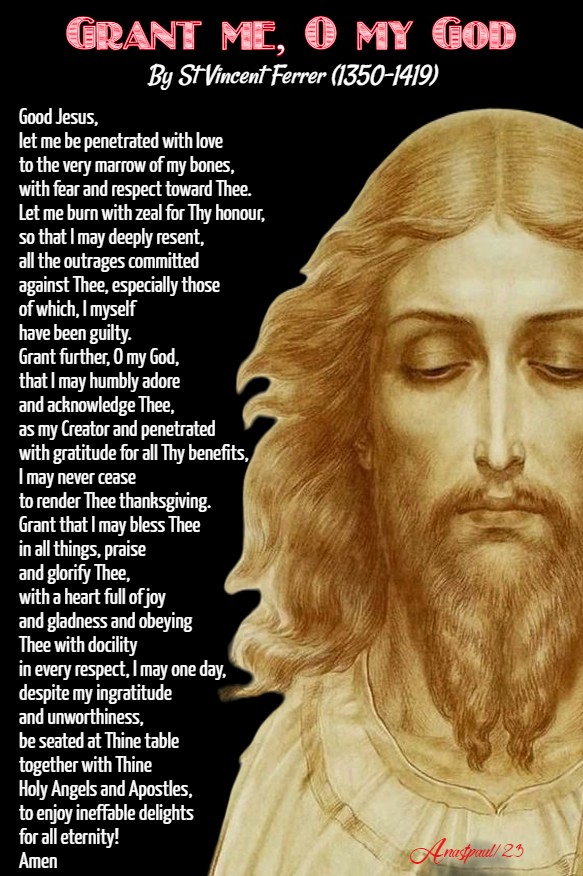
Grant me, O my God By St Vincent Ferrer (1350-1419)
Good Jesus, let me be penetrated with love to the very marrow of my bones, with fear and respect toward Thee. Let me burn with zeal for Thy honour, so that I may deeply resent, all the outrages committed against Thee, especially those of which, I myself have been guilty. Grant further, O my God, that I may humbly adore and acknowledge Thee, as my Creator and penetrated with gratitude for all Thy benefits, I may never cease to render Thee thanksgiving. Grant that I may bless Thee in all things, praise and glorify Thee, with a heart full of joy and gladness and obeying Thee with docility in every respect, I may one day, despite my ingratitude and unworthiness, be seated at Thine table together with Thine Holy Angels and Apostles, to enjoy ineffable delights for all eternity! Amen
Thought for the Day – 25 September – Meditations with Antonio Cardinal Bacci (1881-1971)
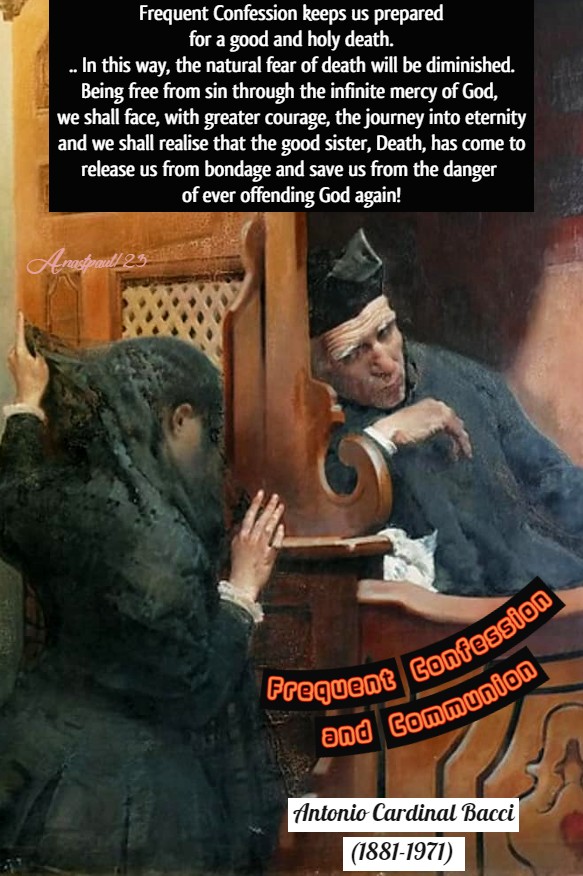
Frequent Confession and Communion
“Frequent Confession keeps us prepared for a good and holy death. We do not know when our lives will end and, therefore, it is necessary to keep ourselves pure and free from sin in the sight of God. We know that death will come to us when we least expect it, as the Gospel assures us and it will come like a thief. It is necessary to be always ready for the great encounter with our Eternal Judge.
In this way, the natural fear of death will be diminished. Being free from sin through the infinite mercy of God, we shall face, with greater courage, the journey into eternity and we shall realise that the good sister, Death, has come to release us from bondage and save us from the danger of ever offending God again!”
Quote/s of the Day – 25 September – Ferial Day, the 17th Sunday after Pentecost – Ephesians 4:1-6, Matthew 22:34-46 – Scripture search here: https://www.drbo.org/
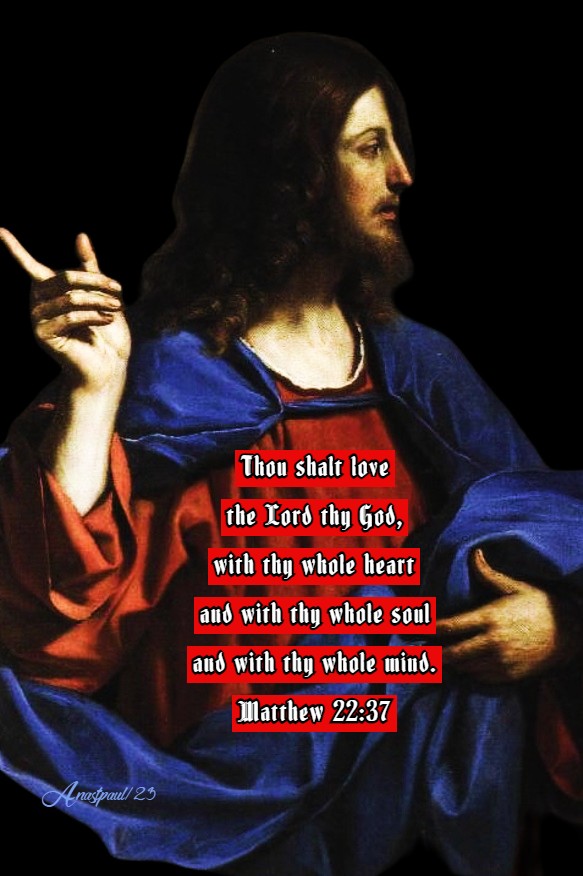
“Thou shalt love the Lord thy God, with thy whole heart and with thy whole soul and with thy whole mind.”
Matthew 22:37
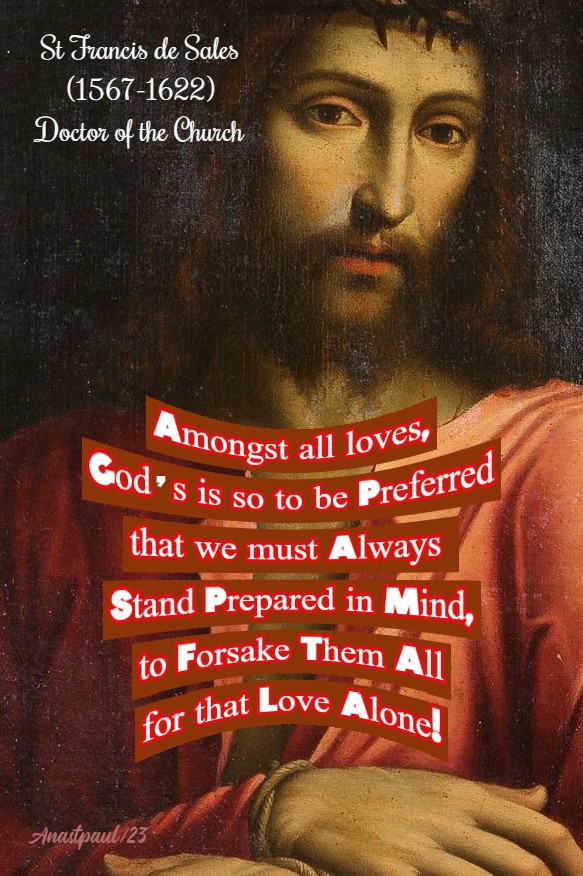
“Amongst all loves, God’s is so to be preferred that we must always stand prepared in mind, to forsake them all for that alone!”
(Treatise on the Love of God, Book 10, Chapter 7)
St Francis de Sales (1567-1622) Doctor of the Church
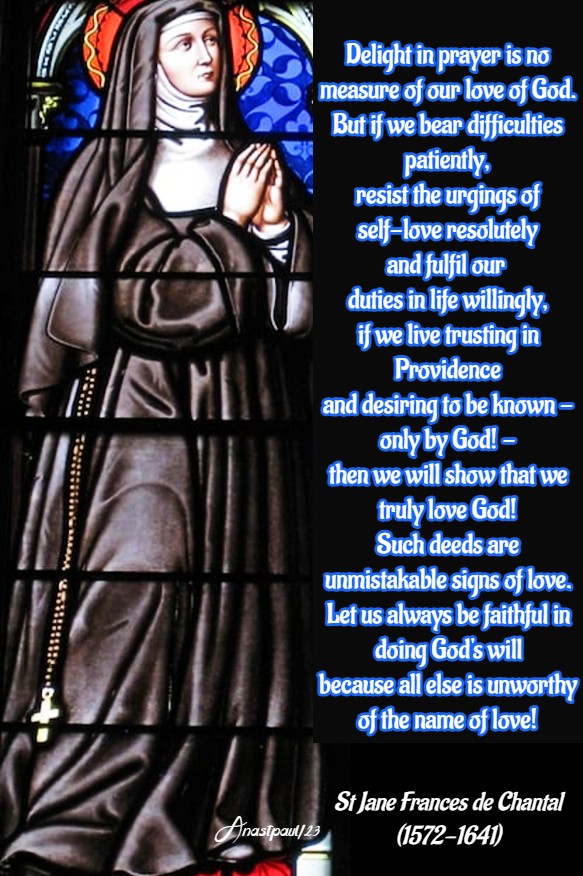
“Delight in prayer is no measure of our love of God. But if we bear difficulties patiently, resist the urgings of self-love resolutely and fulfil our duties in life willingly, if we live trusting in Providence and desiring to be known – only by God! – then, we will show that we truly love God! Such deeds are unmistakable signs of love. Let us always be faithful in doing God’s will because, all else, is unworthy of the name of love!”
St Jane Frances de Chantal (1572-1641)
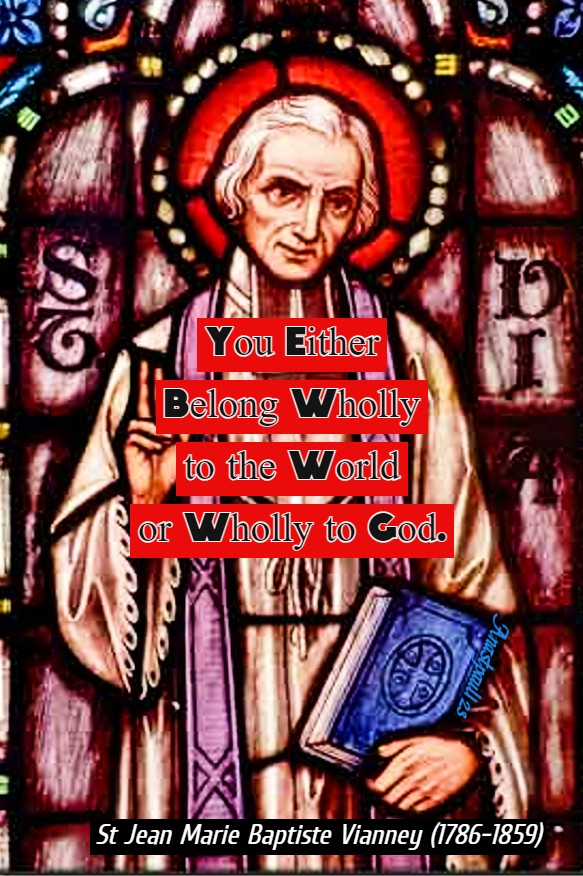
“You either belong wholly to the world or wholly to God.”
St Jean Marie Baptiste Vianney (1786-1859)
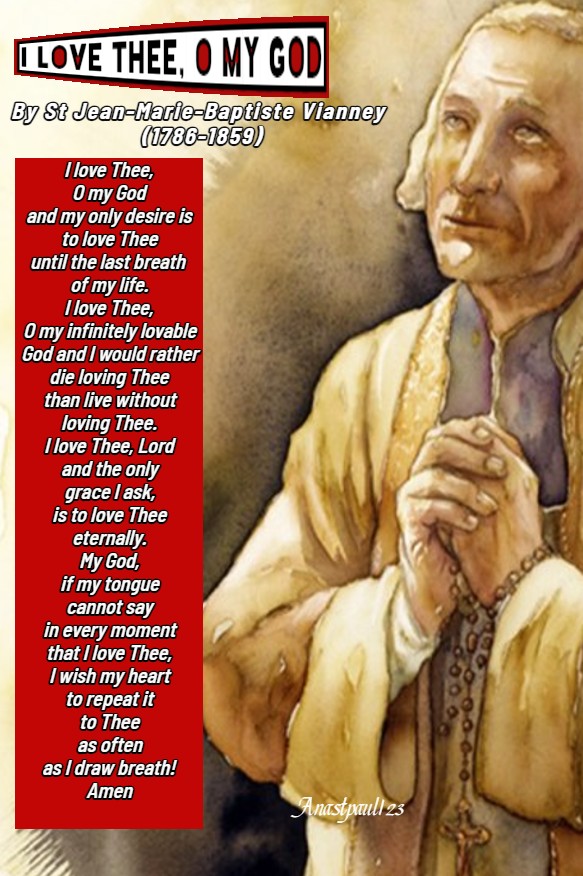
I Love Thee, O My God By St John Vianney (1786-1859)
I love Thee, O my God and my only desire is to love Thee until the last breath of my life. I love Thee, O my infinitely lovable God and I would rather die loving Thee than live without loving Thee. I love Thee, Lord and the only grace I ask, is to love Thee eternally. My God, if my tongue cannot say in every moment that I love Thee, I wish my heart to repeat it to Thee as often as I draw breath! Amen
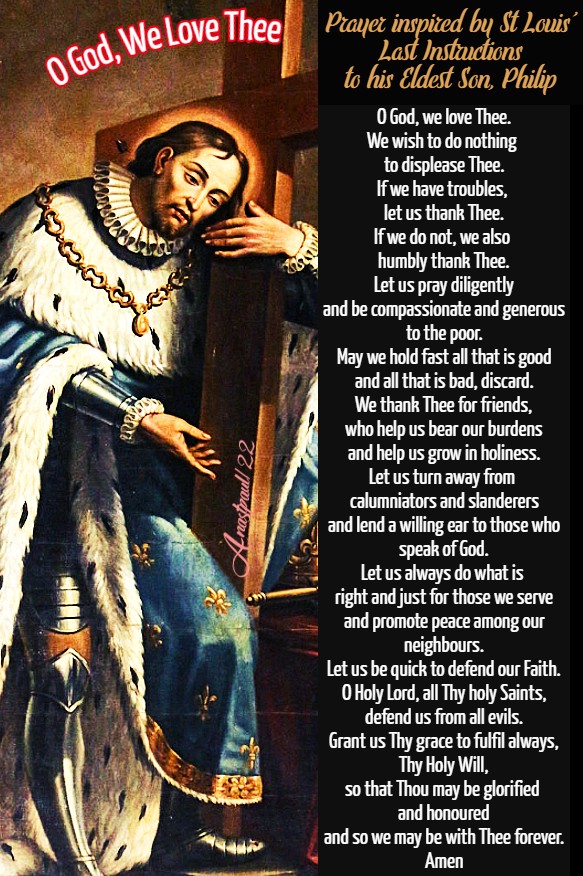
O God, We Love Thee Prayer inspired by St Louis’ Last Instructions to his Eldest Son, Philip (Perhaps Philip prayed thus)
O God, we love Thee. We wish to do nothing to displease Thee. If we have troubles, let us thank Thee. If we do not, we also humbly thank Thee. Let us pray diligently and be compassionate and generous to the poor. May we hold fast all that is good and all that is bad, discard. We thank Thee for friends, who help us bear our burdens and help us grow in holiness. Let us turn away from calumniators and slanderers and lend a willing ear to those who speak of God. Let us always do what is right and just for those we serve and promote peace among our neighbours. Let us be quick to defend our Faith. O Holy Lord, all Thy holy Saints, defend us from all evils. Grant us Thy grace to fulfil always, Thy Holy Will, so that Thou may be glorified and honoured and so we may be with Thee forever. Amen
One Minute Reflection – 25 September – “Month of The Seven Sorrows of the Blessed Virgin Mary and The Holy Cross” – St Vincent Strambi CP (1745-1824) Bishop, Priest of the Passionist Order of St Paul of the Cross – Ferial Day, the 17th Sunday after Pentecost – Ephesians 4:1-6, Matthew 22:34-46 – Scripture search here: https://www.drbo.org/
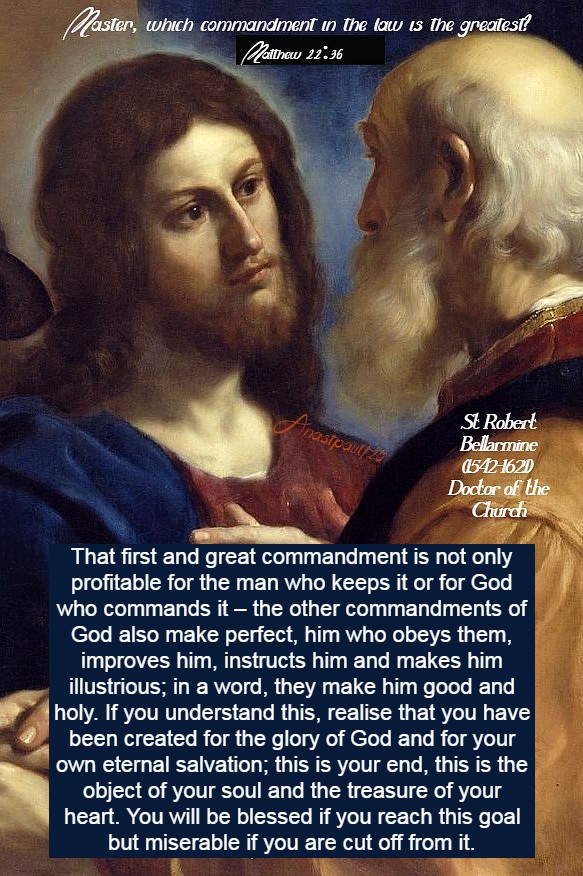
“Master, which commandment in the law is the greatest?” … Matthew 22:36
REFLECTION – “O Lord, what is it that you require of Your servants? “Take my yoke upon you,” you say. And what sort of yoke is this? “My yoke is easy and my burden light.” Now who would not willingly bear a yoke that does not press down but gives strength; a burden that does not weigh heavily but refreshes? As You rightly added: “And you will find rest” (Mt 11:29). And what is this yoke of Yours that does not tire but gives rest? It is the first and greatest of the commandments: “You shall love the Lord your God with all your heart.” What could be easier, better or more agreeable than to love the goodness, beauty and love that is most perfectly Yours, O Lord my God?
Do You not offer a reward to those who keep the commandments, which are “more desirable than a heap of gold and sweeter than honey from the comb?” (Ps 19[18]:11) So in every way You offer a very ample reward, as James the apostle says: “The Lord has prepared the crown of life for those who love him” (Jas 1:12) (…) And Paul quotes these words from Isaiah: “No eye has seen, nor ear heard, nor has the heart of man conceived, what God has prepared for those who love him” (1 Cor 2:9).
That first and great commandment is not only profitable for the man who keeps it or for God who commands it – the other commandments of God also make perfect, him who obeys them, improves him, instructs him and makes him illustrious; in a word, they make him good and holy. If you understand this, realise that you have been created for the glory of God and for your own eternal salvation; this is your end, this is the object of your soul and the treasure of your heart. You will be blessed if you reach this goal but miserable if you are cut off from it.” – St Robert Bellarmine (1542-1621) Doctor of the Church (The Ascent of the Mind to God, 1).
PRAYER – From all perils of soul and body defend us, O Lord, we beseech Thee and by the intercession of the blessed and gloriosus Ever-Virgin Mary, Mother of God, of blessed Joseph, of thy blessed apostles Peter and Paul, the blessed Vincent Strambi, Thy Confessor and all the Saints, graciously grant us safety and peace that all adversities and errors, being overcome, Thy Church may serve Thee in security and freedom. Through the same Jesus Christ, Thy Son our Lord, Who lives and reigns with Thee, in the unity of the Holy Ghost, God, world without end. Amen (Collect).
Our Morning Offering – 25 September – “Month of The Seven Sorrows of the Blessed Virgin Mary and The Holy Cross” – St Vincent Strambi CP (1745-1824) Bishop, Priest of the Passionist Order of St Paul of the Cross
Prayer Before The Crucifix (The Holy Sacrifice of the Mass) By St Vincent Strambi (1745-1824)
Jesus, by this Saving Sign, bless this listless soul of mine. Jesus, by Thine feet nailed fast, mend the missteps of my past. Jesus, with Thine riven hands, bend my will to love’s demands. Jesus, in Thine Heart laid bare, warm my inner coldness there. Jesus, by Thine thorn-crowned head, still my pride till it is dead. Jesus, by Thine muted tongue, stay my words that hurt someone. Jesus, by Thine tired eyes, open mine to faith’s surprise. Jesus, by Thine fading breath, keep me faithful until death. Yes, Lord, by this Saving Sign, save this wayward soul of mine. Amen
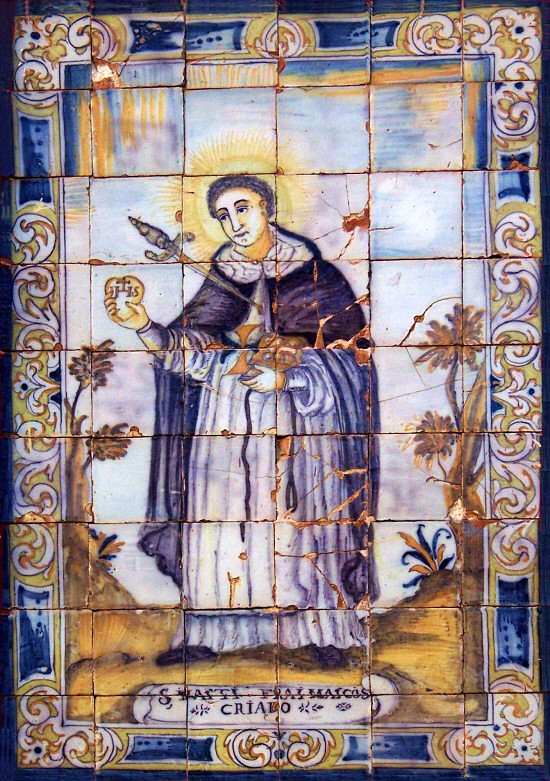
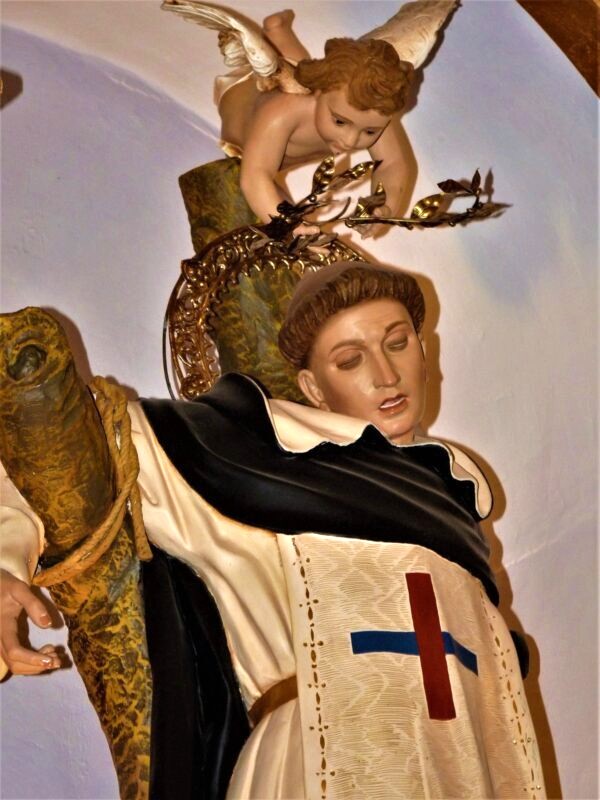
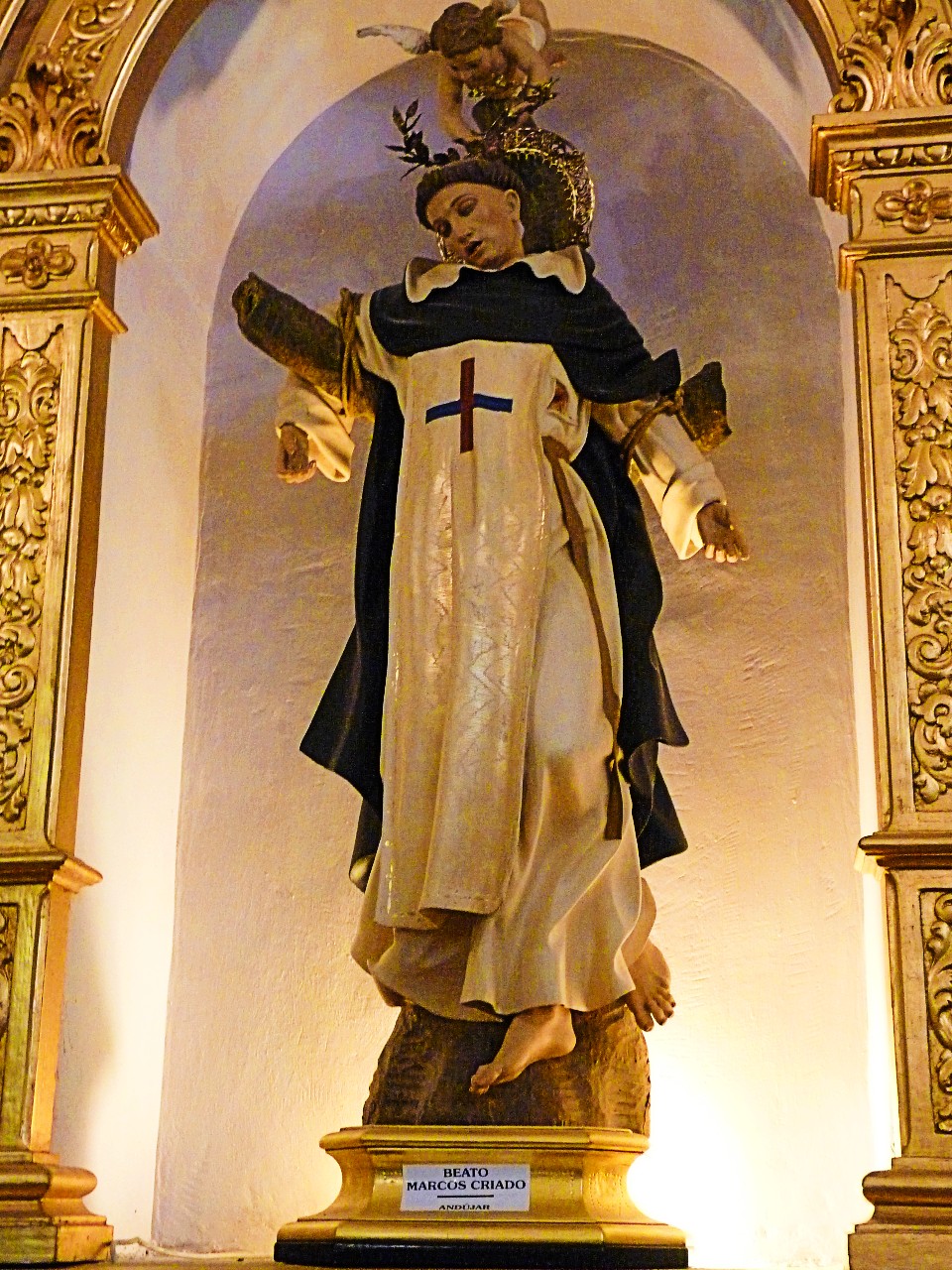
Saint of the Day – 25 September – Blessed Marco Criado OSsT (1522-1569) Trinitarian Priest and Martyr, renowned Preacher, Missionary. Born as Marcus Criado Guelamo on 25 April 1522 in Andujar, Spain and died by being stoned to death on 25 September 1569 (aged 47) near La Peza, Spain. Also known as – Marco Criado Guelamo, Marco Guelamo, Mark.
Marcos Criado Guelamo, better known as Blessed Marco Criado, was born on 25 April 1522 in Andújar (Jaén) and his earthly existence came to a violent end because of his faith in the “Sweet Name of Jesus” in La Peza (Granada) on 24 September 1569. He professed as a Trinitarian (OSsT), distinguished himself for his humility and ability to preach and was Martyred for the Gospel in Las Alpujarras during a Moorish revolt.
Marco Criado was born into a large family with deep Christian roots. He was the youngest of his siblings, the son of Juan Criado Notario, a native of Lahiguera (then La Higuera de Andújar) and María or Marina Guelamo Pasillas, a pious woman from Andujar. From a very young age Marco attended the conventual Church of the Trinitarians in his hometown.
After his mother’s death, he made a pilgrimage to the Shrine of Our Lady de la Cabeza in the Sierra Morena, to pray and commend his soul to God. Following tradition, he slept at the Shrine, asking the Virgin to tell him if it was the divine will that he should enter the Trinitarian Order. Marco Criado, embraced the designs of the Eternal Father and with generosity and humility, followed his vocation. In 1535. he made his Novitiate in the Convent of Andújar. His father also decided to enter religious life and join the Franciscan Order, in the Convent of Arruzafa in Córdoba.
After being Ordained as a Priest, he was later assigned, by his superiors, to the Convents of Andújar, Jaén and Úbeda, where he was given the post of preacher. In Úbeda he combined this mission with the office of Sacristan, a task to which he devoted himself body and soul, to satisfy his yearning for service to the community, with humility and simplicity. Several times he resigned from the highest offices in the Order because of his esteem and desire for a life of evangelical simplicity.
It happened that Archbishop Pedro Guerrero of Granada, concerned about the serious insurrections taking place in the area of the Alpujarras of Granada, met with the Bishops of Almería, Guadix and Málaga, who agreed, first of all, to “send Priests, learned in preaching and exemplary in their Christian life, to the areas most affected by the Moorish uprisings, so that they might devote themselves, with zeal, to reasemble the evangelical seed.”
At the request of the Bishop of Almería, the Trinitarian Provincial Minister of Castile and Andalusia, who was visiting Úbeda, considering the value of Friar Marco to the mission of Alpujarra, agreed that Father Marcos Criado should accompany Father Pedro de San Martín to the Almería Convent to take charge of itinerant preaching, in territories of significant Moorish population, in southeastern Spain. His companion soon died and Marco Criado was left alone, dedicated to his mission among the Moors.
Marco Criado’s apostolic outreach was directed to several localities in the Dioceses of Almería, Granada and Guadix. His preaching focused mainly on the region of the Alpujarras, where there was a large presence of Muslims, a dangerous place for any Christian preacher and also for the Christian inhabitants of the area.
The Town of La Peza became the centre of his missionary activities and was of great support to the local Parish Priest. His zeal in spreading devotion to the Sweet Name of Jesus and his popular sermons, achieved great success.
During one of his missionary journeys, while crossing the Sierra de los Filabres, Marco Criado was captured by a group of Moors, who tied him to a tree for two days. After miraculously surviving, he managed to talk to Abén Cota, leader of the rebellious Moors, to negotiate a peace agreement but this failed. He was tortured, tied to a horse’s tail and dragged for a long time. He was abandoned to his fate, thinking he would die. However, he recovered from his wounds and went on a mission to the regions of Almanzora and Tahá de Marchena, with great success in the Towns of Vera and Cadiar. There, a group of Moors had fled and they had been told to kill him during a sermon.
On Christmas night in 1568 there was a large gathering of Moors in the Alpujarras. On St John’s Eve in 1569, Muslim troops commanded by Aben Homeya decided to return to La Peza. Brother Marco and the Parish Priest were confined to the Parish Church, their movements and words constantly watched. Some exalted ones killed the Parish Priest at the door of the same Church, the same ones who, a few days later, stormed the holy place while Friar Marco was preaching to a small number of Christians who remained in Town. It was 22 September 1569 when Friar Mark was dragged from the Pulpit to the Square where he was stoned to death, after being covered with physical abuse and spit. He was pushed along the road to the Belchite Fountain on the other side of the stream, where he was tied to an oak tree. There he remained, singing hymns and loudly praising the Name of Jesus, until 25 September, when he was killed, tearing out his heart, on which, according to witnesses, the anagram of Jesus had appeared written: “IHS.”
He became known as “the Martyr of the Alpujarras” and his cult was immediately widespread. The people of La Peza call him Saint Macok. To this day, the site of his burial remains a mystery. The iconography depicts him with his heart in his hand and engraved in it, the anagram of Jesus, in memory of the prodigy that, as mentioned, occurred at the time of his Martyrdom. Having collected testimonies of his cult from Father Antonino dell’Assunta, Postulator General of the Discalced Trinitarians, Pope Leo XIII Beatified Marco on 24 July 1899. His liturgical memory is celebrated on 25 September.
“Model of holiness and perennial example, for future generations, of human and spiritual values, rooted in his deep faith in God the Trinity.” Blessed Marco, Pray for us!
Blessed Herman of Reichenau/the Cripple (1013–1054) Benedictine Monk, Confessor, Scholar, Scientist, Writer, Hymnist, Poet, Musical Composer, Teacher. In his own day, the heroic cripple who achieved learning and holiness was called ‘The Wonder of His Age.’. Composer of the “Salve Regina” Hail Holy Queen, “Veni Sancte Spiritus” Come Holy Spirit and “Alma Redemptoris Mater” amongst many others. His Amazing Life and Works: https://anastpaul.com/2019/09/25/saint-of-the-day-blessed-herman-of-reichenau-the-cripple-osb-1013-1054-the-wonder-of-his-age/
St Fymbert Blessed Marco Criado Guelamo OSsT (1522-1569) Trinitarian Priest Martyr St Mewrog St Neomisia of Mecerata St Paphnutius of Alexandria St Principius of Soissons St Solemnis of Chartres
Martyrs of Damascus: A Christian family of six who were tortured to death in a persecution by Roman authorities. They were: Eugenia, Maximus, Paul, Rufus, Sabinian and Tatta. They were tortured to death in Damascus, Syria, date unknown.
The Holy Bishops of Milan: Imagine being part of a Diocese in which 36 of your past Bishops are Saints and some are also Doctors of the Church and Popes (and others being considered for Sainthood)! Today, the Church in Milan commemorates these holy Bishops. They are:
Thought for the Day – 24 September – Meditations with Antonio Cardinal Bacci (1881-1971)
Prudence and Simplicity
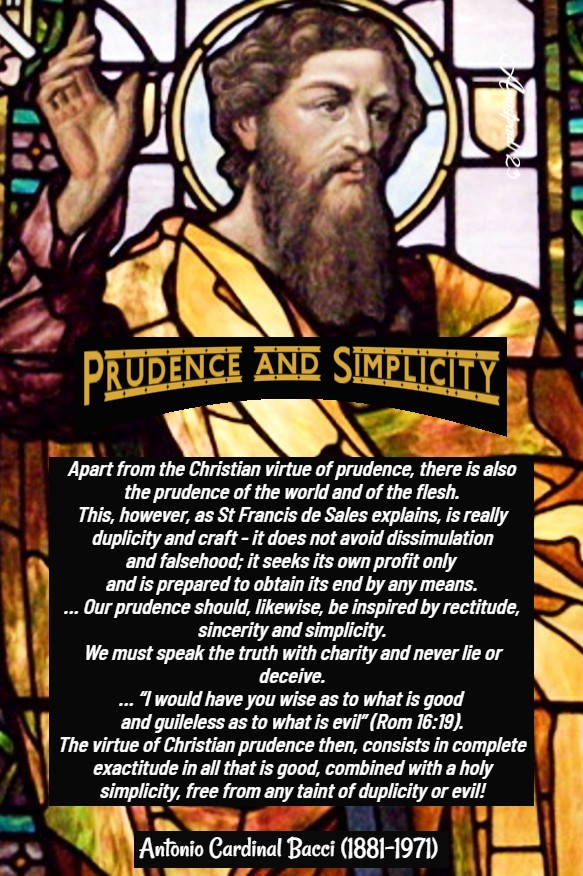
“Apart from the Christian virtue of prudence, there is also the prudence of the world and of the flesh. This, however, as St Francis de Sales explains, is really duplicity and craft – it does not avoid dissimulation and falsehood; it seeks its own profit only and is prepared to obtain its end by any means. “I know nothing at all about the art of falsehood, dissimulation and pretence,” St Francis wrote to the Bishop of Belle, “which is the centre of political activity and the mainspring of human prudence. That which I have on my lips, I have in my heart. I hate duplicity like death” (Letters of St Francis de Sales [Spirito] Bk II C24, Letter 178).
Our prudence should, likewise, be inspired by rectitude, sincerity and simplicity. We must speak the truth with charity and never lie or deceive. “For we can do nothing against the truth,” says St Paul “but, only for the truth” (2 Cor 13:8). He advises the Ephesians – “practice the truth in love” (Eph 4:15). To the Romans he writes: “I would have you wise as to what is good and guileless as to what is evil” (Rom 16:19).
The virtue of Christian prudence then, consists in complete exactitude in all that is good, combined with a holy simplicity, free from any taint of duplicity or evil!”
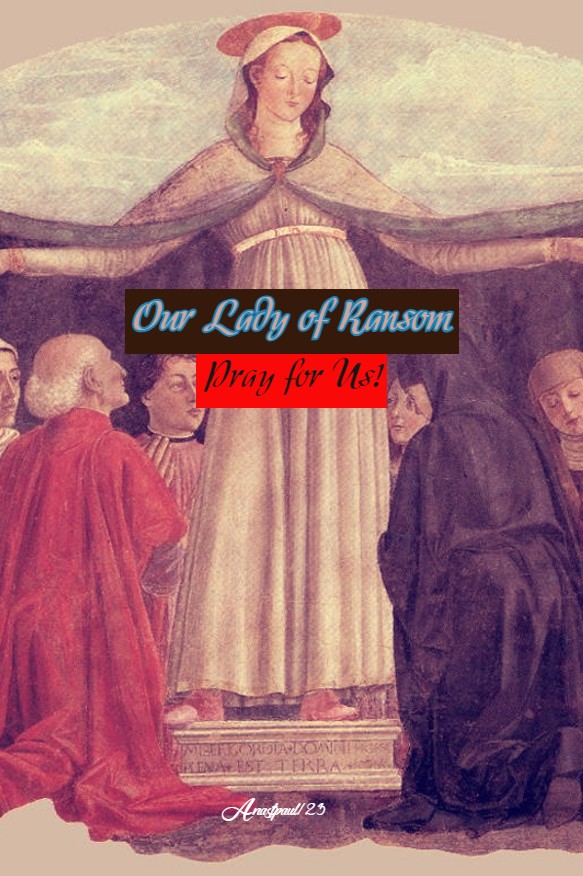
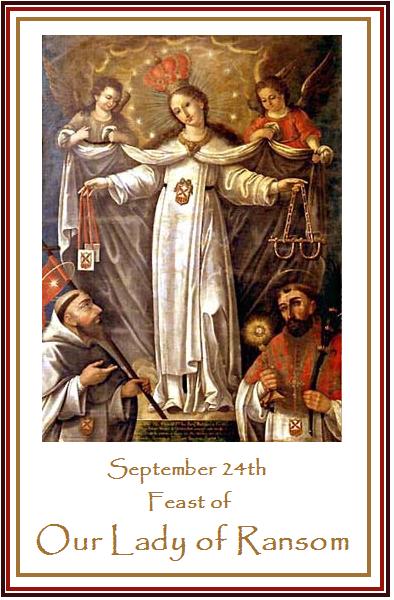
Quote/s of the Day – 24 September – Nuestra Señora de las Mercedes / Our Lady of Mercy / Our Lady of Ransom
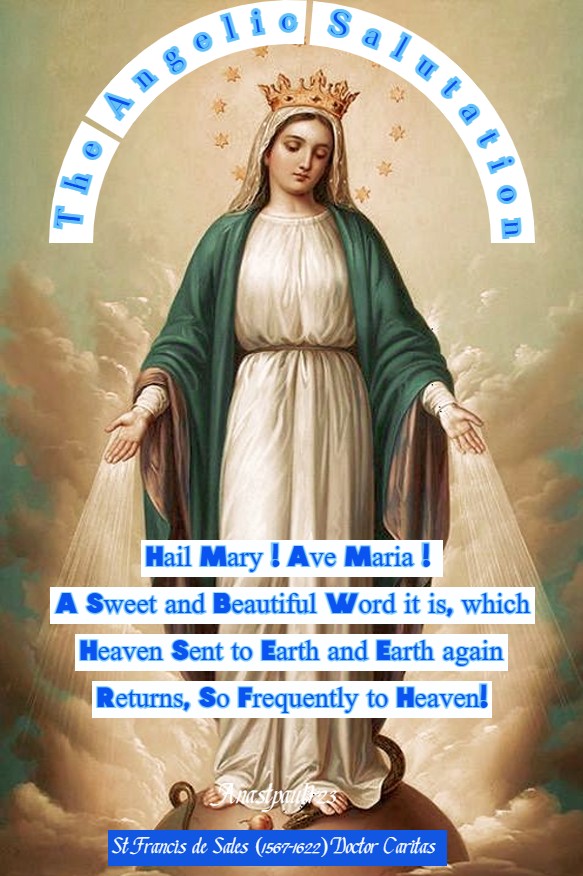
“Hail Mary ! Ave Maria ! . . . A sweet and beautiful word it is, which Heaven sent to earth and earth again returns, so frequently to Heaven! ”
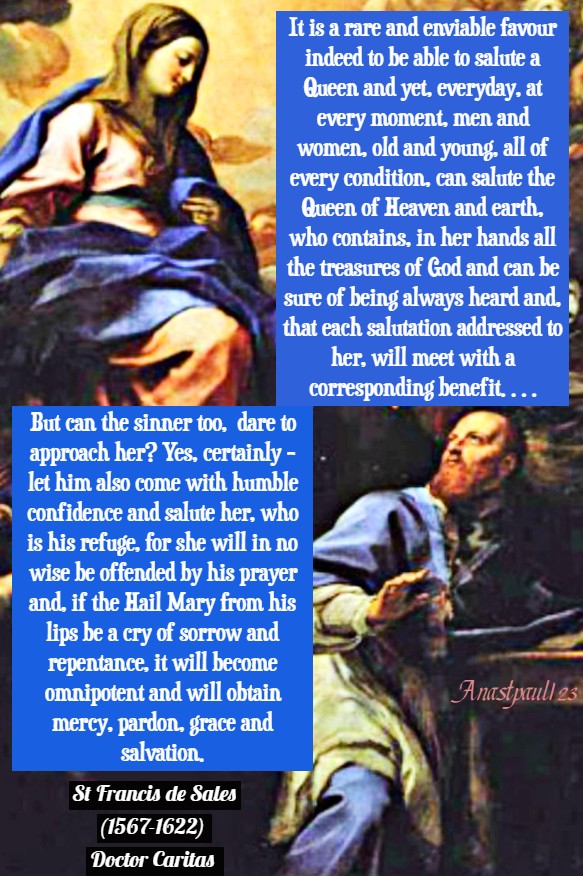
“It is a rare and enviable favour indeed to be able to salute a Queen and yet, everyday, at every moment, men and women, old and young, all of every condition, can salute the Queen of Heaven and earth, who contains, in her hands all the treasures of God and can be sure of being always heard and, that each salutation addressed to her, will meet with a corresponding benefit. . . . But can the sinner too, dare to approach her? Yes, certainly – let him also come with humble confidence and salute her, who is his refuge, for she will, in no wise, be offended by his prayer and, if the Hail Mary from his lips be a cry of sorrow and repentance, it will become omnipotent and will obtain mercy, pardon, grace and salvation.”
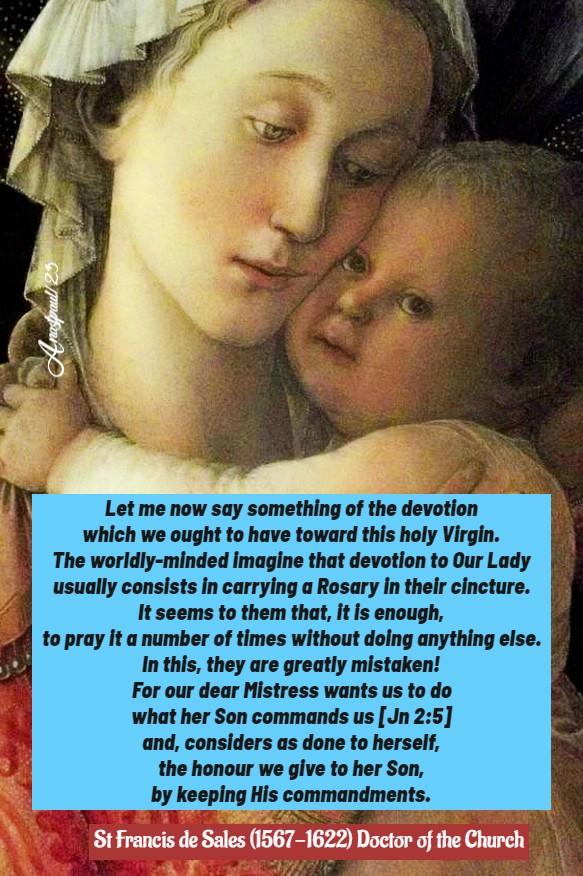
“Let me now say something of the devotion which we ought to have toward this holy Virgin. The worldly-minded imagine that devotion to Our Lady usually consists in carrying a Rosary in their cincture. It seems to them that, it is enough, to pray it a number of times without doing anything else. In this, they are greatly mistaken! For our dear Mistress wants us to do what her Son commands us [Jn 2:5] and, considers as done to herself, the honour we give to her Son, by keeping His commandments.”
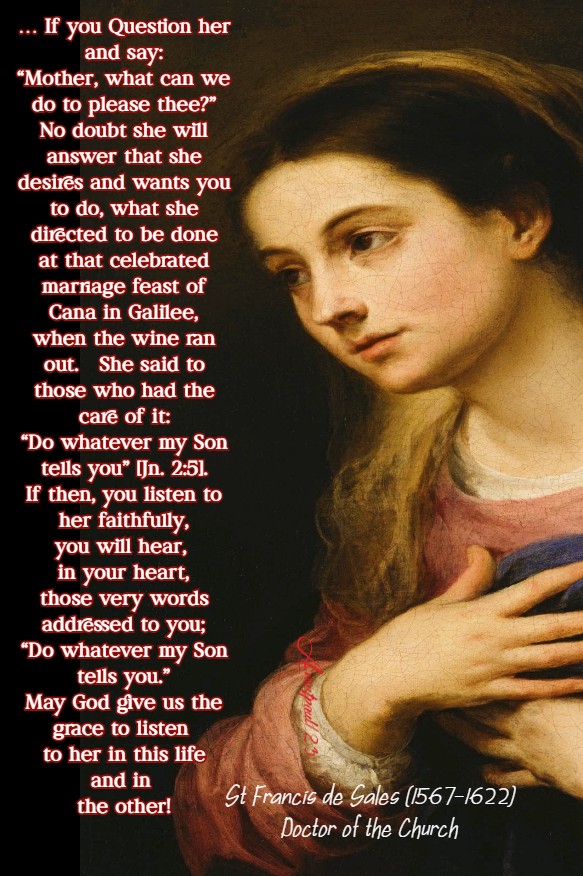
“… If you Question her and say: “Mother, what can we do to please thee?” No doubt she will answer that she desires and wants you to do, what she directed to be done at that celebrated marriage feast of Cana in Galilee, when the wine ran out. She said to those who had the care of it: “Do whatever my Son tells you” [Jn. 2:5]. If then, you listen to her faithfully, you will hear, in your heart, those very words addressed to you; “Do whatever my Son tells you.” May God give us the grace to listen to her in this life and in the other! Amen.
(Sermon for the Feast of the Immaculate Conception, 8 December 1622)
St Francis de Sales (1567-1622) Doctor of the Church
One Minute Reflection – 24 September – “Month of The Seven Sorrows of the Blessed Virgin Mary and The Holy Cross” – Our Lady of Ransom – The 17th Sunday after Pentecost – Ephesians 4:1-6, Matthew 22:34-46 – Scripture search here: https://www.drbo.org/
“Master, which commandment in the law is the greatest?” … Matthew 22:36
REFLECTION – “The Lord asks of us only two things – love of His Majesty and love of our neighbour. These are what we must work for. By observing them with perfection, we do His will and so, will be united with Him. But how far, as I have said, we are from doing these two things, as we ought, for so great a God! May it please His Majesty to give us His grace, so that we might merit, if we wish to reach this state that lies within our power.
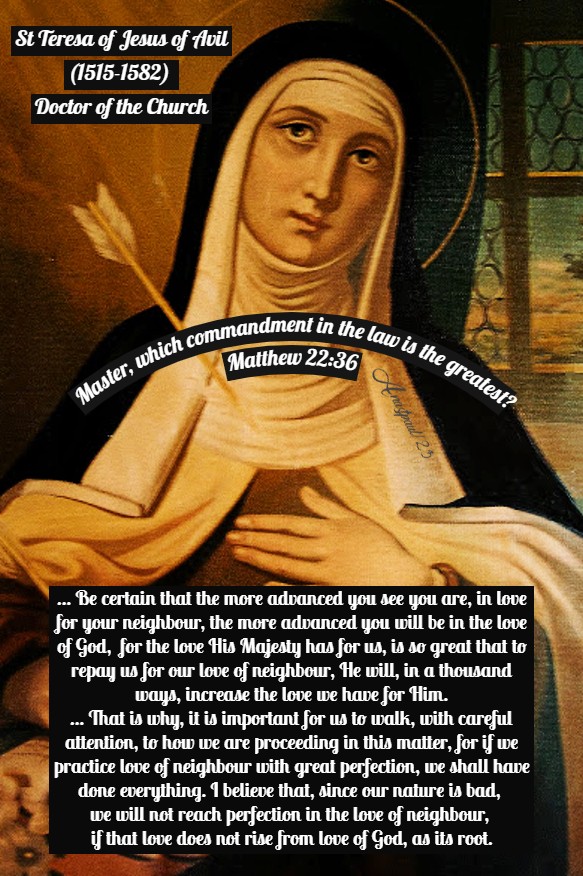
The most certain sign, in my opinion, as to whether or not we are observing these two laws, is whether we observe well, the love of neighbour. We cannot know whether or not we love God, although there are strong indications for recognising that we do love Him but, we can know, whether we love our neighbour. And be certain that the more advanced you see you are, in love for your neighbour, the more advanced you will be in the love of God, for the love His Majesty has for us, is so great that to repay us for our love of neighbour, He will, in a thousand ways, increase the love we have for Him. I cannot doubt this. That is why, it is important for us to walk, with careful attention, to how we are proceeding in this matter, for if we practice love of neighbour with great perfection, we shall have done everything.I believe that, since our nature is bad, we will not reach perfection in the love of neighbour, if that love does not rise from love of God, as its root.” – St Teresa of Jesus of Avila (1515-1582) Carmelite, Doctor of the Church (Interior Castle, Fifth Dwelling Places, Ch 3).
PRAYER – O God, Who for the deliverance of Christians from the power of the pagans, graciously willed to enrich Thy Church by a new religious offspring through the most glorious Mother of Thy Son; grant, we beseech Thee, that by the merits and intercession of her, whom we piously venerate, as the founder of so great a work, we may be delivered from all our sins and from the captivity of the devil. Through Jesus Christ, Thy Son our Lord, Who lives and reigns with Thee, in the unity of the Holy Ghost, God, world without end. Amen (Collect).
Our Morning Offering – 24 September – The 17th Sunday after Pentecost
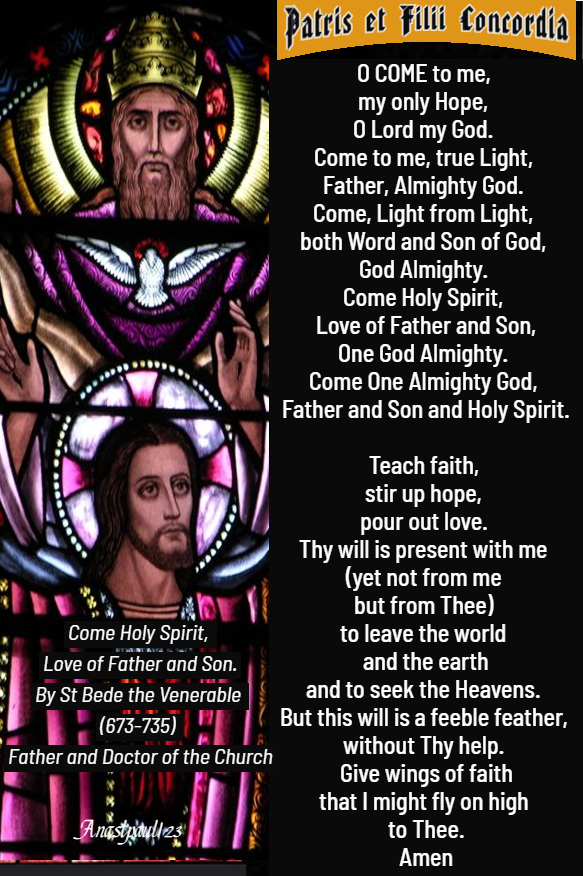
Patris et Filii Concordia Come Holy Spirit, Love of Father and Son. By St Bede the Venerable (673-735) Father and Doctor of the Church
O COME to me, my only Hope, O Lord my God. Come to me, true Light, Father, Almighty God. Come, Light from Light, both Word and Son of God, God Almighty. Come Holy Spirit, Love of Father and Son, One God Almighty. Come One Almighty God, Father and Son and Holy Spirit.
Teach faith, stir up hope, pour out love. Thy will is present with me (yet not from me but from Thee) to leave the world and the earth and to seek the Heavens. But this will is a feeble feather, without Thy help. Give wings of faith that I might fly on high to Thee. Amen
Saint of the Day – 24 September – St Geremarus (c608-658) French Priest, Abbot, Founder of Monasteries. Born in c608 in Vardes, Neuf-Marché, France and died in 658 near Beauvais, France of natural causes. Also known as – Germer de Fly, Geremar, Geremaro. He appears in the Roman Martyrology: “In the Diocese of Beauvais, St Geremarus, Abbot.”
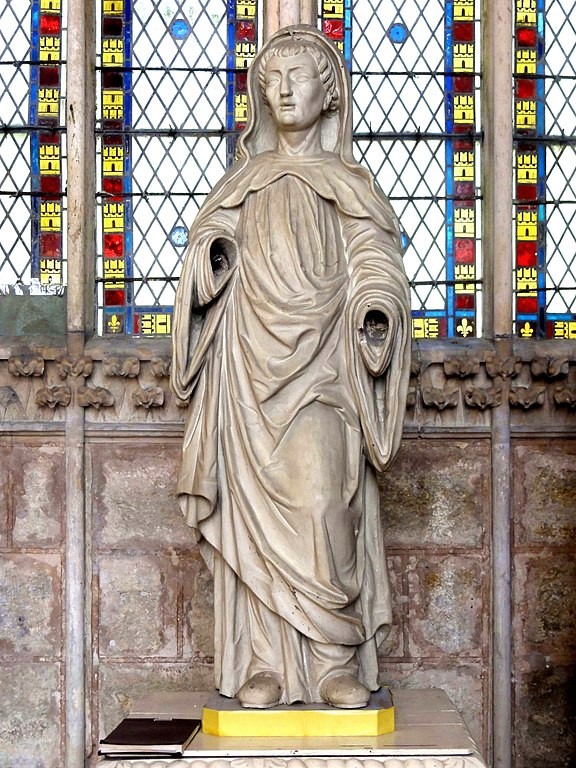
Statue of St Geremarus in the Chapel of Saint-Germer-de-Fly Abbey
Geremarus’ parents, Rigobert and Aga, were of the prime nobility in the territory of Beauvais. He was born at their Castle in the Village Warandra and was educated at the Cathedral school in Beauvais.
Geremarus married a pious lady named Domana and held high positions in the Courts of the Merovingian Kings, Dagobert and Clovis. the couple were blessed with two daughters and a son.
Geremarus met St Audoin (c605-684) Bishop of Rouen, at Dagobert’s Court and on his advice founded the Isle-sur-Epte Monastery in honour of Saint Peter. St Audoin also Ordained Geremarus to the Priesthood. This Monastery was afterwards destroyed by the Normans and is now an estate belonging to Saint Geremarus Abbey.
Again by the advice of Saint Audoin’s, Geremarus made his monastic profession in the Monastery of Pental, in the territory of Rouen. He was soon after chosen Abbot but finding the Monks averse to regularity he left the Abbacy and led an Hermit’s life in a cave near the river Seine. This lastest for 5 1/2 years.
When his only son, Amalbert, died and was buried in Saint Peter’s Monastery, the family estate reverted to Geremarus from his son and with the proceeds he founded the Monastery of Fly or Flaviacum, near Beauvais, now dedicated to our Saint. There he assembled a community of fervent Monks.
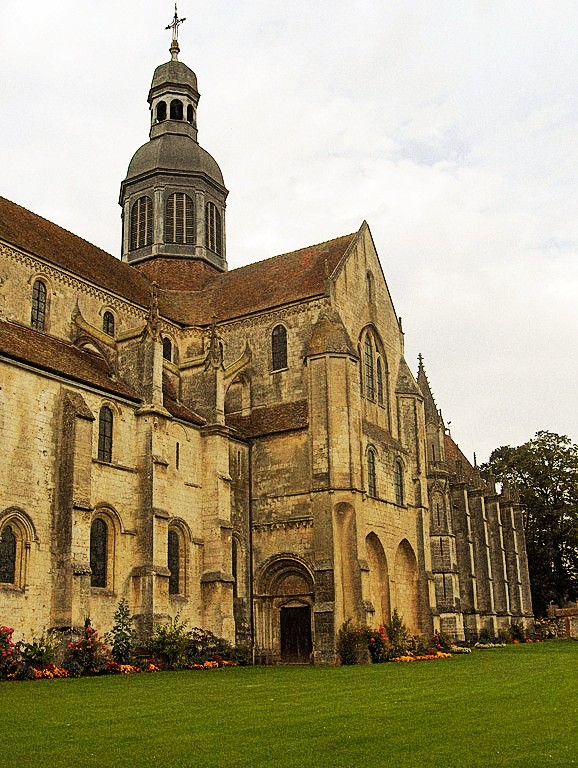
St Geremarus Abbey in Fly
Having governed this house for 3 1/2 years, he happily died on the 24th of September 658. His body was interred in the Church of his Abbey which soon after took his name. His Relics, for fear of the Norman plunderers, were conveyed secretly to Beauvais, where they are still kept in the Cathedral, except the bones of one arm, which have been given back to Saint Geremarus’ Monastery. In August of 1643 Bishop Potier of Beauvais, placed Monks of the congregation of Saint Maur in this Abbey,and erected there, a great school.
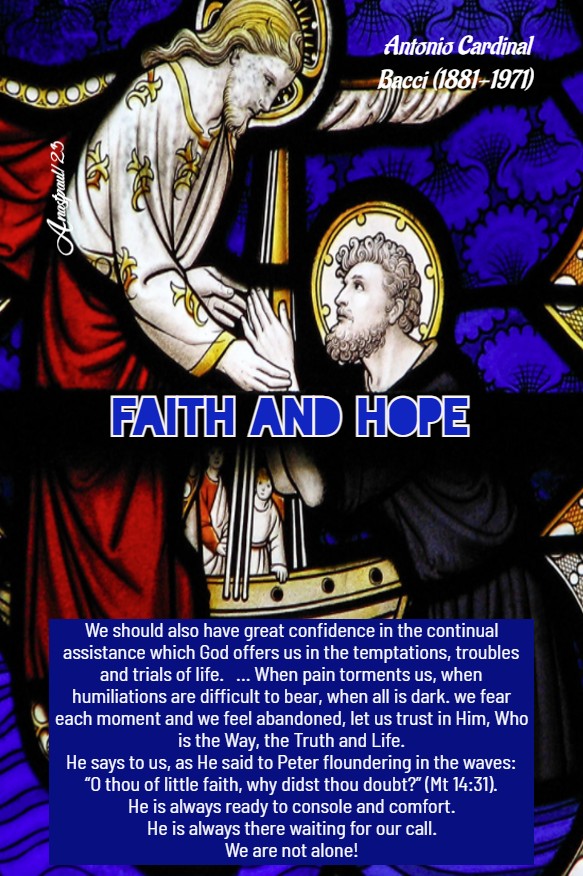
Thought for the Day – September – Meditations with Antonio Cardinal Bacci (1881-1971)
Faith and Hope
“We should also have great confidence in the continual assistance which God offers us in the temptations, troubles and trials of life. When we are strongly tempted, we should remember that God will not permit us to be tempted beyond our strength (Cf 1 Cor 10:13), and we should pray to Him for help.
When pain torments us, when humiliations are difficult to bear, when all is dark. we fear each moment and we feel abandoned, let us trust in Him, Who is the Way, the Truth and Life. He says to us, as He said to Peter floundering in the waves: “O thou of little faith, why didst thou doubt?” (Mt 14:31).
He is always ready to console and comfort. He is always there waiting for our call. We are not alone!”
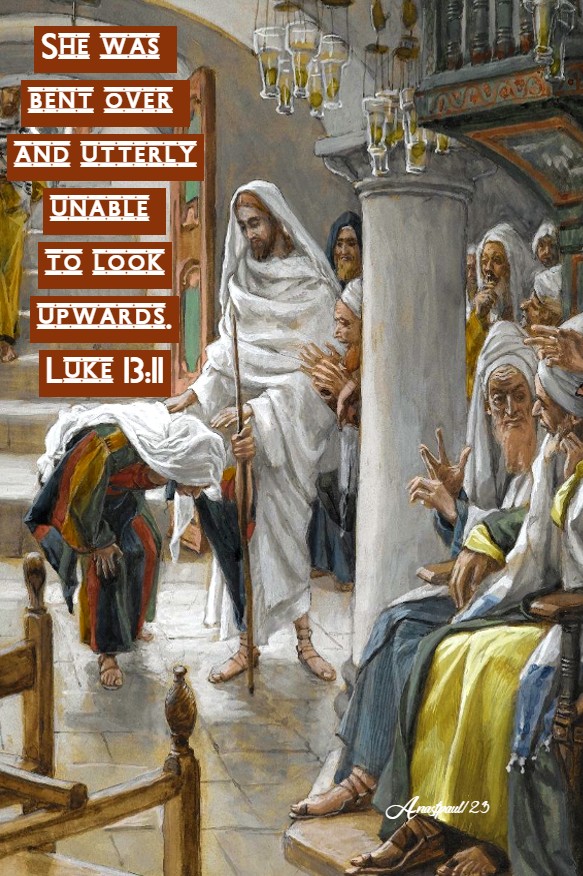
Quote/s of the Day – 23 September – “Month of The Seven Sorrows of the Blessed Virgin Mary and The Holy Cross” – Hebrews 9:2-12, Luke 13:6-17 – Scripture search here: https://www.drbo.org/
“She was bent over and utterly unable to look upwards.”
Luke 13:11
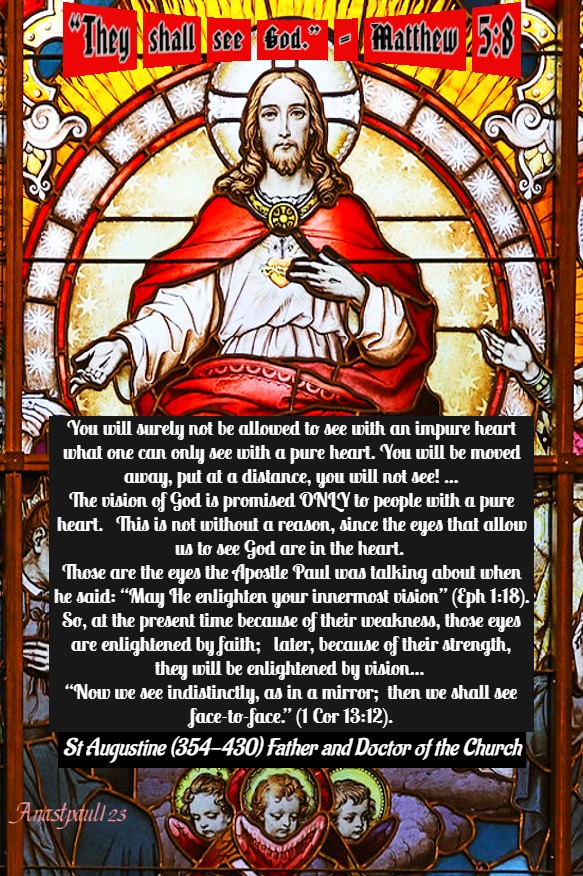
“They shall see God.” Matthew 5:8
“You will surely not be allowed to see with an impure heart what one can only see with a pure heart. You will be moved away, put at a distance, you will not see! The vision of God is promised ONLY to people with a pure heart. This is not without a reason, since the eyes that allow us to see God are in the heart. Those are the eyes the Apostle Paul was talking about when he said: “May He enlighten your innermost vision” (Eph 1:18). So, at the present time because of their weakness, those eyes are enlightened by faith; later, because of their strength, they will be enlightened by vision… “Now we see indistinctly, as in a mirror; then we shall see face-to-face.”
St Augustine (354-430) Father and Doctor of the Church
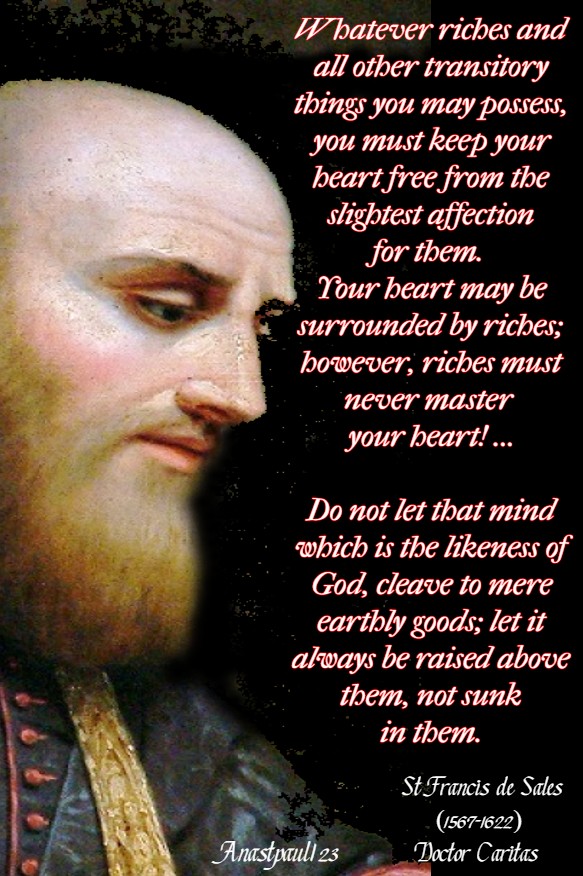
“Whatever riches and all other transitory things you may possess, you must keep your heart free from the slightest affection for them. Your heart may be surrounded by riches; however, riches must never master your heart! … Do not let that mind which is the likeness of God, cleave to mere earthly goods; let it always be raised above them, not sunk in them.”
St Francis de Sales (1567-1622) Doctor Caritas
“Let us not strive for the rewards of Heaven, valuable though they may be but live, so as to please the God of Heaven. If God were not in Heaven, all its beauty, riches and sweetness, would be dull rather than delightful. By faith, we know, God already dwells within us. But in Heaven, we will see God face-to-face. May we so live that one day, we will be in Heaven praising and praying eternally, before our Lord and Saviour!”
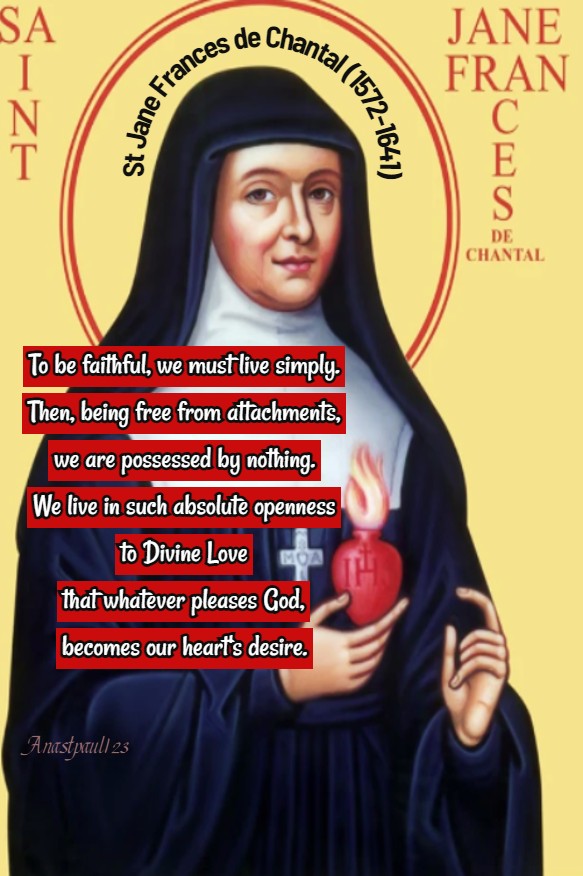
“To be faithful, we must live simply. Then, being free from attachments, we are possessed by nothing. We live in such absolute openness to Divine Love that whatever pleases God, becomes our heart’s desire.”
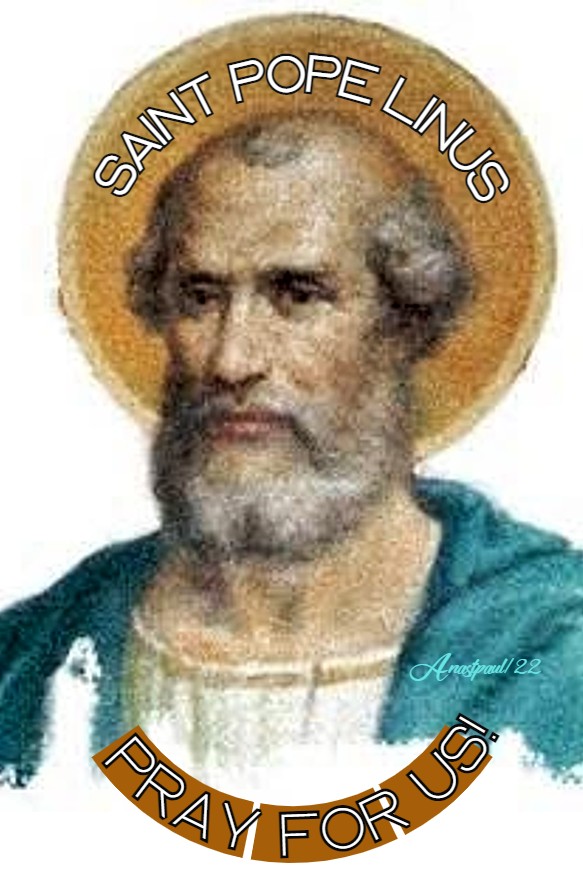
One Minute Reflection – 23 September – “Month of The Seven Sorrows of the Blessed Virgin Mary and The Holy Cross” – St Pope Linus (c10 – c76) Successor to St Peter – Hebrews 9:2-12, Luke 13:6-17 – Scripture search here: https://www.drbo.org/
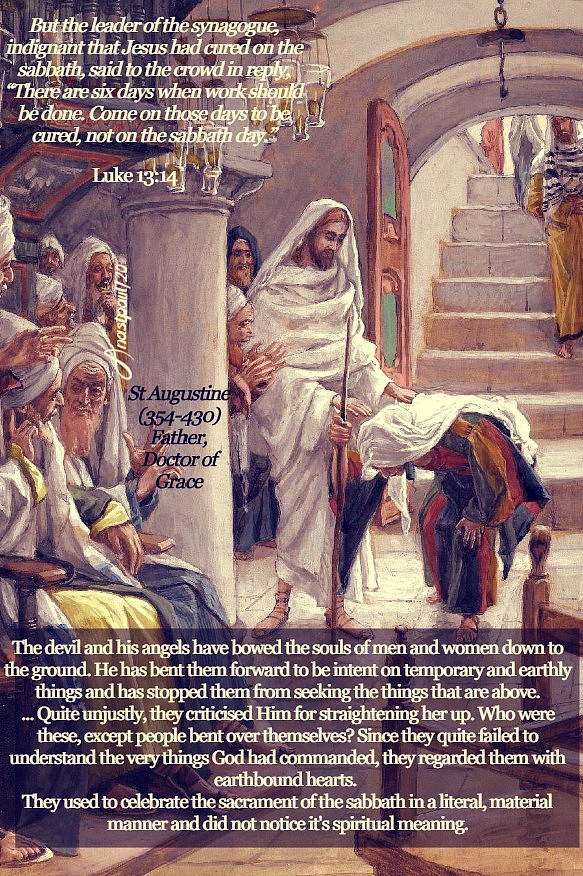
“But the leader of the synagogue, indignant that Jesus had cured on the sabbath, said to the crowd in reply, “There are six days when work should be done. Come on those days to be cured, not on the sabbath day.” – Luke 13:14
REFLECTION – “The whole human race, like this woman, is bent over and bowed down to the ground. Someone already understands these enemies. He cries out against them and says to God, “They have bowed my soul down.” The devil and his angels have bowed the souls of men down to the ground. He has bent them forward to be intent on temporary and earthly things and has stopped them from seeking the things that are above.
Since that is what the Lord says about the woman whom Satan had bound for eighteen years, it was now time for her to be released from her bondage on the sabbath day. Quite unjustly, they criticised Him for straightening her up. Who were these, except people bent over themselves? Since they quite failed to understand the very things God had commanded, they regarded them with earthbound hearts. They used to celebrate the sacrament of the sabbath in a literal, material manner and did not notice it’s spiritual meaning!” – St Augustine (354-430) Father, Doctor of Grace (Sermon 162)
PRAYER – Look forgivingly on Thy flock, Eternal Shepherd, and keep it in Thy constant protection, by the intercession of blessed Linus Thy Sovereign Pontiff, whom Thou didst constitute Shepherd of the whole Church. Through the same Jesus Christ, Thy Son our Lord, Who lives and reigns with Thee, in the unity of the Holy Ghost, God, world without end. Amen (Collect).
Our Morning Offering – 23 September – “Month of The Seven Sorrows of the Blessed Virgin Mary and The Holy Cross” and Our Lady’s Day
What Can I Say? By St Anselm (1033-1109) Magnificent Doctor Marian Doctor
My most merciful Lady, what can I say about the fountains which flowed from thy most pure eyes when thou saw thy only Son before thee, bound, beaten and suffering? What do I know of the flood which drenched thy matchless face, when thou beheld thy Son, thy Lord and thy God, stretched on the Cross without guilt, when the flesh of thy flesh was cruelly butchered by wicked men? How can I judge, what sobs, troubled thy most pure breast, when thou heard, “Woman, behold thy son,” and the disciple, “Behold, thy Mother,” when thou received as a son, the disciple, in place of the Master, the servant, for the Lord? Amen
From “The Prayers and Meditations of Saint Anselm with the Proslogion,” Benedicta Ward, trans,1973, Penguin classics, Penguin Group (UK)
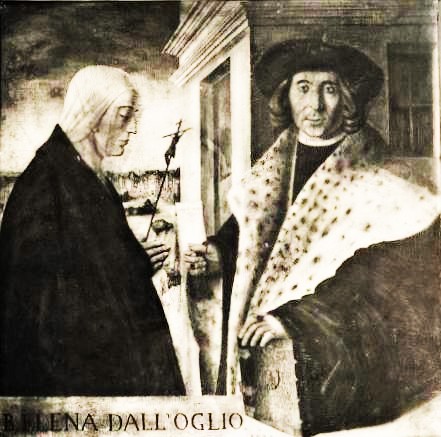
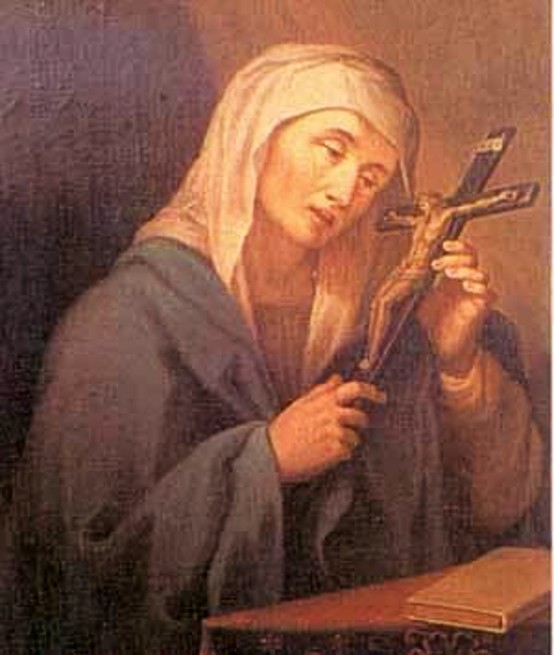
Saint of the Day – 23 September – Blessed Elena Duglioli (1472-1520) Widow Born in 1472 at Bologna, Italy and died on 23 September 1520 of natural cause, aged 48. Also known as – Elena Duglioli Dall’Olio, Hélène, Helen of Bologna. Elena was Beatified on 26 March 1828 by Pope Leo XII. Her body is incorrupt.
Unfortunately we have scant information on Elena’s life. Elena Duglioli was born in Bologna in 1472 to the aristocrats Notary Silverio Duglioli and Pentisilea Boccaferri.
During her childhood and adolescence, she desired to become a professed religious and decided to enter the Poor Clare Convent of Corpus Domini, Bologna. Her parents, however, wished her to marry and to obey and please them, she agreed to marry the much older Senator Benedetto dall’Olio.
The marriage took place in 1487 when she was 15 years old to the 40 year old Senator. Elena who greatly desired to Consecrate her virginity to God was able to bring Benedetto to agree to maintain total chastity in their marriage (this information is unconfirmed, hence her title remains ‘Widow’). The marriage proved happy and successful with both husband and wife living in admirable union and in complete harmony. Benedetto died after they had been together for 30 years.
Bl Elena with her husband Benedetto
Having become a widow, she devoted herself to pious works with even greater zeal.
Elena bore a particular devotion to Saint Cecilia and the Papal Legate to Bologna – Cardinal Francesco Alidosi – gave her a knucklebone Relic of St Cecilia. Her devotion to the Saint led her to commission the construction of a Church where the Artist, Raphael, would paint an image of the Saint Cecilia.
Elena died on 23 September 1520. Her incorrupt remains are housed in the Church of San Giovanni in Monte.
The Beatification received official confirmation on 26 March 1828 once Pope Leo XII approved her local cultus. Prospero Lorenzo Lambertini – the future Pope Benedict XIV – spoke in favour of Elena’s Beatification.
St Pope Linus (c 10 – c 76) Successor to St Peter. Papacy lasted from c 67 to his death as a Martyr. Among those to have held the position of Pope, Peter, Linus and Clement are specifically mentioned in the New Testament. Linus is mentioned in the closing greeting of the Second Epistle to Timothy as being with Paul in Rome near the end of Paul’s life. About St Pope Linus: https://anastpaul.com/2018/09/23/saint-of-the-day-23-september-st-pope-linus-c-10-c-76-successor-to-st-peter/
St Cissa of Northumbria St Constantius of Ancona Blessed Elena Duglioli (1472-1520) WidowHer body is incorrupt.
Bl Guy of Durnes St Peter Acontanto St Polyxena
St Sosius (275-305) Confessor, Deacon and Martyr. His holiness and wisdom drew many Prelates to his feet, seeking spiritual assistance. St Sosius was a Deacon of Misenum, an important naval base of the Roman Empire in the Bay of Naples. The Roman Martyrology reads: “At Capo Miseno in Campania, St Sosius, Deacon and Martyr, who, as Pope St Symmachus reports, wishing to save his Bishop from death, instead found death together with him, obtaining equal glory at the same price.” His Life and Death: https://anastpaul.com/2022/09/23/saint-of-the-day-23-september-saint-sosius-275-305-confessor-deacon-and-martyr/
Thought for the Day – 22 September – Meditations with Antonio Cardinal Bacci (1881-1971)
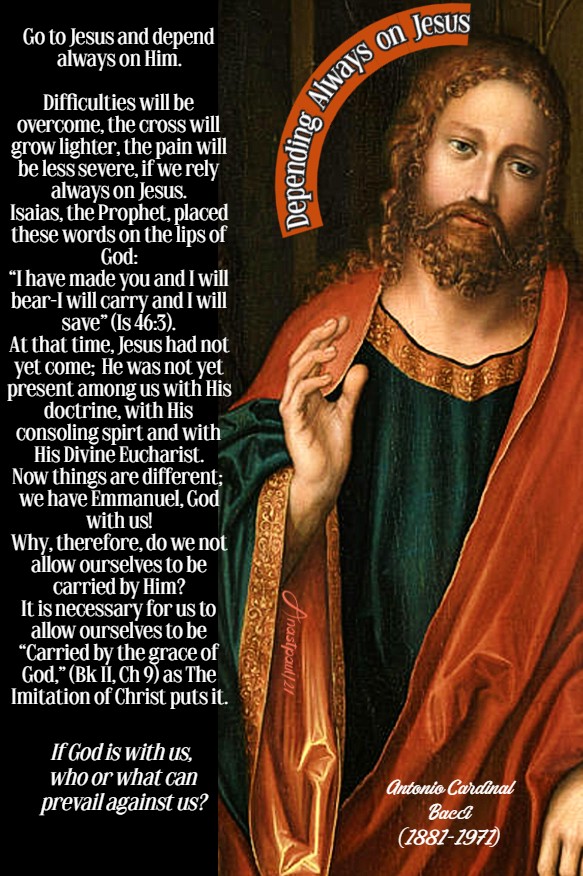
Depending Always on Jesus
“Virtue is difficult and life holds more trials than consolations. Sometimes, we feel discouraged because virtue seems impossible and we fall so often, in spite of our best resolutions or because, our cross seems too heavy and we feel that we are overburdened.
Where will we find comfort in our sufferings and strength in our weakness? “Come to me, all you who labour and are burdened and I will give you rest” (Mt 11:28). Go to Jesus and depend always on Him.
Difficulties will be overcome, the cross will grow lighter, the pain will be less severe, if we rely always on Jesus. Isaias, the Prophet, placed these words on the lips of God: “I have made you and I will bear-I will carry and I will save” (Is 46:3). At that time, Jesus had not yet come; He was not yet present among us with His doctrine, with His consoling spirt and with His Divine Eucharist. Now things are different; we have Emmanuel, God with us! Why, therefore, do we not allow ourselves to be carried by Him? It is necessary for us to allow ourselves to be “Carried by the grace of God,” (Bk II, Ch 9) as The Imitation of Christ puts it.
If God is with us, who or what can prevail against us?
We must, as St Francis de Sales writes, lean on the arm of Jesus, as the child leans securely on the arm of it’s mother. “It matters little,” he adds, “where she walks, on a grassy plain or on a steep path surrounded by precipices.” She, is his mother and she carries him; that is enough to make him happy and content. We must trust Jesus in this way, relying always on His support in joy and in sorrow, in moments of trial and in moments of satisfaction, in life and in death. Let us not be afraid; Jesus is better and stronger than our earthly mother. If He guides and supports us, we can be sure of Heaven, no matter what happens!”
Quote/s of the Day – 22 September – St Thomas of Villanova OSA (1488-1555) Archbishop, Confessor.
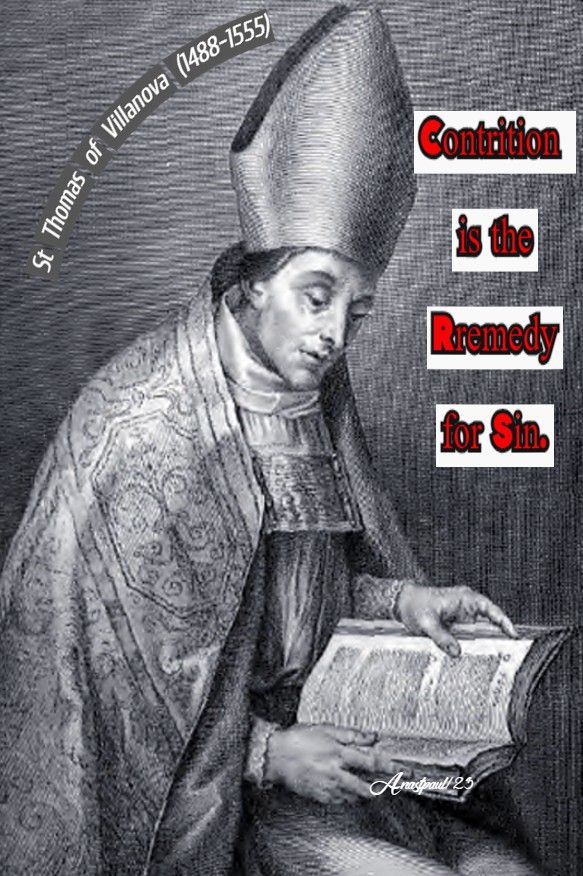
“Contrition is the remedy for sin.”
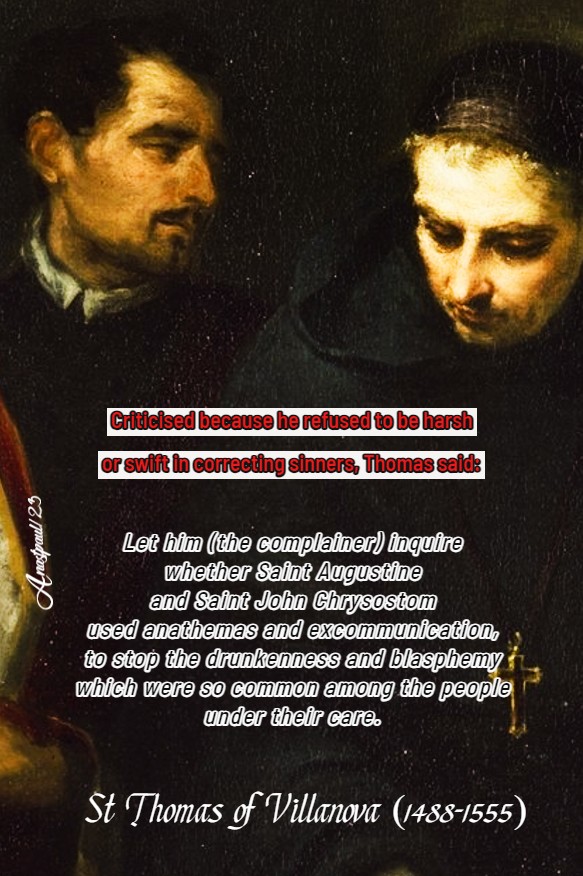
Criticised because he refused to be harsh or swift in correcting sinners, Thomas said: “Let him (the complainer) inquire whether Saint Augustine and Saint John Chrysostom used anathemas and excommunication, to stop the drunkenness and blasphemy which were so common among the people under their care.”
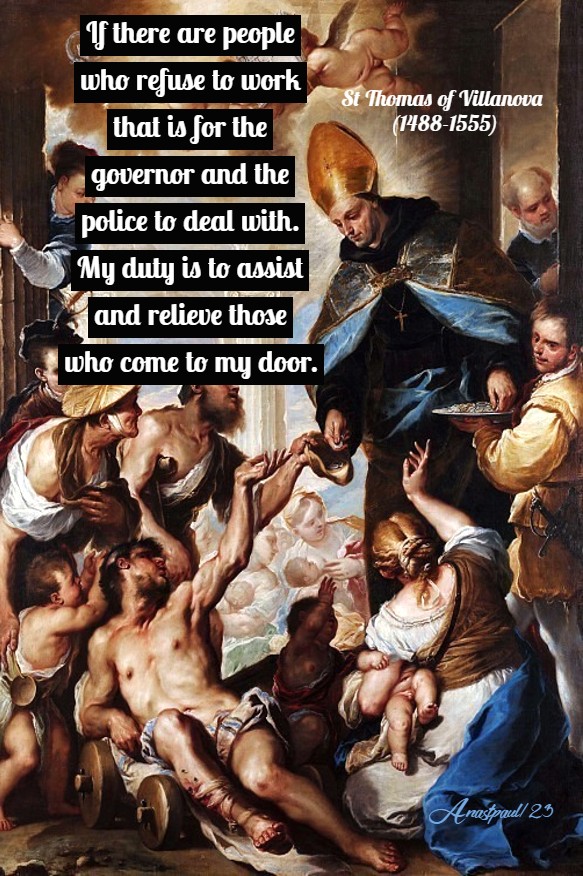
“If there are people who refuse to work that is for the governor and the police to deal with. My duty is to assist and relieve those who come to my door.”
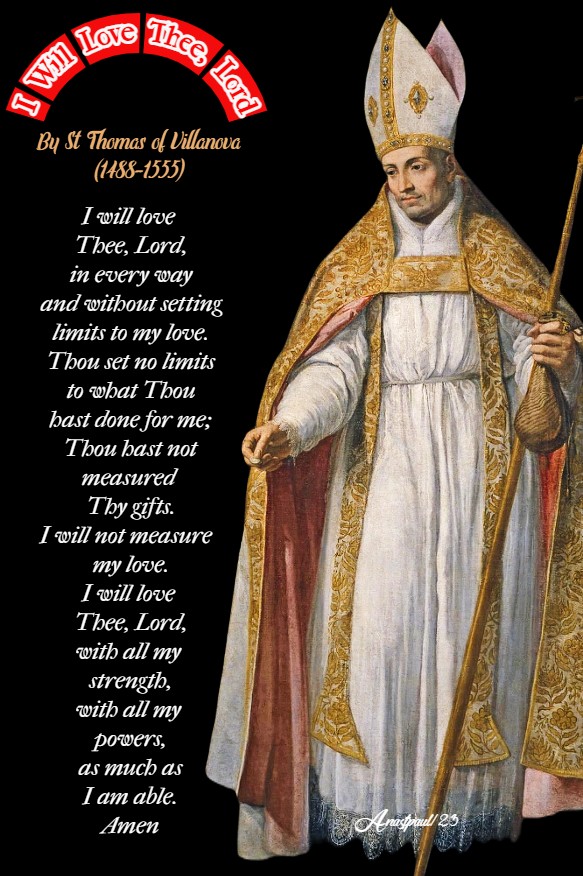
I Will Love Thee, Lord By St Thomas of Villanova (1488-1555)
I will love Thee, Lord, in every way and without setting limits to my love. Thou set no limits to what Thou hast done for me; Thou hast not measured Thy gifts. I will not measure my love. I will love Thee, Lord, with all my strength, with all my powers, as much as I am able. Amen
One Minute Reflection – 22 September – “Month of The Seven Sorrows of the Blessed Virgin Mary and The Holy Cross” – St Thomas of Villanova OSA (1488-1555) Archbishop, Confessor – Ecclesiasticus Sirach44:16-27; 45:3-20, Matthew 25:14-23 – Scripture search here: https://www.drbo.org/
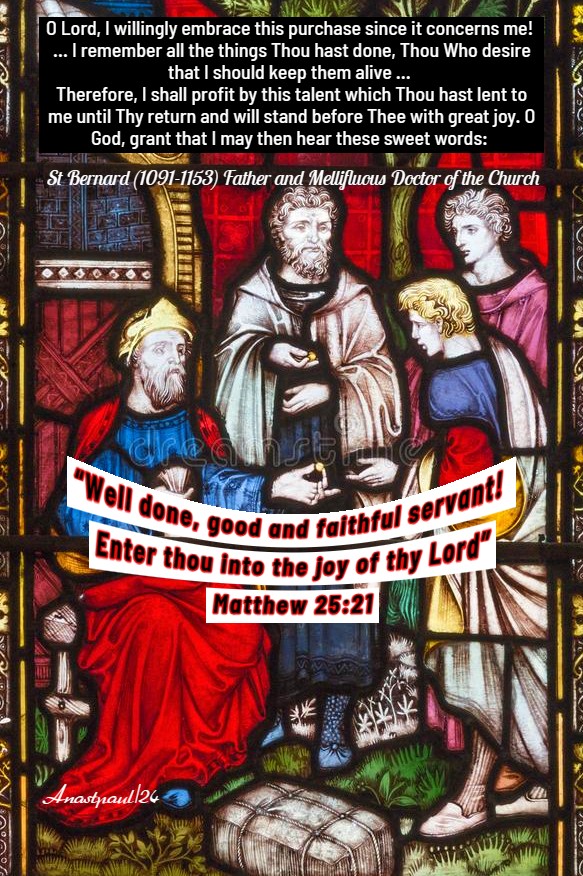
“Well done, good and faithful servant … Enter thou into the joy of thy Lord.”- Matthew 25:21
REFLECTION – “The Word of the Father, Only-begotten Son of God, Sun of Justice (Mal 3:20), is the great Merchant Who has brought us the price of our redemption. It is a truly precious exchange which we can never value sufficiently, when a King, Son of the King Most High, has become the Coin, the Gold has paid our dues, the Just Man is given for the sinner. Truly unmerited mercy, perfectly disinterested love, astonishing goodness…, it is a completely disproportionate purchase, in which the Son of God is delivered up for the servant, the Creator is put to death for the one He has created, the Lord is condemned for His slave.
O Christ, these are Thine Works, Thou Who descended from Heaven’s brightness into our hellish darkness, to bring light to our gloomy prison. Thou came down from the Right Hand of the Divine Majesty, into our human misery, to redeem the human race, Thou Who descended from the Father’s glory to death on the Cross, to triumph over death and its author. Thou art the only One and there is no other but Thee Who could have been drawn to redeem us through Thine Own Goodness…
Let all the merchants of Teman (Bar 3:23) withdraw from this place … it is not they but Israel [Thy] beloved whom [Thou hast] chosen, Thou Who hide these mysteries from the wise and prudent and have revealed them to those babes and humble servants of Thine (Lk 10:21) … O Lord, I willingly embrace this purchase since it concerns me!… I remember all the things Thou hast done, Thou Who desire that I should keep them alive … Therefore, I shall profit by this talent which Thou hast lent to me until Thy return and will stand before Thee with great joy. O God, grant that I may then hear these sweet words: “Well done, good and faithful servant! Enter thou into the joy of thy Lord” (Mt 25:21).” – St Bernard O.Cist. (1091-1153) Cistercian Monk, known as the Last Father and the Mellifluous Doctor of the Church (Selected sermons, no 42: The Five Purchases).
PRAYER – O God, Who endowed blessed Bishop Thomas with the virtue of special pity for the poor, we beseech Thee, through his intercession, generously to pour forth the riches of Thy mercy upon all those who pray to Thee.ThroughJesus Christ, Thy Son our Lord, Who lives and reigns with Thee, in the unity of the Holy Ghost, God, world without end. Amen (Collect).
Our Morning Offering – 22 September – “Month of The Seven Sorrows of the Blessed Virgin Mary and The Holy Cross” and Friday, the Day of the Passion of Our Lord Jesus Christ
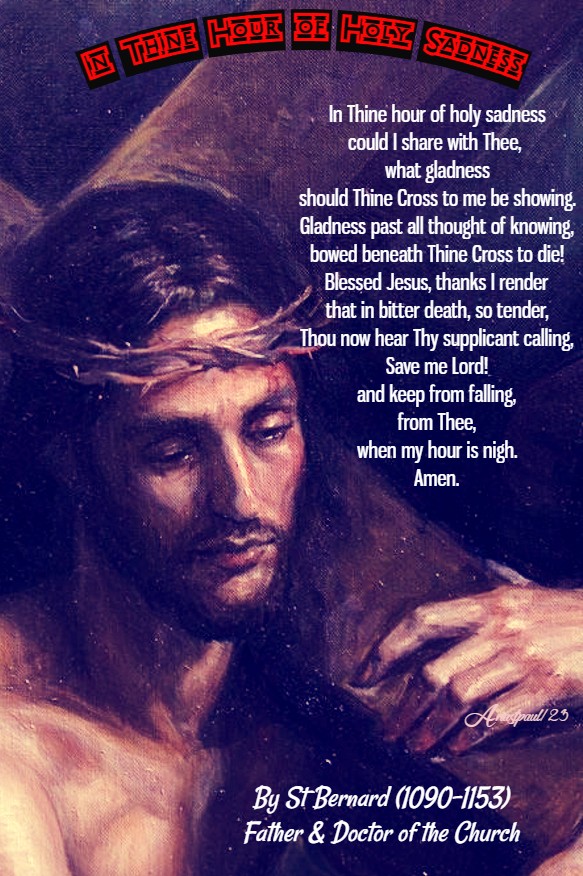
In Thine Hour of Holy Sadness By St Bernard (1090-1153) Father & Doctor of the Church
In Thine hour of holy sadness could I share with Thee, what gladness should Thine Cross to me be showing. Gladness past all thought of knowing, bowed beneath Thine Cross to die! Blessed Jesus, thanks I render that in bitter death, so tender, Thou now hear Thy supplicant calling, Save me Lord! and keep from falling, from Thee, when my hour is nigh. Amen.
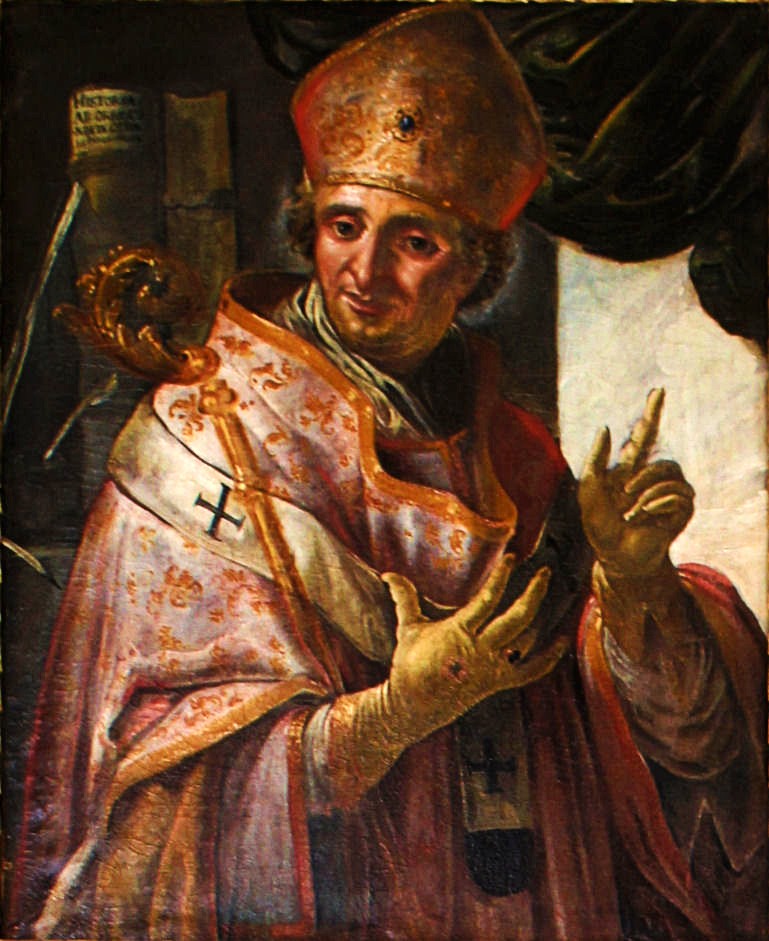
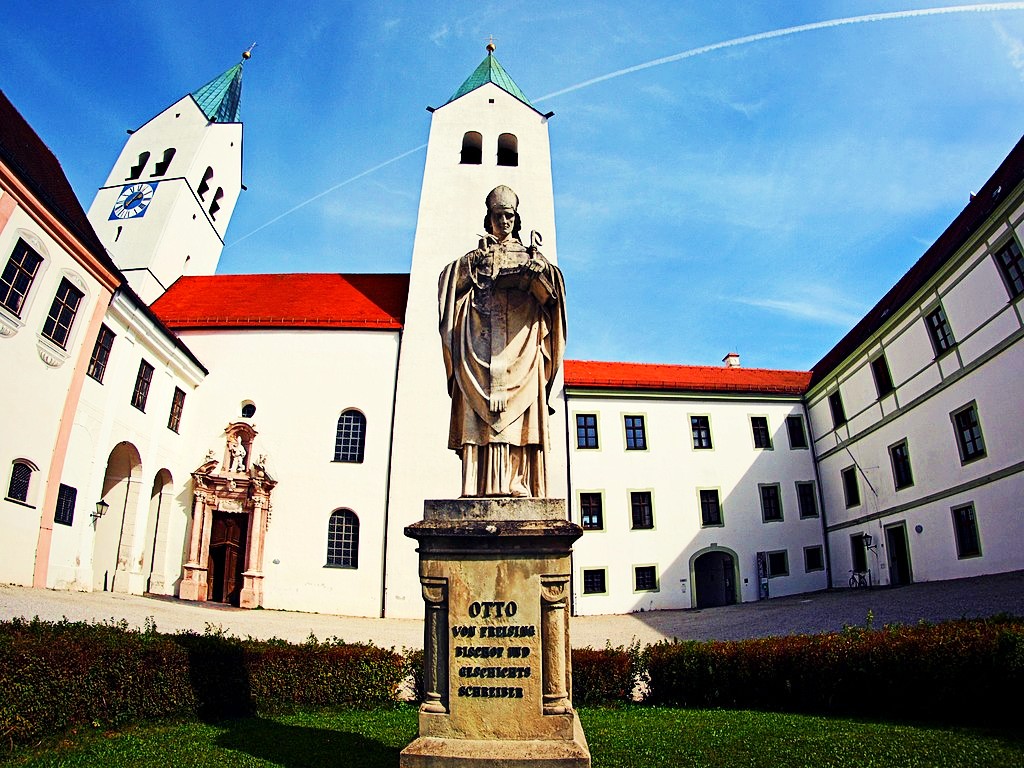
Saint of the Day – 22 September – Blessed Otto of Freising O.Cist. (c1111-1158) Bishop of Freising, Cistercian Priest and Abbot Historian, Reformer, Diplomatic Peace-maker, Defender of the Church, Crusader. Born between 1111 and 1114 in Klosterneuburg near Vienna, Austria and died at Morimond, Champagne, France, on 22 September, 1158 at the young age of 47 at the most. Also known as – Ottone. Additional Memorial – 7 September (Freising and Vienna).
Otto was as the fifth son of Leopold III, Margrave of Austria, by his wife Agnes, daughter of the Emperor Henry IV. By her first husband, Frederick I of Hohenstaufen, Duke of Swabia, by whom she was widowed, Agnes was the mother of the German King, Conrad III and grandmother of the Emperor, Frederick I. Otto’s sister, Judith, was married to Marquess William V of Montferrat. Otto was thus related to the most powerful families in Germany and northern Italy.
Like his younger brothers, he was destined for the Priesthood and when a very young adult, he was made Provost of the Chapter of Canons at Klosterneuberg. For his education, he was sent to the University of Paris, the centre of learning, philosophical, theological and classical.
Whilst travelling towards his homeland after completing his studies, he together with fifteen colleagues, all noblemen, entered the Cistercian Order at Morimond. It is not known what led him to take this step but it seems, by the attendance of his friends that they had contemplated, discussed and spent time in prayer before making this decision. Within three years Otto was elected Abbot of the Monastery. In 1133, Otto now convinced his father to found Heiligenkreuz Abbey, thus bringing literacy and sophisticated agriculture (including wine making) to the region that would become Vienna.
Probably in 1137 or 1138, Otto was called to Freising as Bishop, although he did not lay aside the Habit of his Order.
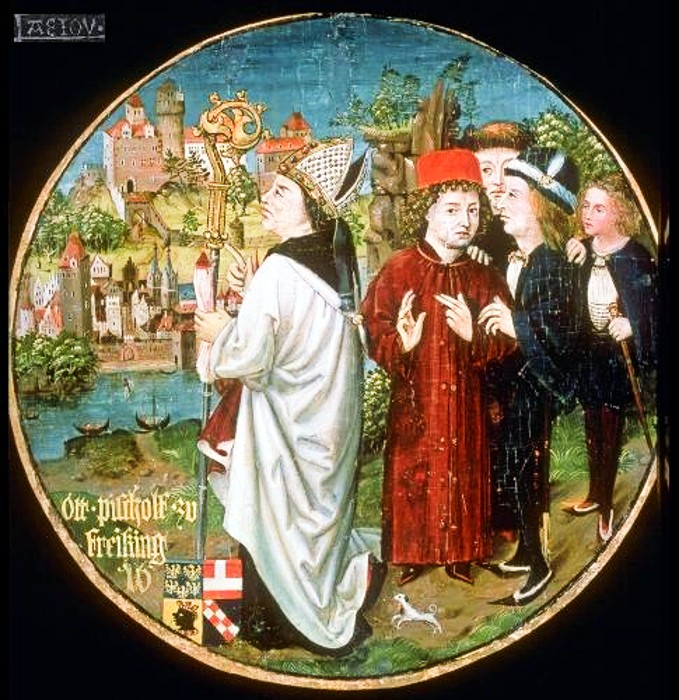
Painting of Blessed Otto of Freising by Hans Part in the Babenberger Stammbaum, ca. 1490, Stift Klosterneuburg. The Bishop is looking at the Cathedral and the City of Freising from the east bank of the Isar river.
As Bishop, Otto displayed a highly beneficent activity by founding and reforming Monasteries and zealously furthering studies by introducing Aristotelian philosophy and scholastic disputations on the model of the University of Paris. As a result, the school at Freising flourished anew.
He removed many of the abuses which had slowly infiltrated the Church and the secular institutions, in consequence of the investiture strife and demanded the return of the properties of which the Church had been robbed. In every way, Ottoe raised the prestige of the Church in Freising as against the nobility and after bitter struggles, freed it from the burdensome jurisdiction of certain Count. As Prince of the German Empire and closely connected with the Hohenstaufen family, he possessed great influence and used his high standing to obtain relief for the Church.
He was especially active in bringing about a reconciliation between Frederick and Henry and in restoring peace between the Emperor and the Pope.
In 1147 he accompanied King Conrad III on his unsuccessful Crusade to the Holy Land. The military division entrusted to Otto was completely routed and he, himself returned home after undergoing the severest privations and facing the greatest dangers. In 1158, due to ill health, Otto was forced to abandon his preposed accompaniment of Emperor Frederick on his march into Italy.
Otto is considered one of the most important historions of the High Middle Ages. Thanks to his excellent education and his noble position, he had access to numerous documents and information on history and politics. His works do not aim to be mere records but above all, to proclaim theological, philosophical and political messages. His “Chronica sive Historia de duabus civitatibus” (The Chronicle or History of the Two States) contains the history of the world in seven books and a vision of the Last Judgment in the eighth book. Otto writes this work as a theological continuation of St Augustine’s “De civitate Dei.” In contrast to St Augustine, Otto sees the Civitas Dei already realised on earth: it consists in the harmony of spiritual and secular power.
From 1156 onwards, Otto wrote the first two books of the “Gesta Friderici Imperatoris” (The Deeds of Emperor Frederick). In them he reproduces several imperial documents in their wording. Above all, he highlights the work of Emperor Friedrich Barbarossa. But this latter work is not confined to Germanic affairs, as tOtto digresses to tell of the preaching of St Bernard of Clairvaux and of his zeal against the heretics. Before his death, Otto commissioned his loyal secretary and Chaplain, Fr Rahewin (Died c1177) to complete this work.
On the way to the General Chapter in 1158 in Cîteaux, Bishop Otto reached his Monastery, Morimond, already ill. He died there surrounded by his monastic brothers. Otto’s body was buried in the Abbey Church of Morimond. Under the Sacramental Altar of the Cistercian Abbey Church of Heiligenkreuz, the bones, which were discovered in 1954 in the ruins of the Morimond Abbey Church and examined from 1966 to 1969 by the Anthropological Department of the Natural History Museum in Vienna, are venerated as Relics of Blessed Otto.
Otto is named as a Blessed with a Memorial day of 7 September in the Archdioceses of Vienna and Munich-Freising and in some Cistercian Monasteries, his memorial day is also celebrated on 7 September.
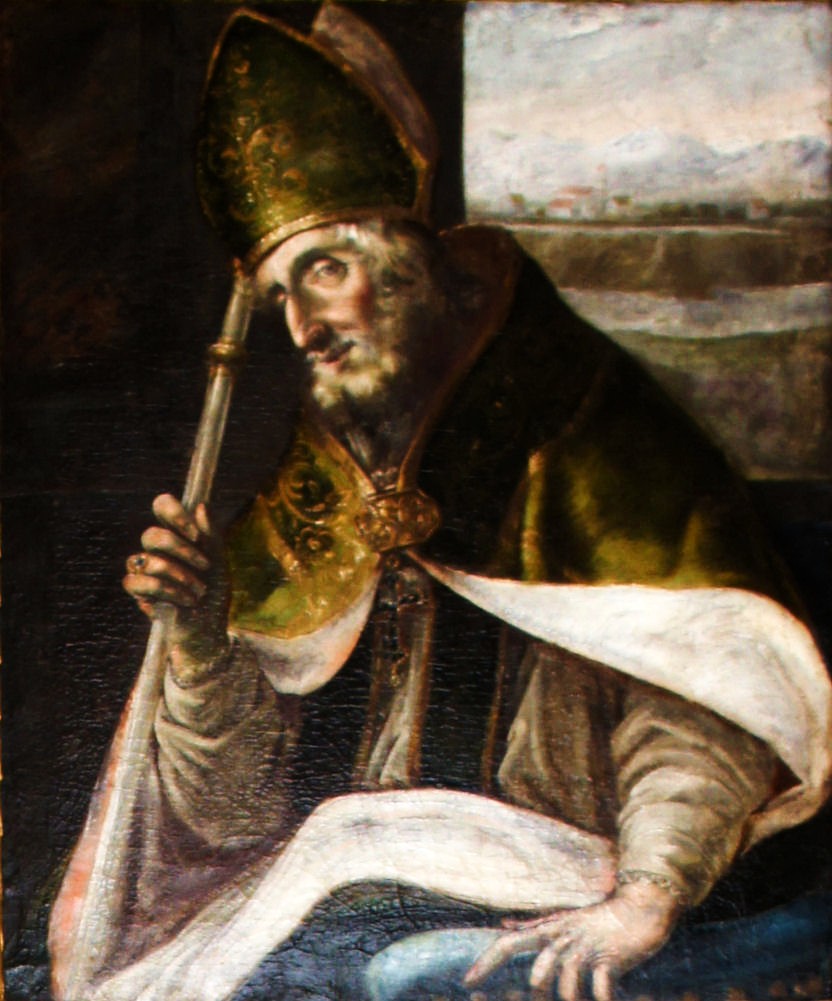
The Statue below is situate at Weihenstephan Abbey which was founded by Bl Otto’s father at Otto’s request. Sadly, it is no longer a working Monastery but it still produces beer and is the oldest brewery in the world.
St Thomas of Villanueva/Villanova OSA (1488-1555) Archbishop, Confessor, Religious Priest of the Order of St Augustine,Writer, Preacher, Teacher, Apostle of Charity, Mystic, Miracle-Worker often called “the Almsgiver” and “the Father of the Poor“, Reformer. Canonised on 1 November 1658 by Pope Alexander VII. About St Thomas here: https://anastpaul.com/2017/09/22/saint-of-the-day-22-september-st-thomas-of-villanova-o-s-a/
St Maurice & Companions: Martyrs of the Theban Legion: + Martyrs (c 287) A Roman imperial legion of 6,600 soldiers, all of whom were Christians; they had been recruited from the area around Thebes in Upper Egypt, were led by Saint Maurice and served under Emperor Maximian Herculeus. Around the year 287, Maximian led the army across the Alps to Agaunum, an area in modern Switzerland, in order to suppress a revolt by the Bagandre in Gaul. In connection with battle, the army offered public sacrifices to the Roman gods; the Theban Legion refused to participate. For refusing orders, the Legion was decimated – one tenth of them were executed. When the remainder refused to sacrifice to the gods, they were decimated again. When the survivors still refused to sacrifice, Maximinian ordered them all killed. Martyrs. https://anastpaul.com/2018/09/22/saints-of-the-day-22-september-st-maurice-and-the-martyrs-of-the-theban-legion-martyrs-c-287/
Bl Alfonso da Cusco St Basilia St Digna of Rome St Emerita of Rome St Emmeramus St Florentius the Venerable
Thought for the Day – 21 September – Meditations with Antonio Cardinal Bacci (1881-1971)
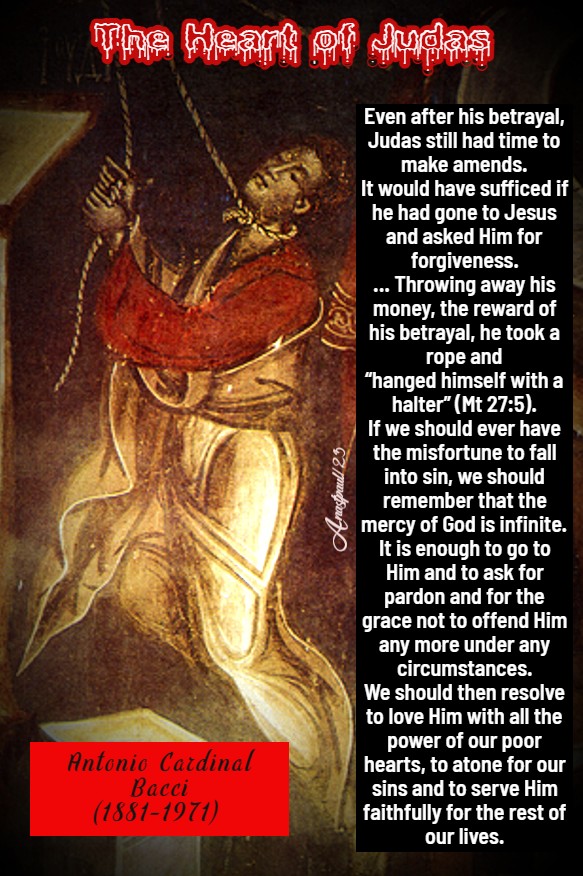
The Heart of Judas
“Even after his betrayal, Judas still had time to make amends. It would have sufficed if he had gone to Jesus and asked Him for forgiveness. He would certainly have received the kiss of peace. He was overcome by despair, however and decided that his sin was too great to be forgiven. So, throwing away his money, the reward of his betrayal, he took a rope and “hanged himself with a halter” (Mt 27:5).
If we should ever have the misfortune to fall into sin, we should remember that the mercy of God is infinite.
It is enough to go to Him and to ask for pardon and for the grace not to offend Him any more under any circumstances. We should then resolve to love Him with all the power of our poor hearts, to atone for our sins and to serve Him faithfully for the rest of our lives.”
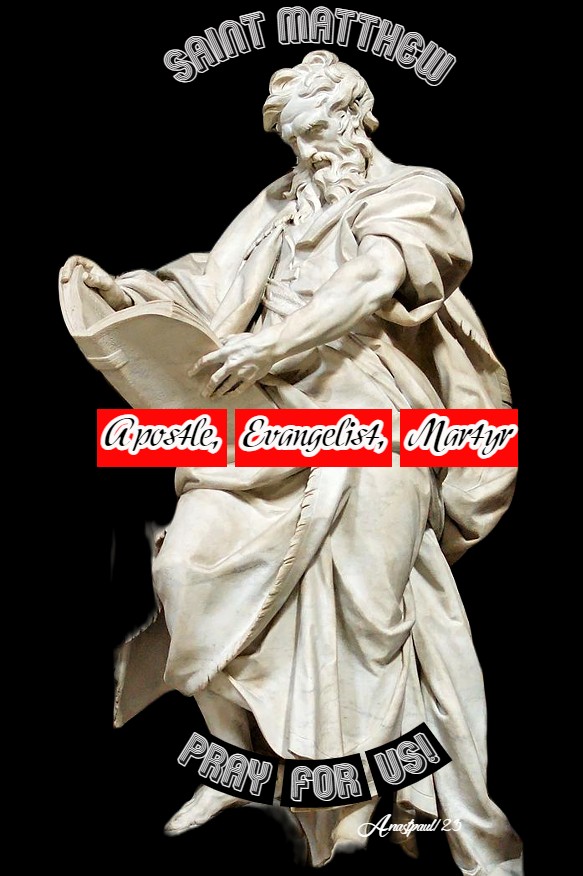
Quote/s of the Day – 21 September – The Feast of St Matthew, Apostle and Evangelist, Martyr
“For, as Scripture says, “The first living creature was like a lion,” (Rev 4:7) symbolising His effectual working, His leadership and Royal Power; “the second was like a calf,” signifying His Sacrificial and Priestly order but, “the third had, as it were, the face as of a man,” – an evident description of His coming as a human being; “the fourth was like a flying eagle,” pointing out the gift of the Spirit hovering with its wings over the Church. And, therefore, the Gospels of Mark, Luke, Matthew and John are in accord with these living things, among which Christ Jesus is seated. …”
St Irenaeus (c130-c202) Bishop, Martyr, Father
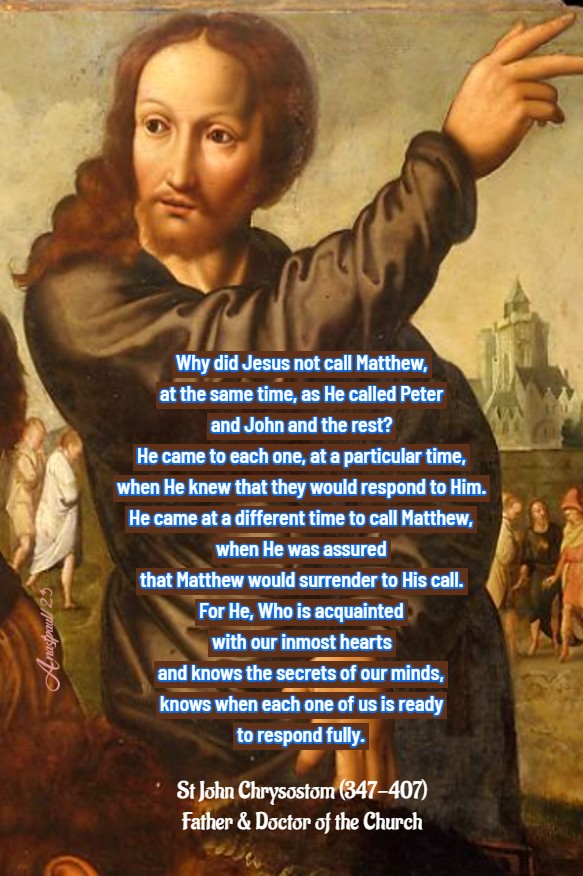
“Why did Jesus not call Matthew, at the same time, as He called Peter and John and the rest? He came to each one, at a particular time, when He knew that they would respond to Him. He came at a different time to call Matthew, when He was assured that Matthew would surrender to His call. For He, Who is acquainted with our inmost hearts and knows the secrets of our minds, knows when each one of us is ready to respond fully.”
St John Chrysostom (347-407) Father & Doctor of the Church
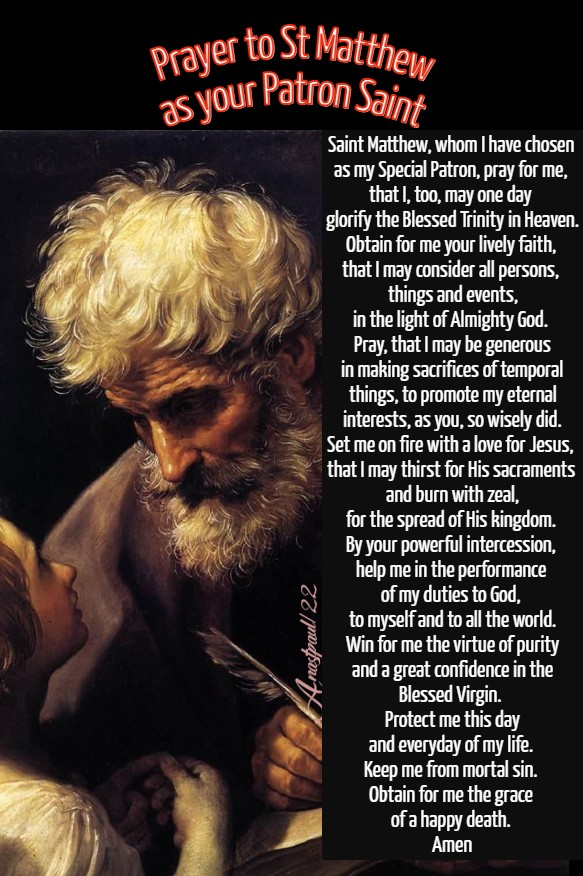
Prayer to St Matthew as your Patron Saint
Saint Matthew, whom I have chosen as my Special Patron, pray for me, that I, too, may one day glorify the Blessed Trinity in Heaven. Obtain for me your lively faith, that I may consider all persons, things and events, in the light of Almighty God. Pray, that I may be generous in making sacrifices of temporal things, to promote my eternal interests, as you, so wisely did. Set me on fire with a love for Jesus, that I may thirst for His sacraments and burn with zeal, for the spread of His kingdom. By your powerful intercession, help me in the performance of my duties to God, to myself and to all the world. Win for me the virtue of purity and a great confidence in the Blessed Virgin. Protect me this day and everyday of my life. Keep me from mortal sin. Obtain for me the grace of a happy death. Amen
One Minute Reflection – 21 September – “Month of The Seven Sorrows of the Blessed Virgin Mary and The Holy Cross” – The Feast of St Matthew, Apostle and Evangelist, Martyr – Ezekiel 1:10-14, Matthew 9:9-13– – Scripture search here: https://www.drbo.org/
“Why does your Master eat with publicans and sinners? ” – Matthew 9:11
REFLECTION – “Our Lord chose Matthew, the Tax Collector, to encourage his fellows to join him. He looked on sinners, called them and brought them to sit beside Him. What a wonderful sight! Angels stand trembling while Publicans, seated, rejoice! The Angels are struck with awe before the Lord’s greatness, while sinners eat and drink with Him! The Scribes choke with hatred and indignation, the Publicans rejoice because of his mercy. The heavens saw the sight and were filled with wonder; hell saw it and was maddened. Satan saw it and was enraged; death saw it and withered; the Scribes saw it and were much troubled.
There was joy in Heaven and happiness among the Angels because the rebellious had been persuaded, the recalcitrant quieted and sinners reformed and because, Publicans had been made righteous. Just as our Lord did not turn away from the shamefulness of the Cross, in spite of the entreaties, of His friends (Mt 16:22) so, He did not refuse the company of Publicans in spite of the taunts of His enemies. He despised mockery and scorned praise, thus, accomplishing all that is for mankind’s good!” – St Ephrem (306-373) Deacon in Syria, Father and Doctor of the Church (Commentary on the Gospel).
PRAYER – May we be helped, O Lord, by the prayers of the blessed Apostle and Evangelist, Matthew that what we ourselves cannot obtain, maybe granted by his intercession. Through Jesus Christ, Thy Son our Lord, Who lives and reigns with Thee, in the unity of the Holy Ghost, God, world without end. Amen (Collect).



























You must be logged in to post a comment.