Our Lenten Journey with St Francis de Sales – 10 March – Friday of the Second Week in Lent – Hebrews 11:33-39, Luke 6:17-23. – Scripture search here: https://www.drbo.org/
“The just cried and the Lord heard them and delivered them out of all their troubles.” Psalm 33:18
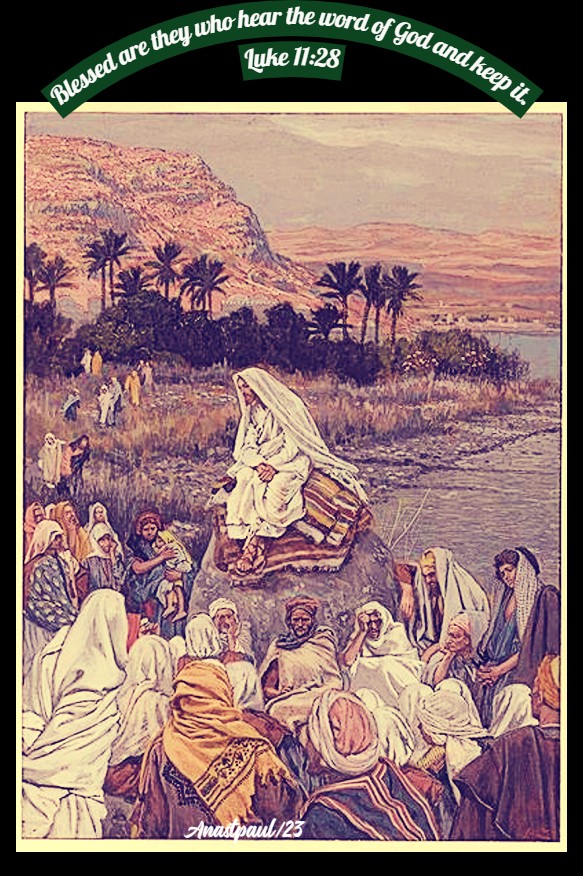
“And He, lifting up His eyes on His disciples, said: Blessed are you poor, for yours is the Kingdom of God.” Luke 6:20
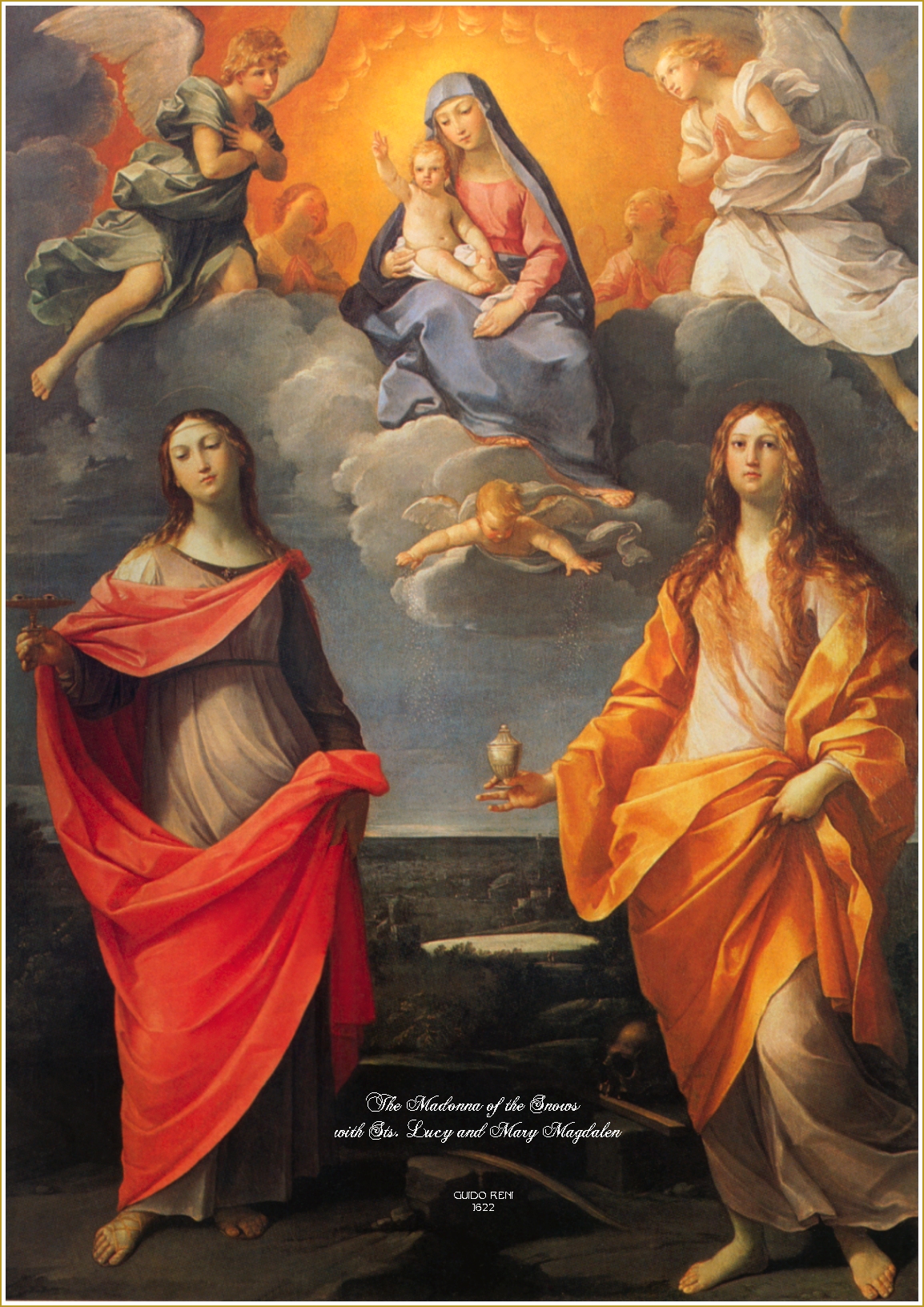
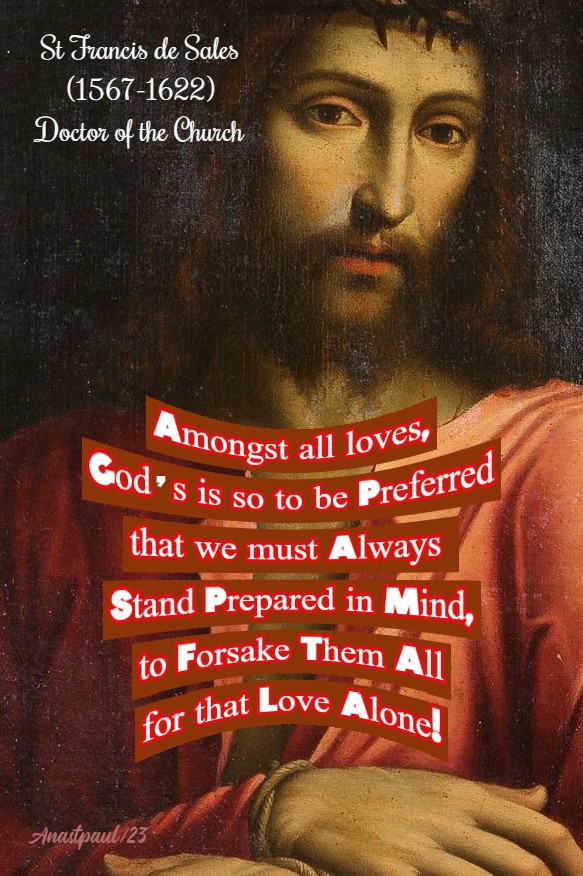
POVERTY AMID RICHES St Francis de Sales (1567-1622) Doctor Caritas
“Blessed are the poor in spirit, for theirs is the Kingdom of God” and if so, woe be to the rich in spirit, for theirs must be the bitterness of hell! By rich in spirit, I mean him, whose riches engross his mind, or whose mind is buried in his riches. He is poor in spirit, whose heart is not filled with the love of riches, whose mind is not set upon them. …
Whatever riches and all other transitory things you may possess, you must keep your heart free from the slightest affection for them. Your heart may be surrounded by riches; however, riches must never master your heart! … And this, my child, is what your heart should be – open only to Heaven, impenetrable to riches and earthly treasures. If you have them, keep your heart from attaching itself to them; let it maintain a higher level and amidst riches be as though you had none, superior to them. Do not let that mind which is the likeness of God, cleave to mere earthly goods; let it always be raised above them, not sunk in them.
… Do not fix your longings on anything which you do not possess; do not let your heart rest in that which you have; do not grieve overmuch , at the losses which may happen to you – and then, you may reasonably believe, that although rich in fact, you are not so in affection but that you are poor in spirit and, therefore, blessed, for the Kingdom of Heaven is yours.” (Introduction to the Devout Life – PART III Containing counsels concerning the practice of virtue).
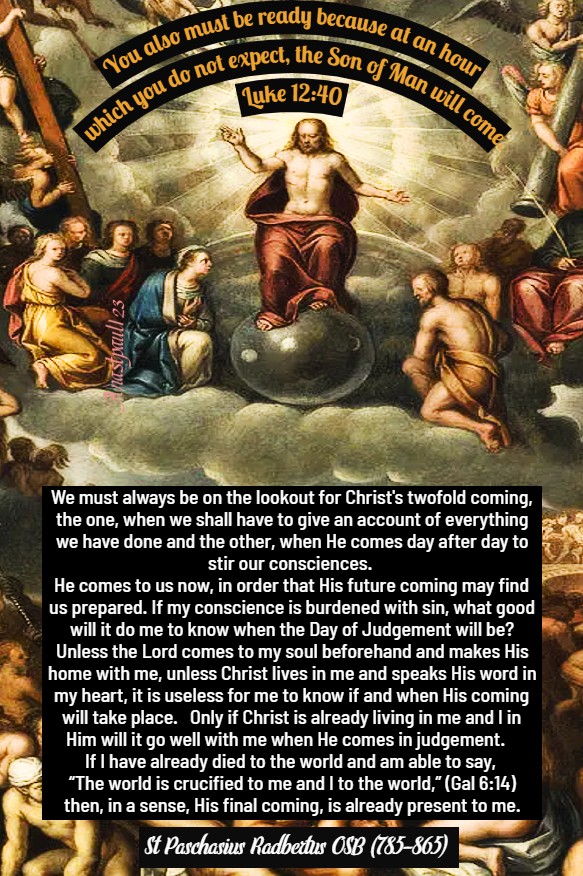
One Minute Reflection – 10 March – Forty Martyrs of Sebaste, Armenia (Died 320) – Friday of the Second Week in Lent – Hebrews 11:33-39, Luke 6:17-23 – Scripture search here: https://www.drbo.org/
“And He, lifting up His eyes on His disciples, said: Blessed are you …” – Luke 6:20
REFLECTION – “Lord Jesus Christ, to teach us the summit of virtue, You ascended the mountain with Your disciples and taught them the Beatitudes and highest virtues, promising them the rewards applicable to each. Grant that my weakness may hear Your Voice, that I may apply myself, through their practice, to acquire the merit of the virtues, so that by Your Mercy, I may receive the promised reward. As I consider the payment, do not let me refuse the effort of the labour. Make my hope of eternal salvation, sweeten the bitterness of the cure, inflaming my soul with the splendour of Your work. Out of the wretched person I am, create one of the blessed; from the blessedness here below, lead me, by Your Grace, to the blessedness of the homeland.
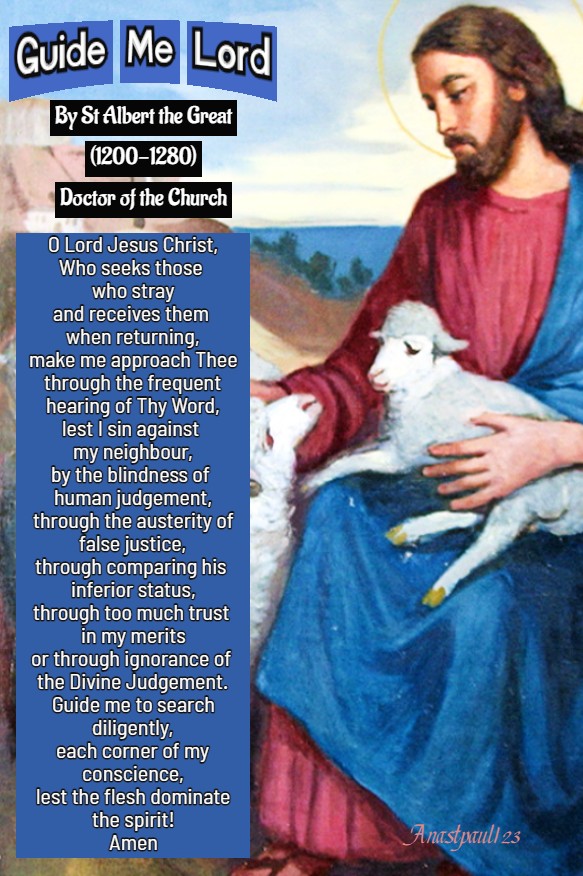
Come, Lord Jesus Christ, in search of Your servant, seeking Your erring and exhausted sheep. Come, Spouse of the Church, in search of Your lost coin. Come, Father of mercies, welcome the prodigal son returning to You. Come, then, Lord, for You are the only One, able to call back the sheep that has strayed, to find the lost drachma, to reconcile the runaway son. Cone, that there may be salvation on earth and joy in Heaven! Turn me towards You and grant that I may carry out a true and perfect repentance, so that I may become an occasion for joy, among the Angels. Sweetest Jesus, I pray You, by the immensity of Your Love for me, a sinner, grant that I may love You alone, above all things, that I may be consoled by none but You, my sweetest God!” – Ludolph of Saxony (c1300-1378) Monk, Theologian, Writer, Dominican then a Carthusian (Prayers to Jesus Christ).
PRAYER – Grant, we beseech Thee, Almighty God, that we who know how courageously Thy holy Martyrs have confessed the faith, may experience their goodness as they intercede for us with Thee. Through Jesus Christ, Thy Son our Lord, Who lives and reigns with Thee, in the unity of the Holy Ghost, God, world without end. Amen (Collect).
Our Morning Offering – 10 March – Friday of the Second Week of Lent
Hail, Sweet Jesus! Prayer to Christ in His Passion and Death By St Francis de Sales (1567-1622) Doctor of the Church
Hail, sweet Jesus! Praise, honour and glory be to Thee, O Christ, Who, of Thou own accord, embraced death, and recommending Thyself to Thy heavenly Father, bowing down Thy venerable Head, did yield up Thy Spirit. Truly thus giving up Thy life for Thy sheep, Thou hast shown Thyself, to be the Good Shepherd. Thou died, O Only-begotten Son of God. Thou died, O my beloved Saviour, that I might live forever. O how great hope, how great confidence have I reposed in Thy Death and Thy Blood! I glorify and praise Thy Holy Name, acknowledging my infinite obligations to Thee. O good Jesus, by Thy bitter Death and Passion, give me grace and pardon. Give unto the faithful departed, rest and life everlasting. Amen
Saint of the Day – 10 March – St Droctoveus (c530-c580) Abbot , disciple of St Germanus He was the first Abbot of the Benedictine Monastery which became the Church of Saint Germain-des-Pres in Paris. Born in c530 in Auxerre, France and died in c580 of natural causes. Also known as – Droctoveus of Paris, Droctoveus of Autun, Droctonius, Droctovée, Droctovius, Drote, Drottoveo, Drotté.
The Roman Martyrology reads: “At Paris, the decease of the Abbot, St Droctoveus, who was a disciple of the blessed Bishop, Germanus.”
The oldest account of Droctoveus’ life was written by his contemporary, the renowned Bishop and Poet, St Venantius Fortunatus in Chapter XI of his Carmina (Songs), who praised his holiness and virtues. A complete Vita was written of him but was unfortunately lost during the Norman raids. In the 9th Century, Gislemar, a Benedictine Monk of this house, collected from tradition and scattered memoirs the history of our Saint and this information was used by the Bollandists in their Lives of the Saints.
Droctoveus became a Monk and studied under St Germanicus (c 490-576 at St Symphorien Abbey at Autun. There a Rule was followed modelled upon that of the Solitaries of Egypt.
When St Germanus had become the Bishop of Paris and King Childebert had founded the Monastery of St Vincent (since called Saint Germain-des -pres) St Germanus being eminent for his learning and extraordinary spirit of mortification and prayer, was appointed the first Abbot of this house.
He ruled the Monastery until his death at the age of around forty-five “the embodiment (so the chroniclers describe him) of Christian and monastic perfection.”
His body is kept in that Abbey and he is honoured by the Church on the 10th of March.
Friday of the Second Week in Lent – FAST and ABSTINENCE
Forty Martyrs of Sebaste, Armenia (Died 320) – Forty Christian soldiers of the Thunderstruck Legion of the Imperial Roman army who were tortured and murdered for their faith during the persecutions of Emperor Licinius. They were exposed naked on a frozen pond to freeze to death at Sebaste, Armenia in 320 and their bodies afterward were burned. THE FULL STORY HERE: https://anastpaul.com/2021/03/10/saints-of-the-day-10-march-the-forty-martyrs-of-sebaste-armenia-died-320/
The Feast of the Holy Shroud: Since 1831, the Holy Shroud of Turin is celebrated on the Friday after the Second Sunday in Lent. Before 1831 it was rarely found on Diocesan calendars. The office is taken from the Proprium of Turin.
St Alexander of Apema St Anastasia the Patrician St Andrew of Strumi St Attalas of Bobbio St Blanchard of Nesle-la-Réposte St Caius of Apema St Cordratus of Nicomedië St Droctoveus (c530-c580) Abbot St Emilian of Lagny St Failbhe the Little St Gustav the Hermit St Himelin Bl John of Vallombrosa St Kessog
St Macarius of Jerusalem (Died c 335) Bishop of Jerusalem for over twenty years. Defender of the Faith against Arianism, founder of the True Cross with St Helena, organiser and manager of the building of the Sacred Basilicas, including the Church of the Holy Sepuchre in Jerusalem, paid for by St Constantine the Great, St Helena’s son. Also of great import is the fact that Bishop Macarius was one of the two main authors of the Nicene Creed, that is, of the Creed that we still pronounce in Mass today The Life os St Macarius: https://anastpaul.com/2022/03/10/saint-of-the-day-10-march-saint-macarius-died-c-335/
St Peter of Veroli St Rufinus of Nicomedië St Sannudius of Bagensena St Saturninus of Nicomedië St Sedna of Ossory St Silvester of Ireland
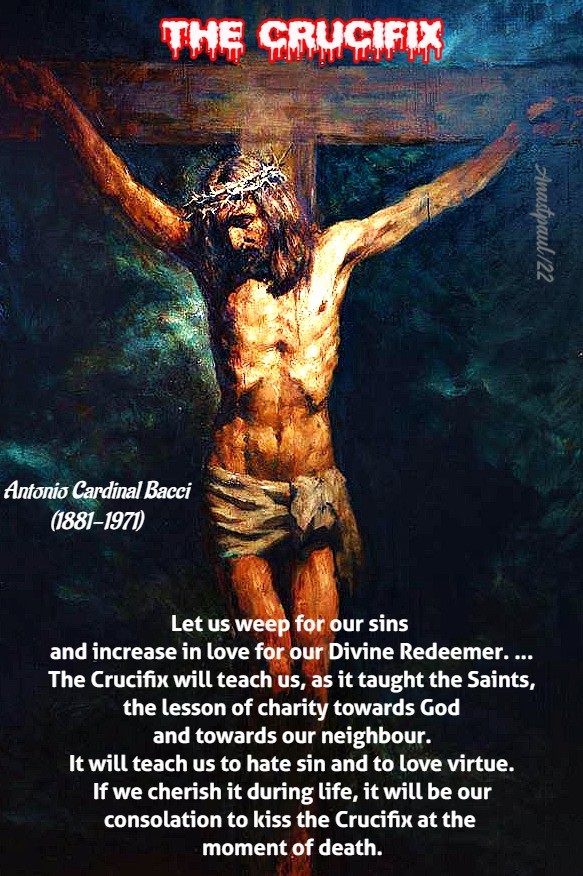
Thought for the Day – 9 March – Meditations with Antonio Cardinal Bacci (1881-1971)
The Human Soul
“Remember that every mortal sin means death to the soul, for it robs it of the supernatural life of grace, making it incapable of every good action and deserving of hell. If you committed one mortal sin, God could tire of you, as if you were an unproductive tree and put an end to your life, without giving you time to repent! Then, you would be lost for all eternity. This thought should never leave your mind, particularly in time of temptation. At such a time, turn to God with confidence, tell Him that you love Him and do not wish to offend Him at any price. Face death rather than sin.”
Quote/s of the Day – 9 March – St Frances of Rome (1384-1440) Widow
“It is most laudable, in a married woman, to be devout but, she must never forget that she is a home-keeper. And sometimes, she must leave God at the Altar to find Him in her household affairs.”
St Frances of Rome (1384-1440)
“Be ever more convinced that your Guardian Angel is really present, that he is ever at your side. St Frances of Rome always saw him standing before her, his arms clasped at his breast, his eyes uplifted to Heaven but, at the slightest failing, he would cover his face, as if in shame and at times, turn his back to her!”
Our Lenten Journey with St Francis de Sales – 9 March – Thursday in the Second Week of Lent – Proverbs 31:10-31, Matthew 13:44-52 – Scripture search here: https://www.drbo.org/
“Thou hast loved justice and hated iniquity; therefore God, thy God, hath anointed thee with the oil of gladness, above thy fellows.” Psalm 44:8
“So shall it be at the end of the world. The Angels shall go out and shall separate the wicked from among the just. And shall cast them into the furnace of fire: there shall be weeping and gnashing of teeth.” Matthew 13:49-50
HEAVEN or HELL? St Francis de Sales (1567-1622) Doctor Caritas
“CONSIDER THAT THE CHOICE you make in this life will last forever in the next! Consider too, that while both are open to receive you, according to your choice, yet God, Who is prepared to give the one by reason of His Justice, the other by reason of His Mercy, all the while desires, unspeakably that you should select Paradise. offering you countless graces on God’s part, countless assistance to attain to it. Consider that Jesus Christ, enthroned in Heaven, looks down upon you in loving invitation – ‘O beloved one, come unto Me and joy forever in the eternal blessedness of My Love!’ Behold His mother yearning over you with maternal tenderness, ‘Courage, my child, do not despise the Goodness of my Son, or my earnest prayers for thy salvation.‘ …
O Hell, I abhor thee now and forever; I abhor thy griefs and torments, thine endless misery, the unceasing blasphemies and maledictions which thou pourest out upon my God and turning to thee, O blessed Paradise, eternal glory, unfading happiness, I choose thee forever as my abode, thy glorious mansions, thy precious and abiding tabernacles.
O my God, I bless Thy Mercy which gives me the power to choose, O Jesus, Saviour, I accept Thine Eternal Love and praise Thee for the promise Thou hast given me, of a place prepared for me, in that blessed New Jerusalem, where I shall love and bless Thee forever. ” (Excerpt – ‘Introduction to the Devout Life’ 9th Meditation).
One Minute Reflection – 9 March – Thursday in the Second Week of Lent – The Memorial of St Frances of Rome Obl.S.B. (1384-1440) Widow – Proverbs 31:10-31, Matthew 13:44-52 – Scripture search here: https://www.drbo.org/
“So shall it be at the end of the world. The Angels shall go out and shall separate the wicked from among the just. And shall cast them into the furnace of fire: there shall be weeping and gnashing of teeth.” – Matthew 13:49-50
REFLECTION – “Our Lord was an example of incomparable patience. He bore with a “devil” among His disciples even to His Passion (Jn 6,70). He said: “Let them grow together until the harvest lest you uproot the wheat when you pull out the weeds” (cf. Mt 13,29f.). As a symbol of the Church, He preached that the net would bring back to shore, namely the end of the world, every kind of fish, both good and bad. And He made it known, in various other ways, whether openly or in parables, that there would always be a mixture of good and bad. But, nevertheless, He stresses, that we have to protect the Church’s discipline when He says: “If your brother sins against you, go and tell him his fault between you and him alone. If he listens to you, you have won over your brother” (Mt 18,15)…
Yet today, we see people who think of nothing but stern commandments, who order that troublemakers be reproved, ‘not giving what is holy to the dogs,’ treating, like the publicans, ‘anyone who despises the Church, cutting off the scandalous member from the body‘ (Mt 7,6 ; 18,17 ; 5,30). Their stormy zeal so troubles the Church, that they pull out the weeds before their time and their blindness makes of them enemies, of the unity of Jesus Christ…
Take care not to let these presumptuous thoughts enter our hearts, trying to separate ourselves from sinners, so as not to be soiled by contact with them, wanting to form a band of pure and holy disciples. We will achieve nothing but breaking up our unity, under the pretext of not associating with the wicked. To the contrary, let us remember the parables of Scripture, their inspired words, their striking examples, where we are shown that, until the end of the world and the day of judgement, the bad will always be mingled amongst the good in the Church, without their participation in the Sacraments being harmful to the good, so long as these latter, have not played a part in their sins.” – St Augustine (354-430) Father and Doctor of Grace (On Faith and Works – Excerpt ch 3-5)
PRAYER – O God, Who along with other gifts of Thy grace honoured blessed Frances, Thy handmaid, with the close companionship of an angel, grant, we beseech Thee, that by the help of her intercession we may be made worthy to attain the companionship of Angels in Heaven. Through Jesus Christ, Thy Son our Lord, Who lives and reigns with Thee, in the unity of the Holy Ghost, God, world without end. Amen (Collect).
Our Morning Offering – 9 March – Thursday in the Second Week of Lent
Look Down, O Lord By St Cajetan (1480-1547)
Look down, O Lord, from Thy sanctuary and from the high habitation of Heaven and behold this Sacred Oblation which our great High Priest, Thy Holy Servant, the Lord Jesus, immolates unto Thee, for the sins of His brethren and be propitious to the multitude of our iniquities. Behold, the Voice of the Blood of Jesus, our Brother, cries to Thee from the Cross. Graciously hear, O Lord, be appeased, O Lord, hearken and do. Delay not for Thy own sake, my God because Thy Name is invoked upon this city and upon Thy people and do with us, according to Thy mercy. Amen
Plenary Indulgence on the First Thursday of each month for Communicants visiting the Blessed Sacrament and reciting this prayer. Partial Indulgence of seven years and seven Quarantines, on all other Thursdays. –Pope Pius VII. “Quarantines” signifies a strict Ecclesiastical penance of forty days, performed according to the practice of the early Church. Hence an Indulgence of “Seven Quarantines,” for instance, implies. the remission of as much temporal punishment, as would be blotted out by the corresponding amount of Ecclesiastical Penance i.e. 7 x 40 = 280 days.
Saint of the Day – 9 March – St Frances of Rome Obl.S.B. (1384-1440) Widow, Founder, Wife, Mother, Mystic, Organiser of charitable services and a Benedictine Oblate who founded a religious community of Oblates, who share a common life without religious vows. Patronages – against plague/epidemics, of automobile drivers (given in 1951), aviators, taxi drivers, death of children, the laity, motorcyclists, motorists, people ridiculed for their piety, Roman housewives, widows, women, Rome, Italy.
Saint Frances of Rome, Widow From the Liturgical Year, 1870
Frances, a noble lady of Rome, led a most virtuous life, even in her earliest years. She despised all childish amusements and worldly pleasures, her only delight being solitude and prayer. When eleven years old, she resolved on consecrating her virginity to God and seeking admission into a Monastery. But she humbly yielded to the wishes of her parents and married a young and rich nobleman, by name Lorenzo Ponziani.
As far as it was possible, she observed, in the married state, the austerities of the more perfect life to which she had aspired. She carefully shunned theatrical entertainments, banquets and other such amusements. Her dress was of serge and extremely plain. Whatever time remained after she had fulfilled her domestic duties, was spent in prayer and works of charity. But her zeal was mainly exercised in endeavouring to persuade the ladies of Rome, to shun the world and vanity in dress. It was with a view to this, that she founded, during her husband’s life, the House of Oblates of the Congregation of Monte-Oliveto, under the Rule of St Benedict.
She bore her husband’s banishment, the loss of all her goods and the trouble which befel her whole family, not only with heroic patience but was frequently heard to give thanks, saying with holy Job: “The Lord hath given and the Lord hath taken away; blessed be the Name of the Lord!”
At the death of her husband, she fled to the aforesaid House of Oblates and there, barefooted, with a rope tied around her neck and prostrate on the ground, she humbly and with many tears, begged admission. Her petition being granted, she, though mother of the whole community, gloried in calling herself everyone’s servant and a worthless woman and a vessel of dishonour. She evinced the contempt she had for herself by her conduct, as well as by her expressions. Thus, when returning from a vineyard in the suburbs, she would go through the city, sometimes carrying faggots on her head, sometimes driving an ass laden with them.
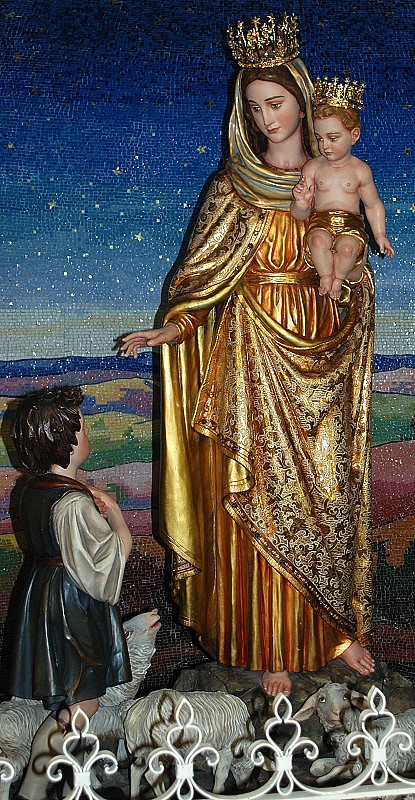
She looked after, and bestowed abundant alms upon the poor. She visited the sick in the hospitals and consoled them, not only with corporal food but with spiritual advice. She was untiring in her endeavours to bring her body into subjection, by watchings, fasting, wearing a hair-shirt and an iron girdle and by frequent disciplines. Her food, which she took but once in the day, consisted of herbs and pulse and her only drink was water. But she would somewhat relent in these corporal austerities, as often as she was requested to do so by her Confessor, whom she obeyed with the utmost exactitude.
Her contemplation of the Divine Mysteries and especially of the Passion, was made with such intense fervour and abundance of tears that she seemed as though she would die with grief. Frequently, too, when she was praying and above all, after Holy Communion, she would remain motionless, with her soul fixed on God and rapt in heavenly contemplation.
The enemy of mankind seeing this, endeavoured to frighten her out of so holy a life, by insults and blows but she feared him not, invariably baffled his attempts and, by the assistance of her Angel Guardian, whose visible presence was granted to her, she gained a glorious victory.
God favoured her with the gift of healing the sick, as also with that of prophecy, whereby she foretold future events and could read the secrets of hearts. More than once, when she was intent on prayer, either in the bed of a torrent, or during a storm of rain, she was not touched by the water. On one occasion, when all the bread they had was scarcely enough to provide a meal for three of the Sisters, she besought our Lord and he multiplied the bread so that after fifteen persons had eaten as much as they needed, there was sufficient left to fill a basket.
At another time, when the Sisters were gathering wood outside the City walls, in the month of January, she amply quenched their thirst by offering them bunches of fresh grapes, which she plucked from a vine and which she had miraculously obtained.
Her virtues and miracles procured for her the greatest veneration from all. Our Lord called her to Himself in the fifty-sixth year of her age and she was Canonised in 1384 by Pope Paul the Fifth.
Thought for the Day – 8 March – Meditations with Antonio Cardinal Bacci (1881-1971)
Knowledge and Goodness
“St Paul wrote: “Let no-one rate himself more than he ought but, let him rate himself according to moderation and according as God has apportioned to each one, the measure of faith” (Rom 12:31). “Knowledge puffs up,” he said “but charity edifies” (1 Cor 8:11).
“The humble knowledge of oneself,” The Imitation of Christ tells us, “is a surer way to God, than deep researches after science. Knowledge is not to be blamed… but a good conscience and a virtuous life, are always to be preferred. But because many take more pains to be learned than to lead good lives, therefore, they often go astray” (Bk 2 ch 3).
So let us learn everything which our position in life requires of us and, as much besides as we are able. But above all, let us learn to be good and holy. If we fail in this, the rest is useless and dangerous!”
Quote/s of the Day – 8 March – The Memorial of St John of God OH (1495-1550) Confessor, Founder of the Brothers Hospitallers of Saint John of God
“Lord, Thy Thorns are my Roses and Thy Suffering, my Paradise.”
After receiving the Last Rites St John said:
“There are three things which make me uneasy: The first is that I have received so many graces from God and have not recognised them and have repaid them with so little of my own. The second is that after I am dead, I fear lest the poor women I have rescued and the poor sinners I have reclaimed, may be illtreated. The third is that those who have trusted me with money and whom I have not fully repaid, may suffer loss on my account.”
Our Lenten Journey with St Francis de Sales – 8 March – Wednesday in the Second Week of Lent – Ecclesiasticus Sirach 31:8-11, Matthew 22:34-46 – Scripture search here: https://www.drbo.org/
“Blessed is the man who fears the Lord, he shall delight exceedingly in His commandments. …” Psalm 111:3
“‘You shall love the Lord your God with your whole heart and with your whole soul and your whole mind.’ This is the greatest and first commandment. And the second is like it, ‘You shall love your neighbour as yourself.’ ” Matthew 22:37-39
THE GREAT COMMANDMENT St Francis de Sales (1567-1622) Doctor Caritas
“CHARITY, while it is alive in the soul, reigns supreme and holds sway over all the emotions, leading the will to put God before everything else without delay, without exception, without reserve. … But why does charity include love of ourselves? Why, because we are wearing God’s Image and Likeness and, since all men enjoy the same noble dignity, we love them too as we love ourselves – in other words, as devoted living likenesses of the Godhead. … So it is, then, that the same charity which gives rise to acts of love of God, also breeds love of our neighbour.
When we see our neighbour, created to the Image and Likeness of God, should we not say to one another, ‘Stop, do you see this created being, do you see how he resembles the Creator? should we not cast ourselves upon him and weep over him with love? Should we not give him a thousand, thousand blessings?
It is for love of God Who made him in His Own Image and Likeness and, therefore, capable of sharing in His goodness in grace and glory. I say it is for love of God, from Whom he is, Whose he is, by Whom he is, in Whom he is, for Whom he is, Whom he resembles in a most particular manner.” – (Treatise on the Love of God, Book 10).
One Minute Reflection – 8 March – Wednesday in the Second Week of Lent – The Memorial of St John of God OH (1495-1550) Confessor, Founder of the Brothers Hospitallers of Saint John of God – Ecclesiasticus Sirach 31:8-11, Matthew 22:34-46 – Scripture search here: https://www.drbo.org/
“‘You shall love the Lord your God with your whole heart and with your whole soul, and your whole mind.’ This is the greatest and first commandment. And the second is like it, ‘You shall love your neighbour as yourself.’ ” – Matthew 22:37-39
REFLECTION – “The Lord asks of us only two things – love of His Majesty and love of our neighbour. These are what we must work for. By observing them with perfection, we do His will and so will be united with Him.
But how far, … we are from doing these two things, for so great a God, as we ought! May it please His Majesty to give us His grace so that we might merit, if we wish, to reach this state that lies within our power. The most certain sign, in my opinion, as to whether or not we are observing these two laws, is whether we observe well the love of neighbour.
We cannot know whether or not we love God, although there are strong indications for recognising that we do love Him but, we can know whether we love our neighbour. And be certain that the more advanced you see you are, in love for your neighbour, the more advanced you will be in the love of God, for the love His Majesty has for us, is so great that to repay us for our love of neighbour, He will,, in a thousand ways, increase the love we have for Him. I cannot doubt this. That is why it is important for us to walk, with careful attention to how we are proceeding in this matter, for if we practice love of neighbour with great perfection, we will have done everything. I believe that, since our nature is weak, we will not reach perfection in the love of neighbour, if that love does not rise from love of God as its root.” – St Teresa of Avila (1515-1582), Carmelite, Doctor of the Church (Interior Castle, Fifth Dwelling Places Ch 3).
PRAYER – O God, Who caused blessed John, when burning with love for Thee, to walk unharmed through the midst of flames and through him, enriched Thy Church with a new religious family; grant by the help of his merits, our sins may be burned away by the fire of Thy love and eternal remedies may come to us. Through Jesus Christ, Thy Son our Lord, Who lives and reigns with Thee, in the unity of the Holy Ghost, God, world without end. Amen (Collect).
Our Morning Offering – 8 March – Wednesday in the Second Week of Lent
Hear Me, O Lord By St Peter of Alcantara (1499-1562)
Hear me, O Lord, my soul’s delight, joy of my heart, not because of my merits but because of Thy boundless goodness. Teach me, enlighten me, direct me, help me in all things that I may never say or do anything but that which I know to be pleasing in Thou sight. Guide me, O God, my Love, my Light and my Life! Amen
Saint of the Day – 8 March – St Felix of Burgundy (Died 647) “The Apostle of East Anglia,” the First Bishop of Dunwich, Missionary in East Anglia and particularly in the Port Town now known as Felixstowe, in Suffolk, England. Amongst being the Founder of Norwich Cathedral and countless Churches.the famous Monastery of Bury Saint Edmunds, he is also the Founder of what is now the University of Cambridge. Born in the late 6th Century in Burgundy, France and died on 8 March 647 of natural causes. Patronage – of the Diocese of East Anglia, Also known as – “The Apostle of East Anglia,” Felix of Dunwich, Felix of East Anglia.
The Roman Martyrology states: “In England, St Felix, Bishop, who converted the East Anglians to the Faith.”
A statue of St Felix, part of a reredos by J P Seddon (1885) at St Peter Mancroft, Norwich
Felix is widely credited as the man who introduced Christianity to the Kingdom of East Anglia. Almost all that is known about him comes from St Bede’s The Ecclesiastical History of the English People, St Bede wrote that Felix freed “the whole of this Kingdom from long-standing evil and unhappiness.”
St Bede continues: “Bishop Felix… came to Archbishop Honorius from the Burgundian region, where he had been raised and Ordained and, by his own desire, was sent by him, to preach the Word of Life to the nation of the Angles. Nor did he fail in his purpose; for, like a good farmer, he reaped a rich harvest of believers. In accord with the meaning of his own name, he freed the whole province from its ancient iniquity and infelicity rought it to the Faith and works of righteousness and guided it to eternal felicity.”
St Bede also records the great zeal of St Sigebert, the King of East Anglia (whom some say was converted by Felix which the King was in exile in France. St Bede says: “As soon as he began to reign, he made it his business to see that the whole Kingdom shared his Faith. Bishop Felix most nobly supported his efforts. This Bishop, who had been born and Consecrated in Burgundy, came to Archbishop Honorius, to whom he expressed his longings, so the Archbishop sent him to preach the Word of Life to this nation of the Angles.”
St Felix stained glass at Norwich Cathedral
Upon his arrival in East Anglia, Sigeberht gave him a See at near Felixstowe, or Dunwich in Suffolk. According to St Bede, Felix helped Sigebert to establish a school in his Kingdom “where boys could be taught letters.”
St Felix and St Sigebert also at Norwich Cathedral
Felix evangelised throughout East Anglia, building a Cathedral at Norwich and school at Dunwich, stone Churches throughout the region and the College that would become the University of Cambridge. In c637, with the aid of St Sigebert, he founded the Bury Saint Edmunds Monastery. Finally, he worked with St Fursey, an Irish Missionary who had arrived in the area. Spiritual teacher of Saint Ethelreda (Died 679) the East Anglian Princess, Queen and later Abbess.
Felix died on 8 March 647, having been the Bishop for 17 years. His Relics were translated from Dunwich to Soham Abbey and then to the Abbey at Ramsey. After his death, he was immediately venerated as a Saint. Several English Churches are dedicated to him.
St Apollonius of Antinoë St Arianus of Alexandria St Beoadh of Ardcarne St Duthus of Ross St Felix of Burgundy (Died 647) Bishop, Missionary in East Anglia and particularly in the Port Town now known as Felixstowe, in Suffolk, England. Amongst being the Founder of countless Churches. a famouse Monastery of Bury Saint Edmunds, he is also the Founder of what is now the University of Cambridge. St Humphrey of Prüm St Jon Helgi Ogmundarson St Litifredus of Pavia St Philemon of Antinoë St Pontius of Carthage St Provinus of Como St Quintilis of Nicomedia St Rhian
Martyrs of North Africa – 9 Saints: A Bishop and some of his flock who were Martyred together in North Africa. The only details that have survived are nine of the names – Beata, Cyril, Felicitas, Felix, Herenia, Mamillus, Rogatus, Silvanus, Urban.
Thought for the Day – 7 March – Meditations with Antonio Cardinal Bacci (1881-1971)
ST THOMAS AQUINAS
“Thomas of Aquin was a wealthy nobleman of great intelligence. A brilliant future seemed to lie before him. But, he answered the inspiration which called him to a life of Christian perfection, in the Order of St Dominic. This divine vocation encountered serious obstacles. His mother and brothers opposed it. The latter went as far as capturing him and imprisoning him in a castle, where they put him beside a woman who tempted him to sin against holy purity. But it was all useless. He chased the temptress away with a blazing torch. Then he knelt before a cross, outlined upon the wall and, as he was praying fervently, he experienced such wonderful peace that it seemed a foretaste of Heaven. From that day, he was never again tried by temptation of the flesh. He was like an Angel in human form.
Do you wish to share, even a little in these rewards? Let us listen to the good inspiration which God gives u. Like St Thomas Aquinas, let us be ready to make any sacrifice, rather than offend God. Let us be prepared to work earnestly to acquire the virtues proper to our state in life.”
Quote/s of the Day – 7 March – The Memorial of St Thomas Aquinas OP (1225-1274) Confessor, Doctor
“The Cross is my sure salvation. The Cross it is, which I worship evermore. The Cross of our Lord is with me. The Cross is my refuge.”
“O precious and wonderful banquet which brings us salvation and contains all sweetness! Could anything be of more intrinsic value? Under the old law, it was the flesh of calves and goats which was offered but here, Christ Himself, the True God, is set before us as our food! What could be more wonderful than this? No other Sacrament has greater healing power; through it, sins are purged away, virtues are increased and the soul is enriched with an abundance of every spiritual gift.”
“Seek praises from God alone.”
Prayer for Chastity and Purity By St Thomas Aquinas (1225-1274)
Dear Jesus, I know that every perfect gift and especially that of chastity, depends on the power of Thy Providence. Without Thee, a mere creature can do nothing. Therefore, I beg Thee, to defend, by Thy grace the chastity and purity of my body and soul. And if I have ever sensed or imagined anything that could stain my chastity and purity, blot it out, Supreme Lord of my powers that I may advance with a pure heart in Thy love and service, offering myself on the most pure altar of Thy Divinity, all the days of my life. Amen
Prayer to St Thomas Aquinas for the Gifts of Chastity and Purity
Chosen lily of innocence, pure St Thomas, who kept chaste the Robe of Baptism and became an angel in the flesh after being girded by two Angels, I implore thee to commend me to Jesus, the Spotless Lamb and to Mary, the Queen of Virgins. Gentle protector of my chastity, ask them that I, who wear the holy sign of thy victory over the flesh, may also share thy purity and after imitating thee on earth, may, at last, come to be crowned with thee among the Angels. Amen
Our Lenten Journey with St Francis de Sales – 7 March – Tuesday of the Second Week in Lent – Scripture search here: https://www.drbo.org/
“Blessed are you who are poor, for yours is the Kingdom of God.” Luke 6:20
“I was an hungred and you gave Me to eat, I was naked and ye clothed Me; come, inherit the Kingdom prepared for you from the foundation of the world.” Matthew 25:34-36
ALMSGIVING St Francis de Sales (1567-1622) Doctor Caritas
“MY CHILD, OUR POSSESSIONS ARE NOT OURS – God has given them to us to cultivate, that we may make them fruitful and profitable in His Service and so doing, we shall please Him. And this we must do more earnestly than worldly men, for they look carefully after their property out of self-love and we must work for the love of God. Now self-love is a restless, anxious, over-eager love and so, the work done on its behalf is troubled, vexatious and unsatisfactory–whereas the love of God, is calm, peaceful and tranquil and so the work done for its sake, even in worldly things, is gentle, trustful and quiet. …
… Always dispose of a part of your means by giving them heartily to the poor – you impoverish yourself, by whatever you give away. It is true that God will restore it to you, not only in the next world, but in this, for nothing brings so much temporal prosperity as free almsgiving but meanwhile, you are sensibly poorer for what you give. Truly that is a holy and rich poverty which results from almsgiving.
… Love the poor and poverty, this love will make you truly poor, since, as Holy Scripture says, we become like to that we love. Love makes lovers equal. “Who is weak and I am not weak?” (2 Cor 11:29) says St Paul? He might have said, Who is poor and I am not poor? for it was love which made him like to those he loved and so, if you love the poor, you will indeed share their poverty and be poor like them.
And if you love the poor, seek them out, take pleasure in bringing them to your home and in going to theirs, talk freely with them and be ready to meet them, whether in Church or elsewhere. Let your tongue be poor with them in converse but let your hands be rich to distribute out of your abundance!” (Introduction to the Devout Life Part III – 15. How to exercise real Poverty, although actually Rich).
One Minute Reflection – 7 March – Tuesday of the Second Week in Lent – The Memorial of St Thomas Aquinas OP (1225-1274) Confessor, Doctor – Wisdom 7:7-14, Matthew 5:13-19 – Scripture search here: https://www.drbo.org/
“You are the salt of the earth. … You are the light of the world.” – Matthew 5:13,14
REFLECTION – “You are the salt of the earth. It is not for your own sake, He says but for the world’s sake that the word is entrusted to you. I am not sending you into two cities only or ten or twenty, not to a single nation, as I sent the prophets of old but across land and sea, to the whole world. And that world is in a miserable state. For when He says: You are the salt of the earth, He is indicating that all mankind had lost its savour and had been corrupted by sin. Therefore, He requires of these men, those virtues which are especially useful and even necessary, if they are to bear the burdens of many. For the man who is kindly, modest, merciful and just, will not keep his good works to himself but, will see to it that these admirable fountains, send out their streams for the good of others. Again, the man who is clean of heart, a peacemaker and ardent for truth, will order his life, so as to contribute to the common good.
Do not think, He says, that you are destined for easy struggles or unimportant tasks. You are the salt of the earth. What do these words imply? Did the disciples restore what had already turned rotten? Not at all. Salt cannot help what is already corrupted. That is not what they did. But what had first been renewed and freed from corruption and then, turned over to them, they salted and preserved in the newness the Lord had bestowed. It took the power of Christ to free men from the corruption caused by sin; it was the task of the Apostles through strenuous labour, to keep that corruption from returning.
Have you noticed how, bit by bit, Christ shows them to be superior to the prophets? He says they are to be teachers, not simply for Palestine but for the whole world. Do not be surprised then, He says, that I address you apart from the others and involve you in such a dangerous enterprise. Consider the numerous and extensive Cities, peoples and nations I will be sending you to govern. For this reason, I would have you make others prudent, as well as being prudent yourselves. For unless you can do that, you will not be able to sustain even yourselves.
If others lose their savour, then your ministry will help them regain it. But if you yourselves suffer that loss, you will drag others down with you. Therefore, the greater the undertakings put into your hands, the more zealous you must be. For this reason, He says: ‘But if the salt becomes tasteless, how can its flavour be restored? It is good for nothing now but to be thrown out and trampled by men’s feet.‘
When they hear the words – when they curse you and persecute you and accuse you of every evil, they maybe afraid to come forward. Therefore, He says; “Unless you are prepared for that sort of thing, it is in vain that I have chosen you. Curses shall necessarily be your lot but they shall not harm you and will simply be a testimony to your constancy. If, through fear, however, you fail to show the forcefulness your mission demands, your lot will be much worse, for all will speak evil of you and despise you. That is what being trampled by men’s feet means.”
Then He passes on to a more exalted comparison -you are the light of the world. Once again, “of the world.” not of one nation or twenty Cities,but of the whole world. The light He means, is an intelligible light, far superior to the rays of the sun we see, just as the salt is a spiritual salt. First salt, then light, so that you may learn how profitable sharp words may be and how useful serious doctrine. Such teaching holds in check and prevents dissipation, it leads to virtue and sharpens the mind’s eye. A City set on a hill cannot be hidden, nor do men light a lamp and put it under a basket. Here again He is urging them to a careful manner of life and teaching them to be watchful, for they live under the eyes of all and have the whole world for the arena of their struggles.” – St John Chrysostom (347-407) Archbishop of Constantinople, Father and Doctor of the Church (An excerpt from his Homily on Matthew).
PRAYER – O God, Who enlightened Thy Church with the wondrous learning of blessed Thomas, Thy Confessor and enriched her through his holy life, grant us, we beseech Thee, both to understand what he taught and by following his example, to do what he did. Through tJesus Christ, Thy Son our Lord, Who lives and reigns with Thee, in the unity of the Holy Ghost, God, world without end. Amen (Collect).
Our Morning Offering – 7 March – The Memorial of St Thomas Aquinas OP (1225-1274) Confessor, Doctor
Grant Me Grace, O Merciful God Prayer of St Thomas Aquinas (1225-1274) Doctor Angelicus & Doctor Communis which he was accustomed to recite everyday before the image of Christ.
Grant me grace, O merciful God, to desire ardently all that is pleasing to Thee, to examine it prudently, to acknowledge it truthfully and to accomplish it perfectly, for the praise and glory of Thy Name. Amen
Saint of the Day – 7 March – St Paul the Simple (Died c339) Hermit, Disciple of St Anthony Abbot, gifted with prophecy and miracles. Also known as – “The Pride of the Desert.”
Paul had long been a humble farmer in Egypt when, at the age of sixty, he discovered that his wife was unfaithful. Leaving her, he set out for the desert and went to Anthony to become a follower. Anthony at first refused him, saying it would be quite impossible for a man of sixty years to adopt such a radical life style.
But Paul was persistent, leading Anthony to give him a host of demanding and arduous tasks which Paul fulfilled with such humility, obedience and simplicity that Anthony allowed him entry into the community.
Paul was termed by Anthony the ideal Monk and the so-called “The Pride of the Desert,” bearing with honour the title “The Simple.” The Monk and Historian Rufinus and the Historian, Palladius both made reference to Paul.
By tradition, he could read minds, cure the sick and cast out demons. St Anthony, it is recorded, had passed a possessed youth saying, “I cannot help the boy, for I have not received power over the prince of the demons. Paul the Simple, however, does have this gift.”
St Ardo of Aniane Bl Daniel of Wichterich St Deifer of Bodfari St Drausinus of Soissons St Enodoch St Esterwine of Wearmouth St Eubulus of Caesarea St Gaudiosus of Brescia (Died c445) Bishop and Confessor Bl Henry of Austria Bl Jermyn Gardiner Bl John Ireland St Paul of Prusa St Paul the Simple St Reinhard of Reinhausen
Martyrs of Carthage – 4 Saints: A catechist and three students Martyred together for teaching and learning the faith. We know little more than their names – Revocatus, Saturninus, Saturus and Secundulus. Mauled by wild beasts and beheaded 7 March 203 at Carthage, North Africa
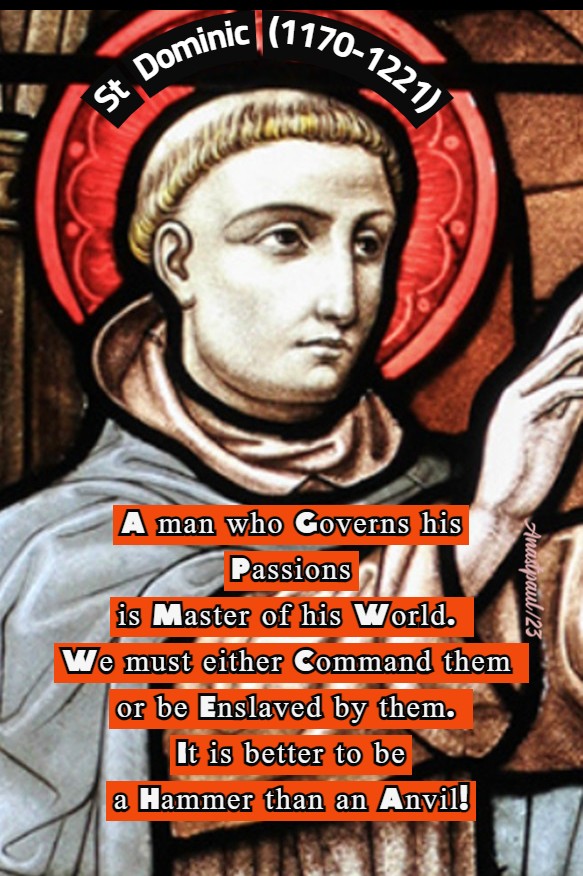
Thought for the Day – 6 March – Meditations with Antonio Cardinal Bacci (1881-1971)
CONSCIENCE
“There are some people who have a right conscience, a conscient, in other words, which is based on the principles of the Gospel, on the precepts of the Church and on the sound advice of a good confessor.
Nevertheless, these must remember St Paul’s warning: “Let him who thinks he stands, take heed, lest he fall” (1 Cor 10:12). They must not grow proud, like the Pharisee who prayed in front of the altar but, must be humble, like the poor publican, who knew that without God’s direction and grace, he would fall into serious sin.
They should remember too that it is not enough to have a right conscience but, its dictates must be put into practice with the help of fervent prayer and frequent reception of the Sacraments.”
Quote/s of the Day – 6 March – Ecclesiasticus Sirach 51:13-17, Matthew 13:44-52 – Scripture search here: https://www.drbo.org/
“The Kingdom of Heaven is like a treasure …”
Matthew 13:44
“ For where thy treasure is, there is thy heart also.”
Matthew 6:21
“Sell what you possess and give alms. Make for yourselves purses which do not grow old, a treasure unfailing in Heaven, where neither thief draws near, nor moth destroys.”
Luke 12:33
“Thy will be done on earth as it is in heaven.”
Matthew 6:10
“I want to advise you and remind you, what His will is. Do not fear that it means He will give you riches, or delights, or honours, or all these earthly things. His love for you is not that small! and He esteems highly what you give Him. He wants to repay you well, for He gives you His Kingdom while you are still on earth … See … what He gave to the One He loved most. By that we understand what His will is. For these are His gifts in this world.”
St Teresa of Avila (1515-1582) Doctor of Prayer of the Church
“By giving yourself to God, you not only receive Himself in exchange but, eternal life as well!”
St Francis de Sales (1567-1622) Doctor Caritatis
“Where is the heart that loves? On the thing it loves. Therefore, where our love is, there our heart is held captive. It cannot leave it; it cannot be lifted higher, it cannot go either to the right or the left; see, it is fixed. Where the miser’s treasure is, there is his heart and where our heart is, there is our treasure.”
Our Lenten Journey with St Francis de Sales – 6 March – Ecclesiasticus Sirach 51:13-17, Matthew 13:44-52 – Scripture search here: https://www.drbo.org/
“The Kingdom of Heaven is like a treasure …” Matthew 13:44
“Again, the Kingdom of Heaven is like a merchant in search of fine pearls. When he finds a single pearl of great price, he goes and sells all that he has and buys it.” Matthew13:45-46
HEAVENLY TREASURE St Francis de Sales (1567-1622) Doctor Caritas
“The first difficulty seen in the question is: Can the souls of the blessed, separated from their bodies, see, hear, consider and understand? Can they, in short, exercise the functions of the mind, as freely as when they were united to their bodies? I answer that not only can they act as before but much more perfectly. And to support this theory I shall give you a story from St Augustine, an author in whom one can place complete trust. He relates that he was acquainted with a physician from Carthage who was as famous in Rome as in that City, both because he excelled in the art of medicine and because, he was a very good man, one who did many charitable works and served the poor gratis.
His charity towards his neighbour, moved God to lift him out of an error into which he had fallen as a young man. God always greatly favours those who practise charity toward their neighbour; indeed, there is nothing that draws down His mercy upon us more abundantly. Our Lord has declared it His own special commandment [Jn. 15:12], the one He loves and cherishes most. For after that of the love of God, there is none greater [Matt 22:37-40].
St Augustine recounts how this physician told him that when young, he began to doubt whether the soul, separated from the body, can see, hear, or understand anything. One day, while in this error, he fell asleep. Suddenly, a handsome young man appeared to him in his sleep and said: “Follow me.” The physician did so and his guide led him into a large and spacious field where, on one side he showed him incomparable beauties and on the other allowed him to hear a concert of delightful music. Then the physician awoke.
Some time after, the same young man again appeared to him in sleep and asked: “Do you recognise me?” The physician answered that he did indeed recognise him distinctly, that it was he who had conducted him to the beautiful field where he had heard such pleasing music. “But how can you see and recognise me?” asked the youth. “Where are your eyes?” “My eyes,” he replied, “are in my body.” “And where is your body?” “My body is lying in my bed.” “And are your eyes open or closed?” “They are closed.” “If they are closed, they can see nothing. Admit, then, since you see me even with your eyes closed, recognise me distinctly and have heard the music, even though your senses slept, that the functions of the mind do not depend on the corporal senses and that the soul, even when separated from the body, can nevertheless see, hear, consider and understand. ” Then the sacred dream ended and the youth left the physician, who never after doubted this truth.” – (Sermon for the Second Sunday of Lent, 20 February 1622).
One Minute Reflection – 6 March – “The Month of the St Joseph” – Sts Perpetua and Felicity (Died c203) Martyrs – Ecclesiasticus Sirach 51:13-17, Matthew 13:44-52 – Scripture search here: https://www.drbo.org/
“Again, the Kingdom of Heaven is like a merchant in search of fine pearls. When he finds a single pearl of great price, he goes and sells all that he has and buys it.” – Matthew 13:45-46
REFLECTION – “For the man who loves God it is sufficient to please the One he loves; and, there is no greater recompense to be sought, than the loving itself. For love is from God, by the very fact, that God Himself is love. The good and chaste soul is so happy to be filled with Him that it desires to take delight in nothing else. For what the Lord says is very true: – ‘Where your treasure is, there also will your heart be.’
What is a man’s treasure but the heaping up of profits and the fruit of his toil? For whatever a man sows, this too will he reap and each man’s gain, matches his toil and where delight and enjoyment are found, there the heart’s desire is attached. Now there are many kinds of wealth and a variety of grounds for rejoicing – every man’s treasure is that, which he desires. If it is based on earthly ambitions, its acquisition makes men not blessed but wretched.
But those who enjoy the things that are above and eternal, rather than earthly and perishable, possess an incorruptible, hidden store, of which the prophet speaks: ‘Our treasure and salvation have come, wisdom and instruction and piety, from the Lord: these are the treasures of justice.’ Through these, with the help of God’s grace, even earthly possessions are transformed into heavenly blessings. It is a fact that many people use the wealth, which is either rightfully left to them or otherwise, acquired, as a tool of devotion. By distributing what might be superfluous to support the poor, they are amassing imperishable riches, so that what they have discreetly given, cannot be subject to loss. They have properly placed those riches, where their heart is, – it is a most blessed thing, to work to increase such riches, rather than to fear that they may pass away.” – St Pope Leo the Great (400-461) Bishop of Rome and Great Western Father and Doctor of the Church (An excerpt from Sermon 92).
PRAYER – Grant, we beseech Thee, O Lord our God, that we may venerate with unceasing devotion Thy holy Martyrs Perpetua and Felicitas and, although we cannot pay them the honour that is their due, may we at least present to them, our humble homage. Through Jesus Christ, Thy Son our Lord, Who lives and reigns with Thee, in the unity of the Holy Ghost, God, world without end. Amen (Collect).
You must be logged in to post a comment.