Saint of the Day – 18 November – Saint Romano of Antioch (Died c 303) Deacon Martyr . Died by strangulation in prison in Antioch, Syria. Also known as – Romanus of Caesarea, Romano.
The Roman Martyrology reads: “At Antioch, the birthday of St Romanus, Martyr in the time of the Emperor Galerius. When the Prefect Asclepiades broke into the Churches and strove to destroy them completely, Romanus exhorted the Christians to resist him and, after being subjected to dire torments and the cutting out of his tongue (without which, however, he spoke the praises of God), he was strangled in prison and crowned with a glorious Martyrdom. Before him suffered a young boy, named Barula, who, being asked by him. whether it was better to worship one God, Whom the Christians adore, was scourged and beheaded.”
In 303 or 304, at the beginning of Diocletian Persecution, a Deacon called Romanus, served in Caesarea in Palestine. He was living in Antioch, where, in the midst of the persecutions, he encouraged the Christians to stand firm.
During a pagan festival, he upbraided the participants for worshiping idols. Taken prisoner, he was condemned to death by fire and was bound to the stake. When rain extinguished the flames, Romanus was brought before Emperor Galerius who was then in Antioch. At the Emperor’s command, Romanus’ tongue was cut out. Tortured in various ways in prison, he was finally strangled.
Eusebius speaks of his Martyrdom in De martyribus Palaestinae. Prudentius relates other details and gives Romanus a companion in Martyrdom, a Christian boy by name Barulas.
he Church of San Román in Seville is dedicated to Romanus. Prudentius wrote a 1140 line Hymn to Romanus, the Romane Christi fortis, the tenth hymn in his Peristephanon.
Dedication of the Basilicas of Peter and Paul: From the twelfth century the Dedications of the Vatican Basilica of St Peter and the Basilica of St Paul on the Via Ostiense, have been celebrated on this day, as the anniversary of their dedication by St Pope Silvester and St Pope Siricius in the fourth century. In more recent times, this feast has been extended to the whole Roman Rite. As the anniversary of the Dedication of the Basilica of St Mary Major (5 August) honours the motherhood of Our Lady, so this Feast honours the memory of the two Princes of the Apostles. About this Feast: https://anastpaul.wordpress.com/2017/11/18/feast-of-the-dedication-of-the-basilicas-of-sts-peter-and-paul-at-rome-18-november/
St Amandus of Lérins Bl Andreas Murayama Tokuan St Anselm of Lérins St Augusto Cordero Fernández St Barulas St Constant Bl Cosmas Takeya Sozaburo Bl Domingos Jorge St Emiliano Martínez de La Pera Alava St Esteban Anuncibay Letona St Francisco Marco Alemán St Germán García y García Bl Guilminus Bl Ioannes Yoshida Shoun St José María Cánovas Martínez St Keverne Bl Leonard Kimura St Mawes St Maximus of Mainz St Modesto Sáez Manzanares St Mummolus of Lagny St Nazarius of Lérins St Noah the Patriarch
St Oriculus St Patroclus of Colombier St Romfarius of Coutances St Romanus of Antioch (Died c 303) Deacon Martyr St Teofredo of Vellaicum St Thomas of Antioch St Vidal Luis Gómara
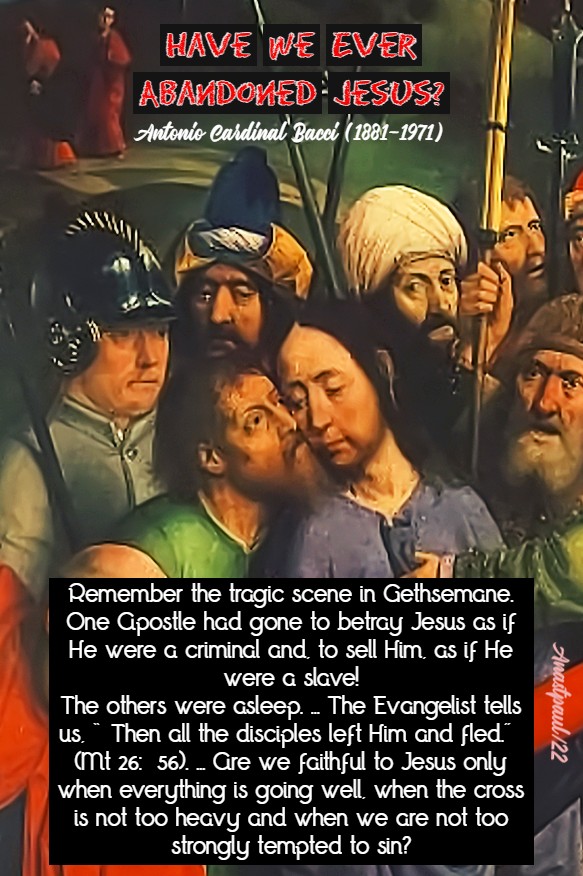
Thought for the Day – 17 November – Meditations with Antonio Cardinal Bacci (1881-1971)
Have We Ever Abandoned Jesus?
“The Apostles did not wish to abandon Jesus in theory but, in practice, they did so. Remember the tragic scene in Gethsemane. One Apostle had gone to betray Jesus as if He were a criminal and, to sell Him, as if He were a slave! The others were asleep. Jesus alone and deserted, was praying for ungrateful humanity. He perspired blood and prepared to drink the bitter chalice of humiliation and of the most ignominious form of death. The hired soldiers arrived and arrested Him, as a seducer of the people.
What was the reaction of the Apostles who had so often promised to be faithful to their Master until death? The Evangelist tells us, “Then all the disciples left Him and fled.” (Mt 26:56).
Let us examine ourselves. Are we faithful to Jesus only when everything is going well, when the cross is not too heavy and when we are not too strongly tempted to sin?”
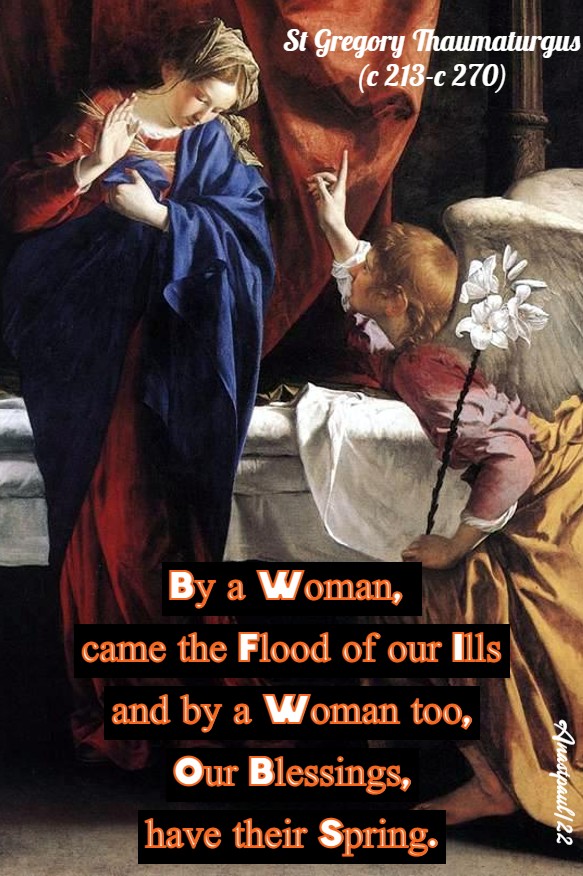
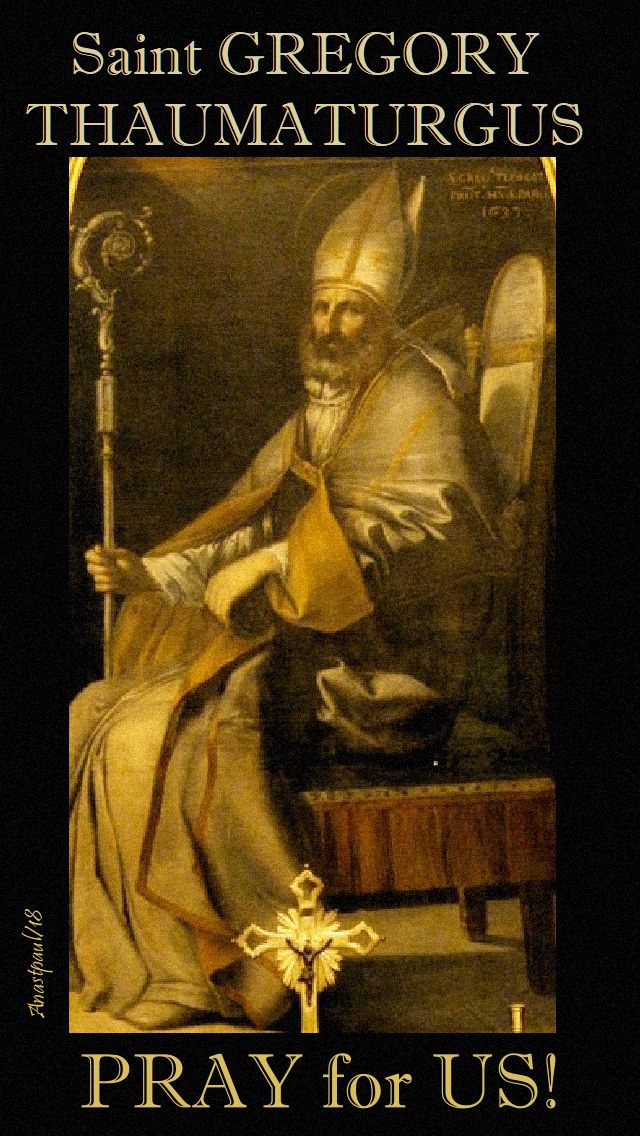
Quote/s of the Day – 17 November – St Gregory Thaumaturgus (c 213-c 270) “the Wonder-Worker,” Bishop, Confessor
“ By a woman, came the flood of our ills and by a woman too, our blessings, have their spring.”
“The Creed” of Saint Gregory Thaumaturgus
There is one God, the Father of the Living Word, Who is His subsistent Wisdom and Power and Eternal Image, perfect Begetter of the perfect Begotten, Father of the Only-begotten Son. There is one Lord, Only of the Only, God of God, Image and Likeness of Deity, Efficient Word, Wisdom comprehensive of the constitution of all things and Power formative of the whole creation, true Son of true Father, Invisible of Invisible and Incorruptible of Incorruptible and Immortal of Immortal and Eternal of Eternal. And there is One Holy Spirit, having His subsistence from God and being made manifest by the Son, to wit to men, Image of the Son, Perfect Image of the Perfect, Life, the Cause of the living, Holy Fount, Sanctity, the Supplier, or Leader, of Sanctification, in Whom is manifested God the Father, Who is above all and in all and God the Son, Who is through all. There is a perfect Trinity, in glory and eternity and sovereignty, neither divided nor estranged. Wherefore, there is nothing, either created or in servitude in the Trinity, nor anything superinduced, as if at some former period, it was non-existent and at some later period, it was introduced. And thus neither was the Son ever wanting to the Father, nor the Spirit to the Son but, without variation and without change, the same Trinity abideth ever.
St Gregory Thaumaturgus (c 213-c 270) “the Wonder-Worker,” Bishop, Confessor
One Minute Reflection – 17 November – St Gregory Thaumaturgus (c 213-c 270) “the Wonder-Worker,” Bishop, Confessor – Sirach 44:16-27; 45:3-20, Mark 11:22-24 – Scripture search here: https://www.drbo.org/
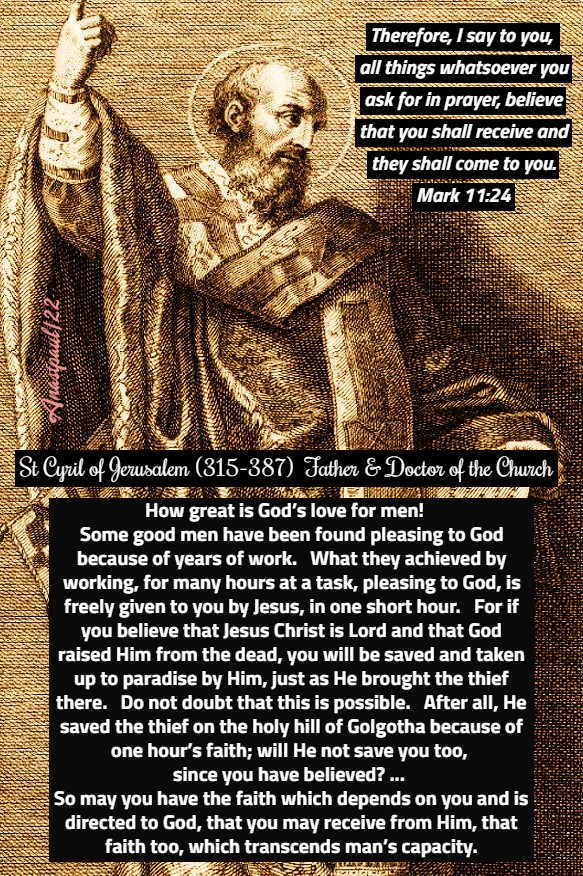
“Therefore, I say to you, all things whatsoever you ask for in prayer, believe that you shall receive and they shall come to you.” – Mark 11:24
REFLECTION – “The one word, faith, can have two meanings. One kind of faith concerns doctrines. It involves, the soul’s ascent to and acceptance of, some particular matter. It also concerns the soul’s good, according to the words of the Lord – Whoever hears My Voice and believes in Him, Who sent Me, has eternal life and will not come to be judged. And again: He who believes in the Son, is not condemned but has passed from death to life.
How great is God’s love for men! Some good men have been found pleasing to God because of years of work. What they achieved by working, for many hours at a task, pleasing to God, is freely given to you by Jesus, in one short hour. For if you believe that Jesus Christ is Lord and that God raised Him from the dead, you will be saved and taken up to paradise by Him, just as He brought the thief there. Do not doubt that this is possible. After all, He saved the thief on the holy hill of Golgotha because of one hour’s faith; will He not save you too, since you have believed?
The other kind of faith is given by Christ, by means of a special grace. To one wise sayings are given through the Spirit, to another perceptive comments by the same Spirit, to another faith by the same Spirit, to another gifts of healing. Now this kind of faith, given by the Spirit as a special favour, is not confined to doctrinal matters, for it produces effects beyond any human capability. If a man who has this faith says to this mountain move from here to there, it will move. For when anybody says this in faith, believing it will happen and having no doubt in his heart, he then receives that grace.
It is of this kind of faith, moreover, that it is said: If you have faith like a grain of mustard seed. The mustard seed is small in size but it holds an explosive force, although it is sown in a small hole, it produces great branches and when it is grown, birds can nest there. In the same way faith produces great effects in the soul instantaneously. Enlightened by faith, the soul pictures God and sees Him as clearly as any soul can. It circles the earth, even before the end of this world, it sees the judgement and the conferring of promised rewards. So may you have the faith which depends on you and is directed to God, that you may receive from Him, that faith too, which transcends man’s capacity.” – St Cyril of Jerusalem (315-387) Archbishop of Jerusalem, Father and Doctor of the Church (An excerpt from the Catecheses, 5).
PRAYER – Grant, we beseech Thee, Almighty God that the venerable feast of Thy blessed Gregory Confessor and Bishop may increase our devotion and promote our salvation. Through Jesus Christ, Thy Son our Lord, Who lives and reigns with Thee, in the unity of the Holy Ghost, God, world without end. Amen (Collect).
May Your Heart Dwell Always in our Hearts! by Saint Francis De Sales (1567-1622) Doctor of Charity
May Your Heart dwell always in our hearts! May Your Blood ever flow in the veins of our souls! O Sun of our hearts, You give life to all things by the rays of Your goodness! I will not go, until Your Heart has strengthened me, O Lord Jesus! May the Heart of Jesus be the King of my heart! Blessed be God. Amen
Saint of the Day – 17 November – St Florinus of Remüs (Died c 856) Priest, Confessor, Miracle-worker. Born in the late 8th Century in Val Venosta, Italy and died in c 856 at Remüs (modern Ramosch), Switzerland of natural causes. His name (from Latin) means “the blooming one.” Patronages – of the Lower Engadine and Vinschgau; from 1288 to 1962 – the Diocese of Chur. Also known as – • Florinus of Chur• Florinus of Finsgowe• Florinus of Matsch• Florinus of Mazia• Florinus of Ramosch• Florinus of Val Venosta• Florinus of Vinschgau• Florinus of Vnuost• Florin, Florian. Additional Memorials – • 7 August (translation of relics to Chur, Switzerland) • 18 December (translation of relics to the Trier, Germany).
Picture at the Parish Church in Matsch in South Tyrol
According to tradition, Florinus was the son of an Anglo-Saxon father and a Christian Jew who had settled in Vinschgau on their return from a pilgrimage to Rome . Florinus was raised by the Priest Alexander of Remüs. His former protégé, Florinus, who had meanwhile become a Priest, followed him in the pastoral apostolit. The activity which the new shepherd carried out by word and example, was so devoted that Florinus quickly won the love and admiration of his flock.
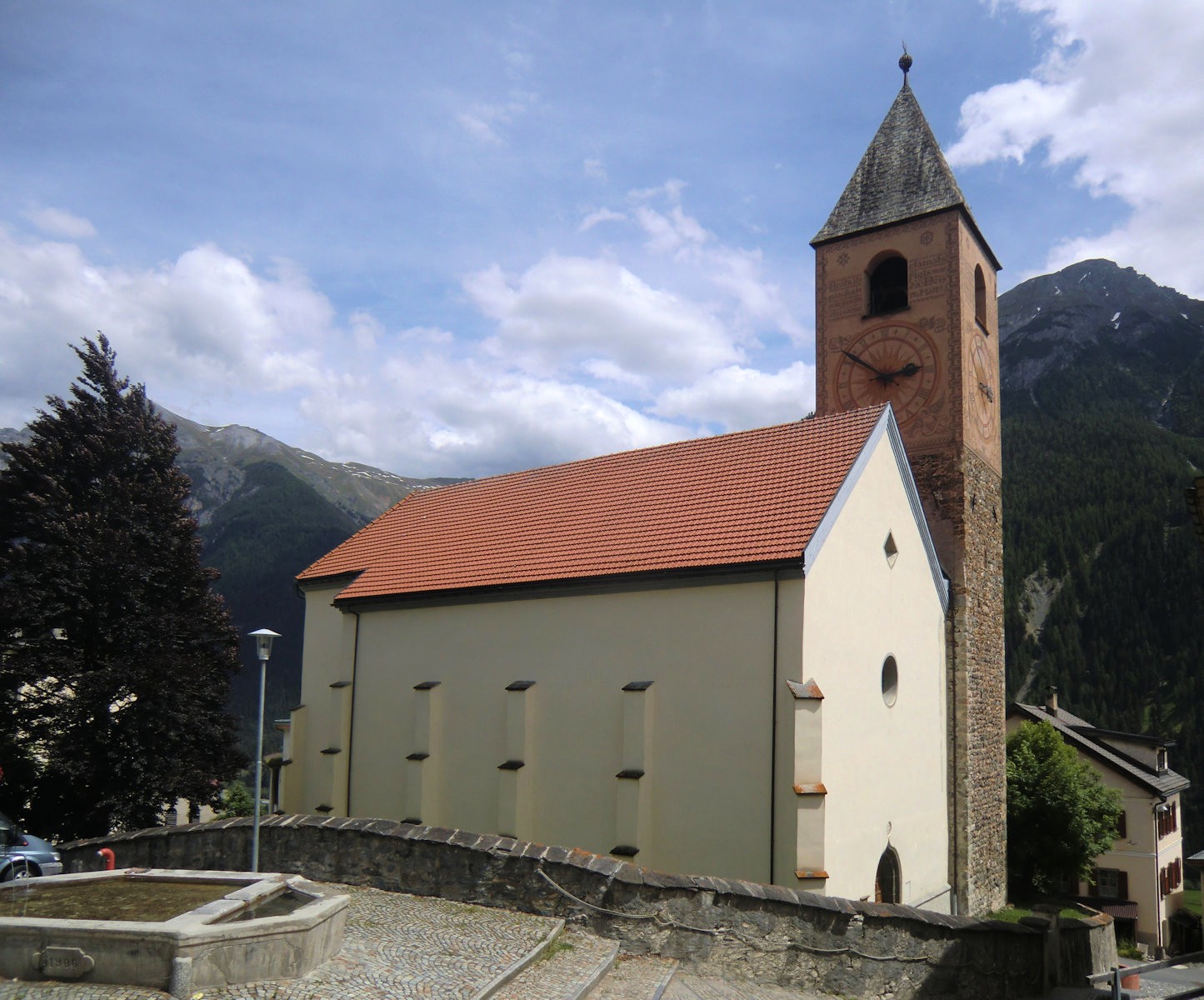
The Church in Ramosch, which used to be dedicated to St Peter and is now to St Florinus
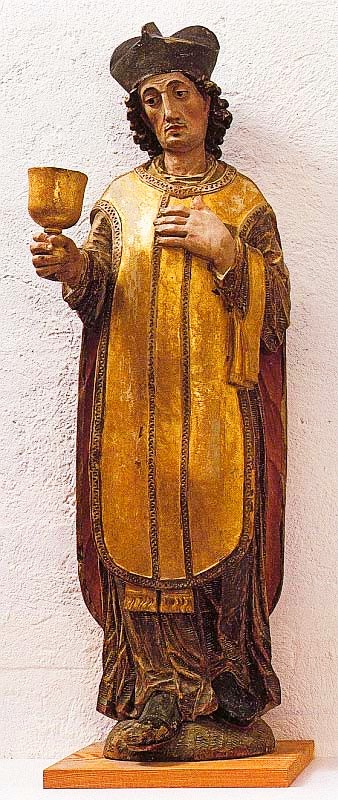
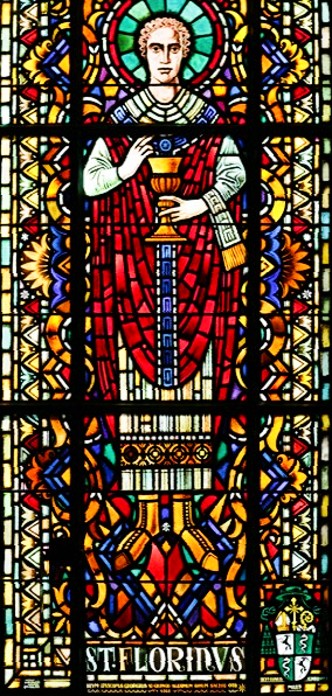
The legend tells of numerous miracles, such as when he fetched the Communion wine, gave it to a poor woman for her ailing husband and, instead refilled the container with water, which turned into wine at the Altar. Hence in art, Florinus is usually depicted holiding a Chalice.
Many miracles also took place at Florinus’ tomb in the Church of Ramosch. As early as 719 there was a Church dedicated to Florinus, presided over by St Othmar of Saint Gallen (feast day yesterday). The Church in Ramosch, was dedicated to Florinus in 930. . Around 950, Duke Hermann of Swabia, brought Florinus’ Relics to the Marienstift in Koblenz, whose Church was then dedicated to Florinus too. After its founding in 1142, the bones came to the Monastery in Schönau near Heidelberg; others are in Regensburg. Because the Founder of the former Monasterywas converted at the grave of Florinus, in Churwalden, he acquired relics for his new foundation.
Stained glass window in the Baptistery in the Chur Cathedral
The Cathedral in Vaduz, built in the 19th Century next to a Chapel dedicated to Florinus and the Parish Church in Matsch is also dedicated to him. Another Chapel, built in 1853 at the end of this village, is dedicated to Florinus and contains a Relic and stands near the courtyard where, according to tradition, Florinus was born. This replaced the Chapel at the place of his birth after it had been destroyed three times by avalanches.
The Miracle of the White Rider: In March 1799 the imperial troops were defeated by the French after a short battle in the Munster valley. The French then scorched, plundered and murdered in Malles and its surroundings. Many residents of Mals grabbed the most necessary belongings and fled hastily. The Matscher people heard, with horror, of the atrocities committed by the French and their fear and concern increased more and more, that the inhuman soldiers might also reach their little village, rob it and burn itto the ground. They gathered in the Parish Church and entreated their Patron, St Florinus to plead for protection and help. Lo and behold, when the enemy found out that the Malser had fled, a detachment of soldiers immediately took up the pursuit and got as far as Rowein before the village of Matsch. Then the Patron Saint of the valley, St Florinus, galloped along on a magnificent white horse and threatened the intruders with his right hand. The white horse, frightening the French so much that they quickly turned and fled down the valley. The village of Mud was saved!
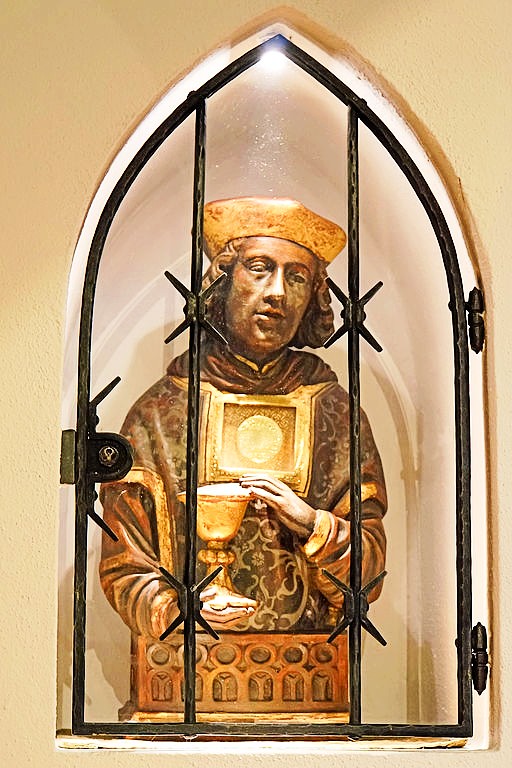
Bust of St. Florinus in Cathedral of Vaduz (Liechtenstein).
St Acisclus St Aignan of Orléans St Alphaeus of Palestine St Eugene of Florence St Eusebio Roldán Vielva St Florinus of Remüs (Died c 856)Priest, Confessor St Giacinto Ansalone St Gregory of Tours
Thought for the Day – 16 November – Meditations with Antonio Cardinal Bacci (1881-1971)
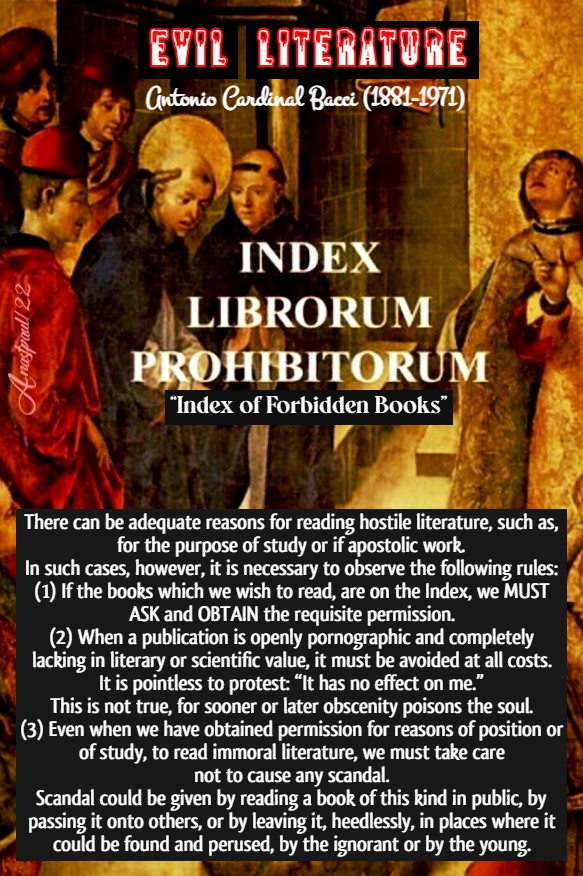
Evil Literature
“There can be adequate reasons for reading hostile literature, such as, for the purpose of study or if apostolic work. In such cases, however, it is necessary to observe the following rules: (1) If the books which we wish to read, are on the Index, we MUST ASK and OBTAIN the requisite permission. (2) When a publication is openly pornographic and completely lacking in literary or scientific value, it must be avoided at all costs. It is pointless to protest: “It has no effect on me.” This is not true, for sooner or later obscenity poisons the soul. (3) Even when we have obtained permission for reasons of position or of study, to read immoral literature, we must take care not to cause any scandal. Scandal could be given by reading a book of this kind in public, by passing it onto others, or by leaving it, heedlessly, in places where it could be found and perused, by the ignorant or by the young.
It maybe that, on these three points, we have something to correct in our own conduct?!”
Quote/s of the Day – 16 November – St Gertrude the Great (1256-1302) Virgin – “The Month of the Holy Souls in Purgatory”
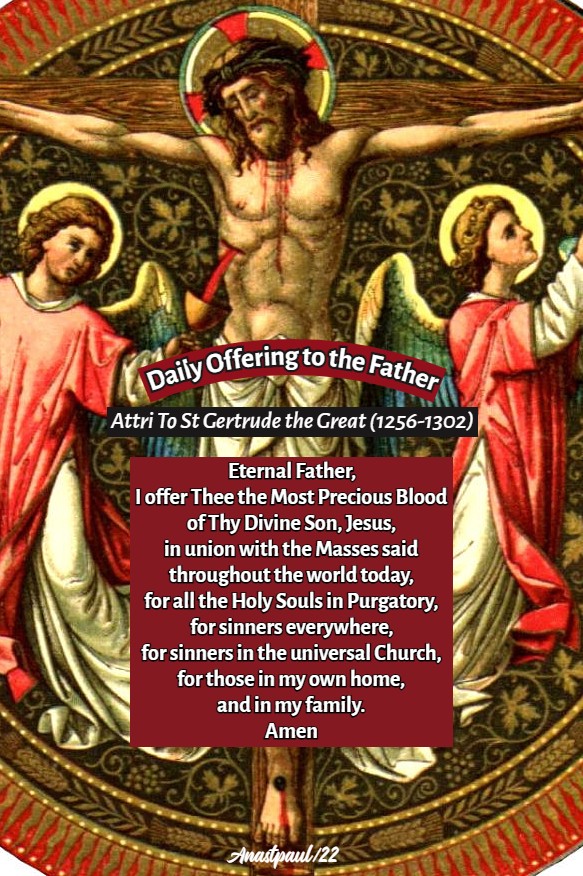
Daily Offering to the Father By St Gertrude the Great (1256-1302) (Attrib)
Eternal Father, I offer Thee the most precious blood of Thy Divine Son, Jesus, in union with the Masses said throughout the world today, for all the Holy Souls in Purgatory, for sinners everywhere, for sinners in the universal Church, for those in my own home, and in my family. Amen
“I praise, adore, bless and thank Thee, to the best of my ability, for Thy wise mercy and Thy merciful wisdom! For Thou, my Creator and my Redeemer, have sought to curb my stiff-necked obstinacy under Thy sweet yoke with the remedy best suited to my infirmity.”
O Sacred Heart of Jesus By St Gertrude the Great (1256-1302)
O Sacred Heart of Jesus, Fountain of eternal life, Your Heart is a glowing Furnace of Love. You are my Refuge and my Sanctuary. O my adorable and loving Saviour, consume my heart with the burning fire with which Your Heart is enflamed. Pour down on my soul those graces which flow from Your love. Let my heart be united with Your Heart. Let my will be conformed to Your Will in all things. May Your Will be the Rule of all my desires and actions. Amen
One Minute Reflection – 16 November – St Gertrude the Great (1256-1302) Virgin – 2 Corinthians 10:17-18; 11:1-2, Matthew 25:1-13 – Scripture search here: https://www.drbo.org/
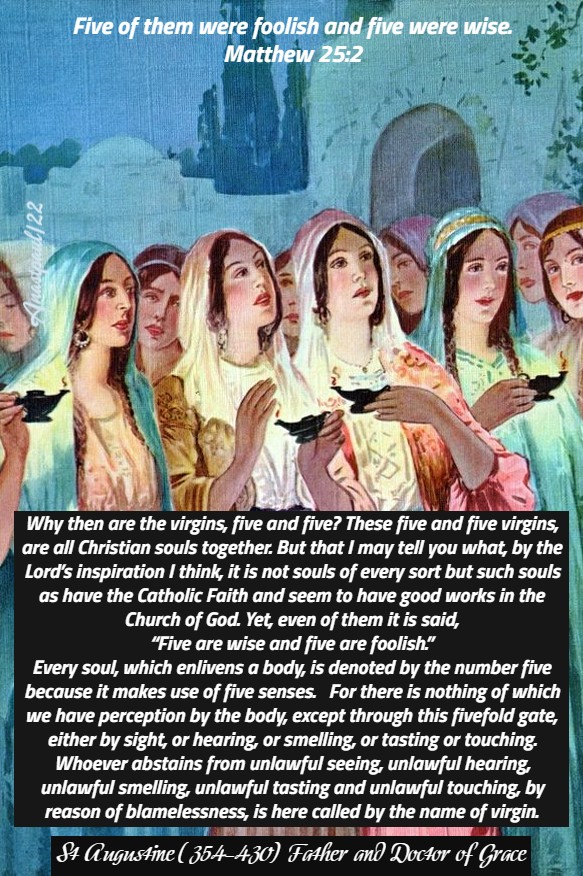
“Five of them were foolish and five were wise…” – Matthew 25:2
REFLECTION – “So then let us understand, dearly beloved, that this parable relates to us all, that is, to the whole Church together, not to the clergy only, of whom we spoke yesterday, nor to the laity only but generally to all. Why then are the virgins, five and five? These five and five virgins, are all Christian souls together. But that I may tell you what, by the Lord’s inspiration I think, it is not souls of every sort but such souls as have the Catholic Faith and seem to have good works in the Church of God. Yet, even of them it is said, “Five are wise and five are foolish.”
Every soul, which enlivens a body, is denoted by the number five because it makes use of five senses. For there is nothing of which we have perception by the body, except through this fivefold gate, either by sight, or hearing, or smelling, or tasting or touching. Whoever abstains from unlawful seeing, unlawful hearing, unlawful smelling, unlawful tasting and unlawful touching, by reason of blamelessness, is here called by the name of virgin.” – St Augustine (354-430) Father and Doctor of Grace (Sermon 93).
PRAYER – O God, Who prepared a pleasing dwelling place for Thyself in the heart of blessed Gertrude the Virgin, by her merits and intercession, mercifully wipe away all sinful stain from our heart and grant that we may enjoy her companionship. Through Jesus Christ, Thy Son our Lord, Who lives and reigns with Thee, in the unity of the Holy Ghost, God, world without end. Amen (Collect).
Our Morning Offering – 16 November – St Gertrude the Great (1256-1302) Virgin, Benedictine Religious, Mystic, Theologian, Writer.
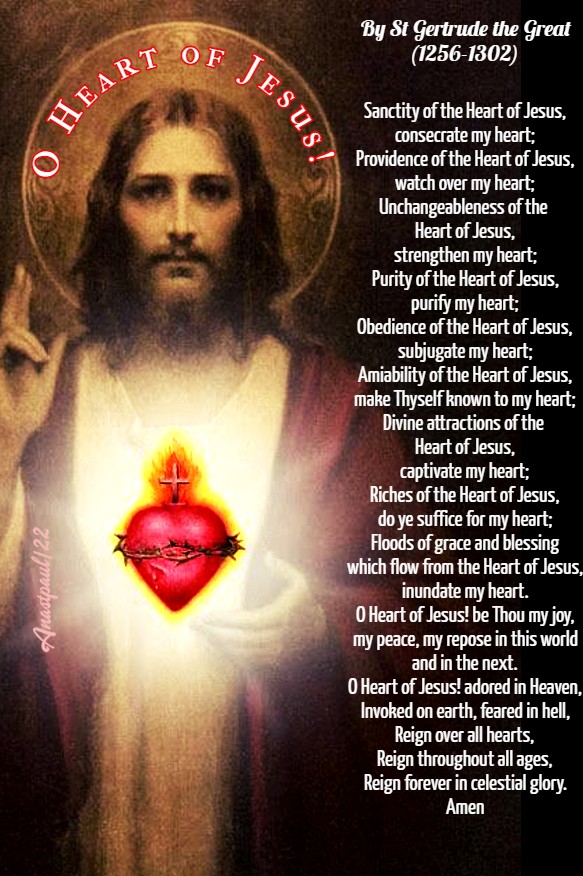
O Heart of Jesus! By St Gertrude the Great (1256-1302)
Sanctity of the Heart of Jesus, consecrate my heart; Providence of the Heart of Jesus, watch over my heart; Unchangeableness of the Heart of Jesus, strengthen my heart; Purity of the Heart of Jesus, purify my heart; Obedience of the Heart of Jesus, subjugate my heart; Amiability of the Heart of Jesus, make Thyself known to my heart; Divine attractions of the Heart of Jesus, captivate my heart; Riches of the Heart of Jesus, do ye suffice for my heart; Floods of grace and blessing which flow from the Heart of Jesus, inundate my heart. O Heart of Jesus! be Thou my joy, my peace, my repose in this world and in the next. O Heart of Jesus! adored in Heaven, Invoked on earth, feared in hell, Reign over all hearts, Reign throughout all ages, Reign forever in celestial glory. Amen
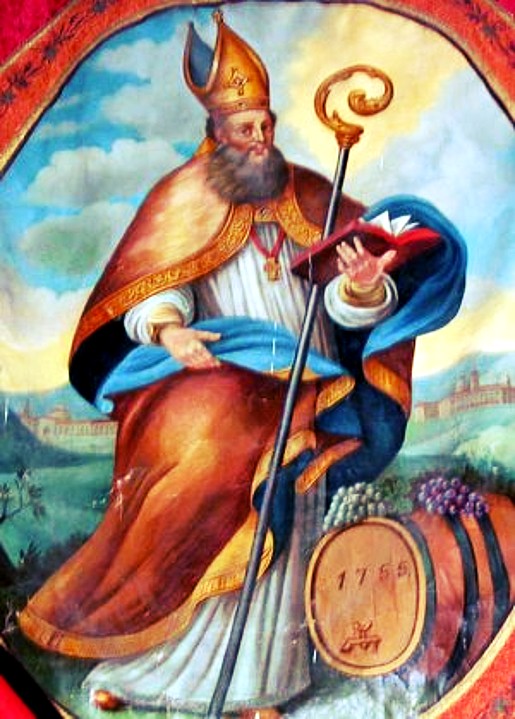
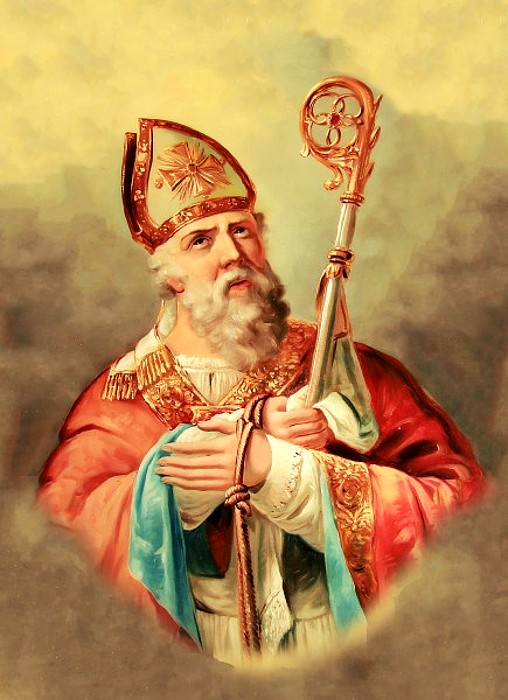
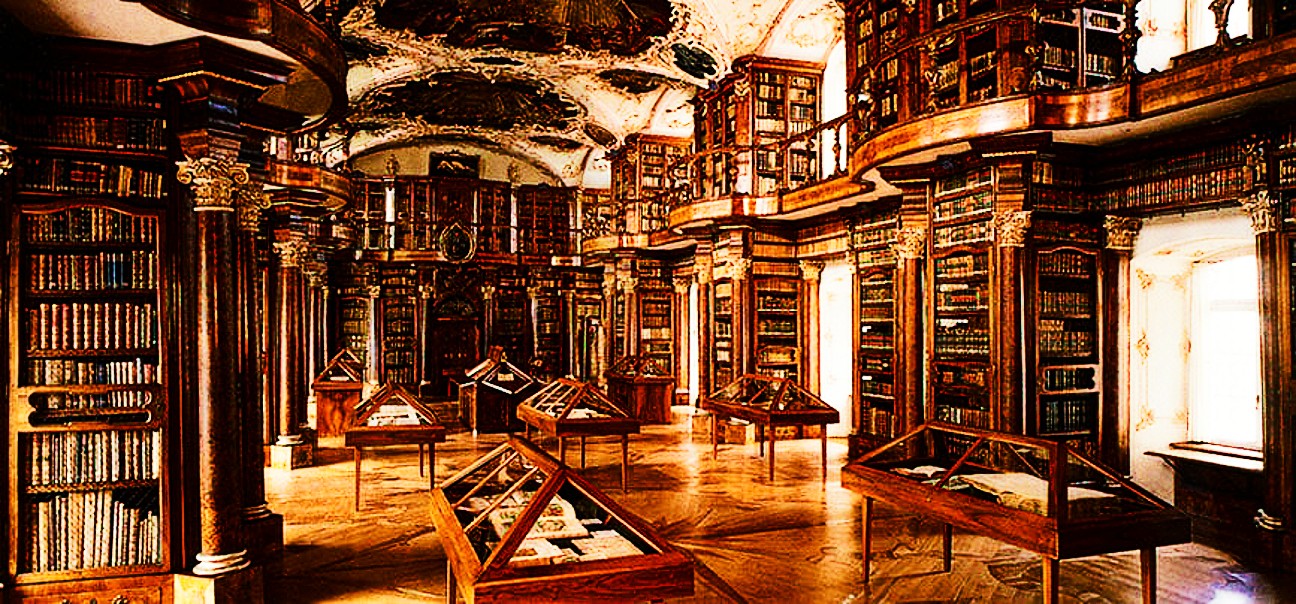
Saint of the Day – 16 November – St Othmar of Saint Gall (c 689-c 759) Priest, the Founder and first Abbot of the Abbey of St Gall in Switzerland, founder of a hospital and a school as well as the famous Library of St Gall (see below), which is the oldest working Library in the world, Apostle of the poor and sick, defender of his people and Abbey against secular usurpers. Born as Alemanne Othmar in c 689 probably near St Gallen and died on 16 November 759 on the Island of Werd-on-the-Rhine, near Echnez, Switzerland. Patronages – of winegrowers, vintners, against childhood diseases and diseases in general, of the Diocese of St. Gallen and the Monatery of St Gall (with St Gall).Also known as -“Poor”Father Audomar, Otmar.
Othmar was born of the Alemannic dialectic group of Germans spoken in certain parts of South Germany, in Alsace (France), Vorarlberg (Austria), Switzerland and Liechtenstein. He received his education in Rhaetia, Switzerland and was Ordained to the Priesthood there. For a time he presided over a Church of St. Florinus in the same location.
Parish church Saint Othmar in Kirchberg. High altar: Statue of Saint Othmar (1710)
In 720, he was appointed as the Superior of the Monks of St Gall (Died 646- Feast 16 October) and Custodian over the Saint’s Relics, who at the time, lived separately but followed a single rule of life. Othmar built a Monastery to accommodate them and united the Monks who lived about the cell of St Gall, according to the Rule of St Columban and became their first Abbot. He added a hospital and a school to the foundation. During his Abbacy the Rule of St Columban was replaced by that of St Benedict.
The Abbey was soon endowed with goods from Alemannic landowners who cared for their salvation but also wanted to keep their goods out of the hands of the Frankish Empire.
Othmar gave away Monastery assets to the poor, built the first house for lepers in Switzerland near the Monastery and took in the sick, blind and poor in another building, where he also looked after them at night. The close connection between the Monastery Monks and the common people, was the reason for his missionary successes and earned him the name “Poor Father.” Fearing the growing wealth of his Monastery, he dressed himself simply, only riding a donkey instead of a horse.
When King Karlmann renounced his throne in 747, he visited Othmar at St Gall and gave him a letter to his brother, King Pepin, recommending Othmar and his Monastery to the King’s generosity and protection. Othmar personally brought the letter to Pepin and was kindly received.
The flourishing Monastery of St Gallen then got caught up in the turmoil of politics in the Frankish Kingdom. When the Counts Warin and Ruodhart unjustly tried to gain possession of some property belonging to St Gall Abbey, Othmar fearlessly resisted their demands. Hereupon they captured him while he was on a journey to Constance and held him prisoner, First he was in the dungeon of the Royal Palace, then led to a show trial, at which he was accused of desecrating a woman and sentenced to death by starvation, later commuted to life imprisonment. He finally found asylum with Count Gozbert on the Rhine Island of Werd near Stein am Rhein but did not survive the abuse he had endured for long and died there.
Othmar’s biographer Gozbert reports that ten years later, in 769, Monks from St Gallen wanted to bring back the body of the Monastery Founder and found it intact. The brothers took a wine barrel with them as provisions for the journey and it always stayed full on the way there and back, no matter how much they drank from it. A storm that was devastating the whole area was miraculously kept away from the ship on the journey across Lake Constance and from the tomb, so that not even the candles at Othmar’s feet and head, went out.
In 867 he was solemnly entombed in the new Church of St Othmar at St Gall. His cult began to spread soon after his death and now he is, next to St Maurice and St Gall, the most popular Saints in Switzerland. His cult was officially recognised in 864 by Bishop Solomon I (Bishop of Constance).
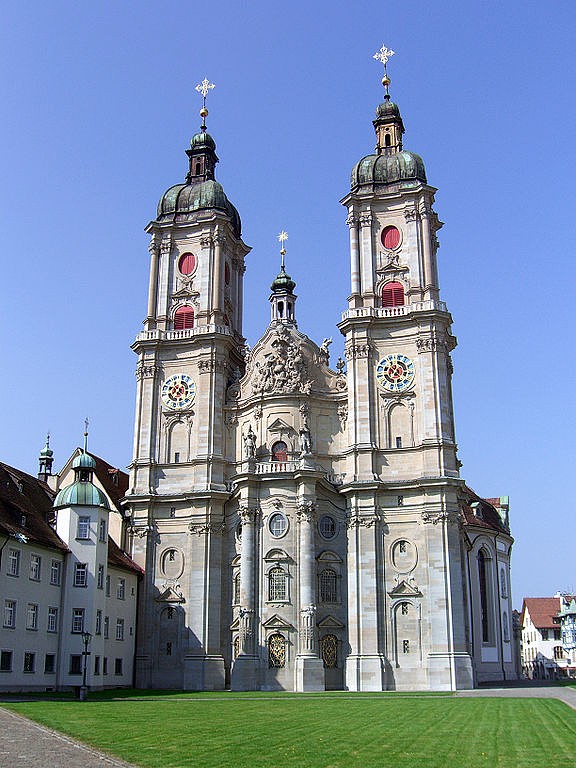
St Gallrn Cathedral dedicated to St Gall and Sr Othmar
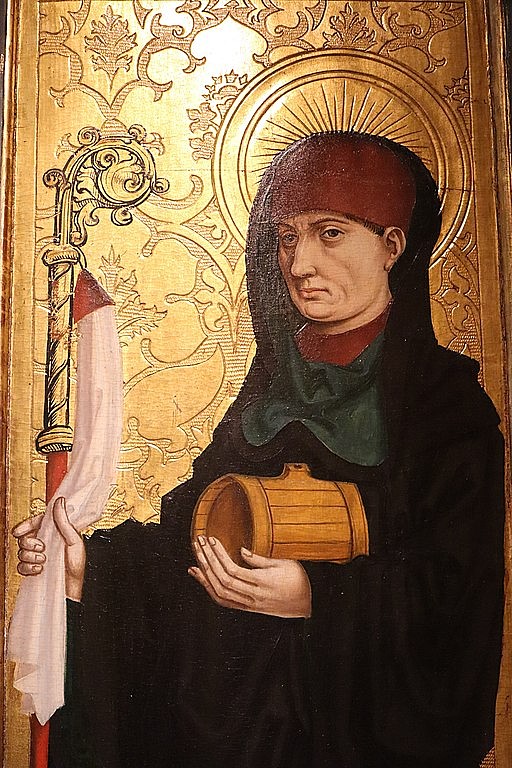
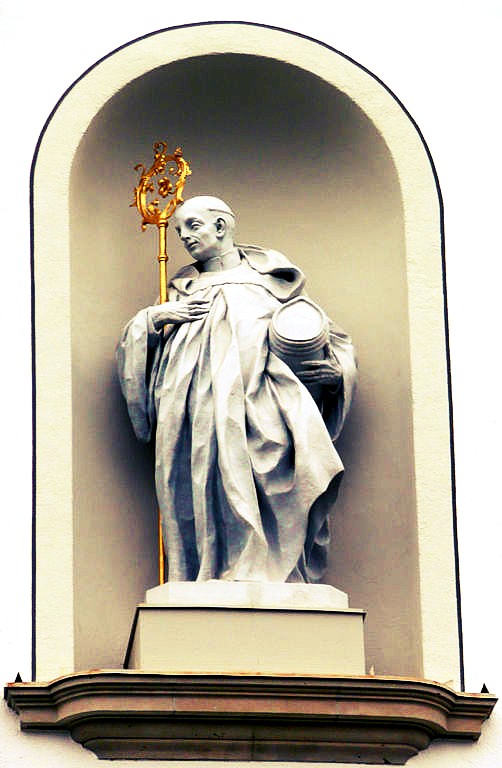
His Feast is celebrated on 16 November. He is represented in art as a Benedictine Abbot, generally holding a little barrel in his hand, an allusion to the miracle, that a barrel of St Othmar never became empty, no matter how much he took from it to give to the poor.
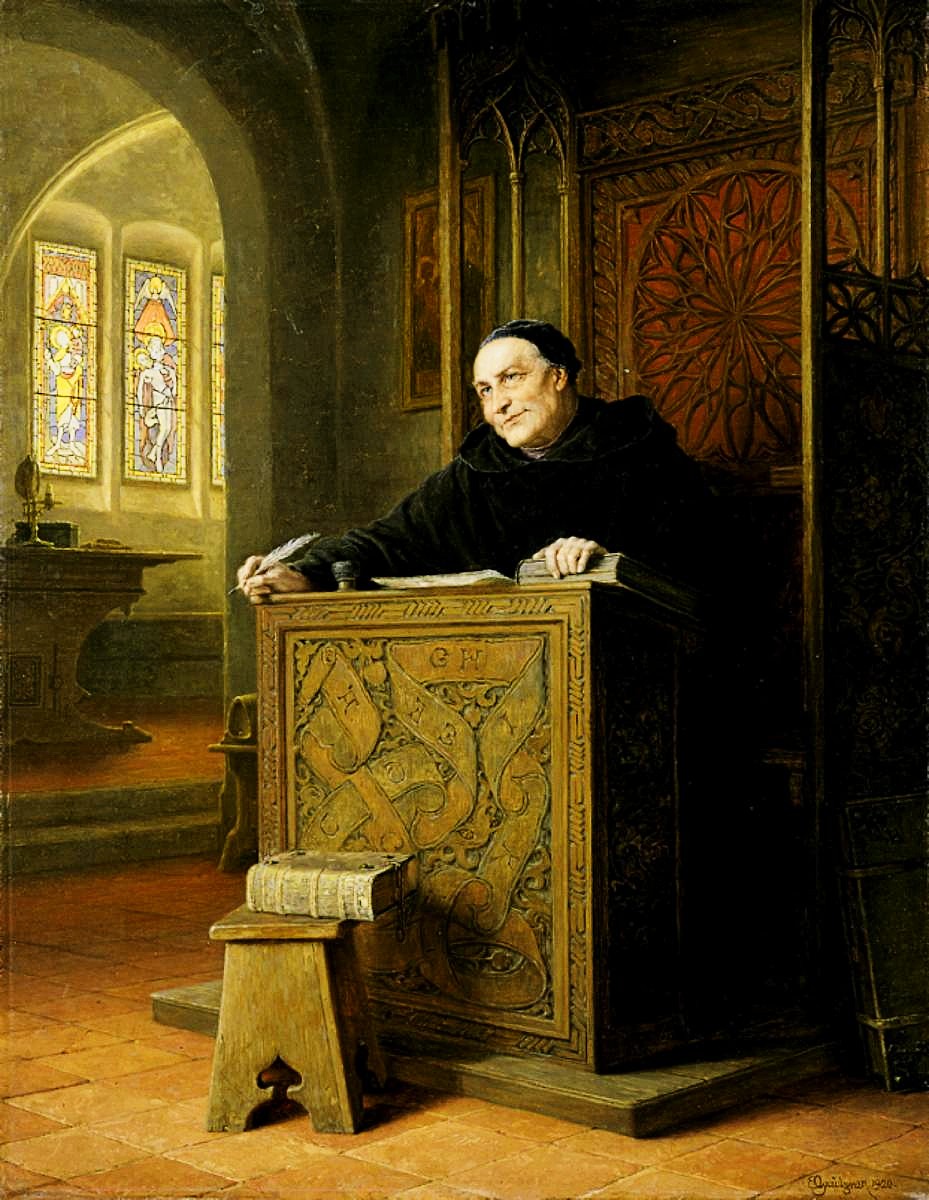
The famous and oldest working library in the world established by St Othmar’ at the Monastery of St Gall
St Gallen Cathedral is dedicated to Saints Gall and Othmar. St Othmar Chapel on Werd island was erected in his memory.
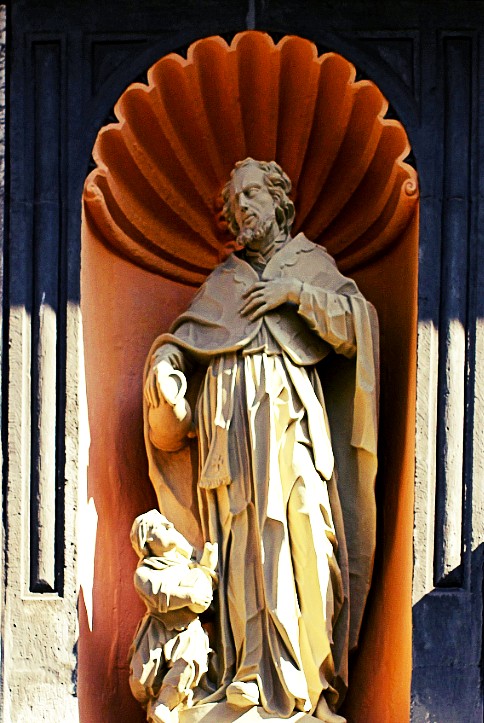
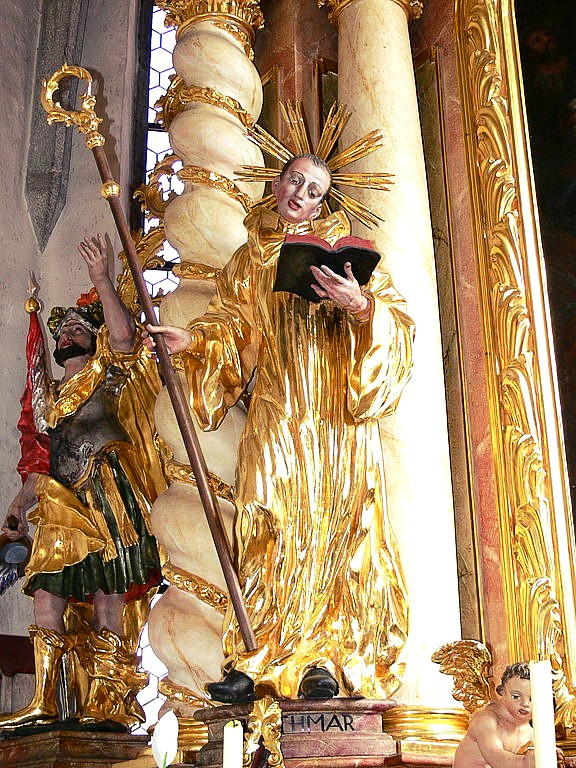
Statue of Saint Othmar on the Wall of the Abbey of St Gall
St Margaret of Scotland (1045-1093) Queen Consort of Scotland Saint Margaret’s name signifies “pearl” “a fitting name,” says Bishop Turgot, her Confessor and her first Biographer, “for one such as she.” Her soul was like a precious pearl. Today is the date of St Margaret’s Death and the usual date for a Feast and in Scotland St Margaret is remembered today. But the Traditional Calendar holds her Feast on 10 June as set by Pope Innocent XII in 1693. About St Margaret: https://anastpaul.com/2018/11/16/saint-of-the-day-16-november-st-margaret-of-scotland-1045-1093-queen/
St Elpidius the Martyr St Eucherius of Lyon St Eustochius the Martyr St Felicita of Capua St Fidentius of Padua St Gobrain of Vannes St Ludre St Marcellus the Martyr St Othmar of Saint Gall (c 689-c 759) Priest, the First Abbot of the Abbey of St Gall in Switzerland. Bl Simeon of Cava
Thought for the Day – 15 November – Meditations with Antonio Cardinal Bacci (1881-1971)
Conversation with God and with Men
“Do not speak too often with men but speak often with God. We should always be in communication with God because, to converse with God, is to pray. Jesus has told us that we ought always to pray (Lk 18:1). We have a great need of intimacy with God, for if the life of grace does not flow within us, we become like arid branches and fall prey to temptations and to tepidity. In order to remain close to God, we must pray constantly. As St Paul says, “whatever you do, in word or in work, do all in the Name of the Lord Jesus, giving thanks to God the Father, through Him” (Col 3:17). This is what the Saints did. While their feet walked the earth, their minds were in Heaven.
We should imitate them by trying to cultivate the interior life which will keep us detached from the world and from sin and always close to God.”
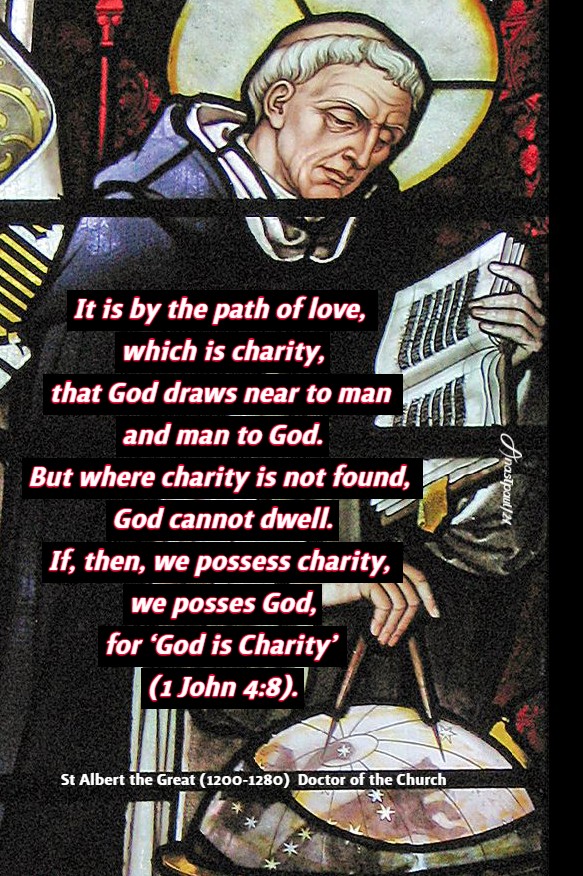
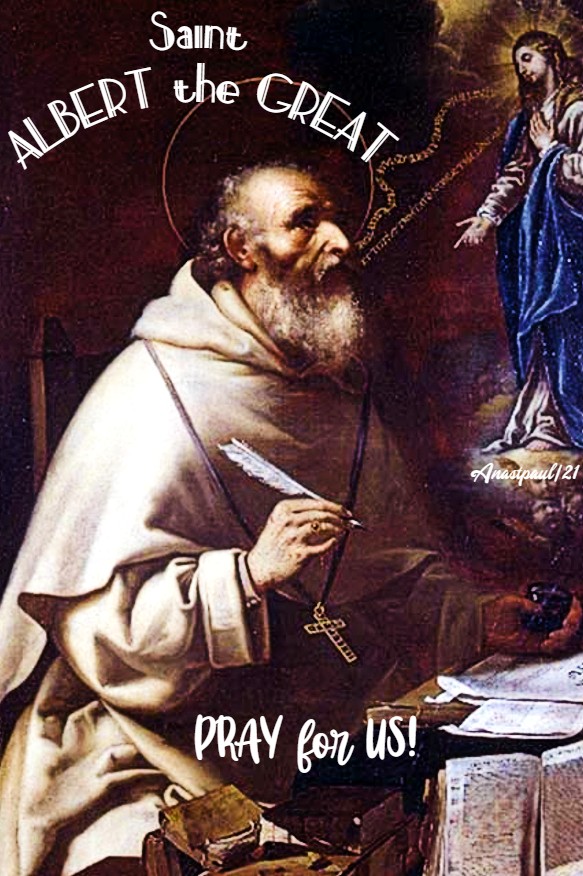
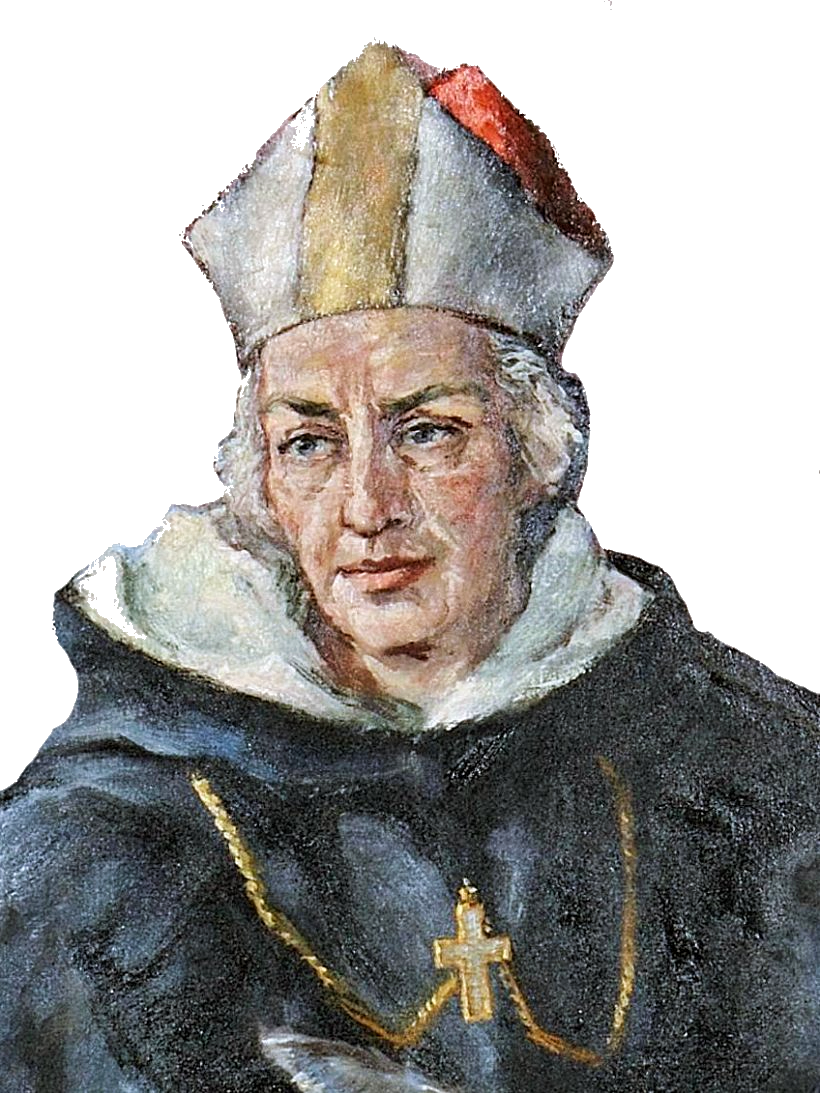
Quote/s of the Day – 15 November – St Albert the Great OP (1200-1280) Bishop, Confessor, Doctor of the Church
“It is by the path of love, which is charity, that God draws near to man and man to God. But where charity is not found, God cannot dwell. If, then, we possess charity, we posses God, for ‘God is Charity’ (1 John 4:8).”
“Banish, therefore, from thy heart, the distractions of earth and turn your eyes to spiritual joys that you may learn at last, to repose in the light of the contemplation of God.”
“Saint Joseph was the just man: by his constant fidelity -an effect of justice; by his perfect discretion – a sister to prudence; by his upright conduct – a mark of strength and by his inviolable chastity – a flower of temperance.”
St Albert the Great (1200-1280) Doctor of the Church
One Minute Reflection – 15 November – St Albert the Great OP (1200-1280) Bishop, Confessor, Doctor of the Church – 2 Timothy 4:1-8, Matthew 5:13-19 – Scripture search here: https://www.drbo.org/
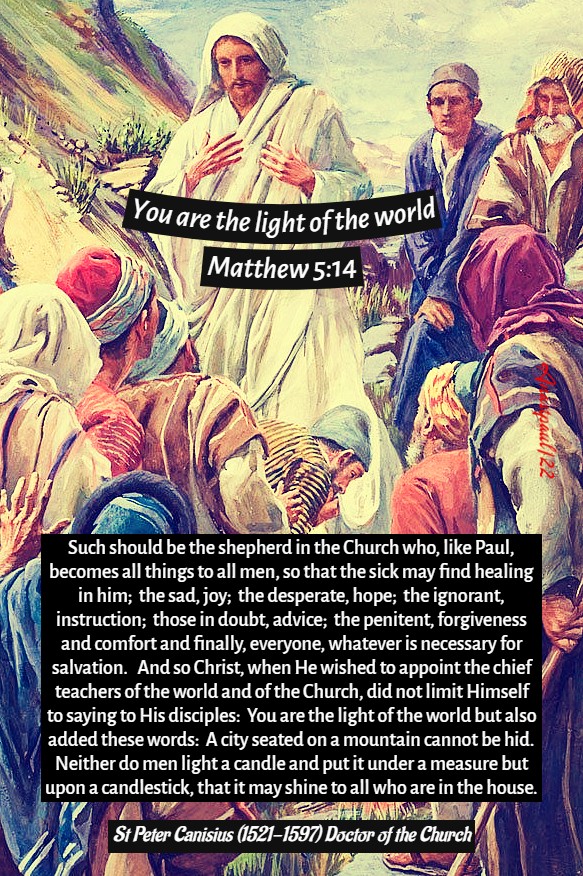
“You are the light of the world.” – Matthew 5:14
REFLECTION – “I shall always love and reverence the Apostles sent by Christ and their successors, in sowing the seed of the Gospel, those zealous and tireless co-operators in propagating the Word, who may justly say of themselves: Let a man so account of us as the ministers of Christ and the dispensers of the mysteries of God. For Christ, like a most watchful and most faithful householder, wished that the Gospel lamp should be lighted by such ministers and delegates, with fire sent down from Heaven and once lighted, should not be put under a measure but set upon a candlestick, so that it may spread its brightness far and wide and put to flight, all darkness and error, rife among both Jews and Gentiles.
Now it is not enough for the Gospel teacher to be a brilliant speaker in the eyes of the people; he must also be as a voice crying in the desert and endeavour, by his eloquence, to help many to lead good lives, lest, if he omit his duty of speaking, he be called the dumb dog that is not able to bark, spoken of by the prophet. Yes, he should also burn, in such a way, that, equipped with good works and love, he may adorn his evangelical office and follow the leadership of Paul. He indeed was not satisfied with bidding the Bishop of the Ephesians: This command and teach: conduct thyself in work as a good soldier of Christ Jesus but he unflaggingly preached the Gospel to friend and foe alike and, said with a good conscience to the Bishops gathered at Ephesus: You know how I have kept back nothing that was for your good but have declared it to you and taught you in public and from house to house, urging Jews and Gentiles to turn to God in repentance and to believe in our Lord Jesus Christ.
Such should be the shepherd in the Church who, like Paul, becomes all things to all men, so that the sick may find healing in him; the sad, joy; the desperate, hope; the ignorant, instruction; those in doubt, advice; the penitent, forgiveness and comfort and finally, everyone, whatever is necessary for salvation. And so Christ, when He wished to appoint the chief teachers of the world and of the Church, did not limit Himself to saying to His disciples: You are the light of the world but also added these words: A city seated on a mountain cannot be hid. Neither do men light a candle and put it under a measure but upon a candlestick, that it may shine to all who are in the house. Those churchmen err, who imagine that it is by brilliant preaching, rather than by holiness of and all-embracing love, they fulfil their office.” – St Peter Canisius SJ (1521-1597) Doctor of the Church (Sermon excerpt).
PRAYER – O God, Who made blessed Albert, ThyBishop and Doctor, eminent in the submission of human wisdom to divine faith, grant us, we beseech Thee, so to follow the path of his teaching that we may enjoy perfect light in Heaven.Through Jesus Christ, Thy Son our Lord, Who lives and reigns with Thee, in the unity of the Holy Ghost, God, world without end. Amen (Collect).
Our Morning Offering – 15 November – St Albert the Great (1200-1280) Bishop, Confessor, Doctor of the Church
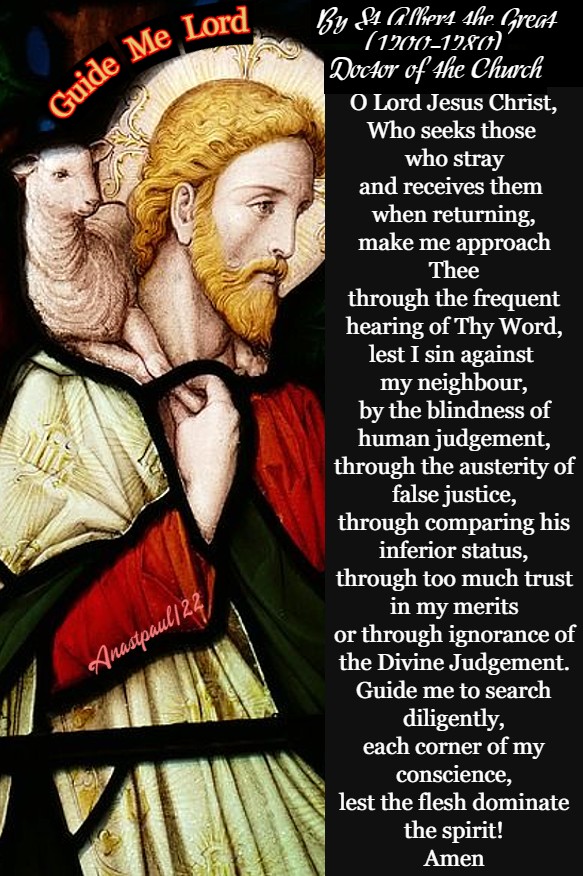
Guide Me Lord By St Albert the Great (1200-1280) Doctor of the Church
O Lord Jesus Christ, Who seeks those who stray and receives them when returning, make me approach Thee through the frequent hearing of Thy Word, lest I sin against my neighbour, by the blindness of human judgement, through the austerity of false justice, through comparing his inferior status, through too much trust in my merits or through ignorance of the Divine Judgement. Guide me to search diligently, each corner of my conscience, lest the flesh dominate the spirit! Amen
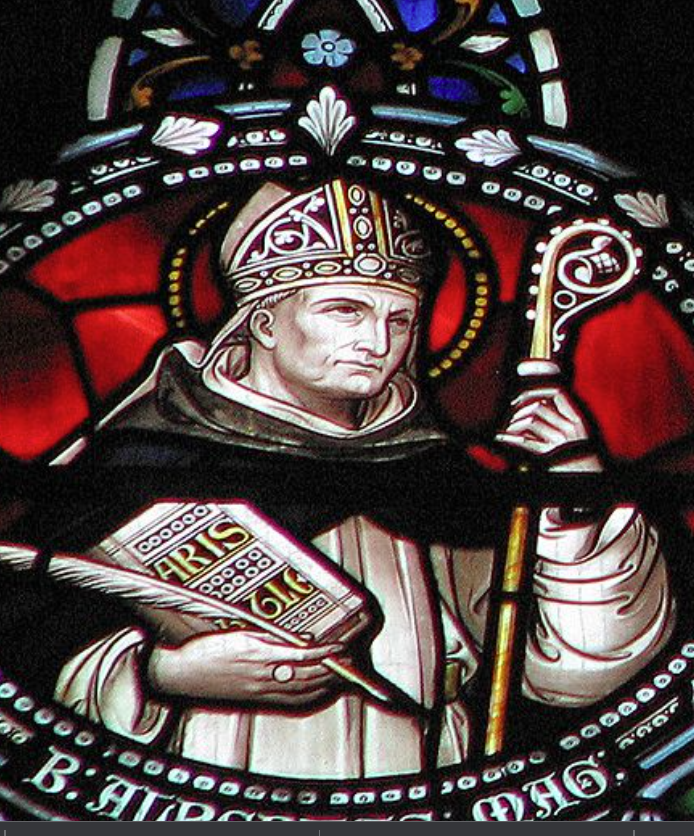
Saint of the Day – 15 November – St Albertus Magnus / the Great OP (1200-1280) Bishop, Confessor, Doctor of the Church – Doctor Universalis (Universal Doctor) – Priest and Friar of the Order of Preachers, Theologian, Scientist, Philospher, Teacher, Writer. St Albert was Beatified in 1622 by Pope Gregory XV and Canonised and created a Doctor of the Church in 1931 by Pope Pius XI. St Albert was known during his lifetime as Doctor Universalis and Doctor Expertus and, late in his life, the Sobriquet “Magnus” was appended to his name. He is the Patron of • Medical Technicians, Natural Sciences, Philosophers, schoolchildren, Scientists (proclaimed on 13 August 1948 by Pope Pius XII). Theology students. Scholars have referred to him as the greatest German Philosopher and Theologian of the Middle Ages.
St Albert the Great, Doctor of the Church From Saint Albert le Grand, 1942
Saint Albert the Great was born in the region of Augsbourg, Germany, of parents rich in the goods of fortune. From the time he was a child, he manifested in his studies, an unusual aptitude for the exact sciences. While he was still a boy, he had himself let down the side of a cliff to examine, at close range, an eagle’s nest which interested him. At the age of fifteen he was already a student of the natural sciences and the humanities, at Bologna. Saint Dominic had died in that City the preceding year, 1221 and was buried in the Dominican Convent there. Their house, in a suburban area of Bologna, was closely associated with the activities at the University and students in large numbers were requesting admission to the Order.
Blessed Reginald of Orleans, Dominican, a former Professor in Paris, came to preach there in the streets. The second Dominican General, Blessed Jordan of Saxony, a compatriot of Albert and a very eloquent Preacher, was in Padua and when the students of Bologna were transferred there, Albert heard him at the Padua Dominican Church. He had already desired to enter the Order, but his uncle, opposed to that plan a very vigorous opposition and Albert was still very young. He dreamed one night that he had become a Dominican but left the Order soon afterwards. The same day he heard Master Jordan preach and the Dominican General spoke of how the demon attempts, to turn aside those who want to enter into religion, knowing that he will suffer great losses from their career in the Church – he persuades them in dreams that they will leave it, or else they see themselves on horseback, or clothed in purple, or as solitaries in the desert, or surrounded by cordial friends; thus he makes them fear entering because they would not be able to persevere. This was precisely Albert’s great concern, faced as he was with his uncle’s opposition. Afterwards the young student, amazed, went to Blessed Jordan, saying: “Master, who revealed my heart to you?” And he lost no time then in entering the Order at the age of sixteen, in 1223, having heard the same Preacher remark, to him personally, that he should consider what a pity it would be, if his excellent youthful qualities became the prey of eternal fires!
When he had earned the title of Doctor in Theology, he was sent to Cologne, where for a long time his reputation attracted many illustrious disciples. The humble Albert, filled with the love of God, taught also in Padua and Bologna, in Saxony, at Freibourg, Ratisbonne and Strasbourg and when Blessed Jordan of Saxony died in 1237, he occupied his place and fulfilled his functions, until 1238, when the election of his successor was held. He returned then to Cologne, where he would encounter a disciple, who alone among all of them, would suffice for his glory — Saint Thomas Aquinas. This young religious, already steeped in the highest theological studies, was silent among the others, to the point of being called by his fellow students “the Mute Ox of Sicily.” But Albert silenced them, saying, “The bellowings of this ox will resound throughout the entire world!”
From Cologne, Saint Albert was called to the University of Paris, with his dear disciple. There, his genius appeared in all its brilliance and there, he composed a large number of his writings. Later, obedience took him back to Germany as Provincial of his Order. Without a murmur, he said farewell to his cell, his books and his numerous disciples and as Provincial, thereafter, journeyed with no money, always on foot, visiting the numerous Monasteries under his jurisdiction, throughout an immense territory, in which were included Austria, Bavaria, Saxony and other regions even to Holland.
He was no longer young when he had to submit to the formal order of the Pope and accept, in difficult circumstances, the Episcopal See of Ratisbonne. There, his indefatigable zeal was rewarded, only by harsh trials, in the midst of which, his virtue was perfected. When, in response to his persevering requests to be relieved of the responsibilities of a large See, Pope Urban IV restored to him the conventual peace of his Order, he was nonetheless, obliged to take up his apostolic journeyings again. Finally, he could enter into a definitive retreat, to prepare for death. One is astonished that amid so many labours, journeys and works of apostolic zeal, Albert could find the time to write on the natural sciences, on philosophy and theology, works which form from twenty-one to thirty-eight volumes, depending on the edition — and one may ask, in which of his titles, he most excelled, that of scholar, of Saint, or of Apostle?
He died, apparently of fatigue, at the age of seventy three, on 15 November 1280 and his body was buried in Cologne in the Dominican Church. He had to wait until 16 December 1931 for the honours of Canonisation and the extension of his cult to the Universal Church. Proclaiming his holiness, Pope Pius XI added the glorious title, so well merited, of Doctor of the Church. From time immemorial, he has been known as the glorious Saint Albert the Great, [Albertus Magnus, most worthy indeed, is this holy child of St Dominic!]
St Albertus Magnus OP (1200-1280) Bishop, Confessor, Doctor of the Church – Doctor Universalis (Universal Doctor) – Priest and Friar of the Order of Preachers, Theologian, Scientist, Philospher, Teacher, Writer. St Albert was Beatified in 1622 by Pope Gregory XV and Canonised and created a Doctor of the Church in 1931 by Pope Pius XI. St Albert was known during his lifetime as Doctor universalis and Doctor expertus and, late in his life, the sobriquet Magnus was appended to his name. St Albert! https://anastpaul.com/2017/11/15/saint-of-the-day-15-november-st-st-albertus-magnus-albert-the-great-o-p-1200-1280-doctor-of-the-church/
St Anianus of Wilparting St Arnulf of Toul Bl Caius of Korea St Desiderius of Cahors St Eugene of Toledo St Felix of Nola St Findan St Fintan the Missionary St Gurias of Edessa Bl Hugh Faringdon Bl John Eynon Bl John Rugg Bl John Thorne
Blessed Lucia (Lucy) of Narni OP (1476-1544) Virgin, Tertiary of the Order of Preachers, Mystic, Stigmatist, Her body is incorrupt. So many miracles occurred at her Shrine that Lucia was finally Beatified on 1 March 1710 by Pope Clement XI. It is thought that Lucia was the inspiration for th little girl Lucy, who could see many things that no-one else could, in C S Lewis’ The Chronicles of Narnia. Her Life: https://anastpaul.com/2021/11/15/saint-of-the-day-15-november-blessed-lucia-of-narni-op-1476-1544/
St Luperius of Verona St Machudd of Llanfechell St Malo of Aleth St Marinus of Wilparting
St Paduinus of Le Mans Bl Richard Whiting Bl Roger James St Shamuna of Edessa St Sidonius of Saint-Saens
Martyrs of Hippo – 20 Saints: 20 Christians Martyred together and celebrated by Saint Augustine. The only details about them to survive are three of the names – Fidenziano, Valerian and Victoria. Hippo, Numidia (in north Africa).
Martyrs of North Africa – 3 Saints: A group of Christians murdered for their faith in imperial Roman north Africa. The only details that have survived are the names of three of them – Fidentian, Secundus and Varicus.
Thought for the Day – 14 November – Meditations with Antonio Cardinal Bacci (1881-1971)
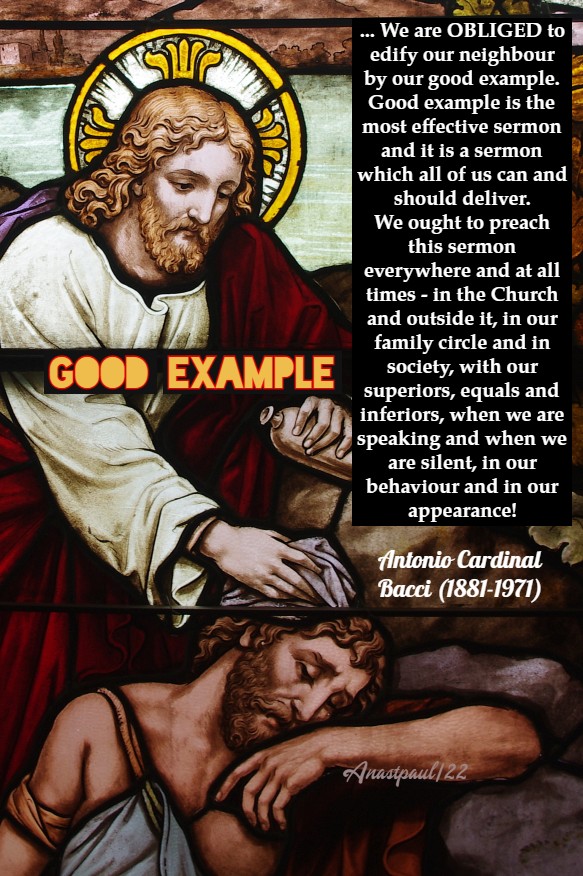
Good Example
“The Holy Spirit tells us that God entrusts to everyone, the care of his neighbour (Ecclus 17:12). “Let your light shine before men,” says Jesus Christ, “in order that they may see your good works and give glory to your Father in Heaven” (Mt 5:16). St Paul echoes this counsel, when he warns us not to return evil for evil but to “provide good things, not only in the sight of God but also in the sight of all men” (Cf Rom 12:17). In other words, we are obliged to edify our neighbour by our good example.
Good example is the most effective sermon and it is a sermon which all of us can and should deliver. We ought to preach this sermon everywhere and at all times – in the Church and outside it, in our family circle and in society, with our superiors, equals and inferiors, when we are speaking and when we are silent, in our behaviour and in our appearance!”
Quote/s of the Day – 14 November – St Josaphat Kuncewicz OSBM (1584-1623) Confessor, Archbishop, Martyr – Hebrews 5:1-6, John 10:11-16 – Scripture search here: https://www.drbo.org/
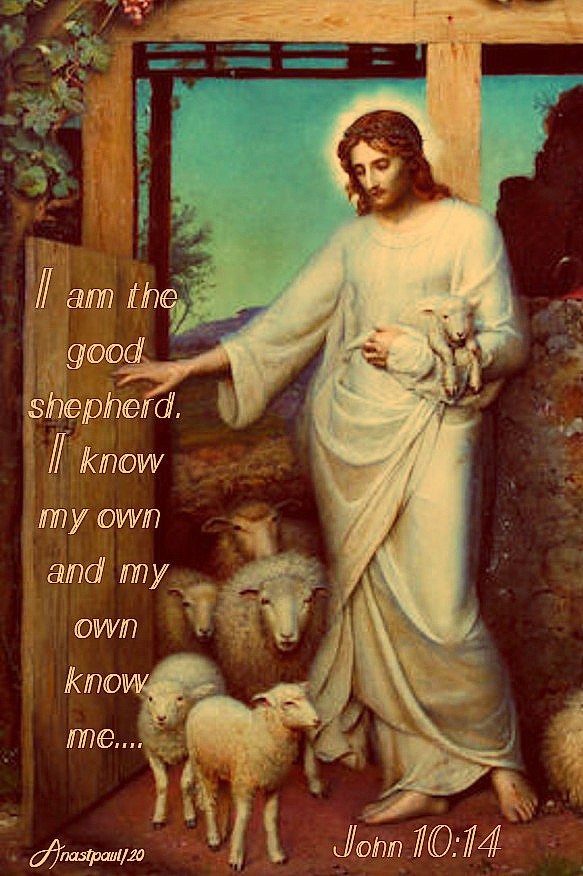
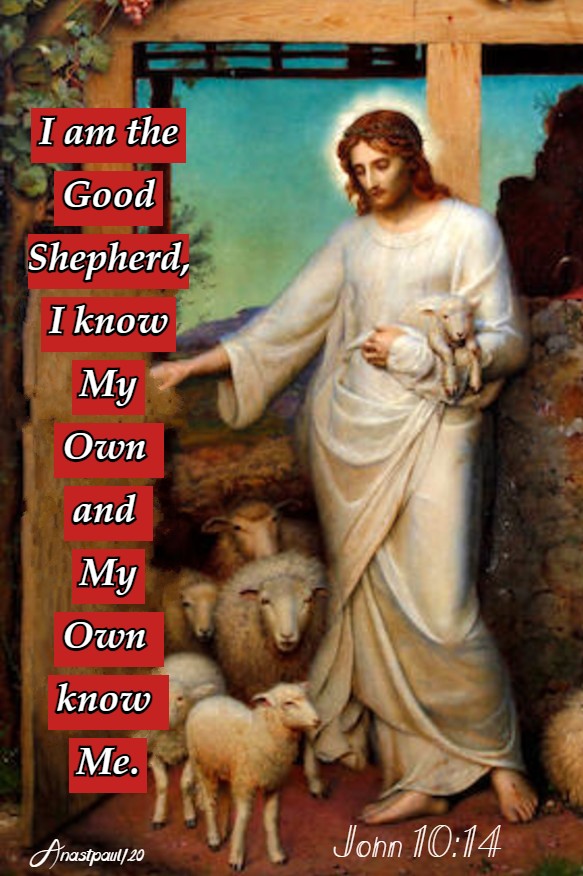
“I Am the Good Shepherd and I know mine and mine know me.”
John 10:14
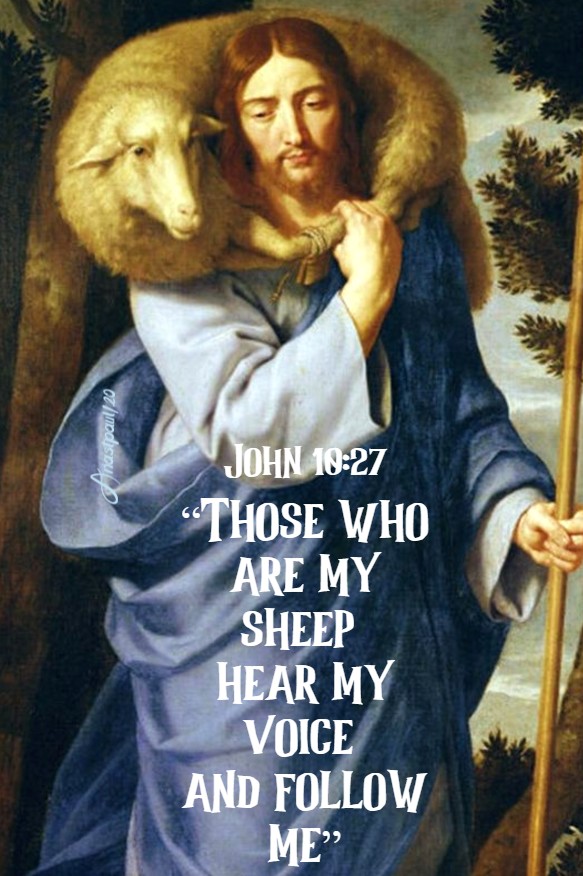
“Those who are my sheep hear my voice and follow me”
John 10:27
“He cries out, saying: See, I am with you all the days of this age. He is Himself the shepherd, the high priest, the way and the door, and has become all things at once for us.”
St Athanasius (297-373) Father & Doctor of the Church
“The mark of Christ’s sheep is their willingness to hear and obey, just as disobedience is the mark of those who are not His. We take the word ‘hear’ to imply obedience to what has been said.”
St Cyril of Alexandria (376-444) Father and Doctor of the Church
“With good reason Christ declares: I am the Good Shepherd, I seek out the lost sheep, the strayed I will bring back, the injured I will bind up, the sick I will heal (Ez 34:16). I have seen the flock of mankind struck down by sickness; I have witnessed my lambs wander about where demons dwell; I have seen my flock ravaged by wolves. All this I have seen and have not witnessed it from on high. That is why I took hold of the withered hand, gripped by pain, as if by a wolf; I have unbound those whom fever had bound; I taught him to see, whose eyes had been shut from his mother’s womb; I brought Lazarus out from the tomb where he had lain for four days (Mk 3:5; 1:31; Jn 9; 11). For I am the Good Shepherd and the good shepherd lays down his life for his sheep.”
Basil of Seleucia (Died 448) Bishop of Seleucia, Writer Oratio 26
O Lord, Show Thy Mercy to Me By St Jerome (347-419) Confessor, Father and Doctor of the Church
O Lord, show Thy mercy to me and gladden my heart. I am like the man on the way to Jericho, who was overtaken by robbers, wounded and left for dead. O Good Samaritan, come to my aid. I am like the sheep which went astray. O Good Shepherd, seek me out and bring me home, in accord with Thy will. Let me dwell in Thy house all the days of my life and praise Thee, forever and ever with those who are there. Amen.
“No matter how grave and how numerous our sins may be, let us remember that the Mercy of God is Infinite. Let us remember that He is waiting for us, as his father waited for the prodigal son and, that He is following us like a shepherd who is searching for his lost sheep. He allowed us to fall, in order to humble us and help us to realise that we are incapable of doing anything good by ourselves.”
One Minute Reflection – 14 November – St Josaphat Kuncewicz OSBM (1584-1623) Confessor, Archbishop, Martyr – Hebrews 5:1-6, John 10:11-16 – Scripture search here: https://www.drbo.org/
“I am the good shepherd and I know My Own and My Own know Me.”- John 10:14
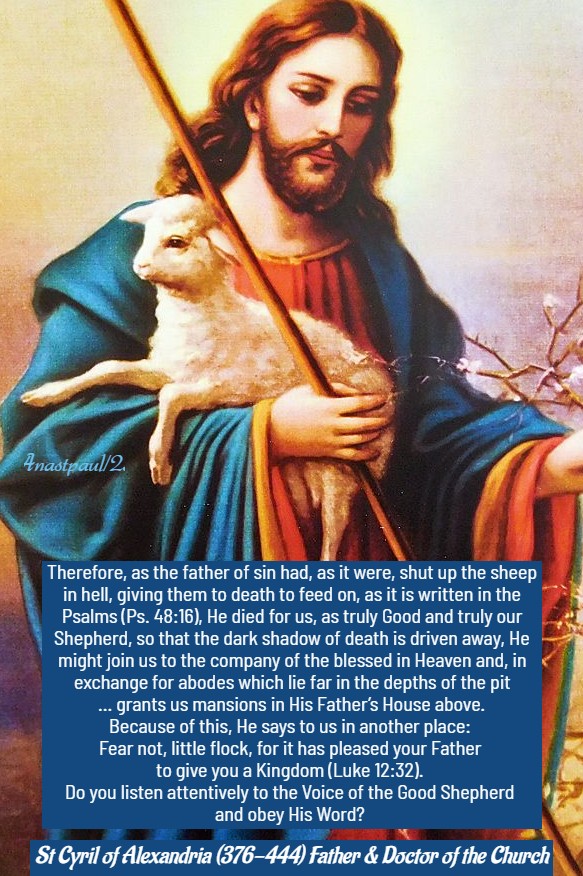
REFLECTION – “He shows in what manner a shepherd may be proved good and, He teaches that, he must be prepared to give up his life, fighting in defence of his sheep, which was fulfilled in Christ. For man has departed from the love of God and fallen into sin and because of this was, I say, excluded from the divine abode of paradise. And when he was weakened by that disaster, he yielded to the devil tempting him to sin and death, following that sin, he became the prey of fierce and ravenous wolves. But after Christ was announced as the True Shepherd of all men, He laid down His life for us (1 John 3:16), fighting for us against that pack of inhuman beasts. He bore the Cross for us that by His own death, He might destroy death. He was condemned for us that He might deliver all of us, from the sentence of punishment: the tyranny of sin being overthrown by our faith: fastening to the Cross, the decree that stood against us, as it is written (Colossians 2:14).
Therefore, as the father of sin had, as it were, shut up the sheep in hell, giving them to death to feed on, as it is written in the Psalms (Ps. Xlviii.16), He died for us, as truly Good and truly our Shepherd, so that the dark shadow of death is driven away, He might join us to the company of the blessed in Heaven and, in exchange for abodes, which lie far in the depths of the pit …grants us mansions in His Father’s House above. Because of this, He says to us in another place: Fear not, little flock, for it has pleased your Father to give you a Kingdom (Luke 12:32). Do you listen attentively to the Voice of the Good Shepherd and obey His Word? – ” – St Cyril of Alexander (376-444) Known as “The Pillar of Faith” Archbishop of Alexandria, Father and Doctor of the Church. (Commentary on the Good Shepherd).
PRAYER – Arouse in Thy Church, O Lord, the spirit with which blessed Josaphat, Thy Martyr and Bishop, was filled, when he laid down his life for his flock; so that, by his intercession, we, also moved and strengthened by the same spirit, may not fear to lay down our lives for our brethren. Through Jesus Christ, Thy Son our Lord, Who lives and reigns with Thee, in the unity of the Holy Ghost, God, world without end. Amen (Collect).
Saint of the Day – 14 November – Saint Siard OPraem (Died 1230) Abbot. Siard of Friesland in the Netherlands, was a holy Abbot of the Norbertine Abbey in Mariëngaard by Hallum in Friesland. He was a powerful and hardworking Administrator, abiding strictly by the Rule of the Order, Apostle of the poor and needy, a holy Abbot of deep and mystical piety and prayer, on occasion he was seen in ecstasy, Peace-maker. Patronage – against blindness, bodily ailments.
He was born to a noble Frisian family in the shadow of the Abbey of Mariëngaard and there received the white habit at the hands of St Frederick (c 780-838). During his first twenty years in the Abbey, Siard practised great penances and mortification and proved a model of edification for the brethren, to such an extent that Abbot John appointed Siard his successor on his death-bed.
Young St Siard kneeling before the Madonna and Child with St Frederick on the right standing
As Abbot his life was particularly marked by its austerity and benevolence.Nothing in his daily life distinguished him from his confreres. He wore the same habit, ate at the same table and slept in the same dormitory. On account of his exceptional humility, he resolutely refused everything that was not strictly necessary. He was a good administrator who governed his Monastery well, both in spiritual and material matters. He laboured zealously with his Monks, particularly in the fields harvesting wheat. He would lead the confreres in the singing of Psalms during harvest time. He was extremely open to those who sought his advice and ensured that the Abbey became known as a place of refuge throughout the region.
As a model of perfection, Siard had also given Blessed Dodo of Haskerland his Norbertine education. He showed a true conciliatory spirit, settling disputes quickly and with the utmost gentleness and understanding. Furthermore, the Saint extended the lands of the Abbey and guided the constructios of various additions to the buildings. The apostolic spirit of the Order thrived at Mariëngaarde under his leadership. Whenever Siard went on a journey, he took along a large basket full of bread and other foods that he could distribute among the poor. Because of this he is usually depicted with a basket at his feet.
Once on a journey, the holy Abbot came across a noisy celebration of music and dance. He stopped and turned to his brothers saying, “Just imagine what songs of joy the angel choirs must sing when they celebrate the conversion of a single sinner.” He urged three things upon the confreres who had to leave the Monastery on a journey – a joyous departure, a peaceful sojourn and a happy return. Known also for his miraculous cures of the sick and ailing, the Monastery began to attract many in search of the alleviation of their physical illnesses, after Siard cured a man of blindness.
Siard had a special devotion to Martha and Mary. He looked to Martha, as an example for his care of the confreres and to Mary, as a reminder of the necessity of listening to Christ, in prayer and meditation. On occasion, he would fall into ecstasy during prayer and hear the heavenly music of the angels.
Naturally the austhere life which Siard had implemented, was not popular with all of the Canons and,, in 1290, one of their number attempted to murder the Abbot. His loud cries brought the aid of the confreres and he escaped with only minor injuries.
He had been Abbot for thirty six years when he died on 14 November 1230. Numerous faithful were granted special favours by God, at his grave. After the destruction of Mariëngaarde by the Calvinists in 1578, his earthly remains were rescued by a Frieslanden nobleman, Siard of Helsema, who brought them to Hildesheim. In 1608 his Relics were divided and placed in two separate Reliquaries. In 1617, one of these was brought to the Abbey of St Feuillin du Roeulz. After the suppression of this Abbey during the French Revolution, the Relics were taken to the Church at Strépy. In 1938 Prelate Bauwens brought them to the Norbertine Abbey of Leffe. The other Reliquary was brought to Tongerlo in 1617, where ever since the people have held St Siard in great honour and celebrated his Feast each year, with great solemnity. A part of the Relic of Siard’s head found a home in the Generalate House in Rome, until 2000 when it was transferred to the Abbey of Windberg.
The cult of St Siard was confirmed by Pope Benedict XIII on 22 January and 8 March in 1728.
O God, Who made Thy Saints to obey the Gospel as an example for many, grant, we beseech Thee, that we may imitate the cheerful goodness and devout piety of the blessed Abbot Siard. We ask this through our Lord Jesus Christ, Thy Son, Who lives and reigns with Thee in the unity of the Holy Ghost, One God forever and ever. Amen.
All Saints of the Carmelite Order: On this day, the Carmelite Family celebrates the memory of all its holy men and women, those known and those unknown, those living on Earth and those living in Heaven, who reflect the glory of God.
St Joseph Maria Pignatelli SJ (1737 – 1811) Priest of the Society of Jesus known as “The Restorer of the Society of Jesus” and “The Second Founder of the Society of Jesus” following the suppression of the Society of Jesus by Pope Clement XIV in 1773. He was Beatified on 21 May 1933 by Pope Pius XI and was Canonised on 12 June 1954 by Venerable Pope Pius XII. His Life: https://anastpaul.com/2019/11/14/saint-of-the-day-14-november-saint-joseph-maria-pignatelli-sj-1737-1811/
St Jucundus of Bologna
St Laurence O’Toole/Lorcán Ua Tuathail (c 1128 – 1180) Archbishop of Dublin, Abbot, Reformer, Mediator, Preacher, Apostle of Charity, Papal Legate to Ireland, he established new Churches and Monasteries. Due to the great number of miracles that rapidly occurred either at his tomb or through his intercession, Lorcán was canonised only 45 years after his death in 1225 by Pope Honorius III. Biography: https://anastpaul.com/2018/11/14/saint-of-the-day-14-november-st-laurence-otoole-c-1128-1180/
St Modanic St Pierre of Narbonne St Ruf of Avignon St Serapion of Alexandria
St Serapion of Algiers OdeM (c 1179–1240) Mercedarian Priest and Martyr, Soldier and Crusader. The Roman Martyrology states today: “At Algiers in Africa, the blessed Serapion, of the Order of Our Blessed Lady of Ransom, for the Redemption of the faithful in captivity and the preaching of the Christian Faith. He was the first of his Order to deserve the Palm of Martyrdom by being crucified and cut to pieces.” On 14 July 1728, a decree was issued confirming his immemorial cult. he was Canonised on 14 April 1728 by Pope Benedict XIII and on 24 August 1743, he was included in the Roman Martyrology. His Life and Death: https://anastpaul.com/2021/11/14/saint-of-the-day-14-november-saint-serapion-of-algiers-odem-c-1179-1240-martyr/
St Siard OPraem (Died 1230) Abbot of the Premonstratensian Order or the “Norbertines.” St Venerando the Centurian St Venerandus of Troyes
Martyrs of Emesa: Group of Christian women tortured and executed for their faith in the persecutions of the Arab chieftain Mady. They died in Emesa (modern Homs, Syria).
Martyrs of Heraclea – (3 Saints): Group of Christians murdered together for their faith. The only details we have are three of their names – Clementinus, Philomenus and Theodotus. They were Martyred in Heraclea, Thrace.
Thought for the Day – 13 November – Meditations with Antonio Cardinal Bacci (1881-1971)
Almsgiving and Simplicity
“There are others who give generously but are anxious to make a good appearance before their fellowmen. It is of these that it has been written “they have received their reward.” (Mt 6:2).
We should give with holy simplicity in the manner indicated in the Gospel. “When thou givest alms, do not let thy left hand know what thy right hand is doing.” (Mt 6:3). Such unostentation generosity, is more pleasing to the poor than the gift itself.”
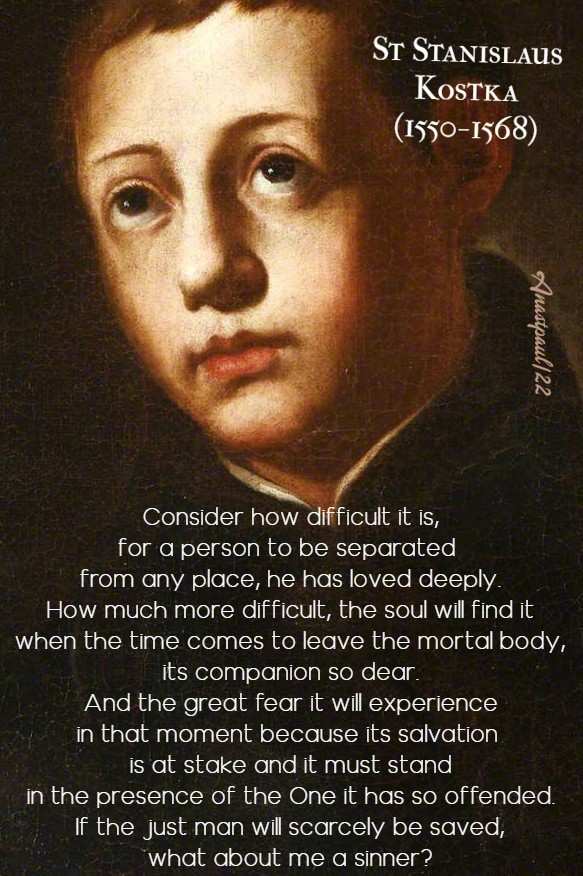
Quote/s of the Day – 13 November – St Stanislaus Kostka SJ (1550-1568) Jesuit Novice
“Consider how difficult it is, for a person to be separated from any place, he has loved deeply. How much more difficult, the soul will find it when the time comes to leave the mortal body, its companion so dear. And the great fear it will experience in that moment because its salvation is at stake and it must stand in the presence of the One it has so offended. If the just man will scarcely be saved, what about me a sinner?”
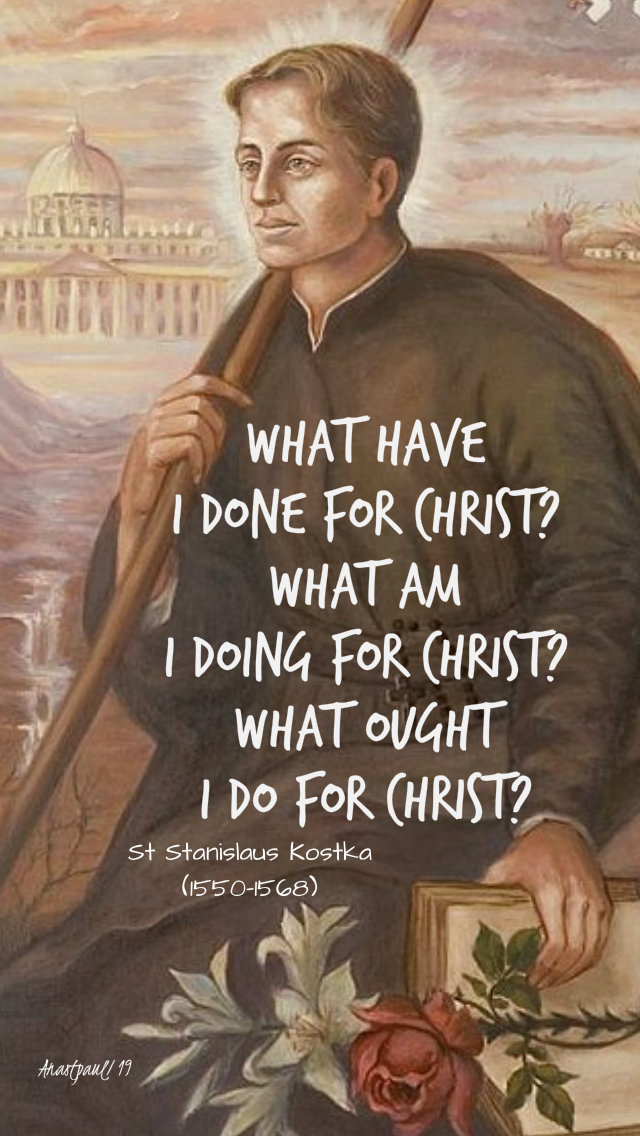
“What have I done for Christ? What am I doing for Christ? What ought I do for Christ?”
One Minute Reflection – 13 November – The Twenty Third Sunday after Pentecost – St Didacus de Alcalá de Henares) OFM (c 1400-1463) Confessor and the Feast of All Saints of the Augustinian Order – Philippians 3:17-21; 4:1-3, Matthew 9:18-26 – Scripture search here: https://www.drbo.org/
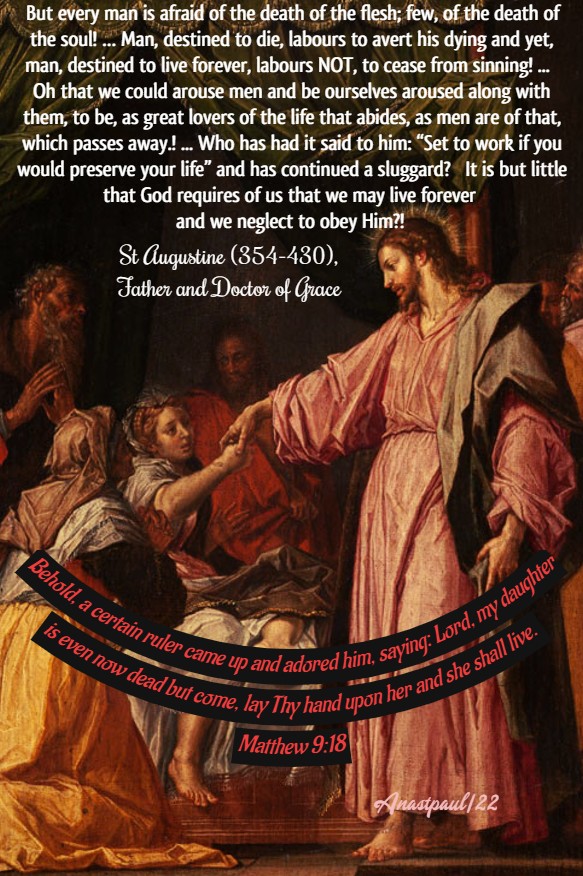
“Behold .a certain ruler came up and adored him, saying: Lord, my daughter is even now dead but come, lay Thy hand upon her and she shall live. ” – Matthew 9:18
REFLECTION – “The hour is coming, in which all that are in their graves ,shall hear His Voice and shall come forth” (Jn 5,28)… We have read in the Gospel, of three dead persons who were raised to life by the Lord and, let us hope, to some good purpose. For surely the Lord’s deeds are not merely deeds but signs… We were listening with wonder… in the reading of the Gospel, how Lazarus was restored to life (Jn 11). If we turn our thoughts to the still more wonderful works of Christ, everyone who believes, rises again – if we all consider and understand that more horrifying kind of death which everyone who sins dies.
But every man is afraid of the death of the flesh; few, of the death of the soul! …Man, destined to die, labours to avert his dying and yet, man, destined to live forever, labours not, to cease from sinning! … Oh that we could arouse men and be ourselves aroused along with them, to be, as great lovers of the life that abides, as men are of that, which passes away.! … Who has had it said to him: “Be off to sea, if you would escape with your life” and has delayed to do so? Who has had it said to him: “Set to work if you would preserve your life” and has continued a sluggard? It is but little that God requires of us that we may live forever and we neglect to obey Him?! …
If, then, the Lord in the greatness of His grace and mercy, raises our souls to life that we may not die forever, we may well understand, that those three dead persons whom He raised in the body, have some figurative significance of that resurrection of the soul, which is effected by faith.” – St Augustine (354-430), Father and Doctor of Grace of the Church (Sermons on Saint John’s Gospel, no.49, 1-3).
PRAYER – Almighty, eternal God, Who in Thy wondrous providence, choose the weak things of the world to overcome the strong, mercifully grant unto us Thy humble servants that, by the loving prayers of blessed Didacus, Thy Confessor, we may be found worthy to be raised unto the everlasting glory of Heaven. Through Jesus Christ, Thy Son our Lord, Who lives and reigns with Thee, in the unity of the Holy Ghost, God, world without end. Amen (Collect).
Our Morning Offering – 13 November – The Twenty Third Sunday after Pentecost – All Saints of the Benedictine & Cistercian Orders
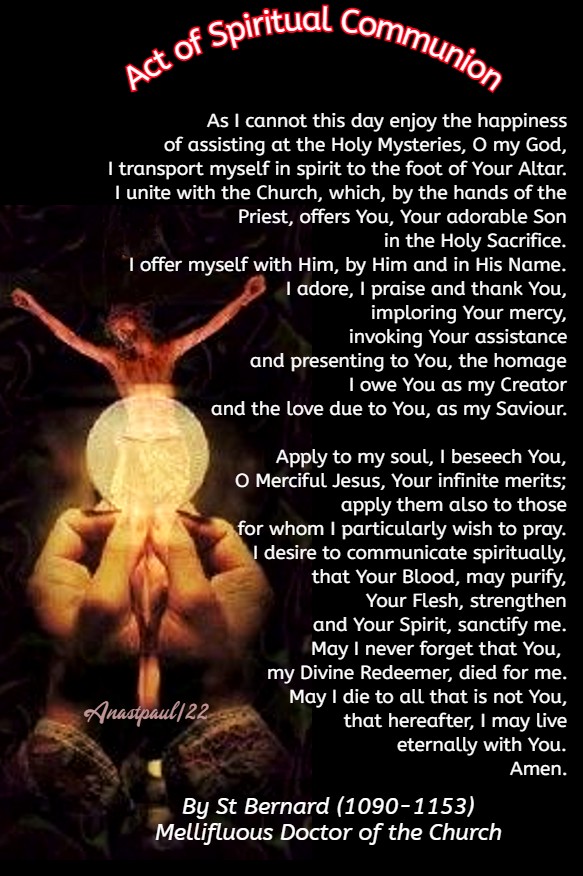
Act of Spiritual Communion By St Bernard O. Cist (1090-1153) Mellifluous Doctor of the Church
As I cannot this day enjoy the happiness of assisting at the Holy Mysteries, O my God, I transport myself in spirit to the foot of Your Altar. I unite with the Church, which, by the hands of the Priest, offers You, Your adorable Son in the Holy Sacrifice. I offer myself with Him, by Him and in His Name. I adore, I praise and thank You, imploring Your mercy, invoking Your assistance and presenting to You, the homage I owe You as my Creator and the love due to You, as my Saviour.
Apply to my soul, I beseech You, O Merciful Jesus, Your infinite merits; apply them also to those for whom I particularly wish to pray. I desire to communicate spiritually, that Your Blood, may purify, Your Flesh, strengthen and Your Spirit, sanctify me. May I never forget that You, my divine Redeemer, died for me. May I die to all that is not You, that hereafter, I may live eternally with You. Amen.



























 AnaStpaul
You must be logged in to post a comment.