Thought for the Day – 12 November – Meditations with Antonio Cardinal Bacci (1881-1971)
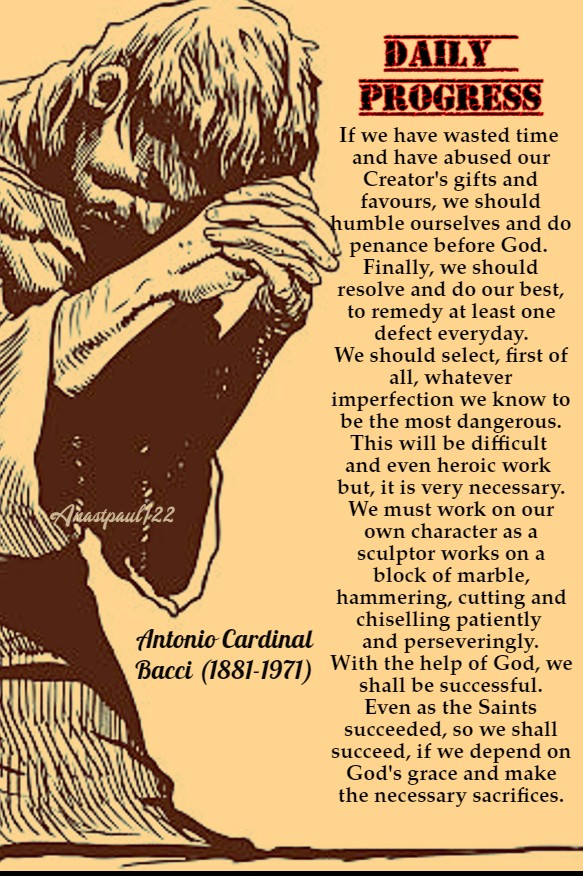
Daily Progress
“There are two ways in which we should make constant daily progress. The first is in the removal of our defects and imperfections. As TheImitation of Christ insists, we should soon become holy, if we were to conquer, at least, one sin every year.
It is opportune, at this stage, to ask ourselves, how many years we have already spent on earth? During these years, how many personal defects can we claim to have remedied? Perhaps there was a time when we were better than we are now? If we have wasted time and have abused our Creator’s gifts and favours, we should humble ourselves and do penance before God.
Finally, we should resolve and do our best, to remedy at least one defect everyday. We should select, first of all, whatever imperfection we know to be the most dangerous. This will be difficult and even heroic work but, it is very necessary. We must work on our own character as a sculptor works on a block of marble, hammering, cutting and chiselling patiently and perseveringly. With the help of God, we shall be successful. Even as the Saints succeeded, so we shall succeed, if we depend on God’s grace and make the necessary sacrifices.”
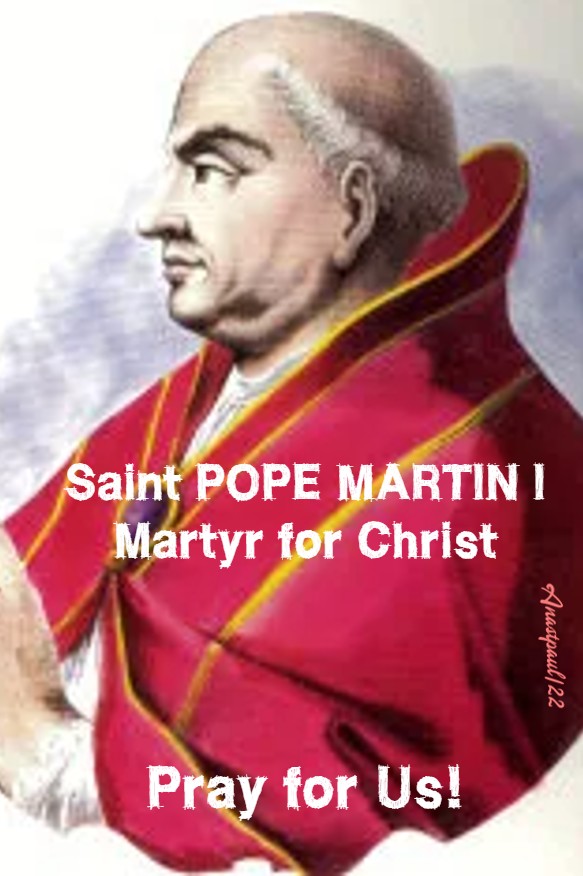
Quote/s of the Day – 12 November – St Martin I, Pope (598-655) Martyr – 1 Peter 5:1-4; 5:10-11, Matthew 16:13-19 – Scripture search here: https://www.drbo.org/
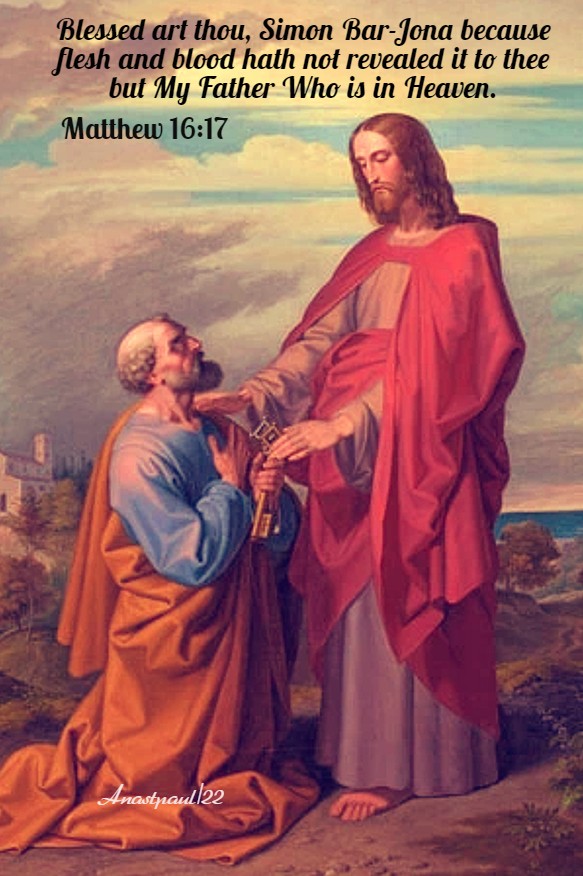
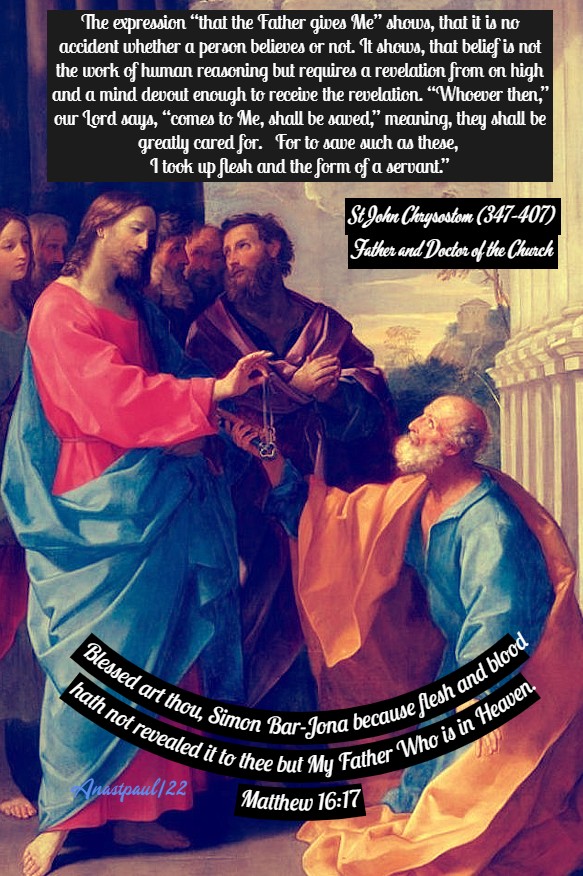
“Blessed art thou, Simon Bar-Jona because flesh and blood hath not revealed it to thee but My Father Who is in Heaven.”
Matthew 16:17
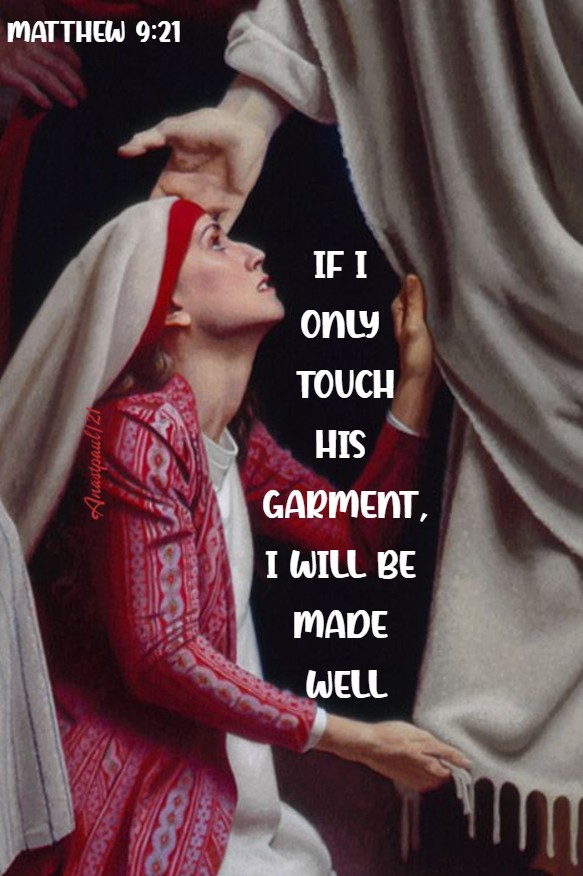
“If I only touch his garment, I will be made well.” Jesus turned and seeing her he said, “Take heart, daughter, your faith has made you well.” And instantly the woman was made well.”
Matthew 9:21-22
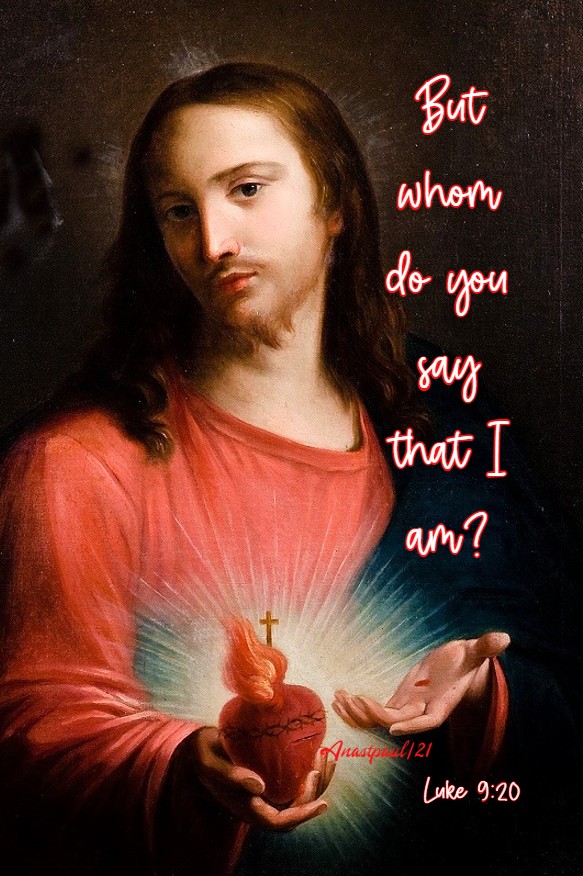
“But whom do you say that I Am?”
Luke 9:20
“Our pilgrimage on earth cannot be exempt from trial. We progress by means of trial. No-one knows himself except through trial, or receives a crown, except after victory, or strives, except against an enemy or temptations.”
St Augustine (354-430) Father and Doctor of Grace
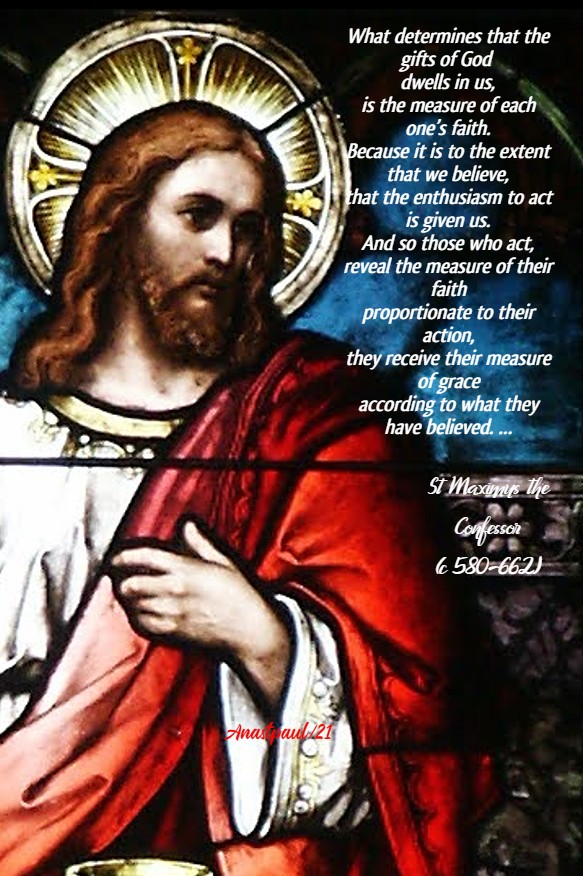
“What determines that the gifts of God dwells in us, is the measure of each one’s faith. Because it is to the extent that we believe, that the enthusiasm to act is given us. And so those who act, reveal the measure of their faith proportionate to their action, they receive their measure of grace according to what they have believed. …”
St Maximus the Confessor (c 580-662) Monk and Theologian
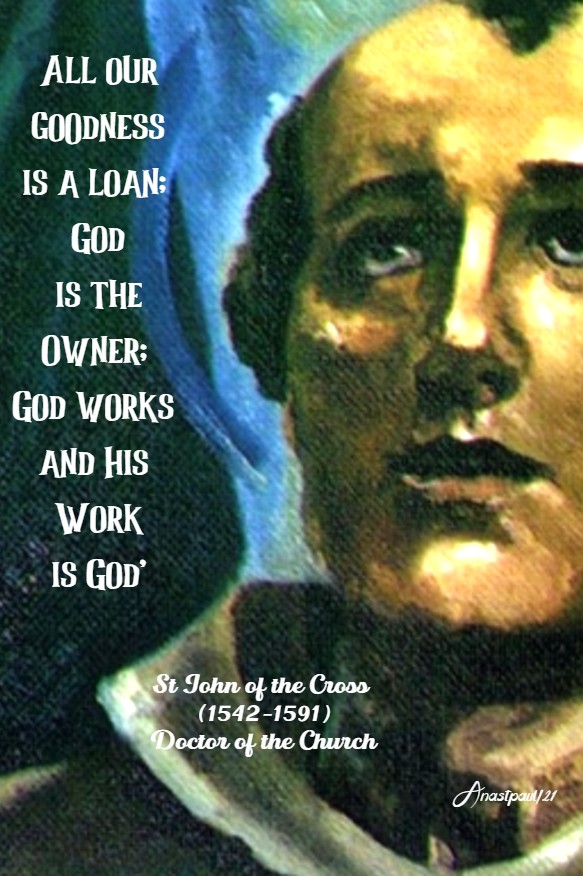
“All our goodness is a loan; God is the owner; God works and His work is God.”
St John of the Cross (1542-1591) Doctor of the Church
The Apostles’ Creed
I believe in God, the Father Almighty, Creator of heaven and earth and in Jesus Christ, His only Son, our Lord, who was conceived by the Holy Spirit, born of the Virgin Mary, suffered under Pontius Pilate, was crucified, died and was buried; He descended into hell; on the third day He rose again from the dead; He ascended into heaven and is seated at the right hand of God the Father Almighty; from thence He shall come to judge the living and the dead. I believe in the Holy Spirit, the Holy Catholic Church, the communion of Saints, the forgiveness of sins, the resurrection of the body and life everlasting. Amen
One Minute Reflection – 12 November – St Martin I, Pope (598-655) Martyr – 1 Peter 5:1-4; 5:10-11, Matthew 16:13-19 – Scripture search here: https://www.drbo.org/
“Blessed art thou, Simon Bar-Jona because flesh and blood hath not revealed it to thee but My Father Who is in Heaven.” – Matthew 16:17
REFLECTION – “Faith in Me, He intimates here, is no ordinary thing or one that comes from human reason but [it] needs a revelation from above. And this He establishes throughout His discourses, showing, that this faith requires a noble sort of soul and one drawn on by God. The expression “that the Father gives Me” shows, that it is no accident whether a person believes or not. It shows, that belief is not the work of human reasoning but requires a revelation from on high and a mind devout enough to receive the revelation. “Whoever then,” our Lord says, “comes to Me, shall be saved,” meaning, they shall be greatly cared for. For to save such as these, I took up flesh and the form of a servant.” – St John Chrysostom (347-407) Archbishop of Constantinople, Father and Doctor of the Church (Homilies on the Gospel of John 45)”
PRAYER – Look forgivingly on Thy flock, Eternal Shepherd and keep it in Thy constant protection, by the intercession of blessed Martin Thy Martyr and Sovereign Pontiff, whom thou didst constitute Shepherd of the whole Church. Through Jesus Christ, Thy Son our Lord, Who lives and reigns with Thee, in the unity of the Holy Ghost, God, world without end. Amen (Collect).
Our Morning Offering – 12 November – Mary’s Saturday – “The Month of the Holy ouls in Purgatory”
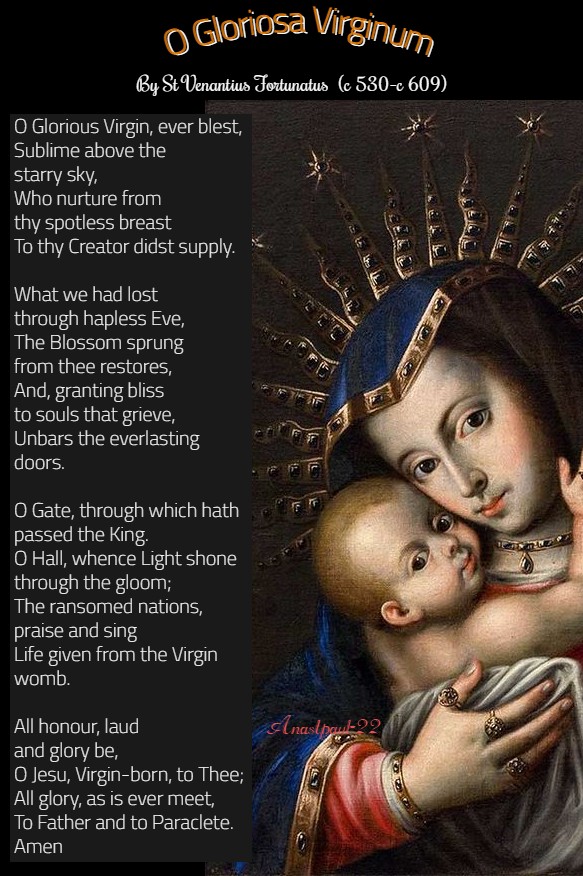
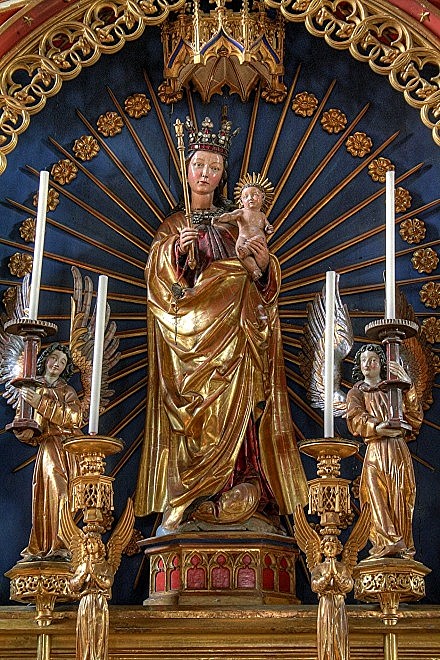
O Gloriosa Virginum By St Venantius Fortunatus (c 530 – c 609)
O Glorious Virgin, ever blest, Sublime above the starry sky, Who nurture from thy spotless breast To thy Creator didst supply.
What we had lost through hapless Eve, The Blossom sprung from these restores, And, granting bliss to souls that grieve, Unbars the everlasting doors.
O Gate, through which hath passed the King. O Hall, whence Light shone through the gloom; The ransomed nations, praise and sing Life given from the Virgin womb.
All honour, laud and glory be, O Jesu, Virgin-born, to Thee; All glory, as is ever meet, To Father and to Paraclete. Amen
O Gloriosa Domina is the second half of the hymn: Quem Terra, Pontus, Aethera. It was composed by St Venantius Fortunatus (c 530 – c 609) the Bishop of Poitiers. In 1632, in accordance with revisions made to the hymns of the Divine Office by Pope Urban VIII (1568-1644), it was altered and changed to O Gloriósa Vírginum. It is sung in the Common of the Blessed Virgin Mary of the Roman Breviary. It is said that St Anthony of Padua (1195-1231) was always singing this hymn. His mother sang it to him as a baby,and even on his death bed after receiving Extreme Unction, he intoned the hymn.
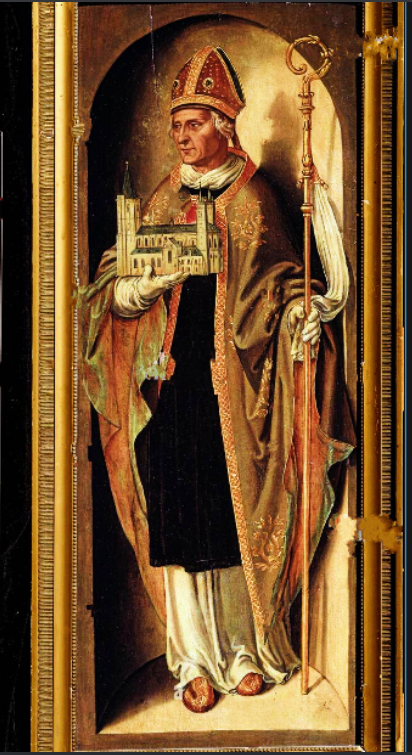
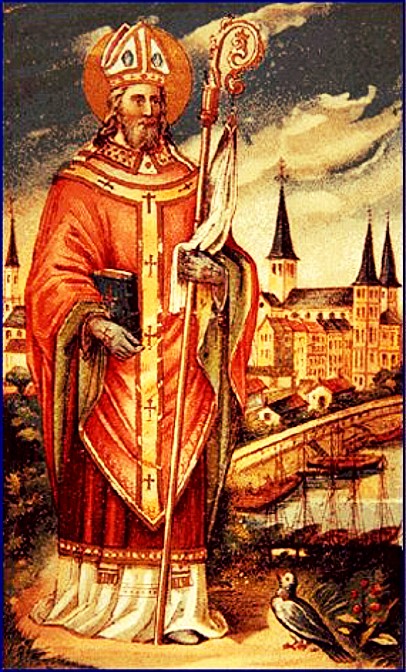
Saint of the Day – 12 November – St Cunibert of Cologne (Died c 663) Archbishop of Cologne, from 627 to his death. He founded many Churches and supported and established Monasteries. Contemporary sources only mention him between 627 and 643. Cunibert died in c 663 in Cologne, Germany of natural causes. Also known as – • Cunibert of Keulen• Cunibert of Köln• Cunibert of Trèves• Cunibert of Trier• Cunipert, Honoberht, Kunibert. He is mentioned in the Roman Martyrology.
Cunibert was born somewhere along the Moselle to a family of the local Ripuarian Frankish aristocracy and educated in Metz at the Court of Chlothar II. He entered religious life and became the Archdeacon of Trier. He was elected Bishop of Cologne in 627. According to legend, he was led by a pigeon to the grave of Saint Ursula.
As Bishop, Cunibert served as an advisor to King Dagobert I. Cunibert also served as tutor to his son and heir, Sigebert III. In 633 or 634 Sigebert was invested as King of Austrasia. Following this, Dagobert made Cunibert and Adalgisel, the mayor of the Palace, co-regents of the Kingdom. After the death of Adalgisel’s successor, Pepin of Landen, Cunibert served as the chief public official of the King, in which capacity, he revised the Lex Ribuaria – the laws of Germany, at that time. Cunibert attended the Synod of Clichy in 626/627.
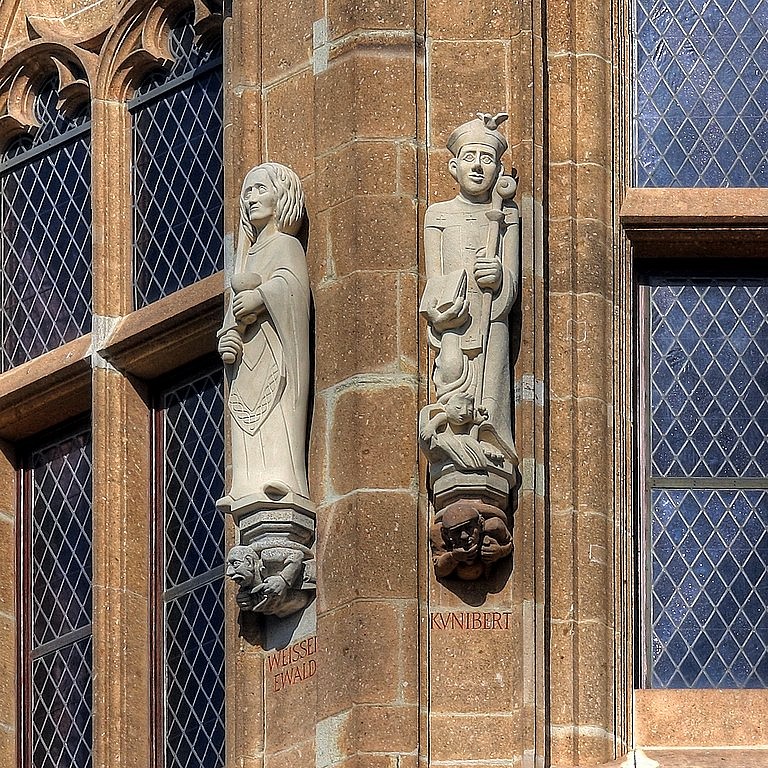
Statue of St Cunibert on the tower of Cologne City
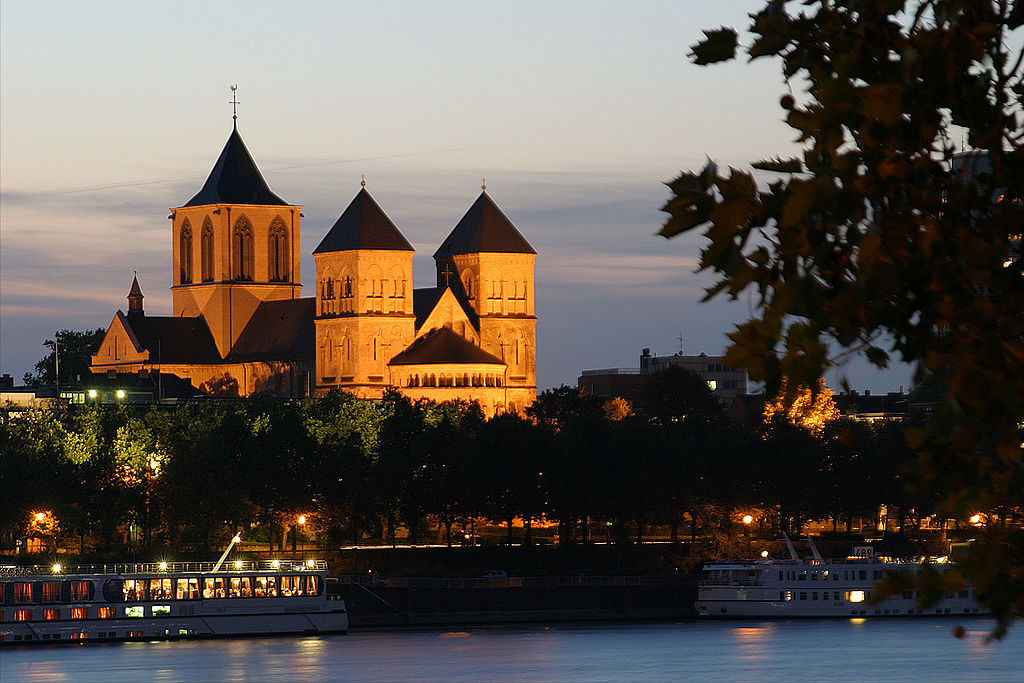
Throughout his Episcopacy, monasticism flourished and Churches were founded and restored. His Feast day is the day of his death, 12 November He is buried in a Church bearing his name in Cologne City, where he lived and died.
St Aurelius St Cadwallader St Cummian Fada St Cunibert of Cologne (Died c 663) Archbishop of Cologne St Emilian Cucullatus St Evodius of Le Puy St Hesychius of Vienne Bl John Cini della Pace
St Livinus of Alost St Machar of Aberdeen St Namphasius St Nilus the Elder St Paternus of Sens St Publius St Renatus of Angers St Rufus of Avignon St Ymar of Reculver
Five Polish Brothers – Martyrs: They weren’t Polish and they weren’t related but were instead five Italian Benedictine Monks who worked with Saint Adalbert of Prague as missionaries to the Slavs and were Martyred together. They were – Benedict, Christinus, Isaac, John and Matthew. Born in Italy. They were Martyred in 1005 at the Benedictine Monastery near Gnesen, Poland and Canonised by Pope Julius II.
Thought for the Day – 11 November – Meditations with Antonio Cardinal Bacci (1881-1971)
Sensitiveness
“Our wounded feelings sometimes give rise to an external explosion in the form of bitter and offensive remarks. These always create disharmony and have various unfortunate after-effects.
It is fatal to lose control over ourselves. A man who has surrendered to anger and resentment, does not weigh his words and is not responsible for his actions. When the fit has passed, he is left with a sense of humiliation because of his lack of moderation and must suffer the consequences, both before God and before his fellowmen in his domestic and social enviroment. “When the angry man has calmed down,” Seneca truly observed, “he is angry with himself.” “Let anger be foreign to us,” said Cicero, “for an angry man is incapable of acting correctly, or prudently. Anything which is done, in a state of agitation, cannot be done properly, nor can it meet with the approval of the bystanders” (De Officiis I, 38).
Let us meditate also on these apt quotations from Sacred Scripture. “A mild answer calms wrath but a harsh word, stirs up anger” (Prov 15:1). “An ill-tempered man, stirs up strife but a patient man allays discord” (Prov 15:18).”
Quote/s of the Day – 11 November – “The Month of the Holy Souls in Purgatory” – St Martin of Tours (c 316-397) Bishop, Confessor – Sirach 44:16-27; 45:3-20, Luke 11:33-36 – Scripture search here: https://www.drbo.org/
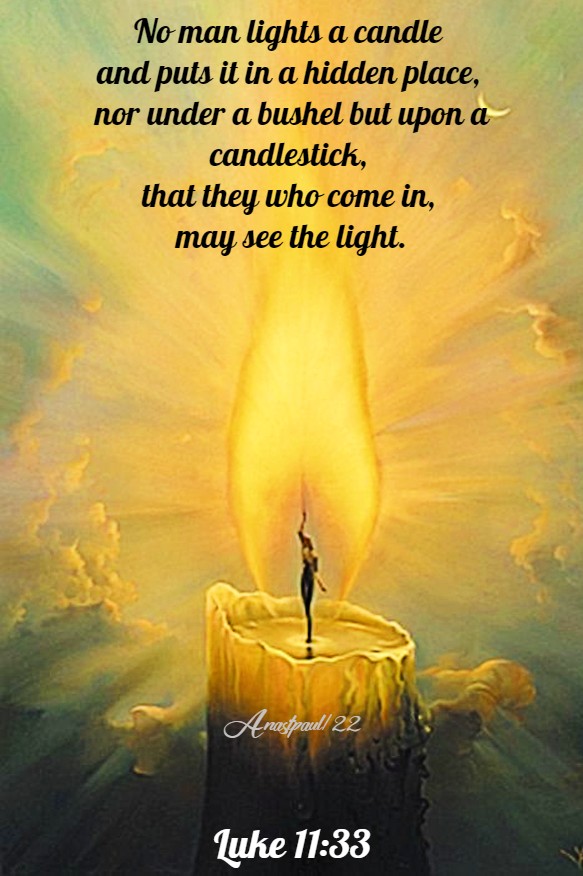
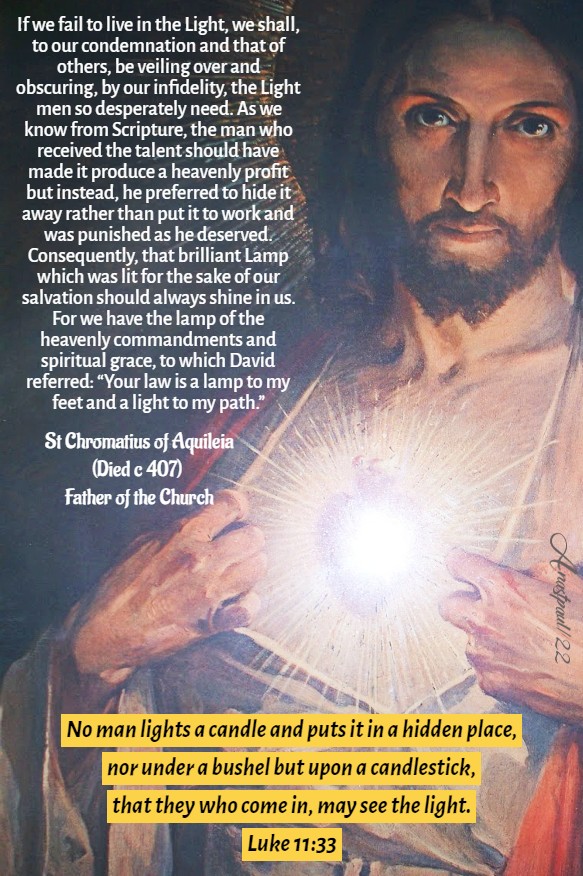
“No man lights a candle and puts it in a hidden place, nor under a bushel but upon a candlestick, that they who come in, may see the light.”
Luke 11:33
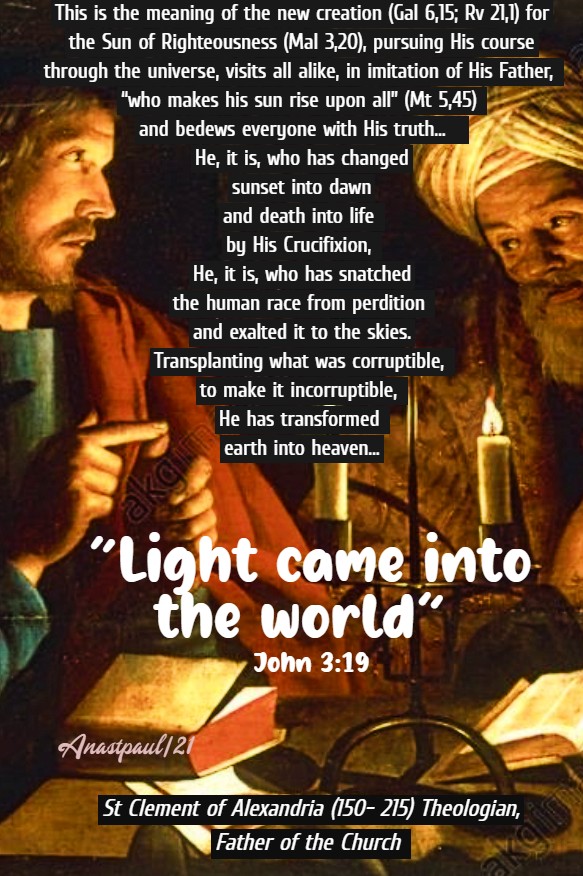
“Light came into the world”
John 3:19
“This is the meaning of the new creation (Gal 6,15; Rv 21,1) for the Sun of Righteousness (Mal 3,20), pursuing His course through the universe, visits all alike, in imitation of His Father, “who makes his sun rise upon all” (Mt 5,45) and bedews everyone with His truth… He, it is, Who has changed sunset into dawn and death into life by His Crucifixion, He, it is, Who has snatched the human race from perdition and exalted it to the skies. Transplanting what was corruptible, to make it incorruptible, He has transformed earth into Heaven!…”
St Clement of Alexandria (150- 215) Theologian, Father of the Church
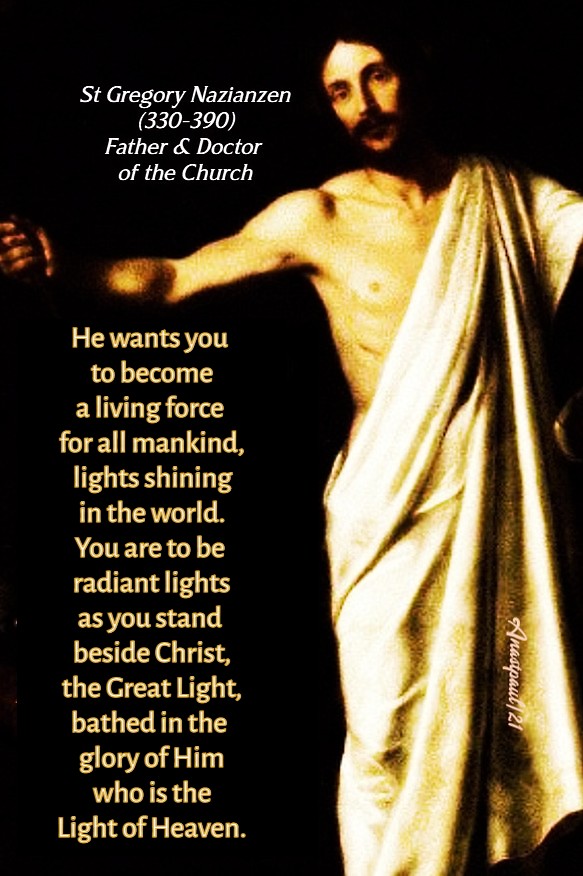
“He wants you to become a living force for all mankind, lights shining in the world. You are to be radiant lights as you stand beside Christ, the Great Light, bathed in the glory of Him who is the Light of Heaven.”
St Gregory Nazianzen (330-390) Father & Doctor of the Church
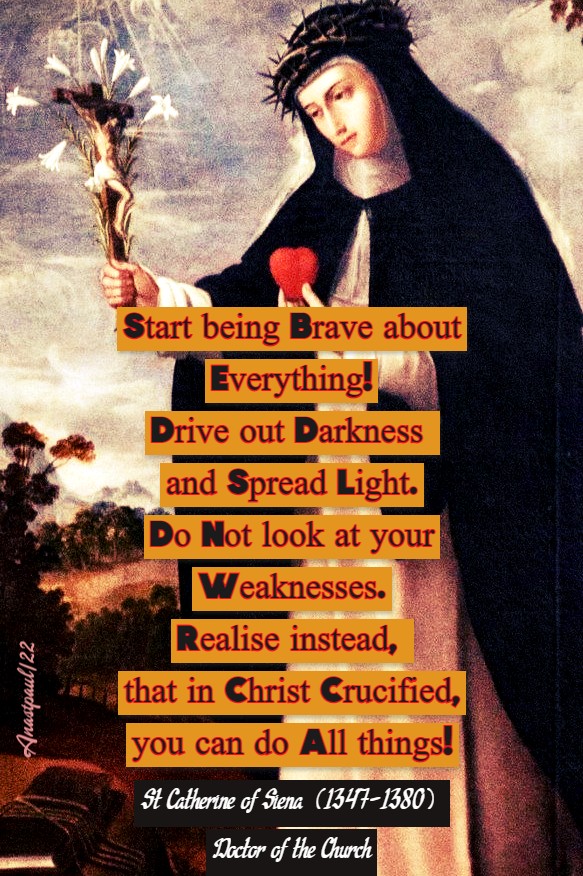
“Start being brave about everything! Drive out darkness and spread light. Do not look at your weaknesses. Realise instead, that in Christ Crucified, you can do all things.”
St Catherine of Siena (1347-1380) Doctor of the Church
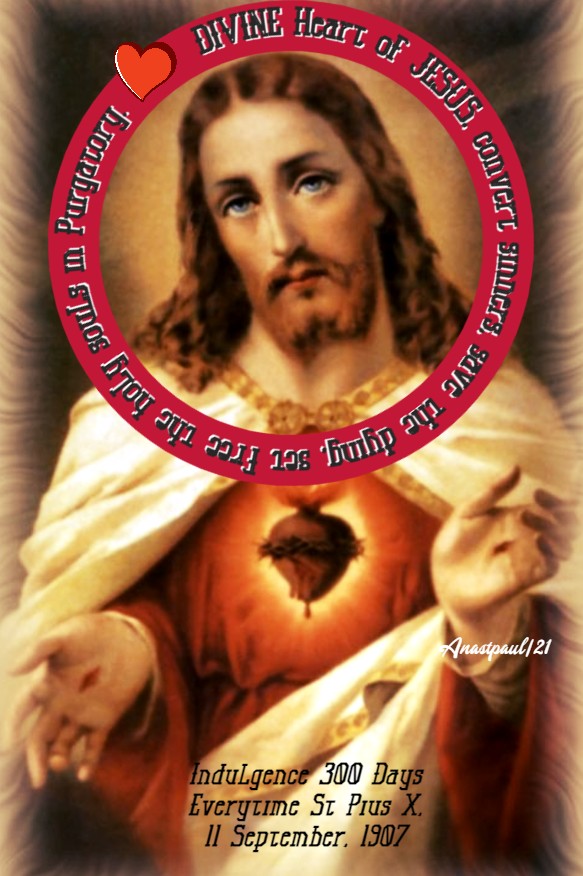
DIVINE Heart of JESUS, convert sinners, save the dying, set free the holy souls in Purgatory. Indulgence 300 Days Everytime – St Pius X, 11 September, 1907
One Minute Reflection – 11 November – St Martin of Tours (c 316-397) “Martin the Merciful,” Bishop, Confessor, Miracle-Worker. – Sirach 44:16-27; 45:3-20, Luke 11:33-36 – Scripture search here: https://www.drbo.org/
“At that time, Jesus said to His disciples: No man lights a candle and puts it in a hidden place, nor under a bushel but upon a candlestick, that they who come in, may see the light.” – Luke 11:33
REFLECTION – “You are the light of the world. A city set on a hill cannot be hidden. Nor do men light a lamp only to put it under a bushel basket; they put it on a stand where it gives light to all in the house. The Lord called His disciples, the salt of the earth because they seasoned ,with heavenly wisdom, the hearts of men, rendered insipid by the devil. Now he calls them, the light of the world as well because they have been enlightened by Him, the True and Everlasting Light and have themselves become a light in the darkness.
Since He is the Sun of Justice, he fittingly calls His disciples, the light of the world. The reason for this, is that through them, as through shining rays, He has poured out the light of the knowledge of Himself, upon the entire world. For by manifesting the Light of Truth, they have dispelled the darkness of error from the hearts of men.
Moreover, we too have been enlightened by them. We have been made light out of darkness, as the Apostle says: For once you were darkness, but now you are light in the Lord; walk as children of light. He says another time: For you are not sons of the night and of darkness but you are all sons of light and of the day.
Saint John also rightly asserts, in his letter: God is Light and whoever abides in God, is in the Light, just as God Himself is in the Light. Therefore, because we rejoice in having been freed from the darkness of error, we should always walk in the Light as children of Light. This is why the Apostle says: Among them you shine as lights in the world, holding fast to the Word of Life.
If we fail to live in the Light, we shall, to our condemnation and that of others, be veiling over and obscuring, by our infidelity, the Light men so desperately need. As we know from Scripture, the man who received the talent should have made it produce a heavenly profit but instead, he preferred to hide it away rather than put it to work and was punished as he deserved.
Consequently, that brilliant Lamp which was lit for the sake of our salvation should always shine in us. For we have the lamp of the heavenly commandments and spiritual grace, to which David referred: Your law is a lamp to my feet and a light to my path.Solomon also says this about it: For the command of the law is a lamp.
Therefore, we must not hide this Lamp of law and faith. Rather, we must set it up in the Church, as on a lampstand, for the salvation of many, so that we may enjoy the Light of Truth itself and all believers, may be enlightened.” – St Chromatius of Aquileia(Died c 407) Bishop of Aquileia, Theologian, Exegete, Writer and friend of Saints Ambrose and Jerome, Father of the Church (Excerpt from A treatise on the Gospel of Saint Matthew).
PRAYER – O God, Who sees that we cannot survive by any power of our own, mercifully grant that, by the intercession of blessed Martin, Thy Confessor and Bishop, we may be made safe from all harm. Through Jesus Christ, Thy Son our Lord, Who lives and reigns with Thee, in the unity of the Holy Ghost, God, world without end. Amen (Collect).
Our Morning Offering – 11 November – The day of the Passion
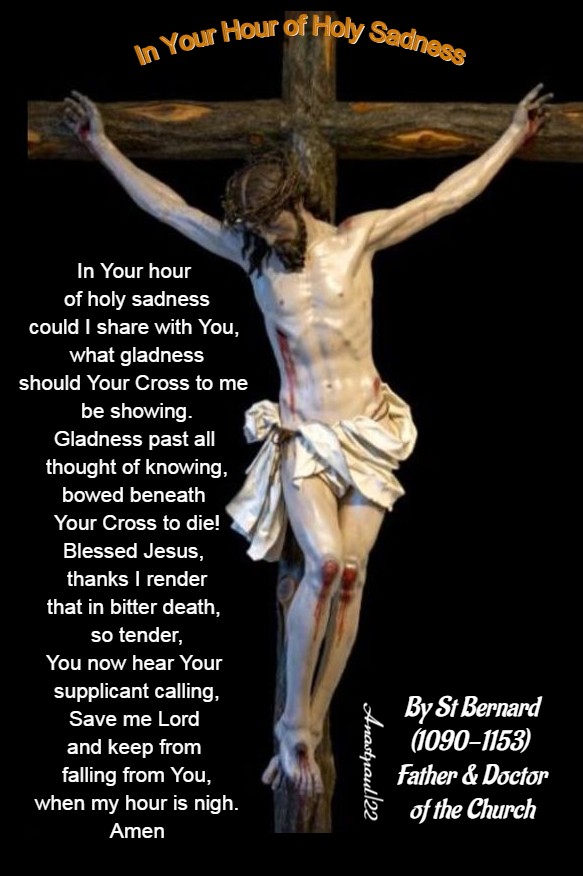
In Your Hour of Holy Sadness By St Bernard (1090-1153) Father & Doctor of the Church
In Your hour of holy sadness could I share with You, what gladness should Your Cross to me be showing. Gladness past all thought of knowing, bowed beneath Your Cross to die! Blessed Jesus, thanks I render that in bitter death, so tender, You now hear Your supplicant calling, Save me Lord and keep from falling from You, when my hour is nigh. Amen.
Saint of the Day – 11 November – Saint Mennas (Died c 300) Martyr, Layman, Miracle-worker, Soldier, he may have been a camel driver and merchant, Hermit. Born in Egypt and died by beheading in c 300 at Cotyaes, Phrygia, under Emperor Diocletian. He was one of the most popular Saints in the early Eastern Church. Patronages – falsely accused people, general physical ailments, peddlers, pilgrims, travelling salesmen. Also known as – • Aba Mina• Menas of Egypt• Menas of Constantinople• Menas of Cotyaes• Menas of Cotyaeum• Menas of Kotyaeum• Menas of Mareotis• Menas the Martyr• Menas the Miracle Maker• Menas the Miracle Worker• Menas the Soldier• Menas the Wonder Worker• Mena, Mennas, Mina, Minas.
The Roman Martyrology reads: “At Cotyaeus, in Phrygia, during the persecution of Diocletian, the celebrated Martyrdome of St Mennas, Egyptian soldier, who cast off the military belt and obtained the grace of serving the King of Heaven, secretly, at first, in the desert. Afterwards, coming out publicly and freely declaring himself a Christian he was first subjected to dire torments and finally, kneeling in prayer and giving thanks to Our Lord Jesus Christ, he was struck with the sword. After his death, he was renowned for many miracles.”
St Mennas by Paolo Veronese
Mennas, a Christian and an Egyptian by birth, served in the Roman army under the tribune Firmilian. When the army came to Cotyaeus in Phrygia, Menas hearing of the impious edicts issued against the Christians by the Emperors Diocletian and Maximian, left the army in order to practise his faith in safety and retired to a solitude in the mountains and served God by fasting vigils and prayer.
During the celebration of a great pagan festival Mennas appeared in the midst of the populace in the circus and fearlessly professed his faith. He was led before the Prefect Pyrrhus, cruelly scourged, put to torture and finally beheaded.
The Martyrdom of St Mennas by Paolo Veronese
His body was brought to Egypt and the Martyr was soon invoked in many needs and afflictions. The fame of the miracles wrought, spread far and wide and thousands of pilgrims came to the grave in the desert of Mareotis, between Alexandria and the valley of Natron.
For centuries Bumma was a national sanctuary and grew into a large city with costly temples a holy well and baths. A beautiful Basilica was erected by the Emperor Arcadius. The cult was spread into other countries, perhaps by travelling merchants who honoured him as their Patron.
As a result of various vicissitudes, the doctrinal disputes and the conquest of Egypt by the Arabians under Omar in 641 the sanctuary was neglected and ultimately forgotten.
During 1905 Msgr C M Kaufmann of Frankfort, led an expedition into Egypt which made excavations at Bumma. He found in a vast field of ruins, the grave, the well and thermae (public baths), the Basilica, the Monastery, numerous inscriptions on the walls, imploring aid through the intercession of the Saint and, thousands of little water pitchers and oil lamps. The rich findings are partly in the Museums of Alexandria and Cairo and partly in Frankfort and Berlin. The Monsignor published an official report of his expedition in 1908, (La découverte des Sanctuaires de Menas dans le désert de Mareotis).
Terracotta pilgrim’s water flask impressed with Saint Mennas between two camels, 1000s of which were found by Msgr C M Kaufmann
St Bartholomew of Rossano (c 970-c 1065) Abbot Confessor, Spiritual disciple and friend of St Nilus (910-1005), Hymnist an highly skilled Calligrapher of sacred manuscripts – the art of calligraphy he had learned from his blessed guide and teacher, He is known as the “Second Founder,” of the Monastery of Grottaferrata founded by St Nilus. A copyist of many codices, Bartholomew is also considered the greatest hymnographer of the 11th century. His Life: https://anastpaul.com/2021/11/11/saint-of-the-day-11-november-saint-bartholomew-of-rossano-c-970-c-1065/
St Bertuin of Malonne St Cynfran of Wales St Isidre Costa Hons Bl Josaphat Chichkov St Marina of Omura St Mennas of Santomenna St Mercurius the Soldier Bl Pavel Dzjidzjov St Rhediw St Theodore the Studite St Turibius of Palencia St Veranus of Lyon St Veranus of Vence
Thought for the Day – 10 November – Meditations with Antonio Cardinal Bacci (1881-1971)
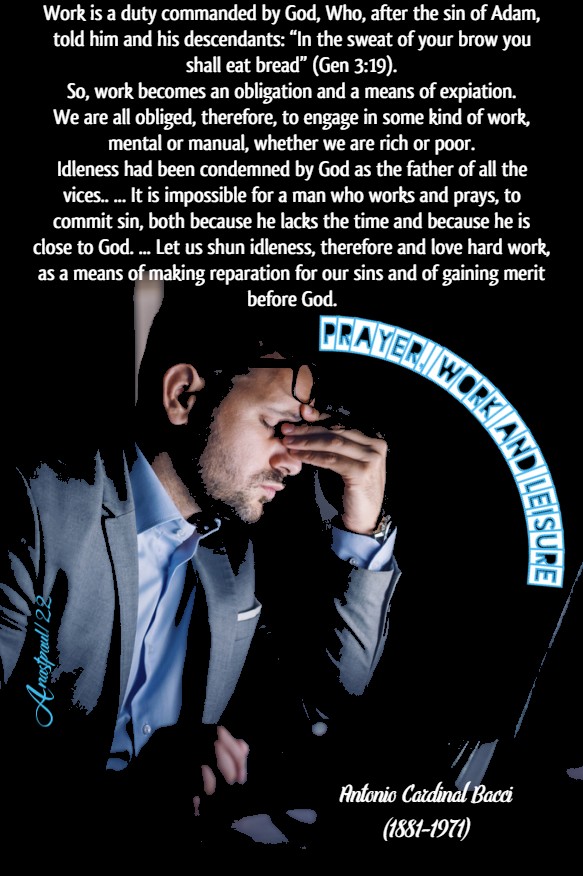
Prayer, Work and Leisure
“WORK: Work is a duty commanded by God, Who, after the sin of Adam, told him and his descendants: “In the sweat of your brow you shall eat bread” (Gen 3:19). So, work becomes an obligation and a means of expiation. We are all obliged, therefore, to engage in some kind of work, mental or manual, whether we are rich or poor. Idleness had been condemned by God as the father of all the vices. “Idleness,” warns the Holy Spirit, “is an apt teacher of mischief” (Eccles 33:29). It is impossible for a man who works and prays, to commit sin, both because he lacks the time and because he is close to God. A man who is close to God will certainly never offend Him. whereas the mind of a man who is lazy and inactive, is open to the attractions of sin.
Let us shun idleness, therefore and love hard work, as a means of making reparation for our sins and of gaining merit before God.”
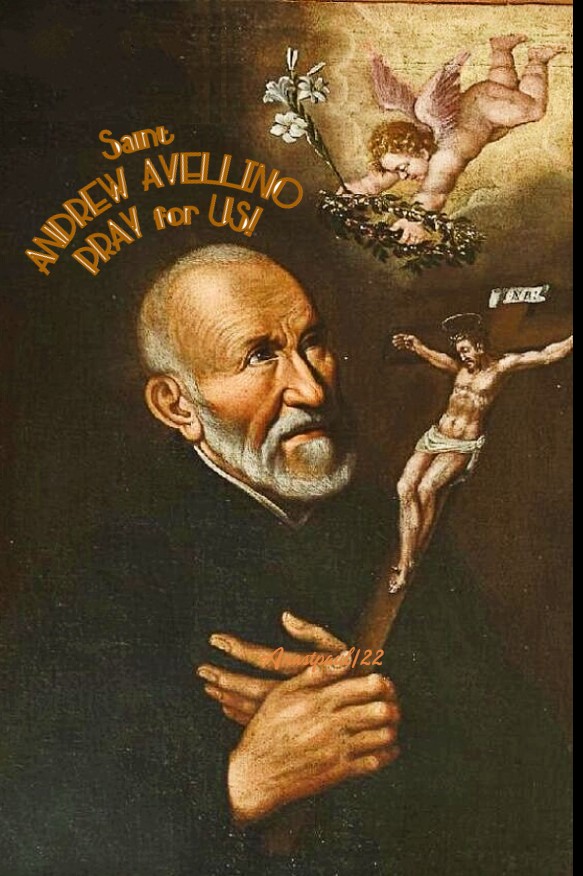
Quote/s of the Day – 10 November – St Andrew Avellino CR (1521–1608) Confessor
“Ah ! what is all that I do and suffer, compared with what my Jesus did and suffered for my sake? O, that I might, for His honour, be torn with scourges and pierced with nails and expire on the Cross for Him!”
“One cannot separate the most Holy Eucharist from the Passion of Jesus.”
St Andrew Avellino (1521–1608)
“It has been curiously remarked by St Andrew Avellino that those who have a special devotion to the Passion, generally die quiet and sweet deaths, as the Virgin Mary, St John the Evangelist and St Mary Magdalen did. Certainly, it is remarkable that, while most of those close to Our Lord died violent deaths, the three who assisted at Calvary, should have died so softly, as if already their real death had been died there!”
One Minute Reflection – 10 November – St Andrew Avellino CR (1521– 1608) Confessor – Sirach 31:8-11, Luke 12:35-40 – Scripture search here: https://www.drbo.org/
“Let your loins be girt about and your lamps burning and you yourselves ,like men waiting for their master’s return from the wedding; so that when he comes and knocks, they may straightaway open to him. Blessed are those servants whom the master, on his return, shall find watching.” – Luke 12:35-37
REFLECTION –“God, the Word, stirs up the lazy and arouses the sleeper. For indeed, someone who comes knocking at the door is always wanting to come in. But, it depends on us, if He does not always enter or always remain. May your door be open to Him Who comes; open your soul, enlarge your spiritual capacities, that you may discover the riches of simplicity, the treasures of peace and sweetness of grace. Expand your heart, run to meet the Sun of that Eternal Light that “enlightens everyone” (Jn 1,9). It is certain, that this true Light shines for all but, if anyone shuts their windows, then they themselves shut themselves off from this Eternal Light.
So even Christ remains outside, if you shut the door of your soul. It is true that He could enter but He does not want to use force, He does not put those who refuse under pressure. Descended from the Virgin, born from her womb, He shines throughout the universe to give light to all. Those who long to receive the Light, that shines with an everlasting brightness, open up to Him. No night comes to intervene. Indeed, the sun we see each day gives way to night’s darkness but the Sun of justice (Mal 3,20) knows no setting, for Wisdom is not overcome by evil.” – St Ambrose (340-397) Bishop of Milan and Father and Doctor of the Church – (12th Sermon on Psalm 118).
PRAYER – O God, by his difficult vow to make daily progress in holiness, Thou placed in the heart of blessed Andrew, Thy Confessor, a wondrous longing to ascend unto Thee, grant us, by his merits and intercession, so to become sharers of that same grace that, ever pursuing the more perfect things, we may be happily brought unto the height of Thy glory.Through Jesus Christ, Thy Son our Lord, Who lives and reigns with Thee, in the unity of the Holy Ghost, God, world without end. Amen (Collect).
Grant me, O my God By St Vincent Ferrer OP (1350-1419)
Good Jesus, let me be penetrated with love to the very marrow of my bones, with fear and respect toward You. Let me burn with zeal for Your honour, so that I may resent terribly, all the outrages committed against You, especially those of which I myself have been guilty. Grant further, O my God, that I may adore and acknowledge You humbly, as my Creator and that, penetrated with gratitude for all Your benefits, I may never cease to render You thanks. Grant that I may bless You in all things, praise and glorify You with a heart full of joy and gladness and that, obeying You with docility in every respect, I may one day, despite my ingratitude and unworthiness, be seated at Your table together with Your Holy Angels and Apostles to enjoy ineffable delights. Amen
Saint of the Day – 10 November – St Andrew Avellino CR (1521– 1608) Confessor, Theatine Priest, Canon and Civil Lawyer, Reformer, Founder of many new Theatine houses, Preacher, Spiritual Advisor, Miracle-worker.
Saint Andrew Avellino, Confessor By Fr Francis Xavier Weninger SJ (1805-1888)
St Andrew Avellino was born at Castro Nuovo, in the kingdom of Naples. To fear God and to avoid sin, were the maxims which his mother, from early childhood, implanted deep into his heart and which became the rule of his entire life. While he studied at Senise, a lady sought to attract him by several presents which she sent him but the chaste youth, accepted not her gifts,and sent her word, saying that she should trouble him no more and might rest assured that he would rather die than consent to any evil. On another occasion when he was enticed to sin, he fled like the chaste Joseph. To escape similar temptations, he determined to become a Priest and was Ordained after he had finished his studies.
For some time he devoted himself to the practice of Canon Law in the eEclesiastical Courts until one day, in the heat of his argument, a trivial lie escaped him. Soon after, while reading the Holy Scriptures, the words, “The mouth that lieth, killeth the soul,” came under his eyes and his repentance was such that, from that moment, he renounced his profession in order to escape from the danger of offending God and gave himself entirely, to the Sacred ministry. By associating frequently with the religious of the Theatine Order, he conceived the desire of joining their number, which he did in 1556. It was on this occasion that he took the name of Andrew, in honour of the holy Apostle of that name, after whose example he desired to suffer much for the glory of God.
His eminent virtues induced his superiors to make him Master of Novices, although he had been only five years in the Order,and afterwards, to charge him with the administration of several houses. He attended to all his duties to the greatest benefit of those under him. Besides the usual vows, he imposed upon himself two more. The first of these was to work continually against his own inclinations; the second, to make continual progress in perfection. The fervent love he bore to God and men, induced him to employ all his leisure moments in prayer and in labouring for the salvation of souls. Before entering into religion, he had been accustomed to give six hours daily to prayer but as he could not, as a religious, spare so much time during the day, he took a part of the night for this sacred duty.
He benefitted mankind much, by preaching and hearing Confessions. He reformed many a hardened sinner, restrained others from falling again, reconciled embittered minds and led numberless souls to Heaven.
God manifested more than once, by miracles, how agreeable the endeavours of the Saint were to Him. One night as he returned home, with his companion, from the house of a sick man whose Confession he had heard, a violent storm extinguished the light that was carried before them but then, such a brightness emanated from the Saint’s body that the way was made clear through the darkness, whilst, at the same time, neither he, nor his companion, was touched by the rain. Many similar events, as also the frequent visions of Saints, the gifts of prophecy and of reading the hearts of men but above all, the many examples of heroic virtue which he gave to others, won for St Andrew, the highest regard. St Charles Borromeo, the holy Cardinal, esteemed him greatly and made use of his zeal on many occasions.
Notwithstanding this, the holy man had so low an opinion of himself that he regarded as nothing his great and arduous labours to further the honour of God and the salvation of souls; looked upon himself as a great sinner,and frequently evinced great fear in regard to his salvation. “If they,” said he, “must regard themselves as useless servants, who have done all their duty, what must I do, who have done so small a part of what I ought to have done?” Sometimes he would look up to Heaven and sigh: “Will that magnificent mansion of the blessed spirits allow the entrance of one so miserable, despicable and sinful as I am?”
From this fear, however, he was afterwards freed by a comforting vision. St Augustine and St Thomas of Aquin, both of whom he honoured as Patrons, appeared to him, consoled him and promised him their aid, especially in that hour, on which eternity depends. Andrew, taking heart, asked them whether he would enjoy eternal life? The answer was as follows: “The time of thy salvation has not come yet. But as in life, everything is doubtful and uncertain, follow our advice – struggle, with the greatest perseverance, on the battle-field of virtue, as thou hast done till now and thus, thou wilt gather a treasure of merit and God will not close to thee, the gates of Heaven.” With these words, the Saint consoled himself,and not only continued his zeal in the practice of virtue but increased it daily.
During the last 18 years of his life, he allowed himself neither meat, nor eggs, nor fish – his nourishment consisted of beans only, of which he had always enough cooked to last him three days. When advised to change his diet, on account of his advanced age, he said: “Although, at the age of 83 years, I am excused from the law of fasting, I find, when thinking of my sins and my indolence in the service of the Most High that I am obliged to fast and to observe other austerities, in order to appease the wrath of God.” Thus spoke he, who had ever preserved his first innocence. His bed was a sack of straw on two boards. He daily scourged himself to blood. Not content with all this, he daily begged the Almighty to send him something to suffer.
The greatest wrongs he bore with invincible meekness; in persecutions and trials, he evinced heroic patience and he met his enemies with truly Christian gentleness. This was especially experienced by the man who had cruelly murdered the son of the Saint’s brother. The holy man exhorted his brother neither to seek, nor demand vengeance. He knew the murderer but revealed him not and when the wretch was at last discovered and arraigned, before the judges, Andrew implored mercy and pardon for him.
Our Saint’s devotion to the passion and death of our Lord Jesus Christ, was the cause of his earnest desire to suffer more and more. He was often heard to say: “Ah ! what is all that I do and suffer compared with what my Jesus did and suffered for my sake? O, that I might, for His honour, be torn with scourges and pierced with nails and expire on the Cross for Him!”
Not less deep was his devotion to the Blessed Sacrament and at the time of Holy Mass, his whole countenance glowed with divine love. To the very last day of his life, although he was almost entirely exhausted, he insisted on saying Mass but he had hardly begun the Psalm at the foot of the Altar, when he was struck with paralysis. He was then carried to his room, where the last Sacraments were administered to him. Having received them, he blessed all those who were present and peace and happiness shone from his countenance. After this, he turned his eyes upon an image of the Blessed Virgin,whom, during all his life he had greatly loved and honoured and expired in the 88th year of his life. His face beamed after his death with a truly divine radiance and God proclaimed the glory which the Saint enjoyed in Heaven, by many and great miracles. St Andrew Avellino, Pray for us! Amen.
St Andrew Avellino (1521 – 1608) Confessor, Theatine Priest, Canon and Civil Lawyer, Reformer, Founder of many new Theatine houses, Preacher, Spiritual Advisor. In 1624, only 16 years after his death, he was Beatified by Pope Urban VIII and in 1712 was Canonised by Pope Clement XI. His remains lie buried in the Church of St Paul at Naples. Patron against sudden death/of a Holy Death, against Apoplexy or Strokes. Biography: https://anastpaul.com/2018/11/10/saint-of-the-day-10-november-st-andrew-avellino-cr-1521-1608/
St Aedh Mac Bricc St Anianus the Deacon St Baudolino (c 700–c 740) Hermit St Demetrius of Antioch St Elaeth the King St Eustosius of Antioch St Grellen St Guerembaldus St Hadelin of Sees Bl Joaquín Piña Piazuelo St John of Ratzenburg St Joseph the Martyr
St Leo of Melun St Monitor of Orleans St Narses of Subagord St Nonnus of Heliopolis St Orestes of Cappadocia St Probus of Ravenna St Theoctiste St Tryphaena of Iconium St Tryphosa of Iconium
Martyrs of Agde – 3 Saints: A group of Christians who were tortured and Martyred together in the persecutions of Diocletian. The only about them to survive are the names – Florentia, Modestus and Tiberius. Martyred c 303 in Agde, France.
Thought for the Day – 9 November – Meditations with Antonio Cardinal Bacci (1881-1971)
INDULGENCES
“Throughout the Centuries, Indulgences have been regulated by the authority of the Church which, in the course of the Council of Trent, (Session XXV Decr. de Indulg.) sanctioned their lawfulness and usefulness, for the Faithful, both living and dead. There is no question of innovation. It cam be said quite truly that the first Indulgence was granted by Jesus Himself, to the repentant thief! “This day,” He told him, “thou shalt be with me in Paradise.” By these words, Our Lord remitted, not only the sin and the eternal punishment, due to it but, also all temporal punishment. In the same way, an Indulgence was granted by St Paul, when he mitigated the punishment inflicted on the offender at Corinth (2 Cor 6-8).
Indulgences are called Plenary, when they remit all the temporal punishment due to sin and Partial, when it is the intention of the Church to release the sinner from whatever penalties would have been expiated, if he had done penance for a certain period of time, in accordance with the ancient discipline. No essential relaxation of practice is intended because the Church always demands that the sinner should first ensure that he is in the state of grace, by making a good Confession. As the Council of Trent insists, he should be sincerely repentant. The Church requires, moreover, that in order to gain a Plenary Indulgence, the penitent should be detached from all affections, even towards deliberate venial sin!”
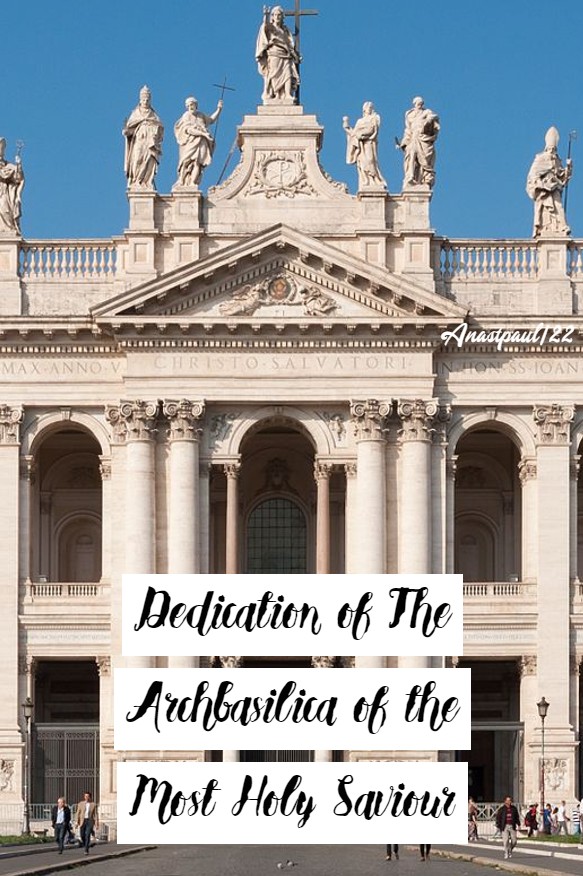
Quote/s of the Day – 9 November – Dedication of The Archbasilica of the Most Holy Saviour
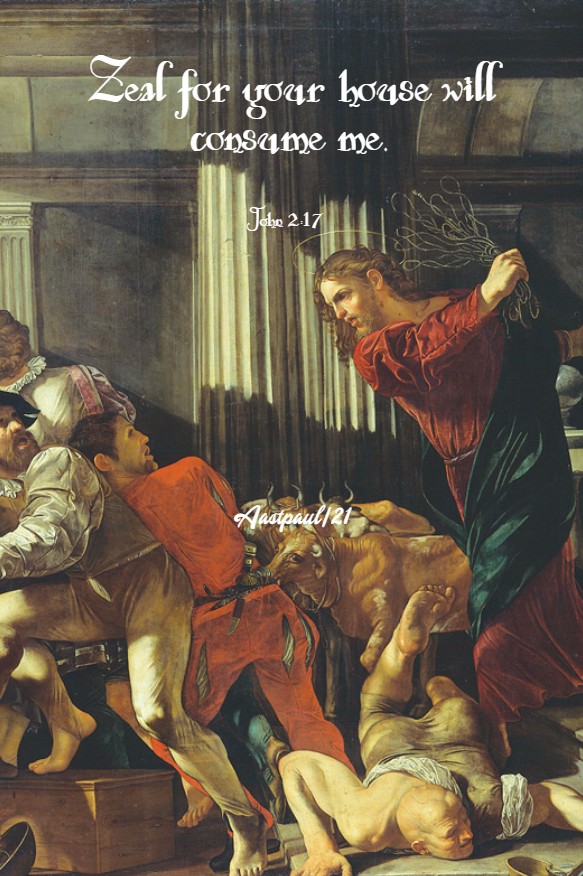
“Zeal for Your House will consume me.”
John 2:17
“…The great movement of apostasy being organised in every country for the establishment of a One-World Church which shall have neither dogmas, nor hierarchy, neither discipline for the mind, nor curb for the passions and which, under the pretext of freedom and human dignity, would bring back to the world, (if such a Church could overcome) the reign of legalised cunning and force and the oppression of the weak and of all those who toil and suffer. […] Indeed, the true friends of the people are neither revolutionaries, nor innovators – they are traditionalists.”
“The Church alone, being the Bride of Christ and having all things in common with her Divine Spouse, is the depository of the Truth.”
“Truly, we are passing through disastrous times, when we may well make our own, the lamentation of the Prophet: “There is no truth and there is no mercy and there is no knowledge of God in the land” (Hosea 4:1). Yet, in the midst of this tide of evil, the Virgin Most Merciful rises before our eyes, like a rainbow, as the arbiter of peace between God and man.”
One Minute Reflection – 9 November – Dedication of The Archbasilica of the Most Holy Saviour – Apocalypse 21:2-5, Luke 19:1-10 – Scripture search here: https://www.drbo.org/
“But Zacheus standing, said to the Lord: Behold, Lord, the half of my goods I give to the poor and if I have wronged any man of anything, I restore him fourfold. Jesus said to him: This day is salvation come to this house because he also is a son of Abraham. For the Son of Man is come to seek and to save that which was lost.” – Luke:8-10
REFLECTION – “… This was an act of divine foreknowledge, for He well knew what would happen. He saw the man’s soul prepared most readily to choose a holy life and converted him, therefore, unto piety. The man, therefore, received Jesus joyfully and this was the commencement of his turning himself unto good, of his departure from his former faults and of his manfully, be-taking himself unto a better course.
But perchance, someone possibly may say, to our common Saviour Christ, ‘What do You, O Lord go to lodge with Zacheus and desire to abide with the chief of the publicans? He has not yet washed away the stain of his greedy love of money. He is still sick with covetousness, the mother of all crimes, still full of the blame of plunder and extortion.‘ But yes, He says, I indeed know this, in that I am God by nature and see the ways of every individual upon earth. And more than this, I know also, things to come. I have called him to repentance, because he is ready thereto and although men murmur and blame My gentleness, facts themselves, shall prove that they are wrong. For Zacheus, it says, stood up, and said unto the Lord, “Behold, the half of whatever I possess I give unto the poor and if I have defrauded any man, I make fourfold restoration.”
You behold his repentance; his rapid change unto a better course, his haste unto piety, the bountifulness of his love for the poor. He, who lately was a publican, or rather the chief of the publicans, given up to covetousness and set upon gain, at once becomes merciful and devoted to charity. He promises that he will distribute his wealth to those who are in need,that he will make restoration to those who have been defrauded and he, who was the slave of avarice, makes himself poor and ceases to care for gains.
Let not the multitudes, therefore, murmur when Christ saves sinners but let them answer us this. Would they have physicians succeed in effecting cures, when they visit the sick? Do they praise them when they are able to deliver men from cruel ulcers, or do they blame them and praise those who are unskillful in their art? But, as I suppose, they will give the sentence of superiority in favour of those, who are skillful in benefiting such as suffer from diseases. Why, therefore, do they blame Christ, if when Zacheus was, so to say, fallen and buried in spiritual maladies, He raised him from the pitfalls of destruction?
And to teach them this, He says, “Today there is salvation for this house, in that he also is a son of Abraham” for where Christ enters, there, necessarily, is also salvation. May He, therefore, also be in us and He is in us, when we believe, for He dwells in our hearts by faith and we are His abode. It would have been better then for the Jews to have rejoiced because Zacheus was wonderfully saved, for he too was counted among the sons of Abraham, to whom God promised salvation in Christ, by the holy prophets, saying, “There shall come a Saviour from Zion and He shall take away iniquities from Jacob and this is My covenant with them, when I will bear their sins.”
Christ, therefore arose, to deliver the inhabitants of the earth from their sins and to seek them that were lost and to save them that had perished. For this is His office and, so to say, the fruit of His Godlike gentleness. Of this will He also count all those worthy, who have believed in Him: by Whom and with Whom to God the Father be praise and dominion, with the Holy Ghost forever and ever, Amen.” – St Cyril of Alexandria (376-444) Known as “The Pillar of Faith” Father and Doctor of the Church (An excerpt from Homily 127).
PRAYER – O God, Who for us bring each year the recurrence of the Consecration day of this Thy holy temple and always bring us back safely to the Sacred Rites, hear the prayers of Thy people and grant that, whoever enters this temple to pray for blessings., may rejoice in having obtained whatever he sought.Through Jesus Christ, Thy Son our Lord, Who lives and reigns with Thee, in the unity of the Holy Ghost, God, world without end. Amen (Collect).
Our Morning Offering – 9 November – Dedication of The Archbasilica of the Most Holy Saviour
Your Instrument Prayer of St Charles Borromeo (1538-1584)
Almighty God, You have generously made known to human beings, the Mysteries of Your life through Jesus Christ Your Son in the Holy Spirit. Enlighten my mind to know these Mysteries which Your Church treasures and teaches. Move my heart to love them and my will to live in accord with them. Give me the ability to teach this Faith to others without pride, without ostentation and without personal gain. Let me realise that I am simply Your instrument for bringing others to the knowledge of the wonderful things You have done for all Your creatures. Help me to be faithful to this task that You have entrusted to me. Amen
Saint of the Day – 9 November – Blessed Gratia of Cattaro OSA (1438-1508) Lay Brother of the Hermits of St Augustine, Ex-sailor. … Born 27 October 1438 at Mul, Cattaro, Dalmatia (modern Kotor, Montenegro) and died on 9 November 1508 in Murano, Italy of natural causes. Gratia was known for his humility, spirit of penance, love of the Eucharist and for his zealous hard labour. Also known as – Gratia of Kotor, Gracija, Grazia. Gratia was Beatified in 6 June 1889 by Pope Leo XIII (cultus confirmed).
Gratia was born in 1438 in the small town of Mula on the coast of Dalmatia near Cattaro (Kotor), not far from present-day Albania. He followed in the footsteps of his father ,who was a sailor and visited many port cities, being particularly drawn by the beauty of Venice. One day, after hearing a sermon of Simon of Camerino in the Augustinian Church of Saint Stephen in that City, he entered the Order as a brother and took the name Gratia, out of gratitude to God for the many gifts he had received. Simon of Camerino had founded a community near Padua where the Friars lived in absolute poverty while ministering at a Shrine dedicated to our Lady. Here Gratia lived a life of prayer and penance and devoted his energies toward the construction of the monastery and the cultivation of its garden.
Later, when Simon established the Friary of Saint Christopher in Venice, Gratia was transferred there, where he was greatly loved by the people and sought after by them for his prayer and counsel. Here he died on 8 November 1508. Within the Church of Saint Christopher, a marble monument was erected to his memory by a Senator of the City, while Gratia’s remains were eventually taken back to Mula. Pope Leo XIII confirmed his cult in 1889.
Gratia might have been considered a belated vocation in his day, earning a living by the hard labour of an itinerant sailor. Following his entrance into religious life, he continued to use his natural gifts in the service of God and his community and by his simple but genuine demeanour, drew others to also recognise, the grace of God at work in their lives.
St Agrippinus of Naples St Alexander of Salonica St Aurelius of Riditio St Benignus of Armagh St Eustolia St Francisco José Marín López de Arroyave
Blessed Gabriel Ferretti OFM (1385-1456) Priest, Friar of the Order of Friars Minor,, Provincial Superior, Mystic. renowned missionary Preacher. He was zealous in the restoration and establishment of new Convents. He was an ancestor to both Cardinal Gabriele Ferretti and Blessed Pope Pius IX, having been descended from a long noble lineage. Patronage – Ancona. His body is incorrupt. He was Beatified on 19 September 1753 by Pope Benedict XIV. Biography: https://anastpaul.com/2021/11/09/saint-of-the-day-9-november-blessed-gabriel-ferretti-ofm-1385-1456/
Bl George Napper Blessed Gratia of Cattaro OSA (1438-1508) Lay Brother of the Hermits of St Augustine Bl Helen of Hungary St Jane of Segna
St Justo Juanes Santos St Luigi Beltrame Quattrocchi St Luis Morbioli St María de la Salud Baldoví Trull St Pabo St Sopatra St Theodore Stratelates St Ursinus of Bourges St Valentín Gil Arribas St Vitonus of Verdun
Martyrs of Constantinople – 3 Saints: A group of ten Christians who tried to defend an image of Jesus over the Brazen Gate of Constantinople from an attack by Iconoclasts during the persecutions of Emperor Leo the Isaurian. The group of was seized by soldiers, condemned by judges for opposing the emperor, and Martyred. The only details that have survived are three of their names – Julian, Marcian and Maria. They were martyred in 730 at Constantinople (modern Istanbul, Turkey).
Thought for the Day – 8 November – Meditations with Antonio Cardinal Bacci (1881-1971)
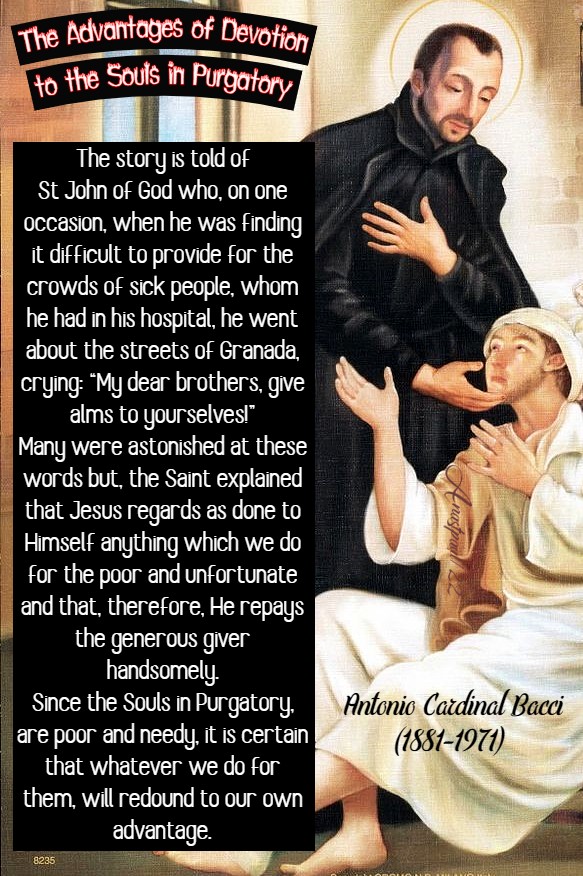
The Advantages of Devotion to the Souls in Purgatory
“The story is told of St John of God who, on one occasion, when he was finding it difficult to provide for the crowds of sick people, whom he had in his hospital, he went about the streets of Granada, crying: “My dear brothers, give alms to yourselves!” Many were astonished at these words but, the Saint explained that Jesus regards as done to Himself anything which we do for the poor and unfortunate and that, therefore, He repays the generous giver handsomely. Since the Souls in Purgatory, are poor and needy, it is certain that whatever we do for them, will redound to our own advantage.
St Margaret of Cortona had a keen devotion to the Faithful Departed. It is related of her that when she was dying, she saw a band of blessed spirits descending from above, in order to escort her into Heaven. These were the countless souls whom her prayers had rescued from the pains of Purgatory.
“If only everyone realised,” the Cure d’Ars once said to a fellow Priest, “what great influence with God, the Holy Souls in Purgatory possess and, the vast number of favours which we obtain through their intercession, they certainly would not be forgotten. Let us pray earnestly for them and they will intercede strongly for us!”
“Whenever I wish to obtain some favour from our Heavenly Father,” said St Catherine of Bologna, “I have recourse to the Souls in Purgatory. I beseech them to present my petition to the Divine Majesty, in their name and through their inetercession, my request is granted.”
Four Crowned Martyrs: Saint Castorus, Saint Claudius, Saint Nicostratus and Saint Simpronian. Skilled stone carvers in the 3rd century quarries. Martyred when they refused to carve an idol of Aesculapius for Diocletian. They were drowned in the River Sava in 305. Patronages – against fever, cattle, sculptors, stone masons, stonecutters.
St Adeodatus I, Pope (Died 618) Bishop of Rome from 19 October 615 to 8 November 618 St Clair of Tours St Cybi of Caenarvon St Drouet
All Saints of the Diocese of Evry: A regional memorial of all the Saints and Beati of the calendar who have a connection to the Diocese of Evry-Corbeil-Essonnes, France. • Blessed Isabella of France, founded the Longchamp monastery • Blessed Nicolas Gaudreau, pastor of Vert-le-Petit • Blessed Pierre Bonse, pastor of Massy • Our Lady of Good Guard, patron saint of the diocese, venerated in Longpont-sur-Orge, France • Saint Corbinian, born in Saint-Germain-lès-Arpajon • Saint Denis of Paris, evangelizer of part of Essonne and revered ni Longpont-sur-Orge • Saint Eloi, who lived in Chilly-Mazarin • Saint Germain of Paris • Saint William of Bourges, son of Count Baldwin IV of Corbeil • Saint William of Aebelholt, pastor of Brunoy • Saint Wulfran of Sens, born in Milly-la-Forêt • Blessed Nativelle, vicar of Longjumeau • Blessed René Le Bris, pastor of Bris-sous-Forges • Saint Spire of Bayeux, whose relics are in Corbeil in the cathedral that bears his name All Saints of Wales
Thought for the Day – 7 November – Meditations with Antonio Cardinal Bacci (1881-1971)
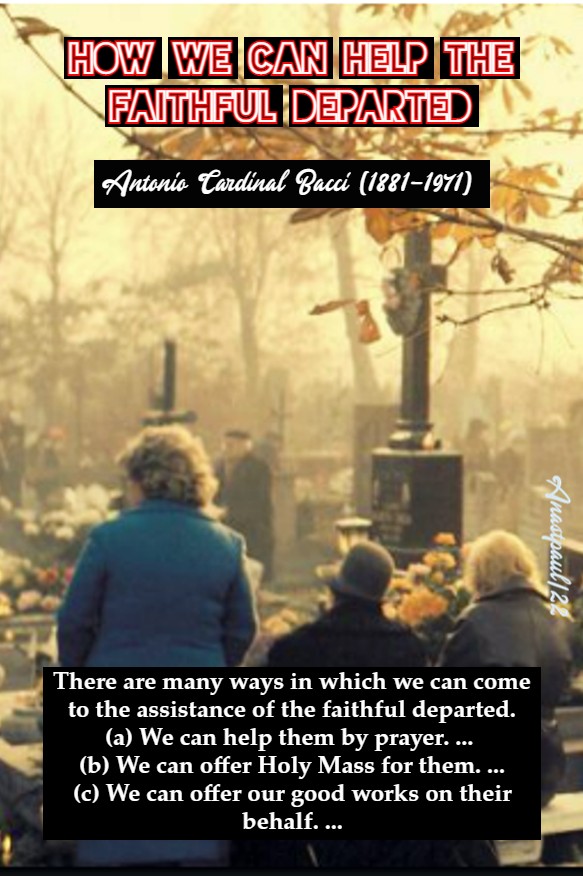
How We Can Help the Faithful Departed
“There are many ways in which we can come to the assistance of the faithful departed.
(a) We can help them by prayer. This is the simplest way and one which is possible for everyone. When we pray for our dead, we feel that we are close to them and are consoled in our sorrow. Moreover, we can be sure of gaining a great deal in return, for the prayers which they offer on our behalf, are very pleasing to God.
(b) We can offer Holy Mass for them. When we do this, it is not only we who pray but Jesus joins with us and offers Himself as a victim of reparation on behalf of the suffering souls. The Mass has an infinite value and one Mass alone would be enough to empty Purgatory. But the application of its infinite merits are always limited, in accordance with the hidden designs of God. Ir is certain, however, that there is no more effective means of helping the faithful departed.
(c) We can offer our good works on their behalf. Every good action has power to satisfy God for some of the debts which we or others have contracted in His regard. Among the good works which we can offer for the souls in Purgatory, are Holy Communion, voluntary mortifications, meek acceptance of the unavoidable sorrows of life, acts of patience and of compassion, spiritual and corporal works of mercy, Indulgences and almsgivine.”
Quote/s of the Day – 7 November – The Feast of All Saints of the Order of Preacher
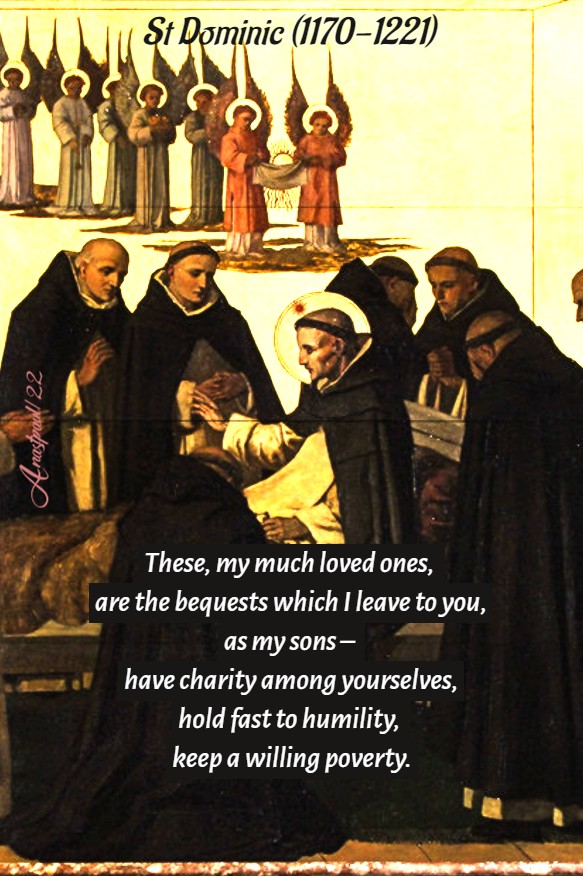
“These, my much loved ones, are the bequests which I leave to you, as my sons – have charity among yourselves, hold fast to humility, keep a willing poverty.”
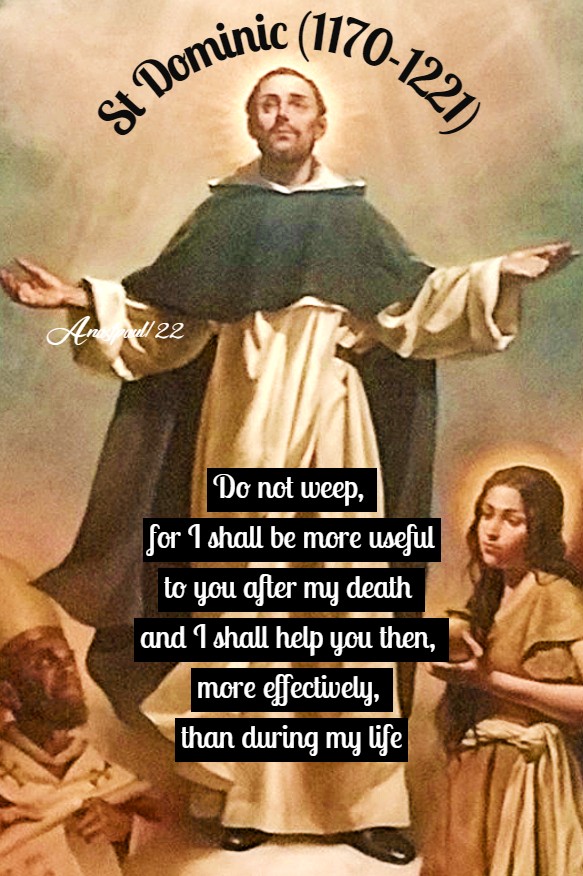
“Do not weep, for I shall be more useful to you after my death and I shall help you then, more effectively, than during my life.”
St Dominic OP (1170-1221)
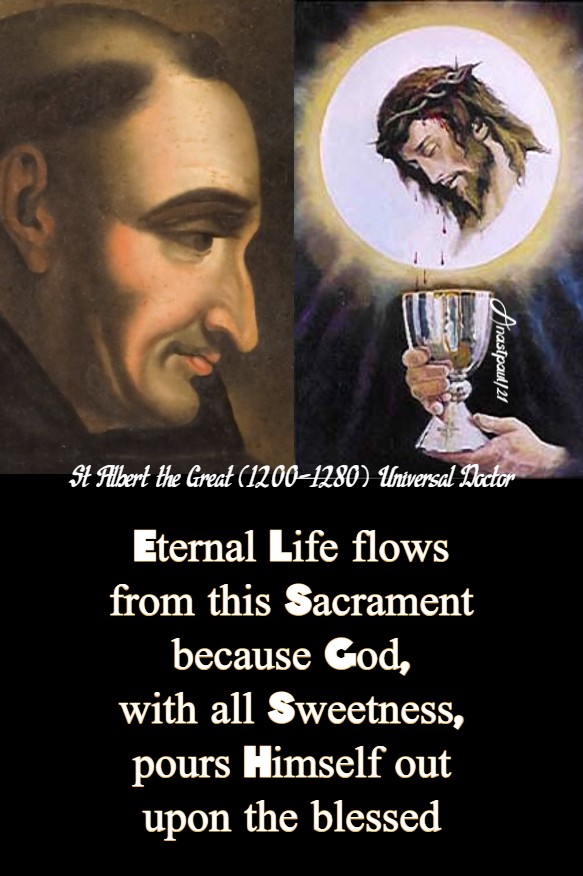
“Eternal life flows from this Sacrament because God, with all sweetness, pours Himself out upon the blessed.”
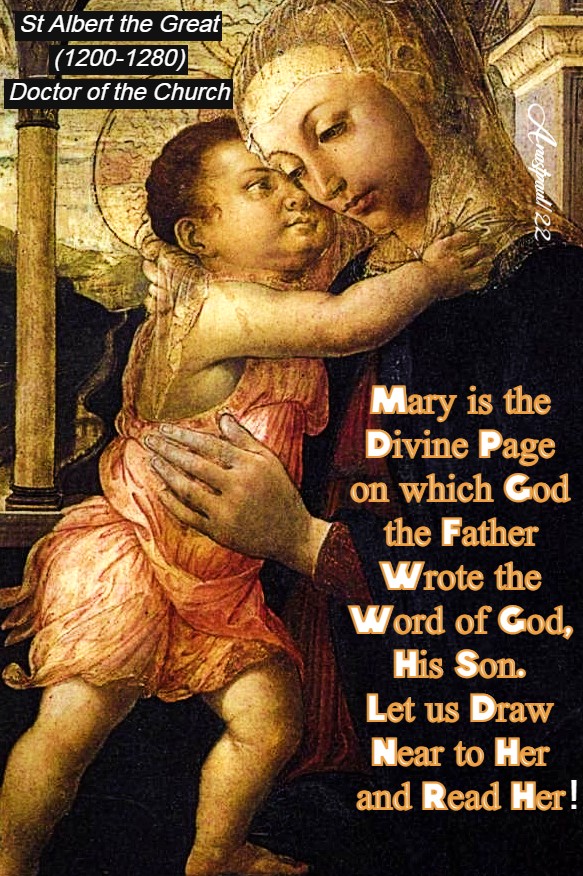
“Mary is the divine Page on which God the Father wrote the Word of God, His Son. Let us draw near to her and read her!”
St Albert the Great OP (1200-1280) Doctor of the Church
“At His Transfiguration Christ showed His disciples, the splendour of His Beauty, to which He will shape and colour, those who are His : ‘He will reform our lowness configured to the Body of His Glory.”
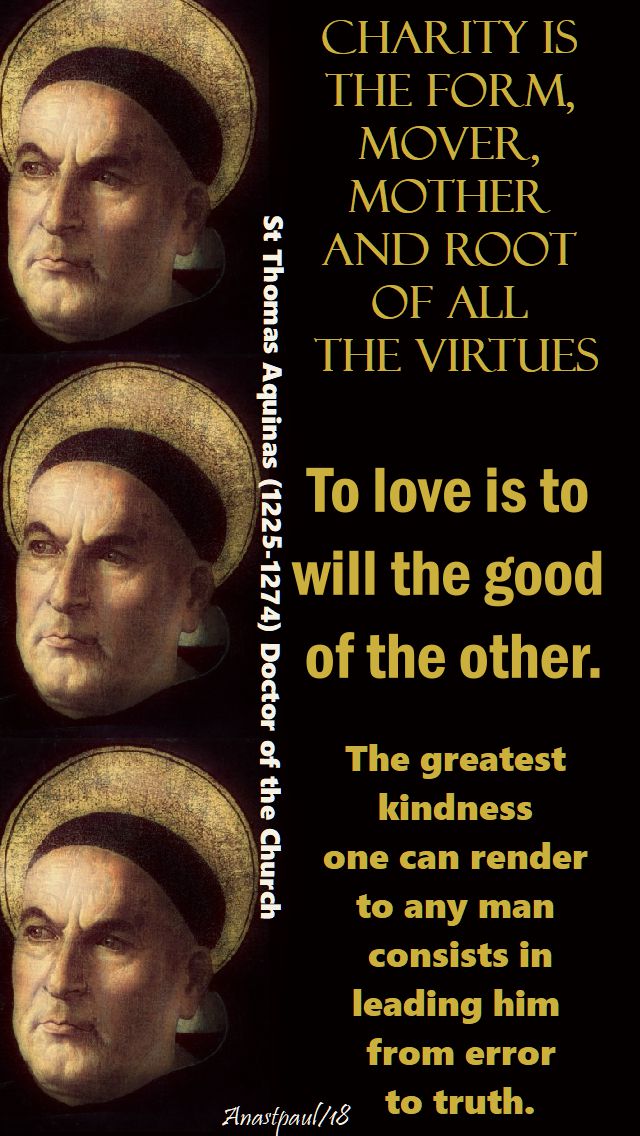
“Charity is the form, mover, mother and root of all the virtues.”
“To love is to will the good of the other.”
“The greatest kindness one can render to any man consists in leading him from error to truth.”
St Thomas Aquinas OP (1225 – 1274) Angelic Doctor of the Church
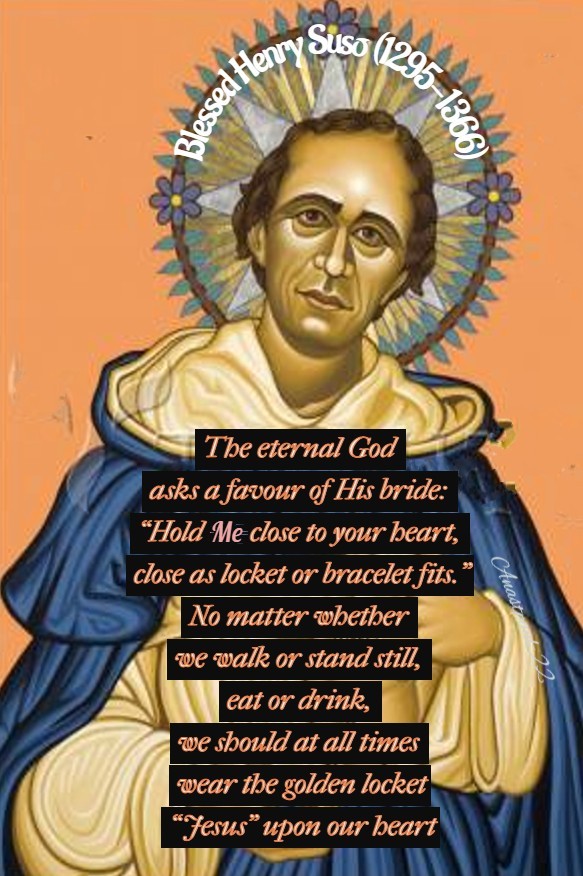
“The eternal God asks a favour of His bride: “Hold Me close to your heart, close as locket or bracelet fits.” No matter whether we walk or stand still, eat or drink, we should at all times wear the golden locket “Jesus” upon our heart.”
Bl Henry Suso OP (1295-1366)
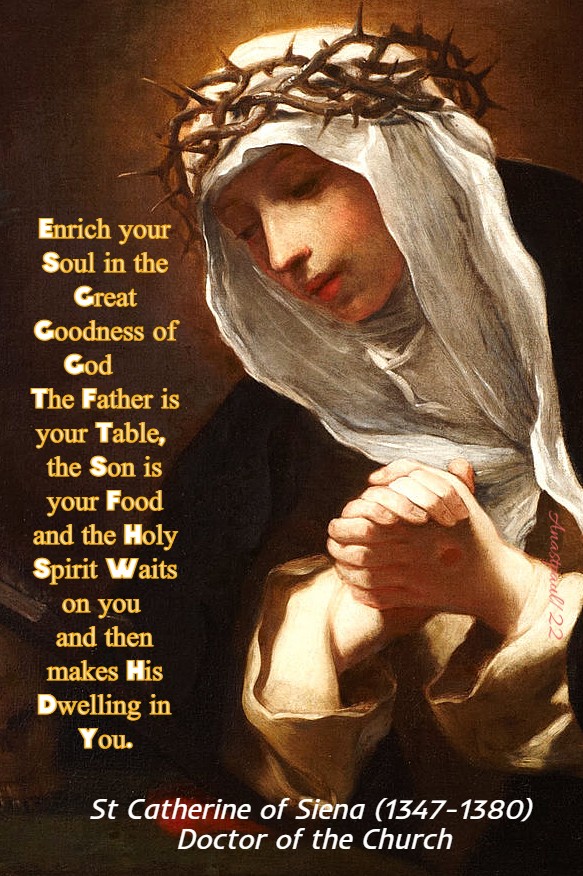
“Enrich your soul in the great goodness of God – The Father is your Table, the Son is your Food and the Holy Spirit waits on you and then makes His Dwelling in you.”
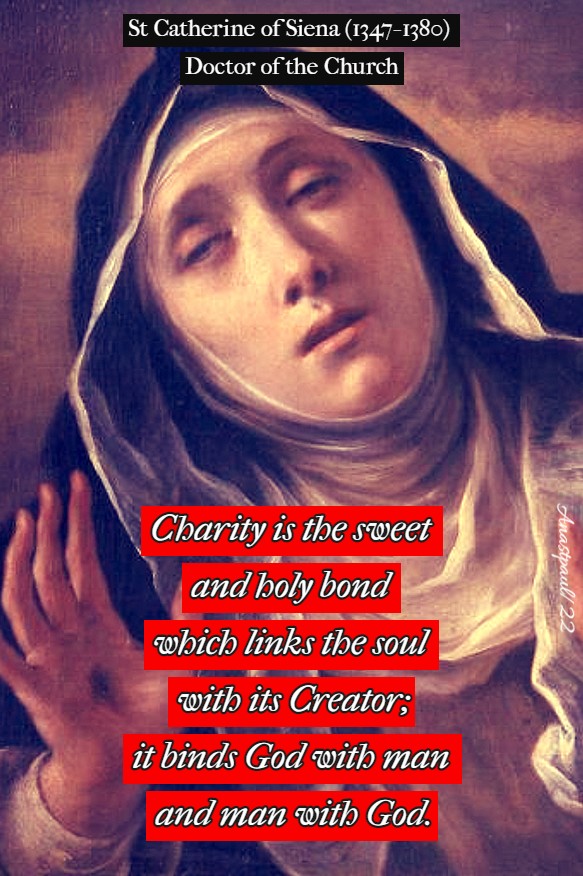
“Charity is the sweet and holy bond which links the soul with its Creator; it binds God with man and man with God.”
St Catherine of Siena OP (1347-1380) Doctor of the Church
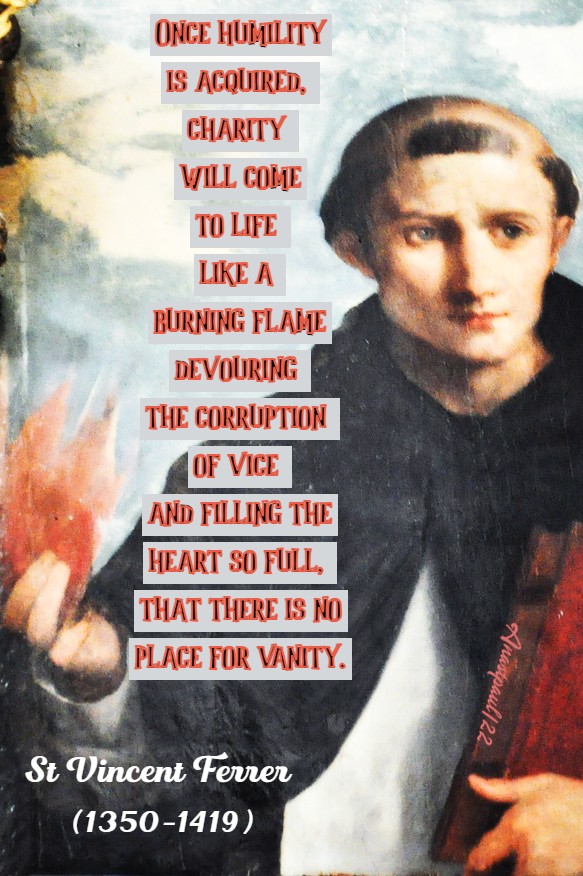
“Once humility is acquired, charity will come to life like a burning flame devouring the corruption of vice and filling the heart so full, that there is no place for vanity.”
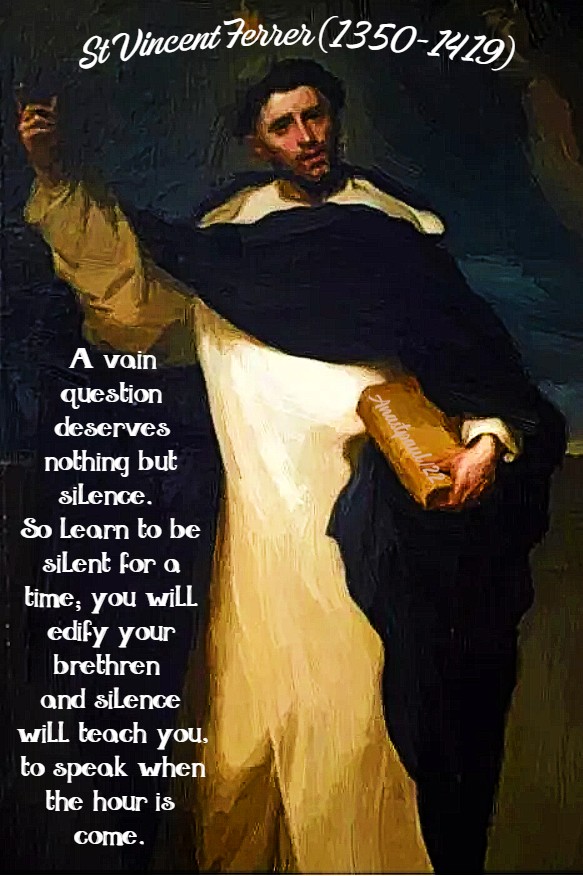
“A vain question deserves nothing but silence. So learn to be silent for a time; you will edify your brethren and silence will teach you, to speak when the hour is come.”
St Vincent Ferrer OP (1350-1419)
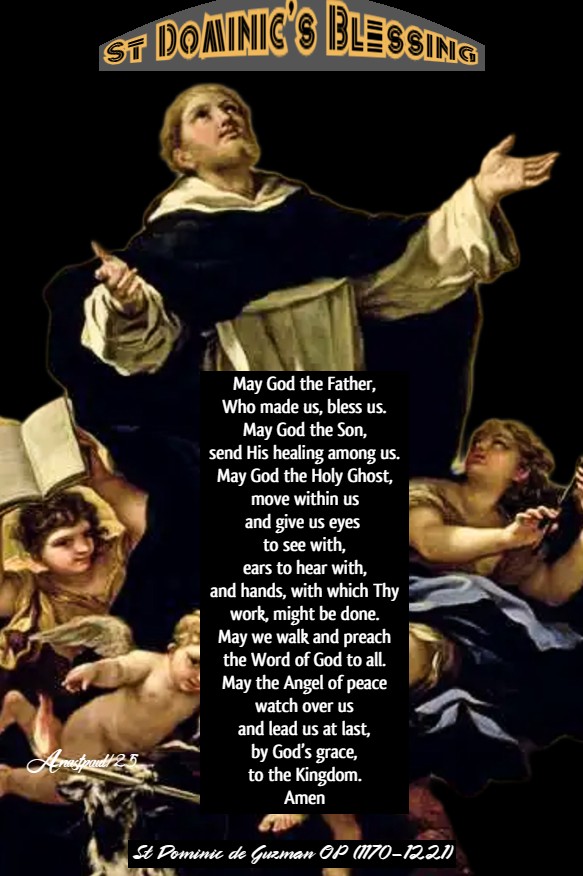
St Dominic’s Blessing By St Dominic de Guzman OP (1170-1221)
May God the Father, Who made us, bless us. May God the Son, send His healing among us. May God the Holy Ghost, move within us and give us eyes to see with, ears to hear with, and hands, with which Thy work, might be done. May we walk and preach the Word of God to all. May the Angel of peace watch over us and lead us at last, by God’s grace, to the Kingdom. Amen
One Minute Reflection – 7 November – “The Month of the Holy Souls in Purgatory” – Within the All Saints Octave – Apocalypse 7:2-12, Matthew 5:1-12 – Scripture search here: https://www.drbo.org/
“Blessed are the merciful, for they shall obtain mercy.” – Matthew 5:7
REFLECTION – “Finally, just as concern for one’s neighbour is added to love of God, so the virtue of mercy is added to the desire for righteousness, as it is said: Blessed are the merciful, for God will be merciful to them.
Remember, Christian, the surpassing worth of the wisdom that is yours. Bear in mind, the kind of school in which you are to learn your skills, the rewards to which you are called. Mercy Itself, wishes you to be merciful, Righteousness Itself, wishes you to be righteous, so that the Creator may shine forth in His creature and the image of God be reflected, in the mirror of the human heart, as it imitates His qualities. The faith of those who live their faith, is a serene faith. What you long for will be given you, what you love will be yours forever.
Since it is by giving alms that everything is pure for you, you will also receive that blessing which is promised next by the Lord: Blessed are the pure of heart, for they shall see God. Dear friends, great is the happiness of those for whom such a reward is prepared. Who are the clean of heart if not those, who strive for those virtues, we have mentioned above? What mind can conceive, what words can express, the great happiness of seeing God? Yet human nature will achieve this when it has been transformed, so that it sees the Godhead no longer in a mirror, or obscurely but face to face—the Godhead that no man has been able to see! In the inexpressible joy of this eternal vision, human nature will possess, what eye has not seen or ear heard, what man’s heart has never conceived!” – St Pope Leo the Great (400-461) Great Western Father and Doctor of the Church (An excerpt from his Sermon 95 On the Beatitudes).
PRAYER – Almighty, eternal God, Who granted us to honour the merits of all Thy Saints in a single solemn festival, bestow on us, we beseech Thee, through their manifold intercession, that abundance of Thy mercy for which we yearn. Through Jesus Christ, Thy Son our Lord, Who lives and reigns with Thee, in the unity of the Holy Ghost, God, world without end. Amen (Collect).
Our Morning Offering – 7 November – Within the All Saints Octave
Eternal God, Our Refuge By St Boniface (672-754) Martyr
Eternal God, the refuge and help of all Thy children, we praise Thee for all Thou hast given us, for all Thou hast done for us, for all that Thou art to us. In our weakness, Thou art strength, in our darkness, Thou art light, in our sorrow, Thou art comfort and peace. We cannot number Thy blessings, we cannot declare Thy love – for all Thy graces, we bless Thee. May we live as in Thy presence, and love the things that Thou loves and serve Thee in our daily lives, through Jesus Christ our Lord. Amen



























 AnaStpaul
You must be logged in to post a comment.