Feast of the Conversion of St Paul, Apostle – 25 January
From the Liturgical Year, 1904
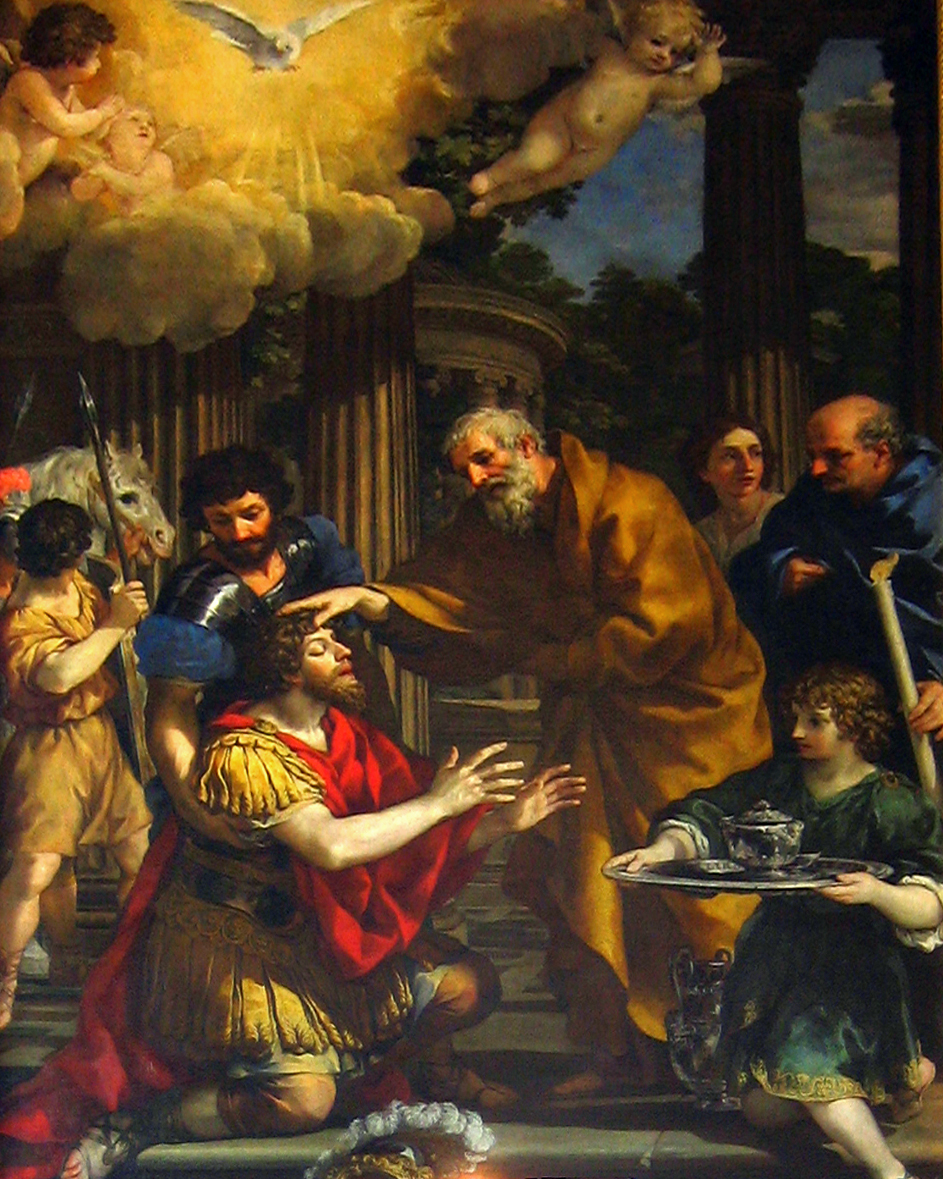
We have already seen how the Gentiles, in the person of the Three Magi, offered their mystic gifts to the Divine Child of Bethlehem and received from Him, in return, the precious gifts of faith, hope and charity. The harvest is ripe; it is time for the reaper to come. But who is to be God’s labourer? The Apostles of Christ are still living under the very shadow of Mount Sion. All of them have received the mission to preach the Gospel of Salvation to the uttermost parts of the world but, not one among them, has, as yet, received the special character of Apostle of the Gentiles. Peter, who had received the Apostleship of Circumcision (Gal 2:8), is sent especially, as was Christ Himself, to the sheep that are lost of the house of Israel (Mt 15:24). And yet, as he is the Head and the Foundation, it belongs to him to open the door of Faith to the Gentiles (Acts 14:26) which he solemnly does, by conferring Baptism on Cornelius, the Roman Centurion.
But the Church is to have one more Apostle – an Apostle for the Gentiles – and he is to be the fruit of the Martyrdom and prayer of St Stephen. Saul, a citizen of Tarsus, has not seen Christ in the flesh and yet, Christ alone can make an Apostle. It is then, from Heaven, where He reigns, impassible and glorified, that Jesus will call Saul to be His disciple, just as, during the period of His active life, He called the fishermen of Genesareth to follow Him and hearken to His teachings. The Son of God will raise Saul up to the Third Heaven and there, will reveal to Him, all His Mysteries and when Saul, having come down again to this earth, shall have seen Peter (Gal 1:18) and compared his Gospel with that recognised by Peter (Ibid 2: 2) – he can say, in all truth that he is an Apostle of Christ Jesus (Gal 1:1) and that he has done nothing less. than the great Apostles (2 Cor 11:55).
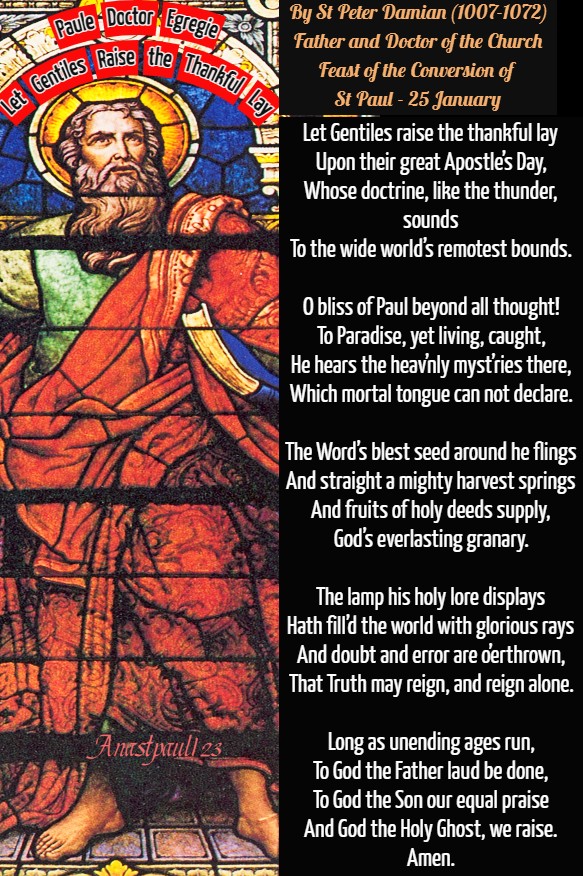
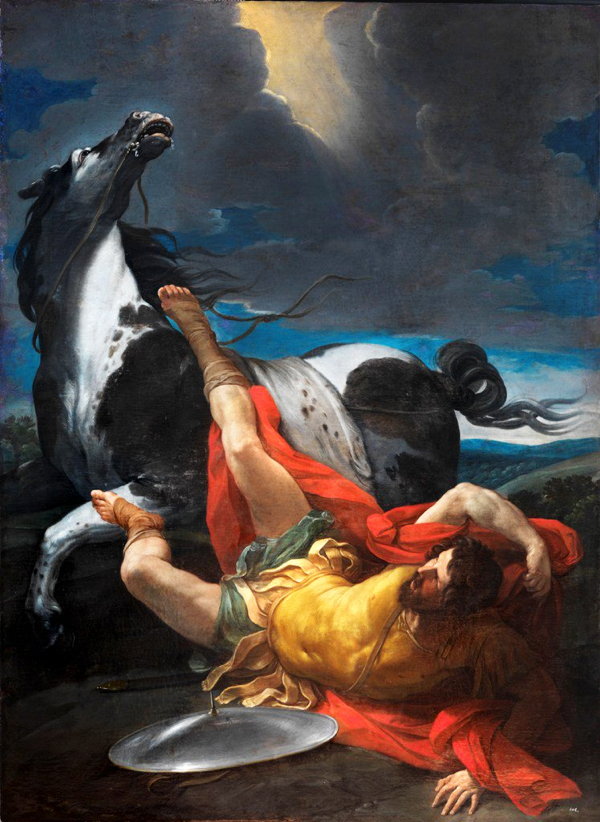
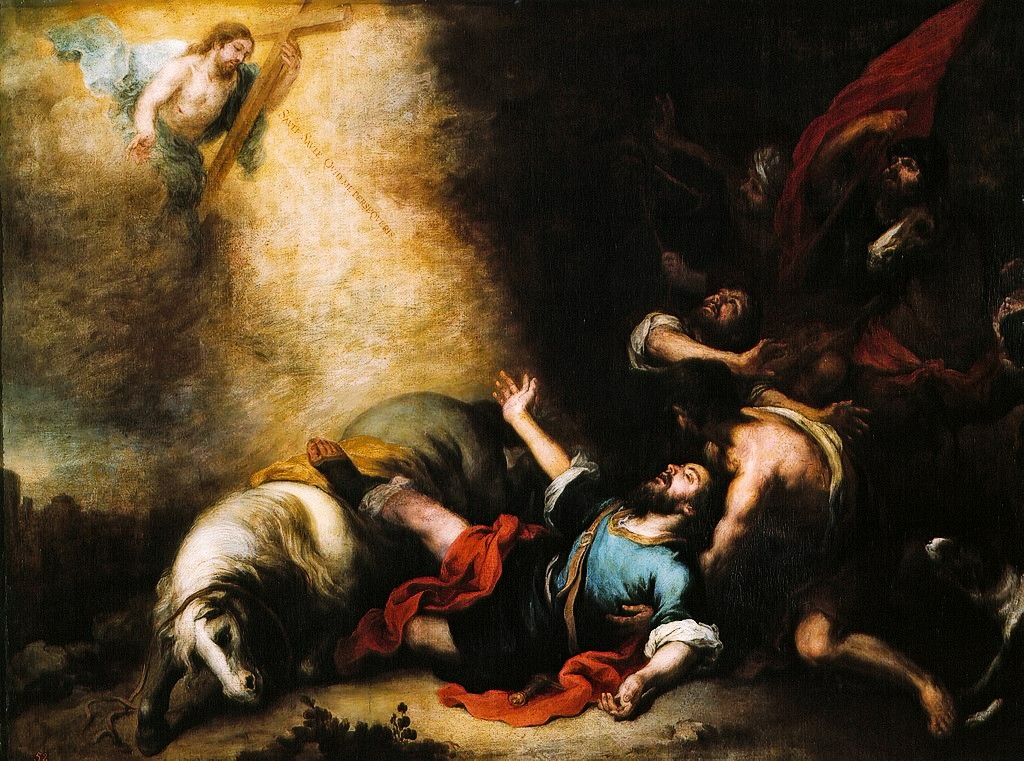
It is on this glorious day of the Conversion of Saul, who is soon to change his name into Paul that this great work is commenced. It is on this day, that is heard the Almighty Voice which breaketh the cedars of Libanus (Ps 28:5) and can make a persecuting Jew become, first a Christian and then an Apostle. This admirable transformation had been prophesied by Jacob, when, upon his death-bed, he unfolded, to each of his sons, the future of the tribe of which he was to be the father. Juda was to have the precedence of honour; from his royal race, was to be born the Redeemer, the Expected of nations. Benjamin’s turn came – his glory is not to be compared with that of his brother Juda and yet, it was to be very great – for, from his tribe, is to be born Paul, the Apostle of the Gentile nations!
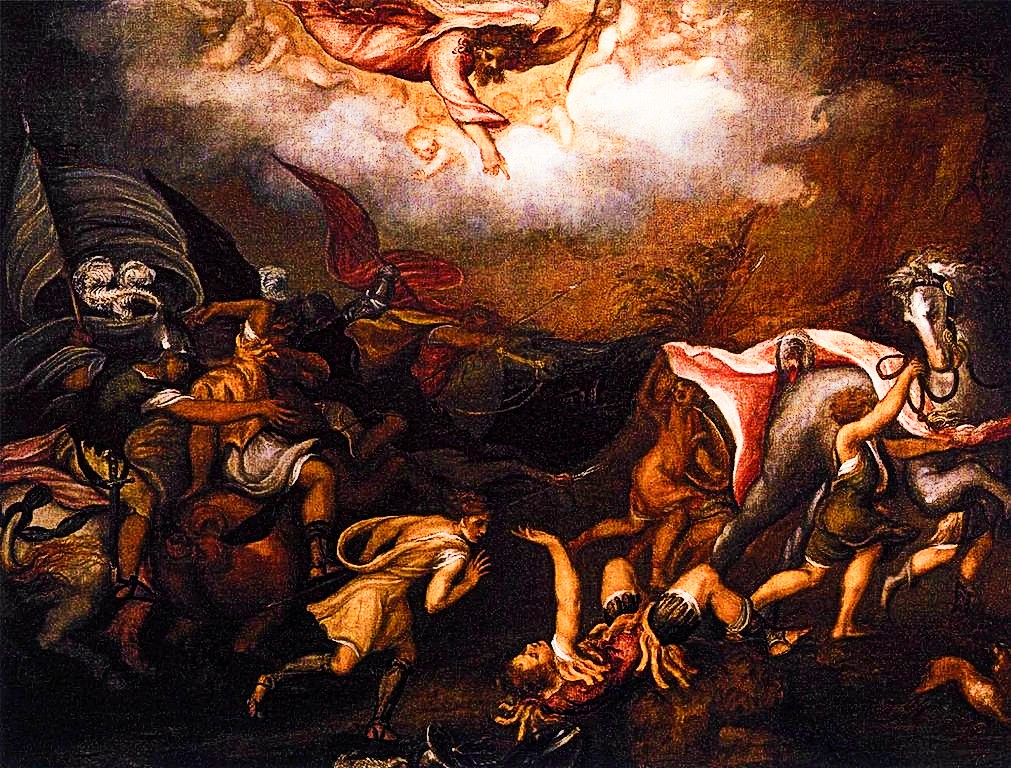
Bartolomé Esteban Murillo: Conversion of Saint Paul
These are the words of the dying Prophet – Benjamin, a ravenous wolf, in the morning shall eat the prey and in the evening, shall divide the spoil (Gen 49:27). Who, says an ancient writer (These words are taken from a Sermon, which for long time was thought to be St Augustine), is he, that in the morning of impetuous youth, goes like a wolf, in pursuit of the sheep of Christ, breathing threatenings and slaughter against them? Is it not Saul on the road to Damascus, the bearer and doer of the high-priest’s orders and stained with the blood of Stephen, whom he has stoned by the hands of all those, over whose garments he kept watch? And he, who, in the evening, not only does not despoil but, with a charitable and peaceful hand, breaks to the hungry the bread of life – is it not Paul, of the tribe of Benjamin, the Apostle of Christ, burning with zeal for his brethren, making himself all to all and wishing even to be an anathema for their sakes?
Oh! the power of our dear Jesus! how wonderful! how irresistible! He wishes that the first worshippers at His Crib should be humble Shepherds – and, He invites them by His Angels, whose sweet hymn was enough to lead these simple-hearted men to the Stable, where lies, in swaddling-clothes, He Who is the hope of Israel. He would have the Gentile Princes, the Magi, do Him homage – and bids to arise in the Heavens, a Star, whose mysterious apparition, joined to the interior speaking of the Holy Ghost, induces these men of desire, to come from the far East and lay, at the feet of an humble Babe, their riches and their hearts. When the time is come for forming the Apostolic College, He approaches the banks of the sea of Tiberias and, with this single word: Follow me, He draws after Him such as He wishes to have as His Disciples. In the midst of all the humiliations of His Passion, He has but to look at the unfaithful Peter and Peter is a penitent. Today, it is from Heaven that He evinces His power – all the Mysteries of our Redemption have been accomplished and He wishes to show mankind that He is the Sole Author and Master of the Apostolate and that, His alliance with the Gentiles, is now perfect – He speaks – the sound of His reproach bursts like thunder over the head of this hot Pharisee, who is bent on annihilating the Church. He takes this heart of the Jew and, by His grace, turns it into the heart of the Apostle, the Vessel of election, the Paul, who is afterwards to say of himself: I live, not I but Christ liveth in me (Gal 2:20).
The commemoration of this great event was to be a Feast in the Church and it had a right to be kept, as near as might be to the one which celebrates the Martyrdom of St Stephen, for Paul is the Protomartyr’s convert. The anniversary of his Martyrdom would, of course, have to be solemnised at the summer-solstice – where, then, place the Feast of his Conversion if not near Christmas and thus our own Apostle, would be at Jesus’ Crib and Stephen’s side? Moreover, the Magi could claim him, as being the conqueror of that Gentile-world, of which they were the first-fruits.
Andrea Schiavone: Conversion of Saul
And lastly, it was necessary, in order to give the Court of our Infant-King its full beauty that the two Princes of the Church – the Apostle of the Jews and the Apostle of the Gentiles – should stand close to the mystic Crib – Peter, with his Keys and Paul, with his Sword. Bethlehem thus becomes the perfect figure of the Church and the riches of this season of the Cycle are abundant beyond measure. Amen.
St Apollo of Heliopolis Bl Archangela Girlani St Artemas of Pozzuoli St Auxentius of Epirus St Bretannion of Tomi St Donatus the Martyr St Dwynwen (Died c 460) Virgin Princess, Nun. St Eochod of Galloway St Joel of Pulsano St Juventinus of Antioch St Maximinus of Antioch St Palaemon
Thought for the Day – 24 January – Meditations with Antonio Cardinal Bacci (1881-1971)
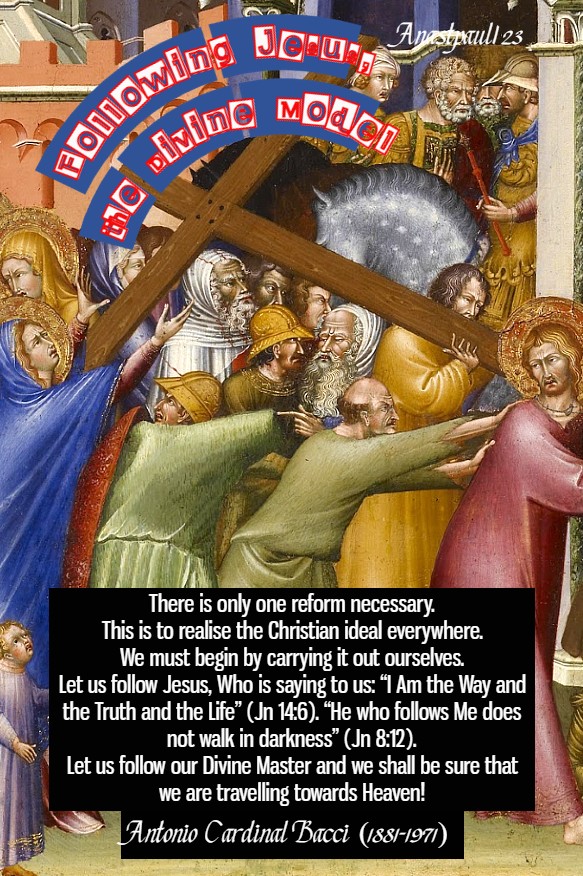
Following Jesus, the Divine Model
“When we have renounced ourselves and have embraced our cross with resignation and love, we must follow Jesus. We must follow Him in a special way as the infallible Teacher of truth. The teachings of men cannot satisfy our intellects. Still less, can they satisfy our hearts. What they teach is either incomplete or false. This is proved by the fact that the doctrines of mean have succeeded and replaced one another, down through the Centuries while “the word of the Lord endures forever” (1 Peter 1:25).
The teaching of Christ produces an extraordinary renovation in the individual, in the family and in society. It is this renewal which we call Christianity and Christian civilisation. There is a wide chasm between paganism and Christianity. This gulf would be even wider, only for the fact that Christianity has not yet been fully put into practice throughout the universe. There is only one reform necessary. This is to realise the Christian ideal everywhere. We must begin by carrying it out ourselves. Let us follow Jesus, Who is saying to us: “I Am the Way and the Truth and the Life” (Jn 14:6). “He who follows Me does not walk in darkness” (Jn 8:12).
Let us follow our Divine Master and we shall be sure that we are travelling towards Heaven!”
Quote/s of the Day – 24 January – St Timothy (1st Century) Disciple of St Paul, Bishop and Martyr – 1 Timothy 6:11-16, Luke 14:26-33.– Scripture search here: https://www.drbo.org/
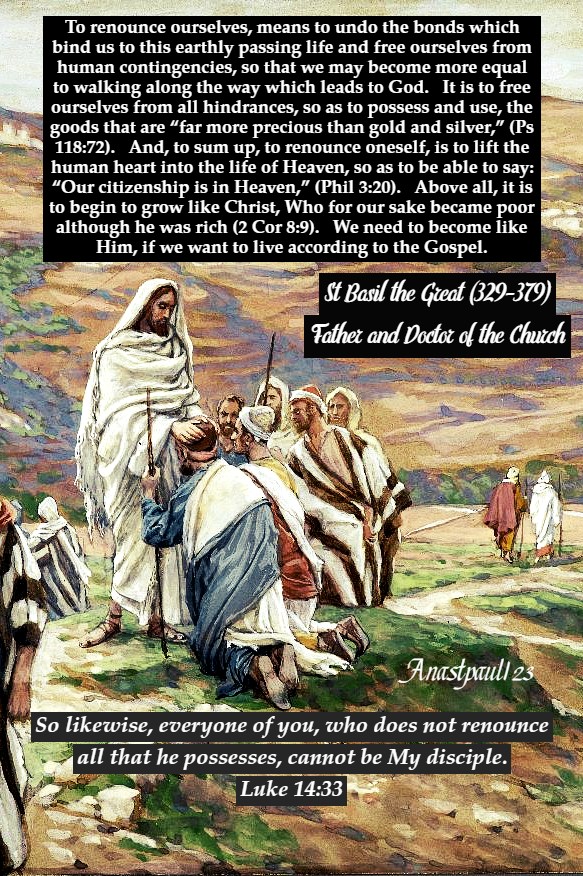
“So likewise, everyone of you, who does not renounce all that he possesses, cannot be My disciple.”
Luke 14:33
“He seems to demand of us the most entire renunciation… So, if we keep back for ourselves , any earthly goods or any perishable supplies, our minds will remain sunk in them, as though in mud. Then, inevitably, our souls will become unable to contemplate God and will be unmoved by desire for the splendours of Heaven and for the good things promised us. We shall only be able to acquire those good things, if we ask for them unceasingly, with a burning desire that will, besides, make easy the effort needed to gain them.”
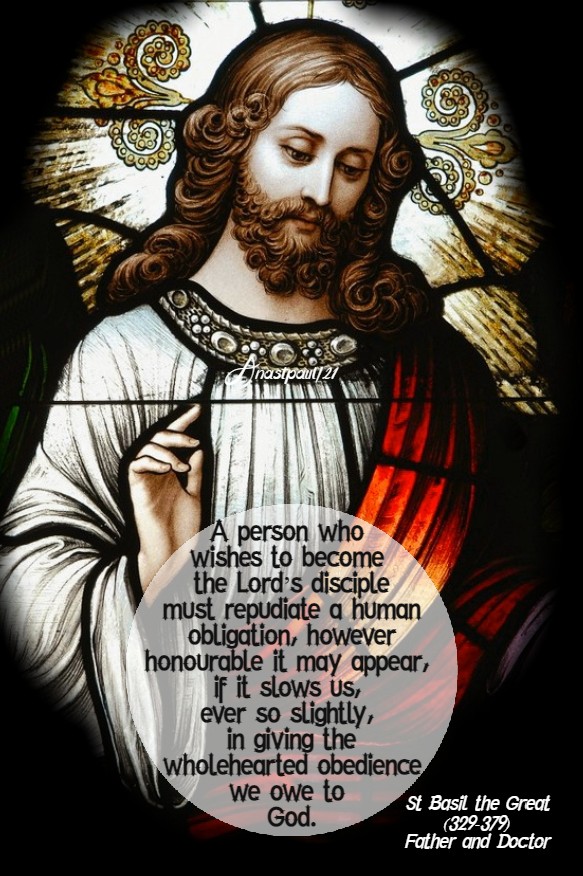
“A person who wishes to become the Lord’s disciple must repudiate a human obligation, however honourable it may appear, if it slows us, ever so slightly, in giving the wholehearted obedience we owe to God.”
St Basil the Great (329-379) Father and Doctor of the Church
“If you wish to enter into life, keep My commandments. If you will know the truth, believe in Me. If you will be perfect, sell all. If you will be My disciple, deny yourself. If you will possess the blessed life, despise this present life. If you will be exalted in Heaven, humble yourself on earth. If you wish to reign with Me, carry the Cross with Me. For only the servants of the Cross find the life of blessedness and of true Light.”
Thomas à Kempis (1380-1471) The Imitation of Christ Chapter 56
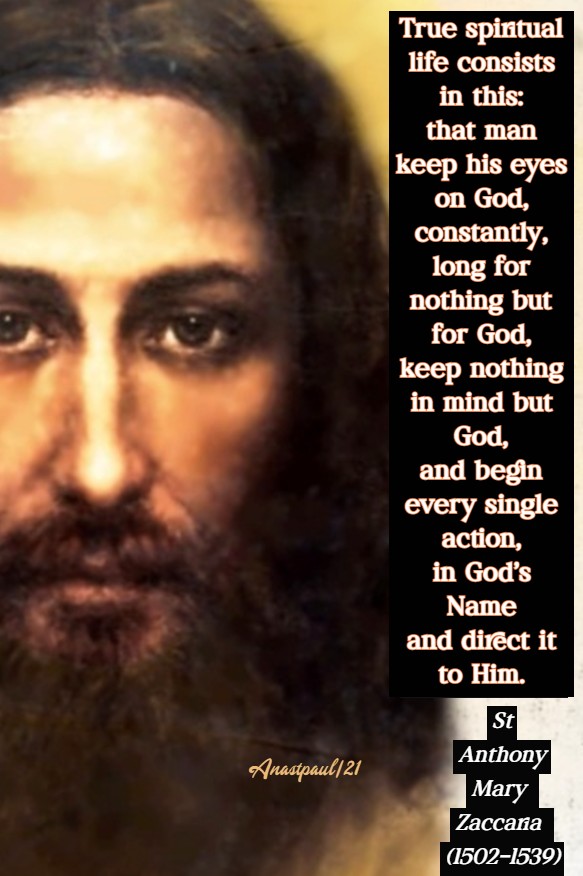
“True spiritual life consists in this: that man keep his eyes on God, constantly, long for nothing but for God, keep nothing in mind but God, and begin every single action, in God’s Name and direct it to Him.”
One Minute Reflection – 24 January – St Timothy (1st Century) Disciple of St Paul, Bishop and Martyr – 1 Timothy 6:11-16, Luke 14:26-33.– Scripture search here: https://www.drbo.org/
“So likewise, everyone of you, who does not renounce all that he possesses, cannot be My disciple.” – Luke 14:33
REFLECTION – “Our Lord Jesus Christ said to all, on many occasions and while giving many demonstrations of it: “If anyone wishes to come after me, he must deny himself, take up his cross and follow me,” (cf Lk 9:23) and again: “anyone of you who does not renounce all that he possesses cannot be My disciple.” Thus, He seems to demand of us the most entire renunciation… “Where your treasure is, there also will your heart be,” He says elsewhere (Mt 6:21). So if we keep back for ourselves any earthly goods or any perishable supplies, our minds will remain sunk in them as though in mud. Then, inevitably, our souls will become unable to contemplate God and will be unmoved by desire for the splendours of Heaven and for the good things promised us. We shall only be able to acquire those good things, if we ask for them unceasingly, with a burning desire that will, besides, make easy the effort needed to gain them.
To renounce ourselves, means to undo the bonds which bind us to this earthly passing life and free ourselves from human contingencies, so that we may become more equal to walking along the way which leads to God. It is to free ourselves from all hindrances, so as to possess and use, the goods that are “far more precious than gold and silver,” (Ps 118:72). And, to sum up, to renounce oneself, is to lift the human heart into the life of Heaven, so as to be able to say: “Our citizenship is in Heaven,” (Phil 3:20). Above all, it is to begin to grow like Christ, Who for our sake became poor although he was rich (2 Cor 8:9). We need to become like Him, if we want to live according to the Gospel.” – St Basil the Great (329-379) Monk and Bishop of Caesarea in Cappadocia, Father and Doctor of the Church (Greater Monastic Rules Q.8).
PRAYER – Be mindful of our weakness, Almighty God and because the burden of our sins weighs heavily upon us, may the glorious intercession of blessed Timothy, Your Martyr and Bishop, sustain us. Through Jesus Christ, Thy Son our Lord, Who lives and reigns with Thee, in the unity of the Holy Ghost, God, world without end. Amen (Collect).
Our Morning Offering – 24 January – Feast of Saint Timothy, Bishop and Martyr
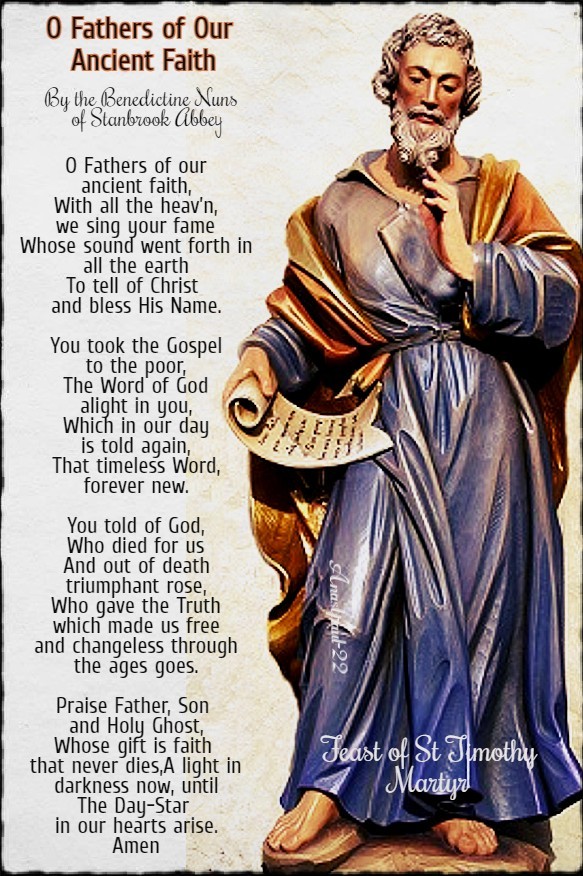
O Fathers of Our Ancient Faith
O Fathers of our ancient faith, With all the heav’n, we sing your fame Whose sound went forth in all the earth To tell of Christ and bless His Name.
You took the Gospel to the poor, The Word of God alight in you, Which in our day is told again, That timeless Word, forever new.
You told of God, Who died for us And out of death triumphant rose, Who gave the Truth which made us free and changeless through the ages goes.
Praise Father, Son and Holy Spirit, Whose gift is faith that never dies, A light in darkness now, until The Day-Star in our hearts arise.
O Fathers of Our Ancient Faith is written by the Benedictine Nuns of Stanbrook Abbey. In the Divine Office it is sung at Morning Prayer in the Common of Apostles. It is set to the anonymous tune associated with the 7th century Latin hymn, Creator Alme Siderum.
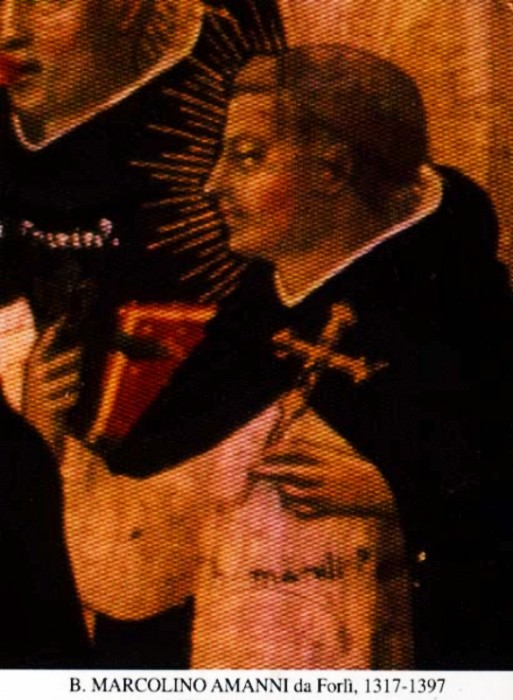
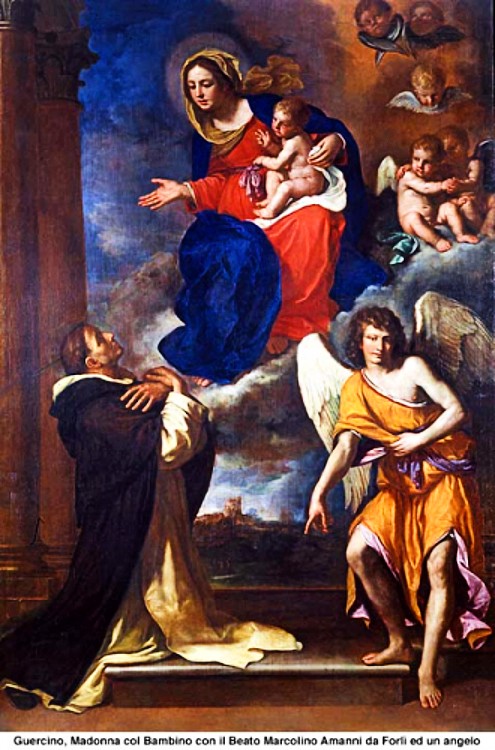
Saint of the Day – 24 January – Blessed Marcolino Amanni of Forli OP (1317-1397) Priest and Friar of the Dominican, the Order of Preachers, Mystic, Assistant Prior and Procurator of his Convent. Born in 1317 in Forli, Emilia, Italy and died on 24 January 1397 in Forli, Emilia, Italy of natural causes, seventy years after his entry into the Order of Preachers. Blessed John Dominici (1356-1419), Archbishop and Cardinal, wrote the life of Blessed Marcolino of Forlì . Also known as – Marcolinus of Forli, Marcolino Amannai da Forli.. Additional Memorial – 21 January in the Diocese of Forli, in order not to clash with the Novena to the Madonna del Fuoco (Our Lady of Fire).
The Roman Martyrology reads: “In Forlì, blessed Marcolino Amanni, Priest of the Order of Preachers, who lived his whole life in great humility and simplicity, in silence, in solitude, in the service of the poor and in the care of children.”
Born in Forli, Italy in 1317, Marcolino Amanni entered the Dominicans at the tender age of 10 years. He occupies a place unique in Dominican annals because he was almost purely contemplative . There is outwardly little to record of Marcolino;s life within the Order, except that for 70 years he kept the Dominican Rule in all its rigour. That is a claim to sanctity that can be made by very few, and is of itself enough to entitle him to sainthood. He did accomplish the reform of several Convents which had fallen from their primitive fervour but this he did by his prayers and his example, rather than by teaching or preaching.
However, from 1367 to 1370, he acted as Procurator and also as Assistant-prior of San Giacomo. Between 1371 and 1395 he is attested as a participant in Chapter assemblies or as a witness in notarial deeds concerning the life of the Convent.
But, for the most part, it is said that Marcolino was most at home with the lay brothers, or with the neighborhood poor, the sick, the needy and children, who enjoyed talking to him. He seldom went out of his cell, neither did he leave any writings. His work was the unseen labour presided over by the Holy Spirit, the work of contemplation. “To give to others the fruits of contemplation,” is the Dominican motto and one might be curious to know how Blessed Marcolino accomplished this.
In order to understand the need for just such a type of holiness, it is well to remember the state of the Church in the 14th Century. Devastated by plague and schism, divided and held up to scorn, preyed upon by all manner of evils, the Church militant was in need, not only of brave and intelligent action but also of prayer. Consistently through the Centuries, God has raised up such saints as could best avert the disasters that threatened the world in their day, and Marcolino was one answer to the need for mystics who would plead ceaselessly for the Church.
Marcolino’s interior life was not recorded by himself or by others. He lived the mystical life with such intensity that he was nearly always in ecstasy and unconscious of the things around him. One of his fellow friars recorded that he seemed “a stranger on earth, concerned only with the things of Heaven.” Most of his brethren thought him merely sleepy and inattentive but actually he was, for long periods, lost in converse with God. Some had heard him talking earnestly to the statue of Our Lady in his cell; some fortunate few had heard Our Lady replying to his questions, with the same simplicity.
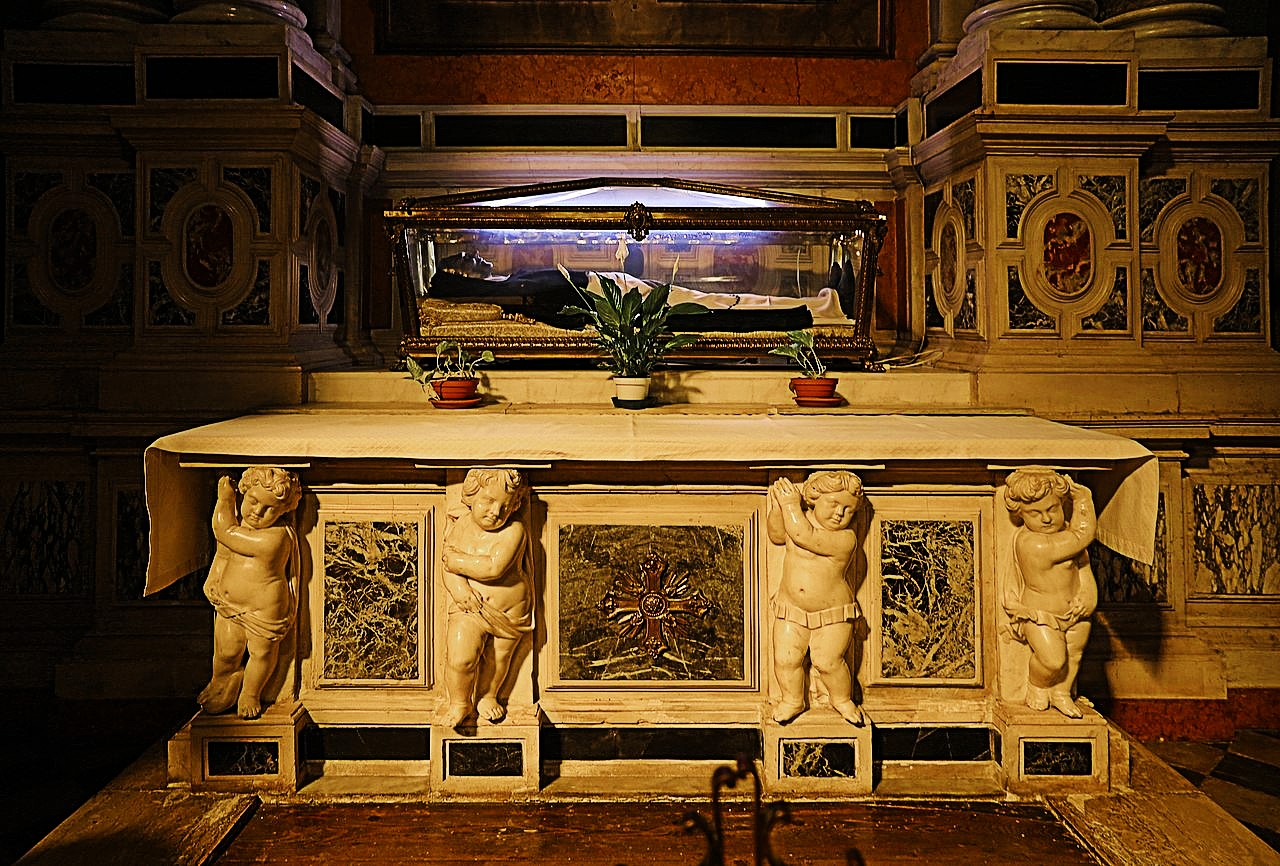
At the death of Marcolino, on 24 January, 1397, a beautiful child appeared in the streets, crying out the news to the little town that the saintly friar was dead. As the child disappeared when the message was delivered, he was thought to have been an Angel. Many miracles were worked at Marcolino’s Tomb. One was the miraculous cure of a woman who had been bedridden for 30 years. Hearing of the death of the blessed, she begged him to cure her so that she could visit his Tomb.
Upon his death, popular devotion, which considered him a saint, obtained that Marcolino, after a solemn funeral, was buried in the Dominican Church and for two months, it was not possible to close the Church, day or night, due to the large influx of faithful .
A little less than a month after Marcolino’s death, on 20 February 1397, Bello de’ Giuliani da Forlì, Vicar of the Bishop of Forlì Scarpetta Ordelaffi, sent a letter to Leonardo Dolfin, Bishop of Castello, informing him of the death of the Dominican religious, who he was described as a brother of exemplary life and full of charity.
Bello also gave news of about fifty miraculous cures performed by the intercession of Marcolino. Subsequent investigations brought this exceptional series of miracles up to 80 (report to Raimondo da Capua, general of the Order, who had been spiritual director and then biographer of Saint Catherine of Siena) and then to 188 (report from Forlì notaries to the Bishop of Forlì, Scarpetta Ordelaffi).
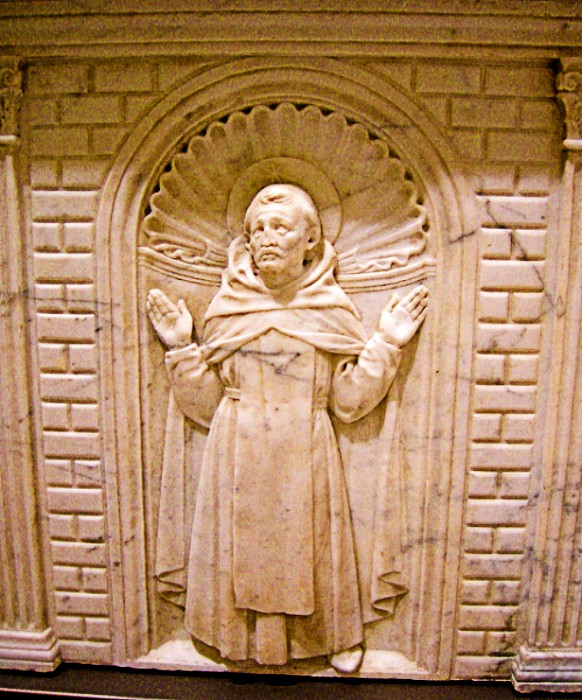
In 1457 Marcollino’s body was transferred to a marble monument by Antonio and Bernardo Rossellino, which had been commissioned by the fellow citizen of Forlì, Nicolò Dall’Aste, Bishop of Recanati. Marcolino’s body was then enshrined in the Forli Cathedral.
He was confirmed as a saint on 9 May 1750 by Pope Benedict XIV.
St Filip Geryluk St Guasacht St Ignacy Franczuk Bl John Grove St Julian Sabas the Elder St Macedonius Kritophagos Blessed Marcolino Amanni of Forli OP (1317-1397) Priest and Friar of the Order of Preachers, the Dominicans, Mystic.
St Projectus St Sabinian of Troyes St Suranus of Sora St Thyrsus Bl William Ireland
Martyrs of Asia Minor – 4 Saints: A group of ChristiansMmartyred together for their faith. The only details to survive are four of their names – Eugene, Mardonius, Metellus and Musonius. They were burned at the stake in Asia Minor.
Martyrs of Podlasie – 13 Beati: Podlasie is an area in modern eastern Poland that, in the 18th-century, was governed by the Russian Empire. Russian sovereigns sought to bring all Eastern-rite Catholics into the Orthodox Church. Catherine II suppressed the Greek Catholic Church in Ukraine in 1784. Nicholas I did the same in Belarus and Lithuania in 1839. Alexander II did the same in the Byzantine-rite Eparchy of Chelm in 1874 and officially suppressed the Eparchy in 1875. The Bishop and the Priests who refused to join the Orthodox Church were deported to Siberia or imprisoned. The laity, left on their own, had to defend their Church, their liturgy and their union with Rome. On 24 January 1874 soldiers entered the village of Pratulin to transfer the parish to Orthodox control. Many of the faithful gathered to defend their parish and Church. The soldiers tried to disperse the people but failed. Their commander tried to bribe the parishioners to abandon Rome but failed. He threatened them with assorted punishments but this failed to move them. Deciding that a show of force was needed, the commander ordered his troops to fire on the unarmed, hymn-singing laymen. Thirteen of the faithful died, most married men with families, ordinary men with great faith. We know almost nothing about their lives outside of this incident. Their families were not allowed to honour them or participate in the funerals and the authorities hoped they would be forgotten. Their names are:
Anicet Hryciuk
Bartlomiej Osypiuk
Daniel Karmasz
Filip Geryluk
Ignacy Franczuk
Jan Andrzejuk
Konstanty Bojko
Konstanty Lukaszuk
Lukasz Bojko
Maksym Hawryluk
Michal Wawryszuk
Onufry Wasyluk
Wincenty Lewoniuk Martyrdom:
shot on 14 January 1874 by Russian soldiers in Podlasie, Poland
buried nearby without rites by those soldiers.
Martyrs of Antioch: Babylas Epolonius Prilidian Urban
Thought for the Day – 23 January – Meditations with Antonio Cardinal Bacci (1881-1971)
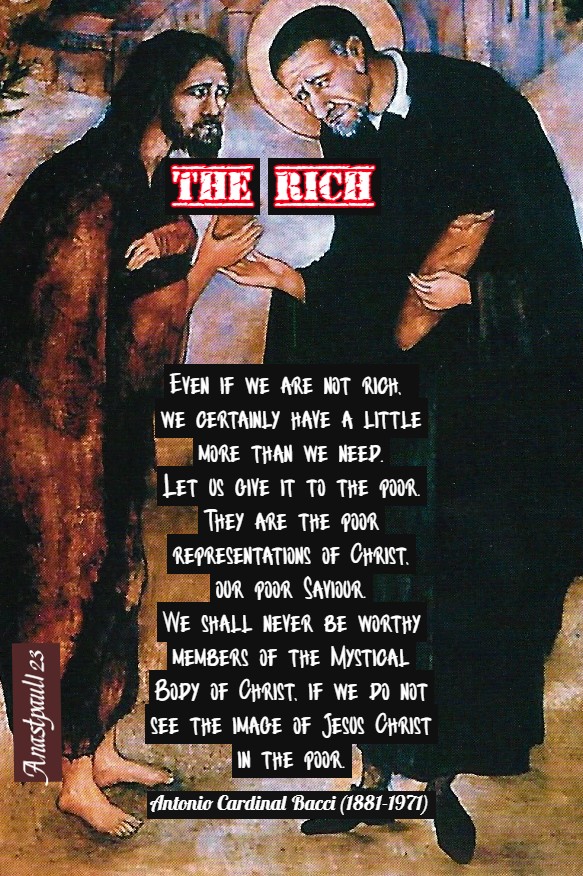
The Rich
“A very rich man who was convinced that he was a good Christian, went to Confession one day. He discussed his doubts and worries about the passages in Sacred Scripture which have just been quoted (see Part One). The penance which he received from the Confessor, was that he should go and read and meditate in a certain city suburb. This area was full of cabins and shacks, where large numbers of poor, abandoned people were eking out an existence. He drove there in his large streamlined car. He stopped and began reading slowly. After a while, he became greatly affected and wept … He left his car and, as if driven by some irresistible force, began to distribute all the money which he had with him to those poor people. At last, he understood fully and without the need of any glossary, the command of Our Lord: “Give that which remains as alms and behold, all things are clean to you” (Lk 11:41). From that day, he was no longer a self-complacent Christian but a just and charitable rich man.
We can all learn a lot from this story. Even if we are not rich, we certainly have a little more than we need. Let us give it to the poor. They are the poor representations of Christ, our poor Saviour. We shall never be worthy members of the Mystical Body of Christ, if we do not see the image of Jesus Christ in the poor.”
Quote/s of the Day – 23 January – “The Month of the Most Holy Name of Jesus” – St Raymond of Peñafort (1175-1275) – Sirach 31:8-11, Luke 12:35-40 – Scripture search here: https://www.drbo.org/
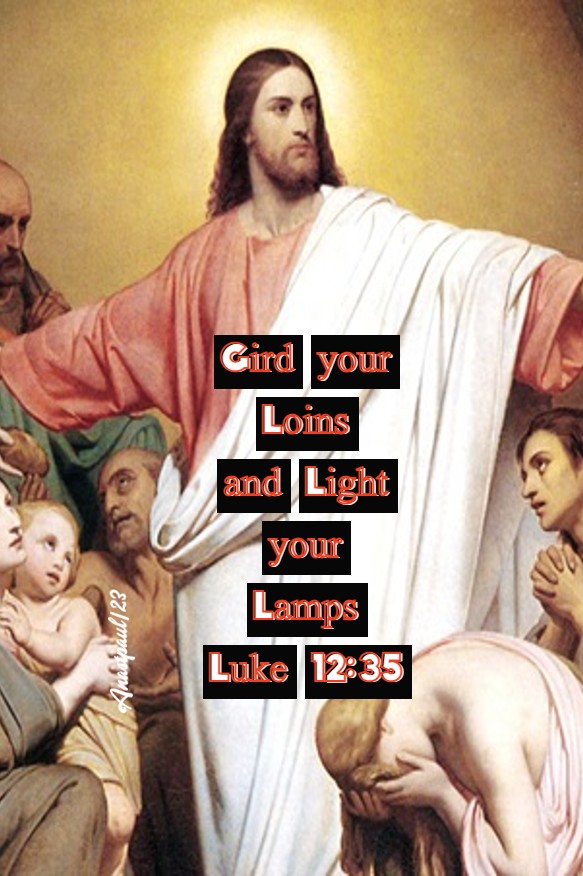
“Gird your loins and light your lamps”
Luke 12:35
“ The fire of the Lord is Light Eternal; the lamps of believers are lit at this fire: “Gird your loins and light your lamps,” (Lk 12:35). It is because the days of our life are still night that a lamp is necessary. This is the fire which, according to the testimony of the disciples at Emmaus, the Lord Himself set within them: “Were not our hearts burning within us while He spoke to us on the way and opened the scriptures to us?” (Lk 24:32). He gives us evident proof of this fire’s action, enlightening man’s inmost heart. That is why the Lord will come in fire (Is 66,15) so as to devour our faults at the resurrection, fulfil each one’s desires with His Presence and cast His Light over their merits and mysteries.”
St Ambrose (340-397) Father and Doctor of the Church
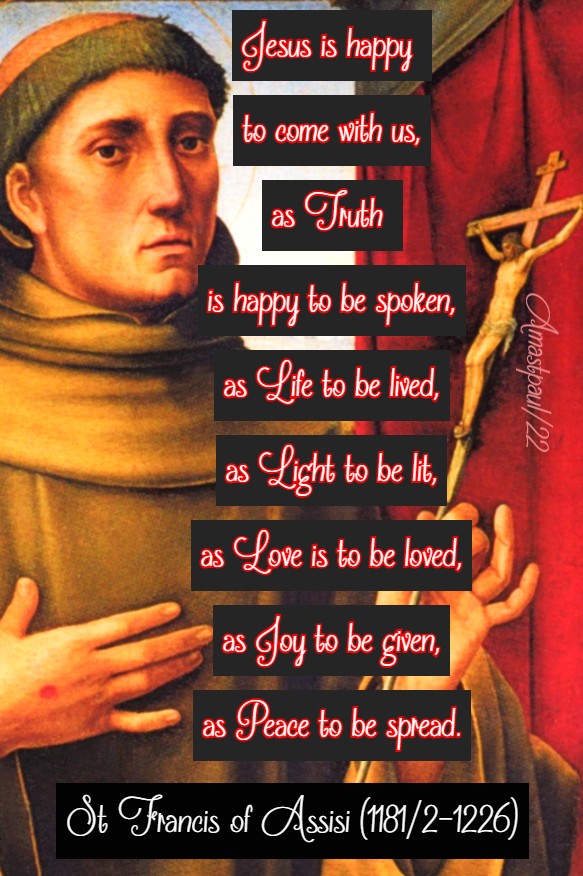
“Jesus is happy to come with us, as Truth is happy to be spoken, as Life to be lived, as Light to be lit, as Love is to be loved, as Joy to be given, as Peace to be spread.”
St Francis of Assisi (1181/2–1226)
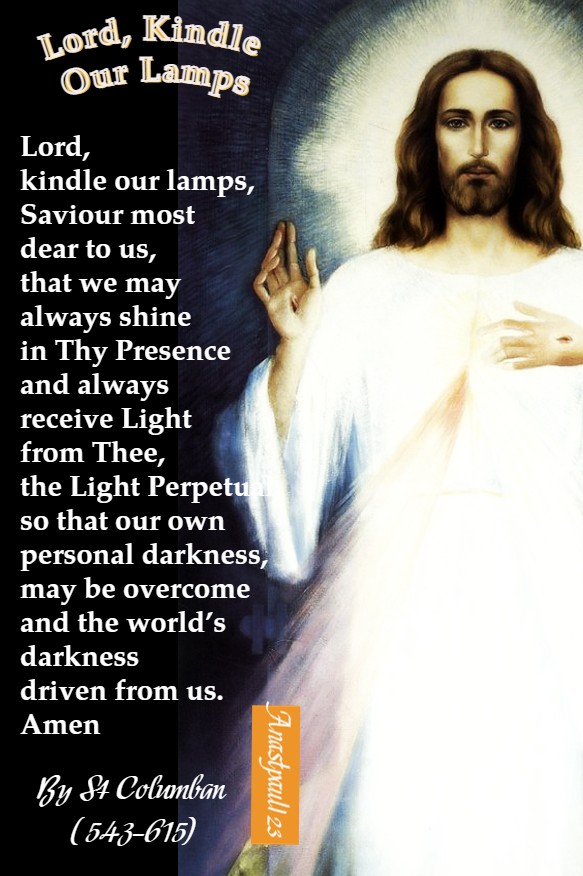
Lord, Kindle our Lamps By St Columban (543-615)
Lord, kindle our lamps, Saviour most dear to us, that we may always shine in Thy Presence and always receive Light from Thee, the Light Perpetual, so that our own personal darkness, may be overcome and the world’s darkness driven from us. Amen
One Minute Reflection – 23 January – St Raymond of Peñafort (1175-1275) – Sirach 31:8-11, Luke 12:35-40 – Scripture search here: https://www.drbo.org/
“You also must be ready, for at an hour that you think not, the Son of man will come.” – Luke 12:40
REFLECTION – “I have come to set the earth on fire and how I wish it were already blazing”… The Lord desires to have us vigilant, always waiting for the Saviour’s coming… But as the gain is meagre and the merit weak, when fear of pain is what prevents us from straying and as love is what has the greater worth, the Lord Himself…sets on fire our longing to win God, when He says: “I have come to set the earth on fire.” Not the kind of fire that destroys, of course but that which produces an upright will and perfects the golden vessels in the Lord’s House by consuming the chaff and the straw (1 Cor 3:12), by devouring all this world’s veneer, acquired through the taste for earthly pleasures and the perishable works of the flesh.
This was the heavenly fire that burned in the bones of the prophets, as Jeremiah declared: “It becomes, like fire burning…in my bones,” (Jer 20,9). For there is a fire of the Lord of which it is said: “Fire goes before Him,” (Ps 96,3). The Lord Himself is a fire, it says: “which burns without being consumed,” (Ex 3,2). The fire of the Lord is Light Eternal; the lamps of believers are lit at this fire: “Gird your loins and light your lamps,” (Lk 12:35). It is because the days of our life are still night that a lamp is necessary. This is the fire which, according to the testimony of the disciples at Emmaus, the Lord Himself set within them: “Were not our hearts burning within us while He spoke to us on the way and opened the scriptures to us?” (Lk 24:32). He gives us evident proof of this fire’s action, enlightening man’s inmost heart. That is why the Lord will come in fire (Is 66,15) so as to devour our faults at the resurrection, fulfil each one’s desires with His Presence and cast His Light over their merits and mysteries.” – St Ambrose (340-397) Archbishop of Milan, Father and Doctor of the Church (Treatise on St Luke’s Gospel, 7, 131-132).
PRAYER – O God, Thou Who chose blessed Raymond to be a renowned minister of the Sacrament of Penance and miraculously brought him through the waves of the sea, grant that, by his intercession, we may produce good results from our penance and reach the Heaven of eternal salvation .Through Jesus Christ, Thy Son our Lord, Who lives and reigns with Thee, in the unity of the Holy Ghost, God, world without end. Amen (Collect).
Saint of the Day – 23 January – Saint Maimbod (Died c 880) Martyr, Irish Pilgrim in France, Missionary Preacher, Born in Ireland and died in c 880 in Kaltenbrunn, Alsace, Gaul (modern France). Maimbod is regarded as an unofficial Patron of eye diseases and ailments. Also known as – Mainbeouf, Mainbodo, Maimbodus.
In the wake of St Columban, many Irish Monks travelled to France and Italy, spreading the Faith “on a pilgrimage for the love of Christ.” Maimbod was one of them, a pilgrim to the Tombs of many Saints and holy Shrines of the Blessed Virgin Mary. As he wandered, he preached, spreading the Faith throughout northern Italy and France.
In Burgundy, a nobleman gave him hospitality and unsuccessfully pressed him to settle there. Upon Maimbod’s departure, the nobleman gave Maimbod a pair of gloves as a reminder to pray for him.
He was praying at the Church of Domnipetra near Alsace, when he was set upon by robbers who, believed he had money because he was wearing gloves, murdered him.
There is a second version of his death which omits the gloves and relates his murder having been accomplished by pagans, enraged by Maimbod’s confession of Christ.
When miracles began to occur at his Tomb in Domnipetra, Count Aszo of Monteliard asked the blind Bishop Berengarius for a gift of the Saint’s Relics. Berengarius delegated the translation ceremony to his co-adjutor, Bishop Stephen. During the rite, Berengarius miraculously received his sight and instituted a Feast in honour of the Saint. Maimrod’s Relics were destroyed during the French Revolution.
Maimbod was Canonised by the confirmation of his cult on 24 November 1900 by Pope Leo XIII. His Feast today is especially celebrated in the Diocese of Besançon.
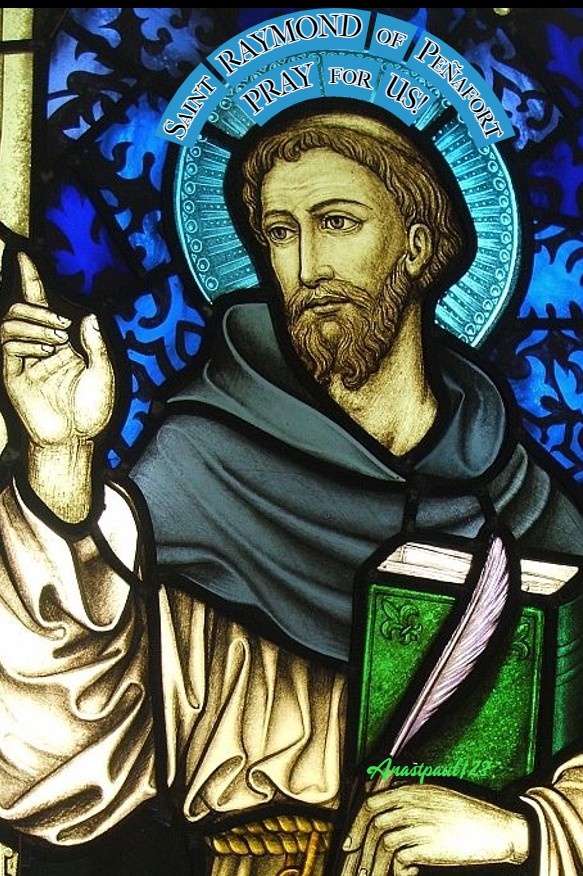
St Raymond of Peñafort OP (1175-1275) “Father of Canon Law” Dominican Priest, Doctor of Canon Law, the Third Master of the Order of Preachers, Founder of the Mercedarian friars, Writer, Teacher, Miracle-Worker. St Raymond of Peñafort’s Feast day was inserted in the General Roman Calendar in 1671 for celebration on 23 January. In 1969 it was moved to 7 January, the day after that of his death. He is the Patron Saint of canon lawyers, specifically and lawyers, in general. Biography: https://anastpaul.com/?s=st+raymond+penafort
St Abel the Patriarch St Agathangelus St Amasius of Teano St Aquila the Martyr St Asclas of Antinoe St Clement of Ancyra St Colman of Lismore St Dositheus of Gaza
St Ildephonsus (506-667) Archbishop of Toledo. Theologian, Scholar, Marian devotee, Writer, Evangeliser. Abbot Dom Guéranger calls him the Doctor of the Virginity of Mary. Saint Ildephonsus established the Feast of the Expectation of the Blessed Virgin Mary, which is still kept in some places on 18 December. Biography: https://anastpaul.wordpress.com/2018/01/23/saint-of-the-day-23-january-st-ildephonsus-607-667/
Bl Juan Infante St Jurmin St Lufthild St Maimbod (Died c 880) Martyr, Irish Pilgrim in France, Missionary Preacher, Bl Margaret of Ravenna St Martyrius of Valeria St Messalina of Foligno St Ormond of Mairé St Parmenas the Deacon St Severian the Martyr
Thought for the Day – 22 January – Meditations with Antonio Cardinal Bacci (1881-1971)
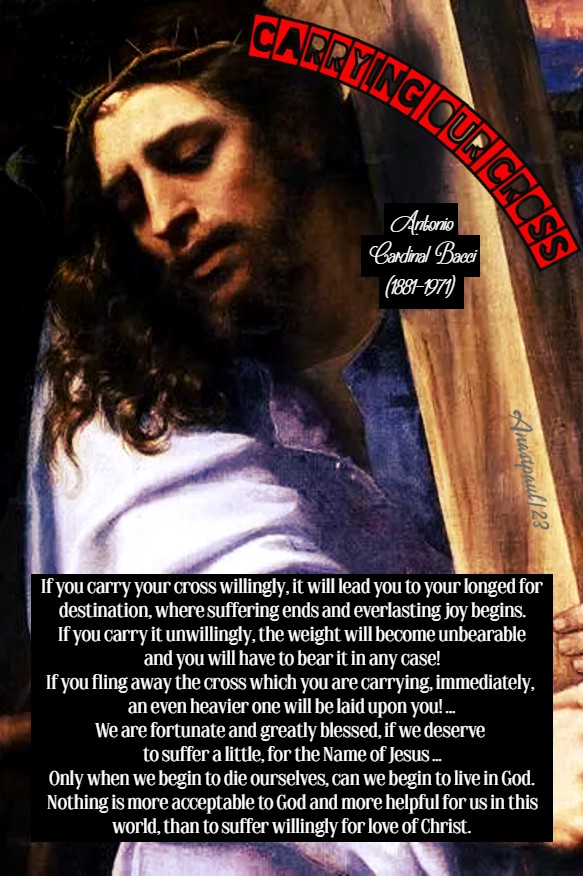
Carrying our Cross
“We also read in the Imitation of Christ: “No man has so heartfelt a sense of the Passion of Christ, as he whose lot it has been, to suffer like things.” (Imitation of Christ, Bk II, Ch 12) If you carry your cross willingly, it will lead you to your longed for destination, where suffering ends and everlasting joy begins. If you carry it unwillingly, the weight will become unbearable and you will have to bear it in any case! If you fling away the cross which you are carrying, immediately, an even heavier one will be laid upon you! Look upon them as wonderful consolations because, the sufferings of this life cannot be regarded as the measure of that glory which will be ours in Heaven … (Rom 8:18). We are fortunate and greatly blessed, if we deserve to suffer a little, for the Name of Jesus … Only when we begin to die ourselves, can we begin to live in God. Nothing is more acceptable to God and more helpful for us in this world, than to suffer willingly for love of Christ.”
Quote/s of the Day – 22 January – The Third Sunday after the Epiphany – Romans 12:16-21, Matthew 8:1-13 – Scripture search here: https://www.drbo.org/
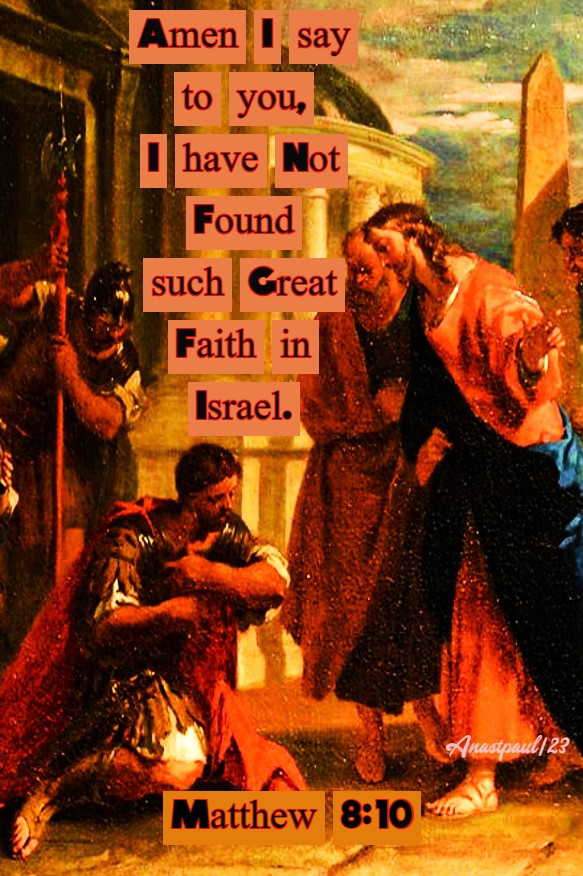
“Amen I say to you, I have not found such great faith in Israel.”
Matthew 8:10
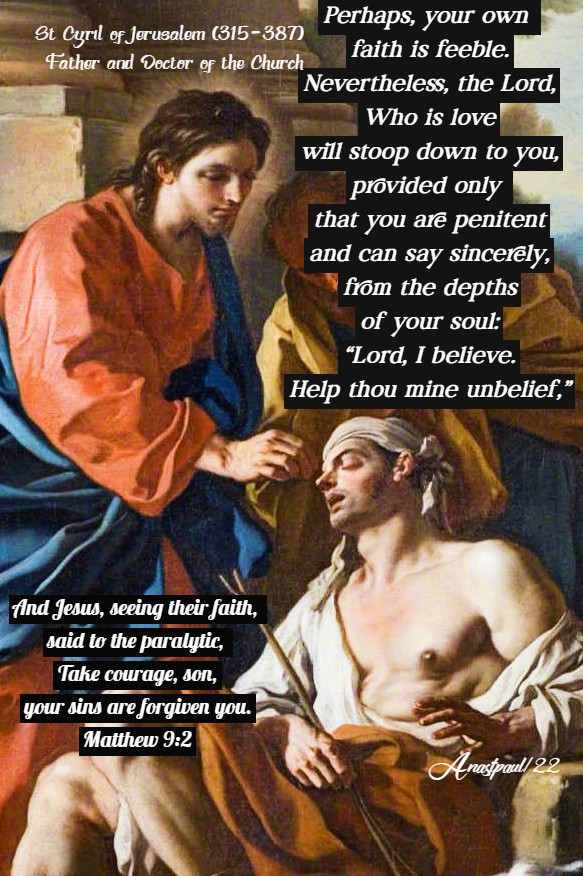
“And Jesus, seeing their faith, said to the paralytic, Take courage, son, your sins are forgiven you.”
Matthew 9:2
“Perhaps, your own faith is feeble. Nevertheless, the Lord, who is love will stoop down to you, provided only that you are penitent and can say sincerely, from the depths of your soul: “Lord, I believe. Help Thou mine unbelief,” (Mark 9:23)……”
St Cyril of Jerusalem (315-387) Father and Doctor of the Church
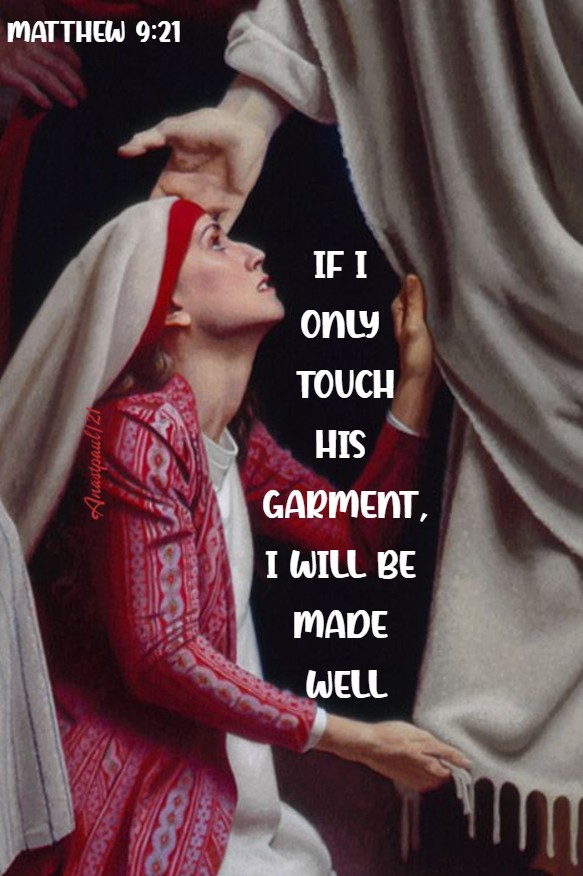
“If I only touch his garment, I will be made well.” Jesus turned and seeing her he said, “Take heart, daughter, your faith has made you well.” And instantly the woman was made well.”
Matthew 9:21-22
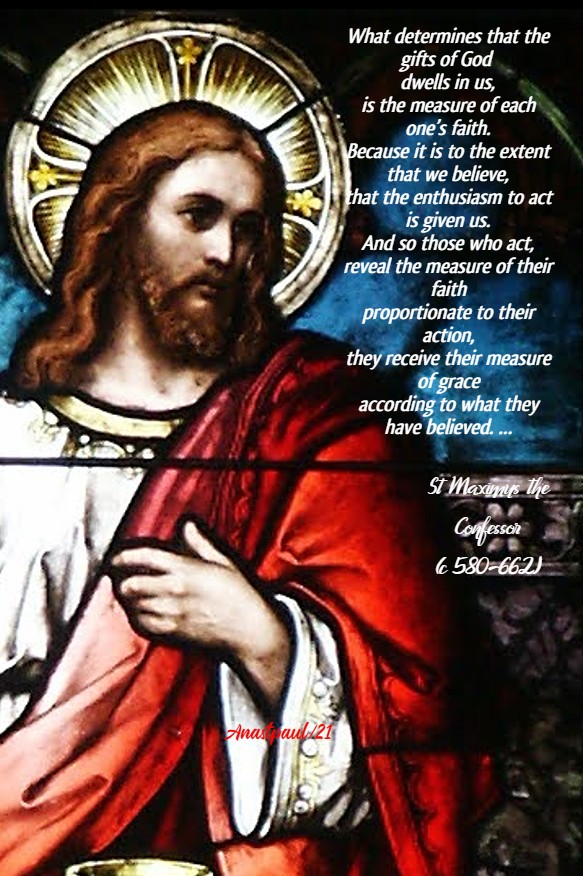
“What determines that the gifts of God dwells in us, is the measure of each one’s faith. Because it is to the extent that we believe, that the enthusiasm to act is given us. And so those who act, reveal the measure of their faith proportionate to their action, they receive their measure of grace according to what they have believed. …”
St Maximus the Confessor (c 580-662) Monk and Theologian
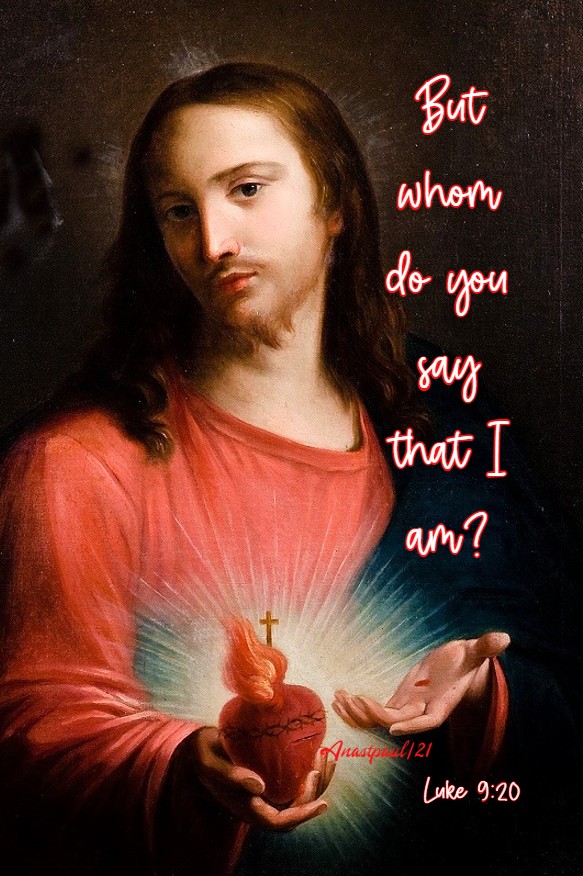
“But whom do you say that I Am?”
Luke 9:20
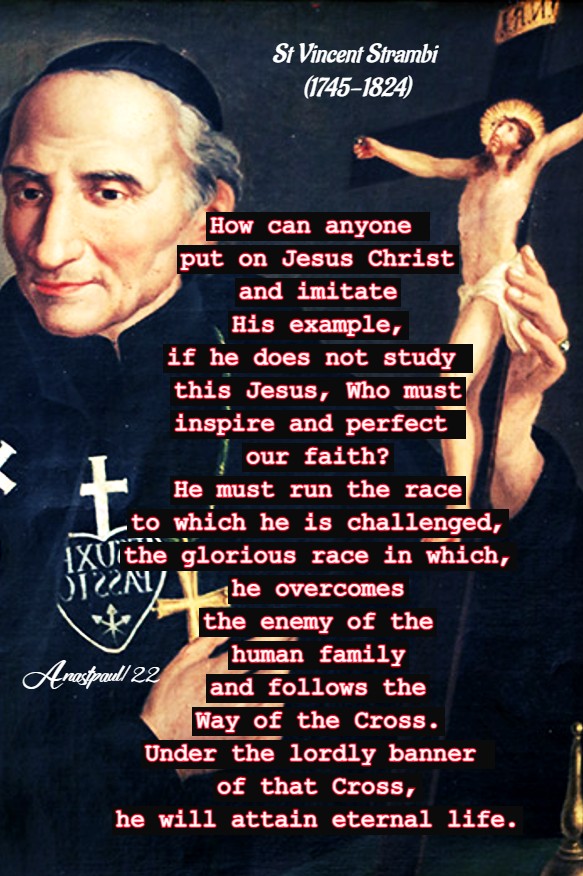
“… How can anyone put on Jesus Christ and imitate His example, if he does not study this Jesus, who must inspire and perfect our faith? He must run the race to which he is challenged, the glorious race in which, he overcomes the enemy of the human family and follows the Way of the Cross. Under the lordly banner of that Cross, he will attain eternal life.”
St Vincent Strambi CP (1745-1824)
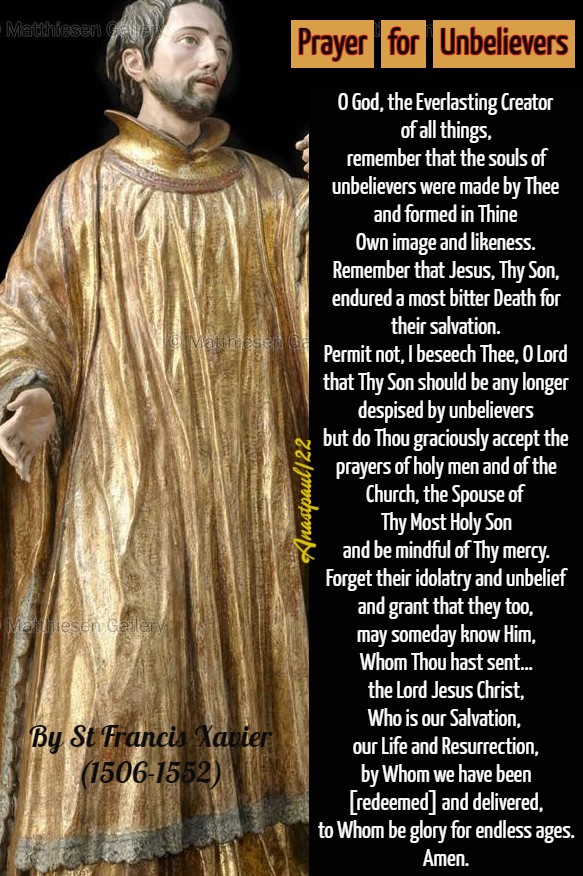
Prayer for Unbelievers By St Francis Xavier (1506-1552)
O God, the Everlasting Creator of all things, remember that the souls of unbelievers were made by Thee and formed in Thine own image and likeness. Remember that Jesus, Thy Son, endured a most bitter Death for their salvation. Permit not, I beseech Thee, O Lord that Thy Son should be any longer despised by unbelievers but do Thou graciously accept the prayers of holy men and of the Church, the Spouse of Thy Most Holy Son and be mindful of Thy mercy. Forget their idolatry and unbelief and grant that they too, may someday know Him, Whom Thou hast sent…the Lord Jesus Christ, Who is our Salvation, our Life and Resurrection, by Whom we have been [redeemed] and delivered, to Whom be glory for endless ages. Amen.
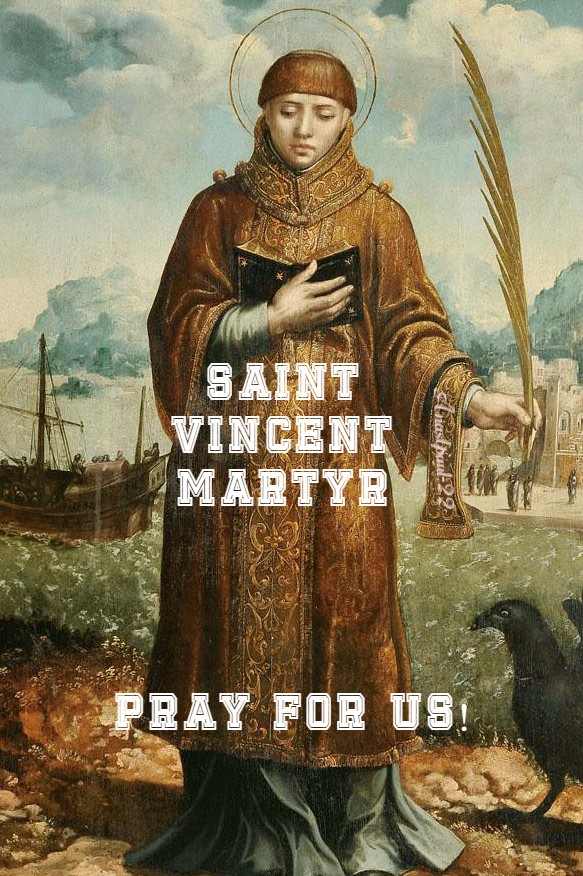
One Minute Reflection – 22 January – St Vincent of Saragossa (Died 304) Protomartyr of Spain and St Anastasius the Persian (Died 628) Martyr – The Third Sunday after the Epiphany – Romans 12:16-21, Matthew 8:1-13 – Scripture search here: https://www.drbo.org/
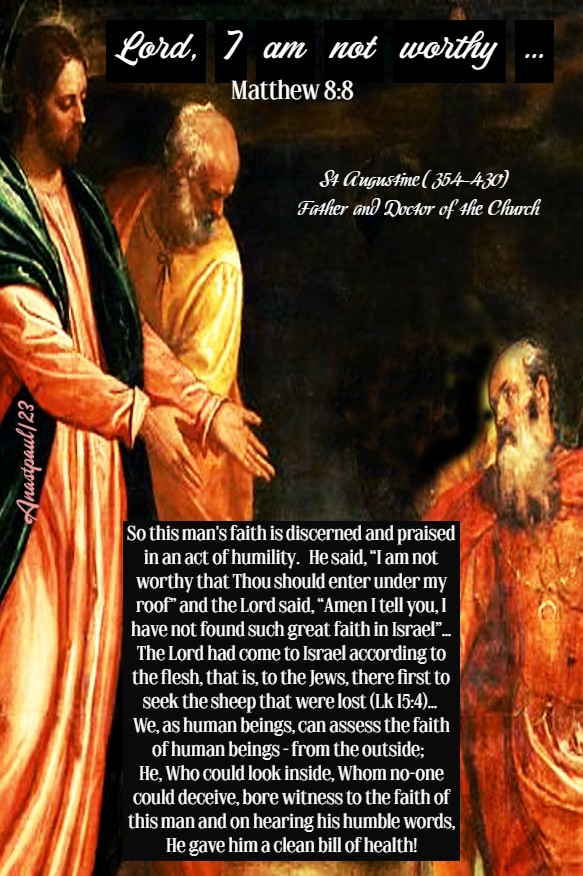
“Lord, I am not worthy … ”- Matthew 8:8
REFLECTION – “When the Gospel was read, we heard Jesus praise our faith in an act of humility. When the Lord Jesus, you remember, promised He would go to the centurion’s house to heal his servant, the man replied, “I am not worthy that Thou should enter under my roof but only say the word, and he will be healed”. By calling himself unworthy, he showed he was worthy to have Christ enter, not within his walls but within his heart…
There would, after all, have been no great benefit if the Lord Jesus had entered within his walls and had not been in his bosom. Christ, the teacher of humility, by both word and example, had, you may remember, sat down in the house of a certain proud Pharisee called Simon (Lk 7:36). And although He was sitting in his house, there wasn’t anywhere in his heart, where the Son of man might lay His Head (Lk 9,58)… But into this centurion’s house, He did not enter, yet, he took possession of his heart…
So this man’s faith is discerned and praised in an act of humility. He said, “I am not worthy that Thou should enter under my roof” and the Lord said, “Amen I tell you, I have not found such great faith in Israel”… The Lord had come to Israel according to the flesh, that is, to the Jews, there first to seek the sheep that were lost (Lk 15:4)… We, as human beings, can assess the faith of human beings – from the outside; He, Who could look inside, Whom no-one could deceive, bore witness to the faith of this man and on hearing his humble words, He gave him a clean bill of health!” – St Augustine (354-430) Bishop of Hippo, Father and Doctor of the Church (Sermon 62).
PRAYER – Give heed to our humble prayers, O Lord, that we who know we are guilty of our own sin, may be saved by the intercession of Thy blessed Martyrs Vincent and Anastasius.Through Jesus Christ, Thy Son our Lord, Who lives and reigns with Thee, in the unity of the Holy Ghost, God, world without end. Amen (Collect).
Our Morning Offering – 22 January – The Third Sunday after the Epiphany
Give Me Thyself, O My God By St Augustine (354-430) Father and Doctor of Grace
Give me Thyself, O my God, give Thyself to me. Behold I love Thee and if my love is too weak a thing, grant me to love Thee more strongly. I cannot measure my love to know how much it falls short of being sufficient but let my soul hasten to Thy embrace and never be turned away, until it is hidden in the secret shelter of Thy Presence. This only do I know, that it is not good for me when Thou art not with me, when Thou art only outside me. I want Thee in my very self. All the plenty in the world which is not my God, is utter want. Amen
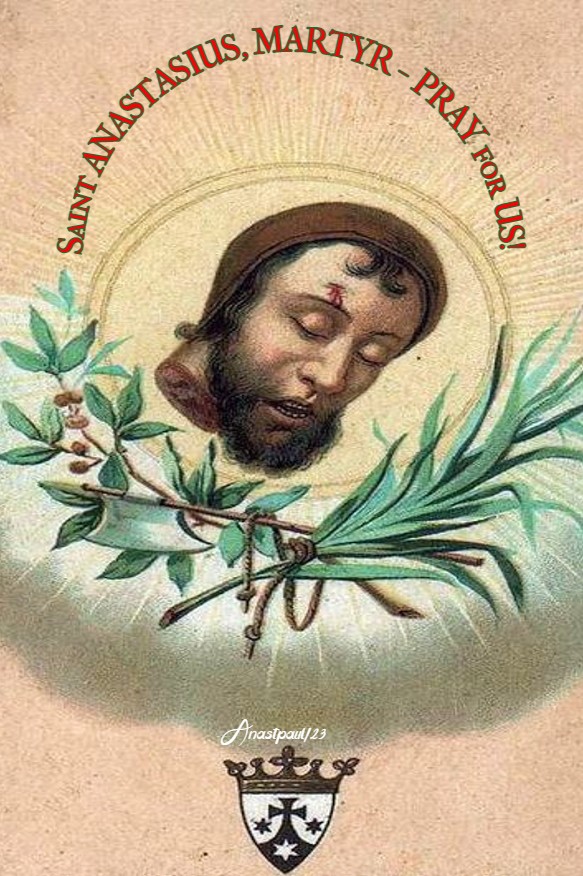
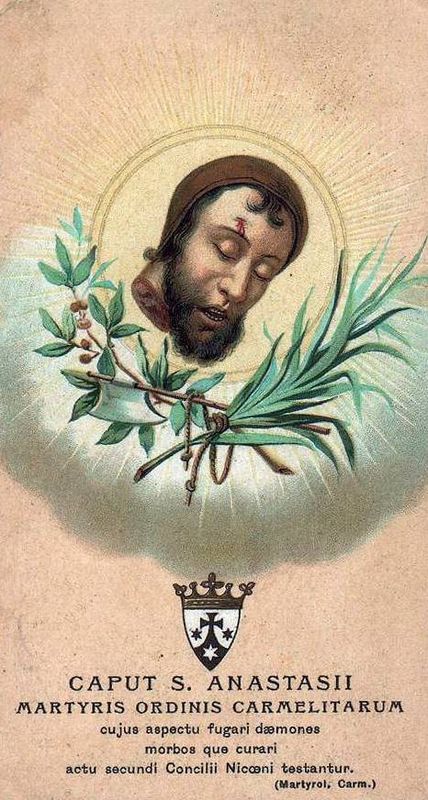
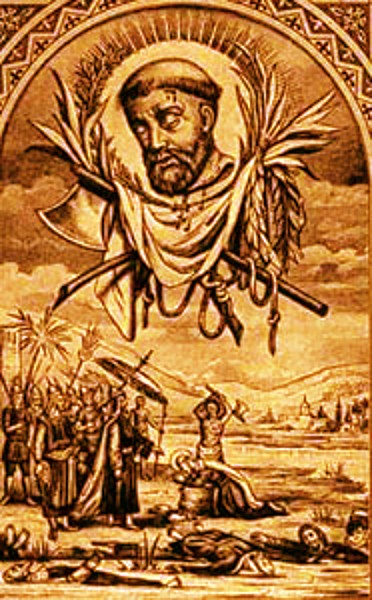
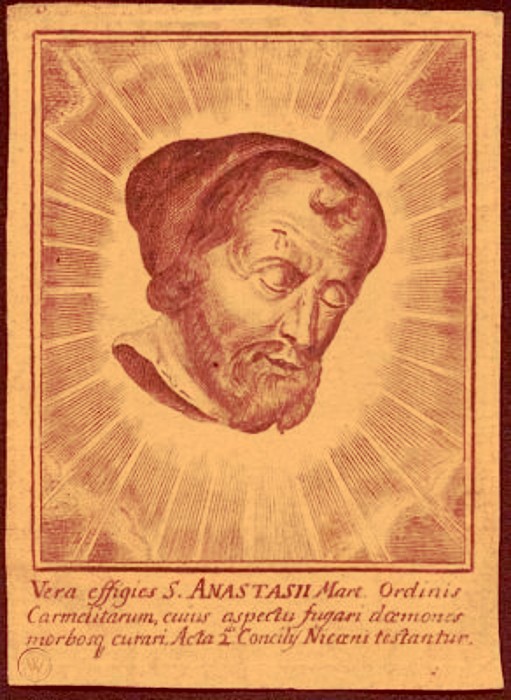
Saint of the Day – 21 January – St Anastasius the Persian (Died 628) Martyr, Monk. Born in Persia as Magundat and died by strangulation and beheading in 628 in Persia. Patronages – against headaches, of goldsmiths.
The Roman Martyrology reads: “At Rome, at Aquiae, Salviae, St Anastasius, a Persian Monk, who, after suffering much at Caesarea in Palestine, from imprisonment, stripes and fetters, had to bear many afflictions from Chosroes, King of Persia, who caused him to be beheaded. He had sent before him, to Martyrdom, seventy of his companions, who were precipitated into rivers. His head was brought to Rome, together with his venerable likeness, by the sight of which, the demons are expelled and diseases cured, as is attested by the Acts of the Second Council of Nicacea.”
Anastasius was born in the City of Ray. He was the son of a Magian named Bau. He had a brother whose name is unknown. He was a cavalryman in the army of Khosrow II (590–628) and participated in the capture of the True Cross in Jerusalem which was carried to the Sasanian capital.
The occasion prompted him to ask for information about the Christian religion. He then experienced a conversion of faith, left the army, became a Christian and then a Monk at the Monastery of Saint Savvas (Mar Saba) in Jerusalem.
Anastasius was baptised by St Modestus, the Bishop of Jerusalem, receiving the Christian name Anastasius to honour the Resurrection of Jesus Christ (anástasis” in Greek meaning resurrection).
After seven years of the monastic observance, he was moved by the Holy Ghost to go in quest of Martyrdom and went to Caesarea, then subject to the Sasanians. There he interrupted and ridiculed the pagan priests for their religion and was, as a result, arrested by the local governor, taken prisoner, cruelly tortured to make him deny Christ and finally carried down near the Euphrates river, where his tortures was continued, while at the same time, the highest honours in the service of King Khosrow II, as a Magi, were promised him, if he would renounce Christianity.
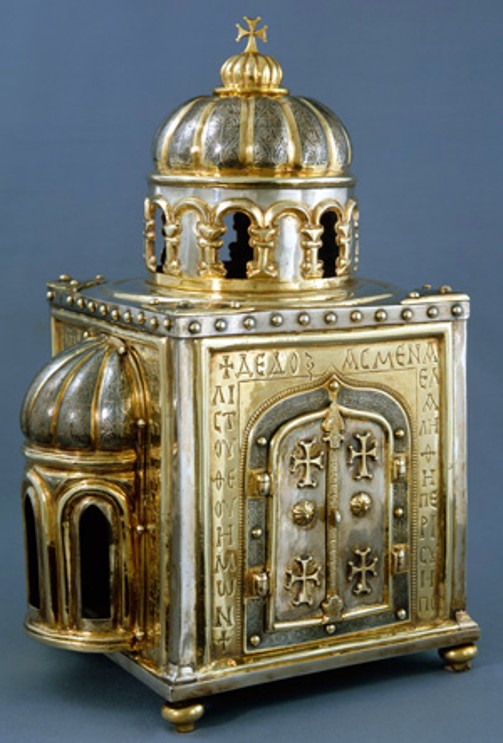
Finally, after refusing to renounce Christ, with seventy others, he was strangled to death and decapitated on 22 January 628. His body, which was thrown to the dogs but was left untouched by them, was carried from there to Palestine, then to Constantinople and finally, to Rome, where the relics were venerated at the Tre Fontane Abbey.
A Passio written in Greek, was devoted to the Saint. An adapted Latin translation, possibly by Archbishop Theodore of Canterbury, was available to the Anglo-Saxon Historian, the Venerable St Bede, who criticised the result and took it upon himself to improve it. There are sadly, no surviving manuscripts of St Bede’s revision, although one copy did survive to the 15th Century.
St Antonio della Chiesa St Blaesilla of Rome St Brithwald of Ramsbury St Caterina Volpicelli St Dominic of Sora
Blessed Giuseppe Giaccardo SSP (1896-1948) St Guadentius of Novara
Blessed Maria Mancini of Pisa OP (1356-1431) Widow, Second Order Sister of the Order of Preachers, spiritual disciple of St Catherine of Siena, Prioress, Mystic, Reformer, Apostle of the poor and the sick. The Roman Martyrology states: “In Pisa, Blessed Maria Mancini, who, twice widowed and all her children lost, under the exhortation of St Catherine of Siena, began community life in the Monastery of St Domenic, which she led for ten years.” Her Life: https://anastpaul.com/2022/01/22/saint-of-the-day-22-january-blessed-maria-mancini-of-pisa-op-1356-1431/
Bl Walter of Himmerode Bl William Patenson
Martyrs of Puigcerda: St Orontius St Victor St Vincent
Thought for the Day – 21 January – Meditations with Antonio Cardinal Bacci (1881-1971)
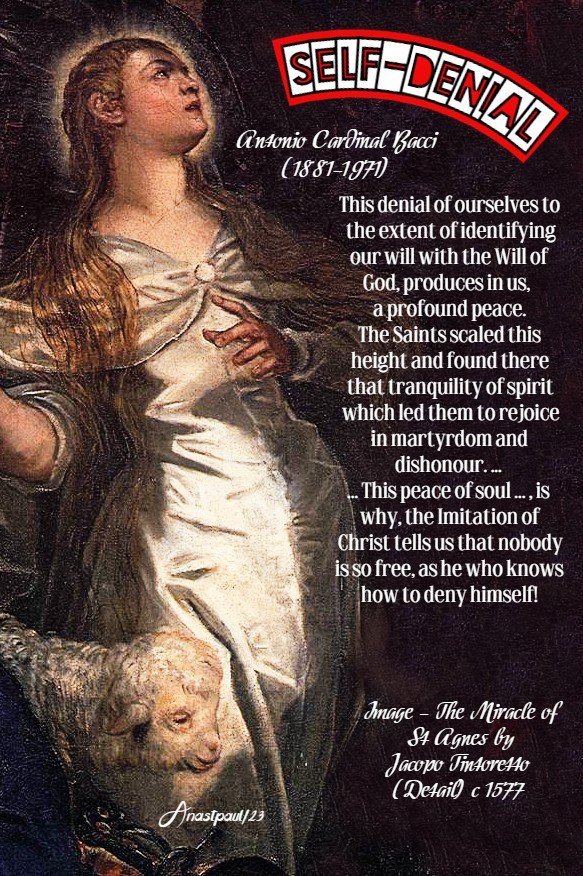
Self-Denial
“This denial of ourselves to the extent of identifying our will with the Will of God, produces in us, a profound peace. The Saints scaled this height and found there that tranquility of spirit which led them to rejoice in martyrdom and dishonour.
It was this peace of soul which made the dying St Aloysius Gonzaga smile and say: “I am happy to be going.” It was this which enabled the saintly, Cardinal Fisher, when he was going to the scaffold, to behold a light which does not fail and say: “Commit to the Lord your way … He will make justice dawn for you like the light (Ps 36:5-6). This too, is why, the Imitation of Christ tells us that nobody is so free, as he who knows how to deny himself!””
Quote/s of the Day – 21 January – “The Month of the Most Holy Name of Jesus” – St Agnes (c 291- c 304) Virgin and Martyr – Ecclesiasticus 51:1-8, 12, Matthew 25:1-13 – Scripture search here: https://www.drbo.org/
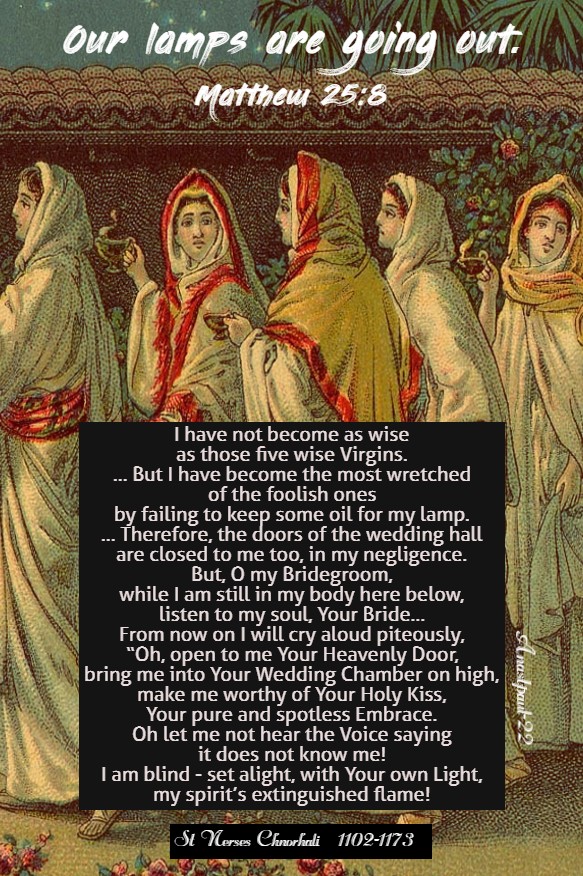
“Our lamps are going out.”
Matthew 25:8
“I have not become as wise as those five wise Virgins. … But I have become the most wretched of the foolish ones by failing to keep some oil for my lamp, namely, mercy together with virginity or, still more, the anointing from Baptism’s Sacred fount…
Therefore, the doors of the wedding hall are closed to me too, in my negligence. But, O my Bridegroom, while I am still in my body here below, listen to my soul, Your Bride… From now on, I will cry aloud piteously, “Oh, open to me Your Heavenly Door, bring me into Your Wedding Chamber on high, make me worthy of Your Holy Kiss, Your pure and spotless Embrace. Oh let me not hear the Voice saying it does not know me! I am blind; set alight with Your own Light my spirit’s extinguished flame!”
St Nerses Chnorhali (1102-1173) Armenian Bishop
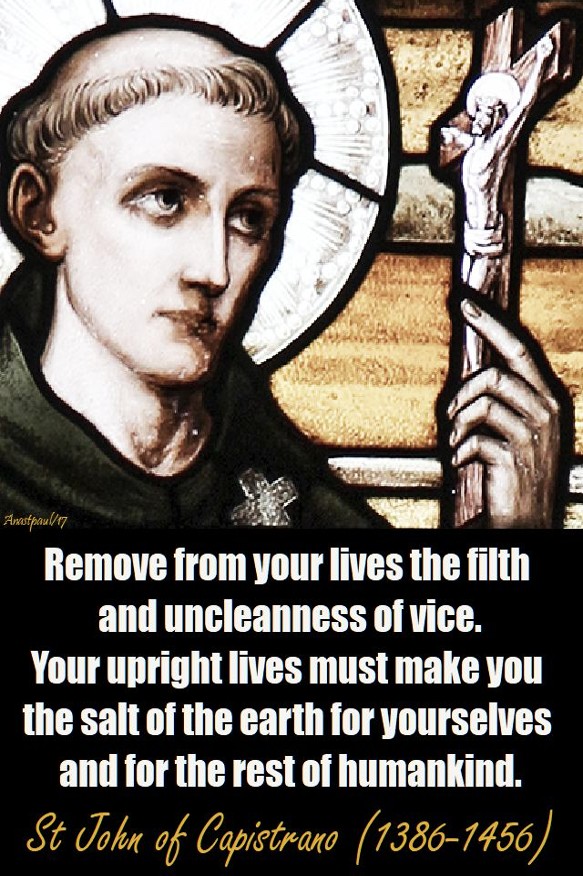
“Remove from your lives the filth and uncleanness of vice. Your upright lives must make you the salt of the earth for yourselves and for the rest of humankind…”
St John of Capistrano OFM (1386-1456)
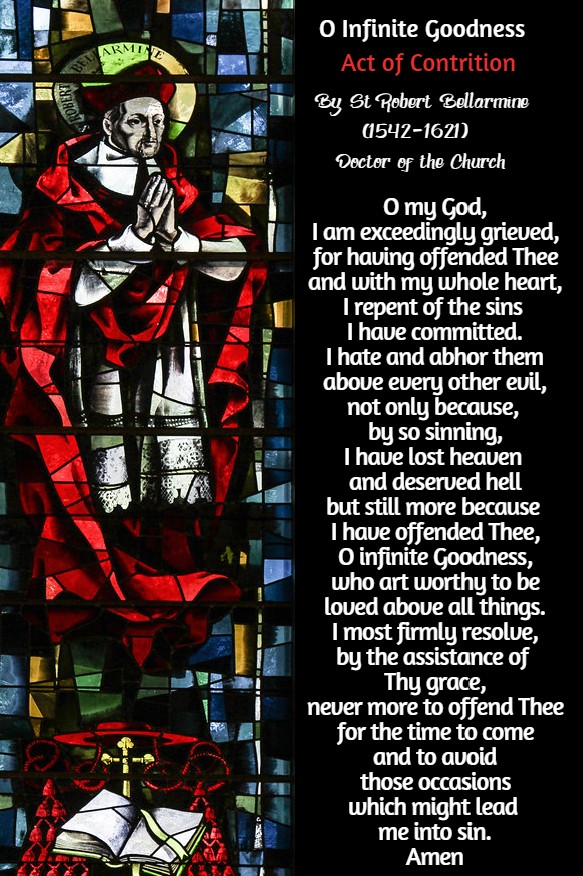
O Infinite Goodness – Act of Contrition By St Robert Bellarmine (1542-1621) – Doctor of the Church
O my God, I am exceedingly grieved, for having offended Thee and with my whole heart, I repent of the sins I have committed. I hate and abhor them above every other evil, not only because, by so sinning, I have lost heaven and deserved hell but still more because I have offended Thee, O infinite Goodness, who art worthy to be loved above all things. I most firmly resolve, by the assistance of Thy grace, never more to offend Thee for the time to come and to avoid those occasions which might lead me into sin. Amen
One Minute Reflection – 21 January – “The Month of the Most Holy Name of Jesus” – St Agnes (c 291- c 304) Virgin and Martyr – Ecclesiasticus 51:1-8, 12, Matthew 25:1-13 – Scripture search here: https://www.drbo.org/
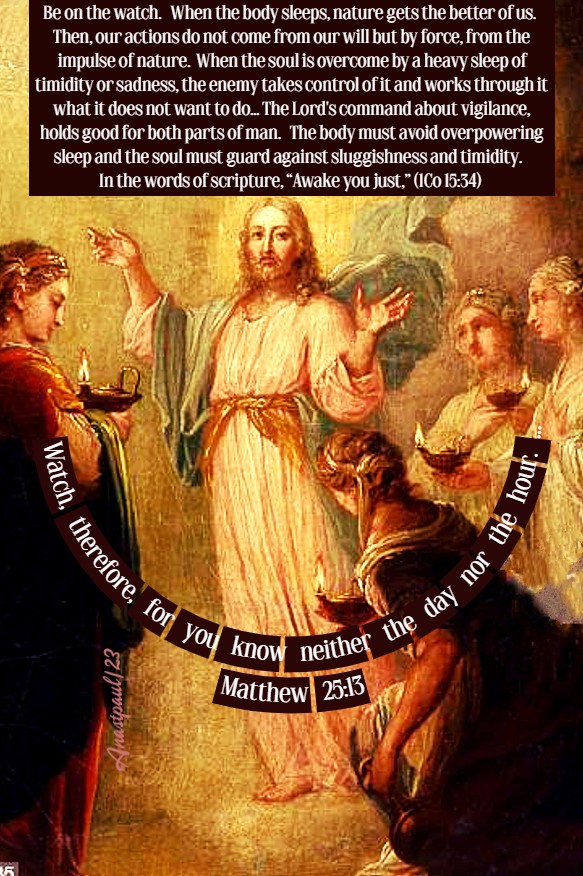
“Watch, therefore, for you know neither the day nor the hour.” – Matthew 25:13
REFLECTION – “To prevent His disciples from questioning Him about the time of His Coming, Christ said, ‘Of that hour no-one knows, neither the Angels nor the Son. It is not for you to know the times or moments.’ (Mt 24:36; Apoc 1:7). He hid the time from us, so that we would be on the watch and so, that each of us might think that the Coming will happen in His own lifetime…
Be on the watch. When the body sleeps, nature gets the better of us. Then, our actions do not come from our will but by force, from the impulse of nature. When the soul is overcome by a heavy sleep of timidity or sadness, the enemy takes control of it and works through it what it does not want to do… The Lord’s command about vigilance, holds good for both parts of man. The body must avoid overpowering sleep and the soul must guard against sluggishness and timidity. In the words of scripture, “Awake you just,” (1Co 15:34) and “I rose up and Am still with you,” (Ps 138:18) and “Do not lose heart” (cf Ep 3:13)…
“Five of them were foolish and five of them were prudent,” the Lord says. Their virginity had nothing to do with Him calling them wise, for they were all virgins but rather, their good works. Even though your chastity is of angelic holiness, note well that the Angels’ holiness is free of all envy or other evil. So even though you are not rebuked for impurity, take care not to be so, for impatience or anger either… “Gird your loins” so that chastity may lighten our steps. “And light your lamps” (Lk 12:35) because the world is black as night, it stands in need of the light of the upright. “Your light must shine before others, that they may see your good deeds and glorify your heavenly Father” (Mt 5:16).” – St Ephrem (306-373) Deacon in Syria, Father and Doctor of the Church [Commentary on the Diatessaron, 18, 15f. ; SC 121] (trans. cf Breviary).
PRAYER – Almighty, eternal God, Thou Who choose the weak things of the world to confound the strong, mercifully grant that we, who are celebrating the feast of blessed Agnes, Thy Virgin and Martyr, may reap the benefit of her patronal intercession with Thee. Through Jesus Christ, Thy Son our Lord, Who lives and reigns with Thee, in the unity of the Holy Ghost, God, world without end. Amen (Collect).
Our Morning Offering – 21 January – Mary’s Saturday
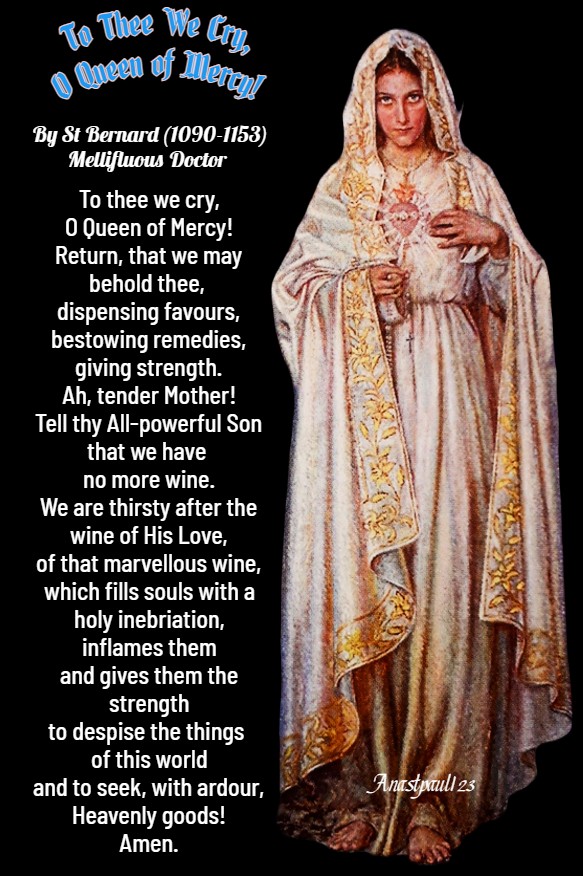
To Thee We Cry, O Queen of Mercy! By St Bernard (1090-1153) Mellifluous Doctor of the Church
To thee we cry, O Queen of Mercy! Return, that we may behold thee, dispensing favours, bestowing remedies, giving strength. Ah, tender Mother! Tell thy All-powerful Son that we have no more wine. We are thirsty after the wine of His Love, of that marvellous wine, which fills souls with a holy inebriation, inflames them and gives them the strength to despise the things of this world and to seek, with ardour, Heavenly goods. Amen.
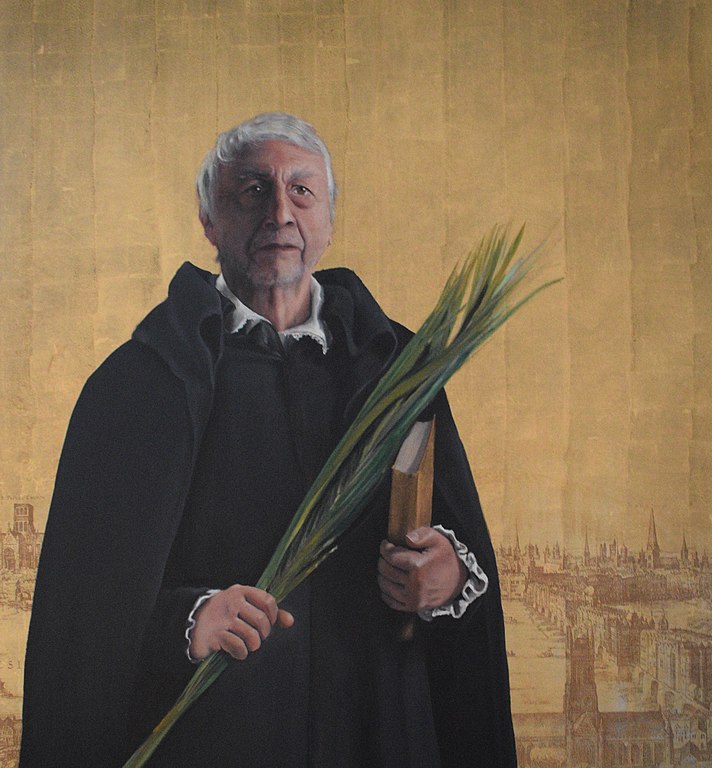
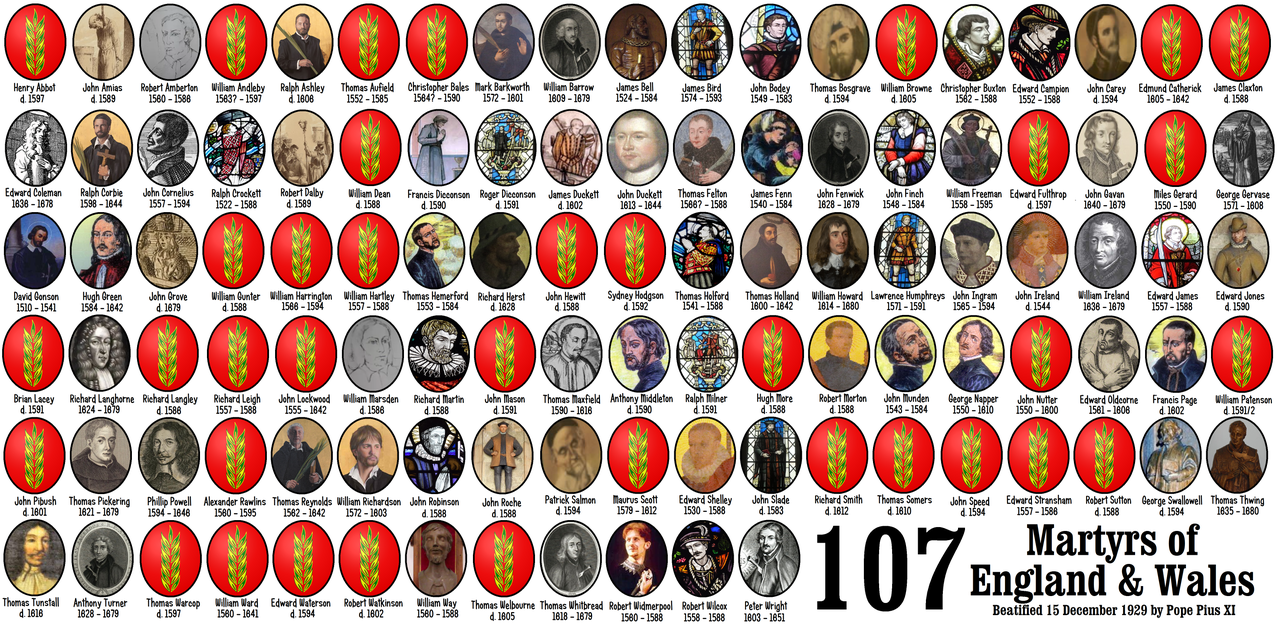
Saint of the Day – 21 January – Blessed Thomas Reynolds (1562-1642) Priest Marty.r Born in 1562 in Oxfordshire, England as Thomas Green and died by being hanged, drawn, and quartered on 21 January 1642 at Tyburn, London, England. Also known as – Richard Reynolds (not to be confused with the Saint of the same name, of the Order of Bridgettine Monks executed in England by Henry VIII), Thomas Green. Additional Memorials – 4 May as one of the 107 Martyrs of England and Wales, also known as Thomas Hemerford and One Hundred and Six Companion Martyrs, 29 October as one of the Martyrs of Douai, 1 December as one of the Martyrs of Oxford University. Thomas was Beatified on 15 December 1929 by Pope Pius XI.
Painting in of Blessed Thomas in the English College, Valladolid, Spain
We believe Thomas was born in Oxfordshire (or possibly Warwickshire) into a Catholic family. In keeping with the necessity of the times, he left England to study for the Priesthood on the continent, initially going to Rheims before continuing his studies from September 1590 in the English College, at Valladolid, Spain, as one of its first students and finally, at another newly founded Jesuit institution, the English College of St Gregory in Seville.
Thomas was Ordained a Priest in Seville in 1592 and immediately returned to England, where he ministered to the recusant Catholic community until his arrest in 1606, in the wave of anti-Catholic measures that were taken, following the Gunpowder Plot of November 1605. Whilst the duration of his early years of ministry reflected the slightly less difficult times for Catholics during that period, the Gunpowder Plot changed the atmosphere, making it far more hostile.
Thomas was one of the Priests who were fortunate, in being just exiled from England rather than immediately Martyred, in response to the Plot. However, he soon returned and once more set about caring for Catholics in secret. This he continued for about twenty years until he was arrested in 1628.
He was put on trial and condemned to death but given a reprieve at the behest of the Queen, Henrietta Maria, wife of Charles I, a Catholic. Although imprisoned, he was kept under relatively mild conditions which included being allowed to receive visitors readily. Many Catholics visited him, not only to offer him care and support but also for his spiritual guidance and the Sacraments.
In 1635 he was one of a number of Priests who would pay a bond and then be released from prison which allowed him to minister to the local Catholic population in London on a regular basis. With the Crown at that time having Catholic sympathies and the rather more anti-Catholic feelings of Parliamentarians being diffused due to Parliament’s long suspension, this was a period when the pressures on Catholics were eased. It was due to this that a number of Priests were able to act in a similar manner to Thomas.
The financial needs of King Charles I forced him to recall Parliament in 1640. At this time, Parliament was increasingly being dominated by Puritan protestants who were hostile to Catholicism. As a result, conditions for Catholics and Priests became far more difficult with Priests, once more, being confined full time to their prisons. The trials and death sentences for Priests resumed and one of the early victims was Thomas. Now eighty years of age, by nature a gentle and slightly timid person and being somewhat infirm, Thomas admitted his fears of facing execution and how he would be able to manage the ordeal he was soon to undergo. He spent his final couple of days in prayer and asking for the prayers of his fellow Priests, imprisoned with him.
On the morning of his execution, 21 January 1642, Thomas was embued by grace with a sense of complete peace and serenity. He had been filled with the courage and strength of Christ, so much so, that he was no longer afraid of what lay ahead and using supplies that had been brought to him in prison, he said his final Holy Mass, before being summoned to his execution.
On arrival at Tyburn, he addressed the assembled crowd for nearly half-an-hour. He pointed out that in forty years work as a Priest in England, no-one could testify to him having ever uttered a word of treason and that his sole aim had been to ‘reduce strayed souls to the fold of the Catholic Church.’ He added that he had no desire to criticise or meddle with the actions of Parliament but rather, that God would bless them and teach them what to do best for the kingdom. He extended his prayers to the King and Queen and all the Kingdom which he hoped would flourish. He concluded by asking forgiveness of all he had offended and granting forgiveness to any, who sought it for actions against him, particularly in regard to his imminant death. Turning to the sheriff overseeing the execution, he specifically thanked him and for his patience whilst he addressed the crowd and prayed, that God would reward him for that, by one day making him a saint in Heaven. The sheriff in turn commended himself to Reynolds and was heard to remark to one of those present that he had never seen a man die like Thomas. Having finished his address, Thomas knelt to pray. He and Roe were placed in the cart, embraced one another, then recited the Miserere Psalm in turn, until the cart was pulled away.
When the sheriff offered Thomas a blindfold, he replied: “I dare look death in the face.” The sheriff allowed the Martyrs to hang till they expired to spare them the suffering of being drawn and quartered, which he only carried out after they were dead. Catholics amongst the crowd, of which there were found to be many, came forwards to dip cloths in their blood to provide Relics for veneration.
Thomas Reynolds was Beatified by Pope Pius XI on 15 December 1929, therefore, he is among the group of One Hundred and Seven Martyrs of England and Wales. On the image below, our Blessed Thomas Reynolds appears at no 81, the 5th image on the second-last row.
St Agnes of Aislinger St Anastasius of Constantinople St Aquila of Trebizond St Brigid of Kilbride St Candidus of Trebizond Bl Edward Stransham
St Epiphanius of Pavia (c 439–496) Bishop of Pavia, Italy from from 466 until his death. Papal and Secular Mediator and Peacemaker, Known as – “Epiphanius the Peacemaker,” “The Glory of Italy,” “The Light of Bishops.” The Roman Martyrology for 21 January reads : “In Pavia, Saint Epifanio, Bishop , who, at the time of the barbarian invasions, worked zealously for the reconciliation of the peoples, for the liberation of prisoners and for the reconstruction of the destroyed City.” Biography: https://anastpaul.com/2022/01/21/saint-of-the-day-21-january-saint-epiphanius-of-pavia-439-496/
St Eugenius of Trebizond St Gunthildis of Biblisheim
Blessed Josefa María Inés de Benigánim OAD (1625–1696) Nun of the Discalced Augustinian Nuns with the religious name of “Josefa María of Saint Agnes,” Virgin, Mystic, gifted with the charism of prophecy and counsel. She became known for her profound spiritual and theological insight as well as for her severe austerities she practised during her life. Her body is incorrupt. Blessed Josefa was Beatified on 26 February 1888, at Saint Peter’s Basilica by Pope Leo XIII. Biography: https://anastpaul.com/2020/01/21/saint-of-the-day-21-january-blessed-josefa-maria-ines-de-beniganim-oad-1625-1696/
St Lawdog St Maccallin of Waulsort
St Meinrad of Einsiedeln OSB (c 797–861) “Martyr of Hospitality,” Martyr, Priest, Monk, Hermit. In 1039, the year of Meinrad’s Canonisation as a Saint, his remains were brought back to Einsiedeln. During the French Revolution, Meinrad’s relics were hidden at Tyrol, Austria, by Abbot Conrad Tanner and his reliquary is now enshrined in the Grace Chapel of the Abbey Church at Einsiedeln. St Meinrad’s Life and Death: https://anastpaul.com/2021/01/21/saint-of-the-day-21-january-saint-meinrad-of-einsiedeln-osb-c-797-861-martyr/
St Patroclus of Troyes St Publius of Malta (Died c 112) Bishop Blessed Thomas Reynolds (1562-1642) Priest Martyr St Valerian of Trebizond St Vimin of Holywood St Zacharias the Angelic
Mercedarian Nuns of Berriz – Three pious Mercedarian Nuns at the Monastery of Vera Cruz, Berriz, Spain who are remembered together on the Mercedarian calendar – Cristina, Mary Magdalene and Mary of Jesus.
Blessed Martyrs of Laval – 19 Beati: Fifteen men and four women who were Martyred in Laval, France by anti-Catholic French Revolutionaries. The were born in France and they were Martyred on several dates in 1794 in Laval, Mayenne, France. They were Beatified on 19 June 1955 by Pope Pius XII at Rome, Italy.
Blessed André Duliou
Blessed Augustin-Emmanuel Philippot
Blessed François Duchesne
Blessed François Migoret-Lamberdière
Blessed Françoise Mézière
Blessed Françoise Tréhet
Blessed Jacques André
Blessed Jacques Burin
Blessed Jean-Baptiste Triquerie
Blessed Jean-Marie Gallot
Blessed Jeanne Veron
Blessed John Baptist Turpin du Cormier
Blessed Joseph Pellé
Blessed Julien Moulé
Blessed Julien-François Morin
Blessed Louis Gastineau
Blessed Marie Lhuilier
Blessed Pierre Thomas
Blessed René-Louis Ambroise
Martyrs of Rome – 30 Saints: Thirty Christian soldiers executed together in the persecutions of Diocletian. They were Martyred in 304 in Rome, Italy.
Martyrs of Tarragona: Augurius, Eulogius, Fructuosus.
Thought for the Day – 20 January – Meditations with Antonio Cardinal Bacci (1881-1971)
Blessed are the Poor
“Those who are really poor should not be too disturbed. If they are resigned to their poverty and are not consumed by the desire for riches, the blessing of the Gospel is theirs. Let them remember that when Jesus became Man, in order to redeem us, He did not choose to be wealthy. He chose to be the poorest of men. Similarly, Our Blessed Lady, St Joseph and all the Saints, were free from all desire of worldly possessions, so that there was room in their hearts only for God, their supreme good. Let them remember too, for their cosolation that it is much easier for them to gain Heaven because they are not weighed down by worldly cares.
Let us all love and aim at acquiring the true riches of the spirit, which are to be found now in the practice of virtue and later in Heaven.”
Quote/s of the Day – 20 January – St Fabian, Pope, and St Sebastian – Martyrs – Hebrews 11:33-39, Luke 6:17-23 – Scripture search here: https://www.drbo.org/
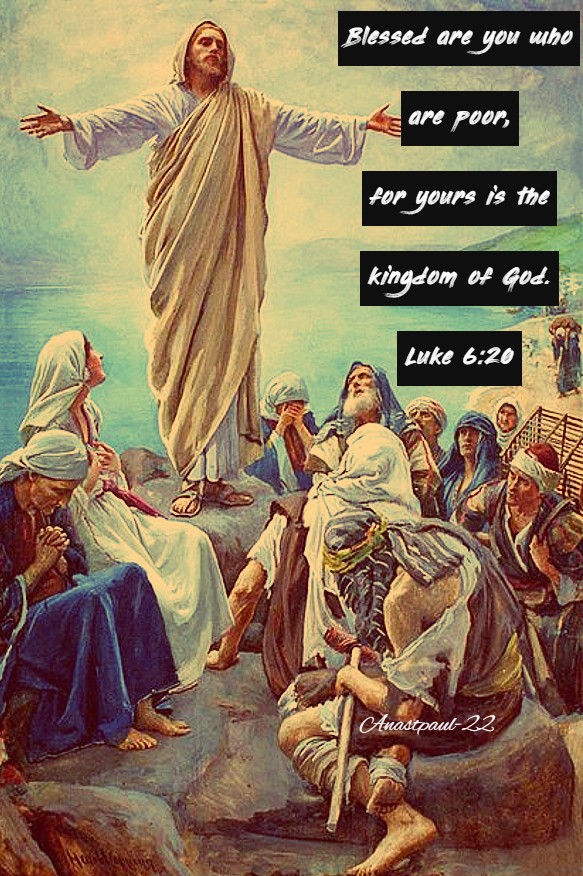
“Blessed are you who are poor, for yours is the Kingdom of God.”
Luke 6:20
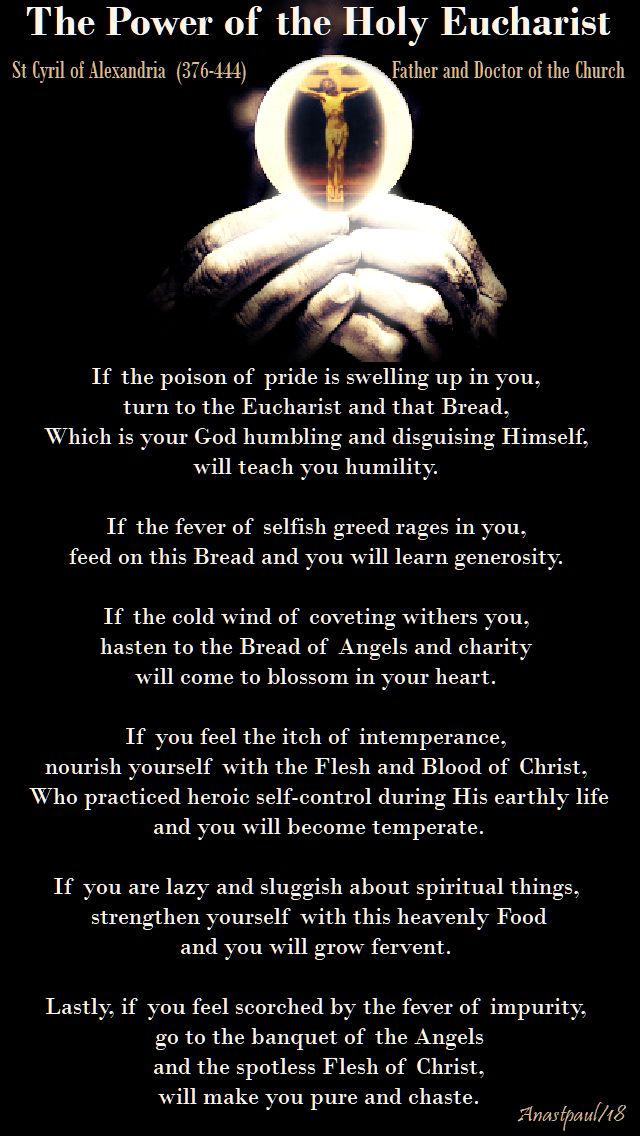
“If the poison of pride is swelling up in you, turn to the Eucharist and that Bread, Which is your God humbling and disguising Himself, will teach you humility.
If the fever of selfish greed rages in you, feed on this Bread and you will learn generosity.
If the cold wind of coveting withers you, hasten to the Bread of Angels and charity will come to blossom in your heart.
If you feel the itch of intemperance, nourish yourself with the Flesh and Blood of Christ, Who practiced heroic self-control during His earthly life and you will become temperate.
If you are lazy and sluggish about spiritual things, strengthen yourself with this heavenly Food and you will grow fervent.
Lastly, if you feel scorched by the fever of impurity, go to the banquet of the Angels and the spotless Flesh of Christ, will make you pure and chaste.”
St Cyril of Alexandria (376-444) Father and Doctor
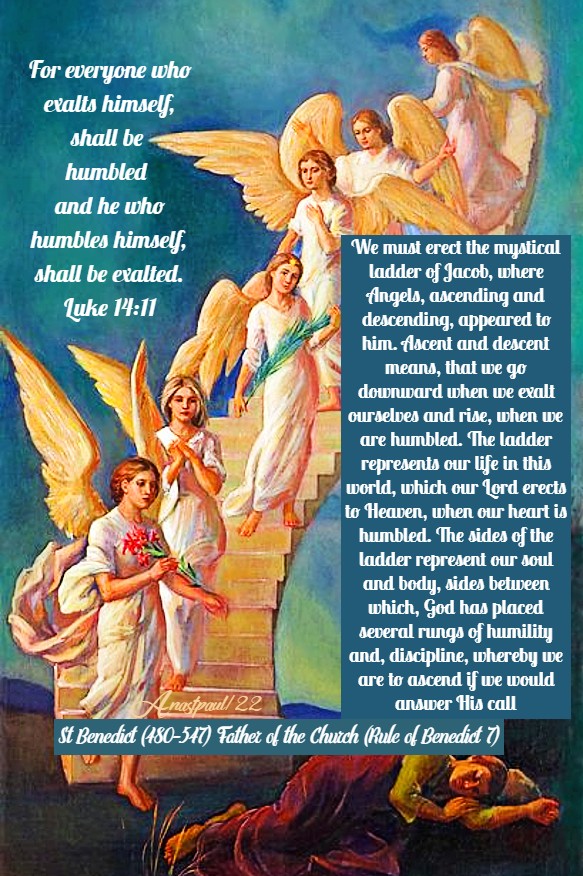
“For everyone who exalts himself, shall be humbled and he who humbles himself, shall be exalted.”
Luke 14:11
“We must erect the mystical ladder of Jacob, where Angels, ascending and descending, appeared to him. Ascent and descent means, that we go downward when we exalt ourselves and rise, when we are humbled. The ladder represents our life in this world, which our Lord erects to Heaven, when our heart is humbled. The sides of the ladder represent our soul and body, sides between which, God has placed several rungs of humility and, discipline, whereby we are to ascend if we would answer His call.”
(Rule of Benedict #7)
St Benedict (480-547) Father of the Church
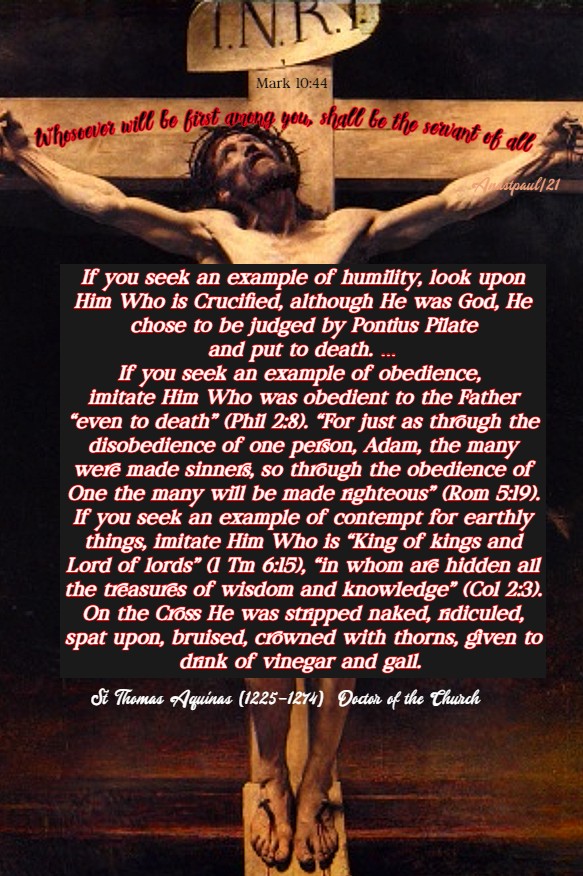
“If you seek an example of humility, look upon Him Who is Crucified, although He was God, He chose to be judged by Pontius Pilate and put to death. … If you seek an example of obedience, imitate Him Who was obedient to the Father “even to death” (Phil 2:8). “For just as through the disobedience of one person, Adam, the many were made sinners, so through the obedience of One, the many will be made righteous” (Rom 5:19). . If you seek an example of contempt for earthly things, imitate Him Who is “King of kings and Lord of lords” (1 Tm 6:15), “in whom are hidden all the treasures of wisdom and knowledge” (Col 2:3). On the Cross He was stripped naked, ridiculed, spat upon, bruised, crowned with thorns, given to drink of vinegar and gall.”
St Thomas Aquinas (1225-1274) Angelic Doctor of the Church
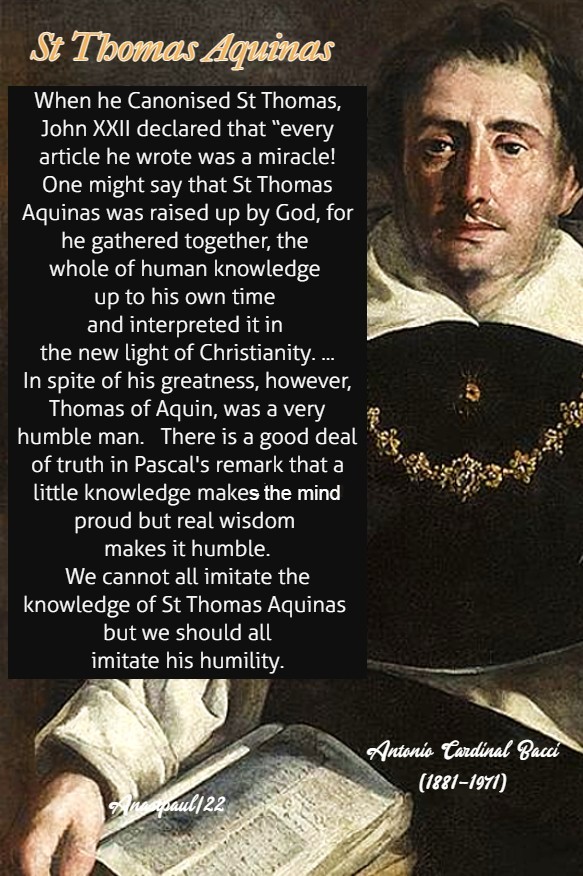
“When he Canonised St Thomas, John XXII declared that “every article he wrote was a miracle!” One might say that St Thomas Aquinas was raised up by God, for he gathered together, the whole of human knowledge up to his own time and interpreted it in the new light of Christianity. … In spite of his greatness, however, Thomas of Aquin, was a very humble man. There is a good deal of truth in Pascal’s remark that a little knowledge makes the mind proud but real wisdom, makes it humble. We cannot all imitate the knowledge of St Thomas Aquinas but we should all imitate his humility.”
One Minute Reflection – 20 January – “The Month of the Most Holy Name of Jesus” – St Fabian, Pope, and St Sebastian – Martyrs – Hebrews 11:33-39, Luke 6:17-23 – Scripture search here: https://www.drbo.org/
“Blessed are you who are poor, for yours is the Kingdom of God.” – Luke 6:20
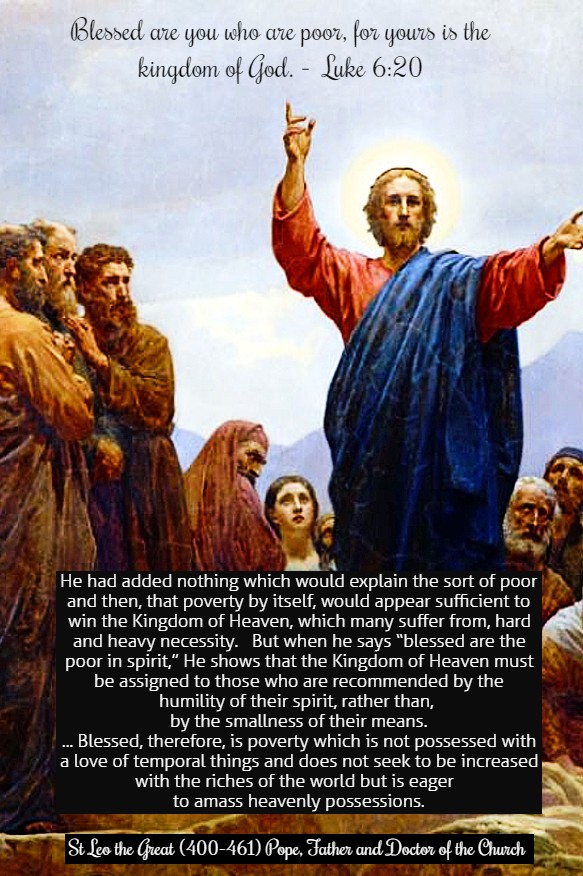
REFLECTION – “Blessed,” He says, “are the poor in spirit, for theirs is the kingdom of heaven” (Mt 5:3). It would perhaps be doubtful what poor He was speaking of, if in saying “blessed are the poor ” He had added nothing which would explain the sort of poor and then, that poverty by itself, would appear sufficient to win the Kingdom of Heaven, which many suffer from, hard and heavy necessity. But when he says “blessed are the poor in spirit,” He shows that the Kingdom of Heaven must be assigned to those who are recommended by the humility of their spirit, rather than, by the smallness of their means.
Yet it cannot be doubted, that this possession of humility is more easily acquired by the poor than the rich: for submissiveness is the companion of those, who want, while loftiness of mind dwells with riches. Notwithstanding, even in many of the rich, is found that spirit which uses its abundance, not for the increasing of its pride but on works of kindness and counts that for the greatest gain, which it expends in the relief of others’ hardships. It is given to every kind and rank of men, to share in this virtue, because men may be equal in will, though unequal in fortune and it does not matter, how different they are in earthly means, who are found equal in spiritual possessions. Blessed, therefore, is poverty which is not possessed with a love of temporal things and does not seek to be increased with the riches of the world but is eager to amass heavenly possessions.” – St Leo the Great (400-461) Pope, Father and Doctor of the Church (Sermon 95, PL 54, 461).
PRAYER – Be mindful of our weakness, Almighty God and since the burden of our sins weighs heavily upon us, may the glorious intercession of Thy holy Martyrs, Fabian and Sebastian sustain us. Through Jesus Christ, Thy Son our Lord, Who lives and reigns with Thee, in the unity of the Holy Ghost, God, world without end. Amen (Collect).




















You must be logged in to post a comment.