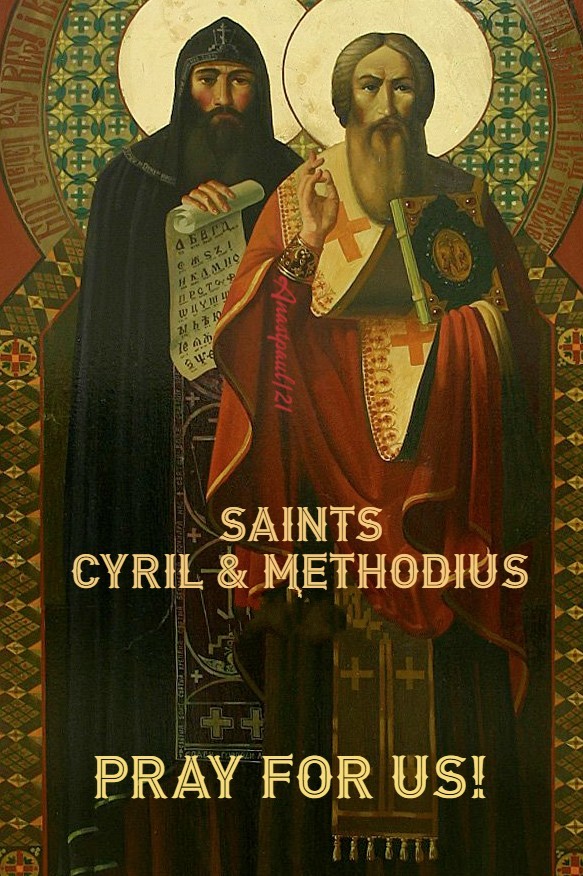
One Minute Reflection – 7 July – The Memorial of Saint Cyril (827-869) and Saint Methodius (826-885) “Apostles to the Slavs,” Sibling Brother Bishops, Confessors – Romans 8:18-23, Luke 10:1-9
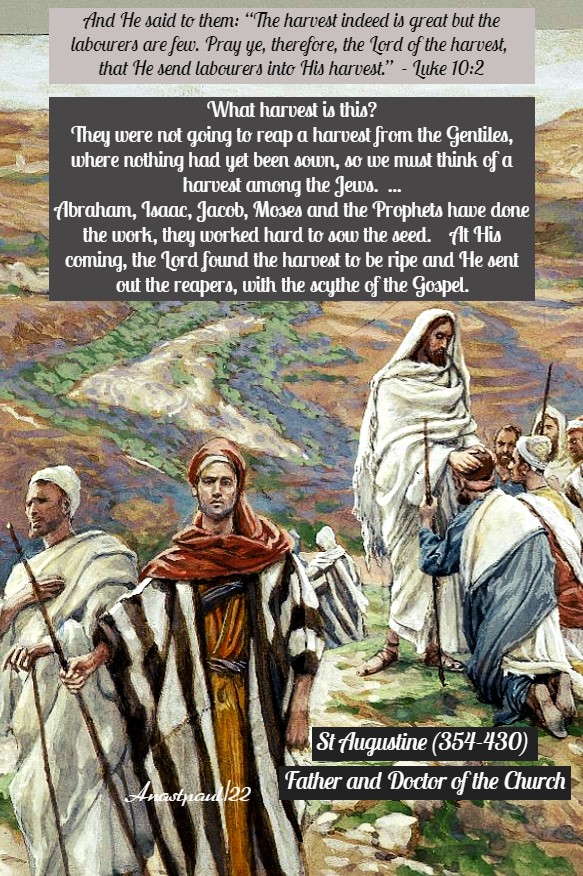
“Pray ye therefore the Lord of the harvest that He send labourers into His harvest.” – Luke 10:2
REFLECTION – “The gospel that has just been read to us invites us to seek out what this harvest might be of which the Lord says to us that: “The harvest is indeed great, the laborers are few, so pray the lord of the harvest that He send labourers into His harvest.” So it was that,, in addition to those twelve disciples whom He called Apostles (those who have been sent), He sent out seventy-two others. All of them, as His own words reveal, were sent to work at a harvest that had already been prepared. What harvest is this? They were not going to reap a harvest from the Gentiles, where nothing had yet been sown, so we must think of a harvest among the Jews. It was in order to reap this harvest that the Lord of the harvest came. But to the other peoples He sent, not reapers but sowers. Among the Jews, then, there was a harvest but elsewhere, the sowing. And it was particularly, while reaping among the Jews, that He chose the Apostles. Harvest time had come, the harvest was ripe, for the prophets had done their sowing among them…
Did not the Lord declare to His disciples: “You say the harvest will be a long time. I tell you, look up and see, the fields ripe for harvest,” (Jn 4,35)? And again, He said: “Others have done the work and you are sharing the fruits of their work,” (ibid v.38). Abraham, Isaac, Jacob, Moses and the prophets, have done the work, they worked hard to sow the seed. At His coming, the Lord found the harvest to be ripe and He sent out the reapers, with the scythe of the Gospel.” – St Augustine (354-430) Bishop of Hippo, Father and Doctor of the Church (Sermon 101).
PRAYER – Look forgivingly on Thy flock, Eternal Shepherd and keep it in Thy constant protection, by the intercession of the blessed brothers, Cyril and Methodius, who, by the power of the Holy Ghost were moved to bring the light of the Gospel to a hostile and divided people. Through Jesus Christ, Thy Son our Lord, Who lives and reigns with Thee, in the unity of the Holy Ghost, God, world without end. Amen (Collect).
Our Morning Offering – 7 July – “The Month of the Most Precious Blood”
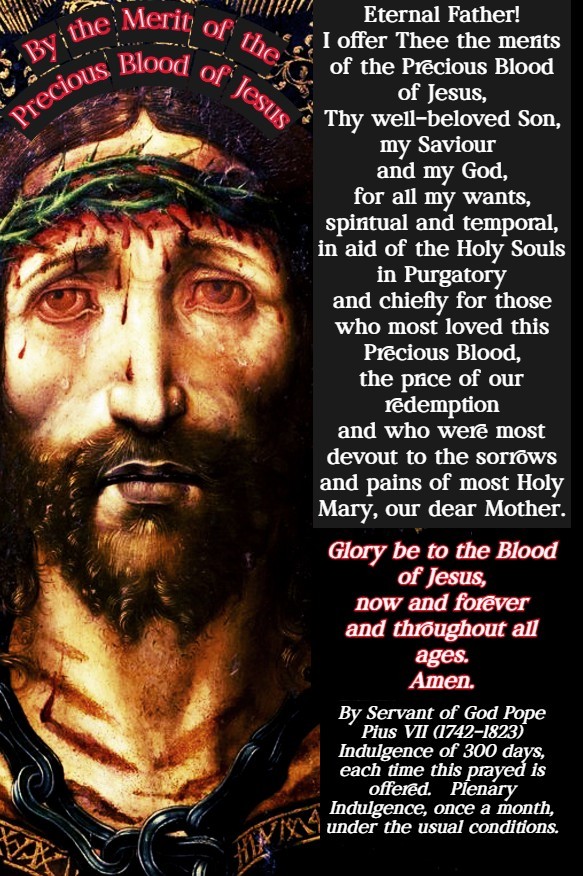
By the Merit of the Precious Blood of Jesus By Servant of God Pope Pius VII (1742-1823) Papacy from 1800 to 1823 Indulgenced Act of Oblation to Our Father
Eternal Father! I offer Thee the merit of the Precious Blood of Jesus, Thy well-beloved Son, my Saviour and my God, for all my wants, spiritual and temporal, in aid of the Holy Souls in Purgatory and chiefly for those who most loved this Precious Blood, the price of our redemption and who were most devout to the sorrows and pains of most Holy Mary, our dear Mother.
Glory be to the Blood of Jesus, now and forever and throughout all ages. Amen.
Indulgence of 300 days, each time this prayed is offered 22 September 1817 with a Plenary Indulgence, once a month, under the usual conditions.
Note of Interest: On 15 August 1811 – the Feast of the Assumption – it is recorded that the Pope celebrated Mass and entered a trance and began to levitate, in a manner, that drew him to the Altar. This particular episode aroused great wonder and awe among participants at the Mass , which included the French soldiers guarding him, who were awestruck at what had occurred and left records of it.
Saint of the Day – 7 July – Saint Prosper of Aquitaine (c 390-c 465) Theologian, Married Layman, Writer, disciple and friend of St Augustine (354-430). St Prosper was the first continuator of St Jerome’s Universal Chronicle. Born in c 390 in Aquitaine, France and died in c 465 in Rome, Italy, of natural causes. Also known as – Tiro Prosper or Prosper Tiro.
Prosper was a native of Aquitaine, France and may have been educated at Bordeaux. By 417 he arrived in Marseilles as a refugee from Aquitaine, in the aftermath of the Gothic invasions of Gaul.
We first meet Prosper definitively around 425 as a participant in the Pelagian controversy which rocked the Church in southern France. Pelagian heretics minimised the role of grace in the first steps of becoming a Christian. Many vigorously opposed St Augustine’s strict views that special grace was required for salvation and thus, many were predestined to damnation. Prosper, a lay theologian, championed St Augustine. And in 428, a letter from Prosper prompted Augustine to write a major work on predestination.
Although a layman, Prosper threw himself with ardour into the religious controversies of his day, defending St Augustine and propagating orthodoxy. In his De vocatione omnium gentium – “The Call of all Nations,”, in which the issues of the call to the Gentiles is discussed, in the light of Augustine’s doctrine of Grace, Prosper appears as the first of the medieval Augustinians.
In 431, Prosper went to Rome and obtained a letter from Pope Celestine I that affirmed Augustine and his views and urged the French Bishops to quell the dispute peacefully. But it raged on. For several more years, Prosper wrote extensively, defending and popularising St Augustine’s teaching.
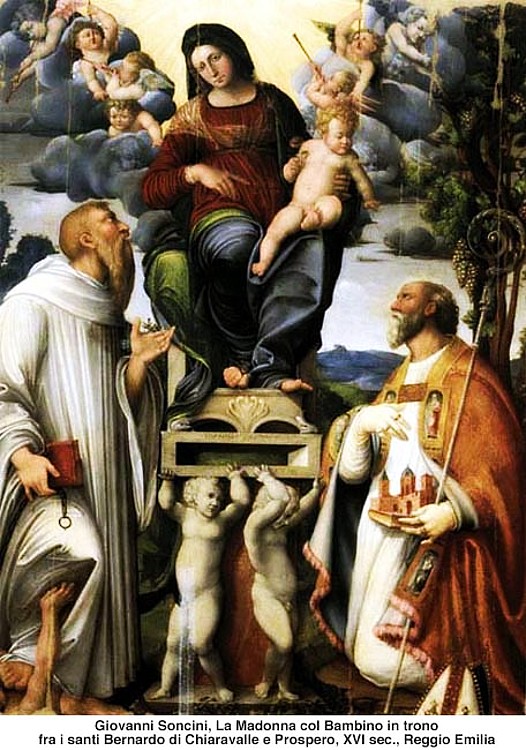
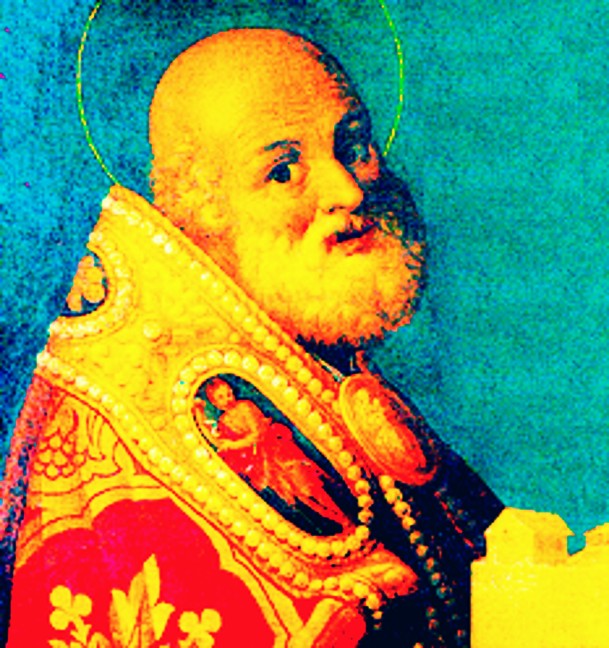
St Prosper on the right with Baby Jesus above him
In The Call to All Nations, Prosper seems to have mellowed somewhat, allowing that God mercifully made the Grace of Salvation available to all human beings. In the following excerpt Prosper describes the interplay of grace and free will:
“When the Word of God enters the ears through the ministry of preachers, the action of the Divine Power fuses with the sound of the human voice. The soul passes from one will to another will. Although the will that is driven out lingers on for a while, the newborn will claims for itself, all that is better in human beings. Thus the law of sin and the law of God do not dwell in the same way and together in the same person. Then the tempter tries to ambush the person through external things but the mind, strong with God’s help, prevails. For there are occasions for struggle and these greatly benefit the faithful. Their weakness is buffeted so that their holiness may not yield to pride. All good things, especially those conducive to eternal life, are obtained, increased and preserved through God’s favour.”
Prosper spent the last part of his life in Rome where he served as secretary to St Pope Leo the Great. During that tim, he wrote the Chronicle, a universal history from Adam’s fall to the Vandal’s conquest of Rome in 455. He died in Rome around 465.
You will remember yesterday’s Saint Palladius of Ireland, knowledge of whose history, was greatly enhanced by his contemporary’s writings, St Prosper, who speaks of St Palladius, in particular in regard to the Pelagian heresy.
Saint Cyril (827-869) Saint Methodius (826-885) “Apostles to the Slavs,” Sibling Brother Bishops, Confessors, Theologians, Missionaries, Writers, Preachers, Patrons of Europe. Creators of the Glagolitic alphabet, the first alphabet used to transcribe Old Church Slavonic and Cyrillac Alphabet, which was developed from it. Their Feast Day is 7 July (moved in 1969). The great Saints Cyril & Methodius: https://anastpaul.wordpress.com/2018/02/14/saints-of-the-day-14-february-sts-cyril-827-869-methodius-826-885/
St Lawrence of Brindisi OFM Cap (1559-1619) Confessor, The “Franciscan Renaissance Man,” Priest and Friar of the Friars Minor Capuchin, Theologian, Vicar General of the Franciscans, Language scholar, Humanist, Philosopher, Biblicist, Preacher, Missionary, Professor, International Administrator, Confidant of Popes, Emperors, Kings and Princes, Diplomatic envoy, Army Chaplain, Military Strategist and Morale builder, Polemicist, Prolific writer. He was Beatified on 1 June 1783 by Pope Pius VI and Canonised on 8 December 1881 by Pope Leo XIII. His Zealous Life: https://anastpaul.com/2017/07/21/saint-of-the-day-21-july-st-lawrence-of-brindisi-o-f-m-cap-doctor-of-the-church/
St Alexander St Angelelmus of Auxerre St Apollonius of Brescia
Blessed Pope Benedict XI OP (1240-1303) Cardinal-Priest of St Sabina, Bishop of Ostia then of Rome, Dominican Friar, Prior Provincial of Lombardy prior to becoming the Master of the Order in 1296, Apostolic Papal Legate to Hungary and France, Teacher, Preacher, Writer and renowned Scholar with special emphasis on Biblical commentary. His Papacy began on 22 Ocober 1303 and ended at his death on 7 July 1304. His Life: https://anastpaul.com/2020/07/07/saint-of-the-day-7-july-blessed-pope-benedict-xi-1240-1303/
Bl Bodard of Poitiers St Bonitus of Monte Cassino St Carissima of Rauzeille St Eoaldus of Vienne St Ethelburga of Faremoutier St Hedda of Wessex St Maelruan Bl Marie-Gabrielle-Françoise-Suzanne de Gaillard de Lavaldène St Medran St Merryn Bl Oddino Barrotti St Odo of Urgell St Odran St Palladius of Ireland St Pantaenus of Alexandria
St Pantænus (Died c 216) Father of the Church, Theologian, Philosopher, Teacher, Confessor and Defender of the Faith, Writer and interpreter of the Bible, the Trinity and Christology, |Missionary. Convert ofthe disciples of the Apostles. Head of the Alexandrian School of Learning – a famous pupil was St Clement of Alexandria. Biography: https://anastpaul.com/2019/07/07/saint-of-the-day-7-july-st-pantaenus-father-of-the-church-died-c-216/
St Prosper of Aquitaine (c 390-c 436) Theologian, Married Layman, Writer, disciple abd friend of St Augustine. St Syrus of Genoa St They
Martyrs of Durres – 7 Saints: Also known as – Martyrs of Dyrrachium/Martyrs of Durazzo. A group of seven Italian Christians who fled Italy to escape the persecutions of Emperor Hadrian. Arrived in Dyrrachium, Macedonia to find Saint Astius tied to a cross, covered in honey, laid in the sun and left to be tortured by biting and stinging insects. When they expressed sympathy for Astius, they were accused of being Christians, arrested, chained, weighted down, taken off shore and drowned. We know little more about each of them than their names – Germaus, Hesychius, Lucian, Papius, Peregrinus, Pompeius and Saturninus. They were born in Italy and were martyred at sea c117 off the coast of Dyrrachium (Durazzo), Macedonia (modern Durres, Albania).
Thought for the Day – 6 July – Meditations with Antonio Cardinal Bacci (1881-1971) – Octave Day of Saints Peter and Paul
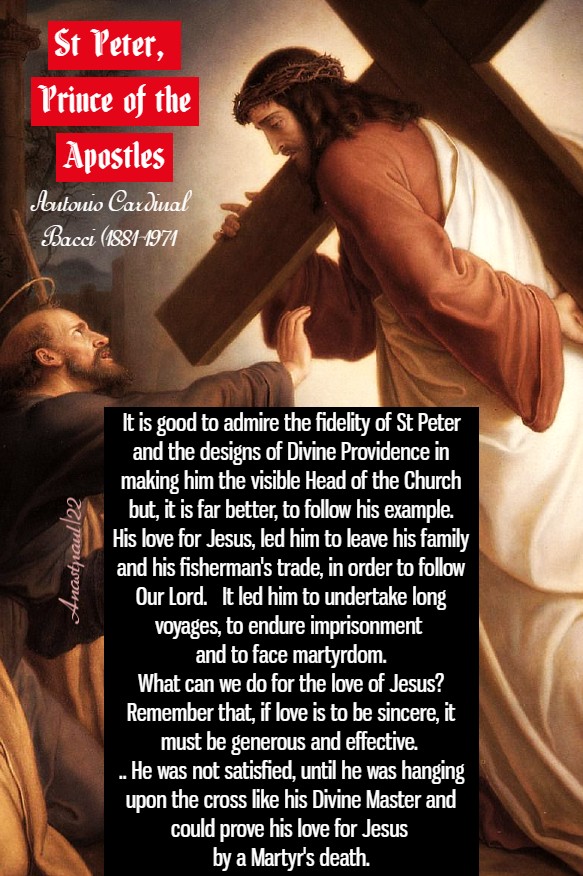
St Peter, Prince of the Apostles St Paul, the Apostle to the Gentiles
“It is good to admire the fidelity of St Peter and the designs of Divine Providence in making him the visible Head of the Church but, it is far better, to follow his example. His love for Jesus, led him to leave his family and his fisherman’s trade, in order to follow Our Lord. It led him to undertake long voyages, to endure imprisonment and to face martyrdom. What can we do for the love of Jesus? Remember that, if love is to be sincere, it must be generous and effective.
Secondly let us meditate on and imitate, the ardent and fearless faith of St Peter. He was not afraid to preach the teaching of Christ before the Sanhedrin. He was not afraid of Herod, who cast him into prison.
He was not afraid of the Roman Emperor, who caused him to be crucified. Our faith should be steadfast and lively, like his!
Finally, let us imitate Peter in his repentance. Although he loved Jesus very much and had such great faith in Him, in a moment of weakness and of imprudence, he denied Him three times. All his life, however, be wept bitterly for this sin. Whenever he heard a cock crowing, it was as if an arrow had pierced his heart. He was not satisfied, until he was hanging upon the cross like his Divine Master and could prove his love for Jesus by a Martyr’s death.”
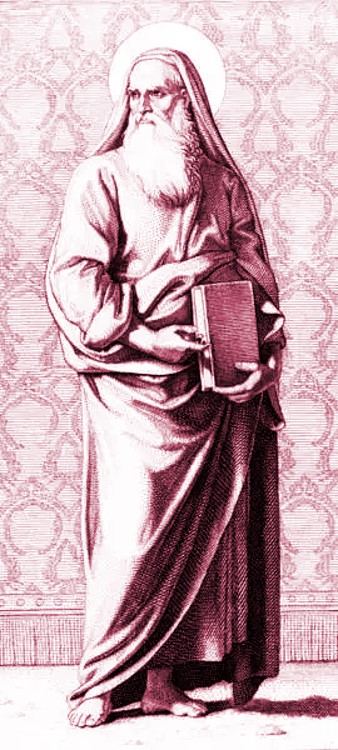
St Paul, the Apostle to the Gentiles
We can learn many other virtues from St Paul, besides his zealous love for God and for his fellowmen. We can also learn from him, the virtues of humility and of apostolic fervour. The Apostle of the Gentiles reached such heights of sanctity, as to feel himself transformed into Christ Himself and to deserve to be taken up into the third Heaven, where he enjoyed a foretaste of eternal happiness. Nevertheless, he considered himself unworthy to be called an Apostle and he realised, that all his gifts came to him from God. “Not that we are sufficient of ourselves, to think anything as from ourselves but our sufficiency, is from God” (2 Cor 3:5). Whenever we succeed in any project, we should think on the same lines because, it is only when we are humble and depend on the grace of God, that the success of our actions will redound to the glory of our Creator. If the cancer of ambition or of self-love, should corrupt our purity of intention, our work would not be blessed by God and would not make us worthy of everlasting life. Let us repeat often: “All for You, with You and in You, my God.”
Quote/s of the Day – 6 July – Octave Day of Saints Peter and Paul
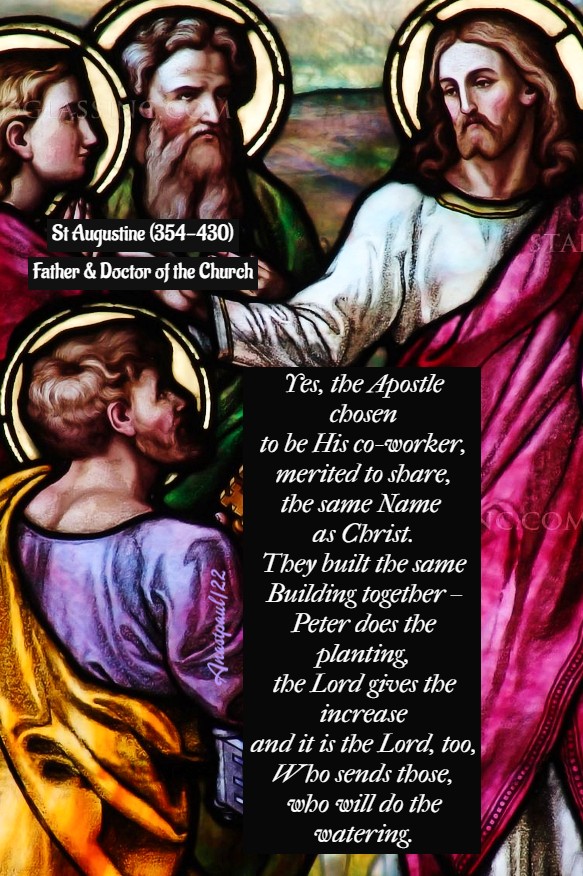
“Yes, the Apostle chosen to be His co-worker, merited to share, the same Name as Christ. They built the same Building together – Peter does the planting, the Lord gives the increase and it is the Lord, too, Who sends those, who will do the watering (cf 1 Cor 3:6f).”
St Augustine (354-430) Father & Doctor of the Church
“Nothing escaped the Wisdom and Power of Christ, the elements of nature lay at His service, spirits obeyed Him, Angels served Him. … And yet, out of all the world, Peter alone was chosen to stand at the head, for the calling of all the peoples and the oversight of all the Apostles and Fathers of the Church.”
St Pope Leo the Great (400-461) Father and Doctor of the Church
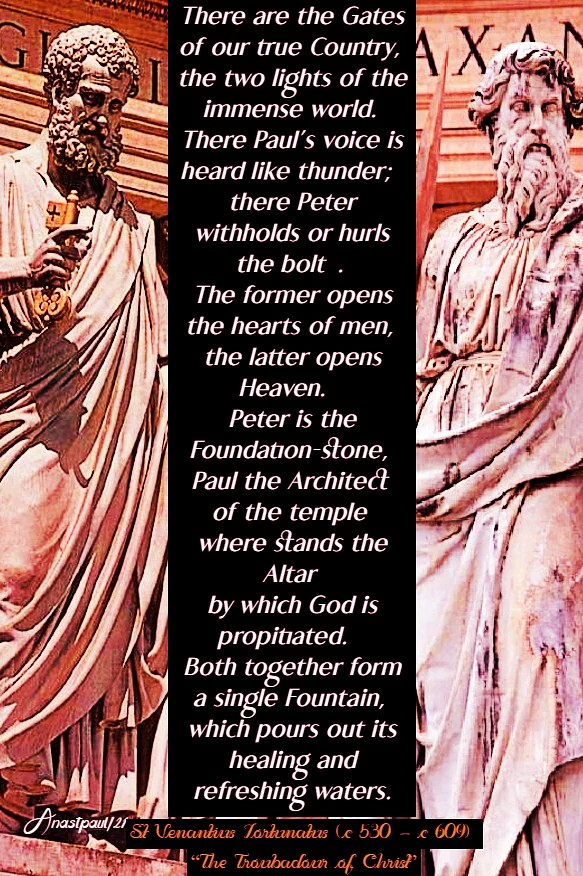
“There are the gates of our true country, the two lights of the immense world. There Paul’s voice is heard like thunder; there Peter withholds or hurls the bolt . The former opens the hearts of men, the latter opens Heaven. Peter is the Foundation-stone, Paul the Architect of the temple where stands the Altar by which God is propitiated. Both together form a single Fountain, which pours out its healing and refreshing waters.”
St Venantius Fortunatus (c 530 – c 609) “The Troubadour of Christ”
St Paul’s Prayer – Ephesians 3:14-21
For this reason, I bow my knees before the Father, from Whom every family in heaven and on earth takes its name. I pray that, according to the riches of His glory, He may grant that you may be strengthened in your inner being with power through His Spirit and that Christ may dwell in your hearts through faith, as you are being rooted and grounded in love. I pray that you may have the power to comprehend, with all the Saints, what is the breadth and length and height and depth and to know, the love of Christ that surpasses knowledge, so that you may be filled with all the fullness of God. Now to Him Who, by the power at work within us, is able to accomplish abundantly, far more than all we can ask or imagine. To Him be glory in the Church and in Christ Jesus, to all generations, forever and ever. Amen.
One Minute Reflection – 6 July – “The Month of the Most Precious Blood” – Octave Day of Saints Peter and Paul – Romans 8:18-23, Luke 5:1-11
“And getting into one of the boats, the one that was Simon’s, He asked him to put out a little from the land. And sitting down, He began to teach the crowds from the boat.” – Luke 5:3
REFLECTION – “Ordinarily, people are not given life on a boat but transported. Nor are they comforted on a vessel but anxious about its journey. Notice also, that this boat is not a boat that is given to Peter to be piloted — rather, it is the Church, which is committed to the Apostle to be governed. For this is the vessel that does not kill but gives life to those borne along by the storms of this world, as if by waves. Just as a little boat holds the dying fish that have been brought up from the deep, so also the vessel of the Church gives life to human beings who have been freed from turmoil. Within itself, I say, the Church gives life to those who are half-dead, as it were.” – St Maximus of Turin (? – c 420) Bishop, Father (Sermon 110).
PRAYER – O God, Who made this day holy by the Martyrdom of Your Apostles Peter and Paul, grant Thy Church to follow in all things, the teaching of those, from whom she first received the faith. Through Jesus Christ, Thy Son our Lord, Who lives and reigns with Thee, in the unity of the Holy Ghost, God, world without end. Amen (Collect).
Our Morning Offering – 6 July – “The Month of the Most Precious Blood”
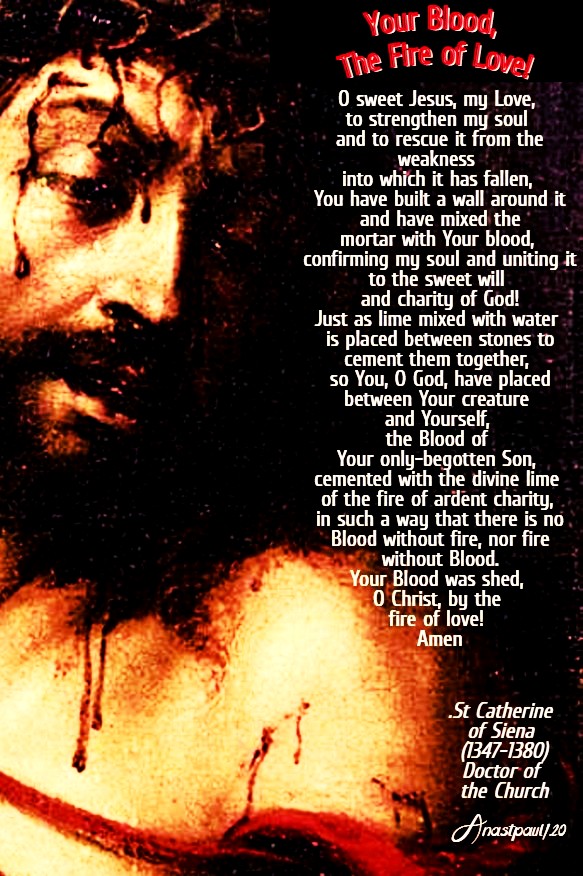
Your Blood, The Fire of Love! By St Catherine of Siena (1347-1380) Doctor of the Church
O sweet Jesus, my Love, to strengthen my soul and to rescue it from the weakness into which it has fallen, You have built a wall around it and have mixed the mortar with Your Blood, confirming my soul and uniting it to the sweet will and charity of God! Just as lime mixed with water is placed between stones to cement them together, so You, O God, have placed between Your creature and Yourself, the Blood of Your only-begotten Son, cemented with the divine lime of the fire of ardent charity, in such a way that there is no Blood without fire, nor fire without Blood. Your Blood was shed, O Christ, by the fire of love! Amen.
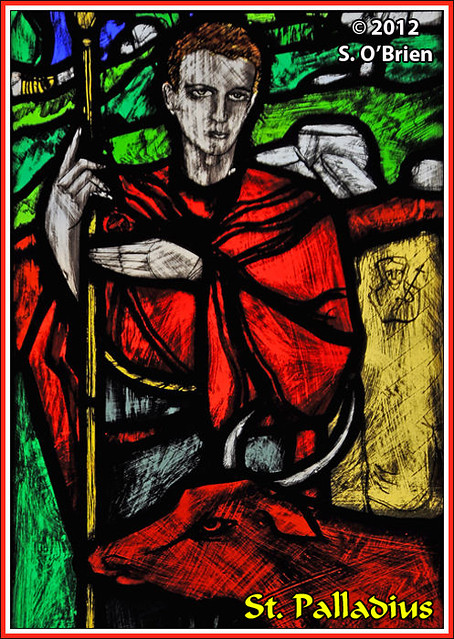
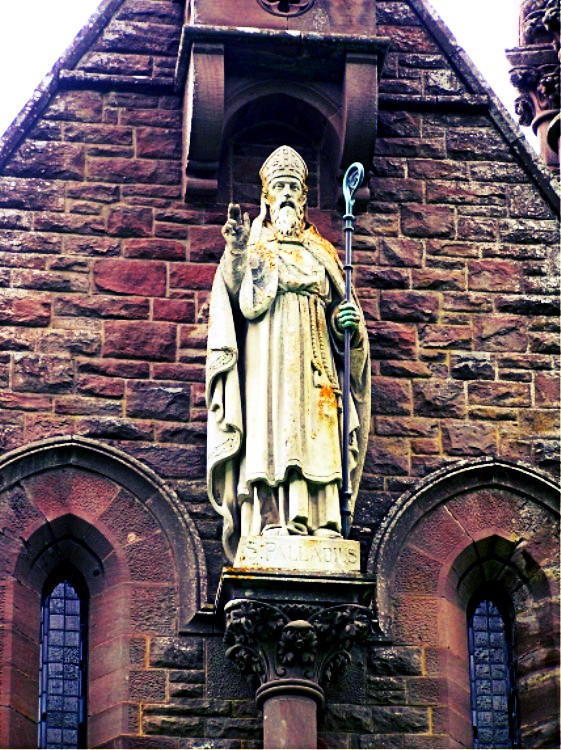
Saint of the Day – 6 July – Saint Palladius of Ireland (Died c 432) The First Bishop sent to Ireland preceding St Patrick and “Apostle of the Scots.” Died 9n c 432 at Fordun, Scotland of natural causes. Patronage – Scotland. Also known as – Palladius of Aberdeen, Palladius of Scotland, Pallade, Palladio, “Apostle of the Scots.”
A seventh century Irish biography of Saint Patrick identifies Palladius as Archdeacon of the Roman Church under Pope Celestine. Saint Prosper of Aquitaine, his contemporary, informs us in his historical chronicle. that when Agricola, a noted Pelagian heretic, had corrupted the Churches of Britain by introducing that pestilential heresy, Pope Celestine, in 429, at the instance of Palladius the Deacon, sent there Saint Germanus, Bishop of Auxerre, as his Legate. He, after having ejected the heretics, brought back the Britons to the Catholic faith.
The same Pope sent Palladius to the Celts. Palladius was accompanied by four companions: Sylvester and Solinus, who remained in Ireland, after he left and Augustinus and Benedictus, who followed him to Britain but returned to their own country after his death.
The Irish writer of the life of Saint Patrick says that Palladius preached in Ireland some time before Saint Patrick but, that he was soon sent away by the King of Leinster and returned to North Britain, where he had opened his mission.
Saint Prosper says that he was consecrated Bishop by the same Pope Celestine and then sent with relics of Saint Peter and Saint Paul, as the first Bishop to the nation of the Scots. Several colonies of these had passed from Ireland into North Britain and taken possession of the part of the country since called Scotland. Later Saint Palladius also founded three Churches in more hospitable regions of Ireland.
He preached to the Scots with great zeal, and formed a considerable Church. The Scottish historians tell us, that the Faith was first planted in North Britain about the year 200, in the time of King Donald, when Saint Victor I was Pope but they all acknowledge, that Palladius was the first Bishop of that Country and they call him their first Apostle. Saint Palladius died at Fordun, fifteen miles from Aberdeen, about the year 432.
Scottish Church tradition holds, that he presided over a Christian community there for about 20 years. A cluster of dedications in the Mearns in Scotland, in the village of Auchenblae, are believed to mark his last resting place. As late as the reign of James V, royal funds were disbursed for the fabrication of a new Reliquary for the Church there, and an annual “Paldy Fair” was held at least until the time of the Reformation.
St Gervais St Giusto of Condat St Goar of Aquitaine St Godelieve St Monenna St Noyala of Brittany St Petrus Wang Zuolung St Palladius of Ireland (Died c 432) The First Bishop sent to Ireland preceding St Patrick and “Apostle of the Scots.”
St Saxburgh of Ely St Sisoes the Great Bl Suzanne Agathe de Loye Bl Thomas Alfield (c 1552-1585) Priest Martyr St Tranquillinus of Rome
Martyrs of Campania – 23 Saints: A group of 23 Christians arrested, tortured and then beheaded together in the later 3rd century by order Gf Governor Rictiovarus during the persecutions of Diocletian. The names that have come down to us are – Antoninus, Arnosus, Capicus, Cutonius, Diodorus, Dion, Isidore, Lucia, Lucian, Rexius, Satyrus and Severinus.
Martyrs of Fiesole – 5 Saints: Five Christians Martyred together during the persecutions of Emperor Domitian – Carissimus, Crescentius, Dulcissimus, Marchisianus and Romulus. c 90 near Fiesole, Italy.
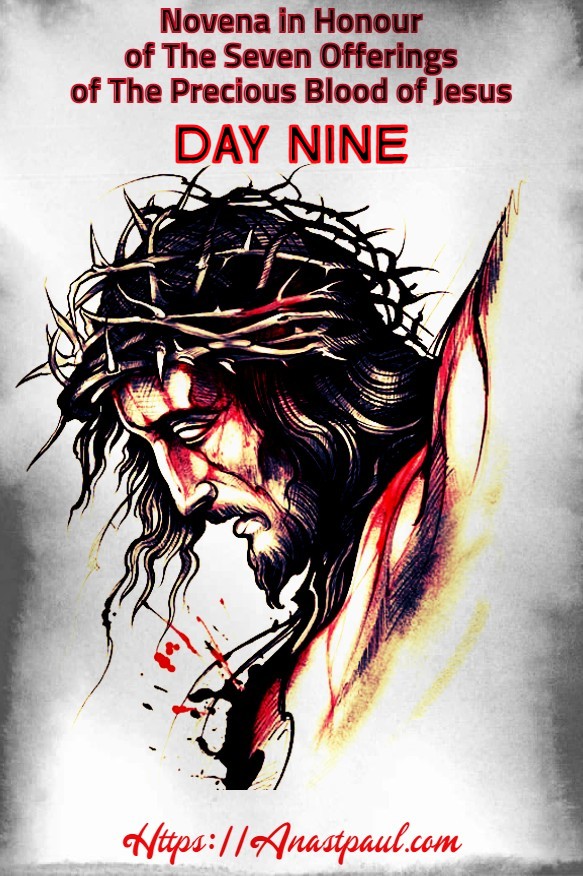
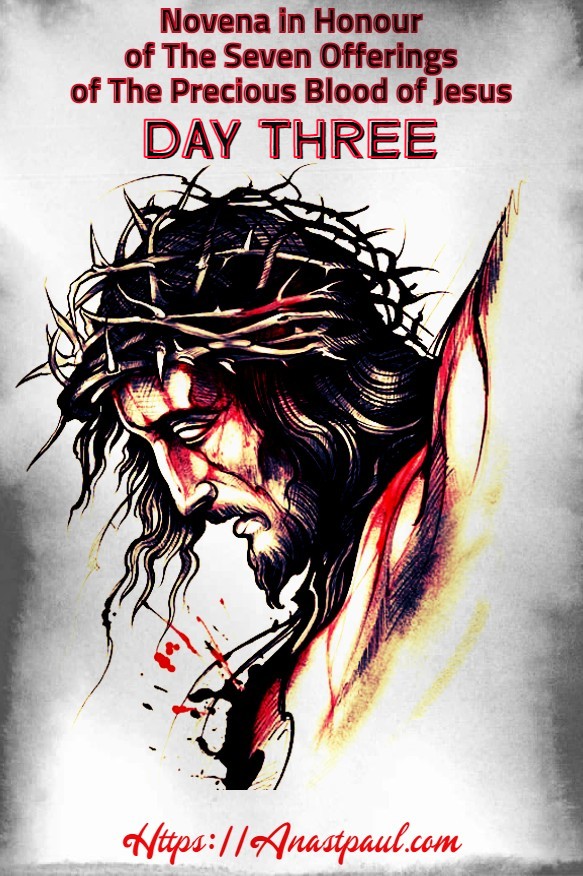
Indulgenced Novena in Honour of The Seven Offerings of the Precious Blood of Jesus
THE NINETH DAY
(An Indulgence of 5 Years for this Prayer — Roman Missal)
Prayer to Venerate With Solemn Worship The Price of Our Salvation
Almighty and Everlasting God, who hast appointed thine Only-Begotten Son to be the Redeemer of the world and hast been pleased to be reconciled unto u, by His Blood, grant us, we beseech Thee, so to venerate with solemn worship, the price of our salvation, that the power thereof may here on earth. keep us from all things hurtful and the fruit of the same, may gladden us forever hereafter in Heaven . through the same Christ our Lord. Amen
Glory be to the Father, etc.
Blessed and praised for evermore, be Jesus Who hath saved us with His Blood!
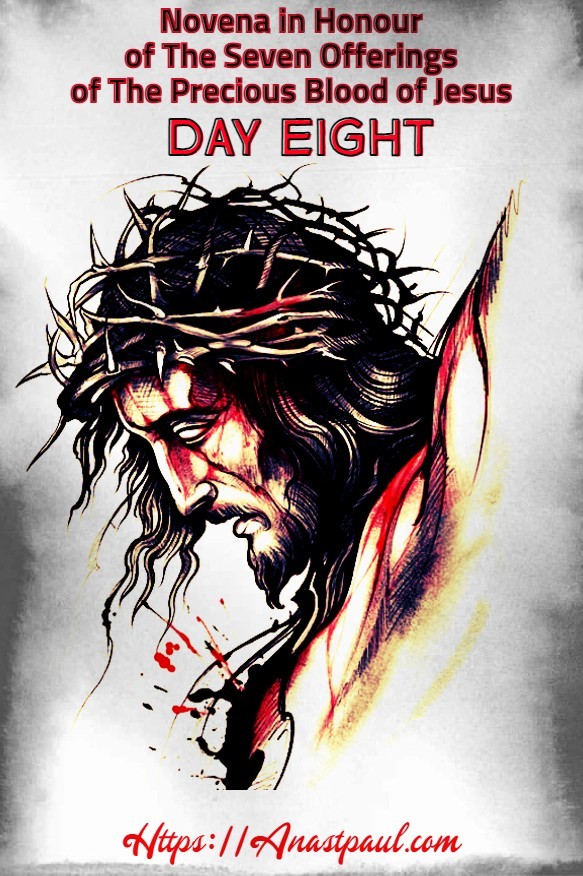
Indulgenced Novena in Honour of The Seven Offerings of the Precious Blood of Jesus
(An Indulgence of 3 years–Pius VII, 1817)
THE EIGHTH DAY
Eternal father I offer Thee the Most Precious Blood of Jesus Christ in atonement for my sins and in supplication for the Holy Souls in Purgatory and for the needs of Holy Church.
Glory be to the Father, etc.
Blessed and praised for evermore be Jesus Who hath saved us with His Blood!
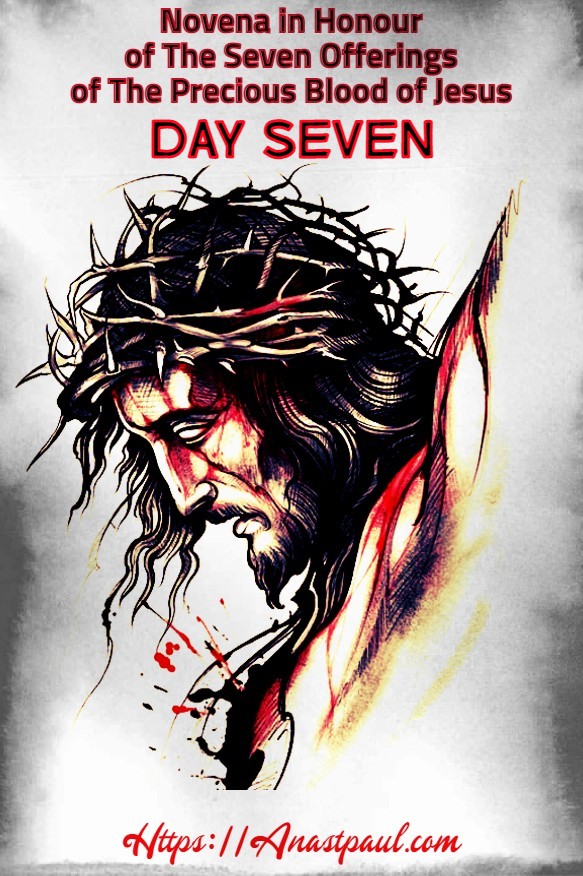
Indulgenced Novena in Honour of The Seven Offerings of the Precious Blood of Jesus
(An Indulgence of 3 years–Pius VII, 1817)
THE SEVENTH DAY
Eternal Father, I offer Thee the merits of the Precious Blood of Jesus, Thy beloved Son, my Savior and my God, for all my needs, both temporal and spiritual, as an intercession for the Holy Souls in Purgatory and in an especial manner, for those who were most devoted to this price of our Redemption and to the sorrows and sufferings of our dear Mother, Mary most Holy.
Glory be to the Father, etc.
Blessed and praised for evermore be Jesus Who hath saved us with His Blood!
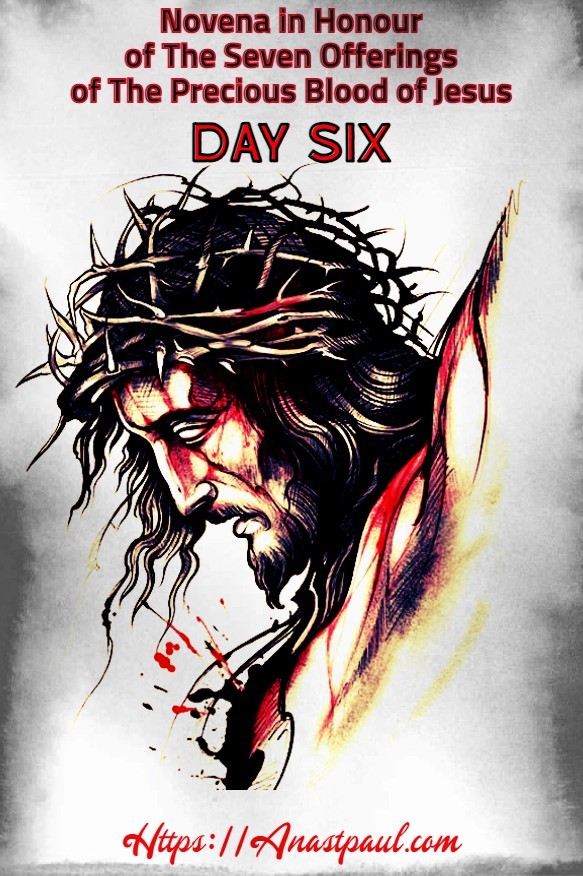
Indulgenced Novena in Honour of The Seven Offerings of the Precious Blood of Jesus
(An Indulgence of 3 years–Pius VII, 1817)
THE SIXTH DAY
Eternal Father, I offer Thee the Merits of the Precious Blood of Jesus, Thy Beloved Son, my Saviour and my God, for all men who are lovers of this great Treasure and who are united with me in adoring and glorifying It and who labour to spread this devotion.
Glory be to the Father, etc.
Blessed and praised for evermore be Jesus, Who hath saved us with His Blood!
Indulgenced Novena in Honour of The Seven Offerings of the Precious Blood of Jesus
(An Indulgence of 3 years–Pius VII, 1817)
THE FIFTH DAY
Eternal Father, I offer Thee the merits of the Precious Blood of Jesus, Thy Beloved Son, my Saviour and my God, for all those who are to pass this day to the other life, that Thou wouldst deliver them from the pains of hell and admit them with all speed, to the possession of Thy glory.
Glory be to the Father, etc.
Blessed and praised for evermore be Jesus Who hath saved us with His Blood!
Dear Friends, I am a little under the weather. I will be gone for a few days but will post the Precious Blood Novena.. which will post earlier than usual. In the meantime, let us pray for each other. See you soon. 🧡🙏 Ana
Indulgenced Novena in Honour of The Seven Offerings of the Precious Blood of Jesus
(An Indulgence of 3 years–Pius VII, 1817)
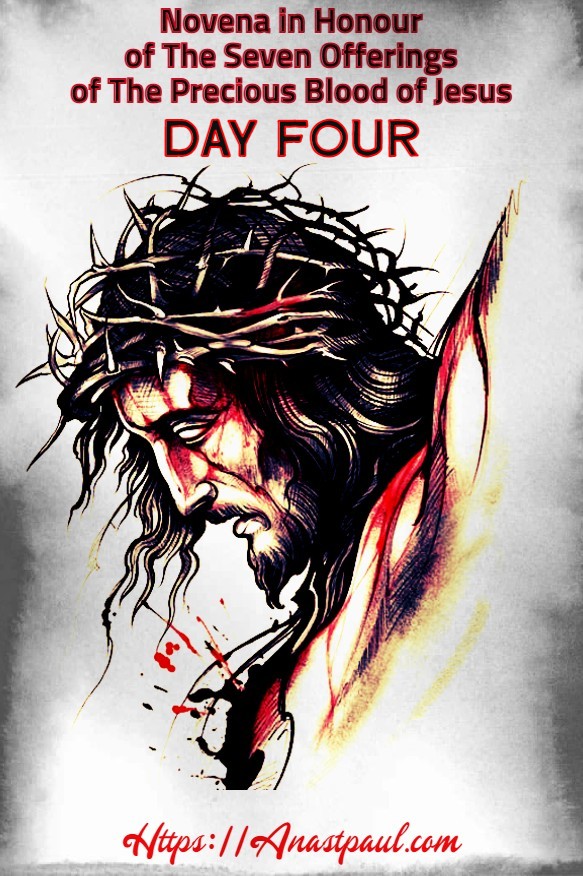
THE FOURTH DAY
Eternal Father, I offer Thee the Merits of the Precious Blood of Jesus, Thy beloved Son, my Saviour and my God, f or all my relatives, friends and enemies, for those in need, in sickness, in tribulation and for all those, for whom Thou knowest that I am bound to pray and willest that I should pray.
Glory be to the Father, etc.
Blessed and praised for evermore be Jesus Who hath saved us with His Blood!
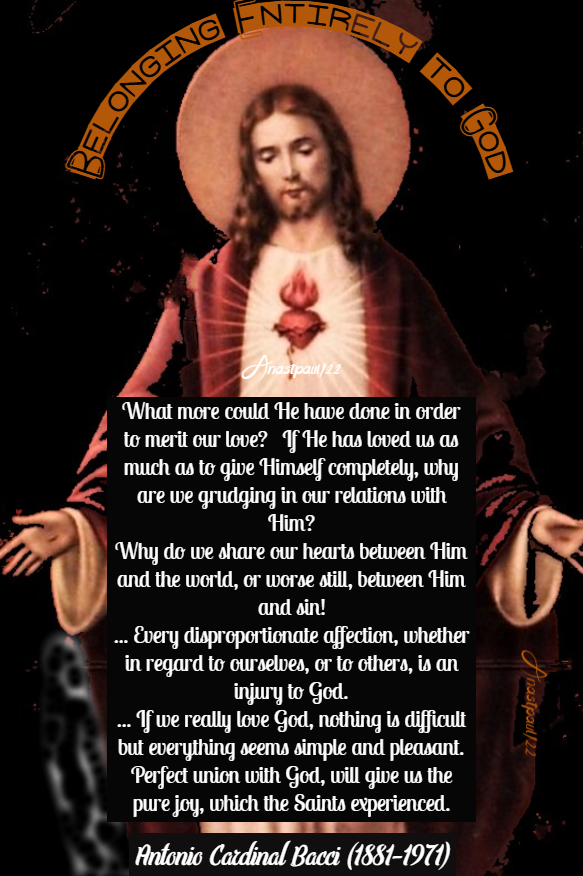
Thought for the Day – 25 June – Meditations with Antonio Cardinal Bacci (1881-1971)
Belonging Entirely to God
“What more could He have done in order to merit our love? If He has loved us as much as to give Himself completely, why are we grudging in our relations with Him? Why do we share our hearts between Him and the world, or worse still, between Him and sin!
There is nothing to prevent us from loving creatures, as well as God but, they should be loved in God and for God. They should form a ladder, which enables us to climb towards God.
Every disproportionate affection, whether in regard to ourselves, or to others, is an injury to God. If we really belong entirely to God, we should be at peace. Since virtue is difficult, it is difficult to belong completely to God but, the effort gives us a foretaste of the happiness of Heaven.
If we really love God, nothing is difficult but everything seems simple and pleasant. Perfect union with God, will give us the pure joy, which the Saints experienced.”
Quote/s of the Day – 25 June – The Nativity of St John the Baptist
“ And when Elizabeth heard the greeting of Mary, the baby leaped in her womb. And Elizabeth was filled with the Holy Spirit … “For behold, when the sound of your greeting came to my ears, the baby in my womb leaped for joy.”
Luke 1:41,44
“I tell you, among those born of women, no-one is greater than John; yet the least in the kingdom of God is greater than he.”
Luke 7:28
“At my birth, I took away my mother’s barrenness and while still an infant, I healed my father’s dumbness, for You gave me in childhood, the gift of working miracles.”
St Gregory the Illuminator (c 213-270) Bishop
“As a representative of the past, he is born of aged parents, as herald of the new, he is declared to be a prophet, while still in his mother’s womb.”
“The release of Zechariah’s voice at the birth of John, is a parallel to the rending of the veil, at Christ’s Crucifixion. If John were announcing his own coming, Zechariah’s lips would not have been opened. The tongue is loosened because a voice is born.
“John is a voice for a time but Christ is the eternal Word, from the beginning.”
St Augustine (354-430) Bishop, Father, Doctor of Grace
One Minute Reflection – 25 June – “The Month of the Sacred Heart” – The Nativity of St John the Baptist – Isaias 49:1-3, 5-7, Luke 1:57-68
“Immediately his mouth was opened, his tongue freed and he spoke blessing God.” – Luke 1:64
“When John, his son was born, among his neighbours there was concern about what name he should be given. Writing tablets were offered to his father, so that he himself could put down the name that he had decided upon, so that he might express, in writing, what he could not, in speech. Then, in a wonderful manner, when he had taken the tablets in order to begin writing, his tongue was loosened, the written word gave way to speech and he did not write “John” but spoke it. Consider, then, the merit of the holy Baptist: he gave his father back his voice, he restored the faculty of speech to the priest. Consider, I say, his merit – John unloosed the mouth that the angel had bound. What Gabriel had closed, the little child unlocked. When John is born, the father suddenly becomes a prophet or priest, speech attains its use, love receives an offspring, the office recognises the priest.” – – St Maximus of Turin (Died c 420) Bishop of Turin, Father (Sermon 6) St Maximus’ Feast Day today.
PRAYER – O God, Who made this a day most worthy of our celebration because of blessed John; grant Thy people the grace of spiritual joys and direct the minds of all the faithfu, into the path of eternal salvation. Through Jesus Christ, Thy Son our Lord, Who lives and reigns with Thee, in the unity of the Holy Ghost, God, world without end. Amen (Collect). OUR Lady of the Sacred Heart, Pray for Us! – Indulgence 100 Days. Everytime – Raccolta 174 St Pius X, 9 July 1904.
Saint of the Day – 25 June – Saint Gallicanus of Ostia (Died c 363) Martyr, Layman, firstly as a Ranking Officer in the Imperial Army of Constantine the Great, promoted to the position of a Roman Consul, Convert to Christianity. He died in the persecutions under Julian.
The Roman Martyrology states of him today: “At Alexandria, St Gallicnus, ex-Consul and Martyr, who had been honoured with a triumph and was held in affection by Emperor Constantine
Gallicanus had been converted by the disciples of St John and St Paul, after which he withdrew to Ostia with St Hilarinus and devoted himself entirely to the duties of hospitality and to the service of the sick. The report of such an event spread through the whole world and from all sides, many persons came to see a man, who had been a Senator and Consul, washing the feet of the poor, preparing their table, serving them, carefuly waiting on the infirm and performing other works of mercy.
Driven from this place by Julian the Apostate, he repaired to Alexandria, where, for refusing to sacrifice to idols, at the command of the Judge Raucian, he was put to the sword and thus became a Martyr of Christ.”
According to his Acts he was a distinguished General in the war against the Persians. He was also Consul with Symmachus in 330 and perhaps also once before, with Caesonius Bassus in 317. After his conversion to Christianity he retired to Ostia, founded a hospital where he worked with Saint Hilarinus and endowed a Church built by Constantine I.
Under Julian he was banished to Egypt and lived with the hermits in the desert.
A small Church was built in his honour in the Trastevere of Rome. His relics are at Rome in the Church of Sant’Andrea della Valle.
Gallicanus’ conversion was dramatised in the tenth century by the nun Roswitha. St Gallicanus is a Saint of the Colonnade at St Peter’s Basilica, Vatican City, Rome. He is the first Statue on the right (north) colonnade, St. Gallicanus faces toward the front opening of St Peter’s Square. His Statue was carved etween 1670-1673 by Lazzaro Morelli, who was the most prolific of the artists working for Bernini on the colonnade statues, with over 45 of the saints attributed to him.
Amand of Coly Bl Burchard of Mallersdorf St Cyneburga of Gloucester Bl Dorothy of Montau St Eurosia of Jaca St Febronia of Nisibis Bl Fulgentius de Lara St Gallicanus of St Gallicanus of Ostia (Died c 363) Martyr, Layman, Roman Consul St Gohard of Nantes Bl Guy Maramaldi Bl Henry Zdick Bl John the Spaniard St Luceias and Companions
Indulgenced Novena in Honour of The Seven Offerings of the Precious Blood of Jesus
(An Indulgence of 3 years–Pius VII, 1817)
THE THIRD DAY
Eternal Father, I offer Thee the merits of the Precious Blood of Jesus, Thy beloved Son, my Saviour and my God, for the conversion of unbelievers, the rooting-up of all heresies and the conversion of all sinners, especially those within our homes and within Holy Mother Church.
Glory be to the Father, etc.
Blessed and praised for evermore be Jesus Who hath saved us with His Blood!
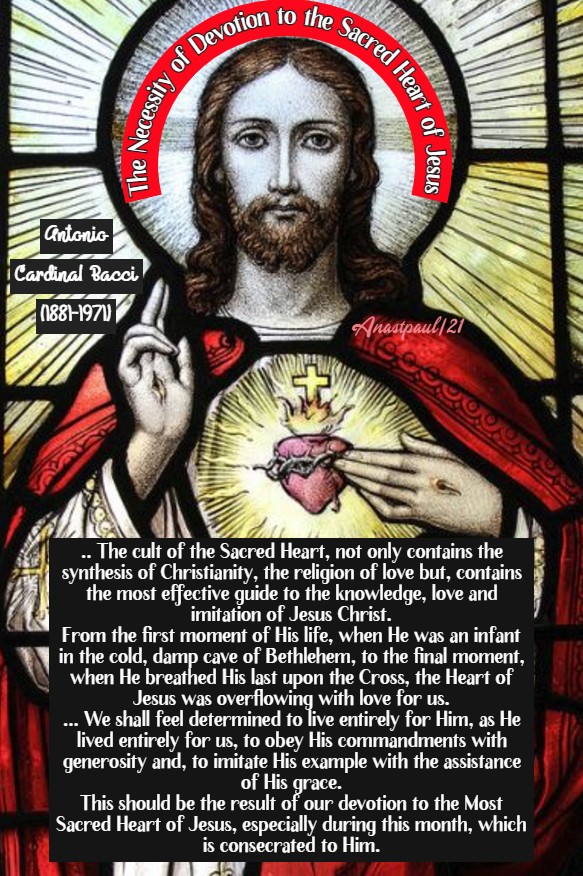
Thought for the Day – 24 June – Meditations with Antonio Cardinal Bacci (1881-1971)
The Necessity of Devotion to the Sacred Heart of Jesus
“It is necessary to develop and meditate on these words of Pius XI, (see Part One) from which, it is clear, that the cult of the Sacred Heart, not only contains the synthesis of Christianity, the religion of love but, contains the most effective guide to the knowledge, love and imitation of Jesus Christ. From the first moment of His life, when He was an infant in the cold, damp cave of Bethlehem, to the final moment, when He breathed His last upon the Cross, the Heart of Jesus was overflowing with love for us. We can learn from this, to know our Divine Saviour better, so that appreciating more fully His infinite love for us, we shall feel an upsurge of gratitude and, of love. We shall feel determined to live entirely for Him, as He lived entirely for us, to obey His commandments with generosity and, to imitate His example with the assistance of His grace. This should be the result of our devotion to the Most Sacred Heart of Jesus, especially during this month, which is consecrated to Him.”
Quote/s of the Day – 24 June – “The Month of the Sacred Heart” and the Feast of the Sacred Heart of Jesus
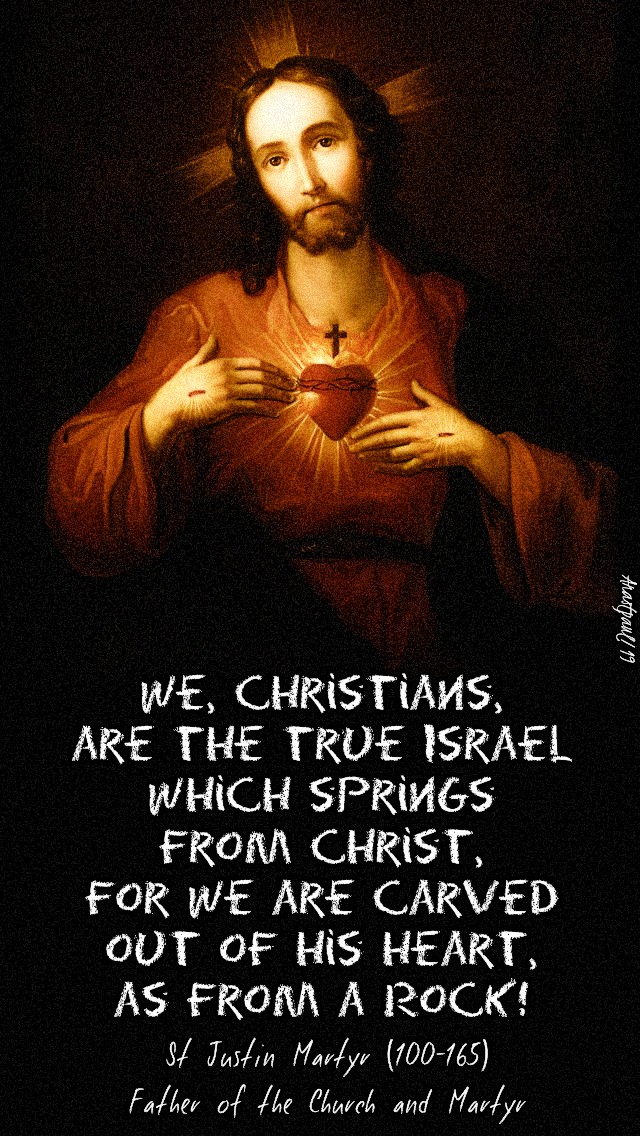
“We, Christians, are the true Israel which springs from Christ, for we are carved out of His Heart, as from a Rock!”
St Justin Martyr (100-165) Father of the Church and Martyr
“Be strengthened in Almighty God and in the power of His might, for with His help, nothing is difficult. Throw off the heavy load of your own will, cast aside the burden of sin and gird yourselves as valiant warriors. Forget what you are leaving behind; strain forward to the great things before you. I tell you, that every place where you set foot, shall be yours. For the Spirit who goes before your face is Christ the Lord. He will carry you to the topmost peak in the arms of His Love.”
St Francis of Assisi (c 1181-1226)
“The Sacred Heart is the symbol of that boundless love which moved the Word to take flesh, to institute the Holy Eucharist, to take our sins upon Himself and, dying on the Cross, to offer Himself as a victim and sacrifice to the eternal Father.”
“O Heart of love, I put all my trust in Thee, for I fear all things, from my own weakness, but I hope for all things, from Thy Goodness.”
The Twelve Promises of Jesus to Saint Margaret Mary or those Devoted to His Sacred Heart:
I will give them all the graces necessary for their state of life.
I will establish peace in their families.
I will console them in all their troubles.
They shall find in My Heart an assured refuge during life and especially at the hour of their death.
I will pour abundant blessings on all their undertakings.
Sinners shall find in My Heart the source of an infinite ocean of mercy.
Tepid souls shall become fervent.
Fervent souls shall speedily rise to great perfection.
I will bless the homes where an image of My Heart shall be exposed and honoured.
I will give to priests the power of touching the most hardened hearts.
Those who propagate this devotion shall have their names written in My Heart, never to be effaced.
The all-powerful love of My Heart will grant to all those who shall receive Communion on the First Friday of nine consecutive months the grace of final repentance; they shall not die under my displeasure, nor without receiving their Sacraments; My heart shall be their assured refuge at that last hour.
From Saint Margaret Mary Alacoque’s Vision of Jesus
St Margaret Mary Alacoque (1647-1690) Visionary of the Sacred Heart
One Minute Reflection – 24 June – “The Month of the Sacred Heart” and the Feast of the Sacred Heart of Jesus – Ephesians 3:8-12, 14-19, John 19:31-37.
“And to have Christ dwelling, through faith, in your hearts, so that, being rooted and grounded in love, you may be able to comprehend, with all the saints, what is the breadth and length and height and depth and to know Christ’s Love, which surpasses knowledge,” – Ephesians 3:17-19
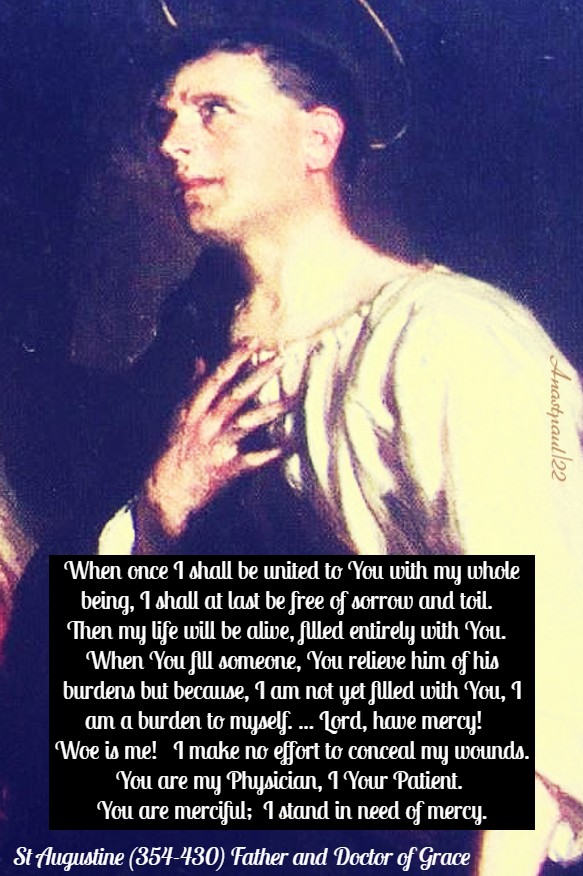
REFLECTION – “When once I shall be united to You with my whole being, I shall at last be free of sorrow and toil. Then my life will be alive, filled entirely with You. When You fill someone, You relieve him of his burdens but because, I am not yet filled with You, I am a burden to myself. My joy when I should be weeping, struggles with my sorrows, when I should be rejoicing. I know not where victory lies.
Woe is me! Lord, have mercy on me! My evil sorrows and good joys are at war with one another. I know not where victory lies. Woe is me! Lord, have mercy! Woe is me! I make no effort to conceal my wounds. You are my Physician, I Your Patient. You are merciful; I stand in need of mercy.” – St Augustine (354-430) Father and Doctor of Grace (An excerpt from: The Confessions Book 10).
PRAYER – O God, Who in the Heart of Thy Son, wounded by our sins, mercifully lavish upon us the infinite riches of Love, grant, we beseech Thee, that as we offer Him the faithful service of our devotion, we may also show forth fitting reparation. Through Jesus Christ, Thy Son our Lord, Who lives and reigns with Thee, in the unity of the Holy Ghost, God, world without end. Amen (Collect). SACRED Heart of JESUS, Thy Kingdom come! – Indulgence 300 Days – Every time – Raccolta 179 St Pius X, 6 November 1906.
Our Morning Offering – 24 June – “The Month of the Sacred Heart” and the Feast of the Sacred Heart of Jesus
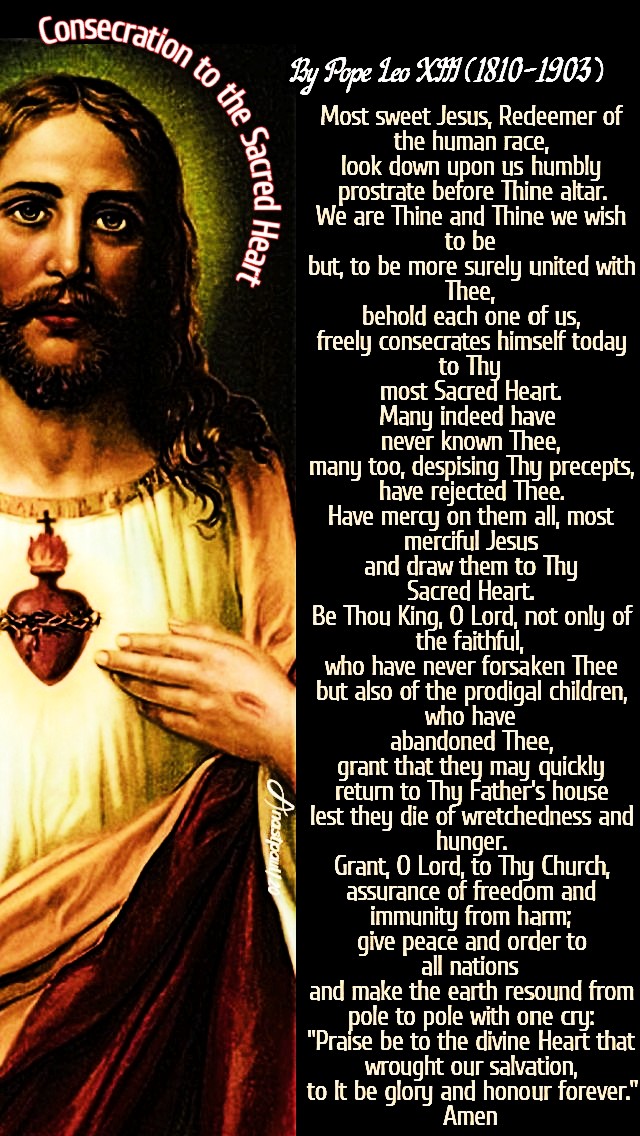
Consecration to the Sacred Heart By Pope Leo XIII (1810-1903) Pope from 1878-1903
Most sweet Jesus, Redeemer of the human race, look down upon us humbly prostrate before Thine altar. We are Thine and Thine we wish to be but, to be more surely united with Thee, behold each one of us, freely consecrates himself today to Thy most Sacred Heart. Many indeed have never known Thee, many too, despising Thy precepts, have rejected Thee. Have mercy on them all, most merciful Jesus and draw them to Thy Sacred Heart. Be Thou King, O Lord, not only of the faithful, who have never forsaken Thee but also of the prodigal children, who have abandoned Thee, grant that they may quickly return to Thy Father’s house lest they die of wretchedness and hunger. Be Thou King of those who are deceived by erroneous opinions, or whom discord keeps aloof and call them back to the harbour of truth and unity of faith, so that there may be but one flock and one Shepherd. Be Thou, King of all those. who are still involved in the darkness of idolatry or of Islamism and refuse not, to draw them into the light and kingdom of God. Turn Thine eyes of mercy towards the children of the race, once Thy chosen people – of old they called down upon themselves the Blood of the Saviour; may it now descend upon them, a laver of redemption and of life. Grant, O Lord, to Thy Church, assurance of freedom and immunity from harm; give peace and order to all nations and make the earth resound from pole to pole, with one cry: “Praise be to the Divine Heart that wrought our salvation; to It be glory and honour forever.” Amen
The above prayer, composed by Pope Leo XIII was included in the 1899 Encyclical Annum Sacrum issued by Leo XIII as he Consecrated the entire world to the Sacred Heart of Jesus. The consecration was influenced by two letters written to the Holy Father by Blessed Sister Mary of the Divine Heart, who stated that in visions of Jesus Christ, she had been told to request the Consecration.
“For this cause I bow my knees to the Father, that you may be able to comprehend with all the saints what is the breadth and length and height and depth of this Mystery.” – Ephesians 3:14,18.
“To me, the least of all the saints, is given this grace to preach among the Gentiles and to enlighten all men, what is the dispensation of the Mystery which hath been hidden from eternity in God, Who created all things. For this cause I bow my knees to the Father of our Lord Jesus Christ, of Whom all paternity in heaven and earth is named, That He would grant you the grace to be strengthened by the power of His Spirit, unto the inward man. That Christ may dwell by faith in your hearts, that being rooted and founded in charity, you may be able to comprehend, with all the saints, what is the breadth and length and height and depth of this mystery. To know also, the charity of Christ, which surpasseth all human knowledge.”
“With these words to the Ephesians and similar assurance,s in many passages of the Epistles, which St Paul wrote – not only for the faithful of his own day but for those of all future time – the Apostle of Nations exhorts us, in the most expressive manner, to advance in the knowledge of Christ. And, if we wish to comprehend the total height and depth, the entire breadth and length, of the Love of Jesus, we can only do so, by looking into the depths of His Sacred Heart and to make this clear, will be the object of my words today. O Mary, Mother of the Divine Heart, obtain for us the grace to enter into the full knowledge of Christ’s Love for us, that we may meet it with faithful reciprocal love! I speak in the Holy Name of Jesus, for the greater honour and glory of God!
To contemplate in its entire extent the Love of Jesus Christ and to open our hearts, in true reciprocal love to the Lord, that He may dwell therein, we must go to the Sacred Heart and look into its depths. There, ah! there, we can behold, in all its immensity, a Love so mighty, that it drew Him away from the Throne of His Glory in Heaven to earth and urged Him, not only to assume human nature but, by so doing, as St Paul assures us, to annihilate Himself and take the form of a slave. For, appearing as a Man among men, He concealed His Divinity before them and, although He wrought miracles, other men, with the Divine assistance, performed wonders still greater – Moses, for instance, at the departure of the children of Israel from Egypt.
Men, in general, acknowledged Him so little as God, that they threatened to stone Him when He declared that He was! They persecuted ,at every occasion, this meek Lamb of God and at last nailed Him to the Cross. And what brought to such depths of humility, the King of kings and Lord of lords? Because He chose not to appear as a powerful monarch, as a ruler over the whole universe, before whom all nations would tremble but ,as a slave, for He entered this world as the subject of an emperor, who governed only the Romans as free men, while those nations he had conquered, were held in subjection. And, therefore, Christ suffered the Death of the slave – Crucifixion.
Why did He humble Himself so deeply? One glance into the Divine Heart will tell us that it was His Merciful Love to us. Great God! what misery overwhelmed the human race and, what would have become of us, if the Arm of Thy infinite Justice had not been stayed! But Christ the Son of God, equal in essence and nature to His eternal Father, wished, through Love, to celebrate the triumph of His Infinite Mercy and this Love, urged Him,not only to grant pardon to penitent sinners but to make satisfaction for them and take upon Himself, the justification for sin.
Not only, beloved in Christ, did He mean to pardon this or that sin, to forgive this or that sinner but for every sin, that would ever be committed and, for every sinner, if he were truly contrite, a gracious pardon would be found. Christ requires but one thing of the sinner – that he avails himself of those efficacious means of salvation, to be found in the True Church and takes refuge in His Sacred Heart.
Dearly beloved Catholic souls, redeemed by the Blood of God, reflect upon this precious truth and, that you may realise the depth of His Love for you, look at the Sacred Heart – look into Its Bleeding Wound. The Almighty, the Omnipotent God, the gracious and merciful Saviour, comes from the Heaven of His glory to afford us a certain refuge therein – to save us from that pit, which the malice of sin, has prepared for us in hell.
The Deluge prefigured the spiritual ruin which overwhelmed the whole human race. Now, Holy Scripture testifies, that the waters thereof rose to the height of fifteen cubits above the loftiest mountains. This indicates the degree of malice which characterised the wickedness of mankind, it being greater than that of the fallen angels. Their sin was that pride, which led them to wish to be like God; while man, on the contrary, committed Deicide, as St.Peter, in his first sermon, called the Crucifixion, when he said: “The Author of life you have killed.“
This reproach applies, not only to those Jews who personally laid hands on Christ but, to all men as sinners; for St Paul asserts: “Whosoever sins, Crucifies God in his heart, tramples His Precious Blood under foot.” And yet God forgives on account of the merits of Christ! Whom? – The greatest sinner, if he but repent! And what means does He choose for this? Let us adore and wonder, for the commission of the greatest possible si – attempted Deicide – became for us, the source of every grace. What a triumph of Infinite Mercy!
Glance at the Heart of Jesus, opened after His Death: – by this, He opened His Arms to every soul, with the loving words: “I have loved thee unto death and presented the last drop of My Heart’s Blood for thee to draw thee from the abyss of destruction, which thy sins prepared for thee in hell.” Oh, what a depth and, at the same time, what a height of Love! The work of Redemption as consummated by this Love, made fast the gates of hell and rescued us from that fiery pit but, not content with this, our loving Saviour would open the portals of a Heaven, more beautiful, than the one which would have been our portion had Adam never sinned.
And now, as brothers of the Son of God, we may enter that region of bliss,and become, as precious stones, set in the celestial crown of the world of Angels. We may, by our zeal, in the exercise of good works and their union with the Merits of Christ, ascend higher and higher, through new and more brilliant merits, to an immeasurable degree of glory! Look at Mary, whose throne is next to that of Jesus: she was, like us, a child of man and her glory, by far outshines that of the brightest Angel. We, as her children, may hope to attain a place in Heaven, near that of our gracious Queen – for from the Heart of Jesus, came forth the cry: “To him that shall overcome, I will grant to sit with Me on My Throne.”
And how shall we learn the breadth of this love? I answer: By contemplating the generosity which marked Its course and so animated the Sacred Heart in the Breast of the Infant Saviour, in the crib and of the Redeemer, on the Cross. Even now, it beats for us in the Most Holy Sacrament over the whole globe. Think of the generosity of that Love, by which Jesus has communicated to us, the whole Merit of His Life, Passion, and Death.
The words of St Augustine, refer to this in the explanation and answer, given by him, of the words of Christ: “What price could man give for his soul?” “Remember,” exclaims St Augustine, “the price which Christ paid for you through the work of Redemption; you have been purchased by the Life, Passion and Death of Christ, the Son of God.” What He gave for you, He did not give even for the Angels. Oh, how sweetly are we reminded of all this by one loving glance at the Sacred Heart of Jesus! It beats indeed today on earth, for each one of us. Go before the Tabernacle and ask what is that which Jesus confers upon you in every Holy Communion. It is Himself.
And the length of this enduring Love, may be discerned by the unwearied forbearance He shows to man. From the first moment of your conception, Christian soul, He has loved you with an everlasting Love. He has thought of you and longed to bless you for all eternity. And it will be your own fault, if He does not remain, until your very latest breath, the same faithful, loving Jesus, Who will assist you in that last dread passage where time is merged into eternity.
Yes, it is an Article of Faith, that when the greatest sinner turns, with a repentant heart to Jesus, even in his dying hour, he will still be saved through Him. And is this really so? Christian, look at the wounded Heart in the Breast of your Redeemer. It has ceased to beat – it is dead! Yet, from the Wound came Blood and Water, the symbol of the Church, to which Christ gave power to pardon the dying sinner whose heart cries out for mercy – for forgiveness through the Merits of Christ.
Dearly beloved, who have listened to my words today, reflect upon what I have told you of the Most Sacred Heart of Jesus – of the height, depth, breadth and length of the Love of Christ. Consider it daily and the wish of St Paul, of which I have already spoken to you, will certainly be fulfilled in you. You will become so strengthened in the love of God, through the Spirit of Christ, that He will abide in your heart and, finding therein, so firm a faith, earnest a hope and ardent a love, will there take up His abode forever. Amen! – Fr Francis Xavier Weninger SJ (1805-1888) (Excerpt -The Feast of the Sacred Heart).
Bl Christopher de Albarran St Erembert I of Kremsmünster St Faustus of Rome and Companions St Festus of Rome St Germoc St Gohardus of Nantes Bl Henry of Auxerre/the Hagiographer St Ivan of Bohemia St John of Rome
St John of Tuy St Joseph Yuan Zaide Bl Maksymilian Binkiewicz St Rumold St Simplicio of Autun Bl Theodgar of Vestervig St Theodulphus of Lobbes
Martyrs of Satala: Seven Christian brothers who were soldiers in the imperial Roman army. They were expelled from the military, exiled and eventually martyred in the persecutions of Maximian. We know little more about them than their names – Cyriacus, Firminus, Firmus, Longinus, Pharnacius, Heros and Orentius. The martyrdoms occurred in c 311 at assorted locations around the Black Sea.


























 AnaStpaul
You must be logged in to post a comment.