St Gervais St Giusto of Condat St Goar of Aquitaine St Godelieve St Monenna St Noyala of Brittany St Petrus Wang Zuolung St Palladius of Ireland (Died c 432) The First Bishop sent to Ireland preceding St Patrick and “Apostle of the Scots.”
St Saxburgh of Ely St Sisoes the Great Bl Suzanne Agathe de Loye Bl Thomas Alfield (c 1552-1585) Priest Martyr St Tranquillinus of Rome
Martyrs of Campania – 23 Saints: A group of 23 Christians arrested, tortured and then beheaded together in the later 3rd century by order Gf Governor Rictiovarus during the persecutions of Diocletian. The names that have come down to us are – Antoninus, Arnosus, Capicus, Cutonius, Diodorus, Dion, Isidore, Lucia, Lucian, Rexius, Satyrus and Severinus.
Martyrs of Fiesole – 5 Saints: Five Christians Martyred together during the persecutions of Emperor Domitian – Carissimus, Crescentius, Dulcissimus, Marchisianus and Romulus. c 90 near Fiesole, Italy.
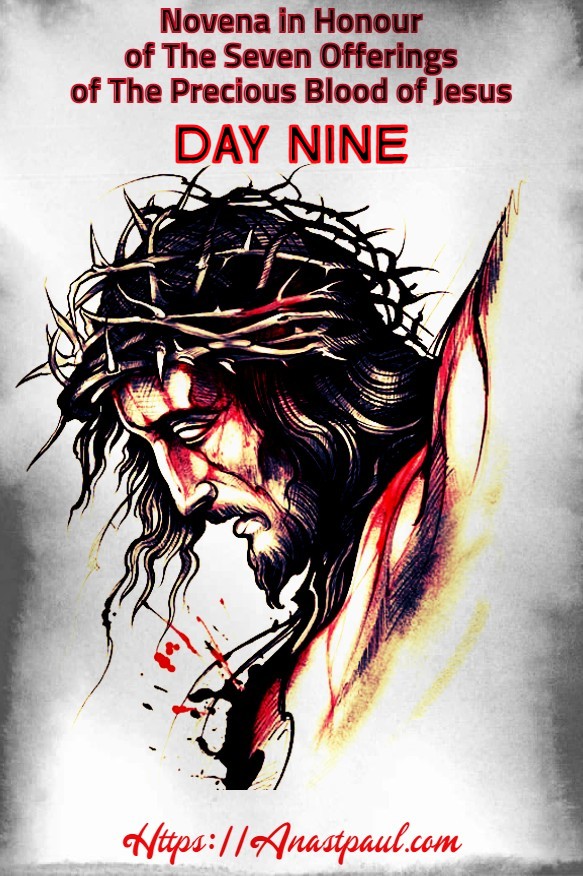
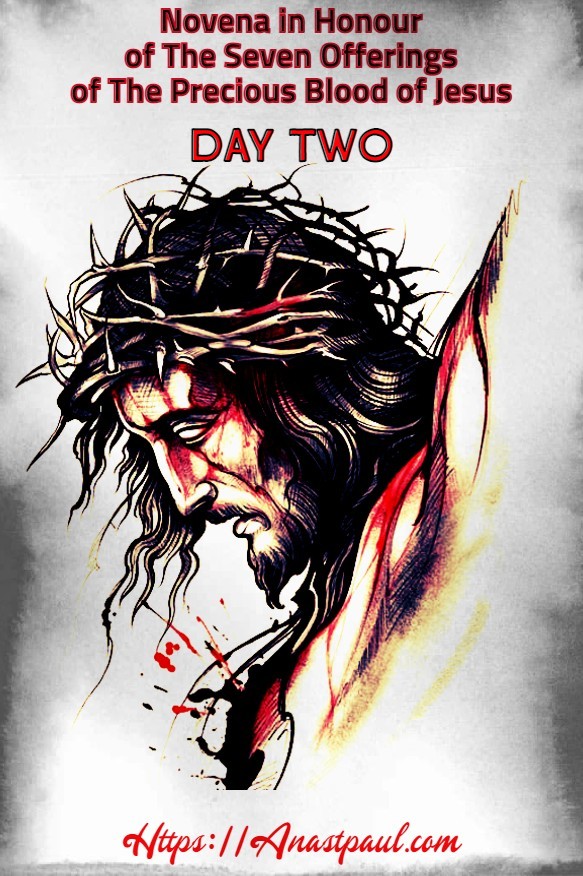
Indulgenced Novena in Honour of The Seven Offerings of the Precious Blood of Jesus
THE NINETH DAY
(An Indulgence of 5 Years for this Prayer — Roman Missal)
Prayer to Venerate With Solemn Worship The Price of Our Salvation
Almighty and Everlasting God, who hast appointed thine Only-Begotten Son to be the Redeemer of the world and hast been pleased to be reconciled unto u, by His Blood, grant us, we beseech Thee, so to venerate with solemn worship, the price of our salvation, that the power thereof may here on earth. keep us from all things hurtful and the fruit of the same, may gladden us forever hereafter in Heaven . through the same Christ our Lord. Amen
Glory be to the Father, etc.
Blessed and praised for evermore, be Jesus Who hath saved us with His Blood!
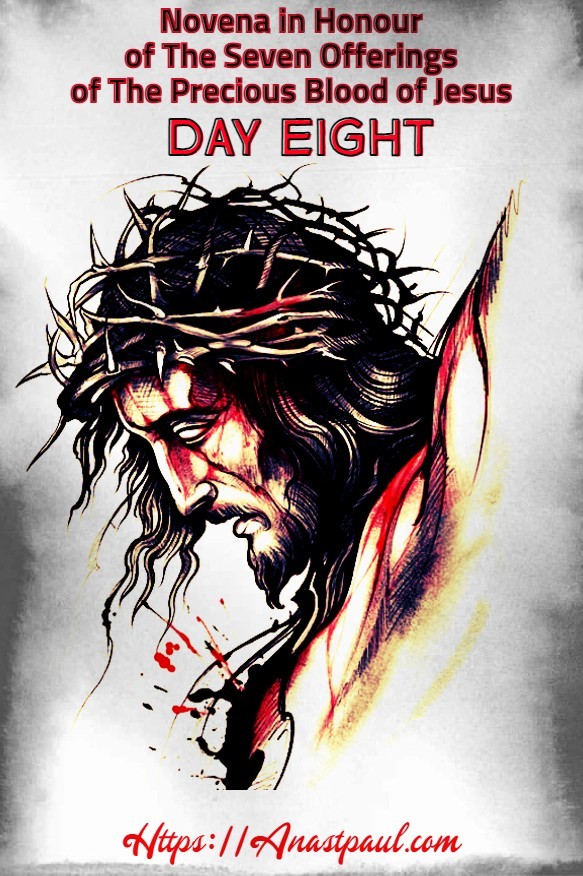
Indulgenced Novena in Honour of The Seven Offerings of the Precious Blood of Jesus
(An Indulgence of 3 years–Pius VII, 1817)
THE EIGHTH DAY
Eternal father I offer Thee the Most Precious Blood of Jesus Christ in atonement for my sins and in supplication for the Holy Souls in Purgatory and for the needs of Holy Church.
Glory be to the Father, etc.
Blessed and praised for evermore be Jesus Who hath saved us with His Blood!
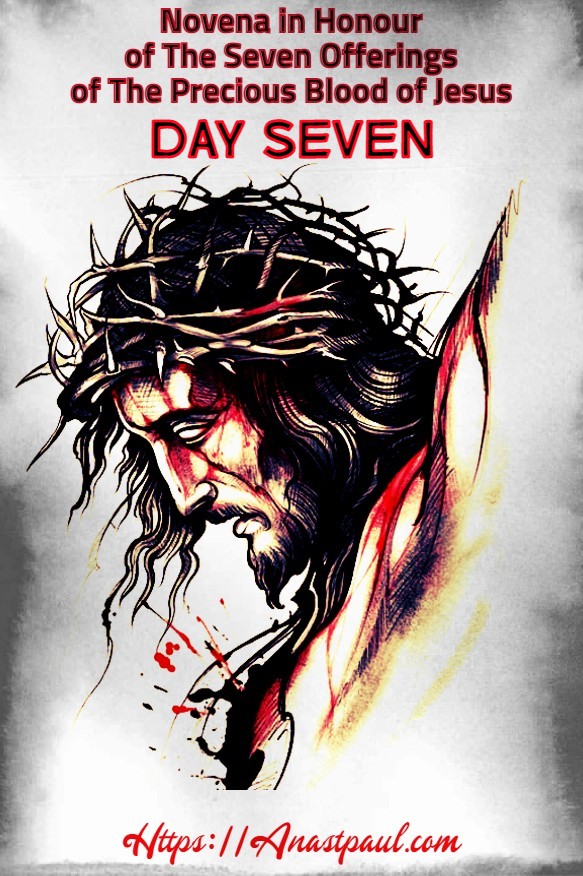
Indulgenced Novena in Honour of The Seven Offerings of the Precious Blood of Jesus
(An Indulgence of 3 years–Pius VII, 1817)
THE SEVENTH DAY
Eternal Father, I offer Thee the merits of the Precious Blood of Jesus, Thy beloved Son, my Savior and my God, for all my needs, both temporal and spiritual, as an intercession for the Holy Souls in Purgatory and in an especial manner, for those who were most devoted to this price of our Redemption and to the sorrows and sufferings of our dear Mother, Mary most Holy.
Glory be to the Father, etc.
Blessed and praised for evermore be Jesus Who hath saved us with His Blood!
Indulgenced Novena in Honour of The Seven Offerings of the Precious Blood of Jesus
(An Indulgence of 3 years–Pius VII, 1817)
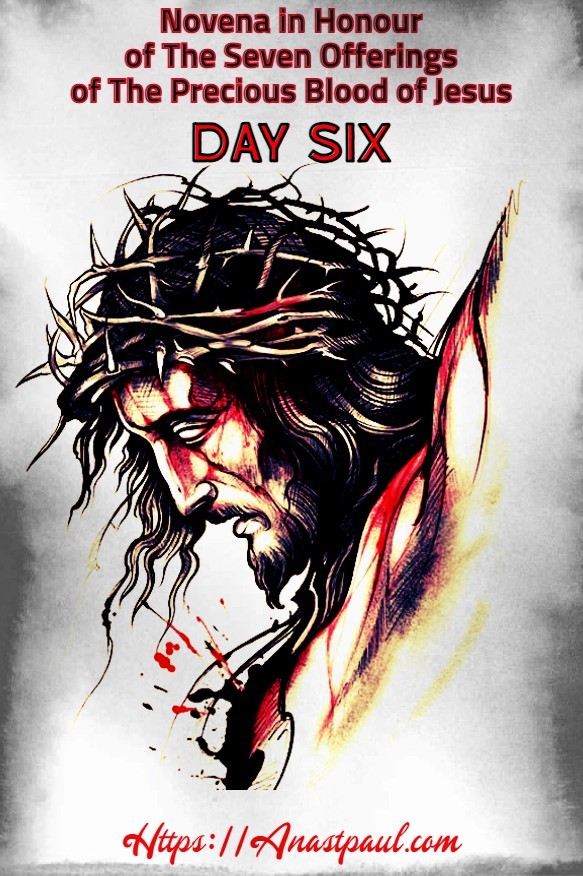
THE SIXTH DAY
Eternal Father, I offer Thee the Merits of the Precious Blood of Jesus, Thy Beloved Son, my Saviour and my God, for all men who are lovers of this great Treasure and who are united with me in adoring and glorifying It and who labour to spread this devotion.
Glory be to the Father, etc.
Blessed and praised for evermore be Jesus, Who hath saved us with His Blood!
Indulgenced Novena in Honour of The Seven Offerings of the Precious Blood of Jesus
(An Indulgence of 3 years–Pius VII, 1817)
THE FIFTH DAY
Eternal Father, I offer Thee the merits of the Precious Blood of Jesus, Thy Beloved Son, my Saviour and my God, for all those who are to pass this day to the other life, that Thou wouldst deliver them from the pains of hell and admit them with all speed, to the possession of Thy glory.
Glory be to the Father, etc.
Blessed and praised for evermore be Jesus Who hath saved us with His Blood!
Dear Friends, I am a little under the weather. I will be gone for a few days but will post the Precious Blood Novena.. which will post earlier than usual. In the meantime, let us pray for each other. See you soon. 🧡🙏 Ana
Indulgenced Novena in Honour of The Seven Offerings of the Precious Blood of Jesus
(An Indulgence of 3 years–Pius VII, 1817)
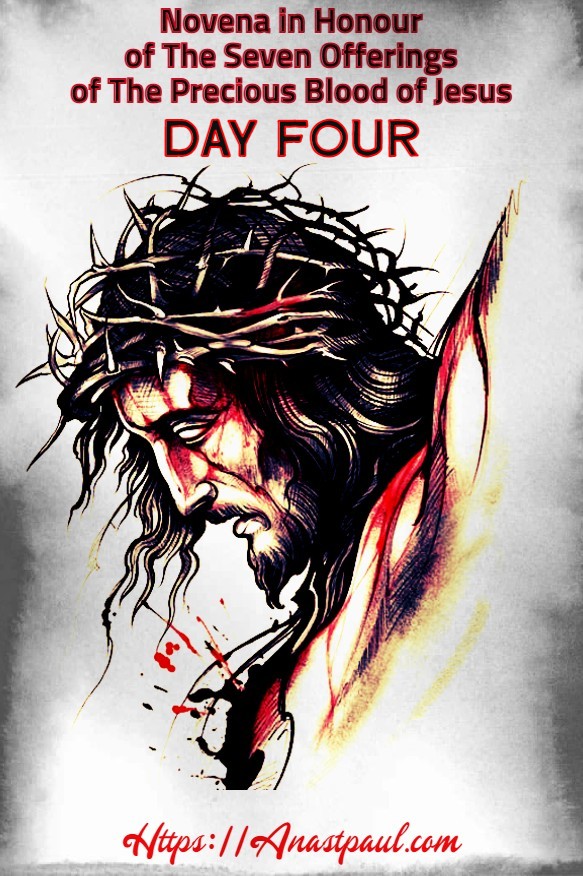
THE FOURTH DAY
Eternal Father, I offer Thee the Merits of the Precious Blood of Jesus, Thy beloved Son, my Saviour and my God, f or all my relatives, friends and enemies, for those in need, in sickness, in tribulation and for all those, for whom Thou knowest that I am bound to pray and willest that I should pray.
Glory be to the Father, etc.
Blessed and praised for evermore be Jesus Who hath saved us with His Blood!
Thought for the Day – 25 June – Meditations with Antonio Cardinal Bacci (1881-1971)
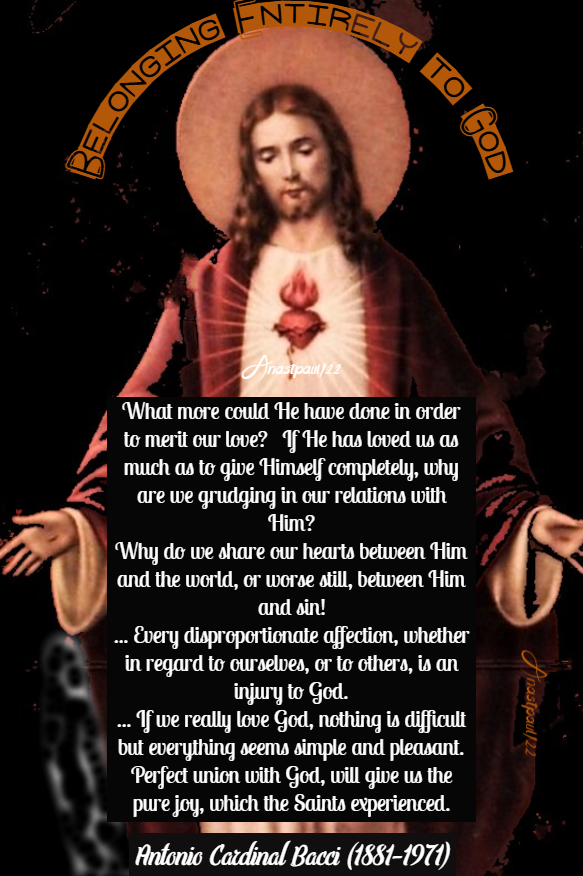
Belonging Entirely to God
“What more could He have done in order to merit our love? If He has loved us as much as to give Himself completely, why are we grudging in our relations with Him? Why do we share our hearts between Him and the world, or worse still, between Him and sin!
There is nothing to prevent us from loving creatures, as well as God but, they should be loved in God and for God. They should form a ladder, which enables us to climb towards God.
Every disproportionate affection, whether in regard to ourselves, or to others, is an injury to God. If we really belong entirely to God, we should be at peace. Since virtue is difficult, it is difficult to belong completely to God but, the effort gives us a foretaste of the happiness of Heaven.
If we really love God, nothing is difficult but everything seems simple and pleasant. Perfect union with God, will give us the pure joy, which the Saints experienced.”
Quote/s of the Day – 25 June – The Nativity of St John the Baptist
“ And when Elizabeth heard the greeting of Mary, the baby leaped in her womb. And Elizabeth was filled with the Holy Spirit … “For behold, when the sound of your greeting came to my ears, the baby in my womb leaped for joy.”
Luke 1:41,44
“I tell you, among those born of women, no-one is greater than John; yet the least in the kingdom of God is greater than he.”
Luke 7:28
“At my birth, I took away my mother’s barrenness and while still an infant, I healed my father’s dumbness, for You gave me in childhood, the gift of working miracles.”
St Gregory the Illuminator (c 213-270) Bishop
“As a representative of the past, he is born of aged parents, as herald of the new, he is declared to be a prophet, while still in his mother’s womb.”
“The release of Zechariah’s voice at the birth of John, is a parallel to the rending of the veil, at Christ’s Crucifixion. If John were announcing his own coming, Zechariah’s lips would not have been opened. The tongue is loosened because a voice is born.
“John is a voice for a time but Christ is the eternal Word, from the beginning.”
St Augustine (354-430) Bishop, Father, Doctor of Grace
One Minute Reflection – 25 June – “The Month of the Sacred Heart” – The Nativity of St John the Baptist – Isaias 49:1-3, 5-7, Luke 1:57-68
“Immediately his mouth was opened, his tongue freed and he spoke blessing God.” – Luke 1:64
“When John, his son was born, among his neighbours there was concern about what name he should be given. Writing tablets were offered to his father, so that he himself could put down the name that he had decided upon, so that he might express, in writing, what he could not, in speech. Then, in a wonderful manner, when he had taken the tablets in order to begin writing, his tongue was loosened, the written word gave way to speech and he did not write “John” but spoke it. Consider, then, the merit of the holy Baptist: he gave his father back his voice, he restored the faculty of speech to the priest. Consider, I say, his merit – John unloosed the mouth that the angel had bound. What Gabriel had closed, the little child unlocked. When John is born, the father suddenly becomes a prophet or priest, speech attains its use, love receives an offspring, the office recognises the priest.” – – St Maximus of Turin (Died c 420) Bishop of Turin, Father (Sermon 6) St Maximus’ Feast Day today.
PRAYER – O God, Who made this a day most worthy of our celebration because of blessed John; grant Thy people the grace of spiritual joys and direct the minds of all the faithfu, into the path of eternal salvation. Through Jesus Christ, Thy Son our Lord, Who lives and reigns with Thee, in the unity of the Holy Ghost, God, world without end. Amen (Collect). OUR Lady of the Sacred Heart, Pray for Us! – Indulgence 100 Days. Everytime – Raccolta 174 St Pius X, 9 July 1904.
Saint of the Day – 25 June – Saint Gallicanus of Ostia (Died c 363) Martyr, Layman, firstly as a Ranking Officer in the Imperial Army of Constantine the Great, promoted to the position of a Roman Consul, Convert to Christianity. He died in the persecutions under Julian.
The Roman Martyrology states of him today: “At Alexandria, St Gallicnus, ex-Consul and Martyr, who had been honoured with a triumph and was held in affection by Emperor Constantine
Gallicanus had been converted by the disciples of St John and St Paul, after which he withdrew to Ostia with St Hilarinus and devoted himself entirely to the duties of hospitality and to the service of the sick. The report of such an event spread through the whole world and from all sides, many persons came to see a man, who had been a Senator and Consul, washing the feet of the poor, preparing their table, serving them, carefuly waiting on the infirm and performing other works of mercy.
Driven from this place by Julian the Apostate, he repaired to Alexandria, where, for refusing to sacrifice to idols, at the command of the Judge Raucian, he was put to the sword and thus became a Martyr of Christ.”
According to his Acts he was a distinguished General in the war against the Persians. He was also Consul with Symmachus in 330 and perhaps also once before, with Caesonius Bassus in 317. After his conversion to Christianity he retired to Ostia, founded a hospital where he worked with Saint Hilarinus and endowed a Church built by Constantine I.
Under Julian he was banished to Egypt and lived with the hermits in the desert.
A small Church was built in his honour in the Trastevere of Rome. His relics are at Rome in the Church of Sant’Andrea della Valle.
Gallicanus’ conversion was dramatised in the tenth century by the nun Roswitha. St Gallicanus is a Saint of the Colonnade at St Peter’s Basilica, Vatican City, Rome. He is the first Statue on the right (north) colonnade, St. Gallicanus faces toward the front opening of St Peter’s Square. His Statue was carved etween 1670-1673 by Lazzaro Morelli, who was the most prolific of the artists working for Bernini on the colonnade statues, with over 45 of the saints attributed to him.
Amand of Coly Bl Burchard of Mallersdorf St Cyneburga of Gloucester Bl Dorothy of Montau St Eurosia of Jaca St Febronia of Nisibis Bl Fulgentius de Lara St Gallicanus of St Gallicanus of Ostia (Died c 363) Martyr, Layman, Roman Consul St Gohard of Nantes Bl Guy Maramaldi Bl Henry Zdick Bl John the Spaniard St Luceias and Companions
Indulgenced Novena in Honour of The Seven Offerings of the Precious Blood of Jesus
(An Indulgence of 3 years–Pius VII, 1817)
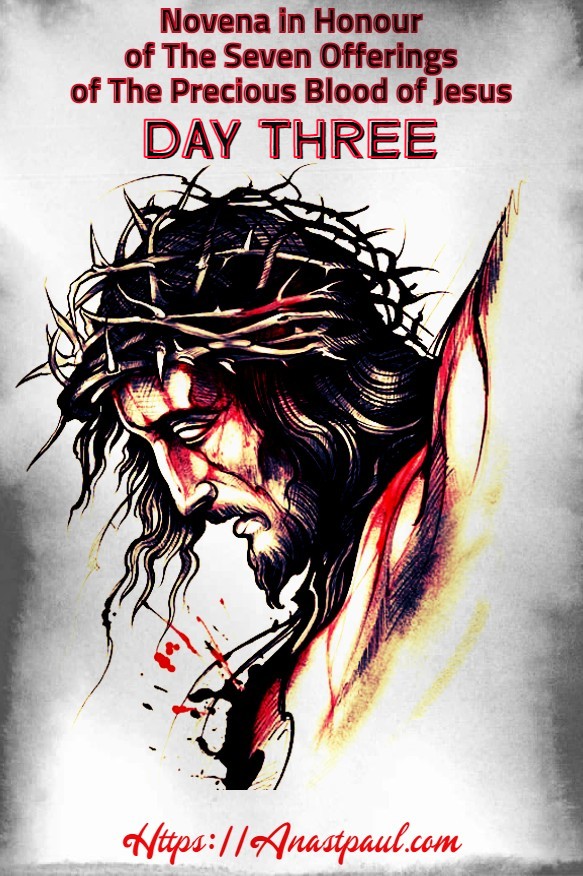
THE THIRD DAY
Eternal Father, I offer Thee the merits of the Precious Blood of Jesus, Thy beloved Son, my Saviour and my God, for the conversion of unbelievers, the rooting-up of all heresies and the conversion of all sinners, especially those within our homes and within Holy Mother Church.
Glory be to the Father, etc.
Blessed and praised for evermore be Jesus Who hath saved us with His Blood!
Thought for the Day – 24 June – Meditations with Antonio Cardinal Bacci (1881-1971)
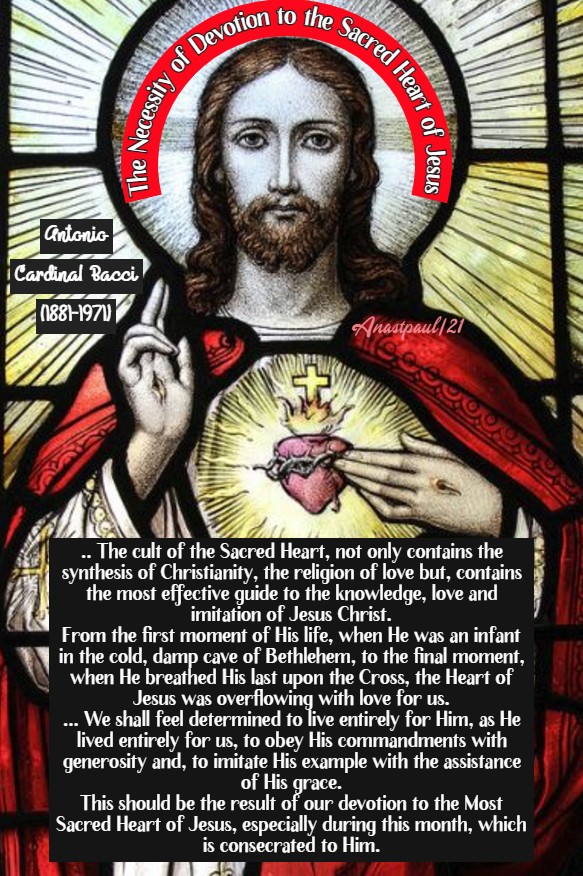
The Necessity of Devotion to the Sacred Heart of Jesus
“It is necessary to develop and meditate on these words of Pius XI, (see Part One) from which, it is clear, that the cult of the Sacred Heart, not only contains the synthesis of Christianity, the religion of love but, contains the most effective guide to the knowledge, love and imitation of Jesus Christ. From the first moment of His life, when He was an infant in the cold, damp cave of Bethlehem, to the final moment, when He breathed His last upon the Cross, the Heart of Jesus was overflowing with love for us. We can learn from this, to know our Divine Saviour better, so that appreciating more fully His infinite love for us, we shall feel an upsurge of gratitude and, of love. We shall feel determined to live entirely for Him, as He lived entirely for us, to obey His commandments with generosity and, to imitate His example with the assistance of His grace. This should be the result of our devotion to the Most Sacred Heart of Jesus, especially during this month, which is consecrated to Him.”
Quote/s of the Day – 24 June – “The Month of the Sacred Heart” and the Feast of the Sacred Heart of Jesus
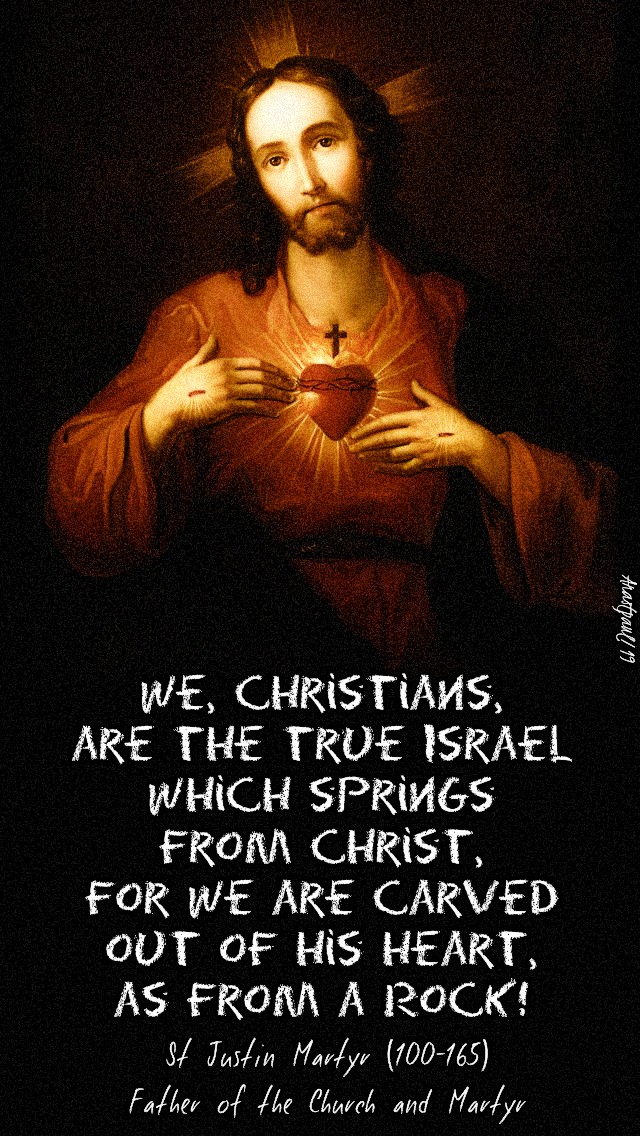
“We, Christians, are the true Israel which springs from Christ, for we are carved out of His Heart, as from a Rock!”
St Justin Martyr (100-165) Father of the Church and Martyr
“Be strengthened in Almighty God and in the power of His might, for with His help, nothing is difficult. Throw off the heavy load of your own will, cast aside the burden of sin and gird yourselves as valiant warriors. Forget what you are leaving behind; strain forward to the great things before you. I tell you, that every place where you set foot, shall be yours. For the Spirit who goes before your face is Christ the Lord. He will carry you to the topmost peak in the arms of His Love.”
St Francis of Assisi (c 1181-1226)
“The Sacred Heart is the symbol of that boundless love which moved the Word to take flesh, to institute the Holy Eucharist, to take our sins upon Himself and, dying on the Cross, to offer Himself as a victim and sacrifice to the eternal Father.”
“O Heart of love, I put all my trust in Thee, for I fear all things, from my own weakness, but I hope for all things, from Thy Goodness.”
The Twelve Promises of Jesus to Saint Margaret Mary or those Devoted to His Sacred Heart:
I will give them all the graces necessary for their state of life.
I will establish peace in their families.
I will console them in all their troubles.
They shall find in My Heart an assured refuge during life and especially at the hour of their death.
I will pour abundant blessings on all their undertakings.
Sinners shall find in My Heart the source of an infinite ocean of mercy.
Tepid souls shall become fervent.
Fervent souls shall speedily rise to great perfection.
I will bless the homes where an image of My Heart shall be exposed and honoured.
I will give to priests the power of touching the most hardened hearts.
Those who propagate this devotion shall have their names written in My Heart, never to be effaced.
The all-powerful love of My Heart will grant to all those who shall receive Communion on the First Friday of nine consecutive months the grace of final repentance; they shall not die under my displeasure, nor without receiving their Sacraments; My heart shall be their assured refuge at that last hour.
From Saint Margaret Mary Alacoque’s Vision of Jesus
St Margaret Mary Alacoque (1647-1690) Visionary of the Sacred Heart
One Minute Reflection – 24 June – “The Month of the Sacred Heart” and the Feast of the Sacred Heart of Jesus – Ephesians 3:8-12, 14-19, John 19:31-37.
“And to have Christ dwelling, through faith, in your hearts, so that, being rooted and grounded in love, you may be able to comprehend, with all the saints, what is the breadth and length and height and depth and to know Christ’s Love, which surpasses knowledge,” – Ephesians 3:17-19
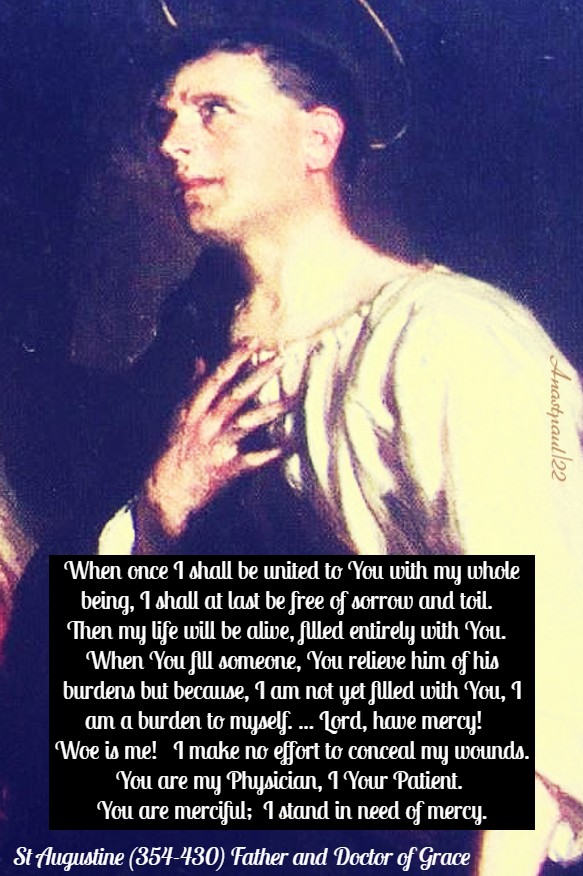
REFLECTION – “When once I shall be united to You with my whole being, I shall at last be free of sorrow and toil. Then my life will be alive, filled entirely with You. When You fill someone, You relieve him of his burdens but because, I am not yet filled with You, I am a burden to myself. My joy when I should be weeping, struggles with my sorrows, when I should be rejoicing. I know not where victory lies.
Woe is me! Lord, have mercy on me! My evil sorrows and good joys are at war with one another. I know not where victory lies. Woe is me! Lord, have mercy! Woe is me! I make no effort to conceal my wounds. You are my Physician, I Your Patient. You are merciful; I stand in need of mercy.” – St Augustine (354-430) Father and Doctor of Grace (An excerpt from: The Confessions Book 10).
PRAYER – O God, Who in the Heart of Thy Son, wounded by our sins, mercifully lavish upon us the infinite riches of Love, grant, we beseech Thee, that as we offer Him the faithful service of our devotion, we may also show forth fitting reparation. Through Jesus Christ, Thy Son our Lord, Who lives and reigns with Thee, in the unity of the Holy Ghost, God, world without end. Amen (Collect). SACRED Heart of JESUS, Thy Kingdom come! – Indulgence 300 Days – Every time – Raccolta 179 St Pius X, 6 November 1906.
Our Morning Offering – 24 June – “The Month of the Sacred Heart” and the Feast of the Sacred Heart of Jesus
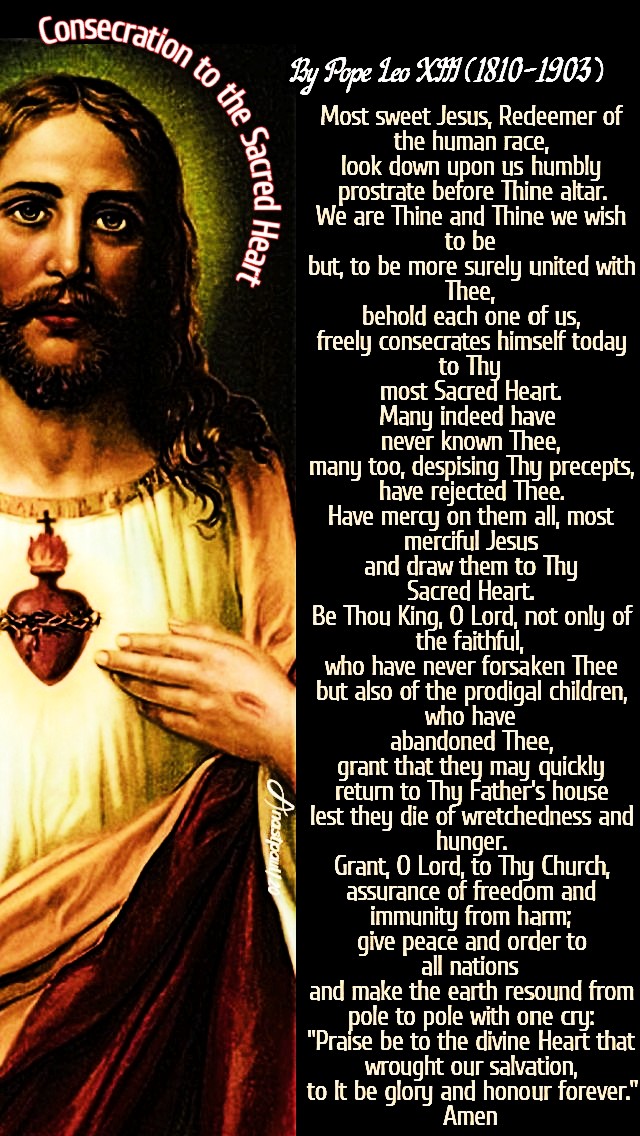
Consecration to the Sacred Heart By Pope Leo XIII (1810-1903) Pope from 1878-1903
Most sweet Jesus, Redeemer of the human race, look down upon us humbly prostrate before Thine altar. We are Thine and Thine we wish to be but, to be more surely united with Thee, behold each one of us, freely consecrates himself today to Thy most Sacred Heart. Many indeed have never known Thee, many too, despising Thy precepts, have rejected Thee. Have mercy on them all, most merciful Jesus and draw them to Thy Sacred Heart. Be Thou King, O Lord, not only of the faithful, who have never forsaken Thee but also of the prodigal children, who have abandoned Thee, grant that they may quickly return to Thy Father’s house lest they die of wretchedness and hunger. Be Thou King of those who are deceived by erroneous opinions, or whom discord keeps aloof and call them back to the harbour of truth and unity of faith, so that there may be but one flock and one Shepherd. Be Thou, King of all those. who are still involved in the darkness of idolatry or of Islamism and refuse not, to draw them into the light and kingdom of God. Turn Thine eyes of mercy towards the children of the race, once Thy chosen people – of old they called down upon themselves the Blood of the Saviour; may it now descend upon them, a laver of redemption and of life. Grant, O Lord, to Thy Church, assurance of freedom and immunity from harm; give peace and order to all nations and make the earth resound from pole to pole, with one cry: “Praise be to the Divine Heart that wrought our salvation; to It be glory and honour forever.” Amen
The above prayer, composed by Pope Leo XIII was included in the 1899 Encyclical Annum Sacrum issued by Leo XIII as he Consecrated the entire world to the Sacred Heart of Jesus. The consecration was influenced by two letters written to the Holy Father by Blessed Sister Mary of the Divine Heart, who stated that in visions of Jesus Christ, she had been told to request the Consecration.
“For this cause I bow my knees to the Father, that you may be able to comprehend with all the saints what is the breadth and length and height and depth of this Mystery.” – Ephesians 3:14,18.
“To me, the least of all the saints, is given this grace to preach among the Gentiles and to enlighten all men, what is the dispensation of the Mystery which hath been hidden from eternity in God, Who created all things. For this cause I bow my knees to the Father of our Lord Jesus Christ, of Whom all paternity in heaven and earth is named, That He would grant you the grace to be strengthened by the power of His Spirit, unto the inward man. That Christ may dwell by faith in your hearts, that being rooted and founded in charity, you may be able to comprehend, with all the saints, what is the breadth and length and height and depth of this mystery. To know also, the charity of Christ, which surpasseth all human knowledge.”
“With these words to the Ephesians and similar assurance,s in many passages of the Epistles, which St Paul wrote – not only for the faithful of his own day but for those of all future time – the Apostle of Nations exhorts us, in the most expressive manner, to advance in the knowledge of Christ. And, if we wish to comprehend the total height and depth, the entire breadth and length, of the Love of Jesus, we can only do so, by looking into the depths of His Sacred Heart and to make this clear, will be the object of my words today. O Mary, Mother of the Divine Heart, obtain for us the grace to enter into the full knowledge of Christ’s Love for us, that we may meet it with faithful reciprocal love! I speak in the Holy Name of Jesus, for the greater honour and glory of God!
To contemplate in its entire extent the Love of Jesus Christ and to open our hearts, in true reciprocal love to the Lord, that He may dwell therein, we must go to the Sacred Heart and look into its depths. There, ah! there, we can behold, in all its immensity, a Love so mighty, that it drew Him away from the Throne of His Glory in Heaven to earth and urged Him, not only to assume human nature but, by so doing, as St Paul assures us, to annihilate Himself and take the form of a slave. For, appearing as a Man among men, He concealed His Divinity before them and, although He wrought miracles, other men, with the Divine assistance, performed wonders still greater – Moses, for instance, at the departure of the children of Israel from Egypt.
Men, in general, acknowledged Him so little as God, that they threatened to stone Him when He declared that He was! They persecuted ,at every occasion, this meek Lamb of God and at last nailed Him to the Cross. And what brought to such depths of humility, the King of kings and Lord of lords? Because He chose not to appear as a powerful monarch, as a ruler over the whole universe, before whom all nations would tremble but ,as a slave, for He entered this world as the subject of an emperor, who governed only the Romans as free men, while those nations he had conquered, were held in subjection. And, therefore, Christ suffered the Death of the slave – Crucifixion.
Why did He humble Himself so deeply? One glance into the Divine Heart will tell us that it was His Merciful Love to us. Great God! what misery overwhelmed the human race and, what would have become of us, if the Arm of Thy infinite Justice had not been stayed! But Christ the Son of God, equal in essence and nature to His eternal Father, wished, through Love, to celebrate the triumph of His Infinite Mercy and this Love, urged Him,not only to grant pardon to penitent sinners but to make satisfaction for them and take upon Himself, the justification for sin.
Not only, beloved in Christ, did He mean to pardon this or that sin, to forgive this or that sinner but for every sin, that would ever be committed and, for every sinner, if he were truly contrite, a gracious pardon would be found. Christ requires but one thing of the sinner – that he avails himself of those efficacious means of salvation, to be found in the True Church and takes refuge in His Sacred Heart.
Dearly beloved Catholic souls, redeemed by the Blood of God, reflect upon this precious truth and, that you may realise the depth of His Love for you, look at the Sacred Heart – look into Its Bleeding Wound. The Almighty, the Omnipotent God, the gracious and merciful Saviour, comes from the Heaven of His glory to afford us a certain refuge therein – to save us from that pit, which the malice of sin, has prepared for us in hell.
The Deluge prefigured the spiritual ruin which overwhelmed the whole human race. Now, Holy Scripture testifies, that the waters thereof rose to the height of fifteen cubits above the loftiest mountains. This indicates the degree of malice which characterised the wickedness of mankind, it being greater than that of the fallen angels. Their sin was that pride, which led them to wish to be like God; while man, on the contrary, committed Deicide, as St.Peter, in his first sermon, called the Crucifixion, when he said: “The Author of life you have killed.“
This reproach applies, not only to those Jews who personally laid hands on Christ but, to all men as sinners; for St Paul asserts: “Whosoever sins, Crucifies God in his heart, tramples His Precious Blood under foot.” And yet God forgives on account of the merits of Christ! Whom? – The greatest sinner, if he but repent! And what means does He choose for this? Let us adore and wonder, for the commission of the greatest possible si – attempted Deicide – became for us, the source of every grace. What a triumph of Infinite Mercy!
Glance at the Heart of Jesus, opened after His Death: – by this, He opened His Arms to every soul, with the loving words: “I have loved thee unto death and presented the last drop of My Heart’s Blood for thee to draw thee from the abyss of destruction, which thy sins prepared for thee in hell.” Oh, what a depth and, at the same time, what a height of Love! The work of Redemption as consummated by this Love, made fast the gates of hell and rescued us from that fiery pit but, not content with this, our loving Saviour would open the portals of a Heaven, more beautiful, than the one which would have been our portion had Adam never sinned.
And now, as brothers of the Son of God, we may enter that region of bliss,and become, as precious stones, set in the celestial crown of the world of Angels. We may, by our zeal, in the exercise of good works and their union with the Merits of Christ, ascend higher and higher, through new and more brilliant merits, to an immeasurable degree of glory! Look at Mary, whose throne is next to that of Jesus: she was, like us, a child of man and her glory, by far outshines that of the brightest Angel. We, as her children, may hope to attain a place in Heaven, near that of our gracious Queen – for from the Heart of Jesus, came forth the cry: “To him that shall overcome, I will grant to sit with Me on My Throne.”
And how shall we learn the breadth of this love? I answer: By contemplating the generosity which marked Its course and so animated the Sacred Heart in the Breast of the Infant Saviour, in the crib and of the Redeemer, on the Cross. Even now, it beats for us in the Most Holy Sacrament over the whole globe. Think of the generosity of that Love, by which Jesus has communicated to us, the whole Merit of His Life, Passion, and Death.
The words of St Augustine, refer to this in the explanation and answer, given by him, of the words of Christ: “What price could man give for his soul?” “Remember,” exclaims St Augustine, “the price which Christ paid for you through the work of Redemption; you have been purchased by the Life, Passion and Death of Christ, the Son of God.” What He gave for you, He did not give even for the Angels. Oh, how sweetly are we reminded of all this by one loving glance at the Sacred Heart of Jesus! It beats indeed today on earth, for each one of us. Go before the Tabernacle and ask what is that which Jesus confers upon you in every Holy Communion. It is Himself.
And the length of this enduring Love, may be discerned by the unwearied forbearance He shows to man. From the first moment of your conception, Christian soul, He has loved you with an everlasting Love. He has thought of you and longed to bless you for all eternity. And it will be your own fault, if He does not remain, until your very latest breath, the same faithful, loving Jesus, Who will assist you in that last dread passage where time is merged into eternity.
Yes, it is an Article of Faith, that when the greatest sinner turns, with a repentant heart to Jesus, even in his dying hour, he will still be saved through Him. And is this really so? Christian, look at the wounded Heart in the Breast of your Redeemer. It has ceased to beat – it is dead! Yet, from the Wound came Blood and Water, the symbol of the Church, to which Christ gave power to pardon the dying sinner whose heart cries out for mercy – for forgiveness through the Merits of Christ.
Dearly beloved, who have listened to my words today, reflect upon what I have told you of the Most Sacred Heart of Jesus – of the height, depth, breadth and length of the Love of Christ. Consider it daily and the wish of St Paul, of which I have already spoken to you, will certainly be fulfilled in you. You will become so strengthened in the love of God, through the Spirit of Christ, that He will abide in your heart and, finding therein, so firm a faith, earnest a hope and ardent a love, will there take up His abode forever. Amen! – Fr Francis Xavier Weninger SJ (1805-1888) (Excerpt -The Feast of the Sacred Heart).
Bl Christopher de Albarran St Erembert I of Kremsmünster St Faustus of Rome and Companions St Festus of Rome St Germoc St Gohardus of Nantes Bl Henry of Auxerre/the Hagiographer St Ivan of Bohemia St John of Rome
St John of Tuy St Joseph Yuan Zaide Bl Maksymilian Binkiewicz St Rumold St Simplicio of Autun Bl Theodgar of Vestervig St Theodulphus of Lobbes
Martyrs of Satala: Seven Christian brothers who were soldiers in the imperial Roman army. They were expelled from the military, exiled and eventually martyred in the persecutions of Maximian. We know little more about them than their names – Cyriacus, Firminus, Firmus, Longinus, Pharnacius, Heros and Orentius. The martyrdoms occurred in c 311 at assorted locations around the Black Sea.
Novena in Honour of The Seven Offerings of the Precious Blood of Jesus
(An Indulgence of 3 years–Pius VII, 1817)
THE SECOND DAY
Eternal Father, I offer Thee the merits of the Precious Blood of Jesus, Thy beloved Son, my Saviour and my God, for peace and concord among Catholic Kings and Princes, for the humbling of the enemies of our Holy Faith and the welfare of all Thy Christian people.
Glory be to the Father, etc.
Blessed and praised for evermore be Jesus Who hath saved us with His Blood!
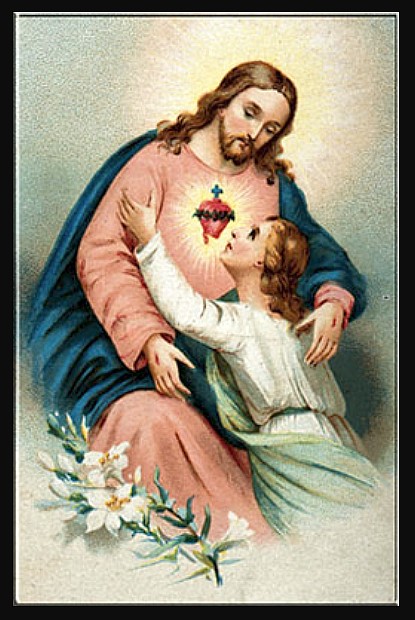
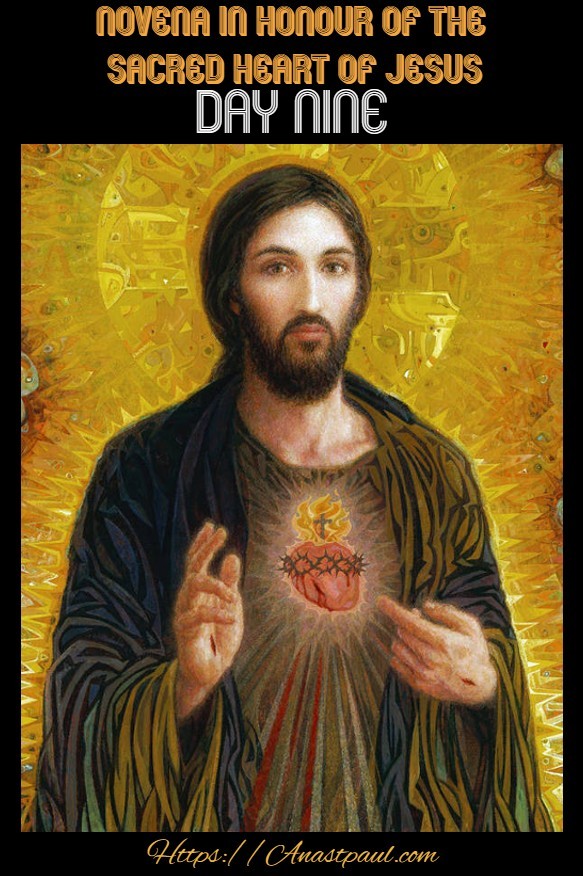
Everyday unite your prayers and adorations with those of the Most Holy Virgin and of one of the nine choirs of Angels and Saints, to honour one of the dispositions of the Sacred Heart of Jesus and to practise some virtue in its honour.
THE NINTH DAY
With the Blessed Virgin, the Angels and the unknown Saints of all states.
Adore the Sacred Heart of Jesus, who complains of the coldness and indifference of the lukewarm,and who promises so much to fervent souls, who have the generosity to relinquish all, in order to love Him without reserve.
Practice—Endeavour to discover the cause of your want of devotion and of your tepidity; adopt such measures as will enable you to arise from this state and embrace every means ,which may contribute to render you more agreeable in the eyes of Jesus Christ.
Practice–Perform some penance, some generous act of virtue, in reparation of the outrages which He receives.
Prayer of St. Alphonsus Liguori to the Sacred Heart
O Adorable Heart of my Jesus, Heart created expressly. for the love of men! Until now, I have shown towards Thee only ingratitude. Pardon me, O my Jesus. Heart of my Jesus, Abyss of Love and of Mercy, how is it possible, that I do not die of sorrow when I reflect on Thy Goodness to me and my ingratitude to Thee? Thou, my Creator, after having created me, hast given Thy Blood and Thy Life for me and, not content with this, Thou hast invented a means of offering Thyself everyday for me, in the Holy Eucharist, exposing Thyself to a thousand insults and outrages. Ah, Jesus, do Thou wound my heart with a great contrition for my sins and a lively love for Thee. Through Thy Tears and Thy Blood, give me the grace of perseverance in Thy fervent love, until I breathe my last sigh. Amen.
Thought for the Day – 23 June – Meditations with Antonio Cardinal Bacci (1881-1971)
Spiritual Communion
“St Thomas Aquinas calls the Eucharist “the Sacrament of love” (Opuse 38:25). When love is ardent and sincere, it longs for constant contact with the beloved. Spiritual Communion can be made in a single instant, for it requires only an Act of Faith and an Act of Love. Jesus, come into my heart, for I have need of You. I love You, my Jesus, keep me close to You always.
Aspiration: O Jesus, I cling to You, with all my heart!”
Quote/s of the Day – 23 June – “The Month of the Sacred Heart” – The Octave Day of Corpus Christi
“My dear souls, let us recognise, I pray you, Christ’s infinite charity towards us in the institution of this Sacrament of the Eucharist. In order that our love be a spiritual love, He wills a new heart, a new love, a new spirit for us. It is not with a carnal heart but with a spiritual one, that Christ has loved us with a gratuitous love, a supreme and most ardent love, by way of pure grace and charity. Ah! One needs to love Him back with one’s whole, whole, whole, living, living, living and true, true, true heart!!”
St Lawrence of Brindisi(1559-1619) Apostolic Doctor of the Church
Sweet Sacrament, We Thee Adore
I see upon the Altar placed The Victim of the greatest love. Let all the earth below adore and join the heavenly choirs above: Sweet Sacrament, we Thee adore, Oh! make us love Thee more and more.
Jesus! dear Shepherd of the flock, that crowds in love, about Thy feet, Our voices yearn to praise Thee, Lord and joyfully Thy presence greet: Sweet Sacrament, we Thee adore, Oh! make us love Thee more and more.
O Precious Blood of Jesus, cleanse my soul from every stain! Most pure Heart of Jesus, purify me! Most humble Heart of Jesus, teach me Thy humility! Sweet Heart of Jesus, communicate to me Thy gentleness and patience! Most merciful Heart of Jesus, have mercy on me! Most loving Heart of Jesus, inflame my heart with love of Thee!
One Minute Reflection – 23 June – “The Month of the Sacred Heart” – The Octave Day of Corpus Christi –1 Corinthians 11:23-29, John 6:56-59.
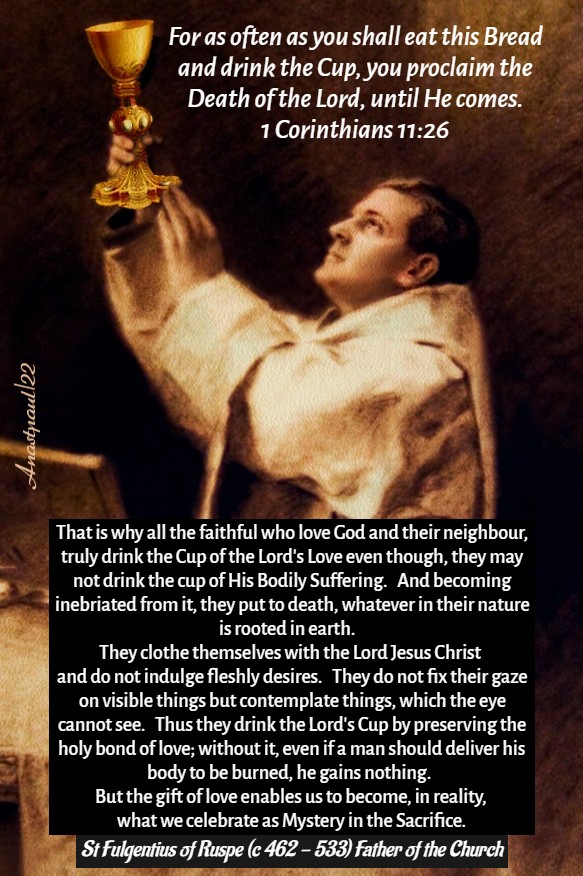
“For as often as you shall eat this Bread and drink the Cup, you proclaim the Death of the Lord, until He comes.” – 1 Corinthians 11:26
REFLECTION – “In our offering of the Holy Sacrifice we fulfil the Command of our Saviour, as recorded by the Apostle Paul: The Lord Jesus, on the night in which He was betrayed, took bread and after He had given thanks, broke it and said: This is My Body, which is given for you. Do this in remembrance of Me. The same way, after the supper, He took the Cup saying: This Cup is the New Covenant in My Blood. Do this, whenever you drink it, in remembrance of Me. For as often as you eat this Bread and drink this Cup, you shall proclaim the Death of the Lord until He comes.
This Sacrifice is offered, then, to proclaim the Lord’s Death; it is offered in remembrance of Him Who laid down His Life for our sake. As He says: Greater love than this no man has, that he lay down his life for his friends. Because Christ died for us out of love, we ask, when we make remembrance of His Death, at the time of Sacrifice, that we too may be granted love through the coming of the Holy Spirit. We pray, that by the Love which Christ had for us when He braved the Cross, we may receive the grace of the Spirit and be crucified to the world and the world to us. The Death Christ died, He died to sin, once for all but the Life He lives, He lives to God. Let us imitate our Lord’s Death and also live a new life. Strengthened with the gift of His Love, let us die to sin and live for God.
For God’s Love has been poured out in our hearts, through the Holy Spirit, Who has been given to us. Indeed our sharing in the Lord’s Body and Blood, when we eat His Bread and drink His Cup, teaches us, that we should die to the world and that we should keep our life hidden with Christ in God, crucifying our flesh with its vices and evil desires.
That is why all the faithful who love God and their neighbour, truly drink the Cup of the Lord’s Love even though, they may not drink the cup of His Bodily Suffering. And becoming inebriated from it, they put to death, whatever in their nature is rooted in earth. They clothe themselves with the Lord Jesus Christ and do not indulge fleshly desires. They do not fix their gaze on visible things but contemplate things, which the eye cannot see. Thus they drink the Lord’s Cup by preserving the holy bond of love; without it, even if a man should deliver his body to be burned, he gains nothing. But the gift of love enables us to become, in reality, what we celebrate as Mystery in the Sacrifice.” – St Fulgentius of Ruspe (c 462 – 533) Bishop, Father (An excerpt from Against Fabianus).
PRAYER – Grant, O Lord, that we may always fear and love Thy Holy Name, for Thou never fails to guide those whom Thou firmly establish in Thy love. Through Jesus Christ, Thy Son our Lord, Who lives and reigns with Thee, in the unity of the Holy Ghost, God, world without end. Amen (Collect). MAY the Heart of JESUS in the most Blessed Sacrament be praised, adored and loved with grateful affection, at every moment, in all the Tabernacles of the world, even to the end of time. – Indulgence 100 Days, Once a Day. Raccolta 161 Pius IX, 29 February 1868.
Our Morning Offering – 23 June – “The Month of the Sacred Heart”
O Sacred Heart of Jesus By St Gertrude the Great (1256-1302)
O Sacred Heart of Jesus, Fountain of eternal life, Your Heart is a glowing Furnace of Love. You are my Refuge and my Sanctuary. O my adorable and loving Saviour, consume my heart with the burning fire with which Your Heart is enflamed. Pour down on my soul those graces which flow from Your love. Let my heart be united with Your Heart. Let my will be conformed to Your Will in all things. May Your Will be the Rule of all my desires and actions. Amen
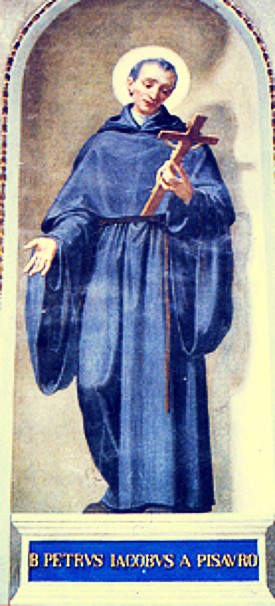
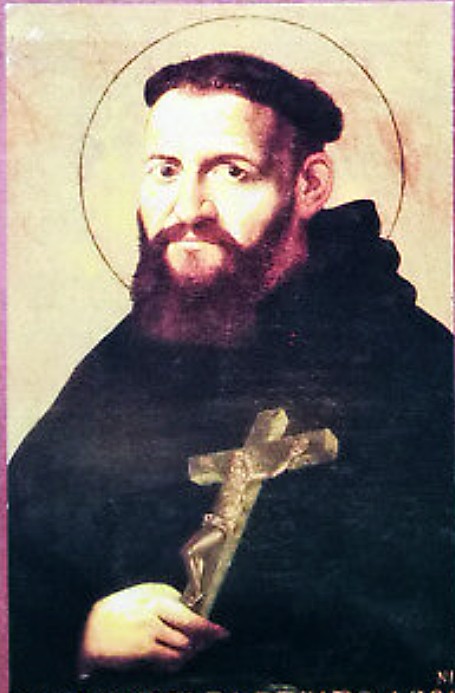
Saint of the Day – 23 June – Blessed Pietro Giacomo of Persaro OSA (c 1445 -1496) Priest of the Order of the Hermits of St Augustine, Professor in Sacred Theology, Novice Master, Born in c 1445 in Pesaro, Italy and died on 23 June 1496 the Hermitage of Valmanente in the Marche, Italy. Also known as – Peter James.
Pietro was born in Pesaro most likely, around the year 1445. Little is known about his family, which some historians call Gaspari. Ar a very young age, he asked and obtained, entrance to the Convent of the Augustinians in Pesaro, who instilled in him the compelling charm which inspired devotion in others, which characterised the Augustinians – with study as a way to wisdom, virtue and apostolic ministry.
At the end of his Novitiate, the young man made his profession and was sent to complete his studies necessary for the Priestly ministry and an academic career according to the rigid and demanding program prescribed for the Augustinian Order.
After his Priestly Ordination, he entered the Convent life with the commitment to continue his studies and to guide the young students of the Order.
In 1472 he was Master of the Novices in Perugia. In 1473 he was sent to teach in the Augustinian College in Florence. In 1482 we find him, already with the title of Professor in Sacred Theology in Rimini with the task of Master of the Novices..
He participated in two General Chapters: in 1482 in Perugia and in 1486 in Siena. He died in his early fifties. His life, therefore, ended not due to the wear and tear of the years but, probably, of the hardships of his mortication and penances. At the end of his life, always in the esteem of his Superiors and confreres, he renounced any office, even a prestigious one, in order to devote himself to the ascetic life and contemplation in the Hermitage of Valmanente, made famous by the holiness of St Nicholas of Tolentino, who in that place, had its famous vision of Purgatory.
Other records which historians have sometimes reported regarding our saint – such as his appointment as General Commissioner for a dispute between the Convents of Pergola and Corinaldo, his election as Prior Provincial of the Picena Province and the office of Prior in the famous Convent and College of St James the Greater in Bologna – should be better verified, also because some may refer to a another Pietro Giacomo da Pesaro, a contemporary of his.
However, we do know for sure, that the Blessed Pietro Giacomo emerged with some unmistakable characteristics – his holiness of life, love for study, commitment to evangelisation and the spiritual and cultural formation of young Augustinians, the search for solitude, asceticism, prayer and penance. ,
He died in 1496 in Valmanente, where his relics are now venerated in the Augustinian Church. Pope Pius IX, of blessed memory, approved his cult in 1848.
St Moeliai of Nendrum Blessed Pietro Giacomo of Persaro OSA (c 1445-1496) Priest of the Order of the Hermits of St Augustine Bl Peter of Juilly Bl Thomas Corsini of Orvieto St Thomas Garnet Bl Walhere of Dinant St Zenas of Philadelphia St Zeno of Philadelphia
Martyrs of Ancyra: A family of converts who were arrested, tortured, and sent in chains to Ancyra, Galatia (modern Ankara, Turkey) where they was tortured again by order of governor Agrippinus during the persecutions of Diocletian. Martyrs. They were – Eustochius, Gaius, Lollia, Probus, Urban. Died by being roasted over a fire and finally beheaded c300 in Ancyra, Galatia (modern Ankara, Turkey).
Martyrs of Nicomedia: During the persecutions of Diocletian, many Christians fled their homes to live in caves in the area of Nicomedia. In 303 troops descended on the area, systematically hunted them down and murdered all they could find.
Novena in Honour of The Seven Offerings of the Precious Blood of Jesus
(An Indulgence of 3 years–Pius VII, 1817)
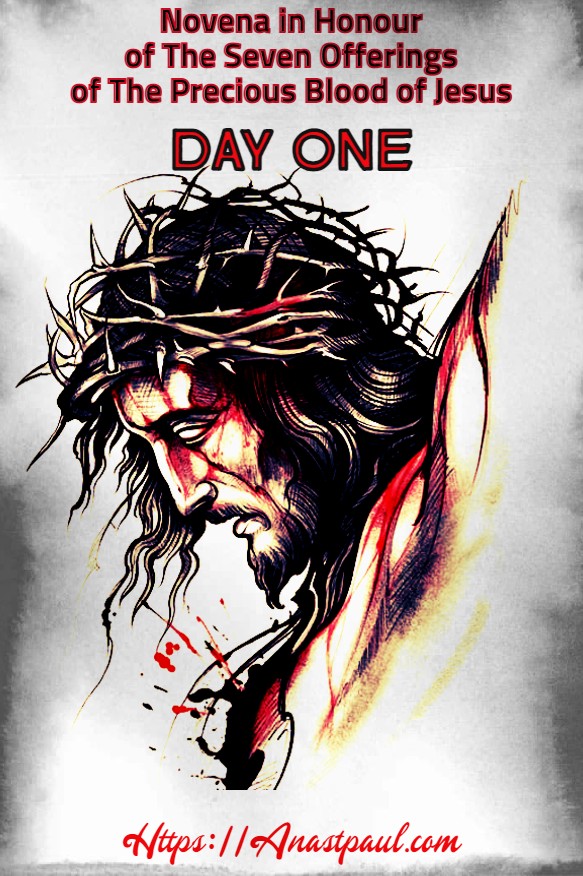
THE FIRST DAY
Eternal Father, I offer thee the merits of the Precious Blood of Jesus, Thy beloved Son, my Saviour and my God, for the spread and exaltation of my dear Mother, Thy holy Church, for the preservation and welfare of her visible Head, the true sovereign Roman Pontiff, for the Cardinals, Bishops and Pastors of souls and for all the Priests of the Sanctuary.
Glory be to the Father, etc.
Blessed and praised for evermore, be Jesus Who hath saved us with His Blood!
































You must be logged in to post a comment.