Everyday unite your prayers and adorations with those of the Most Holy Virgin and of one of the nine choirs of Angels and Saints, to honour one of the dispositions of the Sacred Heart of Jesus and to practise some virtue in its honour.
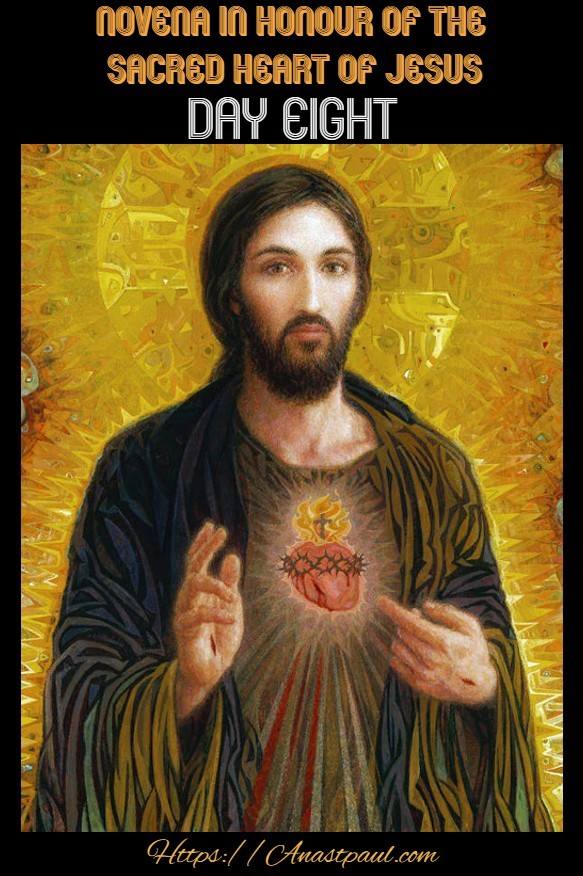
THE EIGHTH DAY
With the Blessed Virgin, the Archangels and the Holy Innocents.
Adore the Sacred Heart of Jesus, which is sensibly afflicted with the outrages and impieties of those who are rebels to the Church and good morals and, which desires to find faithful Christians, who will endeavour to repair these disorders.
Practice-–Perform some penance, some generous act of virtue, in reparation for the outrages which He receives.
Prayer of St. Alphonsus Liguori to the Sacred Heart
O Adorable Heart of my Jesus, Heart created expressly. for the love of men! Until now, I have shown towards Thee only ingratitude. Pardon me, O my Jesus. Heart of my Jesus, Abyss of Love and of Mercy, how is it possible, that I do not die of sorrow when I reflect on Thy Goodness to me and my ingratitude to Thee? Thou, my Creator, after having created me, hast given Thy Blood and Thy Life for me and, not content with this, Thou hast invented a means of offering Thyself everyday for me, in the Holy Eucharist, exposing Thyself to a thousand insults and outrages. Ah, Jesus, do Thou wound my heart with a great contrition for my sins and a lively love for Thee. Through Thy Tears and Thy Blood, give me the grace of perseverance in Thy fervent love, until I breathe my last sigh. Amen.
Thought for the Day – 22 June – Meditations with Antonio Cardinal Bacci (1881-1971)
Frequent Communion
“For the practice of daily Communion, however, we should have the approval of our Confessor. We should be fully determined to preserve ourselves free from every sin, especially from grave sin, for otherwise, we could not approach the Eucharistic banquet (if anyone receives Jesus with mortal sin on his soul, he commits a terrible sacrilege). This practice, moreover, should help us to avoid every deliberate imperfection and venial sin and should inspire in us, a lively spirit of Christian charity. “Receive Communion everyday,” said St Augustine, “because it will help you everyday … but you must live in a manner which will entitle you to communicate daily” (De Verbo Domini – Sermon 28).
Frequent Communion, therefore, will enable us to set out upon the road to perfection, without relaxing in our resolution and without any false scruples. “Two kinds of people,” wrote st Francis de Sales, “should receive Communion frequently – the perfect and the imperfect; the perfect in order to preserve their holiness; the imperfect, in order to reach perfection.” (Introduction to the Devout Life c 2).
Let us ask the advice of our regular Confessor. We shall be fortunate if we can approach the Sacred Banquet everyday, or at least very often, for we shall be sure that we are on the path to holiness.”
Quote/s of the Day – 22 June – “Month of the Sacred Heart” – The Memorial of St Paulinus of Nola (c 354-431) Bishop, Confessor, Father.
“To my mind, the only art, is the Faith and Christ is my Poetry.”
“It is not surprising if, despite being far apart, we are present to each other and without being acquainted, know each other because, we are members of One Body, we have One Head, we are steeped in One Grace, we live on One Loaf, we walk on One Road and we dwell in the Same House!”
One Minute Reflection – 22 June – “The Month of the Sacred Heart of Jesus” – Within the Octave of Corpus Christi and the Memorial of St Paulinus of Nola (c 354-431) Bishop, Confessor – 1 Corinthians 23-29, John 6:56-59.
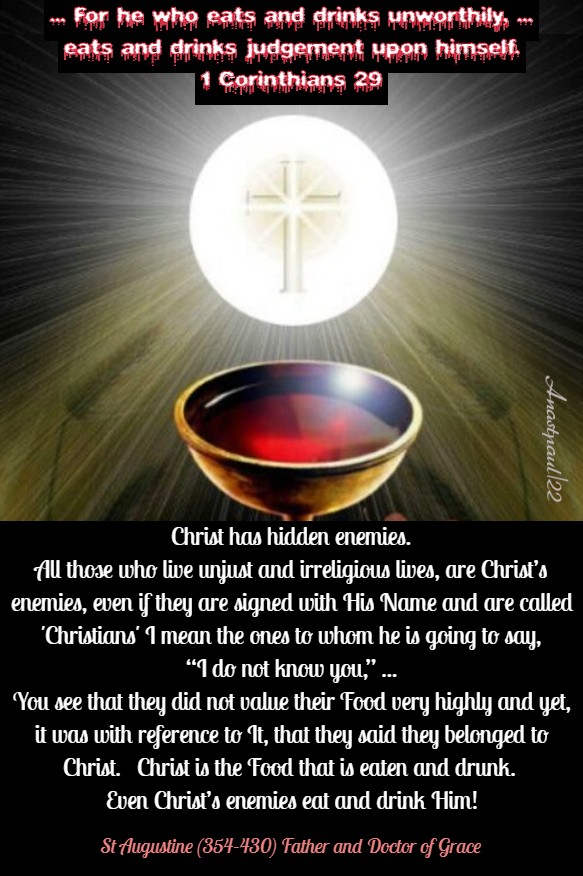
“ … For he who eats and drinks unworthily, … eats and drinks judgement upon himself.”- 1 Corinthians 29
REFLECTION – “Christ has hidden enemies. All those who live unjust and irreligious lives are Christ’s enemies, even if they are signed with His Name and are called ‘Christians’ I mean the ones to whom he is going to say, “I do not know you” and they say to him, “Lord, in your name we ate and drank. In your name, we performed many deeds of power. What did we eat and drink in your name?”
You see that they did not value their food very highly and yet, it was with reference to It, that they said they belonged to Christ. Christ is the Food that is eaten and drunk. Even Christ’s enemies eat and drink Him! The faithful know the Lamb without spot on which they feed, if only they fed on It in such a way that they are not liable to punishment! The Apostle says, “Whoever eats and drinks unworthily is eating and drinking judgment upon himself.” – St Augustine (354-430) Father and Doctor of Grace (Sermon 308).
PRAYER – O God, Who promised to those who forsake all things in this world for Thee, a hundred-fold reward in the world to come and life everlasting, mercifully grant that, following closely in the footsteps of the holy Bishop, Paulinus, we may look upon earthly things as nought and long only for those of Heaven. Who lives and reigns with God the Father, in the unity of the Holy Spirit, God, world without end. Amen (Collect). SWEET HEART of my JESUS, Make me love Thee ever more and more! – Indulgence 300 Days Everytime – Plenary Once a Month – Raccolta 162 – Pope Pius IX 26 November 1876.
Our Morning Offering – 22 June – “The Month of the Sacred Heart of Jesus”
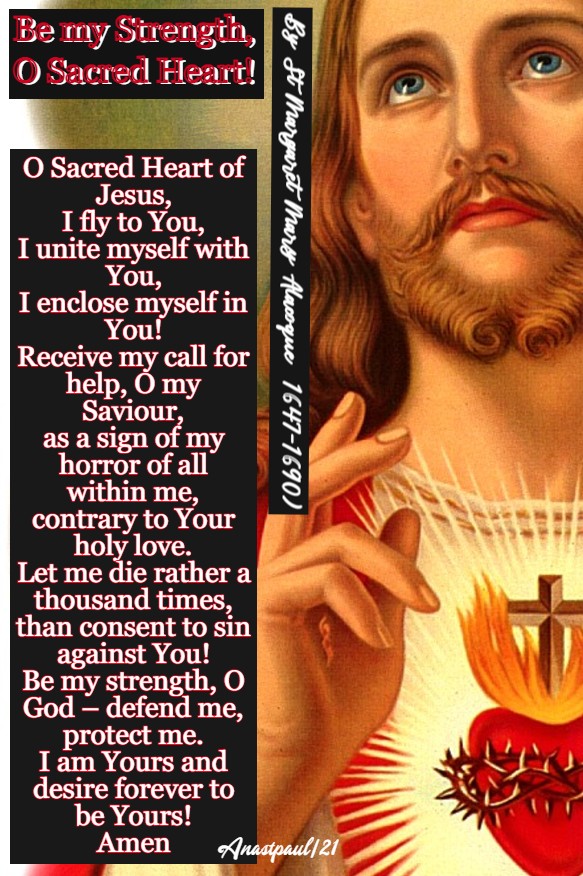
Be my Strength, O Sacred Heart! By St Margaret Mary Alacoque (1647-1690) Visionary of the Sacred Heart
O Sacred Heart of Jesus, I fly to You, I unite myself with You, I enclose myself in You! Receive my call for help, O my Saviour, as a sign of my horror of all within me, contrary to Your holy love. Let me die rather a thousand times, than consent to sin against You! Be my strength, O God – defend me, protect me. I am Yours and desire forever to be Yours! Amen
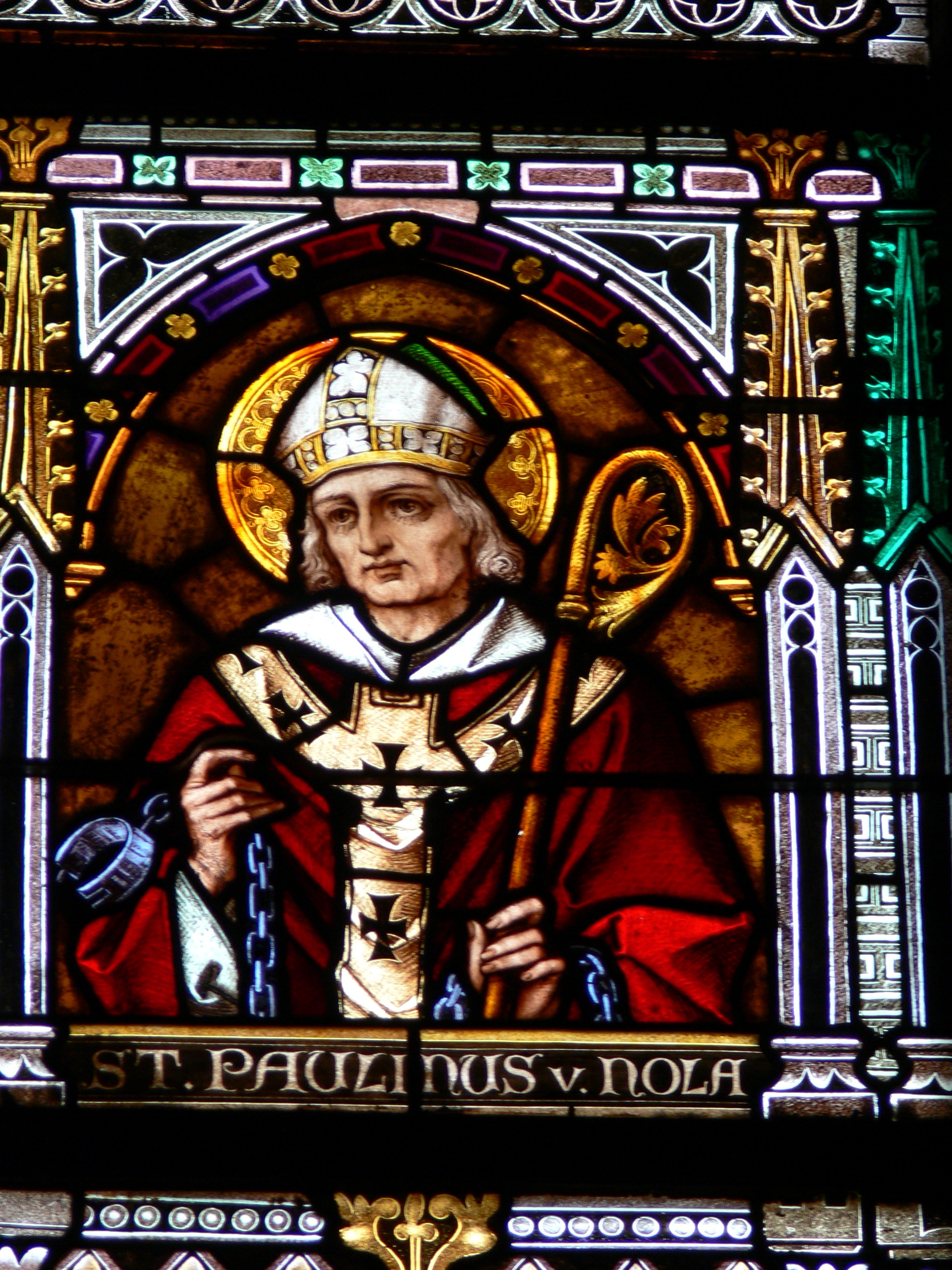
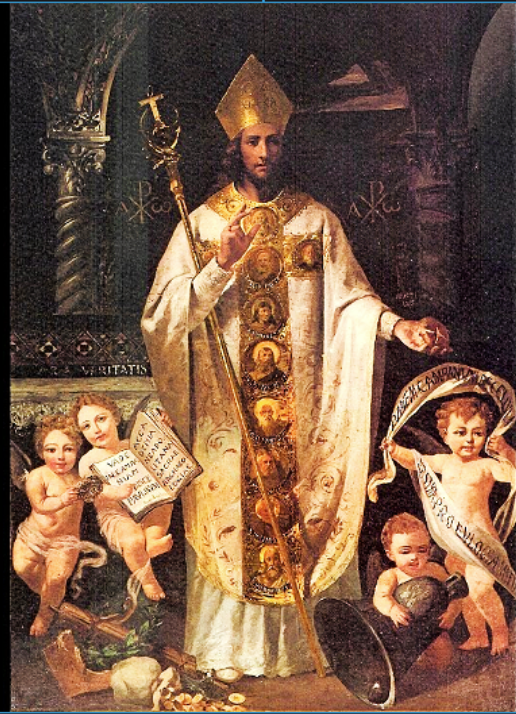
Saint of the Day – 22 June – St Paulinus of Nola (c 354-431) Bishop, Confessor, Poet, Writer, Apostle of Charity, Preacher, distinguished lawyer who hHeld several public offices in the Empire as Orator, Senator and Governor before his retirement from public life and his dedication to the service of God.
The Roman Martyrology reads of him today: “At Nola, in Campania, the birthday of the blessed Paulinus, Bishop and Confessor, who, although a most noble and wealthy man, made himself poor and humble for Christ. And, what is still more admirable, became a slave to liberate a widow’s son, who had been carried to Africa by the Vandals, when they devastated Canpania. He was celebrated, not only for his learning and exceptional holiness of life but, also for his power over the demons. His great merit has been extolled by Saints Ambrose, Jerome, Augustine and Gregory, in their writings. His body, at first transferred to Benevento and thence to Rome, was restored to Nola by Order of Pius X.”
St Paulinus, Bishop of Nola By Fr Francis Xavier Weninger SJ (1805-1888)
St Paulinus, who, on account of his great learning and eloquence but still more, on account of his virtues, is highly praised by St Ambrose, St Augustine, St Jerome and St Gregory, was a native of Bordeaux, in the Province of Gascony. His parents, who were Romans and very rich and of ancient nobility, desired that their son should be as eminent for intelligence and knowledge, as he was on account of his birth and fortune. Their desire was fulfilled, for, when Paulinus had reached the age of manhood, he was not only honoured and admired, by everyone but, was chosen Prefect and Governor of Rome and gained great fame for the wisdom of his administration. The pious Paulinus, however, soon became tired of all worldly honours and pleasures and, having resigned his Office, he went to Barcelona in Spain, to serve God without disturbance.
Having remained there for some time, he returned to Italy. At that time, St Ambrose was the Bishop of Milan and to him, Paulinus applied for advice, with regard to the change he intended to make in his life. Having received the Saint’s directions, he went to Nola, in Campania, as he entertained special reverence towards St Felix, Priest and Martyr, of that City. There, he humbled himself so deeply, that for some time he occupied the office of Sacristan. Afterwards he sold his estates and having used a part of the money in building a Church at Fundi, he gave the remainder to the poor. He then proceeded to a little village in the neighbourhood of Nola, changed his rich garments for humble clothing and commenced to lead the life of a Hermit in a poor little hut, deriving all his sustenance from alms.
But, although Paulinus kept himself secluded, it yet became known who he was and whence he came and not only Nola but all Italy, was astonished, that so great and eminent a man, had chosen for his walk through life, such an humble and, in the eyes of the world, such a despised path. The esteem in which he was then held by both clergy and laity, was so great, that, on the death of the Bishop of Nola, they determined to raise him to the Episcopal chair. It was long before the humble servant of God could be persuaded to accept the dignity but having at last consented, his love, his solicitude for his flock, the zeal he displayed for the honour of God, made him beloved by men and favoured by the Almighty.
Soon after his election to the See, Campania suffered the fate of many other countries and was laid waste by the Goths and many of its inhabitants were taken prisoners. The holy Bishop used all his income to feed the poor and ransom the captives. When all his resources were exhausted, Nola was plundered and the great servant of the Almighty, with several others, was taken prisoner. God, however, so ordained, that he was speedily released. Some years afterwards, the Vandals crossed the ocean and, again plundering the Kingdom of Naples, took away many of the inhabitants as prisoners. Among these were several persons from Nola and although St.Paulinus exerted himself to the utmost to redeem them from prison, he was unable to help all.
This extremity gave the holy Bishop an opportunity for an act of charity which had never before been witnessed in the world. St Gregory himself relates the event as follows: “A poor widow, coming to the Saint, complained with bitter tears, that her only son, who was all the support she had, was taken prisoner and begged him not to refuse her the money she needed for his ransom. The Saint, deeply affected, answered: “My dear daughter, I have not anything left but to ransom your son, I will sell myself. I will go with you and you must say that you give me instead of your son, in order that he may return to you.” The widow, unspeakably surprised at the Saint’s offer, hesitated to accept it but Paulinus knew how to overcome her remonstrances and, at last persuaded her to consent to his plan. He travelled with her to Africa, where her son had already arrived and the Saint, clad in the garment of a slave, was exchanged for the widow’s son, the latter being set at liberty. Paulinus was charged with the care of a garden, as he said that he was able to perform that work and God blessed his endeavours in such a manner, that everything grew most wonderfully under his hands.
A near relative of the King, who was a great lover of horticulture, came frequently into the garden and speaking with the new gardener, soon observed that he was more than an ordinary labourer. Paulinus one day whispered to him in a prophetic spirit: “Have a care for the future. Thy King will soon be a corpse. Act in time and take all proper measures in the affairs of the Crown.” The gentleman, greatly terrified at this speech, informed the King of it, who desired to see Paulinus.
Fear bedewed the King’s face with great drops of sweat when the Saint appeared before him. for, he had had a dream in the night, in which it appeared to him that he stood before the Divine Judgement-seat and heard the sentence: “The scourge given to him shall again be taken from his hands.” Among the judges, the king said, he had seen the man now standing before him. After this, he gave orders to inquire into the history of this gardener. At first, Paulinus would not confess who he was but, as they insisted on knowing and he thought it might promote the honour of God, he revealed his name and also how he had become a slave. The king, admiring his virtue, immediately gave him his liberty and told him he would grant him any favour he might ask. The Saint requested the liberation of all the captives from Nola, which the \King granted without any hesitation. Hence, all the prisoners from Nola were assembled at Court and being liberated, they returned with the holy Bishop, whom they justly regarded and honoured as their deliverer. How the whole City rejoiced, when the Saint arrived there accompanied by so many long lost friends! All the inhabitants went out to meet him,and having given him due thanks for his love and goodness, they led him with great honours and rejoicings to his Episcopal chair, whence he exhorted them to give thanks to the Almighty for the grace bestowed on them and to serve Him fervently and with unwearied zeal in future.”
After this he continued his pastoral functions until sickness confined him to his bed. Two Bishops from the neighbourhood, visited him at this time and having an Altar erected in his room, he for the last time said Holy Mass. When this was accomplished, he lay down again and asked where his brothers were? A servant, supposing that St Paulinus was speaking of the two above-mentioned Bishops, replied: “They are here, dear Father.” The Saint, however, said: “Not so, those, whom I mean, are the two Bishops, Januarius and Martin, who were with me and who promised to come soon again.” Januarius had formerly been Bishop at Naples, Martin at Tours – both were famous on account of their holiness. They appeared to the Saint and cheered him in his suffering and thus he expired happily in the Lord, in the year 431 . The holy Fathers Jerome, Gregory and Ambrose, in their works, bestow high praise on the great learning as well as the virtues of this Saint. St Augustine, in his record of St Paulinus, relates among other events, that when St Paulinus had been taken prisoner, he said to the Almighty: “Lord, release my heart from all anxiety for gold and silver, as Thou knowest best, where I have placed my treasures.” St Augustine remarks that the holy man had already sent all that had been his, according to the admonition of our Lord, to Heaven, through the hands of the poor. Amen! St Paulinus, Pray for us all!
St Paulinus of Nola (c 354-431) Bishop, Confessor, Poet, Writer, Apostle of Charity, Preacher, Orator, Senator and Governor. St Paulinus was an inspiration to many—including six great Saints of the Church, who referenced him in letters of encouragement to others: St Augustine, St Jerome, Melania, St Martin of Tours, St Gregory and St Ambrose. St Augustine wrote, “Go to Campania– there study Paulinus, that choice servant of God. With what generosity, with what still greater humility, he has flung from himself the burden of this world’s grandeurs to take on him the yoke of Christ and in His service how serene and unobtrusive his life!” About St Paulinus: https://anastpaul.com/2018/06/22/saint-of-the-day-22-june-st-paulinus-of-nola-c-354-431/
St Aaron of Brettany St Aaron of Pais-de-Laon St Alban of Britain Bl Altrude of Rome St Consortia St Cronan of Ferns St Eberhard of Salzburg St Eusebius of Samosata St Exuperantius of Como St Flavius Clemens St Gregory of Agrigento St Heraclius the Soldier St Hespérius of Metz
Blessed Pope Innocent V OP (c 1225-1275) Papal Ascesion 21 January 1276 unril 22 June 1276 (the date of his death. Friar of the Order of Preachers, Theologian, renowned Preacher, Scholar, Writer,, Dominican Office bearer, disciple of St Albert the Great and collaborator and friend of St Thomas Aquinas.and St Bonaventure. His Life: https://anastpaul.com/2021/06/22/saint-of-the-day-22-june-blessed-pope-innocent-v-op-c-1225-1275/
St John IV of Naples St Julius of Pais-de-Laon Bl Kristina Hamm Bl Marie Lhuilier St Nicetas of Remesiana St Precia of Epinal St Rotrudis of Saint-Omer St Rufinus of Alexandria
Martyrs of Samaria – 1480 Saints: 1480 Christians massacred in and near Samaria during the war between the Greek Emperor Heraclius and the pagan Chosroas of Persia. c 614 in the vicinity of Samaria, Palestine.
NOVENA OF DEVOTION TO THE PRECIOUS BLOOD OF JESUS Begins tomorrow 22 June
“Blood that but one drop of has the world to win All the world forgiveness of its world of sin.” (Adoro te Devote – St Thomas Aquinas)
In his book, The Precious Blood, Father Frederick William Faber CO (1814-1863). calls St Paul the “Doctor of the Precious Blood” owing to his evident fondness to preach on It in his epistles (Romans 3:25; Ephesians 1:7; Hebrews 9:12).
He recounts that the lives of Saints are replete with devotion to the Precious Blood, making special mention of St. John Chrysostom, St. Austin, St. Gertrude and St Catherine of Sienna, whom he considered the Prophetess of the Precious Blood for putting emphasis on It as the solution to the ills of her times.
Father Faber also remarks that the Precious Blood makes us appreciate more deeply, Christ’s Redemption of mankind, His Sacrifice and Passion.
It also makes us comprehend the beautiful doctrine and the august realities of the Blessed Sacrament as we kneel in front of the Tabernacle in humble adoration.
Over time the Church gave Her blessing to the devotion by approving societies like the Missionaries of the Precious Blood; enriching confraternities like that of St Nicholas in Carcere, in Rome and that of the London Oratory; attaching indulgences to prayers and scapulars in honour of the Precious Blood and instituting commemorative Feasts of the Precious Blood, Friday after the fourth Sunday in Lent and, since Pope Pius IX, the first Sunday of July.
Sadly, however, the Feast was removed from the Universal Calendar in 1969, the argument being that the cultus of the Precious Blood is included in the Mass and Divine Office of the Solemnity of the Most Holy Body and Blood of Christ (Corpus Christi). Nevertheless, we who follow the Traditional Calendar still celebrate this Feast and the Month of July, as dedicated to the Most Precious Blood, just as Pope Pius IX intended it to be.
Thought for the Day – 21 June – Meditations with Antonio Cardinal Bacci (1881-1971)
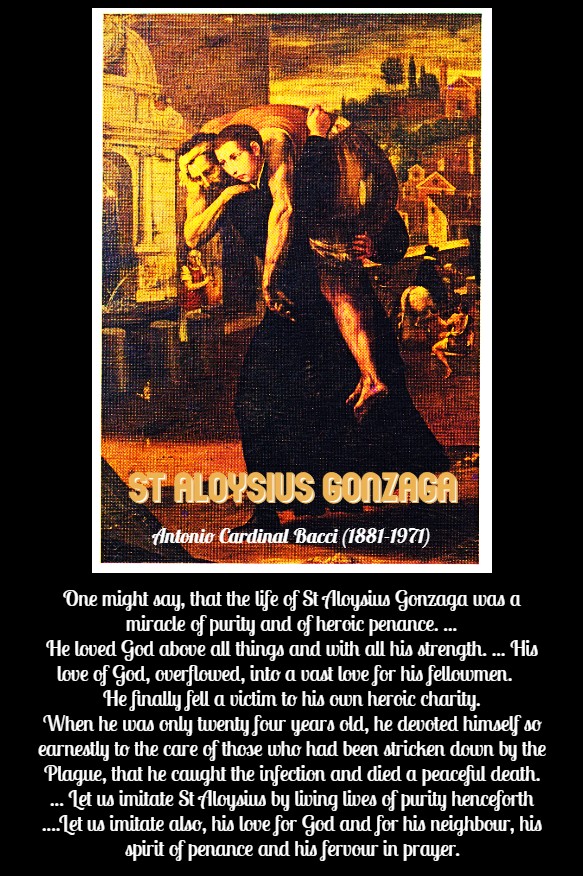
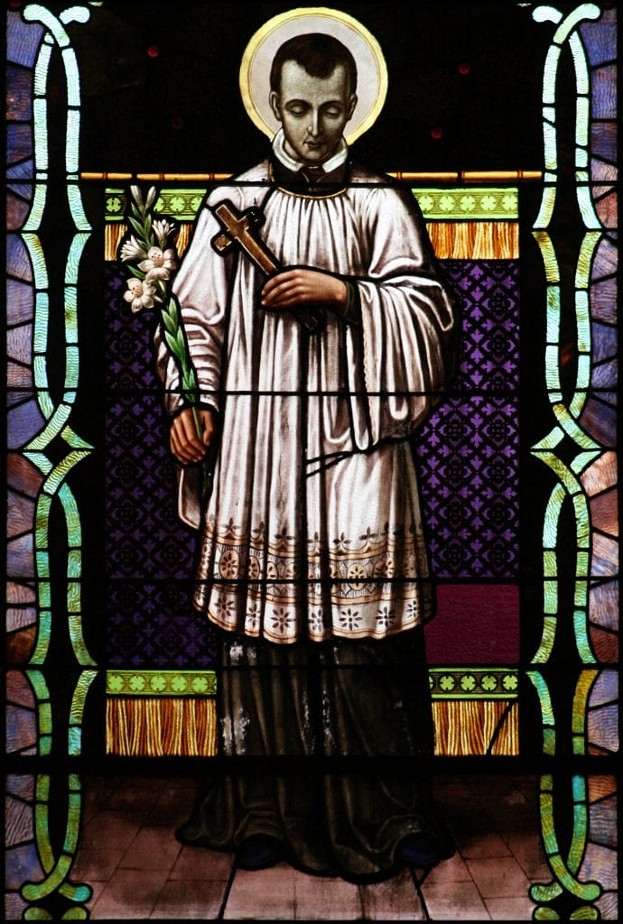
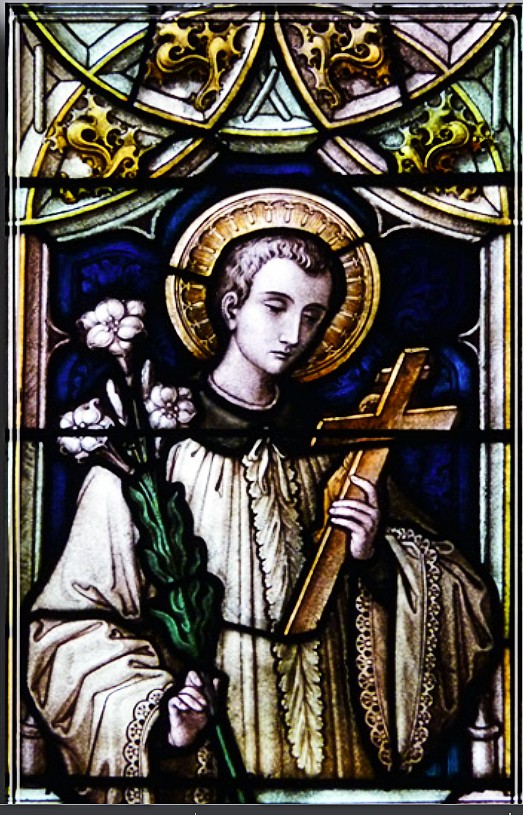
St Aloysius Gonzaga
“One might say, that the life of St Aloysius Gonzaga was a miracle of purity and of heroic penance. The source of his sanctity was the ardent love of God which he cherished from his childhood days. He loved God above all things and with all his strength. Therefore, long hours of prayer were a joy to him, the service of God in the Society of Jesus was his main desire and, mortification, was a loving offering, which he made in expiation of the sins of men.
The heart of St Aloysius, was not closed to men because of its supreme love of God. His love of God, overflowed, into a vast love for his fellowmen. He finally fell a victim to his own heroic charity. When he was only twenty four years old, he devoted himself so earnestly to the care of those who had been stricken down by the Plague, that he caught the infection and died a peaceful death. In his final moments, he smiled and announced that he was happy to be leaving the world.
Do we desire to merit as peaceful and holy a death as this? Let us imitate St Aloysius by living lives of purity henceforth, even if we have not always been as faithful as he was in this regard. Let us imitate also, his love for God and for his neighbour, his spirit of penance and his fervour in prayer.”
Everyday unite your prayers and adorations with those of the Most Holy Virgin and of one of the nine choirs of Angels and Saints, to honour one of the dispositions of the Sacred Heart of Jesus and to practise some virtue in its honour.
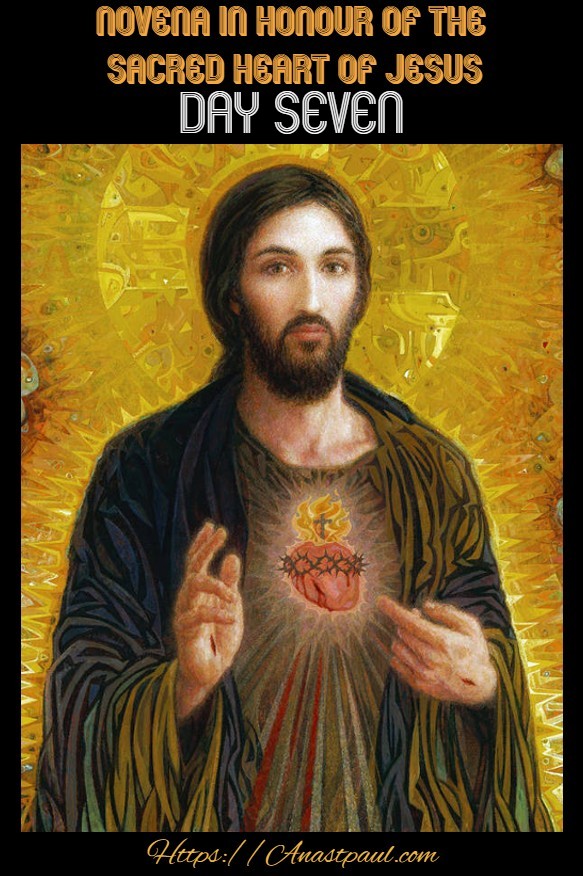
THE SEVENTH DAY
With the Blessed Virgin, the Principalities, and the Holy Virgins and Widows.
Adore the Sacred Heart of Jesus, which delights to be with the children of men and which, with tenderness, pities our miseries and our wants.
Practice-–Esteem the happiness you enjoy, in being able to converse with Jesus Christ in the most Holy Sacrament and avail yourself of this advantage, as often as you can, without neglecting the duties of your state.
Prayer of St. Alphonsus Liguori to the Sacred Heart
O Adorable Heart of my Jesus, Heart created expressly. for the love of men! Until now, I have shown towards Thee only ingratitude. Pardon me, O my Jesus. Heart of my Jesus, Abyss of Love and of Mercy, how is it possible, hat I do not die of sorrow when I reflect on Thy Goodness to me and my ingratitude to Thee? Thou, my Creator, after having created me, hast given Thy Blood and Thy Life for me and, not content with this, Thou hast invented a means of offering Thyself everyday for me, in the Holy Eucharist, exposing Thyself to a thousand insults and outrages. Ah, Jesus, do Thou wound my heart with a great contrition for my sins and a lively love for Thee. Through Thy Tears and Thy Blood, give me the grace of perseverance in Thy fervent love, until I breathe my last sigh. Amen.
Quote of the Day – 21 June – The Memorial of St Aloysius de Gonzaga SJ (1568-1591) “The Angel of Purity”
“Recommend yourself to your Angel Guardian three times a day – in the morning. by the prayer “Angele Dei” in the evening, by the same prayer and during the day, when you visit the Altars in Churches. Remember that you are to be guided by your Angel, like a blind man who cannot see the dangers of the streets and trusts entirely. to the person who leads him.”
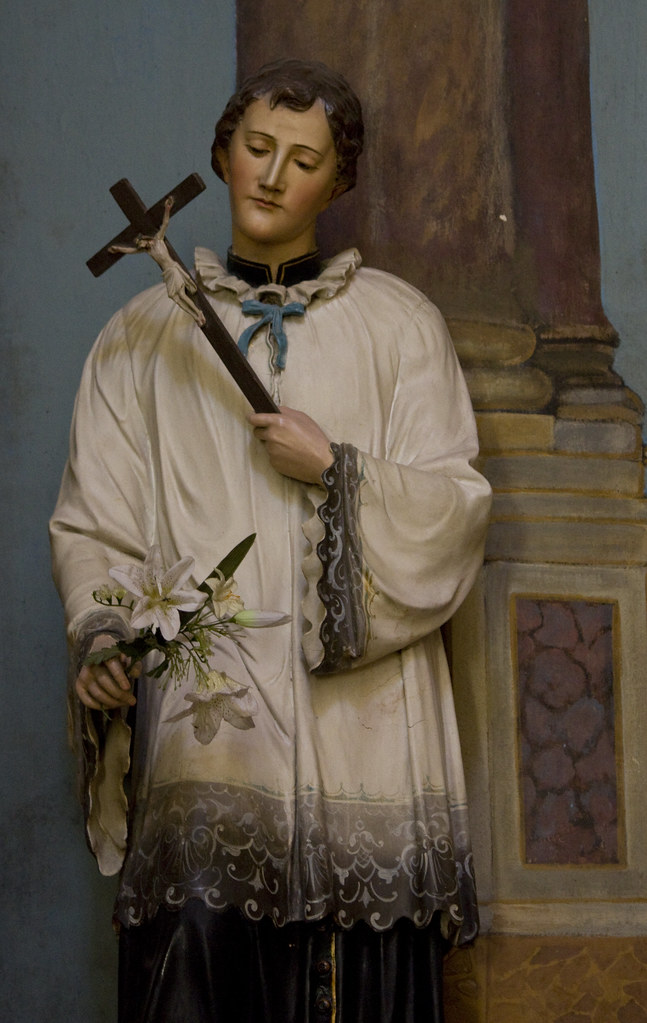
St Aloysius de Gonzaga (1568-1591)
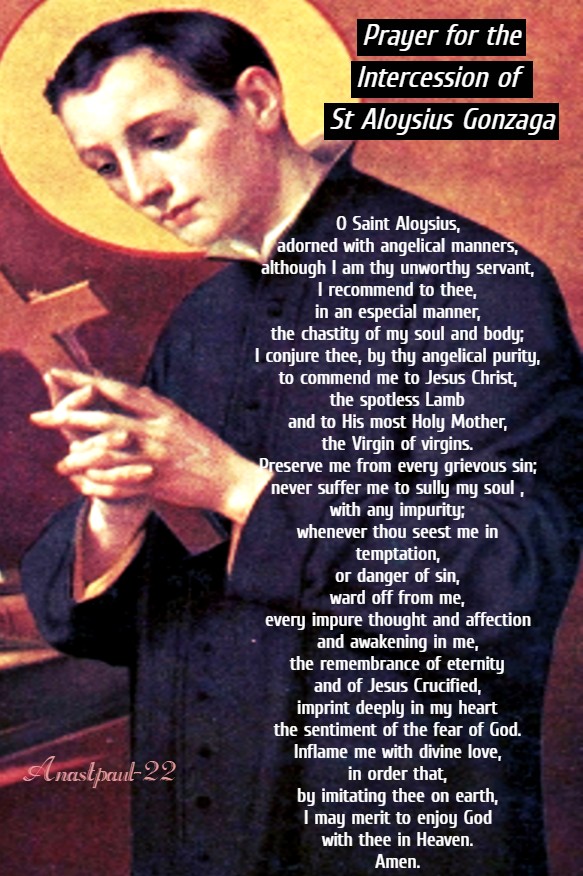
Prayer for the Intercession of St Aloysius Gonzaga, (Can be Prayed as a Novena for Nine Consecutive Days)
O Saint Aloysius, adorned with angelical manners, although I am thy unworthy servant, I recommend to thee, in an especial manner, the chastity of my soul and body; I conjure thee, by thy angelical purity, to commend me to Jesus Christ, the spotless Lamb and to His most Holy Mother, the Virgin of virgins. Preserve me from every grievous sin; never suffer me to sully my soul , with any impurity; whenever thou seest me in temptation, or danger of sin, ward off from me, every impure thought and affection and awakening in me, the remembrance of eternity and of Jesus Crucified, imprint deeply in my heart the sentiment of the fear of God. Inflame me with divine love, in order that, by imitating thee on earth, I may merit to enjoy God with thee in Heaven. Amen. Our Father, Hail Mary
One Minute Reflection – 21 June – “The Month of the Sacred Heart of Jesus” – Tuesday within the Octave of Corpus Christi and the Memorial of St Aloysius de Gonzaga SJ (1568-1591) – 1 Corinthians 23-29, John 6:56-59.
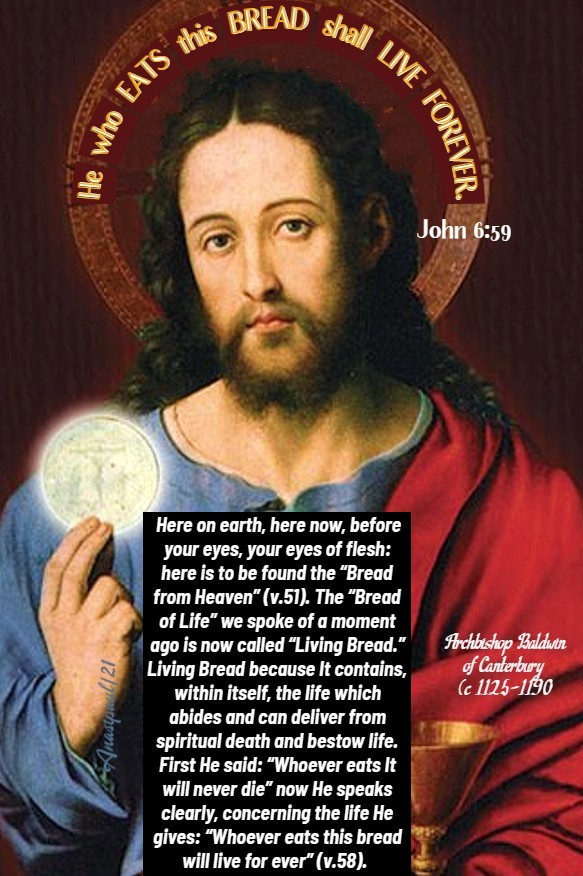
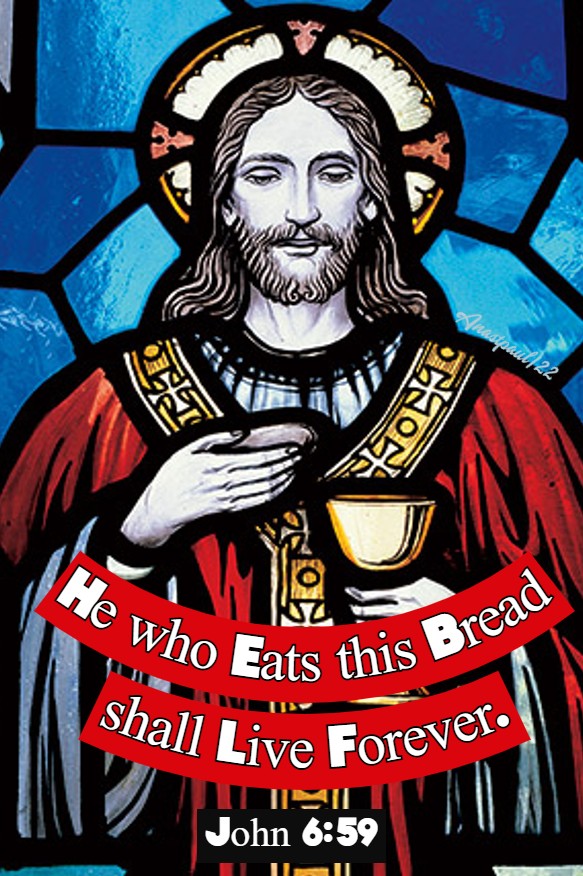
“This is the Bread that has come down from Heaven; not as your fathers ate the manna and died. He who eats this Bread shall live forever.” – John 6:59
REFLECTION – Christ is “the bread of life” for those who believe in Him: to believe in Christ is to eat the bread of life, to possess Christ within one, is to possess eternal life… “I am the bread of life,” He says; “your fathers ate manna in the wilderness and they are dead” (Jn 6,48f). By this is to be understood ,spiritual death. Why are they dead? Because they believed in what they saw and did not understand what they could not see… Moses ate manna, Aaron ate it and many others, too, who pleased God and are not dead. Why are they not dead? Because they understood, in a spiritual fashion, they were spiritually hungry, they tasted the manna spiritually, so that they might be spiritually satisfied. “This is the bread that came down from heaven: whoever eats it will never die” (v.50). This manna – that is to say, Christ, who Himself spoke like this…, was prefigured by the manna but was able to do more than manna could. For manna could not, of itself, prevent dying spiritually… But the righteous saw Christ in the manna, they believed in His coming and Christ, of whom manna was the symbol, grants to all who believe in Him that they should not spiritually die. Hence He says: “This is the bread come down from heaven; whoever eats it will never see death.” Here on earth, here now, before your eyes, your eyes of flesh: here is to be found the “bread from heaven” (v.51). The “bread of life” we spoke of a moment ago is now called “living bread.” Living bread because it contains, within itself, the life that abides and can deliver from spiritual death and bestow life. First He said: “Whoever eats it will never die” now he speaks clearly, concerning the life He gives: “Whoever eats this bread will live for ever” (v.58). Archbishop Baldwin of Canterbury (c 1125-1190) Cistercian – The Sacrament of the Altar II
PRAYER – O God, bestower of heavenly gifts, Who in the angelic youth Aloysius joined wondrous innocence of life to an equally wondrous love of penance; grant, by his merits and prayers, that we who have not followed him in his innocence may imitate him in his penance. Through Jesus Christ, Thy Son our Lord, Who lives and reigns with Thee, in the unity of the Holy Ghost, God, world without end. Amen (Collect). SACRED Heart of JESUS, Thy Kingdom come! Indulgence 300 Days. Everytime Raccolta 178 St Pius X, 4 May 1906.
Our Morning Offering – 21 June – “The Month of the Sacred Heart”
O DIVINE Heart of JESUS Pope Leo XIII Indulgence 100 Days, Once a day Raccolta 167 13 March 1901.
O DIVINE Heart of JESUS, grant, we beseech Thee, eternal rest to the souls in purgatory, the final grace to those who shall die today, true repentance to sinners, the light of the faith to pagans and Thy Blessing to me and mine. To Thee, O most compassionate Heart of JESUS! I commend all these souls and I offer to Thee, on their behalf, all Thy merits, together with the merits of Thy most Holy Mother and of all the Saints, Angels and all the Sacrifices of the Holy Mass, Communions, prayers and good works, which shall be accomplished today, throughout the Christian world. Amen
Saint of the Day – 21 June – St Aloysius Gonzaga SJ (1568-1591) Confessor, Seminarian of the Society of Jesus, Mystic, Marian devotee, born of a noble family as Prince Luigi. Known as “The Angel of Purity.” Patronages – Catholic youth, Jesuit scholastics, the blind, eye ailments, AIDS patients, care-givers, Jesuit students, for relief from pestilence, young people, Castiglione delle Stiviere, Italy, Valmonte, Italy.
The Roman Martyrology reads: “At Rome, St Aloysius de Gonzaga, of the Society of Jesus, most renowned for his contempt of his Princely dignity and the innocence of his life.”
St Aloysius de Gonzaga (Excerpt) By Fr Virgilio Cepari SJ (1564-1631)
St Aloysius, unlike so many of his illustrious family, has not left behind him, the glory of a great Captain, or of a man of letters, or of a ruler or statesman. Perhaps we may gather from this brief life, that thanks to the laws of inheritance, or to the gifts specially bestowed upon him, had longer years and occasion been given to him, he would have made his mark in the world. Talents he had and they were very notable whenever circumstances called them into play. Father Budrioli, a contemporary of our Saint, records in his Memoirs of St Aloysius ,that it was the conviction of all the Fathers in the Roman College and, there were men of European fame amongst them, that young Gonzaga had been given to the Society of Jesus, by a special Providence, to be one day its General, a post for which his prudence, sound judgement and extraordinary ability in matters of business, seemed even then, to have marked him out.
But St Aloysius had a heart too great to be contented with earthly grandeur. Nothing seemed of value to him, except what is prized by God and what, like Him, is everlasting To our Saint, the highest science was the science of Saints, to conquer oneself, the greatest victory, to serve God was to reign.! His motto was: Quid hoc ad aeternitatem? What is this to eternity? Guided by this thought, the young Prince, though living in the midst of a profligate world, with its charms and seductions on every side, took in hand the difficult task of making himself a Saint. And in the short space that he lived, he reached such a height of sanctity, that Holy Church, not content with raising him to her Altars, honoured him with the title of “The Angel of Purity”and gave him as model and Patron to the youth of the future.
What commemoration more fitting or more profitable than, by the faithful picture of his life, to reproduce him, whose whole being, whose every word and deed, whose each joy and sorrow, every aspiration and success were a constant forward march towards that ideal of perfection, which attracted him from childhood!
Fr Virgilio Cepar was a contemporary of the Saint, an ocular witness of most of the facts he narrates; he was his fellow-student and lived with him for several years, during which time, he met him everyday and was honoured with his most entire confidence. And what Cepari himself had not seen and heard, he learned from the lips of those who had witnessed all that he narrates, the mother and brother of St Aloysius, his tutors, servants, his relatives and acquaintances, his masters, superiors in religion, his Confessor. Fr Cepari visited every place, except those in Spain, where the Saint had stayed for any length of time and took down on the spot, the most exact information, as can be learnt from the statements of the sworn witnesses. No other writer of the life of St Aloysius has done the same.
To download “The Life of St Aloysius Gonzaga”, click on the link below.
St Raymond of Barbastro St Rufinus of Syracuse St Suibhne the Sage St Terence St Ursicenus of Pavia
Martyrs of Taw – 3+ Saints: Three Christians of different backgrounds who were martyred together – Moses, Paphnutius, Thomas. They were beheaded in Taw, Egypt, date unknown.
Everyday unite your prayers and adorations with those of the Most Holy Virgin and of one of the nine choirs of Angels and Saints, to honour one of the dispositions of the Sacred Heart of Jesus and to practise some virtue in its honour.
THE SIXTH DAY
With the Blessed Virgin, the Powers, and the Holy Confessors.
Adore the Sacred Heart of Jesus, containing within itself the plenitude of graces and opening to diffuse them abundantly on those who address themselves to it.
Practice—Humble yourself in the presence of your Saviour for having so often abused his mercies and with new ardour and perfect confidence, implore Him to grant you grace.
Prayer of St Alphonsus Liguori to the Sacred Heart
O Adorable Heart of my Jesus, Heart created expressly. for the love of men! Until now, I have shown towards Thee only ingratitude. Pardon me, O my Jesus. Heart of my Jesus, Abyss of Love and of Mercy, how is it possible, hat I do not die of sorrow when I reflect on Thy Goodness to me and my ingratitude to Thee? Thou, my Creator, after having created me, hast given Thy Blood and Thy Life for me and, not content with this, Thou hast invented a means of offering Thyself everyday for me, in the Holy Eucharist, exposing Thyself to a thousand insults and outrages. Ah, Jesus, do Thou wound my heart with a great contrition for my sins and a lively love for Thee. Through Thy Tears and Thy Blood, give me the grace of perseverance in Thy fervent love, until I breathe my last sigh. Amen.
Thought for the Day – 20 June – Meditations with Antonio Cardinal Bacci (1881-1971)
The Eucharistic Life
“The Eucharistic life, which is the life of union with Jesus, especially by means of daily Communion, transforms us and makes us holy. It preserves and increases in us, the grace which is the supernatural life of the soul. The Eucharist, of itself, does not bestow grace because, it is a Sacrament of the living. It is our food and food is not given to the dead but, to the living. For this reason, we should receive Holy Communion free from the stain of sin. The Eucharist, moreover, remits venial sin, strengthens us in our resolution and increases our charity. Venial sin, is a sickness of the soul. Just as natural food banishes listlessness and vulnerability to disease, our Eucharistic nourishment has the same effect on our spiritual life.
It is because the Blessed Eucharist increases our love for Jesus, that it weakens our evil inclinations. The Eucharist and sin, are mutually exclusive of one another because, the Eucharist is Jesus and sin is the devil. Our Eucharistic food, moreover, produces, in our souls, a spiritual consolation which is a foretaste of the happiness of Heaven.
Let us listen to Jesus living within us. He will enable us to forget our worldly cares and will raise us to a higher plane where, by God’s Infinite Goodness, we shall continue to grow in virtue.”
Quote/s of the Day – 20 June – “The Month of the Sacred Heart” – Monday within the Octave of Corpus Christi
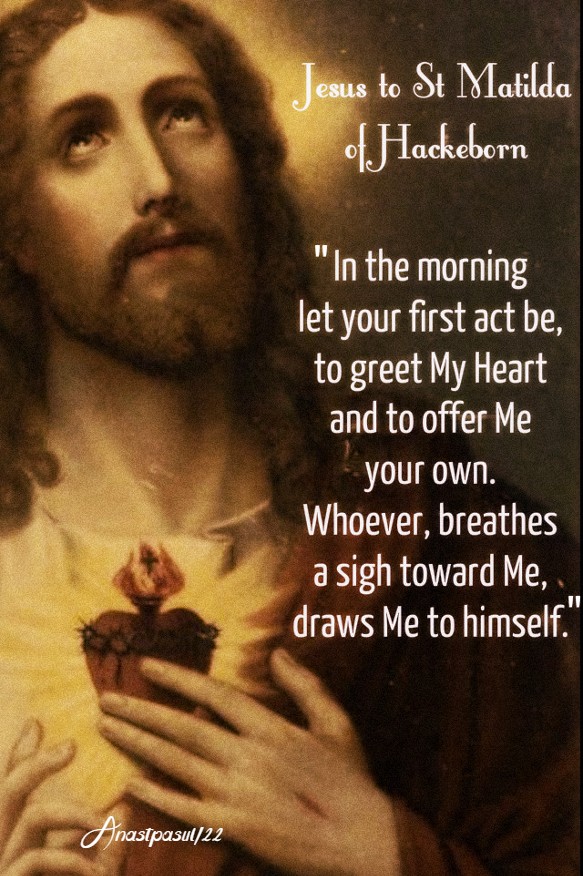
“In the morning let your first act be to greet My Heart and to offer Me your own. Whoever, breathes a sigh toward Me, draws Me to himself.”
Jesus to St Matilda/Mechtilde of Hackeborn (c 1241-1298)
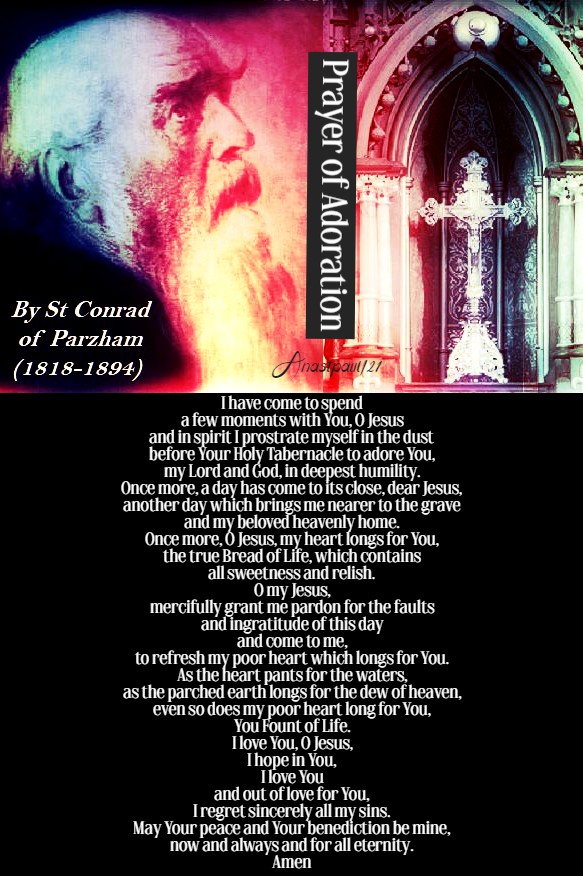
Prayer of Adoration and Repentance/Night Prayer By St Conrad of Parzham (1818-1894)
I have come to spend a few moments with You, O Jesus and in spirit I prostrate myself in the dust before Your Holy Tabernacle to adore You, my Lord and God, in deepest humility. Once more, a day has come to its close, dear Jesus, another day which brings me nearer to the grave and my beloved heavenly home. Once more, O Jesus, my heart longs for You, the true Bread of Life, which contains all sweetness and relish. O my Jesus, mercifully grant me pardon for the faults and ingratitude of this day and come to me, to refresh my poor heart which longs for You. As the heart pants for the waters, as the parched earth longs for the dew of heaven, even so does my poor heart long for You, You Fount of Life. I love You, O Jesus, I hope in You, I love You and out of love for You, I regret sincerely all my sins. May Your peace and Your benediction be mine, now and always and for all eternity. Amen
One Minute Reflection – 20 June – “The Month of the Sacred Heart” – Monday within the Octave of Corpus Christi and the Memorial of St Pope Silverius (Died 538) Martyr – 1 Corinthians 23-29, John 6:56-59.
“He who eats this Bread shall live forever.” – John 6:59
REFLECTION – “Since it was the Will of God’s Only-Begotten Son, that men should share in His Divinity, He assumed our nature in order that, by becoming Man. He might make men gods . Moreover, when He took our flesh. He dedicated the whole of its substance to our salvation. He offered His Body to God the Father, on the Altar of the Cross, as a sacrifice for our reconciliation. He shed His Blood for our ransom and purification, so that we might be redeemed, from our wretched state of bondage and cleansed from all sin. But to ensure that the memory of so great a gift would abide with us forever, He left His Body as food and His Blood as drink, for the faithful to consume in the form of bread and wine.
O precious and wonderful banquet which brings us salvation and contains all sweetness! Could anything be of more intrinsic value? Under the old law, it was the flesh of calves and goats, which was offered but here, Christ Himself, the True God, is set before us as our food! What could be more wonderful than this? No other Sacrament has greater healing power; through it, sins are purged away, virtues are increased and the soul is enriched with an abundance of every spiritual gift. It is offered in the Church for the living and the dead, so that what was instituted for the salvation of all, may be for the benefit of all. Yet, in the end, no-one can fully express the sweetness of this Sacrament, in which spiritual delight is tasted at its very source, and in which, we renew the memory, of that surpassing love for us, which Christ revealed in His Passion.
It was to impress the vastness of this love, more firmly upon the hearts of the faithful, that our Lord instituted this Sacrament at the Last Supper. As He was on the point of leaving the world to go to the Father, after celebrating the Passover with His disciples, He left it as a perpetual memorial of His Passion. It was the fulfilment of ancient figures and the greatest of all His Miracles, while, for those who were to experience the sorrow of His departure, it was destined to be a unique and abiding consolation.” – St Thomas Aquinas (1225-1274) Dominican Priest and Theologian, Doctor of the Church (An excerpt from On the Feast of the Body of Christ).
PRAYER – Look forgivingly on Thy flock, Eternal Shepherd and keep it in Thy constant protection, by the intercession of blessed Sylvester thy Martyr and Sovereign Pontiff, whom Thou didst constitute Shepherd of the whole Church. Through Jesus Christ, Thy Son our Lord, Who lives and reigns with Thee, in the unity of the Holy Ghost, God, world without end. Amen (Collect). O HEART of love, I place all my trust in Thee; for though I fear all things from my weakness, I hope all things from Thy mercies. – Ejaculation of Saint Margaret Mary – Indulgence 300 Days, Everytime – Raccolta 180St Pius X, 3 June 1908.
Our Morning Offering – 20 June – “The Month of the Sacred Heart” – Monday within the Octave of Corpus Christi
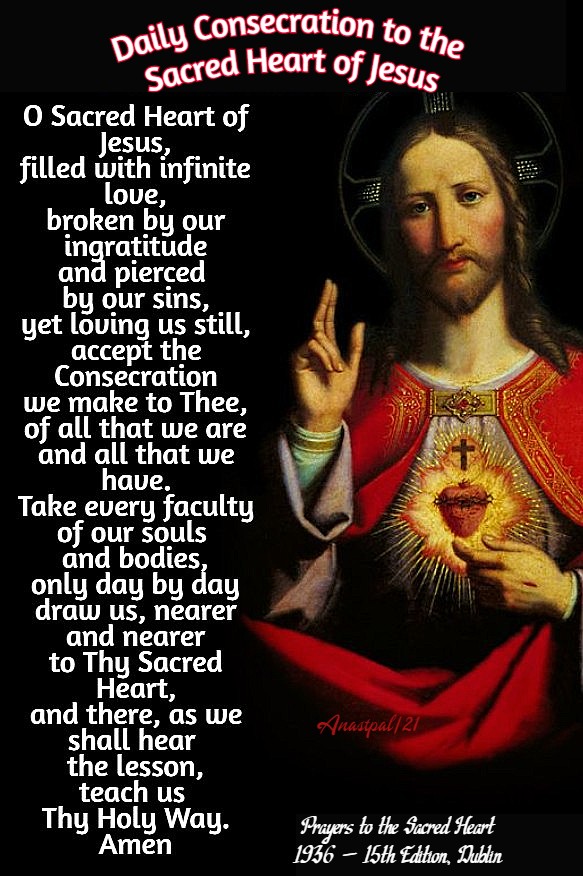
Daily Consecration to the Sacred Heart of Jesus Prayers to the Sacred Heart 1936 – 15th Edition, Dublin
O Sacred Heart of Jesus, filled with infinite love, broken by our ingratitude and pierced by our sins, yet loving us still, accept the Consecration we make to Thee, of all that we are and all that we have. Take every faculty of our souls and bodies, only day by day draw us, nearer and nearer to Thy Sacred Heart, and there, as we shall hear the lesson, teach us Thy Holy Way. Amen
Saint of the Day – 20 June – Blessed Michelina of Pesaro TOSF (1300-1356) Widow, Religious of the Third Order of the Friars Minor, Stigmatic, Penitent, Apostle of all in need, Founder of the Confraternity of the Annunciation, to care for the poor, nurse the sick and bury the dead. Born in 1300 at Pesaro, Urbino, Italy and died on 19 June 1356 (aged 55–56) 1356 of natural causes. Patronages – Pesaro, widows, against mental illness, against death of children. Also known as – Michelina Metelli. Beatified on 13 April 1737 by Pope Clement XII.
The Town of Pesaro is situate on the shores of the Adriatic in Italy, not far from the famous Shrine of Loreto. There, in 1300, a daughter was born to the wealthy and noble Metelli family, who received the name Michelina in Baptism. The child was endowed with superior natural gifts and, in accordance with the pious tradition of the family, she was brought up in the holy fear of the Lord.
When she was twelve years old, Michelina was married to a nobleman of the powerful family of Malatesta. Although Michelina was good and pious, it is said that her heart was divided between creatures and the Creator, as is often the case. Her husband and a son, with whom the marriage was blessed, occupied her heart more than was becoming to a Christian woman.
The Lord severed one of these ties, by taking her husband to Himself, when Michelina was only twenty years old. This was a severe trial for the young wife but Michelina did not yet recognise the higher designs of God. Her maternal affections were now still more centred on her little son.
About this time, a pious Tertiary from Syria came to Pesaro and edified the entire Town by her fervour at prayer and the holiness of her life. Michelina also conceived a great veneration for this pious lady and invited her to take up her abode in her palace, promising to provide for all her needs, so that she could serve God alone. The stranger gratefully accepted this hospitality and almighty God rewarded Michelina by permitting her to learn to love God above all things and all other things only in God.
Once on the Feast of Pentecost, she conversed with her Tertiary guest on the need of surrendering one’s heart to God. The latter spoke of it in glowing terms and declared it was necessary. “That may be true” said Michelina, “but I cannot aspire to such perfection. My son, the tenderest object of my affections, occupies my heart too much and my earthly possessions do not leave me free enough to offer my heart completely to God.” “Let us then,” replied the Tertiary, “pray together that God may disengage your heart from those things which are an obstacle to your salvation and perfection.” The grace of the Holy Spirit was not wanting and Michelina answered, “Ah yes, let us. I, too, desire to serve God better than I have until now.”
The next morning both attended Holy Mass and prayed fervently for this intention. At the close of Mass, Blessed Michelina interiorly heard the voice of Our Lord: “I will set you free. I will take your son to Myself and you shall henceforth belong to Me alone.” When they arrived at home they found the child sick and soon God took him from this world, in which he would have been in great danger because of the inordinate tenderness of his mother. The two women saw how the Holy Angels carried his soul to heaven.
The mother was now like one transformed. Her heart was no longer attached to temporal goods. She distributed them lavishly among the poor in spite of the remonstrances of her relatives. After a while, she entered the Third Order of St Francis and adopted the afflicted and the indigent as her new family. She became a mother to the orphans, the support of poor widows, the nurse of the sick, the comfort of the sorrowful. Her house was the refuge of all unfortunate persons. She also practised severe acts of penance in order to atone for her former life.
She proceeded to give away all her belongings and property and founded the Confraternity of the Annunciation, to care for the poor, nurse the sick and bury the dead. Initially her family believed her to be insane and had her locked up. Upon her release from confinement, she made a pilgrimage to the Holy Land as penance for her sins. She received the Stigmata during the course of this journey. It was on Mount Calvary where she suffered so fervently that all present saw her in an ecstasy.
Upon her return to her native country, she redoubled her prayers, practices of penance and works of charity, until Our Lord called her to Himself on 19 June 1356. Her Tomb in the Franciscan Church of Pesaro, was made glorious by numerous miracles. The Apostolic See approved her public veneration in 1737, whereupon the Town of Pesaro chose her as its special Patron.
St Bagne of Thérouanne St Edburga of Caistor St Florentia of Seville
Blessed Francisco Pacheco SJ (1566-1626) Martyr, Priest of the Society of Jesus, Missionary to India, China and Japan, Provincial Superior. Fr Pacheco and his eight Jesuit companions, together with the nine lay Christians, were included among the 205 Martyrs Beatified by Blessed Pope Pius IX on 7 May1867. His Life and Death: https://anastpaul.com/2021/06/20/saint-of-th-day-20-june-blessed-francisco-pacheco-sj-1566-1626/
St Gemma of Saintonge St Goban of Picardie St Helen of Öehren
St Macarius of Petra St Methodius of Olympus Blessed Michelina of Pesaro TOSF (1300-1356) Widow, Religious of the Third Order of the Friars Minor. St Novatus of Rome
Martyred in London: Bl Anthony Turner Bl John Fenwick Bl John Gavan BL Thomas Whitbread Blessed William Harcourt
Irish Martyrs – 260 Beati – This is the collective title given to the 260 or more persons who are credited with dying for the Faith in Ireland between 1537 and 1714.
Martyrs of Lower Moesia: Martyred on the Black Sea at Lower Moesia (in modern Bulgaria), date unknown. St Cyriacus St Paul
Martyred in Nagasaki: 9 Beati : burned alive on 20 June 1626 in Nagasaki, Japan. Their ashes were thrown into the sea and no relics remain. They were Beatified on 7 May 1867 by Pope Pius IX. • Blessed Baltasar de Torres Arias • Blessed Francisco Pacheco • Blessed Gaspar Sadamatsu • Blessed Giovanni Battista Zola • Blessed Ioannes Kisaku • Blessed Michaël Tozo • Blessed Paulus Shinsuke • Blessed Petrus Rinsei • Blessed Vincentius Kaun
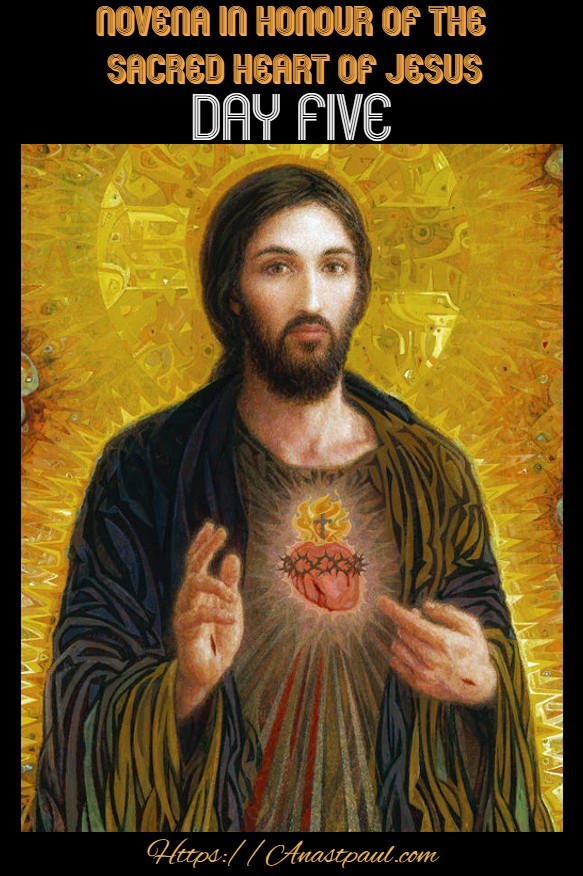
Everyday unite your prayers and adorations with those of the Most Holy Virgin and of one of the nine choirs of Angels and Saints, to honour one of the dispositions of the Sacred Heart of Jesus and to practise some virtue in its honour.
THE FIFTH DAY
With the Blessed Virgin, the Virtues and the Holy Doctors.
Adore the Sacred Heart of Jesus, endowed with all the virtues and making their practice easy to you, by the efficacy of its merits and the force of its example.
Practice–Meditate on that virtue which you particularly require; apply yourself to practise it and let not the day pass without making some acts of this virtue.
Prayer of St Alphonsus Liguori to the Sacred Heart
O Adorable Heart of my Jesus, Heart created expressly. for the love of men! Until now, I have shown towards Thee only ingratitude. Pardon me, O my Jesus. Heart of my Jesus, Abyss of Love and of Mercy, how is it possible, hat I do not die of sorrow when I reflect on Thy Goodness to me and my ingratitude to Thee? Thou, my Creator, after having created me, hast given Thy Blood and Thy Life for me and, not content with this, Thou hast invented a means of offering Thyself everyday for me, in the Holy Eucharist, exposing Thyself to a thousand insults and outrages. Ah, Jesus, do Thou wound my heart with a great contrition for my sins and a lively love for Thee. Through Thy Tears and Thy Blood, give me the grace of perseverance in Thy fervent love, until I breathe my last sigh. Amen.
Thought for the Day – 19 June – Meditations with Antonio Cardinal Bacci (1881-1971)
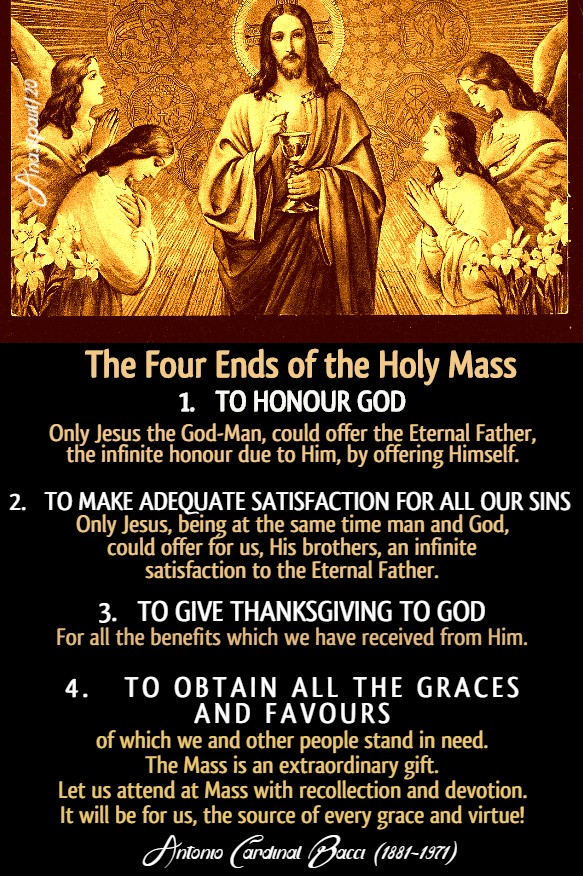
The Four Ends of the Holy Mass
“Let us meditate on the fact, that the Sacrifice of the Eucharist, was instituted for four ends, namely:
1. TO HONOUR GOD All the Angels and Saints of Heaven and all the human beings upon earth, could not possibly honour God, as He ought to be honoured because, they are creatures who derive everything which they possess from God. Only Jesus the God-Man, could offer the Eternal Father, the infinite honour due to Him, by offering Himself.
2. TO MAKE ADEQUATE SATISFACTION FOR ALL OUR SINS Insofar, as they are a revolt against God, our sins are, in a certain way, infinite. This is because they offend an Infinite Being. Only Jesus, being at the same time man and God, could offer for us, His brothers, an infinite satisfaction to the Eternal Father. Only He, could redeem us from the debt of crime and punishment, which we had contracted, by offering Himself, without reserve, in the Eucharistic Sacrifice. It must be explained, however, that although the Mass is of infinite value in itself, God applies this value to us in a finite way only, according to His good pleasure and according to our dispositions. For this reason, we should do well to attend Mass, as often as possible and with the maximum fervour.
3. TO GIVE THANKSGIVING TO GOD for all the benefits which we have received from Him.
4. Finally, TO OBTAIN ALL THE GRACES AND FAVOURS of which we and others stand in need. The Mass is an extraordinary gift. Let us attend at Mass with recollection and devotion. It will be for us, the source of every grace and virtue!” Amen
Quote/s of the Day – 19 June – “The Month of the Sacred Heart of Jesus” – Solemnity of Corpus Christ. Sunday within the Octave and the Memorial of St Juliana Falconieri OSM (1270 – 1341) Virgin
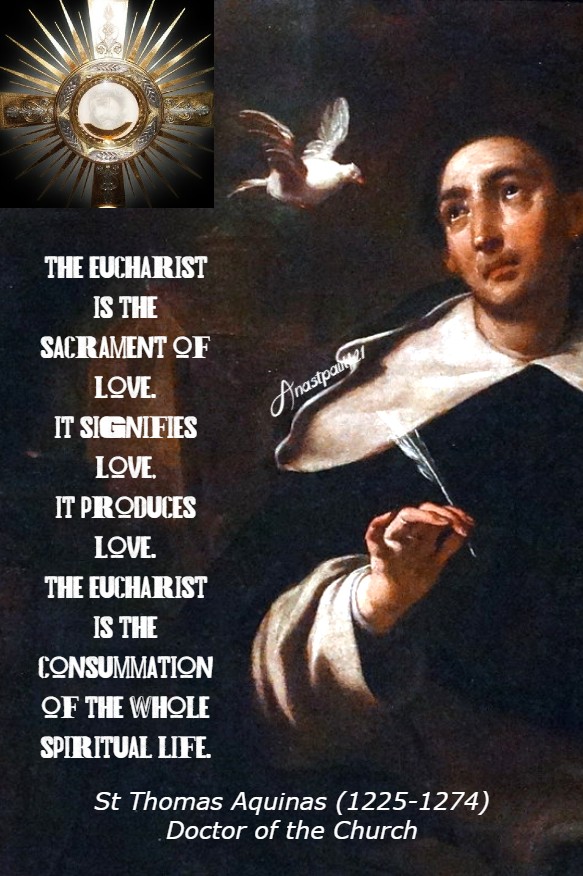
“The Eucharist is the Sacrament of Love. It signifies Love, It produces love. The Eucharist is the consummation of the whole spiritual life.”
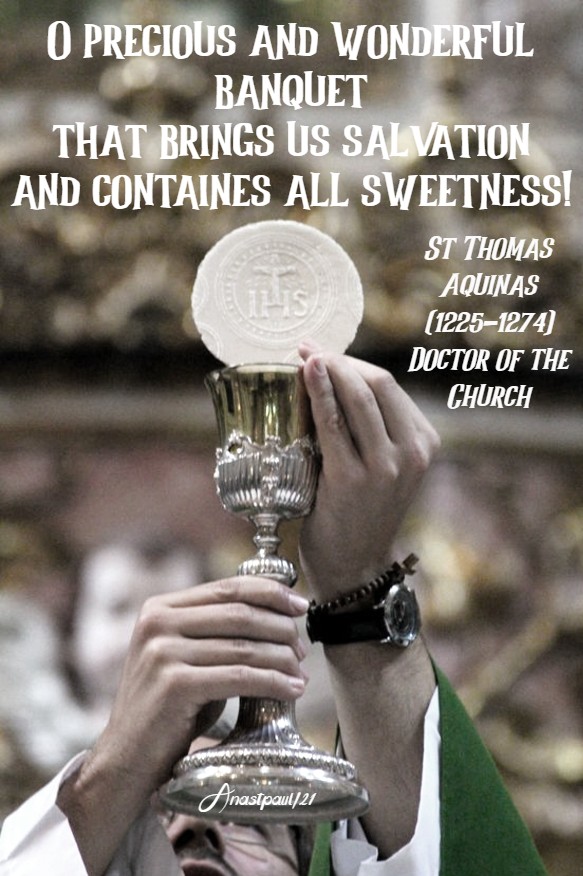
“ O precious and wonderful banquet that brings us salvation and contains all sweetness!”
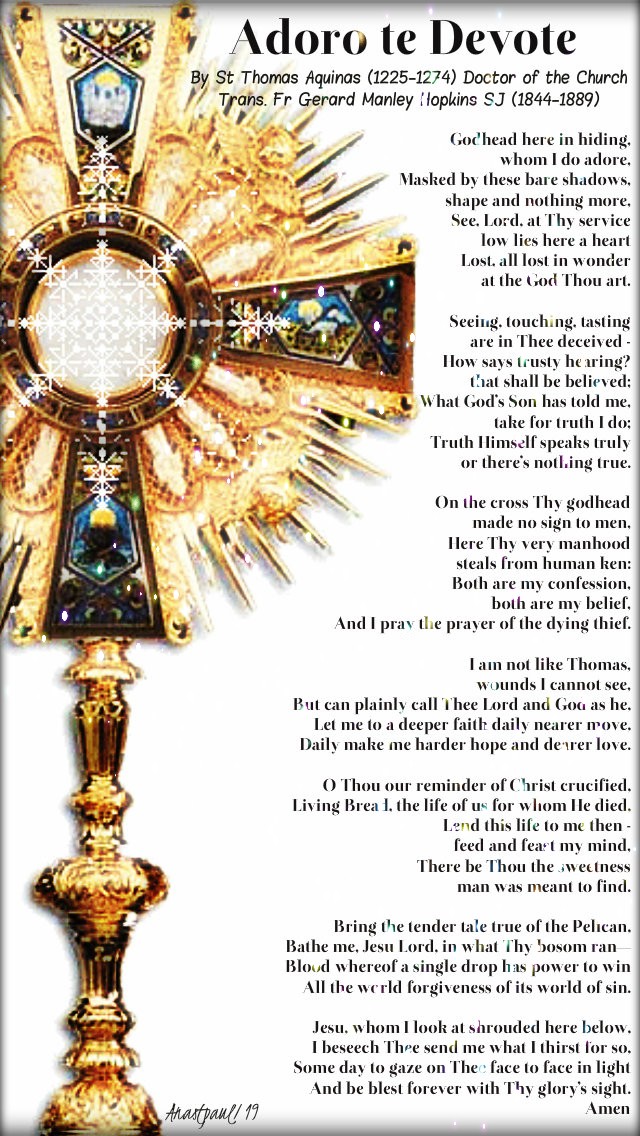
Adoro te Devote Trans. Fr Gerard Manley Hopkins SJ (1844-1889)
Godhead here in hiding, whom I do adore, Masked by these bare shadows, shape and nothing more, See, Lord, at Thy service low lies here a heart Lost, all lost in wonder at the God Thou art.
Seeing, touching, tasting are in Thee deceived – How says trusty hearing? that shall be believed, What God’s Son has told me, take for truth I do, Truth Himself speaks truly or there’s nothing true.
On the cross Thy godhead made no sign to men, Here Thy very manhood steals from human ken – Both are my confession, both are my belief, And I pray the prayer of the dying thief.
I am not like Thomas, wounds I cannot see, But can plainly call Thee Lord and God as he, Let me to a deeper faith daily nearer move, Daily make me harder hope and dearer love.
O Thou our reminder of Christ crucified, Living Bread, the life of us for whom He died, Lend this life to me then – feed and feast my mind, There be Thou the sweetness man was meant to find.
Bring the tender tale true of the Pelican, Bathe me, Jesu Lord, in what Thy bosom ran— Blood whereof a single drop has power to win All the world forgiveness of its world of sin.
Jesu, whom I look at shrouded here below, I beseech Thee send me what I thirst for so, Some day to gaze on Thee face to face in light And be blest forever with Thy glory’s sight. Amen
St Thomas Aquinas (1225-1274) Doctor angelicus/Doctor communis
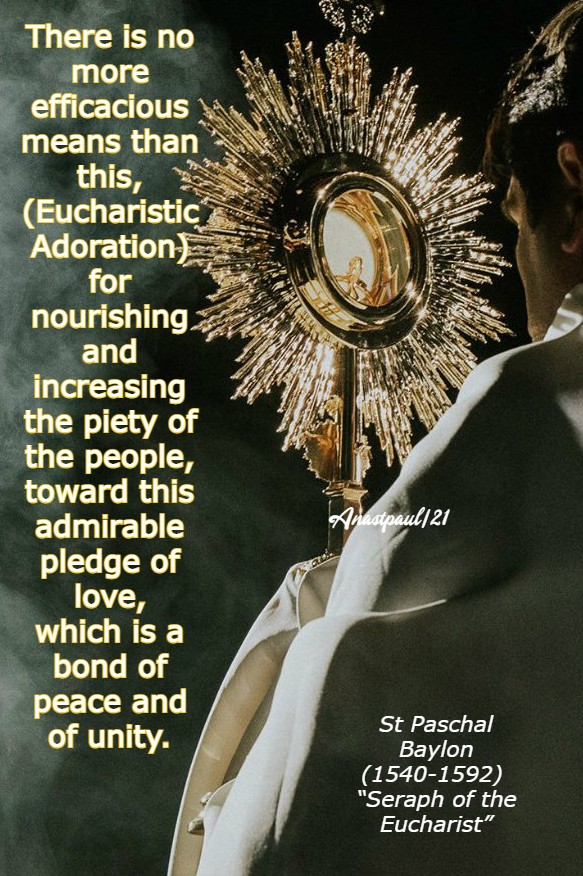
“There is no more efficacious means than this, (Eucharistic Adoration) for nourishing and increasing the piety of the people, toward this admirable pledge of love, which is a bond of peace and of unity.”
St Paschal Baylon (1540-1592)
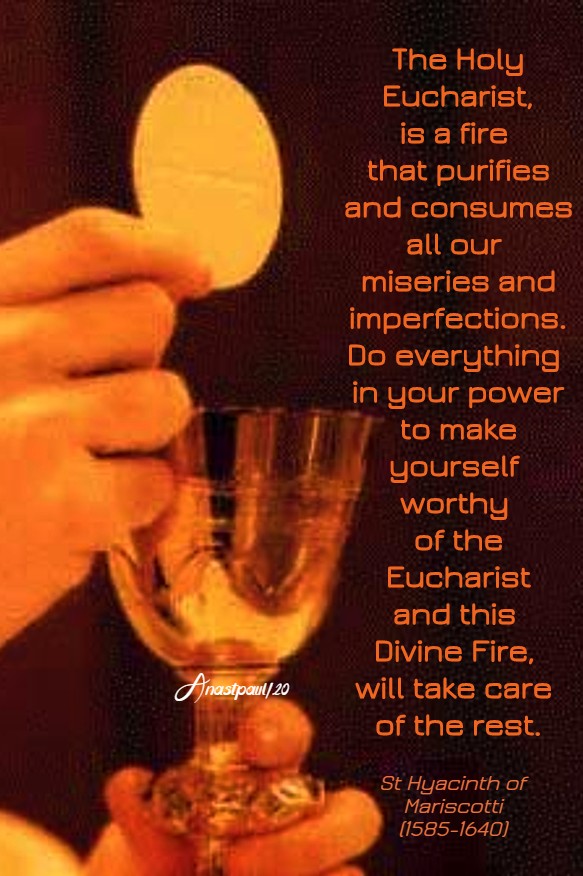
“The Holy Eucharist, is a fire that purifies and consumes all our miseries and imperfections. Do everything in your power to make yourself worthy of the Eucharist and this Divine Fire, will take care of the rest.”
St Hyacinth of Mariscotti (1585-1640)
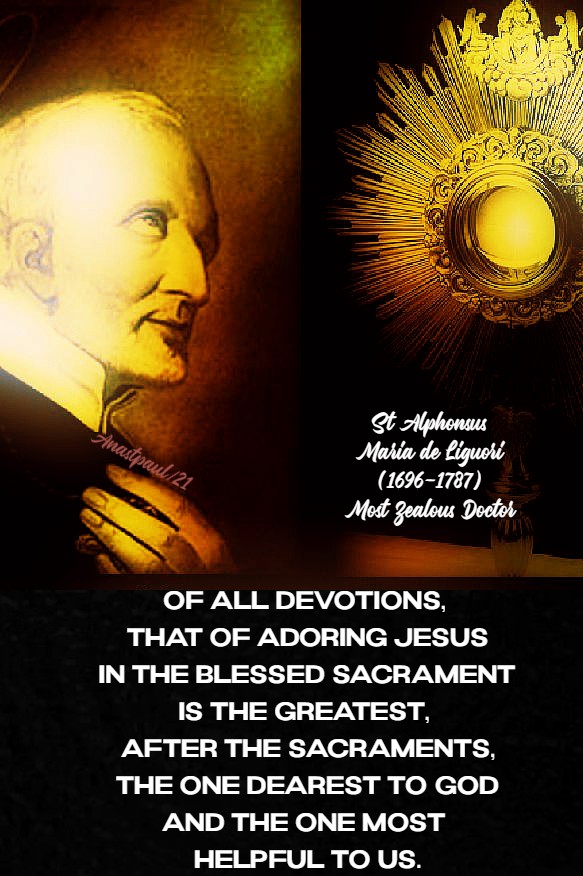
“Of all devotions, that of adoring Jesus in the Blessed Sacrament is the greatest, after the sacraments, the one dearest to God and the one most helpful to us.”
St Alphonsus Maria de Liguori (1696-1787) Most Zealous Doctor
Anima Christi
Soul of Christ, sanctify me Body of Christ, save me Blood of Christ, inebriate me Water from the side of Christ, wash me Passion of Christ, strengthen me Good Jesus, hear me Within Your wounds, shelter me from turning away, keep me From the evil one, protect me At the hour of my death, call me Into Your presence lead me to praise You with all Your saints Forever and ever, Amen
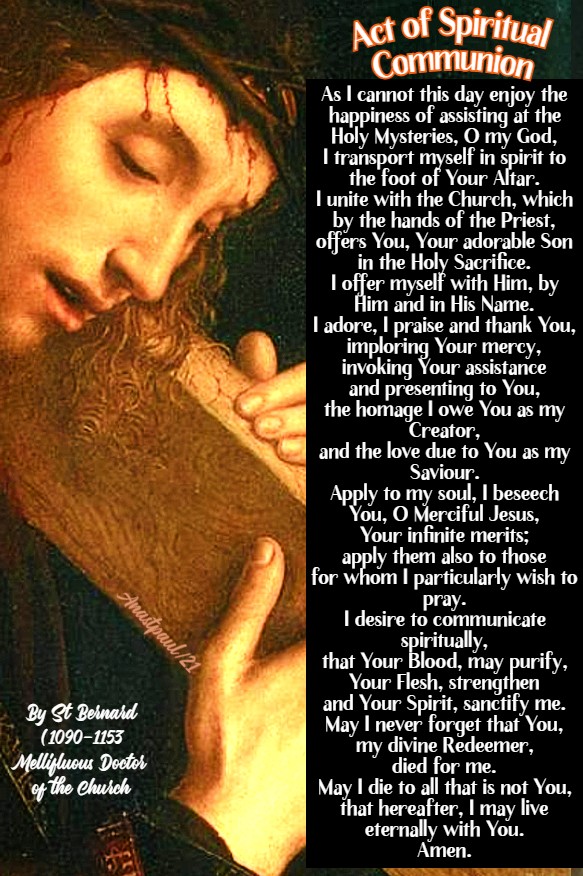
Act of Spiritual Communion By St Bernard (1090-1153 Mellifluous Doctor of the Church
As I cannot this day enjoy the happiness of assisting at the Holy Mysteries, O my God, I transport myself in spirit to the foot of Your Altar. I unite with the Church, which by the hands of the Priest, offers You, Your adorable Son in the Holy Sacrifice. I offer myself with Him, by Him and in His Name. I adore, I praise and thank You, imploring Your mercy, invoking Your assistance and presenting to You, the homage I owe You as my Creator and the love due to You as my Saviour.
Apply to my soul, I beseech You, O Merciful Jesus, Your infinite merits; apply them also to those for whom I particularly wish to pray. I desire to communicate spiritually, that Your Blood, may purify, Your Flesh, strengthen and Your Spirit, sanctify me. May I never forget that You, my divine Redeemer, died for me. May I die to all that is not You, that hereafter, I may live eternally with You. Amen.
One Minute Reflection – 19 June – “The Month of the Sacred Heart of Jesus” – Solemnity of Corpus Christ. Sunday within the Octave – 1 John 3:13-18. Luke 14:16-24.
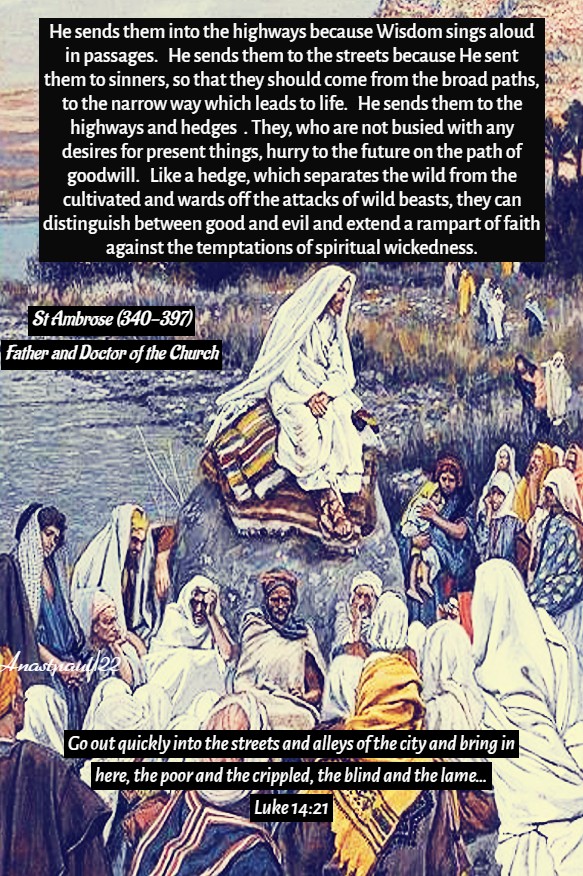
“The servant went and reported this to his Master. Then the Master of the house was angry and commanded His servant, ‘Go out quickly into the streets and alleys of the city and bring in here, the poor and the crippled, the blind and the lame…” – Luke 14:21
REFLECTION – “He turned to the Gentiles from the careless scorn of the rich. He invites both good and evil to enter, in order to strengthen the good and change the disposition of the wicked for the better. The saying that was read today is fulfilled, “Then wolves and lambs will feed together.” He summons the poor, the maimed and the blind. By this, He shows us, either that handicaps do not exclude us from the Kingdom of Heaven that the Lord’s mercy forgives the weakness of sinners. Whoever glories in the Lord, glories as one redeemed from reproach, not by works but by faith.
He sends them into the highways because Wisdom sings aloud in passages. He sends them to the streets because He sent them to sinners, so that they should come from the broad paths, to the narrow way which leads to life. He sends them to the highways and hedges . They, who are not busied with any desires for present things, hurry to the future on the path of goodwill. Like a hedge, which separates the wild from the cultivated and wards off the attacks of wild beasts, they can distinguish between good and evil and extend a rampart of faith against the temptations of spiritual wickedness.” – St Ambrose (340-397) Bishop of Milan, Father and Doctor of the Church (Exposition on the Gospel of Luke, 7).
PRAYER – O God, Who miraculously fortified blessed Juliana, Thy Virgin, in her last illness with the precious Body of Thy Son, grant, we beseech Thee, that with her merits pleading for us, we also, refreshed and strengthened by the same Sacrament in our dying agony, may be brought to our heavenly home. Through Jesus Christ, Thy Son our Lord, Who lives and reigns with Thee, in the unity of the Holy Ghost, God, world without end. Amen (Collect). MAY the Heart of JESUS in the most Blessed Sacrament be praised, adored and loved with grateful affection, at every moment, in all the Tabernacles of the world, even to the end of time. Amen. Indulgence 100 Days, Once a day. Raccolta 161 Pope Pius IX, 29 February 1868.
Our Morning Offering – 19 June – “The Month of the Sacred Heart of Jesus” – Solemnity of Corpus Christ. Sunday within the Octave
O Heart of Jesus in the Blessed Sacrament By The League of the Sacred Heart 1929 (Ireland)
O Heart of Jesus in the Blessed Sacrament, overflowing with gentleness, tenderness and charity, I bury in the abyss of Thy Mercy, all my iniquities and all my negligence. I offer Thee my labours and my sufferings, my sorrows and my miseries, I recommend to Thee my life and my death. Solace my doubts Sweet Jesus, calm my fears and grant, that day-by-day, I may become more united to Thy Sacred Heart, learning Thy love and Thy holiness. Amen
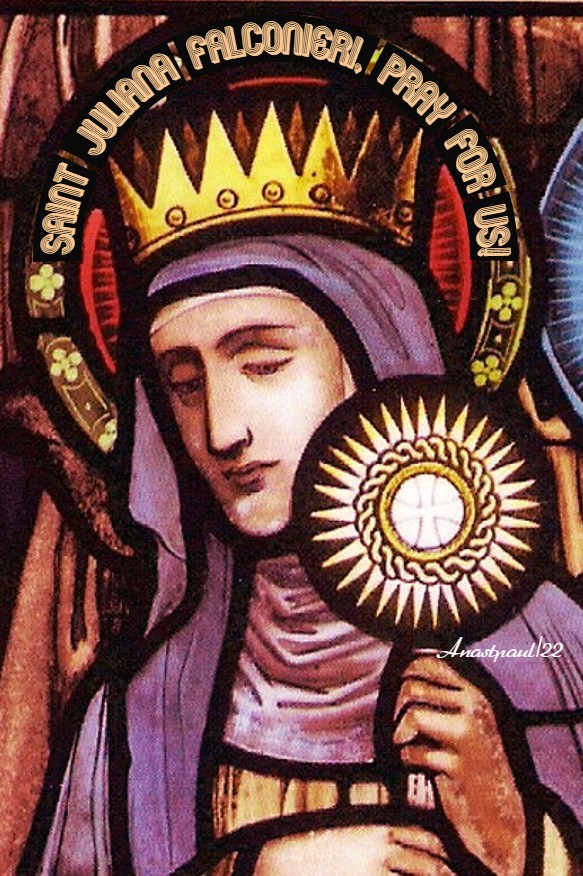
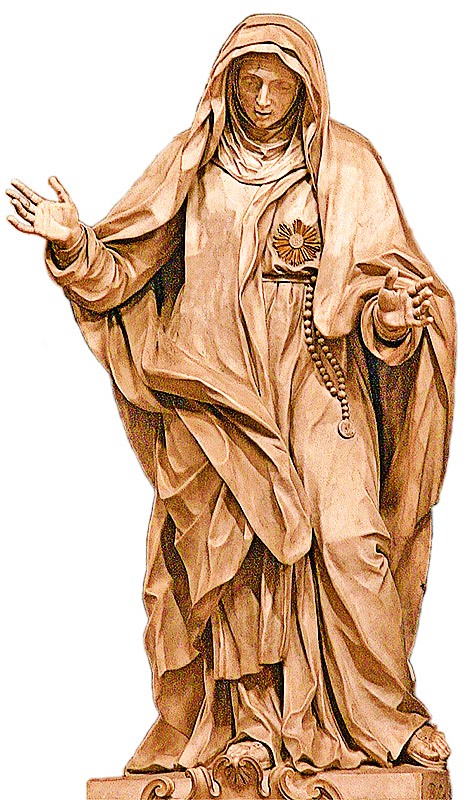
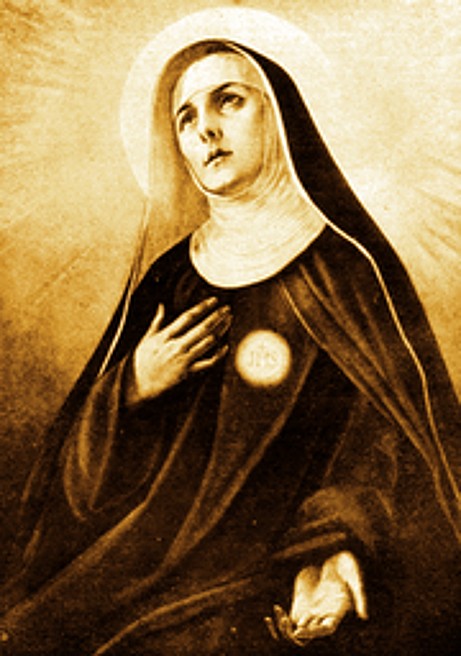
Saint of the Day – 19 June – St Juliana Falconieri OSM (1270–1341) Virgin and Foundress of the Religious Sisters of the Order of Servites, Mystic, Ecstatic, Ascetic.
The Roman Martyrology reads today: “At Florence, St Julian Falconieri, Virgin, Foundress of the Sisters of the Order of the Servants of the Blessed Virgin Mary, who was placed among the Holy Virgins by the Sovereign Pontiff, Clement XII.”
St Juliana Falconieri, Virgin By Fr Francis Xavier Weninger SJ (1805-1888)
The Roman Martyrology, enlarged by Benedict XIV announces today, the festival of St.Juliana. Florence in Italy, is the place where St Juliana was born, in 1270. Her parents were of the illustrious house of Falconieri and were long without issue, until, at last, the fruit of many prayers, this holy daughter was given to them. It was looked upon as a sign of her future holiness, that Juliana, when an innocent child, pronounced the two blessed names of Jesus and Mary, without having been taught by anyone to utter them. Even in her childhood, she endeavoured, so earnestly, to attain Christian virtues, that her uncle, St Alexius, of the Order of Servites, who was her instructor, hesitated not to say to her mother, that she had not given birth to a mortal maiden, but to an Angel.
And in truth, Juliana’s conduct was such, that she resembled an Angel, rather than a human being. Never was it seen, that she raised her eyes to look at the face of any man, much less that she ever regarded the other sex with boldness. Her horror of sin was innate, so that she trembled when she only heard the name of it, nay, she was seen to sink to the ground, as one dead, when a crime was only mentioned. Regardless of her temporal wealth and of many advantageous offers of marriage, she made a vow, in presence of St Philip Benizi, by which she Consecrated her virginity to God, when she was not yet fifteen years of age. She was the first of her sex who entered the Order of the Servites. Many of the highest nobility followed her example. Juliana prescribed certain rules for them, in the composition of which, she showed extraordinary wisdom and holiness. Hence she is justly recognised and honoured, as the Foundress of the Sisterhood of the Servants of Mary.
St Philip Benizi, (one of the Seven Holy Founders) who not only enlarged the Order of the Servites but also, guided those who belonged to it, in a most exemplary manner, was so thoroughly convinced of the virtues of Juliana, that he said, before his death, that there was no-one more fit to be entrusted with the government of the whole Order–men as well as women–than Juliana. She, however, had quite a different opinion of herself and, although, she was appointed to guide others, she performed, with the utmost willingness, the most menial services for those under her. She was so deeply devoted to prayer, that she continued whole days in this exercise, during which time, she often fell into ecstasies and was favoured with divine apparitions. The time unoccupied by work and prayer, she usually spent in reconciling hostile minds, for which kind office, she was peculiarly qualified and also, in converting sinners, many of whom her persuasions brought to the knowledge of their faults, or in nursing the sick, to whom she was devoted with a mother’s love.
Anxious to conquer herself, she more than once sucked the putrid matter from the ulcers of the sick and God, in consideration of such heroic self-abnegation, instantly restored them to health. She was as severe to herself as she was tender towards others. The rest, which she took at night on the bare floor, was very short – as she occupied the greater part of the night in prayer. She chastised her innocent body with scourges and chains of wire. She fasted every Saturday on water and bread. Two days of every week she lived almost without earthly nourishment, as she then received the Bread of Angels, the Blessed Eucharist. On other days, she partook of food but only of very little and that of the most ordinary kind, as otherwise she refused to touch it.
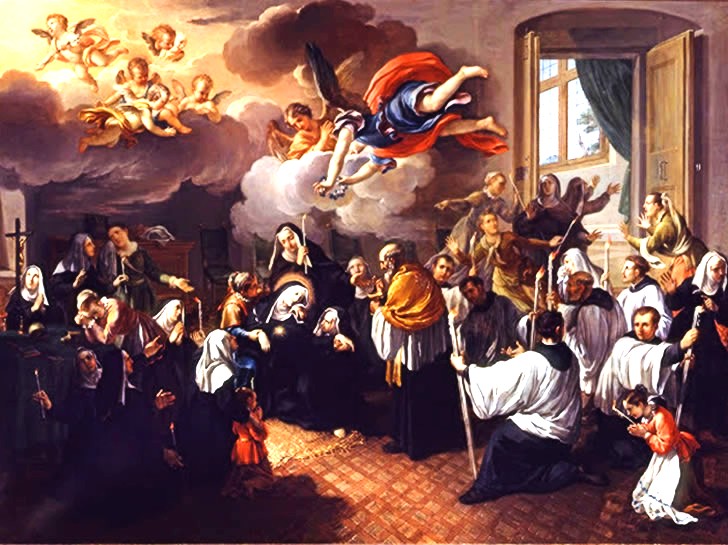
This continual rigour eventually impaired her health and caused her most severe pains, which at last, in the 70th year of her age, ended her life. She had suffered, in this manner, for many years, with the most cheerful and edifying patience. Only one thing pained her exceedingly in her last day,: which was, that, as she could not retain any food, the Priest could not give her the Blessed Sacrament, for which she longed so ardently. Flying for refuge to God, she prayed that He would not permit her to die without this great consolation. Soon after, as if convinced that God would bestow upon her an extraordinary grace, she requested the Priest to bring the holy Eucharist, at least to her room and hold it to her breast. The Priest consented to her request but no sooner had the Blessed Sacrament been placed near her breast, than it suddenly disappeared and at the same time, the countenance of Juliana expressed a great interior satisfaction and happiness. Whilst the Priest strove to recover from his surprise, the servant of God, miraculously fed with the Bread of Life, expired without a struggle. After her death, they found on the left side of her breast, the form of the Host, bearing the image of the Crucified Saviour, like a seal pressed into the flesh. This led to the belief, that the holy virgin had been, in an unprecedented way, comforted in her last hour with the Blessed Eucharist. The fame of this miracle and of many others with which God honoured her after her death, won for Juliana, the esteem of the whole Christian world. Her holy body was buried in the magnificent Church which her father had built in honour of the Blessed Virgin and in memory of the Annunciation.
Father’s Day + 2022 Wishing all Dads a Blessed and Happy Father’s Day!
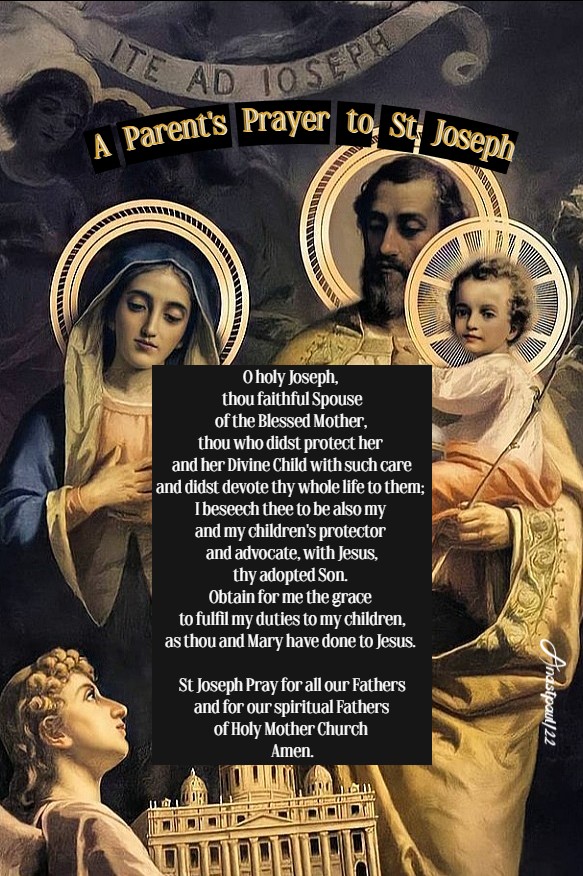
A Parent’s Prayer to St Joseph
O holy Joseph, thou faithful Spouse of the Blessed Mother, thou who didst protect her and her Divine Child with such care and didst devote thy whole life to them; I beseech thee to be also my and my children’s protector and advocate, with Jesus, thy adopted Son. Obtain for me the grace to fulfil my duties to my children, as thou and Mary have done to Jesus.
St Joseph Pray for all our Fathers and for our spiritual Fathers of Holy Mother Church Amen.
Solemnity of Corpus Christ Sunday within the Octave
St Hildegrin of Châlons-sur-Marne Bl Humphrey Middlemore St Innocent of Le Mans St Lambert of Saragossa St Lupo of Bergamo St Modeste Andlauer St Nazario of Koper Bl Odo of Cambrai St Rémi Isoré Bl Sebastian Newdigate Bl Thomas Woodhouse Bl William Exmew St Zosimus of Umbria
Everyday unite your prayers and adorations with those of the Most Holy Virgin and of one of the nine choirs of Angels and Saints, to honour one of the dispositions of the Sacred Heart of Jesus and to practise some virtue in its honour.
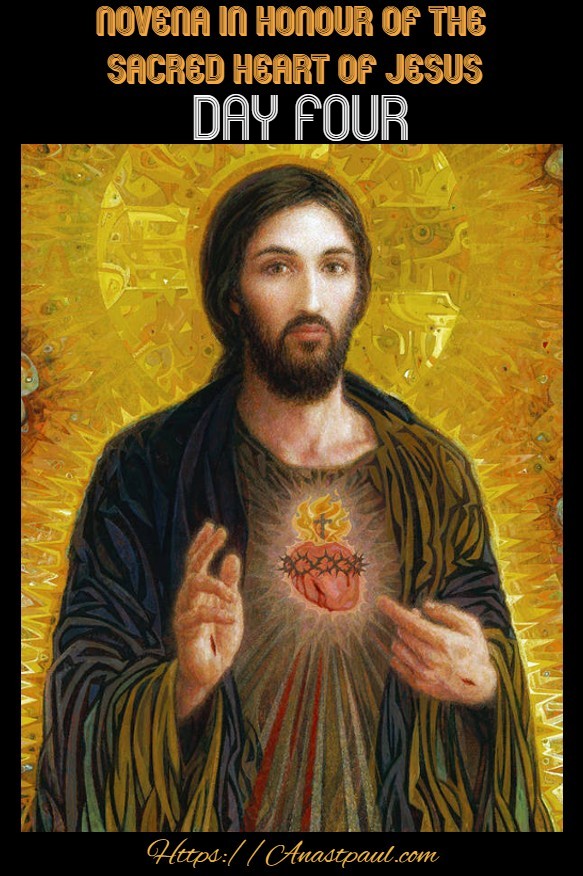
THE FOURTH DAY
With the Blessed Virgin, the Dominations and the Holy Martyrs.
Adore the Sacred Heart of Jesus, burning with love for you and implore, as a favour, that your love for the Sacred Heart of Jesus may be increased.
Practice-–Visit the Sacred Heart, as often as possible, to render to it your thanksgiving, for the love it bears for you and to profess your love for it.
Prayer of St Alphonsus Liguori to the Sacred Heart
O Adorable Heart of my Jesus, Heart created expressly. for the love of men! Until now, I have shown towards Thee only ingratitude. Pardon me, O my Jesus. Heart of my Jesus, Abyss of Love and of Mercy, how is it possible, hat I do not die of sorrow when I reflect on Thy Goodness to me and my ingratitude to Thee? Thou, my Creator, after having created me, hast given Thy Blood and Thy Life for me and, not content with this, Thou hast invented a means of offering Thyself everyday for me, in the Holy Eucharist, exposing Thyself to a thousand insults and outrages. Ah, Jesus, do Thou wound my heart with a great contrition for my sins and a lively love for Thee. Through Thy Tears and Thy Blood, give me the grace of perseverance in Thy fervent love, until I breathe my last sigh. Amen.


































You must be logged in to post a comment.