Thought for the Day – 27 May – Meditations with Antonio Cardinal Bacci (1881-1971)
A Lesson from Scripture God Alone
“O Mary, my most Holy Mother, free me from useless desires and from an excessive longing for worldly things. Help me to think always of Heaven. Grant that I may find my happiness in God alone, as you did by acting in perfect accordance with His Holy Will. By loving Him above everything in the world, may I one day enjoy, with you, the everlasting happiness of Heaven. Amen.”
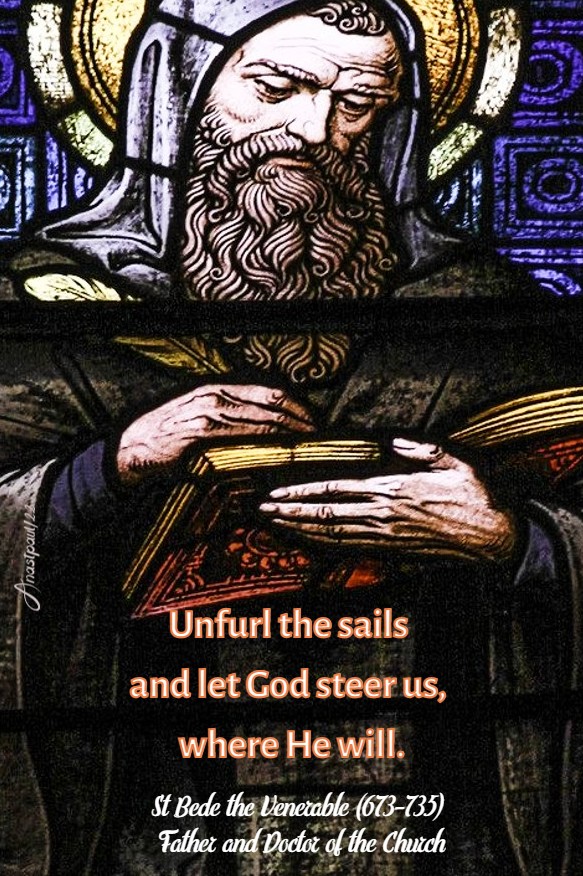
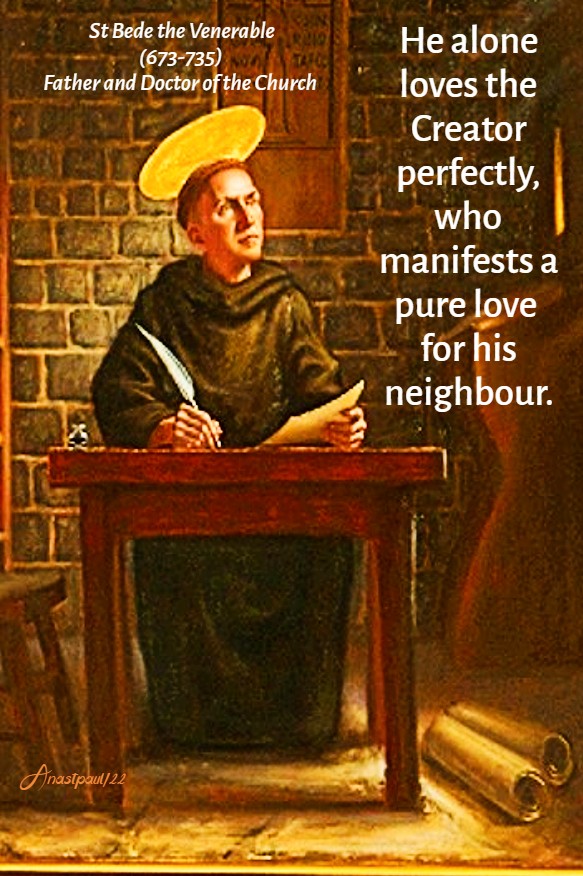
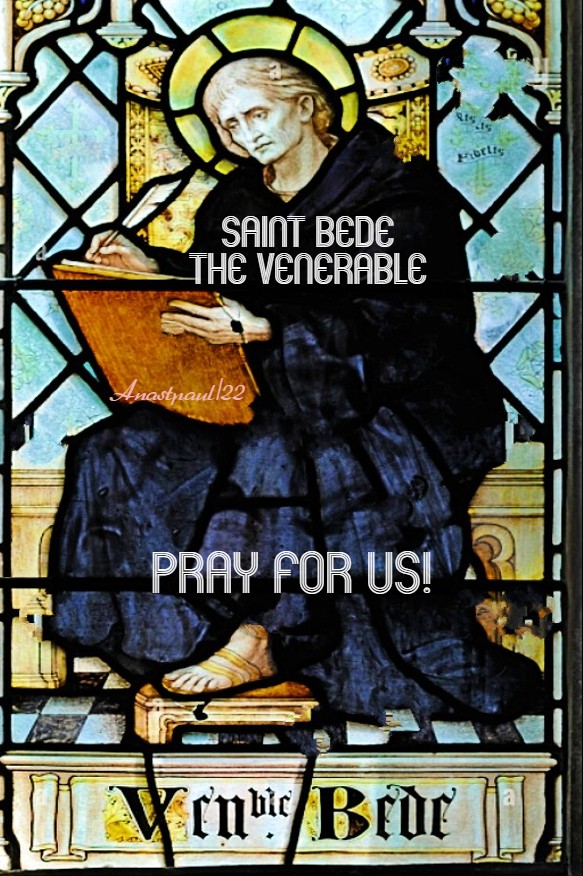
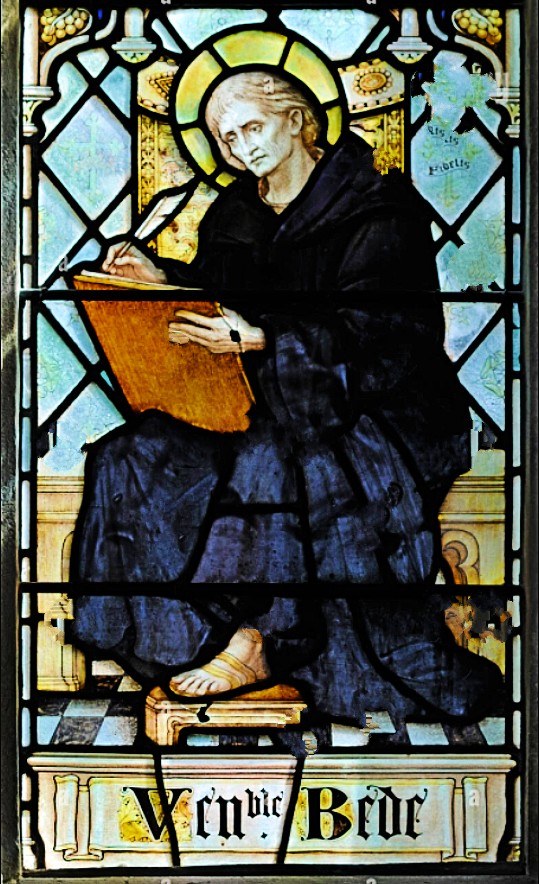
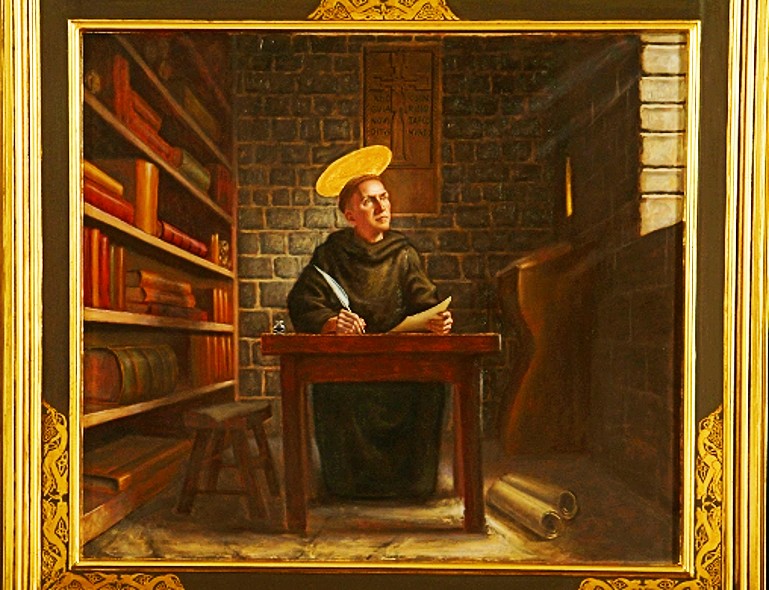
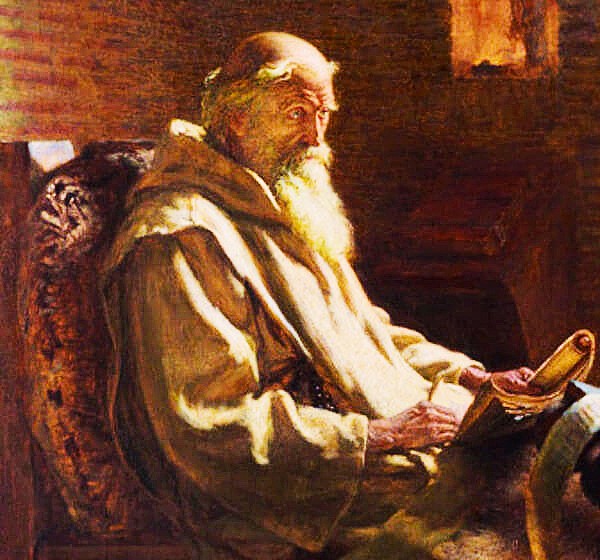
Quote/s of the Day – 27 May – St Bede the Venerable (673-735) Confessor, Father and Doctor of the Church –
“Unfurl the sails and let God steer us, where He will.”
“He alone loves the Creator perfectly, who manifests a pure love for his neighbour.”
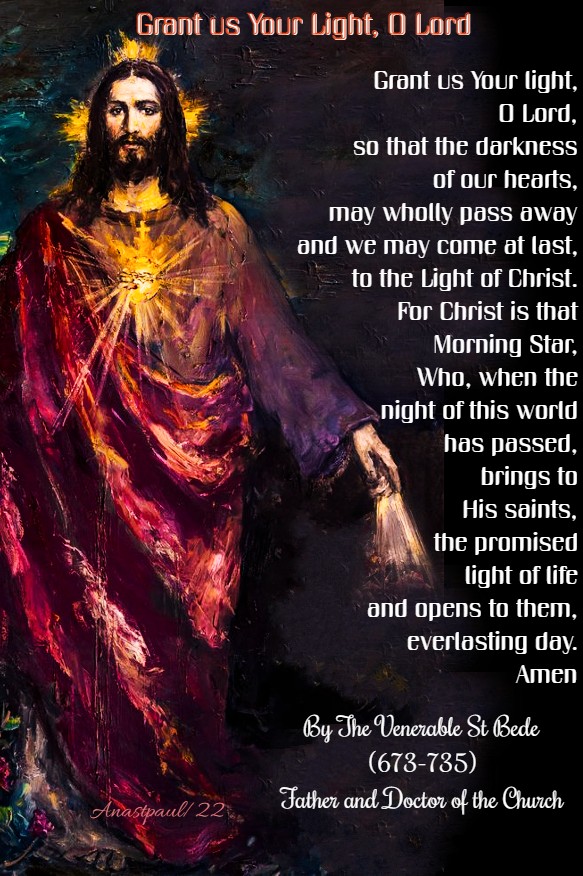
Grant us Your Light, O Lord By The Venerable St Bede (673-735) Father and Doctor of the Church
Grant us Your light, O Lord, so that the darkness of our hearts, may wholly pass away and we may come at last, to the Light of Christ. For Christ is that Morning Star, who, when the night of this world has passed, brings to His saints, the promised light of life and opens to them, everlasting day. Amen.
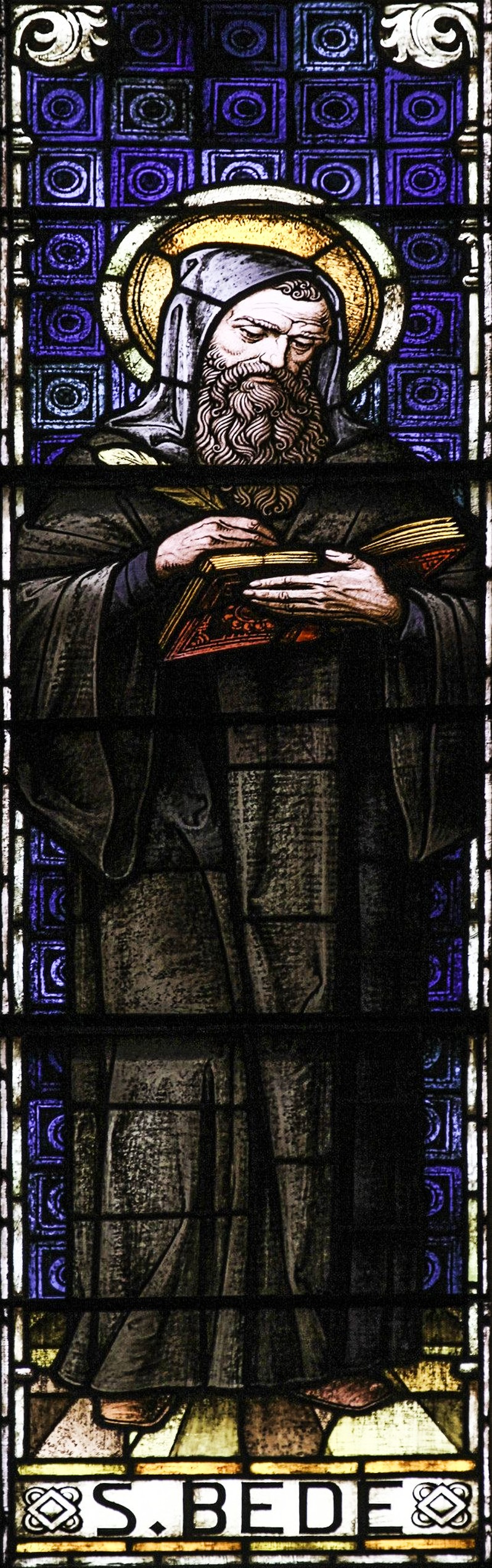
St Bede the Venerable (673-735) Father and Doctor of the Church
St Bede became known as “Venerable Bede or Bede the Venerable” (Latin: Beda Venerabilis) by the 9th Century because of his great devotion and holiness but this was not linked to consideration for sainthood. According to a legend, the epithet was miraculously supplied by Angels. It was first utilised in connection with St Bede, where he was grouped with others, who were called “venerable,” at two Ecclesiastical Councils, held at Aachen in 816 and 836. Paul the Deacon (c 720-c 796) Italian Monk, Writer, Historian, then referred to him as Venerable consistently. By the 11th and 12th Centuries, the title had become commonplace and it is rarely omitted today.
One Minute Reflection – 27 May – Saint Bede the Venerable (673-735) Confessor, Father and Doctor of the Church – 2 Timothy 4:1-8, Matthew 5:13-19
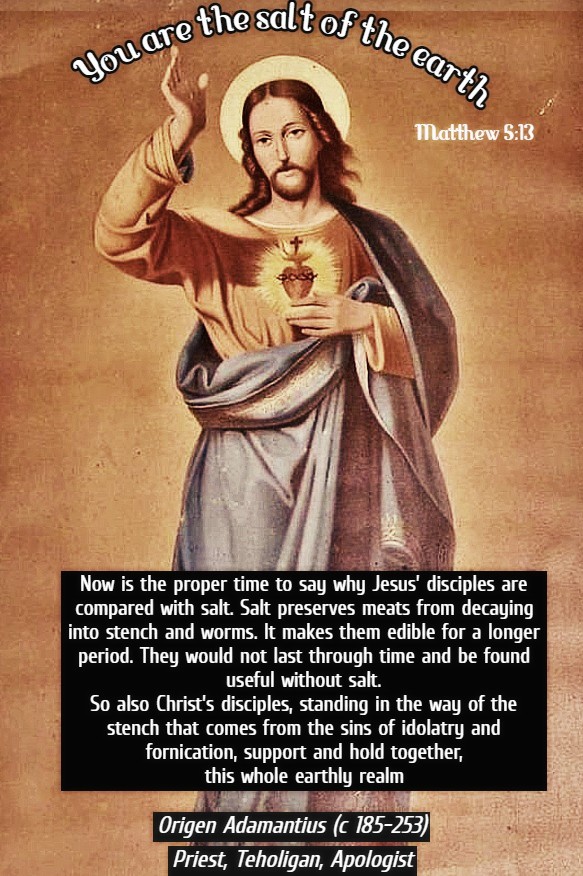
“You are the salt of the earth” – Matthew 5:13
REFLECTION – “Salt is useful for so many purposes in human life! What need is there to speak about this? Now is the proper time to say why Jesus’ disciples are compared with salt. Salt preserves meats from decaying into stench and worms. It makes them edible for a longer period. They would not last through time and be found useful without salt. So also Christ’s disciples, standing in the way of the stench that comes from the sins of idolatry and fornication; support and hold together, this whole earthly realm.” – Origen Adamantius (c 185-253) Priest, Theologian, Exegist, Writer, Apologist, Father – (Fragment 91).
PRAYER – O God, Who enlightened Your Church with the learning of blessed Bede, Your Confessor and Doctor, graciously grant that Your servants may ever be enlightened by his wisdom and helped by his merits. Through Jesus Christ, Thy Son our Lord, Who lives and reigns with Thee, in the unity of the Holy Ghost, God, world without end. Amen (Collect).
Our Morning Offering – 27 May – “The Month of the Blessed Virgin Mary”
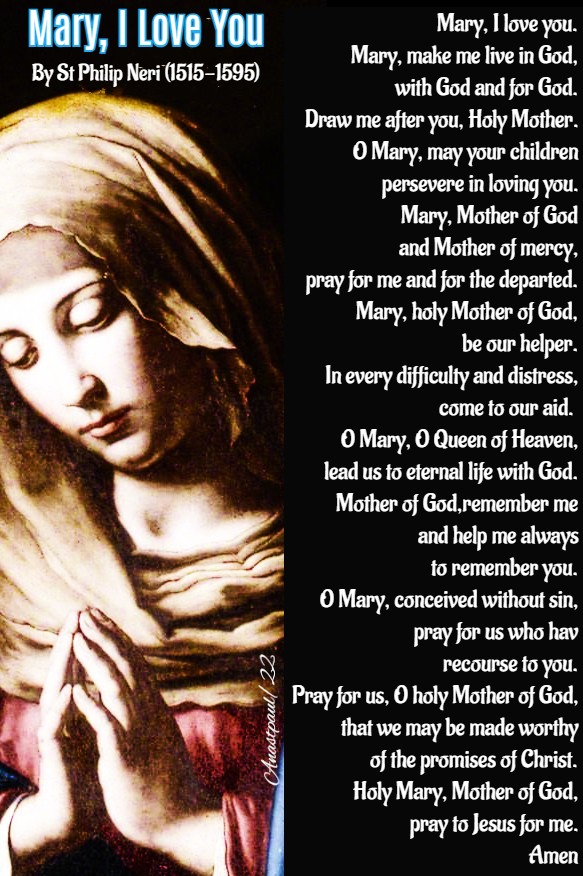
Mary, I Love You By St Philip Neri (1515-1595)
Mary, I love you. Mary, make me live in God, with God and for God. Draw me after you, Holy Mother. O Mary, may your children persevere in loving you. Mary, Mother of God and Mother of mercy, pray for me and for the departed. Mary, holy Mother of God, be our helper. In every difficulty and distress, come to our aid. O Mary, O Queen of Heaven, lead us to eternal life with God. Mother of God, remember me and help me always to remember you. O Mary, conceived without sin, pray for us who have recourse to you. Pray for us, O holy Mother of God, that we may be made worthy of the promises of Christ. Holy Mary, Mother of God, pray to Jesus for me. Amen
Saint of the Day – 27 May – Saint Bede the Venerable (673-735) Confessor, Priest, Monk, Father and Doctor of the Church (Added by Pope Leo XIII in 1899),
Today, … England brings forward her illustrious son, the Venerable Bede. This humble Monk, whose life was spent in the praise of God, sought his Divine Master in nature and in history but above all in Holy Scripture, which he studied with a loving attention and fidelity to Tradition. He, who was ever a disciple of the ancients, takes his place today among his masters, as a Father and Doctor of the Church.
He thus sums up his own life: “I am a Priest of the Monastery of the Blessed Apostles Peter and Paul. I was born on their land and ever since my seventh year, I have always lived in their house, observing the Rule, singing day by day in their Church and making it my delight to learn, to teach, or to write. Since I was made a Priest, I have written commentaries on the Holy Scripture for myself and my brethren, using the words of our venerated Fathers and following their method of interpretation. And now, good Jesus, I beseech Thee, Thou Who hast given me in Thy mercy, to drink of the sweetness of Thy Word, grant me now, to attain to the Source, the Fount of Wisdom,and to gaze upon Thee forever and ever.” (Bede, Hist. Eccl. cap. ult.)
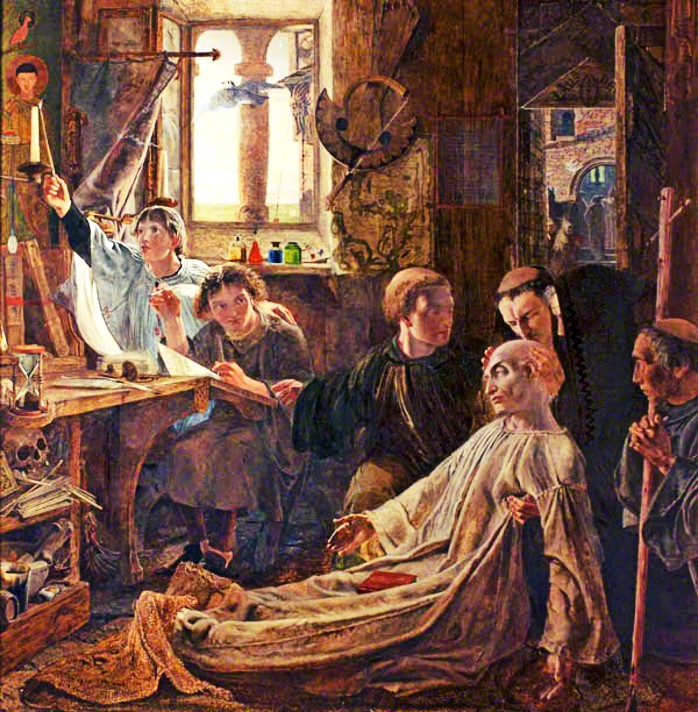
The holy death of the servant of God was one of the most precious lessons he left to his disciples. His last sickness lasted fifty days and he spent them, like the rest of his life, in singing the Psalms and in teaching. As the Feast of the Ascension drew near, he repeated over and over again, with tears of joy, the Antiphon: O King of Glory, Who hast ascended triumphantly above the heavens, leave us not orphans but send us the Promise of the Father, the Spirit of Truth. He said to his disciples, in the words of St Ambrose: “I have not lived in such a way, as to be ashamed to live with you but I am not afraid to die, for we have a good Master.” Then returning to his translation of the Gospel of St John and a work, which he had begun, on St Isidore’s Day, he would say: “I do not wish my disciples to be hindered after my death, by error, nor to lose the fruit of their studies.”
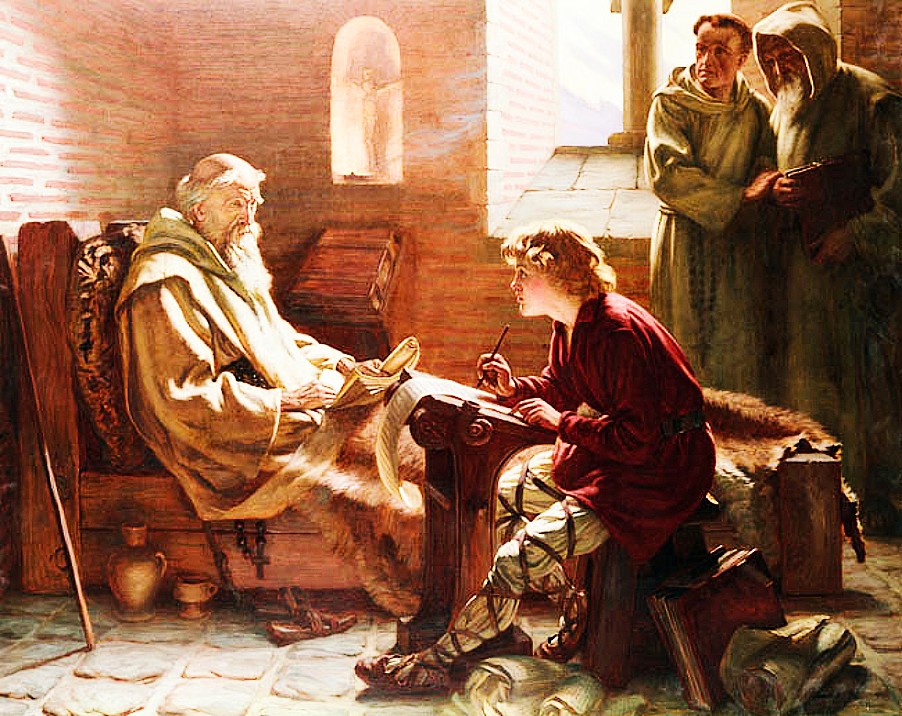
On the Tuesday before the Ascension ,he grew worse and it was evident that the end was near. He was full of joy and spent the day in dictating and the night in prayers of thanksgiving. The dawn of Wednesday morning found him urging his disciples to hurry on their work. At the hour of Tierce they left him to take part in the procession made on that day (the last of the Rogation days), with the relics of the Saints. One of them, a youth, who stayed with him, said: “Dear Master, there is but one chapter left; hast thou strength for it?” “It is easy,” he answered with a smile, “take thy pen, cut it and write – but make haste.” At the hour of None, he sent for the Priests of the Monastery and gave them little presents, begging them to remember him at the Altar. All wept. But he was full of joy, saying: “It is time for me, if it so please my Creator, to return to Him Who made me out of nothing, when as yet I was not. My sweet Judge has well ordered my life and now, the time of dissolution is at hand. I desire to be dissolved and to be with Christ. Yea, my soul longs to see Christ my King in His beauty.”
So did he pass this last day. Then came the touching dialogue with Wibert, the youth mentioned above. Dear master, there is yet one sentence more. Write quickly. After a moment – “ It is finished,” said the youth. “Thou sayest well,” replied the blessed man. “It is finished. Take my head in thy hands and help me face the Oratory, for it is a great joy to me to see myself facing that holy place where I have so often prayed.” When they had laid him on the floor of his cell, he said: “Glory be to the Father and to the Son and to the Holy Ghost” and when he had named the Holy Ghost, he yielded up his soul.
St Acculus of Alexandria St Antanansio Bazzekuketta St Barbara Kim St Barbara Yi
St Bruno of Würzburg (c 1005-1045) Bishop Prince, Imperial Chancellor of Italy from 1027 to 1034. Bruno rebuilt the existing Cathedral, constructed many new Churches and improved education, to which purpose he composed a well-known exegesis on the Psalms to which he appended an analysis of ten Biblical hymns, consisting of extracts from the writings of the Church Fathers. Under his direction the Cathedral school flourished. About St Bruno: https://anastpaul.com/2020/05/27/saint-of-the-day-27-may-st-bruno-of-wurzburg-c-1005-1045-bishop-prince/
Bl Dionysius of Semur Bl Edmund Duke St Eutropius of Orange St Evangelius of Alexandria St Frederick of Liège Bl Gausberto of Montsalvy St Gonzaga Gonza St James of Nocera Bl John Hogg St Julius the Veteran and Companions St Liberius of Ancona St Matiya Mulumba Bl Matthias of Nagasaki St Melangell St Ranulphus of Arras St Restituta of Sora and Companions Bl Richard Hill Bl Richard Holiday St Secundus of Troia
Thought for the Day – 26 May – Meditations with Antonio Cardinal Bacci (1881-1971)
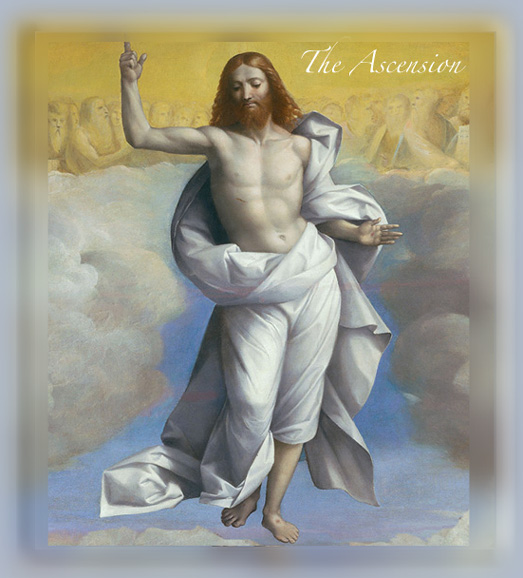
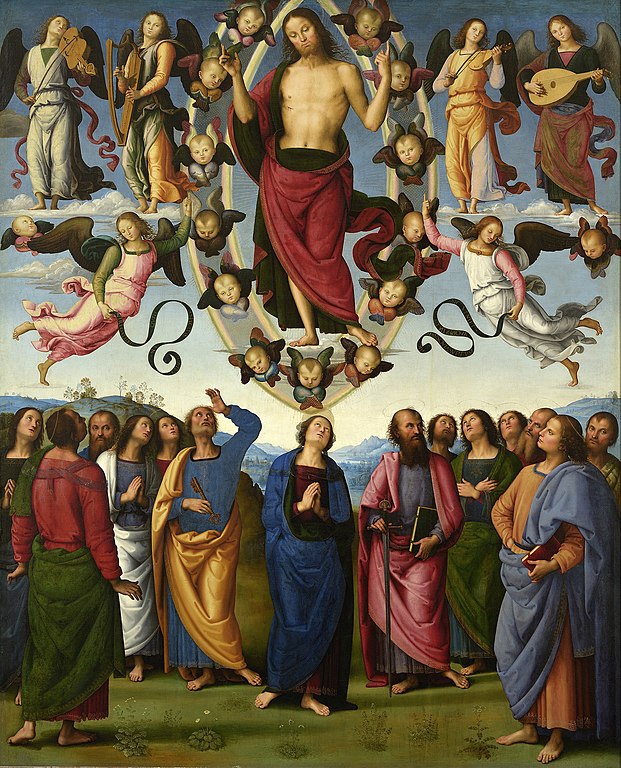
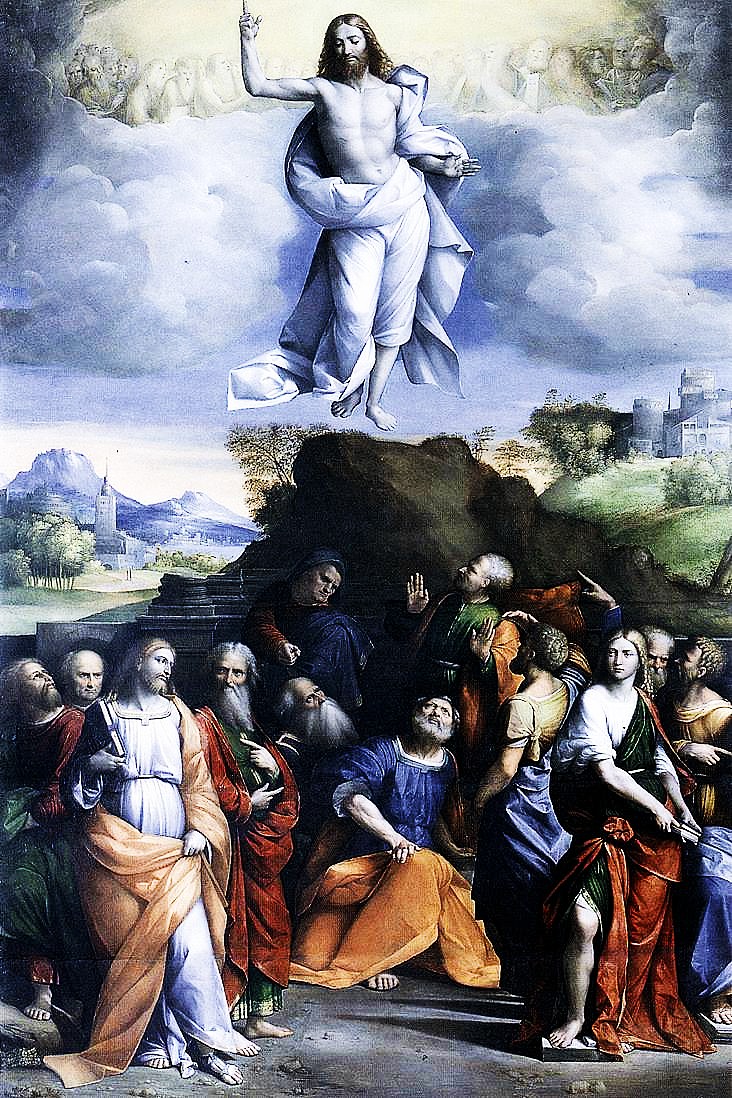
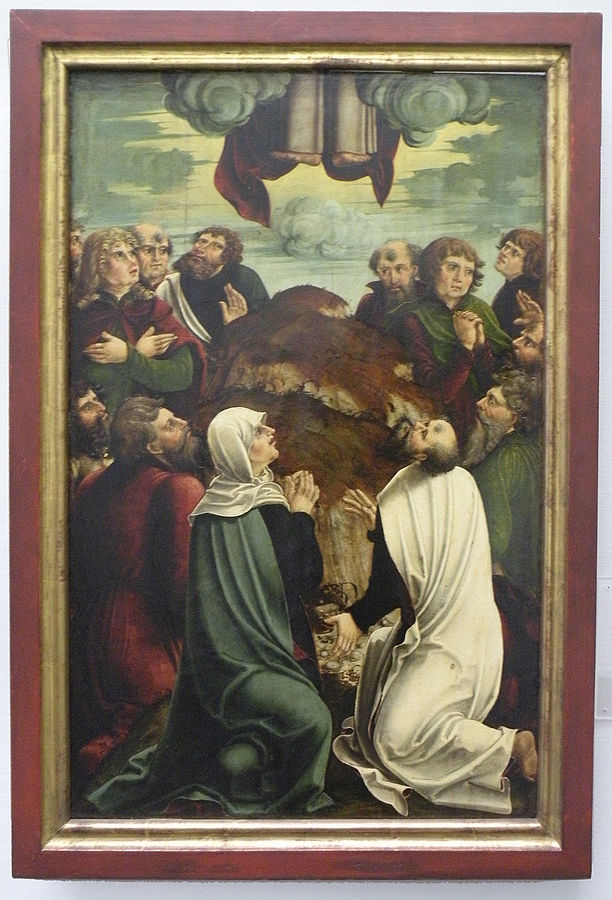
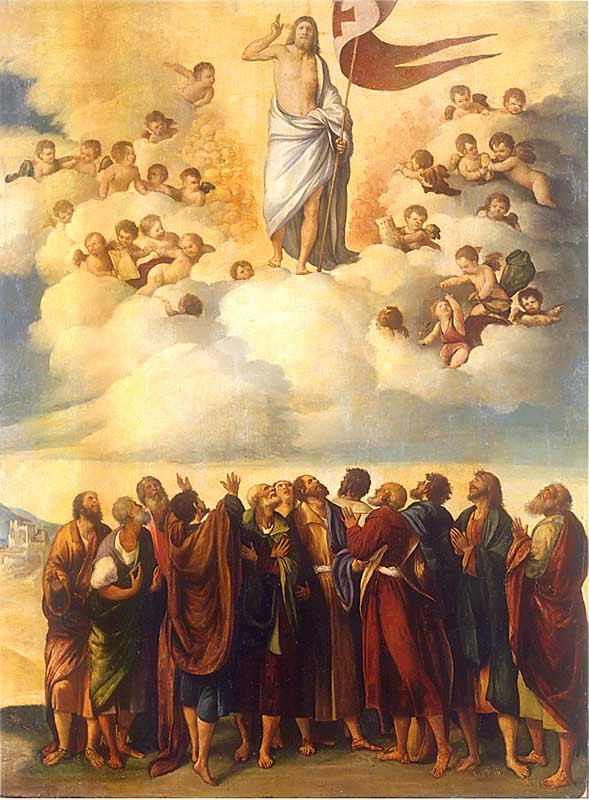
The Ascension of Jesus
“After His glorious Resurrection from the dead, Jesus appeared to His Apostles. For forty days He instructed them concerning the Kingdom of God. When He had announced to His followers, that He would send the Holy Spirit to give them the enlightenment and courage to preach the Gospel, they gathered together on the Mount of Olives and saw Him rise upwards until a bright cloud hid Him from their view. The Mystery of the Ascension contains a lesson for us. We must be detached from the world and brought closer to Heaven, which is our true home. We are so attached to earthly things because money, reputation and pleasure are closer to our hearts than the thought of God or of eternity. We shall have to leave all these things behind soon enough, however. When death comes, the world will slip away from us and the soul will stand alone before God.
Let us begin to detach ourselves from worldly affairs and to make Heaven the object of our desires. Why should we be sorry or afraid, or both, to leave this earth? Remember the teaching of St Paul “Here we no permanent city but we seek for the city that is to come” (Heb 13:14). “For me to live is Christ,” he said, “and to die is gain” (Phil 1:21). “desiring to depart and to be with Christ, a lot by far the better” (Phil 1:23).
Let us pray in the beautiful words of the Church: “Lord, grant that while we are living in this changing world, we may aspire to the true happiness of Heaven, so that in the midst of earthly vicissitudes, our hearts maybe content in this ambition.” (Roman Breviary).
Let us not be afraid of death, for it is only the Gate of Heaven!”
Quote/s of the Day – 26 May – The Ascension of Our Lord
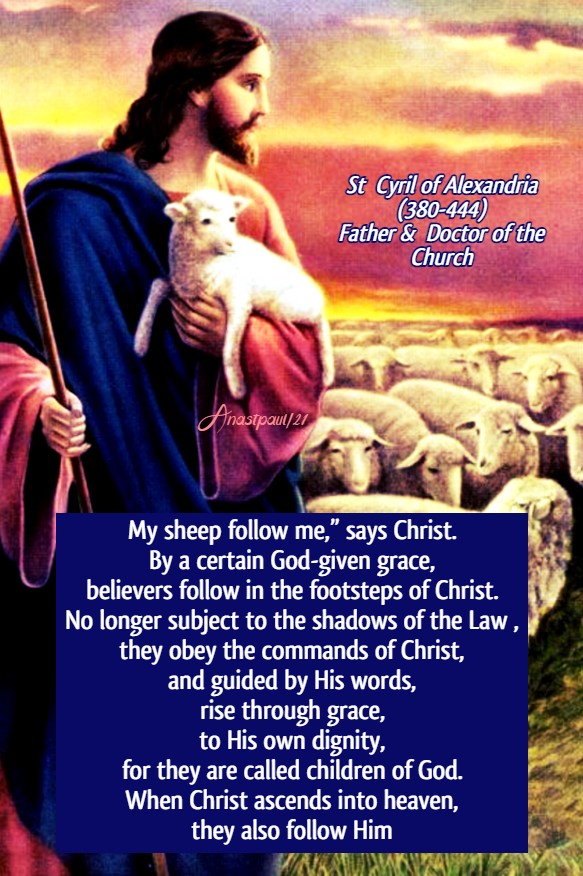
“My sheep follow me,” says Christ. By a certain God-given grace, believers follow in the footsteps of Christ. No longer subject to the shadows of the Law , they obey the commands of Christ, and guided by His words, rise through grace, to His own dignity, for they are called children of God. When Christ ascends into heaven, they also follow Him.”
St Cyril of Alexandria (376-444) Father and Doctor of the Church
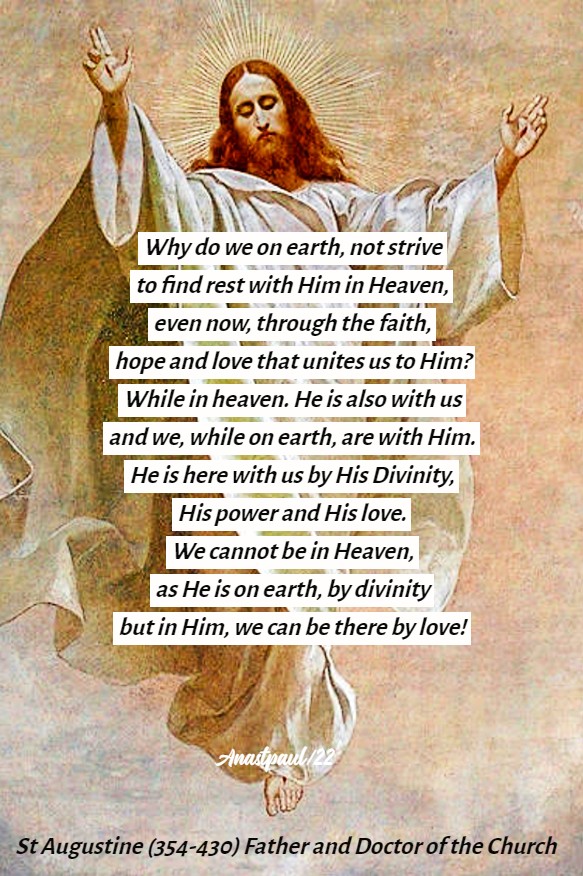
“Why do we on earth, not strive to find rest with Him in Heaven, even now, through the faith, hope and love that unites us to Him? While in heaven. He is also with us and we, while on earth, are with Him. He is here with us by His Divinity, His power and His love. We cannot be in Heaven, as He is on earth, by divinity but in Him, we can be there by love!”
St Augustine (354-430) Father and Doctor of the Church
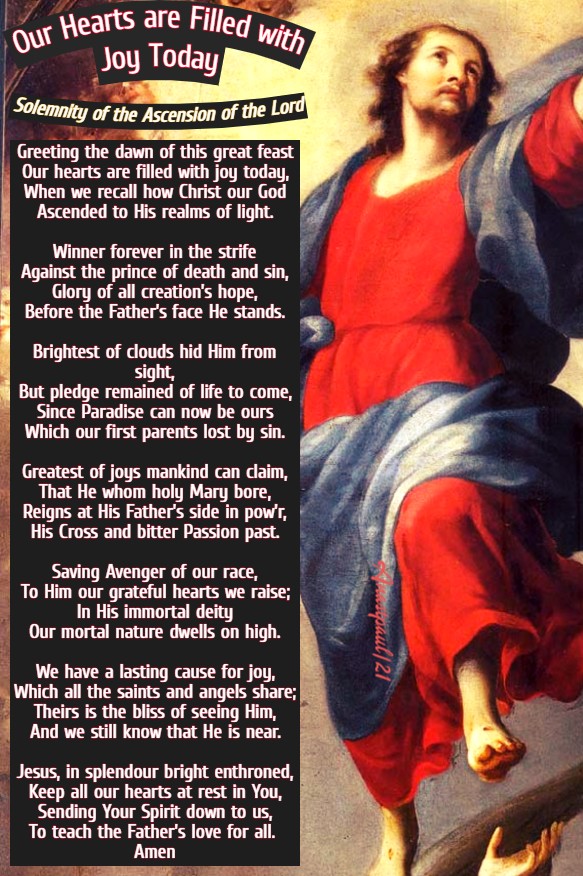
Our Hearts are Filled with Joy Today The Benedictines of Saint Cecilia’s Abbey, Ryde, UK
Greeting the dawn of this great feast Our hearts are filled with joy today, When we recall how Christ our God Ascended to His realms of light.
Winner forever in the strife Against the prince of death and sin, Glory of all creation’s hope, Before the Father’s face He stands.
Brightest of clouds hid Him from sight, But pledge remained of life to come, Since Paradise can now be ours Which our first parents lost by sin.
Greatest of joys mankind can claim, That He whom holy Mary bore, Reigns at His Father’s side in pow’r, His Cross and bitter Passion past.
Saving Avenger of our race, To Him our grateful hearts we raise; In His immortal deity Our mortal nature dwells on high.
We have a lasting cause for joy, Which all the saints and angels share; Theirs is the bliss of seeing Him, And we still know that He is near.
Jesus, in splendour bright enthroned, Keep all our hearts at rest in You, Sending Your Spirit down to us, To teach the Father’s love for all. Amen
One Minute Reflection – 26 May – The Ascension of Our Lord – Acts 1:1-11, Mark 16:14-20
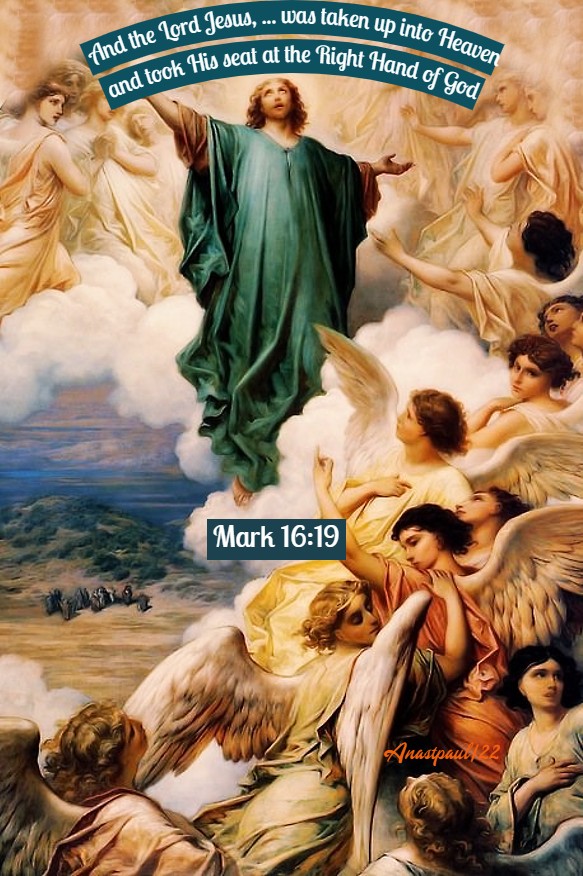
“And the Lord Jesus, after He spoke to them, was taken up into Heaven and took His seat at the Right Hand of God.” – Mark 16:19
REFLECTION – “And so, while at Easter it was the Lord’s Resurrection which was the cause of our joy, our present rejoicing is due to His Ascension into Heaven. With all due solemnity, we are commemorating that day on which our poor human nature was carried up in Christ, above all the Hosts of Heaven, above all the ranks of Angels, beyond those Heavenly Powers, to the very throne of God the Father.
It is upon this ordered structure of divine acts, that we have been firmly established, so that the grace of God may show itself still more marvelous when, in spite of the withdrawal from our sight of everything that is rightly felt to command our reverence, faith does not fail, hope is not shaken, charity does not grow cold. It was in order that we might be capable of such blessedness, that on the fortieth day after His Resurrection, after He had made careful provision for everything concerning the preaching of the Gospel and the Mysteries of the New Covenant, our Lord Jesus Christ was taken up to Heaven before the eyes of His Disciples and so, His Bodily Presence among them, came to an end.
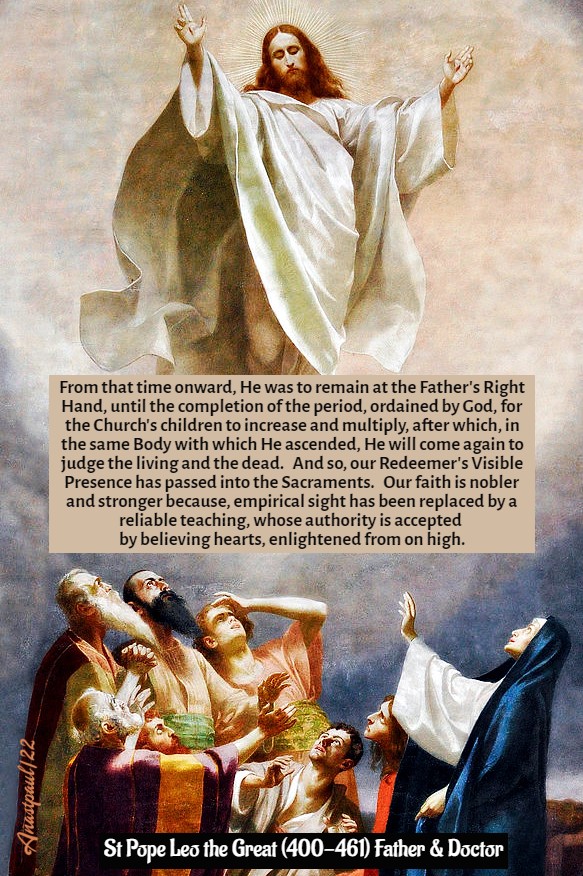
From that time onward, He was to remain at the Father’s Right Hand, until the completion of the period, ordained by God, for the Church’s children to increase and multiply, after which, in the same Body with which He ascended, He will come again to judge the living and the dead. And so, our Redeemer’s Visible Presence has passed into the Sacraments. Our faith is nobler and stronger because, empirical sight has been replaced by a reliable teaching, whose authority is accepted by believing hearts, enlightened from on high.” – St Leo the Great (400-461) Pope , Great Father and Doctor of the Church (Sermon 74).
PRAYER – Grant, we beseech Thee, Almighty God, that as we do believe Thine Only-Begotten Son, our Saviour to have this day ascended into the heavens, so we may also in heart and mind, ascend and with Him continually dwell. Through the same Jesus Christ, Thy Son our Lord, Who lives and reigns with Thee, in the unity of the Holy Ghost, God, world without end. Amen (Collect).
Our Morning Offering – 26 May – The Ascension of Our Lord
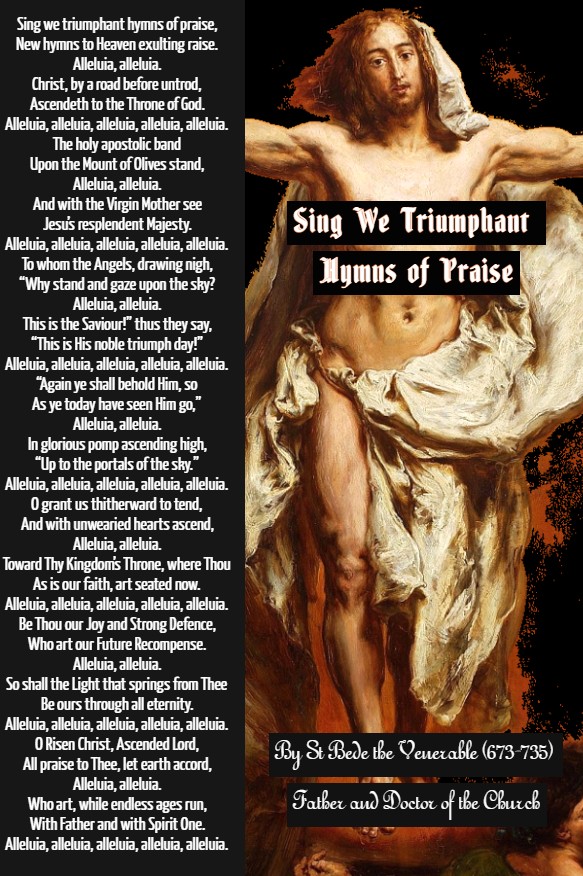
Sing We Triumphant Hymns of Praise By St Bede the Venerable (673-735) Father and Doctor of the Church
Sing we triumphant hymns of praise, New hymns to Heaven exulting raise. Alleluia, alleluia. Christ, by a road before untrod, Ascendeth to the Throne of God. Alleluia, alleluia, alleluia, alleluia, alleluia. The holy apostolic band Upon the Mount of Olives stand, Alleluia, alleluia. And with the Virgin Mother see Jesu’s resplendent Majesty. Alleluia, alleluia, alleluia, alleluia, alleluia.
To whom the Angels, drawing nigh, “Why stand and gaze upon the sky?” Alleluia, alleluia. “This is the Saviour!” thus they say, “This is His noble triumph day!” Alleluia, alleluia, alleluia, alleluia, alleluia.
“Again ye shall behold Him, so As ye today have seen Him go.” Alleluia, alleluia. In glorious pomp ascending high, “Up to the portals of the sky.” Alleluia, alleluia, alleluia, alleluia, alleluia.
O grant us thitherward to tend, And with unwearied hearts ascend, Alleluia, alleluia. Toward Thy Kingdom’s Throne, where Thou, As is our faith, art seated now. Alleluia, alleluia, alleluia, alleluia, alleluia.
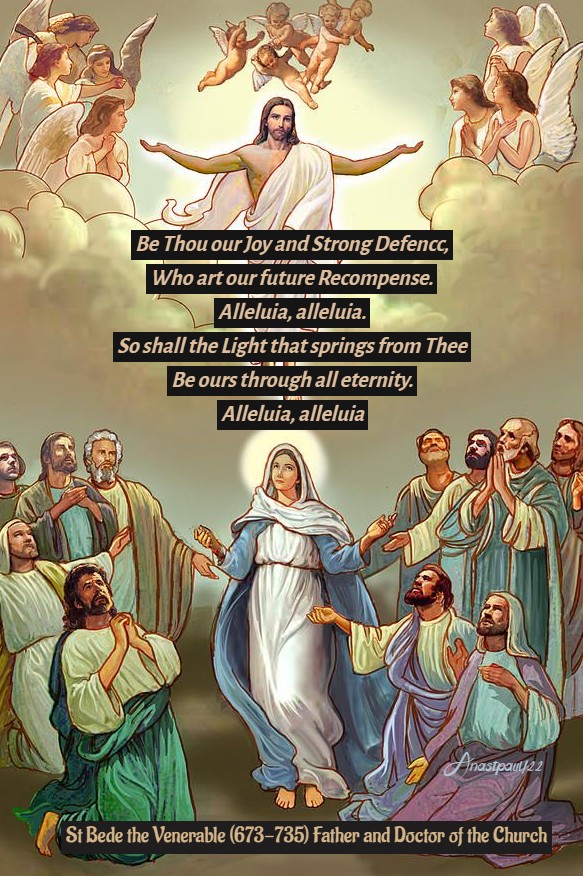
Be Thou our Joy and Strong Defence, Who art our Future Recompense. Alleluia, alleluia. So shall the Light that springs from Thee Be ours through all eternity. Alleluia, alleluia, alleluia, alleluia, alleluia.
O Risen Christ, aAcended Lord, All praise to Thee, let earth accord, Alleluia, alleluia. Who art, while endless ages run, With Father and with Spirit One. Alleluia, alleluia, alleluia, alleluia, alleluia.
The ASCENSION of OUR LORD – 26 May By Abbot Prosper Guéranger (1805-1875) Excerpt
The Sun of the fortieth day has risen in all His splendour! The earth, which shook with gladness at the Birth of our Emmanuel (Ps. xcv. xcvi. xcvii.), now thrills with a strange emotion. The Divine series of the Mysteries of the Man-God is about to close. Heaven has caught up the joy of earth. The Angelic Choirs are preparing to receive their promised King and their Princes stand at the Gates, that they may open them when the signal is given of the mighty Conqueror’s approach (Ibid. xxiii. 7). The holy souls, that were liberated from Limbo on the morning of the Resurrection, are hovering round Jerusalem, waiting for the happy moment when Heaven’s gate, closed by Adam’s sin, shall be thrown open and they shall enter, in company with their Redeemer: a few hours more and then to Heaven! Meanwhile, our Risen Jesus has to visit His Disciples and bid them farewell, for they are to be left, for some years longer, in this vale of tears.
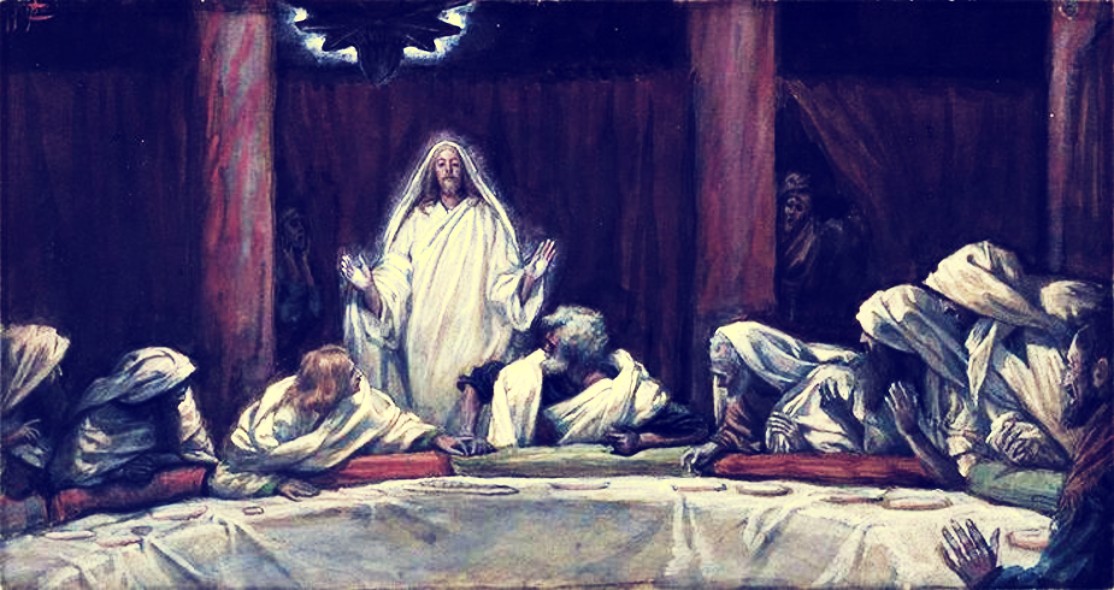
They are in the Cenacle, impatiently awaiting His coming. Suddenly He appears in their midst. Of the Mother’s joy, who would dare to speak? As to the Disciples and the holy Women, they fall down and affectionately adore the Master, Who has come to take His leave of them. He deigns to sit down to table with them, He even condescends to eat with them, not, indeed, to give them proof of His Resurrection, for He knows that they have no further doubts of the Mystery but now that He is about to sit at the Right Hand of the Father, He would give them this endearing mark of familiarity. O admirable repast! in which Mary, for the last time in this world, is seated side by side with her Jesus and in which the Church, (represented by the Disciples and the holy Women,) is honoured by the visible presidency of her Head and Spouse. …
Then assuming a tone of authority, such as none but a God could take, He says to them: Go ye into the whole world and preach the Gospel to every creature. He that believeth and is baptised, shall be saved but he that believeth not, shall be condemned (Ibid. xvi. 15, 16). And how shall they accomplish this mission of preaching the Gospel to the whole world? how shall they persuade men to believe their word? By Miracles. And these signs, continues Jesus, shall follow them that believe – in My Name, they shall cast out devils, they shall speak with new tongues, they shall take up serpents;,and if they shall drink any deadly thing, it shall not hurt them; they shall lay their hands upon the sick and they shall recover (St. Mark, svi. 17, 18). He would have Miracles to be the foundation of His Church, just as He had made them the argument of His own Divine Mission. The suspension of the laws of nature proves to us that it is God Who speaks, we must receive the word and humbly believe it. …
But the hour of separation is come. Jesus rises: His blessed Mother and the hundred and twenty persons assembled there, prepare to follow Him. The Cenacle is situated on Mount Sion, which is one of the two hills within the walls of Jerusalem. The holy group traverses the City, making for the eastern Gate, which opens on the Valley of Josaphat. It is the last time that Jesus walks through the faithless City. He is invisible to the eyes of the people who denied Him but visible to His Disciples and goes before them, as, heretofore, the pillar of fire led on the Israelites. How beautiful and imposing a sight! Mary, the Disciples and the holy Women, accompanying Jesus in His Heaven-ward journey, which is to lead Him to the Right Hand of His Eternal Father! It was commemorated in the Middle-Ages by a solemn Procession before the Mass of Ascension Day. What happy times were those, when Christians took delight in honouring every action of our Redeemer! They could not be satisfied, as we are, with a few vague notions, which can produce nothing but an equally vague devotion! …
According to a tradition, which has been handed down from the earliest ages of Christianity (Constit. Apost., lib. v. cap. xix), it is mid-day, the same hour that He had been raised up, when nailed to His Cross. Giving His Blessed Mother a look of filial affection and another of fond farewell to the rest of the group, who stand around Him, Jesus raises up His Hands and blesses them all. Whilst thus blessing them, He is raised up from the ground whereon He stands and ascends into Heaven (St. Luke, xxiv. 51). Their eyes follow Him, until a cloud comes and receives Him out of their sight (Acts, i. 9).
Yes, Jesus is gone! The earth has lost her Emmanuel! … During the Forty days He has deigned to spend with us, since His Resurrection, our faith has made us cling to Him: we would fain have kept Him with us forever but the hour is come, He has left us; yes, our dearest Jesus is gone! O happy the souls that He had taken from Limbo! they have gone with Him and, for all eternity, are to enjoy the heaven of His visible presence.
The Disciples are still steadfastly looking up towards Heaven, when lo! two Angels, clad in white robes, appear to them, saying: Ye men of Galilee! why stand ye looking up to heaven? This Jesus, Who is taken up from you into heaven, shall so come as ye have seen Him going into heaven (Acts, i. 10, 11)! He has ascended, a Saviour; He is to return, as Judge; between these two events is comprised the whole life of the Church on earth. We are, therefore, living under the reign of Jesus as our Saviour, for He has said: God sent not His Son into the world to Judge the world, but that the world might be Saved by Him (St. Joh, iii. 17) and to carry out this merciful design, He has just been giving to His Disciples, the mission to go throughout the whole world and invite men, whilst yet there is time, to accept the mystery of Salvation! … The Angels said to the Apostles: This Jesus shall come, as ye have seen Him going into heaven: happy we, if, during His absence, we shall have so unreservedly loved and served Him, as to be able to meet Him, with confidence, when He comes to judge us!
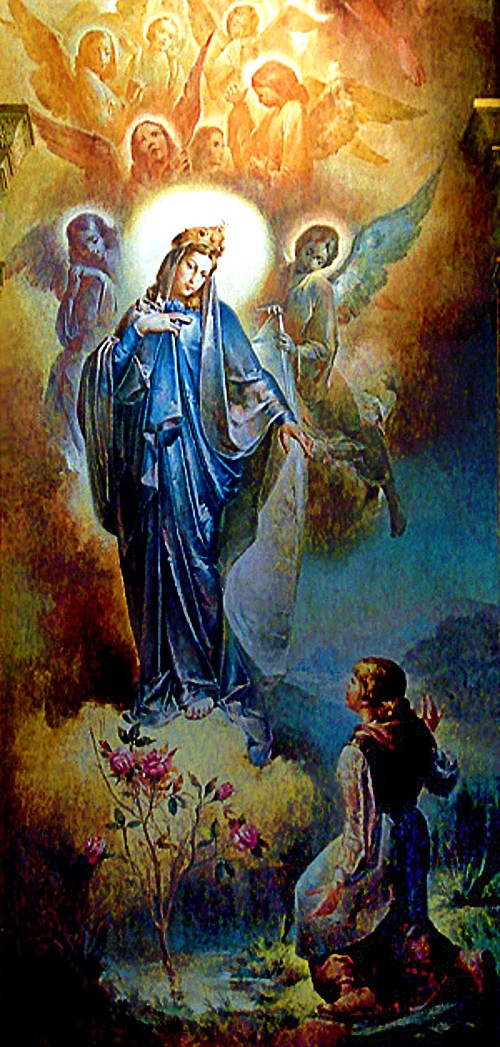
Nostra Signora di Caravaggio / Our Lady of Caravaggio, Lombardy, Italy (1432) – 26 May:
Title given to the Blessed Virgin Mary who appeared in an apparition on 26 May 1432 in the countryside outside Caravaggio, Lombardy, Italy. Giannetta de’ Vacchi Varoli was cutting hay in a field when the Virgin appeared. Mary requested penance from and a chapel built by the locals. A new spring of healing water appeared in the hay field. The apparition anniversary became a day of pilgrimage to the Shrine of Santa Maria del Fonte built at the site and devotion to the Madonna of Caravaggio spread through the region and eventually around the world. In 1879, Italians from Lombardy built a chapel for their settlement in southern Brazil. As it was the only sacred art that any of them possessed, they dedicated the Chapel to the Madonna di Caravaggio. Today the shrine hosts over a million pilgrims annually. Patronage – Diocese of Cremona, Italy.
St Alphaeus St Anderea Kaggwa Bl Andrea Franchi St Becan of Cork Bl Berengar of Saint-Papoul St Damian the Missionary St Desiderius of Vienne St Pope Eleuterus St Felicissimus of Todi St Fugatius the Missionary St Gioan Ðoàn Trinh Hoan St Guinizo of Monte Cassino St Heraclius of Todi Bl Lambert Péloguin of Vence
St Odulvald of Melrose St Paulinus of Todi St Peter Sanz St Ponsiano Ngondwe St Priscus of Auxerre and Companions St Quadratus of Africa St Quadratus the Apologist St Regintrudis of Nonnberg St Simitrius of Rome and Companions St Zachary of Vienne
“We ought to pray and invoke the Holy Spirit, for each one of us greatly needs His protection and His help. The more we are lacking in wisdom, weak in strength, burdened with trouble, prone to sin, the more we should turn to Him, Who is the never-ceasing Fount of Light, Strength, Consolation and Holiness.”
St Pope Leo the Great (400-461) Father and Doctor of the Church
Thought for the Day – 25 May – Meditations with Antonio Cardinal Bacci (1881-1971)
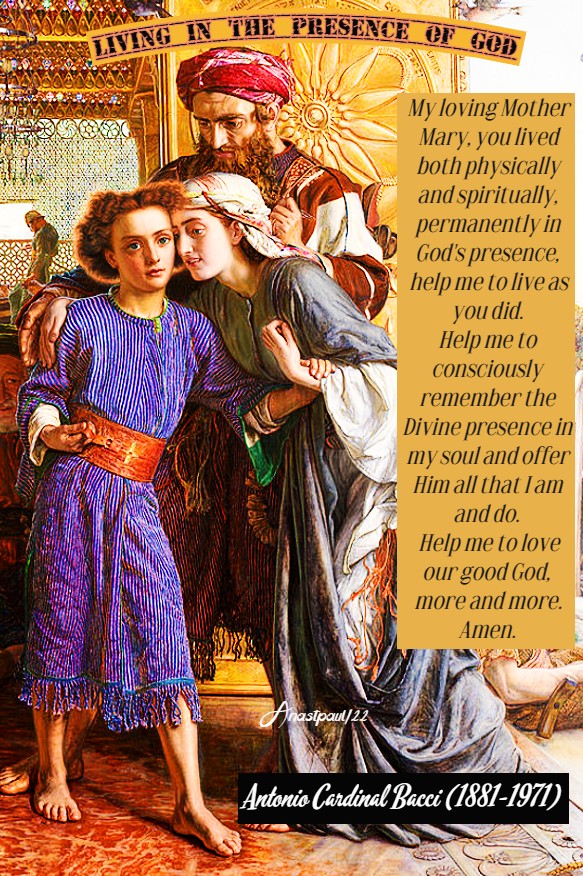
Living in the Presence of God
“The masters of the spiritual life advise us to the best way to cultivate an awareness of the presence of God (Cf St Alphonsus Liguori, Al Divino Servizio, III, 3). This may be done by employing the intellect to form the concept of God’s nearness and by using the will, to offer to Him, ourselves and everything around us, with acts of humility, adoration and love. The intellect, enlightened by faith, tells us that God is everywhere, “Do not I fill heaven and earth? said the Lord” (er 23:24). We should see Him in all His creations which reflect His eternal glory. “Learn to love the Creator in the creature” says St Augustine, “so that you may not become attached to created things and so lose Him by Whom, you yourself were created” (In Px 18).
When we wish to revive, in our minds, a sense of the presence of God, we should not picture Him as a distant Being but, as our own God, Who condescended to dwell within us. We should then listen to His inspirations and humbly venerate His Divine Majesty, which resides in our souls. “Do you not know,” says St Paul, “that you are the temple of God and that the Spirit of God dwells in you?” (1 Cor 3:16). God is everywhere but He dwells in a special manner, in our souls. It is difficult for us, however, to live with our minds constantly concentrated on Him. If we were able to do so, this would be an anticipation of the happiness of the Blessed in Heaven. But, we should have a habitual intention, which we should renew as often as possible, of living in the presence of God and of offering Him all our desires and actions. Then, our whole life will be a continual prayer of great value in the sight of God.
My loving Mother Mary, you lived both physically and spiritually, permanently in God’s presence, help me to live as you did. Help me to consciously remember the Divine presence in my soul and offer Him all that I am and do. Help me to love our good God, more and more. Amen.”
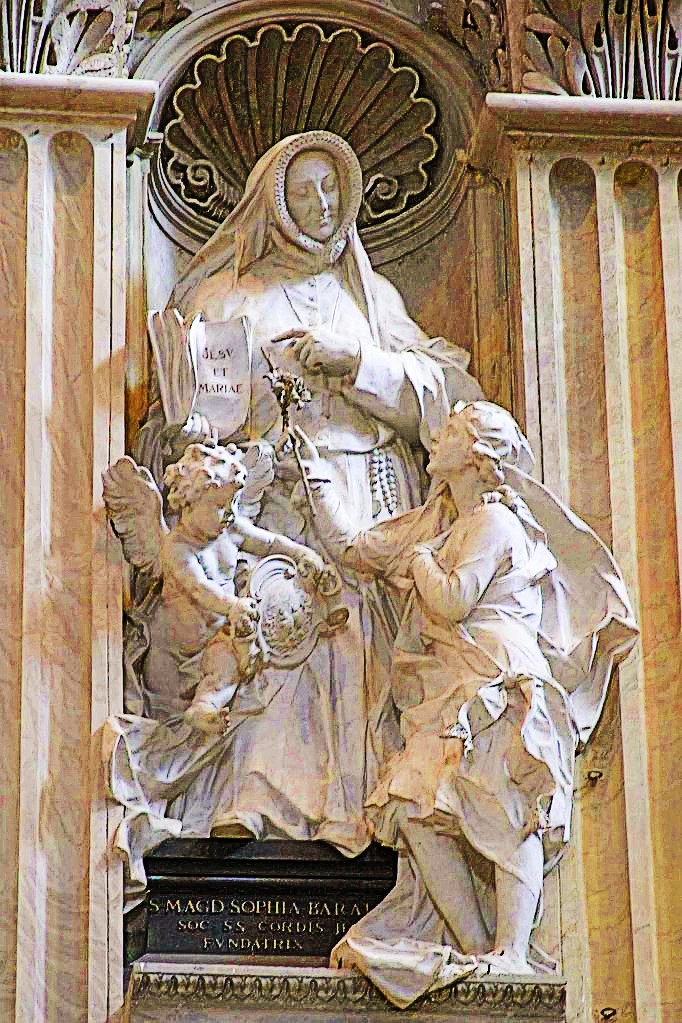
Quote/s of the Day – 25 May – St Madeleine Sophie Barat RSCJ (1779-1865) Virgin, Religious, Foundress of the Religious of the Sacred Heart of Jesus
“Our Lord, Who saved the world, through the Cross, will only Work for the good of souls, through the Cross.”
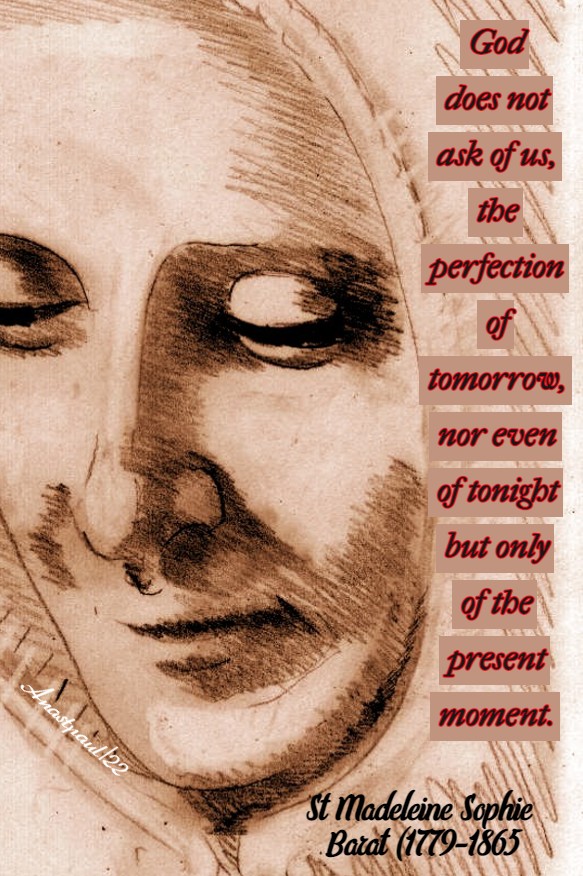
“God does not ask of us, the perfection of tomorrow, nor even of tonight but only, of the present moment. ”
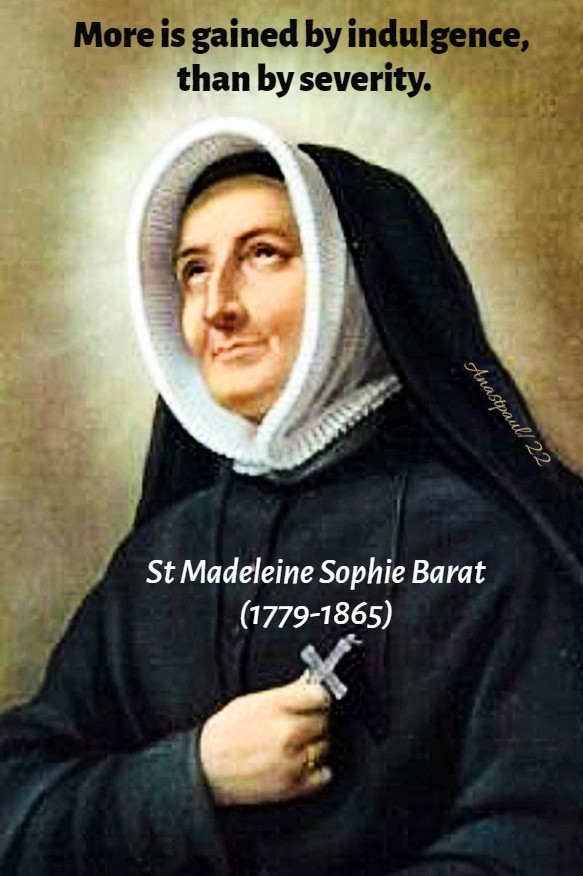
“More is gained by indulgence, than by severity.”
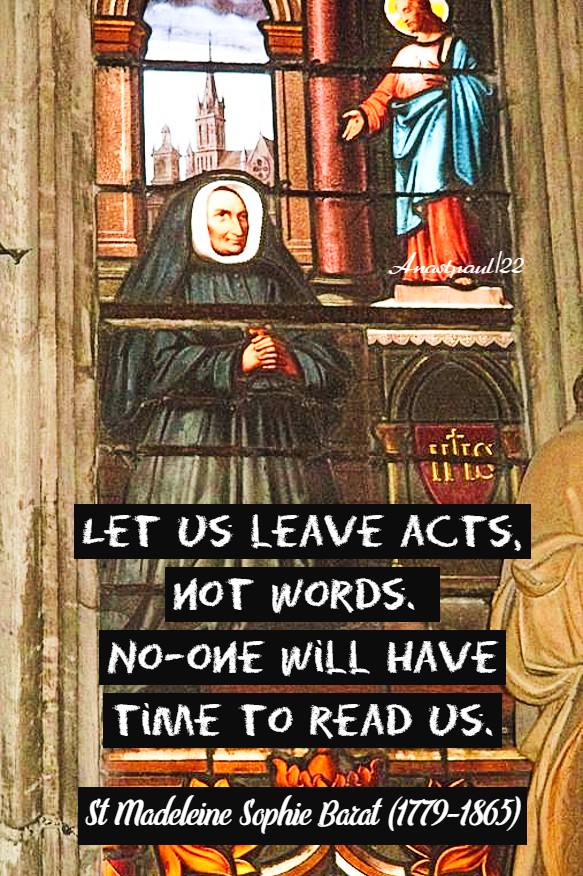
“Let us leave acts, not words. No-one will have time to read us.”
“Give only good example, to the children; never correct them, when out of humour or impatient. We must win them by an appeal to their piety and to their hearts. Soften your reprimands with kind words; encourage and reward them. That is, in short, our way of educating.”
One Minute Reflection – 25 May – “The Month of the Blessed Virgin Mary” and the Memorial of St Pope Gregory VII (1015-1085) – 1 Peter 5:1-4; 5:10-11., Matthew 16:13-19
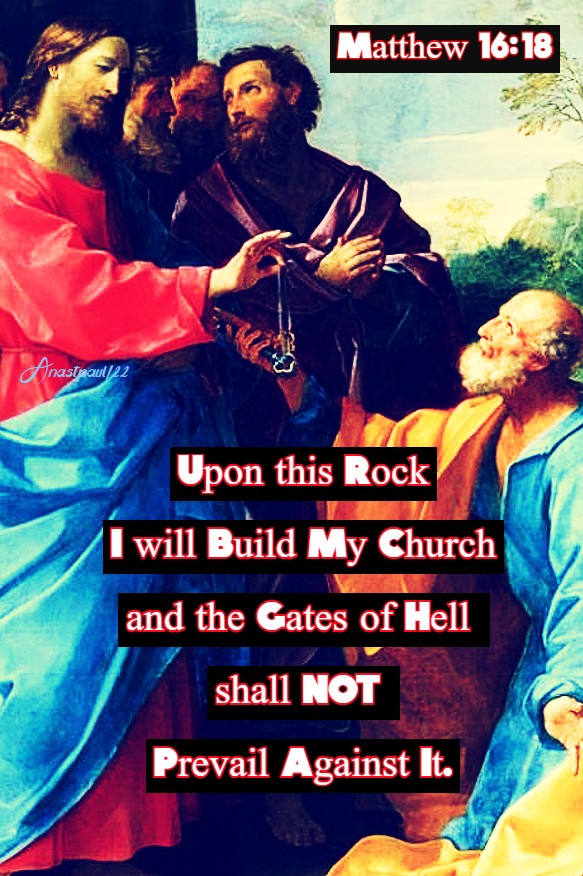
“Upon this rock I will build my church” – Matthew 16:18
REFLECTION – “Peter was to receive on deposit, the keys of the Church, or rather the keys of Heaven and, he should see himself entrusted with the numerous people. What did the Lord actually say to him? “Whatever you bind on earth shall be bound in heaven and whatever you loose on earth shall be loosed in heaven” (Mt 16:19). For Peter had a somewhat abrupt character; if he had been without sin what sort of forgiveness would the disciples have received from him? This is why divine grace allowed him to fall into a certain fault, in order that his own trial should make him benevolent towards others. Do you see how God can let someone fall into sin; this Peter, the leader of the Apostles, the unshakable foundation, indestructible rock, first in the Church, impregnable harbour, unshakable tower — this same Peter who had said to Christ: “Even though I should have to die with you, I will not deny you” (Mt 26:35), Peter who, by a divine revelation, had confessed the Truth: “You are the Christ, Son of the Living God” (Mt 16:16). (…) But as I said, God arranged it in this way and allowed Peter to sin because, he had it in mind, to confer numerous people on him and he feared, that his roughness, joined to his impeccability, might make him unsympathetic towards his brothers. He gave way to sin so that, remembering his own failure and the kindness of the Lord, he might testify to others, a grace of philanthropy in accord with the divine design conceived by God. The fall had been permitted, to the one, who was going to see himself entrusted with the Church, the Pillar of the Church, the Harbour of the Faith; the fall had been permitted to Peter, the Doctor of the Universe, in order that, the forgiveness received, might remain the foundation of love for others.” – St John Chrysostom (347-407) Bishop of Constantinople, Father and Doctor of the Church – On the apostle Peter and the prophet Elijah
PRAYER – O God, the strength of those who trust in You, Who fortified blessed Gregory, Your Confessor and Pontiff, with the virtue of firmness to protect the freedom of the Church, grant us, by his example and intercession, bravely to overcome all evil. Through Jesus Christ, Thy Son our Lord, Who lives and reigns with Thee, in the unity of the Holy Ghost, God, world without end. Amen (Collect).
Our Morning Offering – 25 May – “The Month of the Blessed Virgin Mary”
Mother of my God, Lady Mary, Queen of Mercy By St Alphonsus Liguori (1696-1787) Most Zealous Doctor
Mother of my God and my Lady Mary, as a beggar, all wounded and sore, presents himself before a great Queen, so do I present myself before you, who are Queen of heaven and earth. From the lofty throne on which you sit, disdain not, I implore you, to cast your eyes on me, a poor sinner. God has made you so rich that you might assist the poor and has made you Queen of Mercy, that you might relieve the miserable. Behold me then and pity me. Behold me and abandon me not, until you see me changed from a sinner into a saint. Amen
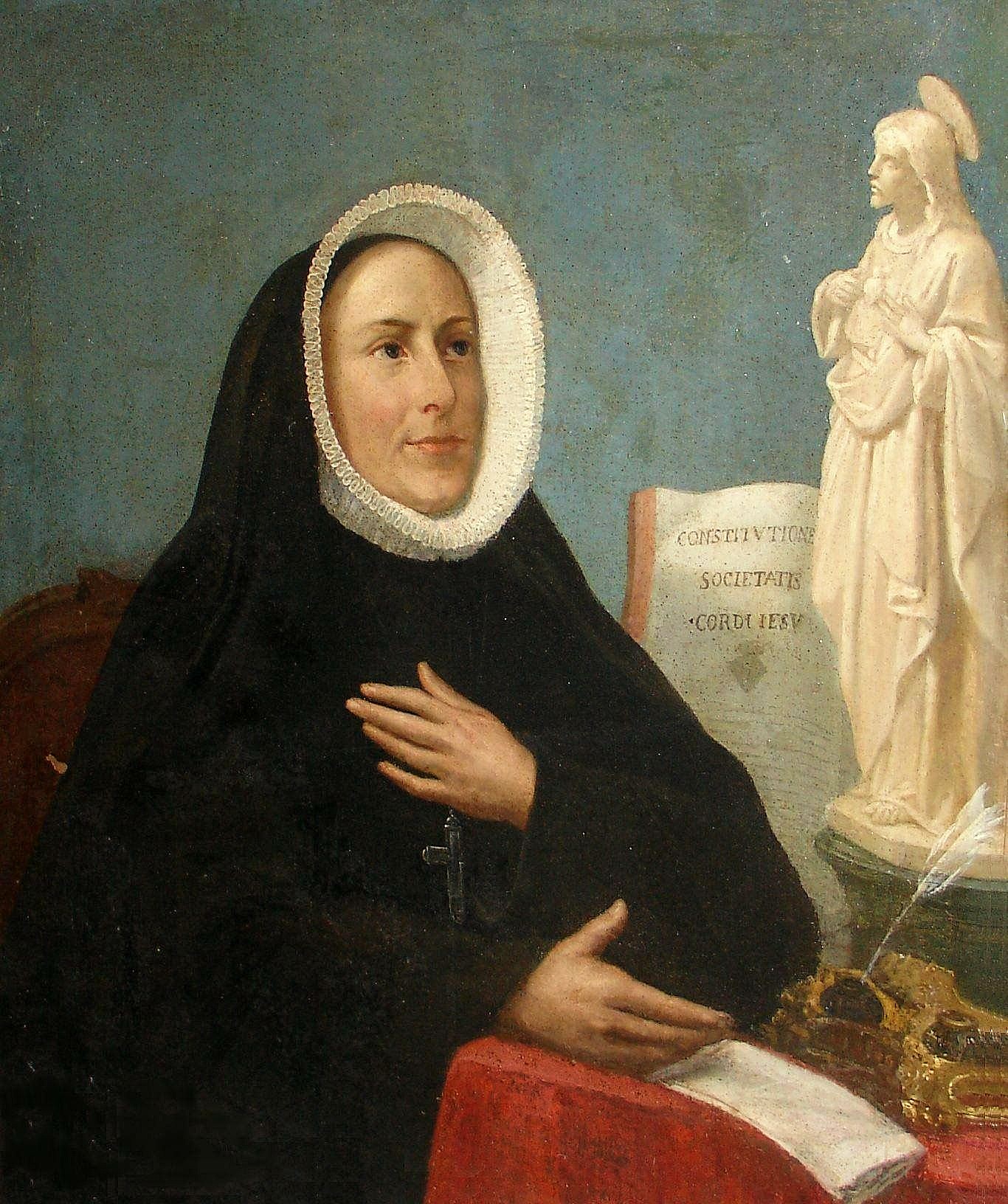
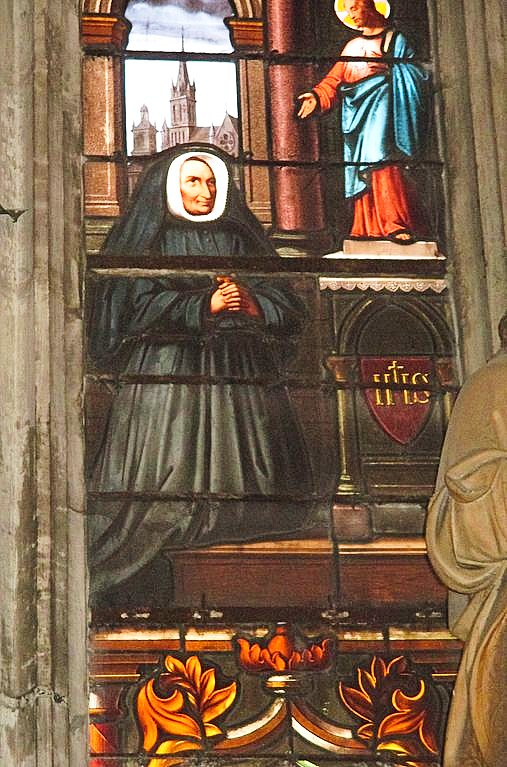
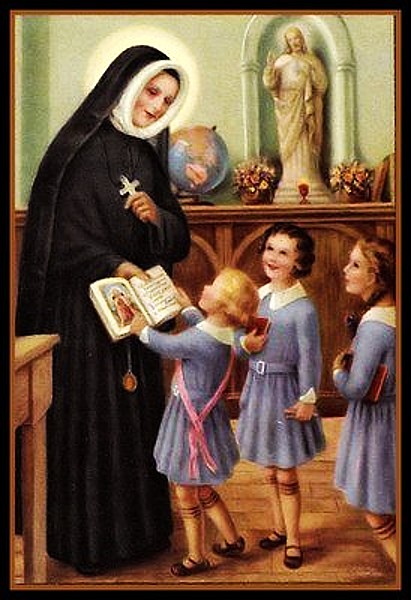
Saint of the Day – 25 May – St Madeleine Sophie Barat RSCJ (1779-1865) Virgin, Religious, Foundress of the Religious of the Sacred Heart of Jesus, a worldwide religious institute of Teachers. Born on 12 December 1779 at Joigny, France and died on Ascension Thursday, 25 May 1865, aged 85 at Paris, France of natural causes. Patronage – Teachers. Her body is incorupt.
She was a delicate little girl, spoilt, bubbling over with life and intelligence. Born during the night of 13 December 1779 in the little Burgundian town of Joigny in the glimmer from a neighbour’s burning house, she was premature and so frail that she was Baptised at dawn. She was the third child in a family of craftsmen, barrel-makers and vine-growers, who lived comfortably enough, in a small house in the rue du Puits-Chardon (today, 11 rue Davier). When she was seven, she became the pupil of her brother Louis, eleven years her senior. He was teaching in the local college until he was old enough to be able to be Ordained Priest. Under his austere direction, she made astonishing progress in all her subjects, both secular and religious, yet she regretted hardly having time to play with friends her own age, even at the time of the grape harvest and traditional holiday in the country of vineyards! Her family’s Jansenistic severity, might have crushed and destroyed her liveliness but, fortunately, she kept her spontaneous vivacity and joyful character.
During the Revolution, Sophie was a courageous adolescent. She, who so loved study had to work as a seamstress and became an excellent embroidress. She had to be the link between her father, a good workman but illiterate and her mother, more refined, sensitive and cultured. Above all, she had to sustain the courage of her family when her brother was made prisoner by the revolutionaries and only escaped the guillotine by the intervention of providence. It was then that Sophie discovered devotion to the Sacred Heart and now, she put all her trust in the love of Christ.
Still very young, she gave proof of resolve and generosity, when her brother, liberated by the fall of Robespierre, asked her to come to Paris to continue her education. Certainly it cost her dearly to tear herself away from her mother’s tenderness but she was resolved to give herself entirely to God. The Revolution had closed all the Convents and her brother’s offer ,opened to her a way of renunciation and generosity. For five years she lived in Paris, a life of prayer and study, giving herself to catechising the children of the Marais quartier.
In 1800 her brother introduced her to Fr Varin who was trying to establish a congregation of religious women, founded on the spirituality of the Heart of Christ and vowed to education. She had wanted to enter Carmel but the appeal of Fr Varin made her reflect. The exceptional culture she had acquired, the needs of a society that was gradually coming out of the revolutionary torments and which lacked guidelines, were these not signs of the Will of God for her?
On 21 November 1800, in Paris, she made her first religious commitment. A year later, a first community was established at Amiens, of which she was soon named Superior. While for political reasons, the Congregation could only take the name of Society of the Sacred Heart in 1815. II spread gradually, to Grenoble, then to Poitiers where the first noviciate was opened. She was named Superior General at the age of twenty-six. Henceforward, Madeleine Sophie’s life merged with that of the Society of the Sacred Heart, which she governed. She crossed France and Europe, going wherever she was asked to found Boarding Schools. And she insisted on opening a free school, or sometimes an orphanage, alongside each one, to which poor girls came flocking, since at that time, there were no communal schools.
This long religious life from 1800 to 1865 was filled with prayer, work and suffering but also with deep joy.
First, prayer, intense and prolonged for seven hours, day and night sometimes. Faith in the Love of God, manifested in the Heart of Jesus, was so important for her, that what counted was to respond to this Love by adoration and making it known and loved by all, throughout the world.
This prayer animated her immense work and her entire life. To bring up children and young people one must first love them, seek to understand them, respect their budding personality, instruct them in awakening their faculties, exercising their judgement, affirming their will and developing in them, the sense of responsibility. It was in that spirit that she formed the Religious of the Sacred Heart to be Teachers. Her task was varied. She had to open schools, to negotiate with religious and civil authorities, buy or rent property, construct or adapt buildings. She also had to send groups of religious to various places, at a time when these had to assume almost single-handedly, all the tasks of teaching, administration and material work.
Once she had established Convents, she had to visit them. But journeys at that time, by coach hired with much trouble, were long, difficult and sometimes dangerous. There was also, a large correspondence to maintain, so as to keep in touch, advise and encourage. She opened 122 Convents. Several disappeared, suppressed as a result of war, persecution by hostile regimes or simply because, certain foundations had not been wise.
At her death in 1865, 89 of them were flourishing. Thousands of young people were being educated there, by 3,500 religious. These houses were dispersed throughout 16 countries of Europe, Africa, North and South America. In 1818, she had sent St Philippine Duchesne to the United States, where she opened the first schools in very hard conditions and in great poverty.
These results that might make one think of a triumphant development, should not create an illusion – they were only obtained in the midst of great trials and at the price of suffering,: long and repeated illnesses, epidemics which ravaged entire regions, decimating religious and pupils alike. 1350 Religious of the Sacred Heart died before their foundress. Political troubles, revolutions and persecutions, chased the religious from Northern Italy and Switzerland. Mother Barat was also faced with contradictions and even calumnies against herself and her work, dissensions at the interior of the Congregation, as a result of misunderstandings and incomprehension. Twice, from 1809 to 1815 and from 1839 to 1843, crises put in peril the very existence of the Society of the Sacred Heart. Madeleine Sophie rose above them all with her usual weapons – silence, humility and the prayer which united her ever more closely to Jesus Christ. From Him she drew an unshakeable hope and full forgiveness for those who made her suffer.
What can one say of the joys, which, on the other hand lightened her life – her union with God, the approbation and support of the Church, to which she was so deeply attached, the esteem and affection which responded to her loving devotedness, for she had a truly exceptional gift of communion with others and friendship.. She welcomed everyone in the same way – Ecclesiastical dignitaries, Princesses, men distinguished by their culture or their power, workmen, religious, pupils and their parents. She showed so much interest, such a quality of listening and sympathy that one left her conscious of having been understood and comforted. Her preferences were for the poor and the deprived, for whom she always had time, help and delicate attention.
In her old age, the only relaxation she allowed herself, was to see the Junior School of the Rue de Varenne, brought to see her by their mistress. They came across the garden to the Mother House, Boulevard des Invalides and sat round her under a great cedar tree, whence ensued joyous exchanges. Saint Madeleine Sophie listened to them, asked them questions, answered their questions and passed round sweets. It was mutual joy; for the children knew well who loved them.
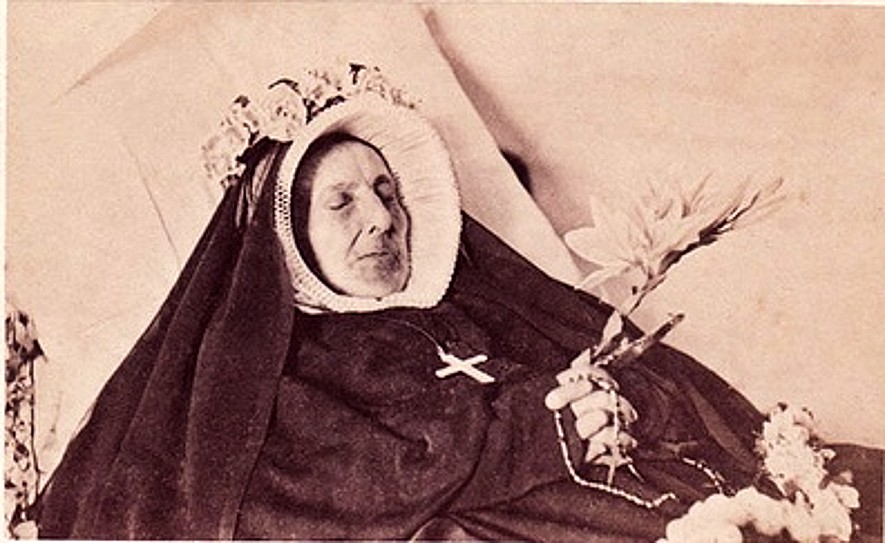
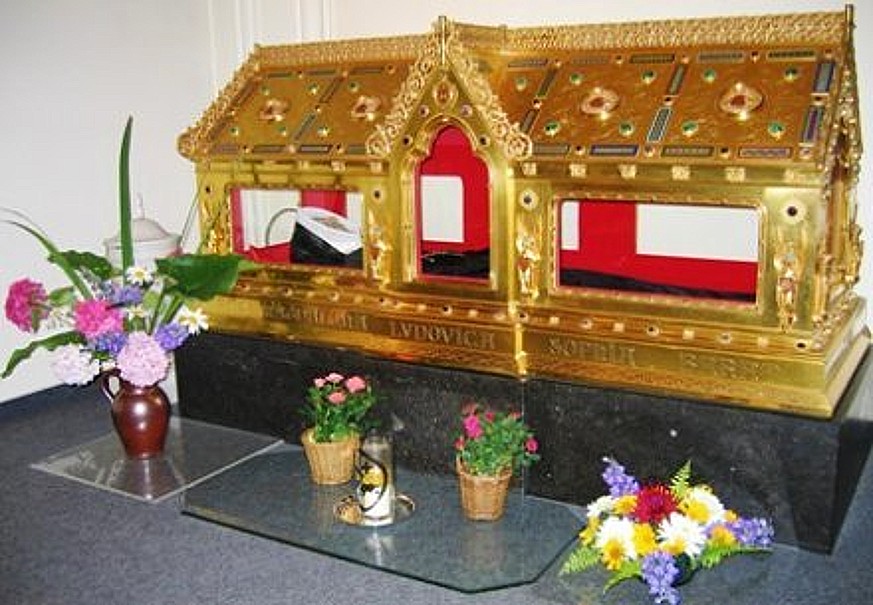
Saint Madeleine Sophie died in Paris on 25 May, 1865. Ascension Day. She was buried in the cemetery at Conflans. In 1904, when the French Sisters were expelled by the Combes laws, her body was transferred to the Sacred Heart at Jette, Brussels. Since her Beatification in 1908 by St Pius X, her well-preserved body has been exposed in a Shrine. She was Canonised n 24 May 1908 by Pope Pius XI
Since 20 May 1998, her Shrine has been at 31 rue de l’Abondance 1210 Brussels. You can go there to pray to Saint Madeleine Sophie.
Today nearly 4,000 religious try to follow her example and continue her work. All over the world, thousands of pupils, former pupils and all sorts of people, benefit, often without knowing it,, from her influence, her holiness and her love. St Madelein Sophie Barrat, pray for our children, pray for us all! Thanks be to God, amen.
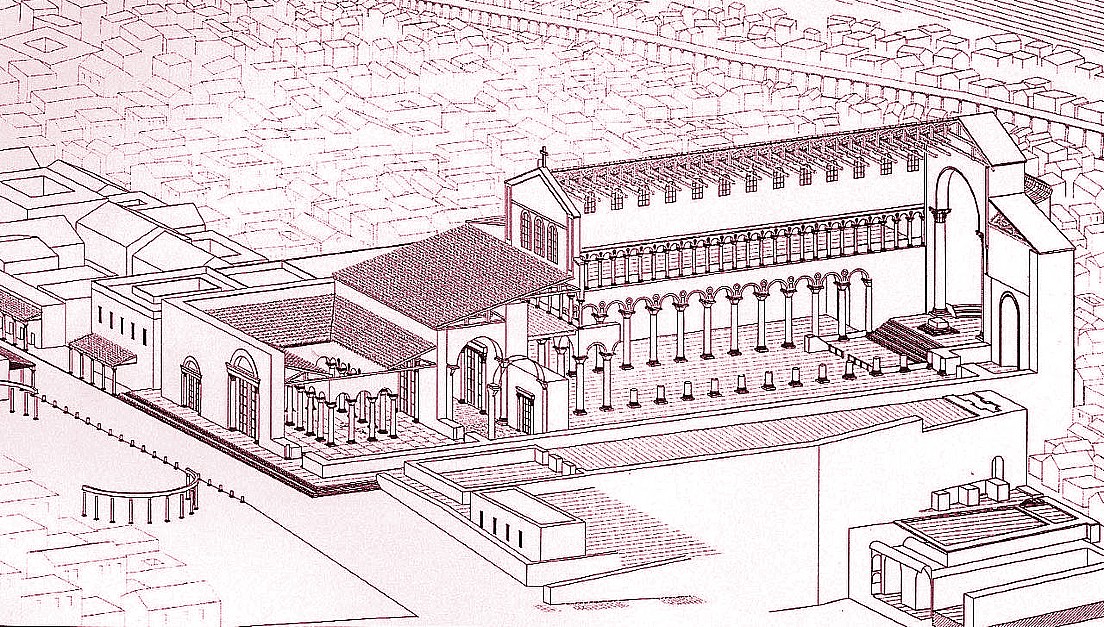
Our Lady the Nea/New Church of the Virgin Mary or New Church of St Mary, Mother of God, built by the Emperor Justinian the Good, Jerusalem (530) – 25 May:
The Abbot Orsini wrote: “Our Lady the Nea or New, at Jerusalem, built by the Emperor Justinian, at Jerusalem, in the year 530.”
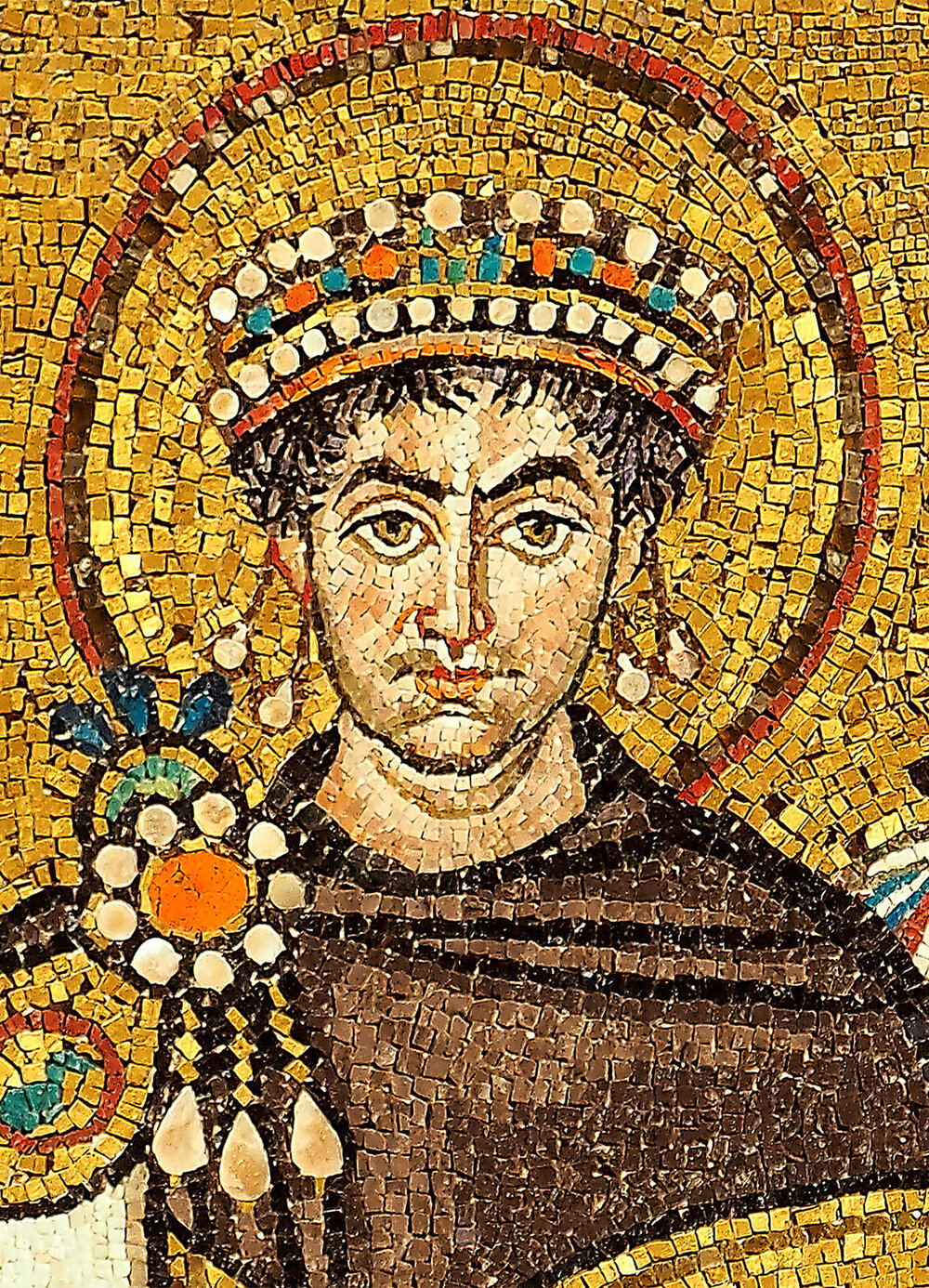
The Emperor Justinian the Good, is justifiably famous for many achievements and among them his construction of the magnificent Church of the Holy Wisdom, the Hagia Sophia, which is now a mosque in Istanbul. There was once another Church, though, dedicated to the Blessed Virgin, that must have been just as splendid and an architecture wonder, as is, the Hagia Sophia but this magnificent structure was destroyed by an earthquake.
Recent archeological excavations have uncovered the foundations of the Church, but there were also one of Justinian’s court historians, a man named Procopius of Caesarea, who wrote in great detail about the construction of the Nea Church of Our Lady the New, Mother of God:
“These things the Emperor Justinian accomplished by human strength and skill but he was also assisted by his pious faith, which rewarded him with the honour he received and aided him in this cherished plan. The Church required throughout, columns whose appearance would not fall short of the beauty of the building and of such a size, that they could resist the weight of the load which would rest upon them. However, the site itself, being very far from the sea, inland and walled about on all sides by hills, that were quite steep, made it impossible for those who were preparing the foundations to bring columns from outside.
But when the impossibility of this task was causing the Emperor to become impatient, God revealed a natural supply of stone, perfectly suited to this purpose, in the nearby hills, one which had either lain therein concealment previously, or was created at that moment. Either explanation is credible to those who trace the cause of it to God, for while we, in estimating all things by the scale of man’s power, consider many things to be wholly impossible, for God nothing in the whole world can be difficult or impossible. So, the Church is supported on all sides by a number of huge columns from that place, which in colour resemble flames of fire, some standing below and some above and others in the stoas which surround the whole Church, except on the side facing the east.
Two of these columns stand before the door of the Church, exceptionally large and probably second to no column in the whole world. Here is added another colonnaded stoa, which is called the narthex, I suppose because it is not broad. Beyond this is a court with similar columns, standing on the four sides. From this there lead doors to the interior, which are so stately, that they proclaim to those walking outside what kind of sight they will meet within. Beyond there is a wonderful gateway and an arch, carried on two columns, which rises to a very great height. Then as one advances, there are two semi-circles which stand facing each other on one side of the road which leads to the Church, while facing each other on the other side, are two hospices, built by the Emperor Justinian. One of these is destined for the shelter of visiting strangers, while the other is an infirmary for poor persons suffering from diseases.”
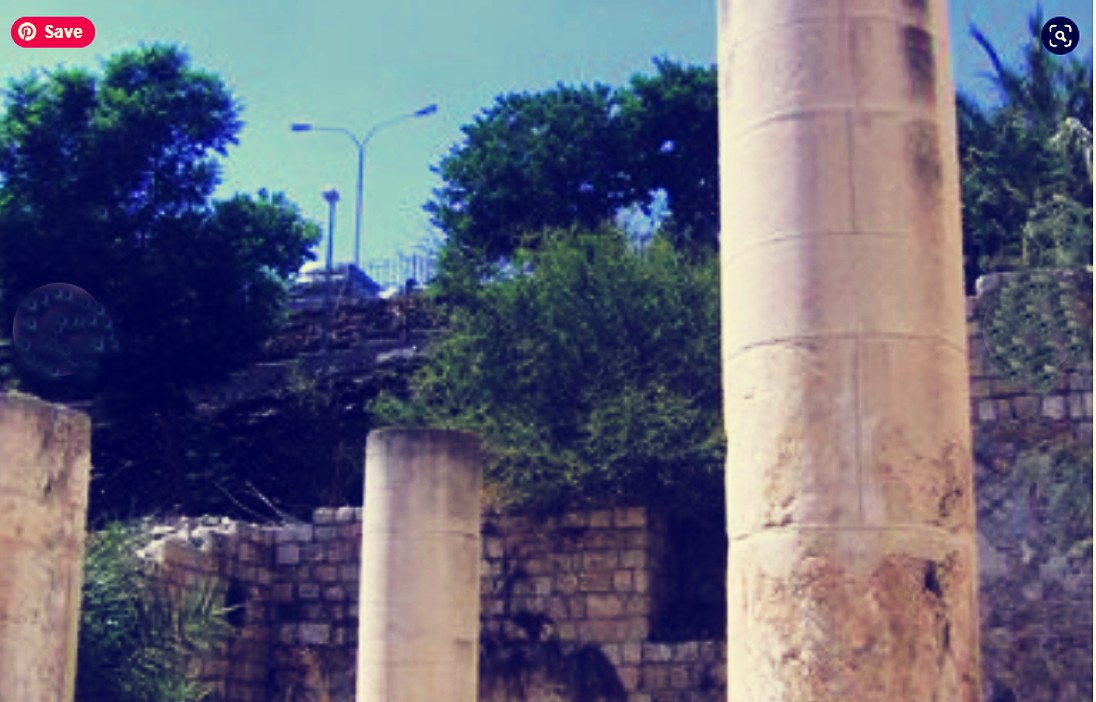
Ruins of the Columns
Archaeologists working in the region near Jerusalem, believe they have found this miraculous quarry. They have found a stone pillar that was cracked and, therefore, not used, in a field of similar stones. Although the field cannot be linked to the Nea, it does seem to prove, that the stone for the Church was available for the project.
Recent archeology confirms that the Church was very large for the time, at over 100 meters long and 52 meters wide and probably had 5 aisles. St Antoninus of Piacenza, who visited the Basilica in about 570, wrote: “with its great congregations of Monks and its guest houses for men and women. In catering for travellers, they have a vast number of tables and more than three thousand beds for the sick!”
. In 1977, archeologists, led by Professor Nachman Avigad, found a large Greek inscription above a Cross that confirmed that construction of the Church was attributed to the generosity of Emperor Justinian. At that time, a corner of the Church, outside the Old City walls, was incorporated into the Beth Shalom Garden. In the following years, investigative and preservation work continued and in 1988 the restored vaults were incorporated into the Garden of Redemption.
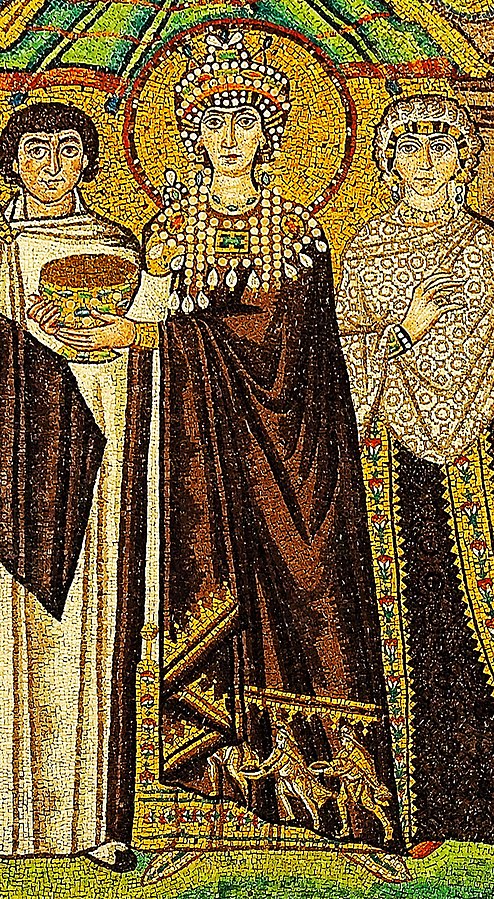
Emperor Justinian the Good
St Pope Gregory VII (1015-1085) Confessor, Bishop of Rome 22 April 1073 to his death in 1085, Monk, Priest, Reformer, Administrator, Adviser. Pope Gregory “was probably the most energetic and determined man ever to occupy the See of Peter and was driven by an almost mystically exalted vision of the awesome responsibility and dignity of the papal office” (Eamonn Duffy, Saints and Sinners: A History of the Popes). Biography: https://anastpaul.com/2018/05/25/saint-of-the-day-25-may-st-pope-gregory-vii-c-1015-1085/
St Agustin Caloca St Aldhelm of Sherborne Bl Antonio Caixal Bl Bartolomeo Magi di Amghiari St Canio St Cristobal Magallanes Jara St Denis Ssebuggwawo St Dionysius of Milan St Dunchadh of Iona St Egilhard of Cornelimünster Bl Gerardo Mecatti St Gerbald St Injuriosus of Auvergne St Iosephus Chang Song-Jib Bl James Bertoni Bl Juan of Granada St Leo of Troyes St Madeleine Sophie Barat RSCJ (1779-1865) Virgin, Religious, Foundress of the Religious of the Sacred Heart of Jesus. St Matthêô Nguyen Van Ðac Phuong St Maximus of Evreux Bl Nicholas Tsehelsky St Pasicrates of Dorostorum Bl Pedro Malasanch St Pherô Ðoàn Van Vân St Scholastica of Auvergne St Senzio of Bieda St Urban I, Pope St Valentio of Dorostorum St Victorinus of Acquiney St Winebald of Saint Bertin St Worad of Saint Bertin St Zenobius of Florence
Thought for the Day – 24 May – Meditations with Antonio Cardinal Bacci (1881-1971)
The Recollection of Mary
“We cannot all be Monks or Hermits. Most have to live in the world and look after their daily business., They have to deal with all kinds of people and are subject to the tremendous influences of the modern world. How can they be recollected? It is difficult but it is possible. Most of the Saints lived in the heart of the world, while still maintaining close contact with God. St Paul the Apostle and St John Bosco, are two examples which come to mind.
St Paul traversed the greater parts of the known world. He preached in the temple of Jerusalem and on the Areopagus of Athens, in the Synagogues, squares, court rooms and prsisons of countless cities. Throughout it all, his heart remained united to God, so that he could exclaim: “It is now no longer I who live but Christ lives in me” Gal 2:20). “For to me to live is Christ,” he said, “and to die is gain. But if to live in the flesh is my lot, this means for me, fruitful labour and I do not know which to choose. Indeed, I am hard-pressed from both sides – desiring to depart and to be with Christ – a lot by far the better; yet, to stay on in the flesh is necessary for your sake” |(Phil 1:21-23).
The superhuman industriousness of St John Bosco is well known. He never rested but, his extraordinary activity derived entirely from his close and loving union with God.
We also should try and preserve an oasis of silence in our heart, while we are making our way through the noisy uproar which prevails around us. We shall draw from this oasis of interior recollection, the power to conquer the temptations of the world and to accomplish all the good work which God wishes us to do.”
Quote/s of the Day – 24 May – “The Month of the Blessed Virgin Mary” – James 1:22-27, John 16:23-30
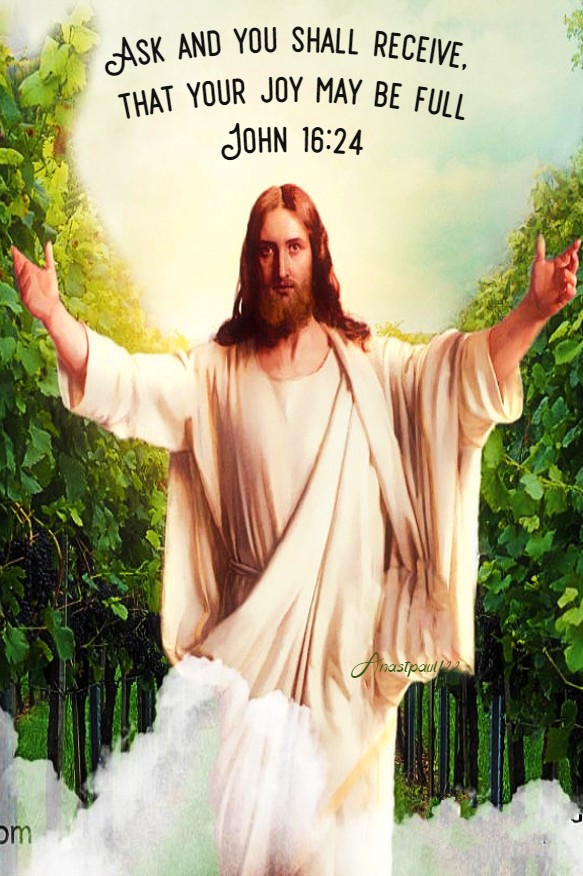
“Ask and you shall receive, that your joy may be full.”
John 16:24
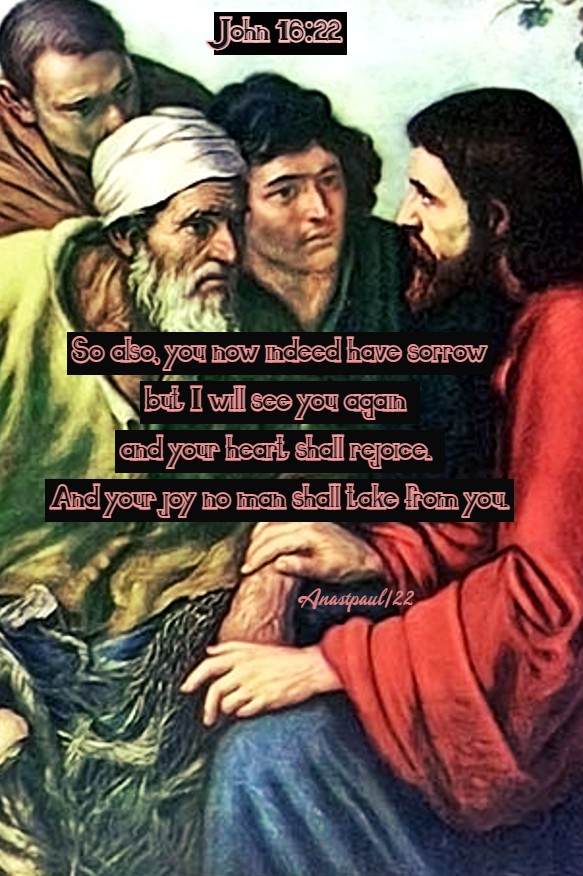
“So also, you now indeed have sorrow but I will see you again and your heart shall rejoice. And your joy, no man shall take from you.”
John 16:22
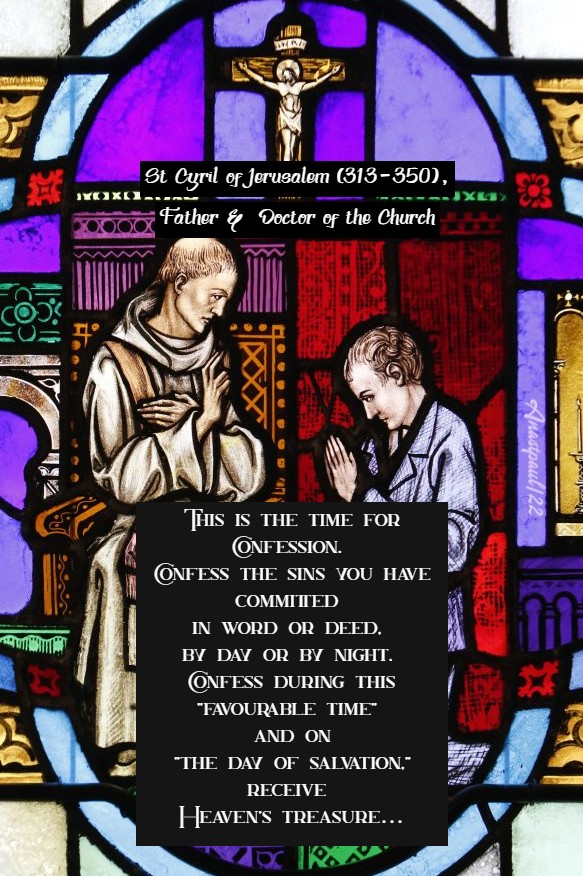
“This is the time for Confession. Confess the sins you have committed in word or deed, by day or by night. Confess during this “favourable time” and on “the day of salvation,” receive Heaven’s treasure… ”
St Cyril of Jerusalem (313-350), Father & Doctor of the Church
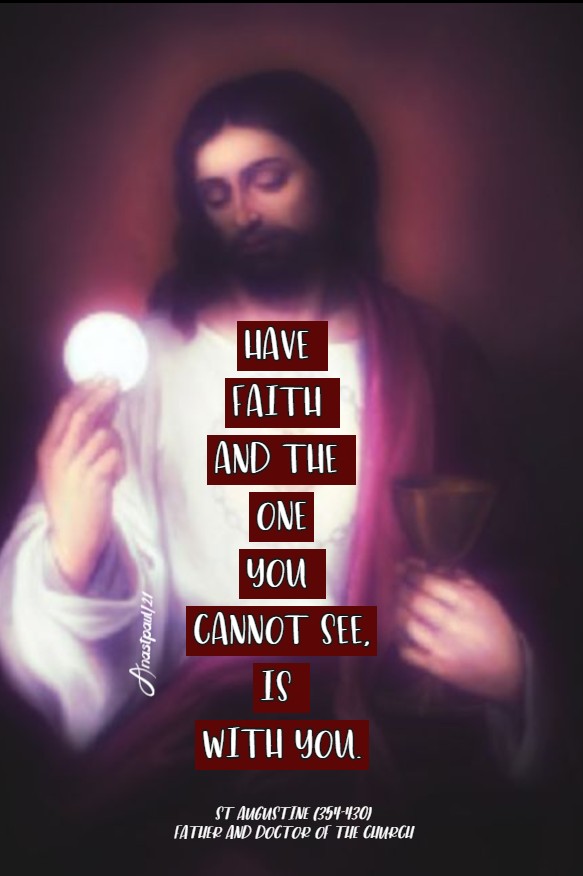
“Have faith and the One you cannot see, is with you.”
St Augustine (354-430) Father and Doctor of the Church
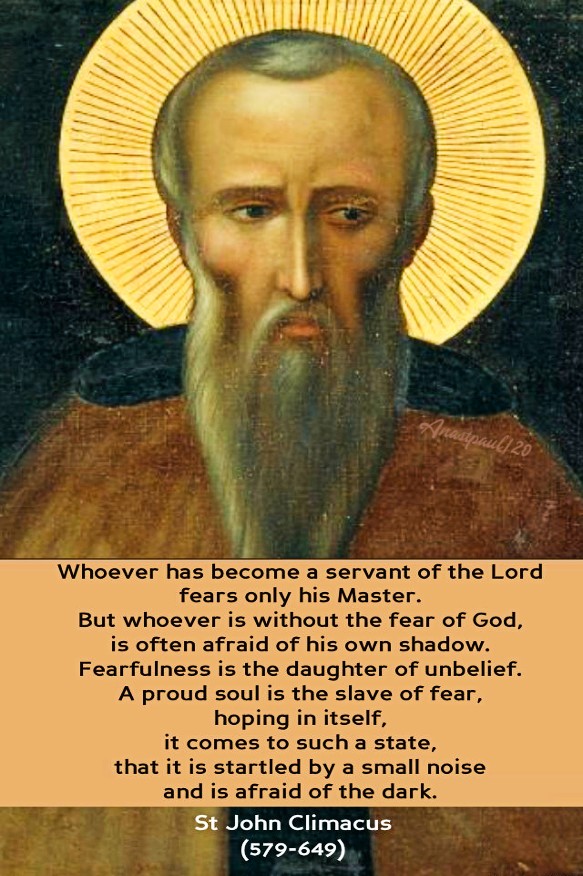
“Whoever has become a servant of the Lord, fears only his Master. But whoever is without the fear of God, is often afraid of his own shadow. Fearfulness is the daughter of unbelief. A proud soul is the slave of fear, hoping in itself, it comes to such a state, that it is startled by a small noise and is afraid of the dark.”
St John Climacus (579-649) Father of the Church
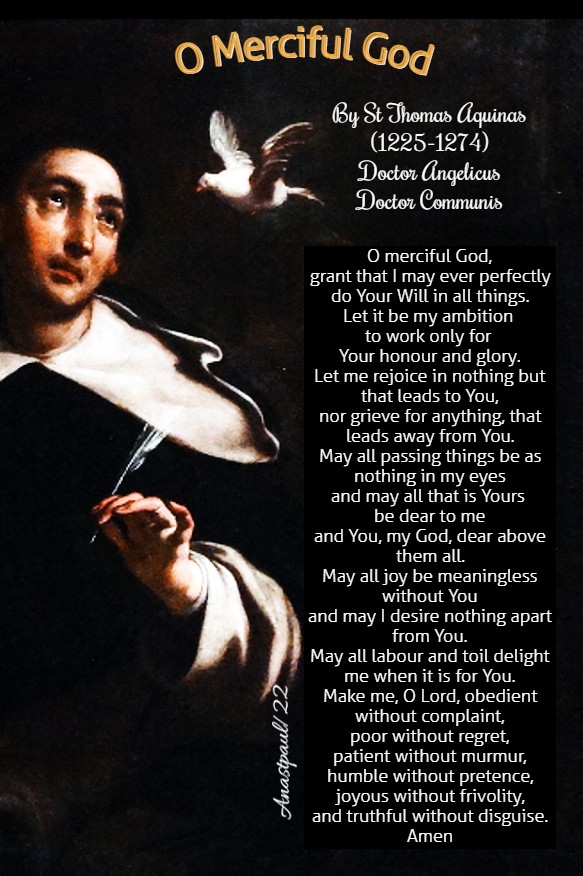
O Merciful God By St Thomas Aquinas (1225-1274) Doctor Angelicus, Doctor Communis
O merciful God, grant that I may ever perfectly do Your Will in all things. Let it be my ambition to work only for Your honour and glory. Let me rejoice in nothing but that leads to You, nor grieve for anything, that leads away from You. May all passing things be as nothing in my eyes and may all that is Yours, be dear to me and You, my God, dear above them all. May all joy be meaningless without You and may I desire nothing, apart from You. May all labour and toil delight me when it is for You. Make me, O Lord, obedient without complaint, poor without regret, patient without murmur, humble without pretence, joyous without frivolity, and truthful without disguise. Amen
One Minute Reflection – 24 May – “The Month of the Blessed Virgin Mary” – James 1:22-27, John 16:23-30
“That your joy may be full.” – John 16:24
REFLECTION – “The entire life of a good Christian is, in fact, an exercise of holy desire. You do not yet see what you long for but the very act of desiring, prepares you, so that when He comes, you may see and be utterly satisfied.
Suppose you are going to fill some holder or container and you know you will be given a large amount. Then you set about stretching your sack or wineskin or whatever it is. Why? Because you know the quantity with which you will fill it and your eyes tell you, there is not enough room. By stretching it, therefore, you increase the capacity of the sack and this is how God deals with us. Simply by making us wait, He increases our desire, which in turn, enlarges the capacity of our soul, making it able to receive what is to be given to us.
So, my brethren, let us continue to desire, for we shall be filled. Take note of Saint Paul, stretching as it were, his ability to receive what is to come – ‘Not that I have already obtained this,’ he said, ‘or am made perfect.Brethren, I do not consider that I have already obtained it.’ We might ask him, ‘If you have not yet obtained it, what are you doing in this life?’ ‘This one thing I do,‘ answers Paul, ‘forgetting what lies behind, and stretching forward to what lies ahead, I press on toward the prize to which I am called in the life above.‘ Not only did Paul say he stretched forward but he also declared that he pressed on toward a chosen goal. He realised, in fact, that he was still short of receiving ‘what no eye has seen, nor ear heard, nor the heart of man conceived.‘
Such is our Christian life. By desiring Heaven, we exercise the powers of our soul. Now this exercise will be effective, only to the extent, that we free ourselves from desires leading to infatuation with this world. Let me return to the example I have already used, of filling an empty container. God means to fill each of you with what is good – so cast out what is bad! If he wishes to fill you with honey and you are full of sour wine, where is the honey to go? The vessel must be emptied of its contents and then be cleansed. Yes, it must be cleansed, even if you have to work hard and scour it. It must be made fit for the new thing, whatever it may be!” – St Augustine (354-430) Father and Doctor of Grace (An excerpt from his Tractates on «The First Letter of John»)
PRAYER – Grant, we beseech Thee, O Lord God, unto all Thy servants, that they may remain continually in the enjoyment of soundness, both of mind and body and by the glorious intercession of the Blessed Mary, always a Virgin, may be delivered from present sadness and enter into the joy of thine eternal gladness. Through Jesus Christ, Thy Son our Lord, Who lives and reigns with Thee, in the unity of the Holy Ghost, God, world without end. Amen (Collect).
Our Morning Offering – 24 May – “The Month of the Blessed Virgin Mary”
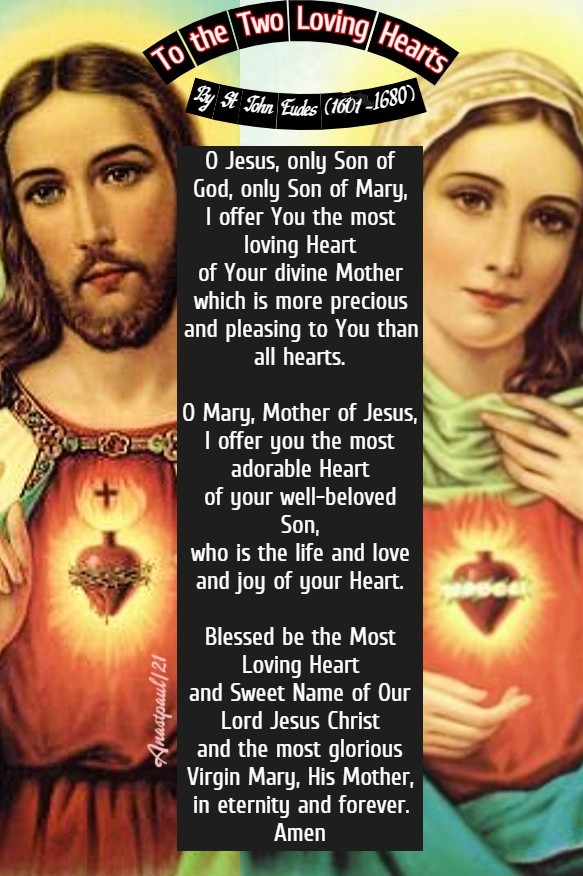
To the Two Loving Hearts By St John Eudes (1601-1680)
O Jesus, only Son of God, only Son of Mary, I offer You the most loving Heart of Your divine Mother which is more precious and pleasing to You than all hearts.
O Mary, Mother of Jesus, I offer you the most adorable Heart of your well-beloved Son, who is the life and love and joy of your Heart.
Blessed be the Most Loving Heart and Sweet Name of Our Lord Jesus Christ and the most glorious Virgin Mary, His Mother, in eternity and forever. Amen
Saint of the Day – 24 May – Blessed Philip of Piacenza OSA (Died 1306) Priest of the Order of the Hermits of St Augustine. Ascetic, Penitent, Miracle-worker.
Blessed Philip, a contemporary of St Nicholas of Tolentino OSA (1245-1305), was one of those who bore witness to the tradition of holiness, which the Order has had since its very beginnings.
The Anonymous Florentine in A Brief Life of Some Hermit Friars, offers the following information concerning Philip:
Friar Philip, who spent his ministry in the City of Piacenza, Italy, practiced an admirable asceticism. For he used an iron breastplate to subdue his flesh, instead of the wool or haircloth employed by other servants of God. It was, therefore, fitting for God to work miracles on his behalf. I heard what I am narrating from Friar Albertino of Cumi, who actually experienced it. More than once when I was a student at Genoa, he told me how he had recovered from a severe fever by commending himself to both the renowned miracle worker, Friar Philip and our Patron, Saint Augustine.
Friar Philip also freed Master William of Cremona, the present Prior General of the Order, from an infirmity of the leg. And he conferred the blessing of health on many other sick people, especially those suffering from melancholy. All this is well known at the Augustinian Monastery in Piacenza.
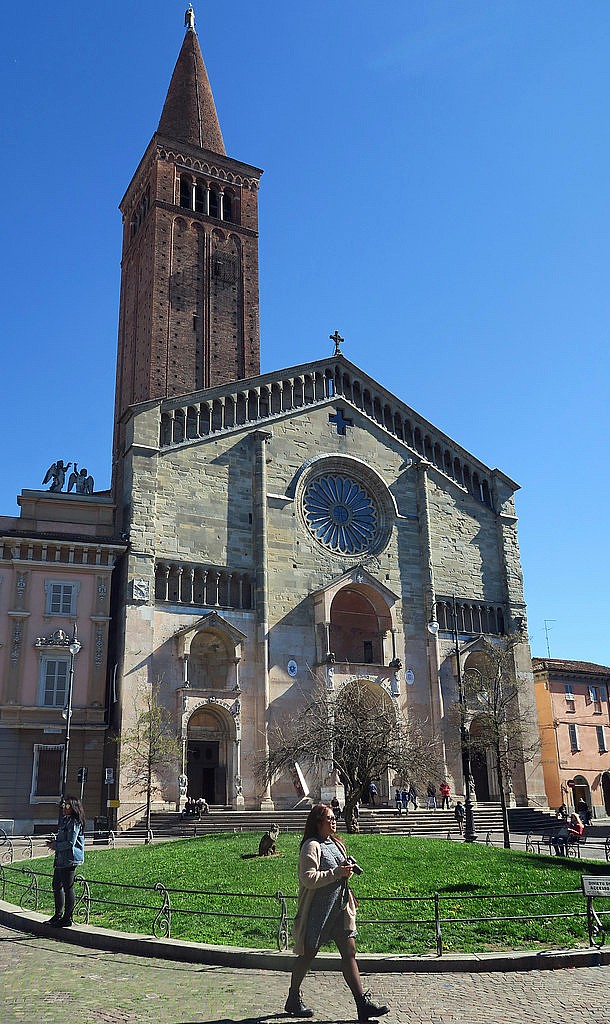
Philip lived and worked in the Augustinian Monastery of Saint Lawrence in Piacenza, Italy. After his death on 24 May 1306, the people remembered him and celebrated his memory. Since the suppression of religious houses in 1808, his body has been preserved and venerated, in the Cathedral Church of Piacenza.
Our Lady of China: Our Lady of China is a title for the Virgin Mary in China who is believed to have appear at the small village of Donglu in 1900. In Chinese she is called Zhōnghuá Shèngmǔ. She is also known as Our Lady of Donglu.
St Afra of Brescia Bl Benedict of Cassino
St David, King of Scotland (1085-1183) King David was a social and religious Reformer, a man of great administrative skills, apostle of charity and of holy piety. He transformed his Kingdom by the widespread introduction of Catholic Churches and Monasteries, thus also assisting in the international diplomatic influence of his country, it’s farming and agricultural wealth and it’s education. He was the main force and instrument of God in Christianising Scotland. St David’s life: https://anastpaul.com/2020/05/24/saint-of-the-day-24-may-st-david-king-of-scotland-1085-1183/
Bl Diego Alonso St Donatian of Nantes St Gennadius of Astroga St Hubert of Bretigny St Joanna the Myrrhbearer Bl John del Prado Bl John of Montfort Bl Juan of Huete Bl Louis-Zéphirin Moreau St Manahen St Marciana of Galatia St Meletius the Soldier Bl Nicetas of Pereslav St Palladia St Patrick of Bayeux Blessed Philip of Piacenza OSA (Died 1306) Priest of the Order of the Hermits of St Augustine St Rogatian of Nantes St Sérvulo of Trieste St Simeon Stylites the Younger
St Susanna Martyr (Died 2nd Century) One of a group of wives of 2nd century Martyred soldiers under the command of Saint Meletius. Following the death of the soldiers, the wives and children were Martyred, as well.
Bl Thomas Vasière St Vincent of Lérins St Vincent of Porto Romano
Martyrs of Istria: A group of early Martyrs in the Istria peninsula. We know little more than some names – Diocles, Felix, Servilius, Silvanus and Zoëllus.
Martyrs of Plovdiv: 38 Christians Martyred together in the persecutions of Diocletian and Maximian. We don’t even known their names. They were beheaded in Plovdiv, Bulgaria.
Thought for the Day – 23 May – Meditations with Antonio Cardinal Bacci (1881-1971)
Prayer to Mary, Our Mother
“Even if we fall often into sin, we should never be discouraged. Although Mary is the Mother of all mankind, she, in a special fashion, is the merciful Mother of sinners. No matter how sinful a man maybe, he will not be lost if he is sincerely devoted to Mary. We must not be deluded into imagining, however, that it is enough to pray to Our Lady in order to be saved, even if we continue to commit sin. St Brigid tells us in her revelations, that Mary is not the Motbher of hardened sinners but, only of those sinners who desire to amend their lives and pray to her with this intention (Rev Bk 4, C 138).
Jesus has told us, moreover, that “not everyone who says to me, Lord, Lord, shall enter the Kingdom of Heaven but he who does the will of my Father in Heaven, shall enter the Kingdom of Heaven” (Mt 7:21). The same holds for those who are devoted to Our Lady. It is not sufficient to pray to her but we must also imitate her and accompany our prayers with the resolution of improving.
Fervent prayer is certain to obtain Mary’s intercession on our behalf. St Alphonsus recommends, in particular: (a) the Hail Mary repeated three times every morning and every night, with the invocation “Mother most pure, pray for me;” (b) an invocation to Our Lady everytime the clock strikes the hour; (c) the daily recitation of the Holy Rosary; (d) a visit to the Altar of Our Lady evertime we make our daily visit to the Blessed Sacrament; (e) and some acts of mortification on the vigil of principal Feasts of Our Lady, followed by a fervent celebration of the Feasts themselves. If we show our good dispositions in this manner, Mary will be our true Mother in life and in death.”
Quote/s of the Day – 23 May – James 5:16-20, Luke 11:5-13
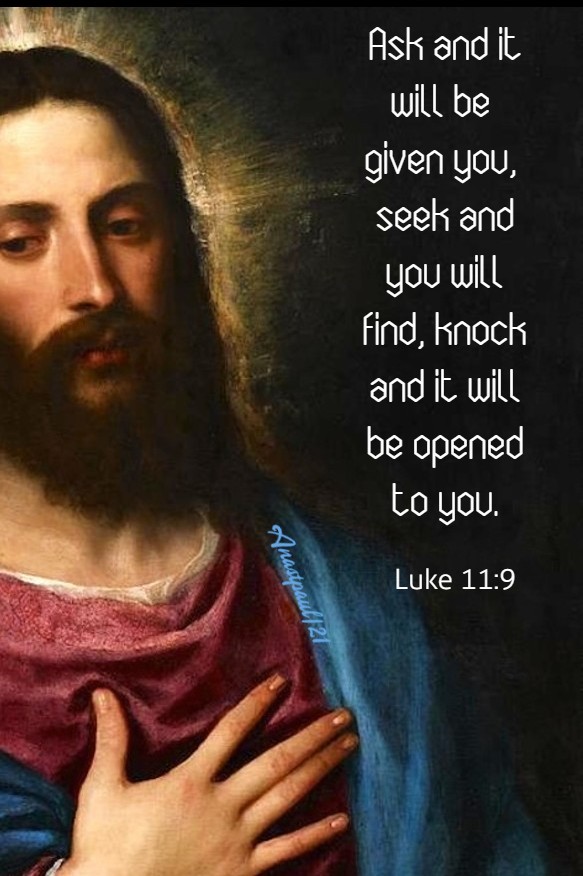
“Ask and it shall be given you: s seek and you shall find: knock and it shall be opened to you. ”
Luke 11:9
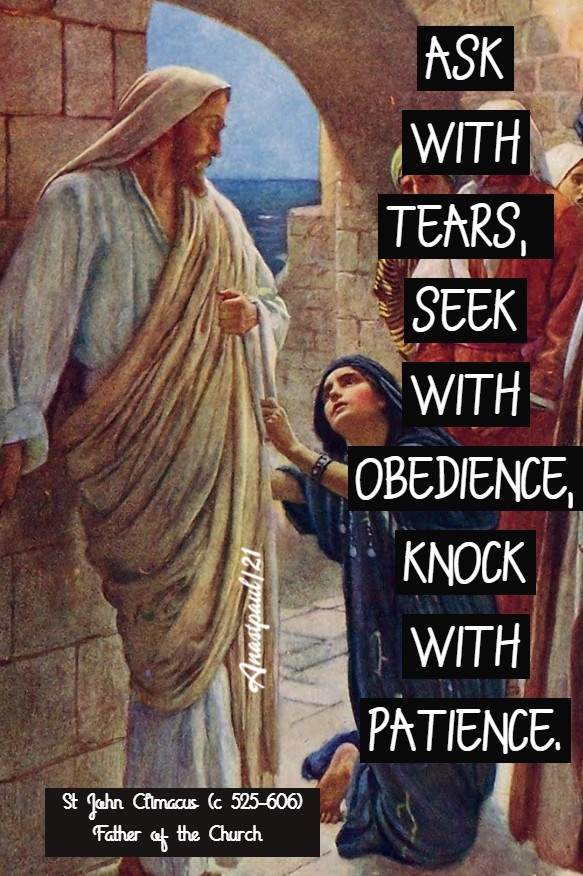
“Ask with tears, seek with obedience, knock with patience.”
“A servant of the Lord stands bodily before men but mentally, he is knocking at the gates of Heaven. with prayer.”
St John Climacus (c 525-606) Father of the Church
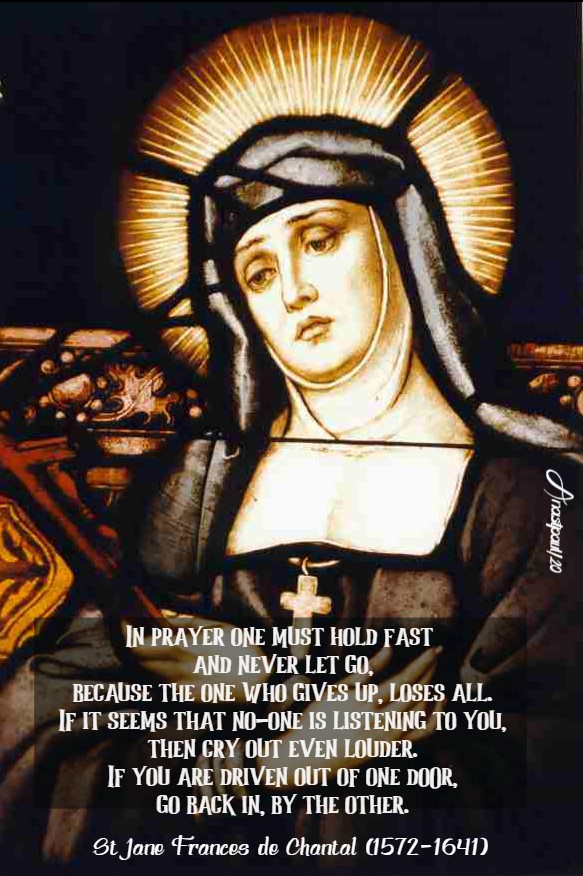
“In prayer one must hold fast and never let go, because the one who gives up, loses all. If it seems that no-one is listening to you, then cry out even louder. If you are driven out of one door, go back in by the other.”
St Jane Frances de Chantal (1572-1641)
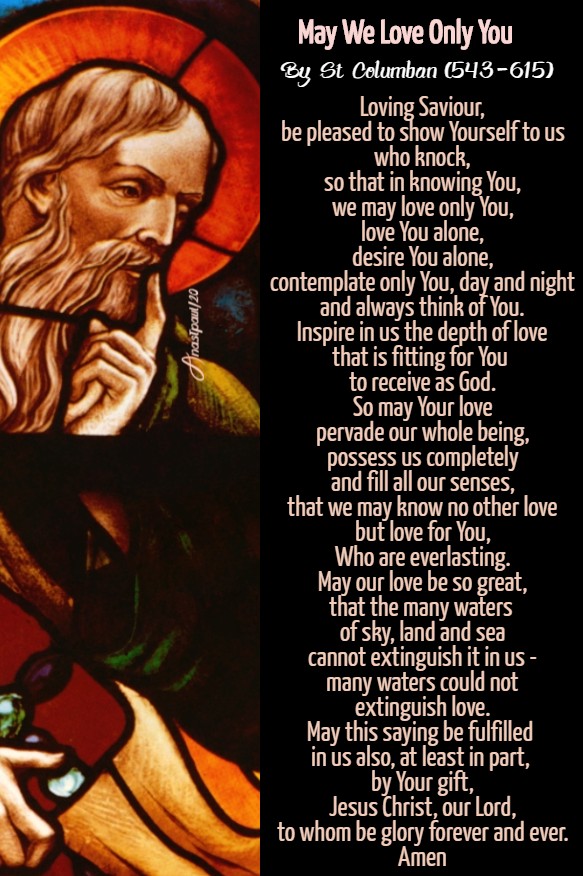
May We Love Only You By St Columban (543-615)
Loving Saviour, be pleased to show Yourself to us who knock, so that in knowing You, we may love only You, love You alone, desire You alone, contemplate only You, day and night and always think of You. Inspire in us the depth of love that is fitting for You to receive as God. So may Your love pervade our whole being, possess us completely and fill all our senses, that we may know no other love but love for You, Who are everlasting. May our love be so great, that the many waters of sky, land and sea cannot extinguish it in us – many waters could not extinguish love. May this saying be fulfilled in us also, at least in part, by Your gift, Jesus Christ, our Lord, to Whom be glory forever and ever. Amen
One Minute Reflection – 23 May – “The Month of the Blessed Virgin Mary” – James 5:16-20, Luke 11:5-13
“Ask and it shall be given you: seek and you shall find: knock and it shall be opened to you. ” – Luke 11:9
REFLECTION – “Whatever you shall ask.” Then why do we often see believers asking and not receiving? Perhaps it is that they do not ask correctly. When a person would make a bad use of what he asks for, God in His mercy, does not grant him it. It is even more the case, that if someone asks what would, if answered, only tend to his injury, there is surely greater cause to fear, in case what God could not withhold with kindness, He should give in His anger. Still, if God even in kindness, often refuses the requests of believers, how are we to understand “Whatever you shall ask in My Name, I will do?” Was this said to the Apostles only? No. He says …, “He who believes in Me, the works that I do he shall do also.” And if we go to the lives of the Apostles themselves, we shall find that he who laboured more than them all, prayed that the messenger of Satan might depart from him but was not granted his request.
Wake up then, believer and note what is stated here: “In my Name.” That [Name] is Christ Jesus. Christ signifies King, Jesus signifies Saviour. Therefore, whatever we ask for that would hinder our salvation, we do not ask in our Saviour’s Name and yet, He is our Saviour, not only when He does what we ask but also, when He does not. When He sees us ask anything to the disadvantage of our salvation, He shows Himself our Saviour by not doing it. The physician knows whether what the sick person asks for, is to the advantage or disadvantage of his health. And [the physician] does not allow what would be harmful to him, although the sick person himself, desires it. But the physician looks to his final cure.
And some things we may even ask in His Name and He will not grant them to us, at the time, although He will some time. What we ask for is deferred, not denied. He adds, “that the Father may be glorified in the Son.” The Son does not do anything without the Father, inasmuch as He does it, in order that the Father may be glorified in the Son, for the Father and Son are One.” – St Augustine (354-430) Great Western Father and Doctor of Grace of the Church (Tractates on the Gospel of John, 73)
PRAYER – Grant, we beseech Thee, O Almighty God, that we, who in our tribulation are yet of good cheer because of Thy loving-kindness, may find Thee mighty to save from all dangers. Through Jesus Christ, Thy Son our Lord, Who lives and reigns with Thee, in the unity of the Holy Ghost, God, world without end. Amen (Collect).
Our Morning Offering – 23 May – “The Month of the Blessed Virgin Mary”
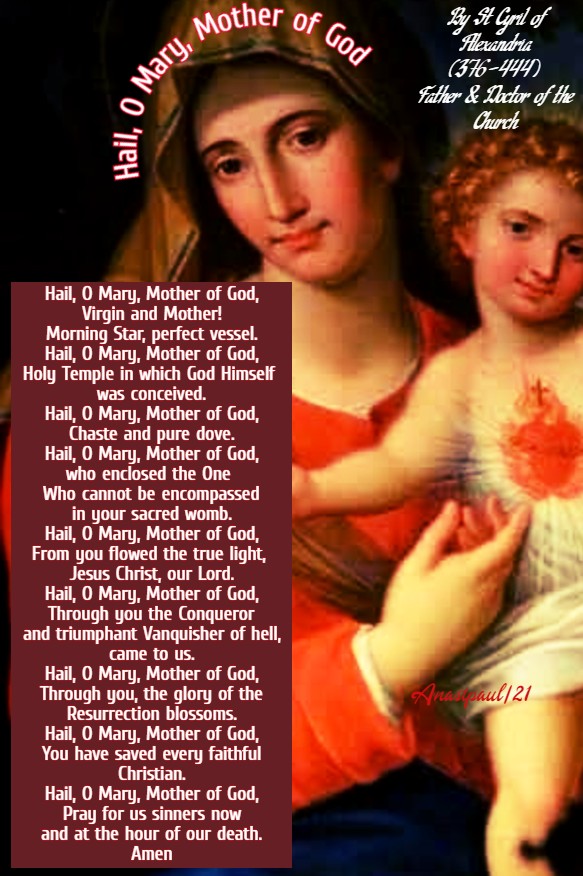
Hail, O Mary, Mother of God By St Cyril of Alexandria (376-444) Father & Doctor of the Church
Hail, O Mary, Mother of God, Virgin and Mother! Morning Star, perfect vessel. Hail, O Mary, Mother of God, Holy Temple in which God Himself was conceived. Hail, O Mary, Mother of God, Chaste and pure dove. Hail, O Mary, Mother of God, who enclosed the One, Who cannot be encompassed in your sacred womb. Hail, O Mary, Mother of God, From you flowed the true Light, Jesus Christ, our Lord. Hail, O Mary, Mother of God, Through you the Conqueror and triumphant Vanquisher of hell, came to us. Hail, O Mary, Mother of God, Through you, the glory of the Resurrection blossoms. Hail, O Mary, Mother of God, You have saved every faithful Christian. Hail, O Mary, Mother of God, Pray for us sinners now and at the hour of our death. Amen
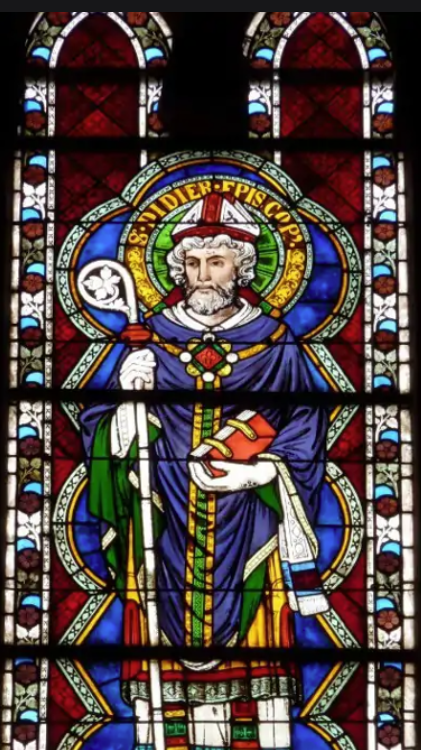
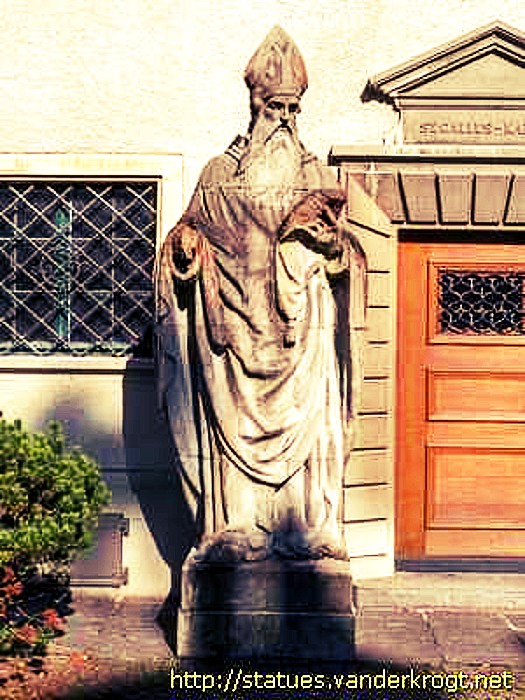
Saint of the Day – 23 May – Saint Desiderius of Langres (c 307-c 356) Martyr, the Third Bishop of Langres, France. St Desiderius is a Cephalophores (one who picks up his head, after being beheaded and walks). Born in c 307 in Genoa, Italy and died by being beheaded in c 356 near Langres, France. Patronages – of the City and Diocese of Langres, of difficult or impossible situations, he is invoked for assistance for those seeking the truth, of Assago and Castelnuovo Scrivia both towns in Italy. Also known as – Desiderius of Genoa, Desiderio of…, Dizier of…, Didier of…, Désiré of… Additional Memorial – 19 January (translation of his relics).
The Roman Martyrology reads: “Near Langres in Lugdunense Gaul, now in France, the passion of St Desiderius, offering himself serenely for the good of the flock entrusted to him.”
Desiderius occupies the third place in the list of Bishops of Langres, it seems he was a native of the surroundings of Genoa and miraculously appointed to the Episcopal See of Langres.
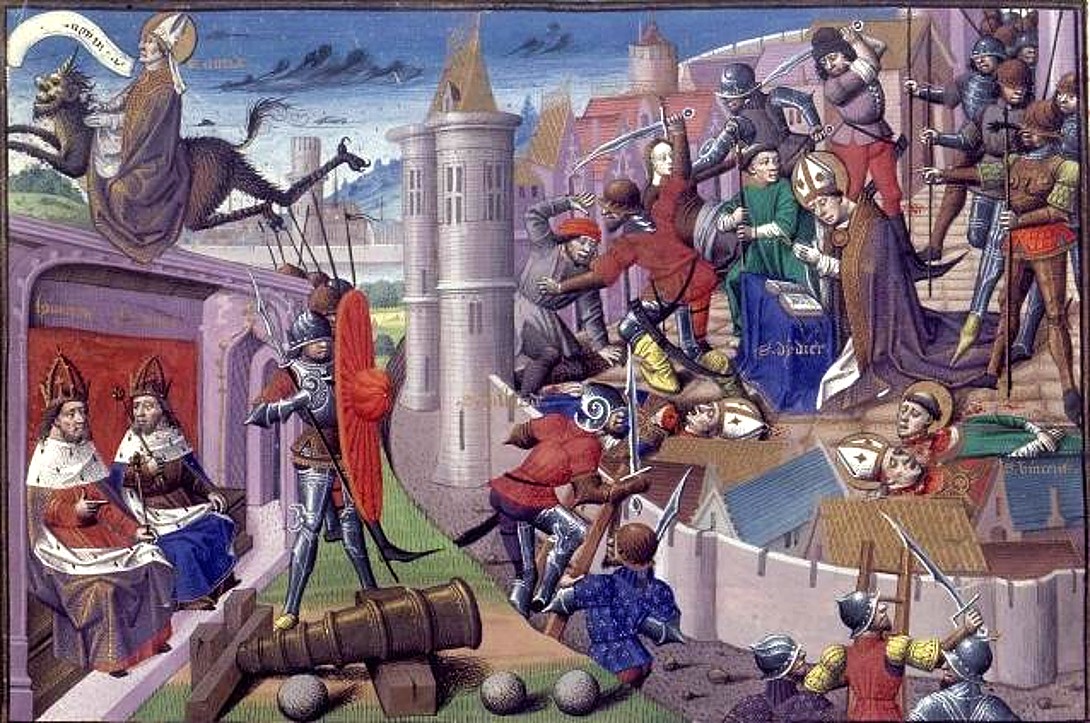
A cleric from the aforementioned City named Varnacario, wrote an account of his Martyrdom at the beginning of the seventh century, based on local traditions. According to this account by Varnacario, the Bishop Desiderius was beheaded during an invasion of the Vandals in which he offered himself to save his flock.
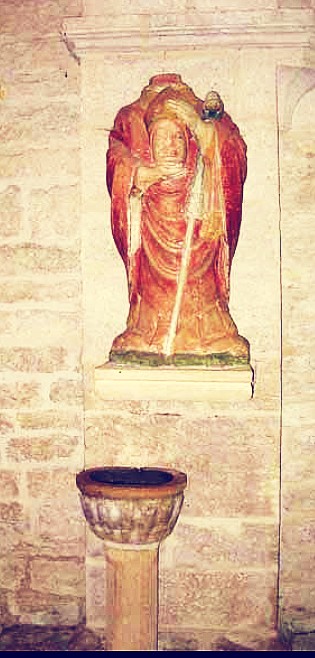
A legend says that after his beheading, the holy Bishop, like so many other cephalophores, picked up his head and returned to the City, through a crack in the rock that had opened to let him pass, this opening is still shown today.
The City of Langres also remembers him on 19 January, the anniversary of the transfer of the relics of St Desiderius which occurred in 1315. His cult spread, not only in France but also in Italy, Switzerland, Germany. He is the Patron Saint of the City of Langres and many Churches in the Diocese are dedicated to him. His tomb was kept in a Benedictine Priory in the centre of the City.
In 1354, a famous brotherhood apostolate was founded in his honour to which Kings and Princes belonged. St Desiderius is invoked as a witness to the truth of the oaths and as a protector in difficult situations.


























You must be logged in to post a comment.